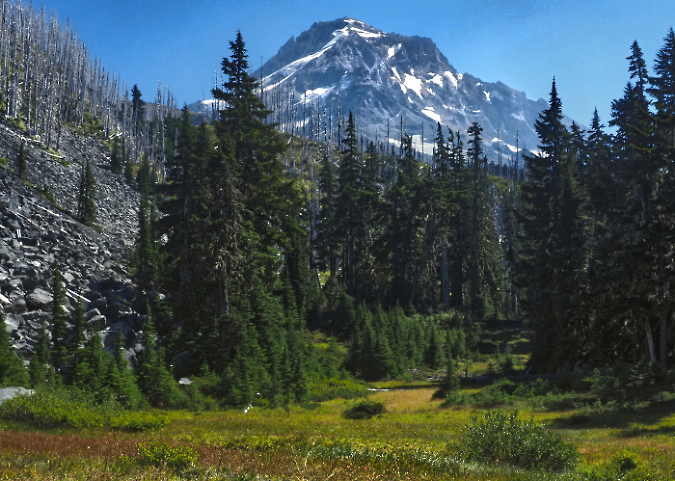
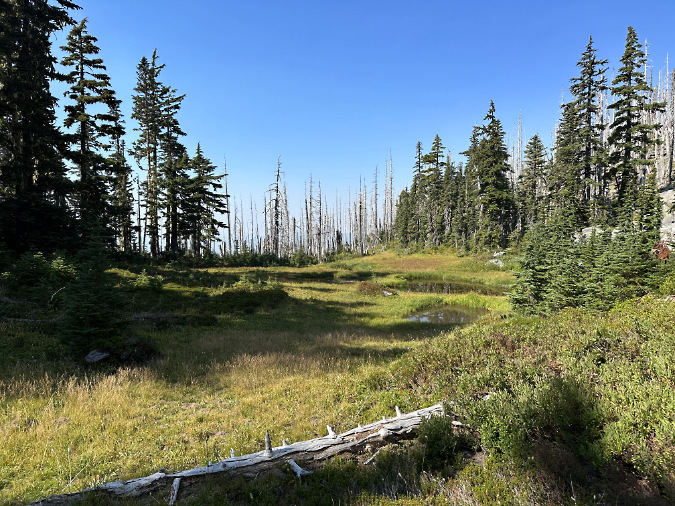
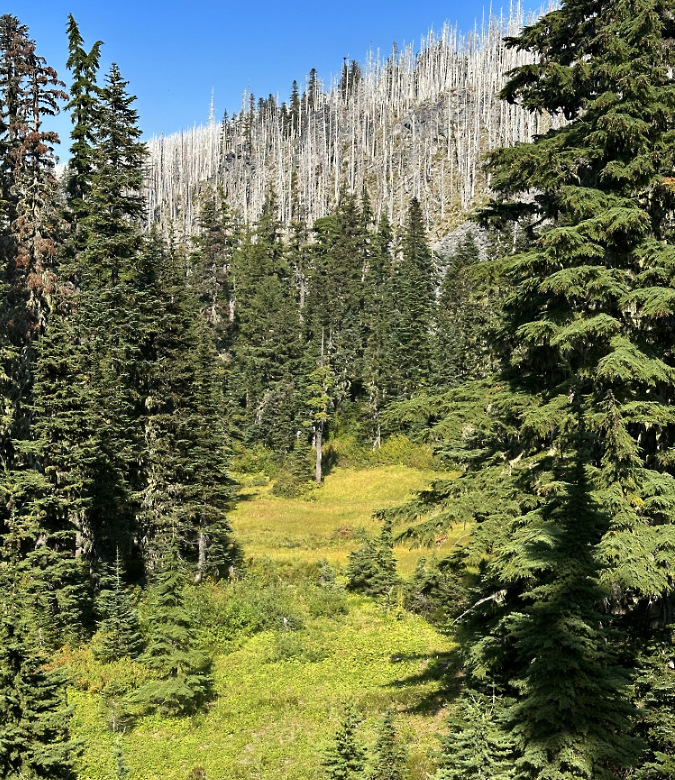
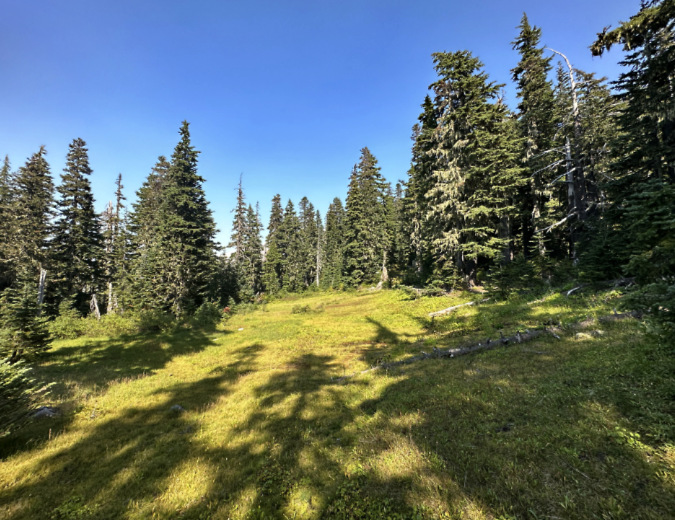
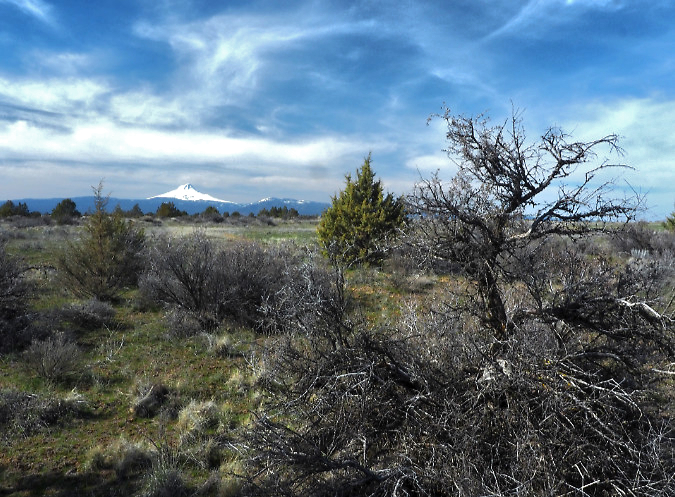
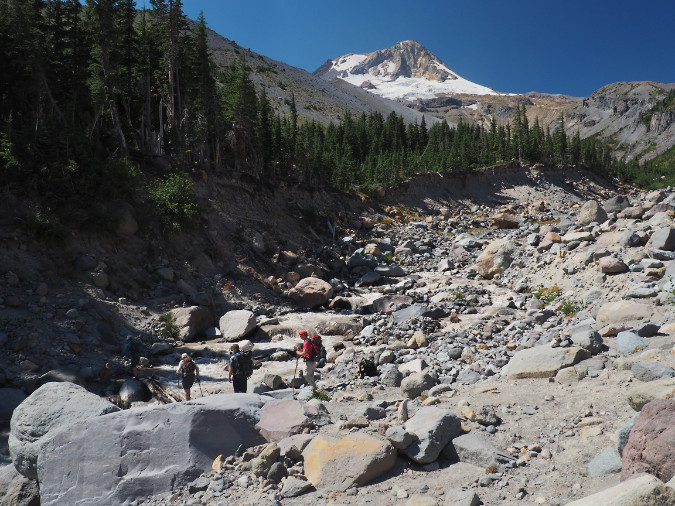
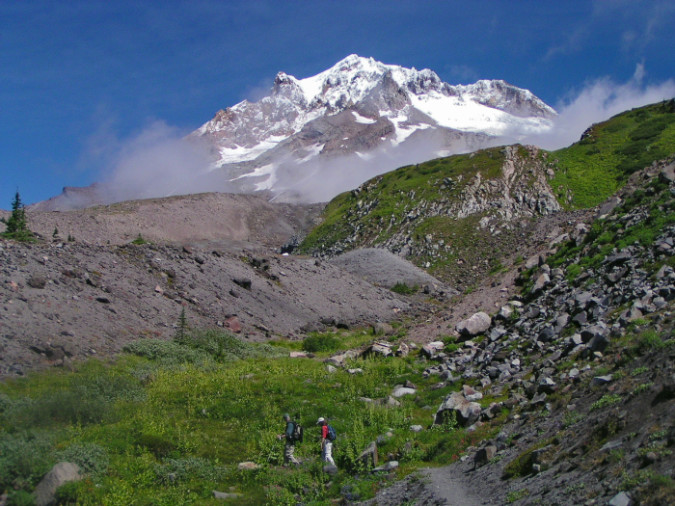
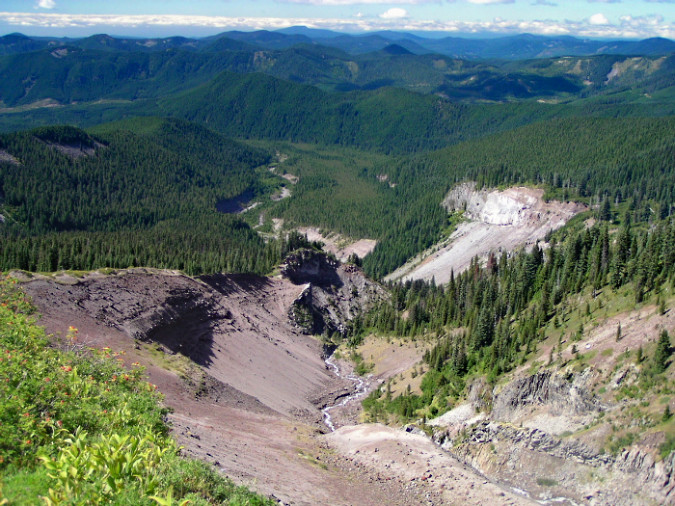
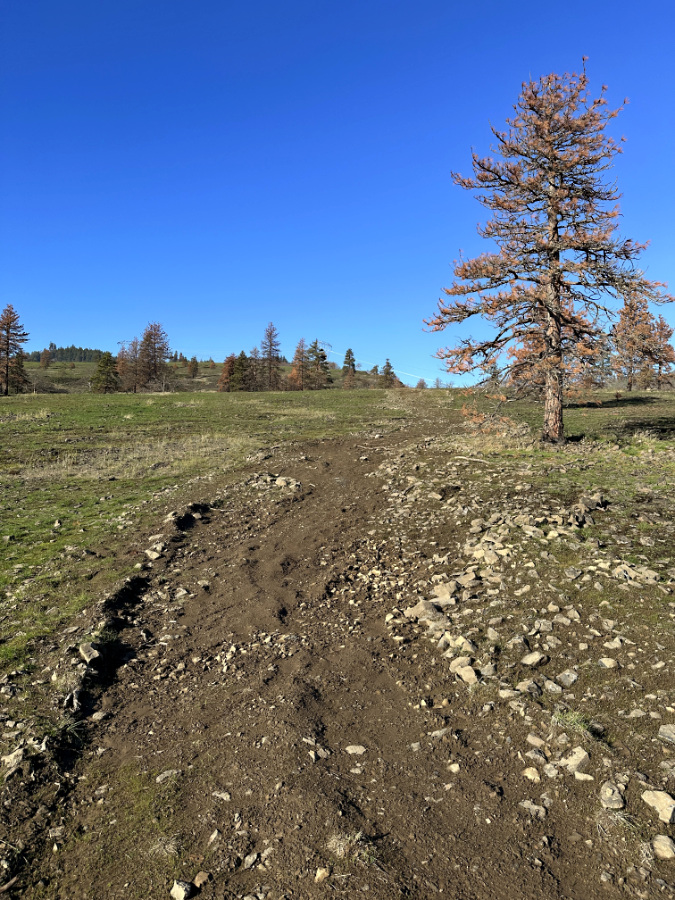
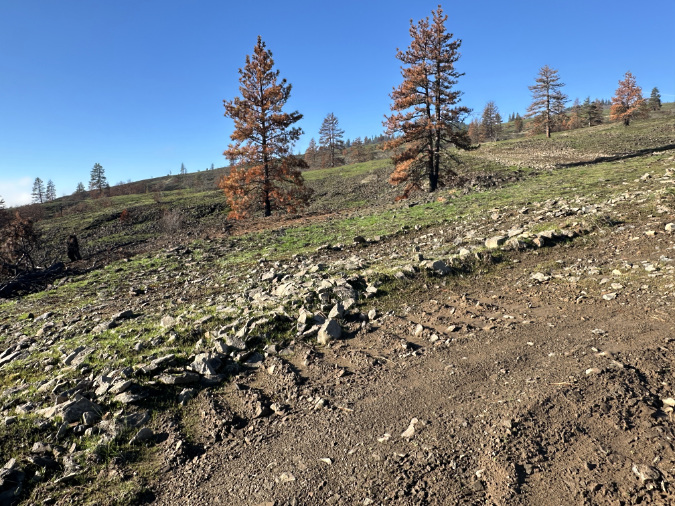
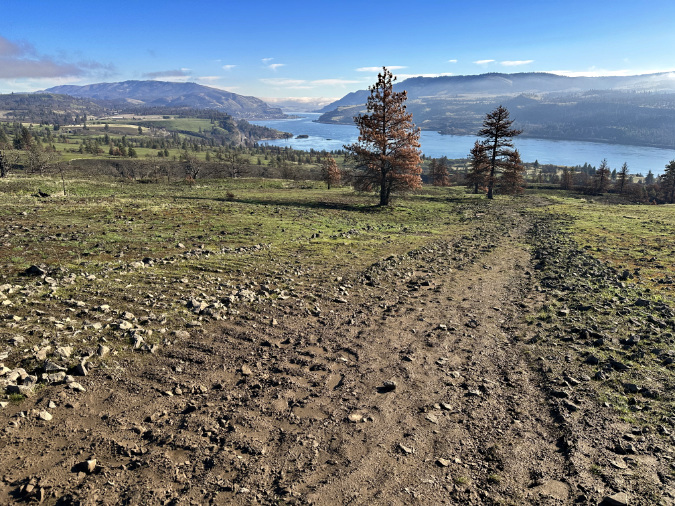
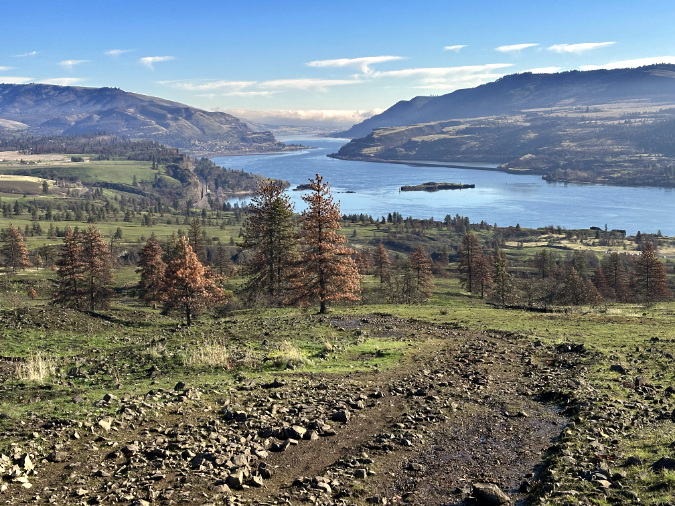
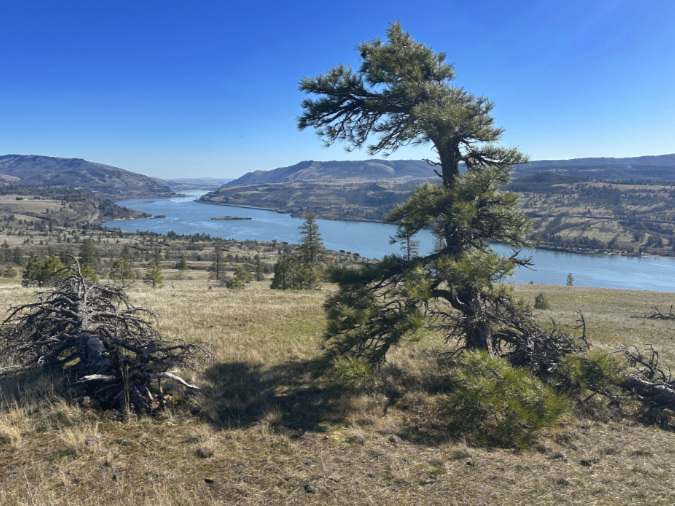
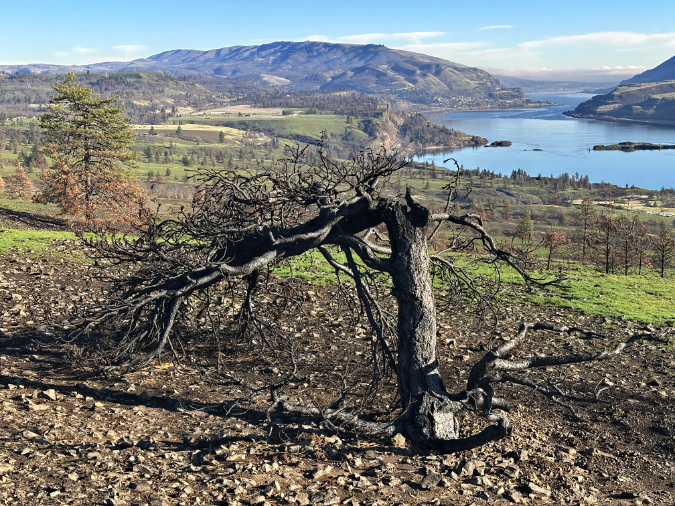
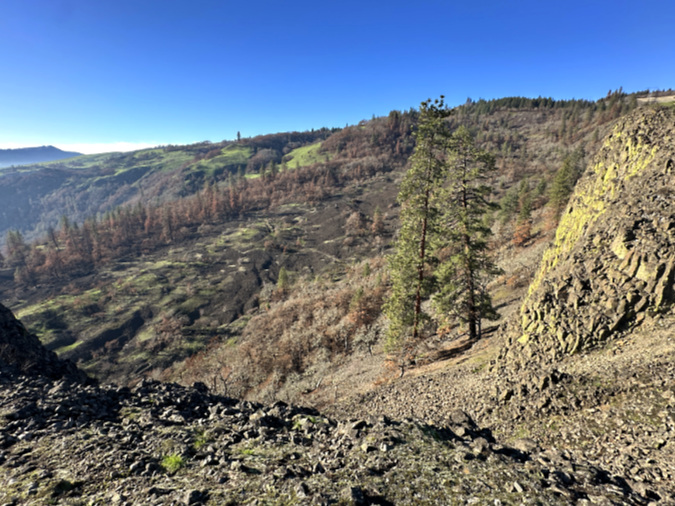
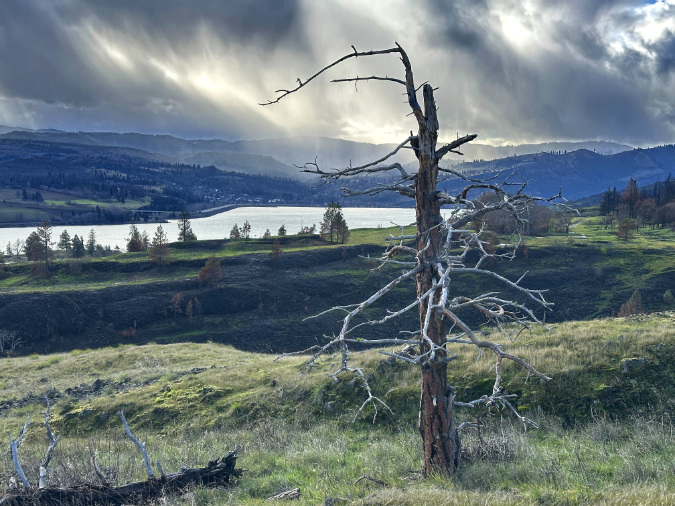
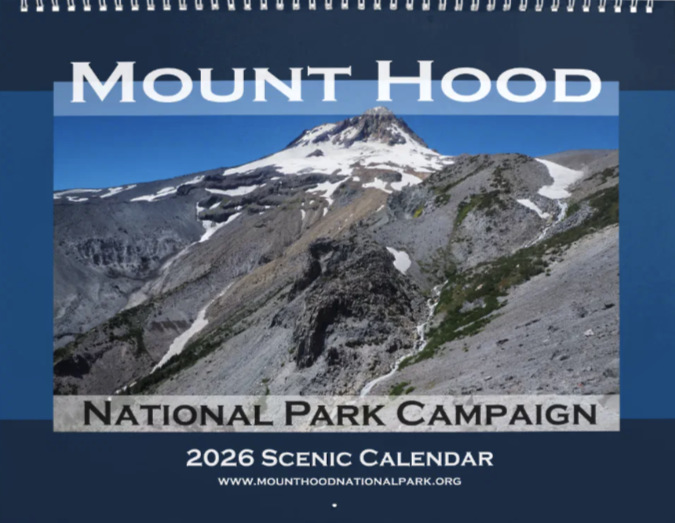
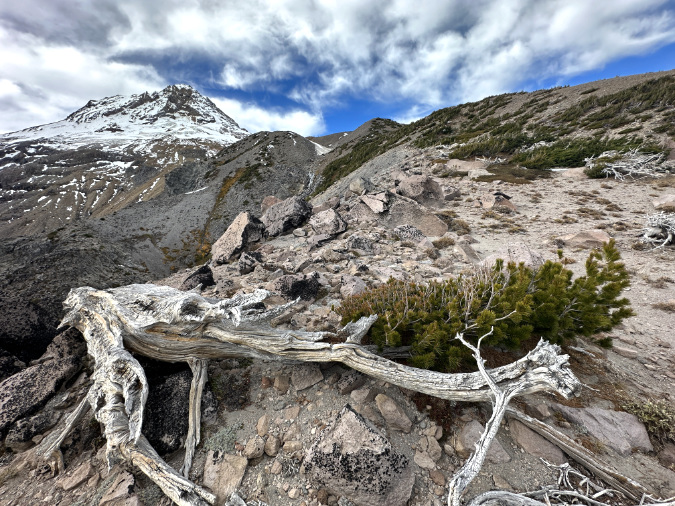
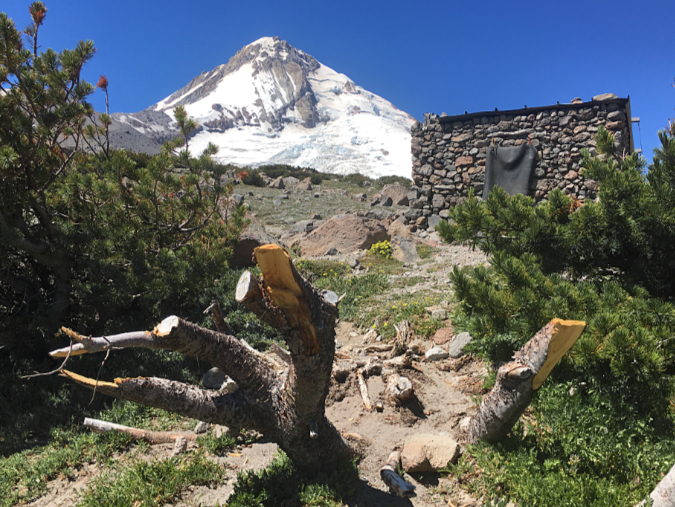
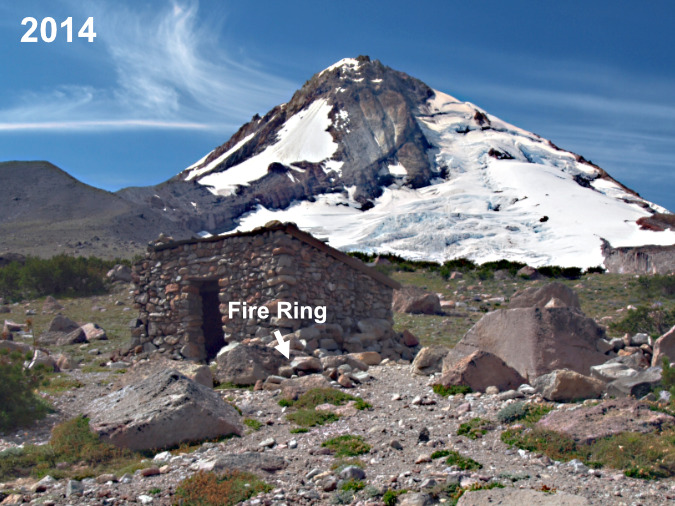
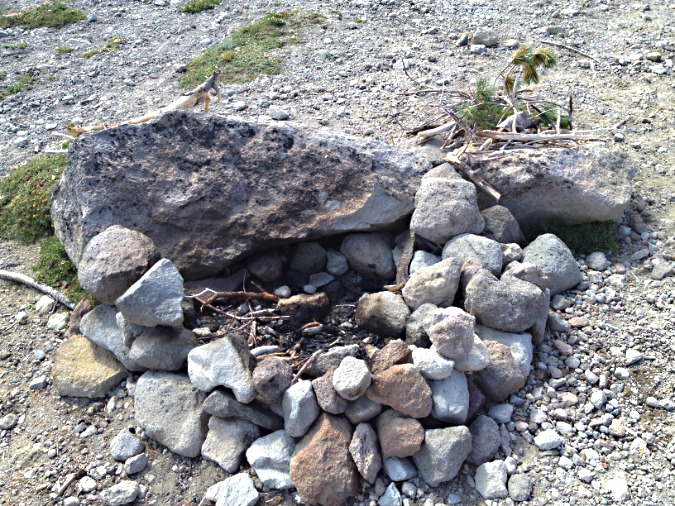
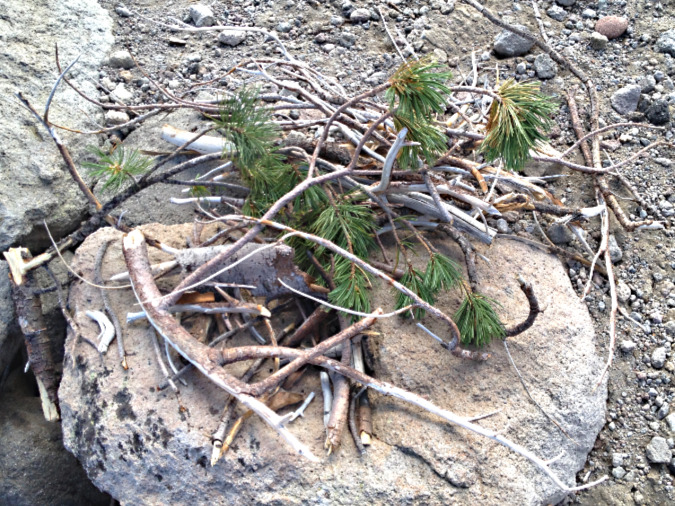
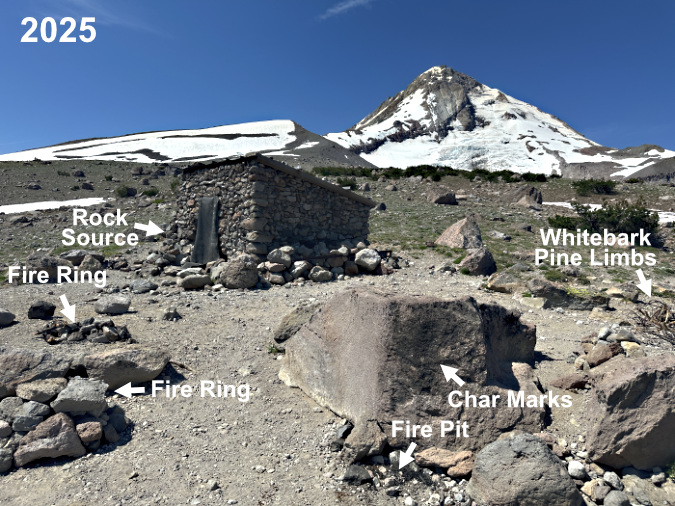
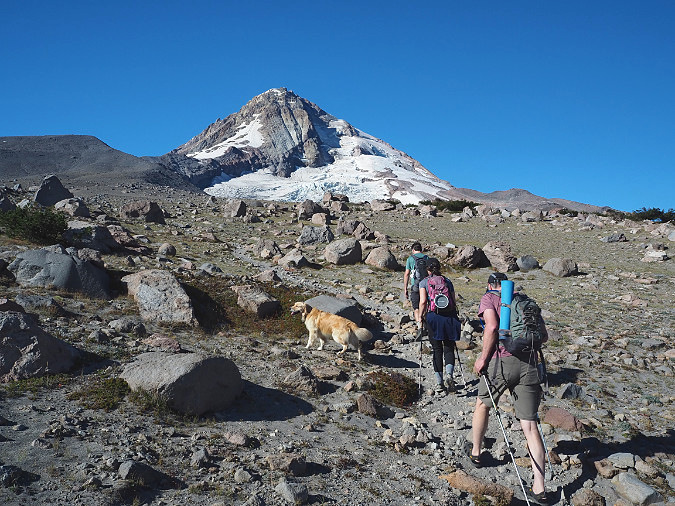
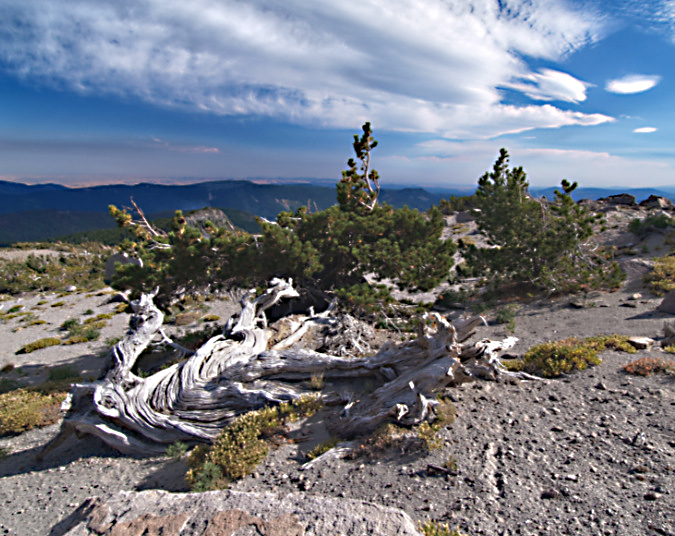
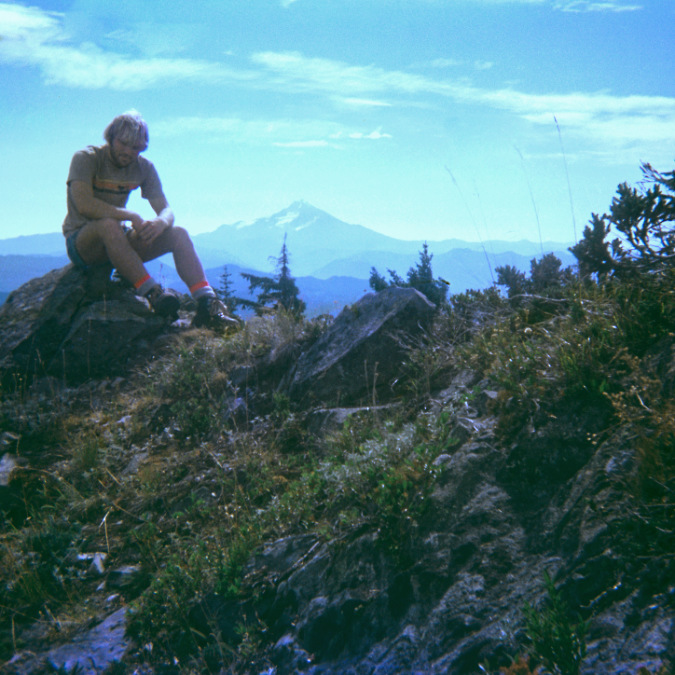
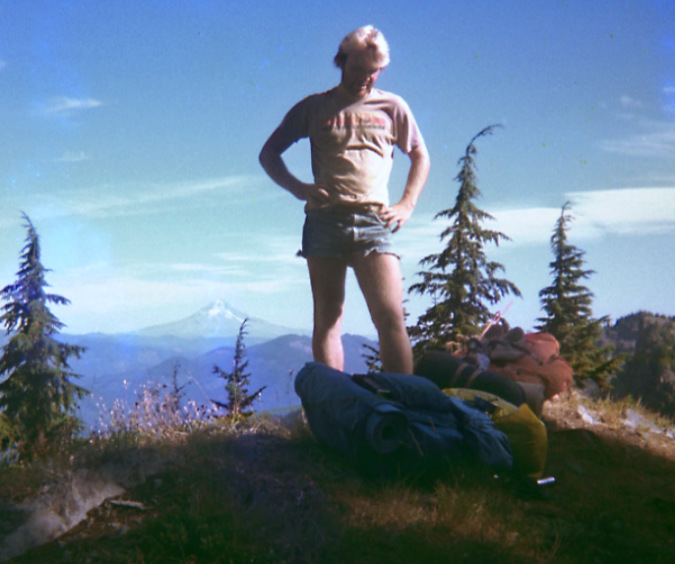
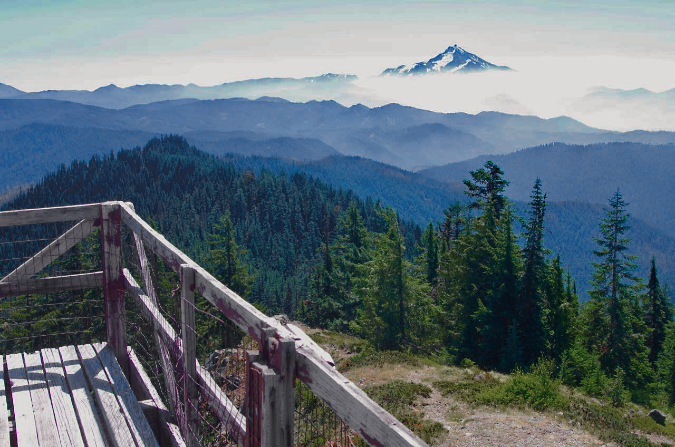
Mount Hood from Lower Vista Meadow in late August of this year
It seems impossible that time can passed this quickly, but August marked 18 years since two trail friends joined me for a memorable off-trail trip into one of the least-known areas in the Mount Hood Wilderness. It’s a place I call “Boundary Point”. What began as sunny, hot summer day soon turned into a brooding, blustery thunderstorm, making Boundary Point seem all the more remote and wild. That 2008 visit was my only time there, but it has lived in the back of my mind as a place that really ought to have a trail.
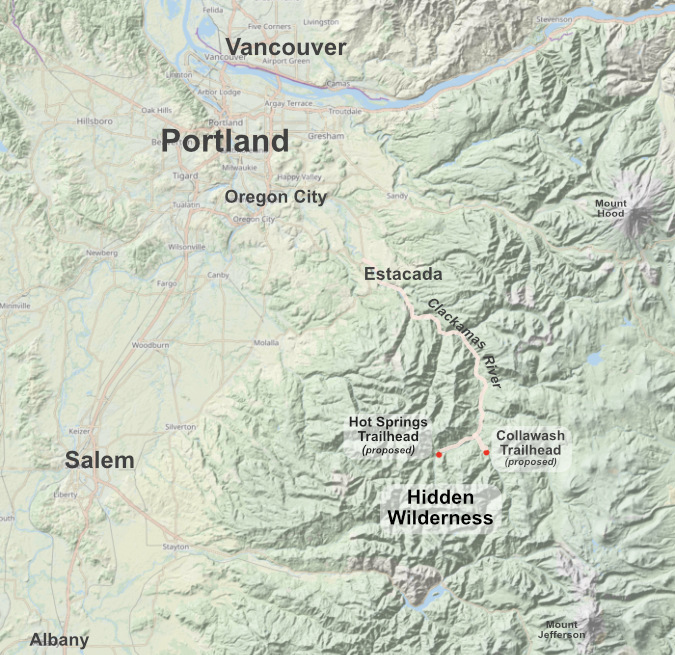
More recently, I’ve made similar off-trail trips to another lesser-known, equally stunning spot within the wilderness that is not far from Boundary Point. I call this place “Vista Meadows”, and this article describes a trail concept that would connect both places in a much-needed expansion of our very busy trail system on the mountain.
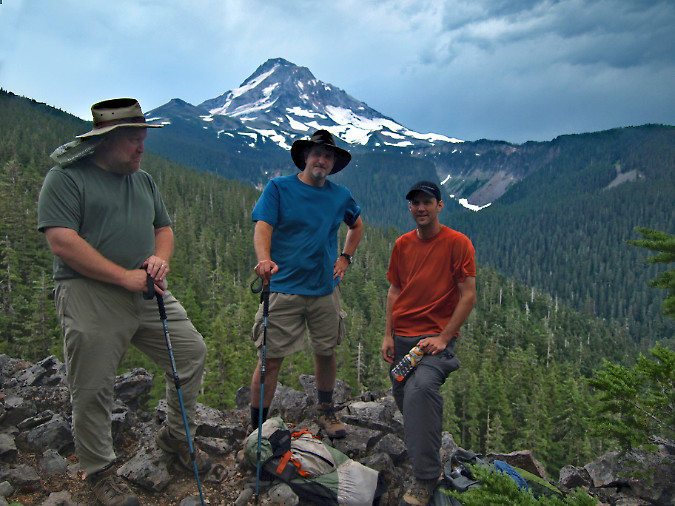
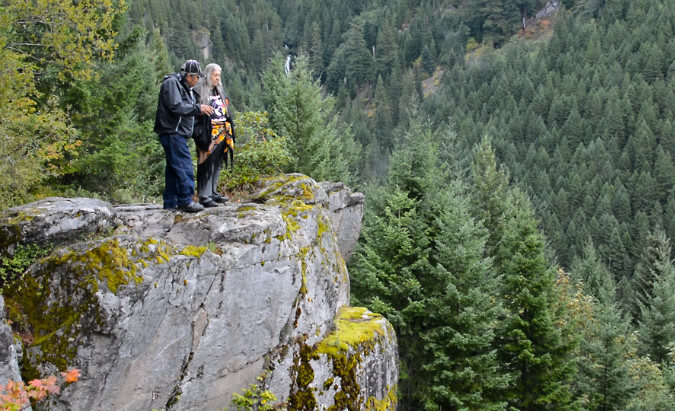
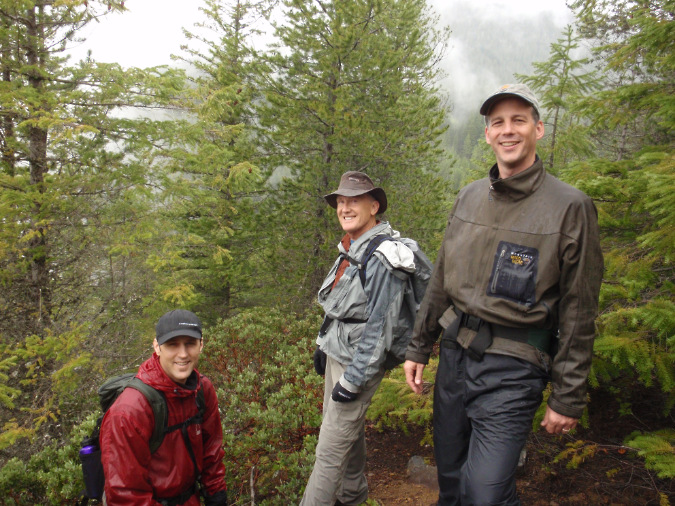
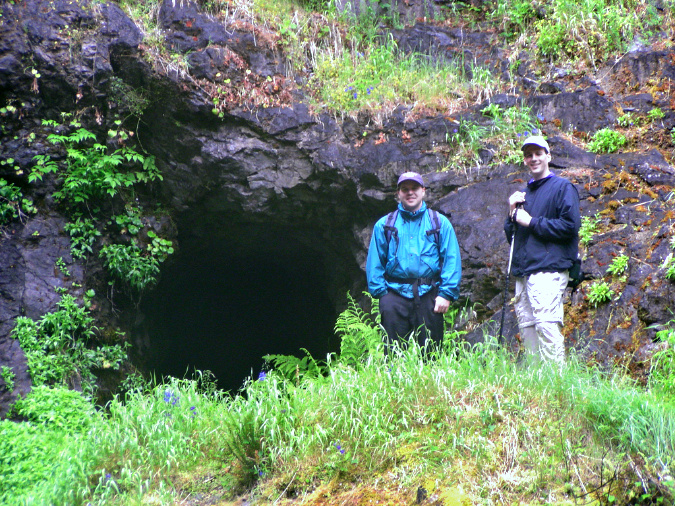
The (much younger author) at Boundary Point in 2008 with longtime trail friends Jeff (center) and Jamie (right). Just three years later the Dollar Fire would sweep across this area in its final flare-up, burning across roughly half the forests visible in this view, including Boundary Point
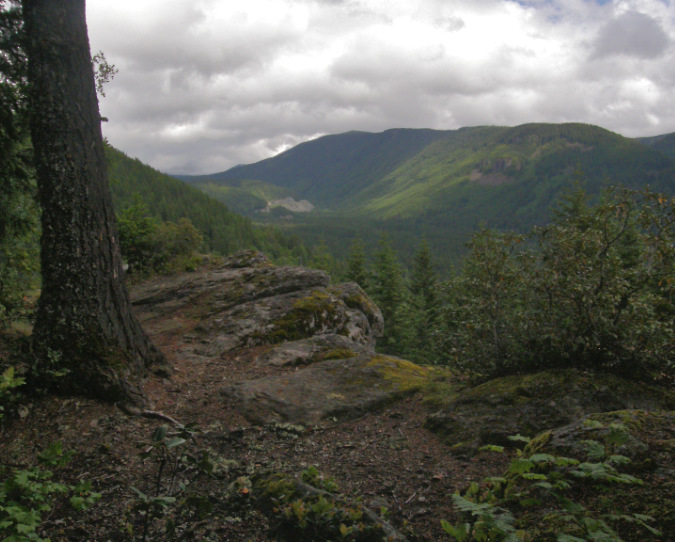
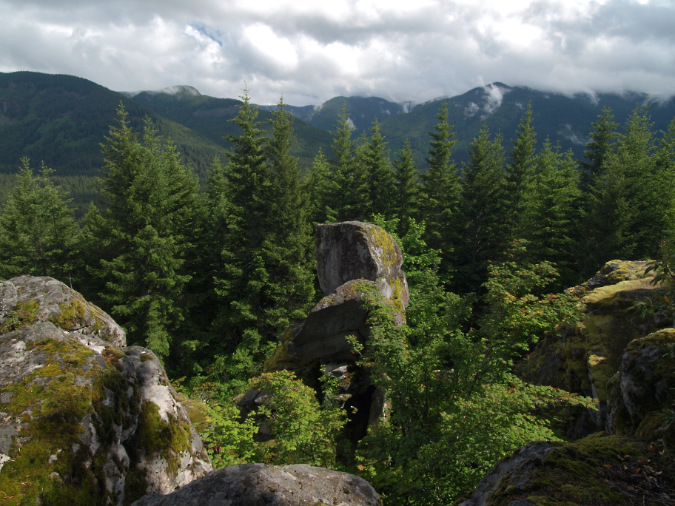
The spot I call Boundary Point is exactly that: a rugged clifftop viewpoint located just inside the wilderness boundary, and therefore just beyond reach of the notorious Boundary Clearcut described in a pair of 2008 blog articles. If the view from Boundary Point seems familiar, that’s because it’s the same iconic perspective of the mountain as viewed from Lost Lake – except much closer.
The view from Boundary Point is truly impressive. Mount Hood towers above, of course, but the view also features a look at jagged Cathedral Ridge rising steeply across Ladd Creek canyon, eventually reaching to the summit of the mountain. The Coe, Ladd, Glisan and Sandy glaciers can also be seen from here, along with a rare glimpse into the very rugged and rarely seen Glisan Creek canyon.
In 2011 the Dollar Lake Fire burned through the upper part of Ladd Creek canyon in its final days, including a good portion of both Vista Ridge and Cathedral Ridge that, together, frame the canyon. Today, the bleached skeletons of ghost trees killed in the fire rise above the slowly recovering forest, gradually regenerating fifteen years after the fire. Forests recover slowly in this unforgiving subalpine environment, whether from wildfires or logging.
Middle Boundary Lake in 2008 (with Jamie), then still barely recovering decades after the massive 1980s clearcut that destroyed a centuries-old subalpine forest along a 2-mile stretch of the Mount Hood Wilderness. The intact forest in the background marks the edge of the clearcut and the wilderness boundary. This protected forest also survived the 2011 wildfire
Lakes are somewhat scarce in the Mount Hood Wilderness. The mountain rises in a narrow spot in the Cascades. Thus, the terrain around the mountain is dominated by steep canyons that drain quickly to the big rivers that flow nearby, so there are few high lake basins like those found around other big Cascade volcanoes. Tiny lakes like Dollar Lake and Perry Lake were therefore given full-blown “lake” status when they were named by early forest rangers, though they would likely go unnoticed elsewhere in the Cascades.
That’s why the group of four small lakes on the northwest shoulder of Boundary Point is notable. Three of these remain as picturesque, untouched lakes, still tucked in among towering, ancient Mountain hemlock and Noble fir stands. The fourth, middle lake was cruelly cut over as part of the Boundary Clearcut – an environmental crime if it were allowed to happen today. But it was business as usual in the 1980s when our forests were sold off in a frenzy to the highest bidders. It was an era when timber sales were auctioned for clearcutting in giant squares or rectangles that had little relationship to the actual land or ecosystem, but were efficient to log and simple to describe in timber sale contracts.
Upper Boundary Lake was spared from the chainsaws because it falls just inside the Mount Hood Wilderness boundary. This shallow tarn remains a peaceful, sylvan place today, as the subalpine forests surrounding the lake were spared from the 2011 Dollar Lake Fire
All four lakes are glacial features, created during the last ice age when the Ladd Glacier filled today’s canyon to the rim and extended nearly ten miles down what is today the West Fork Hood River valley. Along with Boundary Point and Vista Meadows, this group of lakes are among the very scenic features that would be connected for hikers to enjoy along this proposed trail.
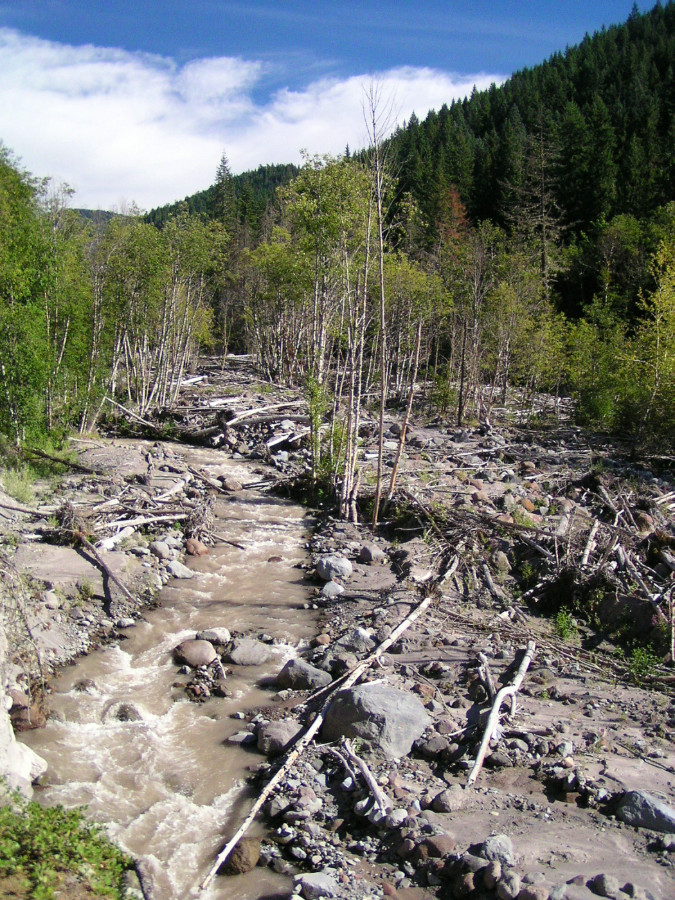
Further upstream, Ladd Creek canyon hides the main surprise: Vista Meadows, the scenic gem the proposed trail would be named for. Vista Meadows consists of a string of alpine meadows hidden in plain sight, just across Ladd Creek from iconic Eden Park. Because Ladd Creek is an often-volatile glacial outflow, it has gouged a deep, boulder-filled channel separating Eden Park from Vista Meadows over the millennia. This physical barrier likely explains why Vista Meadows has gone so unnoticed.
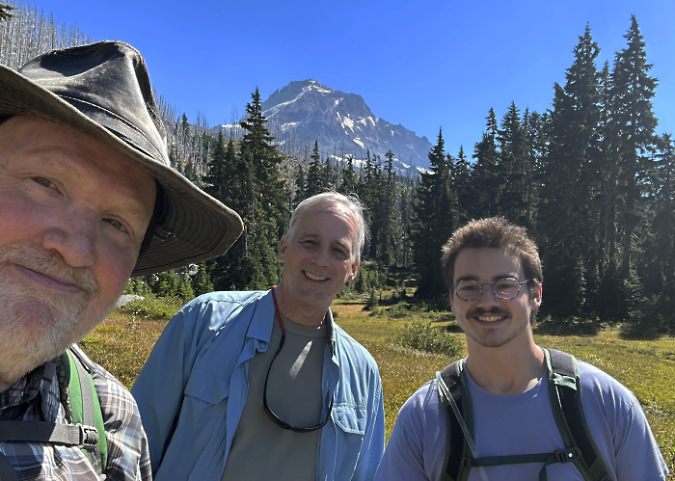
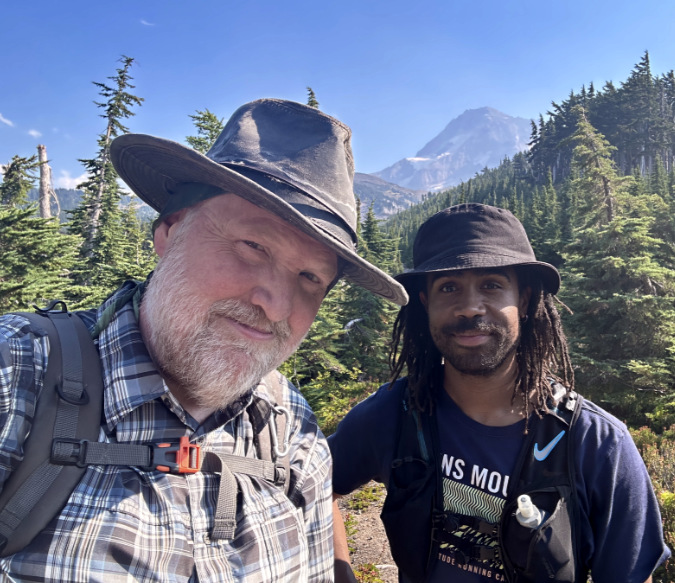
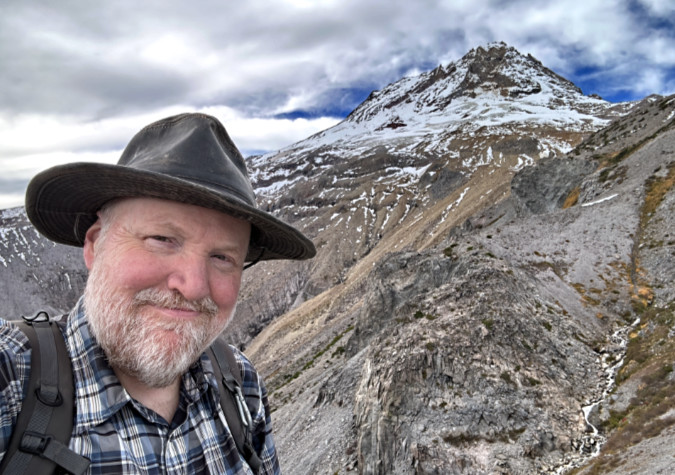
The (now much older!) author at Vista Meadows in August this year with off-trail companions Ted and Logan
At one time, when the once-mighty Ladd Glacier had just retreated from this spot, it left behind a broad, gentle valley floor, with Ladd Creek meandering through newly formed meadows. But like the other glacial streams on the mountain, the creek has since carved a deep channel through that old glacial valley, leaving Vista Meadows and Eden Park perched on either side of today’s canyon as remnants of an ancient valley scene that once was.
Where would the new trail start?
The new Vista Meadows trail would begin at the today’s Mazama Trailhead, located just off the Lolo Pass Road on the northwest side of the mountain. Like most of Mount Hood’s access points, it was never built to handle the demand that today’s summer weekends bring. In fact, this was never designed to be a trailhead, at all. Instead, it was constructed as a landing yard for logs pulled in from clearcuts extending in all directions during the heyday of logging, from the 1950s through the early 1990s.
As recently as the 1950s, the road to the current Mazama trailhead didn’t even exist – nor did Lolo Pass Road! Instead, a trail network connected dozens of long-gone Forest Service guard stations and lookouts located around the mountain. Today’s Mazama Trail is just the surviving stub of one of these original trails, and once connected Mount Hood to Lost Lake. Most of that historic trail network was lost to roads and clearcuts during the logging era, with trailheads incrementally moved up the mountain as the logging operations expanded.
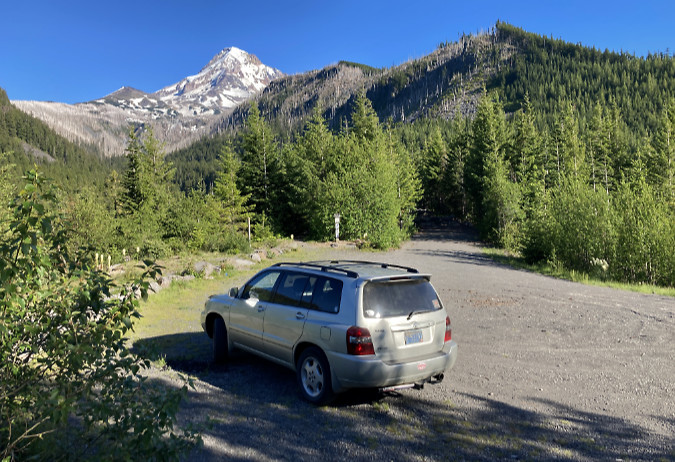
The Mazama Trailhead provides a preview of most of the route for the proposed Vista Meadows Trail, along the ridge to the left of the mountain in this view. The Mazama Trail follows Cathedral Ridge, the main ridge to the right of the mountain. The two trails would connect via the Timberline Trail, forming a long loop from this trailhead
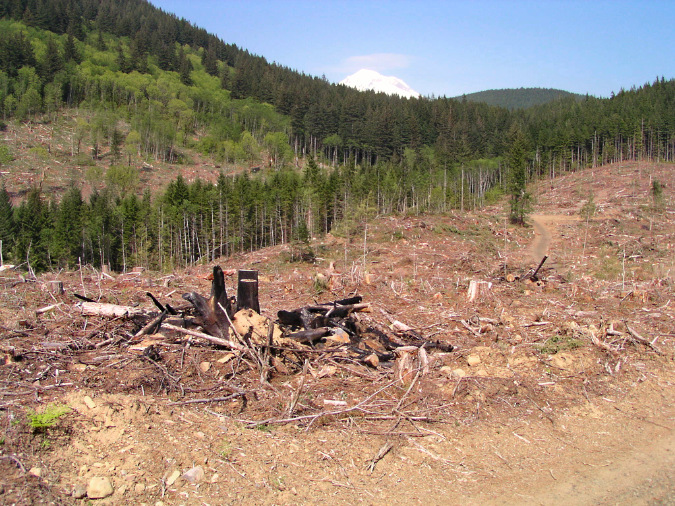
While it’s jarring today to think the Forest Service was logging so high on the mountain, the logging roads and clearcuts continued still further up the slopes from today’s Mazama trailhead. In the photo above, the entire slope on the right is just one of the many recovering clearcuts that fanned out from this spot. Many of the logging spurs in this area have since been closed, but the yarding area here and its access road were repurposed to become today’s trailhead.
For many years the Mazamas mountaineering organization has maintained this trail, and thus the renaming from the “Cathedral Ridge Trail” to the “Mazama Trail.” This trail is just one of the many spokes connecting to the Timberline Trail, with this route connecting just west of Cairn Basin. The proposed Vista Meadows trail would add another spoke to the wheel.
A virtual trip along the proposed route…
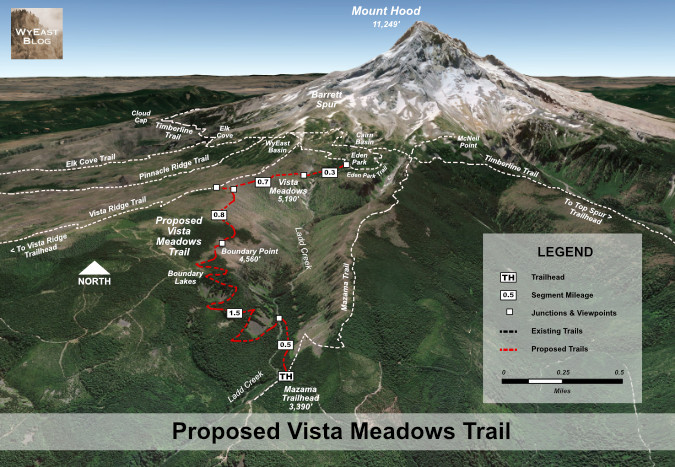
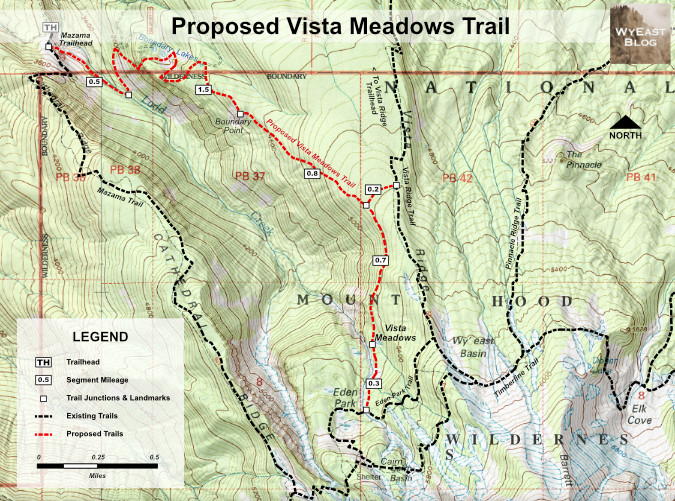
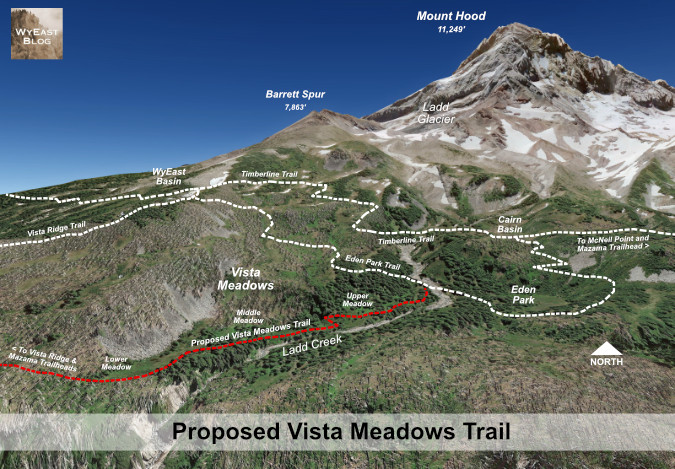
The maps below give more detail on how this concept would work, and how the new trail would complement existing trails and trailheads in this corner of the Mount Hood Wilderness. The first map is a birds-eye view to place the trail in context to the mountain. The second map is a topographic version that includes the surrounding network of trails the new route is intended to enhance.
A birds-eye view of the proposed Vista Meadows Trail connecting the Mazama Trailhead to the Vista Ridge and Eden Park trails, creating both a new trail experience and loop hike opportunities from these adjoining trails and trailheads
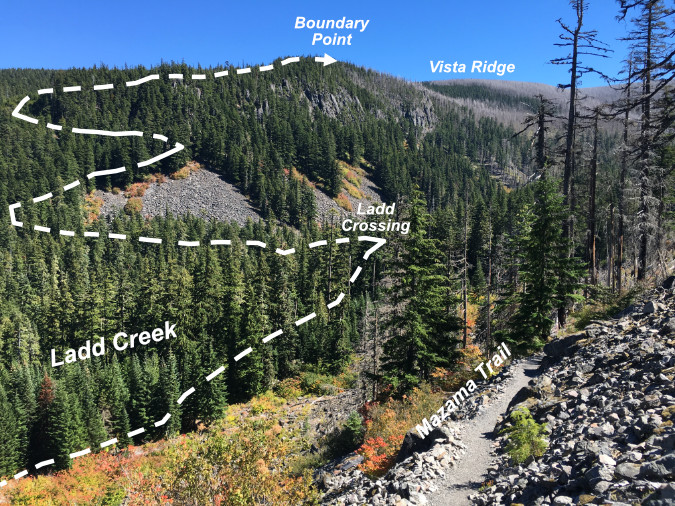
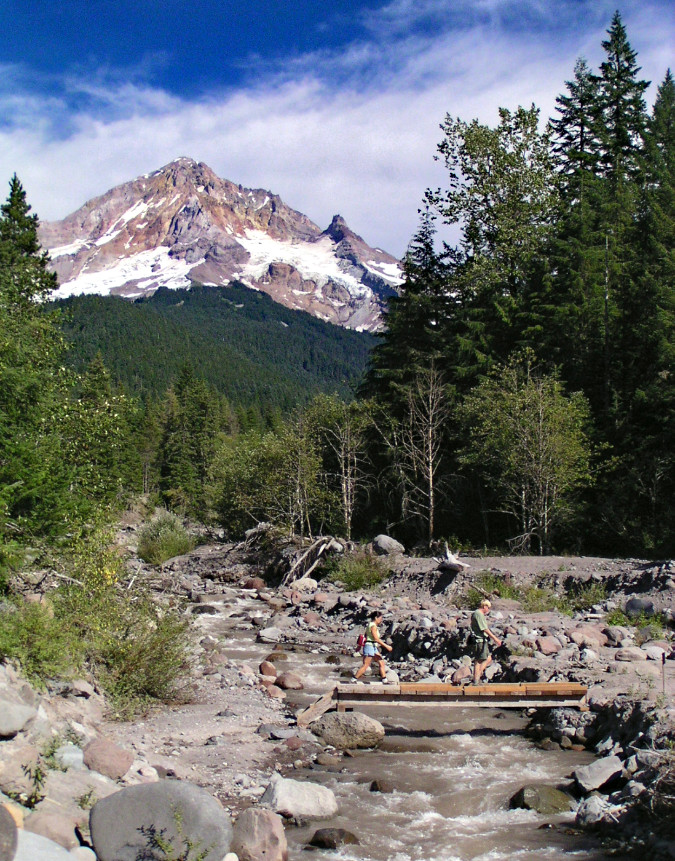
Beginning at the Mazama Trailhead, the new Vista Meadows Trail would traverse below the Mazama Trail into Ladd Canyon, arriving at a crossing of Ladd Creek about a half mile from the trailhead. This would be a permanent footbridge to ensure safe crossings and to make the trail accessible to less experienced or able-bodied visitors. Would a bridge last here? While Ladd Creek can be unruly, it’s not as volatile as some of its glacial siblings, as evidenced by the Lolo Pass Road bridge a couple miles downstream. That modest structure was built just a few feet above the stream and has survived many high-water events over the years.
Route of the lower half of the proposed Vista Meadows Trail to Boundary Point, as viewed from the Mazama Trail
From the new footbridge over Ladd Creek, the proposed trail would climb the north wall of the canyon in a series of long switchbacks, passing broad talus slopes with mountain views before reaching the Lower Boundary Lakes. From the lower lakes, the trail would then traverse a steep cirque wall that protected these lakes from logging, then arrive at Middle Boundary Lake – ravaged by logging, and still recovering from the huge clearcut that engulfed it some 40 years ago.
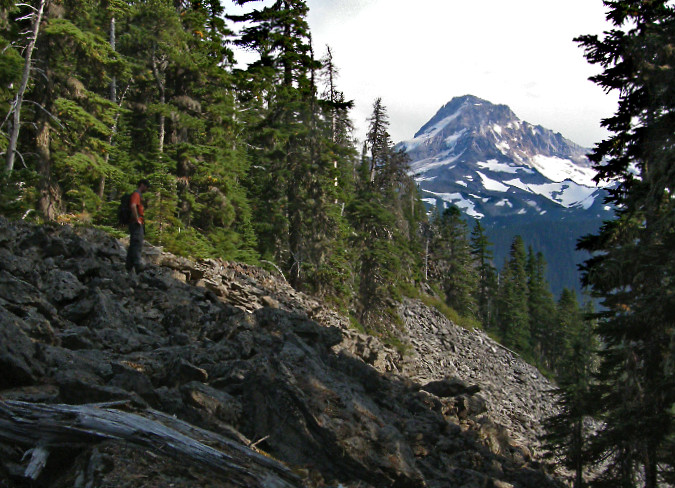
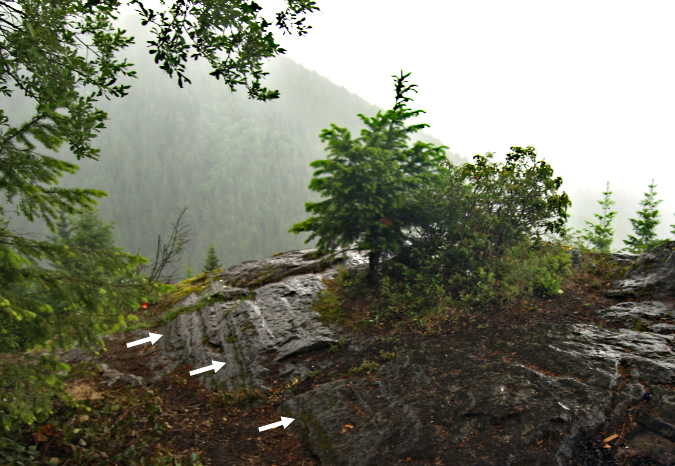
Beyond the middle lake, the new trail would leave the recovering clearcut and re-enter deep forests of the Mount Hood Wilderness, soon arriving at serene Upper Boundary Lake. From here, the final stretch to Boundary Point would begin a traverse above wide talus slopes (below) with fine views of the mountain and into Ladd Creek canyon, now far below. The trail would leave dense forest here and enters part of the Dollar Lake burn that encompassed Boundary Point.
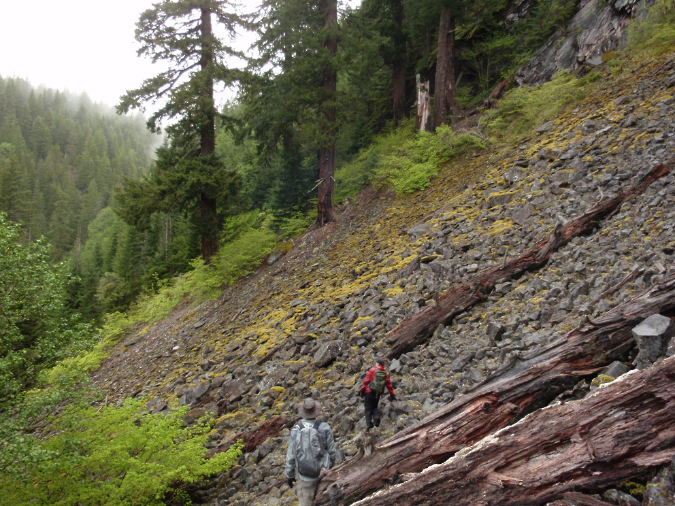
Jamie ascending the final pitch on our 2008 trip to Boundary Point, where Mount Hood comes into view across steep talus slopes. Much of the forest shown here burned in the 2011 Dollar Lake Fire and has since begun a slow recovery
Beyond the talus slopes, the new trail would soon reach the cliff-top views of Boundary Point, described previously. At two miles from the trailhead, Boundary Point would mark the mid-point of the new trail. The impressive views and many picnic-friendly boulders and rock outcrops from which to enjoy the scenery would likely make this the main destination for many hikers.
With a round-trip of 4 miles to Boundary Point and elevation gain of just under 1,200 feet, this segment of the proposed trail would also fill an important need to provide more medium-length hikes on the mountain for casual hikers. Hiking to Boundary Point on the proposed trail would be comparable in length and difficulty to the popular Angel’s Rest hike in the Gorge, for example.
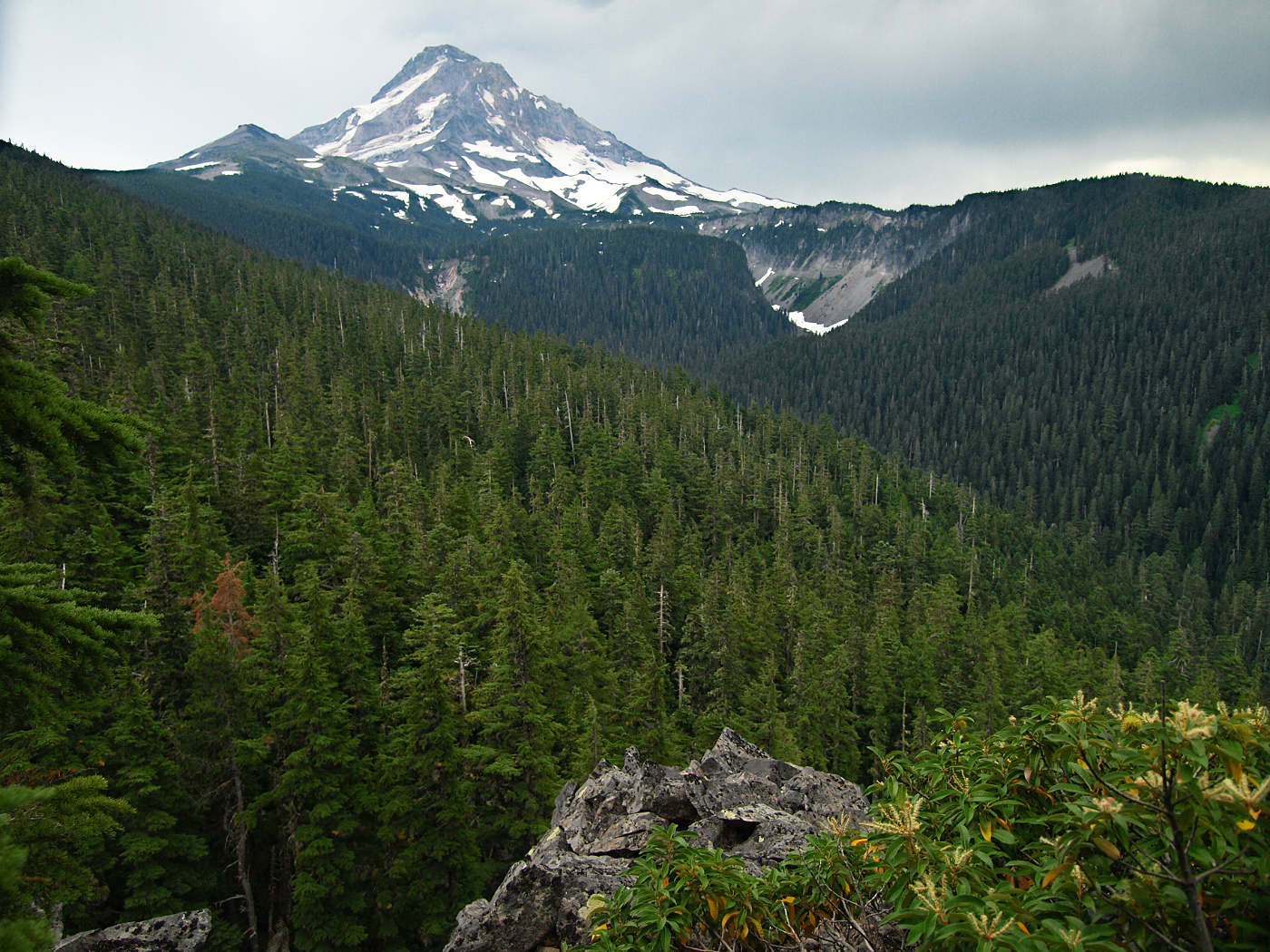
2008 view of Mount Hood rising above Ladd Canyon. Though Boundary Point itself burned in the 2011 fire, much of the forested slope seen in the foreground survived
Though Boundary Point burned in the 2011 fire, a large section of forest just beyond survived (shown in the foreground of the 2008 image, above). From Boundary Point, the trail would first travel through this intact forest of Mountain hemlock and Noble fir as it gradually ascends Vista Ridge, before re-entering another burn area near the ridge crest.
At the 2.8-mile mark, the new route would connect to a proposed quarter-mile tie to the Vista Ridge Trail. This connector would allow for a number of possible loops for hikers approaching from both the Mazama and Vista Ridge trailheads. Loop hikes are the holy grail for many hikers, as they offer maximum scenery and variety. Yet, they also serve a very practical purpose by simply spreading people out. This is a growing need on our very busy mountain.
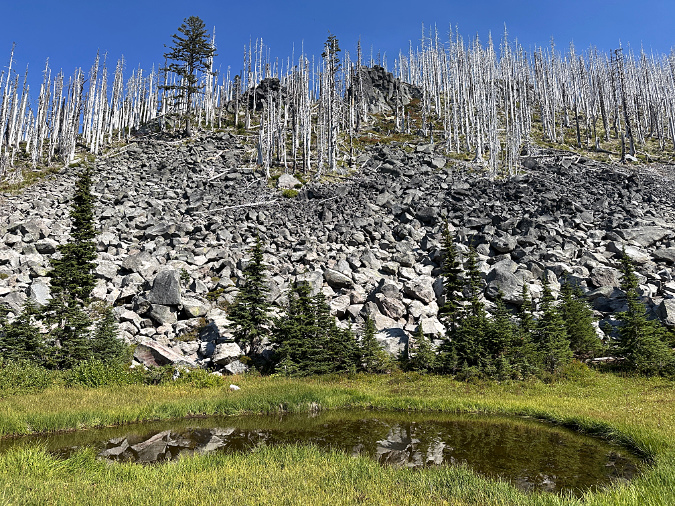
From its high point at the proposed Vista Ridge connector, the new trail would next begin a gradual 0.7-mile descent to Vista Meadows. This part of the route also burned in the 2011 fire, and is now a striking ghost forest with non-stop views of the mountain looming along the descent.
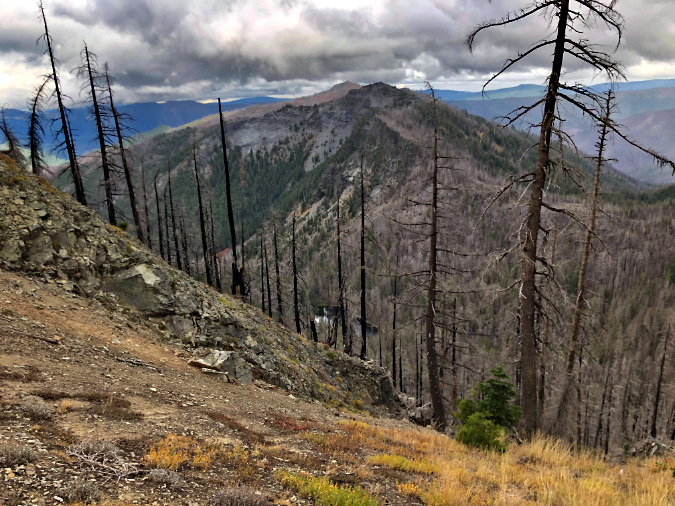
Ghost forests, talus slopes and rocky outcrops newly revealed on Vista Ridge by the 2011 fire, as viewed from Lower Vista Meadow
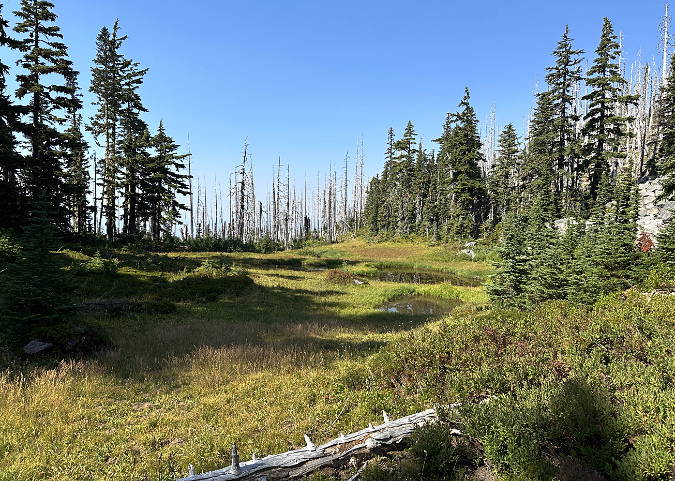
The new trail would soon arrive at Lower Vista Meadow, where it would re-enter surviving forests of ancient Mountain hemlock for the rest of the route. The lower meadow is especially idyllic, with views of the mountain, an impressive talus wall to the east and small alpine tarns sprinkled across the meadow. Year-round streams meander through the meadow, making backcountry campsites within the adjacent forest a possible addition to this trail concept.
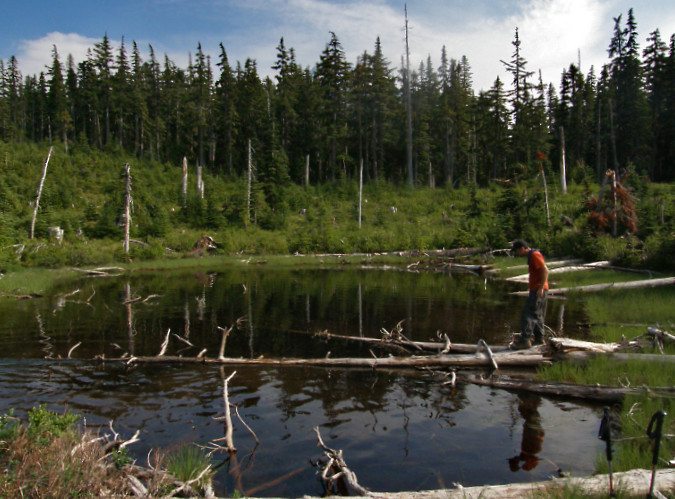
Lower Vista Meadow is dotted with several alpine tarns alive with tadpoles and frogs in summer
The proposed trail would next travel along the forested edge of Lower Vista Meadow, with Ladd Creek rushing loudly in the canyon below, just to the west. Soon, views into the middle and upper Vista Meadows would unfold along this exceptionally scenic, final 0.3-miles of the proposed trail before reaching its junction with the Eden Park Trail.
The total length of the new trail would be just short of 4 miles from the Mazama Trailhead. The elevation gain would be about 1,800 feet, similar to other trail “spokes” that connect to the hub formed by the Timberline Trail.
Middle Vista Meadow is tucked among towering, old-growth Mountain hemlock with the ghost forests of Vista Ridge rising above
Upper Vista Meadow sprawls across a gentle slope, just below the Eden Park Trail
From the upper end of the proposed trail, hikers could make loops through Eden Park, Cairn Basin and WyEast Basin, before returning on the new trail – or Vista Meadows, itself, could be the destination. As a main destination, Eden Park offers has some of the finest campsites on the mountain for people looking to spend a night in the wilderness. More ambitious hikers could also head west from Cairn Basin toward McNeil Point, returning on the Mazama Trail, or turn in the opposite direction to make the steep ascent of Barrett Spur.
The following map provides a closer look at the trail network in the Eden Park vicinity, and how the proposed Vista Meadows Trail would connect to this system.
Detailed view of the proposed Vista Meadows Trail and nearby destinations of Eden Park, Cairn Basin, WyEast Basin and Barrett Spur
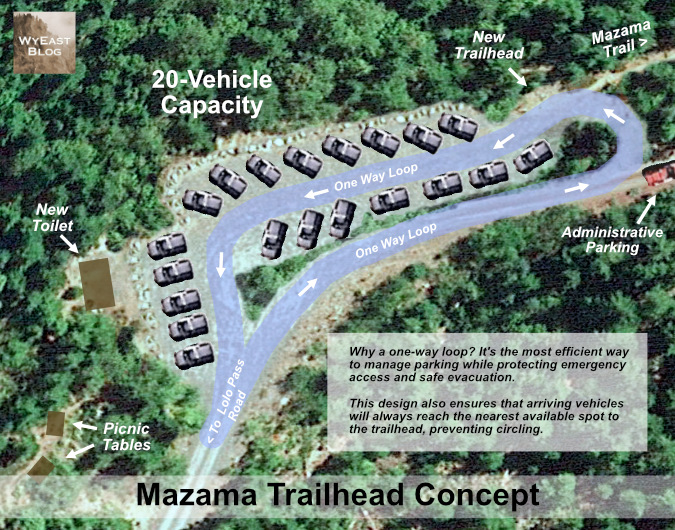
With today’s Mazama Trailhead awkwardly located on a ridgetop better suited to yarding logs than parking cars, the following concept shows one way to improve the trailhead to meet demand for more parking and creating a safer trailhead design for backcountry emergencies.
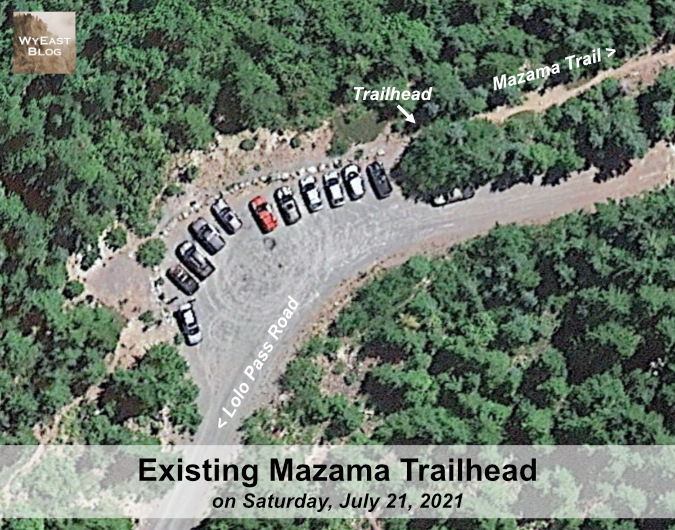
The image below shows the existing trailhead in the summer of 2021, when the COVID pandemic had triggered a surge in trail use that continues today. It was not quite overflowing on that July weekend five years ago. Without an intentional design and some sort of parking management, unimproved trailheads like these have become a growing headache and safety hazard for both visitors and emergency responders when they do overflow with demand.
The Mazama Trailhead as it exists today – simply an old log yarding area that served clearcuts fanning in all directions in decades past
The reimagined trailhead (below) shows how a reconfigured, more organized design within the same footprint as the existing trailhead could create a safer, more efficient access point into the wilderness, while also adding a few parking spaces.
The one-way loop design in this concept mirrors a similar layout proposed in this article for a relocated the Vista Ridge Trailhead. One-way trailhead loops provide safety benefits for emergency vehicles by providing turnaround space and keeping travel lanes defined and less likely to be blocked by parked cars. They also create a more efficient design for visitors by ensuring that the first open space is also be the closest to the trailhead by design, thus discouraging circling for a space.
Unlike the Vista Ridge proposal, this design attempts to make the existing trailhead location work better, but with inherent constraints that limit adding much additional space for parking here.
This re-imagined trailhead would add more parking spaces, an administrative space and turnaround for Forest Service or emergency responders, pit toilet and picnic tables
This conceptual design would accommodate up to 20 vehicles, roughly five more spaces than the current trailhead allows today. Importantly, the design would set aside administrative parking and logistics space for Forest Service workers or emergency responders in an area that is now used for visitor parking.
While this concept is simple and would exist within the bounds of the current trailhead, it would require the Forest Service to do some limited clearing, grading, gravel resurfacing and place a few boulders to better define the space. The proposed toilet and picnic tables would be new to the trailhead, but they are needed and overdue. These additions also represent the threshold for this to become a managed Northwest Forest Pass site, along with an ongoing maintenance responsibility under the forest pass system.
This work could likely be completed without a complex environmental analysis through a process called a “categorical exception” that is used to streamline improvements to existing sites where minimal environmental disruption is expected.
What would it take… and why bother?
Today, the Forest Service is reeling from staffing and budget cuts, whipsawed by a belligerent, often lawless administration bent logging, mining or simply selling off our public lands. Meanwhile, public input on these decisions (or even knowledge of them) has been aggressively curtailed, if it exists at all. So, why even bother thinking about new trails in this oppressive era?
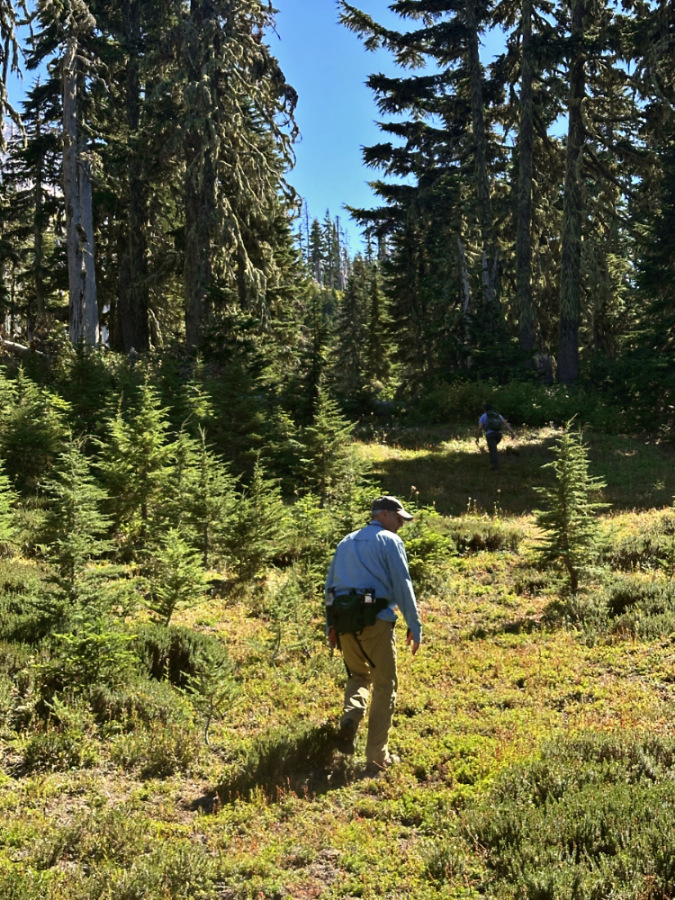
Exploring Vista Meadows with Ted and Logan in late August of this year
One reason is that public fatigue and discouragement are the very point with repressive regimes, especially when their agenda and actions are deeply unpopular with the public. That is overwhelmingly the case right now. Therefore, the importance of thinking – and dreaming – is essential to both challenging the regime and preparing to shape what will come next.
It’s a cycle as old as our democracy. The Civil Rights Movement of the 1950s and 60s lived by a credo that “during good times, plan for the bad, and during bad times, plan for the good.” That makes right now the perfect time to plan for the good – for our trails and the public lands they connect us to. There is enormous power here, as one of the most important takeaways from this grim era is how deeply Americans value our public lands. It’s an overwhelming majority that spans traditional party lines and ideologies, a rarity in these polarized times.
The author with off-trail companion André in July 2023 on our first exploration of Vista Meadows
The origin of our trail system is also worth remembering: nearly all of our trails were built between 1910 and 1940 by people using simple hand tools. In fact, the trail system we cherish today is significantly smallerthan what was originally built with saws, shovels, axes and picks during that brief period. Much of the original system was lost during the first big selloff of our public lands during the industrial logging era of the 1950s through early 90s.
So, today we are simply working to rebuild part of a system and vision that once was. It’s not a moon shot to imagine a new era of investment in our trails and our public lands. It’s just a matter of restoring widely popular priorities when the reset comes. And it is coming.
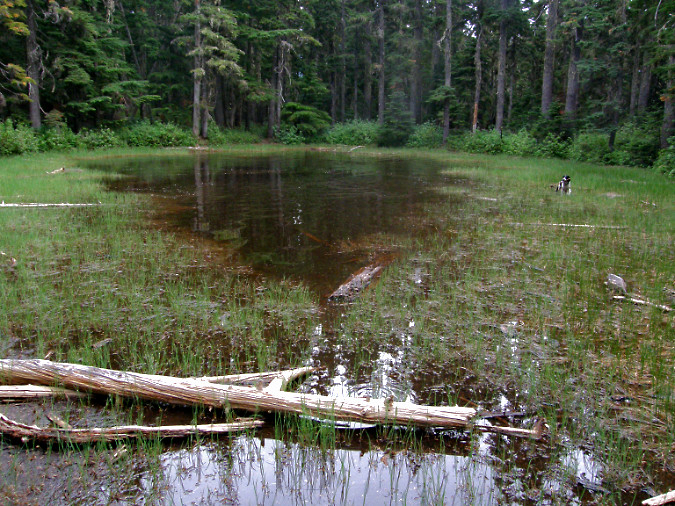
Lower Vista Meadow in July 2023
On a more pragmatic level, it’s also true that it will take some time to undo the harm that has been done to our federal agencies and public lands. To begin building trails again, we will need to ensure that we make the most of our existing system as we work our way out of the hole that has been dug.
Therein lies the challenge for continued creativity and determination, not despair. Those of us who show up and engage will be helping to draft the next chapter… and that usually begins with a little dreaming.
Thanks for stopping by – I hope to see you on a (new) trail sometime!
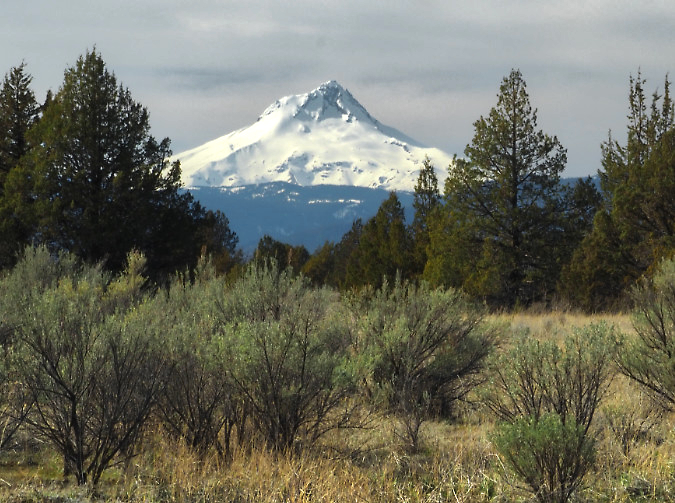
A battle is brewing over large-scale solar, commercial development on protected farmland at Juniper Flat, located in the southeast shadow of Mount Hood
Juniper Flat is a lesser-known corner of WyEast country. It’s a basalt plateau bordered by the White River canyon and Tygh Valley to the north, the deep canyon of the Deschutes River to the east, the Confederated Tribes of Warm Springs Reservation to the south and the forested lands of Mount Hood National Forest rising to the west.
Things haven’t changed much here since white migration began along the Oregon Trail in the 1840s. It’s one of the earliest white settlements in Oregon, as it lies along the historic Barlow Road where the infamous route began its climb over the Cascades. Before native peoples here were displaced by settlers, villages and seasonal hunting and gathering encampments thrived for millennia.
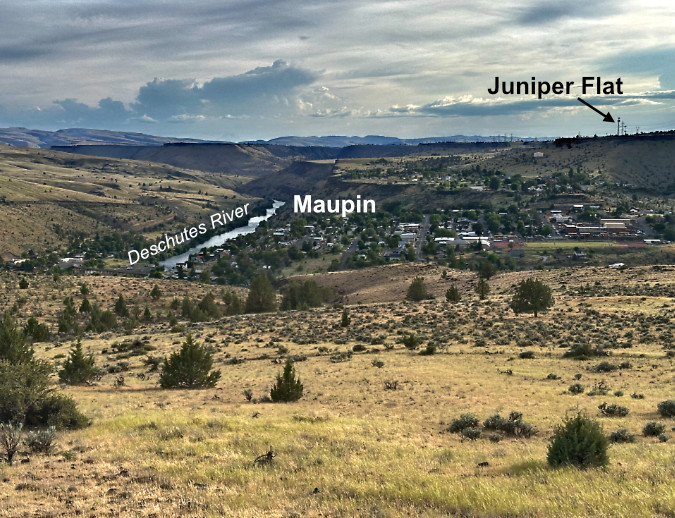
Where is Juniper Flat? If you have traveled to Maupin via Mount Hood, then you have passed through the rural community of Juniper Flat just west of town
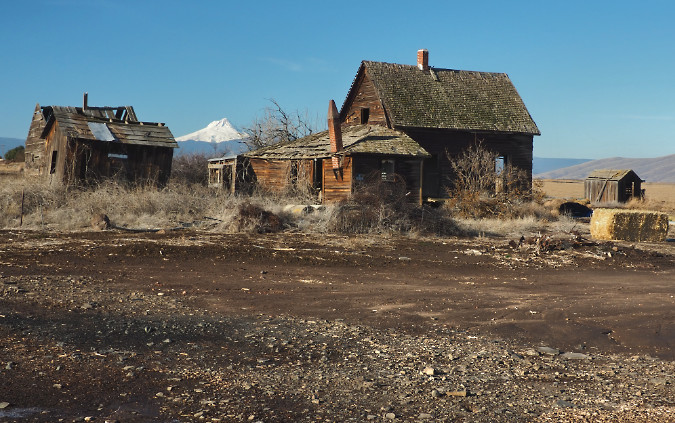
If you recognize this iconic old farmstead along US 197 (just north of Maupin), then you’ve also passed through Juniper Flat
Today, you will find Century Farms and working ranches here, along with the extensive stands of Western juniper that give the flat its name. The juniper forest here is unique, as these are the lowest elevation groves of the species in Oregon, growing at just 1,600 feet. Western juniper typically is found at elevations of 3,000 feet or more in the true high desert ecosystem.
These are also the nearest juniper groves to the rainy Portland metro region, and part of the most compact ecological transect from west side rainforests to east side sagebrush in the entire Cascade Range. Just 40 miles as the crow flies separate the moss-draped canyons of the Salmon River on the west side of the Cascade crest, where rainfall approaches 100 inches per year, to arid Juniper Flat on the east side, which averages barely ten inches annually. So, while Western juniper is common across the dry side of Oregon, these groves are uniquely special.
Hundreds of acres of thriving Western juniper groves Juniper Flat its name. Thanks to the rain shadow created by Mount Hood, they provide complete high-desert ecosystem at an unusually low elevation for the species
The thriving juniper forest also reflects the unusual soils of the flat. Before farming arrived, most of Juniper Flat was covered with “biscuit scablands”, the mysterious, still-debated desert phenomena of fertile soil mounds, or “biscuits” (see the blog article on Desert Mounds), ringed by a low, narrow beds of gravel and basalt bedrock “scabland”.
Where these desert mounds were large and deep enough, farmers plowed them flat to create a thin soil layer deep enough grow winter wheat, or alfalfa and other feed grains with the help of summer irrigation. However, much of the Juniper Flat biscuit scabland is still intact, with desert mounds and scattered juniper groves that are used mostly for grazing cattle. Almost all of the land here is private.
Large tracts of rugged, never-plowed “biscuit scabland” habitat survive among the plowed century-old farms at Juniper Flat. This view looking east includes the nearby Deschutes River Canyon in the distance that forms the east edge of the flat
In winter the rocky “scabland” hollows that surround the mounded “biscuits” of fertile soil often fill with rainwater and snowmelt to form ponds, enhancing habitat for elk, geese, ducks and other wildlife that winter here. These winter ponds are located on the state-owned White River Wildlife Area is located along the northwest edge of Juniper Flat
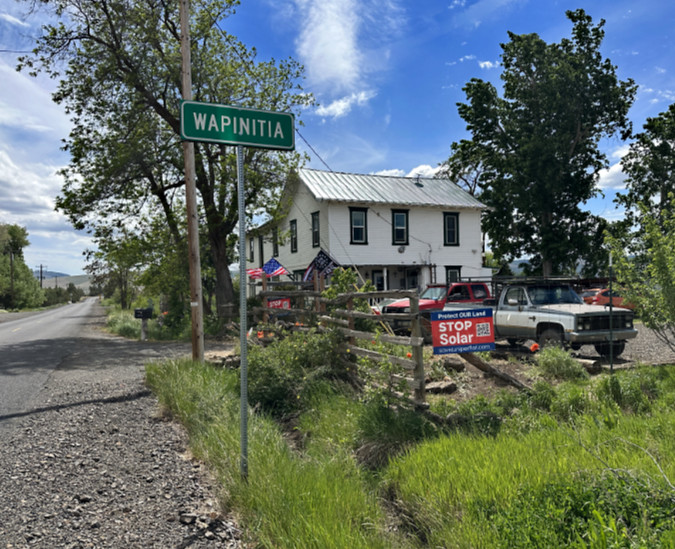
This the was peaceful state of affairs at Juniper Flat until recently, when banners reading “Stop Solar” suddenly began appearing on fences, gates and barns throughout the community. Nearly two centuries after white settlers claimed this area for farming, very big changes seem to be on the horizon.
A national solar developer based in West Palm Beach, Florida called BrightNight has proposed a massive commercial solar array that would straddle the main road that passes through Juniper flat, sending “clean energy” into the nearby interstate transmission lines that stream south to California. The proximity of these transmission lines – an ironic legacy of The Dalles Dam that destroyed Celilo Falls, to the north – is what has put this quiet community in the crosshairs for large scale, corporate energy development.
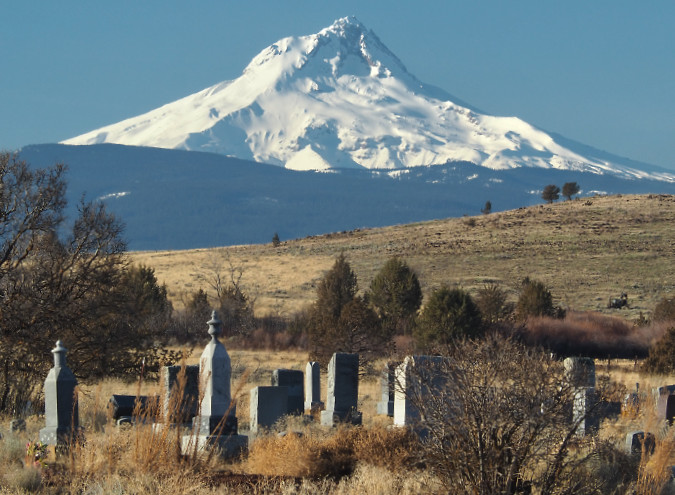
Grave markers at the historic Kelly Pioneer Cemetery in the heart of Juniper Flat record the struggles of white settlers who endured this often-harsh desert environment when farming came to the area in the mid-1800s. Many lives were shortened by the hardships of building a life here. This starkly beautiful area has changed little since those early days – until now
If you have followed the clean energy boom in Oregon over the past few decades, the proposal at Juniper Flat bears strong echoes of the battles over wind energy in the eastern Columbia River Gorge that erupted in the 1990s: farmers and ranchers choosing to sell or lease their land to the power industry were pitted against both neighbors and outside interests who opposed it. Like the earlier wind turbine battles, there is big private utility money involved here, too.
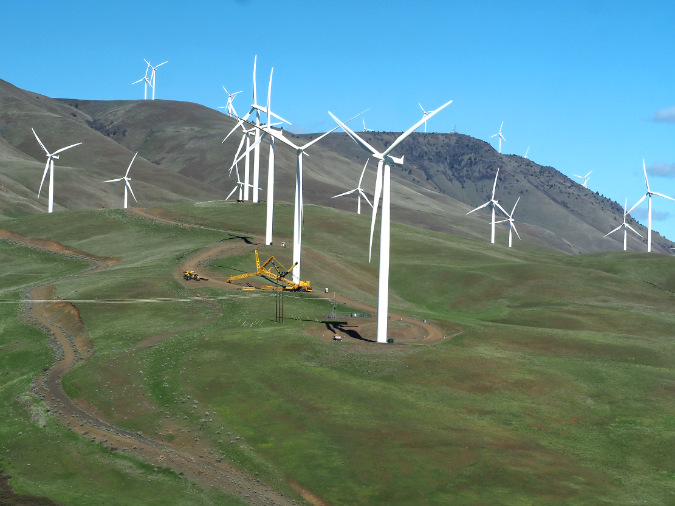
In the East Gorge, the power companies won the battle, with a big assist from the Oregon and Washington legislatures, who handed out large subsidies for clean energy projects like the wind turbine complexes we see there today.
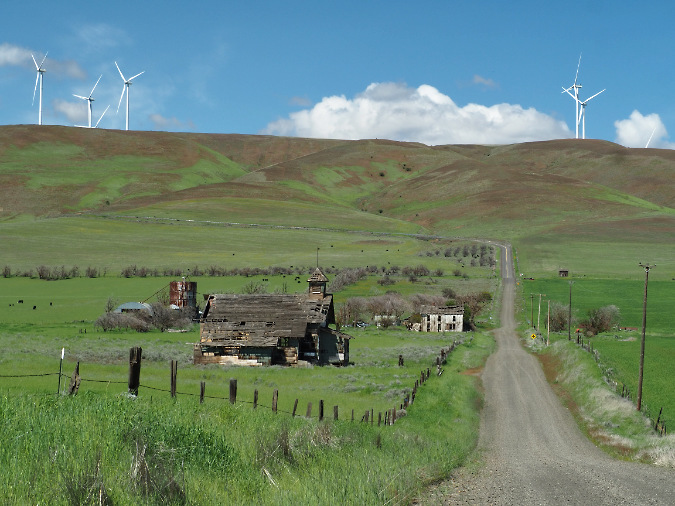
The commercial wind turbine boom in the East Columbia Gorge over the past 20 years has changed rural landscapes in places like Goodnoe Hills for the foreseeable future. Little consideration was given to their visual and cultural impact in the rush to develop the new energy capacity
Like the wind turbine complexes before them, the arrival of commercial solar installations in Oregon’s eastside desert country continues efforts by private utilities to control and centralize electricity production. Just as vast wind turbine arrays were marketed as some sort of modern version of the idyllic family farm windmill from a century ago, industrial-scale solar energy is marketed as something akin to a rooftop panel on suburban home, providing a benign and clean alternative to polluting sources of energy.
It’s an appealing image in an era when we desperately need to expand clean energy production to meet growing power demands and state and global climate targets. Yet, what the commercial wind and solar industries most have in common are massive, industrial-scale operations that span thousands of acres, while providing few jobs in the local economy.
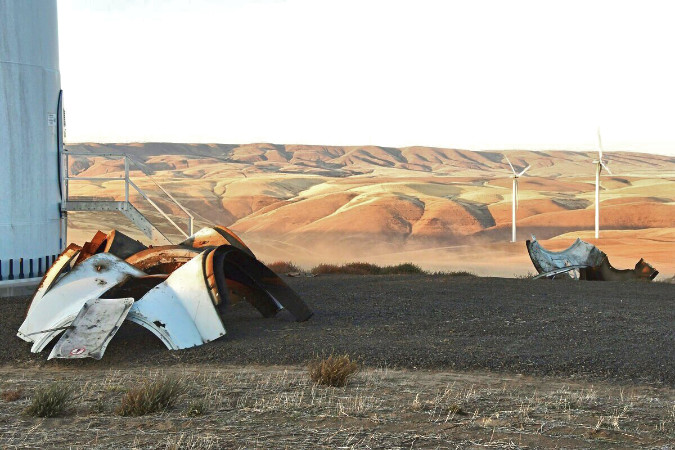
Fallen PGE wind turbine debris at Biglow Canyon has made the news recently, as the wind farm begins to show its age after just two decades (Kathy McCullough/The Times Journal)
A selling point for wind turbines during they 1990s and 2000s heyday was the ability to allow farming, ranching and wildlife passage to continue beneath their turbines, while also providing supplemental income to ranchers who leased their land to the industry. Solar farms make no such promise. Instead, they convert ranch lands with simple, wildlife-friendly barbed-wire fences to fully enclosed industrial complexes, barricaded behind cyclone fences that are topped with razor wire. The desert landscape is erased, completely.
Over the past year, the increasingly dilapidated state of the Portland General Electric (PGE) Biglow Canyon windmills (located about 35 miles northeast of Juniper Flat, in the East Gorge) has been making the news. If past is prologue, the eventual tab for years of deferred maintenance and ongoing mechanical problems of this taxpayer-subsidized development will also be charged to customers of the utilities, not their shareholders.
Not so green? Travelers rushing far below on Interstate-84 see the “green” energy that our private utilities market and sell at a premium when they look up at the forest of white wind turbines in the East Gorge. What they cannot see from below is the maze of access roads permanently carved into fragile desert soils that are required for each tower to be constructed and maintained
Fortunately, PGE is an outlier among the utilities, as most of the first-wave wind farm developers who came to Oregon are upgrading to more efficient turbines and blades as their turbines reach the end of their original design life – which is reportedly about 30 years.
However, even if every one of the wind tubines were phased out and the end of their 30-year life, they would still leave a tangle of unsustainable access roads built to install and service every tower. It’s one of the less-talked about legacies of wind developments, as they are mostly out of sight to the traveling public, and not featured in glossy renewable energy brochures provided by the utilities. In the East Gorge, the many impacts of the service roads also include harm to sites held sacred by area tribes, as described in this article.
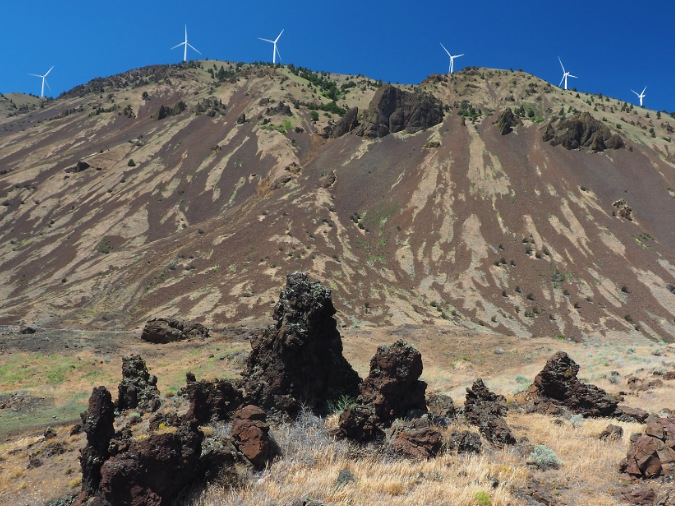
Private utilities built these wind turbines on a bluff in the East Gorge that is sacred to local tribes. The utilities are now are engaged in legal battles over plans to further impact this culturally significant area with still more “green” energy development
While the PGE example at Biglow Canyon is a cautionary tale for all mass wind energy projects built by private interests, the move toward commercial, mass solar energy is even more concerning. Installing modern wind turbine isn’t a practical option for home owners, but adding solar panels and battery storage to homes and businesses is rapidly emerging as the better choice. This hasn’t gone unnoticed by the utilities.
Long caption (and an aside) on my complicated relationship with PGE: yes, I’m a longtime subscriber to their Green Future program, which means I opt to pay premium rates to support PGE purchasing power from renewable energy sources (note the fine print below the chart on the left – PGE buys its renewable energy from power companies across the west). Why do I subscribe to the program? Because PGE is the only game in town and this program is one tangible way to move them toward renewables. However, I’d much prefer to flip the script and apply the surcharge to users who choose NOT to make this shift in the form of a carbon tax, but that policy change has had a fraught history in utility-dominated Oregon politics.Meanwhile, PGE’s residential rates have jumped by more than 50% in the past five years, like most regulated electric utilities in Oregon, and there’s no real way to know how much of that jump has gone toward transitioning to green power. Also buried somewhere in that increase is a significant profit margin for their private shareholders, of course… so, I have a complicated relationship with PGE
Not surprisingly, PGE recently applied for state permits to develop industrial-scale solar arrays at their troubled Biglow wind installation. It’s a move that would permanently destroy the prime farmland their wind turbine installations were purported to protect. While their plans for the aging wind turbines remain unclear, PGE’s interest in moving to massive solar arrays is very clear The utility has proposed converting 3 square miles of farmland adjacent to their Biglow Canyon wind energy complex to industrial solar arrays.
Also not surprising: the solar developer for PGE at the Biglow site is BrightNight, the same Florida developer seeking to bring industrial solar to Juniper Flat. Their company profile describes them as “the first AI-native cognitive enterprise in energy, built around its industry-leading artificial intelligence platform”. Not exactly comforting, if you’ve followed recent news about AI agents “escaping” to roam the internet on their own volition. From the BrightNight website:
____________
“Leasing your land for the development of a renewable power project is a great way to generate an income, invest in your future, and maintain ownership of your property for future use. BrightNight is working with hundreds of landowners across the U.S. Generate income for the life of the lease and when the project’s operation is complete (average 30-50 years), then the project is removed, components recycled, and the land is restored to the condition in which it was found – ready for you to use again!”
____________
Make of this corporate-speak what you will, but this pitch to landowners helps explain the appeal to dryland farmers at a time when they are under multiple stresses, ranging from the escalating effects of climate change to international tariff wars and growing regional labor shortages due to immigration policies.
Trapped in the Grid?
Electricity generating projects are almost always described by the number of “households” they can support, ostensibly because it’s a relatable concept to their residential consumers. And yet, “households” only account for about one-third of the electricity demand in Oregon. Roughly one-quarter of our electrical power goes to industry while a whopping 40 percent is consumed by the commercial sector – which includes data centers.
Electric utility customers often have the option to pay extra for “green” electricity (see my very long caption, above) to help transition the power industry away from fossil fuels. Unfortunately, efforts by the Oregon Legislature to put the premium price burden on non-renewable sources in the form of a carbon failed a few years ago, and so the state is mostly regulating its way to renewable energy through existing laws that have much less impact – and counting on consumers to subsidize green energy on our own.
There’s another way to move more quickly to renewable, clean energy: move the residential sector off the centralized grid. That would not only protect households from having to bear the burden of the explosive growth in commercial energy consumption with double-digit rate increases, it would also make the system more resilient and diversified. In a region where wildfire risk is increasingly forcing private utilities to shut down their distribution lines to avoid catastrophe, being on the grid will become increasingly reliable – especially in rural areas.
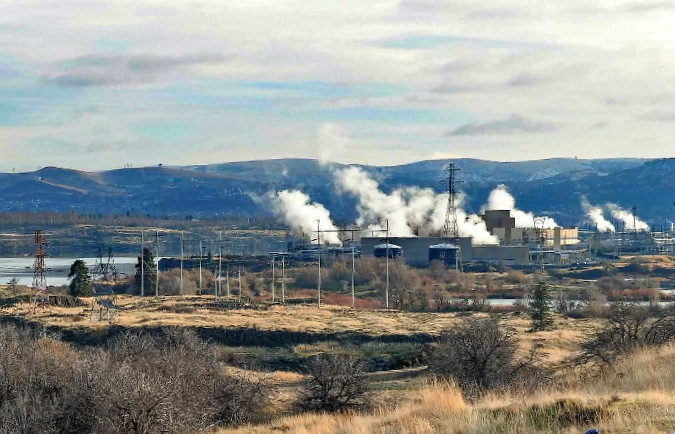
The Google data center in The Dalles is among several of these new, power-hungry developments east of the Cascades that have spiked demand for electricity and water, while providing comparatively few jobs (OPB)
Oregon’s centralized grid model of investor-owned renewable energy stands in sharp contrast to emerging trends around the world, where cheap Chinese solar panels are being installed on dwellings from shantytowns to elite gated communities. While we do enjoy more dependable electricity from our our expansive grid – for now — we also pay a steep premium for the luxury in our utility bills.
However, much of our electric grid is getting old and nearing (or beyond) its design life, increasing vulnerability for future mass outages and wildfire risks. The disastrous Labor Day fires ignited by powerlines in 2020 that destroyed several communities around Oregon were not an anomaly, but rather, a glimpse into this growing reality.
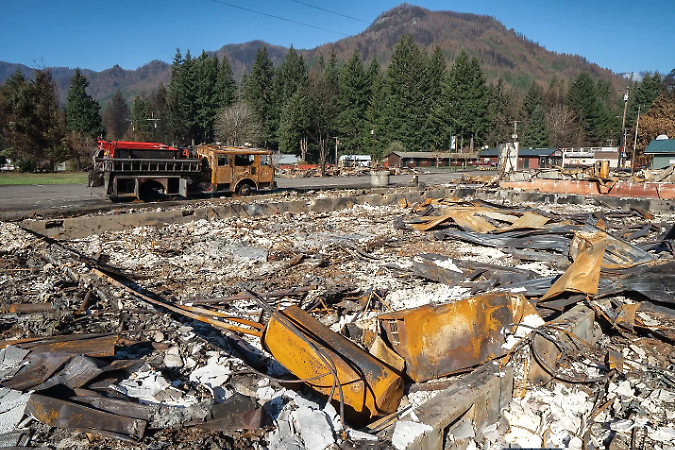
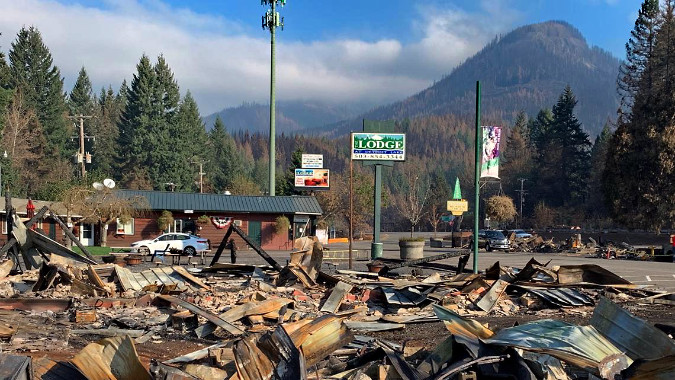
Most of the town of Detroit, Oregon was leveled by the 2020 Beachie Fire (even the fire engine in this view was abandoned and burned as the fire advanced). A wave of lawsuits for negligence followed against PacifiCorp for leaving its powerlines energized during the widely predicted, unusually dangerous windstorm that fanned the fire in September that year. As of late 2025, the utility has paid out $1.6 billion in settlements toward nearly 4,200 wildfire claims in Oregon and California, yet is reported to remain liable for tens of billions in outstanding lawsuits. Though PacifiCorp is locally based in Portland, it is owned by billionaire Warren Buffet, founder and CEO of the Berkshire Hathaway investment firm (World Atlas)
The Lodge at Detroit Lake was among the few properties left standing after the 2020 fire, and was the first to open. Today, the community is struggling to rebuild five years after the disaster. A similar story is playing out in the other rural communities in Oregon burned in the 2020 wildfires (KGW)
The explosive growth in solar installations in developing parts of the world is often in direct response to the inadequacy or absence of local electrical grids, and thus most of this new solar it is not connected to a grid. Instead, the panels are owned and maintained by the households and businesses who install them, though some are eventually connected to the grid.
This revolution of micro-scale solar is finally bringing a sustainable, reliable and affordable electricity to poorly served communities in places like Mexico, Brazil, Turkey and China. Consumers there pay half — or even a third — of what most Americans spend per kilowatt hour for electricity, thanks to the emergence of cheap solar panels that can be installed directly by homes and businesses.
In India, the explosion of cheap, plug-and-play solar has revolutionized access to renewable energy in urban areas, as well. Places like Lucknow, a regional hub of just over 4 million people in northern India, have emerged as world leaders in this trend. Lucknow now leads the rest of India with more than 300 new solar installations every day. Well over a million households and businesses there now using the cheap, privately installed solar panels. Their panels are sold more like Americans sell cars, through vendors and dealerships, direct to the consumer for installation.
Privately-installed, rooftop solar energy has revolutionized access to reliable power in India. These rooftop installations are in Lucknow, now the leader in solar among major cities in India (Source: ThePrint)
The new technology is also surging in Europe, where more than 4 million plug-in rooftop units have been installed in Germany. In the U.S., seven states (Utah, Colorado, Connecticut, Maine, Maryland, New Hampshire and Virginia) have passed legislation allowing these units to be installed, and 34 other states have legislation proposed. In Oregon, lawmakers introduced House Bill 4080 this year to allow portable, plug-in solar devices, but the bill failed due to push-back from utilities and local fire officials. So, for the moment, we are not leading this charge.
There are still plenty of technological hurdles for the micro-solar revolution to navigate, especially the ability to store power at the household level for nighttime or low-light use. Though batteries for household storage to date have relied upon expensive, potentially dangerous lithium-based technology, emerging sodium-ion systems promise much more affordable, environmentally sustainable and safe technology that uses cheap, common minerals.
Once again, China is far ahead of the U.S. in developing this clean energy storage solution, and is expected to dominate the market over the next few years as these batteries become the global standard for small-scale energy storage. For those old enough to remember the 1970s, it feels like a déjà vu of the U.S. ceding the auto manufacturing market to Japan for lack of a forward-facing economic vision.
Small solar panels are also changing the landscape for street venders in India, too, providing enough portable energy generation to power foot carts and bread stands (Source: ThePrint)
So, why do these global trends matter for Juniper Flat? Because the local battle over solar arrays here is largely a product of our private utilities working to ensure that electricity continues to be distributed from commercial providers, not produced (or distributed) by consumers. The public financial incentives for renewable energy projects are further reinforcing this commitment to utility-owned power generation, yet another reflection of the power of the industry in Salem.
This results in the entire burden of bringing a needed transition to sustainable, renewable energy to population centers like Portland – or California – on rural communities like Juniper Flat, where utilities can count on support from local governments and limited opposition from local communities. Don’t believe it? Imagine for a moment if a solar or wind energy developments covering thousands of acres were proposed in the heart of the Willamette Valley, or just outside Portland’s urban growth boundary. The outcry would send lawmakers straight to Salem to stop to it in its tracks.
This is inherent and unfair vulnerability that rural communities east of the mountains are shouldering. More frustrating is the fact that it’s almost entirely out of sight and mind to the very people who will actually consume the energy produced here.
The view from the main rail station in Lucknow, India tells the story of their rapid transition to solar (Source: ThePrint)
Why is the Juniper Flat development moving forward at the same time the current U.S. administration has turned back the clock on renewable energy? The truth is, clean, renewable energy development today makes very good economic sense, even without public subsidies. Private utilities can see past this political moment and they continue to diversify their energy sources across the country with investments in solar and wind to meet rapidly growing demand – and maintain profits.
For example, battery storage installations by utilities for wind and solar have doubled during the two years since the current administration returned to office promising to shift our national energy focus back to fossil fuels. Even more surprising: two thirds of those newly installed batteries have been installed in conservative “red” states like Texas, along with states like California and Colorado where the politics favor renewable energy. This trend is accelerating against the backdrop of federal backsliding, not slowing.
Thus, despite the federal U-turn on renewable energy, the Juniper Flat project continues to move forward with plenty of inertia, in part because the State of Oregon remains committed to renewable energy, but mostly because of simple growth in demand. This transition to renewable energy is a very good thing, but relying solely on private utilities as middleman to deliver it to consumers only hampers the transition – as the rest of the world is showing us.
Why bother opposing the Juniper Flat project?
If the political and economic deck in Oregon is stacked in favor of private utilities, is it even worth it for locals to oppose the Juniper Flat project? And is it elitist for those of us who support transition to sustainable energy to oppose a solar project simply because it’s unwelcome in our backyard?
At first glance, the combination of MAGA banners and opposition to solar might make you think the fight in Juniper is an ideological war on renewable energy, but it’s really about protecting the beauty, tradition and sustainability of a farming community
Many in the Juniper Flat community have resoundingly answered the first question. Yes, it’s worth it! The “Stop Solar” banners and signs are everywhere. I spoke with a few folks while in Juniper Flat a few weeks ago, and while you might assume a conversation between a progressive Portlander and conservative local residents would be fraught in these times, there was important common ground to be had.
Most basic is that Juniper Flat is simply the wrong place – for its beauty, for its functioning farm and ranch economy, and for the serious fire risks that industrial solar collection brings. This also answers the second question, as the local opposition is not reflexive “not in my backyard” reaction, but rather, a thoughtful challenge to a massive project that will permanently change the face of this community.
Simply put, the most compelling argument against the project is that its obvious risks outweigh any benefits to the community. It’s the wrong place, even if you subscribe to commercial solar installations as a preferred solution to providing renewable energy.
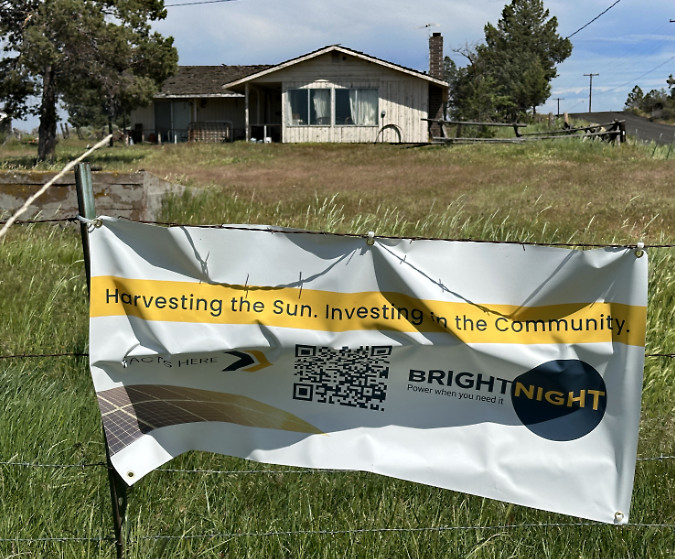
BrightNight has provided a few yard banners to their supporters to counter the opposition in Juniper Flat, though these are greatly outnumbered by the Stop Solar campaign signs
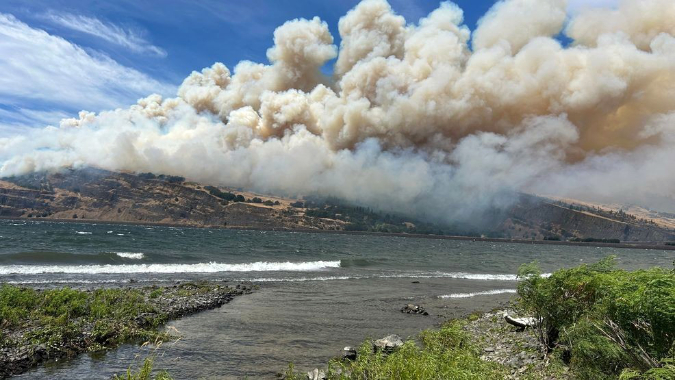
Of their many concerns, the risk of fire is near the top of the list. As if to prove the point, the Grasshopper Fire that erupted just a few weeks ago on a forested ridge rising above Juniper Flat is still burning and pouring smoke into the community. Juniper Flat was among several communities in the area that endured rolling Level 3 “Go Now!” evacuation orders beginning in late July as the fire expanded to nearly 100,000 acres by mid-August. Fire is a very real – and growing — threat in this tinder-dry desert climate.
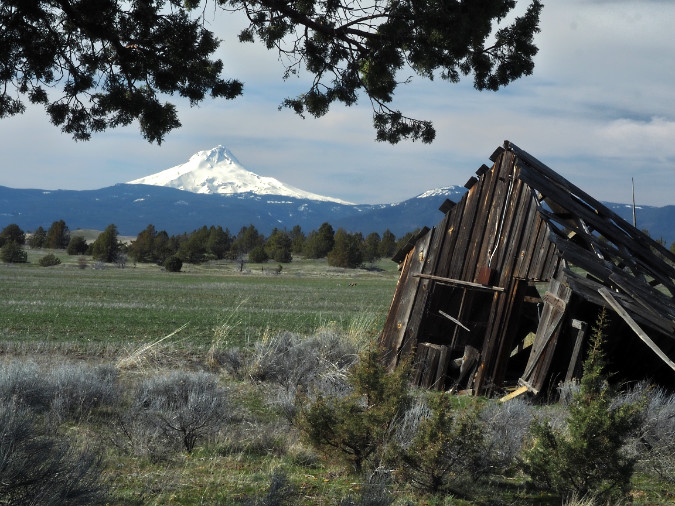
Another point of common ground between our urban and rural perspectives was simple distrust of private utilities to responsibly build and manage something of this scale over time. Local residents I spoke with pointed to a massive new solar installation at nearby Bakeoven, located just east of Juniper Flat. The last time I had visited the area was during the pandemic, when Bakeoven consisted of a couple ranches and a few abandoned homesteads. It was lonely, beautiful desert country.
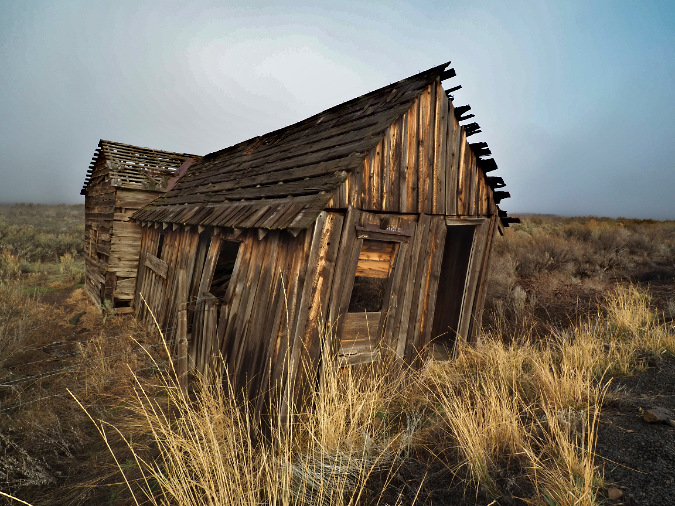
Not too long ago, Bakeoven was still a lonely spot in the sagebrush sea, marked by the bones of old homesteads and a few scattered ranches. I took this photo about a year before BrightNight brought their solar complex to the area – and perhaps as a metaphor, this old building has now collapsed
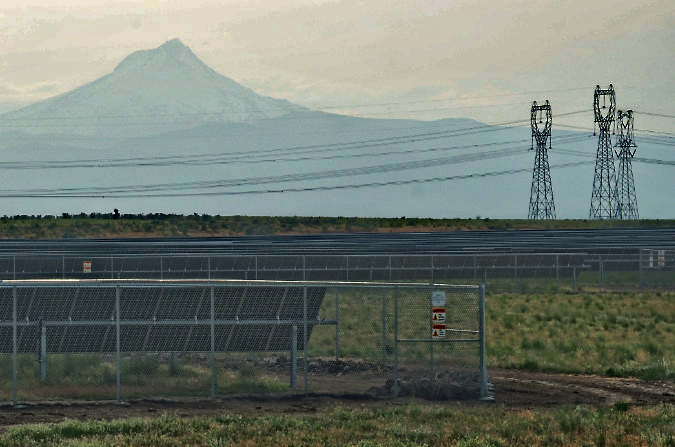
Following the advice of folks in Juniper Flat, I made a return to Bakeoven to get a preview of what was being proposed. And after just three years since my last visit there, I was shocked at the scale of the changes. As much as private utilities market themselves as a good neighbor to local residents, the new Bakeoven installation looked more like a vast, high-security prison than a “farm”.
That’s what prompted me to write this article, as a good look at the Bakeoven development is all you need to know about the threat to Juniper Flat. The following photos are from my recent visit to the newly developed site, and they illustrate why the solar opponents in Juniper Flat fear what may be coming to their community.
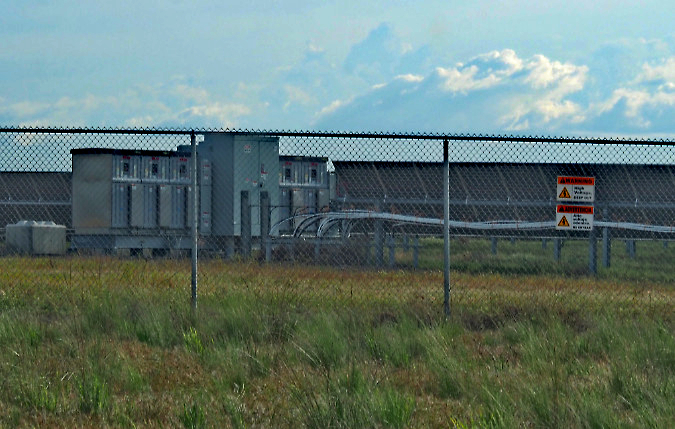
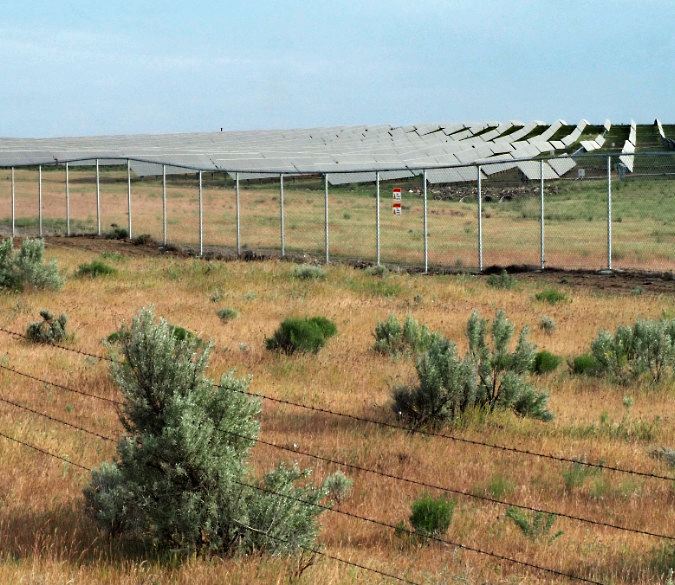
The new Bakeoven solar development provides a fairly stark visual contrast to the “harvesting the sun, investing in communities” tagline on the BrightNight “pro-solar” banners in Juniper Flat. Mostly, it looks like a sprawling prison complex
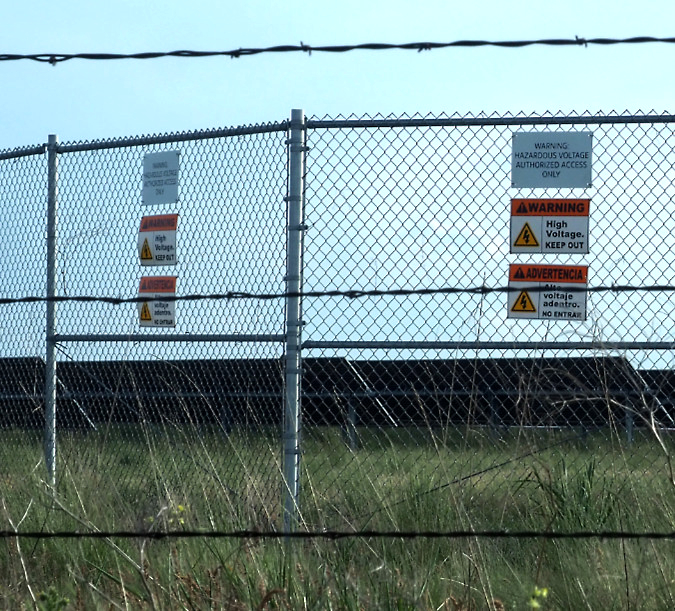
These foreboding signs dot the 3-mile fence that now fronts Bakeoven Road along the solar development. The stern messages seem at odds with industry assurances that these plants are benign, and present little fire risk to the surrounding communities
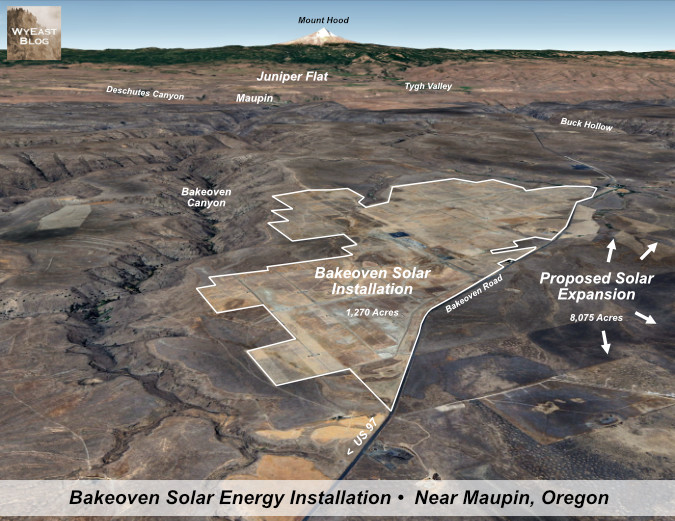
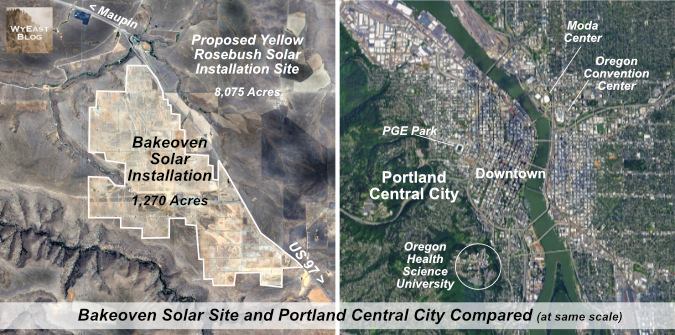
Digging a bit deeper, I also found that the solar development at Bakeoven has just begun. If the recently built 1,270 acre first phase isn’t jarring isn’t enough, consider that another 8,075 acres of open rangeland directly across the road from Bakeoven installation are also proposed for solar development. This would result in a combined area of nearly 15 square miles of former sagebrush desert and ranch land covered with solar arrays, industrial batteries and powerlines connecting them to the transmission grid.
Sagebrush country is vast, so for perspective and proximity, here are a couple views of the recently completed Bakeoven development – and note that the site boundaries are approximate based on land that was cleared for the solar arrays when this imagery was captured:
Perspective view of the new Bakeoven solar energy site in context to Juniper Flat and Maupin. At 7,500 acres, the Juniper Flat development would be six times this area. At Bakeven, developers have proposed expanding solar development by more than 8,000 acres, covering an area more than seven times the current site.
So, how big is this? For Portlanders, just the first, newly completed phase at Bakeoven would encompass most of Portland’s central sity (see below). The proposed next phase will at Bakeoven would cover an area nearly seven times the existing development – and so would the proposed Juniper Flat solar development.
It’s hard to appreciate scale in sagebrush country, but 1,200 acres is large – and the new 7,000+ acre expansion proposals at both Bakeoven and Juniper Flat are really large
Some landowners have signed on to the Juniper Flat proposal for a financial stake, and that’s understandable. Farming here has always been a struggle. This isn’t the Willamette Valley with a mild, moist climate and 15-foot-deep topsoil, after all. And yet, in just a few years Juniper Flat will celebrate two centuries of farming and ranching here. And as with all farm land in Oregon, once it’s paved and developed, there is no going back. Promises from energy developers sound good, but Juniper Flat would be changed forever.
That’s why the Juniper Flat proposal was originally denied by local planning officials concerned about the loss of farmland and impact on the local farm economy under Oregon’s land use laws. Ironically, the State of Oregon vetoed that local government decision to deny the project, citing the state’s renewable energy goals as the reason to override a local decision. Now, development continues to move forward against both the concerns of many local residents and local officials.
From sagebrush to solar in just a couple years – and mostly out of sight for Oregonians. Hopefully, the local organizing in Juniper Flat will change that
It’s also true that some local elected officials have signed on to these industrial solar developments on the promise of new jobs and economic windfalls, and this is also understandable in a rural setting.
However, if the Bakeoven installation is any indication, this is likely a mirage for folks hoping developments likes these will be transformational to the local economy. On my weekday visit there was no sign of anyone working at the vast site – not even a single maintenance truck. Just locked gates, the hum of electricity and dozens of ominous warning signs posted along the entirety of its 3-mile long Bakeoven Road frontage.
Perhaps the best argument against the Juniper Flat development is also the toughest to make at a community scale: that private energy utilities in Oregon should not be allowed to monopolize the solar market. If the past few years have taught us anything about above-ground transmission lines, we would be pivoting away from them as an unsustainable, unsafe way to provide electrical power to households – and especially to import power from distant sources to our major urban areas.
The Bakeoven development rose from the sagebrush sea in the shadow of Mount Hood, but it was proximity to the steel towers rising above the maze of solar panels that were the real draw. The modern curse of the lower Deschutes corridor are the transmission lines linking the lower Columbia River hydro project to 40 million electricity consumers in California. Access to these transmission lines has drawn industrial solar and wind solar production to the corridor – along with several power-hungry data centers
At a time of climate change and growing droughts, the risk of continued human-caused wildfires to rural communities should be raising all manner of red flags for our state regulators and legislators who hold the power to regulate the power industry and to open the solar market for individuals. Hopefully, growing community opposition for large-scale industrial solar developments in places like Juniper Flat will someday be heard by the powers that be in Salem.
Meanwhile, the arrival of affordable, micro-scale solar energy capture does seem inevitable, even in our system where corporate utilities wield enormous political sway. It’s a timely opportunity to give people an affordable, renewable option to the increasingly expensive monopolies of private utilities focused on their shareholders over consumers.
And yes, we still have to catch up with the rest of the globe. Household solar may not be a viable option for everyone in Oregon just yet, but the pace of technology seems to be quickly taking us in that very direction. Why not get onboard now?
Finding unexpected common ground… in Juniper Flat
The picturesque, fading bones of homestead structures are not just part of what makes Juniper Flat beautiful and timeless, they also tell the story of generations of farmers who continue to work the land here. This place is special, and it’s a way of life and community that deserves to be spared the impact of industrial solar development
As I waved goodbye to a local couple I’d visited with in Juniper Flat, I was taken by an unexpected, pleasant surprise. After a tense first few moments – big dogs barking the alarm in their yard as I took roadside photos, and the homeowners emerging from their farmhouse with a decidedly wary stride – things cooled down when I simply asked about their yard sign and opposition to the solar project.
As the conversation unfolded, I made no secret of being a Portlander – but I also told them of my love and appreciation for the area, and my many visits over the decades to capture the beauty of Juniper Flat with images.
Not surprisingly, this is exactly why they live here – and their love of the area is more than I can imagine. It is their home, after all. As our conversation grew more open, friendly and thoughtful, it transformed from obvious points of disagreement (and there were surely many) to points where we did agree. As Oregonians. That felt good.
Mixed among the cultivated fields that are proposed to be part of the 7,500-acre Juniper Flat solar development are stretches of intact desert ecosystem mostly used for grazing, but that also support native species and contain pristine landscapes unique to this area
It was such a refreshing conversation between supposed “enemies”, and a reminder that in this political era, divisiveness and rancor are tools employed by the powerful to maintain their power, not to make our lives better. On that point, we strongly agreed.
We parted with big smiles, with me wishing them well in their fight. It felt really normal, healthy and encouraging in these otherwise harsh, angry times.
Make no mistake, the fight against the solar project in Juniper Flat is a fledgling effort and it’s an uphill battle for the opponents, but they do have a website for folks interested in learning more or even helping out. You can find it here at Save Juniper Flat, or simply use the QR code shown in the opening image to this article. I do wish them well. They have so much at stake.
In the meantime, it’s not too soon for any of us to begin thinking about how we might be part of a household solar revolution in Oregon as part of moving toward sustainable energy sources – and perhaps become the catalysts for it?
Thanks for stopping by and for reading another long piece if you made it this far! I hope to see you on the trail sometime – or even in Juniper Flat!
______________
Tom Kloster | September 2026
Technical note: this article dove into the weeds a bit, so feel free to send me corrections if I’ve missed or mischaracterized any major points, and as always…a postscript: have you visited the new companion WyEast Images Blog? Be sure to subscribe while you’re there!
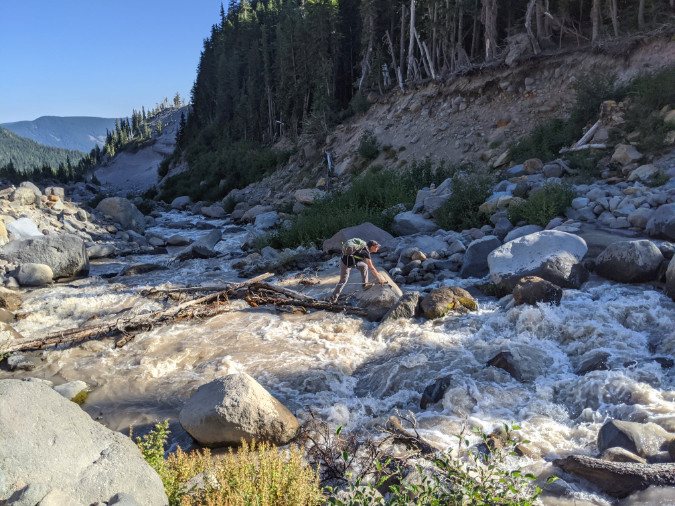
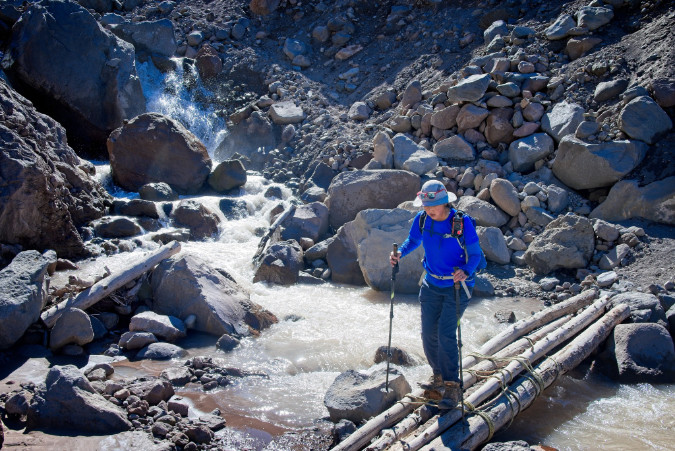
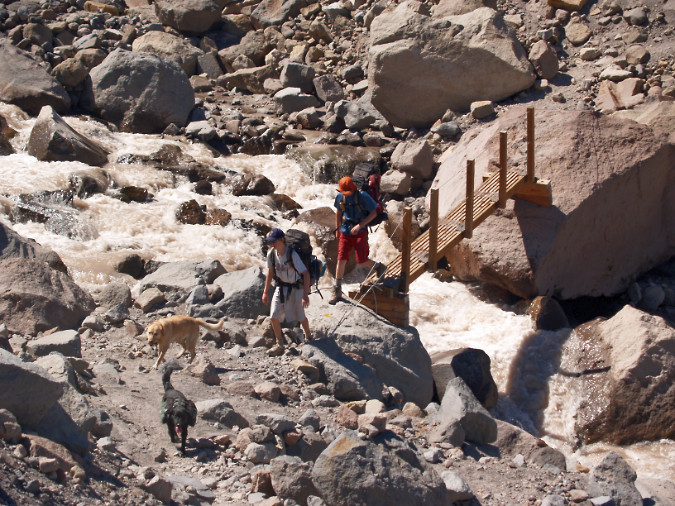
Hiker making a scary bridgeless crossing of raging Newton Creek along the Timberline Trail during summer runoff in 2022 (Craig Gwydir)
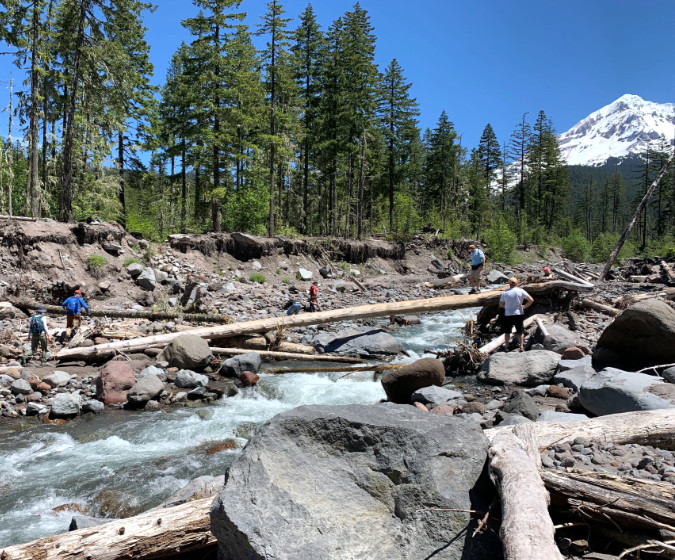
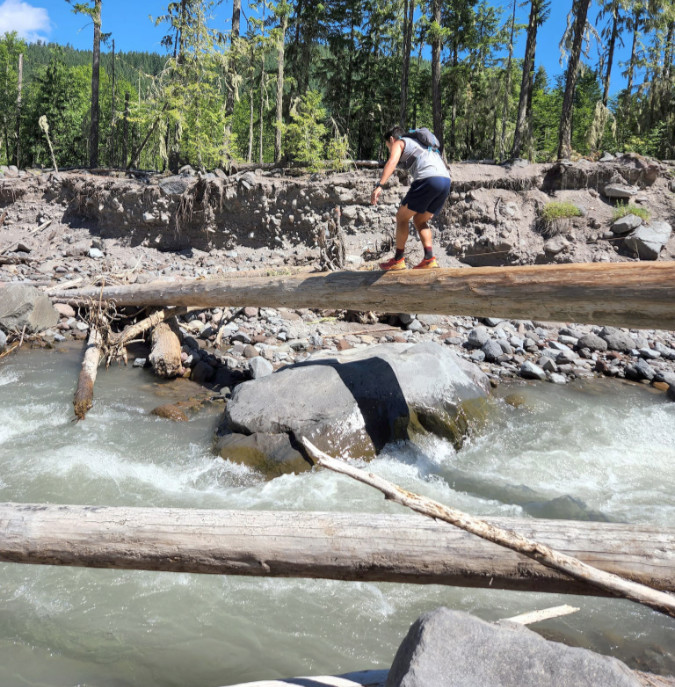
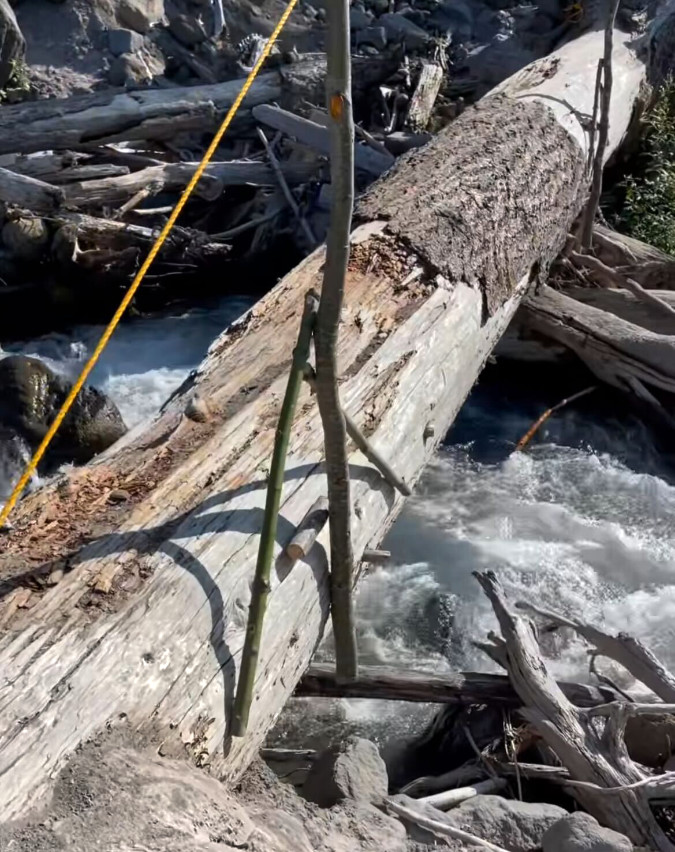
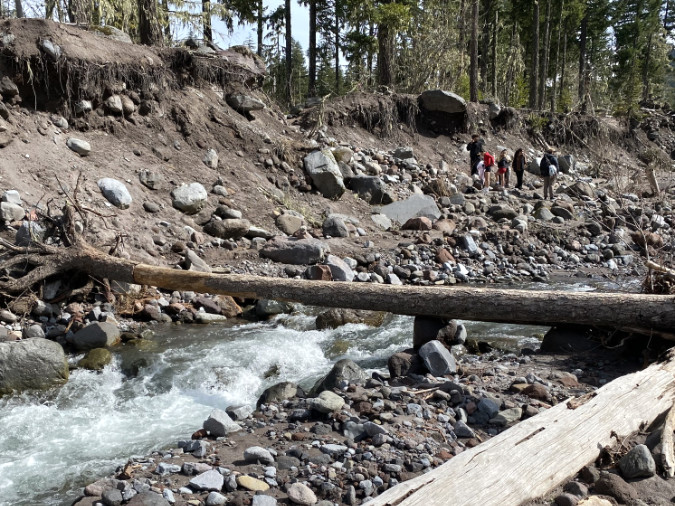
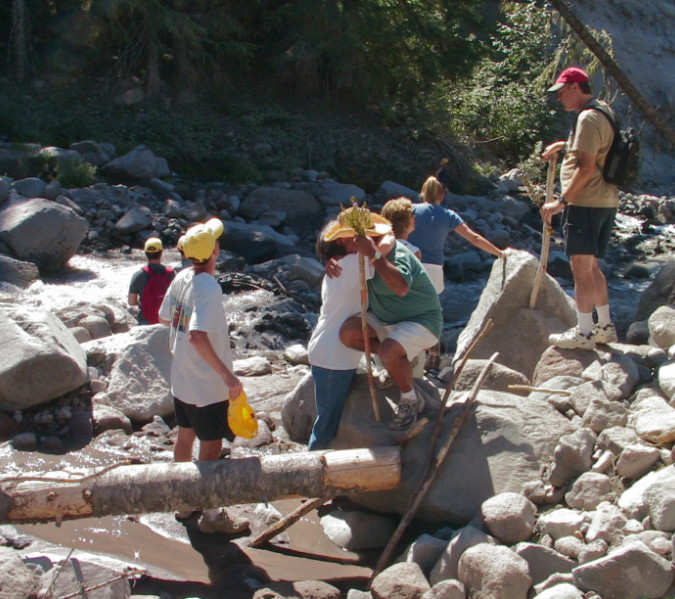
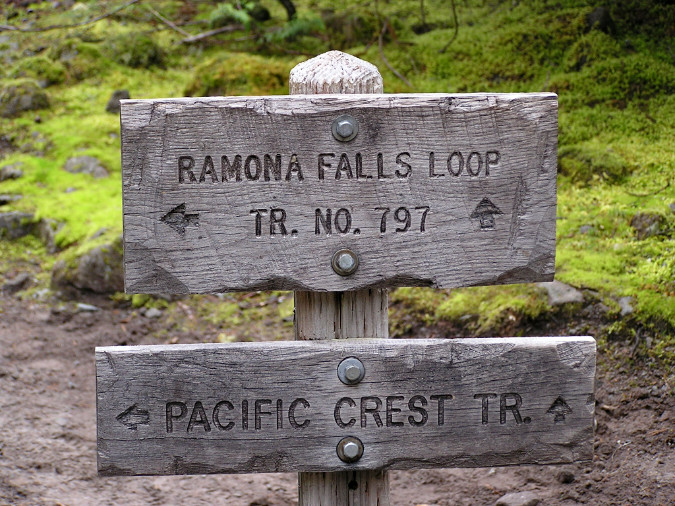
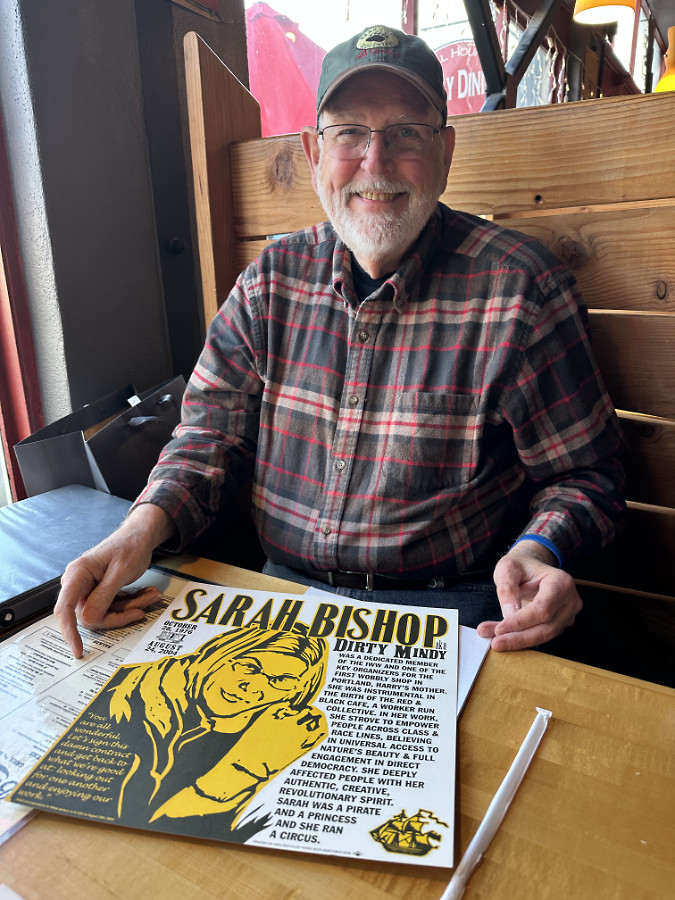
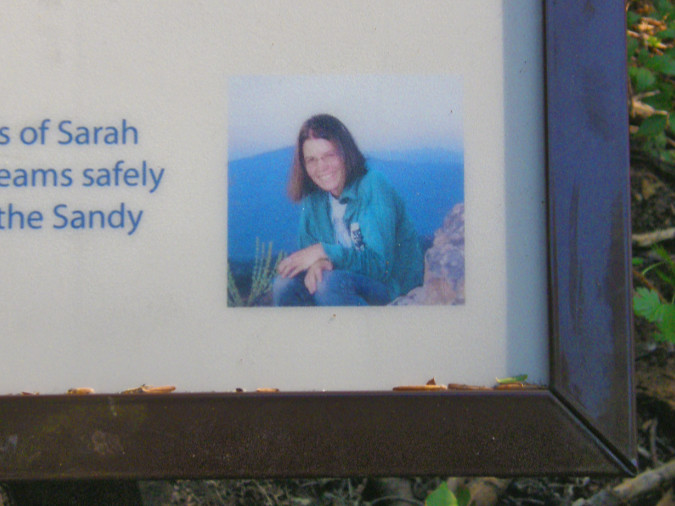
In this previous article, the story of Sarah Bishop included a call for restoring a footbridge over the Sandy River along the popular Ramona Falls loop trail. After her tragic death, Sarah’s family led a successful campaign to install signs at several wilderness entry points around the mountain warning hikers of the risks in crossing glacial streams and how to navigate them safely.
That was 20 years ago, and the situation has since grown urgent. The time has now come to simply provide bridges at the fourteen glacial stream crossings within the Mount Hood Wilderness. Why are the crossings so much worse? Here are the driving forces making the current situation unacceptable and now the moment to do something about it:
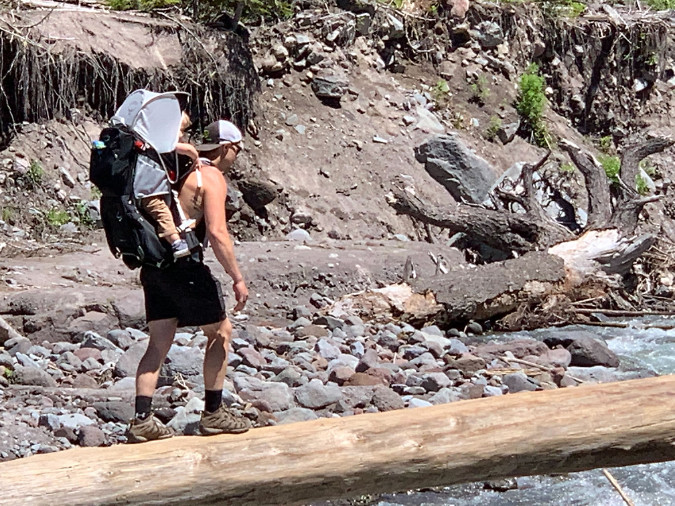
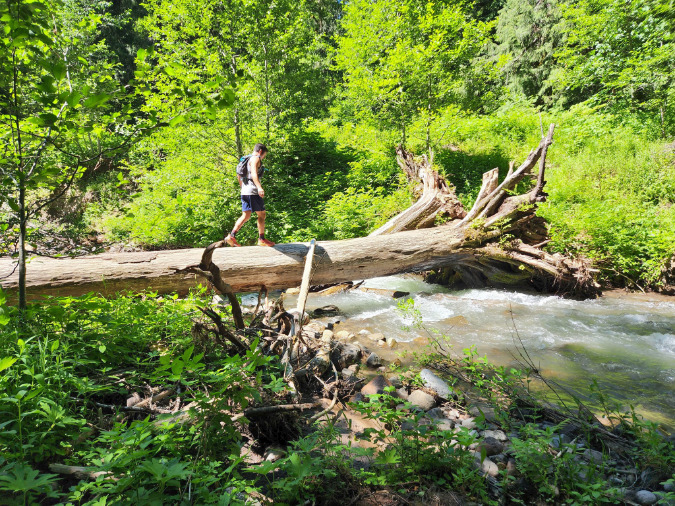
1. Sheer numbers of hikers: in one of their classic 1970s field guides, iconic authors Harvey Manning and Ira Spring once described the Mount Hood Wilderness as “mobbed year-round”. Both passed away in the early 2000s, and they probably couldn’t have imagined what “mobbed” really looks like, as what they saw as mobs the 1970s would be dwarfed by today’s crowds. The explosive growth in public demand for wilderness trails around Mount Hood translates not only to overflowing trailhead parking, but also traffic jams at the mountain’s most notorious glacial stream crossings, where hikers often wait in line to navigate sketchy logs or user-rigged “bridges” to cross.
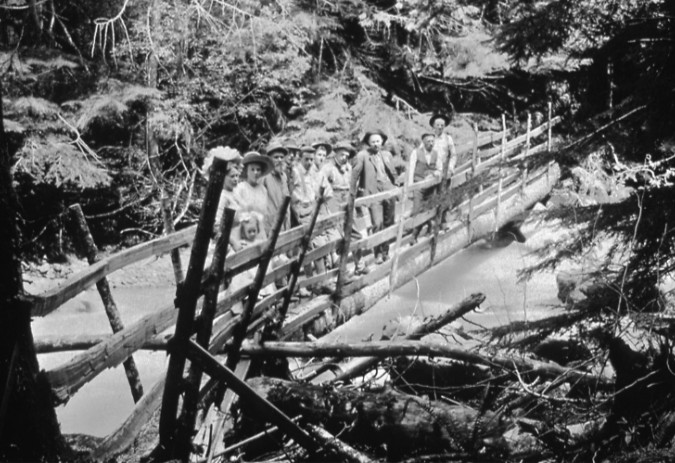
Crossing Mount Hood’s glacial streams has always been a challenge for hikers. Rails were added to a fallen log to create this bridge over the Zigzag River in the 1920s (Gary Randall)
Hikers are also less prepared for these obstacles today, thanks to social media driving the demand. Where hikers of the 1970s might have read one of the Spring & Manning or Don and Roberta Lowe guides to plan their trip, and thus become aware of these obstacles, today’s hikers are far more likely to have planned their trips based on a random Instagram image or Tik Tok videos that rarely bother to include meaningful trail information.
2. The glacial streams are a ‘changin: If you’re an old-timer, you probably remember when footbridges crossed several of the big streams on Mount Hood. That was a time when global warming was still a theory and glacial retreat was barely perceptible (though it was already underway), allowing for permanent structures at several crossings. Today, we can see the glaciers changing every year, and their retreat has wreaked havoc at downstream crossings.
The Newton Creek crossing on the Timberline Trail is nearly 30 feet lower than it was just two decades ago, thanks to a series of floods and intense stream erosion resulting from climate change
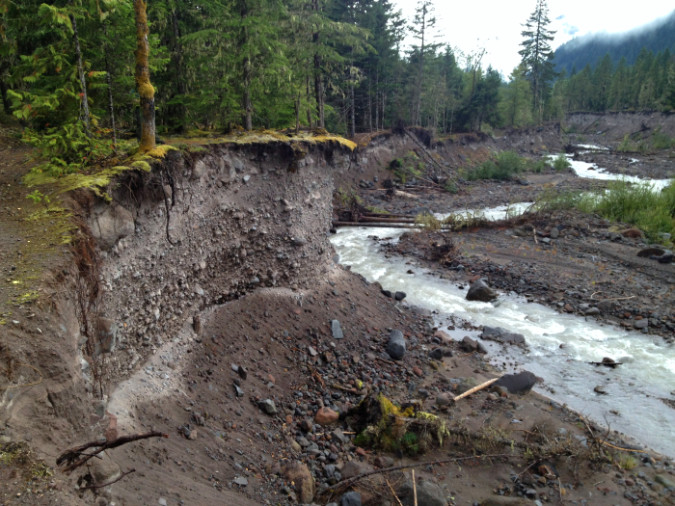
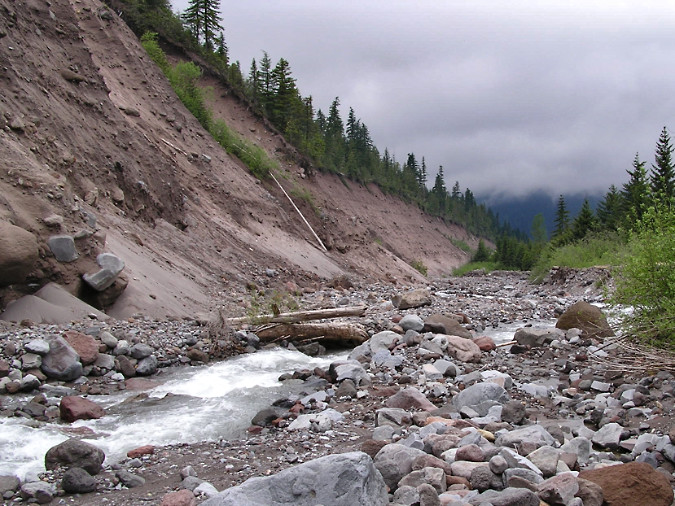
As the ice melts away, U-shaped glacial valleys are rapidly eroding and deepening to become V-shaped river canyons. New channels are continually forming downstream from the glaciers as heavy loads of debris from upstream erosion are released into glacial streams. Winter debris flows and summer flash floods have also become a routine event on the mountain, presenting a volatile, continually changing landscape.
3. Hiker safety: Mount Hood is increasingly an urban wilderness dominated by day-hikers, less experienced hikers, families with young kids and some people with disabilities. This is to be expected — the mountain is just an hour away for some 2 million people – more than four times the population living in greater Portland in the 1930s, when the Timberline Trail was originally constructed.
Like it or not, these numbers will only continue to grow, in part because our unique quality of life – including a mountain in our collective backyard — continues to bring people to our region. So, given this reality, will our mountain be a wilderness for everyone, or just those who are physically able to wade a torrent of thigh-deep glacial runoff or inch across a wobbly log six feet above the water?
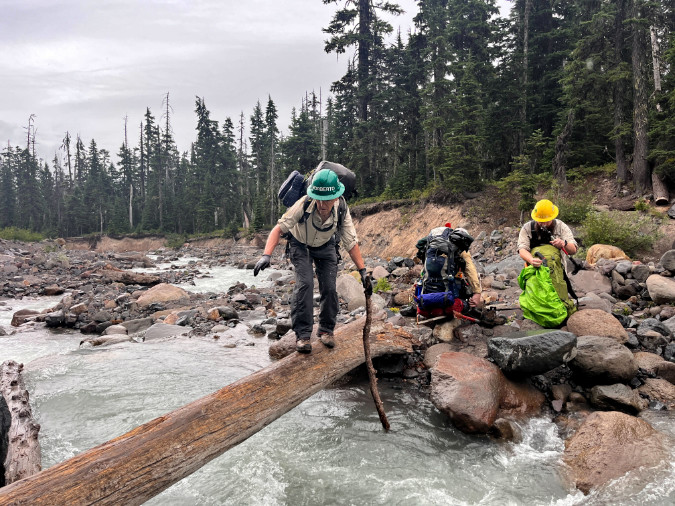
Volunteers from Trailkeepers of Oregon (TKO) making a sketchy crossing of Newton Creek enroute to a multi-day wilderness stewardship event within the Mount Hood Wilderness. Among their gear are 7-foot manual crosscut saws – the only saws allowed for clearing trails within the wilderness.
The hazards presented by the glacial crossing affect more than just hikers. Trail crews, backcountry rangers and emergency responders carrying heavy gear are also forced to navigate these obstacles – sometimes to rescue folks injured while making the same dangerous crossings.
4. Quality of the (urban) wilderness experience: People go to the Mount Hood Wilderness for the exceptional alpine scenery and a reasonably rugged experience. For most, this simply means an unpaved mountain trail, not confronting scary obstacles that leave them shaken and reluctant to return.
Timberline Trail hiker crossing a user-rigged log crossing on the notorious Eliot Branch in 2023, the volatile outflow from Mount Hood’s largest glacier (Guy Meacham)
There are wilderness purists who argue that it should be this way, and those unable to handle the risks should simply stay away. It’s an elitist argument that – unfortunately – is also made by some of our land managers as an excuse to do nothing. Fact is, Mount Hood is an urban wilderness (see No. 1, above), not the Alaskan frontier. For elite hikers seeking physical danger and hardship in their outdoor experience, there are dozens of wilderness areas beyond the day-trip range of major urban areas like Portland to choose from. Mount Hood just isn’t one of those places, and it never really was.
5. It’s good for business: Just as many people from our area think Mount Hood is already a national park (really!), so do visitors from around the country — and the world. The Timberline Trail brings untold numbers of long-distance travelers to the area every year, most thinking they will enjoy a national park-like quality experience on their 40-mile circuit. Over the years, I’ve encountered many of these folks on the trail and have been saddened to hear of their disappointment – not with the spectacular scenery, which they marvel at – but of the deteriorating trail conditions and especially the stream crossings.
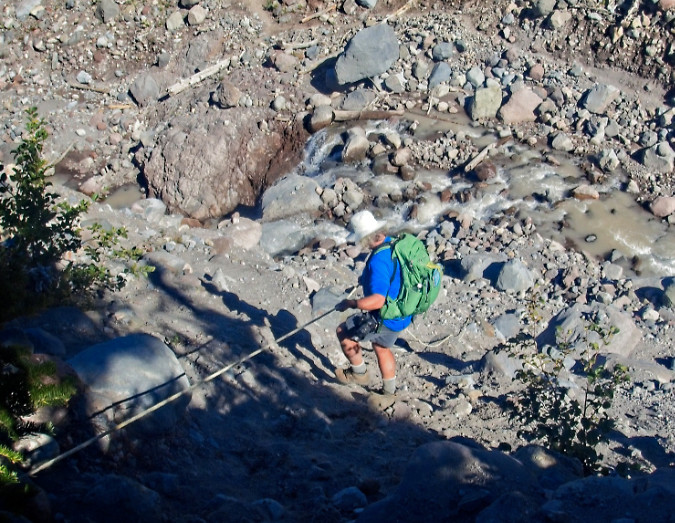
Hikers from around the world come to Mount Hood to experience the Timberline Trail, only to find themselves descending on random ropes left by previous hikers to navigate scary, bridgeless stream crossings (Chiyoko Meacham)
Why does this matter? Because visitors from out of state or other countries are the folks most supporting the tourism economy in the communities surrounding the mountain, from lodging and restaurants to local guide services, museums, galleries and farm stands. Yet, the quality of the Timberline Trail experience is rarely appreciated for its benefit to the local economy. Visitors from elsewhere are essential to any local tourism strategy, but with the current state of the trail, we are doing our very best to discourage positive experiences and repeat visits from beyond Oregon and Southwest Washington.
6. Real funding options: Did you know the Forest Service issues special use permits to private, for-profit businesses to maintain many of our campgrounds and trailheads, and even to conduct private trail events on Mount Hood each year? More significantly, this includes the large ski resorts who operate on our public lands under special permit, and who are increasingly marketing themselves as hiking destinations. Should these commercial interests be part of funding needed trail improvements on the Timberline Trail – including stream crossings? Absolutely. More about that toward the end of this article.
7. No more legal excuses:On December 27, 2021, the U.S. Court of Appeals ruled in the Ludwig vs. the United States case that the U.S. Forest Service was immune from wrongful death liability after a hiker drowned while attempting to cross a footbridge over the Sandy River near Ramona Falls during an extreme storm event.
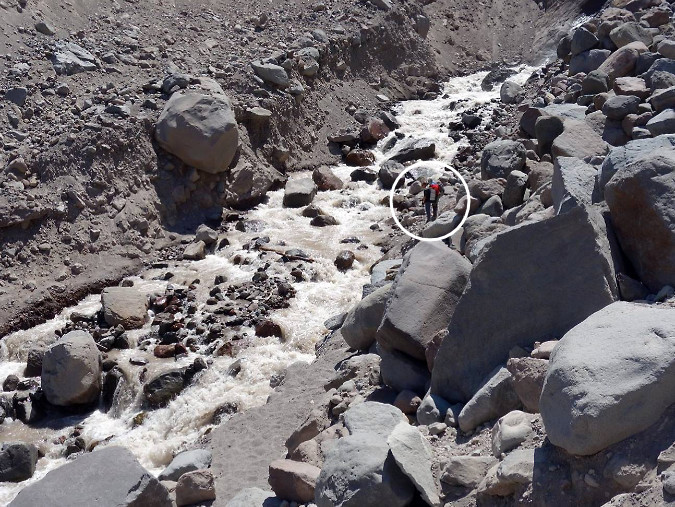
Can you see the hikers (circled) contemplating a ford of the Eliot Branch – and perhaps giant boulders teetering above the stream? Nobody should face this degree of physical risk when hiking the Timberline Trail (Robin Barklis/Portland Hikers)
The Ludwig case has long been pointed to as the reason for not providing safe crossings there, or anywhere within the Mount Hood Wilderness, but the case has since been decided. Now, it’s simply an excuse for doing nothing – though, ironically, it’s conceivable that not doing anything could open the agency to some future liability claim for exactly that reason.
It’s time to move beyond legal liability excuses and simply make public safety the priority, once again. It’s time to finally make the Timberline Trail a safe, world-class experience for everyone.
Fifteen Crossings?
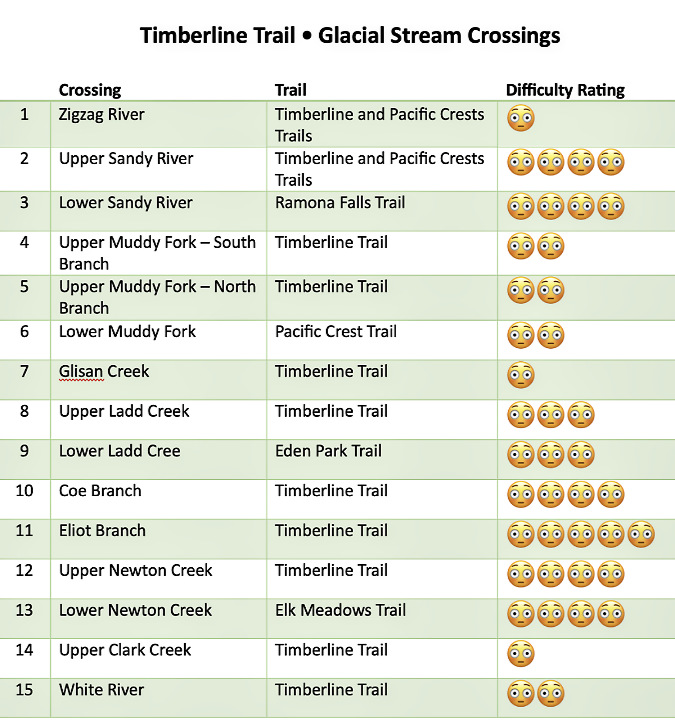
So, where are the footbridges needed? At all fifteen glacial stream crossings within the Mount Hood Wilderness. All of them – though more on how to tackle that in a bit. Here they are in the traditional clockwise order that hikers experience, beginning at Timberline Lodge, each scored according to their relative fear-inducing capacity:
Here’s a map of the proposed glacial stream footbridges. Most are located along the Timberline Trail (and the Pacific Crest Trail where the two overlap), along with two popular alternate routes to the Timberline Trail at Eden Park and Elk Meadows and the major access point to the loop at Ramona Falls:
What do the worried emoji ratings mean? They are subjective based on my own hiking experiences over the years, along with those of many others in my hiking circles. They range from a ranking of one emoji (rock hop, usually with dry feet) to four or five emojis for scary crossings in fast, icy, thigh-deep water that even the most experienced hikers struggle to cross during the summer peak glacial melt.
It’s no surprise that the Eliot Branch should rise to the top of the list, as it is fed by Mount Hood’s largest glacier and has experienced some of the most dramatic erosion and canyon deepening on the mountain in recent years. In contrast, the Zigzag River, Glisan Creek and Upper Clark Creek crossings are not major obstacles for most hikers. However, any of these have the potential to be dangerous during summer glacial outbursts and thunderstorms, as was the case for Sarah Bishop.
Going by the book..?
What is the official line from the Forest Service on providing stream crossing structures? It’s fairly specific. Here’s what the Forest Service trail handbook has to say:
______________
“Stream and river crossings present a challenge to trail managers who need to balance difficulty levels, safety, convenience, cost, environmental consequences, and esthetics. At one end of the use spectrum, a bridge can allow people with disabilities, toddlers, and users who are new to the outdoors to experience the trail with little risk.
“But bridges are expensive. Wilderness visitors who expect a challenge may prefer a shallow stream ford. During high water, these folks may opt for a tightrope walk across a fallen log. Each kind of water crossing has consequences for the recreation experience and the lands being accessed. Choose wisely from the spectrum of options before committing present and future resources to any given crossing.”
______________
The key in this guidance is the focus on the spectrum of user abilities. “Wilderness visitors” are implied to be at the most experienced end of the spectrum, and assumes these hikers are both aware of the meaning of designated wilderness and are either seeking — or at least expecting – to ford streams on their own.
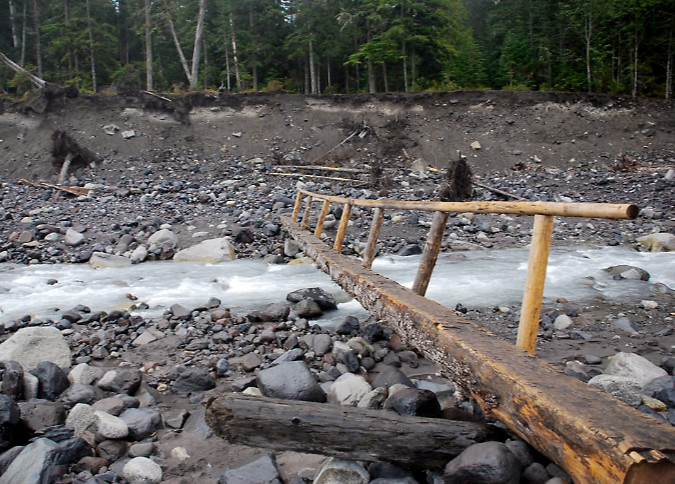
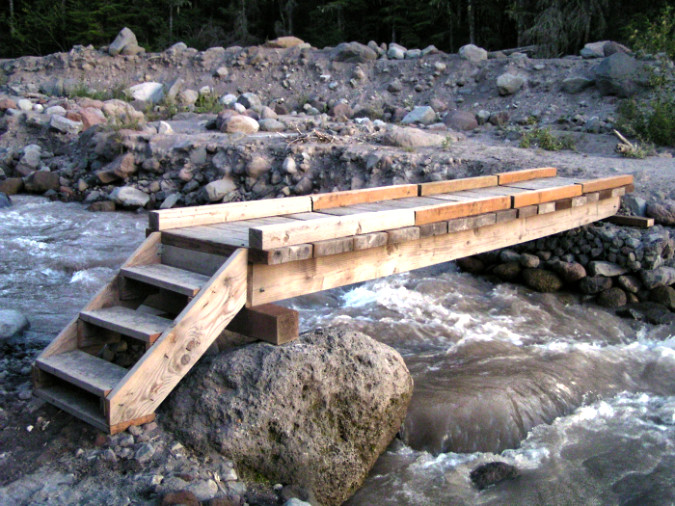
The sturdy Clark Creek Bridge is a bit of a relic from days when the Forest Service actively provided bridges around Mount Hood. It’s a permanent bridge that has survived for years, thanks to Clark Creek being the less rambunctious outflow from the Newton Clark Glacier to its rowdy twin Newton Creek. Today, it is the only bridged glacial stream crossing on the mountain. Clark Creek forms the Mount Hood Wilderness boundary, here – the wilderness entry sign is on the opposite end of this bridge.
This is almost never the case on Mount Hood. How to know that? Just look at the footwear (sneakers and flip-flops) and lack of trail safety basics on many of the folks heading into the wilderness, often without even a pack or bottle of water, much less a map or knowledge of the trail. All too often, ill-equipped hikers also have young kids and pets in tow.
The key wording from the Forest Service guidance on this less experienced end of the user spectrum should apply to all of Mount Hood’s glacial stream crossings: “a bridge can allow people with disabilities, toddlers, and users who are new to the outdoors to experience the trail with little risk” (author’s underscored emphasis added).
What is the Minimum Tool Philosophy?
There’s more guidance from the Forest Service best practices on footbridges that comes from the “minimum tool philosophy”, which seeks to “get the job done with the least long-term impact while still meeting management objectives”. That’s a mouthful, but here are the considerations included in this part of the agency technical guidance:
Do we really need a bridge here? Do we really need to cross here early in the spring?
Will someone be killed or injured if we don’t provide an easier crossing?
Is this really the best place to cross this stream?
What alternatives do we have to cross this stream, including not crossing it at all? Can we afford this crossing?
What are the environmental and social consequences of a given type of crossing here? Can we commit to long-term inspections and maintenance?
Who will really care if we don’t build (or replace) a bridge?
A telling footnote in this section of the Forest Service guidance adds that “it’s a wonderful thing to keep one’s feet dry, but keeping those feet dry in the backcountry is expensive.” For me, this comes across as surprisingly dismissive and elitist, but the list of “minimum tool” considerations are nonetheless easy enough to address in the example of the Timberline Trail.
The first two questions answer themselves – we already know many of the crossings on Mount Hood are dangerous, but also that travel is highly seasonal. The third, fourth and fifth questions also answer themselves: the Timberline Trail is an iconic feature that can’t simply be closed for lack of a desire or funding by the agency to make it safe to travel. It’s the Timberline Trail, after all! People come from around the world to experience this historic trail. Enough said.
Yikes! Hiker forced to carry a toddler over a very high log crossing over the Lower Sandy River in 2022 (TKO)
The final question seems obvious, but it does go to the larger problem that the Timberline Trail isn’t actively championed by anyone beyond the hiking community. But would anyone other than hikers “really care” if the bridge problem remains unresolved? No doubt, though the economic value of trails is almost never featured in local tourism programs, and thus not really understood by the broader community.
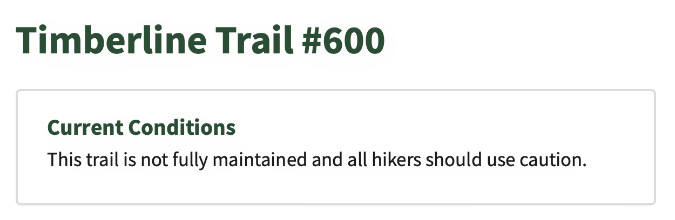
The two counties that encompass most of Mount Hood – Clackamas and Hood River – market themselves heavily at tourism destinations, yet have minimal content on their tourism websites for Timberline Trail visitors beyond a link to the Forest Service web page for the trail, which currently opens with this grim warning:
Makes you proud to be an Oregonian, right?
Be they local day hikers or international travelers coming to experience the Timberline Trail, all visitors to the mountain should obviously be part of the local tourism strategy. That’s a bigger nut to crack, but a good start would be making the trail safe so that disclaimers like this aren’t the first thing a prospective visitor sees when planning a trip to our mountain.
What are some working examples?
When it comes to suffering the effects of rapid climate change on its streams, Mount Hood has plenty of company from glacial peaks around the world. The best peers to learn from are right here in the Pacific Northwest, where trails on the other big Cascade volcanoes are also being impacted by the same forces we’re seeing on Mount Hood. There are also great regional examples of bridge structures provided within designated wilderness — including within the Mount Hood National Forest!
As around-the-mountain trails go, Mount Rainier’s Wonderland Trail is the Timberline Trail writ large. The trail covers 93 miles compared to Mount Hood’s 40-mile loop, and Mount Rainier has 28 glaciers compared to Mount Hood’s 12, several of them dwarfing the size of Mount Hood’s largest glaciers – and similarly outsized glacial streams, as well.
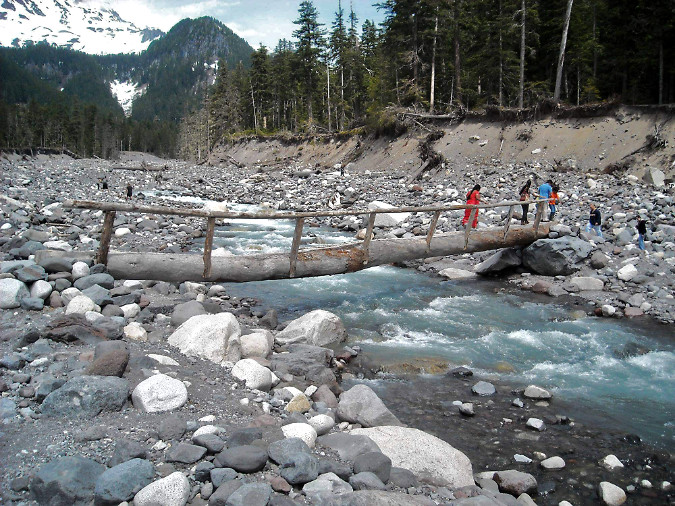
Carbon River Bridge, Mount Rainier National Park. This simple design is the most common in the park. It can be repositioned when needed, and easily replaced if lost to a major flood event (NPS)
Mount Rainer is protected as a national park, of course, and the Park Service strictly manages the Wonderland Trail as a pristine wilderness experience. Though it’s an ongoing struggle, park rangers work to provide seasonal crossings on the major glacial streams throughout the hiking season, though they do wash out frequently, leaving hikers to navigate on their own until the bridges can be re-installed.
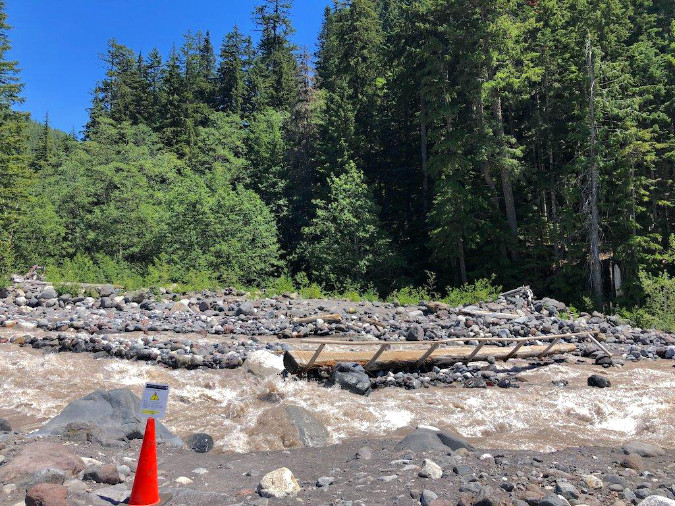
Nisqually River Bridge, Mount Rainier National Park (NPS)
Nisqually River Bridge temporarily out of service due to shifting river channels. The sign on the cone in the foreground cautions hikers on the best way to navigate the crossing in the meantime (NPS)
The Park Service at Mount Rainier has coped with this challenge with much less formal crossings, often simply a long, locally-sourced log with a single handrail that can be sacrificed should (or rather, when) the next flood sweeps down from the glaciers above. Hikers are cautioned to prepare for occasional washouts and difficult crossings each year, though the management goal is to make this classic trail as safe and enjoyable as possible. The park web page for the trail also includes extensive detail on current conditions, backcountry regulations and tips for planning a trip that would be a great template for expanding web content for the Timberline Trail.
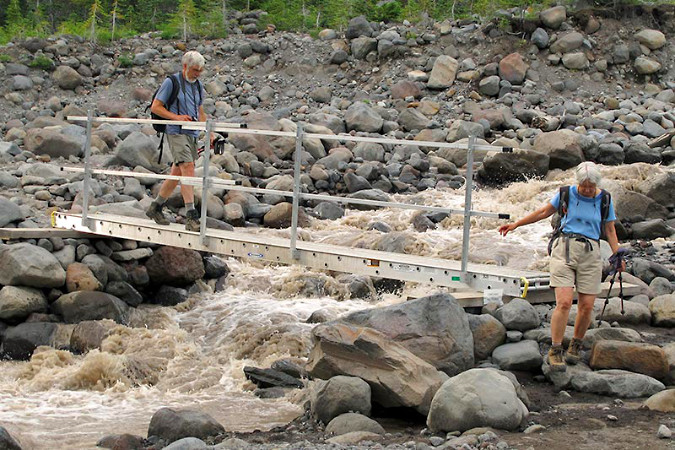
Heading north to Mount Baker, the Forest Service has provided a decidedly industrial, aluminum seasonal bridge in the past at Rocky Creek (below), a glacial outflow within the Mount Baker National Recreation Area. Though the design would not be appropriate for a wilderness setting, the seasonal placement is a helpful guide, as this stream is much like Mount Hood’s larger glacial outflows.
Rocky Creek Bridge, Mount Baker National Recreation Area (Adam Schneider)
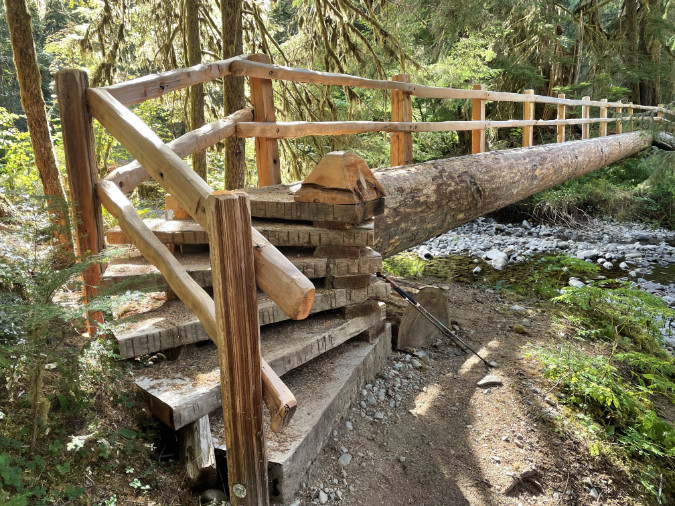
At Olympic National Park the newly built, permanent crossing of the Soleduck River (below) is a handsome solution that could work at downstream locations like the lower Muddy Fork on Mount Hood, where the river channel is less volatile and a large bridge could connect relatively stable, forested banks like these. While the Olympic peaks along the High Divide that feed into the Soleduck no longer have active glaciers, they do have an impressive snowpack each winter and famously heavy precipitation that required this bridge to be built for regular stream flooding.
The beautifully constructed Soleduck River Bridge in Olympic National Park (Tom Lovett)
Turning south and back to Oregon, the Fall Creek Bridge (below) in the Three Sisters Wilderness is another fairly new example of a permanent bridge on a heavily traveled wilderness trail. Though it does span a glacial outflow from the South Sister’s Lewis Glacier, the volatility of the meltwater is greatly reduced by the Green Lakes, which act as a jumbo settling pond for the silty glacial runoff. This is why Fall Creek is both crystal clear and fairly stable within its banks downstream from the lakes, and why a permanent bridge design could be constructed here. Like the Soleduck River example, this structure could be a model for the lower Muddy Fork, where a permanent bridge seems feasible.
Fall Creek bridge near one of the main gateways into the Three Sisters Wilderness
Contrary to what you may have heard, the Mount Hood National Forest has recently built (or rebuilt) several footbridges within its designated wilderness areas. One example described in [the previous article on the subject] is the lower Ramona Creek footbridge, built within the wilderness just a few years ago, and just a short distance from the Lower Sandy River crossing. The justification here (and for the upper Ramona Creek bridge at the base of the falls) is simply the number of hikers on this very popular trail – a decision completely consistent with the Forest Service best practices.
A lesser-known example is this footbridge built over Gumjuwac Creek (below), in the heart of the Badger Creek Wilderness, just east of Mount Hood. Where Ramona Creek is relatively small, Gumjuwac Creek can be a seasonal challenge during spring runoff, and thus the decision to build this new structure a few years ago. Much of the Badger Creek Wilderness has burned in recent days as part of the ongoing Grasshopper Fire, so we don’t know the fate of this bridge at this time.
Gumjuwac Creek Bridge in the Badger Creek Wilderness (TKO)
Meanwhile, in the Mark O. Hatfield Wilderness in the Columbia River Gorge National Scenic Area, volunteers recently rebuilt this bridge along the Wahclella Falls trail, along with other structures affected by the 2017 Eagle Creek Fire. Like the examples from Ramona Falls and Falls Creek in the Three Sisters Wilderness, the decision to build permanent structures here is in recognition of the heavy trail use, again, consistent with Forest Service guidelines.
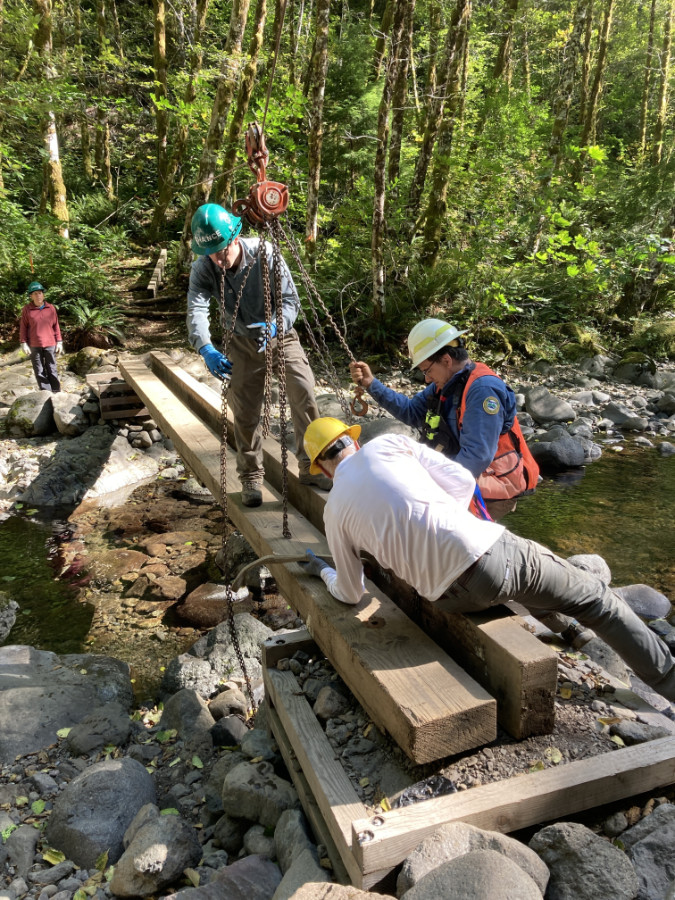
Trailkeepers of Oregon (TKO) volunteer repairing a winter-damaged bridge within the Mark O. Hatfield Wilderness (TKO)
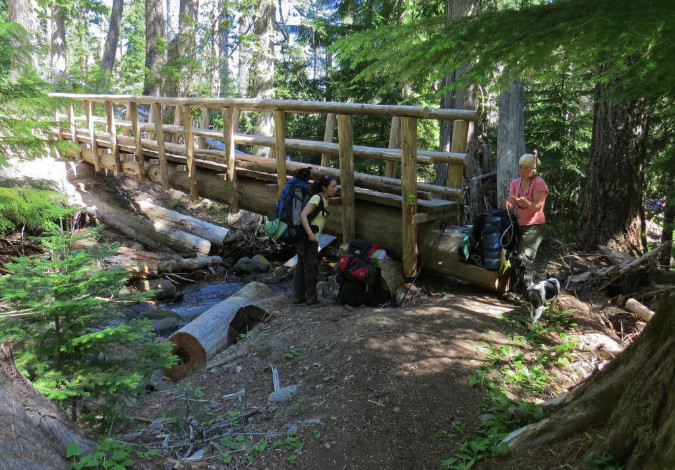
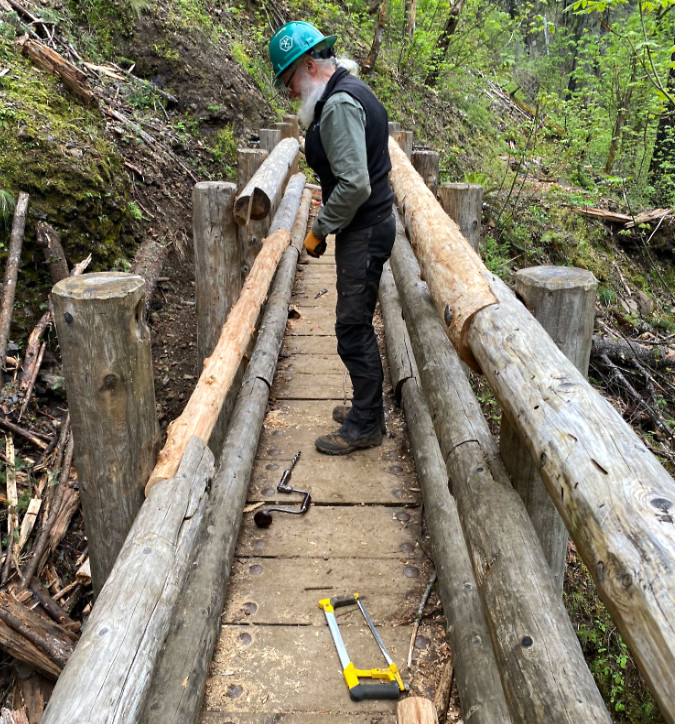
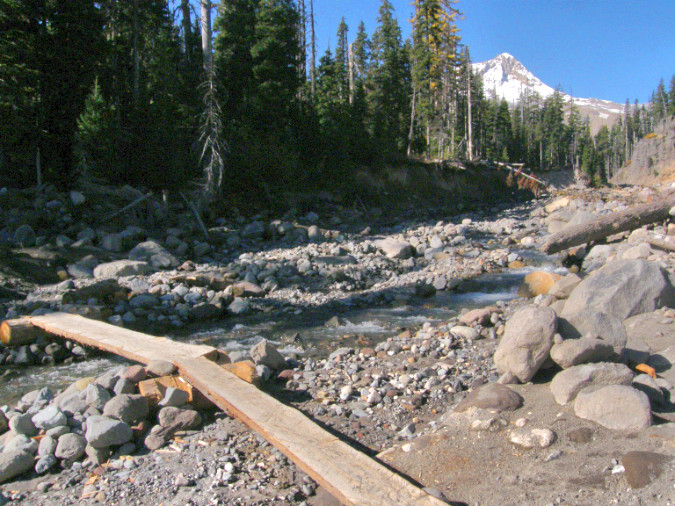
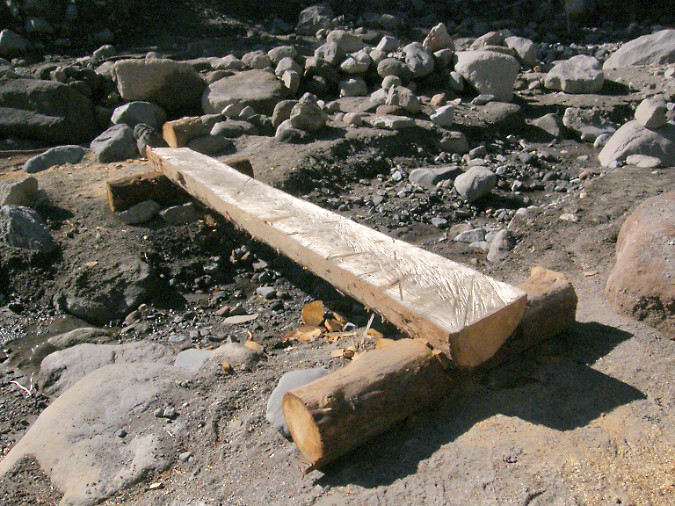
These permanent bridge examples are included to debunk the idea that bridges along the Timberline Trail are somehow precluded by the Mount Hood Wilderness designation. It’s simply not the case, though it is true that permanent bridges on several of Mount Hood’s glacial streams would soon be washed away. So, what would a simple, straightforward and affordable solution for these crossings look like?
Read on…
A simple proposal for Mount Hood… hiding in plain sight?
It was plain sight — but a while ago. In their response to the 2008 Bluegrass Fire on the east edge of the Mount Hood Wilderness, fire crews were dispatched from the Elk Meadows trailhead. Crossing Clark Creek was simple, as the permanent bridge shown above was there and ready to serve the hundreds of firefighters who eventually descended on the blaze.
Crossing Newton Creek was another matter. There was no bridge and the stream is well known for its year-round volatility. In the urgency of the moment, necessity made for the simplest, most elegant and affordable solution possible. Using logs washed left along the floodway by the stream, firefighters simply cut them into manageable sections, then halved them down the center to make simple bridge spans. Smaller logs were cut and shaped with hand tools to form simple abutments. The designs were straight out of 1930s era Civilian Conservation Corps handbooks for backcountry engineering.
Seasonal crossing at lower Newton Creek built by firefighters to provide access to the 2008 Bluegrass Fire
The simple design at Newton Creek allowed the crossings to be moved or adjusted with the ever-changing channels of Newton Creek as the fire operation progressed over several weeks
These designs were also the most compatible with their wilderness setting. There were no nails, no rock baskets and no concrete footings, just wood. They were also highly adaptive, with crews able to quickly move sections around to keep up with the ever-changing channels formed by Newton Creek during the summer runoff season. They could also be easily set back in place if the high water in the stream dislodged them. These simple crossings lasted through the fire, the following winter and into the next summer season, serving hikers long after the Bluegrass Fire had burned out.
Within a couple years, the logs crossing Newton Creek were eventually swept away and added to the many logjams downstream on this very rowdy glacial stream. Therein lies the beauty of this solution: it doesn’t matter. The logs were untreated and used no hardware in their installation, making them nearly indistinguishable from other logs piled along the stream. Yet, they still provided safe crossings for hikers who otherwise would have been wading the stream, or scrambling over loose logs, unsafe logs.
Detailed view of logs halved with chainsaws and cupped footings created with chainsaws and hatchets
These simple structures could be used on any of the fifteen glacial stream crossings in the Mount Hood Wilderness, including every one of the crossings on the Timberline Trail. The design is simple, adaptive, cheap and renewable.
The main constraint in the design for a wilderness setting is halving the logs, as this work was done with chainsaws during the Bluegrass Fire operation. Could logs simply be halved with crosscut saws? It’s possible, but time-consuming and impractical. Besides, volunteer organizations like Trailkeepers of Oregon (TKO) and others are already very busy just clearing fallen logs from our trails inside the wilderness that cross recent burns.
Logs stacked near Indian Henry Campground on the Clackamas River after the 2020 Riverside Fire
So, why were power saws allowed inside the Mount Hood Wilderness area in 2008? Because wilderness limitations on machinery are typically lifted during firefighting efforts, and it turns out these exceptions fall under thesame provisions that allow the Forest Service to construct wilderness footbridges where needed to “protect the health and safety of persons within the area”.
Does that mean an exception could be made now for the purpose of constructing wilderness trail bridges? Unlikely. Short of a forest fire, lifting limits on the use of chainsaws in wilderness for any purpose remains controversial, even when a good case could be made for protecting the health and safety of the public. Therefore, this proposal calls for mass production of the half-log spans off-site, then transporting and caching stockpiles of 3-4 logs at each of the crossings, ready to install as needed.
How would this work for all of the glacial stream crossings in the Mount Hood Wilderness (except for the lower Muddy Fork crossing on the Pacific Crest Trail – more on that in a moment):
1) Prepare standardized materials offsite: Halved logs would be prepared offsite in stockpiled in standard 8-foot and 12-foot lengths. The Forest Service has a bounty of fire-killed logs at the moment in the Clackamas District, thanks to the 2020 Riverside Fire and subsequent blowdown events. These could provide decades of material for this purpose, and it’s work that could be done by contractors or volunteers as part of chainsaw certification programs that already take place there.
Logs stacked along the Clackamas River Highway after the December 2025 storms
2) Drop log caches: Caches of logs would be placed near 14 seasonal crossings – enough for three replacements and close enough to the crossing site to be moved into place by Forest Service or volunteer crews. The main lift (pun not intended!) in this step would be moving the log caches to the various sites, as it would require the Forest Service to make an exception to the Wilderness Act to bring helicopters in. This sounds harder than it is. Going back to the Wilderness Act, there are two important exceptions for using motorized equipment in wilderness for administrative purposes:
1) In emergencies involving the health and safety of persons within the area.
This is the provision that allowed for construction of the Newton Creek bridges during the Bluegrass Fire.
2) When a motorized or mechanized action is necessary as the minimum requirement for proper protection and administration of the area as wilderness.
This second exception clearly seems to apply, since trails themselves are core the Wilderness Act which states that “…wilderness areas shall be devoted to the public purposes of recreational, scenic, scientific, educational, conservation, and historical use”, and thus the administrative purpose. Helicopters would likely be less controversial than chainsaws, as the work could be done in as little as a single day and would not involve power equipment on the ground.
Helicopters used for logging can carry multiple, full-length logs per load (US Forest Service)
How would this work? Having photographed helicopter logging (from a safe distance) in the past, I’ve watched hundreds of logs moved in bundles of 2-6 raw logs measuring 30-50 feet in length over the course of a couple days. Dropping the caches of half-logs would only have to be done every few years, thus further minimizing impact on the wilderness. If the drops were timed for late fall, there would be minimal conflict with hikers, while still allowing ground crews to access the different stockpiling sites.
But does the Forest Service even own helicopters? Only a few, though the agency contracts or charters with dozens of private providers to carry out a host of forest management activities, so this work is easily within their wheelhouse of know-how and funding arrangements.
3) Seasonal bridge placement: while there’s no harm to the environment if a half-log bridge is swept downstream, the idea is to minimize that risk and reduce the need to replenish the cache at a particular site by placing them as seasonal crossings. A reasonable window could be from July 1 through October 31, the mostly snow-free season when the vast majority of hikers are entering the wilderness. Hikers attempting to cross the streams before or after that time would at least be aware of the lack of structured crossings.
Trailkeepers of Oregon (TKO) volunteers work with the Oregon Department of Forestry to annually install and remove this seasonal bridge at Elk Creek on the popular Kings Mountain Trail
While the placement could be done by Forest Service crews, there are also at least two trail stewardship non-profits – Trailkeepers of Oregon (TKO) and the Pacific Crest Trail Association (PCTA) — that have the volunteer capacity, expertise and working relationship with the Forest Service to be part of placing these structures.
The Forest Service would need to periodically replenish the log caches at each site as logs are lost or damaged, though the idea of a cache is to minimize this need by providing enough material onsite to last for years. The abutment sections would be completely constructed onsite using manual tools, so only the half-log spans would be cached. The simplicity of the design would also allow backcountry Forest Service or volunteer crews to quickly reinstall or replace crossings that are impacted by flooding or channel changes during the summer hiking season.
Where to start?
Yes, this is a big proposal, given the status quo of doing nothing. Where to start? Following the informal “fear emoji” rating in the prior table, the three most problematic among the 15 glacial stream crossings are the upper and lower Sandy River crossings and the Eliot Branch.
The Forest Service built this wilderness bridge on the Ramona Falls Trail – but how were materials delivered to the site?
All three of these sites could provide excellent pilot projects, not just because safe crossings are badly needed here, but also because they are close to trailheads. This could allow materials to be transported to the site without machinery, thus avoiding the complexity of helicopter drops in a pilot phase (pun also unintended!). They would also be easily accessible for volunteers to monitor and maintain. If these pilot projects are successful, then the program could gradually be expanding to the rest of the wilderness.
So, how did the Forest Service bring materials to the new Ramona Falls trail bridge that was constructed in 2012? Unclear, as the structure includes both logs that might have been sourced locally, but also dimensional lumber that must have been carried in. This somewhat recent project could provide guidance for a new seasonal bridge pilot project on the nearby Sandy River crossings.
There’s a notable exception in the list of 15 crossings, and it was mentioned in the permanent bridge examples from Olympic National Park and the Three Sisters Wilderness: the lower Muddy Fork crossing. For years, a very large log (shown above) has been in place at the crossing, serving as a “permanent” bridge of sorts for hikers. There spot is also a ford for horses, as this is a Pacific Crest Trail crossing.
This log has survived several winters at the lower Muddy Fork Crossing, thanks to more stable banks and less channel shifting in this part of the Sandy River valley. A permanent bridge is a good option for this spot (Lily Peterson/Portland Hikers).
The lower Muddy Fork site is more like the lower Clark Creek crossing in that the stream is less volatile and the stream channel likely stable enough to support a year-round crossing structure. The site also lies in close proximity to the Ramona Falls trailhead, providing the same good access that allowed for the new wilderness bridges on Ramona Creek in recent years. This permanent crossing should also move forward now in tandem with the pilot project for seasonal crossings.
_______________
Fifteen new crossings are a lot to ask of an agency whose posture at Mount Hood has been to provide no safe crossings at all, so it would take some trail champions both within and outside the agency to take a first step. That could take the form of just a single pilot project right now, perhaps beginning on the upper Sandy River crossing that took Sarah Bishop’s life – or the lower Sandy River crossing that Sarah’s family has been advocating for?
There are non-profit trail partners ready to help. The Forest Service already has agreements with volunteer trail organizations to maintain trails within the Mount Hood Wilderness, notably Trailkeepers of Oregon (TKO) and the Pacific Crest Trail Association (PCTA). Other organizations like the Mazamas have provided trail maintenance on select trails within the wilderness over the years, as well. Compared to the ongoing need to trim brush and clear logs, placing seasonal bridges could also be a coup for drawing new volunteers to this needed work.
Trailkeepers of Oregon (TKO) volunteers removing the seasonal Elk Creek Bridge in the Tillamook State Forest at the close of the summer hiking season (TKO)
But there’s an outside-the-box option that the Forest Service has not considered in the past – and should. The agency grants special permits to several commercial operations to do business on our public lands, some to carry out work for the agency, like running campgrounds and maintaining trailheads. These contractors could be part of the solution, since they are already actively doing basic work for the agency.
But there’s a better opportunity worth exploring in providing these crossings: the major ski resorts on Mount Hood’s south side. In an era of climate change, the combination of shrinking, unpredictable winter snowpacks and soaring gear and ticket prices have resulted in an aging demographic of alpine ski enthusiasts in recent years. This is happening across the industry. Resorts have responded with summer activities designed to bring riders to their ski lifts in the summer months, notably mountain bike and hiking trails.
On Mount Hood, the Timberline and Ski Bowl resorts have leaned hard into mountain biking to keep their lifts busy in summer, but Mount Hood Meadows has opted for a bold focus on hiking, including construction of a dense network of trails that radiate from the day lodge and ski lift terminals. Ski Bowl advertises lift-based hiking as well, though most of the “trails” simply follow ski lift service roads, where the Meadows network offers real hiking trails built for people, not maintenance trucks. That’s a good thing!
Mountain biker straying from Timberline resort private bike trails onto the public, hiker-only Mountaineer Trail, one of many public trails the resort includes in its advertised summer hiking trail network
For its part, Timberline maintains a tiny nature trail network adjacent to the historic (and publicly owned) Timberline Lodge, but the rest of the trails in its promoted network are all built and maintained by the public – including the Pacific Crest and Timberline Trail segments that pass through their permit area (though there are tremendous opportunities for the resort to help expand the system). Meadows also includes public trails in its hybrid network, including a section of the Timberline Trail, and all of its trails are open to the public.
Therefore, why not ask the two larger resorts to participate in maintaining wilderness bridges? The Timberline resort includes both the Zigzag and White River crossings in their advertised trail system. The Meadows resort includes the upper Clark Creek crossing on the Timberline Trail and both the upper and lower Newton Creek crossings are just outside their advertised network.
The Forest Service has some experience with seasonable bridges on the Timberline Trail. This seasonable crossing on the Eliot Branch was in place for several years in the 2000s
The design of the seasonal Eliot Branch crossing involved two footings bolted to boulders along the stream. This design was used within the designed Mount Hood Wilderness
It’s an idea worth exploring, as both resorts periodically renew their long-term permits to operate on public land with the Forest Service, and that’s a time when the public’s interest in their use of our lands is incorporated into a binding agreement. It’s encouraging the resorts are thinking beyond ski tickets, but it also a good time to acknowledge the commercial benefit they are receiving from public trails and ask them to step up and become a partner in making it a safe experience for everyone.
So, there are some ideas that could help us get unstuck from what is an intolerable situation on Mount Hood’s glacial stream crossings. Let’s not wait for another tragedy to point out the obvious: the glacial crossings are becoming increasingly dangerous and must be addressed, sooner or later.
Thanks for following the blog ! I hope to see you on the trail sometime!
_____________
Tom Kloster | August 2026
Postscript: have you visited the new companion WyEast Images Blog? Be sure to subscribe while you’re there!
Morning sunbeams catching the mist at Ramona Falls
August was hot and dry in Oregon in 2014, and we were on the way to the hottest summer on record at the time. The combined heat and drought led to a predictable wave of wildfires that year, with a full 31 days of Level 5 fire conditions that surpassed all previous records by a full week.
No wonder, then, that Portlanders flocked to the mountains seeking cool respite from the heat. Among the most popular escapes was Ramona Falls, among the most visited waterfalls in Oregon and located just inside the Mount Hood Wilderness. The lacy, intricate beauty that makes the falls famous to photographers also creates a unique microclimate, cooling the air at the shady base of the falls by 15 degrees or more. On busy summer days, hundreds hike the rambling 7-mile loop trail and bask in the cooling mist and absorb the beauty of this idyllic, family-friendly place.
With its gentle grade and abundant scenery, the Ramona Falls loop has been a favorite family hike in the Mount Hood Wilderness for generations
Such was the scene that year on Tuesday, August 12. Hordes of hikers had set off from the crowded trailhead that day, only to be surprised by a sudden, intense thunderstorm that gathered over Mount Hood. As they returned to the seasonal footbridge over the Sandy River, just a mile from the trailhead, they discovered a suddenly raging torrent nearly touching the bridge.
Scores were able to cross the bridge safely, but hikers Nathan Johnson and Brent Ludwig met tragedy that day. They were taking up the rear with their group and still on the bridge when a flood surge dislodged a logjam just upstream, unleashing a sudden wave 5-8 feet deep that overtook the bridge. Both men were swept into the river. Johnson somehow survived the ordeal, but Ludwig perished in the torrent.
Brent Ludwig had come to Oregon on a visit from his hometown of New Lenox, Illinois, but he would not return. His body was later recovered by searchers more than a mile downstream.
The Forest Service had just installed this seasonal bridge over the Sandy River on the Ramona Falls trail in 2013. One year later it would wash out in the tragic incident that took the life of Brent Ludwig. It has not been replaced since
Witnesses described a chaotic scene after the bridge washed out, with rescue workers ferrying hikers stranded on the north side of a raging Sandy River for several hours using a pair of tethered rafts. In all, 23 hikers were rescued that day. Meanwhile, other rescuers searched the river banks below for victims, eventually locating Ludwig.
The 2014 rescue was hampered by the relative remoteness of the washed-out bridge. Hikers who had made it across before the wash-out still had to walk another mile back to the trailhead, then drive several miles toward Highway 26 to reach the nearest cell coverage and report the dire situation.
Hikers chose this precarious log to cross the Sandy River on the Ramona Falls trail in 2022… (TKO)
…and though it was the best available crossing, it was extremely dangerous, with hikers balancing ten feet above rushing glacial runoff and the large boulders that flank the stream (TKO)
Soon after the 2014 incident, the estate of Brent Ludwig filed suit against the Forest Service seeking damages for negligence. After many years in the courts, the case was finally decided in favor of the Forest Service in October 2021. In the meantime, the seasonal bridge on this heavily traveled trail had not been replaced, with the Forest Service pointing to the pending litigation as cause to simply leave Ramona Falls visitors to their own devices in crossing the Sandy River.
Though the court case is long settled, the Sandy River crossing still has no bridge, putting the thousands of hikers who head into the Mount Hood Wilderness for Ramona Falls each year needlessly at risk.
Though understandable, hikers often add makeshift rigging to log crossings, intending to improve safety – though trusting these rickety solutions can be riskier than the logs themselves. This rigged handline was later removed by volunteer trail crews in July 2024 at the request of the Forest Service (TKO)
The otherwise family-friendly Ramona Falls trail puts hundreds of kids at risk each year when they must contend with the Sandy River crossing (Matt Bromley)
Hikers in March of this year searching for a Sandy River crossing on the Ramona Falls trail. Each winter the river reshapes the channel and shifts log piles (Matt Bromley)
Other Forest Service explanations for continuing to leave this heavily traveled crossing bridgeless have included legal restrictions from its wilderness status and the idea that leaving the crossing in its current state will somehow self-manage the overcrowding that exists on this popular trail. Still another argument is that danger involved in making the crossing is somehow part of the “wilderness experience”.
None of these arguments holds up. First, the Wilderness Act clearly allows federal lands agencies wide discretion to construct footbridges where needed to “protect the health and safety of persons within the area”. There are many examples to point to, but most obvious are the two wilderness bridges over Ramona Creek, itself, on this very hiking loop. Both are modest stream crossings that present exponentially less risk to public health and safety than the Sandy River crossing.
This impressive new bridge over Ramona Creek was built inside the Mount Hood Wilderness boundary in 2012, just a half-mile beyond the bridgeless Sandy River crossing
Predictably, the lack of a safe crossing at the Sandy River since the 2014 incident has also done little to deter hikers from showing up here. Instead, the crowds have grown, thanks to both social media, the growing popularity of hiking and of the spectacle of Ramona Falls, itself. There are many proven tools for managing crowded trails in our wilderness areas. Making the experience more dangerous should not be among them, nor should forcing visitors to take undue risks be considered part of the “wilderness experience”.
Impromptu Sandy River crossing installed by hikers, as seen in early June 2026… (Kevin Lu)
….this effort involved lashing two thin poles together (Kevin Lu)
As it proved in 2014, the Sandy River can be unruly – like all of Mount Hood’s glacial runoff streams. They are prone to flash floods year-round and have become even more erratic as the mountain’s glaciers and winter snowpack recede with global climate change. This means a nearly constant re-arranging of the river channels each year, with hikers searching for fallen logs to inch their way across the streams where trails cross them.
While challenging for any hiker, it’s an unacceptable situation at the Sandy River crossing on the Ramona Falls trail, where young children, less able-bodied or experienced hikers and small pets make up such a large share of the visitors.
It’s long overdue to fix this crossing.
Ten Years Earlier…
The summer of 2004 was much different than 2014 would turn out to be for Oregon. The west side of the state experienced unseasonably cool, wet weather, with rare summer snows on Mount Hood as low as 6,000 feet. The last week of August that year was especially stormy, with the west slopes of the mountain receiving as much as 10 inches of rain from August 21-25. This, at a time of year when thousands of hikers from around the world come to Mount Hood to experience the iconic 42-mile Timberline Trail.
One of these hikers was Portlander Sarah Nicole Bishop, a 27-year-old backpacker who had started her clockwise trip around the mountain at the Ramona Falls trailhead. Sarah set off across the Sandy River footbridge and past Ramona Falls on the first day of a planned 4-day loop around the mountain. She was a seasoned backpacker and well-prepared for adverse conditions.
Sarah (center) and friends in 2004
By all accounts, Sarah Bishop was a force of nature just beginning to make her mark in the world. In her young life, she had worked at youth camps, been a residential counselor, social work case manager and had served as a crisis intervention specialist with Harry’s Mother, a Portland youth shelter.
She was politically active, creating and managing 100 Percent Portland, a democracy project to promote voter registration and civic duty. Sarah was outspoken for workers’ rights and an active member of the International Workers of the World (commonly known as ‘Wobblies.’) Her future was very bright.
On the fourth and final day of her wet circuit around the mountain, Sarah passed Timberline Lodge, stopping for hot chocolate. before pushing ahead to the Zigzag River crossing, climbing to Paradise Park. From there, she had only the steep descent to the Sandy River and two river crossings before reaching her starting point at the Ramona Falls trailhead. Sarah had safely managed several crossings over rain-swollen glacial streams on her circuit, and hikers who encountered her as she made her way back to the Ramona Falls trailhead reported that she was in good spirits and enjoying her hike.
Sarah had started her hike on Saturday afternoon, August 21, crossing the Ramona Falls footbridge over the Sandy River when conditions were still dry. By that night, the weather changed and the Sandy River had flooded its banks and washed out the bridge. Worse, by the time she was returning to the trailhead on that final day of her hike, she would also have to contend with the bridgeless upper crossing of the Sandy River along the Timberline Trail. It was here that Sarah’s life was cut tragically short.
The Sandy River channel is wide and ever-changing. Much of the river is lined with steep bluffs where the stream has continually flooded and undercut its banks. This view is near the junction of the Pacific Crest and Ramona Falls trails (Bruce Bishop)
When Sarah did not return from her hike as scheduled on Tuesday, August 24, her family became concerned, but they were informed that a search and rescue could not be authorized until it was verified that Sarah was on the mountain. That kicked off a search for her truck the next day by her father Bruce and Sarah’s partner Joseph at the most likely trailheads, beginning at Cloud Cap and working clockwise. It was raining and dark when they finally found Sarah’s car at the Ramona Falls trailhead at 10 PM that evening – the last vehicle in the lot. They reported her missing to the Clackamas County Sheriff that night.
The formal search and rescue effort began the next morning on Thursday, August 26, with teams searching the 12-mile section of the Timberline Trail between the Ramona Falls trailhead and Timberline Lodge where Sarah was last seen. At around 2 PM that afternoon Sarah’s body was found along the Sandy River, about a half-mile below the upper crossing on the Timberline Trail, and just three miles from her truck.
This view shows the high, unstable bluffs below the Timberline Trail ford where Sarah may have fallen while scouting for a safe crossing (Bruce Bishop)
Sarah still had the waistbelt on her pack buckled and her boots on when searchers found her, so her family believes she had been scouting for a spot to cross the unseasonably high Sandy River. While searching for a place to cross, she may have slipped into the river from the steep bluffs that line this section of the stream, possibly becoming injured in the fall.
If you have hiked into the Mount Hood Wilderness in the decades since, you likely know Sarah’s story from the work her family has done to honor her memory and to educate hikers on the dangers of glacial stream crossings. Near each of five wilderness trailheads — Ramona Falls, Top Spur, Cloud Cap, White River and Timberline West – Sarah’s story is shared on interpretive trail signs that warn of the danger and provide tips for safe stream fords.
An early snowstorm greeted volunteers installing the sign west of Timberline Lodge on September 29, 2007 (Bruce Bishop)
Volunteers installing the Top Spur sign on August 1, 2008 (Bruce Bishop)
Sign installation near the White River wilderness boundary on September 27, 2009 (Bruce Bishop)
Sarah’s family worked with the Forest Service to design, build and install these signs, though they were completely privately funded. All five signs are still in place today. Sarah’s family and friends regularly visit and maintain each sign, an effort that continues to be privately funded as a labor of love by those who loved Sarah.
_________________
The seasonal Sandy River bridge on the Ramona Falls Trail was replaced by the Forest Service after Sarah died in 2004, and was installed each summer until the 2014 bridge tragedy. Sarah’s family and friends crossed the bridge in 2005 and hiked another two miles upstream to the spot where Sarah was found to celebrate her memory. Sarah’s parents, Bruce and Judy Bishop, were joined by her 83-year-old grandmother and more than two dozen others on that memorable day. The yellow caps in the photos that follow were made for the occasion, and read “Remembering Sarah Bishop”.
Sarah’s family and friends gathered on August 27, 2005 to hike a section of the Ramona Falls loop in remembrance of her life (Bruce Bishop)
The 2005 remembrance hike ended at the upper Sandy River crossing where Sarah had lost her life the year before. Soon after, Bruce and Judy Bishop resolved to pay tribute to Sarah’s memory in service to other hikers (Bruce Bishop)
Over the next two years, Bruce and Judy worked to gain approval of the plan, and by the summer of 2009 all five signs had been installed by Sarah’s family and friends, with Forest Service staff support on hand.
Ramona Falls Loop sign (Bruce Bishop)
Sadly, many of those who gave tribute to Sarah on that memorable day in 2005 would not be able to repeat the trip today. The bridgeless Sandy River crossing on the Ramona Falls trail is an untenable barrier for so many. While it’s a frustration for many who would simply like to visit the falls, it’s a more profound disappointment to those who would pay tribute to Sarah’s memory near the place where she died.
It’s time to fix this crossing.
_________________
Last winter, I had the privilege of meeting Bruce and learning Sarah’s story. We’ve since met several times to figure out how to get the Forest Service unstuck on this long-overdue need at Ramona Falls – and at other increasingly dangerous glacial stream crossings around the mountain. The following is a Q&A with Bruce on the subject:
WyEast: Bruce, when you picture the bridge finally being restored at the Ramona Falls trailhead, what would that mean to you? Who are the folks that come to mind that you’d like to see walking over it, once again?
Bruce: Our family first hiked to Ramona Falls with church families, probably in 1984 when Sarah was 7 years old. Over 20 years later, our memorial hike included a group with a wide range of ages and abilities. Such groups today can’t visit Ramona Falls safely. While the hike to the river is enjoyable, continuing to the falls makes the hike spectacular. I’d like families with young children and elderly great grandparents like us to be able to see Ramona Falls.
WyEast: By all accounts, Sarah was a force of nature, and loved being in nature. Wilderness trails seem to be where she recharged and found the energy to have an impact in her daily life. Can you tell us more about what it meant to her to be out in nature?
Bruce: In her youth, Sarah went to church camp every summer outside Molalla and became a camp staffer and director there through college. She hiked around Mt. Rainier with a group of incoming students for her orientation to college. It rained, and she was the only one to have packed rain gear for the hike. After college, she hiked extensively in the Gorge and on Mount Hood. And in early August 2004, she and a friend hiked to the top of Pilot Rock in the Rogue River Valley. A photo from that predawn hike was used for the woodcut in the poster below.
Bruce and Judy Bishop have worked for 22 years to honor Sarah’s life and make something good from the tragedy of her death
WyEast: In 2005 you led your family and many of Sarah’s friends on a remembrance hike to the spot where she was found. How did that day lead to the wilderness sign project?
Bruce: Many of those at the memorial hike in 2005 spent that weekend at our church camp, a place that Sarah loved. We caravanned from the camp to the Ramona Falls trailhead for the group hike, passing the studio for Mt. Hood ceramists Dave and Suzanne Enna. After the hike, we stopped at their studio sale, and several family members purchased pieces of Enna art. As a youth, Dave had attended our church in downtown Portland and created the communion ware for the church, as well as Sarah’s urn.
Following the memorial hike and inspired by Dave Enna’s ceramics, Judy and I agreed that signs promoting hiker safety would be a fitting memorial for Sarah, and we contacted Forest Service staff to turn the idea into reality.
WyEast: We’ve talked about the Ramona Falls trail being special because of both its beauty, but also its accessibility to the average person – not just avid hikers. Is that part of your motivation for finally getting the Sandy River crossing fixed? Is it something Sarah would have been passionate about?
Bruce: Sarah had a diverse array of “passions.” Her friends who inscribed her memorial poster described her well when they wrote, “[She] was a dedicated member of the IWW and one of the key organizers for the first Wobbly shop in Portland, Harry’s Mother. She was instrumental in the birth of the Red and Black Cafe, a worker run collective. In her work she strove to empower people across class and race lines, believing in universal access to nature’s beauty and full engagement in direct democracy. She deeply affected people with her authentic, creative, revolutionary spirit. Sarah was a pirate and a princess and she ran a circus.”
_________________
So, how would this happen? If the question is to simply restore the seasonal Sandy River footbridge on the Ramona Falls trail, that’s very easy. The Forest Service simply needs to say yes. It really is that simple, and it’s long overdue.
In reality, it won’t be that simple. Yet, I’m confident that Bruce and Judy Bishop, and all who loved Sarah, will keep at this and persuade the Forest Service to finally do what’s right for the many people who come to the Mount Hood Wilderness to spend a day in nature and marvel at the beauty of Ramona Falls. I like their odds, as they have Sarah’s memory on their side.
The seasonal Sandy River footbridge at the Ramona Falls trailhead on August 20, 2004. Sarah would cross this bridge on the first day of her hike around the mountain. The next morning, it was gone in the stormwaters that also took Sarah’s life.
_________________
Postscript
After my first meeting with Bruce last year, I dug into my photo archives and folders to prepare this article. I remembered seeing the new trailhead signs for the first time at the Top Spur trailhead, and discovered I had taken photos of the new sign back in September 2008 — including this detailed view of Sarah:
Each of the trailhead signs include Sarah’s image and memory as a reminder of the real dangers that crossing glacial streams present
At the time, I remember being pleasantly surprised that the Forest Service had even agreed to the signs being posted – no small task! I also remembered the tragic incident, and after searching through my archives, I found I had saved this Oregonian article back in 2004 in a folder dedicated to the stream crossing situation on Mount Hood. Clearly, the problem is not new, though it has certainly worsened in the intervening years.
As I looked back into my photo archives, I was startled to discover that I had walked the Sandy River and Paradise Park sections of the Timberline Trail the same week Sarah had. These photos of the Sandy River from the Ramona Falls trail are from August 20, 2004, the day before Sarah would walk this trail to begin her hike:
The ravaged Sandy River floodway along the Ramona Falls trail on August 20, 2004. The next day, the river would swell once again from the storm that took Sarah Bishop’s life
Hikers crossing the Sandy River bridge to Ramona Falls on August 20, 2004. Sarah Bishop would cross this bridge the following day to begin her 4-day trip. Within a day of her crossing, the bridge would wash out in the storm that took Sarah’s life
One week later, I would hike the Timberline Trail west from Timberline Lodge to Paradise Park, the section where Sarah was last seen just days prior. My motivation for going there on that day was scenery. There had been a break in the weather, with fresh snow on the mountain from the same storm that had made Sarah’s trip so tragic. These are scenes from Paradise Park on that day, August 28, 2004:
The powerful storm that swept over Mount Hood while Sarah Bishop hiked the Timberline Trail cleared abruptly, leaving a rare dusting of August snow on the mountain. This scene was captured at Paradise Park on August 28, 2004, just four days after Sarah hiked through
Looking down the Sandy River canyon from Paradise Park toward the Timberline Trail crossing and Ramona Falls area, far below, on August 28, 2004
Though I was likely thinking of Sarah on this second trip — as I had archived the news coverage account the day before — rediscovering these photos and meeting her father after 22 years made Sarah’s story all the more real and impactful. The real gift in writing this article has been getting to know Bruce. Through his eyes and memories, I can begin to appreciate the amazing, inspired person behind that familiar face on the trailhead signs, and why she lives on so vividly in the hearts of so many.
Sarah Bishop hiking at Pilot Rock, Oregon in August 2004, just a few days before her tragic death on Mount Hood
Sarah’s tragedy raises the larger question about the many other dangerous glacial outflow crossings on the mountain today. While her death might not have been preventable, the lack of safe crossings on the Timberline Trail today remains unacceptable. Watch for a follow-up article with a modest proposal to finally move forward on this front.
Remembering Sarah…
In the meantime, we can all take lessons to live by from Sarah Bishop: connect with the world around us, take the time to care and make the time to act on our convictions. Be brave and step up to uncomfortable challenges. Reach out and help. Make a difference where we can.
Sarah continues to inspire those who knew and loved her because of that undefeatable spirit. We should thank her for that – and remember her.
(updated June 28 to expand details of the search for Sarah in August 2004)
The Catherine Creek savannah already turning to summer hues in early May of this year
As a follow-up to the previous three-part series on the aftermath of the Burdoin Fire (links to all recent articles on the fires at Catherine Creek are at the bottom of this article), I stopped by West Catherine Creek in early May to check on the recovery, just ten months after the fire swept through last July. The fire burned especially hot here, and less than a year after the 2024 Top of the World Fire had roared through. Things looks especially bleak for the keystone Oregon white oak and Ponderosa pine when I last visited in December.
Here’s the good news: given the back-to-back pummeling this area has endured, the resilience on display on this visit is both surprising and inspiring. Yes, there’s likely a long, hot summer ahead for the survivors, but what I saw last month bodes well for the larger recovery of the larger Catherine Creek savannah. Read on for a deeper dive!
The Bulldozer Road
In this earlier article I lamented a new fire lane that had bulldozed the upper portion of the Bitterroot Trail, destroying one of the better informal paths in the Gorge and worsening erosion of already fragile savannah soils in the aftermath of the fire. After posting the previous article, I also learned that the rough state of the fire lane on my last visit was, in fact, the “restored” surface, with no Forest Service plans to further mitigate the impacts.
The good news: I’ve since learned that the general routing of the fire lane was made on the fly, literally in the heat of the Burdoin Fire event. It was not an intentional effort to erase the Bitterroot Trail. Still more encouraging, there’s a real possibility the Forest Service might someday recognize this popular trail as part of the formal system, thus opening the door to non-profits partnering with the agency to retore the tread and improve it to sustainable design standards.
Hikers have already begun to redefine a single path through the bulldozed fire lane that used to be the upper Bitterroot trail
In the meantime, I was reminded on my most recent visit to never underestimate the power of hikers who love their trails. In the five months since my winter visit, hikers had clearly voted with their feet (and boots) on their preferred option among the two ruts left by the bulldozers, thereby beginning an informal restoration of the Bitterroot Trail.
In most cases, the less popular ruts have already begun to grow over with savannah grasses, and even a few wildflowers. In some of these sections the less-favored ruts have been rejected because of deep erosion leaving them a cobbly, ankle-twisting mess. Messy as they are, these scars, too, will stabilize over time with the recovery of the meadow ecosystem.
In this section of the fire lane the verdict is split, though on most of the route hikers are picking the uphill (left) track
This spot on the old Bitterroot trail was always messy, and the bulldozers made it much worse. Ironically, that was the impetus for hikers to completely circumvent the rocky old route with this surprisingly well-placed path, uphill from the old route
There are still a few spots where a preferred hiker path has yet to emerge, mostly near the upper end of the trail, where the fire lane is quite wide. However, it was also clear that I wasn’t the only hiker kicking rocks off the emerging, hiker-defined tread in an effort to help the Bitterroot Trail once again offer the experience it provided before the Burdoin Fire.
At the upper end of the old Bitterroot Trail the erosion from uncontrolled runoff in the lower track is discouraging, but it has also pushed hikers onto the upper track (on the right), redefining the trail here. Over time, returning savannah grasses and wildflowers should eventually stabilize the eroded track on the left
Then-and-now photos (below) of a spot featured in previous articles on West Catherine Creek show meadow grasses quickly moving into what was a bulldozed mess at this scenic spot along the Bitterroot Trail. It will take more time to completely heal, but it’s encouraging to see the recovery taking hold so quickly, in just the first spring since the fire.
The impact of the bulldozer on the burned landscape was bleak when these hikers struggled through last December…
…but spring rains have begun to heal the scars and hikers have begun to restore the footpath with the power of hundreds of determined hiking boots
The Savannah Wildflowers
Wildflowers have surged back to live across the West Catherine Creek savannah in this first spring since the fire. Species that grow from bulbs or rhizomes were especially well-prepared to survive the burn, and seemed mostly unaffected, though wildflowers with less underground reserve are also bouncing back.
While the speed of the wildflower recovery is welcome, it shouldn’t be completely surprising, even with back-to-back fires. Most of these species are not only built for fire, but rely upon it to thrive. This relationship has been on full display after other recent fires in the East Gorge, most notably the massive Substation Fire that burned 80,000 acres along the lower Deschutes River canyon in 2018. There, the ecosystem rebound has been explosive, and provides a helpful preview of what to expect in the years ahead for the Burdoin Fire – provided the area is given time to fully recover.
Who are the stars of the wildflower recovery? The following is a sampler of the most prolific of the late season wildflowers rebounding at the heart of the burn scar….
Camas is thriving at the ponds, notable because they are vernal ponds, and had gone dry for the summer at the time of the Burdoin Fire, leaving the soil here exposed to the full brunt of the fire
Death Camas is also at the ponds, like its less deadly cousin
Wild Onion is thriving along the west Catherine Creek Rim, thanks to its tiny onion bulbs that were protected from the fire by several inches of soil
Paintbrush (and Balsamroot, beyond) are thriving above Rowland Wall, but mostly along the cooler margins of the burn. They will be important to reseeding nearby, more severely burned areas
Ookow dotted the savannah, but are most prolific along the west Catherine Creek Rim where the fire was somewhat less intense
Bitterroot is thriving along the west Catherine Creek Rim and the exposed areas of the Rowland Wall. These unique plants are known for their disappearing act in summer, and had already shed their blooms and foliage before the Burdoin Fire last July. Their tough taproots and brief growth cycle in late winter through spring make these iconic wildflowers especially adapted to fire
If the resiliency of spring wildflowers weren’t enough to inspire optimism, I came across this unexpected resident (below) high in the savannah meadows, along the upper section of the Bitterroot trail. Not much larger than a nickel, this treefrog was sheltering in the shade of a tuft of meadow grass.
…and an unexpected treefrog high in the savannah meadows!
Though it’s surprising that they can thrive in the desert country east of the Cascades, treefrogs adapt by sheltering in burrows in the heat of summer. This likely helped some of these creatures survive the fire last year, living on to produce another generation of offspring this year.
Oak and Ponderosa Survivors
The most unexpected part of the recovery at West Catherine Creek (to me) is the resilience of the Oregon white oak groves and Ponderosa pine sprinkled across the savannah. Their future looked grim when I visited last winter, after the back-to-back fires, but now there are signs of life on even the most badly burned trees.
A sampling of some of some of the more remarkable survivors follows, some marked with inset boxes for subsequent photos that provide greater detail…
Somehow, this torched old Ponderosa on the west Catherine Creek rim is still hanging on – or, at least part of it is…
A closer look at the surviving limbs. Will these be enough to save the tree? Quite possibly, as there are many gnarled examples of trees just like this across the Catherine Creek savannah
This future of this ancient Oregon white oak looked grim last winter…
…but a closer look this spring shows lots of new growth emerging from its scorched limbs. This tree has a very good chance of surviving.
This trio of Ponderosa in the heart of the West Catherine Creek savannah fared especially well, possibly because of more abundant ground water (as indicated by the still-green grasses and wildflowers) they have access to?
Further upslope, this big Ponderosa didn’t fare as well and seemed a total loss last winter…
…but this closer look shows some living limbs near the base of the tree. If it does survive, this tree is one its way to becoming another gnarled, scrappy survivor in this harsh environment
This pair of large oaks along the Rowland Wall show just how seemingly random the impact of a wildfire can be. The tree on the left didn’t make it, but why did its twin just a few inches away survive? In the end, the surviving tree now has less competition for groundwater and soil nutrients – including those that will someday come from its decaying twin – an ecosystem benefit that favors the stranger, surviving oak
Throughout the oak stands below the Rowland Walls, what looks like mistletoe….
…but are really explosions of new shoots and foliage from larger, living limbs that survived the fire
The young Ponderosa in the foreground has beat the odds so far, somehow surviving the fire. Its presumptive parent (in the background) was only lightly affected by the burn, and will benefit by shedding its scorched lower limbs, making it less vulnerable to future burns
On my winter visit, I had written off this entire stand of crowded young oaks and pines. While the thicket of young Ponderosa on the right was, indeed, completely killed, roughly half the oaks in the grove on the left are making a surprising recovery
This stand of Ponderosa in the upper meadow was a focus of previous articles on both the 2024 and 2025 fires, as both burned very hot and long under these trees due to heavy accumulation of downed trees and brush. Of the seven trees shown, three (numbered) seem likely to survive, with new growth emerging this spring. This stand is another good example of the benefits of fire to the surviving trees – both in reducing competition for water and soil nutrients, but also by raising their canopy ahead of the next fire, as all three surviving trees lost lower limbs to the burn
Favorites and old friends…
I’ve mostly kept this series focused on ecosystem recovery and the health of the savannah, but it’s no secret that most who go there each year are seeking more than science. The beauty and uniqueness of the landscape is breathtaking, as are the ancient, gnarled oaks and pines that grow here. They become old friends to us.
In that spirit, I’ll finish with updates on a few of these places in the West Catherine Creek area and the old friends who grow there. First, the good news: for those who love the Catherine Creek canyon, the fire was both beneficial — clearing accumulated brush and downfall and thinning thickets of young trees — while visually minimal. The shelter provided the cliffs and the relatively moist soils along the creek appears to have helped most of the oak groves and scattered Ponderosa pine on the canyon floor survive – and now thrive.
The following views into the Catherine Creek canyon from the west rim tell the story…
Looking across the Catherine Creek canyon from the west shows an oak and pine forest that has largely survived in the relatively moist, wind-protected confines. The trees in the less intensely burned savannah on the far side of the canyon also seems to be largely recovering after the fire
A few trees above the Catherine Creek Arch were lost to the fire, but most of the groves within the protected cultural area near the arch seem to be recovering
At the lower end of West Catherine Creek, a trio of big oaks tower above a familiar seasonal pond surrounded by spring wildflowers (below). It’s a favorite, much-photographed spot along the trail, and one of the most picturesque scenes in East Gorge. Two of the oaks here survived, though the smallest oak in the trio did not.
Last winter, it was unclear if any of these trees would survive, but the surviving pair on the right appear to have been just large enough to make it through the fire. Both show a lot of new growth, and stand a very good chance of living on to thrill visitors for years to come. Their younger sibling on the left does not seem to have survived, however.
The “Oak Trio” grove at the (already dry in this view) west pond is now the “Oak Duo”, with the younger tree on the left losing the battle to the fire. The twin siblings on the right are thriving in their recovery.
In a previous article, I profiled this picturesque “grove” of oaks (below) that turns out to be a single tree. Its original trunk now just a hollow in the middle marking a fire or lightning event from long ago, replaced by a circle of shoots that have become trunk-sized. This is among my sentimental favorites for its uniqueness, and thus a welcome sight to see it bouncing back strongly after two successive wildfires.
The sprawling old oak that decided to become its own grove is alive and well at West Catherine Creek
Finally, there is the impossibly contorted old oak creeping along the exposed rim of Rowland Wall (below). The winds from the west were especially powerful the day I was there, providing some insight into why this tough old tree is only a few feet tall (though nearly twenty feet long!) Both fires somehow missed this rocky outcrop completely.
Had the fire burned here, I’m certain this old tree would have been killed, as its low limbs have no chance of reaching above even a modest brushfire and much of its trunk is deadwood, just waiting to become fuel.
This ancient, battered oak dodged the back-to-back fires to live another season and produce another cycle of acorns
Instead, this old sentinel has survived to live for a few more years and produce acorns. A few of its seeds might even go unnoticed by local ground squirrels and take root, someday replacing this old tree and completing the cycle – that’s the science of this ecosystem. But my sentimental side hopes this spectacular old tree outlives me by many decades.
More driftwood than tree, the old oak atop Rowland Wall is the living embodiment of the extreme conditions here
As hard as it has been to watch old survivors in the Catherine Creek savannah finally lose their battle to live over the course of these fires, it was losing an equally tortured old pine [add the link here] (below) just a few hundred yards up the ridge from the ancient oak that caused me to rethink my appreciation for these old trees. It was the realization that human fire suppression had artificially extended the longevity of these tree for our aesthetic benefit, yet undermined the very health of the ecosystem they exist solely to perpetuate – for their benefit.
Thus, where my mindset before the fires was to greet these old friends as museum pieces and romantic testaments to their instinct to survive, I’m now attempting to reverse that expectation.
On this trip, I made a point of appreciating the gnarled, surviving old oak at Rowland Wall for both its tenacity and good luck, and the privilege of learning a bit more each time I visit — about the forces that continue to shape it, and the forces within this oak that have enabled it to endure seemingly impossible odds. And if this old oak suddenly joins its Ponderosa neighbor to become another bleached skeleton on my next visit? Well, then there will be new lessons to learn as it slowly fades into the savannah grassland.
I avoided looking at this old Ponderosa on my first visit after it was killed by the Burdoin Fire. Now, I’m learning to appreciate it for the story it will tell for decades to come as the bleached reminder of a tree that once figured out how to survive in this impossible spot atop Rowland Wall
All of this sounds easy enough, but letting go of old ways is never easy. It’s a new mindset of embracing a present that I deeply treasure as simply a fleeting part of the continuum, as opposed to something to be preserved, often against its own nature. Fire-deprived landscapes in the East Gorge are our invention, after all.
Therefore, part of the journey for all of us in restoring fire to this landscape requires adjusting our sentimental side to a new sense of what constitutes “beauty” – and to nudge my own sensibilities in that direction, I’ve added a new category to the article tags in the blog to include “ghost trees”. Watch for more of those in the future!
As always, thanks for reading this far – and I hope to see you on the trail, sometime!
Devil Canyon holds one of Mount Hood’s best waterfalls – known to only a few, despite being less than a mile from busy traffic on US26
Growing up in Portland in the 1970s and 80s meant many trips to a family cabin on Forest Road 35A, along the Zigzag River. My folks eventually sold the place when I was in my 20s, and simply owning a house was still way out of reach — much less a second home on the Zigzag River. How I would have loved to keep it in the family, but alas, I have only fond memories and a few photos to remember our family cabin.
It’s still there, though, toward the turnaround at the end Road 35A. It’s a rustic, hand-crafted gem built in the 1930s on Forest Service land as part of the 99-year lease program. When my family bought it, the place was completely furnished with original pinewood furniture, a cast iron cook stove, 1930s dishes and cookware, a shelf of vintage board games and colorful, coiled rag rugs of the era scattered throughout. There was even a small bookcase stocked with Zane Grey paperbacks and old guidebooks and maps of the Mount Hood area! It was like a living museum.
The family cabin on Road 35A in the late 1970s, after much TLC from the family to restore it to its original condition.
Only after the cabin was sold in the early 90s did we learn of its dark past. It turns out the prior owner had been a loner who tragically ended life there with a shotgun – and wasn’t discovered for several weeks thereafter. Thus, when my family bought the cabin “furnished, as is”, it included a rather grisly scene in the downstairs bedroom, along with all those vintage 1930s furnishings that took on a new meaning.
Road 35A was (and is) barely maintained by the Forest Service, much less plowed in winter. Instead, we often parked along US26 and made the trek to the end of the road on snowshoes, pulling food and gear on toboggans. This photo of me and mom is from the winter of 1980-81 when I had just turned 18 and started college
This very late revelation about the cabin’s secret past did explain several parents-only trips in the very beginning, when we were told the place “needed some repairs” before the kids could join them up there. Dad was a physician, so making those “repairs” were all in a day’s work for him, as he later described to us in all-too-graphic detail the scene they found on their first walk through the cabin.
In retrospect, the rest of the family was relieved to have been spared this grim backstory over those many years of vacations and holidays spent at the cabin — though much speculation followed on whether the occasional bumps and footsteps heard in the middle of the night were really just our imagination..?
The best reason to bring your teenager home from college along to the cabin – aside from hauling heavy toboggans loaded with food and gear? Shoveling snow off the roof, of course! This is also a scene from the winter of 1980-81, and I’m not even sure how I got up there safely, much less got back down…
It was during those years at the Zigzag cabin that my passion for the mountain really took off. In winter, it was a base camp for skiing and snowshoeing. In summer, I roamed the trails and forests in all directions, mostly alone (still my preferred mode). Dad picked up a copy of Jack Grauer’s classic “Mount Hood – A Complete History” that we kept up at the cabin, and I devoured every page. I still read it often. I was – and still am – infatuated with Mount Hood!
The most popular trail in the area was a short loop at the end of Road 35A that climbs to a rocky bluff high above the Zigzag River. Called “High Rocks” by the cabin community, the outcrop gave fine views of Mount Hood, nearby “Silent Rock” – the highway cut where US26 begins its ascent of Laurel Hill — and Tom Dick and Harry Mountain, beyond. Though I haven’t hiked it in years, the rustic loop trail is no doubt still there, and still maintained by cabin owners.
I took this photo of mom (center), my Great-Aunt Mabel (right) and Mabel’s ”best friend and companion” Pauline (left, and we would say her “partner” today, social mores having thankfully evolved). They were enjoying the view from “High Rocks” on one of their visits to Oregon in 1982. Mount Hood is peeking out from the clouds in the distance, and the Zigzag River flows directly below these 100-foot cliffs
Beyond the High Rocks loop, a lesser-known trail network was developed and maintained by a longtime cabin owner who I only knew by his old-school hiking staff and the Scottish tartan vests and cap he wore. If I could teleport in time, I’d retrieve the copy of his hand-drawn trail map that hung on the ancient refrigerator in our Zigzag cabin, as it included all sorts of unofficial trails linking into the surrounding Forest Service system.
Thankfully, I do remember most of those trails, and one in particular that could be useful today (more on why in a moment). It was called “The Tripod Trail” and left the High Rocks loop to climb a still high bluff to a viewpoint of the Zigzag Valley. The old map also noted a mysterious waterfall, located just below the Tripod Trail where it traversed into Devil Canyon. Intriguing!
Most of the old Tripod Trail followed an old logging grade that scaled the bluff in switchbacks. The often-faint trail was marked by simple stick tripods tied with twine that gave the trail its name. From the end of the logging grade at crest of the bluff a user trail continued north, eventually crossing Devil Creek and connecting to the West Zigzag and South Burnt Lake trailheads at the upper end of Forest Road 27 – also known as Enola Hill Road. During those years at the Zigzag cabin, this was my direct, unofficial access from the cabin door to the Zigzag Mountain trail network and the Mount Hood Wilderness.
Today’s Road 27 Dilemma
Road 27 begins about a mile west of Road 35A. Starting from US26, it also crosses the Zigzag River, then briefly parallels the river heading upstream to provide access for a small group of Forest Service summer cabins. Soon the road makes a hairpin turn, reverts to an unimproved dirt surface and launches up the steep face of Enola Hill along a very narrow, winding traverse. This is the nerve-wracking section the road is most notorious for.
The lower portion of Road 27 is (in)famous for its periodic landslides and nerve-wracking drop-offs…
…while the upper portion is known for its sprawling mudholes
Near the top of Enola Hill, the road flattens out as it crosses a large inholding of private land on a flat bench above the hill. These and other private lands on the hill have been brutally logged many times over, a source of legal disputes with area tribes. However, the private land owners have never attempted to limit general public use of the road where it passes through the private inholding. Until now.
This gate abruptly appeared on Road 27 last year. Signs posted just beyond warn of private property and surveillance (photo: Jerry King)
Through a legal and bureaucratic saga too long and frustrating to summarize for this article, the Forest Service apparently has no means to remove a gate that was abruptly installed by the private land owners last year. This has caused much angst among hikers who fear losing the trails accessed by Road 27 forever, as well as folks in the Rhododendron community whose Henry Creek water source originates on Enola Hill, and is also reached via Road 27.
Can you spot the private land in this view from Road 27? Mount Hood peeks over protected public forests in the distance, within the Mount Hood Wilderness that border these private parcels.
There are good arguments for figuring out a solution and reopening the gate to the general public, though the chances do seem slim. Fortunately, the Rhododendron community appears to have worked out access to the Henry Creek watershed. However, it’s unclear whether even emergency responders have access, should there be a need for search and rescue crews or other responders. The rest of the public is simply left out in the cold after nearly a century of enjoying access to our national forest lands on this road.
Tribal leaders survey Devil Canyon from the rocky viewpoint atop Enola Hill during their years-long dispute over a nearby highway widening project that destroyed a spiritual site (the tribes finally won a settlement in that case from the federal government in 2023). Devil Canyon Falls can be seen in the distance (photo: Beckett Fund for Religious Liberty)
Despite these frustrations, there are some real benefits to this road finally being closed. That’s the focus of this article. At the top of the list is the spiritual significance of Enola Hill to local tribes, a concern that has led to prolonged legal disputes over past decades with the Forest Service and the Oregon Department of Transportation.
Though the tribal interests cover a larger area surrounding the hill, the spot that most anyone can appreciate as sacred and worth protecting is the rocky outcrop on the east end of the hill, where views sweep from Devil Canyon Falls to Laurel Hill, and to the broad Zigzag Valley, below. The overlook is located National Forest land, and until last year, the tribes enjoyed open, public access to this revered spot, along with everyone else.
A short path leads to the dramatic overlook on Enola Hill, with the Zigzag Valley spreading out below and Tom Dick and Harry Mountain in the distance in this view
Devil Canyon Falls is the show-stopper from the Enola Hill viewpoint, the only spot where the full extent of the 3-tiered falls can be seen and heard
However, despite its beauty and cultural significance, the rocky viewpoint on Enola Hill has the misfortune of being just a few yards from wide pullout on Road 27 that has long attracted target shooters, off-roaders and other bad actors who routinely left their trash and broken glass behind. The gated road has at least given the culturally important area a reprieve from this ongoing problem.
The road itself is a also maintenance liability to a Forest Service already overburdened with a sprawling network of deteriorating logging roads. The steep, lower section is prone to landslides and blowdowns and parts of the upper section can be a 3-season muddy quagmire. Though its condition was always primitive, simply keeping it open remained a chore.
Forest roads bring shooters, dumpers and illegal off-high vehicle activity. Road 27 is no exception, as evidenced in this scene just steps away from the Enola Hill viewpoint
Times have also changed the need for Road 27. Beyond access to the private inholdings, the road no longer serves its original purpose for logging and as a route to the long-gone Devils Meadow Campground. Today, most of the public lands along upper Road 27 are protected as wilderness, and thus the road will never again serve commercial logging on public lands here. Its sole remaining public function is access to the West Zigzag and South Burnt Lake trailheads into the Mount Hood Wilderness.
Before the gate closure last year, the reputation of Road 27 as a rough, sketchy road with some rough, sketchy characters hanging out along it kept many hikers away from the trailhead, and this may have been one of the motivations for the gate. Simply reopening the road would likely revert to the same, sketchy status quo. In this way, the gate closure provides an opportunity to create a better option for hikers: to finally bypass the road entirely with a new Devil Canyon Trail.
Into the canyon…
The idea of accessing the wilderness with an official trail that begins somewhere along the Zigzag River has long been on my mind – ever since that old sketch map that took me up the Tripod Trail. In those days of exploring the area, I’d also made my way up Devil Canyon from below, fascinated by the steep, rambunctious stream and the mystery of a big waterfall upstream – and I wondered why there wasn’t already a trail here?
Decades later, I finally returned to Devil Canyon with a group of friends on a mission to reach the falls, this time with the dream of a new trail passing right in front of the waterfall on the way to the West Zigzag and South Burnt Lake trailheads. Though it had been 30 years since I last explored the area, it was exactly as I remembered it.
Intrepid waterfall hunters Jamie, Don and Ted getting ready to descend into Devil Canyon a few years ago
Following my memory of the old sketch map, it didn’t take long before we found the upper end of the Tripod Trail along Road 27 – well above both Enola Hill and the falls – and followed it down to a very well-used (and flagged) log crossing of Devil Creek. From there, the obvious path took us along the east rim of the canyon, as the stream below us dropped steeply and noisily toward the falls. Soon, we left the Tripod Trail and followed our ears deeper into the canyon.
Picking our way across the broad talus slope that borders Devil Canyon Falls
The final descent to the falls was down a tall, steep talus slope. We couldn’t see the falls until we were nearly at its foot, and it was raging in an unusually wet June. I had pictured a tall, stairstep cascade, up-close, something like Wahkeena Falls in the Gorge, but the steepness of the canyon meant that we could only see the final 90-foot tier of the falls from below.
It turned out the best view of the falls was from that rocky viewpoint on Enola Hill, though finally standing at its thundering base was exhilarating, indeed! Red alders crowded the stream and waved in the blast of mist blowing downstream from the falls. Piles of car-sized boulders and massive logs jammed the stream and ancient groves of Douglas fir towering above, giving the scene a remote, primeval feel.
As close is this spot was to the rush of the outside world, it was truly wild. Maybe it really would be best to keep the view at a distance?
The lower of three tiers that make up Devil Canyon Falls. The canyon contains stands of ancient Douglas fir, with a few fallen giants lodged in the stream. Ted and Jamie are standing on the huge log in this view – circled for scale.
Thus, my daydream of a streamside trail ascending to a front-row viewpoint of the falls was fading fast in that rugged, wild canyon. As we made our way back up the steep talus slope to the Tripod Trail, I began to think about other options for a new connecting route to Zigzag Mountain.
Climbing out of Devil Canyon and into the mist – and back to the Tripod Trail.
From the top of the talus slope, we had a good view of the west canyon rim, behind us. A series of flat-topped cliffs extended north from the Enola Hill overlook, possibly providing more waterfall views from along the way. These cliffs could offer a scenic rim trail route if the Forest Service were to go big and design a new trail to bypass the Road 27 dilemma. Meanwhile, the Tripod Trail we were following on the east side of the canyon was clearly an option, as well.
Looking across at the cliff tops on the west side of Devil Canyon that could provide a new wilderness trail connecting route
Back home from our canyon adventure, a closer look at LIDAR imagery (below) showed the Tripod Trail alignment nicely, where the ascent section climbs the wall of the Zigzag River valley on a well-built logging grade as it switchbacks up the slope. The user trail that continues from the top of the logging spur to Road 27 doesn’t show on Lidar, but it’s plain as day on the ground, and mostly follows a level bench above the canyon. An official Forest Service trail along this route to bypass Road 27 seems straightforward.
The LIDAR image revealed yet another surprise option: a series of old logging grades that climb Enola Hill, on the west side of the canyon. These would provide an even better opportunity for a low-cost trail alternative to the Tripod Trail that bypasses Road 27.
Clearly, these are some good options for a new trail, but which is best? The following concept map includes all three options – good, better and best – for a Devil Canyon Trail. All three options would begin as a new streamside trail that follows the Zigzag River to Devil Canyon, then turns upstream to follow Devils Creek a short distance to where the three options diverge (below):
A new streamside trail along the Zigzag River and Devils Creek would, alone, be a win for Mount Hood, where there are few such trails, thanks to the concentration of roads that follow many of the stream corridors around the mountain. Simply walking this 1.1 mile streamside segment would be a destination in its own right for hikers with young families or cabin owners looking for a short outing – and provide a way for those who don’t own summer cabins to enjoy the beauty of the Zigzag River, up close.
Hundreds of private cabins built on leased Forest Service land has made the Zigzag River mostly a privileged sight. The proposed options for bypassing the Road 27 closure would all include nearly a mile of trail along this beautiful stream, a destination in its own right
From the split in Devil Canyon, the first option — the old Tripod Trail on the east side of Devil Canyon – would be the easiest to build. The upper section still showed signs of regular use on our visit just a few years ago, and the old road grades are clearly still in place on the bluff face. It could be a straightforward way to formalize a new trail connection that simply follows an existing, already graded route. This might also be the most pragmatic option, given the many challenges the Forest Service is facing in our current political moment.
The main drawback of the Tripod Trail route are two crossings of Devil Creek. It’s an often rowdy stream and a significant barrier in the wet season that would require footbridges to safely cross. Another drawback of this option is that it entirely misses the Enola Hill viewpoint, an important destination in its own right, and possibly the only full view of Devil Canyon Falls to be found.
Devil Creek flows loud and fast through its steep canyon. This view was captured on our June exploration, during heavy spring runoff.
The second trail option would follow the old Enola Hill logging grades revealed on LIDAR, heading west from where the three trail options split to climb the hill in a series of switchbacks. This option improves on the Tripod Trail by avoiding stream crossings entirely. The route eventually connects to Road 27 at a point just east of the private parcels, and provides access to the clifftop viewpoint of Devil Canyon Falls after a short road walk along Road 27.
The main drawback of the second option is the 1.8 of miles of road walking from where the route would join Road 27 to the existing wilderness trailheads. As road walks go, however, the section above the private inholdings is narrow and rustic, climbing through dense, mostly untouched forest. It’s a big step up from walking a more modern, gravel forest road through clearcuts. If the Forest Service were to close and decommission this section of Road 27, it could also be more formally converted into trail, with the Salmon Butte road-to-trail conversion as one recent example.
As road walks go, the public section of Road 27 is pleasant enough… but it’s still a road walk
It turns out the “trail” beyond the existing wilderness trailhead to Burnt Lake and East Zigzag Mountain is, in fact, a repurposed forest road that once led to a long-gone campground at Devils Meadow. Over the decades, the road has very gradually faded to seem more like a trail as nature reclaims its edges. Thus, if Road 27 were closed and simply designated as a trail, it would eventually fade to something more trail-like, even without a specific project to convert it to trail tread – albeit, over many decades.
The third – and preferred — option is to go big – to build a completely new trail that bypasses both the gated portion of Road 27 and the old, converted road section above the current South Burnt Lake trailhead. This new trail could be a far more scenic, rewarding route that follows dramatic clifftop views and parallels Devil Creek more closely on the approach to Devils Meadow.
Looking south into the Salmon-Huckleberry Wilderness from the viewpoint on Enola Hill – a destination that would be part of both the second and third trail options described in this article
Such a trail would be similar to the Cold Springs Creek trail that passes Tamanawas Falls on the way to Elk Meadows, providing lots of turnaround points at meaningful destinations. This could provide options for folks of all abilities, will still providing backcountry access into the Mount Hood Wilderness for more adventurous hikers. The experience would also be similar to the North Burnt Lake Trail, on the opposite side of Zigzag Mountain, where the trail follows Lost Creek, passing a series of small waterfalls along the way to Burnt Lake.
Look closely – assuming public access is restored — at the rocky viewpoint on Enola Hill and you can find ice-age glacial striations (see arrows in the image, above) from when massive glaciers filled the Zigzag River valley so deep they scraped and sculpted the tops of these cliffs more than 500 feet above the valley floor
The best part of this “go big” option would be the viewpoint on Enola Hill, itself – an important destination in its own right that deserves public access – but without the destructive behavior that roads too often bring to special places. I don’t claim much insight or understanding of the importance of this place to area tribes, though it’s my hope that a trail could be a benefit to the tribes by ending much of the destructive history that Road 27 has brought to the area, while once again restoring their access.
And the new trailhead?
All three trail options would begin at the base of Enola Hill, where Road 27 turns sharply and reverts to a dirt road as it begins its steep ascent. There’s plenty of space here for a turnaround, as there is an old road spur heading east (blocked by boulders). The north Burnt Lake trailhead might be the best model for what could work at a new Devil Canyon trailhead. It has spaces for about a dozen vehicles and is operated as a Northwest Forest Pass site, providing some regulation on use and an official presence by the Forest Service.
This old spur from Road 27 at the base of Enola Hill would serve as the new Devil Canyon Trailhead.
Would improved access from the south side of Zigzag Mountain have the unintended effect of diverting trailhead use (and parking) from the popular north access to Burnt Lake to a new trailhead for the south access? Not likely. That’s because the hike to the lake from the north trailhead is only 3 miles long, with a few hundred feet elevation gain, whereas the new route to the lake from a Devil Canyon trailhead would be at least 6 miles long and gain well over a thousand feet in elevation to reach the lake.
So, what next?
As with any new trail, there’s opportunity for much of the work to be done in partnership with volunteer organizations, like Trailkeepers of Oregon (TKO) and other trail organizations. Local community groups in the Zigzag area could also be part of the effort.
A new trail here would need to be built in partnership with area tribes, as well, given their deep interest in Enola Hill. They would need to be consulted in all aspects of any project in order to respect and protect their cultural interests in the area, and hopefully there could be a way to provide both restored public access and protect these values.
Could this happen anytime soon? I’m hopeful the Forest Service is at least thinking along these lines. The Road 27 issue seems intractable, and it’s far too soon to give up on access to public trails that have been around for more than a century.
The burn scars on these giant Douglas fir in Devil Canyon date back more than a century to fires that swept most of Zigzag Mountain. This grove survived and is thriving high above Devil Canyon Falls
Yes, this is a tall order in a time of federal agency cuts and the current administration’s emphasis on extraction over all else on our federal lands. But we’re only a couple years from a new administration – and hopefully just a few months from restoring meaningful congressional checks on the administration that could help reverse some of the attacks on our public lands and dismantling of the agencies who administer them.
There’s also a lot of federal infrastructure funding for our national parks and forests that was authorized during the last administration, but is being slow-walked by the current one. These funds could be (and likely would be) obligated very quickly by a new administration, underscoring the importance of moving forward to plan for projects like this, even in these times.
After all, it’s never too early to plan for better days that do lie ahead!
Verdant green was returning to the savannah meadows east of Catherine Creek in early December, just four months after the Burdoin Fire had swept through.
Last July the Burdoin Fire burned a swath nearly 10 miles long and blackened more than 11,000 acres along Washington State Route 14 between the towns of White Salmon and Lyle. Though no lives were reported lost, more than 100 structures were destroyed in the fire and the town of Lyle evacuated.
This is the final article in a 3-part virtual tour of the ecological aftermath of the fire in three separate areas with the burn zone, each with a different story to tell. Part 1 of the series can be found here and Part 2 is here. This final installment examines the eastern part of the fire, where it burned through the Catherine Creek canyon and across the sloping oak savannah directly east of the canyon (shown as subarea 3, below). This tour follows the lop shown in blue.
If the story of the twice-burned area west Catherine Creek was one of fragility – of an ecosystem not able to fully recover from back-to-back wildfires — the story of the east Catherine Creek area is a more hopeful one, where periodic fires improve the Oak savannah landscape when the ecosystem has time to rebound.
Catherine Creek East: the potential for sustainability
The third subarea in this series is the most-visited part of the Catherine Creek natural area, featuring some of the most travelled trails in the Columbia River Gorge – including an accessible loop trail and the popular Catherine Creek loop that passes a rare basalt rock arch, a unique and culturally significant place for area tribes.
The rail fence surrounding the Catherine Creek Arch completely burned in the fire, but had already been replaced by early fall to continue protecting this culturally significant spot.
An early takeaway is that Burdoin Fire was beneficial to this part of the burn, clearing overgrown brush and downed fuel and rejuvenating the sprawling meadows. Not surprisingly, the newly burned areas here fared better than those in the twice-burned west Catherine Creek area, especially the survival of oak and pine groves.
At east Catherine Creek, most of the Ponderosa pine survived, though some old giants were toppled. We won’t know the full impact on Oregon white oak trees until they leaf out in spring, though many here seem to have survived. As keystone species, the recovery of pine and oak groves here is essential to the ecosystem, and so far, the prospects for this area are encouraging.
In a pattern seen throughout the burn, deeply blackened spots mark areas where underbrush and accumulated debris burned hottest, impacting nearby trees and slowing the rebound of savannah grasses and wildflowers.
The popular Catherine Creek Loop trail begins along the stream, climbing through its vertical-walled canyon to views of the rock arch along the east wall. The trail then doubles back to follow the east rim and return to the trailhead on State Route 14. Like the Labyrinth, Bitterroot and Rowland Wall trails to the west, the Catherine Creek Loop passes mostly through a landscape scoured by ice age floods, with thin, rocky soils and craggy basalt outcrops.
Oak and pine groves grow dense and tall within the sheltered confines of the Catherine Creek canyon, but are widely scattered and mostly stunted in the exposed savannah, where the soils are thin and west winds are relentless.
The Oaks
Most of the Oregon white oak groves at east Catherine Creek are concentrated within the creek canyon, itself. Here, they form large stands up to 60 feet tall, thanks to the protective 100-foot cliff walls that enclose the canyon. Smaller oak groves grow in pockets throughout the area where soils are deep enough to support them.
Tall oak groves cover much of the sheltered valley floor along Catherine Creek. Many seem to have survived the Burdoin Fire.
The canyon groves seem to have largely survived the fire, having completed their fall dormancy cycle by dropping their foliage, and thus leafless (as they should be) when I toured the area in December. This could reflect their proximity to Catherine Creek and simply being better hydrated at the time of the fire last July than trees growing in the rocky, exposed slopes above the canyon.
A few groves were more heavily impacted, notably the grove in front of the Catherine Creek Arch, which grows on a dry, rocky slope slightly above the canyon floor. Wherever it burned in the canyon, the fire cleared much of the understory and fallen trees and limbs that had accumulated over many years. As is the case throughout the Burdoin Fire, the canyon oaks that did succumb to the fire were often trees with hollows that allowed the fire to ignite dead heartwood, causing these trees to eventually collapse under their own weight.
A common sight throughout the Burdoin burn, this hollow oak continued to burn from the inside out long after the fire had moved east, eventually toppling under its own weight.
This ancient oak had suffered a direct lightning sometime in its long life, but was hanging on with a single limb as of last spring…
…but the Burdoin Fire quickly made its way into the old tree’s hollow trunk, burning it from the inside out….
…and leaving its fallen trunk nearby on the ground – charred only on in the inside, a common sight after wildfires on the oak savannah.
The baked ground tells the story, here – the fire burned away brush and charred this fallen log, hot enough to kill several nearby oaks.
Hollows like these can be seen through east Catherine Creek area, marking dead stump that were completely burned away by the fire – including tunnels that mark where roots once were.
This big oak at west Catherine Creek seems to have survived, if only barely….
…a closer look shows a patch of ground where the fire burned long an hot, likely fueled by brush and downed debris…
…and burning long enough to char the exposed heartwood of this tree, though not enough to ignite it….
…thus allowing the oak to complete the growing season this fall and produce another crop of acorns that will serve as a food source over the winter for wildlife and help renew burned areas in spring.
The Pines
Ponderosa pine fared better in the east Catherine Creek area than in any areas to the west, including the Labyrinth, as the Burdoin Fire seems to have lost some intensity as it moved past Catherine Creek. Many younger Ponderosas in the open savannah area above the canyon benefited from the fire, as they will eventually shed scorched, lower limbs that would expose them to crown fires in future burns. Many large pines escaped the fire completely intact, thanks to their already elevated crowns that were high enough to escape the reach of the flames in this section of the fire.
As with old oaks, a few large Ponderosa were felled by the fire when prior damage to their trunk exposed vulnerable heartwood to prolonged burning. Like the fallen oaks that burned from the inside out, these big pines collapsed under their own weight once their trunks had been compromised by the fire.
This very large Ponderosa in the open savannah was felled by the fire…
…it’s hollowed out stump tells the story: the fire entered the tree’s heartwood, burning it from the inside out until the tree collapsed under its own weight.
This picturesque old Ponderosa was standing tall last spring…
…but the fire burned it almost completely after toppling the tree…
…leaving only its dismembered limbs and a stripe of bare ground where the completely burned trunk once lay…
…nearby, the hollowed-out stump was only a thin shell of fire-resistant bark still standing where the trunk of this tree once stood.
This Ponderosa is the picture of fire-forest adaptation. I’s lower limbs were killed by burning understory, but its crown remains green and healthy. If given a chance to recover for a few years, it will be even more resilient to subsequent wildfires.
This stunted Ponderosa in the open savannah is a surprising survivor, given its low canopy and nearby and numerous nearby pines that did not survive…
…but a closer look at its trunk shows that the fire simply didn’t burn long or hot enough here to char the bark, and instead only singed a few lower limbs. The blackened area east (and downwind) of the tree did burn hot, but with flames blowing in that direction, and away from the tree, it was not enough to kill this survivor.
Charred human history at Catherine Creek…
Before the Burdoin Fire, the Catherine Creek Loop trail featured an old corral and collapsed barn from when the area was still a working cattle ranch. The fire completely consumed these traces of cultural history, save for piles of rocks that once supported fence posts.
The fire also consumed wood rail fences constructed by the Forest Service several years ago to limit access to the Catherine Creek Arch, a sacred site to area tribes. While these were completely consumed by the fire, they have since been replaced by the Forest Service, just months after the fire. The new rails were even salvaged from a recent Douglas fir removal effort in the Major Creek basin, where the Forest Service is working to restore Oregon white oak groves threatened by invading conifers. The rock arch was unaffected, though several large pine and oak trees near the arch appear lost to the fire.
The old corral along Catherine Creek in better days last spring…
…and the same spot after the fire, where only the rocks that held up the fence posts survived.
New fences have already been constructed to project the Catherine Creek Arch cultural site…
…and only a few scraps of charred rail remain of the old fence.
The fire burned hot in this spot below the arch, burning a brushy area and completely destroying the old fence that protected the site. The newly installed fence is shown here, standing out starkly against burned logs and scorched ground.
The loop trail once had two footbridges, a user-built upper bridge and a large lower bridge constructed by the Forest Service in 2019. The modest upper bridge was partly destroyed by falling debris, and now is partly submerged in Catherine Creek. A large debris pile just downstream now serves as the upper “bridge” until a new structure can be built – one that has long been planned by the Forest Service.
Thought tilting a bit, the large, new lower bridge over Catherine Creek seems to have survived without any impact from the fire.
Fortunately, the much larger lower bridge seems largely unaffected by the fire. Though the flames did sweep through the area – enough to clear brush along Catherine Creek just upstream from the bridge, the structure shows no signs of fire damage.
Overall, the Catherine Creek canyon and savannah grasslands to the east appear to have benefitted from the fire. Some big trees were lost, but many survived and will be better equipped to survive the next event, given time to recover. That’s what sustainability would look like here, if we were to return to a cycle of periodic grassland wildfire.
The path forward is a choice…
It’s a fact that fire is a natural and necessary part of the Oak Savannah ecosystem of the East Gorge, but we’re entering an uncharted era with climate change, decades of fire suppression and an ever-growing population living in the Gorge. Is it even possible to find sustainability?
There are no easy answers to striking a sustainable balance, and the Top of the World Fire in 2025 underscored that reality. The fire escaped a controlled Forest Service burn along the upper margins of the Catherine Creek savannah, quickly spreading through the west meadows.
Social media recriminations against the Forest Service spread as quickly, with much second-guessing of the agency decision to conduct the burn, along with wildly false information about the practice, itself. If moving the public mindset away from total fire suppression was challenging before the advent social media, it has become truly daunting now.
Grassland prescribed burn in the Gorge IUSFS)
Despite the public uproar — and legitimate questions that that arose from the Top of the World incident — it’s a reality that the escalating pace of human-caused fires is a real threat to the long-term health of natural ecosystems and the safety of people who live in the Gorge. The true threat isn’t from prescribed burns, however. It’s from all of the other human activities that continue to cause the vast majority of wildfires in the Gorge. Statewide, the Keep Oregon Green non-profit puts the share of human-caused fires at 70% of all wildfires.
There is good news, however. A growing body of evidence in recent years from wildfire research continues to underscore real options for how we can slow this trend through better fire prevention and sustainable land management. Of these, prescribed burns top of the list as both essential for sustainable forest and rangeland management and for preventing or minimizing the impact of unplanned, human-caused wildfires.
Here are some key facts to consider and share as an advocate for finding balance in the Gorge ecosystem:
Prescribed burns reduce the risk of more dangerous, uncontrollable wildfires, with studies showing they reduce fuel loads by about 50%. Consider that the Burdoin and Top of the World fires would have been much more destructive had the Forest Service not been actively conducting prescribed burns in the Catherine Creek area for many years prior.
Prescribed burns have a very high success rate. Over 99% stay within their intended boundaries and greatly reduce the destructive intensity of future wildfires. People living on rural acreages in the Gorge can be among the most vocal in their opposition to prescribed burns because of smoke and the potential for fires to escape. In reality, controlled burns — coupled with creating defensible space on private property by clearing flammable vegetation near structures and hardening homes with fire-resistant materials – are the best defense for people who choose to live there.
While the US Forest Service conducts roughly 4,500 prescribed fires nationally each year, only about seven (roughly 0.15%) escape, representing a tiny fraction of the over 60,000 total wildfires that occur each year – the majority of which are human-caused.
(Source for the above: U.S. Congressional Budget Office and Washington DNR))
The Burdoin Fire was only the latest of several human-caused fires occurring up and down the Gorge in just the past few years. It’s a fact that isn’t emphasized enough, with local media often reporting each event as a one-off, and rarely covering the human factor in the larger trend that is unfolding before us.
Though fire may be overdue in many of the areas that have burned, the timing of human-caused fires is usually terrible – at the height of the dry season when fires like the Burdoin burn hottest and spread uncontrollably, maximizing impacts on both the environment and people living in the Gorge.
Low-intensity prescribed burn in the Columbia Gorge in 2018 (USFS)
While controlled burns are a critical tool moving forward, they are not the sole answer. One fire prevention tool that remains largely absent is enforcement. With the infamous exception of the Eagle Creek Fire in 2017 – where teens responsible for the fire were held heavily accountable – most human-caused fires on public lands go unsolved. This deprives the public of both accountability for those causing the fire and increased awareness of the behaviors that lead to human-caused fires. The human-caused 2020 Riverside Fire in the Clackamas River canyon is just one tragic example. It remains unsolved, despite being one of the largest, most destructive fires in recent memory in WyEast Country.
Catherine Creek canyon after the fire. This is a good example of what a “sustainable” ecosystem should look like: groves of Oregon white oak, punctuated with a few spikes of Ponderosa pine.
Yet aother piece of the puzzle is shutting down access to public lands during times of extreme fire danger. Had the Eagle Creek Trail been closed on that Labor Day Weekend in 2017, when the wildfire risk was extreme, that fire would have been prevented. After the fact, the Forest Service was widely blamed for not making that call, but just imagine the public outcry if the agency had made that call, closing down recreation in the Gorge for the busiest weekend of the year – and no fires had occurred!
The same predicament isn’t new, and dogs all government agencies involved in public health and safety. While an ounce of prevention may be worth a pound of cure, public opinion and the resulting political fallout favor quick cures over short time frames of days and weeks, not preventative measures that requires months or years.
The east Catherine Creek savannah will be more open, as roughly a third of the Ponderosa pine across this grassland succumbed to the fire. The survivors will be better equipped for the next burn, moving the ecosystem back toward a few widely-scattered pines across the savannah.
Given this reality, the public health model might provide the best path for restoring ecosystem health on our public lands. That means building a broad understanding of the benefits of natural wildfires and controlled burns, and how these are different from human-caused fires.
Following the public health model would require a level of public investment in education that goes beyond Smokey Bear ads. That’s a tall order in the current political climate, but given the Federal Government has spent at least $3 billion fighting forest fires annually in recent years, there is funding to be had if this case can be made.
This gnarled old oak grows in a patch of savannah eat of Catherine Creek that dodged the fire…
…and when I went to take a closer look at this tree, I discovered that someone’s geocache was spared, too. Had the fire burned through here, the box would have survived, but the accumulated debris at the base of this tree might have burned long enough to fatally wound it.
My optimistic view is that today’s escalating pace of human-caused fires and their impact on people’s lives in the Gorge has created an opening for a more sustainable, science-informed path — despite the din of social media and our regressive politics of the moment.
In the last installment to this series, I included this image of two hikers and their dog suddenly stopping after a rough stumble down a badly damaged trail to take in the scene before them.
Hikers (and their dog) pausing to take in the spectacular view from the Bitterroot Trail just west of Catherine Creek.
The image has stayed with me in writing this series on the Burdoin Fire. It’s just one of hundreds I took that day, yet it captures what it means to so many of us to spend time in the Gorge. I do believe that our collective appreciation of its unique beauty and vulnerability is the key to protecting this place in perpetuity, so that future generations might share the same experience. I’m optimistic that we’ll forge a sustainable path.
And a closing note…
Finally, I will also add that our “collective appreciation” for the Gorge should include federal lands workers tasked with somehow protecting this area at a time when their mission and jobs are under direct attack from the current administration. Several have reached out to me over the past year, helping me to better understand and appreciate their work. Much of it is unseen by the public, but has already made the Gorge more resilient and better prepared for an uncertain future.
While we may not always agree with their decisions, it’s important in this moment to acknowledge their work and dedication under the most hostile circumstances our federal lands agencies have ever faced. In the end, our public lands depend most on the success of those who have dedicated themselves to public service – and upon the rest of us advocate for the policies and resources they need for success.
_____________
On the Bitterroot Trail in December…
If you’ve read this far, thanks for taking the time for this 3-part series — I know it was long!! In upcoming articles I’ll be taking a close look at Mount Hood’s ever-challenging glacial stream crossings along the Timberline Trail, and I’ve got many more articles that have long been in the queue. Now that I’m retired, I finally have a moment to write them!
Thanks for following the blog! I hope to see you on the trail sometime!
_____________
Tom Kloster | March 2026
(Postscript: have you visited the new companion WyEast Images Blog? Be sure to subscribe while you’re there!)
Aerial view taken last fall of the scorched aftermath of the 2025 Burdoin fire (Wikimedia)
The Burdoin Fire erupted east of White Salmon in late July last year, burning across some of the most popular recreation lands in the East Gorge. The fire began along State Route 14 and quickly spread eastward, and by the time it was controlled in mid-August, it had burned a swath nearly 10 miles long and blackened more than 11,000 acres. More than 100 structures were lost in the fire, though no lives were reported lost.
This is the second article in a 3-part series that provide a virtual tour of the aftermath of the fire on public land ecosystems across three separate areas. Each article is centered on popular trail, each with a different story to tell. The photos for this series are from mid-December 2025, when winter rains had already begun to rejuvenate the wildflower grasslands. Part 1 of the series can be found here.
This second installment examines the central part of the fire, where it burned across the section known Rowland Wall and the meadows of the West Catherine Creek savannah (shown as subarea 2, below). This subarea is defined by the popular Rowland Wall-Bitterroot trail loop, shown in purple on the map.
This section of the Burdoin Fire is unique from the rest of the burn, as it was the second major fire to burn through this in less than a year. The impacts of the previous burn, known as the Top of the World Fire, are described in this 2025 WyEast Blog article.
When documenting the landscape for the 2025 article, it didn’t occur to me that the area could burn again, so soon, as there wasn’t much fuel left from the previous fire. With fire as a natural and essential part of the dry savannah ecosystem, we’re somewhat conditioned to think the burn cycles have some degree of order to them, only sweeping through occasionally, when they can be beneficial in rejuvenating the landscape.
Not so for the West Catherine Creek area, however. For many of the groves of Oregon white oak and Ponderosa pine that are keystone species in this subarea, the Burdoin Fire proved too much, too soon. Only a few trees that survived the first fire seem to have survived the second burn, though we won’t know the full impact until this spring – and beyond.
Catherine Creek West: A Cautionary Story of Fragility
The popular trail that follows the exposed basalt rim of Rowland Wall is how most people visit the meadows west of Catherine Creek, often following a loop that includes the Bitterroot Trail that follows the west rim of Catherine Creek, about a mile east of Rowland Wall. While there are Forest Service plans to someday formalize some of these routes, the unofficial user trails people know today are rocky, winding ascents through Missoula flood-scoured terrain. The two trails eventually climb just above the reach of the ice age floods, connecting where they cross sweeping wildflower meadows and grasslands.
Trees are scarce along the Rowland Wall, limited to just a few gnarled oak and pine krummholz clinging to the basalt. Move away from the exposed rim and groves of oak and pine are scattered across the meadows in a textbook example of the oak savannah ecosystem.
Oak savannah landscape of West Catherine Creek in spring 2025, bouncing back after the September 2024 fire had burned through the area.
As described in the previous article on the Top of the World Fire recovery, the burned portions of western Catherine Creek bounced back strongly last winter and spring, just months after the fire. If measured by the buildup of woody debris and heavy brush among the groves of oak and pine, that fire was overdue. Some trees were killed by the 2024 fire, though most of the Ponderosa pine survived, often improving their fire-readiness by shedding scorched, lower limbs that risk serving as a “ladder” to a fatal crown fire in future burns.
The Burdoin Fire was that fire, and it simply came too soon. Along with their thick, jigsaw-puzzled bark, shedding low-hanging canopy is a literal trial-by-fire adaption of Ponderosa pine to a fire forest ecosystem, with ancient survivors carrying their foliage high above their thickly barked trunks. The Burdoin Fire granted no such time for the survivors of the 2024 fire to adapt.
These back-to-back fires at West Catherine Creek underscore a challenging reality in coping with fire in an era of changing climate and a long history of fire suppression: while our east side forests and savannahs require fire for their health, fires that burn too hot or too frequently can also set forest recovery back by decades. As resilient as they have evolved to be, the dry east side ecosystem can be equally fragile when stressed beyond the point of recovery.
The Oaks
While the keystone Oregon white oak groves along the Labyrinth Trail (in the first installment tothisseries) had already begun to recover over the fall months, the oaks in the West Catherine Creek area fared poorly, most having already endured the Top of the World fire. Few were showing any sign of rebound since the Burdoin as of December, though we won’t know until spring foliage emerges in late April just how impacted these trees are.
Like those in the Labyrinth, the oaks west of Catherine Creek that burned still held many of their dead leaves into December, as their normal autumn leaf-drop cycle was interrupted on limbs killed in the fire.
This venerable oak on the west edge of Catherine Creek canyon was hit hard by the Burdoin Fire, like so many of the oaks in this part of the burn.
The burn scars on the trunk of this tree tell the story: the fire burned hot on the right side of the tree, enough to kill the bark and most of the tree’s foliage.
The fire burned hot enough to completely blacken the leaves on the lower limbs of this tree. We won’t know until spring if trees like these somehow survived the fire.
Unlike the nearby Labyrinth area, few oaks showed new growth since the fire – this tree was among the few in the West Catherine Creek area to push up new shoots from its surviving roots over the summer and fall.
This oak along the west Catherine Creek rim has a good chance of surviving the fire. Browned foliage marks the parts that were likely killed by the fire, but the bare upper canopy is a sign that at least part of the tree survived long enough to drop its leaves normally in fall.
Though the oaks in the west Catherine Creek area did not show the almost immediate signs of recovery seen in The Labyrinth, some of the badly burned oaks here will still likely produce new growth from their surviving roots. For the burned oaks that don’t bounce back in spring, their long-term replacement will depend on acorns carried in from a few unburned trees scattered along the rim of Catherine Creek canyon and other surviving groves along the fire’s perimeter.
For us, this could mean decades before we will see mature oaks again in the most intensely burned part of the Burdoin fire. For the oak trees, this is an expected, cyclical event in their ecosystem they have evolved to rely upon, and a recovery process they have repeated time and again over the millennia.
Scattered oak ancients along the west Catherine Creek rim completely dodge the fire. These trees will become the parents to new groves when their acorns help reseed nearby burned areas.
At first glance, this oak grove seems to have survived the fire. But it isn’t a grove at all…
…as a closer look reveals this to be a multi-trunked, single oak tree….
…and a still-closer look reveals a hole at the center that marks this as a tree that rebuilt itself from surviving roots decades ago with the original trunk – now gone — was likely killed in a wildfire. This tree is living example of how our Oregon white oak have completely adapted to fire as an essential part of their ecosystem, periodically rejuvenating the landscape.
The Pines
If the Ponderosa pines in the West Catherine Creek area had been allowed a few years to shed lower canopy killed in the 2024 fire, the story might be different here — one of emerging, future giants becoming increasingly invulnerable to fire. Instead, the pines that survived the first fire at didn’t have time to shed killed limbs, which then became tinder-dry fuel for the flames to climb still more quickly into crown fires, killing many trees. Due to this effect, only a few Ponderosa survived in this part of the Burdoin burn. This is surprising, given that little understory or downed debris remained from the first fire to provide fuel to the second burn, suggesting the heat stress of a second fire, alone, was too much for many of these trees to survive.
Young Ponderosa and older, wind-stunted trees built low to the ground were the main victims in the second fire. Some of these trees had made it through the first fire having lost half or more of their canopy, yet surviving enough to add new foliage last spring. However, this left them weakened and vulnerable when the Burdoin Fire came through, and most surviving small or low trees were completely killed in this second round.
As described in this article, the rocky margins of Rowland Rim were spared in the 2024 fire, but burned in the second event, killing some of the most iconic “krummholz” trees in the area. However, the fire seemed to lose intensity as it reached the west rim of Catherine Creek canyon, and several of the iconic Ponderosa that burned in this area stand a chance of surviving. This could be due to the lack fuel from brush and dry debris that had already burned in the 2024 fire.
What will the Ponderosa groves look like in this area in the future? Some large trees seem likely to survive, ready to re-seed and rebuild burned groves until the next fire event sweeps through.
This sturdy Ponderosa was hit hard by the fire. Like most of the stunted pines in exposed areas, it wasn’t tall enough to escape the reach of the fire as typical Ponderosas of this age is adapted to do.
The deeply burned patch to the west of the old pine tells the larger story. This scar likely marks a downed tree, dense brush – or both – that burned long and hot enough to all but kill the old Ponderosa that was just downwind during the fire.
A handful of green limbs are still hanging on, giving this tree at least some chance of surviving, despite having already lost its crown prior to the fire – possibly from lightning. Still, the odds remain long for this old tree.
Some of the most intense burning at the West Catherine Creek savannah was along the lower slopes that didn’t burn in the 2024 fire. Here, the dense understory and buildup of debris burned hot enough to completely kill this mixed grove of Ponderosa pine and Oregon white oak.
The Burdoin Fire also killed this crowded stand of young Ponderosa on the lower slopes that was spared by the 2024 fire, crowning in several of the trees. Tough as this scene is to look at, Ponderosa in the East Gorge rely upon fire to prevent crowded stands and competing with overgrown underbrush.
This grove of Ponderosas was hit hard by the 2024 fire due to a buildup of fallen logs and other dry debris, and tree canopies that extended to the ground. The pair of pines on the left survived the first fire, while the heat from the two fallen logs killed the tree on the right and appeared to have doomed its neighbor, at center. This photo is from just a month prior to the Burdoin Fire, showing the already tinder-dry grasslands last summer.
This view shows the same grove just six months later. The lack of remaining fuel on the ground left from the first fire seems to have helped the grove endure the Burdoin Fire. The large Ponderosa at center is still hanging on, though it lost much of its canopy in the two fires, and it will be slow to recover if it does survive. The pair on the left seem to have survived the second fire, though the smaller of these Ponderosas lost much more of its canopy to the second fire after surviving the 2024 fire largely intact.
This Ponderosa had somehow escaped the flames during the 2024 Top of the World Fire, despite its low canopy and vulnerability to fire. Only a few limbs burned in the first fire…
…but the Burdoin Fire proved too much for this little tree. It was completely killed on the second fire…
…and the story of told through its charred bark. Though its trunk had been scorched in the first fire, the second fire proved too much, killing the tree’s living cambium layer beneath.
The story of this iconic Ponderosa (and its offspring) is in this previous blog post. It was among the many krummholz that were lost to the second fire to burn through the West Catherine Creek area in less than a year.
Looking west from Rowland Wall toward the Labyrinth, the scope of the fire comes into view. Surviving Ponderosa are green and easy to spot compared to browned pines killed by the fire. Oak groves with rusty-brown leaves still attaches are also likely killed by the fire, while groves with bare (gray in this view) branches likely survived – though we won’t know until spring.
Firefighting Scars
Until 1988, the public lands we know today as the Catherine Creek natural area were part of a private ranch called “Sunflower Hill”. The Forest Service began acquiring lands here as part of the creation of the Columbia River Gorge National Scenic Area in 1988. The Friends of the Columbia Gorge, Columbia Land Trust and the Nature Conservancy have also been active in acquiring and restoring what had been heavily impacted private grazing land in the East Gorge, including at Catherine Creek.
While the Forest Service has since developed a few trails according to their master plan for Catherine Creek, most trails here are long-established user trails or old jeep tracks that date back to the ranching days. Such is the case for both the Rowland Wall and Bitterroot trails that form the loop described in this article. As user trails, they have no real status with the Forest Service, no matter how cherished or popular they may be with hikers. The Rowland Wall trail has some official standing for its proximity to a planned Forest Service trail that has yet to be built, but the Bitterroot Trail has no such status or protection.
And thus, it was disheartening to discover that firefighters battling the Burdoin Fire last summer had transformed a half-mile section of the Bitterroot Trail into a bulldozed fire road – which, notably, failed to prevent the fire from burning eastward for several miles. Though federal laws require the Forest Service to restore trails impacted by firefighting, the Bitterroot Trail is simply an unofficial user path. Therefore, the Forest Service has no responsibility to retore the trail, despite its popularity and (formerly) excellent condition
However, the bulldozer road seems a clear candidate for restoration, as the Forest Service is obligated to decommission roads and bulldozer tracks created as part of fighting a wildland fire. Normally, this work would occur immediately after a fire event as part of the required Burned Area Emergency Responseprocess that is designed to prevent erosion and restore burned areas to their natural state. That said, we’re living in a time where the Forest Service capacity has been deeply compromised by the current administration, with environmental considerations being pushed aside in favor of increasing timber harvests and selling off mineral rights.
As of mid-December, when I last walked this section of trail, it was still in the shape left by the firefighters: a 15 to 20-foot scar across the open meadows of West Catherine Creek. Deep ruts left by the bulldozers were already channeling winter runoff and causing rill erosion, eroding the thin savannah soils this area was intended to protect when it was acquired by the Forest Service. Piles of rubble dredged up in the roadbuilding line the route, amplifying erosion by channeling runoff directly in the fall line of the slope.
An unwelcome legacy from the Burdon Fire: a haphazard cat road built by firefighters now replaces part the Bitteroot Trail with this ugly scar on the landscape.
My hope is that the Forest Service will at least decommission the bulldozer tracks, as they not only obliterated a popular trail, but also destroyed a significant amount of savannah grassland that should be restored. Time is of the essence, too, as the cool-season grassland growing season has already begun in the East Gorge and typically ends by early June.
Many wildflowers will return to the Burdoin burn this spring, and the oaks and Ponderosa pine will return in time. But unless restored, this man-made scar will remain for decades – a scar on the land and for those who cherished this trail.
So, what will happen to the Bitterroot Trail? If the Forest Service does not restore the bulldozer road, then the same hikers who have unofficially maintained this trail for decades will now be tasked with “unofficially” undoing the harm done by the bulldozers as part of restoring the trail. A better solution would be for the agency to come around to the idea of doing both: remediate the damage to the meadow by decommissioning the road, while also being open to formally recognizing a trail that has long brought the public to this area – including re-routing, if needed to provide a sustainable tread.
The following is a visual tour of the bulldozer track that replaces what was once the upper half-mile of the Bitterroot Trail.
The new cat road was already channeling runoff and eroding precious soil from these meadows in mid-December, even before the heavy rains arrived later that month. Had it been decommissioned ahead of the winter rainy season this scar could have been recovering along with the surrounding meadows.
Cat tracks and deeply gouged ruts mark the new road, with no drainage features to manage runoff and erosion, though it runs directly downslope across the meadows.
In this view, the cat tracks on the right had already been erased by heavy rill erosion that was actively stripping soil from the scar.
Near the upper end of the new cat track, the main impact was to disturb the cobbled bedrock that is just inches below the thin meadow soil in this area, leaving rock piles and ruts that will persist for decades unless they are decommissioned and the area restored to its pre-fire condition.
On the day I visited in mid-December, hikers following the Bitterroot Trail were already attempting to navigate the bulldozer track, slipping on loose cobbles, through mud holes, or heading cross-country to avoid the mess, and thus further impacting the meadows. Like me, many were probably encountering the destruction for the first time on a day when they were already absorbing the impact of the fire on the ecosystem. It was hard to watch.
The Bitterroot Trail survived this steep stretch of cat road construction, where the bulldozers briefly ran parallel to the trail. While the environmental impacts and sustainability of user trails are valid Forest Service concerns, the brutality and carelessness of the new cat road renders the argument moot in this side-by-side comparison.
What should have been a relaxing, rejuvenating day on the trail for this couple turned into an ankle-twisting exercise in frustration as they discovered that part of the Bitterroot Trail had been destroyed, replaced by a crude cat road. Here, they are descending the steep, loose section shown in the previous photo.
While a section of the Bitterroot Trai has been destroyed, the views have not. This pair stopped to take in the sweeping panorama before continuing their scramble along the new cat road to the resumption of the Bitterroot Trail.
As I watched the pair shown above struggle through the frustrating mess, then suddenly pause at the astonishing view that unfolded before them, I regained my optimism that we can make this right. Catherine Creek – and the Gorge – are simply too precious to be treated this way. This is undeniably a world-class landscape, and even if our public land agencies don’t always live up to that standard, I do believe that our collective appreciation of the unique beauty and vulnerability of landscape will lead us to do better.
Next up: Catherine Creek East
The third and final piece in this series is more uplifting (I promise!) and will focus on the eastern savannah of Catherine Creek, where the fire was more clearly beneficial in sustaining the grassland ecosystem.
Thanks for taking the time to read this far, and for visiting the blog!
_____________
Tom Kloster | February 2026
(Postscript: have you visited the new companion WyEast Images Blog?Be sure to subscribe while you’re there!)
The Burdoin Fire was already moving east toward Coyote Wall on July 18, 2025, just hours after it started (photo: KVAL)
The Burdoin Fire erupted along the shoulder of Washington State Route 14 on a warm Friday afternoon last July, about two miles east of the town of White Salmon. Like most wildfires in the Gorge, it was human-caused and could have been prevented. Fanned by summer winds, the fire quickly spread eastward, sweeping across some of the best-known, most treasured public lands in the Columbia River Gorge, burning through iconic places like Coyote Wall and Catherine Creek.
On just the second day, the fire had roared into the Catherine Creek area and was now threatening the town of Lyle, a full seven miles upriver from its origin. That day, the Klickitat County Sheriff issued a Level 3 “Go now!” order and the town and surrounding area were evacuated. More than 900 wildland firefighters would eventually be on the ground over the next two weeks to help contain the blaze. The map below shows the general path of the fire over the days that followed.
By the time it was controlled in mid-August, the fire had burned a swath nearly 10 miles long and blackened more than 11,000 acres. Though the town of Lyle was spared, more than 100 structures were lost in the fire. No lives were reported lost in the event. The full scope of the impact on the Oak Savannah ecosystem remains unknown until spring, when it will become clear how the Oregon white oak trees fared. This 3-part series of articles is a snapshot in time as of early December, when the ecosystem recovery had visibly begun, but with many questions about long-term resiliency unanswered.
What’s dead and what’s alive?
With Ponderosa pine it’s easy to see where fire has killed limbs or whole trees simply by where green foliage remains a few months after a fire. Sometime conifers can produce new growth from limbs whose needles were browned or even burned off by fire, but usually they sacrifice these limbs and focus their energy on green, healthier limbs.
The impact of fire on conifers is almost immediate, with burned areas turning brown (or with foliage completely burned away) and surviving areas retaining their green, living foliage.
There’s a benefit to sacrificing low-hanging limbs that is an evolutionary adaptation for fire-dependent conifers like Pondersosa pine, Western larch and Douglas fir. By shedding lower limbs over time, whether through exposure to fire or simply aging, they reduce the risk of these limbs providing a “ladder” for intense fires to climb into the crown of a tree, which it is much less likely to survive. Their fire-adapted thick bark, especially on older trees, helps protect the trunk against all but the hottest fires.
Over the longer term, conifers that lose more than half their foliage will often struggle to rebuild a canopy sufficient to survive, so in the years following a fire some heavily impacted Ponderosa pine in the Burdoin area may weaken and eventually lose the battle.
For deciduous trees in the dry East Gorge, like the dominant Oregon white oak and occasional Bigleaf maple, the visual impact of fire in the months after a burn can be counter-intuitive. With most fires occurring in the dry summer months, the immediate impact is browned leaves left hanging on scorched limbs, killed by the heat but not completely burned away. In fall, healthy leaves on surviving trees will turn color and drop naturally, following their annual cycle.
Understanding what survived on deciduous trees in the first winter after a fire is counter-intuitive, as the burned limbs and trees typically don’t drop their leaves in fall.
However, brown, killed leaves tend to hang on during the first winter, whether on just a burned limb or an entire tree killed in the fire, thus interrupting the normal process of dropping leaves in fall as they enter winter dormancy. Trees or limbs killed by fire are thus frozen in time, with brown, dead leaves hanging from killed limbs seeming to be the survivors, and healthy, bare limbs seeming to be killed by the fire. After the first winter the burned leaves will eventually drop off, and when new foliage emerges in spring the surviving trees will be more intuitive – green foliage on the survivors, with bare limbs and trees showing the true impact of the fire.
Learning from the Aftermath in Three Parts
With any wildfire, there is much to learn in the immediate aftermath, and this is especially true in the oak savannah grasslands of the East Gorge, where a single season of regrowth can erase much of the visible burn scar left from a fire. This 3-part series is a virtual survey of the aftermath of the 2025 Burdoin Fire in three separate areas of the burn (shown on the map, below), each centered on a popular trail and each with a different story to tell.
This first installment examines the west end of the fire, nearest its origin, where it burned across the area known as the Labyrinth. The second installment will focus on open savannah country between the Rowland Wall and Catherine Creek, and an area that had already burned in the fall of 2024. The third installment will survey Catherine Creek canyon and the burned savannah areas to the east of the canyon. The trail routes followed for each survey are also shown on the above map. The photos for these tours were taken in December 2025.
The Labyrinth: A Story of Wildfire Resiliency and Renewal
Few trails in the Gorge reveal the power of the ice age Missoula Floods that shaped the landscape like the Labyrinth Trail, which winds through a tortured landscape of basalt walls, fins and mesas stripped bare to bedrock by these massive floods just 13,000 years ago – a geologic blink of an eye.
The trail corkscrews steeply upward through this rocky maze until it suddenly reaches the gentle, wildflower-filled upper slopes. Here, above the high-water flood levels that rose to be as much 600 feet deep, soils were left intact. We’re only beginning to understand the scale of these floods, though scientists now believe there were at least 40, and perhaps as many as 100 of these catastrophic events over two millennia, shaping the rugged Gorge as we know it today.
The basalt mesa known to hikers as Accordion Rock rises above a burned landscape in the Labyrinth. Bright green grasses and meadow wildflowers had already begun to emerging by late November, just four months after the Burdoin Fire had burned through. The Oregon white oak trees in this view aren’t showing fall color; instead, these are leaves killed by the fire and left hanging long after healthy oaks have dropped their leave and entered winter dormancy. We won’t know the full impact of the fire on trees like these until spring.
Along its route, the Labyrinth trail passes through dense groves of mostly stunted Oregon white oak and scattered, often stunted Ponderosa pine growing in the thin soils that exist within the flood-scoured maze of the Labyrinth. Trees in this area were hit hard, in part because they live a stressed life in the already harsh conditions. By comparison, the deeper soils and gentler slopes above the Labyrinth support thriving groves of large oaks and impressively tall Ponderosas. Size and vigor matter for trees exposed to fire, and trees on these upper slopes seem to have fared somewhat better, at least at this early stage of recovery. We won’t really know until spring.
This was the first major fire to hit the Labyrinth in many years, another factor shaping how and where the burn impacted the landscape, as some of the most impacted areas are where a dense understory vulnerable to fire had formed over decades, often with accumulated debris in the form of fallen trees and limbs. This had a striking impact in fueling the flames in ways that can already be seen in just the few months since the fire, so there is already much to learn about fire resiliency and ecosystem renewal in the Labyrinth.
The Fallen Oaks
Together with Ponderosa pine, our native Oregon white oaks are a keystone species in the East Gorge, supporting hundreds of species of wildlife that rely upon them. One of the important benefits they bring are the signature cavities that form in older trees where they have been scarred or have simply shed limbs, providing critical shelter for wildlife.
The fire aftermath along the Labyrinth Trail shows how fire can both create these cavities while also exploiting them to topple whole trees. By creating new scars, fires can expose heartwood that will eventually decay to become hollows. Yet, the same openings also allow fire to reach dry heartwood, ultimately felling entire trees by burning them from the inside out. There are many large oaks that met this fate throughout the Labyrinth
This big oak along the Labyrinth Trail was felled by the fire, yet it didn’t entirely burn. Instead, the fire burned from inside the tree’s hollow base. The unburned bark and browned leaves on its downed top suggest that it fell after the main fire event had move eastward, yet left the tree’s hollow core smoldering until it finally collapsed under its own weight.
This is the stump of the tree shown in the preview view (the top can be seen in the background) showing how the fire burned inside the tree long enough to completely hollow it, eventually causing the tree to collapse.
This big oak along the Labyrinth trail met a similar fate, with its charred, hollowed-out stump in the foreground and the tree’s collapsed, unburned trunk and limbs beyond.
This big oak was also toppled by fire burning within its hollow trunk. Part of the tree’s top is lying to the right, unburned because it likely fell after the fire had already swept through and consumed the understory brush and debris here. The blackened area in front of the tree tells the story of a main trunk that had enough deadwood inside to fuel a complete burn, leaving only a white line of ashes to mark where it fell.
This wide view of the previous fallen oak shows the line of ashes left from the completely burned main section of its trunk and a scattering of green, upper limbs left mostly unburned by the fire. Like the previous examples, the unburned bark on these limbs show that the tree fell sometime after the fire had already cleared the understory here and moved eastward.
Oak Showing their Resilience
In the central Gorge, where the Eagle Creek Fire roared through in 2017, Bigleaf maple have emerged as a super-species in the forest recovery process. Throughout the lower elevations of the Gorge fire burn scar, thickets of new leaders exploded from the stumps of burned Bigleaf maple trees within a year. Today, many of these newly sprouted stems have grown to be 10-15 feet tall. Over time, 3-5 of these leads will become dominant. We know this from the mature, multi-trunked rainforest maples that are so familiar and iconic in the Gorge – only, now we can better understand one reason why this form is so common.
This survival strategy is much the same for Oregon white oak. While they lack the thick, protective bark of a Ponderosa pine to protect the living cambium layer beneath their bark, many oaks along the Labyrinth Trail are already cashing in their adaptive insurance policy by pushing up new shoots from their base. This, just months after the fire and long after the normal spring growing season, shows how completely adapted to – and reliant upon – wildfire our native oaks have become.
Like many of the Oregon white oak in the Labyrinth, this tree looks quite dead at first glance, still covered with killed foliage that should otherwise have been shed with the fall leaf drop. But a closer look….
…reveals this oak to have already pushed up new shoots from its intact roots.
Still more surprising, new growth was also emerging from the main trunk, where the tree’s bark was thickest and protected the tree just enough to lose its limbs to the fire, but not its main trunk.
This grove of oaks in the Labyrinth was cleared of most of its understory and accumulated debris by the fire. Many of the lower limbs have been killed by the fire, as revealed by the scorched leaves still hanging from the lower third of these trees. The upper limbs survived long enough to shed their leaves in the fall, leaving them bare for the winter and more likely to produce new foliage in the spring.
This close-up view of the previous image shows a rusty stripe within a larger bare patch extending from a burned-out stump – all are telltale signs that a tree that was downed in the fire (or perhaps already on the ground), and burned long and hot here. The lingering embers burned hot enough to turn brown, living soil into red, mineral soil, marking where the fallen tree trunk lay. The surrounding, darker soil marks the area where the fire had sufficient fuel to burn long enough to kill the roots and seeds of understory plants that are otherwise rebounding around this cleared patch.
It’s hard not to become attached to iconic trees, and this picturesque twin-trunked oak at the top of the Labyrinth is a sentimental favorite to many. Though the fire swept through here, this fine tree seems to have survived… though we won’t know for certain until spring foliage appears.
A closer look at the charred area to the right of this iconic oak shows how narrowly this tree dodged the fire – just a few inches that might have decided its fate.
In the upper meadows above the Labyrinth, the oaks are much larger, thanks to deep soils above the flood-scoured Labyrinth. However, the better soils here and an absence of fire in recent years also contributed to an overgrown understory and accumulation of debris that completely burned away in the fire. We’ll know in the spring if the heat from this intense burning was too much for these big groves to survive.
Bigleaf maple aren’t common in the East Gorge, though they thrive in niche locations along cliff walls and protected gullies that produce groundwater seeps and concentrate stormwater sufficient for them to live in this desert climate. This Bigleaf maple clearly lost its lower limbs to the fire – those still covered in scorched foliage – but its upper limbs lived to shed their foliage normally in the fall, suggesting the fire move fast and low here, allowing the main trunk and upper limbs to survive.
Another bigleaf maple in the Labyrinth that seems to have survived the fire, with the yellow leaves on the left making limbs that survived long enough to turn in the fall and scorched leaves on the right that were killed in the fire. Like the oaks, we’ll know in the spring whether these maples have survived the fire to grow for another season.
Mighty Ponderosa
Ponderosa pines are scattered throughout The Labyrinth, with some of the largest, most stately trees growing in the upper meadows, well above the Missoula flood zone. While these trees are completely adapted to periodic, low-intensity fire with their protective, fire-resistant bark and high limbs, the Burdoin Fire managed to reach the crowns of several of the largest Ponderosa along the Labyrinth Trail, revealing the intensity of the fire. Most of these trees still hold green foliage, but their loss of living canopy will slow their growth for many years, and some may not survive the loss of foliage over the long term.
Smaller Ponderosa pine are highly vulnerable to fire, as they haven’t had time to build up a protective bark layer and their foliage is still close to the ground, creating an easy “ladder” for fires to climb into their canopy. Thus, many of smaller Ponderosa along the Labyrinth Trail were killed by the fire. Unlike their adaptive oak neighbors, pines don’t grow new shoots from their roots, so it will be up to the surviving large Ponderosa to re-seed the area in the aftermath of the fire.
This big Ponderosa pine in the hearth of the Labyrinth lost most of its foliage to the fire due to a “ladder” of low limbs that allowed the fire to climb into its crown. Ponderosa have evolved to thrive with frequent, low-intensity fire, shedding their lowest, scorched limbs to become even more resilient for the next fire event. In the absence of regular fires, this big Ponderosa matured with its lower canopy fully intact, exposing it to a crown fire when an intense burn like the Burdoin Fire finally arrived. If this tree survives, it will take many years to build enough new canopy to bring the tree back to health.
This young trailside Ponderosa didn’t have a chance, but upon closer inspection…
…a pair of young oaks sharing space with the pine are already pushing up new shoots from their surviving roots, a super-power that allows oaks to quickly bounce back after fire in the East Gorge..
This young Ponderosa passed the test, sacrificing lower limbs to the fire, yet retaining its crown. Eventually shedding those killed lower limbs will help the tree survive future fires.
This large Ponderosa in the Labyrinth, with its tall canopy and high limbs, seems to have survived a hot spot in the fire that was intense enough to kill most of the oak grove that surrounds it. This pine might be old enough to have experienced wildfire in the distance past, before aggressive fire suppression began.
These large Ponderosa in the upper meadows enjoy deep soils and better growing conditions than the rocky Labyrinth areas, below. The large tree at center has clearly survived and been made more fire resistant in the future by losing its lowest limbs to the fire.
A closer look at this tree shows that both of its young offspring still have some green foliage, and have a chance of surviving, as well.
From the west, this towering Ponderosa at the top of the Labyrinth Trail seemed to fare reasonably well at first glance, losing a few of its lower limbs to the heat. However…
…the entire east side of its canopy burned, nearly to the top of the tree, providing an example of the ladder effect on large trees that retain limbs within the reach of fire. The fact that this tree had low limbs also suggests that it has not faced a wildland fire in its many decades of growing here, if ever. Though this tree lost at least half of its canopy, the crown is intact and the tree stands a good chance of slowly recovering over time.
A closer look at the base of this big pine shows a wide charred area where meadow perennials have haven’t bounced back. Why? This blackened area marks where a dense patch where the accumulation of understory brush and fallen debris fueled the fire long and hot enough to climb into the canopy of the big pine and kill the roots of the understory plants. This is a good example of how savannah fires can convert woodlands and brushy areas back to grassy meadows.
This group of young pine skeletons were offspring of the big pine and part of the brush and fuel buildup that put the large tree at risk. Crowded Ponderosa pine seedling colonies like these were among the hardest hit by the Burdoin Fire.
Understory Heroes
Beneath the canopy of those big keystone tree species are a multitude of shrubs, small trees, wildflowers, ferns and grasses that complete the savannah ecosystem in the East Gorge. Like the oaks and pines, these species are also well-adapted to fire, relying upon it for their periodic renewal.
This is most evident with perennial wildflowers, ferns and grasses that had already begun to emerge on charred, black slopes in a carpet of bright green, quickly sprouting from their surviving roots soon after the first fall rains arrived in September. Our mild winter (thus far) has only helped them continue to slowly grow and recover ahead of the spring growing season.
Native shrubs were also largely torched by the fire, though the roots of many survived and have also begun to regrow, renewing themselves with young vigorous stems that will replace old, woody thickets. For these plants, periodic low-intensity fire is an essential rejuvenator in the savannah environment.
Oregon grape respond well to fire, pushing brilliant, vigorous new foliage up from its roots within weeks to replace burned thickets of old stems.
These emerging Oregon grape stems are surrounded by wildflowers and grasses that are also recovering quickly throughout the Labyrinth.
Ferns in the Labyrinth are mostly dormant in the dry months, dropping their foliage when the summer drought begins, then re-emerging for the winter months when rains return in fall. This timing worked well for these Polypodium ferns, whose underground rhizomes survived the heat and are already pushing up another season of winter fronds.
The fire was hot enough in this spot to kill a thick layer of moss where it bordered a boulder in this view, yet the dormant fern rhizomes underneath survived to push up tiny new fronds once cool fall temperatures and rain showers returned to the Labyrinth.
Invasive plants are opportunistic and can take hold after fires like the Burdoin. This invasive blackberry was already here, however, and is quickly rebounding.
One of the surprising effects of fire in the East Gorge is how meadow rocks superheat from the flame, holding their heat long enough to kill the roots and seeds in the soil around them. This ring-of-death effect is common throughout the open savannah areas of the Burdoin Fire.
The moss on this large boulder tells a unique story: the fire burned low and fast here, enough to kill the moss on the 2-foot high face of the boulder, yet not sweep over it – and not hot enough to kill the roots and seeds in the soil that are already emerging.
Among the recovering shrubs is the nemesis of Gorge hikers, our native Poison oak. Beyond its toxic quality that makes it a bane to humans, this is an important understory species for wildlife who don’t mind is toxins, relying upon it for cover and forage. Deer are immune to its urushiol oil, and browse the foliage from spring through fall and its stems in winter. Birds feed on its attractive (if toxic to us!) berries. The ability of Poison oak to quickly bounce back from fire may be bad news for hikers, but it’s good news for wildlife and the health of the larger ecosystem.
If it didn’t make us itch, we’d grow it in our gardens. Useful to all but humans, these Poison oak are bouncing back with vigor from their surviving roots and underground stems. Sorry, hikers!
Two old icons…
These are two Oregon white oak giants along the Labyrinth Trail that I would be remiss if I did not report on, as they are well-known to hikers, and are truly impressive trees.
This sprawling oak (below) is not far from the trailhead, with an infamous long, horizontal limb (on the left) that is low enough to make many hikers duck as they pass under it. The trail curves under the limb, then through a gap in the rocks just behind the tree, making this a memorable spot on the trail.
This familiar oak with his head-bumping lower limb looks to have survived the fire largely intact.
Looking down the long head-bumping limb from behind the oak reveals a burn scar on the back of the trunk that will likely become a hollow someday if the tree is unable to close the wound with new bark.
A sign of new growth to come in spring, healthy, fallen leaves and fully developed acorns give reason for optimism that the head-bumping oak will leaf out once again this spring.
Like most of the fire-impacted oaks, we won’t know for sure if this big tree has survived until spring. The fire burned hot enough here to completely clear the understory and all debris, right up to the rocky outcrop beyond the tree, leaving a burn scar on the tree’s trunk in the process. However, its limbs do seem to have sprouted some late season growth, giving a hint that it will survive largely intact, ready to bump more hiker heads for years to come.
A second iconic giant is just a few dozen yards uphill from the first big oak, and it fared quite well. As you can see in this image (below), the trail served as a fire break of sorts, and this very old tree seems to be largely untouched by the flames — though the heat many have scorched some of its lower limbs that hang above the blackened area on the slope to the right.
This giant, old trailside oak seems to have survived the fire almost completely unscathed.
Had the fire reached the base of this ancient oak, it could easily have found its way into the heart of the tree, as its trunk holds numerous large cavities that are part of what make this tree so iconic.
Next up: Catherine Creek West
Part two of this 3-part series will focus on the western savannah of Catherine Creek and the Rowland Wall, an area that was hit hard by the Burdoin Fire just nine months after the Top of the World Fire had raced through. This area has a tougher story to tell, but one with important takeaways for those who love the Gorge and seek to protect this place. I’ll have this second installment posted shortly.
As always, thanks for taking the time to read this far, and for visiting the blog!
_____________
Tom Kloster | February 2026
New! Have you visited the companion WyEast Images sister blog? Have a look and be sure to subscribe while you’re there!
Finally! After months of tinkering, stalling, backpedaling, rethinking, reformatting, rebooting and a few late-night rants against the constant evolution toward more complexity of the WordPress plaform (that I use for this blog), I’ve finally started up a companion to the WyEast Blog that I have had in mind for many years. It’s called the WyEast Images Blog and it is completely dedicated to photos.
Why this and why now? Here are my motivations, in no particular order:
Image constraints: though I’ve periodically updated the blog template I use for the WyEast Blog, I’ve kept it tethered to the goal of easy reading on tablets, phones and e-mail, with an emphasis on fast downloads and small screen viewing. This has translated to relatively limited image size. The original format when I started the blog back in 2008 was especially constrained, with a maximum image width of just 350 pixels. At the time, the iPhone had barely been invented (in 2007) and the iPad had not arrived yet (it would come in 2010), so download speeds were the main driver behind those original, small images – most of us were still connecting up on low-resolution computer monitors via our phone lines in those days!
As handheld devices took over, the original 350-pixel scale worked pretty well for the screen size and resolution of those early devices, too. So, it wasn’t until 2019 that I finally updated the blog image format to fixed width of 675 pixels. While this is already smallish by today’s standards, it still looks very good on phones and tablets, in particular. Here’s a comparison of just how big a leap the change from 350 to 675 pixels was in terms of image size and resulting detail:
Original and current image formats for the WyEast Blog compared
Because the 675-pixel size is still working fairly well, I don’t see big changes coming for the WyEast Blog format on this front – if I can avoid it! Part of that is due to the legacy impact, as each time I upsize the template, the images in the original posts from 2008-2019 look increasingly like they had somehow shrunk in the wash of time (and many of these articles still get active views, surprisingly!)
Therefore, when I want include larger images (typically for maps and nerdy schematics) I end up linking to a separate file that can be viewed in greater detail. I’ve done this since the beginning with the “click here to see a large version” option for both faster overall downloading, but also because the compressed large versions don’t look that great when auto-scaled inline into the 675-pixel blog format.
This workaround has been fine for maps (and my nerdy schematics), where users can choose to open the large version and zoom in to great detail, or simply scroll past the link. However, it’s not so great for photos, and photos are my passion!
With photos, bigger really is better: Thus, the new, WyEast Images companion blog where the images are the focus (ahem!). Each post will include a single image at much larger scale with a few, hopefully succinct paragraphs providing context and significance of the image.
How much larger than images in the WyEast Blog? Images in the new blog are 1400 pixels wide, compared to just 675 pixels on this blog. Here’s another comparison of what that means for image size and resolution:
Image formats for the WyEast blog and new WyEast Images blog compared
The larger images do more justice to what I saw and felt out in WyEast Country than a small, inline image in a WyEast Blog post can offer. I also have thousands of images from a lifetime on the mountain and in the Gorge that I don’t get to share through conventional, story or issue-driven blog posts, so this is an outlet to simply enjoy these amazing places in our world.
For several years, I have been building up an archive of images on a proprietary photo hosting service (called Zenfolio) that I intended to use for this purpose, but it was clunky to administer, expensive and awkward for folks to browse if they were new to the interface. It just wasn’t working out. So, I allowed that subscription to lapse as of December 31 – which also happened to be my last day working before I retired! So, there are a couple of reasons for the “why now?” question I opened with. I finally had some precious time to get this up and running!
Supporting our photography professionals: along with the larger image format come some real reservations of publishing at this scale, as I know from my own experience that they will be vulnerable to being used without permission in the wild west that is the internet. That annoys me because, in my view, only photographers who make their living from the craft should be competing for the scarce dollars out there in the commercial market for photographic art.
I ‘m proud to count several of these talented folks as my friends, right here in WyEast Country, and they are already struggling to keep up with the torrent of “free” images that circulate on the web — largely without permission, much less compensation. The emergence of completely unregulated AI-generated imagery will only compound this problem.
This is why I am (and always will be) an amateur photographer, by definition. I never sell photos, with the caveat that I occasionally donate them for use by non-profits and sometimes public entities. To maintain this bright line, I’ve taken the added step of including a discreet signature to each image (the squiggly scrawl in example below) in the new blog to discourage re-use, along with a copyright line in each blog post – something I’ve never done on this blog, but will do in the new blog for the reasons I’ve just described. We’ll see how it goes!
I’ll keep it discreet, but the large images on the new blog will have a watermark signature
The goal of the signature is to simply to help me spot when images have been appropriated for a commercial purpose and remedy that – and hopefully to point the perpetrator to one of our fine area professionals to purchase a legitimate stock image that meets their needs.
Short reads: No surprise if you are a WyEast Blog reader, this is a long-format blog… and getting longer all the time! Therefore, the core intent of the new companion blog is to provide a side channel for you (and me) to cover WyEast topics in a text-light, image-centric format that celebrates the larger mission of the WyEast Blog: that Mount Hood and the Gorge are supremely special, and deserve better care and protection than what we give them. A simple photo can often make that case more powerfully than words are capable of.
Better Accessibility: You may have been tracking the accessibility movement on the internet in recent years, but the trend is strongly toward detailed captions for images so they may be enjoyed by visually impaired readers. Thus, each photo caption in the new blog will be followed by a detailed image description. This enhances the photo for any reader, too, as the description will often contain background information not immediately intuited from the photo.
Time travel: my personal photo archive of WyEast Country goes back decades, but I’ve also hoarded thousands of historic images that I’ll occasionally post for some real time travel. We already have the amazing Hood River History Museum’s Historic Hood River photo blog and photographer Gary Randall’sexcellent “You know that you’re from ‘The Mountain’ if…” public Facebook group covering that beat, so historic posts on the new blog will be rare and hopefully complementary to these other forums when I put them up.
Navigating WyEast Images
The screenshot below shows the main page layout for the companion blog. In the left column you will find (1) the blog logo that also functions as a link back to the main page, (2) a mini-logo that links back to the WyEast Blog, (3) running list of previous posts – these can be viewed as individual pages in addition to simply scrolling the main page, and (4) a link to an “about” page that describes the purpose of the blog and its relationship to the larger Mount Hood National Park Campaign.
Layout of the main page on the new WyEast Images blog
Continuing with the above screen shot,(5) is where you can subscribe to the blog You do need to subscribe separately to the new blog if you prefer e-mail notifications, even if you subscribe to this blog. Moving to the main column on the right, new blog posts appear here, beginning with (6) a photo title with the year the photo was taken and date of the actual post (in small font), followed by a brief narrative about the photo, (7) a detailed description of the image for the visually impaired, and (8) a tiny pop-up menu for managing your subscription to the blog, buried in the lower right corner.
Like this blog, there’s a space to comment on the images when they are viewed on individual pages (by clicking on the image title). I do my best to read and respond to comments – they are always appreciated!
I’ve tested the new blog on a large monitor, tablet and smart phone. It works fine in all three cases, but the format gets clunky on a phone screen. Given the point of the blog, that’s okay with me, as phone can’t do the images justice. The new site really is designed for images to be viewed in at least some of their detailed glory. Thus, computer monitors are ideal, but I am very happy with how it loads and looks on an iPad, as well.
I know there are many iPad users that subscribe to this blog, so here’s a tip for the new WyEast Images Blog: double-tap an image to enlarge to full screen and pinch to return to the regular blog page view. It makes for very smooth scrolling.
Is this Escapism or Activism?
Both! After all, that’s one of the virtues of our public lands – as an escape from our everyday – and a call to action to protect them. That’s where the escape provides the clarity and renewed energy for activism. Works for me every time I step on a trail, and hopefully the large photos in the new blog can provide a virtual version of that feeling. It’s also true that we’re living in a particularly ugly time in our country, so the idea of simply providing an escape for a few minutes to distract with the sublime is a big motivation for me.
My hope is to capture the extraordinary beauty of WyEast Country in a way that is both an outlet from today’s often grim headlines, while inspiring that sense of ownership of the long-term legacy of Mount Hood and the Gorge that is central to caring for these places. Accordingly, photos will range from iconic, world-class destinations to the lesser-known gems and secrets that are often most at risk. The opening narrative for each photo will help tell that story.
Where to find the new blog?
If you’ve read this far, you’ve probably guessed – the new WyEast Images Blog can be found at:
I’ve already posted a few images as part of getting the kinks out, and I hope to add an image every week or so – more, if I’m able to. We’ll see how it goes!
Thanks for reading, and as always, thanks for caring about WyEast Country!
The old tree looking splendid last spring on its perch high above the Columbia River, looking eastward
Among the victims of the July’s Burdoin Fire in the East Gorge was a venerable Ponderosa pine that had clung to life for many decades on an exposed basalt shelf, high atop the cliffs of Rowland Wall. For years, it has been like an old friend to hikers passing this scenic overlook along the West Catherine Creek loop.
The July fire swept through less than a year after the Top of the World fire burned across the Catherine Creek area in October 2024. The old pine had managed to dodge that earlier event, and likely others before it, but the low-slung tree was completely overwhelmed by this year‘s blaze.
Ponderosa pines are built for fire, and have evolved to rely upon it. They’re part of the fire forest ecosystem on the east slopes of the Cascades, where they are a keystone species. Yet, their natural defenses of thick, fire-resistant bark and a high crown that extends beyond the reach of periodic fires couldn’t save this stunted old Ponderosa. That’s because extreme Gorge winds and exposure to winter ice and snow had transformed what might have been a towering, 90-foot tree into a contorted Krumholtz, natures inspiration for the ancient art of Bonsai.
The old tree (and it’s offspring, on the left) also enjoyed a fine view downriver to Mount Hood
Ancient, sculpted trees like these have inspired humans for millennia, and it’s easy to see why. Their heroic efforts to adapt, their ability to somehow survive in unbearably harsh conditions and their sheer longevity lend a spiritual nature to these remarkable living things. The further fact that their lifespans in these harshest of conditions still exceeds ours by decades, and even centuries, only adds to their intrigue and fascination. Their fantastic, battered shapes tell a story about their survival like no other living thing,
__________________
I had a pretty good idea the old tree had been killed since viewing it from a far ridge several weeks ago. When I finally approached it up-close on the trail in mid-December, its grim fate was unavoidable. The old tree was gone. Only a totally charred skeleton remained.
First glimpse of the old tree’s fate – a blackened skeleton on its lonely clifftop
Up close, you could see exactly what happened. Though blackened, most of the old, bleached deadwood on the tree had survived, yet the entire canopy had been torched and bark boiled off the living sections of its trunk and limbs. It must have been an incredibly hot firestorm when the fire rolled over the rocky shelf, though it didn’t linger enough to completely consume the tree.
As you can see in the opening photos, there wasn’t much fuel on the ground to feed the fire for very long here, suggesting that a tremendous wave of wind-blown flames simply rolled across this ridge and continued eastward.
Though blackened, much of the deadwood on the tree didn’t fully burn, suggesting a very fast, very hot fire rolling through
The old tree had originally taken on its reclining shape when it was tipped over by strong winds long ago, yet it survived by virtue of a few intact roots on the lee side that continued to sustain it until now. Once tipped, two of its side limbs emerged as a pair of new replacement leaders, forming the new crown. The surviving roots that kept the tree alive were suspended above ground, however, and remained highly vulnerable to fire.
The little offspring of the old tree also perished in the fire, a common fate for young Ponderosa, and one that the species have adapted to. Fires help thin stands of crowded seedlings, creating our familiar Ponderosa parklands on the east slope of the Cascades
Grassland fires normally brown but don’t actually burn green needles on Ponderosa pine. The Burdoin Fire was so hot that it fully torched the needles on this old tree, completely burning them away in a flash.
This old Ponderosa was likely approaching a century in age, perhaps older. From this isolated ledge above the river, it probably witnessed the highways being built and the slack water ponding behind Bonneville Dam. It survived at least one major fire in its lifetime, though likely more. Fires are common here. This tough little tree survived numerous droughts and undoubtedly a few close lightning strikes, too. More recently, it survived a wave of beetle invasions that killed many healthy Ponderosa pine in the gorge.
For the past few decades, the West Catherine Creek loop trail has curved around this old tree, bringing it into new prominence and appreciation by hundreds of hikers who pass by each year and considered it a friend. Even its nearby neighbor (below), another picturesque, sculpted old tree along the trail, was killed by the fire, its top snapping off after the heart of the main trunked burned away from lingering fire.
This neighboring Ponderosa survivor also succumbed to the blaze, though in this case it was the adjacent supply of dry, downed wood you can see in this view from March 2025 that sealed this trees fate by burning longer and hotter here
The scorched earth surrounding the skeleton of the neighboring Ponderosa shows just how hot and long the fire burned here, thanks to the fuel lying around the tree. The fire burned long enough her to hollow the tree and topple its crown
While it’s hard to say goodbye to these old trees, losing them serves as a needed reminder of what is at stake on our public lands. Fires are becoming more frequent and more destructive, and the large majority are caused by humans. Like any human-caused fire, this didn’t need to happen, nor can our forests keep up with the pace of human-caused fires with the changes in climate we are experiencing. Losing trees like these before their time also means depriving future generations the chance to appreciate as we have been privileged to.
Oddly, the tall Ponderosas growing at the base of Rowland Wall escaped the fire entirely, just a few dozen yards from trees that were completely torched on the exposed rim. This could be their isolation on rocky talus slopes, or it could simply be how strong winds moved the fire through the area. The Burdoin Fire is presumed to be human-caused and began at the left base of the far ridge in this view, along Highway 14
It’s human nature to be sentimental when losing old survivors like these, though nature has no such attachment. In nature, there is a certain randomness when ancient trees are finally lost to fire, drought or disease that is beyond our human ability to fully understand, much less accept. They seem so tough and immortal — and yet we know they are irreplaceable, too, and therefore incredibly fragile.
Just down the rim from the old Ponderosa, that randomness of nature spared a spectacularly gnarled Oregon white oak (below). If the old Ponderosa was stooped, this old oak is downright crawling. Its limbs grow no more than two fee from the ground, yet it stretches nearly twenty feet in length, with a 10-inch trunk! Had the fire swept through it, it wouldn’t have survived. Yet, through that same randomness of the wildfire event, it will live to produce acorns for another season.
Like the old Ponderosa neighbor that lived just up the ridge, this old oak was tipped at some point, yet survived. It now grows as a flattened krummholz in this very windy, exposed meadow
With its bare winter limbs and bleached, gnarled trunk, this old oak could be mistaken for one of the many killed trees, save for the telltale unburned summer grasses that mark this as an unburned area. Like its Ponderosa neighbor just up the ridge, the beauty of this tree is in the story of perseverance and survival under the harshest of conditions that its contorted shape tells. That story is still told even after these old survivors have finally succumbed to the elements, when their skeletons slowly fade away in the dry, desert landscape.
Embracing their continuum
On the next ridge to the east, across the Catherine Creek canyon, another gnarled Ponderosa pine (two photos, below) lost its battle to survive before the recent fires raced through in 2024 and 2025. Its sun-bleached skeleton managed to dodge both fires, or it would be completely gone today. This old tree’s top lies on the ground, a few feet from its trunk, likely blown off by a lightning strike that also might have killed the tree. Lighting is a real threat for lone trees growing out in the open savannah of the East Gorge.
This old Ponderosa skeleton dodged both recent fires and still stands to tell a story of survival on this windy slope
This old skeleton is still sturdy, will likely stand for at least few more years, barring more wildfires. Its battered trunk still has some bark attached, and old snags like these can persist for decades in this environment. And, just as we are learning to appreciate the bleached ghost forests on Mount Hood for their own stark beauty, these old skeletons in the Gorge can be newly appreciated for their sculptured forms and they survival stories they continue to tell.
Winter storms battered the old tree in life and as a skeleton. This view is looking west, toward the Cascades and an approaching December squall
The part that comes less naturally for us is how these old trees embrace their larger continuum so gracefully. From a seed germinating in rocky Gorge soils, to becoming a mature tree, drawing water and minerals from the soil to grow and sustain a green canopy and produce seeds, and then eventually dying and decaying to become part of the rocky soil, once again. In our very own short lives, we focus on the living part, but for the Ponderosa pine and Oregon white oak trees of the east Gorge, the larger continuum is the point.
About a half mile downhill from the lightning snag is yet another Ponderosa skeleton (below) that has finally tipped over, after its roots had decayed and the Gorge winds had become too much to bear. Hundreds of hikers pass this tree carcass every year, though few take note of the story this old skeleton has to tell. This stunted survivor was only 10 feet tall when it was living, and yet its trunk was a foot thick. It was probably 75-100 years old when it finally it lost the battle to the elements, yet in life it likely produced some of the offspring that have now become the surviving Ponderosa pine in the distance.
This stunted old Ponderosa Pine snag finally toppled, and now provides shelter and food for a young (leafless in this winter view) Oregon white oak seen poking up from behind
Even as its skeleton lies on the ground, rotting in this final stage of the continuum, the remains of old tree are providing a sheltered spot for a young Oregon white oak to get its start. Its decaying trunk is habitat for burrowing bugs and rodents, including a ground squirrel who stowed the acorn that sprouted to become the young oak. These residents of the old tree are helping to further break down the remaining wood into fine organic matter that feeds the little oak and a drift of wildflowers that have clustered around the skeleton.
Bugs and rodents are active inside the toppled snag, helping to dismantle it to become part of the soil, once again
When we think of trees through a human lens, we focus on their survival as a means to simply reproduce for another year. But what if trees are mostly taking the longer view, using their ability (and apparent will) to survive to an old age as a means to produce and store as much organic matter as they can manage before they die, thereby creating new habitat and building the soil for the offspring of their offspring’s offspring? Why wouldn’t living things capable of surviving for centuries have this longer continuum as their greatest purpose?
Then, just imagine how different our lives would be if our every thought was grounded in providing for our grandchildren’s children’s children. Imagine how different our world would be!
__________________
Looking ahead in the New Year…
As of today, I have retired after 40 years in public service! It has been a great journey, but I’m now looking ahead to a lot more time on the trail, various writing and advocacy projects, and (of course) more time volunteering for Trailkeepers of Oregon (TKO) in this new year. I’ve been looking forward to this chapter in life!
The (now reired!) author blending in nicely with bleached, gnarled old trees in the East Gorge…
As always, I appreciate you stopping by to read a long-form blog in the era of Tik-Tok videos and YouTube Shorts, and especially for your patience during the periodic dry spells in the blog over the past couple years. I plan to improve on that in 2026! Thank you for caring about WyEast Country, too. I know you may not always agree with what I post here, but I also know you love this place just as much as I do, and I appreciate the space to say what’s on my mind in that very generous spirit.
Next up in this new year? I’m working on a series of articles looking at the Burdoin Fire impact and recovery in depth. There is so much to learn from our wildfires! I’ve also got a couple surprises that I’ve been working on, including an overdue proposal to make the Timberline Trail a lot better for the hundreds (thousands?) who complete that classic around-the-mountain trek each year.
In the meantime, I hope to see you on the trail somewhere!
What AI thinks of the WyEast Blog of late…. uncanny accuracy!
The crickets are chirping and (AI-generated) tumbleweeds are rolling around the WyEast Blog this fall, so I thought I’d post an overdue update: the blog lives! Just a bit behind on posts.
First off, some personal news: I’ll be retiring after 40 years in public service at the end of this month! I surely never planned to work this long, but I’ve been gifted with a job I love, an amazing agency to be part of for 33 of those years and with a team of co-workers who have become like family, many whom I have worked with for decades. Most every day is rewarding and fun, and for that I feel stupid fortunate!
Young punk in the 90s in luxury window cube…. This was weekend attire, by the way. The internet hadn’t been invented just yet, so working overtime mean a trip into the office, typically on Saturday mornings. Lots of museum pieces on my desk – notably, Kodak slide trays and a preview carrousel projector on the far right that we called R2D2. Fancy cassette/CD boombox on the shelf (probably playing Everclear or Green Day… it was the 90!) and a Macintosh Centris computer on the desk.
However, sometime early this year I knew the time was right. I’ll be 64 in January, after all! Mainly, it was the fact that I’ve been able to bring a new tier of diverse, talented young professionals onboard since COVID amid the “great resignation”, making it much easier to hand off the baton and step aside. The luxury of an orderly succession in these times has been profoundly rewarding, knowing that the future of the organization I care so much about is in great hands!
Old fart reprising the previous 90s pose in my old cube for a photo-op a few weeks ago. CRT monitors have long since given way to flat screens and I don’t think the younger workers could identify a slide tray if I were to put one in their hands. The building was completely remodeled after COVID to a “hoteling” format with no formal offices. Today, most workers (myself included) working a hybrid schedule of telework/in-person days. It’s a brave new work office world!
The race toward retirement over the past few months has been a hectic transition for my team at work, but to spice things up, my wife and I kicked off the second phase of a major home renovation we started during COVID, and that has been in the works since we bought house more than 33 years ago. The timing wasn’t the intended plan, as we started working on the design way back in January, but it has combined with my retirement sprint to create a perfect storm of (muddy) chaos on the home front.
Foundation forms for a kitchen addition to our old 1944 house in North Portland. Project completion is scheduled for February!
A saving grace is that much of the work that I’m contributing to the project (interior painting, casing and trimming windows and doors, installing pantry cabinets and building a new back porch… it’s a long list!) begins in January, in tandem with my retirement. I can’t say that was well-planned, but it turned out to be fortuitous timing.
Looking ahead to retirement, my plans include MUCH more time on endeavors like this blog. plus time up on the Mountain and in the Gorge, of course. I continue to serve on the board for Trailkeepers of Oregon (TKO) and have various projects I’m involved in on that front that I’m looking forward to leaning into, as well.
On that note, I’ll close with my annual calendars, as all proceeds go straight to TKO. This year I’ve branched out a bit, with dual calendars. First up, the 23rd edition of the Mount Hood National Campaign calendar, featuring the view from Gnarl Ridge on the cover for 2026:
2026 Mount Hood Calendar cover
And for something a bit different, I’ve also created an Oregon High Desert calendar:
2025 Oregon High Desert Calendar cover
The desert calendar is a bit of a preview of my retirement, as I began making what I call my “old man in the desert” trips in spring and fall each year since COVID in what was initially an effort to simply isolate and avoid crowds. These trips ignited an old passion for Oregon’s Outback that remains strong for me, and thus the collection of photos for this calendar. I’m already planning my spring “old man in the desert” escape!
Both calendars measure 11×14″ and are printed on glossy, high quality stock. They are available on my Zazzle store at the link below — including full previews of the monthly images:
Zazzle ships relatively quickly, so if you’re looking for stocking stuffers, these should arrive by the holidays if ordered in the next week or two. You can also ship them direct as gifts from the Zazzle store!
Squaring the circle after 18 years! The USFS gave TKO the green light to add our field guide trail map and info about upcoming volunteer stewardship opportunities on the Vista Ridge and Old Vista Ridge trail at their shared trailhead this summer. This comes after (ahem!) an unauthorized rescue of the Old Vista Ridge Trail that began way back in 2007, an effort that eventually allowed this beautiful old trail to be officially recognized by the USFS, once again. Today, TKO has an ongoing agreement to maintain both trails annually.
So there’s my mea culpa for the tumbling tumbleweeds around here. Happily, I have many articles in the queue for 2026 (and beyond) and can’t wait to begin working on them full-time as a retired person! In the meantime, my very best to those who follow this blog and, as always…
The ancient Whitebark pines on Gnarl Ridge have managed to dodge wildfires for centuries through their rugged isolation, but can they survive our wilderness campfires?
Fire season was off to an ominous start this year with the Rowena and Burdoin fires sweeping across hundreds of acres of oak and pine savannah in the Gorge, destroying several homes. Yet, these early fires were a bit of an anomaly. Thus far, at least. We enjoyed a healthy, lingering snowpack in the Cascades this summer, and despite a late-August heat wave and the fires currently burning in sagebrush country east of the mountains, we’ve had a mostly cooler summer that seems more like 1980s than our overheated summers of today.
I’ve pointed this out to a fair number of younger hikers on the trail this summer while crossing rejuvenated snowfields on the Timberline Trail in early August. Until sometime around 2000, when the effects of climate change seemed to be visibly escalating, this is what summers were like here: a three-month drought with a couple heat waves, to be sure, but mostly moderate temperatures and even a few wet summer storms to break up the dry spell.
Our unexpected respite from extreme heat this year could also blunt the severity of our annual wildfire season, though it bears remembering that some of our most destructive firestorms have happened in September.
Not out of the woods with our fire season, just yet. The human-caused Riverside Fire started on September 8, 2020 and eventually burned 138,000 acres of the Clackamas River basin over the following weeks, much of the burn hot enough to create ghost forests where nothing survived. This scene looking into the Whale Creek basin is one of those places.
If we do make it past this Labor Day weekend without catastrophic fires in the Cascades – the five-year anniversary of the catastrophic fires that swept through in 2020 — odds are good that we will have enjoyed an unearned break this year in an otherwise non-stop era of major wildland fires. The emphasis should be on unearned, however, as we’re not making nearly enough progress in achieving a sustainable balance of healthy, beneficial fires in our forests.
Instead, we’ve catapulted from a century of unhealthy fire suppression and unsustainable forestry into the unhappy payback: a modern era of destructive, catastrophic fires fueled by the combined effects of fire suppression and overcrowded clearcut plantations in a rapidly warming climate. Add in a climate-denying administration in Washington DC that seems bent on somehow turning our collective clock back to 1955, and we’re losing ground fast on what otherwise could be a manageable crisis.
So, yes. There’s plenty of room for frustration and discouragement with the current state of affairs. But there are also encouraging signs that a return to more enlightened times has already begun, and the pendulum is beginning to swing toward science sustainability, once again. With that in mind, and in the spirit of “planning for good times during the bad”, this piece focuses on simple actions that we could take locally to help slow some of the momentum of a wildland fire cycle that is burning our forests faster than they can recover.
“We have met the enemy….”
You would be hard-pressed to find anyone under the age of 40 who knows what the “Sunday funnies” is (or was), much less Walt Kelly’s wise possum named Pogo. On the first Earth Day in 1970, Kelly produced a poster with the now-famous “we have met the enemy and he is us” strip, a play on a lesser-known military quote dating back to the War of 1812. Pogo’s version resonated, and Walt Kelly repeated it in this strip published on the second Earth Day, in 1971:
Pogo was right…
We’ve made real progress on environmental pollution since then, but Pogo’s observation could easily apply to our current wildfire crisis. Here’s a stunning statistic: research from the U.S. Forest Service in 2020 estimated that nearly 85 percent of wildland fires are caused by humans! That’s obviously an unacceptable number. The list of human causes? Campfires and debris burning are at the top of the list, followed by sparks from heavy equipment, fireworks and discarded cigarettes (arson is surprisingly high on the list – something to research for a future article?)
Campfires are the overwhelming human cause of wildfires
On our public lands, debris burning (as in logging slash) and sparks from heavy equipment mostly fall into the realm of logging and road construction, off-road vehicles and gas chainsaws used for firewood gathering. If you narrow the focus to human-caused fires that begin in our protected wilderness and backcountry areas, the list becomes much shorter: campfires, discarded cigarettes and (rarely) fireworks.
Narrowing a bit further to something we can tackle right here in WyEast Country, this article will focus on campfires within the protected Mount Hood Wilderness, and the surprising lack of restrictions on them. Few even know there are restrictions, but if someone were inclined to look it up, the list of places where campfires are prohibited on Mount Hood is puzzling, at best. Here’s the complete regulation:
Mount Hood Wilderness regulations on campfires (USFS)
First, some context: TKO’s Wilderness Ambassadors are counting in excess of 300 people heading to Paradise Park on the Timberline Trail each day on summer weekends this year – and that’s just one of the gateway points into the wilderness. Even if you assume that some meaningful share of the tens of thousands who enter the Mount Hood Wilderness are aware of campfire restrictions, these rules still seem random and confusing.
How would the average person know how far “500 feet from the McNeil Point Shelter”, or a “half-mile from Burnt Lake” is? What’s a “tree-covered island” versus a grove of trees at Elk Cove and Elk Meadows? The last rule is especially puzzling, though it seems to describe a near-total ban at Paradise Park. Add in the ever-shrinking number of Forest Service rangers available to patrol the Mount Hood Wilderness, and it’s hard to believe these restrictions are having any real impact as written, however well-intended.
Making the case: Protecting the wilderness experience
Though seemingly random, the places on Mount Hood called out in the campfire ban is instructive. These are all heavily-visited places where the increased wildlife risk of campfires is compounded by a degraded wilderness experience. It’s a compelling argument that anyone who has visited these places over time can testify to, as the human impacts are all-too apparent in each of the spots listed – and getting worse.
Once the cutting starts, it’s hard to stop. This butchered Whitebark pine had the misfortune of taking root near the Cooper Spur Shelter, perhaps before shelter and Timberline Trail even existed. It was still living as recently as 2020 (when these fresh cuts had been made), even as novice hikers continued hacking it apart for firewood too green to even burn
That’s why impacts on the human experience are a great starting point in making the case for a more effective, comprehensive campfire ban within the Mount Hood Wilderness. After all, much of the wilderness is very heavily visited, and many other popular spots face the same pressures as those few included in the current campfire ban. If visible impact from heavy use is the criterion, the Forest Service has simply lagged behind in adding to this list.
So, where to start in expanding the list? How about the entirety of Elk Cove and Elk Meadows, not simply the “tree islands”? And what about Cairn Basin, Eden Park and WyEast Basin? Or the rest of the Timberline Trail corridor for that matter? If you were to add every spot along the trail where campsites overflow with backpackers each summer, the dots on the map would quickly merge, making the case for a total ban. It’s simply too complex to describe or enforce a nuanced campfire ban with today’s widespread visitor pressure across so much of the Mount Hood Wilderness. Everything inside the wilderness boundary deserves this protection.
Making the case: A rogue’s gallery of wilderness campfires
I’ve lost track of how many ill-conceived campfire rings that I’ve decommissioned within the Mount Hood Wilderness over the years, but it is an ongoing and increasingly frustrating task. Most of these were not strictly banned under the Forest Service restrictions described above, but they very clearly violated basic “leave no trace” ethics. Worse, they were typically left smoldering, almost always because they had been built in a place too far from a water source to be safely extinguished. So, the campers simply walked away, leaving the seeds for a human-caused wilderness fire to chance. This rogue’s gallery is a sampler of what we are up against:
Not even a fire ring here, just a campfire built on top of the underbrush and forest duff layer along the Newton Creek Trail. It’s dumb luck this fire didn’t spread – likely due to fortuitous wet weather arriving that fall. Note the half-burned limbs left in the pit – how long did they smolder before the rains put this fire out?
This fire had been built on top of Bald Mountain, more than a mile from the nearest water source. It is typical of new campfires in the Mount Hood Wilderness. Lacking a saw, campers simply burned the ends of uncut logs and limbs, often several feet in length. With no fire ring, even the small limbs are spilling out of the campfire, in effect creating lit fuses for this fire to spread to the dry forest duff in all directions – as it already had when I took to photo. The half-burned stump adds to the risk, as it could smolder for days without being properly extinguished.
Another new firepit that had been recently built on a dry ridge top on the east side of the mountain, more than a mile from any water source. It was left smoldering, along with burned trash and (circled) cigarette butts that weren’t even dropped into the fire pit – checking two boxes for this fire on the list of most common causes
Amid the half-burned wood and charred foil, fire has a small orange flag you might have seen in heavily used fire pits during fire season…
…upon closer inspection, they turn out to be temporary bans put in effect during extreme fire risk. Placing these requires intensive wilderness staff capacity, though, and with no clear penalty identified for violators, are they even be heeded?
As some of these detailed captions show, new fire rings usually betray their builders. Almost aways, they contain burned foil, cans and melted plastic that a seasoned, knowledgeable backcountry visitor would never leave behind. Half-burned (and often green) firewood is the other giveaway, usually chopped with a hatchet that few experienced hikers would carry. They are also typically built on top of the flammable forest duff layer, instead of an area cleared to bare, mineral soil.
Smoldering, abandoned campfires don’t always put out a lot of smoke, even when they’re still very hot. This video is from a fire left burning in the Badger Creek Wilderness in the middle of August, far from any water source. Doubly frustrating was using much of my water supply on that hot day to put out a careless campfire…
The next photo set in this rogue’s gallery is a case study of the historic Cooper Spur stone shelter on the Timberline Trail, where misguided campfires are a recurring problem. The shelter draws regular overnight campers who, in turn, have built several rock wall windbreaks around tent sites. Not exactly “no trace”, but also not unusual on the mountain. In this case, they must also be viewed in the context of being next to a man-made stone shelter. The hand of man prominent here, however rustic.
Camping among the rocks at the Cooper Spur shelter has become increasingly common in recent years, thanks in large part to social media, and helping to drive the increase in campfires here
However, there is no water source anywhere near the shelter, so it’s not an ideal camping spot. It’s an even worse place to build campfires. Most campers at the shelter do abide by this obvious ethic, but the few who don’t leave a permanent record of their visit for all who follow in this very popular place. That’s because, beyond the lack of water to reasonably extinguish a fire, there’s also a lack of firewood… except for the federally-listed, threatened Whitebark pines that cling to life here, at nearly 7,000 feet elevation.
I’ve decommissioned many campfires here since unofficially adopting some trails in the area nearly 25 years ago. All of these campfires were perfectly legal under the current Forest Service rules, but also completelyunethical from a “leave no trace” perspective. They also fail simple common sense, given the obvious lack of a nearby water source to put them out.
To put a face on this ongoing struggle, here are some of the rogue campfires that I’ve decommissioned at the Cooper Spur shelter in recent years:
This fire ring has been rebuilt against a boulder, directly in front of the shelter – a favorite location for the campfire builders
A closer look at the 2014 fire ring. The boulder is charred from many fires built here, but the rest of this ring was new, as you can see by the mostly uncharred, smaller rocks
Fuel piled next to the 2014 fire ring includes green limbs pulled from a nearby Whitebark pine, typical signs of a novice
In the intervening years since these photos were taken in 2014, I’ve disassembled and decommissioned this fire ring repeatedly, as the charred boulder seems to attract ever more campfire building at this spot. However, this year things seemed to escalate sharply. This was the scene in late July:
Three campfires – within a few feet of one another? The fire ring on the far left was built in the middle of the trail, the one below on the left was built (once again) against the same boulder shown in the 2014 photos and the fire pit in the lower right was also new – the first in this spot. A large stack of Whitebark Pine limbs, both dead and living, are piled over on the right
A closer look at the new ring built in the middle of the trail shows half-burned Whitebark pine limbs and an attempt to extinguish the fire by piling rocks on top.
A closer look at the new ring shows the rock source to be the recently collapsed corner of the Cooper Spur Shelter – those are mortar traces attached to the rock in this photo. Pure vandalism to use these rocks before they could be to repair the shelter, of course
Decommissioning all three of these fire rings at the Cooper Spur shelter meant carrying at least a dozen gallon-size ziplock bags of (cold) ashes to dump in a discrete spot, moving all of the visibly charred rocks from the area and covering up what was left with a light dusting of loose gravel. However, the char marks left on the large boulder in this newest fire location will be there for many years to come, likely encouraging more fires here so long as they are legal.
This was among the charred Whitebark pine logs scattered from the three fires, apparently in an attempt to put the fire out? This log was cut with a hatchet, another telltale sign of a novice camper
What’s left of this Whitebark pine near the three new fire pits at the shelter shows signs of limbs being sawed, chopped or simply broken off. The stumps still have their bark, so it’s unclear if this was a living tree when it was targeted for firewood
While it has been a frustrating rinse-and-repeat cycle to continually undo these fire rings, it’s also informative. They point to wilderness visitors who require very simple, understandable and enforceable regulations. Even if the area around the shelter were added to the current list of banned places on the Forest Service list, the campfires would almost certainly continue, given the lack of awareness of where fires are prohibited in the wilderness.
Making the case: Current rules aren’t working
In researching this article, I spoke to several seasoned hikers who have been visiting the Mount Hood Wilderness for many years. Even among this veteran cohort there was tremendous confusion and misinformation about the restrictions that do exist, or even where to find them. Some were adamant that campfires were already banned “above the Timberline Trail”, while others believed the ban was “above the timberline”. None could name all of the place-specific bans described in the actual policy, and most could only name one or two. This level of misinformation among the most experienced hikers bodes poorly for the thousands of less-savvy visitors to the wilderness each year might know.
Today’s wilderness hikers on Mount Hood rely more on social media and third-party phone apps for their trail information than on official web content from public agencies, making it increasingly challenging to communicate rules and restrictions
The lack of awareness and understanding of the existing campfire ban is easy to diagnose. First, the official Mount Hood National Forest website is labyrinth, and it’s especially tough to navigate if you’re looking for recreation information. When I Googled “Mount Hood Wilderness”, only the unhelpful Mount Hood National Forest home page and generic “recreation” page showed up in the top 20 search results. Both are dead-ends.
The crucial link for wilderness information (including campfire regulations) is found elsewhere on the website, on a page describing all of the wilderness areas within the national forest – a page Google did not find with a search for “Mount Hood Wilderness.” From this page, the link to information on regulations for the Mount Hood Wilderness is buried in a text blurb that contains a link to this external website describing the campfire policy.
Even a specific Google search for “Mount Hood Wilderness Regulations” takes you to the generic wilderness page for all wilderness areas, where you would still need to track down the buried link to the external page that actually lists the regulations. Few will ever find this information, unfortunately – including Google’s search engine. Google’s AI-powered search provided an even more confusing result, reporting a complete ban on wilderness campfires (!) followed by a partial mention of the actual policy (only for McNeil Point and Ramona Falls):
Google AI not so intelligent when it comes to finding USFS regulations…
So, the internet isn’t much help in tracking down the existing campfire regulations. However, the current ban is clearly described at wilderness trailheads around Mount Hood – if you look closely – along with general guidelines on wilderness ethics, including no-trace ethics campfires.
These are the trailhead signs at the Cloud Cap trailhead, the entry point for the Cooper Spur Shelter, and the standard signboard format for most wilderness trailheads on Mount Hood:
There’s a lot of information at Mount Hood’s wilderness access points. Look closely at this sign at the Cloud Cap trailhead and you might find the limited restrictions on campfires (circled)…
…and a closer view of the campfire restrictions from the above wilderness trailhead sign. The wording here is simplified from the official regulations, yet still quite nuanced for visitors unfamiliar with the wilderness
A second sign at the Cloud Cap wilderness trailhead provides still more information for visitors. The two arrows point to additional info on campfires…
…this enlarged view of the inset on the upper right calls for “minimizing” (highlight added) campfire impacts under the Leave No Trace (LNT) principles…
…and the inset on the left side of the second trailhead sign lists special rules for wilderness, including “cutting or otherwise damaging timber, tree or other forest product”(highlight added)
The current, limited campfire ban is also posted on the back of required wilderness permits, which are required at the Mount Hood Wilderness entry points (except this year, unfortunately, due to Forest Service staff cuts):
There it is! The red arrow points to the Mount Hood Wilderness regulations printed in full on the back of the permit
A closer look at the permit shows a nearly complete version of the existing, limited campfire ban within the Mount Hood Wilderness, albeit slightly simplified from the online, official version
So, the regulations are certainly available enough where it matters – at the trailhead. But the fact that so few know or understand them suggests they aren’t really being read by wilderness visitors – whether on the entry signboards or on the back of permits. That’s likely a case of information overload (there is a lot to read on these signs) and human nature (does anyone really read instructions before assembly..?) Add the complexity of the regulation, and it translates into a policy that is not only too limited in its geographic scope, but also in its effective communication to wilderness visitors.
Making the case: Protecting human life and property
Do the risks and impacts that campfires present at the Cooper Spur Shelter and elsewhere in the Mount Hood Wilderness warrant a total ban on campfires? Thirty or forty years ago, my answer would have been “no”. But the current state of our forests and changing climate doesn’t leave us the luxury to be romantic or sentimental about campfires.
Cloud Cap Inn covered in red fire retardant during the Gnarl Fire in 2008. This historic, priceless 1889 gem narrowly survived the event (USFS)
Cloud Cap area transforming into a massive ghost forest of bleached snags in 2010, two years after the Gnarl Fire
We’ve seen a string of three major fires in the Mount Hood Wilderness in recent years that have completely altered the forests on the north and east slopes of the mountain: the Bluegrass Fire (2006), Gnarl Fire (2008) the Dollar Lake Fire (2011) all burned hot across thousands of acres of subalpine Noble fir, Mountain hemlock and Western larch at an unsustainable pace, leaving large expanses of ghost forest that are only beginning to regenerate today.
None of these fires were human-caused, surprisingly. But there’s little comfort to be found there, given the number of people who visit the wilderness each year – and the number unattended, smoldering campfires they leave behind.
It’s also only a matter of time before similar wildfires return to the south and west sides of the mountain, where a century of fire suppression has left these forests primed for a major fire. And the risk to property and human life on the south side of the mountain is far more significant. Early photos like those below show the extent of the most recent fires to rage through today’s Government Camp area in the decades before the completion of the Mount Hood Loop Highway in the 1920s, and the subsequent flood of ski resorts, Forest Service cabin leases and homes on private land that followed.
This view of the Government Camp area from Multorpor Fen before much development had occurred on the mountain. The arrows point to the ghost forests that marked widespread burns across what are now heavily developed ski resorts and private homes on Mount Hood’s south flank. After more than a century since these fires burned through, the south side of the mountain is primed for a major wildfire
While the surge in recent wildfires on Mount Hood has focused on the east and north sides of the mountain, the west and south sides were the main focus of wildfires in the early 1900s. This view is of Mirror Lake in about 1900, when much of the area south of today’s US 26 had burned in the Kinzel fire
This later view of Mirror Lake from the 1920s shows little forest recovery – and the beginning of what is now more than a century of camping — and campfires
The risk to human life and property only grows as you move to the Zigzag Mountain arm of the wilderness. Zigzag Mountain comprises a complex of forested ridges and peaks that extends ten miles west from Paradise Park on Mount Hood to the community of Zigzag, where the Zigzag and Sandy River valleys converge. Zigzag Mountain and much of the surrounding area burned repeatedly in the early 1900s, long before there were thousands of people living in forest homes along both rivers and scores of businesses had located along this section of the Mount Hood Loop Highway.
The view from Devils Peaks in the 1930s looked much different than today. The peak, itself, had recently been burned over in the Kinzel and Sherar fires, while the area north along Zigzag Mountain was also burned in a series of very large fires in 1904 and 1910 – including the Burnt Lake Fire
While it is inevitable that wildfires will someday sweep through these areas again, igniting one with an unattended, smoldering wilderness campfire doesn’t have to be the cause. And while the Zigzag Mountain portion of the Mount Hood Wilderness is less busy with visitors, the human and property risks from wilderness campfires here are far greater because of the proximity to developed areas immediately adjacent to the wilderness.
Making the case: Protecting the Whitebarks
Protecting human life and property is deservedly the driver in wildfire management, but on Mount Hood, the impact of wilderness campfires extends to our threatened Whitebark pines. I described both their significance as a keystone species and plight in this article several years ago. These are trees worth protecting.
Their ability to thrive in extreme, high elevation environments is part of their secret to dodging forest fires. The ancient groves of Whitebark on the mountain are often so isolated and scattered in their alpine setting that fires racing through the more continuous subalpine forests far below have repeatedly missed them simply because they were out of reach from the flames.
This advantage was borne out again with the recent fires on the east and north sides of the mountain, where the flames seemed to die out as they reached the tree line, well short of many of the ancient Whitebark groves. Their remote habitat is not out of our reach, however — or the impact of our campfires.
This unlucky Whitebark pine has been harvested down to a stump for firewood at the Cooper Spur Shelter
The campfire threat to Whitebarks comes from being hacked apart for scarce firewood this far above the tree line. However, Mountain hemlock and other subalpine species are continuing to spread upward in elevation in our warming climate, infiltrating the once isolated Whitebark Pine groves, and thus increasing their exposure to wildfire.
Mature limbs from Whitebark pine in a large fire pit on the summit of Lookout Mountain, in the Badger Creek Wilderness
There is also an important aesthetic argument for caring about our Whitebarks. While you can’t place a dollar value on the visual and emotional impact of seeing a massive, ancient Whitebark pine in the wild, for most of us it is an awe-inspiring sight. Their contorted shape and especially their bleached bones tell a story of remarkable survival – but they can also provide senseless firewood to a few campers who don’t know any better.
These ancient Whitebark pine skeletons are as beautiful and dramatic as they are vulnerable: the fire pit in the previous image is just a few yards beyond this grove
Beyond our human impact on these trees, Whitebark pine are experiencing a massive die-off across the West from a invasive diseases, insect infestations and worsening drought episodes driven by climate change. This has led them to be federally listed as a threatened species. Given their plight and importance, Whitebark pine may be the best reason for a total campfire ban in the Mount Hood Wilderness.
Whitebark pine along the Timberline Trail selected for seed harvesting in a Forest Service project to help save the species
Seed collection bags on one of Mount Hood’s selected Whitebark pines for genetic research
Since the 1990s, scientists at Mount Hood National Forest have been part of the national recovery effort for Whitebarks, where seeds are being collected from disease resistant trees for propagation to help replace groves where widespread die-offs have occurred in recent years. For more information on this effort, check out the Whitebark Pine Ecosystem Foundation, a leader in the effort to rescue this unique species.
All of these arguments – the threats to our remaining forests, to human life and property and to the Whitebarks — bring me to the conclusion that now is the time fora complete ban on campfires within the Mount Hood Wilderness. No exceptions. Just a simple, understandable and permanent ban.
Making the case: How it’s done elsewhere
The Park Service bans all wilderness fires within Mount Rainier National Park, a model for Mount Hood(NPS)
No doubt the Forest Service would be wary of doing this, but there is already precedent within our national parks. Mount Rainier National Park bans campfires in all backcountry areas, the equivalent of wilderness there. Many western national parks have complete bans seasonally every summer – including in their campgrounds – often beginning as early as late May or early June. These include North Cascades, Olympic, Crater Lake and Mount Rainier national parks in the Northwest, and several other national parks across the country.
Wilderness campfires are completely banned at Rocky Mountain National Park(NPS)
Kings Canyon National Park has a limited prohibition, banning campfires only in alpine areas above 10,000 feet – an abstract metric that would be unlikely to register with newbie hikers most prone to building campfires in these areas(NPS)
Beyond the goal of simply reducing the risk of human-caused fires, the simplicity of complete campfire bans helps compensate for the inevitable lack of enforcement capacity in wilderness areas, whether in national parks or forests. Unattended or dangerously built campfires aren’t there because people want to start a wildland fire, they’re simple a result of ignorance of the risks they present.
The Park Service approach is a simple, direct, teachable way to serve both outcomes – to prevent the risk of human caused fire, and to educate the public on the reality of the risk. A total ban is at least something that can be understood and thus has a chance of being reasonably self-enforced.
Making the case: Taming our inner caveman…
Heat, light and cooking, all in one. We do seem to retain a primal connection to fire (…that looks to be one of my ancestors on the left, by the way – holding a very large marshmallow stick…)
There’s an undeniable romance with campfires that gives pause to land managers like the Forest Service when it comes to pre-emptively regulating them. Yet, human-caused catastrophic wildfires in WyEast Country in recent years in places like the Columbia River Gorge in 2017 (infamously caused by teenagers with fireworks) and the massive Clackamas Riverside Fire in 2020 (apparently caused by a campfire) have begun to change that posture, albeit very gradually.
For the past few decades, the focus of culture change with wildfire has been on a better public understanding of the benefits and necessity of fire in our forest. It’s an essential piece of changing our attitudes, especially since prescribed burns continue to be controversial — despite their proven value. However, letting go of campfires as a ritualistic part of the outdoor experience has not been directly confronted by the Forest Service – yet.
The mythology of the American West in the 1800s continues to be another part of our romance with campfires. These cowboys are preparing their morning Double Caramel Frappuccino with freshly baked Petite Vanilla Bean scones…
The utilitarian purpose of campfires for cooking is long gone. For wilderness backpackers, alternatives to a wood fire for cooking came in the early 1950s, when compact gas and alcohol stoves were first developed, based on portable military stoves. Today, the advantage of stoves for their simplicity, ease of use and certainty for cooking has made them standard practice for backpackers. And while it’s true that you can’t roast marshmallows or hot dogs over a portable gas stove, that’s what our developed campgrounds offer.
It is true that a fire can be a life-saving source of heat in a wilderness emergency, but so can proper clothing and shelter that are among the 10 essentials that every hiker should carry. And a rare emergency survival fire that might be warranted still represents a fraction of the impact and risk that not having any limit on campfires represents.
Our modern-day connection of campfires to the camping tradition began with the arrival of the automobile and developed roads into our public lands in the 1920s. Though early adopters hauled everything for their campsite in their Model T, developed public campgrounds with picnic tables and formal campfire pits soon followed. Campfires in developed campgrounds today are rarely the source of wildfires today, so they continue to provide a safe solution for campers looking for that S’mores experience
In the end, the most personally compelling case for a ban in our time may be the environmental impacts and risk of wildfires that campfires bring. People head for the wilderness to get away from the human-impacted world, and the despair and sense of loss that so many have shared from our recent, catastrophic fires in the Gorge and on Mount Hood underscore just how personal the connection to wilderness is. That’s a winning argument for a ban that most would understand.
Wilderness is special, and this is where a broader understanding of the ethics of wilderness campfires could begin. What not begin growing that awareness here on Mount Hood?
Making it Happen…
The good news is that a national forest supervisor can make this happen with the stroke of a pen, as these policies are made at the local level. The most direct approach would begin with signage at Mount Hood’s wilderness trailheads, with both regulatory and interpretive messages. For those who take the time to read the signboards (and we salute you!), the messages already posted could be adapted to make the interpretive case for a campfire ban.
However, if the goal is to get the message across to the majority of visitors, a blunt, direct and unavoidable approach is warranted. Like this sign – which, for the record, is not a real Forest Service sign (yet):
Keep it simple and direct. To ensure visibility, a sign like this should be posted away from the information overload of the main signboards and directly below the wilderness boundary markers that that are typically the last sign a hiker passes when entering the wilderness. Again, this example is from Cloud Cap, where you can see the wilderness marker in the distance, just up the trail:
Make the campfire ban (and associated fine) the last thing hikers see as they enter the wilderness, where it might just catch their attention…
To reinforce this very direct approach, the same message could be added to the front of the wilderness permits to better catch the eye of those of us (ahem) who are clearly not reading the back of the form:
…and make it the first thing they see when they complete their wilderness permit
Where would this ban apply? Everywhere inside the Mount Hood Wilderness boundary shown below. The wilderness has been expanded several times since the “Mount Hood Primitive Area” was first designated as wilderness in 1964. This is the current boundary where the campfire ban would apply – and including a ban icon on maps like this could be still another helpful reminder for visitors:
The boundary of the Mount Hood Wilderness where the campfire ban should be enacted
While I’ve highlighted what most consider to be the Mount Hood Wilderness on this map, several nearby wilderness areas have been created or expanded since the 1980s, including the Salmon-Huckleberry Wilderness and Badger Creek Wilderness, as well as smaller pocket-wilderness additions at places like Twin Lakes and Tom Dick and Harry Mountain. Should these areas be included in the campfire ban, too?
My answer is no, at least for now. That’s because these areas are mostly less visited and – with the exception of the summit of Lookout Mountain in the Badger Creek Wilderness — don’t have a Whitebark pine population that could be impacted by wilderness campfires. Over the longer term? Yes, these areas should also be included, as we continue to grapple with the wildfire crisis that is unfolding in our forests.
Why it matters…
Ancient Whitebark pine just off the Timberline Trail on Gnarl Ridge
I’ll close with a photo of one of my favorite Whitebark pine ancients (above). It has likely been growing in this sandy flat near the crest of Gnarl Ridge for at least a couple centuries. And it therefore likely witnessed multiple eruptions of smoke and ash from Mount Hood in the late 1700s as a young tree, the last major eruptive period on the mountain.
This old survivor was just getting established here when Lewis and Clark opened the floodgates to white settlement, and thus far it has survived our arrival in the intervening 200 years. Because of its remote home on the mountain, it also survived the Gnarl Fire in 2008, and very likely other wildfires on Mount Hood’s east slope over the centuries. So far, it has also survived the bug and disease infestations attacking our Whitebark pine forests.
Constant sculpting of this ancient Whitebark pine on Gnarl Ridge from blowing sand and ice crystals prevents the it from oxidizing to grey before it is sanded away, continually revealing the underlying color of the wood
This old tree is also about 200 feet from a group of tent sites along the Timberline Trail. What it may not escape is some camper snapping off its ancient, gnarled limbs for firewood — or worse, a spot wildfire caused by an unattended campfire left burning here for lack of a nearby water source on this windy, exposed alpine ridge.
For me, helping these threatened survivors live another century so that future generations might see and be inspired by them is perhaps the reason of all for finally putting an end to our wilderness campfires.
_____________
Tom Kloster • August 2025
_____________
Postscript: I’ve noted this in recent articles, but it bears repeating: this piece is written at a time when the Forest Service, National Park Service and Bureau of Land Management are under siege from a hostile administration in an unprecedented, orchestrated and blatantly corrupt attack on our public lands. My intent is certainly not to pile on at a time when our public workers at these agencies need our support and respect.
However, I also accept the unfortunate reality that it will take many years to restore these organizations. In the meantime, we will need new approaches to protecting our public lands until we eventually rebuild the agencies charged with their management. This article is written in that spirit and in deep support for our public lands agencies.
Columbia Prickly Pear colony thriving on the morning side of WyEast
I am a cactus fanatic. As a seven-year-old, I had a row of them in my bedroom window. They were little collectibles in 2-inch pots that you could buy at Fred Meyer for 49 cents. On my first road trip to the Desert Southwest in 1984 I couldn’t get enough of them. That was the first of many trips, often timed to capture cactus in bloom – to me, the ultimate in wildflower beauty.
Cactus are the rattlesnakes of the desert wildflower community. They combine exquisite beauty with remarkable evolution for a strong self-defense. Did you know that cactus spines are really their leaves, modified for both defense and shade? Or that the pad on a prickly pear cactus is really a thickened stem that carries out photosynthesis in the absence of green leaves? They have evolved to a point that seems downright alien to most other flowering plants.
Brittle Prickly Pear colony growing in the Painted Hills Unit, John Day Fossil Beds National Monument
A few years ago, I came across my first prickly pear cactus in Oregon. It was one of our native species, Brittle Prickly Pear, growing in the John Day National Monument at the Painted Hills Unit. I revisited that patch a couple of times over the years, and finally saw it in bloom – another highlight!
Since then, I have found dozens of Brittle Prickly Pear colonies all around the Painted Hills and adjacent Sutton Mountain areas, often covered with blossoms in late May and early June. Even in bloom, these plants are easy to miss in their native desert habitat. Their compact pads are rounded, about the size and shape of your thumb, and covered in grey spines that also act as camouflage against the desert floor. A mature plant has 20 to 30 pads growing in a low mat that is usually less than 6 inches tall.
Brittle Prickly Pear blossoms at Sutton Mountain, near the Painted Hills
Brittle Prickly Pear bear fruit after blooming and can spread by seed, mostly by birds who navigate the cactus spines to feed on the soft inner part of the fruit. Called “tunas”, their fruit is sweet, putting the “pear” in their common name. Like other Prickly Pear species, they have long been used by indigenous people as a food source and medicinally. Fruit from larger Prickly Pear species is still used to make jams and other foods in Native American and Mexican culture.
Their heavy coat of spines and the ability of pads to freely break away is how Brittle Prickly Pear most commonly reproduce. When kicked loose by deer hoof or hiking boot, a stray pad is given a chance to take root and start a new patch in a local colony of cactus. This is how these “brittle” cousins in the Prickly Pear family earned their common name.
Our northern cactus may be diminutive in stature, but they are built small for a reason. Unlike their much larger relatives in the Sonoran Desert, ours endure bitter winter cold and months of winter storms that would flatten the larger cactus you might see in the Sonoran deserts of Arizona or New Mexico.
Ahab and Moby Cactus…
Given my cactus obsession, I had it in my mind to someday see another of our local cactus: the Columbia Prickly Pear, a species that only grows in low-elevation deserts of the Columbia River and Snake River basins. It became my white whale, and I was determined to see Moby Cactus!
There is still some debate as to whether these are a separate species or a hybrid of our Brittle Prickly Pear and Plains Prickly Pear. The latter is a much more common species that grows across much of the West. Botanists have yet to fully agree on this, so for now Columbia Prickly Pear is called Opuntia Columbiana X Griffiths. The last part of the Latin name comes from botanist David Griffiths, who first documented the species for Western science in the 1920s.
Pioneering western botanist David Griffiths in 1903 (Università di Padova)
Griffiths was from a Welsh family that immigrated to South Dakota in 1870, when he was just three years old. He earned a doctorate in botany from Columbia University in 1900, and went on to distinguished career as a groundbreaking scientist working for the U.S. Department of Agriculture (USDA). There, he spent the first part of the 20th century traveling across the American West documenting plants and photographing the range conditions of the Great Basin at a time when the impacts of fencing and heavy grazing on the desert ecosystem were first beginning to appear.
His work was seminal in helping the USDA improve range management practices on our public lands across the West. When Griffiths died in 1935, he donated his botanical records and collection of glass-negative photographs to The Smithsonian National Museum, along with hundreds of Opuntia specimen that he had collected over his career. The Smithsonian describes his archives in bulk terms — 43 cubic feet, to be exact! Griffiths’ field research legacy is still cited by today’s botanists and rangeland scientists, and his name lives on in our local Columbia Prickly Pear.
One of David Griffiths dozens of field notebooks. These pages describe the inside of Prickly Pear fruit. He is believed to have sliced fruit open and simply pressed them against the page to create these images (Smithsonian Museum)
Though David Griffiths has come to be remembered mainly for his passion for the Opuntia family of cactus, his interest in these tough, versatile survivors initially came from a belief that they could somehow be a livestock feed source on the open range. As odd as this sounds, the pads and fruit are already important for deer, antelope, squirrels and other wildlife who either consume the pads whole or work around the spines to get to the flesh. Other wildlife are more opportune, and consume Prickly Pear after range fires have swept through, searing their spines off. This is precisely how indigenous people prepared the nutrient-rich pads and fruit as a first food for millennia, though the spines were also used for sewing, fish hooks and other purposes.
Not too long before Griffiths first cataloged Prickly Pear cactus, white immigrants to the American West discovered them, as well – and not in a good way. Journals from the Oregon Trail describe the misery of migrants stepping through prickly pear as they crossed the western plains in worn out shoes, as most who traveled the Oregon Trail walked beside their wagons for much of the journey.
Our native cactus are easy to miss in the wild. There are at least five patches of Columbia Prickly Pear in this colony along the Columbia River – marked by arrows. In spring, they are especially well-hidden in new, green grass
Having skewered myself a few times with their spines, I can attest to the lingering soreness that comes with getting poked by a Prickly Pear. I suspect native peoples were more adept at navigating them — even nurturing them, perhaps, since they were valued for their food and cultural value. The photo above gives a sense of how well-camouflaged our Columbia Prickly Pear are in the desert grasslands and sagebrush country of the eastern Columbia River Gorge. The arrows point to several patches of cactus in this colony, each no more than 10 inches tall, yet wide enough to snare an inattentive foot!
The 2025 cactus hunt…
Local wildflower buffs and botanists had already done the hard work and locating Columbia Prickly Pear in the east Columbia River Gorge, making my mission much simpler. There were at least three well-documented colonies, and knowing this, I made 2025 the year that I would see them for the first time – and perhaps even photograph them in bloom.
I initially set out over the winter to simply locate the known colonies from fairly general maps posted online. The first colony was located across the river from the Dallas Dam in a most unlikely spot, surrounded by buzzing transmission lines from the dam and traffic noise from interstate 84. However, this colony was also safely within the confines Seufert Park, a Corps of Engineers site adjacent to The Dallas Dam visitor center.
Columbia Prickly Pear thriving just upstream from the Columbia River Bridge in The Dalles. While these can be tough to spot in spring and summer, they stand out strikingly in winter with their spines capturing the low-angle sun and surrounding grasses dormant and flattened by the winter elements
A short trail hike and a bit of cross country exploring took me straight to a colony of about a dozen cactus patches. They looked much like their Brittle Prickly Pear cousins, though their pads were more flattened and slightly larger. It was a thrill to see them growing right here in WyEast country, with the Columbia River spreading out below and Mount Hood shining on the horizon. I’d found my whale!
The next stop took me across the river to Avery Landing, another Corps of Engineers recreation site, just upstream from Columbia Hills State Park and Horsethief Butte. Expecting to find a similar colony here, I wasn’t prepared to find a muchlarger group of muchlarger plants! The pads on these plants were as much as 6 inches across, and flat like the Prickly Pear cactus I had seen in the Desert Southwest. These plants stood as much as 2 feet high, and were growing on a high, rocky bench with a beautiful backdrop of the Columbia River and Mount Hood, beyond.
Prickly Pear cactus at Avery Landing grow on a rocky bench, a few hundred feet above the park and Columbia River. These are much larger plants than what I saw at Seifert Park.. why?
With the summer grasses and wildflowers dormant, the structure of Prickly Pear on these very large plants was easier to understand. New pads – the modified stems – grow from nodes on the edge of older pads, with typically 1-3 new pads emerging each spring, as shown below.
How Prickly Pear grow, typically with one to three new pads forming on the margins of an older pad
Over time, this growth habit eventually tips the plants over from the successive weight of each new pad, making them seem to be growing horizontally. When pads touch the ground, they can easily take root, forming a new plant and helping further spread the patch from the original, parent plant. In the image below, each successive pad marks at least one year of growth, as new pads don’t always form on old pads. Thus, this stem of four successive pads is at least four years old, with the newest pad nearly touching ground where it might take root.
This chain of Prickly Pear pads originally stood upright, but has gradually tipped and sprawled with the weight of each successive new pad. Eventually, these pads can root and form new plants if they touch the ground
Though not as common, some older pads that support many newer pads eventually become woody stems to support the load. The image below shows how these stems gradually change from green, energy-producing pads to brown, more conventional stems. The pad near the woody portion of the stem is undergoing this transition, having lost the chlorophyll from the lower portion of the pad.
This Prickly Pear at Avery Landing has developed a woody stem from what was once a green pad in order to hold up the heavy load of successive pads that have emerged
For a cactus fanatic, exploring the colony at Avery Landing was a heady experience! But I had one more colony to visit in completing my initial tour of Prickly Pear in the Gorge.
The final winter stop took me Cliffs Park, yet another Corps of Engineers site, located on the Washington side of the river at John Day Dam. This is a familiar place to me, as I have photographed the beautiful river scenes and ancient gravel beaches that line the Columbia here many times. Using online maps, I found just two small plants that were about the same size in stature as those in Seaford Park, but in much smaller patches. It was a disappointing stop, especially compared to the large colony of very large Prickly Pear at Avery landing. Did I miss something?
Like the Columbia Prickly Pear at Seifert Park, the small colony at Cliffs Park grows in the shadow of one of the massive Columbia River Dams. The John Day Dam rises above this cactus patch
However, as I was photographing the small colony at Cliffs Park, I noticed new buds emerging from some of the pads (below). Were these flower buds or new stems? Surprisingly, some of the buds were also located on the flat side of the pad in addition to the edges. This was quite different from what I had seen at Avery Landing. I was now determined to come back and do a more thorough search in this area and document the growth of these buds in spring.
The arrows point to new buds emerging from this Columbia Prickly Pear at Cliffs Park in early March. Are these flower buds or new pads forming?
As spring approached, I made several more visits to the impressive colony at Avery Landing, and was especially excited in early May to find the plants loaded with flower buds (below). These buds developed very quickly, over just a couple weeks.
Hundreds of flower buds were nearly ready to open at the Avery Landing Prickly Pear colony in mid-May
When the Avery landing colony finally began blooming in late May, I was there with my camera to capture it all, including a photo with the trifecta of cactus blossoms, Mount Hood, and the Columbia River that I had been hoping to capture (second photo, below).
The first Prickly Pear blossoms to open in the Avery Landing colony in late May
Trifecta! Blooming Prickly Pear, the Columbia River and Mount Hood a few days after Memorial Day in late May
However, this is where the story takes an unexpected turn. When I took these photos, I thought the Prickly Pear colony at Avery Park to simply be a more vigorous, over-achieving version of the same Columbia Prickly Pear growing across the river, at Seufert Park. Perhaps their much larger size was simply a reflection their habitat? Where the Seufert Park and Cliffs Park colonies were growing on arid, thin soils atop basalt outcrops, the Avery Park colony grows in deep, sloping sand and gravel deposits left behind by the Missoula floods. Perhaps these soils simply offer more moisture and nutrients than are available to their smaller neighbors across the river?
Only after sharing photos of the Avery Landing colony in an online wildflower community, did I learn that the Avery Landing cactus were not our native Columbia Prickly Pear at all! Instead, these are Desert Prickly Pear, an introduced species known as Opuntia Phaeacantha that grow across much of the desert southwest and into the southern Great Basin. Fact is, their true identity wasn’t completely surprising to me, as the growth habits and size of the two species are so different. But it was disappointing.
Desert Prickly Pear is the true identity of the introduced cactus species growing at Avery Landing
It’s hard to say whether these Desert Prickly Pear were planted here intentionally or arrived here accidentally, but they are thriving now. They have formed an extensive colony of at least 25 separate groups that span a 100-yard long bench above the Columbia River. Their size and the extent of the colony suggests they have been here for some time – likely decades or longer – so they are clearly here to stay.
It’s hard to know exactly how the Desert Prickly Pear cactus have been spreading in the Avery Park colony, but because they are mostly clustered along an abandoned road grade (as highlighted on the map below), their spread here could simply be from human or wildlife activity kicking pads loose to root and begin a new patch.
The Desert Prickly Pear colony at Avery Landing grows on a gravel bench that splits off the access road to the park. The separate groups that make up the colony fall within the highlighted area on this map
However, when I visited the colony again in mid-June, the blossoms had mostly faded and the colony was busy forming hundreds of fruit – tunas – that I think might be the primary explanation for the size of the colony. That’s because there is plenty of wildlife sign here, including a very active colony of California ground squirrels living in the basalt outcrops that border the bench. I suspect they are among the wildlife species feeding on the fairly large tunas and thereby spreading their seeds.
Desert Prickly Pear blossoms have dried up on this plant by early June. They will soon drop off as the fruit beneath ripens
Desert Prickly Pear fruit after blossoms have fallen off in mid-June. They will eventually turn to a reddish-purple color as they ripen
As disappointing as the revelation of their true identity was, the colony of Desert Prickly Pear at Avery Landing is nonetheless a spectacular sight. We may be seeing our future here, too, as climate change spurs plant species from across the spectrum to migrate northward as our Pacific Northwest climate becomes warmer. Already, this colony of Desert Prickly Pear is proving the eastern Columbia River Gorge to be an ideal habitat for a species whose native range is nearly 1,000 miles to the south.
Because I had spent much of the annual bloom window in May at Avery Landing, focused on what I thought were Columbia Prickly Pear cactus, I hurriedly doubled back to the colony at Seufert Park hoping to catch the colony there in bloom. No such luck. By the time I returned there in early June, they were completely bloomed out. Still, I was encouraged to see so many dried blossoms on these plants. I knew I would have another chance to photograph them next year, and a fair estimate of their bloom window in late May.
Columbia Prickly Pear at Seufert Park, with dried blossoms just days after the annual bloom cycle. Blossoms here were much less prolific than on the Desert Prickly Pear at Avery landing. The arrows mark just two blossoms on this large patch
Dried Columbia Prickly Pear blossoms at Seufert Park. The fruit (or “tunas”) beneath the spent blossoms were developing quickly here, already turning to their characteristic ripened hue of deep reddish-purple
Finding only dried blossoms at Seufert Park, I headed east on a very hot June day to revisit the tiny group of Columbia Prickly Pear I had seen at Cliffs Park by the John Day Dam. Perhaps these might still have a few blooms? This time, I ignored the online documentation on the colony and explored the basalt outcrop they grow on more broadly. Sure enough, just 50 yards from the two small plants I had seen on my first visit, I came across at least two dozen well-developed patches in a colony that surpassed Seufert Park. Eureka!
However, the desert grassland had completely browned out for the summer at Cliffs Park, and the cactus were completely bloomed out, too. Still, I was excited to find so many plants here and spent much time that day exploring and photographing them.
Part of the surprising Columbia Prickly Pear colony at Cliffs Park (John Day Dam in the distance). Each arrow marks a separate patch
Then, just as I was getting ready to leave the Cliffs Park colony, I came across one last patch of Columbia, Prickly Pear with a single blossom still hanging on. Fortunately, nobody was around to hear when I let out a whoop! I set up my camera and documented that lonely cactus blossom like no flower has ever been photographed. Ahab had finallyfound his whale!
A straggler! One last Columbia Prickly Pear blossoms (center right) was hanging on for my visit to Cliffs Park in early June. And yes, a trifecta – snowy WyEast and the Columbia River are in the distance
Last of the Columbia Prickly Pear blooming at Cliffs Park in early June
Though I missed most of the spring cactus bloom at Cliffs Park, there was plenty of evidence that it had been a good year, with ripening fruit throughout the colony. And while the blooms had been fairly scattered across the colony, there were also plenty of new pads that had developed over the spring, with new, soft spines that were still hardening into new armor.
Fruit forming beneath dried blossoms on Columbia Prickly Pear at Cliffs Park
The Columbia Prickly Pear colony at Cliffs Park is healthy, with several blooms and many new pads emerging this spring. In this view, four new pads have formed. They can be identified by their short spines that have yet to fully mature
It was already hot and dry at the Cliffs Park colony by early June, so these plants won’t get much moisture until well into September, putting their unique water storage ability into use, once again.
Columbia Prickly Pear at Cliffs Park ready for the summer dry season. This plant has added just one new pad this season (lower right), illustrating how slowly these plants grow in their harsh environment
While the rest of the desert goes dormant until the rains return, these unique plants will remain green and producing food for their root systems throughout the summer and their spines will help protect them when most other forage is long dried up in the desert landscape. This is the genius of their evolution.
They seem to like it on the rocks…
Learning that the Avery Landing cactus colony was an introduced species and not the native Columbia Prickly Pear we have at Seufert Park and Cliffs Park helped me understand the preferred habitats for both species, as they are quite different.
The Desert Prickly Pear at Avery Landing is happy on flat or steep slopes, provided that it can grow in loose, sandy or gravely soils. The Gorge has plenty of this with deep Missoula flood deposits lining the river on both sides, sometimes hundreds of feet deep.
Desert Prickly Pear at Avery Landing seem to prefer the loose benches of Missoula Flood sand and gravel that were left here by ice age floods
Desert Prickly Pear seem highly adaptable, some growing in flat areas and hollows, while others thrive in steep ravines and slopes
Sandy soils seem to be key to the flourishing Desert Prickly Pear colony at Avery Landing
Colorful Missoula Flood gravels are mixed with the sandy soils at Avery Landing, another ingredient the Desert Prickly Pear seem to favor
In contrast, the Columbia Prickly Pear colonies at Seufert Park and Cliffs Park are growing in loose scrabble directly on top of exposed basalt outcrops where the Missoula Floods scoured the bedrock. These are harsh places that seemed impossible for a plant to survive, yet our native Columbia Prickly Pear seems to prefer them.
Columbia Prickly Pear at Seufert Park grow in thin, gravelly soils on a basalt bench above river. A second cactus patch in this view is shown with an arrow
This Columbia Prickly Pear at Cliffs Park is growing from a narrow crack in the basalt
This young Columbia Prickly Pear at Cliffs Park has somehow found a toehold on top of a basalt slab
This is especially apparent at Cliffs Park, where the colony is scattered across a low basalt table, despite being surrounded by deep soil deposits of gravel and sand on three sides.
The Cliffs Park colony favors the top of this dry basalt ledge over the deeper soils that surround it, perhaps because there is less competition there from other plants?
The best explanation might be simple competition, as the sandy areas with deeper soils support much more vegetation, including several wildflower species, where the basalt table is mostly limited to grasses, moss and lichen. Where a thin layer of soil has accumulated on the table, the Columbia Prickly Pear seem most at home. Their unique ability to withstand extreme drought also makes them uniquely able to grow under these harsh conditions.
Helping the Columbia Prickly Pear thrive?
While our Columbia Prickly Pear are not common, they are (fortunately) neither rare nor threatened. They’re just quite hard to find. That’s a shame, because they are unique and deserve to be more widely known and appreciated. This article was written in that spirit (including some general directions for finding them, below).
Were Columbia Prickly Pear much more common in the Gorge when Benjamin Gifford took this photo in 1899 at today’s Cliffs Park? I think so…
Why are they so uncommon? My theory as to their present scarcity is simply the wear and tear on the Columbia Gorge since the era of white settlement began nearly 200 years ago. Heavy grazing, first by sheep, then cattle, surely had an impact. Railroad, highway and dam construction followed, and – most recently – windmills. All disrupted our native flora and fauna. Unlike most other wildflowers, cactus are slow growers, and I suspect they are simply more vulnerable to frequent disturbance. This might be another explanation for colonies living atop rocky basalt outcrops where not much else survives.
To help remedy this state of affairs for our Columbia Prickly Pear in a small way, I’ve taken on a project that I thought I’d share here.
The oddly small number of our native cactus in their native landscape inspired me to try propagating them with the intent of starting some new colonies. My (perhaps half-baked) plan is to offer them to public land managers in the Gorge interested in to establishing new Columbia Prickly Pear colonies in a few new spots of similar habitat along the river – of which there are many.
With that goal in mind, I had collected some pads at Avery Landing last winter for propagating before I knew these to be a different species than our native Columbia Prickly Pear. They rooted nicely, but now they will be donated to a garden in Portland – not the Gorge.
Prickly Pear propagate readily, even from the somewhat withered, bedraggled state of these Desert Prickly Pear cuttings in March
By May the Desert Prickly Pear starts had plumped up from their withered state, showing they had quickly grown new roots. Soon, they began pushing out buds for new pads just two months after I planting. Three new buds are numbered here
By early July, the Desert Prickly Pear cuttings were fully rooted and forming new pads
More recently, I collected some pads from our Columbia Prickly Pear. I’m hoping to root them over the summer and offer them to any interested public land managers, especially state parks. Collecting the pads was simple and discreet – as in, I left no trace. The tools involved a pair of kitchen tongs, a paring knife, leather gloves and a paper grocery sack (as I said in my opening, I’m a cactus fanatic, and growing them is in my wheelhouse!). Once harvested, I gave them a few days for the cut to form a callous before planting them in a 50/50 mix of potting soil and perlite.
Columbia Prickly Pear pads collected for propagation in mid-June
Columbia Prickly Pear pads ready for potting in mid-June
The Columbia Prickly Pear nursery in the foreground (smaller pads with yellow-green coloring and white/grey spines) is clearly different in this side-by-side comparison to the much larger Desert Prickly Pear starts (in back, with blue-green pads and red/brown spines)
And then there’s the little cactus shown below. As I was exploring the colony at Cliffs Park, I found this seedling growing on the gravel shoulder of the park road, just a few inches from the asphalt pavement. I had nearly flattened it when I parked on the shoulder! It was clearly doomed there, so thanks to a small trowel I carry my trail car, this little rescue is now growing happily in a pot, waiting to be planted in some permanent location where it might start a new colony.
The little rescued cactus also gave me a good look at their root systems in the wild. They are surprisingly shallow-rooted! It makes sense when you consider their ability to store water in their pads, and their preferred habitat in shallow, rocky soils.
The Cliffs Park rescue cactus gave me my first look at the surprisingly small root system these plants have in the wild
The Cliffs Park rescue cactus potted and growing in his (her?) new home for a while
I don’t have a specific plan for this project beyond propagating a few plants, but my lifelong cactus obsession would not let me do otherwise. I just think that more people should see these amazing plants in places where they likely used to grow in the East Gorge, before white settlement.
Should you propagate these plants? It’s perfectly legal to take cuttings, so if you own property in the East Gorge with the right habitat and are looking to add native species, yes. You would be helping this unique species thrive. Otherwise, simply admiring them in the wild is the best plan. They don’t make for great ornamental cactus for urban settings compared to the many cultivars out there that have been bred for our gardens.
Where you can see them…
If you are interested in seeing cactus growing right here in the Columbia River Gorge, the colonies at Avery Landing and Cliffs Park are very easy to visit. Both bloom from mid-May into early June. Like many cactus species, the blossoms seem to open during the middle of the day and into evening, so afternoons are the best bet for a visit. However, they are fascinating plants to see any time of year, not just during the blooming cycle.
The Columbia River Gorge Prickly Pear tour begins in The Dalles (and ends at Big Jim’s for a milkshake, of course)
While the Avery Landing colony of Desert Prickly Pear are not native, they are beautiful and grow in a spectacular setting. Most of the colony grows along an old road grade that splits off the paved access road to the park. Watch for it heading off to the right just past the winery at the top of the hill. If you cross the railroad tracks, you have gone too far. Here’s a view (below) of the road grade looking back toward the park road and winery – you can park where I did.
Looking east along the old road grade that is home to a large Desert Prickly Pear colony
Part of the Avery Landing colony is on private land, and clearly defined as such with the fence gate. Please respect private property rights.
To see our native Columbia Prickly Pear, you can visit them along the paved access road to Cliffs Park, located on the Washington side of the river at John Day Dam. Follow the road into the park, and pull off just before it turns to gravel. Here’s a wayfinding photo – watch for these signs and pull off just beyond them. The cactus colony is on the low basalt bench just ahead, on the right (north) side of the road.
The Cliffs Park colony is located on the low, rocky bench directly beyond these park signs
Walk slow and carefully to avoid stepping on them – both for your benefit and theirs! And as with any desert hiking, watch your step for rattlesnakes, too. While you’re not likely to see one, they do like to bask in late morning and early afternoon in rocky areas like this.
The towering backdrop to the Cliffs Park colony are the sacred bluffs that I described in this article (you’ll need to scroll down). This is the area where a proposed energy project is being contested by area tribes and many other groups.
If you’d like to learn more about the controversial project from the perspective of the Rock Creek Band of the Yakama Nation, a powerful new documentary called “These Sacred Hills” is currently being screened around our region. https://sacredhillsfilm.com
The sacred hills rise above the Cliffs Park colony of Columbia Prickly Pear
While you are at Cliffs Park, consider traveling a bit further down the gravel road to visit the expansive pebble beach composed of Missoula flood deposits. Mount Hood floats on the horizon, making this one of the most beautiful spots on the Columbia River.
Mount Hood rises above traditional fishing platforms and the vast beaches of Missoula Flood rocks at Cliffs Park
This is a traditional Indian fishing spot, and you will see several fishing platforms here. The park is open to everyone, but please respect the tribal fisheries and the native fisherman who may be working here. I personally choose not to photograph indigenous people fishing, even on public lands.
I did not include Seifert Park on this itinerary for a couple reasons. First, the cactus here are harder to find than those at Avery Landing and Cliffs Park. Also, while it is public land and open to anyone to explore, the park also includes treaty-protected tribal fisheries. If you do go there, please respect the rights and privacy of the tribes.
These rocky outcrops are home to the Seifert Park colony of Columbia Prickly Pear, but they are also protected tribal fisheries. Please be respectful if you explore here
To see our little Columbia Prickly Pear cactus growing in the most unlikely of places gives a sense of the timelessness of nature, despite these colonies being surrounded by transmission towers, the noise of the dam spillways, railroad and highway traffic and the bones of abandoned industries. While the hand of man has not been kind to these areas, the resiliency of nature is truly impressive and inspiring. _______________
One of the dozens of unnamed, unmapped and off-trail waterfalls hidden in the canyons of the Opal Creek wilderness. This rarely visited falls is on Henline Creek
Heading south from Portland along old Highway 99E brings you first to the historic river town of Milwaukie, then up a forested bluff, past the end of the MAX light line and to the Oak Grove district of Clackamas County. From here, the old highway turns southeast, and makes a long, straight (and dreary) descent through the clutter of strip malls and used car lots on its approach to the edge cities of Gladstone and Oregon City. Normally, this is a grim part of this drive, but that last descent holds a surprise on clear winter days: a prominent cluster of mountain ridges on the horizon just high enough to be snowcapped well into June. What are these peaks?
These are the high crags and ridges that form the rugged crest of the Bull of the Woods Wilderness, the adjoining Opal Creek Wilderness and nearby Table Rock Wilderness areas. The Bull of the Woods and Table Rock areas were protected by Congress in the landmark Oregon Wilderness Act of 1984 and protection for the Opal Creek area followed in 1996. Before it was protected in 1984, the Bull of the Woods area was known to conservationists as the Hidden Wilderness. It’s an apt name and one that I’ll use interchangeably in this article, because despite the surprisingly close proximity to nearly 3 million people in the Willamette Valley, this wilderness remains mostly unknown today.
The Bull of the Woods, Table Rock and Opal Creek wilderness areas are located 30 miles due west of Salem and about 50 miles southeast of the Portland Metro Area.
We often say this about the lesser-known gems in our scenery-overloaded corner of the country, but if these areas were located in any state east of the Rockies, they’d be a major attraction. More than a dozen craggy peaks across the three wilderness areas rise above 5,000 feet, and the network of streams that radiate from this complex of mountains and steep ridges are among the most pristine in Oregon.
Together, the streams combine to form the beautiful Collawash River, Hot Springs Fork of the Clackamas, Molalla River and Little North Fork of the Santiam. These rivers are known for their unusual clarity, thanks to their protected headwaters.
Sawmill Falls is located on the Little North Fork of the Santiam River that flows from the Opal Creek Wilderness. This photo was taken just before the Bull Complex Fire impacted this part of the Little North Fork in 2021
Opal Creek, a major tributary to the Little North Fork and the namesake for its own wilderness. This photo was also taken before the Bull Complex fire in 2021
The Hidden Wilderness high country is also dotted with dozens of subalpine lakes and tarns that fill cirques and valleys left behind 15,000 years ago by ice age glaciers, when the peaks of the Hidden Wilderness rose high above the timberline. Below the lakes and peaks, dozens of spectacular waterfalls are hidden in the deep, forested canyons. These remain mostly unnamed and little known, and are inaccessible by trail.
A surprisingly dense network or trails traverses the area, however, though they weren’t built with hikers in mind. Some of these trails were built in the late 1800s, during a mining boom that saw a major influx of human activity when gold was discovered along the Little North Fork in 1859 – the same year the State of Oregon was admitted to the union.
Small-scale hard rock mining later expanded across the mineral-rich Hidden Wilderness region to include copper, zinc and lead. Silver King Mountain, in the heart of the wilderness, was named for one of these mining claims. Today, old mining shafts and rusted relics from this era still remain scattered through the forests of the Hidden Wilderness, adding to the mystery and intrigue of the area.
Henline Falls in the Opal Creek Wilderness is named for a miner who made a claim here in the late 1800s. Abandoned mine shafts can still be found along the creek, including one at the base of the falls. This photo was taken before area was impacted by the 2021 Bull Complex Fire
Hikers exploring the abandoned mine at Henline Falls. Mining relics from the late 1800s and early 1900s are found across the Hidden Wilderness
Many of the area trails were built later, when the area was first designated as national forest in the early 1900s. These trails were built to connect the network of fire lookout towers built atop several peaks in the Hidden Wilderness and to the subalpine lakes that provided a water source for lookouts and stock animals. In those early days of the Forest Service, trails also connected guard station, where forest rangers were stationed and “ranged” the forest trails to protect public lands from illegal logging and grazing. Hikers would not discover these trails until the 1920s and 30s, when the first roads brought weekend campers to the forest.
The original cupola-style Battle Ax Mountain fire lookout in the 1930s (USFS)
The Bull of the Woods fire lookout in the 1950s with Mount Jefferson in the distance (USFS)
Most of the historic lookouts and guard stations in WyEast Country were destroyed by the Forest Service in the 1960s, deemed obsolete when air surveillance for fires took over and the modern cobweb of logging roads transformed access within the forest. The old lookout on Bull of the Woods Mountain survived until very recently, when it was destroyed in the Bull Complex Fire in 2021. More than a dozen lookouts and guard stations once stood in the Hidden Wilderness, but only the unique stone Pechuck Lookout structure on Table Mountain and the historic Bagby Guard Station survive today.
Bagby Hot Springs Guard Station in 1913, among the few guard stations where rangers were guaranteed a warm bath every night!
Most of the early 1900s lookouts and guard stations were destroyed in the 1960s, but the historic Bagby Hot Springs Guard Station survives today and serves as a northern gateway to the Bull of the Woods Wilderness
For many years, an unofficial network of dedicated trail advocates has worked to keep the historic network of trails in the larger Clackamas area alive in the face of years of Forest Service neglect, and, more recently, the wave of wildfires that have brought many of the trails here to the brink of being lost forever. A reputation for lawlessness and confusing, poorly maintained trailhead access roads left over from the big logging era of the 1960s, 70s and 80s in the Clackamas River corridor have also discouraged hikers who might otherwise come here to explore this wilderness gem, hidden in plain sight.
The trail system in the Hidden Wilderness has been in slow decline for decades, first from logging that destroyed many trails and trailheads, and later through lack of maintenance and the impacts of frequent wildfires
The unprecedented attack on federal agencies in recent months by the current administration will only add to the struggle to keep the existing trails open in the near term. But in the longer term, there’s no reason to believe this regrettable trend won’t be reversed. This administration will be replaced in just a few short years, and the demand for more and better trail access to our public lands will only grow in that time.
A strong public backlash against the administration’s public lands policies has organized in recent weeks, underscoring the obvious — that people deeply value our public lands, and expect to have access to them. It’s also true that we are in the middle of a generational transition in national leadership, with younger leaders much more likely to view conservation, clean water and recreation as the primary purposes of our public lands.
With this longer, more hopeful future in mind, the rest of this article focuses on the Hidden Wilderness as it could be, and can be. It’s a positive vision for restoring and expanding trail access into the area, embracing and restoring some of the history that has been lost, and in doing so, provide the Hidden Wilderness the care this remarkable place deserves.
Return of Wildfire: It’s still (mostly) a good thing…
The Janus Fire grew rapidly and combined with other blazes to become the Bull Complex in the summer of 2021 (USFS)
When the Janus Butte fire sparked on a ridge above the Collawash River in August 2021, it felt like a recurring bad dream for many, given the series of devastating fires that had roared through the Mount Hood National Forest in the fall of 2020.
While most of the very recent fires in WyEast Country (including the 36 Pit Fire in 2014, the Eagle Creek Fire in 2017 and the massive Riverside Fires in 2020) were notoriously human-caused, the Janus fire was different. Instead, this was a natural wildfire that began with lightning strikes that ignited several small fires in the Collawash River headwaters. By mid-August of 2021, these fires would merge with the Janus Fire and become known as the Bull Complex, named for the Bull of the Woods Wilderness, where they were advancing quickly.
The Bull Complex eventually burned nearly 25,000 acres (shown in pink), with roughly half the Bull of the Woods Wilderness (in dark green) affected. This fire spared previously burned areas to the west, in the adjacent Opal Creek Wilderness, where the 2020 Beachie Creek Fire resulted in more than 90 percent mortality over much of the 190,000 acre extent
By the end of September 2021, the Bull Complex had burned just short of 25,000 acres. Though significant, this burn was only fraction of the 190,000-acre Beachie Creek Fire that swept through the adjacent Opal Creek Wilderness and 138,000-acre Riverside Fire that burned through the Clackamas River area to the north the previous year.
Together, this combination of natural and human-caused fires left a massive burn scar across much of the Clackamas River and Little North Fork watersheds that will take decades to recover. While science tells us that wildfires are a healthy and necessary part of our forest ecosystem, how could burns this extensive be a good thing?
This aerial view shows the impact of the Bull Complex Fire on the heart of the Bull of the Woods Wilderness. The burned slopes of Mount Beachie (in the foreground) are from the much larger Beachie Creek Fire in 2020.
The answer is nuanced. The combined effect of a century of fire suppression and our changing climate has resulted in an unsustainable sequence of fires in recent years in terms of their size, intensity and frequency. This will make forest recovery in some of the largest (and, notably, human-caused) burns much slower. But where recent burns were smaller and less intense, the recovery cycle is already well underway, and the benefits that science promises are already apparent in these places, including in the Bull of the Woods Wilderness.
The Bull Complex Fire is a good example. The fire burned mostly along steep mountain slopes and ridgetops, including through hundreds of acres of standing snags from a series of earlier fires in the Bull of the Woods that swept through the heart of the wilderness in 2008, 2010 and 2011, completely clearing these slopes for what will most likely become beargrass and huckleberry fields for many years to come. The fire also skipped over several forested canyons that had been spared by earlier fires, allowing trees in these areas to continue to age as mature forests, retaining the biological complexity that only old growth forests can bring to a forest ecosystem.
While the Bull Complex was mostly a beneificial fire for the forest ecosystem, it wasn’t so kind to human infrastructure. It will take years to repair trails impacted by the fire, and many favorite camping spots at the high lakes were completely burned. Perhaps most distressing on the human side of the equation was the loss of the historic Bull of the Woods Lookout tower that as completely destroyed by the fire (more on that later in this article).
For the first few weeks, it seemed the 2021 Bull Complex Fire might spare the historic Bull of the Woods fire lookout, but in early September of that year, the fire surged west, completely destroying the old structure (TKO)
Just three years after the Bull Complex Fire, the 2024 fire season threatened to bring yet another blaze to the Bull of the Woods when Sandstone Fire flared up just north of the Hot Springs Fork last September. Like the Bull Complex, this fire threatened the historic structures at Bagby Hot Springs that had been spared by the 2021 fires. Fortunately, the fire was soon contained and cool fall weather set in before it could spread south to the Bagby area.
The rapid succession of wildfire in recent years in the Hidden Wilderness area has felt jarring mostly because fires here had been successfully suppressed for so long. There was a sense that our forests could remain green and unburned, indefinitely, and that they had always looked this way. But if you look closely at photos taken in the 1930s as part of an expansive Forest Service surveying effort, the forests then looked much like our fire-impacted forests of today. While the current pace of fires feels alarming, we are looking at a forest ecosystem that is much closer to its pre-forest management days, with an ecosystem in a far healthier state that was more adapted to fire.
The following photos are from that 1930s survey, and clearly show a forest that had repeatedly burned with smaller, beneficial fires in the decades prior. For the first image, I paired the 1930s view with one took in 1981, showing how the forests south of the Bull of the Woods had already covered the landscape in the absence of fire during the 50-year period between the images:
This 1930s view from Bull of the Woods shows recent burns along the ridges to the southeast that were likely ignited by lightning, and only burned small patches – a desirable “mosaic” pattern that is beneficial to forests:
Looking to the west from Bull of the Woods in the 1930s revealed yet another recent burn in the Pansy Basin, and area that is now forested and has largely survived more recent fires:
This view is from Whetstone Mountain, looking east toward today’s Bull of the Woods Wilderness, showing much of the upper headwaters of Battle Ax Creek burned. Some of these early fires may also have been human caused by mining activity in the area – a mining camp is visible in this image:
With the recent series of fires repeatedly burning the area, what will the Hidden Wilderness look like in another 50 or 100 years? We have a local example that might provide a preview: Silver Star Mountain, which looms on Portland’s northeast horizon. This area experienced a series of devastating (and mostly human-caused) fires in the early 1900s. Due to erosion and extensive canopy loss from these fires, the forest didn’t fully recover, leaving large areas of subalpine meadows and beargrass fields that persist today. The spring wildflower season and sweeping views year-round from the open ridgetops make it a popular hiking destination and important island of open habitat in the surrounding sea of forest.
Spring bloom along Ed’s Trail on the north ridge of Silver Star Mountain.. This area is still recovering from devastating fires more than a century ago
Like the peaks and ridges that make up the Hidden Wilderness, Silver Star Mountain forms the western slope of the Cascades, taking the full brunt of Pacific storms. The intense weather has contributed greatly to the slow the recovery at Silver Star through erosion and brutal winters that stunt emerging forests. By comparison, today’s landscape at Silver Start Mountain looks a lot like the one that existed in the 1930s lookout surveys of the Hidden Wilderness, suggesting what the future might look like here.
The long-term impact of recent fires on human infrastructure in the Hidden Wilderness are easier to predict. We’ve learned in the recovery from the 2017 Eagle Creek Fire in the Columbia Gorge that fires have long-term impacts on trails as the forest recovers, from ongoing erosion to falling snags and explosive growth of the rejuvenated understory that continually overcomes trails.
Silver Star Mountain gives a good idea of what most of our forests looked like before fire suppression began in the early 1900s. The open peaks here provide important subalpine habitat that we will now likely see in the Hidden Wilderness as it recovers from fire
Access roads have also been affected by the fires, especially in the heavily burned Opal, Battle Ax and Mother Lode creek valleys, adding to questions about their sustainability in an era when industrial logging no longer provides revenue to justify the extensive logging road network built in the 1950s, 60s and 70s, and radical cuts to Forest Service budgets by the current administration raise serious questions about our ability to maintain today’s network of forest roads in the future.
Drawing a new vision from the past?
Way back in 1980, when I was college freshman at Oregon State University, I jumped into the Oregon conservation movement with both feet. Commercial logging on our public lands was moving at an appalling pace, and the few wild places left in the Western Cascades were very much in peril. As Mark Twain wrote, “history doesn’t repeat itself, but it often rhymes”, and that first year of Ronald Reagan’s presidency felt a lot like what we are experiencing now from a conservation perspective — albeit with more grace and nuance, to say the least, Yet, the intent was the same: slash public agency budgets and sell off from our public lands where they could be sold.
The author with a poster fundraiser for the OSU Student Chapter of the Sierra Club back in the day. At $10 this raised some funds and made it onto a lot of dorm room walls!
In response, local activists across Oregon were organizing to advocate for very place-specific islands of intact wilderness that had been spared from logging. The strategy of the day was to publish hiking guides and brochures to help advertise what was at stake with these remaining, still untouched gems. My own involvement was with the Salmon-Huckleberry Wilderness effort, where I put together a brochure and map in collaboration with a conservation group based in Portland to help get the word out. Thankfully, the Salmon-Huckleberry was among the areas protected in the landmark, Republican-sponsored 1984 Oregon Wilderness Act that Ronald Reagan eventually signed into law.
Of these local, grass-roots efforts around Oregon in the late 70s and early 80s, nobody topped the fine field guide published by the Central Cascades Conservation Council, a Salem-area group that gave the Hidden Wilderness its name. Their excellent guide (pictured below) not only provided the most complete trail descriptions for the area to date, but also included an excellent, folded topographic trail map tucked into the back! I was hooked, and made my first overnight trips into the Hidden Wilderness in the summer of 1981.
One of my treasured copies of the Oregon Hidden Wilderness guide and map – you can still find these as used book stores now and then!
The core strategy of those late 70s and early 80s conservation efforts was “eyes on the forest”, the idea that bringing people to endangered places was essential to creating public awareness and advocacy. Thus, the many brochures and guides created by non-profits in that era to introduce people to less-visited places that were gravely threatened by logging. They were largely successful in that objective, as some long-forgotten trails in placed like the Hidden Wilderness were newly “discovered”.
The Bull of the Woods and Table Rock areas were included in 1984 wilderness legislation and the Opal Creek Wilderness was created through a later bill in 1996. These were big wins for the conservation effort, bringing long fought-for protection to the greater Hidden Wilderness area.
The author atop Battle Ax in the fall of 1981
However, these conservation victories in the 1980s and 90s also marked the beginning of a long cycle of decline of the historic trail networks across our national forests as we entered the current era of federal defunding of our public lands. Continued logging on the borders of the new wilderness areas has also continued to chip away at the gateway trails and trailheads, and recent fires have compounded the deterioration of trails access to trailheads.
Therein, lies the opportunity. With trails once again on the brink of being lost forever, and a public both horrified by the administration’s attack on public lands and eager to have better access to the places, are we at a moment for a renewed vision for our public lands?
I think so! There’s a saying from the civil rights era that applies: “during the good times, plan for the bad, and during the bad times plan for the good” We’re certainly in a bad time, but I do believe a period of reconstruction is ahead. So, in that spirit, read on for one way in which the Hidden Wilderness could be reimagined when those better times arrive.
Making the Hidden Wilderness less “hidden”…?
The “eyes on the forest” strategy can still be a powerful, lasting solution to some lingering challenges facing the Hidden Wilderness today. Much of the illegal and destructive behavior that has long dogged backcountry in the Clackamas River corridor traces directly to a lack of eyes on the forest. Even a slight uptick in visitors traveling to campgrounds and trails is a proven antidote to lawless activity like dumping, illegal shooting off-roading outside designated areas.
The existing trail network in the Hidden Wilderness extensive and lightly visited, with plenty of room to accommodate more hikers if trails and trailheads were given more attention. Bringing new hikers is also a help to gateway communities with recreation-based economies who increasingly depend on tourist dollars to survive.
The author backpacking the Hidden Wilderness in 1981. Short shorts were just a thing back then, no further explanation provided…
Most importantly, a program to rebuild and expand the trail network in the hidden Wilderness would help fill the deep deficit in outdoor recreation opportunities that exists in the greater region. The number of trails within a couple hours of Portland has actually decreased since their peak in the 1930s while the metropolitan area population has ballooned from just 500,000 in 1940 to more than 2.5 million residents today – a five-fold increase whose impact is obvious on our trails. It’s not a surprise that maintained trails with good access are often very crowded today.
As communities in the Portland region and Willamette Valley continue to grow, it makes sense to reinvest and improve the trail networks that already exist in places like the Hidden Wilderness, right in our own backyard. It’s also an opportunity for everyday people to be part of that solution through volunteer trail work (more on that in a moment).
Twin Gateway Proposal
Though there are several existing access points of varying condition to the Hidden Wilderness, this article focuses on greatly improving the northern access from the Clackamas River corridor, along Highway 224, which functions as the most direct route from the Portland Metro region. Two new “gateway” trailheads are proposed (below).
The proposed Hot Springs and Collawash gateway trailheads in relation to the Portland Metro region and Clackamas River corridor
The first gateway trailhead would be along the Hot Springs Fork of the Clackamas, at the now-closed Pegleg Falls recreation site. This new gateway to the wilderness would feature a completely new trail along scenic, virtually unknown and (so far) unburned Pansy Creek, with a second, short connecting trail along the Hot Springs Fork linking to the already very popular Bagby Hot Springs recreation site.
The proposed Hot Springs gateway would repurpose the mothballed Pegleg Falls picnic site
The new Hot Springs trailhead would be the starting point for a dramatic loop trail system into the heart of the Hidden Wilderness, while avoiding further crowding at the Bagby parking area, where most visitors are there simply for a day to visit the hot springs. The new trailhead would also take advantage of the Pegleg Falls recreation site, a picnic area that has fallen into disrepair, but could easily be reopened and repurposed as a gateway trailhead.
The second gateway trailhead would be along the Collawash River, just above its confluence with the Hot Springs Fork. This new trailhead would repurpose an overgrown logging yard just off the Collawash River Road. Like the Pegleg Falls site, it is easily accessed from paved roads, a significant improvement for those not wanting to navigate miles of deteriorating, poorly marked logging roads and the lawless activity that is too often found there.
For less experienced hikers, or people concerned about driving backcountry roads, this sign announcing miles of poorly maintained gravel roads ahead is an unwelcome sight. The new Collawash gateway trailhead would spare hikers five miles of backroad travel to reach Dickey Creek
The new Collawash gateway trailhead would also save backpackers ten miles of backroad travel to the sketchy Elk Lake trailhead with a new trail to the Elk Lake Trail via the Collawash River
With both proposed gateways, the main objective is to create loop trail systems into the Hidden Wilderness with easily accessible, well-developed trailheads that will not only draw new visitors, but also be easy to maintain, for law enforcement to patrol and for everyone to feel safer leaving a vehicle there overnight.
A second important objective is to provide more year-round recreation opportunities. Both new trailheads would be at the relatively low elevation of just 2,000 feet, and thus largely snow-free and mostly open year-round. The new trails along the Collawash River, Dickey Creek and Pansy Creek would be relatively low elevation routes, mostly under 2,500 feet, providing much-needed, all-season streamside trails to provide alternatives and take pressure off the limited number of existing, all-season trails in the region.
A closer look at both gateway trailhead concepts follows…
The Hot Springs Fork Gateway
The Hot Springs Fork gateway would salvage the long-abandoned day-use area at Pegleg Falls, a beautiful spot that really deserves to be restored. The site is just 65 miles from downtown Portland, and accessed entirely on paved roads. From the proposed gateway trailhead, a new footbridge across the Hot Springs fork would lead to a proposed Pansy Creek trial and a new Hot Springs connector trail to the Bagby trailhead, just upstream. The map below shows the concept in detail, and how these new connections would create a grand backbacking loop into the heart of the Hidden Wilderness.
The section of the Hot Springs Fork at Pegleg Falls is exceptionally scenic, with summer swimming holes for picknickers and upstream views of 20-foot Pegleg Falls. While the proposed trails would provide exciting new routes into the wilderness for backpackers, they would also serve casual hikers looking for a less challenging experience, as the first section of the new Pansy Creek Trail and proposed Hot Springs Connector would offer easy, streamside routes through lush forest.
Despite the closure of the picnic site, Pegleg Falls remains as a beautiful spot along the Hot Springs Fork that is now gated off to the public
Dilapidated chain-link fences and other leftovers from the defunct Pegleg Falls site could be responsibly removed or repurposed as part of creating a new gateway trailhead here
The new Pansy Creek trail would also bring a surprise for day hikers and backpackers, with an little-known series of waterfalls along the lower three miles of the proposed route. These have only been seen in recent years by a few intrepid waterfall explorers, though loggers likely explored the stream during they logging heyday of the 1960s, 70s and 80s. While the Pansy Creek valley is still recovering from heavy logging in the past, the valley has managed to escape fire in recent years, making this an especially lush rainforest route along the stream corridor.
For day hikers, the Pansy Creek waterfalls would be within a couple miles of the new gateway trailhead at Pegleg Falls. For backpackers, they would mark the start of an exceptional two-or-three day trek that takes them past waterfalls, mountain lakes and high peaks.
Beautiful Pansy Falls along the proposed Pansy Creek trail (Tim Burke)
Upper Pansy Falls along the proposed Pansy Creek trail (Tim Burke)
The upper extent of the loop also includes a proposed connecting trail between the Bagby and and new Pansy Creek trails, creating shorter loop options for both backpackers and day-hikers. This new connector and the proposed Pansy Creek Trail would join the existing wilderness trail system at Pansy Lake.
The proposed Pansy Creek trail would join the existing trail system at Pansy Lake, the stream’s headwaters
The new loop trails would also promote more use of the existing Bagby Trail, an important and historic route that is rarely visited beyond the popular hot springs site. As a result, this trail had fallen into disrepair over the years, and is only now being gradually restored by volunteers.
Do you recognize this waterfall? Not many would, even though it is located just beyond popular Bagby Hot Spring. Beyond the hot springs, this lovely trail is only lightly used, in part because of years of deferred maintenance
This excellent camping spot along the Bagby Trail is only lightly used today, but would be part of a spectacular new wilderness loop with the proposed new Hot Springs gateway trailhead
The Collawash Gateway
The new Collawash gateway trailhead would be the starting point for new trails along both the Collawash River and an extension of the Dickey Creek trail connecting to the new Collawash trail. Together, these new routes would create a spectacular loop reaching into the high country of the Hidden Wilderness (see concept map, below).
The Collawash River is already a popular spot in the Clackamas Corridor, and for good reason. The unique geology of the area and clarity of its tributary streams in the high country of the Hidden Wilderness make for a stunning canyon of deep, clear pools framed by enormous boulders and cliffs. An ancient landslide extends for several miles on the east side of the Collawash, continually reshaping the east wall of the canyon and creating steep whitewater rapids and deep pools along this way.
The new trail would follow the more stable west side of the canyon, in a section of river where the Collawash road climbs quite high and to the east of the canyon. The result would be a true wilderness experience, despite the parallel road corridor. This section of river has never had a trail, so only kayakers and rafters have been here to witness a canyon of spectacular beauty. The new trail would instantly become among the most scenic in the region, eventually connecting to the existing Elk Lake Creek Trail, which leads into the high country of the Hidden Wilderness.
Though paralleled by miles of logging roads, the upper Collawash River remains wild and spectacular. A new trail here would be among the most scenic in the region
The proposed new Collawash River trail and gateway trailhead would largely replace this current “gateway” to the Hidden Wilderness at Elk Lake Creek, where a massive clearcut on the mountain slope ahead greets hikers
Complementing a new Collawash River trail would be an extension of the existing Dickey Creek Trail downstream to the Collawash (see previous concept map). This would allow the Forest Service to abandoning the steep canyon wall descent that currently provides access to Dickey Creek, and even the old logging spur road used to reach the current trailhead. The purpose of this new trail is to provide direct access to Dickey Creek from a far more accessible trailhead, and offer a longer trail experience along this beautiful stream for day hikers or backpackers heading further into the Hidden Wilderness.
What would it take to bring these concepts to reality? More on that in a moment…
Bring back the Bull of the Woods Lookout?
For those who had visited the historic Bull of the Woods lookout over the years, the 2021 Bull Fire felt personal when it swept over the peak, burning the lookout and the traces of at least one outbuilding. Like most wilderness lookouts, it had been in disrepair, the result of limited federal agency budgets that made basic trail maintenance here a challenge and a general reluctance by the Forest Service to maintain fire lookouts that are no longer in use.
Lost in the 1991 fire – the plaque marking the Bull of the Woods fire lookout as a national historic site (Zach Urness)
The historic 1942 structure that burned was not the first lookout at Bull of the Woods. The earliest lookout here was built in the 1920s, and eventually replaced with the classic L-4 design structure that stood here for nearly 80 years. The frame for the original tower was pre-fabricated at the Zigzag Civilian Conservation Corps camp (now the site of the Zigzag Ranger Station). The frame, cabin and outbuildings were then assembled on site with the materials hauled in on pack animals.
The view from the catwalk on the Bull of the Woods lookout was 360 degrees, but it was the view to the southeast of Mount Jefferson rising over the backcountry of the Hidden Wilderness that was most captivating
The Bull of the Woods lookout was last staffed in the summer of 1964. Somehow, it was spared over the next few years when the Forest Service burned dozens of lookouts and guard stations around Mount Hood to the ground as aerial fire surveillance took over.
Thirty-two years later, it was added to the National Historic Register after being nominated by the non-profit Forest Fire Lookout Association. Like most listings for historic forest structures, the status did little to bring resources to preserve the building. Sadly, we have seen this play out across WyEast Country, with priceless, historic structures like the Little Sandy Guard Station and Timberline Trail shelters on Mount Hood falling apart in recent years before our eyes.
The fire took the lookout building at Bull of the Woods but restored the view of Big Slide Lake, far below
So, this seems to be the end of the story for the Bull of the Woods lookout… or is it? It doesn’t have to be, though it would literally require an act of Congress to replace it. There is precedent, in fact. In Washington State, the much-loved Green Mountain lookout had fallen into disrepair in the 1990s, and was finally closed to the public in 1994.
After efforts to make on-site repairs in the late 1990s failed to adequately restore the structure, volunteers worked with the Forest Service to completely remove the lookout, piece by piece, and restore it off-site over a five-year period. With the support of private foundation grants, the restored parts were then re-assembled on site in 2009.
Green Mountain lookout being reassembled on its perch in the Glacier Peak Wilderness in 2009 (Photo: Spokane Review)
This decade-long effort to preserve the lookout did not go unnoticed, however. The restoration of the Green Mountain lookout within the bounds of the Glacier Peak Wilderness triggered a lawsuit by the Montana-based Wilderness Watch conservation group. They challenged the replacement of the structure as a violation of the Wilderness Act, and in 2012 a federal judge agreed, ordering its removal. The newly restored lookout seemed doomed, once again.
This is where the act of Congress came in. Washington Senators Patty Murray and Maria Cantwell introduced legislation to specifically exempt the Green Mountain Lookout from the Wilderness Act, a bill that President Obama signed into law in 2014.
Volunteers hanging a stewardship program welcome banner at the Green Mountain Lookout in 2019, five years after the rebuilt structure was saved from demolition (Photo: Everett Herald)
Today, the lookout still stands as one of the most popular hiking destinations in the state of Washington. To ensure its care in perpetuity, the Washington Trails Association has partnered with the Forest Service to establish an ongoing stewardship program at the lookout to staff the structure with volunteers during the summer hiking seasons, serving as forest interpreters for hikers visiting the lookout and care for the structure, itself.
Could a similar case be made to restore the lookout at Bull of the Woods? It would be a heavy lift, to be sure, but it could also help further the cause of protecting – and sometimes even replacing – historic structures in our forests. After all, they were here long before wilderness protections were created, and they serve as priceless traces of our forest history.
What would it take?
How can any of this ever happen… new trails, new trailheads, restored lookouts? Especially in the current political environment? That’s the inevitable question, of course, as the current administration in Washington continues their dismantling of our federal agencies and threatens to sell off our public lands.
My optimism comes from past cycles of trail building that have always come in waves, and my belief that a renewed focus on recreation and conservation is around the corner.
CCC trail crew working in the Mount Hood National Forest in the 1930s
Our greatest era of trail building came in the 1930s, thanks to New Deal job creators like the Civilian Conservation Corps (CCC) and Works Progress Administration (WPA). These programs were a direct result the economic calamity of the times, and a willingness of Americans to reinvent government on a grand scale. The majority of the trails we enjoy today were built (or rebuilt) over just one decade when these programs were in full swing. World War II brought an end to the CCC and WPA, but the spirit and success of these programs remain on full display on public lands throughout the country.
A lesser-talked about golden era for trails came in the 1970s, and it, too, followed a period of social turbulence and unrest in the 1960s. While it’s true that logging on federal lands was hitting its peak at that time, it was also the case that new trails were being built by the Forest Service around the country. The Youth Conservation Corps (YCC) was created in August 1970 as an updated version of the CCC to help with this work, and signed into law by President Nixon, no less! The YCC still exists today, though somewhat scaled back from its 1970s heyday.
Today’s trail along the Hot Springs Fork to Baby Hot Springs was one of hundreds rebuilt by the CCC in the 1930s and further improved by the YCC in the 1970s
Flash forward to 1993, when AmeriCorps was created as part of the National Community and Community Trust Act, bipartisan legislation that has enabled millions of young people to gain experience and find direction in their lives in the three decades that have followed. In Oregon, this includes trail work on some of our most iconic trails, including the Timberline Trail.
While these programs and our agencies who administer them are under attack from the current administration, only Congress can create government programs and fund them. So, while are in an unprecedented time of belligerence toward the very idea of democracy and self-governance, it’s also true that these programs (and the country) will survive this ugly era. Why? Because they are popular and represent a minimal expense in the larger federal budget.
Eugene-based Northwest Youth Corp partners with AmeriCorps in their young adult leaders program. I ran into this group on the Timberline Trail one evening, where they were relaxing at camp after another day of trail work. When I offered to take a group portrait, their pride was overwhelming: they dropped everything and ran to get their hardhats and tools. It was a memorable encounter more than 15 years ago, and I’m certain their experience continues to enhance and shape their adult lives
That’s where my optimism is grounded. You wouldn’t know it from what is unfolding in our nation’s capital right now, but Americans aren’t nearly as divided as opportunists like the current president and his supporters seek to project. Access to our public lands is considered a sacred right by most Americans, across the political spectrum, and already the public is strongly objecting to the direction this administration has taken. When the impacts of the recent job cuts at the Forest Service and other land agencies begin to be felt over the coming months and years, it will be a real wake-up call, especially to the rural communities where most of these jobs are based.
The truism “you don’t know what you’ve got till it’s gone” perfectly captures our very human tendency to take things for granted when they are going well– until they aren’t and we’re forced to reconcile with our role in what we’ve lost. I’m confident that we’re not only at that moment, but also to a historic degree that rises to the level of the 1930s and 1970s activism and reforms. Trails will be part of that, along with a renewed vision for public lands.
Trailkeepers of Oregon (TKO) and the Hidden Wilderness
I would be remiss if I didn’t include mention of the work Trailkeepers of Oregon (TKO) has begun in the Hidden Wilderness. TKO began sending volunteer crews here a few years ago to begin chipping away at the backlog of maintenance and the impact of recent fires on the trail system. In 2024, that work focused on the beautiful Dickey Creek Trail — the northern route into the wilderness that would be extended with the proposal in this article.
The plan was for TKO was to continue their work going forward, eventually restoring the larger trail network In the Bull of the Woods and Opal Creek wilderness areas, where crosscut saw expertise and backcountry crews are required under the Wilderness Act.
TKO volunteers reopening the burned section of the Dickey Creek Trail in 2024
The budget freezes and staffing cuts under the new administration has changed that. Among the fallout from the haphazard cuts to our public agencies is not only the loss of core agency staff for critical functions like firefighting, but also staff who empower volunteers who do the bulk of the trail maintenance and construction in today’s National Forests.
While we navigate out of the current political moment, the impact of the current staff cuts is real. Recreation programs at the Forest Service had already been running on fumes since the 1990s, so there really was no “fat” to trim, as much as the administration would like us to believe. The result has been a devastating loss in both human capacity and institutional knowledge within the Forest Service and other federal land management agencies. Unfortunately, it will takes many years to rebuild them once this storm is behind us.
TKO volunteers clearing logs from the lower Dickey Creek Trail with crosscut saws in 2024
But the current problem extends to non-profits like TKO who have contracts with the Forest Service to lead volunteer trail crews. The administration has frozen many of the small grants used to fund these contracts. This has put TKO and other trail-oriented non-profits at risk, so now is a great time to send some extra support to help bridge the gap:
Filling the gap will allow TKO continue to care for trails on Mount Hood and in the Gorge, despite the current uncertainty in Forest Service grants. It’s also form of resistance, since the value of spending time in nature on our public lands seems to be a foreign concept to this regime. And if you’re already stepped up to support TKO, thank you!
There is a saying “In the good times, plan for the bad, and in the bad times, plan for the good” that applies to this moment. Yes, there is much work ahead in keeping our trails open and ensuring that our public lands remain public, but we should also keep dreaming about those better days ahead when we can once again go big on trails and recreation in WyEast Country. That day will come!
And if you’ve read this far, thanks for hanging in there on what became a rather lengthy and unwieldy article! I appreciate your patience and, as always, thanks for stopping by!
_______________
Author’s Obscure Postcript…
As you probably noticed, I included a few grainy images in this article from a 1981 backpacking trip into the Hidden Wilderness with my college roommate Dave. We took his early 70s Toyota Carolla wagon up the bumpy road to the Dickey Creek Trailhead while dodging log trucks, as there was very active logging at the time. For the next four days we hiked, swam, explored, fished and took in the views.
They don’t make ‘em like this anymore… and yes, I still have this camera!
However, it wasn’t until decades later that I discovered an undeveloped 126 film cartridge in this old camera that I carried on hikes in those days. I sent it off to be developed, and sure enough, it was filled with exactly 12 images from that trip – one complete roll. I had graduated to an Olympus OM-1 SLR camera shortly after that trip, and had forgotten about the roll of film left in the old Kodak Instamatic!
These grainy photos are priceless to me now, and it was fun to find a purpose for them in this piece! _______________