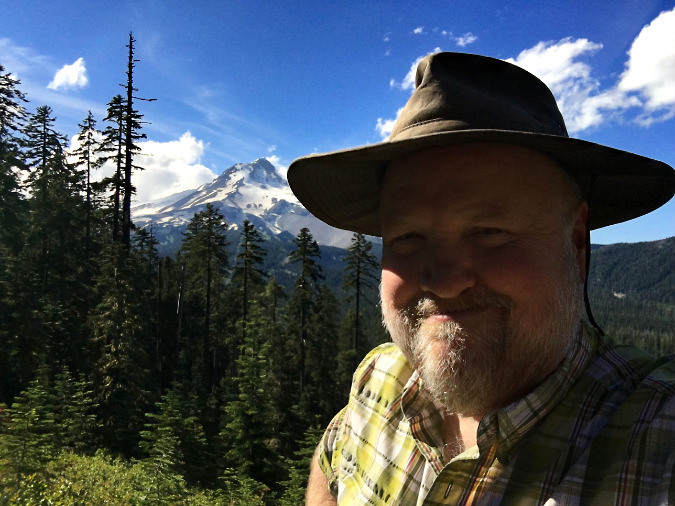
The author on the wrong side of the camera at Bennett Pass
This blog is filled with images that I’ve taken, so this page is about the photos — and the photographer! A couple of basics: first off, I’m strictly a photo enthusiast and weekend warrior. Most of the photos on this blog are mine, so if a photo is uncredited (and not a historic image), then it’s one I’ve taken.
As you might have guessed, my great passions are protecting the Columbia River Gorge and Mount Hood. I spend most of my free time in these places, and I am happiest when I’m capturing what I see and feel in these places in photos. I especially like exploring “new” places that have never been mapped, or have simply been forgotten by the cartographers. All of the above is good therapy for the mind, and an essential counterpart to the more stressful parts of life.
I caught the photo bug in the early 1980s with my old Olympus OM-1 (still works!), and cut my teeth on Kodak Tri-X and Kodachrome 25 film in the days of darkroom developing and printing. As much as the familiar smell of darkroom chemicals brings fond memories, I eagerly switched to digital SLRs in 2002, and I haven’t looked back.
My current camera setup includes three Olympus E-M10s (one lives in my pack full time) for set shots and an iPhone 14 that I keep on my pack belt for informal shots — or potential Sasquatch sightings. I’m a devoted Olympus (now branded as OM Systems) camera fan for their affordability, toughness, optic quality, history of innovation, and especially for creating ultra-compact cameras tailored to the outdoors.
For the Olympus E-M10s, I carry three lenses: a 9-18mm super wide angle for dramatic landscapes, a 12-50mm general power zoom that is the default on the camera and 40-150mm telephoto lens for detail and macro shots. Occasionally, you might see a photo taken with my 75-300mm lens, but I rarely carry it on the trail because of its size and weight. I also carry a multiplier, though seldom used.
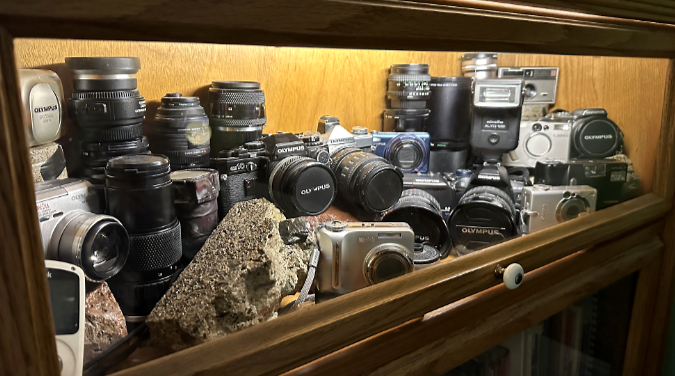
Yes, it’s true. I keep every camera and lens I’ve ever owned in a little shrine…
For filters, I simply keep a polarizer on each lens almost all the time. Yes, this is like nails on a chalkboard for pros, but I’m not one. They are right to point out that I lose a couple f-stops and some image quality, but it’s also rare that I don’t have want for a polarizer in a given scene, so I just leave them on in lieu of a UV filter for lens protection. I also carry a set of neutral density filters for shooting long exposures in bright light.
For accessories, I use a couple of different tripod models: the classic, tank-like Slik U212 DX (nearly indestructible, though I’ve had three) when I feel like carrying a heavy tripod around and the lightweight Slik Sprint Pro series for longer trips into the backcountry. I almost always carry the latter with me on my backpack. Both tripods are the right mix of consumer-level quality and affordability for me.
On the processing end, I work on a Mac and for decades I used the Adobe Creative Suite to process images and create graphics. However, in 2020 I abruptly switched to Affinity Photo and Affinity Design when I finally hit my limit with Adobe’s increasingly predatory pricing and move to cloud subscriptions. I’ve really enjoyed using the Affinity Suite (now owned by Canva), and especially the massive number of YouTube tutorials by its very young user base. It’s a great option for enthusiasts, and has rapidly closed in on Adobe’s capabilities.
More recently, I’ve begun using ChatGPT to create occasional photo graphics. Because of the baggage that AI brings, I include a watermark (see below) on anything I’ve use AI to generate in the interest of full disclosure and transparency.
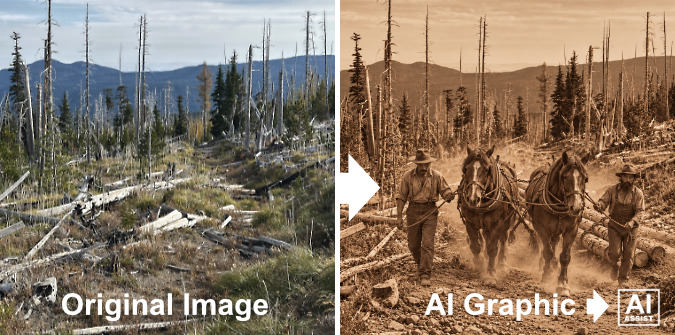
AI-assisted graphics used in the blog will almost always begin with one of my original images, and include an AI watermark on the generated graphic.
Now that I’ve trudged through all of the technical details, I’d be remiss not to point out my proletariat philosophy on photo equipment: save your money! Buy affordable, quality equipment that will help you enjoy the outdoors, not get in the way of it. I’ve seen too many amateur photographers out there with high-end professional gear spending a lot of time fiddling with (or talking about) their hard-to-use equipment, and not much time actually seeing the landscape. If you’re not a pro, my advice is to go with consumer cameras you can afford to break or lose, and enjoy the ride!
Happily, some of the best photos I’ve seen come from humble cameras that anyone can use – yes, including iPhones. In the end, a photo is only as good as the eye and imagination of the photographer who took it. That part just takes time and practice – something I’m still working on, every chance I get.
Finally, I don’t sell photos, but I do donate them to non-profits and public agencies, so feel free to send me a message if you’d like to use one. Even better, I know several amazing photo pros in our area, so if you arelooking for someone to do professional work for you in WyEast Country, please let me know. I would love to send some business their way!
Thanks for visiting the blog!
___________
Tom Kloster | WyEast Blog


Hi Tom, You have some beautiful photographs that I was hoping you would consider sharing a few for Forest Service interpretive signs that we are developing for the Mt Hood National Scenic Byway. Please call me to discuss our ideas. Alex 208-634-0761
LikeLike
Hi Tom, I’m working on a book project for a 100-year old company and we saw a historic photo on your site that we would love to use to help us illustrate one of our stories of the founder on a drive to do highway work in the “coulees” in 1919. We’re wondering if we might get permission to use the photo in our project. I hope to hear from you soon. Thanks! Alice
LikeLike
hello,
I am writing an article for Boat Trader for our Clean Wake campaign. I wanted to ask whether I could use some photos of Clackamas river, they are very cool.
The article mentions some local initiatives being adopted to encourage people to pick up litter around the river,
Many thanks,
Emma
LikeLike
Hi Tom,
I didn’t see a direct way to contact you via the Wy’East blog, so I’ll reach out here. Can you contact me via the Mazama Library? I have a correction and a few questions concerning your post on Leig Coalman and Hood’s Pint Sized Glaciers.
LikeLike
Tom, I am the art director for Natural History magazine. Each issue we feature an area of special interest, (mainly botanical), in a department termed This Land. The author Bob Mohlenbrock has been an anchor for the magazine for many years. February features Wildcat Mountain Research Natural Area and the nobel fir. In your blog, you have photographs of the area he describes. If possible we would like to publish a couple to accompany the article. I can be more specific if you agree to this. Our magazine is supported mainly by subscription and the Friends of Natural History, a nonprofit arm of the organization. Many Thanks, Steve
LikeLike
Hello. The two young women standing by the “newly opened litttle zig zag bridge” selling huckleberries, would these two ladies have the maiden name of Sanders? One of them looks exactly like my grandmother, taken in a picture back in the early 1920’s and she too lived in Zig Zag Oregon, before she married and moved to Norman Oklahoma, before the start of WW2. Thank you…..
LikeLike
Hello Tom, please email me back about one of the photos posted as I have the photo credit.
LikeLike
Hello Tom. I am the editor of Nature Trails, the monthly publication of the Eugene Natural History Society. We are the oldest nonprofit environmental education organization in Eugene (since 1941!). This month (May) our featured speaker is Samantha Hopkins, a paleontologist at the University of Oregon. She will be speaking about the evolutionary origins of mountain beavers. I would like to use your mountain beaver photo for the cover of Nature Trails to advertise her talk.
–Kim Wollter
LikeLike
Hi Kim – thanks for asking! That image is from Wikimedia, so available for you to use.
LikeLike