Warren Falls: A Postscript (Part 2 of 2)

hcrh_review01a

The first part of this article focused on the missed opportunity to restore Warren Falls as part of construction of the most recent phase of the Historic Columbia River Highway (HCRH) State Trail. This article takes a look at this newly completed section of trail.

_________________

hcrh_review01b

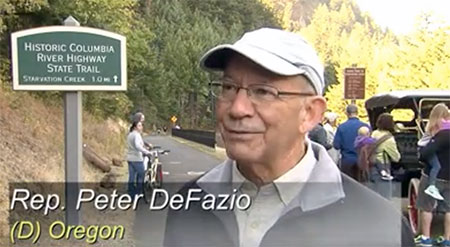
Congressman Peter DeFazio at the grand opening of the new HCRH segment in October (ODOT)

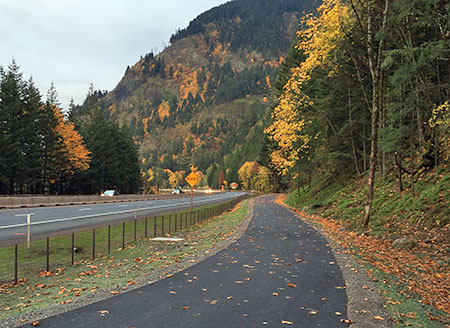
In October, the Oregon Department of Transportation (ODOT) opened the latest section of the HCRH State Trail, a segment stretching from the trailhead at the Starvation Creek wayside west to Lindsey Creek. A portion of this newest section follows the original highway grade where it passes Cabin Creek Falls, but most of the route is a completely new trail – or more accurately, a paved multi-purpose path open to both hikers and cyclists.


hcrh_review01c

The newly revamped Starvation Creek Trailhead

The new HCRH trail segment begins in a small plaza constructed at the south edge of the Starvation Creek wayside. Early plans called for a complete reconstruction of the parking area, but budget constraints intervened, and most of the work here is along the margins of the existing parking lot. The trailhead plaza features some to-be-installed interpretive signs in the shade of a group of bigleaf maple trees, a pleasant meeting spot for hikers or cyclists.

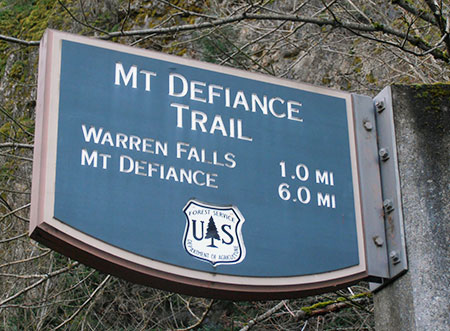
Missing from the revamped trailhead is the original Forest Service trailhead sign that once pointed to Warren Falls (below). It’s unclear if this sign will be reinstalled, but given that Warren Falls, itself, was not “reinstalled” as part of this project, the chances are probably slim.

hcrh_review01d

This sign has gone missing!

The sign actually referred to what is now called Hole-in-the-Wall Falls, where Warren Creek emerges from the diversion tunnel built by ODOT in 1939. The unintended reference to the original falls made for an inspiring Forest Service gaffe for advocates of restoring Warren Falls!

The first few yards of the new trail generally follows the existing route along the Starvation Creek wayside freeway exit ramp. It’s still a noisy, harsh walk through this area, but ODOT has dressed up this section with a sturdy cobble wall and new paving.

hcrh_review01e

Cobble retaining wall near Starvation Creek

The trail concrete barricades along this section that protect the trail from freeway traffic also feature the same decorative steel fencing found elsewhere on the HCRH State Trail, giving a bit more sense of separation from speeding vehicles. The new trail is also slightly elevated here, reducing the noise impacts somewhat from the old trail that was mostly at the ramp grade.

hcrh_review01f

Decorative steel fencing near Starvation Creek

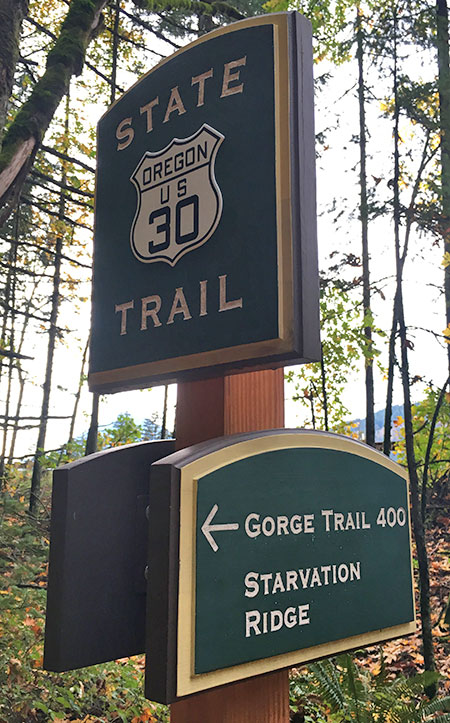
Soon, the new trail drops to the only original section of Columbia River Highway on this restored section of trail, where the old road passed in front of Cabin Creek Falls. An elegant but confusing signpost has been added at the junction with the Starvation Ridge Cutoff trail, pointing to Gorge Trail 400, which currently does not exist in this section of the Gorge.

I didn’t hear back from ODOT as to whether a trail renumbering is in the works that would extend the Gorge Trail to Starvation Creek, but it may be that the Forest Service is planning to stitch together a extension of the Gorge Trail from pieces of the Starvation Ridge and Defiance Trails. That would be a welcome development!

hcrh_review02a

Trail 400..? Is a trail re-numbering in the works?

The location of the new sign almost suggests that the infamous Starvation Cutoff trail – one of the steepest in the Gorge – would be renumbered as the Starvation Ridge trail, with the bypassed section of the current Starvation Ridge trail becoming Trail 400.

Confused..? So are many hikers who visit the area with its already confusing trail network. So, keep your fingers crossed that the Forest Service is rethinking trail numbers and signage in conjunction with the new HCRH trail.

For now, the actual Starvation Cutoff Trail has not changed, though HCRH workers added a nice set of steps at the start of this very steep route.

hcrh_review02b

New steps at the otherwise humble Starvation Cutoff trailhead

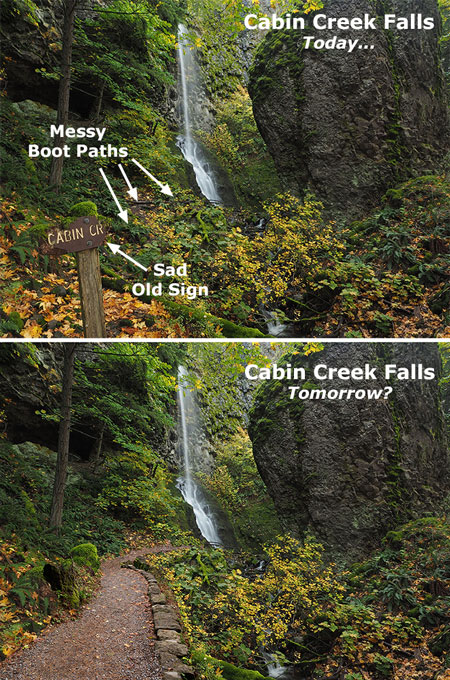
The old pavement in this original highway section was resurfaced with new asphalt as part of the project, but otherwise the route here is much as it was when the highway opened in 1916, including a roadside view of Cabin Creek Falls. However, ODOT missed an opportunity to organize the hordes of visitors who now scramble to the falls along a cobweb of boot paths.

Formalizing a single spur with a properly constructed trail (below) would be a great project for a non-profit like [link]Trailkeepers of Oregon (TKO)[/link] in conjunction with Oregon Parks and Recreation (OPRD), who now manage the trail and adjacent park lands.

hcrh_review02c

Cabin Creek could use a formal path to the falls… and a new sign

[click here for a large version]

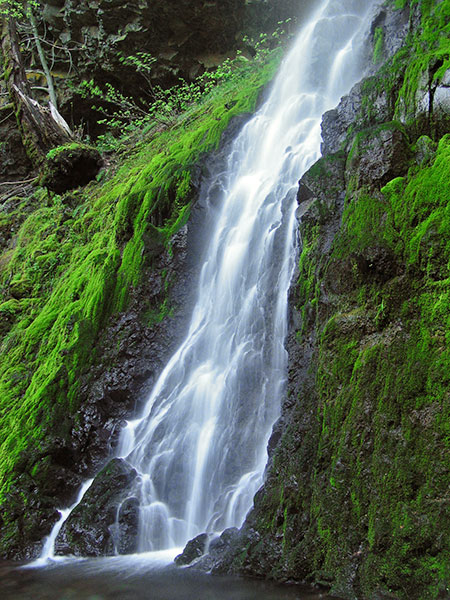
Cabin Creek Falls is popular with families (where kids can safely play in the basalt-rimmed splash pool) and photographers (who love this delicate, mossy falls). For many casual visitors, this is already the turn-around point on their walk from the trailhead, with Cabin Creek being the highlight of their experience, so a spur trail would be a nice addition to allow visitors to get off the pavement and explore a soft trail.

hcrh_review02d

Cabin Creek Falls up close

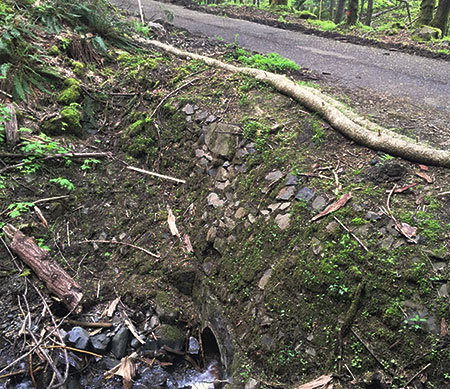
ODOT also cleaned out the large, stone culvert (below) where Cabin Creek flows under the HCRH State Trail. This display of original dry masonry was mostly buried in debris and undergrowth until the trail project was constructed, so the restoration provides a nice look at the craftsmanship of the original highway.

hcrh_review02e

Original dry masonry culvert survives at Cabin Creek

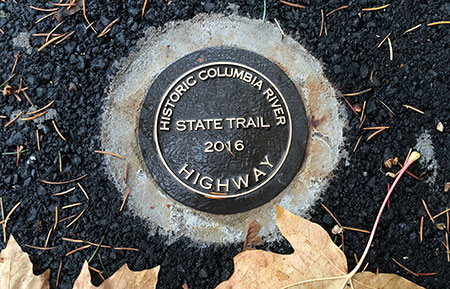
As the new trail route reaches the west end of the original highway section, ODOT thoughtfully place a small memorial (below) in the paving – a nice historic reference to the original highway.

hcrh_review03a

HCRH plaque marks the original highway route near Cabin Creek Falls

As the new route leaves the beautiful, forested section of original highway at Cabin Creek, it suddenly follows the freeway for about 200 yards due to steep slopes along the Gorge wall. This jarringly noisy section could use some replanting to at least create a visual buffer from freeway traffic.

hcrh_review03b

Noisy, barren stretch of the new trail west of Cabin Creek

Soon, the new HCRH route thankfully curves back into the forest on a surprisingly massive structured fill. This structure was required to maintain the modest trail grade as the route climbs from the freeway shoulder to a slight rise near Warren Creek.

This section is bordered with stained wood guardrails, a new design that departs from the vintage-style white guardrails in other sections of the restored highway, but provides a nice aesthetic that will also be easier to maintain.

hcrh_review03c

This large, structured fill west of Cabin Creek was required to maintain the trail grade for bicycles

This following view shows the same spot in July, at the height of construction, and before the fill was completed:

hcrh_review03d

Structured fill near Cabin Creek during construction last July

ODOT was careful to document cultural resources along the route when designing the new trail, including a set of stone ovens built by the original highway masons who camped here during highway construction in the early 1900s. The historic ovens are better protected than before by the raised trail design and guardrails (below), though still fully visible for those who know what they’re looking for.

hcrh_review03e

The historic stone ovens can be seen from the elevated trail section west of Cabin Creek… if you know where to look

One disappointing detail along this section of trail is a long gabion basket wall (below), apparently constructed to catch loose debris from an adjacent slope. The steel cages holding this wall together will hopefully be covered in moss and ferns in time, but for now it’s an eyesore on an otherwise handsome section of the trail.

hcrh_review03f

Would Sam Lancaster have approved of a wire mesh gabion wall..?

Another sore thumb in this forest section is a rusty mesh fence (below) along the freeway right-of-way that should have at least been painted, if not completely replaced as part of the project. Maybe ODOT still has plans to replace this eyesore?

hcrh_review03g

Nope, Sam Lancaster wouldn’t go for this…

As the new section of the HCRH State Trail approaches Warren Creek, it enters a significant cut section to maintain its gentle grade. Thankfully, a huge anthill along this section was spared, one of the interesting curiosities along the former soft trail that used to pass through this forest.

hcrh_review03h

Hydro-seeded cut slope and the big anthill near Warren Creek

This following view is from July, when construction was still underway and the ant colony was no doubt thankful for the protective fence:

hcrh_review03i

The giant anthill lives!

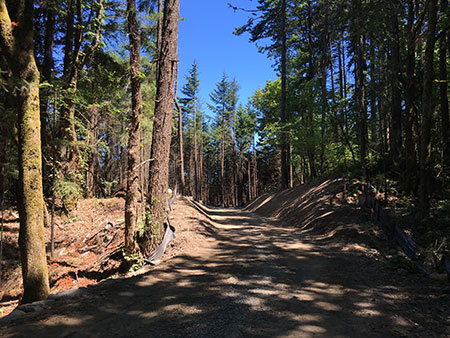
The view below was taken during the construction looks east at the cut section along the new trail. Because the rustic forest trail that once passed through this area was completely destroyed by the new HCRH trail, the reconfigured landscape will be a shock for hikers who hiked the trail in the past. Though hydro-seeded with grass, this section could benefit from some re-vegetation efforts to further speed up healing.

hcrh_review03j

The cut grade near Warren Creek under construction in July

Beyond the cut section, the new route crosses the original channel of Warren Creek, and for those with a sharp eye, a pair of cobble foundations for early homesteads that once lined the creek. Here, the trail reaches a half-circle bench where an all-access side trail curves up to the viewpoint of Hole-in-the-Wall Falls (more on that later in this article).

hcrh_review04a

Half-circle bench serves as the jump-off point to the Hole-in-the-Wall viewpoint

It’s unclear if interpretive signs will be added to this area, but at one time the story of how Warren Creek was diverted in 1939 was planned for the spot where the new trail crosses the old, dry creek bed.

Another new trail sign is also located at the all-access spur trail to Hole-in-the-Wall Falls, as this is also the route to the Starvation Ridge and Defiance Trails. This sign also includes a mysterious reference to Gorge Trail 400, further suggesting that a re-numbering of trails in the area is in the works. A large, multi-trunked bigleaf maple was also spared at this junction.

hcrh_review04b

Bigleaf maple spared… and another mystery reference to Trail 400..?

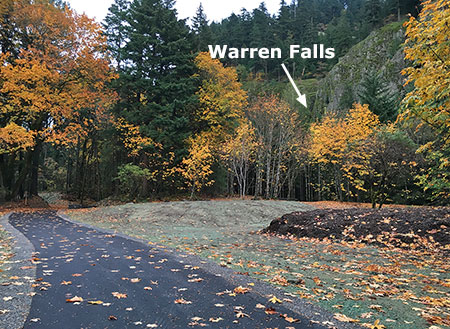
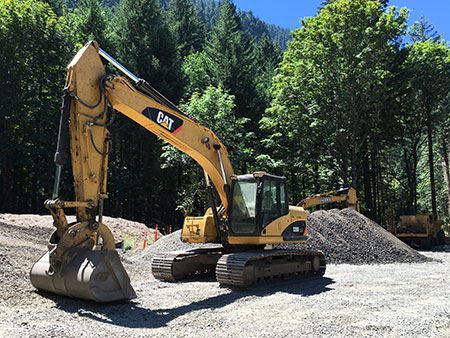
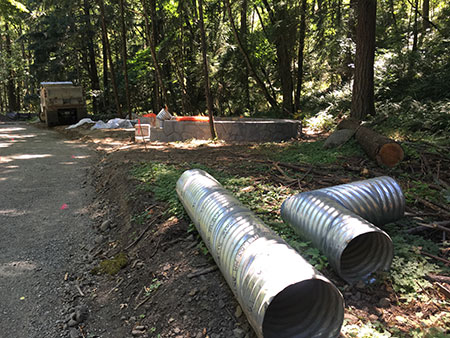
The following view is looking from the new HCRH State Trail toward the Hole-in-the-Wall spur trail, showing the proximity to Warren Falls. The green hydro-seeded area in the photo is where the construction staging area for the project, underscoring the missed opportunity to restore Warren Falls as part of the project – it was just a few yards beyond the staging area.

hcrh_review04c

So very close: Warren Falls from the main construction staging area

hcrh_review04d

Staging area during construction in July – the last time we’ll see heavy equipment this close to Warren Falls for generations?

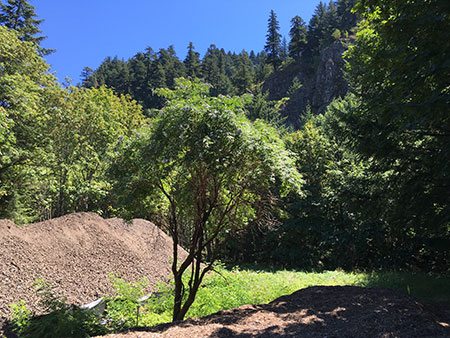
The humble elderberry (below) in the middle of the staging area was spared by ODOT, a nice consideration in a project that did impact a lot of trees. Hopefully, there are plans to expand native plantings here, as this area was covered with invasive Himalayan blackberries for decades before the trail project and will surely revert to invasive species without a deliberate restoration effort.

hcrh_review04e

This apparently well-connected elderberry dodged the ODOT bulldozers!

Moving west, the new HCRH State Trail segment passes through another forested section where the trail rises on fill necessary to bring it to grade with a handsome new bridge over Warren Creek (visible in the distance in the view, below). This is an especially attractive section of trail.

hcrh_review05a

Looking west along the attractive new trail section approaching the Warren Creek Bridge

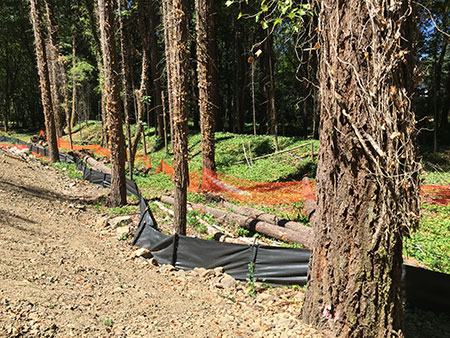
For some reason, many of the trees that were cut for this new section of trail were left piled along the base of the fill (below). The fill slope has been hydro-seeded, so it seems unlikely that the more work is planned to remove or repurpose the log piles, so apparently the were left in this manner on purpose?

hcrh_review05b

Piled logs along the elevated grade approaching Warren Creek Bridge

Looking back to the construction period last summer, you can also see the good work ODOT did to cut back English ivy that was rampant in this area. While ivy was left intact on the forest floor, it was cleared from dozens of trees in this section of the trail.

hcrh_review05c

Invasive English ivy was trimmed from dozens of trees near Warren Creek

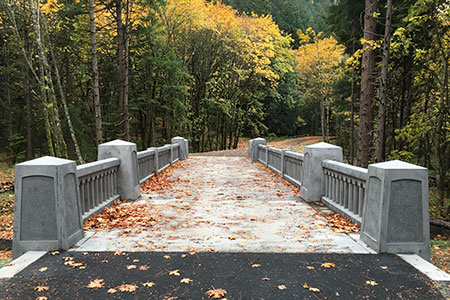
The highlight of the new HCRH trail segment is where the route crosses Warren Creek. Here, a handsome new bridge faithfully echoes the design ethic of Samuel Lancaster, but is probably more elaborate than the original bridge constructed at Warren Creek in 1916. Lancaster’s bridge was destroyed when the first version of the modern highway was built in 1950.

hcrh_review05d

The handsome new Warren Creek Bridge is the jewel of the new trail segment

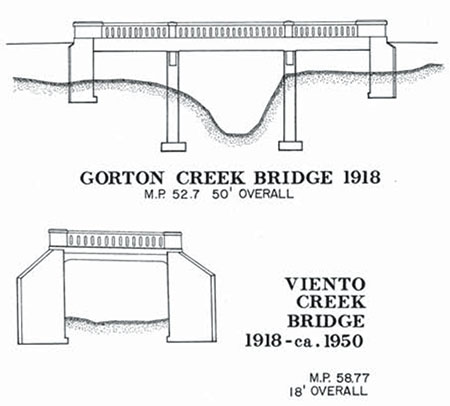
Though no visual record exists, the original Warren Creek Bridge was modest in length, at just 18 feet, and likely resembled the surviving bridge at Gorton Creek to the west, or possibly the original bridge at Viento Creek to the east (shown below).

hcrh_review05e

The original Warren Creek Bridge probably followed one of these designs

The design of the original Warren Creek Bridge inadvertently helped lead the Highway Department to bypass Warren Falls, as stream debris was clogging the bridge opening. The 1941 project files also describe the original bridge being “replaced in a different location” as part of the diversion project, so there may have been two version of the original bridge over Warren Creek before the modern highway was constructed in the 1950s.

hcrh_review05f

Warren Creek Bridge under construction in July

hcrh_review05g

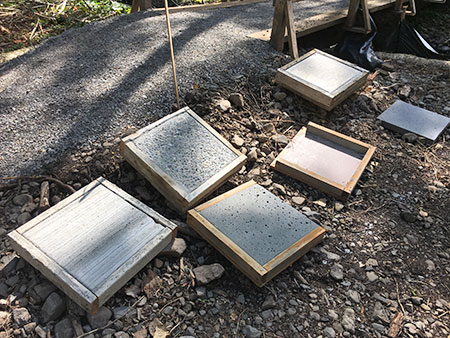
Pavement texture samplers being tested for the project

hcrh_review05h

Looking west across the new Warren Creek Bridge

hcrh_review05i

Railing detail and the view downstream from Warren Creek Bridge

Construction of the new HCRH bridge over Warren Creek was an involved undertaking, with the surprisingly wide span leaving plenty of room for a (someday) restored Warren Falls to move 70+ years of accumulated rock and woody debris down the stream channel.

hcrh_review05j

Built to last, with plenty of room for Warren Creek to once again move rock and log debris down its channel… someday…

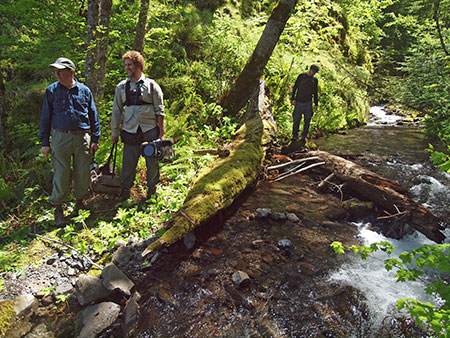
There’s nothing natural about Warren Creek in this area, as it looks (and is) more like a drainage ditch. This is because original streambed is now a dry ravine several hundred yards to the east, and the current streambed is where the Highway Department moved the creek decades ago, when the modern highway was first built in the 1950s.

hcrh_review05k

Ditch-like, man-made channel of Warren Creek as viewed from the new bridge

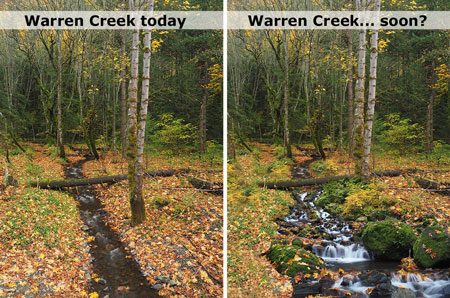
As described in the first part of this article, the someday restoration of Warren Falls will once again allow rocks and woody debris to migrate into the lower channel, eventually transforming the “ditch” into a healthy stream (below) that can fully support endangered salmon and steelhead.

hcrh_review05l

What a healthy Warren Creek might look like from the bridge, someday…

[click here for a larger version]

While ODOT missed the larger opportunity to help this stream restoration along when it declined to restore Warren Falls, the agency also missed the easy opportunity to simply add a few boulders and logs to the section of Warren Creek near the bridge when heavy equipment was in the area. That’s too bad, but perhaps the OPRD will someday enhance this stream section as part of managing the new trail.

hcrh_review06a

Looking west from near the Warren Creek Bridge to the Lancaster Falls viewpoint

From Warren Creek, the new trail follows another fill section to a mostly obstructed viewpoint of Lancaster Falls on Wonder Creek from a small seating area. This viewpoint (below) could use some light pruning to reveal the falls, and perhaps something that’s still in the works by OPRD.

hcrh_review06b

Lancaster Falls viewpoint

One oddity about Wonder Creek is that it mostly disappears into ground before reaching the culvert that carries Warren Creek under I-84 and to the Columbia River. This is partly due to the modest flow from spring-fed Wonder Creek, but also because the slopes below the falls are mostly composed of unconsolidated talus covered with a thin layer of soil and vegetation. So, most of the time the stream is simply absorbed into the water table below the falls.

Yet, in high runoff periods, the new state trail will accommodate the flow with extensive drainage features designed to carry Wonder Creek under the fill section and to the Warren Creek freeway culvert.

hcrh_review06c

Trail construction near the Lancaster Falls viewpoint in July

hcrh_review06d

Lancaster Falls viewpoint under construction in July

Another oddity of Lancaster Falls is its illusive nature. Though thousands of hikers each year view the modest, 20-foot lower tier of the falls where it spills across the Defiance Trail, few know of it’s full extent – and perhaps wonder why Samuel Lancaster wasn’t honored with a more spectacular landmark.

This is the view (below) of Lancaster Falls that most hikers see today, and this this is also the portion of the falls that can be glimpsed through the trees from the new HCRH trail viewpoint:

hcrh_review06e

Lancaster Falls as most know it, along the Defiance Trail

But viewed from across the Columbia River, along Washington’s Highway 14, Lancaster Falls takes on a completely different scale. This view shows the lower 20-foot tier that most know as “Lancaster Falls” completely dwarfed by the towering 300-foot extent of the falls:

hcrh_review06f

The full extent of Lancaster Falls as viewed from the Washington side of the Columbia

While it’s possible to scramble to the base of the main tier of Lancaster Falls, the slopes are unstable and already being impacted by off-trail visitors, so it’s probably best that only a most portion of the falls is (somewhat) visible from the new HCRH route. Hopefully, interpretive signage is in the works for the viewpoint that tells the story of Samuel Lancaster..?

hcrh_review06g

1920s view of the HCRH from Lindsey Creek looking toward Wind Mountain

From the Lancaster Falls viewpoint, the new trail heads west to a section where it once again follows the shoulder of I-84 to Lindsey Creek and the end of new construction. ODOT is working the next trail segment, which will connect from Lindsey Creek to the Wyeth Campground, crossing the base of famously unstable Shellrock Mountain along the way.

Hole-in-the-Wall Falls Spur Trail

hcrh_review07a

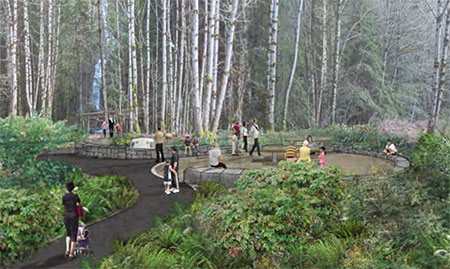
Original concept for the Hole-in-the-Wall Falls viewpoint

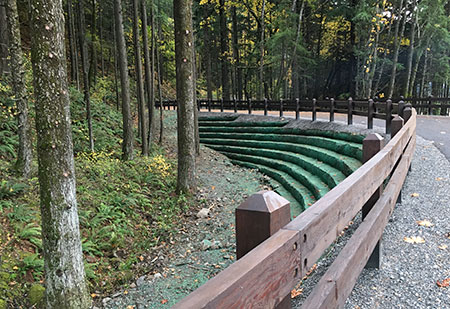
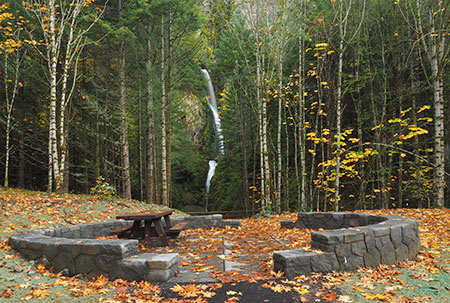
One of the design highlights of the new HCRH trail section is a short all-access spur tail to an overlook of Hole-in-the-Wall Falls, the man-made outflow tunnel that continues to drain Warren Falls of its water. The completed overlook has been scaled back from its original design (shown above), and now features one of the signature circular seating areas, complete with a picnic table (below).

hcrh_review07b

Hole-in-the-Wall Falls viewpoint

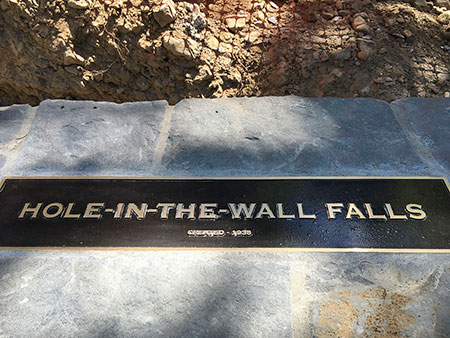
A small plaque at the viewpoint identifies Hole-in-the-Wall Falls, which until now has not been an officially recognized name or has appeared on any official maps. A nice nod to the origin if the “falls” is the byline “Created 1939”. Hopefully, there will be future interpretive displays here, as the story of Warren Falls would be a great addition to this overlook.

hcrh_review07c

Hole-in-the-Wall Falls viewpoint

hcrh_review07d

Hole-in-the-Wall Falls plaque

hcrh_review07e

Hole-in-the-Wall Falls viewpoint under construction in July

The Starvation Ridge Trail picks up from the south side of the Hole-in-the-Wall Falls overlook, heading across a footbridge over Warren Creek.

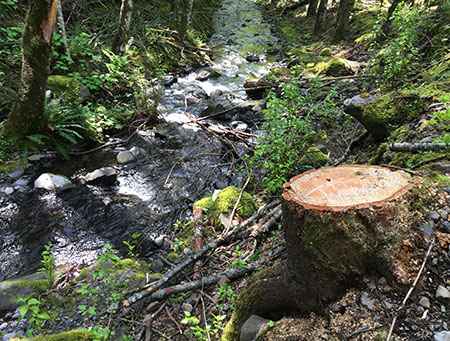
A closer look near the footbridge (below) reveals a surprising disappointment: the stump of a streamside Douglas fir cut improve the view of the falls. It’s too bad that the tree wasn’t simply limbed to provide a view, as it was one of the few larger trees stabilizing the banks of Warren Creek.

hcrh_review07f

Hole-in-the-Wall Falls bridge… and stump?

hcrh_review07g

Unfortunate remains of the offending Douglas fir along Warren Creek

While it’s disappointing to think about the opportunities missed at Warren Falls, the Hole-in-the-Wall Falls overlook and beautiful new Warren Creek Bridge, are still a big a step in the right direction toward someday moving Warren Creek from neglected afterthought to a valued resource that deserves to be restored. ODOT deserves major kudos for their thoughtful work on this section of trail!

“Love what they’ve done with the place…”

hcrh_review08a

Heavy construction of the new “trail” in July looked more like a road to many hikers

Last summer I encountered another hiker while surveying the progress of the new HCRH trail in the Warren Creek area. He was making his way to the Defiance Trail, and when he saw me taking photos, shouted angrily “Love what they’ve done with the place!”

I’ve heard this reaction to the State Trail from many hikers over the years, as avid hikers are often aghast at what they see as more of a “road” than trail. The scope of construction impacts on the natural landscape of the Columbia River Gorge National Scenic Area (CRGNSA) and the millions in public funds being spent on the project rankles hikers who don’t see themselves actually using the trail.

Many hikers are also mystified as to how this project can received tens of million in funding while other, heavily overused Gorge trails are falling apart for lack of adequate funding.

hcrh_review08b

Extensive cut and fill necessary to maintain trail grade meant a wide construction swath

These reactions are understandable, if misguided. The restoration of the surviving HCRH and the future trail segments that will soon complete the original route from Troutdale to The Dalles is an epic effort of ambition and vision in an era when both are rare quantities.

When the route is completed, it will become a world-class cycling attraction, and it is already drawing visitors from around the world. Guided bicycle tours have become a thriving business in the Gorge because of ODOT’s commitment to bringing the HCRH State Trail vision to reality, and businesses in Gorge towns are already seeing the benefits.

Other projects to promote the trail are also in the works. ODOT’s Gorge Hubs project is a new partnership with six cities in the Gorge to provide traveler information for trail users and boost the local economy. The Friends of the Gorge have launched the Gorge Towns to Trails project, a complementary effort to the HCRH State Trail to connect Gorge communities to public lands via trails.

hcrh_review08c

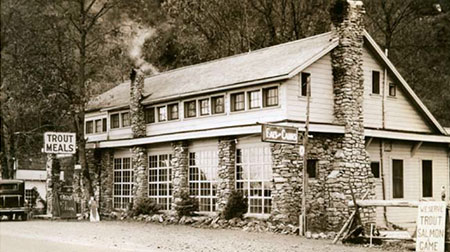
Tourism in the Gorge is as old as the historic highway, itself. This is the Lindsey Creek Inn that once stood where the newly completed HCRH State Trail approaches Lindsey Creek

Plenty of local visitors will continue to use the HCRH State Trail as the project nears completion over the next few years, but the real benefit for Gorge communities is from visitors coming from outside the region. Unlike local visitors, tourists coming from elsewhere will book hotel rooms, purchase meals and take home locally-made products and art from the Gorge to memorialize their trip. These visitors make a much larger contribution to the Gorge economy than a local visitor who might stop by a brewpub on the way back from a day trip.

hcrh_review08d

Gorge sunset from near Starvation Creek along the newly completed HCRH State Trail

A 2011 National Park Service study of tourism dollars shows outside visitors spending anywhere from 7 to 12 times the amount that local visitors spend on a visit to a given park, bringing hundreds of millions to local economies at many parks. There’s no reason why the Gorge can’t better manage the our already heavy demand from local visitors to the Gorge to allow for more outside visitors drawn by the HCRH State Trail to spend their dollars here.

The bigger picture is that anyone opposed to seeing casinos or bottled water plants in the Gorge should be part of supporting a tourism economy that builds on the scenery. Yes, tourism impacts must be managed to protect the Gorge for future generations, but the health of the Gorge economy is the essential ingredient to providing these protections over the long term.

The HCRH State Trail is part of that formula, and it deserves enthusiastic support from anyone who loves the Gorge. If you own a bicycle (or pair of walking shoes), give it a try — and then recommend it as an exciting new vacation destination to distant friends and family!

Warren Falls: A Postscript (Part 1 of 2)

warrenfallspostscript01

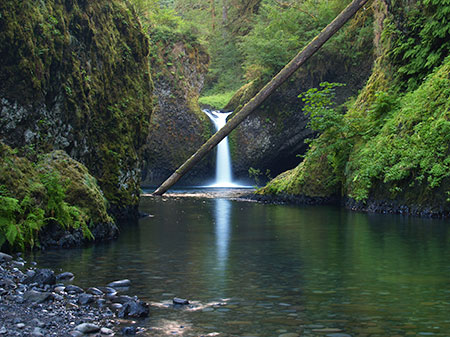
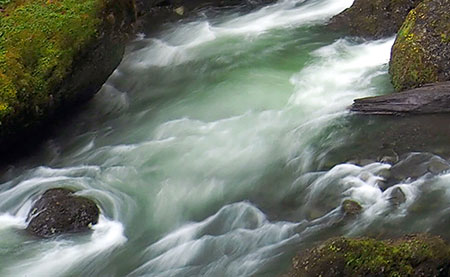
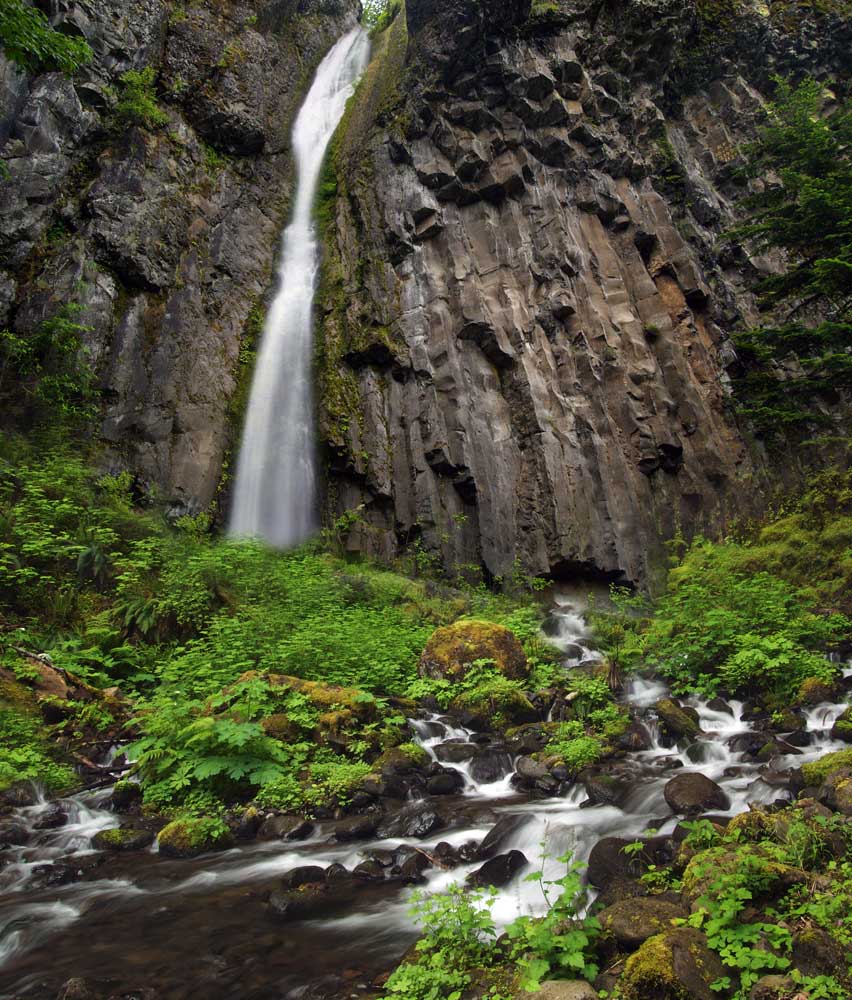
Warren Falls lives! Well, on a few days each year, after heavy rainfall…

The campaign to restore Warren Falls in the Columbia River Gorge is over, at least for now.

The Oregon Department of Transportation (ODOT) is putting the final touches on the latest section of the Historic Columbia River Highway (HCRH) State Trail, from Starvation Creek to Lindsey Creek (more on that in part two of this article), and undoing their diversion tunnel at Warren Falls was not part of the deal.

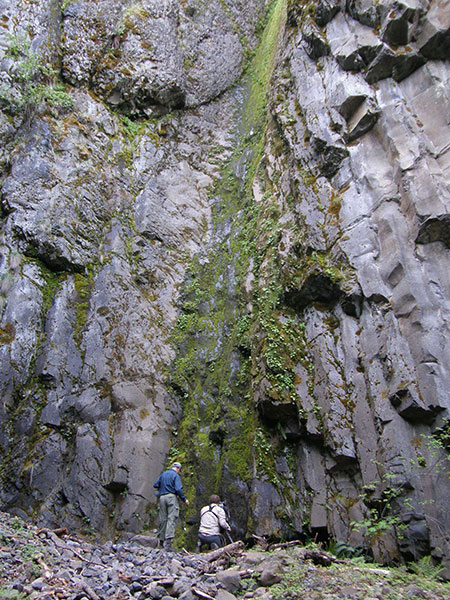
While Warren Creek now has an especially handsome bridge on the new state trail, the dry cliffs of beautiful Warren Falls (below) will continue to be a ghostly testament to the arrogance and carelessness of our modern age – except on those rare stormy days each winter when the falls briefly reappears (above).

warrenfallspostscript02

Warren Falls as it exists most of the time… for now…

Restoring the falls would have been the perfect companion to the HCRH State Trail project, itself an epic restoration project. Samuel Lancaster would surely have approved, too. It was a once in a century opportunity to do the work while heavy equipment was right in front of the falls. But if fighting City Hall is an uphill battle, then the castle walls at ODOT are still more foreboding.

The agency isn’t a monolith. There was encouragement and support from sympathetic professionals at ODOT along the way, albeit plenty of opposition from others. In the end, the agency formerly known only as the Oregon Highway Department revealed its roots, reluctant to step beyond its narrow right-of-way.

And yet the Historic Highway State Trail project, itself, is a bold step forward from simply building highways, and one the agency has been truly committed to. Thus, I’m hopeful about ODOT’s future, and the new state trail has much for us to be proud of.

warrenfallspostscript03

So very close… but not this time…

[click here for a larger view]

Perhaps most disappointing is ODOT’s lack of ownership and sense of responsibility for a stream diversion project that today would be considered a crime against nature. Even when Warren Creek was diverted and the falls destroyed in 1939, it was jarringly at odds with the vision and reverence for the landscape of Samuel Lancaster’s Columbia River Highway, and should have sent up red flags for the Highway Department.

Still more astonishing was learning during the course of this project that none other than Conde McCullough – engineering deity to many as the designer of Oregon’s most treasured highway bridges of the 1920s and 30s – signed off on the diversion project while serving as chief engineer!

Worse, we also learned along the way that it was completely illegal to destroy the falls, even back in 1939, as revealed in this article on the blog.  Oregon wasn’t a very big place back then, so it’s hard to believe the law protecting the falls went unnoticed at the time… but the truth on that point will likely never be known.

warrenfallspostscript04

Warren Falls flows briefly in 2015

Perhaps the greatest irony in the Warren Falls saga is that the original diversion project was designed to protect one the bridges on Sam Lancaster’s famous new road – by destroying one of the more spectacular waterfalls along the route. Lancaster died in March 1941, so it’s doubtful that he was even aware of the project as it moved forward in 1939. Let’s hope so, anyway.

Today, the crumbling diversion dam and tunnel are still listed as “assets” by ODOT, but are really just orphans, and now all but forgotten by the agency for the foreseeable future. Short of Oregon Parks and Recreation (OPRD) taking on the decommissioning as part of some sort of larger Warren Creek restoration project, the most likely outcome is continued deterioration of the diversion structure until nature finally reclaims it.

So, the campaign to restore Warren Falls is over… or is it?

Postscript… and premonition?

After years of attending meetings, writing letters, giving tours to all manner of advocates and officials and even a segment on OPB’s “Oregon Field Guide”, there weren’t many stones left to turn in coaxing ODOT to bring Warren Falls back to its original glory. On the surface, there’s very little to show for the effort.

But is that really true? It depends on how you define victory.

warrenfallspostscript05

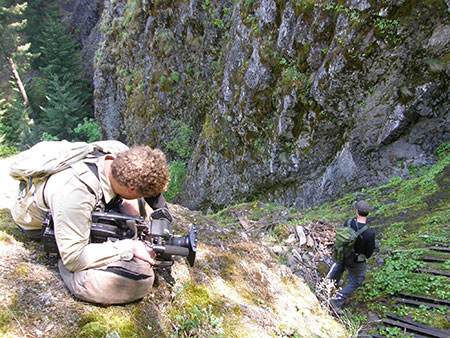
OPB crew at Warren Falls in 2012

Yes, in the immediate future ODOT will continue to treat Warren Creek like a glorified storm culvert, and the former Warren Falls will continue to be a depository for “trash” (what the original engineers called the rock and woody debris we now know are essential to a stream health) separated from the creek’s flow. That’s a shame, and a missed opportunity for the agency to show that it has evolved from its “Highway Department” past.

warrenfallspostscript06

OPB crew above Warren Falls in 2012

But over the past five years, tens of thousands of people have learned the story of Warren Falls thanks to the OPB coverage, thousands more have viewed the WyEast Blog stories here and on the Restore Warren Falls Facebook page, and hundreds have visited the falls site, with more making the side trip each year to pay homage to what once was – and will be, again.

Until they see the silent cliffs where Warren Falls once flowed, most of these visitors have no idea that today’s Hole-in-the-Wall Falls is simply a man-made attraction that came at the cost of destroying Warren Falls. Armed with the history of Warren Falls, few who visit can view it as anything less than an environmental tragedy.

So, despite losing this round, Warren Falls has a lot of new friends, and a lot of people who love the Gorge have gained a better understanding of the lasting cost of “progress” and the chore of undoing our handiwork, even in places we seek to protect most.

Which brings me to…

(Not so) Secrets of the Monkey Wrench Gang…

Oh, how I wish I could share all of the schemes for liberating Warren Falls that have come my way over the past five years! They range from temporary performance art to more permanent alterations that would probably be illegal… if any governing entities were actually concerned about the fate of Warren Falls.

Still more surprising is the range of Monkey-Wrench-Gang-wannabes who proposed taking the restoration of Warren Falls into their own hands: you’ll just have to use your imagination, but some were rather prominent folks who left me speechless with their audacious plans.

So, I’ll share a few highlights, with the strict caveat from the WyEast Blog Legal Department:

NONE OF THESE ACTIVITIES APPEARS TO BE LEGAL, at least not without prior permission from the OPRD or ODOT (and good luck with that, by the way), and therefore the following DOES NOT CONDONE OR ENDORSE these ideas in any way!

Whew. Okay, well one of the most popular schemes is to roll plastic tarps over the giant “trash rack” that forms the screen over the Warren diversion tunnel. This would allow the pristine waters of Warren Creek to ride a plastic liner above the tunnel and over the natural falls. Sort of a giant slippery-slide, but with a real surprise at the end!

warrenfallspostscript07

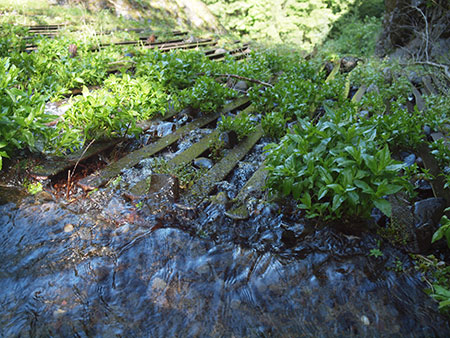
The massive “trash rack” that turned Warren Falls dry in 1939

Someday (on my deathbed, or possibly at the dedication of a restored Warren Falls?) I may reveal an especially prominent individual who personally pitched a version of the slippery slide to me – truly, one of the more unexpected twists in this five-year saga!

Most versions of the slippery slide focused on getting a really good look at what an unaltered Warren Falls looked like via a temporary restoration. But Warren Creek gets pretty wild and wooly in winter, so this would likely be a very brief restoration.

There’s also the question of what would happen to the tarps, once swept away, as there is a lot of potential for adding more man-made junk to an already defaced stream (assuming the tarps didn’t get hung up on the cliffs or left hanging form the outflow to Hole-in-the-Wall Falls).

warrenfallspostscript08

OPB’s Michael Bendixen filming the “trash rack” above the brink of Warren Falls in 2012

Others suggested (WyEast Blog Legal Department repeat notice: not condoning this!) speeding up the “weathering” process that has already begun to expose and compromise the steel beams that form the “trash rack” at the top of the falls.

It turns out that in just the ten years since I’ve been advocating to restore the falls, this part of the diversion has shown noticeable deterioration, and seems to be speeding up. It turns out the top of the “trash rack” is the weakest point in the design, and is steadily unraveling. So, I’m not sure Mother Nature needs much help at this point, despite the enthusiastic volunteers out there.

warrenfallspostscript09

OPB’s Michael Bendixen on top of the “trash rack” that rests on a cobble dam that is gradually eroding away

These photos show the vulnerability of the steel “trash rack” beams where the mortar that once fully embedded them above the diversion tunnel has been significantly compromised since 1939 by the relentless flow Warren Creek:

warrenfallspostscript10

A closer look at the lip of the “trash rack” showing the masonry cap on the cobble dam

warrenfallspostscript11

The masonry cap has worn thin where it anchors the top of the “trash rack” and a small garden flourishes where debris has clogged the giant grate

warrenfallspostscript12

Creative types see an opportunity to speed up the demise of the “trash rack” where these steel beams are almost freed from the concrete cap by weathering

The motive for speeding up the release of the beams varies among schemes and schemers.

One version is to allow enough stream material to pass under the protective “trash rack” to plug up the surprisingly narrow diversion tunnel leading to Hole-in-the-Wall Falls. Which is just 60” in diameter. This is probably what Mother Nature has in mind, though it may take awhile.

Another angle on speeding up the weathering at the top of the steel beams is to allow larger debris (logs, large rocks) to wedge between the beams, thus acting as levers to literally tear it apart with hydraulic pressure during high stream flow. To a large extent, this is already happening, as at least half the rack is plugged with smaller cobbles that are twisting and bending the steel beams with the effects of freeze and thaw during the winter months.

warrenfallspostscript13

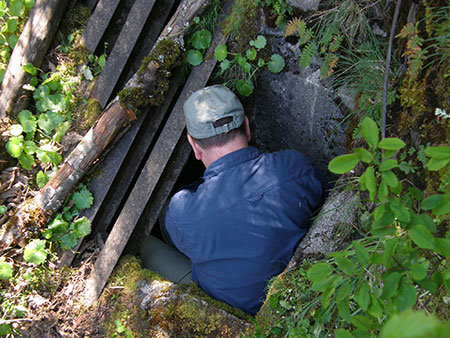
Vince Patton from Oregon Field Guide inspecting the access vault on the west end of the “trash rack”

At least one Warren Falls fan spotted the open vault above the west end of the diversion structure and suggested diverting the creek into this hole (WyEast Blog Legal Department reprise: this is not an endorsement! Plus, you might fall into a tunnel that spit out as a man-made waterfall!), where it could move debris large enough to plug the bypass tunnel. I’m not positive, but I think solid basalt prevents this from happening – either through creative monkey-wrenching or courtesy Mother Nature. But I was impressed at the attention to detail from those who love Warren Falls!

As much as I enjoyed hearing these inspired pitches for a DIY restoration of Warren Falls, one of the reasons I advocated for removing the “trash rack” structure and filling the bypass tunnel in an orderly way was to avoid having a bunch of steel debris entombed at the lip of this beautiful falls. I’d still much prefer a thoughtful decommissioning of the diversion over a disorganized mess – whether triggered by humans or nature.

We owe it to future generations to do this right. And who knows, we may still get the chance!

What the Future Holds: Warren’s Cousins

Short of an unforeseen intervention, the restoration of Warren Falls by forces of nature will take awhile. But it turns out that Warren Falls has some similarly trod-upon cousins in the area who have suffered flagrant abuse, then been abandoned to recover on their own.

The good news: in all cases, nature is winning… albeit, very slowly.

warrenfallspostscript14

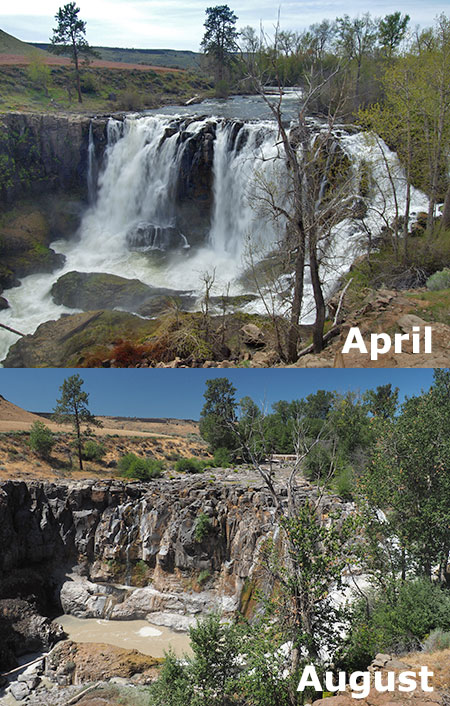
White River Falls needlessly goes dry each summer, thanks to a derelict Pacific Power diversion that sends the river around the falls (visible dropping in on the right).

A spectacular example is White River Falls, located in a state park by that name on the east side of Mount Hood. The falls is just upstream from the confluence of the White River with the Deschutes River.

More than a century ago, the Wasco Milling Company diverted much of the falls to a giant pipeline that fed a powerhouse downstream. Energy from the powerhouse was transmitted to The Dalles. Wasco Milling later sold the plant to Pacific Power, and it was finally shut down in 1960, when the land was transferred to the state of Oregon.

Pacific Power left quite a mess behind. The abandoned power plant, numerous pipelines and the diversion dam all still survive on state park land today. During high runoff in winter and spring the diversion channel is overwhelmed, and the former glory of White River Falls is on display. But by late summer, the entire flow is still diverted into the bypass channel, tumbling around the falls where the diversion pipe once existed.

warrenfallspostscript15

The derelict diversion channel at White River Falls

In this way, the situation at White River is not unlike present-day Hole-in-the-Wall Falls burping out of the Warren Falls bypass tunnel where it once connected to a flume that carried the creek over the old highway and to the Columbia River.

And like Warren Falls, the bypass channel “falls” at White River is a sad, ugly duckling compared to the magnificent original falls. But while there is no plan to formally decommission the diversion at White River Falls, the approach to the diversion dam is increasingly clogged with silt and debris, and should eventually fail, finally closing the chapter on the Wasco Milling Company era.

A few years ago, I reported on a now-scrapped scheme by Wasco County officials to reboot the White River generating plant, proving once again the wise words of John Muir: “Nothing dollarable is safe.” Even in an Oregon state park, it turns out.

A closer cousin to Warren Falls is popular Bridal Veil Falls, located at the far west end of the Columbia Gorge. Though few of the thousands of visitors who hike to the base of Bridal Veil Falls each year can even imagine what this spot looked like just a few decades ago, it was one of the most heavily degraded areas in the Gorge.

warrenfallspostscript16

The lower tier of famous Bridal Veil Falls was altered for mill operations! Who knew?

The mill town of Bridal Veil was once located just 100 yards below the falls, though the town is now nothing more than concrete foundations and rusted cables covered in moss and undergrowth. In this eastward view (below) from the early 1900s, today’s Bridal Veil exit from I-84 to Multnomah Falls would be located near the buildings at the far end of the mill town.

warrenfallspostscript17

The mill town of Bridal Veil in the early 1900s

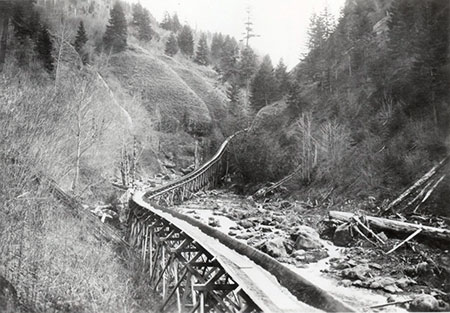
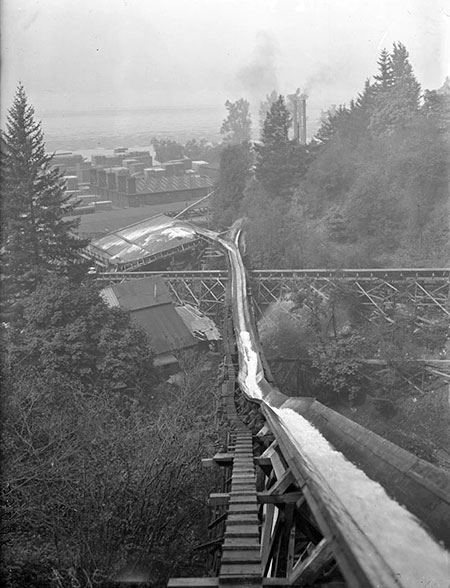
The pile of rough-cut timber in the foreground marks the terminus of log flumes that fed the Bridal Veil mill. At least three timber flumes carried logs and rough lumber to the mill from the slopes of Larch Mountain. One flume closely followed Bridal Veil Creek with the kind of roller coaster ride theme park “log rides” have tried to replicate ever since.

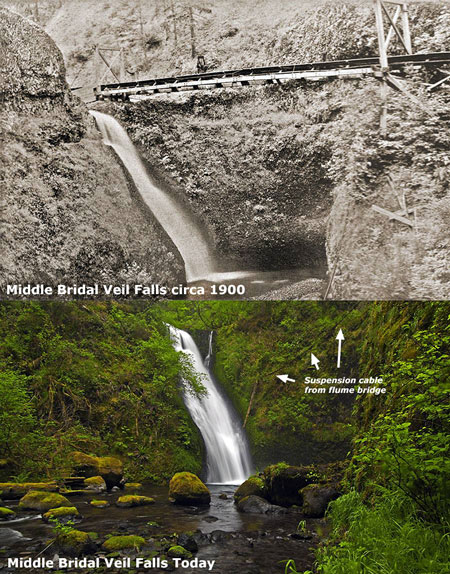
In the scene below (from about 1900) the audacious scale of the flume is evident as it courses down the canyon, about a mile above Bridal Veil Falls, and just below Middle Bridal Veil Falls. The area had already been heavily logged by this time and the stream was viewed as nothing more than a steady water source and convenient path for moving old-growth timber to the mill.

warrenfallspostscript18

The main flume followed a ravaged Bridal Veil canyon to the mill

This view (below) of the converging flumes coming into the mill site conceals Bridal Veil Falls, which is located directly beneath the flumes. Today’s trail to the falls would have travelled under all three flumes where they converge in this scene.

warrenfallspostscript19

Flumes over Bridal Veil Falls (the falls is located directly below the flumes)

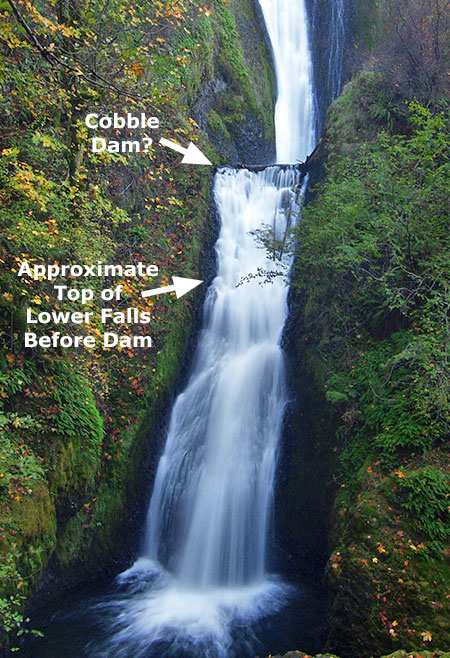
Bridal Veil Falls not only had a trio of log flumes passing overhead, the falls itself was also modified by the mill, presumably to carry water to the mill (though this is just my own speculation – I’d love to hear from mill historians who know more about this!)

The photo below shows the falls in the late 1800s, just before the lower tier had been raised about 15 feet, creating a pool below the upper tier and allowing for a diversion structure (?) to presumably carry a piped portion of the creek to the nearby mill.

During periods of low water today, you can still see parts of the diversion structure at Bridal Veil Falls poking from the water (below).

warrenfallspostscript21

Lower tier of Bridal Veil Falls as it exists today

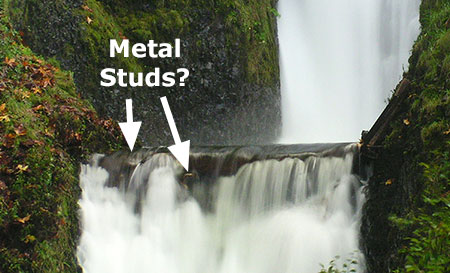
Here are detailed views of the diversion structure that raised the lower tier of Bridal Veil Falls to what we see today:

warrenfallspostscript22

A closer look at what seems to be a cobble dam that raised the height of the lower tier of Bridal Veil Falls…

warrenfallspostscript23

…and a still closer look…

This rare view from the early 1900s shows the diversion structure already in ruins or perhaps under construction? In either case, its purpose only lasted a short period, and in this way the falls is a kindred spirit to Warren Falls, where the short-lived diversion functioned for barely a decade before becoming obsolete and abandoned.

warrenfallspostscript24

The cobble dam shortly after construction… or perhaps after it was abandoned?

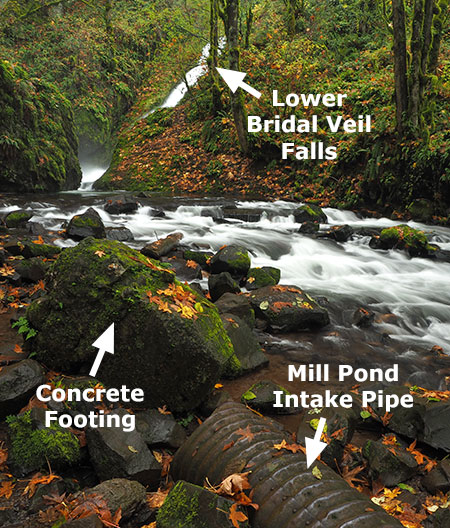
Today, there are still a lot of concrete and steel reminders of the mill town, though they’re often hidden in plain sight, under layers of rust, moss and ferns. For example, this view (below) of the stream below Bridal Veil Falls reveals a “boulder” that is actually a concrete footing and an intake pipe for one of the mill ponds.

warrenfallspostscript25

Mill relics hiding under moss at Bridal Veil Falls

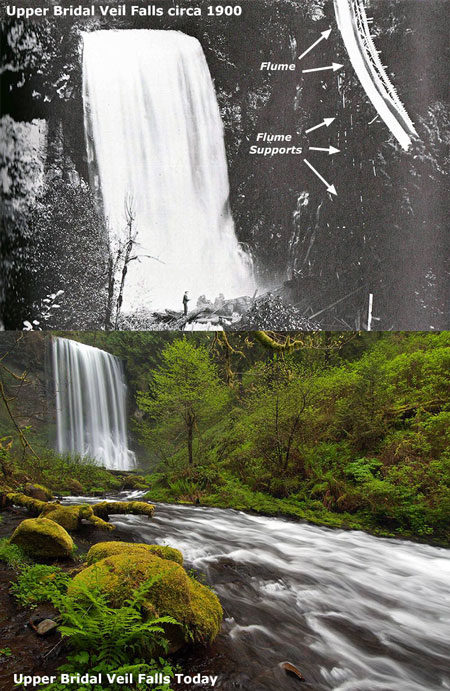
Other large waterfalls on Bridal Veil Creek were impacted by the mill operation, but have recovered dramatically in the decades since the mill finally closed in the 1960s. Here are then-and-now photos of Middle and Upper Bridal Veil Falls:

warrenfallspostscript26

[click here for a larger version]

warrenfallspostscript27

[click here for a larger version]

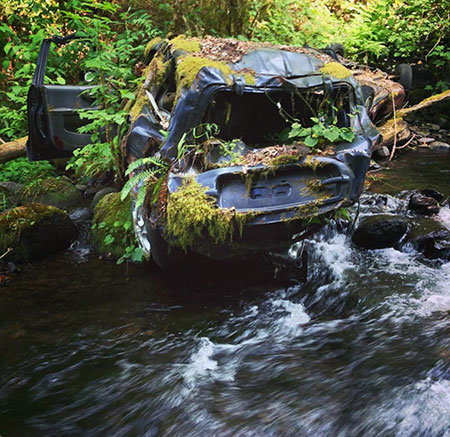
In more recent years, stolen automobiles have periodically been pushed from the cliffs along historic Palmer Mill Road into Bridal Veil canyon. Some of these dumped vehicles have been pulled from the canyon, but others are too difficult to reach, and are slowly fading into the forest.

While they have undoubtedly released engine fluids into the creek and have plastic parts that will last for decades, nature and Bridal Veil Creek are nonetheless making short work of the rest of these vehicles.

warrenfallspostscript28

Moss and ferns consuming a dumped Hyundai Santa Fe just above Upper Bridal Veil Falls (photo courtesy Jamen Lee)

Unlike Warren Falls, the waterfalls on Bridal Veil Creek were never completely diverted from their natural streambed, yet the overall impact of logging and milling at Bridal Veil had a much larger impact on the larger watershed than anything Warren Creek endured. The fact that Mother Nature has consumed most of what wasn’t salvaged when the flumes were pulled from Bridal Veil canyon in the mid-1900s is an inspiration for the ongoing recovery of Warren Falls.

In time, all traces of our impact on the environment really can heal – provided we allow it to happen. Responsibly cleaning up after ourselves would be a more noble path, of course, but at least nature seems to forgive us in time… so far.

Warren Falls Lives!

warrenfallspostscript29

False alarm! Horsetail does look a lot like Warren Falls, though…

A few weeks ago, the local waterfall hunting community had a brief moment of excitement when a vintage 1918 film seemed to include a rare view of Warren Falls! But after looking more closely at the images, it turned out to be Horsetail Falls in very low flow. So, the hunt for a photograph of Warren Falls before the 1939 diversion project continues.

But the similarity was real, so the following is a rough guess of what we might see – and perhaps, sooner than we think: Warren Falls flowing again, returning its amazing amphitheater to mossy green, as the diversion structure continues to crumble into history.

warrenfallspostscript30

For waterfall devotees, this is Horsetail Falls superimposed on Warren’s dry cliff with the reversed base of Dry Creek Falls providing the foreground.

[click here for a large version]

Of course, we already know what a small amount of flow over Warren Falls looks like during high runoff events, as shown in previous photos in this article. What we don’t know is what the full force of Warren Creek might look like coming over this 120-foot escarpment, and especially what it might do with 77 years of accumulated stream debris piled at the base of the natural falls.

We have a pretty good idea, though, based on recent dam removals around the Pacific Northwest. It turns out that streams are surprisingly quick to redistribute accumulated debris and restore themselves to their natural stream state, as we’ve seen with dam removals on the Hood, Little Sandy and White Salmon rivers.

Today, Warren Creek below falls has been reduced to ditch, radically moved by ODOT from its former channel in the 1950s and devoid of the rocks and woody debris essential to a healthy stream since 1939, thanks to the “trash rack”.

warrenfallspostscript31

Add some rocks and logs to lower Warren Creek and it might look like this someday

[click here for a large version]

When Warren Falls returns, the huge pile of stream debris will begin to move downstream, and the debris-starved lower section of Warren Creek will develop the pools and eddies necessary for salmon and steelhead to spawn, as imagined above.

The good news is that the new HCRH State Trail passes high and wide over Warren Creek, ensuring that the creek can evolve back to a natural state in the future without a redux of the 1930s highway impacts that led to the diversion of Warren Falls.

When will Warren Falls return? Not just now… but perhaps sooner than we think.

Meanwhile, we wait… and watch.

_____________________

(Part two of this article will focus on a review of the newly completed Historic Columbia River Highway State Trail segment from Starvation Creek to Wonder Creek, and passing Warren Falls)

_____________________

 To revisit the complete history of the Restore Warren Falls project, here are earlier WyEast blog articles on the subject:

 An Overdue Warren Falls Update (and a bombshell!)

“Warren Falls Lives… Again?”

Warren Falls Solutions

“Warren Falls, we’re ready for your closeup…”

 Warren Falls Mystery… Solved!

Restoring Warren Creek Falls

_____________________

Warren Falls on Oregon Field Guide

_____________________

Restore Warren Falls on Facebook!


Dollar Lake Fire: Five Years After

dollarfirefiveyears01

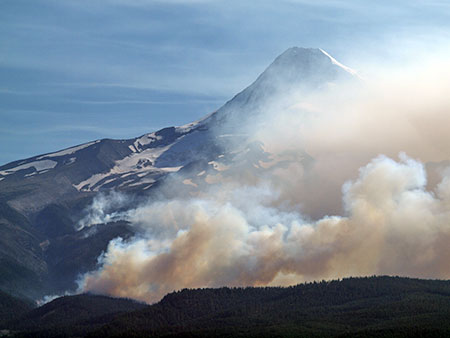
The Dollar Lake Fire from Bald Butte in August 2011

In 2006, the Bluegrass Fire raced along Bluegrass Ridge, torching the subalpine forests above Elk Meadows on Mount Hood’s east flank. In 2008, the Gnarl Fire burned a much larger swath of the east slope, from just above Elk Meadows to the Eliot Branch canyon, nearly destroying century-old Cloud Cap Inn, Snowshoe Lodge and the historic structures at nearby Tilly Jane Campground. Heroic efforts by Forest Service firefighters spared these priceless jewels of Mount Hood’s history, with the fire burning within a few yards of these old structures.

In August 2011, the Dollar Lake Fire was the third in a string of major fires that would ravage the slopes of Mount Hood in a period of just five years, this time burning the north slopes of the mountain. Lightning started the Dollar Fire started on a weekend, just below the popular Elk Cove trail and was immediately reported by hikers in the area.

dollarfirefiveyears02

The Dollar Lake Fire burning below Elk Cove

The Dollar Fire soon erupted to become one of the most fiercely fought and carefully documented fires in recent memory as it swept to the west, eventually threatening Bonneville Power Administration transmission lines at Lolo Pass and the nearby Bull Run Watershed, source of Portland’s drinking water.

The fire wasn’t fully contained until the end of September of that year, eventually burning more than 6,200 acres of forest (maps and photos of the fire can still be viewed on the InciWeb interagency website).

dollarfirefiveyears03

Flare-up in the Dollar Lake Fire in August 2011

Firefighting efforts were initially slow to arrive at the Dollar Fire, and some (including the media and members of Oregon’s Congressional delegation) accused the Forest Service of purposely allowing the fire to grow because it was inside the Mount Hood Wilderness where it didn’t threaten areas open to commercial logging. But a subsequent investigation pointed to overstretched firefighting resources, a growing problem as the federal land agencies struggle to fund the spiraling forest fire phenomena across the west.

dollarfirefiveyears04

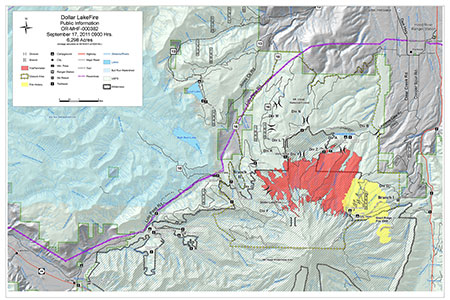
Location of the Dollar Lake and Gnarl fires

 [click here for a large map]

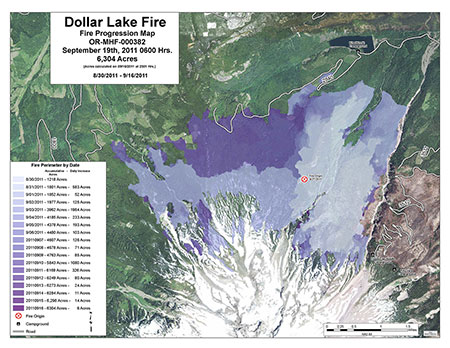
By the time fall rains arrived, the fire had burned almost the entire north slope of Mount Hood, a 5-mile swath stretching from the Eliot Branch on the east to Cathedral Ridge on the west. Almost all of the burn was subalpine Noble fir forest, though a few old-growth mountain hemlock stands along the Timberline Trail were burned at Elk Cove and Cairn Basin.

dollarfirefiveyears05

Timeline and extent of the Dollar Lake fire

[click here for a large map]

The eastern extent of the Dollar Burn contained large stands of Western larch, a fire forest species adapted to frequent, low intensity fires. Most of these trees did not appear to survive the fire, however, due to its extreme heat and intensity.

dollarfirefiveyears06

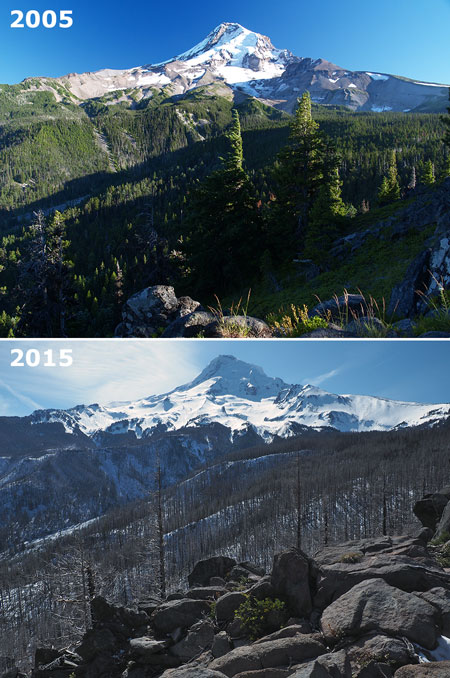
Ground zero for the Dollar Lake fire is the foreground in these views from the Elk Cove Trail taken before the burn and five years after the fire

 [click here for a large map]

In fact, very few trees survived the fire except along its margins, where a beneficial mosaic burn pattern left standing trees and some undergrowth to help begin the recovery phase. This is the new reality facing our forests, as a century of fire suppression continues to fuel catastrophic fires that completely destroy forest on a massive scale.

Summer 2012: Immediate Aftermath

dollarfirefiveyears07

Total destruction along Vista Ridge in 2012

The dense network of trails that cross through the Dollar Burn provide a front-row seat to how (and if) our forests recover from catastrophic fires inside a protected wilderness, without human intervention. In the immediate aftermath of the Dollar Fire, the picture was bleak. In the heart of the burn, the forest kill was nearly complete, as even the duff layer on the forest floor was burned away, exposing a thin layer of volcanic soils vulnerable to erosion.

dollarfirefiveyears08

Blackened trees in 2012, before scorched bark began to peel away

One of the first lessons of the fire was the importance of tree debris in stabilizing the unprotected soil. The living trees in this forest weren’t burned so much as boiled alive as their living cambium layer was superheated beneath their bark. The surprising result in the first season after the fire was scorched bark peeling away to reveal untouched wood underneath.

The piles of peeled bark provided an immediate layer of mulch over the exposed soil, with smaller twigs and limbs also helping to form the beginnings of a new duff layer on the burnt soil.

dollarfirefiveyears09

Trees inside the burn shed their scorched bark in the first year, helping stabilize exposed soils

The roots of some understory plants in the worst of the burn zone also survived the fire, including huckleberry, beargrass and avalanche lilies. Two years after the fire, seeds blown into the burn began to establish, and the recovery was underway in surprisingly short order. Read more about the initial recovery in this 2012 WyEast Blog article.

2016: Five Years of Recovery

This year marks the five-year anniversary of the fire, and the recovery within the Dollar Burn is in full swing, though it will take a century or more for the area to fully recover – more on that in a moment.

How does the Dollar Burn of today compare to the first summer after the fire? As the July scenes along the Vista Ridge Trail (below) show, the understory is recovering rapidly.

dollarfirefiveyears10

Comparison of the recovery along the Vista Ridge Trail in 2012 and 2016

In 2012, avalanche lilies sprung from bulbs spared by the heat of the fire, creating striking stripes of white blossoms and bright green foliage where these plants survived. A few beargrass (a close relative of the lily family) also survived, thanks to deep underground roots that escaped the fire. A few scattered huckleberry and other understory shrubs also sprouted from surviving roots in the first summer after the fire.

In recent years, the beargrass and avalanche lily display in the Dollar Burn has become a spectacular attraction for early season hikers on the Vista Rigde Trail as these fire survivors continue flourish and spread in the bright new conditions. Other shrubby survivors, like huckleberry, have also continued to recover, thriving in the bright new conditions created by the fire.

But the story in the last few years of the recovery has been the arrival of new plants in the burn zone, blown in by seed or deposited by wildlife. These include more understory species, but also the first few conifers to take root.

dollarfirefiveyears11

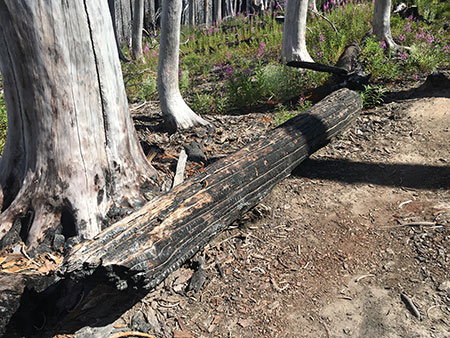
This trailside log was a favorite resting spot for hikers on the Vista Ridge Trail before the Dollar Fire. Since the fire, hikers still rest here and have begun to polish away the charred surface along the top of the log – presumably with a charcoal backside as their souvenir!

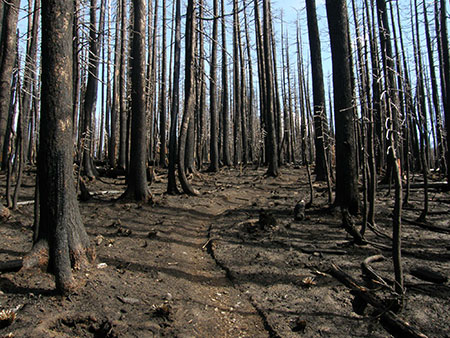
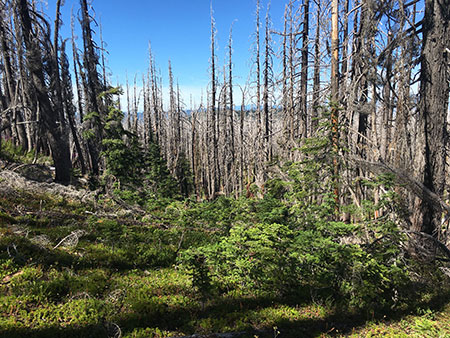
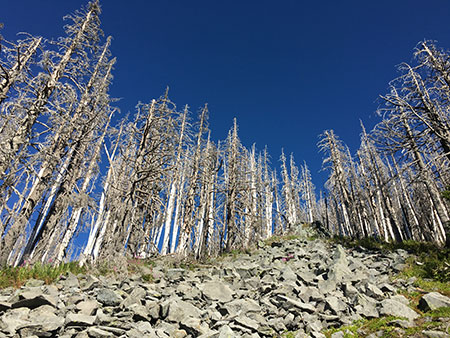
After five years, most of the scorched bark has fallen from the torched trees, and the trunks underneath have bleached from their initial golden shades of newly exposed wood to weathered silver and gray shades of a “ghost forest”.

The standing ghost trees still retain a surprising number of their limbs, and perhaps more surprising, very few have toppled in the five years since the fire. This is testament to the fact that the core of these trees didn’t burn. Most will stand for decades before insects and decay finally bring them down.

dollarfirefiveyears12

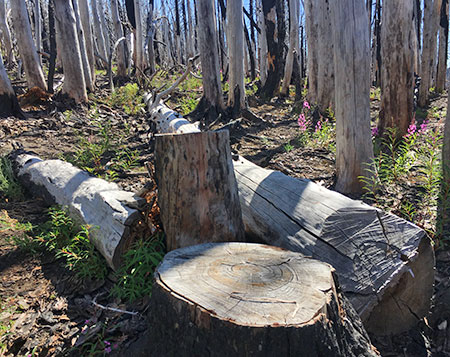
These felled Noble fir along Vista Ridge Trail reveal a forest that was more than 300 years old before the fire

A few trees in the burn zone were cut by firefighters in an attempt to create fire lines. Today, these cut stumps provide a look at the age of this forest. While the trees in the Dollar Burn aren’t particularly large by Pacific Northwest standards, they were actually quite old. The cut tree shown above was more than 300 years old and stump below is from a tree that had grown on Vista Ridge for 360 years!

dollarfirefiveyears13_360years

This ancient Noble fir was 360 years old when it succumbed to the catastrophic Dollar Lake fire

The extreme weather conditions and thin soils make for a hard life for subalpine trees, stunting their relative size compared to lower-elevation forests.

The relatively modest size of these trees compared to their impressive age is another reminder of the vulnerability of our subalpine Noble fir forests that are still being logged commercially. While they continue to be “harvested” in unprotected areas under the premise of sustainability, these trees take centuries to reach a size worthy of commercial cutting, making the “harvest” more like mining than tree farming.

The Pioneers

dollarfirefiveyears14

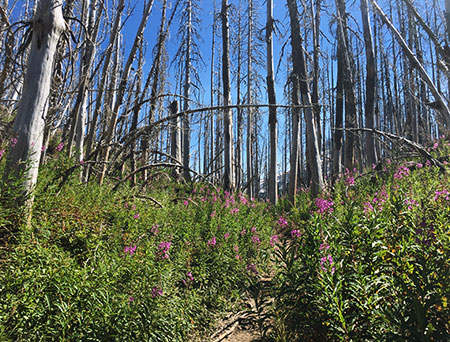
Fireweed is the rock star of the pioneer plants species in the burn zone

The understory in the Dollar Burn is noticeably greener just five years after the fire, and a closer look reveals a handful of plant species doing the heavy lifting at this stage in the forest recovery. At the top of the list of pioneer species is fireweed, (described here in the previous article in this blog).

dollarfirefiveyears15

Fireweed crowding the Vista Ridge Trail in 2016

True to its name, fireweed has evolved to be the first in line to resettle burned or disturbed areas. These plants produce massive quantities of winged seeds that can quickly reach very large areas. They are also hardy perennials with large root systems, so also play an important role in stabilizing exposed soil.

In the Dollar Burn, fireweed has already colonized large areas, creating a spectacular flower displays from mid-summer through fall.

dollarfirefiveyears16

Showy blooms of Fireweed in late summer on Vista Ridge

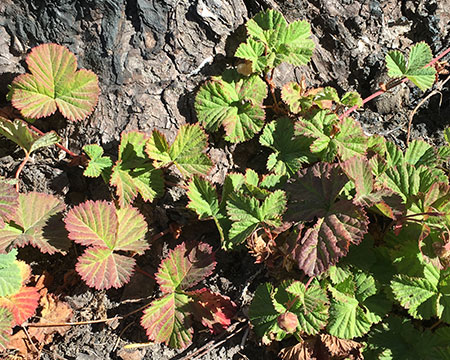
Look between the drifts of fireweed and you’ll find other pioneers taking root. One surprising species is the diminutive wild dwarf bramble (sometimes called wild strawberry for its resemblance of its runners and leaves to domestic strawberries). These tiny plants are now found throughout the burn, threading through piles of bark and limbs.

dollarfirefiveyears17

Wild dwarf bramble growing over charred bark along the Vista Ridge Trail

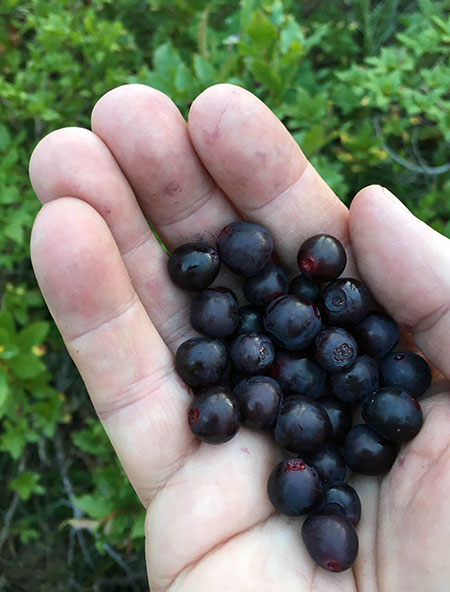
Huckleberries also continue their comeback, mostly from the surviving roots of established plants that grew before the fire but also as seedlings. In a few spots, the understory was not completely destroyed, and in these areas huckleberry is responding strongly to the bright conditions with abundant berry production.

dollarfirefiveyears18

Huckleberry seedlings emerging on Vista Ridge

dollarfirefiveyears19

Huckleberry seedlings growing from the base of a burned snag on Vista Ridge

dollarfirefiveyears20

Huckleberries that survived the fire are producing abundant berry crops in the suddenly sunny environment in the Dollar Burn

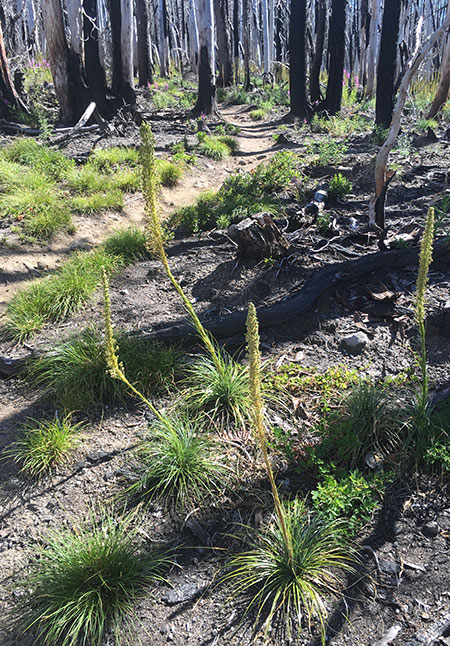
Though they were among the few understory survivors, the recovery of beargrass has been more gradual than expected. Most plants seem to be growing from roots that survived the fire, though the first big bloom of these survivors (and the seeds they produced) only arrived over the past two years.

dollarfirefiveyears21

Beargrass emerging from surviving roots are just beginning to produce blooms within the burn zone

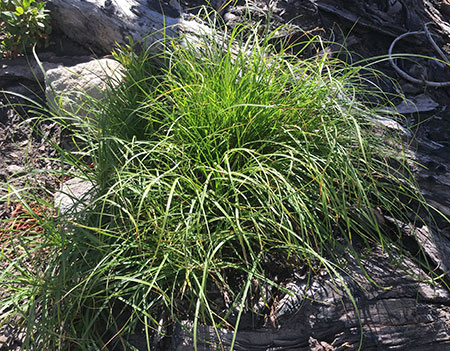
Clumping grasses have also arrived throughout the burn, as well as the occasional rush in moist, protected pockets.

dollarfirefiveyears22

Rush growing in a moist hollow on Vista Ridge

dollarfirefiveyears23

Clumping grasses are taking root in some of the driest areas of the Dollar Burn

Elderberry is among the few woody understory pioneers to arrive in this stage of the Dollar Burn recovery. These plants are scattered widely, growing in less burned areas, and may also be growing from surviving roots.

dollarfirefiveyears24

This young Elderberry shrub is just getting started in the burn zone in 2016

Conifers are just getting started five years after the Dollar Fire. Almost all of the conifer seedlings at this point in the recovery are Mountain hemlock and Noble fir, the dominant evergreens in Mount Hood’s subalpine forests.

By counting branch tiers, a few young trees as old as four years can be found, but most are one or two year-old seedlings. But if you look closely, there are also many seedlings that have not survived the harsh summers in the burn zone, where there is little shade and the sandy mountain soils are extremely dry by the time rain reappears in the fall.

This is the sorting process at work, where only a few seedlings will survive winter cold, summer heat and competition from understory plants to someday become part of the new forest canopy.

dollarfirefiveyears25

Young Mountain hemlock in the Dollar Burn in 2016

dollarfirefiveyears26

Three-year old Noble Fir in the Dollar Burn in 2016

Though most of the Dollar Fire was an overheated catastrophe for the forest, killing almost everything, there are a few spots where the fire cooled and burned in a “mosaic” pattern, leaving a few surviving trees and much of the understory.

These areas are lush islands of life just five years after the fire, underscoring their importance in the recovery and why cooler mosaic burns can be beneficial to the long-term health of a forest. Pioneer species are much more abundant in heavily burned areas that are immediately adjacent to these surviving patches than in other parts of the burn, as plants quickly spread from these islands of green.

dollarfirefiveyears27

Island of green where the Dollar Lake Fire spared a section of forest that now serves as a nursery for regenerating the burn zone

While the Dollar Burn is recovering at nature’s pace, without human intervention, the Forest Service has given the nearby Gnarl Burn section along Cloud Cap Road a recovery boost by planting conifer seedlings. These trees were planting in 2010, about a year before the Dollar Lake Fire and following commercial removal of burned trees along the historic road.

dollarfirefiveyears28

Planted conifers in the Gnarl Burn along Cloud Cap Road in 2016

Today, these trees are thriving, and the main effect of replanting is the diversity of species, including lodgepole pine, western larch, Western white pine, Englemann Spruce and even whitebark pine at higher elevations. Noble fir and mountain hemlock do not seem to have been part of the replanting, perhaps because these species are the most likely to recover without human intervention.

The Long View?

dollarfirefiveyears29

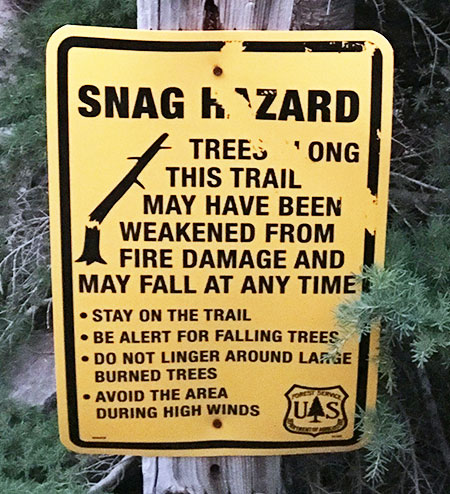
Hazard tree warning at the Vista Ridge trailhead

Hikers on the north side of Mount Hood will continue to have a front-row seat to the forest recovery in the Dollar Burn. Already, there are some surprising lessons.

First, the main victims of blowdown since the fire have often been the few trees that survived the fire intact. This is because of the sudden exposure of their canopy to winter winds and snow loads, and is a surprising blow to the forest recovery these trees would otherwise be helping to seed the burn zone.

dollarfirefiveyears30

Toppled surviving Noble fir in the burn zone in 2016

dollarfirefiveyears31

A surviving canopy becomes a liability in a burned forest, as surviving trees along Vista Ridge were tipped by winter storms in 2016

The Dollar Burn generally stayed well below timberline (and the Timberline Trail), leaving most of the alpine zone intact. But where the fire did burn into places like Elk Cove, Eden Park and Cairn Basin, we will also have an opportunity to watch how alpine ecosystems react to fire.

Some of Mount Hood’s most ancient forests grow in this zone, and have presumably survived because they are somewhat isolated from lower-elevation forests and often grow in moister conditions where snowpack is greater and summer days are cooler. But the forest could take centuries to recover in these areas, impacting the many species of plants and wildlife that live exclusively at this elevation.

dollarfirefiveyears32

It could take centuries for this high-elevation forest of Mountain hemlock and Whitebark pine on Vista Ridge to recover from the fire

In human terms, it’s hard to see forest fire cycles in perspective, but in the case of the Dollar Burn, we have the benefit of early photographs from the area. Forest surveys show that the Red Hill area on the north edge of the Mount Hood Wilderness burned in the early 1900s, and were barely recovering by the 1950s (see below).

dollarfirefiveyears33

The view from Owl Point in 1952 and 2016 shows the cycle of fire on Mount Hood’s north slope over the past century (top photo courtesy Hood River History Museum)

[Click here for a larger version]

Today, the forest in this northern edge of the wilderness has substantially recovered after a century of regrowth, and now the view is reversed: the silvery ghost forests of the Dollar Fire now mark the once-green slopes of Mount Hood as viewed from Owl Point, while green forests and beargrass meadows cover the former Red Hill burn in the foreground.

dollarfirefiveyears34

Looking down on the Dollar Burn and Owl Point in the distance from the Timberline Trail in 2016

So far, so good, but the larger question in an era of climate change is whether our forests will continue to recover from catastrophic fire – or logging – in the way that we have always assumed they will.

As the recovery unfolds in the Dollar Lake, Gnarl and Blue Ridge burns on Mount Hood we’ll learn how resilient our forests really are, and hopefully make better decisions in protecting them for the benefit of future generations.

Fireweed: a rose by any other name..?

Fireweed01

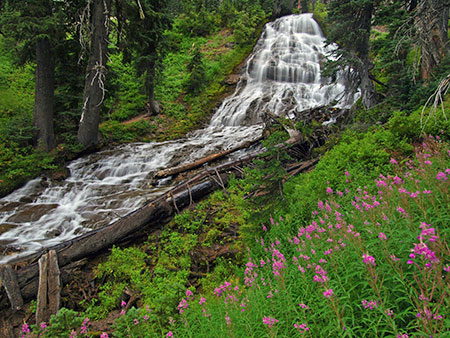
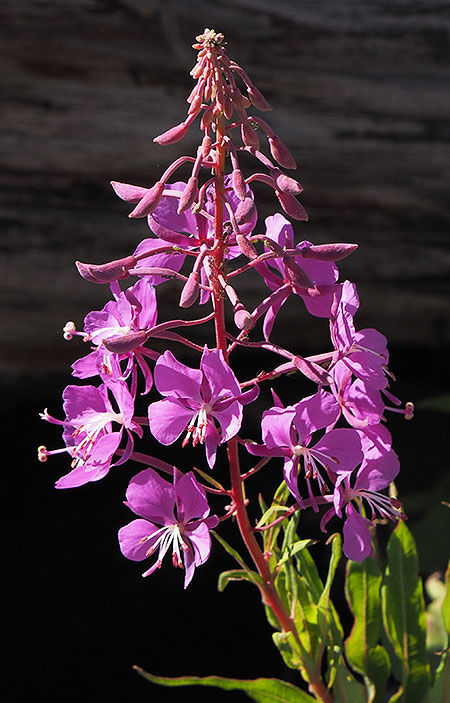
Fireweed frames Umbrella Falls on the East Fork Hood River

Somewhere in the long history of botanical naming slander was committed, as the common name “Fireweed” was given to one of the most beautiful and useful plants found in our forests – and around the world. Thus, the noble Fireweed (Chamerion angustifolium) comes to be associated with notoriously invasive plants like Horseweed, Bindweed, Chickweed, Tumbleweed and Pigweed!

But Fireweed is anything but a weed, at least by the most common definitions:

weed  (wēd) noun

A plant considered undesirable, unattractive, or troublesome, especially one that grows where it is not wanted and often grows or spreads fast or takes the place of desired plants.

To the contrary, Fireweed is a widespread native in northern latitudes, growing from sea level to timberline in a remarkable range of habitats. The common name is half-right, as Fireweed is among the first and most prolific plants to return to burned areas, performing an essential role in stabilizing soil and providing shade for other flora to gradually return. Fireweed is equally at home in moist meadows, forest margins and wherever the ground has been disturbed by human or natural activity.

Fireweed02

Fireweed has carpeted the 2011 Dollar Fire on the north slopes of Mount Hood

The string of fires over the past decade on the east and north slopes of Mount Hood have brought a sea of brilliant Fireweed blossoms to the mountain each summer. Fireweed spreads readily by seed, but are hardy perennials, so they provide years of soil stabilization once established in burned forests or disturbed areas.

Fireweed blossoms are spectacular: their spikes can grow as tall as six feet, though typically they are 3-4 feet in height. Their flowering plumes can have 50 or more blossoms, opening first at the base of the spike and progressing through their long blooming season, typically from June to September.

Fireweed03

Fireweed flower spike

Each Fireweed blossom has four petals that alternate with four narrow sepals, surrounding white stamen and a pistil that splits in fourths.

Depending on your eyes, the blossoms are anything from hot pink to bright fuchsia. The flower stems are often bright crimson, as well, adding to the striking appearance of these plants during their bloom season.

Fireweed04

Fireweed flower spike

The leaves on Fireweed long, narrow strips, radiating from the stem like steps on a ladder. Their leaves give the Fireweed its Latin name of “angustifolium” (meaning narrow-leaved). A close look at the leaves reveals an unusual feature: circular veins looping back to the leaf stem instead of terminating at the edges like most plants.

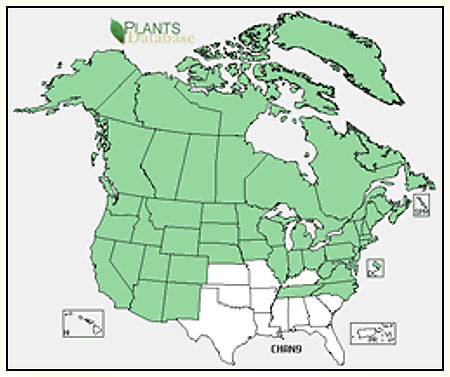
Given their adaptability to the wide range of habitats we have in Oregon, it’s not surprising that Fireweed is found across much of North America, as well as northern Europe:

Fireweed05

Fireweed is especially common in the boreal snow forests of Alaska and Canada, where the provincial flag of the Yukon Territory incorporates the Fireweed blossom:

Fireweed06

While Fireweed has an important ecological role as a pioneer species in burned areas, it was also collected by native peoples in the Northwest for a variety of human uses. Its leaves were brewed to make tea, and nutrient-rich spring shoots were collected as edible greens. Even the fluffy silk from its seed pods were used for weaving.

Today, Fireweed honey and other products from its nectar are still made where the flower is in abundance in places like Alaska, Canada and Northern Europe.

Fireweed Life Cycle

Fireweed07

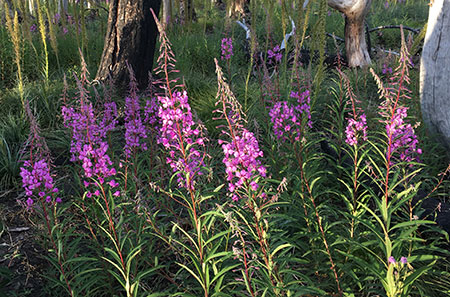
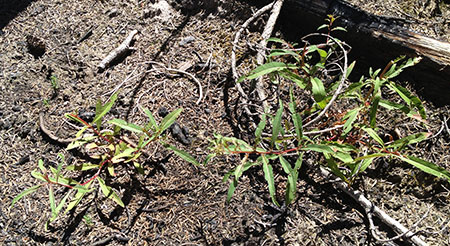
Young Fireweed patch in a recently burned area

Fireweed is a perennial species with the spirit of an annual. While it springs to life from hardy roots and stems each spring, Fireweed grows as easily from its abundant seeds as any annual species, and thus its ability to quickly colonize burned or disturbed areas.

Young plants often produce one large flower spike and a couple of small spikes from auxiliary buds along the main stem. The young Fireweed shown in the photo above are typical, with young plants growing in a dense patch, each producing one main flower spike.

As Fireweed plants continue to grow over successive seasons, they form multiple branches, each with one or more large flower spike. In this way, a single mature plant is eventually capable of producing dozens of spikes. The image below shows a larger, mature Fireweed with several large flower clusters growing from the main plant.

Fireweed08

Mature Fireweed with multiple stems

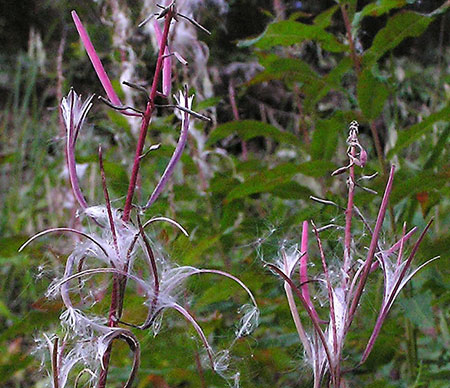
Just as the blossoms of Fireweed open progressively beginning from the base of the flower spikes toward, older blossoms soon produce elongated pink seed capsules (below) even as the tip of the flower spike is still producing blossoms.

Within each capsule, seeds are attached to a fluff of silk that acts as a tiny parachute to carry them far and wide when the capsule splits open. This is the secret to the Fireweed’s remarkable ability to colonize.

A single Fireweed plant can produce 300 to 400 seeds per capsule and as many as 80,000 seeds per plant that will float as far as the wind will take them. Seeds can persist in the soil for years and survive fire, further helping the plant function as a pioneer species in burned areas.

Fireweed09

Fireweed seed capsules opening to reveal silk seed parachutes (USDA)

Fireweed seedlings quickly grow to form their first flower spike and produce seeds by their second year, while also establishing rhizomes that allow mature plants to spread and form clumps.

The first seedlings in a burn often take root where fire debris provides protection and mulch, with new plants quickly filling in the gaps in the first years after a fire. First year Fireweed seedlings look like this:

Fireweed10

First year Fireweed seedlings

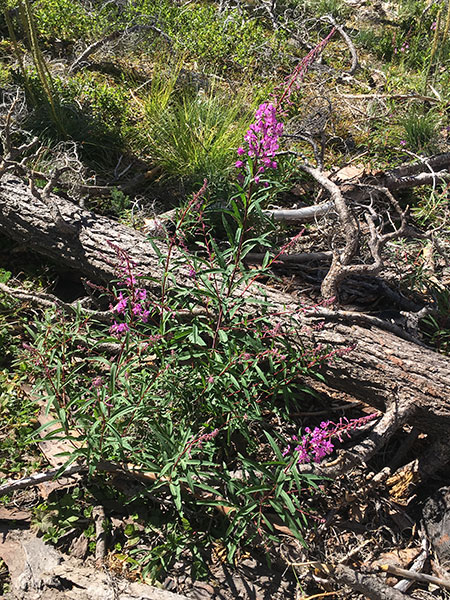
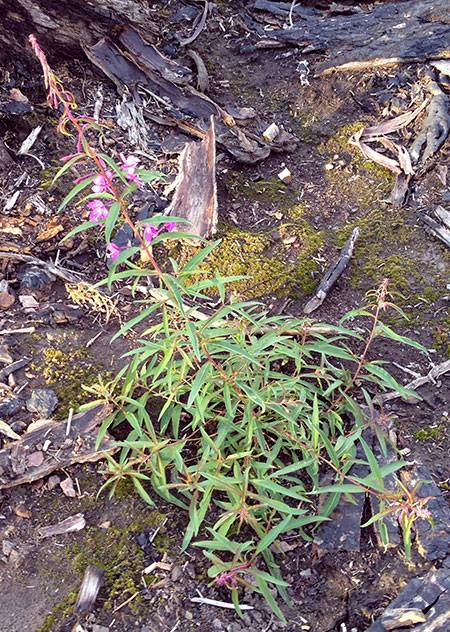
This two-year old seedling is coming into its prime in a still scorched area of the Dollar Fire burn, along the Vista Ridge trail:

Fireweed11

Second-year Fireweed with a main flower spike and several auxiliary spikes

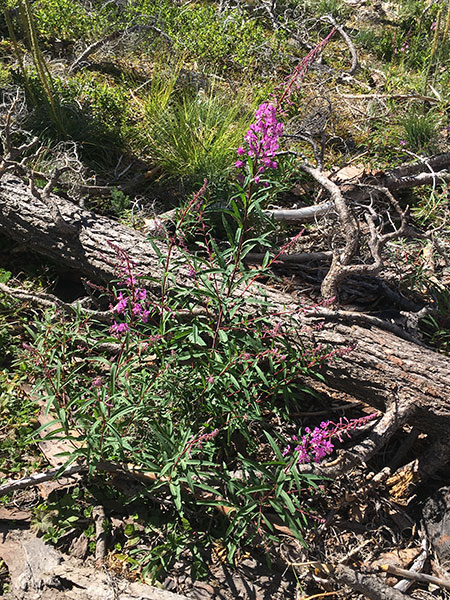
This more mature Fireweed plant has begun to spread its rhizomes and form a clump as it sends up multiple flower spikes in a protected spot by a fallen tree:

Fireweed12

Mature Fireweed

Adding to their colorful display, Fireweed leaves often turn to blazing shades of red and crimson in autumn, another showy feature of this remarkable plant:

Fireweed13

Fireweed foliage in autumn shades of red (USDA)

At higher elevations, the perennial stems of Fireweed are flattened by winter snowpack, but can survive the winter cold to produce broader clumps when new growth emerges in the next growing season.

What’s in a name?

With all of its beauty, versatility and ecological function, why isn’t the Fireweed more celebrated – outside of the Yukon Territory, that is?

Oh, be some other name! What’s in a name? That which we call a rose by any other name would smell as sweet…”

(Juliet Capulet, upon seeing her first Fireweed..?)

 One reason might be its humble name, so one option would be to revert to the British name of “Rosebay Willowherb”, a common name with origins in its herbal use dating to the late 1500s.

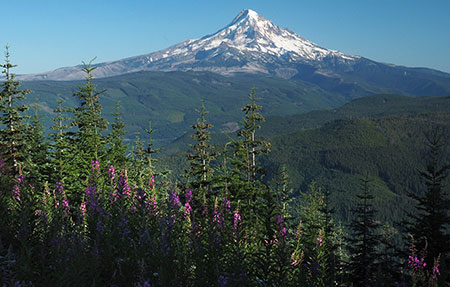
Fireweed14

Fireweed frames Mount Hood from Waucoma Ridge

But in the spirit of bucking norms and traditions, how another option that could be a more complimentary, modern version of it’s weedy current name? Like Fireroot? Or Fireflower? How about Fireleaf? Nope… doesn’t quite work.

How about… Firestar! Hmm… this minor adjustment would honor its essential role in stabilizing burned forests, but with a positive spin – after all, it is a “star” in this role! What do you think?

Yes, it would be a really big lift. A quick web search reveals an aerospace company, energy crystals, software brand, sci-fi novel, rolling fire doors and… a mutant Marvel Comics superheroine! If all of the above are anything like the Yukon Territory, they’d be honored to share their corporate namesake with a beautiful wildflower, right?

Where to see Fire…. star!

Fireweed15

Fireweed crowds the Vista Ridge trail as it passes through the Dollar Fire burn

I’m not really sure how to go about establishing a new common name for a flower, but since many have multiple common names, it must be possible. So, why not try?

In that spirit, here are a couple of trails where you can enjoy magnificent displays of Firestar on the slopes of Mount Hood from mid-July into September:

Elk Cove Trail: this moderately steep trail travels through the heart of the 2011 Dollar Fire, passing near the origin of the fire just below the Coe Overlook and lots of Firestar. The overlook makes a good stopping point for those looking for a shorter hike, though Elk Cove is always a lovely place to spend an afternoon.

Vista Ridge to Eden Park & Cairn Basin: this moderately graded trail hikes through the western expanse of the 2011 Dollar Fire, passing fields of Firestar along the way before looping through idyllic Eden Park and Cairn Basin. Be prepared for a couple crossings of Ladd Creek, a glacial stream that fluctuates with summer melt on hot afternoons.

Enjoy!

A New Vision: Restoring Hiyu Mountain

Hiyu01BullRunHood1900s

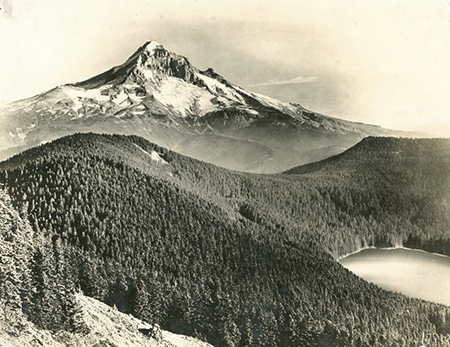
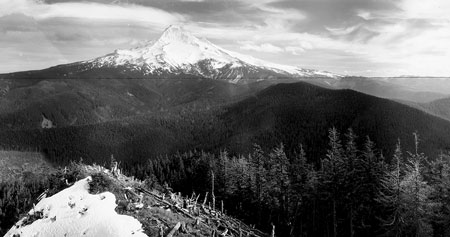
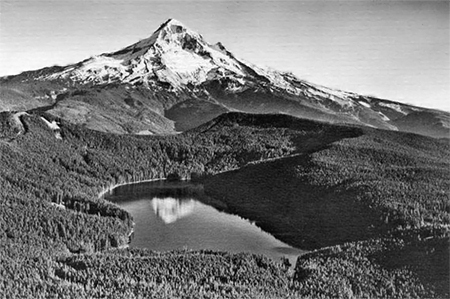
Early 1900s view of Mount Hood and Bull Run Lake, with Hiyu Mountain on the far right and Sentinel Peak on the left

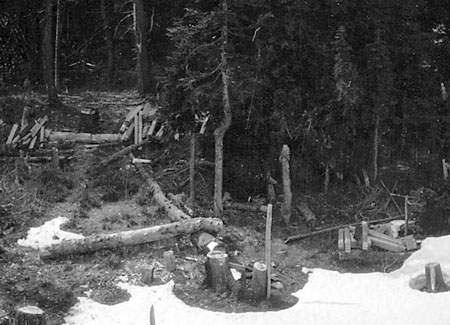
Hidden in plain sight at the foot of Mount Hood and the headwaters of Portland’s Bull Run watershed, Hiyu Mountain is a little-known, much abused gem. No one knows why this graceful, crescent-shaped mountain was named with the Chinook jargon word for “much” or “many”, and sadly, only a very few know of Hiyu Mountain today.

This little mountain deserves better. The broader vision of the Mount Hood National Park Campaign is to heal and restore Mount Hood and the Gorge as a place for conservation and sustainable recreation, ending a century of increasing commercial exploitation and profiteering. As part of this vision, Hiyu Mountain could once again become a place of “hiyu” beauty, where snowcapped WyEast fills the horizon and where Bull Run Lake, indigo source of Portland’s drinking water, could finally be seen and celebrated by the public these lands belong to.

Two Worlds

Hiyu02BullRunHood2010GuyMeacham

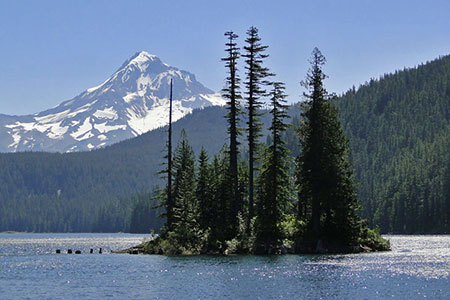
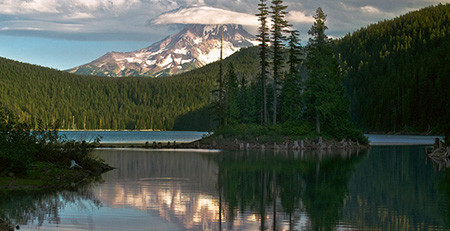
Dodge Island and Mount Hood from Bull Run Lake; Hiyu Mountain is the tall, crescent-shaped ridge rising behind the island (photo courtesy Guy Meacham)

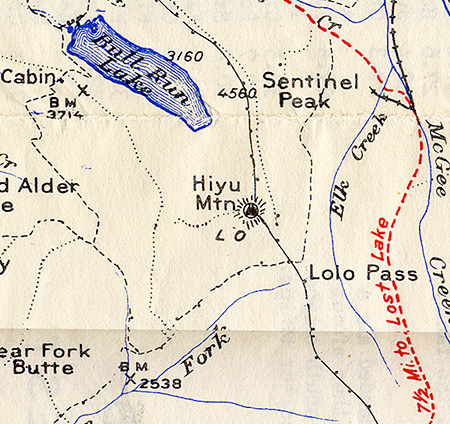
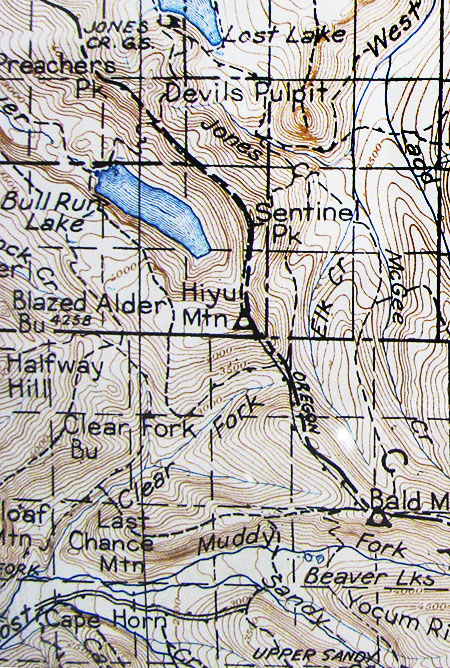
Hiyu Mountain rises 1,500 feet directly above Bull Run Lake, the uppermost source of Portland’s water supply. Lolo Pass is on the south shoulder of the mountain, connecting the Hood River and Sandy River valleys. The two sides of Hiyu Mountain mountain couldn’t be more different.

The northern slope that forms the shoreline of the Bull Run Lake is almost untouched by man, almost as pristine as it was when the Bull Run Watershed was established in the late 1800s.

Hiyu03TopoMap1911

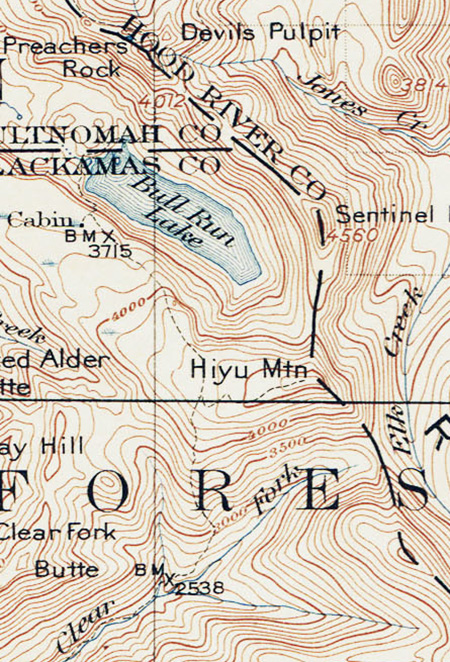
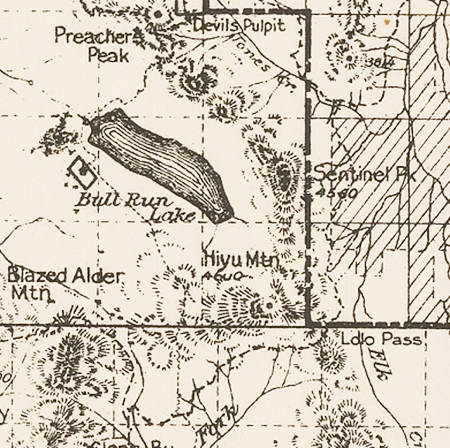
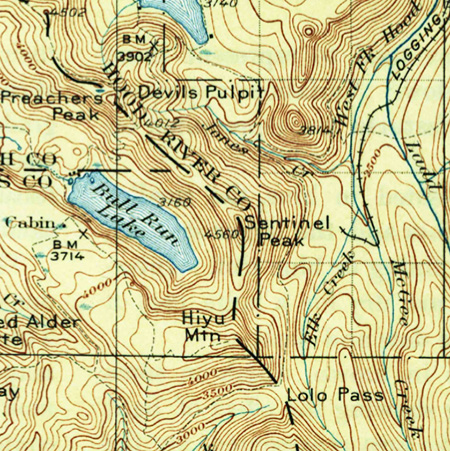
Early 1900s map of Hiyu Mountain and Bull Run Lake

Massive old growth Noble fir forests tower along these northern slopes, where rain and snow from Pacific storm fronts is captured, emerging in the crystal mountain springs that form the headwaters of the Bull Run River.

Almost no one visits this part of Bull Run, save for an occasional Portland Water Bureau worker. This land has been strictly off-limits to the public for nearly 120 years, and remained untouched even as the Bull Run Reserve was developed as a municipal watershed.

Hiyu04ForestMap1915

Early 1900s map showing Hiyu Mountain and the first trails over Lolo Pass

On the south slope of Hiyu Mountain things were surprisingly pristine until the 1950s. This area was also part of the original Bull Run Reserve, but was later ceded – in large part because the south slopes of Hiyu Mountain drain to the Clear Fork of the Sandy River, and away from the Bull Run watershed.

Since the 1950s, a conspiracy of forces has almost completely altered the south face of the mountain and its summit crest. By the mid-1950s, the Forest Service had begun what would become an extensive industrial logging zone here, mining ancient trees in dozens of sprawling, high-elevation clear cuts in the remote Clear Fork valley.

These forests will take centuries to recover, and are today mostly thickets of plantation conifers in woeful need of thinning. The maze of logging roads constructed to cut the forests are now buckling and sliding into disrepair on the steep mountain slopes.

Hiyu05TopoMap1927

1927 map of Hiyu Mountain, Bull Run Lake and the south corner of Lost Lake

By the late 1950s, a logging road had finally pushed over the crest of Lolo Pass. At just 3,330 feet, Lolo is the lowest of mountain passes on Mount Hood and a route long used by Native Americans. But surprisingly, it was the last to see a road in modern times. The road over Lolo Pass coincided with the completion of The Dalles Dam in 1957, some 50 miles east on the Columbia River.

While the dam is most notorious for drowning Cello Falls, a place where native peoples had lived, fished and traded for millennia, it also sent half-mile wide power transmission corridors west to Portland and south to California. Thus, the new road over Lolo Pass enabled the most egregious insult to Hiyu Mountain, with the parade of transmission towers we see today tragically routed over the shoulder of Mount Hood.

The power corridor took advantage of the easy passage over Lolo Pass, an absence of tourists and public awareness (at the time) on this remote side of the mountain, and was built with complete disregard for the natural landscape. It remains as Mount Hood’s worst scar.

Hiyu06TransmissionLines

The Bonneville Power Administration’s quarter-mile wide perpetual clearcut that follows their transmission lines over the shoulder of Hiyu Mountain

 Today, the south side of Hiyu Mountain remains a jarring landscape of ragged clearcuts, failing logging roads and the quarter-mile wide swath of power lines.

With regular clearing and herbicides, the Bonneville Power Administration (BPA) ensures that nothing much grows under its transmission lines except invasive weeds. It’s a perpetual, linear clearcut that serves primarily as a place for illegal dumping and a shooting range for lawless gun owners who ignore (or shoot) the hundreds of BPA “no trespassing” signs. It is truly an ugly and shameful scene that cries out for a better management vision.

The Lookout Era

Hiyu07Lookout1930

The original lookout tower on Mount Hood in the late 1920s

By 1929, the Forest Service had built a 20-foot wooden lookout tower with an open platform atop Hiyu Mountain (above). It was an ideal location, with sweeping views of both the Bull Run Reserve and the entire northwest slope of Mount Hood. A roof was soon added to the original structure, but in 1933 a more standard L-4 style lookout cabin replaced the original structure (below). The new lookout provided enclosed living quarters for lookout staff, complete with a cot, table and wood stove – and an Osborne fire finder in the center of the one-room lookout.

Hiyu08Lookout1933

The 1933 Hiyu Mountain Lookout in the 1950s

Hiyu09Firefinder

Osborne Fire finder in the 1930s (USDA)

When the new Hiyu Mountain lookout was constructed in 1933, the Forest Service was also completing a comprehensive photographic survey from its hundreds of lookout sites throughout Oregon. These photos are now an invaluable historical record. Forest Service photographers used a special panoramic camera to capture the full sweep of the view from each lookout, creating a trio of connecting panoramas from each location.

The following photographs are taken from a panoramic survey at Hiyu Mountain in 1934, and tell us what the area looked like in those early days.

The first photo (below) looks north, toward Bull Run Lake, but also shows the fresh fire lane cut into the forest along the Bull Run Reserve boundary – visible on the right and along the ridge at the top of the photo.

Hiyu10BullRunLakeView1934

Bull Run Lake from Hiyu Mountain in 1934

(click here for a larger photo)

The fire lane is no longer maintained and has now largely reforested. The northern view also shows a simple wind gauge mounted on a pole below the lookout tower and the perfect cone of Mt. St. Helens on the horizon, as it existed before its catastrophic 1980 eruption.

The view to the northeast (below) shows Mount Adams on the distant horizon, and a completely logged West Fork Hood River valley, below. The Mount Hood Lumber Company milled the old growth trees cut from this valley at the mill town of Dee, on the Hood River. The ruins of their company town (and a few surviving structures) can still be seen along the Lost Lake Highway today. Trees cut in the West Fork valley were transported to Dee by a train, and a portion of today’s Lolo Pass road actually follows the old logging railroad bed.

Hiyu11WestForkView1934

The logged-over West Fork valley from Hiyu Mountain in 1934

(click here for a larger photo)

Unfortunately, much of the West Fork valley continues to be in private ownership today. Longview Fiber owned the valley for decades, but sold their holdings in a corporate takeover in the late 2000s to a Toronto-based Canadian trust. More recently, Weyerhauser took ownership of the valley, and has embarked on a particularly ruthless (and completely unsustainable) logging campaign that rivals the complete destruction seen in these photos from the 1930s (watch for a future WyEast Blog article on this unfortunate topic).

To the southeast (below), Mount Hood fills the horizon in spectacular fashion, but there are some interesting details in the photo, too. In the foreground, the rocky spur that forms the true summit of Hiyu Mountain has been cleared to enhance the lookout views. The continued swath of logging in the West Fork valley can be seen reaching the foot of Mount Hood on the left.

Hiyu12HoodView1934

Mount Hood from Hiyu Mountain in 1934

(click here for a larger photo)

A detailed look (below) at the western panorama in the Hiyu Mountain series shows a lot of cleared forest, a necessity as the summit ridge continues in this direction for than a mile, blocking visibility for the new lookout. In this detailed scene, we can also see stacked logs and lumber that were presumably used to build a garage and other outbuilding that were added to the site in the 1930s.

Hiyu13WestView1934

Recently cleared trees at the Hiyu Lookout site in 1934

 (click here for a larger photo)

When it was constructed, the lookout on Hiyu Mountain was remote and reached only by trail. Materials for the new structured were brought in by packhorse. The nearest forest guard station was at Bull Run Lake, where Portland Water Bureau rangers staffed log cabins while guarding the water supply.

A dense network of trails connected the Hiyu Mountain lookout to Bull Run Lake and other lookouts in the area. As the 1930s era Forest Service map (below) shows, a telephone line (the dash-dot line) also connected Hiyu Mountain to other lookouts on Hiyu Mountain and to the cabins at Bull Run Lake. The phone line north of the lookout followed the fire lane, and is likely still there, lost in the forest regrowth.

Hiyu14TrailsMap

1930s map of Hiyu Mountain showing the extensive trail network of the pre-logging area

The 1930s forest map also shows the original alignment of the (then) new Oregon Skyline Trail, now the Pacific Crest Trail (PCT). According to the map, the trail crossed right through the logged-over area of the West Fork valley (between the tributaries of Elk Creek and McGee Creek on the map) in the 1934 panorama photos, so not exactly a scenic alignment. Today’s McGee Creek trail is a remnant of this earlier route from Mount Hood to Lost Lake.

Today’s PCT stays near the ridge tops, roughly following some of the old forest trails from Mount Hood to Lolo Pass, then across the east slope of Hiyu Mountain, toward Sentinel Peak. A 1946 forest map (below) shows the Oregon Skyline Trail to already have been moved to the ridges between Bald Mountain and Lost Lake, though the area was still without roads at the time.

Hiyu15_1946TrailsMap

1946 forest map of the Hiyu Mountain area – oddly, Lolo Pass is not even marked!

By the early 1950s, there were dozens of forest lookouts in the area north of Mount Hood, with structures on nearby Buck Mountain, Indian Mountain, Lost Lake Butte, Bald Mountain, East Zigzag Mountain, West Zigzag Mountain and Hickman Butte. All were within sight of the lookout on Hiyu Mountain, and must have provided welcome — if distant – company to lookout staff.

During the 1950s, roads were finally pushed into the Clear Fork valley and over Lolo Pass as the industrial logging era began on our national forests. During this period, a logging road was constructed between Lolo Pass and Bull Run Lake, including a spur that climbs to the summit of Hiyu Mountain.

Hiyu16BullRunView1953

Bull Run Lake from Hiyu Mountain in the 1950s

Though not widely known today, the logging agenda of the U.S. Forest Service from the 1950s through the 1980s did not spare the Bull Run Reserve. In the 1960s and 70s, alone, some 170 mile of logging roads were cut into the mountain slopes of Bull Run. By the 1990s, 14,500 acres of these “protected” old growth forests of 500-year old trees had been cut, or roughly 20 percent of the entire watershed had been logged. Public protests and legal challenges to stop the logging began as early as 1973, but only in 1996 did legislation finally ban the destruction of Bull Run’s remaining ancient forests.

By the early 1960s, the Forest Service had begun to phase out the forest lookouts, and Hiyu Mountain’s lookout structure was removed by 1967. Since then, the main function of the summit road has been to log the south slope and summit ridge of the mountain and to provide access to radio antennas where the old lookout building once stood. The easy road access to the summit also brought one of Mount Hood’s seismic monitors to Hiyu Mountain in more recent years.

The Ridiculous Red Zone

Hiyu17BullRunLake1960

Hiyu Mountain is the long, dark ridge rising above Bull Run Lake and in front of Mount Hood in this 1960s photo

As recently at the 1980s, it was still legal – and physically possible – to follow the old, unmaintained lookout trail from Lolo Pass to the summit of Hiyu Mountain. Sadly, the Forest Service has since officially closed the trail as part of their stepped-up campaign with the City of Portland Water Bureau to deny any public access to the Bull Run Reserve, even for areas outside the physical watershed.

A few have dared to follow the Hiyu Mountain trail in recent years, and report it to be overgrown, but in excellent shape. The trail climbs through magnificent old Noble fir stands before emerging at the former lookout site. The route doesn’t come remotely close to the actual water supply in Bull Run, which underscores the ridiculousness of the no-entry policy.

Meanwhile, in recent years the City of Portland has been forced to flush entire reservoirs at Mount Tabor and in Washington Park because of suspected contamination from vandals. Yet, these reservoirs continue to be completely accessible and uncovered and in the middle of the city, protected only by fences.

Hiyu18BullRunLakeHiyuPWB

Mount Hood from Bull Run Lake – Hiyu Mountain is the tall ridge immediately in front of Mount Hood in this view (Portland Water Bureau)

Why so little security in the middle of Portland, where the actual water supply is in plain sight and easily vandalized, and so much security where there is little chance of coming anywhere near the water source?

The answer seems to be a mix of dated laws, entrenched bureaucracy and a heavy dose of smokescreen marketing. Portland’s water supply has been under scrutiny by federal regulators in recent years for its vulnerability to tampering – or, perhaps more likely, natural hazards like landslides (Bull Run Lake was created by one, after all), catastrophic forest fires or even a volcanic eruption at nearby Mount Hood. This is because the water coming into city pipes is currently unfiltered.

Hiyu19TourBus

Portland’s Water Bureau provides day tours for a limited number of Portlanders each summer willing to pay $21 for the trip. This is the only way the public can legally visit Bull Run (Wikimedia)

Portland’s elected officials are loathe to fund the price tag for modernizing the system to make it more safe and resilient. In their effort to avoid having to fund and build a filtration system, the City has instead relied heavily on the feel-good mystique of the Bull Run Reserve as a pristine, off-limits place where such measures simply aren’t needed. So far, Portlanders seem content to buy this excuse for preserving the status quo.

That’s too bad, because it’s always shortsighted to exclude the public from access to our public lands, especially if the purpose is as important as ensuring safe drinking water in perpetuity.

A better approach for both the City and the Forest Service would be just the opposite: look for opportunities to involve Portlanders in their Bull Run watershed, including trails like the route to Hiyu Mountain that could give a rare look at the source of our drinking water. Which brings us to…

A New Vision for Hiyu Mountain?

Hiyu20TillamookForestCenterTribune

The popular reproduction lookout tower at the Tillamook Forest Center (Portland Tribune)

We already have a model for honoring Hiyu Mountain’s history at the Tillamook Forest Center, in Oregon’s Coast Range. This relatively new interpretive site is occasionally mocked for its prominent forest lookout tower without a view, but the purpose of the lookout is to educate visitors, not spot fires. Each year, thousands of visitors get a glimpse of how these lookouts came to be, and why they have largely disappeared from the landscape.

A similar project could work at Hiyu Mountain, though a restored lookout tower there could be for the dual purpose of educating visitors on both the history of forest lookouts and the story of the Bull Run Reserve, with birds-eye view of Bull Run Lake from the tower. A restored Hiyu Mountain tower could also provide a more aesthetic alternative for mounting Forest Service communications equipment now installed on top of the mountain.

The concept below would reopen the road to the summit of Hiyu Mountain to the public, with a restored lookout tower as the main attraction. Visitors would have stunning views of Mount Hood and into Bull Run Lake. The old lookout trail from Lolo Pass would also be reopened, providing a way for more active visitors to explore the area and visit the restored lookout tower.

Hiyu21ConceptMapSmall

(Click here for a larger map)

This concept would not put anyone in contact with Bull Run Lake or any of Portland’s Bull Run water, though it would provide a terrific view of the source of our drinking water. It would also pull back the shroud of secrecy around our watershed that allowed hundreds of acres of irreplaceable Bull Run old growth to forest be quietly logged just a few decades ago – the very sort of activity the public should know about when it’s happening on our public lands.

Another feature in this concept is an accessible trail (see map, below) to viewpoints of Bull Run Lake and a pair of scenic ponds that somehow survived the massive Forest Service clearcutting campaign on Hiyu Mountain’s crest.

The idea is to provide much-needed trail experiences for people with limited mobility or who use mobility devices, such as canes, walkers or wheelchairs. Trails with this focus are in short supply and demand for accessible trails is growing rapidly as our region grows. Why build it here? Because everyone should be able to see and learn about their water source, regardless of their mobility.

Hiyu22AllAccessTrailMapSmall

(Click here for a larger map)

These recreational and interpretive features would also allow Hiyu Mountain to begin recovering from a half-century of abuse and shift toward a recreation and interpretive focus in the future. While logged areas are gradually recovering, the area will need attention for decades to ensure that mature stands of Noble fir once again tower along Hiyu Mountain’s slopes.

What would it take..?

What would it take to achieve this vision? The Hiyu Mountain lookout trail is in fairly good shape, and could be restored by volunteers in a single season if the entry ban were lifted. The concept for an accessible loop could be funded with grants that specifically target accessible trails if the Forest Service were to pursue it. And forest lookout organizations already maintain several historic lookouts in Oregon, so they could be a resource for recreating and maintaining a lookout at Hiyu Mountain.

Hiyu23BullRunGate

Welcome to your Bull Run watershed… (Wikimedia)

Most of the infrastructure is already in place, and just waiting for a better management vision for Hiyu Mountain. I’ve described one here, and there are surely others that could provide both public access and restoration.

But only the U.S. Forest Service and City of Portland Water Bureau can move us away from the antiquated entry ban at Bull Run. Hiyu Mountain would be the perfect place to start!


Meet Brian Chambers!

BrianChambers01

Editors note: periodically, I feature local artists and writers in this blog. Brian Chambers is a local photographer in Hood River who has been capturing stunning images of Mount Hood and the Columbia River Gorge. Here’s a recent conversation with Brian.

Brian has also offered to donate a portion of any sales resulting from this interview to the Friends of the Gorge, Trailkeepers of Oregon (TKO) and the Columbia Land Trust, so be sure to mention the blog if you purchase Brian’s photos! (more info following the interview)

_______________

WyEast Blog: Great to meet you, Brian! How long have you been shooting landscape photography in the area?

Brian Chambers: I first came to Hood River on vacation in 1996. I immediately fell in love with the place and had moved here within one year. That was back in the old days of film. I had done a ton of photography way back in high school and had my own darkroom but did less and less as I got older. I was doing a little bit of photography when I moved here but it wasn’t until I bought my first DSLR in 2008 that my hobby became a full-blown addiction.

BrianChambers02SevenmileHill01

Mount Hood from the Eastern Gorge

(click here to view a large version in Brian’s gallery)

WyEast: What are your favorite Gorge locations for shooting – the ones you go back over and again?

Brian: It changes so much from year to year. I tend to find a new location and maybe pre-visualize some images in my mind. I will go back over and over until I am satisfied with the images I can capture with my camera. I will keep trying until I get that special combination of light and composition that really matches what I had seen in my mind.

The thing I like the most about the gorge is the variety. If I had the energy I could shoot a fresh snow fall on a mountain stream at sunrise, at lunch take on moss covered waterfall, at sunset capture the most amazing wildflower scene, and a midnight capture an abandoned house in the middle of a wheat field. I really feel the options are arguably the best in the country.

BrianChambers03UpperHoodValley

Upper Hood River Valley orchards at sunrise

 (click here to view a large version in Brian’s gallery)

Some of my favorites include shooting the orchards of Hood River, Hood River itself with the river in the foreground and the mountain behind it, the view down the gorge anywhere there is exciting light from places like Rowena, Underwood viewpoint, Mitchell point. I have been heading to some of the more off-trail waterfalls and really enjoying the exploring aspect of that. I love Mt Adams in the fall for the color. I could go on all day.

Early in the spring I am really drawn to the east hills. A few years ago it was the Rowena crest, then it was Dalles Mountain, then it was the Memaloose Hills Hike area.

BrianChambers04RowenaSunrise

Sunrise a Rowena Crest

(click here to view a large version in Brian’s gallery)

WyEast: What makes those locations special?

Brian: One big factor is the flowers. Especially this year, although it was an early bloom, it was off the charts good. I don’t think I have ever seen it that good. I love the openness of the land, being able to see the light interacting with terrain. The different compositional options, with 360 degree views and the amazing mountain and gorge views in the background. Sitting in a field of wildflowers all alone watching the rising sun dancing with Mount Hood and lighting up the flowers. It doesn’t get much better than that.

WyEast: What about your favorite Mount Hood locations?

Brian: Well in the winter I spent a ton of time snowshoeing up the White River. It has such an easy access to an amazing mountain view with the river in the foreground. I am almost embarrassed to say how many times I have gone up there looking for the perfect light. I finally got a couple of images I am pretty happy with this year. Persistence can pay off.

BrianChambers05WhiteRiverSunrise

Sunrise on Mount Hood and the White River

 (click here to view a large version in Brian’s gallery)

In the summer I often am heading up to the WyEast Basin and Cairn Basin area. I like that you can take several different trails to get there and it is this wonderful mix of high alpine, lush wildflowers, refreshing streams and small waterfalls with some of the best close-up views of the mountain. The number of great subjects in such a small area is almost mind-boggling.

WyEast: Some of your most stunning photos are shot during the golden hours of early morning or evening – do you have any tips for shooting in those conditions?

Brian: Getting up earlier and staying out later is usually the simplest thing people can do to greatly improve their photography. It is very difficult to get as compelling a photo in the middle of the day. The rapidly changing light around sunrise and sunset can really add a ton of interest, color and excitement to your images. Watch the sky, satellite images and weather forecasts to see if there is going to be enough clouds to make the sky interesting but not too many so that the sun is blocked.

BrianChambers06CairnBasin

Late afternoon wildflowers near Cairn Basin on Mount Hood

 (click here to view a large version in Brian’s gallery)

A tripod is critical for getting clear shots when it is darker. I suggest shooting in RAW not JPEG and bracketing your exposures to capture all of the detail in the brightest and darkest parts of the image.

Be Patient. I can’t tell you the number of times I have been taking pictures and all the other photographers have left and 10 minutes after a boring sunset the sky just lights up.

BrianChambers07AdamsSunset

Autumn sunset at Mount Adams

(click here to view a large version in Brian’s gallery)

That being said, I would be lying if I didn’t say I am just like everyone else in that I sometimes can’t pull myself out of bed in the early morning and I sometimes head to the brewpub at sunset rather than out to shoot. My family is pretty tolerant of me heading out to shoot but I try to balance life and responsibility with photography. Find the balance that makes you happy.

WyEast: You also have some amazing photos that feature the night sky. How exactly do you capture those images?

Brian: It is surprisingly easy if you have a fairly new digital camera. Have a solid tripod. I suggest getting to your location before it gets dark. Set up all your gear, compose your image and focus. Cameras are unable to auto-focus in the dark so you need to focus before it gets too dark and then set your camera to manual focus so it will not try to refocus.

Start taking pictures before it is totally dark and see what happens. Learn how to adjust your camera in manual exposure. Set your aperture to wide open (the smallest number possible), your shutter speed to around 20 or 30 seconds. Crank your ISO up to 800 or 1600 or even higher and fire away. The beauty of digital is it doesn’t hurt to mess up. If it is too dark crank up your ISO higher or lengthen your shutter speed. If it is too bright turn your ISO down.  Look at your results and see what works and what doesn’t. Play and have fun.

BrianChambers08CooperSpurStars

Milky Way and Mount Hood from below Cooper Spur

 (click here to view a large version in Brian’s gallery)

WyEast: Those are great tips! Some of your images of Mount Hood and the Gorge also feature lightning, which seems especially challenging to capture. Other than not standing on high ground – which, actually, it looks like you were – what can you tell us about getting a great lightning photo?

Brian: First of all be safe. I think a lot photographers tell stories of risking life and limb to “get the shot”. Probably not worth it and often just an embellishment to make it sound more dramatic. I like to find a place where I can shoot while sitting in the car or at least find shelter immediately.

BrianChambers09EastGorgeLightning

Thunderstorm lighting up the East Gorge

(click here to view a large version in Brian’s gallery)

It helps to have a cable release or some other way of triggering your camera like a remote control. That allows you to be safe in the car while the camera is outside. If it is dark and you can use a long exposure you can just set the camera to shoot continuously. Sort of a “spray and pray” method but there is nothing worse than missing that solitary lightning bolt.

If it is daylight, the “spray and pray” method doesn’t work because most cameras get bogged down and stop shooting after 20 seconds or so. In that case you can just watch and try to push the button with every strike. It sounds impossible but it can work with a little practice. We don’t get much lightning here so I have yet to invest in a lightning trigger but it’s a device that senses the lightning and takes the photo for you. Pretty handy if you do a ton of lightning shots.

BrianChambers10LostLakeLightning

Lightning at Mount Hood and Lost Lake

 (click here to view a large version in Brian’s gallery)

I have a couple of apps that show you live lightning hits so you can see if it’s worth heading out. And be ready if the conditions change. One of my favorite lightning shots at Lost Lake (above) was purely luck. I was there to take a photo of the sunset when a small storm popped up. I kept taking pictures until I got my shot.

WyEast: You’re based in Hood River, Brian. I’m wondering where you see the fine art scene going in the Gorge over the long term? Do you see art becoming a significant part of the Gorge and Mount Hood economy in the future?

Brian: It is definitely growing. I don’t think there were any art galleries in town when I moved here in 1997. Now it seems like there is one on every block. Many restaurants and breweries also display local artists. Hood River has over 20 new outdoor works of art on display around town. There are so many talented artists in the gorge. I think people are drawn to the quality of life and inspired by amazing beauty at our doorstep.

BrianChambers11StormyGorge

Stormy Gorge evening

(click here to view a large version in Brian’s gallery)

Art can play a significant part in the economy. It is just one more great reason for people to visit the gorge and it fits well with the winery and brewery tours, the Fruit Loop orchard tour and outdoor recreational tourism that the gorge is so rightly known for. I think the artwork can be a long-term reminder of the specialness of the area and for both tourists and people who live here. I love when people look at one of my pictures and it reminds them of some special times they have had here.

BrianChambers12SpiritFalls

Spirit Falls on the Little White Salmon River

(click here to view a large version in Brian’s gallery)

One thing that I am very excited about is helping to organize a temporary art gallery event in downtown Hood River on July 1st -3rd week. Eighteen local artists, including myself, have banded together to showcase and hopefully sell our work. We are having beer and wine and small plates of food, with an opportunity to view work from wide variety of different types of artists.

We will all be on hand all three days to discuss our artwork. The event will be at 301 Oak Street in downtown Hood River. I encourage anyone interested to stop in and say “hello”!

WyEast: That sounds like a great event, Brian! As an artist working in the Gorge, what are some of the challenges you’ve faced in becoming established?

Brian: It has been a slow steady process. Sometimes it seems agonizingly slow.  When I first started taking pictures I didn’t dream that people would want to purchase them. I looked around and saw so many great photographers.

BrianChambers13DufurHomestead

Abandoned homestead near Dufur, Oregon

 (click here to view a large version in Brian’s gallery)

Early in my progression as a photographer I was lucky enough to be accepted into the Columbia Center for the Arts. At that time it was a critical place of support for me. They encouraged me and treated me as a true artist so that I began to think of myself that way. I started to sell some work and began to grow in confidence. Every year they would have a photo contest and I was fortunate enough to win first place among hundreds of entries, including some really talented photographers.

That was a big step for me. Then I branched out and started displaying my work in local bakeries, restaurants and brewpubs. I started to gain more followers and confidence. In the last year or so, I have started to post more consistently on Facebook (www.facebook.com/BrianChambersPhotography/) and connect with people there.

BrianChambers14GorgeHike

Brian teaching photography on a recent Friends of the Gorge outing

I have also begun teaching a little (including the Friends of the Gorge hike where we met). It is something I really enjoy and want to get better at, and something I have considered doing more frequently in the future.

Hood River is full of talented photographers and artists and most of them have been really supportive and welcoming to me.

WyEast: When we met recently on that Friends of the Gorge hike, we talked about the controversy over oil and coal trains traveling through the Gorge. Since then, of course, a worst-case scenario unfolded when an oil train derailed in Mosier on June 3 of this year. What are your thoughts on the oil and coal trains moving through the Columbia River rail corridor?

Brian: That was a real eye opener for me.  I had been out for a road bike ride in the exact location ½ hour before the accident. When I heard about it I actually went to take pictures from across the river. You can see a time lapse I took on my Facebook page. Just watching all the black smoke block out the view of Mt Hood was really a horrible sight.

BrianChambers14OilTrainStill

Brian captured this video of the June 3rd oil train crash in Mosier, Oregon

 (click here to view a large version of this video in Brian’s gallery)

I got stuck in a traffic jam heading home. It took me 2 hours to get home when it would normally take me 10 or 15 minutes. It really made me think about how the unique geography and infrastructure of the Gorge can really amplify any disaster. There are very limited driving options, and if one or two roads are closed people can become trapped.

I also think the accident was not a worst-case scenario. It was lucky it didn’t happen in the center of Mosier or Hood River, where there is a lot more potential for damage and it was lucky it happened on an unusually light wind day. If it had been windy I can only imagine how bad the fire could have been.

WyEast: You’ve hiked the trails of Mount Hood and the Gorge and have seen the growing crowds. Many are concerned that the area is being loved to death. What are your thoughts?

Brian: Wow, what a question. This is something I think about almost daily. Even in my short time here I have seen a tremendous change in the volume of hikers to areas that were once quiet and relatively unknown, like the Columbia Hills Park and Memaloose Hills. I used to go there in the spring and see almost no one. This year they were just packed with people. Which, on one hand, is wonderful that people are out there learning to love the gorge and discovering new places. It is great for society that people are out exercising and recharging in nature. I feel like people will fight to save places once they see how special they are.

BrianChambers16ColumbiaHills

Columbia Hills State Park in spring

 (click here to view a large version in Brian’s gallery)

On the other hand, overcrowded trails and unsafe parking lots are a real concern and take away from everyone’s enjoyment.  As a photographer, I am always looking for the un-crowded wild places and I am afraid as I share them I might be contributing to them becoming crowded and over used.

There is an area near The Dalles that I am just in love with right now and I went there more than a dozen times the last couple years during the wildflower bloom and saw less than a handful of other hikers, and usually didn’t see anyone. Although part of the reason for that is starting my hike before 5 AM! I am torn between never telling anyone about it and wanting everyone to know how amazing it is. The word is already getting out and I suspect it will be packed in a couple years.

BrianChambers17SevenmileHill02

Mount Hood from an “undisclosed location”…

 (click here to view a large version in Brian’s gallery)

I guess I am an optimist. Nature seems to have the ability to not just heal people, but also itself. Just last week I was walking through the Dollar lake fire on Mt Hood. A few years ago it was a scene of total destruction. Everything dead and blackened. Now it’s hard to see the ground due to the huge number of flowers. If we can just try to get out of the way the land can usually do amazing things to recover from damage.

BrianChambers18GorgeSunset

Gorge Sunset near Mitchell Point

 (click here to view a large version in Brian’s gallery)

Ultimately, I think the best answer is more trails. That is why I fully support the work you and others like you are doing. Saving the remaining wild places and creating sustainable hiking trails. I hope as the crowds worsen that will become a bigger priority for more and more people.

WyEast: Last question, and one you probably knew was coming: you’re a veterinarian by trade, so I’m wondering if you’d like to weigh in on bringing dogs into the Gorge? And in particular, what are some tips you would offer for keeping dogs (and people) safe, based on your experiences as a care giver?

Brian: Well, one disease that people new to the area may not have heard of is salmon poisoning. Don’t let your dog eat raw salmon or steelhead. It can cause severe vomiting and diarrhea that can be fatal. As I am sure all hikers already know, there are a few ticks in the area! There are plenty of good tick control medications available for your dog.

BrianChambers19GorgeRainbow

East Gorge rainbow

 (click here to view a large version in Brian’s gallery)

There are lots of dangers out on the trails and roads most of which can be avoided by keeping your dog on a leash and using common sense. I just recently saw a dog that was bitten by a rattlesnake on Dog Mountain. I have seen dogs killed by heat stroke, dogs killed by trains, falls from cliffs, cuts caused by skis, dogs lost in the wilderness, attacked by coyotes and other wild animals, falls from the back of pickup trucks, and too many hit by cars to count.

We also have a lot of poison oak in the Gorge. Keeping your dog on a leash is also a good way to make sure he stays out of poison oak, which can also be transferred to you from your dog’s coat.

BrianChambers20McCallSunset

Spring sunset in the Gorge from Memaloose Hills

 (click here to view a large version in Brian’s gallery)

Lastly, just like you and I, you should avoid overdoing the activity level for your dog’s fitness level. If you have an out of shape dog that doesn’t exercise, don’t start with a long bike ride on a hot day. As your dog starts to age you need to start to reduce the length of the hikes and bikes to ones that will not cause them pain or distress.

It can be hard to do because the dogs often want to go, even when their body is unable. Talk with your vet if your dog is slowing down or seeming stiff and sore, as there are plenty of options to help with that.

WyEast: That’s great information! Thanks for taking the time to chat, Brian – and for celebrating the Gorge and Mount Hood with your amazing photography. We look forward to seeing more of your work!

Brian: It really was my pleasure.

_______________

You can support Brian Chambers’ photography by following him on Facebook:

Brian Chambers Photography on Facebook

Through July 15th, Brian will be donating 20% of proceeds from photos he sells to people who mention this article to the Friends of the Gorge, Trailkeepers of Oregon (TKO) and the Columbia Land Trust, so it’s a great time to support him! (please note that this excludes the July 1-3 pop up gallery)

 Check out more of Brian’s images at:

Brian Chambers Gallery on Zenfolio

 And you can contact Brian directly through e-mail by clicking here.

And finally, learn more about the July 1-3 pop up art gallery in Hood River at:

Art in the Gorge on Facebook


Meet the (Northwest) Maples!

MeetMaples01

The author hanging out with a few Bigleaf Maple giants

Fair or not, we’re not really known for our native maple trees here in the Pacific Northwest. And while we can’t compete with the fall color spectacle of New England’s sprawling maple forests, our trio of native maples have (arguably) a lot more personality!

For example, our massive Bigleaf Maple is the largest maple species in the world, dwarfing anything found in New England forests in scale and grandeur. Likewise, the diminutive Vine Maple is prized as an ornamental for its graceful beauty and dependable fall color. Lesser known is our Douglas Maple, a close cousin of the Vine Maple, but with a personality all its own.

MeetMaples02

Comparison of the three Northwest maple species

This article is brief introduction to our native maples, and tips for identifying them on the trail next time you’re out exploring our Mount Hood and the Columbia River Gorge.

Bigleaf Maple (Acer macroplyllum)

MeetMaples03

Bigleaf Maple grove forming a green awning over Tanner Creek

Bigleaf Maple can grow to 100 feet tall and 50 feet wide, towering over most other broadleaf trees in Northwest forests. These are high-octane maples: young trees can grow 5-6 feet per year, and stumps from cut or fallen trees typically sprout dozens of new shoots that often grow to become impressive, multi-stemmed trees.

MeetMaples04

Bigleaf Maple

As their name suggests, Bigleaf Maple have leaves that can grow to as much as 12” across, and are commonly up to 8” wide. If you have young kids, you’ve undoubtedly brought them home by the handful as souvenirs, as their sheer size is irresistible to young hikers.

In spring, Bigleaf Maple are covered with clusters of yellow-green blossoms that mature to become fuzzy “samaras”, the familiar winged seeds that float through the air when they ripen, like tiny helicopters. In fall, their leaves turn to bright yellow and light orange, depending on exposure. Their bark is rough and becomes deeply furrowed with age.

MeetMaples05

Bigleaf Maple in autumn

Bigleaf Maple like moist soils with good drainage, so you’ll find them along canyon floors and lower-elevation mountain slopes from the Cascades west to the Pacific. However, you can sometimes spot them in the arid eastern end of the Columbia Gorge, growing along the shady north side of cliffs or in slot canyons protected from the harsh desert climate.

In their preferred west side rainforests, mature Bigleaf Maple are usually draped with a thick layer of moss, which in turn creates the perfect habitat for Licorice Fern (Polypodium glycyrrhiza), a species that gets its name from the licorice-flavored rhizomes it uses to ramble over rocks and up mossy tree trunks.

MeetMaples06

Moss-draped Bigleaf Maple with Licorice Fern

Bigleaf Maple aren’t commonly planted as urban trees, in part because of their ultimate size and huge root systems can overwhelm a small garden and lift patios and sidewalks. But you can find them in many urban parks where they have more room to spread out. Though their main commercial value comes as firewood, woodworkers also value burled wood from mature maples.

MeetMaples07

The author (with his better half) circa 1993 with the world’s largest Bigleaf Maple. This giant stood near Jewell Oregon until it fell to a storm in March 2011

The largest Bigleaf Maple in the world stood near the elk refuge at Jewell, Oregon until just a few years ago. This massive tree was estimated to be 200 years old with a trunk measured at 12 feet in diameter! A Pacific storm in March 2011 toppled this gnarled patriarch. Another giant in Marion County has since assumed the title of largest in the world.

Vine Maple (Acer circinatum)

MeetMaples08

Vine Maple sprawling in front of Ponytail Falls

Vine Maple is easy to love. These graceful little trees are as tough as they are adaptable, happily growing as a sprawling “vine” in the shade of deep forests and as a dense, stocky shrub in full sun. In Cascade rainforest environments, Vine Maple can dominate the understory, forming an impressive thicket for off-trail explorers to navigate.

MeetMaples09

Vine Maple

These little trees rarely exceed 20 feet in height, and usually form multiple sprawling trunks as they mature. Their leaves are small – just 2-4” in diameter, with 5-9 lobes (most often 7 lobes).

MeetMaples10

Vine Maple in autumn

In fall, forest-dwelling Vine Maple take on a bright yellow color, while those growing in full sun take on dazzling shades of crimson and orange.

Like their Bigleaf cousins, Vine Maple reproduce with winged samaras, though in their deep forest habitat, they usually spread by simply sprawling and rooting where their contorted stems touch the ground. Their bark is bright green in shade and tan or yellow-green in full sun.

MeetMaples11

Vine Maple samaras

Vine Maple have roughly the same range in the Pacific Northwest as Bigleaf Maple, favoring moist mountain canyons and slopes. This puts Vine Maple square in the path of industrial logging, but if there is a tree that can cope with the timber industry, this is it.

Vine Maple not only survive clear cutting operations, they often survive the destructive mass herbicide treatments still used by the timber industry to destroy all native vegetation prior to planting a monoculture conifer seedlings on logged-off land.

MeetMaples12

Though Weyerhauser Inc. did its corporate best to kill anything that survived their logging operations in this clearcut with the practice of post-logging herbicide treatments, this Vine Maple is cheerfully pushing up a thicket of new shoots from the base of its poisoned trunk

MeetMaples13

A closer view of this tough Vine Maple reveals new shoots sprouting from a limb burned and cracked by heavy application of post-logging industrial herbicides

Vine Maple are a perfect native species for urban gardens in the Pacific Northwest, thriving on neglect and adaptable to sun or shade. As a result, they are readily available in commercial nurseries, but you can also collect them from most public lands for non-commercial use with a permit. The best time to dig is early spring, before buds break, so it pays to learn how to identify them by their stems before you dig.

Douglas Maple (Acer glabrum)

MeetMaples14

Douglas Maple

The least known of the Northwest maples, the Douglas Maple (sometimes called the Rocky Mountain Maple) is quite similar to the Vine Maple. While the two share the same range from the Cascades west to the Pacific, Douglas Maple is more likely to inhabit drier sites on mountain slopes and talus margins. Its range also extends to the Blue Mountains and Northern Rockies.

Douglas Maple are more upright in form than Vine Maple, growing to 20 feet in a spreading vase shape. Their leaves are small, just 2-5” wide with 3 lobes, and noticeably serrated compared to Vine Maple. These are key features in distinguishing the two, as these species often grow right next to each other in their native habitat. Douglas Maple bark is also like Vine Maple, light green becoming tan as trees age.

MeetMaples15

Three lobes, serrated (or “serrate”) leaf edges and bright red stems help distinguish Douglas Maple from its cousin, the Vine Maple

Like its maple cousins, the Douglas Maple also reproduces with winged samaras. In fall, their leaves take on brilliant shades of yellow, red and orange that rival Vine Maple for showiness.

MeetMaples16

Douglas Maple in autumn

Though uncommon as a urban tree, Douglas Maple are just as adaptable as Vine Maple to city gardens. Because they are rarely found in commercial nurseries, collecting them from public lands with a permit is the best option.

Where to See Them?

MeetMaples17

Winter is a great time to see Bigleaf Maple, when bare branches reveal their gnarled, moss-blanketed form. This winter scene is along Tanner Creek in the Columbia Gorge.

You can see magnificent Bigleaf Maple stands in the Columbia Gorge along most of the popular streamside trails, though some of the best can be found along the Latourell Falls loop trail and the popular Eagle Creek trail. The loop trail at Silver Creek State Park near Silverton is also famous for its Bigleaf Maple stands and impressive shows of fall color.

MeetMaples18

Vine Maple thrive in the understory of tall conifer stands like this in the Columbia River Gorge

Vine Maple can be seen on most any trail in the Gorge or on Mount Hood, but for fall color, it’s hard to beat the view of Mount Hood from the Lost Lake loop trail, framed with brilliant Vine Maple. The Ramona Falls loop on the west side of Mount Hood has beautiful stream scenes frames by Vine Maple.

Though its range extends to the Pacific, Douglas Maple is most prominent on the east slopes of the Cascades, including most trails in the eastern Columbia Gorge from Starvation Creek to Mosier. The Tamanawas Falls trail at the eastern foot of Mount Hood has especially abundant stands, with excellent fall color shows in early October.

MeetMaples19

Bigleaf Maple in autumn along McCord Creek in the Columbia River Gorge.

For a trifecta hike that includes all three of our native maple species along a single trail, try the Elowah Falls hike, where magnificent Bigleaf Maple line McCord Creek, Vine Maple fill the understory under tall conifer stands and Douglas Maple grow from the rocky slopes high above Elowah Falls.

All of these hikes can be found in the Oregon Hikers Field Guide. Enjoy!

WyEast Roundup!

Lots going on as we enter 2016 in WyEast country, so this article is a bit of a roundup, beginning with yet another commemorative nod from our federal government in the form of…

Columbia River Gorge Priority Mail Express Stamp!

WyEastRoundup01Stamp01

On December 30, 2015 the U.S. Postal Service released another stamp celebrating the Columbia River Gorge, joining the 1992 USPS postcard of the same, classic scene of Crown Point as viewed from Chanticleer Point (Women’s Forum Park).

WyEastRoundup01Stamp02

While the 1992 commemorative card was an affordable $0.19, the new Gorge stamp is a hefty $22.95, making for a steep addition to stamp collections! This new Priority Mail Express stamp is available in panes of 10 (for a mere $229.50!), and in the words of the Postal Service, the new stamp “celebrates the grandeur of the Columbia River Gorge” with the following:

Approximately 80 miles long and up to 4,000 ft. deep, the gorge runs along the Columbia River to form part of the border between Oregon and Washington. The stamp art captures the beauty of the Columbia River as it winds its way through the steep cliffs of the Cascade Mountain Range. The historic Vista House sitting atop Crown Point and overlooking the river 725 ft. below shimmers in the golden light of the setting sun.

Illustrator Dan Cosgrove of Chicago worked under the direction of Phil Jordan of Falls Church, VA, to create the stamp image.

The artists captured a faithful rendering of the scene, but I can’t help but wonder why a local illustrator wasn’t selected? After all, the Portland region is home to so many, including Paul A. Lanquist (PAL), the creative force behind dozens of “new retro” posters of Pacific Northwest scenes, like this view of Vista House:

Courtesy: Discover the Northwest

Courtesy: Discover the Northwest

So, save your money on that spendy USPS stamp and consider supporting a Northwest artist, instead. You can find Paul Lanquist’s posters at Discover the Northwest and many other outlets.

Still Creek Trails

As part of a recent series of articles on the Mirror Lake backcountry and Wind Creek Basin, I proposed the following concept for eventually expanding trails in this pocket wilderness:

WyEastRoundup02StillCreek01

(click here for large map)

After posting these articles, I happened to be researching the area for a related topic and was surprised to find many of my “proposed” trails on early maps. I’m going to chalk that up as “imitation being the sincerest form of flattery” as I’m sure I’ve studied these maps before, and must have noticed these earlier trails! Or so it would seem?

Nonetheless, it was a pleasant (re)surprise to discover that we once had a hefty trail network here, as it helps make the case for bringing more trails in this area to reality someday. Past is prologue! And who knows, maybe some of these old treads still survive?

WyEastRoundup02StillCreek02

(click here for large map)

A closer look at the 1937 forest map (above, marked with red arrows) reveals a rim trail that followed the north side of Still Creek valley from Camp Creek to – what’s that? – a trail between Still Creek and Mirror Lake!

These old trails show up on a more “official” 1939 forest map (below), with added detail showing the connector to Still Creek continuing south to (what still exists today as) the Eureka Peak trail. This explains what has always been an odd trail fragment at Eureka Peak and raises the intriguing question of whether the segment north of Still Creek to Wind Lake and beyond still exists?

WyEastRoundup02StillCreek03

(click here for large map)

These old routes persist on forest maps dating into the late 1940s, when the commercial logging assault on our forests began wiping out hundreds of miles of old trails (below).

WyEastRoundup02StillCreek04

(click here for large map)

But Mirror Lake, the Wind Creek Basin and Still Creek valley were still recovering from the catastrophic Sherar Burn when the logging bonanza took off in the mid-1900s, and were mostly spared from clear cutting and logging roads. That not only gave today’s pocket wilderness, but it also bodes well for traces of these old trails to still survive – and someday be rediscovered and restored, perhaps?

Eliot Crossing Update

Lots of news on the Eliot Crossing proposal, first described in this WyEast Blog article from 2014. As reported earlier, the Forest Service is moving a trail project forward this year that will finally restore the missing section of the Timberline Trail at the Eliot Branch crossing.

The following map originally appeared in this blog, but later became a Trailkeepers of Oregon (TKO) map for the purpose of the Eliot Crossing project, and now is being shared with the Forest Service, as well:

WyEastRoundup03EliotCrossing

(click here for large map)

In January, Claire Pitner, Forest Service project manager for the new trail at the Hood River Ranger District, sent this good news to local non-profits involved in the project:

“I wanted to let you know that the environmental analysis for the Eliot Reroute was signed yesterday. Furthermore, earlier this week we received word that the Regional Office is providing funding to complete the project. Much of the work will be done using a contractor with volunteer assistance as well.

“We are working on finalizing the contract package in hopes of having a contractor long before we are able to access and do work at the site. I’m looking forward to working with TrailKeepers to get some good work done this summer!”

By early February, the local media picked up on the story with (surprise!) mentions of the WyEast Blog in The Oregonian and Willamette Week – a nice plug for the blog and the Eliot Crossing project!

In early March, the TKO board will be meeting with the Forest Service and several other non-profit organizations to begin planning volunteer activities related to the project. It should be a fun, family-friendly opportunity for volunteers to be part of the project, and I’ll post updates on the project as more details become available.

LG TV Mystery Mountain Ad

I’ll end the roundup on a whimsical note, courtesy LG, the electronics giant. I spotted the following print ad over the holidays and something about it looked too familiar – as it should have. This is our very own Trillium Lake…

Do not attempt to adjust your television…

Do not attempt to adjust your television…

…except it isn’t, unless you’re looking in the rear-view mirror of your kayak (or canoe). A closer look at the mountain (below) shows all the major features of WyEast reversed, with a misplaced White River glacier flowing down the southwest slope of the mountain (imagine the mayhem in Rhododendron!), and poor Illumination Rock and Mississippi Head rudely moved to the east side of the mountain:

This looks vaguely familiar…

This looks vaguely familiar…

But the really goofy part of this ad is the appearance of what seems to be an Italian (Burano?) or perhaps Icelandic fishing village teleported to the Oregon Cascades:

Preview of a future Forest Service concession..?

Preview of a future Forest Service concession..?

As always, it’s good to see our mountain (and Gorge) making regular appearances in print media from around the world, even if the graphic artists can’t resist making a few improvements. Even with the artistic tinkering, these ads underscore the world-class nature of these amazing places… and their national park-worthiness, of course!

2016 Campaign Calendar!

00aCalendarCoverGumjuwac

Each year since 2004, I’ve produced an annual “Mount Hood National Park Campaign Scenic Calendar”. It’s mostly for fun and to showcase the mountain (and Gorge) in a way that helps move beyond the too-often heard “it’s too [fill in the defeatist excuse] to become a national park.”

Wrong! In fact, the spectacular scenery, dramatic human history and sheer diversity of ecosystems in such a compact space make it a perfect candidate! Thus, the “idea campaign”, now entering its 12th year.

Each scenic calendar does put a modest $4 into keeping the campaign website and this blog up and running, but the main reason for picking one up is to simply enjoy looking at our someday national park through every month of the year. They sell for $29.95 over on my new campaign store:

Mount Hood National Park Campaign Store

If you’ve purchased a campaign calendar before, you’ll note that I’ve moved from CafePress to Zazzle for printing. This is in part due to CafePress dropping large format calendars from their offerings. But in truth, I’ve had mixed experiences with the company in recent years, and have heard the same from others who purchased calendars there. So, it was time to bail.

By contrast, Zazzle seems to provide a much better customer experience and the print quality is exceptional – especially compared to CafePress. I’ve been impressed, and I think you’ll be pleased, too!

Now, bear with me as I indulge in my annual reflections from the past year as illustrated by photos from the 2016 calendar…

The Cover Shot

00bCalendarCoverGumjuwac

Mount Hood and valley fog from Gumjuwac Overlook

The view on the cover of the 2016 calendar is from a favorite viewpoint that is surprisingly unknown and never crowded. It’s along the Gumjuwac Trail, and the combination of a steady climb and not much information on maps or guidebooks to indicate a viewpoint seems to have kept this spot out of the mainstream… for now!

The cover shot came on one of those bright blue mountain days when the East Fork Hood River valley was blanketed in dense, freezing fog, thanks to a classic temperature inversion.

00cCalendarCoverGumjuwac

Silver thaw on vine maple along the Gumjuwac Trail

The temperature at the trailhead along the East Fork that November day was a foggy 28 degrees. The first part of the climb along the Gumjuwac Trail was through a wonderland of glazed trees before breaking out of the fog about 1,500 feet above the trailhead. There, the temperature was suddenly in the 40s and allowed for a relatively balmy lunch in the sun!

The Monthly Images

For the January image in the 2016 calendar, I chose a photo taken along the historic Bennett Pass Road (below) after the first big snowfall of the 2014-15 winter season. As it turned out, it was also the last big snowfall! We soon entered a long year of drought in the Pacific Northwest that left the Cascades with the lightest snow pack in years.

01CalendarBennettPass

January features Mount Hood from Bennett Pass Road

The February image of the north face of Mount Hood (below) was taken from a mostly bare Old Vista Ridge Trail in mid-May, with a fresh coast of spring snow at the upper elevations of the mountain that belied the ongoing drought. The trail would normally have 5-10 feet of snow on the ground at that time of year, but the drought of 2015 was already well underway, and many mountain trails were eerily snow-free by early June.

02CalendarNorthFace

February features a close-up of the north face of Mount Hood

For March, I chose a close-up photo of Wahclella Falls (below) on Tanner Creek taken in early May. This has become one of the most popular trails in the Gorge, and remains my favorite, as well. In 2015, I hiked this lovely trail a total of seven times, spanning the four seasons.

On this particular trip, an impromptu, full-blown Bohemian wedding unfolded on the rocks above the falls while I was shooting this image – complete with baskets of rose petals and various acoustic instruments wafting (somewhat in tune) above the roar the falls. It was undoubtedly an unforgettable wedding for the lucky couple, and just another quirky Gorge experience for hikers passing through..!

03aCalendarWahclellaFalls

March features Wahclella Falls on Tanner Creek

The Wahclella Falls photo required a bit more commitment than simply showing up with a tripod. The falls are well-guarded with huge, truck-sized boulders, so to capture this image I packed creek waders and eased out to about mid-thigh in very “refreshing” water to get a clear view of the falls. After 20 minutes in the stream, it took awhile for the circulation to return to my legs…

03bCalendarWahclellaFalls

Thawing my legs after some quality time in the middle of Tanner Creek

This year I started a new guided hike series for the Friends of the Gorge focuses on waterfall photography for beginners. Tanner Creek is the perfect trail for this, with world-class scenery along a short, safe loop trail.

Though the main goal for most hikers at Tanner Creek is Wahclella Falls, the lower creek is especially good for learning the camera basics of long exposures and filters. The April scene (below) was captured during one of these guided hikes.

04aCalendarTannerCreek

April features a sylvan scene along lower Tanner Creek

While poking around the boulders along Tanner Creek for a good photo that day, I nearly stepped on a pair of garter snakes (below) sunning themselves in the filtered sunlight. I assume this to be a mother and offspring, but will defer to the herpetologists on that point!

04bCalendarTannerCreek

Garter snakes on the banks of Tanner Creek

For the May image, I selected a perennial favorite of a lot of photographers, Triple Falls on Oneonta Creek (below). This is one of those spots that just calls out “national park!” It’s a completely unique waterfall that perfectly captures the elements that make Gorge scenes like this unmistakable: bright, crystal clear streams tumbling over sculpted black basalt, framed by velvet blankets of moss and ferns and shaded by the lush foliage of the Cascade rainforest. It’s no wonder the Gorge waterfalls have become iconic, drawing admirers from around the world.

05aCalendarTripleFalls

May features Triple Falls on Oneonta Creek

The trail to Triple Falls was briefly closed on a couple of occasions in 2015 thanks to a large landslide that occurred just below Middle Oneonta Falls, about a half mile below Triple Falls. On the way down from my trip to Triple Falls, I ran into Bruce Dungey (below), a U.S. Forest Service trail crew legend who has worked for the agency for 38 years and in the Gorge since 1992. He had been fine-tuning a temporary route his crew had built through the landslide.

05bCalendarTripleFalls

Forest Service trail crew legend Bruce Dungey working on the big slide that briefly closed the Oneonta Trail last year

We chatted as he was packing up his gear and hiked back to the trailhead together. Bruce quietly lamented the collapse of funding for trail crews in the Gorge over the time he has worked here. As recently as the 1990s, three crew leaders (including him) each led a crew of five working on Gorge trails. Today, there are a total of three trail workers remaining for the entire scenic area.

During the same period, Bruce has seen trail use explode, and he and his remaining crew are struggling just to keep up with the sheer numbers of hikers. Making things worse are bizarre new “sports” like trail bombing, where hikers intentionally cut across switchbacks for the fun of it, in a race to get to the bottom.

Bruce will soon be retiring, taking an immense amount of knowledge of the Gorge trails with him. My conversation with him was yet another reminder that we all need to work together to rearrange our priorities, and move recreation funding to the top of the priority list at our federal agencies.

06aCalendarOwlPoint

June features Owl Point on the Old Vista Ridge Trail

The June image is another from Owl Point (above), a beautiful rocky perch along the Old Vista Ridge Trail. The trail here was almost lost to neglect after being dropped from Forest Service maintenance in the 1970s, but since 2007, this old gem has been gradually restored by a small army of anonymous volunteers.

Today, the old trail looks better than ever, keeping alive one of the earliest routes built on the mountain. Hikers have noticed: the summit register at Owl Point recorded more than 60 entries in 2015, including visitors from as far away as Japan and Europe, and Owl Point is now featured in several hiking guides.

The Owl Point hike took special meaning for me this year, as I was able to take an old friend and college roommate (below) there for a one-day reunion. We couldn’t have had a more idyllic day. It’s no secret that trails are the perfect place for reconnecting with old friends!

06bCalendarOwlPoint

Old friends and mountain trails are a perfect combination!

For July, I selected one of my few wildflower scenes from 2015 (below), captured along the Timberline Trail near Timberline Lodge.

07aCalendarTimberlineTrailHood

July features the Timberline Trail near Timberline Lodge

The early wildflower bloom caught many hikers by surprise, with places like Elk Cove and Paradise Park peaking a full month early from their typical August bloom time. I was among them, and completely missed the bloom at Elk Cove for the first time in over a decade.

The following side-by-side shows Elk Cove still blooming in late August in 2012 and completely gone to seed by August 4 in 2015:

07bElkCovePortraitComparison

The August image in the new calendar is also from the Timberline Trail, this time in a sloping lupine meadow captured in early July on the brink of White River Canyon (below).

08aCalendarWhiteRiverRim

August features lupine meadows on the slopes of White River Canyon

The vastness of the White River Canyon is always an awesome thing to see, and despite the retreat of the White River Glacier, its rugged terminus is still an impressive sight, too. It’s hard to know just how far the glacier will recede with climate change upon us, but it’s fair to say that the lower extent in this photo from last summer (below) may be gone in just a few years, leaving a few moraines behind to mark its former extent.

08bCalendarWhiteRiverRim

White River Glacier is receding in a warming climate…

For September, I chose a photo of the relatively new log bridge on the Trail 400 (The Gorge Trail) over Gorton Creek (below). This handsome footbridge replaced a nearly identical version that had decayed enough to become unstable a few years ago. But the new bridge has quickly weathered to appear as if it has been here for decades, making this is one of the more photogenic spots in the Gorge. It’s rarely busy here, so also a favorite escape of mine on otherwise crowded weekends in the Gorge.

09aCalendarGortonCreekBridge

September features the Gorge 400 Trail bridge over Gorton Creek

When approaching the Gorton Creek area, this sign (below) at the entrance of the Wyeth Campground always seems odd – after all, most campgrounds in the Gorge have piped water systems from nearby springs.

09bCalendarGortonCreekBridge

Surprising sign at the Wyeth Campground…

But the story behind the water problems at Wyeth unfolds as you approach Emerald Falls, the unofficial name for the photogenic lower cascade on Gorton Creek. A 1930s-era diversion dam and pipe system at the falls has gradually been falling apart, with various jury-rigged efforts to keep the system functioning over the years.

When I visited Gorton Creek this year, the latest fix consisting of a riprap of logs (below) had been placed beneath a new section of water line leading to the campground. It’s unclear if this fix will actually restore potable water at Wyeth, but there’s apparently a renewed effort by the Forest Service to do so.

09cCalendarGortonCreekBridge

The fragile, exposed waterworks below Emerald Falls

Fall colors were surprisingly good this year, despite the devastating drought that saw many deciduous trees dropping their leaves in mid-August. By late October, however, many Gorge trails were lighting up with the familiar bright yellow displays we expect from our resident maples, including Elowah Falls (below).

10CalendarElowahPano

October features Elowah Falls

The Elowah Falls photo is actually a 3-image, blended panorama from a long-forgotten overlook that was bypassed when the modern trails were built in the McCord Creek area. It still provides one of the finest views of the falls, but only if you know where to find the old trail!

11aCalendarMirrorLakeWaterfowl

November features tunra swans at Mirror Lake, below Crown Point

For November, I selected an image from “the other” Mirror Lake described in this blog article. While I was able to capture some fall colors and even a group of tundra swans flying through the scene, my main goal in visiting this spot was to replicate an 1870s image of this same spot (below), as captured on glass slides by pioneering photographer Frank Haynes.

11bCalendarMirrorLakeWaterfowl

Echo Bay Comparison (1880s – 2015)

Click here for a larger image

I didn’t quite nail it, in part because I didn’t want to spook the abundant waterfowl resting here, and also because I was running out of dry land to walk on. But it was fun to trace the footsteps of an early photographer. Next time, I’ll try getting a bit closer to the exact spot where Frank Haynes stood by visiting outside of the migratory season for swans, geese and ducks.

For December, I picked a somewhat unconventional (for me) image of a group of mountain hemlock, noble fir and Alaska cedar near Barlow Pass after the first (and only) heavy snowfall, below.

12aCalendarSnowyBarlowPass

December features a winter wonderland near Barlow Pass

But my real goal on that early snowshoe trip last winter was a different photo, the view of Mount Hood from the Buzzard Point overlook (below) along the historic loop highway. In the end, I thought I’d break from tradition and use a more intimate scene for the calendar – hopefully, you will agree, and apologies if you prefer the alpenglow scene!

12bCalendarSnowyBarlowPass

Later that evening near Barlow Pass

The new calendar format offered by Zazzle also gives me the back cover of the calendar to design, and that’s a major enhancement over CafePress. I thought long and hard about what to put on the back, and ended up doing a wildflower collage (below), since close-up images of flora never make it into my calendars.

13CalendarBackCover

The back cover features nine of my favorite wildflower images

For the curious, the flora were taken at the following locations, starting in the upper left and working across:

Top Row:

  • Vine maple near Clear lake
  • Clackamas White Iris near Pup Creek Falls
  • Fairy Slipper (or Calypso) orchid near Cabin Creek

Middle Row:

  • Tiger lily along the Horsetail Creek trail
  • Columbine near the base of Elowah Falls
  • Paintbrush along the summit of Hood River Mountain

Bottom Row:

  • Chocolate lily in the hanging meadows above Warren Creek
  • Gentian along McGee Creek
  • Maidenhair fern near Upper McCord Creek Falls

That’s it for this year’s calendar! Looking ahead toward 2016, I hope to keep up my current pace of WyEast articles as I focus more of my efforts as a volunteer for Trailkeepers of Oregon, among other pursuits. And spend time on the trail, of course!
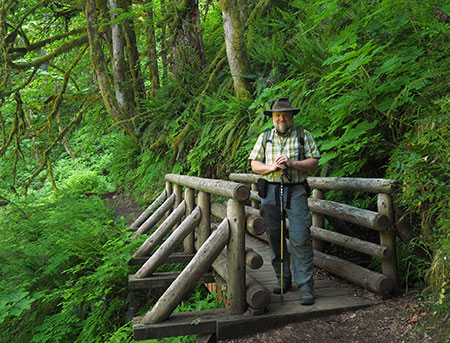
14CalendarHappyNewYear

“You know, this would make a GREAT national park!”

As always, thanks for reading this blog, and especially for the kind comments you’ve sent over the years. I’ve never felt better about Mount Hood and the Gorge someday getting the recognition (and Park Service stewardship) they deserve! That’s largely because of a passionate new generation of Millennials who are questioning the tactics and somewhat stale vision of the conservation movement’s old guard.

While it’s true that we oldsters have savvy and insight borne of experience, it’s also true that fighting too many battles can leave activists tired and resigned. So, bring on the new blood with their refreshing idealism and optimism! We are about to hand them the keys to the movement, and I very much like where they want to take us.

Happy trails to you in 2016!

Tom Kloster | Wy’East Blog

A New Vision for Mirror Lake (Part 3 of 3)

MirrorLakeVision01

Mirror Lake and Mount Hood from Tom Dick and Harry Mountain

 Big changes are coming to the Mirror Lake Trail on Mount Hood, perhaps the single most visited trail on the mountain. This is the third in a three-part series on the future of Mirror Lake, and the need for a broader vision to guide recreation in the area. This article focuses on a (much!) bolder vision that would provide new backcountry experiences and help take pressure off heavily visited Mirror Lake.
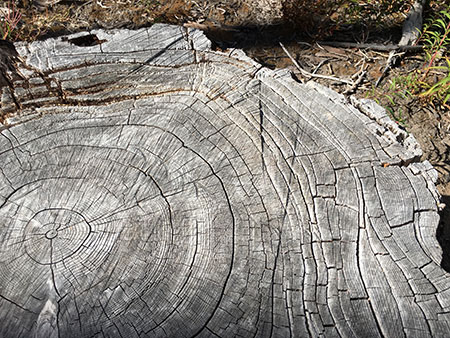
_____________

On March 30, 2009, President Obama signed into law a wilderness bill that brought thousands of acres of land around Mount Hood under permanent protection from logging and other commercial development.

Most of these new areas were expansions of existing wilderness, and such was the case for the backcountry that forms the backdrop for Mirror Lake. This new wilderness area stands as an island, bounded by US 26 on the north and the Still Creek Road on the south. This map shows the new island of wilderness:

MirrorLakeVision02

Click here for a larger map

The new wilderness area encompasses most of the remote, seldom visited Wind Creek drainage and much of Tom Dick and Harry Mountain. As you can see from the map, this island wilderness was added to the nearby Salmon-Huckleberry Wilderness, located to the south. That might be because the new area falls below the 5,000 acre threshold for new wilderness, but it was a missed opportunity to give the area its own wilderness identity.

While Mirror Lake, itself, was left just outside the boundary, the rugged mountain backdrop above the lake is now protected in perpetuity from development, and ski resort expansion, in particular — and whatever else might have been dreamed up by those trying to exploit this beautiful area to make a buck off our public lands.

MirrorLakeVision03

The rugged slopes of Tom Dick and Harry Mountain rising above Mirror Lake are now protected forever

The new wilderness protection also offers an opportunity to rethink how Mirror Lake itself will be protected in the long term. While not the closest wilderness area to the Portland region, it is perhaps the most accessible. That means demand for exploring the Mirror Lake area will only grow over time, no matter where the new trailhead is eventually located.

The Mirror Lake trailhead study took a baby step toward a broader vision for the wilderness area with the intriguing (and now discarded) “Site 5”, which would have moved the trailhead to the base of Laurel Hill, along Camp Creek (see below). Forest Service planners considered a new trail along Camp Creek to connect this lower trailhead to the existing trail – and in doing so, briefly floated the idea of a completely new streamside hike, something the Mount Hood area is woefully short on.

MirrorLakeVision04

Click here for a larger map

It’s true this site would have been a poor replacement for the existing trailhead, simply because of its distance from Mirror Lake. But the idea should be still explored on its own merits – along with other opportunities to build a true trail network in the new Mirror Lake wilderness.

While the Forest Service is rightly concerned about the impacts of heavy foot traffic on Mirror Lake, making it more difficult to get there doesn’t solve the larger issue: over the next 25 years, a million new residents are expected in the greater Portland region, and new trails are essential to spreading out the already overwhelming demand from hikers.

MirrorLakeVision05

Mount Hood from Tom Dick and Harry Mountain

But you might be surprised to know there are no plans to do so. For a variety of frustrating reasons, the Forest Service is doing just the opposite: hundreds of miles of trails are suffering from serious maintenance backlogs, and the agency is actively looking for trails to drop from the maintained network across the Pacific Northwest.

At Mount Hood, the Forest Service is still working from a decades-old forest plan that was written when the Portland region was smaller by about 800,000 residents. In that time, you can count new trails added to the system on one hand – while dozens of legacy trails have been dropped from maintenance. We hear that there’s no just money for trails – and yet, millions are spent each year on the other programs that are clearly a greater Forest Service priority.

To reverse this counter-intuitive downward spiral, the first step is a bold vision to shift the agency toward embracing new trails, and moving recreation to the top of their priorities for Mount Hood. The Mirror Lake area is a perfect place to start.

Taking the Long View

New trail proposals are a regular feature in this blog, but they are usually very specific fixes to a particular trail that should happen in the near term (with a couple of notable exceptions focused on backcountry cycling, found here and here.

The following proposal is different: this is a trail concept that would likely be built over years and decades, but with an eye toward a complete system over the long term. The goal is to absorb some of the inevitable growth in demand for trails while also offering a reasonable wilderness experience.

The proposal comes in two parts. The first focuses on Mirror Lake and the adjacent island of wilderness that encompasses the Wind Creek Basin, while the second part focuses on connections to the main Salmon-Huckleberry Wilderness, to the south. The trail concepts for the first part are shown on this map:

MirrorLakeVision06

Click here for a larger map

The trails shown in red on the map are new trail proposals, and would be built over time to provide alternatives to the overused Mirror Lake trail. Trails in green exist today. The new trails would provide access to new, largely unknown scenic destinations in this pocket wilderness, as well as overnight wilderness camping potential for weekend backpackers.

A key piece in this trail concept is a pair of new routes that would create a Mirror Lake loop from the proposed trailhead at Ski Bowl (see close-up map, below).

MirrorLakeVision06a

Click here for a larger map

While the other trail concepts proposed in this article are intended as a long-term, alternative vision to the status quo in the Mirror Lake area, the Mirror Lake loop trails could – and should — happen in the near term. The Mirror Lake loop concept builds on existing trails and could be built today, if the Forest Service were to embrace the idea.

The new connecting trail from the proposed Ski Bowl trailhead is already part of the Forest Service proposal for relocating the existing trailhead, and will be constructed as part of moving the trailhead.

MirrorLakeVision07

The Tom Dick and Harry traverse concept (the 1.3 mile connector along the north slope of the mountain) could be an important complement to the existing up-and-back trail by offering a loop option. The connector would also provide a real trail alternative to the informal summit ridge trail that eventually ends up following service roads under ski lifts back to the trailhead.

Loop trails not only reduce the impact on individual routes, they also offer more scenery for hikers and less crowding – which helps ensure a better wilderness experience.

MirrorLakeVision08

Moving to the north edge of the Mirror Lake trail concept map, the “Site 5” idea of a lower trailhead along Camp Creek is included, connecting from the Site 5 trailhead location to the Mirror Lake Trail.

While this trail concept seems to be too close to the US 26 highway corridor to provide much of a respite from urban noise, the saving grace is Camp Creek, itself. The creek tumbles along several hundred feet below the, and the sounds of this mountain stream would be more than enough to mask highway noise for hikers if the trail were designed to follow the creek.

MirrorLakeVision09

Looking down… waay down at Camp Creek from Highway 26

The Camp Creek trail concept has a lot to offer hikers: a rare, streamside trail in the Mount Hood corridor, an easy grade for families and a year-round hiking season, with most of the proposed trail located below the winter snow level.

Best of all, the Camp Creek canyon hides a once-famous series of cascades that make up Yocum Falls. These falls are seldom visited today, but the Camp Creek trail concept would pass in front of the beautiful lower tier of this series of waterfalls before climbing to the Mirror Lake trail. The falls would likely become the main focus of this trail for families or casual hikers looking for a short 3-mile, streamside hike.

MirrorLakeVision10

Beautiful Yocum Falls on Camp Creek

Building on the “Site 5” trailhead and Camp Creek trail proposal, this Mirror Lake trails concept includes a new route that would explore Wind Creek. This route would begin at Site 5, following Camp Creek downstream to Wind Creek, then climb into the remote Wind Creek basin. This proposed trail would provide a true wilderness experience, just off the Highway 26 corridor.

Along the way, the proposed Wind Creek trail would include a short spur (see map) to an overlook atop the familiar, towering cliffs that are prominently seen from Highway 26 along the north slope of Tom Dick and Harry Mountain.

MirrorLakeVision11

Google Earth view of the familiar cliffs on Tom Dick and Harry Mountain that would provide a short viewpoint destination off the proposed Wind Creek Trail.

MirrorLakeVision12

Mount Hood as it would appear from the new viewpoint along the proposed Wind Creek Trail.

But the Wind Creek trail concept would have even more to offer hikers: waterfall explorers Tim Burke and Melinda Muckenthaler recently discovered a series of beautiful, unmapped wateralls along Wind Creek where it tumbles from its hanging valley into Camp Creek.

MirrorLakeVision13

Middle Wind Creek Falls (photo courtesy Tim Burke)

MirrorLakeVision14

Upper Wind Creek Falls (photo courtesy Tim Burke)

Above the waterfalls, the proposed trail would enter the Wind Creek Basin, eventually connecting with existing trails on Tom Dick and Harry Mountain to create a number of possible loop hikes and backpacking opportunities.

Foremost among the backpack destinations would be Wind Lake, a pretty, surprisingly secluded lake that is currently only accessible by first navigating a tangle of service roads and resort trails at Ski Bowl. The Wind Creek trail concept would allow hikers to visit this wilderness spot without having to walk through the often carnival-like activities that dominate during the summer months at the resort.

MirrorLakeVision15

Wind Lake (Photo courtesy Cheryl Hill)

A final piece of the concept for the Mirror Lake-Wind Creek backcountry would be a new trail connecting Wind Lake to the Still Creek Road and Eureka Peak Trail. This new route would pass a couple of small, unnamed lakes south of Wind Lake, then traverse a rugged, unnamed overlook that towers 1,600 above the floor of the Still Creek valley (see concept map, above).

MirrorLakeVision16

Looking across the seldom-visited Wind Lakes Basin toward Mount Jefferson

The proposed trail linking Wind Lake to the Eureke Peak trail would also be the first step in better connecting the wilderness island that encompasses the Wind Creek Basin and Mirror Lake to the main Salmon Huckleberry Wilderness, to the south. And on that point…

 Thinking even bigger!

In the long-term, the island of wilderness that covers the Wind Creek-Mirror Lake area should be more fully integrated with the main Salmon-Huckleberry wilderness to enhance both recreation and the ecosystem. This second part of the trail concept for the Mirror Lake area is a broader proposal that encompasses the north edge of the main Salmon-Huckleberry wilderness area, and includes few ideas on how to get there (see map, below).

MirrorLakeVision17

Click here for a larger map

The centerpiece of this part of the trail proposal is to close Still Creek Road from the Cool Creek trailhead to the Eureka Peak trailhed to motorized vehicles. The concept is to leave this nearly 6-mile section of road (shown in yellow on the map) open to cyclists and horses and for occasional administrative use by Forest Service vehicles.

MirrorLakeVision18

Beautiful Still Creek

A corresponding trail concept (shown on the above map) is to build a stream-level hiking trail that parallels the service road, but alternates at each bridge, staying on the opposite side of Still Creek from the road. True, hikers could simply follow the closed road, but the idea is to offer another much-needed, low elevation streamside trail to the area, taking pressure off the few options that currently exist (in particular, the Salmon River).

Closing the trail to motor vehicles would also help control some of the historic problems with dumping, target shooting and vandalism in the area. It would also create a quiet zone for wildlife moving between the main Salmon Huckleberry Wilderness and the wilderness island covering the Mirror Lake-Wind Creek area.

Another concept in this second, broader proposal is a ridge trail along the Salmon River-Still Creek divide, from Devils Peak to Eureka Peak. This little-known arm of the Salmon Huckleberry Wilderness is dotted with rock outcrops and open ridges that offer sweeping views of Mount Hood and the Still Creek valley. This trail concept would new backpack loops possible from the Highway 26 corridor.

MirrorLakeVision19

The Salmon River-Still Creek Divide (with clouds filling the Still Creek valley)

The ridge trail concept proposes two new trails between Veda Butte and Eureka Peak, creating a smaller loop in this area that would traverse open talus slopes and ridge tops with fine views of Mount Hood and Veda Lake.

MirrorLakeVision20

Veda Lake and Mount Hood

MirrorLakeVision21

Veda Lake and Veda Butte

The west end of the proposed ridge trail would connect to the extensive network of trails that converge on Devils Peak and its historic lookout tower. The Cool Creek, Kinzel, Green Canyon and Hunchback Mountain trails would all connect to the proposed ridge trail, creating many hiking loop and backpack options, as well as trail access from the Salmon River area to the Mirror Lake and Wind Creek backcountry.

MirrorLakeVision22

Mount Hood from the Cool Creek Trail

Is this vision for Mirror Lake and the Wind Creek Basin farfetched? Only if we limit our imagination and expectations to the existing forest management mindset.

Consider that nearly all of the trails ever built on Forest Service lands were constructed in just a 20-year span that ended in the mid-1930s, using mostly hand tools, and with budgets a fraction of what is spent today. The real obstacles to a renewed focus on trails and recreation aren’t agency resources, but rather, a lack of vision and will to make it happen.

What can you do?

MirrorLakeVision23

Mirror Lake in winter

For now, these trail concepts are just a few ideas of what the future could be. The critical step in the near term is to simply avoid losing ground when the Mirror Lake trailhead is moved. If you haven’t commented already, consider weighing in on the issue – the federal agencies are still accepting our feedback!

Here are three suggested areas to focus on your comments on:

  1. What would you like to see in the preferred alternative? (see Option 4 in the first part of this article series)?

Are you frustrated with the winter closure of the existing Mirror Lake trailhead? Be sure to mention this in your comments on the proposed new trailhead, as it will need to be design to be plowed and subsequently added to the Snow Park system to serve as a year-round trailhead.

Consider commenting on other trailhead amenities, as well, such as restrooms, secure bicycle parking, trash cans, drinking fountain, signage, picnic tables, a safe pedestrian crossing on Highway 26 for hikers coming from Government Camp or any other feature you’d like to see.

  1. How would you like to see Camp Creek protected?

The project vaguely proposes to restore the existing shoulder parking area to some sort of natural condition. Consider commenting on how this restoration might work to benefit Camp Creek, which is now heavily affected by highway runoff and the impacts of parking here.

In particular, mention the need to divert highway runoff away from Camp Creek for the entire 1-mile stretch from the old trailhead to the Ski Bowl entrance. The proposed parking area restoration is the perfect opportunity to address the larger need to improve the watershed health.

  1. Would you like to see a new vision for the larger Mirror Lake/Wind Creek backcountry?

Share some of the ideas and proposals from this article or other ideas of your own! The Forest Service recreation planners are reviewing the comments from the trailhead relocation project, so it can’t hurt to make a pitch for more trails in the future – even if the recent history has been in the opposite direction.

In particular, mention the loop trail idea described for Mirror Lake, particularly the traverse trail shown on the first concept map. This new trail has a real chance of being built in the near term of there’s public support for it.

You can comment to Seth Young at the Federal Highway Administration via e-mail or learn more about the project here:

Mirror Lake Trailhead Project Information:

Federal Highway Administration

Seth English-Young, Environmental Specialist

Western Federal Lands Highway Division

610 East Fifth Street

Vancouver, WA 98661-3801

Phone: 360-619-7803

Email: seth.english-young@dot.gov

 Subscribe to Project Newsletters

To be added to their mailing list, please send an email to seth.english-young@dot.gov.

 For U.S. Forest Service specific questions contact:

Laura Pramuk

Phone: 503-668-1791

Email: lbpramuk@fs.fed.us

A New Vision for Mirror Lake (Part 2 of 3)

MirrorLake2.01

Today’s Mirror Lake trailhead will soon be history

 Big changes are coming to the Mirror Lake Trail on Mount Hood, perhaps the single most visited trail on the mountain. This is the second of three articles on the future of Mirror Lake, and the need for a broader vision to guide recreation in the area. This article focuses on the alternatives under consideration for a new trailhead.

____________

It’s true. We’re about to lose the historic Mirror Lake trailhead along Highway 26. If you’re like me (and countless other Oregonians), you might have been introduced to hiking and the great outdoors along this classic family trail.

The visibility and convenience of the Mirror Lake trailhead, with its prominent location along the last bend of the Mount Hood Loop Highway as you approach Government Camp, is one of the main reasons this trail has functioned as a “gateway” for novice hikers, stopping at the first trail they see. The short hike to the lake has also made this trip friendly and fun for families with very young kids.

Until recently, the Mirror Lake Trail was also the perfect place to learn the sport of snowshoeing — until the Oregon Department of Transportation (ODOT) closed the trailhead to winter parking in 2010, that is.

MirrorLake2.02

Low snowfall in the winter of 2010 meant the first winter closure of the Mirror Lake trailhead went largely ignored, though the closure has become real in subsequent years

The 2010 winter closure foreshadowed the future, as ODOT always intended to close the trailhead entirely. Now, after years of back and forth with the Forest Service and an array of advocacy groups, and ODOT has won this battle. ODOT’s determination to morph our loop highway into an urban-style freeway came in the form of the $37 million widening project now underway (read more about there here: https://wyeastblog.org/2014/06/30/u-s-26-construction-begins/), and in the tradition of most state highway departments, it was an unstoppable force.

Planning the New Trailhead

Now that the Forest Service has agreed to relocate the trailhead, a little-known branch of the federal government known as the Western Federal Lands Highway Division is taking the lead on finding a new site on behalf of both ODOT and the Forest Service. The planning process kicked off in earnest on October 29 with a lightly attended open house at the Zigzag Ranger District, and the proposal details have since been added to the project website.

You may have seen other changes in the area. ODOT is midway through a major widening of the Mount Hood Highway that will bring a freeway-style concrete barrier to the entire Laurel Hill grade, from Government Camp all the way down to the Kiwanis Camp Road (the old highway section that leads to Little Zigzag Falls).

MirrorLake2.03

“New and improved” highway scars like these along the Mount Hood loop are part of ODOT’s plan to allow weekend skiers to drive just a bit faster

This means the historic trailheads at Laurel Hill and Mirror Lake will only be accessible from the eastbound highway. Portland area hikers leaving Mirror Lake would need to drive east to Government Camp and turn around to head west. Likewise, hikers coming from the east would need to drive to the bottom of the hill, and turn around at Kiwanis Camp Road to reach the Laurel Hill and Mirror Lake trailheads.

Given the implications of the new highway median, the Forest Service has conceded to move the trailhead, and not further explore options for keeping the historic trailhead open to general use. To help this effort, the Forest Service received a grant in 2014 that helped fund the analysis of different trailhead options.

MirrorLake2.04

(click here for a larger map)

The most promising of the various trailhead options under consideration from a logistics standpoint is simply using the Ski Bowl parking area (which, like the rest of the Ski Bowl land, is owned by the public with a long-term lease granted to Ski Bowl to operate here). Not surprisingly, the resort is concerned about sharing their highway access, and was present at the October 29 project open house.

Despite the resort’s concerns, the FHWA and Forest Service have nonetheless ruled out other possible sites (described later in this article), and are now focused solely on the Ski Bowl site with several design options under consideration. The following map shows the four options in relation to the Ski Bowl parking lot:

MirrorLake2.05

(click here for a larger map)

The preferred site has other complications. Much of the land here is within a protected stream buffer that follows Camp Creek. Government Camp’s sewage treatment facility is also located here (in the center of the map, above, and pictured below), and must be designed around for both security and aesthetic reasons.

MirrorLake2.06

The Government Camp sewage treatment plan hides just behind a thin band of trees along the Ski Bowl parking area.

The new trailhead project proposes about fifty parking spaces in the new parking area. That sounds small (and is), considering the crowds on a typical weekend at Mirror Lake, but that’s intentional. The Forest Service is looking to reduce the human impact on Mirror Lake, with a parking area sized to what they see as the optimal maximum for the area (more on this later in the article).

With the proposed new parking area and trail located adjacent to Ski Bowl, there is obviously a large existing parking area that will allow a lot more than 50 cars at trailhead in the off-season for the resort, so it’s unclear of limiting the number of spaces can really limit the number of hikers on the trail. The Ski Bowl resort’s concerns are mostly about winter use, when snowshoers and backcountry skiers could overflow to use the resort parking area and displace resort visitors.

MirrorLake2.07

Panorama of the massive new road cut underway opposite the historic Mirror Lake trailhead on US 26; a concrete median will soon be added here.

The Forest Service and ODOT are proposing to plow the new trailhead parking area in winter and (presumably) add it to the SnoPark system, so this represents a big improvement over the current situation.

Since the ODOT winter closure of the existing trailhead was put in place, snowshoers have simply walked the shoulder of Highway 26 from Ski Bowl to gain access to the historic trailhead — a potentially dangerous (and rather scary) idea. Providing plowed winter access at the new trailhead should resolve this problem.

Another benefit of locating the new trailhead at the Ski Bowl site is proximity to Government Camp. The village has been working hard to become a year-round resort community with a network of new trails now surrounding the community. All four design options would create much better access to Mirror Lake and the surrounding wilderness area for Government Camp visitors and residents, albeit with a sketchy highway crossing.

Considering the Options

With the approximate site for the new trailhead already selected at Ski Bowl, the FHWA and the Forest Service are now concentrating on design options. The Ski Bowl site has many physical limitations, so the focus is on how to integrate the new trailhead with the various site constraints presented by the proximity to Ski Bowl, including the wastewater treatment plant and a 340-foot protected buffer along Camp Creek, itself.

The first design (Option 1) features a suburban style cul-de-sac that would double back from the west approach along Highway 26, running parallel to the highway:

MirrorLake2.08

(click here for a larger map)

This option would require a lot of tree removal as well as extensive fill under the turnaround portion. It would also extend into the protected buffer along Camp Creek. The turnaround is oversized for snowplows, but this design also creates a practical parking enforcement issue during the snow-free seasons, as hikers would almost certainly park in the turnaround during busy summer weekend.

The second design (Option 2) features a triangular loop tucked behind the wastewater treatment plant:

MirrorLake2.09

(click here for a larger map)

This design is an improvement over the first option because it allows for more efficient plowing and use of paved areas. The landscaped center area could even function as a useful place for a few picnic tables for waiting visitors meeting at the trailhead during the snow-free seasons.

The loop in Option 2 could also make it more efficient for law enforcement to patrol and for users to spot suspicious activity. However, like the first design, this option intrudes significantly into the 340-foot protected buffer along Camp Creek and would require removal of a fairly large number of trees.

The third design (Option 3) features a tighter loop that omits the landscaped center included in the second option:

MirrorLake2.10

(click here for a larger map)

Like the first two options, this version extends significantly into the protected buffer along Camp Creek and would require a fair amount of fill and tree removal. Like the second option, Option 3 makes efficient use of paved areas and the loop design would make for easier plowing and patrolling by law enforcement.

The fourth option is the “preferred” option by FHWA and the Forest Service:

MirrorLake2.11

(click here for a larger map)

 This option is preferred mostly because it falls outside the protected 340-foot Camp Creek buffer. I walked the site with the Zigzag District Ranger in late 2014, and while it does make sense as the most compact design, it’s also an attempt to squeeze a lot into a very narrow, surprisingly steep strip of land between the treatment plant and highway.

While the mockup illustration (above) for Option 4 shows a few trees left between the parking area and treatment plant, in reality it would be difficult to achieve the amount of fill required to build the new parking area without removing all of the trees along the north edge of the treatment plant. Over time, this could be remedied with new tree plantings along the fill slope, but in the near term, visitors would enjoy a birds-eye view of the open settling ponds and the treatment plant operators may be concerned about this new level of public visibility.

Tree removal is a concern in all of the designs, as this area contains stands of Alaska cedar, a high-elevation cousin of Western red cedar found throughout the Government Camp area, but relatively uncommon in the Cascades.

MirrorLake2.11a

The graceful, drooping form of Alaska Cedar make it a prized commercial landscape tree

All four options feature a very tight turning sequence for drivers arriving from the west, with a right turn into the shared driveway with the Ski Bowl resort, and almost immediately a second right turn into the trailhead parking. These turns create a blind corner for approaching traffic that probably warrants a deceleration lane along the highway — especially given ODOT’s determination to promote high-speed travel along the loop highway.

No Longer Considered…

The FHWA and Forest Service have already dropped some intriguing trailhead locations that I will briefly describe here. For context, the map below shows four of the five sites original sites (those located closest to Government Camp) considered — the four final design options now under consideration are all located at Site 2 on this map:

MirrorLake2.12

(click here for a larger map)

Site 1 is at the end of the Kiwanis Camp Road, which is really an original segment of the Mount Hood Loop Highway:

MirrorLake2.13

(click here for a larger map)

This site already serves as the trailhead for the Little Zigzag Falls trail and a closed section of the old highway leads to the Pioneer Bridle Trail. This site was dropped because of the added distance to reach Mirror Lake and the difficulty in creating a trail crossing over Highway 26 for hikers.

Site 2 is the Ski Bowl location where the previously described design options are still under study:

MirrorLake2.14

(click here for a larger map)

Sites 3 and 4 are located along another portion of the original Mount Hood Highway, opposite Site 2 and the Ski Bowl parking area:

MirrorLake2.15

(click here for a larger map)

The Glacier View snow park and trailhead is already located along this segment of old highway, and the concept behind both Sites 3 and 4 was to build a larger, shared snow park with a pedestrian bridge over Highway 26 to connect to the Mirror Lake trail. These sites were dropped because of the scale and complexity of spanning Highway 26 with a foot bridge, especially after the highway widening project greatly increased the width of the highway, itself.

Site 5 is located at a quarry at the foot of Laurel Hill, below a prominent rocky knob along the highway created by the road cut (and known as the “Map Curve” to ODOT):

MirrorLake2.16

(click here for a larger map)

While this site was dropped because of its distance from Mirror Lake, it nevertheless offers exciting opportunities as an alternative trailhead and the potential for a broader strategy to manage the heavy visitation to Mirror Lake. Part 3 of this series will explore the possibility of a larger trail network and more hiking options as a strategy for reducing the pressure on Mirror Lake in the long term.

Tragedy of the Commons?

As disappointing as it may be to lose the historic Mirror Lake trailhead, there are some clear environmental benefits that could be achieved.

First, the new trailhead will about a mile east of the historic trailhead, meaning a longer hike by about two miles, round trip. While this will make the trail less accessible to young families, it’s also true that the lake is showing serious damage from overuse. If the more distant trailhead discourages a few hikers, that could be a win for the lake.

MirrorLake2.17

The Forest Service has done extensive soil stabilization work at Mirror Lake just to keep pace with heavy foot traffic.

As I have argued before on this blog, placing physical barriers to outdoor recreation is tragically short sighted if our goal as a society it to encourage people to be more active and to enjoy and take responsibility for our public lands. Thus, I favor other strategies for addressing heavy use on trails, including peak parking fees at the busiest trailheads.

Eventually, the Mount Hood National Forest will have to adopt a real parking strategy on some of its most heavily used sites, but the agency so far has not acknowledged that reality. Instead, its planners are viewing washed-out bridges (Ramona Falls) and trailhead closures (Mirror Lake) as helpful interventions to tame the masses. That’s a poor solution pretending to be a strategy.

Nonetheless, the Forest Service is clearly a long way from adopting a comprehensive trailhead parking policy at Mount Hood, so for Mirror Lake. Making the hike more difficult is probably the only near-term option if the number of hikers can actually be reduced, however short-sighted the approach.

MirrorLake2.18

Rill erosion like this is common where Highway 26 abuts Camp Creek, pouring road gravel and pollutants directly into a protected salmon and steelhead stream

Moving the Mirror Lake trailhead could also allow for a meaningful effort by ODOT and the Forest Service to protect Camp Creek from sediment and runoff pollution from Highway 26.

While ODOT is spending tens of millions to carve away solid rock slopes in order to widen the highway, no funds were set aside to improve stream protection for Camp Creek. The creek is home to protected salmon and steelhead, and eventually it flows into the Sandy River — one of the few spawning streams in the Columbia River system with no dams to block fish passage.

MirrorLake2.19

Highway runoff now pours sediment and pollutants directly into Camp Creek at the Mirror Lake trailhead.

MirrorLake2.20

Looking east along Camp Creek (on the right) and Highway 26 showing rill erosion directly from the road surface into the stream

The Forest Service has indicated a commitment to decommission and restore the historic trailhead once the new trailhead has been constructed. That’s a good start, but it’s unclear whether channeling highway runoff away from Camp Creek is part of that plan.

Ideally, ODOT would construct a concrete curb to divert highway runoff for the entire 1-mile highway section that abuts Camp Creek, from the historic trailhead east to the Ski Bowl entrance.

The actual drainage design would more complex, as the amount of runoff here is clearly enough to erode dozens of rills into the shoulder and directly to Camp Creek, as shown in the photos above. But the removal of the Mirror Lake trailhead represents an opportunity for ODOT to show it cares about more than just moving ski traffic at slightly higher speeds.

The agency also has the funds to address highway runoff into Camp Creek as part of the current widening project, as all ODOT projects include hefty contingency set-asides for just this sort of unanticipated expense — as much as one third of the overall project budget is typically “contingency”.

How to Comment

If you love Mirror Lake or care about Camp Creek, it’s worth commenting on the trailhead relocation project, if only because precious few will take the time to do so. The FHWA, ODOT and Forest Service really do take public comments into consideration, especially when it brings new information to their decisions.

MirrorLake2.21

The resort village of Government Camp from above Mirror Lake.

Here are two suggested areas to focus on your comments on:

What would you like to see in the preferred alternative (Option 4)?

Are you frustrated with the winter closure of the existing Mirror Lake trailhead? Be sure to mention this in your comments on the proposed new trailhead, as it will need to be design to be plowed and subsequently added to the Snow Park system to serve as a year-round trailhead.

Consider commenting on other trailhead amenities, as well, such as restrooms, secure bicycle parking, trash cans, drinking fountain, signage, picnic tables, a safe pedestrian crossing on Highway 26 for hikers coming from Government Camp or any other feature you’d like to see.

How would you like to see Camp Creek protected?

The project vaguely proposes to restore the existing shoulder parking area to some sort of natural condition. Consider commenting on how this restoration might work to benefit Camp Creek, which is now heavily affected by highway runoff and the impacts of parking here.

In particular, mention the need to divert highway runoff away from Camp Creek for the entire 1-mile stretch from the old trailhead to the Ski Bowl entrance. The proposed parking area restoration is the perfect opportunity to address the larger need to improve the watershed health.

You can comment to Seth Young at the Federal Highway Administration via e-mail or learn more about the project here:

Mirror Lake Trailhead Project Information:

___________________

 Federal Highway Administration

Seth English-Young, Environmental Specialist

Western Federal Lands Highway Division

610 East Fifth Street

Vancouver, WA 98661-3801

Phone: 360-619-7803

Email: seth.english-young@dot.gov

 ___________________

Subscribe to Project Newsletters

To be added to our mailing list, please send an email to seth.english-young@dot.gov.

 ___________________

For U.S. Forest Service specific questions contact:

Laura Pramuk

Phone: 503-668-1791

Email: lbpramuk@fs.fed.us

___________________

 Thanks for helping guide the future of Mirror Lake!


A New Vision for Mirror Lake (Part 1 of 3)

Summer evening view of Mount Hood from Mirror Lake

Summer evening view of Mount Hood from Mirror Lake

Big changes are coming to the Mirror Lake Trail on Mount Hood, perhaps the single most visited trail on the mountain. This is the first of three articles on the future of Mirror Lake, and the need for a broader vision to guide recreation in the area.
____________

As part of the unfortunate widening of the Mount Hood Highway currently underway west of Government Camp (see this article for more on the subject), the Oregon Department of Transportation (ODOT) has persuaded the U.S. Forest Service to close the existing, historic trailhead for the Mirror Lake Trail.

ODOT claims safety is the chief concern, a point I will visit later in this series. For now, though, it looks like our highway department will close yet another roadside trailhead in a campaign to gradually morph the Mount Hood Highway into full-fledged freeway.

Going back to the beginning…

Just as Mount Hood generally bears the development pressures of being an hour from Portland, and along transportation corridor that dates to the 1840s, Mirror Lake has long carried the burden of being the closest mountain lake to Portland, and the first easily accessible trailhead along the loop highway.

Because of its proximity, the lake shows up on the earliest maps of the Government Camp area, when the Mount Hood Loop Highway had a very rough, early alignment and was not yet a loop. The original Skyline Trail map (below) from the early 1900s shows Mirror Lake just west of the new trail, and a version of the early loop road before the Laurel Hill switchbacks were built.

1920s-era map of Mount Hood and the Government Camp area

1920s-era map of Mount Hood and the Government Camp area

By the early 1920s, the effort to complete the loop highway was in full swing, including the graceful switchbacks that scaled Laurel Hill (below), the spot where Oregon Trail immigrants had to lower their wagons with ropes because of the steepness of the terrain. Surprisingly, a formal trail to Mirror Lake had not yet been constructed by this time.

1920s map of the first paved alignment of the Mount Hood Loop Highway at Government Camp

1920s map of the first paved alignment of the Mount Hood Loop Highway at Government Camp

Other maps from the early 1900s (below) tell another story about Mirror Lake: it was within the northern extent of the Sherar Burn, a massive fire that had destroyed forests from the Salmon River to Camp Creek. As recently as the 1980s, bleached snags from the fire were standing throughout the Mirror Lake area.

1920s map showing the Sherar Burn extent in the Mirror Lake area

1920s map showing the Sherar Burn extent in the Mirror Lake area

The Sherar Burn of the mid-1800s created vast tracts of huckleberries across the area, and during the early days of the highway, huckleberry pickers were a common sight, selling coffee cans of fresh berries to mountain visitors (below).

Huckleberry pickers in the 1930s at the Little Zigzag River bridge, below Laurel Hill

Huckleberry pickers in the 1930s at the Little Zigzag River bridge, below Laurel Hill

Mirror Lake, itself, looked quite different in the 1920s, too. Today’s tree-rimmed lake was mostly surrounded by burned snags and fields of beargrass and huckleberry in the 1920s (below).

Mirror Lake in the late 1920s

Mirror Lake in the late 1920s

Sometime in the late 1920s or early 1930s, a new trail was constructed from the new highway to Mirror Lake. The trail began at a sharp turn on the old highway, traversing above the north shoulder of Yocum Falls on Camp Creek, crossing to the south side of the creek at the spot where the modern trailhead is located today (see maps below).

This lower section (from the bend in the old highway to the modern trailhead) of the original Mirror Lake trail was destroyed just 25 years later, when the modern highway grade cut through the area. This portion of the old highway still exists in this area, accessible from the Laurel Hill historic landmark pullout (currently closed because of the highway widening).

1930s map of the original Mirror Lake Trail

1930s map of the original Mirror Lake Trail

1930s map of the Mirror Lake Trail and surrounding area

1930s map of the Mirror Lake Trail and surrounding area

When the original Mirror Lake Trail was built, the trailhead was located just a few yards beyond an impressive roadside viewpoint of Yocum Falls on Camp Creek (below). Today, the forest has recovered so completely in this part of the Sherar Burn that this viewpoint is completely overgrown. It is still possible to visit Yocum Falls from the old highway grade, though, by following rough use trails.

Yocum Falls as it once appeared from the original Mount Hood Loop Highway

Yocum Falls as it once appeared from the original Mount Hood Loop Highway

The lower section of the original trail seems to have followed the rambling extent of Yocum Falls quite closely before the trail was destroyed by the modern highway. While the current trailhead gives a brief glimpse of the top of the falls, the old route seems to have provided a nice view of the falls since lost (more on this topic in the third part in this series).

Today, the modern Mirror Lake trailhead continues to provide a popular drop-in hike for families and casual hikers, but the convenience comes at a price. The shoulder parking area is large enough to allow up to 100 cars, and on busy weekends, still more hikers park along the highway all the way to Government Camp, walking the highway shoulder to reach the trailhead.

The Mirror Lake Trail was never designed to handle this much traffic, nor is the small lake able to handle so many visitors. These concerns are part of the Forest Service thinking in why a new trailhead should be constructed.

Camp Creek suffers from its close, unprotected proximity to Highway 26 and the Mirror Lake Trail parking.

Camp Creek suffers from its close, unprotected proximity to Highway 26 and the Mirror Lake Trail parking.

Meanwhile, the 1950s-era trailhead pullout in use today was built at a time when little thought was given to environmental impacts. As a result, highway fill was pushed to the edge of Camp Creek, exposing an important salmon and steelhead stream to heavy loads of silt and pollution from parked vehicles. A visit to Yocum Falls, just downstream, reveals a troubling amount of road debris and the sharp odor of pollution in an otherwise healthy stream corridor.

While these growing impacts on Mirror Lake and Camp Creek aren’t the reason ODOT gives for closing the current Mirror Lake Trailhead, they are compelling arguments to consider.
____________

The next part of this 3-part series will take a closer look at ODOT’s arguments for closing the existing trailhead and the Forest Service proposal for a new trailhead located east of the existing access.

How will the summer of 2015 affect our fall colors?

Shepperd's Dell dressed in autumn golds

Shepperd’s Dell dressed in autumn golds

Oregon may not have the neon rainbow of New England’s fall colors, but we put on a pretty good show if you know where and when to look. However, 2015 will be different, as the extended drought and scorching summer heat has already affected our fall colors this year, even before the leaves began to turn.

To understand why, you have to start with the basics of how leaf colors change with the seasons, and how weather and other factors influence the autumn show each year.

Leaf Biology 101!

Most of our northwest deciduous trees and shrubs leaf out in spring, grow green leaves through the summer, then turn to various shades of yellow and gold in fall, with a few red leaves in the mix. Vine maple, huckleberry and mountain ash provide our most brilliant reds, and most of the larger deciduous trees in our forests turn to some shade of gold, orange or yellow.

Vine maple colors range from pale yellow (in shade) to bright crimson (in full sun)

Vine maple colors range from pale yellow (in shade) to bright crimson (in full sun)

The green color in summer and spring foliage comes from chlorophyll, the amazing molecule that absorbs sunlight and allows for photosynthesis — the process by which plants convert sunlight into carbohydrates (sugars) essential to their growth.

During the spring and summer growing seasons, chlorophyll is produced continually, keeping deciduous leaves green. But as the days shorten with the approach of winter, the decrease in sunlight triggers a change in how cells in the stem of each leaf divide, gradually blocking the flow of both nutrients and chlorophyll to leaves. The cells that form this barrier within the leaf stem are known as the “abscission layer”.

Like vine maple, mountain ash fall colors range from light yellow to brilliant red, based on sun exposure

Like vine maple, mountain ash fall colors range from light yellow to brilliant red, based on sun exposure

Ready for more leaf biology? Well, the yellows, reds and golds of autumn are colors that already reside in leaves, but are revealed as the change to the flow of chlorophyll is blocked by the development of the abscission layer in early fall.

Yellows and golds in fall leaves come from “xanthophylls”, a pigment thought to regulate light in the photosynthesis process. Reds and purples come from “anthocyanins”, a molecule that is believed to complement the green of cholorophyll in the photosynthesis process — but is more commonly is found in flowers, where it functions to attract pollinators.

Dark, cool and wet…

Okay, enough leaf biology! If deciduous leaves are certain to turn color in autumn by their very chemistry, how do environmental factors fit into the leaf cycle? Here are the key forces that shape the timing and brilliance (or lack thereof) in our autumn color show:

Bright sun and cool temperatures: a crisp, abrupt fall pattern speeds up and pronounces the abscission process by which chlorophyll is blocked from leaves. This helps to promote sudden and dramatic color shows. Likewise, a mild, extended Indian Summer tends to slow the process, with a more gradual color change and leaves changing and falling over a longer period.

Cool mountain nights and bright, sunny days set these vine maple ablaze on Mount Hood's Vista Ridge

Cool mountain nights and bright, sunny days set these vine maple ablaze on Mount Hood’s Vista Ridge

Bright days and cool nights also enhance reds and purples in plants with abundant anthocyanins in their leaves. These include vine maple, huckleberry and mountain ash, our most vibrant fall foliage. That’s also why these colors are more prominent at higher elevations where bright days cool nights are guaranteed, even as the valleys are under a blanket of fog.

Early frosts: contrary to popular belief, early frosts hurt fall colors more than they help, as the production of anthocyanin-based colors of red and purple are abruptly interrupted by a premature formation of the abscission layer. If you’ve hiked in the mountains in late August after an early cold snap, you’ve undoubtedly seen a carpet of dropped leaves under huckleberries and other deciduous shrubs.

Drought: like early frosts, drought can trigger a premature formation of the abscission layer, leading to early color change and leaf drop. If you’ve been hiking in the Gorge or on Mount Hood this summer, you likely saw this effect of the drought we are experiencing. While some leaves survive later into autumn, the broader effect is a muted show, as many leaves have already dropped long before the typical fall color season. This is has already been the effect of the drought this year in both the Gorge and on Mount Hood.

Early autumn storms: the arrival of a Pineapple Express storm pattern during Labor Day week of 2013 did a fine job of stripping our maples and other deciduous trees of many of their leaves weeks before they would normally turn and begin to lose their foliage. It’s not common for early storms of this magnitude in our region, so it might be the most notorious culprit in stealing our fall colors!

The colors in this view of Umbrella Falls on Mount Hood are mostly huckleberry -- red when in full sun and yellow in shady stream areas

The colors in this view of Umbrella Falls on Mount Hood are mostly huckleberry — red when in full sun and yellow in shady stream areas

In an ideal year, normal rainfall in spring and summer are followed by a cool, dry Indian summer with warm days and cool nights in the 40s or 50s. This year, we’ve got the Indian summer condtions, but the drought has already triggered leaf drop in a lot of our deciduous forests. Thus, we’re likely to have a so-so color display this Fall.

Where and When to Catch the Colors

A muted fall color display this year shouldn’t keep you from heading out to enjoy it! In a typical year, the high country colors peak in September through early October. Mid-elevation areas and canyons usually peak from mid-October through mid-November, depending on the mix of tree species.

Here are some of the best spots in the Mount Hood area to catch the autumn color:

Elk Cove from Vista Ridge – this 9-mile out-and-back hike is one of the best for exploring Mount Hood’s high country without having to ford glacial streams or suffer huge elevation gains (though you will gain substantial elevation). In September of a typical year, fall colors light up the trail, especially as you descend into Elk Cove, but note that the colors are long gone from this hike in our drought year — see the Oregon Hikers Field Guide description

Elk Cove in late September (in a typical year)

Elk Cove in late September (in a typical year)

Clackamas River Trail – another close option for Portlanders, with a moderately long hike to Pup Creek Falls, albeit with moderate elevation gain. This trail is lined with bigleaf maple, but also has impressive vine maple shows in a recovering burn section that bring shades or red and coral to the trail in October. You’ll also see Douglas maple here, a close but less common cousin to vine maple — see the Oregon Hikers Field Guide description

Brilliant vine maple along the Clackamas River Trail

Brilliant vine maple along the Clackamas River Trail

Lookout Mountain Loop – Always a spectacular hike on a clear day, in October you will also see the annual spectacle of western larch turning golden yellow across the eastern slopes of the Cascades. Larch are a deciduous conifer — a rarity, and an impressive sight — see the Oregon Hikers Field Guide description

Whole mountainsides around Lookout Mountain light up with western larch turning in mid-to-late October

Whole mountainsides around Lookout Mountain light up with western larch turning in mid-to-late October

Latourell Falls Loop – Very close to Portland, this is a popular family hike that visits two waterfalls in a lovely rainforest canyon. In late October, bigleaf maple that dominate the forests here light up in shades of yellow and orange, often covering the trail ankle-deep in their huge leaves — see the Oregon Hikers Field Guide description

The Latourell Falls loop trail still has some color in early November

The Latourell Falls loop trail still has some color in early November

Starvation Creek Loop – like the Latourell loop, Starvation Creek has an abundance of bigleaf maple, but the crisper weather and abundant sun of the eastern Gorge often makes for a brighter show here. Families can simply explore the paved trails around the main falls, but the Lower Starvation hike makes for a fun, if sometimes steep loop past more waterfalls and clifftop viewpoints — see the Oregon Hikers Field Guide description

Bigleaf and vine maple put on a reliable show at Starvation Creek Falls in October

Bigleaf and vine maple put on a reliable show at Starvation Creek Falls in October

Butte Creek Trail – an under-appreciated family trail that does require navigating some harshly managed corporate timber holdings. The outrageous, utterly unsustainable clear-cutting only makes the pristine public forests and waterfalls along the trail that much more spectacular in comparison. This is an ideal October hike, with fall colors typically peaking in the last half of the month. This trail really shines in rainy or overcast weather, when the rainforest glows with countless autumn shades of yellow, gold and orange against a backdrop of deep green – see the Oregon Hikers Field Guide description

The author ankle-deep in maple leaves on the Butte Creek Trail

The author ankle-deep in maple leaves on the Butte Creek Trail

The great thing about taking in fall colors is that the weather really doesn’t matter — a soggy hike through the brilliant yellows of bigleaf and vine maple in a waterfall canyon is just as spectacular as a sunny day hiking through a sea of red and orange in Mount Hood’s huckleberry fields.

Better yet, if you have kids, it’s also a great time to expose them to hiking and exploring the outdoors… though you should also plan on hauling home a hand-picked collection of autumn leaves..!

Enjoy!

The Other Mirror Lake

"Palisades, Columbia River" This 1880s scene captured by Frank J. Haynes, official photographer for the Union Pacific Railroad. Crown Point (then called "Thor's Heights") and its lacy waterfall are the backdrop for what was known as Echo Bay in the early days of settlement.

“Palisades, Columbia River” This 1880s scene captured by Frank J. Haynes, official photographer for the Union Pacific Railroad. Crown Point (then called “Thor’s Heights”) and its lacy waterfall are the backdrop for what was known as Echo Bay in the early days of settlement.

Though seen by far more travelers than the famous Mirror Lake on Mount Hood, a stunning lake by the same name in the Columbia Gorge is unknown to most. That’s because most of the visitors to the “other” Mirror Lake, in plain sight at the foot of Crown Point, are usually speeding by on I-84. Stealing a glimpse of this lovely lake while dodging the steady stream of Walmart trucks that race through the Gorge is risky business!

This “other” Mirror Lake also has a deeper identity crisis: after all, it has only been around since the modern highway through the Gorge was built in the 1950s, and sliced off what was once an inlet to the Columbia to form the shallow lake we know today.

"Echo Bay, Columbia River" by Frank J. Haynes (1885)

“Echo Bay, Columbia River” by Frank J. Haynes (1885)

When the earliest photographers were visiting the Gorge in the 1880s, the inlet was known as Echo Bay, formed where Young Creek (the stream that flows from nearby Shepperd’s Dell) meandered through extensive wetlands, and finally into the Columbia River.

The idyllic scene of Echo Bay in the late 1800s was framed by stately stands of Black cottonwood and Oregon ash, a rocky basalt island with a gnarled grove of Oregon white oak, flocks of ducks and geese and a wispy waterfall cascading down the massive cliffs of Crown Point, above. All of these scenic ingredients are still found there, today, albeit hemmed in by roads and railroads.

Early 1900s view of Crown Point, Echo Bay, Rooster Rock and the salmon cannery from Chanticleer Point.

Early 1900s view of Crown Point, Echo Bay, Rooster Rock and the salmon cannery from Chanticleer Point.

With an 800-foot buttress on one side and the main steam of the Columbia River on the other, Echo Bay was the path of least resistance when the railroads came to the Gorge in the late 1800s. Today’s Union Pacific tracks generally follow the historic railroad alignment, traversing the base of Crown Point along the south shore of the bay, and passing within a few feet of Crown Point’s waterfall.

This early 1900s topographic map shows Echo Bay as it existed until World War II (under the words Rooster Rock). Crown Point isn't labeled on this early map, but is the marked by the sharp bend in the historic highway directly adjacent to Echo Bay.

This early 1900s topographic map shows Echo Bay as it existed until World War II (under the words Rooster Rock). Crown Point isn’t labeled on this early map, but is the marked by the sharp bend in the historic highway directly adjacent to Echo Bay.

Another early map view, this time from around 1900, showing the steep access road that connected the cannery at Rooster Rock to Chanticleer Point and the historic Columbia River Highway on the rim of the Gorge.

Another early map view, this time from around 1900, showing the steep access road that connected the cannery at Rooster Rock to Chanticleer Point and the historic Columbia River Highway on the rim of the Gorge.

Later in the 1800s, a salmon cannery opened near the mouth of the bay, at another small cove at the western base of Rooster Rock (the cannery was also located near the spot where the Lewis and Clark Expedition had camped on November 2, 1805 on their westward journey). Until the late 1940s, the only land access to the cannery was along a narrow dirt road that descended from the rim of the Gorge at Chanticleer Point (explorers can still follow that old road, and state parks planners are considering reopening it as a trail in the future).

Rooster Rock and salmon cannery in the early 1900s.

Rooster Rock and salmon cannery in the early 1900s.

Few travelers used the old cannery road, so for more than sixty years of the post-settlement era in the Gorge, Echo Bay was most seen from train windows, or glimpsed from the high cliffs along the Historic Columbia River Highway after it was completed in 1916.

  1920s view east from near Chanticleer Point showing Rooster Rock, the salmon cannery, original railroad, Echo Bay and Crown Point.


1920s view east from near Chanticleer Point showing Rooster Rock, the salmon cannery, original railroad, Echo Bay and Crown Point.

1920s view east from Crown Point showing the wetlands and meadows of Young Creek that extended east from Echo Bay (the edge of the bay is in the lower left corner of this photo)

1920s view east from Crown Point showing the wetlands and meadows of Young Creek that extended east from Echo Bay (the edge of the bay is in the lower left corner of this photo)

By the end of World War II, the old highway was deemed too slow and narrow for the 20th Century and Americans were increasingly interested in traveling by automobile, not rail. So, by the 1940s a massive project to build a river-level, modern highway through the Gorge was underway.

The modern highway through the Gorge was built in a nearly straight line on twenty feet of rock fill across the lowlands below Crown Point. The elevated road kept the highway surface above flood levels, but also served as a dike, cutting off Echo Bay from the river and forming the strong of small lakes we know today.

1920s view from Chanticleer Point with the approximate route of the modern highway shown as the dashed orange line, along with other landmarks in the Gorge.

1920s view from Chanticleer Point with the approximate route of the modern highway shown as the dashed orange line, along with other landmarks in the Gorge.

[click here for a larger view]

At some point in the 1950s, the largest of these lakes became known as Mirror Lake, though the origin of the name is unknown. The newly created Mirror Lake joined a very long list of lakes with that name, and notably a very famous cousin that mirrors Mount Hood.

While the changes to the area that came with the 1950s construction of the modern highway through the Gorge were mostly in the negative column for the natural environment, the convenient new road access did allow ODOT (which once operated our state park system) to build a large new state park at Rooster Rock in the mid-1950s.

This 1954 map shows the (then new) modern highway and Mirror Lake of today, though the lake had not yet been named the Rooster Rock interchange and park developments had not been constructed.

This 1954 map shows the (then new) modern highway and Mirror Lake of today, though the lake had not yet been named the Rooster Rock interchange and park developments had not been constructed.

Land acquisition for the new Rooster Rock State Park began in 1937, and continued well beyond the development of the park, with a total area of nearly 900 acres by the mid-1980s.

The new park included its very own interchange on the highway, though it was built at the cost of pushing the eastbound exit ramp over a filled area of the lake. Hundreds of paved parking spots were build along a half-mile stretch of beach that once lined the Columbia River here, and Rooster Rock became one of the most heavily-visited state parks in Oregon.

The brand-new interchange and Rooster Rock State Park as it appeared in the late 1950s, adjacent to Mirror Lake.

The brand-new interchange and Rooster Rock State Park as it appeared in the late 1950s, adjacent to Mirror Lake.

Today, the beach (and the accompanying crowds) at Rooster Rock have mostly eroded away, in part because of changes in dredging of the shipping channel. Yet, one remnant of the former Echo Bay can still be seen here, as a small, unnamed cove at the eastern foot of Rooster Rock that is the truncated mouth of Echo Bay, cut off by the modern highway. The little cove now hosts a boat dock, and is easily seen by eastbound highway travelers.

The boat docks in the remnant of Echo Bay that still survives north of the highway, below Rooster Rock (the cliffs of Crown Point are in the background; photo Oregon State Pqrks).

The boat docks in the remnant of Echo Bay that still survives north of the highway, below Rooster Rock (the cliffs of Crown Point are in the background; photo Oregon State Pqrks).

Young Creek still flows into Mirror Lake, but is now channeled through a culvert under the highway to the small cove by Rooster Rock, where it then flows into the Columbia River.

For more than a century, the lowlands along Young Creek and Echo Bay were farmed by early settlers in the area, but in recent decades the entirety of the original Young Creek wetlands adjacent to Mirror Lake have come into public ownership as part of Rooster Rock State Park.

1950s view of the Young Creek lowlands east of Mirror Lake and the (then) new Highway 30.

1950s view of the Young Creek lowlands east of Mirror Lake and the (then) new Highway 30.

The State of Oregon has since been restoring the Young Creek lowland to its former natural state as a wildlife reserve, with a lush mosaic of tree stands, meadows, marshes and ponds. Mirror Lake, itself, has become a surprising haven for waterfowl, with flocks of geese, ducks and white egrets resting and nesting there — a surprising and welcome twist in an area so heavily impacted by human activity over the past 150 years.

Visiting Mirror Lake

While a lake flanked on one side by a freeway and a railroad on the other might not seem like a promising hiking destination, the views of Mirror Lake are just as spectacular today as they were when the first photographers visited Echo Bay in the 1880s.

You can visit the modern lake by taking the eastbound Rooster Rock State Park exit. The park access road curves left, across the freeway overpass. Instead, park on the gravel shoulder on the right, where a gated service road drops to the lake.

Modern topo maps of the Mirror Lake, Crown Point and the Rooster Rock State Park area.

Modern topo maps of the Mirror Lake, Crown Point and the Rooster Rock State Park area.

(click here for a larger map view)

You can follow the service road and explore along the lakeshore in about the same spot that Frank Haynes captured the iconic view at the top of this article in 1885. All of the land here is public, so feel free to explore and reflect on both the long human history and natural beauty of this remarkable spot!

Cool news in the summer heat!

Hood River Confluence at Punchbowl Park (photo by Peter Marbach)

Hood River Confluence at Punchbowl Park (photo by Peter Marbach)

In my last post, I alluded to some pending good news on the WyEast beat, and in this article I’ll share a trio of pleasantly cool developments for our otherwise scorching summer:

Punchbowl Park Project

Starting off with the big news, the folks behind the Punchbowl Park project learned in late June that they had been awarded a State of Oregon grant of $470,000. These funds will make it possible for Hood River County to acquire the 103-acre Punchbowl Park site in partnership with the Western Rivers Conservancy.

Kayakers at the Hood River Confluence at Punchbowl Park (photo by Peter Marbach)

Kayakers at the Hood River Confluence at Punchbowl Park (photo by Peter Marbach)

This is a huge step forward for this citizen-led movement, a major grass-roots effort guided by Heather Staten of the Hood River Valley Residents Committee (HRVRC). Now that the future of the site is secure, Heather and her organization will be working with the county to begin building a recreational trail network through the new park for the public to enjoy.

Map of proposed trail network at Punchbowl Park

Map of proposed trail network at Punchbowl Park

[click here for a larger map]

Much more work lies ahead for Punchbowl Park, and I’ll continue to post updates here on new developments and opportunities to get involved in the trail building over the coming years. Kudos to Heather and those who pitched in for the tireless work that made this happen. Bringing this area into public ownership is a once-in-a-lifetime opportunity, and one that will pay off for many generations to come!

You can already explore Punchbowl Park in its undeveloped state now by following the maze of user trails that already exist there. You will likely notice signs of recent logging — part of an operation to remove diseased trees from the forest in hopes of limiting their spread. The long-term plan for the new park is to let nature take over, and allow the forest to recover to a more natural state after a century of timber harvesting.

Restore Warren Falls

Warren Creek canyon (and falls) from across the Columbia

Warren Creek canyon (and falls) from across the Columbia

For a second bit of cool news, we move west to Warren Falls. In mid-July, I sent a “Hail Mary” plea to local legislators in the Hood River area asking for their (divine?) intervention to somehow prod the Oregon Department of Transportation (ODOT) into decommissioning the Warren Creek diversion tunnel and restoring Warren Falls. I’ve posted several articles on this proposal (as well as this Oregon Field Guide story) in hopes of doing this needed restoration work when the state will have heavy equipment in the area as part of the next phase of the Historic Columbia River Highway (HCRH) State Trail, which will soon cross Warren Creek.

My plea for help was answered promptly and with enthusiasm by State Senator Chuck Thomsen of Hood River. Senator Thomsen agreed to me at the Starvation Creek Wayside early one morning last week for an inspection of the Warren Falls site and a briefing on my proposal to restore the falls. After our tour, he offered to write a letter to both ODOT and the Governor’s office asking them to put Warren Falls on their to-do list. Boom!

The author with Senator Chuck Thomsen at Warren Creek

The author with Senator Chuck Thomsen at Warren Creek

More to come, but simply contacting a legislator has already triggered a call from an ODOT surrogate, essentially asking me to cease and desist in my efforts. I assured them that I had no desire to delay the larger state trail project, but still believe the agency should (and can) do right by undoing their illegal diversion of Warren Creek — and restoring Warren Falls in the process.

I’m convinced that if ODOT channeled the spirit of Samuel Lancaster when he designed the historic highway a century ago, they would easily discover both the will and funding needed to make this happen. And if they do, Sam Lancaster will surely approve — wherever he might be!

If you’re interested in more detail, here’s a (large) PDF of my Hail Mary! letter to Senator Thomsen.

Palmer Glacier gets a Reprieve

Like tractors on a corn field, snowcats plow (and salt) the Palmer Glacier for summer skiers

Like tractors on a corn field, snowcats plow (and salt) the Palmer Glacier for summer skiers

Five years ago, I posted this article challenging the Timberline Ski Resort on their practice of “conditioning” the Palmer Glacier with the equivalent of 500 tons (picture 500 pickup loads) of salt on the glacier each summer.

To defend the practice, the resort points to water quality testing downstream showing only “reasonably elevated levels” of salt in the tributaries that feed into the Salmon River, as if there is something reasonable about purposely pouring salt into one of our premier rivers. The Salmon River is not only treasured for its epic waterfalls and rugged gorge, it’s also a wild and scenic river and among the few salmon and steelhead streams in the Oregon Cascades with no downstream dams to block fish migration. There’s a lot at stake, here.

The source of the Salmon River at the terminus of the Palmer Glacier

The source of the Salmon River at the terminus of the Palmer Glacier

The Forest Service, meanwhile, is also of the “well, let’s see what happens” mindset, and officially permits the Timberline resort to keep dumping tons of salt on Mount Hood most fragile glacier. And yes, it’s still a glacier in name, though you may have noticed that the official media term coming from both the Timberline Resort and the Forest Service is the dismissive “Palmer Snowfield”. I can only guess the thinking behind this, but it’s hard to imagine it not being an attempt to downplay the impacts of salting the glacier.

Yup, still the Palmer Glacier…

Yup, still the Palmer Glacier…

Meanwhile, the Palmer Glacier continues to shrink, along with the rest of our Cascade glaciers in this period of global climate change. The Timberline Resort actually posted a letter to President Obama on their website proclaiming their “strong support for policies to address climate change”, all the while purposely accelerating the melting of their bread-and-butter glacier. Given the contradiction, it’s fairly easy to differentiate the empty rhetoric from the short-term profit motives.

How salty is this runoff from the Palmer Glacier? Enough for the Timberline Resort to be on the defensive, apparently.

How salty is this runoff from the Palmer Glacier? Enough for the Timberline Resort to be on the defensive, apparently.

Ski areas don’t just bring invisible pollution to the Salmon River -- here, a broken boundary pole and ski trash litter the Salmon River headwaters.

Ski areas don’t just bring invisible pollution to the Salmon River — here, a broken boundary pole and ski trash litter the Salmon River headwaters.

The greatest tragedy is that we own the land and the glacier, not the resort. They’re simply leasing the space. So, after the glacier is gone, we’ll own the polluted alpine slopes left behind by the salting practice — as the effects of salt pollution are long-term in nature, and of little concern for ski resort balance sheets or Forest Service concession permits.

So, where’s the cool news in this story? Just that the Timberline resort is closing down the Palmer ski season this weekend — a full month before their advertised “June through Labor Day” summer season concludes.

The Palmer Glacier won't miss those snowcats, skiers or tons of salt this August!

The Palmer Glacier won’t miss those snowcats, skiers or tons of salt this August!

This bit of good news for the Palmer Glacier and Salmon River is real: it translates into hundreds of tons of salt that won’t be spread on the glacier over the month of August this year, and that in turn equals less salt in the river and fragile alpine slopes in a dangerously low water year. It might even mean less melting of the glacier than might happen otherwise.

So, it’s cool news of a sort… and might just help keep the Palmer Glacier around just a bit longer.