The Hidden Shame of Latourell

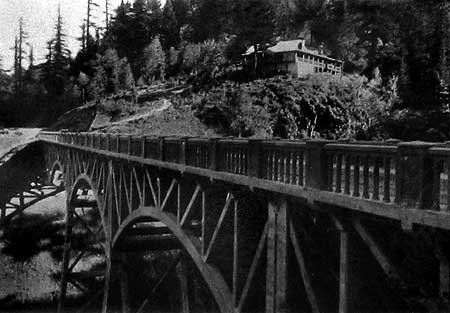
Since tourists first began exploring Samuel Lancaster’s graceful new Columbia River Highway in 1915, Latourell Falls has been a favorite stop. In the early days, a pair of roadhouses (the Falls Chalet and the Falls Villa) flanked the highway at the east end of the dramatic highway bridge spanning the creek, and offered lunch with a view of the falls.

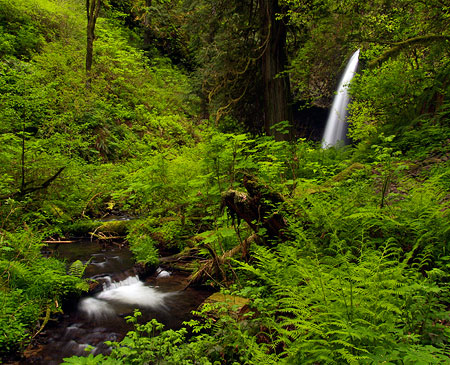
Today, the falls are the main focus of Guy Talbot State Park, with thousands of visitors each year exploring the series of loop trails that circle the lower falls and follow Latourell Creek to the upper falls.

The Falls Chalet in 1915

The scenes along Latourell Creek are beautiful and iconic, and most visitors simply accept that this place will be protected forever for the public. Yet, experienced hikers notice something different about this western-most of the waterfall trails in the Columbia Gorge: it’s not pristine, at least not in the way that other streams in the Gorge are. Despite the beautiful setting, big trees, wildflowers and waterfalls, something about this stream seems degraded.

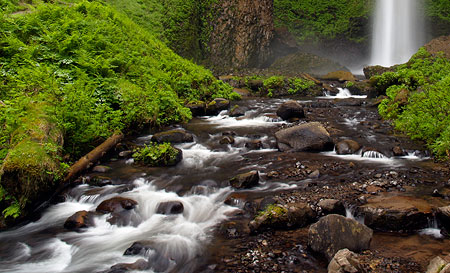
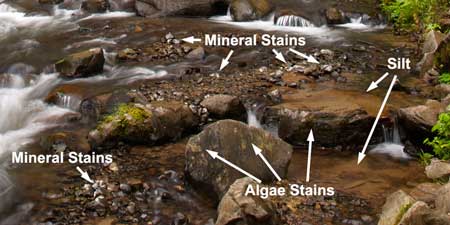
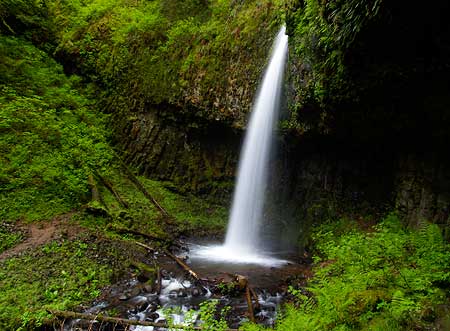
When crossing the rustic footbridge at the thundering base of Latourell Falls, there is often a distinct odor of algae in the air. A closer look at the stream reveals not only algae on the rocks, but also crusty mineral deposits that also suggest degraded water quality in this beautiful stream, and would help explain the algae blooms.

This close-up view (below) is a detailed look at the lower right corner of the previous image of Latourell Falls. The close-up view reveals white mineral deposits and yellow-grown algae stains on several boulders and cobbles. This view also shows fine silt deposits (brown areas in the lower right) that suggest some sort of major disturbance in the watershed.

Why is this? What’s behind the water quality problems on this otherwise untouched stream?

Going to the Source

Upstream from the waterfalls and throngs of visitors along the lower canyon section of Latourell Creek, an explanation for the degraded water quality is revealed. Though few visitors to the lower reaches of the stream would imagine it, the headwaters of Latourell Creek are privately owned, with a number of homes and a lot of logging along the stream.

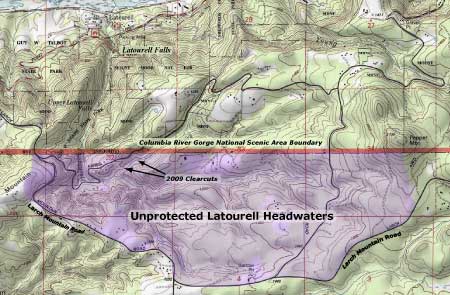
Amazingly, more than three quarters of the Latourell Creek watershed lies outside the protection of public parks and the Columbia River Gorge National Scenic Area (CRGNSA).

While the private homes are partly responsible for the nutrients that feed algae and leave mineral deposits in Latourell Creek (from lawn chemicals, septic tanks and other sources), the aggressive logging of private lands in the upper watershed is the greatest risk to stream quality.

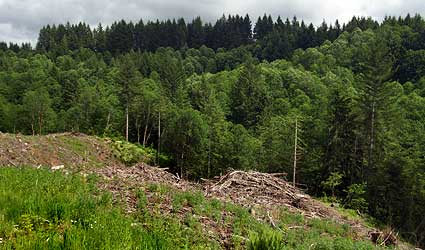
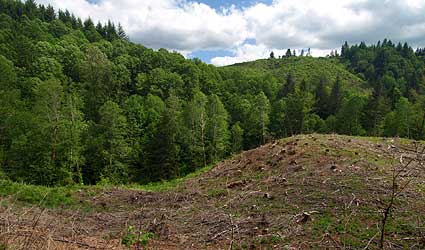
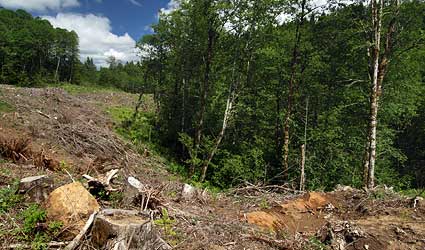
The environmental impact of logging in the headwaters is painfully obvious, with canyon slopes recklessly harvested in clearcuts. This is a discredited, outmoded form of timber management that shouldn’t be practiced anywhere, much less a stream of this caliber that flows into a National Scenic Area.

The clearcut photos shown here were taken in the summer of 2010, with most of these harvests just a couple of years old. In this view (below), an older clear cut can also be seen on the hillside across the canyon, and is just beginning to recover with a light green layer of growth. Most of these forests have been cut several times, with ever-shortened growth cycles between harvests, thanks to a growing market value for marginal timber.

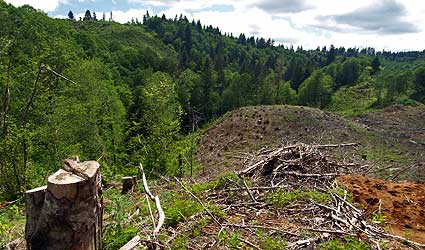
In this view (below) raw skid roads in the lower right drain directly into Latourell Creek, which flows along the tree line, at the edge of the clearcut. Erosion from bare slopes and logging roads is responsible for the most fine sediments (mud) seen below, in the protected sections of Latourell Creek. These sediments not only spoil the stream bottom, they also introduce minerals at a rate which promotes the growth of algae, which in turn, can also harm stream health.

Sadly, Oregon law continues to allow timber harvesting using the clearcut method, and the few environmental protections that do exist for stream protection on private timberlands are little compensation for the effects of clear cutting.

The tragic reality is that in Oregon, the timber lobby is still king. Twenty years of non-stop public relations advertising (kicked off during the early 90s Spotted Owl crisis) by Big Timber have been surprisingly effective in keeping the public largely misinformed on what is really happening in private forests.

In this view (below) of upper Latourell Creek, the private property owner has left the minimal amount of riparian “buffer” required by Oregon law. The trees in this photo are less than ten feet from the edge of Latourell Creek, and most of what you see is actually growing on the opposite bank from the clearcut. Clearly, this practice threatens severe erosion and sediments from the logged area entering the stream in a region where rainfall amounts can reach 100 inches annually.

Clearcuts threaten more than steams and water quality, however. In the 1990s, the Oregon timber lobby was forced to accept limits on clearcutting above roads and dwellings because of a number of catastrophic slides that had been triggered around the state by the practice.

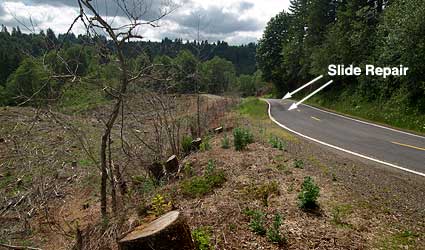
Yet, few limits on logging below developed roads exist, and in the case of the upper Latourell canyon clearcuts, the impact of logging on the slopes below the local roadways is real. In the following view, large trees have not only been recklessly cut from the slope below the road, but the remaining smaller trees and shrubs have been sprayed with herbicide — a routine treatment after clearcutting — and thus killing what was left of root systems that help hold the slope together. As the image indicates, there are already active slides along this slope, triggering road repair costs that will fall upon the public to fix, not the private land owner.

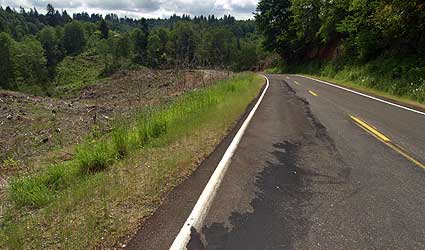
This photo (below) shows the slide repair in more detail — a 200-foot section of road that has already been filled and patched repeatedly, and now will likely continue to fail thanks to a slope that has been further destabilized by aggressive logging.

What’s the Solution?

For much of Oregon, the fate of clearcutting is an open question, with the timber lobby thus far successful in its efforts to prevent the practice from being outlawed. That’s a shame, and a sad commentary on our state politics. But in the case of Latourell Creek, there’s another option.

When the authors of the Columbia River National Scenic Area (CRNSA) were drawing up maps, they focused on scenery and what could be seen from points along the Columbia River. As a result, the scenic act ignored a crucial lesson learned from the newer national parks of the 1960s — most notoriously, Redwoods National Park — that when acquiring park lands, complete ecosystems and watersheds should define the boundaries.

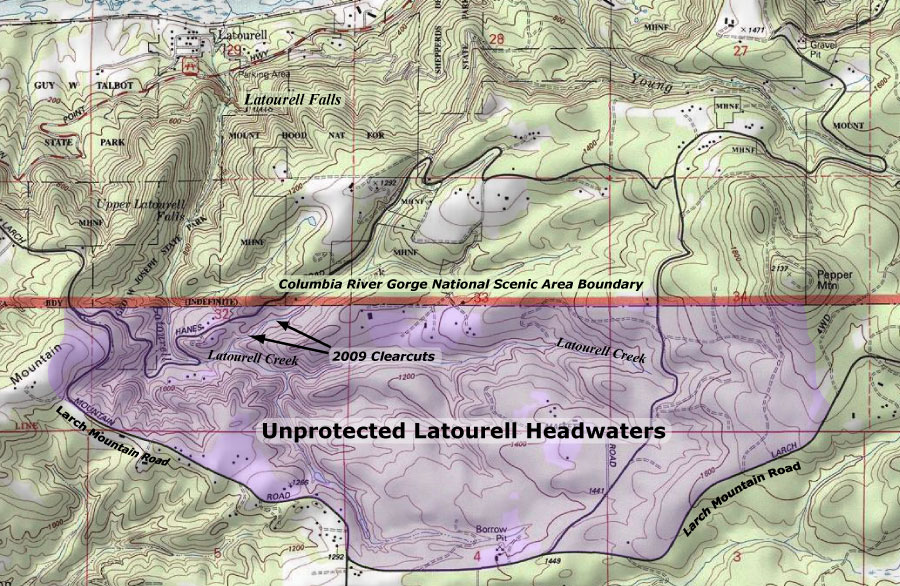
A look at the CRNSA boundary in the Latourell Creek headwaters shows the problem: the upper watershed falls outside the scenic area, and thus is excluded as a place for meaningful regulation or public land acquisition.

Click here for a larger map

It doesn’t have to be this way, however. These lands should be added to the CRNSA, and managed holistically, with the health of the spectacular lower canyon in mind.

After all, Latourell Creek is the only major stream on the Oregon side of the Gorge to straddle the boundary, and thus a good case can be made for amending the CRNSA boundary to incorporate the complete watershed. This would allow for better regulation of private lands in the headwaters, at a minimum, and also allow for CRNSA land acquisition funds to be used here.

Upper Latourell Falls

Another argument in favor of expanding the CRNSA boundary is the convenience of Larch Mountain Road in defining the Latourell Creek watershed. This popular recreation route is already viewed as “part” of the scenic area, albeit outside the boundary in this section. Therefore, an expanded boundary would allow the full Larch Mountain Road corridor to be managed as an extension of the scenic area. This extent is reflected on the map, above.

What Would it Take?

Amending the CRNSA requires an act of Congress, and though it sounds daunting, minor changes to federal boundaries of this sort are common as “riders” on larger federal lands bills.

While better regulation of private lands in the upper Latourell watershed would surely come from an expanded CRNSA, the chief benefit would be the ability to acquire lands for restoration. Already, the Forest Service has acquired hundreds of acres of private elsewhere in the Gorge, and the upper reaches of Latourell Creek would be best protected by fully restoring the watershed.

Upper Latourell Falls

Yet another option could be for advocacy organizations — like the Friends of the Columbia Gorge or Trust for Public Lands — to acquire the upper watershed lands. However, these groups generally operate inside the existing CRNSA boundary, and focus limited funds on still-pristine lands or those with exceptional scenic value.

In the end, it seems that our best bet is for the Oregon Congressional delegation to consider a “housekeeping” update to the CRNSA, including boundary refinements. Perhaps a 20-year review of the CRNSA is in order in 2016?

Discovering Bald Mountain

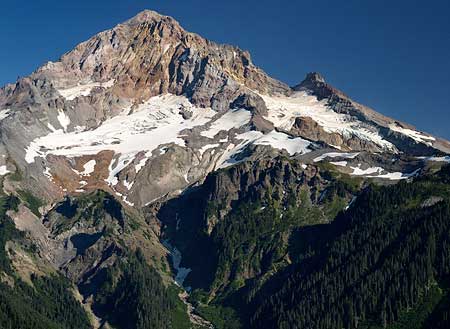
The country is filled with “Bald Mountains”, but for sheer scenic spectacle, few can compare to the Bald Mountain that rises just four miles away from the towering west face of Mount Hood. At one time, a fire lookout stood atop this Bald Mountain, and the view from the tower must have been the envy of fire lookouts around the Northwest.

Today, Bald Mountain isn’t entirely bald, having grown a dense forest of noble fir along the crest and northern slopes over the past half-century. Yet, it was in the 1970s, when the Timberline Trail was rerouted to lead hikers across the steep, open meadows on the south slope of the mountain, that hikers became familiar with Bald Mountain. Today, this spectacular traverse continues to provide one of the most popular, exhilarating sections along the classic loop hike.

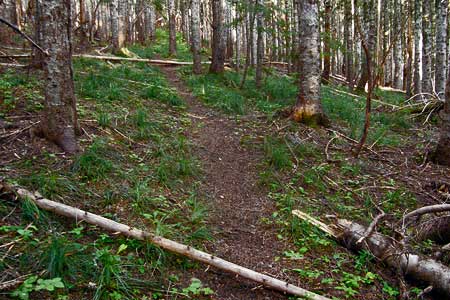
Though most visitors to Bald Mountain keep to the Timberline Trail, you can still follow the historic old path that leads to the former lookout site, with its magnificent, close-up views of Mount Hood. Thanks to the quiet efforts of a few anonymous volunteers over the decades, the trail remains open and lightly maintained, with only an occasional log to step over along the way.

As the old path climbs toward the summit, hikers find themselves in a dense, young forest, and have to use their imagination to picture the open slopes of beargrass — with no forests — that existed when the first lookout was built on “Bald” Mountain more than a century ago.

Along the old trail, hikers will also spot blazes on the few trees that stood at the time of the former lookout tower. These blazes mark most historic trails (see this recent article on blazes) in the Mount Hood area, and confirm that the present alignment of the summit path to Bald Mountain dates back to at least the World War II era, and likely before.

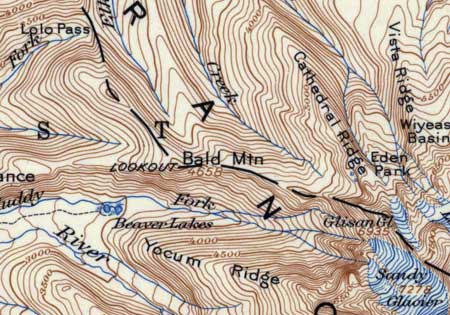
A look at the 1911 USGS map of Mount Hood (below) shows that a “lookout” stood on Bald Mountain long before roads crossed Lolo Pass, and decades before the Timberline Trail was built. The early lookout structure was likely no more than a wood platform, later replaced with a conventional lookout tower. Interestingly, the Beaver Lakes shown on the map have since faded away, too, filled in with forest:

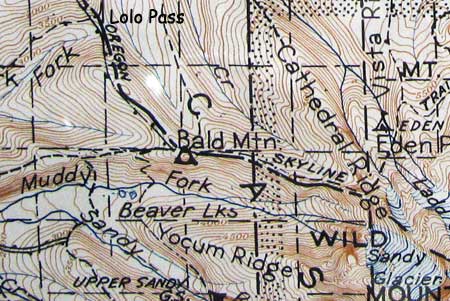
The 1946 USGS map of the Mount Hood area (below) is the last to show a lookout on Bald Mountain (and the Beaver Lakes), but in the intervening years from the 1911 map, the Timberline Trail and Skyline Trail had been completed, with both routes passing just below the lookout.

In fact, it’s likely that the section of Skyline Trail from Lolo Pass to Bald Mountain was originally built for lookout access, since the trail over Lolo Pass was among the earliest built in the area, and in fact, followed an ancient Indian route connecting the Sandy and Hood River valleys.

The alternating ticks shown along the dashed trail segments on the 1946 map indicate a telephone line along the route. Today, these routes often have ceramic insulators still attached to trees, and on this route further suggest that this section of trail was originally built with the lookout in mind. The route is now part of the Pacific Crest Trail, which replaced the old Skyline Trail, and remains one of the best approaches for hiking to Bald Mountain.

What did the old tower look like?

Fire lookouts in the Pacific Northwest followed a few standard designs beginning in the 1930s, after much improvisation in the early lookout designs that were built through the 1920s. The Bald Mountain lookout probably followed this evolution, with some sort of simple platform beginning at the turn of the twentieth century, and later, a more substantial structure built to Forest Service standards.

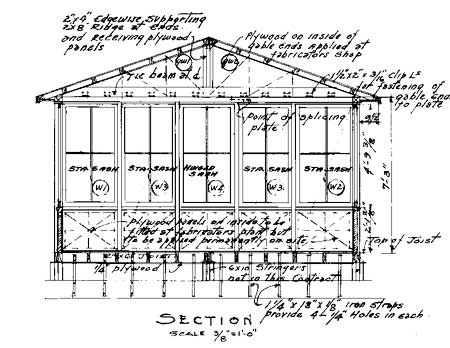
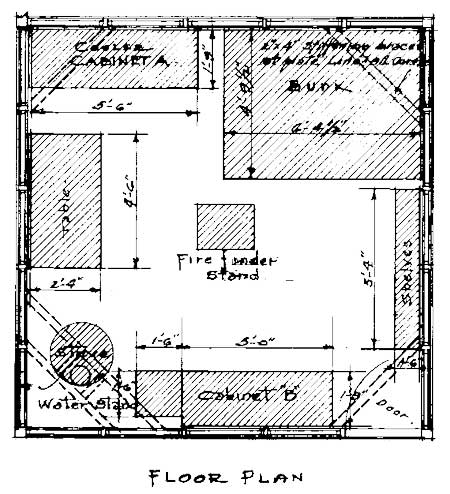
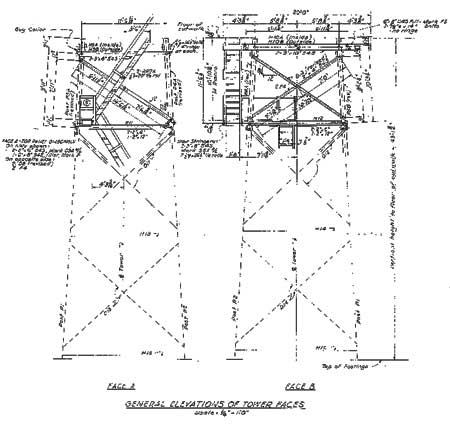
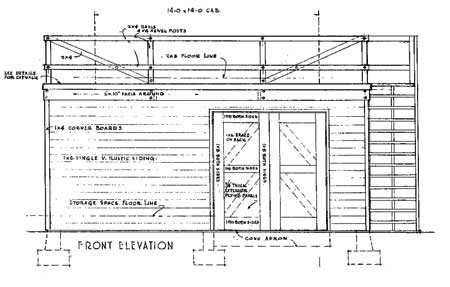
We have a much more exact picture after June 1944, when archived Forest Service documents show a new lookout was designed, apparently to replace an existing structure on Bald Mountain. The following are samples from the 1944 architectural plans for Bald Mountain. There are no clear records of when this lookout was removed, but it was likely in the late 1950s or 1960s, when hundreds of lookouts were viewed as outmoded by the Forest Service and destroyed.

The cab — or cabin — in the 1944 designs for Bald Mountain is a 14×14 foot structure (above) that would closely resemble the surviving cab on the Devils Peak lookout, just to the southwest of Mount Hood in the Salmon-Huckleberry Wilderness. This simple design featured five windows per side and a low, pitched roof.

Inside the cab (below), the living space was organized around a Osborne fire finder, located in the center of the floor, surrounded by a wood stove, table, kitchen, storage cabinets, shelves and bunk. A catwalk wrapped around the outside of the cab, allowing lookouts to maintain the windows, raise and lower shutters and haul firewood and supplies up from below with pulleys.

The 14×14 foot cab rested atop a 43-foot wood-frame tower (below), complete with a spiraling stairway that ascended within the tower uprights. Though the tower was anchored directly to the ground, the main stabilization came from guy wires anchoring the tower to concrete footings in four directions.

The most remarkable aspect of this tower (and many others) is the fact that most of the materials were carried to the site over trails using livestock. That included the cut lumber, concrete, construction hardware, fixtures and windows — an amazing feat when you consider this was repeated dozens of times at lookout sites around the region.

The lookout plans for Bald Mountain also contain one “standard” element that wasn’t so standard, at least compared to other lookouts in the vicinity: a garage and storage shed built around the base of the tower. In this view, the stairway to the tower can be seen on the right, with the dashed lines above the garage marking the location of the tower uprights:

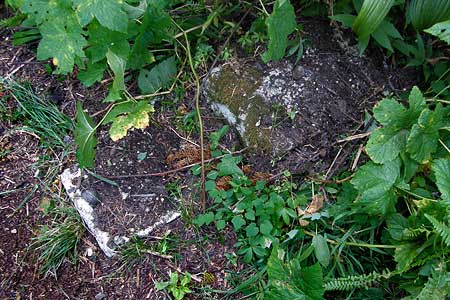
As this design detail from the 1944 plans suggests, there were a number of concrete footings used in the construction of the Bald Mountain lookout tower. Today, these seem to be the only remaining traces of the structure. Three footings are loose, and have been moved around and used by campers over the years. Other footings remain in the ground, mostly reclaimed by the undergrowth. This footing is located along the spur trail leading to the east viewpoint from the lookout site:

Visiting Bald Mountain

There is some irony in the historic Bald Mountain trail being “lost”, as the mountain is now almost completely circled by the Timberline Trail, and thousands of hikers make their way along this route every year. Almost all of these visitors walk right past the unmarked summit path leading to Bald Mountain.

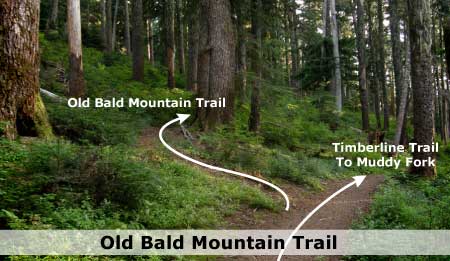
But for those seeking the route less traveled, the hike to the summit is easy, provided you successfully navigate the maze of popular trails in the area. The key is knowing how to spot the unmarked junction with the Timberline Trail. Take a close look at this photo to help you recognize the spot if you choose to visit the old trail — this view is how the trail appears from either of the approaches described below:

From Lolo Pass: The Classic Approach

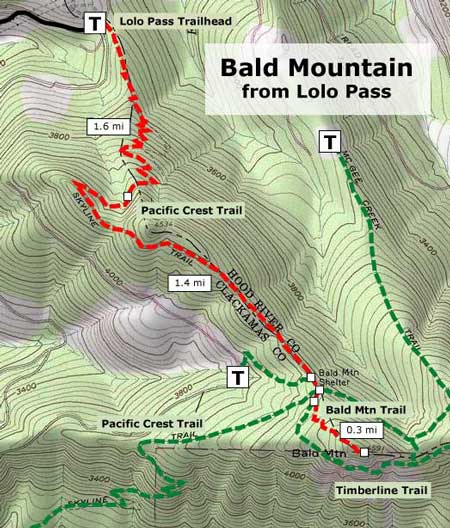
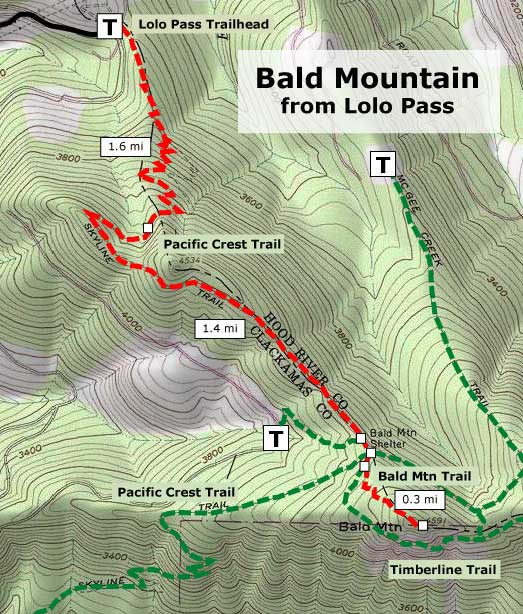
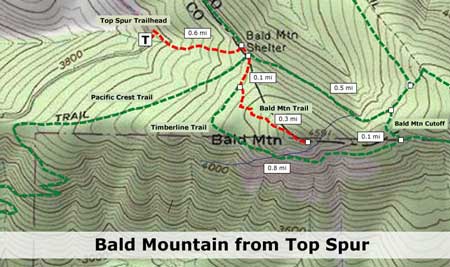
The classic hike begins at Lolo Pass, and follows the Pacific Crest Trail through handsome forests for three miles to the base of the Bald Mountain summit path. The total mileage on this option is 6.6 miles round trip, with an elevation gain of 1,400 feet. The following is a map of the Lolo Pass approach that accompanies the hike description I wrote for the Portland Hikers Field Guide:

Click here for a larger map

For a detailed description of the Lolo Pass approach, visit the Portland Hikers Field Guide page:

Lolo Pass to Bald Mountain Hike

The Field Guide description also includes driving instructions to the trailhead. This is a dry hike, so carry water — and in early summer, plan on the usual bugs that plaque hikers just after snow melt. My favorite time to hike this trail is on a clear day after the first autumn snow dusts the mountain in late September or October. This is when the area is free of bugs AND crowds.

From Top Spur: The Family Route

For a shorter hike that works well for families with kids (or for adults looking for a short afternoon or evening activity) you can also approach Bald Mountain from the Top Spur trailhead. Be forewarned that this is one of the most popular trailheads in the Mount Hood region, and mobbed on summer weekends.

But even on busy weekends, you can smile to yourself as you leave the crowds behind, and head up the quiet, old lookout path for some solitude — hidden in plain sight! From the summit viewpoint, you can literally look down on hikers passing hundreds of feet below on the Timberline Trail, oblivious to your presence.

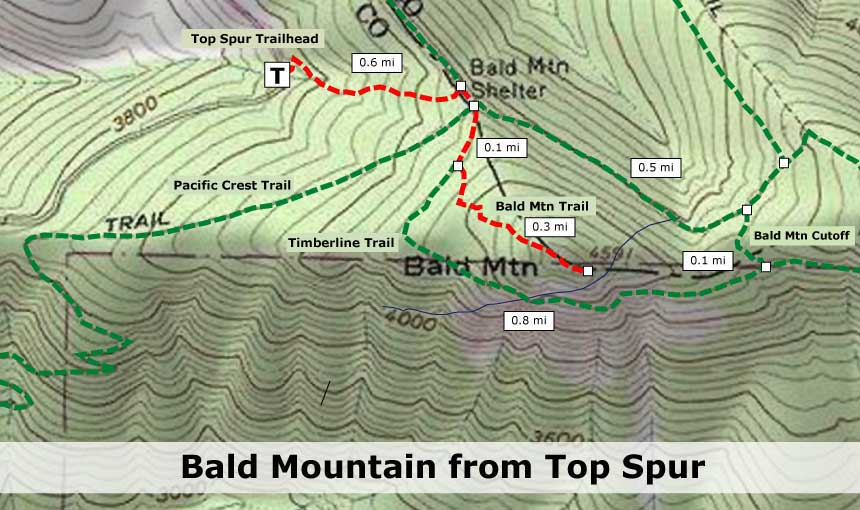
Click here for a larger map

The Top Spur option is just two miles long, round-trip, with an elevation gain of 550 feet. Though short, portions of both the Top Spur and Bald Mountain trails are steep, so you will notice the elevation gain! The tradeoff for kids is the feeling of climbing a real mountain. Bring a pair of binoculars for kids to explore the details of Mount Hood or watch hawks float across the Muddy Fork Valley, below.

For a detailed description of the Top Spur approach, including travel instructions, visit the Portland Hikers Field Guide page:

Top Spur to Bald Mountain Hike

One of the most magical times to visit Bald Mountain is evening, when you can watch the awesome west face of Mount Hood light up at sunset, but still have enough light to hike back to the Top Spur trailhead.

Both hikes are usually open from mid-June through mid-November, and both require a Northwest Forest Pass to park. Both trailheads usually have portable toilets, but no water — be sure to carry your own.

Close Call at White River Falls

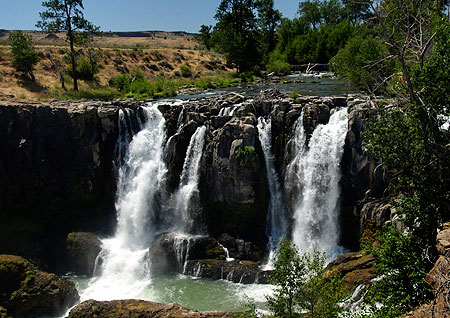
The magnificent desert falls on the White River survived a close brush with disaster this month, when a throwback proposal by Wasco County to divert the river as part of a new hydropower project was scrapped.

Like so many hydro projects of decades passed, this one would have had “little impact”, according to proponents. Yet, as we take in the summertime view of the 90-foot plunge pictured above, it’s obvious that diverting the river would have an immediate impact on the natural beauty of the area. Would half the falls be diverted? Two-thirds? All of it?

(click here for a PDF of Dalles Chronicle article)

Though the Wasco County proposal was ultimately dropped because of concerns voiced by the Oregon State Parks Commission, it wasn’t for lack of “goodies” offered up in exchange for the diversion. The County promised trail improvements for recreation, and interpretive facilities for the structures left behind from the last hydro project here.

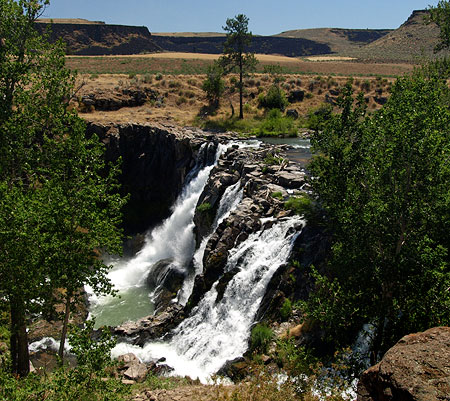
White River Falls with the rocky gulch of Devils Halfacre in the background

The old plant was shut down in 1960, and the land subsequently transferred to the state, first as the “Tygh Valley State Wayside”, then today’s “White River Falls State Park.”

The falls and adjacent White River Gorge are truly a forgotten gem in Oregon, save for a few fishermen in spring and fall, and a lot of teenagers in summer, seeking out the swimming holes below the falls. Yet, the area is only two hours from Portland, and offers some of the most accessible desert scenery in the state.

In recent years, hikers have begun to explore the area, following boot paths and game trails downstream toward the confluence with the Deschutes River, just over two miles below the falls.

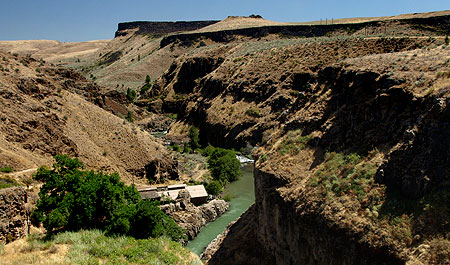
White River Gorge from the falls overlook

What most visitors don’t know is that much of the rugged backdrop for the falls is private land. Most surprisingly, these private holdings include the most of the White River gorge, all the way to the Deschutes confluence, and this beautiful area has somehow escaped development over the years.

Concept: White River Gorge Recreation Area

With Wasco County politicians dreaming up hydro projects for the White River, this article is intended as a more forward-looking counterpoint that actually embraces the scenic and recreational values in the area.

As a starting point, the National Recreation Lands boundary that encompasses the larger Deschutes Canyon could be expanded to include White River Falls, White River Gorge and the adjacent Winter Ridge and Devils Halfacre areas. This could provide the direction needed for state and federal land agencies to begin acquiring private land and planning for recreation.

It’s unclear what the “National Recreation Lands” boundary actually means, however. It seems to mirror the Wild and Scenic River designation for the Deschutes Canyon on USGS maps, but may be an orphan from old federal plans and policies no longer in force. Current federal planning documents for the lower Deschutes Canyon are also badly out of date, so a better legal mechanism likely exists for recognizing the potential for recreation in the White River Gorge area. In the end, some sort of designation is needed to identify the extent of the new recreation area.

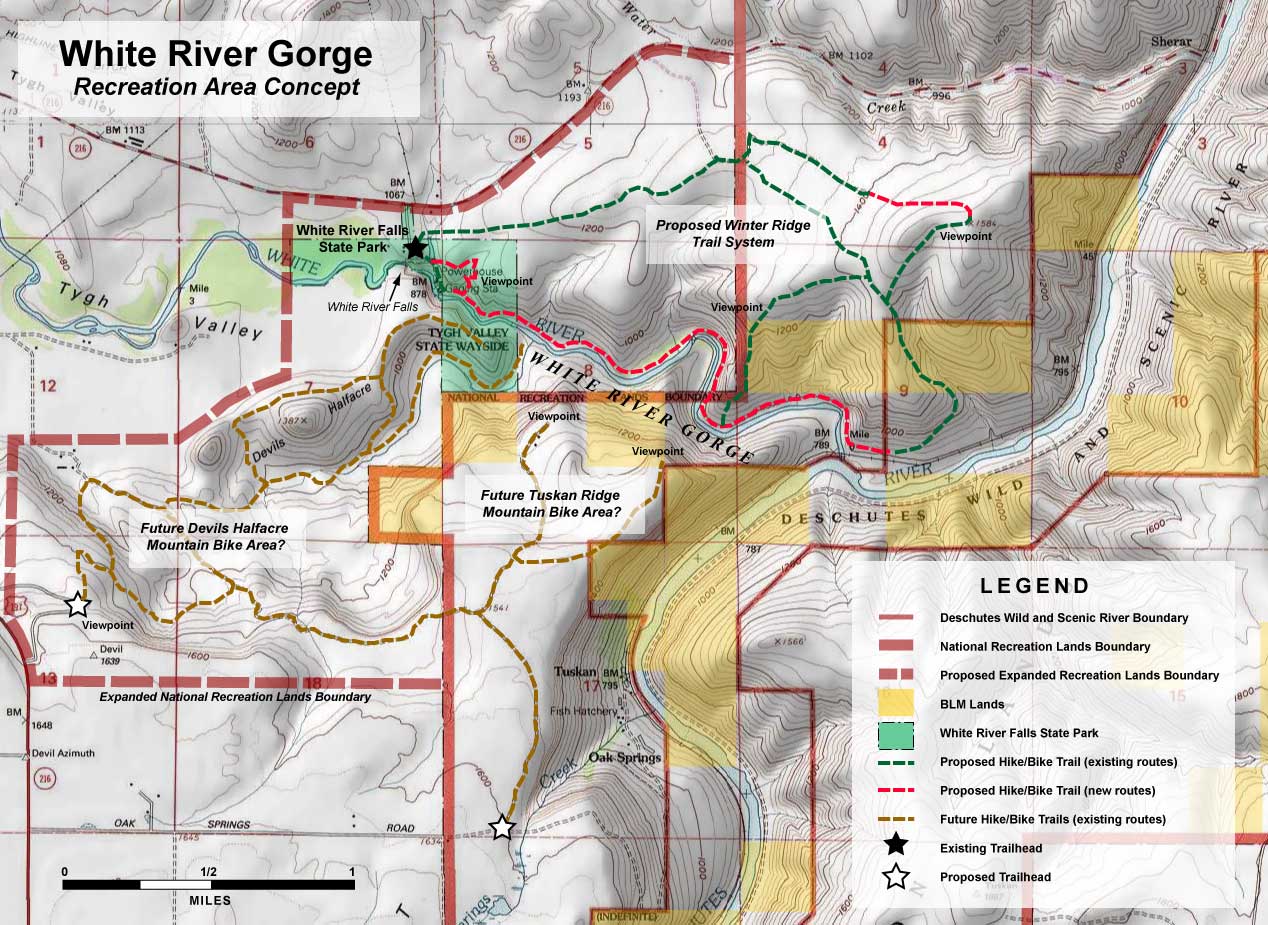
The following map outlines the concept, with the proposed new White River Gorge recreation area bounded in dashed red, existing White River Falls State park in green and federal land holdings (BLM) in yellow:

(Click here for a much larger, more readable map)

The proposal: a network of new desert trails

The main focus of the concept is to build new trails in the White River Gorge, proper, and on the adjacent highlands that I’ve called Winter Ridge for the purpose of this article. The gorge is mostly private land outside the present state park boundaries, so like all of the trail proposals called for in this article, a new White River Gorge trail implies public ownership or easement.

The dashed red lines on the map show the new trail extending through the canyon from the falls to the confluence with the Deschutes, along with a short viewpoint loop within the current state park boundaries. This would become a premier hiking trail in the region, providing a unique riverside hiking experience in a roadless desert canyon.

The first portion of this new trail would simply follow the existing route down to the old power plant, with a new loop climbing back to the trailhead, via a canyon viewpoint above the falls. This part of the proposal could be built now, as it falls entirely within the current state park boundary.

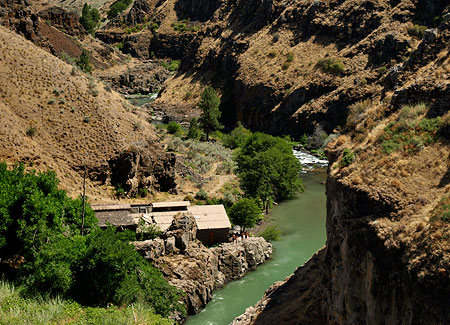
Remains from the former power station in White River Gorge

The canyon trail would offer a unique interpretive opportunity where relics of the old power plant still exist. The Wasco County hydro proposal recognized the historic importance of these structures, and called for interpretive improvements along this existing trail, at the penstock and in the old power plant. These historic structures have been badly vandalized over time, and could greatly benefit from some modest renovation and protection.

In addition to the White River Gorge trail, the proposal calls for a network of hike and bike trails over the broad slopes of Winter Ridge. This area rises steeply above the confluence of the Deschutes and White rivers, with views nearly 800 feet down into the gorge from the open crest. The west slopes drop gently to the trailhead at White River Falls, with sweeping views of Devils Halfacre, Tygh Ridge, Mount Hood and Mount Jefferson.

The proposed trails shown on Winter Ridge (in green on the map) are almost entirely along existing paths and roads, and would require little beyond signage to improve them for hikers and mountain bikers.

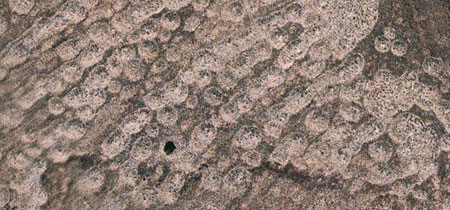
Desert mounds along Winter Ridge (the black dot is a juniper tree, for scale)

Though a portion of Winter Ridge is farmed with winter wheat, much of the terrain is in a native state. The upper slopes of the ridge feature an odd landform unique to the Lower Deschutes River country: countless mounds of soil and rock, often organized in rows. They span 10-20 feet in width, and stand a few feet in height.

These odd “desert mounds” appear on shallow slopes and hilltops throughout the Tygh Ridge area, and this would be one of the few areas where visitors could examine these mysterious formations, up close, and learn some of the many theories about their origin.

Thinking Big: an expansive trail network at Devils Halfacre

It is impossible to stand at White River Falls and not notice the rugged, picturesque rim rock cliffs and massive bluffs that rise to the south of the White River Gorge. This rocky maze is the Devils Halfacre, and though in private holdings now, it offers an especially interesting potential for recreation.

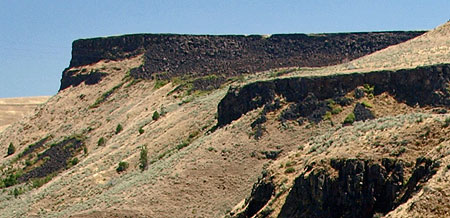
Black basalt cliffs and talus slopes of Tuskan Ridge rise above the White River Gorge

The area falls into two general units: the rocky gulch of Devils Halfacre, proper, and the huge mesa forming the east wall of the gulch, which I’ve called Tuskan Ridge for the purpose of this proposal (see map). A network of trails and dirt tracks already exists here, and could easily be adapted to become an exceptional hike and bike trail network. These trails would lead hikers, bikers or possibly equestrians past rugged rock formations to spectacular, cliff-top viewpoints.

The Devils Halfacre area has excellent potential for trailhead access from both Highway 216 and Oak Springs Road. The terrain here rivals popular destinations in the eastern Columbia River Gorge, and would offer a unique chance to bring sustainable recreation tourism to the local economy.

Looking Forward

The concept presented here is just one way in which recreation and landscape restoration could be combined to preserve the White River Gorge area.

The intense demand for mountain biking opportunities also offers the potential to transform the local economy, especially since the area is just far enough from the Portland metropolitan area to draw overnight and weekend visitors who could support local businesses.

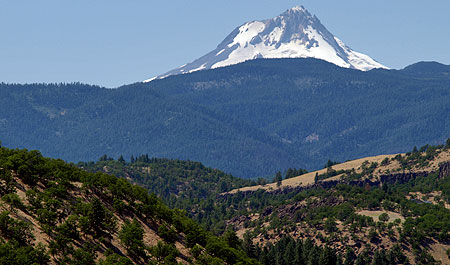
Mount Hood, rising across Tygh Valley from Winter Ridge

At a minimum, now is the time for Wasco County to aim for a more sustainable vision for White River Falls and its surroundings, instead of rehashing old, exploitive ideas that would degrade the area, and that have already failed here, before.

The Oregon State Parks Commission was right to challenge the County’s attempt to turn back the clock at White River Falls. Now would be the perfect time for the County to partner with the Parks Commission and federal agencies to forge a new vision that does justice to the remarkable landscape that exists here.

Return of the Mountain Goat

Rocky Mountain Goats by Albert Bierstadt

Along their return trip across the continent, on April 10, 1806, the Lewis and Clark expedition visited a small Indian village on what is now Bradford Island, in the heart of the Columbia River Gorge. Here, they traded for a beautiful white hide from what we now know as a Rocky Mountain Goat. Meriwether Lewis described it unmistakably in his journal as a “sheep”, white in color with black, pointed horns. The Bradford Island villagers told the expedition the hide had come from goat herds on the high cliffs to the south of what is now Bonneville, on the Oregon side.

Two days later, the expedition encountered another group of Indians, this time near present-day Skamania, on the Washington side of the river. A young Indian woman in the group was dressed in another stunning white hide, and this group also told of “great numbers of these animals” found in “large flocks among the steep rocks” on the Oregon side.

Rocky Mountain Goats by John Woodhouse Audubon

A century later, New York attorney Madison Grant produced the first comprehensive study of the Rocky Mountain Goat for the New York Zoological Society, in 1905. Grant described the historical range of the species extending from British Columbia south along the Cascade Crest to Mount Jefferson. At the time of his research, he reported that mountain goats had “long since vanished from Mt. Hood and from other peaks in the western part of the State, where they once abounded”.

Coincidentally, Grant’s report was published just a few years after the Mazamas mountaineering club formed on the summit of Mount Hood, selecting the Rocky Mountain Goat as their namesake and mascot — apparently, decades after the species had been hunted out in the Mount Hood region.

Early 1900s linen postcard from Glacier National Park

Another century later, on July 27, 2010, the Oregon Department of Fish and Wildlife (ODFW) and Confederated Tribes of Warm Springs made history by releasing 45 Rocky Mountain Goats in the remote backcountry of Whitewater Canyon, on the east slopes of Mount Jefferson, just inside the Warm Springs Reservation.

The Mt. Jefferson release marked a symbolic and spiritual milestone for both conservationists and the Warm Springs Tribe, alike, restoring goats to their native range after nearly two centuries. The release also marked the first step in a major goat reintroduction effort, as envisioned in the landmark 2003 plan developed by ODFW to return goats to their former ranges throughout Oregon.

2010 release near Mt. Jefferson (Photo by Jim Yuskavitch/ODFW)

When the 2003 ODFW plan was developed, about 400 goats were established in the Wallowa and Elkhorn ranges, a few dozen in Hells Canyon, and a few scattered goats had dispersed just beyond these concentrations. The plan calls for moving goats from these established populations to historic ranges in the Oregon Cascades, including in the Columbia River Gorge. The proposed Gorge introduction sites include the rugged Herman Creek headwaters, the open slopes and ridges surrounding Tanner Butte and the sheer gorge face below Nesmith Point. The plan also calls for reintroducing goats at Three Fingered Jack and the Three Sisters in the Central Oregon Cascades.

Members of the Confederated Tribes holding goat kids at 2010 release (Photo by Jim Yuskavitch/ODFW)

The new effort to bring goats back to the Oregon Cascades is not without controversy. Conservation groups have taken the U.S. Forest Service and ODFW to court over lack of adequate environmental review of the plan to bring goats to the Gorge, and the agencies are now completing this work. The legal actions that have slowed the Gorge reintroductions helped move the Warm Springs effort forward, and are likely to move sites near Three Fingered Jack and the Three Sisters ahead of the Gorge, as well.

The 2003 reintroduction plan is also based on selling raffle-based hunting tags that fund the reintroduction program. This strategy is surprising to some, given the small number of animals surviving in Oregon. However, with the raffle for a single tag in 2010 raising nearly $25,000 for the program, it’s clear that selling hunting rights will help guarantee funding the reintroduction effort at a time when state budgets are especially tight.

Mountain Goats on Mount Hood?

The renewed interest in bringing mountain goats back to the Cascades, and the notable omission of Mount Hood from the ODFW plan as a release site, raises an obvious question: why not? The plan doesn’t provide details, but the likely arguments are lack of available habitat and the overwhelming presence of humans on Mount Hood.

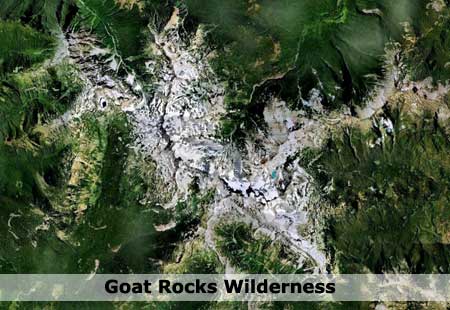
The ODFW plan prioritizes sites that can support at least 50 goats, including space for adult males to roam separately from herds of females and juveniles. Without knowing a specific acreage requirement for individual animals, the following comparison of Mount Hood to the Goat Rocks area helps provide perspective — with an estimated 300 mountain goats thriving at Goat Rocks. These images are at identical scale, showing comparative amounts of alpine terrain:

The Goat Rocks (above) clearly has more prime habitat terrain at the margins of timberline, thanks to the maze of ridges that make up the range. But in total alpine area, the Goat Rocks are not much larger than Mount Hood (below), so it appears that Mount Hood has the space and habitat for at least 50 goats.

The human presence at Mount Hood is a more compelling argument against reintroducing goats. The south side of the mountain is busy year-round, thanks to three ski resorts, with lifts reaching high above timberline into what would otherwise be prime goat habitat. Snowshoers and Nordic skiers fill the less developed areas along the loop highway, making the south side one of the busiest winter sports areas in the region.

However, on the east, north and west sides of the mountain, human presence is mostly seasonal, limited to hikers in summer and fall along the Timberline Trail. These faces of the mountain have also been spared from development by the Mount Hood Wilderness, and thus offer long-term protection as relatively undisturbed habitat. This view of the mountain from the north gives a good sense of the many rugged alpine canyons and ridges that are rarely visited, and could offer high-quality goat habitat:

Since we know goats once thrived on Mount Hood, and adequate habitat seems to exist for goats to survive today, the real hurdle might simply be perception — that wildlife managers cannot imagine wild goats coexisting with the human presence that exists on some parts of the mountain. If so, we may miss a valuable opportunity to reintroduce goats where a large number visitors could view and appreciate these animals.

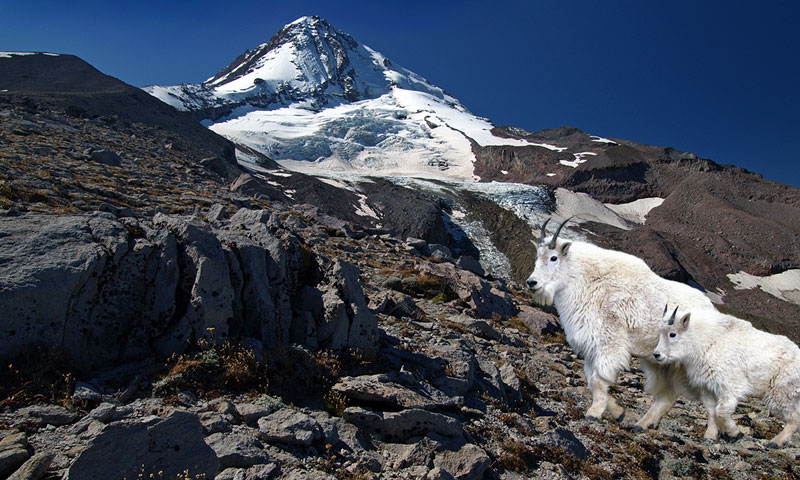
To help remedy this apparent blind spot, the following are a couple of digital renderings of what once was — and perhaps would could be — on Mount Hood. The first view is from Gnarl Ridge, on the east side of the mountain. Here, goats would find plenty of habitat in the high ramparts bordering the Newton Clark Glacier. This area is among the most remote on Mount Hood, so ideal for goats seeking a little privacy from human visitors:

The most obvious Mount Hood habitat is on the north side, on the remote, rocky slopes that border the Eliot, Coe and Ladd glaciers. This part of the mountain is only lightly visited above the Timberline Trail, and rarely visited in winter. It’s easy to picture goats making a home here, on the slopes of Cooper Spur:

(click here for a larger view)

Wildlife managers probably have good reason for skepticism about bringing goats back to Mount Hood. After all, the risks are clearly greater here than at less developed sites.

But let’s reverse these arguments: what if mountain goats were viewed as an end goal in restoring Mount Hood? What if this challenge were reframed as “what would it take for mountain goats to thrive here?” What if successful restoration of Mount Hood’s ecosystems were simply defined by the ability to support an iconic native species like the mountain goat, once again?
________________________

To read an Oregonian article (PDF) on the 2010 Mt. Jefferson goat release, click here.

Celilo Fishing Panorama

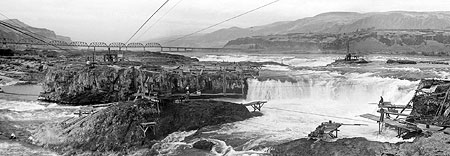
One of the first articles I wrote for the WyEast Blog continues to be among the most popular: Restoring Celilo Falls (February 14, 2009). In the spirit of keeping the idea alive, this article is a tribute to the way of life that all but vanished when Celilo Falls disappeared in 1957, as revealed in photographs.

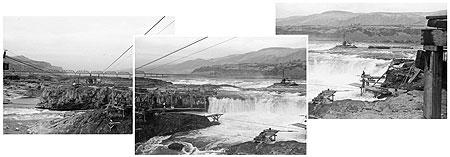
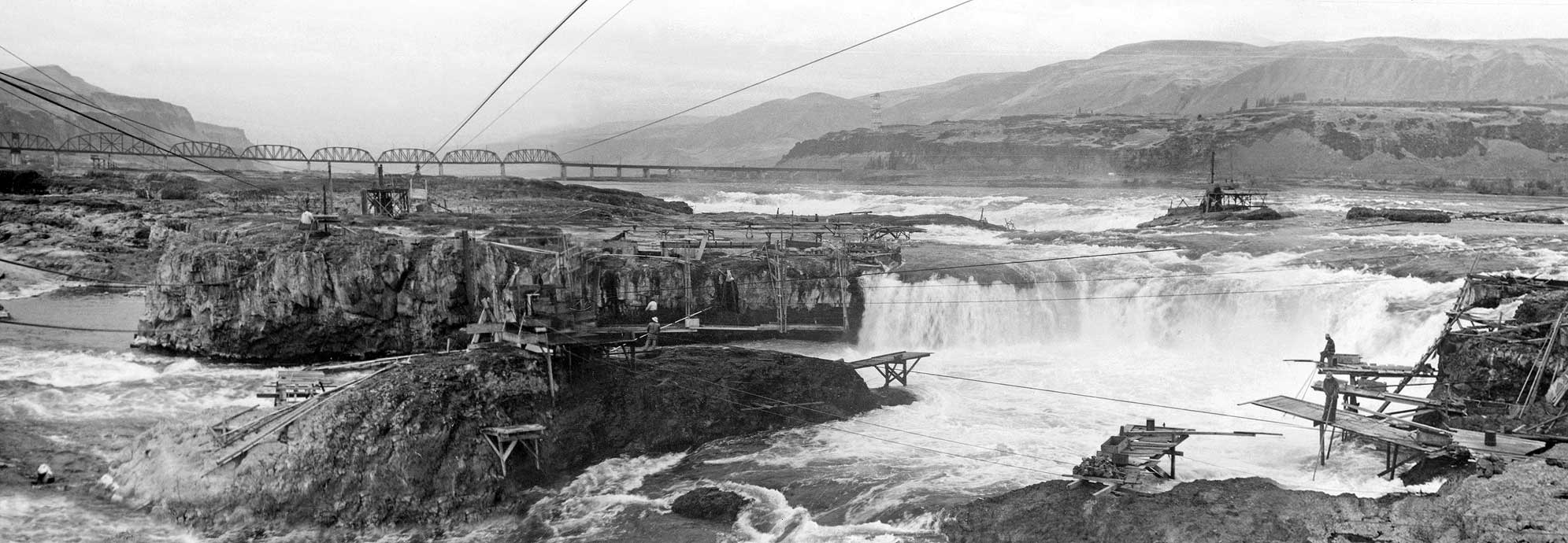
For this article, I blended images of Celilo Falls in the 1930s (courtesy the Oregon State University Commons archive) into a sweeping new panorama. I had viewed the individual images before, but it didn’t occur to me until recently that the following three images overlapped enough to allow for a blended panorama at relatively high resolution:

You can click here for a large view of the blended image, with the caveat that it retains the same publication terms as any other image in the Oregon State University Commons (use your browser window to pan across the image, as it is much larger than most monitors).

My original intent was simply to have a detailed panorama of the scene at Horseshoe Falls, the most iconic of the dozens of cataracts that made up the massive Celilo Falls complex. But as I stitched the images together, the details within the larger image suddenly came into view, and provided new insights into the unique way of life that had evolved over millennia at Celilo.

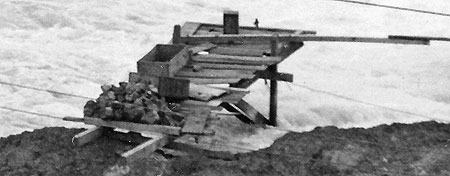
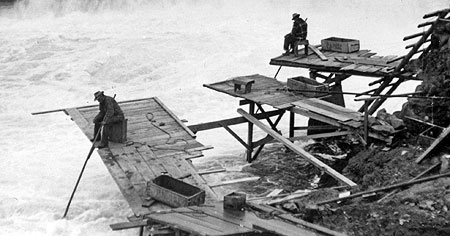
For example, in this clip (below) from the panorama, the surprising system for anchoring the wooden fishing platforms is revealed — a pile of rocks in a framed wooden crib! To my amazement, this method shows up in many other images of Celilo, though I had never noticed this detail before:

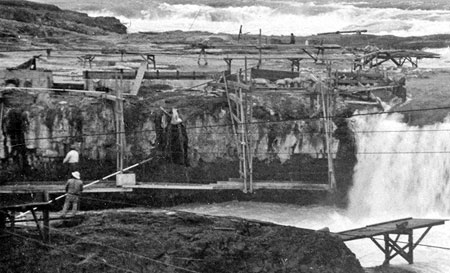
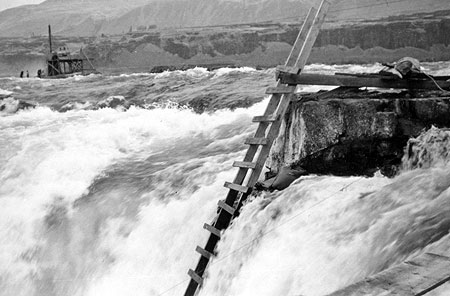
Another enlarged clip (below) from the panorama shows the precarious hanging platforms along a section of cliffs just below the falls, with fishermen using wooden ladders to reach what must have been slippery, intimidating perches:

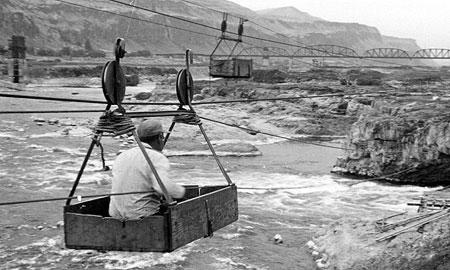
In this enlargement from a separate photograph (below), taken just a few moments before the panorama images, the fisherman riding the cable shuttle to the opposite side of Horseshoe Falls is the same person visible in the panorama view (just below the fourth bridge arch):

The above view also shows a returning shuttle car, perhaps empty, or possibly loaded with filled salmon crates. Pulley systems like these moved fishermen and salmon catch on a network of cables that connected the multitude of rocky islands within the falls complex where fishing platforms were located.

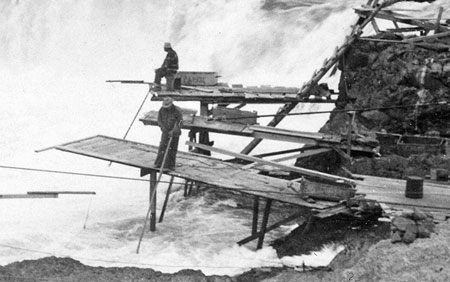
In another clip (below) from the panorama, two fishermen are dipping from a group of platforms located at the extreme base of the falls. These platforms are also anchored with rocks, and are designed with dizzying overhangs that create a startling degree of exposure for the fishermen, yet provide a clear zone under the platforms for maneuvering dip nets:

The following clip (from a separate image) shows the same pair of fishermen seen in the previous clip from the panorama, but from a somewhat different angle. In this view, more details on how their platforms functioned are revealed: a crib of rocks anchors the middle platform, while and all three have large, wooden crates for salmon.

The size of the crates is also telling, as the typical salmon weighed 25-40 lbs, with many big Chinooks weighing in at well over 50 lbs. Landing these huge fish clearly required great skill, strength and agility using 15-foot dip net poles on a slippery plank surface.

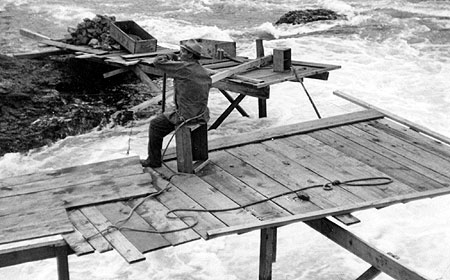
Also visible in the above image are the safety ropes that the men tied to their waists while working the platforms. This was a relatively recent insurance policy in the ancient fishing tradition, and one that was seldom tested by people who had grown up around the platforms, working the salmon harvest.

The following image shows the top of the ladder seen on the right side of the panorama, but viewed from just above the platforms. As with the fishing platforms, the ladder is anchored by a wooden, rock-filled crib.

The above image also shows fisherman working on the next rock outcrop (in the upper left) seemingly afloat in the river, though clearly on another system of platforms in the larger panorama.

In another photo of the scene (below), the safety ropes can be seen in more detail — one tied to the fisherman — as well as the planked decking that was informally scabbed to platform supports.

Though sturdy, the informal construction of the platforms and catwalks makes sense, given that seasonal flooding almost certainly swept away anything that wasn’t removed by the fishermen at the conclusion of the fall fishing season. Yet, the position of individual platforms reflected traditional locations where the same families had fished over the generations. In that sense, while temporary in design, the platforms were also permanent.

The Tradition and the Legacy

Deconstructing these scenes in creating the panoramic view left me with an even greater appreciation for the fishing tradition at Celilo Falls. It also gave me new inspiration to see the falls restored, not simply for their scenic and spiritual value, but for the working fishery they provided. What a thrill it would be for the dip net fisheries to return to these rocks, and to watch them just as photographer who captured these images did!

The attraction of the Celilo restoration idea is that it is completely reachable. The falls is still there, underwater, and serving as a permanent reminder of our priorities as a society. It can be restored.

As the salmon runs continue to fade on the Columbia, along with the barge traffic once used to justify the dams, the sole argument against restoring Celilo Falls fades as well: it is as simple as finding better ways to generate — or conserve — the 1,800 megawatts of hydropower that is generated by The Dalles Dam. It’s really that simple.

Blazes!

Trail blazing is the ancient practice of marking paths with a system of symbols to help travelers navigate, and since the rise of recreational hiking in the 1800s, has been adapted to foot trails. Blazes are generally placed at eye-level, and spaced frequently enough to reassure hikers of the route.

In other parts of the country, where trails often cross private lands and many are maintained by hiking clubs, blazes can take the form of painted dots and symbols or small signs or medallions attached to trees, with hundreds of localized variations. These symbols are easy for volunteers to maintain, and often lend their design to the trail name (e.g., the “White Cross”, “Red Dot” and “White Cross” trails in New Hampshire’s White Mountains)

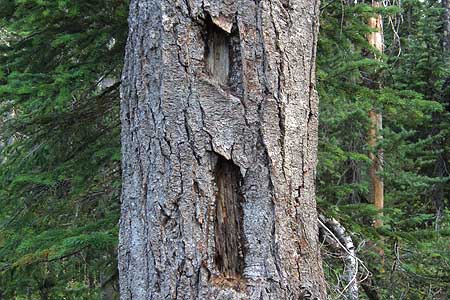
In the Pacific Northwest, where most of our hiking is on public lands, we are used to the standard Forest Service tree blazes that still mark most of our trails (like the one pictured at the top of this article). Though the practice of chopping blazes into trees has long been discontinued out of consideration for trees and trail aesthetics, many of the original blazes still remain, decades later.

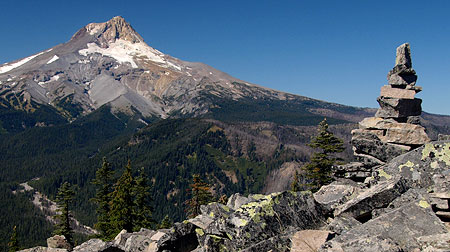
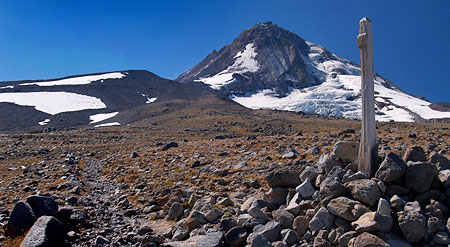
Where trails leave the forest canopy, many Northwest trails are marked with stone cairns, such as along Gunsight Ridge (above) near Mount Hood. Along Mount Hood’s famous Timberline trail, cairns along the high eastern section are further accented by 6x6x8 cedar posts (below) that have been gracefully carved by the elements over the years.

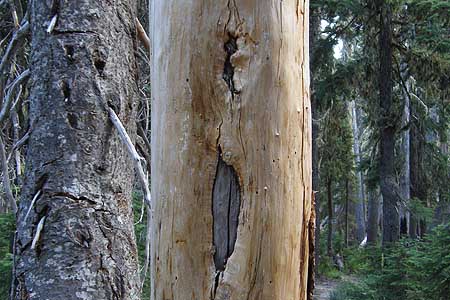
Today, the legacy of Pacific Northwest trail blazing is fading quickly, as most blazes were made at least 50 years ago, and some as much as a century ago. The example below, on Mount Hood, is from a standing snag that tells a familiar story: the tree survived the initial blaze marks for many years — long enough to heal — before finally dying and losing its bark, revealing the layers of blaze-scarred wood, beneath.

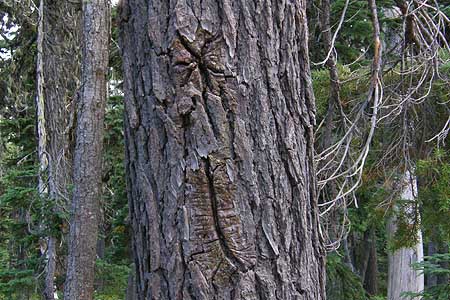
Most northwest trees large enough to withstand a blaze are very large, long-lived species, so there are also countless examples of blazes that have simply been swallowed up by successive seasons of growth. With a sharp eye, you can often spot examples like the one below, where only the healed-over scar of the blaze remains. This tree has nearly erased the blaze scars that were likely made in the 1930s or 40s, but could easily thrive and grow for another century or more.

The Forest Service Standard

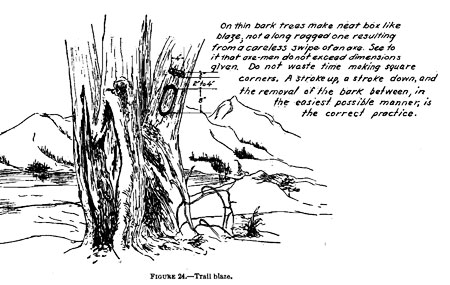
By the 1930s, the Forest Service had established a simple standard for blazes that is responsible for the thousands of blaze remnants that we see today. The Forest Service blaze consisted of an 8” rectangle topped by a 2” rectangle, forming the familiar upside-down exclamation mark that we still find on our trails. The width of the rectangles was determined by the width of an axe blade, roughly 4” across.

The following instructional diagram is from a Forest Service trail manual dating to the 1930s, and provided the basics for the thousands of young Civilian Conservation Corps (CCC) workers who flooded the nation’s forests and parks during the Depression, building trails, campgrounds and roads.

As the diagram (above) shows, the Forest Service blaze was designed for speed, with trail crews quickly working their way along paths, blazing as they went. The crews of the 1930s covered thousands of miles of trails, as the trail network of the day was more than twice what survives today.

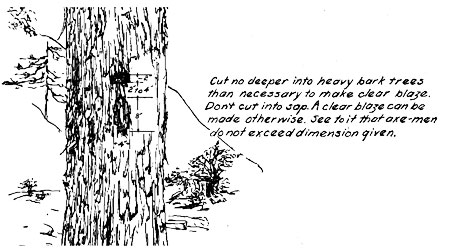
The following is another schematic from the same manual, providing more tips for the CCC crews on how to cut blazes:

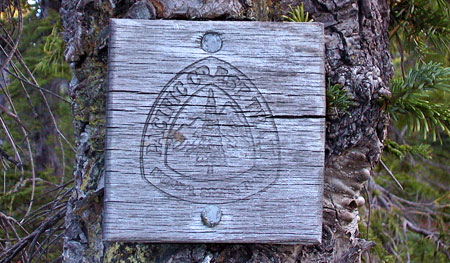
Though most of our trail blazes in the Pacific Northwest follow this standard (or use cairns in open areas), one notable exception exists that is closer to the Eastern system of customized trail icons: the Pacific Crest Trail (PCT).

Throughout its length, the trail is marked with the familiar triangular shield (below), though the old-style metal PCT signs still survive in many sections of the trail.

The PCT sign is an accepted Forest Service standard, and it makes sense that an iconic sign is warranted, as most of the PCT is stitched together from the cobweb of forest trails that existed prior to the PCT, making for many potentially confusing junctions along the way.

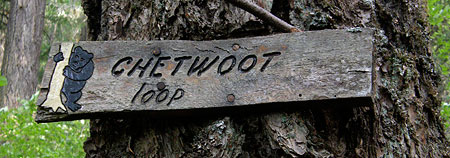
There are also a few local trails in our region that carry an iconic, themed logo that follows the Eastern style, thanks to the work of a few volunteers in the 1970s and 80s. Most notable among them was Basil W. Clark, who not only helped build new trails, but also created illustrated signs for them, such as the “Chetwoot Loop” sign, below:

Clark’s whimsical icon signs also appeared at Devils Rest and Trapper Creek, as well as other spots in the Gorge, and a few still remain today, providing a charming, rustic feel that is unique to these spots. Click here for an early 1980s Oregonian tribute to Clark.

A Future for Themed Blazes?

Chopping blazes into living trees is now a relic of the past, but is there a future for more contemporary blazes along our forest trails? After all, we have only a few decades left before all traces of this earlier era are erased, and trails will be completely reliant on other forms of signage and markings.

One route that could benefit from an iconic, tailored blaze sign is the Timberline Trail. The system of cairns built in the most alpine sections are a good start, but along the rest of the route, there are many spots where the web of intersecting approach routes make it confusing to know if you are still on the loop trail. The Timberline Trail has a couple of easy options for a blaze theme — the Timberline Lodge logo (below, left) or perhaps a CCC-based logo (below, right), given the unique history of the trail.

Other candidates could be the simple loop paths that circle Lost Lake and Trillium Lake, two of Mount Hood’s most visited destinations. Both have thousands of newbie hikers visiting them in the course of a year, many hiking for the very first time. Both trails also have a maze of unofficial, unmarked fisherman and campground paths that can make staying on the loop trail confusing, so a system of blaze signs would provide a useful function.
How might this come about?

As Basil Clark proved, themed blazes are a perfect project for volunteers, from designing and creating the signs, to providing the ongoing installation and maintenance inherent to trail signage. Perhaps trail organizations like Trailkeepers of Oregon, the Mazamas or the Trails Club of Oregon would jump at the opportunity to provide this service?

As always, one way you can help is to propose this idea (or any others you might have) to the Forest Service through their online suggestion box.
Proposal: Elk Cove to Pinnacle Ridge Connector

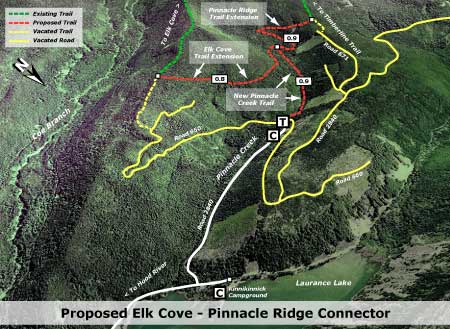
This proposal calls for a new trail connector linking the historic Elk Cove Trail (No. 631) and little-used Pinnacle Ridge Trail (No. 630) on Mount Hood’s rugged north side. This new connector would create a new 9.3 mile hiking loop that could serve as a strenuous day trip for experienced hikers, or an easy overnighter for casual hikers and families.
The new trail would also allow for eventual decommissioning of at least nine miles of deteriorating logging roads (shown in yellow on the maps that follow), as the new connector would provide access to both trails from the lower Elk Cove trailhead at Pinnacle Creek, on Forest Road 2840. In this way, the proposal not only provides an ecological net benefit in restoring the area from its logging heyday, but also pays for itself in reduced life-cycle costs for forest infrastructure.

About half the nine miles of logging roads already fall within the newly expanded Mount Hood Wilderness, so will probably be abandoned without formal decommissioning by the Forest Service.

However, a substantial portion of the old road system falls outside the wilderness boundary, within the Pinnacle Creek drainage. Without the wilderness restrictions, this portion could be decommissioned using traditional machinery, thus providing a significant ecological benefit for the watershed. This would be important in any watershed, but is especially important here, where Pinnacle Creek forms a critical spawning ground for Clear Branch Bull Trout, a local species whose status the Oregon Department of Fish and Wildlife described in 2006 as “highly precarious”.

Clear Branch Bull Trout (ODFW)

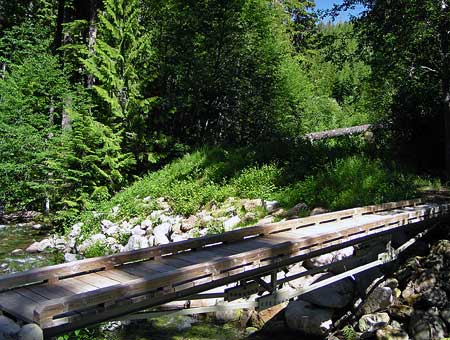
Part of the old logging network also includes the first mile of “trail” that currently leads to Elk Cove. In the late 1990s, the Forest Service relocated the Elk Cove Trailhead to the current location when Pinnacle Creek washed out the road where it crossed the stream. Since then, a footbridge has replaced the old road over the creek, and the “trail” has been an increasingly brushy, mile-long walk up the truncated road on the opposite side.

This messy section of “trail” is a reminder that road-to-trail conversions may seem an attractive bargain in the short run, but are often substandard for the outdoor experience they provide. Worse, over the long-term they can become brushy thickets of alder and willow, making them more costly to maintain than a traditional trail built under established forest canopy.

Overgrown “trail” to Elk Cove is actually a road

This proposal also responds to a road closure project floated by the Forest Service in early 2010 to “provide public access to the Pinnacle Ridge and Elk Cove trails after Road 2840 is decommissioned near Kinnikinnick campground.” The Forest Service project would close Road 2840, converting much of it to trail, and thus adding another mile of road walking to the Elk Cove Trail in the process. Worse, a full 3.5 miles of road walking would be required to reach the current Pinnacle Ridge Trailhead.

In both cases, this amount of road walking is an unacceptable way to provide a quality wilderness experience on two important gateways into the Mount Hood Wilderness. The proposal in this article was submitted to the Forest Service as an alternative, however, the Forest Service project has since been withdrawn, according to their website. Hopefully, this will provide more time to make the case for a better trail solution, since their own watershed management plans call for eventual closure of most logging roads in the area (more about that, later).

What Would it Look Like?

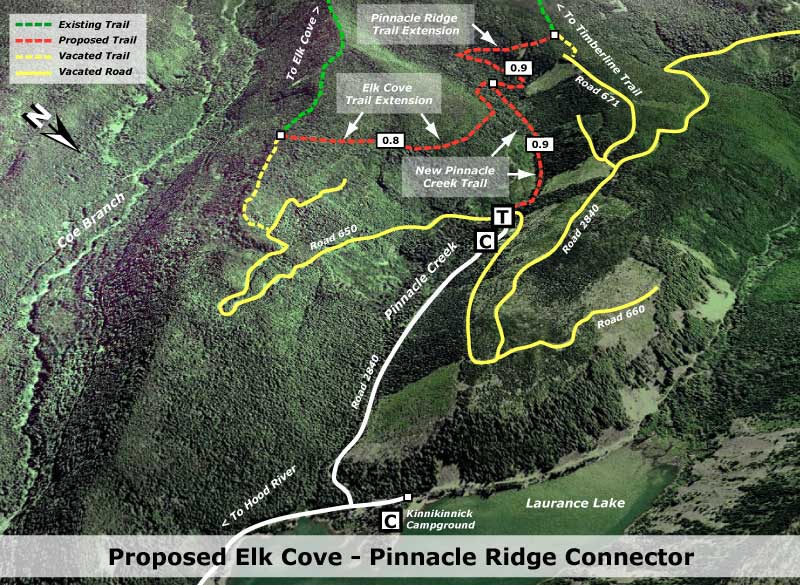
The proposed new trail would begin at the existing Elk Cove Trailhead, along the banks of Pinnacle Creek (see map, below). Though the trailhead, itself, is not in need of significant improvements, the informal campground at the trailhead would be formalized as a tent camping area under the proposal. This would allow for weekend or overnight visitors from Portland or points beyond to arrive late, spend the night at the trailhead, and begin day or backpack trips early the next day.

(click here for larger map)

Where the existing Elk Cove Trail currently heads east, up the truncated Road 650, the proposed new Pinnacle Creek Trail would instead follow rushing Pinnacle Creek southwest for 0.9 miles to a new junction, where a pair of new connections would climb east to the Elk Cove Trail, and west to Pinnacle Ridge Trail. (shown in red on the map, above). The new Pinnacle Ridge Trail would need to sidestep old clearcuts on both sides of the creek, but would easily fit within the intact forest of the riparian corridor, providing a quality, streamside hike.

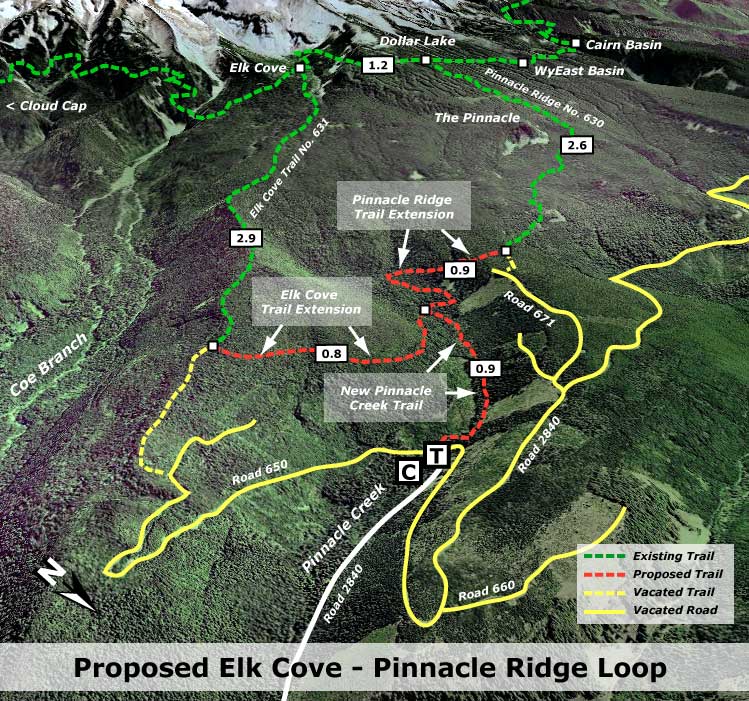
The second map (below) shows how the new connector trails would create a 9.3 mile Elk Cove to Pinnacle Ridge loop for day hikes and overnight trips, with campsites at Elk Cove, Dollar Lake and WyEast Basin. The new loop opportunity would not only make better use of the lightly used Elk Cove and Pinnacle Ridge trails, but also provide a north side access alternative to the very heavily used trailheads at Vista Ridge and Cloud Cap.

(click here for larger map)

For accessibility, the Elk Cove trailhead has the added advantage of being reached mostly on paved roads, with only the final mile on an unpaved road. This represents a substantial improvement over the long, rough ride required to reach both Cloud Cap and Vista Ridge.

The new connector trails would also provide an important aesthetic improvement to the logging road trudge along the first mile of the Elk Cove Trail — a disheartening way to begin (and end) what is otherwise a premier alpine hike.

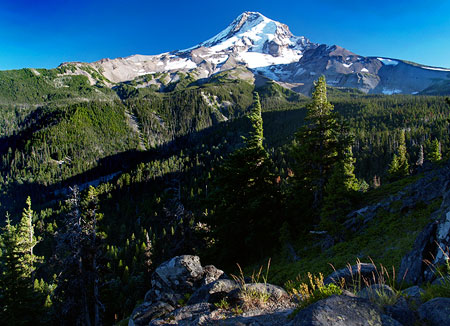
Mount Hood from the dramatic Coe Overlook

These new trails would also provide a higher quality day hike to the little-known Coe Overlook for less experienced hikers, with a 2.3 mile, 1,500 foot climb from the trailhead to the viewpoint. This moderate hike would feature a mile of streamside hiking, virgin subalpine forests and the spectacular view of the north face that the viewpoint offers.

What Would it Take?

This new trail proposal could be largely designed and built by volunteers. Access to the work site is easy, and open from late April through early November, providing an extended season for volunteer workers. The added benefit of linking the trail project to road decommissioning would make this an excellent candidate for groups like Trailkepers of Oregon to consider.

Logistically, the lower Pinnacle Creek valley is located outside the Mount Hood Wilderness, allowing volunteers to use power equipment for trail construction, where needed, with few limitations on trail structures (such as bridges).

Elk Cove Trail at Pinnacle Creek

At this time, it is unclear why the Forest Service has withdrawn their proposal to close and convert Road 2840 to a trail, since the project was driven by a watershed restoration mandate. But if the project is reactivated, we can all have an impact on the reconfigured trail system by weighing in — and simply forwarding this alternative proposal is a way to achieve much better results.

In the meantime, both trails are well worth the extra effort needed to reach the trailheads if you are looking for a different approach to Mount Hood’s north side. Both are described in the Portland Hikers Field Guide:

Elk Cove Hike

Pinnacle Ridge to Elk Cove Hike

Depending on how the snowpack shapes up this year, both trails should be open by mid-July, and provide a great way to visit the mountain! Meanwhile, watch this blog for further Forest Service developments in the Pinnacle Creek area, and opportunities to weigh in.

Warren Falls Lives! (temporarily, at least)

Warren Falls flowed briefly in early December

As an update to this recent article on restoring Warren Falls, I made a trip to the site of the former falls during a classic “pineapple express” pattern of winter monsoons earlier this month. I was thrilled to find a small amount of Warren Creek cresting the weir that has diverted the creek into a bypass tunnel for the past 75 years, and pouring over the falls.

It was remarkable to be in the amphitheater with water cascading over the escarpment, once again, and even if only temporarily. The small amount making its way over the brink completely changed the place from an eerie, somber cavern to a bright, sparkling glen. It was even more exciting to imagine the full force of Warren Creek plunging over the high cliffs, given the thundering display at Hole-in-the-Wall Falls (which is created by the bypass tunnel).

Here is a short video from that day that captures the scene and tells the story of Warren Falls:

Campaign Goes International!

Today I received this wonderful street scene from Peder Bisbjerg, traveling in Quy Nhon, Vietnam (located about halfway between Da Nang and Ho Chi Minh City).

Wait a minute… something looks familiar…

There it is! Mount Hood meets the beaches of Vietnam! Not a lot of volcanoes in Vietnam, proper, but they are just across the South China Sea from a batch of really impressive volcanoes in The Philippines and Malaysia, so the Vietnamese are no strangers to big, solitary peaks that erupt periodically.

According to Peder, he was “eating a delicious eel rice gruel” — and that’s the shop owner smiling in the background. His eel breakfast cost 65 cents.

Thanks for the international publicity, Peder!

(Photos courtesy Peder Bisbjerg)

Farewell to an Old Friend

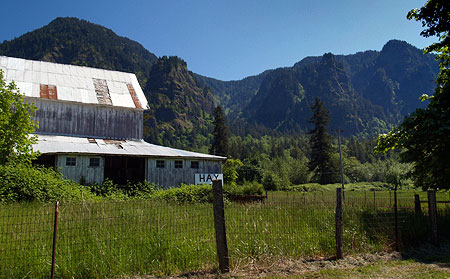
The Bucher barn and Nesmith Point (2008)

For camera buffs, the century-old Bucher family dairy barn at the foot of St. Peters Dome in the Columbia River Gorge has been like an old friend. The huge, stately old structure could not have been more picturesque, with its bleached planks and rusty tin roof standing in dramatic contrast to the towering basalt walls of the Gorge.

Thus, it was to the great dismay of many when the barn came down this fall, and now is in the process of being salvaged.

The Bucher barn was located in the old Dodson district, a fading rural village that experienced its heyday in the 1930s, when the original Columbia River Highway was the premier travel route through the Gorge.

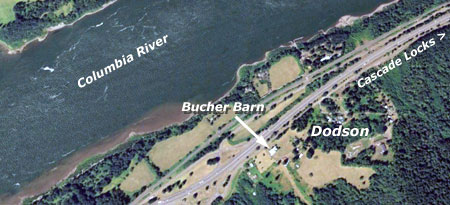
Until its recent collapse, the barn had survived to become the most prominent structure in the Dodson district in recent years, familiar to speeding traffic on I-84 (and plainly visible in the air photo, above).

The Bucher barn in happier days (2006)

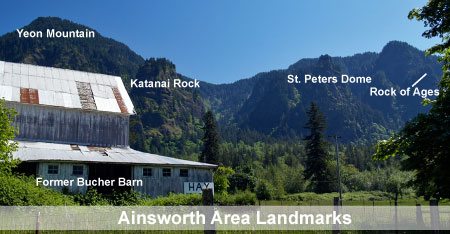
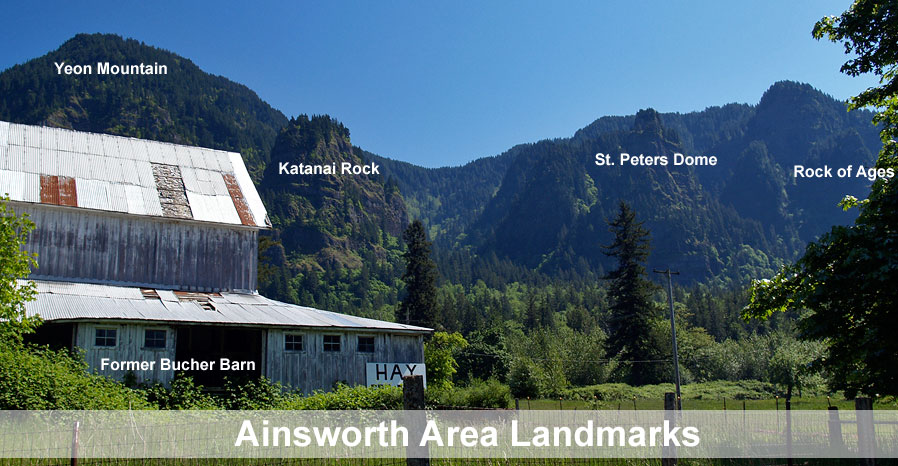
The Bucher barn was tucked at the base of the towering cliffs and spires of Ainsworth State Park, with Yeon Mountain, Katanai Rock, St. Peters Dome and Rock of Ages filling the skyline. Nesmith Point is also prominent, and is the loftiest cliff in the Columbia Gorge, rising nearly 4,000 feet directly above the river.

The barn was located in an area that made headlines in the winter of 1996, when a series of dramatic debris flows roared down from the Gorge rim and burst across I-84, closing the freeway for five days and destroying nearby homes — but sparing the barn. (click here for a full account of the debris flows)

Beginning of the end in November 2010

In recent years, the U.S. Forest Service and Oregon State Parks have been actively acquiring private land in proximity to the Bucher barn as part of implementing the long-term vision for the Columbia River Gorge National Scenic Area. According to the National Integrated Land System (NILS), these acquisitions may cover the Bucher barn parcel, which could explain the barn coming down, though I have not been able to verify this connection.

(Note: please see the postscript to this article for updated background on the ownership of the barn and decision to bring it down).

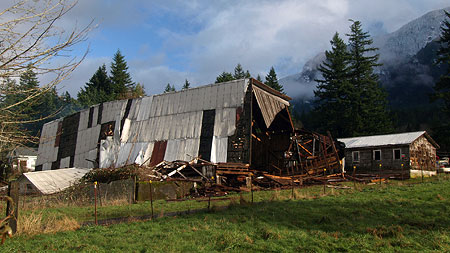
The fallen barn in November 2010

The current deconstruction of the Bucher barn was underway by mid-November of this year. The plank siding had been partially removed from the lower half of the structure by Thanksgiving, but the main building frame was still intact.

By late November, however, the building had been toppled, tipping forward toward the frontage road with the roof framing intact. Whether the collapse was intentional or from a structural failure is unclear, though the ongoing salvage operation suggests that it was dropped intentionally.

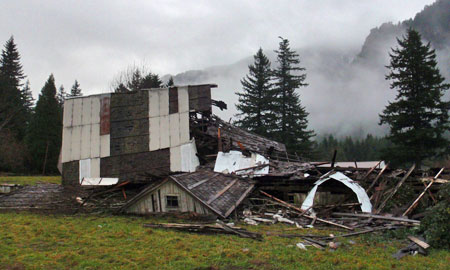
Almost gone in December 2010

A series of early winter storms gripped the Gorge in late November and early December of this year, but the salvage work continues, and by mid-December, half the roof frame of the Bucher barn has been removed, along with most of the metal roofing.

At the current rate of removal, the barn will likely be gone in a few weeks, taking a bit of Oregon history with it. Thankfully, it is one of the more photographed barns in the region, so will live on through images that captured its charm and unique setting.

Bucher barn salvage in December 2010

The sudden demise of the Bucher barn is a reminder that historic barns are fading away across the Oregon landscape, so hopefully others can be equally appreciated and documented while they are still standing.

If you are interested in seeing this rapidly disappearing bit of history, take the Ainsworth exit on I-84, then follow signs to the eastbound Frontage Road and John B. Yeon State Park. The barn is located one-quarter mile from the interchange, just beyond the first house. Please respect the private property signs, and stay outside the fenced pasture.

Postscript

In April 2011, Breanna Mohr, a member of the Bucher family, provided some additional family history on the Bucher barn. The building once belonged to her great-grandfather, Joseph Bucher, a dairy farmer in the Dodson area. When Joseph Bucher passed away, his farm was divided among his children, and the portion that included the barn was passed to his daughter. Breana Mohr goes on to say:

“Now to explain why it is being tern down. The barn has been falling down for many years now, and my aunt could not keep up with the work that it needed… So the family decided to tear it down. This has been a hard thing for my family because they all still remember it being full of milk cows, (my grandfather was the milk man in Dodson) and having to get up early in the morning to milk the cows.”

Breanna also pointed out that I didn’t include Katanai Rock in the original article. The name was new to me, but after a bit of research, I learned that this is the local name for the huge monolith immediately above the Bucher farm. I’ve taken a shot at identifying the various landmarks that make up the towering heights of Ainsworth State Park and the Dodson area, including Katanai Rock:

Click here for a large version of this photo

Though all but the Katanai name are official and found on USGS maps, interpreting the jumble of contours on the map as they related to real features on the ground turns out to be more difficult than I’d imagined. Thus, I’d appreciate any corrections to this schematic that local residents or area explorers have to offer.

Finally, I’d like to thank Breanna Mohr and the Bucher family for not only providing historical background on the area, but also for keeping this fine old structure standing for so long. While it shall be missed by all of us, it was enjoyed for decades for its picturesque charm, and lives on in our memories, as well!

Building the Timberline Trail

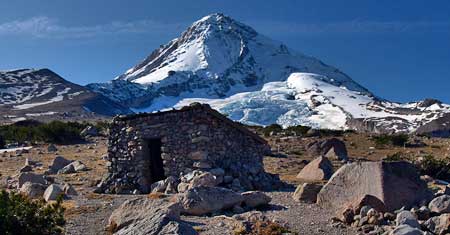
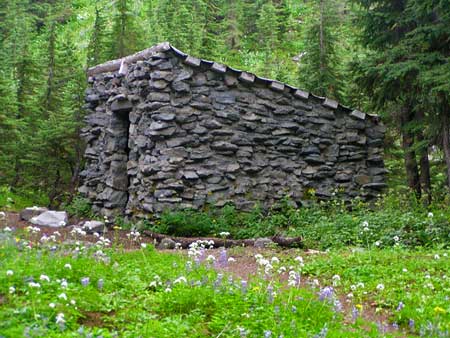
The McNeil Point Shelter.

For decades, hikers and backpackers have taken Mount Hood’s famous Timberline Trail for granted — and why not? It was one of the earliest alpine hiking trails in the American West, and seems to have evolved with the mountain itself.

But the story of the trail is one of an original vision that has been realized in fits and starts, and the story is still unfolding.

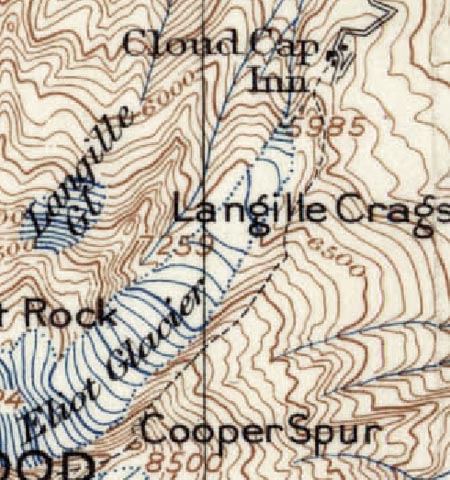
The first recreational trail on Mount Hood followed the South Eliot Moraine from Cloud Cap Inn to Cooper Spur, as shown on this 1911 map.

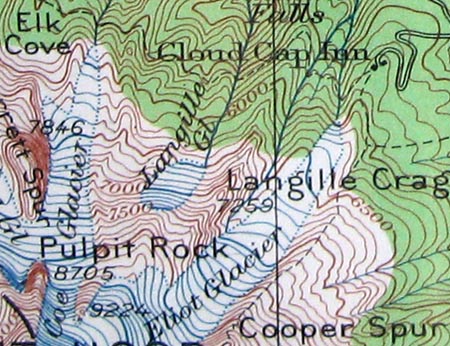
The first modern trail on Mount Hood was established in 1885, beginning at David Rose Cooper’s tent camp hotel, located near the present-day Cloud Cap Inn. The route followed the south Eliot Moraine to his namesake Cooper Spur. Soon thereafter, the Langille family would lead hikes and climbs on this route from the new Cloud Cap Inn, completed in 1889.

The Langilles also established a route from Cloud Cap to Elk Cove for their visitors, completing another section of what would someday become the Timberline Trail.

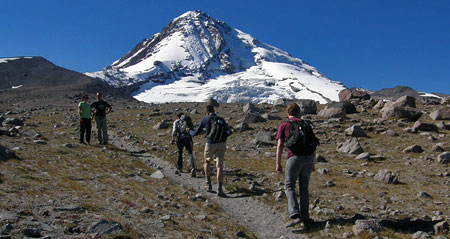
Hikers climbing toward Cooper Spur along one of the original sections of the Timberline Trail.

The route remains a popular trail, today, though it has never been formally adopted or maintained by the Forest Service. The first leg of this trail briefly functioned as a segment of the Timberline Trail, thanks to a temporary re-routing in the mid-2000s (more about that, later).

The significance of the original Cooper Spur trail is that it was built entirely for recreational purposes, the first such route on the mountain.

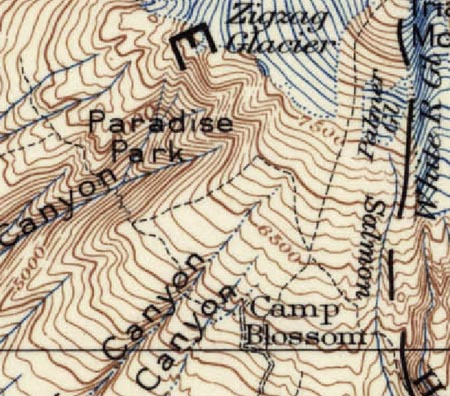
Camp Blossom was built some fifty years before Timberline Lodge was opened in 1938, but established the same network of trails that have since served the lodge.

Other hiking routes soon followed on the south side of the mountain, connecting the former Camp Blossom to nearby Paradise Park and the White River canyon. Camp Blossom was built by a “Judge Blossom” in 1888 to cater to tourists. The camp was at the end of a new wagon road from Government Camp, and located near present-day Timberline Lodge. It was eventually replaced by the Timberline Cabin (1916), and later, Timberline Lodge (1938).

The informal network of alpine trails radiating from Camp Blossom in the late 1800s still forms the framework of trails we use today. This is especially true for the nearly 7 miles of trail from White River to Paradise Park, which largely defined the Timberline Trail alignment in this section.

By the 1920s, the Langille family had developed trails from their Cloud Cap Inn to nearby Elk Cove (1924 USGS map).

By the 1920s, the Mazamas and other local outdoor clubs were pushing for more recreation facilities around the mountain, and public interest in a round-the-mountain trail was growing.

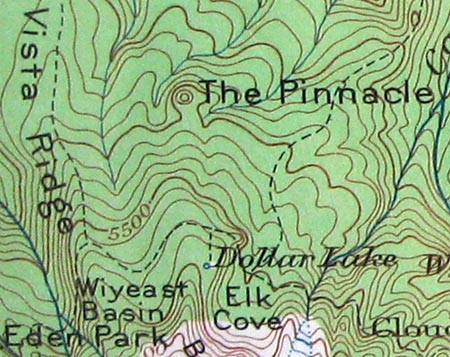
By this time, new Forest Service trails had been built on the north side of the mountain from the Clear Branch valley to Elk Cove and along Vista Ridge to WyEast Basin. These trails were connected at timberline (with a spur to Dollar Lake), creating another segment of what was to become the Timberline Trail. Combined with the route from Cloud Cap to Elk Cove, nearly 8 miles of the future Timberline Trail had been built on the north side of the mountain by the 1920s.

By the 1920s, the Vista Ridge and Elk Cove trails were established, extending the emerging Timberline Trail from Cloud Cap to Eden Park (1924 USGS map).

The Timberline Trail is Born

The concept of a complete loop around the mountain finally came together in the 1930s, during the depths of the Great Depression, when Franklin Delano Roosevelt’s New Deal recovery program, and the Civilian Conservation Corps (CCC), brought the needed manpower and financial resources to the project.

The CCC completed the new 37.6 mile Timberline Trail in 1934, stitching together the existing north side and south side trails, and covering completely new terrain on the remote west and east sides of the mountain.

The venerable Cooper Spur shelter still stands on the slopes above Cloud Cap, maintained by volunteers.

The Corps built a generous tread for the time in anticipation of heavy recreation use. The new trail was built 4 feet wide in forested areas, 2 feet wide in open terrain, and gently graded for easy hiking.

The trail was marked by square cedar posts placed at rectangular intervals over open country and by blazes in forested areas. Many of the distinctive trail posts survive between Cloud Cap and Gnarl Ridge, mounted in huge cairns.

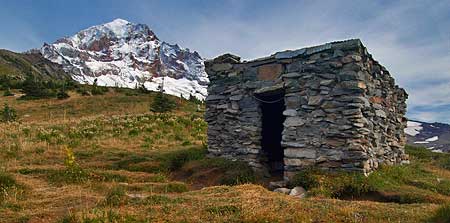
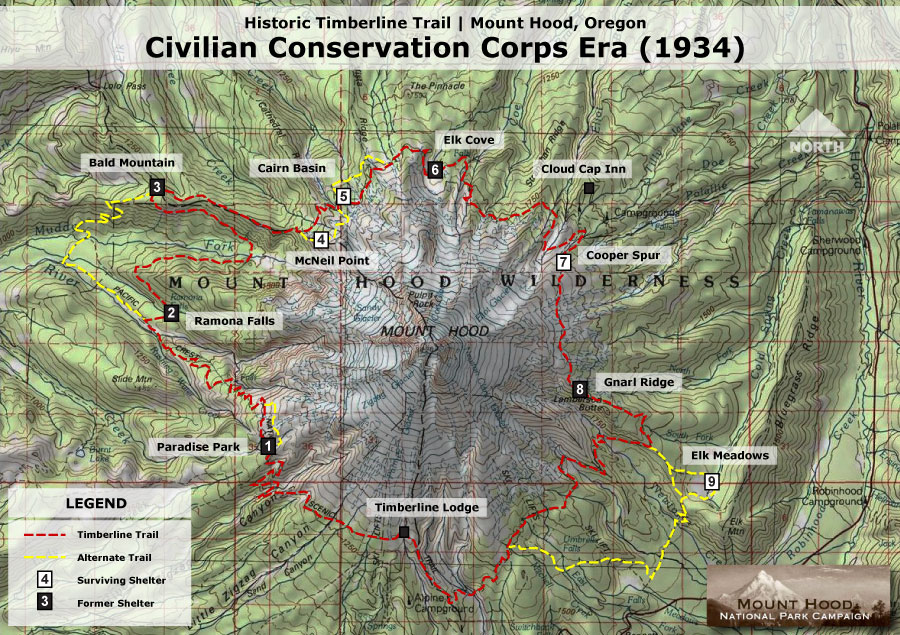
Shelters were built along the trail by the CCC crews as a place for hikers to camp and rest, and as protection against sudden storms. Most are of the same stone design, with a small fireplace and chimney. They were built with steel rafters instead of wood so that the structures, themselves, would not be used as firewood in the treeless high country, and also to withstand heavy winter snows. Of the six original stone structures, only those at McNeil Point, Cairn Basin and Cooper Spur survive (see large version of map, below).

Map of the completed Timberline Trail and CCC era shelters.

(Click here for a large map)

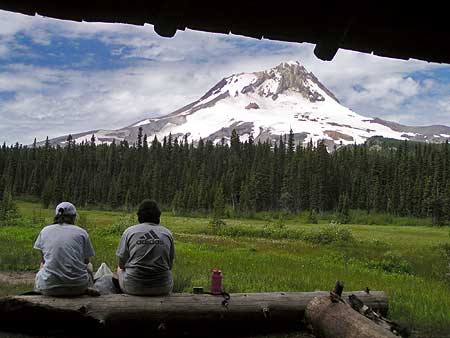
Three wood structures were also built along lower sections of trail, at Ramona Falls, Bald Mountain and Elk Meadows. Of the three, only the rapidly deteriorating structure at Elk Meadows survives.

The completed trail featured a couple of oddities: the McNeil Point shelter had been constructed on a high bluff above the Muddy Fork that was eventually left off the final trail alignment, due to concerns about maintaining the trail at this elevation. Today, thousands of hikers nevertheless use the partially completed trail each year to reach the historic shelter and spectacular viewpoint.

Curiously, the shelter at Elk Meadows was also built off the main loop, perhaps because at the time, the meadows were seen as much a place to graze packhorses as for their scenic value. Like McNeil Point, this “forgotten” shelter continues to be a very popular stop for hikers, today.

This 1921 map shows the Oregon Skyline Trail terminating at Mount Hood, before construction of the Timberline Trail. Note the early Bull Run Reserve encompassing the entire west side of the mountain.

By the late 1930s, much of the new Timberline Trail had also been designated as an extension of the Oregon Skyline Trail — according to maps from the time (above), the Skyline had previously terminated on the slopes of Mount Hood, above Government Camp.

The expanded Skyline Trail arrived at the Timberline Trail from the south, near Timberline Lodge, turned east and traced the new Timberline Trail counter-clockwise around the mountain before descending to Lolo Pass, then headed north to Lost Lake and the Columbia Gorge.

1970s Trail Renaissance

A third major era of trail construction on the mountain came in the 1960s and 1970s, when several major re-routes of the Timberline Trail were built.

By the early 1960s, the Oregon Skyline Trail had been relocated to the west side of the mountain, following the Timberline Trail from Timberline Lodge north to the Bald Mountain Shelter, then on to Lolo Pass.

By the time the Pacific Crest Trail was established in the 1968 National Trails Act, absorbing the old Skyline Trail, a new route across the Muddy Fork canyon was in the works for the Timberline Trail.

The Cairn Basin stone shelter is the best-preserved of the CCC-era structures, thanks to more protection from the elements than most of the original buildings.

By the early 1970s, this new section rounded Yocum Ridge from Ramona Falls, crossed both branches of the Muddy Fork, then ascended to the steep meadows of Bald Mountain, one of the most popular Timberline Trail destinations today.

The new Muddy Fork segment is now part of the Timberline Trail loop, with the Pacific Crest Trail following the old Timberline Trail/Oregon Skyline Trail alignment. Though less scenic, the old route is more direct and reliable for through hikers and horses.

In contrast, the scenic new route for the Timberline Trail has been a challenge for the Forest Service to keep open, with the Muddy Fork regularly changing channels, and avalanche chutes on the valley walls taking out sections of trail, as well.

Going, going… this view from the slowly collapsing Elk Meadows shelter will soon be a memory. This is the only remaining wood shelter of three that were built by the CCC.

In the 1970s, a section of trail descending the east wall of Zigzag Canyon was also relocated, presumably as part of meeting Pacific Crest Trail design standards. While the old route traversed open, loose slopes of sand and boulders, the new trail ducks below the tree line, descending through forest in gentle switchbacks to the Zigzag River crossing of today.

At Paradise Park, a “low route” was built below the main meadow complex, and the headwater cliffs of Rushing Water Creek. Like the Zigzag Canyon reroute, the Paradise Park bypass was presumably built to PCT standards, which among other requirements, are intended to accommodate horses.

The north side of the mountain also saw major changes in the early 1970s. The original Timberline Trail had descended from Cathedral Ridge to Eden Park, before climbing around Vista Ridge and up to WyEast Basin. The new route skips Eden Park, traveling through Cairn Basin, instead, and climbing high over the crest of Vista Ridge before dropping to WyEast Basin.

Beautiful meadow views line the “new” Vista Ridge trail section completed in the early 1970s.

Finally, a section of trail near Dollar Lake was moved upslope, shortening the hike to the lake by a few hundred yards, and creating the sweeping views to the north that hikers now enjoy from open talus slopes east of Dollar Lake. Just beyond Dollar Lake junction, the descent into Elk Cove was also rebuilt, with today’s long, single switchback replacing a total of six on the old trail which descended more sharply into the cove.

In each case, the new trail segments from the early 1970s are notable for their well-graded design and longer, gentler switchbacks. While the main intent of the trail designers was an improved Timberline Trail, the new segments also created a numerous new routes for day hikers who could follow new and old trail segments to form hiking loops. These loops are among the most popular hikes on the mountain today.

The Future?

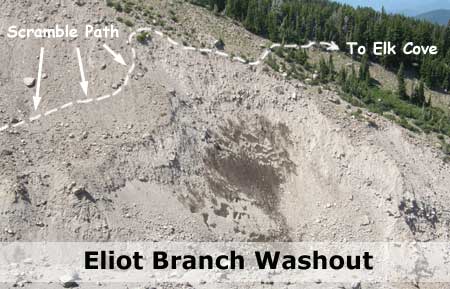
The retreat of Mount Hood’s glaciers in recent years has destabilized the outwash canyons, and in the past two decades, massive debris flows have buried highways and scoured out streambeds. One of the oldest segments of the Timberline Trail, near Cloud Cap, has been disrupted by washouts for nearly a decade, and is now completely closed, thanks to a huge washout on the Eliot Branch in 2007.

Sign from the first re-route, posted in 2001. Now the trail is completely closed at the Eliot Branch.

The Forest Service has since struggled to find funding to reconnect the trail at the Eliot Branch. The first washout moved the stream crossing uphill, taking advantage of the original Cooper Spur path established in the 1880s, then crossing to a parallel climbers path on the north moraine of the Eliot Glacier.

This temporary crossing lasted a for a few years in the early 2000s before the massive washout in 2007 permanently erased this section of trail. This portion of the loop as since been completely closed, though hundreds of hikers each summer continue to cross this extremely unstable, very dangerous terrain.

Site of the Eliot Branch washout and closure -- and the risky route hikers are taking, anyway.

The growing volatility of the glacial streams will ultimately claim other sections of trail, creating an ongoing challenge for the Forest Service to keep the Timberline Trail open each summer.

If repairing the washouts along the trail were as costly as those along the nearby Mount Hood Loop Highway, then there might be some question of whether it makes sense to keep the trail open. After all, millions of dollars are being spent this year to rebuild the Mount Hood Highway bridge over White River, yet again, in an area that has had repeated washouts.

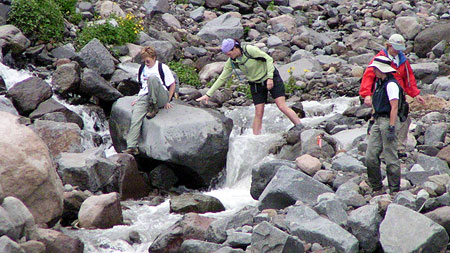
Hikers crossing the Eliot Branch before the 2007 washout.

By comparison, a wilderness trail is exceptionally cheap to build, and much less constrained by topographical or environmental concerns than a road. It really just comes down to money and priorities, and the Forest Service simply doesn’t have the funding to keep pace with the growing needs of the Timberline Trail. With even a modest increase in funding, the trail can be rebuilt and adapted to periodic washouts, or other natural disturbances.

Speaking Up

One way to have an impact on the funding situation for the Timberline Trail is to weigh in with your Congressman and Senators. While the current political climate says that earmarks are dead, history tells us otherwise: ask for an earmark for the Timberline Trail. After all, the trail is historic and an international draw that brings tourists from around the world to help boost local economies.

If you’re not an earmark fan, then you can argue for an across-the-board funding boost for forest trails as a job-producing priority in the federal budget. A ten-fold increase over current levels would be lost in rounding areas in the context of the massive federal budget.

Yet another angle are the health benefits that trails provide, particularly given the federal government’s newly expanded interest in public health. This is emerging as the best reason to begin investing in trails, once again.

Hikers negotiating the Muddy Fork crossing after the 2002 debris flow swept through the canyon.

Of particular interest is the fact that Oregon Congressmen Earl Blumenauer and Greg Walden actually hiked the loop, just before the 2007 Eliot Branch washout. One is a Democrat, the other Republican, so you can cover your bipartisan bases with an e-mail both! They share the mountain, with the congressional district boundary running right down the middle, so both have an interest in the Timberline Trail.

Finally, Oregon Senator Ron Wyden championed expanded wilderness for the Mount Hood area for years, and President Obama finally signed the bill into law earlier this year. So, another angle is to argue for the needed funding to support trail maintenance in these new wilderness areas, especially since they will require more costly, manual maintenance now.

It really makes a difference to weigh in, plus it feels good to advocate for trails with your Congressional delegation. Here’s a handy resource page for contacting these representatives, and the rest of the Oregon delegation:

Here’s how to send an e-mail to Congress

Thanks in advance for making your voice heard!

Million Dollar View – Postscript

Beacon Rock rising above the Columbia, as viewed from the Oregon side

In March 2009, I posted this article about local hostility toward the public that has emerged in the Warrendale community, opposite Beacon Rock on the Columbia River. Last summer, James Ellis Koch, a 68-year-old resident in the area was arrested for firing a rifle and shotgun at fisherman anchored offshore his riverfront property, terrorizing the four men onboard.

The original article has now been updated with postscripts detailing the incident, and pointed observations on Warrendale’s vigilante culture by the sentencing Multnomah County judge Janice Wilson.

Sunshine Rock

Located in a deep canyon near Lost Lake, Sunshine Rock is a 700-foot monolith that would rival famous Beacon Rock in the Columbia Gorge, were you to set them side-by-side. The two rocks might even look a bit like twins: both feature walls of distinctive columnar basalt, and rise to a broad, fluted crest.

Despite its impressive size, Sunshine Rock is nearly hidden from view in the Lake Branch canyon, a few miles upstream from the West Fork Hood River. The rock briefly comes into view traveling down Lake Branch Road from Lost Lake, but only for a moment. With a little exploration, though, better views of this massive rock can be had from less-traveled routes in the area.

Sunshine Rock from Lake Branch Road

Sunshine Rock is a classic basalt plug — the solidified lava throat of an ancient volcano that was once a mountain. Geologic maps of the area identify the rock as andesitic basalt, dating back to the Miocene period of more than 7 million years ago.

This means that Sunshine Rock was formed as part of the “Old Cascades”, the range or deeply eroded peaks and ridges that pre-date today’s relatively young big volcanoes, like Mount Hood, by millions of years.

View across the Lake Branch valley to Sunshine Rock

Over the millennia, the Old Cascades have been carved by erosion and folded by fault lines, with countless new volcanoes emerging to cover older peaks in successive layers. Like most of the rock from the Miocene area, Sunshine Rock was buried by huge shield volcanoes of the Pliocene era, which dates back 2-5 million years.

Shield volcanoes are broad, gently sloped peaks that we now know as the mostly forested summits surrounding Mount Hood, including Larch Mountain, Lost Lake Butte, Mountain Defiance and several other volcanoes in the area. In the case of Sunshine Rock, nearby Indian Mountain is the overlying shield volcano that covers the older Miocene geology.

Giant firs give scale to one of the lower ramparts on Sunshine Rock

In more recent geologic times, the U-shaped valley of the Lake Branch was excavated by 7-mile long glacier that stretched from near present-day Lost Lake to the West Fork valley. There, it joined an enormous, 1,000-foot thick mega-glacier that extended 17 miles from Mount Hood to what are now the apple orchards of Dee Flat, along the Lost Lake Road.

The glacial period covers the Pleistocene era, which spans the most recent 2-million years, and numerous ice ages. The most recent ice advance peaked just 15,000 years ago, and was responsible for the most recent extent of the prehistoric Lake Branch glacier that exposed Sunshine Rock, along the flanks of the valley.

Recent History

Sunshine Rock seems to first appear in the modern record in early lookout tower survey photos. These photos were taken in the 1930s from new lookout sites, and include views from nearby Buck Peak, Raker Point and Lost Lake Butte. The view (below) from Raker Point in 1933 shows the rock most prominently, along with Indian Mountain in the background (another early lookout site).

The venerable Oregon Geographic Names doesn’t list Sunshine Rock among its thousands of entries, so short of historical files kept by the U.S. Forest Service, the inspiration behind the name may be lost to history. The name doesn’t appear on maps until the 1950s, suggesting that it came into being after the logging era was well under way, in the post-war period.

While the exact origin of the name is unknown, the thinking behind it seems evident: the position of the rock on a southeast facing valley wall allows it to catch morning sunlight, and thus would have been a bright beacon for nearby lookouts or loggers in the area.

Visiting Sunshine Rock

Forest Road 13 to Lost Lake forms a large loop, with Sunshine Rock located on the northern leg, along the Lake Branch Road segment of the loop. The best way to spot the rock is to approach from Lost Lake, winding down the Lake Branch valley, and watching for it through the trees.

You can also get a close-up view from Road 1330, which intersects Forest Road 13 near the rock, and leads to an abandoned quarry directly opposite the rock. For more adventurous explorers, Road 1320 climbs nearly to the top of the rock, with old logging spurs leading to the base of its cliffs.

Proposal: Baldwin Memorial Wayside

Few in the Hood River Valley would ever recognize the name “Gilhouley Road”, much less anyone from beyond the area. And yet, at the intersection of this obscure dirt road and the Mount Hood Loop Highway lies an imposing scene that is treasured by locals and tourists, alike: the first big look at Mount Hood as you descend into the Upper Hood River Valley.

On a clear day, you’re guaranteed to see tourists pulled to the highway shoulder, snapping pictures of the mountain rising above bucolic pastures, even as semi-trucks roar past on the downgrade. The scene is irresistible.

Illegal dumping on the proposed wayside site

Earlier this year, a friend and national parks advocate from New England was visiting, and took the opportunity to drive the Mount Hood loop, and see “Oregon’s next national park”. Despite all of the mistreatment Mount Hood has seen, his sharpest critique was the shabby way in which we treat our visitors. He was amazed at the utter lack of traveler information — and confusing information, when it was provided. So, this article is inspired by his comments.

Rediscovering Waysides and Viewpoints

In the early days of auto touring, the Columbia River Gorge had the “King of Roads”, and among the great features of Samuel Lancaster’s magnificent scenic highway were the waysides and viewpoints that dotted the route. A family could load into their 1917 Packard Twin Six, and make a day of it, pulling off at each viewpoint, snapping photos with the family Brownie camera, and often following the short trails that led to still more views, or perhaps a waterfall.

Crown Point is the king of the waysides on the “King of Roads”

Times haven’t changed all that much, since, but the way we design our roads has. Tourists are now discouraged from stopping in many spots, and often take their life in their hands, if they do. Today’s highway engineers are much more concerned about keeping cars moving, at all costs.

The Hood River valley has just one “official” roadside viewpoint, located on county-owned land at Panorama Point in the lower valley. The scene is well-known, but also well removed from the Mount Hood loop highway by a couple miles. This proposal is for a companion overlook to Panorama Point, located in the upper valley, where the mountain first comes into full view for highway travelers, at the obscure junction with Gilhouley Road.

Click here for a larger map

In researching the possibilities for a new wayside at this spot, I first did a site inspection of the hillside above the highway: the area is recently logged, but with a fair number of mature trees left standing. The inevitable illegal dumping is present, of course — the scourge of public lands in highway corridors. But the view is breathtaking, with Mount Hood even more dramatically framed by hills, forests and fields than from the highway grade.

According to public lands data, the land is mostly public, and owned by Hood River County. The map (above) shows a perfect rectangle of public property that extents east along Gilhouley Road from nearby Middle Mountain, largely encompassing the wayside site. One triangle of land (indicated with a question mark) may be a private parcel, but isn’t essential to the wayside concept.

The approach to the site from Highway 35 is ideal: the intersection is located on a long, straight segment of road that would make for safe exit and entry from either direction. The presence of Gilhouley Road means that access is legally assured, with little possibility of an extended battle with ODOT for the right to build a wayside.

Looking south at the wayside site from Highway 35

The larger question is whether ODOT and Oregon State Parks would step up to make this a joint venture with local governments. It seems plausible, at least, given the lack of waysides along this portion of the loop highway, and the obviously heavy tourist traffic.

What would the wayside look like?

The site inspection revealed a surprising expanse of public land available at this site, so I’ve sketched a full-blown day use park as the proposed “Baldwin Memorial Wayside”.

As the schematic (below) shows, there could be a viewing structure, picnic areas, a nature trail and restrooms. This degree of development puts the concept into the major investment category, but certainly not beyond reach, especially since there are no other state parks or waysides in the Hood River Valley.

Click here for a larger map

Because the site has recently been logged, the wayside proposal could be equal parts park development and habitat restoration. While the main feature would be a developed overlook for highway travelers, this proposal also takes advantage of the open hillside rising above the highway. A scattering of ponderosa pine spared from logging provides an excellent opportunity for an interpretive trail built around habitat restoration.

One interesting possibility could be a restored balsamroot and lupine meadow beneath the pines. These spectacular blooming species are native to the area, are already present on the site and could become a popular draw for spring visitors to the area, just as similar wildflower spots in the Gorge are now.

What would it take?

Could a project like this really happen? Some stars are already aligned: Hood River County already owns the land and access rights to the highway at Gilhouley Road. Together, these are an invaluable step forward, since the road guarantees highway access and the land can be used as a grant match for state and federal funds. The site also benefits from access to utilities and proximity to existing emergency services. These are all core considerations when creating a new public park.

Most of all, it would take local leadership in the Hood River Valley area to secure state or federal funding through grants or other sources. Even in times of tight public budgets, this sort of project is achievable, especially if it helps reinforce the local economy and has an ecological purpose.

About the Name

Lastly, what would this new wayside be called? Well, “Baldwin Memorial Wayside” is simply borrowed from nearby Baldwin Creek, which in turn, memorializes Stephen M. Baldwin, who settled a claim along the stream in 1878. This would have made Baldwin one of the earliest settlers in the area.

The Cloud Cap Inn circa 1900

But this is where the connection to the Mount Hood view comes in: Stephen Baldwin’s son Mason “Mace” Baldwin became a well-known figure in Hood River County history in the early 1900s. Most notably, he was one of the founders of the legendary Crag Rats mountain rescue group in 1926, formed after the dramatic rescue he led that summer of an 11-year-old boy lost on Mount Hood.

Mace Baldwin not only gave the Crag Rats their name, he was also elected to be the group’s first “Big Squeak” (president), and went on to take part in many mountain rescues over the years. The Crag Rats were the first mountain rescue organization to be formed in the American West. In 1954, the Crag Rats adopted the venerable Cloud Cap Inn, on the north shoulder of the mountain, and have since been the careful stewards under special arrangement with the Forest Service.

The Crag Rats continue to be active today, and given the connection of this site to one of their founders, perhaps the “Baldwin Memorial Wayside” could include a tribute to these mountain heroes? It would certainly be a fitting memorial, and a fine way for visitors to enjoy the mountain view and learn a bit more about it’s rich human history.

Flag Point Lookout

In the early days at the turn of the 20th Century, the U.S. Forest Service was primarily a security force, tasked with guarding our public lands from timber thieves and squatters. This role expanded to include fire suppression in the early 1900s, a move that we see today as ecologically disastrous, but at the time, responded to massive fires destroying living trees that were valued in board feet, not biology.

The most enduring legacy from this era was the construction of thousands of fire lookouts, hundreds of forest guard stations and a sprawling network connecting trails and primitive dirt roads.

Though the lookouts and guard stations are mostly gone, the trail network still survives as the backbone of today’s recreation trail system. A few trails still lead to surviving lookouts scattered across the country. This article describes one such survivor, the Flag Point Lookout, located at 5,636 feet on a rocky, flat-topped bluff two miles east of Lookout Mountain.

The primitive road to Flag Point is surrounded on three sides by the Badger Creek Wilderness

The Flag Point Lookout is unique in that it continues to serve as an active fire lookout during the summer. The view from the lookout surveys a broad sweep of the eastern slopes of Lookout Mountain, far into the Eastern Oregon sagebrush and ranchland, and south into the rugged Badger Creek Wilderness.

The second structure on Flag Point was this L-4 cabin constructed in 1932, and later replaced by the current structure

Since the establishment of the Badger Creek Wilderness in 1984, The Flag Point lookout and the long, rugged 1930s-era dirt road leading to it have been surrounded on three sides by federally protected wilderness (The same 1984 legislation left two other surviving lookouts in the Mount Hood area, the Devils Peak and Bull of the Woods towers, inside new wilderness areas, where they are now maintained by volunteers as hiking destinations).

The first lookout structure at Flag Point was a six-foot square cabin on a 40-foot pole tower, built in 1924. It must have been terrifying in rough conditions, and was soon replaced with the popular L-4 style cabin (pictured above) on a 30-foot pole tower in 1932, a design that was found across Oregon.

Later improvements to the second tower were made in 1955, and a series of outbuildings were added over the years, replacing the original tent camp that accompanied the first structure.

The current lookout tower and outbuildings at Flag Point

In 1973, the third and current lookout structure was built — an R-6 flat top cabin on a 41-foot tower constructed of sturdy, pressure-treated cross-timbers. Like many lookouts, the structure is primarily held in place by stay cables, and simply rests upon its four concrete foundation feet.

Though the current structure is still too young to be listed on the National Historic Register, it has been listed on the National Lookout Register. It will become eligible for the historic register in just 13 years, in 2023.

Amazingly, the tower is anchored by cables, and simply sits upon its four foundation piers

The Flag Point Lookout is also notable for the remarkable forest ecosystem that surrounds it, where stands of fir and mountain hemlock blend with western larch and ponderosa as east meets west. The rain shadow effect of the Cascade Range is plainly visible from Flag Point, where the sweeping view extends far into the sagebrush deserts of Eastern Oregon.

Ironically, these are fire forests, an ecosystem that has specifically evolved around wildfire cycles, and thus have suffered greatly from the well-intended “protection” from fire that the lookouts have provided. Today, natural fires in the Badger Creek Wilderness are likely to be allowed to burn, with the Forest Service intervening only when homes or private property outside the wilderness are threatened.

The plank staircases are beautifully constructed with rabbet and dado joints, and enclosed with galvanized steel mesh

Beneath the forest canopy, the wildflowers of Flag Point are as diverse as the conifers, with mountain and desert species mingling in the sunny, open meadows. The Divide Trail, connecting Flag Point to Lookout Mountain, provides one of the best wildflower hikes in the region in early summer, traversing through miles of meadows and rock gardens along the way.

Flag Point was an important forest destination in its time, and still serves as the hub for several forest trails that are a legacy of the early lookout era. In addition to the Divide Trail, the lookout has trails radiating to Ball Point, Gordon Butte and Badger Creek. Today, most visitors to the lookout arrive via the access road, but hikers and horse packers also regularly visit the lookout from this network of wilderness trails.

The key to the design of the Flag Point tower is a sturdy maze of treated cross-timbers

The cabin atop the Flag Point lookout consists of a 14-by-14 foot interior, surrounded by an airy exterior catwalk. Steel mesh fills the gap between catwalk railings, adding some degree of confidence for vertiginous visitors.

The small cabin is furnished with a bed, a wood stove for heat, gas cook stove, table and chair, and a solar lighting system — a modern amenity that early lookouts couldn’t have imagined.

Looking east, the view extends beyond the Cascades and across the Oregon desert country (USFS Photo)

At the center of the cabin is a map table that echoes the original Osborne fire finders used to pinpoint fire locations. Outside, a rope and pulley system is used to haul supplies and firewood to the catwalk from the base of the tower.

Water for drinking, cooking and washing must be hauled in to the tower by truck, though early lookouts simply carried water from the nearby Sunrise and Sunset springs. Outbuildings include an outhouse, woodshed and an A-frame communications shack has been added to the west of the tower.

The view to the west provides a spectacular look at Mount Hood and nearby Lookout Mountain (USFS Photo)

Visiting the Lookout

Anyone can visit the Flag Point Lookout by simply parking at the locked gate, and hiking about one quarter mile to the lookout complex. The tower is generally staffed from June 1 through October 15, so be courteous and let the lookout know you’re visiting before climbing the tower. If you’re lucky, the lookout will be on site and invite you up for a tour. If the tower is closed, you can still climb to the lower catwalk for a close-up look at the structure, and views of the surrounding terrain.

The Flag Point lookout also makes for an interesting add-on to the Divide Trail hike to Lookout Mountain. You can simply hike to the lookout along the Flag Point Road from the Divide Trail (about 3/4 mile each way), or shuttle your car to the gate, saving about a mile of road hiking, round-trip.

In winter, the Forest Service rents the lookout cabin to skiers looking for a rugged, remote experience. Of the handful of lookouts open as winter rentals, the Flag Point Lookout is one of the most challenging to reach. You can learn more about winter rentals at the lookout here.

Relic from a bygone era, this 1940s DeSoto is slowly fading into the forest near Flag Point, where it was mysteriously parked decades ago

How to Get There

Reaching the lookout is an adventure in its own right. The last few miles of forest roads are generally open from June through October. From Portland, drive east on US 26 through Government Camp, then follow Highway 35 across the White River, and down the East Fork Hood River valley, beyond the Meadows ski resort.

Turn east (right) on Road 44, where signs point to Dufur and Camp Baldwin, and follow this paved road for 8 miles to the poorly marked junction with Road 4420. Turn south (right) and follow this paved forest road as it eventually curves past the Fifteenmile Campground. Just beyond the sharp bend at the campground, watch for dirt road No. 200, heading abruptly uphill and to the right. This is the Flag Point road, and it bumps along for the next 3.5 miles to the lookout gate. Parking is available near the gate.

Note: unfortunately, the Forest Service has recently ditched this road with a series of water bars that make for very slow going, and make the trip a rough ride for passenger vehicles – take it slowly!