Proposal: Mitchell Point Loop Trails

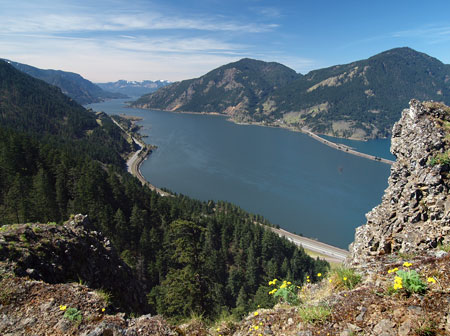
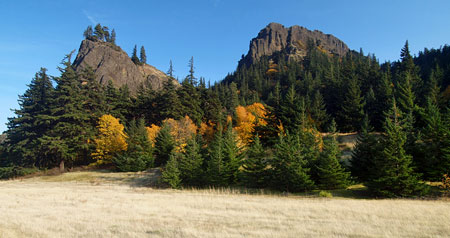
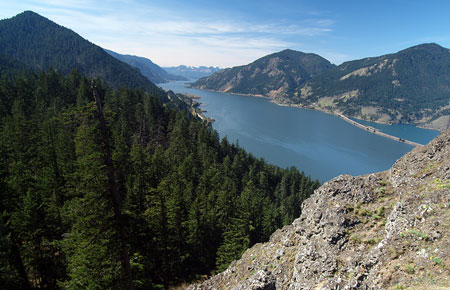
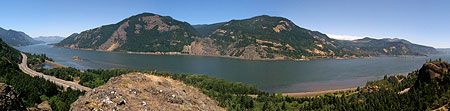
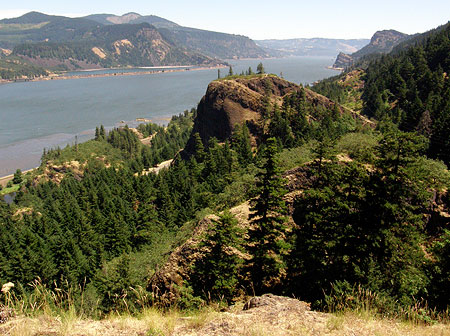
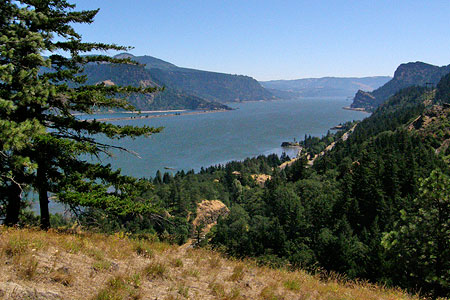
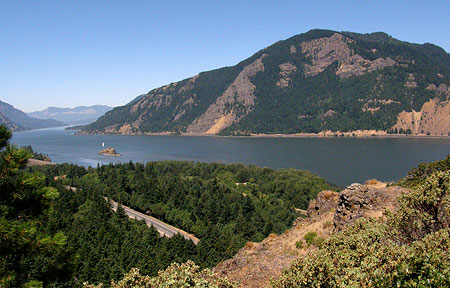
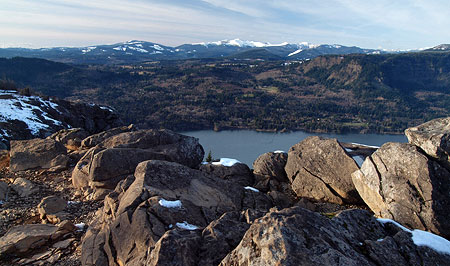
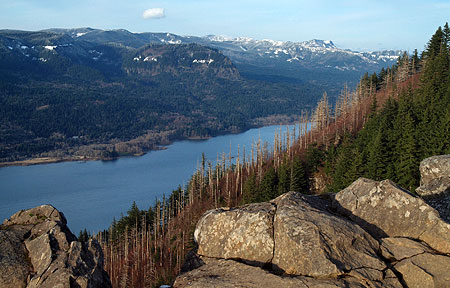
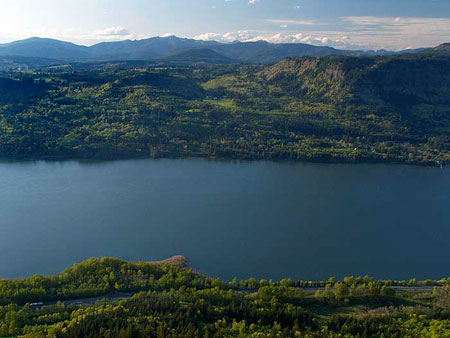
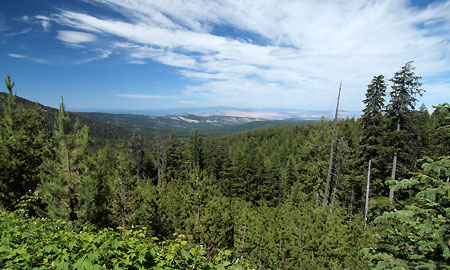
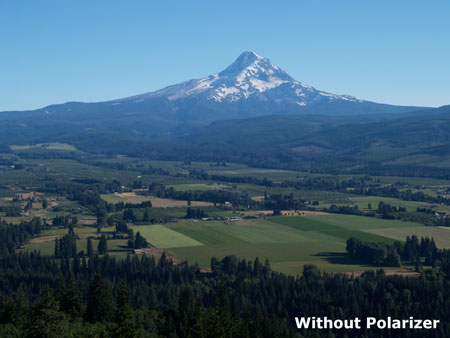
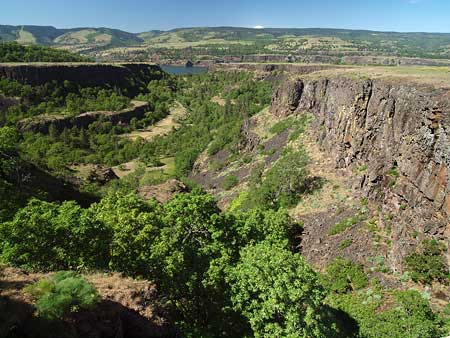
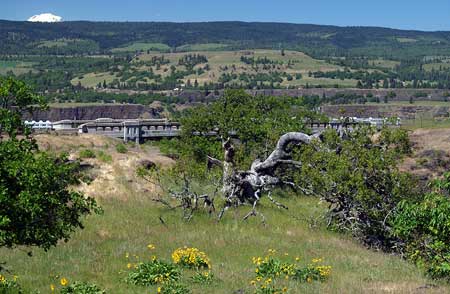
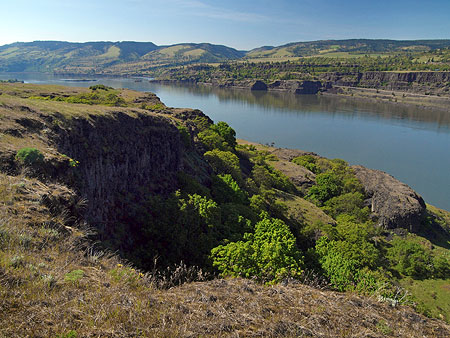
Looking west in the Gorge from Mitchell Point

Looking west in the Gorge from Mitchell Point

Author’s note: this proposal is the latest in a series on this blog aimed at a major Oregon Parks and Recreation Department (OPRD) effort underway to update the 1994 Gorge Parks Plan. OPRD staff will make key decisions on future trail projects for the Gorge over the next four months, so now is the time to weigh in! More information on how to get involved in this important work is included at the end of this article.
_________________

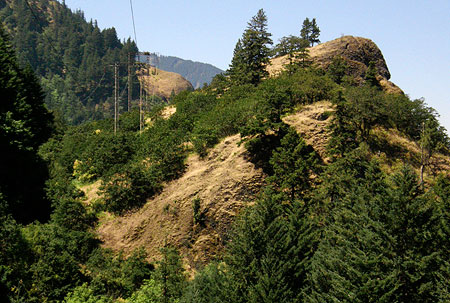
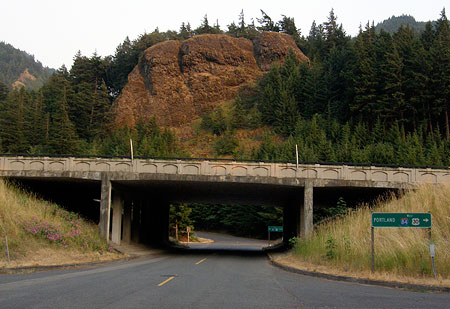
Mitchell Point is a rugged basalt spine that towers a thousand feet above the Columbia River, just five miles west of Hood River. This spectacular outcrop rises in the transition zone where the wet rainforests of the western Cascades meet dry Oregon white oak and Ponderosa pine country of the eastern slope in a unique jumble of ecosystems and geology.

The steep hike to Mitchell Point is described in this WyEast Blog article, and makes for an excellent year-round destination for hikers looking for something a bit less crowded (and a bit more rugged) than viewpoints like Angel’s Rest.

This article focuses on recent improvements to the Mitchell Point wayside and trailhead, and the potential to expand the trails at Mitchell Point to allow for better exploration of the unique landscapes found here, and a deeper appreciation of the colorful human history, as well.

Kudos on Recent Upgrades!

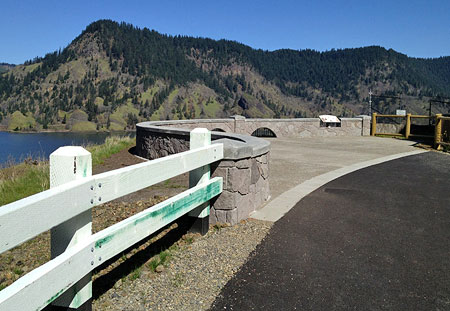
A short, new segment of the Historic Columbia River Highway State Trail leads to the refurbished Mitchell Point overlook

A short, new segment of the Historic Columbia River Highway State Trail leads to the refurbished Mitchell Point overlook

In 2012, the OPRD completed a major overhaul of the Mitchell Point wayside and overlook, with excellent results. Mitchell Point falls within the borders of the Vinzenz Lausmann and Seneca Fouts state parks, and has long served as a scenic wayside for highway travelers and as the trailhead for the Mitchell Point and Wygant trails.

The recent overhaul at Mitchell Point also acknowledges a new function for the trailhead: the Historic Columbia River Highway (HCRH) State Trail project will soon extend through the area, including a proposed tunnel through Mitchell Point, proper, that gives a nod to the iconic highway tunnel that once thrilled highway travelers here.

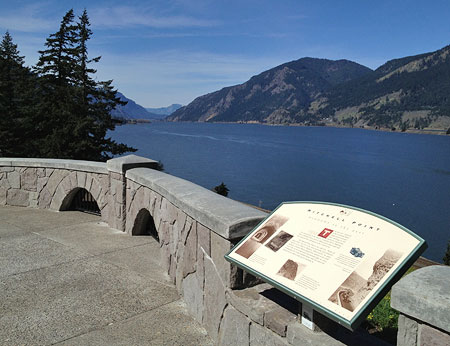
The restored overlook features a sweeping view of the Columbia Gorge and interpretive display on the iconic former Mitchell Point "Tunnel of Many Vistas"

The restored overlook features a sweeping view of the Columbia Gorge and interpretive display on the iconic former Mitchell Point “Tunnel of Many Vistas”

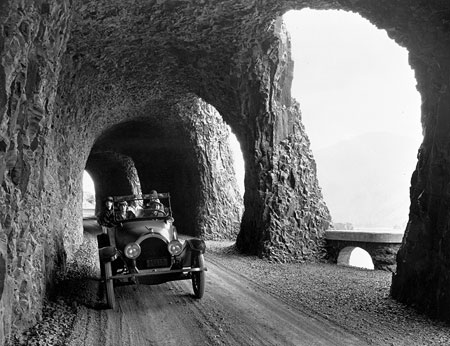
In many ways, the original Mitchell Point Tunnel, with it’s famous “windows” carved in solid basalt, was the scenic and engineering highlight of the old highway. Sadly, the tunnel (along with much of the original highway) was destroyed to allow for freeway widening in 1966.

The original Mitchell Point Tunnel as it appeared around 1920. The tunnel was destroyed to make way for freeway widening in 1966

The original Mitchell Point Tunnel as it appeared around 1920. The tunnel was destroyed to make way for freeway widening in 1966

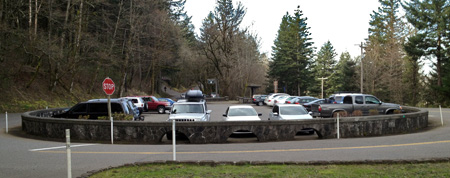
The recent improvements to the Mitchell Point wayside include a redesigned parking lot (complete with native landscaping, bus and bike parking) and a series of handsome stone walls in the Columbia River Highway style that frame the Columbia River overlook. Interpretive history displays are posted in two locations, describing the colorful human history of an area that has now largely reverted to back to nature.

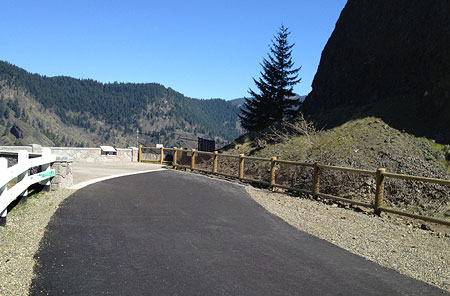
The short walk to the river overlook also gives a glimpse of the planned extension of the HCRH State Trail. As seen in the photo below, the broad paved path is actually a section of the state trail where it approaches the overlook, then bends toward the sheer cliffs at the base of Mitchell Point, ending at a log fence (for now). The proposed tunnel will eventually cut through Mitchell Point here, with a short side-tunnel to a river viewpoint somewhere near the midpoint.

The new section of the HCRH State Trail points toward a planned bicycle and pedestrian tunnel through Mitchell Point

The new section of the HCRH State Trail points toward a planned bicycle and pedestrian tunnel through Mitchell Point

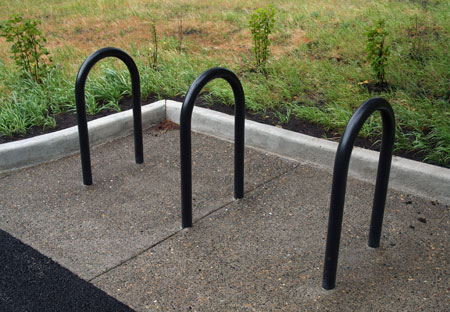
New bicycle racks and native plants are part of the Mitchell Point facelift

New bicycle racks and native plants are part of the Mitchell Point facelift

The improved Mitchell Point wayside also includes a new information kiosk and upgraded restrooms, making this a nearly full-service starting point for hikers — with the sole exception of running water, as none is available at the wayside.

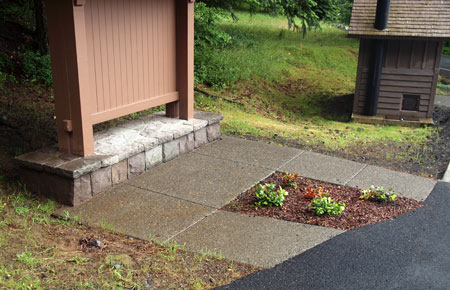
A surprising glitch in the generally excellent attention to detail is the wayside overhaul is an ill-placed square of landscaping in the middle of the paved information kiosk mini-plaza (below). The native salal planted in this tiny square of soil are surely doomed to be trampled by visitors, but more concerning is the impact on accessibility for mobility impaired visitors attempting to avoid this unnecessary obstacle. Fortunately, it’s easily fixed with a few sacks of concrete – hopefully before it becomes a problem.

This refurbished sign kiosk has an unfortunate glitch: an ill-placed patch of landscaping

This refurbished sign kiosk has an unfortunate glitch: an ill-placed patch of landscaping

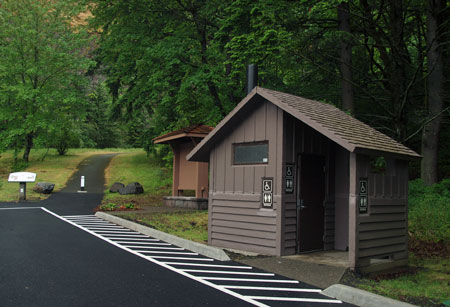
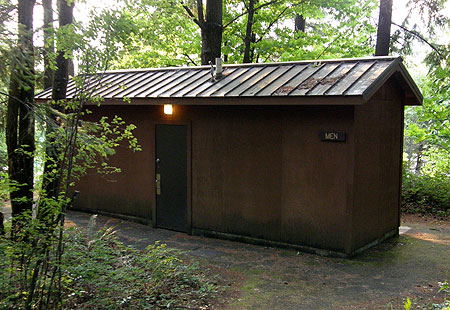
A year-round, accessible restroom completes the upgrade at the Mitchell Point wayside

A year-round, accessible restroom completes the upgrade at the Mitchell Point wayside

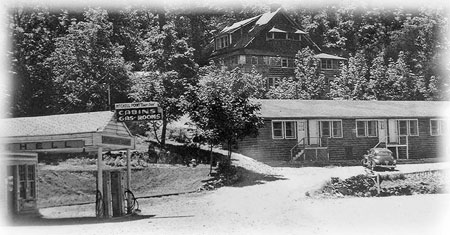
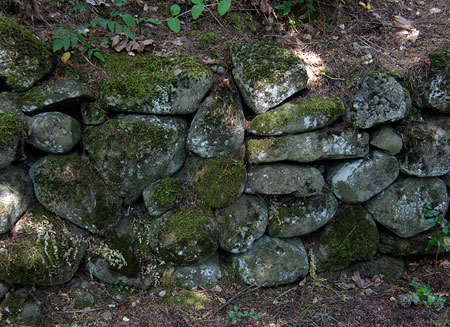
Traces of the rich human history of the area can be seen throughout the Mitchell Point area, and the pair of new interpretive displays help put a face on the early settlements and businesses that once operated here. The history of the Mitchell Point “Tunnel of Many Vistas” at the overlook is excellent, and told with well-known images of this famous structure. But the history of the Little Boy Ranch and its operators found near the parking area is especially welcome, as it helps repeat visitors understand the many traces of old structures and even trees and landscape plants that can still be found sprinkled through the forest.

The Little Boy Ranch motel and cabins at Mitchell Point in the 1930s. The buildings were razed as part of freeway construction in the early 1960s

The Little Boy Ranch motel and cabins at Mitchell Point in the 1930s. The buildings were razed as part of freeway construction in the early 1960s

This 1920s Christmas card from Charles and Helena Parker's Little Boy Ranch featured their children, Charles Jr. and Joan

This 1920s Christmas card from Charles and Helena Parker’s Little Boy Ranch featured their children, Charles Jr. and Joan

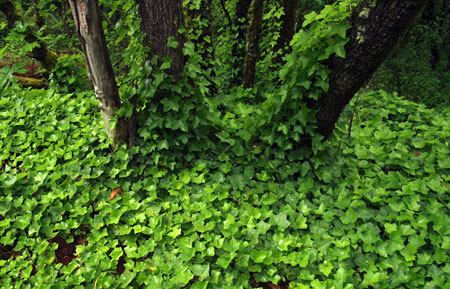
While most of the historical traces at Mitchell Point are subtle and treasured, one is not: English ivy left over from the Little Boy Ranch days is rampant in several sections of the park, and unfortunately, the wayside upgrade didn’t include pulling ivy from the park. This is another oversight that can be easily corrected, as the ivy is mostly confined to the immediate wayside area, and is a good candidate for a volunteer public service projects.

Rampant English ivy is among the unwelcome traces of the Little Boy Ranch era at Mitchell Point

Rampant English ivy is among the unwelcome traces of the Little Boy Ranch era at Mitchell Point

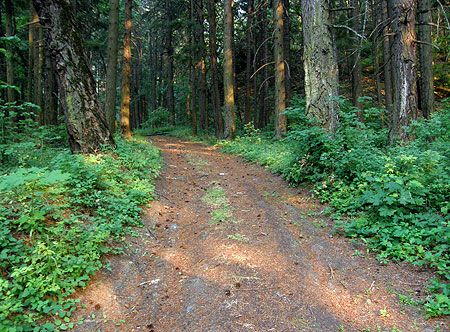
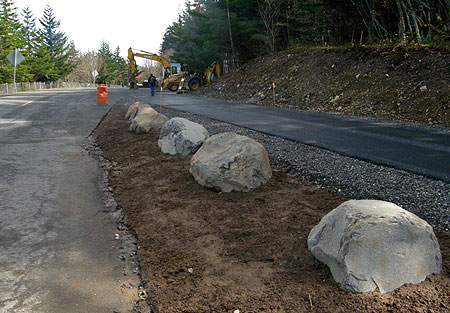
Another surprising gap in the wayside and trailhead upgrade is the lack of signage for the Mitchell Point and Wygant trails that begin here. A few boulders and a bollard barricade have been installed at the old path leading toward the Mitchell Point Trail, but there is still no signage to help visitors navigate the trail (below).

New bollard and boulders, but no sign to mark the Mitchell Point trail?

New bollard and boulders, but no sign to mark the Mitchell Point trail?

Worse, the actual trail to Mitchell Point splits off the paved path as an obscure, unsigned boot path, while the paved route continues (confusingly) to a few picnicking sites (below). This oversight is easily remedied, though there is some question whether OPRD really views the Mitchell Point trail as one of its own, despite the growing use and popularity. Now is good time for the state parks to finally embrace this trail, starting with needed signage.

The formal Mitchell Point Trail is even more obscure, but this is an easily corrected oversight in the OPRD restoration project

The formal Mitchell Point Trail is even more obscure, but this is an easily corrected oversight in the OPRD restoration project

The Wygant Trail fares somewhat better, with an existing HCRH-themed sign posted about 100 yards west of the Mitchell Point wayside, along a surviving segment of the old highway. But better signage at the wayside is needed to help hikers actually find this trail. This is another oversight that is relatively easy to correct, and in this case, could be incorporated into the planned improvements to the HCRH that are coming to this area.

A surviving segment of the old highway serves as the start of the Wygant Trail, though existing signage is obscure

A surviving segment of the old highway serves as the start of the Wygant Trail, though existing signage is obscure

Despite these oversights, the upgrade to the Mitchell Point wayside and trailhead are a big step forward, with excellent attention to detail and continuity with other recently improved parks and waysides in the Gorge. Kudos to the OPRD for their efforts!

The remainder of this article focuses on new trails that could be added to the park, building on existing facilities and the new HCRH State Trail with new hiking loops that explore the area.

Proposal: West Loop Trail

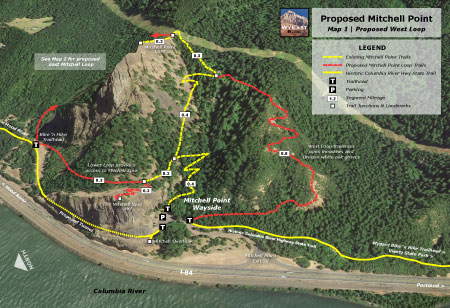
The first leg of an expanded trail system would be a new route traversing a series of open slopes to the west of Mitchell Point, joining the existing Mitchell Point Trail just below the main summit ridge (see map below)

MitchellPointTrails15

[click here to open a large map in a new window]

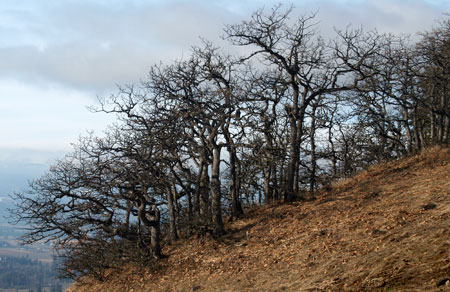
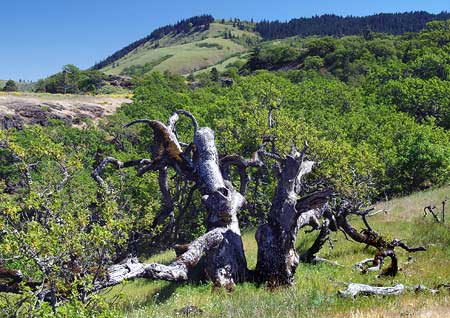
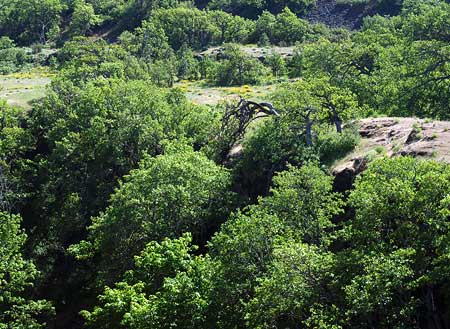
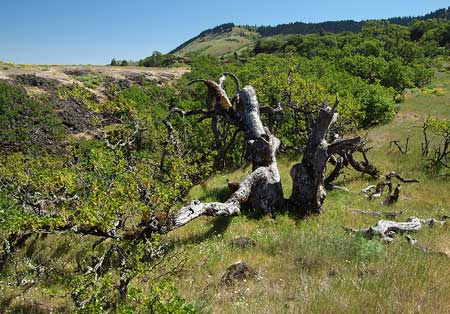
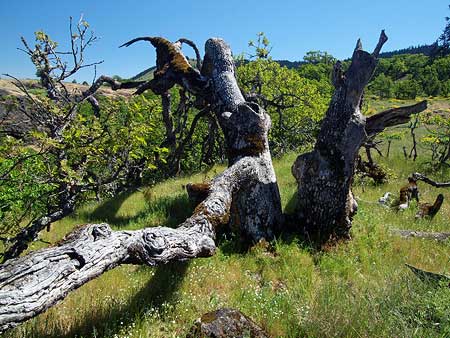
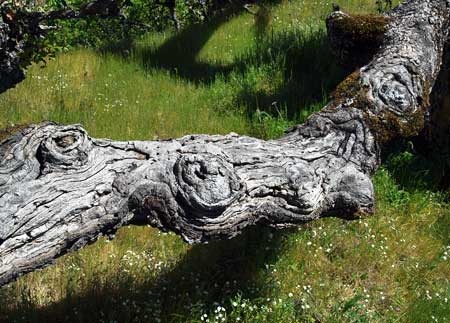
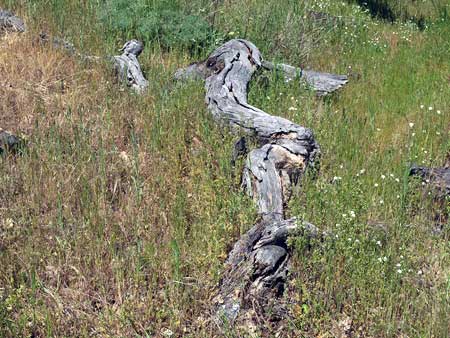
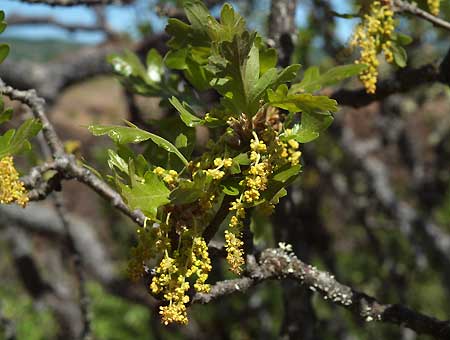
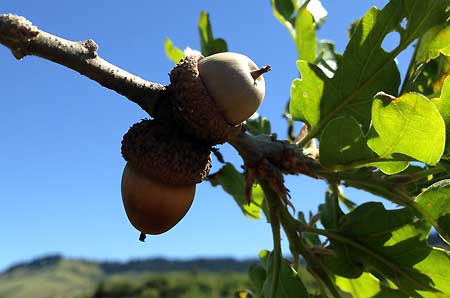
A highlight of this new 0.8 mile trail would be a close-up look at the stunted Oregon white oak groves that somehow survive on the dry, windy slopes here. Though not the western-most stand of oaks in the Gorge, this colony is among the most accessible, and the new trail would provide an opportunity for casual hikers to learn about this unique and fascinating ecosystem.

Oregon white oak in the Gorge often grow in picturesque, stunted groves on the harshest of sites

Oregon white oak in the Gorge often grow in picturesque, stunted groves on the harshest of sites

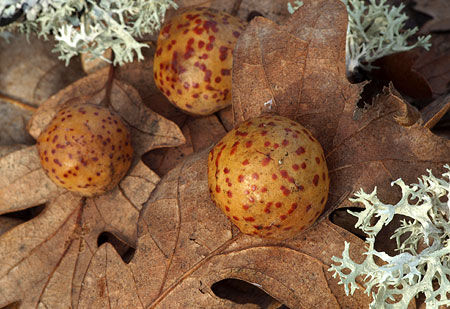
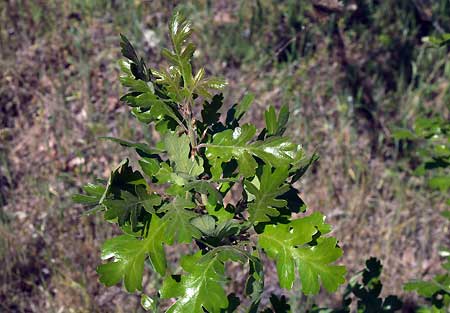
Oak galls are formed by wasp larvae, and are common on Oregon white oak leaves

Oak galls are formed by wasp larvae, and are common on Oregon white oak leaves

This new trail would also be built with a less demanding grade than the existing Mitchell Point Trail, giving less hardy hikers a more manageable option for reaching the summit.

Combined with the existing Mitchell Point Trail, the new would create a 2.6 mile loop for active hikers. Casual hikers and young families could make a shorter hike, with the beautiful oak stands and river views less than one-half mile from the trailhead as the main destination (perhaps with a couple of well-placed trailside benches).

Proposal: East Loop & Mitchell Spur

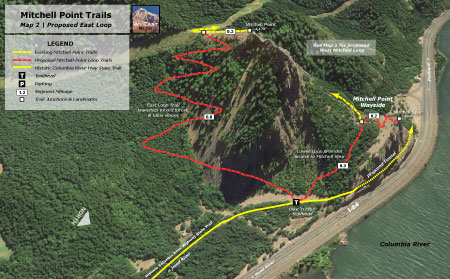
The east slope of Mitchell Point is unknown territory, even to hikers familiar with the area. This part of the proposal includes a new trail connection along the east slope, from the crest of Mitchell Point to the planned HCRH State Trail, creating a loop hike via the proposed new HCRH tunnel (see map, below).

MitchellPointTrails18

[click here to open a large map in a new window]

A lower loop would also be created with an extension of the existing boot path that leads to the foot of Mitchell Spur, the familiar basalt prow that towers over the highway at Mitchell Point. A formal side path would lead to the viewpoint atop the spur, providing another less strenuous alternative for casual hikers to the somewhat challenging Mitchell Point summit trail.

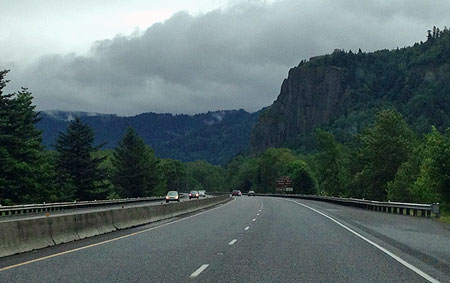
Mitchell Spur (left) is the lower rampart of Mitchell Point (right) in this highway view

Mitchell Spur (left) is the lower rampart of Mitchell Point (right) in this highway view

Mitchell Point looms above in this view from Mitchell Spur

Mitchell Point looms above in this view from Mitchell Spur

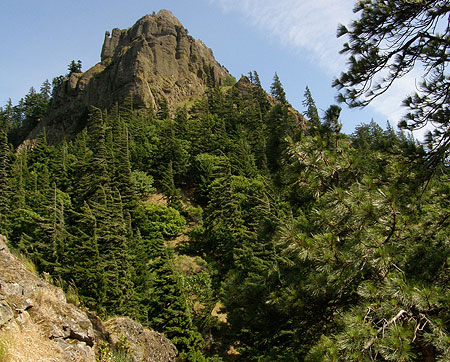
The east loop would join the Mitchell Point trail at this point along the summit ridge

The east loop would join the Mitchell Point trail at this point along the summit ridge

Combined with the existing Mitchell Point trail, the proposed East Loop would create a 3.6 mile hike, including stops at the summits of Mitchell Point and Mitchell Spur. Another option would be a loop using both the east and west trail proposals, a 3.8 mile round trip that would avoid the somewhat rugged talus section of the existing Mitchell Point trail altogether. Other loops from the Mitchell Point trailhead would also be possible, including the ability to follow the planned extension of the HCRH State Trail.

Yet another possibility that comes with the completion of the HCRH State Trail is the idea of a bike-and-hike trailhead for the proposed East Loop trail, where bicycle parking could be provided to allow cyclists to ride and park at the base of the trail. This concept has great potential for other trails that will eventually stub out at the completed HCRH State Trail — including the Wygant Trail in the Mitchell Point area.

What would it take?

The proposals in this article focus on relatively simple, affordable trail projects. Each of the proposed trail segments build on existing trailhead facilities and planned HCRH improvements in the area, while providing a significantly expanded series of hiking opportunities.

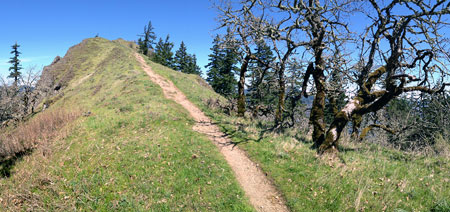
Sweeping river vistas from the summit leg of the Mitchell Point trail

Sweeping river vistas from the summit leg of the Mitchell Point trail

The proposals also lend themselves to volunteer construction, as the easy access from Portland and Hood River would allow public agencies and trail advocates in the region to easily organize volunteer crews to clear and build trails incrementally.

Most importantly, the OPRD is now in the process of updating its 1994 master plan for the Columbia Gorge, and it’s a crucial opportunity to bring new trail ideas into the plan! The OPRD recognizes the demand for new trails in the area, and is actively seeking ideas for projects that are both affordable and ecologically sustainable. The proposals in this article meet both tests, and ought to be included in the updated plan.

What You Can Do!

First, take a look at the Gorge Parks Plan website — our state recreation planners have done an exceptional job scoping the state of our Gorge parks as a starting point for updating the 1994 plan.

Next, weigh in on why new trails are important in the Gorge — and here are some of the proposals posted in this blog as a starting point:

Angels Rest Loop Proposal

Bridal Veil Canyon Proposal

Latourell Loop Makeover Proposal

Viento Bluff Trails Proposal

Mitchell Point Trails Proposal

Finally, consider signing up as a subscriber to the Gorge Parks Plan blog to stay informed. A surprisingly small number of dedicated citizens have been involved thus far in this public process, so you have an opportunity to make a real impact! More information on the Gorge planning effort to come in this blog, as well.

And as always, thanks for doing your part to advocate for the Gorge!

2014 Mount Hood National Park Calendar

2014Calendar00a

Each year at about this time I assemble the Mount Hood National Park Scenic Calendar. The proceeds are modest, but do help support the Mount Hood National Park Campaign website, WyEast Blog and related project expenses. But the main purpose is to simply promote the national park concept by making the case for the campaign with pictures.

What the calendar looks like - oversized 11x17” pages you can actually use!

What the calendar looks like – oversized 11×17” pages you can actually use!

I’ve published the calendars through CafePress since 2004, so this year’s calendar marks the tenth edition. All of the photos in the calendar are from trips and trails I’ve explored over the past year.

I get a surprising number of questions about the photos, so in addition to simply announcing the 2014 calendar, this article tells a bit of the story behind the new images.

The 2014 Scenes

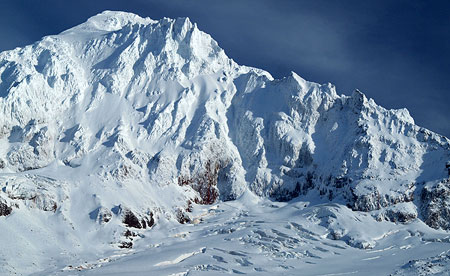
Cover: Sandy Headwall and Glacier from McGee Ridge

Cover: Sandy Headwall and Glacier from McGee Ridge

The cover photo of the Sandy Glacier headwall is really a nod to a chance encounter I had with Brent McGregor, the fearless cave explorer profiled in the Thin Ice: Exploring Mount Hood’s Glacier Caves, a recent Oregon Public Broadcasting feature. I had just posted a WyEast blog article on the program a few days prior, and happened to run into Brent and his climbing partner, Eric Guth, on the Timberline Trail that day in October.

2014Calendar02

Brent and Eric were on their way down from spending the night in the Snow Dragon glacier cave, and provided me with an amazing personal account of their adventures inside the caves. I also learned a bit of the glacier cave geography from the spot where we met atop McGee Ridge. The cover image for the calendar was taken from that spot awhile after the (now famous) ice cave explorers continued down the trail. A most memorable evening!

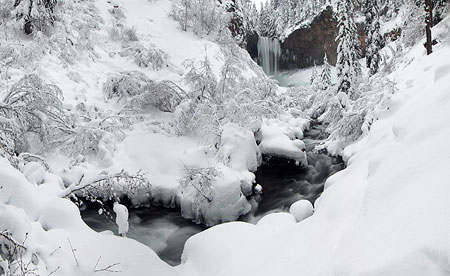
January: Tamanawas Falls dressed in white

January: Tamanawas Falls dressed in white

The monthly scenes begin with a snowy afternoon at Tamanawas Falls in the January image (above). The photo was taken in December 2013, and stitched together from three separate photos — the first of three such composite images in this year’s calendar.

The conditions were perfect that day, and a bit deceptive, as this was the first big snowfall of the season — and thus we was able to simply hike up the trail without snowshoes, albeit with the aid of boot spikes.

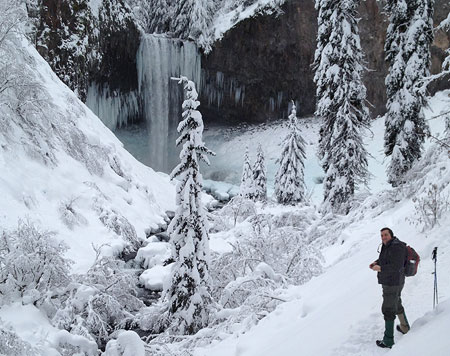
Brother-in-law David taking in the magic at Tamanawas

Brother-in-law David taking in the magic at Tamanawas

My brother-in-law David joined me for the hike to Tamanawas Falls, celebrating his return to Oregon after spending the past thirty years living in distant places, far from the life he knew growing up here among tall trees, big mountains and countless waterfalls – the best kind of reunion!

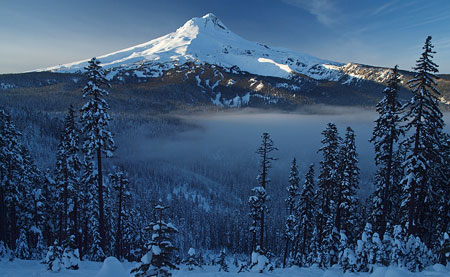
The February image (below) is an evening scene from one of the viewpoints along the historic Bennett Pass Road. The blanket of valley fog rolled in just as the sun dropped behind the mountain ridges, making for an especially peaceful scene.

February: WyEast's under-appreciated southeast side from near Bennett Pass

February: WyEast’s under-appreciated southeast side from near Bennett Pass

Ironically, the story behind the image is anything but quiet, as I was visiting Bennett Pass on New Years Day — apparently, along with the rest of Portland area population!

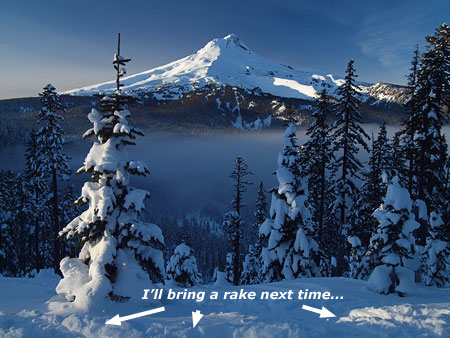
A “pristine” framing of this image suffered as a result, as the fresh blanket of snow from the previous night had already been heavily trampled by the small army of skiers and snowshoers (and their dogs) that day! Otherwise, I would have loved to included this image (below), with a pretty little noble fir in the foreground in the calendar. Maybe I should bring along a rake next time..?

Heavy ski and snowshoe traffic on New Years Day!

Heavy ski and snowshoe traffic on New Years Day!

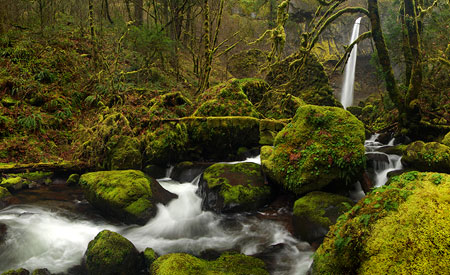
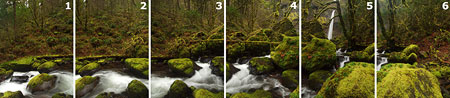
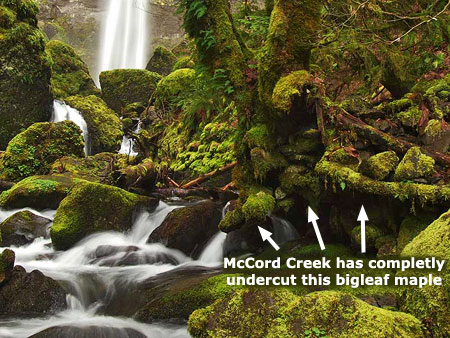
For the March image, I picked a mid-winter Gorge scene captured at Elowah Falls on McCord Creek, just west of Cascade Locks (below). This is another composite image, made from a total of six photos, with the goal of giving a panoramic feel that matches the immensity of the setting.

This is the finished image:

March: Elowah Falls in late winter hues

March: Elowah Falls in late winter hues

The six separate images look like this before merging:

Six photos make up the original panorama at Elowah

Six photos make up the original panorama at Elowah

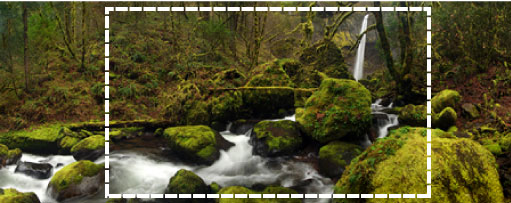
Once merged, I cropped the final image to fit the dimensions of the calendar:

The calendar image was then snipped from the composite image

The calendar image was then snipped from the composite image

There’s a bit of a story to this scene, too: the graceful, multi-trunked bigleaf maple framing the falls will soon succumb to the power of McCord Creek, as the stream has recently eroded the bank to the point that the main trunk of the tree is hovering over the creek, in mid-air (below).

Change is coming to this maple along McCord Creek

Change is coming to this maple along McCord Creek

This section of McCord Creek has suddenly experienced a lot of erosion in the past few years, so this is part of a larger change happening to this iconic spot – much more to come as we watch the power of nature at work, and a reminder that change is constant in the natural landscape!

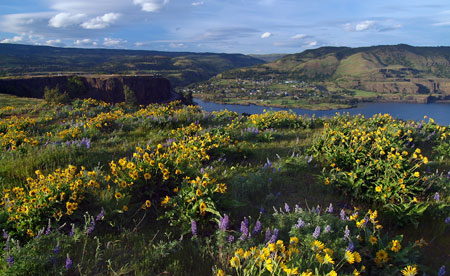
For April, I picked a familiar spot in the Columbia Gorge at Rowena Crest (below), where the blooming lupine and arrowleaf balsamroot frame the river and town of Lyle in the distance. It was a typically blustery day in the Gorge last spring when I visit this spot, and though the overall bloom in the east Gorge in 2013 was somewhat disappointing, the McCall Preserve at Rowena still had a very good flower show.

April: blustery winds at Rowena Crest..? Naturally!

April: blustery winds at Rowena Crest..? Naturally!

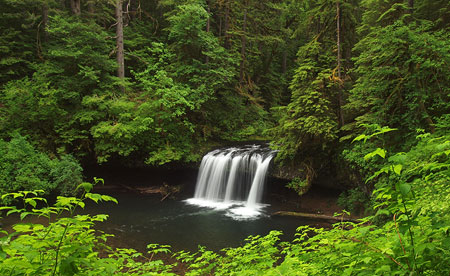
The May image (below) is from the wonderful little loop trail at Butte Creek Falls, an gorgeous little canyon in the otherwise heavily logged foothills southwest of Mount Hood. This view shows the upper falls, a quiet, understated cascade that hides an impressive cave tucked behind the falls. The main falls of Butte Creek if just downstream.

May: pretty Upper Butte Creek Falls is tucked away in serious logging country

May: pretty Upper Butte Creek Falls is tucked away in serious logging country

I enjoy this trail because of the contrasts, as the approach to the trailhead passes through some of the most horrendously cut over timber corporation holdings in Oregon. By comparison, the vibrant, mossy canyon holding Butte Creek is a reminder of what we’ve lost — and hopefully will restore, someday.

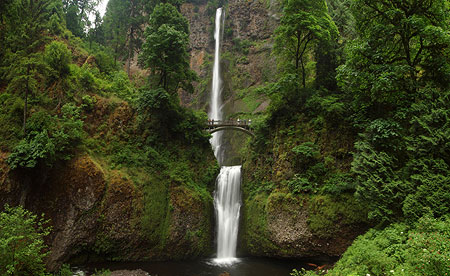
Spring is waterfall season in Oregon, so the June image stays with the theme, this time countering little-known Upper Butte Creek Falls with the queen of all Oregon cascades, Multnomah Falls (below).

June: a composite photo from a very busy viewpoint

June: a composite photo from a very busy viewpoint

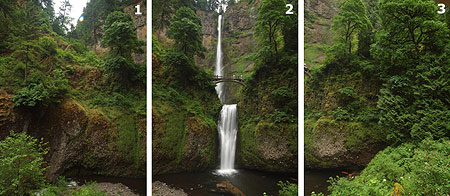
This image is the third blended photo in the 2014 calendar, this time composed of three separate images (below) taken at the perennially crowded lower overlook along the Multnomah Falls trail. As with the other composite images, my goal was to give broader context to the scene — in this case, the massive array of cliffs that surround Multnomah Falls.

Three photos came together for the Multnomah Falls image

Three photos came together for the Multnomah Falls image

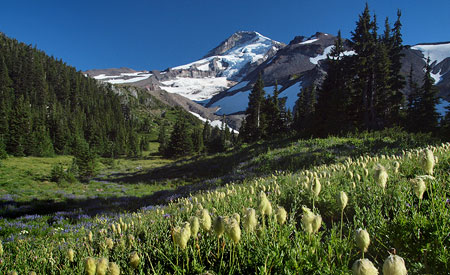
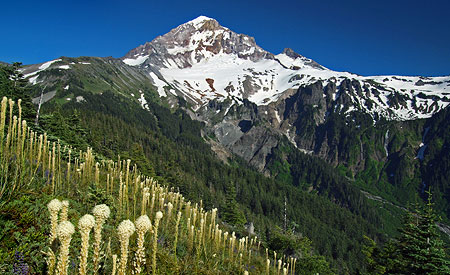
As always, mountain scenes fill the summer months of the calendar, starting with a view of Mount Hood’s towering west face for July (below). This image was captured in mid-July, and though a bit late for the full glory of the beargrass bloom, it does capture the final phase of the bloom. This scene is from one of the hanging meadows high on the shoulder of McGee Ridge, looking into the valley of the Muddy Fork.
July: beargrass bloom in the hanging meadows above the Muddy Fork

July: beargrass bloom in the hanging meadows above the Muddy Fork

For the August calendar scene, I chose an image from a hike to Elk Cove. It’s a bit of a repeat from past calendars, but one of my (and most everyone else, I suspect) favorite views of the mountain. The alpine bloom came late to Elk Cove this year, and still hadn’t peaked when I shot this photo in early August:

August: my annual pilgrimage to "the view" from Elk Cove

August: my annual pilgrimage to “the view” from Elk Cove

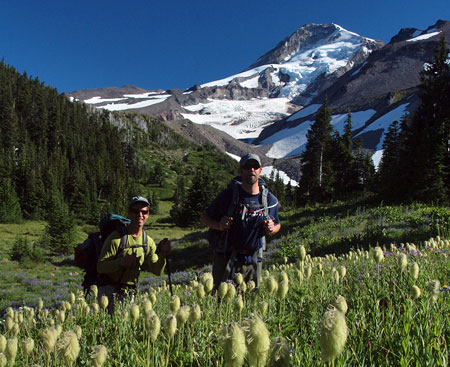
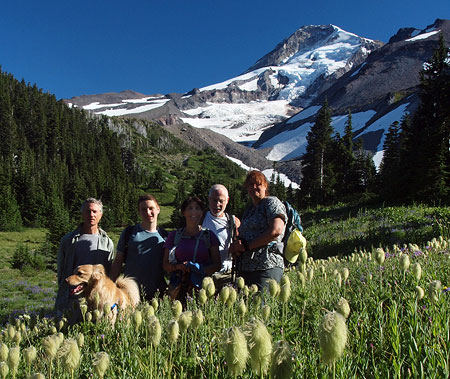
I’ve shot this scene many times, but on this particular trip several hikers passed by while I waited for the afternoon light to soften. Two groups stopped to chat and pose for me, including a pair of hiking buddies doing the Timberline Trail circuit and a family from Olympia, Washington visiting Elk Cove for the first time (below).

Round-the-mountain hikers arriving for a night at Elk Cove

Round-the-mountain hikers arriving for a night at Elk Cove

This group traveled from Olympia to visit Elk Cove

This group traveled from Olympia to visit Elk Cove

Both shots let out a little secret about my favorite photo spot at Elk Cove: it’s only about ten feet off the Timberline Trail, which crosses right through the drift of western pasque flower in the foreground!

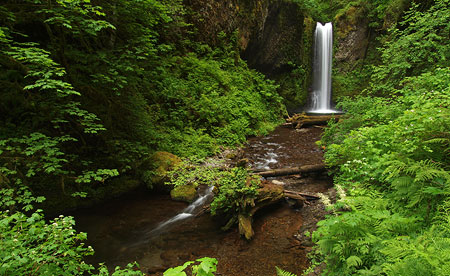
For the September scene, I picked an image of Wiesendanger Falls on Multnomah Creek (below), named for Albert Wiesendanger, a pioneering forester in the Columbia River Gorge.

September: Albert Wiesendanger earned a place name with his falls on Multnomah Creek

September: Albert Wiesendanger earned a place name with his falls on Multnomah Creek

Most hikers are (understandably) looking upstream, toward Wiesendanger Falls, when they walk through Dutchman’s Tunnel (not a true tunnel, but more of a ledge carved into the basalt cliff) along Multnomah Creek, just below the falls.

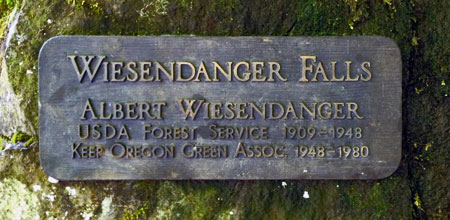
Thus, few see this inconspicuous bronze plaque at the south end of the tunnel honoring Albert Wiesendanger:

2014Calendar20

Wiesendanger not only had an important role in shaping of the trails and campgrounds we now enjoy in the Columbia River Gorge, he also went on to lead the Keep Oregon Green campaign. He is a little-known giant in our local history, and deserves to have his story more widely told.

The October scene isn’t from a trail, but rather, a somewhat obscure dirt road high on the shoulder of Middle Mountain (below), in the Hood River Valley. I learned of this spot several years ago, and often make the bumpy side trip if I’m passing through in early evening — it’s one of the more stunning views in the area, showing off the spectacular Upper Hood River Valley at its finest.

October: The upper Hood River Valley from a lesser-known viewpoint on Middle Mountain

October: The upper Hood River Valley from a lesser-known viewpoint on Middle Mountain

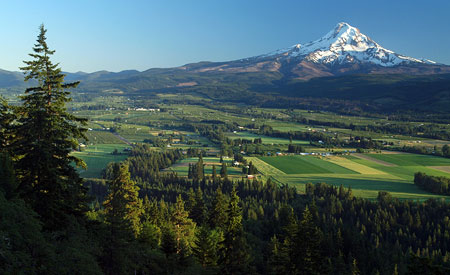
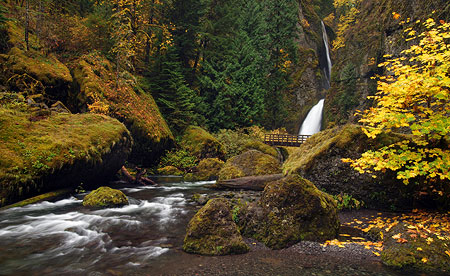
For November, I chose a photo of Wahclella Falls on Tanner Creek taken a year ago (below), in early November 2012. Why? Because the monsoons we experienced in September of this year really did a number on the fall colors. Foliage was battered by the winter-like weather, and trees were deprived of the normal autumn draught conditions that help put the brilliance in our fall.

November: Tanner Creek as it would normally appear in early November

November: Tanner Creek as it would normally appear in early November

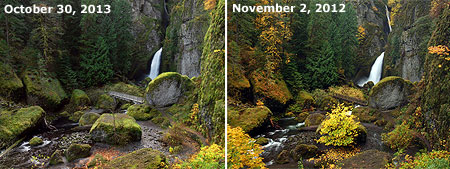
The result of our cold, wet September was a very early leaf fall and generally muted fall colors, as can be seen in these views of Wahclella Falls taken from the same spot at almost the same time of year in 2012 and 2013:

Our rough September weather in 2013 was devastating to autumn foliage

Our rough September weather in 2013 was devastating to autumn foliage

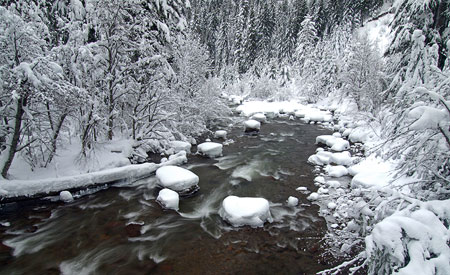
Finally, a winter scene along the East Fork of the Hood River (below) wraps up the 2014 calendar as the December image. This photograph was taken from the footbridge leading to Cold Spring Creek and Tamanawas Falls, and was captured on the same day as the opening January image in this year’s calendar.

December: The East Fork Hood River in winter

December: The East Fork Hood River in winter

Among the missing elements in this year’s calendar are scenes from the Cloud Cap area and Cooper Spur, on Mount Hood’s north side. This is largely due to the indefinite closure of the historic Cloud Cap Road, abruptly announced by the Forest Service earlier this year.

This road closure had a big impact on recreation. While it’s possible for seasoned hikers to make the much longer trek from the nearby Tilly Jane trailhead, for most (especially families and less active hikers), it means that Cooper Spur and the spectacular views of the Eliot Glacier will have to wait until another year.

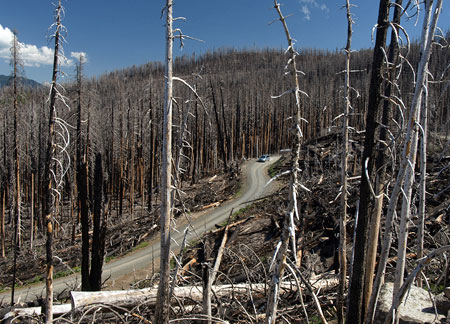
Cloud Cap Road in 2010: salvage logging slash lines the road two years after the Gnarl Fire swept through in August 2008

Cloud Cap Road in 2010: salvage logging slash lines the road two years after the Gnarl Fire swept through in August 2008

The reason for the Cloud Cap Road closure is a bit more worrisome: five years after the Gnarl Fire roared through the area — and four years after an extensive salvage logging operation toppled hundreds of “hazard” trees along the road — the Forest Service has decided that standing trees must once again be felled in order to “protect the public”.

Oddly enough, the road remains open to hikers, skiers and cyclists — apparently because the hazardous trees only fall on cars? We can only hope that the scars from this latest “improvement” don’t further degrade the historic road, when huge piles of slash were left behind, where they still line the old road.

One that didn’t make it…

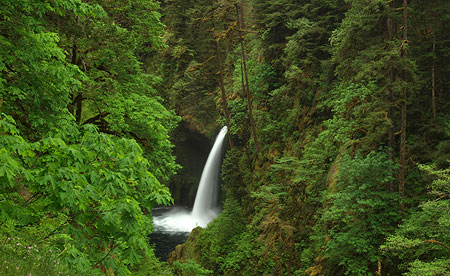
Metlako Falls (from the wrong side of the fence)

Metlako Falls (from the wrong side of the fence)

The above view of Metlako Falls on Eagle Creek was in my folder of favorite 2013 images to include in the annual calendar, but I decided to save the scene for another year. Why? Because in July, I headed up a mighty (okay, two-man) Trailkeepers of Oregon crew to clear out the brush that has blocked safe viewing of Metlako Falls for many years.

Previously, the only way to capture a photo like the one above, photographers had to step OVER the cable hand rail, and stand perilously close to the 200-foot brink dropping into the Eagle Creek Gorge. The hazard to hikers was bad enough, but the “sweet spot” for photos was so over-used that it was starting to erode the ground underneath it, potentially destabilizing the rest of the cliff-top Metlako Falls overlook.

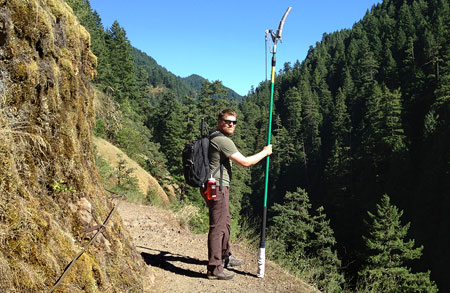
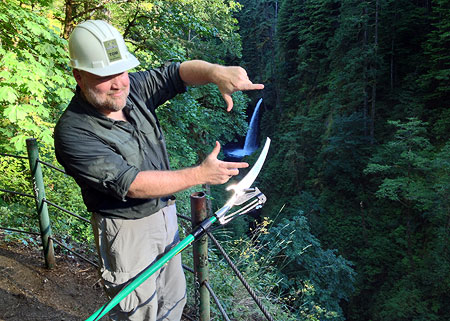
Chris Alley was one half of the TKO crew, and the only hiker with a 16-foot pole pruner on the Eagle Creek Trail that day!

Chris Alley was one half of the TKO crew, and the only hiker with a 16-foot pole pruner on the Eagle Creek Trail that day!

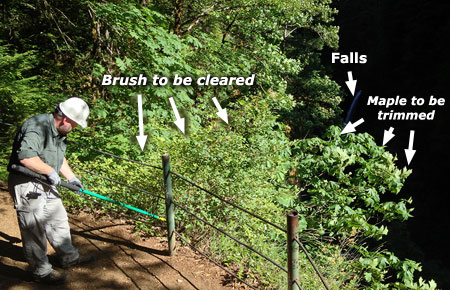
The solution was straightforward: the Gorge unit of the Forest Service approved our plan to trim the offending brush using a 16-foot pole saw. This kept us safely on the uphill side of the cable fence, with just enough reach to clip the brush.

The task at hand: trim overgrown brush and maple limbs

The task at hand: trim overgrown brush and maple limbs

With my Trailkeepers partner Chris Alley along for the project, we made quick work of the offending branches on a rather hot, sticky day. After a couple hours of sawing and lopping, Metlako Falls was once again safely in view! This is a project I’d wanted to do for awhile, so it was great to finally have it sanctioned as a Trailkeepers of Oregon project.

The author: "I can see clearly now (the brush is gone)!"

The author: “I can see clearly now (the brush is gone)!”

Now, I’m looking forward to next spring, when I’ll head up there during the waterfall prime time to re-capture the scene — safely, this time! I’ve already been back this year, and enjoyed seeing casual hikers admiring the unobstructed falls, snapping photos on their iPhones.
_________________

The thirteen images I chose for the 2014 calendar are from a few thousand images I’ve taken this year on close to 50 outings to Mount Hood and the Gorge! As always, the magnificent scenery only strengthened my conviction that Mount Hood should (and will!) be set aside as a National Park! Hopefully, the scenes in the calendar continue to make the case, as well.

How can you get one?

The new calendars are available online:

2014 Mount Hood National Park Calendar at CafePress

They are large and functional, measuring 17” across by 22” tall when hung, with plenty of room for writing notes and scheduling activities. CafePress packages them carefully, with each calendar sealed against a corrugated cardboard backing for support. You can also order them with gift wrapping at additional charge.

The calendars sell for $29.99 + shipping, with about 25% of the proceeds going to support the Mount Hood National Park Campaign. They make terrific stocking stuffers (…although you’ll need an 11×17” stocking…), and CafePress now makes it even easier by offering PayPal as an option.

And as always, thanks for your support of the blog and the campaign!

Restoring the Sahalie Falls Bridge

East Fork Bridge at Sahalie Falls as it appears from the modern Loop Highway

East Fork Bridge at Sahalie Falls as it appears from the modern Loop Highway

After years of delay and public agency wrangling, the long-awaited restoration of the East Fork Bridge at Sahalie Falls (henceforth simply called the “Sahalie Falls Bridge” in this article) began this summer. The project is advancing under a division of the Federal Highway Administration (FHWA) responsible for roads on public lands, and is scheduled for completion this year.

The Sahalie Falls Bridge was constructed as part of the final leg of the Mount Hood Loop Highway in the late 1920s. The bridge was completed in 1928, and is the most dramatic nod to the Samuel Lancaster’s Columbia River Highway on the Mount Hood portion of the loop highway.

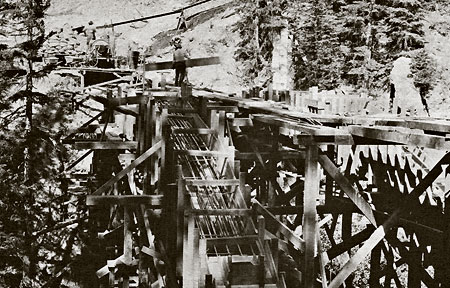
Construction of the East Fork Bridge in 1928 (USFS)

Construction of the East Fork Bridge in 1928 (USFS)

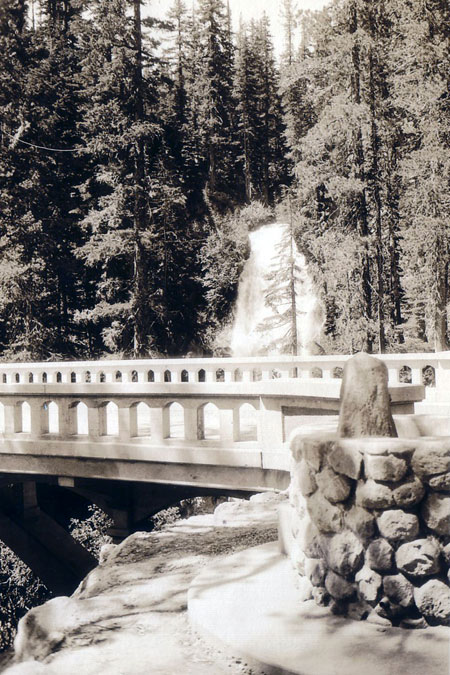
The structure was designed by federal lands bridge engineer H.R. Angwin as a graceful arch, spanning the East Fork directly in front of Sahalie Falls, with decorative railings and sidewalks built to allow travelers to stop and take in the inspiring views.

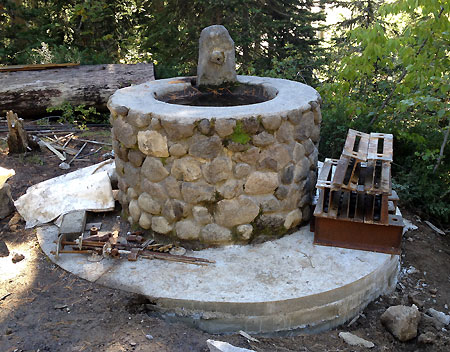
Complementing the idyllic setting is a cobblestone-faced drinking fountain, installed at the east end of the bridge. The fountain once provided a continuous supply of ice-cold mountain water to visitors, and was one of three original stone fountains placed along the Mount Hood portion of the old loop highway.

Sparkling new Sahalie Falls bridge and fountain in the early 1930s

Sparkling new Sahalie Falls bridge and fountain in the early 1930s

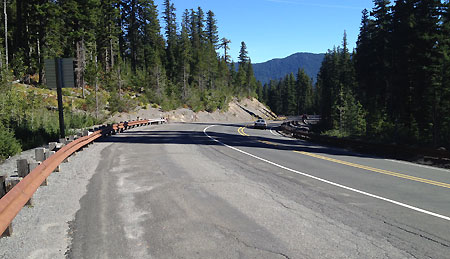
The bridge carried loop highway traffic well into the 1950s, until the modern-day Highway 35 was built, bypassing this section of the old road. The new “straightened” highway not only deprived travelers of seeing Sahalie Falls, it also skipped the mountain views across beautiful Hood River Meadows, just east of the falls on the old road.

Today, this bypassed section of the old highway remains open to the public (when snow-free) and will be drivable again once the bridge restoration is complete.

Who was H.R. Angwin?

One of the mysteries of the old bridge at Sahalie Falls is the life of the designer and builder, Henry Raymond (H.R.) Angwin. Public records show him to be the Senior Bridge Engineer in the San Francisco office for the U.S. Bureau of Public Roads from the 1930s through the 1950s. Over the span of his career, Angwin designed dozens of bridges in the western states.

Oakland Tribune Sunday, September 30, 1917

BETROTHALS HOME WEDDING

In a picturesque setting of pink, Miss Neville Stevenson became the bride last night of Henry Raymond Angwin. Eighty relatives [witnessed the] ceremony read by Dr. John Stevenson and William Angwin.

The bride wore a smart frock of white and silver with a conventional tulle veil and orange blossoms, and carried a shower bouquet of lilies of the valley. Her attendant, Miss [Mabel] Gustaffson, blonde as the bride is dark, was in pretty contrast to pink satin and tulle. The bride’s gown was taupe broadcloth with a chic taupe hat white fox furs accenting the tulle.

Mr. and Mrs. Angwin [will] leave for an extended trip through the east, visiting the interesting cities en route. The bride is the daughter of Mr. and Mrs. A. V. Stevenson, whose home on Newton Street was the scene of the pretty service. Returning to Oakland, the young people will take an apartment in the Piedmont.

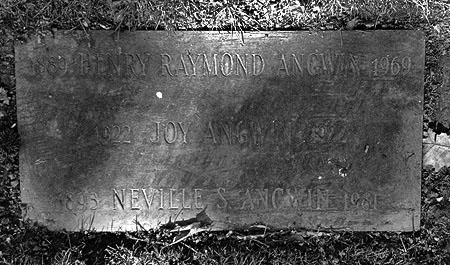
H.R. Angwin was born in 1889, graduated from Oakland High School in California in January 1907, and married Neville Stevenson ten years later, in 1917. They had been married 52 years when H.R. Angwin died in 1969. Neville Angwin died twelve years later, in 1981.

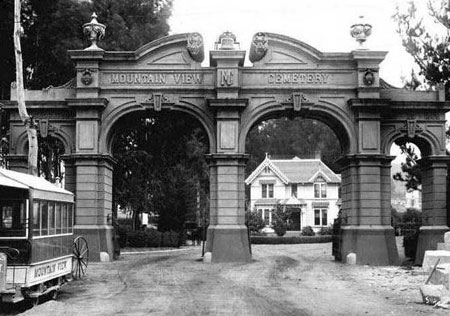
The Angwins had at least two children, Joy and Robert. Joy died as an infant, and is buried at Mountain View Cemetery in Oakland with her parents.

Mountain View Cemetery in Oakland, resting place of the Angwins (Wikimedia)

Mountain View Cemetery in Oakland, resting place of the Angwins (Wikimedia)

Cemetery marker for Henry, Neville and Joy Angwin (BillionGraves.com)

Cemetery marker for Henry, Neville and Joy Angwin (BillionGraves.com)

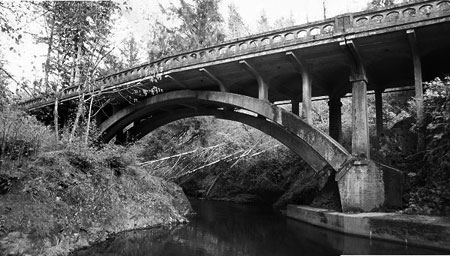
H.R. Angwin designed and built a number of familiar Oregon bridges during his tenure as a federal bridge engineer. The East Fork Bridge at Sahalie Falls was one of his first, completed in 1928. Two years later, Angwin designed and built the larger, and equally graceful Salmon River Bridge in Lincoln County. This hard-working gem also survives today, carrying heavy traffic on Highway 18 to the Oregon Coast.

H.R. Angwin's Salmon River Bridge in Lincoln County

H.R. Angwin’s Salmon River Bridge in Lincoln County

Several other Angwin bridges are scattered across Oregon, but most notable in the Mount Hood area are the steel truss bridges built along the Clackamas River Highway in the 1950s: Carter Bridge, Armstrong Bridge, Whitewater Bridge and Cripple Creek bridge all continue to carry traffic today.

(Author’s note: sadly, not much has been written about H.R. Angwin’s long career as a federal bridge builder, so this part of the article is included in hopes of improving awareness of his contributions, and perhaps inspiring further accounts of life)

The 2013 Restoration Project

Frost damage to the railings on the Sahalie Falls Bridge in 2009

Frost damage to the railings on the Sahalie Falls Bridge in 2009

The Sahalie Falls Bridge had begun to show signs of serious deterioration by the late 1990s, and by the mid-2000s, whole chunks of the north railing were breaking loose — sadly, helped along by vandals pulling at the exposed rebar.

Railing Damage on the East Fork Bridge in 2009

Railing Damage on the East Fork Bridge in 2009

By 2008, the Oregon Department of Transportation (ODOT) had blocked vehicle access to the bridge, and a project was proposed in the state highway budget to restore the bridge. The original ODOT restoration project later evolved to become a FHWA project by 2011.

The restoration focuses on three areas of needed repair: (1) rebuilding the approach abutments on both ends of the bridge, (2) replacing the heavily damaged north railing cap and (3) restoring the footing on the historic fountain at the east end of the bridge (there may be other repairs planned, but there is little information available for this project, so this list covers the repairs underway as of October of this year).

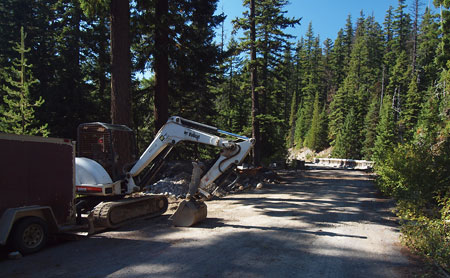
Construction at the old bridge was finally in full swing in September 2013

Construction at the old bridge was finally in full swing in September 2013

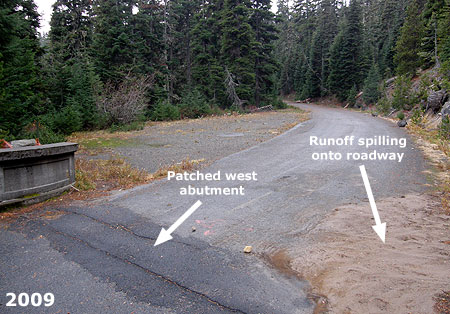
Restoring the bridge abutments involves pouring new reinforced concrete footings at each end of the bridge span and improving surface drainage at the west end to direct storm runoff away from the bridge. The gravel pullouts at both ends of the bridge also appear due for grading and resurfacing as part of the project, as they currently serve as construction staging areas.

The following images show the recent drainage work at the west end, along the approach to the west bridge abutment (as of mid-October), including a recently installed culvert (under the wet fill in the first photo) to address the drainage issues apparent in the earlier 2009 photo (second photo):

Major drainage work is underway as part of reconstructing the west bridge abutment

Major drainage work is underway as part of reconstructing the west bridge abutment

Repeated repairs to the abutment and debris washed onto the roadway is apparent in this 2009 view of the west approach to the bridge

Repeated repairs to the abutment and debris washed onto the roadway is apparent in this 2009 view of the west approach to the bridge

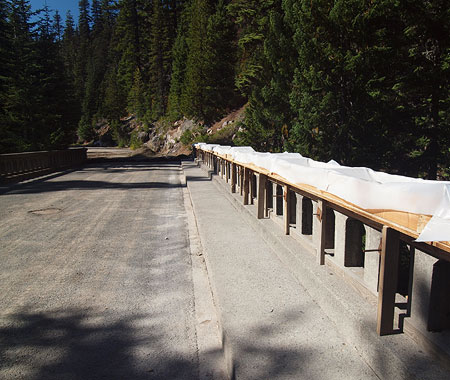
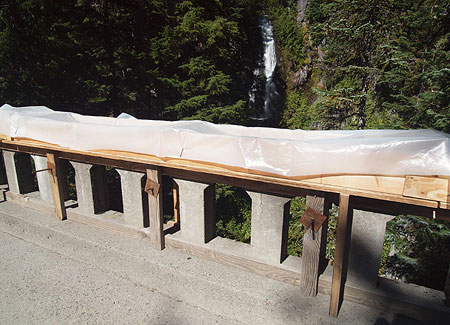
Repairs to the north railing cap extend for the full length of the bridge, with the new cap seated on original concrete railings. As of mid-October, the forms for the new cap had been constructed and were ready to be poured, presumably with concrete, topped by sand mortar. The next series of images show more detail of the railing cap replacement:

Forms in place for pouring a new cap along the north railing

Forms in place for pouring a new cap along the north railing

The forms for the new caps are secured from below with screw clamps

The forms for the new caps are secured from below with screw clamps

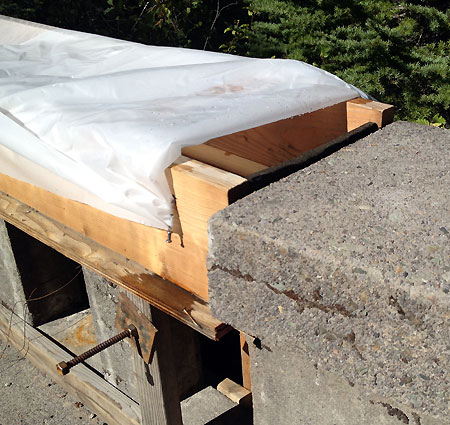
Close-up view of the wood forms constructed for the new railing cap

Close-up view of the wood forms constructed for the new railing cap

A peek inside the railing caps (below) shows careful attention to original design details, including quarter-round trim along the outer edges. New reinforcing rods are wired to the original rebar posts embedded in the rails.

When the new caps are poured, masons will use a screed (board) cut with a low arch to repeat the slightly curved top seen in the original cap. The plastic sheeting attached to the forms will be secured over the newly poured caps to slow the curing process to ensure a strong set.

A peek into the railing cap forms shows careful attention to original design details

A peek into the railing cap forms shows careful attention to original design details

In a nearby pile of demolition rubble, chunks of the old railing cap show the quarter round detail that follows the outer edge of the caps

In a nearby pile of demolition rubble, chunks of the old railing cap show the quarter round detail that follows the outer edge of the caps

The south railing is not part of the restoration project, apparently because of its relatively sound condition

The south railing is not part of the restoration project, apparently because of its relatively sound condition

The third element of the Sahalie Falls Bridge project is replacement of a portion of the concrete footing that supports the historic cobble-faced fountain. In the 2009 photo (below) you can see where a section of the fountain base facing the East Fork (behind the fountain) had sunk toward the creek over time, threatening the stability of the fountain.

The sunken east abutment and partially sunken footing on the old fountain can be seen in this 2009 view

The sunken east abutment and partially sunken footing on the old fountain can be seen in this 2009 view

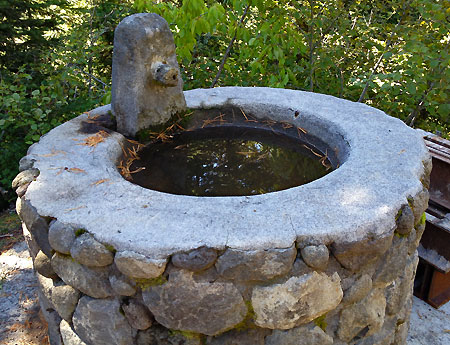
The bowl and rim of the old fountain were restored at some point in the more recent past, and are not part of the current project. The fountain is one of three that survive along the loop highway. The fountain at Buzzard Point still functions, while the fountains at Sahalie Falls and Sherwood Campground (below) are no longer operational and simply serve as rain basins.

The bowl and rim of the fountain were restored at some point in the more recent past

The bowl and rim of the fountain were restored at some point in the more recent past

The three historic Mount Hood Loop fountains, compared

The three historic Mount Hood Loop fountains, compared

[Click here for a larger comparison photo]

This view shows the new concrete footing in place on downslope side of the old fountain

This view shows the new concrete footing in place on downslope side of the old fountain

Crews saved this piece of the old fountain footing -- perhaps to be repurposed as a bench?

Crews saved this piece of the old fountain footing — perhaps to be repurposed as a bench?

Once the restoration project is complete, the Sahalie Falls section of the old loop will re-open to traffic. For the past decade or so, the route has been signed as one-way at the west end, where it connects to the Bennett Pass interchange, so the best way to explore the old highway is follow the signs to Hood River Meadows, then turn left onto the old road before reaching the Meadows resort parking.

Celebrating the Historic Sahalie Falls Bridge

Now that the restoration work is finally underway, the stage is set for some much-needed visitor improvements to the Sahalie Falls area. The view of the falls from the historic bridge is missed by too many travelers, and the odd near-miss with the Umbrella Falls trail (just 100 yards from the bridge, but with no trail connection) has resulted in some messy boot paths formed by hikers attempting to see Sahalie Falls.

This proposal would address both issues, and make it easier to visit the old bridge and falls, whether as a spur from nearby hiking trails, or simply by pulling off Highway 35.

Sahalie Falls trail proposals

Sahalie Falls trail proposals

[Click here for a large map]

The first part of the proposal is a short hiking spur from the bridge to the nearby Umbrella Falls Trail. This would be a very simple trail to build, and could easily be constructed by volunteers. It would not only provide a safe way for hikers to view the falls, but would also allow for the various boot paths along this slope to be decommissioned, and some of the trampled vegetation to be restored.

The pullout on Highway 35 at Sahalie Falls is wide enough to easily allow for roadside parking and a new trailhead

The pullout on Highway 35 at Sahalie Falls is wide enough to easily allow for roadside parking and a new trailhead

The second part of the proposal is an accessible loop trail that would allow the elderly, disabled and families with small children to experience the East Fork in a new way.

The trailhead for the new loop would be at the east end of an existing pullout on Highway 35, where the historic highway bridge can be seen from the modern loop road. The first leg of the new loop trail would follow the East Fork to the base of little-known Lower Sahalie Falls, a charming waterfall hidden in the canyon beneath the historic bridge.

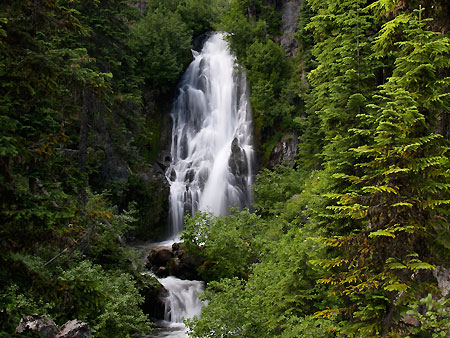
Lower Sahalie Falls

Lower Sahalie Falls

From here, the new accessible loop trail would cross the East Fork in front of the lower falls and gently traverse up the west slope of the canyon to the west bridge approach. Once at the old highway grade, the new path would cross the historic bridge, providing a view back to the trailhead pullout on Highway 35.

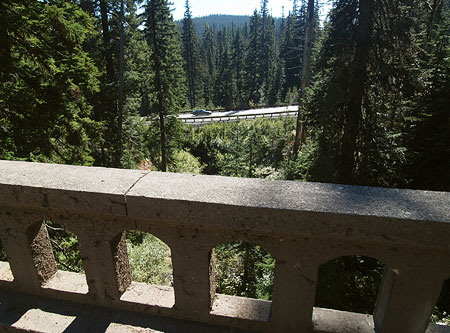
View down the East Fork to Highway 35 from the historic Sahalie Falls Bridge

View down the East Fork to Highway 35 from the historic Sahalie Falls Bridge

Visitors to the bridge inevitably cross to admire the views from both sides, so an accessible route would probably warrant a marked crossing at the two bridgeheads, where people using mobility devices could most safely access the sidewalks.

After enjoying the views from the bridge, visitors would continue past the east end to a resumption of the new loop trail, following the east leg back to the trailhead. The total distance of the accessible loop would be about 0.3 miles with a very modest elevation gain of about 60 feet.

View of Sahalie Falls from the historic loop highway bridge

View of Sahalie Falls from the historic loop highway bridge

Accessible trails are often paved, but for this new route, a better option would be fine gravel, mostly because it would provide better traction in an often wet environment. But the proposed loop is also within the deposit zone for winter highway snow removal that sends a lot of grit used to sand icy roads far into the adjacent forest. A gravel trail surface could actually be enhanced by these annual deposits, where a paved surface would require sweeping to remove winter gravel.

What Would it Take?

As with all proposals in this blog, the Sahalie Falls accessible trail concept relies on the U.S. Forest Service — and in this case, Oregon Department of Transportation — acknowledging the need for more recreational and interpretive opportunities in the Gorge and on Mount Hood.

While the proposed spur connection to the Umbrella Falls trail could be built by volunteers, the proposed accessible loop trail would be a major endeavor that could only be accomplished by the Forest Service in conjunction with ODOT.

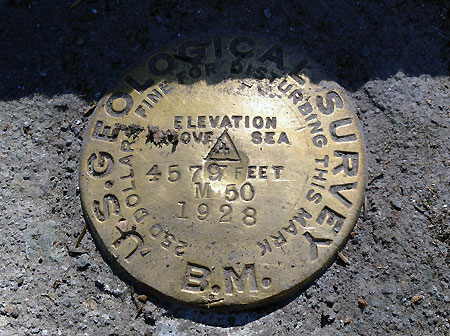
The original USGS survey marker at the east end of the bridge has been uncovered from years of debris

The original USGS survey marker at the east end of the bridge has been uncovered from years of debris

The added twist in this proposal is the need for an accessible trail, something in very short supply in our region despite a rapidly growing elderly and disabled population. Oregon State Parks and Recreation has made great strides in responding to this need in recent years, but the Forest Service lags behind badly, with few accessible facilities built in the last 30 years.

Fortunately, a new guide for designing accessible trails has recently been developed by the Access Recreation project, an ad-hoc organization formed to develop better design guidelines for public agencies involved in trail-building.

SahalieFallsBridge28

The guidelines are now available on the Access Oregon website, and cover everything from trail surface and slope recommendations to best practices for signage and trailside amenities that address the needs of elderly and disabled trail users. It’s a great resource for trail advocates and public agencies, alike — and could help shape new trail options on Mount Hood!

Sandy Glacier Caves: Realm of the Snow Dragon

The Sandy Glacier is front and center in the classic view of Mount Hood from Lolo Pass

The Sandy Glacier is front and center in the classic view of Mount Hood from Lolo Pass

Oregon Public Broadcasting’s venerable Oregon Field Guide series kicks off it’s 25th season in October with a remarkable story on the hidden network of glacier caves that have formed under the Sandy Glacier, high on Mount Hood’s west flank.

In the video preview (below), Oregon Field Guide executive producer Steve Amen says that “in the 25 years we’ve been doing Oregon Field Guide, this is the biggest geologic story that we have ever done”. This is bold statement from a program that has confronted all manner of danger in documenting Oregon’s secret places!

Glacier caves are formed by melt water seeping through glaciers and flowing along the bedrock beneath glaciers. Over time, intricate networks of braided tunnels can form. Because a glacier is, by definition, a river of moving ice, exploring a glacier cave is inherently dangerous — and this is what makes the upcoming Oregon Field Guide special so ambitious.
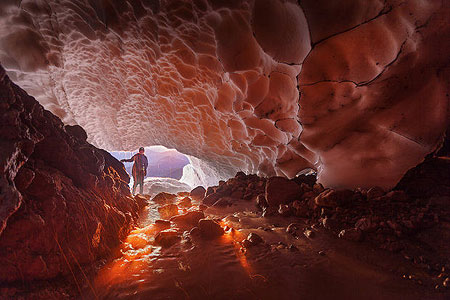
Otherworldly scene from Oregon Field Guide's upcoming "Glacier Caves" special (Brent McGregor/OPB)

Otherworldly scene from Oregon Field Guide’s upcoming “Glacier Caves” special (Brent McGregor/OPB)

Cave explorers have been actively exploring and mapping the extent of the Sandy Glacier caves for the past three years. This previously unknown network of caves has been dubbed the Snow Dragon Glacier Cave System by cavers Eduardo Cartaya, Scott Linn and Brent McGregor in July 2011. Cavers have since surveyed (to date) well over a mile of caves in the network, with parts of the cave system nearly 1,000 feet deep.

Ice Cave or Glacier Cave? Here in volcano country, it’s worth noting that a glacier cave is different than an ice cave. Where a glacier cave has roof of glacial ice, an ice cave occurs where persistent ice forms inside an underground, rock cave. In the Pacific Northwest, we have several examples where ice has accumulated inside lava tubes to form true ice caves, such as the Guler Ice Cave near Mount Adams and Sawyer’s Ice Cave in Central Oregon.

To date, the Snow Dragon cave network consists of three caves that intersect, dubbed the Snow Dragon, Frozen Minotaur, and Pure Imagination caves. Within these caves explorers have discovered a fantastic landscape of streams and waterfalls flowing under a massive, sculpted ceiling of ice.

The caves are punctuated by moulins (pronounced “MOO-lawn”), or vertical shafts in the ice formed by meltwater. Some of these moulins are dry, some are still flowing, and a few have have grown to become skylights large enough serve as entry points into the cave system for daring explorers.

Caving expeditions to the Sandy Glacier caves by the National Speleological Society (NSS) in 2011 and 2012 were featured in the February 2013 NSS News, with a dramatic photo of colossal moulin on its cover. These volunteer expeditions included NSS geologists, glaciologists, spelunkers, scuba divers and mountain climbers who spent eight days documenting the cave system from a base camp high atop the Sandy Glacier.

Sandy Glacier caves on the cover of the National Speleological Society News earlier this year

Sandy Glacier caves on the cover of the National Speleological Society News earlier this year

According to the NSS explorers, the Snow Dragon cave complex is the largest ice cave complex in the lower forty-eight states, and one of the largest in the world. To date, these explorers have found icy passages ranging from huge, ballroom-sized open spaces with 40-foot ceilings to narrow, flooded crawl sapces only a few feet high, and passable only with diving gear.

The Oregon High Desert Grotto, an affiliate of the NSS, has posted a series of fascinating maps documenting their explorations on their website.

The Story Behind the Sandy Glacier Caves?

Glacier caves typically form near the snout of a glacier, and explorers simply follow the outflow stream into the cave system. Such was the case with Paradise Ice Caves at Mount Rainier (now disappeared) at the terminus of the Paradise Glacier. More recently, hikers have explored the outflow opening at the Sandy Glacier, as well.
Topographic map of Mount Hood's west flank and the Sandy Glacier

Topographic map of Mount Hood’s west flank and the Sandy Glacier

[click for a larger map]

The Snow Dragon caves under the Sandy Glacier are different, however. While the glacier does have an outflow opening to the cave system, the cave network extends far beyond the terminus of the glacier, apparently reaching almost to the headwall, nearly a mile away and almost 2,500 feet above the terminus in elevation. The scale and scope of these caves seems to be partly the result of the glacier shrinking, and not just the effects of melting near the terminus of the glacier.

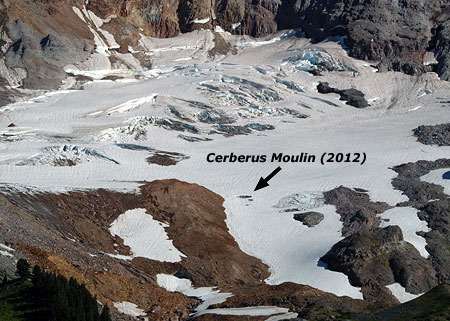
This broader phenomenon first became apparent when a huge moulin — known informally to many hikers as the “glory hole” and formally named the Cerberus Moulin by cavers — appeared in the glacier a few years ago. The Cerberus Moulin is plainly visible to hikers from nearby McNeil Point, which also serves as the jump-off point for explorers.

The Cerberus Moulin is located along the lower, receding edge of the Sandy Glacier

The Cerberus Moulin is located along the lower, receding edge of the Sandy Glacier

A closer view of the Cerberus Moulin in the Sandy Glacier

A closer view of the Cerberus Moulin in the Sandy Glacier

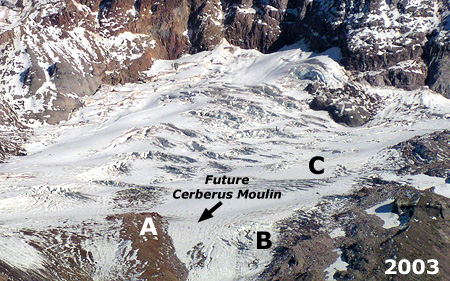
The following photos of the Sandy Glacier were taken nine years apart, in 2003 and 2012, and show the startling retreat of the glacier over just the past decade. The Cerberus Moulin had not yet formed in the 2003 photo, but is plainly visible in the 2012 image. For reference, the broad moraine to the left of the Cerberus Moulin is labeled as (A) in the photos:

Sandy Glacier in 2003

Sandy Glacier in 2003

Sandy Glacier in 2012

Sandy Glacier in 2012

The photo comparison shows big changes in the activity of the glacier, too. What was once an icefall near the terminus of the glacier (B) in 2003 has since receded to the point that the rock outcrop that was beneath (and formed) the icefall is now exposed in the 2012 image. Likewise, the lower third of the glacier (C) was clearly crevassed and actively moving in the 2003 image compared to the 2012 image, where an absence of crevasses shows little glacial movement occurring today in this section of the glacier.

The rapidly shrinking glacier could be an explanation for the relative stability and remarkable extent of the caves underneath the ice. The increased melting is sending more runoff through and under the glacier, helping to form new moulins feeding into the ice caves.

The slowing movement of the lower portion of the glacier could also help explain why the cave network has become so extensive, as more actively flowing ice would be more likely to destroy fragile ice caves before they could become so extensive and interconnected.

Part of a Larger Story

The Sandy Glacier Caves discovery is really part of the much larger story of Mount Hood’s rapidly shrinking glaciers. After millennia of relative stability, we are witnessing broader changes to the landscape surrounding in response to the retreat of the glacial ice.

The downstream effects in recent years from Mount Hood’s melting glaciers have been startling, and the Sandy Glacier is no exception. Sometime during the winter of 2002-03, a massive debris flow was unleashed from just below the terminus of the Sandy Glacier, and roared down the Muddy Fork canyon. The wall of mud and rock swept away whole forests in its wake, burying a quarter mile-wide swath in as much as fifty feet of debris.

Looking across the 2002-03 Muddy Fork debris flow

Looking across the 2002-03 Muddy Fork debris flow

The view (above) looking across the 2002-03 Muddy Fork debris flow shows toppled trees at the margins, while the forests in the main path of the flow were simply carried away.

The view downstream (below) from the center of the debris flow shows the scope of the destruction, with the debris at least 50 feet deep in this spot where the Timberline Trail crosses the Muddy Fork.

Looking downstream from the middle of the 2002-03 Muddy Fork debris flow

Looking downstream from the middle of the 2002-03 Muddy Fork debris flow

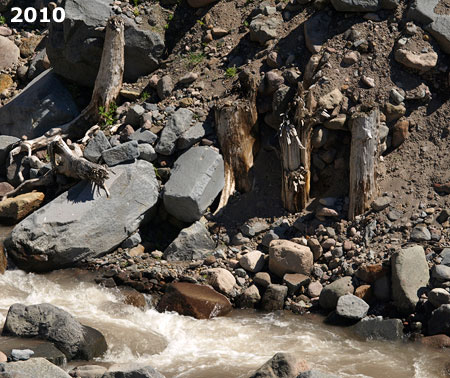
The Muddy Fork has only recently carved its way down through the 2002-03 debris to the original valley floor, revealing mummified stumps from the old forest and visible giving scale to the scope of the event (below).

Seven years after the 2002-03 flow, the Muddy Fork had cut a channel down to its original elevation, revealing the full depth of the flow.

Seven years after the 2002-03 flow, the Muddy Fork had cut a channel down to its original elevation, revealing the full depth of the flow.

These stumps of trees snapped off by the 2002-03 debris flow have reappeared where the Muddy Fork has carved down to the original river level.

These stumps of trees snapped off by the 2002-03 debris flow have reappeared where the Muddy Fork has carved down to the original river level.

With no way to know how long Mount Hood’s glaciers will continue to retreat, catastrophic events of this kind will recur in the coming decades. Runoff from the retreating glaciers will continue to carve away at newly exposed terrain once covered by ice, with periodic debris flows occurring as routine events.

In November 2006, another major flood event in the Sandy River canyon caused damage even further downstream, in the Brightwood area, where private homes line the Sandy River:

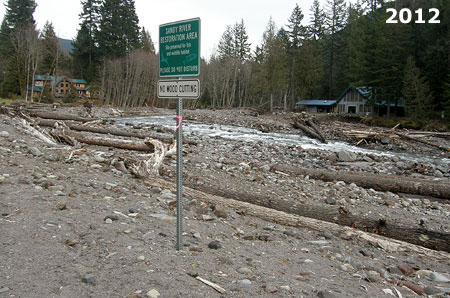
Damage from the 2006 flood was still being repaired when yet another major storm burst stormed down the valley in January 2011. During this event, a large section of Lolo Pass road briefly becoming part of the Sandy River, and scores of homes were cut off from emergency responders:

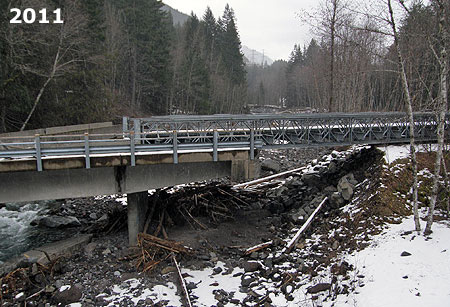
The 2011 event washed out the south approach to the Old Maid Flat Bridge over the Sandy River, forcing the Forest Service to jury-rig a temporary ramp to the bridge. The entire crossing has since been replaced, but like all repairs to streamside roads around the mountain, there is no reason to assume that another event won’t eventually destroy the new bridge, too.

The Old Maid Flat Bridge over the Sandy River was repaired with a temporary approach ramp (on the right in this photo) where the bridge approach had washed out by raging water

The Old Maid Flat Bridge over the Sandy River was repaired with a temporary approach ramp (on the right in this photo) where the bridge approach had washed out by raging water

The two homes in the distance barely survived the 2011 flood event on the Sandy River

The two homes in the distance barely survived the 2011 flood event on the Sandy River

This wider view shows the rebuilt section of Lolo Pass Road that was briefly a channel of the Sandy River during the January 2011 flood

This wider view shows the rebuilt section of Lolo Pass Road that was briefly a channel of the Sandy River during the January 2011 flood

Similar events have occurred over the past several years on the White River, Ladd Creek, East Fork Hood River and the Middle Fork Hood River. The predicted climate changes driving these events give every indication that we will continue to watch similar dramatic changes unfold around Mount Hood in decades to come.

The November 2006 debris flows in the White River canyon buried Highway 35 in boulders (ODOT)

The November 2006 debris flows in the White River canyon buried Highway 35 in boulders (ODOT)

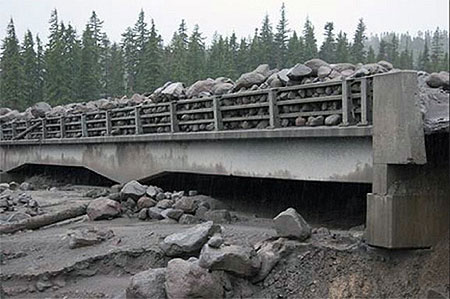
During the 2006 debris flows, the old White River Bridge was completely inundated, leaving an eight-foot layer of boulders on the bridge (ODOT)

During the 2006 debris flows, the old White River Bridge was completely inundated, leaving an eight-foot layer of boulders on the bridge (ODOT)

By late 2012, the Federal Highway Administration had built a new, much larger bridge over the White River designed to survive future debris flows

By late 2012, the Federal Highway Administration had built a new, much larger bridge over the White River designed to survive future debris flows

Just as the wildfires that burned through forests on the eastern and northern flanks of Mount Hood over the past few years have given us new insights into the cycle of forest renewal, the unfolding geological events linked to changing glaciers provide a similar opportunity to better understand these natural processes, too.

While these destructive events are tragic to our sentimental eyes, the rebirth of a forest ecosystem is truly remarkable to witness — as is the discovery of the Sandy Glacier ice caves in the midst of the larger decline of Mount Hood’s glaciers. All of these sweeping events are reminders that we’re just temporary spectators to ancient natural forces forever at work in shaping “our” mountain and its astoundingly complex ecosystems.

So, stay tuned and enjoy, this show is to be continued!
_________________________

OPB Airing Dates

Here are the broadcast dates for the Oregon Field Guide premiere:

• Thursday, October 10 at 8:30 p.m. on OPB TV
• Sunday, October 13 at 1:30 a.m. on OPB TV
• Sunday, October 13 at 6:30 p.m. on OPB TV

For fans of the show, a 25th Anniversary retrospective will also be airing on Thursday, October 3rd. You can learn more about OFG and view their video archive on their website.
_________________________

October 4th Postscript

Author with Brent McGregor on October 4

Author with Brent McGregor on October 4

In the small world department, I had the honor of meeting epic caver, climber and photographer extraordinaire Brent McGregor on the Timberline Trail this afternoon. He and caving partner Eric Guth had spent the night near the entrance to the Snow Dragon Glacier Cave!

After learning a LOT more about the Snow Dragon cave complex from Brent today (and having my jaw drop repeatedly as I heard about their exploits under the glacier!), I’ve updated the above article — including the more accurate use of the name Cerberus Moulin in lieu of the generic “glory hole” nickname that some hikers have been using.

Brent also pointed me to a couple fascinating new videos from OPB that just add to the anticipation of the Glacier Caves premiere on OPB:

Behind the Scenes of Glacier Caves: Mt. Hood’s Secret World

Special Glacier Caves website from OPB

And finally, one more link: the Glacier Caves OPB documentary will be screened in a free, special preview on October 9th at the Hollywood Theater. Here’s the link to the event Facebook page:

Glacier Caves Special Preview

Thanks for the terrific conversation, Brent – great meeting you and Eric!

Proposal: Viento Bluff Trails

Looking west from the summit of Viento Bluff

Looking west from the summit of Viento Bluff

This is the third in a series of new trail proposals for Oregon State Parks land in the Columbia Gorge. This article follows previous proposals for a Bridal Veil Canyon Trail and Angels Rest Loop. All three have the potential to fit into the Oregon State Parks and Recreation (OSPRD) master planning for the Columbia Gorge that is happening right now.

Like the Angels Rest Loop and Bridal Veil Canyon proposals, this trail would be aimed at families, vacationing visitors to the region and those trying out hiking for the first time. Unlike the earlier proposals, the Viento area is little known to most who visit the Gorge. For a moderate effort, this proposal would provide explore the unique, transitional ecosystem found in the mid-section of the Gorge, as well as some sweeping views and towering cliffs.

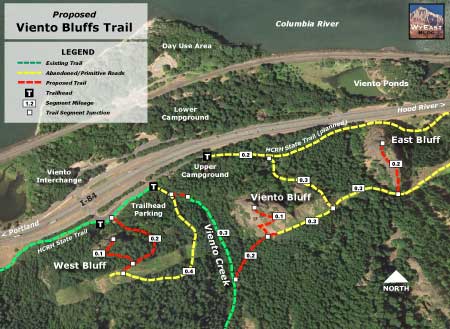
Trail map of the proposal

Trail map of the proposal

(Click here for a larger map)

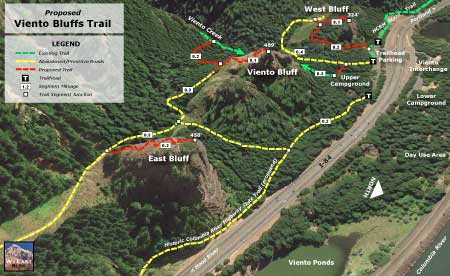
The Viento proposal stitches together several rustic service roads that already exist with new trail segments that would take hikers to three separate, cliff-top viewpoints. All three viewpoints rise high above the popular campgrounds at Viento State Park, and would provide an excellent, moderate hiking challenge for campers and day-visitors, alike.

The map above shows the proposed network of trails, and the oblique view, below, gives a sense of the steep topography that would make the Viento area so interesting as a hiking destination.

Perspective view of the proposal

Perspective view of the proposal

(Click here for a larger map)

The proposed Viento Bluff trails would also build on a planned extension of the mostly-complete Historic Columbia River Highway (HCRH) State Trail, providing bike-and-hike opportunities along this emerging, world-class facility. A six-million dollar extension of the trail will soon extend east from the Viento Trailhead to Perham Creek, completing another link in a route that will eventually extend from Troutdale to The Dalles.

A bit of history on the name “Viento” is in order. While the word means “windy” in Spanish — an often fitting name for this narrow spot in the Gorge — the name was actually coined in the 1800s for an early railroad stop in the area using the first two letters from the surnames of railroad builder Henry Villard, one of his investors, William Endicott, and a local railroad contractor named Tolman (the origin of the name and other local history can be found on an interpretive display near the entrance to Viento State Park).

The following is a detailed description of the three viewpoints that make up the Viento Bluffs and proposed trails that would lead to them.

Viento Bluff Trail

Viento Bluff is a familiar landmark to those traveling I-84

Viento Bluff is a familiar landmark to those traveling I-84

The main focus of the proposed trail network is Viento Bluff, the most prominent of the rocky outcrops that rise above Viento State Park, and a familiar landmark to travelers passing through the Gorge.

While Viento Bluff rises as sheer, 300-foot vertical wall on its north face, the steeply tilted basalt flows that form the bluff have a relatively gentle, meadow-covered south slope. The proposed summit trail would circle the bluff to reach this southern approach.

Historic CCC path along Viento Creek

Historic CCC path along Viento Creek

The trail would begin at the existing day use parking area at the Upper Viento Campground, initially traveling on an existing footpath that follows Viento Creek into its shady, forested canyon. Here, the project would consist of a new footbridge connecting the existing trailhead to the old footpath, and improving the existing tread to basic trail standards.

Historic CCC path

Historic CCC path

The existing footpath appears to be one of the many vestiges of the Civilian Conservation Corps (CCC) in the Viento area. The CCC was created by Franklin D. Roosevelt as part of his Great Depression-era “New Deal” to put young men to work making infrastructure improvements to public lands across the country.

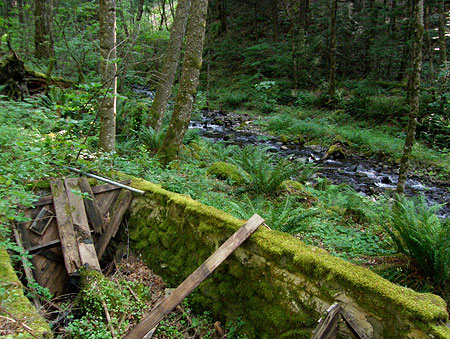
Several stone retaining walls in the area, the original (upper) Viento campground and a collapsed campground water house still remain from the CCC period. The surviving footpath originally led to the water house, but now terminates at its moss-covered ruins, along a pretty section of Viento Creek.

Remains of the old CCC water house along Viento Creek

Remains of the old CCC water house along Viento Creek

From near the end of the existing footpath, the proposed route would turn east, climbing the slope to Viento Bluff in an easy traverse along a heavily used game trail. The deer and elk have done a find job in this section, with a grade that works well as a hiking trail!

Game trail leading from Viento Creek to the bluff

Game trail leading from Viento Creek to the bluff

Soon, this game trail reaches a forested saddle behind Viento Bluff, and enters one of the most lush, abundant stands of poison oak anywhere in the Gorge — one of the few obstacles to realizing the Viento Bluffs trail.

While it’s an ominous sight for anyone sensitive to poison oak, routing a trail to the bluff through this section would be less difficult than appearances might suggest. The open, meadow-covered south slope of the bluff is only about 20 yards beyond the poison oak section, so the exposure would be no more than many trails in the Gorge that pass through poison oak patches. But it would need to be built carefully, and maintained accordingly.

Poison Oak heaven in the saddle south of Viento Bluff!

Poison Oak heaven in the saddle south of Viento Bluff!

From the saddle, the route reaches the stuff of a dirt service road approaching from the east (more about that in a moment), and from this point, the proposed summit trail would begin an exceptionally scenic ascent of Viento Bluff’s south slope, traversing a steep meadow in switchbacks through scattered White Oak and Ponderosa Pine.

The south slope of Viento Bluff as viewed from the East Bluff

The south slope of Viento Bluff as viewed from the East Bluff

The summit of Viento Bluff is exposed on three sides, with vertical drops into the forest below. If this were a remote wilderness viewpoint, simply terminating the viewpoint trail at the top would be safe enough. But because it’s a state park with families and less-experienced hikers, some sort of cable or wood railing would probably be needed here. The wood railings at the Bridal Veil State Park overlook might be a good model for this site, and easily constructed here.

Gorge panorama from Viento Bluff

Gorge panorama from Viento Bluff

The view from the summit of Viento Bluff is impressive, especially given the relatively moderate climb required. The rocky slopes of Dog Mountain dominate the view across the Columbia River, and the sweeping panorama extends as far west as Table Mountain and east to Mitchell Point and the town of White Salmon, beyond.

The summit is quite spacious, providing room for visitors to sit and spend some time taking in the scene or having a trailside picnic. It is also far enough above the busy river corridor to be largely beyond the noise of traffic, while still allowing for interesting views of trucks, trains and barges passing by in the busy transportation corridor provided by the Columbia River Gorge.

East Bluff Trail

The East Bluff as seen from Viento Bluff

The East Bluff as seen from Viento Bluff

The second trail in this proposal would lead from the Upper Viento Campground and trailhead to the East Bluff, an impressive basalt outcrop that is nearly as imposing as Viento Bluff. The East Bluff rises directly above I-84, yet is oddly less visible from the freeway, and therefore less familiar to travelers.

The route to the East Bluff would begin along the proposed extension of the HCRH State Trail, east of the Upper Viento Campground. From a point along the State Trail route, about one quarter mile beyond the campground, a primitive service heads south, climbing the steep ravine between the East Bluff and Viento Bluff. This spur road soon reaches in the power line corridor that crosses the saddle to south of the two bluffs.

Mitchell Point and White Salmon in the distance from the East Bluff

Mitchell Point and White Salmon in the distance from the East Bluff

From the saddle, one fork of the service road heads to the right, to Viento Bluff, as mentioned previously in this article. Along with the proposed new trail from Viento Creek, this route would create a loop hike to Viento Bluff, and a connection to the East Bluff (see map).

The left fork of the service road heads toward the East Bluff. This proposal calls for a new trail here, leaving the service road and traversing the open south slopes of the East Bluff in switchbacks.

The view west toward Dog Mountain and Stevenson from the East Bluff

The view west toward Dog Mountain and Stevenson from the East Bluff

The views from the East Bluff are expansive, encompassing the same stretch of the Gorge as the view from Viento Bluff, but including a unique perspective of Viento Bluff, itself.

The true summit of the East Bluff has a brass 1939 U.S. Geological Survey marker stamped “Viento”. The survey marker dates to the year when Bonneville Dam had just been completed, along with the old power line corridor behind the bluffs that took power from the new dam to Hood River and points east — likely the reason for a survey marker in this spot.

USGS marker on the summit of the East Bluff

USGS marker on the summit of the East Bluff

The summit of the East Bluff is quite broad, and even somewhat brushy in spots. But several dramatic viewpoints ring the edges — much like Angels Rest in the western Gorge, but with a lot less effort. Like Viento Bluff, the cliffs are extremely exposed, and would require some sort of cable or wood fencing, given the location in a state park and relatively easy access.

The loop connection to the proposed Viento Bluff trail (from Viento Creek) would allow for both summits to be included on a longer hike, or simply a hike around Viento Bluff for those who don’t want to climb the actual summit.

West Bluff Loop Trail

West Bluff from the Viento interchange

West Bluff from the Viento interchange

The third piece of the Viento proposal is a short loop trail to the west bluff, a basalt wall rising 250 feet above the Viento interchange and Upper Viento Campground trailhead.

The purpose of the West Bluff trail is to provide a more approachable destination for less ambitious or able-bodied hikers and families with small children. While not as imposing as Viento Bluff and the East Bluff, the West Bluff still delivers impressive views of the Columbia Gorge and an interesting, almost aerial view into the Viento Campground and interchange area, directly below.

This service road would form the east leg of the West Bluff trail loop

This service road would form the east leg of the West Bluff trail loop

The east leg of the loop would follow an existing dirt service road south from the existing trailhead, then fork uphill along a second service road that crosses within a few hundred yards of the West Bluff crest. A spur trail would climb the last stretch to the cliff-top viewpoints. Like the other summits, some sort of fence or railing would be in order here, as the cliffs drop over 200 feet to the trailhead below.

The west leg of the loop would be a new trail climbing a ravine directly below the West Bluff, connecting to the new summit spur. The complete West Bluff loop would cover less than a mile, and gain less than 300 feet elevation, yet give hikers a real sense of achievement. The West Bluff loop would also be the closest of the proposed trails to the main Viento Campground, so well situated to serve campers interested in a modest hike.

An interesting option for the West Bluff trail would be a barrier-free route. While this would be a much more substantial undertaking, it would be one of the few viewpoint trails in the Columbia Gorge available for visitors with limited mobility.

What would it take?

Much of this proposal builds on the repurposing of existing service roads to become wide trails — at least most of the time. The idea is to allow utility workers to access these roads when needed, but functioning as wide trails as their primary purpose. The service roads are owned and maintained by the Bonneville Power Administration (BPA), and see little use by the agency, so a shared purpose might be a way for the BPA to partner with Oregon State Parks to enhance and maintain these routes.

Historic retaining wall at Viento from the CCC era

Historic retaining wall at Viento from the CCC era

There are also several new hiking trail segments in this proposal. All would be straightforward to build, with few topographic or environmental obstacles. Because they are located in a highly accessible area (access from I-84), these new trails could be excellent candidates for construction by volunteer groups like Trailkeepers of Oregon.

Upper Viento Campground restroom is within a few yards of the trailhead

Upper Viento Campground restroom is within a few yards of the trailhead

The HCRH State Trail already has a major trailhead at Viento

The HCRH State Trail already has a major trailhead at Viento

One of the advantages of expanding hiking opportunities in the Viento area is the potential to take advantage of the existing recreation infrastructure: two campgrounds, a day use area, a large supply of trailhead parking, restrooms within a few yards of the trailhead, access to the HCRH State Trail and direct freeway access to I-84. Adding new trails to the area would simply make better use of these existing amenities in addition to enhancing the camping experience at Viento State Park.

What can you do..?

If you like this proposal, there is a unique opportunity to weigh in right now and make your voice heard: share your comments with Oregon Parks & Recreation Division (OPRD), the state agency that operates Viento State Park, and the sole agency responsible for trail planning in the park.

Seldom-seen rubber boa spotted along Viento Creek

Seldom-seen rubber boa spotted along Viento Creek

Over the next year the state is conducting a long-range planning effort to scope future recreation needs in the Gorge. [url]You can weigh in with your thoughts over here.[/url] So far, the State Parks have had fairly light participation in their public outreach, so it’s important to make your views known!

Please consider including links to the Veinto Bluffs, Bridal Veil Canyon and Angels Rest Loop proposals in this blog when you comment — here are the quick links to paste into your message:

Proposal: Bridal Veil Canyon Trail

Angels Rest Loop: One Way Trip to Heaven?

https://wyeastblog.org/2013/09/22/proposal-viento-bluff-trails/

And as I’ve pitched in previous articles, please consider supporting Trailkeepers of Oregon, a non-profit, grass-roots organization that offers meet-up trail stewardship projects in the Gorge and around the region (full disclosure: the author is a founding and current board member of TKO and number one fan of the organization!)

Angels Rest Loop: One Way Trip to Heaven?

Looking across the Columbia River in winter to the Silver Star Range from Angels Rest

Looking across the Columbia River in winter to the Silver Star Range from Angels Rest

The popular hike to Angel’s Rest in the Columbia River Gorge is a rite of passage for long-time Oregonians and newcomers alike, because for many of us, this beautiful trail was our first hiking experience. I first hiked the trail sometime in the 1970s, and have returned many times over the years — most memorably, on the inaugural Trailkeepers of Oregon stewardship project in April 2008.

The (formerly skinny and shaggy) author on top of Angels Rest in 1981 and an older, wiser and (and much balder) version in 2013!

The (formerly skinny and shaggy) author on top of Angels Rest in 1981 and an older, wiser and (and much balder) version in 2013!

The trail has a lot to offer, with sweeping views of the Columbia River Gorge and a brief streamside section along Coopey Creek (which cascades over a pair of waterfalls below the trail). Since the Multnomah Falls Fire of 1991, the hike has offered a close-up look at a recovering forest along the upper reaches of the trail. The 1,600 elevation gain over 2.4 miles to the top of Angels Rest is within reach for most hikers, yet challenging enough to give any hiker a thrill when reaching the rocky, often blustery summit.

The Angels Rest trail also has the distinction of being among the most accessible to Portland, with a trailhead located at a freeway interchange 30 minutes from downtown, and with enough parking to supply a small army. Add the emergence of year-round hiking on our low-elevation trails in recent years, and the unfortunate result is one of the most rapidly deteriorating trails in our region.

The Angels Rest trailhead was expanded and improved in 2000 to include stone walls and trailhead signage in the style found elsewhere along the Historic Columbia River Highway

The Angels Rest trailhead was expanded and improved in 2000 to include stone walls and trailhead signage in the style found elsewhere along the Historic Columbia River Highway

The gradual deterioration of this old trail takes many forms. Along the lower section, the once-narrow traverse across moss and fern-covered talus slopes has broken down, with the path now straddling trees (the original trail is the upper third of the tread):

AngelsRestLoop04

Over time, this could damage the roots of the tree in the above photo to a point where it cannot survive. This threatens not only the tree but also the trail, as tree roots are critical in holding steep, loose Gorge slopes together in a climate where annual rainfall exceeds 100 inches per year.

This badly eroded spot is the overlook above Coopey Falls, along the lower trail:

AngelsRestLoop05

The damage here is fairly obvious: the original trail hugged the vegetation line along the right, but the crush of hikers attempting to view the falls has stripped away both vegetation and soil on the left. Over time, this has left roots of trees clinging to edge of the cliffs below exposed and unlikely to survive, making the trees themselves less likely to survive.

Beyond the Coopey Falls viewpoint, the trail reaches the first of many sections showing the impact of year-round hiking on the trail. Here, winter hikers have worn the new path to the left of the main trail tread in an effort to avoid standing water and mud in the main trail, which has become trenched from overuse:

AngelsRestLoop06

Further up the trail, the path has become so wide that the edges are almost hard to determine:

AngelsRestLoop07

The hikers in the distance in the view above offer a clue as to how this happens: as trails widen from overuse, hikers start waking side-by-side. It’s a natural instinct, but one that the trails were never designed to accommodate.

The scene below shows another example of winter hikers wearing down the edges of the formal trail in an effort to stay out of the mud:

AngelsRestLoop08

While walking adjacent to the trail might work for the first few hikers along one of these sections, in the end, it just creates more mud during the wet season — and an even wider trail as hikers continue to push the edges of the trail outward.

Until a few years ago, the effects of hiking were on display to epic proportions along an upper section of trail, where an enormous mud pit formed as hikers continued to walk ever higher on the shoulders of the widening trail:

AngelsRestLoop09

The section shown above devolved so badly that in 2008, the [url]Trailkeepers of Oregon (TKO)[/url] worked with the U.S. Forest Service to simply bypass that segment with a new trail alignment. The following photo shows TKO volunteers constructing this new section in April 2008:

AngelsRestLoop10

While the new trail was built to a conventional width, the continued heavy, year-round crush of hikers has since “widened” this section to nearly double its original width in just five years:

AngelsRestLoop11

The upper trail includes several switchbacks, and these are traditionally the Achilles heel of any Gorge trail. Newbie hikers and kids can’t seem to resist cutting switchbacks.

Normally, this is manageable by simply blocking shortcuts to discourage the relatively small number of rogue hikers. But with the heavy foot traffic on the Angels Rest Trail, the sheer volume of switchback cutting overwhelms the trail, turning well-designed turns into a muddy, sloping mess:

AngelsRestLoop12

The above switchback was also built with the trail relocation project in 2008, and has barely survived five years of heavy travel from Angels Rest hikers.

The long-term answer to overuse at Angels Rest is to provide new, badly needed hiking alternatives in the Columbia Gorge, such as the Bridal Veil Canyon Trail proposed on this blog.

But Angel’s Rest needs help, too. One way to help this old trail survive for future generations to enjoy is to simply cut the traffic in half — not through restrictions or trail fees, but by creating a one-way hiking loop. The rest of this article outlines a proposal for making this happen.

Creating an Angels Rest Loop Trail

Winter view into the Gorge from Angels Rest

Winter view into the Gorge from Angels Rest

The concept of a one-way Angels Rest loop is simple: construct a separate, new route to Angels Rest that would form the return leg of the loop. The result would instantly cut the number of boots on the Angels Rest Trail by half, allowing the existing sections to be rehabilitated so that this old trail can last indefinitely.

AngelsRestLoop14

[click here for a large map]

The proposed loop trail would split from the existing route about 0.2 miles from the trailhead, just before the current route heads across the lower talus slopes (see map, above). The existing trail would continue to be 2-way for the first 0.2 miles, where the gentle terrain allows for a wider trail.

The new route would function as the downhill portion of the loop so that it could be designed with downhill travel in mind. This would include a gentle incline and minimizing the number of switchbacks compared to the current route. This could have tremendous benefits for the existing route, as a disproportionate share of trail damage to the existing route is from hikers speeding downhill.

Upper Coopey Falls would be a highlight of a connector between the new and existing trails

Upper Coopey Falls would be a highlight of a connector between the new and existing trails

The new return trail would also be designed to have a mid-point connection to the existing trail via a new bridge across Coopey Creek at Upper Coopey Falls (pictured above). The purpose of this connection is to bring hikers to the upper falls on a formal trail where several muddy boot paths have already been worn into the canyon walls by hikers seeking a view.

The mid-point connection would also allow less hardy hikers or families with small children to simply complete a lower loop of just over a mile in length, while still respecting the one-way trail system. The mid-way connector would also lead lower-loop hikers past beautiful Coopey Falls, one of the highlights of the proposed return trail.

The new trail would take hikers past the base of beautiful Coopey Falls, located on public land, but currently only reachable by crossing private property

The new trail would take hikers past the base of beautiful Coopey Falls, located on public land, but currently only reachable by crossing private property

From the summit of Angels Rest, the proposed return route would descend through the hanging valley immediately east of summit. This new route would skirt little-known Foxglove Falls, a wispy 120-foot seasonal cascade hidden in the forest, then switchback down to a basalt bench that wraps around the base of Angel’s Rest. Here, the trail passes through the fire zone, and would have broad views of the Gorge before descending in a gentle curve to the new junction at the Upper Coopey Falls connector trail.

The proposed loop trail would traverse below these cliffs on the north side of Angels Rest

The proposed loop trail would traverse below these cliffs on the north side of Angels Rest

From the Upper Coopey Falls connector, the new route would continue to descend, passing the base of Coopey Falls on a new footbridge, then traversing west, where it would reconnect with the main trail near the trailhead, completing the loop.

The new trail would have views like this of the Columbia River Gorge

The new trail would have views like this of the Columbia River Gorge

The new return trail would travel 1.7 miles in its descent, exactly the same length as the climb along the existing trail. Thus, the hike to Angel’s Rest along the new loop would retain the same mileage and elevation gain as it does today.

The Gorge viewpoints along the proposed new trail, along with stops at Foxglove Falls, Upper Coopey Falls and Coopey Falls, would be significant enhancements to the hike, making a classic trail even better. So, what would it take to realize this proposal?

An Idea within Reach…

This 1911 map shows an upper trail to Angels Rest from the long-vanished mill town of Palmer, long before the Depression-era trail we know today was constructed

This 1911 map shows an upper trail to Angels Rest from the long-vanished mill town of Palmer, long before the Depression-era trail we know today was constructed

The proposed loop trail would be built entirely on public lands, and much of the work could be done by volunteers working in partnership with the Forest Service. Beyond the actual trail, here are some of the other elements of the project, and more opportunities to involve volunteers in the work:

Footbridges: the proposed new loop trail would require two new footbridges: at Coopey Falls and Upper Coopey Falls. These could be excellent volunteer opportunities, as volunteers have helped construct other trail bridges in the Gorge in recent years

Invasive Species: like many spots in the western Gorge, the slopes of Angel’s Rest host invasive species – in particular, English ivy, Himalayan blackberry and Shiny Geranium. The new loop trail segment would actually improve the ability to control these species by providing new access to affected areas. Native plant advocates could become partners in the project in order to remove invasive plants as part of trail construction.

Even on the grayest of winter weekends, cars spill far beyond the overflow parking area at Angels Rest, lining the shoulders of the Historic Highway

Even on the grayest of winter weekends, cars spill far beyond the overflow parking area at Angels Rest, lining the shoulders of the Historic Highway

Trailhead Facilities: the existing parking area, including the large overflow area and shoulder parking along the Historic Columbia River Highway, is more than adequate to serve the proposed loop. In fact, the loop is in response to a trail that is inadequate for the parking! But the trail does not have restroom facilities, a serious deficiency with unpleasant repercussions for a site that can have as many as 100 cars on a busy weekend. The Forest Service and Oregon State Parks and Recreation could partner to address this need as part of creating the loop trail.

Ongoing Stewardship: ongoing maintenance of the trail is also well suited for volunteers, and could be a blueprint for a new, more intensive effort to keep trails in top condition, addressing trail damage before it spirals. The trailhead is close to Portland and easy to find, and the proposed loop route would be short enough for most volunteers to navigate with equipment, or when carrying out debris. The low elevation of the trail means more opportunities for volunteer work, and the beauty and close proximity to Portland would make it an attractive volunteer option.

What can you do?

Angels Rest was one of the scenic highlights along this 1938 Auto Club guide to the Historic Columbia River Highway.

Angels Rest was one of the scenic highlights along this 1938 Auto Club guide to the Historic Columbia River Highway.

If you like this proposal, there area couple of opportunities to weigh in right now and make your voice heard:

1. Send off an e-mail to the staff at the Columbia River Gorge National Scenic Area: here’s the link (you can use the feedback form at the bottom of their web page). This is the federal agency responsible for most of the trails in the gorge, and would be the lead agency in making this loop happen.

2. Weigh in with Oregon Parks & Recreation Division (OPRD), the state agency that operates the series of state parks along the Historic Columbia River Highway. While much of the proposed Angels Rest loop trail travels on U.S. Forest Service lands, the loop also crossed state parks lands. Over the next year the state is conducting a long-range planning effort to scope future recreation needs in the Gorge. You can weigh in over here, using their blog comment format to make your voice heard.

The State Parks and Forest Service national scenic area staff work together to plan and maintain trails in the Columbia River Gorge, so weighing in with the state planning effort is an opportunity to make any of your ideas on recreation needs known to both agencies. So far, the State Parks have had fairly light participation in their public outreach, so it’s important to make your views known!

Don’t be shy about including links to the Bridal Veil Canyon and Angels Rest Loop proposals in this blog, either — here are the quick links to paste into your message:

https://wyeastblog.org/2012/01/15/proposal-bridal-veil-canyon-trail/

https://wyeastblog.org/2013/08/31/angels-rest-loop-one-way-trip-to-heaven/

Finally, consider supporting Trailkeepers of Oregon (TKO), a local non-profit, grass-roots organization that offers meet-up trail stewardship projects in the Gorge and around the region (full disclosure: the author is a founding and current board member of TKO and number one fan of the organization!)

Mount Hood’s Ancient Whitebarks

Ancient Whitebark pine on Gnarl Ridge

Ancient Whitebark pine on Gnarl Ridge

If you have spent much time in Mount Hood’s alpine country, you probably already recognize the Whitebark pine. This rugged cousin to our more common Ponderosa and Lodgepole pines thrives where no other trees can, braving subzero winters and hot, dry summers at the upper extreme of timberline.

Ancient Whitebark pine grove on Lookout Mountain

Ancient Whitebark pine grove on Lookout Mountain

Whitebark pine is easy to identify on Mount Hood. True to their name, they have white bark on younger limbs, and their typically gnarled, picturesque forum is iconic in our Cascade Mountain landscape. These slow-growing patriarchs often live to 500 years or more, with some trees known to survive for more than 1,000 years.

In protected stands below the tree line, they can grow 60-70 feet tall (around Cloud Cap Inn), while in open areas, they creep along the ground, forming a “krummholz” — a low mat of branches stunted by the elements (famously, on Gnarl Ridge, which draws its name from the ancient Whitebarks that grow there).

Whitebark pines have limber branches to withstand the elements

Whitebark pines have limber branches to withstand the elements

Up close, Whitebark pine can be identified by its needles, with five per bundle (compared to two for Lodgepole and three for Ponderosa pine). Whitebark cones don’t open when dry, yet are hardly ever found intact. That’s because of the unique, mutual relationship these trees have with a bird called Clark’s nutcracker, named for William Clark, co-captain of the Lewis & Clark Corps of Discovery expedition.

Clark’s nutcracker subsists almost entirely on the large, nutritious seeds hidden in Whitebark cones. These birds have evolved with an ability to crack the cones and store the seeds in buried caches, for later consumption. The Whitebark pine, in turn, is almost completely dependent on these birds for reproduction, when young seedlings sprout from seeds cached by the nutcracker.

Clark's Nutcracker at Crater Lake (Wikimedia)

Clark’s Nutcracker at Crater Lake (Wikimedia)

In this way, the Whitebark pine is considered by scientists to be a “keystone” species at the center of a broad, highly dependent web of life. In addition to its co-mutual relationship with Clark’s nutcracker, Whitebarks also support other high-elevation species, serving as “islands” of life in otherwise barren alpine zones. These islands shelter mammals, birds and insects migrating through alpine areas and serve as permanent habitat for many mountain plant and animal species.

Whitebark pine seeds serve as a direct food source for several other species in addition to Clark’s nutcracker. The seeds are large and high in fat, and at least 12 species of birds are known to feed on them. The seeds are also a primary good source for ground squirrels living in alpine zones, where they store large quantities of seed in “middens”.

Surprisingly, Whitebark seeds are also an important food source for black bear and the grizzly bear, with both bear species raiding the middens of ground squirrels. For grizzly bears in the Greater Yellowstone Area, Whitebark pine seeds are considered so important in the their diet that the long-term viability of the bear population is linked to the survival of the Whitebark.

A Species in Trouble

Sadly, the Whitebark pine is in deep trouble. The triple threat of (1) an exotic fungal disease known as white pine blister rust, (2) mass infestations of mountain pine beetle and (3) the effects of fire suppression have weakened and killed millions of these trees across Mountain West.

Blister rust (boundary shown in red) has affected almost all Whitebark pine range (green) in North America

Blister rust (boundary shown in red) has affected almost all Whitebark pine range (green) in North America

The U.S. Fish and Wildlife Service (USFW) estimated in 2007 that 800,000 acres of Whitebarks have been lost across the west, an startling statistic given the small, rare alpine habitat that these trees need to survive.

Global warming may turn out to be the nail in the coffin for this venerable species, as less hardy tree species continue to crowd and compete for space in areas once habitable only by the Whitebark pine.

Massive Whitebark pine die-off in Yellowstone (USFWS)

Massive Whitebark pine die-off in Yellowstone (USFWS)

Several efforts to save the species are underway. In July 2011, the U.S. Fish and Wildlife Service (USFWS) determined that the Whitebark pine needed federal protection and that without it, the tree would soon be extinct within as few as two to three generations. However, the tree has not been formally listed in the United States as endangered, due to federal agency funding constraints.

In June 2012, the Canadian federal government declared Whitebark pine endangered, making it the first tree species to be declared endangered in Western Canada.

Whitebark04

The Whitebark Pine Ecosystem Foundation is a science-based, non-profit organization that exists to conserve and restore the Whitebark pine, but their efforts are dependent on support from the public in making the survival of this species a priority with our land management agencies.

Conservation efforts for the Whitebark focus on harvesting seeds from trees that seem to have a natural resistance to white pine blister rust and restoring the role of fire in forest management. Both strategies will require the full engagement of our federal land agencies, and thus the need for a non-profit like the Whitebark Pine Ecosystem Foundation to press the issue in our utterly dysfunctional national government. Please consider supporting them!

Lookout Mountain Sentinels

One of the best places to view ancient Whitebark pine up close is along the crest of Lookout Mountain, located due east of Mount Hood. Like most Whitebark stands around Mount Hood, the trees on Lookout Mountain are in decline, yet hundreds have (so far) survived the triple threat facing the species.

A large stand of Whitebark pine just below the main summit of Lookout Mountain provides a stark example of the die-off that is affecting the species. As shown in the photos below (1983 and 2008), scores of trees in this stand have died in recent years:

Healthy stands of Whitebark pine thrived on the south slope of Lookout Mountain in 1983

Healthy stands of Whitebark pine thrived on the south slope of Lookout Mountain in 1983

Over the past decade, almost the entire stand of Whitebark pine on the south slope has died

Over the past decade, almost the entire stand of Whitebark pine on the south slope has died

The Lookout Mountain grove is on the hot, dry south slope of the peak, so the trees here are clearly stressed by the environment, even without the blister rust and beetle attacks now affecting the species.

On the more protected east slope of the main summit, a remarkable group of ancient Whitebark pine (pictured below) is soldiering on, though some of the oldest sentinels in this group now seem to be fading fast.

Whitebark patriarch near the summit of Lookout Mountain beginning to show stress in 2002

Whitebark patriarch near the summit of Lookout Mountain beginning to show stress in 2002

By 2013, only one of the ancient tree's five trunks is still alive, though healthy younger trees are growing nearby

By 2013, only one of the ancient tree’s five trunks is still alive, though healthy younger trees are growing nearby

Some of the trees in the eastern group are truly ancient. Several were cut in 1930, when a road was built to the summit and a lookout tower constructed. Amazingly, the bleached stumps of these old trees still survive, more than 80 years later.

One of these stumps measuring about a foot across still shows its growth rings, showing that it was 280 years old when it was cut in 1930! This means the tree started life on Lookout Mountain in 1650, twenty years before the Hudson Bay Company was formed under a charter from King Charles II. This tree was already 174 years by the time Dr. John McLoughlin established his Hudson Bay Company outpost at Fort Vancouver, in 1824, and more than 200 years old before tiny Portland, Oregon was incorporated in 1851.

A particularly ancient patriarch in this grove (shown in the photo pairs above and below) grows due east of the summit, along the Divide Trail. This old survivor appears to be the oldest Whitebark pine on Lookout Mountain. While it’s age is unknown, the diameter of its multiple trunks substantially exceeds that of the nearby cut trees, so this ancient sentinel could be 300-500 years old, or more.

A profile view of the patriarch tree in 2002 shows health growth on the eastern trunk (center)

A profile view of the patriarch tree in 2002 shows health growth on the eastern trunk (center)

This profile view from 2013 shows significant dieback on the eastern trunk over the past decade (center)

This profile view from 2013 shows significant dieback on the eastern trunk over the past decade (center)

Sadly, this old veteran is fading fast, with only one living trunk surviving as of this summer. Even as the old tree succumbs to the elements, it continues to serve as a fascinating, beautiful testament to the struggle that Whitebark pines face in their preferred habitat.

A closer look at the old tree (below) shows five sprawling trunks, each more than a foot in diameter. This old survivor looks a bit like a huge, grey octopus (complete with two weathered eyes, looking back at you!).

At its center, the patriarch Whitebark sprawls like an octopus, with five major trunks, each more than a foot in diameter

At its center, the patriarch Whitebark sprawls like an octopus, with five major trunks, each more than a foot in diameter

Ancient Whitebarks at this elevation are typically a twisted tangle of living and dead trunks, and in the case of the Lookout Mountain patriarch tree, only the north and east of the five main trunks survive.

As the photos that follow illustrate, the north trunk may have seen its last summer this year, as its remaining needles suddenly died back as of early July. The surviving east trunk is in better shape, with several green boughs, but its needles obviously lack the vigor of nearby, younger Whitebarks. Clearly, the old giant is in its final years of living after centuries on this unforgiving mountain slope.

A rusty remnant from the days when a lookout tower stood on the mountain hangs on one of the living limbs of the patriarch Whitebark pine

A rusty remnant from the days when a lookout tower stood on the mountain hangs on one of the living limbs of the patriarch Whitebark pine

The bleached bones where the patriarch tree has died back can survive for decades in the arid alpine climate of Lookout Mountain

The bleached bones where the patriarch tree has died back can survive for decades in the arid alpine climate of Lookout Mountain

Yellowing needles on the remaining (east) living trunk of the patriarch Whitebark spell trouble for this old tree

Yellowing needles on the remaining (east) living trunk of the patriarch Whitebark spell trouble for this old tree

This view shows the north trunk of the Patriarch tree, thriving as recently as 2002, but now reduced to a thicket of dead shoots

This view shows the north trunk of the Patriarch tree, thriving as recently as 2002, but now reduced to a thicket of dead shoots

After centuries of growth, this dying cluster of limbs on the north trunk of the patriarch Whitebark marks the last sign of life on this trunk of the old tree, a startling reminder of how quickly our Whitebark pine forests are fading

After centuries of growth, this dying cluster of limbs on the north trunk of the patriarch Whitebark marks the last sign of life on this trunk of the old tree, a startling reminder of how quickly our Whitebark pine forests are fading

As discouraging as the plight of the Whitebark pine might be, the efforts by our federal land agencies and the Whitebark Pine Ecosystem Foundation provide at least a shot at saving the species — and the complex alpine ecosystem that it anchors.

The saga of the American bison provides some encouragement. The species numbered 60 million prior to western expansion, but was decimated to an estimated 541 animals before protection and restoration efforts began in earnest. Today, about 500,000 bison are known to exist, with about 15,000 restored as wild herds. Hopefully, a similar success story for the Whitebark pine will be recounted by future generations, thanks to our current efforts to save the tree.

Exploring Lookout Mountain

The loop hike to Lookout Mountain from High Prairie makes a fine summer outing for families. The full loop covers just 3.2 miles and climbs about 550 feet, and the sweeping summit views provide a big payoff for the moderate effort.

Though the trail is usually snow-free from late June through mid-October, the hike is best in late July and early August, long enough after snowmelt to be mostly bug-free, but early enough to enjoy some of the wildflowers that summer brings to the mountain.

Whitebark17

(click here for a large, printable map)

The best way to hike the loop is to start with the west leg. This is a rustic trail that immediately heads to the right from the High Prairie trailhead, gently climbing through beautiful meadows and open forests. Stay straight where boot paths appear from both sides at about 0.8 miles, and soon reach the first dramatic view along the hike: Mount Hood, framed by a brick-red slope of volcanic cinders and spires.

Red cinders frame Mount Hood from the east leg of the Lookout Mountain loop

Red cinders frame Mount Hood from the east leg of the Lookout Mountain loop

At about 1.3 miles, the west leg meets the Gumjuwac Trail on the south slope of Lookout Mountain. Turn left here, and soon reach the west summit of Lookout Mountain, with a commanding view of Mount Hood and the East Fork Hood River valley, more than 3,000 feet below.

The flat rock outcrops here make for a nice destination in their own right, but to see the old Whitebark pines, you’ll want to continue the hike. The trail now turns east, and follows the summit crest of Lookout Mountain, with several dramatic viewpoints and interesting rock outcrops along the way. A number of Whitebark pine also line the trail, though these trees are protected enough to be in an upright form. The views from the crest are into the winding canyons of the Badger Creek valley, to the south.

Mount Hood from the west summit of Lookout Mountain

Mount Hood from the west summit of Lookout Mountain

The summit crest traverse continues for about 0.3 miles before reaching the old lookout road in a saddle below the main summit. To reach the top, go right (uphill) on the old road and pass through one of the decimated Whitebark stands as you near the main summit of Lookout Mountain. You will reach the summit about 0.2 miles from the saddle, where you can see the crumbing foundations of the 1930 lookout structure and nearby garage.

From the summit, views extend far into the high deserts of Eastern Oregon, south to Mt. Jefferson and the Three Sisters and north to Mt. St. Helens, Mt. Rainier and Mt. Adams. Mount Hood dominates the western skyline. A bit closer are the meadows of High Prairie, where you started your hike, and the tiny lookout tower atop Flag Point, to the east. Badger Lake can also be seen nestled in the forested wilderness to the south.

The view east from the summit of Lookout Mountain

The view east from the summit of Lookout Mountain

To complete the east leg of the loop, simply follow the old lookout road back to the trailhead, passing through handsome mountain hemlock forests and the upper meadows of High Prairie along the way.

To visit the patriarch Whitebark pine described in this article, watch for the Divide Trail on your left as you descend from the top — just a few hundred feet from the summit. The patriarch tree is on the left, just a few yards down the Divide Trail. Use care around the tree so that future generations can enjoy its beauty — whether still living or as a bleached reminder of what once was.
_________________

Directions to High Prairie

To reach the trailhead at High Prairie, follow Highway 35 from Hood River (or Government Camp) to the Forest Road 44 junction, where signs point to Dufur and Camp Baldwin. Drive 3.8 miles on this paved road and watch for a poorly signed, gravel Road 4410 on the right. Follow this dusty collection of washboards and potholes for 4.5 miles to High Prairie, turning right at a T-intersection in the meadow to drive the final 200 yards to the trailhead.

A Northwest Forest Pass is required to park here. Pit toilets are provided. Carry water, as no reliable sources are found on this hike.

Billy Bob, meet Joe Spandex…!

BillyBob01

This article is the second in a series of proposals for new “bikepacking” areas around Mount Hood and in the Gorge — places where cyclists can ride to overnight, off-road campsites. As with the earlier Waucoma Bicycle Backcountry proposal, the concept here is to convert fading logging roads into dual-track bicycle routes, complementing existing single-track trails that already exist in the area.

This proposal focuses on the potential for the Billy Bob Sno-Park to be put to work year-round, using the otherwise vacant facility in the snow-free season as the gateway to a new mountain bike network. The trailhead would become the hub of the newly created Mount Hood National Recreation Area (NRA) unit that covers the Fifteenmile Creek canyon backcountry, and was designed with backcountry bicycling in mind.

The Billy Bob Trailhead

The Billy Bob Winter Shelter

The Billy Bob Winter Shelter

The existing Billy Bob Sno-Park features a winter shelter, complete with wood stove, and is provided for snowmobiles and Nordic skiers. A local snowmobile club is under contract with the Forest Service to groom some forest roads as snowmobile routes, while ski trails are un-groomed and seldom used. Snowshoers also use Billy Bob as a base for reaching the nearby Fivemile Butte and Flag Point lookouts, as both can be rented during the winter.

The winter shelter is at the south end of a very large, paved turnaround suitable for up to 40 vehicles, including trailers carrying snowmobiles. Like the nearby Little John SnoPark, the parking area appears to be an asphalt relic from the logging heyday of the 80s and 90s, originally serving as a loading area for log trucks.

Plenty of parking here..!

Plenty of parking here..!

A pit toilet is also located here, at the northwest corner of the turnaround, opposite the shelter. Presumably, the toilet is kept snow-free in winter, but is also open in summer (though not regularly serviced… ahem!) to the rare visitor in the off-season. There is no water provided at Billy Bob.

The "modern" pit toilet at Billy Bob is relatively new

The “modern” pit toilet at Billy Bob is relatively new

In addition to winter use by snowmobiles and occasional skiers and snowshoers, Billy Bob is sometimes used as a base camp during the fall hunting season, as the surrounding area remains popular for hunting.

Fortunately, the site is far enough from population centers and major highways that it has largely been spared from the dual scourge of illegal dumping and target shooting that plagues similar pullouts and trailheads on the west side of the mountain.

The Proposal

BillyBob05

Click here for a large map

How would the new Fifteenmile Canyon bicycle backcountry work? The first step would be conversion of a number of old logging roads in the area to become dual-track bike trails. In this way, the routes could also continue to function as snowmobile or ski trails in the winter. These proposed routes are shown in yellow on the map.

Next, a few new dual-track trails are proposed (in solid red) where they would better connect the existing network of logging tracks and directly connect the Billy Bob site to nearby drive-up campgrounds at Pebble Ford and the Underhill Site. Abandoned logging spurs make up the bulk of these new routes, so little new construction would be required to complete these dual-track gaps.

Recovering ponderosa forests in the area are a reminder of the clearcutting heyday of the 80s and 90s

Recovering ponderosa forests in the area are a reminder of the clearcutting heyday of the 80s and 90s

The purpose of dual-track trails is to provide less experienced cyclists and families with young kids a less challenging, more relaxed alternative to single track for trail riding. Dual-track routes allow for cyclists to easily pass on the trail, so are a good solution for busy trails where riders with a range of skill levels are expected. The dual-track design would also allow for safer shared use by cyclists, hikers and horses.

In Fifteenmile Canyon, the proposal calls for converting several roads to dual track to create a loop system located along the boundaries of the new Mount Hood NRA. The dual track loop would be gated, with motorized entry limited to service vehicles for maintenance or emergency access.

Stands of large ponderosa and larch are still intact within the canyons of the Eightmile NRA

Stands of large ponderosa and larch are still intact within the canyons of the Eightmile NRA

Within the proposed dual-track loop system, the NRA is centered on the steep maze of gulches, draws and ravines that form thousand-foot deep Fifteenmile Creek canyon. Three existing hiking trails (dashed black on map) extend into the canyon, one following Fifteenmile Creek, and two climbing the north and south slopes of the canyon, connecting to area campgrounds.

The proposal would fill in a few gaps in the existing single-track trail network that explores the Fifteenmile Creek backcountry, including (in dashed red on map) a new route that would extend west from the creek canyon to Bulo Point, a lovely, almost forgotten viewpoint, treated badly during the recent logging bonanza. A new single-track tie would connect the Pebble Ford and Fifteenmile campgrounds and short tie near Fraley Point would complete the single-track system.

Ridgetop meadows and interesting rock outcrops are found throughout the area

Ridgetop meadows and interesting rock outcrops are found throughout the area

The trails at the heart of the Fifteenmile Creek backcountry traverse some of the most ecologically diverse terrain in Oregon, from sun-baked Oregon white oak stands and open balsamroot meadows on sunny slopes and ridgetops to giant ponderosa and western larch parklands along canyon slopes. There are even lush, shady Western red cedar and red alder groves tucked along Fifteenmile Creek.

The proposal calls for three new bicycle camps within this beautiful, quiet backcountry. These campsites would consist of 4-6 groomed tent sites, one or two picnic tables, fire rings and secure bike racks — a comfortable step up from the truly primitive level of wilderness, but still providing a rustic backcountry experience. This, after all, is what the NRA was created for!

The Billy Bob concept calls for 3-way sharing by trail users

The Billy Bob concept calls for 3-way sharing by trail users

A total of ten trailheads are shown on the proposal map. Some already exist, some would be new, but all would need to be upgraded under this proposal to be geared toward backcountry cyclists. This includes a complete trail map with difficulty ratings for trail segments, information on the backcountry camps and “share the trail” information for all users — as these trails would continue to serve hikers and horses, as well as cyclists.

Connections to Points Beyond

Views into the Columbia Basin desert abound from the many high points in the Fifteenmile backcountry

Views into the Columbia Basin desert abound from the many high points in the Fifteenmile backcountry

The main focus of the Billy Bob trailhead proposal is the “bikepacking” potential for the Fifteenmile Canyon backcountry, but a wealth of nearby destinations are close enough to make for fine day trips from the proposed new trailhead.

Nearby Fivemile Butte is already a popular goal for cyclists, with a lookout tower and picnic tables that provide for a rewarding destination. The Flag Point Lookout is also within reach, and still in service during the summer, providing an especially interesting destination, as the lookout staff usually welcome visitors with a tour of the tower.

Cyclists visiting the Fivemile Butte Lookout

Cyclists visiting the Fivemile Butte Lookout

Lookout Mountain is also within reach, although the summit trail falls within the Badger Creek Wilderness, and thus is off-limits to bikes. But cyclists can still ride to High Prairie on a mix of trails and primitive roads and make the short final ascent of the mountain on foot — an equally satisfying option to riding.

The remote Flag Point Lookout is still staffed in summer

The remote Flag Point Lookout is still staffed in summer

The Boy Scouts operate Camp Baldwin just to the north of the proposed bicycle backcountry, with a summer camp program that draws thousands of scouts each year. The camp program includes mountain biking into the surrounding forests, so the proposed Fifteenmile bicycle backcountry would be a natural fit for the Scouts. Even better is the possibility of an ongoing partnership between mountain biking organizations and the Scouts to build and maintain trails in the area over the long term.

Does it Make Sense?

The Surveyors Ridge area to the west of Billy Bob and Fifteenmile Canyon is already a very popular cycling destination, with overflowing trailheads on most summer weekends, so there seems more than enough demand to justify this proposal. More importantly, the Fifteenmile backcountry would provide a unique, overnight “bikepacking” experience for cyclists that doesn’t exist elsewhere on Mount Hood’s east side.

Cyclist on popular Surveyors Ridge (The Oregonian)

Cyclist on popular Surveyors Ridge (The Oregonian)

An emerging bicycle sport that could complement summer riding on the proposed trail nework is “fat biking” or snow biking. Fat bikes use oversized tires to put cyclists on snow-covered trails in winter, and it’s possible that the Billy Bob trailhead and proposed bicycle network could serve this growing form of cycling.

BillyBob14

Likewise, Nordic skiing and snowshoeing are continuing to grow in popularity, and though winter access to the Billy Bob trailhead is a long ride from the Portland area it could provide an important option for Gorge-based visitors looking for something away from the Portland crowds that often overwhelm Mount Hood on winter weekends.

What would it take?

Like the earlier [link=]Waucoma Bicycle Backcountry[/link] proposal on this blog, the viability of this proposal is in its simplicity: less than eight miles of new trail would open a 50-mile network, with dozens of loop options that could be tailored to the ability of individual mountain bikers.

Most of the work required could be done with the help of volunteers, from trail building and campsite development to signage and ongoing maintenance. Some heavy equipment would be required to develop the main trailhead at Billy Bob and to decommission vehicle access on some of the converted roads, and would have to be provided by the Forest Service.

Views from the open ridgetops in Fifteenmile Backcountry extend north to Mount Adams and Mount Rainer in Washington

Views from the open ridgetops in Fifteenmile Backcountry extend north to Mount Adams and Mount Rainer in Washington

The proposal would also require the Forest Service to fully devote the Fifteenmile Canyon to quiet recreation during the snow-free months. A few years ago, that would have been unlikely, but in recent years, the agency has not only adopted plans to phase out hundreds of miles of logging roads, but also adopted a new policy to focus OHV use in a few, very specific areas of the forest.

These recent developments could move this proposal if public support exists for a bicycle backcountry, although the Forest Service will need continued support from quiet recreation advocates to convert old logging roads to trails: recently, the agency has put plans to phase out old roads in the Barlow Ranger District that encompasses the Fifteenmile backcountry on hold, due in part to pressure from OHV groups.

The good news is that mountain bicycling organizations are already working hard to develop trails elsewhere in the Mount Hood region and hopefully would find this proposal worth pursuing, too. If you’re a mountain biker, you can do your part by sharing this article with like-minded enthusiasts, or your favorite mountain biking organization that could serve as a champion!
____________

Bikepacking Resources:

Bikepacking.net is an online community that focuses on off-road touring, away from cars, with great information on gear, routes and trip planning.

The Adventure Cycling Association posted this helpful article on how to pack for your bikepack trip.

The International Mountain Bicycling Association (IMBA) is the premier organization and advocate for backcountry bicycling.

In the Mount Hood region, the Northwest Trail Alliance is the IMBA Chapter doing the heavy-lifting on bicycle trail advocacy.

The IMBA has a guide to fat biking.

Camera Talk: A Trip to Punch Bowl Falls!

This fascinating 1920s postcard features hikers standing on the cliff above the falls and a huge gravel bar that has since disappeared

This fascinating 1920s postcard features hikers standing on the cliff above the falls and a huge gravel bar that has since disappeared

This is the second in a pair of articles for weekend photographers on how to get professional images with the use of a polarizer filter, tripod… and wet feet! In this article, we travel to iconic Punch Bowl Falls on Eagle Creek, one of the many national park-worthy jewels along the Mount Hood loop, and a scene known around the world through posters, art photography and advertising images.

The scene at Punch Bowl Falls hasn't changed much since this 1960s tourism photo was captured

The scene at Punch Bowl Falls hasn’t changed much since this 1960s tourism photo was captured

Punch Bowl Falls has been a popular hiking destination since the completion of the Eagle Creek Trail in 1919, a three-year construction effort of epic stature. The trail is a marvel of engineering and audacity, blasted into sheer cliffs and behind waterfalls as it traverses up the Eagle Creek canyon. A short spur trail drops to Punch Bowl Falls, where wading is required to view the falls in winter and spring.

Punch Bowl Falls has long been a favorite subject for photography, including pioneering Oregon photographers Ray Atkeson and Al Monner, who visited the falls as early as the 1930s and 40s. Today, you can find Punch Bowl falls in dozens of mass-produced calendars, books and art prints, yet it’s always a thrill to capture your own image of the famous falls.

"The Log" still blocked the view in this scene from 2008

“The Log” still blocked the view in this scene from 2008

In the late 1990s, “the log” appeared in front of Punch Bowl Falls, frustrating photographers for a decade until it was swept away in the winter of 2008-09. Today, the falls once again presents itself in magnificent form, just as it has appeared to visitors for nearly a century.

Photographing Punch Bowl Falls

Pick an especially gloomy day for your trip to Punch Bowl Falls -- the more overcast, the better!

Pick an especially gloomy day for your trip to Punch Bowl Falls — the more overcast, the better!

Punch Bowl Falls always looks beautiful, but capturing the beauty with your camera requires some skill. Anyone can capture a professional-looking, slow-shutter photograph of Punch Bowl Falls by following these basic steps:

Step 1: Pick an overcast day. For slow-shutter photography, bright sun is your enemy. Even with a polarizer filter (see previous article), direct sun will blow out your highlights, produce uneven, high-contrast lighting and reduce the vivid colors that long exposures usually capture.

The following photo pair of images from Weisendanger Falls on Multnomah Creek shows the difference. Both exposures were taken from the same spot and at the same shutter speed on a day when the sun was coming and going behind fairly heavy clouds:

Direct sun blows out the highlights on the foliage while leaving other parts of the image in dark shadows

Direct sun blows out the highlights on the foliage while leaving other parts of the image in dark shadows

The same scene with overcast conditions a few minutes later, with much less contrast and much better color saturation

The same scene with overcast conditions a few minutes later, with much less contrast and much better color saturation

The “sun” sample could be even worse: had the sun been shining directly on the bright white of the waterfall, it would have completely blown out any detail.

Another advantage of going on a grey, wet day is that you’ll be less likely to have crowds at the falls. Most people flock to the waterfalls in the Columbia Gorge when the sun is out, which also happens to be the worst time to photograph them! Ideally, pick an overcast, mid-week day for this trip and there’s a good chance that you’ll have the place to yourself for at least awhile. On a recent, somewhat misty Wednesday afternoon, I was the only person photographing the falls for a period of nearly 2 hours!

Step 2: Pack the “four essentials”. Photographing Punch Bowl Falls from stream-level usually requires wading into Eagle Creek. So in addition to the standard (1) tripod and (2) polarizer filter needed for slow-shutter photography, you’ll also want (3) a pair of wading shoes or sandals so that you won’t be squishing back to your car in a pair of soggy boots and (4) a hiking pole to help keep you upright as you negotiate the stream.

Packed for a trip to the middle of Eagle Creek

Packed for a trip to the middle of Eagle Creek

While it’s possible to wade barefoot, or even wear a pair of flip-flops, the bottom of the creek is uneven, slippery and has enough sharp rocks to make something more substantial on your feet a better solution. Remember, you’ll be standing in the creek for anywhere from 10 to 30 minutes, depending on how many photos you take… and how long your feet can tolerate the 45 degree water!

Yes, you will look ridiculous -- but your photos will be amazing!

Yes, you will look ridiculous — but your photos will be amazing!

Step 3: Timing and finding the right spot. If you haven’t been to Punch Bowl Falls before, it’s easy to find. Follow the Portland Hikers guide to Eagle Creek, and after crossing Sorenson Creek on a series of large, round concrete stepping stones, watch for a sign at a sharp bend in the trail pointing to “Lower Punchbowl”.

This spur trail drops one-quarter mile to the banks of Eagle Creek, where you will pass directly above 15-foot Lower Punch Bowl Falls on a somewhat slippery bedrock shelf (watch your step!). From here, head directly across a broad, cobbled beach toward the mossy opening where Eagle Creek seems to emerge from the cliffs. Punch Bowl Falls is set into a huge cavern in these cliffs.

During periods of heavy runoff, much of the beach below Punch Bowl Falls is underwater, and it's not safe to wade into the creek -- save it for another day!

During periods of heavy runoff, much of the beach below Punch Bowl Falls is underwater, and it’s not safe to wade into the creek — save it for another day!

During heavy runoff in spring, much of the rocky beach is underwater, and it’s not possible to safely wade out to the view of Punch Bowl Falls. As a rule of thumb, you should never venture above your knees in fast moving water, or you risk getting swept into the stream… and in this case, over the lower falls!

If you reach the bedrock section above Lower Punch Bowl Falls and water levels force you to duck and dodge among the logs and brush above the beach, then you should simply save the Punch Bowl Falls view for a better day, when water levels are lower. You’ll still have a beautiful view of the lower falls and the gorgeous grotto that surrounds this section of Eagle Creek, with plenty to photograph. After all, there is no such thing as a bad day to be at Eagle Creek, and it’s always best to err on the safe side when it comes to fording streams.

The classic view of Punch Bowl Falls is captured near the large hollow in the cliff shown in this photo

The classic view of Punch Bowl Falls is captured near the large hollow in the cliff shown in this photo

If water levels are low enough, you’ll likely see a little “jetty” of rocks piled in the creek by photographers and hikers who have preceded you, and you might be able to get a photo of the falls without having to wade. Later in summer, you can usually get to the falls view without leaving dry land at all. But for optimum water levels and the most vibrant foliage, it’s best to go from mid-May through mid-June, when you’ll almost certainly be wading for your photos of Punch Bowl Falls.

Assuming water levels are safe, it’s time to put on your water shoes, put your camera on your tripod, extend your tripod’s legs, grab your hiking pole and head out into the stream. Look across the creek for a large, rounded hollow in the opposite cliff (see photo, above) and aim for this part of the stream. When the falls comes into view, simply pick the spot that looks best to your eye.

Photographer standing in Eagle Creek for the "classic" shot of Punch Bowl Falls

Photographer standing in Eagle Creek for the “classic” shot of Punch Bowl Falls

Step 4: Setting up your shot. Once you’ve picked your spot in the stream, it’s time to set up your tripod and get started! If you’ve got a DSLR camera, you’ll want to have a lens somewhere in the 11-42 mm range for this scene. Any point-and-shoot will cover enough range, as well — provided you have threads for a polarizer filter (see previous article).

The classic falls view shown below is the conventional straight-on look into the huge cavern that holds Punch Bowl Falls, but you can vary your composition, of course. Once you’ve framed your image, adjust the polarizer to reduce glare and set the focus.

The "classic" view of Punch Bowl Falls that photographers from around the world come to capture

The “classic” view of Punch Bowl Falls that photographers from around the world come to capture

Next, using your DSLR or point-and-shoot on manual mode, you’ll want to set the shutter speed for 1/2 second to start with. Longer exposures will create a more smoothed shape for the falls, but are usually too long to shoot without adding a light-reducing filter. Exposures shorter than 1/4 second can result in lumpy details on the falls, but there’s no harm in experimenting with different exposures.

Finally, instead of pressing the shutter button on your camera, try using the timer, instead. Most cameras have 2-second and 10-second settings. Using the 2-second timer allows the camera to stop vibrating from your finger pressing the shutter, creating a super-sharp image.

For a less traditional shot, try setting your lens to a very wide field of view and placing the falls off-center — or, try a vertical shot that captures some of the tall trees behind the falls. The only limits are your creativity… and the degree of numbness in your feet!

A less traditional, super-wide view of Punch Bowl Falls captures some stream details

A less traditional, super-wide view of Punch Bowl Falls captures some stream details

After you’ve captured your classic images of Punch Bowl Falls, be sure to spend some time photographing the magnificent scenes below the falls, including Lower Punch Bowl Falls. You can also stop by the short spur to the Metlako Falls viewpoint on the way back to the trailhead for another classic photo opportunity. Eagle Creek is a truly remarkable place with world-class scenery, and it’s easy to spend hours here capturing the beauty in images.

The beautiful grotto below Punch Bowl Falls is well worth photographing, too!

The beautiful grotto below Punch Bowl Falls is well worth photographing, too!

Once you’re back home and downloading your images, you’ll discover that following the steps in this article will deliver terrific images right out of the camera, with little need for photo editing.

All you need to do now is pick the one that you’re going to print and frame!

Camera Talk: Using Polarizer Filters

Composite comparison of polarized and un-polarized images of Mount Hood

Composite comparison of polarized and un-polarized images of Mount Hood

This is the first in a pair of articles on using a polarizer filter to greatly improve your photographs. It’s something that almost any weekend photographer (like me) can do easily and inexpensively. Polarizer filters are especially important for photographs of mountains, waterfalls and flora. In other words, the very things that we seek out when exploring Mount Hood and the Gorge!

The concept of a polarizer filter is straightforward: it consists of a pair of glass filters that rotate for optimal effect. The purpose of a polarizer is to screen out glare from reflective surfaces — rocks, water, leaves, clouds — allowing the true colors of your subject to pass through to your camera’s sensor (or film).

With a digital SLR, you can fine-tune the degree of filtering with great subtlety, but even with an electronic viewfinder you can still see the effects with many point-and-shoot cameras. Cameras with a threaded filter mount are ideal for using a polarizer filter. Though a bit more awkward to manage, you can even get decent results by simply holding a filter in front of the lens on a camera without filter threads!

Circular polarizer filter

Circular polarizer filter

For digital cameras, you need a circular polarizer (and almost all polarizer filters are now of this type). These include a second stage of filtering designed for digital sensors. You also need to know the filter mount size of your camera threads — printed on the lens with a digital SLR and in the specs or on the camera body for other digital cameras that include threads for attaching a filter.

A consumer-grade polarizer will set you back $30 to $50, with the price proportional to diameter of the filter. You can buy these filters at any camera store, and excellent brands like Tiffen and Hoya are both affordable and widely available in stores and online.

When should you use your polarizer?

Professionals frown on leaving a polarizer on your camera unless you’re using it for a specific shot, as these filters reduce the amount of light available to the camera — and in theory, more glass in front of your lens impacts the quality of your images. This makes sense… if you’re a professional.

But for weekend photographers (like me), it’s just easier to leave them on when you’re using your camera in the outdoors. This is because most polarizer filters (like the one pictured above) double as UV filters, meaning that you can use a polarizer in place of the UV filter that is standard protection for a digital SLR lens. But if you’re shooting in low light, it’s probably a good idea to switch to a UV filter, especially if you’re taking hand-held shots. Simply carry both with your camera if you do need to switch.

Too many stacked filters left vignetting in the corners of this image of Newton Creek and Mount Hood

Too many stacked filters left vignetting in the corners of this image of Newton Creek and Mount Hood

You can also attach a polarizer to the outside of your UV filter, “stacking” them. This is convenient, but has tradeoffs. First, three layers of glass in front of your lens could affect your image quality, or even the ability of your camera to auto-focus. Second, the thickness of stacked filters can create a “vignette” effect on your images (see example, above), where the edge of the filters encroaches on the corners of your image. So, it’s usually best to just use one filter at a time, and thus my habit of keeping the polarizer on whenever I’m shooting outdoors.

The following are some tips for using a polarizer in the three most useful situations: mountains, waterfalls (and streams) and flora. Try it, and you will be amazed at your results from this simple piece of equipment!

Mountain Photography

Mountain photography usually involves capturing wildly divergent colors and contrasts. A typical summer scene on Mount Hood might range from bright white snow to nearly black shadows, with a rainbow of colors between. Add reflective glare and atmospheric haze, and what might seem like stunning images out on the trail too often results in disappointment when you get home to discover the muddy, washed-out images that your camera captured.

A polarizer filter does a terrific job of remedying these challenges. Simply attach the filter to your lens or camera, and adjust by turning the outer ring while watching through your viewfinder (or on your monitor). You’ll be amazed at the vibrant colors hiding behind the glare and haze!

While a polarizer can do great things for color, keep an eye on the sky as you adjust your polarizer setting. A polarizer filter has its maximum effect when the sun is at 90 degrees to the scene being captured — in other words, when the sun is directly to your left or right as you shoot. This can result in a unnatural banding of the sky, with an intensely saturated band running vertically at that 90 degree point (see example, below).

This image of Mount Hood from Elk Cove is a typical example of over-polarizing an early evening image

This image of Mount Hood from Elk Cove is a typical example of over-polarizing an early evening image

Over-polarizing the sky is generally a problem when the sun is at a low angle early or late in the day. Unfortunately, this also happens to be the sweet spot for landscape photography, when softer colors and long shadows combine to make for the most dramatic photo. What to do?

The best plan is to compensate for this banding effect by simply dialing back the filter to a point where you’re still getting improved colors, but without overly distorting the sky color. It’s a tradeoff, but worth doing in the field, as correcting an image with over-polarized sky is tricky using a photo editor. In the end, you’ll still have much better colors using the polarizer, even if not to its full effect.

Some before and after comparisons…

Here are some paired mountain scenes, taken with and without the aid of a polarizer filter. The results speak for themselves: better contrast, more intensely blue skies, better mountain colors and more saturated flora and forests. The only difference in these paired images is the polarizer setting!

First up, Mount Hood and the Muddy Fork valley from Bald Mountain. Note the improved color saturation throughout:

Polarizer05

Polarizer06

Next, the upper Hood River Valley from Middle Mountain. Notice the improved detail on the flanks of the mountain, where glare hides both colors and contrast on the unfiltered image:

Polarizer07

Polarizer08

And finally, the White River Canyon. Notice how much more vibrant the Lupine in the foreground are, and how well the clouds are defined in the polarized image:

Polarizer09

Polarizer10

Waterfall Photography

Where mountain photography is usually best when the sun is shining, waterfall photography is just the opposite. Overcast conditions reduce the amount of glare, and the darker conditions help avoid “blowing out” the bright whites of falling water in your photos. This is especially true when taking a long exposure for that professional-looking, streaked effect.

Yet, even in overcast conditions, the amount of glare reflected off leaves, rocks and water is substantial, and can greatly affect your waterfall photographs. Correcting for glare is easy with your polarizer: simply rotate the ring until reflections from these surfaces fade away. The degree to which you filter out glare is a matter of personal taste, but using your polarizer at the highest setting will produce an amazingly vibrant, striking image.

This 1/2 second exposure of Punch Bowl Falls on Eagle Creek was captured with only a polarizer

This 1/2 second exposure of Punch Bowl Falls on Eagle Creek was captured with only a polarizer

Polarizer filters have a dual benefit for waterfall photography, because they also reduce the total amount of light reaching your camera sensor. Normally, this is a minus for photographers, but when you’re taking long waterfall exposures (usually from 1/2 to 1/8 second), a polarizer can take the place of additional light-reducing filters needed to shoot that slowly in daylight. While

Though I carry the additional light-reducing filters, I rarely need them for waterfall photography, as a polarizer filter is generally enough for exposures up to 1/2 second. For most digital SLRs and point-and-shoot cameras a circular polarizer (coupled with a tripod to keep your camera steady) is more than enough to allow you to shoot really professional waterfall images!

Before and after waterfall comparisons…

Here are a couple of paired waterfall images, each scene shot with and without a polarizer filter. Like the mountain scenes, the only difference is the use of a polarizer.

First, Upper McCord Creek Falls in the Columbia Gorge. Notice the difference in reflection from leaves in the foreground and background:

Polarizer12

Polarizer13

Next, Metlako Falls on Eagle Creek in the Columbia Gorge. Notice the difference in reflection and color saturation on the maple leaves at the left side of the image:

Polarizer14

Polarizer15

Photographing Flora

If you enjoy photographing flora, a polarizer is a great way to reduce glare and improve color saturation — especially in wet weather, when leaves are shiny and reflective with moisture. Often, using a polarizer filter to shoot flora means using a tripod, as close-up scenes often mean dark backgrounds.

The good news is that you’ll get a much better picture with a tripod! You’ll be able to compose and focus it more carefully, and use a much lower shutter speed than you could otherwise shoot, allowing for an even more sharp, saturated image.

A polarizer allows the droplets of rain to stand out on this very wet bramble leaf, not the reflection of the sky

A polarizer allows the droplets of rain to stand out on this very wet bramble leaf, not the reflection of the sky

The trick is to balance shutter speed with wind conditions. In perfectly still conditions, you can reliable shoot for up to 1/4 second without having a blurred subject from wind movement, but in somewhat breezy conditions, you’ll have to adjust to at least 1/60th of a second or faster to ensure that your subject isn’t visibly moving in the exposure.

Before and after flora comparisons…

Here are a couple of paired images that show how a polarizer can improve your flora photography. The first is a dry lady fern frond that still has a surprising amount of reflection (the difference in background focus resulted from the auto-focus responding differently to the polarizer settings):

Polarizer17

Polarizer18

A more dramatic difference is clear in this pair of images showing the glossy leaves of deer fern with and without a polarizer:

Polarizer19

Polarizer20

When shooting foliage or flora, your best bet is to choose a day with heavy overcast. A general rule of thumb is that if you can see even the most vague shadow of yourself on an overcast day, you’re going to be dealing with glare on foliage that a polarizer cannot fully compensate for.

The following pair of images taken along Eagle Creek in the Columbia Gorge shows the same scene under heavy overcast (May 29) and two weeks later, under bright overcast (June 29):

Polarizer21

Polarizer22

As you can see, the colors in the first image are much more saturated with a lot less glare, You can see the difference in the foliage in the background, in particular. Both images were shot at the maximum polarizer setting and with the same shutter speed.

Hopefully, these before-and-after images have encouraged you to investigate a polarizer for your camera — or giving another try to one that you already have. You will be glad you did, especially if you’ve though about experimenting with a tripod and slow shutter speed photography. Your photos will dramatically improve, and your main dilemma will be where to hang all those great new images you’re going to want to frame!
________________

Next up: a companion to this article will build on the use of polarizer filters in slow shutter speed photography, featuring a virtual field trip to iconic Punch Bowl Falls on Eagle Creek, and tips on getting that perfect photograph!

The Ancient Rowena Oak

The Rowena Oak

The Rowena Oak

Somewhere under the heading of “hidden in plain sight” is a remarkable Oregon white oak (Quercus garryana) growing just a few yards from the Historic Columbia River Highway, near Rowena Crest. I stumbled across this old sentinel a few weeks ago while exploring the sprawling fields of arrowleaf balsamroot that Rowena is known for.

The venerable Rowena oak is not a particularly graceful tree: you won’t find it in coffee table books or on postcards. Though the gnarled trunks of these slow-growing trees are often living works of art, the Rowena oak is as much a battered monument to simple survival as it is a living sculpture. But it’s well worth a visit for anyone who loves ancient trees, and makes for a unique stop for those exploring the old highway.

Dry Canyon Bridge and McCall Point from Rowena Plateau

Dry Canyon Bridge and McCall Point from Rowena Plateau

The tree is located in a most unlikely spot, near the brink of craggy Dry Canyon, a Missoula Flood feature that is part of the Rowena Dell canyon complex.

The sheer canyon walls are a reminder that the oaks surviving the harsh Rowena climate are anchored in a very thin layer of soil, atop hundreds of feet of layered basalt. This semi-desert ecosystem has an average of just 14 inches of rain per year, with hot, dry summers and freezing winters, and our infamous Gorge winds ready to strike up at any time, year-round.

The fact that Oregon white oaks can live to be hundreds of years old in this environment is truly remarkable. Part of their secret lies in a large taproot that not only anchors the trees in this windy, hostile environment, but also provides trees access to deep groundwater stored in the layers of basalt bedrock. The main taproot in these trees is complemented by a strong lateral root system, giving our native oaks an especially impressive root structure compared to most other tree species.

Dry Canyon and Rowena Dell from the highway bridge

Dry Canyon and Rowena Dell from the highway bridge

Despite these challenges, the oak trees of the dry savannah found at Rowena are thriving, and even the ancient sentinels in these groves are blooming and producing acorns with each spring.

The Rowena Oak grows just a few yards from the historic Dry Canyon bridge, and was clearly here to witness the construction Samuel Lancaster’s Historic Columbia River Highway and Conde McCullough’s iconic highway bridge over the rocky gorge in 1921. The old tree probably stood witness to first railroads being built in the late 1800s, as well — and the rise and fall of the salmon canning industry that swept through the Gorge toward the end of the 1800s.

The Rowena Oak with the Dry Canyon Bridge in the background

The Rowena Oak with the Dry Canyon Bridge in the background

In fact, at roughly two feet in diameter, the Rowena Oak could easily pre-date the arrival of Europeans in this part of North America. An Oregon State University (OSU) study of similar Oregon white oak habitat in Southern Oregon found that trees greater than 15″ in diameter were consistently 200 years or more years in age. The oldest oak in the OSU study was a whopping 429 years old, truly a testament to survival.

The huge, cascading Rowena Oak hangs into the protected niche of Dry Canyon

The huge, cascading Rowena Oak hangs into the protected niche of Dry Canyon

The arid climate at Rowena may be tough on trees, but it also helps preserve the life history of the old giants as they gradually succumb to the elements. Their broken tops and limbs are often preserved exactly where they fell decades ago, as mute testimony to the years of hardship these ancient trees have endured.

The Rowena oak is a great example, as it is surrounded by its own debris from decades of the ice storms, relentless winds and even the occasional lightning strike that are part of survival in the Gorge. The density of Oregon White oak wood helps in the preservation, as well — the same hardness that preserves its wood in the wild is also why these trees have historically been used to make furniture, flooring and barrels.

The Rowena Oak with Sevenmile Hill in the distance

The Rowena Oak with Sevenmile Hill in the distance

The Rowena oak has huge, twin trunks, the top of each toppled long ago by the elements. Lacking a top, the tree relies on four massive, sprawling limbs to survive, highlighting another survival secret of this species: Oregon White Oak sprouts prolifically from dormant buds on stumps and along trunks when tops are cut or broken off. This ability to adapt helped the Rowena oak survive what could have been catastrophic damage for most tree species.

The eastern of the two trunks points two massive, arching limbs toward the rim of Dry Canyon, and a closer look reveals yet another survival secret of this ancient tree: a tangle of branches cascade over the cliff like a leafy waterfall, with a lush canopy protected from the worst of the Gorge weather that sweeps across the top of the plateau.

A closer look at the sprawling Rowena Oak

A closer look at the sprawling Rowena Oak

A third major limb, nearly a foot thick, snakes a surprising 50 feet from the eastern trunk, along the exposed cliff edge of the canyon. This huge limb hovers just 2-3 feet above the ground — yet doesn’t touch — thanks to the tremendous strength of its wood.

The huge, contorted limbs of the Rowena Oak have "eyes" that seem to be watching curious visitors!

The huge, contorted limbs of the Rowena Oak have “eyes” that seem to be watching curious visitors!

The western of the two main trunks has just one surviving major limb, a crooked, cracked affair that touches ground at several points, surrounded by the bleached bones of its own branches, broken off over the decades. Each of the fracture points in this broken old limb is marked with a thicket of new sprouts, showing how this old tree continues to regenerate, extending its long life.

One of the many bleached "bones" that help tell the survival story of the Rowena Oak

One of the many bleached “bones” that help tell the survival story of the Rowena Oak

While the Rowena Oak may look haggard, its growing limbs are healthy, putting out annual bursts of new leaves each spring, along with surprisingly abundant flower clusters. These will soon yield acorns, completing a reproductive cycle this tree has likely repeated since the time when Lewis and Clark passed by, if not longer.

Spring brings another flush of new leaves on the venerable Rowena Oak

Spring brings another flush of new leaves on the venerable Rowena Oak

Spring blossoms on the Rowena Oak

Spring blossoms on the Rowena Oak

Though most have been stripped by the elements or wildlife, several acorns from last year’s crop are still attached to the Rowena Oak, waiting to be dispersed. A mature Oregon white oak can produce anywhere from 20 to 50 lbs of acorns in a season, depending on growing conditions.

Acorns may look tough, but they are designed to sprout new tree seedlings as soon as moisture and warmth allow, as the seeds only remain viable for a year or so. Only a very few will sprout, and only a tiny fraction of seedlings will survive to become trees.

A few acorns from last season are still attached to the Rowena Oak

A few acorns from last season are still attached to the Rowena Oak

The thickets of younger Oregon white oak trees we see in some parts of the Gorge today may be the result of fire suppression over the past century. Studies of Oregon white oak groves in the Willamette Valley by Oregon State University suggest that pre-settlement fires regularly thinned out seedlings, allowing established oak trees to thrive without the competition of young oaks. Fire also kept other, competing tree species at bay that otherwise would have crowded out the native white oaks.

Visiting the Rowena Oak

Though the spectacular fields of yellow balsamroot and blue lupine have mostly faded, Rowena is always fascinating to explore. The Nature Conservancy owns and manages a sizeable conservation preserve covering much of the area.

Visiting the Rowena Oak

Visiting the Rowena Oak

(click here for a larger map in a new window)

A lower trail leads across the Rowena Plateau to a cliff-edge view of the Columbia River, and an upper trail climbs to McCall Point to a sweeping view of Mount Hood and the Gorge. Less adventurous hikers can still enjoy terrific views of the Gorge by simply hiking the first quarter mile or so of these trails, so there are hiking options for every ability.

The Rowena Oak is located just a few steps off the Historic Columbia River Highway, immediately west of the Dry Canyon Bridge. Roadside parking is available as you approach the bridge from Mosier. Simply walk uphill along the west edge of the canyon, and you will immediately spot the old oak from a low rise adjacent to the highway. This is an easy, rewarding stop for families with young kids, as the tree tells a fascinating story of survival.

Spectacular river views reward hikers on the Rowena Plateau trail

Spectacular river views reward hikers on the Rowena Plateau trail

The longer hikes to the Rowena Plateau and McCall Point are quite busy during April and May during the wildflower bloom, but you’ll have them to yourself later in summer and fall, when the flowers are gone but the landscape is just as impressive. While the upper trail leads to broad views of the Columbia River and Mount Hood, the lower trail has a unique pair of “kolk” lakes formed during the Missoula Floods, and equally impressive views of the river and Rowena Dell.

Springtime balsamroot atop McCall Point on the upper trail

Springtime balsamroot atop McCall Point on the upper trail

As with all eastern Gorge hikes, use caution hiking in the heat of summer, as there is little tree canopy to shade these trails. The Nature Conservancy also asks that you stay on the trails, and be aware of the triple hazard of rattlesnakes, poison oak and ticks that are standard for the eastern Gorge. The first two in this list are easy to avoid, but you should prepare for ticks, and follow more rigorous precautions (see this recent article on ticks for a few tips). Note that the trails at Rowena are closed in the winter, when they can be slick and potentially hazardous.

A Trio of Lilies

Glacier Lily (Wikimedia)

Glacier Lily (Wikimedia)

Spring and early summer in the Gorge and around Mount Hood brings countless wildflowers. Perhaps the most striking are the varied siblings of the Lily family that are so familiar to us. This list includes the stately Trillium in early spring, the spectacular white trumpets of the Washington (or is it Mount Hood?) Lily, the blazing Columbia Tiger Lily in early summer and sprawling mountain meadows of Beargrass and Cornflower in high summer. All of these iconic species are part of this impressive family of wildflowers.

Within this crowded list of celebrity siblings are a trio of smaller lilies in the Erythronium genus that can be a bit confusing to distinguish from one another. They are surely worth getting to know: the yellow Glacier Lily, white Avalanche Lily and cream-colored Oregon Fawn Lily are among the most charming wildflowers found in our wild places. This article offers a profile of each of these plants, tips for identifying them and places to see them in their native habitat.

Oregon Fawn Lily
Erythronium oregonum

Oregon Fawn Lily

Oregon Fawn Lily

First up from this trio of lilies is the Oregon Fawn Lily, the largest of the Erythronium genus, and perhaps the most elegant. The Fawn Lily grows at low elevations, preferring open forest and meadows in the Coast Range, Cascade and Siskiyou canyons and foothills.

Oregon Fawn Lily can be found in rainforest regions from California to British Columbia (USDA)

Oregon Fawn Lily can be found in rainforest regions from California to British Columbia (USDA)

Oregon Fawn Lily is found in most of Oregon's wet, western counties (USDA)

Oregon Fawn Lily is found in most of Oregon’s wet, western counties (USDA)

Oregon Fawn Lily have beautifully marked 4-9″ leaves, with a mottled pattern of green, light green and rusty brown that gives these plants their other common name of Trout Lily. These distinctive leaves are the easiest way to identify Fawn Lily. Their graceful blossoms form in clusters of 1-3 per stem, and range in color from white to cream, with yellow anthers. Each flower measures 1-3″ across on stems that range in height from 6-16″.

Oregon Fawn Lily blooms from April through early June. Like all of the Erythronium species, Oregon Fawn Lily emerges from a small bulb in spring and dies back in late summer after producing a 3-sided seed pod, going dormant for the winter.

A reliable place to spot Oregon Fawn Lily is along the Salmon River Trail, where they grace mossy slopes and cliff gardens in the lower sections of the canyon. They can also be found closer to home at the Camassia Nature Preserve in West Linn.

Avalanche Lily
Erythronium montanum

Avalanche Lily

Avalanche Lily

As the common name suggests, Avalanche Lily grows in mountain snow zones, preferring alpine and subalpine forests and meadows. These are among the first flowers to bloom after the snow melts, often forming dramatic carpets with their white, nodding flowers.

Avalanche Lily is found along the Cascade crest, from British Columbia south to Oregon (USDA)

Avalanche Lily is found along the Cascade crest, from British Columbia south to Oregon (USDA)

In Oregon, Avalanche Lily has been reported in the northern and central Oregon Cascades, along the high ridges of our basin-and-range country and on a remote outpost on Saddle Mountain, near Astoria (USDA)

In Oregon, Avalanche Lily has been reported in the northern and central Oregon Cascades, along the high ridges of our basin-and-range country and on a remote outpost on Saddle Mountain, near Astoria (USDA)

Avalanche Lily flowers are white with a yellow base, and thus similar in appearance to Oregon Fawn Lily. But Avalanche Lily is much smaller, growing just 6-8″ tall — an adaptation to their harsh mountain habitat. Their leaves are bright green, shiny and strap-shaped, growing 4-8″ long and 1/2″ wide. Notably, they lack the mottled leaf pattern of the Oregon Fawn Lily, the surest way to distinguish between these species.

Typical field of Avalanche Lily (USDA)

Typical field of Avalanche Lily (USDA)

By the time most hikers make it into the high country in mid-summer, Avalanche Lily blooms have often faded, and have been replaced by distinctive 3-sided seedpods that will ripen by late summer. Like the Oregon Fawn Lily, Avalanche Lily dies back in fall after forming a seedpod and goes dormant, with their underground bulb safely insulated from winter weather.

Avalanche Lily was among the few plants to survive the 2011 Dollar Lake Fire on Mount Hood

Avalanche Lily was among the few plants to survive the 2011 Dollar Lake Fire on Mount Hood

Their bulbs give lilies a distinctive advantage in fire zones, as witnessed after Mount Hood’s Dollar Lake Fire, in 2011. After the winter snows had cleared from the burn in 2012, avalanche lilies emerged from the charred landscape to burst into bloom, once again – their bulbs unaffected by the heat of the fire. Surprisingly, their bulbs are also an important food for bears in areas where Avalanche Lilies grow in abundance.

Avalanche Lily can be found along much of the Timberline Trail and its approaches in early summer. The upper section of the Mazama Trail, in particular, has the reliably prolific display.

Glacier Lily
Erythronium grandiflorum

Glacier Lily

Glacier Lily

The third in the trio of Erythronium lilies is the Glacier Lily, a distinctive little plant with bright yellow flowers. These are generally alpine and subalpine meadow flowers, but in Oregon, they also thrive in the Columbia River Gorge, where they seek out mossy outcrops, hanging meadows and forest margins.

Glacier Lily is so abundant in the Gorge that hikers who haven’t seen them in their more typical mountain setting probably wonder about their common name. But in alpine areas, Glacier Lily is found in the same habitat as Avalanche Lily, where they are among the first flowers to emerge and bloom after snowmelt.

Glacier Lily has the greatest range of the Erythronium lilies and are found throughout the Mountain West (USDA)

Glacier Lily has the greatest range of the Erythronium lilies and are found throughout the Mountain West (USDA)

In Oregon, Glacier Lilies are found in mountain areas across the state (USDA)

In Oregon, Glacier Lilies are found in mountain areas across the state (USDA)

The leaves and growth habit of Glacier Lily looks much like those of their cousin, the Avalanche Lily. Their leaves are bright green, 4-8″ in length and about 1/2″ wide. Their stems are typically 6-12″, though tiny, stunted versions growing just 2-3″ in height can be found in more exposed locations in the Columbia Gorge.

This diminutive Glacier Lily on Mitchell Point in the Columbia Gorge is just 2" tall

This diminutive Glacier Lily on Mitchell Point in the Columbia Gorge is just 2″ tall

Glacier Lily flowers are carried one or two per stem, and are typically lemon yellow, with cream or yellow anthers. Like the Avalanche Lily, these early blooming plants produce a seedpod by late summer, then die back to their bulb and go dormant before re-emerging the following spring.

A favorite habitat for Glacier Lilies in the Columbia Gorge is atop boulders, like this one along Moffett Creek, where they form blooming, yellow "caps" in spring

A favorite habitat for Glacier Lilies in the Columbia Gorge is atop boulders, like this one along Moffett Creek, where they form blooming, yellow “caps” in spring

Their distinctive yellow color makes it easy to differentiate Glacier Lily from the white-flowered Avalanche Lily and Fawn Lily, but there’s a catch: it turns out a surprisingly similar flower from the Fritillaria family known as Yellow Bells does a pretty good job of masquerading as a Glacier Lily at first glance. In the Columbia Gorge, the two flowers commonly grow in close proximity, and bloom at about the same time, making it easy to confuse the two.

Yellow Bells are a member of the Fritillaria family, and often grow in close proximity to Glacier Lily in the Columbia Gorge

Yellow Bells are a member of the Fritillaria family, and often grow in close proximity to Glacier Lily in the Columbia Gorge

But upon closer inspection, the flowers are quite different. Where Glacier Lily matures to form open, flared blossoms, Yellow Bells behave true to their name, with a tight, bell-shaped blossom and straight petals. Once you spot this difference, it’s easy to distinguish between these similar neighbors at a glance.

Glacier Lilies can be found in April and early May on most Gorge trails that traverse open slopes and steep meadows. One reliable place to see them is on the Lower Starvation Loop, where they are sprinkled across the hanging meadows in late April. For hardy hikers, they can also be seen in April on the airy crest of Munra Point.
______________________

Botanical note: sources for this article include the USDA, Mark Turner and Phyllis Gustafson’s Wildflowers of the Pacific Northwest and Russ Jolley’s Wildflowers of the Columbia Gorge.

Ticks! Ticks! (10 Common Myths)

Ticks00

Spring has arrived in the Columbia River Gorge, and as we explore among the unfurling fern fronds and explosion of wildflowers, we will also be keeping a wary eye out for a pair of nemeses who also make the Gorge their home: poison oak and ticks! Sure, there are other natural hazards out there, but poison oak wins the prize for quiet ubiquity while ticks are actually OUT TO GET YOU!

Naturally, a lot of mythology exists on both fronts, and I’ve previously debunked poison oak myths. In this article, I’ll tackle the kitchen remedies and common folklore that abound for ticks. The Centers for Disease Control is my primary source for information on the subject, and their tick resource pages are worth a visit for anyone who spends time in tick country. I’ve also relied on the Companion Animal Parasite Council (CAPC) for the best advice on managing ticks on our pets.

The one to watch for: Western Black-Legged Tick (Source: Public Health Image Library)

The one to watch for: Western Black-Legged Tick (Source: Public Health Image Library)

While poison oak can trigger a miserable rash, it’s rarely a serious health risk. Ticks are different. While their bites aren’t usually painful, these tiny members of the arachnid family (they’ve got eight legs – count ‘em!) can also transmit several blood-borne diseases, most notably the bacterium that can cause Lyme disease in humans and animals.

Western Black-Legged Ticks (from left) in nymph stage, adult male and adult female  (Source: California Health Dept.)

Western Black-Legged Ticks (from left) in nymph stage, adult male and adult female (Source: California Health Dept.)

While the potential for Lyme disease exists in just two tick species, all ticks have the potential to carry disease, and should be treated with equal caution. So, with that creepy-crawly introduction, here are ten common tick myths, debunked:

Myth 1: Ticks only occur in the Eastern Gorge

False. While it’s true that ticks are VERY common in oak and pine savannah of the Eastern Gorge, they have been reported throughout the Gorge, though in decreasing numbers as you head west. Based on my own experience, the tick population grows steadily as you head east of Bonneville.

The CAPC forecast for tick exposure in 2013, with hot spots Hood River and Clackamas counties and Southern Oregon (Source: CAPC)

The CAPC forecast for tick exposure in 2013, with hot spots Hood River and Clackamas counties and Southern Oregon (Source: CAPC)

Ticks are found throughout much of Oregon, as it turns out, but generally not in the prolific numbers as we find the Gorge. The CAPC map (above) shows the 2013 tick exposure forecast by Oregon county, with Hood River and Clackamas counties as a expected hot spots in northern Oregon and Jackson and Josephine counties showing higher risk in southern Oregon.

So, while you may have hiked in the “safer” areas of Gorge, it’s always good idea to do a tick check when you get home, no matter where you hiked. But if you’re hiking east of Bonneville, then it’s a good idea to expect ticks and take some precautions.

Myth 2: Ticks die in winter

False. Though tick populations generally decline in winter, in mild winters (such as the past one) ticks in the Gorge can continue to grow and thrive in the outdoors. When the temperature drops below freezing, ticks simply become inactive and burrow into leaf litter, emerging when conditions improve.

Year-round tick country: the Columbia River from the terraced slopes above Rowena Crest

Year-round tick country: the Columbia River from the terraced slopes above Rowena Crest

Tick research in the Northeast suggests a threshold temperature of 38º F and above for ticks to become active, though no research is available for the Pacific Northwest. But it’s safe to assume that you can encounter active ticks year-round in the Gorge in all but the coldest weather.

Myth 3: Ticks should be removed using a lit match

“Just light a match, blow it out, and put the hot tip on the tick to make it angry, and it will back right out!”

“I just used WD40 on a cotton swab to remove a tick from my 3 lb Chihauhau.”

(advice from the internet)

..or… paint thinner, dish soap, kerosene, nail polish remover and Vaseline. All of these folklore solutions have spread far and wide in the age of the internet, along with cult-like followings to defend them!

Ticks05

The idea that Vaseline or WD-40 will suffocate the tick and nail polish will kill it with toxins or cause it to detach on its own is sketchy, at best. Worse, these folk remedies could cause the tick to disgorge its contents into your bloodstream — exactly what you’re trying to avoid!

Instead, ticks should be gently pulled from the skin with tweezers or a custom tool for removing ticks (more on that later).

Myth 4: If parts of the tick break off when removing it, you have to dig them out to prevent Lyme Disease

Advice on this one varies: some sources recommend removing all parts of the tick to prevent a secondary infection, while others argue that you’ll do yourself more harm trying to dig them from your skin. But if you remove the living tick within 24 hours, you’ve likely removed any risk of infection with a tick-borne disease, even if you didn’t get the entire tick.

The safest bet is to check with your doctor if you find yourself in this situation. Even better, be sure to remove the tick properly, and you will be much less likely to break off any tick parts (again, more on that later).

Myth 5: Ticks can re-grow their bodies if the head is still intact

Headless is dead… even for the mighty tick!

Headless is dead… even for the mighty tick!

False. This bit of folklore probably comes the (admittedly creepy) fact that the abdomen of a tick that has become engorged after several days of being attached to a host can become alarmingly large. Or maybe that some snakes and lizards can re-grow their tail? But a beheaded tick is just that, and can’t survive.

Myth 6: A hot, soapy shower will remove any ticks

Partly true. Ticks can survive a shower – or even a bath — and happily stay attached to your skin, but a shower can wash away ticks that haven’t attached yet. If you’ve done a visual tick check before jumping in the shower, it’s not a bad idea to do another fingertip check with the aid of soap and water, feeling for small bumps along the skin.

A fingertip check is especially helpful in finding small, immature ticks in the nymph stage, when they are about the size of the head of a pin. They often go unnoticed until fully engorged, and are therefore responsible for nearly all of human Lyme disease cases, according to the American Lyme Disease Foundation.

Myth 7: Ticks in Oregon don’t carry Lyme disease

Partly true. While not common in Oregon (yet), Lyme disease is here, with Oregon falling in the “moderate” range for disease risk in 2013, according to the CAPC (see map, below). However, in the Western states, Lyme disease is only transmitted through the Western Black-Legged Tick, just one of several tick species found here.

The 2013 Lyme Disease forecast by the Companion Animal Parasite Council puts Northwest Oregon in the moderate risk range (Source: CAPC)

The 2013 Lyme Disease forecast by the Companion Animal Parasite Council puts Northwest Oregon in the moderate risk range (Source: CAPC)

Though small, Oregon’s Lyme-carrying ticks are noticeably larger than the only other species known to the disease (found in eastern states), so they are easier to spot and remove. Small comfort, to be sure, but it does make coping with ticks a bit less troublesome in this part of the country.

A caveat to that size difference is that our Lyme-carrying ticks in the immature phase — known as a “nymph” are still very small, so warrant extra care during the spring and early summer and nymphs are most common. Nymphs spend most of their time on the ground, and generally feed on small animals as a result, but it’s still a good idea to look closely for nymphs when you check for ticks.

Myth 8: Only people can get Lyme disease

False. Lyme disease was first identified as a tick-borne illness for humans in 1978, and the actual cause (a bacterium) of the illness wasn’t discovered until 1981. By 1984, Lyme disease had been discovered in dogs, and soon after, in other domestic animals, including horses and cats.

In the Northeast, dogs with Lyme disease have become commonplace, to the point that some states have stopped tracking the infectious because of the flood of reports to veterinary clinics.

Oh, the injustice! The sleepy villages of Lyme and Old Lyme, Connecticut have the unfortunate distinction of having a tick-borne disease named for them..!

Oh, the injustice! The sleepy villages of Lyme and Old Lyme, Connecticut have the unfortunate distinction of having a tick-borne disease named for them..!

The test for Lyme disease in dogs takes just a few minutes, and dogs testing positive are generally treated with a 30-day regiment of antibiotics. For most dogs, visible symptoms of the disease are the same as for humans: swollen joints, lethargy, and in a small percentage, kidney failure. Veterinary clinics in the Northeast are now offering a Lyme disease vaccination for dogs in response to the increased rate of infection.

Myth 9: Lyme disease is always marked by a bullseye rash

False. While Lyme disease in humans typically causes a red rash to expand from the site of the tick bite, creating a “bullseye”, this distinctive rash only occurs in 70-80 percent of cases, according to CDC.

The classic Lyme disease bullseye (Wikimedia)

The classic Lyme disease bullseye (Wikimedia)

Usually, a tick must remain attached for a minimum of 24 hours to transmit Lyme disease, so if you remove a tick promptly, it’s soon enough to avoid an infection risk. If you’re not sure, or know that a tick was been embedded for more than 24 (even without the bullseye rash), it’s probably a good idea to check with a doctor about starting antibiotics as a precaution.

Myth 10: Every tick bite carries the possibility of Lyme disease

False. Most tick species do not carry Lyme disease. Only ticks in the genus Ixodes carry the bacteria B. burgdorferi which causes the disease. This includes the Deer tick (Ixodes scapularis) in the Northeastern states and the Western Black-Legged tick (Ixodes pacificus) in the West.

In Oregon, the adult Black-Legged tick measures about two-thirds the size of the more common Wood (or “dog”) tick (Dermacentor variabilis), which frequent similar habitat. However, while the Wood tick doesn’t transmit the Lyme bacteria, it does carry other diseases (including Rocky Mountain Spotted Fever), so the same care in managing ticks applies, no matter the species.

Black-Legged tick (left) compared to common Wood tick (right)

Black-Legged tick (left) compared to common Wood tick (right)

The risk of Lyme infection from a tick bite is estimated at 1-3 percent, so very low — but still cause for caution. Why? Because left untreated, Lyme disease symptoms may progressively affect joint, heart and central nervous system health. In most cases, the infection and symptoms are eliminated with prompt use of antibiotics. Delayed diagnosis and treatment can make the disease more difficult to treat and risk lasting disability, so it’s a serious concern.
_______________________________

When you’re in tick country…

Ticks are found where they can reliably attach to deer, livestock, other mammals, ground-dwelling birds and even lizards. Some of the most productive tick habitats in the Columbia Gorge are oak woodlands and areas of vegetation at the edge of forests, along forest hiking trails and game trails and in grassy meadows. They are also common in power line corridors that cut through forests, around campgrounds and in tall grass along roadways.

While ticks are definitely stalking YOU, it’s not an active pursuit. Instead, they wait on vegetation for passing hosts to come along. Ticks can detect hosts by sensing carbon dioxide, scents and vibrations from movement of their hosts. They can sometimes be seen at the tips of grass blades or plant leaves “questing.” This is a behavior in which the tick extends waving front legs ahead of an approaching host, looking to catch a ride!

Sure, it looks funny! But it’s a proven practice for tick prevention

Sure, it looks funny! But it’s a proven practice for tick prevention

When you’re in tick country, wear light colored long pants and long-sleeved shirts. Tuck pant legs into socks (see photo, above) and shirts into pants to close off points easy of entry at tick-level. This not only makes it harder for a tick to make its way to your skin, it also allows you to better spot ticks on your clothing, and simply brush them off.

Walk in the center of trails, and avoid brushing against tall grass or undergrowth along the trail. If you stop, sit on rocks or logs, not in grassy areas, and periodically brush your legs and sleeps to feel for ticks on your clothing. These simply practices not only help prevent ticks from going for a ride, they also help you avoid poison oak, so you get a twofer for these prevention basics!

Materials treated with DEET or permethrin are proven to repel and eventually kill ticks. Of the two, permethrin is the most effective and long lasting. This pesticide can be used to treat boots, clothing and camping gear and remain protective through several washings. It is toxic to cats, however — even from contact with recently treated clothing — so must be used with care!

DEET (left) is easier to use but Permethrin (right) is more effective for ticks

DEET (left) is easier to use but Permethrin (right) is more effective for ticks

DEET products are also widely available, and can be applied to both your skin and clothes (with some fabric limitations). Deet might be a good option if you’re hiking in warm weather and less inclined to cover up with clothing.

After your hike…

After you’ve been hiking in tick country, here’s an easy checklist to follow:

1. Check clothing for ticks when you return to the trailhead. Ticks may be carried home and into the house on clothing, so check before you get into the car. When you get home, be sure to immediately put clothing in the wash, then the dryer to take care of any stowaways you might have missed. Clothing that can’t be washed can go directly into the dryer, where an hour on high heat will kill any ticks.

2. Do a full body check. Before you get in the shower, use a hand-held or full-length mirror to view all parts of your body including your scalp, behind your ears and… gulp… around your privates! A thorough check should take about 30-45 seconds. Kids should be checked by parents!

3. Shower right away. Showering washes away un-attached ticks that you might not have spotted, and has been shown to reduce your risk of getting Lyme disease as a result. It also gives you an opportunity for a thorough fingertip tick check with soapy fingers.

4. Do another full body check. After a shower, repeat the full body check with a mirror.

You should continue to watch for ticks for a couple days after spending time in tick country, to ensure that you haven’t missed a tick.

What to Do if You Find an Attached Tick

Ticks13

Remove an attached tick as soon as you notice it with tweezers or a special tick removal tool. Grasp a tick as close to your skin as possible, pulling it straight out — and don’t “unscrew” the tick, as suggested in many folk remedies, as you’ll likely pull the head off the tick!

The tick remover kit shown below is one of the best available, and far superior to tweezers, as it involves no squeezing when pulling a tick — thus lessening the chance of infection or breaking off the head. This kit consists of a simple, forked spoon for lifting the tick out and a tiny magnifier for use in the field. I carry this kit in every one of my packs — it’s inexpensive, and easily found in outdoor stores or online.

The excellent Pro-Tick Remedy system makes pulling ticks a breeze!

The excellent Pro-Tick Remedy system makes pulling ticks a breeze!

Once a tick is out, wash the wound with soap or alcohol and monitor it for a day or two for signs of infection. Most tick wounds will heal up quickly, with no sign of the bite after a couple days.

It’s always safe to watch for any signs of tick-borne illness after you’ve been bitten, such as rash or fever in the days and weeks following the bite. If you suspect you have symptoms, see your doctor.

Ticks and your dog…

Dogs are very susceptible to tick bites and diseases, and of course, hikers love to take their dogs into the Gorge. While vaccines protect dogs from some tick borne diseases, they don’t keep your dog from bringing ticks into your home.

There are several things you can do to protect your dog from ticks. Most obvious is to simply leave your dog home when venturing into areas known for ticks — and that includes areas in the Eastern Gorge. But if you do take your dog into tick country, there are some preventative steps that will greatly reduce the chance of a tick attaching to Rover.

The most common (and simplest) solution for preventing ticks on your dog is a once-per month, non-prescription insecticide treatments available from most veterinarians, online or from pet stores. The best-known options are Frontline Plus™ and Advantix™.

Frontline Plus comes in doses adjusted for the weight of your dog, and is applied from a hard-to-open, somewhat awkward-to-use dropper that can spill onto your hands

Frontline Plus comes in doses adjusted for the weight of your dog, and is applied from a hard-to-open, somewhat awkward-to-use dropper that can spill onto your hands

The key ingredient that makes both Frontline Plus™ and Advantix™ effective on ticks is premethrin, the same common, widely-used pesticide used to treat clothing for ticks. Be very careful if you have cats in your home, however, as premethrin can be fatal to cats, whether inadvertently administered or even by exposure to a recently treated family dog. Both treatments are applied along the spine, beginning at the back of the neck and moving toward the tail, and are effective for up to one month.

These products should prevent ticks from attaching to your dog — and even if one does, the premethrin ingredient would likely kill the tick, eventually. But these products don’t prevent ticks from going for a ride in your dog’s fur, so it’s always a good idea to inspect your dog at the trailhead, using a brush, before loading up and driving home.

Advantix has the same premethrin ingredient as Frontline Plus, but is easier to administer with well-designed tubes that keep the product off your hands

Advantix has the same premethrin ingredient as Frontline Plus, but is easier to administer with well-designed tubes that keep the product off your hands

Tick bites on dogs can be hard to detect, as tick borne disease symptoms may not appear for up to three weeks after a tick bite. Call your veterinarian if you notice changes in behavior or appetite in you think your dog might have been bitten by a tick.

Tick! Tick! (…but don’t panic…)

Okay, so this article might have you nervously scratching your legs on your next hike and seeing every black speck on your boots as a TICK! But don’t let these little blood suckers get you down! Sure, they’re annoying… and kind of creepy. But the basic precautions outlined above are easy to build into your hiking routine, and more than enough to give you peace of mind when you’re out on the trail.

Ticks17

If you DO find a tick that has managed to attach to you, and you’re creeped out by the thought of pulling it — or can’t reach the tick yourself — simply head for the doctor’s office. They will take care of it for you, and the chances of any complications are extremely small. Even if you have pulled the tick, and are feeling sort of queasy about it, go to the doctor (with the tick). It will be worth the peace of mind.

For a lot more information on ticks (if you aren’t adequately freaked out by now), check out the Centers for Disease Control tick resources.

Then, by all means, get back out on the trail, ticks (and poison oak) be damned!

Highway 26: Last Chance to weigh in!

Mount Hood from the Mirror Lake Trail

Mount Hood from the Mirror Lake Trail

After several years of planning, the proposed safety projects on the Mount Hood Highway (Highway 26) are nearly a done deal, and have entered a final round of public review and comment — with comments due April 7th!

The project has been the subject of several articles on this blog, and thankfully, has been scaled-back somewhat from the original, old school “widen for safety” retread of 1950s highway mentality that dominated earlier phases in the corridor. That said, the project has simply moved from a failed grade to something like a C-minus, at best. It needs your input to be more than an eyesore for the traveling public.

Google Earth perspective on the US26 Laurel Hill Grade

Google Earth perspective on the US26 Laurel Hill Grade

The highway section in question is the Laurel Hill grade, west of Government Camp. Ever since Oregon Trial pioneers lowered their covered wagons down the infamous talus “chute” on Laurel Hill, this spot has vexed road designers.

The current highway alignment is no exception: despite blasting away a good portion of Laurel Hill, the road is still a steep, curving, often treacherous route. The need for safety improvements is on the mark, but it’s unclear if the solutions proposed by the Oregon Department of Transportation (ODOT) will deliver, as some of the best (and least expensive) recommendations from their own safety study were dropped from the project at the very start.

It’s not to late to add some of these more practical, potentially more effective solutions to the project, even if the highway engineers seem determined to widen the road and chip away more of Laurel Hill as their preferred solution. More on how you can weigh in at the conclusion of this article.

US26Comments02

(click here for a larger map in a new window)

But first, an overview of the ODOT final proposal is in order, starting with kudos to the agency (yes, you read that right!) for greatly improving their public involvement. Having reviewed a lot of ODOT projects over the years, I’m impressed with the effort the agency has made in this final round of outreach for Highway 26.

Though in-person open houses have continued to be limited to the Welches area (despite the fact that the vast majority of highway users — and taxpayers — live in the metro area), the web tools provided by ODOT in this round of public review are especially well done, and arguably a better format for most citizens than traditional open houses.

The Project

The following are “before-and-after” digital renderings of the major elements of the Highway 26 safety project. A link to the ODOT virtual open house is included at the end of this article, and includes these renderings at much larger scale.

The number shown on each pair of images corresponds to the map shown above (or you can click here to open a large version of the map in a new window or tab). The tour starts from the west, at the base of the Laurel Hill grade, and proceeds east toward Government Camp.

US26Comments03

The project begins at the west (lower) end of the Laurel Hill grade. A number of small changes are proposed along this approach, but the most notable is proposal to cut back the cliff at the “Map Curve”, the ODOT name for the wide bend in the highway where Mount Hood first looms into view — a very popular, if somewhat harrowing pullout for visitors.

The rendering above shows what the scaled-back cliff at the Map Curve would look like from the west, as you pass the familiar road cut and rock outcrop known by ODOT as “Silent Rock. As the renderings show, the scaled-back cliff would be a major undertaking. The purpose of this element of the project is to prevent rocks from falling on the highway. According to ODOT, this is safety concern in the area, and the cause of numerous crashes over the years.

US26Comments04

This is another before-and-after rendering of the scaled-back cliff, this time looking west from near the Map Curve toward the base of Laurel Hill. This view shows another proposed feature: a continuous concrete median, extending from just below the Map Curve to just above the Mirror Lake trailhead, for a total of about 2.5 miles.

The ODOT plans for the median call for an “aesthetic” concrete that complements natural material found in the area. The capped concrete median (installed near Bennett Pass) pictured in public outreach materials would, indeed, be a significant improvement over a standard barricade:

US26Comments04a

Unfortunately, the design pictured in the ODOT before-and-after renderings, omit the faux cap, greatly diminishing the “aesthetic” qualities of the proposed barriers.

Other highway departments around the country are experimenting with similar “context sensitive” alternatives for concrete medians in natural or scenic environments, such as this example from CalTrans, installed in the San Luis Obispo area:

US26Comments04b

The cost of aesthetic medians will be a major driver in the ODOT final decision, but the longevity of the medians (30-40 years?) call for getting it right the first time. ODOT should be installing something special that truly enhances the Mount Hood Highway experience, not just something “less worse” than a standard freeway barricade.

The next rendering (below) is from the Map Curve, this time looking east toward Mount Hood. This view also shows the proposed median as well as the scaled-back cliff.

US26Comments05

It’s hard to argue with the need to reduce hazardous rock fall in the Map Curve area, except to imagine a parallel universe where foresighted engineers had tunneled through Laurel Hill when the modern highway was originally built..!

But alas, the current alignment is our reality, and based on the materials provided by ODOT, the scaled-back cliff is another least-worst solution for the problem. The engineers are proposing a steeper-than-standard cliff face when completed, but with a larger catchment at the base, thus (hopefully) reducing the number of rocks that make it to the roadway while also minimizing the amount of road widening to accommodate the catchment.

The towering road cut at the Highway 26 “Map Curve” will get taller and much longer under the ODOT safety proposal (photo: ODOT)

The towering road cut at the Highway 26 “Map Curve” will get taller and much longer under the ODOT safety proposal (photo: ODOT)

ODOT surveyed the existing cliff with the aid of a helicopter, and the scope of this element of the project is truly daunting: as shown in the image above, the man-made cliff is already very large, and making an even taller cut will be a tricky endeavor, indeed.

This element of the project appears to already be a done deal, so the best we can hope for is that the resulting scars on the landscape aren’t any more jarring than what can already be seen (and heard) from nearby recreation trails. Keep your fingers crossed.

US26Comments06

The next rendering (above) is from a point just beyond the Map Curve, looking back at the curve and the adjacent runaway truck ramp (a feature that dates back to the late 1970s). As with the previous views, the changes here include the scaled-back cliff section and continuous concrete median.

Next up is a before-and-after view toward the mountain from high saddle on Laurel Hill where the highway crosses from the south face to the north side of the ridge. This spot is familiar to travelers as the site of the historic Laurel Hill Chute interpretive sign and trail. The rendering shows the proposed median, road widening to 4-lanes and another substantially scaled-back cliff section to address reported rock fall hazards.

US26Comments07

Notably absent from this rendering is a new pullout and trailhead for the historic Laurel Hill Chute site, hopefully just an oversight by the artists. ODOT has not suggested in the written materials for the project that trail access at this point will be eliminated. This is a detail worth commenting on if visiting this fascinating remnant of the original Oregon Trail is one of your family traditions.

The next before-and-after rendering (below) is from the same section of road, also looking east, but from the bottom of an embankment on the opposite side of the highway, where the Pioneer Bridge Trail parallels the road. Here, a structural retaining wall is proposed to provide the additional roadway width needed to widen the highway to four lanes and add the center median. Kudos to ODOT for a context-sensitive solution with this retaining wall: the rendering suggests it will be constructed with faux-stone facing, thus lessening the visual blight for hikers, cyclists and equestrians using the trail, if not the overwhelming noise from highway traffic.

US26Comments08

The proposed widening to 4 lanes in this section is significantly scaled back from earlier incarnations of the Laurel Hill safety project. This is a welcome change to the design, as ODOT’s own safety data shows only occasional spikes in traffic volumes — on holidays and peak summer and winter weekends — that road widening would do little to resolve. Most of the time, traffic volumes on Highway 26 are far below built capacity, and the few (and arguably avoidable) traffic jams that occur don’t warrant costly widening projects.

The final before-and-after view is from opposite the Mirror Lake trailhead, looking west (downhill) toward Laurel Hill. Here, the rendering shows another proposal to cut back an existing slope to address rock fall and sight distance concerns, the upper extent of the proposed median and another section of highway proposed to be widened to 4 lanes.

The Mirror Lake trailhead is unquestionably dangerous, thanks to very heavy use and its location on a relatively steep curve. The proposed median will should eliminate the possibility of crossover crashes throughout its proposed 2.5 mile extent, but is especially warranted at this location.

US26Comments09

However, the median will also prevent left turns in and out of the Mirror Lake trailhead, forcing hikers approaching from Portland to continue west to Government Camp to make their return trip. With the median terminating just east of the trailhead, visitors will be tempted to make a U-turn, a potential hazard ODOT has not addressed in the proposal.

Likewise, visitors coming to Mirror Lake from Government Camp will have to drive 3.5 miles to the bottom of Laurel Hill, and presumably turn around at the Kiwanis Camp junction in order reach the trailhead.

Civil disobedience ensued in 2010 when ODOT abruptly closed the Mirror Lake trailhead to winter parking

Civil disobedience ensued in 2010 when ODOT abruptly closed the Mirror Lake trailhead to winter parking

These changes at Mirror Lake will be unwelcome news to hikers who have already chafed at the recent winter closure of the trailhead by ODOT. In the end, it’s probably a “least worst” trade-off in the interest of traffic safety, but ODOT could be doing much more to make this element a real step forward for Mirror Lake visitors.

For example, it’s hard to tell from the “after” rendering, but the Mirror Lake trailhead appears unchanged: this is a missed opportunity, as ODOT will spend tens of millions on the overall Laurel Hill safety project, and a more carefully and aesthetically designed parking area here, separated from the highway traffic, could further improve traffic safety.

US26Comments11

ODOT has a lot of recent experience in this area from their excellent trailhead parking improvements in the Columbia River Gorge, including Angels Rest, Horsetail Falls and Yeon State Park. These relatively new designs provide a perfect template for the Mount Hood Highway, and follow the aesthetic lead ODOT has already taken in recent years with context sensitive designs for the Multorpor overcrossing and Government Camp signage, for example.

Getting it right the first time!

The current round of projects coming to the Mount Hood Highway are the most recent in a string stretching back decades, and clearly will not be the last. Though the final designs ODOT is proposing in the interest of “safety” are less destructive than some of the initial concepts, there are still a number of missed opportunities and questionable “solutions” on the table.

1920s motorists enjoying the view from a kinder, gentler Mount Hood Highway in 1931

1920s motorists enjoying the view from a kinder, gentler Mount Hood Highway in 1931

It’s probably too late to turn back some of the more questionable elements, but there’s still time to advocate where opportunities have been missed. Here’s a rundown of some additions that could make this project more successful. Consider adding these to your own comments!

1. Retain the Laurel Hill Chute Trailhead: this important historic site has been a family stopping point for generations, and must not be lost to road widening. ODOT should propose an improved pullout for visitors at the current trailhead.

2. Make the Mirror Lake Trailhead a showpiece: ODOT should follow its own lead with new trailheads built in the Gorge, and make this trailhead more than just a dusty highway pull-off. Mirror Lake is the “gateway” trail for many first-time visitors to the mountain and the pullout and trailhead ought to be designed accordingly.

3. Use architecturally enhanced medians: the proposed exposed aggregate medians are a tiny step in the right direction, but this element of the project will be the most visible to the traveling public. Let’s aim higher with architecturally themed medians that coordinate with recent improvements to the Government Camp streetscape — and at a minimum, the capped design used at Bennett Pass.

4. Look for storm water solutions to protect Camp Creek: the project is silent about the ongoing effects of polluted Highway 26 runoff on adjacent Camp Creek, a salmon and steelhead-bearing stream. ODOT will be putting down an immense amount of asphalt and new road fill with this project, so will they also improve storm water capture in the process?

5. Don’t wait to install variable speed signs & photo radar: this is one of the least expensive solutions in ODOT’s own safety audit, but moved to the back of the line from the very start. Why wait? Install variable speed limit signs and photo radar now for use during hazardous conditions.

6. Extend the Highway 26 Safety Corridor: ODOT bravely reduced the posted speed limit to 45 MPH from Wildwood to Rhododendron in an earlier phase of the Highway 26 safety campaign. Now it’s time to extend this safety corridor to Timberline Road. It’s an inexpensive, extremely effective safety solution whose time as come — plus, reduced speeds greatly reduce noise impacts for those living along the corridor and recreating on nearby public lands, a dual benefit.

7. Develop a long-term strategy for the resorts: the dirty little secret in ODOT’s 15-year campaign to address safety in the Mount Hood corridor is that almost all of the crashes occur in winter, on a few weekends when the roads are icy. It’s not rocket science to deduce that most of this is due to the huge spikes in traffic coming from the three major ski resorts on the mountain. It’s time to manage winter resort traffic comprehensively, and give skiers real alternatives to driving to the mountain in adverse conditions (more on that in a future article…)

In the long term, the most sustainable solution for the highway is to manage it as a scenic parkway, and put an end to the constant, incremental creep toward becoming an unmanageable, unlivable urban freeway sprawling over the shoulder of iconic Mount Hood (…more on that in a future article, as well…)

Go ahead, weigh in… by April 7th!

ODOT has done a very good job assembling a “virtual open house”, so if you care about Mount Hood and want to weigh in on their plans, it really couldn’t be easier. Simply go to their project website and explore:

Highway 26 Virtual Open House

Remember, comments are due by April 7th! While it’s true that many of the project elements are likely a done deal, you can still have an impact by making your concerns known. Projects like this have a sizable “contingency” budget set aside for this very reason, and now is the time to guide how those funds (your tax dollars) are spent!

The original Laurel Hill grade in the 1920s, shortly after the Mount Hood Highway opened

The original Laurel Hill grade in the 1920s, shortly after the Mount Hood Highway opened


____________________________

For more background on this proposal, you can also read these previous WyEast Blog articles on the topic:

Highway 26 Widening: Part 1

Highway 26 Widening: Part 2

Highway 26 Widening Postscript… and Requiem?

Tollgate Maples… and the Highway

Mount Hood Loop Interpretive Signs

Original “Historic Oregon” sign at Barlow Pass in the 1940s (Wikimedia Commons)

Original “Historic Oregon” sign at Barlow Pass in the 1940s (Wikimedia Commons)

One of the unexpected discoveries in launching the Mount Hood National Park Campaign in 2004 was the surprising number of people who think our mountain and gorge are already protected as a national park!

This tragic misconception is shared by newbies and natives, alike, so my conclusion is that it comes from the “park-like” visual cues along the Mount Hood Loop: the historic lodges, rustic stone work and graceful bridges along the old highway. There is also a surprising (if disjointed) collection of interpretive signs that you might expect to find in a bona fide national park.

The new (or restored?) sign at Barlow Pass in 2010

The new (or restored?) sign at Barlow Pass in 2010

The interpretive signs around Mount Hood are an eclectic mish-mash of survivors from various public and private efforts over the years to tell the human and natural history of the area.

The oldest signs tell the story of the Barlow Road, the miserable mountain gauntlet that marked the end of the Oregon Trail. The above images show one of the best known of these early signs, a mammoth carved relief that stands at Barlow Pass (the current sign appears to be a reproduction of the original).

Less elaborate signs and monuments of assorted vintage and styles are sprinkled along the old Barlow Road route wherever it comes close to the modern loop highway: Summit Prairie, Pioneer Woman’s Gravel, Laurel Hill.

More recently, the Forest Service and Oregon State Parks have been adding much-needed interpretive signage along the Historic Columbia River Highway (as described in this article), an encouraging new trend.

Oregon State Parks interpretive panels are showing out throughout the Gorge

Oregon State Parks interpretive panels are showing out throughout the Gorge

Thus, I was thrilled when the Forest Service Center for Design and Interpretation in McCall, Idaho contacted me last year about a new series of roadside signs planned for the Mount Hood Loop. They had seen my photos online, and were looking for some very specific locations and subjects.

In the end, the project team picked eight of my images to be included on a series of four interpretive signs. The following is a preview of the signs, and some of the story behind the project. The new signs should be installed soon, and hopefully will survive at least a few seasons on the mountain!

The Signs

The first installation will be placed somewhere along the Salmon River Road, probably near the Salmon River trailhead. This sign focuses on fisheries and the role of the Sandy River system as an unimpeded spawning stream for salmon and steelhead.

This sign will appear near the Salmon River (USFS)

This sign will appear near the Salmon River (USFS)

(click here for a large view)

Part of the narrative for this sign focuses on the removal of the Marmot and Little Sandy dams, a nice milestone in connecting the network of Wild and Scenic Rivers in the Sandy watershed to the Columbia. A PGE photo of the Marmot Dam demolition in 2007 is included on the display, along with river scenes of the Sandy and Salmon. The Salmon River image on the first sign is the only one I captured specifically for the project, in early 2012. It’s a rainy winter scene along the Old Salmon River Trail.

The second sign will be placed at the Little Zigzag trailhead, located along a section of the original Mount Hood Loop highway at the base of the Laurel Hill Grade. The site already has an interpretive sign, so I’m not sure if this is an addition or replacement for the existing (and somewhat weather-worn) installation.

This sign will be located at the Little Zigzag trailhead (USFS)

This sign will be located at the Little Zigzag trailhead (USFS)

(click here for a large view)

The content of the Little Zigzag sign is unique, launching into a surprisingly scientific explanation of how the negative ions created by streams and waterfalls feed your brain to give you a natural high! Not your everyday interpretive sign..! It also includes a decent trail map describing the hike to Little Zigzag falls, as well as other trails in the area.

The Forest Service used several of my images on this sign: views of Little Zigzag Falls, the Little Zigzag River and several botanical shots are incorporated into the layout.

The Little Zigzag Falls image has a bit of a back story: the Forest Service designers couldn’t take their eyes off a log sticking up from the left tier of the falls. To them, it looked like some sort of flaw in the image. I offered to edit it out, and after much debate, they decided to go ahead and use the “improved” scene. While I was at it, I also clipped off a twig on the right tier of the falls. Both edits can be seen on the large image, below:

USFS_Panel_1a

(click here for a larger image)

I should note that I rarely edit features out of a photo — and only when the element in question is something ephemeral, anyway: loose branches, logs, or other debris, mostly… and sometimes the occasional hiker (or dog) that walks into a scene!

The third sign will be installed at the popular Mirror Lake trailhead, near Government Camp. Like the Little Zigzag sign, this panel has a trail map and hike description for Mirror Lake and Tom Dick and Harry Mountain.

A nice touch on Mirror Lake sign is the shout-out to the Children & Nature Network, a public-private collaborative promoting kids in the outdoors. I can’t think of a better trail for this message, as Mirror Lake has long been a “gateway” trail where countless visitors to Mount Hood have had their first real hiking experience.

This sign will be at the Mirror Lake trailhead (USFS)

This sign will be at the Mirror Lake trailhead (USFS)

(click here for a large view)

The Forest Service team used a couple of my photos in the Mirror Lake layout: a summertime shot of the lake with Tom Dick and Harry Mountain in the background, and a family at the edge of the lake, and a second “classic” view of alpenglow on Mount Hood from the lakeshore.

The fourth sign in the series focuses on geology. Surprisingly, it’s not aimed at familiar south side volcanic features like Crater Rock — a theme that was called out in some of the early materials the Forest Service sent me. Instead, this panel describes huge Newton Clark Ridge, and will apparently be installed at the Bennett Pass parking area.

This sign is planned for Bennett Pass (USFS)

This sign is planned for Bennett Pass (USFS)

(click here for a large view)

In a previous blog article, I argue Newton Clark Ridge to be a medial moraine, as opposed to currently accepted theory of a pyroclastic flow deposited on top of a glacier. The Forest Service interpretive panel mostly goes with the conventional pyroclastic flow theory, but hedges a bit, describing it as “remnant” of two glaciers… which sounds more like a medial moraine!

The Newton Clark Ridge sign also includes a description of the many debris flows that have rearranged Highway 35 over the past few decades (and will continue to). One missed opportunity is to have included some of the spectacular flood images that ODOT and Forest Service crews captured after the last event, like this 2006 photo of Highway 35 taken just east of Bennett Pass:

Missed opportunity: photo of the 2006 Newton Creek Floods (USFS)

Missed opportunity: photo of the 2006 Newton Creek Floods (USFS)

The Forest Service used two of my photos for this sign, both taken from viewpoints along the old Bennett Pass Road, about two miles south of the parking area. One wrinkle in how well this sign actually works for visitors is the fact that Newton-Clark Ridge is only partially visible from the Bennett Pass parking lot, whereas it is very prominent from the viewpoints located to the south. Maybe this was the point of using the photos?

The real Newton Clark (1837-1918)

The real Newton Clark (1837-1918)

There is also a glitch in this panel that I failed to catch during the production phase: the hyphen between “Newton” and “Clark” in the title and throughout the text. There’s a lot of confusion about this point, but it turns out that Newton Clark was one person, not two: a decorated Civil War veteran who fought at Shiloh and Vicksburg, among many prominent battles, then moved to the Hood River Valley in 1887, where he was a local surveyor, farmer and early explorer of Mount Hood’s backcountry.

Newton Clark was part of the first white party to visit (and name) Lost Lake, and today’s Newton Clark Glacier and nearby Surveyors Ridge are named for him. The confusion comes from the subsequent naming of the two major streams that flow from the Newton Clark Glacier as “Clark Creek” and “Newton Creek”, suggesting two different namesakes. Hopefully, the local Forest Service staff caught this one before the actual sign was produced!

Strange Bedfellows?

I was somewhat torn as to whether to post this article, as it goes without saying that the WyEast Blog and Mount Hood National Park Campaign are not exactly open love letters to the U.S. Forest Service. So, why did I participate in their interpretive sign project?

First, it wasn’t for the money – there wasn’t any, and I didn’t add a dime to the federal deficit! I don’t sell any of my photos, though I do regularly donate them to friendly causes. So, even though the Forest Service did offer to pay for the images, they weren’t for sale.

One that won’t be built? This sign was originally conceived for Buzzard Point, near Barlow Pass, but it’s not clear if it made the final cut (USFS)

One that won’t be built? This sign was originally conceived for Buzzard Point, near Barlow Pass, but it’s not clear if it made the final cut (USFS)

(click here for a large version)

In this case, once I understood the purpose of the project, it quickly moved into the “worthy cause” column, and I offered to donate whatever images the Forest Service could use, provided I see the context — and now you have, too, in this preview of the new signs!

I will also point out that the Forest Service project staff were terrific to work with, and very dedicated to making a positive difference. We’re fortunate to have them in public service, and that’s a genuine comment, despite my critiques of the agency, as a whole.

Here’s a little secret about the crazy-quilt-bureaucracy that is the Forest Service: within the ranks, there are a lot of professionals who are equally frustrated with the agency’s legacy of mismanagement. While I may differ on the ability of the agency to actually be reformed, I do commend their commitment to somehow making it work. I wish them well in their efforts, and when possible, I celebrate their efforts on this blog.

So you want to change the Forest Service from within..?

1960s visitors in Glacier National Park (NPS)

1960s visitors in Glacier National Park (NPS)

Given the frustrating peril of good sailors aboard a sinking ship, it turns out there are some great options for supporting those in the Forest Service ranks seeking to make a positive difference. So, I thought I would close this article by profiling a couple of non-profit advocacy organizations with a specific mission of promoting sustainable land management and improving the visitor experience on our public lands. I hope you will take a look at what they do, and consider supporting them if you’re of like mind:

USFS_Panel_7

The National Association for Interpretation (NAI) is a not-for-profit 501(c)(3) involved in the interpretation of natural and cultural heritage resources in settings such as national parks, forests, museums, nature centers and historical sites. Their membership includes more than 5,000 volunteers and professionals in over 30 countries.

Original “Historic Oregon” sign at Barlow Pass in the 1940s (Wikimedia Commons)

Original “Historic Oregon” sign at Barlow Pass in the 1940s (Wikimedia Commons)

The Forest Service has a conservation watchdog group all its own, Forest Service Employees for Environmental Ethics (FSEEE), a not-for-profit 501(c)(3) based right here in Oregon. Their mission is to protect our national forests and to reform the U.S. Forest Service by advocating environmental ethics, educating citizens, and defending whistleblowers. The FSEEE membership is made up of thousands of concerned citizens, former and present Forest Service employees, other public land resource managers, and activists working to change the Forest Service’s basic land management philosophy.

I take great comfort in simply knowing that both organizations exist, and are actively keeping an eye on the Forest Service… from within!