Zack Frank’s Undiscovered America

The intrepid Zack Frank visits Mount Hood country

The intrepid Zack Frank visits Mount Hood country

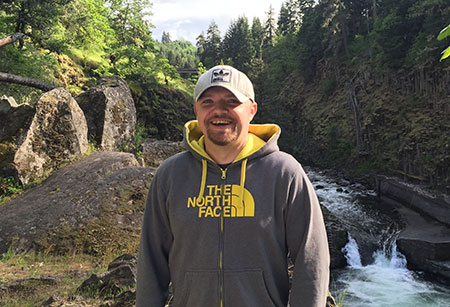
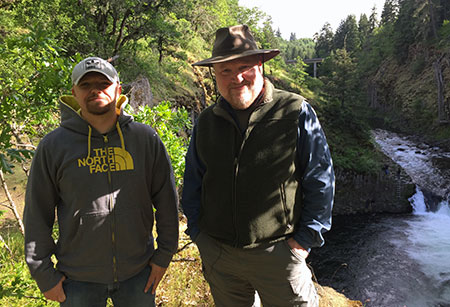
A few weeks ago I had the pleasure of meeting Zack Frank, the young photojournalist behind Undiscovered America, his project to photograph 56 places across the country that should become the next generation of national parks — Mount Hood and the Columbia River Gorge among them! With this ambitious project, he hopes to contribute to a new vision for the next 150 years of conservation in America.

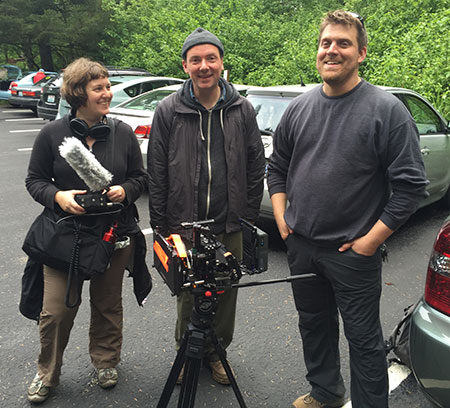
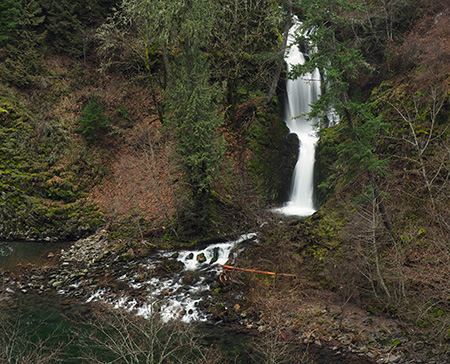
We met at Punchbowl Falls on the West Fork Hood River, a fitting spot for a conversation about overlooked gems that could stand next to the nation’s best-known national parks with a little vision and restoration. Our meeting was made possible by local filmmaker Christopher Alley, whose Ampersand Productions is currently filming a documentary dedicated to the new national parks movement, and featuring the Mount Hood National Park Campaign, in particular.

The film crew: Emily Wahl, Eric Macey and Christopher Alley

The film crew: Emily Wahl, Eric Macey and Christopher Alley

Zack came to the Undiscovered America idea from seeds sown in his youth, when his family drove from Pennsylvania to the great parks of the northern Rockies, including Yellowstone. These early experiences helped shape Zack’s refreshingly holistic vision for the national parks that would focus on restoring gems like Mount Hood and the Columbia Gorge as unique ecosystems that are not represented in the national park system today.

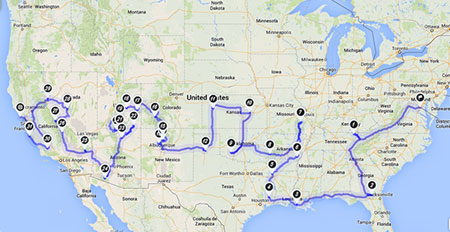
His 6-month grand tour of future parks is funded through a successful Kickstarter campaign that drew nearly 300 backers and set a record for nature photography projects. Zack will be the first known photographer to visit the 50+ sites proposed for national park status.

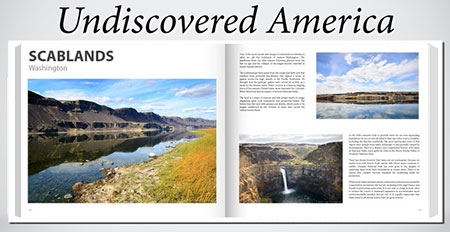
Once his tour is complete, Zack will release a 200-page Undiscovered America book documenting his journey, and hopefully rallying a new parks movement in the same way that earlier photographers brought places like Yellowstone, Yosemite, the Redwoods and North Cascades to the public conscience for the first time. Images from his trek will also be displayed as a traveling show in art galleries across the country, further helping to spread his vision for a new era of national parks.

Stage 1 of Zack's journey focused on the southern part of the country

Stage 1 of Zack’s journey focused on the southern part of the country

Though Mount Hood and the Gorge are part of Zack’s tour, they are different in that they are anything but “undiscovered”! Yet, they do fit perfectly the larger frame of bringing more enlightened and sustainable land management to these special places under the unique stewardship of the National Park Service.

Zack brings his experience as a photojournalist in the United States Marine Corp to the project. After meeting with him, it was clear that also he also brings a remarkable degree of wisdom, confidence and determination to the project that are beyond his years, a reflection of his time spent in Iraq during his service to our country.

We’re also very fortunate that Zack has chosen to continue his service to the country in the form of his Undiscovered America project. Hearing about his vision for the next wave in the American conservation movement was a breath of fresh air. Too many in the old guard of the movement have become prisoners of playing defense, a necessary posture during an era of intense attack on the environment, for sure, but now suddenly out of touch with a new generation of Americans looking for a more compelling and sweeping new vision.

Zack’s project avoids that the fear tactics and hot-button issues approach to conservation that no longer resonates with younger people, who instead are responding more to messages of hope, new ideas and opportunities to work collaboratively for broader solutions than the false choice of “wilderness-or-nothing”. National parks offer a great fit for this generation.

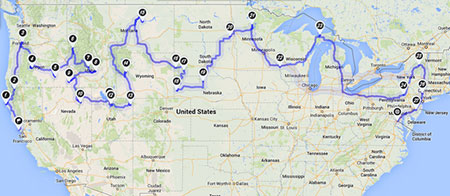
Stage 2 of Zack's tour begins in the Pacific Northwest and travels across the northern states

Stage 2 of Zack’s tour begins in the Pacific Northwest and travels across the northern states

Zack says that he marches to the drum of the likes of John Muir, Timothy O’ Sullivan and Ansel Adams, and embraces the same sweeping vision that caught the imagination of the American mainstream and helped build the National Park System we treasure today. Most importantly, he thinks in increments of decades and centuries — not just the next election campaign or fundraising cycle. In that way, he is true to the pioneering conservationists he holds as his inspiration.

I challenged Zack with a series of defeatist arguments I have heard against protecting Mount Hood and the Gorge as a national park — all too often from some of Oregon’s conservation leaders: how can an area with ski resorts, major highways, utility corridors and cut-over forest lands even be considered for national park status?

One by one, he knocked these arguments down with real examples of existing parks where these supposed deal-killing obstacles like these are managed within a park context, in concert with a broader conservation philosophy that still ensures a sustained natural legacy.

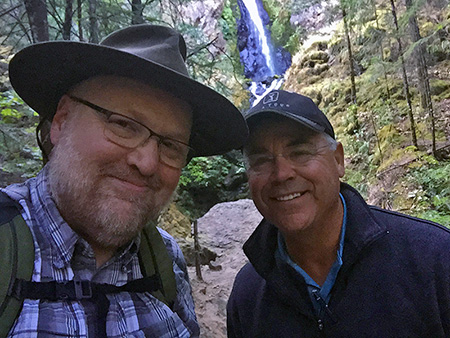
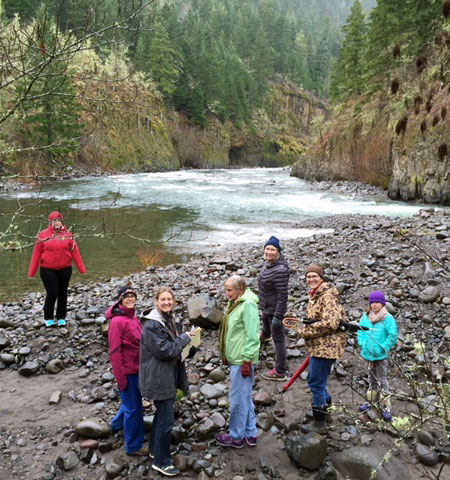
The author meeting with Zack at Punchbowl Falls

The author meeting with Zack at Punchbowl Falls

Zack Frank doesn’t see himself as a standard bearer, simply part of an emerging coalition. But what I saw in Zack is the face of a new generation of conservation leaders — whether he knows it, or not — who are unencumbered by false dichotomies and narrow orthodoxy that have too often muted the conservation movement. He is solidly a millennial, and like so many of his generation that I encounter, Zack gives me a renewed energy and sense of optimism that we can once again do great things on the conservation front, and starting with a new national parks movement!

We’re just passing through, after all…

Tribal fishing at Punchbowl Falls

Tribal fishing at Punchbowl Falls

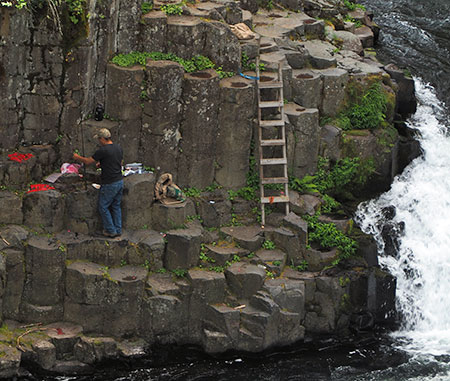
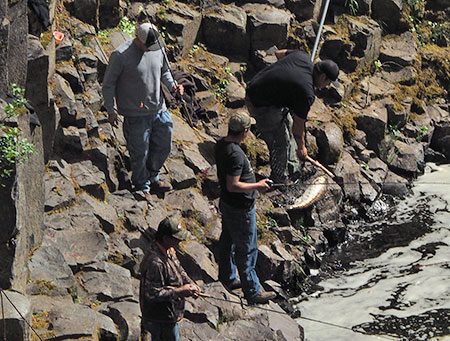
During our visit on the high cliffs above Punchbowl Falls, we watched as a group of tribal fisherman worked the massive pool below the falls for spring Chinook. As they went about their tasks, it struck me that these men were fishing in the footsteps of generations of ancestors who had harvested salmon at this spot for millennia — and that that the stakes are very high for the Mount Hood region, right now.

For centuries, the abundant ecosystems of Mount Hood and the Gorge have supported a large Native American population with a natural bounty that only now is at risk, thanks to just a few decades of rapid development and over-harvesting of resources. In this context, the broader frame that Zack Frank raises for Mount Hood the Gorge is this: we’re just passing through, so what will we choose to leave behind for future generations?

Tribal fishermen at Punchbowl Falls

Tribal fishermen at Punchbowl Falls

While the ecosystems in the Mount Hood region have so far been resilient in the face of these new pressures (the forests have continued to recover after repeated harvesting, salmon return to ancient habitat when we reopen once-damned streams like the West Fork), we are now facing an unprecedented onset of global climate change. Will the sprawling maze of new clear cuts that now mar the upper West Fork valley recover, once again? Probably. But for the first time in millennia, we don’t really know for sure, and so our margin of error grows narrower in just how far we can push the ecosystem to meet our needs.

Selective thinning at the Punchbowl Park site

Selective thinning at the Punchbowl Park site

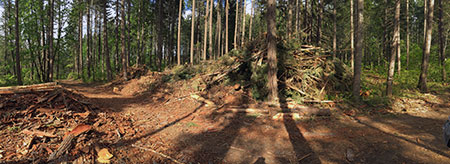
On our walk to Punchbowl Falls, Zack and I talked about some of the answers that were all around us. Restoring Mount Hood means thinning plantation thickets, where industry efforts to short-circuit the natural reforestation cycle on clear cuts has left dangerously crowded stands of unhealthy, fire-prone trees. One such thinning project was underway at the Punchbowl site, where the Western Rivers Conservancy has carefully removed several insect-compromised trees from the forest.

The Punchbowl property, itself, provides another answer: private land trusts working with local communities and governments to restore and bring into public ownership the most important sites and habitats. This continues to be the winning formula for Mount Hood and the Gorge, with much work to be done — and still a need for a larger national park vision to guide often fragmented efforts. Like most of the sites on Zack’s tour, the broader vision for Mount Hood and the Gorge will require a creative blend of acquisition, restoration and new partnerships.

Wy’East Comes to Visit

As I finished my interview with Zack Frank, the tribal fisherman below us were packing up their harvest for the day — a string of salmon that would soon provide food for their families or perhaps be sold in one of the familiar roadside fish stands.

Wy'East makes an appearance at Punchbowl Falls

Wy’East makes an appearance at Punchbowl Falls

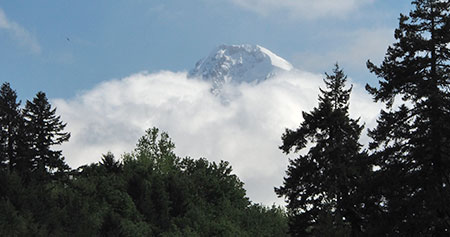
As we watched them scale the cliffs above the falls with their catch, the crest of Mount Hood — Wy’East — suddenly emerged from the clouds, brilliant with a fresh dusting of snow. Zack had spent the morning on the mountain, socked in by a lingering Pacific front, so it was his first sighting of the mountain on this leg of his trek.

The scene unfolding at that moment could not have made a better case for why Mount Hood and the Gorge deserve better: the raw beauty, the amazing collection of ecosystems, from rain forest, fire forests and oak savannah to alpine and desert ecosystems; and perhaps most unique to the area, the rich, unparalleled human history. It was all right there in front of us, and I was thrilled that it could be part of Zack’s journey!

How to support Zack

Zack’s current project was successfully funded through his Kickstarter campaign, but you can still support him by visiting his website and ordering a copy of his forthcoming Undiscovered America book.

Mockup of Zack's forthcoming book about his journey

Mockup of Zack’s forthcoming book about his journey

You can also be a friend of the national parks. Zack recommends the National Parks Conservation Association (and be sure to let the know you support new parks!), but I would suggest an even broader offering: an open mind to what might be, and a willingness to help a new generation of leaders realize their bold aspirations — including a new national parks movement!

An Overdue Warren Falls Update (…and a bombshell!)

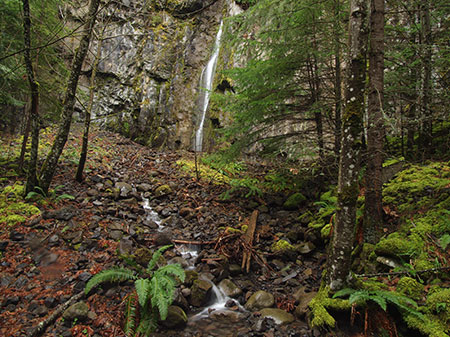
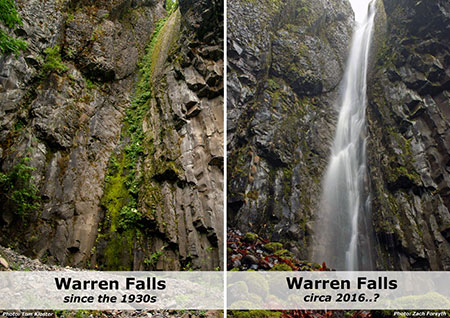
Warren Falls lives! Well, occasionally… during the wettest winter storms

Warren Falls lives! Well, occasionally… during the wettest winter storms

Time is running out on the Restore Warren Falls! project. This summer the next phase of the Historic Columbia River Highway (HCRH) State Trail project will begin construction of a segment that will pass right in front of the falls.

The new trail construction in the area is not simply an ideal opportunity to finally undo what the Oregon Department of Transportation (ODOT) did to this magnificent waterfall 76 years ago — it’s probably the only opportunity in our lifetimes.

In that spirit, I thought an update on the project and Warren Falls was in order — plus share a bit of a bombshell that was sent to me recently!

Checking in on Warren Falls

First, a quick visit to Warren Creek: in mid-April I made a couple visits to Warren Falls as part of my twice-annual Friends of the Gorge hikes. As has become the norm in recent years, the natural falls clearly flowed again this winter during heavy runoff that overwhelmed the diversion weir at the top of the falls.

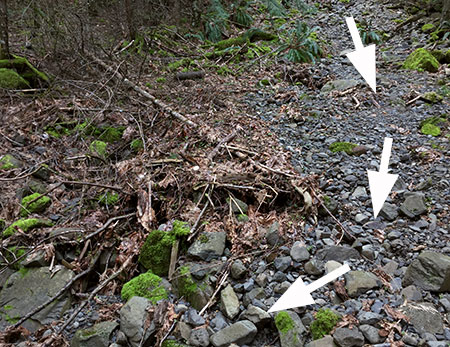
The flood path from the briefly reborn falls cleared leaf debris as shown by the arrows in this photo…

The flood path from the briefly reborn falls cleared leaf debris as shown by the arrows in this photo…

…and in this photo, where the overflow stream continued down the ancient creekbed

…and in this photo, where the overflow stream continued down the ancient creekbed

These regular overflows make more sense when you look at the condition of the weir — the following photos from the top of the falls show just how clogged the giant “trash rack” has become, and also how badly the upper lip of the rack has been exposed as the concrete diversion dam continues to erode:

Over its 76-year life the enormous weir has become twisted and clogged with debris, causing more overflows each year

Over its 76-year life the enormous weir has become twisted and clogged with debris, causing more overflows each year

The steel beams that make up the weir are also coming loose from their foundation as the concrete diversion dam deteriorates with time

The steel beams that make up the weir are also coming loose from their foundation as the concrete diversion dam deteriorates with time

The Friends of the Gorge hikers always marvel at the strange, unsettling scene of a dry waterfall. Like most who visit Warren Falls, many are also saddened by the idea that the ODOT could have been so cavalier in altering such a beautiful scene at Warren Creek so grotesquely.

While the original decision to divert the falls can arguably be blamed on the thinking of the era (late 1930s), I would submit that allowing this tragic mistake to continue to exist is equally cavalier and dismissive of the natural landscape at Warren Creek. Thus, my campaign to attach the burden of undoing the mess at Warren Falls to ODOT — and in particular, their looming state trail construction project that will soon begin in the area.

Gorge Friends hike at Warren Creek in April

Gorge Friends hike at Warren Creek in April

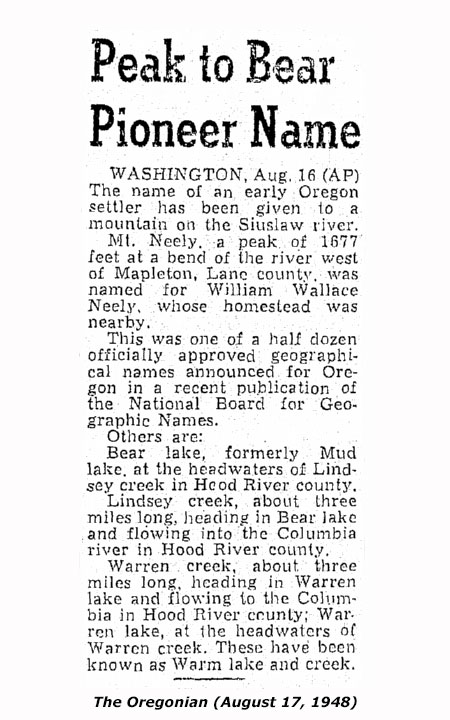
While researching Warren Falls over the winter, I finally found a definitive story on the official naming of the creek. The name “Warren” comes from Warren “Barney” Cooper, and early forest ranger in the Mount Hood area (and part of the Cooper family described in this previous article).

This Oregonian article documents (in the last paragraph) when Warren Cooper’s name finally became the official name of the creek in 1948, though it had been in unofficial use for years:

WarrenFallsUpdate07

So, we now learn that Warren Lake and creek were once called “Warm Lake” and “Warm Creek”. Warren Lake is situated on a high, rocky shoulder of Mount Defiance, and shallow enough to be “warm” in late summer, so that could be the simplest explanation for this early name.

The name “Warren” appears on maps and early documents from well before this 1948 decision, so the timing of the article is interesting, especially so long after Warren Cooper’s death in 1920. Was the naming in 1948 simply cartographic housekeeping or an overdue recognition of a pioneering forest ranger by those who followed him?

As always, every answer brings a few new questions!

Friends of Warren Falls… are everywhere!

Since the Oregon Field Guide story on the Restore Warren Falls! project first aired the fall of 2012 (watch the documentary here), several anonymous “friends” of Warren Falls have quietly contacted me with offers to help.

OFG's Vince Patton and Michael Bendixen looking for the illusive Warren Falls in the winter of 2012

OFG’s Vince Patton and Michael Bendixen looking for the illusive Warren Falls in the winter of 2012

Most surprising among the proposals were offers to simply “monkey-wrench” the weir at the top of the falls to speed up its demise! While I’m sympathetic to both the frustration and impatience behind the monkey-wrenchers out there, I’m also concerned that tinkering with the weir might actually be illegal (though it’s hard to see how a decaying structure that no public agency will claim responsibility for could somehow also become the basis for legal action..?)

More importantly, I’m concerned that formally removing the weir and associated debris will become increasingly difficult if the structure is further compromised. I’ve therefore thanked the monkey-wrenchers for their passion, but encouraged them to be patient and allow the slow wheels of government to turn a bit further..!

…and the bombshell…

Another piece of information that trickled in from an anonymous attorney and friend of Warren Falls is found in plain sight: in the Oregon Revised Statutes. Specifically, ORS 538.200, which exists solely to prohibit the diversion of “streams forming waterfalls near the Columbia River Highway” for “any purpose whatsoever”.

While quite clear in its intent, this might seem like a very general reference. But the statute (which was signed into law in the early 1900s, before the Warren Falls diversion) goes on to list each of the streams and waterfalls that fall under this protection — including Warren Creek, in ORS 538.200(26)!

An unusual view of Warren Creek topping its weir and overflowing into its natural falls (visible behind the trees)

An unusual view of Warren Creek topping its weir and overflowing into its natural falls (visible behind the trees)

What does this new information mean? For starters, it means that ODOT — at the time, called the Oregon Highway Division — broke the law in 1939 when it blasted a diversion tunnel and erected a dam and weir to pipe Warren Creek away from its natural falls and streambed. That is quite clear.

What is unknown is whether the ODOT decision to defy the law in the late 1930s was brazen in its intent. As hard as that possibility is to believe, it is also very hard to believe the agency wouldn’t have known about the law, given that it had been enacted just a few years prior the Warren Falls diversion project being concocted in the early 1930s — and was specifically aimed at the state’s premier highway of the era.

What does it mean today? In my view, it means that ODOT now has BOTH a legal and ethical responsibility to undo what it has done to Warren Falls. That couldn’t be more clear.

The End Game?

For the past four years I’ve been beating the drum to connect the restoration of Warren Falls to the massive, multi-million dollar Historic Columbia River Highway state trail project, without much success. So far I have:

• been turned away by both Oregon State Parks and the U.S. Forest Service, both claiming the falls lies on the other agency’s property (though it quite clearly falls on Oregon State Parks land)

• unsuccessfully pitched the cause to three of the premier conservation groups active in the Gorge, including on-site tours, but did not persuade any of the groups to adopt the cause.

• unsuccessfully made the case twice before the Historic Columbia River Highway steering committee, with some sympathetic interest from the committee, but a deep reluctance to seriously consider the idea. It was added as an item “for consideration” — but later dropped due to cost concerns.

• successfully pitched the idea to the producers of Oregon Field Guide story, and while ODOT staff involved in that effort were sympathetic to the state of Warren Falls, the publicity created by the story did not change their recommendations to their steering committee for any further consideration of restoring the falls.

• posted a string of articles on this blog and started a Facebook group two years ago to continue to rally the cause, but these efforts haven’t made a noticeable dent at ODOT, either.

We are now in the end game, and I don’t think the Warren Falls will ever be restored if the work doesn’t happen when ODOT has heavy equipment in the area later this year. After that, it will most likely be up to Mother Nature, and that’s would be such a sad commentary to future generations when they judge the state of the world we choose to leave them.

From the beginning, I have argued that restoring the falls isn’t about money, but rather, about responsibility. ODOT created the mess that now exists at Warren Creek, and for a whole variety of safety, ethical, environmental — and now, legal — reasons that I’ve argued over the years, it’s time for the agency to own up to their responsibility.

No fooling, ODOT has $2 million annually in a “contingency” fund for exactly the kind of work that restoring Warren Falls would entail — and just allocated another half-million dollars to cover additional costs for the state trail project in the Warren Creek area.

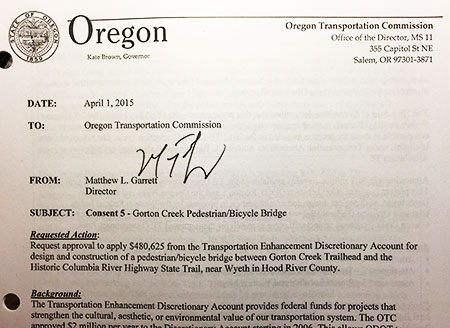
It turns out the money has always been there, too. On April 1, ODOT quietly pulled nearly a half-million dollars in “contingency” funds into this latest phase of the state trail as a consent item before the Oregon Transportation Commission. The new money is for a previously unplanned bridge over nearby Gorton Creek, a worthy addition at the east end of the current phase of construction. Warren Falls could be restored for a fraction of that amount – if only the will and sense of agency responsibility at ODOT existed.

My next efforts will focus beyond ODOT, given my fruitless efforts to work with the agency. At the top of my list of arguments is the newly discovered fact that the agency violated state law when they built the project in 1939 — underscoring the notion that ODOT has both ethical and legal obligations to own up to restoring the falls. The agency clearly has funding available for worthy efforts like this one if the desire exists. I will be making that argument, as well.

There's still time to realize this vision… but not much.

There’s still time to realize this vision… but not much.

I’ll post a follow-ups to article with more details soon, and especially how you might be able to help get the restoration of Warren Falls unstuck from our state bureaucracy. Most of all, a big thanks to all who have offered to help — and as always, thank you reading this blog and caring about Mount Hood and the Gorge!

Punchbowl Park Update

PunchbowlUpdate01

In late January, I posted an article on the proposed Punchbowl Park project at the confluence of the east and west forks of the Hood River. Since then, community activists have worked with Hood River County officials to move the project forward with a remarkable public outreach effort and bold vision for the new park.

Heather Staten, executive director of the Hood River Valley Residents Committee (HRVRC) and the leading force behind the project took a few minutes this week to give an update on the project, and what lies ahead for this exciting proposal.
______________

WyEast Blog: How did the Punchbowl Park project get started, and what is the role of the HRVRC?

Heather Staten: Hood River County and Western Rivers Conservancy, the property’s current owner, had worked unsuccessfully for several years on grants to fund acquisition of the 100-acre property as a County Park. Those efforts had flown under the radar of most local people, even those with close associations to the property. Last summer, David Meriwether, the County Administrator approached me about conducting a robust public process where we would really discover the community’s vision for the property.

My organization, the Hood River Valley Residents Committee (HRVRC), was well-placed to run such a public outreach effort. We’re Oregon’s oldest local land-use advocacy group, with a 38-year history of protecting farms, forests and special natural places. David also knew me from the campaign to reopen Hood River’s libraries when they were closed due to budget cuts. So he knew we had both the local knowledge and organizational capacity to run a really inclusive public process.

WyEast: You’ve made a real effort to involve the broader community in this planning effort. What are some of the most common themes you’re hearing?

Staten: This was a community planning effort. I can’t imagine many planning processes that involved as many people as intensely as this one. Part of it is the nature of the property–it is spectacularly beautiful. People are passionate about it so they have strong opinions. They use it, love it and want to protect it.

One of the things that was interesting to me was how people prioritized protecting the place over whatever they did there. There was real consensus that preserving the natural and ecological features of the place was the most important thing. Whenever there was choice that provided greater convenience for users but at the price of degrading the resource, the public always chose to protect the resource. For instance, they rejected campgrounds and drive up boat ramps.

Heather Staten (holding notebook) on one of her many community tours of the proposed Punchbowl Park

Heather Staten (holding notebook) on one of her many community tours of the proposed Punchbowl Park

WyEast: What makes the site special in a way that warrants a public park?

Staten: Everyone falls under the spell of the rugged wild beauty of the site and its unique and stunning combination of basalt columns, fast moving water and rich flora and fauna. It packs a lot of diversity in a relatively small site — two waterfalls, the confluence of two rivers, basalt canyon, conifer forest on the west side of the property and a really lovely Oregon white oak woodland on the east side.

There is the thrilling experience of walking along the ridge of the canyon with the water crashing far below then a very different experience down at the confluence when you stand at water level with rivers on either side of you joining together. The site provides rare and precious access to the river for anglers, kayakers, rafters and swimmers. In 15 miles, there are only a couple of legal public access points to the river.

WyEast: The proposal includes several new trails. Aren’t there already trails on the site? What would the new trails offer and how would they be built?

Staten: Until now the trail system has consisted of an old logging road and a spider web of social trails that people have created all over the ridge above the West Fork. People know about the waterfall, they can hear and see the water so they cut their own paths to get there. There are so many of these social trails that they are causing environmental damage.

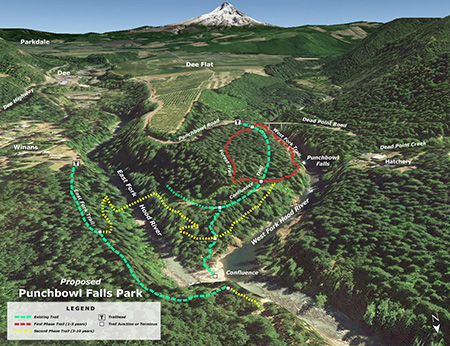
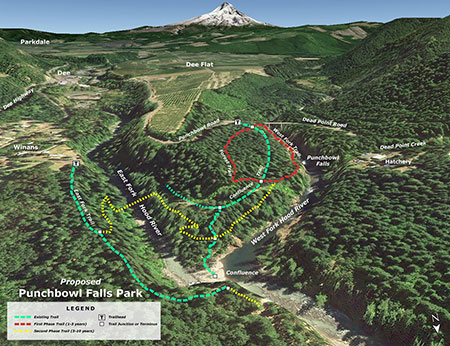
The big idea is to build a new trail to go where people want to go. The new trail will run along the ridge and connect the major, stunning views and access points along the west fork offering kind of a curated experience of the river canyon. Also as part of Phase One we’ll build a forest loop through the woods.

We’ve got an even grander plan for Phase Two, a wooden footbridge over the East Fork that would link the east and west sides of the property. It will greatly expand the length of the trail system and offer a greater diversity of experience. The east side of the river is a hidden gem, with an intact Oregon white oak forest, great vistas of the confluence and river access to the main stem Hood River.

The trail building will mostly be a volunteer effort. We were lucky to meet with Trailkeepers of Oregon (TKO) several months ago — their advice has been invaluable. Trailkeepers will provide the professional expertise and tools and Hood River will provide the local volunteer muscle. It’s a model that Hood River County has used successfully for all of their mountain bike trails on county forest land.

Trail concept proposed as part of the Punchbowl Park plan

Trail concept proposed as part of the Punchbowl Park plan

[click here for a larger view]

WyEast: Punchbowl Falls has been a traditional Native American fishing site, were tribal interests involved in the park planning? If so, what sort of themes did you hear from the tribes?

Staten: The area around Punchbowl Falls, particularly the bowl just below the falls, has been a fishing site for members of the Confederated Tribes of the Warms Springs (CTWS) and their tribal ancestors for centuries. Tribal members attended the public meetings and we consulted with the manager of the CTWS hatchery program in the area.

Tribal members were concerned with interference with their fishing season and with the protection of the riparian corridor for salmon and steelhead habitat. Along with ODFW, the Tribes have been working for the last few years to restore a spring Chinook run to the Hood River. Spring Chinook used to be a very productive fishery on the Hood River but was effectively extinct by the late 1960s, a casualty of dams and detrimental logging practices.

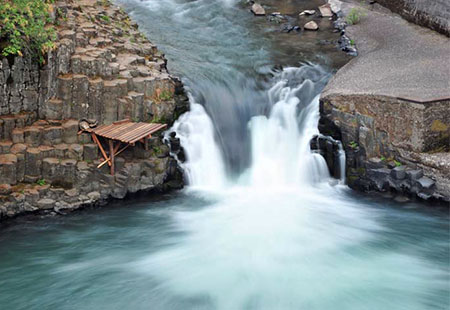
Fishing platform at Punchbowl Falls (courtesy Heather Staten)

Fishing platform at Punchbowl Falls (courtesy Heather Staten)

In 2010, the Powerdale Dam was removed from its location downstream from the Punchbowl area, making the Hood River a free-flowing river again. It’s still early, but there are signs that the chinook run is coming back, so tribal members were concerned that any development at the park, like trail building, be done in a way that did not effect water quality.

Along with their treaty fishing rights, the tribes have some exclusive fishing rights at the property: only tribal members are permitted to fish within 200 feet of Punchbowl Falls. Sport anglers must stay downstream of that boundary, just north of where Dead Point Creek falls enters the Hood River.

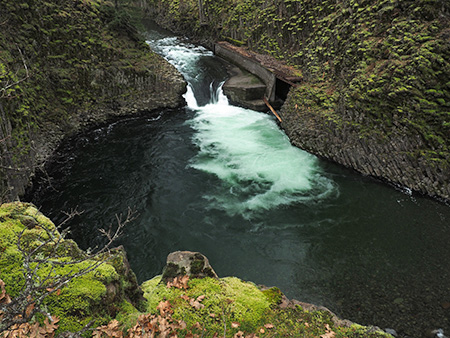
WyEast: When you visit Punchbowl Falls, it’s hard not to notice the concrete fish ladder that was built in the 1950s, as it’s a bit of an eyesore. What is the long-term plan for the fish ladder?

Staten: Yes, it is an eyesore, but it is used by fish as part of the salmon recovery program. There is not yet a plan for the fish ladder. Investigating whether the fish ladder could be removed was outside the scope of this project but definitely worth further research.

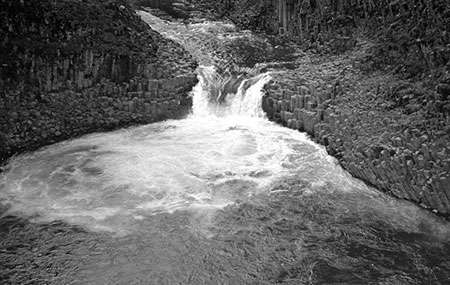
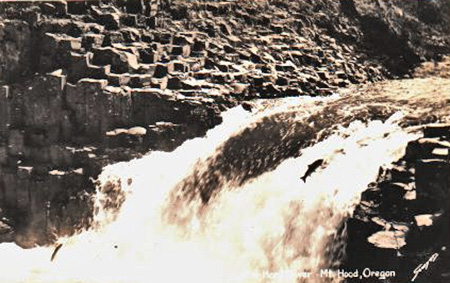
Punchbowl Falls is one of the most photographed locations in Hood River County so we have seen hundreds of old photos of the falls before the fish ladder was constructed in 1959. It does kind of break your heart when you see the basalt columns on the west side of the falls that have been replaced by that concrete.

Punchbowl Falls in 1942, before construction of the fish ladder (in 1959)

Punchbowl Falls in 1942, before construction of the fish ladder (in 1959)

WyEast: Last week the Hood River County Board of Commissioners endorsed the Punchbowl Park proposal. What are the next steps?

Staten: The Board of Commissioners endorsed the park proposal, committed to a budget to develop the park and authorized the County to apply for grants to fund the park’s acquisition. The Commissioners were supportive, enthusiastic and excited about the opportunity to create this park. The big deadline coming up is April 1, when we need to have our grant application in for the Local Government Grant Program of Oregon Parks and Recreation Department (OPRD).

WyEast: Anything else you’d like to add?

Staten: At the end of our presentation to the Board of Commissioners, the chair asked if anyone in the audience would like to speak. A gentleman stood up and said that whenever he went to a National Park, somewhere in experiencing the park, he felt a moment of gratitude because he realized that 100 years ago someone had the vision and the drive to save it for the public, like John Muir at Yosemite. He said that at Punchbowl, we had the opportunity to be the people that saved it for future generations. This is a park not just for us, but also for our great-great grandchildren.

WyEast: Heather, thanks for taking the time to talk about the project, and for all your work in leading this effort. It’s truly a once-in-a-lifetime opportunity, and you’ve really galvanized the community with your vision for protecting this amazing place!

_________________

To view a copy of the Punchbowl Park plan, click here to download a PDF version.

Good News from the Hood River RD!

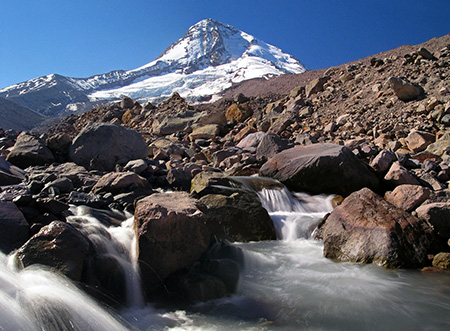
The Eliot Branch and Mount Hood

The Eliot Branch and Mount Hood

A few weeks ago the Forest Service contacted me about a recent article posted on this blog, It’s Time to Fix the Eliot Crossing!

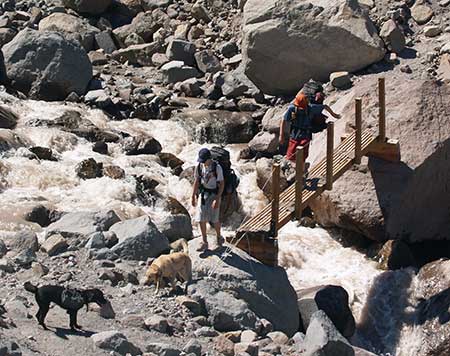
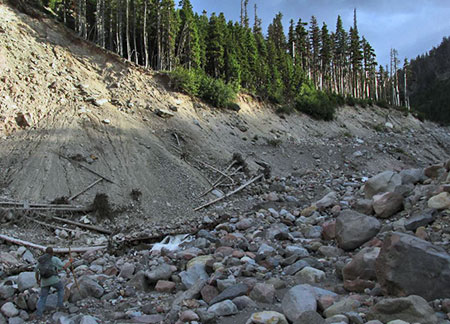
The article proposed some simple solutions for restoring a washed-out section of the Timberline Trail at the Eliot Branch, which has been offically closed for nearly a decade, and is quite dangerous for those who choose to ignore the closure signs.

The article critiqued Forest Service inaction on the problem, and especially the agency obsession with the “million dollar bridge” solution of somehow installing a supension bridge over the disintegrating canyon of the Eliot Branch. This stream is the unruly outflow from the Mount Hood’s Eliot Glacier, largest of the mountain’s glaciers.

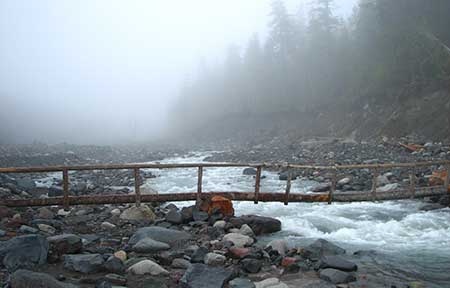
Crossing the Eliot Branch in better days on the old footbridge

Crossing the Eliot Branch in better days on the old footbridge

The proposed susppension bridge would have been prohibitively expensive, and had little chance of ever being funded. Worse, any bridge built here stands a very good chance of being destroyed: the steady retreat of the Eliot Glacier will continue to unravel the canyon below for the foreseeable future as the Eliot Branch carves into new ground once covered by glacial ice.

Because of the critical nature of the article, I expected some grief from the Forest Service. Instead, I learned the Hood River Ranger District has now scrapped its “million dollar bridge” solution and is pursuing a simpler downstream crossing, very similar to what was proposed in the blog article. That’s great news!

The Hood River District staff invited me to meet with them and have a look at their new proposal, so I sat down with one of their Forest Service planners in late December to hear the details. The following are highlights from that conversation.

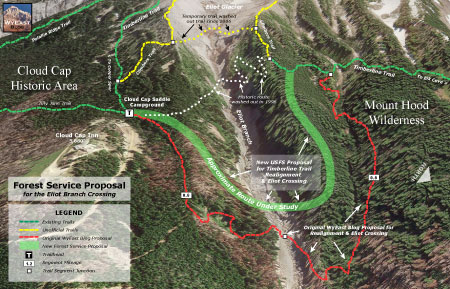
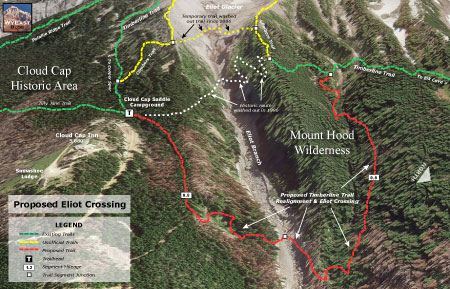
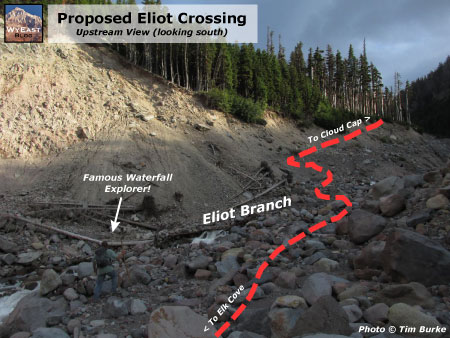
While they are still in the very early stages of laying out a route, the following map shows the general corridor (in green) the Forest Service has scouted for a “low trail” solution, compared to the new trail concept proposed in the earlier blog article (dashed red):

EliotCrossingRedux03

(Click here for a larger version)

The conceptual Forest Service route would descend the east wall of the Eliot Branch canyon in a series of short switchbacks, just upstream from the ravine where the route was proposed in the blog article.

Once across the Eliot Branch, the Forest Service route would traverse along the ridge that forms the west wall of the canyon, while the route proposed in the blog article followed a tributary stream up a ravine that leads to the Timberline Trail. The Forest Service route is a bit shorter, at 1.2 miles, but follows the same “keep it simple” principles laid out in the blog article.

The Eliot Branch in the vicinity of the proposed crossing (photo © Tim Burke)

The Eliot Branch in the vicinity of the proposed crossing (photo © Tim Burke)

Here’s the best news: the Forest Service hopes to have the new trail under construction in 1-2 years, and have already begun scouting possible alignments. Even better, they hope to involve volunteers in some aspect of the construction, and have reached out to Trailkeepers of Oregon (TKO) to begin that conversation (note: the author is also active in TKO).

This has been a long time coming, and kudos are in order for the Hood River Ranger District for getting this project unstuck — and especially for new staff at the Hood River office who have been instrumental in putting the “million dollar bridge” fiasco behind us. While much more work lies ahead for this project to become a reality, it’s a promising change of direction and a new level of commitment from Forest Service to finally fix this problem.

I’ll post updates on the project here over the next couple of years as the details come into view, of course!

A Mea Culpa is in Order…

When I arrived at the Hood River Ranger District last December for the Timberline Trail meeting, I was surprised to see that the visitor facilities had been dramatically upgraded! This was to my chagrin, as I had lamented the need to do so in this blog article in early 2014. It turns out that the finishing touches to the remodeled Hood River offices were being made at about the time I posted those comments here, so a mea culpa is in order!

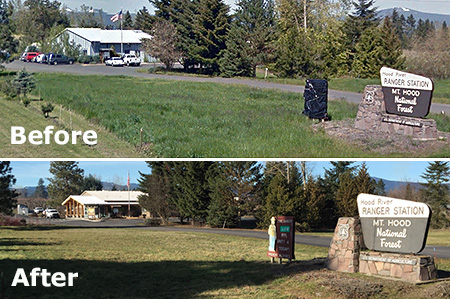
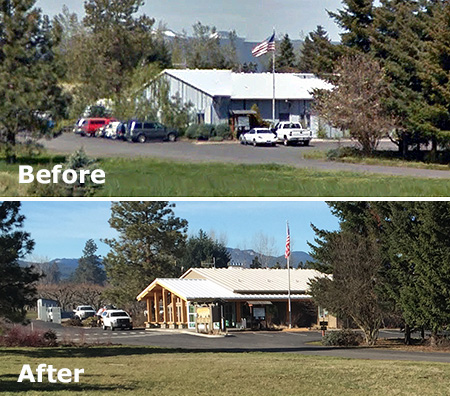
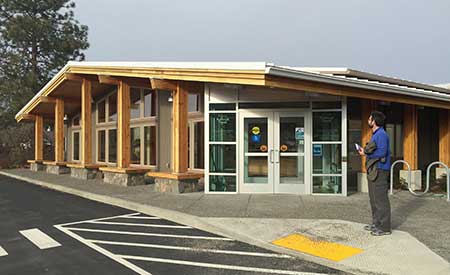
Like me, you probably won’t notice the changes to the Hood River Ranger Station when driving by on the Mount Hood Loop Highway, as the public face of the building has been redesigned to face south, not toward the highway to the east. In fact, the building looks much the same from the highway to the casual eye — though an addition to the main building, new signage and an outbuilding have been constructed in what was once a very large parking lot (see below).

Before and after highway views of the ranger station

Before and after highway views of the ranger station

Before and after views of the ranger station

Before and after views of the ranger station

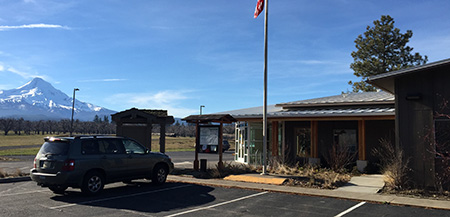
The new orientation makes perfect sense when you stand in front of the building, however. A picturesque view of Mount Hood rising above orchards fills the scene — a view echoed and embraced by the pyramid-shaped wall of windows that define the new visitor center.

Mount Hood fills the southern horizon

Mount Hood fills the southern horizon

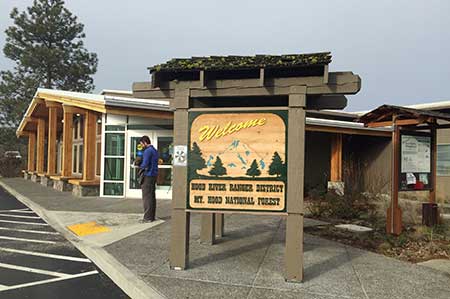
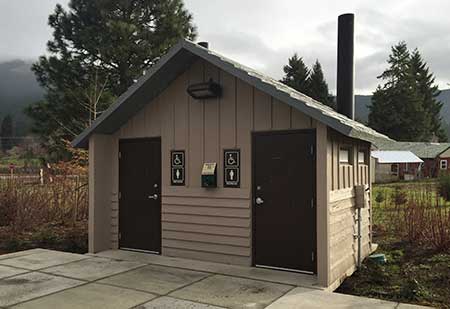
The revamped building exterior has ADA-compliant parking and ramps, a small plaza, updated informational sign kiosk, carved welcome sign, bike rack and a new pit toilet. The latter is a much-needed addition that is less elegant than the flush toilets provided at the new Zigzag Ranger Station, but still a nice step forward.

This carved sign welcomes visitors to the new facility

This carved sign welcomes visitors to the new facility

The new visitors center is ADA accessible

The new visitors center is ADA accessible

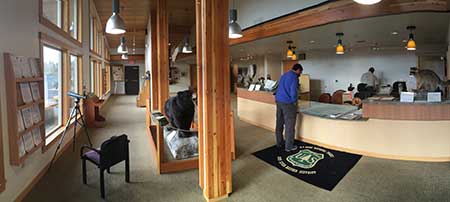
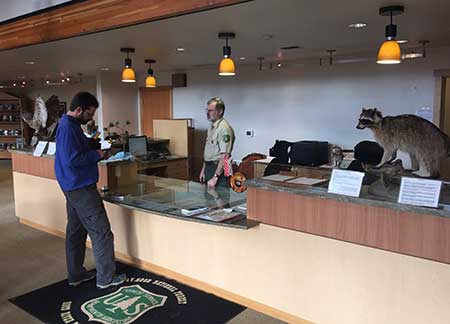
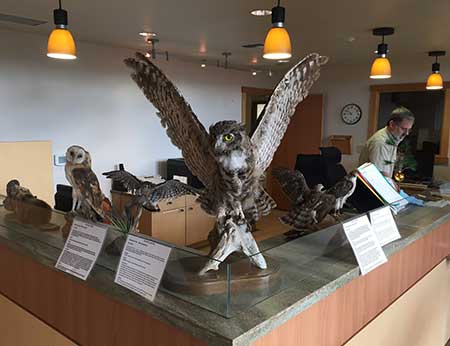
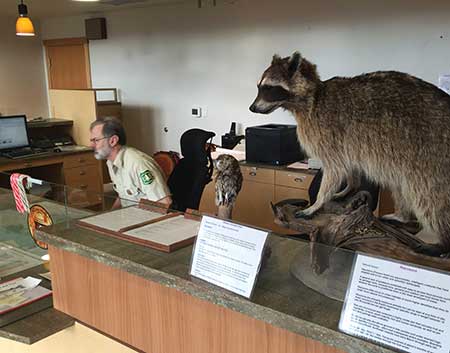
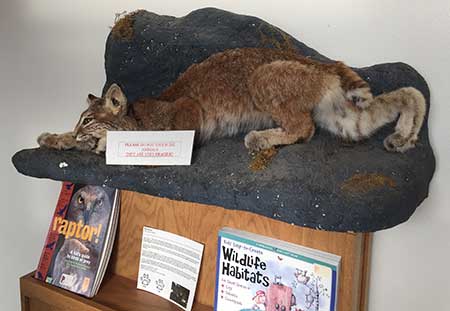
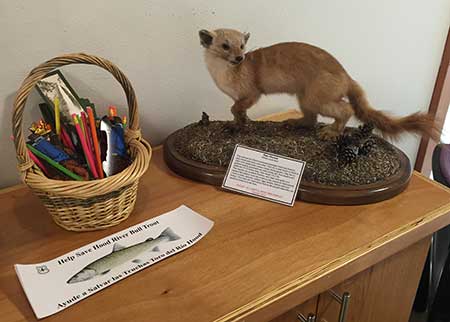
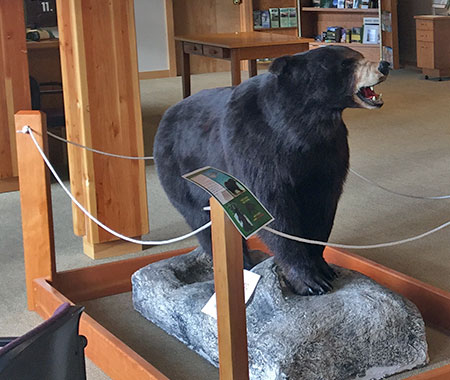
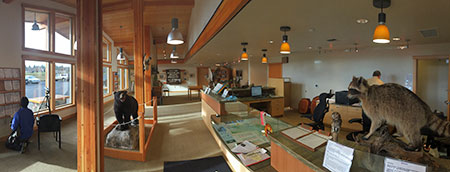
Once inside the new visitors center, you will find a main desk staffed by a Forest Service ranger, and a nice mix of interpretive displays, ranging from historical artifacts to a collection of mounted wildlife specimens found in the Mount Hood region. The center also has a very good selection of field guides and maps for sale, in addition to many free USFS informational materials.

A nice touch inside the building is a terrestrial telescope mounted on a tripod in front of one of the large picture windows, allowing visitors to take a closer look at the mountain that looms above the ranger station.

Interior panorama of the visitors center (note telescope on the left)

Interior panorama of the visitors center (note telescope on the left)

Rangers staff the new front desk at the visitors center

Rangers staff the new front desk at the visitors center

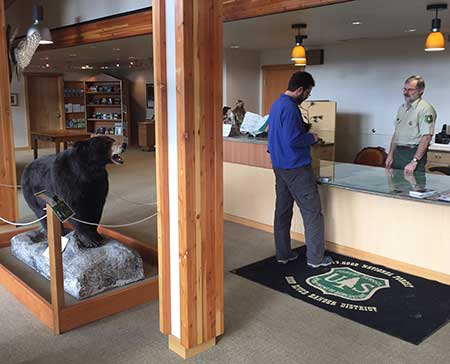
Watch out… bears lurk behind posts in the new facility!

Watch out… bears lurk behind posts in the new facility!

The wildlife specimens will be fun and informative for families visiting the center, as kids are universally drawn to animal displays. Each mounted display has a detailed info card to help parents become instant experts on the different species represented, or for older kids (and adults) to simply browse and learn from.

Owls on display at the front desk

Owls on display at the front desk

Guard raccoon is on duty 24/7…

Guard raccoon is on duty 24/7…

A particularly menacing bobcat is on display!

A particularly menacing bobcat is on display!

This Pine Marten is in charge of the Bull Trout bumper stickers…

This Pine Marten is in charge of the Bull Trout bumper stickers…

Black bear roaming near the front desk

Black bear roaming near the front desk

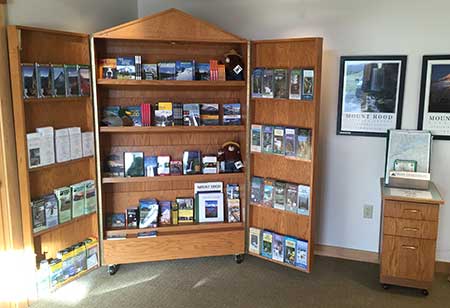
The bookstore is located at the west end of the visitor center and creatively designed as a rolling, self-contained portable display. The book offerings are excellent, including many of the most popular regional hiking, climbing, skiing and snowshoeing guides, plus field guides to area flora, fauna and history. Posters and coffee-table books celebrating Mount Hood are also featured.

The rolling bookstore has an excellent cross-section of materials

The rolling bookstore has an excellent cross-section of materials

The map offerings in the rolling bookstore are also excellent, including USFS maps for most National Forests in Oregon and Washington, and official Forest Service maps for wilderness areas in the more immediate Mount Hood region.

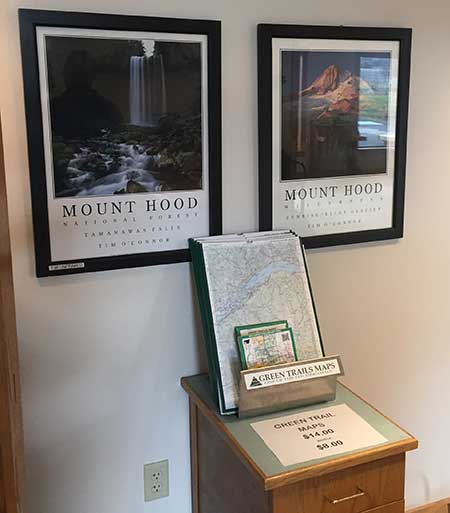
The map selection also includes several independently published trail and ski maps, including the exceptional National Geographic Trails Illustrated series for Mount Hood and the Gorge and maps for the Pacific Crest Trail. There are even Green Trails topographic maps for the Mount Hood region (below).

Green Trails topographic maps for sale

Green Trails topographic maps for sale

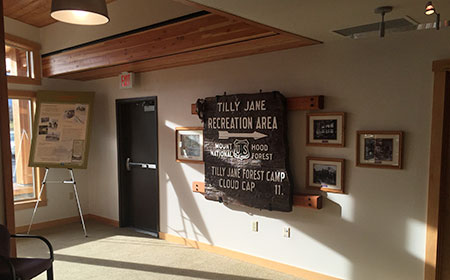
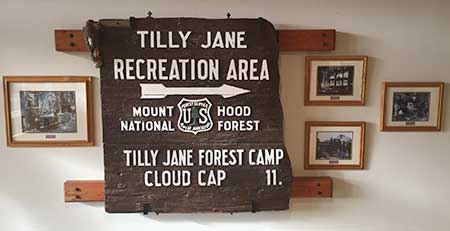
Historical interpretation is somewhat more limited at the new center, anchored by a fine carved sign (presumably Works Progress Administration or Civilian Conservation Corps?) that once stood at the Cloud Cap junction on the old loop highway. The impressive old sign is flanked with captioned photos of north side history on the mountain.

History displays at the west end of the new facility

History displays at the west end of the new facility

Historic Tilly Jane sign anchoring the history displays

Historic Tilly Jane sign anchoring the history displays

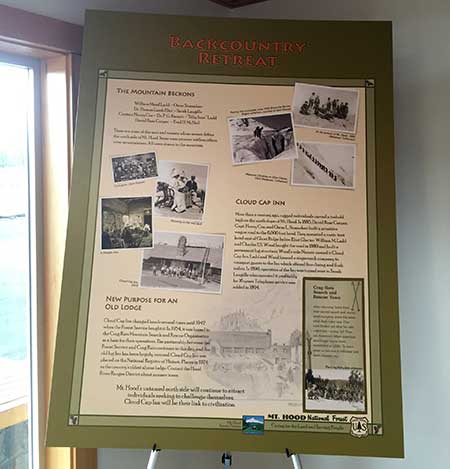
A mounted poster from the Mount Hood Scenic Byway series provides a bit more history of the Cloud Cap Inn and the early climbing history of the north side.

Hopefully, new displays will be added over time to explore more of the rich history of the upper Hood River Valley and north side of Mount Hood: the long Native American history in the area, settlement of the upper Hood River Valley in the 1800s, early Forest Service history on Mount Hood and completion of the Mount Hood Loop Highway in the 1920s are just some of the stories that deserve to be told here.

Mount Hood Scenic Byway history poster

Mount Hood Scenic Byway history poster

There are still some gaps in the visitor experience at the revamped ranger station that could use some attention. First, heavy landscaping hides the Ranger Station from southbound highway traffic (which is how most visitors travel to the mountain), and the signage along the highway is easy to miss. Adding a simple “Visitors Center” sign to the existing entrance marker would be helpful.

Second, the visitor center hours posted at the door differ from what appears on the official Mount Hood Forest website. At least two variations appear on the website, depending where Google takes you: the main website listing shows a M-F schedule, while the dedicated Hood River Ranger District page includes Saturdays in the daily schedule.

The new center elegantly packs a lot into a modest space

The new center elegantly packs a lot into a modest space

The signs at the main entrance to the Ranger Station split the difference, showing M-F hours, but extending to include Saturdays from Memorial Day through Labor Day. In all of these variations, the actual hours are the same: from 8:00 AM to 4:30 PM, closed on all federal holidays.

Obviously, Saturday operating hours are at a premium, both for the Forest Service in covering their expense of keeping the building open, but also for visitors, who are more likely to be traveling here on weekends than weekdays.

Hopefully, the agency can someday find a way to keep the visitors center part of the Ranger Station open on Saturdays (and even Sundays?) year-round. Weekends are undeniably the busiest visitor time on the mountain, and Mount Hood is busy year-round.

Closed mornings, evenings and weekends..?

Closed mornings, evenings and weekends..?

Finally, the pit toilets located outside the new visitor center are currently locked when the visitors center is closed — an unwelcome and unfortunate surprise for travelers who stop early or late in the day, or on weekends.

In the long term, a better way to address the mismatch between federal government hours and those when the public is most likely to be recreating (weekends and holidays) would be to expand the outside informational and interpretive displays to better serve visitors when the main building is closed. This could even include locating interpretive displays some near the pit toilets, and leaving them unlocked on weekends and holidays.

Despite these rough edges, the new visitor center really shines for the Hood River Ranger District. The new facility should greatly enhance the visitor experience for those seeing the area for the first time.

But even if you’re a seasoned Mount Hood hiker, the new center deserves a stop on your next trip through the area. Plan for 20-30 minutes to explore the displays and browse the books and maps.

Finally, a chance to save Punchbowl Falls!

Mount Hood rises in the distance above Punchbowl Falls

Mount Hood rises in the distance above Punchbowl Falls

After nearly 150 years in private ownership, a spectacular basalt gorge along the West Fork Hood River might finally be preserved as a new park. The second of two community meetings on the proposal is rapidly approaching, and is well worth attending if you’re interested in the future of this magnificent place:

Punchbowl Falls Community Workshop
Tuesday, February 10th – 6-7:30 pm
Hood River County Offices
601 State Street, Hood River

If you can’t make the meeting, the county has also set up an online comment forum: click here to complete the survey

About the Proposal

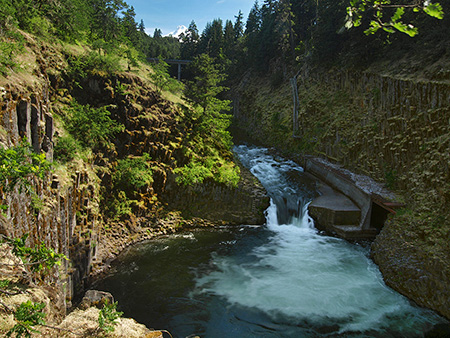
The centerpiece of this exciting proposal is Punchbowl Falls, a cousin to the more famous Punch Bowl Falls on Eagle Creek, in the Columbia Gorge. Both are textbook examples of a “punch bowl” waterfall, pouring into huge, circular bowls carved over the millennia by the upwelling action of the plunging waterfalls. While the more famous Punch Bowl Falls is taller, the Punchbowl Falls on the West Fork is far more powerful, and has carved a much larger amphitheater.

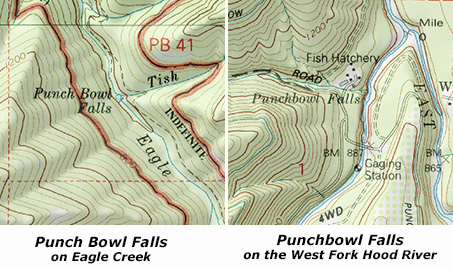
But first, a word about names, as much confusion exists between these waterfall cousins: the lesser-known “Punchbowl” on the West Fork is spelled as one word, while the more famous “Punch Bowl” falls on Eagle Creek uses two words. It’s subtle difference, but important, as these are the official USGS names for the waterfalls, as shown on the maps below:

PunchBowl01

The story of how Punchbowl Falls may finally be preserved for the public began in 2006, when the Western Rivers Conservancy acquired a 20-acre parcel containing the falls from West Fork from Longview Fiber (this is a company that has been aggressively clear-cutting its vast holdings in the upper West Fork watershed over the past decade at an alarming and reckless pace in recent years, so the risk to Punchbowl Falls was real).

The surrounding 82 acres that make up the balance of the Western Rivers property were purchased from Pacificorp in 2010, in tandem with the utility removing its Powerdale Dam, a few miles downstream on the main branch of the Hood River. This purchase includes the beautiful and rugged confluence of the East and West Forks of the Hood River, a powerful spot that remains surprisingly wild and pristine, given the long human presence in this area.

This acquisition marks the beginning of an ambitious effort by the Western Rivers Conservancy to acquire and restore thousands of acres of unprotected West Fork watershed that have been ravaged by relentless logging over the past 130 years, and the eventual restoration of native salmon runs to this beautiful canyon.

Peering into the huge amphitheater at Punchbowl Falls

Peering into the huge amphitheater at Punchbowl Falls

The removal of the dam and consolidation of private land in the spectacular Punchbowl Falls area are huge developments toward the long-term restoration of the Hood River riparian system.

But much work lies ahead, and the most immediate question is whether Hood River County can secure the funds to purchase the 102 acre Punchbowl Falls site from Western Rivers Conservancy for $578,000 — an asking price that is about half the value of the property.

To reach this goal, Hood River County is an application for an Oregon Parks and Recreation (OPRD) grant for purchase of this Punchbowl site. An unsuccessful application was submitted, but failed to win OPRD funding, so in this round the Hood River Valley Residents Committee (HRVRC), a local land-use advocacy group, is sponsoring community outreach activities to help broaden support for the county park proposal.

Early 1900s postcard view of salmon jumping Punchbowl Falls

Early 1900s postcard view of salmon jumping Punchbowl Falls

The area has a long history of recreation as a popular swimming and fishing, which explains why the HRVRC events thus far have had a very strong response: 60 people attended the first community workshop in January, and more than 400 responses have been submitted to the comment website.

Should Hood River County fail to secure state funding for purchase of the site in the near future, the Western River Conservancy is likely to eventually sell the property to another private conservation group, putting future public access in question. While the site has never been more protected from private development, continued public access is now very much at stake.

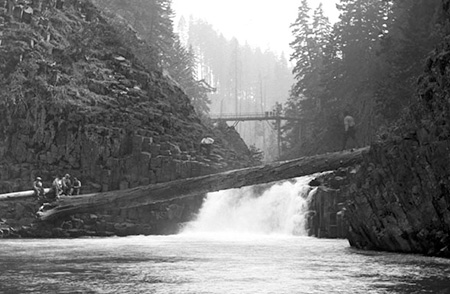
Early 1900s swimmers cross the falls on a giant old-growth log; note the log bridge in the background where the modern high bridge is now located (Hood River History Museum)

Early 1900s swimmers cross the falls on a giant old-growth log; note the log bridge in the background where the modern high bridge is now located (Hood River History Museum)

It’s apparently common for small communities like Hood River County to win funding on a second try from OPRD for projects like this, so your feedback and support is important in helping make the case to the State of Oregon that Punchbowl Falls and the Hood River confluence deserve to be both protected and forever open to the public as a park.

Please take the time to complete the survey if you can’t make the final county meeting in February: Punchbowl Falls Park Survey

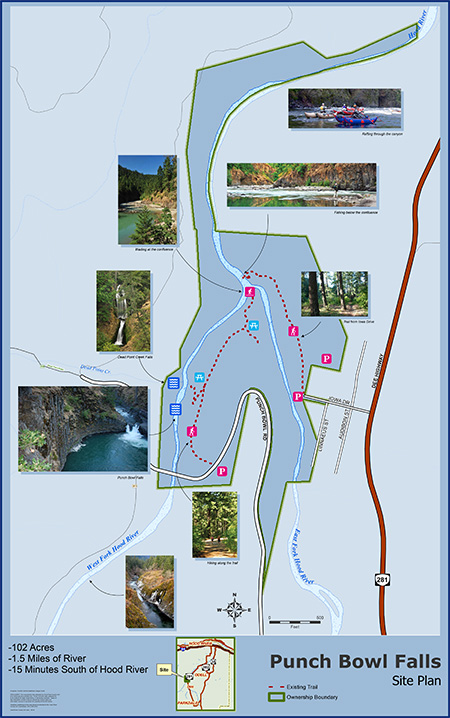
Here’s a map of the proposal from the Hood River County website to familiarize you with the area:

PunchBowl05

Click here for a larger PDF version of the map.

A Virtual Tour of the Site

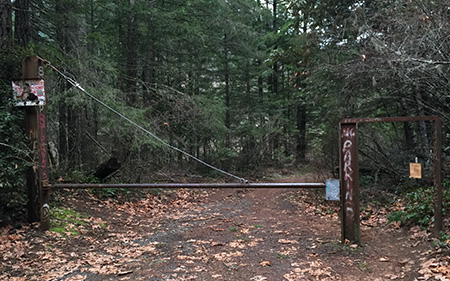
If you haven’t been to Punchbowl Falls, here’s a brief virtual tour. The visit starts at this unassuming steel gate at a large parking turnout, just before Punchbowl Road crosses a high bridge over the West Fork:

The gate at the Punchbowl Falls trailhead

The gate at the Punchbowl Falls trailhead

A short walk down a rustic service road leads to a maze of informal side paths veering off to the left, toward the imposing rim of the West Fork gorge.

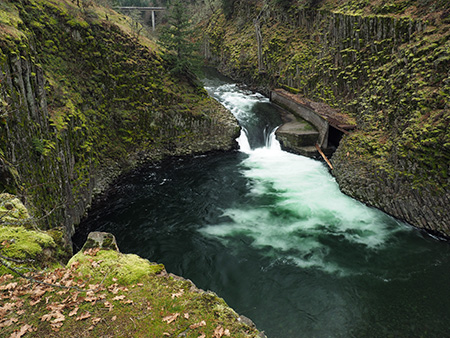
The main attraction here is the massive basalt amphitheater carved by Punchbowl Falls. The walls of the canyon provide some of the best displays of columnar basalt jointing found anywhere in the region. How large is the amphitheater? The scale is hard to appreciate from photos, but Portland’s Memorial Coliseum would fit inside, with headroom to spare!

Looking into the Punchbowl from the east

Looking into the Punchbowl from the east

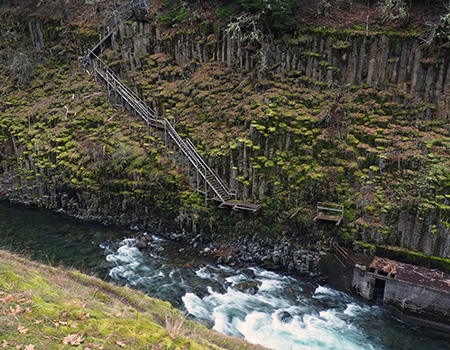
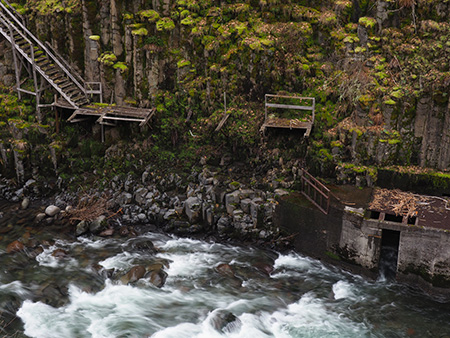
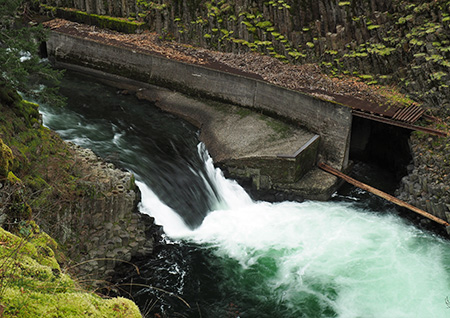
The curving concrete structure to the right of the falls is a fish ladder constructed in 1957 to improve fish passage (though early photos clearly show fish climbing the falls). A closer look at the fish ladder reveals a dilapidated wooden staircase attached to the basalt columns on the far wall of the canyon. The stairs appear to have been added at the time the fish ladder was constructed:

A rickety staircase descends the west wall of the canyon to the fish ladder

A rickety staircase descends the west wall of the canyon to the fish ladder

An even closer look shows the staircase to be in a serious state of disrepair, and a potentially dangerous hazard to the many swimmers who flock to the Punchbowl in summer:

That last step to the fish ladder is a doozy..!

That last step to the fish ladder is a doozy..!

This is an example of the kind of feedback to include when you comment on the park proposal — for example, simply removing the stairs, and perhaps removing or modifying the fish ladder (below) could help it blend these features with the natural surroundings and make the area safer for visitors.

Downstream view of the fish ladder…

Downstream view of the fish ladder…

….and the upstream view

….and the upstream view

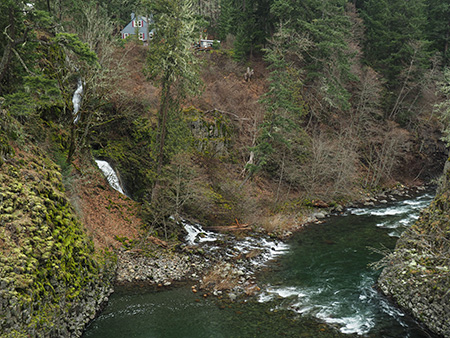
A look downstream from above Punchbowl Falls reveals another waterfall cascading into the gorge from the west. This is the falls on Dead Point Creek, which flows from the high slopes of Mt. Defiance into the Hood River:

Downstream view from above the Punchbowl to Dead Point Falls

Downstream view from above the Punchbowl to Dead Point Falls

The structures above Dead Point Falls are part of a fish hatchery built by the State of Oregon in 1920. The state sold the hatchery at some point in the past, and it is now owned by Troutlodge, a private company that grows and markets fish eggs from several hatcheries in the western states. The hatchery has also been on the market over the past year, but (unfortunately) is not part of the park proposal at this time. Perhaps this could be a second phase of a county park purchase?

Walking downstream along the canyon rim, Dead Point Falls comes into full view. The falls and the canyon wall below the hatchery are fully within the lands owned by the Western Rivers Conservancy, and part of the park proposal:

Dead Point Falls

Dead Point Falls

A closer look at the Dead Point Falls shows a second tier spilling in from the right side. This is the outflow from the hatchery ponds, located behind the buildings that can be seen from the canyon rim, and makes for a unique waterfall:

Dead Point Falls

Dead Point Falls

One of the buildings in the 1920 fish hatchery complex on Dead Point Creek

One of the buildings in the 1920 fish hatchery complex on Dead Point Creek

After visiting a series of waterfall viewpoints along the canyon rim, the network of boot paths curves back to the primitive service road, which descends gently toward the confluence of the West and East Forks of the Hood River — about 1/2 mile downstream from the trailhead.

The confluence is a remarkable place where two powerful rivers collide, creating an enormous gravel bar that makes for a fine lunch spot for taking in the scene. The West Fork enters the confluence at a leisurely pace, emerging from a deep pool between basalt buttresses. The East Fork (shown below) makes a more raucous entrance, roaring around a sharp bend in a series of steep rapids as it tumbles toward the West Fork.

The confluence of the East and West Forks

The confluence of the East and West Forks

The confluence area is fully contained within the Western Rivers Conservancy property, and would be part of a future park. The conservancy holdings include the west (far) wall of the canyon for another mile downstream from this spot, and about the first half-mile of the east wall of the canyon beyond the East Fork is included.

After returning to the trailhead parking area, it’s worth taking a few minutes to walk down Punchbowl Road to the dizzying concrete bridge that spans the upper gorge. There’s plenty of room to safely walk on the bridge, but the side walls are low enough that you’ll want to keep an eye on young kids and pets on a leash.

The dizzying view into Punchbowl Gorge from the bridge

The dizzying view into Punchbowl Gorge from the bridge

From the bridge vantage point, the West Fork corkscrews through a narrow gorge carved into spectacular basalt formations. The gorge area surrounding the bridge is also within the Western Rivers Conservancy holdings, and part of the park proposal.

The proposed park site also has trail access in the Winans community, located on the east side of the East Fork, where Iowa Street joins the Dee Highway, north of the Dee junction. This trail is much less traveled than those in the Punchbowl Falls area, and mainly used for fishing access to the area below the confluence.

How to find Punchbowl Falls?

If you would like to visit the area after reading this virtual tour, simply follow the Dee Highway from Hood River to the old mill town of Dee, forking to the right and following signs to Lost Lake. Immediately after crossing the East Fork in Dee, head right at a sprawling 3-way intersection, then go straight at another 3-way junction, onto Punchbowl Road. Watch for a large parking area on the right after a short distance, just before the road crosses the high bridge over the Punchbowl gorge.

2015 Calendar… and looking back on 2014!

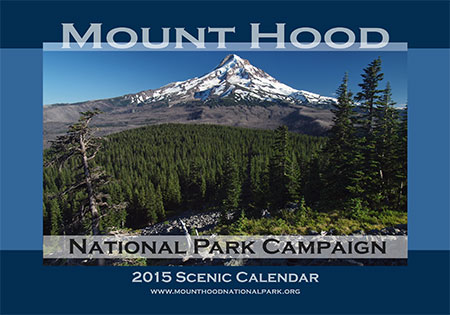
The view from Owl Point is the cover image for 2015

The view from Owl Point is the cover image for 2015

Each year since 2004 I’ve published a wall calendar dedicated to the special places that make Mount Hood and the Gorge a national treasure — and of national park caliber! You can pick one up for $30 at the Mount Hood National Park Campaign store at CafePress, and you’ll also be supporting the campaign website and this blog when you do!

The following is a preview of the calendar images I picked for the 2015 edition, along with some backstory behind the photos. All of the photos were taken from November 2013 through October 2014. Part of the challenge each year is to come up with 13 new calendar-worthy images, which in turn ensures that I get out on the trail and poke around my favorite haunts, plus a few new spots whenever I can!

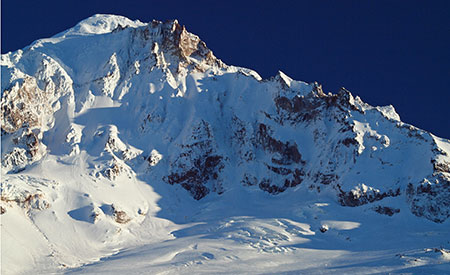
For January, I picked a close-up view of the upper Sandy Glacier and the towering cliffs of the Sandy Headwall. This view came from an early snowfall last winter, one of several trips I made to the Bald Mountain and McGee Ridge:

January features the upper Sandy Glacier and towering Sandy Headwall

January features the upper Sandy Glacier and towering Sandy Headwall

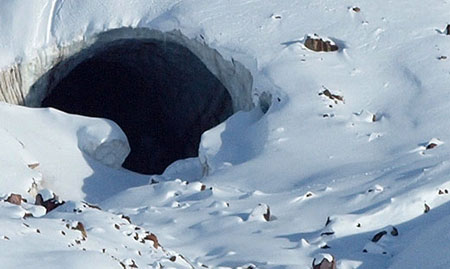
On one of those trips to the McGee Ridge viewpoint, I had just set up my camera and tripod along the Timberline Trail when a pair of climbers came down from the mountain. They were obviously not typical hikers, and soon I realized that they were the explorers I had just written a blog article about! “Sandy Glacier Caves: Realm of the Snow Dragon!” was written partly in anticipation of the Oregon Field Guide 2013 premiere episode that featured the glacier Caves… and my new trail acquaintances, Brent McGregor and Eric Guth.

Look closely, and you can see Eric and Brent's boot prints in the snow near the Snow Dragon cave

Look closely, and you can see Eric and Brent’s boot prints in the snow near the Snow Dragon cave

Brent and Eric pointed out several features around the glacier caves from our vantage point. I was later able to add a postscript to the original article to elaborate on some of the new details about their discovery that I learned that day on the trail.

Eric Guth and Brent McGregor on the trail in 2013

Eric Guth and Brent McGregor on the trail in 2013

I’ve also been able to help Brent with his historic research on the formation of the glacier caves with a series of images I’d taken of the Sandy Glacier since the early 2000s. I’ve photographed the glacier in detail pretty much every year for more than a decade, mostly because of it’s scenic beauty, so it was great to discover a more practical use for all those photos!

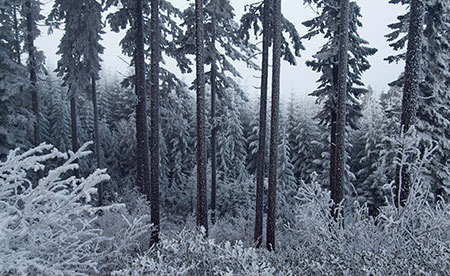
For February, I picked a photo from a memorable winter day on Mount Defiance (below) after a bank of freezing fog had settled in on the mountain for several days. Nearly every surface was covered with long, beautifully developed ice crystals that had grown undisturbed in the almost still air of the freezing fog layer.

February features a frosty forest on the slopes of Mt. Defiance

February features a frosty forest on the slopes of Mt. Defiance

On that frosty day, I also stopped to photograph the sign shown below on the way up to Mount Defiance, as it showed amazing insight and precision by the Hood River County road department in deciding where to stop plowing!

Winter wonderland ahead!

Winter wonderland ahead!

For March, I picked a scene from the Pacific Crest Trail where it climbs along the west rim of the White River canyon. This section of trail is also part of the Timberline Trail, and is surprisingly overlooked, given the views and close proximity to Timberline Lodge.

March features the White River Canyon from the Pacific Crest Trail

March features the White River Canyon from the Pacific Crest Trail

I posted an article in 2011 on the buried forests that can be seen here. The deeply carved maze of ravines that make up the White River canyon are cut into volcanic debris from the Old Maid eruptions that occurred from 1760 to 1810, and subsequent erosion has revealed some of the well-preserved trees that were buried in these eruptions. The 2011 article describes how to view these old specimens.

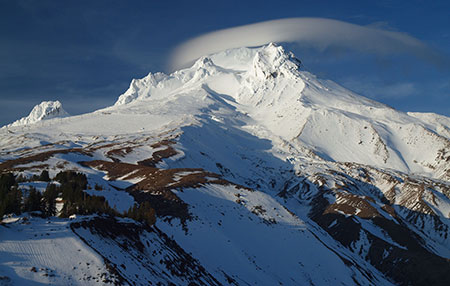
I also enjoyed watching a lenticular cloud form over the mountain in the hour or two that I sat on the canyon rim that evening last winter — one of my favorite mountain phenomena. You can see just the beginning of the cloud over the summit in the calendar view, and the tiny sliver later blossomed into the classic lenticular cloud shown in the view below, as I was packing up for the day:

Lenticular cloud forming over The Mountain

Lenticular cloud forming over The Mountain

Lenticular clouds typically form when moist air from approaching weather fronts is compressed as it passes over the big volcanoes in the Cascade Range. They often form as much as a day before the cloud bands of a Pacific front actually arrive, so are a useful barometer of changing conditions.

For April, I picked something a little different: a desert scene just a few miles east of the mountain, where the same White River that originates from its namesake glacier in the previous scene flows east into the rugged rimrock country of Oregon’s High Desert, shown below:

April features the lower falls at White River Falls State Park

April features the lower falls at White River Falls State Park

Over the millennia, the White River has carved through many layers of Columbia River basalt to form its desert canyon, but as it approaches the confluence with the Deschutes, the river encounters an especially tough series of basalt layers. The result is the spectacular White River Falls, a misty green emerald in the desert, protected in a small state park.

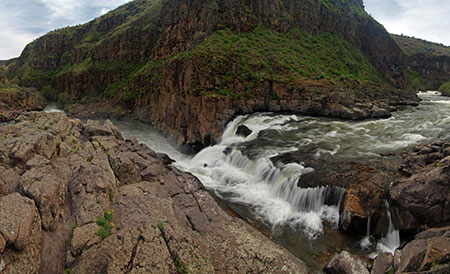
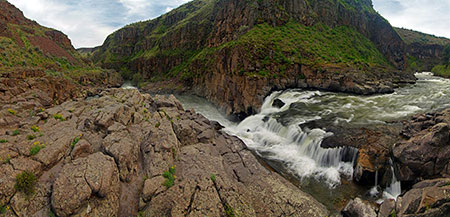
The lower falls pictured in the April image is about one-half mile downstream from the main falls, and well off the popular trail in the area. The calendar image is actually just a cropped portion of a very wide panorama (below) that captures more of the rugged scene at the lower falls.

Original jumbo-pano that the calendar image was cropped from

Original jumbo-pano that the calendar image was cropped from

The scoured bedrock in the foreground of this view is testament to volatile nature of the White River: seasonal floods regularly surge to this depth, engulfing the floor of the canyon.

In another 2011 article titled “Close Call at White River Falls”, I described the threats to this magnificent area, and why it deserved better protection — perhaps someday a unit of Mount Hood National Park?

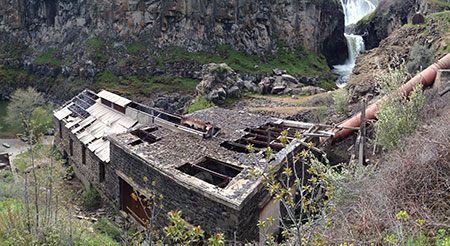
The old powerhouse at White River Falls

The old powerhouse at White River Falls

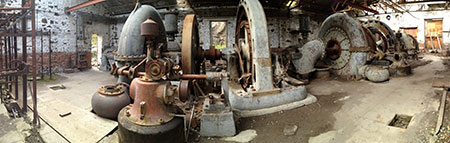
In addition to the natural scenery, the canyon is home to the fascinating ruins of an early 1900s hydroelectric plant. Desert weather has helped preserve the many relics in the area, but arid conditions haven’t prevented vandals from taking an increasing toll on priceless historic resources.

The powerhouse is amazingly well-preserved inside

The powerhouse is amazingly well-preserved inside

Hopefully, we can someday stabilize the White River Falls site and preserve the remaining traces of history for future generations to explore.

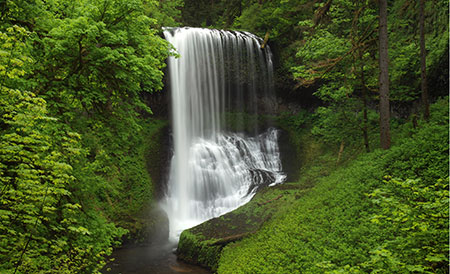
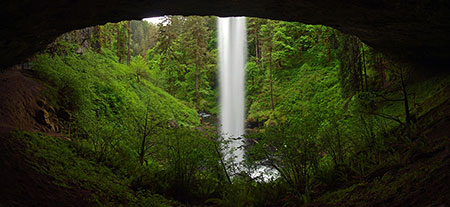
For May, I chose another unusual image for a Mount Hood National Park calendar: Middle North Falls on Silver Creek. Why? Mostly because what we now know as Silver Falls State Park was once proposed to become a national park in the 1920s! It would have been a terrific addition. The scenery, alone blows away many of the existing national parks monuments in our park system!

May features the famous Middle North Falls on Silver Creek

May features the famous Middle North Falls on Silver Creek

Alas, the national park proposal failed after a National Park Service study deemed the logged-over landscape of the 1920s too ravaged to be worthy of park status. Thankfully, that didn’t stop the Civilian Conservation Corps in the 1930s from building the elaborate, magnificent trail system and beautiful South Falls Lodge (listed on the National Historic Register in 1983) that we still enjoy today.

The national park idea for Silver Falls resurfaced again in 2008, when Oregon State Senator (then Representative) Fred Girod proposed it during a special session. Notably, Dr. Girod is a Republican from Stayton, representing the Senate district that encompasses Silver Falls State Park, so maybe we’ll see the idea resurrected in the future? I like that maverick thinking, Senator!

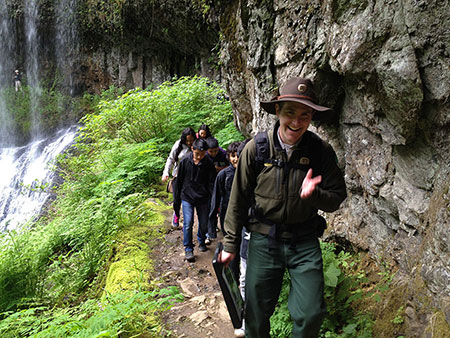
Trail ranger leading a kids hike at Silver Creek -- how very cool!

Trail ranger leading a kids hike at Silver Creek — how very cool!

On the visit last spring when I photographed Middle North Falls, I was reminded that Oregon’s state parks do a pretty good job of embracing the national park tradition at Silver Creek when a young ranger appeared, leading a group of youngsters on a day hike. Kudos to Oregon Parks and Recreation Department for providing programs like these!

Could Silver Falls State Park become a unit of a future Mount Hood National Park? Why not! One tangible benefit would be the opportunity to expand the footprint from the current park boundaries to include the rest of the upper watershed of Silver Creek. The park more than doubled in size in 1958, when a federally funded expansion added in a portion of the headwaters, bringing the park to the present size of just over 90,000 areas.

The amazing, national-park-quality amphitheater behind North Falls

The amazing, national-park-quality amphitheater behind North Falls

Yet, heavy logging and large private inholdings upstream continue to impact Silver Creek stream with silt and algae blooms. These impacts could easily be reversed if the upper watershed were managed for conservation and recreation, instead — especially if the park were expanded to include the upper watershed and its associated habitat.

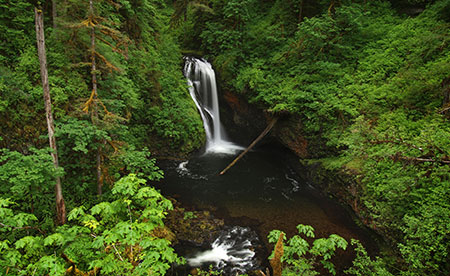
For June, I picked an image of Butte Creek Falls, a nearby cousin to Silver Creek located even closer to Mount Hood, within the Santiam State Forest. Like Silver Creek, the upper watershed of Butte Creek is heavily logged, with some obvious sediment and algae in the stream as a result.

June features Butte Creek Falls

June features Butte Creek Falls

Also like Silver Creek, the health of Butte Creek could be turned around with a shift to managing for conservation and recreation. Unlike Silver Creek, most of the lands in the upstream watershed are already held in the public trust by the State of Oregon.

Unfortunately, our state forests are held captive by a legislature determined to log them to feed the state general fund — and to ensure that rural counties that already pay only a fraction of the property taxes levied in other parts of Oregon aren’t inconvenienced with paying for their own schools.

Therefore, the best way to restore Butte Creek would be to transfer it to Oregon Parks and Recreation Department as a very large state park… or incorporate it into a future Mount Hood National Park! At a minimum, it’s time for the Santiam State forest to focus on restoring forests and protecting watersheds, not just future timber sales.

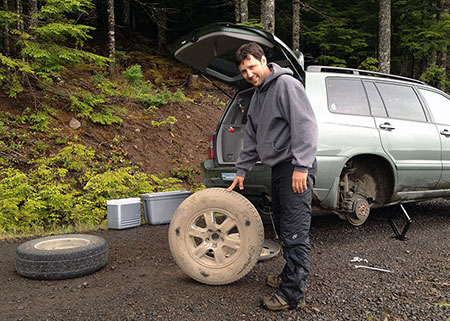
Always travel with an automotive repair expert!

Always travel with an automotive repair expert!

The behind-the-scenes, somewhat embarrassing story that goes with the Butte Creek Falls image is one of my hiking buddy Jamie Chabot helping change a flat tire after our trip to Butte Creek and nearby Abiqua Falls. We managed to take a couple of wrong turns in the maze of logging roads and clearcuts that surround the small preserve containing Butte Creek: at some point, I jumped out to survey the canyon below to figure out where we went wrong… only to hear a HISSSSSSS coming from one of the rear tires!

There was no room to pull off to the side, so we were in the awkward predicament of having the car up on a jack in the middle of an active logging road. Fortunately, we were able to install the spare before a loaded log truck came barreling our way! My belated apologies to Jamie for doing the heavy work while I took pictures… but somebody had to document the episode for posterity!

Jamie was also my hiking companion on a couple of trips to Owl Point last summer. This has been an annual favorite of mine since a group of volunteers from the Portland Hikers forum rescued the Old Vista Ridge from being lost to official Forest Service neglect in 2007.

Each year, the trail seems to get better, thanks to a lot of unofficial TLC from anonymous trail tenders. Today, the Old Vista Ridge trail is in great shape and now forms the boundary of the expanded Mount Hood Wilderness, so in that sense has been etched into legal permanence. Hopefully, it will eventually make it back onto the Forest Service inventory of officially maintained trails, a status it clearly deserves.

July features Mount Hood from Owl Point

July features Mount Hood from Owl Point

There are now several geocaches and a trail log tucked along the historic old trail, and it’s amazing to see how busy the area has become now that it has been featured in several popular hiking guides (including Williams Sullivan’s “100 Hikes in Northwest Oregon” and Paul Gerald’s “60 Hikes within 60 Miles of Portland”).

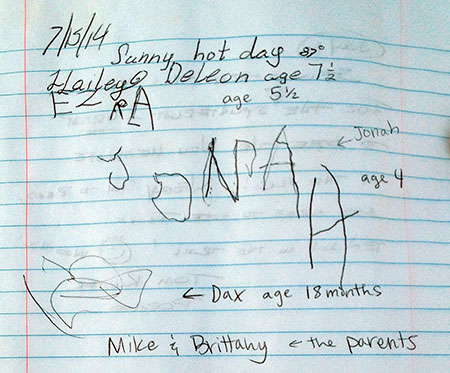
One trail log had more than 60 entries for just 2014, including this wonderful entry from a young family introducing their kids to the adventures of hiking and exploring the Mount Hood backcountry at a very young age:

My favorite Old Vista Ridge trail log entry… ever..!

My favorite Old Vista Ridge trail log entry… ever..!

One of my favorite experiences on the trail is seeing young families introducing their junior hikers to our public lands, battered field guides in hand. Just like my own formative experiences just a few decades ago.

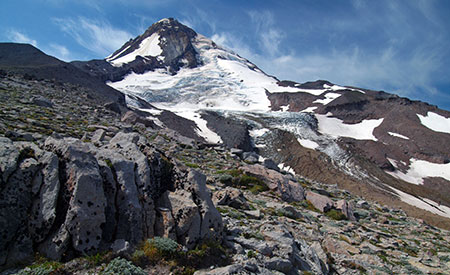
For August, I picked an image from another of my favorite spots, just off the Cooper Spur trail, above the lower extent of the Eliot Glacier. This image was taken on one of those days when clouds were wrapped around the mountain for much of the day, but suddenly cleared for a few minutes — just long enough to capture a few photos before the mountain disappeared, once again:

August features the Eliot Glacier on Mount Hood's north flank

August features the Eliot Glacier on Mount Hood’s north flank

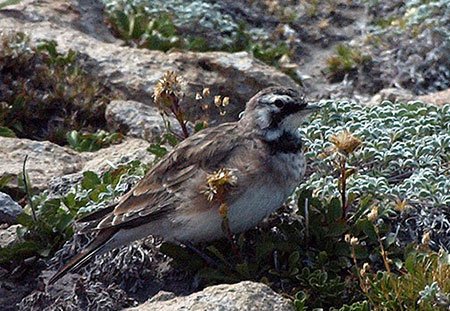
I certainly do not mind sitting on the shoulder of the mountain waiting out the clouds (there’s no such thing as a bad day on the mountain, after all!), but a bonus during this wait was learning a new bird species (to me), as a pair of these small birds (below) stopped by to check me out:

Horned lark at Cooper Spur

Horned lark at Cooper Spur

This is a horned lark, a wintertime migrant to our area, and the pair I saw had likely arrived recently when I spotted them last August. The Portland area actually has a year-round resident population of streaked horned larks, which look similar to horned larks and are a threatened species. These are details I learned after the trip from the helpful folks at the Portland Audubon Society.

According to Audubon staff, horned Larks are widespread songbirds of fields, deserts, and tundra, where they forage for seeds and insects, and sing a high, tinkling song — and thus were quite at home in the tundra conditions of Mount Hood’s high east side. Though they are considered common, they have undergone a sharp decline in the last half-century. Their very generalized range map shows them wintering from the Cascades west and breeding in summer in Canada tundra/steppe terrain.

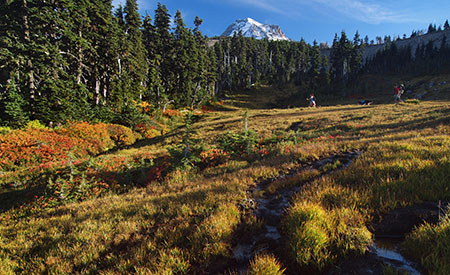
For September I picked an image from Wyeast Basin, taken toward the end of a lovely early autumn day as a family and their dog ambled across the sprawling meadow. Wyeast Basin is remarkable for the surprising number of springs bubbling up from the mountain slopes and racing one another downhill, often just a few feet apart.

September features early autumn colors at WyEast Basin

September features early autumn colors at WyEast Basin

While this view (above) from the calendar is the familiar scene at WyEast Basin, I also turned my tripod around to capture the web of springs and streamlets flowing north toward the big Washington volcanoes, on the distant horizon. The talus slopes of Owl Point can also be seen in the distance from here, just above the tree line.

The view north to Owl Point and the Washington Cascades from WyEast Basin

The view north to Owl Point and the Washington Cascades from WyEast Basin

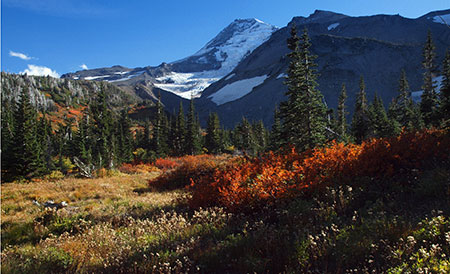
For October, the scene is from Elk Meadows, perhaps the most photogenic of the string of alpine meadows on Mount Hood’s rugged north side. In this view, the Coe Glacier tumbles below the summit, and 7,853-foot Barrett Spur looms darkly on the left. Avalanches roll off Barrett Spur in winter, sometimes with devastating effect on the alpine forests below, as the many bleached snags and stumps in Elk Cove suggest.

October features beautiful Elk Cove in autumn

October features beautiful Elk Cove in autumn

My companions for the Elk Cove hike this fall were Jamie Chabot and Jeff Statt. I met both when Trailkeepers of Oregon (TKO) was founded in 2007: Jeff was the founding president of the new non-profit, and Jamie the original creative force behind the TKO logo, Portland Hikers calendars and the TKO web identity.

Tom, Jamie & Jeff enjoying a little slice of paradise at Elk Cove

Tom, Jamie & Jeff enjoying a little slice of paradise at Elk Cove

Both Jeff and Jamie continue to support TKO after all these years as the organization continues to grow, and we still meet up for periodic trail stewardship projects together. I’m honored to have them as trail friends, and having them along on this hike made it extra-special!

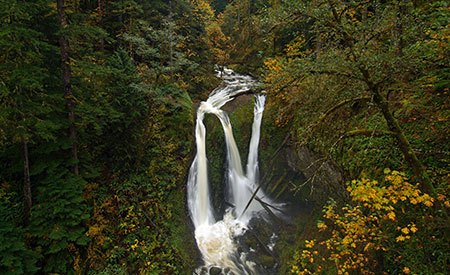
For November, I picked a familiar view of Triple Falls on Oneonta Creek, taken during an especially wet week in the Gorge. Normally, the somewhat muddy runoff in this scene would be a deal-killer for photos, but I came around to the idea that in this case, it told the story of swollen Cascade streams during the stormy months of late autumn rather nicely, so added it to the mix.

November features a swollen Triple Falls on Oneonta Creek

November features a swollen Triple Falls on Oneonta Creek

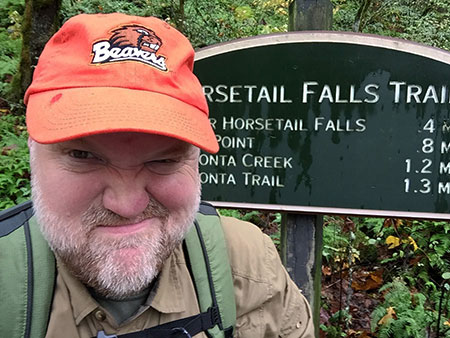
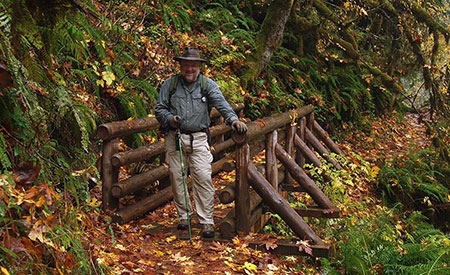
I was memorably soaked on the hike to Triple Falls, not because rain is particularly unique in the Gorge, but because I had just re-ducked my trusty canvas hat (for waterproofing)… but had left it drying in the oven, at home! I discovered this fact at the Oneonta trailhead, so circled back to the Multhnomah Falls lodge to see what sort of hats were in stock.

It turns out that baseball caps are the ONLY option at the Multnomah Falls lodge — and I HATE baseball caps! (primarily because they don’t fit all that well on my basketball-sized head..!) Well, at least I could support my alma mater, and I hit the trail $20 poorer with a ridiculous, ill-fitting beanie that (sort of) kept my large, bald head dry…

You would hate baseball caps, too, if you had a basketball-sized head like mine…

You would hate baseball caps, too, if you had a basketball-sized head like mine…

Once on the trail, I also ran across one of the most extensive landslides to form in recent years, cutting away a 100-foot swath of the Oneonta Trail along a steep canyon section. Trail crews had constructed a temporary crossing of the slide, but just a few days after that trip in November, the slide claimed more ground, erasing the temporary trail. Such is the ongoing challenge of keeping trails open in the very active landscapes of the Gorge and Mount Hood!

A rip-roaring Oneonta Creek after the first big autumn storms

A rip-roaring Oneonta Creek after the first big autumn storms

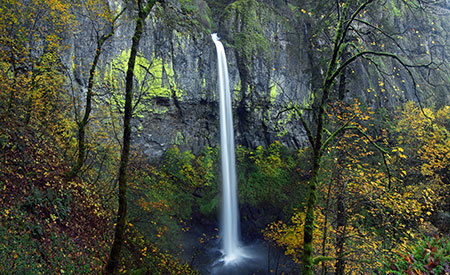
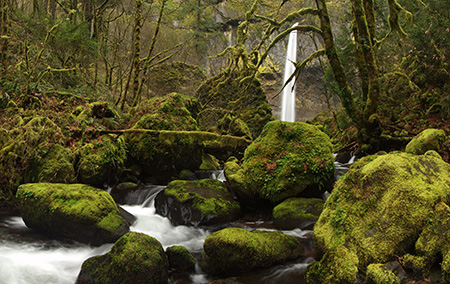
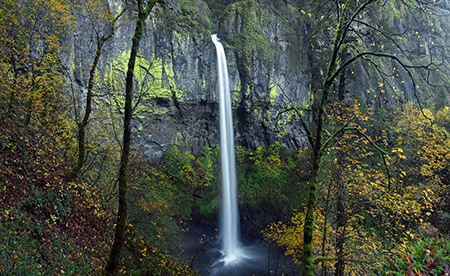
For December, I picked a late fall image of Elowah Falls, taken from one of the long-bypassed viewpoints along the original Civilian Conservation Corps route described in this recent article on McCord Creek.

December features a wide pano of Elowah Falls on McCord Creek

December features a wide pano of Elowah Falls on McCord Creek

Photographing a 213′ waterfall at close range means a wide-angle lens and blending some images. In this case, I merged three vertical images taken with my 11mm lens to create the panoramic view. This is my first time photographing from this spot, and I will definitely return!

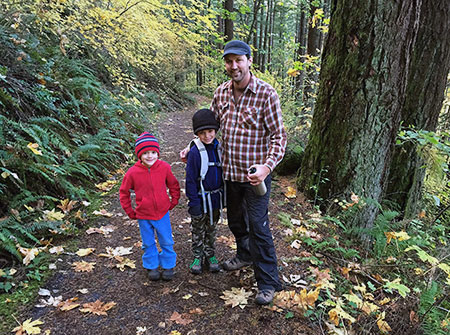
By now you’ve been introduced to my trail buddy Jamie, and on the way out from Elowah Falls that day I ran into Jamie and his two boys! They were headed toward the upper falls on McCord Creek on that very busy hiking day in the Gorge. It was great to see Jamie passing on the hiking tradition to boys!

Jamie and his rugged boys hitting the trail at McCord Creek

Jamie and his rugged boys hitting the trail at McCord Creek

That’s it for the 2015 Mount Hood National Park Campaign calendar highlights, and now for a few thoughts on the blog…

Thanks for another year!

I launched the WyEast Blog in 2008 as a simpler way to promote Mount Hood and the Gorge as “national park-worthy” than updates to the project website would allow. And though I didn’t post quite as often this year for a whole variety of reasons (mostly, real life getting in the way), I was amazed to see the readership for the WyEast Blog continue to grow in 2014.

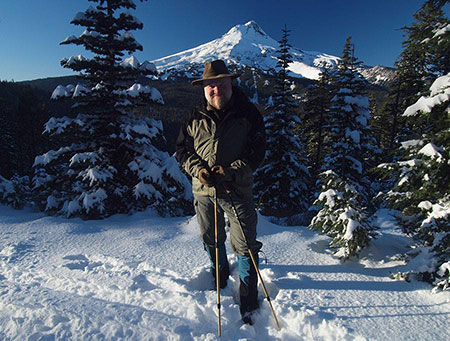
Yours truly taking in the first big snowfall on Mount Hood in early November

Yours truly taking in the first big snowfall on Mount Hood in early November

In early 2014, the monthly page views edged above the 5,000 mark for the first time, and jumped well above that mark during the peak hiking months of spring and summer. More importantly, the list of official blog followers has grown steadily to 141 this year. These are the true Mount Hood and Gorge junkies that I have in mind when I post to the blog, and these are also the folks who send me both nice notes and periodic corrections — both are greatly appreciated!

I posted a total of 14 articles this year, down a bit from previous years, but bringing the six-year total to 136 articles. I’ve also got a bunch of new articles in the oven, ready to post when time allows. So, the WyEast Blog will be around for awhile!

The two most popular articles continue to be:

10 Common Poison Oak Myths (2012)

Ticks! Ticks! (10 common myths) (2013)

The “ticks” article has been viewed 38,147 times since I posted it in 2013, and the poison oak piece 21,545 times — sort of amazing! But these numbers have validated my obsession with providing thorough, detailed, geek-worthy articles that are more in the magazine format than typical blog fare.

Taking in the fall colors at Butte Creek

Taking in the fall colors at Butte Creek

So, enough facts, figures and anecdotes: if you’ve read this far in my annual, somewhat (ahem!) self-indulgent post, THANK YOU for being a reader… and most importantly, thanks for being a friend of Mount Hood and the Gorge!

See you on the trail in 2015!

Tom Kloster
WyEast Blog

Rediscovering McCord Creek!

McCord Creek takes on more subtle hues in winter

McCord Creek takes on more subtle hues in winter

Beautiful McCord Creek boasts a pair of impressive waterfalls that are among the most photogenic in the Columbia River Gorge. The falls are tucked into John B. Yeon State Park, a lesser-known park located about halfway between Multnomah Falls and Cascade Locks.

The rustic CCC-era trails to McCord Creek’s waterfalls have been “discovered” in recent years from spring through fall by crowds of weekend hikers. Yet, the area is surprisingly un-crowded during the wet winter months, from late fall through early spring, and the muted winter tones are just as beautiful.

The area also has a long and fascinating human history that is on display throughout the hike, if you know where to look. This article provides a guide to both the trail and the history of the McCord Creek area.

Frank Warren's salmon cannery (site of today's Warrendale) in 1902

Frank Warren’s salmon cannery (site of today’s Warrendale) in 1902

The human history in this part of the Gorge stretches back thousands of years, as the river was home to a thriving culture of Native American peoples.

The Upper Chinookan people of the Columbia River Gorge fished the legendary autumn salmon runs and picked huckleberries and other wild fruits and forage before moving away from the river during the often harsh winters that we know so well today. An especially elaborate example of the mysterious stone pits thought to be built by native people for ceremonial purposes can still be found high above McCord Creek, on Wauneka Point.

White settlement came to the Gorge in the 1800s, and ushered in an era of profound tragedy for the native people, with epidemics of measles and other European diseases decimating native populations, and white settlement displacing native peoples from places they had inhabited for millennia. It’s an uncomfortable reality to confront today, but also important to never forget as we try to understand our history.

White settlers were equally destructive for the land and natural resources, as well. In a matter of a few decades, the Gorge slopes were almost completely logged of ancient forests and giant fish wheels built along the river were part of the commercial overfishing that nearly collapsed the salmon runs that had sustained Native Americans here for thousands of years.

Frank and Anna Warren in the early 1900s

Frank and Anna Warren in the early 1900s

Frank Warren was among the prominent industrialists operating fish wheels to supply a cannery he built at Warrendale. Today, only a residential district by that name remains to mark the site, just downstream from McCord Creek.

In the heyday of the Columbia River canneries at the turn of the 20th Century, canned salmon from the Warren packing company was exported around the world, and Columbia River canned salmon was as ubiquitous as cans of tuna are in our supermarkets today. But overfishing by gill nets, fish traps and fish wheels nearly destroyed the salmon runs. Fish wheels were finally outlawed by the 1930s, as the canning industry on the Columbia continued its decline. The last salmon cannery on the river closed in the 1970s.

1890s Harpers Weekly illustration of a Columbia River fish wheel

1890s Harpers Weekly illustration of a Columbia River fish wheel

Warren’s packing business made him a millionaire, and he and his wife Anna celebrated their 40th anniversary in style with a 3-month European tour in 1912. For their return trip, the Warrens reserved a first-class stateroom on the maiden voyage of the RMS Titanic.

Anna Warren’s riveting account of the Titanic disaster in April 1912 was featured in the Morning Oregonian twelve days after the incident, creating a local sensation. Her tragic story recounted how her husband Frank helped her onto a lifeboat, with Anna assuming he had followed her in. Instead, when she looked back, she saw Frank helping other women into the boats.

At the time Anna Warren’s account was published, Frank Warren’s fate was still unknown, but he was later identified as among the more than 1,500 who perished that night. Anna Warren was one of just 710 survivors of the disaster.

Myron Kelly's pulp mill at McCord Creek in the 1890s

Myron Kelly’s pulp mill at McCord Creek in the 1890s

At about the same time that Frank Warren was operating his Warrendale cannery in the late 1800s, another settler by the name of Myron Kelly was operating a small pulp mill near McCord Creek. Kelly’s mill used a pair of 400-foot long, riveted steel penstocks to power the pulp manufacturing. Though the mill is long gone, portions of the penstocks still survive. They are clearly visible in the 1890s view of the mill, above.

The penstocks were fed with water from McCord Creek, diverted from above the waterfalls, and routed to the penstocks along the cliff-top ledge we now use as a hiking trail. Kelly used a natural break between basalt layers to blast out the ledge, and hardware from the pipe system is still found throughout the cliff area today. Black cottonwood trees — the same we see lining the river today — provided the raw material for making pulp.

This 1890s photo shows water spouting from the long penstock that drove Myron Kelly's pulp mill

This 1890s photo shows water spouting from the long penstock that drove Myron Kelly’s pulp mill

Surviving portions of the two penstocks are prominently crossed by the trail to Upper McCord Creek Falls, along with other relics sprinkled through the forest. The large wood water cistern located near McCord Creek trailhead is not from the Kelly pulp mill era, surprisingly, and was added later to supply water to area homes.

The early industrial settlements in the Gorge relied on railroads and ships for transport, as there was no road until the early 1900s. That changed in 1916, when the new Columbia River Highway was dedicated with much fanfare. The highway is still famous, cherished by millions of visitors over the past century for its careful attention to the landscape and surrounding Gorge scenery. Perhaps most iconic are its string of graceful bridges.

Columbia River Highway bridge at McCord Creek under construction in 1915 (Wauneka Point towers above)

Columbia River Highway bridge at McCord Creek under construction in 1915 (Wauneka Point towers above)

The original highway bridge at McCord Creek was completed in 1915, and while it wasn’t as graceful as some of the more famous arched bridges, it was nonetheless a spectacular structure. Early travelers not only had a front-row view of Elowah Falls on McCord Creek, but also a sweeping vista across the Columbia to Beacon Rock and the mountains that rise along the Washington side of the Gorge.

The original McCord Creek Bridge was among the longest along the old highway at 365 feet. The old structure was durable enough to be incorporated into the first “modern” highway in the Gorge in the 1950s, when much of the original Columbia River Highway was bypassed. The original McCord Creek Bridge was simply expanded to carry the wider road, and later a twin structure was built to accommodate the development of today’s freeway. The original bridge structure was finally replaced in 1987 with a new bridge, after 70 years of service.

Completed McCord Creek bridge in 1915, with the Kelly pulp mill conduits visible in the cliffs high above, and Elowah Falls behind the bridge

Completed McCord Creek bridge in 1915, with the Kelly pulp mill conduits visible in the cliffs high above, and Elowah Falls behind the bridge

The new McCord Creek Bridge in the 1920s as it appeared from the cliffs above Elowah Falls

The new McCord Creek Bridge in the 1920s as it appeared from the cliffs above Elowah Falls

By the 1930s, the New Deal programs of Franklin D. Roosevelt’s national recovery effort brought the Civilian Conservation Corps (CCC) to the Gorge. Many of the trails we enjoy today were built — or rebuilt — by the CCC, including the McCord Creek trail.

The CCC crews were expert trail builders, and made quick work of the steep Gorge slopes with carefully graded switchbacks constructed with miles of hand-built, rustic stone retaining walls. The original trail at McCord Creek began at the east end of the old highway bridge, traversed to dramatic viewpoints of Elowah Falls, then crossed McCord Creek to climb the east shoulder of the canyon to the upper falls.

Civilian Conservation Corps crew building the catwalk section of the McCord Creek Trail in 1936 (highway bridge visible in lower left corner of photo)

Civilian Conservation Corps crew building the catwalk section of the McCord Creek Trail in 1936 (highway bridge visible in lower left corner of photo)

It was here that the CCC trail builders seized upon the route of Myron Kelly’s penstock conduit around the towering cliffs above Elowah Falls. The photo above shows crews clearing the ledge in 1936 to repurpose the route as a bold new hiking trail.

The galvanized steel handrails that now give some assurance to hikers along this airy catwalk are not mentioned in a fairly detailed 1936 Daily Oregonian story describing the new trail. These were probably added in the 1950s, when similar railings were installed in other parks around the Gorge — and it’s easy to see why this retrofit was needed as you walk along the 300-foot brink!

Beacon Rock and the McCord Creek Bridge as they appeared from the original CCC trail to Elowah Falls

Beacon Rock and the McCord Creek Bridge as they appeared from the original CCC trail to Elowah Falls

The 1936 Daily Oregonian article also mentions one of the more famous features of the area during the early days of the Columbia River Highway. The McCord Creek Bridge construction in 1915 had unearthed a large petrified tree near the east end of the bridge, embedded in the road cut. The tree became a popular feature along the old road, and also marked the start of the McCord Creek trail.

The whereabouts of the petrified tree are unknown today, as it must have been moved (or destroyed) when the modern highway was constructed in the 1950s. Curious Gorge author Scott Cook speculates that it may have found its way to Cascade Locks, where a petrified log now sits on display at the Marine Park. Petrified logs are not uncommon in this part of the Gorge, however, so the fate of this most famous log may never be known for certain.

Update: Scott Cook has located the petrified tree! It was apparently shipped to the University of Oregon Natural History Museum when the modern freeway was built, and placed next to a replica of the Willamette Meteorite. Scott tells me that ODOT historic highway staff approached museum officials a couple of years ago about moving the tree back to its original home (of a few million years), but it’s unclear if that idea gained any traction. The beautiful new McCord Creek bridge sure seems like an appropriate home for the old tree! Stay tuned – I’ll report any news on the subject as it comes.

This petrified log was located at the east end of the McCord Creek bridge, near the original trailhead

This petrified log was located at the east end of the McCord Creek bridge, near the original trailhead

The human history of the McCord Creek area has taken another dramatic turn in recent years with the construction of the Historic Columbia River Highway (HCRH) State Trail. The new bike and pedestrian route is an ambitious, decades-long effort by the State of Oregon to restore lost sections of the original highway, eventually re-connecting the entire original route from Troutdale to The Dalles.

In 2012, construction of the HCRH State Trail section from John B. Yeon State Park to Tanner Creek was in full swing, and featured a handsome new bridge over McCord Creek that rivals the original highway bridges in its design and attention to detail.

The new Historic Columbia River Highway state trail bridge at McCord Creek under construction in 2012

The new Historic Columbia River Highway state trail bridge at McCord Creek under construction in 2012

The completion of this new segment of the HCRH State Trail has opened loop high opportunities in the McCord Creek area, as well as the opportunity to bike and hike — as described below in this article.

Exploring the Trail Secrets of McCord Creek

A young family enjoying the McCord Creek Trail in late autumn

A young family enjoying the McCord Creek Trail in late autumn

Now that you know some of the history of McCord Creek, it’s time to explore the trail! This is a half-day hike for most, so makes for a great option during the short days of winter, when most higher elevation trails are snowed in. It’s also a great family hike, with lots to look at and modest grades throughout, thanks to careful design by its CCC builders.

Like most Gorge trails, the hike has cliffs, poison oak and ticks, so keep an eye on small kids, leash your dog, learn to identify and avoid poison oak and do a tick check when you get home. One of the added advantages of doing this hike during the winter months is that poison oak leaves have dropped, greatly reducing the possibility of bringing home an itchy rash from your hike! Ticks are also much less active in winter — and not particularly prevalent in this particular area — though you should always do a tick check after hiking in the Gorge.

McCord Creek Trail map

McCord Creek Trail map

[click here for a larger, printable map]

The hike starts at the John B. Yeon trailhead (driving instructions at the end of this article), and after passing the old wooden cistern mentioned above, you immediately reach the first poorly-signed junction. The trail to the right heads off to Nesmith Point, so continue straight (left) instead, past an empty signpost and traverse above the trailhead parking area.

Soon, the trail begins a very gradual climb on what is actually an old roadbed, now just a very wide and rustic path. This section of trail was opened sometime after the modern freeway was constructed in the 1950s, and the original trailhead for the McCord Creek trail relocated from its old location on the east side of the creek.

The first of several confusing signs along the trail…

The first of several confusing signs along the trail…

At about one-half mile from the trailhead, the old roadbed ends at a “T” junction with the original CCC trail and another confusing signpost. From this point in the hike, the trip has two forks, with up-and-back spurs to follow, one to each of the two waterfalls. The best way to enjoy the hike is to go right at this junction, and continue climbing toward Upper McCord Creek Falls as your first destination.

As you climb the 1.2 miles to the upper falls, watch for the beautifully constructed stone retaining walls that line much of the trail. They are now cloaked in moss and licorice fern, but have held up amazingly well since the stones were first placed almost 80 years ago by CCC workers.

Legacy of the CCC - rustic stone retaining walls like these are found throughout the hike

Legacy of the CCC – rustic stone retaining walls like these are found throughout the hike

After several switchbacks through steep forest, you will encounter the remains of the old pulp mill penstock pipes. One is located at the end of a switchback, the other crosses the main trail.

Look closely at the second pipe, and you can see the doomed efforts of some early trail crew to actually cut through the surprisingly solid pipe! Up close, you can also see the thousands of rivets used to assemble pipes of this kind in the late 1800s in a way that could withstand the intense water pressure.

Myron Kelly's sturdy penstock pipes still survive along the upper trail

Myron Kelly’s sturdy penstock pipes still survive along the upper trail

The trail passes through a couple more switchbacks beyond the penstock pipes before reaching the spectacular and exhilarating catwalk section, some 300 dizzying feet above McCord Creek. The handrail makes this section very safe, so take the time to look for traces of the old mill conduit that once carried water from McCord Creek around this ledge — there are old bolts and bits of pipe if you watch closely.

The catwalk section has reassuring railing atop the 300-foot cliffs

The catwalk section has reassuring railing atop the 300-foot cliffs

Traces of the old waterworks are still visible on the upper trail

Traces of the old waterworks are still visible on the upper trail

The views from the cliffs are also impressive. On most days, Aldrich and Table Mountains on the Washington side of the Columbia River dominate the horizon, but on clear days, the very top of Mount Adams can also be seen. Further on, the catwalk section of trail also allows a birds-eye view of Elowah Falls dropping into its huge amphitheater, far below.

Sweeping cliff-top views stretch across the Columbia to Aldrich and Table Mountains -- and the very top of Mount Adams, in the distance

Sweeping cliff-top views stretch across the Columbia to Aldrich and Table Mountains — and the very top of Mount Adams, in the distance

If you happen to be hiking the trail during the busier months of May or early June, you’ll have an extra treat on the catwalk section, as the rocks are lined with tiny, hanging wildflowers that cling to the cliffs. Conversely, if you hike the trail in very cold winter weather, you’ll find a spectacular array of icicles along this section (making the handrail that much more appreciated!)

The catwalk portion of the hike ends abruptly when the trail disappears into the lush upper canyon of McCord Creek. Just a few steps into this beautiful rainforest, the view suddenly opens to the twin cascades of Upper McCord Creek Falls. This is an idyllic spot to stop for lunch and photographs. The trail continues a few hundred yards to the edge of McCord Creek, just above the falls, where the intake for Myron Kelly’s pulp plant was apparently located.

Lovely Upper McCord Creek Falls

Lovely Upper McCord Creek Falls

To complete the second leg of the hike, retrace your route down to the “T” junction and continue straight (right) in a traverse across a mossy talus field. Soon, the trail abruptly drops into the lower McCord Creek canyon with another series of switchbacks. In this section, you’ll see old cable railings at an overgrown viewpoint that dates to the 1940s or 50s. You will also have a view down to the new McCord Creek Bridge on the HCRH State Trail, far below.

The lower trail soon traverses above noisy McCord Creek before arriving at the spectacular base of 213-foot Elowah Falls. The trail crosses the stream on a wooden footbridge here, and during the rainy season, expect to get wet — the spray is impressive!

This pretty section of the original CCC trail is now bypassed, but fun to explore

This pretty section of the original CCC trail is now bypassed, but fun to explore

You can do the fragile canyon ecosystem at Elowah Falls a favor in this area by not scrambling up the various boot paths that have formed here. Most are dead-ends left by hiking newbies that go nowhere, but are beginning to have an impact on the landscape.

Instead, there’s a better way to visit a lesser-visited viewpoint of the falls. Simply continue beyond the footbridge and begin traversing downstream along the canyon for about one-quarter mile. As the trail begins to curve away from the stream, watch for an obvious path on the right and above the main trail. This is a bypassed section of the original trail, and it’s in excellent shape for exploring.

You can follow the old tread past a couple of switchbacks, then to a fork, where a short spur leads left to a spectacular, boulder-top view of the Elowah Falls, framed by bigleaf maples. The main portion of the old tread continues a bit further, then dead-ends at another great view of the falls, where you can also see the modern trail and footbridge, below.

Elowah Falls from a viewpoint along the old trail section

Elowah Falls from a viewpoint along the old trail section

If you do explore this abandoned section of trail, please stay on the tread — it’s obvious and easy to follow, with much of it still lined with CCC stone retaining walls. In recent years, boot paths to the viewpoints on the old trail have formed from the modern trail, below, so be sure not to reinforce these and simply retrace your steps along the old route to return to the main trail.

If you’re looking for a longer hike and more variety, you can also continue east from Elowah Falls for about a mile to the newly completed HCRH State Trail, where you’ll find a signpost marking the junction. Turn left on the wide, paved trail and follow it 1.2 miles back to the Yeon Trailhead, passing the impressive new McCord Creek Bridge along the way — another nice stop along the hike. This section of the new HCRH State Trail is noisy, as it follows the freeway closely, but it’s an interesting and new way to appreciate the Gorge from a different perspective.

How to Get There

From Portland, take I-84 to Ainsworth (Exit 35), a few miles east of Multnomah Falls and the eastern access to the drivable western section of the Historic Columbia River Highway. Turn left at the first intersection, then almost immediately turn right onto a frontage road where signs points to Warrendale. From here, continue east on the frontage road to the Yeon State Park trailhead, where the frontage road terminates at an eastbound freeway ramp. To return to Portland, follow the frontage road west to the Ainsworth interchange, and follow signs to Portland.

No trailhead permits are required here, and no restrooms or water are provided (note: water and restrooms are available just west of the Ainsworth interchange, at Ainsworth State Park). Dogs must be leashed in this state park! At least two dogs have had to be rescued by search and rescue teams in the Gorge after falling from cliffs this year because of careless owners who took exception to posted rules. Please set an example and respect this rule… and enjoy your trip!
______________

Special thanks to Scott Cook for his help on this article! Be sure to pick up a copy of Scott’s new guide to Portland: PDXccentric: the odyssey of Portland oddities! You can learn more on the PDXccentric Facebook page.

It’s Time to Fix the Eliot Crossing!

Eliot Branch and Mount Hood before the 2006 washout

Eliot Branch and Mount Hood before the 2006 washout

Another hiking season has passed, marking eight long, inexcusable years since an intense November storm washed out the Timberline National Historic Trail near Cloud Cap in 2006.

Since then, countless hikers from around the world have arrived at this world-class destination only to find cryptic temporary notices stapled to trailhead signs announcing that the segment of the trail crossing the Eliot Branch has been closed indefinitely by the U.S. Forest Service.

Hikers on the seasonal bridge over the Eliot Branch that was in place from the mid-1990s until 2006

Hikers on the seasonal bridge over the Eliot Branch that was in place from the mid-1990s until 2006

Most round-the-mountain hikers start at Timberline Lodge and hike clockwise, and therefore often learn of the Eliot Branch closure halfway through their 40-mile trek. Understandably, many of these hikers began working their way across the deeply eroded canyon in the years following the closure. Today hundreds of hikers each hear ignore the Forest Service notices and follow sketchy boot paths across the Eliot Branch to complete the Timberline Trail circuit.

Why the delay in repairing the trail at the Eliot Branch? The Forest Service claims lack of funding, suggesting in 2010 that “studies were underway” for a million dollar suspension bridge at the current crossing location. Such a project would “require an appropriation by Congress” to fund, according to a Forest Service district ranger at the time.

A second, more practical option under consideration was a significant reroute of the Timberline Trail at the Eliot Branch, which according to the Forest Service at the time, would require “constructing 1.5 miles of new trail to a lower crossing of the creek, then 1.5 miles back up to the existing trail”.

Eight years have passed since the 2006 washout, and four since the Forest Service last gave any indication of working toward a solution for the Timberline Trail. Since then, neither option proposed in 2010 for restoring the crossing has materialized. Instead, Oregon’s premier hiking trail remains an embarrassment, and a testament to the frustrating inability of the Forest Service to set agency priorities that match those of the public they serve.

These seasonable bridge footings were bolted to a pair of huge boulders that were swept away in the 2006 washout

These seasonable bridge footings were bolted to a pair of huge boulders that were swept away in the 2006 washout

The 2006 flood event wasn’t the first time the Eliot Crossing had washed out in recent years. In the mid-1990s, a similar washout erased an earlier crossing that had been in place since the Timberline Trail was constructed in the 1930s. The Forest Service responded to the first washout by appropriating sections of a pair of climber’s trails that ascend moraines on both sides of the Eliot Canyon, and constructing a new crossing between the two trails, above the original crossing.

This new crossing (pictured above) lasted only a few years, until the 2006 storm further deepened the Eliot Branch canyon, this time much more substantially. The new crossing featured a pair of bridge anchors bolted to boulders that straddled the Eliot Branch, and a seasonal bridge that could be reassembled and installed on site each year, similar to the Sandy River bridge near Ramona Falls.

The sorry state of the "closed" Eliot Branch crossing today: a sketchy scramble up a crumbling 300 foot slope, aided by a rope left by hikers

The sorry state of the “closed” Eliot Branch crossing today: a sketchy scramble up a crumbling 300 foot slope, aided by a rope left by hikers

Removable, seasonal bridges are an excellent solution to the dilemma of keeping the Timberline Trail open in an era when retreating glaciers and increasingly erratic weather promises to continue deepening all of Mount Hood’s newly exposed glacial valleys.

This point was underscored earlier this year when an unusually strong summer storm washed out the seasonal Sandy River crossing. While one hiker was tragically killed in the incident, dozens were able to cross to safety because of the seasonal bridge.

For this reason, studying elaborate permanent solutions, such as the “million dollar” suspension bridge, are an exercise in futility. Whole sections of the Eliot Branch canyon have collapsed into the stream over the past two decades during heavy flooding, and there is no reason to assume that this pattern won’t continue to rearrange the landscape for decades to come.

This article proposes a more modest and immediate fix that mirrors the re-route option once considered by the Forest Service. This is a project that could have been constructed shortly after the 2006 floods with minimal cost and an excellent ability to adapt to future flood events.

Lessons from Up North

Wonderland Trail bridge across the Nisqually River in Mount Rainier National Park (Wikimedia)

Wonderland Trail bridge across the Nisqually River in Mount Rainier National Park (Wikimedia)

The Eliot Branch crossing is a perfect example of how the U.S. Forest Service and National Park Service differ in their budget priorities and working relationships with volunteers. It’s instructive to look at how the Park Service responded to the same 2006 storms and flooding that impacted Mount Rainier National Park.

The damage to the 92-mile Wonderland Trail around Mount Rainier was exponentially worse than anything on Mount Hood. This is largely because several of Mount Rainier’s 26 glaciers dwarf even the Eliot Glacier, Mount Hood’s largest, and the Wonderland Trail has three times the glacial stream crossings of the Timberline Trail.

The Wonderland Trail not only crosses many more glacial streams in its circuit around Mount Rainier, it also has bridges across most of them, where most of Mount Hood’s glacial streams have no bridges (requiring hikers to ford most of the glacial streams). So, not only did the Park Service have a trail more than twice as long to restore, but also many times the number of bridges to repair along the Wonderland Trail.

Despite the much greater challenge, the Park Service managed very little disruption for hikers. The Wonderland Trail uses a reservation system, and the Park Service took the precautionary step of not accepting reservations for the 2007 hiking season, in light of the scope of damage to many trail sections and crossings. Yet, the Wonderland Trail was reopened to hikers on August 3, 2007, less than a year after the 2006 floods!

The National Park Service continually maintains dozens of wilderness bridges on the 92-mile long Wonderland Trail around Mount Rainier, despite much worse washouts and much more difficult crossings than anything found on Mount Hood (Wikimedia)

The National Park Service continually maintains dozens of wilderness bridges on the 92-mile long Wonderland Trail around Mount Rainier, despite much worse washouts and much more difficult crossings than anything found on Mount Hood (Wikimedia)

The rapid repairs to the Wonderland Trail happened because re-opening the trail was a top priority for the Mount Rainier National Park. To manage this feat, the staff enlisted some 1,700 volunteers in the effort, with tens of thousands of volunteer labor from organizations like the he Washington Conservation Corps and Student Conservation Association.

The proposal described in this article for the Eliot Branch could easily have been completed in 2007, too, had restoring the trail been a priority for the Forest Service, and especially if volunteer labor had been tapped from any number of organizations involved in trail work in Oregon. Instead, the repairs have waited eight years, with no end in sight.

It’s time to finally fix the Timberline Trail to ensure the safety of hikers determined to make the crossing, and to end the embarrassment of visitors to our region from around the world experiencing this national treasure in such a shameful state of disrepair.

A Simple and Affordable Solution!

EliotCrossing07

[click to see a large version]

The simplest solution to finally restoring the Eliot Branch crossing is to go lower and low-tech. Instead of waiting for a dubious “million dollar” suspension bridge to be funded, a better option would be a new crossing downstream with a simple, seasonal plank bridge.

Why go low? Mostly because the durable bedrock layers that form Stranahan Falls (located about a mile downstream from the current crossing) have also checked down-cutting of the canyon in that stretch by the Eliot Branch. Where the upper canyon has been carved some 150 feet deeper since the 1990s, the lower canyon section, just above Stranahan falls, shows much less erosion during this period.

As shown on the proposal map (above), this new section of the Timberline Trail would depart from Cloud Cap Saddle trailhead, initially following a shallow ravine to the rim of the Eliot Branch canyon. The new trail would then switchback down the east wall of the canyon, reaching the new crossing (shown below) about 0.5 miles from the start of the new trail.

EliotCrossing08

[click to see a large version]

The new, lower stream crossing would be similar to most other glacial fords on the Timberline Trail, except that a bridge is proposed here (as they should be at all glacial crossings on Mount Hood – watch for a future article on that topic!).

This is in part because a bridge has traditionally been provided at this crossing, but also because the crossing location is very close to the Cloud Cap Saddle trailhead, and located at the wilderness boundary, so it would present fewer obstacles to build and maintain. Until the Eliot Branch settles down, however (and that could decades from now – or never), it makes sense to install a season bridge similar to that used on the Sandy River.

From the proposed lower crossing of the Eliot Branch, the new trail would traverse along a side stream that enters the main canyon from the west, climbing approximately 0.8 miles to the resumption of the existing Timberline Trail.

EliotCrossing09

[click to see a large version]

The 600-foot elevation loss (and subsequent gain) for this proposed new alignment of the Timberline Trail would be comparable to what was already required for the old, upper crossing, though the overall mileage of the new route would be slightly longer (by about 0.3 miles). However, the length of the proposed new trail would be less than half of what the Forest Service was considering for a lower crossing option in 2010.

The key to the new crossing location is its proximity to Stranahan Falls, and the massive band of andesite bedrock that not only forms the falls, but also prevents further down-cutting in the area above the falls. As shown the illustrations (above and below), this location is the one spot in the upper reaches of the Eliot Branch canyon that has a reasonable chance of stabilizing in the near term.

EliotCrossing10

[click to see a large version]

As an aside, the area near the brink of Stranahan Falls is arguably the most stable in terms of down cutting, with the streambed now scoured to bedrock for some distance above the falls. But a crossing here would not only add to the elevation loss/gain and distance for the new trail, it would also require some challenging trail construction in the very steep and complex terrain that surrounds the top of the falls.

There are also additional waterfalls to negotiate in the area immediately above Stranahan Falls, including a 25-foot waterslide just above the main falls and a 35″ upper falls just upstream from the waterslide. While it would surely be a spectacular location for a trail crossing, it would also very difficult to build and maintain over time.

A crossing at Stranahan Falls would also encourage more off-trail exploring of the falls area than is desirable, both for public safety and environmental concerns. So, based on these considerations, the crossing location proposed in this article seems to be the best spot for ensuring long-term stability and reasonably straightforward design and construction.

What will it Take?

Sadly, this fine bridge over Clark Creek is among the few surviving on Mount Hood, and the only surviving permanent crossing on a glacial stream.

Sadly, this fine bridge over Clark Creek is among the few surviving on Mount Hood, and the only surviving permanent crossing on a glacial stream.

What would it take to actually build this simple solution for reconnecting the Timberline Trail? Not as much as we’ve been led to believe by the Forest Service. Here’s how the proposal described in this article could be built right away, in 2015:

The total length of the proposed new Timberline Trail section is approximately 1.3 miles, with the first (and most rugged) half mile occurring outside the Mount Hood Wilderness boundary. This would allow for mechanized equipment to be used on that section of new trail, while only hand tools could be used to construct the sections west of the Eliot Branch, inside the wilderness.

These young hikers are experiencing a tainted rite of passage with the long and often treacherous detour required to complete the Timberline Trail (Photo courtesy Christopher Alley)

These young hikers are experiencing a tainted rite of passage with the long and often treacherous detour required to complete the Timberline Trail (Photo courtesy Christopher Alley)

One Forest Service source (the USFS Trails Unlimited enterprise program) estimates the cost of building new trails to be between $2,500 to $12,000 per mile. That’s a big range, to be sure. So for the purpose of this article, I used the top of that range to put the cost of actually constructing the proposed trail at just over $15,000, given that the trail would involve both wilderness construction and steep terrain.

Other costs would include environmental analysis (if needed – this proposal may qualify as a categorical exception), design and surveying. But even if these administrative and technical costs were to triple the cost of the overall project, restoring the Timberline Trail along this alignment might still be possible for well under $100,000, using Forest Service cost estimates. That is a relatively manageable amount that could reasonably be funded from an annual Mount Hood National Forest operating budget of more than $20 million.

So, what’s the delay? First, it’s hard to believe the Forest Service hasn’t considered an inexpensive option like the one proposed here. Yet, no such project has been formally proposed by the agency.

It’s also possible that the Forest Service is still fixated on the more dramatic, elaborate fix described by forest officials in 2010. Such projects are known to bring political favor back at the USFS headquarters in Washington D.C. for their “wow factor” over more mundane projects, after all. Unfortunately, such a project does not appear in the Forest Service schedule of proposed actions (SOPA) where a proposal of that scale would almost surely have to be listed.

This is the frustrating map that still greets Timberline Trail hikers on the Mount Hood National Forest website after eight years

This is the frustrating map that still greets Timberline Trail hikers on the Mount Hood National Forest website after eight years

[click here for a large version]

A third possibility is that the Forest Service is holding the trail hostage in protest to budget cuts that have affected most federal agencies over the past several years. While this might seem far-fetched, consider that Oregon Congressmen Earl Blumenauer and Greg Walden made a much-publicized 4-day trek around the Timberline Trail in July 2005 to highlight issues facing the mountain, just one year before the Eliot Crossing washed out.

Whatever the reason, fixing the Timberline Trail doesn’t seem to be a real priority for the Forest Service. Why else would the most important trail in the Mount Hood National Forest have languished for the past eight years? In that time, the agency has spent tens of millions on other forest projects.

The sad saga of the Timberline Trail closer at the Eliot Branch is also another reminder of just how different the situation at Mount Hood might be if it were under National Park management… which is the much better solution in the long term.
________________

Special thanks to Tim Burke and Melinda Muckenthaler for use of your photos – and for some of the most amazing waterfall exploring anyone has ever done on Mount Hood!

A Tale of Two Ranger Stations: Part Two

Forest Service guard on duty at the Upper Sandy station in the 1930s

Forest Service guard on duty at the Upper Sandy station in the 1930s

Mount Hood National Forest (MHNF) recently completed a $1.7 million overhaul of its Zigzag Ranger Station, the de-facto visitor gateway to Mount Hood. Yet the historic Upper Sandy Guard Station, a National Historic Landmark located just a few miles away, near popular Ramona Falls, has fallen into a serious state of disrepair.

Basic repairs needed to save the historic guard station would cost a fraction of what the Zigzag project cost, so why has the Upper Sandy structure been so badly neglected? Part two of this article looks at some of the reasons behind this frustrating paradox, and some possible solutions.

1930s: Guarding Portland’s Watershed

The Upper Sandy Guard Station was built along the newly constructed Timberline Trail in the 1930s. Its purpose was to house a Forest Service guard, stationed there to patrol the Bull Run Reserve — Portland’s water supply — where it abutted the new around-the-mountain recreation trail. At the time, the Bull Run boundary was much more expansive, touching the northwest corner of Mount Hood.

Guard stations were important landmarks for early forest travelers

Guard stations were important landmarks for early forest travelers

The Upper Sandy Guard Station was one of dozens dotting the Mount Hood National Forest in the 1930s, all built to protect forest resources from timber poaching and other illegal activities. Several of the old guard stations could only be reached by trail, and the roads that did reach them were primitive.

The guard stations also served as a supply and communications base for the scores of fire lookouts built throughout the forest, often connected by phone lines that can still be found along less-traveled trails today. As recreation use along forest trails grew in the 1920s and 30s, guard stations also provided a comforting presence for hikers exploring the largely undeveloped national forests of the time.

Today the Upper Sandy Guard Station is slowly fading away (Cheryl Hill © 2013)

Today the Upper Sandy Guard Station is slowly fading away (Cheryl Hill © 2013)

View of the handsome stonework that makes the guard station unique  (Cheryl Hill © 2013)

View of the handsome stonework that makes the guard station unique (Cheryl Hill © 2013)

The industrial logging era that began in the national forests by the late 1940s soon made guard stations obsolete: as thousands of miles of logging roads were bulldozed into remote areas once only accessible by trail, forest administrative operations were consolidated into a few ranger district office, and most of the old guard stations were shuttered.

The unused buildings soon fell into disrepair, and most of these structures were dismantled or burned by the Forest Service in the late 1950s and 1960s (along with most fire lookouts, also deemed obsolete as aerial fire surveillance began).

When the Bull Run Division boundary was changed in 1977, the Upper Sandy Guard Station was left miles away from the resource it was built to defend. One year later, the Mount Hood Wilderness was expanded to encompass the building, sealing its fate as a relic in the eyes of the Forest Service.

In recent years the roof on the Upper Sandy Guard Station has partially collapsed, despite crude repairs by volunteers  (Cheryl Hill © 2013)

In recent years the roof on the Upper Sandy Guard Station has partially collapsed, despite crude repairs by volunteers (Cheryl Hill © 2013)

The few guard stations that did survive decades of neglect intact now represent a precious glimpse into an earlier, idyllic time in the national forests. They now stand as historical gems, worthy of special protection.

Some of these structures have already been preserved, like the Clackamas Lake Guard Station near Timothy Lake, while others have been allowed to fade away nearly to oblivion, like the Upper Sandy Guard Station. A few that survived intentional destruction by the Forest Service have nonetheless been lost to neglect, like the former High Prairie Guard Station on Lookout Mountain, a building that was partially standing as recently as the early 1980s.

Ruins of the High Prairie Guard Station in 1983 before it faded into the meadow

Ruins of the High Prairie Guard Station in 1983 before it faded into the meadow

In September 2009, the National Park Service finally added the Upper Sandy Guard Station to the U.S. National Register of Historic Places, a move that many considered to be the building’s salvation. After all, the Forest Service had actively sought the historic designation and local Forest Service historians had strongly advocated for preservation of the building. Thus, the disappointment in the years since, as even the most rudimentary Forest Service efforts to stabilize the building failed to materialize.

Instead, the Forest Service posted the following notice on the building, “warning” hikers that entering the structure presented a dire hantavirus risk from resident deer mice. The notice actually admits that only one (!) documented hantavirus case has ever been documented in Oregon, and that “there is no evidence that the disease is carried by rodents who call this building home.”

Of course, deer mice surely inhabit every other historic wilderness structure in the wilderness areas around Mount Hood, yet no health warnings are posted on the shelters at McNeil Point, Cairn Basin, Cooper Spur and Elk Meadows or the lookout at Devils Peak, where hikers routinely camp inside (and maintain) the structures. So, the point of this notice on the Upper Sandy structure seems to be to frighten visitors from entering — or perhaps maintaining — the structure.

The Forest Service has posted this "health warning" on the structure to discourage visitors  (Cheryl Hill © 2013)

The Forest Service has posted this “health warning” on the structure to discourage visitors (Cheryl Hill © 2013)

The Upper Sandy Guard Station was added to the elite National Register partly because of its historic role as a base for patrolling the Bull Run Reserve, but mostly as the only surviving design of its kind in the Pacific Northwest. The building has a unique, rustic architecture that embodies the New Deal programs that put skilled craftsmen and laborers to work on our public lands as part of the 1930s economic recovery.

Most notable is the massive stone masonry end wall that has probably helped stabilize the structure as the log walls continue to deteriorate. Its unique design combining rubble stone and wood walls make it one of a kind among the more than 700 forest administrative buildings constructed during the New Deal era.

The building was constructed by a seven-man crew in the summer of 1935 with a budget of $958.88, including materials: two carpenters worked at the rate of $7/day and two laborers assisted at the more modest rate of $4/day. The guard station was completed on September 28, 1935.

Today the building suffers serious holes roof and will almost certainly be lost in a few years without an immediate effort to stabilize the structure, or better yet, all of the work needed to fully restore this building. So, why is the Forest Service allowing this to happen? Blame it on the Wilderness..?

Does the Upper Sandy Guard Station have a future? (Cheryl Hill © 2013)

Does the Upper Sandy Guard Station have a future? (Cheryl Hill © 2013)

For a time following the 2009 National Historic Register listing, the old guard station had an advocate in the Northwest Forest Conservancy (NFC), a local non-profit focused on preserving several historic forest structures in the Mount Hood National Forest. Today, the NFC appears to be inactive, and there are no advocates pressing for the building to be rescued.

Prior to the 2009 Historic Register listing, the NFC formally proposed managing a restored building. Today, several historic structures in the Tilly Jane area (on the northeast side of Mount Hood) are managed in this way by the Oregon Nordic Club under an agreement with the Forest Service.

Under such an arrangement, the Upper Sandy Guard Station could have been put it to year-round use as part of its restoration. The NFC envisioned volunteers to staff the guard station during the summer, as the proximity to both the trailhead and nearby Ramona Falls makes the guard station a natural base for both volunteers and visitors. Sadly, this plan never moved forward.

The Upper Sandy Guard Station was prominent on this 1939 map of the Timberline Trail, along with the log shelter that once stood at Ramona Falls

The Upper Sandy Guard Station was prominent on this 1939 map of the Timberline Trail

Despite the agency effort to list the building on the National Register, friends of the old guard station within the Forest Service are surprisingly scarce, and mostly limited to historic resource specialists whose workloads spans multiple forests.

Unfortunately, the Upper Sandy Guard Station carries a still heavier burden than simply a lack of interest from the Forest Service: since a 1978 expansion, the guard station has located within the Mount Hood Wilderness, which by some interpretations means it should be allowed to fade into the oblivion in deference to protecting the untrammeled nature of wilderness.

Is it really that simple? Not at all, but internal Forest Service e-mails on the fate of the historic structure show Mount Hood National Forest recreation planners quickly turning to this argument in defending the decision to let the Upper Sandy Guard Station fall further into disrepair. The same e-mail exchanges also reveal internal rivalries between recreation and historic resource staff that have more to do with protecting recreation budgets than adhering to strict interpretations of the Wilderness Act.

Letting this historic building deteriorate is also at odds with the 1999 Mount Hood National Forest facilities master plan, a forest-wide effort to address surplus Forest Service building. The facilities master plan identified the Upper Sandy Guard Station as surplus building, but set no policy for decommissioning or disposing of the structure — one of the core purposes of the facilities plan.

The Devils Peak lookout has apparently found favor with the Forest Service, despite its location inside the Salmon-Huckleberry Wilderness

The Devils Peak lookout has apparently found favor with the Forest Service, despite its location inside the Salmon-Huckleberry Wilderness

The 1999 facilities plan includes other historic structures located inside wilderness area, notably the lookouts at Bull of the Woods and nearby Devils Peak. Both lookouts are included in the National Historic Lookout Register, which is often a first step toward listing in the more rigorous National Historic Landmark Register.

While the Forest Service is silent on Bull of the Woods lookout (and the structure is now showing signs of serious disrepair) the Devils Peak Lookout is described on the Mount Hood National Forest website “open to the public” and maintained as a Forest Service facility.

Why the disparity, especially given that the Devils Peak lookout lacks National Historic Register status? For now, that remains a mystery, as the Forest Service does not seem to have a comprehensive plan for their historic wilderness structures, nor a consistent policy on which structures will be allowed to deteriorate beyond the point of repair — including the remaining Timberline Trail shelters and other facilities across the forest that have gradually been incorporated into new wilderness areas over the years.

This massive new bridge over modest Ramona Creek was built in 2012 inside the Mount Hood Wilderness, less than a mile from the Upper Sandy Guard Station.

This massive new bridge over modest Ramona Creek was built in 2012 inside the Mount Hood Wilderness, less than a mile from the Upper Sandy Guard Station.

Still more confounding is the fact that the Forest Service constructed an elaborate new bridge over Ramona Creek in 2012, just a mile from the Upper Sandy Guard Station and well within the Mount Hood Wilderness. Ramona Creek is a modest stream that can be easily crossed without a bridge, so how was this structure justified?

In a reportedly confrontational exchange in 2007 over the Upper Sandy Guard Station several years ago, a recreation planner from the Zigzag Ranger District responded to questions about the structure with “Have you READ the Wilderness Act? Man-made structures are NOT allowed!” Yet, the same planner was apparently responsible for construction of the elaborate new wilderness bridge over Ramona Creek in 2012.

Clearly, the Mount Hood National Forest has no consistent policy on structures in wilderness areas, historic or otherwise, and thus the highly selective, subjective decisions by district-level staff to build new structures while allowing historic structures to deteriorate.

So, what to do? Fortunately, the answer seems to be coming from the federal land agencies, themselves.

Rethinking the Wilderness Act

Core to the Mount Hood National Forest rationale for letting the Upper Sandy Guard Station fade into oblivion is the opinion — albeit, selectively applied — that “man made structures are not allowed” in wilderness areas. This opinion stems from a series of three recent court decisions and is now widely shared as gospel among the federal land rank-and-file staff.

The stone Cooper Spur shelter along the Timberline Trail is among the historic gems that depend on a better interpretation of the Wilderness Act to survive for future generations

The stone Cooper Spur shelter along the Timberline Trail is among the historic gems that depend on a better interpretation of the Wilderness Act to survive for future generations

However, there is an emerging opinion among wilderness experts within the federal agencies that maintaining and restoring historic wilderness structures is consistent with the 1964 Wilderness Act, and that recent court decisions are more a reflection of flawed arguments made by the federal government in defending its actions to protect historic (and other) structures in wilderness areas. This new argument starts with a key passage in the Wilderness Act, which is the basis for the recent court decisions:

Except in certain specific instances, “there shall be no…structure or installation within any [wilderness] area.” (Wilderness Act, Section 4(c))

In their defense, the federal government has pointed to another passage in the Wilderness Act, arguing that the maintenance or restoration of historic structures qualifies as “use” and is clearly called out among the public purposes of the act:

“Except as otherwise provided in this Act, wilderness areas shall be devoted to the public purposes of recreational, scenic, scientific, educational, conservation, and historical use.” (Wilderness Act, Section 4(b))

Yet, in recent decisions the courts have focused upon the “except as otherwise provided” preface to this clause, and in three key decisions have interpreted historic structures to be at odds with the Wilderness Act. The new thinking emerging among federal wilderness experts focuses on a different defense that would build on this passage in the Wilderness Act:

“A wilderness…may also contain ecological, geological, or other features of scientific, educational, scenic, or historical value.” (Wilderness Act, Section 2(c))

Under this argument, a new approach to defending protection of historic resources in wilderness areas would focus on the “value” of the resource, not “use”, and therefore the mere existence of a demonstrably historic resource like the Upper Sandy Guard Station would be enough to justify maintenance (and even restoration) over time. Finally, another section of the Wilderness Act fills out this new approach, where the act states that structures are generally prohibited except:

“…as necessary to meet minimum requirements for the administration of the area for the purpose of this Act.” (Wilderness Act, Section 4(c))

Therefore, if historic structures represent a “feature of value”, then preserving the structure would be the “minimum requirement” for administering the resource. That’s a lot of legal wrangling, but it could just be what saves our historic wilderness structures.

The Upper Sandy Guard Station sits on a flat bench above the Sandy River, just off the modern alignment of the Pacific Crest Trail.

The Upper Sandy Guard Station sits on a flat bench above the Sandy River, just off the modern alignment of the Pacific Crest Trail.

Taking this interpretation a step further, the fact that “scientific, educational (and) scenic” values are also listed suggests that preserving the Upper Sandy Guard Station by virtue of using it as an overnight rental facility or even staffing it to provide an administrative presence along the overwhelmingly popular Ramona Falls Trail would also be “values” that pass muster under the Wilderness Act. So far, this new approach has not been tested in the courts, but it does offer a hopeful alternative to the troubling direction of recent decisions.

The historic Green Mountain Lookout near Glacier Peak, saved from the federal courts in 2014 by an Act of Congress

The historic Green Mountain Lookout near Glacier Peak, saved from the federal courts in 2014 by an Act of Congress

In the meantime, historic resource advocates in the State of Washington recently short-circuited these recent court decisions in a successful effort to save the Green Mountain Lookout, located inside the Glacier Peak Wilderness.

The Forest Service was taken to court in 2010 over a major restoration of the historic lookout needed to save the structure after years of neglect, including the use of helicopters to carry materials to the remote lookout site. In 2012, the case resulted in one of the three court rulings that have since become the mantra against protecting wilderness structures, and the Forest Service began preparing to remove the building under court order.

Historic resource advocates in Washington State were stunned, and took the case to their congressional delegation. Under the leadership of Senators Patty Murray and Maria Cantwell, Congress acted to permanently protect the structure in April of this year, paving the way for the Forest Service to continue to maintain the Green Mountain lookout for the enjoyment of the public indefinitely.

Saving it by using it?

Ramona Falls is among the most visited wilderness destinations in the country and could use a better ranger presence - why not use the Upper Sandy Guard Station as a base?

Ramona Falls is among the most visited wilderness destinations in the country and could use a better ranger presence – why not use the Upper Sandy Guard Station as a base?

So, how can the Upper Sandy Guard Station be saved? Above all, the building needs an energetic advocate in the form of a non-profit dedicated to historic preservation our public lands – or perhaps even a “Friends of the Upper Sandy Guard Station” non-profit.

The fact that the Mount Hood National Forest has been so arbitrary in its decisions to maintain or build some wilderness structures while allowing others to fall into disrepair is an opportunity: consistent, persistent pressure should be enough to get the Forest Service to do the right thing, and save this priceless old building.

Another possibility is an act of Congress, mirroring the Green Mountain precedent. Given the dire state of the building, perhaps Oregon Senators Ron Wyden and Jeff Merkley could follow in the footsteps of Washington Senator Murray and Cantwell, and simply direct the Forest Service (and the courts) to preserve and restore the building?

These original windows on the guard station were intact as recently as 2008

These original windows on the guard station were intact as recently as 2008

But even with needed repairs, the Upper Sandy Guard Station still lacks a sustaining purpose beyond its intrinsic value as a historic structure. Clearly, the Forest Service sees little value in the building, but to hikers, the structure could be invaluable if managed as a recreation resource.

Here’s how: in summer the guard station could operate in its intended function, with volunteer rangers living in the building during the period when the Sandy River trail bridge is installed (late May through September).

This would put a needed presence on a trail that is heavily traveled, and unfortunately has problems with car break-ins and rowdy visitors at Ramona Falls. The building has the potential to be quite comfortable, as it was originally served with a piped water supply (since removed), and had a sink, small kitchen and even a shower stall that still survives.

Original brass window hardware was still present in 2008, but has since been stripped from by building by vandals

Original brass window hardware was still present in 2008, but has since been stripped from by building by vandals

Volunteer seasonal rangers could also serve as interpreters, giving tours of the old structure and answering questions at Ramona Falls, where the overwhelming share of visitors are casual hikers and young families new to the forest.

Once the seasonal trail bridges have been removed in fall, the guard station could transition to a winter rental, much as several lookouts in the area and the historic guard station at Tilly Jane are operated today. The Old Maid Flat area is a popular snowshoeing and Nordic skiing area, and a restored guard station would be an idyllic overnight destination in high demand. Revenue from rentals could also help pay for needed maintenance and repairs to the structure.

This magnificent fireplace stands at the center of the guard station; the room in the background is a built-in shower, lined with galvanized steel.

This magnificent fireplace stands at the center of the guard station; the room in the background is a built-in shower, lined with galvanized steel.

Could this really work? There are some logistical consideration that would have to be bridged by the Forest Service to actually bring the building back into public use, but they are not insurmountable. First, regular use of the structure would require an outhouse to be restored to the site. Hopefully the original location could be determined from old photos or building plans.

Second, the building would need to be supplied with firewood for winter use, which in turn, would require a woodshed. The National Historic Register evaluation of the building describes a shed that was apparently dismantled many years ago, but could be faithfully restored as part of reconstructing the guard station as it was originally built.

Today, the main structural risk to the building is where several holes have formed in the roof around the chimney. The tarps visible in this photo were placed by the National Historic Register survey crew in 2008 to help stabilize the building.

Today, the main structural risk to the building is where several holes have formed in the roof around the chimney. The tarps visible in this photo were placed by the National Historic Register survey crew in 2008 to help stabilize the building.

Supplying the Guard Station with firewood would be another matter, as any firewood would need to be collected without the use of power tools — a routine task for the hardy individuals who built these structures, but more daunting to us in the modern era. This could be one of the activities of the summer resident rangers. Bundles firewood could also be dropped at the site when a helicopter is already being used to pull out the Sandy River hiking bridge at the end of the summer season.

What next?

Hopefully, this beautiful old structure will find a champion soon, as time is running out for the Upper Sandy Guard Station. While the building condition was described as “excellent” as recently as the 1980s, it has begun to experience major problems from neglect. Worse, vandals have since stripped the building of furnishings and even burned the original wood shutters. The Upper Sandy Guard Station deserves better!

If you would like to help out, consider sending a message to the Forest Service or even your congressional representatives expressing your support for saving this one-of-a-kind window into the past before it’s too late:

Contact Mount Hood National Forest Contact Senator Ron Wyden Contact Senator Jeff Merkley Contact Rep. Earl Blumenauer

If you would like to see the building for yourself, it’s easy to find. The building is on a bench above the Sandy River floodplain, just a few hundred feet off the trail where the Ramona Falls loop intersects the Pacific Crest Trail, near Ramona Falls. The best time to visit is during the summer, when the Sandy River hikers bridge has been installed for the season.

The “Other” Shellrock Mountain

Mount Hood rises above Shellrock Mountain and Badlands Basin

Mount Hood rises above Shellrock Mountain and Badlands Basin

Hidden in plain sight above the Hood River Valley, Shellrock Mountain is a little-known peak with a familiar name. Though it shares a name with its better-known cousin in the Columbia River Gorge, the “other” Shellrock Mountain has much more to offer, and is easier to explore.

The “other” Shellrock Mountain is located along the Surveyors Ridge trail, a route popular with mountain bikers who ride from one glorious viewpoint to another along this well-traveled route. At one point on the trail, an obscure wooden sign points to Shellrock Mountain, but really just marks a short spur trail with a view of the south face of Shellrock. Beyond this modest view, few visitors take the time to explore the mountain or the rugged Badlands Basin, located nearby.

Hidden in plain sight: Shellrock Mountain is from Cooper Spur Road

Hidden in plain sight: Shellrock Mountain is from Cooper Spur Road

[click here for a larger view]

Reaching the summit of Shellrock Mountain involves a short, stiff off-trail scramble up the northeast slope of the peak (more about that later), where a stunning view stretches from the nearby glaciers of Mount Hood to the big peaks of the southern Washington Cascades and arid desert country of the eastern Columbia River Gorge.

Shellrock Mountain sits astride the Hood River Fault, a 20-mile long scarp that forms the east wall of the Hood River Valley. The scarp also forms the last high ridge of the Cascade Range in the Mount Hood area, with evergreen forests giving way to the arid deserts of Eastern Oregon just a few miles east of Shellrock Mountain. This proximity to the desert ecosystem brings together a blend of mountain and desert flora and fauna that make Shellrock Mountain and its surrounding area unique.

While most of the uplifted ridge along the Hood River Fault is composed of ancient layers of basalt, andesite and dacite, the Badlands Basin reveals the more recent debris of a pyroclastic flow, the same roiling mixture of steam, volcanic ash and rock that roared from Mount St. Helens in the May 1980 eruption. This flow originated from Mount Hood during its early formation.

Badlands Basin sprawls against the northern foot of Shellrock Mountain

Badlands Basin sprawls against the northern foot of Shellrock Mountain

Badlands Basin is located at the headwaters of Cat Creek, on the north flank of Shellrock Mountain. Here, the ancient pyroclastic flow has been carved into a fantastic landscape of pinnacles, ridges and goblins that is unmatched elsewhere in the region. The Badland Basin formation spreads across about 100 acres, rising nearly 1,000 above Cat Creek.

The maze of formations in Badlands Basin as viewed from Shellrock Mountain

The maze of formations in Badlands Basin as viewed from Shellrock Mountain

Exploring the Badlands Basin is a rugged and surreal experience for the rare visitors who make their way through the jagged formations. No trails go here, and the terrain is both steep and exposed. But once inside the formation, individual spires and ridges take on a new life, as their bizarre shapes come into focus on a human scale. The Badlands are surprisingly alive, too, with a unique ecosystem of desert and sun-loving alpine flora thriving in dry meadows among the rock outcrops.

Badlands Basin: “The Grizzly Bear”

Badlands Basin: “The Grizzly Bear”

Badlands Basin: “The Hippo”

Badlands Basin: “The Hippo”

Badlands Basin: “The Iguana”

Badlands Basin: “The Iguana”

Together, Shellrock Mountain and the adjacent Badlands Basin are special places that beg to be explored. While the Surveyors Ridge Trail provides a good view into the area, new trails that explore the strange formations of the Badlands up-close and reach the airy summit of Shellrock Mountain could make these places much more accessible for hikers and cyclists. What would these new trails look like?

Proposal: Shellrock Mountain Loop Trail

This proposal calls for a new trail to Shellrock Mountain and Badland Basin from the Loop Highway. Why start at the highway? It makes sense for several reasons: first, the new trailhead at Cat Creek would be only about one-third mile from the popular Dog River Trailhead, making a long and spectacular loop possible for mountain bikers, as the Dog River Trail also connects to the Surveyors Ridge Trail.

Second, a highway trailhead would make the area much more accessible and secure for all visitors, as highway trailheads are easier for law enforcement to patrol, and highway traffic, alone, acts as significant deterrent against car clouters.

ShellrockMountain08

[click here for a large version]

Finally, a trailhead along the Loop Highway could be open most of the year, allowing for winter snowshoe access to the high country around Shellrock Mountain when the Surveyors Ridge Road is buried under snowdrifts.

The proposed Shellrock Mountain Loop would have two legs: a 2.5 mile northern leg would follow Cat Creek to the base of Badlands Basin, then wind through the rock formations to a junction with the Surveyors Ridge Trail. A southern leg would climb the long ridge west of Shellrock Mountain to a separate junction with the Surveyors Ridge Trail, about a mile south of the northern leg. The Surveyors Ridge trail would connect these new trails, creating the loop.

A short summit spur trail would lead from the existing Surveyors Ridge Trail to the rocky top of Shellrock Mountain, providing a side-trip option for cyclists on the ridge and the main destination for hikers on the new Shellrock loop trail.

The following oblique views show the proposed trails from both west and east perspectives:

ShellrockMountain09

[click here for a large version]

ShellrockMountain10

[click here for a large version]

What Would it Take?

In 2009, President Obama signed a bill into law creating the Mount Hood National Recreation Area (MHNRA), a small but significant new form of protection for the Mount Hood area. The MHNRA concept has mountain bikes in mind, as it provides a way to protect recreation areas in a wild state, but without bicycle restrictions (under federal law, bicycles are not allowed in designated wilderness areas).

Shellrock Mountain and Mt. Hood from the Surveyors Ridge Trail

Shellrock Mountain and Mt. Hood from the Surveyors Ridge Trail

The entirety of Shellrock Mountain and the Badlands Basin fall within the MHNRA designation, and as such, deserve to be considered for proposals like this one. The Forest Service has shown an encouraging willingness to work with mountain biking advocates to build new bike trails in the Surveyors Ridge area, too. So while the agency has generally opposed building new trails anywhere else, there is a good chance that the Shellrock Mountain Loop could be build if mountain bike advocates were to embrace the idea.

The first mile of both legs of the new trail would also fall on Hood River County land. The county currently focuses most of its energy on logging its forest holdings, but has worked with mountain bikers in the Post Canyon area to diversify the kinds of uses that county land can be dedicated to.

Nope, this sign doesn’t lead to Shellrock Mountain… yet…

Nope, this sign doesn’t lead to Shellrock Mountain… yet…

In the Shellrock Mountain area, Hood River County has already logged off the big trees, so hopefully the County would see the wisdom of shifting the focus in this area to recreation, as well – and possibly consider funding for trail construction, as well.

Most importantly, mountain biking advocates like the International Mountain Biking Association (IMBA) have a terrific record of trail building, and with help from other trail advocates like Trailkeepers of Oregon (TKO), could be the catalyst in bringing together a collaborative effort of volunteers, the Forest Service and Hood River County in creating this new trail system.

How to Visit Shellrock Mountain

Sturdy hikers can visit Shellrock Mountain today with a bit of wayfinding expertise and some bushwhacking skills. The best starting point is an unofficial trailhead located along the Surveyors Ridge Road.

A brave bushwhacker heads for Shellrock’s summit

A brave bushwhacker heads for Shellrock’s summit

To reach the trailhead from Hood River, drive the Loop Highway (OR 35) ten miles south of I-84 to a crest just beyond the Mount Hood Mill, where you turn left onto Pinemont Drive. This road eventually becomes Surveyors Ridge Road, alternating between paved and gravel surfaces, but is always easily passable for any car.

At almost exactly 11 miles from where you turned off the main highway, watch for an unmarked trail heading to the right at an obvious bend in the road. Park here, and follow the short path to the Surveyors Ridge Trail, just a few feet off the gravel road. Shellrock Mountain is visible directly ahead of you!

The open summit ridge of Shellrock Mountain

The open summit ridge of Shellrock Mountain

From here, turn left (south) and follow the Surveyors Ridge trail for about one-third mile to a gentle crest along the forested east shoulder of Shellrock Mountain. If you pass the trail sign pointing to Shellrock Mountain, you’ve gone too far.

At the crest, head directly uphill on whatever path you can find through the forest, then abruptly leave the trees and reach the open east slopes of Shellrock Mountain, where you will wind among patches of manzanita and ocean spray as you work your way toward the summit. Don’t forget to look back periodically to help you retrace your steps upon your return!

Mount Hood fills the horizon from the top of Shellrock Mountain

Mount Hood fills the horizon from the top of Shellrock Mountain

Soon, you will reach the summit ridge with a series of viewpoints of the Badlands Basin (and your starting point) spreading out to the north and Mount Hood towering to the southwest.

From this vantage point, you can also see the full extent of the 2008 Gnarl Fire that burned the eastern slopes of Mount Hood, sweeping from near Gnarl Ridge on the far left horizon toward Cloud Cap, located right of center. The historic Cloud Cap Inn was barely spared by this blaze. In 2011, the Dollar Fire was started by a lightning strike west of Cloud Cap, sweeping over the right shoulder of the mountain for several miles toward Lolo Pass. For more on the Dollar Fire, click here.

Early stages of the 2008 Gnarl Fire from near Shellrock Mountain

Early stages of the 2008 Gnarl Fire from near Shellrock Mountain

You’ll want to linger on the summit, and be sure to bring along a good map to help you identify the many features near and far that can be seen from this lonely summit. For photographer, the best time to visit in in the morning, which the light on Mount Hood is at its best.

Enjoy!

U.S. 26 Construction Begins

Vestige of better days: ferns and moss are gradually erasing the long-abandoned original loop highway on Laurel Hill

Vestige of better days: ferns and most are gradually erasing the long-abandoned original loop highway on Laurel Hill

Over the past few years, I’ve posted a series of articles in this blog challenging the Oregon Department of Transportation “safety” projects for U.S. 26 in the Mount Hood area. Most of the projects to date have been highway widening cloaked as “safety”, and ODOT has been incrementally widening the highway to five lanes from west of Wemme through Rhododendron over the past decade.

Today, they’ve set their sights on the Laurel Hill section of the highway, where extensive sections of the mountainside will soon be blasted away, ostensibly to prevent rocks from falling on the highway. But as always, the highway “will be widened for safety”.

The big road cut in the center of this Google Earth view will get even bigger with the latest ODOT project

The big road cut in the center of this Google Earth view will get even bigger with the latest ODOT project

The current batch of projects aren’t as bad as they might have been: working from a solid “F” grade as originally rolled out, they’ve moved somewhere into the “D-” range. The project is still a costly dud to taxpayers, approaching $40 million and counting. But the extent of new lanes has been scaled back somewhat and the center median has also been shortened on the west end from what was originally conceived.

Sadly, ODOT can do better — and has, especially in the Columbia River Gorge, where their excellent I-84 Strategy guides design. But on Mount Hood the focus has been on moving traffic, with impacts on the scenic character of Oregon’s tallest peak as an afterthought.

This slope across from the Mirror Lake trailhead will be blasted away to allow for road widening

This slope across from the Mirror Lake trailhead will be blasted away to allow for road widening

For Mount Hood travelers, it’s going to be a radical change. Not only will the physical highway scars on Laurel Hill grow substantially, the road itself will be more freeway-like, thanks to a concrete center median that will stretch four miles from the Kiwanis Camp junction at the bottom of the hill to Government Camp.

While the new median will physically prevent the relatively rare head-on crashes that can occur in winter conditions (when heavy ski traffic is present), ODOT has no shown plans to actually lower the speed limit in this stretch of highly. This would be the most cost-effective way to prevent crashes, and was recommended as a priority by their own safety consultants, but couldn’t compete with the road widening agenda.

You Can’t Get There from Here

The most obvious impact of the new median will be visual. ODOT has been vague about just how ugly the median will be. There are many examples across the country where state highway departments have constructed reasonably attractive median barriers in scenic corridors. Yet, while early ODOT materials on the project suggested a similar approach at Mount Hood, the agency seems to be retreating to a standard Jersey barricade, like you might find on the Banfield Freeway.

The Laurel Hill Chute historic site will be a lot harder to reach for westbound tourists

The Laurel Hill Chute historic site will be a lot harder to reach for westbound tourists

The "improved" highway will allow fewer visitors to take in this mind-boggling view of the "chute" used by Oregon Trail pioneers to descend Laurel Hill

The “improved” highway will allow fewer visitors to take in this mind-boggling view of the “chute” used by Oregon Trail pioneers to descend Laurel Hill


Another impact from the medians that will affect hikers is access to the popular Mirror Lake trailhead and Laurel Hill Chute trail. Once the median is in place, hikers will have to approach from the west to reach these trails, which means that if you are approaching from Government Camp, you would need to drive four miles down Laurel Hill to the Kiwanis junction, turn around and retrace your route to Laurel Hill or Mirror Lake.

Likewise, the hordes of Portlander who fill the Mirror Lake trailhead, in particular, will need to drive to Government Camp or Ski Bowl to make their return trip, as turning west from the trailhead will no longer be possible.

This is Going to Take Awhile

This latest phase of the U.S. 26 widening project begins this summer, and, according to ODOT, will continue through 2016 in the months of April-October each year! ODOT warns travelers that intermittent traffic closures during these construction windows will last 20 minutes and can occur at any time when construction is underway — longer when blasting occurring.

Here’s a rundown of the details from ODOT:

• Around-the-clock closure to one lane in each direction until October 31, 2015
• Blasting will require up to 1-hour closures of U.S. 26 three days a week Monday through Thursday between 5:30 p.m. to 7:30 p.m.
• Intermittent traffic stops lasting 20-minutes anytime
• Increased truck traffic on U.S. 26
• Intermittent single lane closures and flagging for other work
• No construction on holidays and Sundays
• No construction from November to March of each year. During this time all existing lanes will re-open

If that last point leaves no doubt, this project continues spend a lot of general fund dollars on ski traffic — and the reckless driving associated with ski traffic — during winter weekends.

Finding a New Vision for US 26

The “good” news (ironically) is that ODOT is rapidly running out of highway funding. This reality is statewide, thanks to the declining value of a cents-per-gallon gas tax losing ground to inflation and the Oregon Legislature increasingly bonding away future gas taxes to pay today’s bills. It’s a sad state of affairs for transportation in Oregon, but it might also provide a needed opportunity for ODOT to develop a more holistic vision for the Mount Hood corridor.

The agency knows how to do this: ODOT’s I-84 Strategy for the Columbia Gorge guides project design in the National Scenic Area and is a perfect approach for coming up with a more enlightened, sustainable vision for the Mount Hood corridor, as well.

ODOT's excellent I-84 Strategy is a perfect blueprint for a new U.S. 26 vision on Mount Hood

ODOT’s excellent I-84 Strategy is a perfect blueprint for a new U.S. 26 vision on Mount Hood

One very encouraging development is the Mount Hood Multimodal Plan, reported on here in an earlier article. While past efforts to actually manage the ski traffic that drives so many bad highway design decisions in the corridor haven’t gone anywhere, the new plan seems to have legs. That’s good news for Mount Hood at a time when good news is in short supply.
_______________

For more information about the U.S. 26 project and ODOT:

U.S. 26 Website

I-84 Strategy(PDF)

Previous WyEast Blog articles on the U.S. 26 project:

Highway 26 Widening – Part One

Highway 26 Widening – Part Two

Highway 26: Last Chance to Weigh in!

Highway 26 Postscript… and Requium?

Ski Traffic & the Loop Highway: Part 1

Ski Traffic & the Loop Highway: Part 2

Breakfast with Paul Gerald

PaulGerald01

If you’re a hiker, you’ve probably seen (or own) one of Paul Gerald’s guides: 60 Hikes within 60 Miles of Portland, Day Hikes & Sections: Oregon PCT and The Best Tent Camping in Oregon. If you’re a breakfast adventurer, then you’ve surely seen (or own) his instant classic Breakfast in Bridgetown, now in its second edition.

Paul is in the process of publishing new editions of his Breakfast in Bridgetown and 60 Hikes books, and this time he’s trying something a bit different: instead of the usual publishing house, he’s trying out a crowdfunding campaign.

Why does this matter to WyEast Blog readers? Well, partly because it’s important to support local authors who write about our favorite places with a level of knowledge and attention to detail that only we locals can really appreciate. But more importantly, crowdfunding has the potential to unlock a lot more in the way of local publishing, so it’s something that hopeless field guide junkies (like the author!) and casual hikers should get behind in a big way.

You can learn more about Paul’s campaign from this short video — and please consider supporting the campaign before it ends on April 4!

…more about the campaign at the end of this article. First, let’s meet Paul Gerald!

About Paul Gerald

Paul is a freelance writer, author, and publisher. He’s written for The Oregonian and Willamette Week while in Oregon, and for the Memphis Flyer before he migrated to the Great Northwest.

Paul has written hiking and camping guidebooks for Menasha Ridge Press and the Wilderness Press, and with his Breakfast in Bridgetown book, entered the world of self-publishing (also known as “the future of publishing!”) as the owner et al of Bacon and Eggs Press, an assumed business name of Second Cup Productions LLC.

Paul also leads hikes for the Mazamas (including trips to Italy!) and works for Embark Adventures when he’s not researching trails for his own guides. He has also been a supporter of the Portland Hikers community from the very beginning. In Paul’s words, his goal as an author is to “go to interesting places, do interesting things, meet interesting people, and then tell the story.”

The following is a recent WyEast Blog interview with Paul Gerald about his dual passions of hiking and eating breakfast:
___________________

WyEast: Hello Paul! You’ve authored guidebooks to hiking trails and breakfast spots – do you generally start off a hiking day with a big breakfast?

Paul Gerald: Not generally a big one, but if I’m hiking I’ll at least scramble up some eggs at home, get a muffin and coffee on the way, then bring a banana for a little trailhead ritual. After that it’s all about bars and a nice sandwich, then Kettle chips for after. I’m something of a creature of habit. Oh, and I’m carrying about 20 extra pounds these days.

WyEast: Doesn’t that sort of slow you down on the trail?

Paul Gerald: It does, which is part of the reason I don’t do it often. But there is something really nice and Portland-y to go have a nice brunch in town, then drive out to the hills and walk it off. It’s also nice to not have to carry food on the hike. And to really do the Full Portland, I’ll stop at Edgefield on the way back and get a burger and basket of fries. Did I mention the extra 20 pounds?

WyEast: Tell us about your new restaurant guide: does the geography “Bridgetown” cover some of the small burgs that are along the way to favorite trailheads?

Paul Gerald: Breakfast in Bridgetown is what I call “the definitive guide to Portland’s favorite meal.” It’s not a book of reviews and ratings, but rather a series of sketches telling you what a place is like, what they serve, who eats there, and maybe a few funny stories thrown in for your entertainment. I’m not a food critic, I’m a travel writer at heart.

The new (third) edition will cover 120 restaurants, 17 food carts, 11 downtown hotels, and – yes – a lot of places out-of-town.

It also has helpful lists like outdoor seating, early morning and late night breakfasts, vegan/vegetarian options, and this time a whole section on gluten-free breakfasts.

WyEast: What are a couple of your favorites, say, for a hike in the Gorge or up on Mount Hood?

Paul Gerald: I love (and describe in the book) the Otis Cafe (for Cascade Head), Joe’s Donuts and the Huckleberry Inn (for Mount Hood), Camp 18 (for Saddle Mountain), and Skamania Lodge (for the Gorge). I should say, though, that the best way to approach Camp 18 and Skamania would be to hit the buffet after your hike.

Paul exploring the PCT in the Three Sisters Wilderness

Paul exploring the PCT in the Mount Jefferson Wilderness

WyEast: Okay, I’ll definitely try that! So, tell us about your new edition of “60 Hikes….” – what are some new hikes that we can look forward to?

Paul Gerald: The biggest change, other than just getting things up to date, is that the maps and elevation profiles have been upgraded. They have more detail, more helpful information, and they just look better. There is also now a really helpful chart in the beginning of the book, showing which hikes are good for kids, backpacking, seeing waterfalls, wheelchair access, swimming (that’s a new category), great views, the best time to go, etc. It replaces the lists in the front of the current edition, and adds more info, as well.

As for new hikes, I am bringing back two old favorites, both of which had to miss a couple editions because of access issues. One is the Salmonberry River, where you walk down the abandoned railroad through a beautiful Coast Range canyon. They are looking at this as a “rail to trail” project, and I hope to get people out there to see it in its “wild” condition.

I’m also bringing back one of my all-time favorites, which I call South Fork Toutle River. Some folks call it the Sheep Canyon hike, but it’s a section of the Loowit Trail on the west side of Mount Saint Helens. You start in a huge mudslide, walk through ancient forest, then climb into alpine splendor and wind up on the very edge of the 1980 blast zone.

I’m also adding the Cape Horn Trail (I was waiting for all the trails to get worked out) and bringing back the Willamette River Greenway in the middle of Portland.

Mostly, though, it’s about expanding and improving the book. For example, now that the trails in the Coyote Wall and Catherine Creek areas and getting sorted out and signed, I am offering a lot more detail there. I just try to keep making the book better and better.

WyEast: You probably have to focus on covering new trails as a field guide author – but are there any trails that you just go back to over and over because they’re your favorites?

Paul Gerald: Absolutely, and in fact, in the Foreword to the book I describe my personal hiking calendar. For me, “favorite” is all about the time of year. In a nutshell, it’s Eagle Creek in March, eastern Gorge flower hikes in April (especially the “big loop” from Coyote to Catherine and back), Dog Mountain in May, Salmon River and Saddle Mountain in June, all the Hood stuff in July/August (McNeil, Vista Ridge, Timberline), then the old-growth forests in fall, especially Opal Creek and Trapper Creek.

WyEast: What’s the most overlooked gem in your guide? And why is that, exactly?

Paul Gerald: I think I’d have to say Ape Canyon here. Every time I lead that hike for the Mazamas or some friends, people are just blown away. It’s a paved access road, gentle grade, amazing forest and views, fascinating geology, and it winds up at the foot of Mount Saint Helens on this incredible moon-like plateau of rocks and flowers and open space. And all of this in about 11 miles without a steep hill in it!

WyEast: I’ll end with a tough question to put you on the spot: in recent years, hikers have noticed little blue bags of dog poop along hiking trails, apparently left by hikers (hopefully) for picking up on their return trip, but often forgotten and left to annoy other hikers. What’s your stance on bagging dog poop out in the forest? Isn’t it okay to simply kick your dog’s offerings off the trail, especially given the number of plastic bags left behind?

Paul Gerald: Well, even though I suspect this is a “loaded” question, I’ll tell you what I’ve done when I took dogs hiking (I don’t have one myself): I kick it off the trail! My theory is that millions of animals poop in the woods, so why not a dog? Maybe there’s something about dog poop that isn’t good for the environment, and I always make sure to kick it in an area where people aren’t going to picnic or whatever, but that’s my policy.

I’m okay with the bag option, but only if people actually pick them up on the way out. Maybe somebody could start a business making bio-degradable poop bags?

WyEast: So, have you ever carried out someone else’s dog’s poop…? In a bag, of course!

Paul Gerald: I have not. Maybe I will now — if it’s close to the trailhead, of course!
__________________________

You can find more information on Paul’s crowdfunding campaign here – and remember, the campaign ends on Friday, April 4!

Breakfast in Bridgetown Campaign

And you can find his previously published books at local bookstores or online at Paul’s website: PaulGerald.com

Thanks for the great guides, Paul!

The Farmer and his Dell

Hand-colored photo from the 1920s showing the west approach to Shepperd's Dell

Hand-colored photo from the 1920s showing the west approach to Shepperd’s Dell

For nearly a century, countless travelers on the Historic Columbia River Highway have admired the idyllic scene that unfolds at Shepperd’s Dell, one that has also appeared on dozens of postcards and calendars over the decades.

George Shepperd's sole memorial in the Columbia Gorge is this small plaque on the Shepperd's Dell bridge

George Shepperd’s sole memorial in the Columbia Gorge is this small plaque on the Shepperd’s Dell bridge

Yet, beyond the fanciful name and a small bronze plaque at the east end of the highway bridge, few know the story behind the man who gave this land to the public to be enjoyed in perpetuity. Who was George Shepperd? This article is about the modest farmer who gave us his “dell”.

Threading the Needle

George Shepperd’s story is interwoven with the brilliant vision of a true icon in our regional history, Samuel Lancaster, the chief engineer and designer of the Historic Columbia River Highway. Had Sam Lancaster not attempted to frame sweeping views and hidden natural features at every turn with his epic road design, Shepperd’s Dell might have remained a mostly hidden secret.

Lancaster saw his new highway as something to be experienced, not simply the shortest path through the Gorge:

“…as Consulting Engineer in fixing the location and directing the construction of the Columbia River Highway… I studied the landscape with much care and became acquainted with its formation and its geology. I was profoundly impressed by its majestic beauty and marveled at the creative power of God, who made it all… [I] want [visitors] to enjoy the Highway, which men built as a frame to the beautiful picture which God created.”

-Samuel C. Lancaster (1916)

With this grand vision, Lancaster saw a special opportunity to showcase nature at Shepperd’s Dell. When approaching from Crown Point, the old highway rounds a blind corner cut into sheer cliffs, high above the Columbia when the graceful, arched bridge spanning Shepperd’s Dell suddenly comes into view.

Sam Lancaster and other dignitaries are pictured here at Shepperd's Dell on the opening day of the Columbia River Highway in 1916

Sam Lancaster and other dignitaries are pictured here at Shepperd’s Dell on the opening day of the Columbia River Highway in 1916

Tall basalt domes rise above the bridge, and from mid-span, visitors are treated with a view into the shady, fern-draped “dell” holding Young Creek. A graceful, 8-tiered waterfall leaps a total of 220 feet through a twisting gorge, much of it hidden from view in the mossy recesses of the dell.

In his inspired design for Shepperd’s Dell, Sam Lancaster’s threaded the needle by spanning the narrow canyon at the midpoint of the falls. By any other highway engineer of the time, this would have been a travesty, but Lancaster’s gracefully arched bridge and careful attention to detail achieves the opposite: he transformed this little grotto into one of those rare examples where man and nature meld in idyllic harmony. This artful balance is the enduring lure of Shepperd’s Dell to this day, making it a favorite stop along the old highway.
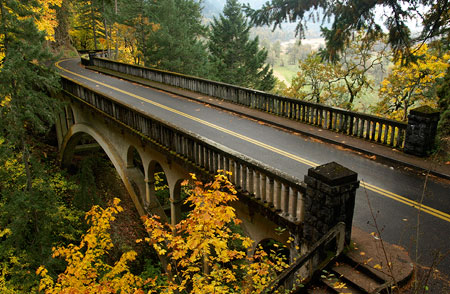
Samuel Lancaster's iconic bridge at Shepperd's Dell as it appears today

Samuel Lancaster’s iconic bridge at Shepperd’s Dell as it appears today

Sam Lancaster said this of his design for Shepperd’s Dell:

“The white arch of concrete bridges a chasm 150 feet in width and 140 feet in depth. The roadway is cut out of solid rock [and] a sparkling waterfall leaps from beetling cliffs and speaks of George Shepperd’s love for the beautiful, and the good that men can do.”

-Samuel Lancaster (1916)

Complementing the highway is a rustic footpath leading from the bridge to a viewpoint at the edge of the falls. The footpath is cut into the vertical walls of the dell and framed with Lancaster’s signature arched walls. From the falls viewpoint, the vista sweeps from a close-up of the cascades on Young Creek to the graceful arch of the highway bridge, soaring above the canyon. This is understandably among the most treasured scenes in the Columbia Gorge.

1920s postcard view of Shepperd's Dell showing the Bishop's Cap in the distance.

1920s postcard view of Shepperd’s Dell showing the Bishop’s Cap in the distance.

Samuel Lancaster created this scene as we experience it today, but only because George Shepperd made it possible by showing Lancaster his secret waterfall, and offering to donate his land to the highway project so that others might enjoy his dell in perpetuity.

Who was George Shepperd?

When Sam Lancaster was building his touring road through the Columbia Gorge, a number of well-to-do land owners with vast holdings in the area generously donated both right-of-way and some of the adjacent lands that hold the string of magnificent waterfalls and scenic overlooks that we enjoy today. Until the highway idea was conceived in the early 1900s, the Gorge was mostly valued for its raw resources, with several salmon canneries and lumber mills along the river and the forests heavily logged. The idea of a parkway was new, and part of the surging interest in creating national parks and expanding outdoor recreation across the country.0

Middle tier of the falls at Shepperd's Dell as viewed from the highway bridge

Middle tier of the falls at Shepperd’s Dell as viewed from the highway bridge

George Shepperd was equally generous with his donation, but he wasn’t a timber baron or salmon cannery tycoon. Instead, Shepperd was a transplanted Canadian farmer who had moved his family here after a short stay Iowa in the 1880s. Samuel Lancaster wrote this of Shepperd:

“The tract of eleven acres at this point, given by George Shepperd for a public park, is unexcelled. God made this beauty spot and gave it to a man with a great heart. Men of wealth and high position have done big things for the Columbia River Highway which will live in history; but George Shepperd, the man of small means, did his part full well.”

-Samuel Lancaster (1916)

George Shepperd, his wife Matilda and their sons William and Stuart moved from Goderich Township, Ontario (roughly halfway between Toronto and Detroit) to a farm in Audobon County, Iowa in 1880, where the couple gave birth to two more sons, George Jr. and John.

George Shepperd's extensive holdings in the early 1900s were mostly hills and ravines (shown in yellow), with the donated Shepperd's Dell parcel shown in green. Much of Shepperd's remaining land has since been brought into public ownership

George Shepperd’s extensive holdings in the early 1900s were mostly hills and ravines (shown in yellow), with the donated Shepperd’s Dell parcel shown in green. Much of Shepperd’s remaining land has since been brought into public ownership

In 1889, the Shepperds moved again, this time to Oregon where they settled in the Columbia River Gorge on a 160-acre land claim along Young Creek, just west of the mill town of Bridal Veil. Their fifth child, a daughter named Myra, was born just a year after they arrived, in November 1890. Upon settling in Oregon, George Shepperd supported his family by farming, dairying and working at the nearby Bridal Veil Lumber Mill.

At this point in history, the George Shepperd story becomes complicated: in May 1895, George and Matilda divorced, and in January 1896, George married Martha “Mattie” Maria Cody Williams, who had also recently divorced. Mattie apparently met George when the Shepperd and Williams families had traveled west to Oregon together in 1889. The “Cody” in Mattie’s lineage was indeed William F. “Buffalo Bill” Cody, a first cousin.

The view today from Shepperd's Dell toward Crown Point includes some of George Shepperd's former pasture lands, now in public ownership and managed for wildlife.

The view today from Shepperd’s Dell toward Crown Point includes some of George Shepperd’s former pasture lands, now in public ownership and managed for wildlife.

George Shepperd was 47 years old when he married 37 year-old Mattie in 1896, and while the first years of their new marriage seemed to have been blissful, the next 35 years of his life were a rollercoaster of tragedies and triumphs.

The tragedy began in 1901 when his eldest son, William J. Shepperd, boarded a train to Portland to pick up supplies for the business he and his brother George Jr. had in Hood River. William reportedly waved to friends and family from the rear platform as he passed through Bridal Veil and the Shepperd farm, then was never seen again.

Local news accounts speculated that William had been “Shanghied” while in Portland and taken aboard a foreign cargo ship. Ten years later, William’s surviving wife Osie and son Raymond also disappeared after living with the Shepperds and members of Osie’s family in Portland for several years. They were never heard from again by George Shepperd.

The Bridal Veil Historic Cemetery is tucked among the trees near the Angels Rest trailhead

The Bridal Veil Historic Cemetery is tucked among the trees near the Angels Rest trailhead

More tragedy ensued in 1903, when George Shepperd lost his beloved Mattie, just seven years after the two had married. There is no record of why she died, though some accounts describe her as “crippled” in those years. She was only 44 years old.

If the impressive memorial he erected for Mattie at the Bridal Veil cemetery is any indication, George was profoundly heartbroken. He never married again. The melancholy epitaph at the base of her grave marker reads:

“One by one earth’s ties are broken, as we see our love decay, and the hope so fondly cherished brighten but to pass away.”

The infant grave of Elizabeth Dutro is also located within the otherwise empty Shepperd family plot, next to Mattie’s grave and dated October 15, 1903 – seven months after Mattie was buried. Baby Dutro seems to be Mattie’s granddaughter by Bertha Delma Williams Dutro, her daughter from her first marriage. Bertha Dutro lived until 1963, and had two more daughters. She is buried at the Idlewildle Cemetery in Hood River.
Mattie Shepperd's grave marker at the Bridal Veil Cemetery

Mattie Shepperd’s grave marker at the Bridal Veil Cemetery

Mattie Shepperd, "wife of George Shepperd"

Mattie Shepperd, “wife of George Shepperd”

The tiny Bridal Veil Cemetery is still maintained and open to the public, though a bit hard to locate: an obscure gravel driveway drops off the north shoulder of the I-84 access road at Bridal Veil, just below the Historic Columbia River Highway. A number of early settlers from the area are buried in this lonely window into the past.
Baby Dutro was laid to rest a few feet away and nine months after Mattie Shepperd

Baby Dutro was laid to rest a few feet away and nine months after Mattie Shepperd

Over the next few years, George Shepperd must have met Samuel Lancaster as the engineer began his surveys of a possible highway route through the Gorge. Travel in the Gorge at that time was mostly by train, and the Shepperd farm was one of the many stops along the route. No record of their meeting exists, but George was described as an early supporter of the highway, and this is surely the time when he realized that he could be part of Lancaster’s grand vision.

Some accounts suggest that the sudden loss of Mattie was also part of George Shepperd’s motivation to leave a lasting legacy with a land donation, but there is no record of this. Instead, it was simply the beauty of Shepperd’s Dell that seemed to motivate him.

Newspaper accounts also show that Shepperd had many opportunities to sell his property for substantial profit, as the new highway was quickly dotted with roadhouses and gift shops aimed at the new stream of tourists. The Oregonian later reported: “ever since the highway was constructed, Mr. Shepperd has received offers to purchase the tract, but has refused them, having in mind an intention to dedicate the property to the use of the public.”

Early 1930s postcard view of Shepperd's Dell.

Early 1930s postcard view of Shepperd’s Dell.

In March 1914, George Shepperd’s land donation along Young Creek was announced as part of the construction of the Columbia River Highway. But by late 1915, Shepperd was involved in a legal dispute with a neighboring landowner who attempted to take claim to the land he had donated – the land that is now Shepperd’s Dell. By 1916, George Shepperd was counter-suing on grounds of fraud to clear the title – one that stemmed from a loan that one of Shepperd’s sons had taken years earlier. The Oregonian reported the events with the headline “Good Deed Spoiled” as a nod to Shepperd’s noble intentions:

“A few years ago, the elder Mr. Shepperd, owner of an 80-acre piece of land above the Columbia River, deeded 10 acres, including the famous Shepperd’s Dell, to the City of Portland as a public playground. The Columbia River Highway was being built and it was apparent to Mr. Shepperd that this attractive place would be a valuable possession to the city. While he was a comparatively poor man, he determined, instead of selling the property for a small fortune that he could have received for it, give it free of cost to the public.”

(The Oregonian, March 16, 1916)

Thankfully, Shepperd prevailed in the legal dispute. At that point in the dramatic early history of the new highway, the Shepperd’s Dell section of the road had already been constructed, but who knows what might have been built there had the land slipped away from public ownership?

In November 1915, George Shepperd was fighting a second legal battle, joining the City of Portland in a lawsuit against the Bridal Veil Lumber Co., and their plan to divert Young Creek away from Shepperd’s Dell and into a generating facility to provide power for their mill. The City and Shepperd prevailed in this suit, as well.

This is the only known photo of George Shepperd. It appeared in the Oregon Journal in 1915.

This is the only known photo of George Shepperd. It appeared in the Oregon Journal in 1915.

George Shepperd’s personal roller coaster continued on June 8, 1916, when he found himself seated among the most honored guests at the spectacular dedication of the Columbia River Highway at Crown Point. Shepperd was recognized in the formal program along with historical luminaries like Sam Hill, Samuel Lancaster, Julius Meier, Simon Benson and John B. Yeon. The ceremony was kicked off audaciously by President Woodrow Wilson unfurling an American Flag remotely by pressing a telegraph button in the White House, surely a highlight for a modest farmer from Canada.

Though surrounded by millionaires and elite scions of Portland’s old money at the grand opening, Shepperd stood apart from his honored peers that day: John B. Yeon, who had been appointed roadmaster in the campaign for the Columbia River Highway project, summed it up best:

Mr. Shepperd’s donation is worthy of the highest praise, especially in view of the fact that he [is] not a wealthy man. He has made a sacrifice for the public good that ought to make some of our rich men ashamed of themselves.

John B. Yeon, Oregon Journal, April 23, 1915

Close-up view of the vehicle carrying Sam Lancaster as he passed Shepperd's Dell during the grand opening of the Columbia River Highway in June 1916.

Close-up view of the vehicle carrying Sam Lancaster as he passed Shepperd’s Dell during the grand opening of the Columbia River Highway in June 1916.

In an earlier 1915 front-page feature previewing the new highway (still under construction), the Oregonian described Shepperd’s Dell this way:

“One of the wonder spots on the Columbia Highway, in the daintiness and sublimity combined with its scenery is Shepperd’s Dell, which was donated to the highway as a public park by George Shepperd, because he loved the spot and because he wanted it preserved forever for the enjoyment of people who come along the highway.

Mr. Shepperd is not a rich man and his donation is one of the most noteworthy in the history of the highway. At Shepperd’s Dell is one of the finest bridges on the highway and a trail has been built leading down from the highway to the dell and back to the beautiful little waterfall and springs in the gorge. The view back from the trail, looking through the arch made by the concrete span, is one of the most beautiful on the highway.”

(Sunday Oregonian, August 29, 1915)

George Shepperd’s Final Years
This home on NE Stanton Street in Portland is where George Shepperd lived out the final years of his life.

This home on NE Stanton Street in Portland is where George Shepperd lived out the final years of his life.

In 1917, sixteen years after his eldest son William had vanished and six years after William’s wife Osie had disappeared with his grandson Raymond, George Shepperd sought foreclosure on 120 acres of land he had given to the young couple shortly before William disappeared in 1901. The title was cleared by April 1919, and Shepperd promptly donated the land, including a four-room farmhouse, to the local YMCA. The YMCA reported that the house and property would be converted into a model boys camp and lodge:

“A party of boys will visit the place today to clear off sufficient land for a baseball diamond and athletic field and to commence the work of remodeling the lodge. The camp will be used by the boys this summer for short camping trips, covering a period of only a few days, and is especially intended for use of those boys who are unable to devote the time required to make the trip to the regular summer camp at Spirit Lake.”

(The Oregonian, April 4, 1919)

By 1920s, George Shepperd had finally retired from his farm at Shepperd’s Dell, having survived his second wife Mattie and a remarkable series of peaks and valleys in his life. He moved to Portland, and lived there until passing away at his residence on NE Stanton Street in July 1930.

George Shepperd's modest grave marker at Riverview Cemetery.

George Shepperd’s modest grave marker at Riverview Cemetery.

Shepperd left an estate of about $8,000 to his remaining sons and daughter, primarily property in the Shepperd’s Dell area. But he hadn’t forgotten his missing grandson Raymond, and left him a token “five dollars in cash”, (about $70 today) presumably in hopes that the execution of his estate might somehow reconnect Raymond with the Shepperd family.

George Shepperd is interred at Portland’s Riverview Cemetery, along with many other important figures from the early period in Portland’s history. His understated gravesite is surprisingly distant from where his wife Mattie is buried in the Bridal Veil cemetery, and we can only guess as to why his surviving children didn’t bury him there.

George Shepperd Jr. in an early 1940s news account, on the right.

George Shepperd Jr. in an early 1940s news account, on the right.

George’s children produced nineteen grandchildren, and the Shepperd family name lives on throughout the Pacific Northwest.

His second-oldest son Stuart lived until 1952, when the Oregonian reported that an “elderly man” had collapsed on a sidewalk in downtown Portland, apparently from a heart attack. At the time of his death, Stuart Shepperd was residing in Latourell, near the family homestead in the Columbia Gorge. His surviving brother George G. was still living in Bridal Veil at the family homestead at that time.

George G. Shepperd and his wife Emma left the Shepperd farm in 1953 or 1954 and George G. lived until 1961. George G Shepperd’s son George “Junior” went on to become a prominent officer for the Oregon Bank, and died in 1975. The youngest of George Shepperd’s four boys, John, died in 1959. Myra Shepperd, George’s only daughter and the only one of his children born in Oregon, lived until 1975.

The bridge at Shepperd's Dell in the 1940s, complete with a white highway sign from that era.

The bridge at Shepperd’s Dell in the 1940s, complete with a white highway sign from that era.

The original 10-acre Shepperd’s Dell park was transferred from the City of Portland to the Oregon State Park system in September 1940. The state made a series of additional purchases to expand the park over the next several decades, bringing the total size of today’s park to more than 500 acres.

Today, Shepperd’s Dell State Park encompasses Bridal Veil Falls, Coopey Falls and the west slope of Angels Rest, to the east, in addition to its namesake waterfall grotto.

George Shepperd’s legacy… and ours?

Shepperd's Dell lights up with fall colors each autumn.

Shepperd’s Dell lights up with fall colors each autumn.

Imagine the Columbia River Highway without Shepperd’s Dell, and you can truly appreciate the magnitude of George Shepperd’s generosity and vision. There’s an important lesson from his legacy: bringing land into public ownership is complicated, expensive and often messy, and thus requires great determination.

Flash forward to our times, and consider the hundreds of private holdings that still remain in the Columbia River Gorge. Then imagine the “good that men can do” (in Samuel Lancaster’s words) — what if just a few of these parcels were donated to the public in perpetuity in our time?
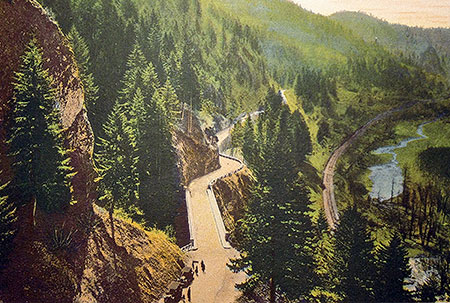
This unusual hand-colored photo from the 1920s is from the Bishops Cap, looking west toward the bridge at Shepperd's Dell. Though the trees have grown, much of the rest of this scene is preserved today.

This unusual hand-colored photo from the 1920s is from the Bishops Cap, looking west toward the bridge at Shepperd’s Dell. Though the trees have grown, much of the rest of this scene is preserved today.

Hopefully, the spirit of George Shepperd’s humble generosity will live on in the hearts of those fortunate few who still hold private property in the Gorge, but we’re also fortunate to have several non-profit organizations with land trusts to help the transition along:

The Friends of the Columbia River Gorge have become the most active in recent years in securing critical private holdings in the Gorge. Without Friends of the Gorge, we would not have secured lands at Cape Horn, Mosier Plateau of the Lyle Cherry Orchard, for example, among more than a dozen sites acquired by the Friends.

The Trust for Public Land serves as a critical go-between in helping secure private lands for eventual public purchase. Without the Trust, we would not have secured nearly 17,000 acres in the Gorge through more than sixty separate transactions over the past 30 years.

The Nature Conservancy continues to acquire endangered ecosystems, and their extensive holdings at Rowena Plateau and McCall Point also serve as some of the most visited recreation trails in the Gorge.

The Columbia Land Trust is another important player in securing private lands in the Gorge, as well as the rest of the lower Columbia River. Their focus is on riparian sites and securing critical habitat.

Very few of us will ever find ourselves in the position of George Shepperd, with a waterfall or craggy viewpoint to give to the public, but we can be part of that enlightened tradition in a smaller way. Please consider supporting these organizations in their efforts to expand our public lands in the Gorge!
________________

His Heirs
The Oregon Journal • July 23, 1930

ShepperdsDell22

GEORGE SHEPPERD was a poor man but he gave all that he had. Without intending it he made for him a memorial that will for all time identify his name with unselfish public service.

He owned a few rocky acres in the Gorge of the Columbia. It was land from which a living could be wrested only by dint of much toil. But through it ran a small stream that at last leaped and laughed and spiraled its way down through the great basaltic cliff that was the wall of the gorge. The course of the cataract led to Shepperd’s Dell.

It was for many years George Shepperd’s habit to go on Sunday afternoon with the children and sit beneath a tree and look down upon the exquisitely fashioned spot. The harsh outlines of the rock, cast up aeons ago by volcanic fires, were softened and carved into fantastic and beautiful forms by the streamlet. Maidenhair fern clung precariously to the cliff. Flowers bloomed under the shadow of the tall and somber firs.

When the Columbia River Highway was built George Shepperd gave Shepperd’s Dell to the people as their beauty spot forever. At other points along the highway “No Trespass” signs appeared where property was privately owned. George Shepperd left a welcome.

One wonders if there will be a bright Sunday afternoon when the spirit of this humble man will be allowed to return and brood over Shepperd’s Dell and share in the pleasure of the many who revel there. Having little, he gave all, and it became much.

(Postscript: after his death the Oregon Journal published this tribute to George Shepperd. We are all still “his heirs”. I would someday like to see these words cast in bronze and tucked into a shady corner of his Dell so that a bit of his story might be known the many who visit this spot)
________________

Acknowledgements: as you might have guessed from the length, this was among the more challenging articles to research for this blog, as very little is written about George Shepperd. An especially big big thank-you goes to Scott Daniels, reference librarian at the Oregon Historical Society, who helped me locate the only known biography of George Shepperd.

The obscure Shepperd biography was written in 1997 by Muriel Thompson, a great-great niece of George Shepperd. Thompson traveled to Oregon to conduct some of her in-depth research, including court records from the various legal actions Shepperd was party to and digging into Oregon Journal archives at a time when news searches meant poring over microfiche archives. It’s an invaluable account of George Shepperd’s life and legacy.

The stairs leading into Shepperd's Dell from the bridge as they appeared in the 1940s - the signpost no longer exists, though the rest of the scene is largely unchanged.

The stairs leading into Shepperd’s Dell from the bridge as they appeared in the 1940s – the signpost no longer exists, though the rest of the scene is largely unchanged.

Thompson’s biography did not have the benefit of today’s internet research tools, and through a variety of these sources, I was able to piece together a fuller picture of George Shepperd’s complex life than was possible in 1997, especially details about his two marriages and additional historic news accounts about his land donation and the construction of the Columbia River Highway.

There is still plenty of mystery surrounding this important player in the history of the Columbia Gorge: did any structures from George Shepperd’s farm survive? Why did his children bury him at Riverview Cemetery instead of Bridal Veil, by his beloved Mattie? What became of his grandson Raymond, by his vanished eldest son William? As always, I welcome any new or corrected information, and especially contact with any of his descendents. One of the unexpected joys in writing this blog is the opportunity to connect directly with grandchildren and great-grandchildren of important people in our regional history!
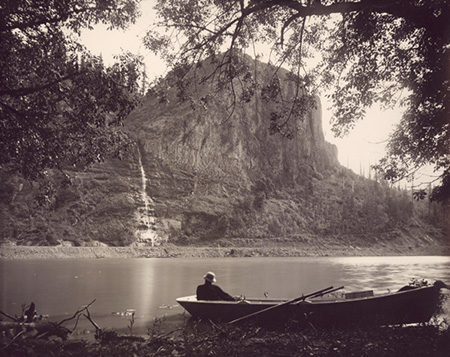
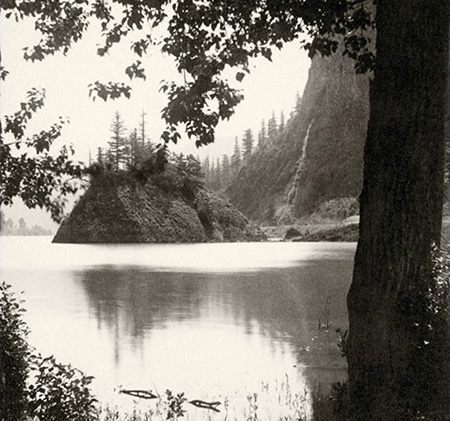
Ski Traffic & the Loop Highway: Part 2

The winter weekend crush of skiers is nothing new on Mount Hood

The winter weekend crush of skiers is nothing new on Mount Hood

(This is the second in a two-part article. The first part focused on the latest plans to add more parking to the Meadows resort, another step in the wrong direction for Mount Hood, but one that (unfortunately) has already been approved by the U.S. Forest Service. This part focuses on the future, and a promising new strategy that seems to finally be turning the page on an era when ODOT and the Mount Hood ski resorts simply paved their way out of weekend traffic problems with more parking and wider highways.)
__________________

Since the early days of developed snow sports on Mount Hood in the 1920s, winter weekend traffic jams have been the norm. The cars have changed (and so has the highway, regrettably), but the same bottlenecks appear in pretty much the same spots, as thousands of Portlanders pour into the ski resorts over a few short winter weekends each year.

Intrepid auto tours reached Government Camp on dirt roads years before the loop highway was completed in the early 1920s

Intrepid auto tours reached Government Camp on dirt roads years before the loop highway was completed in the early 1920s

From the beginning, there have been overflow parking lots, ski buses, shuttles — even an aerial tram in the early 1950s known as the Skiway — all in an attempt to stem the weekend ski traffic.

In 2013, the Oregon Department of Transportation (ODOT), in partnership with the U.S. Forest Service, the Federal Highway Administration and Clackamas and Hood River county officials, kicked off yet another effort to address the winter traffic overload.

In the 1920s, Government Camp was the center of winter activity -- and overflowing with cars

In the 1920s, Government Camp was the center of winter activity — and overflowing with cars

While this is just the latest of several ODOT-led efforts over the years to better manage the Loop Highway, the draft Mount Hood Multimodal Transportation Plan (MHMTP) is the best effort yet. While still only a document full of recommendations, the new plan offers real promise that federal, state and local officials are now more serious about managing the relatively short season of ski traffic gridlock.

Timberline Lodge was overflowing with cars as soon as it opened in the late 1930s

Timberline Lodge was overflowing with cars as soon as it opened in the late 1930s

Instead of attempting to rebuild the entire highway corridor to meet the peak demands of ski resort traffic that occurs over a few weekends each year, the MHMTP focuses instead on low-cost, high-impact tools. This is a radical and positive change in mindset — even if the plan itself still has a few gaps.

The stakes are high when it comes to managing traffic on Mount Hood. The ski resorts have little incentive to do anything except ask the general public to cough up more tax dollars for ever-wider highways. After all, it’s a sweet deal for the resorts and skiers, alike: in Oregon, just one in 25 residents ski, so the subsidy for highway projects catering to ski traffic is enormous.

ODOT is currently seeking bids in the latest round of road widening, this time along the slopes of Laurel Hill in what will eventually total more than $60 million in state gas tax funding over the past decade to widen the Loop Highway from Brightwood to Government Camp.

Camp Creek takes the brunt of trash and pollution from US 26. This scene is the unimproved roadside trailhead at Mirror Lake, where a chemical toilet (and associated trash) sits precariously above a steep bank dropping directly into the stream

Camp Creek takes the brunt of trash and pollution from US 26. This scene is the unimproved roadside trailhead at Mirror Lake, where a chemical toilet (and associated trash) sits precariously above a steep bank dropping directly into the stream

Just a few hundred yards downstream from the scene in the previous photo, Camp Creek spills over beautiful Yocum Falls, a seldom-visited spot bypassed by the modern highway. The pool below the falls is sullied with plastic cups, sport drink bottles and tires that have found their way into the stream from the highway

Just a few hundred yards downstream from the scene in the previous photo, Camp Creek spills over beautiful Yocum Falls, a seldom-visited spot bypassed by the modern highway. The pool below the falls is sullied with plastic cups, sport drink bottles and tires that have found their way into the stream from the highway

The traditional “building your way out” mindset has been bad for business in the local communities along the highway. The wider, noisier road has made it even less attractive for day tourists to risk a stop at the remaining shops and restaurants in the corridor. Worse, the huge 5-lane cross sections built on Highway 26 over the last decade have effectively cut the mountain villages in half by creating a scary barrier for local traffic to navigate, whether on foot, bicycle or in a vehicle.

Widening the Loop Highway is even worse for the natural environment, as highway trash, polluted runoff and blown gravel enters directly into the Salmon River, Still Creek, Camp Creek (pictured above) and the Zigzag River. All four streams serve as important salmon and steelhead habitat, a fact lost on the rush to make room for a few weekends of ski traffic each year.

A New Direction?

The Mount Hood Skiway was an early 1950s experiment to lessen parking pressure on Timberline Lodge - it failed, but may have been ahead of its time!

The Mount Hood Skiway was an early 1950s experiment to lessen parking pressure on Timberline Lodge – it failed, but may have been ahead of its time!

ODOT’s new MHMTP is both comprehensive and innovative. The plan is guided by the following objectives for how future travel should occur on the mountain:

• Improved highway safety for all users
• Expanded travel options year-round
• Reduced peak travel demand
• Enhanced mobility and access to recreation and local communities
• New projects should be financially feasible and sustainable
• New projects should be achievable in the next 15 years

The new focus on cost-effectiveness and a broader definition of desired outcomes beyond simply chasing traffic is new for ODOT — and for Mount Hood. It follows the lead of urban areas across the country, where cities are increasingly moving away from big-ticket road projects that seldom provide the advertised safety or mobility benefits used to justify them, and toward more practical solutions that have fewer unintended consequences.

A decade of futile "widening for safety" projects in the Highway 26 corridor has mostly resulted in dividing local communities and increasing highway runoff, with little traffic benefit

A decade of futile “widening for safety” projects in the Highway 26 corridor has mostly resulted in dividing local communities and increasing highway runoff, with little traffic benefit

To achieve these core objectives in managing the Mount Hood travel corridor, the MHMTP lays out four areas of proposed action – this is the real substance of the plan:

1. Better managing the system: in this area, the plan calls for another plan known as a “concept of operations”, which is transportation jargon for an operations blueprint for the Mount Hood loop from the City of Sandy to Hood River. Elements of an operations blueprint could range from web-based traveler information to new or upgraded electronic message signs along the highway, with real-time updates on traffic, parking, transit and emergencies.

The goal of this element of the MHMTP is to make the best use of the system through better-informed travelers and to better coordinate the various public agencies (ODOT, the Forest Service and the two counties) involved in operating the road system.

How it could be better: the details of the “concept for operations” aren’t nailed down at this point (thus the need for another plan), but one strategy not mentioned in the list of possibilities is variable speed limits along the entire loop. This key recommendation from ODOT’s 2010 Highway 26 Safety Audit deserves to be a priority above other, more costly highway projects already moving forward in the area. DOTs around the country are using this technology with excellent results in improving safety and traffic efficiency, and ODOT should join the movement.

An even larger gap in the strategy is an unwillingness by ODOT and the Forest Service to require the ski resorts to adopt peak pricing as a means to help spread out demand. The resorts are loathe to do this, given their troubled future (as described in Part 1 of this article), but if all three major resorts adopt the same policy, they will at least retain their current competitive positions with one another, while Mount Hood’s communities and environment would benefit from a coordinated effort to spread out the highway demand.

Not in the plan: pricing incentives for parking and lift tickets at the big three resorts to spread demand from weekend peaks

Not in the plan: pricing incentives for parking and lift tickets at the big three resorts to spread demand from weekend peaks

Sadly, it will be a very long time before the Forest Service asks the resort to adopt more aggressive peak pricing for lift tickets, but that is the best long-term solution available for spreading out ski demand. Short of that, ODOT holds the cards for managing parking, as all parking along the mountain portion of the Mount Hood Loop Highway falls within a state-designated SnoPark permit area.

Currently, ODOT charges a generic fee for annual and day passes to park at the SnoPark lots (including all three ski resorts), but the agency should consider using these permits to better manage demand on the highway. This is a very low-cost strategy to avoid some very high-cost road widening projects.

2. Bicycle and pedestrian projects: this much-needed element of the plan calls for improved bike and pedestrian crossings at key locations along the loop highway. Highway widening is also called for to allow for more shoulder space for bicycles, along with bike safety improvements at key intersections and traveler information for bicycles. While not driven by ski resorts, this element of the plan embraces the potential for Mount Hood to become a more balanced, year-round recreation destination, and the Loop Highway becoming less of a barrier to hikers and cyclists.

Notably, the famously crowded Mirror Lake trailhead is called out for relocation to address safety issues with the current trailhead. The new trailhead could be sited across the highway, accessed from an existing section of the Historic Mount Hood Loop Highway (that now serves the Glacier View SnoPark), and connected to the current trailhead with a new pedestrian bridge over US 26.

Rumble strips are very effective at keeping distracted drivers out of bike lanes, but bikes also need enough lane space to keep away from the rumble strip

Rumble strips are very effective at keeping distracted drivers out of bike lanes, but bikes also need enough lane space to keep away from the rumble strip

How it could be better: “widening” for bicycle lanes is a default recommendation that you might expect from ODOT, but the lanes along the Mount Hood loop are already very wide in many spots, so keep your fingers crossed that our highway planners are judicious about where to actually widen the road. In most cases, simply providing rumble strips along the shoulder stripe would go a long way to keep cycles safe from motor vehicle traffic, and require fewer subalpine trees to be cut for road widening.

A major gap in this element of the MHMTP is lack of policy direction on speeding or travel speeds — two of the three main contributors to serious accidents identified in the 2010 ODOT safety study (with winter conditions as the third).

Extending and enforcing the existing ODOT safety corridor and 45 mph speed limit from Rhododendron to the Hood River Meadows entrance to Mount Hood Meadows would make cycling along this most mountainous portion of the loop highway much safer – which in turn, makes cycling more attractive, especially on the lower sections of the loop that are generally snow free year-round.

"Widening for bicycle lanes" sounds easy, but the devil is in the details when the road travels through public forest lands

“Widening for bicycle lanes” sounds easy, but the devil is in the details when the road travels through public forest lands

3. Improved transit service: The MHMTP plan calls for new transit from Sandy to the mountain, and Clackamas County recently received a US Department of Transportation grant to expand its Mount Hood Express bus service from Sandy to Ski Bowl, Government Camp and Timberline Lodge. Rides are $2 each direction, with ten buses daily during the ski season, seven in the off-season. The trip from Sandy to Government Camp takes about 55 minutes and Timberline Lodge at about 75 minutes, so quite competitive with driving times and much less expensive.

It’s a good start, and long overdue. The fact that almost all traffic heading to the mountain during the winter season is destined for Government Camp, Timberline or Meadows makes the Mount Hood area highly serviceable with transit, provided a long-term funding mechanism can be found.

For too long, a very limited supply of shuttles and private ski buses at the Mount Hood resorts have been the sole transit option along the loop highway

For too long, a very limited supply of shuttles and private ski buses at the Mount Hood resorts have been the sole transit option along the loop highway

How it could be better: The proposed transit service in the MHMTP is great if you’re coming from Sandy — or able to drive and park your car there — but it doesn’t allow for truly car-free trips to the mountain in a region that is increasingly interested in having this option.

For years, people have wondered aloud about “extending MAX to the mountain”, but that will never happen — the cost would be astronomical and the ridership on the best of days wouldn’t come close to justifying the cost. But bus transit is completely within reach, and well-suited to the demand.

A proposal called “The Boot Loop” on this blog showed how it could be done — save for public and private interests along the loop highway coming together to make it happen. Let’s hope the Mountain Express pilot project is just the beginning of a more comprehensive transit system on Mount Hood and in the Gorge.

4. Safety projects: several critiques of ODOT’s ill-conceived “widening for safety” campaign along the Mount Hood loop have appeared in this blog over the past few years, and thankfully, some of the worst elements of the most recent phase between Rhododendron and Government Camp have been dropped.

Most recently, ODOT failed to receive construction bids within its project budget for this latest phase, and that is potentially good news if it means that some of the remaining bloated, environmentally destructive elements of the project (like cutting back cliffs on Laurel Hill) are scaled back.

Given this context, the safety projects contained in the MHMTP plan are refreshingly sensible and practice — truly “safety” projects, and not just an old-school highway widening agenda wrapped in an attractuve safety package.

ODOT owes the rural communities (like Rhododendron, above) along the loop highway retrofits to undo the damage from the "widening for safety"

ODOT owes the rural communities (like Rhododendron, above) along the loop highway retrofits to undo the damage from the “widening for safety”

How it could be better: travel speed is the single most important lever for highway engineers to reach for if improved safety is truly the desired outcome. ODOT was bold and forward-thinking when it adopted a safety corridor along a portion of Highway 26 several years ago, and especially when the agency adopted a 45 mph speed limit from Wildwood to Rhododendron.

There’s no reason why this successful strategy can’t be extended for the remainder of the ski commute along the Loop Highway, to the lower entrance at Mount Hood Meadows. As the 2010 ODOT safety audit clearly showed, nearly ALL of the serious accidents in this corridor were directly tied to heavy winter travel, and especially weekends, when the predictable crush of day skiers descends upon the mountain.

What’s Next?

ODOT will be wrapping up the MHMTP shortly. You can track the final recommendations on their project website:

Mount Hood Multimodal Transportation Plan website

As the MHMTP moves forward toward funding, the focus will shift to Clackamas and Hood River counties, the Forest Service, ODOT and the ski resorts working collaboratively to bring the various strategies completion. The plan sets forth three tiers of project, but all recommendations fall within a (relatively) short window of 15 years.

The Mirror Lake trailhead could see big changes under the proposed MHMTP plan

The Mirror Lake trailhead could see big changes under the proposed MHMTP plan

ODOT has an institutional habit of saying it “owns” the highways, but in fact, the public owns it – that’s us! Thus, it falls upon the true owners of the Loop Highway to track the details — the specific projects that will carry out the new direction called for in the MHMTP. Perhaps more importantly, it falls upon us to speak out against more funding of old-school road widening projects cloaked as “safety improvements” that could effectively cancel out the MHMTP proposals.

Over the next few years, the recommendations in the MHMTP will gradually be funded through ODOT’s statewide transportation improvement program and similar capital funding programs at the local level. Watch this blog for more details on how the dollars actually roll out in coming years on our beloved loop highway!
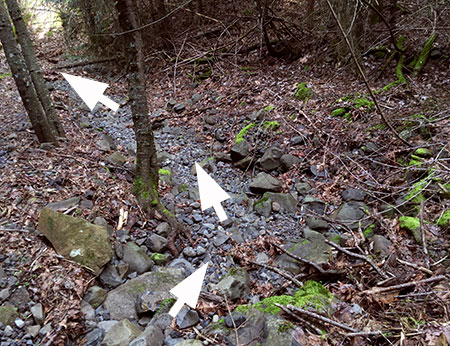
Ski Traffic & the Loop Highway: Part 1

Mount Hood Meadows is seeking yet another overflow parking lot for the resort, its fourth, bringing the resort capacity over 3,500 vehicles

Mount Hood Meadows is seeking yet another overflow parking lot for the resort, its fourth, bringing the resort capacity over 3,500 vehicles

On January 13, the Mount Hood National Forest (MHNF) issued its final environmental assessment for yet another sprawling parking lot at the Mount Hood Meadows ski resort. This is the just the latest decision over nearly 50 years of always finding a way to say “yes” to the private permit holders who operate the Meadows resort on our public lands.

According to MHNF documents, the proposed new “Twilight” lot will require 9.4 acres of subalpine forest adjacent to the popular Elk Meadows Trailhead to be logged, then paved over by the Meadows resort, allowing for 878 new parking spaces on a new 7.2 acre asphalt lot. Translated to urban scale, that’s another seven full Portland blocks of forest that will be replaced with paving simply to meet peak winter weekend demand.

Meadows parking lots are mostly empty outside of a few weekend peaks from December through February. This photo was taken on a sunny Saturday in March, 2009 at the huge Hood River Meadows lot. The tiny structure on the right is the Nordic Ski Center, for scale. Only about a third of the sprawling lot can be seen in this photo

Meadows parking lots are mostly empty outside of a few weekend peaks from December through February. This photo was taken on a sunny Saturday in March, 2009 at the huge Hood River Meadows lot. The tiny structure on the right is the Nordic Ski Center, for scale. Only about a third of the sprawling lot can be seen in this photo

Using Forest Service data, the Twilight proposal translates into roughly 7,500 noble fir, mountain hemlock, Lodgepole pine and other subalpine conifers being cut to bring the overall parking capacity for the Meadows resort to a whopping 3,526 vehicles.

How much parking is this? For comparison, a typical Walmart Supercenter has about 800 parking spaces — which means the total Meadows parking capacity could accommodate four Walmart Supercenters. Another comparison: the new Meadows parking total will be slightly more than the 3,300 spaces Portland International Airport (PDX) provides in its newly expanded day parking structure at the main terminal (see an earlier article on this blog for more details on the Twilight proposal).

Meadows also plans to move its Nordic Center — currently a non-descript modular building located at the back of the sprawling Hood River Meadows lot — to the new Twilight Lot in an effort to better compete with the non-profit Teacup Lake Nordic Club, located across the Loop Highway.

The humble Meadows Nordic Center is overshadowed by the very popular Teacup Lake Nordic Club facilities located across the highway

The humble Meadows Nordic Center is overshadowed by the very popular Teacup Lake Nordic Club facilities located across the highway

Is this latest expansion justified? Not if you dig into the details. The folly in the MHNF decision is that it is based on an outdated special permit granted in 1997 by the Forest Service that gives the Meadows Resort their legal ability to operate a private business on national forest land.

But it turns out that almost no current data on the future of the ski industry supports this decision — including data from the ski resort industry, itself. Instead, this proposal is mostly about the Meadows resort attempting to buck the national trends by drawing skiers and boarders away from competing resorts at Timberline and Mount Hood Ski Bowl.

While this strategy might make sense for Mount Hood Meadows, Inc., it hardly makes sense as public land policy, and especially for taxpayers who subsidize the ski resorts.

The Meadows for-profit Nordic trail system has struggled to compete with the nearby Teacup Lake Nordic Club's larger and more affordable system

The Meadows for-profit Nordic trail system has struggled to compete with the nearby Teacup Lake Nordic Club’s larger and more affordable system

The recent Forest Service decision giving the green light to the Twilight parking expansion also fails to consider the most obvious solution: requiring Meadows to spread out their customer demand with peak ticket pricing. This is the simplest way to avoid overbuilding parking lots and overburdening the Loop Highway, and would make the best use of the Meadows resort capital investment and operations costs.

So, why is Meadows opting for a more costly option to addressing peak ski weekend demand? Read on…

Past is Prologue! (…except when it isn’t…)
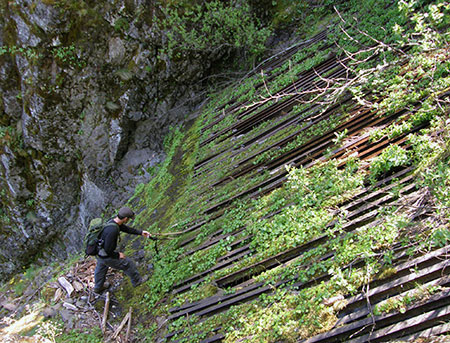
For more than a century, ski resorts across the country have long promoted the inevitability of their rapid growth as part of the advertising pitch, and yet they have a troubling secret in common: snow sports that were once growing exponentially in popularity are now flat or declining, nationally. And this trend has continued for decades.

Instead, most of the touted “growth” at major resorts in the past 30 years has come through consolidation. At the beginning of the 1980’s, there were some 727 ski resorts in operation, nationwide, yet only 480 ski areas survive today. This represents a decline of 33 percent, despite a hefty 36 percent increase in the U.S. population for the same period.

Beautiful Umbrella Falls was barely spared by the original Meadows parking lot (just a few yards beyond the trees at the top of the falls), though it still carries the burden of being in a ski area: trash and blown gravel fill the stream after the snow melts

Beautiful Umbrella Falls was barely spared by the original Meadows parking lot (just a few yards beyond the trees at the top of the falls), though it still carries the burden of being in a ski area: trash and blown gravel fill the stream after the snow melts

This decline also helps explain why all three major resorts on Mount Hood are looking to develop other attractions under their public lands permits to help sell lift tickets — most recently, the proposed bicycle play park at Timberline (Ski Bowl has already developed one that it now plans to expand).

Why the decline? A variety of factors are at work, not the least of which are the effects of climate change on snowpack and the ballooning price tag that has increasingly made skiing a sport for the affluent.

In study last year, the National Ski Areas Association (NSAA) reported that 54 percent of day visits came from households earning more than $100,000, a 12.5 percent increase among affluent skiers from just five years ago. Conversely, visits from households earning less than $100,000 dropped from 52 percent to 46 percent, an 11.5 percent drop for less affluent skiers over the same period.

This trend is not surprising when you consider that an annual pass at Meadows costs around $800 and day passes cost $74 for an adult ticket — and these are relatively affordable prices compared to premier Rocky Mountain and California resorts. Add the costs of gas and equipment, and it can cost a family hundreds of dollars to spend a day skiing on Mount Hood.

This chart shows the relatively flat trend in total U.S. ski visits from 2002 to 2012, and an abrupt dip in 2011-12 reflecting the fourth warmest winter since 1896 (Source: NSAA)

This chart shows the relatively flat trend in total U.S. ski visits from 2002 to 2012, and an abrupt dip in 2011-12 reflecting the fourth warmest winter since 1896 (Source: NSAA)

In 2008, the NSAA produced a study that had more ominous implications for the industry: they found that 85% of beginners who try skiing soon drop out of the sport, translating into only a 15% rate of “conversion” from beginner to regular skiing and snowboarding customers.

In response to this troubling finding, the industry adopted dual goals of (a) improving the total number of people trying the sport by 6 percent and (b) increasing the “conversion” rate from beginner to regular visitor by 1 percent per year. Despite industry efforts to meet these targets, in the six years since these goals were established the rate of new skiers staying with the sport has only increased by only 1 percent, far short of the retention target.

But there is even worse news in the NSAA findings: it turns out the existing base of regular skiers and boarders have also shown a decline in interest, with the rate of repeat resort visits from this core group decreasing by 6 percent since the industry targets were set in 2008.

This chart shows high-stakes future for skiing in the U.S., with the optimistic NSAAs growth strategy in blue and grim reality of current trends in participation in red (Source: NSAA)

This chart shows high-stakes future for skiing in the U.S., with the optimistic NSAAs growth strategy in blue and grim reality of current trends in participation in red (Source: NSAA)

While the resorts continue to fight the overall drop in visitors, they are also battling the elements. Climate change is producing an increasingly erratic snowpack across the country, but especially in the West, where resorts are largely built with special permits on public lands. Larger resorts are spending as much as $50k apiece for snow guns to create their own snow — with some resorts installing hundreds of snow guns to ensure a ski season.

Skiers were already overflowing the Timberline parking lot in 1939, just two years after the lodge opened

Skiers were already overflowing the Timberline parking lot in 1939, just two years after the lodge opened

With the obvious environmental implications of snow making aside — and they are significant — the added cost burden for the resorts will only increase the price of skiing when the costs of snow making equipment, water and the energy needed to pump water uphill are passed along to skiers.

Given these discouraging national trends, are there better solutions to meeting peak ski resort demand at Mount Hood other than to continue paving over the alpine landscape?

This question will be the focus of Part 2 this article, and a new effort by the Oregon Department of Transportation to better manage traffic on the Loop Highway.

_________________

Author’s Note: lest readers think I’m anti-skiing, I am decidedly not. I grew up skiing at Mount Hood from the age of six, and skied at all four resorts on the mountain well into the 1990s, when I shifted to snowshoeing and Nordic skiing. I love the sport, and hope that Mount Hood will always have alpine skiing. But over the past few decades, I have watched the Meadows and Timberline resorts grow too large to be environmentally sustainable.

The Heather Canyon lift at Meadows was the wake-up call for me in the 1990s — and before that, the Palmer Lift at Timberline. Both were a notch too far in what — in my view — had been a reasonably sustainable balance between ski development and protecting the natural landscape of Mount Hood.

The author (center, at the tender age of 11) on a memorable 1973 ski vacation near Innsbruck, Austria with my family

The author (center, at the tender age of 11) on a memorable 1973 ski vacation near Innsbruck, Austria with my family

I also see the current model for commercial ski resorts failing, and worry that the grasping for quick solutions to balance the corporate books is out of sync with what could be sustainable, positive ways to diversity the resort offerings.

Watch for future WyEast Blog articles on this subject, as I not only believe that ski resorts can (and must be, in Mount Hood’s case) continue to operate within a National Park, I also think they could set the standard for environmental and economic sustainability that other resorts might learn from.