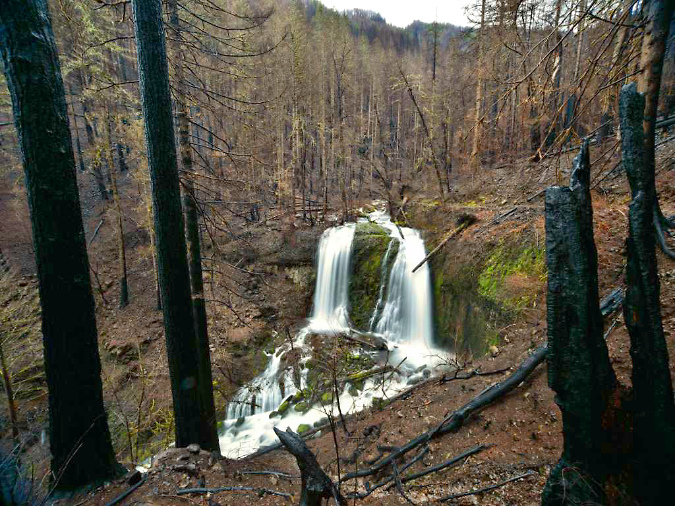
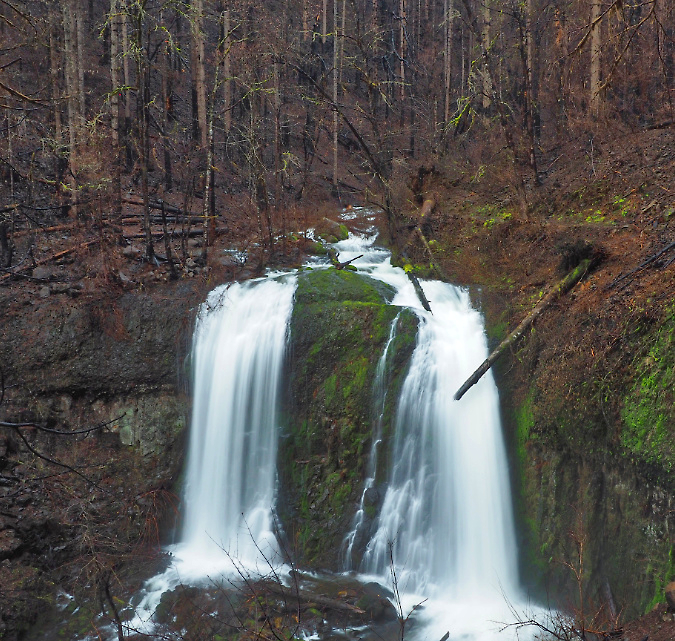
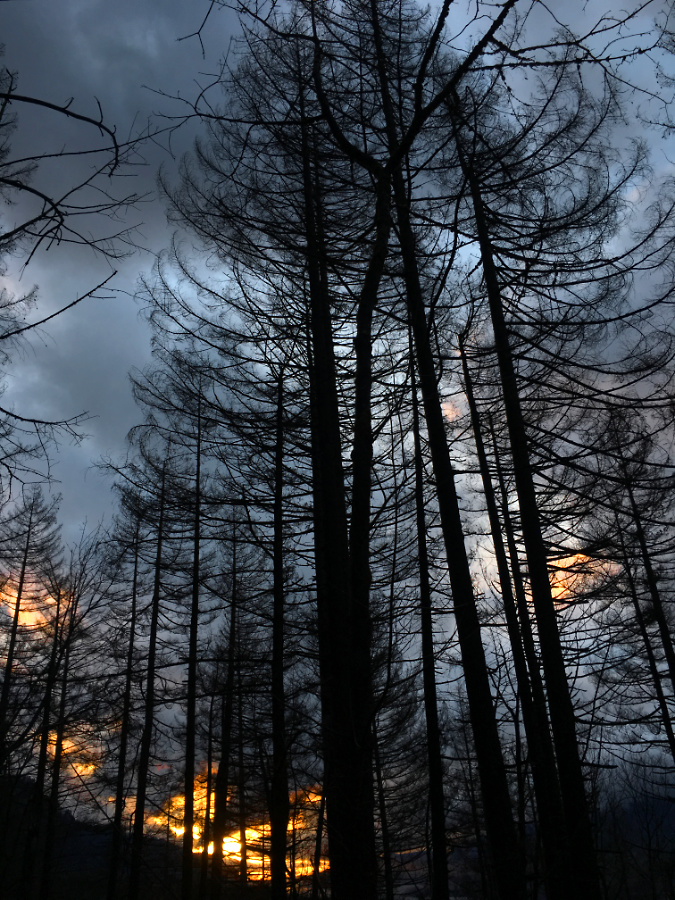
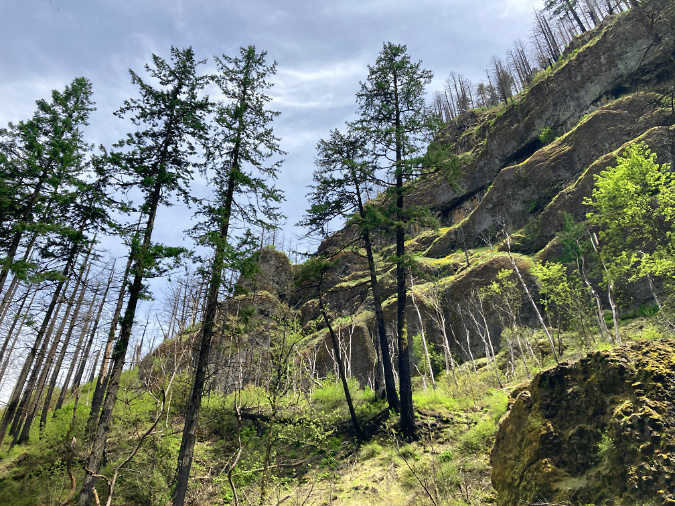
2025 Campaign Calendar..!

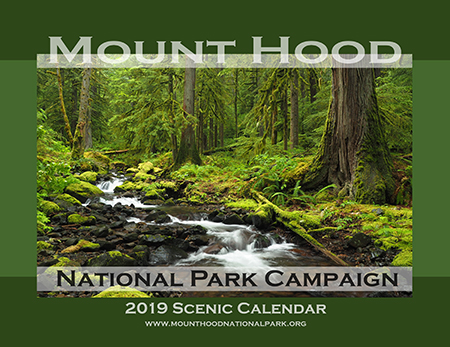
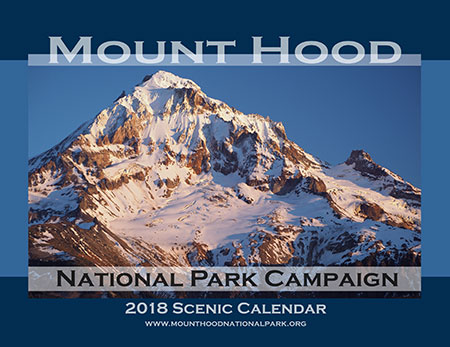
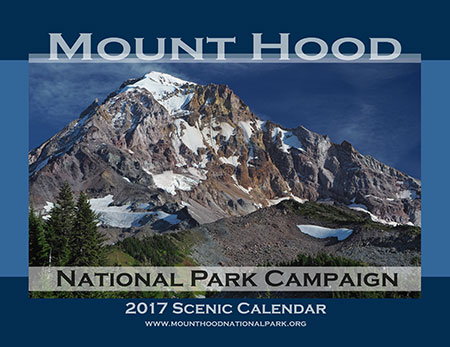
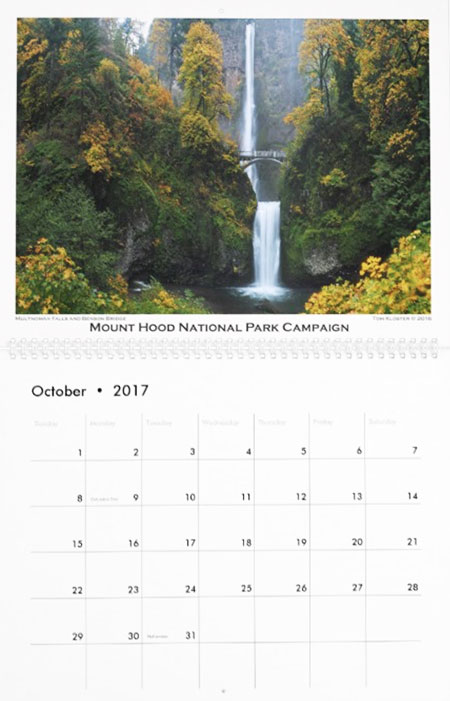
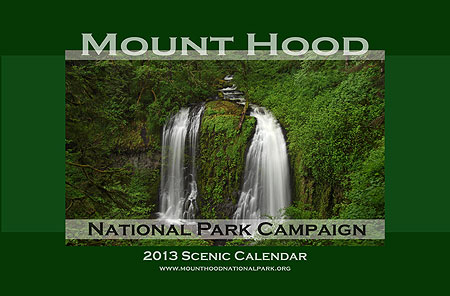
2025 Campaign Calendar Cover

December brings my annual year in review as told through the images I’ve chosen for the new Mount Hood National Park Campaign calendar. It’s a collection of images from around WyEast country that captures my explorations over the past year and its published in a high-quality, oversized format by the good folks at Zazzle. You can order one here:

2025 Mount Hood National Park Campaign Calendar

As always, all proceeds go to Trailkeepers of Oregon (TKO) and you can have these calendars delivered anywhere. You may notice a Red Rock Country calendar of desert southwest images from a recent trip through the Colorado Plateau — proceeds from the is calendar to to TKO, as well! Meanwhile, here’s a deeper dive into the thirteen images I selected for this year’s calendar.

Stories behind the photos…

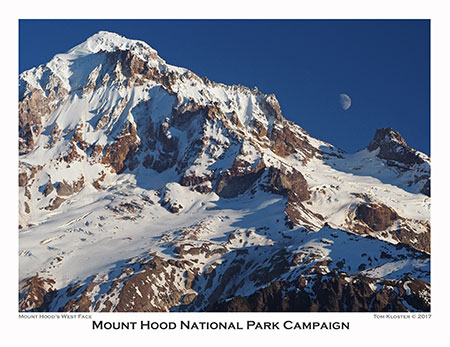
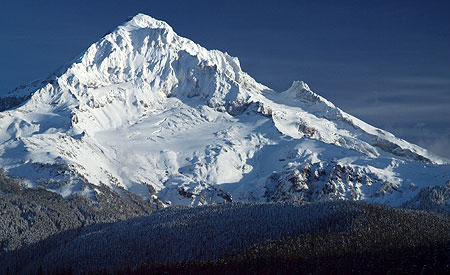
The cover image is also the most recent in the calendar. It’s an alpenglow view of Mount Hood’s west face taken from Lolo Pass road in early November. This is a classic spot for photography after the first few fall snowstorms, so I’m rarely alone there – a notably, I ran into Peter Marbach, one of our amazing WyEast Country professional photographers on this visit! This view came a few minutes before sunset on a crystal-clear fall evening:
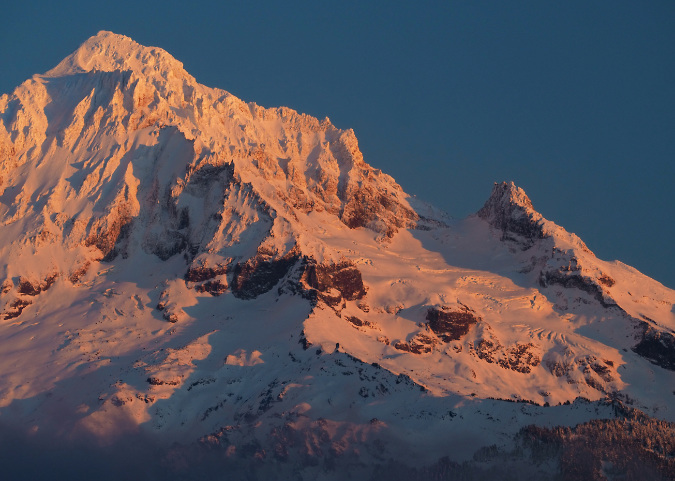
Last light after an early snowfall on the mountain is the cover image of the 2025 campaign calendar

The backstory to this photo is that I had planned to shoot from a favorite spot on the east shoulder of Lolo Pass that evening. I even had my camera set up, ready to go, when a huge fog bank rolled up the West Fork Hood River valley and parked over me at Lolo Pass. It happened in less than a minute, as the photo sequence below shows:
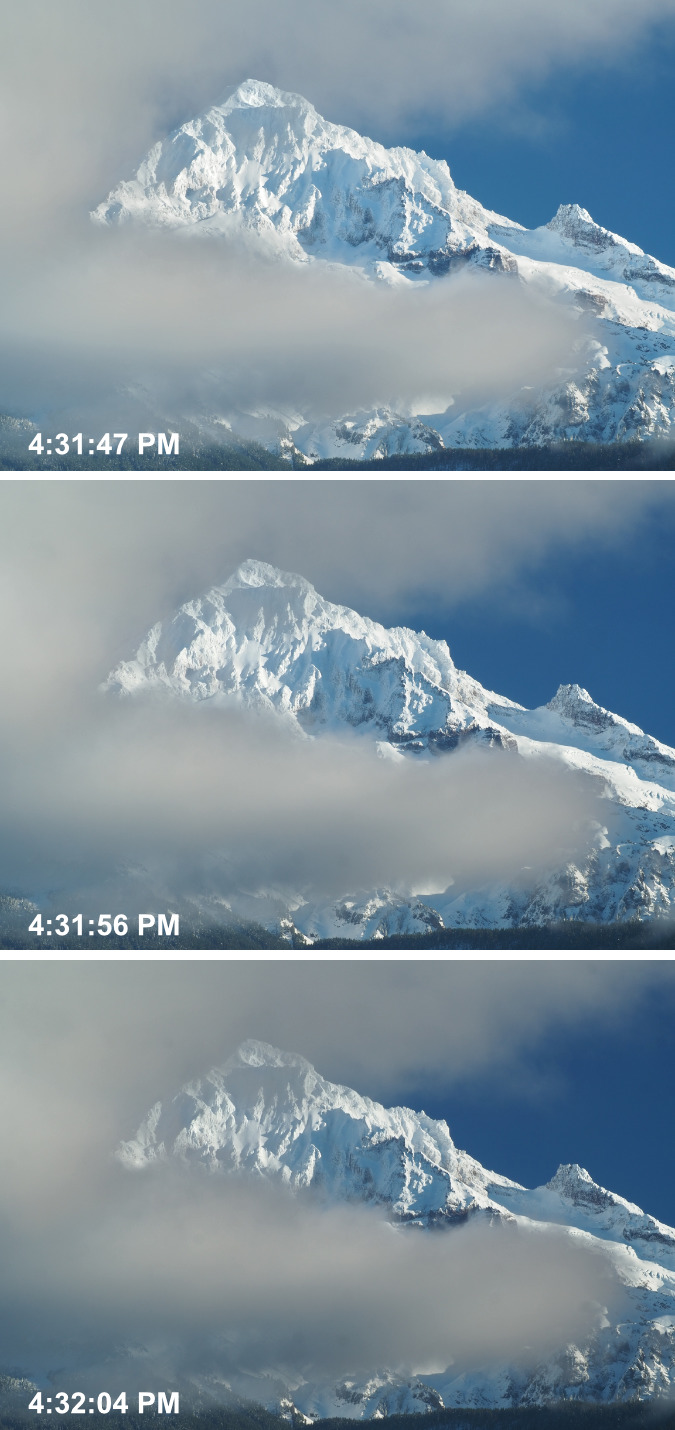
Lolo Pass fog rolling in… setting up my tripod seems to have this effect on the weather!

It turns that topographic conditions are prime at Lolo Pass for fog events like this (sometimes becoming freezing fog). Most of these are triggered when colder, drier continental air from east of the Cascades collides with moist, marine air from west of the mountains to form very localized fog banks parked on top of the pass, with otherwise clear weather to the east and west. 

Sure enough, when I packed up and headed to a viewpoint just west of the pass, the mountain was in full view – along with the fog bank draped over Lolo Pass (below). This is where I captured the cover photo for the new calendar that day and had the pleasure of meeting Mr. Marbach! I’m still kicking myself for not getting a selfie – I’m a big fan of his amazing work.
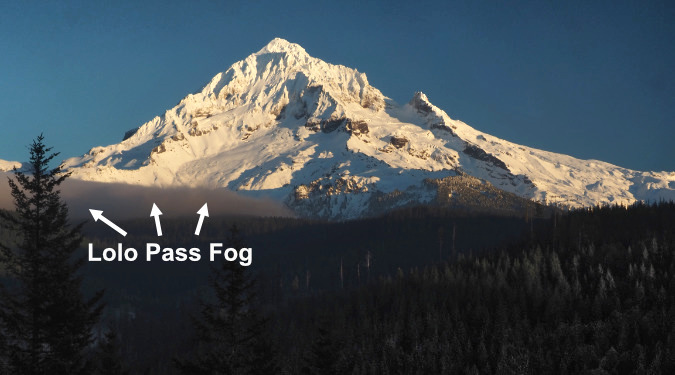
Looking back at the Lolo Pass fog bank from the west side of the mountain

In fall and early spring, strong temperature inversions can also fill the mountain valleys on both sides of Lolo Pass with dense fog. As the sun drops down toward sunset, the valley inversion fog often surges over the pass due to its remarkably low elevation of just 3,415 feet – at least a thousand feet lower than most of the Cascade passes in Oregon.

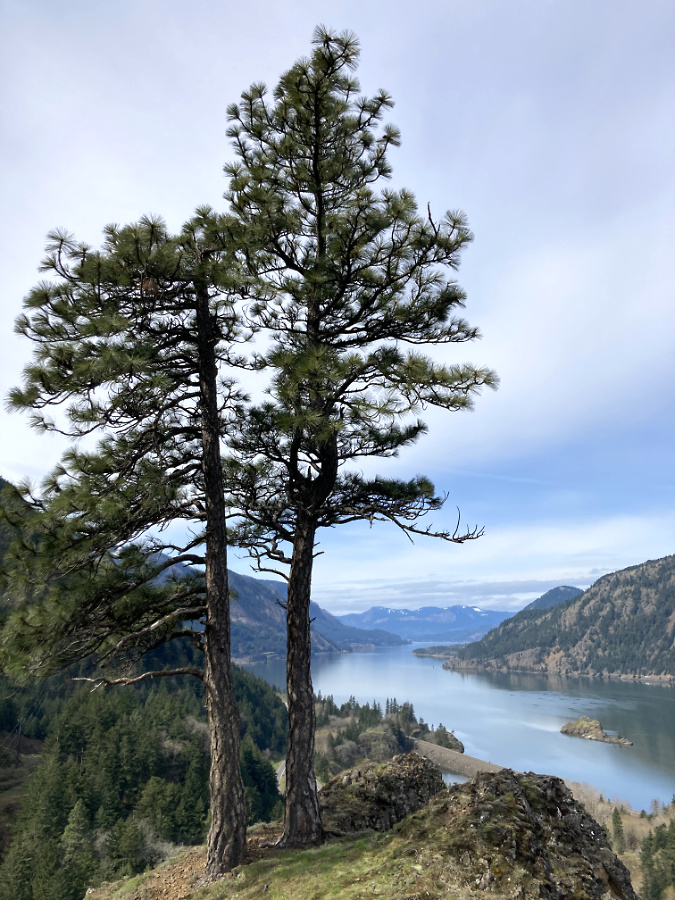
Continuing with the fog theme, inversion valley fog is just how this photo (below) I chose for January image in the new calendar came about. This scene was captured on the east side of Mount Hood, along the lower slopes of Lookout Mountain, with the East Fork Hood River canyon filled nearly to the brim with a dense, thousand-foot thick layer of fog. The view is framed with long-needled Ponderosa Pine boughs, the signature conifer species on the east slope of the Cascades.
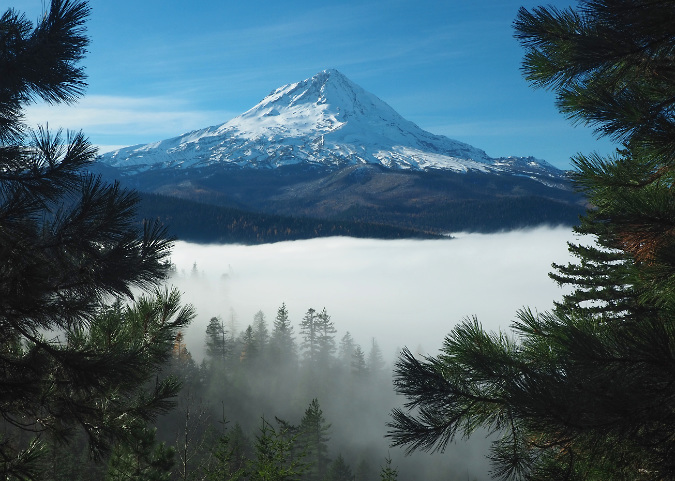
More fog for the January calendar image – this time in the East Fork Hood River valley

Here’s a wider view from the same area (below) showing how the fog filled the valley like a bathtub that day, thanks to a layer of cold, moist air trapped by a stable high-pressure system that was bringing all that sunshine and relatively mild temperatures directly above. On winter days like this, it’s common for temperatures in the fog zone to be hovering near freezing while temperatures above the inversion rise well into the upper 40s or even low 50s.
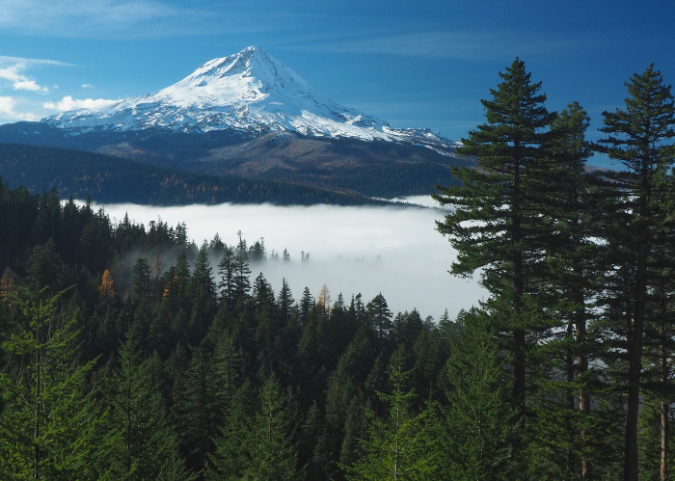
East Fork Hood River inversion fog and Mount Hood

Inversion fog is common on the east end of the Columbia River Gorge and is tributary valleys in winter, often with freezing temperatures that make for spectacular frost displays (and slick roads) when the inversions persist. The forests here are completely adapted to this effect, including the annual pruning that a heavy ice accumulation from persistent fog can bring. 

In this view (below), the winter advantage of Western Larch also stands out. While a few of the Larch still have their golden needles, most (like the one in the center) have already dropped their foliage for the winter, making them less susceptible to heavy winter winds and accumulations of snow and ice. Like Ponderosa Pine, Larch are also fire-resistant – making them perfectly adapted to this “fire forest” mountain ecosystem.
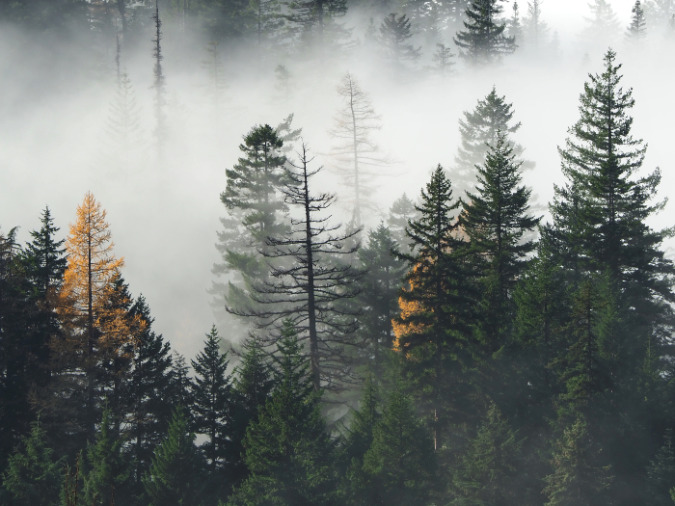
Fog swirling through an east side forest of Larch, true firs, Douglas fir and Ponderosa pine

The fog was sloshing around the East Fork valley that day as I watched and captured the changing scenes. While the overall inversion layer is generally flat, there are waves in the upper surface of the fog what wash “ashore” along the valley walls as the inversion air pressure gradient rolls across the surface of the fog layer. It’s mesmerizing to watch this effect from just above “shore level” as the waves surge below.

This final view was taken from the same spot as the above calendar image, and it shows an approaching wave of fog that would soon overtop the spot where I had set up my camera for these images. Once it engulfed me, the air temperature nearly 20 degrees in just a few minutes!
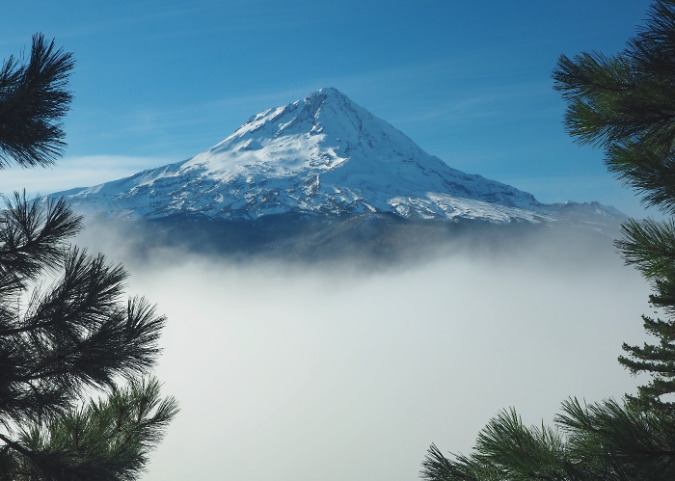
The mountain a few minutes before the ocean of fog inundated this spot!

Winter can be long and grey on the west side of the mountains, but if you know Oregon’s weather patterns you can often spot conditions when the east side of the mountains will be bright and sunny, even as rain falls on the west side. A favorite retreat for me on these days is the lower Deschutes River Canyon, less than two hours from Portland. 

Despite the still-cool temperatures, I prefer to visit the Deschutes River in late winter, when few people are there, and the canyon slopes are green with emerging spring growth and the Alders turn yellow, then rusty-red with catkins. For the February image in the new campaign calendar, I chose this scene (below) near Rattlesnake Canyon that features a picturesque White Alder just coming into its late winter bloom.
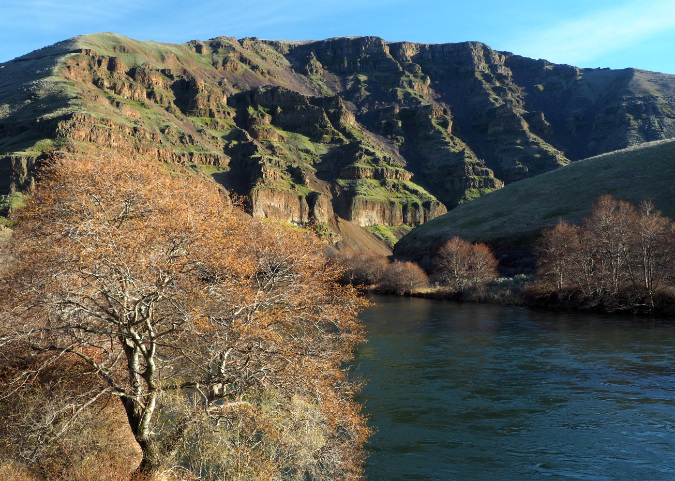
White Alder providing winter color along the Deschutes River for the February calendar image 

Here’s another winter scene along the Deschutes with a mature grove of White Alder (below) growing along the riverbank. White Alder are not widespread in Oregon, and mostly limited to the Willamette Valley, eastern Columbia River Gorge (including the lower Deschutes Canyon) and the Siskiyous in Southern Oregon, Their range overlaps the Red Alder, its close cousin, that grows along the Pacific coast and extends as far inland as the Willamette Valley, where the two species meet.
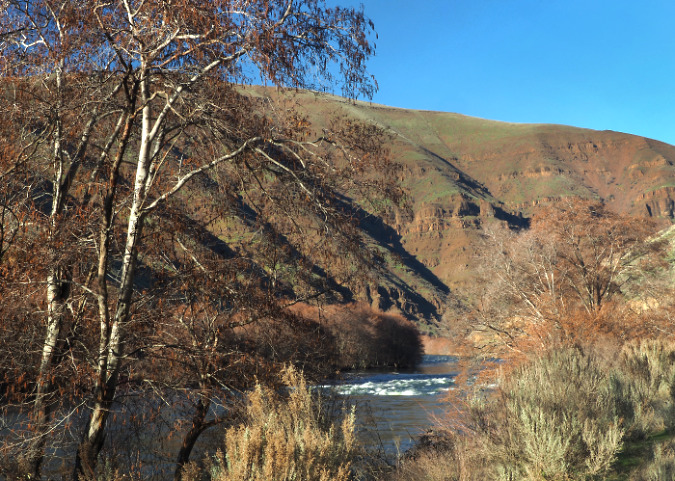
White Alder (left) in winter along the Deschutes

Seen up close, both the male and female catkins of White Alder come into view. In this February photo (below), the male catkins are the long, pendulous blossoms and the green female catkins are still in bud form, just beginning to emerge. The “cones” of last year’s female catkins can still be seen, too. They are the dark ovals that resemble tiny pine cones when they open and dry to a dark brown color in fall. Because White Alder contains both male and female flowers on the same tree, they rely only on wind to pollinate, and the desert country east of Mount Hood provides plenty fo that!
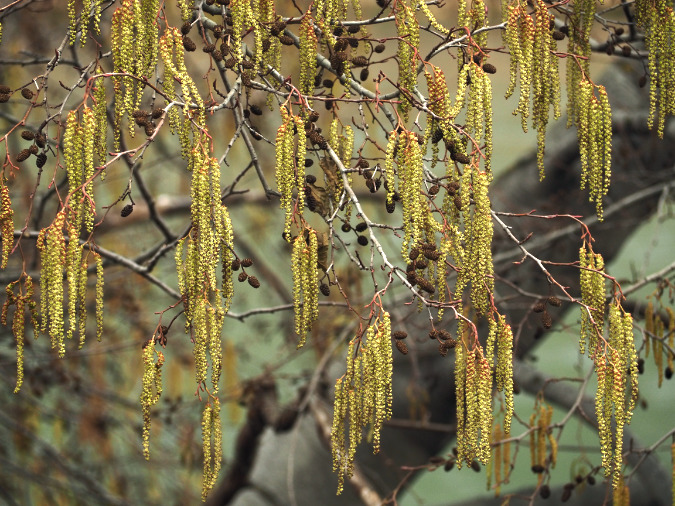
White Alder catkins emerging in February

This view of a typical section of the Lower Deschutes canyon (below) shows just how important the White Alder groves that line the shore are to the ecosystem. They are the only sizable trees in this desert landscape, and they provide essential wildlife habitat along the river. Both Red and White Alder are also nitrogen-fixing trees, enriching the soil for other plants wherever they grow.

White Alder groves line the lower Deschutes River Canyon in winter

Another surprise on this winter trip to the Lower Deschutes were the many flowing tributary waterfalls that are dry for much of the year. This unnamed, two-tier waterfall near Trestle Bend is dropping into a grove of White Alder (below).
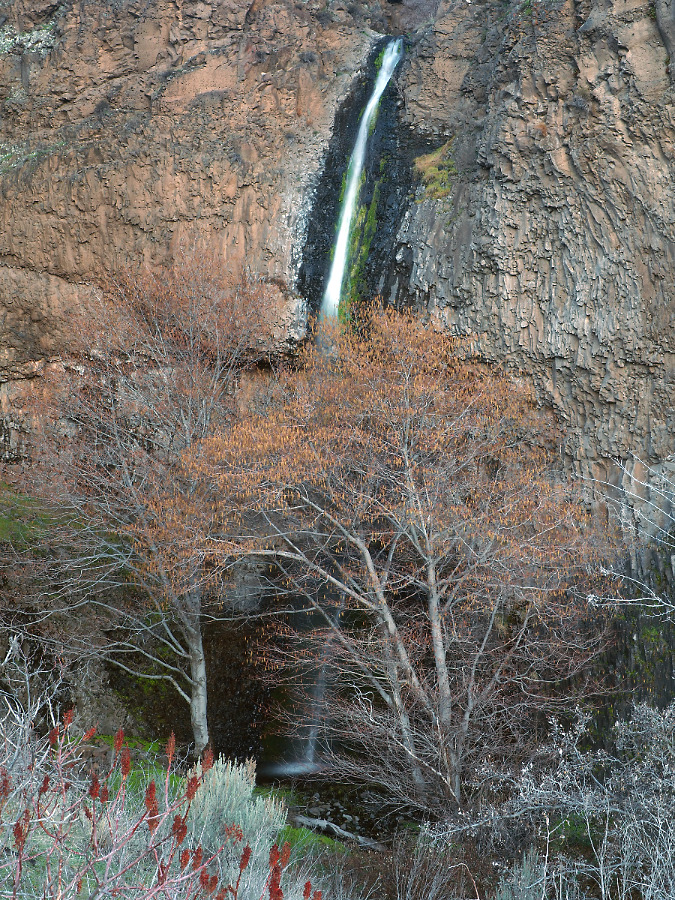
Season waterfall dropping into the Deschutes canyon in winter

While I’ve known for some time that Rocky Mountain Bighorn Sheep live in the Lower Deschutes canyon, I had not seen them until this trip last February, when I spotted two herds high above the river, just upstream from Rattlesnake Canyon. Both were bachelor herds working their way downstream, along the upper slopes of the canyon (below). 
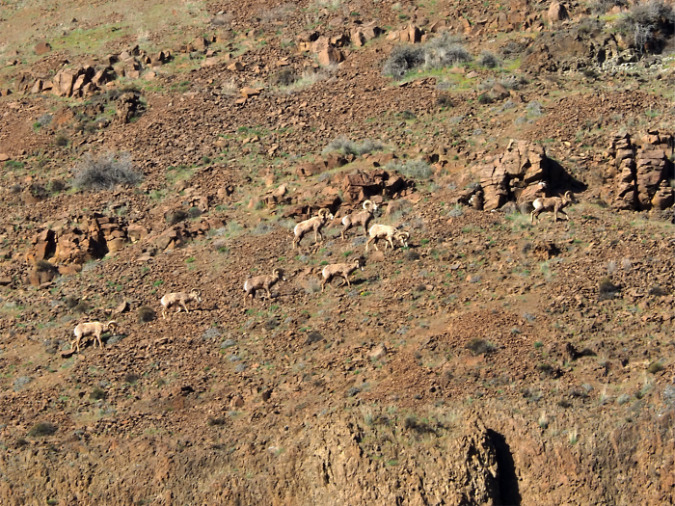
Bighorn Sheep in the lower Deschutes River canyon

Bighorn Sheep are a welcome sight in the Deschutes River canyon, not just because they’re beautiful to see and watch, but because they’re also an indicator of ecosystem health. Bighorns are highly sensitive to human activity, so their presence here reflects the continuing efforts by the Bureau of Land Management and Oregon Department of Fish and Wildlife to expand habitat protection for these animals in Oregon’s desert country.
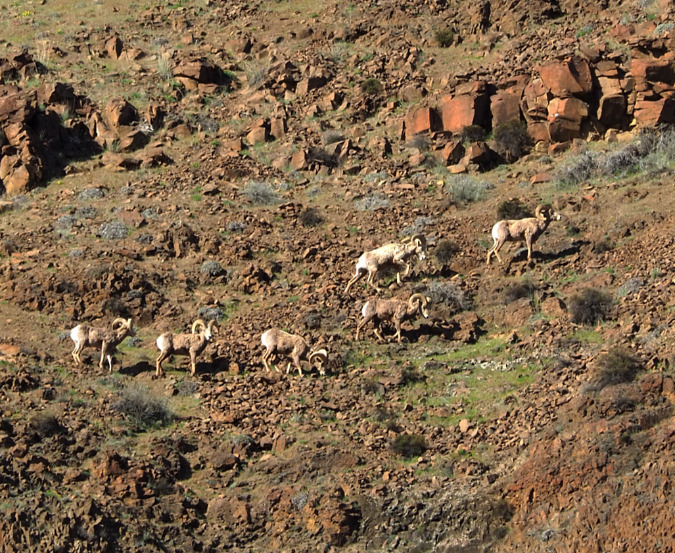
Bighorn Sheep in the lower Deschutes River canyon

This trip was my second to the Lower Deschutes last winter, and I did have a practical mission for returning. On the first trip I had come frighteningly close to dropping a wheel over the edge of a paved section of the river access road, where a landslide has taken a big bite out of it. When I pulled over to take a look, I was spooked by the realization that going off the road here would have sent me 200 feet down the landslide scar, and directly into the river! 

So, one week later I came armed with a can of white paint to (at least temporarily) mark off a shy distance for drivers passing north along the road. Hopefully, the land managers didn’t mind…
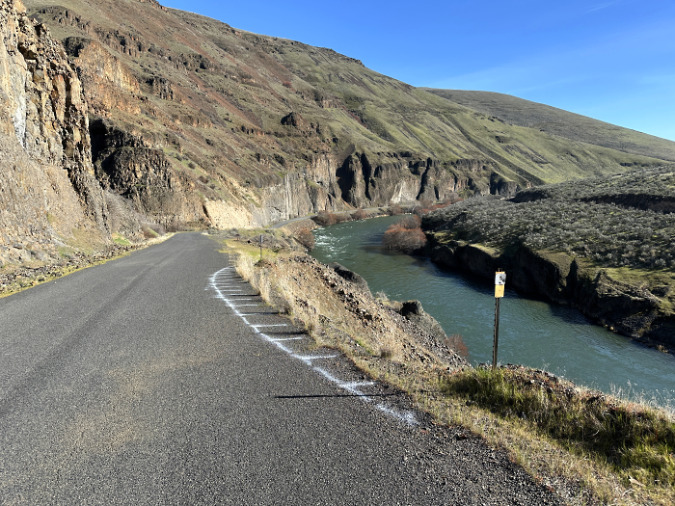
Scary landslide damage to the Deschutes River Road!

This aerial view of the landslide scar from Google Earth (the image below is from 2022) shows just how sketchy the situation is, and that there are really two slides at work, here. The larger slide on the right is the one picture above, where the roadway has been seriously compromised.
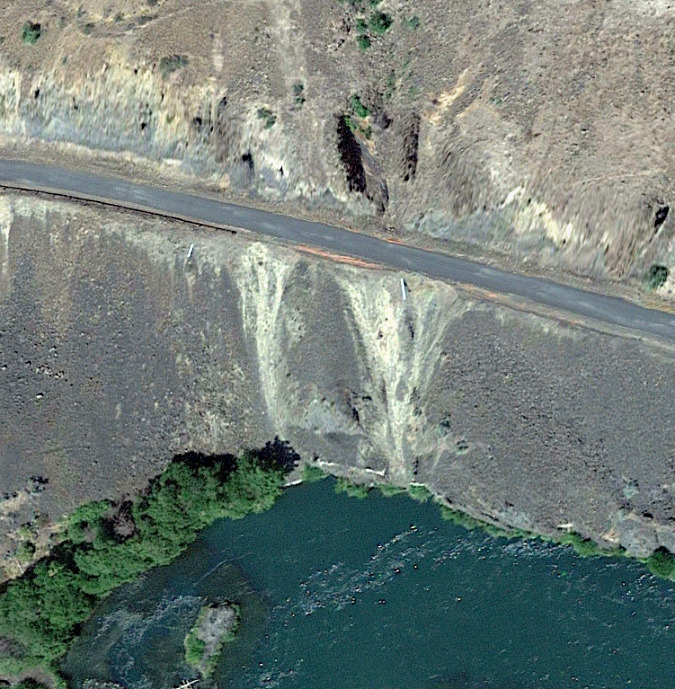
Aerial view of the Deschutes River Road landslides in 2022 (Google Earth)

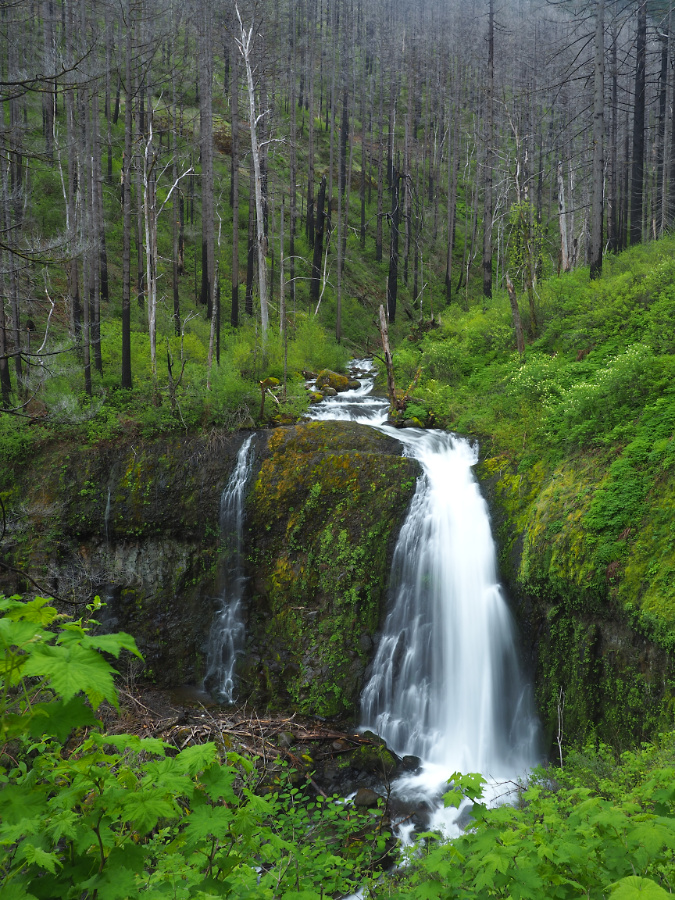
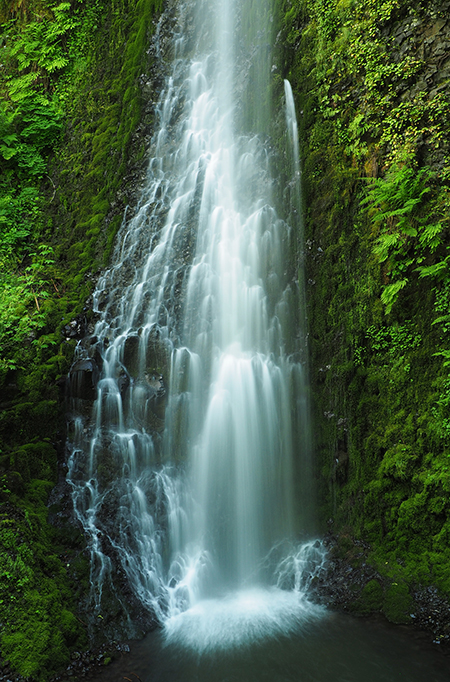
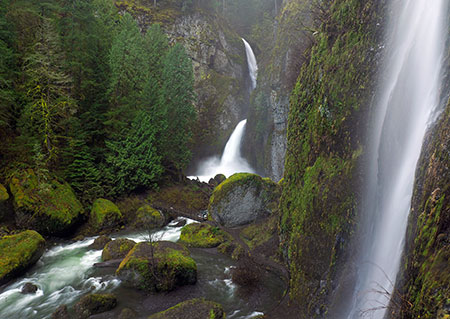
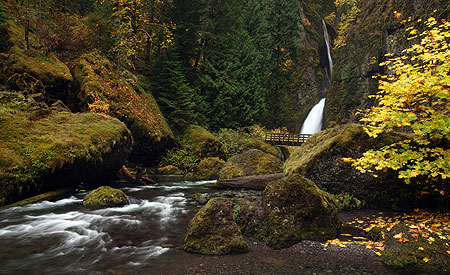
For the March calendar image, I moved to the Columbia River Gorge and Tanner Creek. It’s a place that I describe as the “Gorge on the half-shell”, as this spectacular 2-mile loop trail along to Wahclella Falls has all of the elements of a classic Gorge hike: towering basalt cliffs, a rushing stream with thundering waterfalls, wispy, impossibly tall tributary waterfalls, old-growth Douglas Fir and Western Redcedar, fern-covered talus slopes and lush green moss on seemingly every surface. Throw in four unique footbridges (one where you can reach out and touch a waterfall) and it’s a perfect introduction to the Gorge.

In past years, I have included a favorite scene captured from a viewpoint high above the falls, showing a couple of the tributary waterfalls dropping into the deep gorge that Tanner Creek has carved. I captured the scene once again this year (below), but wanted to try something different for 2025.

Wahclella Falls in the Columbia River Gorge

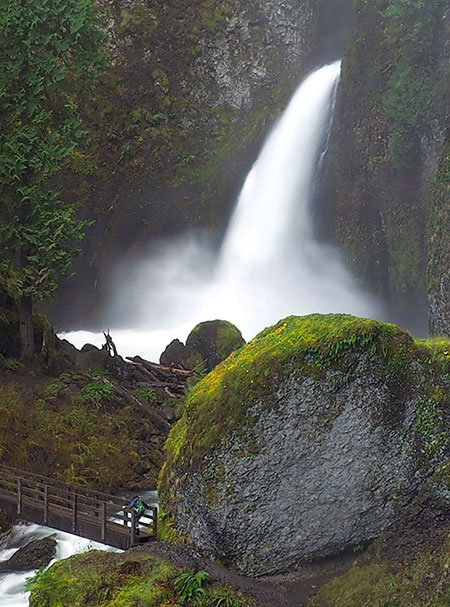
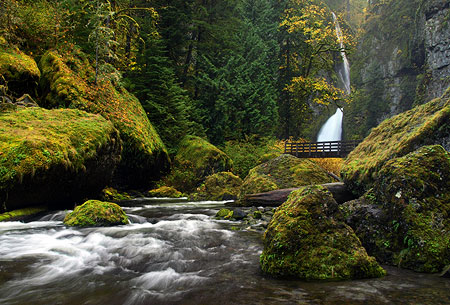
This year I opted for the view from in front of the falls (below), taken from the long footbridge that can spotted in the previous photo. From this streamside perspective, a young Western Redcedar growing directly in front of the falls, and will soon block the view. So, for this year I embraced the photo-bombing tree and framed it to be directly silhouetted by the falls while it’s still short enough not to completely block the view.
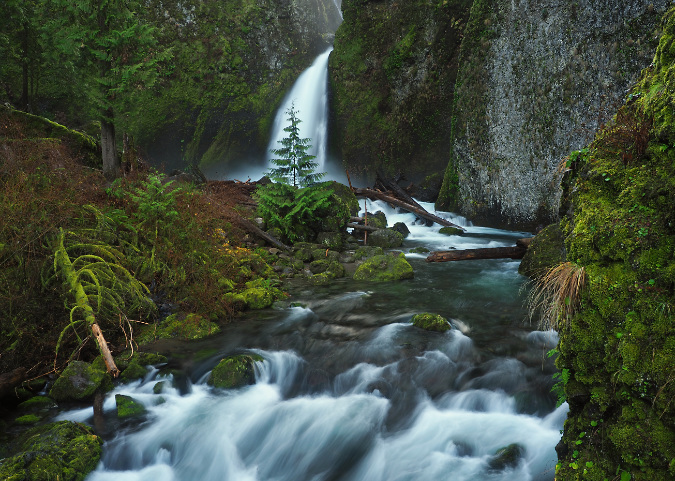
Wahclella Falls and the upstart Western Redcedar tree are featured as the March calendar image

How long before the tree eclipses the view from the footbridge? Here’s a comparative view of this young upstart, and you can see that it will clearly block the falls from this vantage point in the next decade or so… if it survives! That’s an open question, as this little tree is growing quite close to Tanner Creek, and there’s a reason the largest trees near the falls are on higher ground. Tanner Creek is big and rowdy in winter, and regularly scours the streambanks along its course in high water, easily carrying away whole trees in its wake. The giant logjam in the earlier, wide view of the falls is testament to the stream’s power.
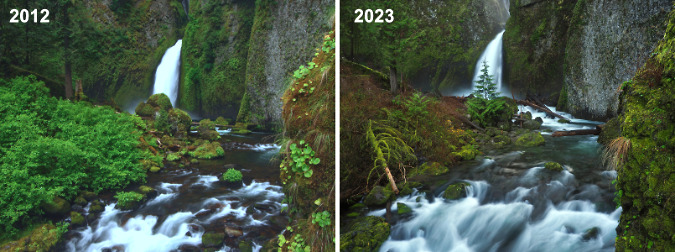
The upstart cedar at Wahclella Falls

[click here for a much larger version]

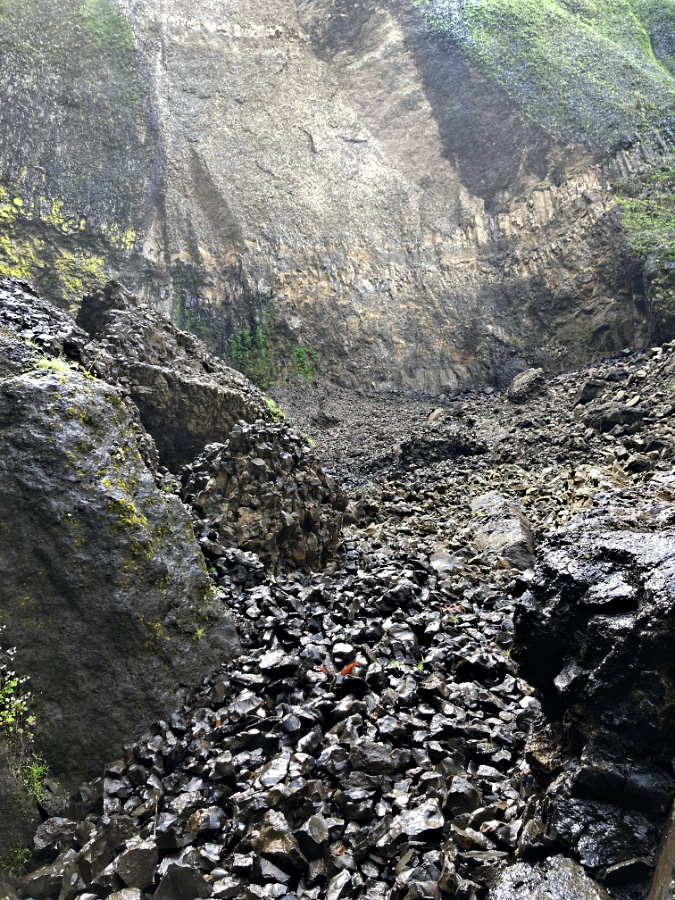
For geoscience types (that would be me), the still-fresh scar from the 1973 landslide at Tanner Creek is hard to take your eyes off when hiking this trail, but in recent years there have been a series of much smaller basalt wall collapses right next to Wahclella Falls that are fascinating to track. Sometime in the past year, another 15×20 foot slab immediately west of the falls collapsed into the splash pool after being undercut by erosion from the pounding water. The photo pair below shows the new scar.
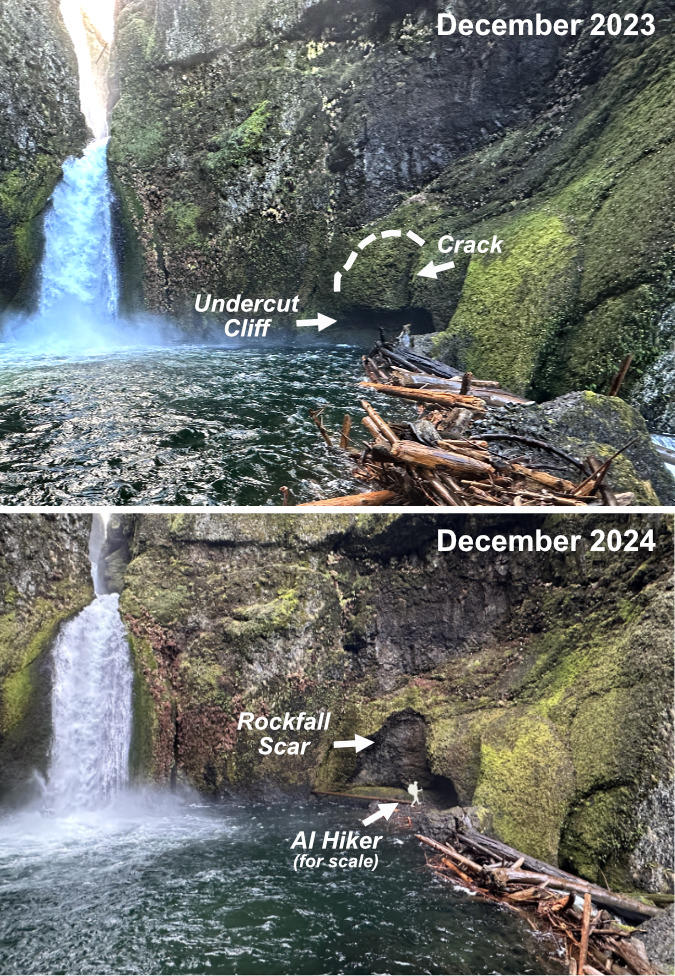
Recent wall collapse along the Wahclella Falls splash pool

This latest evidence of the ongoing erosion along Tanner Creek is a more typical example of the incremental, nearly constant deepening of the canyon that occurs through the combination of gravity and annual freeze-thaw cycles that push cracks in the basalt walls open and gradually the rock apart. 

This weaking of the rock is accelerated by the erosive action of Tanner Creek in undercutting the canyon walls, especially where the heavy basalt layers rests on the must softer Eagle Creek Formation, made up of ancient volcanic debris flows that are easily eroded by the stream. The trailside cave just below Wahclella Falls (where the new the new logjam has accumulated) is a great example of stream erosion cutting away this softer layer beneath several hundred feet of vertical basalt cliff, above. This was mostly likely what triggered the massive 1973 collapse, as well.

For the April image in the new calendar, I chose a scene that put April-blooming Balsamroot front and center. This view from the Columbia Hills State Historical Park (below) is looking west toward Mount Hood on a cool, blustery spring day.
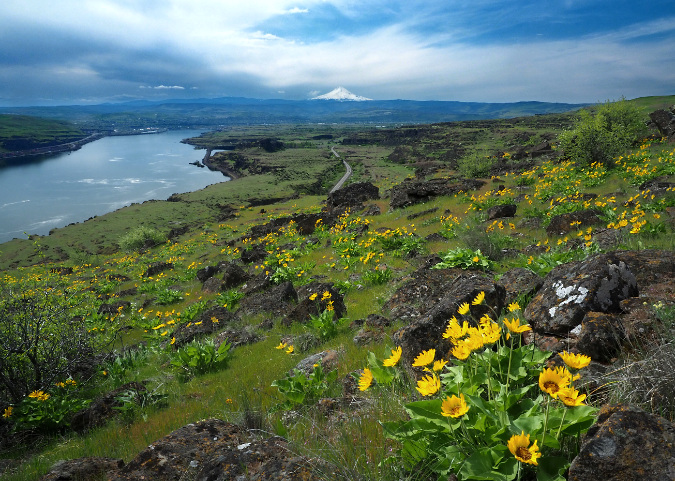
Mount Hood and the flood-scoured lower slopes of the Columbia Gorge are featured in the April calendar image

Staying with a geology theme, this viewpoint is notable for how rocky this scene below is. It was taken at a point just below the high-water mark of the series of ice age floods that shaped much of what we know as the Gorge today. The floodwaters scoured away all but the most resistant basalt, leaving this rugged terrain we know today behind.

You can easily spot the high-water mark of the ice age floods in this part of the Gorge. Just a hundred feet uphill from the viewpoint where the previous photo was taken, the terrain suddenly softens into the rolling slopes that make up the Columbia Hills (below). There’s plenty of jagged basalt here, too, but it’s mostly buried under millennia of soil accumulation that survived the floods thanks to being mainly above the flood levels.
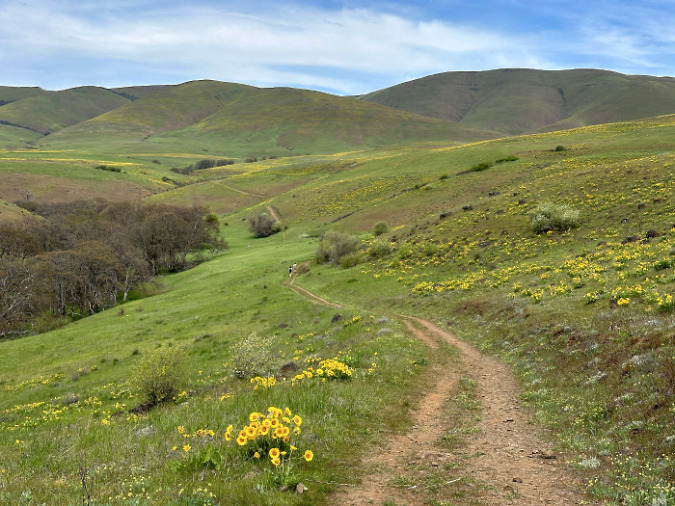
Gentle terrain above the ice age flood high-water level in the Columbia Hills

The surviving soil in these upper slopes of the Gorge translate into enormous wildflower meadows that draw people from around the world. Yellow Balsamroot steals the flower show in the east Gorge in spring, but in places with the Columbia Hills, they are just part of a wildflower spectacle, with Phlox (below), lupine and dozens of other wildflowers filling the gaps between the showy Balsamroot.

Spring wildflower gardens in the Columbia Hills

Each time I visit places the east Gorge in spring, I make it a goal to spot a few of these co-stars in the flower show that I might not have noticed before. To my surprise, my visit last spring included Ballhead Waterleaf, a lush plant that grows throughout the west, but is typically found in moist spots. Yet, this colony (below) had found a shady slope beneath a pair of Bigleaf Maple trees with just enough groundwater to help them thrive in this desert environment.
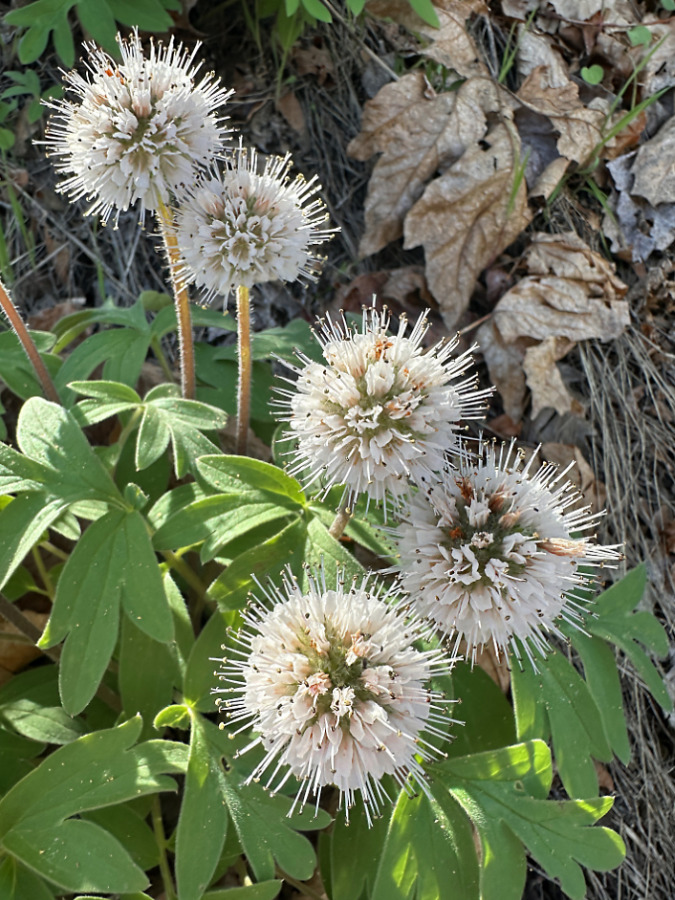
This Ballhead Waterleaf found a shaded niche in the Columbia Hills

Another striking wildflower was new to me on that trip, a lovely plant called Whitestem Frasera (below). It was just coming into bloom and still in bud when I was there, but in a couple weeks would have clusters of blue flowers rising above the beautiful foliage. This is one of many species that is typically found well east of the Cascades, but makes its way well into the Columbia River Gorge where conditions are right.
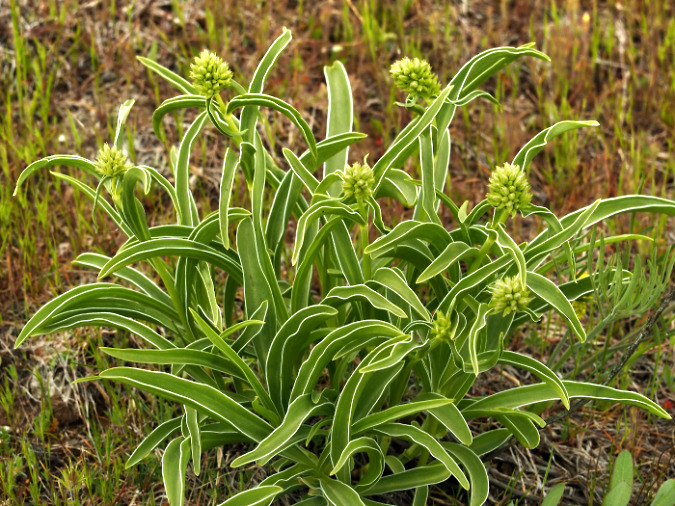
Whitestem Fraseria still in bud in the Columbia Hills

Still more surprising on that trip were several Cushion Fleabane (below) colonizing the old access road that forms the first mile or so of the Crawford Oaks trail in the Columbia Hills. These little plants thrive in fine gravels, and the old roadbed provides that for them, now that traffic is mostly limited to hiking boots.
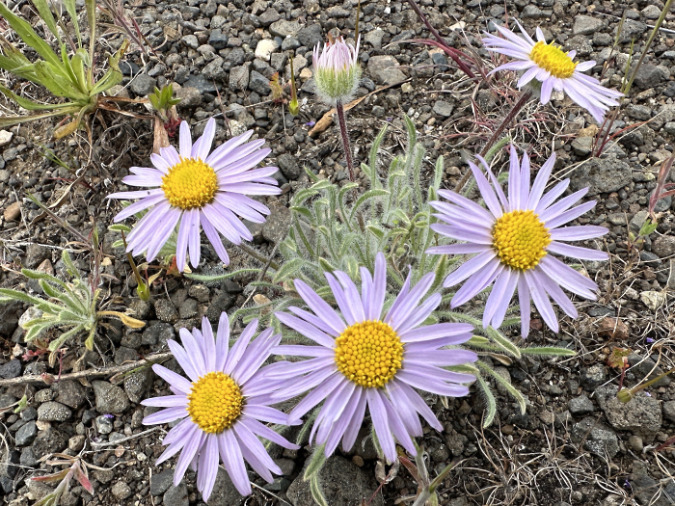
Tiny Cushion Fleabane in the Columbia HIlls

I stayed on the east side of the mountains for the May calendar image, with a view of White River Falls (below), where one of Mount Hood’s many glacial streams carves a deep canyon through sagebrush country and make a spectacular leap over a wide basalt cliff on the way to its confluence with the Deschutes River, just downstream. The falls and its lower canyon are protected as part of White River Falls State Park.
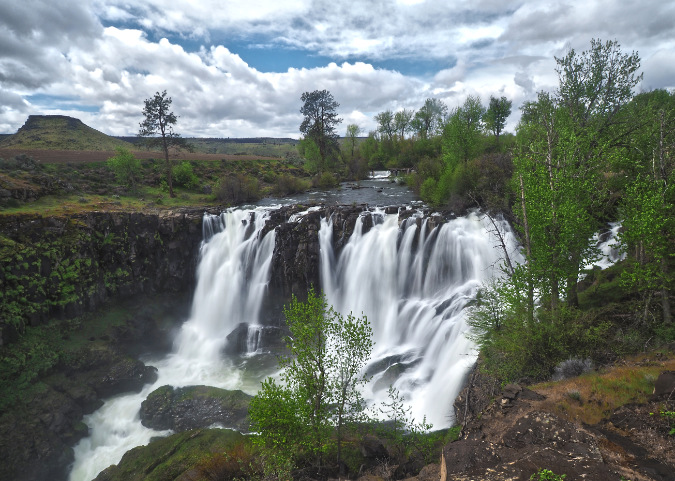
White River Falls during spring runoff in the May calendar image

This spectacular view of the main falls is best in spring, when runoff is high. The upper viewpoint is easily accessible, too – just a few hundred feet from the trailhead, with some of the path paved. But the deep gorge below the main falls hides still more waterfalls that make it well worth the steep hike into the canyon, despite the choppy descent along a long set of deteriorating stairs!

The stairway to White River heaven…

The lower tier of the main falls is unofficially called Celestial Falls (below) and forms a perfect punchbowl between walls of basalt. When winter temperatures drop below freezing, this natural bowl can become a mass of ice built up from the waterfall spray.
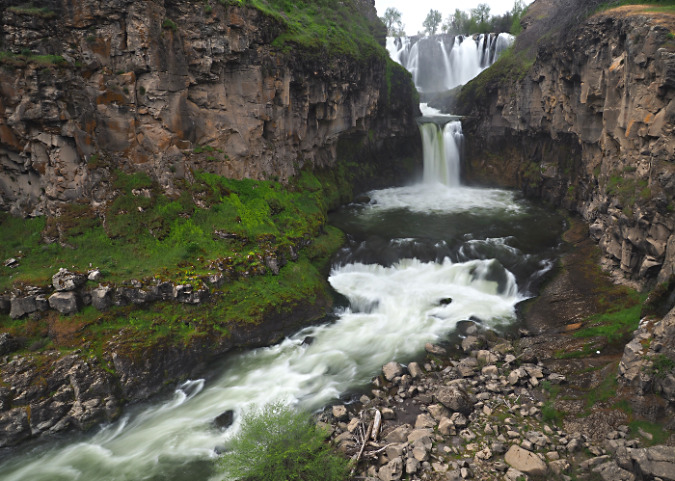
Celestial Falls on the White River, just below the main White River falls

Continue a bit further downstream on an increasingly unofficial trail, past the ruins of the early 1900s hydroelectric plant that once operated here, and the White River makes a third, smaller plunge into another, larger punchbowl at the lower falls (below). This might be my favorite spot in the canyon, as the lower falls and its deep pool are framed with wildflowers in spring, sprinkled among the boulders on the slopes that surround the river.
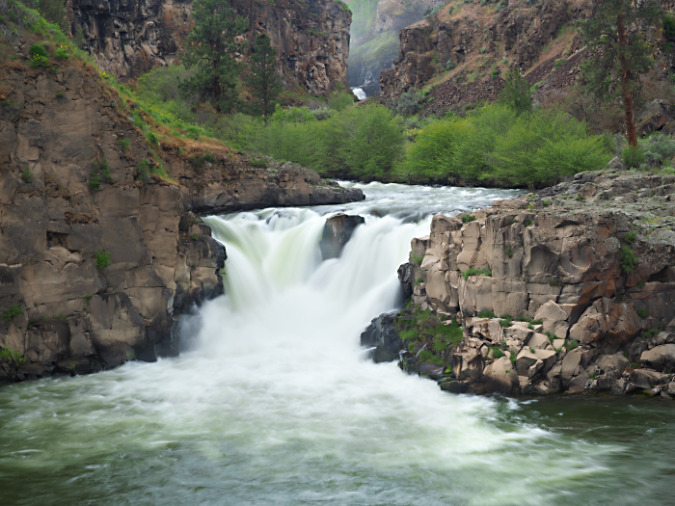
Lower White River Falls

There is a lot to see at White River Falls, and because it’s a regular stop for me, my eye goes to new details on each visit. When I stopped last spring and captured the calendar image shown previously, I was surprised to notice that beavers had taken up residence in the long, slow pool near the old powerhouse, between Celestial Falls and the lower falls. They had also recently made quick work of several trunks of a White Alder clump growing along the beach (below). If you look closely at the image from last April, you can see four fresh cuts, along with at least five previously cut trunks. Just one trunk remained, then, and even this sole survivor had a fresh scar where the beavers were working to finish the job on this grove!
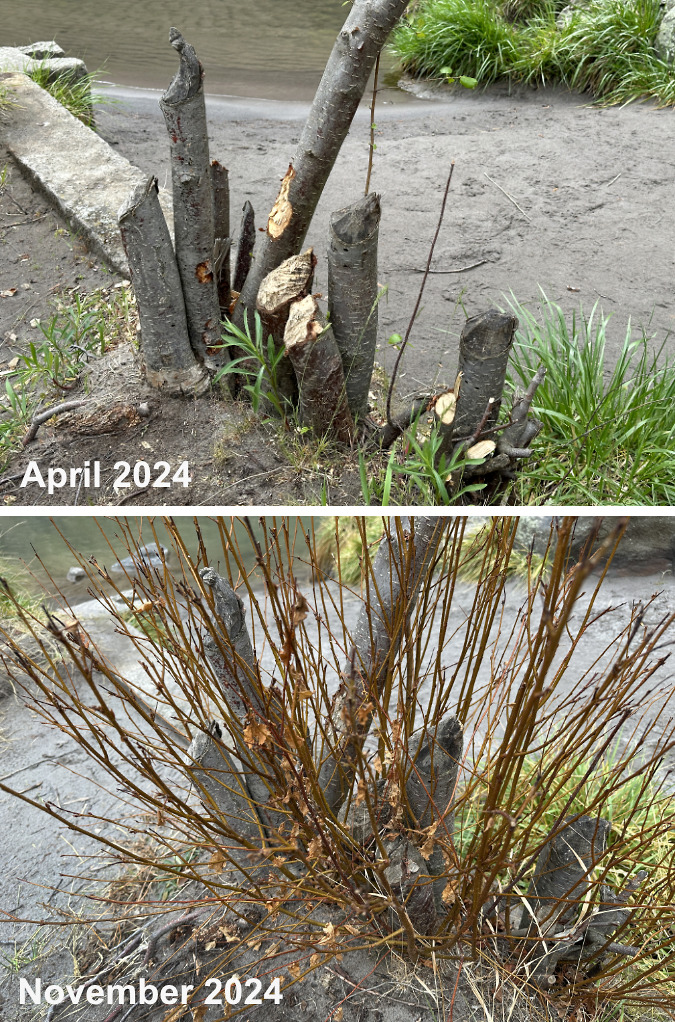
Busy beavers at White River Falls State Park

In the more recent image from last month – just seven months later — you can see the Alder tree is fighting back with a vengeance. Not only did that lonely last trunk survive, dozens of new shoots exploded from the stumps over the summer to replace what the beavers had hauled away. It’s a great example of the continuous cycle between beavers and streamside trees.

When I visited last month, I was also reminded of man’s impact on the falls. In low water, which extends from mid-summer into mid-winter, much of the face of White River Falls goes dry. Why? The answer is in the distance, just beyond the falls, where a long-derelict diversion dam (shown below) was built more than a century ago to direct water to the old hydroelectric penstock pipes.
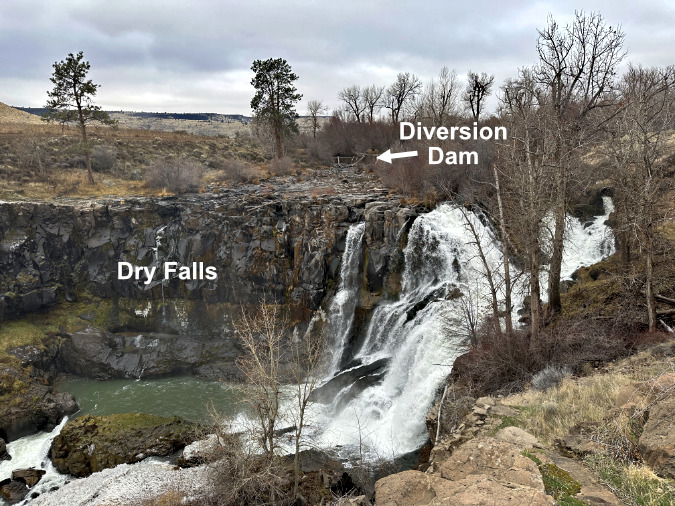
Dried-up White River Falls in the low water season when the main river flow is diverted

You can get a close-up look at the ruins of the old waterworks by following a path that heads upstream from the main falls overlook. Here, the diversion dam and abandoned canals that were once the headworks (below) to an elaborate pipe system are still diverting the river, but only to a side channel that spills around the main falls, as the pipe system was largely removed decades ago.
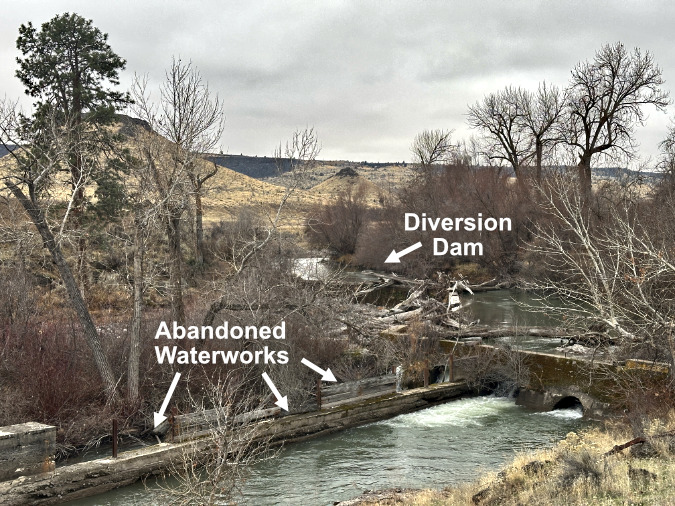
Derelict White River Falls diversion works depriving White River Falls its full spectacle

My hope is that Oregon State Parks officials will someday breach the old dam and restore the falls to its original channel year-round, instead of waiting for the White River to do the job (and it will, eventually).

For June, I chose another east-side image for the calendar. This view of Eightmile Falls (below) is where the main stream flowing from Columbia Hills State Historic Park drops over a basalt cliff as it enters the ice age flood-scoured lower reaches of the Columbia Gorge. In spring, this overlook is especially beautiful, lined with blooming Balsamroot and the creek is running strong with early season runoff.
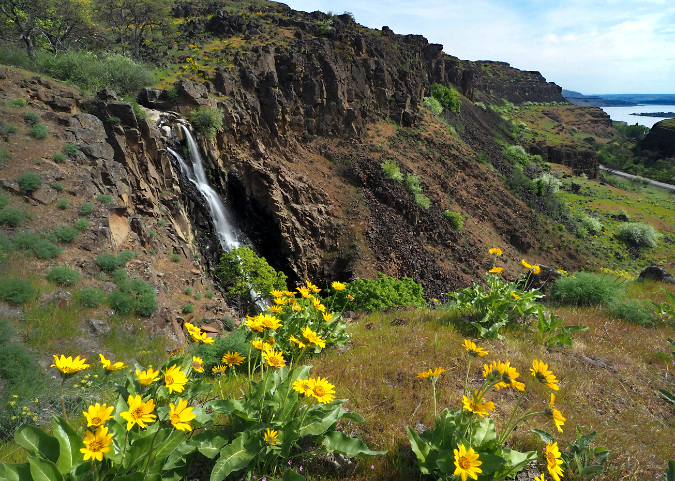
June in the new calendar features Eightmile Falls in the Columbia Hills

Eightmile Falls is located along the Crawford Oaks trail, a relatively new access point to the park that follows a portion of the historic military road that once passed through this area. Along the way, there are views of Mount Hood and the Columbia River framed by old stone walls (below) from the early days of white settlement here in the late 1800s.
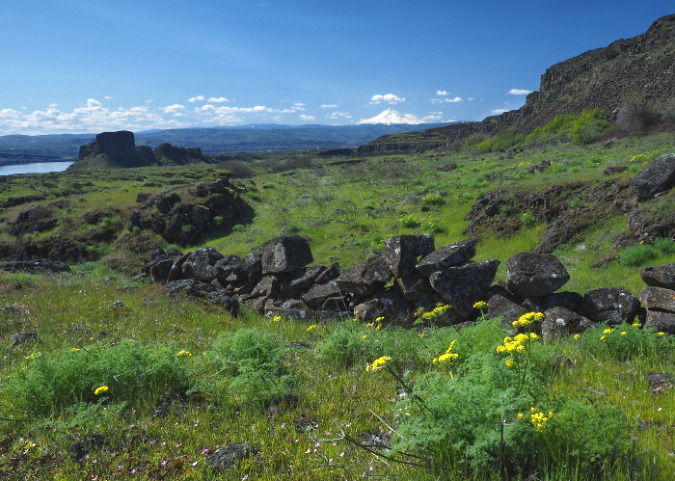
Stone walls in the Columbia Hills mark early white settlements in the area

One surprise along this section of the old military road is a grove of heritage apple trees that have somehow survived here for a century of more, in the middle of this harsh desert environment. In spring, they are covered with blossoms (below) that reveal them to be part of the human story here.
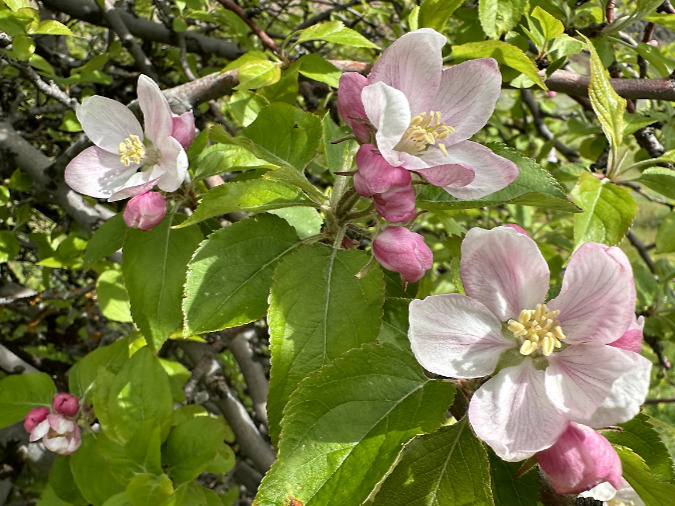
Heritage apple trees from white settlements still survive at Crawford Oaks

Another surprise along the old road are several groups of Bigleaf Maple, a species that thrives in Cascade rainforests. These unlikely trees manage to carve out a niche in this desert environment where they typically grows along basalt walls that provide both weather protection and provide groundwater seeps to help them survive hot summers.
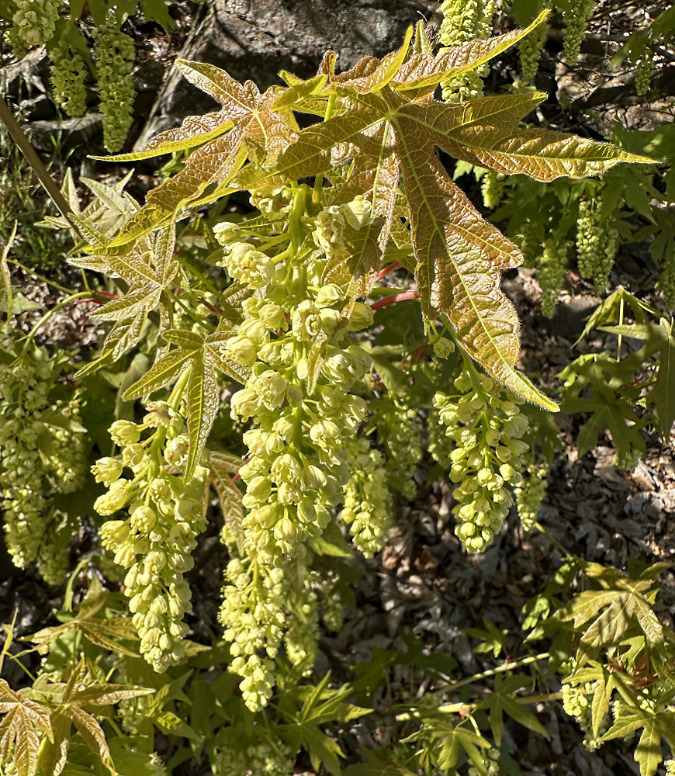
Bigleaf Maple blossoms in the Columbia Hills

In spring, these out-of-place maples also put on an impressive flower display (above) that is easier to appreciate here, where the trees often grow just 15-20 feet high. Their foliage is at eye level, where you can see the blossoms close-up, compared to rainforest cousins where the blooms are often 70 or 80 feet above the forest floor.

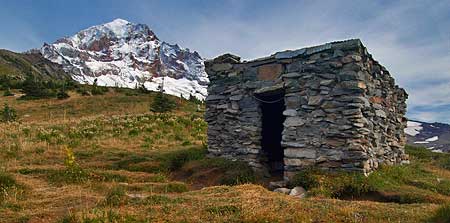
For the July calendar image, I moved up into the mountains with this view (below) of the historic Cooper Spur Shelter, located along the Timberline Trail on the northeast shoulder of Mount Hood. This is among of the most iconic spots on the mountain, and it didn’t disappoint this year, with drifts of blooming yellow Buckwheat and purple Lupine framing the 1930s, Civilian Conservation Corps structure.
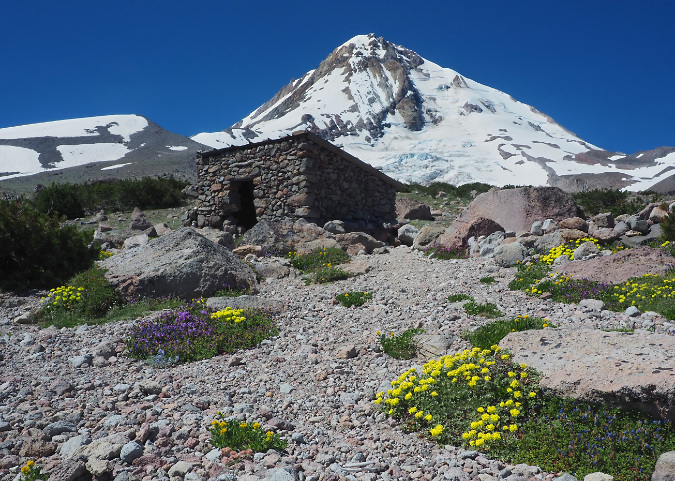
Cooper Spur Shelter with alpine wildflowers are featured in the July calendar image

As tough as it has been to witness the accelerating effects of global warming on Mount Hood’s glaciers in past years, the early summer view of the Eliot Glacier remains one of the most impressive sights in WyEast Country. In this view from farther up the Cooper Spur trail (below) a few weeks later, a group of hikers is silhouetted against the mountain, giving scale to the enormity of the glacier as it tumbles down the mountain.
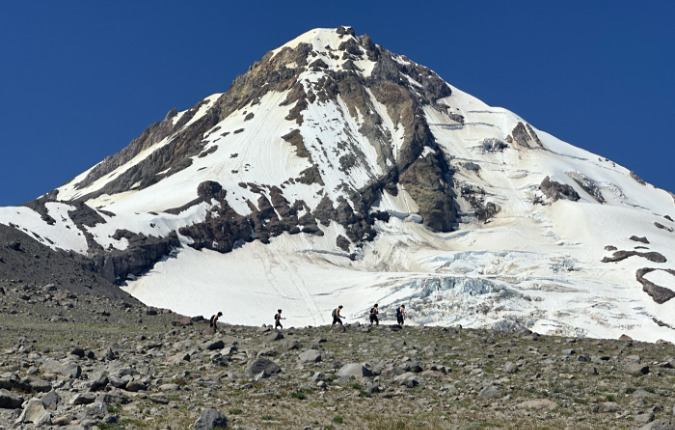
Hikers framed against the Eliot Glacier in Summer

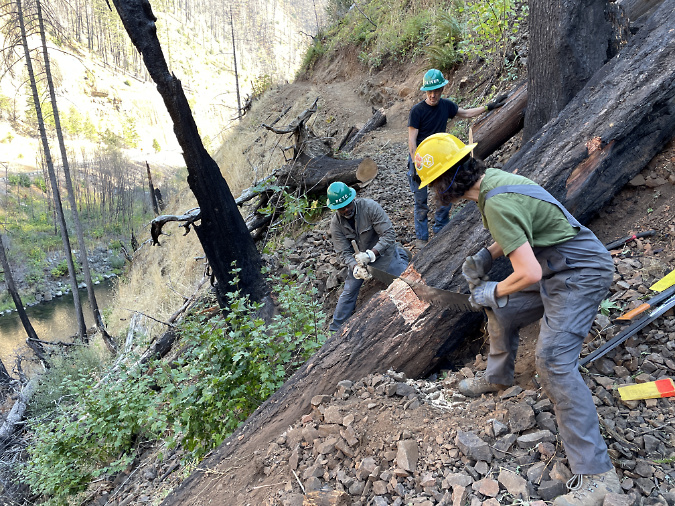
Many of the trails in the Cooper Spur area are as unofficial as they are historic, dating back to the earliest recreation visits to the mountain in the late 1800s and early 1900s, when the Cloud Cap Inn was in its heyday. Today, the continue to be as heavily traveled as the formal trail system. This is made possible by a largely unseen corps of unofficial trail tenders that have helped tend to these routes for decades, as well as the official Timberline and Cooper Spur routes. I know, because I’ve adopted a few of these trails, and I always see the handiwork of others when I’m working there.

Last July, my unofficial trail work focused on retiring a persistent shortcut just below the crest of the South Eliot Moraine. It’s caveman work, as you can see in the schematic below – simply covering the shortcut with rocks large enough to discourage people from taking the shortcut. It’s a never-ending task, as new routes are formed instantly in this open, loose alpine terrain when just one group hikers decides to leave the established trail and make their own way. 
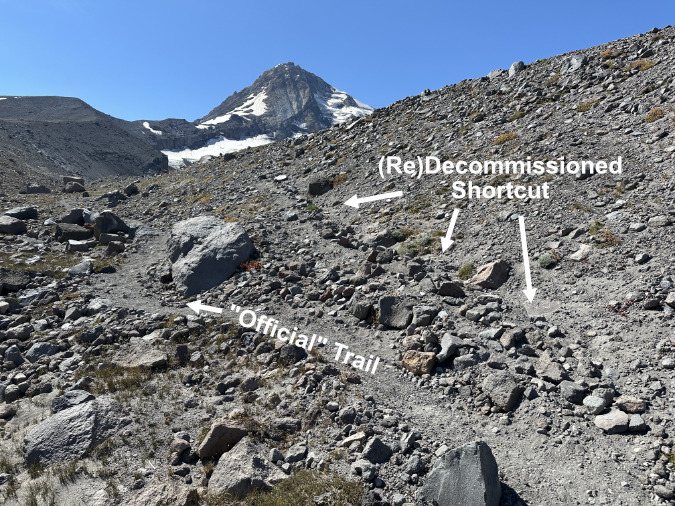
Trail tending along the South Eliot moraine

In the era of cell phones and GPS, these shortcuts are becoming more numerous and persistent. Why? Because the errant digital tracks from lost hikers following dead-ends or short cuts are blindly added to the big data commercial websites that cater to hikers. It’s among the many reasons to avoid commercial apps and social media for hiking guidance, especially when we have TKO’s free Oregon Hikers Field Guide for trails in Oregon and Southwest Washington, a non-profit resource written by hikers, for hikers.

The Cooper Spur Shelter, itself, was also in need of some volunteer tending this year, as the stovepipe in the south corner of the structure has rusted through and that seems to have led to a collapse of the stone wall surrounding it (below). 
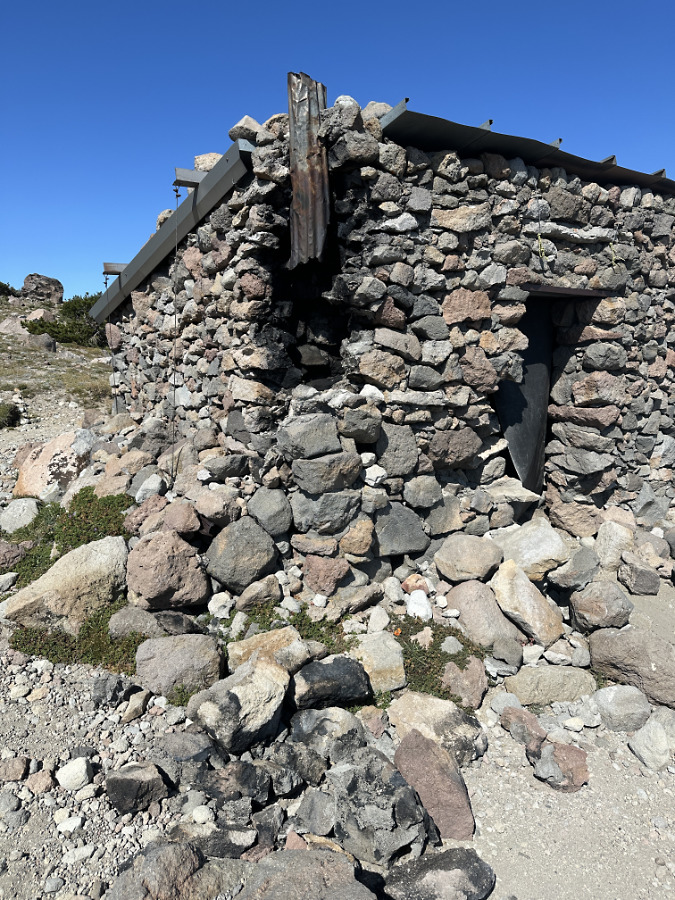
Recent collapse of the south shoulder of the Cooper Spur shelter

While it’s possible the U.S. Forest Service will repair this, I’m going to guess that it will fall to volunteers that I’ve seen working on the structure in the past. I’ve come across them many times over the years, as early as this view (below) taken 22 years ago, when a group of volunteers was repairing that same south corner of the building. Like most of the trails around Cooper Spur, the shelter also represents an ongoing volunteer effort to ensure it survives.
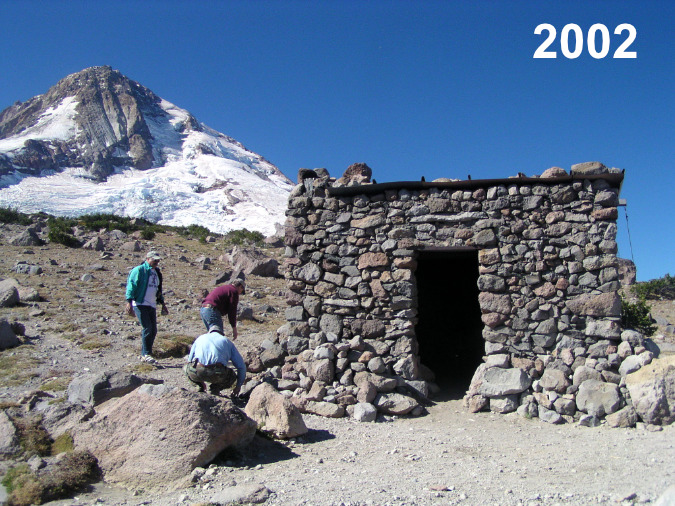
Volunteers repairing the south wall of the shelter more than 20 years ago

For the August image in the new calendar, I chose the view from Inspiration Point (below), a rocky spot along the Cloud Cap Road that provides a sweeping view of the Eliot Branch canyon and Mount Hood’s steep northeast side. This has been a popular tourist stop since visitors begin arriving at the Cooper Spur Inn by horse and buggy in the 1890s.
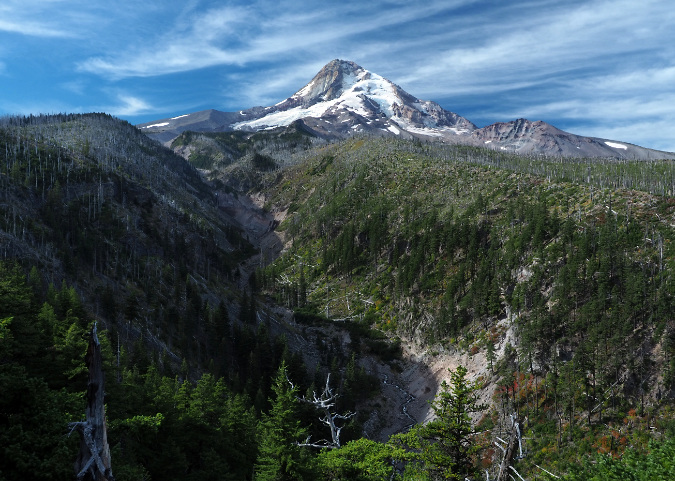
The August calendar image features this classic view of Mount Hood from Inspiration Point

Inspiration Point still offers one of the finest views of both the Coe and Eliot glaciers, the two largest on the mountain. The Coe is the lesser known of the two due to its remote location on the rugged north face of the mountain, and this viewpoint is one of the few places with a close-up look accessible by road.
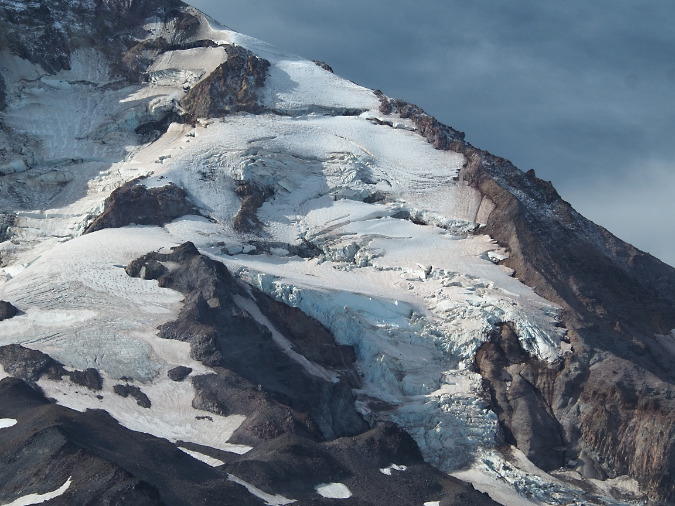
Coe Glacier from Inspiration Point

The steep, unofficial trail to Inspiration Point has been on my list of adopted trails for nearly 20 years, and despite its short length, keeping this little path intact has been a challenge – especially in the years since the 2011 Dollar Lake Fire swept through and left many standing snags that are still periodically falling across the trail.

If you’re not an avid hiker and looking for a short side trip on your way to Cloud Cap, watch for the following signpost at an obvious switchback in the road at about the 3 mile mark (below). From the sign, the trail drops roughly 300 feet to the rocky overlook of Inspiration Point.
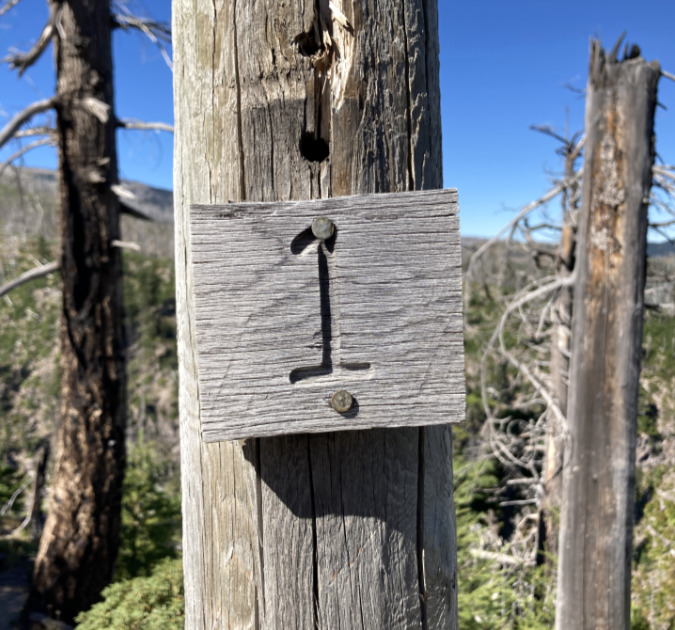
Inspiration Point trail marker 

What does the “1” stand for in this unofficial trail marker? It dates back to a brochure and map once published by the Forest Service that described the history of the Cloud Cap area by numbered waypoints along the road. This signpost and an old, mounted wagon wheel further up the road are all that remains from that effort to share the local history. I do plan to feature the brochure in a future blog article, along with mileage waypoints to guide visitors, in lieu of the old markers that were once here. 

Inspiration Point trail marker… a reminder of an interpretive story that was once told here

For the best view from Inspiration Point, the short trail is a must, but there was a time when you could take in the view from road as you motored your Model T up to Cloud Cap Inn. In fact, an old guardrail that I think might be the original shown in a 1920s postcard view (below) is still there – albeit with a few trees now partly blocking the view.
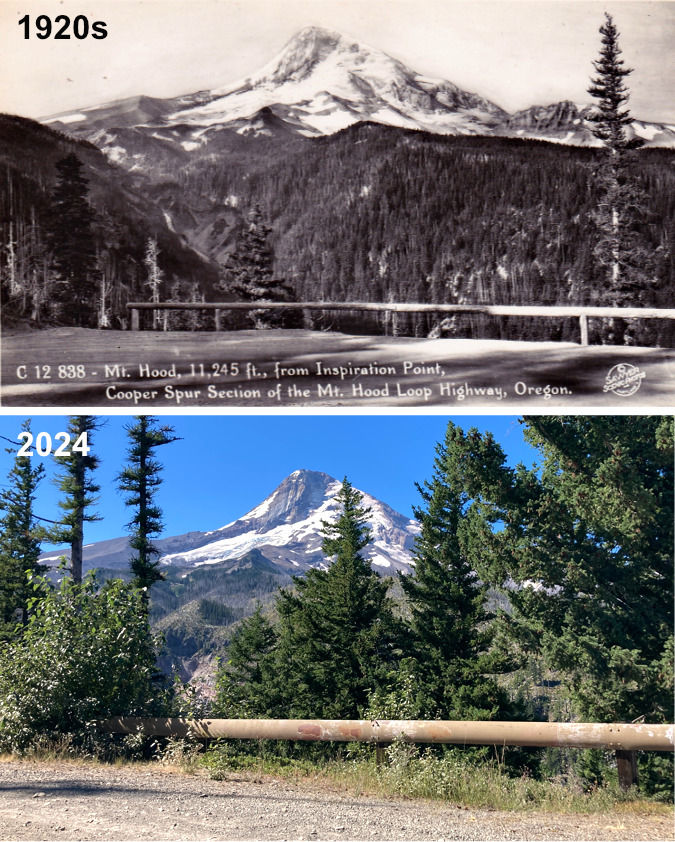
The view from Inspiration Point – then and now

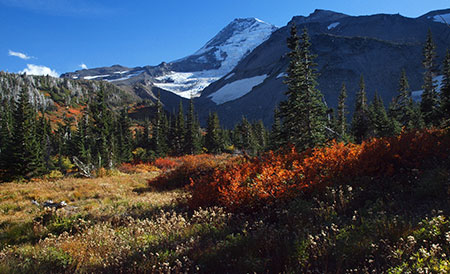
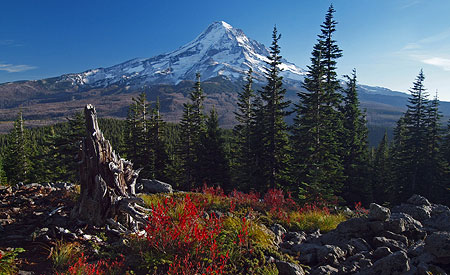
For the September calendar image, I stayed on the mountain and chose an early fall scene at WyEast Basin (below). This photo was taken on a hike in October of this year along the Timberline Trail, from WyEast Basin to Elk Cove, when the huckleberry foliage had turned a brilliant crimson and the alpine meadows to shades of yellow and gold.

WyEast Basin on Mount Hood’s north side is the September image

This photo (below) from the descent into Elk Cove is also from that day, showing the light dusting of early snow that had fallen on the summit the day before.
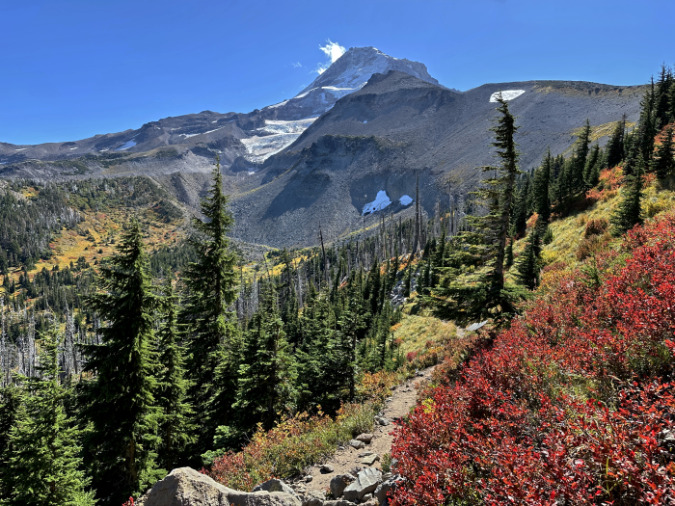
The Timberline Trail approach to Elk Cove lights up with color in autumn

I considered using this view of the upper meadows at Elk Cove (below) from that October trip for the calendar, before realizing just how many times I’ve featured Elk Cove over the years! Lovely as it is, this year I went for a change of scenery with the WyEast Basin scene.
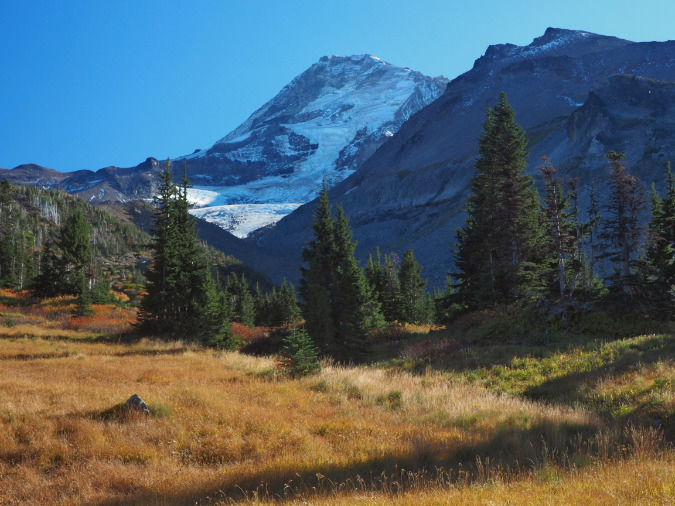
Elk Cove in autumn with an early dusting of snow on the mountain

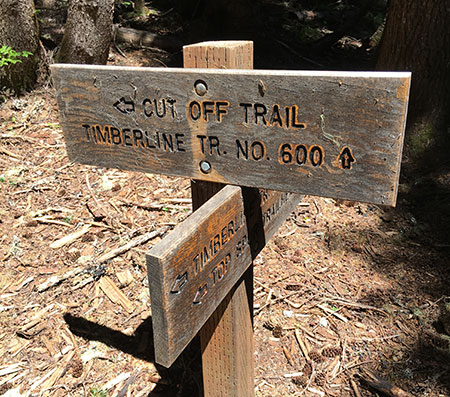
One pleasant surprise at Elk Meadows this year was a new trail sign located at the Timberline Trail junction with the Elk Cove Trail. The old sign had pretty much disintegrated in recent years, causing a fair amount of confusion for hikers, based on the number of times I helped people find their way at that junction. 

One benefit of coming to Elk Cove every year is the opportunity to track changes there over time. This includes trail signs, and in a place where the winter snowpack regularly reaches 10 feet or more in winter, it’s no wonder that these signs take a beating. As you can see from the photo sequence below, the two small signs pointing to “campsites” get the award for most durable. They were already quite weathered in 2010 when the previous “new” trail sign was installed. By 2023, the “new” main sign from 2010 was falling apart. This year, both the main trail sign and the “no camping in meadows” sign were completely replaced, while the two “campsites” signs are still doing their job. 
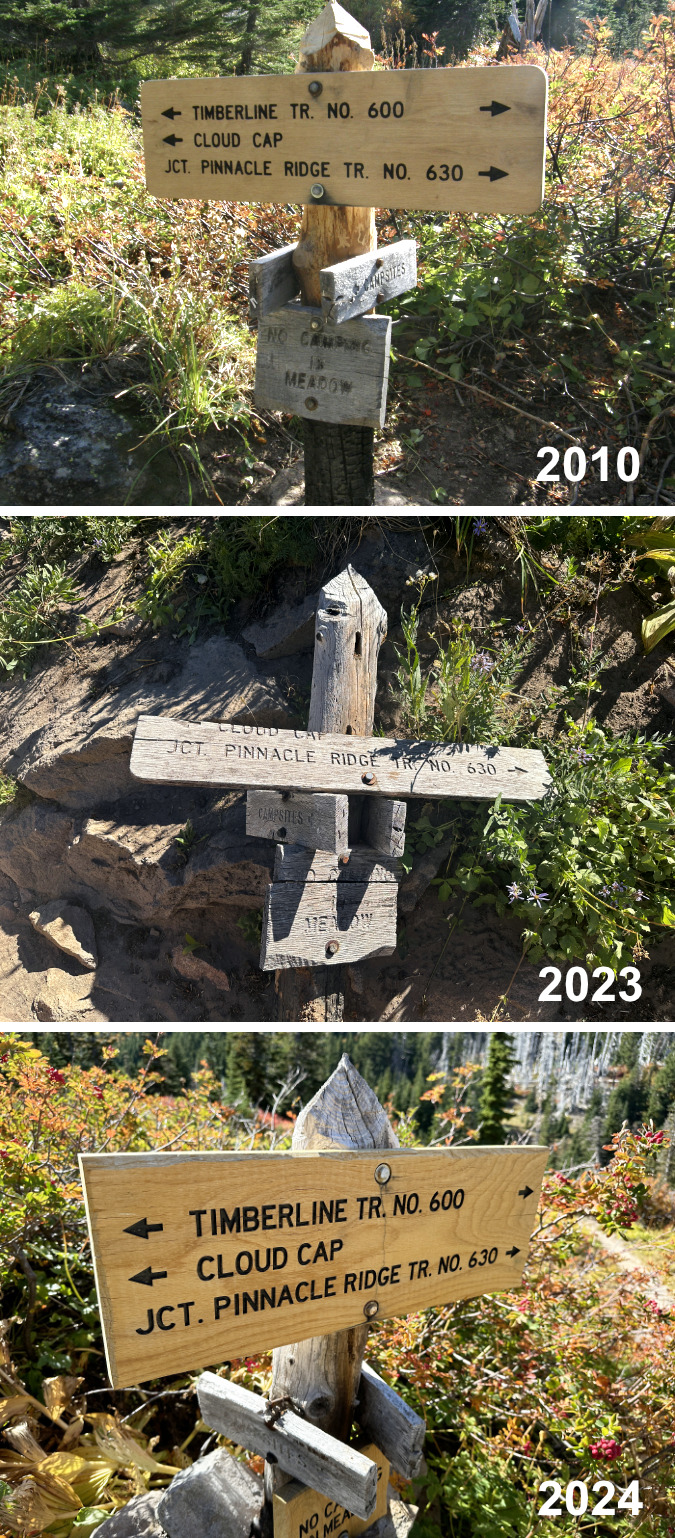
Elk Cove trail signs over the years

On the hike back from Elk Cove, I stopped to collect some trail condition photos at WyEast Basin, where the growing stream of hikers has begun to take its toll on the meadow. Some of this is the result of hikers simply stepping off the trail when passing one-another on a busy section of the Timberline Trail, but the widening tread is mostly the result of the original trail becoming trenched from heavy use, then becoming a muddy ditch when snowmelt fills it early in the hiking season. Hikers then opt to walk on either side to keep their boots dry, gradually destroying the meadow vegetation in the process. 

This schematic (below) shows the original trail at the center (now a trench) as a white dashed line and shoulder paths in red dashed lines, where hikers have already destroyed an alarming amount of meadow vegetation.

Growing damage from trail overuse at WyEast Basin

Over time, this parallel use paths on both sides of the trenched trail will turn into a muddy slog, too, resulting in an ever-widening trail across a beautiful meadow. I’m hoping to find a way for TKO volunteers to restore this trail with a different design that anticipates the muddy season, perhaps even something as bold as a turnpike, or raised section of trail between parallel logs that is designed to keep the trail tread dry by elevating it above the surrounding ground. Below is a recent example from McIver State Park.
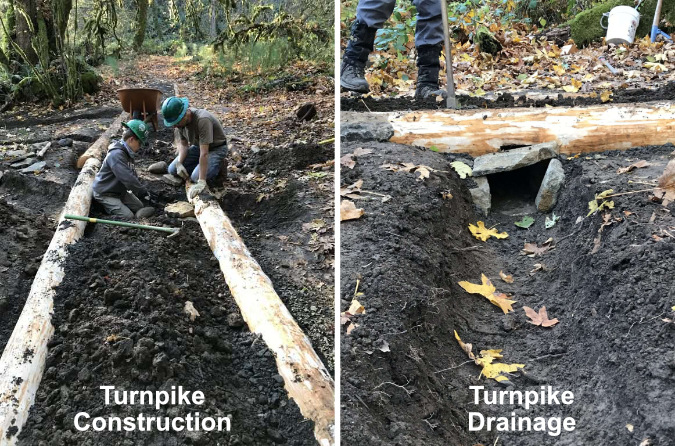
Trailkeepers of Oregon (TKO) volunteers building a turnpike on soggy ground at McIver State Park (photo: TKO)

[click here for a larger version]

The second photo in the above example shows a drainage features, one of the potential benefits of a turnpike at WyEast Basin, as the Timberline Trail crosses at least three small streams that meander through the meadow. However, turnpikes are typically built from found materials near the trail (logs, rocks and soil), which could prove to be challenging in an alpine, wilderness environment. 

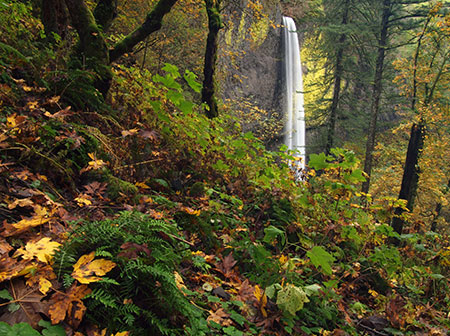
For the October image in the new calendar, I went back to Wahcella Falls. It’s not the first time a waterfall has appeared twice in a single calendar, but it was the combination of fall colors and a person in the photo – a rarity for me – that made the case. Look closely (below) and you’ll see a hiker in front of the falls, taking in the magnificent view.
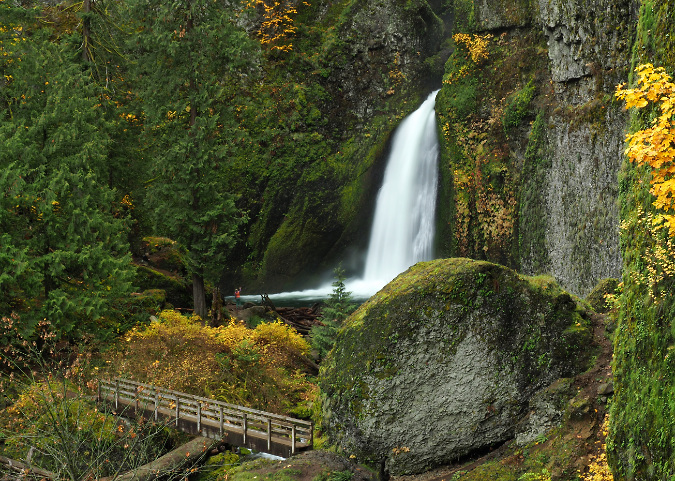
Wahclella Falls (and a hiker) with fall colors is featured as the October image in the calendar

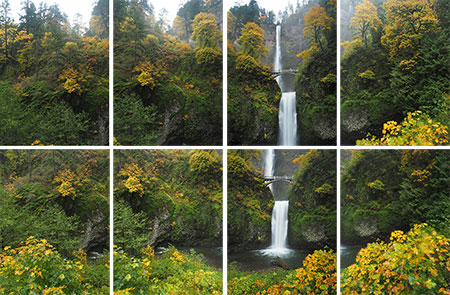
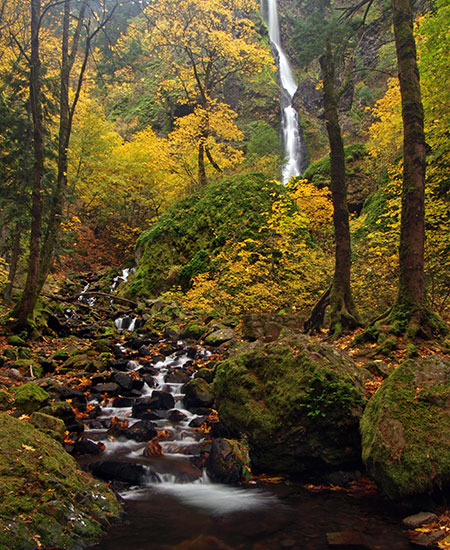
Earlier in this article, I included a photo of Wahclella Falls from an off-trail viewpoint taken in early spring. By late October each year, the same view lights up with gold and yellow fall colors (below) that are becoming even more prevalent in the aftermath of the 2017 Eagle Creek Fire that swept through this canyon. That’s thanks to the rapid recovery of broadleaf trees like Bigleaf and Vine maple that are taking advantage of the open forest conditions created by the fire, and bouncing back from roots and stumps that survived the burn.

Fall colors at Wahclella Falls have become more dramatic since the 2017 fire

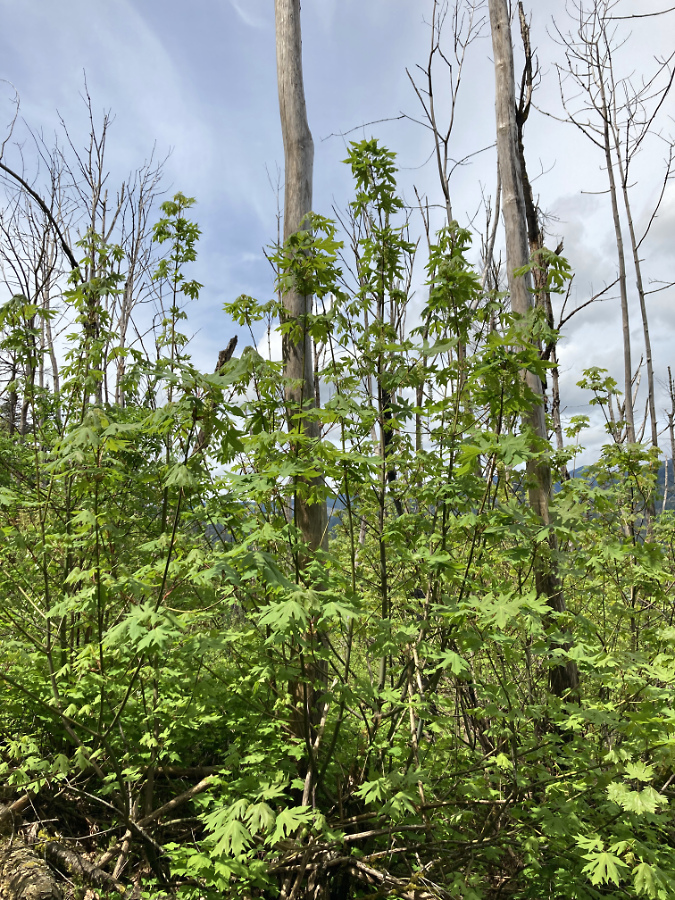
Bigleaf Maple are the real stars in this comeback story, with most growing from the surviving stump of a parent tree killed by the fire. The new access to sunlight and explosive growth also makes for super-sized foliage, with individual leaves measuring nearly a foot across (below) underscoring the common name for these essential trees.
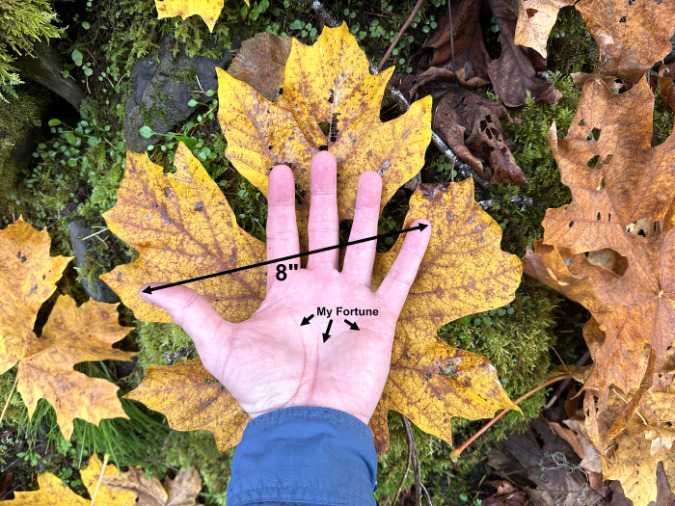
Biglieaf maple leaves are growing to gigantic proportions in the post-fire recovery

When I hike this trail, I see the handiwork of Trailkeepers of Oregon (TKO) crews everywhere, as TKOs volunteers have done much to rescue the trail in the aftermath of the 2017 fire. This includes a streamside section where a huge, post-fire logjam of killed trees accumulated just below Wahclella Falls, and piled so high they spilled onto the trail, itself. TKO and Pacific Crest Trail Association volunteers used a combination of saws and ropes to clear the way back in 2021, and today the logjam is still there to remind us of the power of this stream.
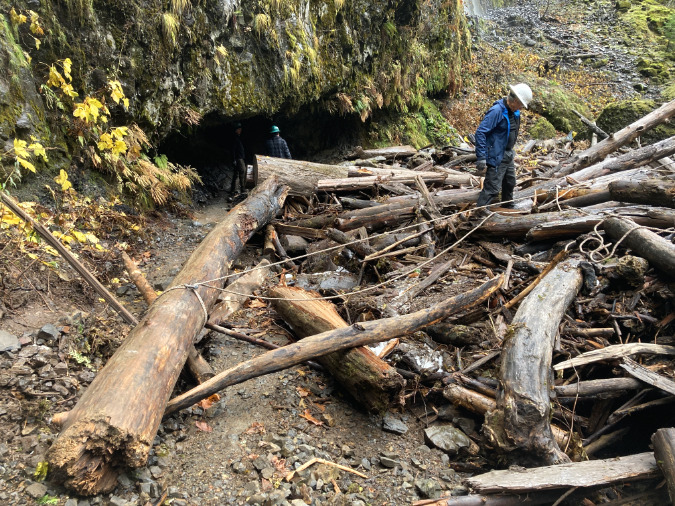
TKO crews clearing the logjam from the Wahclalla Falls trail in 2021

TKO volunteers also worked with the Forest Service to build a rustic set of stairs where the trail had collapsed near the falls, leaving a sketchy scramble through this gap in the rocks for hikers to navigate. The rock steps not only make the trail more accessible to everyday hikers, the add another interesting element and a bit of whimsey for young hikers (below) visiting this family-friendly trail for the first time.

Rustic steps built by TKO volunteers at Wahclella Falls area favorite with young hikers

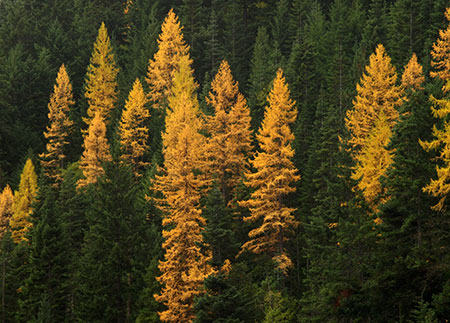
For the November calendar image, I returned to the east side of the mountain and chose a scene captured along the Lookout Mountain Road in late fall. This is the least-visited, less familiar side of the mountain to Portlanders, with a broad, sweeping profile that looks more like other Cascade volcanoes, and contrasts with the familiar, pyramid-shaped summit the mountain presents to the millions who live west of the mountain.
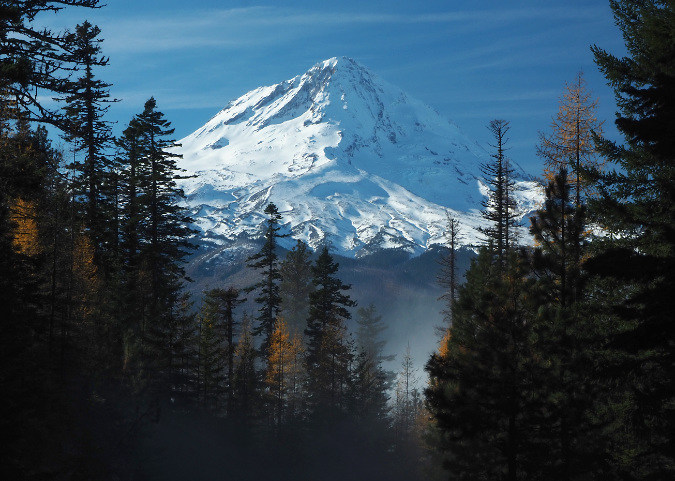
Yellow and gold Larch framing Mount Hood are featured as the November image in the calendar

When the conditions are right, the Western Larch here have turned to their yellow and gold autumn colors and the first temperature inversions have arrived, filling the East Fork Hood River valley with fog. The effect can be quite dramatic. On this day the fog layer was growing especially fast, and surged over me in just the view minutes (below) I had to set up my camera!  
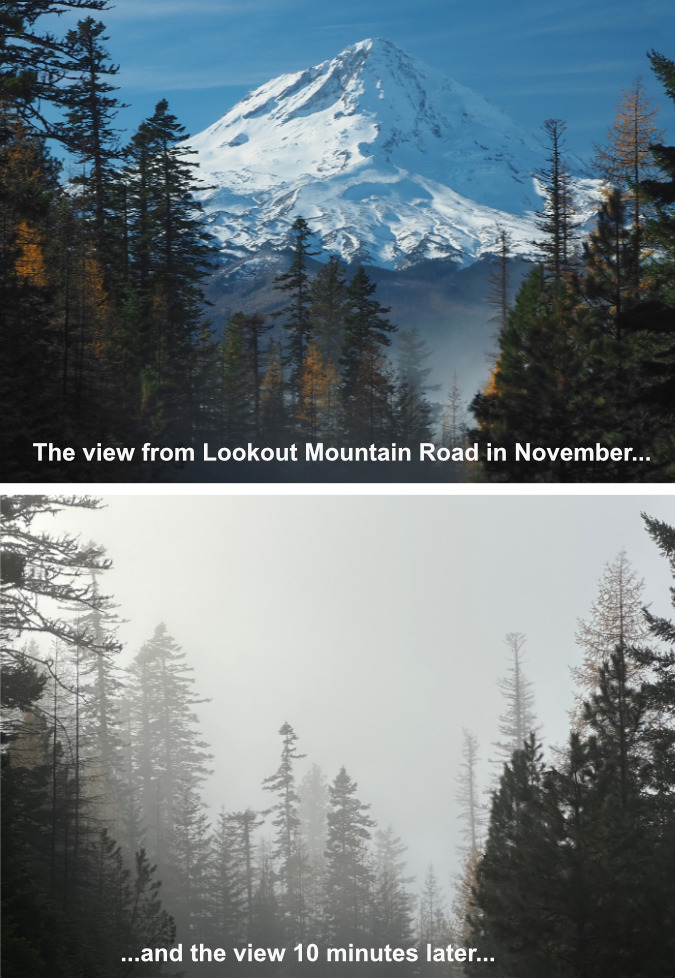
Fast moving fog at Lookout Mountain!

Having been fogged out on that chilly day, I followed another November ritual in the mountains and collected some greens for holiday decorating. Normally, I look for Noble Fir boughs, but on this day, I gathered some beautiful, blue-tinted Engelmann Spruce greens. You can easily distinguish spruce from other conifers by their sharp needles, making them a bit prickly to work with as holiday greens. Nonetheless, they made for some lovely Christmas arrangements at home!
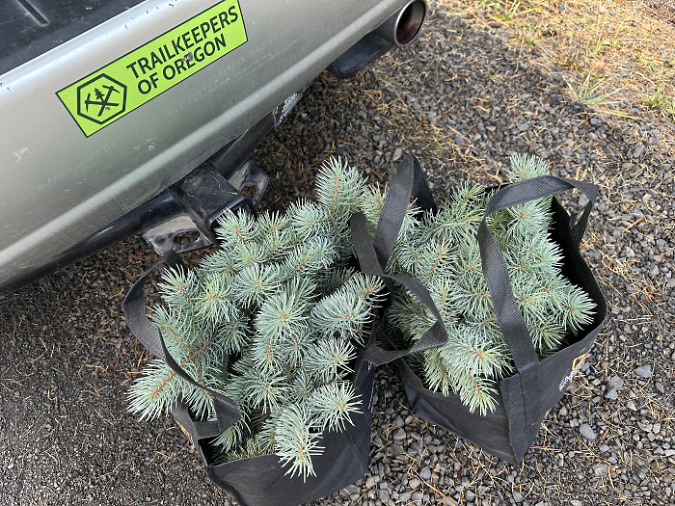
Engelmann Spruce holiday greens..? Prickly!

Is it legal to collect holiday greens within Mount Hood National Forest? Absolutely, but check their website to see if a permit is required. For 2024, permits are waived, and you may collect up to 25 pounds (that’s a lot of boughs!) in a season. The main restriction is Whitebark Pine, which are now a protected species and may not be collected or cut in any way. These trees only grow at and above timberline, but if you’re unsure of how to identify them, just avoid cutting any pine boughs and stick with fir trees. Leave no trace also applies, so collect boughs as if you were pruning trees in your garden, with cuts made as discreetly as possible.

For December, I chose a fairly unconventional image for the new calendar. Continuing with the fog theme, I selected this photo from the Bennett Pass area, where dueling valley fog banks in both the White River and East Fork Hood River valleys were colliding at the pass. The effect in the ancient Noble Fir forests just above Bennett Pass was mesmerizing, with patching of blue sky opening and closing overhead as waves of fog rolled through the big trees.
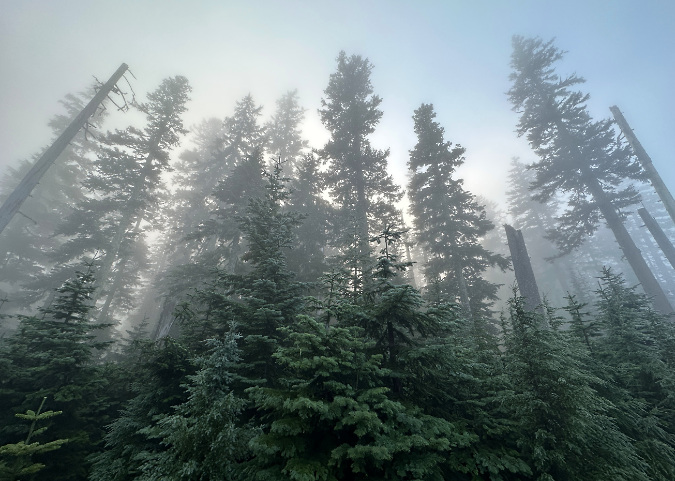
Ancient Noble Fir forest rising into the fog near Bennett Pass are featured as the December image in the new calendar
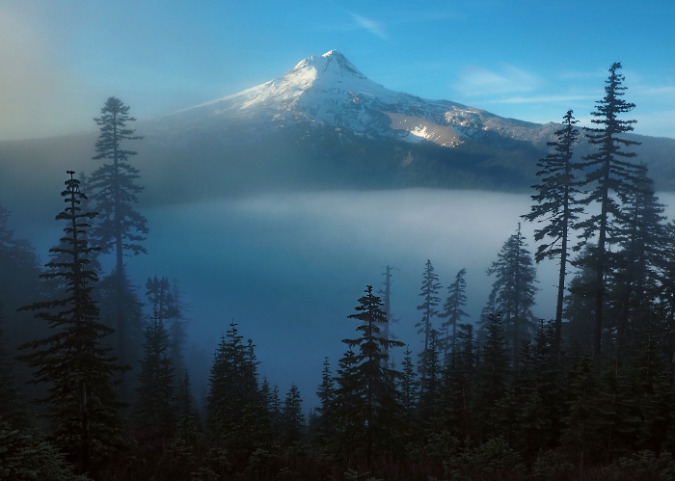
Fog bank filling the East Fork Hood River Valley as viewed from above Bennett Pass

How old are these trees? Some are at least 400 years old. We know this because the area saw heavy logging in the 1970s and 1980s, and many of the giant stumps left from that unfortunate era still remain to tell the story through their tree rings. Fortunately, not all of the big trees were cut, and some truly magnificent old-growth Noble Fir stands remain today.
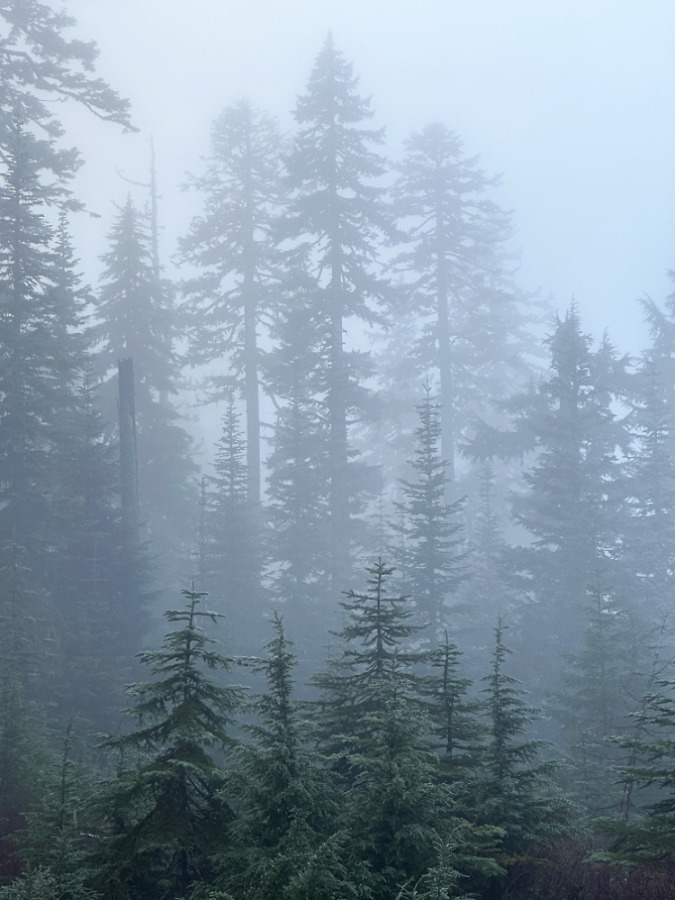
Noble Fir giants in the fog near Bennett Pass
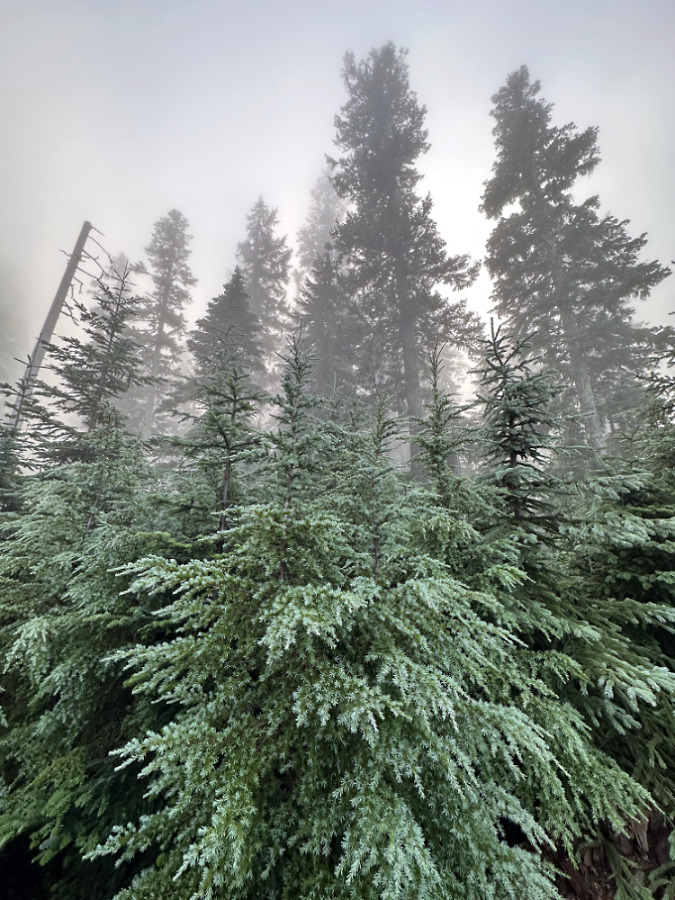
Noble Fir giants and Mountain Hemlock seedlings in the fog near Bennett Pass

On a more practical note, I was encouraged on that trip to see the Forest Service continuing to gradually improve visitor facilities on the mountain, including a new toilet at the popular winter trailhead at Bennett Pass. While pit toilets might not be a joy for anyone to use, they are essential at busy trailheads, especially for families with young kids. Modern toilets like the new facility at Bennett Pass are also accessible for visitors with mobility devices, removing a very real barrier to our public lands.
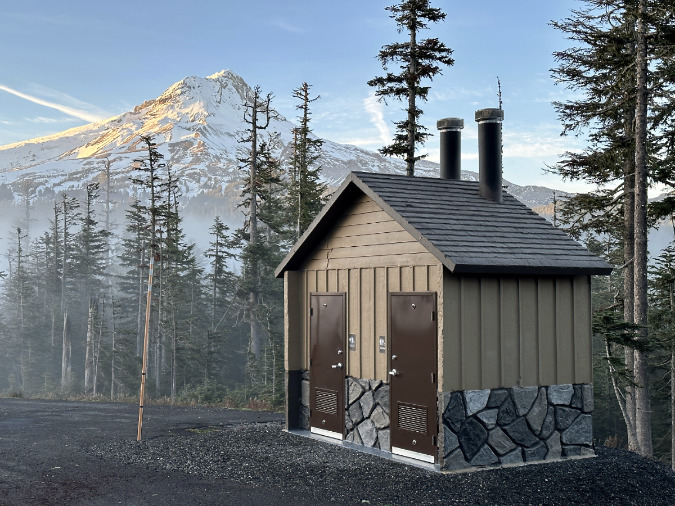
New toilets at Bennett Pass – with a view!

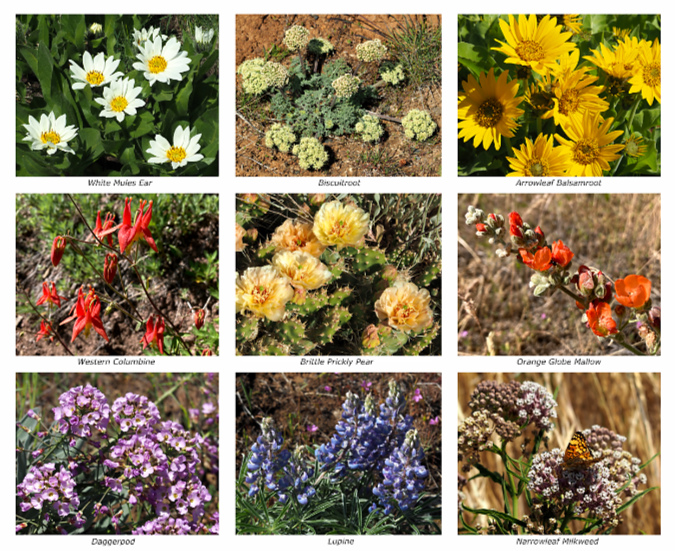
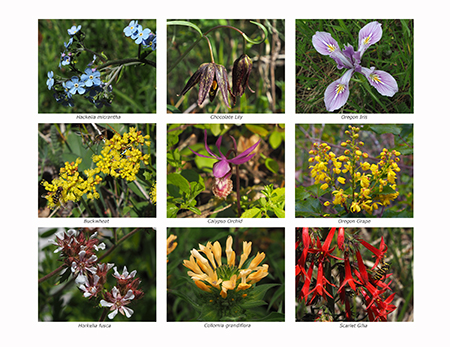
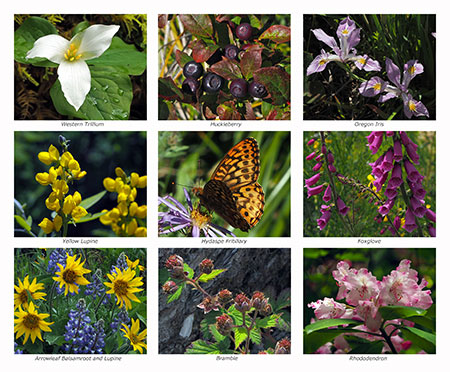
Finally, the back cover of the new campaign calendar features some of the wildflower highlights captured in WyEast Country over the past year (below). Some might be familiar, but I do have one confession to make: the Prickley Pear cactus in the center square wasn’t photographed anywhere near Mount Hood. Instead, it’s over in the John Day country, where I photographed this particular colony near the Painted Hills last spring. 
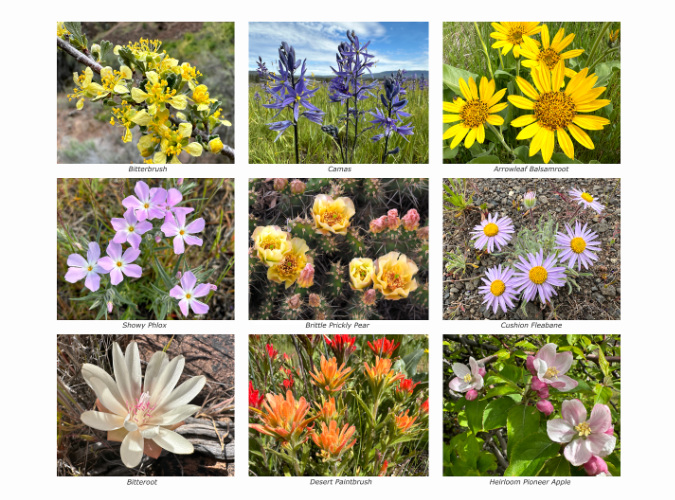
Wildflower mashup on the back of the 2025 calendar

Here’s a closer look at one of the cactus blossoms from that trip (below), showing the unlikely contrast of impossibly delicate flowers emerging from a maze of thorns that make these tough plants so fascinating:
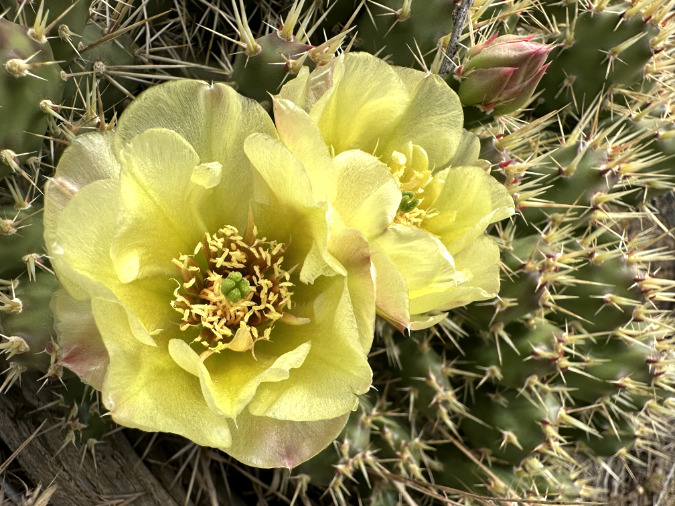
Brittle Prickley Pear near the Painted Hills

Why include this, then? Because I am admittedly obsessed with our native cacti, and determined to finally photograph them where they grow here in WyEast Country. I have two promising leads on that front that I’ll be following up on this spring. Both are near The Dalles and apparently hidden in plain sight, but I suspect I will have some searching to do!
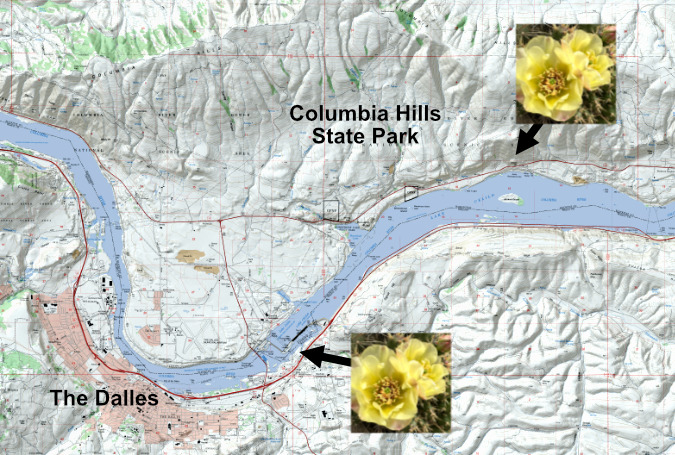
Where the Prickley Pear grows..?

I’ve spent a lot of time over the years hunting for cactus in Oregon. As spectacular and flamboyant as these flowers are when in bloom, the plants are surprisingly well-camouflaged and hard to find when they’re not… unless you step on one! So, more to come in this story.

…and to spare you from scrolling back to the top, here’s the link if you’d like to order the 2025 campaign calendar featuring these new photos:

2025 Mount Hood National Park Campaign Calendar

and all proceeds from calendar sales go to Trailkeepers of Oregon (TKO), and they can be delivered anywhere

Looking ahead to 2025

Thanks for reading this far! Mea culpa: I began 2024 with high hopes of a lot of WyEast Blog articles, but my day job and real-life demands got the better of me this year, once again! Therefore, I’m recycling that goal for 2025, and I’ve got some fun topics that I’m eager to dive into. 

These include some new digging I’ve done on a massive landslide that completely rerouted one of Mount Hood’s major rivers, plus some new research on what many call “Indian pits” or “vision quest pits” – those mysterious pits found in talus slopes all through the Gorge and in spots around Mount Hood. I’ve also got a history piece on a surprising road race with a WyEast connection, and much more beyond these…time permitting!

The old man and the mountain..

As always, thanks for patiently checking back when my posts become infrequent, putting up with the typos and grammatical errors, and — more importantly — thank you for being a friend of our Mountain and Gorge. I hope to see you on the trail sometime in 2025!

________________

Tom Kloster | December 2024

The Campaign Calendar at 20 Years!

The 2024 Campaign Calendar is the twentieth edition!

With the December holiday season comes my annual Mount Hood National Park Campaign calendar, but this year is a bit of a milestone: the 2024 calendar is the 20th edition since I began putting these together back in 2003! Much has changed over those years, so this article includes both a retrospective from the early calendars and highlights from the 2024 edition, so I hope you’ll indulge me!

The new calendars for 2024 are print-on-demand and available now from Zazzle. You can find them here:

See the 2024 Mount Hood National Park Campaign Calendar on Zazzle

Zazzle does excellent work and these can be shipped direct to anywhere. As always, all proceeds go to Trailkeepers of Oregon (TKO) for their crucial work in volunteer trail stewardship and advocacy.

Looking back to the very beginning…

It was back in 2003 when I kicked off the “idea campaign” for a Mount Hood National Park that encompasses Mount Hood and the Gorge. It’s an idea that has made it as far as legislation in Congress on several occasions as early as the 1890s, but never made it as far as the president’s desk to become law – usually due to moneyed interests in exploiting the mountain. Thus, the purpose of the “idea campaign” is to simply keep the national park idea alive.

Shooting the Salmon River with my first digital camera in 2003 (Greg Lief)

I’ve been asked many times “do you really think Mount Hood will become a national park?” I do, of course. Eventually. Most of our national parks had a long and bumpy road to finally being established, often starting as a national monument or recreation area – but always because they had exceptional natural and cultural features unmatched elsewhere. That’s why I believe that Mount Hood will eventually join the ranks of Crater Lake, Mount Rainier and the Olympics and receive the level of commitment to both conservation and recreation that only the National Park Service can offer. In the meantime, this blog serves as place to celebrate those natural and cultural features that make Mount Hood and the Gorge unparalleled places worth protecting, while spotlighting threats to the mountain.

With this goal, the first calendar (below) was an outgrowth of the idea campaign as a visual way to celebrate the many places and landscapes that combine to make WyEast Country so exceptional. Back in 2004, there were also new technologies that helped make a custom calendar possible: I had recently purchased my first digital camera and CafePress had emerged as a quality on-demand printing service as part of the dotcom revolution. 

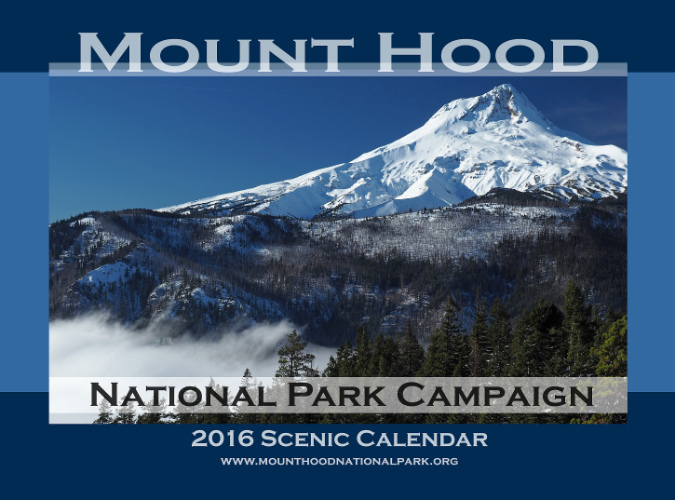
The first cover… back in 2004

The first calendar was modest – printed at 8.5×11 inches with color reproduction that was decidedly “approximate”, though still a big leap forward from color photocopies of the 1990s. The first edition featured a recurring, favorite spot of mine on the cover – Elk Cove on Mount Hood’s north side. 

From this start, the calendar evolved over the next 20 years in technology, print quality and the landscapes I featured. This collage (below) of the 20 annual covers shows some of that evolution.

[click here for a large version]

Looking back, the two constants among cover subjects were waterfalls and the mountain, though the places and vantage points varied greatly. One of the best rewards in putting the calendars together has been the opportunity to explore different corners of the mountain and gorge, as I set a goal early on to feature new images taken during the previous year in each calendar. While there are a few spots I go back to nearly every year, I’ve also been able to feature new places and perspectives not seen elsewhere.

Looking across those old cover images, I’m also able to see how the cover design evolved. The first two calendars used a script font that looks ridiculous to me now, and by 2006 I had moved on to the “national park” fonts I use today – notably, Copperplate — along with the color scheme I had used on the (then) brand new Mount Hood National Park Campaign website. The graphic below the main image was from bumper stickers I also had printed at CafePress at the time.

Getting there… improved fonts in 2006

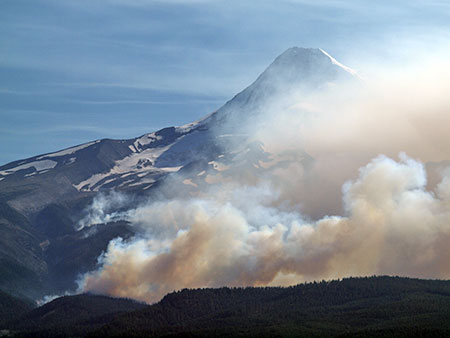
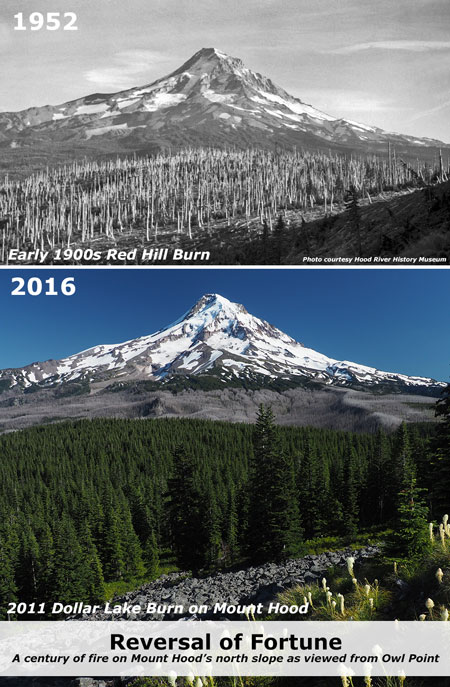
The cover of the 2006 calendar is the first in a series of reminder among the covers that there are no constants in WyEast Country. Everything changes, and lately, change seems to be accelerating, as the cover image of Mount Hood from the Elk Cove trail underscores. Just two years after I took this photo, the Gnarl Fire had roared across the east flank of the mountain, nearly engulfing Cloud Cap Inn. Then, three years after the Gnarl Fire, the Dollar Lake Fire had burned much of the forest on the north slope of the mountain shown in this image.

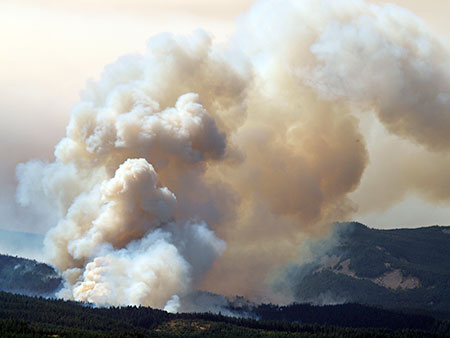
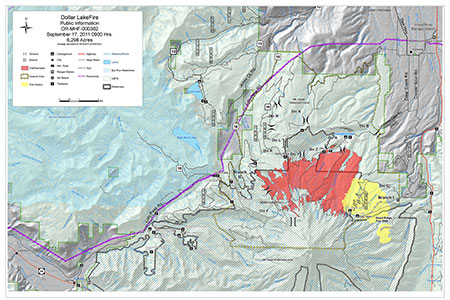
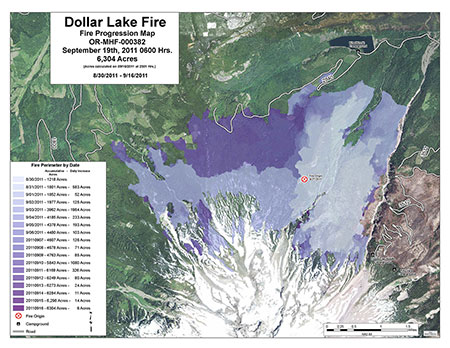
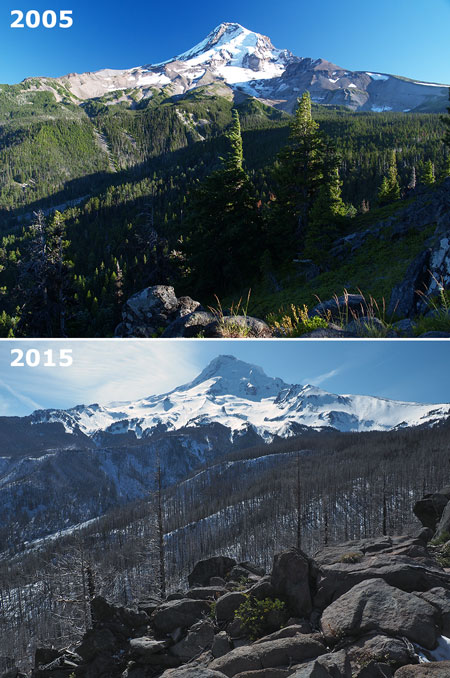
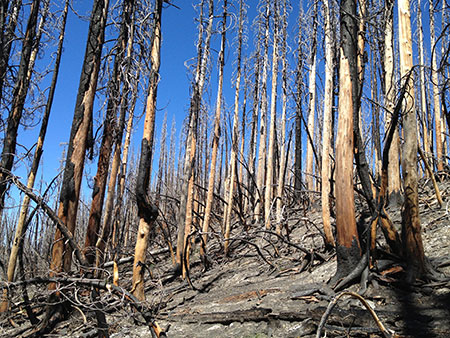
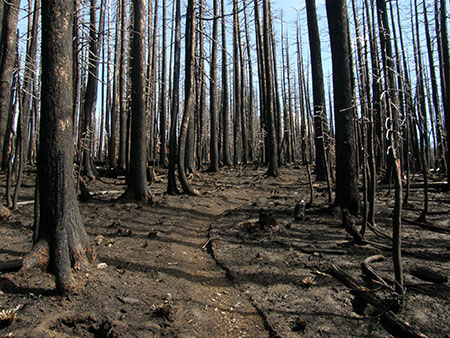
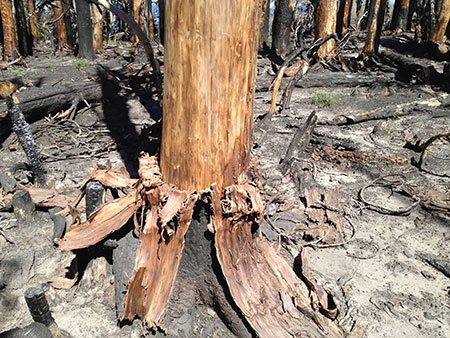
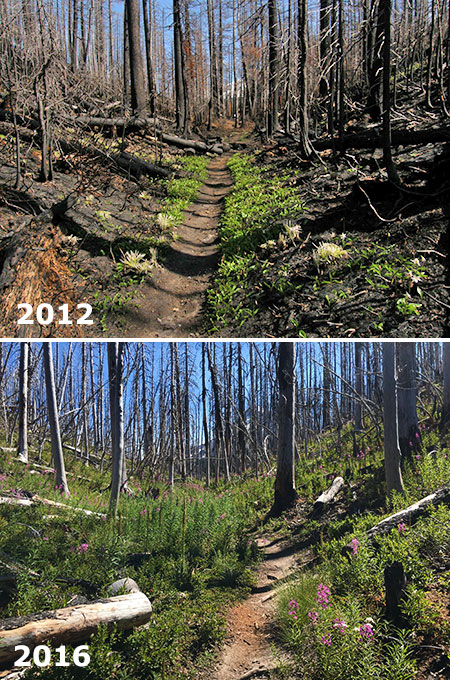
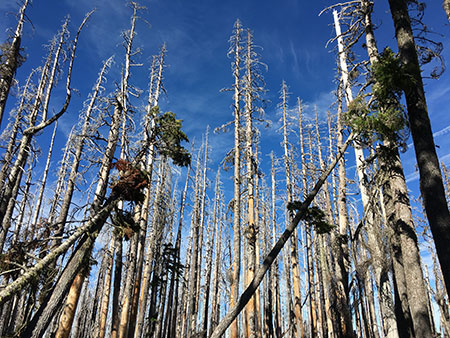
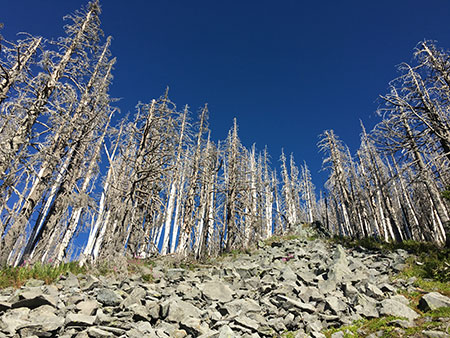
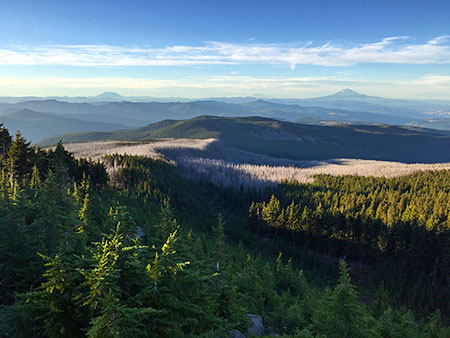
The 2011 Dollar Lake Fire started just below the rocky viewpoint where this cover photo was taken. Today, the sea of green Noble Fir and Mountain Hemlock that once covered the slopes has been replaced by a ghost forest of silver tree skeletons, with a new forest just getting underway in their. The following photo comparison from this viewpoint (below) shows the dramatic changes to the north side in stark contrast. 

The Dollar Lake Fire burned thousands of acres of subalpine forest on Mount Hood’s north slope in 2011

The Dollar Lake Fire brought an unexpected opportunity to witness and document the forest recovery, and without the assistance of man, as most of the fire was within the Mount Hood Wilderness. As such, the Forest Service has adopted a hands-off policy and is deferring to the natural forest recovery process. I’ve since posted several articles tracking the recovery:

“After the Dollar Lake Fire” (June 2012)

Dollar Lake Fire: Five Years After” (October 2016)

“10 Years After the Dollar Lake Fire” (November 2022)

The 2007 calendar marked a technology change when CafePress began offering a much larger format, measuring 11×17”. This required a different photo aspect, but also gave sweeping vistas the space they need to be truly appreciated. Such was the case with the first calendar cover in this larger format in 2007, when the sprawling view of Mount Hood’s east face (below) from Gnarl Ridge was the cover image. This edition also featured what has become the basic design for the cover, along with a blue color scheme that I’ve alternated with the original green theme over the years.

Going ultra-wide with a new format in 2007

In 2008, I started this blog as an alternative to making constant updates to the campaign website. This  opened still more opportunities to explore and capture WyEast country in words and imagery, with deeper dives and more details in the long form that I prefer. As the blog shifted my focus toward emerging risks to Mount Hood and the Gorge, so my photography shifted, and the calendar began to include more remote and obscure places on the mountain.

There’s a story behind the nearly identical cover scenes of Upper McCord Falls (below) that appeared on both the 2011 and 2013 calendars. In 2012 I lost all of my original digital files from the 2011 calendar in a computer upgrade, and by 2013 I’d clearly forgotten what the earlier cover images was. Apparently, I liked that view of Upper McCord Falls enough to put it back on the cover — though I had also upgraded my camera between these covers, so at least the 2013 version was an improvement on the earlier take – to my eye, at least! (for this article, I recreated the 2011 cover from a printed copy of the calendar I saved).

Seeing double-double!

As with so many places in the Gorge that I had taken for granted in my life, it never occurred to me that the forests surrounding Elowah Falls and Upper McCord Falls would soon be completely burned, leaving a landscape will take generations to return to the lush, mature forests that I grew up with. As it turned out, Upper McCord Falls was the first trail I visited within the “restricted area” following the September 2017 Eagle Creek Fire. It was just five months after the fire when I headed up there in February 2018 with a Trailkeepers of Oregon (TKO) crew to survey the trail damage.

The devastation was much more extensive than I expected on what would be the first of many trips into the restricted area after the fire. I had hiked through the recent burns on Mount Hood in previous years, and was braced for seeing ancient trees reduced to burned snags, but what makes the aftermath of fire in the Gorge so unique is the terrain. The forest was playing  a greater role in holding the steep slopes of the Gorge together than I think anyone realized, and just five months after the fire the scale of erosion and ground movement was alarming.

Locating surviving trail tread after the fire at McCord Creek in early 2018

The scene at Upper McCord Falls was startling, as well. The burn was severe around the falls, killing the entire forest. The layers of green moss that survived the burn on the cliffs and boulders nearest the falls seemed like they had been hand-tinted onto the brown landscape, like an old postcard.

Upper McCord Falls in February 2018 (Randi Mendoza, Oregon Parks & Recreation) 

The trail seemed a total loss in several areas on that trip where sliding mud and rock had completely covered the tight series of switchbacks originally carved into the slope by the Civilian Conservation Corps back in the 1930s. In the years that followed the fire, TKO volunteers have removed tons of debris from the trail and reconstructed damaged stone walls built by the CCC, restoring the tread to nearly its original design today.

Upper McCord Falls a few months after the fire

On the way out from that first visit after the fire, the clouds broke at the west end of the Gorge just as darkness was falling, creating the weird illusion that the charred forest silhouetted against dark the clouds and flaming sunset was still burning. As with all who love the Gorge, it was the beginning of a journey for me in accepting the reality of the fire – including the senseless act that started the blaze, as well as the inevitability of this fire being long overdue – and finally, a deeper appreciation for the resilience of our forests in which fire an essential destructive force.

Burned forests at McCord Creek on my first trip after the fire appeared to be on fire, once again, as a brilliant sunset lit up at the west end of he Gorge

Revisiting the slopes leading to Upper McCord Falls last spring, the resurgence of the understory and beginnings of a new forest was inspiring after five summers of forest recovery. While I won’t live long enough to see big trees replace those that were killed in the fire, the surviving trees are bouncing back strongly, and watching the renewal of the Gorge forests is as inspiring in its own way as the big trees we lost. 

A stand of Douglas fir that survived the fire is surrounded by a thriving understory along the McCord Creek trail in Spring 2023

Meanwhile, Upper McCord Falls looks quite different five years later, as well (below). The understory has made a vigorous comeback, but more surprising is the east (left) segment of this twin falls, which appears to be plugged with debris released into McCord Creek from the fire – at least for now. Prior to the burn, the twin tier would have been flowing when I took this photo last spring, just as it was in the calendar covers in 2011 and 2013. 

Upper McCord Falls six years after the fire in Spring 2023

Upper McCord Falls has historically had as many as three segments cascading from the basalt ledge that forms the cascade (a third tier once flowed to the left of east tier as recently as the 1970s, as shown below), so in time, there’s no reason to assume the second (or even third) tiers will re-emerge. The defining factor is simply the amount of rock and log debris piled up on top of the basalt ledge. 

Since the 1970s, the debris had been further stabilized by a colony of Red Alder that was the main force holding the pile of boulders and debris together, eventually blocking the third tier of the falls completely. Today, those trees have been killed, and with the volatile flooding on Gorge streams since the fire, there’s good reason to expect McCord Creek to re-arrange the shape of Upper McCord Falls by removing some or all of the debris plugging parts of the waterfall.

Upper McCord was a triple falls in the 1970s! (Don Lowe)

Where the tree canopy along the McCord Creek trail system were completely burned (below), the forest recovery is now in full swing, choking the route in many spots with Thimbleberry, Vine Maple, Douglas Maple and many other understory plants whose roots survived the burn, allowing them to bounce back quickly.

Forest understory surging back after six years at McCord Creek

Bigleaf Maple are bouncing back in this way, too, pointing to a future deciduous forest canopy as the first phase of recovery in many of the burned areas. Along the lower sections of the McCord Creek trail, ten-foot shoots have exploded from the roots of Bigleaf maple trees whose killed tops still stand as bleached snags (below). Many of these recovering maples will become multi-stemmed trees, a familiar sight in Oregon’s forest and one answer as to why mature Bigleaf Maple so often have multiple trunks.

Bigleaf Maples regrowing from the base of burned trees whose roots survived the fire

The drama at McCord Creek continued a few short years after the fire when the west cliff wall of the Elowah Falls amphitheater collapsed in the winter of 2021. There’s no science (yet) to make the connection, but the Gorge has seen a series of cliff failures since the 2017 Eagle Creek Fire. Could these events be linked to the loss of vegetation or corresponding runoff on Gorge slopes? Perhaps, but as I described in the previous article on the 1973 Tanner Creek landslide, there are unique forces at work in the Gorge that date back to the last ice age, so events like these are the norm, not the exception.

Elowah Falls cliff collapse in the spring of 2021 (Drew Stock, Trailkeepers of Oregon)

TKO volunteers discovered the Elowah Falls cliff collapse in 2021 and captured the dramatic photos shown here. In the immediate aftermath of the collapse, McCord Creek disappeared into the loose basalt cobbles that had filled the creek channel and buried the Trail 400 footbridge to its railings. That condition was temporary, however, as by last spring McCord Creek had already carried away much of the small debris and excavated the footbridge. The images below show the erosive power of the stream over a period of just two years.

Debris burying McCord Creek and its footbridge immediately after the collapse (Drew Stock, Trailkeepers of Oregon)

Elowah Falls footbridge excavated (and railings removed!) by McCord Creek after just two years

Like most cliff collapses in the Gorge, the jumbled debris fan at Elowah Falls is a mix of truck-sized boulders that managed to hold together amid a sea of smaller boulders and fractured basalt cobbles where parts of the once-solid rock face had simply crumbled during the event.

Large blocks of basalt mixed with smaller cobbles in the debris pile at the base of the collapsed cliff

Today, a massive scar is still obvious on the cliff wall where the basalt gave way (below). In time, however, the evidence from event will be hidden under a fresh carpet of moss and Licorice Fern, once again giving that deceptive illusion of stability that has never really existed in the Gorge.

Looking up the debris fan at the massive scar left behind by the cliff collapse at Elowah Falls in Spring 2023

While the cliff collapse at Elowah Falls was massive in scale, it spared the spectacular trail to Upper McCord Falls where it is carved into the basalt walls 400 feet above the creek. In fact, hikers passing along this vertigo-inducing stretch of trail might not even notice that a large section of the wall directly below them had collapsed into the creek, as the impact is mostly hidden from this airy view (below).

Elowah Falls seems unchanged from above along the Upper McCord Trail

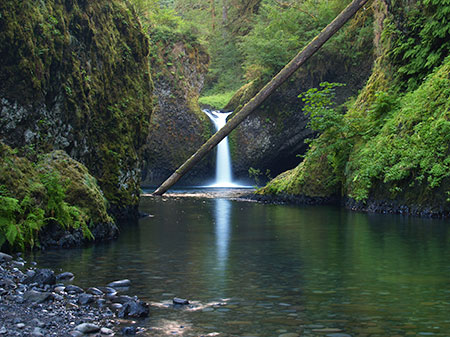
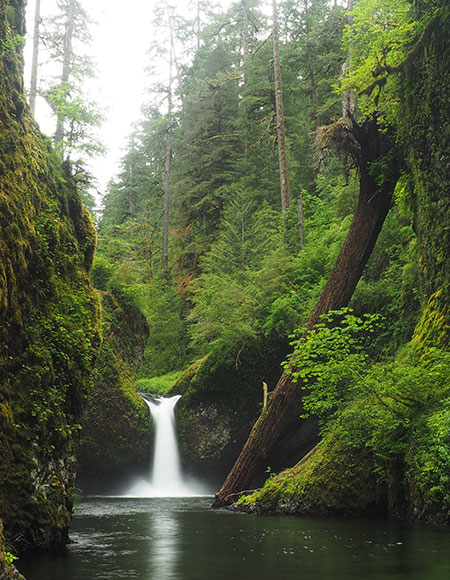
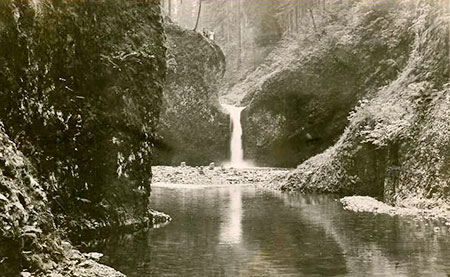
If the cliff collapse Elowah Falls was impressive to see, the earlier collapse at Punch Bowl Falls on Eagle Creek was downright shocking. After Multnomah Falls, and Crown Point, the view into the mossy cavern that holds Punch Bowl Falls might be the most iconic in the Gorge. The idyllic scene drew photographers from around the world before the fire, and even gave its name to the category of “punchbowl” waterfalls.

Punch Bowl Falls as it once appeared in 2012

I posted an extensive piece on this event when it showed up unexpectedly on a series of aerial surveys the State of Oregon had conducted to track landslides after the Eagle Creek Fire. The Punch Bowl collapse occurred just months after the fire, sometime in early 2018. The “restricted area” was still in effect at the time, so the first few people to see the aftermath in person were trail volunteers working to put the Eagle Creek trail back together. Today, you can see the re-arranged landscape by taking the Lower Punch Bowl spur trail down to the falls.

Aftermath of the 2018 cliff collapse at Punch Bowl Falls

Getting that classic shot of Punch Bowl Falls during spring runoff usually entailed wading knee-deep into Eagle Creek to get a look into the hidden cavern that holds the falls. The cliff collapse has since changed things a bit. For now, there are a pair of good-sized boulders that landed in the entrance to the cavern, blocking the traditional view. 

In time, Eagle Creek will dismantle much of the debris from the collapse, and even these boulders will eventually break apart or be pushed downstream by the enormous force of the stream during winter floods. This will be aided by the many fallen logs that have dropped into the stream since the fire, and now act as erosive battering rams and levers as they move downstream.

The ”modern” calendar design emerges in 2016

The final design and format emerged in 2016 with a switch in vendors

Year twelve in the calendar series brought a major shift and format and improved quality when I moved printing from CafePress to Zazzle. The image reproduction at Zazzle is excellent and the overall printing process much better, resolving some quality concerns that drove me to make the move. Zazzle also brought the added opportunity to have a printed back cover on the calendar, kicking off the grid of nine botanical photos that I continue to include each year. Like the scenic views in each calendar, the botanical images are captured over the course of the prior year on my forays into WyEast Country.

New with the 2016 calendar? A printed back cover!

One last profile of note from past calendars is the 2019 edition, where lovely Whale Creek in the Clackamas River watershed is featured. This idyllic scene is – or was – typical of the beautiful rainforests there. Despite a long and frustrating history of aggressive logging over more than a past century, some of the finest ancient forests in the region survived here. Sadly, the Riverside Fire – yet another human-caused event – started just upstream from this spot along the Clackamas, and eventually burned 120,000 acres of forest, as well as numerous structures.

This scene from Whale Creek taken before the 2020 Riverside Fire was featured on the 2019 calendar

I’ve posted many articles on the necessity and benefits of wildfire in our forests, but the Riverside Fire underscores a few caveats to the science. As I described in this 2021 article, we are burning our forests faster than is sustainable. This stems from multiple factors adding up to a perfect storm: a century of fire suppression coupled with heavy logging has left us with thousands of old clearcuts packed with thickets of overplanted, fire-prone young trees and decades of fuel buildup. Add climate change, with our summers getting drier and hotter, and our forests have become a tinder box in most years, not just the occasional hot summer.

The same section of Whale Creek after the fire in 2020 (USFS)

Given this confluence of stresses on our forests, we’re doing an especially poor job preventing human-caused fires – they account for 70 percent of wildfires in Oregon! As I point out in the linked article, we’ll need to set some unwelcome limits on human behavior if we hope to slow down the burning to sustainable levels. So far, the Forest Service is moving very slowly in limited access during extreme fire danger, though successful liability lawsuits against power companies whose live lines triggered some of the 2020 fires may change that thinking.

TKO crews clearing big logs on the Clackamas River Trail after the Riverside Fire

Some good news from the Clackamas? TKO crews have already been working on reopening trails damaged in the fire. Like the Gorge, the Clackamas River canyon is steep country, so keeping trails open as the forest recovers will be a long-term endeavor.

That’s a look back at 20 years of campaign calendars, and now…

…looking ahead to 2024!

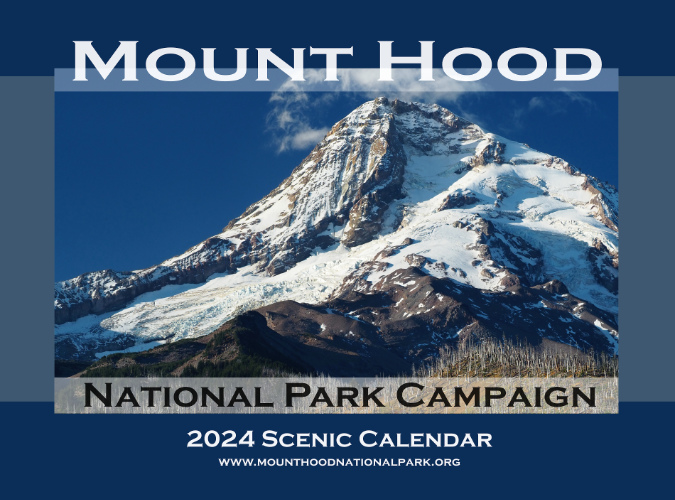
The view from Inspiration Point is the cover image for 2024
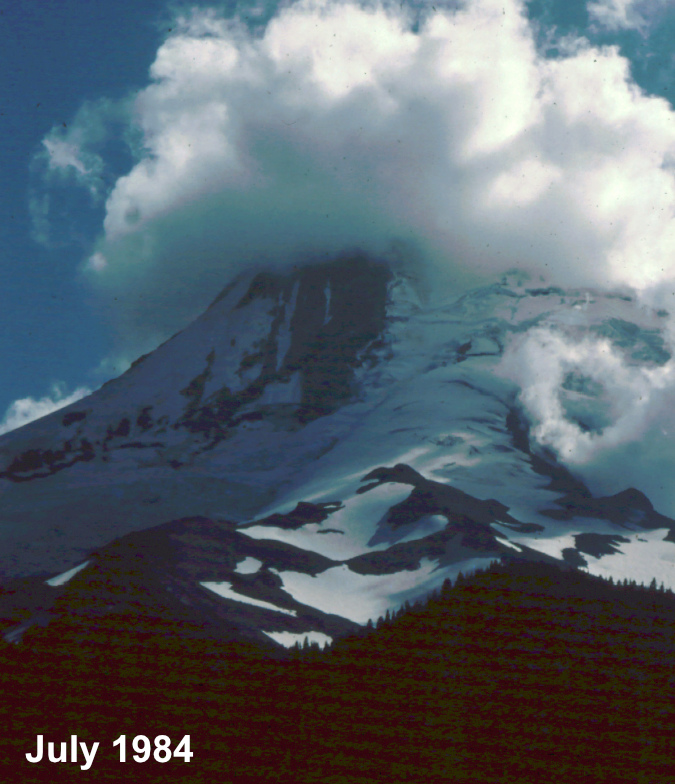
For the 2024 calendar cover, I selected an image of Mount Hood’s fearsome north face (above), as viewed from a tiny, unofficial trail that I maintain at Inspiration Point (located at the 3-mile mark on bumpy  Cloud Cap Road). How long have I been stopping here? I looked back at my photo archive, and the earliest I could find was a slide from the summer of 1984 – which means I’ll celebrate my 40th summer visiting this lovely spot when I stop at Inspiration Point next year!
Clouds capping the mountain on the road to Cloud Cap in this 1980s view from Inspiration Point

On the back cover of the new calendar, yet another collection of nine wildflowers that I photographed over the past year is featured – including a couple that were new to me. 

Back cover of the 2024 calendar
Putting it all together, here’s a jumbo collage of the 12 monthly images in the 2024 calendar, plus the covers and a snapshot of the page layout:

[click here for a large version]

For the January image in the new calendar (below), I selected a view of Mount Hood’s northwest side, with Cathedral Ridge and the Sandy Glacier Headwall covered in an early dusting of autumn snow. On this day last October, the mountain was emerging from the clouds after being socked in most of the day.

Northwest face of Mount Hood with early autumn snow

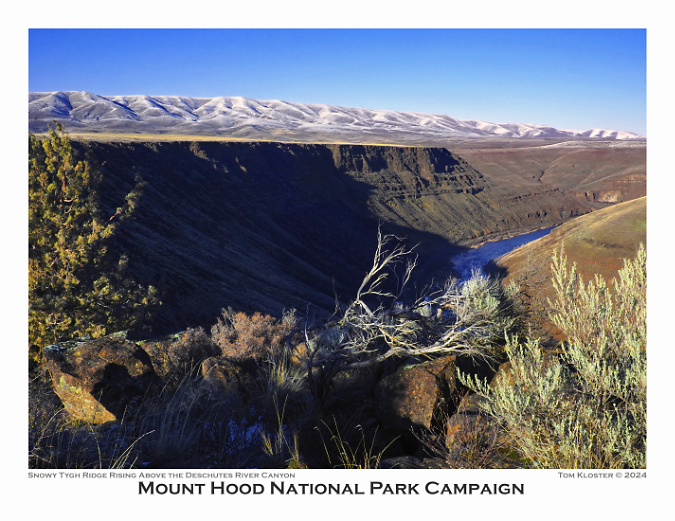
For the February image I thought I’d mix things up a bit with this view of the lower Deschutes River canyon at Oak Springs (below), a corner of WyEast Country that not many find their way to. On this day last winter, a dusting of snow had fallen on Tygh Ridge, the long fault scarp that rises in the distance – another lesser visited spot on this lonely, dry side of the mountain.

Lower Deschutes River and Tygh Ridge from above Oak Springs

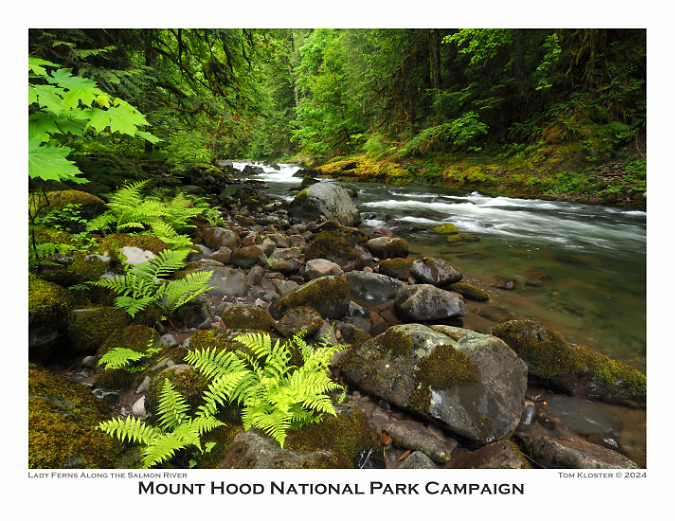
For March, a more familiar scene (below) along a quiet section of the lower Salmon River features a group of Lady Ferns. The Old Salmon River Trail follows this stretch of river through some of the best rainforest and oldest trees within easy reach of Portland.

Lower Salmon River in Spring

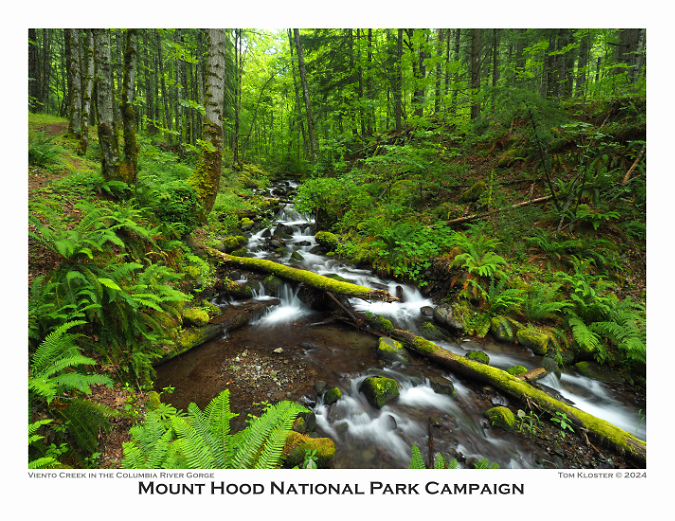
I chose another stream scene for April, though this one is less familiar to most. This is Viento Creek (below), in the east Gorge, just a few miles west of Hood River at Viento State Park.

Viento Creek in the East Gorge

There’s a backstory associated with this photo, as I’ve been working with TKO for the past few years to create a new family-friendly trail from the Viento Campground to a magnificent viewpoint on the Viento Bluffs. The new trail will someday pass the stream scene shown above, enroute to expansive views of the Columbia River – but with a short route that it will be welcoming to casual hikers and young kids. Watch this space for more news on this project!

TKO and State Parks crew surveying a new trail at Viento Bluff earlier this year

The picturesque view from Viento Bluff will someday become a family trail destination

The May calendar image features another stretch of the Salmon River (below). This pretty cascade has become a popular spot for photographers in recent years. I included it in this year’s calendar partly for symbolic purposes, as this scene appeared in the very first calendar in 2004. This is also where Greg Lief’s image at the top of this article of me shooting photos was captured in 2003 – hard to believe that was 20 years ago!

Springtime on the Salmon River

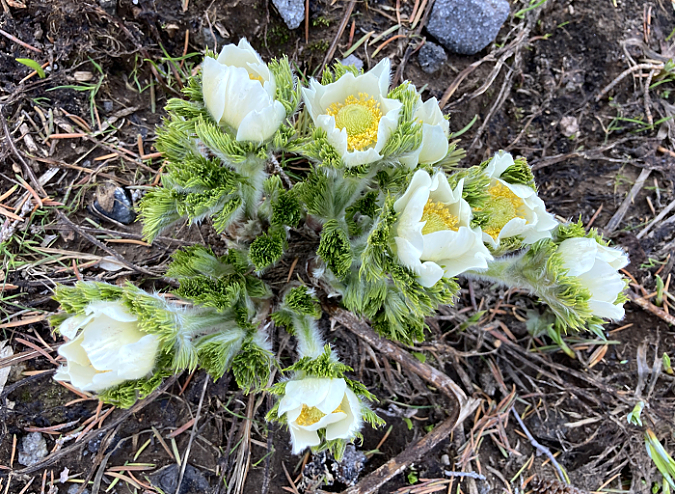
June brings another symbolic favorite, as Elk Cove appeared on the cover of the first calendar, and in several subsequent editions over the years – and almost always from this very spot (below) along the Timberline Trail. As much as the mountain has changed in recent years, this view remains a bit of a constant – always lovely, but especially the Western Pasqueflower are putting on their “Muppets of the Mountains” show.

Summer wildflowers putting on their annual show at Elk Cove

For July I selected another repeat spot, one of my favorite viewpoints of Mount Hood and the Eliot Glacier from the shoulder of Cooper Spur (below). I posted a look-back article on this area earlier this year to kick off a series of then-and-now photo retrospectives. 

Mount Hood and the Eliot Glacier from the Cooper Spur Trail

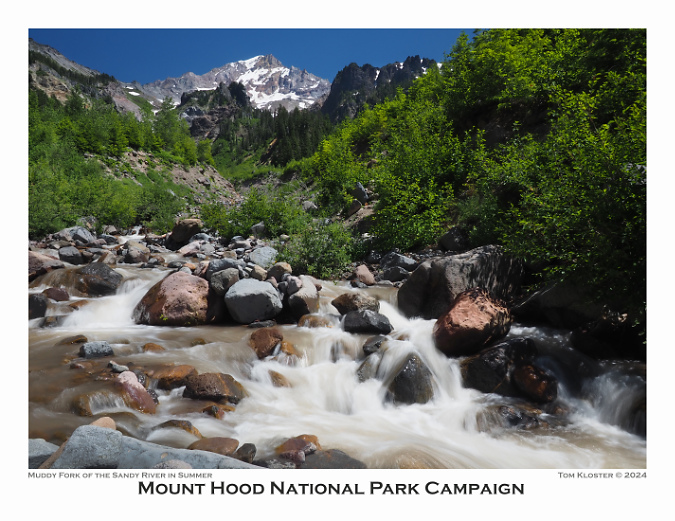
For the August image, I selected another scene from a blog article, in this case a view of the recovering Muddy Fork valley where a landslide swept through two decades ago. This event and several now-and-then photo comparisons are over here.

Muddy Fork of the Sandy River

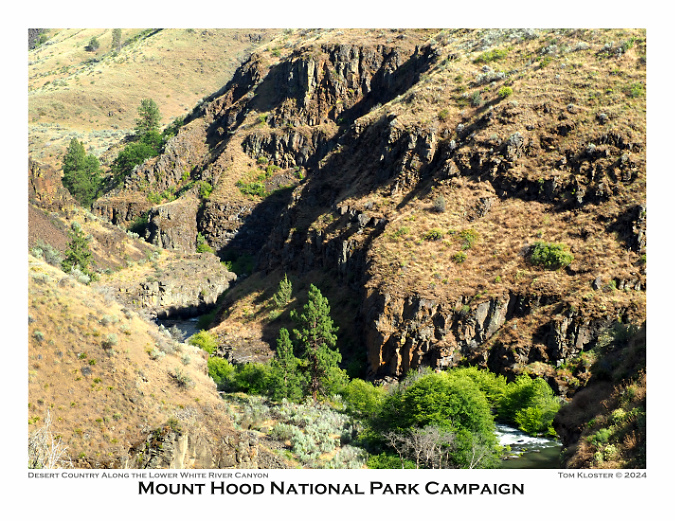
For September, I chose something a bit different, with a cliff-top view into the lower White River Canyon (below) at White River Falls State Park. So many things make Mount Hood unique (and worthy of national park protection!), but the compact collection of wildly different climate zones might be at the top of the list. There aren’t many places in the world where a 2-hour drive from the middle of a major metropolitan area takes you from rainforest to desert, with glacier-covered volcano rising above you the entire time!

Lower White River Canyon in desert country

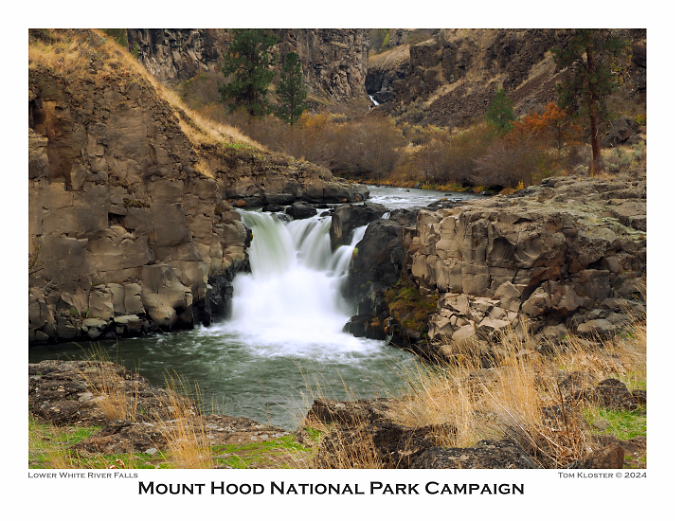
The October image stays with the desert theme, and features Lower White River Falls. In spring, this canyon lights up with desert wildflowers that I’ve included in previous calendar editions, but the tawny yellows, gold and reds of autumn create their own beauty in this rugged landscape.

Lower White River Falls in Autumn

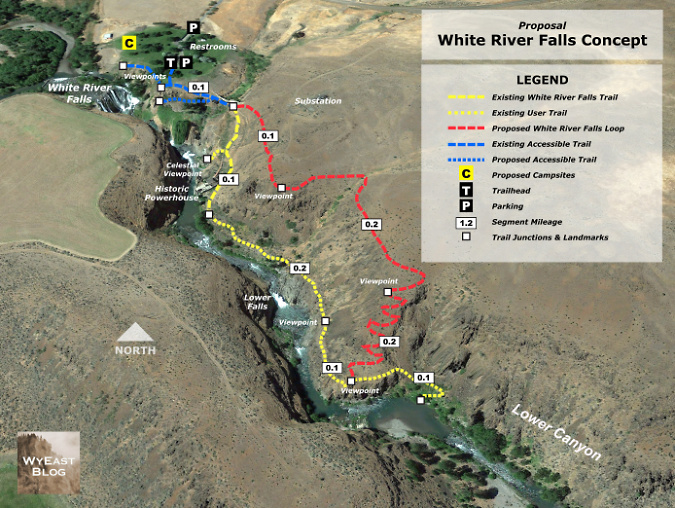
White River Falls State Park remains a diamond in the rough, with much potential for both improved recreation and conservation of the natural and cultural features in the park. The area is becoming more popular, and that has translated into some visible impacts – and therefore several proposals to respond to this increased demand are featured in this article from earlier this year.

Loop Trail concept for White River Falls State Park

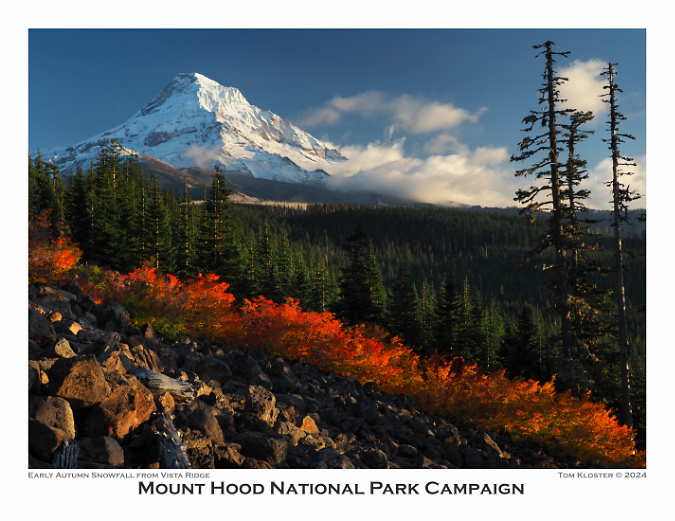
For November, fall colors along Vista Ridge and fresh snow on the mountain are featured (below). This scene is surprisingly easy to get to – it’s along the access road to the Vista Ridge Trailhead, another increasingly popular spot on the mountain. This article from last summer includes some proposals for managing the pressures the newfound popularity is bringing to Vista Ridge.

Brilliant fall colors on Vista Ridge

Finally, a view of the mountain after the first big snowfall of the season (below) from the lightly traveled Gumjuwac Trail, gateway to the Badger Creek Wilderness. My favorite viewpoint hikes are to “pocket views” – those spots where a steep talus slope or rocky outcrop provides an unexpected view – and this rocky crest just below Gumjuwac Saddle is among the best, and was featured on the front of the 2016 calendar, as well.

Pocket viewpoint along the Gumjuwac Trail in winter

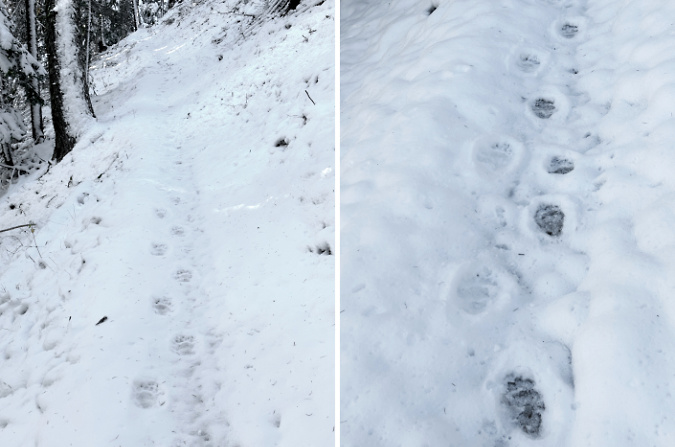
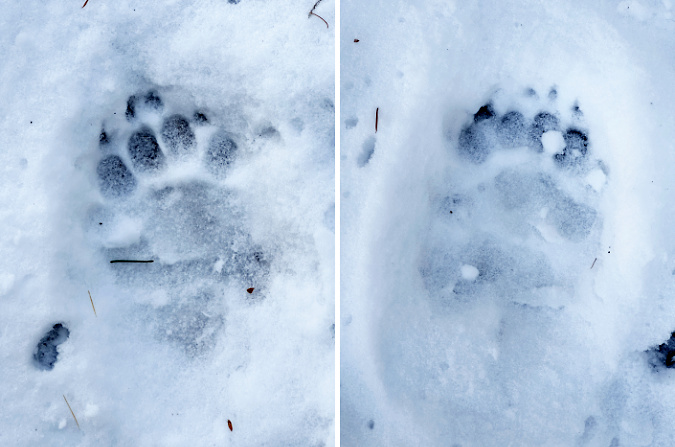
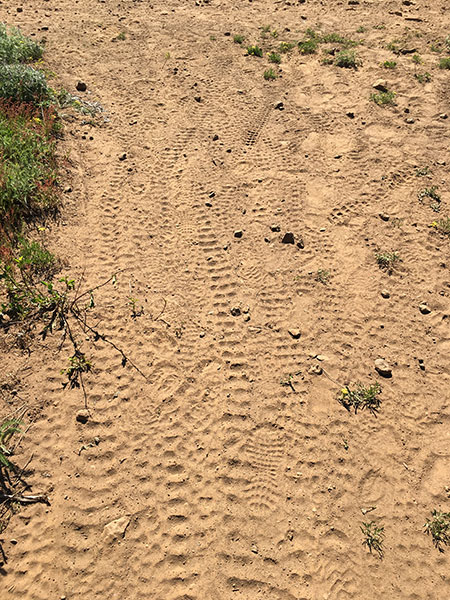
On the way up to the Gumjuwac viewpoint, I followed the chunky footprints of a Black bear for much of the route. Hiking in snow is a useful reminder that wildlife are always out there, even if we don’t have snow on the ground to record their travels. This is their home, after all, we are the visitors.

Bear tracks along the Gumjuwac Trail

Bear tracks in fresh snow on the Gumjuwac Trail

So, that’s it for my annual calendar review! If you made it this far and would like order one, they are available here – and all proceeds go to Trailkeepers of Oregon (TKO):

2024 Mount Hood National Park Calendar
As always, thanks for visiting the blog. Looking ahead to next year, I already have several articles underway, with the usual collection of deep dives, new proposals and reflections on the past. I hope you’ll continue to stop by!

The author at Owl Point in 2008 (Andy Prahl)

Best to you in the coming year – see you on the trail in 2024!

_______________ 

Tom Kloster | December 2023

Postscript: Elk Cove Avalanche

Mid-June view of the Elk Cove avalanche scene (photo: Joshua Baker)

WyEast Blog reader Joshua Baker sent several images from a mid-June trip into Elk Cove this year in response to the recent avalanche article that featured images from early August, when much of the avalanche debris had melted free of snow. These images provide a different perspective of the incident, as the winter snowpack was still largely intact, and most of the trees caught up in the avalanche were still buried in snow.

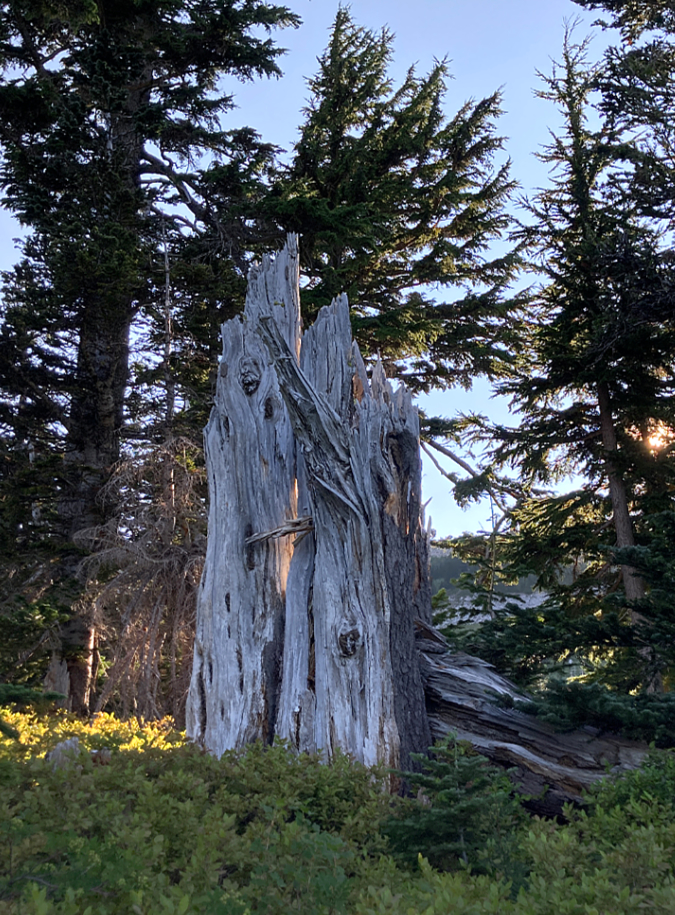
This image shows the top of a still-green Mountain hemlock, snapped off by the avalanche and lying on top of the avalanche debris pile:

Mountain hemlock top snapped off by the avalanche (photo: Joshua Baker)

Another image shows a similarly snapped-off Noble fir lying on top of the avalanche debris:

Noble fir top snapped off by the avalanche (photo: Joshua Baker)

Both images show how trees in deep snowpack can be topped by avalanches, snapped off at the snow line. Not seen in these images are the many trees in the debris pile, below, still buried in snow from the avalanche. As the images in the main article show, whole trees brought down by the event were stacked up to 10 feet deep once the snow melted away over the summer.

This view from mid-June is especially informative, as it shows surviving groups of Mountain hemlock still standing, despite being directly in the path of the avalanche:

Several groups of Mountain hemlock were still standing where the avalanche swept across the floor of Elk Cove (photo: Joshua Baker)

The best explanation for their survival is that the avalanche had rapidly lost speed as it moved across the gently sloped floor of Elk Cove, and these trees were able to withstand the reduced force of the moving avalanche. Another factor is the depth of the avalanche when it reached these trees, as it likely spread out when it reached the floor of the cove, where it finally stopped.

In coming years, I’ll continue to document the debris pile and the recovery of the forest and meadows that were impacted by the avalanche. Just as we’re learning about fire recovery on Mount Hood, this event will provide a window into the resilience of our alpine landscape in the face of an event like this.

Thanks for sharing these photos, Joshua!

Elk Cove Avalanche!

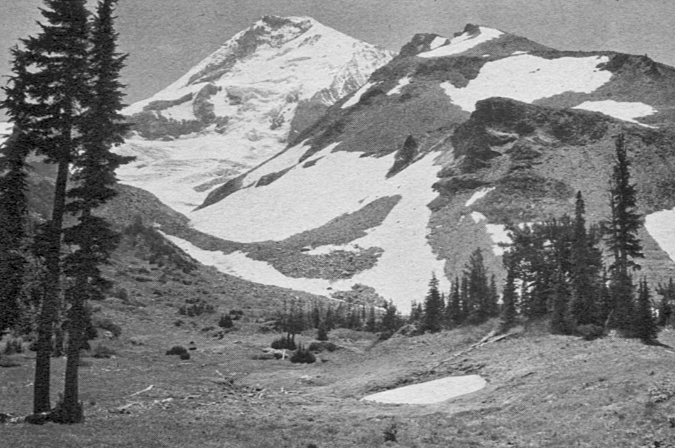
Mount Hood from Elk Cove in 2021

When it comes to bucolic alpine scenes on Mount Hood, it’s hard to beat Elk Cove. From the spectacular wildflower gardens that line ice-cold Cove Creek to the sweeping views of Mount Hood and the mighty Coe Glacier, the cove serves up one postcard scene after another. 

But behind the mountain scenery are some very wild winters. The same steep walls that give Elk Cove its alpine beauty are also a setup for powerful avalanches. These mostly originate on the lower slopes of Barrett Spur and sweep across the cove with surprising regularity. 

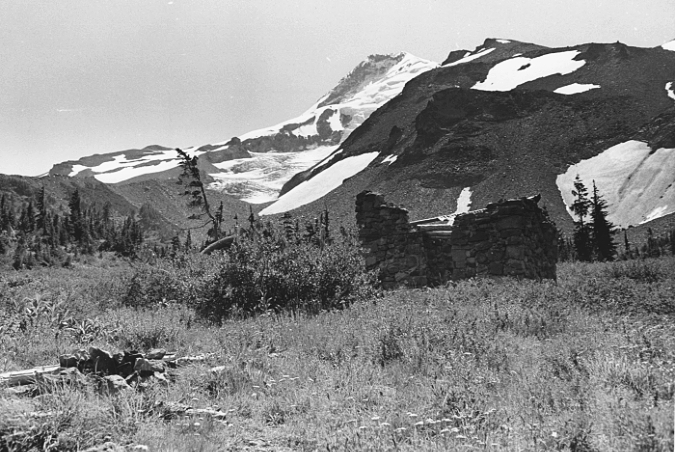
Mount Hood in 1931 from the same spot as the previous photo, when trees were more sparse at Elk Cove

Early photos of Elk Cove suggest that avalanches were once even more devastating than what we experience today, and probably more frequent, judging by the advancing stands of Mountain Hemlock that have since spread across the cove. The change is most likely a reflection of our warming climate and declining snowpack in recent decades, but winter continues to take its toll. Major avalanches still roar into the cove with regularity, leveling trees and leaving piles of debris in their wake.

The shell of the old CCC stone shelter at Elk Cove as it appeared in the early 1960s, after being hit by numerous avalanches over the prior 30 years

When the Timberline Trail was built through Elk Cove in the early 1930s, Franklin Roosevelt’s legendary Civilian Conservation Corps (CCC) constructed one of their many iconic stone shelters here, one of six that were built along the trail. They couldn’t have known the site they picked was perhaps the most exposed to avalanches of any spot within the cove, and by the early 1960s, the shelter had already been badly damaged. Today, only a few rocks mark the shelter’s former location.

The 2021 Elk Cove Avalanche

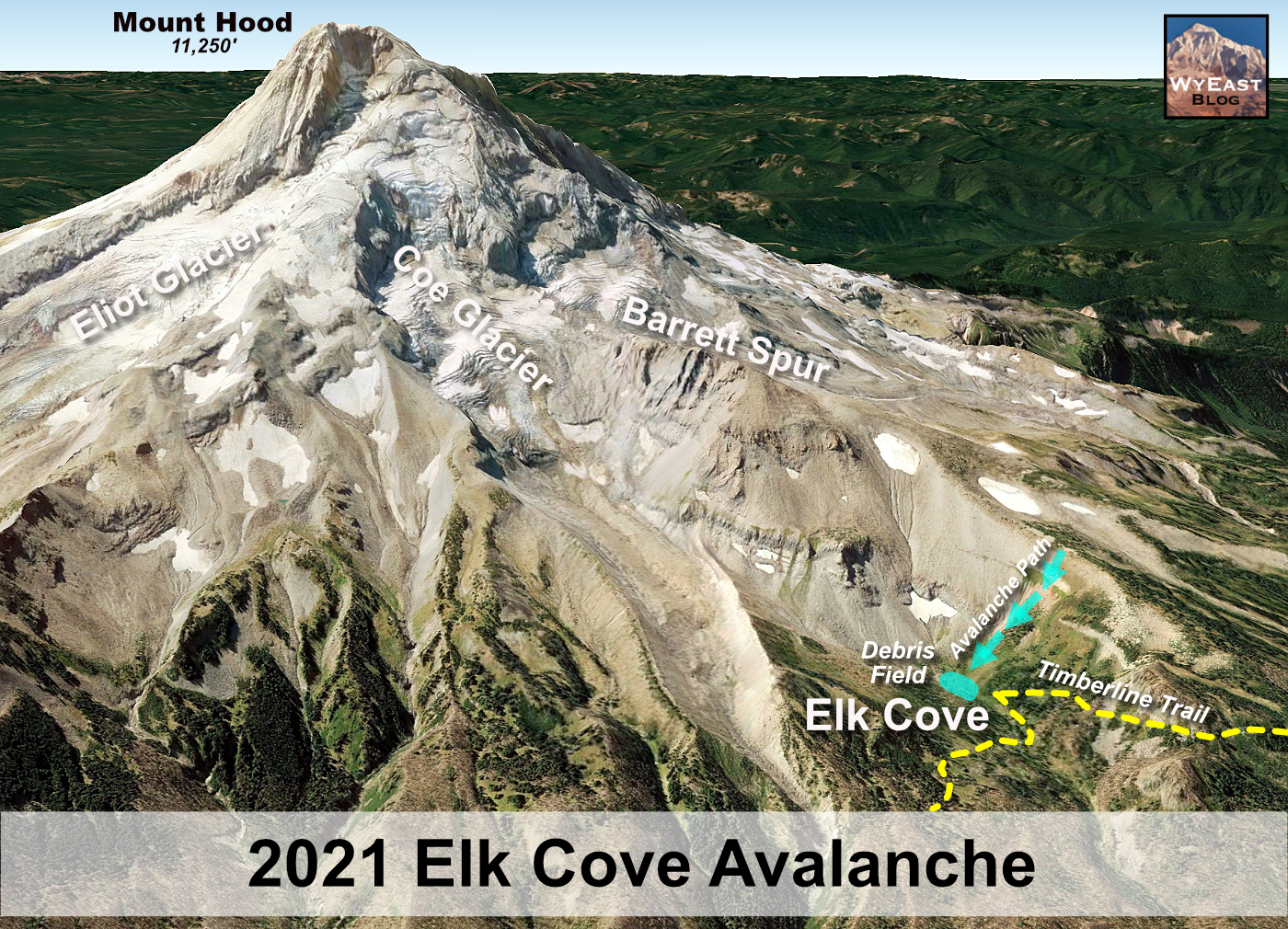
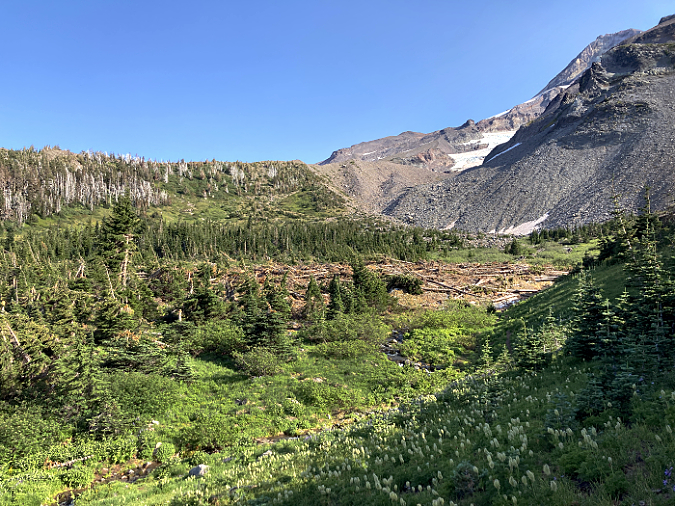
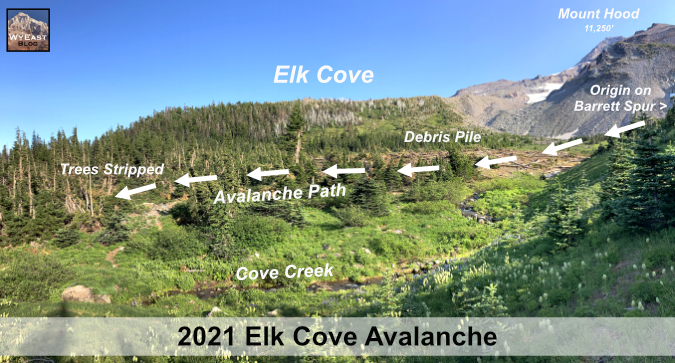
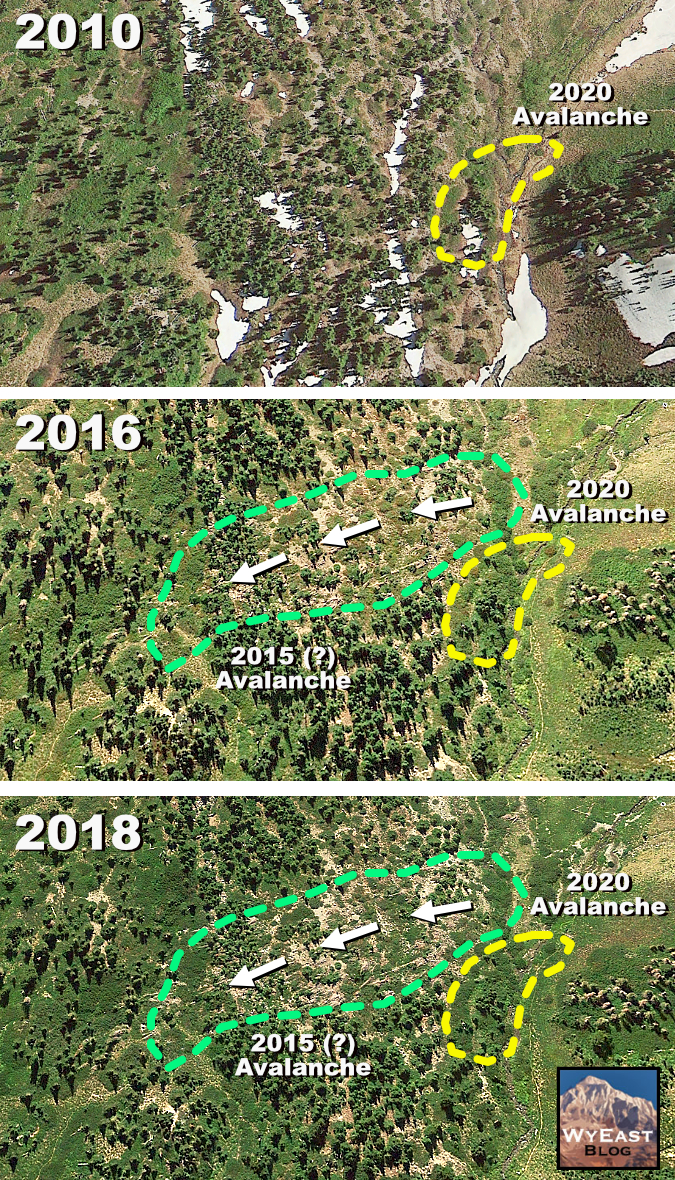
Sometime last winter, yet another avalanche swept off the lower slopes of Barrett Spur, once again landing very near where the old stone CCC shelter had once stood. The debris field left behind by the avalanche was easily spotted by hikers ascending Barrett Spur over the summer, and it is also visible from the Timberline Trail where it enters the Elk Cove.

The following schematic shows Elk Cove and the path of the 2021 avalanche in relation to Mount Hood:

[click here for a larger version of this schematic]

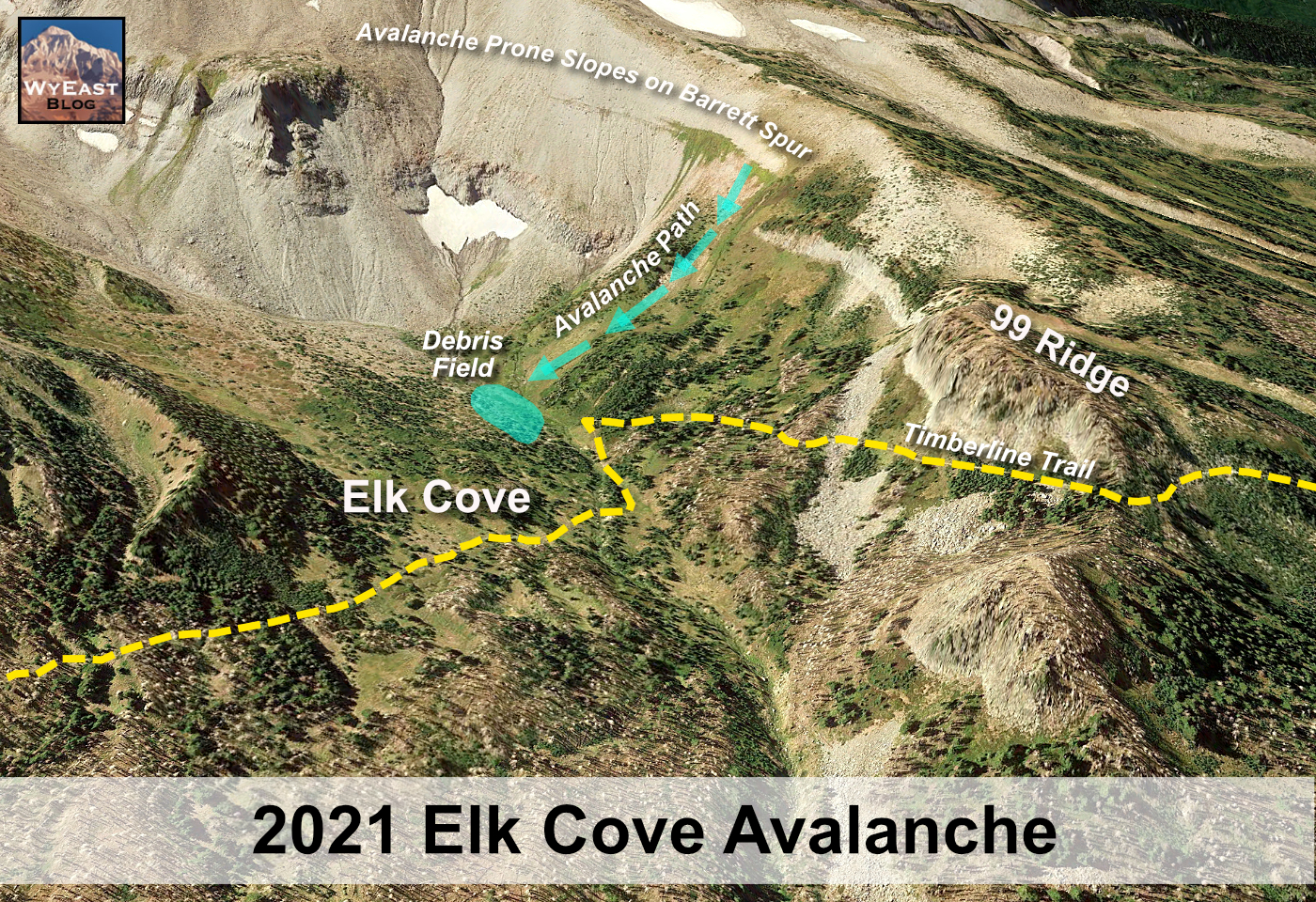
This schematic gives a more detailed view of Elk Cove and the approximate path of the 2021 avalanche, including the steep wall along Barrett Spur that is so prone to avalanches (the Timberline Trail is shown in dashed yellow):

[click here for a larger version of this schematic]

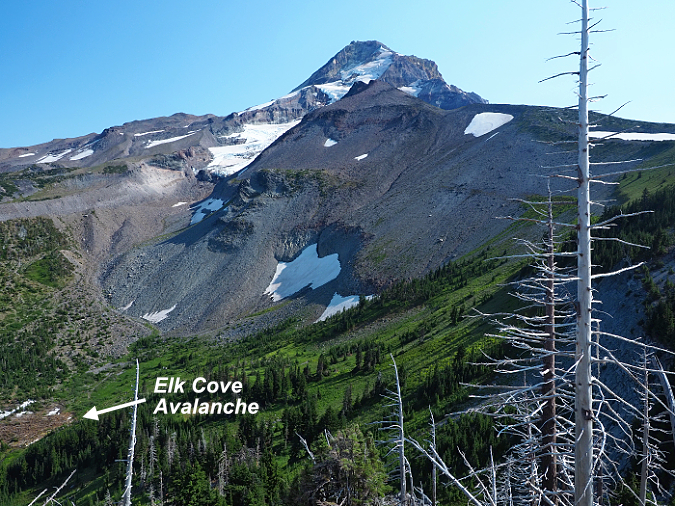
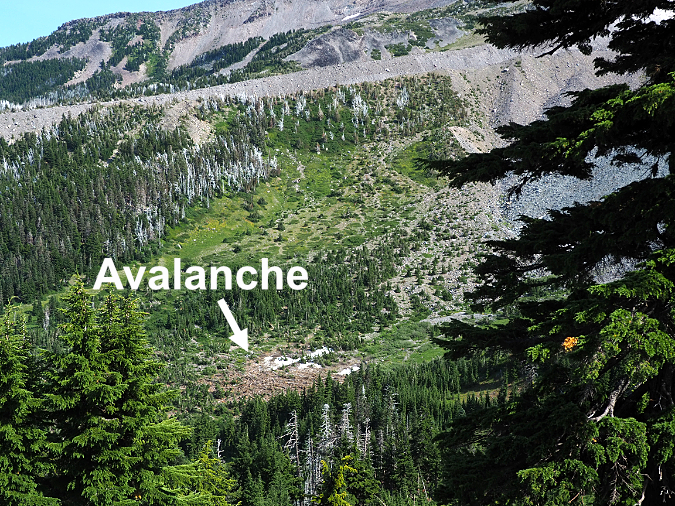
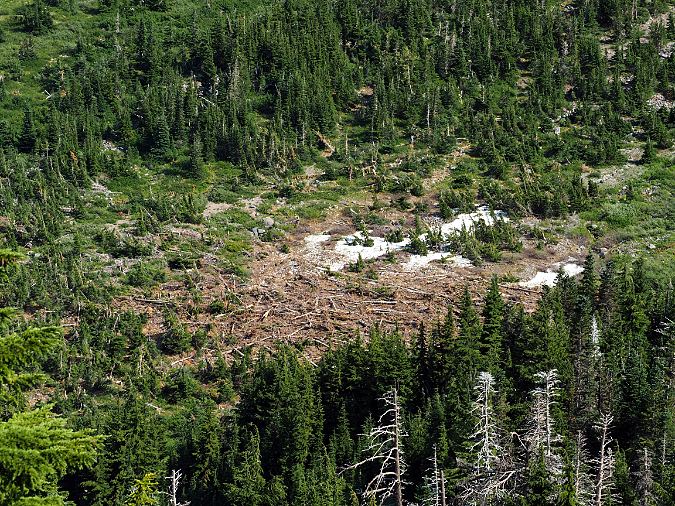
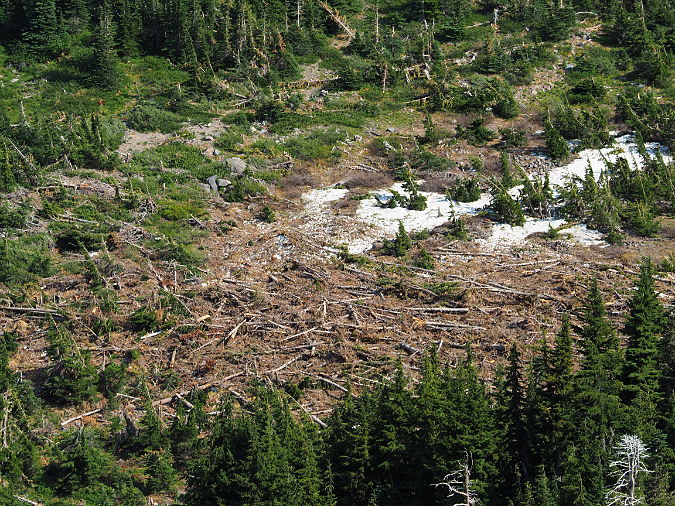
From the ground, the debris field left where the avalanche came to rest is striking. This series of views looking down from 99 Ridge (which forms the west wall of Elk Cove) show where the avalanche stopped, and the debris it left behind:

Mount Hood and the 2021 Elk Cove avalanche site

Closer view of Elk Cove and the avalanche debris field

More detailed view of the avalanche debris field

This detailed view from above gives a sense of scale to the hundreds of trees that were caught up in the avalanche and swept into Elk Cove

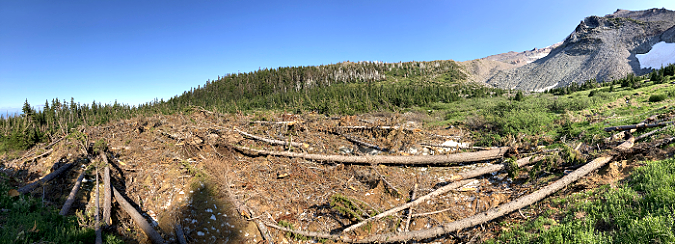
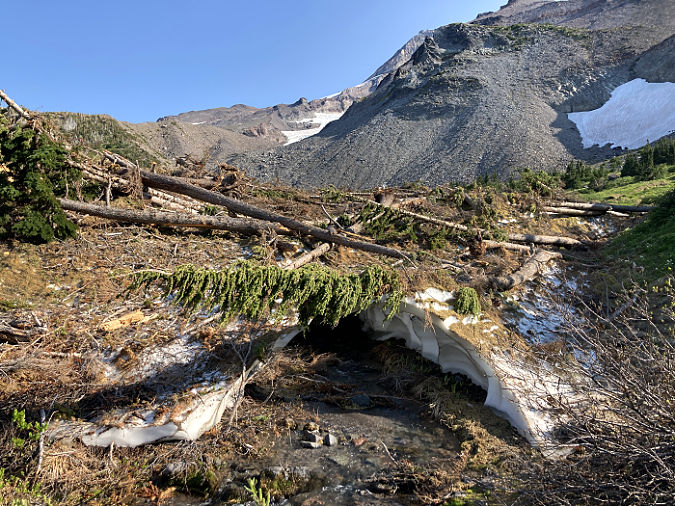
The debris comes into view where the Timberline Trail curves into the west meadow of Elk Cove, along beautiful Cove Creek. Most hikers were likely too busy looking at the wildflowers along the trail this summer to notice the pile of logs just around the bend, but for regular visitors, the avalanche debris was startling!

Elk Cove avalanche and Cove Creek from the Timberline Trail

The origin of the avalanche can be read from the orientation of the many trees caught up in the wave of snow and ice, as they generally point in the direction of the flow. The schematic below shows the path the avalanche took into Elk Cove before the snow and debris finally came to a stop last winter:

[click here for a larger version of this schematic]

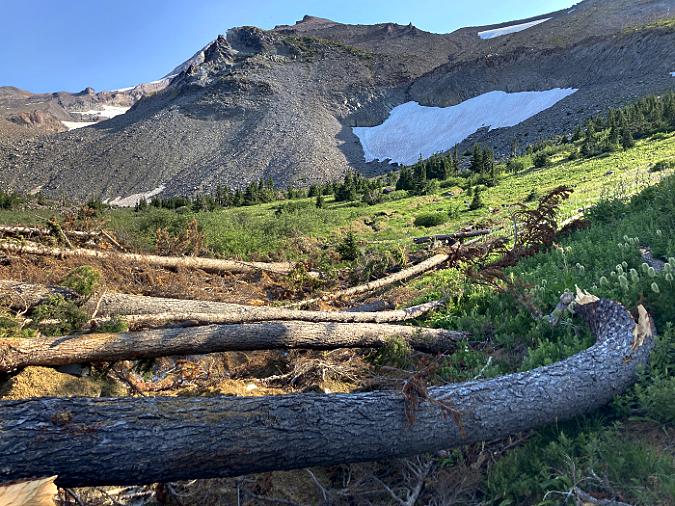
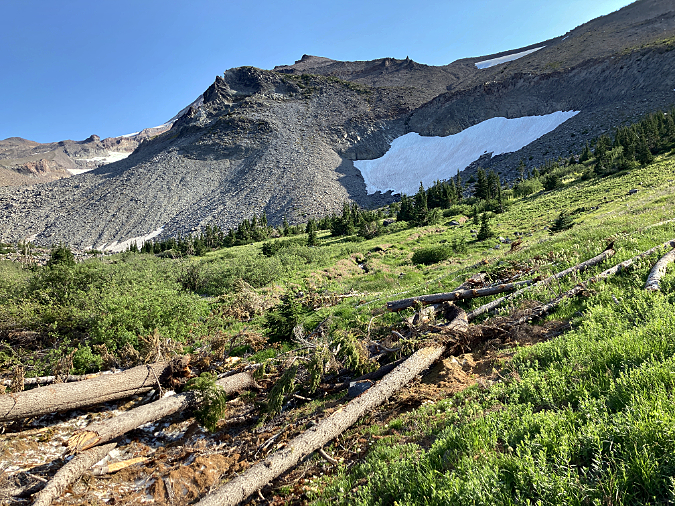
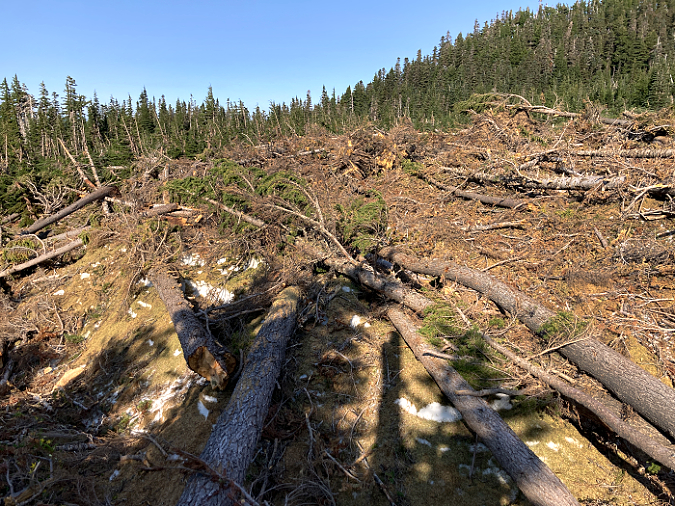
Up close, the awesome power of the avalanche becomes apparent. Whole trees were snapped off and stacked like cordwood in a debris pile as much as 20-foot deep.

The avalanche swept down from the slopes of Barrett Spur (to the right in this view), as indicated by the felled trees pointing to the left, in the direction of the flow

In a typical winter, Elk Cove might have 15-20 feet of snow on the ground, and this snowpack is why small trees on steep mountain slopes are often spared from avalanches, since they are buried under heavy snow in winter. In the view below, the winter snowpack also protected the lush wildflower gardens that line the upper reaches of Cove Creek (seen in the distance), with the avalanche sweeping across these gentle slopes before finally settling on the floor of the cove.

The beautiful wildflower meadows in the upper reaches of Cove Creek were spared from the debris thanks to being on gently sloped terrain and under a blanket of winter snow when the avalanche swept through

Large trees aren’t so fortunate. If they’ve managed to escape avalanches along the base of Barrett Spur long enough to grow taller than the winter snowpack, it’s only luck. In time, most of the taller trees in Elk Cove will be swept away by future avalanches. 

This panoramic view of the 2021 avalanche gives a sense of the scale of the event, with the sprawling pile of debris covering roughly 2-3 acres:

Panoramic view of the 2021 Elk Cove avalanche

[click here for a larger version of the panorama]

By early August, when these photos were taken, it would be easy to think the avalanche was just a pile of trees roaring down the mountain, but in fact, this debris is what’s left now that most of the snow and ice has melted away. Look closely, and you can see that a layer of snow and ice has yet to melt away from under the pile when this photo was taken:

6-10 feet of snow still remains under the debris pile as of early August

The 2021 avalanche dumped part of its debris on top of Cove Creek, but the stream made quick work of the pile over the winter. By summer, it had already melted an extensive tunnel under the mountain of snow, ice and debris (below).

Cove Creek carved this snow cave under the debris pile following the avalanche

The huge pile of snow left in Elk Cove by the avalanche brought another surprise: some of the earliest blooming wildflowers were still just emerging in early August, thanks to the extra snow depth left behind by the avalanche. Among these was Western Pasque Flower, a species of Anemone that blooms within a couple weeks of snowmelt, and therefore rarely see by hikers. In fact, most know this beautiful wildflower by its whimsical seed heads, and by the name “Old Man of the Mountain”. The opening image in this article shows a field of Western Pasque Flower gone to seed.

Normally an early bloomer, this Western Pasque Flower was in bloom in early August, thanks to the late-melting margins of the avalanche debris field

How often to avalanches like this occur at Elk Cove? Probably every winter, though events large enough to topple trees seem to occur every 10 years or so, depending on snowpack and weather conditions. Avalanches are most common in mid-winter, when weak snow layers and heavy snowfalls can cause snow to begin to slide on steep mountain slopes. Once they begin, avalanches can travel nearly 60 miles per hour, giving them the destructive force to level forests and buildings in their path.

Ghosts Hiding in Plain Sight

While the 2021 avalanche at Elk Cove is impressive, it is by no means unusual. A look at aerial photos between 2010 and 2021 shows that another avalanche swept through the same area in about 2015. Based on the orientation of downed trees from his earlier event, it originated on some of the same slopes on Barrett Spur that produced the last winter’s avalanche.

In the air photo comparison, below, the location of the new, 2021 avalanche debris pile is marked in yellow. When the 2010 air photo was taken, the forests at the center of the image were intact, but by the summer of 2016, an avalanche had clearly swept through the area. Based on the lack of reddish/orange debris in the 2016 image – the color of recently killed trees – suggests that this avalanche occurred at least a year earlier. So, for the purpose of this article, I’ve described it as the “2015 Avalanche”, and marked its extend in green.

Air photos show the signs of a roughly 2015 avalanche that swept through the same part of Elk Cove as the 2021 event

In both the 2016 and 2018 views, the path of this earlier avalanche is clearly marked by downed trees that point in the direction (right to left) of the moving snow and ice. Though it impacted a larger area in the cove than the 2021 avalanche, the 2015 event brought less woody debris into the cove, suggesting that it originated on a less forested part of the west wall of Elk Cove. In fact, some of the trees in its path on the floor of the cove survived the avalanche, suggesting that the lack of woody debris in the 2015 event made it somewhat less destructive where it finally came to a stop.

While both of these avalanches are awesome reminders of the power of the elements in alpine country, Elk Cove has a few ghosts from the past that suggest much more fearsome events. Tucked into one of the mature, forested “tree islands” at Elk Cove is a ghost tree that give mute testimony to just how powerful an avalanche on Mount Hood can be. The stump of this ghost tree (below) is nearly four feet in diameter and was toppled many decades ago. 

This giant ghost tree at Elk Cove was toppled long ago by a very large avalanche

This old ghost was once a very large Mountain Hemlock before it was toppled. Today, its broken remains could easily be 100 years old, marking an avalanche that might have preceded the arrival of the Timberline Trail and those 1930s CCC crews on Mount Hood. 

How do we know this old tree was destroyed by an avalanche? The telltale sign is where the tree was snapped off, marking the level of the winter snowpack when the avalanche swept through, and its top is pointed downslope, in the direction the avalanche was moving. Thanks to long, cold winters and dry summers, the shattered remains of this old tree (and several others like it in the cove) have survived to tell the story. 

Since that big avalanche, several good-sized trees have grown up around the old ghost tree, helping put an approximate date of 70-100 years since any avalanche of this scale has swept through the heart of Elk Cove. And though it has been many decades since that event, the days of these younger trees are surely numbered, too, as another epic avalanche in Elk Cove is inevitable.

How to Visit

If you’re an able-bodied hiker, you can visit Elk Cove most easily from the Vista Ridge trailhead. It’s a 9-mile hike round trip, but with well-graded trails and no glacial streams to navigate. If you visit the avalanche debris field, please tread lightly, as the rustic path that once led to the upper reaches of Cove Creek was partly buried with debris, and the surrounding area is covered with a fragile meadow of Western Pasque Flower.

You can find a trail description here in the Oregon Hikers Field Guide. Why, you might even know the author of this field guide entry..!

Tom Kloster | August 2021

2019 Campaign Calendar!

00CoverWhaleCreek

Calendar cover for 2019 featuring Whale Creek

[Click here for a large image]

‘Tis the season for top ten lists and year-end retrospectives, so in that spirit my annual Mount Hood National Park Campaign Calendar is pretty good snapshot of 12 favorite spots of mine across WyEast country this year. Since 2004, I’ve created an annual calendar dedicated to the campaign, each with a fresh set of photos. If you’d like a 2019 calendar, there’s info at the bottom of the article and ALL proceeds will once again go to Trailkeepers of Oregon (TKO).

________________

The annual campaign calendar has been a great motivator for exploring new terrain and improving my photography skills over the years. Each year the calendar project also renews my conviction that Mount Hood and the Gorge are uniquely special places, and deserve better care.

This article is a short tour of the 12 spots that made it into the 2019 calendar, with a few stories behind the photos and reflection on these increasingly fragile landscapes.

Starting with the cover image (at the top of the article), the calendar begins at lovely Whale Creek, a tributary of the Clackamas River that is also featured in the March image, so more about that spot in a moment.

Next up, the January image (below) captures the awesome west face of Mount Hood, where the Sandy Headwall towers 3,000 feet above the Sandy Glacier. This snowy view was captured from near Lolo Pass last winter.

01aLoloPassEastHood

January features the awesome Sandy Headwall

[Click here for a large image]

Not included in the close-up view are the bare slopes of Barrett Spur (below) and other alpine ramparts of Mount Hood that still didn’t have their winter snowpack in early February, when these photos were taken. While it’s not uncommon to have a late snowpack in the Cascades, these events are becoming more common as global warming unfolds in our own backyard.

01bLoloPassEastBarrettSpur

Low snow on Barrett Spur in February tells the story of our changing climate

For February, I chose a close-up perspective of the ice “pillows” that form at the base of Tamanawas Falls (below) in winter. This has become a very popular winter destination in recent years, thanks in large part to social media! (…ahem…)

02aTamanawasFallsDetail

February features Tamanawas Falls

[Click here for a large image]

Tamanawas is Chinook jargon for “guiding spirit”, and is one version among a couple variations in spelling. More challenging is the pronunciation, and with the advent of social media, all manner of spoken variations are being used. For some reason, an especially popular spoken version that doesn’t even correlate to the actual spelling is “tah-ma-WAHN-us”.

It turns out the most accepted pronunciation is “ta-MAH-na-wahs”. I’ve been saying a slight variation of “ta-MAN-a-wahs” for most of my life, so I’ll need to work on that!

02bTamanawasFalls

Cold Spring Creek and Tamanawas Falls in winter

As mentioned earlier, the March calendar image is from Whale Creek (below), located in the heart of the Clackamas River canyon. The creek is hidden in plain sight, flowing through the Indian Henry Campground and next to the east trailhead of the Clackamas River Trail. This area features some of the finest rainforest in WyEast country.

03aWhaleCreekBigCedars

March features a rainforest scene along Whale Creek

[Click here for a large image]

Whale Creek was just one of many places in the Clackamas and Molalla River watersheds that I found myself exploring this year while much of the Oregon portion of the Columbia River Gorge was closed by the Eagle Creek fire. I visited the lower reaches of Whale Creek after seeing stunning photos of a string of waterfalls on the upper reaches of the creek, and quickly fell in love with this pretty stream. Watch for a future article on a trail concept I’ve been working on for Whale Creek with TKO and some area waterfall explorers.

03bWhaleCreekScene

Whale Creek in the Clackamas River canyon

Sadly, the Clackamas River corridor has a bad reputation, thanks to a history of lawless behavior (the recent Pit Fire was started by illegal target shooting, for example) and a long history of Forest Service management that viewed the area more like a tree farm than a forest — and the two go hand in hand, by the way.

Yet, hidden in the now-recovering rainforests of the Clackamas are dozens of spectacular waterfalls, towering basalt walls and rugged vistas that rival the Columbia River Gorge in beauty. There are also a lot of big trees that somehow dodged the logging heyday of past decades.

03cWhaleCreekSnow

Whale Creek in winter

The Clackamas River corridor holds great promise for future recreation alternative to places like the Gorge, and the proven cure for lawless behavior is lawful recreation. I’m optimistic that we’ll make that transition here, and begin valuing places like Whale Creek for the intrinsic value of its forests, not just the saw logs it can produce.

04aWhiteRiverFalls

April features White River Falls State Park

[Click here for a large image]

For the April calendar image, I selected a photo of White River Falls, both for the contrast in WyEast country ecosystems it displays and because this little state park could use some love and expanded boundaries. I posted an article with just such a proposal a few years ago, you can find it over here.

04bWhiteRiverUpperFalls

White River Falls with unprotected desert country beyond

The May calendar image features a sweeping view of the Upper Hood River Valley (below) from little known, seldom-noticed Middle Mountain. Its name tells the story, as forested Middle Mountain divides the upper and lower portions of the Hood River Valley. I learned of this spot about ten years ago from a local photographer and have gone back pretty much every year since.

05aMiddleMountainHood

May features the Upper Hood River Valley as viewed from Middle Mountain

[Click here for a large image]

Zooming in a bit to this idyllic landscape reveals a seemingly timeless farm scene that is easy to take for granted. And yet, these farms were at great peril just a few years ago, when voters passed the deceptive Measure 37 in 2004. The law was pitched as a way for landowners to “seek compensation” for land use regulation, but in truth was just another end-run around Oregon’s protections for farm and forestlands.

Voters later passed Measure 49, in 2007, blunting the impact of the earlier measure, but only after hundreds of urban-scale developments were approved in rural areas across Oregon (including a pair of giant, illuminated billboards along the Mount Hood Highway that still remain today). It was a reminder that while our farms may look timeless, we can never take them for granted. They will always need our support and protection if we want places like this to exist for future generations.

05bUpperValleyFarmDetail

Timeless farm scene below Middle Mountain

Much of Middle Mountain is owned by the public, where county-owned forest lands continue to be (mis)managed as a cash register by Hood River County (the county likes to refer to these land as their “tree farm”). Local residents no doubt enjoy their modest tax rates, as a result, but I’m hoping the rapidly changing demographics in Hood River will bring a different mindset to how the thousands of acres of county forests that ring the Hood River Valley are managed.

05cMiddleMountainLogTruckSign

Logging is still king on Middle Mountain…

One immediate concern on Middle Mountain is the manner of logging. Large clear cuts, like those scarring the slopes of Middle Mountain, are an unsustainable practice, with proven harmful impacts to forest health, water quality and salmon and steelhead populations. Clear cuts are also the cheapest, easiest way to bring haul logs out of the forest. That bottom line might be unavoidable for private forests, but as a public agency, Hood River County should at least adopt a selective harvest policy that leaves standing trees in logged areas.

05dMiddleMountainLogTruck

…keeping Hood River County coffers full…

The county should also reject the reckless use of herbicides sprayed on logged over lands. This is a practice the private industry uses to shortcut the natural forest recovery and speed up the next harvest. The idea is to destroy the recovering forest understory in a logged area so that plantation seedlings might grow a little faster.

05eMiddleMountainTimberSaleBoundary

The forest on the left is next to go…

I’m not certain the county uses this practice on public lands, but it seems to be the case. Consider this notice posted a few days ago on their website:

“Recreation trails are sometimes temporarily closed during additional forest management operations. Operations such as the burning of slash, herbicide application, and the planting of seedlings, will necessitate trail closures. Trails are re-opened once operations are complete.”

This certainly sounds like the private industry practice…

05fMiddleMountainTimberSaleBoundarySign

…might as well add “for now” to the last line on this boundary marker, unfortunately.

Of course, the county could show real leadership and simply ban this practice on private lands in Hood River County, as well. That is, if water quality, wildlife, salmon and steelhead habitat, long-term forest health and tourism are a county priority over the fastest route to clear cutting more logs. My sense is that voters in Hood River County are increasingly focused on these broader concerns, even if the county leadership isn’t there yet.

06aShotgunFallsPortrait

June features Shotgun Falls in the Molalla River canyon

[Click here for a large image]

For the June calendar image, I selected another lesser-known spot, graceful Shotgun Falls (above) in the Molalla River canyon. This pretty, off-trail waterfall has been on my list for some time, and the Gorge closure inspired me to finally make this trip last spring for a much-needed waterfall fix.

06bShotgunFallsBase

Shotgun Falls

Shotgun Falls is a classic “Oregon” waterfall, cascading over a tall, mossy basalt cliff. The falls is a short creek walk from the Molalla River Road, but protected by a 20-foot barrier falls just downstream that requires a slippery scramble to navigate. It’s an increasingly popular off-trail trip, and the streambed is starting to show the wear and tear, making this a great candidate for a proper trail that families with young kids and hikers looking for an easy waterfall trip could enjoy. More to come on this idea..!

06cShotgunFallsSlopeDamage

Time for a real trail, here…

Sometimes a random moment burns a place and time in the forest into your memory. One such moment occurred on my trip to Shotgun Falls when my pack suddenly tipped while shooting photos from high above the falls. To my horror, it went bounding into the canyon, finally stopping just short of Shotgun Creek, about 60 feet below. Thankfully, my camera gear was safely zipped inside and I didn’t even end up with a soggy pack — the difference between a fond memory and forgettable one!

06dShotgunFallsTomsDroppedPack

Takes a licking, keeps on zipping!

The July calendar image features a picture-perfect wildflower scene along Cove Creek (below), located at the base of Barrett Spur in Elk Cove. This idyllic spot is kept open by a deep, lingering snowpack in spring and regular winter avalanches that shear off trees, allowing the alpine meadows to thrive.

07aCoveCreakBarrettSpur

July features Cove Creek and Barrett Spur

[Click here for a large image]

Looking downstream along Cove Creek (below), 99 Ridge can be seen in the distance, covered with ghost trees killed by the 2012 Dollar Lake Fire. The fire reached the margins of Elk Cove, but passed over most of the forests here.

07boveCreekAdams99Ridge

The Dollar Lake Burn swept over 99 Ridge, in the background in this view of Cove Creek

On this trip to Elk Cove, I met a pair of hikers carrying their exhausted pup down the trail. When I chatted briefly with them, I was reminded that hikers are really nice people: they didn’t even know each other. The man carrying the dog had run into the woman as she struggled to carry her dog back to the trailhead. He offered to carry the poor pup the rest of the way!

07cVistaRidgeHikersCarryingDog

Hikers are nice people! (…see text…)

For the August calendar image, I selected a familiar view of Mount Hood from high on the shoulder of Cooper Spur (below). The Eliot Glacier dominates the view here, even as it recedes from global warming. As the glacier recedes, the exposed canyon floor once covered by ice has rapidly eroded, which in turn has  begun to destabilize the moraines that flank the canyon.

08aHoodEliotGlacierPortrait

August features the mighty Eliot Glacier

[Click here for a large image]

I experienced the hazards of the destabilized moraines firsthand when I stopped along the South Eliot Moraine that day and set my pack on a 4-foot long boulder that seemed to be the perfect trailside bench. Before I could park myself on the “bench”, it suddenly gave way, careening end-over-end into the Eliot Branch canyon, kicking off dozens of other rocks and an impressive dust storm along the way!

08bEliotMoraineDustCloud

The south Eliot Moraine continues to crumble…

Thankfully, there were no hikers below — and I was also relieved that I’d snapped up my pack before the boulder disappeared over the edge! Clearly, my pack has nine lives… though I’m not sure how many remain…

08cEliotMoraineBoulderRollEliotBranch

Seeing the boulder finally land among the jumbled rocks 300 feet below was powerful reminder of the scale of this place, as the 4-foot “bench” rock was dwarfed by dozens of larger boulders scattered below the moraine.

08dEliotMoraineBoulderRoll

A 4-foot boulder becomes a pebble among the debris rolling into the Eliot Branch canyon

The September calendar image captures fall colors along Still Creek, on Mount Hood’s southwest side. This photo was taken on a visit to a recent Forest Service project designed to restore salmon and steelhead habitat on Still Creek.

09aAutumnForestStillCreek

September features a grove of Red Alder along Still Creek wrapped in brilliant Vine Maple foliage

[Click here for a large image]

The project site was a badly overused “dispersed” campsite that had become an eyesore over the years. To rehabilitate the site, the Forest Service excavated a large trench to block vehicle access to the streamside campsite, reinforced the barrier with a row of boulders. So far, these barriers seems to be working, as there were no signs of continued camping or off-road vehicle use in the area.

09bStillCreekRestoration

Forest Service stream restoration work on Still Creek

At the heart of the restoration project, several very large logs with root wads attached (below) were hauled into the stream to create the natural “woody debris” habitat that our native salmon and steelhead rely upon. The logs and roots create deep pools and places for small fish to hide from predation as they mature to adulthood.

09cStillCreekRestoration

Bringing back logs and root wads that create prime fish habitat

There’s something primeval about uprooted trees lying across the creek. This is what most of our streams looked like before the settlement era, when forests were logged, streams were tamed and few big trees were left to become “woody debris”. The panorama below shows the full extend of this Forest Service restoration project.

09dStillCreekRestoration

Panoramic view of the restoration site

[Click here for a large image]

On a select few days each fall, the first high elevation snow of the season is followed by a few days of bright, clear weather — and with any luck, all of this coincides with fall colors. Such was the case in the calendar image I selected for October (below), with Mount Hood framed by flaming Vine Maple, as viewed from the Lolo Pass area.

10aHoodLoloPassRoadFallMaples

October features an early snow on Mount Hood, framed by Vine Maples

[Click here for a large image]

Whenever I shoot this scene, an image of a scalloped-edge vintage postcard is in my mind. Thanks to many postcards from the 1940s, 50s and 60s that captured this side of the mountain in autumn, the scene is iconic. This card (below) from the 1950s is typical of the era, and was captured just around the corner from where I shot the 2019 calendar image.

10bLoloPassPostcard

Timeless inspiration, with fancy scalloped edges!

For the November calendar image, I selected a rainforest scene from along the Molalla River (below), where bare winter trees reveal the contorted, mossy limbs of Bigleaf and Vine Maple.

11aMolallaRiverRainforestMossyGlen

November features a pristine rainforest scene along the Molalla River

[Click here for a large image]

While the above certainly scene looks pristine, it’s really not. One of my favorite photographic themes is to capture “pristine” scenery in places that are not — but could be, if managed with an eye toward restoration. Such was the case with the previous photo from Lolo Pass, where transmission towers were literally buzzing overhead, and with the Molalla River, where a road culvert dumped the little stream in the photo from a 4-foot galvanized pipe.

11bMolallaRiverMile8CreekCulvert

…which turns out to not be all that pristine..!

Beauty can be found everywhere, and the path to restoration in even the most impacted areas in WyEast country begins when we see places not just for what they once were, but for what they could be, again.

The December calendar image is a freezing fog scene from the east slopes of Mount Defiance (below). This stunning phenomenon occurs a few times each winter when temperature inversions blanket the eastern Columbia River Gorge with dense fog and frigid temperatures. The effect is magical, though traveling the roads in these conditions can be treacherous!

12aBinnsHillFrostForest

December features a crystal wonderland from freezing fog on the slopes of Mount Defiance

[Click here for a large image]

The frosting of ice coating the forest in these scenes is called “soft rime”, and is made up of feathery, fragile crystals that can be brushed off like a fine powder. Soft rime forms when super-cooled vapor in fog accumulates directly on tree surfaces in delicate, elaborate crystals. Hard rime is defined as ice forming from freezing fog that first condenses to water droplets, then freezes on surfaces, creating a clear, hardened ice layer.

12bKingsleyFrostForest

Freezing fog on Mount Defiance

Soft rime accumulations can be quite impressive in the Gorge, depending on how long the fog event lasts. These scenes were captured after five days of freezing fog and represent about the maximum amount of ice that can accumulate before crystals break off under their own weight.

12cKingsleyFrostForest

Freezing fog on Mount Defiance

This photo (below) is a close-up of soft rime accumulations on a Golden Chinkapin growing on the slopes of Mount Defiance. These crystals as much as three inches long.

12dFrostedChinkapin

Soft rime ice crystals

The scene below shows an odd transition from bare road (and car) to frosted forest that looks like a photoshop creation. In this spot the rime had coated the trees and understory, but not the gravel road in the foreground, creating the strange two-tone scene. This photo is also a bit of a farewell, as my venerable trail car of the past many years years is featured. This old friend was retired to quiet a life in the city just a few months after this photo was taken, at the ripe old age of 13 years and 212,000 miles!

12eKingsleyFrostForestToyota

Farewell to an old friend…

The back page of the 2019 calendar features nine wildflower images from the past year. If you’ve followed articles on the blog, you’ll recognize a several photos featured in stories on Horkelia Meadow and Punchbowl Falls.

From top left and reading across, these flowers are Hackelia micrantha (Horkelia Meadow), Chocolate Lily (Punchbowl Falls Park), Oregon Iris (Shellburg Falls), Buckwheat (Horkelia Meadow), Calypso Orchid (Punchbowl Falls Park), Oregon Grape (Molalla River), Horkelia fusca (Horkelia Meadow), Collomia grandiflora (Clackamas River) and Skyrocket Gilia (Horkelia Meadow).

13BackCover2019

A year in wildflowers!

[Click here for a large image]

So, that’s it for the 2019 campaign calendar! I’ve already started colleting images for next year’s calendar and I’m looking forward to yet another year of exploring all corners of America’s next national park. Maybe I’ll even see you out on the trail!

14ShotgunFallsTom

Old goat that wandered up a creek…

In the meantime, you can order the 2019 calendar over at Zazzle. They’re beautifully printed, oversized designs with functional writing space — they’re working calendars and make great gifts! The calendars sell for $29.95, but Zazzle regularly offers deep discounts, so it’s worth watching for sales. This year, all proceeds from calendars will go to Trailkeepers of Oregon (TKO).

You can order a 2019 campaign calendar here

Thanks for reading this far, and I hope you’re able to get out and explore Mount Hood and the Gorge over the holidays!

_______________

Tom Kloster  •  December 2019

2018 Mount Hood National Park Calendar!

00aCoverHoodLoloPassEvening

Mount Hood’s imposing west face is featured on the cover

[click here for a large image]

Each year since the Mount Hood National Park Campaign began in 2004, I’ve published a wall calendar to celebrate the many reasons why Mount Hood and the Columbia River Gorge should be our next national park. You can pick up this year’s calendar here:

2018 Mount Hood National Park Campaign Calendar

The monthly layout remains the same as last year, with a classic “grid” design that serves nicely as a working calendar for kitchens or offices. The finished calendar hangs 14 inches wide by 22 inches tall, with a white wire binding, and the print quality of the photos is excellent!

00bSamplePage

In the past I’ve used calendar sales help cover some of the modest costs of keeping the campaign website and WyEast blog up and running, but beginning this year I will shift to sending all proceeds to Trailkeepers of Oregon, and in turn, TKO’s coming efforts to help recover our Columbia River Gorge trails from the impacts of the 2017 Eagle Creek Fire.

The great thing about putting these calendars together is that it ensures I continue exploring new places in the gorge and on the mountain, as each calendar consists exclusively of photos I’ve taken over the previous year. In this year’s calendar article, I’ll provide some of the stories behind the photos in the new Mount Hood National Park Campaign Calendar — sort of a visual year-in-review!

The WyEast Year in Images

The following is a rundown of the 12 images inside the calendar by month, with a link to a large version of each image, too (you can see them by clicking the link beneath each preview image).

The 2018 calendar begins with the cover image (at the top of the article), featuring the steep Sandy Headwall on Mount Hood’s imposing west face. This is the view Portlanders have of their mountain from afar, but a close-up look from along the Timberline Trail reveals the crevassed Sandy and Reid glaciers tumbling down the slopes and the deep Muddy Fork canyon, almost directly below. This is Mount Hood’s “tallest” side, with a vertical rise of more than 7,000 feet from the Muddy Fork valley floor to the 11,250-foot summit.

The January image in the new calendar features a chilly Cold Spring Creek on Mount Hood’s east slope:

01aColdSpringCreekScene

Cold Spring Creek in Winter

[click here for a large image]

Only a few years ago, the snowshoe hike along Cold Spring Creek to Tamanawas Falls was completely off the radar for most, but in recent years its popularity has soared, and the trailhead is now packed on winter weekends.

One twist this year was a Forest Service noticed tacked up at the trailhead:

01bColdSpringCreekScene

Hmm…

As it turned out, what apparently was a difficult rock fall to negotiate over the summer was much easier to travel with a couple feet of snow covering the debris. The rocks fell in a section of canyon just below the falls that experienced an enormous cliff collapse in the early 2000s, and continues to be active.

For February, I selected a photo from a near-perfect winter day in the upper White River Canyon, along the popular Boy Scout Ridge snowshoe route:

02aWhiteRiverCanyon

Upper White River Canyon

[click here for a large image]

The day began with clear blue skies, which is glorious, of course, but not so great for photography. After reaching a favorite viewpoint in the upper canyon, though, bands of clouds began floating in, making for some memorable scenes of a cloud-framed mountain. The photo below was taken on the way out that day, as evening shadows began to stretch across the lower canyon.

02bWhiteRiverCanyon

White River and Mount Hood

[click here for a large image]

As covered in previous articles, fire in the Columbia River Gorge is as much a part of the ecology as the trees, themselves. But if you had told me the extent of the Eagle Creek Fire last spring, I wouldn’t have believed you.

For hikers, it’s almost like the Eagle Creek Fire was connecting dots among favorite Columbia River Gorge beauty spots, with only a few of the iconic waterfalls that make the Oregon side of the Gorge famous escaping the flames. So, even knowing and accepting that fire is a necessary and beneficial part of the ecosystem still doesn’t blunt the harsh reality that this fire felt personal. And it’s going to take awhile to heal.

As the fire raged west toward Portland last September, my immediate thought was Tanner Creek, the next drainage to the west of Eagle Creek and directly in the path of the inferno. If I had to pick a spot that embodies almost everything that defines the Columbia River Gorge, Tanner Creek’s lower canyon is it, culminating with spectacular Wahclella Falls.

This canyon is as fine a temple as nature can create, and it’s a sanctuary I visit many times each year. This is my most treasured place in the Gorge… and now I wondered “Would it burn?”

03aWahclellaFallsWide

Wahclella Falls on Tanner Creek

[click here for a large image]

03bWahclellaFallsWide

Waterfall enthusiasts visiting the altar at Wahclella Falls last spring

I didn’t know the answer to that question until a week or two ago, when I came upon some aerial photos of the Gorge taken sometime this fall. My scientific acceptance — embrace, in fact — of fire in our forests aside, I was selfishly relieved to see that the deep gorge surrounding Wahclella Falls had somehow been missed by the fire. Or had simply resisted it.

This photo shows Wahclella Falls and its iconic grove of Western Red Cedar mostly intact, though much of the surrounding Tanner Creek canyon was severely burned:

03cWahclellaFallsWide

Wahclella Falls after the fire

Wahclella Falls is at the bottom of the photo, and Tanner Creek’s lesser-known upper gorge and the string of waterfalls that continue above Wahclella Falls can also be seen in this view. This is a place where I hope to see a trail, someday. Maybe in the destruction of the forest we’ll see new trails to places like this, where we take in new sights while also watching our Gorge recover?

For the March image, I selected another Gorge waterfall. This is the last in a string of waterfalls on Moffett Creek, located immediately to the west of Tanner, Creek. This falls is generally known as Moffett Creek Falls or simply Moffett Falls:

04aMoffettFalls

Moffett Falls

 [click here for a large image]

This waterfall is off-trail, and requires walking a mile or so up the streambed of Moffett Creek to reach it. I first visited this falls in the early 1980s, and have returned several times over the years. Sometime in the late 1980s or early 1990s, a massive rock fall occurred here, and completely changed the landscape below the falls and the canyon slopes to the west.

Before the fire, the scene was already one of recovering forests, with young groves of Red Alder flanking the falls and lining the rearranged creek for 100 yards downstream. The Eagle Creek fire was just the most recent calamity to sweep through this spot, and such is the dynamic, often cataclysmic nature of the Columbia River Gorge.

04bMoffettFalls

Snowdrifts on Moffett Creek in mid-April!

Our trip last April was complicated by an extremely late snowpack, following a very wet and snowy winter in the Gorge. The canyon, itself, was a tangle of downfall from the harsh winter, making it a rough trip compared to previous years.

How did the fire affect Moffett Falls? Much more significantly than Wahclella Falls, on nearby Tanner Creek. Like Tanner Creek, Moffett Creek is located just west of Eagle Creek and was in the direct path of the fire during its most explosive, early phase. As this aerial photo taken sometime this fall shows, the entire forest around Moffett Falls appears to have been killed by the flames:

04cMoffettFalls

Someday, I hope to see a trail to Moffett Creek’s waterfalls, too. Who knows, maybe the changes wrought by the fire will allow the Forest Service to consider that possibility? It turns out this idea isn’t new, at all. In fact, it was proposed in January 1916, when the brand new (now historic) Columbia River Highway was about to open:

04dMoffettFalls

Excerpt from The Oregonian (January 30, 1916)

04eMoffettFalls

Map excerpt from The Oregonian showing the proposed Moffett Creek Trail (January 30, 1916)

More about that trail concept, and the need for a long-term trail plan for the Gorge in a future article…!

Did you know that today’s Silver Creek State Park has been proposed to become a national monument or park at least a couple of times in the past? It makes sense, given the spectacular concentration of waterfalls within this beautiful preserve, and especially with the legacy of trails and lodges left by the Civilian Conservation Corps (CCC) during their 1930s heyday. Many believe it to be a national park or monument today!

With this in mind, I selected a scene from a May visit to Silver Creek’s North Fork as a reminder that there are more than simply the show-stopper waterfalls to this amazing place:

05aSilverCreekBoulderScene

North Fork Silver Creek

[click here for a large image]

While our current regime in Washington D.C. is more focused on tearing away protections from our public in order to sell our resources off to corporate interests at bargain prices, it’s also true that the exploitation/conservation pendulum in our country swings both ways.

In some ways, the outrageous anti-environment, anti-science and anti-public lands extremism we’re seeing with the Trump administration has already kicked off a counter-movement. It can’t come soon enough, and hopefully you’ve joined in the opposition, too.

05bSilverCreekBoulderScene

Misty Silver Creek Forest

Someday, when the pendulum does swing, Silver Creek would make an excellent unit of a future Mount Hood National Park. Why? Because the current park contains just a small slice of Silver Creek’s larger ecosystem, and today’s beautiful scenes of waterfalls and mossy glades are increasingly threatened by upstream development and industrial-scale logging. Watch for a future article on this topic, too!

While on the subject of threatened places, the June image in the 2018 calendar captures another such spot on the other side of Mount Hood: Bald Butte, located along the east wall of the Hood River Valley:

06aBaldButteSouthSlopeHood

Mount Hood in late May from Bald Butte’s sprawling meadows

[click here for a large image]

This lovely butte rises directly above the Hood River Ranger Station, so close that Forest Service workers can enjoy the expansive wildflower spectacle from their offices, about a mile-and-a-half away as the crow flies, and some 2,200 vertical feet below.

You’d think being at the Forest Service’s front door would give pause to those who view our public lands as their personal playground to destroy. But Hood River County has a lot of off-highway vehicle (OHV) enthusiasts, and some in that community make a point of illegally driving their jeeps, quads and dirt bikes up the fragile slopes of Bald Butte — despite prominent signage prohibiting their use and periodic efforts to block them.

This is an ongoing battle with rogues that will someday be won, but it will take the OHV community policing itself to make the change happen. There will never be enough Forest Service crews to fill that void.

06bBaldButteSouthSlopeHood

Growing OHV damage to Bald Butte

How bad it is? Well, the old lookout track that serves as the hikers trail to the summit has become deeply rutted by illegal jeep and motorcycle users, which in turn, has inspired them to form parallel tracks on the open wildflower slopes (above). It will take decades for the damage to recover, even if the law breakers were stopped today.

Meanwhile, dirt bikers have hauled in chainsaws in order to carve new trails through the forests on the east slopes of Bald Butte. It’s not a pretty picture, and so far, nobody in the OHV community seems to be stepping up to confront the lawlessness.

06cBaldButteSouthSlopeHood

Dirt bike tracks don’t lie…

The Forest Service has indicated an interest to work with trail organizations (like TKO) to step up the efforts to keep OHV vandals out of Bald Butte, but in the meantime, they’re doing a lot of damage — which, in turn, is a black eye for anyone who enjoys using OHVs responsibly. Let’s hope they will join in the effort to protect Bald Butte, too.

For more about Bald Butte, and comparison photos that show the rapid progression of the OHV damage there, please see this earlier article on the blog – you can read it here.

For the July calendar image, I picked this 3-part composite of the Muddy Fork and Mount Hood. Look closely and you can see the series of towering waterfalls that drop from the hanging valleys on Yocum Ridge, in upper right. This is one of Mount Hood’s most rugged and untamed spots:

07aMuddyForkPanorama

Mount Hood’s Muddy Fork canyon

[click here for a large image]

Though we had a decent snowpack in the Cascades in 2017, it melted fast when summer arrived, and many trails on Mount Hood’s west slopes were opening by late June. So, when college friends David and Robin, from Colorado, called to say they would be in Portland and wanted to spend a day on the mountain, the hike to the Muddy Fork Crossing was the perfect choice!

07bMuddyForkPanorama

Old friends and The Mountain

It turned out to be a bluebird day, but what I found most interesting as we caught up on our parallel lives was their reaction to being in Pacific Northwest alpine country, again. Though David grew up here, he still marveled at the magnificence of our forests, especially the huge Noble fir groves we passed through, and Robin was especially taken with the amount of water, everywhere!

It was a timely reminder for me to never take our unique ecosystems for granted. Colorado has more big peaks than most any state of the country, but we are unique in our abundance or water and the verdant landscape it brings, from our rainforests, streams and lakes to the glaciers that hang from our peaks.

As we head into the uncertainty of climate change in coming decades, we’ll need to learn to view these seemingly abundant resources as precious and threatened, and no longer something to take for granted.

07cMuddyForkPanorama

Finally!

Another surprise along the hike was a new sign — finally! — marking the well-trod “cut off” that shortcuts the Timberline Trail where Bald Mountain (not to be confused with Bald Butte) meets McGee Ridge. I’m sure there was some official slight-of-hand required for the Forest Service to post this junction, as it is simply a user trail, and thus unsanctioned. But it’s a good call that will help hikers better negotiate the maze of trails in this area.

For August, I selected a photo from a favorite meadow perched along a ridge I call the White River Rim. A fragile island of Whitebark Pine, Mountain Hemlock and Subalpine Fir groves grow here, hemmed in on both sides by deep, perpetually eroding canyons of loose sand and boulder.

08aHoodWhiteRiverRimLowerMeadow

Lupine fields on the White River Rim

[click here for a large image]

To the east of the rim is a maze of deep ravines that make up the White River Canyon. As the White River continues to cut into the loose volcanic slopes, here, whole sections of the ridge-top forests and wildflower meadows perched on the rim slide into the canyon.

The Salmon River is gradually eroding the rim from the west, as well, though less voraciously than the White River. In some spots, the flat ridge top is just a few feet wide, and losing ground fast. This is one of the most dynamic areas on the mountain.

The image below is also from along the rim above the White River, looking south and away from the mountain. This view captures the skeleton of a magnificent Mountain Hemlock and its still-surviving grove companions:

08bHoodWhiteRiverRimLowerMeadow

Sentinel Whitepark Pine on the White River Rim

[click here for a large image]

Mountain Hemlock often growth in tight, circular groves, and I suspect botanists will someday discover that these groves communicate in some way as part of their collective strategy for survival, just as Douglas Fir are now known to communicate. Forest ecologist Suzanne Simard summed it us this way:

“I wondered, could Douglas fir recognize its own kin, like mama grizzly and her cub? So we set about an experiment, and we grew mother trees with kin and stranger’s seedlings. And it turns out they do recognize their kin. 

“Mother trees colonize their kin with bigger mycorrhizal networks. They send them more carbon below ground. They even reduce their own root competition to make elbow room for their kids. When mother trees are injured or dying, they also send messages of wisdom on to the next generation of seedlings.

“So we’ve used isotope tracing to trace carbon moving from an injured mother tree down her trunk into the mycorrhizal network and into her neighboring seedlings, not only carbon but also defense signals. And these two compounds have increased the resistance of those seedlings to future stresses. So trees talk.”

Botanists once viewed a dying or dead tree in a grove like this as one whose biomass had grown too large to support in drought periods, but could another explanation be that the larger tree simply opted to turn over the future of the grove to its younger siblings? We still have so much to learn from our forests…

The September image in the new calendar captures an intersection of three threads of good fortune: an afternoon away form work to visit the mountain, clear weather after an early autumn snowstorm and moonrise over Illumination Saddle, the narrow ridge that connect Illumination Rock to the main summit ridges of Mount Hood.

09aHoodWestFaceMoonrise

Moonrise over Illumination Saddle

[click here for a large image]

Time off from work on a clear autumn day was by design, but the moonrise was pure luck. While there are web tools for figuring out celestial paths from any point on the ground, I do confess that I’m not likely to use them. I simply sat at a favorite spot on the summit of Bald Mountain (not Bald Butte!) for an hour or so, waiting for the sunset, and was suddenly treated to the moon emerging over the saddle as an unexpected surprise!

So, why not use the modern tools? Partly, it just seems like a chore in what should be an enjoyable hobby. But I’d also be turning what was a wonderful surprise into one more thing to worry about — and that’s not why I head into the woods, after all. There’s something to be said for turning over the keys to Mother Nature, right?

And on that point, perhaps the best memory from that cold evening on Bald Mountain last fall was watching the sun set through the trees on the hike back down through the ancient Noble Fir forest.

09bHoodWestFaceMoonrise

Winter sunset in the Noble forest

This grove of 300-year old giants somehow escaped the chainsaws when the Clear Fork valley, below, was logged in the 1960s, 70s and 80s. It remains as a rare reminder of what used to be — and what will be again, if we allow it.

For the October image, fall colors were in order, and with the Gorge trails mostly closed by the Eagle Creek Fire, I headed south to Butte Creek, located just north of Silver Falls State Park in the Santiam State Forest. I picked a serene scene along the creek…

10aButteCreekScene

Butte Creek in autumn

[click here for a large image]

…though this peaceful spot is just 100 yards or so above Butte Creek Falls, which was raging that day, after a series of Pacific fronts had rolled through.

Butte Creek Falls is among my favorites, anywhere, and I’ve included it in past calendars. So, thus the quieter stream scene for 2018, but here’s a look at the high water at the falls that day:

10bButteCreekScene

Butte Creek Falls

[click here for a large image]

Even more than nearby Silver Falls State Park, the Butte Creek canyon (and its twin, Abiqua Creek, just over the ridge) is in desperate need of a better management vision, and would make for an excellent extension of a future Mount Hood National Park. More about that in a future article, as well..!

Though I’ve hiked the short loop trail at Butte Creek many times, the fire in the Gorge had forest ecology and the role of fire in my mind on this visit, and noticed a small army of “legacy trees” throughout the rainforest here.

10cButteCreekScene

The skeletons of Butte Creek’s “legacy trees” are hiding in plain sight

These ancient stumps and snags are from the last big fire to come through the area are called “legacy trees” for the benefits they bring from the old forest to the new. This area likely burned more than a century ago, yet the skeletons of the old forest still serve a crucial role in the health of the new forest.

As they slowly decay, old snags and stumps provide habitat for birds and other wildlife, and once fallen, they become “nurse logs”, upon which new trees grow. They also provide nutrients to the precious mountain soil as they decay — something a log hauled off to become lumber or cardboard can never do.

For November in the new calendar, I selected an image from the upper Hood River Valley, with Mount Hood rising above fields owned by a family that has continuously farmed the valley since the 1800s. On this day in late October, the Cottonwood grove at the center of the photo was in peak form, and the fresh coat of snow on the mountain was softened by a light haze in the air from farmers burning orchard trimmings.

11aClearCreekFieldsHood

Upper Hood River Valley in autumn

[click here for a large image]

But this wasn’t my first attempt at the photo! As shown below, I’d stopped here a couple of weeks earlier, after another early snowfall had blanketed the mountain. At that point, the Cottonwoods were still in their summer green, but what a different two weeks makes! I’ve cropped images from both visits identically for comparison:

11bClearCreekFieldsHood

Hood River Valley scene in mid-October…

11cClearCreekFieldsHood

…and two weeks later!

Notice how much sharper the mountain was on the earlier visit? It could have been wind conditions sweeping away smoke from orchard fires that day, or perhaps the burning season hadn’t begun, yet? Nonetheless, I liked the depth created by the haze in the second view, too.

For the December image, I picked this view of Tamanawas Falls on Cold Spring Creek, captured the same day as the opening photo of the creek in the January image. This is always a magical spot, but I’ll share a couple of details about the trip that made the day memorable.

12aTamanawasStreamWide

Tamanawas Falls on Cold Spring Creek

[click here for a large image]

First, it’s always an icebox in Cold Spring Canyon in winter. Why? Because the low sun angle in winter months can’t reach the canyon floor due to the steep terrain in all directions. So, while the above image looks like it was taken on an overcast day, the view straight up was of a bright blue sky.

The image below shows the cliff section where the recent rock fall occurred, and you can see that the trees on the canyon rim are basking in sun and have shed much of their snow.

12bTamanawasStreamWide

Sunshine above, icebox below…

For slow shutter speed waterfall photographers (like me), this icebox canyon effect means a perpetually cold canyon in winter, but also very good photo conditions. There is one exception to the shady icebox, and that’s when the sun very briefly finds its way through the upper canyon of Cold Spring Creek and lights up the top of the falls for a few minutes. Here’s what that looked like on a trip in 2015:

12dTamanawasStreamWide

Patience pays if you want to catch the winter sunburst at Tamanawas Falls!

The other story behind this photo is found in the following image. The black metal wand is actually part of a tripod leg (and possibly a piece of my pride, too) that snapped off when I took a fairly long, unscheduled slide down the ice-covered slopes near the falls that day.

12cTamanawasStreamWide

Winter gear, somewhat intact…

My mistake was trying to get a little too close for a different angle on the falls, and my humility was only magnified by the fact that a young snowshoeing family watched the whole thing unfold in front of them. As I pretended to calmly fold up my mangled tripod as if it were all a planned event, I overheard their young son say to his parents “Woah! Did you see that man crash and burn??” Yes, I’m afraid everyone did..!

The Zazzle calendar format I’ve been using for the past couple of years also offer a back page, so I’ve continued to use that for wildflower photos that otherwise wouldn’t make it into the calendar.

From the top left for the 2018 calendar, reading right, they are Arrowleaf Balsamroot, Mariposa Lily, Oregon Sunshine, Bicolor Triteleia, Paintbrush, Lupine, Tiger Lily, Larkspur and Bleeding Heart:

13BackCover2018

[click here for a large image]

That’s it for the 2018 calendar, but what about the photos I couldn’t fit in..?

One that didn’t make it…

14aElkCoveHood

Elk Cove on Mount Hood’s north side

[click here for a large image]

I’ve made at least one trip to Elk Cove every summer for as long as I can remember, and have a particular spot that I always shoot from (though I also try new spots each year, too!). It’s a favorite scene, but has also been in many calendars in past years, so Elk Cove is taking the year off from the 2018 calendar.

But worse, it seemed like bad luck to use this photo, given the somewhat scary tumble I took on the way back to the trailhead later that day.

It began with staying too late on the mountain for that gorgeous early evening light, then getting waylaid on the way down the Vista Ridge Trail trail by (more!) plump huckleberries. I filled another water bottle, then hoofed it at high speed in the growing darkness, hoping to avoid digging that annoying headlamp out of my pack.

That was my final error. Just 3/4 mile from the trailhead, where the Vista Ridge Trail crosses a rocky, dusty section in the Dollar Lake Burn, I tripped on a particularly sneaky rock and went airborne, crashing into the base of a bleached snag. Fortunately for my head, I had put my arm out ahead of me in the fall. Unfortunately for my arm, it took the brunt of the blow.

It hurt a LOT, and I just laid there for a moment, trying to figure out if I was seriously hurt. Nope, all parts seemed to be functioning… except better my better judgment, of course!

14bElkCoveHood

Ridiculous… but functional!

What followed was a frantic search, first for my tripod (which I had hurled into the ravine below the trail during the fall), then in my pack for my headlamp (where WAS it?) as my right forearm ballooned up to alarming dimensions. Then came a very long 3/4 mile down the trail to the car.

Once there, I was further chagrined to see that I was, in fact, the last person on the trail that day… more humble pie on the menu! Fortunately, I wasn’t more seriously injured in the fall, or worse, knocked unconscious. Gulp. I ran through a list of the emergency supplies I keep in my pack in my mind…

Meanwhile, my bloated arm was now turning purple, so I turned an extra boot sock into a makeshift wrap and packed a couple of ice bricks from the cooler. I feared a broken arm — after all, I’d broken this arm twice as a kid (don’t ask). The long drive down the mountain was “interesting” without the benefit of an opposing thumb on my sore arm, and I let out a big sigh of relief when I finally arrived at home later that night.

14cElkCoveHood

The radiologist remarked on my unusually curvy bones, courtesy a pair of childhood breaks… but no break this time!

X-rays a few days later confirmed that I just had a very deep bruise (to both forearm AND pride, it turns out), and several weeks of alternating hot and cold packs followed as things gradually got back to normal.

But MORE importantly, I was able to return to the scene of the crash a couple weeks after the event and recover my tripod — yes, the tripod I purchased to replace the one I smashed at Tamanawas Falls!

Here are a couple of schematics that tell the embarrassing story:

14dElkCoveHood

The scene of the crash…

14eElkCoveHood

…and my poor tripod!

The Elk Cove trip was my most painful fiasco of 2017, but not the only one over the past summer. The other would belong to…

…an epic eclipse fiasco!

15aEclipe

Recon data for the eclipse!

You may have heard: we experience a total eclipse in WyEast Country last August! I thought long and hard about setting up camp somewhere south of Mount Hood, in the path of totality, but having taken just one day off work, decided to avoid the predicted crowds and traffic jams (which did happen!)

Instead, I set up at my beloved Owl Point, on the north edge of the Mount Hood wilderness, and just outside the path of totality (as shown in the map, above). I’m not sure what I expected, but I came prepared with two cameras and two tripods (below) to document the scene at five-minute intervals. I left home at 5 AM and was on the trail by 7:30, anticipating great things!

15bEclipe

Dual camera setup, weird light underway

It did turn out to be a memorable experience, but certainly not the beautiful spectacle I had imagined.

First, the strange light during the eclipse was not really pleasant — more just weird and eerie. It made sense to me later, that simply blocking out the sun mid-day would create a cast more like what we see when there’s heavy forest fire smoke in the atmosphere — harsh reddish-yellow — as opposed to the soft colors we see at sunset, when the sun’s rays are filtered through a lot more atmosphere.

I also learned what the scientists had been telling us: that even with near totality, the sun is blindingly powerful, so from this point just outside the path of totality, it was more “dimmed” than “dark” outside. That said, the birds did go quiet, as advertised. That part was surprisingly creepy.

While I plunked away at intervals with my big cameras, I also captured a few with my phone — including this panorama as totality approached. An eerie scene, yes, but what really jumped out is that I also captured the image of the sun in the lens reflections. I’ve enlarged a section, below:

15cEclipe

Just short of totality… note the blue dots!

15dEclipe

Close-up of blue dots reveals the to be reflections of the eclipse in the camera lens!

The following views capture the scene just before and during totality from Owl Point:

15eEclipe

The view from Owl Point just before totality… weird!

15fEclipe

The view from Owl Point at totality… kinda creepy!

What I found most interesting (beyond the weird colors) is that I could see the far side of the path of totality over the west shoulder of the mountain during totality. That gave me the best sense of what the event was all about, and I was glad to have experienced it, though it was definitely not what I was expecting. Just a very interesting experience.

On the way out that day in August, I took the opportunity to pick a water bottle full of plump huckleberries, and also some time to reflect on my place in the universe. I had lost a close family member in July, and a day alone on the mountain was just what I needed to sort out my feelings and replay some good memories in my mind.

15gEclipe

Tasty consolation prize!

The mountains are great for that sort of thing, and we’re so lucky to live in a place where we have that luxury right in our backyard.

And the huckleberries? They were converted into tasty muffins the next day!

Looking ahead to 2018

I’m looking forward to posting a few more articles in the coming year than has been my recent pace. There’s a lot to cover on the WyEast beat, and I’ll be refocusing my volunteer efforts a bit more on advocacy this year, including this blog.

The Eagle Creek recovery effort will be a recurring theme, of course. There is so much to learn from the fire, and there are many crucial choices ahead for land management, too. In particular, I’ll be weighing in on a few topics that I think our non-profit advocates have a blind spot for, or perhaps are shying away from.

16AbiquaFallsTom

The author at Abiqua Falls a week or so ago…

Most importantly, I’ll spend as much time as I can out in WyEast Country, exploring, documenting and celebrating our precious public lands. As always, thanks for reading the blog, and I hope to see you out there, too!

See you on the trail in 2018!

Tom Kloster

WyEast Blog

2017 Campaign Calendar!

mhnp_calendar01

[click here for a large image]

Each year since the Mount Hood National Park Campaign began in 2004, I’ve published a wall calendar to celebrate the many reasons why Mount Hood and the Columbia River Gorge should be our next national park. You can pick up a calendar here:

 2017 Mount Hood National Park Campaign Calendar

The calendar sales help cover some of the costs of keeping the campaign website and WyEast blog up and running. More importantly, they ensure that I continue to explore new places in the gorge and on the mountain, as each calendar consists exclusively of photos I’ve taken in the previous year. In this article, I’ll provide some of the stories behind the photos in the new Mount Hood National Park Campaign Calendar.

 The Calendar

Beginning in 2016, I’ve published the calendar at Zazzle, where the quality of printing and binding is much better than my former printer. The excellent print quality shows in the front cover (above), a view of the northwest face of Mount Hood from Cathedral Ridge where the color accuracy does justice to the vibrant cliffs on this side of the mountain.

An added bonus with Zazzle is the ability to include a full-color spread on the back of the calendar. As with the 2016 calendar, I’ve used this space to show off some of the flora I’ve photographed over the past year – and this year, I added berries and a butterfly to the mix, too:

mhnp_calendar02

[click here for a large image]

The monthly layout remains the same as last year, with a classic design that serves nicely as a working calendar for kitchens or offices:

 mhnp_calendar03

The finished calendar hangs 14 inches wide by 22 inches tall, with a white wire binding.

 The Images

The following is a rundown of the 12 images inside the calendar by month, with a link to a large version of each image, too. This year, I’ve posted especially large versions to allow for a closer look at these scenes (in a new window), and you can see them by clicking the link beneath each preview image.

The 2017 calendar begins with a chilly Tamanawas Falls for the January image. This impressive waterfall is located on Cold Spring Creek on Mount Hood’s east slope:

mhnp_calendar04

Tamanawas Falls in winter clothes

 [click here for a large image]

This popularity of this trail in winter has ballooned in recent years, from almost no visitors just a decade ago to traffic jams on winter weekends today.

The scenery explains the popularity. While the trail is lovely in the snow-free seasons, it’s downright magical after the first heavy snows in winter. The scene below is typical of the many breathtaking vistas along the hike during the snow season.

mhnp_calendar05

Cold Spring Creek gets just a little bit colder

It’s still possible to have the place to yourself, however. Go on a weekday, and you’re likely to find just a few hikers and snowshoers on the trail. Thus far, no Snow Park pass is required here – though that will surely come if the weekend crowds continue!

For February, I picked an image of Mount Hood’s steep north face, featuring the icefalls of the Coe and Ladd glaciers:

mhnp_calendar06

Mount Hood’s mighty north face from Owl Point

[click here for a large image]

This view is unique to the extent that it was taken from the Old Vista Ridge trail to Owl Point – a route that was reopened in 2007 by volunteers and provides a perspective of the mountain rarely seen by most visitors.

 For March, I selected an image of Upper Butte Creek Falls:

mhnp_calendar07

Lovely Upper Butte Creek Falls in spring

[click here for a large image]

This is on the margins of Mount Hood country, but deserves better protections than the Oregon Department of Forestry (ODF) can ever provide, given their constitutional obligation to log state forests to provide state revenue.

While ODF has done a very good job with the short trails that reach the waterfalls of Butte Creek, the bulk of the watershed is still heavily managed for timber harvests. Who knows, someday maybe it will be part of a Mount Hood National Park? It’s certainly worthy.

On this particular trip last spring, I returned to the trailhead to find these notes on my windshield:

mhnp_calendar08

Our future is in good hands!

Not much damage to the car, and the note more than made up for it! I did contact Jesse, and ended up speaking to his dad. I thanked him for being an excellent parent. With dads (and moms) like this, our future is in good hands!

For April, I picked this scene from Rowena Crest at the height of the Balsamroot and Lupine bloom season:

mhnp_calendar09

Rowena Crest in April splendor

[click here for a large image]

Just me and a few hundred other photographers up there to enjoy the wildflowers on that busy, sunny Sunday afternoon! Look closely, and you can see a freight train heading west on the Union Pacific tracks in the distance, lending scale to the enormity of the Gorge.

For the May image, I chose the classic scene of Punch Bowl Falls along the popular Eagle Creek Trail in the Gorge:

mhnp_calendar10

Punch Bowl Falls in spring

 [click here for a large image]

The spring rains faded quickly this year, resulting in much lower flows along Eagle Creek by the time spring greenery was emerging, making it less chilly to wade out to the view of the falls. To the right of the falls you can also see the latest downfall to land in front of the falls. To my eye, this adds to the scene, so I see it as a plus.

This isn’t the first big tree to drop into the Punch Bowl in recent years. In the mid-2000s, another large tree fell directly in front of the falls, much to the frustration of photographers:

mhnp_calendar11

Punch Bowl Falls in 2006 with an earlier fallen tree in front of the falls

 That earlier tree was flushed out a few years ago, only to be replaced by the current, somewhat less obtrusive downfall a couple of years ago. Here’s a wider view showing this most recent addition, including the giant root ball:

mhnp_calendar13

Gravity at work once again at Punch Bowl Falls

This pattern will continue as it has for millennia, as other large Douglas fir trees are leaning badly along the rim of the Punch Bowl. They eventually will drop into the bowl, too, frustrating future generations of photographers!

 The Punch Bowl, itself, changes over time. This early view from the 1920s shows a lot more debris inside the bowl compared to recent decades, possibly from erosion that followed an early 1900s forest fire in the Eagle Creek canyon:

mhnp_calendar12

Punch Bowl Falls in the 1920s

Look closely and you can see flapper-era hikers on the rim of the bowl and several rock stacks left by visitors on the gravel bar – some things never change!

The June image in the new calendar is the opposite of Punch Bowl Falls. While thousands visit Eagle Creek each year, the remote spot pictured below is rarely visited by anyone, despite being less than a mile from Wahtum Lake and the headwaters of Eagle Creek. This view is from a rugged, unnamed peak along Waucoma Ridge, looking toward another unnamed butte and snowy Mount Adams, in the distance:

mhnp_calendar14

A place of ancient significance, yet lost in our modern time

[click here for a large image]

For the purpose of keeping track of unnamed places, I’ve called the talus-covered butte in the photo “Pika Butte”, in honor of its numerous Pika residents. The peak from which the photo is taken is an extension of Blowdown Ridge, a much-abused, heavily logged and mostly forgotten beauty spot that deserves to be restored and placed under the care of the National Park Service.

The view of “Pika Butte” was taken while exploring several off-trail rock knobs and outcrops along Blowdown Ridge, but what made this spot really special was stumbling acxross a cluster of Indian pits (sometimes called vision quest pits). One pit is visible in the lower left corner of the wide view (above) and you can see three in this close-up view from the same spot:

mhnp_calendar15

If only these stones could tell us the story behind the mystery!

Nobody really knows why ancient people in the region made these pits, but it’s always a powerful experience to find them, and imagine the lives of indigenous peoples unfolding in the shadow of Mount Hood. These pits had a clear view of the Hood River Valley, with the Columbia River and Mount Adams in the distance. Indian pits often feature a sweeping mountain or river view, adding to the theory that they were built with a spiritual purpose.

For July, another photo from Owl Point along the Old Vista Ridge trail. This wide view shows some of the beargrass in bloom on the slopes of Owl Point on a sunny afternoon in July:

mhnp_calendar16

Mount Hood fills the skyline from Owl Point

[click here for a large image]

Since this historic trail was adopted by volunteers in 2007, it has become increasingly popular with hikers. Several geocaches are located along the way, as well as a summit register at Owl Point with notes from hikers from all over the world. A few recent entries among hundreds in the register show the impact that this amazing “new” view of Mount Hood has on visitors to Old Vista Ridge:

mhnp_calendar17

mhnp_calendar18

mhnp_calendar19

In a few months I’ll share some exciting news about the Old Vista Ridge Trail, Owl Point and the surrounding areas on Mount Hood’s north slope. Stay tuned!

For August, I picked another scene on the north side of the mountain, this time at iconic Elk Cove along the Timberline Trail:

mhnp_calendar20

Swale along Cove Creek in Elk Cove

[click here for a large image]

The hiker (and his dog) approaching me in this photo stopped to chat, and I was surprised to learn that he was a regular reader of this blog!

As we talked about the changes to the cove that came with the 2011 Dollar Lake Fire (that burned the north and west margins of the cove), he mentioned finding the foundation from the original Civilian Conservation Corps (CCC) shelter in the brush near Cove Creek! We crossed the creek and in a short distance, came to the unmistakable outline of the shelter:

mhnp_calendar21

The old Elk Cove shelter foundation is surprisingly intact – but hidden

This structure was once one of several along the Timberline Trail, but fell into disrepair following avalanche damage sometime in the 1950s or early 1960s. This image is apparently from the mid-1960s, showing the still somewhat intact ruins of the shelter:

mhnp_calendar22

The beginning of the end for the Elk Cove shelter in the 1960s

The location of the shelter was a surprise to me, as I had long thought the building was located near a prominent clearing and campsite near the middle of Elk Cove. Now that I know the exact location, I plan to reproduce the 1960s image on my next trip to the cove, for comparison.

For September, I chose a quiet autumn scene along Gorton Creek, near the Wyeth Campground in the Columbia Gorge (below). This is a spot I’ve photographed many times, just downstream from popular Emerald Falls:

mhnp_calendar23

Pretty Gorton Creek in the Wyeth area of the Gorge

[click here for a large image]

This area has a fascinating history, as today’s Wyeth Campground is located on the grounds of Civilian Public Service Camp No. 1, a World War II work camp for conscientious objectors. The men serving at this camp built roads and trails throughout the Gorge, in addition to many other public works projects. The camp operated from 1941-1946. You can learn more about the Wyeth work camp here.

The October scene is familiar to anyone who has visited the Gorge. It’s Multnomah falls, of course, dressed in autumn colors:

mhnp_calendar24
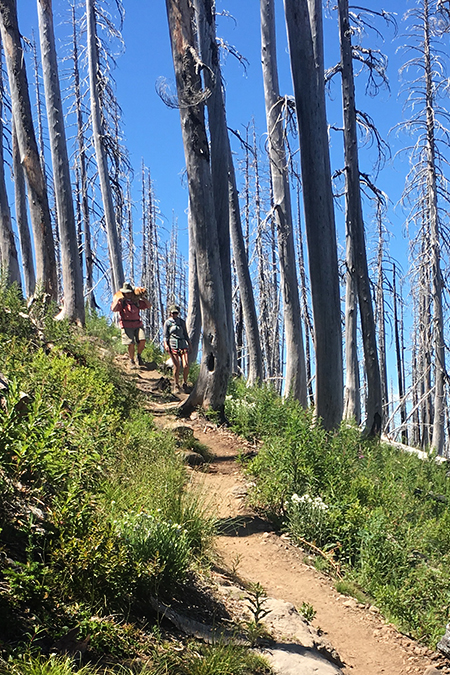
A bugs-eye view of Multnomah Falls?

[click here for a large image]

If the photo looks different than your typical Multnomah Falls view, that’s because I blended a total of eight images to create a horizontal format of this very vertical falls to better fit the calendar. Here’s what the composite looked like before blending the images:

mhnp_calendar25

To young photographers of the digital age, blending photos is routine. But for those of us who started out in the age of film photography and darkrooms, the ability to blend and stack images is nothing short of magical – and fun! While younger photographers are increasingly exploring film photography as a retro art, the digital age is infinitely more enjoyable than the days of dark rooms, chemicals and expensive film and print paper for this photographer.

I paused before including a winter-season photo of Wahclella Falls for the November calendar image (below). Why? Because I’ve used a photo from this area in nearly every calendar since I started assembling these more than a decade ago. It’s my favorite Gorge hike – I visited Tanner Creek and Wahclella Falls five times in 2016 – and have photographed this magnificent scene dozens of times, and yet it never gets old.

mhnp_calendar26

Wahclella Falls is a winter spectacle!

[click here for a large image]

I decided to include this Wahclella Falls scene because it captured a particularly wild day on Tanner Creek last winter. The stream was running high, filling the canyon with mist and seasonal waterfalls drifted down the walls of the gorge on all sides.

The huge splash pool at the base of the falls was especially wild – more like ocean surf than a Cascade stream, and if you look closely, you can also see a hiker braving the rain and cold to take in this view:

mhnp_calendar27

Roaring falls, big boulder… and tiny hiker

I also liked the turbulent stream below the falls, which also boiled more like ocean surf than a mountain stream:

mhnp_calendar28

Tanner Creek comes alive in winter

 So, another calendar featuring Wahclella Falls? Yes, and it certainly won’t be the last. This is among the most magical places in the Gorge – or anywhere!

 Finally, for the December image I selected a photo from my first official attempt at capturing the Milky Way over Mount Hood. This view is across Laurance Lake, on the north side of the mountain:

mhnp_calendar29

Milky Way rising over Laurance Lake and Mount Hood

[click here for a large image]

The glow on the opposite side of the lake is a campfire at the Kinnikinnick Campground, and was just a lucky addition to the scene. While we waited for the Milky Way to appear, there were several campers arriving, making for some interesting photo captures. With a 30-second exposure set for stars, this image also captures the path of a car driving along the south side of the lake to the campground:

mhnp_calendar30

Headlights and campfires in a Laurance Lake time exposure

My tour guide and instructor that evening was Hood River Photographer Brian Chambers, who I profiled in this WyEast Blog article in June. Thanks for a great trip, Brian!

mhnp_calendar31

The author with Brian Chambers somewhere under the Milky Way

So, if you’re looking to support the blog and Mount Hood National Park campaign or just have an ugly fridge to cover, you can order the new calendar on Zazzle.

_________________

…and finally, given the unusual events in our recent national election, some reflections on what it might mean for Mount Hood and the Gorge…

Post-election deju vu: back to the future..?

mhnp_calendar32

Viewed through the lens of protecting public lands and the environment, the presidential election results on November 8 are discouraging, at best. For those of us who have voted in a few elections, it feels a lot like the Reagan Revolution of 1980.

So, the following is a bit of speculation on what lies ahead based upon what we’ve been through before, but with the caveat that unlike that earlier populist surge against government, the environmental agenda of the coming Trump administration is somewhat less clear and appears less ideologically driven.

Ronald Reagan’s vision for government brought a very specific mission to dismantle environmental regulations and open up public lands to commercial interests. To carry out the mission, President Reagan appointed the highly controversial James Watt to head the Department of Interior, and the nearly as controversial Anne Gorsuch to run the EPA. John Block was tapped to head of the Department of Agriculture (which oversees the U.S. Forest Service). Watt and Gorsuch were attorneys, Block a farmer who had entered politics as an agriculture administrator in the State of Illinois.

mhnp_calendar33

James Watt’s radical vision for our public lands threatened to derail Ronald Reagan in his first term

Watt and Gorsuch became infamous for their open disdain for conservationists and the agencies they were appointed to administer. Watt was the Reagan administration’s sympathetic gesture to the original Sagebrush Rebellion. Block focused primarily on an ideological rollback of farm subsidies and programs that dated to the Dust Bowl, and that would eventually be his downfall.

The important lesson is that all three rode in with a “revolution” mandate, and over-reached in their zeal to rewrite American policy overnight. The blowback was instant, and though they did harm our conservation legacy during their embattled tenures, they didn’t have the lasting impact many had feared. Both Watt and Gorsuch were forced to resign before the end of President Reagan’s first term, and Block resigned in the first year of Reagan’s second term.

mhnp_calendar34
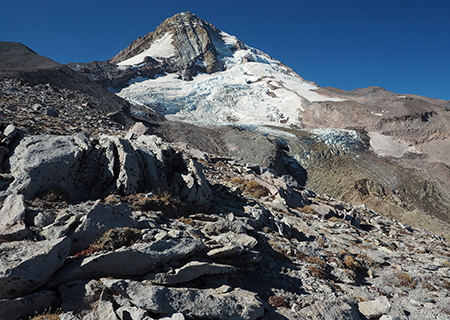
Even Readers Digest covered the EPA Superfund scandal that drove Anne Gorsuch out of office!

Gorsuch was eventually pushed out by Reagan for attempting to conceal EPA Superfund files from Congress as part of an unfolding scandal, becoming the first agency head to be cited for contempt of Congress. Before the scandal drove her from office, Gorsuch became Anne Gorsuch Burford when she married James Burford, Reagan’s Bureau of Land Management (BLM) chief, further fueling concern about whether environmental protections could be objectively enforced on BLM lands.

John Block lasted five years, but was pushed out in early 1986 as the worst farm crisis since the Great Depression unfolded under his tenure. Watt left in more spectacular fashion after stating (apparently a joke) that an ideally balanced advisory panel would include ”a black, a woman, two Jews and a cripple.” (and in the age of Google, he has been deservedly forgotten, with the more consequential James Watt – inventor of the steam engine – reclaiming his name in history).

mhnp_calendar35

Bloom County has some fun with Oregon’s Rajneeshee saga… and Ronald Reagan’s failed cabinet appointees

Will history repeat itself? We’ll see, but there is no reason to assume that the conservation community – and, importantly, the American public – will be any less motivated to speak out if the Trump administration attempts a similar rollback on public land and environmental protections to what the Reagan Administration attempted.

Yes, there will be lost ground, but there will also be unexpected gains. That’s our system. Recall that the same President Reagan who brought James Watt to the national stage also signed the Columbia River Gorge Scenic Area Act into law thirty years ago, on November 17, 1986 (famously “holding his nose”, in his words). In his first term, President Reagan signed the Oregon Wilderness Act into law on June 26, 1984, creating 22 new wilderness areas covering more than 800,000 acres.

As President Obama said in his reflection on the election, “democracy is messy”. He also reminded the president-elect that our system of governance is more cruise ship than canoe, and that turning it around is a slow and difficult process, no matter what “mandate” you might claim. That is by design, of course.

…and the WyEast Blog in 2017..?

Looking ahead toward 2017, I hope to keep up my current pace of WyEast Blog articles as I also continue my efforts as board president for Trailkeepers of Oregon, among other pursuits. And spend time on the trail, of course!

mhnp_calendar36

The author somewhere in Oregon’s next national park…

As always, thanks for reading the blog, and especially for the kind and thoughtful comments many of you have posted over the years. The blog is more magazine than forum, but I do enjoy hearing different perspectives and reactions to the articles.

Despite the election shocker this year, I’ve never felt better about Mount Hood and the Gorge someday getting the recognition (and Park Service stewardship) they deserve! That’s because of a passionate new generation of conservations are becoming more involved in the direction of our nation and our public land legacy. The 2016 election seems to have accelerated the passion this new generation of stewards brings to the fight.

Our future is in very good hands, indeed.

 See you on the trail in 2017!

 Tom Kloster | Wy’East Blog


Dollar Lake Fire: Five Years After

dollarfirefiveyears01

The Dollar Lake Fire from Bald Butte in August 2011

In 2006, the Bluegrass Fire raced along Bluegrass Ridge, torching the subalpine forests above Elk Meadows on Mount Hood’s east flank. In 2008, the Gnarl Fire burned a much larger swath of the east slope, from just above Elk Meadows to the Eliot Branch canyon, nearly destroying century-old Cloud Cap Inn, Snowshoe Lodge and the historic structures at nearby Tilly Jane Campground. Heroic efforts by Forest Service firefighters spared these priceless jewels of Mount Hood’s history, with the fire burning within a few yards of these old structures.

In August 2011, the Dollar Lake Fire was the third in a string of major fires that would ravage the slopes of Mount Hood in a period of just five years, this time burning the north slopes of the mountain. Lightning started the Dollar Fire started on a weekend, just below the popular Elk Cove trail and was immediately reported by hikers in the area.

dollarfirefiveyears02

The Dollar Lake Fire burning below Elk Cove

The Dollar Fire soon erupted to become one of the most fiercely fought and carefully documented fires in recent memory as it swept to the west, eventually threatening Bonneville Power Administration transmission lines at Lolo Pass and the nearby Bull Run Watershed, source of Portland’s drinking water.

The fire wasn’t fully contained until the end of September of that year, eventually burning more than 6,200 acres of forest (maps and photos of the fire can still be viewed on the InciWeb interagency website).

dollarfirefiveyears03

Flare-up in the Dollar Lake Fire in August 2011

Firefighting efforts were initially slow to arrive at the Dollar Fire, and some (including the media and members of Oregon’s Congressional delegation) accused the Forest Service of purposely allowing the fire to grow because it was inside the Mount Hood Wilderness where it didn’t threaten areas open to commercial logging. But a subsequent investigation pointed to overstretched firefighting resources, a growing problem as the federal land agencies struggle to fund the spiraling forest fire phenomena across the west.

dollarfirefiveyears04

Location of the Dollar Lake and Gnarl fires

 [click here for a large map]

By the time fall rains arrived, the fire had burned almost the entire north slope of Mount Hood, a 5-mile swath stretching from the Eliot Branch on the east to Cathedral Ridge on the west. Almost all of the burn was subalpine Noble fir forest, though a few old-growth mountain hemlock stands along the Timberline Trail were burned at Elk Cove and Cairn Basin.

dollarfirefiveyears05

Timeline and extent of the Dollar Lake fire

[click here for a large map]

The eastern extent of the Dollar Burn contained large stands of Western larch, a fire forest species adapted to frequent, low intensity fires. Most of these trees did not appear to survive the fire, however, due to its extreme heat and intensity.

dollarfirefiveyears06

Ground zero for the Dollar Lake fire is the foreground in these views from the Elk Cove Trail taken before the burn and five years after the fire

 [click here for a large map]

In fact, very few trees survived the fire except along its margins, where a beneficial mosaic burn pattern left standing trees and some undergrowth to help begin the recovery phase. This is the new reality facing our forests, as a century of fire suppression continues to fuel catastrophic fires that completely destroy forest on a massive scale.

Summer 2012: Immediate Aftermath

dollarfirefiveyears07

Total destruction along Vista Ridge in 2012

The dense network of trails that cross through the Dollar Burn provide a front-row seat to how (and if) our forests recover from catastrophic fires inside a protected wilderness, without human intervention. In the immediate aftermath of the Dollar Fire, the picture was bleak. In the heart of the burn, the forest kill was nearly complete, as even the duff layer on the forest floor was burned away, exposing a thin layer of volcanic soils vulnerable to erosion.

dollarfirefiveyears08

Blackened trees in 2012, before scorched bark began to peel away

One of the first lessons of the fire was the importance of tree debris in stabilizing the unprotected soil. The living trees in this forest weren’t burned so much as boiled alive as their living cambium layer was superheated beneath their bark. The surprising result in the first season after the fire was scorched bark peeling away to reveal untouched wood underneath.

The piles of peeled bark provided an immediate layer of mulch over the exposed soil, with smaller twigs and limbs also helping to form the beginnings of a new duff layer on the burnt soil.

dollarfirefiveyears09

Trees inside the burn shed their scorched bark in the first year, helping stabilize exposed soils

The roots of some understory plants in the worst of the burn zone also survived the fire, including huckleberry, beargrass and avalanche lilies. Two years after the fire, seeds blown into the burn began to establish, and the recovery was underway in surprisingly short order. Read more about the initial recovery in this 2012 WyEast Blog article.

2016: Five Years of Recovery

This year marks the five-year anniversary of the fire, and the recovery within the Dollar Burn is in full swing, though it will take a century or more for the area to fully recover – more on that in a moment.

How does the Dollar Burn of today compare to the first summer after the fire? As the July scenes along the Vista Ridge Trail (below) show, the understory is recovering rapidly.

dollarfirefiveyears10

Comparison of the recovery along the Vista Ridge Trail in 2012 and 2016

In 2012, avalanche lilies sprung from bulbs spared by the heat of the fire, creating striking stripes of white blossoms and bright green foliage where these plants survived. A few beargrass (a close relative of the lily family) also survived, thanks to deep underground roots that escaped the fire. A few scattered huckleberry and other understory shrubs also sprouted from surviving roots in the first summer after the fire.

In recent years, the beargrass and avalanche lily display in the Dollar Burn has become a spectacular attraction for early season hikers on the Vista Rigde Trail as these fire survivors continue flourish and spread in the bright new conditions. Other shrubby survivors, like huckleberry, have also continued to recover, thriving in the bright new conditions created by the fire.

But the story in the last few years of the recovery has been the arrival of new plants in the burn zone, blown in by seed or deposited by wildlife. These include more understory species, but also the first few conifers to take root.

dollarfirefiveyears11

This trailside log was a favorite resting spot for hikers on the Vista Ridge Trail before the Dollar Fire. Since the fire, hikers still rest here and have begun to polish away the charred surface along the top of the log – presumably with a charcoal backside as their souvenir!

After five years, most of the scorched bark has fallen from the torched trees, and the trunks underneath have bleached from their initial golden shades of newly exposed wood to weathered silver and gray shades of a “ghost forest”.

The standing ghost trees still retain a surprising number of their limbs, and perhaps more surprising, very few have toppled in the five years since the fire. This is testament to the fact that the core of these trees didn’t burn. Most will stand for decades before insects and decay finally bring them down.

dollarfirefiveyears12

These felled Noble fir along Vista Ridge Trail reveal a forest that was more than 300 years old before the fire

A few trees in the burn zone were cut by firefighters in an attempt to create fire lines. Today, these cut stumps provide a look at the age of this forest. While the trees in the Dollar Burn aren’t particularly large by Pacific Northwest standards, they were actually quite old. The cut tree shown above was more than 300 years old and stump below is from a tree that had grown on Vista Ridge for 360 years!

dollarfirefiveyears13_360years

This ancient Noble fir was 360 years old when it succumbed to the catastrophic Dollar Lake fire

The extreme weather conditions and thin soils make for a hard life for subalpine trees, stunting their relative size compared to lower-elevation forests.

The relatively modest size of these trees compared to their impressive age is another reminder of the vulnerability of our subalpine Noble fir forests that are still being logged commercially. While they continue to be “harvested” in unprotected areas under the premise of sustainability, these trees take centuries to reach a size worthy of commercial cutting, making the “harvest” more like mining than tree farming.

The Pioneers

dollarfirefiveyears14

Fireweed is the rock star of the pioneer plants species in the burn zone

The understory in the Dollar Burn is noticeably greener just five years after the fire, and a closer look reveals a handful of plant species doing the heavy lifting at this stage in the forest recovery. At the top of the list of pioneer species is fireweed, (described here in the previous article in this blog).

dollarfirefiveyears15

Fireweed crowding the Vista Ridge Trail in 2016

True to its name, fireweed has evolved to be the first in line to resettle burned or disturbed areas. These plants produce massive quantities of winged seeds that can quickly reach very large areas. They are also hardy perennials with large root systems, so also play an important role in stabilizing exposed soil.

In the Dollar Burn, fireweed has already colonized large areas, creating a spectacular flower displays from mid-summer through fall.

dollarfirefiveyears16

Showy blooms of Fireweed in late summer on Vista Ridge

Look between the drifts of fireweed and you’ll find other pioneers taking root. One surprising species is the diminutive wild dwarf bramble (sometimes called wild strawberry for its resemblance of its runners and leaves to domestic strawberries). These tiny plants are now found throughout the burn, threading through piles of bark and limbs.

dollarfirefiveyears17

Wild dwarf bramble growing over charred bark along the Vista Ridge Trail

Huckleberries also continue their comeback, mostly from the surviving roots of established plants that grew before the fire but also as seedlings. In a few spots, the understory was not completely destroyed, and in these areas huckleberry is responding strongly to the bright conditions with abundant berry production.

dollarfirefiveyears18

Huckleberry seedlings emerging on Vista Ridge

dollarfirefiveyears19

Huckleberry seedlings growing from the base of a burned snag on Vista Ridge

dollarfirefiveyears20

Huckleberries that survived the fire are producing abundant berry crops in the suddenly sunny environment in the Dollar Burn

Though they were among the few understory survivors, the recovery of beargrass has been more gradual than expected. Most plants seem to be growing from roots that survived the fire, though the first big bloom of these survivors (and the seeds they produced) only arrived over the past two years.

dollarfirefiveyears21

Beargrass emerging from surviving roots are just beginning to produce blooms within the burn zone

Clumping grasses have also arrived throughout the burn, as well as the occasional rush in moist, protected pockets.

dollarfirefiveyears22

Rush growing in a moist hollow on Vista Ridge

dollarfirefiveyears23

Clumping grasses are taking root in some of the driest areas of the Dollar Burn

Elderberry is among the few woody understory pioneers to arrive in this stage of the Dollar Burn recovery. These plants are scattered widely, growing in less burned areas, and may also be growing from surviving roots.

dollarfirefiveyears24

This young Elderberry shrub is just getting started in the burn zone in 2016

Conifers are just getting started five years after the Dollar Fire. Almost all of the conifer seedlings at this point in the recovery are Mountain hemlock and Noble fir, the dominant evergreens in Mount Hood’s subalpine forests.

By counting branch tiers, a few young trees as old as four years can be found, but most are one or two year-old seedlings. But if you look closely, there are also many seedlings that have not survived the harsh summers in the burn zone, where there is little shade and the sandy mountain soils are extremely dry by the time rain reappears in the fall.

This is the sorting process at work, where only a few seedlings will survive winter cold, summer heat and competition from understory plants to someday become part of the new forest canopy.

dollarfirefiveyears25

Young Mountain hemlock in the Dollar Burn in 2016

dollarfirefiveyears26

Three-year old Noble Fir in the Dollar Burn in 2016

Though most of the Dollar Fire was an overheated catastrophe for the forest, killing almost everything, there are a few spots where the fire cooled and burned in a “mosaic” pattern, leaving a few surviving trees and much of the understory.

These areas are lush islands of life just five years after the fire, underscoring their importance in the recovery and why cooler mosaic burns can be beneficial to the long-term health of a forest. Pioneer species are much more abundant in heavily burned areas that are immediately adjacent to these surviving patches than in other parts of the burn, as plants quickly spread from these islands of green.

dollarfirefiveyears27

Island of green where the Dollar Lake Fire spared a section of forest that now serves as a nursery for regenerating the burn zone

While the Dollar Burn is recovering at nature’s pace, without human intervention, the Forest Service has given the nearby Gnarl Burn section along Cloud Cap Road a recovery boost by planting conifer seedlings. These trees were planting in 2010, about a year before the Dollar Lake Fire and following commercial removal of burned trees along the historic road.

dollarfirefiveyears28

Planted conifers in the Gnarl Burn along Cloud Cap Road in 2016

Today, these trees are thriving, and the main effect of replanting is the diversity of species, including lodgepole pine, western larch, Western white pine, Englemann Spruce and even whitebark pine at higher elevations. Noble fir and mountain hemlock do not seem to have been part of the replanting, perhaps because these species are the most likely to recover without human intervention.

The Long View?

dollarfirefiveyears29

Hazard tree warning at the Vista Ridge trailhead

Hikers on the north side of Mount Hood will continue to have a front-row seat to the forest recovery in the Dollar Burn. Already, there are some surprising lessons.

First, the main victims of blowdown since the fire have often been the few trees that survived the fire intact. This is because of the sudden exposure of their canopy to winter winds and snow loads, and is a surprising blow to the forest recovery these trees would otherwise be helping to seed the burn zone.

dollarfirefiveyears30

Toppled surviving Noble fir in the burn zone in 2016

dollarfirefiveyears31

A surviving canopy becomes a liability in a burned forest, as surviving trees along Vista Ridge were tipped by winter storms in 2016

The Dollar Burn generally stayed well below timberline (and the Timberline Trail), leaving most of the alpine zone intact. But where the fire did burn into places like Elk Cove, Eden Park and Cairn Basin, we will also have an opportunity to watch how alpine ecosystems react to fire.

Some of Mount Hood’s most ancient forests grow in this zone, and have presumably survived because they are somewhat isolated from lower-elevation forests and often grow in moister conditions where snowpack is greater and summer days are cooler. But the forest could take centuries to recover in these areas, impacting the many species of plants and wildlife that live exclusively at this elevation.

dollarfirefiveyears32

It could take centuries for this high-elevation forest of Mountain hemlock and Whitebark pine on Vista Ridge to recover from the fire

In human terms, it’s hard to see forest fire cycles in perspective, but in the case of the Dollar Burn, we have the benefit of early photographs from the area. Forest surveys show that the Red Hill area on the north edge of the Mount Hood Wilderness burned in the early 1900s, and were barely recovering by the 1950s (see below).

dollarfirefiveyears33

The view from Owl Point in 1952 and 2016 shows the cycle of fire on Mount Hood’s north slope over the past century (top photo courtesy Hood River History Museum)

[Click here for a larger version]

Today, the forest in this northern edge of the wilderness has substantially recovered after a century of regrowth, and now the view is reversed: the silvery ghost forests of the Dollar Fire now mark the once-green slopes of Mount Hood as viewed from Owl Point, while green forests and beargrass meadows cover the former Red Hill burn in the foreground.

dollarfirefiveyears34

Looking down on the Dollar Burn and Owl Point in the distance from the Timberline Trail in 2016

So far, so good, but the larger question in an era of climate change is whether our forests will continue to recover from catastrophic fire – or logging – in the way that we have always assumed they will.

As the recovery unfolds in the Dollar Lake, Gnarl and Blue Ridge burns on Mount Hood we’ll learn how resilient our forests really are, and hopefully make better decisions in protecting them for the benefit of future generations.

How will the summer of 2015 affect our fall colors?

Shepperd's Dell dressed in autumn golds

Shepperd’s Dell dressed in autumn golds

Oregon may not have the neon rainbow of New England’s fall colors, but we put on a pretty good show if you know where and when to look. However, 2015 will be different, as the extended drought and scorching summer heat has already affected our fall colors this year, even before the leaves began to turn.

To understand why, you have to start with the basics of how leaf colors change with the seasons, and how weather and other factors influence the autumn show each year.

Leaf Biology 101!

Most of our northwest deciduous trees and shrubs leaf out in spring, grow green leaves through the summer, then turn to various shades of yellow and gold in fall, with a few red leaves in the mix. Vine maple, huckleberry and mountain ash provide our most brilliant reds, and most of the larger deciduous trees in our forests turn to some shade of gold, orange or yellow.

Vine maple colors range from pale yellow (in shade) to bright crimson (in full sun)

Vine maple colors range from pale yellow (in shade) to bright crimson (in full sun)

The green color in summer and spring foliage comes from chlorophyll, the amazing molecule that absorbs sunlight and allows for photosynthesis — the process by which plants convert sunlight into carbohydrates (sugars) essential to their growth.

During the spring and summer growing seasons, chlorophyll is produced continually, keeping deciduous leaves green. But as the days shorten with the approach of winter, the decrease in sunlight triggers a change in how cells in the stem of each leaf divide, gradually blocking the flow of both nutrients and chlorophyll to leaves. The cells that form this barrier within the leaf stem are known as the “abscission layer”.

Like vine maple, mountain ash fall colors range from light yellow to brilliant red, based on sun exposure

Like vine maple, mountain ash fall colors range from light yellow to brilliant red, based on sun exposure

Ready for more leaf biology? Well, the yellows, reds and golds of autumn are colors that already reside in leaves, but are revealed as the change to the flow of chlorophyll is blocked by the development of the abscission layer in early fall.

Yellows and golds in fall leaves come from “xanthophylls”, a pigment thought to regulate light in the photosynthesis process. Reds and purples come from “anthocyanins”, a molecule that is believed to complement the green of cholorophyll in the photosynthesis process — but is more commonly is found in flowers, where it functions to attract pollinators.

Dark, cool and wet…

Okay, enough leaf biology! If deciduous leaves are certain to turn color in autumn by their very chemistry, how do environmental factors fit into the leaf cycle? Here are the key forces that shape the timing and brilliance (or lack thereof) in our autumn color show:

Bright sun and cool temperatures: a crisp, abrupt fall pattern speeds up and pronounces the abscission process by which chlorophyll is blocked from leaves. This helps to promote sudden and dramatic color shows. Likewise, a mild, extended Indian Summer tends to slow the process, with a more gradual color change and leaves changing and falling over a longer period.

Cool mountain nights and bright, sunny days set these vine maple ablaze on Mount Hood's Vista Ridge

Cool mountain nights and bright, sunny days set these vine maple ablaze on Mount Hood’s Vista Ridge

Bright days and cool nights also enhance reds and purples in plants with abundant anthocyanins in their leaves. These include vine maple, huckleberry and mountain ash, our most vibrant fall foliage. That’s also why these colors are more prominent at higher elevations where bright days cool nights are guaranteed, even as the valleys are under a blanket of fog.

Early frosts: contrary to popular belief, early frosts hurt fall colors more than they help, as the production of anthocyanin-based colors of red and purple are abruptly interrupted by a premature formation of the abscission layer. If you’ve hiked in the mountains in late August after an early cold snap, you’ve undoubtedly seen a carpet of dropped leaves under huckleberries and other deciduous shrubs.

Drought: like early frosts, drought can trigger a premature formation of the abscission layer, leading to early color change and leaf drop. If you’ve been hiking in the Gorge or on Mount Hood this summer, you likely saw this effect of the drought we are experiencing. While some leaves survive later into autumn, the broader effect is a muted show, as many leaves have already dropped long before the typical fall color season. This is has already been the effect of the drought this year in both the Gorge and on Mount Hood.

Early autumn storms: the arrival of a Pineapple Express storm pattern during Labor Day week of 2013 did a fine job of stripping our maples and other deciduous trees of many of their leaves weeks before they would normally turn and begin to lose their foliage. It’s not common for early storms of this magnitude in our region, so it might be the most notorious culprit in stealing our fall colors!

The colors in this view of Umbrella Falls on Mount Hood are mostly huckleberry -- red when in full sun and yellow in shady stream areas

The colors in this view of Umbrella Falls on Mount Hood are mostly huckleberry — red when in full sun and yellow in shady stream areas

In an ideal year, normal rainfall in spring and summer are followed by a cool, dry Indian summer with warm days and cool nights in the 40s or 50s. This year, we’ve got the Indian summer condtions, but the drought has already triggered leaf drop in a lot of our deciduous forests. Thus, we’re likely to have a so-so color display this Fall.

Where and When to Catch the Colors

A muted fall color display this year shouldn’t keep you from heading out to enjoy it! In a typical year, the high country colors peak in September through early October. Mid-elevation areas and canyons usually peak from mid-October through mid-November, depending on the mix of tree species.

Here are some of the best spots in the Mount Hood area to catch the autumn color:

Elk Cove from Vista Ridge – this 9-mile out-and-back hike is one of the best for exploring Mount Hood’s high country without having to ford glacial streams or suffer huge elevation gains (though you will gain substantial elevation). In September of a typical year, fall colors light up the trail, especially as you descend into Elk Cove, but note that the colors are long gone from this hike in our drought year — see the Oregon Hikers Field Guide description

Elk Cove in late September (in a typical year)

Elk Cove in late September (in a typical year)

Clackamas River Trail – another close option for Portlanders, with a moderately long hike to Pup Creek Falls, albeit with moderate elevation gain. This trail is lined with bigleaf maple, but also has impressive vine maple shows in a recovering burn section that bring shades or red and coral to the trail in October. You’ll also see Douglas maple here, a close but less common cousin to vine maple — see the Oregon Hikers Field Guide description

Brilliant vine maple along the Clackamas River Trail

Brilliant vine maple along the Clackamas River Trail

Lookout Mountain Loop – Always a spectacular hike on a clear day, in October you will also see the annual spectacle of western larch turning golden yellow across the eastern slopes of the Cascades. Larch are a deciduous conifer — a rarity, and an impressive sight — see the Oregon Hikers Field Guide description

Whole mountainsides around Lookout Mountain light up with western larch turning in mid-to-late October

Whole mountainsides around Lookout Mountain light up with western larch turning in mid-to-late October

Latourell Falls Loop – Very close to Portland, this is a popular family hike that visits two waterfalls in a lovely rainforest canyon. In late October, bigleaf maple that dominate the forests here light up in shades of yellow and orange, often covering the trail ankle-deep in their huge leaves — see the Oregon Hikers Field Guide description

The Latourell Falls loop trail still has some color in early November

The Latourell Falls loop trail still has some color in early November

Starvation Creek Loop – like the Latourell loop, Starvation Creek has an abundance of bigleaf maple, but the crisper weather and abundant sun of the eastern Gorge often makes for a brighter show here. Families can simply explore the paved trails around the main falls, but the Lower Starvation hike makes for a fun, if sometimes steep loop past more waterfalls and clifftop viewpoints — see the Oregon Hikers Field Guide description

Bigleaf and vine maple put on a reliable show at Starvation Creek Falls in October

Bigleaf and vine maple put on a reliable show at Starvation Creek Falls in October

Butte Creek Trail – an under-appreciated family trail that does require navigating some harshly managed corporate timber holdings. The outrageous, utterly unsustainable clear-cutting only makes the pristine public forests and waterfalls along the trail that much more spectacular in comparison. This is an ideal October hike, with fall colors typically peaking in the last half of the month. This trail really shines in rainy or overcast weather, when the rainforest glows with countless autumn shades of yellow, gold and orange against a backdrop of deep green – see the Oregon Hikers Field Guide description

The author ankle-deep in maple leaves on the Butte Creek Trail

The author ankle-deep in maple leaves on the Butte Creek Trail

The great thing about taking in fall colors is that the weather really doesn’t matter — a soggy hike through the brilliant yellows of bigleaf and vine maple in a waterfall canyon is just as spectacular as a sunny day hiking through a sea of red and orange in Mount Hood’s huckleberry fields.

Better yet, if you have kids, it’s also a great time to expose them to hiking and exploring the outdoors… though you should also plan on hauling home a hand-picked collection of autumn leaves..!

Enjoy!

2013 Mount Hood National Park Calendar

Each year at about this time I assemble the Mount Hood National Park Scenic Calendar. The proceeds are modest, but do help support the Mount Hood National Park Campaign website, WyEast Blog and related project expenses. But the main purpose is to simply promote the national park concept, and make the case for the campaign with pictures.

What the calendar looks like – oversized 11×17” pages you can actually use!

I’ve published the calendars since 2004, so this year’s calendar marks the ninth edition. All of the photos in the calendar are from trips and trails I’ve explored over the past year. I get a surprising number of questions about the photos, so in addition to simply announcing the 2013 calendar, this article tells a bit of the story behind the new images — and some are surprising!

The 2013 Scenes

The cover image for the 2013 calendar is Upper McCord Creek Falls, located just west of Cascade Locks. This is a popular destination for Columbia Gorge lovers, though often overshadowed by its more famous downstream sibling, Elowah Falls.

Cover Scene: Upper McCord Creek Falls

Upper McCord Falls is unique in that it flows as a twin cascade. A little known fact is that a third segment used to flow during the rainy season as recently as the 1970s, just to the left of the two segments shown in the photo (above). The third segment has since been blocked by stream debris, however, so for now, Upper McCord is best known as a twin cascade.

The falls is popular with photographers, but in 2010 was briefly obstructed by a large treetop that had split from atop a nearby maple, landing perfectly on its head, directly in front of the falls. While the local photography community simply grumped and groaned about this unfortunate development, Gorge waterfall explorer and photographer Zach Forsyth did something about it: he scrambled down the slope, and neatly tipped the 40-foot up-ended tree on its side. Thus, Zach made this year’s calendar cover possible – thanks, Zach!

Upper McCord Creek Falls with “the stump” in 2010

Upper McCord Creek Falls is tucked away in the hidden upper canyon of McCord Creek, just a few hundred yards from the brink of Elowah Falls. The trail to the upper falls is especially spectacular, following a ledge chiseled into sheer cliffs in the early 1900s to pipe water to the former Warrendale Cannery, below (portions of the pipe system can be seen along the trail). The falls is hidden from view until you abruptly arrive at the dramatic overlook, directly in front of the falls – one of the finest and most unexpected scenes in the Gorge.

The January calendar scene is a wintery view of the rugged west face of Mount Hood, just emerging from the clouds after a fresh snowfall. This view was captured just a few weeks ago near Lolo Pass, as the evening light was briefly catching the summit.

January Scene: West face after an early winter storm

Like most “mountain in the mist” images, this one was a reward for patience: I waited for two chilly hours for the clouds to clear! It worth the wait, though I’ve also had my share of disappointments when that glorious glimpse of the mountain didn’t materialize.

For the month of February, I picked an image from a trip last winter along the Little Zigzag River. I had planned to snowshoe to Little Zigzag Falls from the Kiwanis Camp, but there were only about 18 inches of snow on the ground, much of it fluffy and new. So, I simply trudged through leaving some very deep boot prints in my wake — and happily, the only footprints on the trail that afternoon.

February Scene: Little Zigzag River in winter

The weather was extremely cold on this visit, revealing one of the surprising effects of running water in winter: it turns out the sheer volume of relatively “warm” water (that is, above freezing) flowing down the Little Zigzag river actually heats the narrow canyon, much like an old steam radiator heats a room.

Following this radiator analogy, the temperate gradient is most noticeable when air temperatures are really cold. It was about 12º F that day, yet the air right next to the stream, and especially in front of Little Zigzag Falls measured in at a “balmy” 30º F. I found myself peeling off layers while shooting the stream and falls, only to hurriedly put them back on as I ventured back down the trail and into the real cold!

For the month of March I chose another waterfall scene, this time the lush, verdant base of popular Latourell Falls in the Columbia Gorge.

March Scene: Latourell Falls in spring

On this visit to the falls, Oregon State Parks construction crews were starting work on several major upgrades to viewpoints along this busy trail. As a result, the most popular trailhead at the Latourell Wayside was closed. Instead, I took a back route to the falls and had the place to myself for the better part of an hour — nearly unheard of on what should have been a busy spring weekend at Latourell Falls.

The April calendar scene is from Rowena Plateau at the McCall Preserve, in the dry, eastern Columbia Gorge. The iconic yellow balsamroot and blue lupine were in peak bloom on this sunny afternoon in mid-spring, and the glassy surface of the Columbia River in the background reveals a rare day of calm in the normally windy Gorge. The very tip of Mount Adams peeks over the hills on the horizon, on the Washington side of the river:

April Scene: Balsamroom and lupine on Rowena Plateau

The trip to Rowena was especially memorable for me, as I was hiking with an old college friend who was visiting Oregon for a few days. Rowena was a great place to catch up on news and old memories.

My friend also happens to be an eminent geologist working for the federal government, so we had a great conversation about the mystery of “desert mounds” (also known as “biscuit scablands”), which found on Rowena Plateau and in other areas in the Columbia Basin (watch for a future WyEast Blog article on this subject…).

Hikers passing one of the mysterious desert mounds on Rowena Plateau

Continuing the balsamroot-and-lupine theme, the May scene in the new calendar comes from Hood River Mountain, a tract of private land that is (for now) open to the public, but at risk of closure, due to heavy use by hikers.

This is one piece of land that will hopefully come into public ownership someday, before a less responsible private owner places trophy homes on these beautiful slopes. I wrote about this unfortunate oversight in the Columbia River Gorge Scenic Act in this article from a few years ago.

May Scene: Hood River Mountain in May

On Memorial Day last spring, I made a trip to Dry Creek Falls, a beautiful waterfall saddled with one of the most unfortunate and uninspiring place names in the Gorge! The June calendar image is from that trip, and captures Dry Creek rambling through the forest a few hundred yards below the falls.

June Scene: (not so) Dry Creek in spring

This area has a unique history: an old, derelict diversion dam and waterworks survives at the base of the falls, where the City of Cascade Locks once tapped the stream for municipal water in decades past. Perhaps this is the origin of “Dry Creek” name — did the stream below the diversion actually go dry when the dam was installed? Perhaps, but today it flows year-round, and makes for a beautiful streamside hike in spring.

Dry Creek Falls and the remains of the old diversion dam and waterworks

The July scene in the 2013 calendar is from a trip to Elk Cove last August. This is one of my annual pilgrimages, and I have photographed this particular spot just east of Cove Creek too many times to count — yet I’m always excited to get there, and recapture the stunning scene.

July Scene: Summer wildflowers at Elk Cove

The wildflower bloom on Mount Hood was delayed by several weeks this year, so even though I was a bit late in visiting Elk Cove, there was still a bumper-crop of purple aster mixing with the blue lupine and mop-heads of western anemone, or Old Man of the Mountain.

Not visible in the calendar view of Elk Cove are the blackened forests directly behind me: the Dollar Fire of 2011 swept across a 5-mile swath along the northern foot of Mount Hood, charring the northern fringes of Elk Cove, including several large stands of mountain hemlock that frame the view from 99 Ridge.

The Dollar Fire burned a 5-mile swath across the north slope Mount Hood

Though it’s initially shocking to see healthy forests killed by fire, it is also part of the natural cycle of forest renewal. Thus, we’ll now have a front-row seat to the fire recovery process that will unfold over the coming years along the popular north side trails. I wrote this blog article on the Dollar Fire earlier this year.

For the August calendar image, I picked a less familiar scene from an otherwise popular hike: the soaring trail to the 8,514’ summit of Cooper Spur. To beat the crowds, I set my alarm for 3 AM and raced to the trailhead at Cloud Cap. I was the first to arrive at the string of dramatic viewpoints along the trail, and caught the first rays of sun lighting up the northeast face of the mountain.

August Scene: Eliot Glacier from Cooper Spur

This view is from the north shoulder of Cooper Spur, just below the summit, and looking into the impressive jumble of crevasses and icefalls along the Eliot Glacier. Though the sky was crystal clear (you can see the moon setting to the left of the mountain), the winds from the south were strong and blustery. So, getting this shot from the lee side of the spur also meant enjoying some respite from the intense wind and blowing volcanic grit.

For the September image, I selected a lesser-known view of the mountain: the remote and rugged Newton Canyon, on the southeast side, where Mount Hood has a broad, massive profile.

September Scene: Rugged Newton Creek Canyon on the east side of Mount Hood

Glacial Newton Creek is best known for the havoc it brings far below, where the stream has repeatedly washed out Highway 35 with violent debris flows that toss Toyota-size boulders and whole trees across the road in their wake. Construction crews were busy this summer completing yet another repair, this time for damage that occurred in the 2006 floods. As always, the new road is bigger and higher than the old. We’ll see if Newton Creek is persuaded to flow through the new series of larger flood culverts this time…

The October scene is from Wahclella Falls on Tanner Creek, a popular family hike that also provides terrific viewing of spawning salmon and steelhead in early autumn.

October Scene: Wahclella Falls in autumn

Fall colors were somewhat muted in 2012, thanks to an unusually long, dry summer that extended well into October. As a result, the broadleaf trees in many areas had already dropped a lot of leaves due to the stress of the drought, before they would even have a change to change with the seasons.

While fall colors at Tanner Creek were less affected by the summer drought, the autumn scene in this year’s calendar has to make due without without the help of the particular tree, the Wahclella Maple I wrote about earlier this year. You can see the hole it left by comparing this year’s image (above) and a 2010 image (below).

Wahclella Falls in 2010 with the Wahclella Maple still standing above the footbridge

Since 2007, I’ve made annual trips with friends and volunteers to tend to the Old Vista Ridge Trail on the north side of Mount Hood. This historic gem from the early 1900s was an overgrown, forgotten victim of the Forest Service clear-cutting juggernaut for some 40 years, but somehow managed to escape their chainsaws.

Volunteers re-opened the Old Vista Ridge Trail in 2007, spurred in part by a Forest Service scheme to turn the area into a playground for dirt bikes and ATVs — an appalling plan that was eventually abandoned, in part because the rediscovered trail had revealed the beauty of the area to so many.

In 2010, the trail became the official northern boundary of the expanded Mount Hood Wilderness, when President Obama signed a new wilderness bill into law. This change should close the door on future Forest Service threats to the area, and today the hike into one of the best on the mountain.

November Scene: Mount Hood from Owl Point

The November calendar scene is from a viewpoint along the Old Vista Ridge Trail known as Owl Point, the rocky outcrop with stunning views of the mountain. Bright red huckleberries light up the foreground in this scene, and the first dusting of snow highlights the mountain. In the distance, you can also pick out the browned forests on the slopes of Mount Hood, where the Dollar Fire swept across the base of the mountain in 2011.

The final image in the new calendar is another taken from Lolo Pass, perhaps one of the most spectacular views of Mount Hood. This image was taken just before sundown after a fresh snowfall had blanketed the mountain.

December Scene: Winter arrives at Lolo Pass

I paid the price for taking in the sunset that night at Lolo Pass, as my car was broken into at the trailhead – something I’d somehow managed to avoid in all my years of hiking! As frustrating as it was to deal with the repairs and lost belongings… I’d do it all over again just to spend those magical hours watching the mountain that night — it was truly breathtaking! Here, take a closer look, and see for yourself:

Mount Hood from Lolo Pass | 2012
_________________

The thirteen images I chose for the 2013 calendar are from a few thousand images I’ve taken this year on something just shy of 40 outings to Mount Hood and the Gorge — a bit less time on the trail than a typical year would allow, but no complaints! As always, these adventures took me to new places and discoveries, as well as fond visits to my favorite old haunts.

And as always, the magnificent scenery further confirmed my conviction that Mount Hood should (and will!) be set aside as our next National Park! Hopefully, the calendar makes the case, as well.

How can you get one, you ask?

The new calendars are available online:

2013 Mount Hood National Park Calendar at CafePress

They are large and functional, measuring 17” across by 22” tall when hung, with plenty of room for writing notes and scheduling activities. CafePress packages them carefully, with each calendar sealed against a corrugated cardboard backing for support.

The calendars sell for $29.99 + shipping, with about 25% of the proceeds going to support the Mount Hood National Park Campaign. They make terrific stocking stuffers (…although you’ll need an 11×17” stocking…), and CafePress now makes it even easier by offering PayPal as an option.

And as always, thanks for your support!
_______________________________________

Addendum: Gorge uber-Guru Scott Cook set me straight on a couple of comments in the above article:

Hey Tom, so of course I read your blog like a good Gorge denizen. A couple of points…I’m not trying to sound like a know-it-all…but I know that you do like to get at the bottom of things and eschew conjecture:

The pipes visible on the Upper McCord trail are from Myron Kelly’s pulp mill, not Warren’s cannery. There are some pix on my blog of Kelly’s mill and iterations of his pipes. I have another old pic too showing the pipe running along the cliff cleft, illustrating to me that the cleft was a pipeway instead of a WPA/CCC construction.

2013MHNPCalendar16
(author’s note: here’s a photo I shared with Scott that shows CCC crews clearing out the old waterline shelf to make way for the trail to Upper McCord Falls — note the Historic Columbia River Highway, far below, and the CCC crew bosses in full uniform)

…and, about Dry Creek falls, the Creek was called Dry Creek before the water works were installed. The reason is that just downstream of the PCT trail bridge, just down the access road 200yards, the creek dries up in the summer to nothing, just a dry creek bed as the creek goes subterranean until re-emerging downstream of the powerline corridor.

If you walk down the access road in the summer, the stream is of course flowing under the bridge, but when you walk downstream the sound goes away and you just figure the stream curved away from the road, but nope, if you bushwhack over just 100 feet you’ll see the dry stream…as you will if you continue down the access road also.

Down the (Dry Creek) access road is a bunker-looking building that was built in the 30’s to store the water from the stream’s waterworks for the city’s first municipal supply. The water shed is still in use today, but the water is pumped upwards into it from wells in the town below.

Next edition of Curious I’ll have Dry Creek Falls as a loop using the powerline access road…so people can learn the history and see the Dried-up Creek as well (cuz everyone loves a loop). Look for my pix on Google Earth of all this stuff and the dried-up creek. -Scott

Thanks, Scott!

After the Dollar Lake Fire

The Dollar Lake Fire from Bald Butte on September 3, 2011

On August 26, 2011, a lightning strike ignited what was to become the Dollar Lake Fire, on Mount Hood’s rugged north side. The fire started in the Coe Branch canyon, just below the Elk Cove trail, and was spotted by numerous hikers.

Initially, it seemed small and manageable. But over the next few days and weeks, arid conditions and strong winds spread the fire from Stranahan Ridge on the east to Cathedral Ridge on the northwest side of the mountain, eventually consuming some 6,300 acres of high elevation forest. The blaze burned through September and into early October, when fall rains finally arrived.

Hot spot erupts along Stranahan Ridge on September 3, 2011

Some of the burn was of the beneficial form, a mosaic fire leaving islands of surviving trees, but much of the fire was too hot and the accumulated forest fuel too plentiful to prevent devastating crown fires from sweeping across the forest. Eventually, the fire destroyed most of the standing timber and burned the forest duff down to mineral soil throughout most of the burn area.

The fire was contained entirely within the Mount Hood Wilderness, thanks to the recent Clear Branch additions that expanded the wilderness boundary on the north to encompass the Clear Branch valley and the high country surrounding Owl Point, to the north. While this complicated fire fighting, it has also created a living laboratory for forest recovery, as the USFS is unlikely to assist the reforestation process inside the wilderness boundary. The Forest Service map, below, shows the broad extent of the fire.

Final extent of the Dollar Lake Fire (outlined in red)

Though the fire burned to the tree line in several spots, a surprising amount of terrain along the iconic Timberline Trail was somehow spared. While the burn touched Elk Cove and Cairn Basin, WyEast Basin and Barrett Spur are well beyond the burned area. The Clear Branch wilderness additions to the north were mostly spared, as well.

The New Vista Ridge: After the Fire

The following is a photo essay from my first visit to the burn, on June 22, 2012, and is the first in what will eventually be a series of articles on the aftermath of the fire.

The devastation left by the fire is awesome to witness, but also starkly beautiful when you consider the context of a forest fire. After all, this event is part of the natural rhythm of the forest just as much as the changing of seasons.

From this point forward, we will have a front-row seat to the miracle of life returning to the fire zone, much as we’ve watched life return to the Mount St. Helens blast zone over the past 32 years. And as my photos show, the rebirth of the forest ecosystem has already begun on Mount Hood’s northern slopes.

Untouched trailhead at Vista Ridge.

From the Vista Ridge trailhead, I followed the Vista Ridge Trail to the snow line, above about 5,000 feet. The Vista Ridge trailhead is completely untouched, though the fire swept through a vast area immediately to the south. Yet, no sign of the fire is evident at the trailhead marker (above).

A bit further up the trail, at the Old Vista Ridge trailhead, the fire zone comes into view. Where green forests existed last summer, browned foliage and a burned forest floor spread out east of the junction. This fringe of the fire is of the healthy “mosaic” form, sparing large trees, while clearing accumulated forest debris.

Old Vista Ridge trailhead spared by fire… just barely.

An unexpected benefit of the fire came last fall, when the USFS added the long-neglected Old Vista Ridge trail to official agency fire maps (below) released to the public. Volunteers began restoring this beautiful trail in 2007, but formal acknowledgement of the route on USFS maps is a welcome development.

Welcome development: Old Vista Ridge trail reappears on USFS fire fighting maps

Clearly, the restoration of the Old Vista Ridge trail helped fire fighters reach this area, and could have served as a fire line had the blaze swept north, across the Clear Branch. Hopefully this is an indication that the Old Vista Ridge trail will someday reappear on the USFS maintenance schedule, too.

Turning south on the Vista Ridge trail from the Old Vista Ridge junction, the wilderness registration box and map board seem to have received divine intervention from the fire — the blaze burned within a few feet of the signs, yet spared both. From here, the Vista Ridge trail abruptly leaves the scorched fringe of the fire, and heads into the most devastated areas.

Vista Ridge trail signs were spared… by divine guidance?

A few yards up the Vista Ridge trail, the devastation quickly intensifies.

From about the 4,700 foot level, the Dollar Lake Fire burned the forests along Vista Ridge to bare earth. In this area, the entire forest crowned, leaving only a scattering of surviving trees where protected by topography or sheer luck. Forest understory, woody debris and duff burned to mineral soil, leaving a slick, muddy surface of ash. For those who have hiked through the previous Bluegrass Fire or Gnarl Fire zones on the east slopes of Mount Hood, this eerie scene is familiar.

The surprisingly intact trail curves through the devastated forests along Vista Ridge.

Crown fires have killed almost all of the standing forests along Vista Ridge.

Amid the devastation in this hottest part of the Dollar Lake Fire, signs of life are already emerging. At this elevation, one of the toughest survivors is beargrass, a member of the lily family with a deep rhizome that allows plants to survive even the hottest fires. These plants are normally evergreen, but were completely scorched in the fire. The new grown in this photo (below) has emerged this spring.

Beargrass (Xerophyllum tenax) emerges from underground rhizomes protected from the fire.

Another surprise is avalanche lily, one of the more delicate flowers in the subalpine ecosystem. Like beargrass, these plants survive thanks to a bulb located deep enough in the soil to escape the heat of the fire. As one of the early bloomers in the mountain forests, these plants area already forming bright green carpets in the sea of fire devastation (below).

Avalanche Lily (Erythronium grandiflorum) emerging from the ashes.

A ribbon of green, these Avalanche Lilies are emerging along the Vista Ridge trail.

Another of the beneficial aspects of the fire comes into view a bit further up the trail: several sections of Vista Ridge had long been overgrown with thickets of overcrowded, stressed trees that were ripe for a burn.

Over the coming years, these areas are likely to evolve into beargrass and huckleberry meadows like those found at nearby Owl Point or along Zigzag Mountain, where fires have opened the landscape to sun-loving, early succession plants.

Unhealthy forest thickets cleared by fire — a beneficial outcome of the blaze.

One human artifact was uncovered by firefighters — a coil of what must be telephone cable (below). This is a first along the Vista Ridge trail, but makes sense given the insulators and cable found along the Old Vista Ridge trail.

It’s hard to know what this connected to, but on the north end, it served the old Perry Lake Guard Station and lookout, just east of Owl Point. It’s possible this line extended to the Bald Mountain lookout, though I have been unable to verify this on historic forest maps.

Telephone cable on Vista Ridge – gathered up and coiled by firefighters?

Though much of the devastation zone still consists of blackened trees and soil, some of the burned forest has begun to evolve into the uniquely attractive second phase. This happens when scorched bark peels away from trees to reveal the often beautiful, unburned wood beneath.

Soon, all of the trees in this forest will shed their bark. The skeletons of thousands of trees will emerge in colors of red, yellow and tan, then gradually fade to a bleached gray and white with time.

The burned trees of Vista Ridge are just beginning to shed their blackened bark, revealing beautiful trunks unscarred by the fire.

Mount Hood rises behind the new ghost forests of Vista Ridge

This second phase of the fire is helped along by winter snow. As the scene above shows, the freeze-thaw and compacting effects of the snow pack have already stripped many trees of their bark beneath the now-melted snowpack. Hot summer sun will continue this process, shrinking the remaining bark until it drops from the drying tree trunk.

This process of de-barking is the first in a post-fire sequence of events that will recycle much-needed organic matter to the forest floor. Twigs and tree limbs will soon fall, and over time, whole trees will begin to drop. This is a critical phase in stabilizing the forest soil, when low vegetation is still just beginning to re-establish in the fire zone.

Strips of tree bark are the first organic layer to accumulate on the floor of the burn zone.

The next few images show the extent of the Dollar Lake Fire, as viewed from Vista Ridge. To the east (below), The Pinnacle was mostly burned, but the fire somehow missed stand of trees just below the north summit.

These trees will play an important role in reforestation of the area, partly because so few trees survived the fire, but also because of their geographic location above the surrounding forest, where wind will widely scatter their seeds.

The Pinnacle, where a small grove of of trees on the north slope survived the fire.

To the south, the area above Elk Cove known as 99 Ridge (shown below) was partly spared, though the fire did scorch the east slopes of the ridge. From this side (to the west), the Timberline Trail corridor was almost completely spared. Ironically, Dollar Lake — the namesake for the fire — appears to have been spared, as well.

To the west of 99 Ridge, WyEast Basin was also spared, but the area along the Timberline Trail to the west of the basin, along the upper sections of Vista Ridge, was largely burned.

Forests along 99 Ridge were spared by the fire.

This panoramic view (below) encompasses the entire mid-section of the fire, from Stranahan Ridge on the horizon to Vista Ridge, on the right. This is a new viewpoint along a largely unnoticed rocky scarp on the east shoulder of Vista Ridge, now revealed thanks to the fire.

(Click here for a much larger panoramic view]

A Changed Landscape

Those who have explored Mount Hood’s north slopes over the years will surely mourn the loss of the beautiful forests of noble fir and mountain hemlock that once stood here — I certainly have. But this is also a chance to watch the ecosystem recover and restore itself over time, as it has for centuries. Among the surprising benefits are the new scenic vistas that are suddenly available, giving a bit more meaning to the name “Vista Ridge.”

The new views from Vista Ridge include Laurance Lake and Bald Butte, to the east.

By following the true ridge top of Vista Ridge, the new views extend east across Laurance Lake and the Clear Branch valley to Bald Butte and the Columbia Basin (above). Most of the area below the ridge is not burned, and this new perspective on the recent additions to the Mount Hood Wilderness is both unexpected and beautiful.

To the north, the new views include the rugged and little-known Owl Point area of the expanded Mount Hood Wilderness (reached by the Old Vista Ridge trail). Mount Adams rises in the distance, above the talus fields and meadows of Owl Point.

Owl Point and Mount Adams from newly revealed viewpoint on Vista Ridge.

This suddenly very scenic “true” ridge along the lower portion of Vista Ridge is easy enough to hike by simply following the ridge top where the existing trail heads into a narrow draw, about one-half mile from the Old Vista Ridge trail junction. It’s worth the visit if you’d like to inspect the scenery and Dollar Lake Fire up-close.

But in the spirit of recasting the Vista Ridge trail in the aftermath of the fire, and taking in these new views, now would be the perfect time to simply realign the trail along the ridge top. As shown on the map (below), this project could be done in a weekend by volunteers, if approved by the Forest Service.

(Click here for a larger map]

The fire has already done the heavy work of trail building by clearing the ground to mineral soil: designing and completing a realigned trail here would be quite straightforward. The slope of the ridge top, itself, is surprisingly gentle and would allow for an easy grade, similar to the current trail.

I hope to pitch this idea to the Forest Service, so if you’re interested in getting involved, watch the Portland Hikers forum for updates. That’s where volunteer work parties will be organized if there is interest from the USFS.

Until then, take the time to explore the fire zone, and watch the unfolding forest recovery firsthand. Visit the Portland Hikers Field Guide for directions to the Vista Ridge Trailhead.

Proposal: Elk Cove to Pinnacle Ridge Connector

This proposal calls for a new trail connector linking the historic Elk Cove Trail (No. 631) and little-used Pinnacle Ridge Trail (No. 630) on Mount Hood’s rugged north side. This new connector would create a new 9.3 mile hiking loop that could serve as a strenuous day trip for experienced hikers, or an easy overnighter for casual hikers and families.

The new trail would also allow for eventual decommissioning of at least nine miles of deteriorating logging roads (shown in yellow on the maps that follow), as the new connector would provide access to both trails from the lower Elk Cove trailhead at Pinnacle Creek, on Forest Road 2840. In this way, the proposal not only provides an ecological net benefit in restoring the area from its logging heyday, but also pays for itself in reduced life-cycle costs for forest infrastructure.

About half the nine miles of logging roads already fall within the newly expanded Mount Hood Wilderness, so will probably be abandoned without formal decommissioning by the Forest Service.

However, a substantial portion of the old road system falls outside the wilderness boundary, within the Pinnacle Creek drainage. Without the wilderness restrictions, this portion could be decommissioned using traditional machinery, thus providing a significant ecological benefit for the watershed. This would be important in any watershed, but is especially important here, where Pinnacle Creek forms a critical spawning ground for Clear Branch Bull Trout, a local species whose status the Oregon Department of Fish and Wildlife described in 2006 as “highly precarious”.

Clear Branch Bull Trout (ODFW)

Part of the old logging network also includes the first mile of “trail” that currently leads to Elk Cove. In the late 1990s, the Forest Service relocated the Elk Cove Trailhead to the current location when Pinnacle Creek washed out the road where it crossed the stream. Since then, a footbridge has replaced the old road over the creek, and the “trail” has been an increasingly brushy, mile-long walk up the truncated road on the opposite side.

This messy section of “trail” is a reminder that road-to-trail conversions may seem an attractive bargain in the short run, but are often substandard for the outdoor experience they provide. Worse, over the long-term they can become brushy thickets of alder and willow, making them more costly to maintain than a traditional trail built under established forest canopy.

Overgrown “trail” to Elk Cove is actually a road

This proposal also responds to a road closure project floated by the Forest Service in early 2010 to “provide public access to the Pinnacle Ridge and Elk Cove trails after Road 2840 is decommissioned near Kinnikinnick campground.” The Forest Service project would close Road 2840, converting much of it to trail, and thus adding another mile of road walking to the Elk Cove Trail in the process. Worse, a full 3.5 miles of road walking would be required to reach the current Pinnacle Ridge Trailhead.

In both cases, this amount of road walking is an unacceptable way to provide a quality wilderness experience on two important gateways into the Mount Hood Wilderness. The proposal in this article was submitted to the Forest Service as an alternative, however, the Forest Service project has since been withdrawn, according to their website. Hopefully, this will provide more time to make the case for a better trail solution, since their own watershed management plans call for eventual closure of most logging roads in the area (more about that, later).

What Would it Look Like?

The proposed new trail would begin at the existing Elk Cove Trailhead, along the banks of Pinnacle Creek (see map, below). Though the trailhead, itself, is not in need of significant improvements, the informal campground at the trailhead would be formalized as a tent camping area under the proposal. This would allow for weekend or overnight visitors from Portland or points beyond to arrive late, spend the night at the trailhead, and begin day or backpack trips early the next day.

(click here for larger map)

Where the existing Elk Cove Trail currently heads east, up the truncated Road 650, the proposed new Pinnacle Creek Trail would instead follow rushing Pinnacle Creek southwest for 0.9 miles to a new junction, where a pair of new connections would climb east to the Elk Cove Trail, and west to Pinnacle Ridge Trail. (shown in red on the map, above). The new Pinnacle Ridge Trail would need to sidestep old clearcuts on both sides of the creek, but would easily fit within the intact forest of the riparian corridor, providing a quality, streamside hike.

The second map (below) shows how the new connector trails would create a 9.3 mile Elk Cove to Pinnacle Ridge loop for day hikes and overnight trips, with campsites at Elk Cove, Dollar Lake and WyEast Basin. The new loop opportunity would not only make better use of the lightly used Elk Cove and Pinnacle Ridge trails, but also provide a north side access alternative to the very heavily used trailheads at Vista Ridge and Cloud Cap.

(click here for larger map)

For accessibility, the Elk Cove trailhead has the added advantage of being reached mostly on paved roads, with only the final mile on an unpaved road. This represents a substantial improvement over the long, rough ride required to reach both Cloud Cap and Vista Ridge.

The new connector trails would also provide an important aesthetic improvement to the logging road trudge along the first mile of the Elk Cove Trail — a disheartening way to begin (and end) what is otherwise a premier alpine hike.

Mount Hood from the dramatic Coe Overlook

These new trails would also provide a higher quality day hike to the little-known Coe Overlook for less experienced hikers, with a 2.3 mile, 1,500 foot climb from the trailhead to the viewpoint. This moderate hike would feature a mile of streamside hiking, virgin subalpine forests and the spectacular view of the north face that the viewpoint offers.

What Would it Take?

This new trail proposal could be largely designed and built by volunteers. Access to the work site is easy, and open from late April through early November, providing an extended season for volunteer workers. The added benefit of linking the trail project to road decommissioning would make this an excellent candidate for groups like Trailkepers of Oregon to consider.

Logistically, the lower Pinnacle Creek valley is located outside the Mount Hood Wilderness, allowing volunteers to use power equipment for trail construction, where needed, with few limitations on trail structures (such as bridges).

Elk Cove Trail at Pinnacle Creek

At this time, it is unclear why the Forest Service has withdrawn their proposal to close and convert Road 2840 to a trail, since the project was driven by a watershed restoration mandate. But if the project is reactivated, we can all have an impact on the reconfigured trail system by weighing in — and simply forwarding this alternative proposal is a way to achieve much better results.

In the meantime, both trails are well worth the extra effort needed to reach the trailheads if you are looking for a different approach to Mount Hood’s north side. Both are described in the Portland Hikers Field Guide:

Elk Cove Hike

Pinnacle Ridge to Elk Cove Hike

Depending on how the snowpack shapes up this year, both trails should be open by mid-July, and provide a great way to visit the mountain! Meanwhile, watch this blog for further Forest Service developments in the Pinnacle Creek area, and opportunities to weigh in.

Building the Timberline Trail

The McNeil Point Shelter.

For decades, hikers and backpackers have taken Mount Hood’s famous Timberline Trail for granted — and why not? It was one of the earliest alpine hiking trails in the American West, and seems to have evolved with the mountain itself.

But the story of the trail is one of an original vision that has been realized in fits and starts, and the story is still unfolding.

The first recreational trail on Mount Hood followed the South Eliot Moraine from Cloud Cap Inn to Cooper Spur, as shown on this 1911 map.

The first modern trail on Mount Hood was established in 1885, beginning at David Rose Cooper’s tent camp hotel, located near the present-day Cloud Cap Inn. The route followed the south Eliot Moraine to his namesake Cooper Spur. Soon thereafter, the Langille family would lead hikes and climbs on this route from the new Cloud Cap Inn, completed in 1889.

The Langilles also established a route from Cloud Cap to Elk Cove for their visitors, completing another section of what would someday become the Timberline Trail.

Hikers climbing toward Cooper Spur along one of the original sections of the Timberline Trail.

The route remains a popular trail, today, though it has never been formally adopted or maintained by the Forest Service. The first leg of this trail briefly functioned as a segment of the Timberline Trail, thanks to a temporary re-routing in the mid-2000s (more about that, later).

The significance of the original Cooper Spur trail is that it was built entirely for recreational purposes, the first such route on the mountain.

Camp Blossom was built some fifty years before Timberline Lodge was opened in 1938, but established the same network of trails that have since served the lodge.

Other hiking routes soon followed on the south side of the mountain, connecting the former Camp Blossom to nearby Paradise Park and the White River canyon. Camp Blossom was built by a “Judge Blossom” in 1888 to cater to tourists. The camp was at the end of a new wagon road from Government Camp, and located near present-day Timberline Lodge. It was eventually replaced by the Timberline Cabin (1916), and later, Timberline Lodge (1938).

The informal network of alpine trails radiating from Camp Blossom in the late 1800s still forms the framework of trails we use today. This is especially true for the nearly 7 miles of trail from White River to Paradise Park, which largely defined the Timberline Trail alignment in this section.

By the 1920s, the Langille family had developed trails from their Cloud Cap Inn to nearby Elk Cove (1924 USGS map).

By the 1920s, the Mazamas and other local outdoor clubs were pushing for more recreation facilities around the mountain, and public interest in a round-the-mountain trail was growing.

By this time, new Forest Service trails had been built on the north side of the mountain from the Clear Branch valley to Elk Cove and along Vista Ridge to WyEast Basin. These trails were connected at timberline (with a spur to Dollar Lake), creating another segment of what was to become the Timberline Trail. Combined with the route from Cloud Cap to Elk Cove, nearly 8 miles of the future Timberline Trail had been built on the north side of the mountain by the 1920s.

By the 1920s, the Vista Ridge and Elk Cove trails were established, extending the emerging Timberline Trail from Cloud Cap to Eden Park (1924 USGS map).

The Timberline Trail is Born

The concept of a complete loop around the mountain finally came together in the 1930s, during the depths of the Great Depression, when Franklin Delano Roosevelt’s New Deal recovery program, and the Civilian Conservation Corps (CCC), brought the needed manpower and financial resources to the project.

The CCC completed the new 37.6 mile Timberline Trail in 1934, stitching together the existing north side and south side trails, and covering completely new terrain on the remote west and east sides of the mountain.

The venerable Cooper Spur shelter still stands on the slopes above Cloud Cap, maintained by volunteers.

The Corps built a generous tread for the time in anticipation of heavy recreation use. The new trail was built 4 feet wide in forested areas, 2 feet wide in open terrain, and gently graded for easy hiking.

The trail was marked by square cedar posts placed at rectangular intervals over open country and by blazes in forested areas. Many of the distinctive trail posts survive between Cloud Cap and Gnarl Ridge, mounted in huge cairns.

Shelters were built along the trail by the CCC crews as a place for hikers to camp and rest, and as protection against sudden storms. Most are of the same stone design, with a small fireplace and chimney. They were built with steel rafters instead of wood so that the structures, themselves, would not be used as firewood in the treeless high country, and also to withstand heavy winter snows. Of the six original stone structures, only those at McNeil Point, Cairn Basin and Cooper Spur survive (see large version of map, below).

Map of the completed Timberline Trail and CCC era shelters.

(Click here for a large map)

Three wood structures were also built along lower sections of trail, at Ramona Falls, Bald Mountain and Elk Meadows. Of the three, only the rapidly deteriorating structure at Elk Meadows survives.

The completed trail featured a couple of oddities: the McNeil Point shelter had been constructed on a high bluff above the Muddy Fork that was eventually left off the final trail alignment, due to concerns about maintaining the trail at this elevation. Today, thousands of hikers nevertheless use the partially completed trail each year to reach the historic shelter and spectacular viewpoint.

Curiously, the shelter at Elk Meadows was also built off the main loop, perhaps because at the time, the meadows were seen as much a place to graze packhorses as for their scenic value. Like McNeil Point, this “forgotten” shelter continues to be a very popular stop for hikers, today.

This 1921 map shows the Oregon Skyline Trail terminating at Mount Hood, before construction of the Timberline Trail. Note the early Bull Run Reserve encompassing the entire west side of the mountain.

By the late 1930s, much of the new Timberline Trail had also been designated as an extension of the Oregon Skyline Trail — according to maps from the time (above), the Skyline had previously terminated on the slopes of Mount Hood, above Government Camp.

The expanded Skyline Trail arrived at the Timberline Trail from the south, near Timberline Lodge, turned east and traced the new Timberline Trail counter-clockwise around the mountain before descending to Lolo Pass, then headed north to Lost Lake and the Columbia Gorge.

1970s Trail Renaissance

A third major era of trail construction on the mountain came in the 1960s and 1970s, when several major re-routes of the Timberline Trail were built.

By the early 1960s, the Oregon Skyline Trail had been relocated to the west side of the mountain, following the Timberline Trail from Timberline Lodge north to the Bald Mountain Shelter, then on to Lolo Pass.

By the time the Pacific Crest Trail was established in the 1968 National Trails Act, absorbing the old Skyline Trail, a new route across the Muddy Fork canyon was in the works for the Timberline Trail.

The Cairn Basin stone shelter is the best-preserved of the CCC-era structures, thanks to more protection from the elements than most of the original buildings.

By the early 1970s, this new section rounded Yocum Ridge from Ramona Falls, crossed both branches of the Muddy Fork, then ascended to the steep meadows of Bald Mountain, one of the most popular Timberline Trail destinations today.

The new Muddy Fork segment is now part of the Timberline Trail loop, with the Pacific Crest Trail following the old Timberline Trail/Oregon Skyline Trail alignment. Though less scenic, the old route is more direct and reliable for through hikers and horses.

In contrast, the scenic new route for the Timberline Trail has been a challenge for the Forest Service to keep open, with the Muddy Fork regularly changing channels, and avalanche chutes on the valley walls taking out sections of trail, as well.

Going, going… this view from the slowly collapsing Elk Meadows shelter will soon be a memory. This is the only remaining wood shelter of three that were built by the CCC.

In the 1970s, a section of trail descending the east wall of Zigzag Canyon was also relocated, presumably as part of meeting Pacific Crest Trail design standards. While the old route traversed open, loose slopes of sand and boulders, the new trail ducks below the tree line, descending through forest in gentle switchbacks to the Zigzag River crossing of today.

At Paradise Park, a “low route” was built below the main meadow complex, and the headwater cliffs of Rushing Water Creek. Like the Zigzag Canyon reroute, the Paradise Park bypass was presumably built to PCT standards, which among other requirements, are intended to accommodate horses.

The north side of the mountain also saw major changes in the early 1970s. The original Timberline Trail had descended from Cathedral Ridge to Eden Park, before climbing around Vista Ridge and up to WyEast Basin. The new route skips Eden Park, traveling through Cairn Basin, instead, and climbing high over the crest of Vista Ridge before dropping to WyEast Basin.

Beautiful meadow views line the “new” Vista Ridge trail section completed in the early 1970s.

Finally, a section of trail near Dollar Lake was moved upslope, shortening the hike to the lake by a few hundred yards, and creating the sweeping views to the north that hikers now enjoy from open talus slopes east of Dollar Lake. Just beyond Dollar Lake junction, the descent into Elk Cove was also rebuilt, with today’s long, single switchback replacing a total of six on the old trail which descended more sharply into the cove.

In each case, the new trail segments from the early 1970s are notable for their well-graded design and longer, gentler switchbacks. While the main intent of the trail designers was an improved Timberline Trail, the new segments also created a numerous new routes for day hikers who could follow new and old trail segments to form hiking loops. These loops are among the most popular hikes on the mountain today.

The Future?

The retreat of Mount Hood’s glaciers in recent years has destabilized the outwash canyons, and in the past two decades, massive debris flows have buried highways and scoured out streambeds. One of the oldest segments of the Timberline Trail, near Cloud Cap, has been disrupted by washouts for nearly a decade, and is now completely closed, thanks to a huge washout on the Eliot Branch in 2007.

Sign from the first re-route, posted in 2001. Now the trail is completely closed at the Eliot Branch.

The Forest Service has since struggled to find funding to reconnect the trail at the Eliot Branch. The first washout moved the stream crossing uphill, taking advantage of the original Cooper Spur path established in the 1880s, then crossing to a parallel climbers path on the north moraine of the Eliot Glacier.

This temporary crossing lasted a for a few years in the early 2000s before the massive washout in 2007 permanently erased this section of trail. This portion of the loop as since been completely closed, though hundreds of hikers each summer continue to cross this extremely unstable, very dangerous terrain.

Site of the Eliot Branch washout and closure -- and the risky route hikers are taking, anyway.

The growing volatility of the glacial streams will ultimately claim other sections of trail, creating an ongoing challenge for the Forest Service to keep the Timberline Trail open each summer.

If repairing the washouts along the trail were as costly as those along the nearby Mount Hood Loop Highway, then there might be some question of whether it makes sense to keep the trail open. After all, millions of dollars are being spent this year to rebuild the Mount Hood Highway bridge over White River, yet again, in an area that has had repeated washouts.

Hikers crossing the Eliot Branch before the 2007 washout.

By comparison, a wilderness trail is exceptionally cheap to build, and much less constrained by topographical or environmental concerns than a road. It really just comes down to money and priorities, and the Forest Service simply doesn’t have the funding to keep pace with the growing needs of the Timberline Trail. With even a modest increase in funding, the trail can be rebuilt and adapted to periodic washouts, or other natural disturbances.

Speaking Up

One way to have an impact on the funding situation for the Timberline Trail is to weigh in with your Congressman and Senators. While the current political climate says that earmarks are dead, history tells us otherwise: ask for an earmark for the Timberline Trail. After all, the trail is historic and an international draw that brings tourists from around the world to help boost local economies.

If you’re not an earmark fan, then you can argue for an across-the-board funding boost for forest trails as a job-producing priority in the federal budget. A ten-fold increase over current levels would be lost in rounding areas in the context of the massive federal budget.

Yet another angle are the health benefits that trails provide, particularly given the federal government’s newly expanded interest in public health. This is emerging as the best reason to begin investing in trails, once again.

Hikers negotiating the Muddy Fork crossing after the 2002 debris flow swept through the canyon.

Of particular interest is the fact that Oregon Congressmen Earl Blumenauer and Greg Walden actually hiked the loop, just before the 2007 Eliot Branch washout. One is a Democrat, the other Republican, so you can cover your bipartisan bases with an e-mail both! They share the mountain, with the congressional district boundary running right down the middle, so both have an interest in the Timberline Trail.

Finally, Oregon Senator Ron Wyden championed expanded wilderness for the Mount Hood area for years, and President Obama finally signed the bill into law earlier this year. So, another angle is to argue for the needed funding to support trail maintenance in these new wilderness areas, especially since they will require more costly, manual maintenance now.

It really makes a difference to weigh in, plus it feels good to advocate for trails with your Congressional delegation. Here’s a handy resource page for contacting these representatives, and the rest of the Oregon delegation:

Here’s how to send an e-mail to Congress

Thanks in advance for making your voice heard!