A Trio of Lilies

Glacier Lily (Wikimedia)

Glacier Lily (Wikimedia)

Spring and early summer in the Gorge and around Mount Hood brings countless wildflowers. Perhaps the most striking are the varied siblings of the Lily family that are so familiar to us. This list includes the stately Trillium in early spring, the spectacular white trumpets of the Washington (or is it Mount Hood?) Lily, the blazing Columbia Tiger Lily in early summer and sprawling mountain meadows of Beargrass and Cornflower in high summer. All of these iconic species are part of this impressive family of wildflowers.

Within this crowded list of celebrity siblings are a trio of smaller lilies in the Erythronium genus that can be a bit confusing to distinguish from one another. They are surely worth getting to know: the yellow Glacier Lily, white Avalanche Lily and cream-colored Oregon Fawn Lily are among the most charming wildflowers found in our wild places. This article offers a profile of each of these plants, tips for identifying them and places to see them in their native habitat.

Oregon Fawn Lily
Erythronium oregonum

Oregon Fawn Lily

Oregon Fawn Lily

First up from this trio of lilies is the Oregon Fawn Lily, the largest of the Erythronium genus, and perhaps the most elegant. The Fawn Lily grows at low elevations, preferring open forest and meadows in the Coast Range, Cascade and Siskiyou canyons and foothills.

Oregon Fawn Lily can be found in rainforest regions from California to British Columbia (USDA)

Oregon Fawn Lily can be found in rainforest regions from California to British Columbia (USDA)

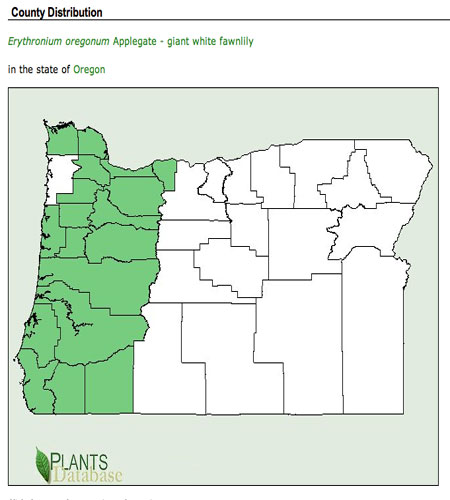
Oregon Fawn Lily is found in most of Oregon's wet, western counties (USDA)

Oregon Fawn Lily is found in most of Oregon’s wet, western counties (USDA)

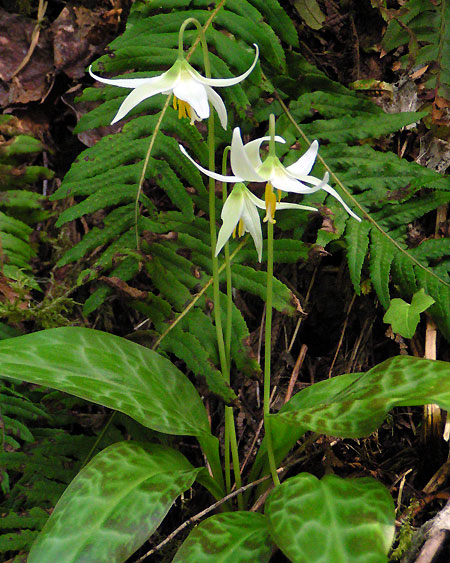
Oregon Fawn Lily have beautifully marked 4-9″ leaves, with a mottled pattern of green, light green and rusty brown that gives these plants their other common name of Trout Lily. These distinctive leaves are the easiest way to identify Fawn Lily. Their graceful blossoms form in clusters of 1-3 per stem, and range in color from white to cream, with yellow anthers. Each flower measures 1-3″ across on stems that range in height from 6-16″.

Oregon Fawn Lily blooms from April through early June. Like all of the Erythronium species, Oregon Fawn Lily emerges from a small bulb in spring and dies back in late summer after producing a 3-sided seed pod, going dormant for the winter.

A reliable place to spot Oregon Fawn Lily is along the Salmon River Trail, where they grace mossy slopes and cliff gardens in the lower sections of the canyon. They can also be found closer to home at the Camassia Nature Preserve in West Linn.

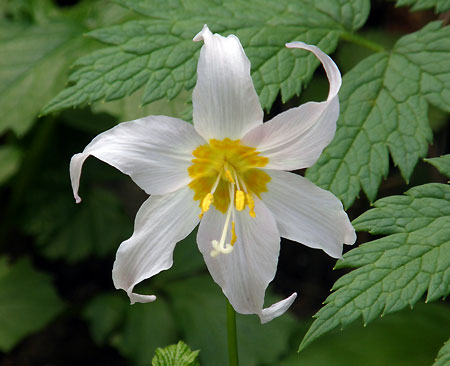
Avalanche Lily
Erythronium montanum

Avalanche Lily

Avalanche Lily

As the common name suggests, Avalanche Lily grows in mountain snow zones, preferring alpine and subalpine forests and meadows. These are among the first flowers to bloom after the snow melts, often forming dramatic carpets with their white, nodding flowers.

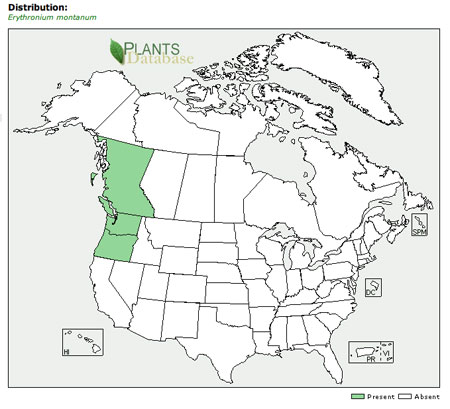
Avalanche Lily is found along the Cascade crest, from British Columbia south to Oregon (USDA)

Avalanche Lily is found along the Cascade crest, from British Columbia south to Oregon (USDA)

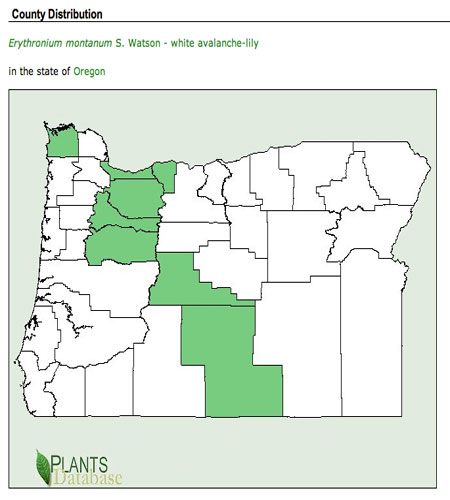
In Oregon, Avalanche Lily has been reported in the northern and central Oregon Cascades, along the high ridges of our basin-and-range country and on a remote outpost on Saddle Mountain, near Astoria (USDA)

In Oregon, Avalanche Lily has been reported in the northern and central Oregon Cascades, along the high ridges of our basin-and-range country and on a remote outpost on Saddle Mountain, near Astoria (USDA)

Avalanche Lily flowers are white with a yellow base, and thus similar in appearance to Oregon Fawn Lily. But Avalanche Lily is much smaller, growing just 6-8″ tall — an adaptation to their harsh mountain habitat. Their leaves are bright green, shiny and strap-shaped, growing 4-8″ long and 1/2″ wide. Notably, they lack the mottled leaf pattern of the Oregon Fawn Lily, the surest way to distinguish between these species.

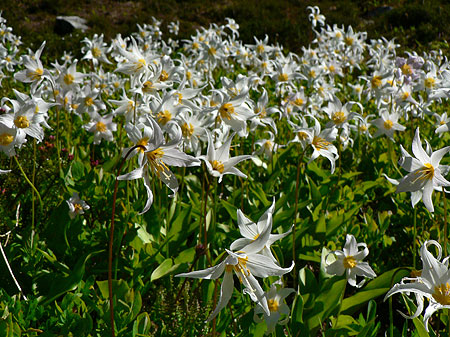
Typical field of Avalanche Lily (USDA)

Typical field of Avalanche Lily (USDA)

By the time most hikers make it into the high country in mid-summer, Avalanche Lily blooms have often faded, and have been replaced by distinctive 3-sided seedpods that will ripen by late summer. Like the Oregon Fawn Lily, Avalanche Lily dies back in fall after forming a seedpod and goes dormant, with their underground bulb safely insulated from winter weather.

Avalanche Lily was among the few plants to survive the 2011 Dollar Lake Fire on Mount Hood

Avalanche Lily was among the few plants to survive the 2011 Dollar Lake Fire on Mount Hood

Their bulbs give lilies a distinctive advantage in fire zones, as witnessed after Mount Hood’s Dollar Lake Fire, in 2011. After the winter snows had cleared from the burn in 2012, avalanche lilies emerged from the charred landscape to burst into bloom, once again – their bulbs unaffected by the heat of the fire. Surprisingly, their bulbs are also an important food for bears in areas where Avalanche Lilies grow in abundance.

Avalanche Lily can be found along much of the Timberline Trail and its approaches in early summer. The upper section of the Mazama Trail, in particular, has the reliably prolific display.

Glacier Lily
Erythronium grandiflorum

Glacier Lily

Glacier Lily

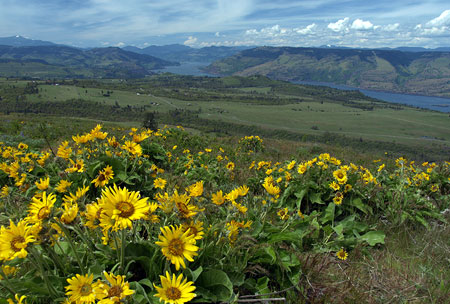
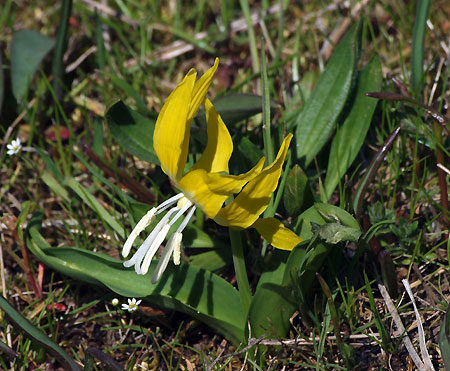
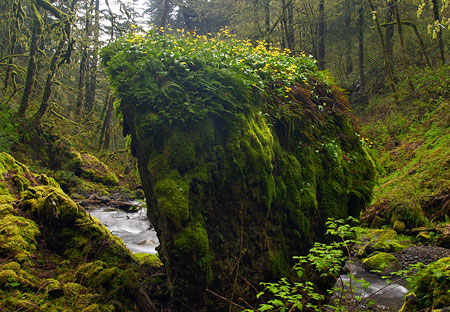
The third in the trio of Erythronium lilies is the Glacier Lily, a distinctive little plant with bright yellow flowers. These are generally alpine and subalpine meadow flowers, but in Oregon, they also thrive in the Columbia River Gorge, where they seek out mossy outcrops, hanging meadows and forest margins.

Glacier Lily is so abundant in the Gorge that hikers who haven’t seen them in their more typical mountain setting probably wonder about their common name. But in alpine areas, Glacier Lily is found in the same habitat as Avalanche Lily, where they are among the first flowers to emerge and bloom after snowmelt.

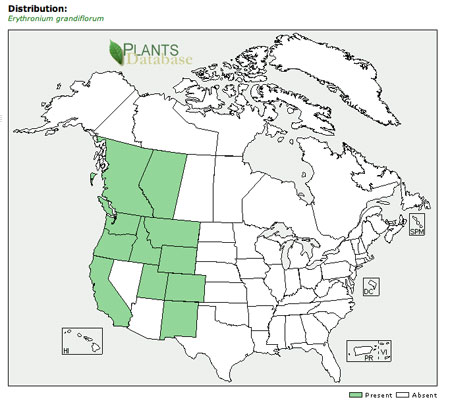
Glacier Lily has the greatest range of the Erythronium lilies and are found throughout the Mountain West (USDA)

Glacier Lily has the greatest range of the Erythronium lilies and are found throughout the Mountain West (USDA)

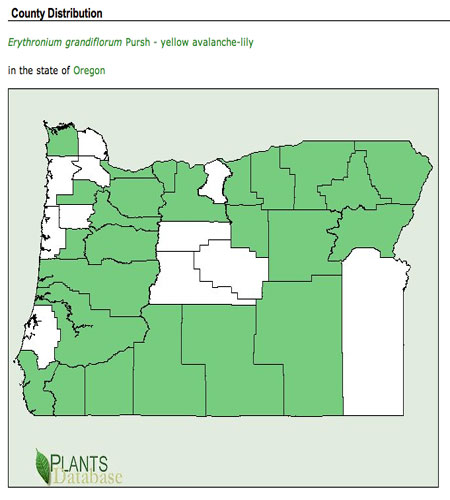
In Oregon, Glacier Lilies are found in mountain areas across the state (USDA)

In Oregon, Glacier Lilies are found in mountain areas across the state (USDA)

The leaves and growth habit of Glacier Lily looks much like those of their cousin, the Avalanche Lily. Their leaves are bright green, 4-8″ in length and about 1/2″ wide. Their stems are typically 6-12″, though tiny, stunted versions growing just 2-3″ in height can be found in more exposed locations in the Columbia Gorge.

This diminutive Glacier Lily on Mitchell Point in the Columbia Gorge is just 2" tall

This diminutive Glacier Lily on Mitchell Point in the Columbia Gorge is just 2″ tall

Glacier Lily flowers are carried one or two per stem, and are typically lemon yellow, with cream or yellow anthers. Like the Avalanche Lily, these early blooming plants produce a seedpod by late summer, then die back to their bulb and go dormant before re-emerging the following spring.

A favorite habitat for Glacier Lilies in the Columbia Gorge is atop boulders, like this one along Moffett Creek, where they form blooming, yellow "caps" in spring

A favorite habitat for Glacier Lilies in the Columbia Gorge is atop boulders, like this one along Moffett Creek, where they form blooming, yellow “caps” in spring

Their distinctive yellow color makes it easy to differentiate Glacier Lily from the white-flowered Avalanche Lily and Fawn Lily, but there’s a catch: it turns out a surprisingly similar flower from the Fritillaria family known as Yellow Bells does a pretty good job of masquerading as a Glacier Lily at first glance. In the Columbia Gorge, the two flowers commonly grow in close proximity, and bloom at about the same time, making it easy to confuse the two.

Yellow Bells are a member of the Fritillaria family, and often grow in close proximity to Glacier Lily in the Columbia Gorge

Yellow Bells are a member of the Fritillaria family, and often grow in close proximity to Glacier Lily in the Columbia Gorge

But upon closer inspection, the flowers are quite different. Where Glacier Lily matures to form open, flared blossoms, Yellow Bells behave true to their name, with a tight, bell-shaped blossom and straight petals. Once you spot this difference, it’s easy to distinguish between these similar neighbors at a glance.

Glacier Lilies can be found in April and early May on most Gorge trails that traverse open slopes and steep meadows. One reliable place to see them is on the Lower Starvation Loop, where they are sprinkled across the hanging meadows in late April. For hardy hikers, they can also be seen in April on the airy crest of Munra Point.
______________________

Botanical note: sources for this article include the USDA, Mark Turner and Phyllis Gustafson’s Wildflowers of the Pacific Northwest and Russ Jolley’s Wildflowers of the Columbia Gorge.

Ticks! Ticks! (10 Common Myths)

Ticks00

Spring has arrived in the Columbia River Gorge, and as we explore among the unfurling fern fronds and explosion of wildflowers, we will also be keeping a wary eye out for a pair of nemeses who also make the Gorge their home: poison oak and ticks! Sure, there are other natural hazards out there, but poison oak wins the prize for quiet ubiquity while ticks are actually OUT TO GET YOU!

Naturally, a lot of mythology exists on both fronts, and I’ve previously debunked poison oak myths. In this article, I’ll tackle the kitchen remedies and common folklore that abound for ticks. The Centers for Disease Control is my primary source for information on the subject, and their tick resource pages are worth a visit for anyone who spends time in tick country. I’ve also relied on the Companion Animal Parasite Council (CAPC) for the best advice on managing ticks on our pets.

The one to watch for: Western Black-Legged Tick (Source: Public Health Image Library)

The one to watch for: Western Black-Legged Tick (Source: Public Health Image Library)

While poison oak can trigger a miserable rash, it’s rarely a serious health risk. Ticks are different. While their bites aren’t usually painful, these tiny members of the arachnid family (they’ve got eight legs – count ‘em!) can also transmit several blood-borne diseases, most notably the bacterium that can cause Lyme disease in humans and animals.

Western Black-Legged Ticks (from left) in nymph stage, adult male and adult female  (Source: California Health Dept.)

Western Black-Legged Ticks (from left) in nymph stage, adult male and adult female (Source: California Health Dept.)

While the potential for Lyme disease exists in just two tick species, all ticks have the potential to carry disease, and should be treated with equal caution. So, with that creepy-crawly introduction, here are ten common tick myths, debunked:

Myth 1: Ticks only occur in the Eastern Gorge

False. While it’s true that ticks are VERY common in oak and pine savannah of the Eastern Gorge, they have been reported throughout the Gorge, though in decreasing numbers as you head west. Based on my own experience, the tick population grows steadily as you head east of Bonneville.

The CAPC forecast for tick exposure in 2013, with hot spots Hood River and Clackamas counties and Southern Oregon (Source: CAPC)

The CAPC forecast for tick exposure in 2013, with hot spots Hood River and Clackamas counties and Southern Oregon (Source: CAPC)

Ticks are found throughout much of Oregon, as it turns out, but generally not in the prolific numbers as we find the Gorge. The CAPC map (above) shows the 2013 tick exposure forecast by Oregon county, with Hood River and Clackamas counties as a expected hot spots in northern Oregon and Jackson and Josephine counties showing higher risk in southern Oregon.

So, while you may have hiked in the “safer” areas of Gorge, it’s always good idea to do a tick check when you get home, no matter where you hiked. But if you’re hiking east of Bonneville, then it’s a good idea to expect ticks and take some precautions.

Myth 2: Ticks die in winter

False. Though tick populations generally decline in winter, in mild winters (such as the past one) ticks in the Gorge can continue to grow and thrive in the outdoors. When the temperature drops below freezing, ticks simply become inactive and burrow into leaf litter, emerging when conditions improve.

Year-round tick country: the Columbia River from the terraced slopes above Rowena Crest

Year-round tick country: the Columbia River from the terraced slopes above Rowena Crest

Tick research in the Northeast suggests a threshold temperature of 38º F and above for ticks to become active, though no research is available for the Pacific Northwest. But it’s safe to assume that you can encounter active ticks year-round in the Gorge in all but the coldest weather.

Myth 3: Ticks should be removed using a lit match

“Just light a match, blow it out, and put the hot tip on the tick to make it angry, and it will back right out!”

“I just used WD40 on a cotton swab to remove a tick from my 3 lb Chihauhau.”

(advice from the internet)

..or… paint thinner, dish soap, kerosene, nail polish remover and Vaseline. All of these folklore solutions have spread far and wide in the age of the internet, along with cult-like followings to defend them!

Ticks05

The idea that Vaseline or WD-40 will suffocate the tick and nail polish will kill it with toxins or cause it to detach on its own is sketchy, at best. Worse, these folk remedies could cause the tick to disgorge its contents into your bloodstream — exactly what you’re trying to avoid!

Instead, ticks should be gently pulled from the skin with tweezers or a custom tool for removing ticks (more on that later).

Myth 4: If parts of the tick break off when removing it, you have to dig them out to prevent Lyme Disease

Advice on this one varies: some sources recommend removing all parts of the tick to prevent a secondary infection, while others argue that you’ll do yourself more harm trying to dig them from your skin. But if you remove the living tick within 24 hours, you’ve likely removed any risk of infection with a tick-borne disease, even if you didn’t get the entire tick.

The safest bet is to check with your doctor if you find yourself in this situation. Even better, be sure to remove the tick properly, and you will be much less likely to break off any tick parts (again, more on that later).

Myth 5: Ticks can re-grow their bodies if the head is still intact

Headless is dead… even for the mighty tick!

Headless is dead… even for the mighty tick!

False. This bit of folklore probably comes the (admittedly creepy) fact that the abdomen of a tick that has become engorged after several days of being attached to a host can become alarmingly large. Or maybe that some snakes and lizards can re-grow their tail? But a beheaded tick is just that, and can’t survive.

Myth 6: A hot, soapy shower will remove any ticks

Partly true. Ticks can survive a shower – or even a bath — and happily stay attached to your skin, but a shower can wash away ticks that haven’t attached yet. If you’ve done a visual tick check before jumping in the shower, it’s not a bad idea to do another fingertip check with the aid of soap and water, feeling for small bumps along the skin.

A fingertip check is especially helpful in finding small, immature ticks in the nymph stage, when they are about the size of the head of a pin. They often go unnoticed until fully engorged, and are therefore responsible for nearly all of human Lyme disease cases, according to the American Lyme Disease Foundation.

Myth 7: Ticks in Oregon don’t carry Lyme disease

Partly true. While not common in Oregon (yet), Lyme disease is here, with Oregon falling in the “moderate” range for disease risk in 2013, according to the CAPC (see map, below). However, in the Western states, Lyme disease is only transmitted through the Western Black-Legged Tick, just one of several tick species found here.

The 2013 Lyme Disease forecast by the Companion Animal Parasite Council puts Northwest Oregon in the moderate risk range (Source: CAPC)

The 2013 Lyme Disease forecast by the Companion Animal Parasite Council puts Northwest Oregon in the moderate risk range (Source: CAPC)

Though small, Oregon’s Lyme-carrying ticks are noticeably larger than the only other species known to the disease (found in eastern states), so they are easier to spot and remove. Small comfort, to be sure, but it does make coping with ticks a bit less troublesome in this part of the country.

A caveat to that size difference is that our Lyme-carrying ticks in the immature phase — known as a “nymph” are still very small, so warrant extra care during the spring and early summer and nymphs are most common. Nymphs spend most of their time on the ground, and generally feed on small animals as a result, but it’s still a good idea to look closely for nymphs when you check for ticks.

Myth 8: Only people can get Lyme disease

False. Lyme disease was first identified as a tick-borne illness for humans in 1978, and the actual cause (a bacterium) of the illness wasn’t discovered until 1981. By 1984, Lyme disease had been discovered in dogs, and soon after, in other domestic animals, including horses and cats.

In the Northeast, dogs with Lyme disease have become commonplace, to the point that some states have stopped tracking the infectious because of the flood of reports to veterinary clinics.

Oh, the injustice! The sleepy villages of Lyme and Old Lyme, Connecticut have the unfortunate distinction of having a tick-borne disease named for them..!

Oh, the injustice! The sleepy villages of Lyme and Old Lyme, Connecticut have the unfortunate distinction of having a tick-borne disease named for them..!

The test for Lyme disease in dogs takes just a few minutes, and dogs testing positive are generally treated with a 30-day regiment of antibiotics. For most dogs, visible symptoms of the disease are the same as for humans: swollen joints, lethargy, and in a small percentage, kidney failure. Veterinary clinics in the Northeast are now offering a Lyme disease vaccination for dogs in response to the increased rate of infection.

Myth 9: Lyme disease is always marked by a bullseye rash

False. While Lyme disease in humans typically causes a red rash to expand from the site of the tick bite, creating a “bullseye”, this distinctive rash only occurs in 70-80 percent of cases, according to CDC.

The classic Lyme disease bullseye (Wikimedia)

The classic Lyme disease bullseye (Wikimedia)

Usually, a tick must remain attached for a minimum of 24 hours to transmit Lyme disease, so if you remove a tick promptly, it’s soon enough to avoid an infection risk. If you’re not sure, or know that a tick was been embedded for more than 24 (even without the bullseye rash), it’s probably a good idea to check with a doctor about starting antibiotics as a precaution.

Myth 10: Every tick bite carries the possibility of Lyme disease

False. Most tick species do not carry Lyme disease. Only ticks in the genus Ixodes carry the bacteria B. burgdorferi which causes the disease. This includes the Deer tick (Ixodes scapularis) in the Northeastern states and the Western Black-Legged tick (Ixodes pacificus) in the West.

In Oregon, the adult Black-Legged tick measures about two-thirds the size of the more common Wood (or “dog”) tick (Dermacentor variabilis), which frequent similar habitat. However, while the Wood tick doesn’t transmit the Lyme bacteria, it does carry other diseases (including Rocky Mountain Spotted Fever), so the same care in managing ticks applies, no matter the species.

Black-Legged tick (left) compared to common Wood tick (right)

Black-Legged tick (left) compared to common Wood tick (right)

The risk of Lyme infection from a tick bite is estimated at 1-3 percent, so very low — but still cause for caution. Why? Because left untreated, Lyme disease symptoms may progressively affect joint, heart and central nervous system health. In most cases, the infection and symptoms are eliminated with prompt use of antibiotics. Delayed diagnosis and treatment can make the disease more difficult to treat and risk lasting disability, so it’s a serious concern.
_______________________________

When you’re in tick country…

Ticks are found where they can reliably attach to deer, livestock, other mammals, ground-dwelling birds and even lizards. Some of the most productive tick habitats in the Columbia Gorge are oak woodlands and areas of vegetation at the edge of forests, along forest hiking trails and game trails and in grassy meadows. They are also common in power line corridors that cut through forests, around campgrounds and in tall grass along roadways.

While ticks are definitely stalking YOU, it’s not an active pursuit. Instead, they wait on vegetation for passing hosts to come along. Ticks can detect hosts by sensing carbon dioxide, scents and vibrations from movement of their hosts. They can sometimes be seen at the tips of grass blades or plant leaves “questing.” This is a behavior in which the tick extends waving front legs ahead of an approaching host, looking to catch a ride!

Sure, it looks funny! But it’s a proven practice for tick prevention

Sure, it looks funny! But it’s a proven practice for tick prevention

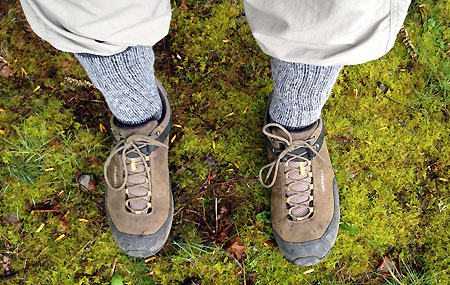
When you’re in tick country, wear light colored long pants and long-sleeved shirts. Tuck pant legs into socks (see photo, above) and shirts into pants to close off points easy of entry at tick-level. This not only makes it harder for a tick to make its way to your skin, it also allows you to better spot ticks on your clothing, and simply brush them off.

Walk in the center of trails, and avoid brushing against tall grass or undergrowth along the trail. If you stop, sit on rocks or logs, not in grassy areas, and periodically brush your legs and sleeps to feel for ticks on your clothing. These simply practices not only help prevent ticks from going for a ride, they also help you avoid poison oak, so you get a twofer for these prevention basics!

Materials treated with DEET or permethrin are proven to repel and eventually kill ticks. Of the two, permethrin is the most effective and long lasting. This pesticide can be used to treat boots, clothing and camping gear and remain protective through several washings. It is toxic to cats, however — even from contact with recently treated clothing — so must be used with care!

DEET (left) is easier to use but Permethrin (right) is more effective for ticks

DEET (left) is easier to use but Permethrin (right) is more effective for ticks

DEET products are also widely available, and can be applied to both your skin and clothes (with some fabric limitations). Deet might be a good option if you’re hiking in warm weather and less inclined to cover up with clothing.

After your hike…

After you’ve been hiking in tick country, here’s an easy checklist to follow:

1. Check clothing for ticks when you return to the trailhead. Ticks may be carried home and into the house on clothing, so check before you get into the car. When you get home, be sure to immediately put clothing in the wash, then the dryer to take care of any stowaways you might have missed. Clothing that can’t be washed can go directly into the dryer, where an hour on high heat will kill any ticks.

2. Do a full body check. Before you get in the shower, use a hand-held or full-length mirror to view all parts of your body including your scalp, behind your ears and… gulp… around your privates! A thorough check should take about 30-45 seconds. Kids should be checked by parents!

3. Shower right away. Showering washes away un-attached ticks that you might not have spotted, and has been shown to reduce your risk of getting Lyme disease as a result. It also gives you an opportunity for a thorough fingertip tick check with soapy fingers.

4. Do another full body check. After a shower, repeat the full body check with a mirror.

You should continue to watch for ticks for a couple days after spending time in tick country, to ensure that you haven’t missed a tick.

What to Do if You Find an Attached Tick

Ticks13

Remove an attached tick as soon as you notice it with tweezers or a special tick removal tool. Grasp a tick as close to your skin as possible, pulling it straight out — and don’t “unscrew” the tick, as suggested in many folk remedies, as you’ll likely pull the head off the tick!

The tick remover kit shown below is one of the best available, and far superior to tweezers, as it involves no squeezing when pulling a tick — thus lessening the chance of infection or breaking off the head. This kit consists of a simple, forked spoon for lifting the tick out and a tiny magnifier for use in the field. I carry this kit in every one of my packs — it’s inexpensive, and easily found in outdoor stores or online.

The excellent Pro-Tick Remedy system makes pulling ticks a breeze!

The excellent Pro-Tick Remedy system makes pulling ticks a breeze!

Once a tick is out, wash the wound with soap or alcohol and monitor it for a day or two for signs of infection. Most tick wounds will heal up quickly, with no sign of the bite after a couple days.

It’s always safe to watch for any signs of tick-borne illness after you’ve been bitten, such as rash or fever in the days and weeks following the bite. If you suspect you have symptoms, see your doctor.

Ticks and your dog…

Dogs are very susceptible to tick bites and diseases, and of course, hikers love to take their dogs into the Gorge. While vaccines protect dogs from some tick borne diseases, they don’t keep your dog from bringing ticks into your home.

There are several things you can do to protect your dog from ticks. Most obvious is to simply leave your dog home when venturing into areas known for ticks — and that includes areas in the Eastern Gorge. But if you do take your dog into tick country, there are some preventative steps that will greatly reduce the chance of a tick attaching to Rover.

The most common (and simplest) solution for preventing ticks on your dog is a once-per month, non-prescription insecticide treatments available from most veterinarians, online or from pet stores. The best-known options are Frontline Plus™ and Advantix™.

Frontline Plus comes in doses adjusted for the weight of your dog, and is applied from a hard-to-open, somewhat awkward-to-use dropper that can spill onto your hands

Frontline Plus comes in doses adjusted for the weight of your dog, and is applied from a hard-to-open, somewhat awkward-to-use dropper that can spill onto your hands

The key ingredient that makes both Frontline Plus™ and Advantix™ effective on ticks is premethrin, the same common, widely-used pesticide used to treat clothing for ticks. Be very careful if you have cats in your home, however, as premethrin can be fatal to cats, whether inadvertently administered or even by exposure to a recently treated family dog. Both treatments are applied along the spine, beginning at the back of the neck and moving toward the tail, and are effective for up to one month.

These products should prevent ticks from attaching to your dog — and even if one does, the premethrin ingredient would likely kill the tick, eventually. But these products don’t prevent ticks from going for a ride in your dog’s fur, so it’s always a good idea to inspect your dog at the trailhead, using a brush, before loading up and driving home.

Advantix has the same premethrin ingredient as Frontline Plus, but is easier to administer with well-designed tubes that keep the product off your hands

Advantix has the same premethrin ingredient as Frontline Plus, but is easier to administer with well-designed tubes that keep the product off your hands

Tick bites on dogs can be hard to detect, as tick borne disease symptoms may not appear for up to three weeks after a tick bite. Call your veterinarian if you notice changes in behavior or appetite in you think your dog might have been bitten by a tick.

Tick! Tick! (…but don’t panic…)

Okay, so this article might have you nervously scratching your legs on your next hike and seeing every black speck on your boots as a TICK! But don’t let these little blood suckers get you down! Sure, they’re annoying… and kind of creepy. But the basic precautions outlined above are easy to build into your hiking routine, and more than enough to give you peace of mind when you’re out on the trail.

Ticks17

If you DO find a tick that has managed to attach to you, and you’re creeped out by the thought of pulling it — or can’t reach the tick yourself — simply head for the doctor’s office. They will take care of it for you, and the chances of any complications are extremely small. Even if you have pulled the tick, and are feeling sort of queasy about it, go to the doctor (with the tick). It will be worth the peace of mind.

For a lot more information on ticks (if you aren’t adequately freaked out by now), check out the Centers for Disease Control tick resources.

Then, by all means, get back out on the trail, ticks (and poison oak) be damned!

Highway 26: Last Chance to weigh in!

Mount Hood from the Mirror Lake Trail

Mount Hood from the Mirror Lake Trail

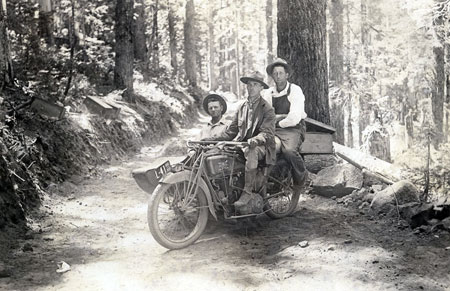
After several years of planning, the proposed safety projects on the Mount Hood Highway (Highway 26) are nearly a done deal, and have entered a final round of public review and comment — with comments due April 7th!

The project has been the subject of several articles on this blog, and thankfully, has been scaled-back somewhat from the original, old school “widen for safety” retread of 1950s highway mentality that dominated earlier phases in the corridor. That said, the project has simply moved from a failed grade to something like a C-minus, at best. It needs your input to be more than an eyesore for the traveling public.

Google Earth perspective on the US26 Laurel Hill Grade

Google Earth perspective on the US26 Laurel Hill Grade

The highway section in question is the Laurel Hill grade, west of Government Camp. Ever since Oregon Trial pioneers lowered their covered wagons down the infamous talus “chute” on Laurel Hill, this spot has vexed road designers.

The current highway alignment is no exception: despite blasting away a good portion of Laurel Hill, the road is still a steep, curving, often treacherous route. The need for safety improvements is on the mark, but it’s unclear if the solutions proposed by the Oregon Department of Transportation (ODOT) will deliver, as some of the best (and least expensive) recommendations from their own safety study were dropped from the project at the very start.

It’s not to late to add some of these more practical, potentially more effective solutions to the project, even if the highway engineers seem determined to widen the road and chip away more of Laurel Hill as their preferred solution. More on how you can weigh in at the conclusion of this article.

US26Comments02

(click here for a larger map in a new window)

But first, an overview of the ODOT final proposal is in order, starting with kudos to the agency (yes, you read that right!) for greatly improving their public involvement. Having reviewed a lot of ODOT projects over the years, I’m impressed with the effort the agency has made in this final round of outreach for Highway 26.

Though in-person open houses have continued to be limited to the Welches area (despite the fact that the vast majority of highway users — and taxpayers — live in the metro area), the web tools provided by ODOT in this round of public review are especially well done, and arguably a better format for most citizens than traditional open houses.

The Project

The following are “before-and-after” digital renderings of the major elements of the Highway 26 safety project. A link to the ODOT virtual open house is included at the end of this article, and includes these renderings at much larger scale.

The number shown on each pair of images corresponds to the map shown above (or you can click here to open a large version of the map in a new window or tab). The tour starts from the west, at the base of the Laurel Hill grade, and proceeds east toward Government Camp.

US26Comments03

The project begins at the west (lower) end of the Laurel Hill grade. A number of small changes are proposed along this approach, but the most notable is proposal to cut back the cliff at the “Map Curve”, the ODOT name for the wide bend in the highway where Mount Hood first looms into view — a very popular, if somewhat harrowing pullout for visitors.

The rendering above shows what the scaled-back cliff at the Map Curve would look like from the west, as you pass the familiar road cut and rock outcrop known by ODOT as “Silent Rock. As the renderings show, the scaled-back cliff would be a major undertaking. The purpose of this element of the project is to prevent rocks from falling on the highway. According to ODOT, this is safety concern in the area, and the cause of numerous crashes over the years.

US26Comments04

This is another before-and-after rendering of the scaled-back cliff, this time looking west from near the Map Curve toward the base of Laurel Hill. This view shows another proposed feature: a continuous concrete median, extending from just below the Map Curve to just above the Mirror Lake trailhead, for a total of about 2.5 miles.

The ODOT plans for the median call for an “aesthetic” concrete that complements natural material found in the area. The capped concrete median (installed near Bennett Pass) pictured in public outreach materials would, indeed, be a significant improvement over a standard barricade:

US26Comments04a

Unfortunately, the design pictured in the ODOT before-and-after renderings, omit the faux cap, greatly diminishing the “aesthetic” qualities of the proposed barriers.

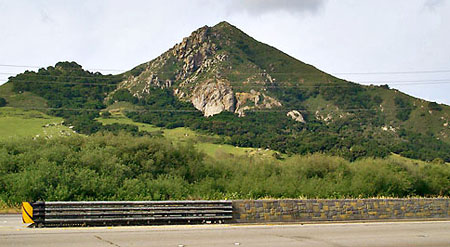
Other highway departments around the country are experimenting with similar “context sensitive” alternatives for concrete medians in natural or scenic environments, such as this example from CalTrans, installed in the San Luis Obispo area:

US26Comments04b

The cost of aesthetic medians will be a major driver in the ODOT final decision, but the longevity of the medians (30-40 years?) call for getting it right the first time. ODOT should be installing something special that truly enhances the Mount Hood Highway experience, not just something “less worse” than a standard freeway barricade.

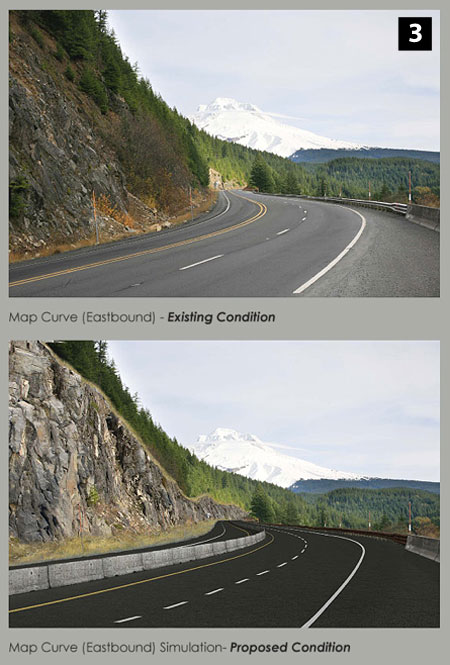
The next rendering (below) is from the Map Curve, this time looking east toward Mount Hood. This view also shows the proposed median as well as the scaled-back cliff.

US26Comments05

It’s hard to argue with the need to reduce hazardous rock fall in the Map Curve area, except to imagine a parallel universe where foresighted engineers had tunneled through Laurel Hill when the modern highway was originally built..!
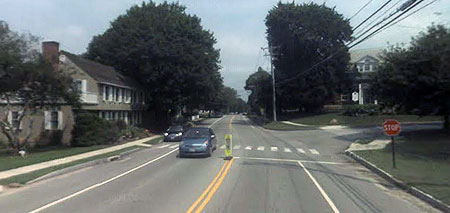
But alas, the current alignment is our reality, and based on the materials provided by ODOT, the scaled-back cliff is another least-worst solution for the problem. The engineers are proposing a steeper-than-standard cliff face when completed, but with a larger catchment at the base, thus (hopefully) reducing the number of rocks that make it to the roadway while also minimizing the amount of road widening to accommodate the catchment.

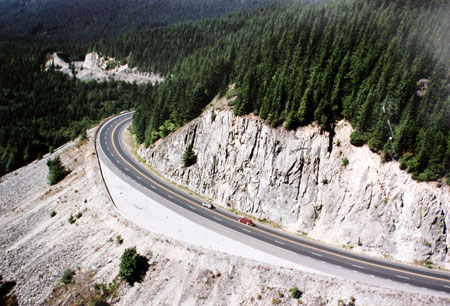
The towering road cut at the Highway 26 “Map Curve” will get taller and much longer under the ODOT safety proposal (photo: ODOT)

The towering road cut at the Highway 26 “Map Curve” will get taller and much longer under the ODOT safety proposal (photo: ODOT)

ODOT surveyed the existing cliff with the aid of a helicopter, and the scope of this element of the project is truly daunting: as shown in the image above, the man-made cliff is already very large, and making an even taller cut will be a tricky endeavor, indeed.

This element of the project appears to already be a done deal, so the best we can hope for is that the resulting scars on the landscape aren’t any more jarring than what can already be seen (and heard) from nearby recreation trails. Keep your fingers crossed.

US26Comments06

The next rendering (above) is from a point just beyond the Map Curve, looking back at the curve and the adjacent runaway truck ramp (a feature that dates back to the late 1970s). As with the previous views, the changes here include the scaled-back cliff section and continuous concrete median.

Next up is a before-and-after view toward the mountain from high saddle on Laurel Hill where the highway crosses from the south face to the north side of the ridge. This spot is familiar to travelers as the site of the historic Laurel Hill Chute interpretive sign and trail. The rendering shows the proposed median, road widening to 4-lanes and another substantially scaled-back cliff section to address reported rock fall hazards.

US26Comments07

Notably absent from this rendering is a new pullout and trailhead for the historic Laurel Hill Chute site, hopefully just an oversight by the artists. ODOT has not suggested in the written materials for the project that trail access at this point will be eliminated. This is a detail worth commenting on if visiting this fascinating remnant of the original Oregon Trail is one of your family traditions.

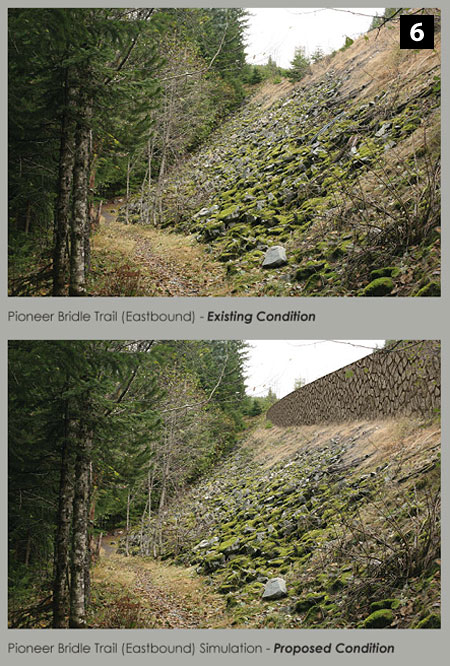
The next before-and-after rendering (below) is from the same section of road, also looking east, but from the bottom of an embankment on the opposite side of the highway, where the Pioneer Bridge Trail parallels the road. Here, a structural retaining wall is proposed to provide the additional roadway width needed to widen the highway to four lanes and add the center median. Kudos to ODOT for a context-sensitive solution with this retaining wall: the rendering suggests it will be constructed with faux-stone facing, thus lessening the visual blight for hikers, cyclists and equestrians using the trail, if not the overwhelming noise from highway traffic.

US26Comments08

The proposed widening to 4 lanes in this section is significantly scaled back from earlier incarnations of the Laurel Hill safety project. This is a welcome change to the design, as ODOT’s own safety data shows only occasional spikes in traffic volumes — on holidays and peak summer and winter weekends — that road widening would do little to resolve. Most of the time, traffic volumes on Highway 26 are far below built capacity, and the few (and arguably avoidable) traffic jams that occur don’t warrant costly widening projects.

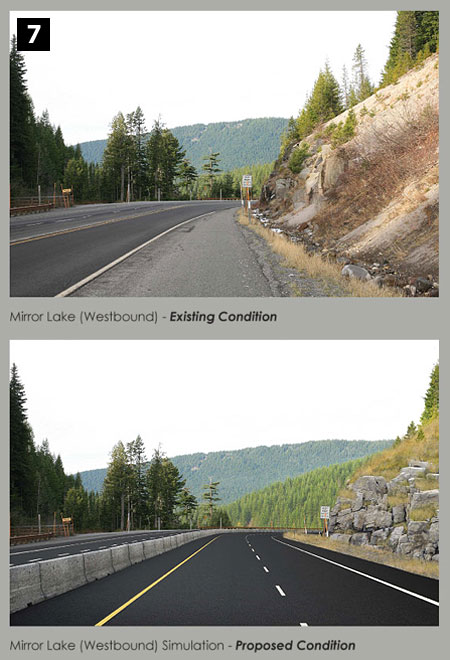
The final before-and-after view is from opposite the Mirror Lake trailhead, looking west (downhill) toward Laurel Hill. Here, the rendering shows another proposal to cut back an existing slope to address rock fall and sight distance concerns, the upper extent of the proposed median and another section of highway proposed to be widened to 4 lanes.

The Mirror Lake trailhead is unquestionably dangerous, thanks to very heavy use and its location on a relatively steep curve. The proposed median will should eliminate the possibility of crossover crashes throughout its proposed 2.5 mile extent, but is especially warranted at this location.

US26Comments09

However, the median will also prevent left turns in and out of the Mirror Lake trailhead, forcing hikers approaching from Portland to continue west to Government Camp to make their return trip. With the median terminating just east of the trailhead, visitors will be tempted to make a U-turn, a potential hazard ODOT has not addressed in the proposal.

Likewise, visitors coming to Mirror Lake from Government Camp will have to drive 3.5 miles to the bottom of Laurel Hill, and presumably turn around at the Kiwanis Camp junction in order reach the trailhead.

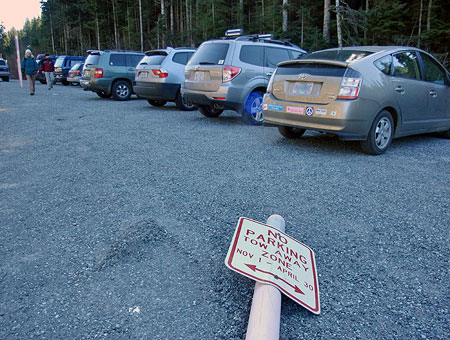
Civil disobedience ensued in 2010 when ODOT abruptly closed the Mirror Lake trailhead to winter parking

Civil disobedience ensued in 2010 when ODOT abruptly closed the Mirror Lake trailhead to winter parking

These changes at Mirror Lake will be unwelcome news to hikers who have already chafed at the recent winter closure of the trailhead by ODOT. In the end, it’s probably a “least worst” trade-off in the interest of traffic safety, but ODOT could be doing much more to make this element a real step forward for Mirror Lake visitors.

For example, it’s hard to tell from the “after” rendering, but the Mirror Lake trailhead appears unchanged: this is a missed opportunity, as ODOT will spend tens of millions on the overall Laurel Hill safety project, and a more carefully and aesthetically designed parking area here, separated from the highway traffic, could further improve traffic safety.

US26Comments11

ODOT has a lot of recent experience in this area from their excellent trailhead parking improvements in the Columbia River Gorge, including Angels Rest, Horsetail Falls and Yeon State Park. These relatively new designs provide a perfect template for the Mount Hood Highway, and follow the aesthetic lead ODOT has already taken in recent years with context sensitive designs for the Multorpor overcrossing and Government Camp signage, for example.

Getting it right the first time!

The current round of projects coming to the Mount Hood Highway are the most recent in a string stretching back decades, and clearly will not be the last. Though the final designs ODOT is proposing in the interest of “safety” are less destructive than some of the initial concepts, there are still a number of missed opportunities and questionable “solutions” on the table.

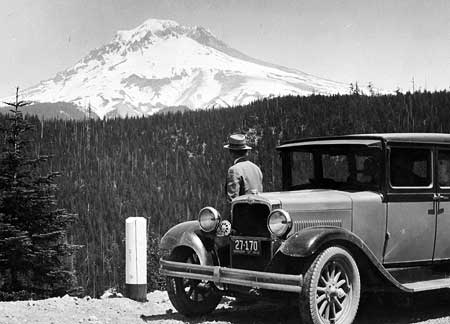
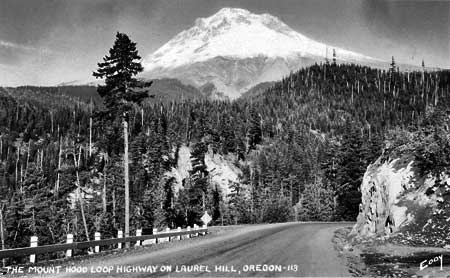
1920s motorists enjoying the view from a kinder, gentler Mount Hood Highway in 1931

1920s motorists enjoying the view from a kinder, gentler Mount Hood Highway in 1931

It’s probably too late to turn back some of the more questionable elements, but there’s still time to advocate where opportunities have been missed. Here’s a rundown of some additions that could make this project more successful. Consider adding these to your own comments!

1. Retain the Laurel Hill Chute Trailhead: this important historic site has been a family stopping point for generations, and must not be lost to road widening. ODOT should propose an improved pullout for visitors at the current trailhead.

2. Make the Mirror Lake Trailhead a showpiece: ODOT should follow its own lead with new trailheads built in the Gorge, and make this trailhead more than just a dusty highway pull-off. Mirror Lake is the “gateway” trail for many first-time visitors to the mountain and the pullout and trailhead ought to be designed accordingly.

3. Use architecturally enhanced medians: the proposed exposed aggregate medians are a tiny step in the right direction, but this element of the project will be the most visible to the traveling public. Let’s aim higher with architecturally themed medians that coordinate with recent improvements to the Government Camp streetscape — and at a minimum, the capped design used at Bennett Pass.

4. Look for storm water solutions to protect Camp Creek: the project is silent about the ongoing effects of polluted Highway 26 runoff on adjacent Camp Creek, a salmon and steelhead-bearing stream. ODOT will be putting down an immense amount of asphalt and new road fill with this project, so will they also improve storm water capture in the process?

5. Don’t wait to install variable speed signs & photo radar: this is one of the least expensive solutions in ODOT’s own safety audit, but moved to the back of the line from the very start. Why wait? Install variable speed limit signs and photo radar now for use during hazardous conditions.

6. Extend the Highway 26 Safety Corridor: ODOT bravely reduced the posted speed limit to 45 MPH from Wildwood to Rhododendron in an earlier phase of the Highway 26 safety campaign. Now it’s time to extend this safety corridor to Timberline Road. It’s an inexpensive, extremely effective safety solution whose time as come — plus, reduced speeds greatly reduce noise impacts for those living along the corridor and recreating on nearby public lands, a dual benefit.

7. Develop a long-term strategy for the resorts: the dirty little secret in ODOT’s 15-year campaign to address safety in the Mount Hood corridor is that almost all of the crashes occur in winter, on a few weekends when the roads are icy. It’s not rocket science to deduce that most of this is due to the huge spikes in traffic coming from the three major ski resorts on the mountain. It’s time to manage winter resort traffic comprehensively, and give skiers real alternatives to driving to the mountain in adverse conditions (more on that in a future article…)

In the long term, the most sustainable solution for the highway is to manage it as a scenic parkway, and put an end to the constant, incremental creep toward becoming an unmanageable, unlivable urban freeway sprawling over the shoulder of iconic Mount Hood (…more on that in a future article, as well…)

Go ahead, weigh in… by April 7th!

ODOT has done a very good job assembling a “virtual open house”, so if you care about Mount Hood and want to weigh in on their plans, it really couldn’t be easier. Simply go to their project website and explore:

Highway 26 Virtual Open House

Remember, comments are due by April 7th! While it’s true that many of the project elements are likely a done deal, you can still have an impact by making your concerns known. Projects like this have a sizable “contingency” budget set aside for this very reason, and now is the time to guide how those funds (your tax dollars) are spent!

The original Laurel Hill grade in the 1920s, shortly after the Mount Hood Highway opened

The original Laurel Hill grade in the 1920s, shortly after the Mount Hood Highway opened


____________________________

For more background on this proposal, you can also read these previous WyEast Blog articles on the topic:

Highway 26 Widening: Part 1

Highway 26 Widening: Part 2

Highway 26 Widening Postscript… and Requiem?

Tollgate Maples… and the Highway

Mount Hood Loop Interpretive Signs

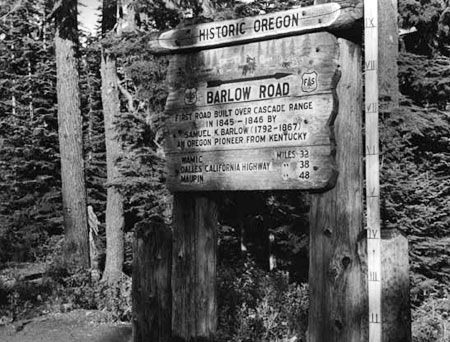
Original “Historic Oregon” sign at Barlow Pass in the 1940s (Wikimedia Commons)

Original “Historic Oregon” sign at Barlow Pass in the 1940s (Wikimedia Commons)

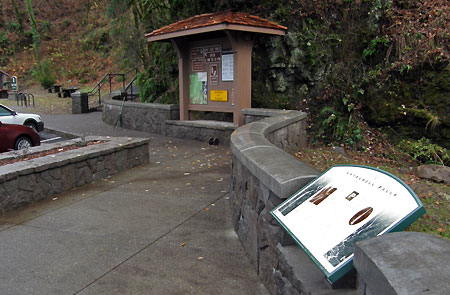
One of the unexpected discoveries in launching the Mount Hood National Park Campaign in 2004 was the surprising number of people who think our mountain and gorge are already protected as a national park!

This tragic misconception is shared by newbies and natives, alike, so my conclusion is that it comes from the “park-like” visual cues along the Mount Hood Loop: the historic lodges, rustic stone work and graceful bridges along the old highway. There is also a surprising (if disjointed) collection of interpretive signs that you might expect to find in a bona fide national park.

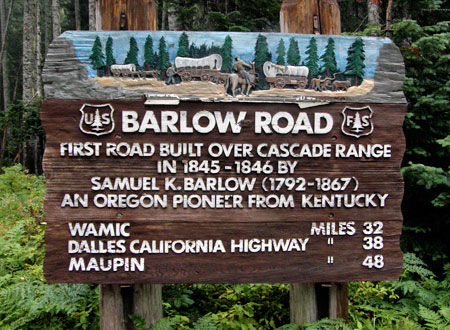
The new (or restored?) sign at Barlow Pass in 2010

The new (or restored?) sign at Barlow Pass in 2010

The interpretive signs around Mount Hood are an eclectic mish-mash of survivors from various public and private efforts over the years to tell the human and natural history of the area.

The oldest signs tell the story of the Barlow Road, the miserable mountain gauntlet that marked the end of the Oregon Trail. The above images show one of the best known of these early signs, a mammoth carved relief that stands at Barlow Pass (the current sign appears to be a reproduction of the original).

Less elaborate signs and monuments of assorted vintage and styles are sprinkled along the old Barlow Road route wherever it comes close to the modern loop highway: Summit Prairie, Pioneer Woman’s Gravel, Laurel Hill.

More recently, the Forest Service and Oregon State Parks have been adding much-needed interpretive signage along the Historic Columbia River Highway (as described in this article), an encouraging new trend.

Oregon State Parks interpretive panels are showing out throughout the Gorge

Oregon State Parks interpretive panels are showing out throughout the Gorge

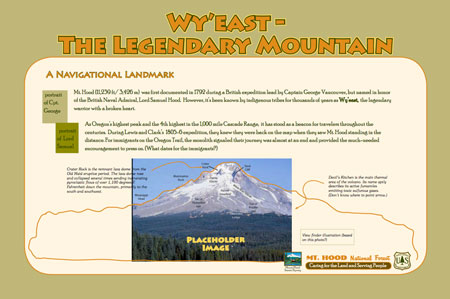
Thus, I was thrilled when the Forest Service Center for Design and Interpretation in McCall, Idaho contacted me last year about a new series of roadside signs planned for the Mount Hood Loop. They had seen my photos online, and were looking for some very specific locations and subjects.

In the end, the project team picked eight of my images to be included on a series of four interpretive signs. The following is a preview of the signs, and some of the story behind the project. The new signs should be installed soon, and hopefully will survive at least a few seasons on the mountain!

The Signs

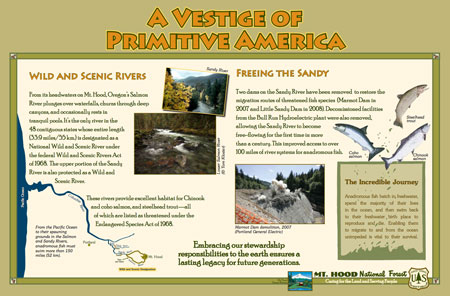
The first installation will be placed somewhere along the Salmon River Road, probably near the Salmon River trailhead. This sign focuses on fisheries and the role of the Sandy River system as an unimpeded spawning stream for salmon and steelhead.

This sign will appear near the Salmon River (USFS)

This sign will appear near the Salmon River (USFS)

(click here for a large view)

Part of the narrative for this sign focuses on the removal of the Marmot and Little Sandy dams, a nice milestone in connecting the network of Wild and Scenic Rivers in the Sandy watershed to the Columbia. A PGE photo of the Marmot Dam demolition in 2007 is included on the display, along with river scenes of the Sandy and Salmon. The Salmon River image on the first sign is the only one I captured specifically for the project, in early 2012. It’s a rainy winter scene along the Old Salmon River Trail.

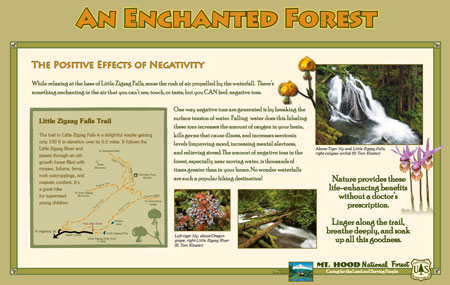
The second sign will be placed at the Little Zigzag trailhead, located along a section of the original Mount Hood Loop highway at the base of the Laurel Hill Grade. The site already has an interpretive sign, so I’m not sure if this is an addition or replacement for the existing (and somewhat weather-worn) installation.

This sign will be located at the Little Zigzag trailhead (USFS)

This sign will be located at the Little Zigzag trailhead (USFS)

(click here for a large view)

The content of the Little Zigzag sign is unique, launching into a surprisingly scientific explanation of how the negative ions created by streams and waterfalls feed your brain to give you a natural high! Not your everyday interpretive sign..! It also includes a decent trail map describing the hike to Little Zigzag falls, as well as other trails in the area.

The Forest Service used several of my images on this sign: views of Little Zigzag Falls, the Little Zigzag River and several botanical shots are incorporated into the layout.

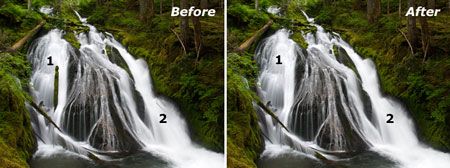
The Little Zigzag Falls image has a bit of a back story: the Forest Service designers couldn’t take their eyes off a log sticking up from the left tier of the falls. To them, it looked like some sort of flaw in the image. I offered to edit it out, and after much debate, they decided to go ahead and use the “improved” scene. While I was at it, I also clipped off a twig on the right tier of the falls. Both edits can be seen on the large image, below:

USFS_Panel_1a

(click here for a larger image)

I should note that I rarely edit features out of a photo — and only when the element in question is something ephemeral, anyway: loose branches, logs, or other debris, mostly… and sometimes the occasional hiker (or dog) that walks into a scene!

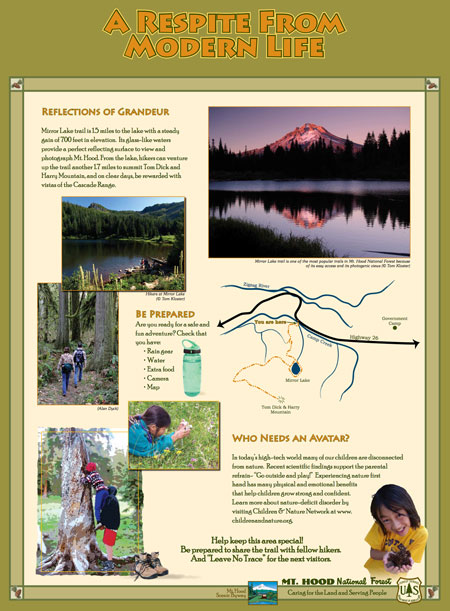
The third sign will be installed at the popular Mirror Lake trailhead, near Government Camp. Like the Little Zigzag sign, this panel has a trail map and hike description for Mirror Lake and Tom Dick and Harry Mountain.

A nice touch on Mirror Lake sign is the shout-out to the Children & Nature Network, a public-private collaborative promoting kids in the outdoors. I can’t think of a better trail for this message, as Mirror Lake has long been a “gateway” trail where countless visitors to Mount Hood have had their first real hiking experience.

This sign will be at the Mirror Lake trailhead (USFS)

This sign will be at the Mirror Lake trailhead (USFS)

(click here for a large view)

The Forest Service team used a couple of my photos in the Mirror Lake layout: a summertime shot of the lake with Tom Dick and Harry Mountain in the background, and a family at the edge of the lake, and a second “classic” view of alpenglow on Mount Hood from the lakeshore.

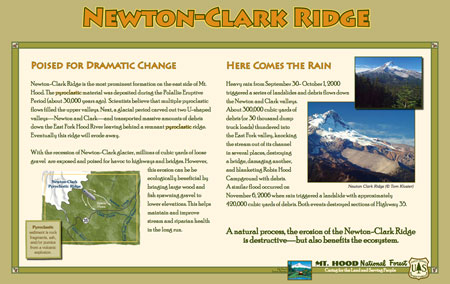
The fourth sign in the series focuses on geology. Surprisingly, it’s not aimed at familiar south side volcanic features like Crater Rock — a theme that was called out in some of the early materials the Forest Service sent me. Instead, this panel describes huge Newton Clark Ridge, and will apparently be installed at the Bennett Pass parking area.

This sign is planned for Bennett Pass (USFS)

This sign is planned for Bennett Pass (USFS)

(click here for a large view)

In a previous blog article, I argue Newton Clark Ridge to be a medial moraine, as opposed to currently accepted theory of a pyroclastic flow deposited on top of a glacier. The Forest Service interpretive panel mostly goes with the conventional pyroclastic flow theory, but hedges a bit, describing it as “remnant” of two glaciers… which sounds more like a medial moraine!

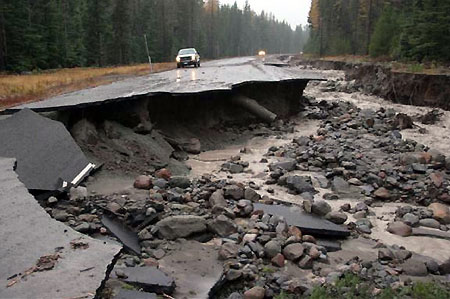
The Newton Clark Ridge sign also includes a description of the many debris flows that have rearranged Highway 35 over the past few decades (and will continue to). One missed opportunity is to have included some of the spectacular flood images that ODOT and Forest Service crews captured after the last event, like this 2006 photo of Highway 35 taken just east of Bennett Pass:

Missed opportunity: photo of the 2006 Newton Creek Floods (USFS)

Missed opportunity: photo of the 2006 Newton Creek Floods (USFS)

The Forest Service used two of my photos for this sign, both taken from viewpoints along the old Bennett Pass Road, about two miles south of the parking area. One wrinkle in how well this sign actually works for visitors is the fact that Newton-Clark Ridge is only partially visible from the Bennett Pass parking lot, whereas it is very prominent from the viewpoints located to the south. Maybe this was the point of using the photos?

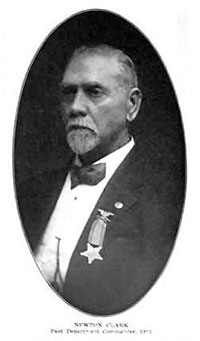
The real Newton Clark (1837-1918)

The real Newton Clark (1837-1918)

There is also a glitch in this panel that I failed to catch during the production phase: the hyphen between “Newton” and “Clark” in the title and throughout the text. There’s a lot of confusion about this point, but it turns out that Newton Clark was one person, not two: a decorated Civil War veteran who fought at Shiloh and Vicksburg, among many prominent battles, then moved to the Hood River Valley in 1887, where he was a local surveyor, farmer and early explorer of Mount Hood’s backcountry.

Newton Clark was part of the first white party to visit (and name) Lost Lake, and today’s Newton Clark Glacier and nearby Surveyors Ridge are named for him. The confusion comes from the subsequent naming of the two major streams that flow from the Newton Clark Glacier as “Clark Creek” and “Newton Creek”, suggesting two different namesakes. Hopefully, the local Forest Service staff caught this one before the actual sign was produced!

Strange Bedfellows?

I was somewhat torn as to whether to post this article, as it goes without saying that the WyEast Blog and Mount Hood National Park Campaign are not exactly open love letters to the U.S. Forest Service. So, why did I participate in their interpretive sign project?

First, it wasn’t for the money – there wasn’t any, and I didn’t add a dime to the federal deficit! I don’t sell any of my photos, though I do regularly donate them to friendly causes. So, even though the Forest Service did offer to pay for the images, they weren’t for sale.

One that won’t be built? This sign was originally conceived for Buzzard Point, near Barlow Pass, but it’s not clear if it made the final cut (USFS)

One that won’t be built? This sign was originally conceived for Buzzard Point, near Barlow Pass, but it’s not clear if it made the final cut (USFS)

(click here for a large version)

In this case, once I understood the purpose of the project, it quickly moved into the “worthy cause” column, and I offered to donate whatever images the Forest Service could use, provided I see the context — and now you have, too, in this preview of the new signs!

I will also point out that the Forest Service project staff were terrific to work with, and very dedicated to making a positive difference. We’re fortunate to have them in public service, and that’s a genuine comment, despite my critiques of the agency, as a whole.

Here’s a little secret about the crazy-quilt-bureaucracy that is the Forest Service: within the ranks, there are a lot of professionals who are equally frustrated with the agency’s legacy of mismanagement. While I may differ on the ability of the agency to actually be reformed, I do commend their commitment to somehow making it work. I wish them well in their efforts, and when possible, I celebrate their efforts on this blog.

So you want to change the Forest Service from within..?

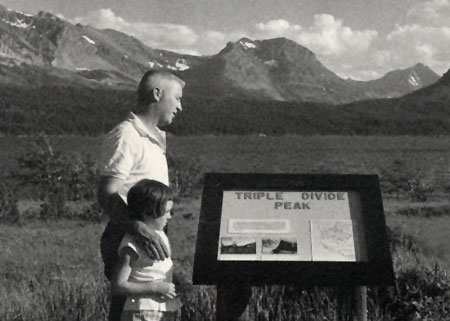
1960s visitors in Glacier National Park (NPS)

1960s visitors in Glacier National Park (NPS)

Given the frustrating peril of good sailors aboard a sinking ship, it turns out there are some great options for supporting those in the Forest Service ranks seeking to make a positive difference. So, I thought I would close this article by profiling a couple of non-profit advocacy organizations with a specific mission of promoting sustainable land management and improving the visitor experience on our public lands. I hope you will take a look at what they do, and consider supporting them if you’re of like mind:

USFS_Panel_7

The National Association for Interpretation (NAI) is a not-for-profit 501(c)(3) involved in the interpretation of natural and cultural heritage resources in settings such as national parks, forests, museums, nature centers and historical sites. Their membership includes more than 5,000 volunteers and professionals in over 30 countries.

Original “Historic Oregon” sign at Barlow Pass in the 1940s (Wikimedia Commons)

Original “Historic Oregon” sign at Barlow Pass in the 1940s (Wikimedia Commons)

The Forest Service has a conservation watchdog group all its own, Forest Service Employees for Environmental Ethics (FSEEE), a not-for-profit 501(c)(3) based right here in Oregon. Their mission is to protect our national forests and to reform the U.S. Forest Service by advocating environmental ethics, educating citizens, and defending whistleblowers. The FSEEE membership is made up of thousands of concerned citizens, former and present Forest Service employees, other public land resource managers, and activists working to change the Forest Service’s basic land management philosophy.

I take great comfort in simply knowing that both organizations exist, and are actively keeping an eye on the Forest Service… from within!

Alva Day and the Lost Lake Highway

Timeless classic: 1920s Postcard view of Mount Hood from Lost Lake

Timeless classic: 1920s Postcard view of Mount Hood from Lost Lake

The Hood River History blog recently featured a series that caught my eye: a local family packing up their car for a camping trip to Lost Lake. The images were from a series captured in the 1939s and early 40s by Alva Luman Day, a local photographer whose legacy as a figure in Mount Hood history is only now beginning to emerge.

As happens with most history research, digging a bit deeper into the story of Alva Day’s camping trips to Lost Lake revealed more than a few surprises. This article is the story of how the modern-day highway to Lost Lake came to be, and how the life of Alva Day is intertwined in this story.

Alva Luman Day

Alva Day was born in 1887 in Colorado and moved to Oregon by the early 1900s. Day married Io Stewart in 1908, and they gave birth to their son Carroll Stewart Day in July 1910. Sometime after arriving in Oregon, Alva spent time in Alaska, though it is unclear whether his wife and young son traveled with him. But by 1918, he was back in Hood River to stay, working for Pacific Power and Light until he retired in the 1940s.

Alva Day clamming in Ketchikan - 1917 (Source: Hood River History)

Alva Day clamming in Ketchikan – 1917 (Source: Hood River History)

The above photo from Hood River History shows a young Alva Day during his Alaska years, posing for his camera during a clam dig near Ketchikan in 1917. He was just shy of 30 years old in this photo, and about to make his permanent move to Oregon.

Alva Day was a skilled and prolific photographer. The History Museum of Hood River has more than a thousand of Day’s images in their collection. The Lost Lake series is typical of his photos, too. He had an eye for detail and composition, but with a journalist’s instinct for storytelling. He often added his own, handwritten notes to the back of his prints, gradually building a rich historic legacy that we are just beginning to appreciate today.

1920s postcard view of Lost Lake from nearby Raker Point

1920s postcard view of Lost Lake from nearby Raker Point

Alva Day’s family trips to Lost Lake by automobile were a relatively new phenomenon in the 1930s. A rough wagon road had been constructed in 1905, but soon fell into disrepair, and was never passable to automobiles. The new Lost Lake Highway had only been completed in the early 20s and was still unpaved when the Day family made their camping treks. In fact, most of the public lands around Mount Hood were still roadless at the time, as commercial logging (and its roads) would not emerge a major focus of the U.S. Forest Service until the 1950s.

Construction of the Lost Lake Highway began in 1919, spurred by construction of the new Mount Hood Loop Highway, and the excitement over the recently completed Columbia River Highway. The Lost Lake Highway was conceived as a joint venture between the U.S. Forest Service and Hood River County, climbing 14 miles from the company mill town of Dee to the lake. Roughly two-thirds the road was on county land, and the upper third inside the Oregon (later renamed Mount Hood) National Forest boundary.

Lost Lake is prominent on this 1920s map of the Mount Hood Loop (Source: The Oregonian)

Lost Lake is prominent on this 1920s map of the Mount Hood Loop (Source: The Oregonian)

The project got off to a rough start, and endured many setbacks and delays over four years of construction. From the beginning, there were worker shortages, with District Ranger Warren Cooper making trips to Hood River in September 1919 in search of men willing to join the effort:

“We are going to have the road finished for motor traffic by next summer if we can get help. We need ten men now” said Cooper at the time. But by November of that year, snow shut down road construction until the following spring of 1920.

By mid-summer of 1920, Forest Supervisor Thomas H. Sherrard had 12 workers pushing forward on the National Forest portion of the project in order to complete the final two miles to the lake. By September of that year, the Oregonian reported the construction to be “progressing fast” with the “gem of the Cascades to be open to auto travel next year.”

Hood River photographer Fred Donnerberg captured this image of the road under construction in the summer of 1920 (note the boxes of explosives in the background) (source: Hood River History)

Hood River photographer Fred Donnerberg captured this image of the road under construction in the summer of 1920 (note the boxes of explosives in the background) (source: Hood River History)

Still more delays followed, with the “finished” road rough and still impassable to most cars by the end of 1921. With the route largely in place, a gravel surface would be added in the summer of 1922, finally making it a truly durable “highway” for auto travel. The Oregonian reported the completion of the clearing and grading phase in the fall of 1921 as follows:

“When the last charge of TNT was exploded, removing the last barrier of boulders and a giant fir stump, members of the 20-man forestry crew paused on the lake’s edge and gave a huzza that echoed and re-echoed through the forest. Then they cleared away the debris, the new road was open, and one of the gems of the Oregon National Forest was made accessible to motorists of the Hood River Valley, or their visitors from Portland, over the Columbia River Highway.

“The forestry crew broke camp today, closing the new dirt grade with a barricade of felled trees as they left the district… It is planned that the new grade of approximately five miles shall be surfaced with crushed rock next summer… The cost of grading the stretch, which penetrates a district of magnificent firs and cedars, was about $18,000.”

It turns out that Alva Day had an important role in the completion of the Lost Lake Highway, too. He was an avid sportsman, and secretary of the Hood River Game Protection Association at the time, one in a series of prominent roles he played over his life advocating for hunting, fishing and wildlife conservation.

Alva Day (left) overseeing the release of hatchery fry in 1933 (source: Hood River History)

Alva Day (left) overseeing the release of hatchery fry in 1933 (source: Hood River History)

The game association was a strong advocate for the project, promoting the idea and leading critical local fund-raising efforts for the county portion of the project in 1919 and 1920 to keep construction on track.

By the mid-1920s, thousands of cars were streaming up the dusty, gravel road to Lost Lake, and Alva Day was undoubtedly among the visitors. Responding to this instant popularity, the Forest Service gave the green light to several summer cabins and a small resort in the years that followed, and later constructed the beautiful campground we know today. Lost Lake was now a major tourism destination, drawing tens of thousands of visitors each year to its postcard shoreline views of Mount Hood, framed by ancient cedars.

Day Family Trips to Lost Lake

Alva Day’s involvement in the conception and completion of the Lost Lake Highway adds new meaning to the series of photos he captured on family outings to Lost Lake in the 1930s and 40s. He loved the lake, and according to Hood River History accounts, made these annual camping excursions every summer.

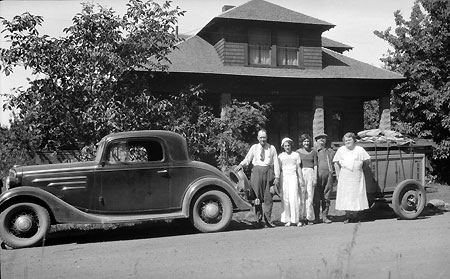
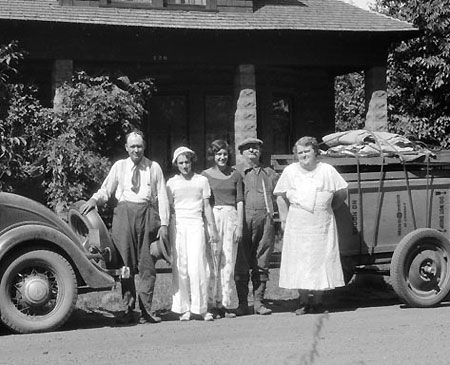
The Day family ready to go camping in 1938 (Source: Hood River History)

The Day family ready to go camping in 1938 (Source: Hood River History)

The Hood River History series of Lost Lake images begins with the above photo, captured in front of the Day family home in Hood River at 420 June Street. According to the Hood River History blog discussion, the house still stands. Note the hefty trailer behind the car — as subsequent photos in the series show, this is industrial camping!

A closer view of the Day family (Source: Hood River History)

A closer view of the Day family (Source: Hood River History)

Looking at the first image in a bit more detail, we see Alva Day on the left and Io Day on the right. The Hood River History blog discussion speculates that the two young women were the Day’s daughters (Helen and Emma) and the older man next to Io Day was her father. However, I wasn’t able to confirm this in any formal records.

Instead, official records show that Alva and Io Day had just one child, their son Carroll. Carroll married a Helen Colby in 1931, so the “Helen” speculated in this photo could be his wife. Sadly, Helen (Colby) Day died just nine years later, in 1947 (Carroll Day married again in 1948 to Aline Andrew, and both lived into the 1990s).

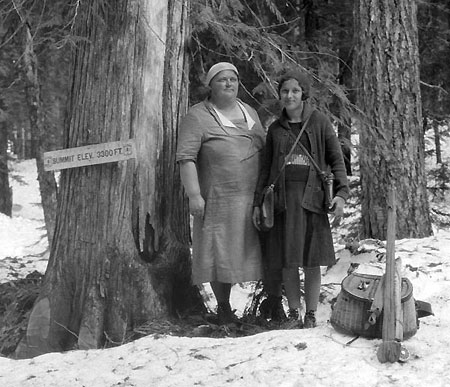
Snow at the lake? Not unusual in early summer  (Source: Hood River History)

Snow at the lake? Not unusual in early summer (Source: Hood River History)

The next image in the Hood River History series is from an earlier trip, taken in 1933, but I’ve included it here because it wouldn’t have been unusual for early summer campers to encounter snowdrifts on the way to Lost Lake. On this earlier trip, it’s possible that Alva Day (on the left) and Io (center) were simply heading up for some early summer fishing, and not on a camping trip.

The Hood River History blog clearly identifies the man on the left in both of the previous photos as Alva Day, which raises a question: did he shoot these as self-portraits using a timer, or was someone else behind the camera? More on that in a moment…

Is this Alva and Io Day’s daughter-in-law? (Source: Hood River History)

Is this Alva and Io Day’s daughter-in-law? (Source: Hood River History)

A closer look at the 1933 photo clearly shows Io Day to be the same person as that pictured in the 1938 camping trip series. But the young woman next to her in the 1933 photo (above) also seems to be the same person standing near the stove (below) in this detailed look at the next photo in the series, captured in 1938:

Helen (Colby) Day five years later? (Source: Hood River History)

Helen (Colby) Day five years later? (Source: Hood River History)

The similarity between these images, and lack of documentation on Alva and Io Day having more than one child leads me to speculate that we’re looking at Helen (Colby) Day, first wife of Alva and Io’s son Carroll. There is no birth date available for Helen (Colby) Day, but assuming she was roughly Carroll Day’s age, they would both have been in their mid-20s when these images were captured.

A wider view of the campsite scene (below) shows the rest of the family, and the impressive array of gear that filled up that trailer behind the family car! You can see still more detail on the original Historic Hood River image, but some of the intriguing highlights include the cook stove, wooden table, what appears to be a wood pantry or food box, and of course a canvas tent in the background.

Sharp-eyed viewers of this photo in the Hood River History blog also spotted bratwurst in one of the frying pans, a pile of discarded tin cans behind the stove (did they pack them out?) and a swimsuit and towels hanging to dry on the clothes line. Alva’s boat is tied up at the lakeshore, just beyond the table.

Camping in style at Lost Lake in 1938 (Source: Hood River History)

Camping in style at Lost Lake in 1938 (Source: Hood River History)

In this wider view, Alva Day is seated to the left, and next to him a young man that I will speculate is Carroll Day. The woman toward the back is clearly Io Day, with another unidentified young woman seated next to her. If the young man in the above photo is, indeed, Carroll Day, then I will also speculate that he was behind the camera in the previous two images, as well.

The next camping image is actually from 1941, but also fits the theme. In this view, Io Day is relaxing at the base of a large cedar tree, looking quite comfortable and content. On this outing, the wood stove is still there, and a wood picnic table has appeared. Were these provided by the Forest Service? Most interesting, of course, is the portable radio sitting on the table:

Io Day relaxing at Lost Lake in 1941 (Source: Hood River History)

Io Day relaxing at Lost Lake in 1941 (Source: Hood River History)

A closer look (below) shows the radio in a bit more detail — likely a portable “farm radio” of the era, designed to run on batteries at a time when many rural areas were still without electricity, but within reach of radio broadcasts. Could they pick up Portland broadcasts at Lost Lake? Or possibly KODL 1440 in The Dalles, which began broadcasting in 1940?

Is Io listening to The Whistler? (Source: Hood River History)

Is Io listening to The Whistler? (Source: Hood River History)

Whatever the station, they would have been listening to popular suspense programs of the day like “The Whistler” and “The Shadow”, made all the more spooky by firelight in the middle of the forest!

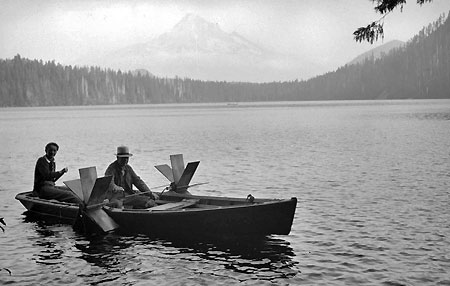
Next in the series is another image from the 1938 outing that shows Alva Day in his unique paddleboat. The unidentified women from the previous campsite image is steering the boat and Alva is cranking the paddles. Mount Hood rises in the hazy background in this scene:

Alva Day’s boat at Lost Lake in 1938 (Source: Hood River History)

Alva Day’s boat at Lost Lake in 1938 (Source: Hood River History)

A closer look at the boat (below) shows the crank mechanism Alva is using to turn the paddles — an ingenious, if odd design!

A two man paddleboat? (Source: Hood River History)

A two man paddleboat? (Source: Hood River History)

The cedar branch in the upper corner shows this image was taken from shore — perhaps by Carroll Day… or Io? Setting up a timed self-portrait for this view would have been quite a feat, even for Alva Day.

Alva’s Lost Lake bounty (Source: Hood River History)

Alva’s Lost Lake bounty (Source: Hood River History)

The final image (above) in the Historic Hood River series shows Alva Day’s sportsman side: an even dozen trout, presumably caught while camping at Lost Lake. A fitting finale to the Lost Lake camping series!

Alva Day’s Legacy

Alva Day’s role in the creation of the Lost Lake Highway is a mostly forgotten part of his legacy. But his roles in advocating for wildlife and in photographing the unfolding history of the Hood River region are only now being rediscovered and appreciated.
For more than three decades, Alva Day was a local leader for wildlife conservation in Hood River, and later was active in the formation of the Oregon Wildlife Federation and the Western Federated Sportsmen. During this period, he was also a contributor to The Oregon Sportsman, the monthly journal of the Oregon Game Commission.

It’s easy to forget how dire the need for wildlife conservation was at the time, and especially the role that hunters and fishermen played in the movement. For a century, the developing Northwest been dumping raw sewage into its rivers, filling the air with smoke, clearing the forests, scouring mountain streams with logging “splash dam” floods and overharvesting many species of game and fish. While we are still struggling to restore our native habitats and wildlife in our time, we have come a long way, already, thanks to the pioneering efforts of people like Alva Day.

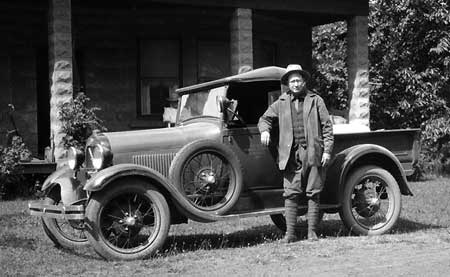
Alva Day with his Pacific Power company car in 1929 (Source: Hood River History)

Alva Day with his Pacific Power company car in 1929 (Source: Hood River History)

Alva Day’s photographic story of the Hood River area is perhaps his greatest contribution, and in time, is likely to be his most enduring legacy. The History Museum has hundreds of his prints in their collection, documenting everything from simple scenes of daily life to historic events, like the June 1927 flood that ravaged the town of Arlington, or the shameful day in May 1942, when hundreds Japanese Americans from the Hood River Valley were loaded onto trains and sent to World War II internment camps

This Hood River History blog project is now in the process of scanning many of Alva Day’s images, and using the blog to build an oral history for each image. This work allows all of us to have a window into the past and contribute to the continued documentation of our region’s history.

A Trip to Idlewild Cemetery

The Idlewild Cemetery in Hood River was established in 1894, and with more than 7,000 graves, is a treasure trove of local history. You can find Alva Day’s family here, too.

Idlewild Cemetery (source: findagrave.com)

Idlewild Cemetery (source: findagrave.com)

Alva and Io Day were both born in 1887, and both died in 1955, after nearly 47 years of marriage. Io died in early January of that year, and Alva Day followed on November 15, 1955. Both are buried at the Idlewild, along with their son Carroll Day, whose ashes joined the family plot at the age of 81 in January 1991. Carroll’s second wife, Aline Day, died in 1995, and her ashes were also placed with Carroll and his parents at Idlewild.

Alva and Io Day and son Carroll and his wife Aline are at rest in the same plot (source: findagrave.com)

Alva and Io Day and son Carroll and his wife Aline are at rest in the same plot (source: findagrave.com)

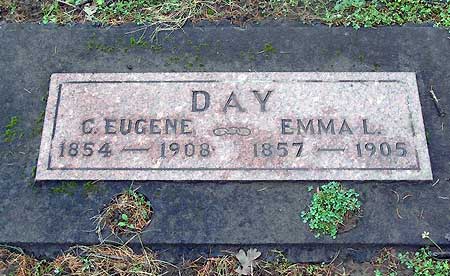
Alva Day’s parents, Emma and Charles Eugene Day, are buried at Idlewild Cemetery, too. Emma Day died in 1905 and Charles Day on May 17, 1908 — the same year that Alva and Io Day were married.

Alva Day’s parents Charles Eugene and Emma Day are also buried at Idlewild Cemetery (source: findagrave.com)

Alva Day’s parents Charles Eugene and Emma Day are also buried at Idlewild Cemetery (source: findagrave.com)

You can visit the Day family plot in Block 9, Lot 24. Idlewild Cemetery is on Tucker Road at Brookside Drive, and though located on a commercial strip, the back of the cemetery abuts orchards, so it makes for a pleasant and interesting afternoon of exploring.
_________________________________

Postscript: Supporting Hood River History

Over the past couple of years, the History Museum of Hood River County has issued a series of terrific images in their Historic Hood River blog series. The history blog comes to us through the generous work of volunteers Arthur Babitz, Bill Pattison and Sally Donovan, and we are truly indebted to their efforts.

By creating this online archive of historic photos, the museum is providing an invaluable resource, free to the public. If you love history and the Mount Hood region, consider supporting the museum for their efforts. While the modest $5 museum admission fee helps support the museum, consider becoming a member to help provide ongoing support for their fine work as stewards of Hood River history.

The History Museum of Hood River County (source: History Museum)

The History Museum of Hood River County (source: History Museum)

The History Museum graciously granted permission to showcase the images included in this article, and I’m hopeful it will send a few visitors and donations in their direction.

The museum is now open after a year or major renovations. You can find it on East Port Marina Drive, accessed via Exit 64 on Interstate-84. The museum is located on the banks of the Hood River, near the prominent suspension footbridge visible from the freeway, and well worth the visit!
____________________________

Postscript: More on Alva Day from Hood River History

Arthur Babitz writes to say: “We actually have 2500 of his images, indicating an annual summer trip to Lost Lake for much of his adult life. There is an extended series showing construction of the bridge near the lodge building. He also participated in and photographed the Legion climbs of Mt. Hood for many years. We have hundreds of images he shot on those climbs. You’ll be seeing many more of them on the HHR blog.”

Thanks for all your fine work in bringing the Day photos back to life, Arthur!

Latourell Falls Makeover (Part 2)

Latourell Falls

Latourell Falls

In the first part of this article, I focused on recent improvements that have greatly enhanced the Historic Columbia River Highway wayside at Latourell Falls. This article looks at the balance of Guy Talbot State Park, where a number of improvements are needed to keep pace with the ever-growing number of visitors who now hike the Latourell loop trail year-round.

Improving the Loop Trail

Hiking the loop in the traditional clockwise direction from the wayside, the first stop is bench located a few hundred yards up the trail. This memorial bench was donated by the Sierra Club, and though it’s not a great architectural fit for the area (a rustic style would be more appropriate), it’s still a welcome resting spot for casual hikers.

Memorial bench along the Latourell Loop Trail

Memorial bench along the Latourell Loop Trail

Not coincidentally, the bench faces a lovely view of Latourell Falls, but there’s a story behind the view, as someone has made the effort to do some “scene management” for photographers. Take a look at the photo below, and you can appreciate the waterfall scene in its graceful glory, framed by firs and moss-covered maples. But a closer look reveals a sawed-off stump with a fresh cut. Why here? Because a trail steward (authorized or otherwise) trimmed off the broken shards of a maple that split off in an ice storm a few years ago — leaving a sore thumb that marred this classic view. You can see in these after/before comparisons from now and in 2010:

A beautiful scene as viewed in December 2012…

A beautiful scene as viewed in December 2012…

…and the sore thumb that once was…

…and the sore thumb that once was…

…and the telltale stump!

…and the telltale stump!

If this was sanctioned “scene management” pruning, then kudos to the State Parks folks for putting classic views on their maintenance list. If this is a guerilla effort by a frustrated photographer, then perhaps State Parks managers will take note, and keep this view intact..!

Moving up the loop, the trail soon approaches a heavily trampled bluff above Latourell Falls. Here, the first apparent problem is a decades-old shortcut at the first switchback. A sign begs hikers to stay on the trail to protect “sensitive plants”, but so far, the boots are winning, despite logs and debris purposely scattered across the shortcut.

Tossing more logs across this shortcut might help, but borrowing an idea from the beautiful new stonework at the trailhead (or recently built stonework along the Bridal Veil Falls trail), and adding a rustic stone retaining wall here to corral traffic would be a nice option that would have lasting value.

A forlorn sign attempts to reason with trail-cutters

A forlorn sign attempts to reason with trail-cutters

The viewpoint atop the well-worn bluff is really starting to show its age. The 1950s-vintage steel cable fence and mix of concrete and steel pipe posts were never a good aesthetic fit for the Gorge, but more importantly, they’re not doing anything. Visitors have recently pushed a scary boot path past the fence, and down to the brink of Latourell Falls (shown below), so a near-term fix is in order.

The overgrown, beleaguered viewpoint at the to of the falls is in need of some TLC!

The overgrown, beleaguered viewpoint at the to of the falls is in need of some TLC!

The trail at the overlook has already been stomped into a wide “plaza” of sorts, and that would be a good design solution here, with a stone wall replacing the rickety old handrail. A layer of crushed gravel (another design feature of the recent improvements at Bridal Veil Falls) would further help minimize the mud slick that forms in wet months.

The lone (and beleaguered) wood bench at the overlook is well-used, and a redesign should include two or three places to sit and admire the view. For most visitors who venture beyond the lower falls overlook, this bluff above the falls is the turnaround point.

The boot path to the brink of the falls has become a heavily used liability in recent years

The boot path to the brink of the falls has become a heavily used liability in recent years

Adding a stone wall to better define the overlook would help curb foolhardy visitors from following the boot path to the falls brink. However, the overlook also needs some vegetation management in order to simply maintain the view back down to the trailhead — this is what most hikers who push beyond the handrails are looking for, after all.

A pair of reckless visitors in flip-flops spotted in 2010 at the bottom of the dangerous boot path, tempting fate…

A pair of reckless visitors in flip-flops spotted in 2010 at the bottom of the dangerous boot path, tempting fate…

A few steps beyond the bluff overlook, an unmarked trail forks to the right, descending to Latourell Creek. At first, this seems like another informal boot path, but a closer look reveals a well-constructed trail. In fact, this is where a lower loop once crossed the creek, connecting to the main loop where it returns (and is clearly visible) on the far side of the creek. This is an old idea that still makes sense, and should be embraced with a new bridge and refurbished connector trail.

This side trail (to the right) used to be part of a lower loop route

This side trail (to the right) used to be part of a lower loop route

In reality, hikers are already using the lower loop, though a series of slick, dangerous logs a few yards upstream from the brink of Latourell Falls serve as the “bridge”. Reconnecting and restoring these old trail segments would be a good way to provide a shorter loop for less active hikers, and also resolve this hazardous crossing that is clearly too tempting for many hikers to resist.

Bridge needed! This old trail and the sketchy log crossing are an accident waiting to happen -- and also an opportunity to provide an excellent short loop for hikers.

Bridge needed! This old trail and the sketchy log crossing are an accident waiting to happen — and also an opportunity to provide an excellent short loop for hikers.

Moving along the loop to its upper end, the Latourell trail has a few issues at Upper Latourell Falls that deserve attention in the interest of protecting the lush landscape from being loved to death. For many years, this upper section of the trail was only lightly used, but the proximity of Talbot State Park to the Portland Metro region and the family-friendly nature of this trail has clearly made the full loop a very favorite destination.

Upper Latourell Falls

Upper Latourell Falls

The trail approach on the east side of the falls is in good shape, but problems start to emerge on the west side of the footbridge. This is not coincidental, as an adventurous early trail once switch-backed up the slope on the west side, and led to a precarious bridge across the mid-section of the falls (shown below).

The location of this old trail was uncovered only recently. Century-old rockwork and obvious paths heading uphill from the falls have always hinted at an old trail, but a geocache has now been placed along the old path, drawing enough visitors up the slope to add some urgency to addressing the off-trail impacts here.

A century-old trail climbs the west slope at Upper Latourell Falls

A century-old trail climbs the west slope at Upper Latourell Falls

The best solution here is to embrace the lowest segment of the old path by repairing the stonework, or perhaps adding steps where a shortcut has formed, and provide hikers with that close-up view from behind the falls that is responsible for the bulk of the off-trail traffic (the hikers in the photo above are making this irresistible trip).

The upper sections of the old trail are much less traveled, and a simple solution here might be to simply ask the geocache owner to remove the cache. The cache risks not simply re-opening the old trail, but also bringing inexperienced hikers to the potentially dangerous rock shelf where the log footbridge once stood. If the geocache is removed soon, it’s unlikely that visitors would even notice the upper portions of this trail.

This precarious bridge spanned the upper tier of Upper Latourell Falls in the early 1900s (courtesy U of O Archives)

This precarious bridge spanned the upper tier of Upper Latourell Falls in the early 1900s (courtesy U of O Archives)

Turning downstream along the west leg of the Latourell loop, the trail passes a couple of spots where some TLC is needed. First, another potentially dangerous log crossing (shown below) has drawn enough traffic to form its own boot path.

It could be decades before this old log finally collapses into the creek, so a better plan is needed to stem the damage now. Sawing out the log seems possible, and is a job that could be easily in early fall, when water levels are at their lowest, and fire danger has passed. This might even be a job for volunteer trail stewards with crosscut skills.

The other “bridge” on upper Latourell Creek…

The other “bridge” on upper Latourell Creek…

A bit further downstream along the west leg, the loop trail passes the old trail leading to the former footbridge (described previously). Here, the new trail launches uphill along a steep, slick segment built to bypass the bridge.

Reopening the old trail section (and adding a new bridge) would therefore have a spinoff benefit here: not only would a shorter loop be possible (and safe), but the short, badly designed new section of the current trail (shown in yellow on the map, below) could be decommissioned, with the main route using the old section of trail, once again (shown in red). This would be a terrific project for volunteers, including bridge construction.

LatourellLoop16

(click here for a large map)

Another scary feature suddenly appears as the west leg of the loop trail curves above Latourell Falls: an old viewpoint spur trail heads straight down to a very exposed, rocky outcrop rising directly above the falls. The view from this exposed landing is impressive, but completely unsafe, given the thousands of families with young kids that walk this loop each year. There is no railing and no warning of the extreme exposure for parents attempting to keep kids in tow.

The west overlook from the trail… yikes!

The west overlook from the trail… yikes!

The safety hazards of the west overlook are twofold: certain death for someone slipping over the 280 foot sheer cliff to the north and a tempting, sloped scramble to the falls brink for daredevils and the foolhardy.

A simple solution could be a handrail or cable encircling the viewpoint, but a more elegant option would be a more permanent viewing platform in the stonework style of the improvements at the trailhead, serving both as a safety measure and to encourage visitors to comfortably enjoy the airy view.

The west overlook and falls brink from the east side

The west overlook and falls brink from the east side

Next, the loop trail curves away from the creek and out of Latourell canyon, passing an overgrown viewpoint (that probably deserves to be retired), then descending in a long switchback to the Historic Columbia River Highway.

Here, the route crosses the road, and resumes on an attractive path that suddenly ends in the Talbot State Park picnic area. Though a bit of searching gets most hikers to the resumption of the loop hike, some signage would be helpful here — both to direct loop hikers back to the main trailhead, but also pointing picnickers to trail to both the upper and main waterfalls.

Heavy traffic has formed a boot-path at the base of Latourell Falls

Heavy traffic has formed a boot-path at the base of Latourell Falls

Beyond the picnic area, the trail re-enters Latourell canyon and quickly descends to the base of Latourell Falls, the final area where loop trail improvements are sorely needed. At this point along the loop, we are within a few hundred yards of the main trailhead and wayside, so the crush of year-round visitors is evident everywhere — and thus the paved trail surface in this portion of the loop.

Most of the human impact is absorbed by the trail, but in recent years a messy boot path has developed along the west side of the creek, starting at the lower footbridge, and branching as it heads toward the base of the falls.

Looking back at the footbridge, and the extent of damage from the boot path

Looking back at the footbridge, and the extent of damage from the boot path

As it nears the falls, the boot path devolves into a web of muddy paths, where delicate ferns and wildflowers have been trampled

As it nears the falls, the boot path devolves into a web of muddy paths, where delicate ferns and wildflowers have been trampled

There isn’t a good way to convert this boot path into a formal spur or viewpoint because of the unstable slopes and visual impact it would create, so the challenge is how to best manage the off-trail activity. The simplest option would be an extension of the bridge hand-rail to block the boot path, making off-trail exploring a bit harder.

This mud patch at the east approach to the lower footbridge would make a perfect mini-plaza for visitors to spend time taking in the view

This mud patch at the east approach to the lower footbridge would make a perfect mini-plaza for visitors to spend time taking in the view

But there is also an opportunity to embrace the first part of the boot path, where a “mud plaza” of sorts has been stomped into the ground. This spot features one of the best angles for photographing the falls, after all, so a stone masonry mini-plaza with seating would be a terrific way to both discourage the off-trail travel, and give waterfall admirers an inviting place to stop and photograph the falls, out of the main flow of foot traffic.

Honoring Guy W. Talbot

One last bit of unfinished business at Talbot State Park is a debt of gratitude to Guy Talbot, himself. At the west end of the historic highway bridge, a large gravel pullout serves as overflow parking for this popular park. The loop trail crosses the highway near the pullout and in recent years, heavy use has turned this into an overflow trailhead, as well.

The wide pullout at the west end of the Latourell Bridge

The wide pullout at the west end of the Latourell Bridge

At first glance, it seems nothing more than a broad, gravel shoulder. But upon closer inspection, it’s home to the only real monument to Guy Webster Talbot — the man whose profound generosity spared Latourell Falls from some other fate, and gave us the park that we know today. After all, the property wasn’t simply an undeveloped tract of forest, but rather, Talbot’s beloved country home. He gave the place he loved most to all Oregonians, in perpetuity.

Few traces of Talbot’s home and the surrounding estate survive, so this would be the perfect spot for a third interpretive sign (the first two are on the east end of the bridge, at the refurbished wayside) focused on Talbot, and why he was such an important historical figure in history of the area.

This plaque is the sole evidence of Guy Talbot’s grand gesture to the public

This plaque is the sole evidence of Guy Talbot’s grand gesture to the public

The pullout, itself, could also be improved to become a more formal secondary trailhead for the loop, as well — perhaps not as substantial as the newly rebuilt main trailhead and wayside at the other end of the bridge, but something better than the pothole-covered pullout that exists today.

The venerable Latourell Creek Bridge is among the most impressive on the old highway

The venerable Latourell Creek Bridge is among the most impressive on the old highway

Finally, there’s one more interpretive opportunity near the Guy Talbot memorial: a tale of two bridges. One is the towering, 300-foot long Latourell Bridge along the old highway, to the east. The unique history of its construction in 1914 is a story that should be told, especially since visitors can walk both sides of the bridge on the beautifully designed, original sidewalks.

The second bridge is a curious phantom of history — a former footbridge that once connected the two halves of the Talbot property in an elaborate, Venetian-style arch. Though long gone, the footings for the bridge can still be seen, and are a reminder of the elegance of days gone by.

The old footbridge over the highway was located just east of Latourell Creek

The old footbridge over the highway was located just east of Latourell Creek

The good news is that both the Oregon State Parks and Oregon Department of Transportation (ODOT) are on a roll when it comes to enhancing the Historic Columbia River Highway trails and waysides. Many recent improvements to the Gorge parks and the old highway, itself, have already been completed in recent years, and more are already under construction.

Hopefully, polishing up the rest of the Latourell Falls loop and Talbot State Park can find its way into the State Parks and ODOT work program, too!

___________________________

Addendum: after posting this article, I heard from the owner of the geocache mentioned above Upper Latourell Falls. File this under the “small world” department, but it also happened to be someone I’ve known for many years, and who sets the highest standard for conservation ethics. Had I checked the cache ownership and known this, it would have erased any concerns about potential impacts the cache will have on the area. I now know it is in very good hands!

The cache owner also shared some numbers behind the cache that support that last point: only 50 users have logged it in the 3-plus years since it was placed, so not enough to have a noticeable impact on the terrain. Thus, the impacts that we’ve seen in recent years are likely just more of what we see elsewhere on the loop, where the crush of thousands off feet hitting this trail each year is running the landscape a bit ragged.

At its core, geocaching is a terrific way to introduce people (and especially children) to our public lands, which in turn, helps create advocates for conservation — something very much in line with this blog. Hopefully this article didn’t leave other geocachers thinking otherwise. After all, I own several caches myself, and like most cache owners, do my best to ensure they bring people into the wilds while also having minimal impact on the landscape.

Latourell Falls Makeover (Part 1)

Today’s wayside is located at the east end of the Latourell Bridge, where the Falls Chalet roadhouse once stood in 1914 (shown here)

Today’s wayside is located at the east end of the Latourell Bridge, where the Falls Chalet roadhouse once stood in 1914 (shown here)

Over the past few years, Oregon Parks & Recreation has set the high bar for recreation improvements on the state lands it manages in the Columbia River Gorge Scenic Area. The latest project is a handsome, thoughtful makeover of the Latourell Falls wayside, located along the Historic Columbia River Highway (HCRH) in Talbot State Park.

The Latourell wayside serves thousands of Gorge tourists each year, and also functions as the trailhead for the very popular Latourell Falls loop trail. The site has a long history, and was once home to a pair of roadhouses during the heyday of Samuel Lancaster’s world-class highway in the early 1900s.

The Falls Villa roadhouse was located across the road from today’s wayside through the 1930s, now marked only by a stand of mature bigleaf maple

The Falls Villa roadhouse was located across the road from today’s wayside through the 1930s, now marked only by a stand of mature bigleaf maple

Modest improvements to the wayside over the years included interpretive historic signs added in the 1990s that tracked the colorful human history of the area, but for the most part, the site was dated and dingy. The restoration work completed last summer is thus a major upgrade that deserves a review here. The work was completed with a special grant secured by the Oregon State Parks department

Makeover Review

Front and center in the rebuilt wayside is the official state park sign, constructed in the standardized style used for both national forest and state park units throughout the Columbia Gorge National Scenic Area (CGNSA). The sign is mounted on a newly constructed basalt base, also designed in the uniform CGNSA style.

Welcome (again) to Guy W. Talbot State Park!

Welcome (again) to Guy W. Talbot State Park!

One missed opportunity in repurposing the existing entry sign was the chance to tell the story of Guy Talbot (picture below, in the early 1930s), one of the business titans of early Portland. Talbot donated the land containing Latourell Falls and the gorgeous canyon above the falls, so deserves more than passing mention in the human story of the area (along with other benefactors who donated the lands we now know as the state parks gems dotting the Historic Columbia River Highway).

Guy W. Talbot as he appeared in 1933 on the front page of the Oregonian, announcing his retirement

Guy W. Talbot as he appeared in 1933 on the front page of the Oregonian, announcing his retirement

Two enamel interpretive panels installed at the wayside in the 1990s were salvaged and reinstalled in the new layout. One focuses on the history of the historic highway (the photos of the roadhouses, above, are from this display) and is now mounted in outside a new restroom (below). It’s a well-trafficked location, albeit sorely lacking in aesthetic appeal! The second interpretive sign is located at the main falls overlook, and briefly describes the history of private land donations for parks in the Gorge.

The new restroom is located at the east end of the wayside, tucked away from most of the picnic tables and a good distance from the new falls overlook plaza. While modern budgets probably require the low-maintenance advantage of pit toilets, the more civilized flush toilets that were removed were an aesthetic notch above the smelly nature of a chemical toilet.

The new restroom is (unfortunately) the standard pit-toilet style found elsewhere along the old highway

The new restroom is (unfortunately) the standard pit-toilet style found elsewhere along the old highway

Considering the volume of visitors to this park, plumbed toilets may be essential — we shall find out soon enough! Fortunately, flush toilets at historic highway waysides still survive at Bridal Veil, Multnomah Falls, Ainsworth State Park, Eagle Creek, Bridge of the Gods and Starvation Creek.

But a major improvement that comes with the new restroom is the location on the south side of the old highway, adjacent to the parking area — the old restroom required crossing the highway. The new toilets are also ADA accessible, along with the drinking fountain located outside the restroom and two of the nearby picnic tables.

Accessible drinking fountain located outside the restroom

Accessible drinking fountain located outside the restroom

An unexpected benefit from the relocated restrooms: it turns out the old restrooms blocked a very nice view of the Latourell Bridge (below), framed by mossy bigleaf maple trees. The old restroom site is marked only by a flat spot below the highway. The low-headroom trail under the bridge that once accessed the restroom has also been decommissioned.

The view that used to be behind the restroom..!

The view that used to be behind the restroom..!

Other details of the new wayside design include basalt curbs that edge the repaved parking area (below), and bicycle racks for cyclists touring the old highway to safely stop and admire the upper viewpoint, fill water bottles, picnic or use the restrooms.

Stone curbs show the attention to details paid by the designers

Stone curbs show the attention to details paid by the designers

One thoughtful aspect of the new bicycle racks is the central location: too often, bicycle parking is relegated to an unused corner. This makes for much less secure parking than a more prominent location, where the public eye is more likely to deter sketchy behavior.

Centrally located bike racks front the main parking area

Centrally located bike racks front the main parking area

The west end of the wayside is the primary focus for visitors, with a handsome plaza and several new visitor amenities. A concrete-capped stone wall in the Gorge style wraps around the plaza, with notched insets for visitor information and interpretive sign installations.

An attractive, new visitor information sign (below) is an excellent addition to the wayside. While it contains the standard park information found at most state parks, an excellent trail map describing the Latourell Creek loop hike is also featured. Even better, the map isn’t of the cartoonish variety often found at tourist waysides. Instead, it shows accurate trail information and even includes elevation contours!

The handsome new visitor information sign at the Latourell wayside

The handsome new visitor information sign at the Latourell wayside

The visitor map does a good job of showing the hiking options and trail highlights, as well as helpful tips on the multiple (and somewhat confusing) trailheads that provide access to the loop. A nice cartographic touch is attention to showing private lands that abut the park (though hopefully some future version of this map will show those lands in public ownership, through the Columbia Gorge Scenic Area acquisition program!)

The excellent, new Latourell Falls Loop map

The excellent, new Latourell Falls Loop map

One minor map glitch exists: the labeling of “Upper Falls” and “Lower Falls” may work for most people, but using the proper place name for Latourell Falls (instead of “Lower Falls”) would be more accurate and informative to those visiting the park for the first time (the upper falls is known unofficially as “Upper Latourell Falls”, so not an issue). There’s rarely a good reason to deviate from official geographic names on maps, after all.

A closer look at the excellent detail on the new park map

A closer look at the excellent detail on the new park map

Hopefully, the State Parks folks will also provide a downloadable, online copy of this map at some point — one that non-profits like Portland Hikers could also offer on their user-created Field Guide, for example.

Another nice touch on the visitor information sign is the high-profile shout-out to the Columbia Group of the Sierra Club, the volunteer trail stewards for the Talbot State Park (thanks, Sierra Club!). Not only are the signs a welcome recognition of trail volunteers, but also a subtle tool for raising public awareness to the unfortunate reality that volunteers have become an essential partner to public agencies in keeping our trail system open.

Kudos to the Sierra Club volunteers!

Kudos to the Sierra Club volunteers!

The photo below shows the new visitor information sign from the perspective of the new plaza, with the restrooms visible in the far distance.

The view toward the visitor signboard and steps leading to the upper falls viewpoint from the new plaza (interpretive sign in foreground)

The view toward the visitor signboard and steps leading to the upper falls viewpoint from the new plaza (interpretive sign in foreground)

This view also shows the second notched inset in the curving basalt wall that defines the plaza overlook, where the second refurbished interpretive sign has been installed. This sign briefly describes how Latourell Falls and other nearby parks came into public ownership in the early 1900s, and is the only mention of Guy Talbot in the wayside beyond the entry signs — an oversight that is a missed opportunity in the redesign (more about that coming in Part 2 of this article).

Latourell Falls from the new plaza overlook (with the interpretive sign on the left)

Latourell Falls from the new plaza overlook (with the interpretive sign on the left)

The new plaza corrects many serious problems with the old design, starting with the need for a more spacious falls overlook that respects the historic design of the Samuel Lancaster’s Columbia River Highway. The new plaza meets this test with flying colors, including a subtle, but helpful detail of steps replacing ramps at both the upper and lower loop trailheads.

Another view from the plaza showing the interpretive sign (in the distance) and steps leading to the lower end of the Latourell Falls loop

Another view from the plaza showing the interpretive sign (in the distance) and steps leading to the lower end of the Latourell Falls loop

Because the opening segments of the loop in both directions are paved, there has always been a temptation for people with strollers (or worse, wheelchairs) to assume the trail is safe for wheeled vehicles — it is not! Thus, the new steps will help visitors with strollers and mobility devices to avoid the dangerous mistake of venturing onto the loop trail.

The plaza forms a semi-circle in order to incorporate a second view of the spectacular Latourell Bridge in addition to the falls view. This is an unexpected discovery for visitors arriving over the bridge, unaware of its soaring height and graceful arches.

Wayside details: Samuel Lancaster would approve!

Wayside details: Samuel Lancaster would approve!

On this detail, the designers hit a home run, with a series of arches built into the basalt walls that beautifully echo the bridge design, and seamlessly tie the wayside into the highway, itself, as a natural extension of Samuel Lancaster’s masterpiece. Each arch also includes a painted steel grate – a nice detail that will keep kids and pets on the plaza-side of the stone walls.

A newly installed, arch-back bench at the head of the lower loop trailhead gives a similar nod to the historic bridge, while also helping terminate the decommissioned path that once accessed the old restroom, via a narrow, sketchy path that ducked beneath the bridge (the wood post rails in the photo below block the route of the old path).

This stately bench salutes the old highway bridge, a nice touch!

This stately bench salutes the old highway bridge, a nice touch!

In the center of the new plaza, the designers have incorporated a long planter-bench (below) that will be a welcome respite for visitors to sit and enjoy the view. However, the design of the bench planter is problematic: The narrow planting compartment is not irrigated, and thus presents a tough landscape dilemma. The designers planted mahonia nervosa, or longleaf Oregon grape that should be drought-tolerant enough to survive, and compact enough to fit the narrow space. But it will also a prickly companion to share the bench with! Perhaps this was intentional (as a means to keep the plants from being crushed)?

The other dilemma with planters of this type is the frustrating reality that it will become an oversized ashtray over time. In the end, it might have made more sense to simply design a wide bench with a solid top for the plaza (which is certainly an option for retrofitting this bench, as needed).

A large planter bench anchors the new plaza

A large planter bench anchors the new plaza

The revamped wayside also includes improvements to the popular upper viewpoint, located just east of the visitor information sign. The upper viewpoint path is also the trailhead for the upper portion of the Latourell Falls loop.

The stairway to the upper viewpoint path (below) also forms the terminus of the stone wall that defines around the plaza, and is nicely designed to simply lead wandering visitors to the overlook. Like the steps at the opposite end of the plaza that lead to the lower trail, these steps may help deter wheelchairs and strollers from the steep, unsafe climb to the upper viewpoint.

New steps leading to the upper falls viewpoint and loop trail

New steps leading to the upper falls viewpoint and loop trail

Unfortunately, the upper viewpoint path is one of the disappointments in the Latourell makeover. The short, existing section of paved trail to the viewpoint is steep and slick even for able-bodied hikers. Worse, it becomes a terrifying skating rink in winter ice conditions — which happens to be a time when the Gorge is often crowded with visitors admiring the spectacle of waterfalls transformed into ice cathedrals.

While the new handrails help, a home-run design here would have been a series of steps and landings all the way to the viewpoint — picture a scaled down version of the stairs approaching the lower Multnomah Falls viewpoint as an example. Instead, the improved steps at the base of the path taper onto the old path in a fairly awkward transition, an understandable budget constraint, no doubt, but a missed opportunity, nonetheless.

Unfortunately, this ugly, occasionally dangerous path remains a sore thumb…

Unfortunately, this ugly, occasionally dangerous path remains a sore thumb…

After walking the brief section of old paving, visitors suddenly reach a completely reconstructed upper falls viewpoint (below) with nice attention paid to views. The basalt surround at the viewing platform has a subtle cutout where a steel fence allows the falls to be more fully viewed when approaching the overlook. This design replaces an old stone wall that once blocked the view from the trail, so is an especially thoughtful detail.

The revamped upper viewpoint platform is a major upgrade, albeit marred by the ugly approach on a steep, outmoded old trail

The revamped upper viewpoint platform is a major upgrade, albeit marred by the ugly approach on a steep, outmoded old trail

The awkward transition from the ugly remnant section of the old pathway to the new platform detracts from the otherwise beautiful scene, but is also something that can be remedied with future enhancement to the viewpoint.

The disappearing Latourell Falls view: a thorny problem?

The disappearing Latourell Falls view: a thorny problem?

Some unfinished business exists at the upper viewpoint, and it might fit into the State Parks operations budget: any photographer will attest to some much-needed “view management” here. Over the past decade or two, the brushy slope below the viewpoint (below) has swallowed up the bottom third of the falls. It’s something that a bit of pruning would greatly enhance. As recently as the 1990s the splash pool at the base of Latourell Falls was clearly visible from the viewpoint.

A Legacy Achievement

Though there will always more work to do in bringing the Gorge trails and byways closer to the national park standard, the Latourell Falls makeover is a terrific step in that direction. The project achieves a level of quality and permanence that few improvements manage.

Latourell Falls from the new wayside plaza

Latourell Falls from the new wayside plaza

The new space created and constructed by the State Parks team will easily last for decades, joining the rest of the historic Columbia River Highway as a stunning blend of nature and architecture that continue to thrill visitors from around the world. It’s truly a legacy project, and all who were involved in the design and construction deserve our kudos – thank you!
______________________________

(Next up in the Part 2 of this article: a look at the Latourell Loop trail and possible improvements that would bring this popular trail to its full potential)
______________________________

Read an article on the Latourell wayside makeover

Read an article on the local stone masons uniquely skilled to do the kind of work on display at Latourell Falls

2013 Mount Hood National Park Calendar

Each year at about this time I assemble the Mount Hood National Park Scenic Calendar. The proceeds are modest, but do help support the Mount Hood National Park Campaign website, WyEast Blog and related project expenses. But the main purpose is to simply promote the national park concept, and make the case for the campaign with pictures.

What the calendar looks like – oversized 11×17” pages you can actually use!

I’ve published the calendars since 2004, so this year’s calendar marks the ninth edition. All of the photos in the calendar are from trips and trails I’ve explored over the past year. I get a surprising number of questions about the photos, so in addition to simply announcing the 2013 calendar, this article tells a bit of the story behind the new images — and some are surprising!

The 2013 Scenes

The cover image for the 2013 calendar is Upper McCord Creek Falls, located just west of Cascade Locks. This is a popular destination for Columbia Gorge lovers, though often overshadowed by its more famous downstream sibling, Elowah Falls.

Cover Scene: Upper McCord Creek Falls

Upper McCord Falls is unique in that it flows as a twin cascade. A little known fact is that a third segment used to flow during the rainy season as recently as the 1970s, just to the left of the two segments shown in the photo (above). The third segment has since been blocked by stream debris, however, so for now, Upper McCord is best known as a twin cascade.

The falls is popular with photographers, but in 2010 was briefly obstructed by a large treetop that had split from atop a nearby maple, landing perfectly on its head, directly in front of the falls. While the local photography community simply grumped and groaned about this unfortunate development, Gorge waterfall explorer and photographer Zach Forsyth did something about it: he scrambled down the slope, and neatly tipped the 40-foot up-ended tree on its side. Thus, Zach made this year’s calendar cover possible – thanks, Zach!

Upper McCord Creek Falls with “the stump” in 2010

Upper McCord Creek Falls is tucked away in the hidden upper canyon of McCord Creek, just a few hundred yards from the brink of Elowah Falls. The trail to the upper falls is especially spectacular, following a ledge chiseled into sheer cliffs in the early 1900s to pipe water to the former Warrendale Cannery, below (portions of the pipe system can be seen along the trail). The falls is hidden from view until you abruptly arrive at the dramatic overlook, directly in front of the falls – one of the finest and most unexpected scenes in the Gorge.

The January calendar scene is a wintery view of the rugged west face of Mount Hood, just emerging from the clouds after a fresh snowfall. This view was captured just a few weeks ago near Lolo Pass, as the evening light was briefly catching the summit.

January Scene: West face after an early winter storm

Like most “mountain in the mist” images, this one was a reward for patience: I waited for two chilly hours for the clouds to clear! It worth the wait, though I’ve also had my share of disappointments when that glorious glimpse of the mountain didn’t materialize.

For the month of February, I picked an image from a trip last winter along the Little Zigzag River. I had planned to snowshoe to Little Zigzag Falls from the Kiwanis Camp, but there were only about 18 inches of snow on the ground, much of it fluffy and new. So, I simply trudged through leaving some very deep boot prints in my wake — and happily, the only footprints on the trail that afternoon.

February Scene: Little Zigzag River in winter

The weather was extremely cold on this visit, revealing one of the surprising effects of running water in winter: it turns out the sheer volume of relatively “warm” water (that is, above freezing) flowing down the Little Zigzag river actually heats the narrow canyon, much like an old steam radiator heats a room.

Following this radiator analogy, the temperate gradient is most noticeable when air temperatures are really cold. It was about 12º F that day, yet the air right next to the stream, and especially in front of Little Zigzag Falls measured in at a “balmy” 30º F. I found myself peeling off layers while shooting the stream and falls, only to hurriedly put them back on as I ventured back down the trail and into the real cold!

For the month of March I chose another waterfall scene, this time the lush, verdant base of popular Latourell Falls in the Columbia Gorge.

March Scene: Latourell Falls in spring

On this visit to the falls, Oregon State Parks construction crews were starting work on several major upgrades to viewpoints along this busy trail. As a result, the most popular trailhead at the Latourell Wayside was closed. Instead, I took a back route to the falls and had the place to myself for the better part of an hour — nearly unheard of on what should have been a busy spring weekend at Latourell Falls.

The April calendar scene is from Rowena Plateau at the McCall Preserve, in the dry, eastern Columbia Gorge. The iconic yellow balsamroot and blue lupine were in peak bloom on this sunny afternoon in mid-spring, and the glassy surface of the Columbia River in the background reveals a rare day of calm in the normally windy Gorge. The very tip of Mount Adams peeks over the hills on the horizon, on the Washington side of the river:

April Scene: Balsamroom and lupine on Rowena Plateau

The trip to Rowena was especially memorable for me, as I was hiking with an old college friend who was visiting Oregon for a few days. Rowena was a great place to catch up on news and old memories.

My friend also happens to be an eminent geologist working for the federal government, so we had a great conversation about the mystery of “desert mounds” (also known as “biscuit scablands”), which found on Rowena Plateau and in other areas in the Columbia Basin (watch for a future WyEast Blog article on this subject…).

Hikers passing one of the mysterious desert mounds on Rowena Plateau

Continuing the balsamroot-and-lupine theme, the May scene in the new calendar comes from Hood River Mountain, a tract of private land that is (for now) open to the public, but at risk of closure, due to heavy use by hikers.

This is one piece of land that will hopefully come into public ownership someday, before a less responsible private owner places trophy homes on these beautiful slopes. I wrote about this unfortunate oversight in the Columbia River Gorge Scenic Act in this article from a few years ago.

May Scene: Hood River Mountain in May

On Memorial Day last spring, I made a trip to Dry Creek Falls, a beautiful waterfall saddled with one of the most unfortunate and uninspiring place names in the Gorge! The June calendar image is from that trip, and captures Dry Creek rambling through the forest a few hundred yards below the falls.

June Scene: (not so) Dry Creek in spring

This area has a unique history: an old, derelict diversion dam and waterworks survives at the base of the falls, where the City of Cascade Locks once tapped the stream for municipal water in decades past. Perhaps this is the origin of “Dry Creek” name — did the stream below the diversion actually go dry when the dam was installed? Perhaps, but today it flows year-round, and makes for a beautiful streamside hike in spring.

Dry Creek Falls and the remains of the old diversion dam and waterworks

The July scene in the 2013 calendar is from a trip to Elk Cove last August. This is one of my annual pilgrimages, and I have photographed this particular spot just east of Cove Creek too many times to count — yet I’m always excited to get there, and recapture the stunning scene.

July Scene: Summer wildflowers at Elk Cove

The wildflower bloom on Mount Hood was delayed by several weeks this year, so even though I was a bit late in visiting Elk Cove, there was still a bumper-crop of purple aster mixing with the blue lupine and mop-heads of western anemone, or Old Man of the Mountain.

Not visible in the calendar view of Elk Cove are the blackened forests directly behind me: the Dollar Fire of 2011 swept across a 5-mile swath along the northern foot of Mount Hood, charring the northern fringes of Elk Cove, including several large stands of mountain hemlock that frame the view from 99 Ridge.

The Dollar Fire burned a 5-mile swath across the north slope Mount Hood

Though it’s initially shocking to see healthy forests killed by fire, it is also part of the natural cycle of forest renewal. Thus, we’ll now have a front-row seat to the fire recovery process that will unfold over the coming years along the popular north side trails. I wrote this blog article on the Dollar Fire earlier this year.

For the August calendar image, I picked a less familiar scene from an otherwise popular hike: the soaring trail to the 8,514’ summit of Cooper Spur. To beat the crowds, I set my alarm for 3 AM and raced to the trailhead at Cloud Cap. I was the first to arrive at the string of dramatic viewpoints along the trail, and caught the first rays of sun lighting up the northeast face of the mountain.

August Scene: Eliot Glacier from Cooper Spur

This view is from the north shoulder of Cooper Spur, just below the summit, and looking into the impressive jumble of crevasses and icefalls along the Eliot Glacier. Though the sky was crystal clear (you can see the moon setting to the left of the mountain), the winds from the south were strong and blustery. So, getting this shot from the lee side of the spur also meant enjoying some respite from the intense wind and blowing volcanic grit.

For the September image, I selected a lesser-known view of the mountain: the remote and rugged Newton Canyon, on the southeast side, where Mount Hood has a broad, massive profile.

September Scene: Rugged Newton Creek Canyon on the east side of Mount Hood

Glacial Newton Creek is best known for the havoc it brings far below, where the stream has repeatedly washed out Highway 35 with violent debris flows that toss Toyota-size boulders and whole trees across the road in their wake. Construction crews were busy this summer completing yet another repair, this time for damage that occurred in the 2006 floods. As always, the new road is bigger and higher than the old. We’ll see if Newton Creek is persuaded to flow through the new series of larger flood culverts this time…

The October scene is from Wahclella Falls on Tanner Creek, a popular family hike that also provides terrific viewing of spawning salmon and steelhead in early autumn.

October Scene: Wahclella Falls in autumn

Fall colors were somewhat muted in 2012, thanks to an unusually long, dry summer that extended well into October. As a result, the broadleaf trees in many areas had already dropped a lot of leaves due to the stress of the drought, before they would even have a change to change with the seasons.

While fall colors at Tanner Creek were less affected by the summer drought, the autumn scene in this year’s calendar has to make due without without the help of the particular tree, the Wahclella Maple I wrote about earlier this year. You can see the hole it left by comparing this year’s image (above) and a 2010 image (below).

Wahclella Falls in 2010 with the Wahclella Maple still standing above the footbridge

Since 2007, I’ve made annual trips with friends and volunteers to tend to the Old Vista Ridge Trail on the north side of Mount Hood. This historic gem from the early 1900s was an overgrown, forgotten victim of the Forest Service clear-cutting juggernaut for some 40 years, but somehow managed to escape their chainsaws.

Volunteers re-opened the Old Vista Ridge Trail in 2007, spurred in part by a Forest Service scheme to turn the area into a playground for dirt bikes and ATVs — an appalling plan that was eventually abandoned, in part because the rediscovered trail had revealed the beauty of the area to so many.

In 2010, the trail became the official northern boundary of the expanded Mount Hood Wilderness, when President Obama signed a new wilderness bill into law. This change should close the door on future Forest Service threats to the area, and today the hike into one of the best on the mountain.

November Scene: Mount Hood from Owl Point

The November calendar scene is from a viewpoint along the Old Vista Ridge Trail known as Owl Point, the rocky outcrop with stunning views of the mountain. Bright red huckleberries light up the foreground in this scene, and the first dusting of snow highlights the mountain. In the distance, you can also pick out the browned forests on the slopes of Mount Hood, where the Dollar Fire swept across the base of the mountain in 2011.

The final image in the new calendar is another taken from Lolo Pass, perhaps one of the most spectacular views of Mount Hood. This image was taken just before sundown after a fresh snowfall had blanketed the mountain.

December Scene: Winter arrives at Lolo Pass

I paid the price for taking in the sunset that night at Lolo Pass, as my car was broken into at the trailhead – something I’d somehow managed to avoid in all my years of hiking! As frustrating as it was to deal with the repairs and lost belongings… I’d do it all over again just to spend those magical hours watching the mountain that night — it was truly breathtaking! Here, take a closer look, and see for yourself:

Mount Hood from Lolo Pass | 2012
_________________

The thirteen images I chose for the 2013 calendar are from a few thousand images I’ve taken this year on something just shy of 40 outings to Mount Hood and the Gorge — a bit less time on the trail than a typical year would allow, but no complaints! As always, these adventures took me to new places and discoveries, as well as fond visits to my favorite old haunts.

And as always, the magnificent scenery further confirmed my conviction that Mount Hood should (and will!) be set aside as our next National Park! Hopefully, the calendar makes the case, as well.

How can you get one, you ask?

The new calendars are available online:

2013 Mount Hood National Park Calendar at CafePress

They are large and functional, measuring 17” across by 22” tall when hung, with plenty of room for writing notes and scheduling activities. CafePress packages them carefully, with each calendar sealed against a corrugated cardboard backing for support.

The calendars sell for $29.99 + shipping, with about 25% of the proceeds going to support the Mount Hood National Park Campaign. They make terrific stocking stuffers (…although you’ll need an 11×17” stocking…), and CafePress now makes it even easier by offering PayPal as an option.

And as always, thanks for your support!
_______________________________________

Addendum: Gorge uber-Guru Scott Cook set me straight on a couple of comments in the above article:

Hey Tom, so of course I read your blog like a good Gorge denizen. A couple of points…I’m not trying to sound like a know-it-all…but I know that you do like to get at the bottom of things and eschew conjecture:

The pipes visible on the Upper McCord trail are from Myron Kelly’s pulp mill, not Warren’s cannery. There are some pix on my blog of Kelly’s mill and iterations of his pipes. I have another old pic too showing the pipe running along the cliff cleft, illustrating to me that the cleft was a pipeway instead of a WPA/CCC construction.

2013MHNPCalendar16
(author’s note: here’s a photo I shared with Scott that shows CCC crews clearing out the old waterline shelf to make way for the trail to Upper McCord Falls — note the Historic Columbia River Highway, far below, and the CCC crew bosses in full uniform)

…and, about Dry Creek falls, the Creek was called Dry Creek before the water works were installed. The reason is that just downstream of the PCT trail bridge, just down the access road 200yards, the creek dries up in the summer to nothing, just a dry creek bed as the creek goes subterranean until re-emerging downstream of the powerline corridor.

If you walk down the access road in the summer, the stream is of course flowing under the bridge, but when you walk downstream the sound goes away and you just figure the stream curved away from the road, but nope, if you bushwhack over just 100 feet you’ll see the dry stream…as you will if you continue down the access road also.

Down the (Dry Creek) access road is a bunker-looking building that was built in the 30’s to store the water from the stream’s waterworks for the city’s first municipal supply. The water shed is still in use today, but the water is pumped upwards into it from wells in the town below.

Next edition of Curious I’ll have Dry Creek Falls as a loop using the powerline access road…so people can learn the history and see the Dried-up Creek as well (cuz everyone loves a loop). Look for my pix on Google Earth of all this stuff and the dried-up creek. -Scott

Thanks, Scott!

Warren “Barney” Cooper

Early 1900s map with Warren Creek identified

While tracking down the human history behind the mysterious (and temporarily defunct) falls on Warren Creek in the Columbia River Gorge over the past year, I was surprised to learn that “Warren” is not the surname of a local homesteader or early explorer.

Instead, it is the first name of an early Forest Service ranger, Warren “Barney” Cooper, whose own surname puts him among Mount Hood’s pioneering royalty: the remarkable Coopers of the Hood River Valley.

The David Rose Cooper Family

David Rose and Marion Cooper with their family in 1884. Barney Cooper is on the right (photo: A Complete History of Mount Hood)

Barney Cooper was part of a pioneer family that figures prominently in the history of the Hood River Valley. His father, David Rose Cooper, uprooted from Aberdeenshire, Scotland in 1872 (where the Cooper family had lived for more than 300 years), and moved his wife Marian and their children to settle in America. After a trek across the country, David and Marion Cooper originally settled near Roseburg, in Southern Oregon. Here, they gave birth to several children, including Warren.

In 1882, the Coopers moved again to become some of the first white settlers in the upper Hood River Valley. David Rose Cooper was captivated by Mount Hood, and the idea of building a road to the foot of its enormous north side glaciers. In 1884, he teamed up with two local settlers, Henry Coe and Oscar Stranahan, to form the Mount Hood Trail and Wagon Company.

Under this venture, they built a trail to the mountain, completing work in 1886. The trail was quickly expanded to become a rough wagon road, and in 1888 opened as a 12-mile toll route. The new road led adventurers to the rocky crest on the shoulder of the mountain where the historic Cloud Cap Inn still stands today.

Cooper Spur was named for Warren’s father, David Rose Cooper

The legacy of these early pioneers lives on in our place names. A well-known Mount Hood adventurer from Portland, Dr. Thomas Lamb Eliot, spent time exploring the mountain with the men who built the first road, and named several prominent landmarks on the mountain in their honor: Cooper Spur for David Rose Cooper, Coe Glacier for Henry Coe and Stranahan Ridge and Falls for Oscar Stranahan.

With the new road in place, David Rose Cooper opened a “tent hotel” near today’s Tilly Jane camp in 1888, offering guide services where he led guests across the high country on Mount Hood’s northeast slopes. Marian Cooper and the couple’s younger children all helped in the tent hotel operation, including Warren Cooper, who was just 12 years old at the time. The oldest Cooper children stayed behind, tending the family farm in the valley below.

The Cooper tent hotel near Tilly Jane in 1888 – a young Warren Cooper is atop the horse in the center (photo: A Complete History of Mount Hood)

The modest tent hotel was short-lived. In 1889, a group of Portland investors had begun work on the Cloud Cap Inn, and purchased the Cooper toll road as part of forming a new Mount Hood Stage Company. The new lodge opened in August 1889, ushering in a new era of tourism on the mountain that continues to this day. The seed that started it all was the Cooper family’s tent hotel.

Barney Cooper and the Forest Service

Warren McCalley “Barney” Cooper was born in 1876 in the town of Wilbur, where the Cooper family first settled in Southern Oregon. Time spent on the slopes of Mount Hood after the family moved to the Hood River Valley had a lasting impression on Barney. During the 1890s, he became a forest ranger for the Cascade Forest Preserve, the huge federal holding that preceded formation of the U.S. Forest Service.

Warren M. “Barney” Cooper at Elk Meadows around 1915

Barney Cooper eventually served as the first district ranger for the Hood River Ranger District with the creation of the U.S. Forest Service in 1905. He served in this capacity for 15 years. During his tenure, the Mount Hood portion of the Cascade Forest Reserve was be set apart in 1908 to become the Oregon National Forest (and was later renamed the Mount Hood National Forest, in 1924).

There was no ranger station at the time, so Barney conducted Hood River Ranger District operations from his home near Parkdale. Duties were initially focused on protecting the forest from timber thieves and squatters, but soon shifted toward fire prevention. During this formative era, many of the familiar names we know in the Mount Hood area were placed on early maps by the first forest rangers, and many of the trails and roads we still use were planned and built.

A scene from the original route to Cloud Cap that David Rose Cooper conceived and built

In 1915, Barney led an expedition of state officials on a preliminary survey of the Mount Hood Loop Highway. Sam Lancaster’s Columbia River Highway was nearing completion in the Gorge, and there was great interest in completing a loop around the mountain. Barney led the group up Cold Spring Creek to Elk Meadows, then down to Hood River Meadows, bypassing the steep East Fork canyon — though the highway would eventually follow the more rugged canyon route.

Barney and Kate Cooper

When Barney Cooper was 28 years old, he married Catherine Elizabeth “Kate” Gribble, who had just turned 25 years old. They were wed on December 28, 1904 in Wasco County, east of Hood River.

In 1907, Barney and Kate lost their first child at birth, a daughter. In 1913, they gave birth to a second child, Wilbur David Cooper, who would live to be 97 years old. He died only recently, on October 28, 2010 in El Cerrito, California. Sadly, both Barney and Kate died in 1920, leaving young Wilbur Cooper an orphan at the age of seven. He was raised by the extended Cooper family living in the Hood River Valley.

Warren McCalley “Barney” Cooper

Barney Cooper’s cause of death is listed as “sleeping sickness”, which might seem odd today, given our familiarity with the tropical version of “sleeping sickness”. But from 1916 to 1926, another form of sleeping sickness — encephalitis lethargica — swept the globe in a widespread epidemic. Barney Cooper died in Portland on February 18, 1920.

Kate Cooper died just a week before Barney, on February 11, 1920. Kate died of “consumption”, or what we know today to be tuberculosis. Kate also died in Portland.

There’s no known history on the sequence of events that sent both Kate and Barney into a Portland hospital at the same time, but it must have been devastating for the extended Cooper family. They were in the prime of their lives, as Kate was just 41, and Barney 44 years old.

David Rose Cooper died shortly thereafter, in 1922, at the age of 77. Marion Cooper lived on for several years in the family homestead near Parkdale. She died at age of 89 in 1939, having experienced an amazing span of history during the course of her long life.

A visit to Upper Valley Cemetery

After researching the remarkable Cooper family history, I made a trip to the Upper Valley Cemetery near Parkdale a few weeks ago to visit the family’s gravesites. This quiet little cemetery is modest and unassuming, appropriately nestled between working apple orchards on all sides.

David Rose Cooper’s gravesite is located in the open center of the cemetery, and Marion Cooper’s grave is just a few feet away. Standing by their grave markers, Mount Hood rises to the south, and Bald Butte fills the skyline to the east.

Barney and Kate Cooper were laid to rest along the west edge of the cemetery, beneath the canopy of a huge Douglas fir and Port Orford cedar. A wood bench is located nearby, between the trees, facing the main part of the cemetery.

Gravesites of Barney, Kate and Baby Cooper

Barney’s grave marker is engraved with the U.S. Forest Service emblem – a forest ranger forever! Kate’s marker is a few feet away, and adorned with what seems to be a morning glory vine — her favorite flower, perhaps?

Between Barney and Kate lies their infant daughter, the first to be buried here in their shady family plot.

________________________

A Lasting Tribute?

Before he died at the age of 97 in 2010, Wilbur Cooper had survived his wife of 73 years, Juanita, and one of their twin daughters, Leslie. According to published accounts, he is survived by his daughters Rosemarie and Carrolyn, son-in-law Jon, four grandchildren and two great-grandchildren.

My hope is to somehow contact his surviving family so that they might learn about my efforts to restore Warren Falls on Warren Creek — places named for a grandfather they never met. This effort is complicated by the fact that Wilbur Cooper had no sons, and thus the Cooper surname may not have carried forward in his branch of the family.

A fitting tribute to Barney Cooper?

Learning a bit more about Warren “Barney” Cooper in researching this article further inspires me in restoring Warren Falls. It would be a fitting tribute to his contributions as one of Mount Hood’s first rangers.

I’m also hopeful his surviving descendents might be able to shed more light on Warren Falls and Warren Creek — and on Barney Coopers life in the woods. If you know someone in the Cooper family who might be able to help me in that effort, please forward this article to them.
________________________

For more family history on Barney and Wilbur Cooper:

L.J. Cooper’s Recollections of Barney Cooper (PDF)

Wilbur Cooper’s 2010 obituary (PDF)

As always, Jack Grauer’s “Complete History of Mount Hood” (first edition) was invaluable in putting this article together.

The author on Cooper Spur in September 2012

Money Plant

Spring brings a stunning array of wildflowers to the Columbia River Gorge, and one of the most striking is the Money Plant (Lunaria annua), also known commonly as Silver Dollar Plant and Honesty. Its botanical name “lunaria” refers to its moon-shaped seed pods. But it turns out that Money Plant isn’t really a native — more about that in a moment.

This beautiful species produces lush purple, lilac and white blossoms on tall stalks in spring. But it is the namesake “silver dollar” seed pods — known as a “silique” — in fall and winter that are most familiar to us.

Money Plant typically grows in scattered roadside drifts, and can be found along the western sections of the Historic Columbia River Highway where it favors sites with rich soils and filtered sunlight.

Typical Money Plant coming into bloom in its second year

Money Plant is a biennial, which means it takes two years to complete its lifecycle from germination to flowering and seed production.

In its first year the Money Plant sprouts from seeds in early spring, and over the course of summer develops leaves, stems, and roots substantial enough to survive the subsequent winter, when the plant becomes dormant.

In its second year, the Money Plant emerges from dormancy and “bolts” to produce tall flowering stems by late spring. The blossoms open from the bottom of the emerging stalk, and proceed to bloom at the growing tip of the flower stem, even as the earliest flowers have transformed into green, developing seed pods.

Money Plants blooms come in purple, lilac …and white

By early summer, most of the blooms have dropped, and the flower stalks have transformed into a bouquet of flat, green discs. These are the pods, or “siliques”, that hold developing seeds, and will soon mature to become the more familiar “silver dollars”.

Middle stage: green “dollars” forming along the flower stalk

“Dollars” are already forming on this plant, even as the tip of each flower stalk continues to bloom

Close-up view of the young seed pods shows the tiny dots that will mature into pea-sized seeds

By late summer of their second year, Money Plants have put all of their energy into producing viable seeds, whereupon the plant dies and turns a tawny brown as it dries.

Finally, the outer skin of each seed pod shrinks enough to become brittle, eventually popping off to release the seeds. Two to four flat, kidney-shaped seeds adhere to the pair of outer skins, allowing them to carried a short distance from the mother plant in the first fall storms, with the skin serving as a mini-sail.

Mature seeds still attached to the mother plant

Some of the seeds have fallen from these pods, revealing the first few “silver dollars”

Close view of the two outer skins of a silique and the shiny inner membrane “dollar”

Once the outer skins are shed from the seed pods, the Money Plant takes on its most familiar form. Each pod has an iridescent central membrane that dries to form the “silver dollar” that is reveled when the outer skins and seeds have been shed. These “dollars” remain on the plant through the winter and beyond, and even have commercial value as floral material.

Money Plant at the end of its lifecycle, with all of its seeds shed, leaving only a skeleton of the plant (source: Wikimedia)

Surprisingly… not native!

As non-natives go, Money Plant looks right at home among the native wildflowers of the Columbia Gorge. The plants are attractive, aren’t particularly aggressive and tend form only scattered small drifts among our native species.

It’s no secret how Money Plant naturalized: you can find Money Plant sold as a garden ornamental around the world, as the appeal of the plant is universal: showy flowers, attracts butterflies, valued for its dried form and easily grown from seed.

In a garden center near you?

Thus, this native to the Balkans of Southeastern Europe has since naturalized throughout the world – including our own Columbia River Gorge.

The following map shows Money Plant naturalizing in pretty much every temperate state, but notably where winters are cool enough to trigger its biennial growth stages:

Source: USDA

In Oregon, the plant is listed as “moderately invasive” by numerous public land agencies and native plant organizations, though not on the “100 Worst List” of noxious species targeted by the State of Oregon for eradication.

Meanwhile, Money Plant seeds have found a new niche as a promotional gimmick, with marketers selling customized seed packets — most often for financial institutions, but also for other organizations.

It is therefore unlikely that Money Plant will ever be eradicated from Oregon — but also doesn’t seem to be a destructive invader. It thrives among native plants, but doesn’t seem to smother them. Compared to other, more aggressive invaders, Money Plant seems more “naturalized” than “invasive”.

Should you grow Money Plant?

So, now you’re feeling guilty about those Money Plant seeds you collected to plant in your garden, right? Clearly, millions of Americans have done the same — or simply purchased a pack of seeds at their local garden center (or received a pack from their bank – as I recently did).

Once planted, Money Plant is also very good at propagating itself in your garden – just as it does on roadsides. So, for most gardeners, that’s a benefit since the plant is a biennial and must be replanted annually, though that is also what makes the plant invasive.

Who wouldn’t want this flower in their garden..?

So, is it okay to grow an “invasive” species..? Generally, the answer is “no”. But here’s a responsible way to grow Money Plant in your garden: simply cut the drying seed stalks (whether from your own garden, or collected in the wild) as they’re beginning to turn yellow, but before they’ve become brittle enough to release seeds. This prevents the seeds from scattering on their own, potentially beyond your garden.

Next, hang the cut plants in a garage or basement to completely dry. Once dried, you can shake the outer silique skins (and seeds) from the plants into a paper bag, and use the shiny inner “silver dollars” that remain on the stems for decoration. This allows you to collect and sow the seeds you harvest where you can keep an eye on the plants, and carefully control where the seeds go.

If you’ve collected your seeds in the wild, then you get bonus points: in addition to having some beautiful flowers in your garden, you’ve also done your part to keep the naturalized population in check, as well. That should go a long way in easing your guilt..!

Warren Falls story airs October 25th on Oregon Field Guide!

The Magnificent Seven ready to head to Warren Falls on May 12

If you’ve followed this blog for awhile, you may remember this article from last spring. This earlier article documents the field shoot at Warren Falls for a story on OPB’s Oregon Field Guide.

The segment finally airs this week at the following times on Oregon Public Broadcasting:

• Thursday, Oct. 25 at 8:30pm

• Sunday, Oct 28 at 6:30pm (repeat)

After the story airs, it will be viewable on the Oregon Field Guide website:

OFG Warren Falls Episode

Vince and Michael at work along Warren Creek

Thanks go out to Vince Patton and Michael Bendixen, the brave OFG crew who made a couple of trips to Warren Falls to capture the story. Along the way they braved an ice storm, waded through knee-deep poison oak, dodged cliffs and dangled beneath the huge “trash rack” that covers the top of the Warren Falls diversion. They are true adventurers to the core!

The crew spent two separate days on site, and captured what should be some very intriguing views of the Warren Falls diversion structure — including that glimpse under the weir, looking into the tunnel. The video from our earlier, icy winter trip should be interesting, with some surprises, I suspect.

OFG shooting at the base of Warren Falls last May (Photo: Adam Sawyer)

ODOT continues to move forward toward construction of the Historic Columbia River Highway State Trail segment from Starvation Creek to Warren Falls, so stay tuned! I’ll continue to post information on the effort to restore the falls on the blog, as well as on the Restore Warren Falls Facebook page:

Restore Warren Falls on Facebook

An Oregon Classic

The granddaddy of Oregon field guides was published in 1969

Today, you can walk into a Portland bookstore and find dozens of hiking guides, most with a narrow geographic focus or hiking speciality — hiking Mount Hood, hiking with dogs, hiking with kids, day hikes, backpacking trips — that cater to every stripe of hiker.

But in the beginning, there was only one guide: 100 Oregon Hiking Trails by Don and Roberta Lowe. The book was published by the Touchstone Press in 1969, and was the first of many guides that established the Lowes as the undisputed experts on hiking in Oregon.

Family heirloom: frontpiece of our original copy, signed by Don Lowe

100 Oregon Hiking Trails set the bar for what every hiking guide is still judged by. The Lowes hiked every trail in the book to ground-truth and map actual trail locations, covering 1,400 miles in their efforts. Each hike includes Roberta Lowe’s detailed narrative describing the trip and a summary of basic trail data, including elevation gain and loss, mileage, hiking season and driving instructions.

Don Lowe is an accomplished photographer, and captured photos for each hike. Don also created custom trail maps using USGS topo sheets as his base — and often correcting the actual trail location, adding trail highlights and mapping forest road updates.

The result was a pioneering guide that many hikers carried in their packs (after all, this was the era when photocopiers were still rare!) and relied upon as their “eleventh essential”.

Typical map from 100 Oregon Hiking Trails – this one is for the Serene Lake hike

Exactly half the trips in 100 Oregon Hiking Trails are day trips from Portland, and another thirty are in the Central Oregon Cascades. The twenty remaining trips are spread across southern and eastern Oregon. Most of these hikes are still classics, covered many times over in field guides published over four the decades since the Lowes first described them.

But while the destinations are the same, many trails have changed significantly since 100 Oregon Hiking Trails was published: most of the trails we know today on Dog Mountain and Silver Star Mountain today simply didn’t exist in 1969, for example. In a few cases, the destination itself has changed: former lookouts are gone (Silver Star Mountain, Saddle Mountain, Bald Butte), viewpoints partly grown over (Lost Lake Butte, Fish Creek Mountain) or trails simply lost (the Perdition Trail).

Don and Roberta are pictured building a fire at Serene Lake in “100 Oregon Hiking Trails

Perhaps most importantly, 100 Oregon Hiking Trails was a hedge against the sharp decline in forest trails that accompanied the escalating timber harvests on federal lands in the 1950s and 60s. Though clear cuts and logging roads claimed many more trails during the logging heyday that continued through the 1980s, the Lowes inspired countless Oregonians to rediscover their forests. These new hikers, in turn, brought a new awareness of the heavy toll that industrial forestry was having on our public lands.

Growing up with 100 Oregon Hiking Trails: My First Backpack

Like most outdoor-oriented Portlanders in the late 1960s and 70s, my family had a copy of 100 Oregon Hiking Trails out on the coffee table (right next to Ray Atkeson’s Oregon, Jack Grauer’s Mount Hood: A Complete History, Maynard Drawson’s Treasures of the Oregon Country, Ralph Friedman’s Oregon for the Curious… and a few recent issues of LIFE magazine).

Ready for adventure: Mom, sister Carol and older brothers Kurt and Mark with yours truly getting ready to load up the station wagon. Dad is behind the camera, and oldest brother Pete off to college.

My earliest family day hikes in the Gorge and around Mount Hood were at the age of five or six. But after reaching the ripe old age of eight in 1970, my folks deemed me old enough to carry my own backpack. It was July, and the destination was Hike No. 43 in 100 Oregon Hiking Trails: Serene Lake. This trip still stands as my earliest hiking memory, and made me a hiker for life.

The trip started from the Frazier Turnaround, reached by a primitive road that was just as rough in 1970 as it is today. Back then, my dad was navigating an aircraft carrier-like 1967 Plymouth Fury II station wagon over that road – a thought that seems terrifying today. I recall a lot of lurching and grinding through the boulders and dust-filled potholes that pass as “road” along this route… and some choice expletives from dad, of course!

Once at the trailhead, we saddled up in packs ranging from cutting edge (my folks and older brothers had spiffy orange Kelty backpacks) to retro — my sister and I had military surplus canvas packs from Wigwam, a 60s-era army surplus store in Portland. Thankfully, our canvas packs had “modern” aluminum frames – an improvement over oak! The same held for our tents: my folks slept in dad’s orange, nylon climbing tent, while my older brothers carried two army surplus canvas pup tents for the kids. Dad reviewed the route in our copy of 100 Oregon Hiking Trails, then stowed the guide in the top pocket of his pack.

Rest stop at the two-mile mark on the switchbacks below Serene Lake – that’s me running around annoying everyone, no doubt…

The hike was uneventful, and soon we arrived at the north shore of Serene Lake, right where the Lowes are pictured in the guide. We had plenty of day left for exploring, a very quick (and cold) swim, wading in search of crayfish and a picnic on the talus slope above the lake.

Finally, it was time to set up camp. We stayed on the west shore of the lake, where I’m fairly certain at least one rustic picnic table existed. The canvas pup tents came with heavy metal stakes, but no poles – we used sticks for that. They also had simple cotton ties for closures, a detail that would prove fateful as evening approached.

Mom set up an impromptu picnic lunch on a talus slope above Serene Lake.

As sundown approached, the infamous mosquitoes of the Rock Lakes Basin descended upon us with a vengeance. Dad sprayed the kids down with a can of OFF! bug spray, and built a campfire to make our dinner. The fire did a good job of keeping the bugs away, so we stayed up late, roasting hot dogs and marshmallows in the warm, bug free circle.

Bedtime brought on a sequence of memorable events that are now family lore. I was paired with Kurt, my oldest brother on the trip, and our first unpleasant discovery was just how impossible it would be to keep mosquitoes out of that pup tent. More drama followed: at some point during the night, I woke my brother up to tell him I was about to throw up.

Our recollections vary on what happened next, but I distinctly remember being ejected from the tent like a human missile, and spending the next 20 minutes (or was it hours?) hunched in a patch of huckleberries paying the price for all those hot dogs and marshmallows. At some point, I was allowed back in the tent, but only after losing another pint of blood to the mosquitos… and my dinner.

A mummified mosquito is proof that dad opened up the guidebook at least once during our buggy stay at Serene Lake!

Despite the long night at Serene Lake on that first backpack trip, I was hooked. After the hike, I pored over our beat-up copy of 100 Oregon Hiking Trails, memorizing it. Our family went on to hike many of the trails described in the book, and in later Lowe guides (that I also memorized). The die was cast, and I was addicted to hiking for life.

These early experiences are why I LOVE to see parents with young kids out on the trail — they’re setting them on a very healthy, satisfying path… literally! An added bonus is that hikers are among the best forest stewards and conservationists, simply because they come to know the land on a very personal level.

The Lowe Legacy Continues

100 Oregon Hiking Trails was only the beginning for Don and Roberta Lowe. Within a year of its publication in 1969, their second book, 100 Northern California Hiking Trails, was published in 1970. Many books followed over the next three decades. Each of the subsequent books is more focused in scope, including regional hiking guides for Oregon, Southwest Washington, Northern California and Colorado. The Lowes also wrote one of the first mountain biking guides for Oregon, in 1991.

The back cover of 100 Oregon Hiking Trails features the dynamic Lowe team at work.

All of these books are worth collecting if you’re a hiker interested in trail history, or exploring those “lost trails” that have dropped off Forest Service maps and maintenance schedules, but can still be followed.

A favorite among the later Lowe books is 50 Hiking Trails: Portland and Northwest Oregon, published in 1986. This classic is still sought after for its description of some of the most threatened, least traveled trails in our region, and has helped these trails survive by introducing new generations of hikers to them.

Don and Roberta Lowe’s epic tribute to Mount Hood (1975)

Perhaps the finest Lowe collectible is their beautiful large-format book Mount Hood: Portrait of a Magnificent Mountain, published in 1975. Though Don Lowe’s photographic talent is evident in the small, black and white images that fill the many Lowe guidebooks, the beautiful collection of Don’s fine color photography in this book is simply stunning. Likewise, Roberta Lowe has the space in this book to expand her prose to a compelling story of Mount Hood’s natural and cultural history. This is a must-have for Mount Hood lovers, and can still be found at local bookstores.

———————–
Postscript: this is the 100th article posted on the WyEast Blog since starting it nearly four years ago, so celebrating 100 Oregon Hiking Trails seemed like the perfect topic! The books of Don and Roberta Lowe had a big impact on my life, and I’m sure many others were influenced by their celebration of Oregon’s wild beauty.

In the early 1980s, I approached Don and Roberta Lowe for help with a college project: creating a trail map of the (then) embattled Salmon-Huckleberry backcountry as part of the campaign to preserve the area as wilderness (which eventually happened in 1984).

The Lowes invited me to their home to discuss the project, and patiently endured my endless questions. Don even gave me a tour of his basement darkroom, where all those maps and images I had memorized had been created. Roberta kept up a correspondence on my student project for over a year, and I still keep those old letters as a reminder of their generosity in helping a young student with their time and knowledge.

I ran into the Lowes again about a year ago, and in catching up with them, was reminded once again what a gift they were to Oregon. They were an important part of that special Oregon spirit of the 60s and 70s that still defines what it means to live here today.

Thanks, Don and Roberta!

Our Gorge: Their Summer Destination..!

Look! Behind you… it’s Multnomah Falls!

Thanks to being one of the country’s original motoring routes, countless automobile ads have been filmed along the Mount Hood Loop Highway over the years. Usually, our world-class scenery is little more than an un-credited extra in the casting, though always a welcome affirmation of the national park qualities of Mount Hood and the Columbia Gorge!

But this summer, two new ads from Infiniti get more personal with the Gorge as “your summer destination”. True, it’s the luxury Infiniti G Sedan (and the affluent buyers they are courting) that the company has in mind, but like few ads before it, these 30-second spots use the Gorge setting as the main selling point. They’re fun to watch for local Gorge enthusiasts, especially some digital slight-of-hand for the sharp-eyed.

Cruising Waterfall Alley

The first ad opens with a stylish 30-something couple in a contemporary art gallery, admiring a metal sculpture. Behind them is a rather nice abstract painting of Multnomah Falls, featuring the Benson Bridge (was it created for the ad?).

After a brief daydream involving a cruise ship and spritely grandpa running by in a red Speedo, the couple turns toward the painting behind them and proclaims: “Let’s go on vacation there!”

Ah, now you see it! Nice painting, too…

Cut to a lovely summer view of Multnomah Falls and Benson Bridge… and a car zipping across the pedestrians-only bridge…? Clearly, a driving maneuver made possible through the miracle of computer generated imagery (CGI), but fun to see for those who know the location!

Look out, pedestrians! Luxury sedan coming through..!

Before your eyes can zero in on the car atop Benson Bridge, the scene cuts to the same car coming across the similarly arched Shepperd’s Dell bridge. For the national audience watching this ad, the two bridges do appear to be the one and the same, adding to the fun for local Gorge aficionados who know better.

Aren’t you going to slow down for the waterfall..?

From Shepperd’s Dell, the sleek new Infiniti now passes in front of Horsetail Falls as the fine print appears: “Professional driver. Closed course. Do not attempt.” Good advice… especially if you still owe on your $37,000 luxury sedan!

Nope, not stopping at this falls, either…

Next, the ad cuts to a section of historic highway that appears to be just east of Shepperd’s Dell, with a verdant green forest canopy reflecting off the hood of the well-polished Inifiti. A squiggly “sharp turns” sign completes the scene and message: sure, it looks like a sedan, but it drives like a sports car!

That squiggly arrow means “go faster”, right..?

Then, another abrupt U-turn, and we complete the high-speed tour of Waterfall Alley with a spin around Crown Point. The colors and river level in the background show this scene to have been filmed in the peak of spring in May or early June, under overcast skies, as were the previous clips in the sequence.

Hey, you’re speeding past a world-class viewpoint..!

The exception is the opening Multnomah Falls shot — the only clip without an actual vehicle operating in it. This clip appears to have been filmed later, possibly mid-summer, and clearly under sunny conditions, too. Could this be a stock video clip with the CGI added?

Here’s the complete video of “your summer destination” in Waterfall Alley – enjoy the ride!


______________________

Cruising Rowena Crest

One of these ads would be fun enough for local Gorge junkies to study, but a twin ad filmed in the eastern Gorge is equally intriguing. This commercial begins with a somewhat younger 30-something couple (the Infiniti G is apparently an “entry level” luxury model… hmm…) this time admiring a mysterious coffee table book in an upscale bookstore (is this a film set, or real location..?)

Definitely not Powell’s, but the book looks interesting…

Like the first couple, this pair daydreams of a tropical vacation (on Bora Bora), then comes to their senses when a coconut thumps the hood of their hyper-polished Infiniti sedan. Startled from their daydream, they take a look at the two-page spread in the huge art book before them and proclaim: “Let’s go here!”

…now the book looks REALLY interesting!

The colossal book looks like it must be a custom-made prop, but does have a caption running down the left side that describes driving this scenic route in Oregon — perhaps this is a real book?

If so, the camera crews went to extraordinary efforts to match the location for the first shot in first video sequence — or is it the other way around? If the book was created as a prop for the ad, the stills of this scene for the book were clearly shot later in the summer than the filming of the driving sequences, as evidenced by the summer colors along the freeway and Sevenmile Hill, in the background.

A couple of quick cuts in the opening sequence along the historic highway show off a lovely section of Samuel Lancaster’s beautiful old road, featuring the artful stonework and remarkable effort to blend with the landscape that continues to make the Historic Columbia River Highway a “summer destination” for visitors from around the world.

Ah… you might want to slow down on this curve…

…or not… glad there’s a “professional” at the wheel…

Next, the still spotless Infiniti sedan makes another time-travel maneuver, appearing on the Rowena Loops, just to the east of the opening clip. This is one of the most photographed sections of the old highway for the purpose of selling fast cars, so an expected clip in this ad.

Clearly, he saw another squiggly arrow sign…

The next clip is back in geographic sequence, picking up the sedan as it passes another terrific Lancaster design feature: the graceful roadside viewpoint just below Rowena Crest. Though a bit sketchy for pulling off (especially with professional Infiniti drivers speeding by), this little overlook is one of the lovelier details along the historic highway.

Wait! Another view… point… eh… never mind.

The second ad ends up with another leap to the east, near Rowena, proper, just below the loops. The amazingly bug and dust free Inifiti zooms past a nice section of restored wooden historic highway guardrail before the commercial fades to text.

The shiniest car to ever visit Rowena?

Here’s the complete video for the second ad – another fun 30-second ride!


______________________

Do these ads matter?

Beyond the welcome confirmation by Madison Avenue of the Gorge and Mount Hood as places of national park caliber (and generally assumed as such by most out-of-state visitors), these moments in the national spotlight have real benefits for our region. I tried a few web searches using the catch phrase from the ad, and found many queries and discussions from curious viewers trying to figure out where these ads were filmed.

A Google search for “Infiniti commercial” shows the waterfall spots to be popular

If ads like these translate into out-of-state visitors coming to experience the Columbia River Gorge and Mount Hood for themselves, it’s a big win for the local economy: visitors from outside our region spend much more than locals when they’re here, especially on lodging and dining.

That’s a good thing for the Gorge and Mount Hood communities, even if we can’t take credit for the free advertising — our breathtaking landscape gets star billing for that!

The Boot Loop: Bringing Transit to Mount Hood

There is a surprisingly long, sometimes strange history in the effort to bring public transportation to Mount Hood. Private ski buses have carried winter visitors to the mountain almost since the beginning of the south side resorts. Before that, visitors to Cloud Cap journeyed by train, then stage, to reach the mountain at the turn of the 20th Century.

Perhaps the strangest episode was the brief reign of the Skiway to Timberline, an ungainly gondola scheme consisting of a customized bus suspended on a cable lift. The Skiway carried skiers from Government Camp to Timberline Lodge in just 10 minutes, with two modified coaches called “Cloudliners” custom-designed for the circuit.

Was the Skiway to Timberline ahead of its time?

The system cost a hefty $2 million when it was completed in 1951, but only operated until 1956 due to chronic mechanical problems and disappointing interest from skiers. Though it seems absurd now, the operators actually filed for permits to extend the Skiway to the summit of Mount Hood, then down the north face to Cloud Cap before the entire enterprise stalled.

Today, a ski trail carrying the name is the only reminder of the Skiway. The base terminal survives, but is nearly unrecognizable, having been converted into condominiums.The following newsreel captures the spirit if the Skiway in its early, more optimistic days:

In 1986 the first of Portland’s light rail lines opened, reaching out to the suburb of Gresham, 15 miles east of downtown. The system was an immediate hit with Portlanders, and soon there were enthusiastic calls for extending the tracks to Mount Hood. It was never to be, of course, simply because of the sheer cost of building a line on that scale (Government Camp lies 40 miles and nearly 4,000 vertical feet above Gresham) that would never draw enough passengers to justify the expense. Yet, it was conventional wisdom that some sort of public transportation to Mount Hood was needed.

Could transit to Mount Hood work?

During the recent economic downturn, the lack of a transit option has been still more glaring, with gas prices topping $4 per gallon, and an increasing number of Portlanders simply opting out of owning an automobile. For many skiers, hikers and mountain bikers, this once again raises the question: why isn’t there public transit to Mount Hood and the Columbia Gorge?

The simple answer is that none of the public agencies with jurisdiction for the area is even considering the option. The Forest Service has placed a few conditions on ski resorts to provide limited transit, but otherwise is silent on public transportation.

The Oregon Department of Transportation (ODOT) has the authority to step up, and even commissioned a 1999 feasibility study for the US 26 corridor. But instead of exploring the recommended transit options, ODOT has since focused its efforts on widening the highway in response to ski-weekend traffic bottlenecks, to the tune of nearly $50 million over the past 12 years. To date, only the National Park Service has embraced recreation transit, with bus and shuttle systems serving several national parks.

The National Park Service already provides transit service in several parks (NPS)

This leaves ridesharing as the only viable alternative to driving alone to the trailheads for skiers, hikers and cyclists. While many hikers take advantage of sponsored hikes and informal meet-ups to take advantage of this option, there is no organized rideshare system available to the public.

What would it take to provide meaningful transit to Mount Hood and the Gorge? This article attempts to answer the logistics of that question, and explores whether a system could actually designed with hikers and cyclists in mind. In this way, the proposal differs from past schemes in that it focuses on hikers and mountain bikers, not ski resorts.

Proposal: The Boot Loop!

Over the years, many people have asked me about transit to Mount Hood and the Gorge, perhaps because they know I’m a transportation planner by day. And while my professional background made this proposal easier to assemble, it goes without saying that this is simply a “what if” concept. It’s meant to show just one way in which transit on Mount Hood might work. In the end, transit is a complex balance between ridership and service levels, and only a thorough transit study can produce a real plan. Instead, think of this as a hiker’s plan for transit, hopefully to spur some discussion!

The proposed Boot Loop consists of three overlapping bus transit lines:

Mount Hood Line (orange) – seasonal route serving the Mount Hood Loop on weekends (Friday-Sunday) from June through October

Hood River Line (yellow) – year-round route serving the western Gorge on weekends (Friday-Sunday)

Cascade Locks Line (green) – year-round, all-week route serving the most popular trailheads in the Gorge

Here’s a map of the proposed system:

(click here for a very large, printable version of the map)

Here’s a closer look at how the schedules could work for these lines (these are clips from the Boot Loop map, shown above). All lines begin at the Gateway Transit Center, the nexus of three light rail lines on the MAX system and home to a large park-and-ride structure.

Hikers already use Gateway as an informal meet-up site for ridesharing, so it’s a natural location for the Boot Loop. The proposed service starts on the hour, beginning with an early departure of the Mount Hood line at 6 AM and the Gorge lines beginning at 7 AM.

Morning transit service on the Boot Loop

(click here to enlarge)

A total of eight buses would depart in the morning on full service, summer weekends: three for Mount Hood, three for Cascade Locks and two for Hood River. All three lines would have additional park-and-ride stops, with the Mount Hood Line stopping at the Gresham Transit Center, Sandy City Hall and Hood River, and both Gorge lines stopping at a new park-and-ride at the Sandy Delta interchange (and trailhead).

By design, the Gorge lines have several overlapping stops, with the weekend service provided by the longer Hood River line helping carry extra demand for the most popular western Gorge trailheads.

Evening transit service on the Boot Loop

(click here to enlarge)

Some Gorge stops would only have morning service, due to westbound freeway access constraints. These include the Eagle Creek, Herman Creek, Starvation Creek and Mitchell Point trailheads. With the exception of Mitchell Point, all have trail access to nearby trailheads that would have PM service, so this would mostly require some advance trip planning for hikers. If the completion of the Historic Columbia River Highway State Trail stays on schedule, Mitchell Point will soon have trail access to a nearby trailhead (Viento), as well.

A closer look at the proposed bus schedule reveals another benefit of overlapping service: in summer, the Mount Hood Line returning through the Gorge provides additional mid-day and evening return options, giving hikers a lot of flexibility in planning their day.

For accuracy, I clocked travel times for all three routes, including dwell time for unloading passengers, gear and bikes, so these are pretty close to what you could expect from this proposal. How fast would the ride be? Some of the more popular destinations, as measured in travel time from Gateway:

These times are competitive with driving, and if the service seems surprisingly fast, that’s because there are few stops on any of the proposed lines compared to urban transit systems.

Transit Stops for Hikers

One of the unique considerations for recreation transit is providing shelter at the trailheads. While urban systems might be able to get by with a metal sign tacked to a phone pole, hikers would need more protection from the elements, especially if they arrive early for a return trip home.

The National Park Service sets the standard for transit shelters, with substantial, rustic designs in its major parks. Similar designs would make sense for the most popular trailheads like Angels Rest, Horsetail Falls or Mirror Lake.

National Park Service example of a more substantial transit shelter (NPS)

For less busy trailheads, a simpler design could work, though the purpose of the structure is as much psychological as practical: it protects you from the elements, while also reassuring you that the bus will stop when it comes by.

Some examples of more modest structures follow:

Rustic rural transit shelter in Great Britain (Wikipedia)

Simple covered picnic table that could serve as a basic trailhead transit shelter (Wikipedia)

One reason urban transit providers avoid shelters is the cost of maintaining them, given the sheer number of stops in an urban setting (TriMet maintains more than a thousand shelters). But in a recreation setting, the shelters serve anyone using a trailhead, which opens up a number of options for building and maintaining these facilities as multi-purpose shelters and interpretive stops.

What about the buses?

One of the persistent complaints about bus transit is simply the “closeness” factor, something modern urban buses have addressed in recent years with greatly improved ventilation and climate controls. Modern excursion coaches are even better, and the vehicles used in the Boot Loop would be like these vehicles — with coach seats, onboard restrooms and large cargo areas for bikes and packs. The tradeoff is seating capacity, with excursion buses generally carrying from 44 to 52 passengers.

All-electric urban transit vehicles are becoming affordable (Wikipedia)

Buses also don’t have to be loud and polluting, anymore. Around the world, transit providers are increasingly looking at alternatives to diesel buses, with Asia boldly leading the way. China used a fleet of 50 all-electric buses in the 2008 Olympics, bringing the technology into the forefront. Metropolitan Seoul, Korea now runs an all-electric fleet, and many other urban transit providers are moving toward electric vehicles.

All-electric excursion buses providing park transit in China (Wikipedia)

Current battery technology has extended the range of electric buses to almost 200 miles on a charge, easily meeting the requirements for the Boot Loop between charges. These vehicles are currently more expensive than diesel, but prices are coming down, and they have the advantage of zero emissions and much quieter operation — big advantages when operating in a natural environment.

What would it take?

So, what would it take to bring transit to Mount Hood? For starters, an understanding that no transit system pays for itself with fares, alone. Just as automobiles pay for a fraction of the roads they require, transit typically recovers about a third of the operating expense with fares. With that assumption as a starting point, you can scale the total system accordingly, based on a rough estimate of fares.

Let’s do the math: at peak operations, with eight buses carrying a full load of 44 passengers (based on the proposed schedule), the system could draw about 700 one-way fares on a summer weekend. If you figure about $10 for a one-way ticket (or $20 round trip per hiker), that would generate $7,000 toward the 36 total hours of bus operation per day needed to run the Boot Loop, or nearly $200 per operating hour.

With most urban transit systems running operating costs of less than $100 per hour, this rough calculation seems to leave a lot of room for less-than-full buses and the other expenses of running a system, assuming an operating subsidy similar to what urban transit receives.

Parking capacity is a major problem at many trailheads; transit could help reduce demand

Electric buses cost upwards of $500,000, and the Boot Loop would require eight (including a spare). Likewise, the system would require 30 new transit stops, some with sizable shelters. Thus, the front-end capital price tag to start up the system I’ve described here would easily be in the range of $5-7 million. This startup number sounds big, but in transportation dollars, it’s well within the realm of the possible.

But the real commitment in providing transit comes in the ongoing support for operations. That’s where a useful model comes from Timberline Lodge, another venture for the public good that requires ongoing public dollars and private support to exist.

The lodge is managed by a triad consisting of the U.S. Forest Service (which owns the lodge on behalf of the public), the RLK Company (which operates the lodge and ski resort), and the Friends of Timberline, a non-profit that advocates for the preservation of the structure. Together, these partners ensure that the public enjoys the successful operation of Timberline Lodge as a public/private endeavor as no single partner could.

Sleeping is the best way to travel (Wikimedia)

A similar model could work for the Boot Loop, with the Forest Service providing trailhead bus stop improvements, ODOT providing operating funds and vehicles, and a transit provider actually operating the system. TriMet could certainly operate it, but it could also fall to the City of Sandy’s SAM system to operate, or even a private operator. They key is an understanding by the partners that all three have a stake in providing successful transit — and this is where the Forest Service and ODOT still fall short.

Another core premise behind this proposal is that hikers and bikers may be more motivated to use transit than the public at large, for reasons ranging from personal ethics (a more sustainable way to travel), convenience (relax or even sleep to and from the trailhead) to simple economics (cheaper than driving, and no car at the trailhead to get looted). Is this premise true? There’s no way to answer that question, short of a thorough market study, but this article is intended to help the conversation along.

Transit does finally seem like the right solution at the right time for Mount Hood and the Gorge. If the demand is there, are ODOT and the Forest Service ready to step up? We’ll see.

The Wahclella Maple

Autumn sunburst lights up the Wahclella maple in late 2011

Sometime last winter a picturesque bigleaf maple framing Wahclella Falls tumbled into Tanner Creek, likely under the stress of heavy snow or ice. In any other spot, this event might have gone unnoticed, but the Wahclella maple had the distinction of a front row seat at one of the most visited and photographed waterfalls in the Columbia River Gorge.

“Change is the only constant. Hanging on is the only sin.”
-Denise McCluggage

Tanner Creek gorge is no stranger to change. In the spring of 1973, a massive collapse of the west wall, just below Wahclella Falls, sent a huge landslide into the creek, temporarily forming a 30-foot deep lake behind the jumble of house-size boulders. Today, the popular Wahclella Falls trail crosses the landslide, providing a close-up view of the natural forces that have created this magnificent place.

By contrast, the demise of the Wahclella maple is a very small change, indeed. But a closer look provides a glimpse into some of the more subtle changes that are part of the perpetually unfolding evolution this beautiful landscape. The following are nearly identical photos captured six years apart, in 2006 and 2012, and the changes over that short span are surprising:

[Click here for a larger view]

Comparing these images, one obvious change is in the stream, itself where (1) an enormous log has been pushed downstream by the force of Tanner Creek, testament to the power of high water. In the center of the scene (2) a young bigleaf maple has doubled in height, obscuring the huge boulder that once sheltered the tree, and on course to obscure the footbridge, as well. New growth is also filling in (3) along the new section of raised trail built on gabions in the 1990s (gabions are wire mesh baskets filled with rock, and were used to build up the trail along the edge of Tanner Creek)

The main change to this scene is the Wahclella maple (4), itself. Because the tree fell into a brushy riparian thicket, the fallen trunk and limbs have already been largely overtaken by lush spring growth of the understory. In a few short years, the fallen tree will disappear under a thick layer of moss and ferns, completing the forest cycle.

[Click here for a larger view]

But the story of the fallen Wahclella maple doesn’t end there, thanks to the unique adaptive abilities of bigleaf maple. Unlike most of our large tree species, bigleaf maple is prolific in sprouting new stems from stumps or upturned root balls. The massive, multi-trunked giants that appear in our forests are the result of this form of regeneration.

The Wahclella maple is already re-growing from its shattered trunk

[Click here for a larger view]

In this way, the Wahclella maple already seems to be making a comeback. With its former trunk still lying nearby, the shattered base of the tree has sprouted several new shoots this spring. In time, there’s a good chance that some of these shoots will grow to form a new, multi-trunked tree, perhaps one that is even more magnificent for future generations of photographers.

In the meantime, the old maple tree is a reminder that the beauty of the area is forever a work in progress, and how fortunate we are to watch the each stroke of nature unfold.

“The best thing about the future is that it comes only one day at a time.”
-Dean Acheson

_______________________________

How to visit Wahclella Falls

Though hardly a secret anymore , the hike to Wahclella Falls remains a less traveled alternative to other short waterfall hikes in the Gorge. The trail is generally open year-round, though the best times for photography are in May/June, when spring greenery is at its peak, and in late October, when the bigleaf maples light up the forest with bright yellow and orange hues.

[Click here for a larger, printable version of this map]

This is a terrific family trail, thanks to several dramatic footbridges, two waterfalls, a staircase, caves (!) and several streamside spots safe for wading or skipping stones. Young kids should be kept close, however, since there are also some steep drop offs along sections of the trail. For kids, midweek in midsummer is a perfect time to visit.

Another fascinating time to visit with kids is during the fall spawning season, when the stream below the hatchery diversion dam is filled with returning salmon and steelhead within easy view of the trail.

Wahclella Falls is a family favorite

The trailhead for Wahclella Falls is easy to find. Follow I-84 east from Portland to Bonneville Dam (Exit 40), turning right at the first stop sign then immediately right into the trailhead parking area along Tanner Creek, where a Northwest Forest Pass is required. Portable toilets are provided at the trailhead from spring through early fall.

The trail begins at a gate at the south end of the parking area, and initially follows a rustic gavel road to a small diversion dam that provides water for the Bonneville Fish Hatchery. From here, the route crosses a footbridge in front of Munra Falls, and becomes a proper hiking path. Head right (downhill) at a fork in the trail 0.7 miles from the trailhead to begin the loop through the towering amphitheater surrounding Wahclella Falls, then retrace your steps 0.7 miles to the trailhead after completing the 0.6 mile loop portion of the trail. Enjoy!