Proposal: Bridal Veil Canyon Trail

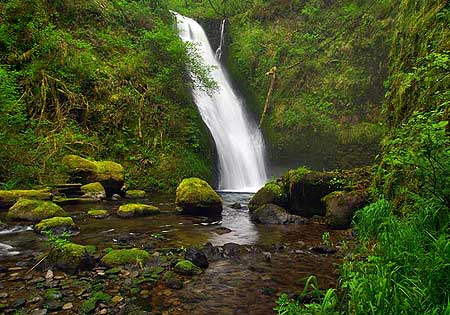
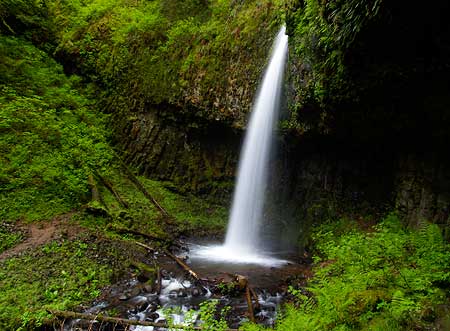
Upper Bridal Veil Falls

It is an unfortunate reality that in the face of Oregon’s population doubling over the past half-century, our trail system has declined. The resulting crowding and overuse is evident on many of the trails that remain, especially on those fringing the rapidly growing Portland region.

This trend is at odds with oft-stated public goals of better public access to nature, re-introducing children to the outdoors, providing more active, quiet recreation near our urban centers, shifting toward a more sustainable forest economy and creating affordable recreation in the interest of social equity.

So, what to do? Build more trails. Soon. And take better care of what we already have.

This article lays out a specific vision for one such trail, an all-season, family-friendly loop in the Columbia Gorge. This would not only be an important step toward meeting those public goals, but also could also become a flagship project for a renewed campaign to expand our trails to meet overwhelming demand.

The place is spectacular Bridal Veil Creek, known for its namesake falls, but less known is the string of waterfalls in its shady upper canyon, or the rich history that colors the area.

The Legacy of Bridal Veil

The town of Bridal Veil in 1900

Though deceivingly green and pristine today, the Bridal Veil watershed was once the center of what was arguably the most intensive logging operation in the region.

From 1886-1936, the company town of Bridal Veil thrived at the base of Bridal Veil Falls, on the banks of the Columbia River. The mill town at Bridal Veil was connected to a hillside sister mill community known as Palmer, located on the slopes of Larch Mountain. Today’s Palmer Mill Road survives as the connecting route between the two former mills.

Loggers near New Palmer in 1912

In the turn-of-the-century heyday of these mills, logs were rough-milled at the Palmer site, and sent down a mile-long flume to the Bridal Veil mill for finishing as commercial lumber. The terminus of the flume can be seen in the lower right of the first photo (above), with a huge pile of rough cut lumber piled at its base.

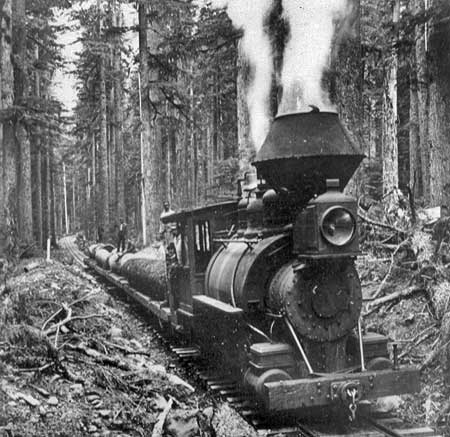
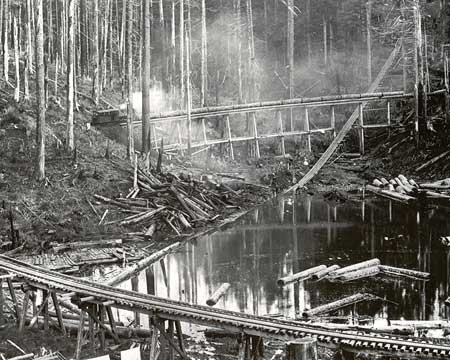
Timber was hauled to the holding ponds at the Palmer site along a series of rail spurs, traces of which can still be found today in the deep forests of Larch Mountain.

Jumbo steam engine hauling logs to New Palmer in 1905

The original Palmer site operated until a fire destroyed the mill in 1902, and the New Palmer mill was constructed nearby. New Palmer operated until the Bridal Veil Falls Lumbering Company shut down in 1936, a victim of the Great Depression and the largely logged-out Bridal Veil area.

Kraft Foods bought the mill and surrounding town in 1937, and formed the Bridal Veil Lumber and Box Company. Kraft manufactured its iconic wooden cheese boxes at the mill from 1937-1960, when Bridal Veil was finally shut down for good.

Old Palmer mill pond in 1896

The town site of Bridal Veil had already begun to fade when Kraft bought the community and mill in 1937, and today only the post office and cemetery survive. The tiny post office remains a popular attraction for mailing wedding announcements and invitations (with a “Bridal Veil, OR” postmark), and is now the sole reason for its existence. The cemetery saw its last burial in 1934, and local volunteers now maintain the grounds.

In 1990, the Trust for Public Lands purchased the Bridal Veil site, with the intention of clearing the remaining structures and transferring the land to the U.S. Forest Service for restoration. A decade-long legal battle ensued between local historic preservation interests and the Trust before the buildings were finally cleared, beginning in 2001. The last structure (a church) was demolished in 2011, leaving only the post office.

Log flume near Middle Bridal Veil Falls in 1896

Though the structures are mostly gone, remnants and artifacts from the Bridal Veil logging era are everywhere in the canyon: moss-covered railroad ties can still be seen on the old logging grades, concrete foundations line the old streets of the town, and chunks of suspension cable and rusted hardware follow the old flume corridor.

Sadly, there is also modern debris in the mix: illegal dumping has plagued Palmer Mill Road for decades, including automobiles that have been rolled over the canyon rim, tumbling into Bridal Veil Creek. At least three recently dumped autos are still lodged above the upper falls today, and several have already been pulled from the creek over the years.

Kraft cheese box

The combination of historic and nuisance debris lining this beautiful canyon present a couple of opportunities for the public. Clearly, the historic traces give a unique glimpse into the past, and an opportunity to interpret the logging history for present-day visitors.

But the nuisance debris also provides an opportunity to engage the public in a major cleanup of the canyon, and ongoing stewardship, in tandem with construction of a new trail.

The Proposal

This proposal for Bridal Veil canyon has two components:

1. Building a 2.5 mile hiking trail to spectacular views of the middle and upper waterfalls along Bridal Veil Creek

2. Converting Palmer Mill Road to become a bicycle trail

The focus of the proposal is on the hiking loop — a new, all-season trail that will offer a premier hike to families and casual hikers, while taking some pressure off crowded routes in the vicinity (such as Angels Rest, Latourell Falls and the Wahkeena-Multnomah trails).

The Palmer Road conversion is a secondary piece that responds to growing demand for new bike trails, as well as the failing state of the road for vehicular traffic (more about that, below).

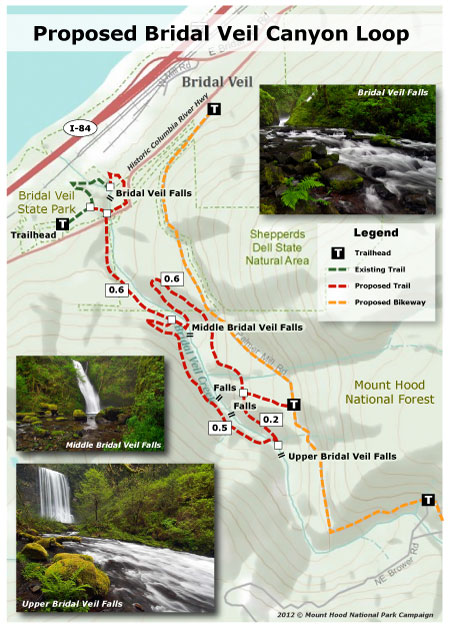
The following trail map shows these proposals in detail:

(click here for a larger version of the map)

One of the unique advantages of building in the Bridal Veil watershed is the already impacted nature of the landscape. Adding a trail here is a modest change compared to a century of road building and logging. The proposal also provides an opportunity to restore some of the environmental damage from past activities in the process, such as illegal dumping and invasive species that have been introduced to the canyon.

Another unique advantage is the opportunity to extend the new trail from the existing trailhead and picnic facilities that exist at Bridal Veil State Park. The park already has a paved parking area, picnic tables, year-round restroom and a couple of short hiking trails. The new trail proposal would build on these amenities, making for a full-service for casual hikers or families with young kids.

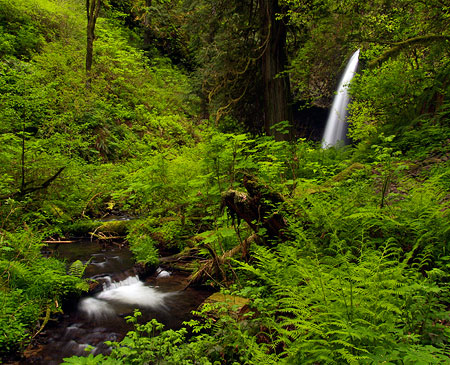
Upper Bridal Veil Creek

The trailhead is also adjacent to rustic Bridal Veil Lodge, and would certainly complement the long-term operating of this historic roadhouse by greatly expanding recreation opportunities in the area.

The new trail would begin a few feet beyond the trailhead sign on the existing Bridal Veil Falls trail, turning upstream from the current path. The new route would duck under the Historic Columbia River Highway, and follow the west side of Bridal Veil Creek closely for 0.6 miles to a new footbridge at beautiful Middle Bridal Veil Falls. Here, a few moss-covered remains of the old log flume survive among the ferns and boulders.

Middle Bridal Veil Falls

The proposed loop forks here, with the stream-level route continuing along the west side of the creek, and the eastern bluff route returning across the proposed bridge (see map, above).

The stream-level route would now climb a switchback to an overlook of Middle Bridal Veil Falls, and continue to traverse the stream for a half-mile, passing two more mid-sized waterfalls. Soon, the trail would arrive at a second bridge, just below magnificent Upper Bridal Veil Falls.

The upper falls is the main attraction of the proposed loop trail — a powerful 100-foot wall of water in a steep amphitheater. Hikers will want to enjoy this spot for a while, perhaps from the proposed footbridge, or possibly from a viewing platform similar to the deck at Bridal Veil Falls.

Upper Bridal Veil Falls

After taking in the view of the upper falls, hikers would begin the traverse of the east side of the canyon, along the return portion of the proposed loop trail. This section would gently climb the steep canyon walls to a series of open bluffs that frame the gorge. Along the way, a spur trail would connect the loop trail to the proposed bike route along Palmer Mill Road.

The return route would end with a long switchback descent to the proposed footbridge at Middle Bridal Veil Falls, and hikers would retrace their steps for the final 0.6 miles to the trailhead. The new loop would be a total 2.5 miles, round-trip.

Bridal Veil Falls

The final piece of the puzzle in the trail proposal would be a short return loop on the existing Bridal Veil Falls trail. This route would climb from the existing viewing platform above Bridal Veil Falls, traversing below the scenic highway to a new stream crossing at the highway bridge. Though this route involves extra cost and engineering challenges, it would also create a longer loop that incorporates the existing Bridal Veil Falls trail, for a total of 3.5 miles.

Converting Palmer Mill Road

While the main focus of this proposal is on new hiking trails, the deteriorating state of Palmer Mill Road — and the serious problems it creates in terms of illegal dumping and vandalism — calls the question of whether to allow traffic on this road in the long term?

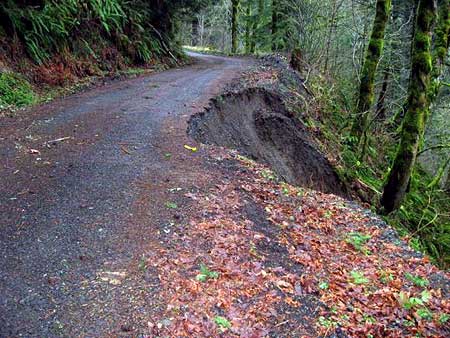
2011 slide on Palmer Mill Road (Multnomah Co.)

In 2011, the road was closed for several months to allow for repairs where a sizeable section had failed. Though unintentional, the statement on Multnomah County’s website makes the case for closing the road permanently:

“The isolated road is one of the county’s few remaining gravel roads. The narrow road climbs a steep hillside above Bridal Veil Falls along Bridal Veil Creek.

No homes or businesses are located along Palmer Mill Road. The road was built to serve logging mills in the 1880s that are now long gone. Few cars use the road, so not many people noticed when a landslide closed the route in March 2011, during one of the wettest winters in recent memory.”

At a time when county transportation funds are rapidly dwindling, converting the road to become a bicycle trail would not only help the health of Bridal Veil canyon, it could also remove some of the maintenance burden for the county. It also seems to fit the county’s own direction for the corridor, as the upper segment of Palmer Mill Road has been gated to vehicles for years, and is a favorite route among cyclists and hikers.

Palmer Mill Road in autumn

Like the proposed Bridal Veil loop trail, a bike trail along Palmer Mill Road already has a developed trailhead. In this case, the paved overflow lot for the Angels Rest trail provides ready-made parking. Therefore, no new accommodations for bike trail users would be needed (though the Angels Rest trailhead is not equipped with an all-season restroom or water).

(a caveat to this proposal: the steepness of Palmer Mill Road might limit its suitability for bikes, especially downhill, and therefore might need to be managed accordingly (like the Zigzag Trail near Surveyors Ridge, for example, which requires cyclists to walk bikes in the downhill direction).

What will it take?

This proposal will require a partnership between the U.S. Forest Service (administers the upper portion of the canyon), Oregon State Parks (administers the lower section) and trail advocacy groups. While the proposed loop represents a substantial amount of trail design, engineering and construction, it is well within reach if a public-private partnership can be realized.

The scope of the proposal is about the same as the Wahclella Falls trail, which was rebuilt in the 1990s to include two sizeable footbridges and sections of new tread on steep slopes. However, there would be little or no costs associated with the trailhead at Bridal Veil Canyon, unlike the Wahclella Falls project.

(click here for a larger view of this map)

(click here for a PDF version of this map)

Sound interesting? The best way to advocate for this trail is to simply pass the idea along. I will be advocating the project with Oregon State Parks, eventually, so word-of-mouth support among hikers could be helpful.

To share this concept, download the illustrated PDF version (above) of the map and send it to friends, fellow hikers or even to Oregon State Parks or Forest Service officials, with your own suggestions for how to proceed. That’s how grassroots projects get started, after all!
___________________________

Acknowledgements: this article has been underway for a couple of years, and reflects help from several local Gorge experts. My thanks go to Bryan Swan for his research on the history (and mystery) of Upper Bridal Veil Falls, and to Greg Lief and Don Nelsen for making bushwhack trips with me to Upper and Middle Bridal Veil Falls, respectively. Special thanks go to Zach Forsyth for his intrepid explorations along the less-traveled sections of the canyon, and advice on possible trail alignments.

New Lidar Maps of Mount Hood

The age of the microprocessor has ushered in a revolution in the fields of cartography and geosciences. After all, few could have imagined streaming Google Earth imagery over a worldwide web when the first air photos were being scanned and digitized in the 1980s.

The latest innovation on the geo-data front promises still more detailed geographic information than has ever been available before: Lidar (light detection and ranging) is a new technology that uses aircraft-mounted lasers to scan the earth at an astonishing level of detail. The resulting data can be processed to create truly mind-boggling terrain images that are rocking the earth sciences.

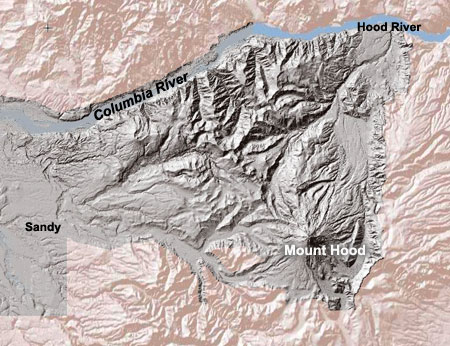
The Oregon Department of Geology & Mineral Industries (DOGAMI) has kicked off a project to develop a statewide lidar database. The effort began with a pilot project in the Portland metropolitan region in 2006, expanding to become a statewide effort in late 2007. Some of the first available imagery encompasses the Mount Hood region, including the Columbia River Gorge. The following map shows DOGAMI’s progress in lidar coverage (in gray) as of 2011:

A New Way to See Terrain

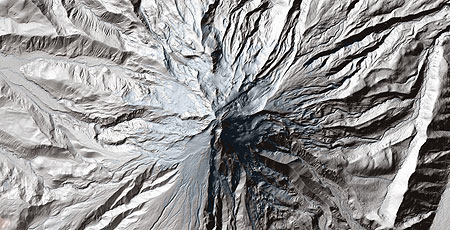
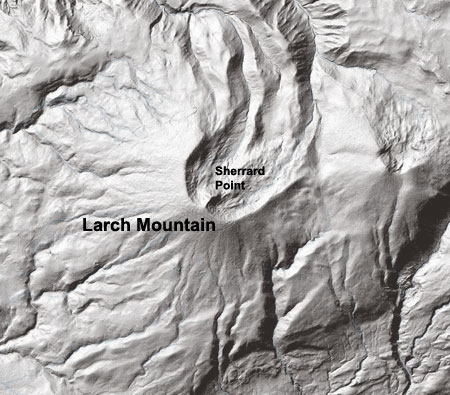
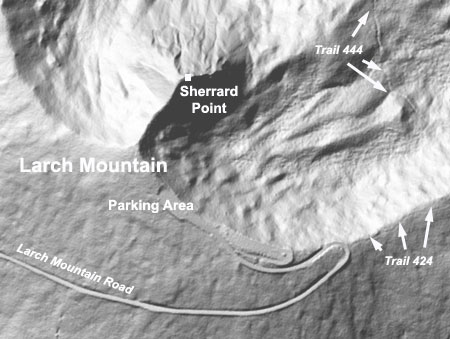
Lidar imagery has a “lunar” look, thanks to its tremendous detail and the ability for lidar new technology to “see through” forest vegetation. This view of Larch Mountain, for example, immediately reveals the peak to be the volcanic cone that it is, complete with a blown-out crater that was carved open by ice-age glaciers:

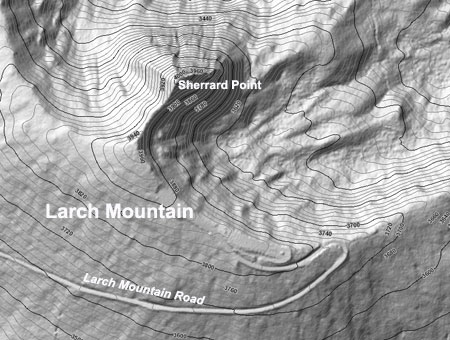
Move closer to the Larch Mountain view, and even more detail emerges from the lidar imagery. In the following close-up view, details of the Larch Mountain Road and parking area can be seen, as well as some of the hiking trails in the area:

The Oregon lidar imagery includes elevation contour data, and for hikers and explorers using the new information to plan outings, this is probably an essential layer to include. Here is the previous close-up image of Larch Mountain with elevation data shown:

The contours are not simply a rehash of USFS ground-survey data, but instead, derived from the lidar scans. In this way, the contours are as direct a reflection of the lidar data as the shaded relief that gives the images their 3-D drama.

There are some caveats to the new lidar technology: while it is possible to see most roads and even some trails in great detail, in many areas, lidar doesn’t pick up these features at all. Lidar also edits most vegetation out of the scene, though the state does provide topographic overlays for vegetation.
DOGAMI is now streaming the lidar data over its Lidar Data Viewer website, finally putting the new imagery in the eager hands of the general public. For this article, I’ll focus on the highlights of my first “tour” of the Mount Hood and Columbia River Gorge areas covered by the project so far — a familiar landscape viewed through the “new eyes” of lidar.

Seeing the Landscape with “New Eyes”

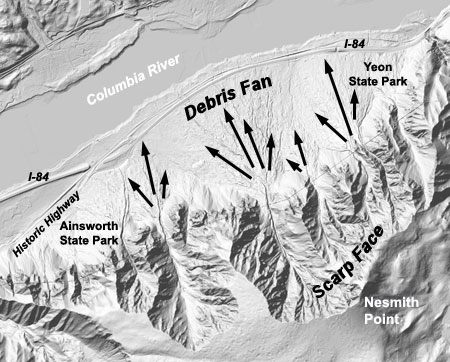
The first stop on the lidar tour is the Nesmith Point scarp face, a towering wall of cliffs that rise nearly 4,000 feet above Ainsworth State Park, near the rural district of Dodson. The Nesmith fault scarp has always been difficult to interpret from USGS topgraphic maps, with a maze of confusing contour lines that do little to explain the landscape. Air photos are even less helpful, with the steep, north-facing slopes proving nearly impossible to capture with conventional photography.

The lidar coverage of the Nesmith scarp (above) reveals the origin of the formation: a massive collapse of the former Nesmith volcano into the Columbia River, probably triggered by the Bretz Floods during the last ice age.

The Nesmith scarp continues to be one of the most unstable places in the Gorge. Over the millennia, countless debris flows have rushed down the slopes toward the Columbia, forming a broad alluvial fan of layered debris where traffic rushes along I-84 today. In February 1996, the most recent in this ancient history of debris flows poured down the canyons and across the alluvial fan, destroying homes and closing both I-84 and the railroad for several days.

Lidar provides a new tool for monitoring unstable terrain like the Nesmith scarp, and may help in preventing future loss of life and public infrastructure when natural hazards can be more fully understood.

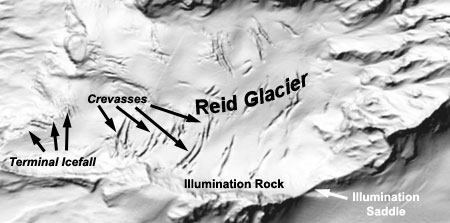
The ability to track detailed topographic changes over time with lidar is the focus of the next stop on the lidar tour: the Reid Glacier on Mount Hood’s rugged west face. As shown in the lidar image, above, bands of crevasses along the Reid Glacier show up prominently, and for the first time this new technology will allow scientists to monitor very detailed movements of our glaciers.

This new capability could not have come at a better time as we search for answers in the effort to respond to global climate change. In the future, annual lidar scans may allow geologists and climate scientists to monitor and animate glaciers in a way never possible before.

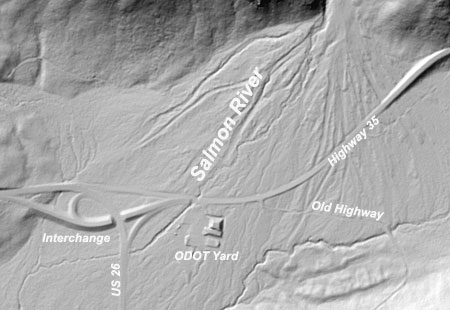
Moving to Mount Hood’s south slopes on the lidar tour, this image shows the junction of US 26 and Highway 35, which also happens to be built on the alluvial fan formed by the Salmon River, just below its steep upper canyon.

Unlike the nearby White River, the Salmon has had relatively few flood events in recent history. To the traveling public, this spot is simply a flat, forested valley along the loop highway. Yet, the lidar image shows dozens of flood channels formed by the Salmon River over the centuries, suggesting that the river has temporarily stabilized in its current channel — but not for long.

DOGAMI geologists are already examining the lidar imagery for these clues to “sleeping” calamities: ancient landslides, fault lines and flood zones concealed by a temporary carpet of our ever-advancing forests.

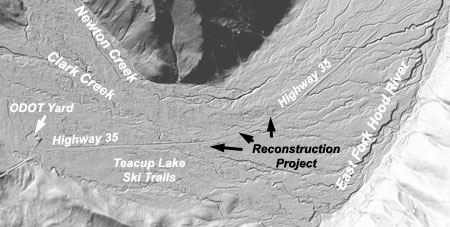
The lidar images reveal a similar maze of flood channels at our next stop, where glacial Newton and Clark creeks join to form the East Fork Hood River. This spot is a known flood risk, as Highway 35 is currently undergoing a major reconstruction effort where debris flows destroyed much of the highway in November 2006.

While the highway engineers are confident the new highway grade will hold up to future flood events, the above lidar image tells another story: with dozens of flood channels crossing the Highway 35 grade, it seems that no highway will be immune to floods and debris flows in this valley.

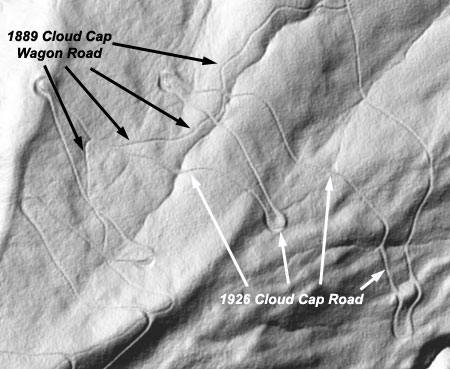
The new lidar images also provide an excellent tool for historical research. The following clip from below Cloud Cap Inn on Mount Hood’s north side is a good example, with the lidar image clearly showing the “new”, gently graded 1926 road to Cloud Cap criss-crossing the very steep 1889 wagon (or “stage”) road it replaced:

The Cloud Cap example not only highlights the value of lidar in pinpointing historic features, but also in archiving them. In 2008, the Gnarl Fire swept across the east slopes of Mount Hood, leaving most of the Cloud Cap grade completely burned. Thus, over time, erosion of the exposed mountain slopes may erase the remaining traces of the 1889 wagon road, but lidar images will ensure that historians will always know the exact location of the original roads in the area.

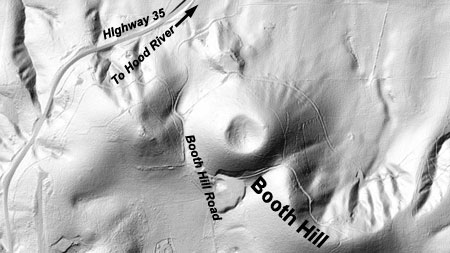
Moving north to the Hood River Valley, the value of lidar in uncovering geologic secrets is apparent at Booth Hill. This is a spot familiar to travelers as the grade between the upper and lower Hood River valleys. Booth Hill is an unassuming ridge of forested buttes that helps form the divide. But lidar reveals the volcanic origins of Booth Hill by highlighting a hidden crater (below) that is too subtle to be seen on topographic maps — yet jumps off the lidar image:

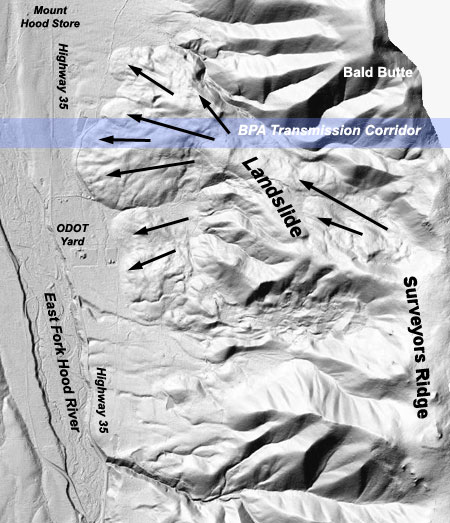
Another, nearby geologic secret is revealed a few miles to the south, near the Mount Hood Store. Here, an enormous landslide originates from Surveyors Ridge, just south of Bald Butte, and encompasses at least three square miles of jumbled terrain (below):

Still more compelling (or perhaps foreboding) is the fact that the Bonneville Power Administration (BPA) chose this spot to build the transmission corridor that links The Dalles Dam to the Willamette Valley. The lidar image shows a total of 36 BPA transmission towers built on the landslide, beginning at the upper scarp and ending at the toe of the landslide, where a substation is located.

As with most of the BPA corridor, the slopes under the transmission lines have been stripped of trees, and gouged with jeep tracks for powerline access. Could these impacts on the slide reactivate it? Lidar will at least help public land agencies identify potential natural hazards, and plan for contingencies in the event of a disaster.

Mount Hood Geologic Guide and Recreation Map

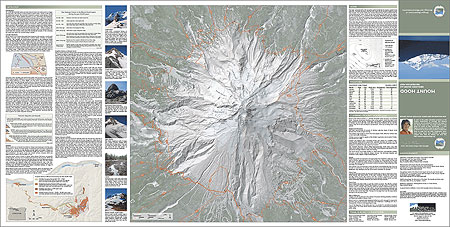
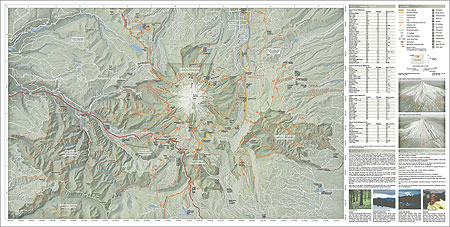
You can tour the lidar data on DOGAMI’s Lidar Data Viewer, but for portability, you can’t beat the new lidar-based recreation map created by DOGAMI’s Tracy Pollock. The new map unfolds to 18×36”, and is printed on water-resistant paper for convenient use in the field.

Side A of the new map focuses on the geology of Mount Hood, with a close-up view of the mountain and most of the Timberline Trail:

(click here for a larger version)

Side B of the map has a broader coverage, and focuses on recreation. Most hiking trails and forest roads are shown, as well as the recent Mount Hood area wilderness additions signed into law in 2009:

(click here for a larger version)

You can order printed copies of this new map for the modest price of $6.00 from the DOGAMI website, or pick it up at DOGAMI offices. It’s a great way to rediscover familiar terrain through the new lens of lidar.

The Newton Clark Moraine

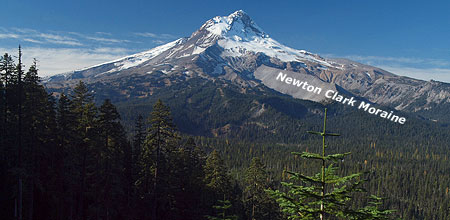
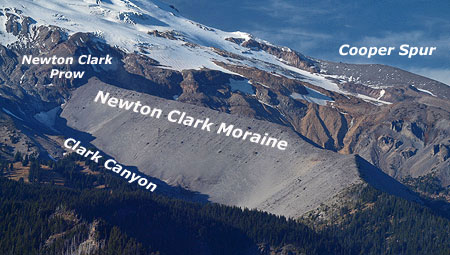
Mount Hood and the Newton Clark Moraine from Bennett Pass Road

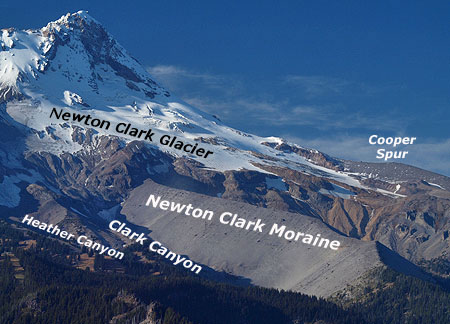
Tucked on the remote east shoulder of Mount Hood is the Newton Clark Moraine, the largest glacial formation on the mountain, and one of its most prominent features. Yet this huge, snaking ridge remains one of Mount Hood’s least known and most mysterious landmarks.

At over three miles in length, and rising as much as a thousand feet above the glacial torrents that flow along both flanks, the Newton Clark Moraine easily dwarfs the more famous moraines along the nearby Eliot Glacier.

East Face Detail with Newton Clark Moraine

How big is it? The Newton Clark Moraine contains roughly 600 million cubic yards of debris, ranging from fine gravels and glacial till to house-sized boulders. This translates to 950 million tons of material, which in human terms, means it would take 73 million dump truck loads to haul it away.

Backcountry skiers often call the moraine “Pea Gravel Ridge”, which is a poor choice of words, as pea gravel is something you would expect in tumbled river rock. The Newton Clark Moraine is just the opposite: a jumble of relatively young volcanic debris, some of it located where it fell in Mount Hood’s eruptive past, some of it moved here by the colossal advance of the Newton Clark Glacier during the last ice age.

Newton Clark Moraine

As a result, the rocks making up the moraine are sharp and raw, not rounded, and the debris is largely unsorted. Giant boulders perch precariously atop loose rubble, making the moraine one of the most unstable places on the mountain.

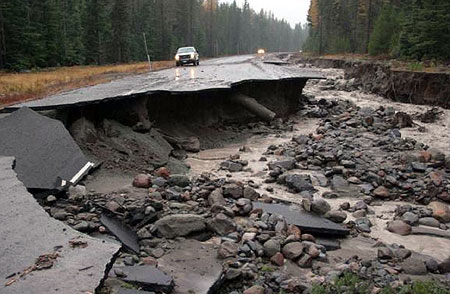
In recent years, erosion on Mount Hood has been accelerating with climate change. Sections of the Newton Clark Moraine are regularly collapsing into Newton and Clark creeks, creating massive debris flows that have repeatedly washed out Highway 35, below.

2006 Newton Creek Washout on Highway 35 (USFS)

Today, an ambitious Federal Highway Administration project is underway to rebuild and — supposedly — prevent future washouts on Highway 35 at Newton Creek and the White River. But given those 73 million dump truck loads of debris located upstream on Newton Creek, it’s likely that nature has different plans for the area as climate change continues to destabilize the landscape.

Something a Little Different

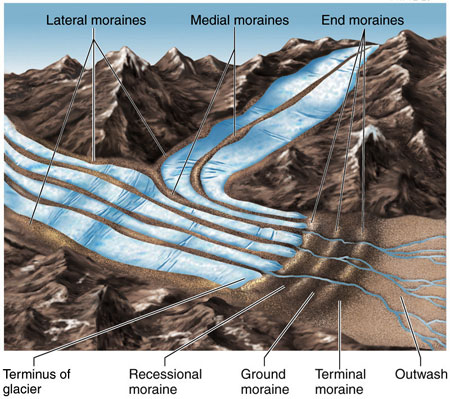
Most glacial moraines on Mount Hood are lateral moraines, formed along the flanks of glaciers, or terminal moraines formed at the end of a glacier. The Newton Clark Moraine is different: it is a medial moraine, meaning that it formed between two rivers of ice.

(Wikipedia)

As shown in this schematic (above), medial moraines are more common in places like Alaska or Chile, where much larger glaciers flow for miles, like rivers. When these glaciers merge, a medial moraine is often created, marked by the characteristic stripe of rock that traces the border between the combined streams of ice.

At the surface of a glacier, only the top of a medial moraine is visible. Only upon a glacier retreating can the full size of a medial moraine be appreciated. In this way, the height of the Newton Clark Moraine is a reasonable estimate of the height (or depth) of the ancestral Newton Clark Glacier during the most recent ice age advance — the crest of the moraine approximates the depth of the former glacier.

The Newton Clark Prow

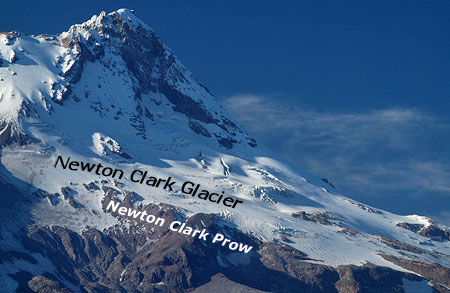
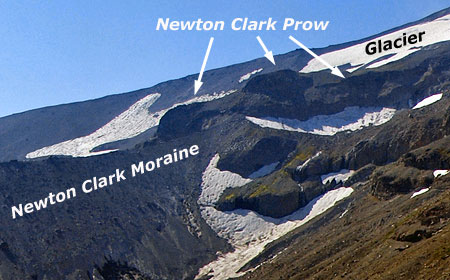
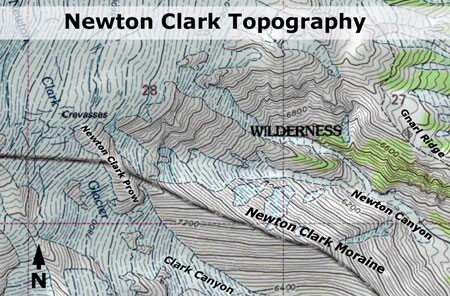
The Newton Clark Moraine is even more unique in that the two bodies of ice that formed the moraine flowed from the same glacier. Like the modern Newton Clark Glacier, the much larger ice age ancestor also began as a single, wide body of ice on Mount Hood’s east flank, but then split as it flowed around the massive rocky prow that now marks the terminus to the glacier.

The outcrop is typical of the stratovolcanoes that make up the high peaks of the Cascades. Stratovolcanoes are formed like a layer cake, with alternating flows of tough, erosion-resistant magma and loose ash and debris deposits. The Newton Clark Prow is a hard layer of magma in the “cake” that is Mount Hood, with looser layers of volcanic ash and debris piled above and below.

Newton Clark Prow detail from Gnarl Ridge

In fact, without this broad rib of volcanic rock to shore up its eastern side, the very summit of Mount Hood might well have been further eroded during the series of glacial advances that have excavated the peak.

Similar rocky outcrops appear elsewhere on the mountain, forming Mississippi Head, Yocum Ridge, Barrett Spur and the Langille Crags. Hikers visiting Gnarl Ridge know the Newton Clark Prow from the many waterfalls formed by glacial runoff cascading over its cliffs.

(Click here for a larger version)

The much softer and less consolidated rock below the prow made it easy for the ice age ancestor of the Newton Clark to scour away the mountain. This action created the huge alpine canyons that Clark and Newton creeks flow through today, as well as the enormous U-shaped valley of the East Fork Hood River.

A Glimpse into the Ice Age

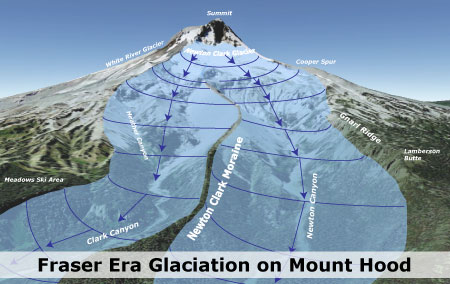
While today’s Newton Clark Glacier flows a little over a mile down the east face of the mountain, its giant ice age ancestor once flowed more than 12 miles down the East Fork valley (today’s Highway 35 route), nearly to the junction of today’s Cooper Spur road. At its peak, the ancestral glacier was more than 1,200 feet deep as it flowed down the valley.

If you were to walk along the crest of the Newton Clark Moraine at that time (as suggested in the illustration, below), you would have likely been able to walk directly across the ice to Gnarl Ridge or today’s Meadows lifts, as the Clark and Newton Creek valleys were filled to the rim with rivers of ice.

Ancestral Newton Clark Glacier Extent

(Click here for a larger version)

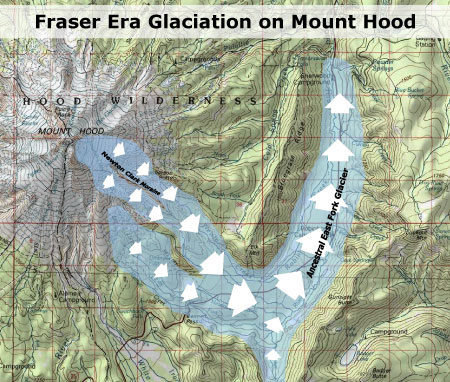
This most recent ice age is known to scientists as the Fraser Glaciation, and extended from about 30,000 years ago until about 10,000 years ago. At its peak, the zone of perpetual snow was as low as 3,400 feet, though probably closer to 4,000 feet in the area east of Mount Hood.

This means the deflation zone — the point in its path when a glacier is melting ice more quickly than snowfall can replace — was probably somewhere near the modern-day Clark Creek Sno-Park, or possibly as low as the Gumjuwac Trailhead, where today’s Highway 35 crosses the East Fork.

Below this point, the ancestral glacier would have changed character, from a white jumble of cascading ice to one covered in rocky debris, yet still flowing toward its terminus at roughly at modern-day confluence of the East Fork with Polallie Creek (the map below shows a very generalized estimate of the ancestral glacier)

Geologists believe the Fraser-era glacial advances followed the path of earlier glaciers in their flow patterns. With the Newton-Clark glacier, scientists have found traces of at least two previous glacial advances from even more ancient glacial periods that extended far down the East Fork Valley prior to the Fraser Glaciation. This helps explain the magnitude of the glacial features in the East Fork valley, having been repeatedly carved into an enormous U-shaped trough by rivers of ice over the millennia.

Ancestral Newton Clark Glacier extending down the East Fork valley

(Click here for a larger version)

The timing of the Fraser Glaciation is even more fascinating, as it coincides with the arrival of the first humans in the Americas. It was during this time — at least 15,000 years ago, and likely much earlier — that the first nomadic people crossed the Bering Straight and moved down the Pacific Coast.

Does this mean that the earliest humans in the region might have camped at the base of Mount Hood’s enormous ice age glaciers, perhaps hunting for summer game along the outflow streams? No evidence exists to show just how far humans pushed into Mount Hood’s prehistoric valleys, but scientists now believe people have lived along the Columbia River for at least 10,000 years, and the oral histories of some tribes in the region are also believed to extend back to that time.

How to See It

The best way to see and appreciate the Newton Clark Moraine is along the Timberline Trail where it follows Gnarl Ridge. This route offers a wide-open view across Newton Canyon to the moraine. You can also see the active geology at the headwaters of Newton Creek, where the slopes of the moraine continue to change every winter. On a breezy day, you might also notice sulfur fumes blowing over the summit from the crater — a reminder that Mount Hood is still very much a living volcano today.

Mount Hood and the Newton Clark Moraine (on the left) from Gnarl Ridge

You can follow a detailed hike description to Gnarl Ridge from the Portland Hikers Field Guide at the following link:

Portland Hikers Field Guide: Gnarl Ridge Hike

Another way to see the moraine is from rustic Bennett Pass Road. In summer, you can walk or bike along the old road from Bennett Pass, and there are several viewpoints across the East Fork valley to the headwaters and the Newton Clark Moraine. In winter, you can park as the Bennett Pass Sno-Park and ski or snowshoe to one of the viewpoints — a popular and scenic option.

The most adventurous way to visit is to simply hike the crest of the moraine, itself. This trip is only for the most fit and experienced hikers, as the final segment is off-trail, climbing high above the Timberline Trail. The reward is not only close-up look at the mountain from atop the moraine, but also a rare look at a series of spectacular waterfalls that can only be seen from this vantage point.

Whatever option you choose, you’ll have unique glimpse into Mount Hood’s past — and possibly its future — through one of the mountain’s most unusual geologic features.

Columbia Gorge: The Fight for Paradise

On November 17, OPB’s Oregon Field Guide aired a special 1-hour look at the Columbia River Gorge Scenic Act, commemorating the 25th anniversary of the legislation.

The show provides a comprehensive look at the history of the Gorge Act, its friends and foes and some of the future challenges, including those never anticipated when the legislation was written — such as the recent land rush for wind turbine sites. Several of the most prominent early defenders of the Gorge are included, including Chuck Williams and Nancy Russell.

The program also includes in-depth look at the Native American legacy in the Gorge, and the ironic effect of the Gorge Act bringing a surge of new residents since it was signed into law — all seeking a life amid the scenery, and bringing demand for hundreds of new homes and new industry to a new level in the Gorge.

The program overlooks the massive increase in recreation demand over the past three decades, and the lack of trails to serve the crowds. Not much attention is paid to the future role of federal stewardship in the Gorge, and especially the national park vision that Chuck Williams advocated during the fight for protection.

Tsagaglalal or She Who Watches (USFS)

Likewise, Senator Bob Packwood is given too much credit for passage of the Gorge Act (in his own words, of course, in typical Bob Packwood form), while Senator Mark Hatfield is not given enough. Had Hatfield been alive to comment, he would undoubtedly have given a humble account of his key role in developing the legislation. This political history might make for a future documentary on the evolution of the Gorge Act, itself, perhaps based on Carl Abbot’s book Planning a New West: The Columbia River Gorge National Scenic Area.

Still, the program provides a very good overview of the Gorge Act over the past quarter century, and how much it has already changed the public/private balance of interests in the Gorge. Here is the documentary in full (approximately 55 minutes):

Piggyback Plant

Piggyback plant

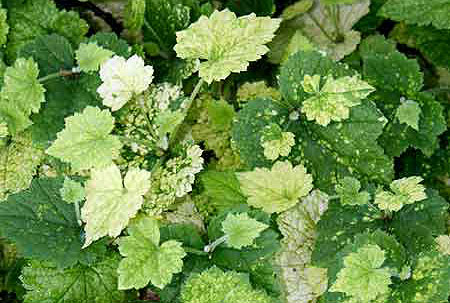
Hike along any low-elevation stream in the Cascades and you’re likely to pass colonies of Tolmiea menziesii — more commonly known as the piggyback plant. These humble plants draw their common name from a unique habit of sprouting new plants on top of their leaves (reflected in other common names for the species, including “youth-on-age” and “thousand mothers”).

The botanical name for this species memorializes two giants in the early days of Pacific Northwest botanical discovery: Scottish-Canadian botanist William Fraser Tolmie and Archibald Menzies, the Scottish naturalist for the Vancouver Expedition.

Young leaves on a piggyback plant

These fuzzy little plants thrive in the moist shade of streamside broadleaf trees like red alder and bigleaf maple. As forest floor dwellers, piggyback plants have become expert at reproducing. They can spread along their well-developed rhizomes, through seeds, and of course, through the tiny plantlets that form on their leaves.

A close look at the piggyback plant reveals a whorl of basal leaves, typical of the many species in the saxifrage family. The leaves have 5-7 lobes, and are finely toothed. Both leaves and stems are covered in fine white hairs that give them a soft texture to the touch.

Daughter plantlet on a piggyback plant mother leaf

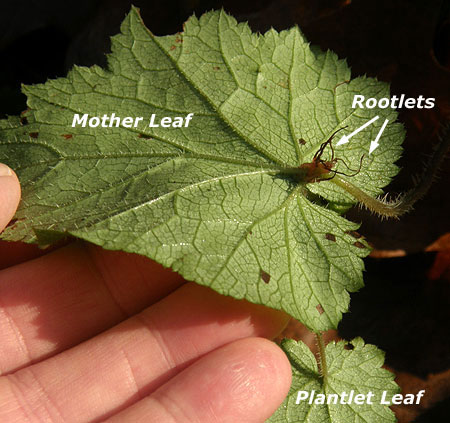
Piggyback plants produce leaves continually from their base, with larger, older leaves eventually sprouting a “daughter” plantlet. The genius of this reproductive strategy is how it fits into the life cycle of the deciduous forests where the plants thrive. As the older leaves mature, they extend away from the mother plant on 4-6” stems, allowing daughter plantlets that form to touch down well away from the parent plant.

This is where the over-story of deciduous trees come in. Daughter plantlets form mostly over the course of the spring and summer growing season, By autumn, they are ready for falling maple and alder leaves to bury them, pressing tiny rootlets on the daughter plants into contact with the ground, where they can grow and anchor the new plant.

Underside of a mother leaf showing rootlets on a piggyback “daughter”

By the next spring, the new plant is ready to grow on its own, still fed by the nutrients from the fading mother leaf, and still with the connecting stem from the mother leaf forming an umbilical cord to the mother plant. Over time, the mother leaf and stem connecting to the daughter plant wither and die, and the daughter becomes truly independent from the parent.

In spring, piggyback plants produce clusters of tiny, graceful blossoms on 6-10” spikes. Each blossom is capable of producing a small seed capsule filled with tiny seeds. Flower stalks die back over the course of a summer, releasing seeds to grow side-by-side with the cloned plants that have sprouted from rhizomes and “piggyback” plantlets.

Piggyback plant flower (Wikimedia)

As a survival strategy, the seed offspring have the advantage of being cross-pollinated. Over time, seed-based offspring can evolve with the genes of two parents to have new survival characteristics that single parent cloned plants from root or leaf starts inherently lack.

Piggyback Plants in the Commercial Trade

Only a few native plants from Pacific Northwest forests have been hybridized to become commercial cultivars, and still fewer are suitable as indoor plants. The piggyback plant fills this rare niche, somehow adapting to the relatively hot, arid conditions indoors. They are typically sold as hanging basket plants.

Piggyback plant cultivar “Taff’s Gold”

The curious “piggyback” habit is the main attraction for growing the plants indoors. Breeders have created commercial hybrids with larger leaves, more “piggyback” plantlets and even a few variegated cultivars, such as the “Taffs Gold” Tolmiea shown above.

Starting Your Own Piggyback Plant

There’s no need to buy a piggyback plant, kids (and parents) can enjoy collecting and growing piggyback plants collected in the wild. You can make this a two-part adventure for kids by combining the collecting with a day hike, then propagating what you’ve collected at home.

Piggyback plants are plentiful along several family-friendly trails in the Columbia River Gorge: notable among these are the short trails to Latourell Falls, Bridal Veil Falls, Elowah Falls and Wahclella Falls.

On each trail, you’ll find piggyback plants in streamside areas and where deciduous trees grow. Your kids will quickly learn to spot them, and it’s okay to collect a few plantlets for growing at home, as you will be leaving the mother plant behind to produce more (an important lesson for kids).

Materials for starting your own plant

To grow your daughter plant, you’ll need the following:

• small pot (3-4 inches)
• soil-less potting mix
• bobby pin (or paper clip)
• rubber band
• plastic sandwich or freezer bag

Planting your starts is simple: (1) fill the pot to within 1” of the top with soil; (2) place the mother leaf and plantlet in the pot, with rootlets touching the soil; pin in place by pushing the bobby pin (or paper clip) over the mother leaf stem just below the plantlet, and holding it against the soil. Next, (3) sprinkle another 1/4” of potting mix, slightly covering the stem and base of the plantlet, and water well. Finally, (4) secure the plastic bag over the pot with the rubber band to provide a humid environment for the young plantlet to become established.

Piggyback start potted and ready to grow

Keep your new piggyback plant in a bright north or east-facing window, and covered with the plastic bag until you see the plantlet growing. At this point, you can remove the bag and watch your new houseplant grow — or plant it in your yard, where it will thrive in moist shade.

This is a terrific way to get young kids excited about the outdoors, and perhaps develop a green thumb in the process! You can start a piggyback plant at any time, as the plantlets can be collected year-round on the low-elevation Gorge trails listed above.

White River Buried Forest

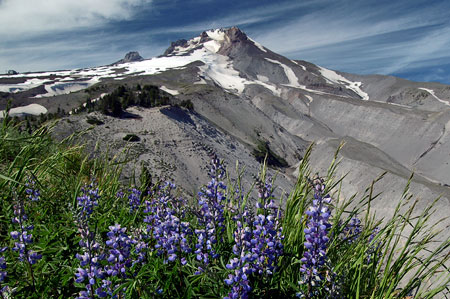
The summer of 2011 will be remembered as the year of the Dollar Lake Fire in the Mount Hood area, as much of the north side is still smoldering from a lightning-caused wildfire that ignited on August 26. Though a calamity to those who loved the verdant forests on Mount Hood’s northern slopes, the fire is a blip on the screen when compared to the many explosive events that have rearranged the mountain’s forests and topography over the millennia.

Among the most recent and fascinating of these events are the Old Maid eruptions. These explosions knocked over entire forests on the mountain’s south side like matchsticks, burying them under a deep layer of ash and volcanic debris. This article describes the Old Maid events, and how to see traces of their aftermath today.

The Old Maid Eruptions

While most tourists at Timberline Lodge on a given day are blissfully unaware that Mount Hood is living volcano, the occasional, heady odor of sulfur fumes blowing down from the crater are a reminder the “quiet” spell we are enjoying is only temporary.

[click here for a larger version]

In geologic terms, the Old Maid eruptions are incredibly recent, finally winding down in our recorded history of the early 1800s. The events are named for Old Maid Flats, the debris plain created by the eruptions in the Sandy River canyon, though the impact on the mountain was much broader.

Scientists have determined the Old Maid eruptive period to have occurred within from about 1760 to 1810 A.D. In fact, when Lewis & Clark described the shallow “quicksand” delta of the Sandy River in 1804-05, they were looking at volcanic sediments that had only recently flooded down the river from the active slopes Mount Hood.

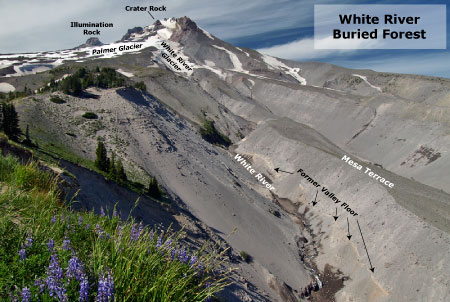
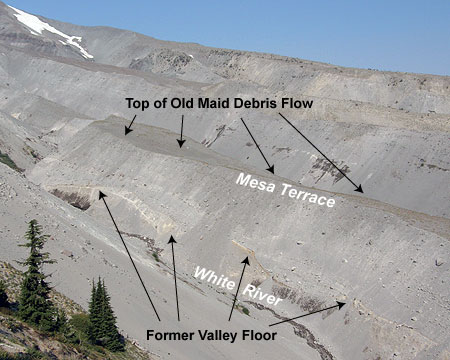
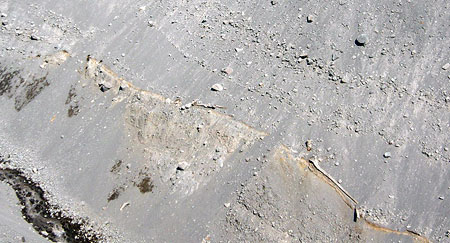
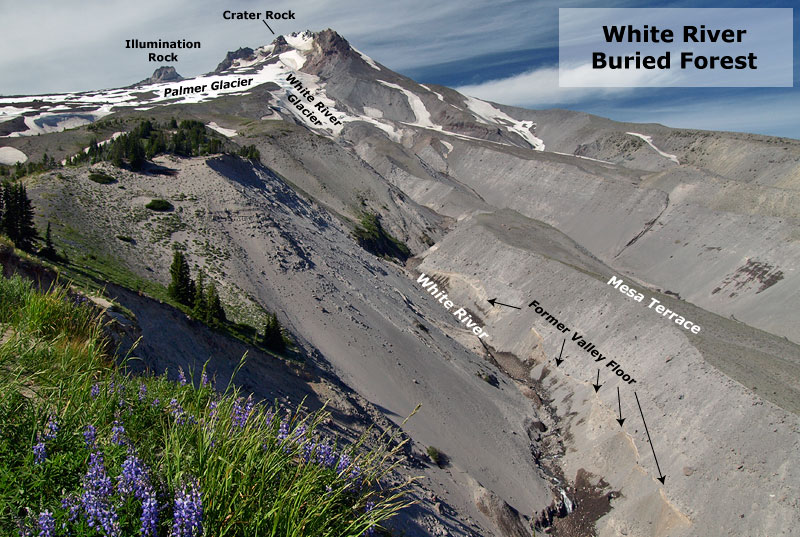
The former floor of the White River canyon is visible as a thin layer of oxidized soil, dotted with mummified trees.

The scientific accuracy of these dates is made possible by thousands of mummified trees swept over by the Old Maid debris flows, and later exposed by streams cutting into the sediments. The White River buried forest is one of the more prominent locations where these flattened forests and the former valley floor can plainly be seen.

The Old Maid eruptions originated in the modern crater of Mount Hood, where sulfur fumes still rise from the vents known as the Devils Kitchen. The massive, 800-foot volcanic dome of Crater Rock, itself, is just 200 years old and formed during these eruptions. The heat of rising magma in the crater eventually sent pyroclastic flows down the Sandy and White River canyons — rolling clouds of super-heated ash and debris that buried the entire landscape.

A closer look at the buried valley floor reveals mummified trees.

The Old Maid eruptions deposited about one hundred feet of debris throughout the upper White River canyon, filling the formerly U-shaped glacial valley with a flat fan of volcanic boulders, cobbles and fine ash. The outflow from the White River Glacier has since carved deeply into the debris flow, revealing the old valley floor and some of the thousands of mummified trees knocked over by the Old Maid event.

A flat-topped ridge in the middle of the White River canyon known as Mesa Terrace (see earlier schematic) is a remnant of the debris flow that shows the original depth of the debris above the valley floor.

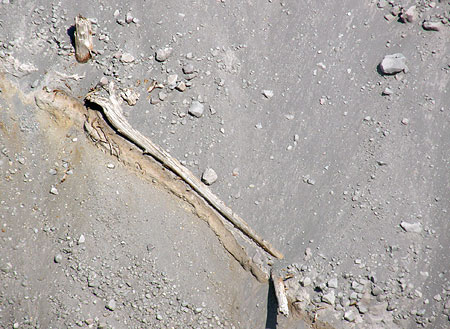
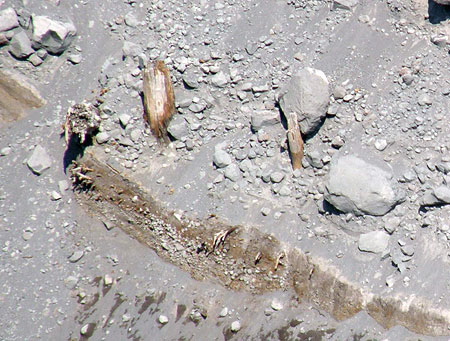
Close-up of an entire tree, tipped over and buried where it fell on the former valley floor.

Two types of debris flow swept down the southern slopes of Mount Hood during the Old Maid eruptions. The most destructive were the pyroclastic flows, which many of us are familiar with from the colossal Mount St. Helens eruption of May 18, 1980.

In addition to the hot pyroclastic flows, cooler mudflows from flash-melted glaciers and snowfields also swept down Mount Hood’s south slopes during the Old Maid events. We know the buried forests at the bottom of White River Canyon fell victim to these mudflows, as pyroclastic flows would have instantly incinerated the standing timber. Instead, the cooler debris flows simply knocked the forests over, and buried them under layers of mud and debris.

Scientists believe these trees were partially buried, then broken off by subsequent flows.

Scientists believe the old valley floor now being revealed by erosion was of glacial origin, dating back to the last major glacial advance of the White River Glacier some 10,000 years ago. Thus, forests grew undisturbed along the former valley floor of the White River for a very long time.

Hiking to the Overlook

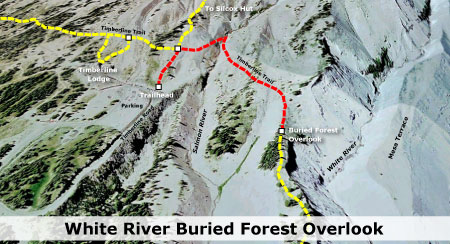
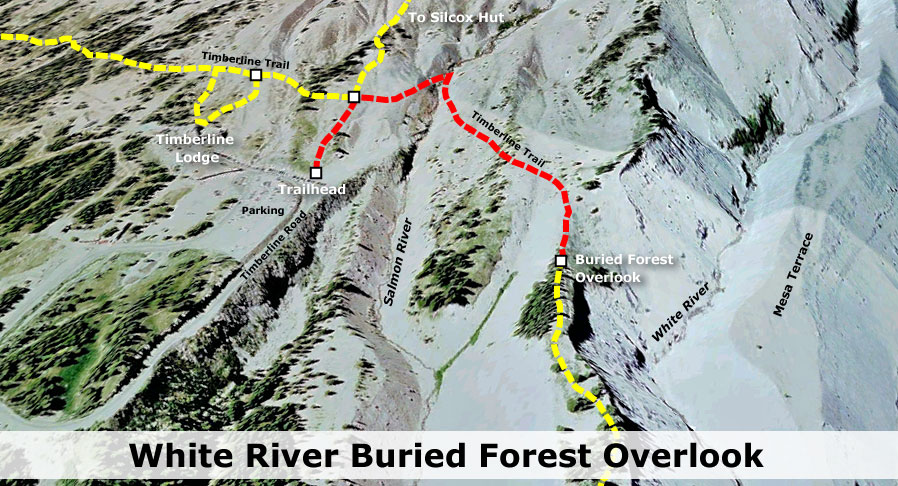
Hiking to the White River buried forest overlook is easy and scenic, as well as historic and iconic: it follows Mount Hood’s famous Timberline Trail for 0.7 miles to the impressive rim of the White River canyon. This section of trail also serves as the Pacific Crest Trail, the 2,000-mile epic trek from Mexico to Canada.

To find the trailhead, park in the lower, overflow lot located to the east of Timberline Lodge. Park near a gated dirt on the west side of the parking area. Follow this old road steeply uphill for about 200 yards to an obvious junction with the Timberline Trail, and turn right (or, if you’re coming from the lodge, follow any of the trails beyond the lodge uphill to the Timberline Trail and turn right). The Timberline Trail quickly traverses into a side-canyon, crossing the headwaters of the Salmon River.

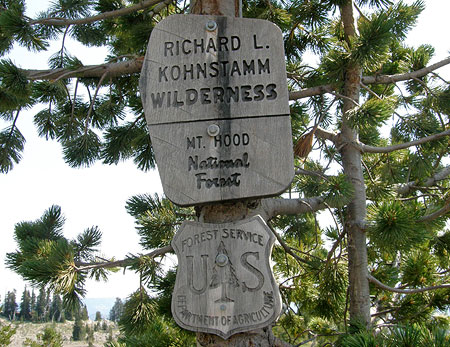
Next, the Timberline Trail rambles across pumice-covered slopes and soon reaches a sign marking the Richard L. Kohnstamm Wilderness, created in 2009 as an addition to the wilderness complex that encircles Mount Hood. Kohnstamm was the resort operator responsible for resurrecting a struggling Timberline Lodge in the 1950s, and setting the resort on the successful path that it continues to enjoy today.

[click here for a larger, printable map]

Beyond the wilderness boundary, the trail descends across another pumice slope, then drops more steeply on a surface of loose glacial till as it traces the west moraine of the White River canyon. Soon, you will reach the overlook where the Timberline Trail follows the moraine crest, and arrives at a stand of trees. This is a good spot to stop and take in the scenery, and especially to pick out the signs of the buried forest, at the bottom of the canyon, below.

The south-facing slopes and open terrain can make this a hot, dusty hike in late summer, so be sure to carry water. You will also want a pair of binoculars to view the buried forest details more closely. If you have the time and energy after visiting the buried forest overlook, you can retrace your step to the dirt access road, then turn right and follow it to Silcox Hut, about 0.8 miles from the trailhead. The hut was the original upper terminal for the first Magic Mile ski lift in the late 1930s, and today is maintained as an historic structure.

SOLVED: North Side Waterfall Mystery

Fans of the classic 1975 edition of Jack Grauer’s “Mount Hood: A Complete History” have memorized the many rare photos and stories found only in this unique book. For waterfall hunters, the photo on page 226 (shown above) is particularly compelling. The 1890s image is titled “Wallalute Falls on Compass Creek”, and shows the tiny figure of a man at the base of a dramatic falls.

The mystery in this caption stems from the fact that USGS maps have long shown Wallalute Falls to be the prominent cascade on the Eliot Branch, just below Cloud Cap. This huge falls is visible from Inspiration Point on the Cloud Cap Road, and is clearly not the same as the cascade shown in the Grauer book.

This article attempts to untangle the story of these waterfalls, and the confusion surrounding the names of the remarkable, mysterious group of waterfalls spread across the Eliot, Compass and Coe drainages.

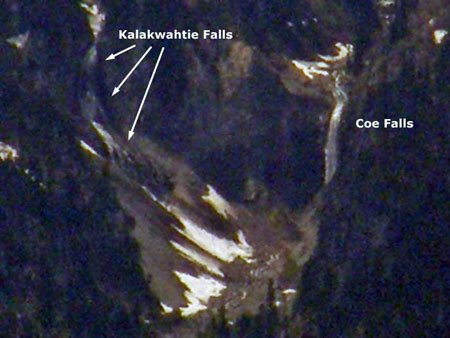
The story begins in June 2010, when I posted a report at PortlandHikers.org on my first good view of the two mapped waterfalls on the Coe Branch. I had spotted them from an off-trail outcrop on the east rim of the Hood River Valley, and captured this grainy view from a very long telephoto image:

My excitement over this sighting began with the first good look at the very tall, powerful Coe Falls. Though I had explored the brink of the falls from the Timberline Trail, I had never made the rugged descent to the base of the falls. Thus, finally seeing this magnificent waterfall in its entirety was a thrill.

I watched Coe Falls for a moment through the lens, and then to my astonishment, I realized that the adjacent falls (on an unnamed tributary to the Coe Branch) was also in plain view! While Coe Falls was towering and stately, this neighboring cascade was a sprawling, graceful veil. I gave the unnamed falls the working title of “Kalakwhahtie Falls”, which is Chinook jargon for “petticoat”, and quite descriptive of the falls (and I couldn’t bring myself to add another “Bridal Veil” falls to the long list with that name!)

Wayne Harvey’s Adventures

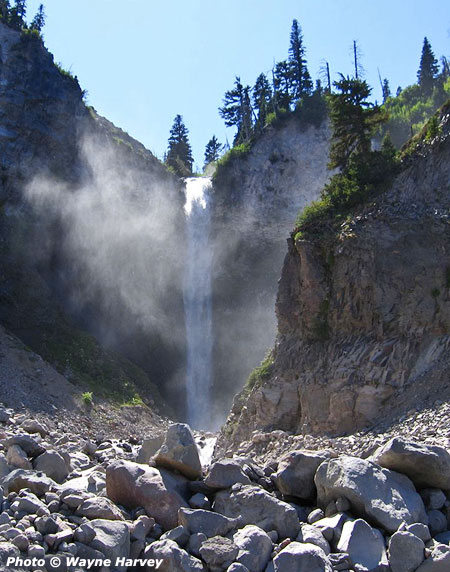
Based on my PortlandHikers.org report and the photo schematic I provided, local waterfall adventurer Wayne Harvey was intrigued, and in July 2010 made an epic solo trip into the Coe Branch canyon to explore and document this impressive pair of waterfalls. His trip produced the first known contemporary image of Coe Falls, thundering into its huge amphitheater:

Coe Falls in 2010

Wayne also captured the first known photo of Kalakwhahtie Falls, cascading over the east wall of the Coe Falls amphitheater. Though the mid-summer stream levels in Wayne’s photo (below) were notably lower than in my grainy images from across the valley, his images captured a uniquely beautiful waterfall:

Kalakwhahtie Falls in 2010

Wayne’s photos of Coe Falls immediately raised questions about the Wallalute Falls image in the Grauer book. The resemblance was striking, and without definitive modern images of the waterfalls on Compass Creek to compare to, another possibility arose: was the falls in Jack Grauer’s book actually Coe Falls?

Further intrigued by the unfolding mystery, Wayne made a second, even more rugged solo trip into the Coe Branch canyon in July 2011, this time to explore Compass Creek and document the remaining waterfalls of Mount Hood’s north slope.

Wayne’s 2011 return trip took him across the boulder-filled floor of the Coe Branch valley, then into the dense underbrush of the remote Compass Creek canyon. His first discovery was the lower of the two mapped falls on Compass Creek to be much larger than anyone had imagined, dropping roughly 100 feet into a picturesque bowl (below).

Lower Compass Falls in 2011

The larger-than-expected lower falls also presented an obstacle for Wayne as he searched for a route upstream to the main falls. He later described a scramble up a steep chute that was “all fours in places”, and the only passable route. Beyond the scramble past the lower falls, Wayne continued upstream to an impressive view of Compass Creek Falls, dropping nearly 200 feet into a sheer amphitheater (below).

The real Wallalute Falls on Compass Creek in 2011

With this image, Wayne had solved the Wallalute Falls mystery: the falls pictured in the Grauer book is clearly the same as the falls he documented on Compass Creek. Wallalute Falls is indeed on Compass Creek, not the Eliot Branch.

Unraveling the Mapping Mystery

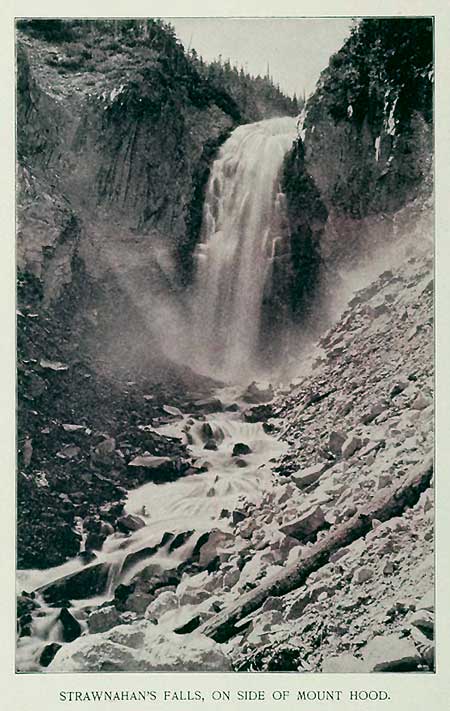
With Wayne Harvey’s trip report from Compass Creek in hand, it was now possible to unravel another waterfall mystery. This time, the confusion involves another historic photo from the area dating from the 1890s, and titled “Strawnahan’s Falls” (below):

1890s Stranahan Falls - known for decades as “Wallalute”

For years, waterfall hunters have recognized this falls to be the large, prominent falls on the Eliot Branch identified on maps as Wallalute Falls (shown below in its modern form). The reference to “Strawnahan” (which is clearly a misspelling of “Stranahan”, the name given to a nearby ridge in honor of area pioneers) was assumed to be either an informal name that was later replaced by “Wallalute” or simply an error on the historic photo, itself.

Stranahan Falls as it appears today, after years of recent flooding have scoured the Eliot Branch canyon

Wayne Harvey’s field documentation of the real Wallalute Falls now seems to provide definitive evidence that a map error occurred, transferring the “Wallalute” name from Compass Creek to the Eliot Branch, with the “Stranahan” name simply getting lost in the shuffle.

The following map provides the context for the USGS map error by showing the close, and potentially confusing proximity of (1) Stranahan Falls (labeled as Wallalute on USGS maps), (2) the true Wallalute Falls on Compass Creek, and (3) the lower falls on Compass Creek.

Still another twist in this saga comes from a later, more obscure edition of the Grauer book, published in 2006. In this edition, Grauer describes the work of Mount Hood pioneer Mark Weygandt building the earliest trails in the vicinity of Cloud Cap Inn:

“It was probably in this year (1900) that he built trails. One trail led from the low end of Ghost Ridge to a view of Stranahan Falls. He then extended it across Eliot Creek to Stranahan Ridge and to Wallalute Falls and Canon Balls Falls on Compass Creek, at the bottom of Adams’ Hole. Parts of this route later became part of [the] Timberline Trail. He also made a trail down Sand Creek Ridge to a viewpoint of the falls on Sand Creek, later named Polallie Creek.”

These accounts are the gold standard for Mount Hood history, partly because Grauer lived a good portion of it himself, but also because of the extensive spoken history he has documented through interviews of the historic figures, themselves.

Grauer’s description gives a name to the lower Compass Creek falls for the first time in recent memory — “Canon Ball Falls” — as well as the canyon section that encompasses both Wallalute and Canon Ball falls on Compass Creek — “Adams’ Hole”. Grauer is also definitive on the Stranahan and Wallalute names, correctly tying them to the Eliot Branch and Compass Creek, respectively.

Mapping the North Side Waterfalls

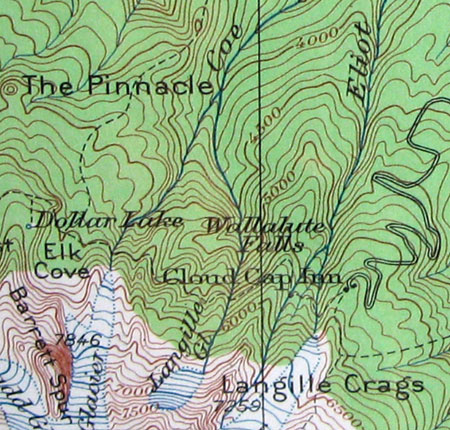
The USGS map error that created the confusion may go back more than a century, as it appears to be reflected on all USGS maps known to carry the name “Wallalute”. The follow map excerpt (below) is from 1924, and shows how the error could have occurred: note that early topographic maps didn’t always show the crosshatch used to denote waterfalls on more contemporary maps. With this omission, and the close proximity of Compass Creek and the Eliot Branch on earlier, small-scale maps, it’s easy to see how later cartographers might have been confused as to which stream Wallalute Falls was really on.

1924 USGS Map

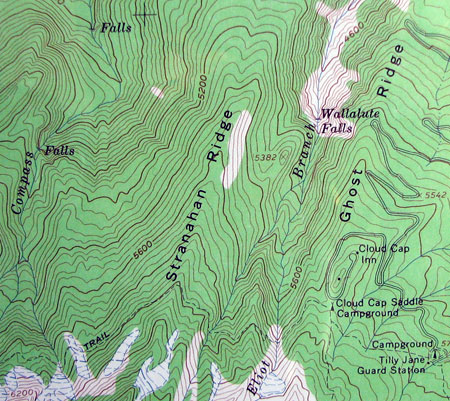
The following USGS map excerpt (below) was published in 1962, and is the first to attach Wallalute Falls specifically to the Eliot Branch. This map appeared when the 1:24,000 topographic series was being published, and the larger scale allowed features like Wallalute Falls to be more definitively identified — or, in this case — misidentified. Though the location of Wallalute was in error on the 1962 sheets, these large-scale maps did show the the waterfalls on Compass Creek and the Coe Branch accurately for the first time.

1962 USGS Map

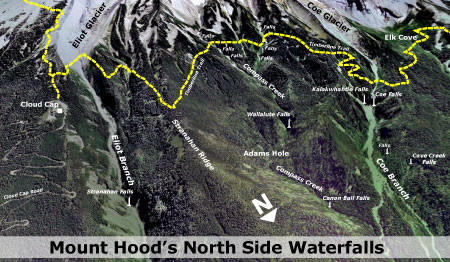
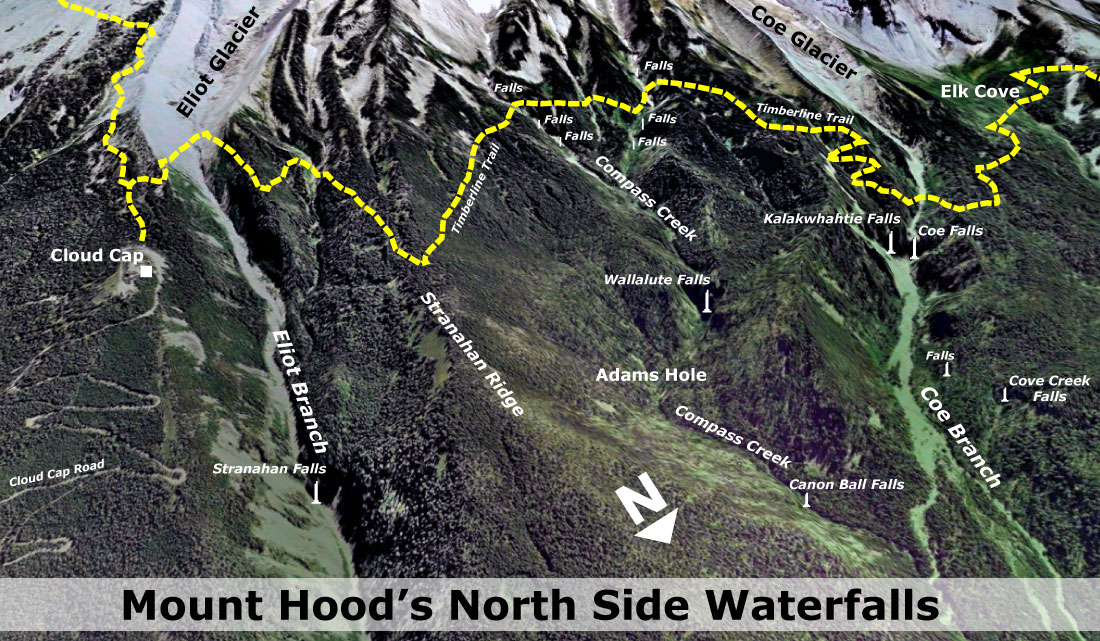
Pulling all of this together, the following is an oblique view of the north side region showing all of the waterfalls in context: Stranahan Falls on the Eliot Branch, Wallalute and Canon Ball falls on Compass Creek, and Kalakwhahtie and Coe falls on the Coe Branch.

(Click here for a larger map)

Also shown are a couple of unnamed tributary waterfalls in the Coe Branch canyon, and there are surely other waterfalls yet to be discovered in this seldom-visited area.

In an effort to close the chapter on this naming saga, I plan to provide the documentation from this article to the Oregon Board of Geographic Names (OBGN), in hopes that they can eventually look into the matter and perhaps correct the map error of more than a century ago.

Visiting the Waterfalls

The series of waterfalls described in this article are remote and difficult to reach. Visiting these waterfalls is only for expert explorers.

Wayne Harvey approached the Coe and Compass Creek falls from the Elk Cove Trail, dropping into the canyon just beyond the prominent Coe Canyon overlook. This required a rugged descent of nearly a thousand vertical feet, followed by challenging bushwhacks at stream level to the waterfalls.

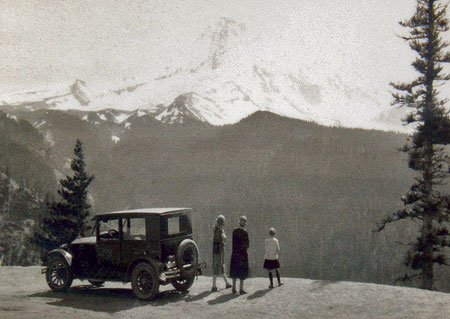
1920s Visitors to Cloud Cap taking in the view of Stranahan Falls (just to the right of the small tree in front of the car) and Mount Hood from Inspiration Point

Stranahan Falls can be seen from Inspiration Point, but represents a potentially dangerous descent into a canyon that has been destabilized by recent floods. However, there are good views of the falls from a boot path that descends to a rocky overlook, just below Inspiration Point on the Cloud Cap Road.

One of the trail concepts in the Mount Hood National Park Campaign calls for a “low trail” paralleling the Timberline Trail. On the north side of Mount Hood, this new route would connect the dots among the string of waterfalls described in this article. Wayne Harvey’s remarkable images of the waterfalls only underscore the case for providing access to these beautiful places, hiding in plain sight.

Acknowledgements: special thanks to Wayne Harvey for the use of his images and field reports, and to both Wayne Harvey and Bryan Swan of the Northwest Waterfall Survey for their help in untangling the history of geographic names in the Eliot, Compass and Coe drainages.

The Tollgate Maples… and the Highway
The two remaining Tollgate maples

Last week, the Forest Service and Oregon Department of Transportation (ODOT) jointly announced that the main trunk of one of two remaining Barlow Road Tollgate heritage maple trees would be coming down soon:

“A 130-year-old bigleaf maple, which marks the spot of the western-most tollgate of the historic Barlow Road, has substantial decay and poses a hazard to travelers on U.S. Highway 26 (Mt. Hood Highway). The tree is planned to be felled within the next three weeks.”

(download the press release here)

On its face, the decision is both reasonable and expected. The maples were planted in the 1880s by tollgate keeper Daniel Parker, and have lived the typical lifespan of our native bigleaf maple. A third maple apparently survived until the mid-1990s, and along with the tree that will soon be removed, framed the old tollhouse that once stood on the north side of the tollgate (where the highway is located, now).

The large trunk on the right will be removed, but the three smaller trunks on the left will be spared

The good news is that the tree will live on, through suckers that have grown to become three separate trunks – a typical form for bigleaf maples. From the press release:

“The old bigleaf maple to be felled has several stems: a main stem, with a diameter of 25 inches, and three smaller 4- to 6-inch diameter stems growing from the base of the trunk. These three smaller stems, each about 25 feet tall, will be untouched by the project, while the decaying main stem will be reduced to a height of two to three feet.”

Hopefully the companion tree on the south side of the gate will also survive through new stems someday growing from its base. This is the larger of the two trees, and because of its distance from the highway, will be allowed to grow undisturbed.

The remaining maple is far enough from the road that it will be allowed to remain, undisturbed

As trees around Mount Hood go, the two maples at Tollgate aren’t particularly remarkable — there are plenty of larger, older and more impressive bigleaf maple trees growing in less traveled areas of the surrounding forests. The uniqueness of these trees, of course, is the tie to the Oregon Trail, itself, a piece of Amercian history that is deeply embedded in our cultural identity.

Sam Barlow’s Road

Most Oregonians know the story of Sam Barlow, and his daring expedition over the shoulder of Mount Hood with Joel Palmer in the fall of 1845, in search of a land route through the Cascades.

Sam Barlow and his legendary road

By 1846, the route the two men had scouted and led their own wagons over had become a business venture for Barlow: a notoriously rough toll road that thousands of Oregon settlers would travel over in the years that followed. Many described it as the worst part of their 2,000-mile journey.

The tollgate site marked by the twin maples was the final location of at least five tollgate sites that existed along the Barlow Road over the years, with this final tollgate operating from 1883 to 1918. The gatekeeper charged $5 per wagon, with smaller fees for livestock, foot travelers and even the first automobile, which arrived at the tollgate in 1903. This was a handsome price in its day, but for most travelers, it was also a one-time charge on the way to the Willamette Valley.

The Tollgate wayside fronts one of the few remaining Highway 26 segments that has remained largely unchanged little since the first highway was built in the 1920s

As the toll road era faded away in the early 1900s, plans for the first loop highway around the mountain were underway, and much of the new route followed the original Barlow Road when first leg was completed in the 1920s.

Because the Barlow Road had a number of evolving alignments over the years, many traces of the route survived the highway-building era, and can still be seen today. The original loop highway was used through the 1950s, and was then replaced with the modern alignment we know today.

The Future of Barlow Road… and Highway 26?

The tentative tone in the opening paragraph if this article stems from the terrible record ODOT and the Forest Service have in protecting the historic, scenic and environmental legacy of the Barlow Road corridor.

Highway 26 “improvement” just east of Tollgate in 2004

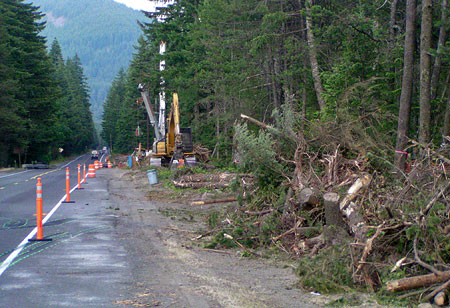
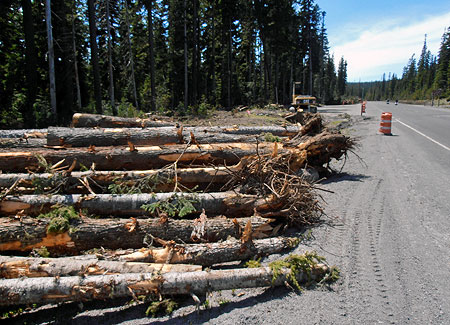
While the Forest Service and ODOT have made a reasonable case for removing the heritage maple at the Tollgate site, the agency has a long history of aggressive, senseless tree removals along the Mount Hood Loop. Most of this sad legacy stems from ODOT’s unstated objective to widen the highway to four lanes through the entire Mount Hood corridor at all costs — usually cloaked as a “safety” or “preservation” projects to ensure that their policy makers and the general public don’t get in the way of the underlying road widening mission that continues to drive the agency.

One strategy used by highway engineers to ease the path toward eventual road widening is to cut trees way back along highway sections in advance, as a divide-and-conquer strategy. The goal is to avoid jeopardizing a future road-widening project with public outcry over tree removal.

This practice is also rationalized under the “safety” banner, but actually encourage speeding by removing the traffic calming effect that a tree canopy creates. The use of street trees and landscaping in urban areas to discourage speeding is a widespread and fully accepted practice in the modern transportation design, but clearly hasn’t penetrated the ODOT offices yet.

Highway 35 “improvement” currently underway near Hood River Meadows is predictably cutting trees back from the roadway

In 2004, ODOT cleared the shoulders along several sections of US 26 in the vicinity of the Tollgate site, and one concern in hearing the news of the heritage tree is that this project is a precursor to tree removal along this final stretch of mostly original highway, where big trees still grow near the road.

The unstated ODOT mission to widen the loop highway to an urban freeway standard is described in detail in these earlier WyEast Blog articles:

• Highway 26 Widening – Part One

• Highway 26 Widening Projects – Part Two

• Highway 26 Widening Postscript… and Requiem?

Unfortunately, the projects described in these articles continue to advance, with a few cosmetic details thrown in to keep them moving. Sadly, they represent almost $30 million in public dollars that will make the highway a lot more like an urban freeway, while ignoring their own consultant recommendations for far less costly, more effective safety solutions.

The first phase of ODOT’s “safety and preservation” work is slated to begin just east of Tollgate this summer, and — right on schedule — the project has already been “updated” to include widening for a new westbound travel lane, along with “separate projects to remove select trees for safety reasons.” Just as predicted.

A New Vision for the Mount Hood Loop

The beautiful wayside at Tollgate is a great example of the very kind of feature that ought to be the focus of a tourism-oriented highway design along the Mount Hood Loop. Yet ODOT is about to make changes to the highway that will make it much less friendly for visitors. Is there an alternative?

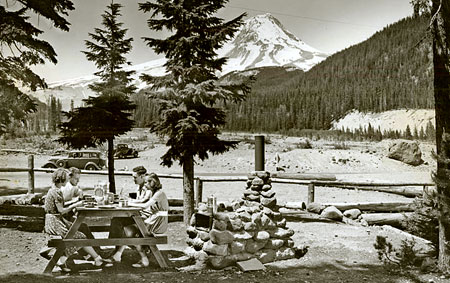
1950s Mount Hood Loop wayside at White River

In a coming piece, I’ll present a different vision for the Mount Hood Loop that rejects the current ODOT plans for road widening, and the dubious “safety” claims that ODOT officials are using to cloak nearly $30 million in projects that will turn the corridor into a freeway.

This alternative vision will offer a less costly, sustainable long-term design that actually IS safer, and also much more enjoyable for the visitors to the mountain that drive the local economy.

Gorge Aspen Colony

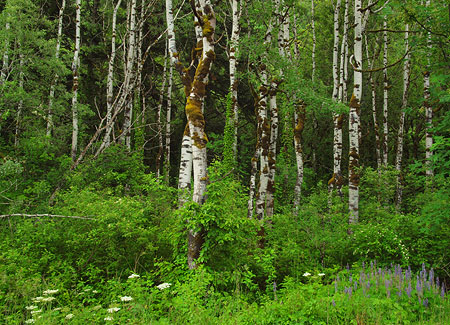
Quaking Aspen grove near Bridal Veil

Just east of Bridal Veil on the Historic Columbia River Highway, a colony of white-barked Quaking Aspen (Populus tremuloides) suddenly appear along the road, seemingly transported from somewhere in the Rocky Mountains. Though these are North America’s most widespread tree species, they are uncommon in Western Oregon.

Many who spot these unlikely trees might reasonably assume they were intentionally planted here, given the nearby residential district. That’s possible, but it’s more likely that this is a native stand, one of only a few sprinkled on the western fringes of the aspen range, where it extends south from Canada along the eastern crest of the Cascades.

Quaking Aspen appear suddenly along the Scenic Highway near Bridal Veil (Google Streetview)

The stand is easy to find: drive one-third mile beyond the Angels Rest trailhead in the Bridal Veil area and watch for the trees on the south side of the road. There’s room to pull off, but use caution before wading in — this might be the only Aspen grove in Oregon with knee-deep poison oak! The stand is also fringed with lupine, coltsfoot and many other wildflowers in mid-spring, making for a dramatic scene.

Why Here?

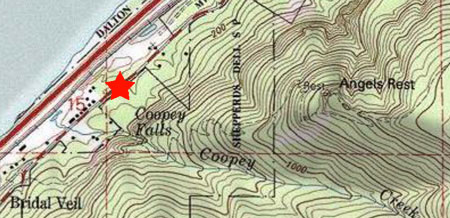
Topographic maps give a hint as to why Aspen would grow here: marshy, river bottom soils, cool mountain air flowing off Larch Mountain and down Coopey Canyon and the generally brisk Gorge winters mimic prime aspen habitat. The grove also appears to be on public land, within Shepperds Dell State Park (see map, below).

The Quaking Aspen grove is near Coopey Creek, below Angels Rest

It’s hard to know the future of Oregon’s aspen trees, given the expected effects of climate change on most northern species. The following map shows just how fragile the aspens along the Cascade Range are compared to the broad habitat found in the Rockies, Great Lakes region and Canada:

North American extent of Quaking Aspen (Wikimedia)

Even more isolated and fragile are the groves that dot the basin and range country of Southeast Oregon. These are the aspens growing on alpine islands in the desert, including Steens Mountain, Hart Mountain and a few other tall peaks in the high desert country.

Ecology of the Aspen

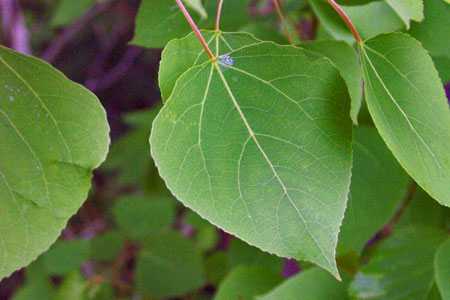
The name “Quaking Aspen” comes from the unique trembling that the slightest breeze creates among the leaves of Aspen trees. This is also where the botanical name of “tremuloides” is derived.

The “quaking” comes from flattened petiole, or stem, that connects the leaves to tree branches, and vibrates in the wind. The soft rustling is unmistakable to anyone who has spent time in Aspen country. Though Aspen are famous for their brilliant yellow fall color, the Gorge grove tends to be a paler yellow, possibly reflecting the milder fall temperatures at the site, compared to typical Aspen habitat.

Quaking Aspen leaves

Quaking Aspen reproduce mostly through root sprouts, with the young trees called “clones”, since they are genetically identical, and usually still connected to the parent tree. Whole groves of Aspen often consist of clones from a single originating tree, and share a single root system, and are thus called clone colonies.

This shared root system help explain why these colonies leaf out in spring and abruptly turn color in the fall as a complete unit, but often out of sync with nearby colonies running on their own clock.

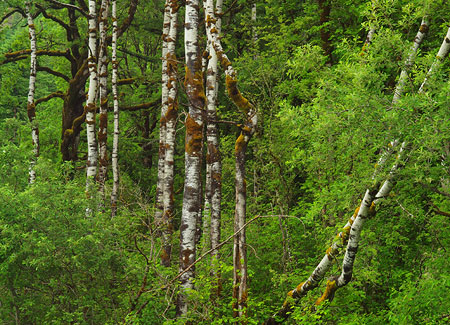
Moss on Aspen trees: a uniquely Oregon thing?

The survival advantage of a clone colony can be seen in the Pando colony in Southern Utah, located high on the Colorado Plateau. Scientists estimate the 100-acre colony to have nearly 50,000 individual “stems” (trees) in the grove, all sharing a common root system. Amazingly, the root system is estimated to be at least 80,000 years old, with some scientists estimating the colony to be over million years old. This makes the Quaking Aspen both the oldest and largest organism on the planet, as defined by a continuously living DNA marker.

One disadvantage of clone colonies is that Aspen trees come in male and female varieties, and thus the clones in a colony are usually the same sex, making seed production more difficult.

Young Aspen clones emerging at the edge of the grove

Even when Aspen seeds are produced, they lack sufficient food and coating to make them durable enough to survive for long in harsh environments. This could be why Aspen rarely grow from seed, but also underscores the vulnerability of the species, since seed reproduction allows a species to migrate much more quickly in period of rapid climate change.

Aspen Die-Off

Older Aspens dying off in Southern Colorado (USFS)

In the mid-1990s, scientists began to notice a mass die-off in Quaking Aspen trees across the Western US. Often, the older trees in a grove were afflicted, but increasingly, entire clone colonies have died. There are a variety of theories about the decline, though most attribute it to a combination of changing climate and a century of fire suppression.

Like most western trees, Aspen are well adapted to fire, and quickly spring back after a burn, since the common root system of a colony is generally left unscathed, even if fire kills most of the trees growing from the root system. Under this theory, the die-off is a response to older Aspen groves simply outliving their viability, and abruptly falling victim to disease.

Entire Aspen groves dying in New Mexico (USFS)

Another theory focuses on the drought conditions that have plagued the west during the past two decades. Some scientists believe this has simply left Aspen too stressed to cope with insects and diseases that normally not be life-threatening to the trees. One study showed that more than 80% of the die-off has occurred in areas predicted to lose Aspen trees as a result of climate change — usually south-facing and lower-elevation habitats. This evidence also reinforces the risks that climate change will eventually bring for the Aspen forests.

Yet another theory is that over-grazing is causing the decline, with young tree sprouts being grazed before they can reach maturity, and replace older trees within a grove. In a unique study of wolves at Yellowstone, a variation on this research showed the same relationship where deer and elk populations were not checked by predators, causing a similar decline in Aspen colonies.

The phenomenon is now known collectively as “Sudden Aspen Decline”, and is the focus of much concern among researchers.

Though the die-off seems to be slowing in recent years, thanks to record rainfall in several previously drought-stricken areas, the damage has been extensive: Colorado has lost nearly 500,000 acres of aspen since the die-off began, or nearly 20 percent of its standing aspen. Other Rocky Mountain stands show similar damage, with scientists estimating that Aspen groves surviving today accounting for just 40% of what stood in the mid-1800s.

The Future of the Gorge Aspen?

Aspen can’t compete for long with Bigleaf Maple (seen in background) and other large species

The recent ecology of Aspen in the west is alarming, but researchers are busy looking for answers. In Oregon, studies are underway on the resiliency of Quaking Aspen in the Warner and Trout Creek mountains, and Oregon State University is providing ongoing research with The Aspen Project.

And what is the future of the Aspen grove near Bridal Veil? The good news is the trees seem to be on public land, and thus easier to protect and manage. New clones can also be seen growing at the edge of the stand, though the trees still face heavy competition from a thicket of underbrush, and a growing canopy of big conifers and Bigleaf Maple. In the long term, these Aspen won’t survive the competition unless the colony is actively managed to help them survive.

The western-most Quaking Aspen grove?

Other small Aspen stands dot the Gorge and the western foothills of Mount Hood, including one emerging stand along US 26, just east of Gresham, that might just be the western-most in the state. Much larger stands flank the east slope of the Cascades in places like the Hood River Valley, Metolius River and Klamath Lake.

While these isolated stands are small and remote from the prime Aspen habitat of the Rockies and Canada, that could be a very good reason to help them survive: it’s possible that these intrepid Oregon Aspen will be better situated to survive climate change, and may represent a genetic insurance policy for the species.

Scientists are learning much about Aspen and how to perpetuate the species in the face of the die-off. Hopefully, Oregon’s public land managers will also apply these lessons to the tiny, isolated healthy stands in places like the Gorge, as one more safeguard for an increasingly vulnerable species.

Clackamas River Trail

Pup Creek Falls on the Clackamas River Trail

Though no longer a well-kept secret, the relatively new Clackamas River Trail from Fish Creek to Indian Henry Campground provides a scenic, all-season alternative to the often crowded low-elevation trails in the Columbia Gorge. An added bonus is the impressive falls on Pup Creek — the main attraction for many who make this trip. But the trail also provides a unique, close-up look at a rapidly recovering forest ecosystem that burned less than a decade ago, and plenty of river scenery along the way.

The Fire Zone

In September 2002, the Bowl Fire swept through 339 acres of tall timber along the first mile or so of the Clackamas River Trail, just east of Fish Creek. Today, nine seasons of forest recovery have brought a rejuvenated understory with sun-loving wildflowers crowding the trail. While many trees were killed, a surprising number of the old giants survived, providing a living laboratory on the role of fire in our forest ecosystems.

White Clackamas iris (Iris tenuis S. Watson)

Along this section of trail, the fire has been especially beneficial to the rare Iris tenuis S. Watson, or Clackamas iris. This elegant wildflower occurs in both blue and white in its very narrow range. It is found along the Clackamas and Molalla Rivers, and nowhere else. These iris form beautiful drifts of white blossoms along the burned section of trail in late May and early June.

White Clackamas iris (Iris tenuis S. Watson)

Ancient Forests

Beyond the fire zone, the trail dips into an impressive stand of ancient forest, tucked into a shady grotto between 200-foot cliffs and the Clackamas River, at the confluence with the Roaring River. These centuries-old western red cedar and Douglas fir thrive in the boggy river bottom, well protected from the elements.

In spring, the air in this pocket of ancient forest is filled with the pungent (and unmistakable) aroma of skunk cabbage growing in the bog, while the sound of falling water reveals a string of delicate waterfalls cascading over the cliffs, and into the green grotto.

Looking down at ancient forest from a cliff-top viewpoint

After passing through this magical spot, the Clackamas River Trail climbs a steep, rocky bluff above this hidden forest, providing a unique opportunity to observe the big trees from different levels, as if riding an elevator.

Hiking The Trail

Guidebook descriptions vary, but by my estimate, the hike from Fish Creek to beautiful Pup Creek Falls is about 8 miles round-trip, with the rollercoaster trail gaining about 900 feet in elevation along the way as it climbs around several cliffs. Because the high point at Pup Creek is only 1,300 feet in elevation, the trail is usually open year-round.

[Click here for a larger map]

The trail starts at the Fish Creek trailhead, located about 15 miles southeast of Estacada on Highway 224. The turnoff to Fish Creek is well marked, and is just past the Carter Bridge, Lockaby and Armstrong campgrounds.

Turn right onto Fish Creek road, pass the Fish Creek campground, cross the Clackamas on yet another bridge, then watch for the trailhead parking on the right, at the confluence of Fish Creek and the Clackamas. The trail begins at the far (south) end of the parking area, on the opposite side of the road, and is marked with a signpost.

The Fish Creek Trailhead

The path starts out wide and gentle, following a rustic dirt road to a small stream ford and dropping to the banks of the Clackamas. From here, the trail briefly rambles at river grade before entering the fire zone. Soon, the first uphill section begins as the trail climbs through the burn and over the first set of cliffs. On the bluff above the cliffs, white Clackamas iris line the trail in spring, along with many other wildflowers.

After the first crest, the trail descends to the river again, reaching a short pair of switchbacks just over a mile from the trailhead. Caution: watch for poison oak on both sides of the trail after the second switchback for a hundred yards or so — this is the only notable poison oak patch along the trail, but worth watching for (see map, above).

Section of the Clackamas River Trail

The trail follows the river bank only briefly, as the roller coaster trip through the burn section continues for another half-mile or so. Soon, the trail leaves the burn, and crosses the first in a series of small streams as it descends toward the ancient forest section, at about the 2-mile mark. There is a large riverside campsite among the giant cedars, here, and this makes a good spot to turn around if you are looking for a shorter hike.

Continuing through the ancient forest, the trail passes the skunk cabbage bog before crossing the largest of several streams dropping into the ancient forest grotto — and take a look upstream, too: a nearly hidden waterfall leaps off the cliffs beyond the big trees.

Next, the trail climbs a rocky bluff in a couple of switchbacks, providing that “elevator” view of the ancient forest, then a glimpse of the Roaring River confluence with the Clackamas, across the canyon. From here, the trail levels off, following the top of a bank of mossy cliffs for the next half-mile or so.

Steppingstone Creek

Soon, the trail crosses yet another lively creek, this one called “Steppingstone Creek” on the map for the helpful (and picturesque) series of stones that carry hikers across. From here, the final half-mile to the junction with the Pup Creek climbs very gently, with many river views.

The junction with the short spur to Pup Creek Falls is marked with a post, though no sign attached as of this spring. But you’ll know when you’re there: the junction is in a clearing under a transmission pylon. If you miss it, you’ll arrive at Pup Creek after 200 feet or so — by far the largest side stream on the hike, so you’ll know if you need to backtrack.

Upper Tier of Pup Creek Falls

The spur trail to the falls makes one quick switchback, but otherwise follows Pup Creek upstream to the dramatic amphitheater holding the 237-foot falls. In winter and early spring, the falls are particularly impressive, jetting a lot of spray to the small viewpoint at the end of the spur trail, so early season photographers should be prepared to battle the mist!

Because the falls are framed by a group of magnificent bigleaf maples, this is an ideal destination for late October or early November, when fall colors are peaking, and yellow maple leaves complement the bright yellow lichens on the walls of the amphitheater.

Traveler Tips

Highway Noise: on summer weekends, traffic on Highway 224 is more noticeable, so it’s a good idea to save this hike for mid-week, or the off-season for summer camping — or even winter, when you’ll have the place to yourself. That said, the highway proximity is rarely a distraction from the beautiful scenery on this trip.

“Leaves of three, let it be!”

Poison Oak: note the map, above — one enthusiastic patch of poison oak flanks both sides of the trail at the 1.2 mile mark, where the route descends through a short pair of switchbacks. The itchy stuff begins at the second switchback and continues for a couple hundred yards, but is easy to avoid if you know to watch for it.

Ticks: though rare, ticks have also been reported in the lower Clackamas canyon, so be sure to do a tick check after your trip — a good idea after any hike.

Camping: one of the handy aspects of this trail is the amazing selection of campgrounds in the vicinity — more than a dozen line the lower Clackamas. Two offer walking access to the trail: Fish Creek, near the trailhead described in this article, and Indian Henry, located about four miles beyond Pup Creek.

Forest Pass: the Fish Creek trailhead requires a Northwest Forest Pass, though this trailhead also has the option of a $5/day onsite payment for a day pass.

Brooks Meadow: Discovering a Hidden Gem

Brooks Meadow from the west

Brooks Meadow is one in a string of sunny meadows located on the gentle northern slopes of Lookout Mountain, just east of Mount Hood. At 35 acres, Brooks Meadow is among the largest, and has a long human history thanks to the water and forage it offers. It was likely visited for centuries by Native Americans, and in the late 1800s, was grazed with sheep following white settlement of the region.

(Click here for larger view of Brooks Meadow)

Early settlement trails in the area connected the dots between meadows and water sources, with several converging at the Brooks Meadow by the early 1900s. A guard station was constructed at the upper end at that time, near the junction of three trails at the north edge of the meadow. Later, the trails became primitive forest roads.

Brooks Meadow was surrounded by clearcuts by the 1980s

By the 1950s, sheep and cattle grazing in the Lookout Mountain area was on the decline, giving way to a boom in commercial logging. Timber harvests focused on the big ponderosa and larch stands unique to the east slopes, and mills in the area thrived. The timber boom hit its peak in the 1980s, when miles of logging roads and hundreds of clearcuts transformed the slopes of Lookout Mountain.

When the sawdust settled in the early 1990s, Brooks Meadow was somehow spared, a lush island in a forest that had been almost completely logged in all directions. By sheer luck, when the commercial logging boom swept the area, the old primitive road and trail system was mostly bypassed or destroyed by the modern, paved roads that carries logs to the mills.

A thin veil of trees were spared along the periphery of Brooks Meadow

At Brooks Meadow, a new paved route was built around the north side of the meadow (shown above), bypassing the historic dirt track through the center of the meadow. The Dufur Mill Road was also paved, and routed just south of the meadow, proper.

Thankfully, the relocated roads kept the steady stream of log trucks out of the meadow, and allowed the fragile ecosystem to survive the logging era relatively intact. In fact, the curtain of trees that was spared along the margins largely hides the meadow from today’s travelers, allowing Brooks Meadow to remain surprisingly unknown.

Old topographic maps still show the abandoned dirt roads and former Guard Station at Brooks Meadow

When the paved roads were built, the primitive roads through the meadow were simply abandoned, and never properly decommissioned. In the intervening years, these abandoned roads have begun to reforest, thanks to the drainage that keeps the old roadbed drier than the surrounding meadow, and survivable for trees.

A closer view (below) of Brooks Meadow shows the abandoned road, and the dotted line of young trees that have begun to grow along the old roadbed. The location of the former guard station that once stood here is also shown.

The old road through Brooks Meadow is revealed by the young trees growing along it

Many of the meadows in the Mount Hood area are shrinking, thanks in part to a century of fire suppression and climate changes that allow for gradually encroaching forests. For Brooks Meadow, the threat comes from within, as well, with the strip of forest along the old road threatening to divide-and-conquer the meadow with reforestation.

This doesn’t have to happen, of course. The purpose of this article is to prod the U.S. Forest Service to consider a brushing project to remove the young trees along the old roadbed, and perhaps consider changes to the road’s drainage features that would help the old roadbed blend into the meadow, once again.

The brushing project is straightforward: there are about 60 young trees scattered along the old road, and they are small enough to removed by volunteers armed with bow saws and loppers. The drainage project would likely require more work, but could still be done by volunteers, assuming it is akin to trail maintenance work using hand tools.

Here is my offer to the U.S. Forest Service: I will assemble work crews of 10-12 volunteers for the brushing and drainage work needed to save Brooks Meadow. I believe the brushing could be done in a single day, and the drainage work in 2-3 volunteer days. Let’s get it done – we just need the green light from you!

Visiting Brooks Meadow

The best time to visit Brooks Meadow is in June and early July, when the wildflowers are at their best. In many spots, the flowers are waist-deep, and you will be surrounded by the sound of buzzing bees, singing birds and perhaps even spot elk or deer. There is no formal trail, but the going is easy if you follow the tree line along the edges of the meadow.

Elk grazing in the upper section of Brooks Meadow in 2009

(Click here for a larger view)

The route begins at the pullout “trailhead” at the west end of the meadow (see driving instructions, below). The best way to tour the meadow is clockwise from the pullout, following just inside the treeline. This will keep your feet fairly dry, and protect the most pristine inner portions of the meadow from human traffic.

In the clockwise loop around the meadow, you will be rewarded with mountain views from the upper end, and huge drifts of wildflowers in early summer. Autumn is also a beautiful time to visit the meadow, though you should wear hunters colors whenever hiking on the east side in fall. In morning and evening, there are often elk and deer browsing in the meadow. Be forewarned not to approach elk herds — simply enjoy them from a distance.

(Click here for a larger map)

One uncommon plant to look for in the meadow is Agoseris elata, or tall agoseris. This plant is in the sunflower family, and looks a bit like a dandelion blossom on steroids. Agoseris elata grows in just two places in the entire Mount Hood National Forest — Brooks Meadow and nearby Bottle Prairie.

How to Get There

Brooks Meadow is located just off Forest Road 44, east of Mount Hood. Follow Oregon 35 from either Hood River or US 26 to the Forest Road 44 junction. Turn east, and follow Road 44 uphilll for several miles to the obvious intersection with Forest Road 17, where Forest Road 44 abruptly turns right. Continue straight at this intersection, onto Road 17, and immediately watch for a pullout just 100 yards from the intersection.

(There are no restrooms or water sources at this informal trailhead. The nearest facilities are at the Sherwood campground, located along Highway 35, north of the Road 44 junction)

Postscript

After publishing this article, I noticed that the Forest Service and City of The Dalles have been busy posting the boundaries of The Dalles Water Watershed, again, including the informal trailhead at Brooks Meadow.

At least the shooters appreciate the new targets posted at Brooks Meadow

It’s a bit hard to take the closure seriously (most don’t, actually), given how the agencies have carved up this once pristine area with miles of logging roads and hundreds of clearcuts. More absurd is the fact that the “protected” stream flowing from the meadow is soon piped under paved Brooks Meadow Road in an open culvert — apparently, an area where protection isn’t required. Beer cans tossed in the culvert from passing pickup trucks complete this ironic picture.

So, use your judgment in visiting Brooks Meadow. While it’s hard to believe that hikers visiting the meadow to appreciate its beauty would actually be prosecuted (and spend the advertised six months in jail and a $500 fine, no less!) the posted closure is for real, unfortunately.

The Hidden Shame of Latourell

Since tourists first began exploring Samuel Lancaster’s graceful new Columbia River Highway in 1915, Latourell Falls has been a favorite stop. In the early days, a pair of roadhouses (the Falls Chalet and the Falls Villa) flanked the highway at the east end of the dramatic highway bridge spanning the creek, and offered lunch with a view of the falls.

Today, the falls are the main focus of Guy Talbot State Park, with thousands of visitors each year exploring the series of loop trails that circle the lower falls and follow Latourell Creek to the upper falls.

The Falls Chalet in 1915

The scenes along Latourell Creek are beautiful and iconic, and most visitors simply accept that this place will be protected forever for the public. Yet, experienced hikers notice something different about this western-most of the waterfall trails in the Columbia Gorge: it’s not pristine, at least not in the way that other streams in the Gorge are. Despite the beautiful setting, big trees, wildflowers and waterfalls, something about this stream seems degraded.

When crossing the rustic footbridge at the thundering base of Latourell Falls, there is often a distinct odor of algae in the air. A closer look at the stream reveals not only algae on the rocks, but also crusty mineral deposits that also suggest degraded water quality in this beautiful stream, and would help explain the algae blooms.

This close-up view (below) is a detailed look at the lower right corner of the previous image of Latourell Falls. The close-up view reveals white mineral deposits and yellow-grown algae stains on several boulders and cobbles. This view also shows fine silt deposits (brown areas in the lower right) that suggest some sort of major disturbance in the watershed.

Why is this? What’s behind the water quality problems on this otherwise untouched stream?

Going to the Source

Upstream from the waterfalls and throngs of visitors along the lower canyon section of Latourell Creek, an explanation for the degraded water quality is revealed. Though few visitors to the lower reaches of the stream would imagine it, the headwaters of Latourell Creek are privately owned, with a number of homes and a lot of logging along the stream.

Amazingly, more than three quarters of the Latourell Creek watershed lies outside the protection of public parks and the Columbia River Gorge National Scenic Area (CRGNSA).

While the private homes are partly responsible for the nutrients that feed algae and leave mineral deposits in Latourell Creek (from lawn chemicals, septic tanks and other sources), the aggressive logging of private lands in the upper watershed is the greatest risk to stream quality.

The environmental impact of logging in the headwaters is painfully obvious, with canyon slopes recklessly harvested in clearcuts. This is a discredited, outmoded form of timber management that shouldn’t be practiced anywhere, much less a stream of this caliber that flows into a National Scenic Area.

The clearcut photos shown here were taken in the summer of 2010, with most of these harvests just a couple of years old. In this view (below), an older clear cut can also be seen on the hillside across the canyon, and is just beginning to recover with a light green layer of growth. Most of these forests have been cut several times, with ever-shortened growth cycles between harvests, thanks to a growing market value for marginal timber.

In this view (below) raw skid roads in the lower right drain directly into Latourell Creek, which flows along the tree line, at the edge of the clearcut. Erosion from bare slopes and logging roads is responsible for the most fine sediments (mud) seen below, in the protected sections of Latourell Creek. These sediments not only spoil the stream bottom, they also introduce minerals at a rate which promotes the growth of algae, which in turn, can also harm stream health.

Sadly, Oregon law continues to allow timber harvesting using the clearcut method, and the few environmental protections that do exist for stream protection on private timberlands are little compensation for the effects of clear cutting.

The tragic reality is that in Oregon, the timber lobby is still king. Twenty years of non-stop public relations advertising (kicked off during the early 90s Spotted Owl crisis) by Big Timber have been surprisingly effective in keeping the public largely misinformed on what is really happening in private forests.

In this view (below) of upper Latourell Creek, the private property owner has left the minimal amount of riparian “buffer” required by Oregon law. The trees in this photo are less than ten feet from the edge of Latourell Creek, and most of what you see is actually growing on the opposite bank from the clearcut. Clearly, this practice threatens severe erosion and sediments from the logged area entering the stream in a region where rainfall amounts can reach 100 inches annually.

Clearcuts threaten more than steams and water quality, however. In the 1990s, the Oregon timber lobby was forced to accept limits on clearcutting above roads and dwellings because of a number of catastrophic slides that had been triggered around the state by the practice.

Yet, few limits on logging below developed roads exist, and in the case of the upper Latourell canyon clearcuts, the impact of logging on the slopes below the local roadways is real. In the following view, large trees have not only been recklessly cut from the slope below the road, but the remaining smaller trees and shrubs have been sprayed with herbicide — a routine treatment after clearcutting — and thus killing what was left of root systems that help hold the slope together. As the image indicates, there are already active slides along this slope, triggering road repair costs that will fall upon the public to fix, not the private land owner.

This photo (below) shows the slide repair in more detail — a 200-foot section of road that has already been filled and patched repeatedly, and now will likely continue to fail thanks to a slope that has been further destabilized by aggressive logging.

What’s the Solution?

For much of Oregon, the fate of clearcutting is an open question, with the timber lobby thus far successful in its efforts to prevent the practice from being outlawed. That’s a shame, and a sad commentary on our state politics. But in the case of Latourell Creek, there’s another option.

When the authors of the Columbia River National Scenic Area (CRNSA) were drawing up maps, they focused on scenery and what could be seen from points along the Columbia River. As a result, the scenic act ignored a crucial lesson learned from the newer national parks of the 1960s — most notoriously, Redwoods National Park — that when acquiring park lands, complete ecosystems and watersheds should define the boundaries.

A look at the CRNSA boundary in the Latourell Creek headwaters shows the problem: the upper watershed falls outside the scenic area, and thus is excluded as a place for meaningful regulation or public land acquisition.

Click here for a larger map

It doesn’t have to be this way, however. These lands should be added to the CRNSA, and managed holistically, with the health of the spectacular lower canyon in mind.

After all, Latourell Creek is the only major stream on the Oregon side of the Gorge to straddle the boundary, and thus a good case can be made for amending the CRNSA boundary to incorporate the complete watershed. This would allow for better regulation of private lands in the headwaters, at a minimum, and also allow for CRNSA land acquisition funds to be used here.

Upper Latourell Falls

Another argument in favor of expanding the CRNSA boundary is the convenience of Larch Mountain Road in defining the Latourell Creek watershed. This popular recreation route is already viewed as “part” of the scenic area, albeit outside the boundary in this section. Therefore, an expanded boundary would allow the full Larch Mountain Road corridor to be managed as an extension of the scenic area. This extent is reflected on the map, above.

What Would it Take?

Amending the CRNSA requires an act of Congress, and though it sounds daunting, minor changes to federal boundaries of this sort are common as “riders” on larger federal lands bills.

While better regulation of private lands in the upper Latourell watershed would surely come from an expanded CRNSA, the chief benefit would be the ability to acquire lands for restoration. Already, the Forest Service has acquired hundreds of acres of private elsewhere in the Gorge, and the upper reaches of Latourell Creek would be best protected by fully restoring the watershed.

Upper Latourell Falls

Yet another option could be for advocacy organizations — like the Friends of the Columbia Gorge or Trust for Public Lands — to acquire the upper watershed lands. However, these groups generally operate inside the existing CRNSA boundary, and focus limited funds on still-pristine lands or those with exceptional scenic value.

In the end, it seems that our best bet is for the Oregon Congressional delegation to consider a “housekeeping” update to the CRNSA, including boundary refinements. Perhaps a 20-year review of the CRNSA is in order in 2016?

Discovering Bald Mountain

The country is filled with “Bald Mountains”, but for sheer scenic spectacle, few can compare to the Bald Mountain that rises just four miles away from the towering west face of Mount Hood. At one time, a fire lookout stood atop this Bald Mountain, and the view from the tower must have been the envy of fire lookouts around the Northwest.

Today, Bald Mountain isn’t entirely bald, having grown a dense forest of noble fir along the crest and northern slopes over the past half-century. Yet, it was in the 1970s, when the Timberline Trail was rerouted to lead hikers across the steep, open meadows on the south slope of the mountain, that hikers became familiar with Bald Mountain. Today, this spectacular traverse continues to provide one of the most popular, exhilarating sections along the classic loop hike.

Though most visitors to Bald Mountain keep to the Timberline Trail, you can still follow the historic old path that leads to the former lookout site, with its magnificent, close-up views of Mount Hood. Thanks to the quiet efforts of a few anonymous volunteers over the decades, the trail remains open and lightly maintained, with only an occasional log to step over along the way.

As the old path climbs toward the summit, hikers find themselves in a dense, young forest, and have to use their imagination to picture the open slopes of beargrass — with no forests — that existed when the first lookout was built on “Bald” Mountain more than a century ago.

Along the old trail, hikers will also spot blazes on the few trees that stood at the time of the former lookout tower. These blazes mark most historic trails (see this recent article on blazes) in the Mount Hood area, and confirm that the present alignment of the summit path to Bald Mountain dates back to at least the World War II era, and likely before.

A look at the 1911 USGS map of Mount Hood (below) shows that a “lookout” stood on Bald Mountain long before roads crossed Lolo Pass, and decades before the Timberline Trail was built. The early lookout structure was likely no more than a wood platform, later replaced with a conventional lookout tower. Interestingly, the Beaver Lakes shown on the map have since faded away, too, filled in with forest:

The 1946 USGS map of the Mount Hood area (below) is the last to show a lookout on Bald Mountain (and the Beaver Lakes), but in the intervening years from the 1911 map, the Timberline Trail and Skyline Trail had been completed, with both routes passing just below the lookout.

In fact, it’s likely that the section of Skyline Trail from Lolo Pass to Bald Mountain was originally built for lookout access, since the trail over Lolo Pass was among the earliest built in the area, and in fact, followed an ancient Indian route connecting the Sandy and Hood River valleys.

The alternating ticks shown along the dashed trail segments on the 1946 map indicate a telephone line along the route. Today, these routes often have ceramic insulators still attached to trees, and on this route further suggest that this section of trail was originally built with the lookout in mind. The route is now part of the Pacific Crest Trail, which replaced the old Skyline Trail, and remains one of the best approaches for hiking to Bald Mountain.

What did the old tower look like?

Fire lookouts in the Pacific Northwest followed a few standard designs beginning in the 1930s, after much improvisation in the early lookout designs that were built through the 1920s. The Bald Mountain lookout probably followed this evolution, with some sort of simple platform beginning at the turn of the twentieth century, and later, a more substantial structure built to Forest Service standards.

We have a much more exact picture after June 1944, when archived Forest Service documents show a new lookout was designed, apparently to replace an existing structure on Bald Mountain. The following are samples from the 1944 architectural plans for Bald Mountain. There are no clear records of when this lookout was removed, but it was likely in the late 1950s or 1960s, when hundreds of lookouts were viewed as outmoded by the Forest Service and destroyed.

The cab — or cabin — in the 1944 designs for Bald Mountain is a 14×14 foot structure (above) that would closely resemble the surviving cab on the Devils Peak lookout, just to the southwest of Mount Hood in the Salmon-Huckleberry Wilderness. This simple design featured five windows per side and a low, pitched roof.

Inside the cab (below), the living space was organized around a Osborne fire finder, located in the center of the floor, surrounded by a wood stove, table, kitchen, storage cabinets, shelves and bunk. A catwalk wrapped around the outside of the cab, allowing lookouts to maintain the windows, raise and lower shutters and haul firewood and supplies up from below with pulleys.

The 14×14 foot cab rested atop a 43-foot wood-frame tower (below), complete with a spiraling stairway that ascended within the tower uprights. Though the tower was anchored directly to the ground, the main stabilization came from guy wires anchoring the tower to concrete footings in four directions.

The most remarkable aspect of this tower (and many others) is the fact that most of the materials were carried to the site over trails using livestock. That included the cut lumber, concrete, construction hardware, fixtures and windows — an amazing feat when you consider this was repeated dozens of times at lookout sites around the region.

The lookout plans for Bald Mountain also contain one “standard” element that wasn’t so standard, at least compared to other lookouts in the vicinity: a garage and storage shed built around the base of the tower. In this view, the stairway to the tower can be seen on the right, with the dashed lines above the garage marking the location of the tower uprights:

As this design detail from the 1944 plans suggests, there were a number of concrete footings used in the construction of the Bald Mountain lookout tower. Today, these seem to be the only remaining traces of the structure. Three footings are loose, and have been moved around and used by campers over the years. Other footings remain in the ground, mostly reclaimed by the undergrowth. This footing is located along the spur trail leading to the east viewpoint from the lookout site:

Visiting Bald Mountain

There is some irony in the historic Bald Mountain trail being “lost”, as the mountain is now almost completely circled by the Timberline Trail, and thousands of hikers make their way along this route every year. Almost all of these visitors walk right past the unmarked summit path leading to Bald Mountain.

But for those seeking the route less traveled, the hike to the summit is easy, provided you successfully navigate the maze of popular trails in the area. The key is knowing how to spot the unmarked junction with the Timberline Trail. Take a close look at this photo to help you recognize the spot if you choose to visit the old trail — this view is how the trail appears from either of the approaches described below:

From Lolo Pass: The Classic Approach

The classic hike begins at Lolo Pass, and follows the Pacific Crest Trail through handsome forests for three miles to the base of the Bald Mountain summit path. The total mileage on this option is 6.6 miles round trip, with an elevation gain of 1,400 feet. The following is a map of the Lolo Pass approach that accompanies the hike description I wrote for the Portland Hikers Field Guide:

Click here for a larger map

For a detailed description of the Lolo Pass approach, visit the Portland Hikers Field Guide page:

Lolo Pass to Bald Mountain Hike

The Field Guide description also includes driving instructions to the trailhead. This is a dry hike, so carry water — and in early summer, plan on the usual bugs that plaque hikers just after snow melt. My favorite time to hike this trail is on a clear day after the first autumn snow dusts the mountain in late September or October. This is when the area is free of bugs AND crowds.

From Top Spur: The Family Route

For a shorter hike that works well for families with kids (or for adults looking for a short afternoon or evening activity) you can also approach Bald Mountain from the Top Spur trailhead. Be forewarned that this is one of the most popular trailheads in the Mount Hood region, and mobbed on summer weekends.

But even on busy weekends, you can smile to yourself as you leave the crowds behind, and head up the quiet, old lookout path for some solitude — hidden in plain sight! From the summit viewpoint, you can literally look down on hikers passing hundreds of feet below on the Timberline Trail, oblivious to your presence.

Click here for a larger map

The Top Spur option is just two miles long, round-trip, with an elevation gain of 550 feet. Though short, portions of both the Top Spur and Bald Mountain trails are steep, so you will notice the elevation gain! The tradeoff for kids is the feeling of climbing a real mountain. Bring a pair of binoculars for kids to explore the details of Mount Hood or watch hawks float across the Muddy Fork Valley, below.

For a detailed description of the Top Spur approach, including travel instructions, visit the Portland Hikers Field Guide page:

Top Spur to Bald Mountain Hike

One of the most magical times to visit Bald Mountain is evening, when you can watch the awesome west face of Mount Hood light up at sunset, but still have enough light to hike back to the Top Spur trailhead.

Both hikes are usually open from mid-June through mid-November, and both require a Northwest Forest Pass to park. Both trailheads usually have portable toilets, but no water — be sure to carry your own.

Close Call at White River Falls

The magnificent desert falls on the White River survived a close brush with disaster this month, when a throwback proposal by Wasco County to divert the river as part of a new hydropower project was scrapped.

Like so many hydro projects of decades passed, this one would have had “little impact”, according to proponents. Yet, as we take in the summertime view of the 90-foot plunge pictured above, it’s obvious that diverting the river would have an immediate impact on the natural beauty of the area. Would half the falls be diverted? Two-thirds? All of it?

(click here for a PDF of Dalles Chronicle article)

Though the Wasco County proposal was ultimately dropped because of concerns voiced by the Oregon State Parks Commission, it wasn’t for lack of “goodies” offered up in exchange for the diversion. The County promised trail improvements for recreation, and interpretive facilities for the structures left behind from the last hydro project here.

White River Falls with the rocky gulch of Devils Halfacre in the background

The old plant was shut down in 1960, and the land subsequently transferred to the state, first as the “Tygh Valley State Wayside”, then today’s “White River Falls State Park.”

The falls and adjacent White River Gorge are truly a forgotten gem in Oregon, save for a few fishermen in spring and fall, and a lot of teenagers in summer, seeking out the swimming holes below the falls. Yet, the area is only two hours from Portland, and offers some of the most accessible desert scenery in the state.

In recent years, hikers have begun to explore the area, following boot paths and game trails downstream toward the confluence with the Deschutes River, just over two miles below the falls.

White River Gorge from the falls overlook

What most visitors don’t know is that much of the rugged backdrop for the falls is private land. Most surprisingly, these private holdings include the most of the White River gorge, all the way to the Deschutes confluence, and this beautiful area has somehow escaped development over the years.

Concept: White River Gorge Recreation Area

With Wasco County politicians dreaming up hydro projects for the White River, this article is intended as a more forward-looking counterpoint that actually embraces the scenic and recreational values in the area.

As a starting point, the National Recreation Lands boundary that encompasses the larger Deschutes Canyon could be expanded to include White River Falls, White River Gorge and the adjacent Winter Ridge and Devils Halfacre areas. This could provide the direction needed for state and federal land agencies to begin acquiring private land and planning for recreation.

It’s unclear what the “National Recreation Lands” boundary actually means, however. It seems to mirror the Wild and Scenic River designation for the Deschutes Canyon on USGS maps, but may be an orphan from old federal plans and policies no longer in force. Current federal planning documents for the lower Deschutes Canyon are also badly out of date, so a better legal mechanism likely exists for recognizing the potential for recreation in the White River Gorge area. In the end, some sort of designation is needed to identify the extent of the new recreation area.

The following map outlines the concept, with the proposed new White River Gorge recreation area bounded in dashed red, existing White River Falls State park in green and federal land holdings (BLM) in yellow:

(Click here for a much larger, more readable map)

The proposal: a network of new desert trails

The main focus of the concept is to build new trails in the White River Gorge, proper, and on the adjacent highlands that I’ve called Winter Ridge for the purpose of this article. The gorge is mostly private land outside the present state park boundaries, so like all of the trail proposals called for in this article, a new White River Gorge trail implies public ownership or easement.

The dashed red lines on the map show the new trail extending through the canyon from the falls to the confluence with the Deschutes, along with a short viewpoint loop within the current state park boundaries. This would become a premier hiking trail in the region, providing a unique riverside hiking experience in a roadless desert canyon.

The first portion of this new trail would simply follow the existing route down to the old power plant, with a new loop climbing back to the trailhead, via a canyon viewpoint above the falls. This part of the proposal could be built now, as it falls entirely within the current state park boundary.

Remains from the former power station in White River Gorge

The canyon trail would offer a unique interpretive opportunity where relics of the old power plant still exist. The Wasco County hydro proposal recognized the historic importance of these structures, and called for interpretive improvements along this existing trail, at the penstock and in the old power plant. These historic structures have been badly vandalized over time, and could greatly benefit from some modest renovation and protection.

In addition to the White River Gorge trail, the proposal calls for a network of hike and bike trails over the broad slopes of Winter Ridge. This area rises steeply above the confluence of the Deschutes and White rivers, with views nearly 800 feet down into the gorge from the open crest. The west slopes drop gently to the trailhead at White River Falls, with sweeping views of Devils Halfacre, Tygh Ridge, Mount Hood and Mount Jefferson.

The proposed trails shown on Winter Ridge (in green on the map) are almost entirely along existing paths and roads, and would require little beyond signage to improve them for hikers and mountain bikers.

Desert mounds along Winter Ridge (the black dot is a juniper tree, for scale)

Though a portion of Winter Ridge is farmed with winter wheat, much of the terrain is in a native state. The upper slopes of the ridge feature an odd landform unique to the Lower Deschutes River country: countless mounds of soil and rock, often organized in rows. They span 10-20 feet in width, and stand a few feet in height.

These odd “desert mounds” appear on shallow slopes and hilltops throughout the Tygh Ridge area, and this would be one of the few areas where visitors could examine these mysterious formations, up close, and learn some of the many theories about their origin.

Thinking Big: an expansive trail network at Devils Halfacre

It is impossible to stand at White River Falls and not notice the rugged, picturesque rim rock cliffs and massive bluffs that rise to the south of the White River Gorge. This rocky maze is the Devils Halfacre, and though in private holdings now, it offers an especially interesting potential for recreation.

Black basalt cliffs and talus slopes of Tuskan Ridge rise above the White River Gorge

The area falls into two general units: the rocky gulch of Devils Halfacre, proper, and the huge mesa forming the east wall of the gulch, which I’ve called Tuskan Ridge for the purpose of this proposal (see map). A network of trails and dirt tracks already exists here, and could easily be adapted to become an exceptional hike and bike trail network. These trails would lead hikers, bikers or possibly equestrians past rugged rock formations to spectacular, cliff-top viewpoints.

The Devils Halfacre area has excellent potential for trailhead access from both Highway 216 and Oak Springs Road. The terrain here rivals popular destinations in the eastern Columbia River Gorge, and would offer a unique chance to bring sustainable recreation tourism to the local economy.

Looking Forward

The concept presented here is just one way in which recreation and landscape restoration could be combined to preserve the White River Gorge area.

The intense demand for mountain biking opportunities also offers the potential to transform the local economy, especially since the area is just far enough from the Portland metropolitan area to draw overnight and weekend visitors who could support local businesses.

Mount Hood, rising across Tygh Valley from Winter Ridge

At a minimum, now is the time for Wasco County to aim for a more sustainable vision for White River Falls and its surroundings, instead of rehashing old, exploitive ideas that would degrade the area, and that have already failed here, before.

The Oregon State Parks Commission was right to challenge the County’s attempt to turn back the clock at White River Falls. Now would be the perfect time for the County to partner with the Parks Commission and federal agencies to forge a new vision that does justice to the remarkable landscape that exists here.

Return of the Mountain Goat

Rocky Mountain Goats by Albert Bierstadt

Along their return trip across the continent, on April 10, 1806, the Lewis and Clark expedition visited a small Indian village on what is now Bradford Island, in the heart of the Columbia River Gorge. Here, they traded for a beautiful white hide from what we now know as a Rocky Mountain Goat. Meriwether Lewis described it unmistakably in his journal as a “sheep”, white in color with black, pointed horns. The Bradford Island villagers told the expedition the hide had come from goat herds on the high cliffs to the south of what is now Bonneville, on the Oregon side.

Two days later, the expedition encountered another group of Indians, this time near present-day Skamania, on the Washington side of the river. A young Indian woman in the group was dressed in another stunning white hide, and this group also told of “great numbers of these animals” found in “large flocks among the steep rocks” on the Oregon side.

Rocky Mountain Goats by John Woodhouse Audubon

A century later, New York attorney Madison Grant produced the first comprehensive study of the Rocky Mountain Goat for the New York Zoological Society, in 1905. Grant described the historical range of the species extending from British Columbia south along the Cascade Crest to Mount Jefferson. At the time of his research, he reported that mountain goats had “long since vanished from Mt. Hood and from other peaks in the western part of the State, where they once abounded”.

Coincidentally, Grant’s report was published just a few years after the Mazamas mountaineering club formed on the summit of Mount Hood, selecting the Rocky Mountain Goat as their namesake and mascot — apparently, decades after the species had been hunted out in the Mount Hood region.

Early 1900s linen postcard from Glacier National Park

Another century later, on July 27, 2010, the Oregon Department of Fish and Wildlife (ODFW) and Confederated Tribes of Warm Springs made history by releasing 45 Rocky Mountain Goats in the remote backcountry of Whitewater Canyon, on the east slopes of Mount Jefferson, just inside the Warm Springs Reservation.

The Mt. Jefferson release marked a symbolic and spiritual milestone for both conservationists and the Warm Springs Tribe, alike, restoring goats to their native range after nearly two centuries. The release also marked the first step in a major goat reintroduction effort, as envisioned in the landmark 2003 plan developed by ODFW to return goats to their former ranges throughout Oregon.

2010 release near Mt. Jefferson (Photo by Jim Yuskavitch/ODFW)

When the 2003 ODFW plan was developed, about 400 goats were established in the Wallowa and Elkhorn ranges, a few dozen in Hells Canyon, and a few scattered goats had dispersed just beyond these concentrations. The plan calls for moving goats from these established populations to historic ranges in the Oregon Cascades, including in the Columbia River Gorge. The proposed Gorge introduction sites include the rugged Herman Creek headwaters, the open slopes and ridges surrounding Tanner Butte and the sheer gorge face below Nesmith Point. The plan also calls for reintroducing goats at Three Fingered Jack and the Three Sisters in the Central Oregon Cascades.

Members of the Confederated Tribes holding goat kids at 2010 release (Photo by Jim Yuskavitch/ODFW)

The new effort to bring goats back to the Oregon Cascades is not without controversy. Conservation groups have taken the U.S. Forest Service and ODFW to court over lack of adequate environmental review of the plan to bring goats to the Gorge, and the agencies are now completing this work. The legal actions that have slowed the Gorge reintroductions helped move the Warm Springs effort forward, and are likely to move sites near Three Fingered Jack and the Three Sisters ahead of the Gorge, as well.

The 2003 reintroduction plan is also based on selling raffle-based hunting tags that fund the reintroduction program. This strategy is surprising to some, given the small number of animals surviving in Oregon. However, with the raffle for a single tag in 2010 raising nearly $25,000 for the program, it’s clear that selling hunting rights will help guarantee funding the reintroduction effort at a time when state budgets are especially tight.

Mountain Goats on Mount Hood?

The renewed interest in bringing mountain goats back to the Cascades, and the notable omission of Mount Hood from the ODFW plan as a release site, raises an obvious question: why not? The plan doesn’t provide details, but the likely arguments are lack of available habitat and the overwhelming presence of humans on Mount Hood.

The ODFW plan prioritizes sites that can support at least 50 goats, including space for adult males to roam separately from herds of females and juveniles. Without knowing a specific acreage requirement for individual animals, the following comparison of Mount Hood to the Goat Rocks area helps provide perspective — with an estimated 300 mountain goats thriving at Goat Rocks. These images are at identical scale, showing comparative amounts of alpine terrain:

The Goat Rocks (above) clearly has more prime habitat terrain at the margins of timberline, thanks to the maze of ridges that make up the range. But in total alpine area, the Goat Rocks are not much larger than Mount Hood (below), so it appears that Mount Hood has the space and habitat for at least 50 goats.

The human presence at Mount Hood is a more compelling argument against reintroducing goats. The south side of the mountain is busy year-round, thanks to three ski resorts, with lifts reaching high above timberline into what would otherwise be prime goat habitat. Snowshoers and Nordic skiers fill the less developed areas along the loop highway, making the south side one of the busiest winter sports areas in the region.

However, on the east, north and west sides of the mountain, human presence is mostly seasonal, limited to hikers in summer and fall along the Timberline Trail. These faces of the mountain have also been spared from development by the Mount Hood Wilderness, and thus offer long-term protection as relatively undisturbed habitat. This view of the mountain from the north gives a good sense of the many rugged alpine canyons and ridges that are rarely visited, and could offer high-quality goat habitat:

Since we know goats once thrived on Mount Hood, and adequate habitat seems to exist for goats to survive today, the real hurdle might simply be perception — that wildlife managers cannot imagine wild goats coexisting with the human presence that exists on some parts of the mountain. If so, we may miss a valuable opportunity to reintroduce goats where a large number visitors could view and appreciate these animals.

To help remedy this apparent blind spot, the following are a couple of digital renderings of what once was — and perhaps would could be — on Mount Hood. The first view is from Gnarl Ridge, on the east side of the mountain. Here, goats would find plenty of habitat in the high ramparts bordering the Newton Clark Glacier. This area is among the most remote on Mount Hood, so ideal for goats seeking a little privacy from human visitors:

The most obvious Mount Hood habitat is on the north side, on the remote, rocky slopes that border the Eliot, Coe and Ladd glaciers. This part of the mountain is only lightly visited above the Timberline Trail, and rarely visited in winter. It’s easy to picture goats making a home here, on the slopes of Cooper Spur:

(click here for a larger view)

Wildlife managers probably have good reason for skepticism about bringing goats back to Mount Hood. After all, the risks are clearly greater here than at less developed sites.

But let’s reverse these arguments: what if mountain goats were viewed as an end goal in restoring Mount Hood? What if this challenge were reframed as “what would it take for mountain goats to thrive here?” What if successful restoration of Mount Hood’s ecosystems were simply defined by the ability to support an iconic native species like the mountain goat, once again?
________________________

To read an Oregonian article (PDF) on the 2010 Mt. Jefferson goat release, click here.