Alva Day and the Lost Lake Highway

Timeless classic: 1920s Postcard view of Mount Hood from Lost Lake

Timeless classic: 1920s Postcard view of Mount Hood from Lost Lake

The Hood River History blog recently featured a series that caught my eye: a local family packing up their car for a camping trip to Lost Lake. The images were from a series captured in the 1939s and early 40s by Alva Luman Day, a local photographer whose legacy as a figure in Mount Hood history is only now beginning to emerge.

As happens with most history research, digging a bit deeper into the story of Alva Day’s camping trips to Lost Lake revealed more than a few surprises. This article is the story of how the modern-day highway to Lost Lake came to be, and how the life of Alva Day is intertwined in this story.

Alva Luman Day

Alva Day was born in 1887 in Colorado and moved to Oregon by the early 1900s. Day married Io Stewart in 1908, and they gave birth to their son Carroll Stewart Day in July 1910. Sometime after arriving in Oregon, Alva spent time in Alaska, though it is unclear whether his wife and young son traveled with him. But by 1918, he was back in Hood River to stay, working for Pacific Power and Light until he retired in the 1940s.

Alva Day clamming in Ketchikan - 1917 (Source: Hood River History)

Alva Day clamming in Ketchikan – 1917 (Source: Hood River History)

The above photo from Hood River History shows a young Alva Day during his Alaska years, posing for his camera during a clam dig near Ketchikan in 1917. He was just shy of 30 years old in this photo, and about to make his permanent move to Oregon.

Alva Day was a skilled and prolific photographer. The History Museum of Hood River has more than a thousand of Day’s images in their collection. The Lost Lake series is typical of his photos, too. He had an eye for detail and composition, but with a journalist’s instinct for storytelling. He often added his own, handwritten notes to the back of his prints, gradually building a rich historic legacy that we are just beginning to appreciate today.

1920s postcard view of Lost Lake from nearby Raker Point

1920s postcard view of Lost Lake from nearby Raker Point

Alva Day’s family trips to Lost Lake by automobile were a relatively new phenomenon in the 1930s. A rough wagon road had been constructed in 1905, but soon fell into disrepair, and was never passable to automobiles. The new Lost Lake Highway had only been completed in the early 20s and was still unpaved when the Day family made their camping treks. In fact, most of the public lands around Mount Hood were still roadless at the time, as commercial logging (and its roads) would not emerge a major focus of the U.S. Forest Service until the 1950s.

Construction of the Lost Lake Highway began in 1919, spurred by construction of the new Mount Hood Loop Highway, and the excitement over the recently completed Columbia River Highway. The Lost Lake Highway was conceived as a joint venture between the U.S. Forest Service and Hood River County, climbing 14 miles from the company mill town of Dee to the lake. Roughly two-thirds the road was on county land, and the upper third inside the Oregon (later renamed Mount Hood) National Forest boundary.

Lost Lake is prominent on this 1920s map of the Mount Hood Loop (Source: The Oregonian)

Lost Lake is prominent on this 1920s map of the Mount Hood Loop (Source: The Oregonian)

The project got off to a rough start, and endured many setbacks and delays over four years of construction. From the beginning, there were worker shortages, with District Ranger Warren Cooper making trips to Hood River in September 1919 in search of men willing to join the effort:

“We are going to have the road finished for motor traffic by next summer if we can get help. We need ten men now” said Cooper at the time. But by November of that year, snow shut down road construction until the following spring of 1920.

By mid-summer of 1920, Forest Supervisor Thomas H. Sherrard had 12 workers pushing forward on the National Forest portion of the project in order to complete the final two miles to the lake. By September of that year, the Oregonian reported the construction to be “progressing fast” with the “gem of the Cascades to be open to auto travel next year.”

Hood River photographer Fred Donnerberg captured this image of the road under construction in the summer of 1920 (note the boxes of explosives in the background) (source: Hood River History)

Hood River photographer Fred Donnerberg captured this image of the road under construction in the summer of 1920 (note the boxes of explosives in the background) (source: Hood River History)

Still more delays followed, with the “finished” road rough and still impassable to most cars by the end of 1921. With the route largely in place, a gravel surface would be added in the summer of 1922, finally making it a truly durable “highway” for auto travel. The Oregonian reported the completion of the clearing and grading phase in the fall of 1921 as follows:

“When the last charge of TNT was exploded, removing the last barrier of boulders and a giant fir stump, members of the 20-man forestry crew paused on the lake’s edge and gave a huzza that echoed and re-echoed through the forest. Then they cleared away the debris, the new road was open, and one of the gems of the Oregon National Forest was made accessible to motorists of the Hood River Valley, or their visitors from Portland, over the Columbia River Highway.

“The forestry crew broke camp today, closing the new dirt grade with a barricade of felled trees as they left the district… It is planned that the new grade of approximately five miles shall be surfaced with crushed rock next summer… The cost of grading the stretch, which penetrates a district of magnificent firs and cedars, was about $18,000.”

It turns out that Alva Day had an important role in the completion of the Lost Lake Highway, too. He was an avid sportsman, and secretary of the Hood River Game Protection Association at the time, one in a series of prominent roles he played over his life advocating for hunting, fishing and wildlife conservation.

Alva Day (left) overseeing the release of hatchery fry in 1933 (source: Hood River History)

Alva Day (left) overseeing the release of hatchery fry in 1933 (source: Hood River History)

The game association was a strong advocate for the project, promoting the idea and leading critical local fund-raising efforts for the county portion of the project in 1919 and 1920 to keep construction on track.

By the mid-1920s, thousands of cars were streaming up the dusty, gravel road to Lost Lake, and Alva Day was undoubtedly among the visitors. Responding to this instant popularity, the Forest Service gave the green light to several summer cabins and a small resort in the years that followed, and later constructed the beautiful campground we know today. Lost Lake was now a major tourism destination, drawing tens of thousands of visitors each year to its postcard shoreline views of Mount Hood, framed by ancient cedars.

Day Family Trips to Lost Lake

Alva Day’s involvement in the conception and completion of the Lost Lake Highway adds new meaning to the series of photos he captured on family outings to Lost Lake in the 1930s and 40s. He loved the lake, and according to Hood River History accounts, made these annual camping excursions every summer.

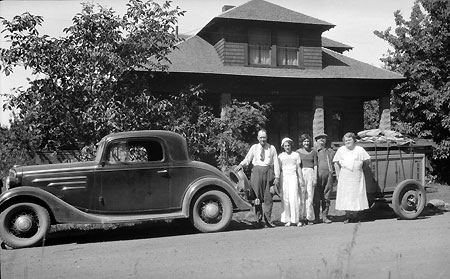
The Day family ready to go camping in 1938 (Source: Hood River History)

The Day family ready to go camping in 1938 (Source: Hood River History)

The Hood River History series of Lost Lake images begins with the above photo, captured in front of the Day family home in Hood River at 420 June Street. According to the Hood River History blog discussion, the house still stands. Note the hefty trailer behind the car — as subsequent photos in the series show, this is industrial camping!

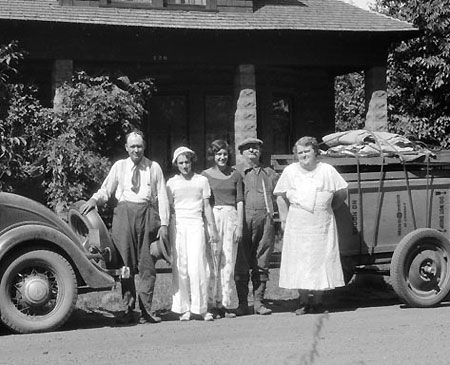
A closer view of the Day family (Source: Hood River History)

A closer view of the Day family (Source: Hood River History)

Looking at the first image in a bit more detail, we see Alva Day on the left and Io Day on the right. The Hood River History blog discussion speculates that the two young women were the Day’s daughters (Helen and Emma) and the older man next to Io Day was her father. However, I wasn’t able to confirm this in any formal records.

Instead, official records show that Alva and Io Day had just one child, their son Carroll. Carroll married a Helen Colby in 1931, so the “Helen” speculated in this photo could be his wife. Sadly, Helen (Colby) Day died just nine years later, in 1947 (Carroll Day married again in 1948 to Aline Andrew, and both lived into the 1990s).

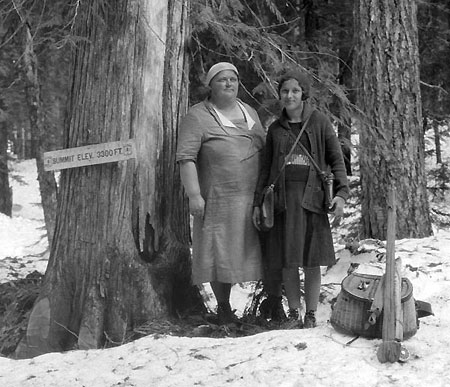
Snow at the lake? Not unusual in early summer  (Source: Hood River History)

Snow at the lake? Not unusual in early summer (Source: Hood River History)

The next image in the Hood River History series is from an earlier trip, taken in 1933, but I’ve included it here because it wouldn’t have been unusual for early summer campers to encounter snowdrifts on the way to Lost Lake. On this earlier trip, it’s possible that Alva Day (on the left) and Io (center) were simply heading up for some early summer fishing, and not on a camping trip.

The Hood River History blog clearly identifies the man on the left in both of the previous photos as Alva Day, which raises a question: did he shoot these as self-portraits using a timer, or was someone else behind the camera? More on that in a moment…

Is this Alva and Io Day’s daughter-in-law? (Source: Hood River History)

Is this Alva and Io Day’s daughter-in-law? (Source: Hood River History)

A closer look at the 1933 photo clearly shows Io Day to be the same person as that pictured in the 1938 camping trip series. But the young woman next to her in the 1933 photo (above) also seems to be the same person standing near the stove (below) in this detailed look at the next photo in the series, captured in 1938:

Helen (Colby) Day five years later? (Source: Hood River History)

Helen (Colby) Day five years later? (Source: Hood River History)

The similarity between these images, and lack of documentation on Alva and Io Day having more than one child leads me to speculate that we’re looking at Helen (Colby) Day, first wife of Alva and Io’s son Carroll. There is no birth date available for Helen (Colby) Day, but assuming she was roughly Carroll Day’s age, they would both have been in their mid-20s when these images were captured.

A wider view of the campsite scene (below) shows the rest of the family, and the impressive array of gear that filled up that trailer behind the family car! You can see still more detail on the original Historic Hood River image, but some of the intriguing highlights include the cook stove, wooden table, what appears to be a wood pantry or food box, and of course a canvas tent in the background.

Sharp-eyed viewers of this photo in the Hood River History blog also spotted bratwurst in one of the frying pans, a pile of discarded tin cans behind the stove (did they pack them out?) and a swimsuit and towels hanging to dry on the clothes line. Alva’s boat is tied up at the lakeshore, just beyond the table.

Camping in style at Lost Lake in 1938 (Source: Hood River History)

Camping in style at Lost Lake in 1938 (Source: Hood River History)

In this wider view, Alva Day is seated to the left, and next to him a young man that I will speculate is Carroll Day. The woman toward the back is clearly Io Day, with another unidentified young woman seated next to her. If the young man in the above photo is, indeed, Carroll Day, then I will also speculate that he was behind the camera in the previous two images, as well.

The next camping image is actually from 1941, but also fits the theme. In this view, Io Day is relaxing at the base of a large cedar tree, looking quite comfortable and content. On this outing, the wood stove is still there, and a wood picnic table has appeared. Were these provided by the Forest Service? Most interesting, of course, is the portable radio sitting on the table:

Io Day relaxing at Lost Lake in 1941 (Source: Hood River History)

Io Day relaxing at Lost Lake in 1941 (Source: Hood River History)

A closer look (below) shows the radio in a bit more detail — likely a portable “farm radio” of the era, designed to run on batteries at a time when many rural areas were still without electricity, but within reach of radio broadcasts. Could they pick up Portland broadcasts at Lost Lake? Or possibly KODL 1440 in The Dalles, which began broadcasting in 1940?

Is Io listening to The Whistler? (Source: Hood River History)

Is Io listening to The Whistler? (Source: Hood River History)

Whatever the station, they would have been listening to popular suspense programs of the day like “The Whistler” and “The Shadow”, made all the more spooky by firelight in the middle of the forest!

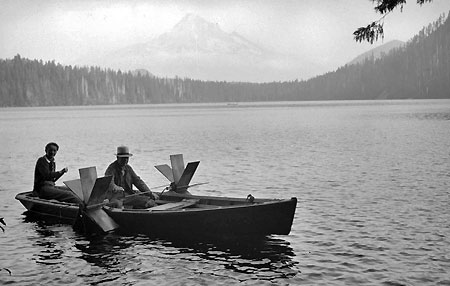
Next in the series is another image from the 1938 outing that shows Alva Day in his unique paddleboat. The unidentified women from the previous campsite image is steering the boat and Alva is cranking the paddles. Mount Hood rises in the hazy background in this scene:

Alva Day’s boat at Lost Lake in 1938 (Source: Hood River History)

Alva Day’s boat at Lost Lake in 1938 (Source: Hood River History)

A closer look at the boat (below) shows the crank mechanism Alva is using to turn the paddles — an ingenious, if odd design!
A two man paddleboat? (Source: Hood River History)

A two man paddleboat? (Source: Hood River History)

The cedar branch in the upper corner shows this image was taken from shore — perhaps by Carroll Day… or Io? Setting up a timed self-portrait for this view would have been quite a feat, even for Alva Day.

Alva’s Lost Lake bounty (Source: Hood River History)

Alva’s Lost Lake bounty (Source: Hood River History)

The final image (above) in the Historic Hood River series shows Alva Day’s sportsman side: an even dozen trout, presumably caught while camping at Lost Lake. A fitting finale to the Lost Lake camping series!
Alva Day’s Legacy

Alva Day’s role in the creation of the Lost Lake Highway is a mostly forgotten part of his legacy. But his roles in advocating for wildlife and in photographing the unfolding history of the Hood River region are only now being rediscovered and appreciated.
For more than three decades, Alva Day was a local leader for wildlife conservation in Hood River, and later was active in the formation of the Oregon Wildlife Federation and the Western Federated Sportsmen. During this period, he was also a contributor to The Oregon Sportsman, the monthly journal of the Oregon Game Commission.

It’s easy to forget how dire the need for wildlife conservation was at the time, and especially the role that hunters and fishermen played in the movement. For a century, the developing Northwest been dumping raw sewage into its rivers, filling the air with smoke, clearing the forests, scouring mountain streams with logging “splash dam” floods and overharvesting many species of game and fish. While we are still struggling to restore our native habitats and wildlife in our time, we have come a long way, already, thanks to the pioneering efforts of people like Alva Day.

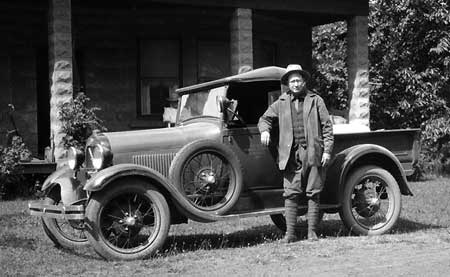
Alva Day with his Pacific Power company car in 1929 (Source: Hood River History)

Alva Day with his Pacific Power company car in 1929 (Source: Hood River History)

Alva Day’s photographic story of the Hood River area is perhaps his greatest contribution, and in time, is likely to be his most enduring legacy. The History Museum has hundreds of his prints in their collection, documenting everything from simple scenes of daily life to historic events, like the June 1927 flood that ravaged the town of Arlington, or the shameful day in May 1942, when hundreds Japanese Americans from the Hood River Valley were loaded onto trains and sent to World War II internment camps

This Hood River History blog project is now in the process of scanning many of Alva Day’s images, and using the blog to build an oral history for each image. This work allows all of us to have a window into the past and contribute to the continued documentation of our region’s history.

A Trip to Idlewild Cemetery

The Idlewild Cemetery in Hood River was established in 1894, and with more than 7,000 graves, is a treasure trove of local history. You can find Alva Day’s family here, too.

Idlewild Cemetery (source: findagrave.com)

Idlewild Cemetery (source: findagrave.com)

Alva and Io Day were both born in 1887, and both died in 1955, after nearly 47 years of marriage. Io died in early January of that year, and Alva Day followed on November 15, 1955. Both are buried at the Idlewild, along with their son Carroll Day, whose ashes joined the family plot at the age of 81 in January 1991. Carroll’s second wife, Aline Day, died in 1995, and her ashes were also placed with Carroll and his parents at Idlewild.

Alva and Io Day and son Carroll and his wife Aline are at rest in the same plot (source: findagrave.com)

Alva and Io Day and son Carroll and his wife Aline are at rest in the same plot (source: findagrave.com)

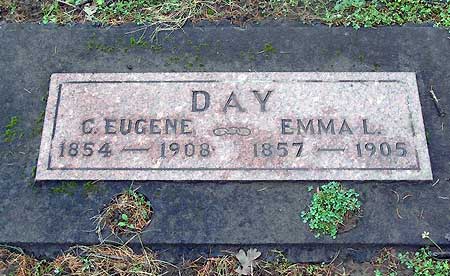
Alva Day’s parents, Emma and Charles Eugene Day, are buried at Idlewild Cemetery, too. Emma Day died in 1905 and Charles Day on May 17, 1908 — the same year that Alva and Io Day were married.

Alva Day’s parents Charles Eugene and Emma Day are also buried at Idlewild Cemetery (source: findagrave.com)

Alva Day’s parents Charles Eugene and Emma Day are also buried at Idlewild Cemetery (source: findagrave.com)

You can visit the Day family plot in Block 9, Lot 24. Idlewild Cemetery is on Tucker Road at Brookside Drive, and though located on a commercial strip, the back of the cemetery abuts orchards, so it makes for a pleasant and interesting afternoon of exploring.
_________________________________

Postscript: Supporting Hood River History

Over the past couple of years, the History Museum of Hood River County has issued a series of terrific images in their Historic Hood River blog series. The history blog comes to us through the generous work of volunteers Arthur Babitz, Bill Pattison and Sally Donovan, and we are truly indebted to their efforts.

By creating this online archive of historic photos, the museum is providing an invaluable resource, free to the public. If you love history and the Mount Hood region, consider supporting the museum for their efforts. While the modest $5 museum admission fee helps support the museum, consider becoming a member to help provide ongoing support for their fine work as stewards of Hood River history.

The History Museum of Hood River County (source: History Museum)

The History Museum of Hood River County (source: History Museum)

The History Museum graciously granted permission to showcase the images included in this article, and I’m hopeful it will send a few visitors and donations in their direction.

The museum is now open after a year or major renovations. You can find it on East Port Marina Drive, accessed via Exit 64 on Interstate-84. The museum is located on the banks of the Hood River, near the prominent suspension footbridge visible from the freeway, and well worth the visit!
____________________________

Postscript: More on Alva Day from Hood River History

Arthur Babitz writes to say: “We actually have 2500 of his images, indicating an annual summer trip to Lost Lake for much of his adult life. There is an extended series showing construction of the bridge near the lodge building. He also participated in and photographed the Legion climbs of Mt. Hood for many years. We have hundreds of images he shot on those climbs. You’ll be seeing many more of them on the HHR blog.”

Thanks for all your fine work in bringing the Day photos back to life, Arthur!

Latourell Falls Makeover (Part 2)

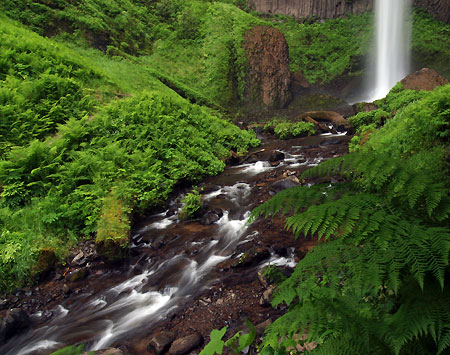
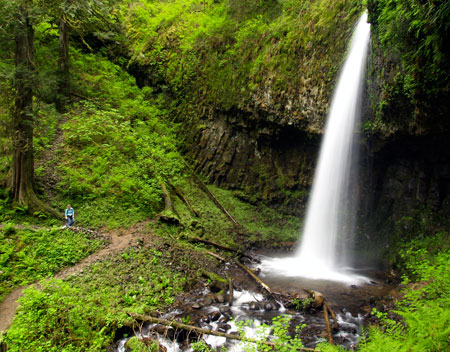
Latourell Falls

Latourell Falls

In the first part of this article, I focused on recent improvements that have greatly enhanced the Historic Columbia River Highway wayside at Latourell Falls. This article looks at the balance of Guy Talbot State Park, where a number of improvements are needed to keep pace with the ever-growing number of visitors who now hike the Latourell loop trail year-round.

Improving the Loop Trail

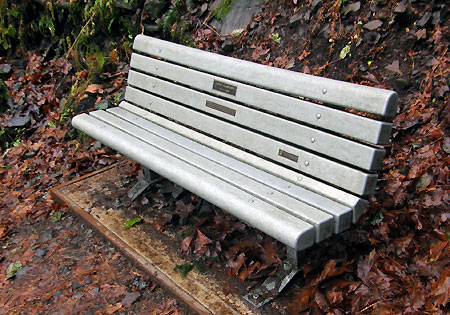
Hiking the loop in the traditional clockwise direction from the wayside, the first stop is bench located a few hundred yards up the trail. This memorial bench was donated by the Sierra Club, and though it’s not a great architectural fit for the area (a rustic style would be more appropriate), it’s still a welcome resting spot for casual hikers.

Memorial bench along the Latourell Loop Trail

Memorial bench along the Latourell Loop Trail

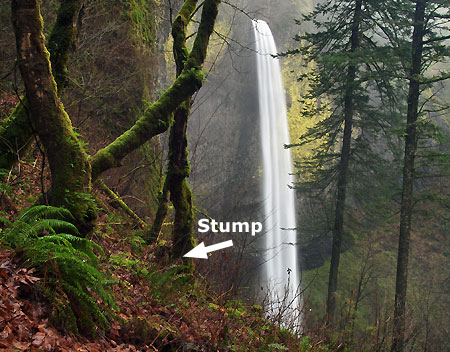
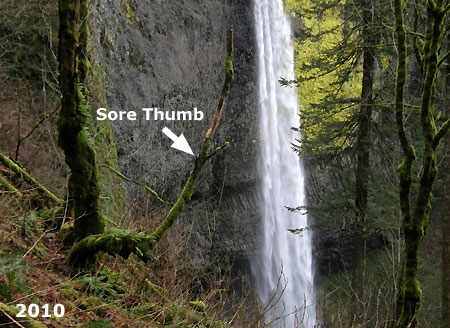
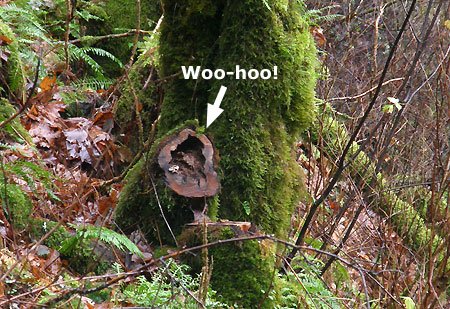
Not coincidentally, the bench faces a lovely view of Latourell Falls, but there’s a story behind the view, as someone has made the effort to do some “scene management” for photographers. Take a look at the photo below, and you can appreciate the waterfall scene in its graceful glory, framed by firs and moss-covered maples. But a closer look reveals a sawed-off stump with a fresh cut. Why here? Because a trail steward (authorized or otherwise) trimmed off the broken shards of a maple that split off in an ice storm a few years ago — leaving a sore thumb that marred this classic view. You can see in these after/before comparisons from now and in 2010:

A beautiful scene as viewed in December 2012…

A beautiful scene as viewed in December 2012…

…and the sore thumb that once was…

…and the sore thumb that once was…

…and the telltale stump!

…and the telltale stump!

If this was sanctioned “scene management” pruning, then kudos to the State Parks folks for putting classic views on their maintenance list. If this is a guerilla effort by a frustrated photographer, then perhaps State Parks managers will take note, and keep this view intact..!

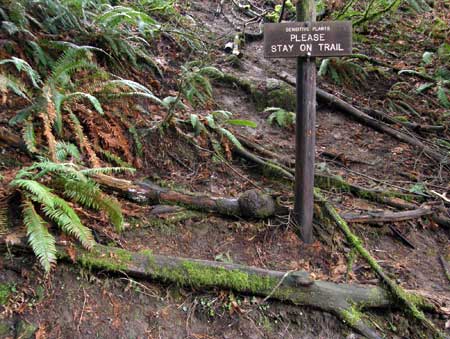
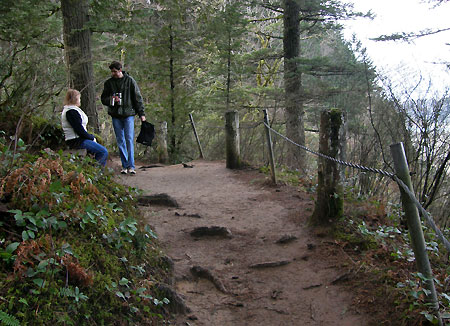
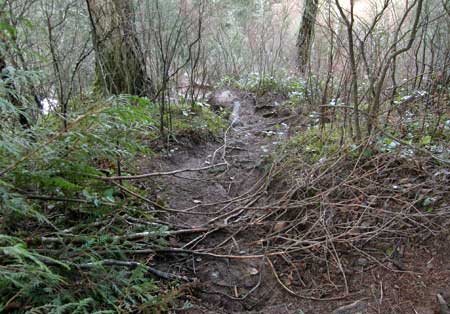
Moving up the loop, the trail soon approaches a heavily trampled bluff above Latourell Falls. Here, the first apparent problem is a decades-old shortcut at the first switchback. A sign begs hikers to stay on the trail to protect “sensitive plants”, but so far, the boots are winning, despite logs and debris purposely scattered across the shortcut.

Tossing more logs across this shortcut might help, but borrowing an idea from the beautiful new stonework at the trailhead (or recently built stonework along the Bridal Veil Falls trail), and adding a rustic stone retaining wall here to corral traffic would be a nice option that would have lasting value.

A forlorn sign attempts to reason with trail-cutters

A forlorn sign attempts to reason with trail-cutters

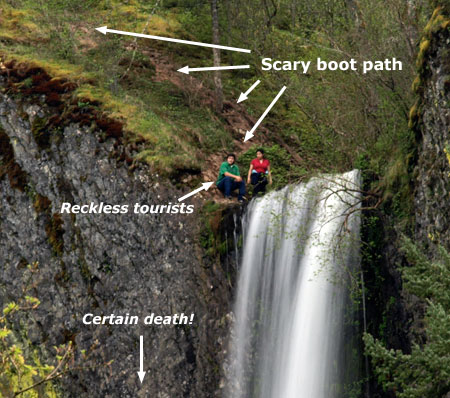
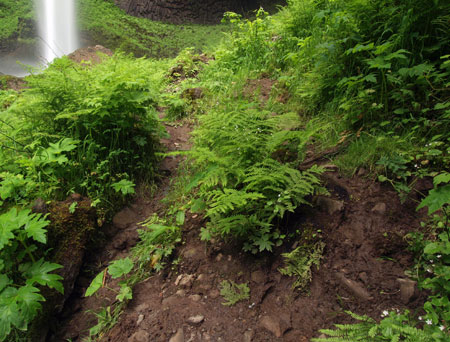
The viewpoint atop the well-worn bluff is really starting to show its age. The 1950s-vintage steel cable fence and mix of concrete and steel pipe posts were never a good aesthetic fit for the Gorge, but more importantly, they’re not doing anything. Visitors have recently pushed a scary boot path past the fence, and down to the brink of Latourell Falls (shown below), so a near-term fix is in order.

The overgrown, beleaguered viewpoint at the to of the falls is in need of some TLC!

The overgrown, beleaguered viewpoint at the to of the falls is in need of some TLC!

The trail at the overlook has already been stomped into a wide “plaza” of sorts, and that would be a good design solution here, with a stone wall replacing the rickety old handrail. A layer of crushed gravel (another design feature of the recent improvements at Bridal Veil Falls) would further help minimize the mud slick that forms in wet months.

The lone (and beleaguered) wood bench at the overlook is well-used, and a redesign should include two or three places to sit and admire the view. For most visitors who venture beyond the lower falls overlook, this bluff above the falls is the turnaround point.

The boot path to the brink of the falls has become a heavily used liability in recent years

The boot path to the brink of the falls has become a heavily used liability in recent years

Adding a stone wall to better define the overlook would help curb foolhardy visitors from following the boot path to the falls brink. However, the overlook also needs some vegetation management in order to simply maintain the view back down to the trailhead — this is what most hikers who push beyond the handrails are looking for, after all.

A pair of reckless visitors in flip-flops spotted in 2010 at the bottom of the dangerous boot path, tempting fate…

A pair of reckless visitors in flip-flops spotted in 2010 at the bottom of the dangerous boot path, tempting fate…

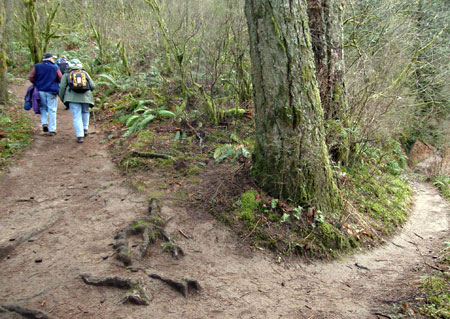
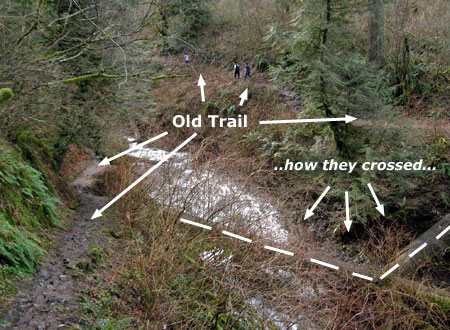
A few steps beyond the bluff overlook, an unmarked trail forks to the right, descending to Latourell Creek. At first, this seems like another informal boot path, but a closer look reveals a well-constructed trail. In fact, this is where a lower loop once crossed the creek, connecting to the main loop where it returns (and is clearly visible) on the far side of the creek. This is an old idea that still makes sense, and should be embraced with a new bridge and refurbished connector trail.

This side trail (to the right) used to be part of a lower loop route

This side trail (to the right) used to be part of a lower loop route

In reality, hikers are already using the lower loop, though a series of slick, dangerous logs a few yards upstream from the brink of Latourell Falls serve as the “bridge”. Reconnecting and restoring these old trail segments would be a good way to provide a shorter loop for less active hikers, and also resolve this hazardous crossing that is clearly too tempting for many hikers to resist.

Bridge needed! This old trail and the sketchy log crossing are an accident waiting to happen -- and also an opportunity to provide an excellent short loop for hikers.

Bridge needed! This old trail and the sketchy log crossing are an accident waiting to happen — and also an opportunity to provide an excellent short loop for hikers.

Moving along the loop to its upper end, the Latourell trail has a few issues at Upper Latourell Falls that deserve attention in the interest of protecting the lush landscape from being loved to death. For many years, this upper section of the trail was only lightly used, but the proximity of Talbot State Park to the Portland Metro region and the family-friendly nature of this trail has clearly made the full loop a very favorite destination.

Upper Latourell Falls

Upper Latourell Falls

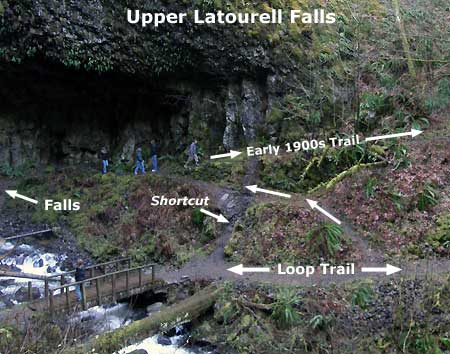
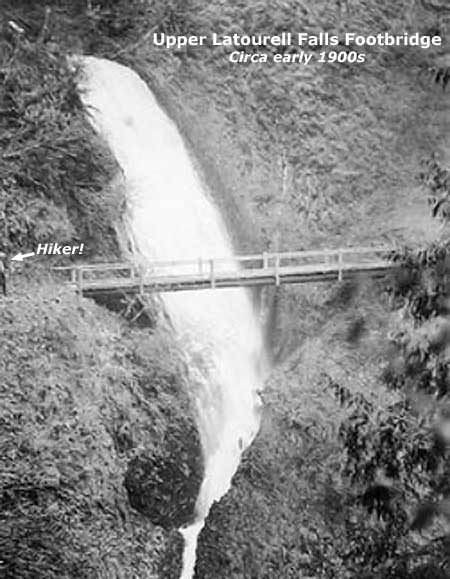
The trail approach on the east side of the falls is in good shape, but problems start to emerge on the west side of the footbridge. This is not coincidental, as an adventurous early trail once switch-backed up the slope on the west side, and led to a precarious bridge across the mid-section of the falls (shown below).

The location of this old trail was uncovered only recently. Century-old rockwork and obvious paths heading uphill from the falls have always hinted at an old trail, but a geocache has now been placed along the old path, drawing enough visitors up the slope to add some urgency to addressing the off-trail impacts here.

A century-old trail climbs the west slope at Upper Latourell Falls

A century-old trail climbs the west slope at Upper Latourell Falls

The best solution here is to embrace the lowest segment of the old path by repairing the stonework, or perhaps adding steps where a shortcut has formed, and provide hikers with that close-up view from behind the falls that is responsible for the bulk of the off-trail traffic (the hikers in the photo above are making this irresistible trip).

The upper sections of the old trail are much less traveled, and a simple solution here might be to simply ask the geocache owner to remove the cache. The cache risks not simply re-opening the old trail, but also bringing inexperienced hikers to the potentially dangerous rock shelf where the log footbridge once stood. If the geocache is removed soon, it’s unlikely that visitors would even notice the upper portions of this trail.

This precarious bridge spanned the upper tier of Upper Latourell Falls in the early 1900s (courtesy U of O Archives)

This precarious bridge spanned the upper tier of Upper Latourell Falls in the early 1900s (courtesy U of O Archives)

Turning downstream along the west leg of the Latourell loop, the trail passes a couple of spots where some TLC is needed. First, another potentially dangerous log crossing (shown below) has drawn enough traffic to form its own boot path.

It could be decades before this old log finally collapses into the creek, so a better plan is needed to stem the damage now. Sawing out the log seems possible, and is a job that could be easily in early fall, when water levels are at their lowest, and fire danger has passed. This might even be a job for volunteer trail stewards with crosscut skills.

The other “bridge” on upper Latourell Creek…

The other “bridge” on upper Latourell Creek…

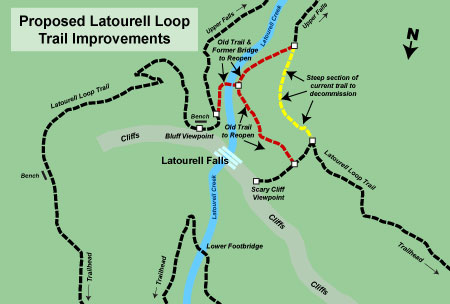
A bit further downstream along the west leg, the loop trail passes the old trail leading to the former footbridge (described previously). Here, the new trail launches uphill along a steep, slick segment built to bypass the bridge.

Reopening the old trail section (and adding a new bridge) would therefore have a spinoff benefit here: not only would a shorter loop be possible (and safe), but the short, badly designed new section of the current trail (shown in yellow on the map, below) could be decommissioned, with the main route using the old section of trail, once again (shown in red). This would be a terrific project for volunteers, including bridge construction.

LatourellLoop16

(click here for a large map)

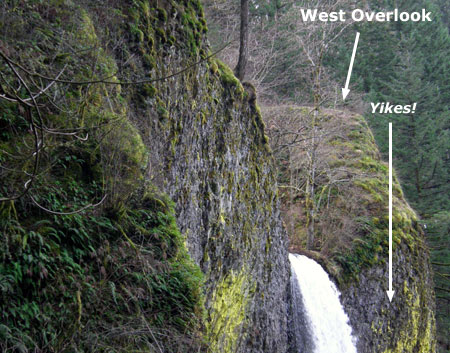
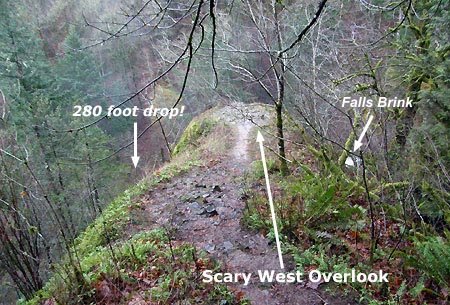
Another scary feature suddenly appears as the west leg of the loop trail curves above Latourell Falls: an old viewpoint spur trail heads straight down to a very exposed, rocky outcrop rising directly above the falls. The view from this exposed landing is impressive, but completely unsafe, given the thousands of families with young kids that walk this loop each year. There is no railing and no warning of the extreme exposure for parents attempting to keep kids in tow.

The west overlook from the trail… yikes!

The west overlook from the trail… yikes!

The safety hazards of the west overlook are twofold: certain death for someone slipping over the 280 foot sheer cliff to the north and a tempting, sloped scramble to the falls brink for daredevils and the foolhardy.

A simple solution could be a handrail or cable encircling the viewpoint, but a more elegant option would be a more permanent viewing platform in the stonework style of the improvements at the trailhead, serving both as a safety measure and to encourage visitors to comfortably enjoy the airy view.

The west overlook and falls brink from the east side

The west overlook and falls brink from the east side

Next, the loop trail curves away from the creek and out of Latourell canyon, passing an overgrown viewpoint (that probably deserves to be retired), then descending in a long switchback to the Historic Columbia River Highway.

Here, the route crosses the road, and resumes on an attractive path that suddenly ends in the Talbot State Park picnic area. Though a bit of searching gets most hikers to the resumption of the loop hike, some signage would be helpful here — both to direct loop hikers back to the main trailhead, but also pointing picnickers to trail to both the upper and main waterfalls.

Heavy traffic has formed a boot-path at the base of Latourell Falls

Heavy traffic has formed a boot-path at the base of Latourell Falls

Beyond the picnic area, the trail re-enters Latourell canyon and quickly descends to the base of Latourell Falls, the final area where loop trail improvements are sorely needed. At this point along the loop, we are within a few hundred yards of the main trailhead and wayside, so the crush of year-round visitors is evident everywhere — and thus the paved trail surface in this portion of the loop.

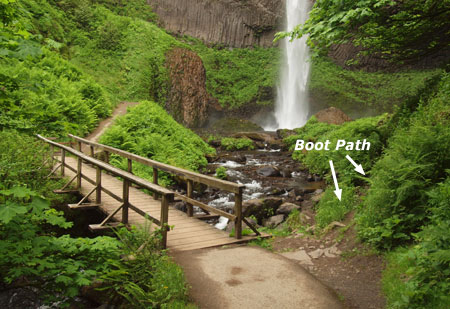
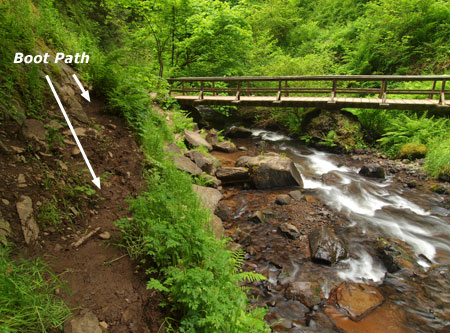
Most of the human impact is absorbed by the trail, but in recent years a messy boot path has developed along the west side of the creek, starting at the lower footbridge, and branching as it heads toward the base of the falls.

Looking back at the footbridge, and the extent of damage from the boot path

Looking back at the footbridge, and the extent of damage from the boot path

As it nears the falls, the boot path devolves into a web of muddy paths, where delicate ferns and wildflowers have been trampled

As it nears the falls, the boot path devolves into a web of muddy paths, where delicate ferns and wildflowers have been trampled

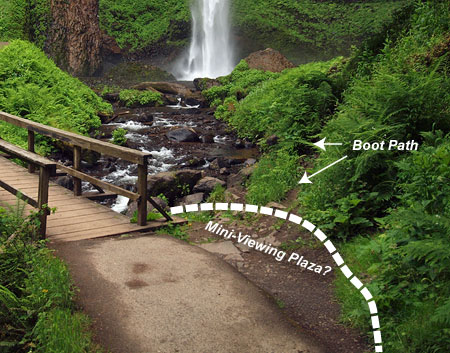
There isn’t a good way to convert this boot path into a formal spur or viewpoint because of the unstable slopes and visual impact it would create, so the challenge is how to best manage the off-trail activity. The simplest option would be an extension of the bridge hand-rail to block the boot path, making off-trail exploring a bit harder.

This mud patch at the east approach to the lower footbridge would make a perfect mini-plaza for visitors to spend time taking in the view

This mud patch at the east approach to the lower footbridge would make a perfect mini-plaza for visitors to spend time taking in the view

But there is also an opportunity to embrace the first part of the boot path, where a “mud plaza” of sorts has been stomped into the ground. This spot features one of the best angles for photographing the falls, after all, so a stone masonry mini-plaza with seating would be a terrific way to both discourage the off-trail travel, and give waterfall admirers an inviting place to stop and photograph the falls, out of the main flow of foot traffic.

Honoring Guy W. Talbot

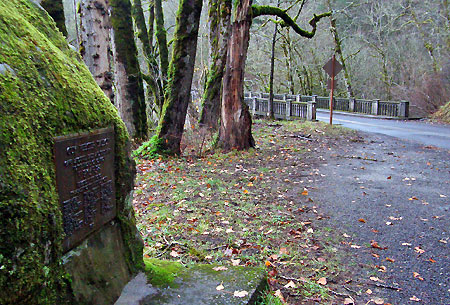
One last bit of unfinished business at Talbot State Park is a debt of gratitude to Guy Talbot, himself. At the west end of the historic highway bridge, a large gravel pullout serves as overflow parking for this popular park. The loop trail crosses the highway near the pullout and in recent years, heavy use has turned this into an overflow trailhead, as well.

The wide pullout at the west end of the Latourell Bridge

The wide pullout at the west end of the Latourell Bridge

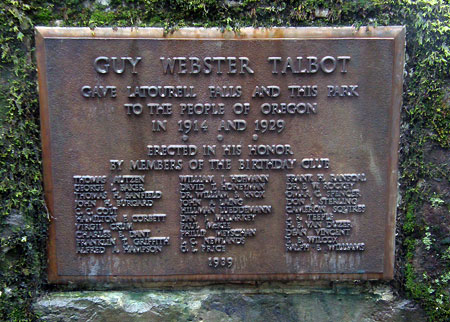
At first glance, it seems nothing more than a broad, gravel shoulder. But upon closer inspection, it’s home to the only real monument to Guy Webster Talbot — the man whose profound generosity spared Latourell Falls from some other fate, and gave us the park that we know today. After all, the property wasn’t simply an undeveloped tract of forest, but rather, Talbot’s beloved country home. He gave the place he loved most to all Oregonians, in perpetuity.

Few traces of Talbot’s home and the surrounding estate survive, so this would be the perfect spot for a third interpretive sign (the first two are on the east end of the bridge, at the refurbished wayside) focused on Talbot, and why he was such an important historical figure in history of the area.

This plaque is the sole evidence of Guy Talbot’s grand gesture to the public

This plaque is the sole evidence of Guy Talbot’s grand gesture to the public

The pullout, itself, could also be improved to become a more formal secondary trailhead for the loop, as well — perhaps not as substantial as the newly rebuilt main trailhead and wayside at the other end of the bridge, but something better than the pothole-covered pullout that exists today.

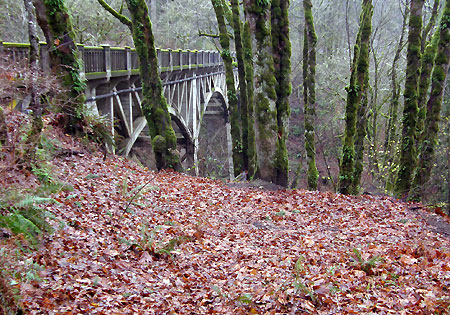
The venerable Latourell Creek Bridge is among the most impressive on the old highway

The venerable Latourell Creek Bridge is among the most impressive on the old highway

Finally, there’s one more interpretive opportunity near the Guy Talbot memorial: a tale of two bridges. One is the towering, 300-foot long Latourell Bridge along the old highway, to the east. The unique history of its construction in 1914 is a story that should be told, especially since visitors can walk both sides of the bridge on the beautifully designed, original sidewalks.

The second bridge is a curious phantom of history — a former footbridge that once connected the two halves of the Talbot property in an elaborate, Venetian-style arch. Though long gone, the footings for the bridge can still be seen, and are a reminder of the elegance of days gone by.

The old footbridge over the highway was located just east of Latourell Creek

The old footbridge over the highway was located just east of Latourell Creek

The good news is that both the Oregon State Parks and Oregon Department of Transportation (ODOT) are on a roll when it comes to enhancing the Historic Columbia River Highway trails and waysides. Many recent improvements to the Gorge parks and the old highway, itself, have already been completed in recent years, and more are already under construction.

Hopefully, polishing up the rest of the Latourell Falls loop and Talbot State Park can find its way into the State Parks and ODOT work program, too!

___________________________

Addendum: after posting this article, I heard from the owner of the geocache mentioned above Upper Latourell Falls. File this under the “small world” department, but it also happened to be someone I’ve known for many years, and who sets the highest standard for conservation ethics. Had I checked the cache ownership and known this, it would have erased any concerns about potential impacts the cache will have on the area. I now know it is in very good hands!

The cache owner also shared some numbers behind the cache that support that last point: only 50 users have logged it in the 3-plus years since it was placed, so not enough to have a noticeable impact on the terrain. Thus, the impacts that we’ve seen in recent years are likely just more of what we see elsewhere on the loop, where the crush of thousands off feet hitting this trail each year is running the landscape a bit ragged.

At its core, geocaching is a terrific way to introduce people (and especially children) to our public lands, which in turn, helps create advocates for conservation — something very much in line with this blog. Hopefully this article didn’t leave other geocachers thinking otherwise. After all, I own several caches myself, and like most cache owners, do my best to ensure they bring people into the wilds while also having minimal impact on the landscape.

Latourell Falls Makeover (Part 1)

Today’s wayside is located at the east end of the Latourell Bridge, where the Falls Chalet roadhouse once stood in 1914 (shown here)

Today’s wayside is located at the east end of the Latourell Bridge, where the Falls Chalet roadhouse once stood in 1914 (shown here)

Over the past few years, Oregon Parks & Recreation has set the high bar for recreation improvements on the state lands it manages in the Columbia River Gorge Scenic Area. The latest project is a handsome, thoughtful makeover of the Latourell Falls wayside, located along the Historic Columbia River Highway (HCRH) in Talbot State Park.

The Latourell wayside serves thousands of Gorge tourists each year, and also functions as the trailhead for the very popular Latourell Falls loop trail. The site has a long history, and was once home to a pair of roadhouses during the heyday of Samuel Lancaster’s world-class highway in the early 1900s.

The Falls Villa roadhouse was located across the road from today’s wayside through the 1930s, now marked only by a stand of mature bigleaf maple

The Falls Villa roadhouse was located across the road from today’s wayside through the 1930s, now marked only by a stand of mature bigleaf maple

Modest improvements to the wayside over the years included interpretive historic signs added in the 1990s that tracked the colorful human history of the area, but for the most part, the site was dated and dingy. The restoration work completed last summer is thus a major upgrade that deserves a review here. The work was completed with a special grant secured by the Oregon State Parks department

Makeover Review

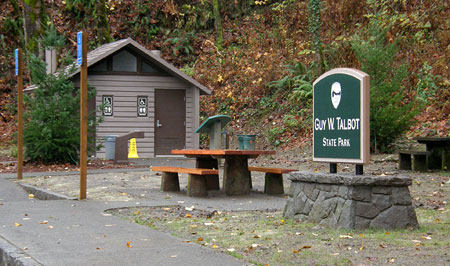
Front and center in the rebuilt wayside is the official state park sign, constructed in the standardized style used for both national forest and state park units throughout the Columbia Gorge National Scenic Area (CGNSA). The sign is mounted on a newly constructed basalt base, also designed in the uniform CGNSA style.

Welcome (again) to Guy W. Talbot State Park!

Welcome (again) to Guy W. Talbot State Park!

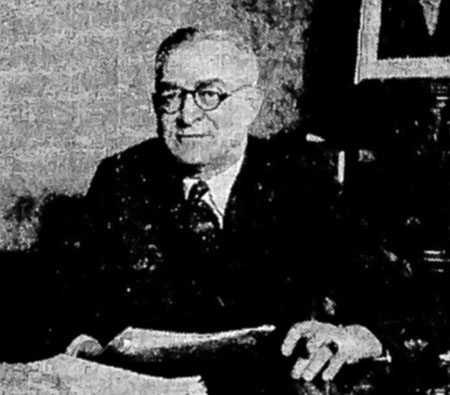
One missed opportunity in repurposing the existing entry sign was the chance to tell the story of Guy Talbot (picture below, in the early 1930s), one of the business titans of early Portland. Talbot donated the land containing Latourell Falls and the gorgeous canyon above the falls, so deserves more than passing mention in the human story of the area (along with other benefactors who donated the lands we now know as the state parks gems dotting the Historic Columbia River Highway).

Guy W. Talbot as he appeared in 1933 on the front page of the Oregonian, announcing his retirement

Guy W. Talbot as he appeared in 1933 on the front page of the Oregonian, announcing his retirement

Two enamel interpretive panels installed at the wayside in the 1990s were salvaged and reinstalled in the new layout. One focuses on the history of the historic highway (the photos of the roadhouses, above, are from this display) and is now mounted in outside a new restroom (below). It’s a well-trafficked location, albeit sorely lacking in aesthetic appeal! The second interpretive sign is located at the main falls overlook, and briefly describes the history of private land donations for parks in the Gorge.

The new restroom is located at the east end of the wayside, tucked away from most of the picnic tables and a good distance from the new falls overlook plaza. While modern budgets probably require the low-maintenance advantage of pit toilets, the more civilized flush toilets that were removed were an aesthetic notch above the smelly nature of a chemical toilet.

The new restroom is (unfortunately) the standard pit-toilet style found elsewhere along the old highway

The new restroom is (unfortunately) the standard pit-toilet style found elsewhere along the old highway

Considering the volume of visitors to this park, plumbed toilets may be essential — we shall find out soon enough! Fortunately, flush toilets at historic highway waysides still survive at Bridal Veil, Multnomah Falls, Ainsworth State Park, Eagle Creek, Bridge of the Gods and Starvation Creek.

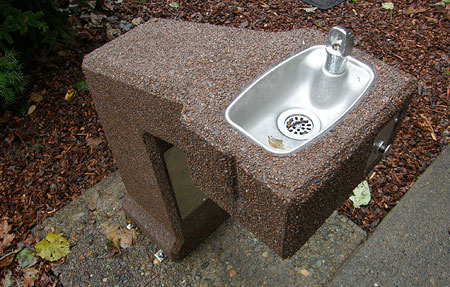
But a major improvement that comes with the new restroom is the location on the south side of the old highway, adjacent to the parking area — the old restroom required crossing the highway. The new toilets are also ADA accessible, along with the drinking fountain located outside the restroom and two of the nearby picnic tables.

Accessible drinking fountain located outside the restroom

Accessible drinking fountain located outside the restroom

An unexpected benefit from the relocated restrooms: it turns out the old restrooms blocked a very nice view of the Latourell Bridge (below), framed by mossy bigleaf maple trees. The old restroom site is marked only by a flat spot below the highway. The low-headroom trail under the bridge that once accessed the restroom has also been decommissioned.

The view that used to be behind the restroom..!

The view that used to be behind the restroom..!

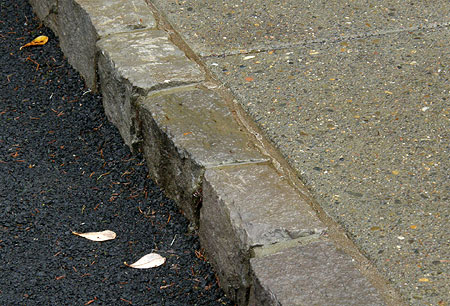
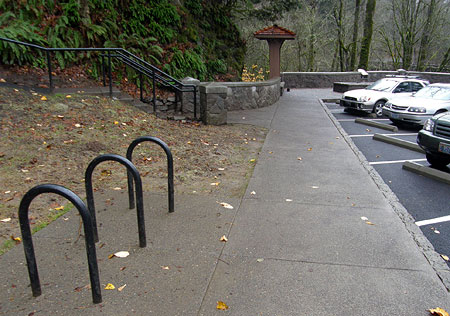
Other details of the new wayside design include basalt curbs that edge the repaved parking area (below), and bicycle racks for cyclists touring the old highway to safely stop and admire the upper viewpoint, fill water bottles, picnic or use the restrooms.

Stone curbs show the attention to details paid by the designers

Stone curbs show the attention to details paid by the designers

One thoughtful aspect of the new bicycle racks is the central location: too often, bicycle parking is relegated to an unused corner. This makes for much less secure parking than a more prominent location, where the public eye is more likely to deter sketchy behavior.

Centrally located bike racks front the main parking area

Centrally located bike racks front the main parking area

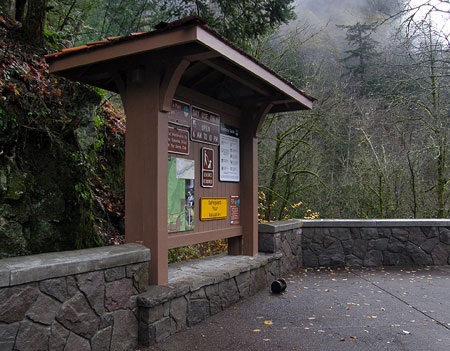
The west end of the wayside is the primary focus for visitors, with a handsome plaza and several new visitor amenities. A concrete-capped stone wall in the Gorge style wraps around the plaza, with notched insets for visitor information and interpretive sign installations.

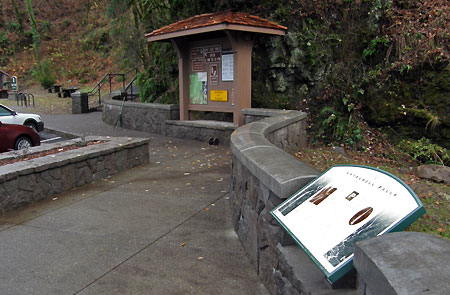
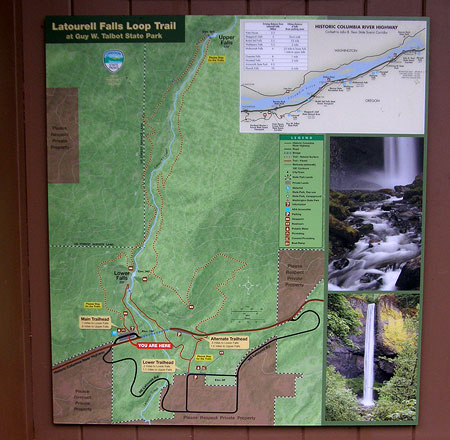
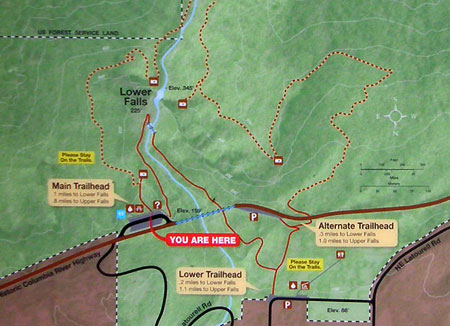
An attractive, new visitor information sign (below) is an excellent addition to the wayside. While it contains the standard park information found at most state parks, an excellent trail map describing the Latourell Creek loop hike is also featured. Even better, the map isn’t of the cartoonish variety often found at tourist waysides. Instead, it shows accurate trail information and even includes elevation contours!

The handsome new visitor information sign at the Latourell wayside

The handsome new visitor information sign at the Latourell wayside

The visitor map does a good job of showing the hiking options and trail highlights, as well as helpful tips on the multiple (and somewhat confusing) trailheads that provide access to the loop. A nice cartographic touch is attention to showing private lands that abut the park (though hopefully some future version of this map will show those lands in public ownership, through the Columbia Gorge Scenic Area acquisition program!)

The excellent, new Latourell Falls Loop map

The excellent, new Latourell Falls Loop map

One minor map glitch exists: the labeling of “Upper Falls” and “Lower Falls” may work for most people, but using the proper place name for Latourell Falls (instead of “Lower Falls”) would be more accurate and informative to those visiting the park for the first time (the upper falls is known unofficially as “Upper Latourell Falls”, so not an issue). There’s rarely a good reason to deviate from official geographic names on maps, after all.

A closer look at the excellent detail on the new park map

A closer look at the excellent detail on the new park map

Hopefully, the State Parks folks will also provide a downloadable, online copy of this map at some point — one that non-profits like Portland Hikers could also offer on their user-created Field Guide, for example.

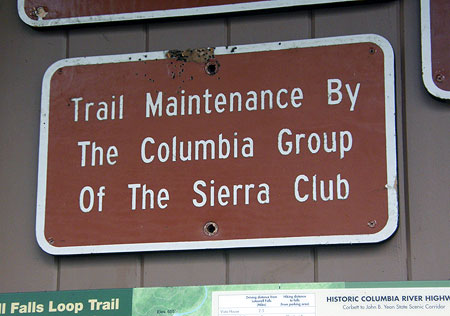
Another nice touch on the visitor information sign is the high-profile shout-out to the Columbia Group of the Sierra Club, the volunteer trail stewards for the Talbot State Park (thanks, Sierra Club!). Not only are the signs a welcome recognition of trail volunteers, but also a subtle tool for raising public awareness to the unfortunate reality that volunteers have become an essential partner to public agencies in keeping our trail system open.

Kudos to the Sierra Club volunteers!

Kudos to the Sierra Club volunteers!

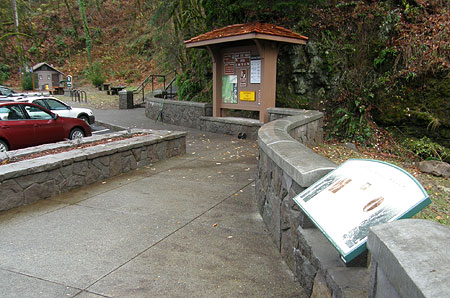
The photo below shows the new visitor information sign from the perspective of the new plaza, with the restrooms visible in the far distance.

The view toward the visitor signboard and steps leading to the upper falls viewpoint from the new plaza (interpretive sign in foreground)

The view toward the visitor signboard and steps leading to the upper falls viewpoint from the new plaza (interpretive sign in foreground)

This view also shows the second notched inset in the curving basalt wall that defines the plaza overlook, where the second refurbished interpretive sign has been installed. This sign briefly describes how Latourell Falls and other nearby parks came into public ownership in the early 1900s, and is the only mention of Guy Talbot in the wayside beyond the entry signs — an oversight that is a missed opportunity in the redesign (more about that coming in Part 2 of this article).

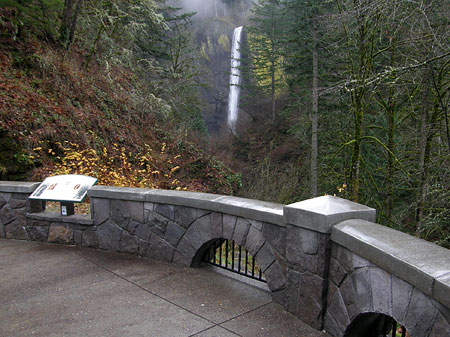
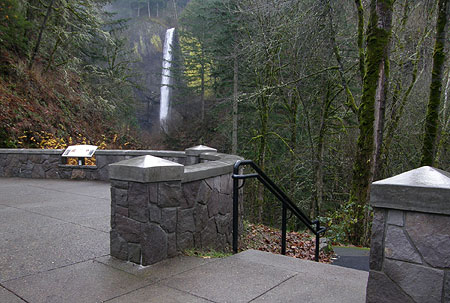
Latourell Falls from the new plaza overlook (with the interpretive sign on the left)

Latourell Falls from the new plaza overlook (with the interpretive sign on the left)

The new plaza corrects many serious problems with the old design, starting with the need for a more spacious falls overlook that respects the historic design of the Samuel Lancaster’s Columbia River Highway. The new plaza meets this test with flying colors, including a subtle, but helpful detail of steps replacing ramps at both the upper and lower loop trailheads.

Another view from the plaza showing the interpretive sign (in the distance) and steps leading to the lower end of the Latourell Falls loop

Another view from the plaza showing the interpretive sign (in the distance) and steps leading to the lower end of the Latourell Falls loop

Because the opening segments of the loop in both directions are paved, there has always been a temptation for people with strollers (or worse, wheelchairs) to assume the trail is safe for wheeled vehicles — it is not! Thus, the new steps will help visitors with strollers and mobility devices to avoid the dangerous mistake of venturing onto the loop trail.

The plaza forms a semi-circle in order to incorporate a second view of the spectacular Latourell Bridge in addition to the falls view. This is an unexpected discovery for visitors arriving over the bridge, unaware of its soaring height and graceful arches.

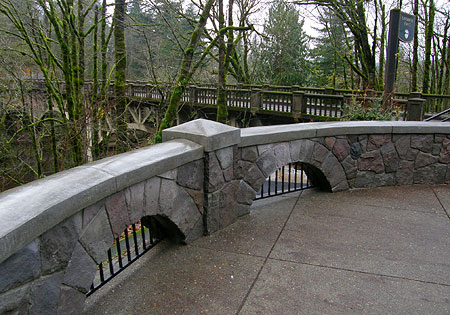
Wayside details: Samuel Lancaster would approve!

Wayside details: Samuel Lancaster would approve!

On this detail, the designers hit a home run, with a series of arches built into the basalt walls that beautifully echo the bridge design, and seamlessly tie the wayside into the highway, itself, as a natural extension of Samuel Lancaster’s masterpiece. Each arch also includes a painted steel grate – a nice detail that will keep kids and pets on the plaza-side of the stone walls.

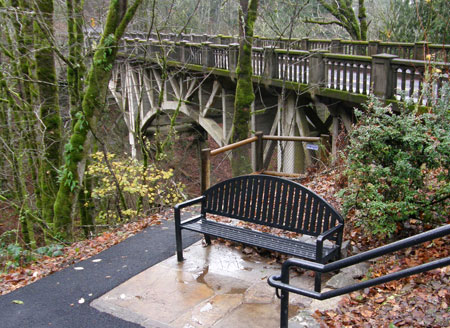
A newly installed, arch-back bench at the head of the lower loop trailhead gives a similar nod to the historic bridge, while also helping terminate the decommissioned path that once accessed the old restroom, via a narrow, sketchy path that ducked beneath the bridge (the wood post rails in the photo below block the route of the old path).

This stately bench salutes the old highway bridge, a nice touch!

This stately bench salutes the old highway bridge, a nice touch!

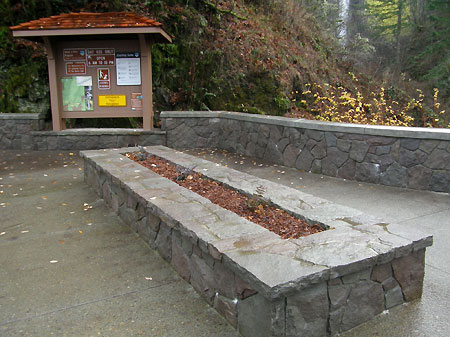
In the center of the new plaza, the designers have incorporated a long planter-bench (below) that will be a welcome respite for visitors to sit and enjoy the view. However, the design of the bench planter is problematic: The narrow planting compartment is not irrigated, and thus presents a tough landscape dilemma. The designers planted mahonia nervosa, or longleaf Oregon grape that should be drought-tolerant enough to survive, and compact enough to fit the narrow space. But it will also a prickly companion to share the bench with! Perhaps this was intentional (as a means to keep the plants from being crushed)?

The other dilemma with planters of this type is the frustrating reality that it will become an oversized ashtray over time. In the end, it might have made more sense to simply design a wide bench with a solid top for the plaza (which is certainly an option for retrofitting this bench, as needed).

A large planter bench anchors the new plaza

A large planter bench anchors the new plaza

The revamped wayside also includes improvements to the popular upper viewpoint, located just east of the visitor information sign. The upper viewpoint path is also the trailhead for the upper portion of the Latourell Falls loop.

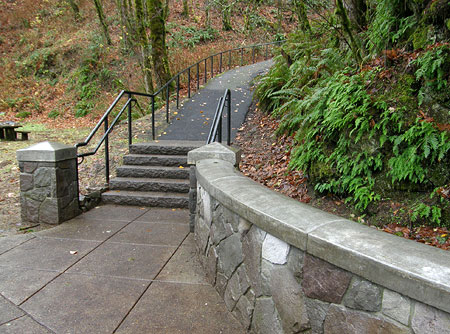
The stairway to the upper viewpoint path (below) also forms the terminus of the stone wall that defines around the plaza, and is nicely designed to simply lead wandering visitors to the overlook. Like the steps at the opposite end of the plaza that lead to the lower trail, these steps may help deter wheelchairs and strollers from the steep, unsafe climb to the upper viewpoint.

New steps leading to the upper falls viewpoint and loop trail

New steps leading to the upper falls viewpoint and loop trail

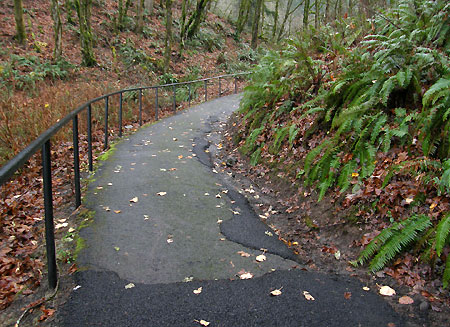
Unfortunately, the upper viewpoint path is one of the disappointments in the Latourell makeover. The short, existing section of paved trail to the viewpoint is steep and slick even for able-bodied hikers. Worse, it becomes a terrifying skating rink in winter ice conditions — which happens to be a time when the Gorge is often crowded with visitors admiring the spectacle of waterfalls transformed into ice cathedrals.

While the new handrails help, a home-run design here would have been a series of steps and landings all the way to the viewpoint — picture a scaled down version of the stairs approaching the lower Multnomah Falls viewpoint as an example. Instead, the improved steps at the base of the path taper onto the old path in a fairly awkward transition, an understandable budget constraint, no doubt, but a missed opportunity, nonetheless.

Unfortunately, this ugly, occasionally dangerous path remains a sore thumb…

Unfortunately, this ugly, occasionally dangerous path remains a sore thumb…

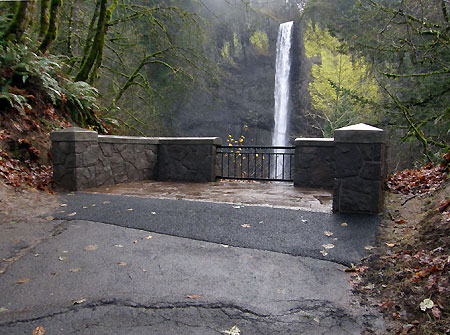
After walking the brief section of old paving, visitors suddenly reach a completely reconstructed upper falls viewpoint (below) with nice attention paid to views. The basalt surround at the viewing platform has a subtle cutout where a steel fence allows the falls to be more fully viewed when approaching the overlook. This design replaces an old stone wall that once blocked the view from the trail, so is an especially thoughtful detail.

The revamped upper viewpoint platform is a major upgrade, albeit marred by the ugly approach on a steep, outmoded old trail

The revamped upper viewpoint platform is a major upgrade, albeit marred by the ugly approach on a steep, outmoded old trail

The awkward transition from the ugly remnant section of the old pathway to the new platform detracts from the otherwise beautiful scene, but is also something that can be remedied with future enhancement to the viewpoint.

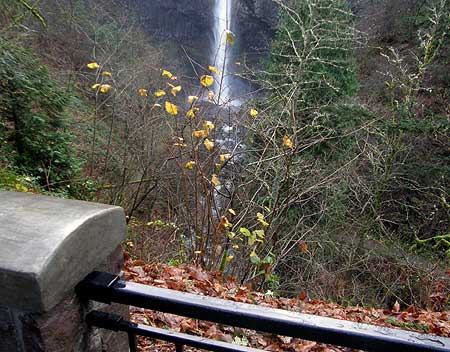
The disappearing Latourell Falls view: a thorny problem?

The disappearing Latourell Falls view: a thorny problem?

Some unfinished business exists at the upper viewpoint, and it might fit into the State Parks operations budget: any photographer will attest to some much-needed “view management” here. Over the past decade or two, the brushy slope below the viewpoint (below) has swallowed up the bottom third of the falls. It’s something that a bit of pruning would greatly enhance. As recently as the 1990s the splash pool at the base of Latourell Falls was clearly visible from the viewpoint.

A Legacy Achievement

Though there will always more work to do in bringing the Gorge trails and byways closer to the national park standard, the Latourell Falls makeover is a terrific step in that direction. The project achieves a level of quality and permanence that few improvements manage.

Latourell Falls from the new wayside plaza

Latourell Falls from the new wayside plaza

The new space created and constructed by the State Parks team will easily last for decades, joining the rest of the historic Columbia River Highway as a stunning blend of nature and architecture that continue to thrill visitors from around the world. It’s truly a legacy project, and all who were involved in the design and construction deserve our kudos – thank you!
______________________________

(Next up in the Part 2 of this article: a look at the Latourell Loop trail and possible improvements that would bring this popular trail to its full potential)
______________________________

Read an article on the Latourell wayside makeover

Read an article on the local stone masons uniquely skilled to do the kind of work on display at Latourell Falls

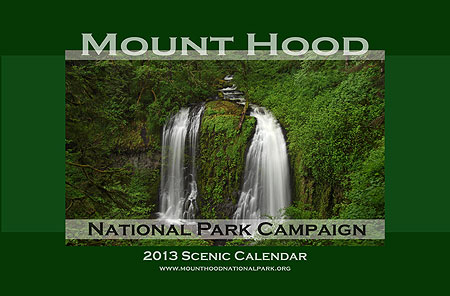
2013 Mount Hood National Park Calendar

Each year at about this time I assemble the Mount Hood National Park Scenic Calendar. The proceeds are modest, but do help support the Mount Hood National Park Campaign website, WyEast Blog and related project expenses. But the main purpose is to simply promote the national park concept, and make the case for the campaign with pictures.

What the calendar looks like – oversized 11×17” pages you can actually use!

I’ve published the calendars since 2004, so this year’s calendar marks the ninth edition. All of the photos in the calendar are from trips and trails I’ve explored over the past year. I get a surprising number of questions about the photos, so in addition to simply announcing the 2013 calendar, this article tells a bit of the story behind the new images — and some are surprising!

The 2013 Scenes

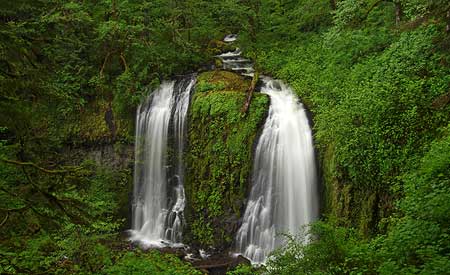
The cover image for the 2013 calendar is Upper McCord Creek Falls, located just west of Cascade Locks. This is a popular destination for Columbia Gorge lovers, though often overshadowed by its more famous downstream sibling, Elowah Falls.

Cover Scene: Upper McCord Creek Falls

Upper McCord Falls is unique in that it flows as a twin cascade. A little known fact is that a third segment used to flow during the rainy season as recently as the 1970s, just to the left of the two segments shown in the photo (above). The third segment has since been blocked by stream debris, however, so for now, Upper McCord is best known as a twin cascade.

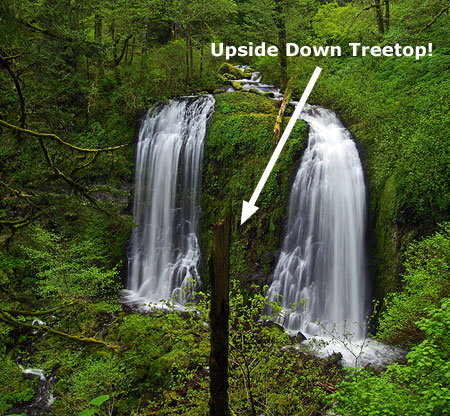
The falls is popular with photographers, but in 2010 was briefly obstructed by a large treetop that had split from atop a nearby maple, landing perfectly on its head, directly in front of the falls. While the local photography community simply grumped and groaned about this unfortunate development, Gorge waterfall explorer and photographer Zach Forsyth did something about it: he scrambled down the slope, and neatly tipped the 40-foot up-ended tree on its side. Thus, Zach made this year’s calendar cover possible – thanks, Zach!

Upper McCord Creek Falls with “the stump” in 2010

Upper McCord Creek Falls is tucked away in the hidden upper canyon of McCord Creek, just a few hundred yards from the brink of Elowah Falls. The trail to the upper falls is especially spectacular, following a ledge chiseled into sheer cliffs in the early 1900s to pipe water to the former Warrendale Cannery, below (portions of the pipe system can be seen along the trail). The falls is hidden from view until you abruptly arrive at the dramatic overlook, directly in front of the falls – one of the finest and most unexpected scenes in the Gorge.

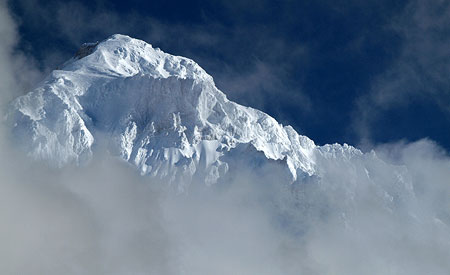
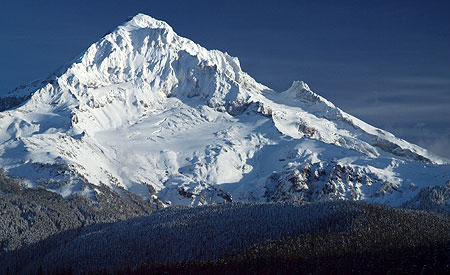
The January calendar scene is a wintery view of the rugged west face of Mount Hood, just emerging from the clouds after a fresh snowfall. This view was captured just a few weeks ago near Lolo Pass, as the evening light was briefly catching the summit.

January Scene: West face after an early winter storm

Like most “mountain in the mist” images, this one was a reward for patience: I waited for two chilly hours for the clouds to clear! It worth the wait, though I’ve also had my share of disappointments when that glorious glimpse of the mountain didn’t materialize.

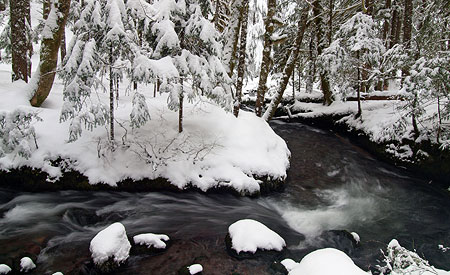
For the month of February, I picked an image from a trip last winter along the Little Zigzag River. I had planned to snowshoe to Little Zigzag Falls from the Kiwanis Camp, but there were only about 18 inches of snow on the ground, much of it fluffy and new. So, I simply trudged through leaving some very deep boot prints in my wake — and happily, the only footprints on the trail that afternoon.

February Scene: Little Zigzag River in winter

The weather was extremely cold on this visit, revealing one of the surprising effects of running water in winter: it turns out the sheer volume of relatively “warm” water (that is, above freezing) flowing down the Little Zigzag river actually heats the narrow canyon, much like an old steam radiator heats a room.

Following this radiator analogy, the temperate gradient is most noticeable when air temperatures are really cold. It was about 12º F that day, yet the air right next to the stream, and especially in front of Little Zigzag Falls measured in at a “balmy” 30º F. I found myself peeling off layers while shooting the stream and falls, only to hurriedly put them back on as I ventured back down the trail and into the real cold!

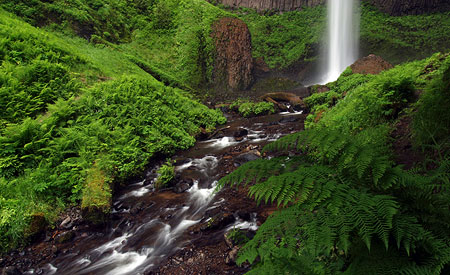
For the month of March I chose another waterfall scene, this time the lush, verdant base of popular Latourell Falls in the Columbia Gorge.

March Scene: Latourell Falls in spring

On this visit to the falls, Oregon State Parks construction crews were starting work on several major upgrades to viewpoints along this busy trail. As a result, the most popular trailhead at the Latourell Wayside was closed. Instead, I took a back route to the falls and had the place to myself for the better part of an hour — nearly unheard of on what should have been a busy spring weekend at Latourell Falls.

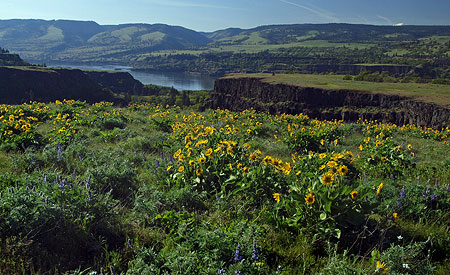
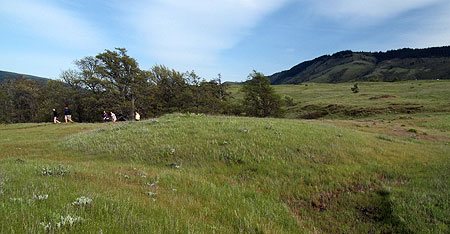
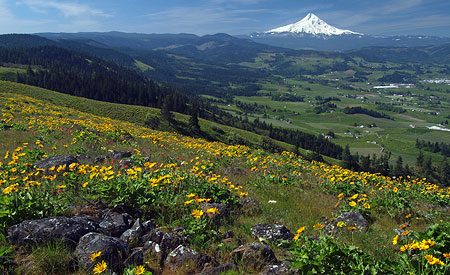
The April calendar scene is from Rowena Plateau at the McCall Preserve, in the dry, eastern Columbia Gorge. The iconic yellow balsamroot and blue lupine were in peak bloom on this sunny afternoon in mid-spring, and the glassy surface of the Columbia River in the background reveals a rare day of calm in the normally windy Gorge. The very tip of Mount Adams peeks over the hills on the horizon, on the Washington side of the river:

April Scene: Balsamroom and lupine on Rowena Plateau

The trip to Rowena was especially memorable for me, as I was hiking with an old college friend who was visiting Oregon for a few days. Rowena was a great place to catch up on news and old memories.

My friend also happens to be an eminent geologist working for the federal government, so we had a great conversation about the mystery of “desert mounds” (also known as “biscuit scablands”), which found on Rowena Plateau and in other areas in the Columbia Basin (watch for a future WyEast Blog article on this subject…).

Hikers passing one of the mysterious desert mounds on Rowena Plateau

Continuing the balsamroot-and-lupine theme, the May scene in the new calendar comes from Hood River Mountain, a tract of private land that is (for now) open to the public, but at risk of closure, due to heavy use by hikers.

This is one piece of land that will hopefully come into public ownership someday, before a less responsible private owner places trophy homes on these beautiful slopes. I wrote about this unfortunate oversight in the Columbia River Gorge Scenic Act in this article from a few years ago.

May Scene: Hood River Mountain in May

On Memorial Day last spring, I made a trip to Dry Creek Falls, a beautiful waterfall saddled with one of the most unfortunate and uninspiring place names in the Gorge! The June calendar image is from that trip, and captures Dry Creek rambling through the forest a few hundred yards below the falls.

June Scene: (not so) Dry Creek in spring

This area has a unique history: an old, derelict diversion dam and waterworks survives at the base of the falls, where the City of Cascade Locks once tapped the stream for municipal water in decades past. Perhaps this is the origin of “Dry Creek” name — did the stream below the diversion actually go dry when the dam was installed? Perhaps, but today it flows year-round, and makes for a beautiful streamside hike in spring.

Dry Creek Falls and the remains of the old diversion dam and waterworks

The July scene in the 2013 calendar is from a trip to Elk Cove last August. This is one of my annual pilgrimages, and I have photographed this particular spot just east of Cove Creek too many times to count — yet I’m always excited to get there, and recapture the stunning scene.

July Scene: Summer wildflowers at Elk Cove

The wildflower bloom on Mount Hood was delayed by several weeks this year, so even though I was a bit late in visiting Elk Cove, there was still a bumper-crop of purple aster mixing with the blue lupine and mop-heads of western anemone, or Old Man of the Mountain.

Not visible in the calendar view of Elk Cove are the blackened forests directly behind me: the Dollar Fire of 2011 swept across a 5-mile swath along the northern foot of Mount Hood, charring the northern fringes of Elk Cove, including several large stands of mountain hemlock that frame the view from 99 Ridge.

The Dollar Fire burned a 5-mile swath across the north slope Mount Hood

Though it’s initially shocking to see healthy forests killed by fire, it is also part of the natural cycle of forest renewal. Thus, we’ll now have a front-row seat to the fire recovery process that will unfold over the coming years along the popular north side trails. I wrote this blog article on the Dollar Fire earlier this year.

For the August calendar image, I picked a less familiar scene from an otherwise popular hike: the soaring trail to the 8,514’ summit of Cooper Spur. To beat the crowds, I set my alarm for 3 AM and raced to the trailhead at Cloud Cap. I was the first to arrive at the string of dramatic viewpoints along the trail, and caught the first rays of sun lighting up the northeast face of the mountain.

August Scene: Eliot Glacier from Cooper Spur

This view is from the north shoulder of Cooper Spur, just below the summit, and looking into the impressive jumble of crevasses and icefalls along the Eliot Glacier. Though the sky was crystal clear (you can see the moon setting to the left of the mountain), the winds from the south were strong and blustery. So, getting this shot from the lee side of the spur also meant enjoying some respite from the intense wind and blowing volcanic grit.

For the September image, I selected a lesser-known view of the mountain: the remote and rugged Newton Canyon, on the southeast side, where Mount Hood has a broad, massive profile.

September Scene: Rugged Newton Creek Canyon on the east side of Mount Hood

Glacial Newton Creek is best known for the havoc it brings far below, where the stream has repeatedly washed out Highway 35 with violent debris flows that toss Toyota-size boulders and whole trees across the road in their wake. Construction crews were busy this summer completing yet another repair, this time for damage that occurred in the 2006 floods. As always, the new road is bigger and higher than the old. We’ll see if Newton Creek is persuaded to flow through the new series of larger flood culverts this time…

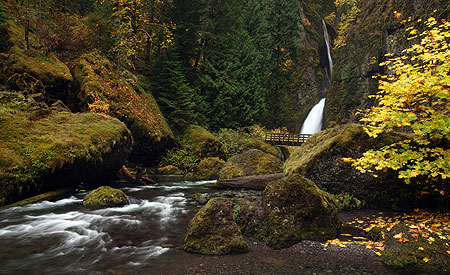
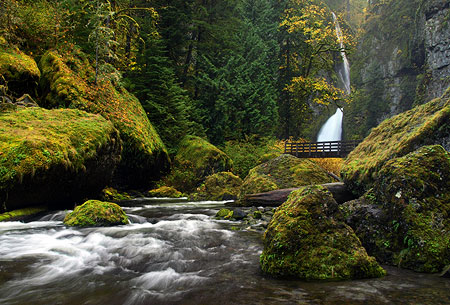
The October scene is from Wahclella Falls on Tanner Creek, a popular family hike that also provides terrific viewing of spawning salmon and steelhead in early autumn.

October Scene: Wahclella Falls in autumn

Fall colors were somewhat muted in 2012, thanks to an unusually long, dry summer that extended well into October. As a result, the broadleaf trees in many areas had already dropped a lot of leaves due to the stress of the drought, before they would even have a change to change with the seasons.

While fall colors at Tanner Creek were less affected by the summer drought, the autumn scene in this year’s calendar has to make due without without the help of the particular tree, the Wahclella Maple I wrote about earlier this year. You can see the hole it left by comparing this year’s image (above) and a 2010 image (below).

Wahclella Falls in 2010 with the Wahclella Maple still standing above the footbridge

Since 2007, I’ve made annual trips with friends and volunteers to tend to the Old Vista Ridge Trail on the north side of Mount Hood. This historic gem from the early 1900s was an overgrown, forgotten victim of the Forest Service clear-cutting juggernaut for some 40 years, but somehow managed to escape their chainsaws.

Volunteers re-opened the Old Vista Ridge Trail in 2007, spurred in part by a Forest Service scheme to turn the area into a playground for dirt bikes and ATVs — an appalling plan that was eventually abandoned, in part because the rediscovered trail had revealed the beauty of the area to so many.

In 2010, the trail became the official northern boundary of the expanded Mount Hood Wilderness, when President Obama signed a new wilderness bill into law. This change should close the door on future Forest Service threats to the area, and today the hike into one of the best on the mountain.

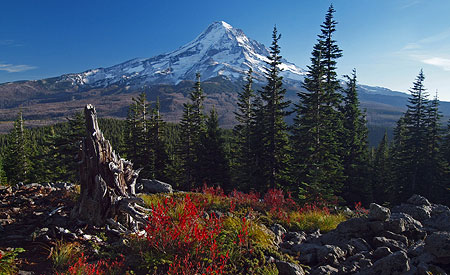
November Scene: Mount Hood from Owl Point

The November calendar scene is from a viewpoint along the Old Vista Ridge Trail known as Owl Point, the rocky outcrop with stunning views of the mountain. Bright red huckleberries light up the foreground in this scene, and the first dusting of snow highlights the mountain. In the distance, you can also pick out the browned forests on the slopes of Mount Hood, where the Dollar Fire swept across the base of the mountain in 2011.

The final image in the new calendar is another taken from Lolo Pass, perhaps one of the most spectacular views of Mount Hood. This image was taken just before sundown after a fresh snowfall had blanketed the mountain.

December Scene: Winter arrives at Lolo Pass

I paid the price for taking in the sunset that night at Lolo Pass, as my car was broken into at the trailhead – something I’d somehow managed to avoid in all my years of hiking! As frustrating as it was to deal with the repairs and lost belongings… I’d do it all over again just to spend those magical hours watching the mountain that night — it was truly breathtaking! Here, take a closer look, and see for yourself:

Mount Hood from Lolo Pass | 2012
_________________

The thirteen images I chose for the 2013 calendar are from a few thousand images I’ve taken this year on something just shy of 40 outings to Mount Hood and the Gorge — a bit less time on the trail than a typical year would allow, but no complaints! As always, these adventures took me to new places and discoveries, as well as fond visits to my favorite old haunts.

And as always, the magnificent scenery further confirmed my conviction that Mount Hood should (and will!) be set aside as our next National Park! Hopefully, the calendar makes the case, as well.

How can you get one, you ask?

The new calendars are available online:

2013 Mount Hood National Park Calendar at CafePress

They are large and functional, measuring 17” across by 22” tall when hung, with plenty of room for writing notes and scheduling activities. CafePress packages them carefully, with each calendar sealed against a corrugated cardboard backing for support.

The calendars sell for $29.99 + shipping, with about 25% of the proceeds going to support the Mount Hood National Park Campaign. They make terrific stocking stuffers (…although you’ll need an 11×17” stocking…), and CafePress now makes it even easier by offering PayPal as an option.

And as always, thanks for your support!
_______________________________________

Addendum: Gorge uber-Guru Scott Cook set me straight on a couple of comments in the above article:

Hey Tom, so of course I read your blog like a good Gorge denizen. A couple of points…I’m not trying to sound like a know-it-all…but I know that you do like to get at the bottom of things and eschew conjecture:

The pipes visible on the Upper McCord trail are from Myron Kelly’s pulp mill, not Warren’s cannery. There are some pix on my blog of Kelly’s mill and iterations of his pipes. I have another old pic too showing the pipe running along the cliff cleft, illustrating to me that the cleft was a pipeway instead of a WPA/CCC construction.

2013MHNPCalendar16
(author’s note: here’s a photo I shared with Scott that shows CCC crews clearing out the old waterline shelf to make way for the trail to Upper McCord Falls — note the Historic Columbia River Highway, far below, and the CCC crew bosses in full uniform)

…and, about Dry Creek falls, the Creek was called Dry Creek before the water works were installed. The reason is that just downstream of the PCT trail bridge, just down the access road 200yards, the creek dries up in the summer to nothing, just a dry creek bed as the creek goes subterranean until re-emerging downstream of the powerline corridor.

If you walk down the access road in the summer, the stream is of course flowing under the bridge, but when you walk downstream the sound goes away and you just figure the stream curved away from the road, but nope, if you bushwhack over just 100 feet you’ll see the dry stream…as you will if you continue down the access road also.

Down the (Dry Creek) access road is a bunker-looking building that was built in the 30’s to store the water from the stream’s waterworks for the city’s first municipal supply. The water shed is still in use today, but the water is pumped upwards into it from wells in the town below.

Next edition of Curious I’ll have Dry Creek Falls as a loop using the powerline access road…so people can learn the history and see the Dried-up Creek as well (cuz everyone loves a loop). Look for my pix on Google Earth of all this stuff and the dried-up creek. -Scott

Thanks, Scott!

Warren “Barney” Cooper

Early 1900s map with Warren Creek identified

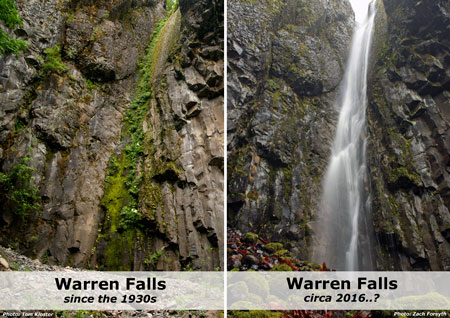
While tracking down the human history behind the mysterious (and temporarily defunct) falls on Warren Creek in the Columbia River Gorge over the past year, I was surprised to learn that “Warren” is not the surname of a local homesteader or early explorer.

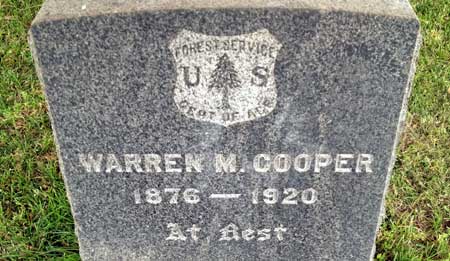
Instead, it is the first name of an early Forest Service ranger, Warren “Barney” Cooper, whose own surname puts him among Mount Hood’s pioneering royalty: the remarkable Coopers of the Hood River Valley.

The David Rose Cooper Family

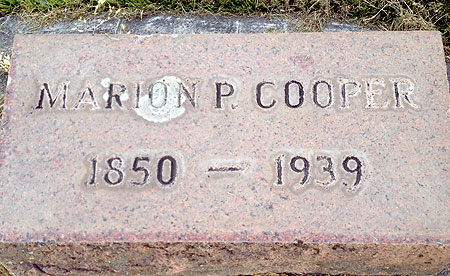
David Rose and Marion Cooper with their family in 1884. Barney Cooper is on the right (photo: A Complete History of Mount Hood)

Barney Cooper was part of a pioneer family that figures prominently in the history of the Hood River Valley. His father, David Rose Cooper, uprooted from Aberdeenshire, Scotland in 1872 (where the Cooper family had lived for more than 300 years), and moved his wife Marian and their children to settle in America. After a trek across the country, David and Marion Cooper originally settled near Roseburg, in Southern Oregon. Here, they gave birth to several children, including Warren.

In 1882, the Coopers moved again to become some of the first white settlers in the upper Hood River Valley. David Rose Cooper was captivated by Mount Hood, and the idea of building a road to the foot of its enormous north side glaciers. In 1884, he teamed up with two local settlers, Henry Coe and Oscar Stranahan, to form the Mount Hood Trail and Wagon Company.

Under this venture, they built a trail to the mountain, completing work in 1886. The trail was quickly expanded to become a rough wagon road, and in 1888 opened as a 12-mile toll route. The new road led adventurers to the rocky crest on the shoulder of the mountain where the historic Cloud Cap Inn still stands today.

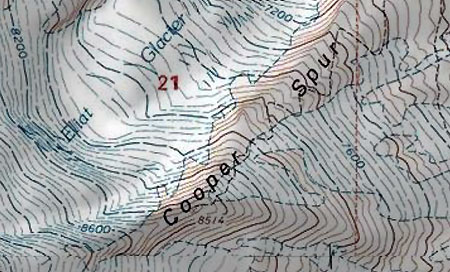
Cooper Spur was named for Warren’s father, David Rose Cooper

The legacy of these early pioneers lives on in our place names. A well-known Mount Hood adventurer from Portland, Dr. Thomas Lamb Eliot, spent time exploring the mountain with the men who built the first road, and named several prominent landmarks on the mountain in their honor: Cooper Spur for David Rose Cooper, Coe Glacier for Henry Coe and Stranahan Ridge and Falls for Oscar Stranahan.

With the new road in place, David Rose Cooper opened a “tent hotel” near today’s Tilly Jane camp in 1888, offering guide services where he led guests across the high country on Mount Hood’s northeast slopes. Marian Cooper and the couple’s younger children all helped in the tent hotel operation, including Warren Cooper, who was just 12 years old at the time. The oldest Cooper children stayed behind, tending the family farm in the valley below.

The Cooper tent hotel near Tilly Jane in 1888 – a young Warren Cooper is atop the horse in the center (photo: A Complete History of Mount Hood)

The modest tent hotel was short-lived. In 1889, a group of Portland investors had begun work on the Cloud Cap Inn, and purchased the Cooper toll road as part of forming a new Mount Hood Stage Company. The new lodge opened in August 1889, ushering in a new era of tourism on the mountain that continues to this day. The seed that started it all was the Cooper family’s tent hotel.

Barney Cooper and the Forest Service

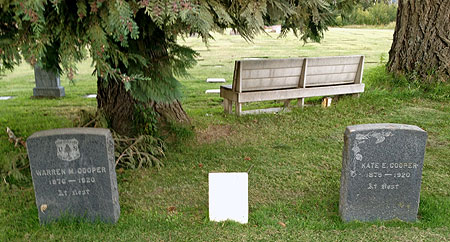
Warren McCalley “Barney” Cooper was born in 1876 in the town of Wilbur, where the Cooper family first settled in Southern Oregon. Time spent on the slopes of Mount Hood after the family moved to the Hood River Valley had a lasting impression on Barney. During the 1890s, he became a forest ranger for the Cascade Forest Preserve, the huge federal holding that preceded formation of the U.S. Forest Service.

Warren M. “Barney” Cooper at Elk Meadows around 1915

Barney Cooper eventually served as the first district ranger for the Hood River Ranger District with the creation of the U.S. Forest Service in 1905. He served in this capacity for 15 years. During his tenure, the Mount Hood portion of the Cascade Forest Reserve was be set apart in 1908 to become the Oregon National Forest (and was later renamed the Mount Hood National Forest, in 1924).

There was no ranger station at the time, so Barney conducted Hood River Ranger District operations from his home near Parkdale. Duties were initially focused on protecting the forest from timber thieves and squatters, but soon shifted toward fire prevention. During this formative era, many of the familiar names we know in the Mount Hood area were placed on early maps by the first forest rangers, and many of the trails and roads we still use were planned and built.

A scene from the original route to Cloud Cap that David Rose Cooper conceived and built

In 1915, Barney led an expedition of state officials on a preliminary survey of the Mount Hood Loop Highway. Sam Lancaster’s Columbia River Highway was nearing completion in the Gorge, and there was great interest in completing a loop around the mountain. Barney led the group up Cold Spring Creek to Elk Meadows, then down to Hood River Meadows, bypassing the steep East Fork canyon — though the highway would eventually follow the more rugged canyon route.

Barney and Kate Cooper

When Barney Cooper was 28 years old, he married Catherine Elizabeth “Kate” Gribble, who had just turned 25 years old. They were wed on December 28, 1904 in Wasco County, east of Hood River.

In 1907, Barney and Kate lost their first child at birth, a daughter. In 1913, they gave birth to a second child, Wilbur David Cooper, who would live to be 97 years old. He died only recently, on October 28, 2010 in El Cerrito, California. Sadly, both Barney and Kate died in 1920, leaving young Wilbur Cooper an orphan at the age of seven. He was raised by the extended Cooper family living in the Hood River Valley.

Warren McCalley “Barney” Cooper

Barney Cooper’s cause of death is listed as “sleeping sickness”, which might seem odd today, given our familiarity with the tropical version of “sleeping sickness”. But from 1916 to 1926, another form of sleeping sickness — encephalitis lethargica — swept the globe in a widespread epidemic. Barney Cooper died in Portland on February 18, 1920.

Kate Cooper died just a week before Barney, on February 11, 1920. Kate died of “consumption”, or what we know today to be tuberculosis. Kate also died in Portland.

There’s no known history on the sequence of events that sent both Kate and Barney into a Portland hospital at the same time, but it must have been devastating for the extended Cooper family. They were in the prime of their lives, as Kate was just 41, and Barney 44 years old.

David Rose Cooper died shortly thereafter, in 1922, at the age of 77. Marion Cooper lived on for several years in the family homestead near Parkdale. She died at age of 89 in 1939, having experienced an amazing span of history during the course of her long life.

A visit to Upper Valley Cemetery

After researching the remarkable Cooper family history, I made a trip to the Upper Valley Cemetery near Parkdale a few weeks ago to visit the family’s gravesites. This quiet little cemetery is modest and unassuming, appropriately nestled between working apple orchards on all sides.

David Rose Cooper’s gravesite is located in the open center of the cemetery, and Marion Cooper’s grave is just a few feet away. Standing by their grave markers, Mount Hood rises to the south, and Bald Butte fills the skyline to the east.

Barney and Kate Cooper were laid to rest along the west edge of the cemetery, beneath the canopy of a huge Douglas fir and Port Orford cedar. A wood bench is located nearby, between the trees, facing the main part of the cemetery.

Gravesites of Barney, Kate and Baby Cooper

Barney’s grave marker is engraved with the U.S. Forest Service emblem – a forest ranger forever! Kate’s marker is a few feet away, and adorned with what seems to be a morning glory vine — her favorite flower, perhaps?

Between Barney and Kate lies their infant daughter, the first to be buried here in their shady family plot.

________________________

A Lasting Tribute?

Before he died at the age of 97 in 2010, Wilbur Cooper had survived his wife of 73 years, Juanita, and one of their twin daughters, Leslie. According to published accounts, he is survived by his daughters Rosemarie and Carrolyn, son-in-law Jon, four grandchildren and two great-grandchildren.

My hope is to somehow contact his surviving family so that they might learn about my efforts to restore Warren Falls on Warren Creek — places named for a grandfather they never met. This effort is complicated by the fact that Wilbur Cooper had no sons, and thus the Cooper surname may not have carried forward in his branch of the family.

A fitting tribute to Barney Cooper?

Learning a bit more about Warren “Barney” Cooper in researching this article further inspires me in restoring Warren Falls. It would be a fitting tribute to his contributions as one of Mount Hood’s first rangers.

I’m also hopeful his surviving descendents might be able to shed more light on Warren Falls and Warren Creek — and on Barney Coopers life in the woods. If you know someone in the Cooper family who might be able to help me in that effort, please forward this article to them.
________________________

For more family history on Barney and Wilbur Cooper:

L.J. Cooper’s Recollections of Barney Cooper (PDF)

Wilbur Cooper’s 2010 obituary (PDF)

As always, Jack Grauer’s “Complete History of Mount Hood” (first edition) was invaluable in putting this article together.

The author on Cooper Spur in September 2012

Warren Falls story airs October 25th on Oregon Field Guide!

The Magnificent Seven ready to head to Warren Falls on May 12

If you’ve followed this blog for awhile, you may remember this article from last spring. This earlier article documents the field shoot at Warren Falls for a story on OPB’s Oregon Field Guide.

The segment finally airs this week at the following times on Oregon Public Broadcasting:

• Thursday, Oct. 25 at 8:30pm

• Sunday, Oct 28 at 6:30pm (repeat)

After the story airs, it will be viewable on the Oregon Field Guide website:

OFG Warren Falls Episode

Vince and Michael at work along Warren Creek

Thanks go out to Vince Patton and Michael Bendixen, the brave OFG crew who made a couple of trips to Warren Falls to capture the story. Along the way they braved an ice storm, waded through knee-deep poison oak, dodged cliffs and dangled beneath the huge “trash rack” that covers the top of the Warren Falls diversion. They are true adventurers to the core!

The crew spent two separate days on site, and captured what should be some very intriguing views of the Warren Falls diversion structure — including that glimpse under the weir, looking into the tunnel. The video from our earlier, icy winter trip should be interesting, with some surprises, I suspect.

OFG shooting at the base of Warren Falls last May (Photo: Adam Sawyer)

ODOT continues to move forward toward construction of the Historic Columbia River Highway State Trail segment from Starvation Creek to Warren Falls, so stay tuned! I’ll continue to post information on the effort to restore the falls on the blog, as well as on the Restore Warren Falls Facebook page:

Restore Warren Falls on Facebook

An Oregon Classic

The granddaddy of Oregon field guides was published in 1969

Today, you can walk into a Portland bookstore and find dozens of hiking guides, most with a narrow geographic focus or hiking speciality — hiking Mount Hood, hiking with dogs, hiking with kids, day hikes, backpacking trips — that cater to every stripe of hiker.

But in the beginning, there was only one guide: 100 Oregon Hiking Trails by Don and Roberta Lowe. The book was published by the Touchstone Press in 1969, and was the first of many guides that established the Lowes as the undisputed experts on hiking in Oregon.

Family heirloom: frontpiece of our original copy, signed by Don Lowe

100 Oregon Hiking Trails set the bar for what every hiking guide is still judged by. The Lowes hiked every trail in the book to ground-truth and map actual trail locations, covering 1,400 miles in their efforts. Each hike includes Roberta Lowe’s detailed narrative describing the trip and a summary of basic trail data, including elevation gain and loss, mileage, hiking season and driving instructions.

Don Lowe is an accomplished photographer, and captured photos for each hike. Don also created custom trail maps using USGS topo sheets as his base — and often correcting the actual trail location, adding trail highlights and mapping forest road updates.

The result was a pioneering guide that many hikers carried in their packs (after all, this was the era when photocopiers were still rare!) and relied upon as their “eleventh essential”.

Typical map from 100 Oregon Hiking Trails – this one is for the Serene Lake hike

Exactly half the trips in 100 Oregon Hiking Trails are day trips from Portland, and another thirty are in the Central Oregon Cascades. The twenty remaining trips are spread across southern and eastern Oregon. Most of these hikes are still classics, covered many times over in field guides published over four the decades since the Lowes first described them.

But while the destinations are the same, many trails have changed significantly since 100 Oregon Hiking Trails was published: most of the trails we know today on Dog Mountain and Silver Star Mountain today simply didn’t exist in 1969, for example. In a few cases, the destination itself has changed: former lookouts are gone (Silver Star Mountain, Saddle Mountain, Bald Butte), viewpoints partly grown over (Lost Lake Butte, Fish Creek Mountain) or trails simply lost (the Perdition Trail).

Don and Roberta are pictured building a fire at Serene Lake in “100 Oregon Hiking Trails

Perhaps most importantly, 100 Oregon Hiking Trails was a hedge against the sharp decline in forest trails that accompanied the escalating timber harvests on federal lands in the 1950s and 60s. Though clear cuts and logging roads claimed many more trails during the logging heyday that continued through the 1980s, the Lowes inspired countless Oregonians to rediscover their forests. These new hikers, in turn, brought a new awareness of the heavy toll that industrial forestry was having on our public lands.

Growing up with 100 Oregon Hiking Trails: My First Backpack

Like most outdoor-oriented Portlanders in the late 1960s and 70s, my family had a copy of 100 Oregon Hiking Trails out on the coffee table (right next to Ray Atkeson’s Oregon, Jack Grauer’s Mount Hood: A Complete History, Maynard Drawson’s Treasures of the Oregon Country, Ralph Friedman’s Oregon for the Curious… and a few recent issues of LIFE magazine).

Ready for adventure: Mom, sister Carol and older brothers Kurt and Mark with yours truly getting ready to load up the station wagon. Dad is behind the camera, and oldest brother Pete off to college.

My earliest family day hikes in the Gorge and around Mount Hood were at the age of five or six. But after reaching the ripe old age of eight in 1970, my folks deemed me old enough to carry my own backpack. It was July, and the destination was Hike No. 43 in 100 Oregon Hiking Trails: Serene Lake. This trip still stands as my earliest hiking memory, and made me a hiker for life.

The trip started from the Frazier Turnaround, reached by a primitive road that was just as rough in 1970 as it is today. Back then, my dad was navigating an aircraft carrier-like 1967 Plymouth Fury II station wagon over that road – a thought that seems terrifying today. I recall a lot of lurching and grinding through the boulders and dust-filled potholes that pass as “road” along this route… and some choice expletives from dad, of course!

Once at the trailhead, we saddled up in packs ranging from cutting edge (my folks and older brothers had spiffy orange Kelty backpacks) to retro — my sister and I had military surplus canvas packs from Wigwam, a 60s-era army surplus store in Portland. Thankfully, our canvas packs had “modern” aluminum frames – an improvement over oak! The same held for our tents: my folks slept in dad’s orange, nylon climbing tent, while my older brothers carried two army surplus canvas pup tents for the kids. Dad reviewed the route in our copy of 100 Oregon Hiking Trails, then stowed the guide in the top pocket of his pack.

Rest stop at the two-mile mark on the switchbacks below Serene Lake – that’s me running around annoying everyone, no doubt…

The hike was uneventful, and soon we arrived at the north shore of Serene Lake, right where the Lowes are pictured in the guide. We had plenty of day left for exploring, a very quick (and cold) swim, wading in search of crayfish and a picnic on the talus slope above the lake.

Finally, it was time to set up camp. We stayed on the west shore of the lake, where I’m fairly certain at least one rustic picnic table existed. The canvas pup tents came with heavy metal stakes, but no poles – we used sticks for that. They also had simple cotton ties for closures, a detail that would prove fateful as evening approached.

Mom set up an impromptu picnic lunch on a talus slope above Serene Lake.

As sundown approached, the infamous mosquitoes of the Rock Lakes Basin descended upon us with a vengeance. Dad sprayed the kids down with a can of OFF! bug spray, and built a campfire to make our dinner. The fire did a good job of keeping the bugs away, so we stayed up late, roasting hot dogs and marshmallows in the warm, bug free circle.

Bedtime brought on a sequence of memorable events that are now family lore. I was paired with Kurt, my oldest brother on the trip, and our first unpleasant discovery was just how impossible it would be to keep mosquitoes out of that pup tent. More drama followed: at some point during the night, I woke my brother up to tell him I was about to throw up.

Our recollections vary on what happened next, but I distinctly remember being ejected from the tent like a human missile, and spending the next 20 minutes (or was it hours?) hunched in a patch of huckleberries paying the price for all those hot dogs and marshmallows. At some point, I was allowed back in the tent, but only after losing another pint of blood to the mosquitos… and my dinner.

A mummified mosquito is proof that dad opened up the guidebook at least once during our buggy stay at Serene Lake!

Despite the long night at Serene Lake on that first backpack trip, I was hooked. After the hike, I pored over our beat-up copy of 100 Oregon Hiking Trails, memorizing it. Our family went on to hike many of the trails described in the book, and in later Lowe guides (that I also memorized). The die was cast, and I was addicted to hiking for life.

These early experiences are why I LOVE to see parents with young kids out on the trail — they’re setting them on a very healthy, satisfying path… literally! An added bonus is that hikers are among the best forest stewards and conservationists, simply because they come to know the land on a very personal level.

The Lowe Legacy Continues

100 Oregon Hiking Trails was only the beginning for Don and Roberta Lowe. Within a year of its publication in 1969, their second book, 100 Northern California Hiking Trails, was published in 1970. Many books followed over the next three decades. Each of the subsequent books is more focused in scope, including regional hiking guides for Oregon, Southwest Washington, Northern California and Colorado. The Lowes also wrote one of the first mountain biking guides for Oregon, in 1991.

The back cover of 100 Oregon Hiking Trails features the dynamic Lowe team at work.

All of these books are worth collecting if you’re a hiker interested in trail history, or exploring those “lost trails” that have dropped off Forest Service maps and maintenance schedules, but can still be followed.

A favorite among the later Lowe books is 50 Hiking Trails: Portland and Northwest Oregon, published in 1986. This classic is still sought after for its description of some of the most threatened, least traveled trails in our region, and has helped these trails survive by introducing new generations of hikers to them.

Don and Roberta Lowe’s epic tribute to Mount Hood (1975)

Perhaps the finest Lowe collectible is their beautiful large-format book Mount Hood: Portrait of a Magnificent Mountain, published in 1975. Though Don Lowe’s photographic talent is evident in the small, black and white images that fill the many Lowe guidebooks, the beautiful collection of Don’s fine color photography in this book is simply stunning. Likewise, Roberta Lowe has the space in this book to expand her prose to a compelling story of Mount Hood’s natural and cultural history. This is a must-have for Mount Hood lovers, and can still be found at local bookstores.

———————–
Postscript: this is the 100th article posted on the WyEast Blog since starting it nearly four years ago, so celebrating 100 Oregon Hiking Trails seemed like the perfect topic! The books of Don and Roberta Lowe had a big impact on my life, and I’m sure many others were influenced by their celebration of Oregon’s wild beauty.

In the early 1980s, I approached Don and Roberta Lowe for help with a college project: creating a trail map of the (then) embattled Salmon-Huckleberry backcountry as part of the campaign to preserve the area as wilderness (which eventually happened in 1984).

The Lowes invited me to their home to discuss the project, and patiently endured my endless questions. Don even gave me a tour of his basement darkroom, where all those maps and images I had memorized had been created. Roberta kept up a correspondence on my student project for over a year, and I still keep those old letters as a reminder of their generosity in helping a young student with their time and knowledge.

I ran into the Lowes again about a year ago, and in catching up with them, was reminded once again what a gift they were to Oregon. They were an important part of that special Oregon spirit of the 60s and 70s that still defines what it means to live here today.

Thanks, Don and Roberta!

Our Gorge: Their Summer Destination..!

Look! Behind you… it’s Multnomah Falls!

Thanks to being one of the country’s original motoring routes, countless automobile ads have been filmed along the Mount Hood Loop Highway over the years. Usually, our world-class scenery is little more than an un-credited extra in the casting, though always a welcome affirmation of the national park qualities of Mount Hood and the Columbia Gorge!

But this summer, two new ads from Infiniti get more personal with the Gorge as “your summer destination”. True, it’s the luxury Infiniti G Sedan (and the affluent buyers they are courting) that the company has in mind, but like few ads before it, these 30-second spots use the Gorge setting as the main selling point. They’re fun to watch for local Gorge enthusiasts, especially some digital slight-of-hand for the sharp-eyed.

Cruising Waterfall Alley

The first ad opens with a stylish 30-something couple in a contemporary art gallery, admiring a metal sculpture. Behind them is a rather nice abstract painting of Multnomah Falls, featuring the Benson Bridge (was it created for the ad?).

After a brief daydream involving a cruise ship and spritely grandpa running by in a red Speedo, the couple turns toward the painting behind them and proclaims: “Let’s go on vacation there!”

Ah, now you see it! Nice painting, too…

Cut to a lovely summer view of Multnomah Falls and Benson Bridge… and a car zipping across the pedestrians-only bridge…? Clearly, a driving maneuver made possible through the miracle of computer generated imagery (CGI), but fun to see for those who know the location!
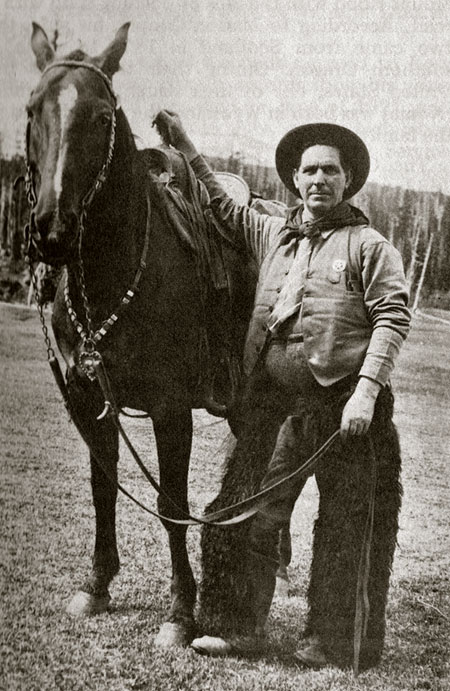
Look out, pedestrians! Luxury sedan coming through..!

Before your eyes can zero in on the car atop Benson Bridge, the scene cuts to the same car coming across the similarly arched Shepperd’s Dell bridge. For the national audience watching this ad, the two bridges do appear to be the one and the same, adding to the fun for local Gorge aficionados who know better.

Aren’t you going to slow down for the waterfall..?

From Shepperd’s Dell, the sleek new Infiniti now passes in front of Horsetail Falls as the fine print appears: “Professional driver. Closed course. Do not attempt.” Good advice… especially if you still owe on your $37,000 luxury sedan!

Nope, not stopping at this falls, either…

Next, the ad cuts to a section of historic highway that appears to be just east of Shepperd’s Dell, with a verdant green forest canopy reflecting off the hood of the well-polished Inifiti. A squiggly “sharp turns” sign completes the scene and message: sure, it looks like a sedan, but it drives like a sports car!

That squiggly arrow means “go faster”, right..?

Then, another abrupt U-turn, and we complete the high-speed tour of Waterfall Alley with a spin around Crown Point. The colors and river level in the background show this scene to have been filmed in the peak of spring in May or early June, under overcast skies, as were the previous clips in the sequence.

Hey, you’re speeding past a world-class viewpoint..!

The exception is the opening Multnomah Falls shot — the only clip without an actual vehicle operating in it. This clip appears to have been filmed later, possibly mid-summer, and clearly under sunny conditions, too. Could this be a stock video clip with the CGI added?

Here’s the complete video of “your summer destination” in Waterfall Alley – enjoy the ride!


______________________

Cruising Rowena Crest

One of these ads would be fun enough for local Gorge junkies to study, but a twin ad filmed in the eastern Gorge is equally intriguing. This commercial begins with a somewhat younger 30-something couple (the Infiniti G is apparently an “entry level” luxury model… hmm…) this time admiring a mysterious coffee table book in an upscale bookstore (is this a film set, or real location..?)

Definitely not Powell’s, but the book looks interesting…

Like the first couple, this pair daydreams of a tropical vacation (on Bora Bora), then comes to their senses when a coconut thumps the hood of their hyper-polished Infiniti sedan. Startled from their daydream, they take a look at the two-page spread in the huge art book before them and proclaim: “Let’s go here!”

…now the book looks REALLY interesting!

The colossal book looks like it must be a custom-made prop, but does have a caption running down the left side that describes driving this scenic route in Oregon — perhaps this is a real book?

If so, the camera crews went to extraordinary efforts to match the location for the first shot in first video sequence — or is it the other way around? If the book was created as a prop for the ad, the stills of this scene for the book were clearly shot later in the summer than the filming of the driving sequences, as evidenced by the summer colors along the freeway and Sevenmile Hill, in the background.

A couple of quick cuts in the opening sequence along the historic highway show off a lovely section of Samuel Lancaster’s beautiful old road, featuring the artful stonework and remarkable effort to blend with the landscape that continues to make the Historic Columbia River Highway a “summer destination” for visitors from around the world.

Ah… you might want to slow down on this curve…

…or not… glad there’s a “professional” at the wheel…

Next, the still spotless Infiniti sedan makes another time-travel maneuver, appearing on the Rowena Loops, just to the east of the opening clip. This is one of the most photographed sections of the old highway for the purpose of selling fast cars, so an expected clip in this ad.

Clearly, he saw another squiggly arrow sign…

The next clip is back in geographic sequence, picking up the sedan as it passes another terrific Lancaster design feature: the graceful roadside viewpoint just below Rowena Crest. Though a bit sketchy for pulling off (especially with professional Infiniti drivers speeding by), this little overlook is one of the lovelier details along the historic highway.

Wait! Another view… point… eh… never mind.

The second ad ends up with another leap to the east, near Rowena, proper, just below the loops. The amazingly bug and dust free Inifiti zooms past a nice section of restored wooden historic highway guardrail before the commercial fades to text.

The shiniest car to ever visit Rowena?

Here’s the complete video for the second ad – another fun 30-second ride!


______________________

Do these ads matter?

Beyond the welcome confirmation by Madison Avenue of the Gorge and Mount Hood as places of national park caliber (and generally assumed as such by most out-of-state visitors), these moments in the national spotlight have real benefits for our region. I tried a few web searches using the catch phrase from the ad, and found many queries and discussions from curious viewers trying to figure out where these ads were filmed.

A Google search for “Infiniti commercial” shows the waterfall spots to be popular

If ads like these translate into out-of-state visitors coming to experience the Columbia River Gorge and Mount Hood for themselves, it’s a big win for the local economy: visitors from outside our region spend much more than locals when they’re here, especially on lodging and dining.

That’s a good thing for the Gorge and Mount Hood communities, even if we can’t take credit for the free advertising — our breathtaking landscape gets star billing for that!

“Warren Falls, we’re ready for your close-up…”

On May 12, Oregon Public Broadcasting’s popular Oregon Field Guide program travelled to the site of Warren Falls to film a story on the unique history of Warren Creek: the odd 1939 highway department project that silenced the falls, and the potential for restoring the falls to its former grandeur.

Michael Bendixen and Vince Patton on the chilly January trip to Warren Falls

This was the second trip to Warren Falls for Oregon Field Guide producer Vince Patton and videographer Michael Bendixen. Both had joined me for a first look at the area on a particularly icy January day last winter when the Gorge was at its worst — freezing rain and sleet over a crusty layer of snow.

Our May 12 trip would prove to be the welcome opposite: unseasonably warm, summerlike conditions, with trails lined with ferns and wildflowers instead of snow. Along for the trip were PortlandHikers.org friends Adam Sawyer and Jamie Chabot, and Kristen Stallman and Andy Johnson, representing the ODOT team that is steering the Historic Columbia River Highway restoration project.

(from left) Adam, me, Andy, Jamie, Kristen, Vince and Michael at the trailhead

We met at the Starvation Creek trailhead at 9 AM, and loaded up our packs with OPB gear before making the short hike to Warren Falls. Along the way, the OPB team shot a few trail scenes, but were interested in getting to Warren Falls and Hole-in-the-Wall Falls while the morning light lasted.

Vince and Michael working at the mighty basalt wall formed by Warren Falls

We soon reached the massive amphitheater created by Warren Falls, where the OPB crew filmed the haunting scene of the silenced waterfall, marked only by the trail of moss that marks where the waterfall once flowed. The group spent some time here discussing the strange project that diverted Warren Creek in 1939, and the mechanics of the diversion tunnel and accompany flume that has long since disappeared.

Warren Creek had overflowed Warren Falls several times over the course of our wet winter, and there were obvious signs that a large amount of water had coursed down the old streambed. But on this day, the stream was dry, with the eerie quiet that now exists here.

Michael filming at Hole-in-the-Wall Falls

We backtracked to Hole-in-the-Wall Falls for another session of shooting. Here, the rest of the group visited while Michael and Vince captured several angles of the odd, accidental waterfall.

Adam, Andy, Jamie & Kristen at Hole-in-the-Wall Falls

For a good look at the bypass tunnel that creates Hole-in-the-Wall Falls, we moved to the knoll above the footbridge. From this spot, it’s easy to imagine the wood flume that once attached to the tunnel exit and carried Warren Creek over the old highway and railroad, all the way to the Columbia River. Only when the old flume disappeared was today’s man-made falls created.

Pointing out the man-made features of the upper portion of Hole-in-the-Wall Falls

A wood flume originally connected to the tunnel opening, carrying Warren Creek over the old highway and to the Columbia

Next, we hiked up the Starvation Ridge Trail, heading for the brink of Warren Falls, and the huge steel weir at the head of the diversion tunnel.

The original plan was to scramble down Warren Creek from the Starvation Ridge Trail ford for the quarter mile of bushwhacking required to reach the brink of the falls. But Kristen had been to the diversion structure a few days earlier with an ODOT engineering crew, and they had found a faint boot path that dropped more directly from the Starvation Ridge Trail.

We voted on the two options at the Starvation Creek ford: wet feet and a rock hop along the stream or pushing through a hillside of poison oak along the boot path? The poison oak option won the day!

Weighing the alternative routes at the upper Warren Creek crossing

We backtracked to the jump-off point for the boot path, descended through a manageable patch of poison oak, and soon found ourselves curving around a steep, grassy bluff hanging directly above the 120-foot cliffs of Warren Falls.

From here, a dramatic view of the massive Warren Creek diversion structure suddenly came into view, and the OPB crew set up to shoot the scene.

Rounding the approach to the brink of Warren Falls

Michael shoots the diversion structure from the cliff top above Warren Falls

The diversion structure is much larger up-close than the historic drawings or a glimpse from below the falls would suggest. The tilted weir is made from sixty 20-foot steel beams laid across a 28-foot wide trench carved into the cliff. Beneath the mesh of steel rails, the trench leads directly to the bypass tunnel.

A close-up view reveals at least half the weir to be filled with loose rubble, to the extent that it is lush with a strange hanging garden of wildflowers, A thicket of willow has even become established in the upper right corner of the weir, suspended 15 feet above the diversion tunnel, below. The forces of nature are taking back Warren Creek Falls, slowly but surely.

Vince takes in the huge steel weir that covers the diversion tunnel opening, rushing directly below him

The up-close view also shows most of the beams to be twisted and buckled with the ravages of time, thanks to rocks and debris getting lodged between the beams, and the effects of freeze-thaw cycles in the harsh Gorge winters.

Still, the overall structure represents an amazing ingenuity of design and construction detail to have lasted 73 years, but is still functioning as intended. While nature is clearly winning this battle, the persistence of the diversion project is silent tribute to the designers and builders who created these structures in 1939.

Jamie exploring the steel weir from below — the top of Warren Falls is few feet beyond

Jamie peers through the weir into the opening of the diversion tunnel, directly below

Vince found an opening in the upper corner of the weir, and set up a compact camera mounted on a short arm to film the scene below

The OBP team used a compact video camera mounted on an arm to shoot under the weir. Vince found an opening at the upper west corner of the weir that gave access to the view from below the steel beams.

From this angle, Vince was shooting just below the upper edge of the weir, where a 15-foot rubble and masonry dam was constructed across the creek to elevate the angle of the weir structure toward Warren Falls. For 73 years, this design has allowed for loose debris to roll off the weir and over the natural falls, while filtering the waters of Warren Creek through the weir into the bypass tunnel that now forms Hole-in-the-Wall Falls.

Vince filming the tunnel below the weir with the compact camera

Next, we moved to the top of the weir, crossing to the upper east corner of the structure. The view from the top of the weir looking over the brink of Warren Falls is impressive, as is the view toward the Columbia River. From here, Dog Mountain fills the horizon across the river.

But the fact that the river can clearly be seen from the brink makes a good case that Warren Falls was one of the “four cascades caused by small streams falling from the mountainsides” in Captain William Clark’s journal entry of October 29, 1805. The other three were presumably the nearby falls on Starvation Creek, Cabin Creek and Lancaster Falls on Wonder Creek.

Looking down Warren Falls from the top of the weir

Dog Mountain dominates the view from the top of the Warren Creek diversion dam

The view from the top of the weir shows more wear and tear on the structure: the mortared lip of the rubble dam is badly weathered, fully exposing the ends of many of the 60 steel beams that connect to it, with only a rusty bolt anchoring them to the masonry wall.

Here, the decay of the diversion system seems to be moving close to structural failure — another argument for an orderly removal of the weir, and restoration of Warren Falls before it becomes impossible to safely do so.

Close-up of the top of the weir shows the wear-and-tear of 70 years

Vince and Michael planning the shoot from the top of the Warren Falls diversion dam

Jamie helps Michael set up at the top of the diversion structure

The group settled in for a lengthy shoot at the top of the falls, where Michael and Vince worked to capture the setting, and the rest of the group enjoyed the sylvan scene along Warren Creek.

Michael shooting from midstream, at the brink…

Michael posing for a certain Oregon Field Guide fan!

It’s a long drop: Michael shooting from the top of the diversion

The OPB crew wrapped up the day’s shooting with a few interviews and reflections of the group on the diversion project, and the future of Warren Falls. We soon packed up the video gear, and started up the canyon slope for the trail.

Adam shooting the OPB crew… shooting Warren Falls…

On the trip back to the trailhead, we ran into several groups of curious hikers, all familiar with Oregon Field Guide and excited to meet the crew.

One young woman asked what we were filming, and I explained the story to her — and asked her to go to Restore Warren Falls! on Facebook. Later, she approached me at the trailhead, and asked “Why are you focusing on this when there are so many global issues facing the world?”

Jamie muggles the geocache at Warren Falls. We signed it “Oregon Field Guide”

At the time I was somewhat startled, and replied that the project to restore the Historic Columbia River Highway provided a unique opportunity for funding the restoration of Warren Falls — a good argument, and one she seemed to accept. But I wish I’d simply said “We have to start somewhere, and right now, this is as good a place as any!”

“I wondered why somebody didn’t do something. Then I realized, I am somebody.”

~Author Unknown

(Special thanks to the Vince, Michael, Jamie, Adam, Andy and especially Kristen for another great day imagining the past and future Warren Falls)

___________________________

Previous articles on restoring Warren Falls:

Restoring Warren Falls
Warren Falls Lives! (temporarily, at least)
Warren Falls Mystery… Solved!
Warren Falls Solutions
Warren Falls Lives… Again?

Restore Warren Falls! on Facebook

Exploring Mitchell Point

Looking west into the Gorge from Mitchell Point.

If you find yourself overwhelmed by the crowds at Angels Rest, Mitchell Point in the east end of the Gorge is terrific alternative that offers equally stunning views, without the circus atmosphere.

Though the hike is just 2.6 miles round-trip, the elevation gain is around 1,000 vertical feet, thanks to an often steep path. But the unfolding scenery will distract you from the huffing and puffing required to reach the summit. Be sure to pick a sunny day for this hike, and if you make the trip from late April through early June, you’ll also be rewarded with a variety of wildflowers along the way.

An East Gorge Icon

Mitchell Point is unmistakable to travelers rushing by on I-84, rising dramatically from the forested Gorge slopes, just west of Hood River.

The main summit is a dizzying rocky spine towering 1,000 feet above the Columbia River and I-84. Below the main summit is Mitchell Spur, a tilted, ramp-shaped peak with a sheer cliff that rises nearly 400 feet above the highway. The Native American names for these prominent outcrops were Storm King (Mitchell Point) and Little Storm King (Mitchell Spur). The current name reportedly comes from an early trapper who lived in the area.

Mitchell Point from the west.

Like most of the rocky outcrops that frame the Columbia Gorge, Mitchell Point is composed of flood basalts — layers of dense lava spread over the region in the very distant geologic past. In this part of the Gorge, earth movements have tilted these ancient flows to the south at 30-degree angle. This tilt is most evident in Mitchell Spur, where exposed cliffs reveal the many layers of basalt that shape the terrain.

But it took the ice age Missoula Floods to shape Mitchell Point as we now know it. These monumental floods repeatedly swept through the Gorge 13,000 years ago at depths of up to 600 feet deep and speeds up to 80 mph.

The ancient floods stripped away loose material from the walls of the Columbia Gorge, exposing the familiar rocky crags we now know as Crown Point, Rooster Rock, Beacon Rock and Mitchell Point. The tilt of the underlying basalt at Mitchell Point has allowed the steep north face of the rock to maintain its near-vertical pitch, millennia after the floods subsided.

Mitchell Point from the Washington Side in the 1920s, showing the river-level railroad grade, old highway viaduct and famous Mitchell Point Tunnel.

[click here for a larger view]

When the railroads were built through the Gorge in the late 1800s, they hugged the cliffs in places like Mitchell Point, where rocky bluffs jutted into the river. This meant that Samuel Lancaster, the visionary engineer of the historic Columbia River Highway, was left with little space for his iconic road when construction began in 1914.

In these spots, Lancaster applied daring creativity by engineering his road onto the steep walls of the gorge, high above the river. At Mitchell Point, his remarkable design traced the side of Mitchell Spur, carved into the basalt face 100 feet above the railroad in 1915. Near the east end, he famously designed a 385-foot tunnel with windows carved into solid rock.

The five windows of Mitchell Point Tunnel from the east approach.

There were a total of five arched windows carved into the Mitchell Point Tunnel, each forming a roadside alcove. Each alcove was fitted with the standard arched masonry rail found throughout the gorge, constructed of basalt with a concrete cap.

These stone walls had the practical function of keeping early visitors (and their automobiles) from slipping through the open windows, and onto the railroad tracks far below, but also added an aesthetic finishing detail that is typical of Samuel Lancaster’s designs.

Equally amazing was the approach to the Mitchell Point Tunnel — a viaduct (pictured below) anchored to the vertical walls of Mitchell Spur led directly into the west portal of the tunnel. For early visitors in touring cars, it was truly a thrilling ride, and a dramatic gateway to the famous tunnel.

The tunnel was destroyed in 1966 when modern-day I-84 was built, though much of the ledge that once held the old highway can still be seen today. New plans call for re-creating at least a portion of the tunnel as part of completing the Historic Columbia River Highway trail.

West end of Mitchell Point Tunnel in 1916.

As you explore the Mitchell Point area, be sure to stop by the Anna and Vinzenz Lausmann memorial near the trailhead. There, you can thank the Lausmann family for their generous donation of the surrounding land to the State of Oregon for “park purposes [to] further the recreational and scenic aspects of the Columbia River Gorge” on December 28, 1954.

The area to the west of the trailhead falls within Wygant State Park, and was also a gift to the public, donated by Simeon and Olivia Reed in 1933. Seneca Fouts donated the land to the east in 1944, encompassing the top of Mitchell Point, and the area now carries his name as Seneca Fouts State Natural Area. The Lausmann donation completed the puzzle in 1954, preserving the entirety of Mitchell Point forever.

Hiking Mitchell Point

The trail to Mitchell Point is unmarked and a bit obscure, at first. Simply head toward the state park signboard at the south end of the parking area and follow a paved trail a short distance before veering left and uphill onto an obvious unpaved path.

[click here for a larger view]

The rustic route meanders through open forest for a few hundred yards, then begins climbing an occasionally steep series of switchbacks. Look closely, and you’ll note the trail briefly follows the original 1870s wagon road through the Gorge, a primitive road that traversed between Mitchell Point and Mitchell Spur.

The trailhead, with Mitchell Point rising above.

After climbing a few switchbacks through young forest, you’ll notice a trail heading off to the north at the final switchback, at about 0.4 miles. If you have the time and are looking for a little adventure, this path heads off to Mitchell Spur. The first section is an obvious trail to the saddle between Mitchell Spur and Mitchell Point, and from there it’s a cross country through a steep meadow to the obvious summit.

Looking up at Mitchell Point from the lower trail.

The main route continues past the spur trail and soon enters a broad talus field, traversing steeply across the loose rock. You’ll have your first views of the Columbia River from here — a tantalizing preview of the views ahead, and just enough to make up for the steep climb.

The trail briefly enters forest, then heads back across the talus slope to a switchback before traversing back and re-entering dense forest. You’ll have a good view of the summit ridge through the trees, and can admire the hundreds of tiny calypso orchids that bloom along this shady section of trail in late April and early May.

The rocky spine of Mitchell Point from the upper trail.

Soon the trail passes through a final stand of large douglas fir before emerging in an open powerline corridor. Though not the most aesthetic setting for a trail, the corridor does offer a profusion of wildflowers in spring, including impressive clumps of a striking blue flower called great hounds tongue.

Great hounds tongue blooms in late April and early May near the crest of Mitchell Point.

The trail makes another quick switchback in the powerline corridor, then reaches an open saddle directly below Mitchell Point, at 1.1 miles.

From here, the summit is framed in gnarled Oregon white oak. Even the transmission towers are interesting, as they offer a glimpse into the 1930s construction heyday when so much of Oregon’s infrastructure was built through New Deal programs that eased the Great Depression.

Built to last: Depression-era transmission towers were installed when Bonneville Dam was constructed in the 1930s.

From the saddle, the final 0.2 mile stretch to the summit of Mitchell Point heads off to the north. The trail is steep and slick in spots, but you won’t mind, because the unfolding scenery is breathtaking. The west face of Mitchell Point drops off in a harrowing series of cliffs, while the east face is a steep hanging meadow. The summit path follows the narrow ridgeline between these slopes.

The trail ends just short of the true summit, but don’t attempt to go further — the exposure is extreme, and the view isn’t any better. Instead, pick one of any number of perches along the summit ridge to relax and enjoy the view.

The final pitch to the summit of Mitchell Point.

The vista to the west extends to Stevenson Washington, and the Table Mountain-Greenleaf Peak complex, beyond. To the east, the view reaches toward the grassy highlands of Burdoin Mountain, above White Salmon, Washington. The summit of Mount Defiance rises high above the forests to the southwest.

Far below, you can watch tiny trucks and cars inching along on I-84, and an occasional freight train passing along both shores of the Columbia, looking like model train sets. Barges loaded with Eastern Oregon grain also look like toys from this lofty perspective.

Tiny trucks, trains and barges move through the Gorge in this view from the summit of Mitchell Point.

Depending on the season and weather, you might get buzzed by dive-bombing cliff swallows while taking in the summit view. Though vertigo-inducing, it’s fascinating to peer over the edge of the sheer summit and watch these aerial acrobats streak through air to their nests in the cliffs below.

For all its scenery, Mitchell Point is a steep climb with plenty of exposure in the final stretch, so best to leave small kids at home, and keep dogs on a leash. As with any eastern Gorge hike, learn to identify (and avoid) poison oak, and check for ticks after your hike.

How to Get There

To visit Mitchell Point, print the large version of the trail map (above) as a pocket reference, then head east from Portland on I-84 to Exit 58, which takes you to Lausmann State Park and the Mitchell Point trailhead.

The finest accommodations can be found at Lausmann State Park.

No pass is required at this trailhead. Carry water, as no reliable sources are available. A toilet is provided at the trailhead.

To return to Portland, you’ll have to head further east on I-84 to the next interchange, at Hood River to reach westbound I-84).

Addendum

Chris Elbert points out the following on the Oregon State Parks website: “April 19, 2012 Note: The park will be closed May 1-Oct. 15 for parking lot and overlook improvements.”

Though this message was posted on the Seneca Fouts State Natural Area page and not on the Vincenz Lausmann State Park page, it’s safe to assume the reference is to the same parking area. If you should find the gate closed and don’t want to wait until October, there is plenty of space for parking off the entrance road, and near I-84, and it’s a short walk from there to the trailhead.

Thanks for the heads-up, Chris!

Warren Falls Lives… Again?

March 16 was a good day for Warren Falls: in the morning, the Historic Columbia River Highway Advisory Committee (AC) allowed me time on their agenda for a second pitch to restore Warren Falls as part of the larger historic highway trail project. After the meeting, I visited Warren Falls and was able to capture it flowing, thanks to the unusually heavy rain we had experienced in early March. Here are the highlights:

HCRC Advisory Committee

Last summer, I made a pitch to the HCRC Advisory Committee (AC) to restore Warren Falls as part of the highway restoration project, and in my second appearance, was able to provide a much more polished case. The members of the AC were engaged and clearly interested in the idea, asking many questions after the presentation. However, they are also constrained by the tight budget and timeline they are working under to complete the highway restoration by the 2016 centennial of Samuel Lancaster’s “King of Roads.”

The HCRH trail design already includes a short trail and overlook at Warren Falls

The AC chair sent me a follow-up message after the meeting offering support for all of the proposals I had laid out at the meeting — except restoration of Warren Falls itself. While that last part was disappointing, it was helpful to at least have a sense of where the AC stood on the issue, since I can now focus efforts on finding the needed funding and perhaps a project partner for ODOT to pull off the Warren Falls restoration.

The good news is the AC is supportive of several accompanying proposals that I laid out in the presentation, including:

• designing the crossing of the original Warren Creek channel to resemble a “bridge” so that there will be a place for an interpretive panel describing the history of the area

• addition of a side trail to the original Warren Falls with an interpretive panel – albeit, with “volunteer work”

• Enhancing fish habitat downstream of Hole-in-the-Wall Falls as a proposed mitigation action related to construction of the next (unfunded) trail segment west of the Starvation-Lindsey segment currently being designed

• removal of invasive species in the area – mostly, English ivy, Himalayan blackberry and Scots broom.

So, despite the disappointment of not adding the falls restoration to the current ODOT project, the list of related restoration work supported by the AC is a big step forward. In their words, the AC is “supportive of [the] idea to bring water back to the original waterfall, but given our charge, we cannot offer any monetary or construction assistance”. A partial victory, to be sure, but also a challenge to help ODOT find funding for the Warren Falls restoration.

This historic streambed of Warren Creek, now permanently cut off from the stream, could have a “bridge-like” crossing and an interpretive sign describing the area history.

An interesting footnote to the meeting was a conversation I had afterward with a reader of this blog who had watched the presentation, and thought a much simpler solution was possible for restoring Warren Falls: simply pull out the “trash rack” grate, and let Warren Creek do the rest. The stream would surely plug the tunnel with debris and gradually start flowing over its original falls without an elaborate engineering solution for retiring the tunnel.

It’s a temptingly simple idea, and came from a person with a professional background as a hydrologist, no less. So, that scaled-back option will be my starting point as I look for additional funding for bringing back Warren Falls.

Warren Falls Lives!

After the HCRH Advisory Committee presentation, I bolted for the Starvation Creek trailhead, with a strong hunch that Warren Falls would be flowing that day. Despite the bright, blue skies on March 16, the previous week had seen an unusually cold and wet weather pattern, and the gorge waterfalls visible from the highway were roaring.

As hoped, when I arrived at Hole-in-the-Wall Falls, part of Warren Creek was flowing down the normally dry channel that leads to Warren Falls. I captured the following video as I walked along the temporary stream, then rounded a corner to find water flowing over Warren Falls, once again. Warren Falls lives!

As with previous visits when Warren Falls was flowing, the experience was magical. Instead of hearing the echoes of trucks on I-84 in the dry amphitheater surrounding the falls, I could hear only the sound of Warren Creek — or the overflowing part of it, at least — cascading over the 120-foot brink of the falls, then splashing down the normally dry streambed to the point where it re-joins the main stream of Warren Creek, at Hole-in-the-Wall Falls.

This clip marks the moment when a large rock came over the falls, in the background… CRACK!

The video still image, above, marks a somewhat jarring moment on this visit, however: if you listen closely at 0:47 you can hear a CRACK! in the background, then an abrupt end to that clip in the video. This is the sound of a soccer ball-sized rock coming over the top of the falls — just as designed — and landing in the debris pile near the base. It was not only startling to hear this, but also a bit ominous, considering that on previous visits I had been standing at the base of the falls shooting video and still photos. If you visit when Warren Falls is flowing, please don’t stand near the base of the falls!

Finally, there was a pleasant surprise on the way out that day. For some reason I had never noticed, but the USFS trailhead sign at Starvation Creek (pictured at the top of this article) actually lists Warren Falls as a destination! Clearly, the Forest Service meant Hole-in-the-Wall Falls, but I choose to look upon the sign as a good omen that the real Warren Falls will be restored!

Friends for Warren Falls

My month of Warren Falls adventures continued on March 25, when I guided a Friends of the Gorge hike on a tour of the Starvation-area waterfalls, including a visit to Warren Falls. At 24 hikers, the group was by far the largest I have led to the falls site!

Friends of the Gorge hike visits the site of Warren Falls

Warren Falls was once again dry on this visit, but the group was fascinated by the odd history of the diversion project, the obvious signs that Warren Falls had recently flowed, and the magnificence of the massive basalt amphitheater that frames the falls.

Restore Warren Falls on Facebook

I’ve had many people ask how they can support the effort to restore Warren Falls. In response, I have finally set up a Facebook page for people to track progress on the project and vote their support for the idea:

Warren Falls on Facebook

You can help out by stopping by the Facebook page, like it, and then forward the web link to like-minded friends. If the project picks up enough “likes”, it will help me make the case to ODOT and elected officials that popular support exists for the project.


Thanks go out to those who have already stopped by the Facebook page, and thanks, especially, to Scott Cook for speaking out in support of Warren Falls at both HCRH Advisory Committee meetings — very much appreciated, Scott!

Please watch the Warren Falls page on Facebook for more updates on the project as the it unfolds over the next several months.

Warren Falls Solutions

The strange history of Warren Falls began shortly after completion of the Historic Columbia River Highway in the 1920s, when unruly Warren Creek repeatedly pushed debris against the modest new highway bridge that spanned the stream.

The first Warren Creek bridge was replaced as part of the waterfall diversion; no photos of the original structure survive

Oregon highway engineers subsequently diverted the creek in 1939 through a bizarre tunnel that survives to this day. The diversion created today’s manmade Hole-in-the-Wall Falls when an accompanying flume was removed sometime in the early 1960s, leaving an eerie, dry cliff where Warren Falls once thundered.

This article proposes a few solutions for restoring Warren Falls to its former glory in tandem with the ongoing ODOT project to restore the Historic Columbia River Highway.

Option A: Let Nature Take Her Course

The simplest solution for restoring Warren Falls is to simply wait for the “trash rack” diversion structure to rust away, eventually collapsing into the tunnel intake under the weight of a heavy winter flood or debris flow. Surprisingly, this hasn’t already happened over the 73-year life of the diversion project, but it is inevitable.

Debris flows periodically clog the brink of Oneonta Falls; a similar event is inevitable at Warren Falls

This is the least desirable option because it leaves the maintenance and safety liability of the diversion tunnel in ODOT’s hands, and the removal of obsolete structures to chance. The dry falls and diversion tunnel are visited regularly by curious hikers, canyoneers and rock climbers, so the unresolved safety liability the tunnel presents for ODOT is quite real.

Option B: A Large Cork

Short of waiting for the “trash rack” diversion structure to collapse on its own, the simplest option for restoring Warren Falls is to cork the tunnel intake. A vault carved like a rocky bathtub into the bedrock brink of the falls forms the tunnel intake, and provides for the “cork” solution.

Though the metal “trash rack” covers an opening of roughly 20×20 feet square, the rock vault is tapered in a v-shape, narrowing to the 5 foot width of the tunnel at the bottom of the vault. The “cork” would be a series of stacked basalt columns filling the vault and blocking the bypass tunnel opening. Approximately twenty 6-foot columns, each about 18 inches in diameter would do the job.

The 1939 construction drawings for the diversion project show the v-shaped vault carved into the lip of Warren Falls, leading to the diversion tunnel (cross-section view)

Mother Nature would provide the assist for this solution once the basalt columns are in place, with the hydraulic force of Warren Creek filling the spaces between columns with fine gravels and sediment over time. Eventually, the voids between the columns would fill completely, plugging the bypass tunnel to all but a small amount of seepage.

The lower end of the corked bypass tunnel would also be covered with a protective grate to prevent curious explorers from entering, just as a number of lava tubes in Oregon have been gated to public access. The bonus? A very large, secured bat cave is created in the process!

A stack of basalt columns like these would form the “cork” that plugs the bypass tunnel forever (Wikipedia)

How would the basalt columns get up there? The best plan would be an air crane, as the rock columns would be comparable in size and weight to the timber loads that are routinely lifted in Oregon’s helicopter logging operations.

ODOT maintains an open maintenance field just a few hundred yards from the falls site, with direct freeway access for delivering the columns to a staging area. On-the-ground workers could access the top of the falls from the Starvation Ridge Trail, but a mechanical lift from the base of the falls would be more practical.

Option C: Colossal Dental Work

The third option is the best plan for fully restoring Warren Falls to near-natural conditions. This design would “fill the cavity” of the entire bypass tunnel, permanently.

Construction detail of the lip of the masonry dam that supports the “trash rack” (cross-section view)

This solution uses the original masonry dam at the head of the bypass tunnel to temporarily pipe Warren Creek over the natural falls during the construction phase, allowing for concrete work to proceed within the bypass tunnel.

The tunnel would be plugged in two steps. First, a reinforced concrete plug would be poured at the lower opening of the bypass tunnel, sealing the tunnel exit. The plug would be disguised on the outside to match the color and texture of the basalt cliff.

Next, the rest of the tunnel would be filled with mixture of concrete and rock cobbles — roughly 100 cubic yards worth. Once the tunnel “cavity” is filled, the vault at the top of the falls would be filled with basalt columns, using the same method described in the “cork” scenario. In this case, they could be mortared in place, since this approach would already have concrete pouring equipment on site.

Wanted: dentist with masonry skills and a helicopter pilot license… (photo: Zach Forsyth)

The “dental work” option has the benefit of stabilizing basalt cliffs that form the western wall of Warren Falls by permanently filling the man-made cavity behind them. This option allows ODOT to walk away from the Warren Tunnel site forever, with almost no trace of the old stream diversion left behind.

How would ODOT move the concrete and rock to the top of the falls? Fortunately, much has changed since the tunnel was originally created, and today there is portable equipment specifically designed for the task.

First up is a truck-mounted concrete pump, normally used for precision pouring in building construction, but increasingly used to minimize environmental impacts at construction sites.

This truck-mounted concrete pump would easily reach the top of Warren Falls (Wikipedia)

Moving rock to the top of the falls would be a bit more cumbersome, but could employ a portable rock conveyor. These are widely used in commercial aggregate operations, and could conceivably be used at the Warren Falls site. A low-budget alternative is to us rock from Warren Creek’s streambed above the falls.

Moving heavy equipment to the site would drive up the cost of restoring Warren Falls, so the “dental work” option for completely decommissioning the old tunnel is probably the least viable alternative, given funding constraints. But it’s also possible that ODOT will already have equipment required to do the job in the area as part of the project to restore the historic highway.

A telescoping rock conveyor could be the solution for loading aggregate into the Warren Tunnel (Wikipedia)

Next Steps?

Why link restoration of Warren Falls to the Historic Columbia River Highway project? The answer lies in the intertwined history of the falls and the highway department: now is the time for ODOT to undo an unfortunate environmental travesty from another era.

The historic Columbia River Highway restoration project provides a once-in-a-lifetime opportunity to provide the resources needed to restore the falls. It also allows ODOT to demonstrate how much highway planning has evolved since the diversion project was conceived, more than 70 years ago.

I will be making another pitch to restore Warren Falls at the Historic Columbia River Highway advisory committee meeting on March 16 (in Hood River). Hopefully, I’ll be able to capture the imagination of the citizens and ODOT staff charged with returning the old highway to its former glory, and make the case that restoring Warren Falls ought to be part of the larger restoration effort.

More to come…

Warren Falls Mystery… Solved!


(Click here for a larger view)

It was the summer of 1939, and Depression-era Americans were escaping the hard times with the theater releases of “Gone with the Wind” and “The Wizard of Oz”. In Europe, Hitler’s invasion of Poland in September of 1939 ignited World War II.

Against the sweeping backdrop of this pivotal year in history, a odd story was playing out on obscure Warren Creek, near Hood River in the Columbia River Gorge. This is the story of how today’s manmade Hole-in-the-Wall Falls was created, and Warren Falls was (temporarily, at least) lost to time. It all began 15,000 years ago…

15,000 Years Ago – The string of waterfalls on Warren Creek were formed as a result of the Bretz Floods. Also known as the Missoula Floods, these were a cataclysmic series of bursts from glacial Lake Missoula that scoured out the Columbia River Gorge over a 2,000 year span. The events finally ended with the ice age, about 13,000 years ago.

J. Harlen Bretz faced decades of controversy before his flood theory was accepted

Today’s rugged cliffs in the Columbia Gorge were over-steepened by the Bretz floods, leaving tributary streams like Warren Creek cascading down the layers of sheer, exposed basalt bedrock. Geologist J. Harlen Bretz published his theory describing the great floods in 1923, just a few years before Warren Falls would be diverted from its natural channel.

June 6, 1916 – Samuel Lancaster’s Columbia River Highway is dedicated, and immediately hailed as one of the pre-eminent roadway engineering feats in the world. The spectacular new road brings a stream of touring cars into the Gorge for the first time, with Portlanders marveling at the new road and stunning scenery.

Samuel Lancaster touring his beautiful new highway in 1916

Lancaster’s new highway passed Warren Falls under what is now I-84, crossing Warren Creek on a small bridge, and passing two homesteads, a small restaurant and service station that were once located near the falls. Today, this section of the old road is about to be restored as a multi-use path as part of the Historic Columbia River Highway project.

July 29, 1939 – Robert H. “Sam” Baldock is midway through his 24-year tenure as Oregon State Highway Engineer (1932-1956), an influential career spanning the formative era of the nation’s interstate highway era. Baldock advocated for the construction of what would eventually become I-84 in the Columbia Gorge, initially built as a “straightened” US 30 that bypassed or obliterated Samuel Lancaster’s visionary Columbia River.

Thirties-era Chiefs: Oregon Highway Engineer Sam Baldock (left) and Assistant Highway Engineer Conde B. McCullough (right)

In a letter to the Union Pacific Railroad, Baldock describes an ingenious “trash rack” and bypass tunnel at Warren Falls that had just been released to bid, on July 27. The project was designed to address an ongoing maintenance problem where Warren Creek had repeatedly clogged the openings on the old highway and railroad bridges with rock and log debris.

While the Baldock proposal for Warren Creek seems a brutal affront to nature by today’s standards, an irony in this bit of history is that his assistant highway engineer was none other than Conde B. McCullogh, the legendary bridge designer whose iconic bridges define the Oregon Coast Highway.

McCullough designed several bridges along the Columbia River Highway, as well, yet he apparently passed on the opportunity to apply a more elegant design solution to the Warren Creek flooding problem. Otherwise, we might have an intact Warren Falls today, perhaps graced by another historic bridge or viaduct in the McCullough tradition!

Historic site map of the Warren Falls diversion project (1939)

(Click here for a larger view of this map)

At the time of the Warren Falls diversion project, the railroad was located adjacent to the highway (it was later moved onto fill in the Columbia River when the modern I-84 alignment was built in the 1950s).

The Union Pacific had already attempted to address the Warren Creek issue with a flume built to carry the stream over the railroad and away from the railroad bridge. This initial effort by the railroad appears to have been the catalyst for a joint project with ODOT to build an even larger diversion.

This map blends historic information from ODOT site plans with the modern-day location of Warren Creek.

(Click here for a larger view of this map)

August 10, 1939 – Union Pacific Railroad Resident Engineer S. Murray responds to Baldock’s July 29 letter, praising the “trash rack” and tunnel design solution, but also offering an alternative approach to the tunnel scheme:

“I think possibly we have all approached this problem from the reverse end. Above the falls there is a deposit of gravel about 600 feet long and of varying widths and depths, and possibly there are 10,000 yards of it ready to move.

Would it not be practicable and sensible to simply hoist a cat up the cliff and into the canyon and push this material down over the falls and then away from the course of the water, and then construct a small barrier of creosoted timber so as to hold back future deposits until they accumulate in sufficient amount to justify their being moved again?”

In the letter, Murray suggests that Baldock’s Highway Department do a comparative cost analysis of this alternative, as he expected to “have difficulty in obtaining approval” of the Union Pacific’s participation in the project “under [the] present railroad financial situation.”

The Union Pacific proposed hoisting a bulldozer like this one to the top of Warren Falls and using it to push debris over the brink!

August 30, 1939 – In his response to Murray, Sam Baldock declines to consider the counter proposal to simply bulldoze the debris above Warren Falls as an alternative to the tunnel project, and instead, continues advancing a $14,896.27 construction contract to complete the diversion project for Warren Creek.

September 2, 1939 – Murray responds immediately to Baldock’s August 30 letter. With disappointment and surprising candor, he dryly quotes a 1934 letter where Baldock had proposed completely moving both the highway and railroad to the north, and away from Warren Falls, as a solution to the debris problem, apparently to underscore his belief that Baldock’s tunnel project would be a short-term, costly fix at best.

This earlier 1934 correspondence from Baldock turns out to be prophetic, of course, with the modern-day alignment of I-84 and the Union Pacific railroad ultimately carrying out Baldock’s vision.

Baldock’s faster, straighter version of the Columbia River Highway began to emerge in the 1940s (near Mitchell Point).

These proposals for altering Warren Creek may seem brazen and completely irresponsible by today’s environmental standards, but consider that at the time the dam building era on the Columbia River was just getting underway. By comparison, these “improvements” to nature were just another effort to conquer the land in the name of progress.

These schemes also underscore how visionary Samuel Lancaster really was: far ahead of his colleagues of the day, and some 75 years ahead of the 1990s reawakening among engineers to “context sensitive” design in the modern engineering profession.

Cross-section plans for the “trash rack” design at the head of the Warren Creek diversion tunnel; the odd structure still survives and continues to function today.

October 2, 1939 – Work on the Warren Falls diversion project begins. The full project includes the diversion tunnel and flume, plus reconstruction of a 0.69 mile section of Lancaster’s historic highway and two bridges. In the fall of 1939, the highway contractor built a highway detour road, new highway bridges, and excavated the flume ditch and relief channels.

Work on the “trash rack” and associated blasting for the diversion tunnel bogged down, however, with the contractor continuing this work through the winter of 1940. Despite the modest budget, ODOT records show that the contractor “made a very good profit” on the project, and completed work on September 21, 1940.

The budget for the project was as follows:

Compared to modern-day transportation projects that routinely run in the millions, seeing costs detailed to the penny seems almost comical. Yet, at the time both the Oregon Highway Department and Union Pacific Railroad were strapped for cash, and very cost-conscious about the project. A series of letters between the sponsors continued well beyond its completion to hash out an eventual 50/50 agreement to pay for construction and ongoing maintenance of the stream diversion structures.

After the 1940s – the reconstruction of the Columbia River Highway at Warren Creek was part of a gradual effort to widen and straighten US 30 along the Columbia River. Today’s eastbound I-84 still passes through the Tooth Rock Tunnel, for example, originally built to accommodate all lanes on the straighter, faster 1940s version of US 30.

The beginning of the end: construction of the “new” bridge at Oneonta Creek in 1948, one of many projects to make the old highway straighter and faster. Both this bridge, and the original Lancaster bridge to the right, still survive today.

By the early 1950s, most of Sam Lancaster’s original highway had been bypassed or obliterated by the modernized, widened US 30. Much of the new route was built on fill pushed into the Columbia River, in order to avoid the steep slopes that Lancaster’s design was built on.

Passage of the federal Interstate and Defense Highways Act in 1956 moved highway building in the Gorge up another notch, with construction of I-80N (today’s I-84) underway. The new, four-lane freeway followed much of the US 30 alignment, though still more of Lancaster’s original highway was obliterated during the freeway construction. This was the final phase of freeway expansion in the Gorge, and was completed by 1963.

In the Warren Creek area, interstate highway construction in the late 1950s finally achieved what Sam Baldock had envisioned back in his correspondence of 1932, with the Union Pacific railroad moved onto fill reaching far into the Columbia River, creating what is now known as Lindsay Pond, an inlet from the main river that Lindsay, Wonder and Warren creeks flow into today. The “improved” 2-lane US 30 of the 1940s had become today’s four-lane freeway by the early 1960s.

Coming Full Circle: Restoring Warren Falls

Since the mid-1990s, ODOT and the Friends of the Historic Columbia River Highway have worked to restore, replace and reconnect Samuel Lancaster’s magnificent old road. In some sections, the road continues to serve general traffic, though most of the restoration focus is on re-opening or re-creating formerly closed sections as a bike and pedestrian trail.

The trail segment in the Warren Falls vicinity is now entering its design phase, and is slated for construction as early as 2016, commemorating the centennial of Lancaster’s road. Though initially excluded from the plan, the restoration of Warren Falls is now shown as a “further study” item — a step forward, for sure, but still a long way from reality. The plan does call for an overlook of both the historic Warren Falls and Hole-in-the-Wall falls (shown below).

Proposed trail alignment along the reconstructed Historic Columbia River Highway.

(Click here for a larger view of the trail plan)

There are three key reasons to restore Warren Falls now:

1. Funding is Available: The nexus for incorporating the restoration of Warren Falls into the larger trail project is clear: the trail project will require environmental mitigation projects to offset needed stream crossings and other environmental impacts along the construction route. Restoring the falls and improving fish habitat along Warren Creek would be a terrific candidate for this mitigation work.

2. The Right Thing to Do: Restoring the falls is also an ethical imperative for ODOT. After all, it was the former Oregon Highway Department that diverted Warren Creek, and therefore it falls upon ODOT to decommission the diversion tunnel and restore the falls. Doing this work in conjunction with the nearby trail project only makes sense, since construction activity will already be occurring in the area. Most importantly, it also give ODOT an opportunity to simply do the right thing.

Ain’t no way to treat a lady: the obsolete Warren Creek diversion tunnel is not only a maintenance and safety liability for ODOT (photo by Zach Forsyth)

3. Saves ODOT Money: Finally, the restoration makes fiscal sense for ODOT. The Warren Creek diversion tunnel is still on the books as an infrastructure asset belonging to ODOT, which in turn, means that ODOT is liable for long-term maintenance or repairs, should the tunnel fail.

The tunnel also represents a safety liability for ODOT, as more rock climbers and canyoneers continue to discover the area and actually travel through the tunnel. Decommissioning the tunnel and diversion would permanently remove this liability from ODOT’s operating budget.

Not good enough: excerpt from the HCRC restoration mentions the “Historic Warren Falls site”, missing the opportunity to restore the falls to its natural state.

How can you help restore Warren Falls? Right now, the best forum is the Historic Columbia River Highway Advisory Committee, a mostly-citizen panel that advises ODOT on the trail project. A letter or e-mail to the committee can’t hurt, especially since the project remains a “further study” item. You can find contact information for the committee on the HCRH page on ODOT’s website.

But it is also clear that Oregon State Parks will need to be a project partner to restore Warren Falls. The best way to weigh in is an e-mail or letter to the office of Oregon State Parks & Recreation (OSPRD) director Tim Wood. You can find contact information on the Oregon State Parks website. This is one of those rare opportunities where a few e-mails could really make a difference, and now is the time to be heard!
_______________________________________

Special thanks go to Kristen Stallman, ODOT coordinator for the HCRH Advisory Committee, for providing a wealth of historic information on the Warren Creek bypass project.

To read Oral Bullards‘ 1971 article on Hole-in-the-Wall Falls, click here. Though largely accurate, note that Bullards’ article is based on interviews of ODOT employees at the time, and not the original project files that were the basis for this blog article.

Next: a simple, affordable design solution for restoring Warren Falls!

Proposal: Bridal Veil Canyon Trail

Upper Bridal Veil Falls

It is an unfortunate reality that in the face of Oregon’s population doubling over the past half-century, our trail system has declined. The resulting crowding and overuse is evident on many of the trails that remain, especially on those fringing the rapidly growing Portland region.

This trend is at odds with oft-stated public goals of better public access to nature, re-introducing children to the outdoors, providing more active, quiet recreation near our urban centers, shifting toward a more sustainable forest economy and creating affordable recreation in the interest of social equity.

So, what to do? Build more trails. Soon. And take better care of what we already have.

This article lays out a specific vision for one such trail, an all-season, family-friendly loop in the Columbia Gorge. This would not only be an important step toward meeting those public goals, but also could also become a flagship project for a renewed campaign to expand our trails to meet overwhelming demand.

The place is spectacular Bridal Veil Creek, known for its namesake falls, but less known is the string of waterfalls in its shady upper canyon, or the rich history that colors the area.

The Legacy of Bridal Veil

The town of Bridal Veil in 1900

Though deceivingly green and pristine today, the Bridal Veil watershed was once the center of what was arguably the most intensive logging operation in the region.

From 1886-1936, the company town of Bridal Veil thrived at the base of Bridal Veil Falls, on the banks of the Columbia River. The mill town at Bridal Veil was connected to a hillside sister mill community known as Palmer, located on the slopes of Larch Mountain. Today’s Palmer Mill Road survives as the connecting route between the two former mills.

Loggers near New Palmer in 1912

In the turn-of-the-century heyday of these mills, logs were rough-milled at the Palmer site, and sent down a mile-long flume to the Bridal Veil mill for finishing as commercial lumber. The terminus of the flume can be seen in the lower right of the first photo (above), with a huge pile of rough cut lumber piled at its base.

Timber was hauled to the holding ponds at the Palmer site along a series of rail spurs, traces of which can still be found today in the deep forests of Larch Mountain.

Jumbo steam engine hauling logs to New Palmer in 1905

The original Palmer site operated until a fire destroyed the mill in 1902, and the New Palmer mill was constructed nearby. New Palmer operated until the Bridal Veil Falls Lumbering Company shut down in 1936, a victim of the Great Depression and the largely logged-out Bridal Veil area.

Kraft Foods bought the mill and surrounding town in 1937, and formed the Bridal Veil Lumber and Box Company. Kraft manufactured its iconic wooden cheese boxes at the mill from 1937-1960, when Bridal Veil was finally shut down for good.

Old Palmer mill pond in 1896

The town site of Bridal Veil had already begun to fade when Kraft bought the community and mill in 1937, and today only the post office and cemetery survive. The tiny post office remains a popular attraction for mailing wedding announcements and invitations (with a “Bridal Veil, OR” postmark), and is now the sole reason for its existence. The cemetery saw its last burial in 1934, and local volunteers now maintain the grounds.

In 1990, the Trust for Public Lands purchased the Bridal Veil site, with the intention of clearing the remaining structures and transferring the land to the U.S. Forest Service for restoration. A decade-long legal battle ensued between local historic preservation interests and the Trust before the buildings were finally cleared, beginning in 2001. The last structure (a church) was demolished in 2011, leaving only the post office.

Log flume near Middle Bridal Veil Falls in 1896

Though the structures are mostly gone, remnants and artifacts from the Bridal Veil logging era are everywhere in the canyon: moss-covered railroad ties can still be seen on the old logging grades, concrete foundations line the old streets of the town, and chunks of suspension cable and rusted hardware follow the old flume corridor.

Sadly, there is also modern debris in the mix: illegal dumping has plagued Palmer Mill Road for decades, including automobiles that have been rolled over the canyon rim, tumbling into Bridal Veil Creek. At least three recently dumped autos are still lodged above the upper falls today, and several have already been pulled from the creek over the years.

Kraft cheese box

The combination of historic and nuisance debris lining this beautiful canyon present a couple of opportunities for the public. Clearly, the historic traces give a unique glimpse into the past, and an opportunity to interpret the logging history for present-day visitors.

But the nuisance debris also provides an opportunity to engage the public in a major cleanup of the canyon, and ongoing stewardship, in tandem with construction of a new trail.

The Proposal

This proposal for Bridal Veil canyon has two components:

1. Building a 2.5 mile hiking trail to spectacular views of the middle and upper waterfalls along Bridal Veil Creek

2. Converting Palmer Mill Road to become a bicycle trail

The focus of the proposal is on the hiking loop — a new, all-season trail that will offer a premier hike to families and casual hikers, while taking some pressure off crowded routes in the vicinity (such as Angels Rest, Latourell Falls and the Wahkeena-Multnomah trails).

The Palmer Road conversion is a secondary piece that responds to growing demand for new bike trails, as well as the failing state of the road for vehicular traffic (more about that, below).

The following trail map shows these proposals in detail:

(click here for a larger version of the map)

One of the unique advantages of building in the Bridal Veil watershed is the already impacted nature of the landscape. Adding a trail here is a modest change compared to a century of road building and logging. The proposal also provides an opportunity to restore some of the environmental damage from past activities in the process, such as illegal dumping and invasive species that have been introduced to the canyon.

Another unique advantage is the opportunity to extend the new trail from the existing trailhead and picnic facilities that exist at Bridal Veil State Park. The park already has a paved parking area, picnic tables, year-round restroom and a couple of short hiking trails. The new trail proposal would build on these amenities, making for a full-service for casual hikers or families with young kids.

Upper Bridal Veil Creek

The trailhead is also adjacent to rustic Bridal Veil Lodge, and would certainly complement the long-term operating of this historic roadhouse by greatly expanding recreation opportunities in the area.

The new trail would begin a few feet beyond the trailhead sign on the existing Bridal Veil Falls trail, turning upstream from the current path. The new route would duck under the Historic Columbia River Highway, and follow the west side of Bridal Veil Creek closely for 0.6 miles to a new footbridge at beautiful Middle Bridal Veil Falls. Here, a few moss-covered remains of the old log flume survive among the ferns and boulders.

Middle Bridal Veil Falls

The proposed loop forks here, with the stream-level route continuing along the west side of the creek, and the eastern bluff route returning across the proposed bridge (see map, above).

The stream-level route would now climb a switchback to an overlook of Middle Bridal Veil Falls, and continue to traverse the stream for a half-mile, passing two more mid-sized waterfalls. Soon, the trail would arrive at a second bridge, just below magnificent Upper Bridal Veil Falls.

The upper falls is the main attraction of the proposed loop trail — a powerful 100-foot wall of water in a steep amphitheater. Hikers will want to enjoy this spot for a while, perhaps from the proposed footbridge, or possibly from a viewing platform similar to the deck at Bridal Veil Falls.

Upper Bridal Veil Falls

After taking in the view of the upper falls, hikers would begin the traverse of the east side of the canyon, along the return portion of the proposed loop trail. This section would gently climb the steep canyon walls to a series of open bluffs that frame the gorge. Along the way, a spur trail would connect the loop trail to the proposed bike route along Palmer Mill Road.

The return route would end with a long switchback descent to the proposed footbridge at Middle Bridal Veil Falls, and hikers would retrace their steps for the final 0.6 miles to the trailhead. The new loop would be a total 2.5 miles, round-trip.

Bridal Veil Falls

The final piece of the puzzle in the trail proposal would be a short return loop on the existing Bridal Veil Falls trail. This route would climb from the existing viewing platform above Bridal Veil Falls, traversing below the scenic highway to a new stream crossing at the highway bridge. Though this route involves extra cost and engineering challenges, it would also create a longer loop that incorporates the existing Bridal Veil Falls trail, for a total of 3.5 miles.

Converting Palmer Mill Road

While the main focus of this proposal is on new hiking trails, the deteriorating state of Palmer Mill Road — and the serious problems it creates in terms of illegal dumping and vandalism — calls the question of whether to allow traffic on this road in the long term?

2011 slide on Palmer Mill Road (Multnomah Co.)

In 2011, the road was closed for several months to allow for repairs where a sizeable section had failed. Though unintentional, the statement on Multnomah County’s website makes the case for closing the road permanently:

“The isolated road is one of the county’s few remaining gravel roads. The narrow road climbs a steep hillside above Bridal Veil Falls along Bridal Veil Creek.

No homes or businesses are located along Palmer Mill Road. The road was built to serve logging mills in the 1880s that are now long gone. Few cars use the road, so not many people noticed when a landslide closed the route in March 2011, during one of the wettest winters in recent memory.”

At a time when county transportation funds are rapidly dwindling, converting the road to become a bicycle trail would not only help the health of Bridal Veil canyon, it could also remove some of the maintenance burden for the county. It also seems to fit the county’s own direction for the corridor, as the upper segment of Palmer Mill Road has been gated to vehicles for years, and is a favorite route among cyclists and hikers.

Palmer Mill Road in autumn

Like the proposed Bridal Veil loop trail, a bike trail along Palmer Mill Road already has a developed trailhead. In this case, the paved overflow lot for the Angels Rest trail provides ready-made parking. Therefore, no new accommodations for bike trail users would be needed (though the Angels Rest trailhead is not equipped with an all-season restroom or water).

(a caveat to this proposal: the steepness of Palmer Mill Road might limit its suitability for bikes, especially downhill, and therefore might need to be managed accordingly (like the Zigzag Trail near Surveyors Ridge, for example, which requires cyclists to walk bikes in the downhill direction).

What will it take?

This proposal will require a partnership between the U.S. Forest Service (administers the upper portion of the canyon), Oregon State Parks (administers the lower section) and trail advocacy groups. While the proposed loop represents a substantial amount of trail design, engineering and construction, it is well within reach if a public-private partnership can be realized.

The scope of the proposal is about the same as the Wahclella Falls trail, which was rebuilt in the 1990s to include two sizeable footbridges and sections of new tread on steep slopes. However, there would be little or no costs associated with the trailhead at Bridal Veil Canyon, unlike the Wahclella Falls project.

(click here for a larger view of this map)

(click here for a PDF version of this map)

Sound interesting? The best way to advocate for this trail is to simply pass the idea along. I will be advocating the project with Oregon State Parks, eventually, so word-of-mouth support among hikers could be helpful.

To share this concept, download the illustrated PDF version (above) of the map and send it to friends, fellow hikers or even to Oregon State Parks or Forest Service officials, with your own suggestions for how to proceed. That’s how grassroots projects get started, after all!
___________________________

Acknowledgements: this article has been underway for a couple of years, and reflects help from several local Gorge experts. My thanks go to Bryan Swan for his research on the history (and mystery) of Upper Bridal Veil Falls, and to Greg Lief and Don Nelsen for making bushwhack trips with me to Upper and Middle Bridal Veil Falls, respectively. Special thanks go to Zach Forsyth for his intrepid explorations along the less-traveled sections of the canyon, and advice on possible trail alignments.

Columbia Gorge: The Fight for Paradise

On November 17, OPB’s Oregon Field Guide aired a special 1-hour look at the Columbia River Gorge Scenic Act, commemorating the 25th anniversary of the legislation.

The show provides a comprehensive look at the history of the Gorge Act, its friends and foes and some of the future challenges, including those never anticipated when the legislation was written — such as the recent land rush for wind turbine sites. Several of the most prominent early defenders of the Gorge are included, including Chuck Williams and Nancy Russell.

The program also includes in-depth look at the Native American legacy in the Gorge, and the ironic effect of the Gorge Act bringing a surge of new residents since it was signed into law — all seeking a life amid the scenery, and bringing demand for hundreds of new homes and new industry to a new level in the Gorge.

The program overlooks the massive increase in recreation demand over the past three decades, and the lack of trails to serve the crowds. Not much attention is paid to the future role of federal stewardship in the Gorge, and especially the national park vision that Chuck Williams advocated during the fight for protection.

Tsagaglalal or She Who Watches (USFS)

Likewise, Senator Bob Packwood is given too much credit for passage of the Gorge Act (in his own words, of course, in typical Bob Packwood form), while Senator Mark Hatfield is not given enough. Had Hatfield been alive to comment, he would undoubtedly have given a humble account of his key role in developing the legislation. This political history might make for a future documentary on the evolution of the Gorge Act, itself, perhaps based on Carl Abbot’s book Planning a New West: The Columbia River Gorge National Scenic Area.

Still, the program provides a very good overview of the Gorge Act over the past quarter century, and how much it has already changed the public/private balance of interests in the Gorge. Here is the documentary in full (approximately 55 minutes):