Proposal: Gorton Creek Accessible Trail

GortonCreek01

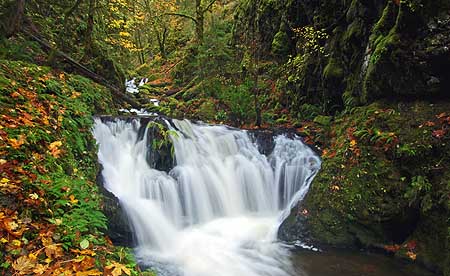
Emerald Falls on the proposed Gorton Creek Accessible Trail

The Mount Hood National Park Campaign proposes a major expansion of the trail system in the Columbia Gorge and around Mount Hood, including more opportunities for elderly, disabled and young families to experience nature. After all, hiking is the most basic form of active recreation, and should be available to all of us — especially as our region continues to grow and urbanize.

Proposed Gorton Creek Accessible Trail

Accessible trails are designed to provide access for everyone, and these facilities will be in growing demand as our country continues to age. By 2030, nearly a third of our population will be over the age of 55, and accessible trails will be in demand as never before.

In the spirit of providing accessible trails, this proposed new trail at Gorton Creek would allow for easy access to streamside vistas and photogenic Emerald Falls. This section of trail would bring visitors through a lush forest of Douglas fir, bigleaf maple and red alder.

GortonCreek02

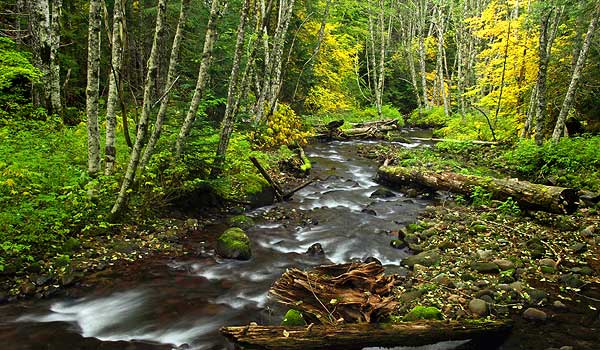
Autumn on Gorton Creek as viewed from the proposed location of an accessible viewpoint

Gorton Creek becomes increasingly prominent as the trail draws near the stream and the sound of rushing water fills the air. Just below the proposed viewpoint of Emerald Falls and rushing Gorton Creek, there is a large gravel beach at a bend in the stream that could even provide the potential for universal access to the stream, itself — a first in the region.

The accessible portion of the new trail would largely follow an existing boot path that, in turn, follows a very old roadbed still shown on USGS maps. Thus, the gentle grade that would meet accessible trail design requirements. The dashed yellow line on the map, below, shows where the roadbed segment could be improved to provide universal access to a streamside overlook just below Emerald Falls.

GortonCreek03

Proposed Gorton Creek Family Trail

Family trails are designed to allow young children on foot, in backpacks or in strollers to have their first nature experience, and hopefully begin a lifetime of active recreation in nature.

The second part of the proposed Gorton Creek Trail would be designed for young families, with a short, easy grade leading to a viewing platform below Gorton Creek Falls. The falls is a towering 120 foot plunge set against a magnificent wall of columnar basalt, and would provide an exciting destination for budding young hikers. This section of proposed trail is shown in red on the map, above.

The family trail portion of this project would a couple of important objectives. First, it would provide a new hiking option for families with beginning hikers, with easy access from Portland and the potential to camp at Wyeth Campground as part of the adventure. Such trails are in surprisingly short supply in the Gorge, and therefore often crowded when families are most likely to visit, depriving them of a quality nature experience.

Second, this segment of the trail would combine with the lower, accessible segment to allow for extended family outings — grandparents enjoying the lower streamside viewpoint as young children and parents hike the short family spur to the main falls viewpoint, for example, with the extended family camping or picnicking at the Wyeth Campground.

Gorton Creek Restoration

While this proposal would meet growing needs for accessible trails in the region, it would remedy an escalating problem at Gorton Creek: the secret is out on Gorton Creek Falls, and waterfall enthusiasts are wreaking havoc on the trail-less canyon section above Emerald Falls as they scramble to reach the main falls, upstream. The damage to the canyon slopes (see photos, below) and stream bed is particularly worrisome given the important role the stream has as fish habitat.

GortonCreek04

Gorton Creek Falls is no longer a well-kept secret. Each summer, more visitors are pushing cross-country through the upper canyon, leaving damaged slopes and trampled vegetation in their wake

Finally, trail construction could also allow for the washed-out waterworks at Emerald Falls (see photo, below) to be permanently relocated within the trail corridor, and less prone to the periodic failures that plague the current streamside alignment. The water pipeline is currently in a precarious condition, and would greatly benefit from a trail project happening in this canyon sooner than later.

GortonCreek05

The washed out water supply line for Wyeth Campground hangs from cables anchored to stakes below Emerald Falls

To visit Gorton Creek, drive east of Cascade Locks to the Wyeth exit, turn right, then turn right again on the old highway that parallels I-84. Watch for the Wyeth Campground on the left, just before a bridge over Gorton Creek. If the campground gate is closed, park to the side, and walk through the campground to the well-marked trailhead at the south end — otherwise, you can drive to the trailhead.

To reach Emerald Falls, follow the formal trail 0.1 miles to a junction with Trail No. 400, where it crosses Gorton Creek on an impressive footbridge that kids will want to explore. Continue straight, past the bridge and Trail 400, following the obvious footpath up the east side of the stream canyon for another 0.4 miles. Watch your step around Emerald Falls, as the water works erosion has left abrupt holes and weakened stream banks. Do the canyon a favor, and don’t scramble upstream to Gorton Creek — wait for a trail to be built, instead!

(Editors Note: Trail No. 408 already carries the name “Gorton Creek Trail”, but never comes close to the creek, traversing high above the canyon rim on the shoulder of Nick Eaton Ridge. This trail eventually climbs to the summit of Green Point Mountain — and thus, might be better named the “Green Point Mountain Trail” should a new trail along Gorton Creek become a reality, if not before)
Indian Salmon Harvest

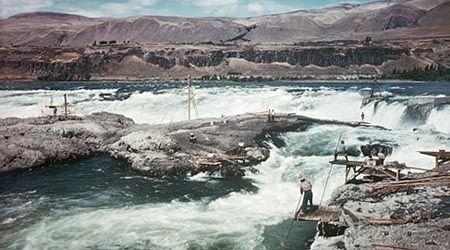
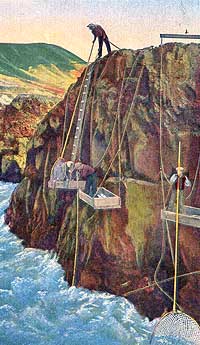
1930s painting of Indians fishing at Celilo Falls, as they had for thousands of years prior to white settlement of the Oregon Country.

1930s painting of Indians fishing at Celilo Falls, as they had for thousands of years prior to white settlement of the Oregon Country.

In recent years, conservationists have lined up against a proposed Indian Casino in the Columbia Gorge, and with good reason. While the project would certainly benefit the people of the Warm Springs tribe, it would also have unacceptable environmental effects on the Gorge (A better solution is to simply locate the casino in Portland, which is the obvious force driving the Cascade Locks location – separate article to follow).

But if you are a like-minded conservationist, you have an alternative for supporting the Native American economy that doesn’t involve slot machines. Simply pack a large cooler on your next visit to the Gorge, and stop by one of several roadside salmon markets, where Indians from the Gorge tribes sell fresh, “over the bank” chinook, coho, steelhead, sockeye, walleye and shad.

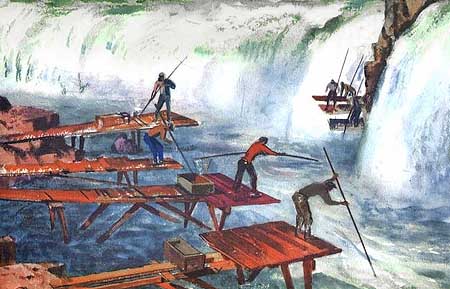
1930s rendering of Indian fisherman working the narrows below Celilo Falls

1930s rendering of Indian fisherman working the narrows below Celilo Falls

A surprisingly small number of urbanites who visit the Gorge support these fishermen, possibly because they don’t understand the fishery. But if you have never had fresh salmon, you will be pleasantly surprised at the difference in flavor between the tribal fisheries and the fish-farm salmon that your local supermarket is likely selling as “fresh” (dyed pink to disguise its origin, since fish farms produce a gray meat in salmon).

The tribes also sell the finest smoked salmon available, anywhere — after all, they have had thousands of years to perfect the smoking process, and smoked salmon can be eaten plain, as a snack or with hors d’oeuvres, or used in salads, pasta, casseroles or other cooked dishes. Fresh and smoked salmon freezes well, so buying during the fall harvest, in particular, can provide for a full winter of salmon in your diet. This is an excellent option when fish isn’t available at the roadside markets, and helps the tribes sustain their economy over the winter months, as well.

The Nez Perce, Umatilla, Warm Springs and Yakama tribes have had permanent rights to harvest salmon from the Columbia River under a series of 1854-55 treaties with the United States Government. While these treaties have been subject to much litigation — and questionable “compensation” agreements allowed for destruction of Celilo Falls in the 1950s — the tribes manage the fisheries today in cooperation with the state governments of Oregon and Washington through the Columbia River Inter-tribal Fisheries Commission. The focus of the Fisheries Commission is on habitat recovery and sustainable fishing practices, and ensuring that this ancient tradition isn’t lost.

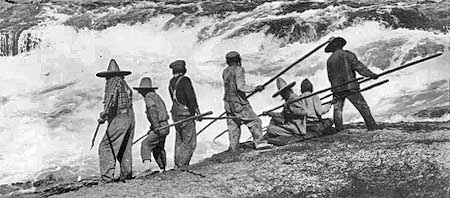
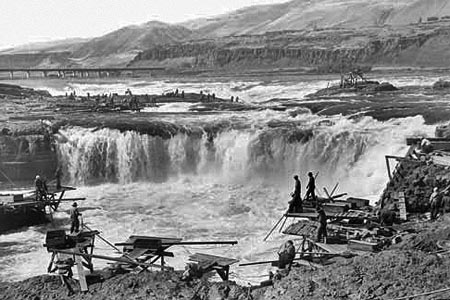
Indians fishing Celilo Falls with dip nets in the early 1900s, prior to construction of dams at Bonneville and The Dalles.

Indians fishing Celilo Falls with dip nets in the early 1900s, prior to construction of dams at Bonneville and The Dalles.

On a recent stop at the Cascade Locks market, beneath Bridge of the Gods, a young Indian in his teens asked me “if I knew any stories about Lewis & Clark”. I looked down at my faded t-shirt, commemorating the Lewis & Clark expedition, realizing why he had asked the question.

I responded with a few anecdotes from the expedition — how the Indians at Celilo had introduced the explorers to salmon, and in doing so, probably saved their lives. I also mentioned that the early white explorers unknowingly brought diseases with them that erased much of the native population, even before the huge waves of white settlers followed in the 1840s. To his apparent surprise, I also talked about the Corps of Discovery being the first true democracy in the United States, with an Indian woman (Sacajawea) and a black man (York) given equal voice at major turning points in the mission.
Upon that, he reached out, shook my hand, and said “thanks, man. I love to hear those stories.” But we both knew he was really testing my knowledge — and my respect for his native culture — to see if I was just another ignorant tourist in a Lewis & Clark t-shirt. I walked away with a bag of smoked salmon fillets and thinking what a complicated world it still is for young Native Americans.

You can learn more about the Indian Fishing Harvest at this official website, including the history of Indian fishing in the Columbia, where to find roadside stands, and how to buy fish from roadside vendors. Often, there are several vendors at a site, so if you plan to buy a few packages of fish, make your way from stand to stand, so that you support each of the vendors.

Restoring forests, one community at a time

Interior Secretary Ken Salazar set the Pacific Northwest forest recovery effort back on track in July when he reversed the Bureau of Land Management’s (BLM) Western Oregon Plan Revisions (the WOPR, a brilliantly unintentional blunder as acronyms go, as it became known as “The Whopper”). This represented a major step back from scientifically corrupt policies intended to enrich timber corporations at great cost to our public lands.

In this recent opinion piece in The Oregonian, Dominick DellaSala and Randi Spivak respond to Salazar’s move, and provide an excellent framework for how we should move forward to restore our public forests. Their prescription: emphasize needed thinning of the sickly, biologically sterile tree plantations left from the logging heyday of past decades, and embrace the value that our restored forests will have in the global effort to reduce carbon emissions.

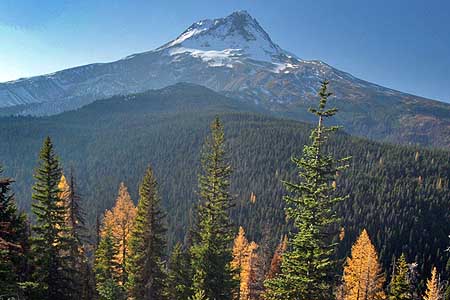
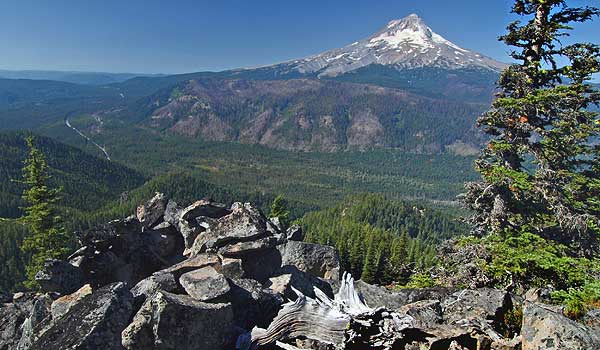
The eastside forests spreading out below Lookout Mountain look healthy enough from a distance, but in reality are in dire need of a bold new restoration strategy.

The eastside forests spreading out below Lookout Mountain look healthy enough from a distance, but in reality are in dire need of a bold new restoration strategy.

As described in their article, the Siuslaw National Forest has already begun to embrace this new approach, and other public forest managers are beginning to take notice. But a truly comprehensive restoration effort must be more aggressive, and should also focus on stabilizing the forest-based communities that were left to die when the big timber operations pulled out in the 1980s and 90s

Traditional thinning offers a couple of opportunities for local communities: the timber operations involve most of the same logging skills that were once the mainstay of rural Oregon. In addition, the harvested wood from thinning offers not only traditional saw logs for small mills, but also a new economic niche in the smaller woody debris that was once discarded or burned on site in the forests. New uses for small woody debris include engineered wood products and even energy production as biomass.

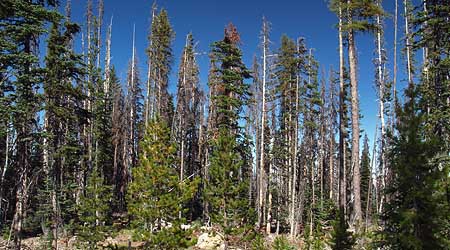
A closer view of typical second-growth forests near Lookout Mountain reveals a dying, overcrowded ecosystem under great biological stress.

A closer view of typical second-growth forests near Lookout Mountain reveals a dying, overcrowded ecosystem under great biological stress.

One practical challenge in reaching this new approach will be the scaled-back network of logging roads, since the over-built system constructed in the second half of the 1900s is rapidly crumbling and infeasible to maintain for the long term. One strategy is to tie road decommissioning to forest thinning and restoration efforts, pulling out obsolete roads after forests have been largely restored. Another could be aerial operations, perhaps even balloon logging. Still another could be roadless logging with light equipment or even horses — a practice well established on small, private woodlots in Oregon.

The key to finding this new balance in sustainable forest restoration a role of direct stewardship among the forest communities — to view them as the keepers of the forest, as opposed to the “forest dependent” mindset of the industrial logging era. This means establishing an ongoing relationship between community-based forest management organizations and the federal agencies that govern most of our public forest land. These new organizations could follow the lead of watershed councils and farm bureaus, using formal governance coupled with direct management responsibilities as forest recovery agents.

A bright spot in the restoration of the eastside forests near lookout mountain, this thinned plantation is beginning to resemble a natural forest, with multi-aged stands and a recovering understory.

A bright spot in the restoration of the eastside forests near lookout mountain, this thinned plantation is beginning to resemble a natural forest, with multi-aged stands and a recovering understory.

How would the economics of community-based stewardship work? In a commodity-based model of selling products recovered from thinning, the objective is straightforward — but unlikely to be profitable as a private enterprise.

Instead, the public will likely need to provide some level of subsidy for the restoration work involved, with commodity proceeds offsetting public costs. The advantage of a public subsidy is that it provides an ongoing public interest in the health and viability of the forest communities, themselves, and could help avoid the volatility that private timber harvesting brought to these communities in their first century.

A few stands of late succession ponderosa and Western larch forest still exist on the slopes of Lookout Mountain, providing a glimpse of what a restoration policy must aim for.

A few stands of late succession ponderosa and Western larch forest still exist on the slopes of Lookout Mountain, providing a glimpse of what a restoration policy must aim for.

But the more interesting idea is to create a long-term financial model for stewardship communities based on carbon sequestration as part of global efforts to reduce carbon emissions. Carbon credits would be sold as offsets to carbon polluters, and providing a permanent incentive to bring the northwest forests back to health.

The credits could be managed as a community trust, or managed through a public-private corporation. Under this paradigm, there would be little incentive to harvest large trees, since they would exist primarily as carbon storage units under the new carbon-based economic framework.

Of course, we also know that big trees and mature forests also provide a much wider array of ecological and social benefits, but these costs have never factored in to the short-term price for raw logs in the old timber harvesting paradigm. As DellaSala and Spivak point out in their article, the Pacific Northwest is uniquely capable of storing carbon in our living forests, and to a degree nearly unmatched in the world. If this potential is given a value, then we may well seen an end to the destruction of our mature forests for saw logs and pulp that could just as easily be manufactured from private plantation materials.

The concept of community-based stewardship in carrying out forest restoration is attainable, as evidenced by the many successful public-private partnerships that exist today. But it’s unclear if the Forest Service and BLM bureaucracies are flexible or willing enough to embrace the idea.

Instead, a new conservation-based form of administration may be needed — broader than the National Park Service in scope, but borrowing from the Park Service ethic of conservation and sustainability. The Cascade Forest Preserve, perhaps, extending from the Sierras to the Canadian border? Given the grave implications of climate change, it is impossible to think too big or boldly as we search for a way forward.

The Mount Hood Lily

MountHoodLily01

Second only to our towering Pacific rhododendron (Rhododendron macrophylum) in pure spectacle, the striking white trumpets of the Mount Hood lily are unforgettable. These handsome lilies often grow to more than six feet in height with as many as 20 flowers, each up to 8 inches in length. Never heard of the Mount Hood lily? That’s probably because you know this as the Washington lily (Lilium washingtonianum Kellogg), though it is also widely known as the Cascade lily and Mount Hood lily. A slightly variant race of the species in Northern California is commonly called the Shasta lily.

But the rather generic name of “Washington lily” is made more confusing by the simple fact that this beautiful plant doesn’t even grow in the state of Washington. Its northern extent is the area around Mount Hood, and its range extends down the Cascades and into the California Sierras. But thankfully, it turns out that the lily wasn’t named for the State of Washington, at all. Instead, the naming pre-dates Washington statehood.

In fact, botanist Albert Kellogg named this regal flower for Martha Washington, wife of our first president, when he first described the species in 1859. The spectacular, aromatic plants were soon collected for gardens and picked by forest visitors, locally decimating the population by the 1950s. Today, they have made a comeback, and are relatively common across their range, especially around Mount Hood.

Martha Washington and a Nineteenth Century rendering of our western lily named in her honor

Martha Washington and a Nineteenth Century rendering of our western lily named in her honor

Like most lilies, the Mount Hood Lily is a perennial that grows from a bulb, and thus the ease in collecting the species for commercial use. Native Americans also collected the bulbs as a food source. The plant grows in open woodlands and forest openings, often in surprisingly dry conditions.

In addition to multiplying their bulbs over time, the plants produce up to 200 seeds in the capsules that follow each flower. While digging the bulbs is strongly discouraged, collecting the seeds to grow in home gardens is a responsible, sustainable means of propagating the plants. Collected seeds of the native species, as well as many hybrids, are also available from specialized retailers.

So, in the spirit of provincialism, I propose that we rename this plant, simply because of the confusion over the name — after all, Kellogg named the plant in the year in which Oregon became a state, so he was likely unaware that another state in the Northwest would be named for George Washington.

There’s also the fact our first First Lady already has the aristocratic series of Martha Washington Geraniums (Pelargonium domesticum) named in her honor, and thus adding the Mount Hood lily is a mere asterisk in comparative prominence. Besides, Martha Washington has already had three postage stamps, two early dollar bills, several U.S. Mint commemorative coins and the only U.S. naval ship — the U.S.S. Lady Washington — to be named for a first lady.

As a modest and proper woman in the tradition of her time, surely she would cringe at this embarrassment of honors? And as the chief overseer of the Mount Vernon plantation and a gardener herself, surely Martha Washington would be the first to agree that the Mount Hood lily is a far superior name, both in descriptiveness and clarity?

This leads us to another simple compromise: when she tended to troops at General Washington’s side in the desperate struggle at Valley Forge, Martha Washington became known as Lady Washington, and a true heroine in her time. So, perhaps the Lady Washington lily would be a proper solution to our naming dilemma?

Between a rock and a hard place…

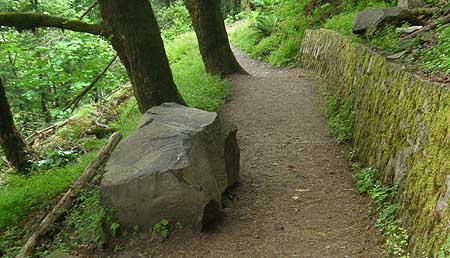
Sometime in the past couple of years, a refrigerator-sized piece of basalt split from the cliffs above Horsetail Falls, tumbled across two switchbacks on Gorge Trail 400, and landed perfectly on a third, forming a handy bench that only Mother Nature could design – or did she?

The convenient boulder that recently appeared on Trail 400, above Horsetail Falls - the work of man or nature?

The convenient boulder that recently appeared on Trail 400, above Horsetail Falls - the work of man or nature?

Rocks like this are constantly breaking loose from the walls of the gorge, usually far from the view or earshot of hikers. Through the relentless effects of water, and cycles of freeze and thaw during the winter months, bits and pieces of the stacked layers of basalt eventually break free, and join the enormous piles of talus that have accumulated beneath the cliffs over the millennia.

The new bench-boulder above Horsetail Falls is a bit chunkier than most, but tiny when compared to the house-sized boulders that are known to break loose on occasion. One infamous event near Wahclella Falls in the late 1960s was massive enough to send an entire subdivision of house-sized boulders into Tanner Creek, temporarily forming a small lake in the aftermath.

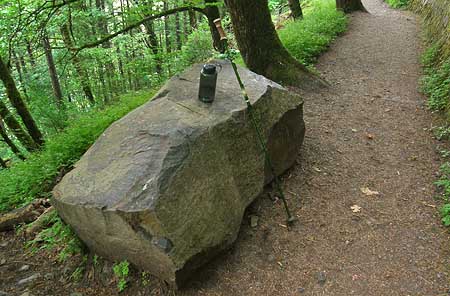
Looking down at the new boulder, the view is a bit more menacing, with a big bite taken out of the solid rock wall in the foreground, and a trail of debris, below.

Looking down at the new boulder, the view is a bit more menacing, with a big bite taken out of the solid rock wall in the foreground, and a trail of debris, below.

Assuming that the big rock did land in the middle of the trail, there are a couple of miracles that suggest divine placement. First, the boulder missed the adjacent wall, though it took a sizeable bite out of a retaining wall further uphill (see photo, above). Second, the boulder managed to land parallel to the path, and just far enough from the rock wall to allow hikers to easily slip between… a rock and a hard place!

It’s possible that trail crews could have jimmied this massive stone into its convenient position, but unlikely. Just one cubic foot of solid basalt weighs in at a staggering 188 lbs, which means that this fridge-sized weighs at least 12,000 pounds — more than six tons!

Perfect for a trailside respite, the big rock bench is already a favorite of hikers

Perfect for a trailside respite, the big rock bench is already a favorite of hikers

A more unnerving thought is the possibility of hikers actually witnessing nature at work, here, given the popularity of this well-traveled path nearly year-round. But, even with the scores of hikers walking by, there are plenty of quiet spells during the winter season, when this stone most likely made its move — and there’s also the dark of night.

However the big rock arrived, it has already become a popular stopping point for newbie hikers, puffing their way up the trail from Horsetail Falls, in search of Ponytail Falls. In this way, the big rock might just be Mother Nature’s way of tempting her most impatient species to stop and relax, if only for a moment.

Tunnel Point Wayside

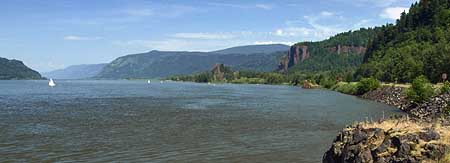
The sprawling vista into the Gorge from Tunnel Point Wayside

The sprawling vista into the Gorge from Tunnel Point Wayside

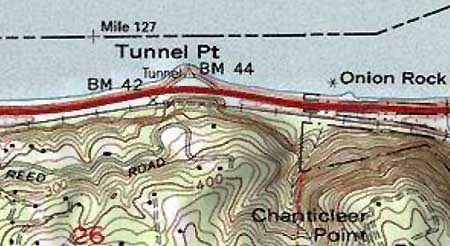
Mostly lost in the noise of Interstate-84, the tiny Tunnel Point Wayside is a forgotten bit of ground that deserves a little more respect. This spot is named for the railroad tunnel that cuts through the lower buttress of Chanticleer Point, to the south. In the early days of Highway 30 construction in the Gorge, the wayside at Tunnel Point was designed as a scenic turnout for visitors. From here, the first big view of the Gorge spreads out, with Crown Point and Vista House framing the scene.

TunnelPointMap

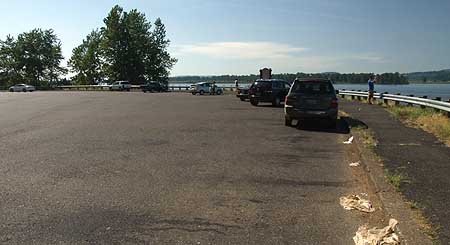
Today, freeway barricades prohibit access to the wayside for eastbound travelers entering the Gorge, and the turnout is an afterthought for most westbound travelers, since the Gorge view is behind them. The wayside has thus devolved into a huge, paved layover spot for semi-trucks — a sad epitaph for what should (and could) be a premier gateway viewpoint in the Gorge.

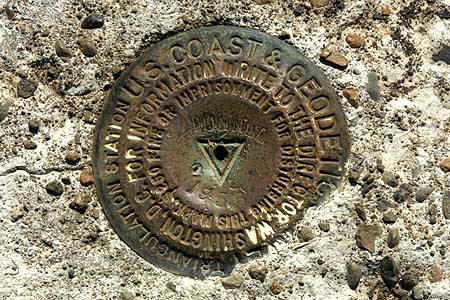
Tunnel Point has two U.S.G.S. benchmarks and a ship beacon bolted to its tiny, rocky cape. Beyond the sterile steel guardrail that borders the turnout, basalt cliffs drop 20 feet into the river. These little cliffs are likely remnants of a more noble formation, undoubtedly quarried to help build the modern highway in the Gorge in the 1940s and 50s. But they still give a sense of the natural environment that once existed here, and provide for an interesting shoreline along the river.

This USGS benchmark was placed in 1956, likely in conjunction with modern highway construction in the Gorge.

This USGS benchmark was placed in 1956, likely in conjunction with modern highway construction in the Gorge.

Look closely at these rocky mini-bluffs and you’ll see cliff-dwelling Gorge plants making a home, while red alder and Douglas fir are colonizing the rocky shoreline on both sides of Tunnel Point. Nature is making a valiant attempt to restore this spot, even if we humans are lagging in the effort.

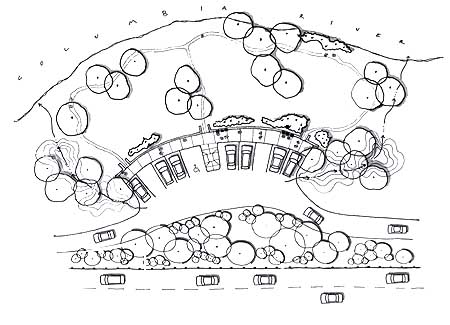
How could the Tunnel Point Wayside be restored? For starters, the massive expanse of asphalt could be redesigned to restore green areas, with landscaping, trees, picnic tables, restrooms and perhaps a travel information center. After all, this spot is as much a gateway to the Portland metropolitan area as to the Gorge, given that access is limited to westbound travelers.

Next, a series of walking paths could be added along the little bluffs, providing a place for travelers to stretch their legs, and learn a bit about the Gorge. A wooden Oregon History sign is already mounted in the parking area, and could be restored to become part of an improved interpretive display and walking path system.

Wasted space: the vast, barren turnout at Tunnel Point.

Wasted space: the vast, barren turnout at Tunnel Point.

These improvements would provide for a welcome refuge for travelers arriving in the Portland region from points east, but what about travelers entering the Gorge from the west? Providing access to eastbound visitors would be a tall order, requiring some sort of overpass or tunnel to deliver visitors from the opposite side of the highway. The cost, logistics and visual impacts probably make this infeasible, unfortunately.

But for now, improving the wayside for westbound traffic would be a big step in the right direction. Since the wayside is within the highway right-of-way, improvements could be built by the Oregon Department of Transportation (ODOT) with highway funds, in conjunction with Oregon Parks and Recreation. Tunnel Point Wayside deserves this new lease on life, and travelers in the Gorge deserve to enjoy this unique perspective of the river and Gorge.

Postscript: after writing this article a few months ago, I ran across a “generic” roadside pullout design in the 2005 I-84 Design Strategy — a joint ODOT, U.S. Forest Service, Federal Highway Administration and Columbia Gorge Commission planning document that lays out the framework for future improvements to the highway within the Columbia River Gorge National Scenic Area.

The schematic looks tailor-made for the Tunnel Point Wayside, and in this design, reclaims much of the parking area as a park with riverside loop trail. Though hard to see in this scaled-down version, the plan calls for just ten parking spots, with trucks obviously barred from entering (the truck stops in Troutdale are only a few miles further, after all). Most interesting are bio-swales on both sides of the pullout, draining the parking area and adding more green screening from the highway. A glimpse of what might be, perhaps?

Restoring Celilo Falls

Celilo Falls has always been phantom of history to me, since I born a few years after the U.S. Army Corps of Engineers buried the falls behind The Dalles Dam in 1957. My understanding of the falls and the loss it now represents has come from old photos and maps, and a few shaky film images.

The railroad bridge in the background of this iconic view is the key to locating the falls today

The railroad bridge in the background of this iconic view is the key to locating the falls today

Yet for many, the falls and the native culture surrounding them are alive and vibrant in their memories, thanks to seeing and experiencing them first-hand. For Native Americans, the vivid memories only add to the pain of losing a place that quite literally defined a people for millennia.

The idea of restoring the falls — even temporarily — has been suggested over the years, usually to be slapped down quickly by the Corps of Engineers as unfeasible, or even dangerous. In the late 1980s, a brief, 30th anniversary movement to temporarily draw down the pool behind the dam briefly gained local momentum before the federal agencies killed any talk of the idea. The Corps likely realized that revealing the falls to the public even once could make it politically impossible to ever refill the dam again.

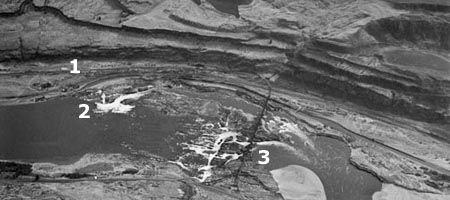
This 1940s aerial view shows the falls and railroad bridge, looking south

This 1940s aerial view shows the falls and railroad bridge, looking south

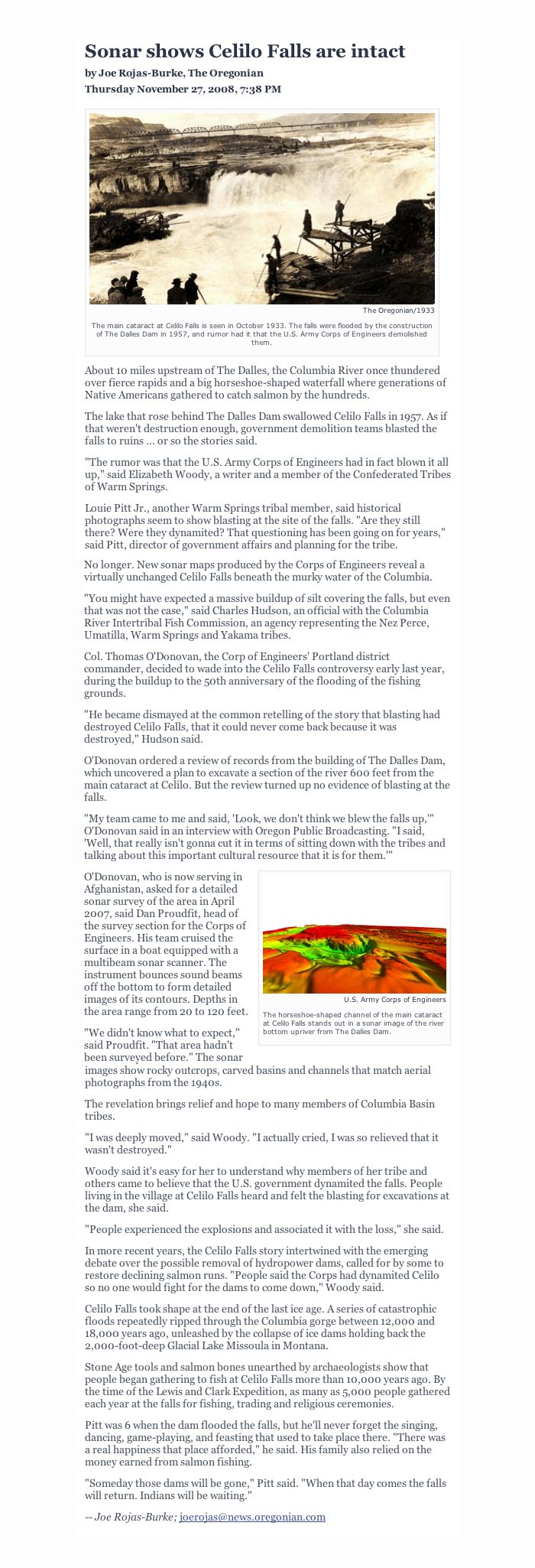
The hostility of the federal agencies toward even acknowledging the falls fanned the rumors among the local tribes that the falls had, in fact, been purposely destroyed by the Corps of Engineers just before they were inundated. This rumor persisted until last year, when a new mindset among Corps managers spurred the agency to compile a comprehensive sonar map of the falls to show that they are quite intact, beneath the still surface of the reservoir.

The sonar confirmation of the intact falls has breathed new life into the hopes of many that the falls will not just someday be restored, but perhaps someday soon. This is where the restoration of Celilo Falls fits within the scope of the MHNP Campaign: the emerging environmental theme in the coming century is restoration, and no place in the Pacific Northwest is more deserving — perhaps even the nation, considering that 11,000 years of Native American culture at Celilo makes it the oldest continuously settled place in North America.

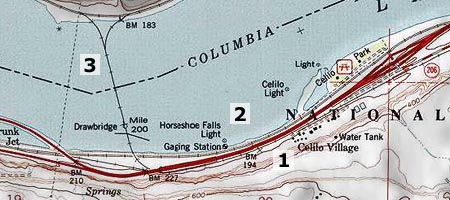
This map clip correlates today's landmarks to the aerial view of the falls, above

This map clip correlates today's landmarks to the aerial view of the falls, above

But the connection to Mount Hood is even more elemental: the mountain towers over the Celilo country like a beacon, and has been a similarly important feature in the culture of Lower Columbia tribes. Celilo and WyEast are connected, and so their restoration should be. A joined effort to heal these places expands the possibilities for both.

What will a restored Celilo Falls look like? Initially, it will likely be mineral-stained and muddy. But the new sonar maps confirm that silts have not overtaken the falls, so if the pool behind The Dalles Dam were simply lowered today, we would see a largely intact falls — perhaps even with traces of the cantilevered dip net fishing structures that once clung to the rocks around the falls. And over time, the falls would quickly recover to blend again with the surrounding landscape.

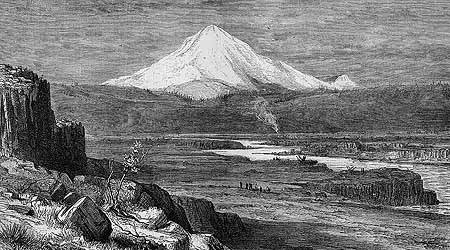
R. Swain Gifford's 1875 etching of Mount Hood towering over the Celilo Narrows is among the earliest geographically accurate renderings of the area

R. Swain Gifford's 1875 etching of Mount Hood towering over the Celilo Narrows is among the earliest geographically accurate renderings of the area

What would a restored Celilo Falls mean for the mid-Columbia economy? The immediate impact would be on power supplies, and it is unlikely that the falls could ever be restored without some alternate energy supply — perhaps a wind farm of equal wattage? — ensuring that no net loss in energy production would result.

The next big question would be impacts on shipping, but the good news here is that barges were already using the Celilo Canal to bypass the falls long before the dam was erected. The canal system would conceivably resume this function, if the falls were reborn, albeit with likely improvements and modernization.

These scene was photographed in the mid-1950s, just before the falls was inundated

These scene was photographed in the mid-1950s, just before the falls was inundated

What kind of protection should the restored Celilo Falls receive? That part is easy. The astonishing scope of history tied to the falls easily qualify the site for World Heritage status within the U.S. National Park System, perhaps as a National Historic Site. This would put the restored falls in a category with places like Mesa Verde, in Colorado, and provide the needed framework to preserve and understand the historic resources that lie beneath today’s reservoir.

Restoration of Celilo Falls is a long-term dream of so many, but movement in that direction really began as soon as the falls disappeared in 1957. The falls has never left our collective consciousness, and thus demands restoration.

Another small step toward restoration will occur in 2009, when the commemorative Confluence Project will bring an art installation to Celilo. The project is marking the two centuries since Lewis and Clark passed through the region, and the millennia of human history that makes Celilo unique. A small step, but also a bit more progress toward what I believe will be the inevitable restoration of Celilo Falls — under the gaze of a restored Mount Hood.

Fire Forests of the Cascades

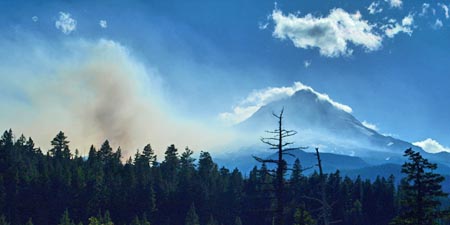
The Gnarl Fire of 2008 shocked Portlanders by racing across the east slopes of Mount Hood, and nearly destroying the historic buildings at Cloud Cap and Tilly Jane. But as an east side fire, the Gnarl burn was relatively small, and part of what has become an annual ritual for rural communities of fighting intense blazes along the east slope of the Cascades.

The 2008 Gnarl Fire, viewed in August from Dufur Mill Road

The 2008 Gnarl Fire, viewed in August from Dufur Mill Road

The cause for the intensity of these fires is well-known and well-documented. We know that a century of fire suppression, promotion of even-aged stands of second growth in logged areas and a changing climate are forces conspiring to burn the east side forests on a scale not seen in recent decades.

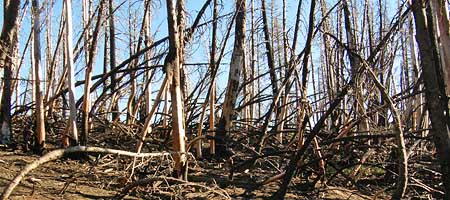
But not all of the east side fires are catastrophic, even with the fuel build-up from our history of fire suppression. The 2006 fire at Bluegrass Ridge was a glimpse into what was once a routine occurrence along the east side of the Cascades. The Bluegrass Fire began as a lightning strike in the dry season, and soon spread along the east face of the ridge in a mosaic pattern: some parts of the forest were completely killed, while others were a mix, where pockets of forest survived among the burned trees.

The aftermath of the 2006 Bluegrass Fire ranged from total destruction in areas like this, to mosaic patterns where less crowded forests existed

The aftermath of the 2006 Bluegrass Fire ranged from total destruction in areas like this, to mosaic patterns where less crowded forests existed

Most significantly, the larger, fire-resistant species like western larch and ponderosa pine often survive fires in these mosaic areas, and this was the case in the Bluegrass Fire. We will know in a year or two whether the extensive larch population in the Gnarl Fire area were similarly resistant.

The survival of these big trees is the key to the natural ecosystem that defines east side forests. Forest ecologists are now calling these east side regimes “fire forests”, as a counterpoint to the west side rain forests, where abundant rainfall is the operative element in defining the forests.

The “fire forest” name is apt, since we now know that a number of tree species in this dry forest system depend on fire for natural succession that creates mature forests. In the Mount Hood area, these east side trees are Douglas fir, western larch and ponderosa pine. All three have thick, fire-resistant bark that helps them survive moderate fires, and benefit from periodic clearing of undergrowth that competes for moisture and soil nutrients. Fires, in turn, release nutrients for the big trees, further enhancing the growth of fire-resistant species.

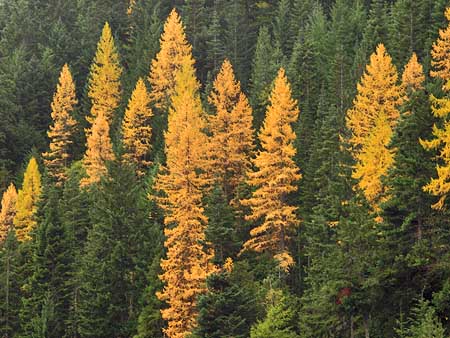
Western larch light up the eastside forests in autumn. Larch are among the fire-resistant species that require periodic burns for their long-term health

Western larch light up the eastside forests in autumn. Larch are among the fire-resistant species that require periodic burns for their long-term health

The question for the east side forest is not whether they will continue to burn — they have evolved with fire, after all — but rather, how we will learn to live with the fires. We now know that we cannot simply extinguish them. A century of fire suppression has created mammoth fires that we simply cannot control.

We also know that we cannot prevent forest fires from starting, since the large majority begin from lighting strikes. And we know that many more catastrophic burns will occur before the east side forests return to a more sustainable condition that mimics the natural ecosystem that once thrived.

Most ominous is the recent discovery — from tree-ring research — that the Western states are coming off an unusually wet century, and that the decades ahead are likely to carry more drought, not less. So it is imperative to help the east side forests stabilize before conditions make that proposition still more difficult.

These mature, healthy forests of western larch, ponderosa pine and Douglas fir along Bluegrass Ridge survived the fire

These mature, healthy forests of western larch, ponderosa pine and Douglas fir along Bluegrass Ridge survived the fire

A first step is continuing to thin tree plantations on logged lands to help prevent still more crowded, bug-infested forests like those that are currently driving the fire epidemic. The second step is more difficult: letting fires burn. This policy will be most difficult in the many areas where rural development has encroached on forest boundaries, but it is a necessary step. Both of these steps will require a new mindset about fire, not the least of which will be a public education shift away from Smokey Bear and fire suppression and toward a modern understanding of fire.

But a third step is most difficult of all: setting fires in prescribed locations to help restore forest balance. While the rash of east side fires in recent years has made this part of restoring forest balance less urgent, it will still be necessary — and controversial. Federal agencies have already begun employing this tool, but in cases where a controlled burn becomes a wildfire, the public is not prepared to understand why that risk is necessary — and perfectly natural. Still more public outreach and education will be needed.

The good news is that the scientists are winning this debate, and even the Forest Service has gradually begun to embrace fire ecology as part of their management philosophy. The Park Service is much further long, having successfully weathered the early criticism of their prescient decision to let the huge Yellowstone fires of the mid-1980s burn.

The remarkable resilience and recovery of Yellowstone in the intervening years has not only been vindication for that bold decision, but also an invaluable lesson to land agencies across the west who are responsible for managing “fire forests”. The time to embrace fires in our forests has arrived.

Phoca Rock

An early 1900s postcard shows a steam ship passing Phoca Rock

An early 1900s postcard shows a steam ship passing Phoca Rock

Anyone who has made a few trips through the Columbia Gorge has noticed the small monolith that pokes out of the center of the river near Cape Horn. This is Phoca Rock, and its distinction lies partly in the fact that it is one of the few landmarks in the Gorge that carries the name given by Lewis and Clark on their 1805-06 Corps of Discovery journey.

Lewis and Clark didn’t actually name the rock until they were camped on the Oregon Coast, and compiled their journals while suffering through a dank Northwest winter. William Clark named the rock for the abundant harbor seals spotted in the river – phoca vitulina.

Harbor seals basking in Alaska's Tracy Arm

Harbor seals basking in Alaska's Tracy Arm

Harbor seals are still native to the lower Columbia River, although in smaller numbers than when Lewis and Clark paddled through. Government bounties in Oregon and Washington killed more than 20,000 Harbor seals in the two states from the 1920s through 1972, when hunting was finally banned.

The Harbor seal population has since rebounded from fewer than 7,000 seals at the time of the ban to more than 17,000 today. Still, biologists in both states must monitor the seals for health and impacts from commercial fisheries.

Phoca Rock continues to serve as a river beacon today, marking the edge of shipping lanes on the Columbia. The rock marks the edge of two-foot shallows along Oregon’s Sand Island and the 45-foot deep Candiana Channel that separates Phoca Rock from Cape Horn, on the Washington side.

Phoca Rock today, as seen from Bridal Veil State Park

Phoca Rock today, as seen from Bridal Veil State Park

Clark estimated the rock to be 100 feet tall, but today we know it to be just 30 feet. Its prominence lies in its isolation, and early names for the rock underscored this point: beginning in the mid-1800s, Phoca was alternately called “Hermit’s Islet”, “Lone Rock” and “Sentinel Rock” before the federal government finally restored the original name given by Lewis and Clark, in the early 1900s.

This 1911 map shows Phoca Rock with its restored name

This 1911 map shows Phoca Rock with its restored name

So, why is Phoca Rock sitting alone, in the middle of the Columbia River? Chances are the rock isn’t a tiny cousin to nearby Beacon Rock, the exposed, solid core of an ancient volcano. Phoca is more likely an outcrop of the Grande Ronde basalt flows that produced the cliffs of Cape Horn, to the north, and the Pillars of Hercules, along the Oregon shore.

One of many old postcard views that show "Sentinel Rock", one of the itinerant names for Phoca Rock

Diminutive Phoca Rock is as tough as it is tiny. The rock survived multiple Missoula Floods, after all, and thousands of years of parting the waters of the Columbia River. And left alone, Phoca Rock will continue to weather the elements for millennia with little change, long after the ribbons of asphalt and steel that line the Gorge have vanished.

Unfinished work at Tumala

Most of us grew up using the word “squaw” as the counterpoint to “brave” in our one-dimensional, Hollywood version of Indian culture. But historians and Native Americans always knew this word to be derogatory and offensive in its original use, so the current national efforts to remove “squaw” from maps and places is long overdue.

In Oregon, the list of places using this name numbers 172, but nowhere was there such a concentration as in the Roaring River high country, where no less than four features — plus a road — were named “squaw”.

Acting on a legislative directive, the Clackamas County Commission began the work of changing the names of “Squaw” mountain, meadows, lakes and creek to “Tumala” in 2007, and the Oregon Geographic Names Board completed the work in early 2008. Tumala is a Chinook word meaning tomorrow, or afterlife, and is as good a name as you might wish for in this lovely mountain blend of craggy peaks, big trees and sunny meadows.

Beautiful Tumala Lakes and Meadows in the Roaring River backcountry

Beautiful Tumala Lakes and Meadows in the Roaring River backcountry

But the work here has only begun. Tumala Mountain and the surrounding country are rich with Native American and early pioneer history, yet little has been done to simply preserve the legacy, much less celebrate it.

Native Americans hunted and foraged along the high ridges of Tumala Mountain area for centuries, and likely set fires to keep the huckleberry slopes productive.

In the autumn of 1855, a 22-year old U.S. Army lieutenant named Henry Abbot and his 18-year old Indian guide, Sam-ax-shat, led a survey party across the Cascades. They followed the high divide between the Salmon and Roaring rivers, and passed through the Tumala Lakes basin, a protected refuge with water and grazing along the high ridge top.

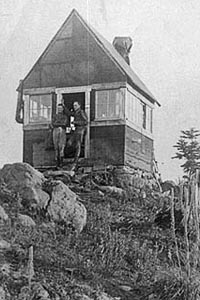
Abbot’s journey lent his name to the early Forest Service road that would later be built along this route, in the 1920s. A string of fire lookouts, guard stations and a network of trails soon followed in this corridor. The lookout on Tumala Mountain was rebuilt at least twice, before it was finally removed in the 1960s, when the Forest Service burned hundreds of old lookout structures that were no longer in use.

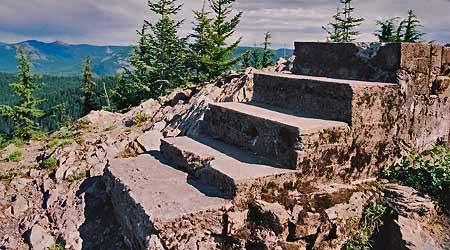
Stairway to the past, these steps once led to the lookout atop Tumala Mountain

Stairway to the past, these steps once led to the lookout atop Tumala Mountain

Today, the old road to the Tumala Mountain lookout site still exists, but serves mainly to deliver motorcycles and OHVs to the fragile mountain summit. The Abbot Road, itself, has become a sad, dangerous shooting gallery overrun by OHVs and target hunters. Tumala Meadows and Lakes are also within reach of the OHVs, despite efforts to keep them out of this remarkable basin.

The original lookout on Tumala Mountain, pictured in 1916 (USFS photo)

The original lookout on Tumala Mountain, pictured in 1916 (USFS photo)

So the name change is a starting point, but the work here is unfinished. At Tumala Mountain, the solution is simple: the area must be managed for activities that build on the natural and cultural legacy, and help preserve the traces that still remain.

The first step in making this transition is to remove the shooters and OHVers from the area. Until they are gone, hikers, picnickers, cyclists and equestrians are unlikely to feel safe visiting the area, and the area will continue to suffer the abuse that is so evident today.

A message from the builders of the old lookout awaits hikers who discover the stairsteps that still remain

A message from the builders of the old lookout awaits hikers who discover the stairsteps that still remain

Unfortunately, the Forest Service is on the path to do just the opposite: the so-called “Mount Hood Travel Plan” currently underway has proposed that this area simply be written off as an OHV playground. This is unacceptable, and another reminder that the USFS agency mission simply does not allow it to behave as a responsible steward for the land.

But beyond the OHV problem, the second part of the puzzle is how to make the area more inviting for quiet recreation? There is no lack of scenery or interesting destination, after all. Indeed, this would most involve simple measures like better road and trail signs and improving lost campgrounds like those at Lookout Springs and Twin Springs — both would be excellent base camps for equestrians or cyclists. With a few improvements and the promise of finally solving the OHV and shooting problems, the area would become a prime outdoor destination.

This unfinished work can start now, by simply weighing in against the foolish, shortsighted OHV plan with the Forest Service. This would at least stop the bleeding.

But in the longer term, the unfinished work at Tamala — “tomorrow” — Mountain would be better managed by the National Park Service. Tumala is yet another reminder that the Forest Service cannot be trusted to protect and celebrate the natural and cultural legacy of Mount Hood.

Vision Quest Sites

The Lookout Mountain vision quest site is perched high on rocky cliff

The Lookout Mountain vision quest site is perched high on rocky cliff

One of the great thrills of exploring remote mountain tops and rocky outcrops in the Mount Hood backcountry is stumbling upon a long-forgotten vision quest site. These are typically rock pits, large enough for a person — though modern visitors should never enter them, out of respect for both their spiritual and scientific significance.

Archaeologists are still debating the purpose of these pits. The most accepted theory is that these pits were built by Native Americans seeking a vision of their guardian spirit through a combination of physical exertion, deprivation and isolation. Under this theory, Native Americans would have spent several days building these pits, then meditating in them without food or human interaction in order to achieve a spiritual experience.

Other researchers argue that the pits were used as hunting blinds or to store food. But these alternative theories are hard to accept for locations like those around Mount Hood and in the Gorge. Most of this sites are on huge talus slopes or mountain tops, which would have been inconvenient as a food cache or for retrieving killed game.

The Lookout Mountain vision quest pit pictured here has still more mystery surrounding it. While the location of the pit is typical – high on a rocky knoll, overlooking the East Fork valley and Mount Hood – the walls of the pit are stacked higher and narrower than most, possibly due to the steepness of the site.

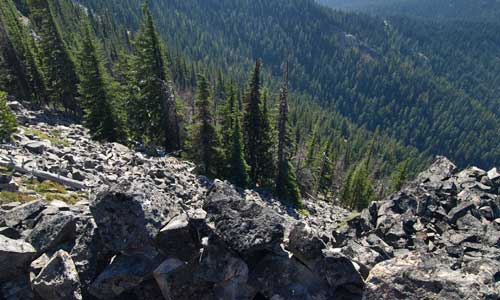
Looking down the steep slopes of Lookout Mountain from the vision quest pit

Looking down the steep slopes of Lookout Mountain from the vision quest pit

But even more perplexing are the worn traces of mortar between some of the stones (seen in the wall of the pit, toward the bottom of the second image). One possibility is that the mortar was an early attempt to preserve the site, given it’s fragile and exposed state. But who would have hauled both mortar and water to this site?

Perhaps early forest rangers who once manned a Forest Service guard station at High Prairie, a short distance away. The guard station was abandoned half a century ago, so this timing would be consistent with other, early 20th Century effort to “restore” Native American structures. This was famously done at several spots in Pueblo country, but might have happened here, too.

Whatever the answer, the Lookout Mountain vision quest site is among the most inspiring in the area, and it’s easy to imagine Native Americans seeking out spots like this for a spiritual journey. But it’s also easy to imagine sites like this being lost forever, for lack of a management imperative by the U.S. Forest Service to actively protect these places.

This kind of fragile resource is also among the best arguments for the Mount Hood National Park Campaign, since the Park Service has a long and proven track record of this sort of resource protection. In contrast, the Forest Service has aggressively logged much of the terrain around this site, oblivious to special places like this. So for now, obscurity is the best friend of these resources, until better stewardship finally comes to Mount Hood.

Just 75 Years

Autumn unfolds along McGee Creek, in the upper West Fork Hood River valley

Autumn unfolds along McGee Creek, in the upper West Fork valley

This scene in the headwaters of the West Fork of the Hood River was captured a few weeks ago, as early autumn colors began to sweep through the forest. This particular stream is McGee Creek, one of the larger tributaries that feeds the West Fork. Most hikers know McGee Creek from its alpine origins, where it tumbles from the wildflower meadows that sprawl below popular McNeil Point. But the creek soon enters lush forest on its way to joining the West Fork.

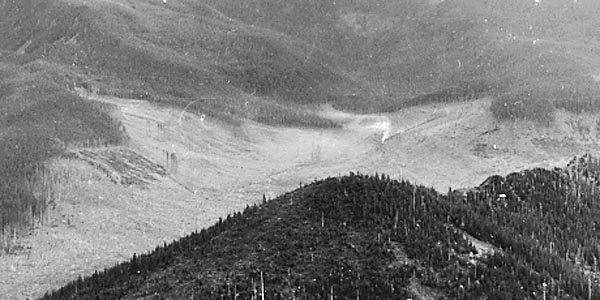
The surprise is that none of this existed just 75 years ago, when massive railroad logging operations had leveled the virgin forests of the West Fork. Look closely at the following image, captured in 1933 from high above the West Fork valley; the methodical clearing of the forests on the valley floor is nearly complete, and the steam plume from a log train headed back to the old mill town of Dee can also be seen:

By 1933, railroad logging had nearly cleared the West Fork valley

The steam engine in this old photo is at roughly the same spot as the autumn scene in the upper photo, illustrating the remarkable resilience of our forests. In about the span of an average lifetime — just 75 years — the forest along this stretch of McGee Creek has recovered from complete destruction, largely on its own. This is good news for other areas of Mount Hood and the Gorge that still show the scars of logging and road building. Given time and some modest restoration efforts, even the most damaged ecosystems will recover.

The autumn scene on McGee Creek also holds some lessons for restoration that may not be immediately obvious. The large log lying along the right side of the creek, for example, was carefully placed there by biologists, just a few years ago. This was in recognition that a century of logging has deprived our streams of large woody debris that turns out to be an essential ingredient for healthy fisheries.

Perhaps most importantly, the white-trunked alders that line McGee Creek show that the forest here is recovering through natural succession. These pioneering trees provide quick cover and their dense root systems help prevent soil erosion.

Red alders are short-lived, adding their fallen debris to the rich duff layer they help build in recovering areas. Amazingly, they actually fix nitrogen in the soil through their roots, enriching it for the big conifers that will follow. Finally, the light canopy they provide allows for a complex understory of plants to develop in tandem with the alder groves, ensuring that forest diversity is re-established during the recovery cycle.

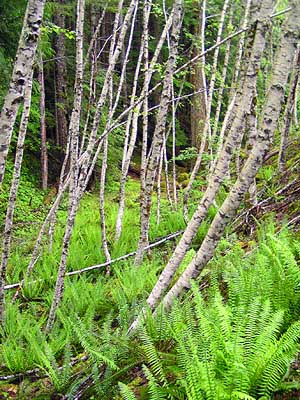
A typical red alder grove pioneering the recovery along an old road

A typical red alder grove pioneering the recovery along an old road

When McGee Creek was logged, the natural recovery that followed was mostly accidental — early timber operations viewed the forests as limitless, and logged areas were mostly ignored once the trees had been cut. The shift to cultivated tree farms didn’t begin until the late 1940s and the era of road-based logging.

In these more recently logged areas, the pioneer, non-commercial hardwoods like red alder were usually killed with herbicides in order to promote the quick growth of commercial timber species, especially Douglas fir. This practice has led to the thickets of crowded fir trees that we see today. These unnatural stands are vulnerable to disease and fire, and have almost no understory to provide for bio-diversity and wildlife habitat.

Sadly, it will take decades to thin these misguided plantations and decommission the failing logging roads that threaten streams and slopes. But though the task of forest recovery and restoration is a tall one, the good news is that the lessons of natural succession from places like McGee Creek have worked their way into forest management. Our scientists are now learning to work with nature, not control it — by letting the red alders grow.

As we continue to turn the page on past practices and begin a new era of restoration for the forests of Mount Hood, we can take some degree of consolation in knowing that a complete recovery is well within our reach. By watching and learning from the forest ecosystem, we now realize that the natural processes that have renewed our forests for millennia must be allowed to follow their ancient course, once again.

Reid Glacier

Soft evening light on Reid Glacier and Illumination Rock

Soft evening light on Reid Glacier and Illumination Rock

Reid Glacier, on Mount Hood’s rugged west flank, is one of the most interesting of the mountain’s 12 glaciers. This tumbling body of ice flows between the towering walls of Yocum Ridge and Hawkins cliffs, with the tall spire of Illumination Rock soaring above its deep crevasses. Oddly, Reid Glacier is the source of the Sandy River, whereas the Sandy Glacier gives birth to the Muddy Fork – some confusion on the part of early cartographers, perhaps? And while the Reid is among the most visible of Hood’s glaciers from Portland, few hikers actually make the long climb to the high meadows of Yocum Ridge for a close-up view of the glacier.

USGS view of the Reid Glacier

USGS view of the Reid Glacier

Reid Glacier is also unique as the only one of Mount Hood’s glaciers that wasn’t named for a local pioneer, or simply given a descriptive name. Instead, this secluded river of ice was named to honor Harry Fielding Reid, the eminent geophysicist who is considered to be the father of modern thinking on faults and tectonic forces.

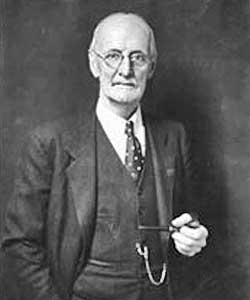
Harry Fielding Reid (1859-1944)

Harry Fielding Reid (1859-1944)

Reid never actually visited the glacier, though he was an avid mountaineer and did study the White River Glacier extensively. The Mazamas honored Reid by naming the glacier for him at a campfire ceremony held on the mountain on July 16, 1901.

Harry Fielding Reid’s research took him around the world, and his groundbreaking work at Glacier Bay in Alaska was recognized by the naming of yet another Reid Glacier for the scientist. The Alaska glacier by the same name is much larger, of course, and is a tidewater glacier flowing into the Reid Inlet in Glacier Bay. Thus, the smaller Reid Glacier on Mount Hood lives in the shadow of its larger sibling in Alaska, with few biographies of Harry Reid making mention of the more diminutive Mount Hood namesake.

Today, the Seismological Society of America awards its top honor, the Harry Field Reid Medal, for outstanding contributions to the fields of seismology and earthquake engineering.

Just Two Dead Trees

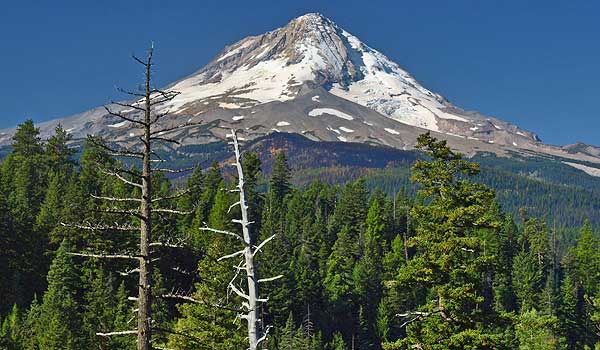
The two snags and Mount Hood in September 2008

The two snags and Mount Hood in September 2008

For many years, I’ve stopped at a favorite vantage point along Dufur Mill Road to photograph the massive east face of Mount Hood, framed by a trio of big ponderosa pines. In the beginning, two were living, and the third was a bleached, dead snag that stood between them. Then another died just a few years ago (the tree on the left in the photo), creating a new snag.

Each year, the two snags in this trio have become more weathered, with the remaining bits bark dropping from the silver wood of the older snag, and a few more branches dropping from the younger skeleton. I watched this evolving scene with interest, but also took for granted. I was thus surprised — and saddened — to discover that these two, old sentinels had been cut down sometime this fall.

They were left simply lying on the ground, in the ravine far below the road, and it’s unclear why they were cut. When I was there, a pair of grizzled men were cutting firewood along the road, a sanctioned activity permitted by the Forest Service. Yet, these two great snags were far enough below the road to represent a real chore to recover as firewood. Indeed, the men were working the uphill side of the road, where logs could simply be rolled down to their truck. More to the point, there is plenty of downed timber for woodcutting in the area, so it was unnecessary to cut any snags, much less these two giants.

But somebody felled them, and this is just one price of the casual culture of tree cutting that reduces every standing tree on U.S. Forest Service land, dead or alive, to a dollar value in board feed of lumber, or cords of firewood or cardboard boxes. What a waste.

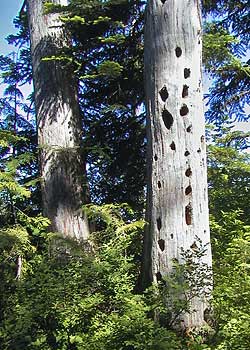
Two more fortunate snags live on as wildlife trees near Lost Lake

Two more fortunate snags live on as wildlife trees near Lost Lake

So this story remains a puzzle to me. I doubt many noticed these two old snags, but they surely added to the scene in ways both aesthetic — they were majestic and photogenic — and functional, since big snags are an important part of a diverse wildlife habitat in our forests. I’d often seen crows, and even a couple of hawks, sitting in these old snags over the years, and there were probably dozens of other creatures that lived in these old skeletons, or relied on them for survival.

They might have lasted for decades as bleached monuments, too. Mount Hood is dotted with century-old snags left from fires that occurred in the early 1900s, after all, since big trees like these have remarkable resistance to the elements as snags. But this pair will only remain standing in my imagination, and I’m thankful that I captured them in a few photographs over the years as a reminder of their beauty and value.