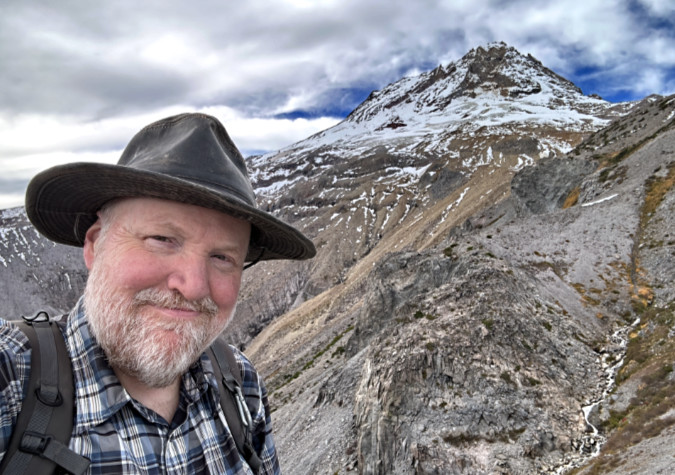
WyEast Blog News!

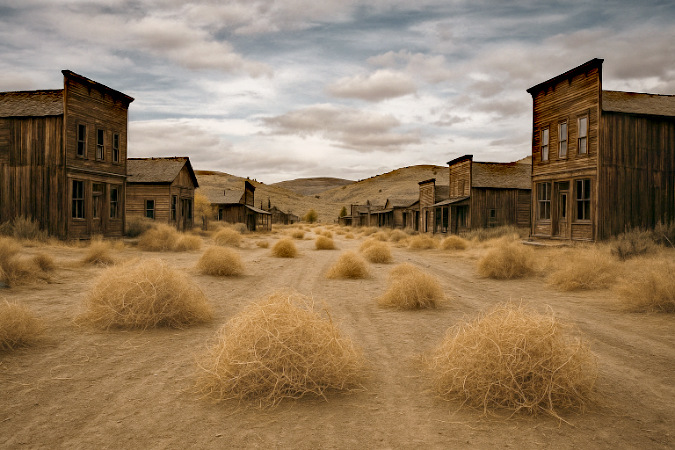
What AI thinks of the WyEast Blog of late…. uncanny accuracy!

The crickets are chirping and (AI-generated) tumbleweeds are rolling around the WyEast Blog this fall, so I thought I’d post an overdue update: the blog lives! Just a bit behind on posts.

First off, some personal news: I’ll be retiring after 40 years in public service at the end of this month! I surely never planned to work this long, but I’ve been gifted with a job I love, an amazing agency to be part of for 33 of those years and with a team of co-workers who have become like family, many whom I have worked with for decades. Most every day is rewarding and fun, and for that I feel stupid fortunate!

Young punk in the 90s in luxury window cube…. This was weekend attire, by the way. The internet hadn’t been invented just yet, so working overtime mean a trip into the office, typically on Saturday mornings. Lots of museum pieces on my desk – notably, Kodak slide trays and a preview carrousel projector on the far right that we called R2D2. Fancy cassette/CD boombox on the shelf (probably playing Everclear or Green Day… it was the 90!) and a Macintosh Centris computer on the desk. 

However, sometime early this year I knew the time was right. I’ll be 64 in January, after all! Mainly, it was the fact that I’ve been able to bring a new tier of diverse, talented young professionals onboard since COVID amid the “great resignation”, making it much easier to hand off the baton and step aside. The luxury of an orderly succession in these times has been profoundly rewarding, knowing that the future of the organization I care so much about is in great hands!

Old fart reprising the previous 90s pose in my old cube for a photo-op a few weeks ago. CRT monitors have long since given way to flat screens and I don’t think the younger workers could identify a slide tray if I were to put one in their hands. The building was completely remodeled after COVID to a “hoteling” format with no formal offices. Today, most workers (myself included) working a hybrid schedule of telework/in-person days. It’s a brave new work office world!

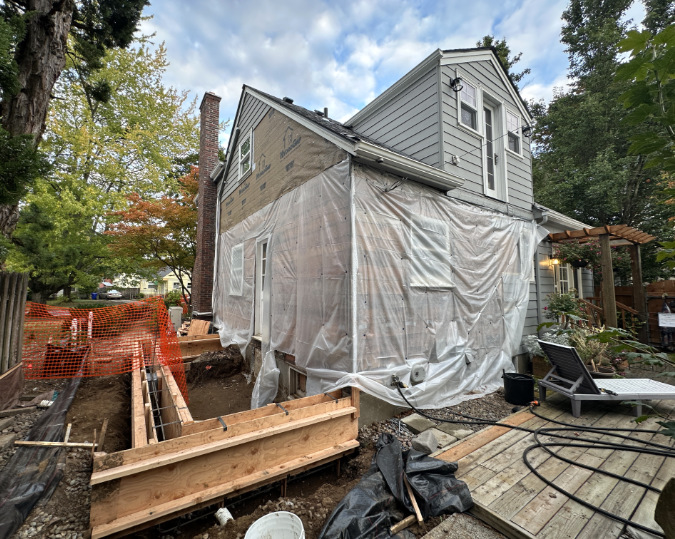
The race toward retirement over the past few months has been a hectic transition for my team at work, but to spice things up, my wife and I kicked off the second phase of a major home renovation we started during COVID, and that has been in the works since we bought house more than 33 years ago. The timing wasn’t the intended plan, as we started working on the design way back in January, but it has combined with my retirement sprint to create a perfect storm of (muddy) chaos on the home front. 

Foundation forms for a kitchen addition to our old 1944 house in North Portland. Project completion is scheduled for February!

A saving grace is that much of the work that I’m contributing to the project (interior painting, casing and trimming windows and doors, installing pantry cabinets and building a new back porch… it’s a long list!) begins in January, in tandem with my retirement. I can’t say that was well-planned, but it turned out to be fortuitous timing.

Looking ahead to retirement, my plans include MUCH more time on endeavors like this blog. plus time up on the Mountain and in the Gorge, of course. I continue to serve on the board for Trailkeepers of Oregon (TKO) and have various projects I’m involved in on that front that I’m looking forward to leaning into, as well.

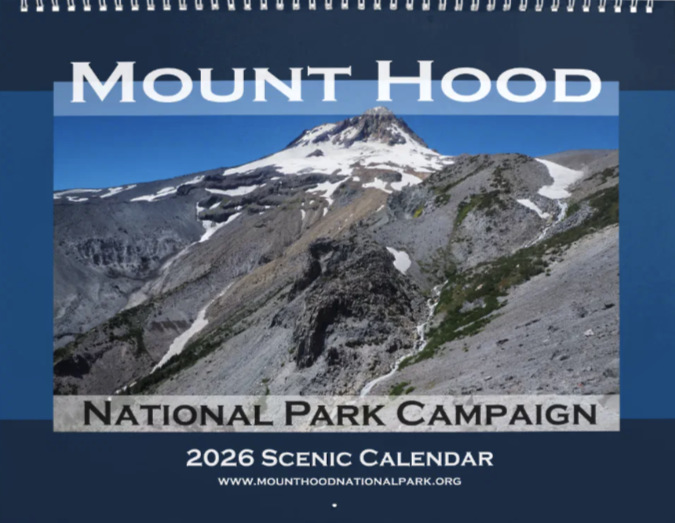
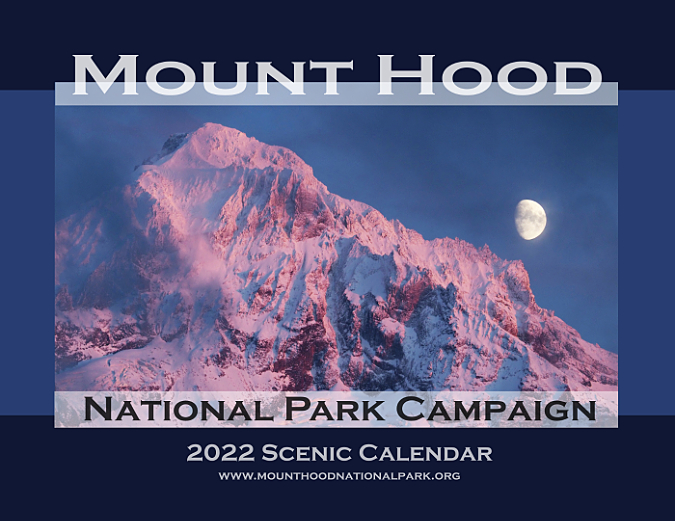
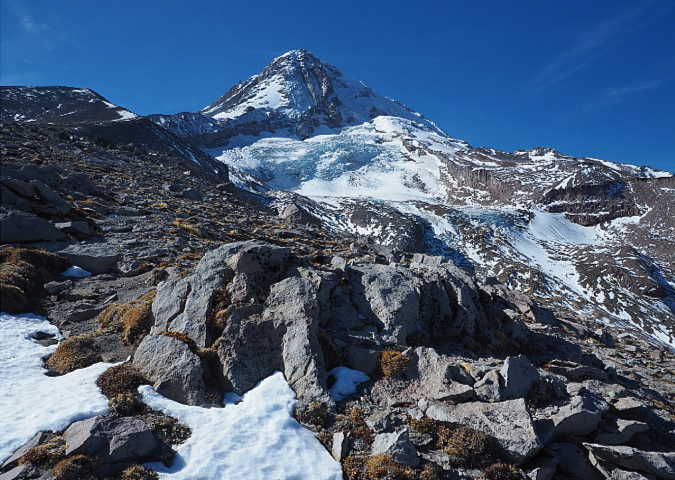
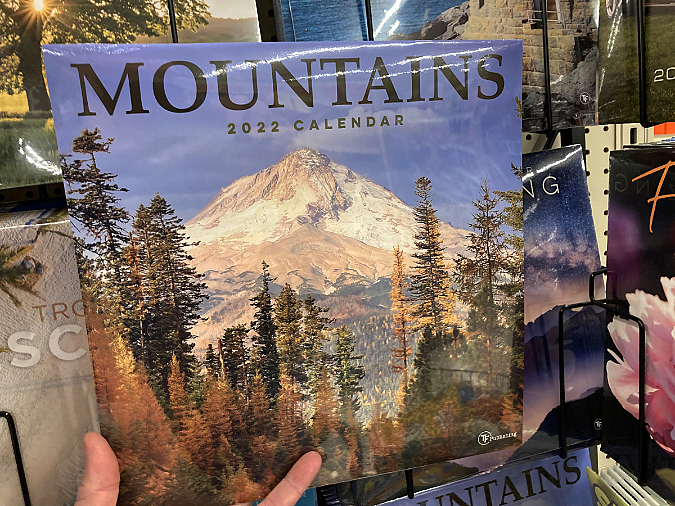
On that note, I’ll close with my annual calendars, as all proceeds go straight to TKO. This year I’ve branched out a bit, with dual calendars. First up, the 23rd edition of the Mount Hood National Campaign calendar, featuring the view from Gnarl Ridge on the cover for 2026:

 2026 Mount Hood Calendar cover

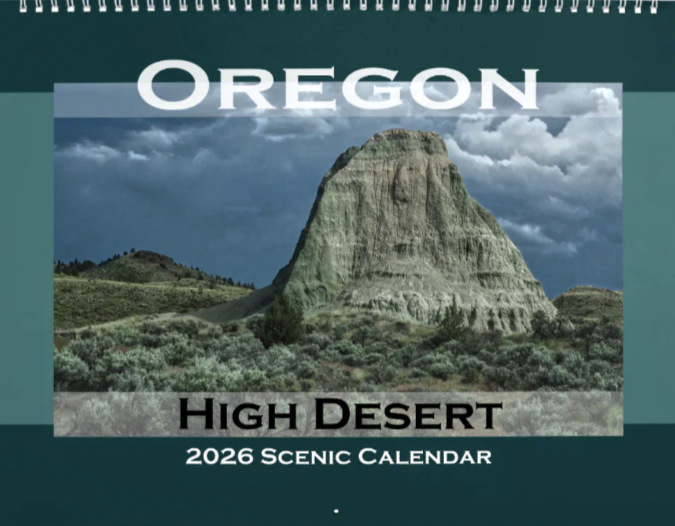
And for something a bit different, I’ve also created an Oregon High Desert calendar:

2025 Oregon High Desert Calendar cover

The desert calendar is a bit of a preview of my retirement, as I began making what I call my “old man in the desert” trips in spring and fall each year since COVID in what was initially an effort to simply isolate and avoid crowds. These trips ignited an old passion for Oregon’s Outback that remains strong for me, and thus the collection of photos for this calendar. I’m already planning my spring “old man in the desert” escape!

Both calendars measure 11×14″ and are printed on glossy, high quality stock. They are available on my Zazzle store at the link below — including full previews of the monthly images:

Tom’s Mount Hood and Oregon Desert Calendars

Zazzle ships relatively quickly, so if you’re looking for stocking stuffers, these should arrive by the holidays if ordered in the next week or two. You can also ship them direct as gifts from the Zazzle store!

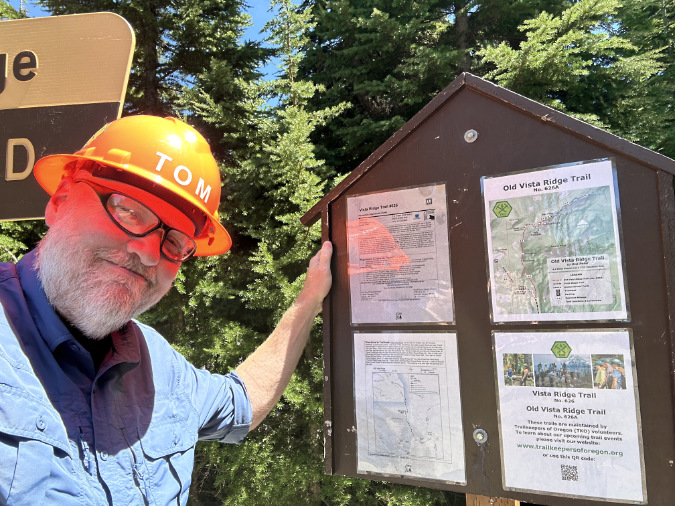
Squaring the circle after 18 years! The USFS gave TKO the green light to add our field guide trail map and info about upcoming volunteer stewardship opportunities on the Vista Ridge and Old Vista Ridge trail at their shared trailhead this summer. This comes after (ahem!) an unauthorized rescue of the Old Vista Ridge Trail that began way back in 2007, an effort that eventually allowed this beautiful old trail to be officially recognized by the USFS, once again. Today, TKO has an ongoing agreement to maintain both trails annually.

So there’s my mea culpa for the tumbling tumbleweeds around here. Happily, I have many articles in the queue for 2026 (and beyond) and can’t wait to begin working on them full-time as a retired person! In the meantime, my very best to those who follow this blog and, as always…  

I hope to see you on the trail sometime!

_____________________ 

Tom Kloster | December 2025

2025 Campaign Calendar..!

2025 Campaign Calendar Cover

December brings my annual year in review as told through the images I’ve chosen for the new Mount Hood National Park Campaign calendar. It’s a collection of images from around WyEast country that captures my explorations over the past year and its published in a high-quality, oversized format by the good folks at Zazzle. You can order one here:

2025 Mount Hood National Park Campaign Calendar

As always, all proceeds go to Trailkeepers of Oregon (TKO) and you can have these calendars delivered anywhere. You may notice a Red Rock Country calendar of desert southwest images from a recent trip through the Colorado Plateau — proceeds from the is calendar to to TKO, as well! Meanwhile, here’s a deeper dive into the thirteen images I selected for this year’s calendar.

Stories behind the photos…

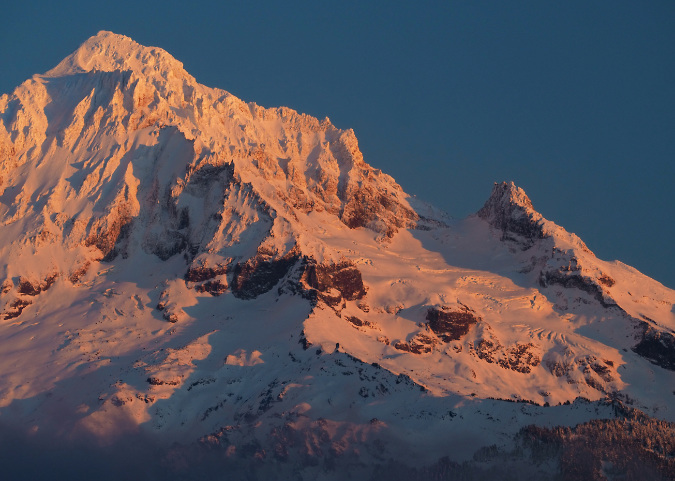
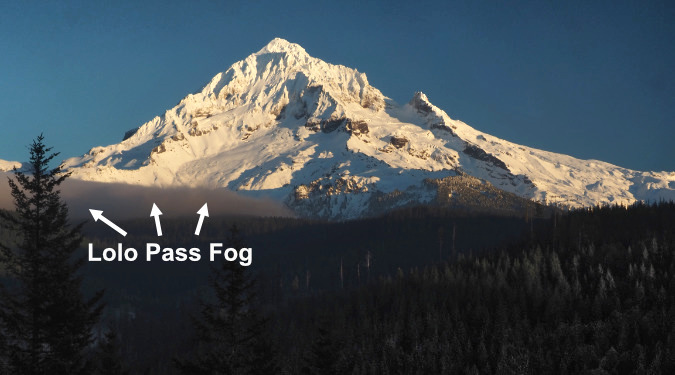
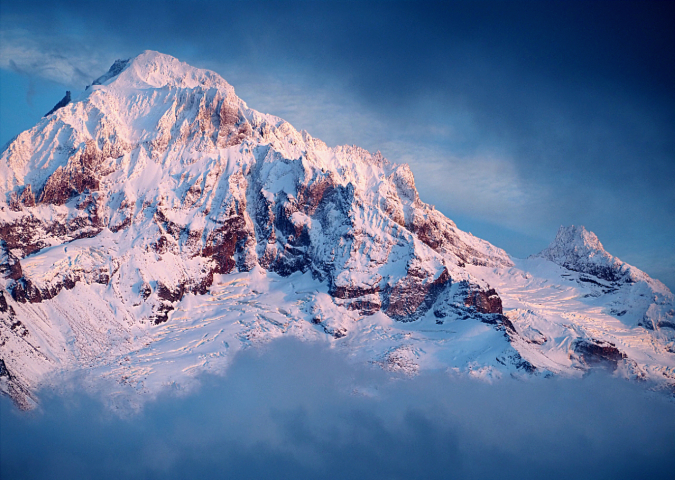
The cover image is also the most recent in the calendar. It’s an alpenglow view of Mount Hood’s west face taken from Lolo Pass road in early November. This is a classic spot for photography after the first few fall snowstorms, so I’m rarely alone there – a notably, I ran into Peter Marbach, one of our amazing WyEast Country professional photographers on this visit! This view came a few minutes before sunset on a crystal-clear fall evening:

Last light after an early snowfall on the mountain is the cover image of the 2025 campaign calendar

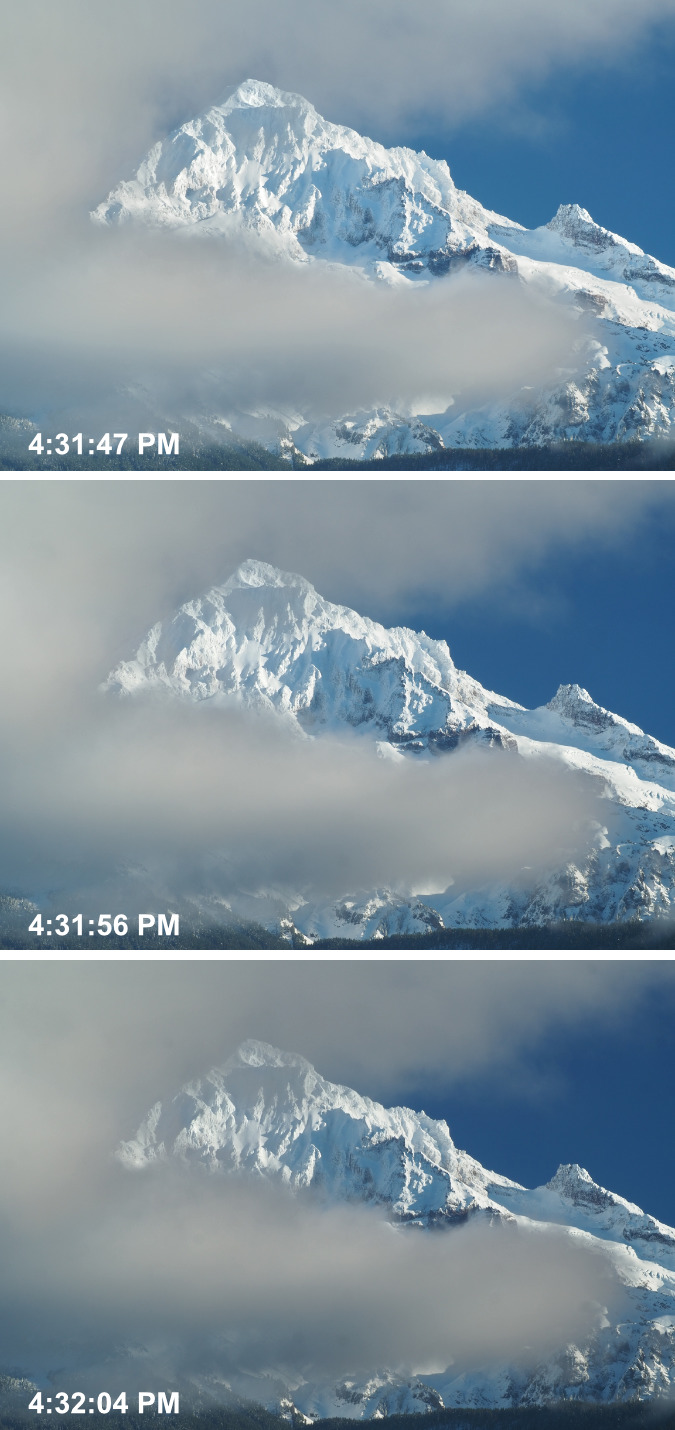
The backstory to this photo is that I had planned to shoot from a favorite spot on the east shoulder of Lolo Pass that evening. I even had my camera set up, ready to go, when a huge fog bank rolled up the West Fork Hood River valley and parked over me at Lolo Pass. It happened in less than a minute, as the photo sequence below shows:

Lolo Pass fog rolling in… setting up my tripod seems to have this effect on the weather!

It turns that topographic conditions are prime at Lolo Pass for fog events like this (sometimes becoming freezing fog). Most of these are triggered when colder, drier continental air from east of the Cascades collides with moist, marine air from west of the mountains to form very localized fog banks parked on top of the pass, with otherwise clear weather to the east and west. 

Sure enough, when I packed up and headed to a viewpoint just west of the pass, the mountain was in full view – along with the fog bank draped over Lolo Pass (below). This is where I captured the cover photo for the new calendar that day and had the pleasure of meeting Mr. Marbach! I’m still kicking myself for not getting a selfie – I’m a big fan of his amazing work.

Looking back at the Lolo Pass fog bank from the west side of the mountain

In fall and early spring, strong temperature inversions can also fill the mountain valleys on both sides of Lolo Pass with dense fog. As the sun drops down toward sunset, the valley inversion fog often surges over the pass due to its remarkably low elevation of just 3,415 feet – at least a thousand feet lower than most of the Cascade passes in Oregon.

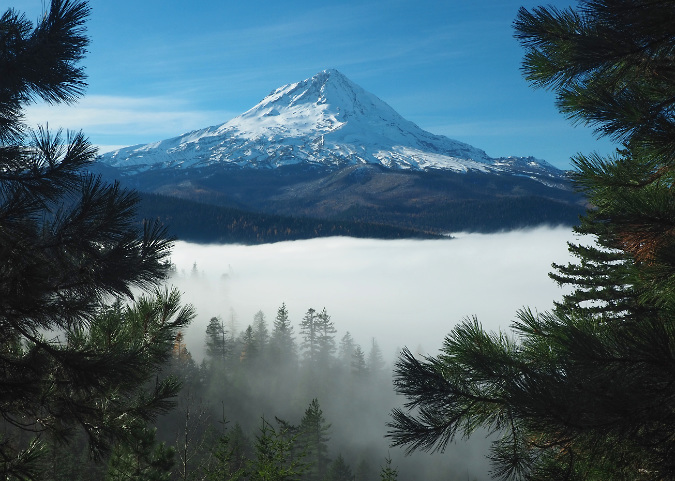
Continuing with the fog theme, inversion valley fog is just how this photo (below) I chose for January image in the new calendar came about. This scene was captured on the east side of Mount Hood, along the lower slopes of Lookout Mountain, with the East Fork Hood River canyon filled nearly to the brim with a dense, thousand-foot thick layer of fog. The view is framed with long-needled Ponderosa Pine boughs, the signature conifer species on the east slope of the Cascades.

More fog for the January calendar image – this time in the East Fork Hood River valley

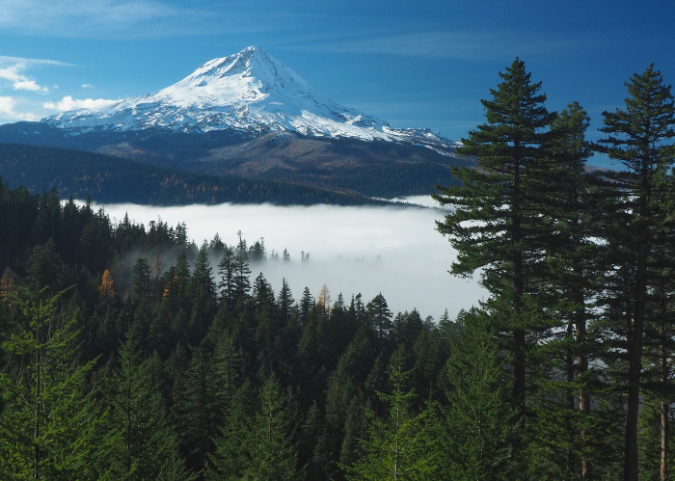
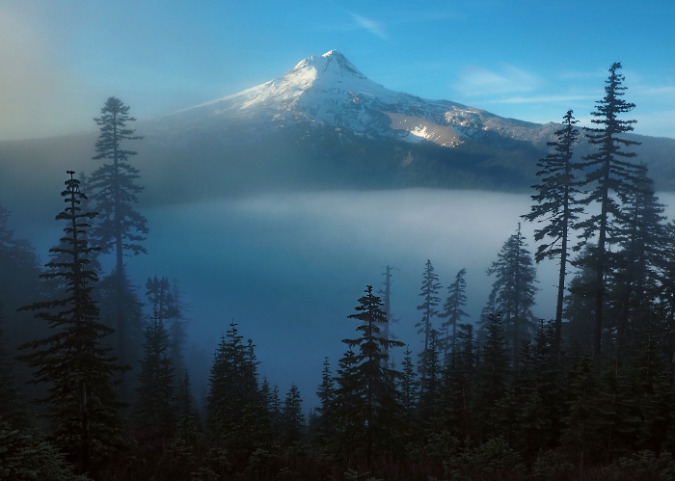
Here’s a wider view from the same area (below) showing how the fog filled the valley like a bathtub that day, thanks to a layer of cold, moist air trapped by a stable high-pressure system that was bringing all that sunshine and relatively mild temperatures directly above. On winter days like this, it’s common for temperatures in the fog zone to be hovering near freezing while temperatures above the inversion rise well into the upper 40s or even low 50s.

East Fork Hood River inversion fog and Mount Hood

Inversion fog is common on the east end of the Columbia River Gorge and is tributary valleys in winter, often with freezing temperatures that make for spectacular frost displays (and slick roads) when the inversions persist. The forests here are completely adapted to this effect, including the annual pruning that a heavy ice accumulation from persistent fog can bring. 

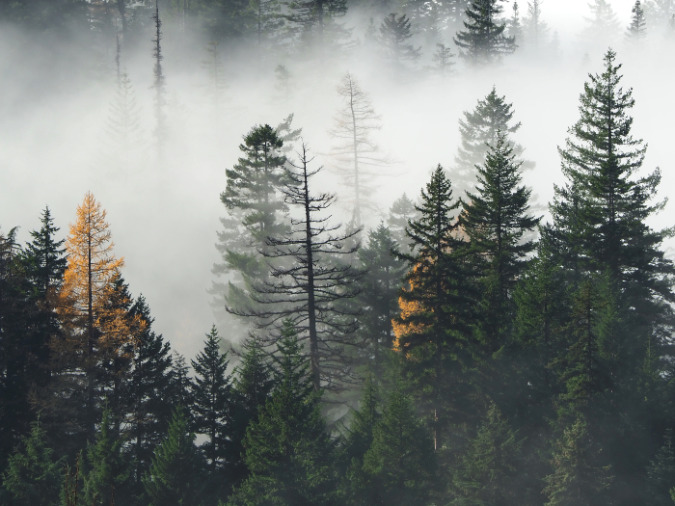
In this view (below), the winter advantage of Western Larch also stands out. While a few of the Larch still have their golden needles, most (like the one in the center) have already dropped their foliage for the winter, making them less susceptible to heavy winter winds and accumulations of snow and ice. Like Ponderosa Pine, Larch are also fire-resistant – making them perfectly adapted to this “fire forest” mountain ecosystem.

Fog swirling through an east side forest of Larch, true firs, Douglas fir and Ponderosa pine

The fog was sloshing around the East Fork valley that day as I watched and captured the changing scenes. While the overall inversion layer is generally flat, there are waves in the upper surface of the fog what wash “ashore” along the valley walls as the inversion air pressure gradient rolls across the surface of the fog layer. It’s mesmerizing to watch this effect from just above “shore level” as the waves surge below.

This final view was taken from the same spot as the above calendar image, and it shows an approaching wave of fog that would soon overtop the spot where I had set up my camera for these images. Once it engulfed me, the air temperature nearly 20 degrees in just a few minutes!

The mountain a few minutes before the ocean of fog inundated this spot!

Winter can be long and grey on the west side of the mountains, but if you know Oregon’s weather patterns you can often spot conditions when the east side of the mountains will be bright and sunny, even as rain falls on the west side. A favorite retreat for me on these days is the lower Deschutes River Canyon, less than two hours from Portland. 

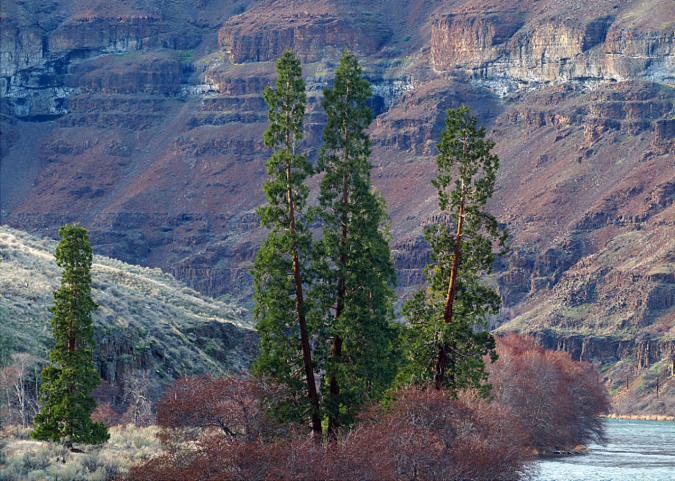
Despite the still-cool temperatures, I prefer to visit the Deschutes River in late winter, when few people are there, and the canyon slopes are green with emerging spring growth and the Alders turn yellow, then rusty-red with catkins. For the February image in the new campaign calendar, I chose this scene (below) near Rattlesnake Canyon that features a picturesque White Alder just coming into its late winter bloom.

White Alder providing winter color along the Deschutes River for the February calendar image 

Here’s another winter scene along the Deschutes with a mature grove of White Alder (below) growing along the riverbank. White Alder are not widespread in Oregon, and mostly limited to the Willamette Valley, eastern Columbia River Gorge (including the lower Deschutes Canyon) and the Siskiyous in Southern Oregon, Their range overlaps the Red Alder, its close cousin, that grows along the Pacific coast and extends as far inland as the Willamette Valley, where the two species meet.

White Alder (left) in winter along the Deschutes

Seen up close, both the male and female catkins of White Alder come into view. In this February photo (below), the male catkins are the long, pendulous blossoms and the green female catkins are still in bud form, just beginning to emerge. The “cones” of last year’s female catkins can still be seen, too. They are the dark ovals that resemble tiny pine cones when they open and dry to a dark brown color in fall. Because White Alder contains both male and female flowers on the same tree, they rely only on wind to pollinate, and the desert country east of Mount Hood provides plenty fo that!

White Alder catkins emerging in February

This view of a typical section of the Lower Deschutes canyon (below) shows just how important the White Alder groves that line the shore are to the ecosystem. They are the only sizable trees in this desert landscape, and they provide essential wildlife habitat along the river. Both Red and White Alder are also nitrogen-fixing trees, enriching the soil for other plants wherever they grow.

White Alder groves line the lower Deschutes River Canyon in winter

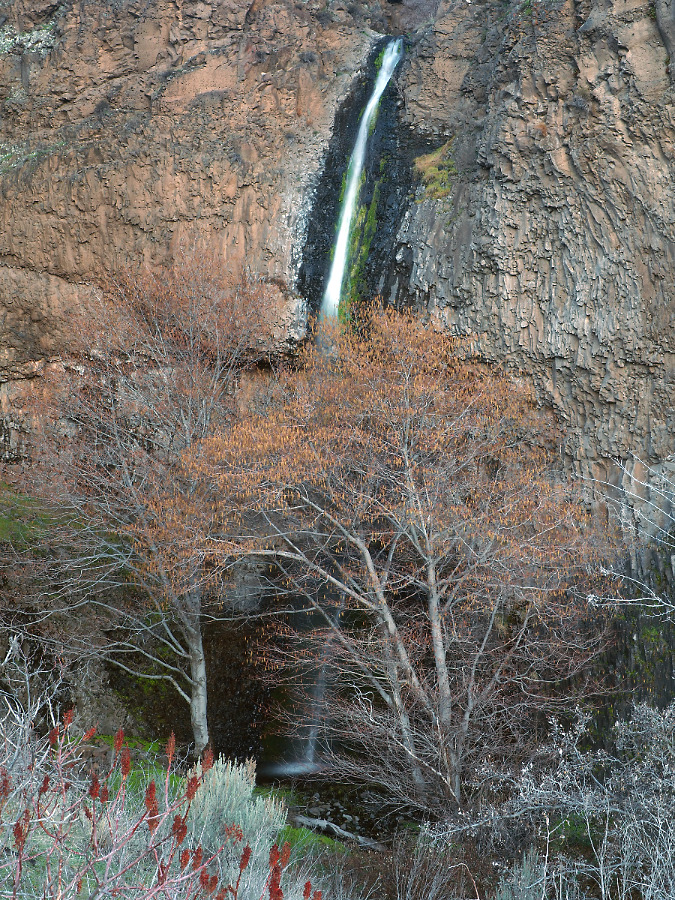
Another surprise on this winter trip to the Lower Deschutes were the many flowing tributary waterfalls that are dry for much of the year. This unnamed, two-tier waterfall near Trestle Bend is dropping into a grove of White Alder (below).

Season waterfall dropping into the Deschutes canyon in winter

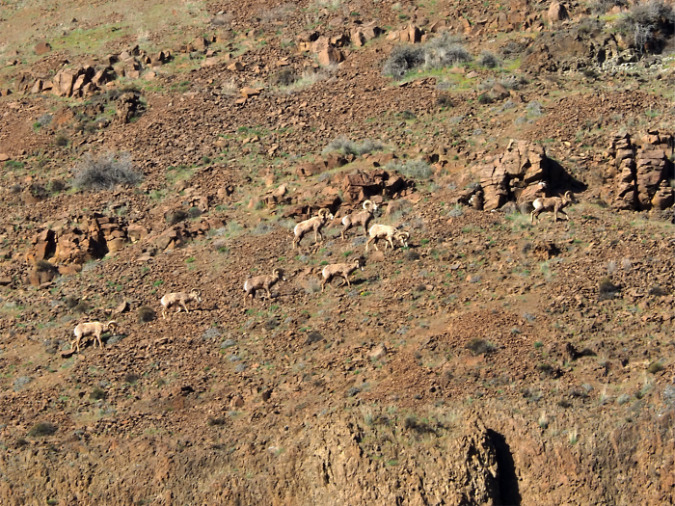
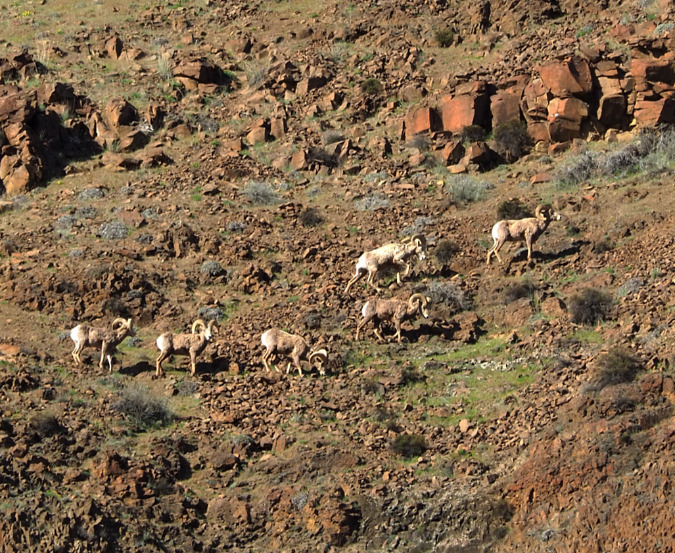
While I’ve known for some time that Rocky Mountain Bighorn Sheep live in the Lower Deschutes canyon, I had not seen them until this trip last February, when I spotted two herds high above the river, just upstream from Rattlesnake Canyon. Both were bachelor herds working their way downstream, along the upper slopes of the canyon (below). 

Bighorn Sheep in the lower Deschutes River canyon

Bighorn Sheep are a welcome sight in the Deschutes River canyon, not just because they’re beautiful to see and watch, but because they’re also an indicator of ecosystem health. Bighorns are highly sensitive to human activity, so their presence here reflects the continuing efforts by the Bureau of Land Management and Oregon Department of Fish and Wildlife to expand habitat protection for these animals in Oregon’s desert country.

Bighorn Sheep in the lower Deschutes River canyon

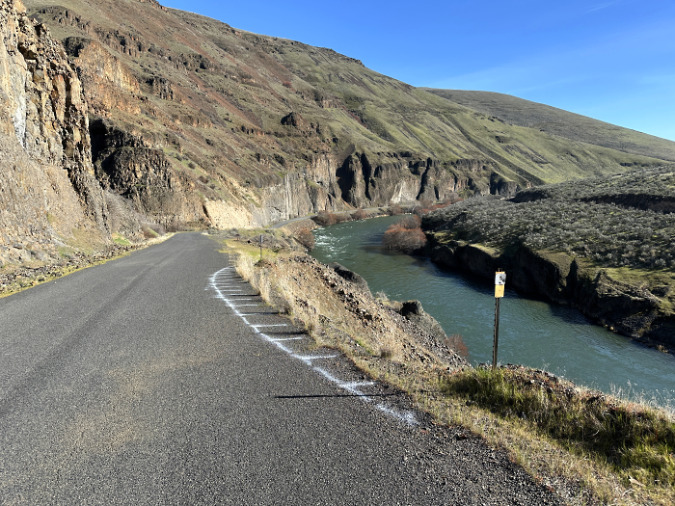
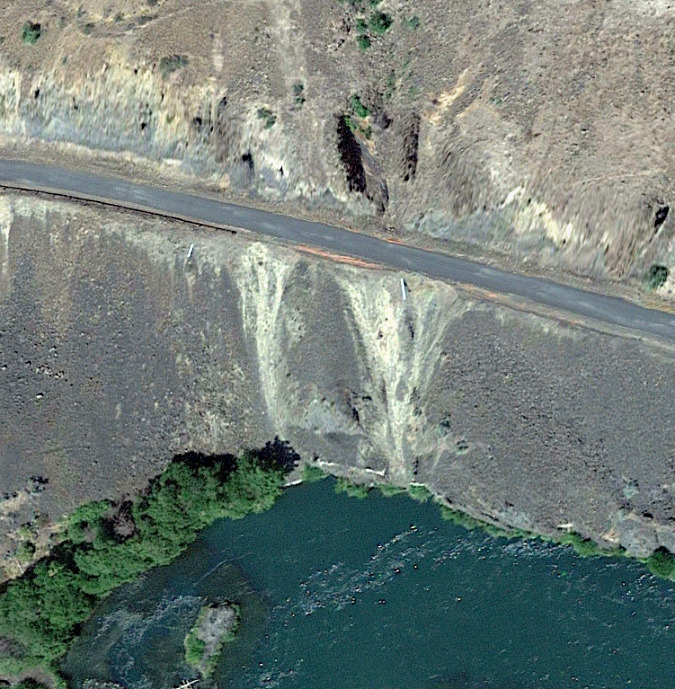
This trip was my second to the Lower Deschutes last winter, and I did have a practical mission for returning. On the first trip I had come frighteningly close to dropping a wheel over the edge of a paved section of the river access road, where a landslide has taken a big bite out of it. When I pulled over to take a look, I was spooked by the realization that going off the road here would have sent me 200 feet down the landslide scar, and directly into the river! 

So, one week later I came armed with a can of white paint to (at least temporarily) mark off a shy distance for drivers passing north along the road. Hopefully, the land managers didn’t mind…

Scary landslide damage to the Deschutes River Road!

This aerial view of the landslide scar from Google Earth (the image below is from 2022) shows just how sketchy the situation is, and that there are really two slides at work, here. The larger slide on the right is the one picture above, where the roadway has been seriously compromised.

Aerial view of the Deschutes River Road landslides in 2022 (Google Earth)

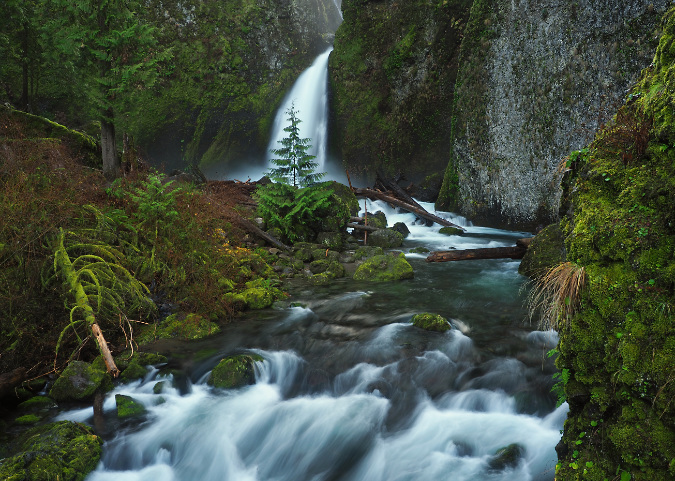
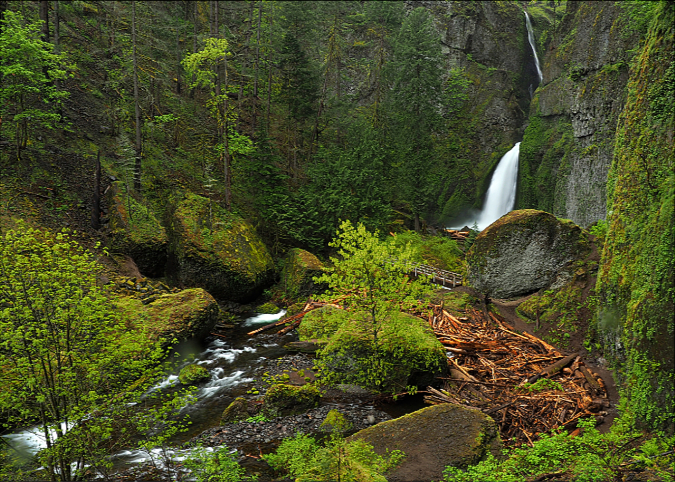
For the March calendar image, I moved to the Columbia River Gorge and Tanner Creek. It’s a place that I describe as the “Gorge on the half-shell”, as this spectacular 2-mile loop trail along to Wahclella Falls has all of the elements of a classic Gorge hike: towering basalt cliffs, a rushing stream with thundering waterfalls, wispy, impossibly tall tributary waterfalls, old-growth Douglas Fir and Western Redcedar, fern-covered talus slopes and lush green moss on seemingly every surface. Throw in four unique footbridges (one where you can reach out and touch a waterfall) and it’s a perfect introduction to the Gorge.

In past years, I have included a favorite scene captured from a viewpoint high above the falls, showing a couple of the tributary waterfalls dropping into the deep gorge that Tanner Creek has carved. I captured the scene once again this year (below), but wanted to try something different for 2025.

Wahclella Falls in the Columbia River Gorge

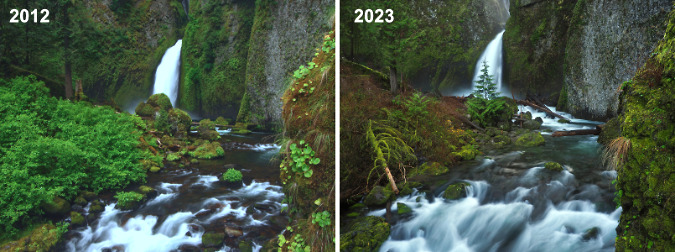
This year I opted for the view from in front of the falls (below), taken from the long footbridge that can spotted in the previous photo. From this streamside perspective, a young Western Redcedar growing directly in front of the falls, and will soon block the view. So, for this year I embraced the photo-bombing tree and framed it to be directly silhouetted by the falls while it’s still short enough not to completely block the view.

Wahclella Falls and the upstart Western Redcedar tree are featured as the March calendar image

How long before the tree eclipses the view from the footbridge? Here’s a comparative view of this young upstart, and you can see that it will clearly block the falls from this vantage point in the next decade or so… if it survives! That’s an open question, as this little tree is growing quite close to Tanner Creek, and there’s a reason the largest trees near the falls are on higher ground. Tanner Creek is big and rowdy in winter, and regularly scours the streambanks along its course in high water, easily carrying away whole trees in its wake. The giant logjam in the earlier, wide view of the falls is testament to the stream’s power.

The upstart cedar at Wahclella Falls

[click here for a much larger version]

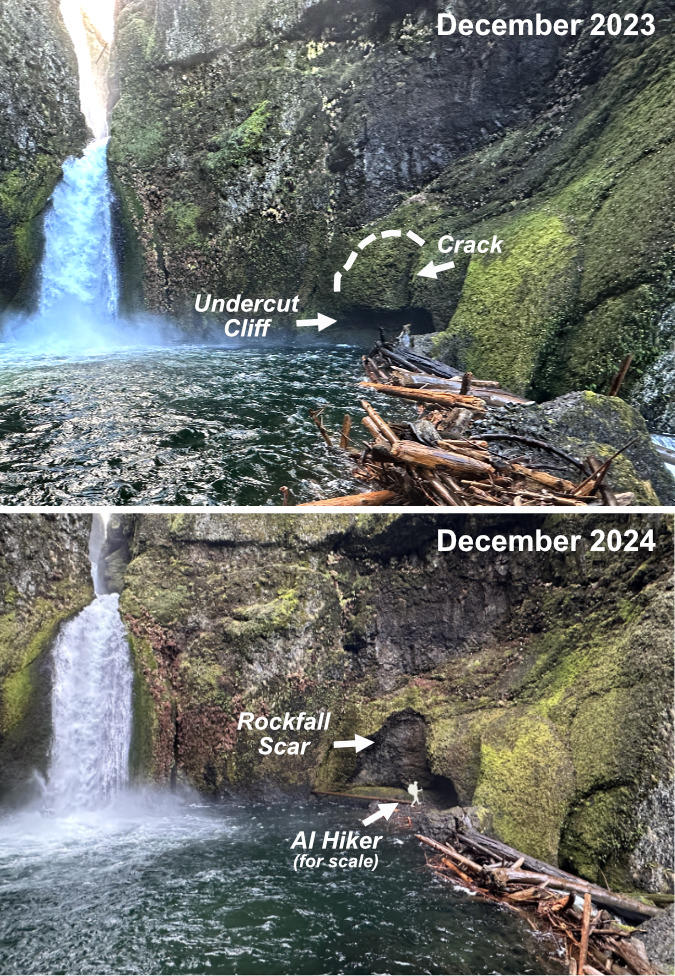
For geoscience types (that would be me), the still-fresh scar from the 1973 landslide at Tanner Creek is hard to take your eyes off when hiking this trail, but in recent years there have been a series of much smaller basalt wall collapses right next to Wahclella Falls that are fascinating to track. Sometime in the past year, another 15×20 foot slab immediately west of the falls collapsed into the splash pool after being undercut by erosion from the pounding water. The photo pair below shows the new scar.

Recent wall collapse along the Wahclella Falls splash pool

This latest evidence of the ongoing erosion along Tanner Creek is a more typical example of the incremental, nearly constant deepening of the canyon that occurs through the combination of gravity and annual freeze-thaw cycles that push cracks in the basalt walls open and gradually the rock apart. 

This weaking of the rock is accelerated by the erosive action of Tanner Creek in undercutting the canyon walls, especially where the heavy basalt layers rests on the must softer Eagle Creek Formation, made up of ancient volcanic debris flows that are easily eroded by the stream. The trailside cave just below Wahclella Falls (where the new the new logjam has accumulated) is a great example of stream erosion cutting away this softer layer beneath several hundred feet of vertical basalt cliff, above. This was mostly likely what triggered the massive 1973 collapse, as well.

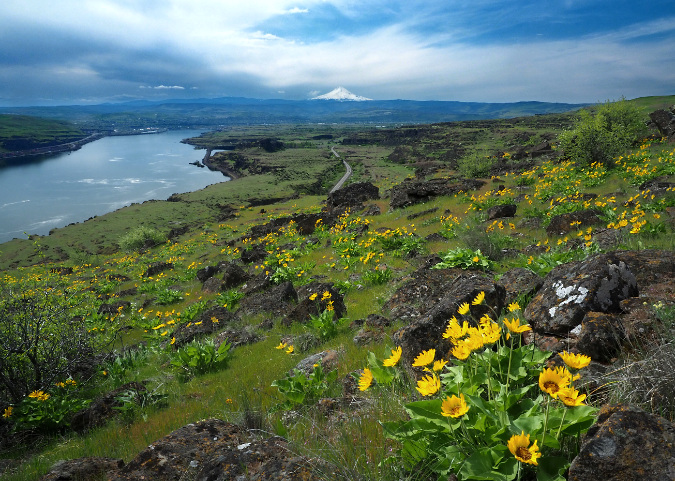
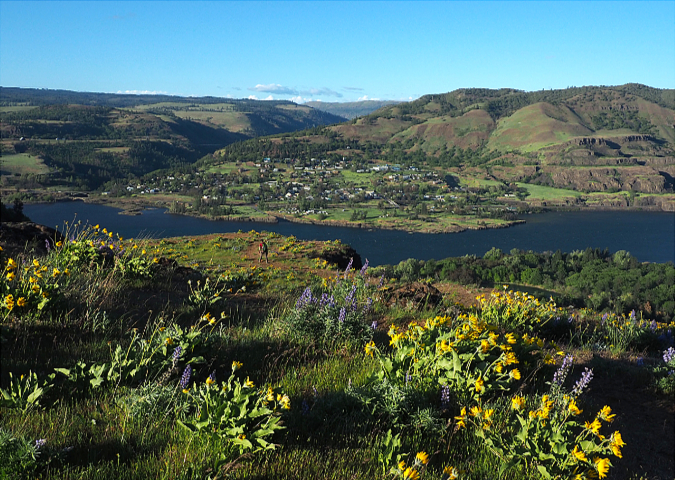
For the April image in the new calendar, I chose a scene that put April-blooming Balsamroot front and center. This view from the Columbia Hills State Historical Park (below) is looking west toward Mount Hood on a cool, blustery spring day.

Mount Hood and the flood-scoured lower slopes of the Columbia Gorge are featured in the April calendar image

Staying with a geology theme, this viewpoint is notable for how rocky this scene below is. It was taken at a point just below the high-water mark of the series of ice age floods that shaped much of what we know as the Gorge today. The floodwaters scoured away all but the most resistant basalt, leaving this rugged terrain we know today behind.

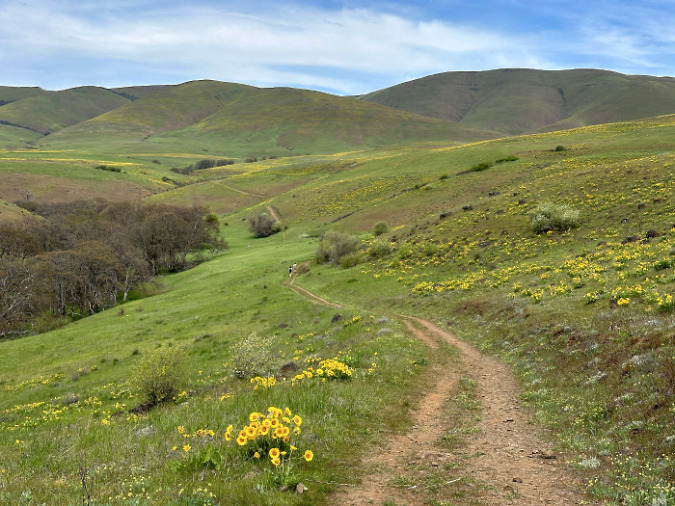
You can easily spot the high-water mark of the ice age floods in this part of the Gorge. Just a hundred feet uphill from the viewpoint where the previous photo was taken, the terrain suddenly softens into the rolling slopes that make up the Columbia Hills (below). There’s plenty of jagged basalt here, too, but it’s mostly buried under millennia of soil accumulation that survived the floods thanks to being mainly above the flood levels.

Gentle terrain above the ice age flood high-water level in the Columbia Hills

The surviving soil in these upper slopes of the Gorge translate into enormous wildflower meadows that draw people from around the world. Yellow Balsamroot steals the flower show in the east Gorge in spring, but in places with the Columbia Hills, they are just part of a wildflower spectacle, with Phlox (below), lupine and dozens of other wildflowers filling the gaps between the showy Balsamroot.

Spring wildflower gardens in the Columbia Hills

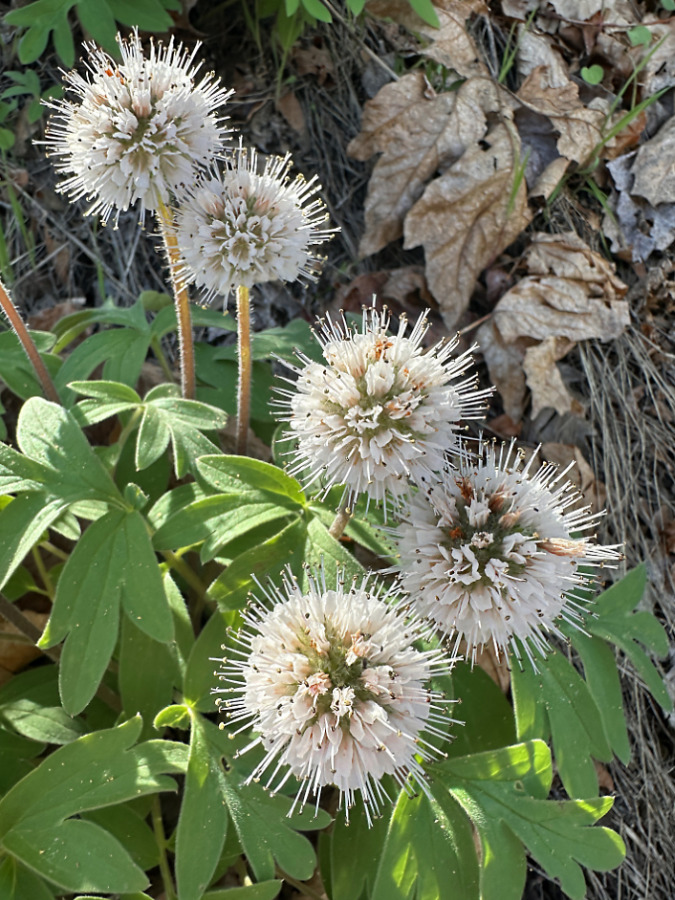
Each time I visit places the east Gorge in spring, I make it a goal to spot a few of these co-stars in the flower show that I might not have noticed before. To my surprise, my visit last spring included Ballhead Waterleaf, a lush plant that grows throughout the west, but is typically found in moist spots. Yet, this colony (below) had found a shady slope beneath a pair of Bigleaf Maple trees with just enough groundwater to help them thrive in this desert environment.

This Ballhead Waterleaf found a shaded niche in the Columbia Hills

Another striking wildflower was new to me on that trip, a lovely plant called Whitestem Frasera (below). It was just coming into bloom and still in bud when I was there, but in a couple weeks would have clusters of blue flowers rising above the beautiful foliage. This is one of many species that is typically found well east of the Cascades, but makes its way well into the Columbia River Gorge where conditions are right.

Whitestem Fraseria still in bud in the Columbia Hills

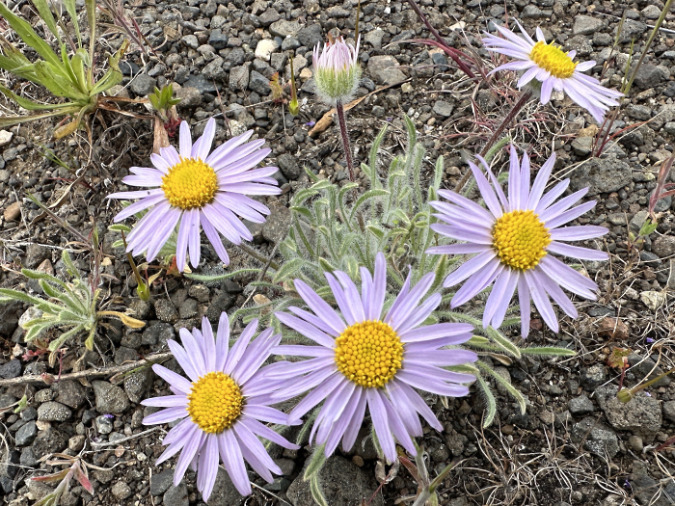
Still more surprising on that trip were several Cushion Fleabane (below) colonizing the old access road that forms the first mile or so of the Crawford Oaks trail in the Columbia Hills. These little plants thrive in fine gravels, and the old roadbed provides that for them, now that traffic is mostly limited to hiking boots.

Tiny Cushion Fleabane in the Columbia HIlls

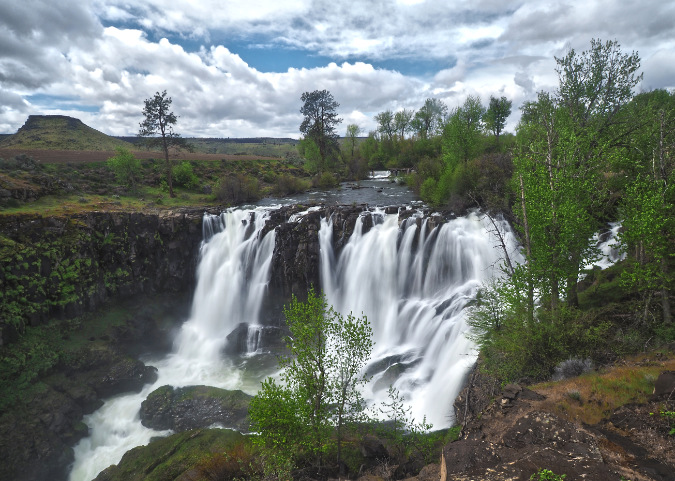
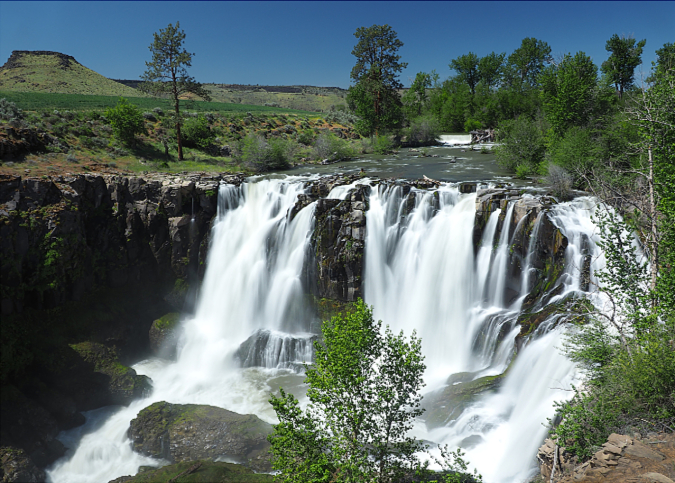
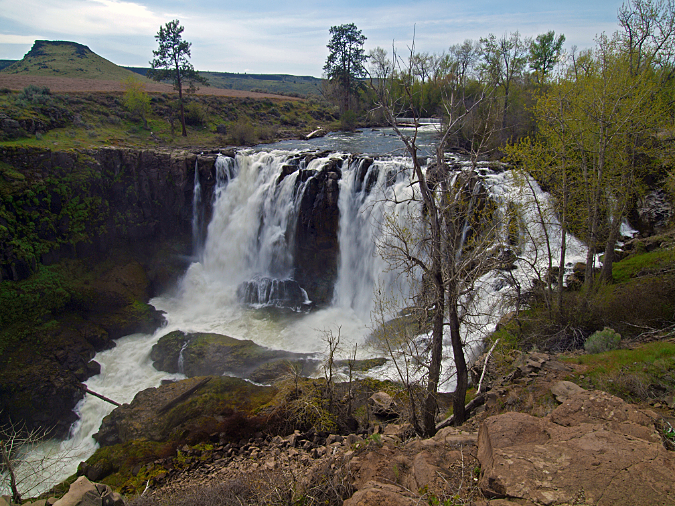
I stayed on the east side of the mountains for the May calendar image, with a view of White River Falls (below), where one of Mount Hood’s many glacial streams carves a deep canyon through sagebrush country and make a spectacular leap over a wide basalt cliff on the way to its confluence with the Deschutes River, just downstream. The falls and its lower canyon are protected as part of White River Falls State Park.

White River Falls during spring runoff in the May calendar image

This spectacular view of the main falls is best in spring, when runoff is high. The upper viewpoint is easily accessible, too – just a few hundred feet from the trailhead, with some of the path paved. But the deep gorge below the main falls hides still more waterfalls that make it well worth the steep hike into the canyon, despite the choppy descent along a long set of deteriorating stairs!

The stairway to White River heaven…

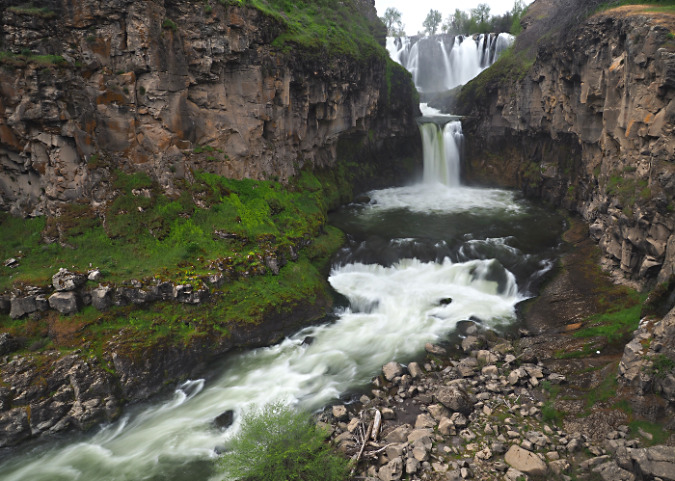
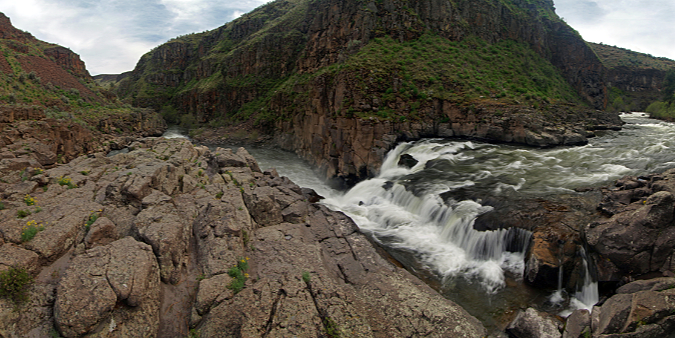
The lower tier of the main falls is unofficially called Celestial Falls (below) and forms a perfect punchbowl between walls of basalt. When winter temperatures drop below freezing, this natural bowl can become a mass of ice built up from the waterfall spray.

Celestial Falls on the White River, just below the main White River falls

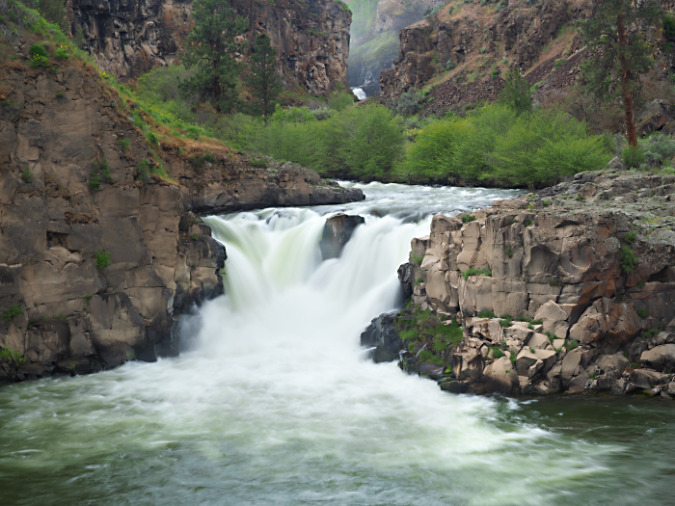
Continue a bit further downstream on an increasingly unofficial trail, past the ruins of the early 1900s hydroelectric plant that once operated here, and the White River makes a third, smaller plunge into another, larger punchbowl at the lower falls (below). This might be my favorite spot in the canyon, as the lower falls and its deep pool are framed with wildflowers in spring, sprinkled among the boulders on the slopes that surround the river.

Lower White River Falls

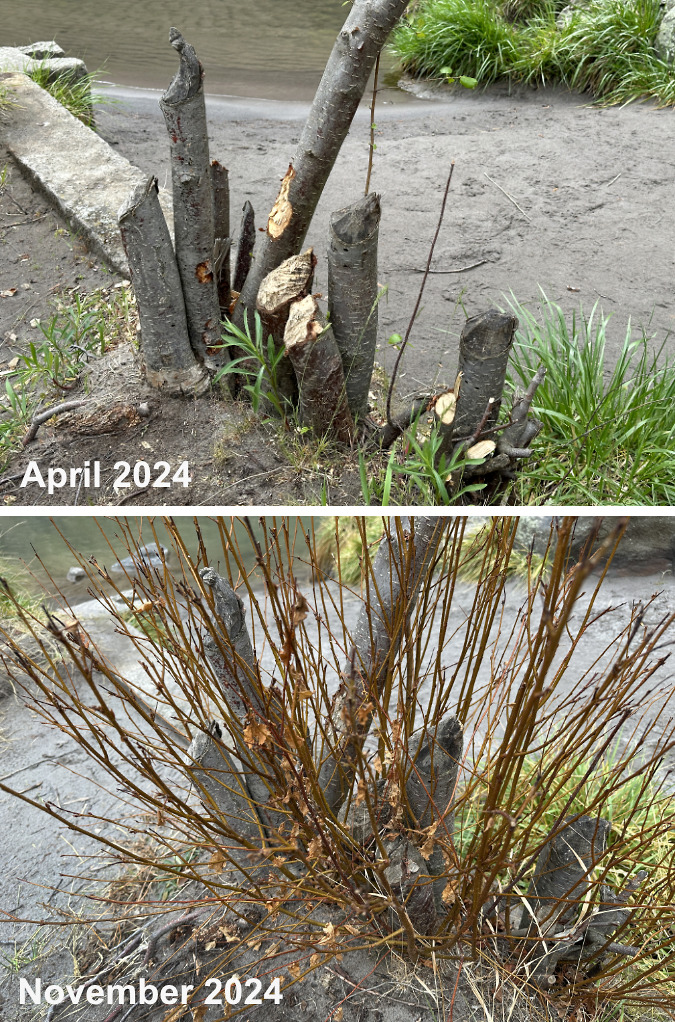
There is a lot to see at White River Falls, and because it’s a regular stop for me, my eye goes to new details on each visit. When I stopped last spring and captured the calendar image shown previously, I was surprised to notice that beavers had taken up residence in the long, slow pool near the old powerhouse, between Celestial Falls and the lower falls. They had also recently made quick work of several trunks of a White Alder clump growing along the beach (below). If you look closely at the image from last April, you can see four fresh cuts, along with at least five previously cut trunks. Just one trunk remained, then, and even this sole survivor had a fresh scar where the beavers were working to finish the job on this grove!

Busy beavers at White River Falls State Park

In the more recent image from last month – just seven months later — you can see the Alder tree is fighting back with a vengeance. Not only did that lonely last trunk survive, dozens of new shoots exploded from the stumps over the summer to replace what the beavers had hauled away. It’s a great example of the continuous cycle between beavers and streamside trees.

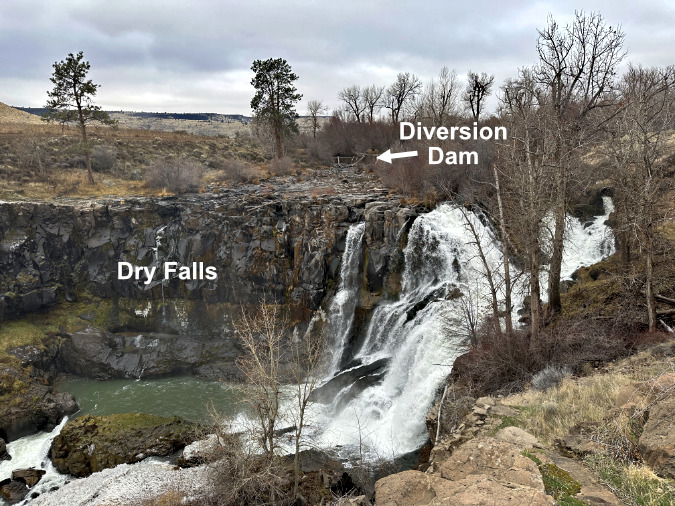
When I visited last month, I was also reminded of man’s impact on the falls. In low water, which extends from mid-summer into mid-winter, much of the face of White River Falls goes dry. Why? The answer is in the distance, just beyond the falls, where a long-derelict diversion dam (shown below) was built more than a century ago to direct water to the old hydroelectric penstock pipes.

Dried-up White River Falls in the low water season when the main river flow is diverted

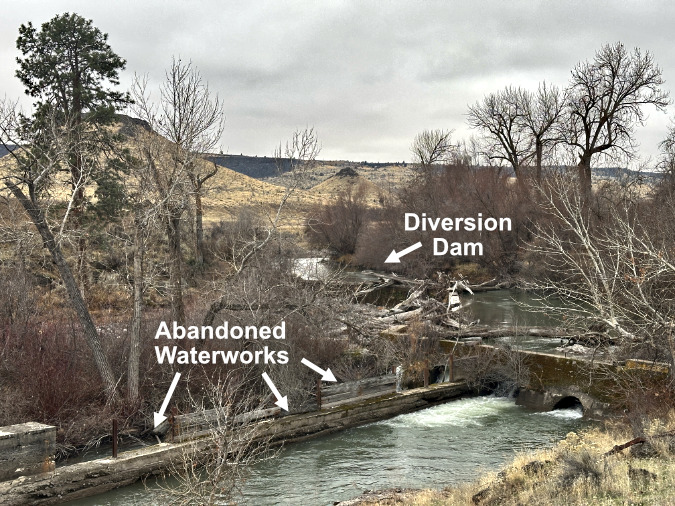
You can get a close-up look at the ruins of the old waterworks by following a path that heads upstream from the main falls overlook. Here, the diversion dam and abandoned canals that were once the headworks (below) to an elaborate pipe system are still diverting the river, but only to a side channel that spills around the main falls, as the pipe system was largely removed decades ago.

Derelict White River Falls diversion works depriving White River Falls its full spectacle

My hope is that Oregon State Parks officials will someday breach the old dam and restore the falls to its original channel year-round, instead of waiting for the White River to do the job (and it will, eventually).

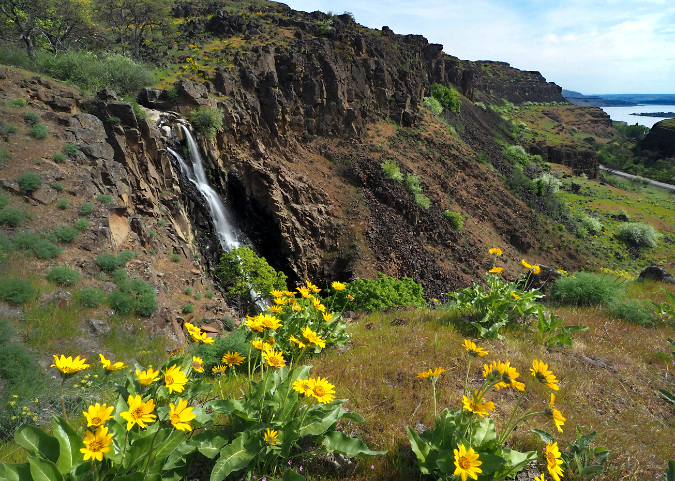
For June, I chose another east-side image for the calendar. This view of Eightmile Falls (below) is where the main stream flowing from Columbia Hills State Historic Park drops over a basalt cliff as it enters the ice age flood-scoured lower reaches of the Columbia Gorge. In spring, this overlook is especially beautiful, lined with blooming Balsamroot and the creek is running strong with early season runoff.

June in the new calendar features Eightmile Falls in the Columbia Hills

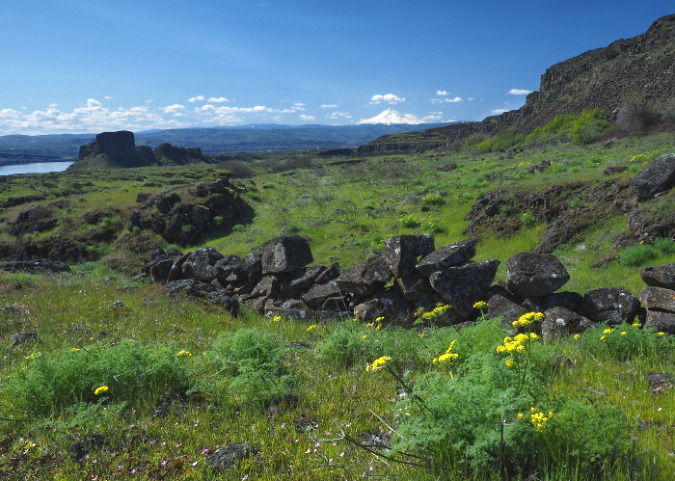
Eightmile Falls is located along the Crawford Oaks trail, a relatively new access point to the park that follows a portion of the historic military road that once passed through this area. Along the way, there are views of Mount Hood and the Columbia River framed by old stone walls (below) from the early days of white settlement here in the late 1800s.

Stone walls in the Columbia Hills mark early white settlements in the area

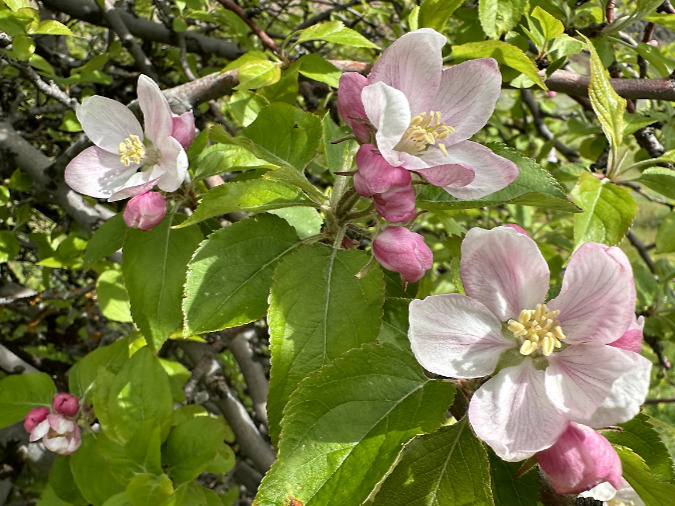
One surprise along this section of the old military road is a grove of heritage apple trees that have somehow survived here for a century of more, in the middle of this harsh desert environment. In spring, they are covered with blossoms (below) that reveal them to be part of the human story here.

Heritage apple trees from white settlements still survive at Crawford Oaks

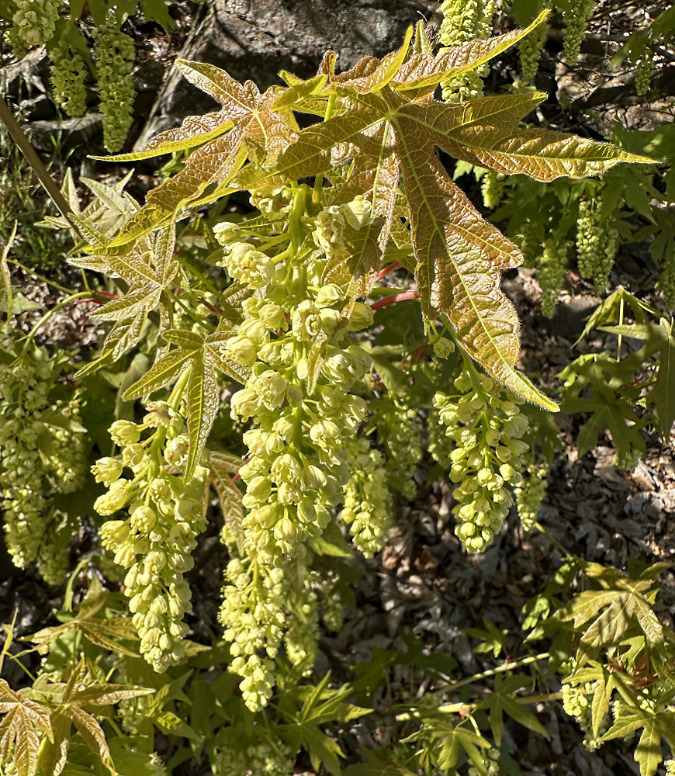
Another surprise along the old road are several groups of Bigleaf Maple, a species that thrives in Cascade rainforests. These unlikely trees manage to carve out a niche in this desert environment where they typically grows along basalt walls that provide both weather protection and provide groundwater seeps to help them survive hot summers.

Bigleaf Maple blossoms in the Columbia Hills

In spring, these out-of-place maples also put on an impressive flower display (above) that is easier to appreciate here, where the trees often grow just 15-20 feet high. Their foliage is at eye level, where you can see the blossoms close-up, compared to rainforest cousins where the blooms are often 70 or 80 feet above the forest floor.

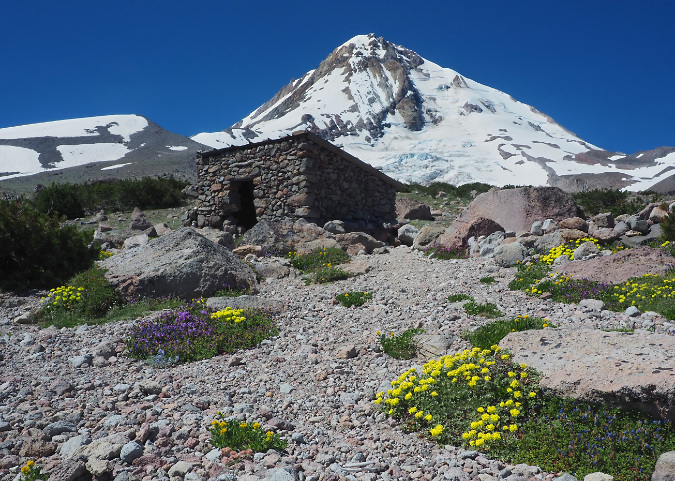
For the July calendar image, I moved up into the mountains with this view (below) of the historic Cooper Spur Shelter, located along the Timberline Trail on the northeast shoulder of Mount Hood. This is among of the most iconic spots on the mountain, and it didn’t disappoint this year, with drifts of blooming yellow Buckwheat and purple Lupine framing the 1930s, Civilian Conservation Corps structure.

Cooper Spur Shelter with alpine wildflowers are featured in the July calendar image

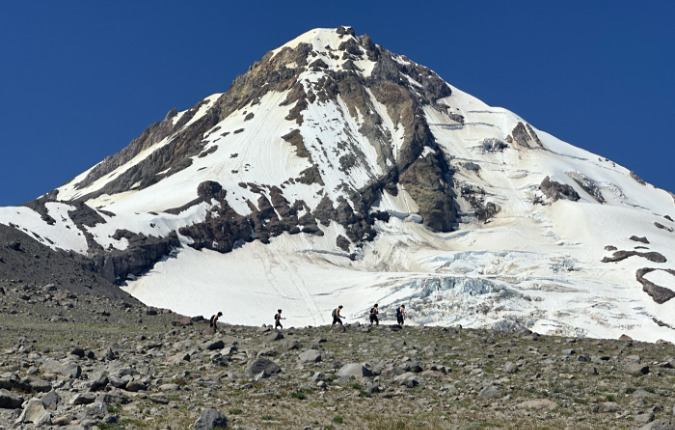
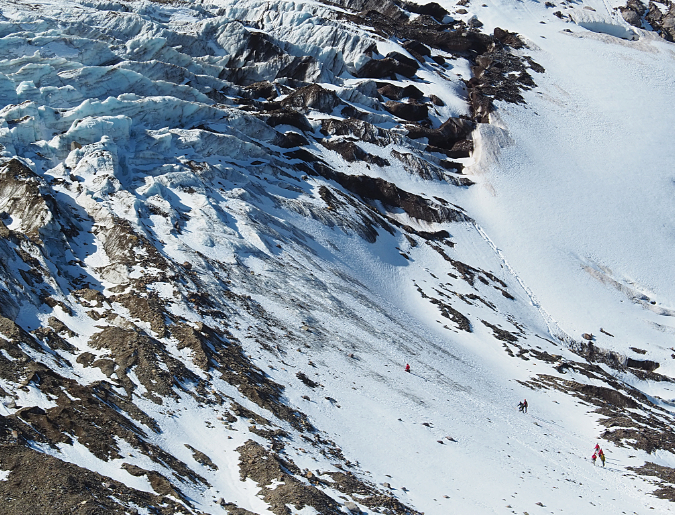
As tough as it has been to witness the accelerating effects of global warming on Mount Hood’s glaciers in past years, the early summer view of the Eliot Glacier remains one of the most impressive sights in WyEast Country. In this view from farther up the Cooper Spur trail (below) a few weeks later, a group of hikers is silhouetted against the mountain, giving scale to the enormity of the glacier as it tumbles down the mountain.

Hikers framed against the Eliot Glacier in Summer

Many of the trails in the Cooper Spur area are as unofficial as they are historic, dating back to the earliest recreation visits to the mountain in the late 1800s and early 1900s, when the Cloud Cap Inn was in its heyday. Today, the continue to be as heavily traveled as the formal trail system. This is made possible by a largely unseen corps of unofficial trail tenders that have helped tend to these routes for decades, as well as the official Timberline and Cooper Spur routes. I know, because I’ve adopted a few of these trails, and I always see the handiwork of others when I’m working there.

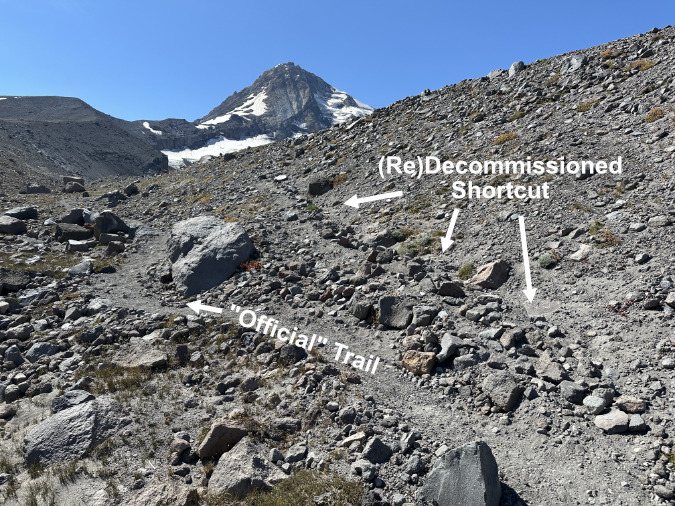
Last July, my unofficial trail work focused on retiring a persistent shortcut just below the crest of the South Eliot Moraine. It’s caveman work, as you can see in the schematic below – simply covering the shortcut with rocks large enough to discourage people from taking the shortcut. It’s a never-ending task, as new routes are formed instantly in this open, loose alpine terrain when just one group hikers decides to leave the established trail and make their own way. 

Trail tending along the South Eliot moraine

In the era of cell phones and GPS, these shortcuts are becoming more numerous and persistent. Why? Because the errant digital tracks from lost hikers following dead-ends or short cuts are blindly added to the big data commercial websites that cater to hikers. It’s among the many reasons to avoid commercial apps and social media for hiking guidance, especially when we have TKO’s free Oregon Hikers Field Guide for trails in Oregon and Southwest Washington, a non-profit resource written by hikers, for hikers.

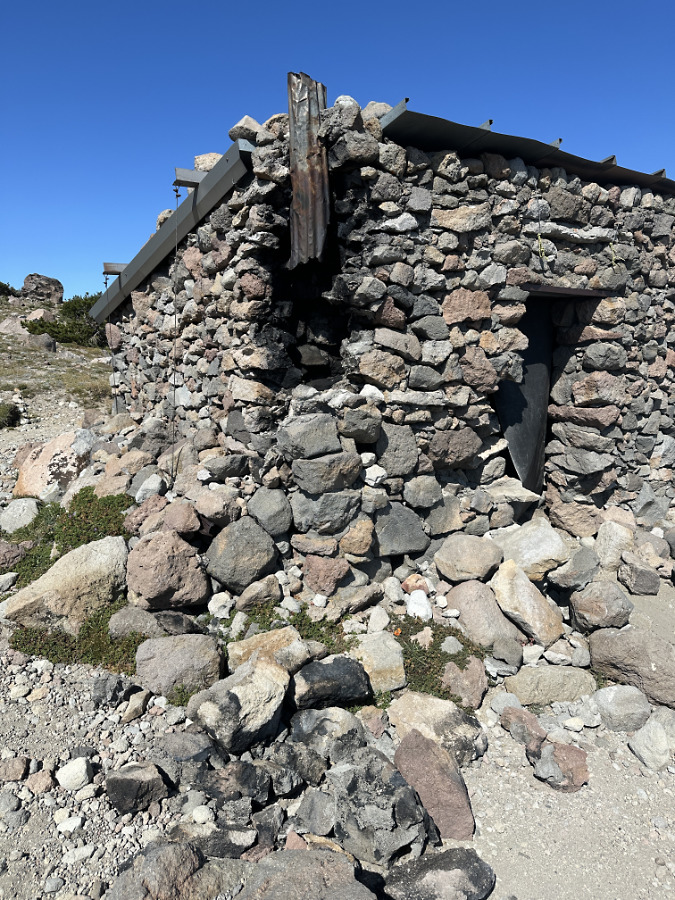
The Cooper Spur Shelter, itself, was also in need of some volunteer tending this year, as the stovepipe in the south corner of the structure has rusted through and that seems to have led to a collapse of the stone wall surrounding it (below). 

Recent collapse of the south shoulder of the Cooper Spur shelter

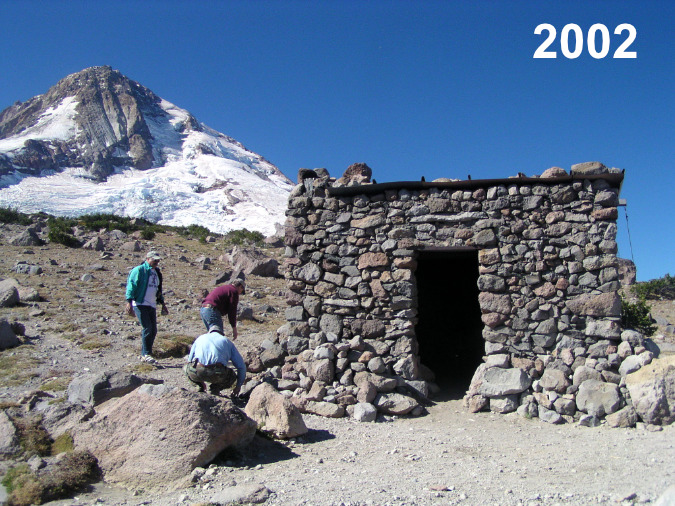
While it’s possible the U.S. Forest Service will repair this, I’m going to guess that it will fall to volunteers that I’ve seen working on the structure in the past. I’ve come across them many times over the years, as early as this view (below) taken 22 years ago, when a group of volunteers was repairing that same south corner of the building. Like most of the trails around Cooper Spur, the shelter also represents an ongoing volunteer effort to ensure it survives.

Volunteers repairing the south wall of the shelter more than 20 years ago

For the August image in the new calendar, I chose the view from Inspiration Point (below), a rocky spot along the Cloud Cap Road that provides a sweeping view of the Eliot Branch canyon and Mount Hood’s steep northeast side. This has been a popular tourist stop since visitors begin arriving at the Cooper Spur Inn by horse and buggy in the 1890s.

The August calendar image features this classic view of Mount Hood from Inspiration Point

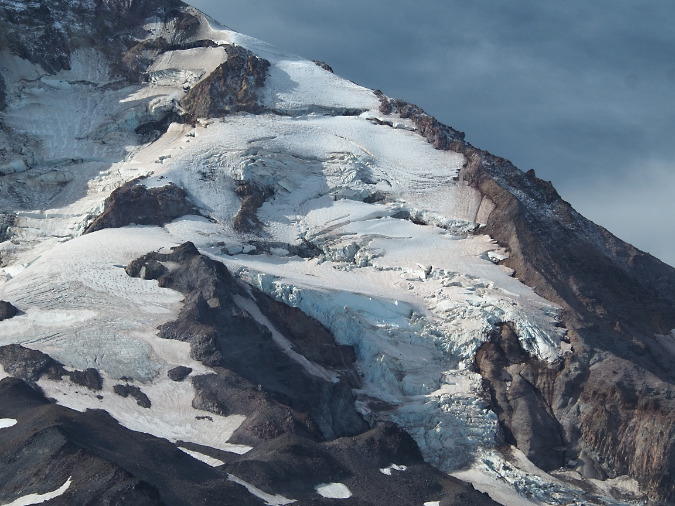
Inspiration Point still offers one of the finest views of both the Coe and Eliot glaciers, the two largest on the mountain. The Coe is the lesser known of the two due to its remote location on the rugged north face of the mountain, and this viewpoint is one of the few places with a close-up look accessible by road.

Coe Glacier from Inspiration Point

The steep, unofficial trail to Inspiration Point has been on my list of adopted trails for nearly 20 years, and despite its short length, keeping this little path intact has been a challenge – especially in the years since the 2011 Dollar Lake Fire swept through and left many standing snags that are still periodically falling across the trail.

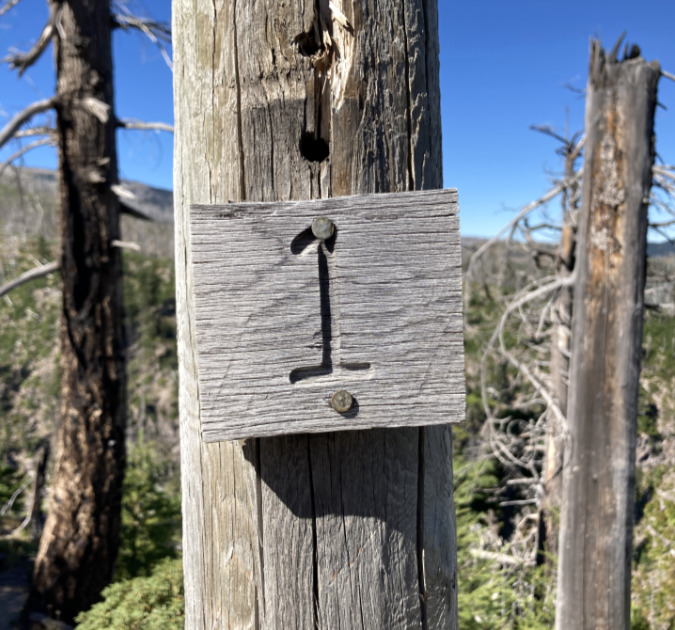
If you’re not an avid hiker and looking for a short side trip on your way to Cloud Cap, watch for the following signpost at an obvious switchback in the road at about the 3 mile mark (below). From the sign, the trail drops roughly 300 feet to the rocky overlook of Inspiration Point.

Inspiration Point trail marker 

What does the “1” stand for in this unofficial trail marker? It dates back to a brochure and map once published by the Forest Service that described the history of the Cloud Cap area by numbered waypoints along the road. This signpost and an old, mounted wagon wheel further up the road are all that remains from that effort to share the local history. I do plan to feature the brochure in a future blog article, along with mileage waypoints to guide visitors, in lieu of the old markers that were once here. 

Inspiration Point trail marker… a reminder of an interpretive story that was once told here

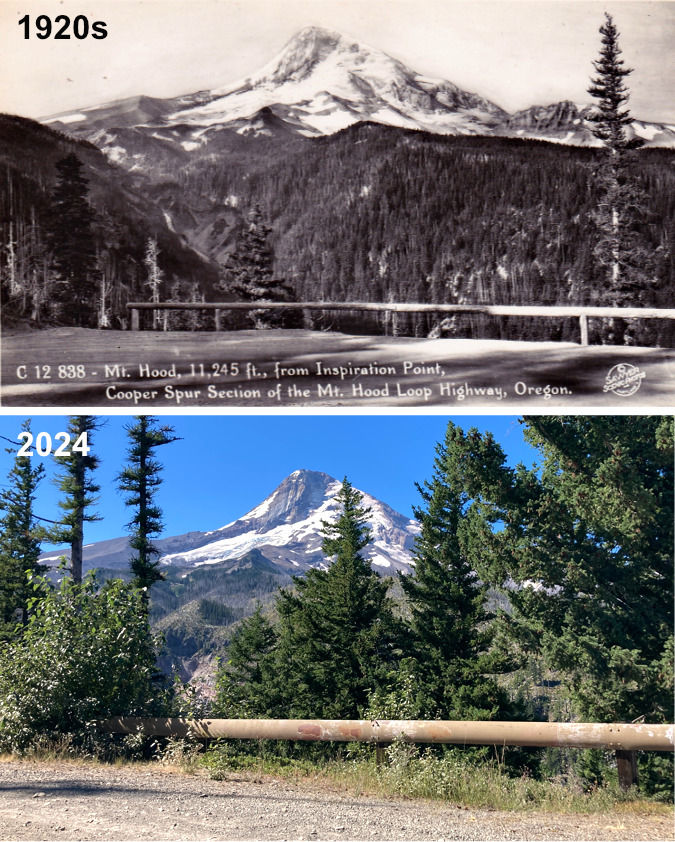
For the best view from Inspiration Point, the short trail is a must, but there was a time when you could take in the view from road as you motored your Model T up to Cloud Cap Inn. In fact, an old guardrail that I think might be the original shown in a 1920s postcard view (below) is still there – albeit with a few trees now partly blocking the view.

The view from Inspiration Point – then and now

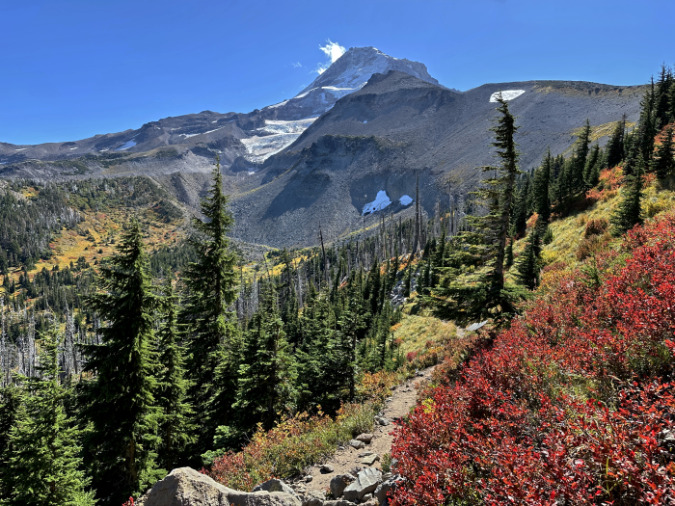
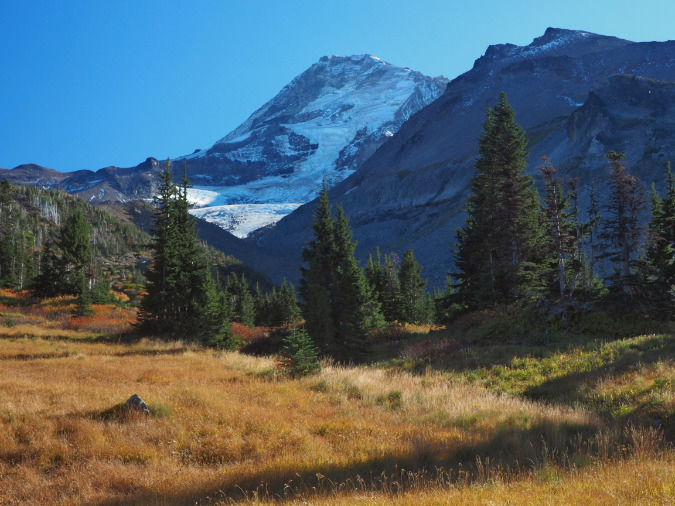
For the September calendar image, I stayed on the mountain and chose an early fall scene at WyEast Basin (below). This photo was taken on a hike in October of this year along the Timberline Trail, from WyEast Basin to Elk Cove, when the huckleberry foliage had turned a brilliant crimson and the alpine meadows to shades of yellow and gold.

WyEast Basin on Mount Hood’s north side is the September image

This photo (below) from the descent into Elk Cove is also from that day, showing the light dusting of early snow that had fallen on the summit the day before.

The Timberline Trail approach to Elk Cove lights up with color in autumn

I considered using this view of the upper meadows at Elk Cove (below) from that October trip for the calendar, before realizing just how many times I’ve featured Elk Cove over the years! Lovely as it is, this year I went for a change of scenery with the WyEast Basin scene.

Elk Cove in autumn with an early dusting of snow on the mountain

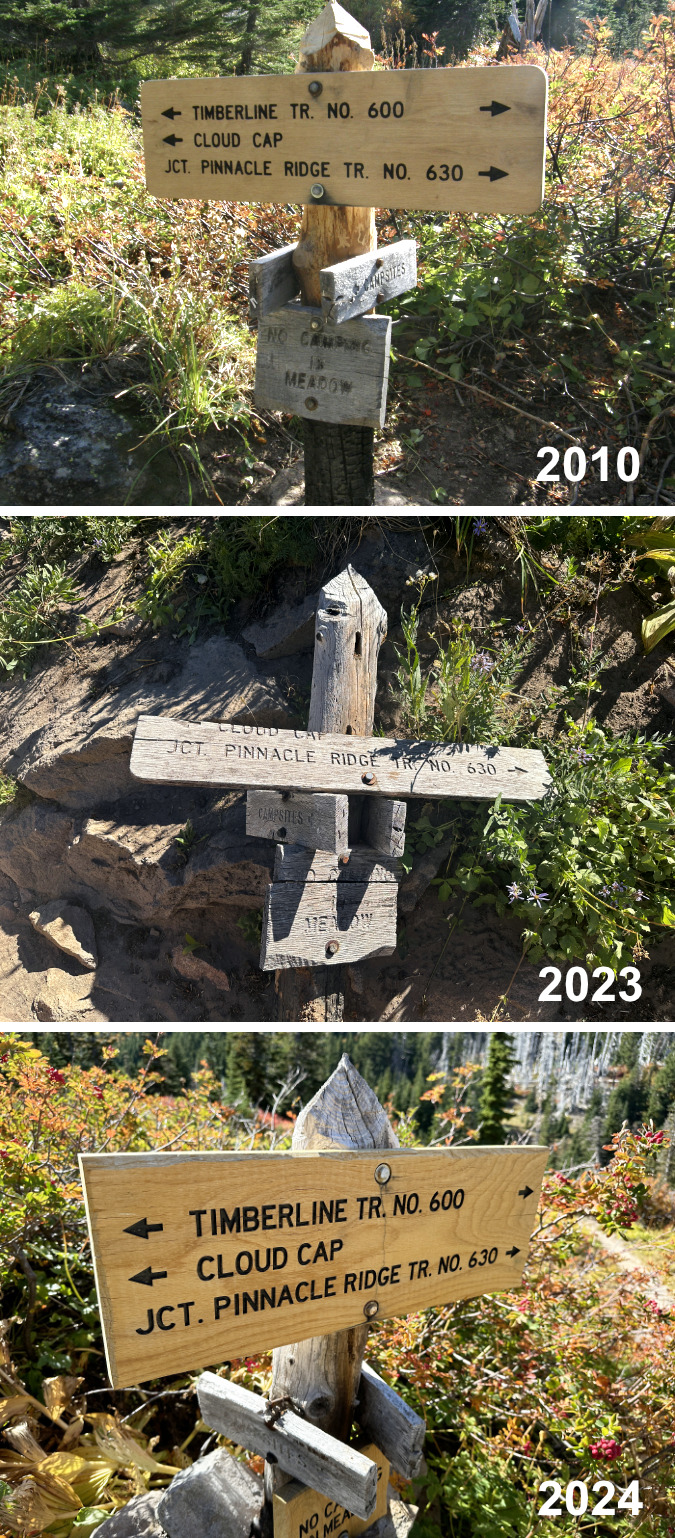
One pleasant surprise at Elk Meadows this year was a new trail sign located at the Timberline Trail junction with the Elk Cove Trail. The old sign had pretty much disintegrated in recent years, causing a fair amount of confusion for hikers, based on the number of times I helped people find their way at that junction. 

One benefit of coming to Elk Cove every year is the opportunity to track changes there over time. This includes trail signs, and in a place where the winter snowpack regularly reaches 10 feet or more in winter, it’s no wonder that these signs take a beating. As you can see from the photo sequence below, the two small signs pointing to “campsites” get the award for most durable. They were already quite weathered in 2010 when the previous “new” trail sign was installed. By 2023, the “new” main sign from 2010 was falling apart. This year, both the main trail sign and the “no camping in meadows” sign were completely replaced, while the two “campsites” signs are still doing their job. 

Elk Cove trail signs over the years

On the hike back from Elk Cove, I stopped to collect some trail condition photos at WyEast Basin, where the growing stream of hikers has begun to take its toll on the meadow. Some of this is the result of hikers simply stepping off the trail when passing one-another on a busy section of the Timberline Trail, but the widening tread is mostly the result of the original trail becoming trenched from heavy use, then becoming a muddy ditch when snowmelt fills it early in the hiking season. Hikers then opt to walk on either side to keep their boots dry, gradually destroying the meadow vegetation in the process. 

This schematic (below) shows the original trail at the center (now a trench) as a white dashed line and shoulder paths in red dashed lines, where hikers have already destroyed an alarming amount of meadow vegetation.

Growing damage from trail overuse at WyEast Basin

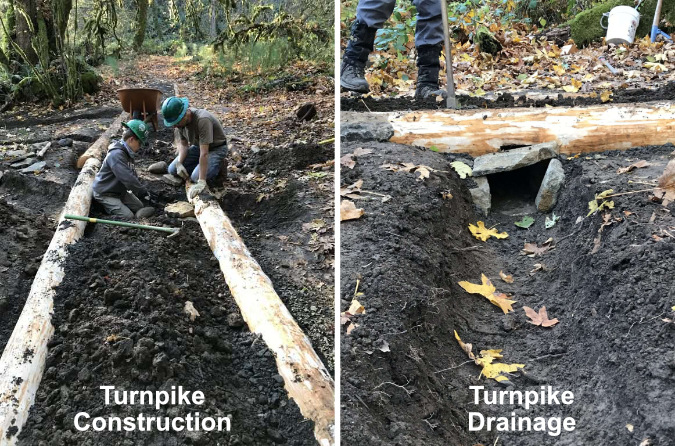
Over time, this parallel use paths on both sides of the trenched trail will turn into a muddy slog, too, resulting in an ever-widening trail across a beautiful meadow. I’m hoping to find a way for TKO volunteers to restore this trail with a different design that anticipates the muddy season, perhaps even something as bold as a turnpike, or raised section of trail between parallel logs that is designed to keep the trail tread dry by elevating it above the surrounding ground. Below is a recent example from McIver State Park.

Trailkeepers of Oregon (TKO) volunteers building a turnpike on soggy ground at McIver State Park (photo: TKO)

[click here for a larger version]

The second photo in the above example shows a drainage features, one of the potential benefits of a turnpike at WyEast Basin, as the Timberline Trail crosses at least three small streams that meander through the meadow. However, turnpikes are typically built from found materials near the trail (logs, rocks and soil), which could prove to be challenging in an alpine, wilderness environment. 

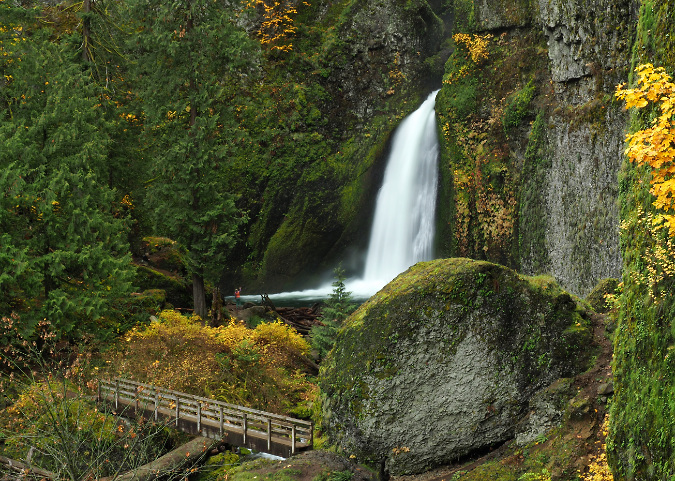
For the October image in the new calendar, I went back to Wahcella Falls. It’s not the first time a waterfall has appeared twice in a single calendar, but it was the combination of fall colors and a person in the photo – a rarity for me – that made the case. Look closely (below) and you’ll see a hiker in front of the falls, taking in the magnificent view.

Wahclella Falls (and a hiker) with fall colors is featured as the October image in the calendar

Earlier in this article, I included a photo of Wahclella Falls from an off-trail viewpoint taken in early spring. By late October each year, the same view lights up with gold and yellow fall colors (below) that are becoming even more prevalent in the aftermath of the 2017 Eagle Creek Fire that swept through this canyon. That’s thanks to the rapid recovery of broadleaf trees like Bigleaf and Vine maple that are taking advantage of the open forest conditions created by the fire, and bouncing back from roots and stumps that survived the burn.

Fall colors at Wahclella Falls have become more dramatic since the 2017 fire

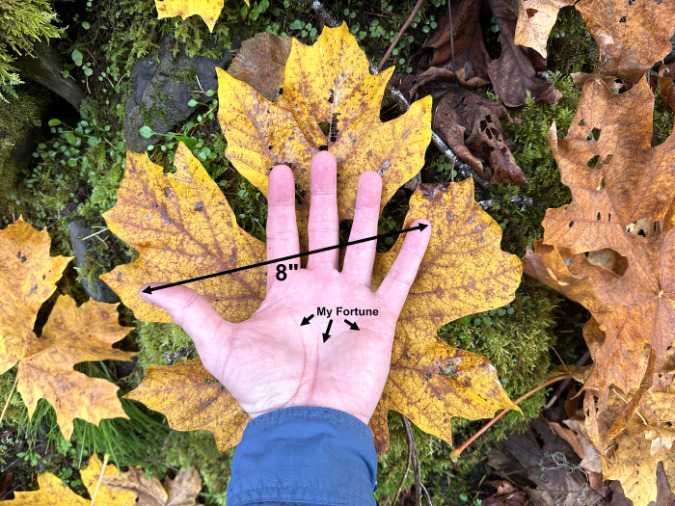
Bigleaf Maple are the real stars in this comeback story, with most growing from the surviving stump of a parent tree killed by the fire. The new access to sunlight and explosive growth also makes for super-sized foliage, with individual leaves measuring nearly a foot across (below) underscoring the common name for these essential trees.

Biglieaf maple leaves are growing to gigantic proportions in the post-fire recovery

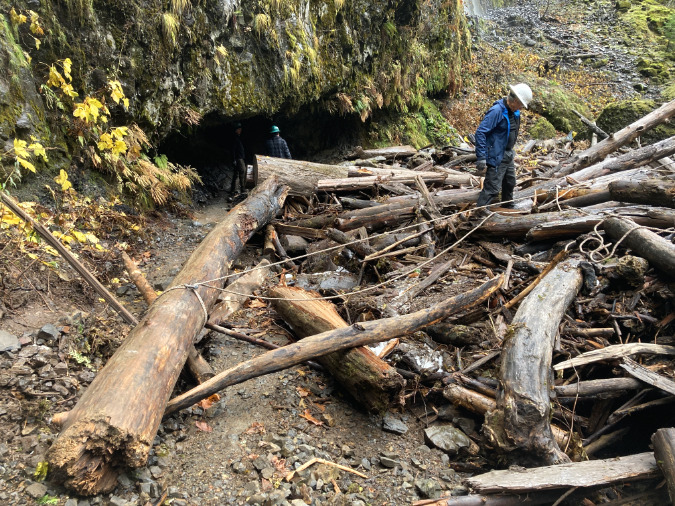
When I hike this trail, I see the handiwork of Trailkeepers of Oregon (TKO) crews everywhere, as TKOs volunteers have done much to rescue the trail in the aftermath of the 2017 fire. This includes a streamside section where a huge, post-fire logjam of killed trees accumulated just below Wahclella Falls, and piled so high they spilled onto the trail, itself. TKO and Pacific Crest Trail Association volunteers used a combination of saws and ropes to clear the way back in 2021, and today the logjam is still there to remind us of the power of this stream.

TKO crews clearing the logjam from the Wahclalla Falls trail in 2021

TKO volunteers also worked with the Forest Service to build a rustic set of stairs where the trail had collapsed near the falls, leaving a sketchy scramble through this gap in the rocks for hikers to navigate. The rock steps not only make the trail more accessible to everyday hikers, the add another interesting element and a bit of whimsey for young hikers (below) visiting this family-friendly trail for the first time.

Rustic steps built by TKO volunteers at Wahclella Falls area favorite with young hikers

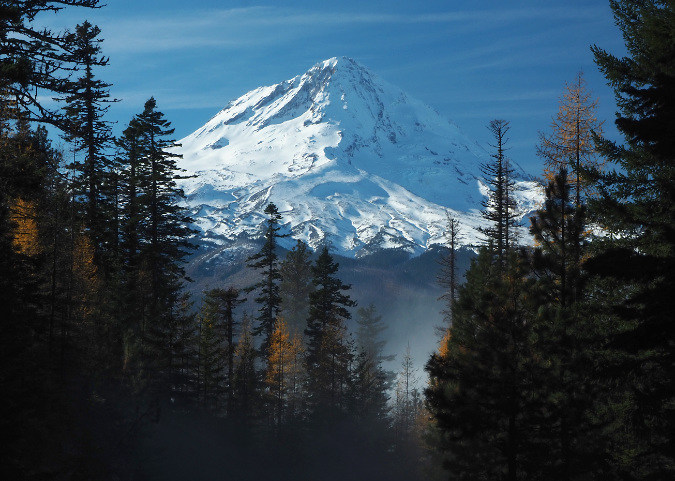
For the November calendar image, I returned to the east side of the mountain and chose a scene captured along the Lookout Mountain Road in late fall. This is the least-visited, less familiar side of the mountain to Portlanders, with a broad, sweeping profile that looks more like other Cascade volcanoes, and contrasts with the familiar, pyramid-shaped summit the mountain presents to the millions who live west of the mountain.

Yellow and gold Larch framing Mount Hood are featured as the November image in the calendar

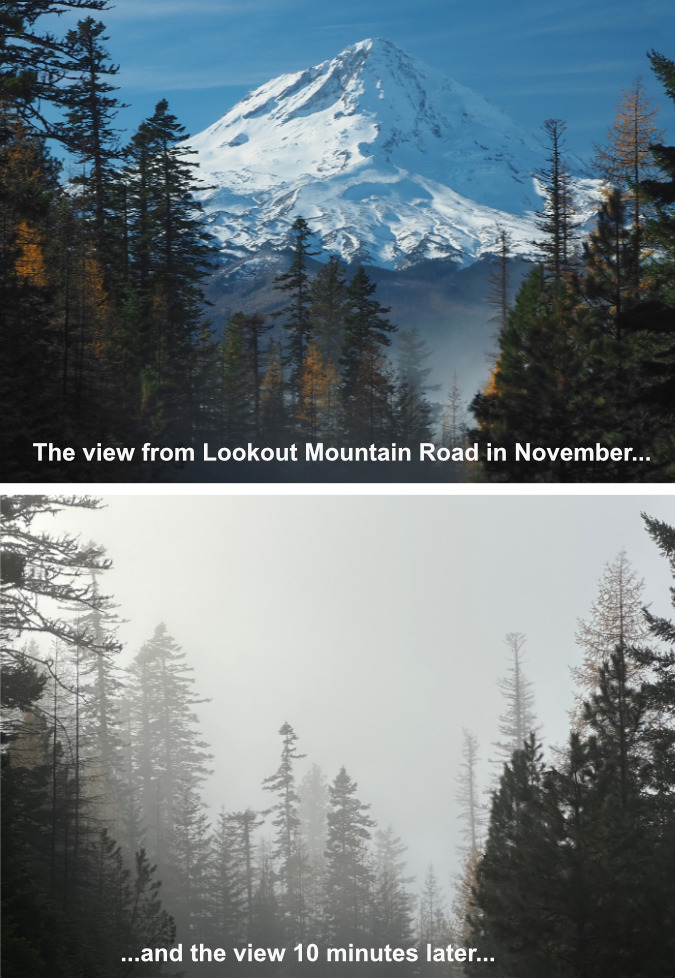
When the conditions are right, the Western Larch here have turned to their yellow and gold autumn colors and the first temperature inversions have arrived, filling the East Fork Hood River valley with fog. The effect can be quite dramatic. On this day the fog layer was growing especially fast, and surged over me in just the view minutes (below) I had to set up my camera!  

Fast moving fog at Lookout Mountain!

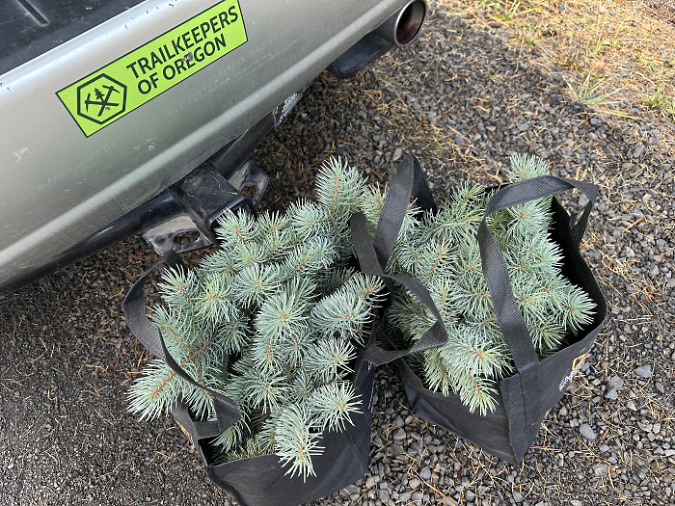
Having been fogged out on that chilly day, I followed another November ritual in the mountains and collected some greens for holiday decorating. Normally, I look for Noble Fir boughs, but on this day, I gathered some beautiful, blue-tinted Engelmann Spruce greens. You can easily distinguish spruce from other conifers by their sharp needles, making them a bit prickly to work with as holiday greens. Nonetheless, they made for some lovely Christmas arrangements at home!

Engelmann Spruce holiday greens..? Prickly!

Is it legal to collect holiday greens within Mount Hood National Forest? Absolutely, but check their website to see if a permit is required. For 2024, permits are waived, and you may collect up to 25 pounds (that’s a lot of boughs!) in a season. The main restriction is Whitebark Pine, which are now a protected species and may not be collected or cut in any way. These trees only grow at and above timberline, but if you’re unsure of how to identify them, just avoid cutting any pine boughs and stick with fir trees. Leave no trace also applies, so collect boughs as if you were pruning trees in your garden, with cuts made as discreetly as possible.

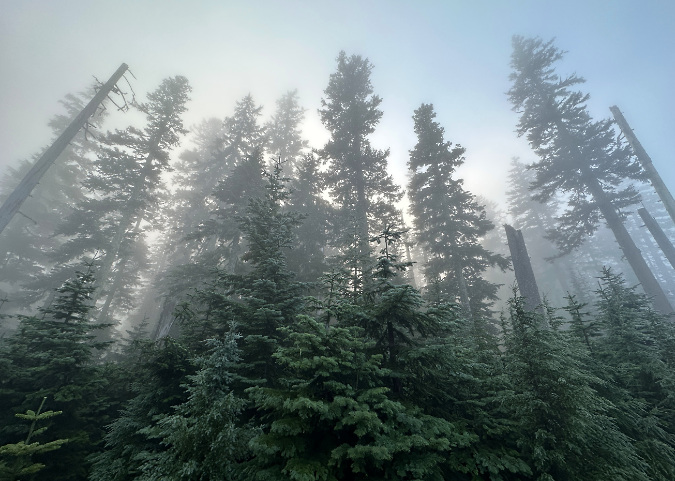
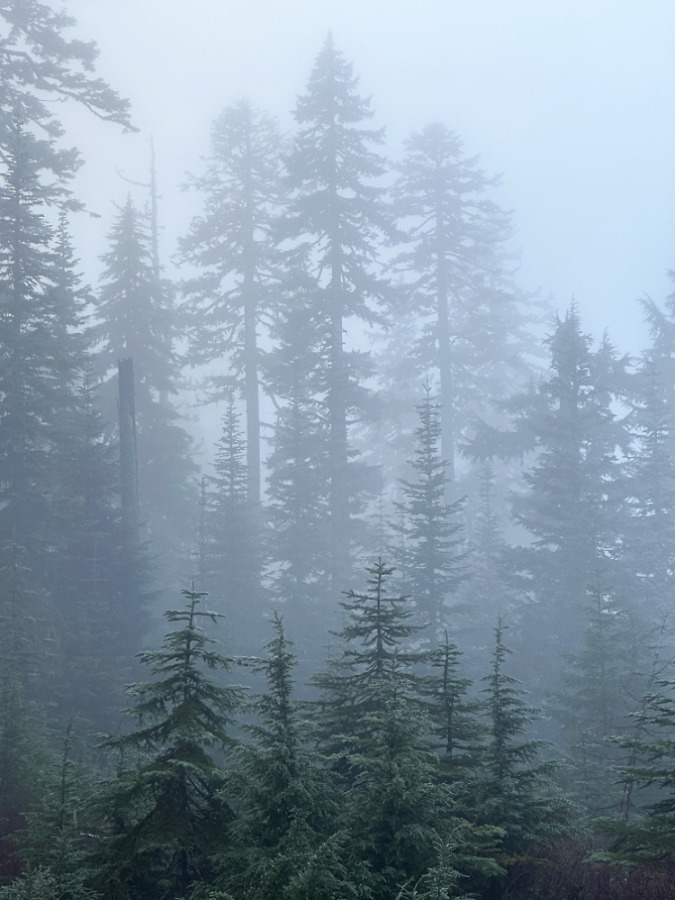
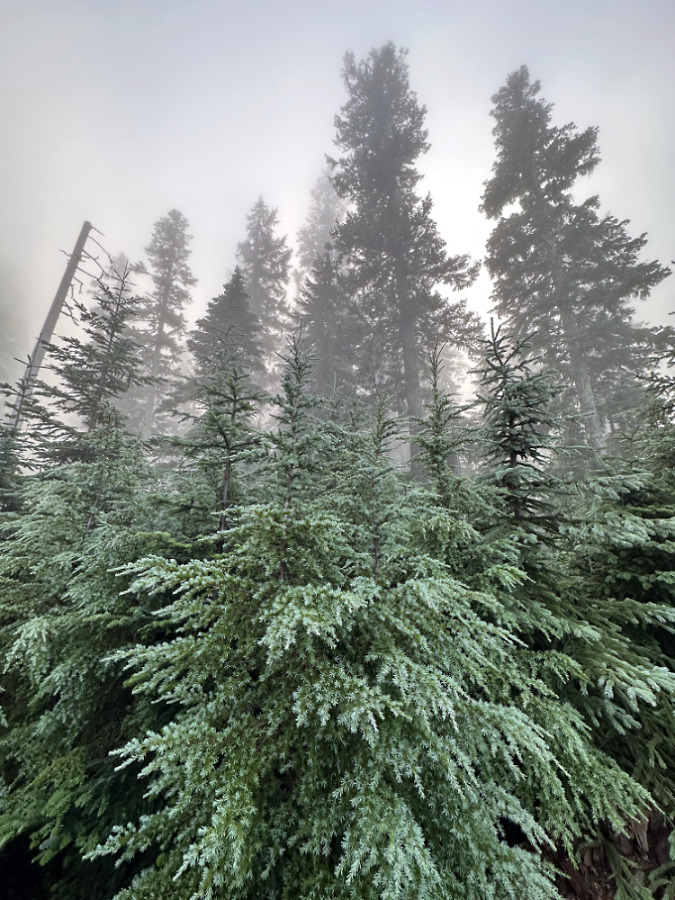
For December, I chose a fairly unconventional image for the new calendar. Continuing with the fog theme, I selected this photo from the Bennett Pass area, where dueling valley fog banks in both the White River and East Fork Hood River valleys were colliding at the pass. The effect in the ancient Noble Fir forests just above Bennett Pass was mesmerizing, with patching of blue sky opening and closing overhead as waves of fog rolled through the big trees.

Ancient Noble Fir forest rising into the fog near Bennett Pass are featured as the December image in the new calendar

Fog bank filling the East Fork Hood River Valley as viewed from above Bennett Pass

How old are these trees? Some are at least 400 years old. We know this because the area saw heavy logging in the 1970s and 1980s, and many of the giant stumps left from that unfortunate era still remain to tell the story through their tree rings. Fortunately, not all of the big trees were cut, and some truly magnificent old-growth Noble Fir stands remain today.

Noble Fir giants in the fog near Bennett Pass

Noble Fir giants and Mountain Hemlock seedlings in the fog near Bennett Pass

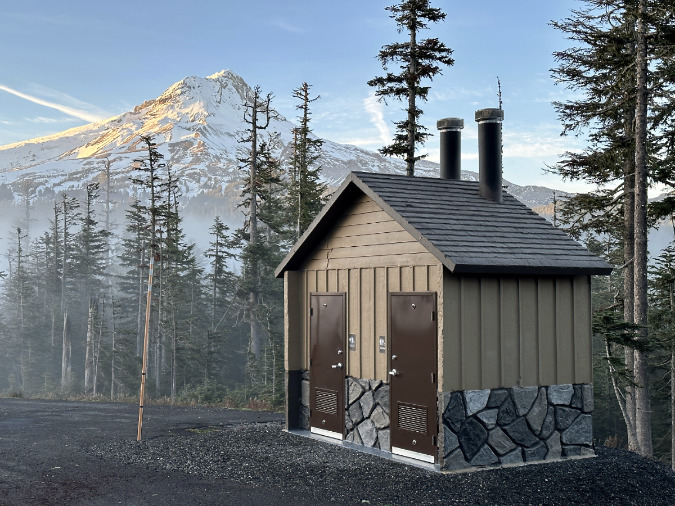
On a more practical note, I was encouraged on that trip to see the Forest Service continuing to gradually improve visitor facilities on the mountain, including a new toilet at the popular winter trailhead at Bennett Pass. While pit toilets might not be a joy for anyone to use, they are essential at busy trailheads, especially for families with young kids. Modern toilets like the new facility at Bennett Pass are also accessible for visitors with mobility devices, removing a very real barrier to our public lands.

New toilets at Bennett Pass – with a view!

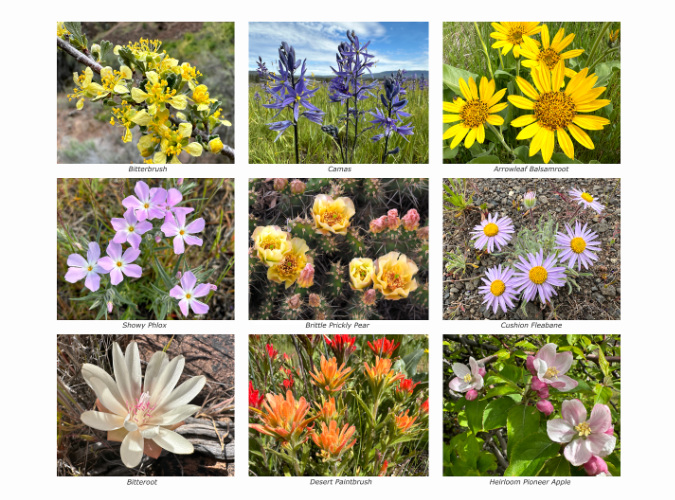
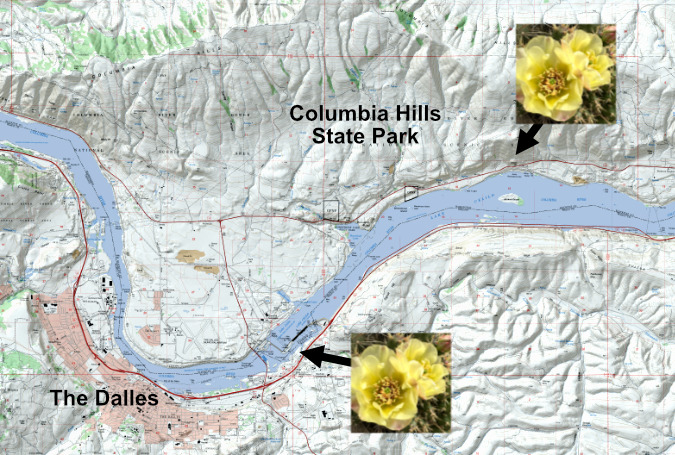
Finally, the back cover of the new campaign calendar features some of the wildflower highlights captured in WyEast Country over the past year (below). Some might be familiar, but I do have one confession to make: the Prickley Pear cactus in the center square wasn’t photographed anywhere near Mount Hood. Instead, it’s over in the John Day country, where I photographed this particular colony near the Painted Hills last spring. 

Wildflower mashup on the back of the 2025 calendar

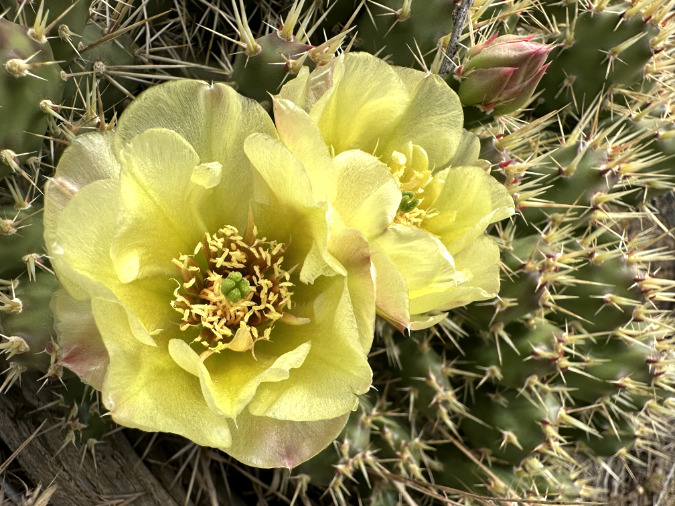
Here’s a closer look at one of the cactus blossoms from that trip (below), showing the unlikely contrast of impossibly delicate flowers emerging from a maze of thorns that make these tough plants so fascinating:

Brittle Prickley Pear near the Painted Hills

Why include this, then? Because I am admittedly obsessed with our native cacti, and determined to finally photograph them where they grow here in WyEast Country. I have two promising leads on that front that I’ll be following up on this spring. Both are near The Dalles and apparently hidden in plain sight, but I suspect I will have some searching to do!

Where the Prickley Pear grows..?

I’ve spent a lot of time over the years hunting for cactus in Oregon. As spectacular and flamboyant as these flowers are when in bloom, the plants are surprisingly well-camouflaged and hard to find when they’re not… unless you step on one! So, more to come in this story.

…and to spare you from scrolling back to the top, here’s the link if you’d like to order the 2025 campaign calendar featuring these new photos:

2025 Mount Hood National Park Campaign Calendar

and all proceeds from calendar sales go to Trailkeepers of Oregon (TKO), and they can be delivered anywhere

Looking ahead to 2025

Thanks for reading this far! Mea culpa: I began 2024 with high hopes of a lot of WyEast Blog articles, but my day job and real-life demands got the better of me this year, once again! Therefore, I’m recycling that goal for 2025, and I’ve got some fun topics that I’m eager to dive into. 

These include some new digging I’ve done on a massive landslide that completely rerouted one of Mount Hood’s major rivers, plus some new research on what many call “Indian pits” or “vision quest pits” – those mysterious pits found in talus slopes all through the Gorge and in spots around Mount Hood. I’ve also got a history piece on a surprising road race with a WyEast connection, and much more beyond these…time permitting!

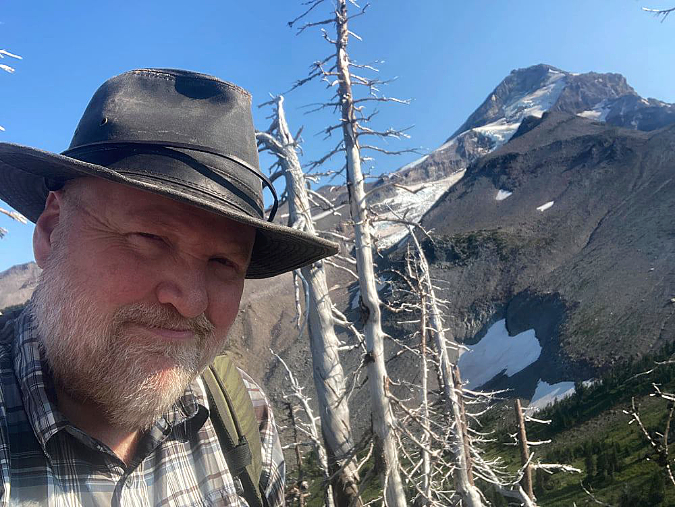
The old man and the mountain..

As always, thanks for patiently checking back when my posts become infrequent, putting up with the typos and grammatical errors, and — more importantly — thank you for being a friend of our Mountain and Gorge. I hope to see you on the trail sometime in 2025!

________________

Tom Kloster | December 2024
20 years of change on Cooper Spur… and the future?

Workers cutting beams from solid pine trunks for the new Cloud Cap Inn during the summer of 1888. The (then) surging Eliot glacier loomed just beyond Cloud Cap in those early days (Author’s note: this is a modified historical image that I have colorized to bring the sense of the distant past a bit closer to our present-day world)

[click here for a large version]

When the builders of Cloud Cap Inn began construction in earnest in early summer 1889, the backdrop for Mount Hood’s first mountain lodge was radically different than today. The Northern Hemisphere was experiencing the final decades of a brief, still unexplained cooling period known as the Little Ice Age that stretched from the 1500s through the 1800s. 

The cooling was modest, but enough to surge the Eliot Glacier down to the tree line, nearly filling the deep trough between the high lateral moraines that were created in the last true ice age, thousands of years prior. The debris-covered terminus (or snout) of the Eliot Glacier was in plain view from Cloud Cap, directly behind the workers on the left side of the photo, above. It was formidable wall of glacial ice and rock rising nearly 300 feet above the valley floor.

Early photo views of the Eliot Glacier’s terminus shows the river of ice already receding between the 1890s and 1920s

[click here for a large version]

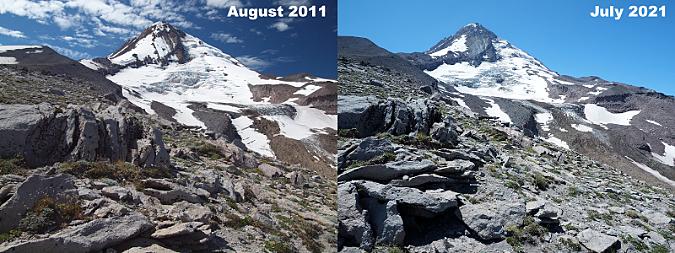
The Little Ice Age faded in the 20th Century, and as the photo pair above shows, the Eliot Glacier was already receding from its recent surge by the 1920s. Today, the Eliot Glacier has retreated about a half mile from its terminus in 1889, and lost as much as half its depth to our warming climate. 

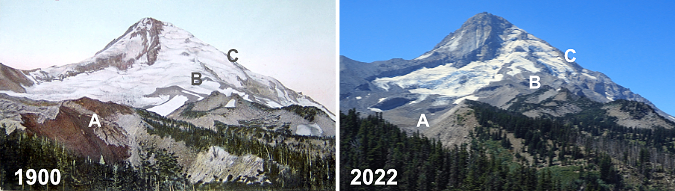
The following photo pair shows the dramatic change from 1920 to 2020. The change in the glacier’s thickness can be seen by (A) the exposed cliffs below Cooper Spur were carved into a vertical wall by the glacier at its peak. The glacier’s terminus (B) has receded dramatically over the past century, revealing the high moraines we now see rising above the Eliot Branch. A more subtle change (C) are the alpine forests gradually moving up the mountain as summer snowpacks diminish.

Another, more detailed 1920 view of the Eliot Glacier’s terminus compared to the same view in 2020 shows the radical change over the past century

[click here for a large version]

For much of the past century, these changes were gradual enough that only a few scientists and mountain climbers noticed the ongoing change. But since the turn of the millennium the pace of change has accelerated to an alarming rate as our climate warms.

This article documents this most recent period of change, over the two decades that span from 2002 to 2022, including how the landscape on the mountain, itself, as changed. The article focuses on the area around Cloud Cap and the Eliot Glacier, as viewed from the Cooper Spur trail, as this corner of the mountain has seen some of the most volatile change.

Why 2002 as a starting point? That answer has to do with technology, not climate change. That was the year that I began shooting with a digital camera. For someone who learned photography with a film camera (including plenty of spent time in the darkroom in the 1980s) the age of digital has been a revelation. Film and print paper was expensive, and while I have a lengthy archive of images going back to 1980, the digital era has allowed me to bring back hundreds of photos from a single trip to the mountain, where I might have captured a dozen during the film era that was rapidly winding down by the early 2000s. 

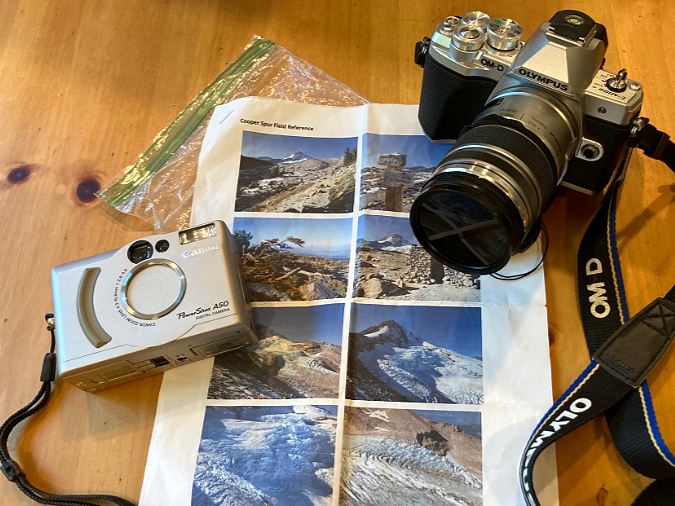
Then and now – my 2002 pocket camera and 2022 digital SLR, along with the 2002 photos I hoped to re-create.

The result is enough archived images beginning in 2022 to create a fairly thorough then-and-now comparison of the Eliot Glacier and surrounding environment along the Cooper Spur trail. The 2002 images came from a Canon A50 PowerShot pocket camera, still one of the best digital cameras I’ve owned over the years. Not long after this trip in 2002, I added my first digital SLR to my camera collection, and I have long since retired my film cameras for good. The 2020 images were captured with an Olympus EM-10 digital SLR, my fifth digital SLR, and easily my favorite (thus far).

To re-create the images from that 2002 trip, I carried a folded-up, modern-day version of a film-era proof sheet from that earlier visit in my pocket on a hike up Cooper Spur last September. Along the way, I did my best to match the scenes as I had viewed them 20 years prior. Once home, I was able to assemble 19 pairs that were close though to allow for nearly identical side-by-side comparisons. I’ve also noted a few points of interest for each image, keyed to both the 2002 and 2022 versions, to help highlight the changes that have unfolded. Because the embedded images in this article are inherently small, I’ve also posted a link below each image to a large version that will open in a new tab.

And now, how about a tour of these places in 2002 and 2022?

Change is constant… and surprising!

[click here for a large version]

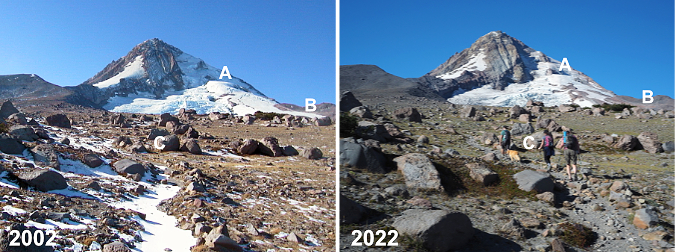
From Cloud Cap, the Timberline Trail route to Cooper Spur makes a dramatic entrance to the upper section of Tilly Jane Canyon and the first big view of Mount Hood. The changes in the first photo pair (above) are subtle, though telling. As is the case throughout the Cascades, groves of (A) Mountain hemlock continue their march to higher elevations, one more indicator of our changing climate. Lighter snowpacks (which translates to longer growing seasons) might also be the explanation for more expansive groundcover (B) of Juniper and Penstemon in the foreground. In distance (C), a pioneering Whitepark pine has survived to grow from a few feet tall to nearly 20 feet.

[click here for a large version]

Moving further up the mountain, the Timberline Trail reaches a junction with the Tilly Jane and Cooper Spur trails (above), just above the tree line. Here, the most notable change is the battering the old trail sign has taken in 20 years of winter storms and avalanches.  The two signboards were still around as recently as four years ago, but they were finally swept away in the last couple years. The bottom of the 8×8” post remains, though it had snapped off mid-way several years ago — a reminder of the power of moving winter snow in this avalanche-prone area! 

[click here for a large version]

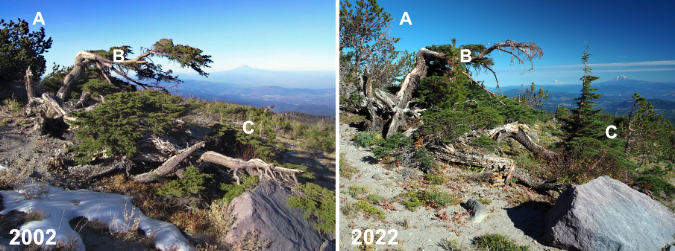
Just uphill from the trail junction, the next photo pair (above) shows a venerable Mountain hemlock  that has caught the eye of many hikers over the years. Notably, the Whitebark pine just behind the hemlock (A) has grown considerably, a hopeful sign for a keystone species that has been hard hit by climate change and disease in recent decades. The hemlock (B) shows some wear, however. The upper limb that reached out toward Mount Rainier and Mount Adams has lost the battle with the winter elements, and some of the lower limbs seem to be fading, too. But in the timeless cycle of nature, a completely new Mountain hemlock (C) has grown from beneath its elder, no doubt helped along by nutrients from the decaying limbs of the older tree and the protection from the elements the old hemlock still provides.

[click here for a large version]

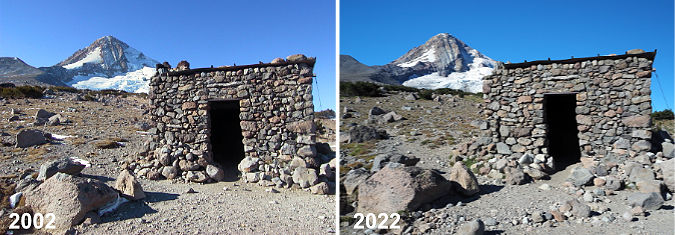
Further up the trail, the old stone warming hut at Cooper Spur appears (above). These shelters were built by the Civilian Conservation Corps (CCC) in the early 1930s, when the Timberline Trail was first completed. Thankfully, almost nothing has changed here, thanks to the work of volunteers who keep this old structure cabled to the ground and intact after nearly a century.

[click here for a large version]

Above the old warming hut, the Cooper Spur Trail heads into tundra country (above) as it nears the 7,000 foot elevation on the mountain. From this perspective, the retreat of the Eliot Glacier starts to become apparent, especially to those familiar with the area. The rounded ice crest known to climbers as the Snow Dome (A) is notably smaller and the depth of the glacier has receded enough in the lower reaches (B) to drop beyond the top of the east moraine from this perspective. In the foreground (C) alpine wildflowers continue their march to higher elevations where only a few grasses once grew because of once-lingering snowpacks.

[click here for a large version]

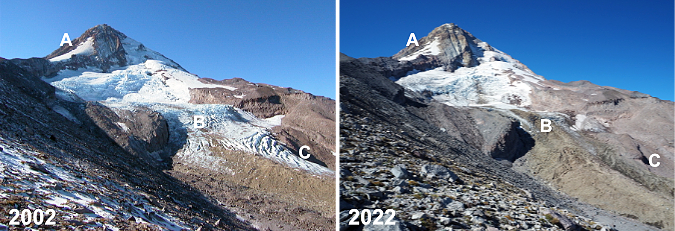
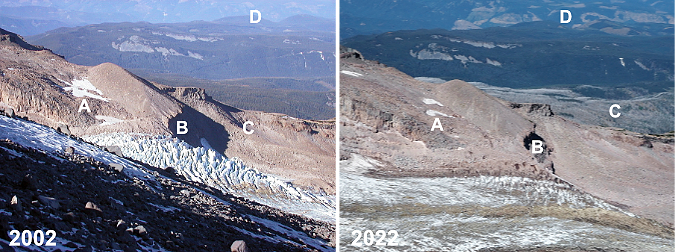
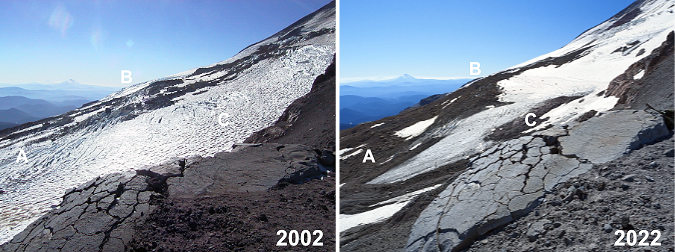
This photo pair (above) is from the first big view of the Eliot Glacier from the Cooper Spur Trail. The change over the past 20 years is unmistakable here. On the upper shoulder of the mountain (A), the snowfields that once led climbers to the summit well into summer are much smaller, making this approach in summer a very sketchy affair today, with much falling rock. 

This pair of images also shows how the lower Eliot Glacier icefall has changed dramatically in just two decades of glacial retreat. The blue chaos of seracs and crevasses (B) that were once a prime ice climbing destination are now well below the “firn line”, the point at which a glacier is losing more ice than it is gaining. This line is generally where a glacier changes from blue and white clean ice to a gray mix of ice and rock, as the glacier gradually shrinks and melts in its descent. Further down (C), the decreasing depth of the glacier is especially notable where blue and white ice have disappeared.

[click here for a large version]

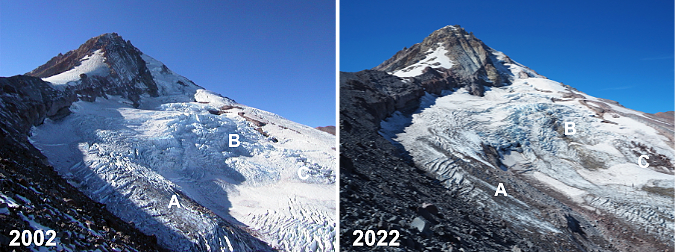
The next pair of images (above) is from an overlook just below the crest of Cooper Spur, at about the 8,000 foot elevation. Here, the Eliot Glacier is still impressive and awe inspiring as a mass of tumbling ice and wrinkled crevasses. The notable change in these views is the thinning of the ice (A and C) along the glacier’s margins, with piles of rubble appearing between lobes of flowing ice. The main icefall (B) also has some underlying rock showing as yet another sign of the thinning of the ice sheet

[click here for a large version]

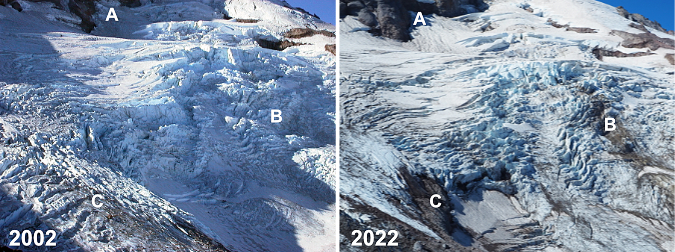
This pair (above) is simply a closer look at the main icefall from the same vantage point, showing (A) where the thinning ice mass has revealed more of the north wall of the mountain, and (b) where rock outcrops are now pushing through the icefall from below. Icefalls form because of these outcrops, so the appearance of the underlying rock is measure of the glacier depth decreasing. Twenty years ago, enough ice flowed over this outcrop to completely overwhelm it, whereas today we’re beginning to see traces of the rock beneath the glacier.

[click here for a large version]

This is another view of the Eliot Glacier from just below the crest of Cooper Spur, looking across the upper part of the glacier. Here the shrinking snowfields on the climbing route above Cooper Spur (A) are more apparent, as are the exposed cliffs (B) below the north face of the mountain, where the thinning ice has revealed a vertical well. On the shoulder of the mountain, a once-crevassed section of moving glacier has slowed to become a snowfield along the margin of the glacier.

[click here for a large version]

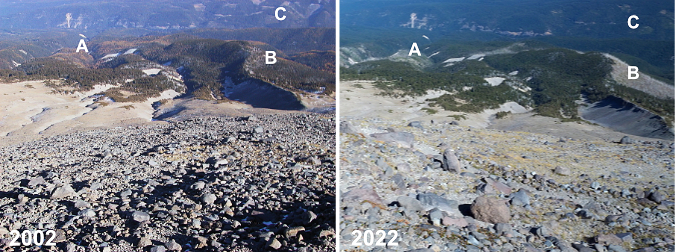
This photo pair (above) is looking across the Eliot Glacier from the crest of Cooper Spur, at about 8,500 feet elevation. It’s subtle, but the permanent snowfields (A) along the upper end of the Langille Crags are smaller today, and the lower icefall (B) is dramatically diminished, as shown in previous views. In the near distance (C) the silver ghost forest of the 2011 Dollar Lake Fire shows up today along the Mount Hood’s northern foot. In the far distance (D) the massive (and completely unsustainable) logging spree being carried out by timber giant Weyerhauser since taking over the timber holdings in the West Fork Hood River area a few years ago is painfully apparent.

[click here for a large version]

This pair (above) is a closer view of the previous set, focusing on the lower Eliot Glacier icefall. This comparison shows the thinning of the ice sheet (A and B) against the cliffs of the Langille Crags, and (C) the dramatic change on the near side of the glacier, where the firn line has moved several hundred feet up the mountain over two decades.

[click here for a large version]

Moving away from the Eliot Glacier, this photo pair (above) shows the broad east slope of Cooper Spur from the crest, looking toward the canyon of the East Fork Hood River. The changes here are subtle, but still notable. Historic Cloud Cap Inn (A) still stands, despite being threatened by both the 2008 Gnarl Ridge Fire and 2011 Dollar Lake Fire. The ghost forests of the Gnarl Ridge Fire (B) are recovering rapidly today, filled with understory and rapidly growing Western Larch seedlings that are now 6-8 feet tall. In the distance, the human scars (C) caused by Forest Service clear cutting on the slopes of Surveyors Ridge in the 1980s and 90s are gradually fading away, too, as the forests there slowly recover.

[click here for a large version]

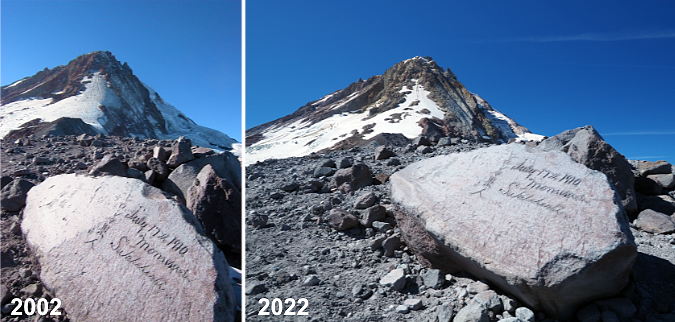
Happily, not much change at Hiroshima Rock (above) in 20 years – or even 122 years! This unlikely etching by a 1910 Japanese Climbing expedition has somehow survived more than a century of fierce ice and sand blasting, perhaps because the carving is on the leeward side of the rock? It remains a favorite touchstone for hikers passing through. Here’s an earlier blog article on this unique message from the past.

[click here for a large version]

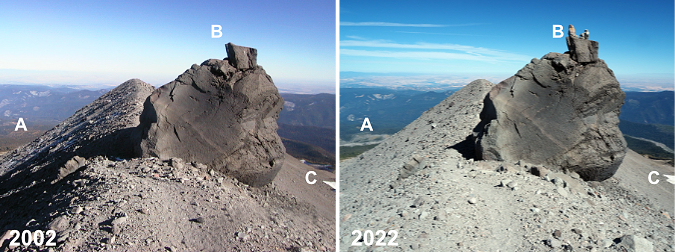
This photo pair (above) is looking back toward the crest of Cooper Spur from a bit further up the mountain, with a feature known as Tie-in Rock in the foreground. As in previous photos, the burn scars (A) of recent forest fires can be seen in the distance. The seemingly inescapable modern phenomenon of rock stacking (B) is present on Tie-in Rock, too. Size is hard to gauge here, but the rock is about 15 feet tall and takes some effort scale — much less with rocks in hand! The Newton Clark Glacier’s retreat (C) is somewhat noticeable on the far right, though the changes are much more apparent in the image pairs that follow.

[click here for a large version]

This image pair (above) provides full-on view of the Newton Clark Glacier from Cooper Spur. This sprawling glacier faces southeast, and because it catches summer sun from sunrise until late afternoon, it is has been more visibly impacted by climate change than the northeast-facing Eliot Glacier. What was once an icefall (A) 20 years ago is now bare rock, with the glacier flowing around it. Along the margins of Cooper Spur (B and C) the shrinking expanse of the glacier is prominent.

[click here for a large version]

This is a similar view (above) looking south across the Newton Clark Glacier. Like the Eliot Glacier, the lower, blue and white ice crevasses (A) on the glacier have fallen below the firn line, replaced by a grey mix of moving rock and ice. On the far shoulder of the mountain the former icefall at the center of the glacier (B) has receded around the rock outcrop that once produced it. In the foreground (C), the thinning of the overall ice sheet is dramatic over just two decades. Mount Jefferson is visible on the far horizon.

[click here for a large version]

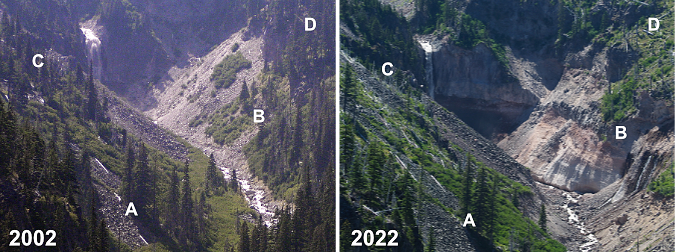
This photo pair (above) is from far below Cooper Spur, at an overlook above the Eliot Branch called Inspiration Point. I’ve included it in this series because the retreat of the glacier has had dramatic impacts downstream, too. As the glacier continues its retreat, the Eliot Branch is cutting a v-shaped channel into the soft, flat valley floor that was once beneath the glacier, releasing vast amounts of rocky debris into the stream below. Compounding that effect are periodic flood events that have repeatedly scoured the canyon. As this pair shows, the changes are extensive. 

For reference, a grove of three trees (A) in the lower center of the above photo pair have dodged the mayhem, though a group just below this trio has been swept away by the Eliot Branch. Meanwhile, an entire stand of trees (B) on the west wall of the canyon has slipped away in a massive landslide, revealing raw, banded volcanic bedrock, below. Another stand of trees on the east side of the canyon (C) burned in the 2011 Dollar Lake Fire, as did the remaining trees (D) in the upper west side of the canyon. This continues to be a very active, dynamic area, with constant changes to the river channel and canyon walls.

[click here for a large version]

The final photo pair is a longer comparison of just over 120 years, as seen from Cloud Cap Inn. Mirroring the changes shown throughout this article, the Eliot is a much smaller glacier today than it was when my own grandparents were born around 1900. The mass of ice and rock (A) that once made up the terminus would be enough to fill up much of downtown Portland. The lesser-known Langille Glacier (B) has almost certainly stopped moving, and has become a series of icefields. The Coe Glacier (C) is also in retreat, despite its shady location on the north side of the mountain.

Changes like those we are seeing on Mount Hood are tough to absorb, and thus I was determined to end this article on a hopeful note. Why? Because I’m a hopeful and optimistic person to the core, but also because there is much we can do to slow the climate change that is affecting so much of our world.

[click here for a large version]

We’re not powerless against these changes, though we do have a limited time on this planet to do our part. And thus, the final image pair (above). Why, it’s me! In 2002 I was a 40-year-old with blond hair and a red beard. Fast forward to 2022 and… well, at age 60 there’s not much hair left and the beard has turned decidedly gray. Time is not on my side, to be sure, but there is plenty more I can do in my life!

The benefit of 20 more years of living is the knowledge that I can still hoof it to the top of Cooper Spur (if a lot more slowly — and feeling it more the next day, too!) and still see things I’ve never noticed before. In 2002 I was still just thinking about how I could help keep the century-old idea of a national park around Mount Hood and the Gorge alive. Two years later, I started the Mount Hood National Park Campaign website to put the idea into words and pictures (and yes, it does need an update!). Six years later, I started writing this blog to continue celebrating the future Mount Hood National Park. That’s something I can continue to do even when getting to the top of Cooper Spur is finally out of my reach!

At age 60 I know I can’t single-handedly stop the changes happening on Mount Hood and in the Gorge, whether it be from climate change to just the sheer growth in the number of people coming here. But age DOES bring the super-power of perspective that can only come from time and lived experience — and in my case, I’ve also got the photos to prove it! I’m able to put a face on those changes to help inspire caring and action toward a new vision for the future, one that focuses on sustainability and adaptation in the face of change. That’s the point of this article and the WyEast Blog, of course.

And what about the future..?

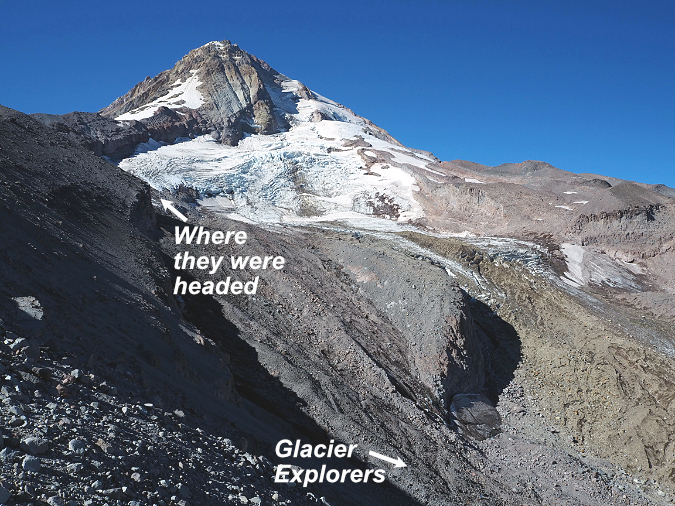
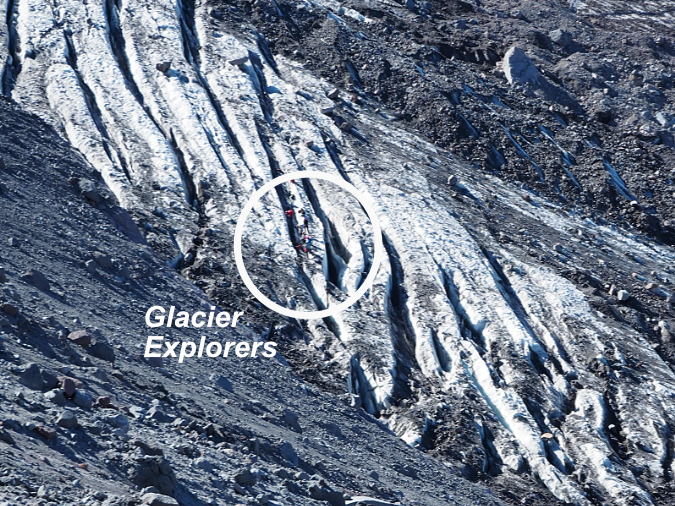
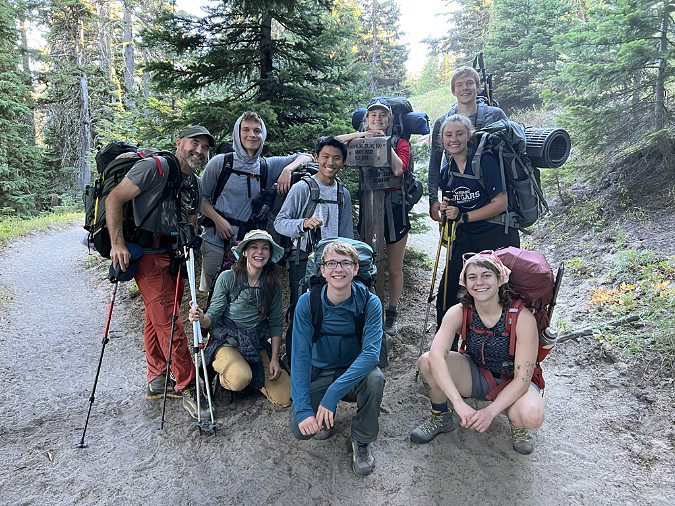
Throughout that day on Cooper Spur in September, I watched a group of young glacier explorers far below me, working their way through rock debris and over crevasses as they approached the main icefall on the Eliot Glacier. I took a few photos of the group along the way, and was thus delighted to run into them on their return to the trailhead that afternoon. I turns out they were students from Pacific University’s Outdoor Leadership Program, led by instructor Philip Friesen. 

If the then-and-now photos of changes on Mount Hood are tough to look, this is where the real hopefulness in this article comes in. Phil’s program at Pacific is pointing a new generation of future leaders toward a life and careers in the outdoors that I believe will be transformational for many of the environmental challenges we’re facing today. 

When I asked, here’s how Phil describes his program:

“I think the main thing to share with the world is that the students in our program focus on addressing systemic oppression and environmental issues while learning how to courageously lead others into the mountains, on rivers, and on the rock–we combine the joy of being outdoors in nature with the challenge of meeting some of our society’s biggest challenges.”

And there are many other educators like Phil out there helping young people of today turn their passion for the outdoors and their hunger to enact positive change into lifelong careers that will have a real impact in making a better world. As an old guy with only a few years left to do my part, I find this so inspiring and reassuring!

Phil Friesen (left) and his group of Pacific University students from the Outdoor Leadership Program are all smiles last September, even after a grueling climb up the Eliot Glacier!

Students in Phil’s program spend extensive time in the outdoors, learning how to hike, climb and kayak, so that they may be able to bring the outdoor experience to others over their lifetimes. This is the very best path toward conservation and sustainability, especially for our public lands. Only when we spend time there can we begin to feel the personal sense of ownership necessary to care for and protect these spaces in perpetuity.

I have great faith in what we have named “Generation Z”, and so does Phil. Young people majoring in Outdoor Leadership at Pacific are readying themselves for a life doing what they love, whether it be as a guide, ranger, naturalist or many other emerging careers in the growing outdoor industry. They’re also learning about the history of exclusion on our public lands, and the urgent need to remove barriers so that all Americans can enrich their lives in the same way that the most privileged among us already do. That hits home for them, too, as they are by far the most diverse generation in our history. 

Phil plans to share these images with his students, most of whom were born around 2002, when I took that first set of photos. They will likely find them jarring, as they only know the Eliot Glacier of today, and may not realize how quickly it is fading away. But they have an abundance  of passion for the environment, and I do think these photos will lend still more urgency to them in their commitment to make our world a better place.

The author getting his head straight in the shadow of mighty WyEast before heading home for  another week in civilization (Photo by Andy Prahl)

The real power of the Outdoor Leadership Program – and this is true for anyone who spends time in the outdoors – is the cascade of reflections that immersion in nature fosters. No matter your walk of life, time on a trail, among the trees or through mountain meadows, ensures the perspective, peace of mind and hopefulness needed to make the rest of our busy lives more successful. I refer to as my mental health time, when I get my head straight before another week of Zoom meetings and e-mails. Phil’s students are learning this early on, and I’m certain it will be as restorative and rejuvenating in their lives as it is in mine.

Phil’s group was all grins after a grueling day climbing up a glacier. Such is life when you’re 20 years old! They don’t know it yet, but they are part of what could be the most consequential generation in our history. They have no choice but to grapple with enormous challenges that my own generation has so short on. But because I do get to spend a fair amount of time around today’s Generation Z, I’m more certain than ever that they are special. They are uniquely up for the challenge. Phil’s students are way too young to know this quote that has guided since childhood, but they are nonetheless embracing it like no generation has before them:

________________

“Unless someone like you cares an awful lot,

it’s not going to get better. It’s not.”

-The Lorax

________________

And a final note to Phil Friesen and his Outdoor Leadership Program students: Thank you for the great things you are about to do!

________________

Author’s postscript: My best to all who have followed this blog over these many years! I greatly appreciate the support and especially your passion and concern for the future of our WyEast Country. I have a bunch of new articles planned for the coming year and look forward to sharing them with you!

In the meantime, I hope to see you on the trail!

Tom Kloster • January 1, 2023

2022 Campaign Calendar!

If you have followed this blog for a while, then you know I gather up my best WyEast images each year and publish them in the Mount Hood National Park Campaign Scenic Calendar. They are available online, and all proceeds from the calendars go the Trailkeepers of Oregon (TKO), a non-profit trail advocacy and stewardship organization that I’ve volunteered with since TKO formed, way back in 2007.

I’ll post more on how to order the 2022 calendar at the end of this article. But first, here’s a preview of the images, along with a few stories behind the photos.


The January image (below) and cover shot (top) in the new calendar were taken on the same magical evening at Lolo Pass, just a few weeks ago. The clouds framing the mountain were condensing right above me on this clear, cold evening, as they often do here, when moist Pacific air is compressed as it pushes over Lolo Pass on Mount Hood’s northwest shoulder. In winter, this geographic phenomenon can create a localized freezing-fog event at Lolo Pass, though it might be sunny and dry for miles in every direction!

January features Mount Hood alpengow from Lolo Pass

I’ve spent many evenings at Lolo Pass photographing alpenglow on the mountain under these conditions, and the fun (or frustration!) comes with the mountain peeking through the clouds, then quickly disappearing, once again. Because the prime evening light lasts for only a few minutes, those moments when the clouds suddenly part to reveal alpenglow on the mountain are a real thrill for photographers. On this evening, I was joined by another photographer, and we both cheered when the clouds opening up to reveal not just the mountain, but also the moonrise appearing over his shoulder! The moment was over after just a few seconds, but it is captured in the cover photo for this year’s calendar. It was the also the last time WyEast revealed himself on that memorable evening.

For February, I chose an image of Cedar Island, a botanical anomaly located in the heart of the Deschutes River canyon. This article from earlier this year tells the story of this odd group of Incense Cedar trees mysteriously growing far outside their normal range and habitat and somehow thriving in the middle of desert country, thanks to a confluence of unique conditions.

February features mysterious Cedar Island in the Deschutes River Canyon

These trees are truly oddities, but as described in the article, they’re also doing quite well. They have now established a satellite colony on the shoreline opposite the island, where a combination of shade and underground springs has allowed them to thrive. You can visit this grove by following the Deschutes River access road north from Sherars Falls for a few miles, just beyond Beavertail Campground.

As the 2017 Eagle Creek Fire begins to fade into our collective memory, and the post-fire recovery of the Columbia River Gorge continues to unfold, there are plenty of surprises. Perhaps most startling are the twin cliff collapses at Metlako Falls and nearby Punch Bowl Falls, along Eagle Creek. The Metlako overlook collapse occurred about nine months before the fire, but the Punch Bowl Falls event followed the burn. Some speculate the latter event was triggered by changes in runoff and the water table resulting from the burned forest. It’s an intriguing theory, though we may never really know for sure. What is certain is that both events are part of the ongoing evolution of the Gorge landscape, though we tend to think of it as static.

A similar collapse on a much larger scale occurred at nearby Tanner Creek in 1973, temporarily damming the creek and forming a lake that persisted for several years. The March calendar image features Wahclella Falls (below), framed by house-sized boulders that mark the many cliff collapses that have occurred here over the millennia.

March features Wahclella Falls on Tanner Creek

The Eagle Creek Fire burned lightly in the lower section of the Tanner Creek canyon, sparing many of the big, old trees here. However, the story in the upper Tanner Creek canyon is starkly different, with much of the overstory completely killed. Though just four years have passed since the fire, hundreds of logs from trees burned upstream have already collected in the side channel just below Wahclella Falls (below), forming a huge log jam that spilled onto the trail! Volunteers from TKO had to saw a path through the debris to reopen the trail in the winter of 2020-21.

What will the post-fire future bring to Tanner Creek and Eagle Creek? A LOT more logs, that much is certain. Some logs will make it downstream to the lowest stretches of the Tanner Creek, where biologists once placed logs and boulders in an attempt to improve salmon habitat. Now, the Eagle Creek fire is about to provide a major assist in that work by delivering a lot more logs in coming years.

Panoramic view of the new log jam below Wahclella Falls

The logs in Tanner Creek (and other major streams in the Gorge affected by the fire) may be new to us, but they are really just a return to what used to be, before fire suppression, when the Gorge was much less forested and the streams were filled with a lot more logs. That’s good news for the health of the forest and the endangered salmon and steelhead that rely on log-filled streams to spawn, as well as wildlife that depend on a forest with a mosaic of old growth forests, recovering forests and open patches created by fire.

For April, I chose a somewhat deceptive image from a spot called Fairbanks Gap (below), in the eastern Columbia River Gorge. One deception comes from the fact that Interstate-84 is not only out of sight, but also out of hearing range from this spot, despite being directly below the cliffs that frame the gap. Another is that this scene is on private land, and thus a reminder that without the Columbia River Gorge National Scenic Area protections, a lot more places like this would have vacation homes (or worse) constructed on them. Instead, this remains a working cattle ranch – though I hope someday it will make its way into public ownership for permanent protection.
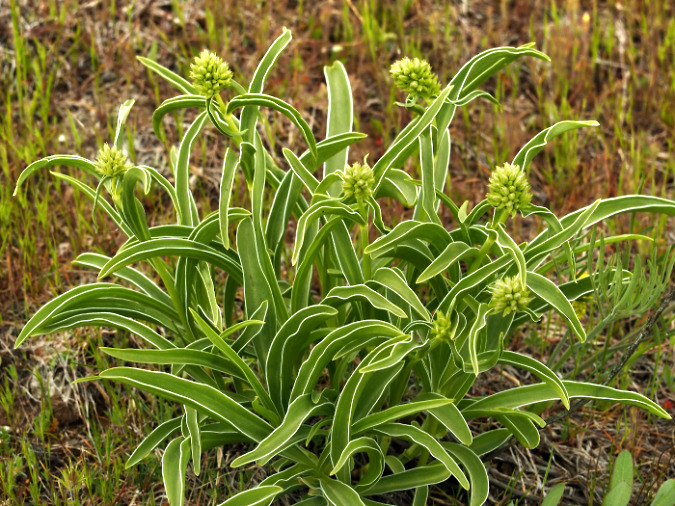
April features Fairbanks Gap and the east Columbia River Gorge

You can follow a nice backroad loop past the Fairbanks Gap by taking Fifteenmile Road out of The Dalles, and turning sharply uphill onto gravel (and signed) Old Moody Road at the rural crossroad community of Fairbanks (which features a lovely one-room schoolhouse). From here, Old Moody Road climbs to the gap, then traverses high bluffs above the Columbia River, with many spectacular views, before descending to Deschutes State Park, along I-84. My favorite time to visit this area is in late spring, when wildflowers line the old roads, and the eastern Gorge is verdant green.

The May image also features the eastern Gorge, this time at Rowena Plateau during the annual wildflower show. Yellow-flowered Arrowleaf balsamroot and blue-blossomed Lupine are the showy stars here, but the plateau is home to dozens of wildflower species, some found only in this part of the Gorge.

May features Rowena Plateau (and the town of Lyle, across the river)

In recent years, Rowena Plateau and the trail to McCall Point have been “discovered”, and the place is often crowded with adoring visitors. To address some of the impacts of all those feet on the trails, TKO has been working on some realignments and repairs to the McCall Point trail, with an eye toward improving the grades and drainage in a way that makes the trails more resilient to both weather and boots.

The Nature Conservancy owns much of Rowena Plateau, and continues to allow visitors to their preserve. This is a real gift for the public to enjoy, and while the vast majority come to enjoy (and revere) the scenery, big crowds inevitably mean a few thoughtless people. So, while I was frustrated to see tagging on a boulder along the lower part of the McCall Point trail on this trip, I also wasn’t surprised.

Tagging on a boulder on Rowena Plateau – a growing scourge in the Gorge

Tagging has become a problem throughout WyEast country, and especially in the Gorge. It’s especially frustrating at Rowena, where a private non-profit has shown the generosity of allowing us to visit their preserve. We probably can’t stop tagging, but you can support the Nature Conservancy of Oregon with a donation for the excellent work they are doing in the Gorge.

Our early and unusually warm spring this year came on the heels of an excellent snowpack, and that translated into heavy runoff and an impressive scene at White River Falls State Park, in the desert country east of Mount Hood. The June calendar image features a raging White River Falls (below), framed with bright green Cottonwood trees. The park encompasses the two-tiered main falls and a lesser-known lower falls, along with the fascinating ruins of a turn-of-the-20th Century hydroelectric project that once powered The Dalles.

June features White River Falls during spring runoff season

Only photographers would notice this aesthetic improvement to the main falls overlook – but sometime over the past years, a pair of long-dead Cottonwoods that partly blocked the view finally collapsed… or were perhaps were removed by park officials? The latter explanation is quite plausible, as the Oregon Parks and Recreation Department has stepped up their efforts to maintain this somewhat remote park, including buttoning up the historic powerhouse, where vandals had covered some of the walls with tagging and damaged some of the old machinery.

Snaggy former view of White River Falls… these dead trees are gone!

In the years I’ve spent visiting this little park, it has gone from very obscure to quite popular, and even the boot path to the once little-known lower falls is now well-worn. In a coming article, I’ll post some trail concepts for improving some of these boot paths and adding new trails to better manage some of the human impacts as visitation continues to grow.

Lower White River Falls and Gorge

For July, I chose an image from a favorite spot along the Cooper Spur Trail, overlooking the mighty Eliot Glacier, largest of Mount Hood’s glaciers. Our long spring and record-setting summer heat were hard on Mount Hood’s glaciers, and by late summer the Eliot Glacier was looking especially beleaguered. This image (below) was captured in late September, after an early snow had given the glacier a new coat of white, and the annual summer melting had finally slowed for the year.

July features the still-magnificent Eliot Glacier

As I was shooting this image of the mountain and the Eliot Glacier, I spotted a mountain rescue team training at the base of the lower icefall. There was a time not too long ago when the seracs (or ice pinnacles) in the lower icefall with turquoise-blue and a prime ice climbing area.

Climbers training in mountain rescue below the lower Eliot Glacier icefall

But the continued retreat of the Eliot Glacier has now moved the firn line above the lower icefall in recent years, and the seracs are now dark with glacial till and rock. The firn line is where a glacier is losing more ice than it is gaining, so as the glacier recedes the firn line gradually moves higher.

This is pair of images (below) that I’ve taken over the past decade from this spot, and I post them not to make readers feel sad or discouraged, but rather, to underscore the sense of urgency we all must feel in our collective response to global warming.

The Eliot Glacier has receded markedly over just the past decade

[click here for a much larger version of this comparison]

The accelerated Eliot Glacier retreat over the past two decades has had all sort of impacts, but near the top of the list of concerns is the impact on downstream fisheries that depend on cold, dependable runoff from the glacier. A more visible impact has been the deep erosion and periodic floods and debris flows that have reshaped the Eliot Branch canyon, below the glacier.

Though I know both the science and politics are challenging, I’m hopeful that we’ll find a path toward a worldwide shift away from carbon pollution in my lifetime. Future generations may not see the Eliot Glacier as I once knew it, but hopefully there will be a smaller Eliot Glacier they can stand in awe of, still tumbling down the slopes of Mount Hood.

At the opposite end of the glacial spectrum, the August calendar image features the icy stream that flows from Mount Hood’s tiniest living glacier, the tenacious Glisan Glacier, located high on the northwest shoulder of the mountain. For some reason, this glacial outflow was never given a proper name by early mountain explorers, despite many smaller streams on the mountain being named. The oversight is a bit of a mystery, as there were several well-documented trips to this side of the mountain in the early 1920s and 1930s by the Mazamas for the very purpose of mapping and naming the features here.

August features “Glisan Creek”, the glacial outflow from the tiny Glisan Glacier

As a default, many call this “Glisan Creek”. That’s not a bad option, since there’s a good chance the glacier, itself, will fall victim to global warming in coming decades, and only the creek will remain. The Glisan Glacier was named for prominent Portlander Rodney Glisan in 1938. Some of the history of all of Mount Hood’s smallest glaciers is included in this earlier article on Mount Hood’s Pint-Size Glaciers.

After an especially long and dry spring and summer in WyEast Country, fall brought early snow and some of the best fall colors in memory to the mountain. The scene below, at the McNeil Tarns, was captured after the first dusting of snow in late September, and it’s also the calendar image for that month in the new calendar.

September features the McNeil Tarns on Mount Hood

This is a well-known spot along the Timberline Trail, as it is located along the approach to popular McNeil Point on the northwest shoulder of the mountain and visited by thousands of hikers each year. While most hikers know of the pair of McNeil tarns located immediately adjacent to the Timberline Trail, few know of the third, lesser-known tarn in this trio. It’s located just off the Mazama Trail (below). Thanks to a dense veil of trailside Huckleberries, Mountain Ash and young Mountain Hemlock, this beautiful tarn is known to surprisingly few, but it is no less lovely than its more popular siblings.

The Mazama Tarn near McNeil Point on Mount Hood

Over the past five years, I’ve posted several articles about Punchbowl Falls Nature Park, the newest public lands in WyEast Country. The new park is the product of determined volunteers at Thrive! Hood River and Trailkeepers of Oregon (TKO), and features a surprising abundance of forest types, river scenes and waterfalls. Dead Point Falls (the October calendar image, below) is among the park highlights, especially in fall when Bigleaf Maple, Vine Maple, Western Dogwood and Oregon White Oak light up the surrounding forest in shades of orange, yellow and red.

October features Dead Point Falls and the West Fork Hood River

Meanwhile, higher up on the mountain, beautiful Heather Canyon on Mount Hood’s southeast flank is especially lovely in fall, when Huckleberry and Mountain Ash turn the canyon into a brilliant watercolor of orange and yellow. Lower Heather Creek Falls (below) is the featured image for November in the new calendar.

November features Heather Creek on the southeast slopes of Mount Hood

There are a couple ways to hike into Heather Canyon, but I always opt for the Newton Creek Trail approach, mostly to avoid walking through the Mount Hood Meadows ski resort. In the coming year, I hope to post a long-planned article with a somewhat radical proposal for rethinking Mount Hood Meadows – something we should all be considering as climate change threatens to put ski resorts as we know them out of business in coming years.

Anyone visiting Lookout Mountain on Mount Hood’s east side has probably noticed this beautifully framed view from Lookout Mountain Road (below), and I chose it for the December image in the new calendar. If the conditions are right, early snow on the mountain appears just as the Western Larch trees are turning to yellow and gold, and such was the case this year!

December features Mount Hood framed by Western Larch

I’ve photographed this spot too many times to count over the years and I’ve always thought of it as a scene only hikers knew about. However, a couple of days after capturing the calendar image, I was walking through my neighborhood grocery store and did a double take when I saw the scene on the cover of a nationally marketed calendar!

This looks vaguely familiar…

The photographer (and I’m not sure who it is) captured a less snowy version of Mount Hood, though it remains a beautiful image, and it’s great to see this lesser-known view of the mountain in wide publication.

Finally, the back cover of the new calendar features wildflower highlights from around WyEast country, ranging from the elegant Mount Hood Lily and Pacific Rhododendron to our state flower, the Oregon Grape (below).

The back cover of the calendar features a selection of wildflowers

There you have it! If you’d like to purchase a calendar, it’s easy to order direct from Zazzle:

2022 Mount Hood National Park Campaign Calendar

Each page in the calendar measures 11×14 inches (or 22×14” unfolded on the wall) and I’ve designed this as a functioning calendar, with date squares that you can actually write in! Zazzle prints these with exceptional quality and ships them carefully packaged with a backer board and moisture seal.
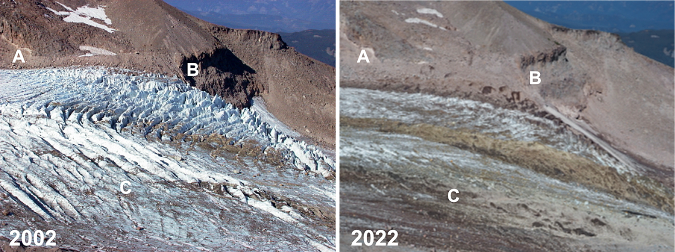
For another week or so, the calendars will sell for $29.75, but after December 20 that price will bump up to $34.95, with the additional five dollars of markup also going to directly to TKO, bringing the total to about $10 from each calendar to TKO for the great work they do. Zazzle typically ships these within a few days of ordering, and I usually receive orders within about 10 days.


Thanks for reading this far, and as always, thanks for visiting the blog – I hope to see you here and on the trail in the coming year!

Tom Kloster • December 2021