Warren Falls Lives! (temporarily, at least)

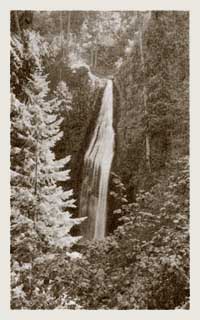
Warren Falls flowed briefly in early December

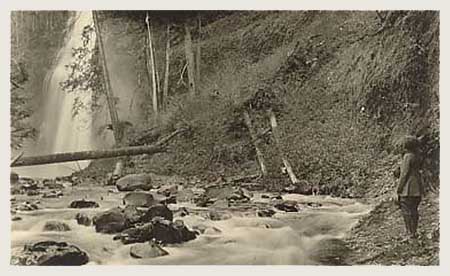
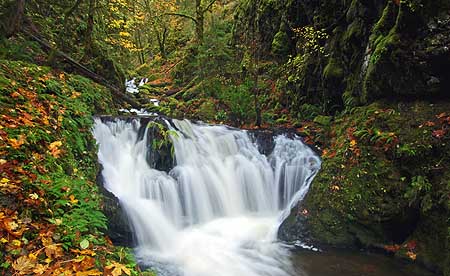
As an update to this recent article on restoring Warren Falls, I made a trip to the site of the former falls during a classic “pineapple express” pattern of winter monsoons earlier this month. I was thrilled to find a small amount of Warren Creek cresting the weir that has diverted the creek into a bypass tunnel for the past 75 years, and pouring over the falls.

It was remarkable to be in the amphitheater with water cascading over the escarpment, once again, and even if only temporarily. The small amount making its way over the brink completely changed the place from an eerie, somber cavern to a bright, sparkling glen. It was even more exciting to imagine the full force of Warren Creek plunging over the high cliffs, given the thundering display at Hole-in-the-Wall Falls (which is created by the bypass tunnel).

Here is a short video from that day that captures the scene and tells the story of Warren Falls:

Million Dollar View – Postscript

Beacon Rock rising above the Columbia, as viewed from the Oregon side

In March 2009, I posted this article about local hostility toward the public that has emerged in the Warrendale community, opposite Beacon Rock on the Columbia River. Last summer, James Ellis Koch, a 68-year-old resident in the area was arrested for firing a rifle and shotgun at fisherman anchored offshore his riverfront property, terrorizing the four men onboard.

The original article has now been updated with postscripts detailing the incident, and pointed observations on Warrendale’s vigilante culture by the sentencing Multnomah County judge Janice Wilson.

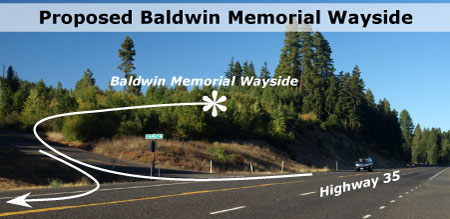
Proposal: Baldwin Memorial Wayside

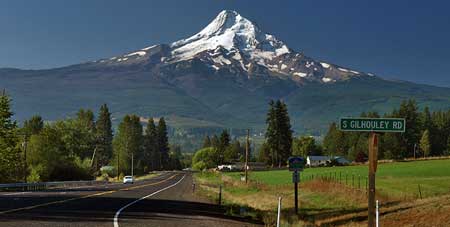
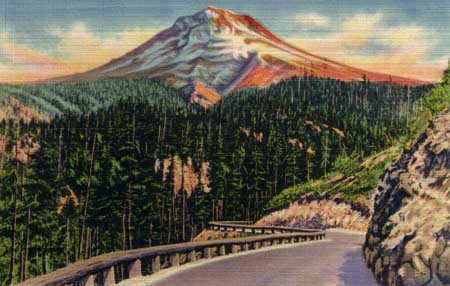
Few in the Hood River Valley would ever recognize the name “Gilhouley Road”, much less anyone from beyond the area. And yet, at the intersection of this obscure dirt road and the Mount Hood Loop Highway lies an imposing scene that is treasured by locals and tourists, alike: the first big look at Mount Hood as you descend into the Upper Hood River Valley.

On a clear day, you’re guaranteed to see tourists pulled to the highway shoulder, snapping pictures of the mountain rising above bucolic pastures, even as semi-trucks roar past on the downgrade. The scene is irresistible.

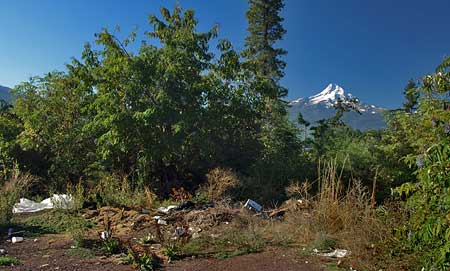
Illegal dumping on the proposed wayside site

Earlier this year, a friend and national parks advocate from New England was visiting, and took the opportunity to drive the Mount Hood loop, and see “Oregon’s next national park”. Despite all of the mistreatment Mount Hood has seen, his sharpest critique was the shabby way in which we treat our visitors. He was amazed at the utter lack of traveler information — and confusing information, when it was provided. So, this article is inspired by his comments.

Rediscovering Waysides and Viewpoints

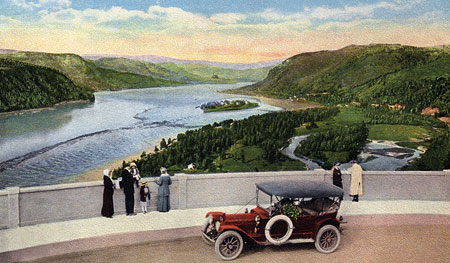
In the early days of auto touring, the Columbia River Gorge had the “King of Roads”, and among the great features of Samuel Lancaster’s magnificent scenic highway were the waysides and viewpoints that dotted the route. A family could load into their 1917 Packard Twin Six, and make a day of it, pulling off at each viewpoint, snapping photos with the family Brownie camera, and often following the short trails that led to still more views, or perhaps a waterfall.

Crown Point is the king of the waysides on the “King of Roads”

Times haven’t changed all that much, since, but the way we design our roads has. Tourists are now discouraged from stopping in many spots, and often take their life in their hands, if they do. Today’s highway engineers are much more concerned about keeping cars moving, at all costs.

The Hood River valley has just one “official” roadside viewpoint, located on county-owned land at Panorama Point in the lower valley. The scene is well-known, but also well removed from the Mount Hood loop highway by a couple miles. This proposal is for a companion overlook to Panorama Point, located in the upper valley, where the mountain first comes into full view for highway travelers, at the obscure junction with Gilhouley Road.

Click here for a larger map

In researching the possibilities for a new wayside at this spot, I first did a site inspection of the hillside above the highway: the area is recently logged, but with a fair number of mature trees left standing. The inevitable illegal dumping is present, of course — the scourge of public lands in highway corridors. But the view is breathtaking, with Mount Hood even more dramatically framed by hills, forests and fields than from the highway grade.

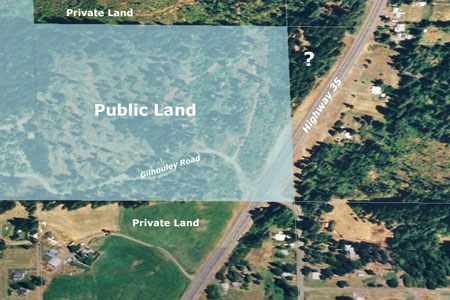
According to public lands data, the land is mostly public, and owned by Hood River County. The map (above) shows a perfect rectangle of public property that extents east along Gilhouley Road from nearby Middle Mountain, largely encompassing the wayside site. One triangle of land (indicated with a question mark) may be a private parcel, but isn’t essential to the wayside concept.

The approach to the site from Highway 35 is ideal: the intersection is located on a long, straight segment of road that would make for safe exit and entry from either direction. The presence of Gilhouley Road means that access is legally assured, with little possibility of an extended battle with ODOT for the right to build a wayside.

Looking south at the wayside site from Highway 35

The larger question is whether ODOT and Oregon State Parks would step up to make this a joint venture with local governments. It seems plausible, at least, given the lack of waysides along this portion of the loop highway, and the obviously heavy tourist traffic.

What would the wayside look like?

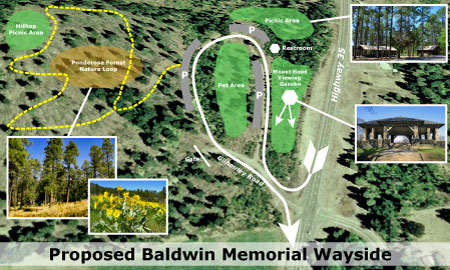
The site inspection revealed a surprising expanse of public land available at this site, so I’ve sketched a full-blown day use park as the proposed “Baldwin Memorial Wayside”.

As the schematic (below) shows, there could be a viewing structure, picnic areas, a nature trail and restrooms. This degree of development puts the concept into the major investment category, but certainly not beyond reach, especially since there are no other state parks or waysides in the Hood River Valley.

Click here for a larger map

Because the site has recently been logged, the wayside proposal could be equal parts park development and habitat restoration. While the main feature would be a developed overlook for highway travelers, this proposal also takes advantage of the open hillside rising above the highway. A scattering of ponderosa pine spared from logging provides an excellent opportunity for an interpretive trail built around habitat restoration.

One interesting possibility could be a restored balsamroot and lupine meadow beneath the pines. These spectacular blooming species are native to the area, are already present on the site and could become a popular draw for spring visitors to the area, just as similar wildflower spots in the Gorge are now.

What would it take?

Could a project like this really happen? Some stars are already aligned: Hood River County already owns the land and access rights to the highway at Gilhouley Road. Together, these are an invaluable step forward, since the road guarantees highway access and the land can be used as a grant match for state and federal funds. The site also benefits from access to utilities and proximity to existing emergency services. These are all core considerations when creating a new public park.

Most of all, it would take local leadership in the Hood River Valley area to secure state or federal funding through grants or other sources. Even in times of tight public budgets, this sort of project is achievable, especially if it helps reinforce the local economy and has an ecological purpose.

About the Name

Lastly, what would this new wayside be called? Well, “Baldwin Memorial Wayside” is simply borrowed from nearby Baldwin Creek, which in turn, memorializes Stephen M. Baldwin, who settled a claim along the stream in 1878. This would have made Baldwin one of the earliest settlers in the area.

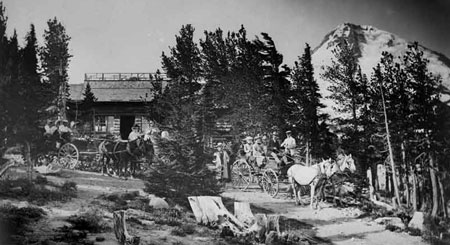
The Cloud Cap Inn circa 1900

But this is where the connection to the Mount Hood view comes in: Stephen Baldwin’s son Mason “Mace” Baldwin became a well-known figure in Hood River County history in the early 1900s. Most notably, he was one of the founders of the legendary Crag Rats mountain rescue group in 1926, formed after the dramatic rescue he led that summer of an 11-year-old boy lost on Mount Hood.

Mace Baldwin not only gave the Crag Rats their name, he was also elected to be the group’s first “Big Squeak” (president), and went on to take part in many mountain rescues over the years. The Crag Rats were the first mountain rescue organization to be formed in the American West. In 1954, the Crag Rats adopted the venerable Cloud Cap Inn, on the north shoulder of the mountain, and have since been the careful stewards under special arrangement with the Forest Service.

The Crag Rats continue to be active today, and given the connection of this site to one of their founders, perhaps the “Baldwin Memorial Wayside” could include a tribute to these mountain heroes? It would certainly be a fitting memorial, and a fine way for visitors to enjoy the mountain view and learn a bit more about it’s rich human history.

Proposal: Cooper Springs Trail

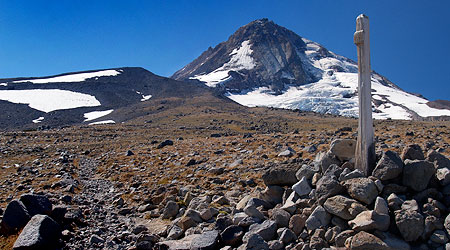
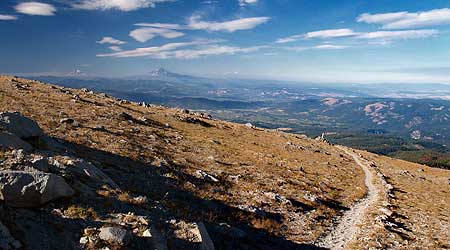
Cairns with cedar posts mark the way on the slopes below Cooper Spur.

One of the memorable highlights along the Timberline Trail is the starkly beautiful section between Gnarl Ridge and Cloud Cap, high on the broad east shoulder of the mountain. Here, the trail crests its highest point, at 7,335 feet, as it traverses the tundra slopes of Cooper Spur more than a thousand feet above the tree line.

However, the spectacular elevation of the Cooper Spur section is also its Achilles heel, since hikers attempting the Timberline Trail must cross a series of steep snowfields here. In most years this entire section is snowed in through late July, and some sections of trail appear to be permanently snow-covered.

Looking north along the Timberline Trail along the slopes of Cooper Spur

The trail builders constructed a series of huge cairns to mark the way through this rugged landscape, yet the snowfield crossings continue to present both a risk and route-finding obstacle to most hikers, especially in early summer. The Timberline Trail continues to draw hikers from around the world in ever-growing numbers, so an alternative route seems in order to ensure that the around-the-mountain experience continues to be world class for all visitors.

The Proposal

To provide a more reliable alternative for this segment, a new, parallel trail is proposed as part of the Mount Hood National Park Campaign. The new route would be about a mile to the east, at roughly the 6,200’ level, just below the tree line. For early season hikers, or simply those not up to the rugged combination of elevation, rock and snow on the existing trail, this new route would provide a more manageable alternative.

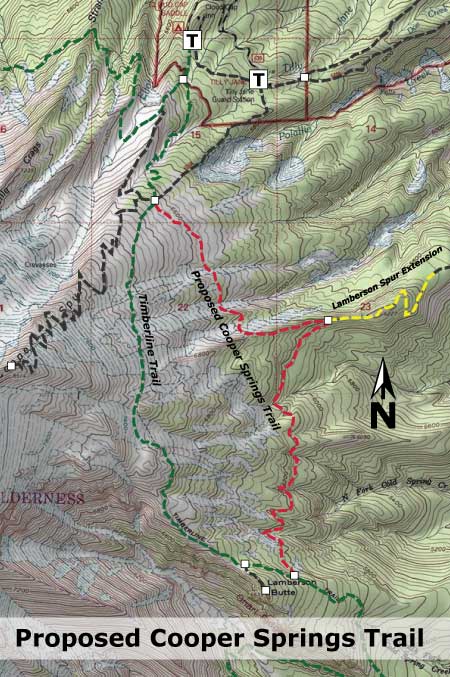
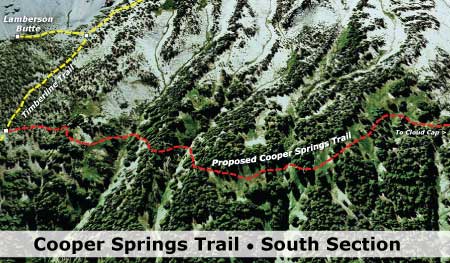
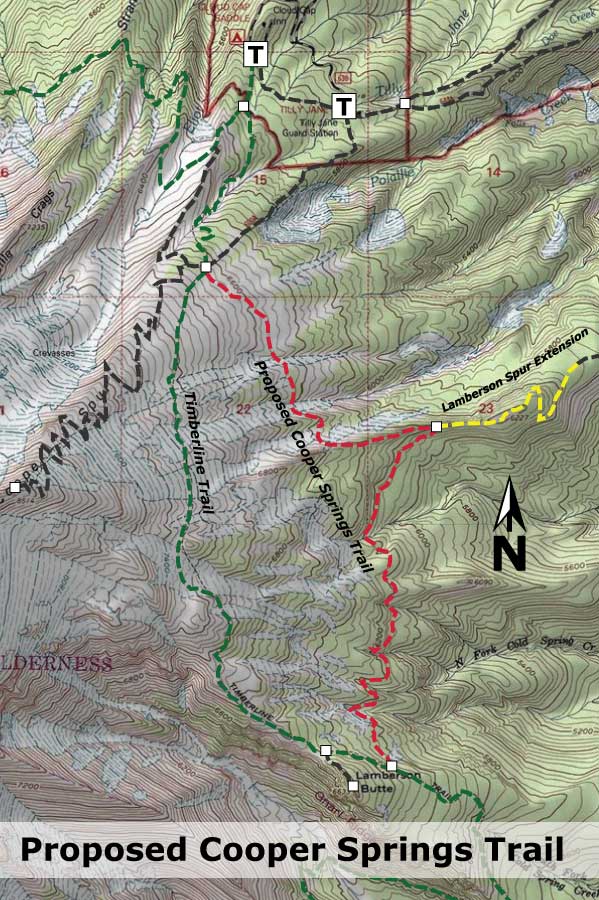
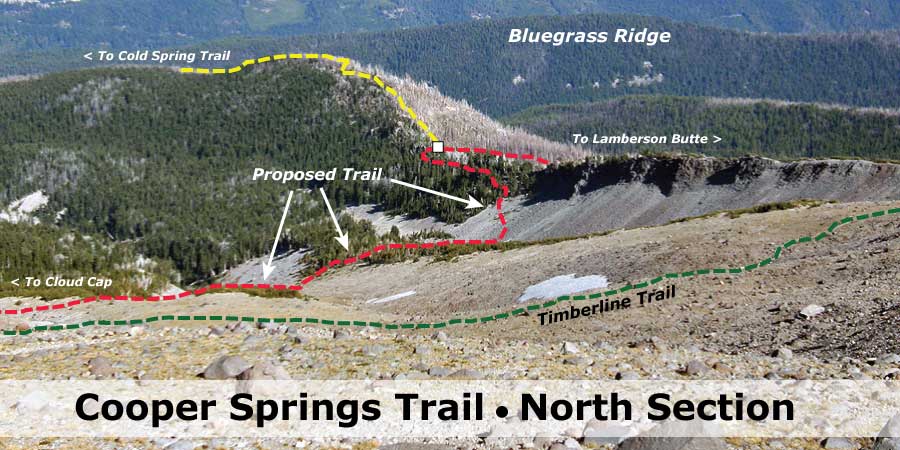
This new 3.5-mile route would still connect Cloud Cap to Lamberson Butte, but at a lower elevation. As shown on the map below, the proposed Cooper Springs Trail (in red) would depart from the current Timberline Trail (in green) at the current Cooper Spur junction on the north, and rejoin the Timberline Trail just below Lamberson Butte, to the south.

Click here for a large map

This option would add about a half-mile to the around-the-mountain trip, but would also save about 800’ of elevation gain, as measured in the traditional clockwise direction on the Timberline Trail. In fact, the new Cooper Springs Trail would actually drop 200’ in elevation from Cooper Spur Junction to Lamberson Spur.

This new trail wouldn’t be a formal segment of the Timberline Trail, but simply a hiking option, just as other parallel routes to the Timberline Trail already allow at Umbrella Falls, Paradise Park, Muddy Fork and Eden Park.

Today, these complementary routes along other sections of the Timberline Trail not only allow for interesting loops and less crowded conditions for hikers, they also provide detour options when trail closures occur — as happened recently along the Muddy Fork, where hikers were able to use a parallel route to avoid washouts on the main trail.

What Hikers Would See

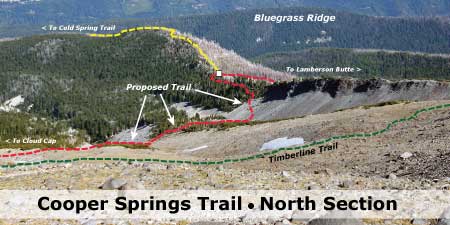
The northern segment of the new Cooper Springs Trail would make a gradual descent from the existing 4-way junction of the Cooper Spur, Tilly Jane and Timberline trails to the tree line, curving through a series of small headwater canyons that eventually feed into Polallie Canyon. This section would cross the first of several small streams along the new route.

The northern section of the new trail from above the Timberline Trail, as viewed from the slopes of Cooper Spur.

Click here for a large map

Soon the new route would cross a sharp ridge, where under this proposal it would intersect with an extension of the Lamberson Spur Trail. This trail is an odd anomaly: the route is marked and maintained where it leaves the Cold Spring Creek Trail, but mysteriously dies out on a ridge about a mile below the tree line. A few adventurous hikers continue cross-country from this abrupt terminus to the Timberline Trail each year, but under this proposal, the Lamberson Spur Trail would be formally connected to the new Cooper Springs Trail. This new segment is shown in yellow on photo schematic, above.

Extending the Lamberson Spur route to the new Cooper Springs Trail would entail about a mile of new trail, but would be an important piece in linking the new Cooper Springs route to the existing network of trails along Cold Spring Creek and Bluegrass Ridge, to the east. Together, this network of trails could provide an important, less crowded overnight or backpacking experience than is possible on the more heavily visited sides of the mountain.

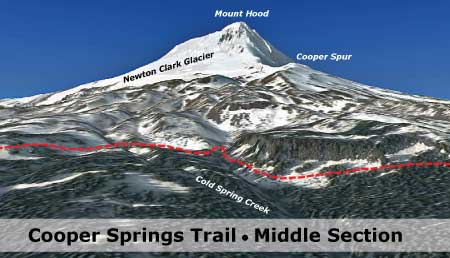
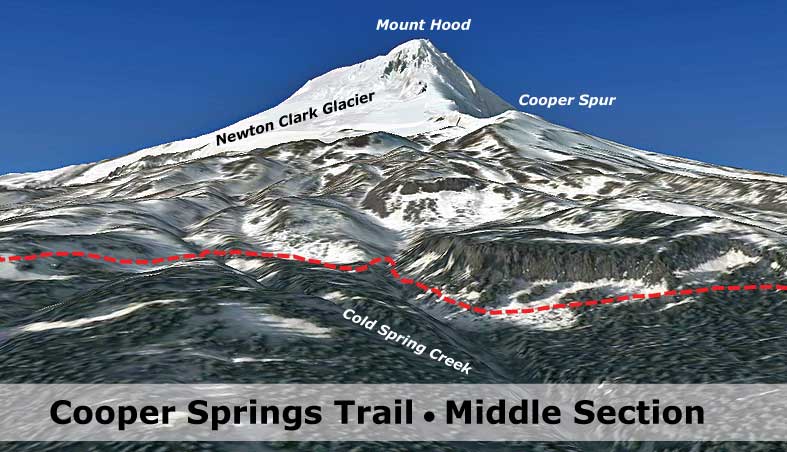
Beyond the proposed Lamberson Spur junction, the middle section of the new Cooper Springs Trail would pass through an especially interesting landscape. Here, a series of dramatic cliff-edged bluffs and talus slopes frame the view of Mount Hood and Cooper Spur, looming above, while the trail would cross through groves of ancient mountain hemlock.

The middle section of the new trail would traverse a series of little known canyons and cliff-topped bluffs below Cooper Spur.

Click here for a large map

This section of the new trail would also provide a close-up look at the aftermath of the Gnarl Fire, which burned a large swath of forest along the eastern base of the mountain in the summer of 2008.

At one point, the fire made headlines when it threatened to destroy historic structures in the area, narrowly missing the venerable Cloud Cap Inn. Though the trail would traverse above the burn, it would allow hikers to watch the recovery phase of the fire cycle unfold on the slopes, below.

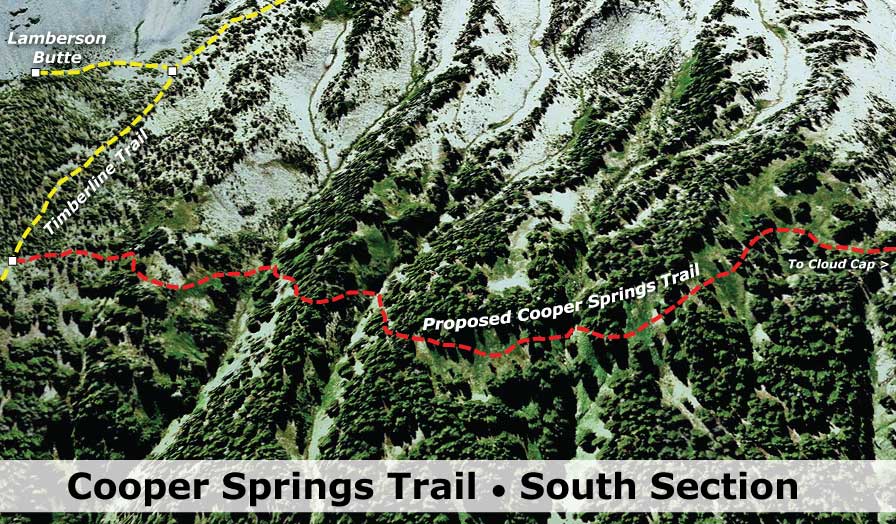
Finally, in the southern section the proposed Cooper Springs Trail would traverse through dozens of rolling lupine meadows, gnarled stands of whitebark pine and mountain hemlock and unique views of the massive east face of Mount Hood and the surrounding wilderness.

The southern section of the new trail would weave through a series of little-known alpine meadows, near Lamberson Butte.

Click here for a large map

In this section, the proposed trail would traverse the slopes of Cooper Spur at the point where a series of tributaries to Cold Spring Creek emerge and flow eastward through a maze of steep canyons. The springs are continuously fed by several permanent ice fields on Cooper Spur, and thus would be a reliable water source for hikers — and are also the namesake for the proposed trail.

The new route would then rejoin the Timberline Trail just below Lamberson Butte.

What it Would Take

The proposed Cooper Springs Trail (and Lamberson Spur extension) would be entirely within the Mount Hood Wilderness, and thus must be built without the add of motorized equipment.

Normally, this presents a major obstacle to trail construction, since a typical trail requires the removal of trees and vegetation down to mineral soil — a formidable task in the rainforests of the western Cascades, even with the aid of chainsaws and power tools. However, the slopes of Cooper Spur consist mostly of soft, sandy soils, loose rock, scattered trees and open meadows, so construction of the 3.5 mile trail would be much less cumbersome with hand tools here than in other parts of the forest.

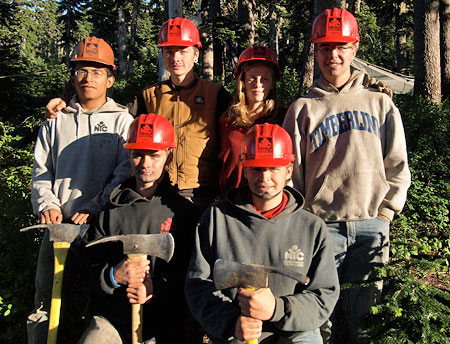
One of the Northwest Youth Corps crews that worked the Timberline Trail in 2009.

There are a number of organizations that might be interested in helping build the trail, but perhaps the most promising would be the Northwest Youth Corps, an organization that has sent crews of young people to restore wilderness trails around Mount Hood for many years.

Finally, it would take a renewed commitment from the Forest Service to expand the trail network around the mountain, and this is the largest obstacle. The agency has been doing just the opposite for many years, allowing trails to fade into oblivion for lack of basic maintenance.

But this is also where you can help: the Forest Service has the funding to provide more trails, yet needs strong public support to make trails a priority in agency budgets. Buying a forest pass simply isn’t enough, unfortunately.

Make your opinion known, and don’t accept the “lack of funding” explanation. Instead, take a look at this comparison of funding for Mount Hood and a couple of well-known national parks, and simply ask that YOUR forest to be managed with trail recreation at the top of the priority list.

How can you contact them? Just click here to send them an e-mail!

It’s Just Another 12.6 Acres

By mid-afternoon on a busy January weekend, the main Meadows parking lot has already begun to empty.

Mount Hood’s ski resorts continue their slow-motion assault on the mountain this summer with yet another parking lot expansion at the Meadows Resort. The Forest Service has not yet released the details beyond this “proposal” statement:

“Mt. Hood Meadows Ski Resort Twilight Parking Lot.

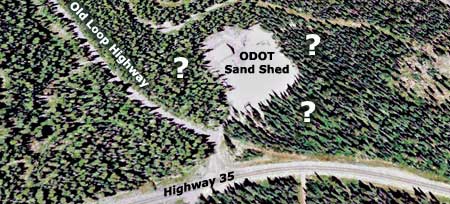
Developing a new parking area and bus maintenance facility just behind ODOT’s Bennett Pass sand shed. This would create a new 12.6 acre opening in the forest and permanent removal of vegetation. The parking is needed to deal with existing demand.”

Without more specifics, it’s hard to know just HOW bad this idea is, except that “permanent removal of vegetation” in a “new 12.6 acre opening in the forest” might qualify for some kind of award for obtuse new euphemisms within the federal bureaucracy. Yes, it’s another parking lot.

Where is the new parking lot “behind the sand shed” proposed? We don’t know yet.

We also know that ODOT, the Mount Hood National Forest (MHNF) and the ski resorts really aren’t very interested in managing peak resort demand to minimize the need for more parking and wider highways. Beyond an anemic fleet of ski buses, there is no plan. So, this looks like more of the same, and another patch of subalpine forest will soon be erased from the slopes of Mount Hood.

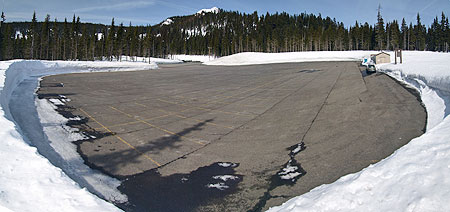
The sprawling Hood River Meadows lot is mostly empty nine months of the year -- this panoramic view is on a beautiful March weekend with a 12-foot snowpack on the ground, but when most skiers are busy doing other things.

Here’s the real tragedy: like the highway widening projects proposed along Highway 26 west of Government Camp, the string of parking lots at Meadows are really only used a few days each year — a few busy weekends in December, January and February, when the Meadows resort is briefly crowded to capacity. But a look at the Hood River Meadows lot on a sunny March weekend (above) tells the real story. These parking lots mostly sit empty for nine months each year, and only fill on weekends during the 3-month “busy” period each winter.

There is a better way. The Mount Hood National Forest and ODOT could tear a page from the Deschutes National Forest playbook, and take a serious look at managing weekend crowds with a Paul S. Sarbanes Transit in the Parks and Public Lands Grant. What the is that? Well, it’s how the Deschutes NF will partner with nearby Central Oregon communities to examine the possibilities for a different transportation solution for the few winter peaks that stress the transportation system than simply putting down more asphalt. Here’s the news release (PDF).

Putting a Face on 12.6 Acres

In the meantime, this is a good opportunity to think about the magnitude of 12.6 acres. While it might seem small enough to be disposable to an agency responsible for over one million acres of public land, the proposal is “permanent”, after all. In the spirit of not taking one acre of public land for granted, here are some comparable spots in Portland that cover approximately the same acreage that provide a sense of scale for this proposal:

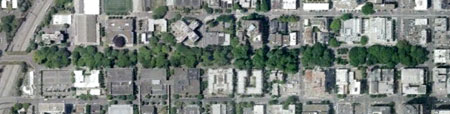
Portland’s South Park Blocks

The South Park Blocks in Portland stretch 12 blocks, and cover just nine acres in area. All twelve blocks would fit inside the proposed Meadows parking expansion, yet manage to include one of Portland’s largest forests of century-old elms, along with numerous fountains, monuments, plazas and walkways. Of course, in many cities, it would just be 12 more blocks of surface parking.

Tom McCall Waterfront Park

Looking rather brown in this post-Rose Festival restoration view, Tom McCall Waterfront Park is also about 12 blocks long, and covers about 13 acres. This park also manages to incorporate a number of fountains and monuments, pathways, the sea wall, plus the entire Rose Festival midway every June, as well as dozens of other festivals and concerts over the course of the year.

In the case of McCall Park, 13 acres covers a lot of terrain, but it also has a surprising history: this stretch of land was once Harbor Drive, a 4-lane highway, that city leaders tore out and replaced with a park.

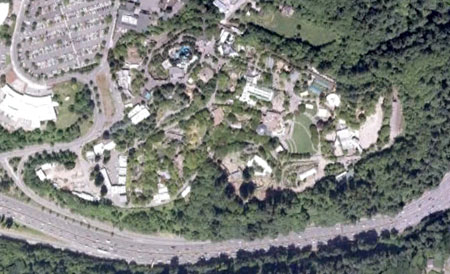
The Oregon Zoo

The Oregon Zoo covers 64 acres, but the Great Northwest Exhibit only covers about a 12 acres, and is comparable to the Meadows parking proposal. Like the forests around Mount Hood, the Northwest Exhibit is home to cougars, bald eagles, black bears and salmon — plus mountain goats, river otters, sea lions and sea otters.

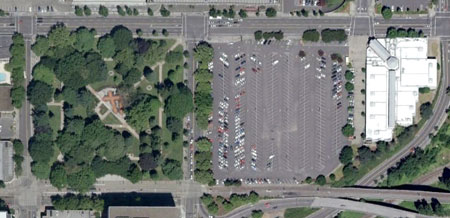
Holladay Park and the Lloyd Cinemas in Portland

Holladay Park, the Lloyd Cinemas and the very large cinema parking lot in between fit into a space of about ten acres in Portland’s Lloyd District. By comparison to the 12-acre Meadows proposal, the four acres that fall within the cinema parking lot provides 550 parking spaces — therefore, a similarly designed lot on the acreage Meadows proposes to develop on Mount Hood would translate to 1,650 spaces! Is this possible?

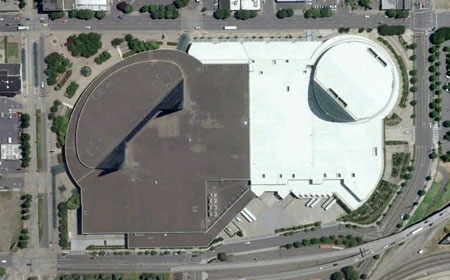
The Oregon Convention Center

The Oregon Convention Center also fits neatly on about 14 acres, providing 1 million square feet of convention space, plus numerous plazas and walkways, a light rail station and truck loading bays. Unlike Meadows, the Convention Center didn’t have the luxury of simply paving over a nearby forest for overflow parking, and thus the underground structure with space for 800 vehicles.

Laurelhurst Park

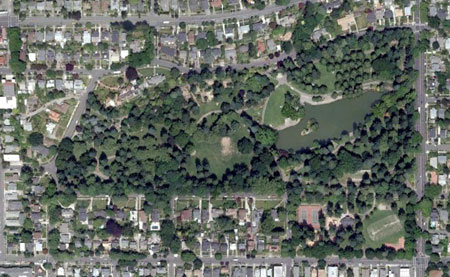
Finally, Laurelhurst Park is about twice the acreage of the proposed Meadows parking lot, at 26 acres. But it gives a good visual of what the ski resort proposes to pave over with their lot. Simply imagine “permanently removal” of the vegetation on one half of Laurelhurst park, above, replaced by a parking lot.

On its 26 acres, Laurelhurst provides a concert stage, numerous monuments and art displays, tennis court, volleyball court, basketball court, soccer field, horseshoe pit, play area, picnic sites, off-leash pet area, restrooms, network of paved and soft walking paths and an interpretative historical sites — which half should be paved over for overflow ski resort parking?

What’s Next?

What will be the fate of the latest Meadows proposal to build parking on Mount Hood? Hopefully, the Forest Service will act as protective stewards of our public lands, and see more value to a 12.6 acre piece of forested land than just a bunch of trees that should be “permanently removed” to make room for skiers during a few winter weekends. We’ll see.

As details about the latest Meadows parking lot expansion are revealed, updates will be posted here, including opportunities to weigh in on the plan. After all, every acre counts, and all 12.6 acres belong to you and me, our children and their children, not the Meadows resort development.

Timberline Lodge Bike Proposal

Post Canyon free ride circuit near Hood River (The Oregonian)

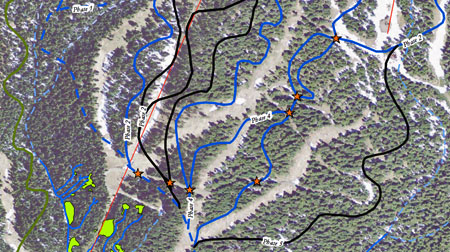
The Timberline Resort is proposing to build 15 miles of downhill-only bicycle play trails along their lower ski slopes, below the main lodge parking area. The trails will require clearing mountain vegetation, including alpine trees up to half-a-foot in diameter, and building a series of jumps and ramps for bikes. The “downhill only” design relies on chairlifts to carry bikers back up the mountain, and is presumably aimed at younger cyclists.

You don’t have to be against mountain bikes to be skeptical about the Timberline Ski Resort proposal to build 15 miles of bike trails on the slopes below Timberline Lodge. You simply have to wonder why here? Why now?

Comments on the scoping phase of this proposal are due soon (July 30), so now is the time to weigh in. This article covers some of the questions the Forest Service should be addressing in their review of this proposal.

A solution looking for a problem?

This clip shows a portion of the maze of proposed bike play trails

The Forest Service scoping letter states “Oregon is considered the mountain biking capital of the Northwest and more people per capita have bicycles in Portland than any other city in the country. However, there are few Oregon ski areas that offer full-service, lift-assisted mountain biking for all ability levels.”

This is one of those leading-the-witness statements that you might expect to hear from the Timberline Resort, as the profit-seeking concessionaire, not from the Forest Service — who we might expect to be the cautious guardian of our mountain.

Oregon may be the mountain biking capital, and there are surely a lot of Portlanders with mountain bikes, but it’s a leap to assume that Portland’s cyclist are lacking for ski-lift-assisted bike playground. So, the first scoping question for the Forest Service:

1. What is the national demand for ski-lift-assisted bike trails? What is the demand in Oregon? What is the demand at Mount Hood?

If the Forest Service cannot demonstrate unmet demand for ski-lift-assisted bike trails, then this proposal should be denied.

It’s really about lift tickets, not bikes

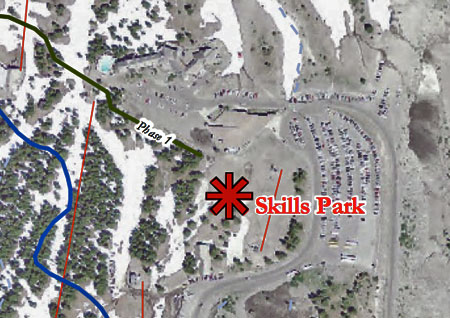
The proposal includes another “skills park” on Mount Hood, duplicating Ski Bowl

So, why the sudden interest in building more bike play trails on Mount Hood?

The answer is fairly simple: the Timberline Resort is looking to sell more summer lift tickets, bike rentals, concessions and hotel reservations. That’s pretty much it. Right now, the Timberline operators can look down from the hotel balcony in summer, and see the lifts at Mount Hood Ski Bowl carrying bikers up the slopes of Multorpor and Tom Dick and Harry Mountain. Who can blame them for wanting to steal some of that business?

But this raises another series of questions for the scoping:

2. Would the Timberline proposal cannibalize the Mount Hood Ski Bowl bike operations? Would this, in turn, jeopardize the viability of the Ski Bowl resort, which has no Palmer Lift and summer skiing to round out its winter profits?

Given that Timberline has a summer skiing program, Mount Hood Ski Bowl should be given priority in meeting whatever demand exists for ski-life-assisted bike trails. If excess demand doesn’t exist, the Timberline proposal should be denied.

Mount Hood Ski Bowl already provides lift-assisted bike trails and a skills park

Authorized vs. Unauthorized Damage?

The Forest Service scoping letter states “because of limited managed mountain biking areas on public land the Forest Service is seeing an increase in unauthorized free-ride mountain biking areas. These illegally constructed trails are creating resource damage as they appear throughout Oregon’s public lands.”

This raises another question for the project scoping:

3. Where is “resource damage” resulting from mountain biking? What sort of damage is being done? How have mountain bikes been identified as the source of the damage?

The scope letter also states “a managed, well designed, downhill-only, mountain bike trail system and skills park in Northwestern Oregon would provide an opportunity for safe, managed mountain biking and reduce unauthorized mountain biking and thereby could reduce associated resource damage on public lands.”

Another case of leading the witness — in this instance, a leap from rogue mountain bikers building illegal trails to those seeking “well designed, downhill only” trails with a “skills park”, which just happens to be what the Timberline resort wants to build on our public land. This statement fits the old adage “when all you have is a hammer, everything looks like a nail.”

Ironically, on mountain bike trails elsewhere in the Mount Hood National Forest, downhill riding is prohibited in order to “prevent erosion”, according to the Forest Service trail signage. Does this suggest that the “downhill-only” trails proposed by Timberline will be inherently erosion-prone?

This issue raises still more scoping questions:

4. How is “downhill-only” bike demand measured, as opposed to the demand for bicycle trails, in general? How would the “authorized” construction of 15 miles of downhill-only bicycle trails at the Timberline resort compare with the “unauthorized” areas in terms of tree removal and trail construction?

If the Forest Service analysis shows that forest ecosystems in the fragile alpine areas around Timberline are more vulnerable to erosion than other areas, or that “downhill-only” bicycle travel increases erosion risk, the Timberline proposal should be denied.

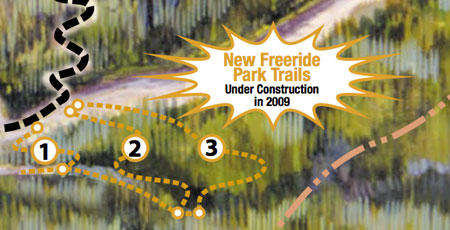
Ski Bowl just added a free ride park in 2009 -- are we witnessing an arms race between the resorts?

You’re on my land!

One of the more troubling aspects of any proposal coming from the Mount Hood area ski resorts is their attitude of entitlement toward use of public land. Not surprisingly, few among the public are aware that the resorts exist wholly on public land, leased from the U.S. Forest Service.

As such, every expansion proposal should be viewed with skepticism, since they generally represent another slice of natural ecosystem being carved away — as the Timberline proposal does.

Putting the relationship in urban terms, consider how the public would react if a private, for-profit enterprise proposed a fee-based play area within a city park, maybe starting with small corner, then coming back every few years, asking to fence off a bit more of the lawn in order to stay profitable. At what point is it the obligation of the public to ensure profitability?

Unfortunately, the U.S. Forest Service has a developed a bias toward the “viability” argument, and has a history of ceding more public land to the resorts under the rationale of keeping them in business. This is a very slippery slope, and only leads to more development on the mountain. In this case, it raises another question for the scoping phase of the proposal:

5. What is the financial argument for this proposal from the Timberline resort? Is the resort suffering financial losses during the summer (or winter) months that this proposal is intended to stem?

If the Forest Service finds that the proposal is primarily driven primarily by private financial interests, not measurable public demand, the proposal should be denied.

Another Way

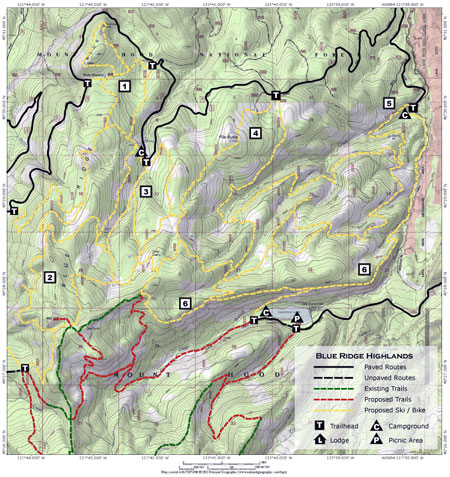
The Mount Hood National Park Campaign proposes hundreds of miles of new mountain biking trails, many from converted logging road that provide an exceptional opportunity to expand the bike network (click here to view the maps).

Instead of relying on chairlifts and lift tickets, the Campaign proposals focus networks of overlapping loops, with lots of possibilities for varied terrain to create an exciting, healthy cycling experience. The proposals are designed to meet different skill levels and be easily accessed from nearby communities. Most importantly, they are designed to place mountain biking within financial reach of a broad range of income levels — something the ski resorts don’t pretend to do.

The proposed Blue Ridge Highlands bicycle network

(click here to view a larger map)

Note that there are no “skill parks” in the Mount Hood National Park proposals, as they don’t really belong in a national forest, much less a national park. But there are plenty of state and private land opportunities for developing skill parks in the area, and of course, we already have a fee-based concession at the Mount Hood Ski Bowl resort.

Besides, if the economic model for Timberline involves charging cyclists to pay for access to a skill park, why not let the free market provide this on private land under a similar fee system, in closer proximity to Portland, and away from sensitive alpine terrain?

A better alternative in the near term for addressing the “unauthorized” trails issue is to work with an advocacy group, like the Columbia Area Mountain Bike Associates (CAMBA), to develop a low-or-no-fee extreme biking/play park area on less sensitive land closer to Portland.

One such site already exists by permission on private, state and county-owned land in the Post Canyon area, near Hood River, and another known as Black Rock, near Falls City. These sites were developed largely with private donations of time, labor and materials, and there’s no reason why other similar areas couldn’t be developed outside the national forest to meet whatever demand might exist.

The Forest Service scoping letter states “further development of this area is supported by existing infrastructures such as parking lots, restrooms and signage.” If these are the principal arguments for further commercialization of the fragile mountain ecosystem, then it’s obvious that signs, a parking area and restroom at some other site could be built, perhaps entirely with private funds.

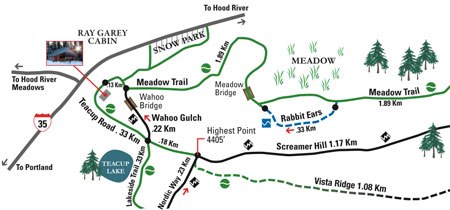
Teacup Lake Nordic Club developed their groomed trail network in cooperation with the U.S. Forest Service

A perfect model for this alternative approach already exists: the non-profit Teacup Lake Nordic Club cabin and ski trail complex, near Bennett Pass. This fine destination provides an affordable alternative to the nearby Mount Hood Meadows commercial venue, with club members asked to make a modest donation in order to use the extensive ski trail complex.

A similar approach could be used to provide more services at sites like Post Canyon or Black Rock, and this leads to the final question that the Forest Service should address during this scoping phase:

6. What opportunities exist for the Forest Service to work with non-profit and community organizations to provide free-ride bike parks on less sensitive lands than the alpine areas below Timberline Lodge?

If there are community partners out there with an interest in pursuing a more affordable, sustainable alternative to a lift-based bike park (including private, state and county land owners) then the the Timberline proposal should be denied.

You can find more on how to comment at the Mount Hood National Forest site: Timberline Mountain Bike Proposal. If you don’t make the requested July 30 deadline, don’t be afraid to submit your comments late. The Forest Service will continue to accept them because, after all, YOU own the land.
______________________

Addendum: Read Dennis Chaney’s Op-Ed on the proposal (PDF)

Proposal: Mark O. Hatfield Memorial Trail

Senator Mark O. Hatfield campaigning in 1967

One of the legacies of former Oregon Senator Mark O. Hatfield was expansion of the state’s wilderness system in 1978 and 1984, the largest expansion before or since that time. Though Hatfield was harshly criticized by conservationists for also sponsoring pro-logging legislation that led to the destruction of ancient forests, his role in creating new wilderness in Oregon remains a singular achievement that no other senator has yet matched.

To honor the senator, Congress renamed one of these new wilderness areas, the former Columbia Wilderness, as the Mark O. Hatfield Wilderness in 1996. This recognition marked the senator’s retirement from Congress after nearly a half century of public service that included serving as an Oregon legislator, Oregon’s Secretary of State, then Governor, before finally being elected to the U.S. Senate in 1967, where he served for 30 years

Senator Hatfield with wife Antoinette in 2008 (Willamette University)

The recognition also triggered another round of critiques by conservationists over Hatfield’s environmental legacy. But for many, it was also a fitting tribute to the senator who had pushed the Columbia River Gorge Scenic Act through Congress in the 1980s when it would have been easy for the Oregon Republican to simply leave the task to his Democratic counterparts.

Hatfield’s long service, and his independent stance on a number of topics, forced him to break ranks with the Republican Party on a number of progressive issues. These ranged from successfully sponsoring Oregon’s landmark civil rights legislation in 1954 (a full decade ahead of the U.S. Civil Rights Act) to his early opposition to American involvement in the Vietnam conflict, and later, the Gulf War.

His independence and principled “sanctity of life” stance that led him to champion civil rights for minorities and gays, while opposing wars, the death penalty and abortion later earned him his own chapter in Tom Brokaw’s “The Greatest Generation”.
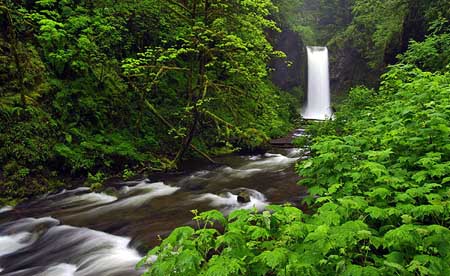
Multnomah Creek along the proposed Hatfield Trail

Though his environmental legacy is a conflicted one, Hatfield’s landmark environmental protections in Oregon still exceed that of his fellow Democrats, who claim the natural constituency of environmentalists, but have seldom acted with such determination and vision.

The Mark O. Hatfield Wilderness originally spanned the most remote high country on the Oregon side of the Columbia River Gorge, but in 2009, President Obama signed a new wilderness bill into law that expanded the Hatfield wilderness significantly. The new boundary stretches the Hatfield Wilderness from Larch Mountain and Multnomah Creek on the west to the steep ridges and canyons of Mount Defiance, on the east.

The Concept

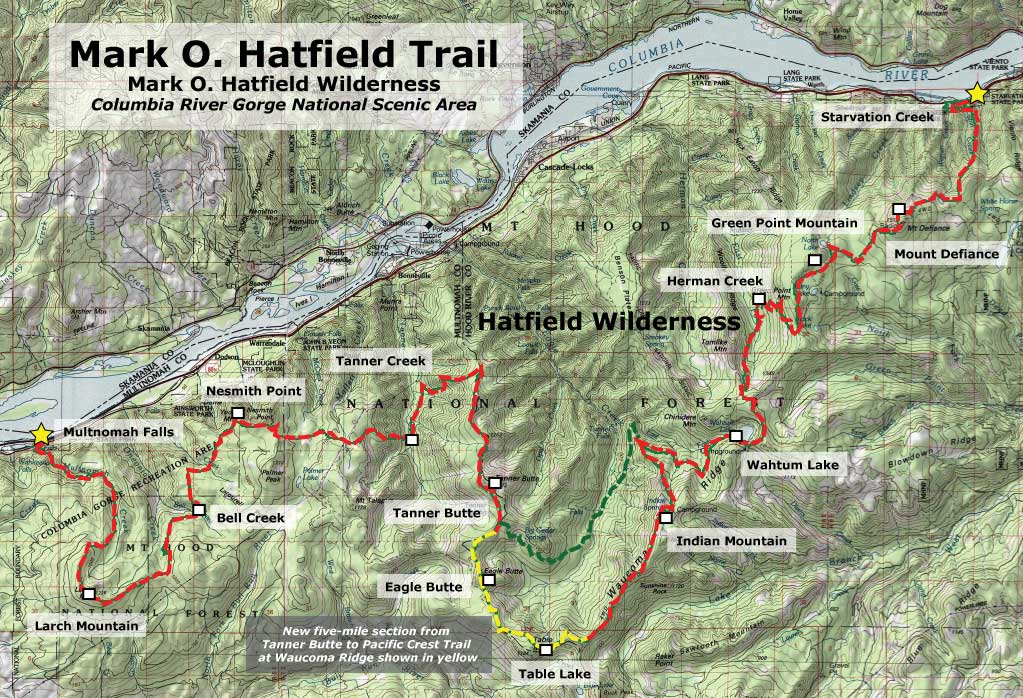
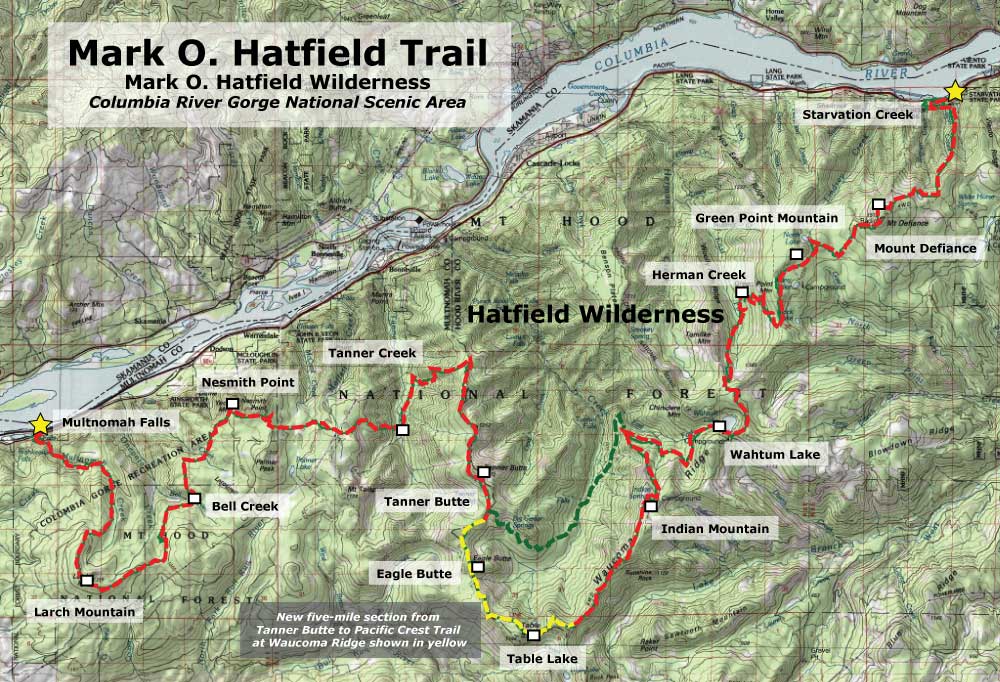
This Mark O. Hatfield Trail proposal is for a 60-mile memorial trail that spans the Hatfield Wilderness, beginning at Multnomah Falls and culminating at Starvation Creek Falls, passing through the most rugged, lonely country to be found in the Columbia River Gorge along the way. This new trail would join classic hikes like the Timberline Trail at Mount Hood and the Wonderland Trail at Mount Rainier as premier backpacking destinations of national prominence.

(click here to view a larger map)

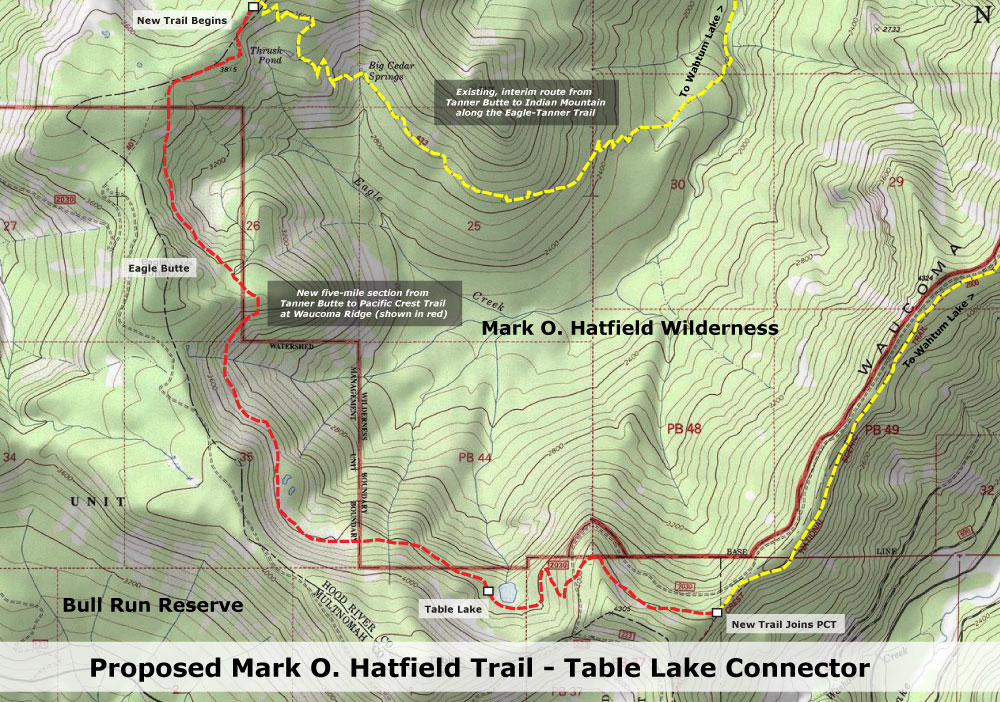
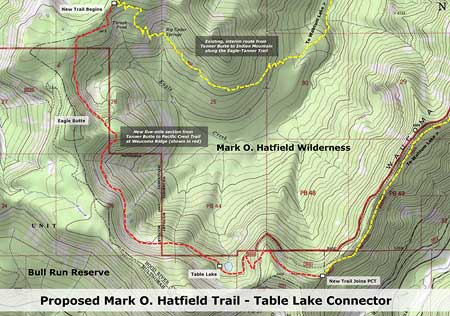
The new trail would largely be assembled from existing routes, but with a notable exception: a new, five-mile segment would curve just inside the Bull Run Reserve, along the headwaters of Eagle Creek. The new segment would bring hikers to little known Eagle Butte and rare views into the Eagle Creek backcountry that few have seen before.

Though this new trail segment would not physically enter the Bull Run watershed, it would nonetheless pass inside the reserve boundary. This would require special approval by the U.S. Forest Service, similar to that given the Pacific Crest Trail, where it crosses along the edge of Bull Run. Simply raising the issue might even challenge the absurd notion that trails and hikers present a risk to the watershed – a separate topic for another column!
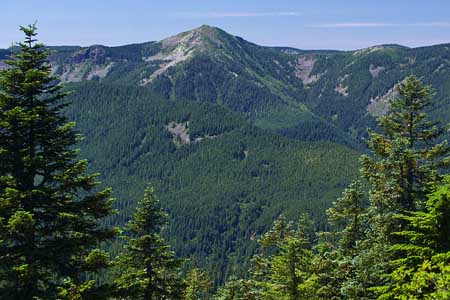
Rugged Tanner Butte in the Hatfield Wilderness

Along the route, there are also many trails that would be “saved” by this proposal – routes that have been badly neglected for decades, but deserve to be maintained. In some spots, short realignments would be needed to improve old or confusing sections. In the area of Starvation Creek, for example, a redesigned trail along the final stretch near I-84 is needed to improve on the current, rather jarring re-entry into civilization.

The Trail

The 60-mile route is designed as a six-day trek, beginning at the Multnomah Falls Lodge, then leaving civilization behind for most of the next six days as the route traverses through the rugged high country of the Hatfield Wilderness.

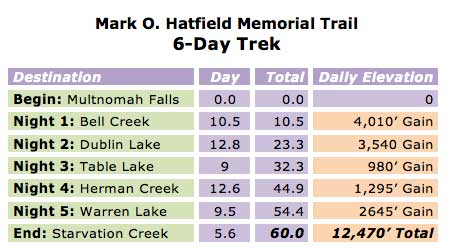
The following trip log shows the most prominent landmarks along the trail, with proposed camp spots for five nights on the trail. The up-and-down elevation changes inherent to the Hatfield Wilderness terrain will make this a challenging trek for any hiker. Segment and cumulative mileage is shown, along with net elevation gains and losses:

Day 1 to Bell Creek: the 60-mile trek would begin along the very popular Larch Mountain Trail, following Multnomah Creek beyond the reach of the throngs at Multnomah Falls, then climbing to historic Sherrard Point on Larch Mountain, another popular tourist destination. From here, the trail leaves the tourists behind, dropping into ancient forests along Bell Creek and the first campsite at 10.5 miles.

Day 2 to Dublin Lake: this is the most strenuous day along the circuit, covering 12.8 miles as the trail climbs over the shoulder of Nesmith Point, drops into Tanner Creek canyon, then climbs out again to arrive at Dublin Lake. At Nesmith Point, hikers can look down on the Columbia River nearly 4,000 feet below from the highest point on the Gorge rim, and on Van Ahn Rim hikers will get a rare look into the backcountry of the Tanner Creek canyon and into the Bull Run Reserve.
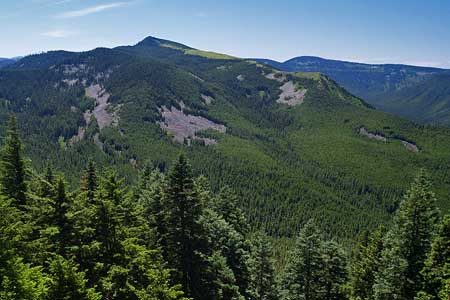
Indian Mountain with Eagle Butte in the distance

Day 3 to Table Lake: the third day of the proposed Hatfield Trail is a less challenging 9-mile hike along the high ridges of the Eagle Creek backcountry, allowing time for the spectacular side trip to Tanner Butte, along the way. The new trail segment begins north of Tanner Butte, and traverses across the rugged talus slopes and mountain tarns of Eagle Butte and Table Mountain, with expansive views into the Eagle Creek canyon, 3,000 feet below. The campsite for this proposed new segment is inside the Bull Run Reserve, at little-known Table Lake. Though the trail is inside the Bull Run boundary, the entirely of the trail is within the upper reaches of the Eagle Creek drainage, and is outside the physical watershed of the Bull Run.

Day 4 to Herman Creek: on the fourth day, the route joins the Pacific Crest Trail and passes high over the shoulder of Indian Mountain, then drops to popular Wahtum Lake. The lake provides a midpoint trailhead access for those looking for a shorter trip, an alternative camping spot or possibly a feed drop for those planning stock trips along the trail. From Wahtum Lake, the trail climbs over Anthill Ridge, then descends past Mud Lake before reaching a campsite at Herman Creek at the 12.6 miles.
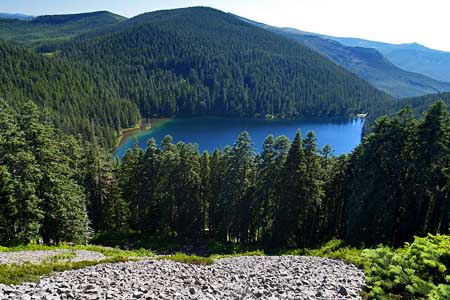
Wahtum Lake from Anthill Ridge along the proposed Hatfield Trail

Day 5 to Warren Lake: this is also a less demanding day, with most of the climbing in the first few miles, as the route climbs out of the Herman Creek canyon, and passes the rocky summit of Green Point Mountain, with expansive views of the surrounding wilderness. From here, the route passes above Rainy, North and Bear lakes before curving around the rocky north face of Mount Defiance, then dropping to beautiful Warren Lake at 9.5 miles.

While the recommended circuit includes a night at Warren Lake to enjoy the exceptionally rugged setting and wilderness scenery, the relatively short, final leg to Starvation Creek will draw many hikers to make this a 5-day trip, and skip the final campsite at Warren Lake. For these hikers, the lake might simply offer the opportunity for a quick swim before heading back to civilization.

Bear Lake and Mount Defiance along the proposed Hatfield Trail

Day 6 to Starvation Creek: the short, 5.6 mile final leg travels steeply down the north slope of Mount Defiance along Starvation Ridge, dropping 3,600 feet in just over five miles. Along the way, the trail passes above dizzying cliff-top viewpoints and shady side-canyon waterfalls before reaching the Columbia River and the end of the trail at Starvation Creek.

The restrooms, telephone, easy highway access and shady, un-crowded streamside picnic sites below lofty Starvation Creek Falls make this an ideal terminus for hikers seeking to relax after their adventure.

The following table summarizes the recommended 6-day hike, with running mileage and daily elevation gains:
What would it take?

Much of the trail network described is exceptional in scenic value, but suffers from years of deferred maintenance and modernization. Since most of the route is already in place, the Mark O. Hatfield trail concept would mostly require a stepped up commitment to maintaining and improving existing routes.

This would include basic maintenance, like brushing out overgrown routes, tread repair and drainage, but would also new signage and log bridges across major streams, consistent with the Wilderness Act . This work could begin immediately, but will require funding, as the route is generally too remote and rugged to depend entirely on volunteer labor.
(Click here for a larger map of the new trail)

Constructing the new 5-mile segment proposed inside the Bull Run Reserve is the boldest element of this proposal, and a tall order for the federal bureaucracy. However, a simple interim plan is to route the new trail along the existing Eagle/Tanner (No. 433) and Indian Spring (No. 435) trails. These trails are shown in yellow on the map, above, and in green on the map showing the entire Hatfield Trail proposal.

This interim route would reduce the total hike distance by about two miles, and add about 1,000 feet of elevation gain. However, the interim option would allow for full implementation the Hatfield Trail concept in the near term, rather than waiting for the bureaucracy to address the watershed issue.
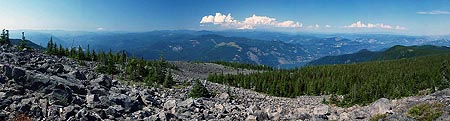
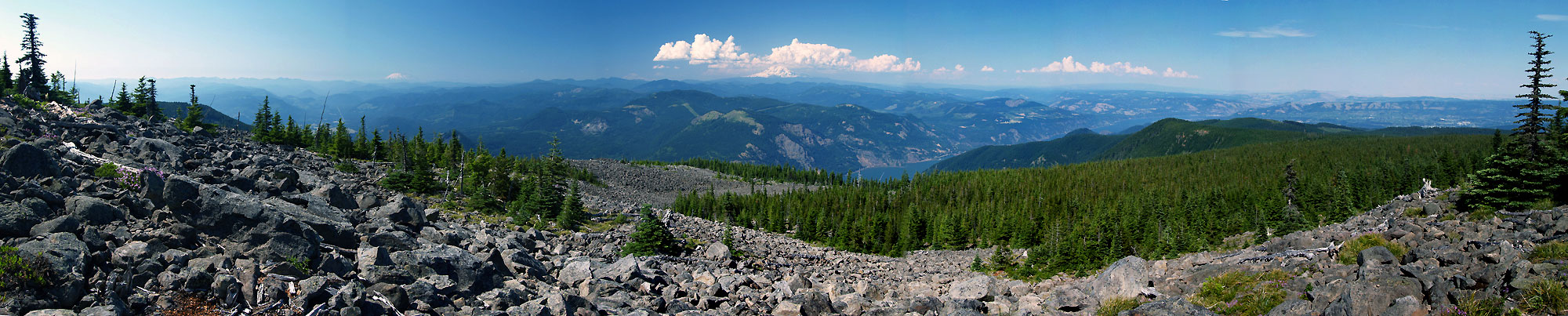
Columbia River from rugged Mount Defiance, near Warren Lake

(Click here for a large view of the panorama)

Another possibility for the long term is to finally complete the long-stalled Gorge Trail (No. 400) connection from Wyeth to Starvation Creek. This missing piece is a segment that would curve around the steep face of Shellrock Mountain (the focus of a future WyEast Blog article), creating a 30-mile trail connection from Multnomah Falls to Starvation Creek.

This connection would allow for a loop hike for hardy backpackers looking for a 90-mile backpack. However, because substantial portions of the existing Gorge Trail 400 are exposed to freeway noise and other reminders of civilization, the loop is not included in the Mark O. Hatfield Trail concept.

Why now?

This isn’t a difficult project to realize, and it would pay fitting tribute to begin work on this concept in time for Senator Hatfield to personally see the project begin – possibly even to participate in the ground breaking.

Accomplishing this project would be well-deserved recognition for the heavy lifting he did as our senator to protect the Columbia Gorge and Oregon’s wilderness for generations to come. The better question: why not now?

Stop Salting the Palmer Glacier!

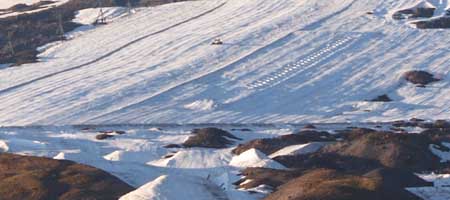
The plowed surface of the Palmer Glacier shows up on summer evening view of Mount Hood’s south face

A recent article in Willamette Week by Adrienne So goes where The Oregonian and other media have not dared in the nearly 30 years since the controversial Palmer Lift opened the Palmer Glacier to year-round skiing. In her article, So asks the obvious question: is it really such a good idea to pour nearly a million pounds of salt on the glacier each summer to melt the ice for skiers?
But So also asks the more maddening question: how can it be that the Forest Service and Oregon Department of Environmental Quality (DEQ) are fine with this practice? The sad answer lies in the cozy relationship the Forest Service maintains with the ski resorts and the ironic fact that the DEQ can only regulate the salting when damage finally shows up downstream. In other words, when it’s too late.

The Palmer Glacier is not the smallest on Mount Hood, but surely the most fragile thanks to its low elevation and southern exposure

What lies downstream from the Palmer Glacier? Initially, a steep maze of alpine canyons carries melt water from the glacier to the tree line. Soon, these mountain streams combine to become the Salmon River. The river flows just a few miles before reaching Red Top Meadows. A short distance beyond, the river enters wilderness and the broad expanse of Salmon River Meadows, by far the largest wetland complex on Mount Hood.

From the meadows, the rapidly growing river turns west, then drops into one of the wildest, deepest canyons in Oregon, thundering over a string of tall waterfalls that are so remote as to have only been discovered in the 1960s. The Salmon River National Recreation Trail follows the canyon section, and is among the most popular hikes in the Pacific Northwest, year-round.

Beyond the steep gorge section, the river slows and broadens, rambling through ancient forests where it is recognized as one of the state’s premier salmon and steelhead habitats. Here, it is strictly managed for its fisheries with special seasons and limits. Trails follow the river in this section, too, leading to shady forest camps and fishing holes. The giant cedar groves along the lower river are the most accessible ancient forest in the region, just 45 minutes from Portland.

For their part, the Timberline operators make a point of never calling the Palmer Glacier by its true name. Instead, they use the term “Palmer Snowfield” in their marketing, apparently to downplay the fact that their summertime skiing is putting one of Mount Hood’s most vulnerable glaciers at risk.

Since the construction of the Palmer Lift, Timberline ski resort operators have plowed the Palmer Glacier like an icy farm field, with the benefit of salt to soften the surface

The motivations of the Timberline resort are easy enough to understand: it’s a commercial venture (albeit on public land and in a public structure), and they are not in the business of protecting the Salmon River ecosystem for the public at large. The salting makes money for the Timberline resort, after all, or they wouldn’t do it.

But to wrap your head around the Forest Service policy of allowing the salting is to believe that dumping just under 500 tons of salt (that’s about 500 pickup loads) on Palmer Glacier each year won’t have an environmental impact. That the impacts could extend from the headwaters of this river complex to the pristine meadows, forests, waterfalls and fisheries that lie below makes the policy that much more appalling.

As destructive and shortsighted as this policy seem, there’s really nothing you and I can do about it – at least not until the salt starts showing up downstream in concentrations that constitute “pollution”. If that seems like a Catch-22, well, that’s because it is.

In the meantime, the only available alternative is awareness. You can start by reading So’s excellent article, over here (PDF):

Salt and a Wound: Summertime and salting is easy on Palmer Glacier

Next, share what you learn with those who love Mount Hood – and especially those who ski at the Timberline resort. It’s likely they don’t even know about this obviously reckless practice, and Timberline hasn’t been particularly up-front about it.

Next, print this bumper (or rear-window) sticker to kick off your own awareness campaign:

Click here for a bumper-sized version to print

There’s a worn adage that when you find yourself at the bottom of a hole, the first thing to do is stop digging. Until more is understood about the impacts of the salting practice on the Palmer Glacier and the sensitive environments that lie downstream, it’s time to stop the salting. Now.

The New Mount Hood National Recreation Area

When the Omnibus Public Land Management Act of 2009 was signed into law by President Obama last year, most of the media attention focused on the new wilderness lands set aside in Oregon. This included a number of new wilderness areas and expansion of existing areas around Mount Hood and in the Columbia Gorge.

But the legislation also contained a new creature of federal law that hardly noticed: creation of the Mount Hood National Recreation Area (NRA). The new designation joined a number of similar “national recreation areas” on United States Forest Service (USFS) land, and added to the confusion that already exists between USFS areas under this designation, and the completely different National Park Service (NPS) designation of “national recreation area.”

The difference is usually found in the fine print, where commercial logging or other extractive uses are allowed in the USFS version of a “national recreation area”, albeit with limitations, whereas such activities are never permitted under NPS management.

This is true for the new Mount Hood NRA, as well. While the 2009 legislation called for the USFS to “provide for the protection, preservation, and enhancement of recreational, ecological, scenic, cultural, watershed, and fish and wildlife values” in the new recreation area, the Forest Service isn’t quite prohibited from carrying out the activities they’ve come to be known for — timber harvest and road building – unless the NRA overlaps a designated wilderness area.

Timber Harvest – The new law allows the “cutting, sale, or removal of timber within the Mount Hood NRA to the extent necessary to improve the health of the forest in a manner that maximizes the retention of large trees, improves the habitats of threatened, endangered, or sensitive species or maintains or restores the composition and structure of the ecosystem by reducing the risk of uncharacteristic wildfire.”

That’s a mouthful, but it does represent a major departure from the status quo commercial timber harvesting that the USFS has employed over the past sixty years across the Mount Hood region. Simply prioritizing the “retention of large trees” is revolutionary for the agency, since these were the prime targets of thousands of timber sales over the past many decades under the pseudo-science of being “decadent” and “unproductive”.

Road Building – The act states that “no new or temporary roads shall be constructed or reconstructed within the Mount Hood NRA except as necessary to protect the health and safety of individuals in cases of an imminent threat of flood, fire, or any other catastrophic event that, without intervention, would cause the loss of life or property; to conduct environmental cleanup required by the United States; to allow for the exercise of reserved or outstanding rights provided for by a statute or treaty; to prevent irreparable resource damage by an existing road; or to rectify a hazardous road condition.”

Another mouthful, and less of a change for the USFS, since pretty much any new road project could be justified under these criteria. But in reality, the agency has experienced collapsing timber revenues and steep cuts in its operating budgets in recent years to pay for new roads. The road building era of the USFS is over, and the Mount Hood National Forest is among several that going through a process to plan for the closure and decommissioning of unneeded roads to reduce maintenance liability and enhance fish habitat. Nonetheless, the new legislation probably makes it a bit harder to build new roads within the NRA, even if the funds are available.

Bicycles – The act doesn’t come out and say it, but the driving purpose behind the creation of the Mount Hood NRA is to provide new protections against logging and development in areas that not only have a high scenic value, but are also popular with mountain bikers. Because bicycles are not allowed inside wilderness areas (yet), the NRA designation became an important political compromise with bike advocates who initially opposed the legislation for the numerous areas that would become off-limits to bikes.

The implication in this intent is that the areas included in the “national recreation area” will be a priority for developing new bike trails and trailhead facilities, including the conversion of surplus logging roads to bicycle trails in some cases. The act provided no funding for this new programmatic emphasis, however, so the work of building and maintaining bicycle trails in the new “national recreation area” will continue to be an uphill struggle, and require the help of volunteers.

Where is the Mount Hood National Recreation Area?

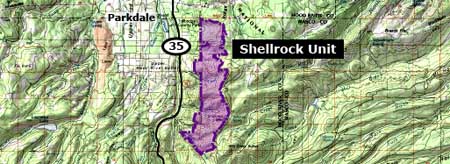
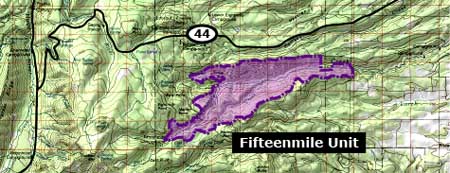
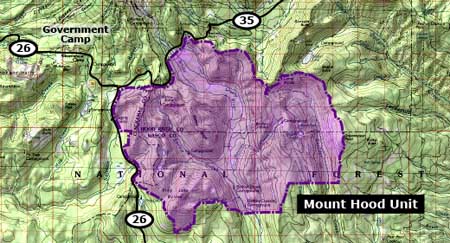
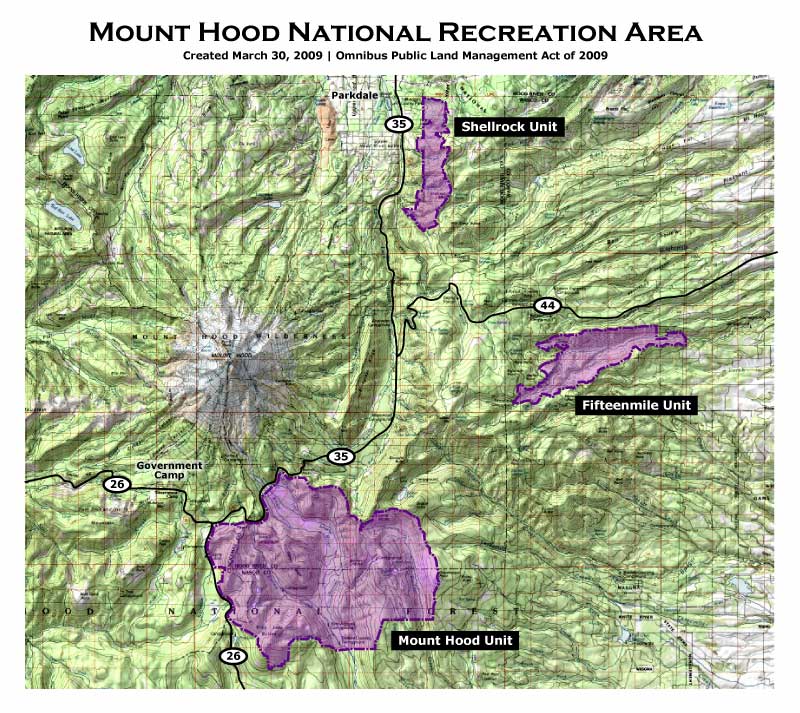
The new Mount Hood NRA covers approximately 34,550 acres in an arc composed of three separate units, each located to the east and south of the mountain. The map below shows the extent and relationship of the three Mount Hood NRA units:

click here for a larger version of the map

The three units of the NRA are located in close proximity to the Mount Hood Loop Highway, and easily accessed from the Portland region, and the communities of Mount Hood and the Gorge. All three are already popular recreation destinations, so the new NRA designation simply embraces and protects this function, while ensuring that cyclists continue to have access.

The Shellrock Unit (map below) of the Mount Hood NRA is the smallest and most northern in the complex. This unit is centered on the popular Surveyor’s Ridge trail complex that features miles of some of the finest single-track cycling in Oregon, and has easy access from Forest Roads 44 and 17.

This is also one of the most heavily logged corners of the Mount Hood National Forest, and will require decades of restoration management to recover. However, the extensive network of logging roads also serves as a prime candidate for conversion to single or dual track bicycle trails. This area features some of the finest views of Mount Hood to be found, so the future is bright for recreation in this unit.

The Fifteenmile Unit (map below) is located due east of Mount Hood, along Forest Road 44, and adjacent to the Badger Creek Wilderness (located to the south). This is also a popular area with cyclists, and like the Shellrock Unit, this area has been brutally logged over the past three decades.

Worse, the remaining forest stands in the Fifteenmile Unit have been hit hard by beetle infestations and drought cycles, resulting in some of the most stressed forests in the Mount Hood region. These conditions, combined with a century or fire suppression where fire is an essential component in the forest ecology has left a tinderbox just waiting for a catastrophic fire.

It will take decades of restoration management to bring back the parkland forests of ponderosa pine, western larch and Oregon white oak that once dominated the area. But as with the Shellrock Unit, the potential for converting logging roads in the Fifteenmile Unit to single and dual track bicycle routes is excellent. The area has a unique blend of high desert and Mount Hood viewpoints that already make it a popular destination, so the NRA designation bodes well for both restoring the forests and expanding recreation here.

The Mount Hood Unit (map below) is the third and final piece of the Mount Hood NRA complex. This is by far the largest of the three units, extending from the Salmon River on the west to the Badger Creek Wilderness on the east, and encompassing a large segment of the upper White River valley. Unlike the other units, the Mount Hood portion of the NRA complex incorporates new wilderness areas, including the Twin Lakes, Barlow Ridge and Bonney Butte wilderness areas. A segment of the Pacific Crest Trail passes through the west edge of this unit of the NRA.

The range of recreation activities is diverse in this largest of the three NRA units, ranging from heavy winter use by skiers, snowshoers and snowmobiles, and summer use by hikers, equestrians and cyclists. The most popular cycling areas are in the eastern portion, along the Gunsight Trail and in the vicinity of Bonney Meadows and the Boulder Lakes.

The eastern portion of this unit is also the most heavily logged, especially in the southeast corner of the NRA, near Boulder Creek. However, like the Shellrock and Fifteenmile units, the logging road network in the Mount Hood unit provide an excellent opportunity for conversion to single or dual track bicycle routes.

What’s Next?

In the near term, the new Mount Hood NRA functions mostly as a curiosity, though in time it will shape USFS decisions on forest management. The main benefit in the short term is more protection for recreation in these areas, and perhaps expanded opportunities for bicycling.

But in the long term, the designation has an intriguing possibility of serving as a steppingstone to National Park status. For example, it could be eventually expanded to cover a much larger (or all) of the Mount Hood National Forest. This could happen in the near term, as demand for recreation from the rapidly growing Portland area continues to outpace what the Forest Service is able to deliver under its current management approach, and is clearly the preferred public use for the forest.

Thus, if a large portion (or all) of the Mount Hood National Forest were to be designated as an NRA, the step to transferring the area to the National Park Service becomes much more plausible, since the Park Service already administers a number of NRAs under its jurisdiction.

In this way, an obscure, almost accidental element of the Omnibus Public Land Management Act of 2009 might have paved a new way for Mount Hood to finally join the ranks of other national parks.

Proposal: South Fork Water Works Trail

Lower falls on the South Fork Clackamas River in 1963

In 1913, the young cities of Oregon City and West Linn suffered a serious outbreak of typhoid from an increasingly polluted Willamette River, their sole source of water at the time. The incident spurred Oregon City’s leaders to appoint a “Pure Mountain Water League” and directed it to locate a safer source of drinking water.

The League settled on the pristine South Fork of the Clackamas River in the Cascade foothills. The City of West Linn signed on with Oregon City, offering to pay for one third of the cost of a new pipeline to bring the South Fork water to the two cities. A South Fork Water Board was created to carry out this ambitious project.

By the fall of 1915, the new water district had managed to lay twenty-six miles of 18” pipe from a site at the confluence of Memaloose Creek and the South Fork Clackamas all the way to Oregon City and West Linn. The new pipeline began to carry municipal water on October 7, 1915.

Main falls on the South Fork Clackamas River in 1963

In 1939 the South Fork Water Board expanded the system with the help of one of Franklin Roosevelt’s New Deal recovery programs, the Works Project Administration. This project extended a 24” pipeline upstream from the Memaloose Creek intake to a point upstream, above the 120-foot main falls on the South Fork. This project involved carving a series of three dramatic tunnels and a cantilevered pipeline through solid basalt cliffs.

The new intake improved water pressure downstream, and this system continued to serve as the water supply for the two cities until a new filtration plant was constructed on the lower Clackamas River, in 1958. Both systems were used until 1985, when the South Fork pipeline was decommissioned. Since then, the network of roads, tunnels, plank walkways, log bridges and old pipeline has slowly been fading into the green rainforest of the South Fork canyon.

The story might have ended there, except for the series of spectacular series of waterfalls along the South Fork and Memaloose Creek. By the late 1990s, some of the region’s more adventurous kayakers had scouted both streams, and in the early 2000s, had documented the first known descent of the South Fork by kayak.

Main falls on the South Fork with hiker in 1923

These intrepid kayakers portaged the big waterfalls on the South Fork by following the abandoned tunnels and log bridges left behind by the South Fork Water Board. In doing so, they brought renewed interest to the area, as word of a high concentration of waterfalls spread to other adventurers.

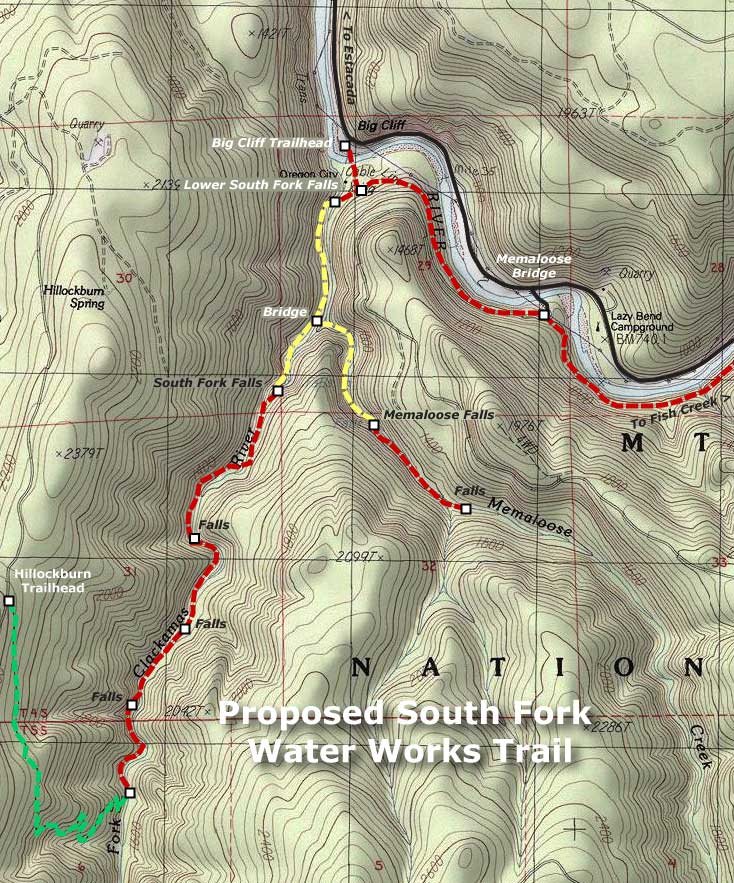
In total, there are five major waterfalls along the final two miles of the South Fork, and two along the last mile of Memaloose Creek, where it flows into the South Fork. The old water works roads and tunnels reach two of the South Fork waterfalls, including the main 120-foot falls, as well as the main falls on Memaloose Creek. The remaining waterfalls are remote, and not reached by the water works roads.

The tunnels and roads along this system are entirely intact and walkable – as several explorers have now documented. A timber bridge over the South Fork at Memaloose Creek is also intact, and is now used by waterfall explorers to cross the stream. These old roads and tunnels offer a unique opportunity for a new trail system that could build on the existing network, and offer an unparalleled blend of natural spectacle, historical artifacts and lots of insight into the history of the South Fork water works project, itself.


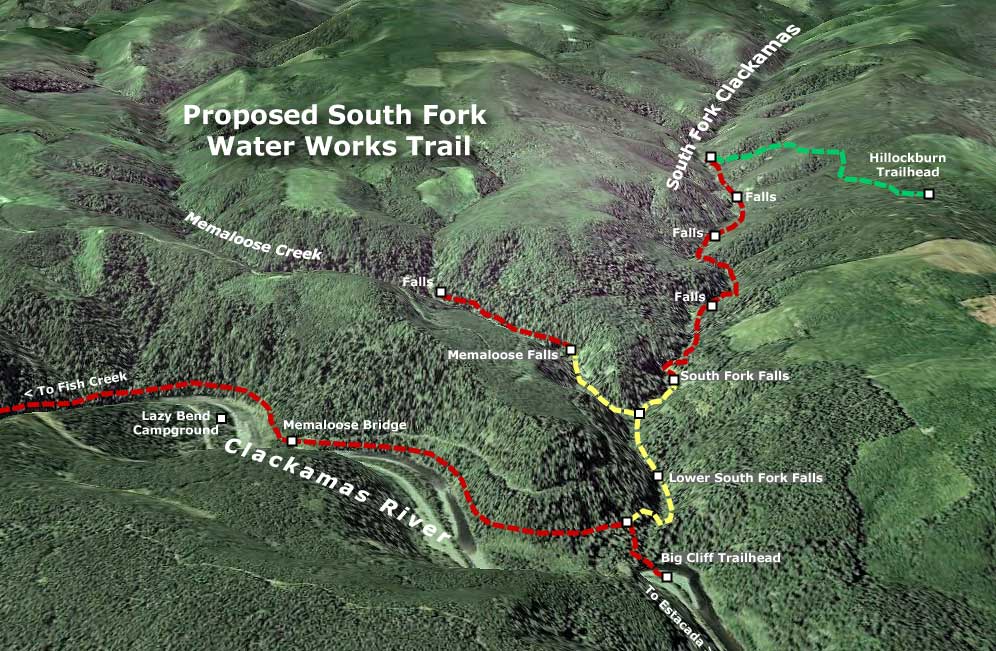
(Click here for a larger map)

What would this trail look like? The accompanying maps (above and below) show the sections that would follow old water works grades in yellow. All of these roads have been recently scouted, and are in good shape, and thus easily converted to trails. The six tunnels along the way (one along Memaloose Creek and five along the South Fork) are also in good shape, and easily walked, although at two are long enough that a headlamp is required.

New trails would also be needed to complete the system, and are shown in red on the accompanying maps. A new trailhead and access trail would located on the east side of the Memaloose Bridge, following the Clackamas River downstream, then turning up the South Fork canyon and joining the converted water works grade at the lower South Fork falls (this section along the Clackamas would also serve as an extension of the Clackamas River Trail, extending east to Fish Creek, and the current trail terminus).

Two trail extensions would carry hikers deeper into the canyons of the South Fork Clackamas and Memaloose Creek, beyond the water works roads. A new Memaloose trail would climb a half-mile to a second falls, upstream from the main Memaloose falls. An extended South Fork trail would continue from the final waterworks tunnel, and travel 1.5 miles upstream along the west bank of the river, passing three remote waterfalls before ending at the existing Hillockburn Trail (shown in green on the maps).


(Click here for a larger map)

Look closely at the maps, and you will also see a proposal to add a trailhead at Big Cliff, along the Clackamas Highway, with a footbridge connecting across the Clackamas River to the new South Fork trail network. The concept here is to provide a family-oriented day-use area on this scenic bend in the river that serves as the long-term gateway to the South Fork canyon. Today, this spot is an eyesore – a huge dirt and gravel expanse that suffers from dumping, shooting and other unlawful behavior. The trailhead and day-use concept would turn this blank expanse into a place for families to explore the river and nearby trails, less than an hour Portland.

Future trailhead and day-use area at Big Cliff?

In deep, rocky canyons like the lower South Fork, building new trails is complex, costly and at odds with modern conservation ethics, where blasting a trail through cliffs is no longer an accepted practice. Thus, the ability to convert the water works roads would bring hikers into a landscape that probably would never be reached with modern trails. In many ways, the canyon is an accidental version of the venerable Eagle Creek Trail, in the Columbia Gorge, where the route is famously carved into the cliffs.

The logistics for this proposal are also fortuitous. The water works area of the lower South Fork canyon was specifically excluded from the 2009 Lewis & Clark wilderness act that set aside the upstream portions of the South Fork canyon as new wilderness. This means that while the upper canyon trail must be built with wilderness restrictions in mind, converting the roads, repairing bridges and preserving the historical artifacts in the lower canyon won’t be encumbered by wilderness restrictions.

This is a project whose time has come – in part, because the word is out about the scenic wonders of this beautiful canyon, but also because the historic features ought to be preserved before they are lost to time and the elements.

Highway 26 Widening Postscript… and Requiem?

Original Loop Highway section on Laurel Hill in the 1920s, later destroyed when the present highway was built in the 1960s

As a postscript to the previous two-part article, I offer some final thoughts on the proposed widening of the Mount Hood Highway in the Laurel Hill area:

First, the Oregon Department of Transportation (ODOT) process used to gather public input on projects like those proposed for Laurel Hill is abysmal. Information on the web is cryptic, at best, and generally absent. Amazingly, there is no opportunity to comment online, nor information on how or where to comment. When I contacted project managers about making comments, I was given different comment deadlines, a full month apart. The ODOT website contains no information on comment deadlines.

ODOT posts a “users guide” to the State Transportation Improvement Program (STIP) process used for funding decisions, but this document manages to be more cryptic than the draft STIP document, itself, since it has been written for government workers and program insiders, not citizens. The process is also designed to buffer the Oregon Transportation Commission from public comment, with any input that does make it to the ODOT region offices collected and processed in a way that effectively buries public concerns under official recommendations by ODOT managers and obscure “citizen” commissions called ACTs. Since there is no ACT for the Mount Hood area, the comment opportunities for the Laurel Hill proposals fall into an even murkier void. In the end, this is a process that is staff-driven, and out of step with the ethic of citizen-centered transportation planning.

Second, the STIP selection process is a done deal by the time most citizens see it, since projects emerge from within the ODOT bureaucracy, not through an open solicitation of public ideas and needs, or even a long-range plan that maps out a pool of projects to draw from.

Thus, the projects in the Laurel Hill area will be very difficult to stop, since they surfaced in the past STIP cycle, and are now about to be funded in 2010 and 2011 as a “routine” final step. Since citizens are discouraged from participation in the selection phase of project funding, these projects will likely advance to a design and construction phase that makes them inevitable before any real public outreach or discourse can really occur. This was the case in the previous “widening for safety” projects in the Wildwood area, where the broader public outreach to citizens in the adjacent corridor began long after the project was conceived and funded. This left area residents with a Hobson’s choice between various widening options for “safety” as opposed to real choices for improving safety that could have been less costly and destructive.

Loop highway construction in the Brightwood area in the 1930s

Third, it is time for the Oregon Transportation Commission to pull the plug on the notion of “widening for safety”. This is a dubious loophole in the funding process the OTC sets forth for project selection, where safety benefits generally bring projects to the top of the list.

That’s a laudable goal, but it allows widening projects cloaked under the “safety” mantle to advance, unquestioned, and become the first to be funded. But as the Wildwood project details admitted, these projects are mostly about “matching the cross-section” of previously widened highway sections in the vicinity, not safety. So, this is nothing more than an highway capacity agenda, and it should be openly considered as such, not slipped under the radar of the OTC.

The stakes are much higher for the Laurel Hill “widening for safety” projects. While future generations may choose to tear up the asphalt and replant the forests that were cut away to make room for a wider highway in the Wildwood and Rhododendron sections, the Laurel Hill projects will require ODOT to blast away more of Laurel Hill’s rocky face. These changes are permanent and destructive, and it would take centuries for the area to recover, should our children or grandchildren conclude that we made a grave error in judgement in an our efforts to save skiers a few minutes driving time. The decision ought to be considered carefully in this light, not slipped through without public discussion.

Simpler days: the original loop highway corkscrewed up Laurel Hill, molding to the terrain as it climbed the steep slopes made infamous by Oregon pioneers

It is also true that ODOT has the means for a very open discussion about the projects proposed on Highway 26, and could give the OTC a true sense of public support for these proposals. For example, ODOT could simply post signs along the highway advertising the projects, and direct interested citizens to an online opportunity to comment. The agency could even use the giant electronic message sign in Rhododendron for this purpose, if meaningful public involvement were truly the objective.

I submit these critiques as one who works in the transportation planning realm daily, so it is both frustrating and discouraging to imagine what an ordinary citizen would have to overcome to be heard in this process. It is a fact that transportation planning is an arcane and difficult to understand realm, and for this reason, Federal Highway Administration (FHWA) regulators are looking for more meaningful public involvement in transportation decisions at the state and local levels. The ODOT processes fall far short of what the FHWA envisions, where ordinary citizens could easily access information about projects that affect them, and make meaningful comment to decision makers.

To meet its regulatory expectations from the federal government, and its obligation to Oregon citizens who fund the very existence of ODOT, it is time for the agency to engage the public in a more meaningful way, and allow each of us to weigh in on how our tax dollars will be spent. The looming decisions about the Mount Hood Highway would be a good starting point for this needed reform.
_________________________________________

Download a copy of the Mount Hood National Park Campaign (PDF) comments on the Highway 26 projects: click here

Download a slide presentation of the 2009 safety audit (PDF) of the Laurel Hill section of Highway 26: click here

Highway 26 Widening Projects – Part Two

The Oregon Department of Transportation (ODOT) is set to begin construction of more than $27 million in road widening projects along the Mount Hood Highway in 2010 and 2011. These projects are supposed to improve safety along the segment of Highway 26 located east of Rhododendron, and along the Laurel Hill grade. In reality, they will do little more than speed up traffic, and perhaps even make the highway less safe as a result.

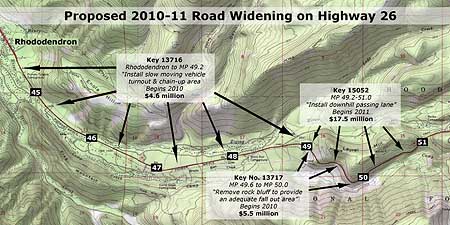
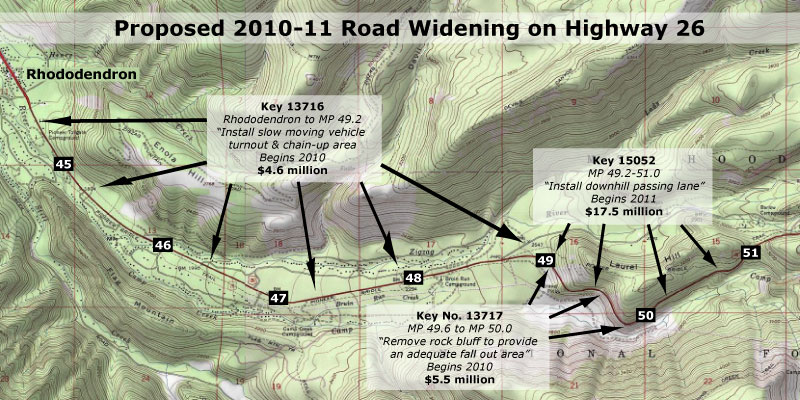
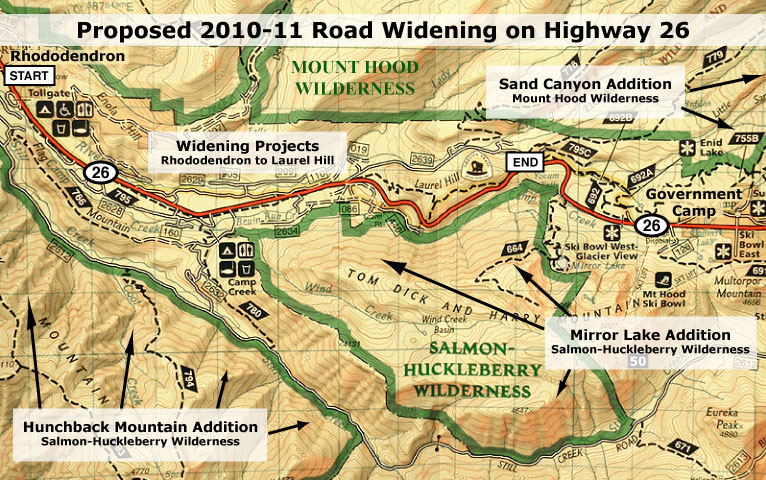
There are a total of three projects proposed for the Mount Hood corridor in this round of funding, including two “safety” projects that would widen the highway, and a third “operations” project that appears to be driven by the other two “widening for safety” proposals. The projects and their ODOT key numbers are shown on the map below.

Three projects are proposed for Highway 26 in 2010-11 that will add capacity to the road, though only if you read the fine print

(click here for a larger map)

The most alarming of the projects in this round of road widening is a proposed downhill passing lane on Laurel Hill, supposedly making it “safer” for throngs of Portland-bound skiers to pass slow vehicles on the downhill grade on busy weekends. This project is a repeat of the outmoded “widening for safety” philosophy that has already impacted the lower sections of the corridor, and was described in Part One of this article.

The ODOT project details for the “downhill passing lane” are sketchy, but such projects generally assume that drivers forced to follow slow vehicles become frustrated, and attempt to pass in an unsafe manner — a potentially deadly decision on a winding, steep mountain road. But is the answer to build a wider, faster road? Or should ODOT first use all of the other tools available to manage the brief periods of peak ski traffic before spending millions to cut a wider road into the side of Laurel Hill?

The answer to these questions seem obvious, but in fact, ODOT is moving forward with the most expensive, environmentally destructive options first, in the name of safety.

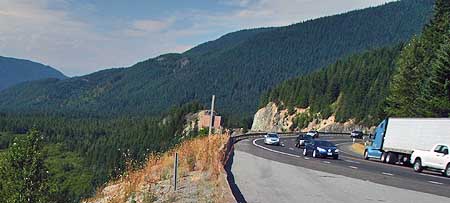
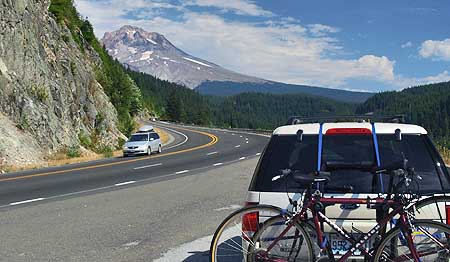
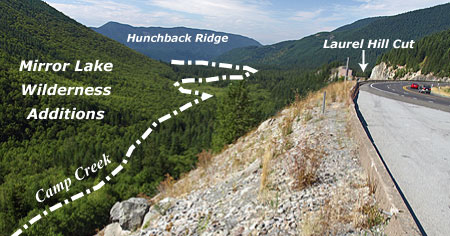
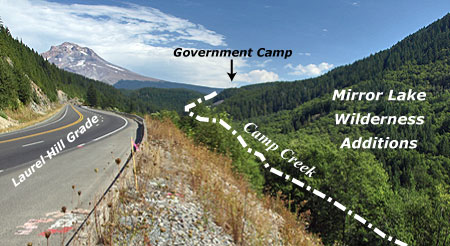
The westward view of the Laurel Hill Grade in a section proposed for widening to allow a downhill passing lane. The newly protected wilderness of the Camp Creek valley spreads out to the left.

A better solution, at least in the interim, would be to employ some of the less-expensive, less environmentally degrading approaches that have been successfully used elsewhere in the corridor. One option could be simply enforcing the current 55 mph speed limit and no-passing zones, for example, which would be much more affordable than the millions proposed to widen the highway in this difficult terrain.

Another possibility could be to extend — and enforce — the 45 mph safety corridor speed limit east from Rhododendron to the Timberline Junction, in Government Camp. Enforcing this slower 45 mph limit would result in skiers spending only an additional 90 seconds traveling the nine-mile section of Highway 26 from Government Camp to Rhododendron. This would seem a reasonable trade-off in the name of safety, especially compared to the millions it would cost to build downhill passing lanes on this mountainous section of highway.

The view east (in the opposite direction of the previous photo) where road widening is proposed to add a fourth downhill lane, carved from the sheer side of Laurel Hill.

Delaying the current road-widening proposals and taking a less costly approach to improving safety would also allow ODOT to more fully evaluate the effects that growing traffic on Highway 26 is having on the surrounding area. And while it is true that delaying a project that has already moved this far in the ODOT funding pipeline is an uphill battle, it is also true that a more fiscally conservative approach is clearly more consistent with the agency’s own transportation policy than the costly widening projects that are proposed.

However, while the visionary Oregon Transportation Plan (OTP) calls for a departure from old school thinking when it comes to new highway capacity, it does not establish a detailed vision for the Mount Hood Highway. But the general direction provided by the OTP does support a least-cost approach to managing highways, and slowing down the latest road widening proposals in the Mount Hood corridor would be consistent with that policy.

Unfortunately, the badly outdated Oregon Highway Plan (OHP) sets the wrong direction for the Mount Hood Highway, emphasizing speed and road capacity over all else. But until a better vision is in place for the highway, the response by ODOT planners and engineers to safety concerns and traffic accidents in this corridor will be more road widening projects sold as “safety improvements.”

Both the Salmon-Huckleberry and Mount Hood wilderness areas saw major expansions in 2009 that were not considered in the proposed ODOT expansion projects for Highway 26

(click here for a larger map)

Over the years, this old-school approach has already created a road that is rapidly approaching a full-blown freeway in size and noise impacts on surrounding public lands. At the same time, the pressure to minimize highways impacts on the forest surroundings is still growing.

In 2009, wilderness areas around Mount Hood were significantly expanded, and the new boundaries now draw close to the highway along the Laurel Hill grade, where the “safety” widening is proposed. What will the noise impacts of the proposed highway expansion be on the new wilderness?

Already, highway noise dominates the popular Tom Dick and Harry Mountain trail inside the new wilderness, for example, more than a mile to the south and 1,500 feet above the Laurel Hill Grade. How much more noise is acceptable? How will hikers destined for these trails safely use roadside trailheads to access wilderness areas?

Nearby Camp Creek should be a pristine mountain stream, but instead carries trash and tires from the Mount Hood Highway. While it is protected by wilderness now, how will storm water runoff from an even wider highway be mitigated to avoid further degradation? How will existing pollution impacts be addressed?

The answers to these questions were not considered when this new round of “widening for safety” projects were proposed, but should be addressed before projects of this scale move to construction.

This view west along the Laurel Hill Grade shows the proximity of the new Mirror Lake wilderness additions to the highway project area.

This view east along the Laurel Hill Grade, toward Mount Hood, shows the proximity of the new wilderness boundary to the project area.

In the long term, the solution to balancing highway travel needs with protection of the natural resources and local communities along the Mount Hood corridor needs a more visionary plan to better guide ODOT decisions. Such a plan could establish an alternative vision for the Mount Hood Highway that truly stands the test of time, where the highway, itself, becomes a physical asset treasured by those who live and recreate on the mountain. This should be the core principle of the new vision.

The very complexities and competing demands of the Mount Hood corridor make it a perfect pilot for such a plan — one that would help forge a new framework for managing the highway in a sustainable way that protects both community and environmental resources.

There is also room for optimism that ODOT can achieve a more visionary direction for the corridor. The agency is showing increasing sensitivity to the way in which transportation projects affect their surroundings, as evidenced by in recent projects in the Columbia Gorge and even on Mount Hood.

To underscore this point, I chose the logo at the top of this article because it shows a re-emerging side of ODOT that understands both the historic legacy and the need for a new vision for the Mount Hood Highway that keeps the road scenic and special. After all, Oregon’s highway tradition that includes the legacy of the Historic Columbia River Highway, the Oregon Coast Highway and the amazing state park and wayside system was largely developed as an extension of our early highways. ODOT can do this simply be reclaiming what is already the agency’s pioneering legacy..

The Laurel Hill Grade on Highway 26 as viewed from a popular trail in the new Mirror Lake additions to the Salmon Huckleberry Wilderness.

The missing piece is direction from the Oregon Transportation Commission (OTC) to develop a new vision that governs how the highway is managed, and establishes desired community and environmental outcomes by which highway decisions are measured. But until a new vision for the Mount Hood Highway is in place, it makes sense to slow down the current slate of costly projects that threaten to permanently scar the landscape, and take the necessary time to develop a better plan.

If you care about the Mount Hood Highway, you should make your thoughts known on both points, and the sooner the better. The process used by ODOT to make these decisions is difficult for citizens to understand and track, especially online. So, the easiest option for weighing in is to simply send your comments in the form of an e-mail to all three tiers in the decision-making structure, using the contact information that follows.

Comments to ODOT are due by January 31, but you also can comment to the Clackamas County Commission and OTC at the same time. Contact information can be found on these links:

ODOT Region 1
(Select one of the Region 1 coordinators listed)

Clackamas County Commission

Oregon Transportation Commission (OTC)

When describing the projects, you should use the “key numbers” shown in the first map, above, as well as the project names. Simply state your concerns in your own words, but consider these critical points:

  1. The proposed Mount Hood Highway widening projects should be delayed until less-expensive, less irreversible solutions can be explored;
  2. The Mount Hood Highway needs a new vision and a better plan

Remember, these are your tax dollars being spent and your public lands at stake. You have a right to be heard, and for your voice to have an impact. With any luck, these projects can be delayed, and more enlightened approaches explored for managing our highway.

Highway 26 Widening – Part One

The Mount Hood Highway in the late 1950s, when it was a 2-lane scenic byway that curved through Government Camp on its famous circuit around the mountain.

Several years ago, the Oregon Department of Transportation (ODOT) began a series of safety projects in the Mount Hood Highway (Highway 26) corridor in response to a growing number of deadly highway accidents. So far, the projects are a mixed bag, with some of the projects dramatically widening the highway in an unfortunate attempt to make it “safer”. In making the decisions, ODOT is continuing to follow a path that is gradually transforming the Mount Hood Highway into something that looks more like an urban freeway, one dubious “safety” expansion project at a time.

This recent work went into high gear when Highway 26 was designated a safety corridor by the Oregon Transportation Commission (OTC), which has the effect of doubling fines for speeding and other traffic infractions. While this simple change in fines may be having an effect on driver behavior, the more aggressive action of setting (and enforcing) a new 45 mph speed limit on a portion of the corridor from Wildwood to Rhododendron has clearly been successful in bringing down speeds along this problematic corridor.

Other projects, like the cable median dividers installed on the Cherryville Hill section of the highway, are simple, inexpensive retrofits to the existing road that leave the corridor mostly untouched. These projects provide a significant improvement in safety, according to early reports (view PDF), while leaving the community character and forested highway shoulders intact.

Recent road widening projects along Highway 26 has been sold as safety improvements, but are more likely to simply encourage more speeding.

But on other safety projects in Mount Hood Highway corridor, ODOT has fallen into the old-school highway engineering trap of widening and adding lanes in the name of “safety”. The traditional thinking behind this approach is that making roads wider and adding new lanes will allow faster traffic to pass slow vehicles more safety, and to have better driver visibility and response time, thus reducing accidents.

But this traditional approach is rapidly falling out of favor, as transportation research continues to show that drivers simply drive faster with wider roads and more lanes. A truism is that on highways, speed kills, so widening a highway for safety is a contradiction, since the wider road will simply encourage more speeding and likely produce still more deadly crashes.

The “widen for safety” approach can also have profound effects on the natural environment and health and safety of communities along a corridor. Building oversized roads in rural areas brings an array of environmental and local community impacts that are rarely considered in the transportation decision-making. For example, wider roads not only require more right-of-way to be clear for new lanes, but engineers typically clear forests well beyond the roadway in such projects, justifying wide shoulders with safety and maintenance concerns, but rarely considering options that would leave roadside forests intact.

Faster speeds also have a number of unintended effects on rural communities. The immediate impact is to make it more dangerous for local traffic to enter or cross the wider highway that doubles as their main thoroughfare. Often, historic local access points are eliminated completely in the name of safety. And studies on Washington’s Snoqualamie Pass Highway also show that speeding up traffic results in drivers feeling less safe in pulling off the highway to patronize rural businesses, thereby directly affecting rural tourism economies.

ODOT cross-section of the now constructed Wildwood to Wemme safety widening that eliminated the A.J. Dwyer Scenic Area (2007).

One of the recent projects of this sort was built between Wildwood and Wemme, where scores of trees were cut in a wide swath along the highway to add road width for “safety”. Yet, the project forever altered what the traveling public had assumed was a protected corridor, thanks to a rustic “A.J. Dwyer Scenic Area” sign that had stood for decades on the highway shoulder. As it turned out, the Dwyer preserve never had a chance in the face of a major highway project presented as a “safety improvement.”

The purpose statement in the 2007 ODOT Environmental Assessment for this “safety” project reveals the underlying highway expansion mindset behind the project — to larger goal was simply to widen the highway to “match” already wide segments abutting this segment:

“The purpose of the proposed project is to improve safety on US 26 between milepost 38.75 and milepost 40.01 and to match the cross section (width of lanes, center turn lane and shoulders) to that of the roadway to the east and west of the proposed project area.”

(Source: US 26: Wildwood-Wemme Revised Environmental Assessment 2007)

Another problematic part of such “safety” projects like the Wildwood to Wemme widening is the manner in which the larger public is excluded from participating. ODOT routinely sends notices to property owners in the vicinity — in this case, several hundred residents of the Wemme community, and holds local community meetings. But public involvement beyond the local community is largely absent, especially for those outside the local area who wish to comment online.

In this example, the local outreach effort drew only three written comments, and three oral comments at a public meeting — with one individual responsible for both a written comment and oral testimony — bringing the total public input to five individuals. Surely, a project of this magnitude and permanence deserved greater review and input from the hundreds of thousands of Oregonians who use this corridor each year, but do not happen to live in the local community.

This recent safety project near Zigzag leveled hundreds of trees and converted a scenic 2-lane road into a wide highway.

A similar, recent project built between Zigzag and Rhododendron also destroyed a wide swath of forest (pictured above), and closed traditional access points for local streets in the name of safety. Because a 45 mph speed limit was also established (and enforced) in this section at the same time as the new capacity was added, we will never know if simply enforcing the lower limit might have had the very same safety benefits without the substantial costs and impacts.

One lesson from these recent “widening for safety” projects might be to strictly enforce the “safety corridor” doubling of fines first, or considering applying lower speed limits, to learn whether improved safety can be addressed more simply and cost effectively with simple changes — and with less impact on the environment and community character.

This brings us to the present, and the next round of “safety” projects in the corridor that area about to unfold, a bit further up the highway. These projects are more of the same, but entirely on public lands and in much more difficult terrain. The implication of these projects, and how to have your voice heard, is the focus of Part Two of this article.

Proposal: Gorton Creek Accessible Trail

GortonCreek01

Emerald Falls on the proposed Gorton Creek Accessible Trail

The Mount Hood National Park Campaign proposes a major expansion of the trail system in the Columbia Gorge and around Mount Hood, including more opportunities for elderly, disabled and young families to experience nature. After all, hiking is the most basic form of active recreation, and should be available to all of us — especially as our region continues to grow and urbanize.

Proposed Gorton Creek Accessible Trail

Accessible trails are designed to provide access for everyone, and these facilities will be in growing demand as our country continues to age. By 2030, nearly a third of our population will be over the age of 55, and accessible trails will be in demand as never before.

In the spirit of providing accessible trails, this proposed new trail at Gorton Creek would allow for easy access to streamside vistas and photogenic Emerald Falls. This section of trail would bring visitors through a lush forest of Douglas fir, bigleaf maple and red alder.

GortonCreek02

Autumn on Gorton Creek as viewed from the proposed location of an accessible viewpoint

Gorton Creek becomes increasingly prominent as the trail draws near the stream and the sound of rushing water fills the air. Just below the proposed viewpoint of Emerald Falls and rushing Gorton Creek, there is a large gravel beach at a bend in the stream that could even provide the potential for universal access to the stream, itself — a first in the region.

The accessible portion of the new trail would largely follow an existing boot path that, in turn, follows a very old roadbed still shown on USGS maps. Thus, the gentle grade that would meet accessible trail design requirements. The dashed yellow line on the map, below, shows where the roadbed segment could be improved to provide universal access to a streamside overlook just below Emerald Falls.

GortonCreek03

Proposed Gorton Creek Family Trail

Family trails are designed to allow young children on foot, in backpacks or in strollers to have their first nature experience, and hopefully begin a lifetime of active recreation in nature.

The second part of the proposed Gorton Creek Trail would be designed for young families, with a short, easy grade leading to a viewing platform below Gorton Creek Falls. The falls is a towering 120 foot plunge set against a magnificent wall of columnar basalt, and would provide an exciting destination for budding young hikers. This section of proposed trail is shown in red on the map, above.

The family trail portion of this project would a couple of important objectives. First, it would provide a new hiking option for families with beginning hikers, with easy access from Portland and the potential to camp at Wyeth Campground as part of the adventure. Such trails are in surprisingly short supply in the Gorge, and therefore often crowded when families are most likely to visit, depriving them of a quality nature experience.

Second, this segment of the trail would combine with the lower, accessible segment to allow for extended family outings — grandparents enjoying the lower streamside viewpoint as young children and parents hike the short family spur to the main falls viewpoint, for example, with the extended family camping or picnicking at the Wyeth Campground.

Gorton Creek Restoration

While this proposal would meet growing needs for accessible trails in the region, it would remedy an escalating problem at Gorton Creek: the secret is out on Gorton Creek Falls, and waterfall enthusiasts are wreaking havoc on the trail-less canyon section above Emerald Falls as they scramble to reach the main falls, upstream. The damage to the canyon slopes (see photos, below) and stream bed is particularly worrisome given the important role the stream has as fish habitat.

GortonCreek04

Gorton Creek Falls is no longer a well-kept secret. Each summer, more visitors are pushing cross-country through the upper canyon, leaving damaged slopes and trampled vegetation in their wake

Finally, trail construction could also allow for the washed-out waterworks at Emerald Falls (see photo, below) to be permanently relocated within the trail corridor, and less prone to the periodic failures that plague the current streamside alignment. The water pipeline is currently in a precarious condition, and would greatly benefit from a trail project happening in this canyon sooner than later.

GortonCreek05

The washed out water supply line for Wyeth Campground hangs from cables anchored to stakes below Emerald Falls

To visit Gorton Creek, drive east of Cascade Locks to the Wyeth exit, turn right, then turn right again on the old highway that parallels I-84. Watch for the Wyeth Campground on the left, just before a bridge over Gorton Creek. If the campground gate is closed, park to the side, and walk through the campground to the well-marked trailhead at the south end — otherwise, you can drive to the trailhead.

To reach Emerald Falls, follow the formal trail 0.1 miles to a junction with Trail No. 400, where it crosses Gorton Creek on an impressive footbridge that kids will want to explore. Continue straight, past the bridge and Trail 400, following the obvious footpath up the east side of the stream canyon for another 0.4 miles. Watch your step around Emerald Falls, as the water works erosion has left abrupt holes and weakened stream banks. Do the canyon a favor, and don’t scramble upstream to Gorton Creek — wait for a trail to be built, instead!

(Editors Note: Trail No. 408 already carries the name “Gorton Creek Trail”, but never comes close to the creek, traversing high above the canyon rim on the shoulder of Nick Eaton Ridge. This trail eventually climbs to the summit of Green Point Mountain — and thus, might be better named the “Green Point Mountain Trail” should a new trail along Gorton Creek become a reality, if not before)

Off-Highway Vehicles

Fresh jeep tracks carve into the soft cinder summit of Red Hill, one of the areas the Forest Service would like to turn into a dirt bike playground.

Fresh jeep tracks carve into the soft cinder summit of Red Hill, one of the areas the Forest Service would like to turn into a dirt bike playground.

To get a handle on the off-highway vehicles (OHV) that are tearing up our public lands, the Mount Hood National Forest (MHNF) has embarked on a plan to concentrate them in just a few areas, presumably to reduce “conflicts” with other forest visitors.

The OHVs consist of 4-wheel ATVs, dirt bikes and 4×4 jeeps and trucks, and make up just one percent of the visitors to the forest. Their destructive, noisy, polluting quality make these vehicles a menace in the forest, whether on roads or off.

Unfortunately, the easy and most obvious solution (simply ban the vehicles!) is not politically available to the Forest Service under their convoluted “multiple use” mission. Instead, the MHNF will attempt to sacrifice a few places, as if any part of the forest should be sacrificed to an activity so senseless and destructive.

The unique geology on the summit of Red Hill, shown above and below, provides a good example of why OHVs should not be tolerated in our forests. The delicate cinder cone provides a unique view of Mount Hood, but also has the misfortune of being within reach of a logging spur. OHVs have pushed through the remaining forest to the summit of Red Hill, thoughtlessly digging ruts into the surface for the sake of a few minutes of joy-riding.

Another view of Red Hill's summit showing the criss-crossing ruts left by thoughtless OHVers.

Another view of Red Hill's summit showing the criss-crossing ruts left by thoughtless OHVers.

Similar damage can be found in sensitive areas throughout the Mount Hood National Forest, wherever logging spurs provide easy access for the OHVers. The Forest Service proposals would not only designate several areas for permanent abuse by OHVS, but also propose building new trail networks for OHV play areas.

Red Hill is one of many areas that has the misfortune of falling inside one of the Forest Service “study” areas for the OHV proposal — in this case, the area is called Bear Creek. But looking at the MHNF map of the proposal, you would be hard pressed to know what is really at stake (see excerpt, below).

Cryptic map of the Bear Creek area used by the Forest Service to propose OHV playgrounds

Cryptic map of the Bear Creek area used by the Forest Service to propose OHV playgrounds

The dashed purple lines on this map show the maze of proposed dirt bike trails, but where is this? Sadly, the missing features on this map that might otherwise orient hikers familiar with the area are Red Hill, Perry Lake and the Old Vista Ridge Trail. The trail, itself, is proposed to be converted to an OHV path, and the tangle of motorcycle routes spread across the north slope of the ridge.

Look at another map of the same Bear Creek study area (below) and you begin to see the features that are at risk.

A topographic map reveals the true features and terrain at risk from the Bear Creek OHV proposal, including Red Hill, the Old Vista Ridge Trail, Owl Point and Perry Lake.

A topographic map reveals the true features and terrain at risk from the Bear Creek OHV proposal, including Red Hill, the Old Vista Ridge Trail, Owl Point and Perry Lake.

In recent years, volunteers have largely restored the Old Vista Ridge Trail, once again bringing hikers to the spectacular beargrass meadows and huckleberry fields that sprawl along the ridges around Red Hill and Owl Point, and the many stunning view of Mount Hood, towering to the south. This is a first step in bringing needed advocates to the area, and who might take a stand against the OHV idea.

Another new development since the Forest Service hatched this plan was the passage of the Lewis and Clark Mount Hood Wilderness bill. Several areas adjacent to the OHV proposals were set aside, including here at Red Hill, where the Mount Hood Wilderness was expanded to follow the Old Vista Ridge Trail, touching the OHV proposal for Bear Creek.

While it is frustrating that we must fight to save places like Red Hill and Owl Point from something as senseless as the proposed OHV plan, it is equally important to make your thoughts known. The places on the study list were selected by the Forest Service, in part, because they lack the advocates that more popular quiet recreation spots enjoy.

The view from Owl Point, along the Old Vista Ridge Trail -- proposed as a motorcycle track in the OHV plan.

The view from Owl Point, along the Old Vista Ridge Trail -- proposed as a motorcycle track in the OHV plan.

So, if you are a friend of any of the study areas, weigh in with your thoughts while the MHNF comment period is open, though October 28. The best place to learn about the OHV proposal is over here, on the Bark website. Bark has posted all of the relevant documents, and provide background on what has become a fairly confusing, complex process.

Bark has been following the issue closely for nearly three years, and helped ensure that Alternative 4 in the plan. This option has the least impact of the “build” alternatives, and excludes the Red Hill and Old Vista Ridge areas. Instead, OHVs would be focused in two areas located south of Mount Hood known as McCubbins Gulch and LaDee Flat. Alternative 4 is the pragmatic alternative that the Mount Hood National Park Campaign will endorse as a lesser of evils.

You may also contact the Forest Service directly with your comments:

Jennie O’Connor Card
Mt. Hood National Forest
6780 Highway 35
Parkdale, Oregon 97041
(541) 352-6002 ext. 634