Warren Falls Lives! (temporarily, at least)

Warren Falls flowed briefly in early December

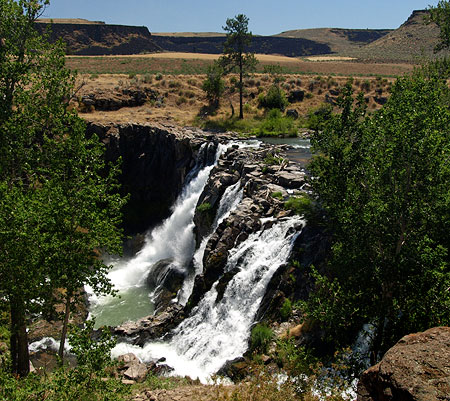
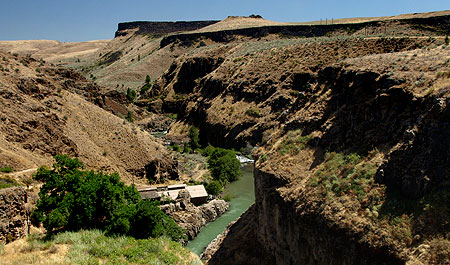
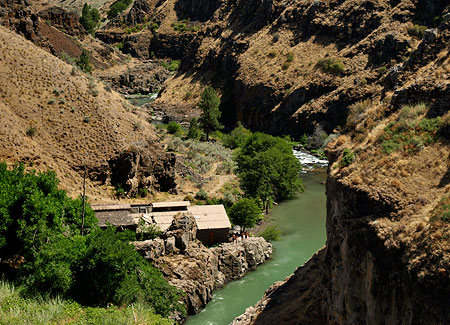
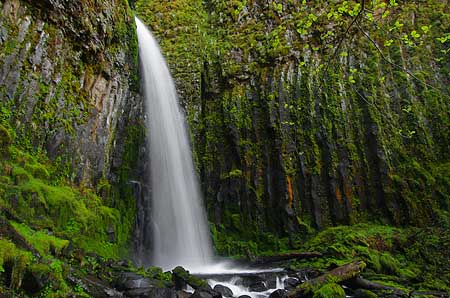
As an update to this recent article on restoring Warren Falls, I made a trip to the site of the former falls during a classic “pineapple express” pattern of winter monsoons earlier this month. I was thrilled to find a small amount of Warren Creek cresting the weir that has diverted the creek into a bypass tunnel for the past 75 years, and pouring over the falls.

It was remarkable to be in the amphitheater with water cascading over the escarpment, once again, and even if only temporarily. The small amount making its way over the brink completely changed the place from an eerie, somber cavern to a bright, sparkling glen. It was even more exciting to imagine the full force of Warren Creek plunging over the high cliffs, given the thundering display at Hole-in-the-Wall Falls (which is created by the bypass tunnel).

Here is a short video from that day that captures the scene and tells the story of Warren Falls:

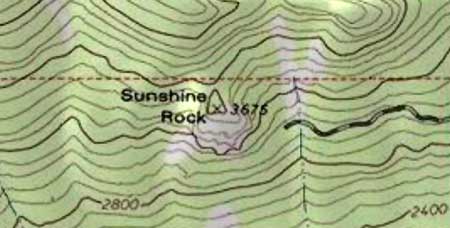
Sunshine Rock

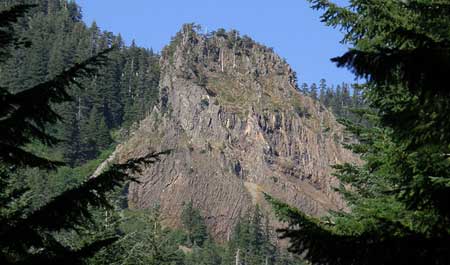
Located in a deep canyon near Lost Lake, Sunshine Rock is a 700-foot monolith that would rival famous Beacon Rock in the Columbia Gorge, were you to set them side-by-side. The two rocks might even look a bit like twins: both feature walls of distinctive columnar basalt, and rise to a broad, fluted crest.

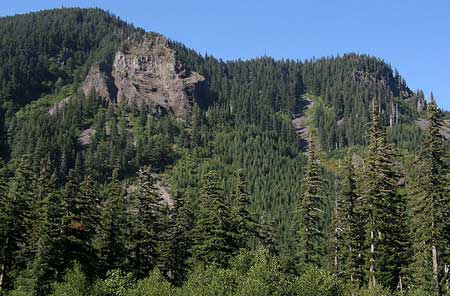
Despite its impressive size, Sunshine Rock is nearly hidden from view in the Lake Branch canyon, a few miles upstream from the West Fork Hood River. The rock briefly comes into view traveling down Lake Branch Road from Lost Lake, but only for a moment. With a little exploration, though, better views of this massive rock can be had from less-traveled routes in the area.

Sunshine Rock from Lake Branch Road

Sunshine Rock is a classic basalt plug — the solidified lava throat of an ancient volcano that was once a mountain. Geologic maps of the area identify the rock as andesitic basalt, dating back to the Miocene period of more than 7 million years ago.

This means that Sunshine Rock was formed as part of the “Old Cascades”, the range or deeply eroded peaks and ridges that pre-date today’s relatively young big volcanoes, like Mount Hood, by millions of years.

View across the Lake Branch valley to Sunshine Rock

Over the millennia, the Old Cascades have been carved by erosion and folded by fault lines, with countless new volcanoes emerging to cover older peaks in successive layers. Like most of the rock from the Miocene area, Sunshine Rock was buried by huge shield volcanoes of the Pliocene era, which dates back 2-5 million years.

Shield volcanoes are broad, gently sloped peaks that we now know as the mostly forested summits surrounding Mount Hood, including Larch Mountain, Lost Lake Butte, Mountain Defiance and several other volcanoes in the area. In the case of Sunshine Rock, nearby Indian Mountain is the overlying shield volcano that covers the older Miocene geology.

Giant firs give scale to one of the lower ramparts on Sunshine Rock

In more recent geologic times, the U-shaped valley of the Lake Branch was excavated by 7-mile long glacier that stretched from near present-day Lost Lake to the West Fork valley. There, it joined an enormous, 1,000-foot thick mega-glacier that extended 17 miles from Mount Hood to what are now the apple orchards of Dee Flat, along the Lost Lake Road.

The glacial period covers the Pleistocene era, which spans the most recent 2-million years, and numerous ice ages. The most recent ice advance peaked just 15,000 years ago, and was responsible for the most recent extent of the prehistoric Lake Branch glacier that exposed Sunshine Rock, along the flanks of the valley.

Recent History

Sunshine Rock seems to first appear in the modern record in early lookout tower survey photos. These photos were taken in the 1930s from new lookout sites, and include views from nearby Buck Peak, Raker Point and Lost Lake Butte. The view (below) from Raker Point in 1933 shows the rock most prominently, along with Indian Mountain in the background (another early lookout site).

The venerable Oregon Geographic Names doesn’t list Sunshine Rock among its thousands of entries, so short of historical files kept by the U.S. Forest Service, the inspiration behind the name may be lost to history. The name doesn’t appear on maps until the 1950s, suggesting that it came into being after the logging era was well under way, in the post-war period.

While the exact origin of the name is unknown, the thinking behind it seems evident: the position of the rock on a southeast facing valley wall allows it to catch morning sunlight, and thus would have been a bright beacon for nearby lookouts or loggers in the area.

Visiting Sunshine Rock

Forest Road 13 to Lost Lake forms a large loop, with Sunshine Rock located on the northern leg, along the Lake Branch Road segment of the loop. The best way to spot the rock is to approach from Lost Lake, winding down the Lake Branch valley, and watching for it through the trees.

You can also get a close-up view from Road 1330, which intersects Forest Road 13 near the rock, and leads to an abandoned quarry directly opposite the rock. For more adventurous explorers, Road 1320 climbs nearly to the top of the rock, with old logging spurs leading to the base of its cliffs.

Flag Point Lookout

In the early days at the turn of the 20th Century, the U.S. Forest Service was primarily a security force, tasked with guarding our public lands from timber thieves and squatters. This role expanded to include fire suppression in the early 1900s, a move that we see today as ecologically disastrous, but at the time, responded to massive fires destroying living trees that were valued in board feet, not biology.

The most enduring legacy from this era was the construction of thousands of fire lookouts, hundreds of forest guard stations and a sprawling network connecting trails and primitive dirt roads.

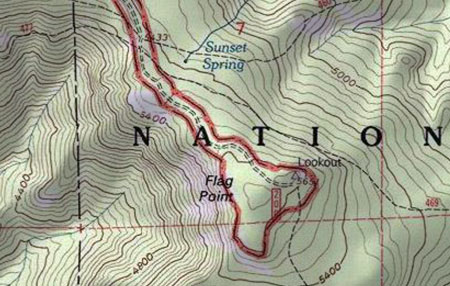
Though the lookouts and guard stations are mostly gone, the trail network still survives as the backbone of today’s recreation trail system. A few trails still lead to surviving lookouts scattered across the country. This article describes one such survivor, the Flag Point Lookout, located at 5,636 feet on a rocky, flat-topped bluff two miles east of Lookout Mountain.

The primitive road to Flag Point is surrounded on three sides by the Badger Creek Wilderness

The Flag Point Lookout is unique in that it continues to serve as an active fire lookout during the summer. The view from the lookout surveys a broad sweep of the eastern slopes of Lookout Mountain, far into the Eastern Oregon sagebrush and ranchland, and south into the rugged Badger Creek Wilderness.

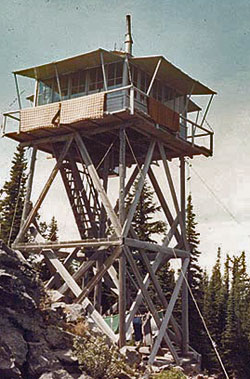
The second structure on Flag Point was this L-4 cabin constructed in 1932, and later replaced by the current structure

Since the establishment of the Badger Creek Wilderness in 1984, The Flag Point lookout and the long, rugged 1930s-era dirt road leading to it have been surrounded on three sides by federally protected wilderness (The same 1984 legislation left two other surviving lookouts in the Mount Hood area, the Devils Peak and Bull of the Woods towers, inside new wilderness areas, where they are now maintained by volunteers as hiking destinations).

The first lookout structure at Flag Point was a six-foot square cabin on a 40-foot pole tower, built in 1924. It must have been terrifying in rough conditions, and was soon replaced with the popular L-4 style cabin (pictured above) on a 30-foot pole tower in 1932, a design that was found across Oregon.

Later improvements to the second tower were made in 1955, and a series of outbuildings were added over the years, replacing the original tent camp that accompanied the first structure.

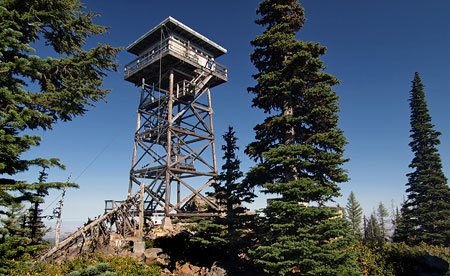
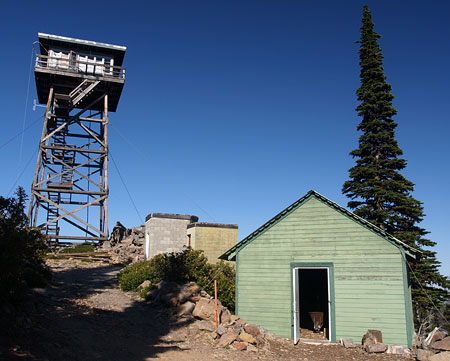
The current lookout tower and outbuildings at Flag Point

In 1973, the third and current lookout structure was built — an R-6 flat top cabin on a 41-foot tower constructed of sturdy, pressure-treated cross-timbers. Like many lookouts, the structure is primarily held in place by stay cables, and simply rests upon its four concrete foundation feet.

Though the current structure is still too young to be listed on the National Historic Register, it has been listed on the National Lookout Register. It will become eligible for the historic register in just 13 years, in 2023.

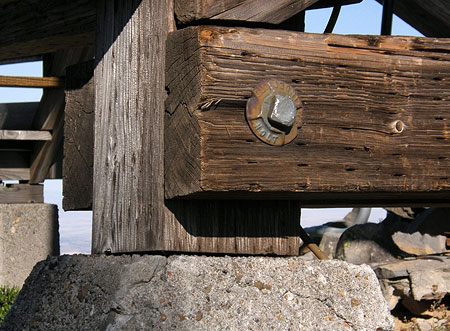
Amazingly, the tower is anchored by cables, and simply sits upon its four foundation piers

The Flag Point Lookout is also notable for the remarkable forest ecosystem that surrounds it, where stands of fir and mountain hemlock blend with western larch and ponderosa as east meets west. The rain shadow effect of the Cascade Range is plainly visible from Flag Point, where the sweeping view extends far into the sagebrush deserts of Eastern Oregon.

Ironically, these are fire forests, an ecosystem that has specifically evolved around wildfire cycles, and thus have suffered greatly from the well-intended “protection” from fire that the lookouts have provided. Today, natural fires in the Badger Creek Wilderness are likely to be allowed to burn, with the Forest Service intervening only when homes or private property outside the wilderness are threatened.

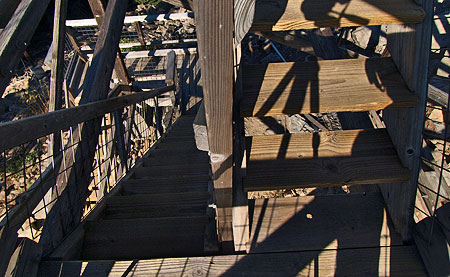
The plank staircases are beautifully constructed with rabbet and dado joints, and enclosed with galvanized steel mesh

Beneath the forest canopy, the wildflowers of Flag Point are as diverse as the conifers, with mountain and desert species mingling in the sunny, open meadows. The Divide Trail, connecting Flag Point to Lookout Mountain, provides one of the best wildflower hikes in the region in early summer, traversing through miles of meadows and rock gardens along the way.

Flag Point was an important forest destination in its time, and still serves as the hub for several forest trails that are a legacy of the early lookout era. In addition to the Divide Trail, the lookout has trails radiating to Ball Point, Gordon Butte and Badger Creek. Today, most visitors to the lookout arrive via the access road, but hikers and horse packers also regularly visit the lookout from this network of wilderness trails.

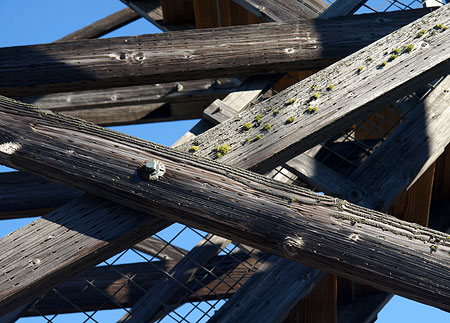
The key to the design of the Flag Point tower is a sturdy maze of treated cross-timbers

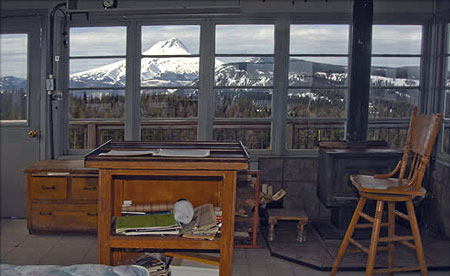
The cabin atop the Flag Point lookout consists of a 14-by-14 foot interior, surrounded by an airy exterior catwalk. Steel mesh fills the gap between catwalk railings, adding some degree of confidence for vertiginous visitors.

The small cabin is furnished with a bed, a wood stove for heat, gas cook stove, table and chair, and a solar lighting system — a modern amenity that early lookouts couldn’t have imagined.

Looking east, the view extends beyond the Cascades and across the Oregon desert country (USFS Photo)

At the center of the cabin is a map table that echoes the original Osborne fire finders used to pinpoint fire locations. Outside, a rope and pulley system is used to haul supplies and firewood to the catwalk from the base of the tower.

Water for drinking, cooking and washing must be hauled in to the tower by truck, though early lookouts simply carried water from the nearby Sunrise and Sunset springs. Outbuildings include an outhouse, woodshed and an A-frame communications shack has been added to the west of the tower.

The view to the west provides a spectacular look at Mount Hood and nearby Lookout Mountain (USFS Photo)

Visiting the Lookout

Anyone can visit the Flag Point Lookout by simply parking at the locked gate, and hiking about one quarter mile to the lookout complex. The tower is generally staffed from June 1 through October 15, so be courteous and let the lookout know you’re visiting before climbing the tower. If you’re lucky, the lookout will be on site and invite you up for a tour. If the tower is closed, you can still climb to the lower catwalk for a close-up look at the structure, and views of the surrounding terrain.

The Flag Point lookout also makes for an interesting add-on to the Divide Trail hike to Lookout Mountain. You can simply hike to the lookout along the Flag Point Road from the Divide Trail (about 3/4 mile each way), or shuttle your car to the gate, saving about a mile of road hiking, round-trip.

In winter, the Forest Service rents the lookout cabin to skiers looking for a rugged, remote experience. Of the handful of lookouts open as winter rentals, the Flag Point Lookout is one of the most challenging to reach. You can learn more about winter rentals at the lookout here.

Relic from a bygone era, this 1940s DeSoto is slowly fading into the forest near Flag Point, where it was mysteriously parked decades ago

How to Get There

Reaching the lookout is an adventure in its own right. The last few miles of forest roads are generally open from June through October. From Portland, drive east on US 26 through Government Camp, then follow Highway 35 across the White River, and down the East Fork Hood River valley, beyond the Meadows ski resort.

Turn east (right) on Road 44, where signs point to Dufur and Camp Baldwin, and follow this paved road for 8 miles to the poorly marked junction with Road 4420. Turn south (right) and follow this paved forest road as it eventually curves past the Fifteenmile Campground. Just beyond the sharp bend at the campground, watch for dirt road No. 200, heading abruptly uphill and to the right. This is the Flag Point road, and it bumps along for the next 3.5 miles to the lookout gate. Parking is available near the gate.

Note: unfortunately, the Forest Service has recently ditched this road with a series of water bars that make for very slow going, and make the trip a rough ride for passenger vehicles – take it slowly!

Proposal: South Fork Water Works Trail

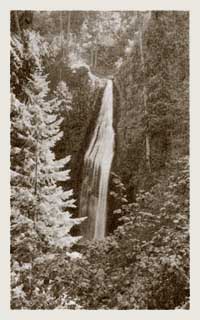
Lower falls on the South Fork Clackamas River in 1963

In 1913, the young cities of Oregon City and West Linn suffered a serious outbreak of typhoid from an increasingly polluted Willamette River, their sole source of water at the time. The incident spurred Oregon City’s leaders to appoint a “Pure Mountain Water League” and directed it to locate a safer source of drinking water.

The League settled on the pristine South Fork of the Clackamas River in the Cascade foothills. The City of West Linn signed on with Oregon City, offering to pay for one third of the cost of a new pipeline to bring the South Fork water to the two cities. A South Fork Water Board was created to carry out this ambitious project.

By the fall of 1915, the new water district had managed to lay twenty-six miles of 18” pipe from a site at the confluence of Memaloose Creek and the South Fork Clackamas all the way to Oregon City and West Linn. The new pipeline began to carry municipal water on October 7, 1915.

Main falls on the South Fork Clackamas River in 1963

In 1939 the South Fork Water Board expanded the system with the help of one of Franklin Roosevelt’s New Deal recovery programs, the Works Project Administration. This project extended a 24” pipeline upstream from the Memaloose Creek intake to a point upstream, above the 120-foot main falls on the South Fork. This project involved carving a series of three dramatic tunnels and a cantilevered pipeline through solid basalt cliffs.

The new intake improved water pressure downstream, and this system continued to serve as the water supply for the two cities until a new filtration plant was constructed on the lower Clackamas River, in 1958. Both systems were used until 1985, when the South Fork pipeline was decommissioned. Since then, the network of roads, tunnels, plank walkways, log bridges and old pipeline has slowly been fading into the green rainforest of the South Fork canyon.

The story might have ended there, except for the series of spectacular series of waterfalls along the South Fork and Memaloose Creek. By the late 1990s, some of the region’s more adventurous kayakers had scouted both streams, and in the early 2000s, had documented the first known descent of the South Fork by kayak.

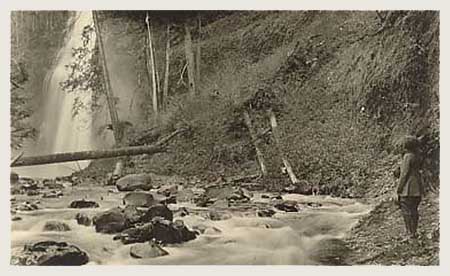
Main falls on the South Fork with hiker in 1923

These intrepid kayakers portaged the big waterfalls on the South Fork by following the abandoned tunnels and log bridges left behind by the South Fork Water Board. In doing so, they brought renewed interest to the area, as word of a high concentration of waterfalls spread to other adventurers.

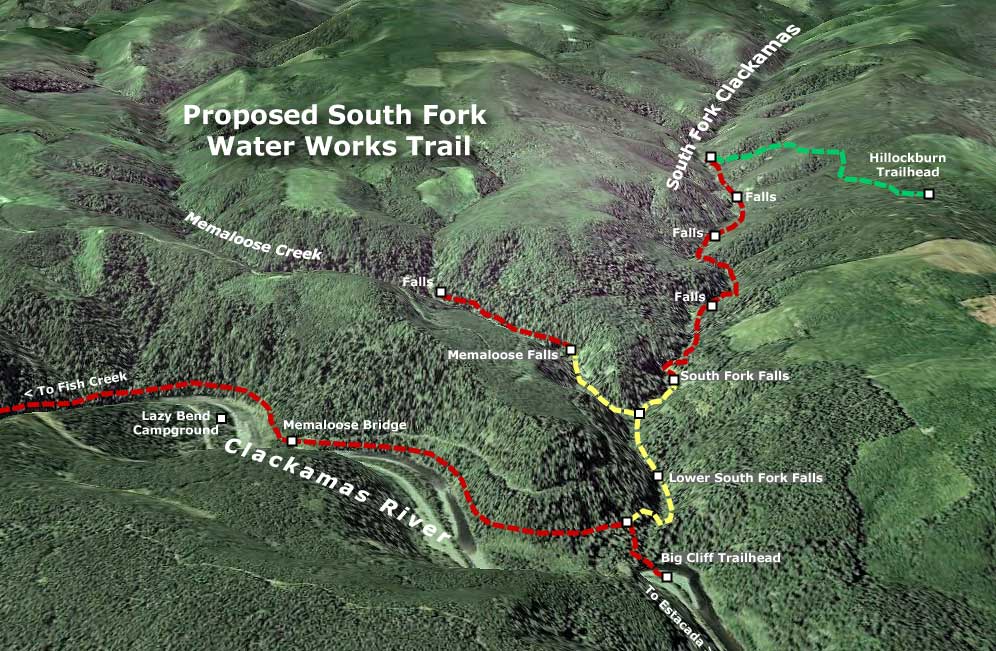
In total, there are five major waterfalls along the final two miles of the South Fork, and two along the last mile of Memaloose Creek, where it flows into the South Fork. The old water works roads and tunnels reach two of the South Fork waterfalls, including the main 120-foot falls, as well as the main falls on Memaloose Creek. The remaining waterfalls are remote, and not reached by the water works roads.

The tunnels and roads along this system are entirely intact and walkable – as several explorers have now documented. A timber bridge over the South Fork at Memaloose Creek is also intact, and is now used by waterfall explorers to cross the stream. These old roads and tunnels offer a unique opportunity for a new trail system that could build on the existing network, and offer an unparalleled blend of natural spectacle, historical artifacts and lots of insight into the history of the South Fork water works project, itself.


(Click here for a larger map)

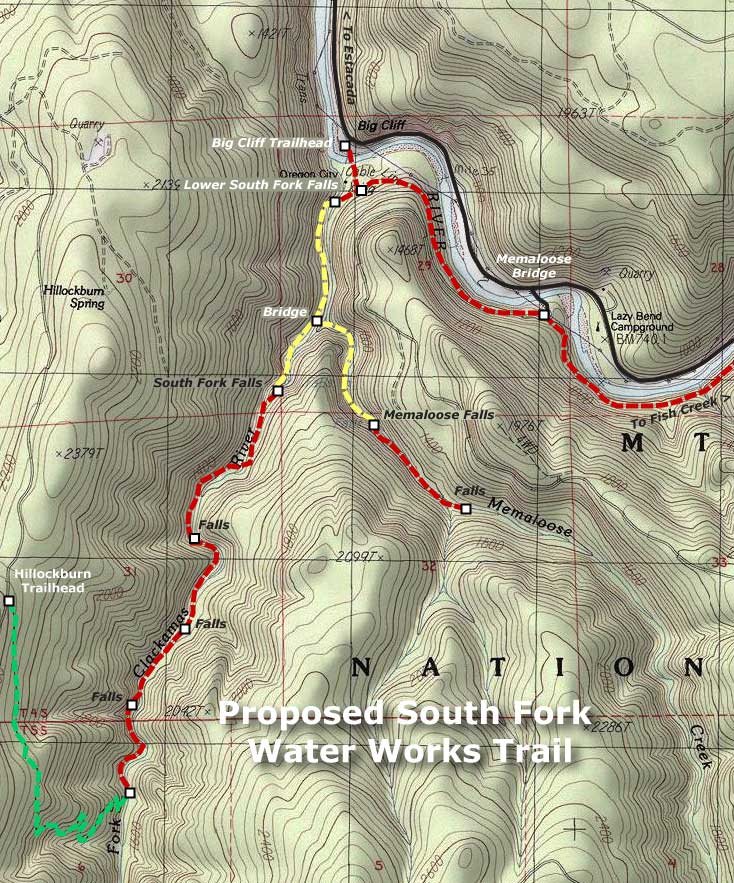
What would this trail look like? The accompanying maps (above and below) show the sections that would follow old water works grades in yellow. All of these roads have been recently scouted, and are in good shape, and thus easily converted to trails. The six tunnels along the way (one along Memaloose Creek and five along the South Fork) are also in good shape, and easily walked, although at two are long enough that a headlamp is required.

New trails would also be needed to complete the system, and are shown in red on the accompanying maps. A new trailhead and access trail would located on the east side of the Memaloose Bridge, following the Clackamas River downstream, then turning up the South Fork canyon and joining the converted water works grade at the lower South Fork falls (this section along the Clackamas would also serve as an extension of the Clackamas River Trail, extending east to Fish Creek, and the current trail terminus).

Two trail extensions would carry hikers deeper into the canyons of the South Fork Clackamas and Memaloose Creek, beyond the water works roads. A new Memaloose trail would climb a half-mile to a second falls, upstream from the main Memaloose falls. An extended South Fork trail would continue from the final waterworks tunnel, and travel 1.5 miles upstream along the west bank of the river, passing three remote waterfalls before ending at the existing Hillockburn Trail (shown in green on the maps).


(Click here for a larger map)

Look closely at the maps, and you will also see a proposal to add a trailhead at Big Cliff, along the Clackamas Highway, with a footbridge connecting across the Clackamas River to the new South Fork trail network. The concept here is to provide a family-oriented day-use area on this scenic bend in the river that serves as the long-term gateway to the South Fork canyon. Today, this spot is an eyesore – a huge dirt and gravel expanse that suffers from dumping, shooting and other unlawful behavior. The trailhead and day-use concept would turn this blank expanse into a place for families to explore the river and nearby trails, less than an hour Portland.

Future trailhead and day-use area at Big Cliff?

In deep, rocky canyons like the lower South Fork, building new trails is complex, costly and at odds with modern conservation ethics, where blasting a trail through cliffs is no longer an accepted practice. Thus, the ability to convert the water works roads would bring hikers into a landscape that probably would never be reached with modern trails. In many ways, the canyon is an accidental version of the venerable Eagle Creek Trail, in the Columbia Gorge, where the route is famously carved into the cliffs.

The logistics for this proposal are also fortuitous. The water works area of the lower South Fork canyon was specifically excluded from the 2009 Lewis & Clark wilderness act that set aside the upstream portions of the South Fork canyon as new wilderness. This means that while the upper canyon trail must be built with wilderness restrictions in mind, converting the roads, repairing bridges and preserving the historical artifacts in the lower canyon won’t be encumbered by wilderness restrictions.

This is a project whose time has come – in part, because the word is out about the scenic wonders of this beautiful canyon, but also because the historic features ought to be preserved before they are lost to time and the elements.

Proposal: Gorton Creek Accessible Trail

GortonCreek01

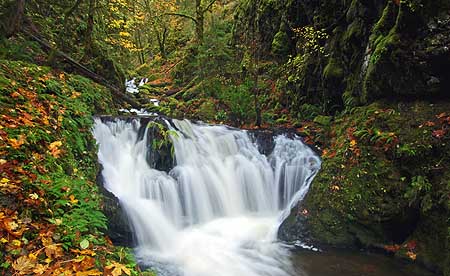
Emerald Falls on the proposed Gorton Creek Accessible Trail

The Mount Hood National Park Campaign proposes a major expansion of the trail system in the Columbia Gorge and around Mount Hood, including more opportunities for elderly, disabled and young families to experience nature. After all, hiking is the most basic form of active recreation, and should be available to all of us — especially as our region continues to grow and urbanize.

Proposed Gorton Creek Accessible Trail

Accessible trails are designed to provide access for everyone, and these facilities will be in growing demand as our country continues to age. By 2030, nearly a third of our population will be over the age of 55, and accessible trails will be in demand as never before.

In the spirit of providing accessible trails, this proposed new trail at Gorton Creek would allow for easy access to streamside vistas and photogenic Emerald Falls. This section of trail would bring visitors through a lush forest of Douglas fir, bigleaf maple and red alder.

GortonCreek02

Autumn on Gorton Creek as viewed from the proposed location of an accessible viewpoint

Gorton Creek becomes increasingly prominent as the trail draws near the stream and the sound of rushing water fills the air. Just below the proposed viewpoint of Emerald Falls and rushing Gorton Creek, there is a large gravel beach at a bend in the stream that could even provide the potential for universal access to the stream, itself — a first in the region.

The accessible portion of the new trail would largely follow an existing boot path that, in turn, follows a very old roadbed still shown on USGS maps. Thus, the gentle grade that would meet accessible trail design requirements. The dashed yellow line on the map, below, shows where the roadbed segment could be improved to provide universal access to a streamside overlook just below Emerald Falls.

GortonCreek03

Proposed Gorton Creek Family Trail

Family trails are designed to allow young children on foot, in backpacks or in strollers to have their first nature experience, and hopefully begin a lifetime of active recreation in nature.

The second part of the proposed Gorton Creek Trail would be designed for young families, with a short, easy grade leading to a viewing platform below Gorton Creek Falls. The falls is a towering 120 foot plunge set against a magnificent wall of columnar basalt, and would provide an exciting destination for budding young hikers. This section of proposed trail is shown in red on the map, above.

The family trail portion of this project would a couple of important objectives. First, it would provide a new hiking option for families with beginning hikers, with easy access from Portland and the potential to camp at Wyeth Campground as part of the adventure. Such trails are in surprisingly short supply in the Gorge, and therefore often crowded when families are most likely to visit, depriving them of a quality nature experience.

Second, this segment of the trail would combine with the lower, accessible segment to allow for extended family outings — grandparents enjoying the lower streamside viewpoint as young children and parents hike the short family spur to the main falls viewpoint, for example, with the extended family camping or picnicking at the Wyeth Campground.

Gorton Creek Restoration

While this proposal would meet growing needs for accessible trails in the region, it would remedy an escalating problem at Gorton Creek: the secret is out on Gorton Creek Falls, and waterfall enthusiasts are wreaking havoc on the trail-less canyon section above Emerald Falls as they scramble to reach the main falls, upstream. The damage to the canyon slopes (see photos, below) and stream bed is particularly worrisome given the important role the stream has as fish habitat.

GortonCreek04

Gorton Creek Falls is no longer a well-kept secret. Each summer, more visitors are pushing cross-country through the upper canyon, leaving damaged slopes and trampled vegetation in their wake

Finally, trail construction could also allow for the washed-out waterworks at Emerald Falls (see photo, below) to be permanently relocated within the trail corridor, and less prone to the periodic failures that plague the current streamside alignment. The water pipeline is currently in a precarious condition, and would greatly benefit from a trail project happening in this canyon sooner than later.

GortonCreek05

The washed out water supply line for Wyeth Campground hangs from cables anchored to stakes below Emerald Falls

To visit Gorton Creek, drive east of Cascade Locks to the Wyeth exit, turn right, then turn right again on the old highway that parallels I-84. Watch for the Wyeth Campground on the left, just before a bridge over Gorton Creek. If the campground gate is closed, park to the side, and walk through the campground to the well-marked trailhead at the south end — otherwise, you can drive to the trailhead.

To reach Emerald Falls, follow the formal trail 0.1 miles to a junction with Trail No. 400, where it crosses Gorton Creek on an impressive footbridge that kids will want to explore. Continue straight, past the bridge and Trail 400, following the obvious footpath up the east side of the stream canyon for another 0.4 miles. Watch your step around Emerald Falls, as the water works erosion has left abrupt holes and weakened stream banks. Do the canyon a favor, and don’t scramble upstream to Gorton Creek — wait for a trail to be built, instead!

(Editors Note: Trail No. 408 already carries the name “Gorton Creek Trail”, but never comes close to the creek, traversing high above the canyon rim on the shoulder of Nick Eaton Ridge. This trail eventually climbs to the summit of Green Point Mountain — and thus, might be better named the “Green Point Mountain Trail” should a new trail along Gorton Creek become a reality, if not before)

Tiny Timberline Survivors

TinyTimberline00

Bright yellow Sulphur Flower carpet the slopes below Palmer Glacier in August

During the peak of summer in the high country around Mount Hood, hikers flock to the lush mountain meadows in places like Paradise Park, Cairn Basin, Elk Cove and Elk Meadows to take in the huge drifts of waist-deep wildflowers. Along the way, they usually pass through the cinder slopes and glacial moraines that seem barren in comparison, but in fact are home to some of the toughest survivors of the wildflower community.

These diminutive flowers are incredibly rugged, resilient plants that somehow manage to persist in the harshest of alpine environments, cheerfully blooming each August during a snow-free growing season that spans only three or four months. Most are perennials, persisting from summer to summer, despite a thick snow pack for much of the year.

Their tiny size is but one of their adaptations to the extreme conditions that exist above the tree line. Most also feature long taproots that anchor them deep in the loose mountain soil, and thick, leathery leaves that help conserve water while maximizing photosynthesis during the very short growing season.

There are a number of tough species in this community of survivors, but the following are seven that are among the most common and interesting, and worth getting to know. These plants were all photographed on the same August evening, high on the south slopes of Mount Hood.

TinyTimberline01

Creeping Penstemon (Penstemon davidsonii)

Creeping Penstemon
This tiny flower grows just six inches tall, though its woody stems are almost shrub-like, and allow the plants to form carpets several feet across, usually on the protected side of a boulder. The oval, evergreen leaves are small and leathery, and also seem almost shrub-like, resembling tiny rhododendron leaves. The flowers can range in hue from lavender to nearly pink, and bloom in short spikes in early and mid-summer.

TinyTimberline02

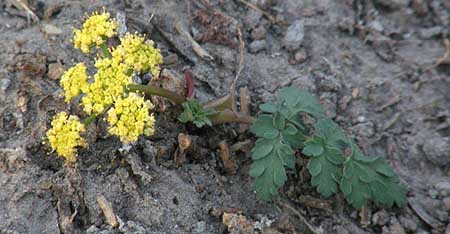
Desert Parsley (Lomatium martindalei)

Desert Parsley
This little plant (also called Few-Fruited Desert Parsley) also grows in loose sand or pumice at the tree line, and is anchored by a large taproot that can up to a foot long. The thick roots of wild parsleys were collected by Native Americans as a food. Desert Parsley is most notable for its graceful, fernlike leaves, but also sports bright yellow blossoms in mid-summer. The plant is rarely more than four or five inches high.

TinyTimberline03

Low Mountain Lupine (Lupinus lepidus)

Low Mountain Lupine
This wonderfully tiny lupine is an obvious cousin to its many tall relatives, except that it grows no more than three or four inches tall. The tiny leaflets resemble the large, palmate leaves of larger lupines, except that they are the size of a button. The leaves are also covered in soft, silvery velvet that further helps the plants conserve water. The plants are anchored by a long taproot, like most alpine dwarfs. Their blossoms are globe-shaped, like a clover, though clearly related to the tall flower spikes of their larger cousins. Low Mountain Lupine blooms from early August through early September.

TinyTimberline04

Partridge Foot (Luetkea pectinata)

Partridge Foot
This delicate plant can form an extensive groundcover below timberline, but also blankets moist spots in the harsh country above the tree line, especially where melting snow trickles in small streams across rocky slopes. Partridge Foot is only a few inches tall, with creamy white flower spikes reaching 3-4 inches in mid-summer. The common name comes from the shape if its leaves, which apparently resemble a bird’s foot.

TinyTimberline05

Pussypaws (Spraguea umbellate)

Pussypaws
This tiny wildflower also has a self-evident common name, owing to the soft, fleshy, paw-shaped leaves that help the plant store moisture in its harsh habitat. In mid-summer, Pussypaws are covered with tufts of pom-pom flowers that open white, then fade to rose-pink. These little plants are no more than two inches high, with flower stems reaching three or four inches. It thrives in nearly soil-less pumice, and has an amazing taproot that can be as long as ten feet!

TinyTimberline06

Spreading Phlox (Phlox diffusa)

Spreading Phlox
Easily the lowest alpine flower, Spreading Phlox grow in a mat just 1-3 inches high, with their stunny explosion of cheery blossoms literally covering the plants in early August. The button-like flowers range from white to blue, with all shades of pink and violet between. Like its alpine neighbors, Spreading Phlox is deeply rooted, and thus well adapted to the dry, loose pumice and sandy slopes that it thrives in.

TinyTimberline07

Suphur Flower (Erigonum umbellatum)

Sulphur Flower
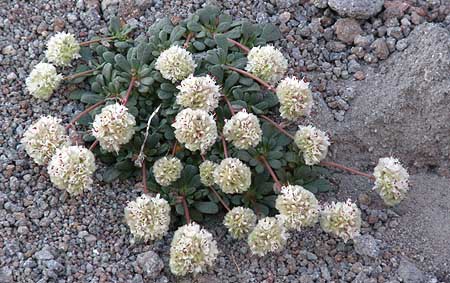
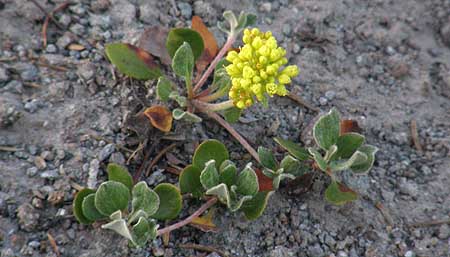
Also known as Sulphur Buckwheat, this is a tough survivor that lives in the least hospitable reaches of the alpine environment. This plant has silvery leaves covered with tiny hairs that help conserve moisture, allowing the plants to grow in what seem to be impossible habitats — from cracks between rocks and in loose scrabble on moraines. The flowers can range from cream to yellow, and light up slopes in early summer, before fading to a rosy hue. The top photo in this post shows a colony of Sulpher Flower on Mount Hood’s dry south slopes.

How to See Them
These timberline survivors can be seen all around Mount Hood, and on some of the higher surrounding peaks, too, such as Lookout Mountain and the high spots in the Columbia Gorge that reach above the tree line.

An easy way to see these plants up close is to explore the trails around Timberline Lodge. Several paved footpaths circle the lodge, and head up the mountain from the back of the lodge. You can follow one all the way to Silcox Hut, which is located far above the tree line, but still features many of these tiny flowers along the way.

Another option from Timberline is to follow the Pacific Crest Trail (PCT) south from the lodge, crossing the glacial headwaters of the Salmon River then to an impressive overlook of the White River canyon. This section of the PCT is lined with these tiny alpine survivors. Visit these trails in early August, and you’re guaranteed to see them in bloom.

Dry Creek Ponds: Orphaned Gems

Dry Creek flows into a series of lush ponds just south of I-84.

Dry Creek flows into a series of lush ponds just south of I-84.

Just inside the city limits of Cascade Locks — and just outside the protection of the Columbia Gorge National Scenic area — lie a series of beautiful ponds and an adjacent group natural springs so pure that a national bottled water corporation is considering a new plant here. The ponds, themselves, are posted with real estate signs advertising dream home sites in this pretty location, albeit within earshot of noisy I-84.

The ponds underscore one of the dilemmas facing natural sites in the Columbia Gorge that happen to fall within the designated “urban areas” that are excluded from scenic area protection. Most of the Gorge towns are too small to have the fiscal means to protect these orphaned gems, even if they wanted to. Meanwhile, the non-profit organizations and federal agencies involved in land acquisition focus exclusively outside these urban areas. The result is a surprising number of natural features that face great risk of development, with no clear path for protection.

Dry Creek is better known for its waterfall, about a mile upstream from the ponds.

Dry Creek is better known for its waterfall, about a mile upstream from the ponds.

In the case of the Dry Creek Ponds, much of the land is already up for sale, and the real question is whether some sort of public purchase could intervene, and save the ponds from development. The ponds are not entirely pristine: a frontage road along I-84 borders one of the ponds, and there are a few homes tucked into the forest near the ponds. But the ponds are largely undeveloped, and surely worth more to the public as protected natural areas than to a few as exclusive home sites.

One option for protecting the ponds is the federal acquisition program operated by the Forest Service to consolidate lands within the scenic area. Their guidelines focus outside the urban areas, but a case could easily be made to cross those boundaries when natural sites are adjacent to surrounding public land. This is the case for the Dry Creek ponds, which not only abut the scenic area, but also the federal Oxbow fish hatchery.

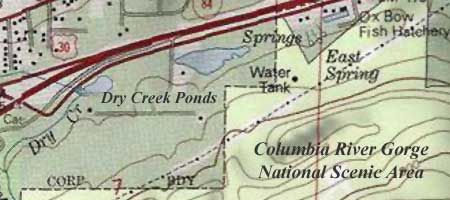
Dry Creek ponds are located outside the protection of both the National Scenic Area boundary and the nearby Oxbow fish hatchery.

Dry Creek ponds are located outside the protection of both the National Scenic Area boundary and the nearby Oxbow fish hatchery.

A second option for protection are the private agencies involved in land acquisition within the scenic area. These organizations typically turn most of their acquisitions over to the federal government for long-management, so in the case of the Dry Creek Ponds, it would still be important to find a way for federal acquisitions to exist inside the urban areas.

A third option is for local governments to step up to the challenge, and create a municipal park or natural area for its local citizenry. In this case, the City of Cascade Locks is the local government in question, and like most of the small cities in the Gorge, is financially strapped. So a hybrid approach where the federal agencies, or perhaps the non-profits (or both) help the small cities make strategic acquisitions of places like the Dry Creek Ponds.

The ponds are teeming with wildlife, despite the noise of the nearby freeway.

The ponds are teeming with wildlife, despite the noise of the nearby freeway.

One of the truisms about sudden growth in small communities like Cascade Locks is that the civic awareness of threats to natural areas usually comes too late in the development boom. After years of slow growth, Cascade Locks is slowly awakening. So, like other Gorge communities, the town is entering a short window of opportunity for natural area protection that will be fleeting.

The Dry Creek Ponds are worth saving. The ponds are home to waterfowl, beaver and a thriving population of other species in the wetlands and forest that border the ponds. The ponds are unique in having such close proximity to Cascade Locks, and therefore easy access for visitors. This is one of only a few places in the Gorge where it is easy to get very close to a pond ecosystem, and thus could provide a valuable place for learning and wildlife watching.

Wetland birds thrive in tall marshes that border the ponds.

Wetland birds thrive in tall marshes that border the ponds.

The ponds could also provide a starting point for hikers to head up Dry Creek to the falls — or points beyond along the Pacific Crest Trail, which passes just above the ponds, inside the scenic area.

In the end, the fate of the ponds will be a measure of our collective will to protect the larger Gorge landscape for generations to come, no matter where we’ve drawn lines on maps or how we have divided public land management responsibilities. In this way, the ponds provide an opportunity for local citizens, public land stewards and non-profit environmental advocates to show that our collective vision extends across those artificial boundaries.

Restoring forests, one community at a time

Interior Secretary Ken Salazar set the Pacific Northwest forest recovery effort back on track in July when he reversed the Bureau of Land Management’s (BLM) Western Oregon Plan Revisions (the WOPR, a brilliantly unintentional blunder as acronyms go, as it became known as “The Whopper”). This represented a major step back from scientifically corrupt policies intended to enrich timber corporations at great cost to our public lands.

In this recent opinion piece in The Oregonian, Dominick DellaSala and Randi Spivak respond to Salazar’s move, and provide an excellent framework for how we should move forward to restore our public forests. Their prescription: emphasize needed thinning of the sickly, biologically sterile tree plantations left from the logging heyday of past decades, and embrace the value that our restored forests will have in the global effort to reduce carbon emissions.

The eastside forests spreading out below Lookout Mountain look healthy enough from a distance, but in reality are in dire need of a bold new restoration strategy.

The eastside forests spreading out below Lookout Mountain look healthy enough from a distance, but in reality are in dire need of a bold new restoration strategy.

As described in their article, the Siuslaw National Forest has already begun to embrace this new approach, and other public forest managers are beginning to take notice. But a truly comprehensive restoration effort must be more aggressive, and should also focus on stabilizing the forest-based communities that were left to die when the big timber operations pulled out in the 1980s and 90s

Traditional thinning offers a couple of opportunities for local communities: the timber operations involve most of the same logging skills that were once the mainstay of rural Oregon. In addition, the harvested wood from thinning offers not only traditional saw logs for small mills, but also a new economic niche in the smaller woody debris that was once discarded or burned on site in the forests. New uses for small woody debris include engineered wood products and even energy production as biomass.

A closer view of typical second-growth forests near Lookout Mountain reveals a dying, overcrowded ecosystem under great biological stress.

A closer view of typical second-growth forests near Lookout Mountain reveals a dying, overcrowded ecosystem under great biological stress.

One practical challenge in reaching this new approach will be the scaled-back network of logging roads, since the over-built system constructed in the second half of the 1900s is rapidly crumbling and infeasible to maintain for the long term. One strategy is to tie road decommissioning to forest thinning and restoration efforts, pulling out obsolete roads after forests have been largely restored. Another could be aerial operations, perhaps even balloon logging. Still another could be roadless logging with light equipment or even horses — a practice well established on small, private woodlots in Oregon.

The key to finding this new balance in sustainable forest restoration a role of direct stewardship among the forest communities — to view them as the keepers of the forest, as opposed to the “forest dependent” mindset of the industrial logging era. This means establishing an ongoing relationship between community-based forest management organizations and the federal agencies that govern most of our public forest land. These new organizations could follow the lead of watershed councils and farm bureaus, using formal governance coupled with direct management responsibilities as forest recovery agents.

A bright spot in the restoration of the eastside forests near lookout mountain, this thinned plantation is beginning to resemble a natural forest, with multi-aged stands and a recovering understory.

A bright spot in the restoration of the eastside forests near lookout mountain, this thinned plantation is beginning to resemble a natural forest, with multi-aged stands and a recovering understory.

How would the economics of community-based stewardship work? In a commodity-based model of selling products recovered from thinning, the objective is straightforward — but unlikely to be profitable as a private enterprise.

Instead, the public will likely need to provide some level of subsidy for the restoration work involved, with commodity proceeds offsetting public costs. The advantage of a public subsidy is that it provides an ongoing public interest in the health and viability of the forest communities, themselves, and could help avoid the volatility that private timber harvesting brought to these communities in their first century.

A few stands of late succession ponderosa and Western larch forest still exist on the slopes of Lookout Mountain, providing a glimpse of what a restoration policy must aim for.

A few stands of late succession ponderosa and Western larch forest still exist on the slopes of Lookout Mountain, providing a glimpse of what a restoration policy must aim for.

But the more interesting idea is to create a long-term financial model for stewardship communities based on carbon sequestration as part of global efforts to reduce carbon emissions. Carbon credits would be sold as offsets to carbon polluters, and providing a permanent incentive to bring the northwest forests back to health.

The credits could be managed as a community trust, or managed through a public-private corporation. Under this paradigm, there would be little incentive to harvest large trees, since they would exist primarily as carbon storage units under the new carbon-based economic framework.

Of course, we also know that big trees and mature forests also provide a much wider array of ecological and social benefits, but these costs have never factored in to the short-term price for raw logs in the old timber harvesting paradigm. As DellaSala and Spivak point out in their article, the Pacific Northwest is uniquely capable of storing carbon in our living forests, and to a degree nearly unmatched in the world. If this potential is given a value, then we may well seen an end to the destruction of our mature forests for saw logs and pulp that could just as easily be manufactured from private plantation materials.

The concept of community-based stewardship in carrying out forest restoration is attainable, as evidenced by the many successful public-private partnerships that exist today. But it’s unclear if the Forest Service and BLM bureaucracies are flexible or willing enough to embrace the idea.

Instead, a new conservation-based form of administration may be needed — broader than the National Park Service in scope, but borrowing from the Park Service ethic of conservation and sustainability. The Cascade Forest Preserve, perhaps, extending from the Sierras to the Canadian border? Given the grave implications of climate change, it is impossible to think too big or boldly as we search for a way forward.

The Mount Hood Lily

MountHoodLily01

Second only to our towering Pacific rhododendron (Rhododendron macrophylum) in pure spectacle, the striking white trumpets of the Mount Hood lily are unforgettable. These handsome lilies often grow to more than six feet in height with as many as 20 flowers, each up to 8 inches in length. Never heard of the Mount Hood lily? That’s probably because you know this as the Washington lily (Lilium washingtonianum Kellogg), though it is also widely known as the Cascade lily and Mount Hood lily. A slightly variant race of the species in Northern California is commonly called the Shasta lily.

But the rather generic name of “Washington lily” is made more confusing by the simple fact that this beautiful plant doesn’t even grow in the state of Washington. Its northern extent is the area around Mount Hood, and its range extends down the Cascades and into the California Sierras. But thankfully, it turns out that the lily wasn’t named for the State of Washington, at all. Instead, the naming pre-dates Washington statehood.

In fact, botanist Albert Kellogg named this regal flower for Martha Washington, wife of our first president, when he first described the species in 1859. The spectacular, aromatic plants were soon collected for gardens and picked by forest visitors, locally decimating the population by the 1950s. Today, they have made a comeback, and are relatively common across their range, especially around Mount Hood.

Martha Washington and a Nineteenth Century rendering of our western lily named in her honor

Martha Washington and a Nineteenth Century rendering of our western lily named in her honor

Like most lilies, the Mount Hood Lily is a perennial that grows from a bulb, and thus the ease in collecting the species for commercial use. Native Americans also collected the bulbs as a food source. The plant grows in open woodlands and forest openings, often in surprisingly dry conditions.

In addition to multiplying their bulbs over time, the plants produce up to 200 seeds in the capsules that follow each flower. While digging the bulbs is strongly discouraged, collecting the seeds to grow in home gardens is a responsible, sustainable means of propagating the plants. Collected seeds of the native species, as well as many hybrids, are also available from specialized retailers.

So, in the spirit of provincialism, I propose that we rename this plant, simply because of the confusion over the name — after all, Kellogg named the plant in the year in which Oregon became a state, so he was likely unaware that another state in the Northwest would be named for George Washington.

There’s also the fact our first First Lady already has the aristocratic series of Martha Washington Geraniums (Pelargonium domesticum) named in her honor, and thus adding the Mount Hood lily is a mere asterisk in comparative prominence. Besides, Martha Washington has already had three postage stamps, two early dollar bills, several U.S. Mint commemorative coins and the only U.S. naval ship — the U.S.S. Lady Washington — to be named for a first lady.

As a modest and proper woman in the tradition of her time, surely she would cringe at this embarrassment of honors? And as the chief overseer of the Mount Vernon plantation and a gardener herself, surely Martha Washington would be the first to agree that the Mount Hood lily is a far superior name, both in descriptiveness and clarity?

This leads us to another simple compromise: when she tended to troops at General Washington’s side in the desperate struggle at Valley Forge, Martha Washington became known as Lady Washington, and a true heroine in her time. So, perhaps the Lady Washington lily would be a proper solution to our naming dilemma?

Where the heck is Tamarack Rock?

TamarackRock01

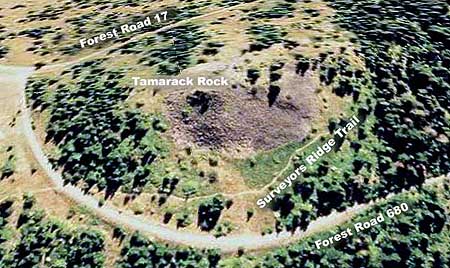
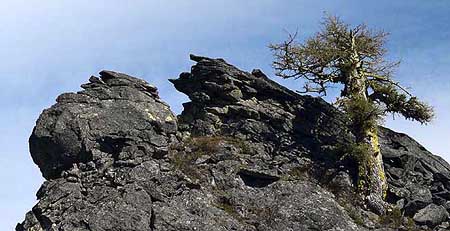
You won’t find Tamarack Rock on any maps, though this rugged knoll is hidden in plain sight — just off the Surveyors Ridge Road (FR 17) on the east side of Mount Hood. The rock didn’t get much respect during the logging heyday of the late 1900s, with gravel spur roads wrapping almost entirely around the rock, and big ponderosa trees felled from its gentle southern flank.

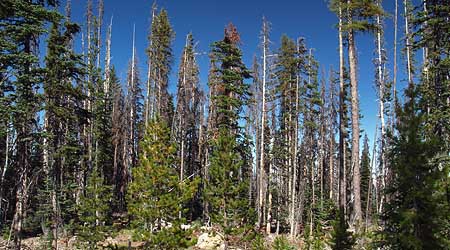
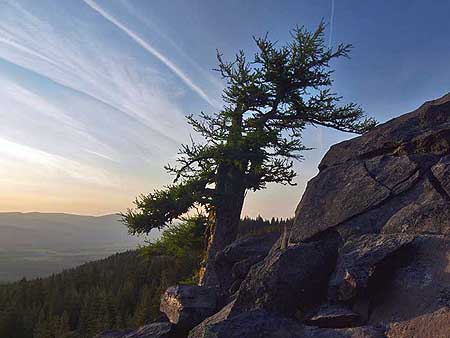
But through all the destruction that reigned here, a lone Western larch tree survived in a most unlikely spot, among the huge boulders near the crest. The tree is among the most magnificent of its kind in the area, a massive, gnarled, determined old sentinel that has managed to dodge lightning strikes and fires, as well as chainsaws.

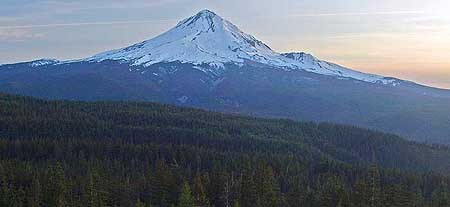
Mount Hood at dusk from Tamarack Rock

Mount Hood at dusk from Tamarack Rock

The view from the rock is glorious, with the broad northeastern face of Mount Hood towering over waves of forest ridges, and the tiny farms and orchards of the Upper Hood River Valley, spread far below. The forested Mill Creek Buttes complete the scene, to the east. The scenery is so sweeping that it’s easy to forget the maze of logging roads and clearcuts all around. In this way, Tamarack Rock survives, surprisingly intact.

A birds-eye view of Tamarack Rock

A birds-eye view of Tamarack Rock

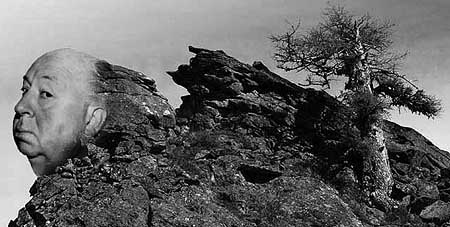
I had passed the rock countless times over the years, always promising myself that I’d explore this postage-stamp wilderness someday. This spring, I finally made good on the promise, and explored the landmark from all sides. Trail riders and hikers are already familiar with the rugged west face of the rock, where it towers above the popular Surveyors Ridge Trail. From this angle, the rock has a “face”, which in turn led to a spirited discussion among the PortlandHikers.org community on just what to call the rock — if it didn’t already have a name.

The "face" of Tamarack Rock from the Surveyors Ridge Trail.

A quick survey of those familiar with the area didn’t reveal a local name for the rock, so I posted a survey on PortlandHikers.org to poll a few options. When the votes were counted, the uncanny resemblance of the “face” to a certain Hollywood film director won the day, and it appeared that this landmark might become “Hitchcock Rock” to recreationists. Fortunately, the story didn’t end there, though it led to some creative photo interpretations (see below).

The backup filming location for "North by Northwest", perhaps?

This is where the PortlandHikers.org discussion sent me back to the rock, because it was unclear from my early photos whether the ancient tree near the crest was living, dying or dead — or simply a larch in dormant winter phase, sans needles. My second visit a few weeks later revealed a fresh burst of new needles covering the old giant, and redirected the naming discussion to the tree in question.

Given the proximity of Larch Mountain (and other features) using the larch as namesake, the PortlandHikers.org consensus was to fudge a bit by using the “tamarack” name, instead. This is botanically incorrect, but as we learned in our debate on the subject, a good portion of the west actually uses the name “tamarack” to describe Western larch, and it had a nice ring to it, besides: Tamarack Rock!

I wasn't the first to the top, and surely won't be the last..!

I wasn't the first to the top, and surely won't be the last..!

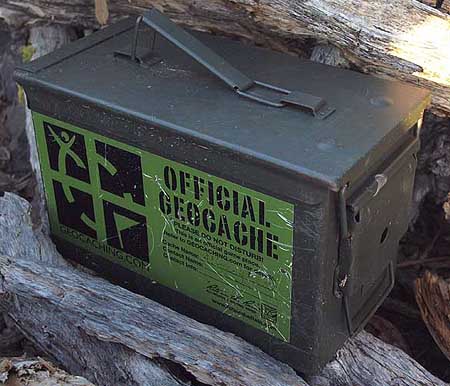
On this follow-up visit to the rock, I also discovered a long history of visitors, beginning with a geocache box tucked into an inconspicuous hiding spot. The journal inside listed a visitor earlier the same day, remarking on a “large coyote” seen near the rock. Other visitors simply commented on the impressive views.

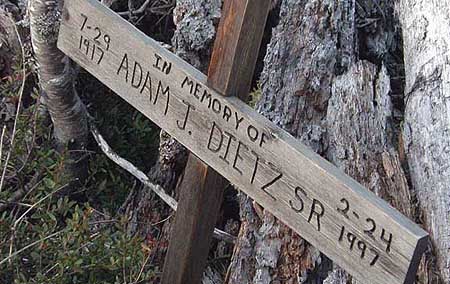
Not far from the geochache were a couple of homemade memorials, honoring Adam J. Dietz Sr. (1917-1997) and Alfred West (1910-1998). Clearly, these two gentlemen had some connection with the rock, but for now, I can only assume they worked or hunted in the forest, and might have been local to the area. But their presence further cemented the idea of a more respectful name for the rock, no matter the Hitchcockian resemblance.

The rustic Adam J. Dietz Sr. Memorial on Tamarack Rock

The rustic Adam J. Dietz Sr. Memorial on Tamarack Rock

Yet the human history of Tamarack Rock seems to go back even further, and perhaps by millennia: a few yards from the aluminum Alfred West memorial cross, there are at least two, and possibly three Native American ceremonial pits. One is quite obvious, a second somewhat compromised and a third barely visible. The pits are located in full view of the mountain, and mimic similar pits in the area, including this subject of an earlier post.

Finding all this human history in gathering twilight on that brisk spring evening was exhilarating, to say the least. It was yet another reminder that we are all just passing through, and how we treat this land will be our only real legacy. Tamarack Rock has clearly been admired and loved for generations, and how fortunate we are that the even the era of road building and forest destruction didn’t destroy this unique place.

In another century, there’s a good chance the old larch tree will still live, clinging to this rock, long after we’re gone. If the old tree does survive, it will be a pretty good measure of our collective will to leave the Mount Hood country in better shape than we found it. It will also reflect our human capacity to honor places like this simply because of their spiritual significance to those who came before us.

I think we’re up to that challenge.

New Glaciers on Mount Hood?

WhiteRiverNewGlacier01

It seems implausible, but climate change may be creating new glaciers on Mount Hood — but not in the usual way that glaciers are created. A close look at the retreating White River Glacier on the sunny south flank of Mount Hood reveals two stranded arms that are now separate glacier. As marked by (1) and (2) on the photo, above, a pair of truncated mini-glaciers have been cut off from the main flow of the White River Glacier by a previously hidden moraine that is now being exposed by the rapidly retreating ice.

Until fairly recently in geologic time, the White River Glacier extended far beyond its current extent, flowing down the rugged canyon shown in the photo for several miles to a terminus far beyond where Highway 35 now crosses the glacial outwash plain. But the glacier is retreating rapidly, destabilizing the canyon and changing its shape as it shrinks.

A closer look at two mini-glaciers on Mount Hood

A closer look at two mini-glaciers on Mount Hood

A closer look at the two mini-glaciers reveals why a glacier is different from a static field of ice. Glaciers flow under their own weight, sending waves of ice sliding downward as more snow is added, above. Huge cracks known as crevasses form at stress points in the river of ice, and these are a defining feature in identifying a glacier. Both of these sheets of ice have crevasses, and thus are moving glaciers.

A look at the topographic map shows how the extent of the White River Glacier has changed as recently as the 1960s, when the map was surveyed. The mini-glacier marked as (1) was clearly an arm of the White River Glacier until very recently, but surprisingly, the second mini-glacier (2) appears to already have separated from the main glacier before the surveys were done — though it is clearly a truncated lobe of the main glacier, as well.

WhiteRiverNewGlacier03

Another defining feature for this pair of mini-glaciers is that the emerging moraine that divides them from the main glacier also divides their outflow. They feed a separate branch of the White River from the main stem – another argument for recognizing these glaciers as discrete, perhaps?

It is logical to assume that these little glaciers are doomed by the same forces of climate change that created them, but there is a twist that just might keep them flowing — and perhaps thriving — as a result of climate change. While scientists believe that snow levels will rise in the Cascades over the next century, they also believe that precipitation will increase.

That could mean that in the highest elevation areas where winter precipitation still falls mainly as snow could actually see glaciers grow in depth, but perhaps not in length, since freezing levels would be higher. Therefore, if these mini-glaciers are high enough on the mountain, they may well survive, or possibly even grow, thanks to increased snowfall at this elevation.

If these glaciers are new, and independent of the White River Glacier, they deserve some respect, since all known glaciers in Oregon have been formally named. And that brings us to a bit of history surrounding this flank of the mountain. For here, on the upper slopes above these little glaciers, the first attempts on Mount Hood’s summit were made by early white settlers.

A close-up view of the mini-glaciers reveals classic crevasses

A close-up view of the mini-glaciers reveals classic crevasses

The first man in this story is Thomas Jefferson Dryer, the colorful publisher of the Weekly Oregonian in the mid-1800s (pictured below, on the left). Dryer claims to have been the first white man to climb the mountain, in August 1854. Dryer’s description of the climb makes it clear that he did not reach the true summit, though he may well have reached the top of the Steel Cliffs, only a few hundred feet below the summit — and an amazing achievement for the day.

Dryer complicated his case by embellishing the story with outrageous exaggerations — being able to see Mount Shasta (not possible) and peaks in the Rockies (definitely not possible), and his climbing companion bleeding form his skin from the extreme altitude (not very likely). But Dryer was also the first white man to climb Mount St. Helens, so his story must be taken with some degree of faith.

Dryer’s account wasn’t challenged until three years later, when one of his employees, Henry Lewis Pittock, made the first documented ascent of Mount Hood on August 6, 1857. The Pittock party made the climb along what is now the traditional southern route, skirting the west edge of the White River Glacier, and climbing through the crater. When Pittock’s party made claim to being the “first” to summit the mountain, it set off a dispute with Dryer over the veracity of his own account that continues to this day.

Thomas Jefferson Dryer (left) and Henry Lewis PIttock

Thomas Jefferson Dryer (left) and Henry Lewis PIttock

In 1861, Dryer was tapped to serve in the Lincoln administration, and turned the Weekly Oregonian over to Pittock, to whom he owed a significant debt in the form of back pay. Pittock, in turn, converted the weekly into a daily and was soon publishing the predominant newspaper in the region, today’s daily Oregonian.

Pittock is now recognized as the first white man to summit Mount Hood, but like Dryer, doesn’t have a landmark in his name to record his place in history (though Portlanders are quite familiar with the iconic mansion he built atop the West Hills).

So I offer a modest proposal: honor both men for their historic climbs, with the western mini-glacier (1) named for Pittock, representing his more westerly approach, and the eastern mini-glacier named for Dryer, who may have even walked on this ice sheet in his own attempt at the summit. Both men deserve to be remembered for their part in Mount Hood’s history, and these little glaciers deserve some respect, too.

Between a rock and a hard place…

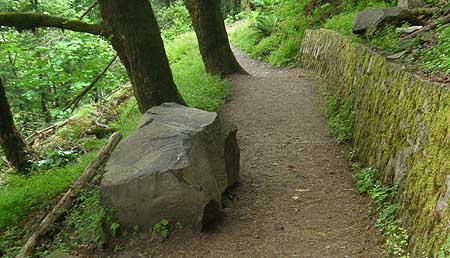
Sometime in the past couple of years, a refrigerator-sized piece of basalt split from the cliffs above Horsetail Falls, tumbled across two switchbacks on Gorge Trail 400, and landed perfectly on a third, forming a handy bench that only Mother Nature could design – or did she?

The convenient boulder that recently appeared on Trail 400, above Horsetail Falls - the work of man or nature?

The convenient boulder that recently appeared on Trail 400, above Horsetail Falls - the work of man or nature?

Rocks like this are constantly breaking loose from the walls of the gorge, usually far from the view or earshot of hikers. Through the relentless effects of water, and cycles of freeze and thaw during the winter months, bits and pieces of the stacked layers of basalt eventually break free, and join the enormous piles of talus that have accumulated beneath the cliffs over the millennia.

The new bench-boulder above Horsetail Falls is a bit chunkier than most, but tiny when compared to the house-sized boulders that are known to break loose on occasion. One infamous event near Wahclella Falls in the late 1960s was massive enough to send an entire subdivision of house-sized boulders into Tanner Creek, temporarily forming a small lake in the aftermath.

Looking down at the new boulder, the view is a bit more menacing, with a big bite taken out of the solid rock wall in the foreground, and a trail of debris, below.

Looking down at the new boulder, the view is a bit more menacing, with a big bite taken out of the solid rock wall in the foreground, and a trail of debris, below.

Assuming that the big rock did land in the middle of the trail, there are a couple of miracles that suggest divine placement. First, the boulder missed the adjacent wall, though it took a sizeable bite out of a retaining wall further uphill (see photo, above). Second, the boulder managed to land parallel to the path, and just far enough from the rock wall to allow hikers to easily slip between… a rock and a hard place!

It’s possible that trail crews could have jimmied this massive stone into its convenient position, but unlikely. Just one cubic foot of solid basalt weighs in at a staggering 188 lbs, which means that this fridge-sized weighs at least 12,000 pounds — more than six tons!

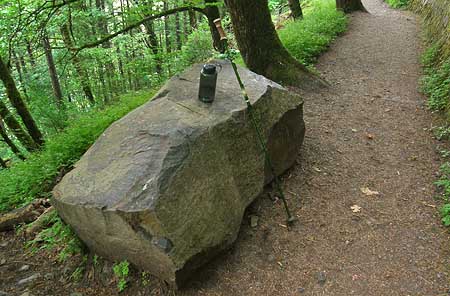
Perfect for a trailside respite, the big rock bench is already a favorite of hikers

Perfect for a trailside respite, the big rock bench is already a favorite of hikers

A more unnerving thought is the possibility of hikers actually witnessing nature at work, here, given the popularity of this well-traveled path nearly year-round. But, even with the scores of hikers walking by, there are plenty of quiet spells during the winter season, when this stone most likely made its move — and there’s also the dark of night.

However the big rock arrived, it has already become a popular stopping point for newbie hikers, puffing their way up the trail from Horsetail Falls, in search of Ponytail Falls. In this way, the big rock might just be Mother Nature’s way of tempting her most impatient species to stop and relax, if only for a moment.

Arrowleaf Balsamroot

Balsamroot blankets the Dalles Mountain nature preserve in spring; Mount Hood rises from the clouds on the horizon, above the Columbia River and the town of The Dalles

Balsamroot blankets the Dalles Mountain nature preserve in spring; Mount Hood rises from the clouds on the horizon, above the Columbia River and the town of The Dalles

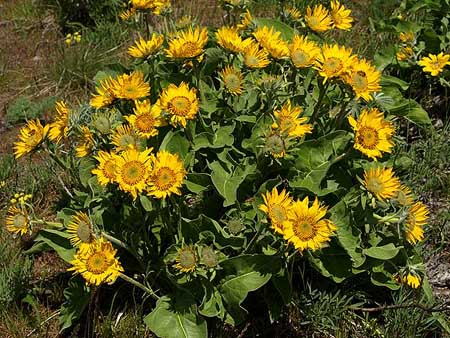
In late spring across the arid mountain west, sunny slopes and open Ponderosa forests explode with bright yellow drifts off Arrowleaf balsamroot (Balsamorhiza sagittata), the native sunflower of the western states. These handsome plants are especially abundant along the dry east slope of the Cascades, where they are also known as Oregon sunflower.

The name “Arrowleaf” describes the large, felted leaves of this plant — though in size they are closer to a spade than an arrowhead, often as much as a foot in length. “Balsamroot” refers to the fist-sized, branched taproot that anchors these plants in their typically windswept, harsh environment. The roots have a strong, pine-scented (or “balsam”) sap. These oversized roots not only draw moisture from deep in the arid soils in which Arrowleaf balsamroot grow, but also allow the plants to easily survive fires.

A typical balsamroot in spring, nearing peak bloom

A typical balsamroot in spring, nearing peak bloom

The flowers are actually complex collection of individual blossoms that give the illusion of a single, large flower head. The outer ring of “petals” emerge from dozens of individual florets, each producing one enormous petal that combine to form the ring of yellow petals. A close look at the developing flower head (below) shows these emerging super-petals as a fringe of green tips.

Honeybee on a balsamroot

Honeybee on a balsamroot

Native Americans used almost all parts of these plants for food. Tender shoots and leaves were eaten raw or steamed, and immature flower heads were peeled and eaten. The sunflower-like seeds were eaten dry, or roasted. The roots, which are bitter when raw, were cooked and ground into a meal that was used to make cakes, and dried and powdered to make tea.

The plant was also used for medicinal purposes, with green leaves used to treat burns and the boiled roots used to create a medicinal salve for small wounds. A tea made from the roots was used to treat respiratory ailments. Balsamroot is still used today in organic foods and herbal medicines.

Wildlife also depend on Arrowleaf balsamroot. The plants are tolerant of browsing by deer and elk, and the seeds are important forage for small mammals, such as the Columbia ground squirrel. Wild horses graze on the plants in spring, and are especially fond of the flowers. The plants are also grazed by domestic stock, though they are sensitive overgrazing.

Miles of balsamroot create a brief dusting of bright green and yellow on the desert slopes of the Eastern Gorge each spring

Miles of balsamroot create a brief dusting of bright green and yellow on the desert slopes of the Eastern Gorge each spring

In the right conditions, Arrowleaf balsamroot grow to fill whole mountainsides with their spectacular blooms. As the blooming season of Arrowleaf balsamroot peaks in late April or early May, the Columbia River Gorge provides one of the finer displays anywhere. Blue lupine is a frequent companion plant, providing a painting-perfect complement to the displays.

You can visit some of these spectacular displays by exploring Gorge hiking trails at Dog Mountain, Catherine Creek, Rowena Crest and Dalles Mountain Ranch. Check out the Portland Hikers Field Guide for more information on these destinations.

Scorpions!

At first glance, just a wayward crayfish.. but wait! Is that (gulp!) a scorpion's tail..?

At first glance, just a wayward crayfish.. but wait! Is that (gulp!) a scorpion's tail..?

A couple of years ago, I stopped to do some trail tending on the way down from Tamanawas Falls, on the Cold Spring Creek trail. It was dusk, and I was moving some rocks around to improve the tread in a gravelly area, on a slope just above the rushing creek. I spotted what looked like an oval coin, where I had just turned over a rock. Closer inspection revealed a pair of pincers and a tail, perfectly coiled up and tucked in around an armored body.

I thought it might be a crayfish that had somehow made its way up the slope to the trail. But suddenly, the creature exploded into motion, bolting to the top of a nearby rock at a speed that no crayfish could reach out of water. At that point, the tail was extended, and I realized I was looking at a scorpion!

It was nearly dark, so I quickly set up my tripod, as the scorpion sat motionless for me — apparently agreeable to an unscheduled portrait. The first view (above) was his semi-alert position that he held until I moved the camera closer for a better shot. At that point, he went into what can only be described as a “defensive” posture (below), and I must say that this sent some of my primal neurons into overdrive!

What scorpions do when they've decided their photo-op is over..!

What scorpions do when they've decided their photo-op is over..!

I snapped a couple more shots of this pose before he abruptly raced up the slope — right past my foot, alarmingly — and into the brush. It was exhilarating because I don’t often stumble upon some new creature that I haven’t seen before, and especially one this exotic and seemingly out-of-place. What was a scorpion doing in a lush, mountain canyon along a rushing stream? Aren’t they desert dwellers?

After the trip, I researched scorpions a bit, and learned that they do, indeed, inhabit the Cascades as far north as British Columbia. Though I have yet to positively identify this one, it appears to be Paruroctonus boreus, the Northern Scorpion, or possibly one of the Vaejovis scorpion species native to Oregon. Its body was about 2″ in length, claws roughly an inch long, and the tail around 2″ long.

Oregon State University zoologist Philip Brownell provides helpful background in this article on just how scorpions could survive in a place like Cold Spring canyon, where deep snow covers the ground for months every winter. The key is their unique metabolic ability go into stasis in underground burrows, using little oxygen and requiring little food until conditions on the surface improve. But unlike other hibernating creatures, scorpions can quickly switch from stasis to active hunting in a matter of minutes.

Scorpion Mountain, in the Bull of the Woods country south of Mount Hood, might just have been inspired by the real thing, after all..!

Scorpion Mountain, in the Bull of the Woods country south of Mount Hood, might just have been inspired by the real thing, after all..!

Scorpions are live-bearing, with the female carrying her brood on her back until their first molt, upon which they head off on their own. If you get the creepy-crawlies from the sight of scorpions, I don’t suggest Googling images of a female ferrying her batch of young one around! They’re also nocturnal, so you’re unlikely to ever see one in the Cascades.

And what of the dreaded venom? Well, the Northern Scorpion’s venom is listed as a potentially dangerous neurotoxin for humans by some sources, with swelling and pain at the site of the sting, and possibly other more serious reactions. So it’s pretty clear that these creatures are to be seen, but not handled.

According to the National Geographic article link, above, the toxicity of the venom is inversely proportional to the size of the pincers, since large-clawed scorpions tend to hunt their insect prey with their claws, where small-clawed species are more likely to depend on their venom to immobilize their prey.

The spot where I found my specimen was classic habitat for Northern scorpion, according to several web sources. This species apparently lives on dry, loose riverbank slopes in much of its range. So that means that the entire Cold Spring Creek canyon is prime habitat, not to mention most every other canyon in this part of the Cascades.

So, keep that in mind, next time you’re turning over stones in the woods!

Western Pasque Flower

The blossoms of the Western Pasque Flower emerge just after snow melt

The blossoms of the Western Pasque Flower emerge just after snow melt

The earliest visitors to the Mount Hood high country are among the lucky few to see Western Pasque Flower (Anemone occidentalis) in bloom. The cream-colored blossoms of these plants emerge in meadows and on sandy mountain slopes as soon as the snow melts, often along the margins of lingering snow patches. Western Pasque bloom even before their foliage emerges, allowing the plants to accelerate seed production in the short mountain summers.

After just a few days in bloom, the petals drop, and the Western Pasque enters a second stage, where the flower heads take on the form of a green sea anemone, with balls of soft spikes rising above emerging, fern-like foliage.

The second phase of the Western Pasque Flower, when the new seedheads are in their sea anemone form

The second phase of the Western Pasque Flower, when the new seedheads are in their sea anemone form

The second phase goes unnoticed by most mountain visitors, lost in the green of rapidly awakening meadows. But during this phase, the seedheads begin their metamorphosis to the final stage that gives Western Pasque Flower its best-known persona.

In this phase, the prickly “sea anemone” globes suddenly grow an impressive mane of white hair that is like no other alpine flower. The dramatic seedheads of the Western Pasque persist at this stage from late July well into the fall, when the seeds are finally distributed.

The final phase of the Western Pasque Flower, when it becomes the Old Man of the Mountains

The final phase of the Western Pasque Flower, when it becomes the Old Man of the Mountains

The whimsical appearance of the Western Pasque in this final form has given rise to a number of equally colorful common names:

• Old Man of the Mountain
• Tow-Headed Baby
• Mop Top
• Hippie-on-a-Stick
• Mouse-on-a-Stick

As a child of the 70s, I suppose it’s not surprising that I call them “Muppets of the Mountains”. They’re like an old friend to hikers, greeting us as we venture to our favorite alpine meadows and swales on bright summer weekends, waving in the breeze with their silky “wigs” growing more curious and eccentric by the day.

Western Pasque Flower carpet Elk Cove in summer

Western Pasque Flower carpet Elk Cove in summer

If Native Americans gathered these plants, their local use was apparently not passed along to anthropologists. Other American species of Anemone were used by Native Americans for a variety of medicinal uses, but perhaps the high-elevation range of the Western Pasque simply made it impractical to harvest? In most years, the high meadows that these plants call home are only snow-free for 3-4 months in summer.

Today, you can find Western Pasque Flower above 5,000 feet in Mount Hood’s alpine meadows and steep, sandy slopes. The plants are most prolific at Elk Cove and Paradise Park, but can be founds along many sections of the Timberline Trail, blooming in mid-July and in their more familiar bearded form from Late July through September.