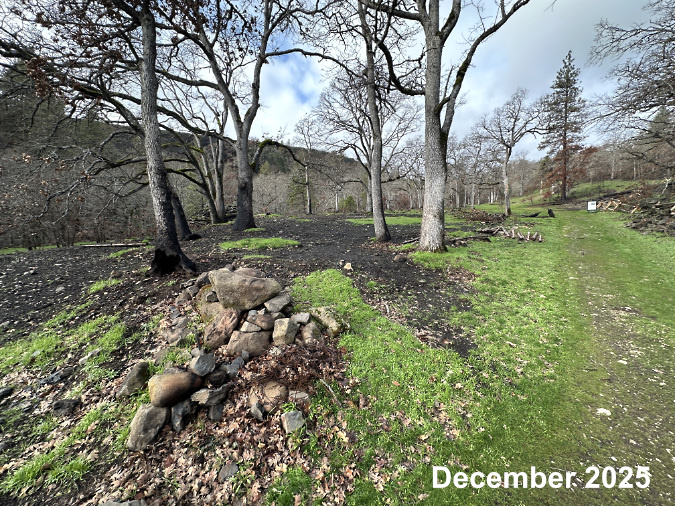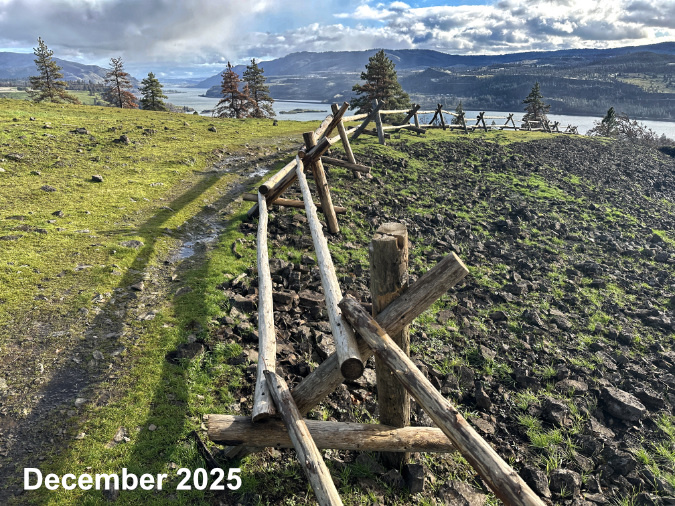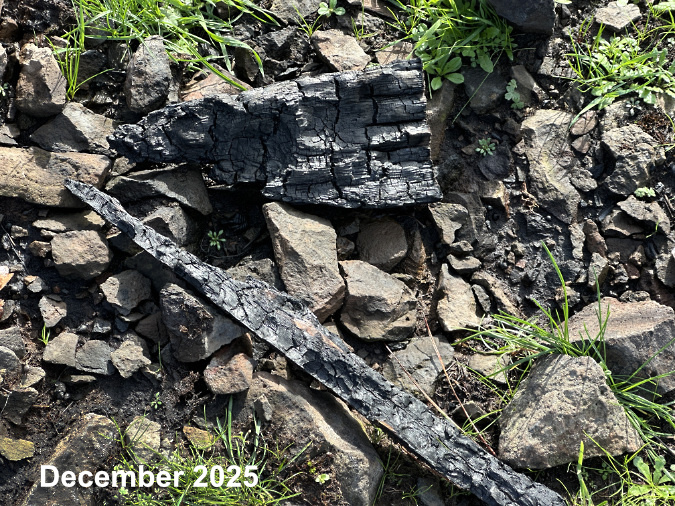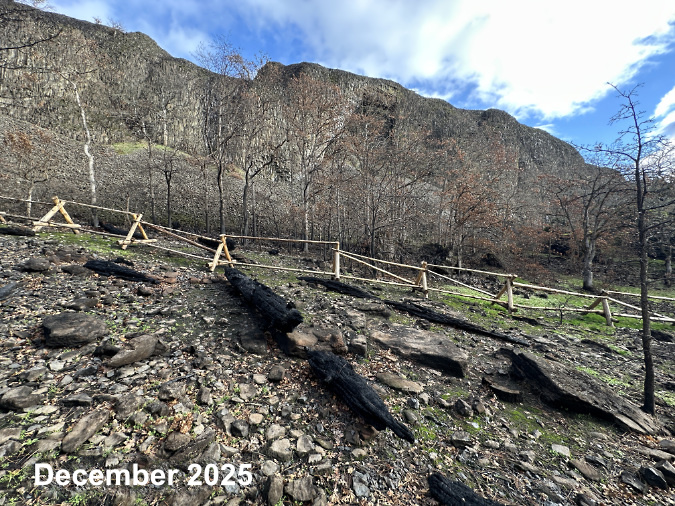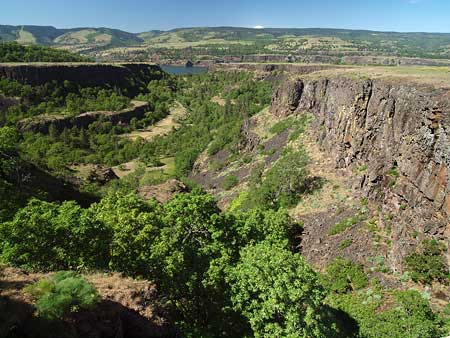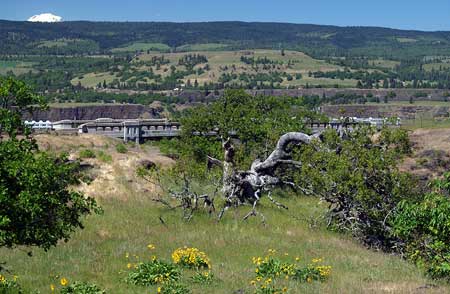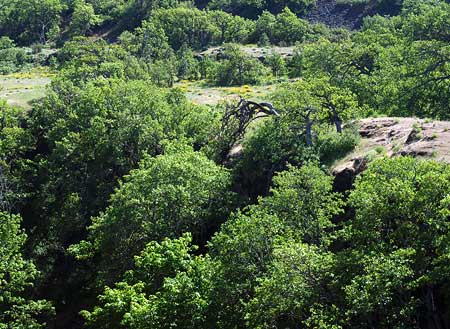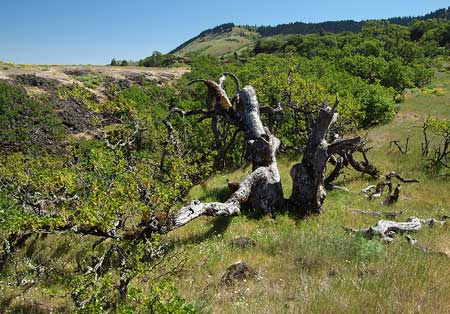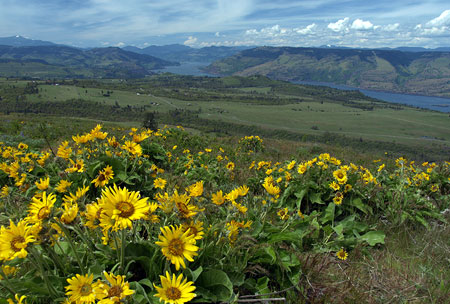
Secrets of the Fire at Catherine Creek

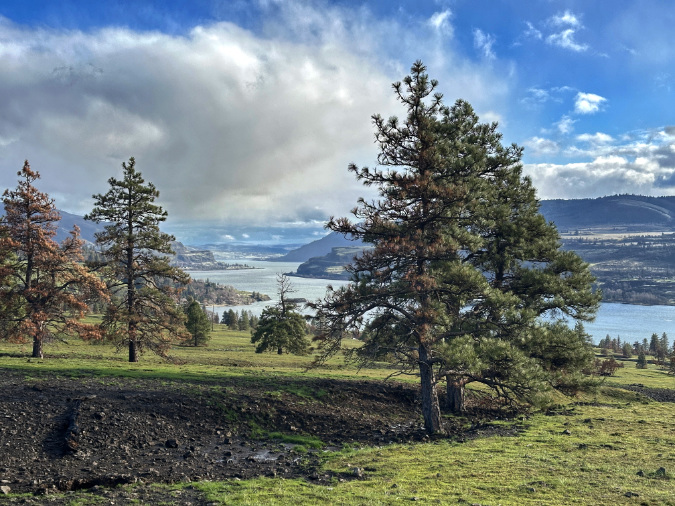
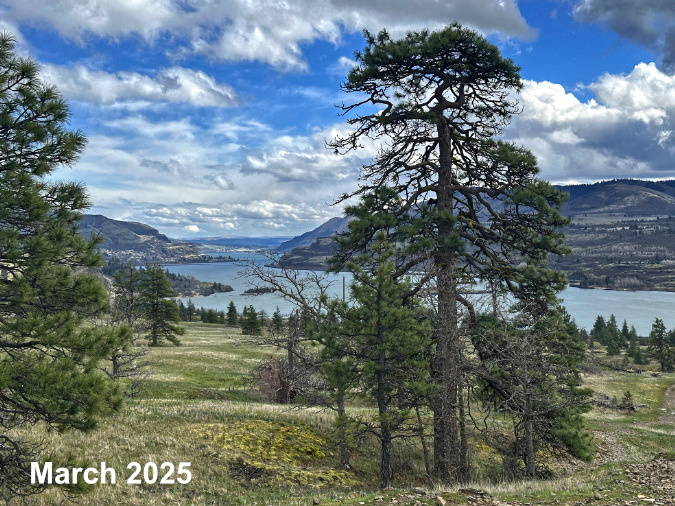
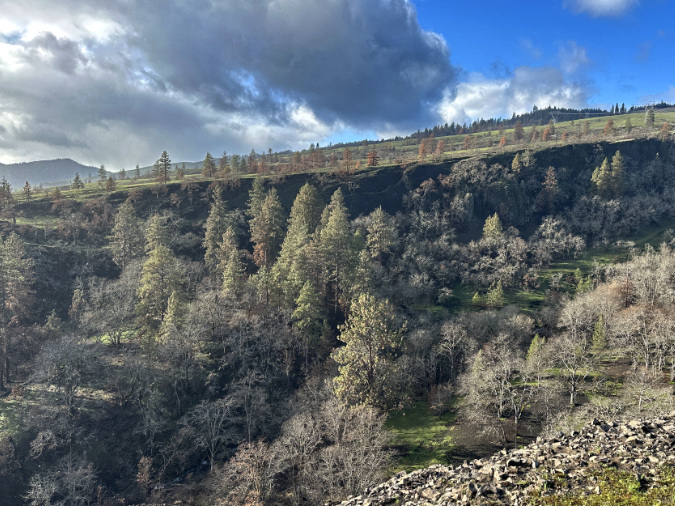
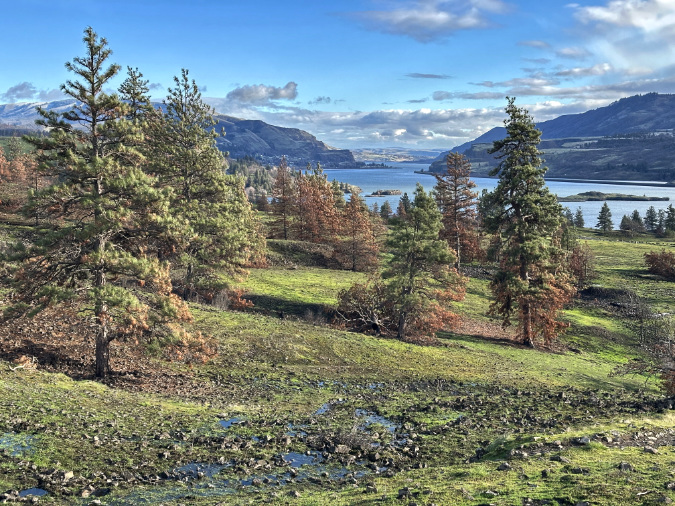
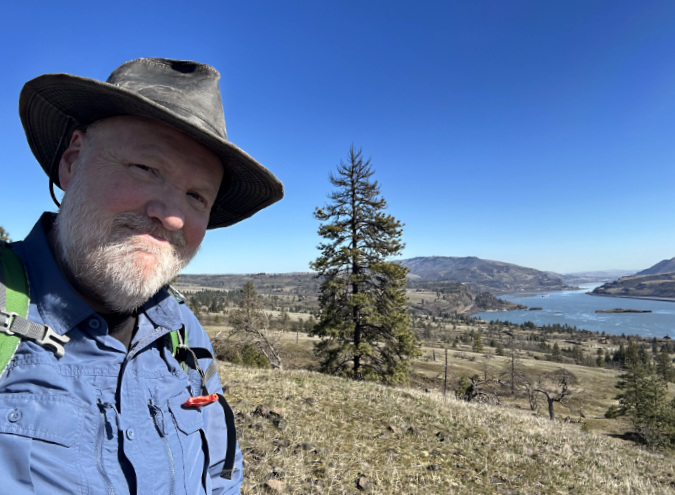
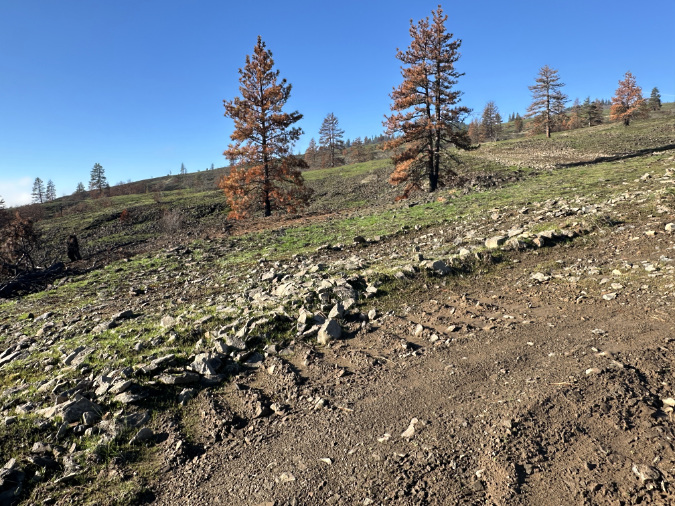
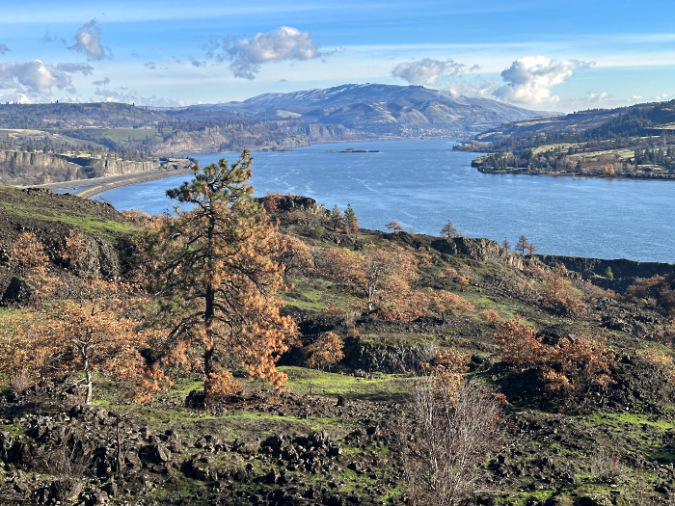
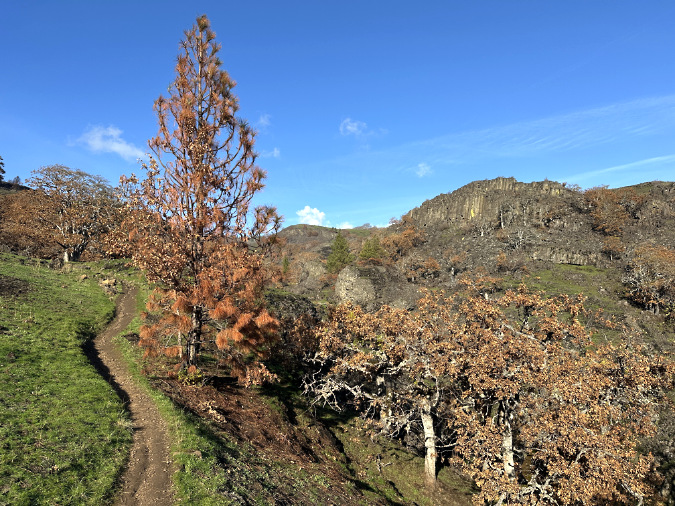
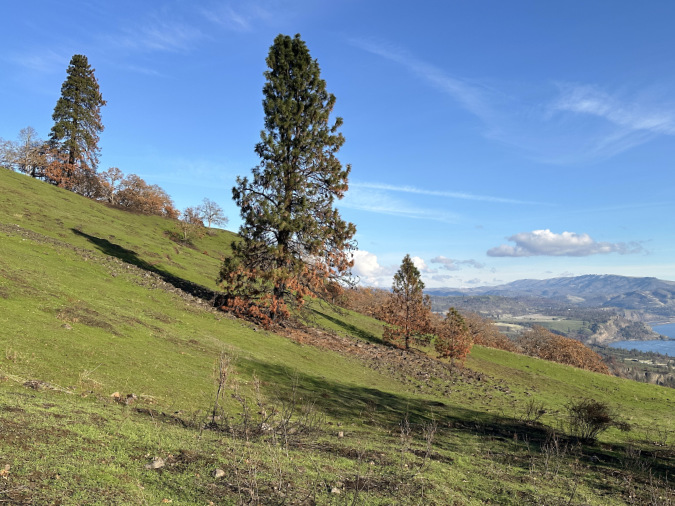
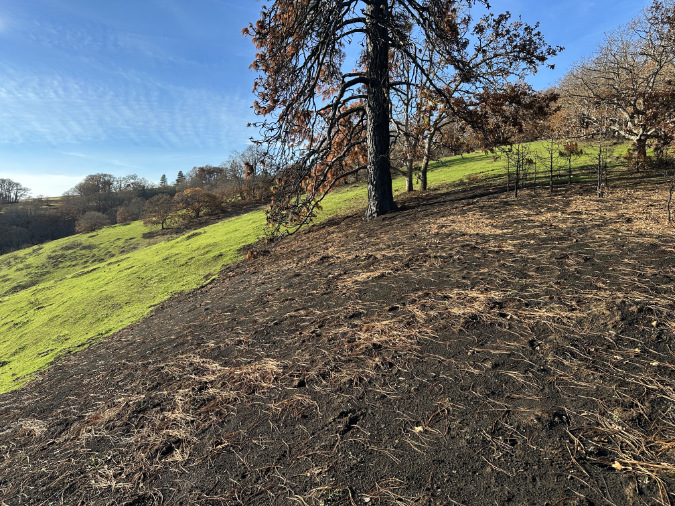
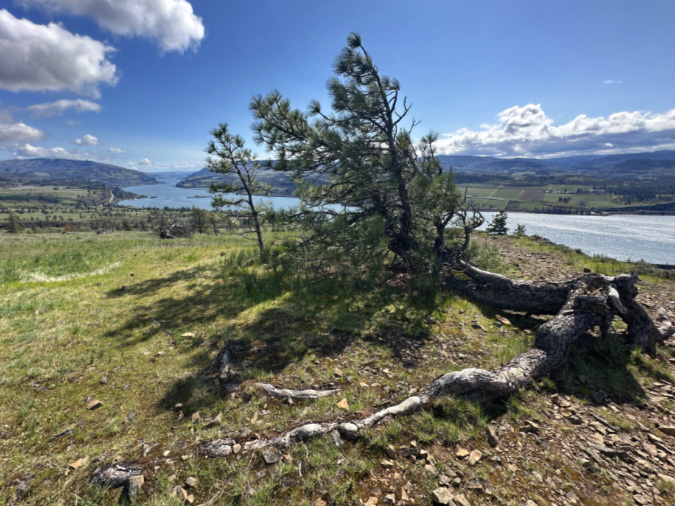
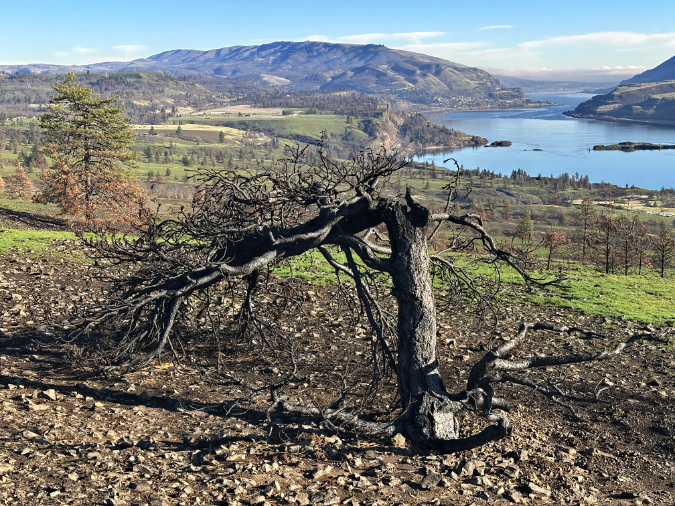
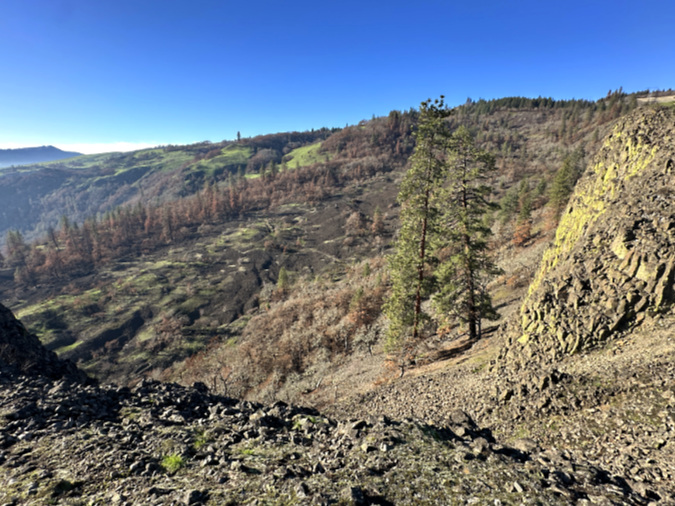
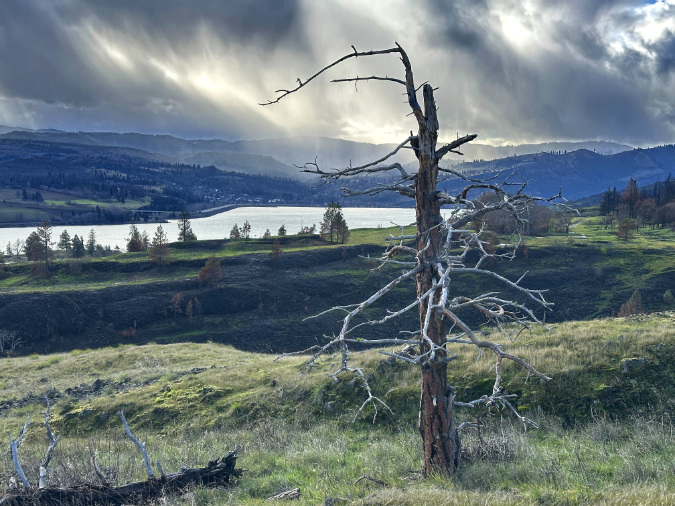
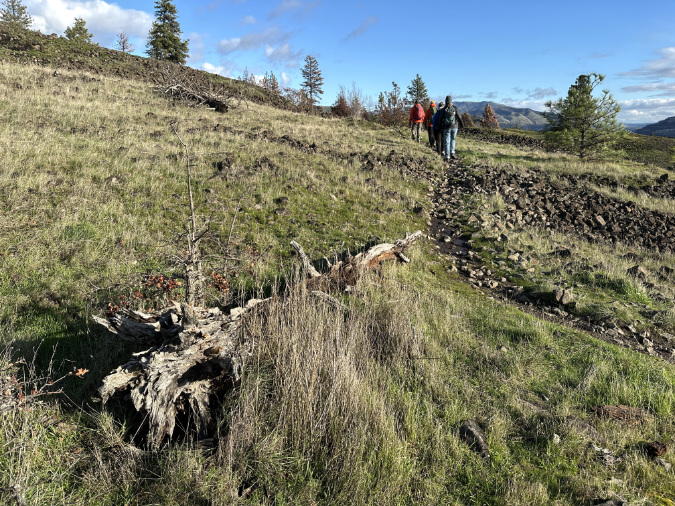
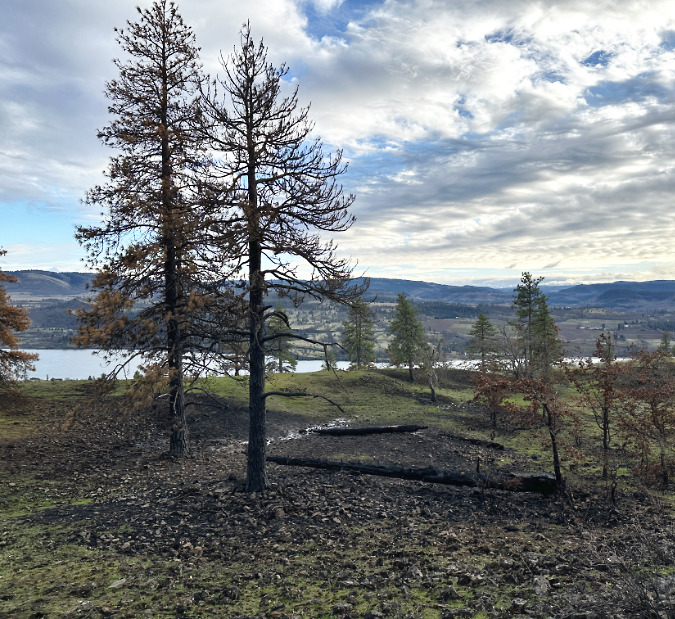
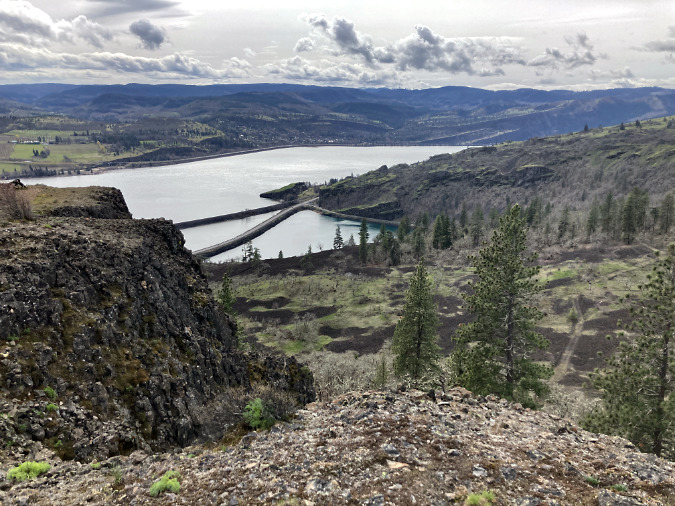
Green regrowth has already returned to the upper meadows at Catherine Creek, just three months after the October 2024 wildfire

Preface: our federal workforce is under unprecedented, highly personal attack by the new administration. The attacks are reckless, cruel and purposely vindictive to the perceived “enemies” of the regime. Many of the newly appointed cabinet officials in the Departments of Interior and Agriculture were specifically selected for their radical, fringe views on the environment and are openly hostile to the very concept of public lands that belong to everyone. We’ll be on defense on this front for the next four years, unfortunately.

Like many articles posted on the blog, I’ve shared my views in this piece on how our public lands at Catherine Creek might be managed in the future. At this moment in our history, however, I also want to open with my unequivocal support for the federal workers who have devoted their careers to caring for our public lands. Over the past three weeks, I’ve seen them proudly and professionally continue to do their work, despite the hostility and mockery of their commitment to public service from the new administration.

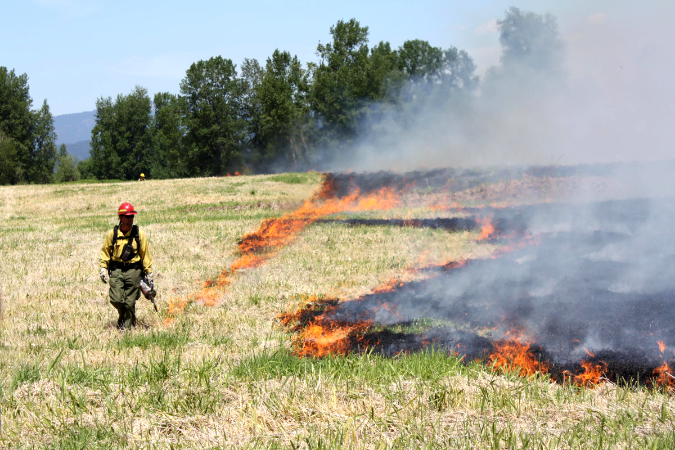
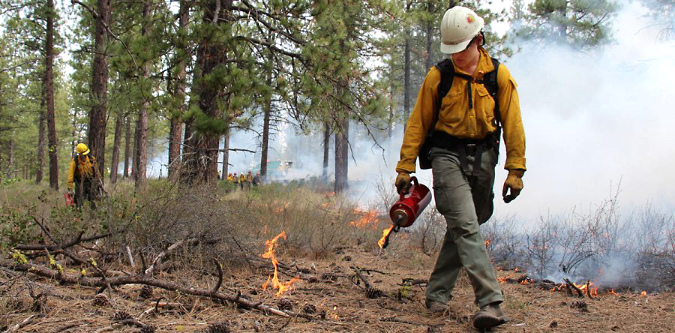
U.S. Forest Service workers conduct a controlled burn in Ponderosa country (photo: Deschutes Collaborative)
We’re at a low point as a country, for sure, but I know that we will outlast this regime. Once they have been removed from power, I also believe we will not only restore what damage has been done, but also thrive in a renewed commitment to our public lands. It does (unfortunately) seem that as a nation, sometimes we don’t know what we’ve got until it’s gone. In the meantime, we’ll need to support our federal workers while they are under siege. We can all do that with kind words when we see them out in the field, helping them care for the land, and by sending our support for public lands to our congressional representative and senators. It really does work.
Thanks for indulging me – and now, on to the secrets of the recent wildfire at Catherine Creek…

____________

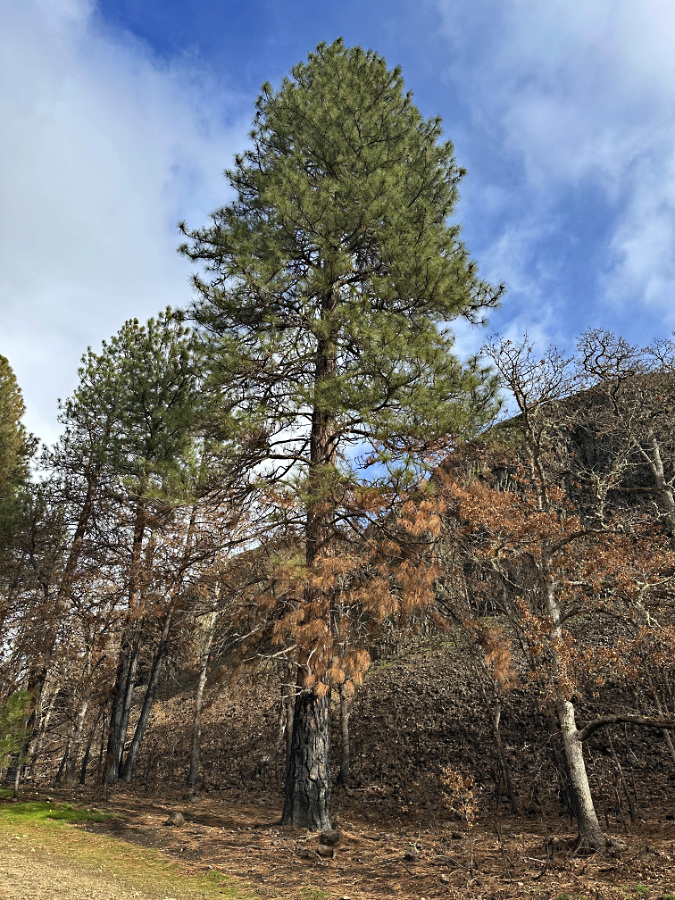
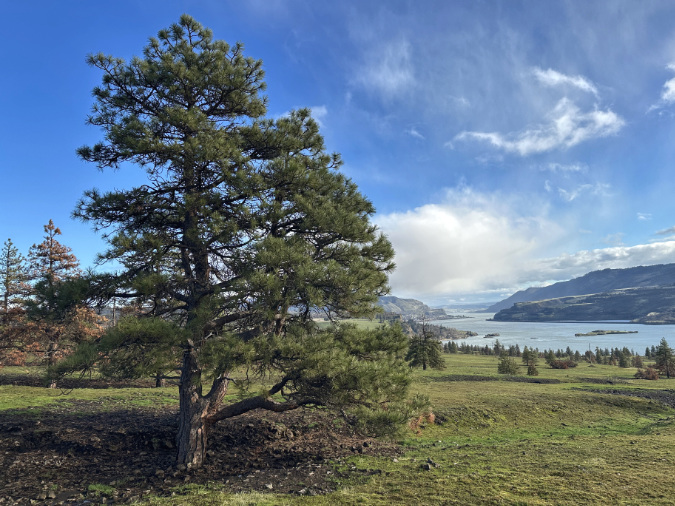
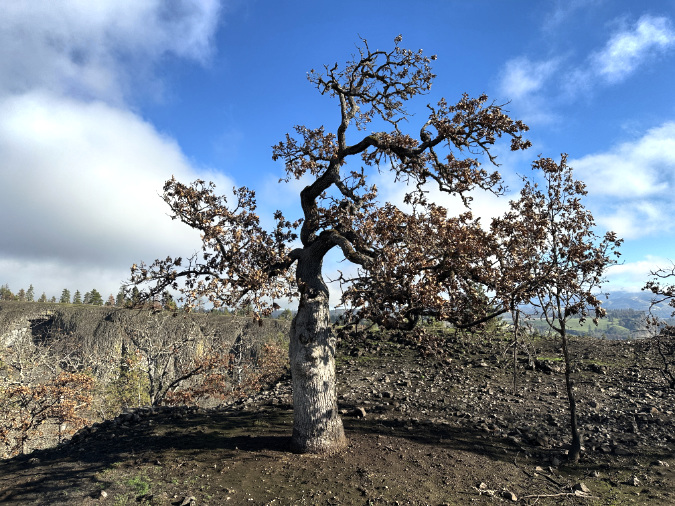
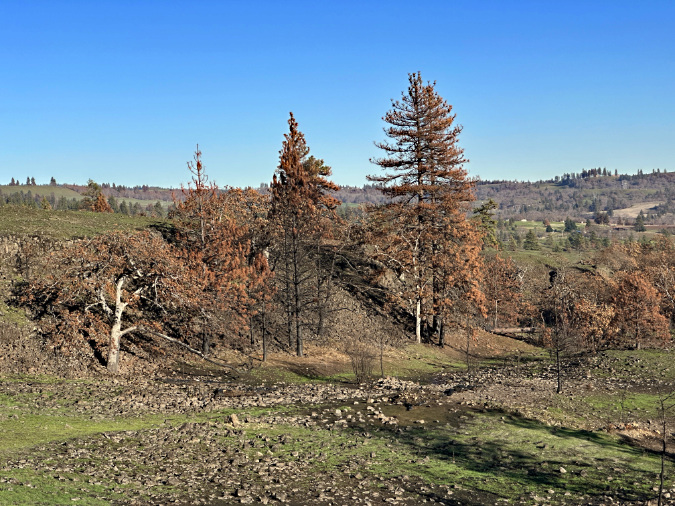
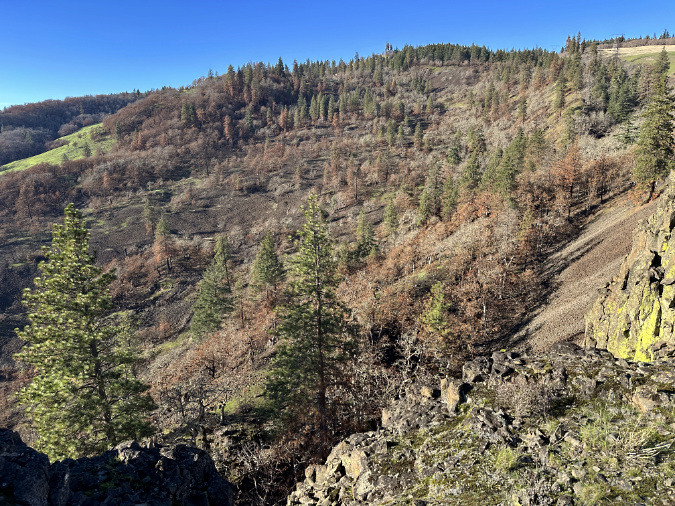
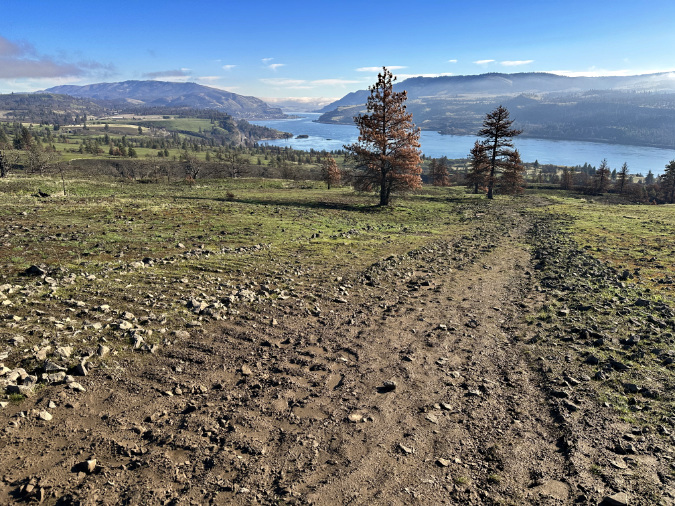
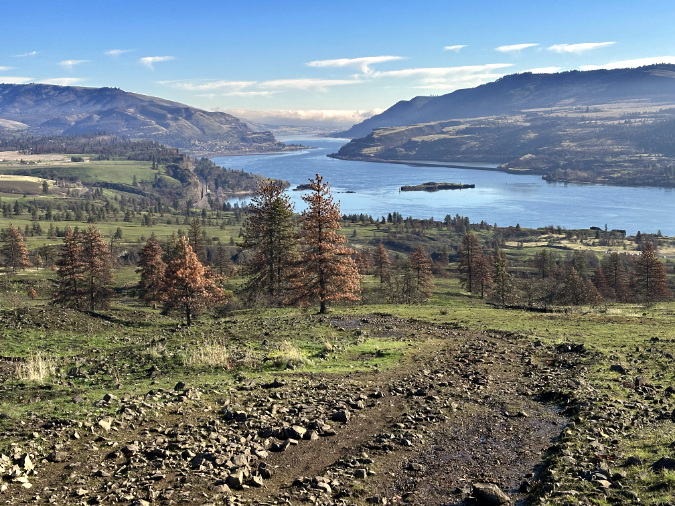
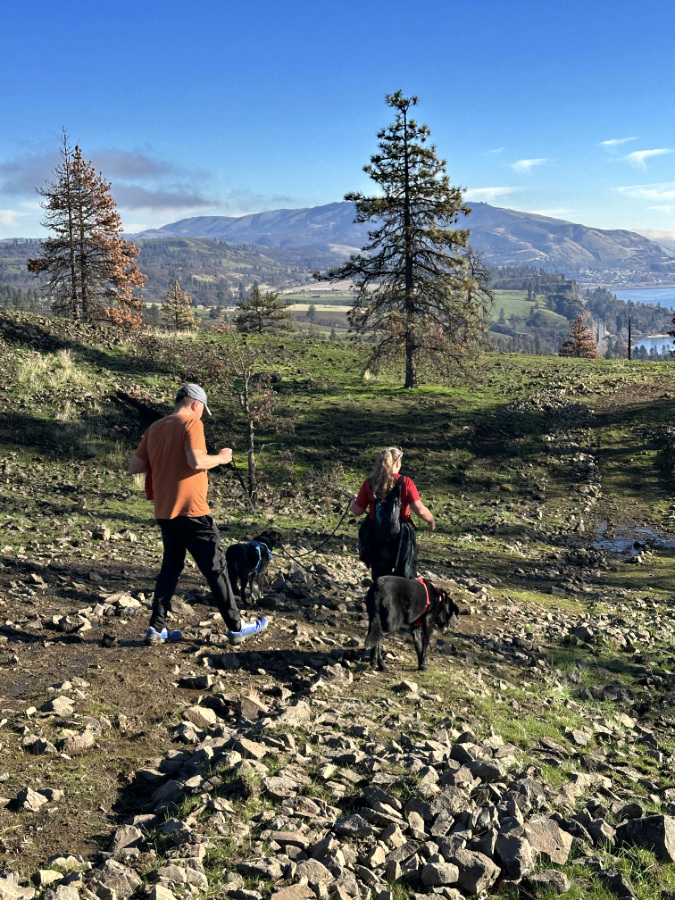
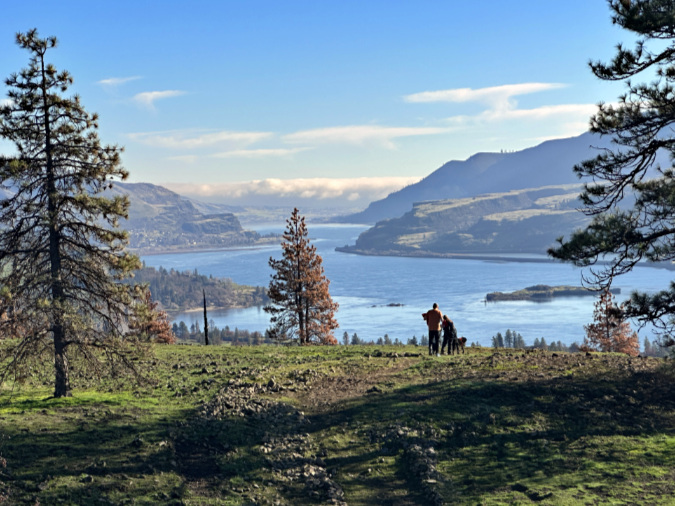
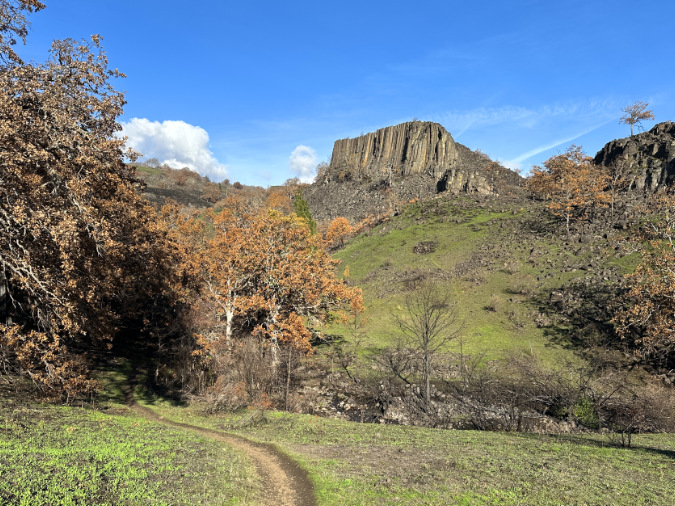
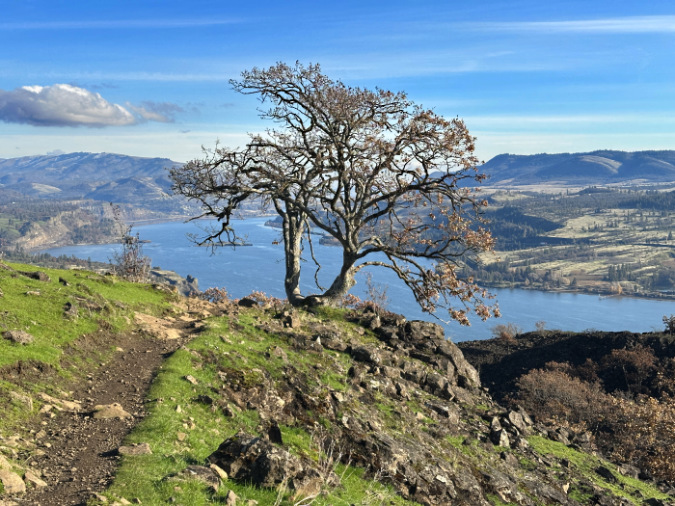
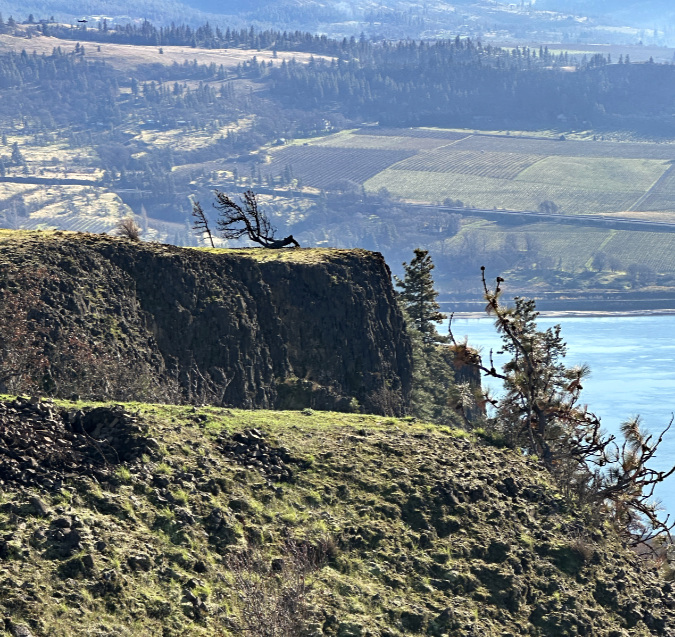
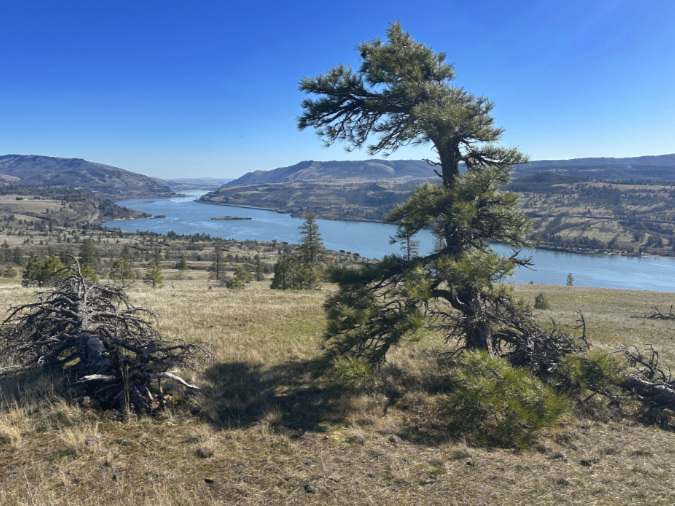
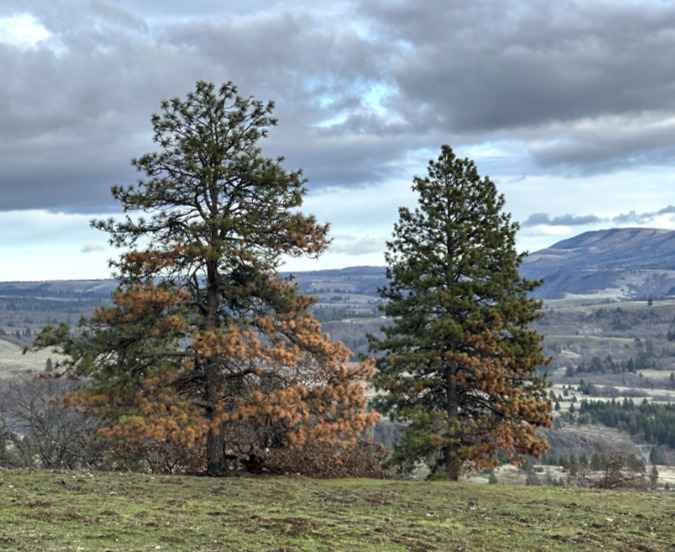
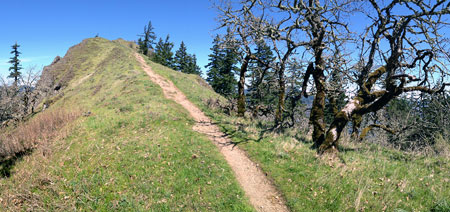
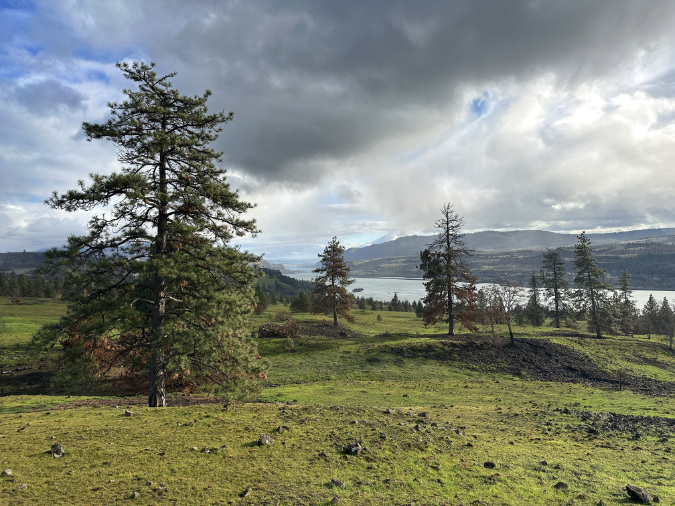
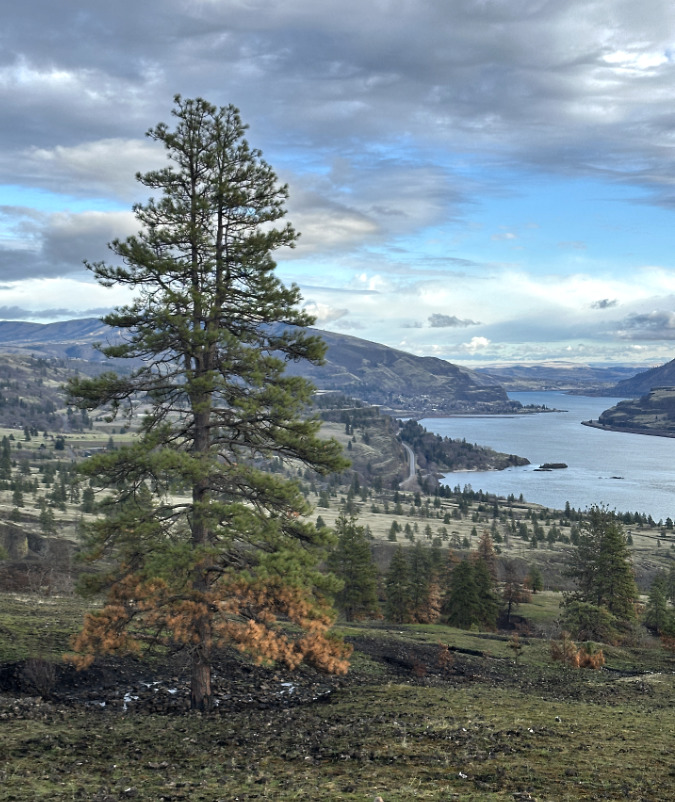
The opening photo for this article is from a mid-January ramble through the sprawling western meadows of the Catherine Creek savannah, located in the eastern Columbia Gorge near the small town of Lyle. Just three months after a fire swept through the area, only the singed lower limbs on the Ponderosa Pine grove in the distance provide a hint to what unfolded here. 

Last October, a wildfire at Catherine Creek was sparked by a prescribed burn that spun out of control, adding to the continuing struggle for public acceptance of controlled burning. The science is definitive, however: controlled fires are the most important tool in restoring forest health and preventing large wildfires in the Western U.S., where our forests are suffering the effects of more than a century of aggressive fire suppression. 

While there is plenty to talk about (and learn) on living with fire in the West, this article will focus very locally on some surprising effects on the ground of the fire at Catherine Creek. The meadows are already rapidly rebounding from the event, and there are fascinating traces from the fire that help explain why steep meadows and open savannah exist in the eastern Gorge. Toward the end of the article, I’ll also include some tips on how to see this transformation for yourself, close-up.

The fire…

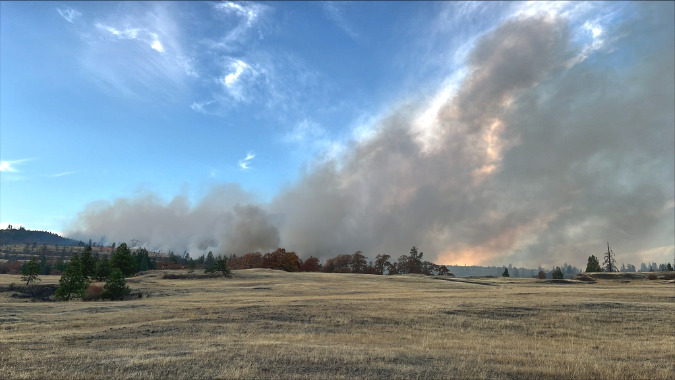
Early stages of the October 2024 fire at Catherine Creek, just after 4 PM, before it swept across the upper meadows (U.S. Forest Service)

The fire at Catherine Creek was officially named the “Top of the World Fire”. For simplicity, I will simply refer to it as the Catherine Creek fire in this article. The wildfire began at about 4 PM on Monday, October 14, 2024, when unexpected winds lifted embers beyond the boundaries of a controlled burn the Forest Service had been lit that morning. 

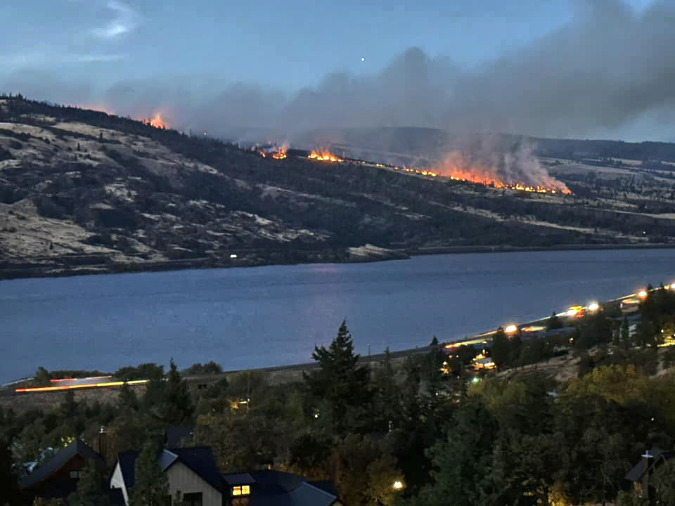
Once the wildfire was ignited, it quickly spread east and downhill, across the open grassland savannah of Catherine Creek and toward Highway 14. As it grew, more than a hundred firefighters used air tankers, fire trucks and bulldozers to contain the wildfire over the next few days, finally achieving containment by the end of the week.

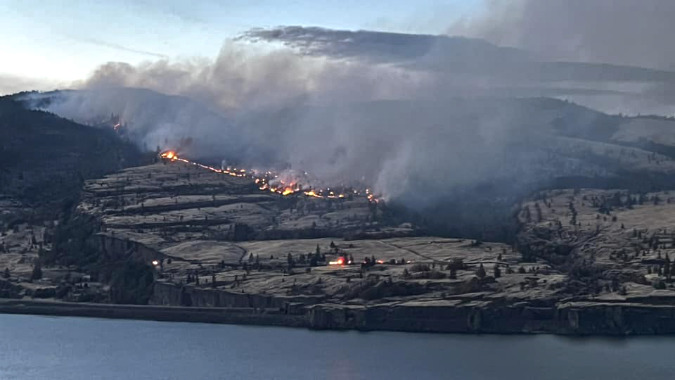
Late afternoon view of the fire from across the river as it moved into the savannah (Facebook/Susan Garrett Crowley)

Residents of the town of Mosier, located across the Columbia River, had a front row seat to the event. Their images of the fire soon showed up on social media, along with frustration and anger toward the Forest Service for conducting a controlled burn in windy conditions. While these burns are carefully planned with local conditions in mind (including soil moisture, air temperature, humidity and wind speeds), fire can still escape the controlled area, even when all of these variables for a safe burn are met. After all, fire cannot always be controlled in any setting, even with the best of our modern-day technology at hand.

The Forest Service estimates that about 4,500 prescribed burns are conducted across the country each year, covering some 1.3 million acres across the National Forest System. For comparison, that’s roughly equivalent to the entirety of Mount Hood National Forest being treated each year. This might be a surprise to some, given the continued controversy surrounding the practice, but the Forest Service argues that nearly all prescribed fires – 99.8 percent, according to the agency — are carried out as planned. 

By early evening the fire had progressed nearly to Highway 14 (Facebook/Mark Paine)

The future of our Western forests looks very challenging for the Forest Service and other land managers. More than a century of accumulated forest debris, an overgrown understory of brush and thickets of unhealthy trees in overplanted clearcuts have created a tinderbox for public land agencies to contend with.

The accelerating effects of climate change will make their job ever more complex as our public land agencies race to reduce the risks of large-scale wildfires with controlled burns, meanwhile continually evolving the practice to somehow achieve the near-perfect success rate needed to maintain public support. Add an ever-growing number of homes being built in the forest margins (often called the wildland-urban interface), and it is hard to imagine that we won’t see future controlled burns escape their planned boundaries.

A closer look…

The effects of fire suppression since the early 1900s are especially pronounced on the east slopes of the Cascades. Here, the forests are dominated by fire-dependent conifers like Ponderosa Pine and Western Larch, but these species have been choked out across much of their habitat by unchecked growth of true firs and other fire-vulnerable species that are crowding east side forests today.

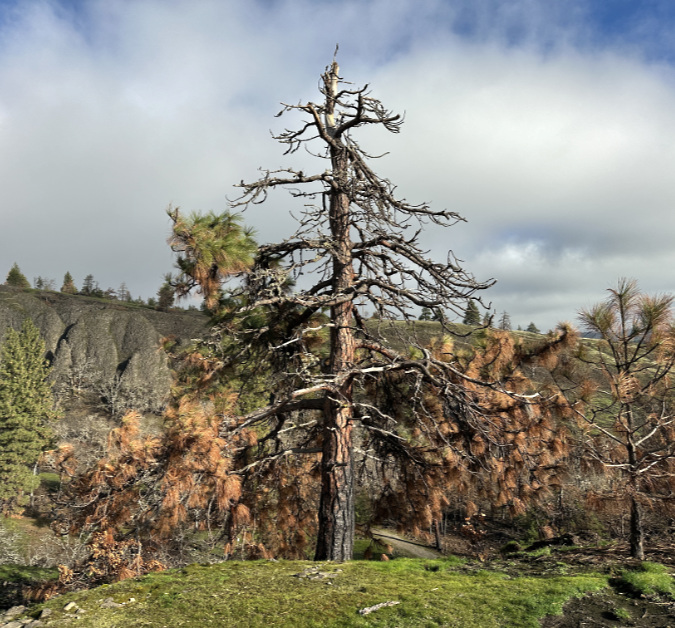
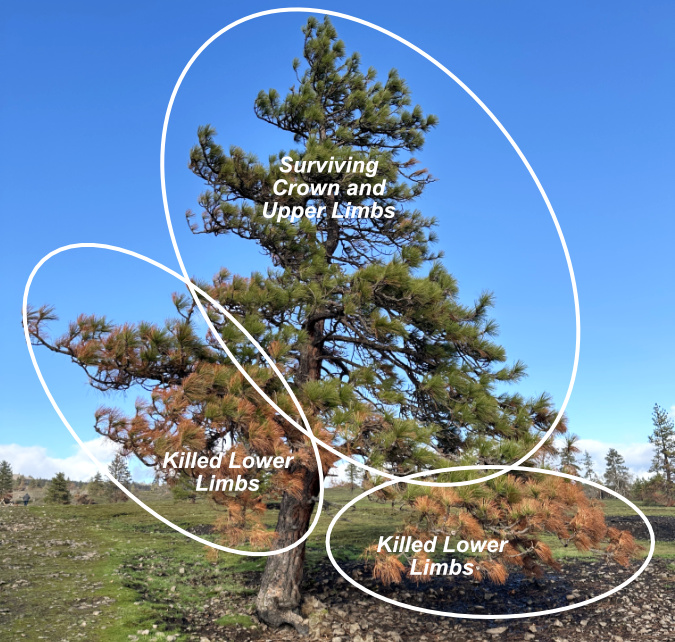
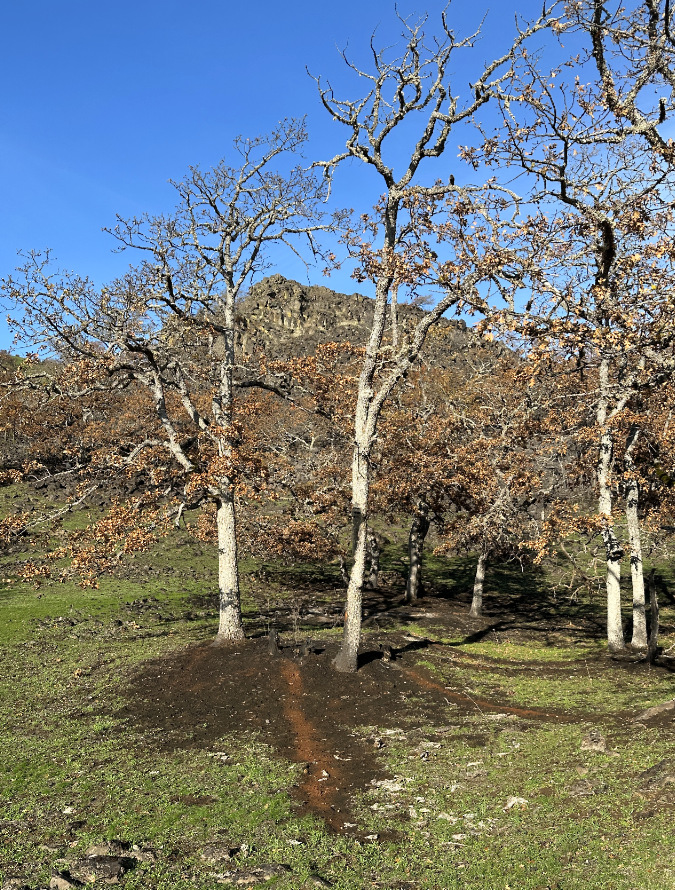
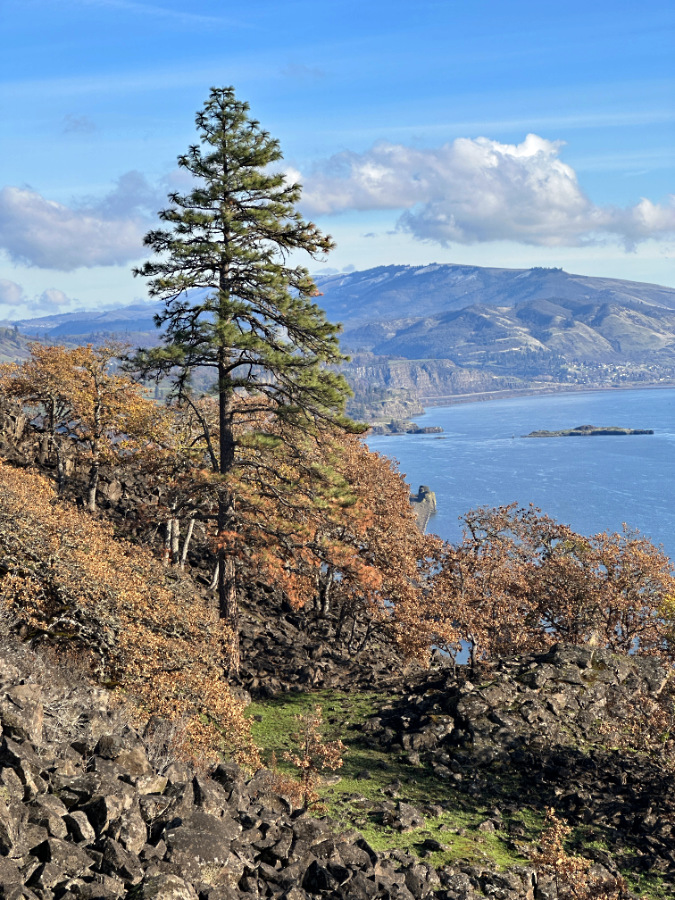
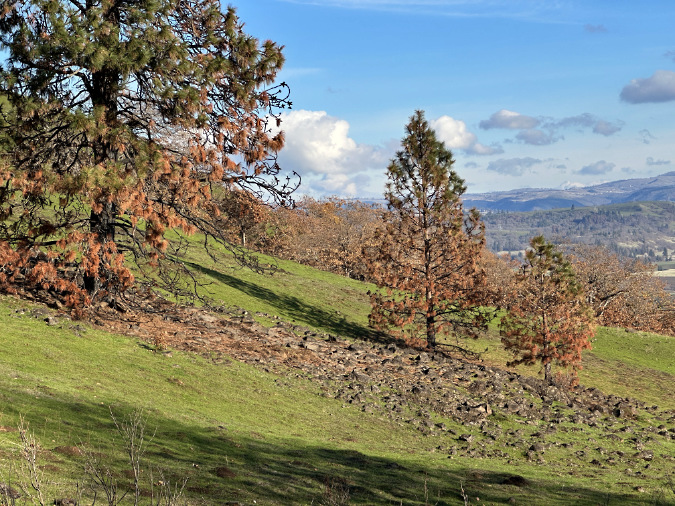
Scorched lower limbs on these Ponderosa Pine are the mark of a beneficial, mostly low-intensity savannah fire

The comparatively dry climate of east-side forests also means more accumulation of dead forest debris that would quickly be covered in moss and succumb to decay on the wet, western slopes of the mountains. This is why fire is so important as part of the east side ecosystem, and why species like Ponderosa Pine have evolved to thrive with fire, not despite it.

The burn scars at Catherine Creek provide a perfect living laboratory to see the beneficial effects of wildfire, firsthand and in real-time. While I’ve tracked the 2011 Dollar Lake Fire on Mount Hood and the 2017 Eagle Creek Fire in this blog to learn from the recovery in those respective ecosystems, the fire at Catherine Creek provides some new insights into the role of fire in the eastern Gorge savannah.

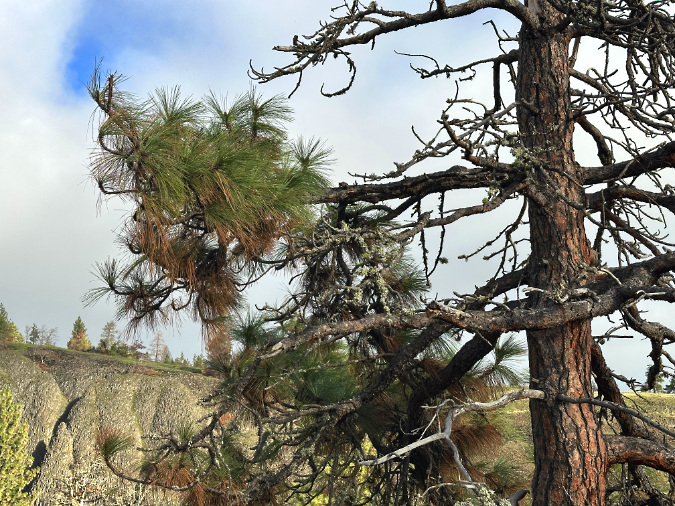
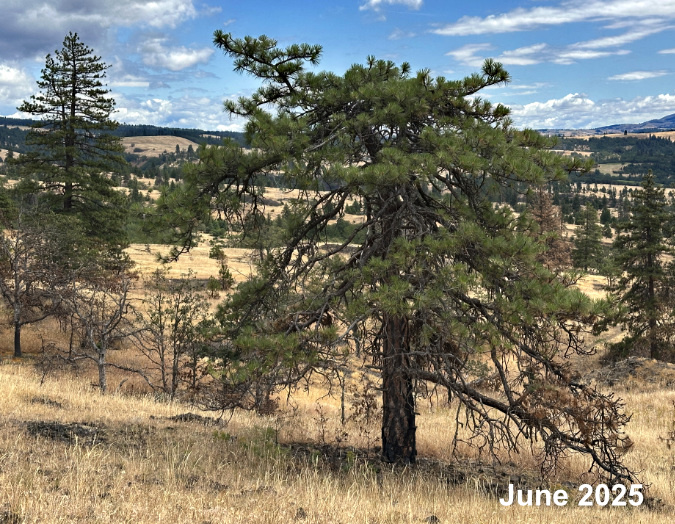
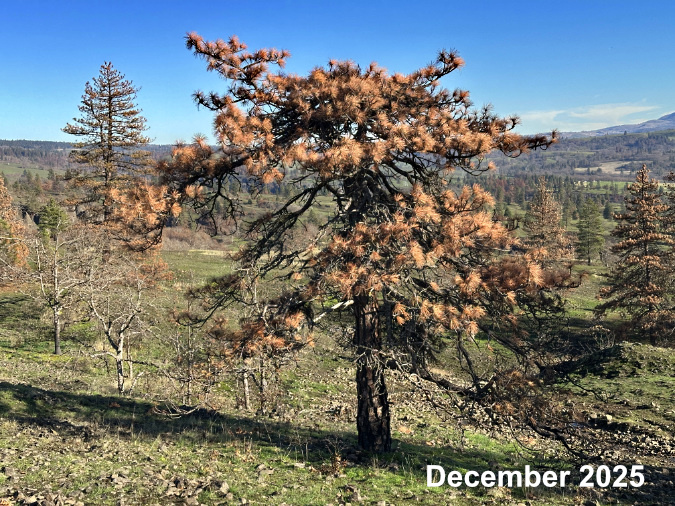
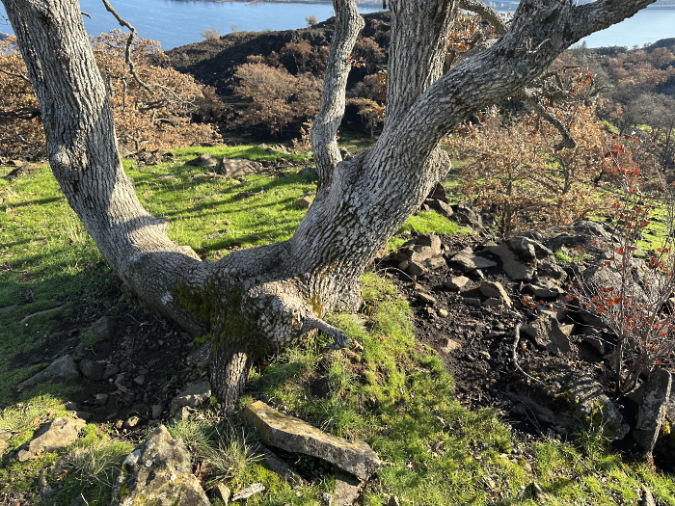
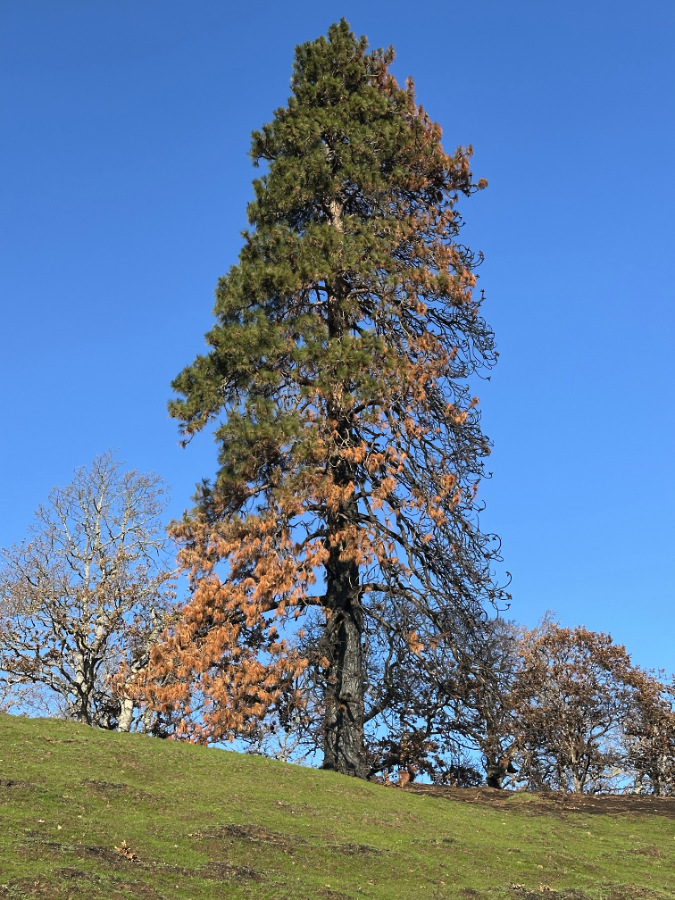
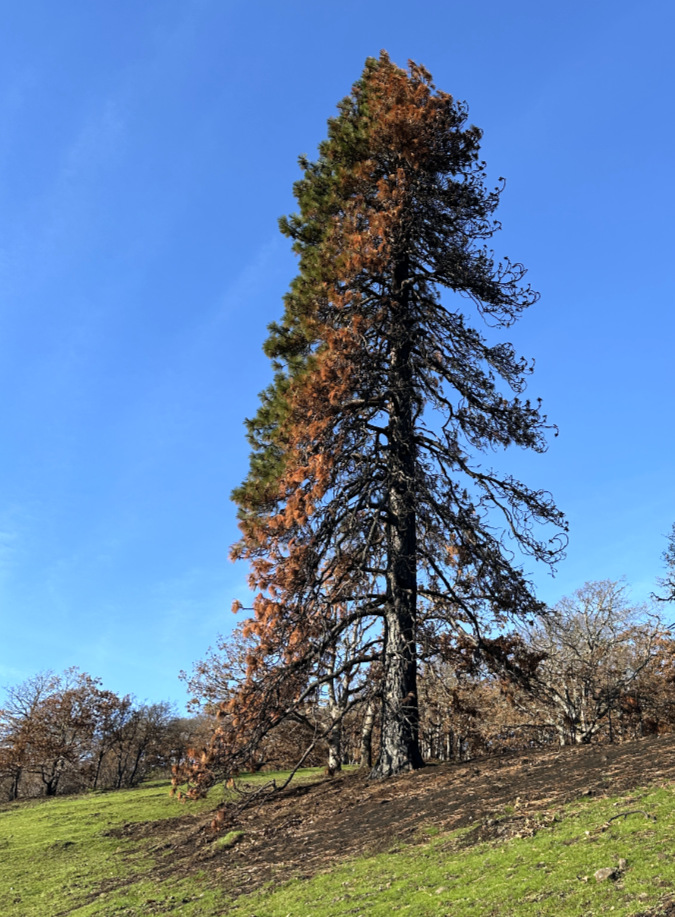
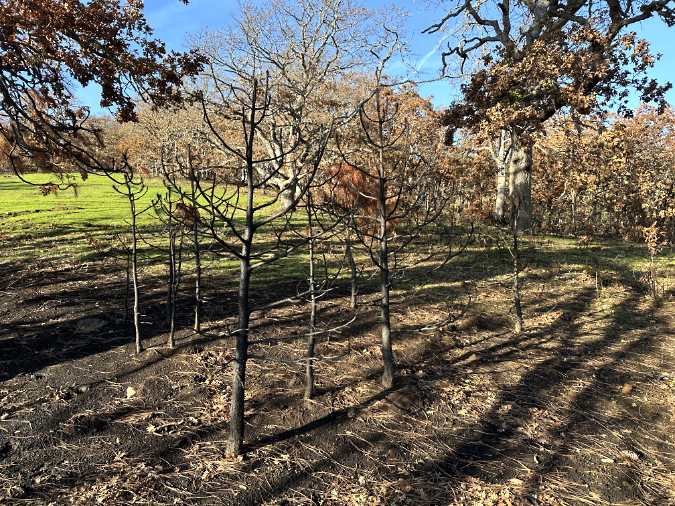
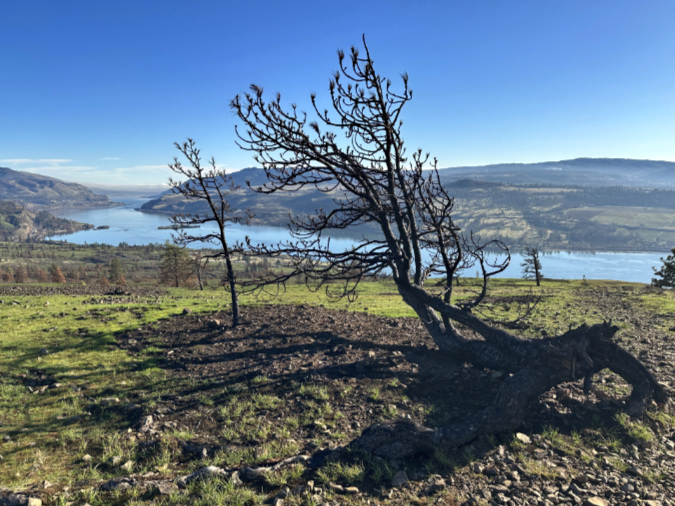
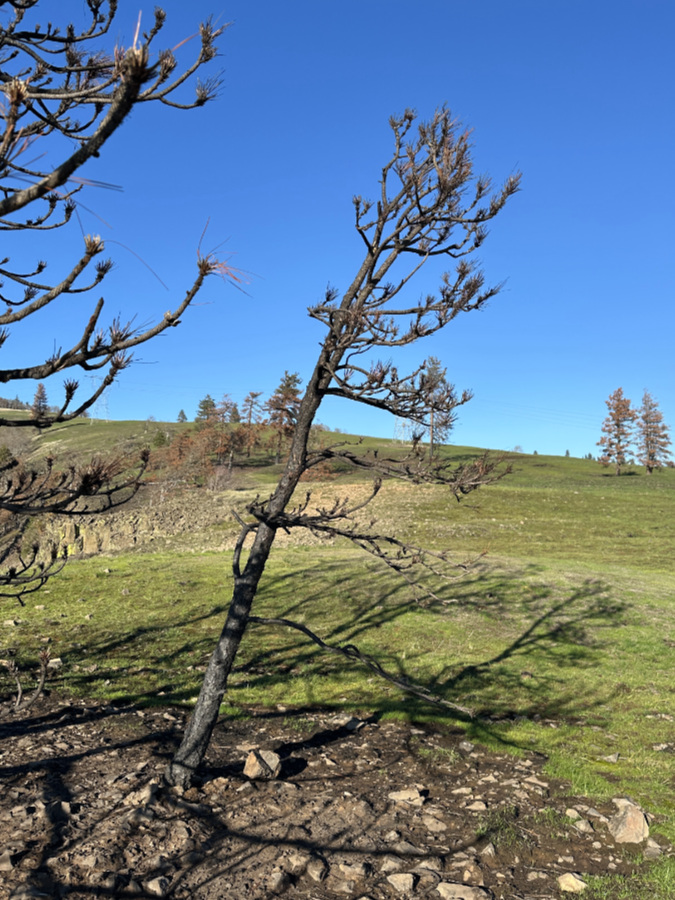
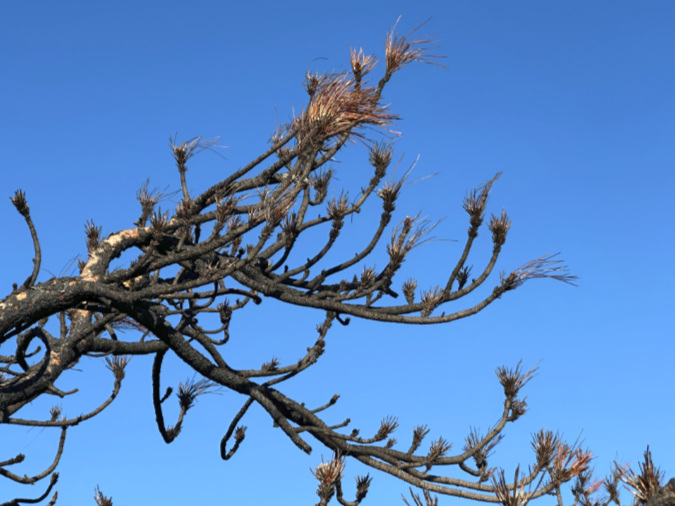
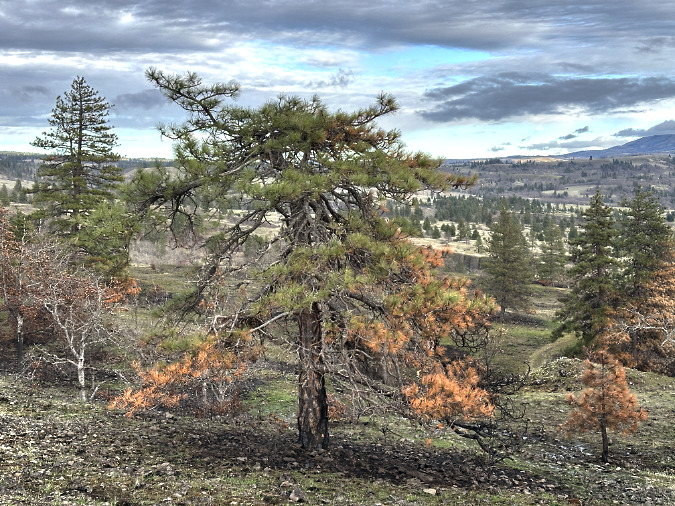
The first thing I noticed on my recent visit were the singed lower limbs on all of the Ponderosa Pine trees that survived the fire. These trees are known for their thick, fire-resistant bark, and in this case, the fire was cool enough to burn just the lower limbs on many of the trees. Most of the large trees here survived because the fire didn’t reach up into their crowns. This is known as “crowning” and something that is usually fatal to a big conifer. The recent fires on Mount Hood and in the Eagle Creek Fire experienced hundreds of acres of crown fires, where the entire forest was killed.

Scorched lower limbs are a good thing for this Ponderosa Pine, as losing these branches will protect it from crown fires in future events

The fact that many of the large Ponderosa Pine even had green limbs all the way to the ground is evidence that a significant fire hasn’t swept through here for some time. Most of the singed limbs on these trees have likely been killed and will eventually fall from the trees. In the near term, they have lost some of the green canopy needed to help the trees survive, but recovering over the long term, they will also become more fire resilient, with their lowest limbs much higher on the tree, and thus out of reach for moderate fires like this one.

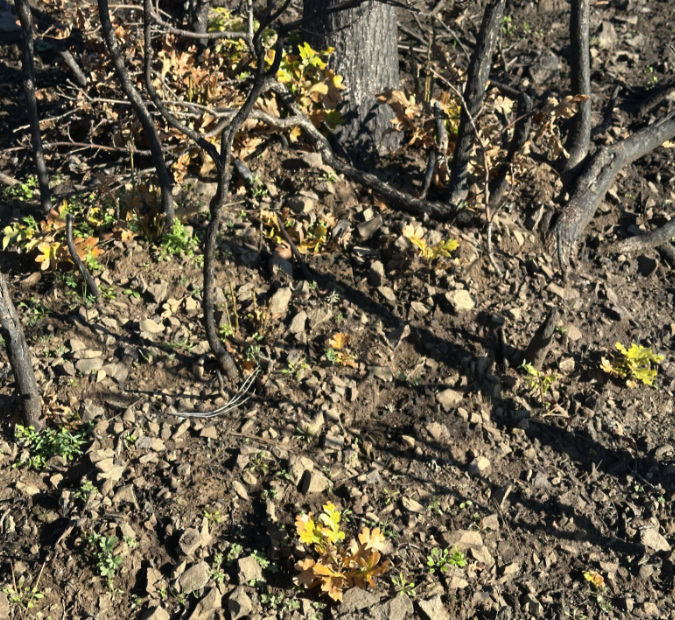
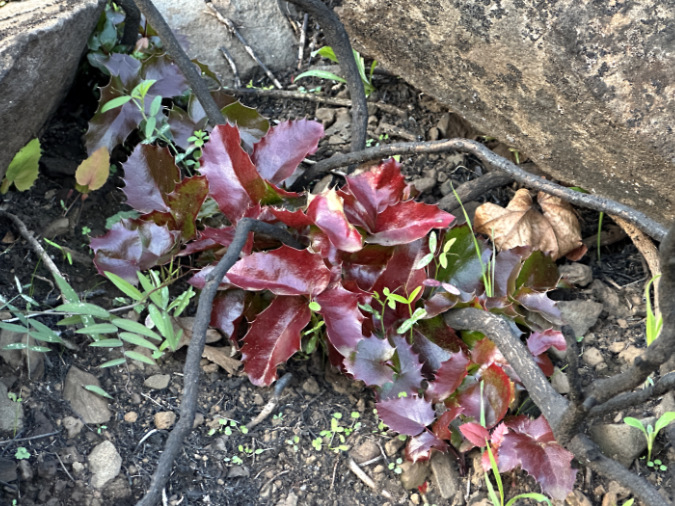
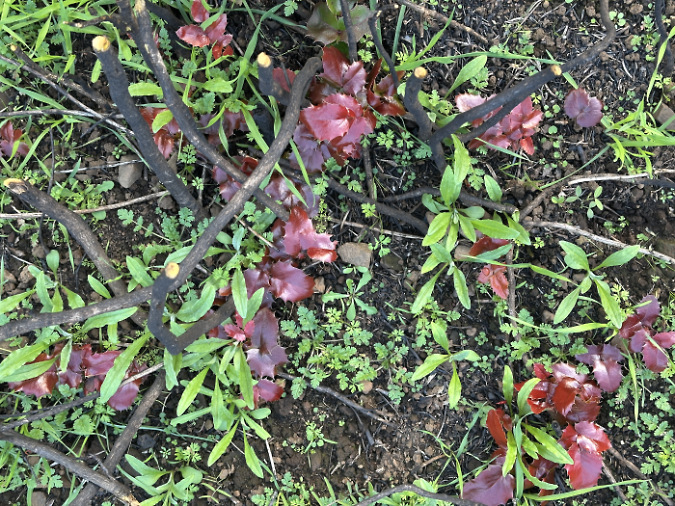
The suddenly bright green surface of the burned savannah meadows also has a story to tell. This isn’t simply grass, but also an infinite number of seedlings exploding from the cleared soil, even during the cold winter months. It’s hard to know what species these will mature into this spring, but it’s a fair bet that the wildflowers this area is known for will be even more spectacular in coming years. 

Some grass is sprouting in the burned meadows, but also a lot of tiny wildflower seedlings just three months after the fire

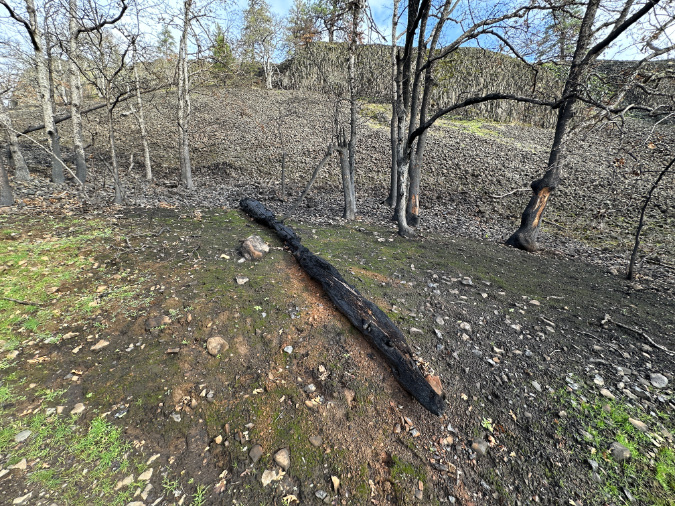
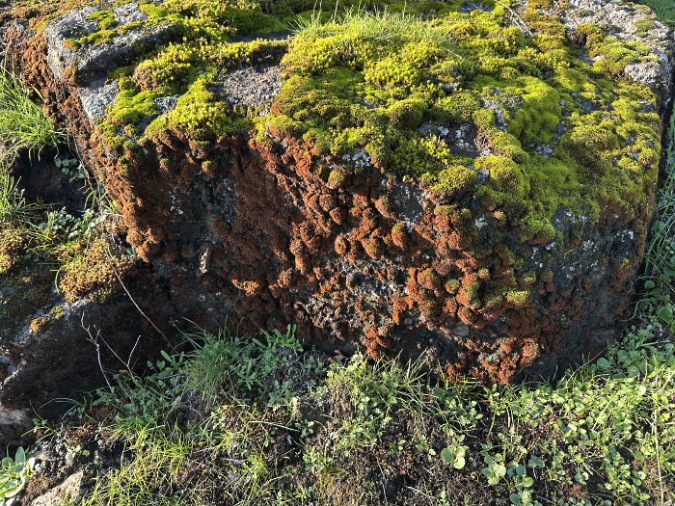
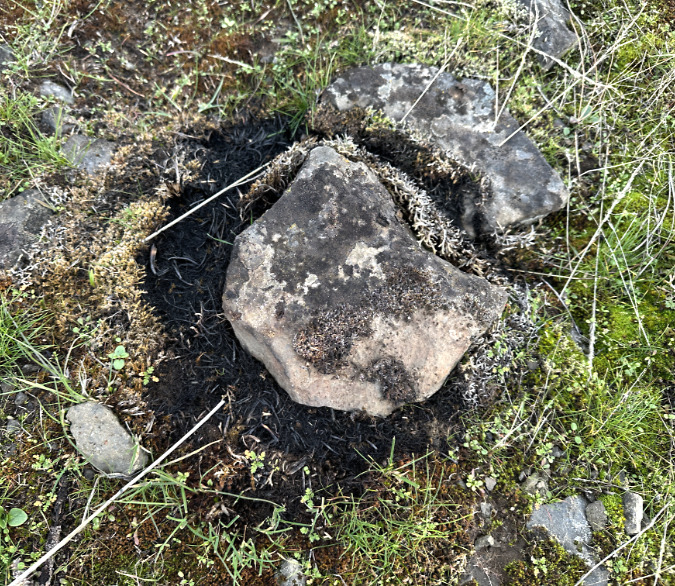
Another surprising story from the fire is how rocks and rocky areas intensified the effects of the flames on vegetation. Throughout the burn, you can find rocks that were superheated by the fire, then stayed hot relative to the surrounding soil after the flames had passed, completely killing vegetation in a ring around the rock (below). It’s hard to know how this will affect the recovering plant community, but in an ecosystem where fire was once common, it surely must have some role in determining which plants thrive most in rocky areas.

Rocks within the burn intensified the impact of the fire, leaving scorched rings like this where vegetation was completely killed

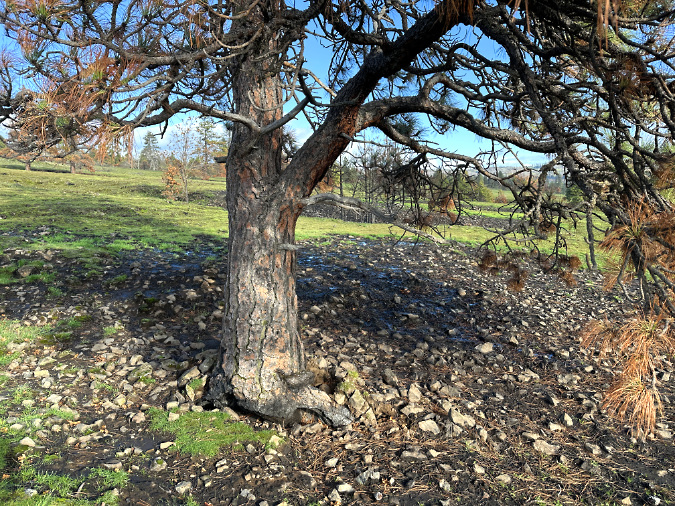
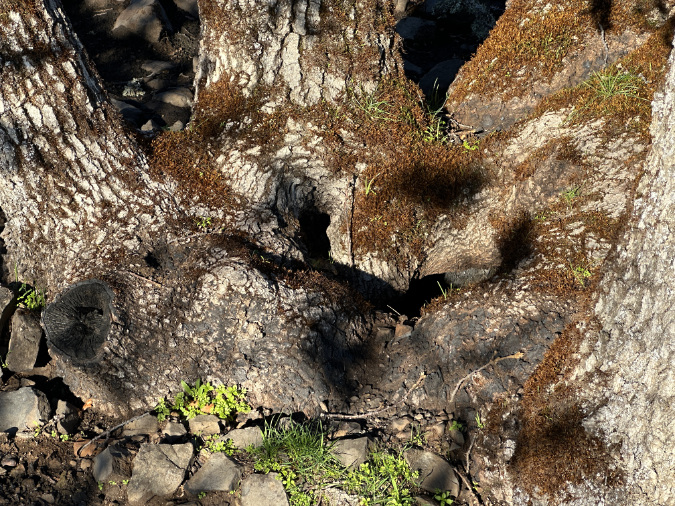
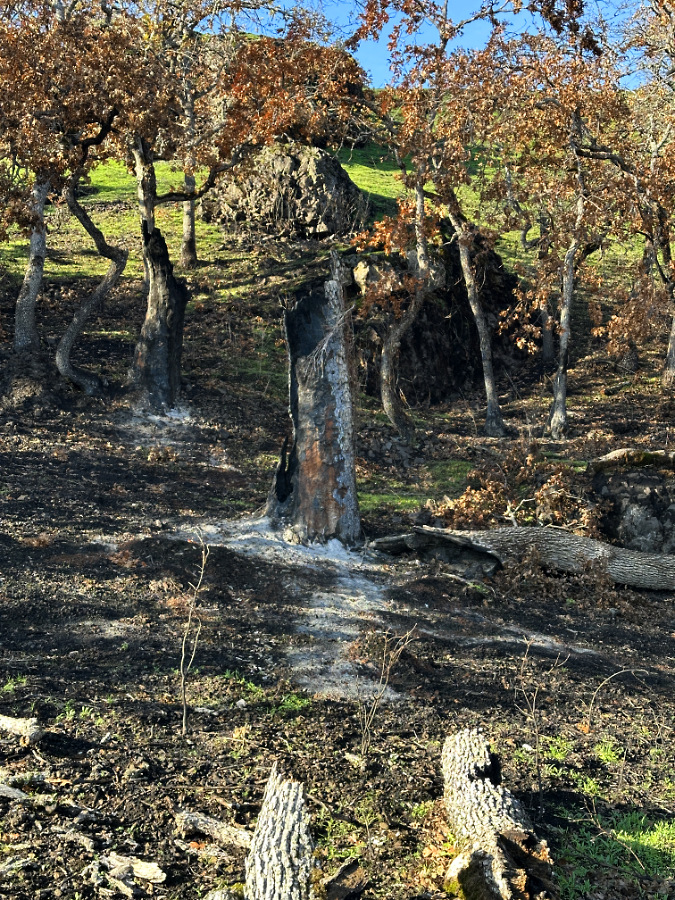
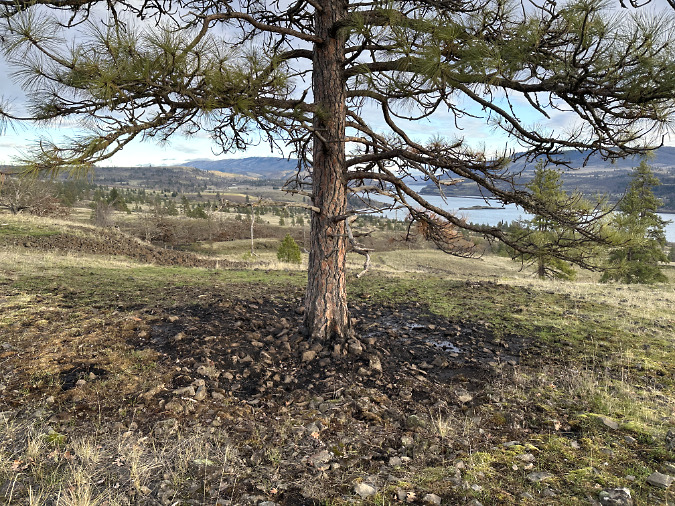
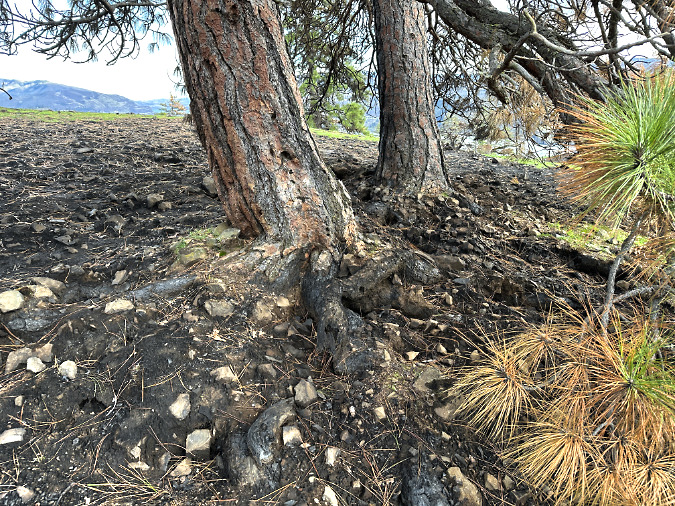
The dripline beneath Ponderosa Pine trees also proved to be a surprising hot spot, with vegetation and sometimes even the duff layer completely burned away. This seems to have resulted mostly from an over-accumulation of wood debris and a blanket of dried pine needles that simply burned hotter and longer during the event. These burn rings underscore the importance of restoring fire to this ecosystem, and not allowing wood debris to build up under these trees to a level where they cannot survive when fire returns.

The charred burn ring under this Ponderosa Pine was less extensive due to the tree’s relative youth, with less dry fuel accumulation to intensify the burn

The charred ring under this part of large Ponderosa Pine is more extensive, burning down to bare rock and mineral soil, due to the larger supply of dry fuel that had accumulated here over many years

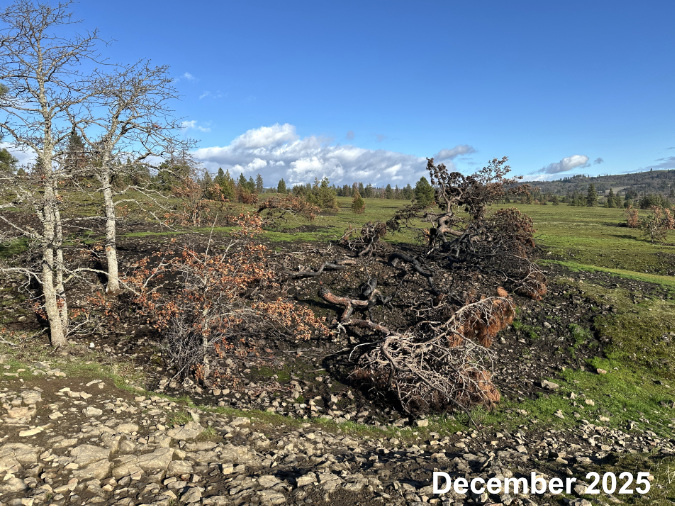
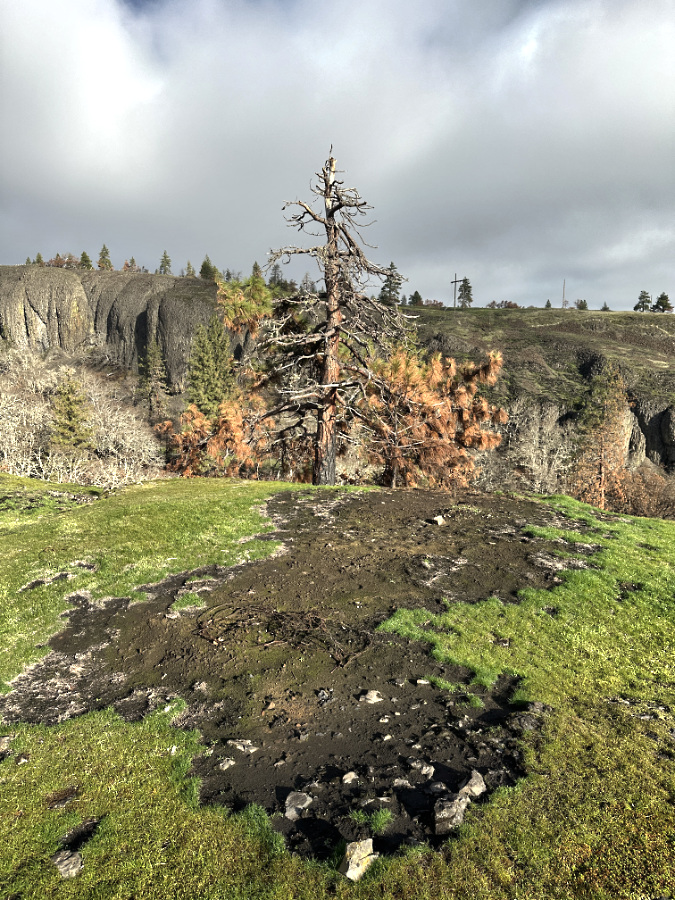
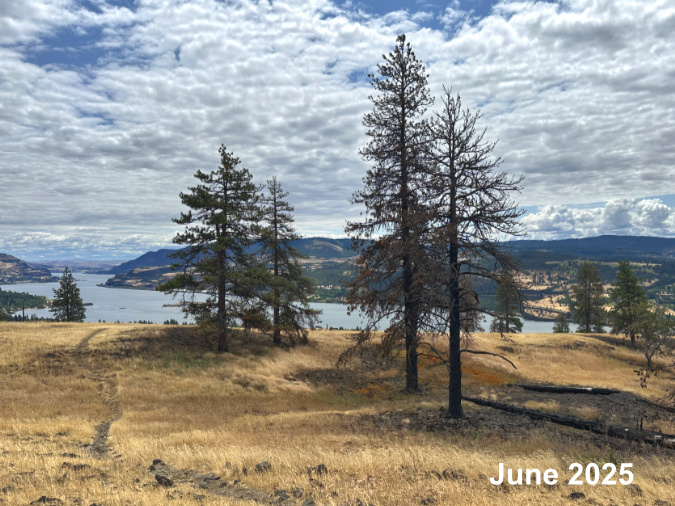
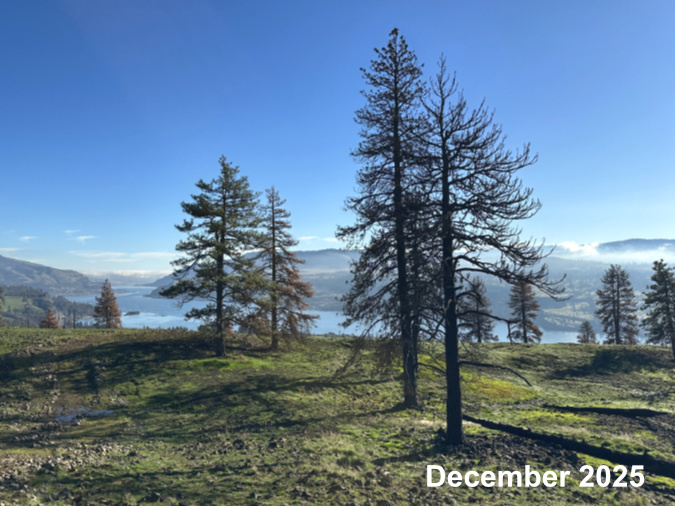
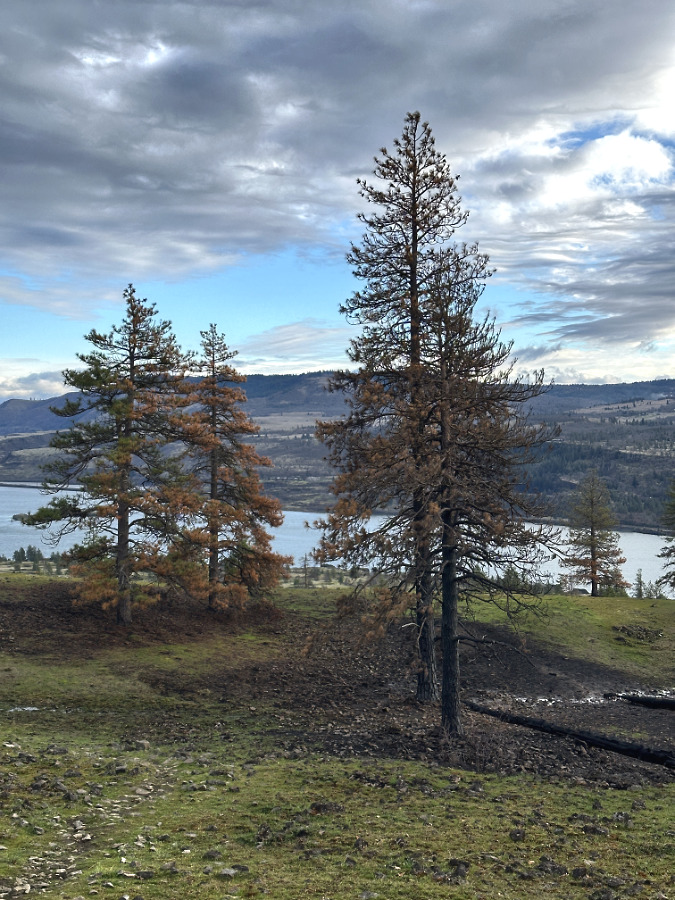
One of the most fascinating stories the burn scars can tell us is how downed trees across the savannah landscape affected the intensity of the burn and put nearby, living trees at risk. The blackened swath adjacent to the pair of large Ponderosas shown below marks where a fallen tree burned hotter and much longer than the overall fire, scorching the standing trees halfway up their canopy. These trees will likely survive, but the recovery of the tree on the right will be slower as it struggles to rebuild its living canopy.

A downed tree that left the charred scar shown in this view burned long and hot enough to scorch branches halfway up these nearby Ponderosa Pine

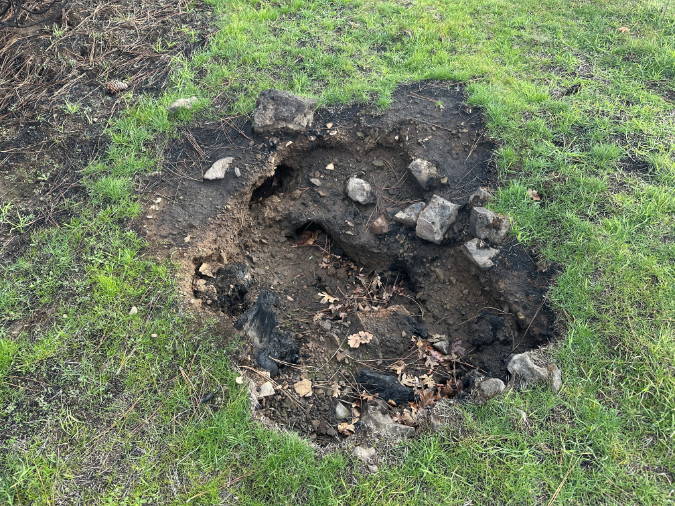
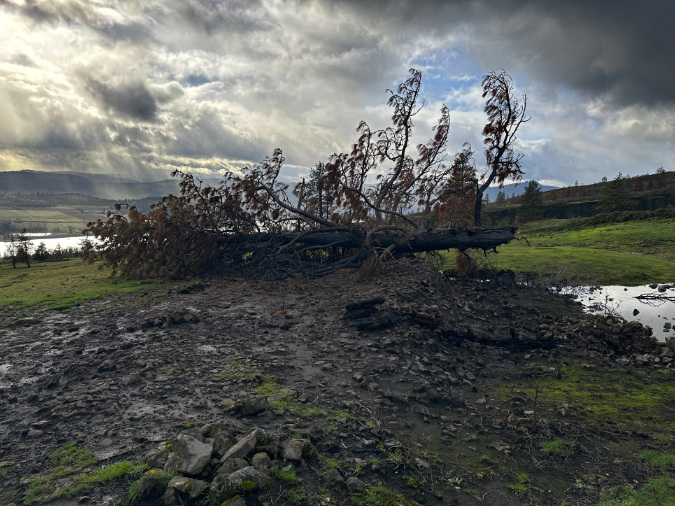
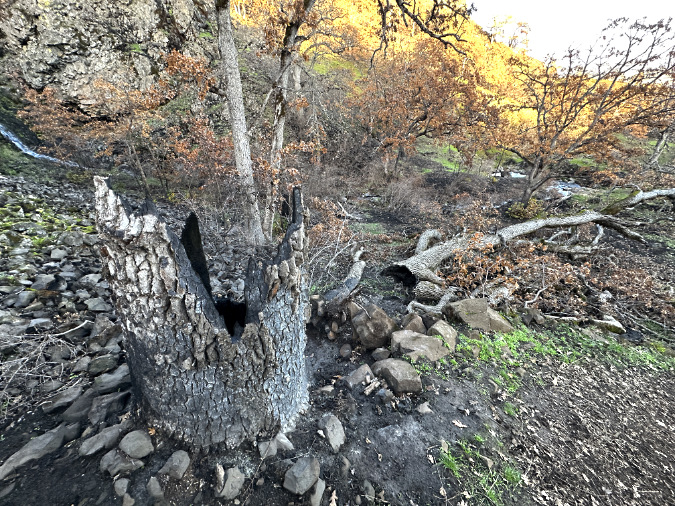
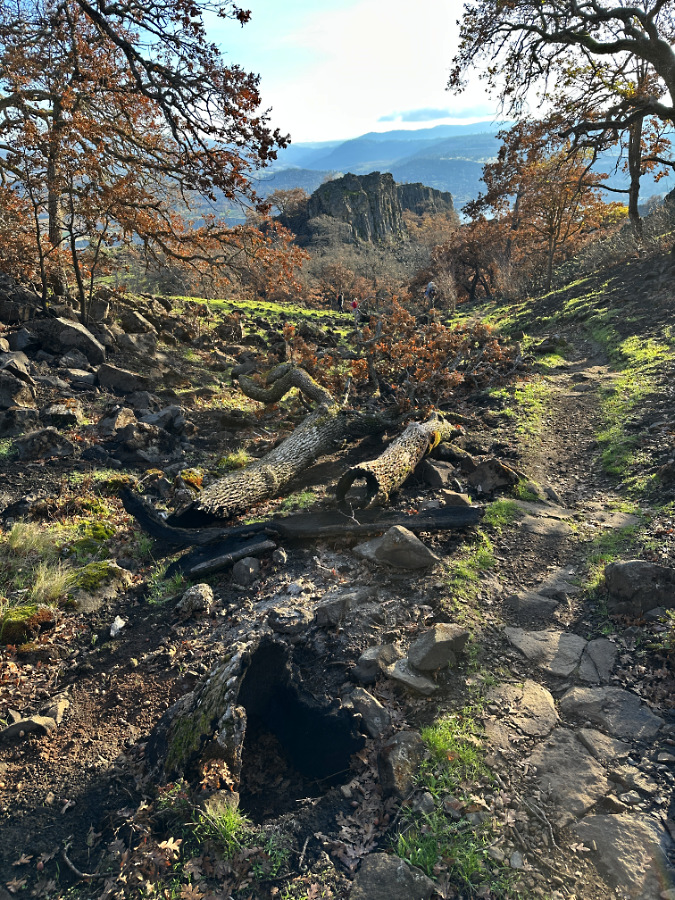
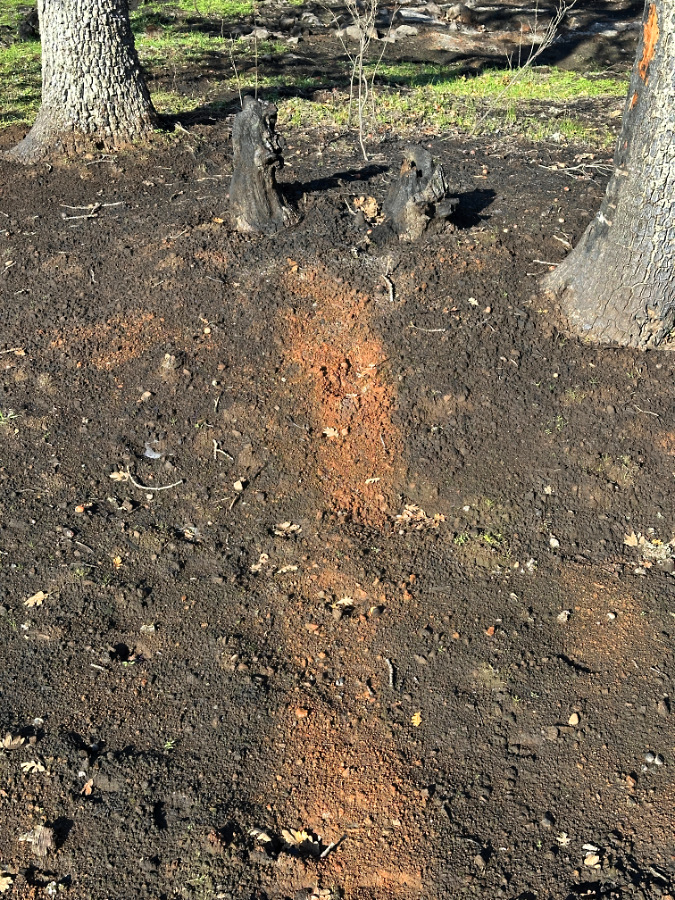
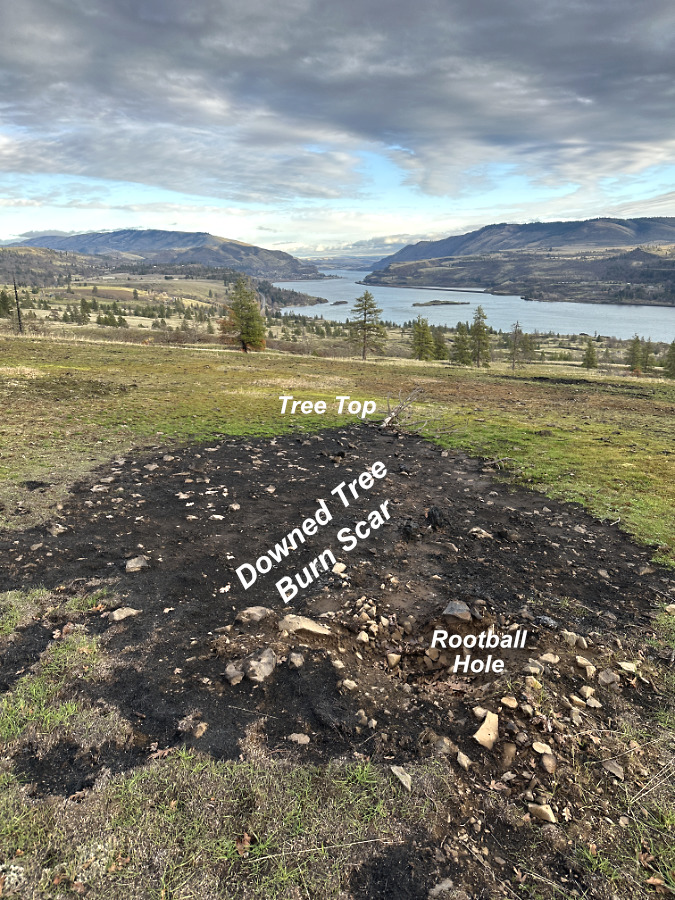
This view (below) of a downed tree scar is typical of dozens across the burned savannah of the Catherine Creek fire. This view is looking from the base of what was once a fallen tree, with a prominent hole in the ground and upturned soil and rocks in the foreground. These mark where tree roots had pulled this material from the ground when the tree originally fell, but are now burned away, leaving only the pile of soil and rock.

Burn scars from downed trees like this are found across much of the savannah area of the Catherine Creek fire, with the trees almost completely reduced to ashes that have since washed away during winter rainstorms. This view from the base of the tree shows the characteristic hole and upturned soil left by the root ball that has since been burned away

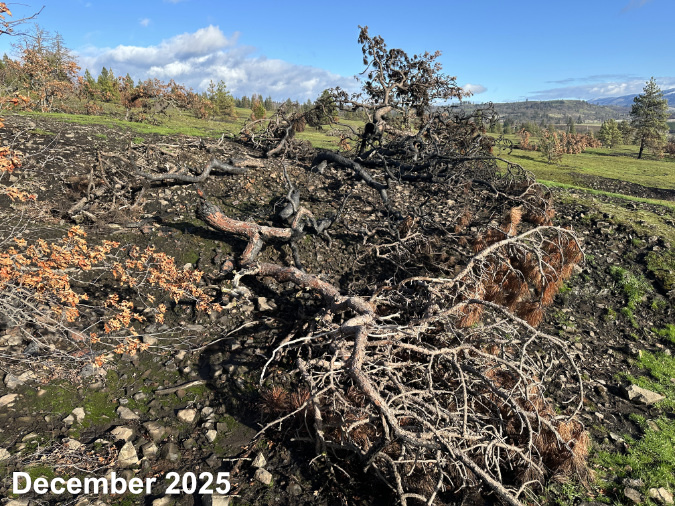
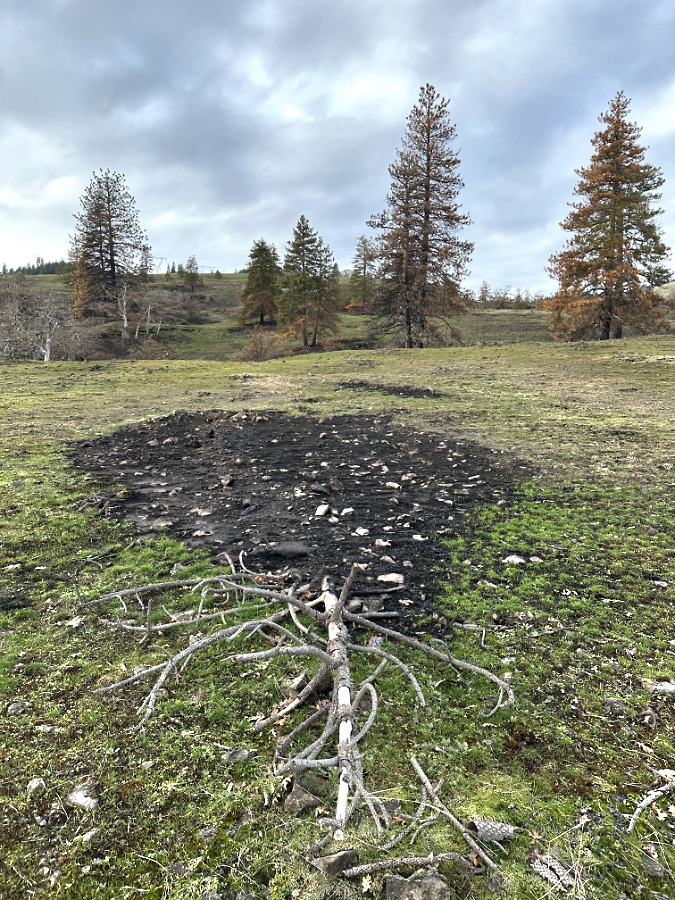
This next image (below) is the reverse view of the same fallen tree, now looking from the top. The very tip of this downed tree in the foreground somehow managed to survive the fire, unburned. Even the shape of the fallen tree is apparent in the pyramid-shaped burn scar.

This view of the previous burn scar shows the perspective from the top of the former tree, with only the unburned tip left to tell the story

The bare soil created by these intensively burned patches surely serves a niche in a grassland savannah ecosystem that relies on fire to rejuvenate. I’ll be tracking the recovery of these areas over the next few years to see if certain plants are especially adapted to regenerate in these spots – and conversely, whether these badly burned areas open the door to invasive plants, one of the liabilities of intense fires.

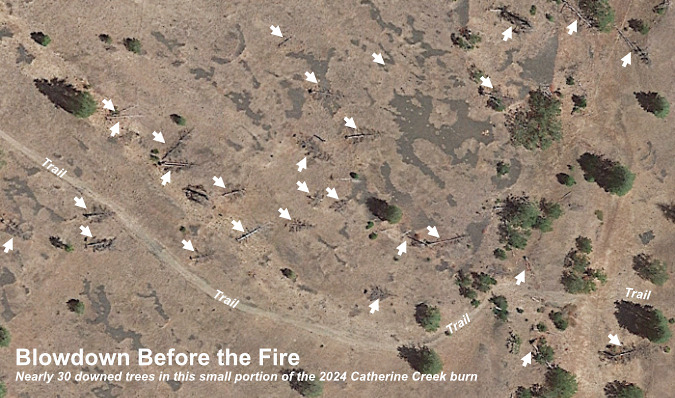
The downed trees and their distinctive burn patterns within the Catherine Creek burn are not an anomaly. While they likely went unnoticed to most who visited this area before the fire, there were hundreds of downed trees spread across the open savannah. This aerial view (below) is just a small area, and yet there were more than 30 downed trees here before the fire (marked by the arrows). All were burned. Their sheer number underscores how the absence of fire has allowed dry debris to accumulate here in recent decades.

There were hundreds of downed trees across the savannah section of the Catherine Creek burn before the fire, mostly unnoticed by hikers traveling through. The arrows mark each blowdown

[click here for a larger view]

Another takeaway from the aerial sample is the uniformity in how these trees fell. Nearly all of them point eastward, revealing the predominant winds from the west in this part of the Gorge – especially in the winter, when soils are saturated and storms are frequent and often powerful.

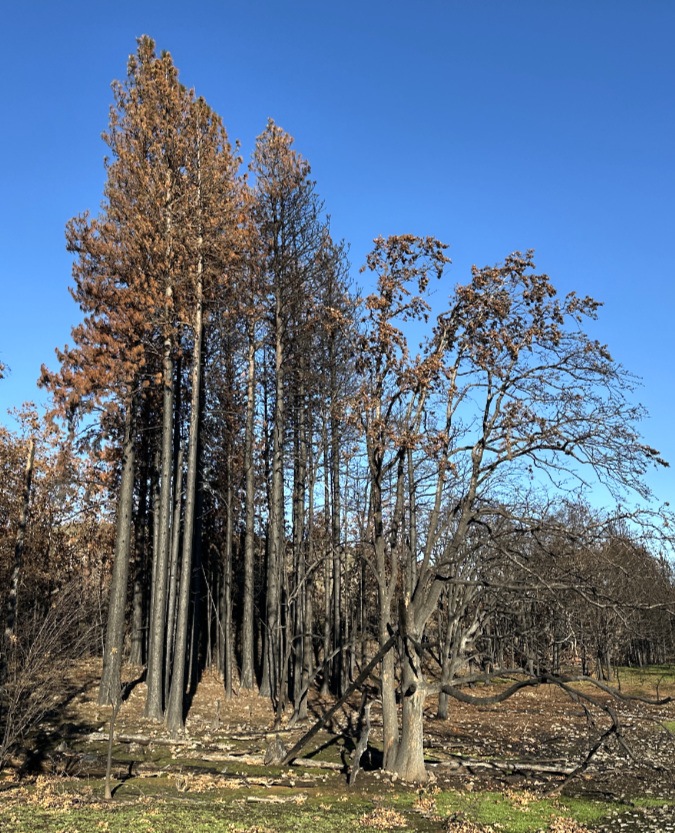
Surprisingly, some of the big Ponderosa Pine that fared most poorly were growing in stands (below). Here, the combination of their accumulated fuel of dried limbs and needle beds around their trunks combined with fallen trees within the stand for a fire too hot for these trees to survive. Their low canopy – a product of not having fire present until now – also made them vulnerable to the hotter burning that happened here.

These trees help tell the story of why Ponderosa Pine are more often solitary trees within the savannah ecosystem. Not only do they have less competition from other trees for water and nutrients, they are also less vulnerable to spot fires from accumulated debris and fallen trees.

Growing in groves usually helps trees survive by protecting them from wind, but here their close proximity meant a combined debris accumulation — including downed trees — that burned hot and long, killing the largest Ponderosa Pine trees in this group

Another look at the same grove shows how several downed trees combined to create a fiery oven that few trees survived

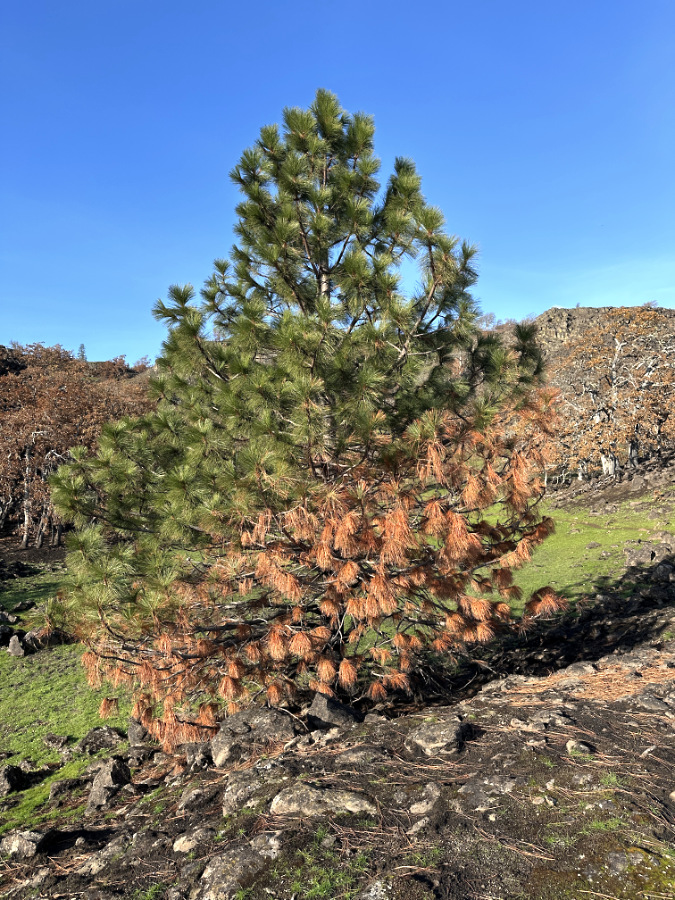
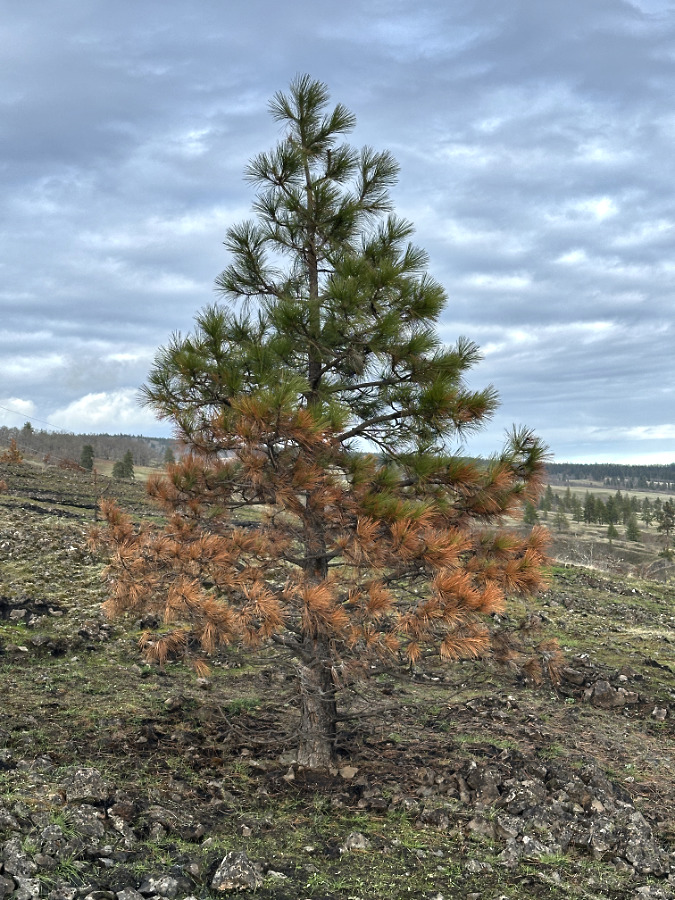
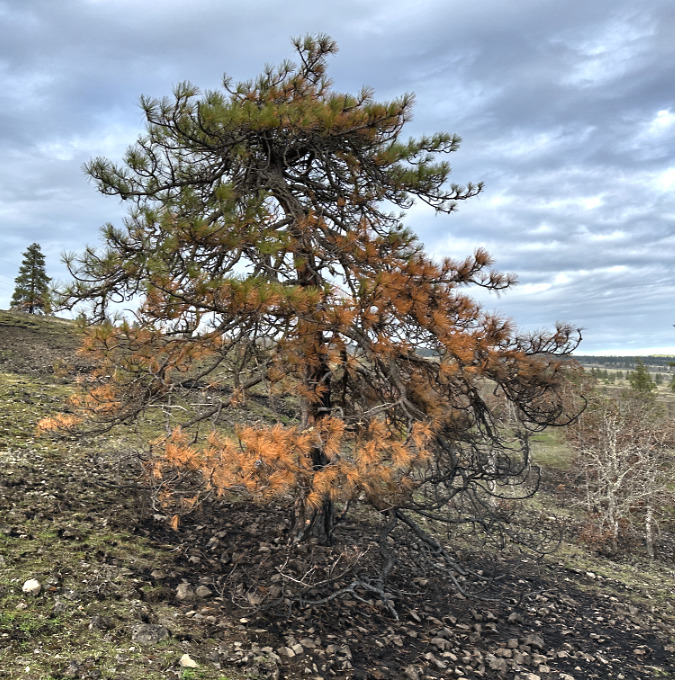
Young Ponderosa Pine in the burned savannah have their own story to tell about the Catherine Creek fire. This tree (below) lost roughly half its green canopy, but the top survived the fire – so far, at least. This suggests that the flames rolled through fairly quickly. The lack of a burn ring also shows that this tree was too young to have accumulated much dried debris beneath its small canopy. With repeated, low-intensity fires, this tree can continue this pattern until its canopy is high enough from the ground to survive fire events fully intact. This is the classic cycle of a mature Ponderosa Pine forest under the natural conditions in which the species evolved.

Even very young trees can benefit from fire by shedding their lower canopy — if they can survive the loss of so many limbs

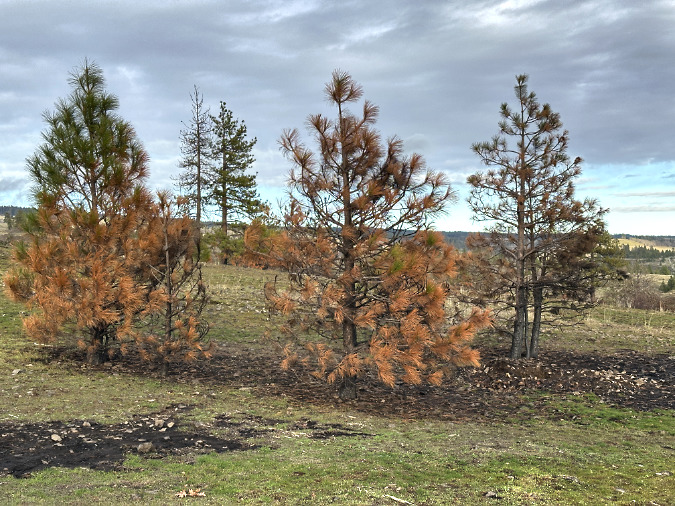
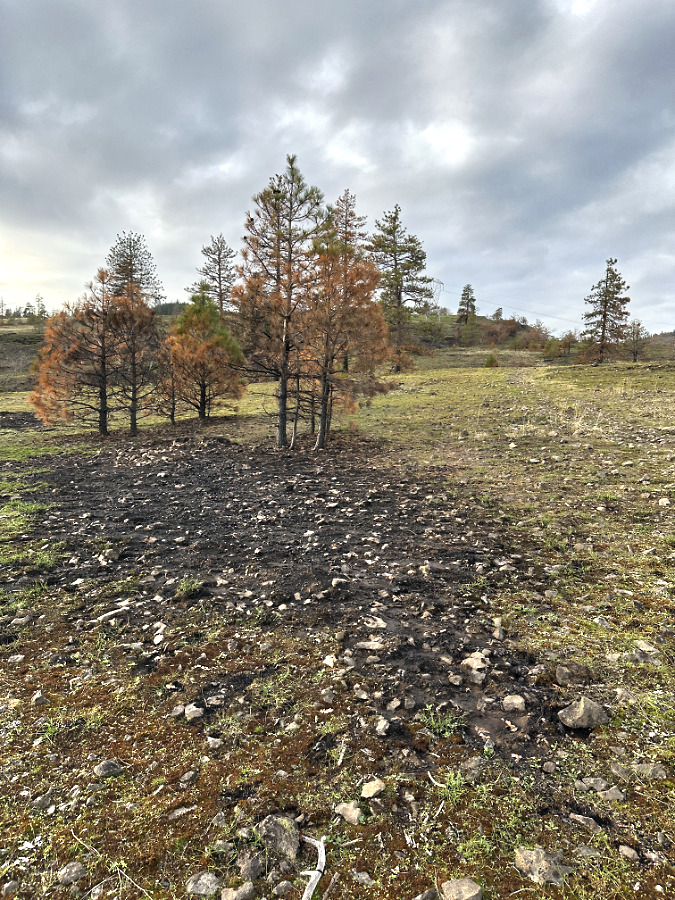
This grove of young Ponderosa Pine (below) fared worse, but it wasn’t due to their close proximity to one another, or even a combined accumulation of debris that made them vulnerable. Instead, it was their proximity to a very large, downed tree – perhaps their parent – that burned long and hot enough to badly scorch them. Of the group, only the tree on the left seems to have enough living canopy to survive.

This group of young Ponderosa Pine trees might have fared better had they not been growing around a large, downed tree that burned long and hot just to the right

This view of the same grove of small trees shows the burn scar of a large downed tree that sealed their fate was. The wide shape of the burn scar clearly shows that the tree still had many limbs intact that only added to the heat it produced

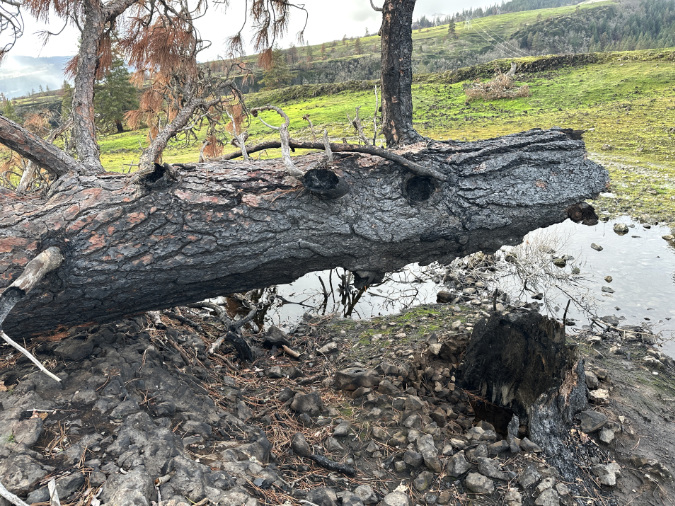
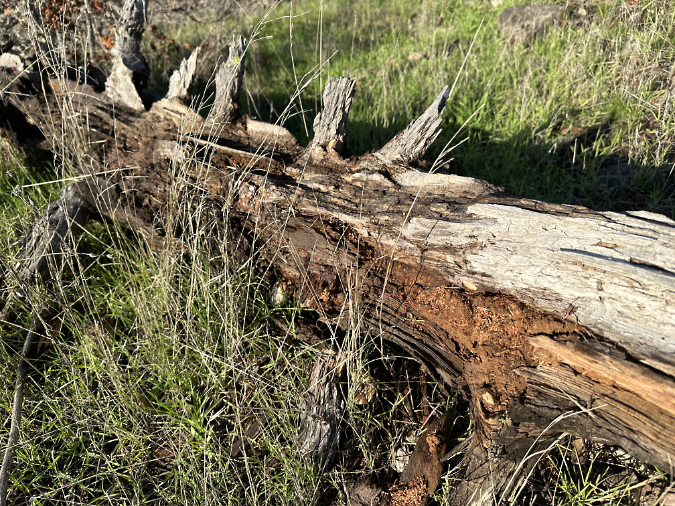
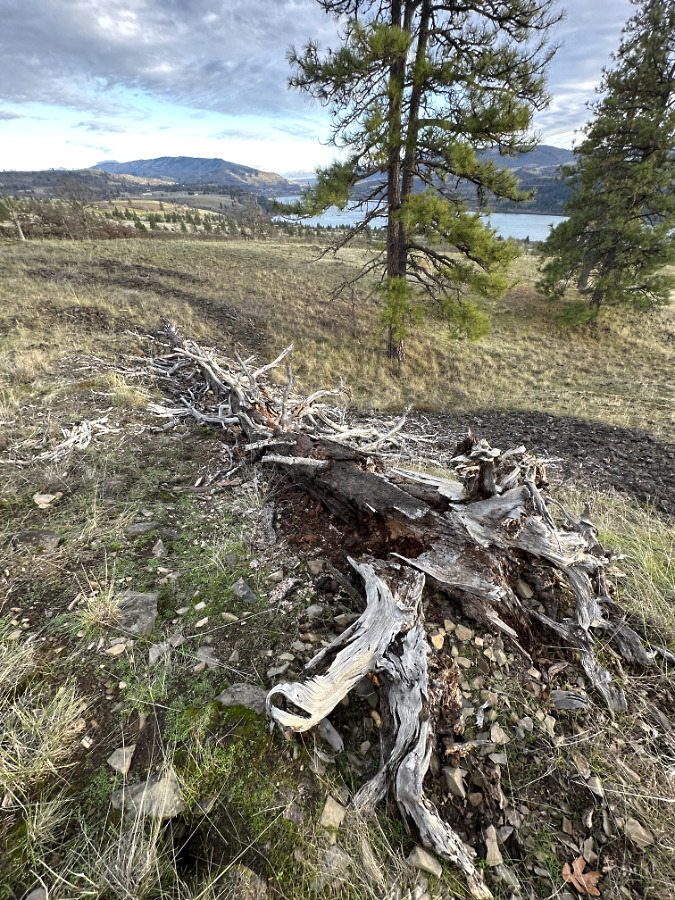
Though the recovering meadows in the Catherine Creek burn are rapidly concealing the extent of the burn, the edge of the burn zone can be found by surviving blowdowns, like this one (below), just a few feet beyond the burn scars. This ancient downfall also underscores just how long it has been since fire was a force in this ecosystem – this tree has been lying here for decades.

The hundreds of downed trees that burned across the Catherine Creek savannah looked something like this before the fire. The age of this very old tree skeleton shows that beneficial wildfires have been suppressed here for decades

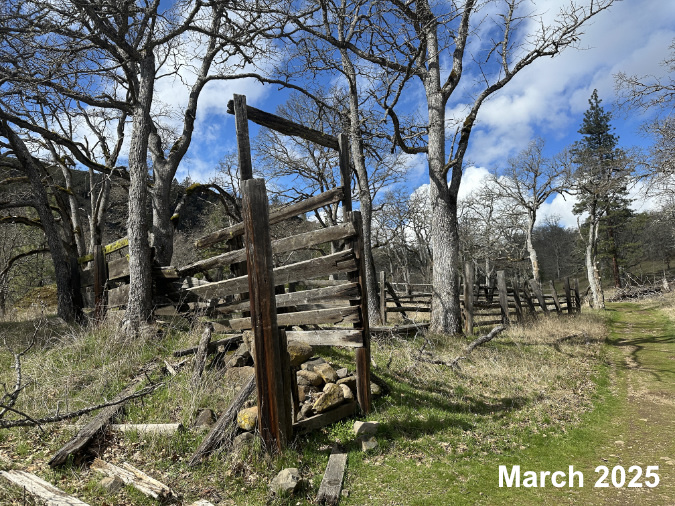
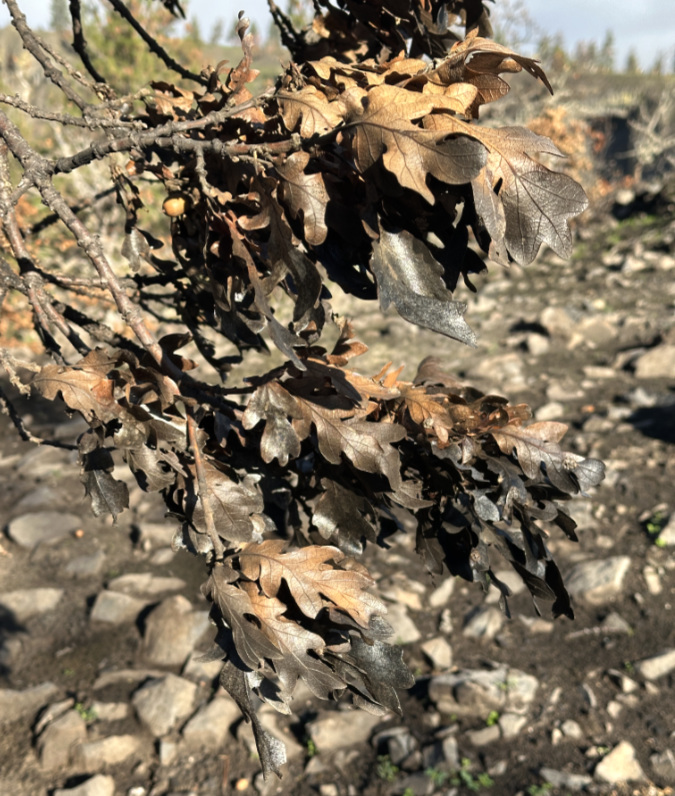
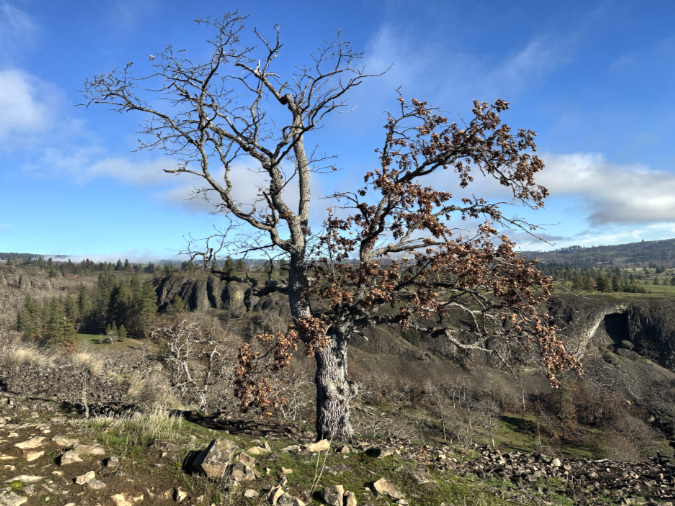
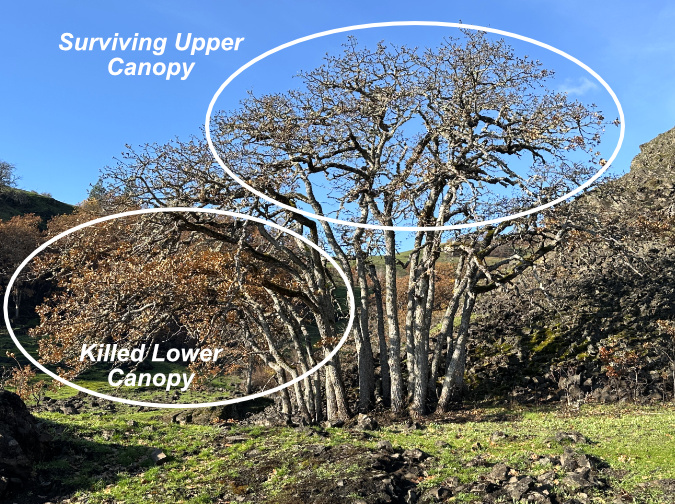
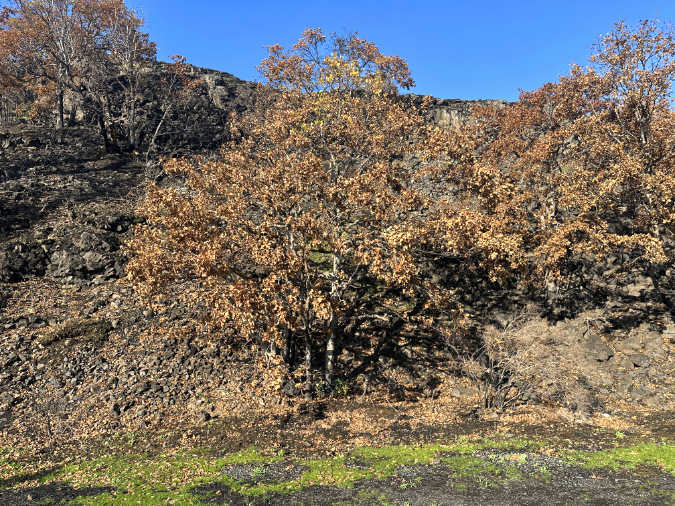
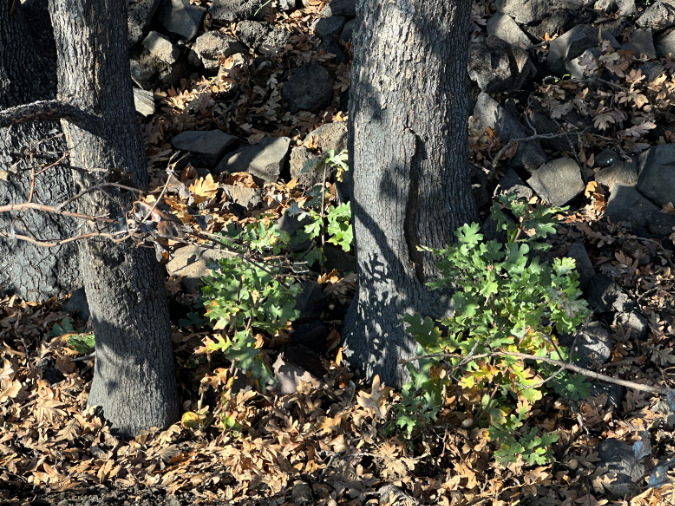
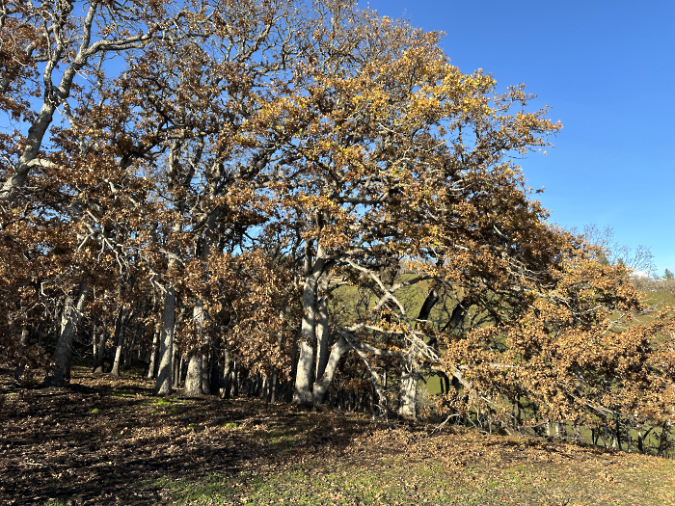
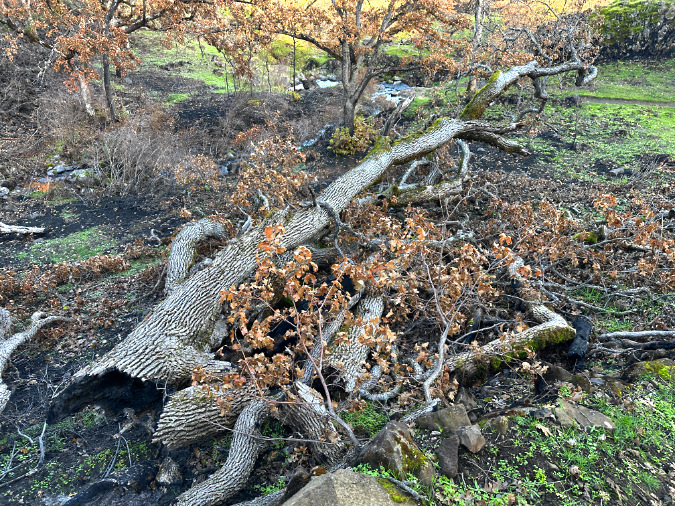
The fire at Catherine Creek didn’t expand far into Oregon White Oak habitat, the other iconic tree species in the eastern Columbia River Gorge. Like Ponderosa Pine, these trees have evolved with fire, and require regular, low-intensity burns for their health. They have deep taproots that help them retain moisture, even during the dry summer season, and corky, protective bark that helps insulate them from low-intensity fire, much like Ponderosa Pine with its thick, orange bark. Oregon White Oak also has less resin in its wood and leaves, making these trees less flammable and prone to crowning than other tree species.

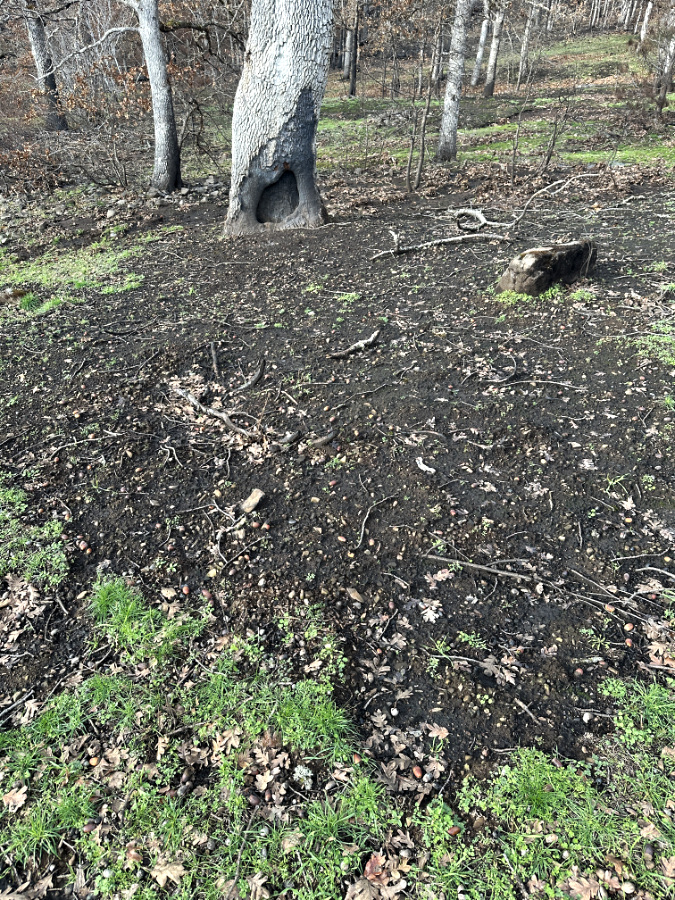
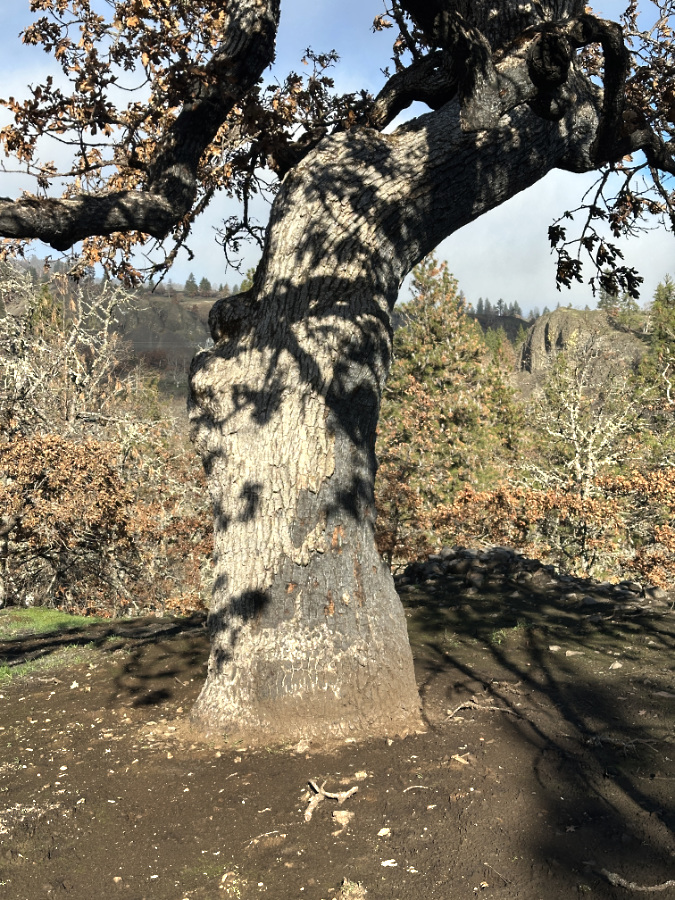
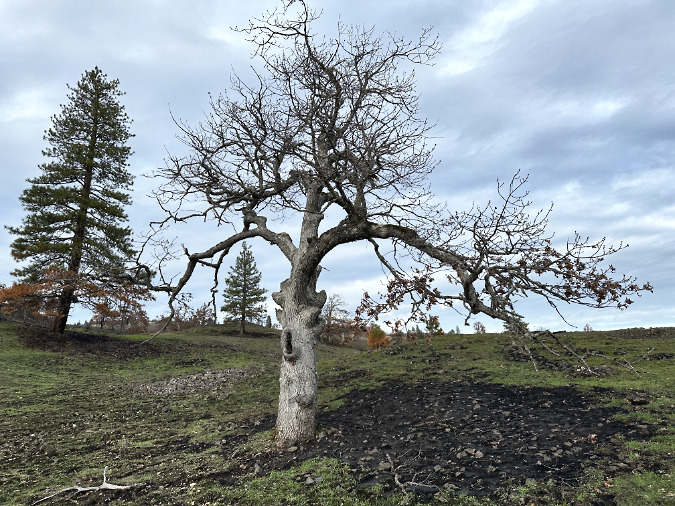
The burn pattern under this Oregon White Oak (below) is much like that of the nearby Ponderosa Pine, and suggest that it, too, had an accumulation of debris that burned hotter and longer, thanks to fire suppression. These oaks also have fire resistant buds, so I’ll be watching to see how well this fire-impacted tree rebounds in spring. 

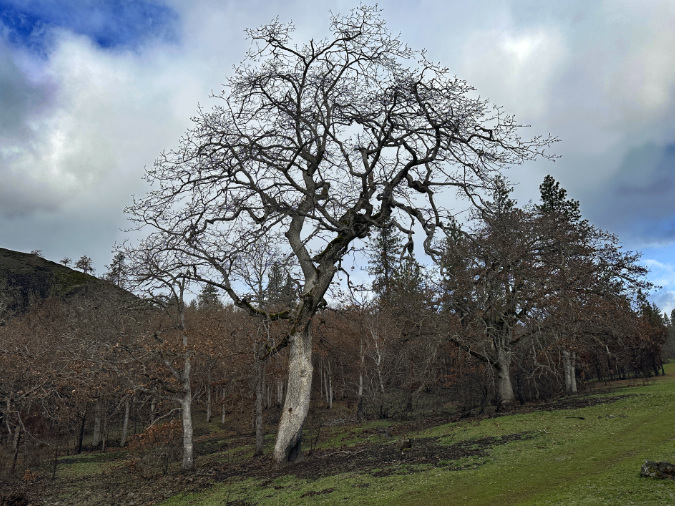
Oregon White Oaks have their own built-in fire resistance, and are adapted to low-intensity brushfires. This tree will likely survive the Catherine Creek burn

Like Ponderosa Pine, our Oregon White Oaks also benefit from having competing brush and understory plants cleared with regular, low intensity fires. In the Willamette Valley, where Oregon White Oak trees grows to be very large, scientists estimate that low-intensity wildfires burned every three to five years prior to white settlement of the Pacific Northwest. Most of these fires were set by indigenous people to maintain the Oak savannah landscape in the valley. I suspect the same was true for the oak groves on the east slopes of the Cascades, as well – especially in the Gorge, where a large indigenous population thrived.

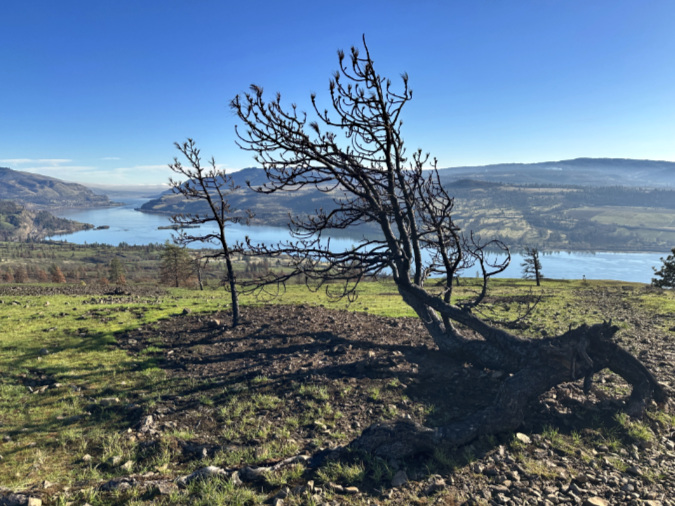
One survivor of the Catherine Creek fire that caught might eye is the humble Ponderosa Pine shown below. It had clearly seen some rough times it its life, losing its top at some point, perhaps to an ice storm, wind or even a lightning strike. The result is an unusually short tree for its age, making it more vulnerable to fire. Still, it appears to have survived the October fire.

This stunted Ponderosa Pine has already suffered adversity in its life on the Catherine Creek savannah. Despite this tree’s humble height and low canopy, it did retain some of its healthy crown after the fire

From the uphill side, this old tree seems to have lost minimal canopy, but viewed from the downhill side (below), the fire had a much greater impact, singeing close to half the canopy. Like most of the Pondersosa Pine, there seems to have been enough accumulation of old limbs and dried pine needles beneath this tree to allow the fire to burn much hotter and longer, and the tree’s low canopy made it still more vulnerable to the heat. 

This view of the same stunted Pondera Pine shows a greater impact of the fire on the downhill side of the tree, where accumulated debris likely burned longer and hotter

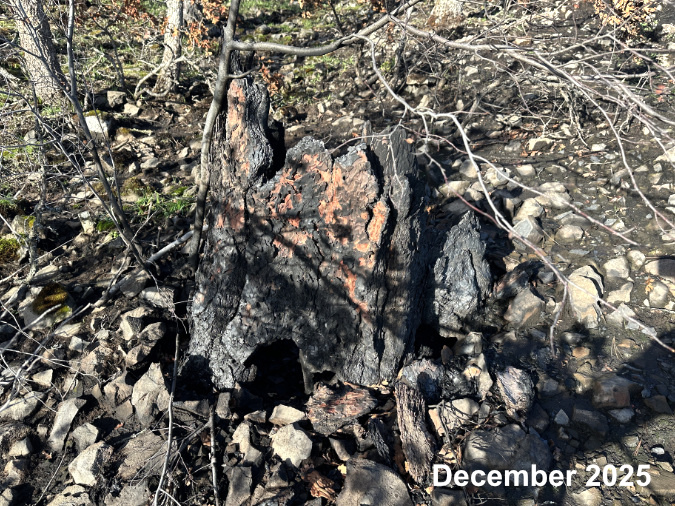
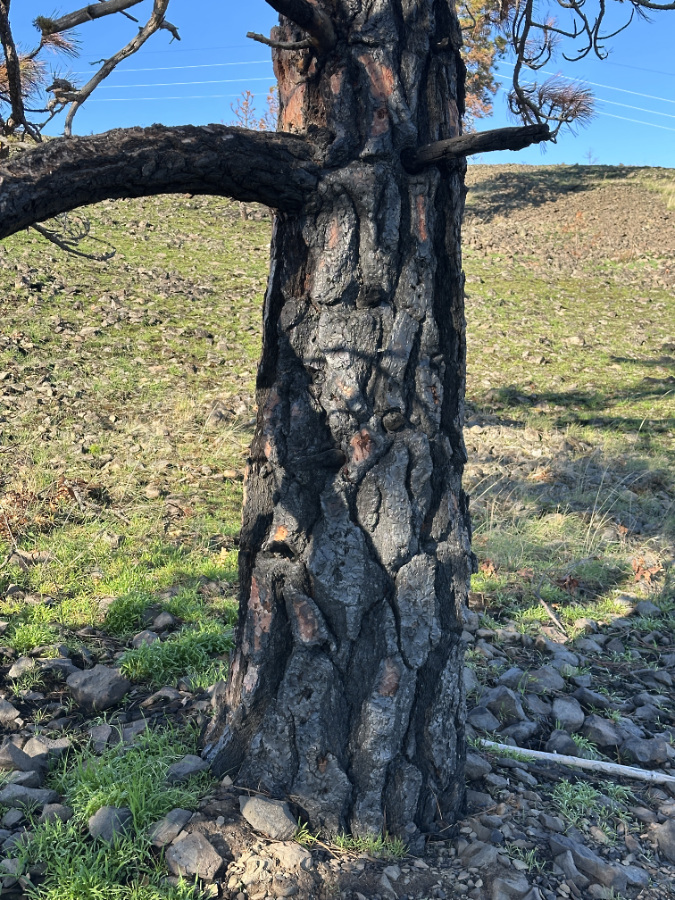
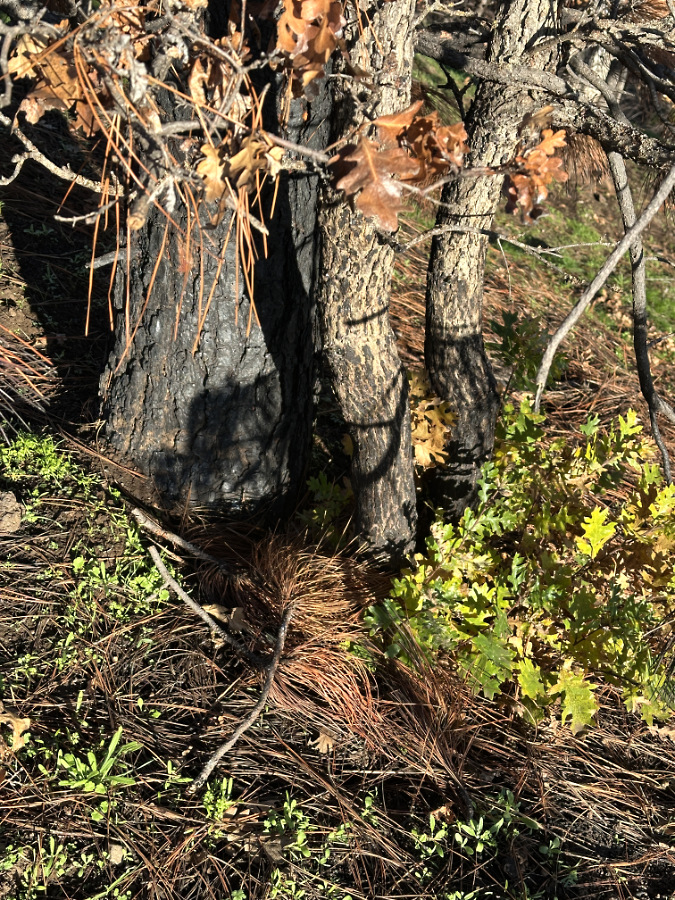
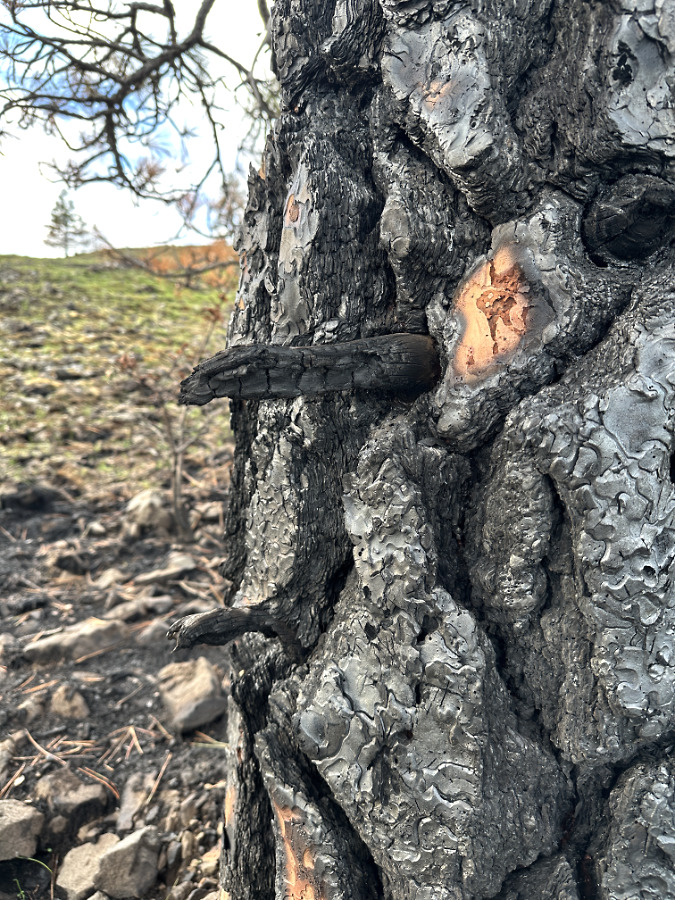
A close look at the trunk on this old, diminutive pine shows just how important Ponderosa bark is to the survival of this species. In a few spots (below) where some of the heavily charred bark has flaked away, the layers of bark underneath are still completely unburned. Therefore, if this tree has enough remaining green canopy to survive the fire, it should have the intact trunk and root system needed to growth and recover. I will be rooting for this survivor!

Ponderosa Pine bark on living trees is remarkably fire-resistant. Just beneath the badly blackened surface, the bark is intact and healthy

It will take years for the full effects of the fire to be known at Catherine Creek, but just three months after the burn, the area is looking both resilient and rejuvenated as open grassland savannah. One hopeful outcome from this event is that it might open the door to future controlled burns on other savannah landscapes in the Gorge in the years to come as we watch and learn from the recovery here.

How to tour the Catherine Creek burn area?

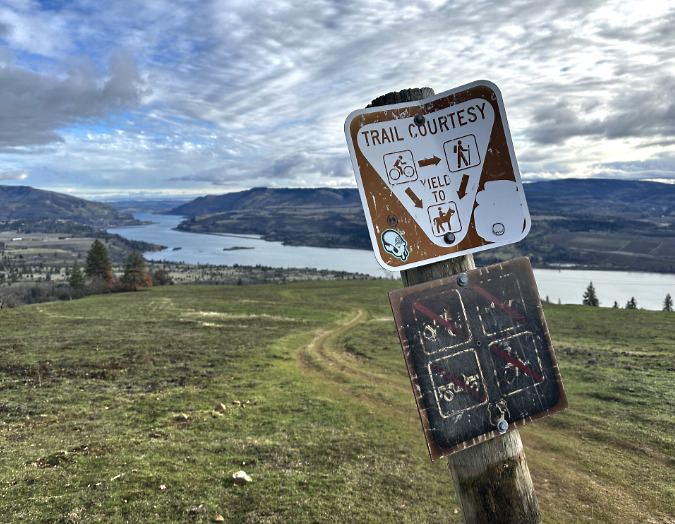
Scorched trail sign in the upper meadows at Catherine Creek

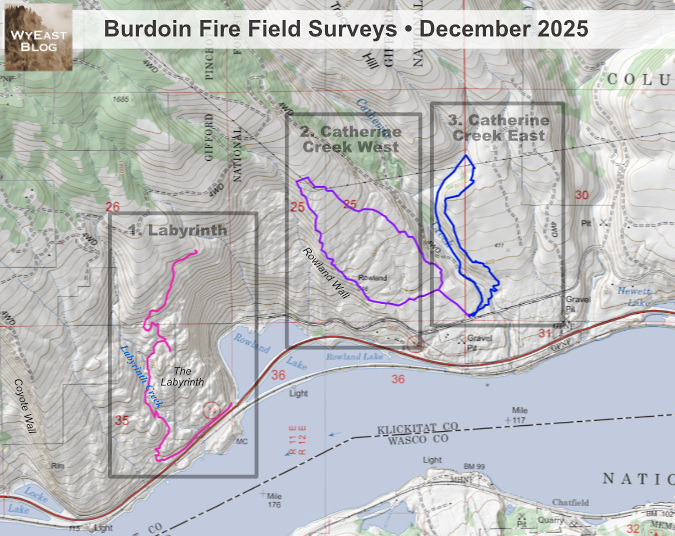
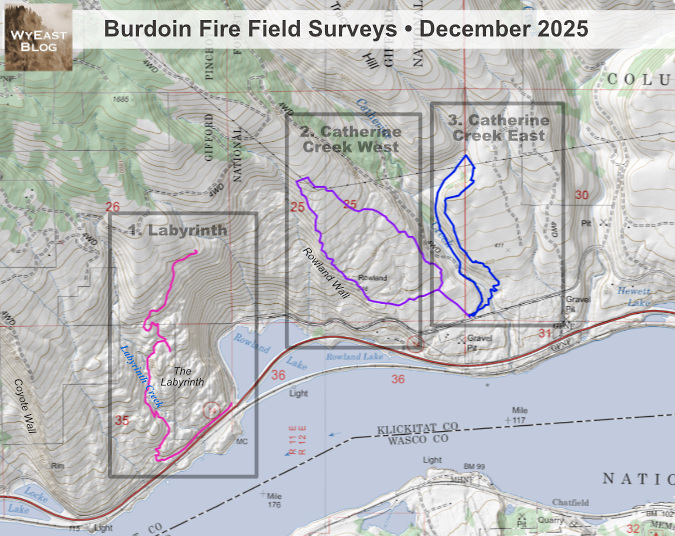
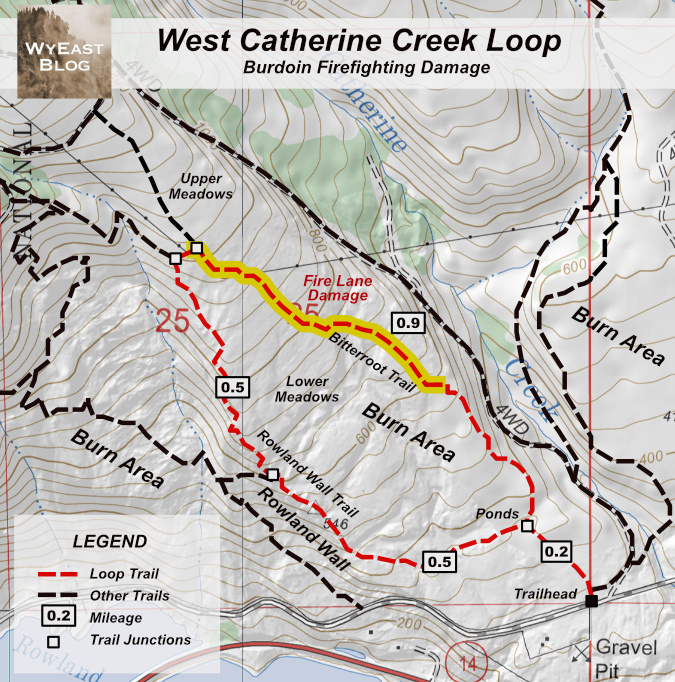
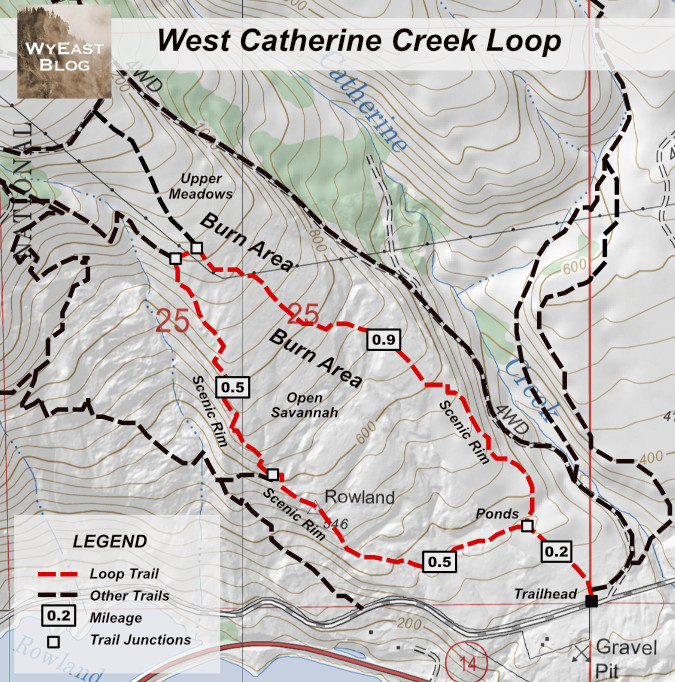
The Catherine Creek trail network can be confusing to explore, as there is both an abundance of trails and a dearth of trail signage! This loop takes you through some of the finest scenery and provides a close look at the 2024 burn recovery, though none of the trail junctions are signed. The loop shown in red works best when hiked clockwise, climbing about 800 feet in elevation in the first mile through mostly open savannah, then dropping the same distance in the remaining 1.3 miles, along the rugged Rowland Wall. 

[click here for a large, printable version of this map]

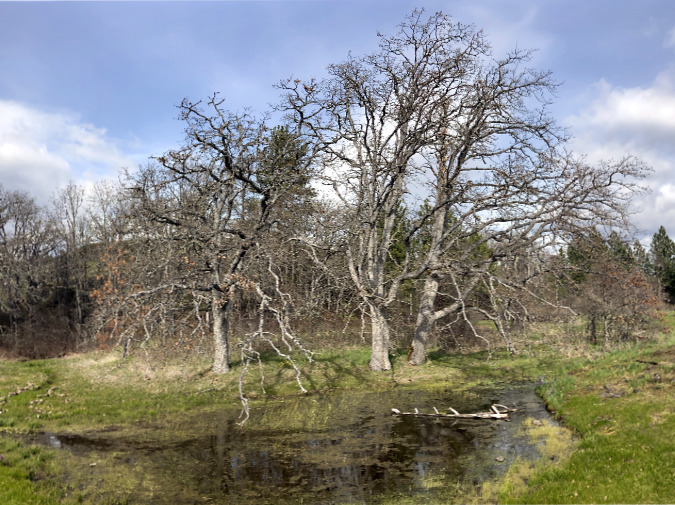
While the mileage is relatively modest, the return loop along the rim is rocky, so an option for the less sure-footed is to simply go as far as you feel like on the first leg to the upper meadows, then return the way you came. One important wayfinding tip in the absence of signs is to look for the critical junction at the 0.2 mile mark when you reach a group of seasonal ponds. Watch for a path that heads right, along the ponds, then climbs a slope to begin following a rocky rim on the way to the savannah section. 

Ponds at Catherine Creek mark the start of the loop trail route

The junction at the upper end of the loop can also be hard to find when the meadow grass gets tall, but watch for it on the left when you pass under the obvious transmission lines, roughly halfway between two large transmission towers. Be sure to print a copy of the above map to keep in your pocket, too!

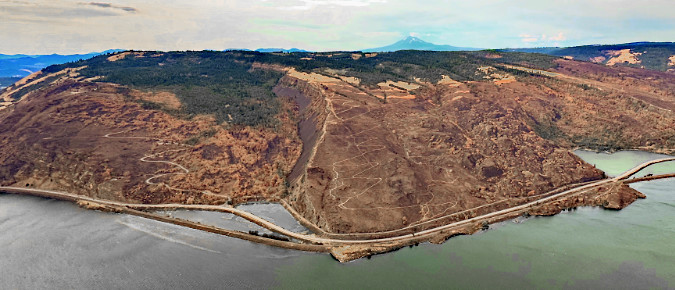
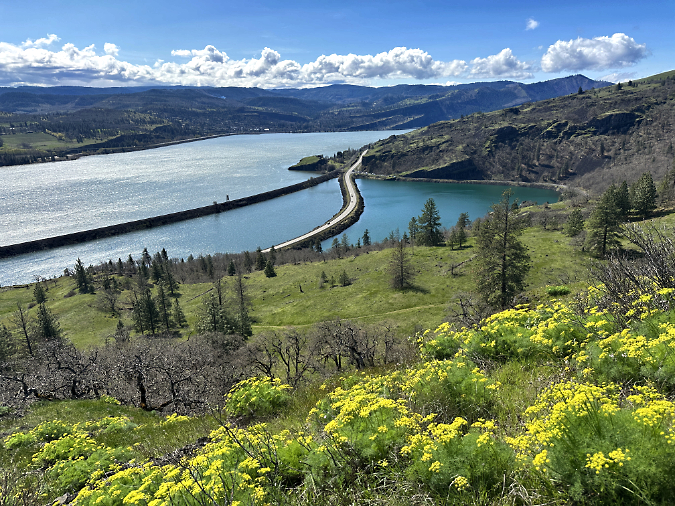
The west leg of the loop, along the Rowland Rim escarpment, also provides fascinating views into dozens of pits in the talus slope below that likely served ceremonial or burial purposes for indigenous people who once lived here in very large numbers. On a clear day, Mount Hood is on the horizon, across the Columbia River. In spring, the entire loop is decorated with wildflowers.

The view from the Rowland Wall section of the hiking loop features Mount Hood (among clouds in this photo) and a maze of ceremonial pits in the talus fields, below, left over the centuries by indigenous peoples

You’ll also be sharing the trail with bikes and possibly horses if you’re on foot. Like all of the eastern Columbia River Gorge, this tick, poison oak and rattlesnake country, with the usual considerations.

Enjoy… and please be kind to your federal lands workers!

________________

Tom Kloster • February 2025

Proposal: Mitchell Point Loop Trails

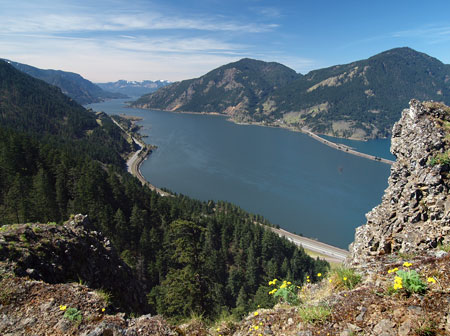
Looking west in the Gorge from Mitchell Point

Looking west in the Gorge from Mitchell Point

Author’s note: this proposal is the latest in a series on this blog aimed at a major Oregon Parks and Recreation Department (OPRD) effort underway to update the 1994 Gorge Parks Plan. OPRD staff will make key decisions on future trail projects for the Gorge over the next four months, so now is the time to weigh in! More information on how to get involved in this important work is included at the end of this article.
_________________

Mitchell Point is a rugged basalt spine that towers a thousand feet above the Columbia River, just five miles west of Hood River. This spectacular outcrop rises in the transition zone where the wet rainforests of the western Cascades meet dry Oregon white oak and Ponderosa pine country of the eastern slope in a unique jumble of ecosystems and geology.

The steep hike to Mitchell Point is described in this WyEast Blog article, and makes for an excellent year-round destination for hikers looking for something a bit less crowded (and a bit more rugged) than viewpoints like Angel’s Rest.

This article focuses on recent improvements to the Mitchell Point wayside and trailhead, and the potential to expand the trails at Mitchell Point to allow for better exploration of the unique landscapes found here, and a deeper appreciation of the colorful human history, as well.

Kudos on Recent Upgrades!

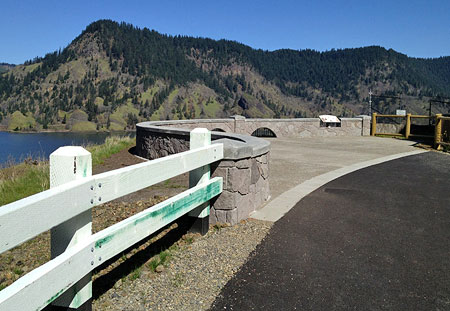
A short, new segment of the Historic Columbia River Highway State Trail leads to the refurbished Mitchell Point overlook

A short, new segment of the Historic Columbia River Highway State Trail leads to the refurbished Mitchell Point overlook

In 2012, the OPRD completed a major overhaul of the Mitchell Point wayside and overlook, with excellent results. Mitchell Point falls within the borders of the Vinzenz Lausmann and Seneca Fouts state parks, and has long served as a scenic wayside for highway travelers and as the trailhead for the Mitchell Point and Wygant trails.

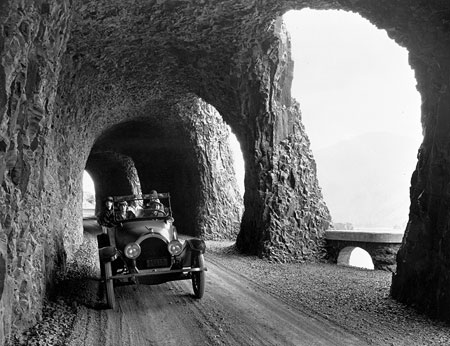
The recent overhaul at Mitchell Point also acknowledges a new function for the trailhead: the Historic Columbia River Highway (HCRH) State Trail project will soon extend through the area, including a proposed tunnel through Mitchell Point, proper, that gives a nod to the iconic highway tunnel that once thrilled highway travelers here.

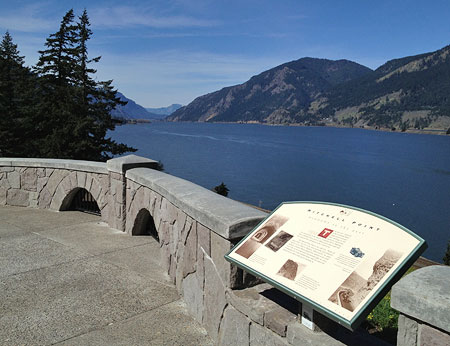
The restored overlook features a sweeping view of the Columbia Gorge and interpretive display on the iconic former Mitchell Point "Tunnel of Many Vistas"

The restored overlook features a sweeping view of the Columbia Gorge and interpretive display on the iconic former Mitchell Point “Tunnel of Many Vistas”

In many ways, the original Mitchell Point Tunnel, with it’s famous “windows” carved in solid basalt, was the scenic and engineering highlight of the old highway. Sadly, the tunnel (along with much of the original highway) was destroyed to allow for freeway widening in 1966.

The original Mitchell Point Tunnel as it appeared around 1920. The tunnel was destroyed to make way for freeway widening in 1966

The original Mitchell Point Tunnel as it appeared around 1920. The tunnel was destroyed to make way for freeway widening in 1966

The recent improvements to the Mitchell Point wayside include a redesigned parking lot (complete with native landscaping, bus and bike parking) and a series of handsome stone walls in the Columbia River Highway style that frame the Columbia River overlook. Interpretive history displays are posted in two locations, describing the colorful human history of an area that has now largely reverted to back to nature.

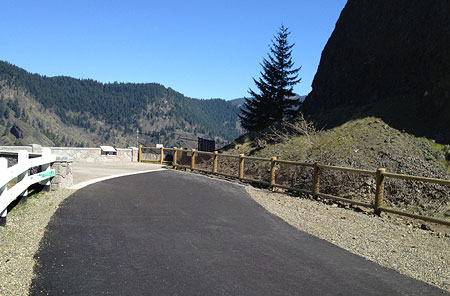
The short walk to the river overlook also gives a glimpse of the planned extension of the HCRH State Trail. As seen in the photo below, the broad paved path is actually a section of the state trail where it approaches the overlook, then bends toward the sheer cliffs at the base of Mitchell Point, ending at a log fence (for now). The proposed tunnel will eventually cut through Mitchell Point here, with a short side-tunnel to a river viewpoint somewhere near the midpoint.

The new section of the HCRH State Trail points toward a planned bicycle and pedestrian tunnel through Mitchell Point

The new section of the HCRH State Trail points toward a planned bicycle and pedestrian tunnel through Mitchell Point

New bicycle racks and native plants are part of the Mitchell Point facelift

New bicycle racks and native plants are part of the Mitchell Point facelift

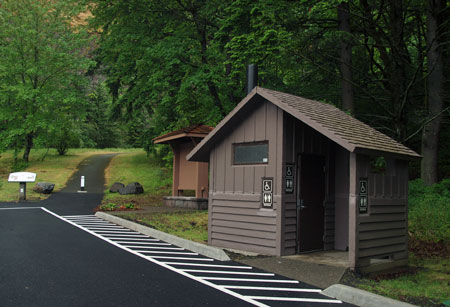
The improved Mitchell Point wayside also includes a new information kiosk and upgraded restrooms, making this a nearly full-service starting point for hikers — with the sole exception of running water, as none is available at the wayside.

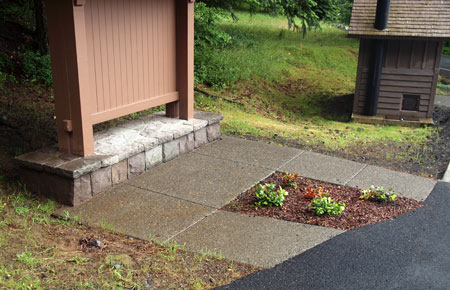
A surprising glitch in the generally excellent attention to detail is the wayside overhaul is an ill-placed square of landscaping in the middle of the paved information kiosk mini-plaza (below). The native salal planted in this tiny square of soil are surely doomed to be trampled by visitors, but more concerning is the impact on accessibility for mobility impaired visitors attempting to avoid this unnecessary obstacle. Fortunately, it’s easily fixed with a few sacks of concrete – hopefully before it becomes a problem.

This refurbished sign kiosk has an unfortunate glitch: an ill-placed patch of landscaping

This refurbished sign kiosk has an unfortunate glitch: an ill-placed patch of landscaping

A year-round, accessible restroom completes the upgrade at the Mitchell Point wayside

A year-round, accessible restroom completes the upgrade at the Mitchell Point wayside

Traces of the rich human history of the area can be seen throughout the Mitchell Point area, and the pair of new interpretive displays help put a face on the early settlements and businesses that once operated here. The history of the Mitchell Point “Tunnel of Many Vistas” at the overlook is excellent, and told with well-known images of this famous structure. But the history of the Little Boy Ranch and its operators found near the parking area is especially welcome, as it helps repeat visitors understand the many traces of old structures and even trees and landscape plants that can still be found sprinkled through the forest.

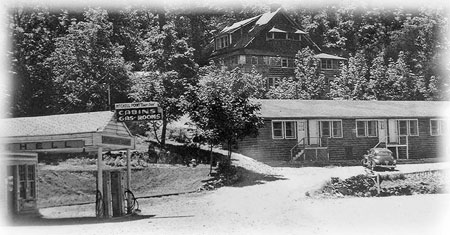
The Little Boy Ranch motel and cabins at Mitchell Point in the 1930s. The buildings were razed as part of freeway construction in the early 1960s

The Little Boy Ranch motel and cabins at Mitchell Point in the 1930s. The buildings were razed as part of freeway construction in the early 1960s

This 1920s Christmas card from Charles and Helena Parker's Little Boy Ranch featured their children, Charles Jr. and Joan

This 1920s Christmas card from Charles and Helena Parker’s Little Boy Ranch featured their children, Charles Jr. and Joan

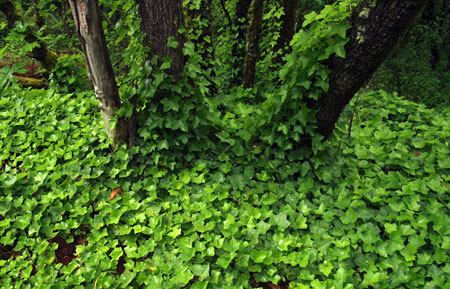
While most of the historical traces at Mitchell Point are subtle and treasured, one is not: English ivy left over from the Little Boy Ranch days is rampant in several sections of the park, and unfortunately, the wayside upgrade didn’t include pulling ivy from the park. This is another oversight that can be easily corrected, as the ivy is mostly confined to the immediate wayside area, and is a good candidate for a volunteer public service projects.

Rampant English ivy is among the unwelcome traces of the Little Boy Ranch era at Mitchell Point

Rampant English ivy is among the unwelcome traces of the Little Boy Ranch era at Mitchell Point

Another surprising gap in the wayside and trailhead upgrade is the lack of signage for the Mitchell Point and Wygant trails that begin here. A few boulders and a bollard barricade have been installed at the old path leading toward the Mitchell Point Trail, but there is still no signage to help visitors navigate the trail (below).

New bollard and boulders, but no sign to mark the Mitchell Point trail?

New bollard and boulders, but no sign to mark the Mitchell Point trail?

Worse, the actual trail to Mitchell Point splits off the paved path as an obscure, unsigned boot path, while the paved route continues (confusingly) to a few picnicking sites (below). This oversight is easily remedied, though there is some question whether OPRD really views the Mitchell Point trail as one of its own, despite the growing use and popularity. Now is good time for the state parks to finally embrace this trail, starting with needed signage.

The formal Mitchell Point Trail is even more obscure, but this is an easily corrected oversight in the OPRD restoration project

The formal Mitchell Point Trail is even more obscure, but this is an easily corrected oversight in the OPRD restoration project

The Wygant Trail fares somewhat better, with an existing HCRH-themed sign posted about 100 yards west of the Mitchell Point wayside, along a surviving segment of the old highway. But better signage at the wayside is needed to help hikers actually find this trail. This is another oversight that is relatively easy to correct, and in this case, could be incorporated into the planned improvements to the HCRH that are coming to this area.

A surviving segment of the old highway serves as the start of the Wygant Trail, though existing signage is obscure

A surviving segment of the old highway serves as the start of the Wygant Trail, though existing signage is obscure

Despite these oversights, the upgrade to the Mitchell Point wayside and trailhead are a big step forward, with excellent attention to detail and continuity with other recently improved parks and waysides in the Gorge. Kudos to the OPRD for their efforts!

The remainder of this article focuses on new trails that could be added to the park, building on existing facilities and the new HCRH State Trail with new hiking loops that explore the area.

Proposal: West Loop Trail

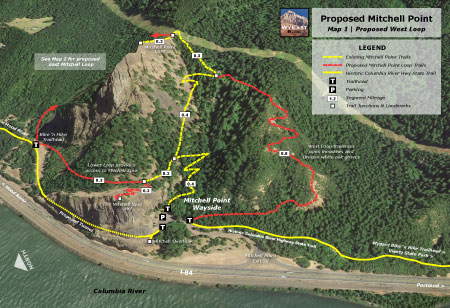
The first leg of an expanded trail system would be a new route traversing a series of open slopes to the west of Mitchell Point, joining the existing Mitchell Point Trail just below the main summit ridge (see map below)

MitchellPointTrails15

[click here to open a large map in a new window]

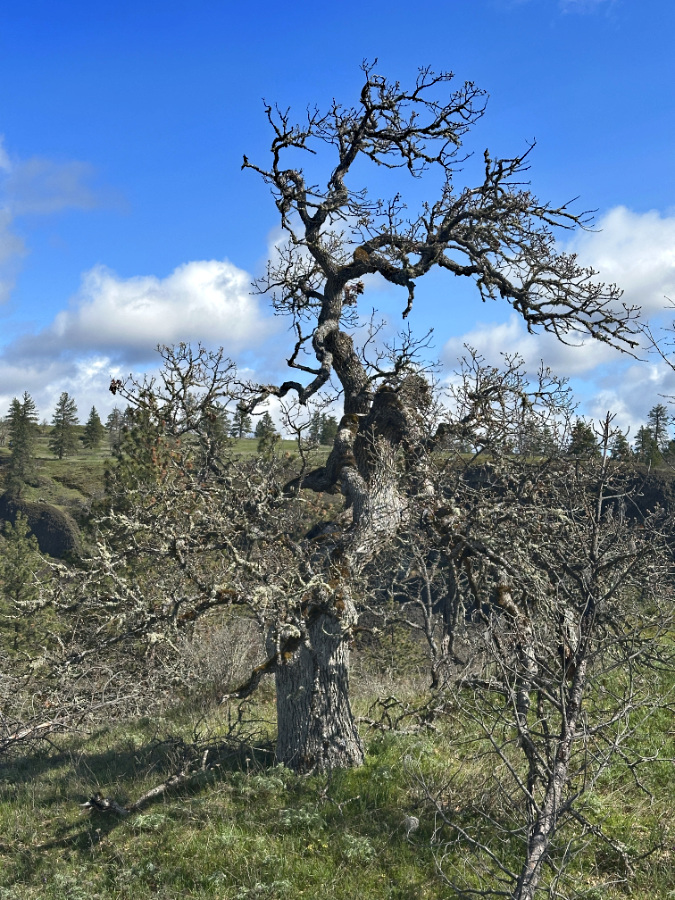
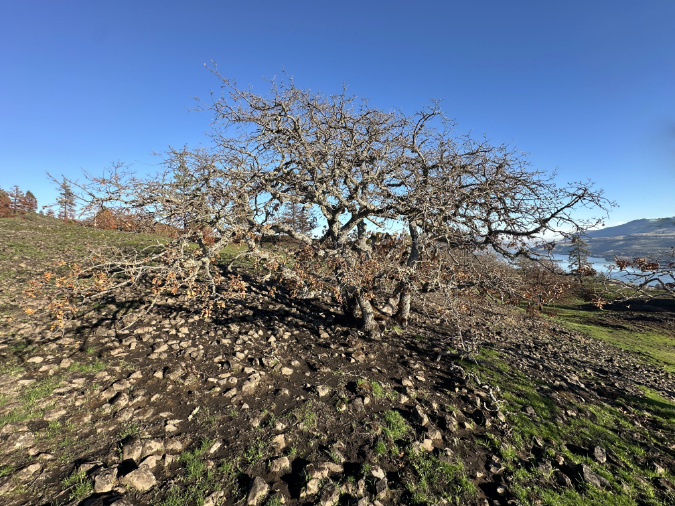
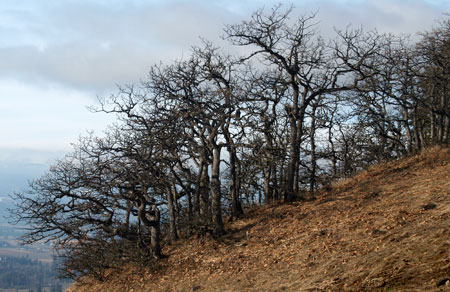
A highlight of this new 0.8 mile trail would be a close-up look at the stunted Oregon white oak groves that somehow survive on the dry, windy slopes here. Though not the western-most stand of oaks in the Gorge, this colony is among the most accessible, and the new trail would provide an opportunity for casual hikers to learn about this unique and fascinating ecosystem.

Oregon white oak in the Gorge often grow in picturesque, stunted groves on the harshest of sites

Oregon white oak in the Gorge often grow in picturesque, stunted groves on the harshest of sites

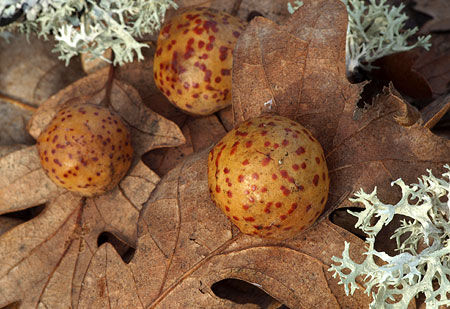
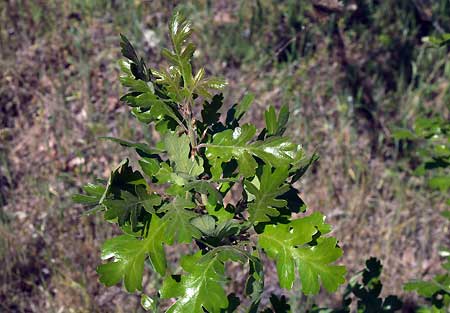
Oak galls are formed by wasp larvae, and are common on Oregon white oak leaves

Oak galls are formed by wasp larvae, and are common on Oregon white oak leaves

This new trail would also be built with a less demanding grade than the existing Mitchell Point Trail, giving less hardy hikers a more manageable option for reaching the summit.

Combined with the existing Mitchell Point Trail, the new would create a 2.6 mile loop for active hikers. Casual hikers and young families could make a shorter hike, with the beautiful oak stands and river views less than one-half mile from the trailhead as the main destination (perhaps with a couple of well-placed trailside benches).

Proposal: East Loop & Mitchell Spur

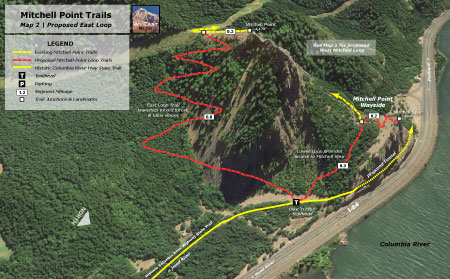
The east slope of Mitchell Point is unknown territory, even to hikers familiar with the area. This part of the proposal includes a new trail connection along the east slope, from the crest of Mitchell Point to the planned HCRH State Trail, creating a loop hike via the proposed new HCRH tunnel (see map, below).

MitchellPointTrails18

[click here to open a large map in a new window]

A lower loop would also be created with an extension of the existing boot path that leads to the foot of Mitchell Spur, the familiar basalt prow that towers over the highway at Mitchell Point. A formal side path would lead to the viewpoint atop the spur, providing another less strenuous alternative for casual hikers to the somewhat challenging Mitchell Point summit trail.

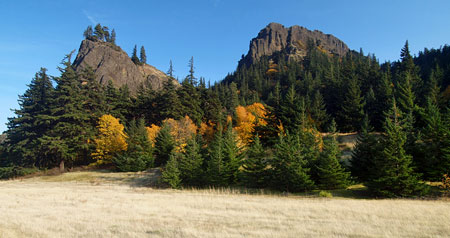
Mitchell Spur (left) is the lower rampart of Mitchell Point (right) in this highway view

Mitchell Spur (left) is the lower rampart of Mitchell Point (right) in this highway view

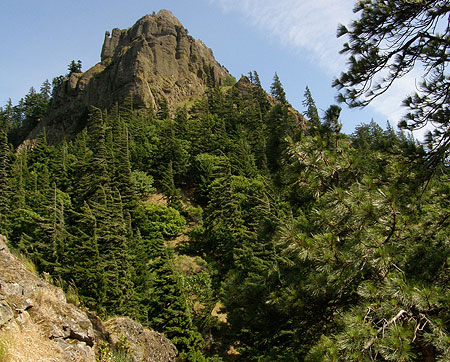
Mitchell Point looms above in this view from Mitchell Spur

Mitchell Point looms above in this view from Mitchell Spur

The east loop would join the Mitchell Point trail at this point along the summit ridge

The east loop would join the Mitchell Point trail at this point along the summit ridge

Combined with the existing Mitchell Point trail, the proposed East Loop would create a 3.6 mile hike, including stops at the summits of Mitchell Point and Mitchell Spur. Another option would be a loop using both the east and west trail proposals, a 3.8 mile round trip that would avoid the somewhat rugged talus section of the existing Mitchell Point trail altogether. Other loops from the Mitchell Point trailhead would also be possible, including the ability to follow the planned extension of the HCRH State Trail.

Yet another possibility that comes with the completion of the HCRH State Trail is the idea of a bike-and-hike trailhead for the proposed East Loop trail, where bicycle parking could be provided to allow cyclists to ride and park at the base of the trail. This concept has great potential for other trails that will eventually stub out at the completed HCRH State Trail — including the Wygant Trail in the Mitchell Point area.

What would it take?

The proposals in this article focus on relatively simple, affordable trail projects. Each of the proposed trail segments build on existing trailhead facilities and planned HCRH improvements in the area, while providing a significantly expanded series of hiking opportunities.

Sweeping river vistas from the summit leg of the Mitchell Point trail

Sweeping river vistas from the summit leg of the Mitchell Point trail

The proposals also lend themselves to volunteer construction, as the easy access from Portland and Hood River would allow public agencies and trail advocates in the region to easily organize volunteer crews to clear and build trails incrementally.

Most importantly, the OPRD is now in the process of updating its 1994 master plan for the Columbia Gorge, and it’s a crucial opportunity to bring new trail ideas into the plan! The OPRD recognizes the demand for new trails in the area, and is actively seeking ideas for projects that are both affordable and ecologically sustainable. The proposals in this article meet both tests, and ought to be included in the updated plan.

What You Can Do!

First, take a look at the Gorge Parks Plan website — our state recreation planners have done an exceptional job scoping the state of our Gorge parks as a starting point for updating the 1994 plan.

Next, weigh in on why new trails are important in the Gorge — and here are some of the proposals posted in this blog as a starting point:

Angels Rest Loop Proposal

Bridal Veil Canyon Proposal

Latourell Loop Makeover Proposal

Viento Bluff Trails Proposal

Mitchell Point Trails Proposal

Finally, consider signing up as a subscriber to the Gorge Parks Plan blog to stay informed. A surprisingly small number of dedicated citizens have been involved thus far in this public process, so you have an opportunity to make a real impact! More information on the Gorge planning effort to come in this blog, as well.

And as always, thanks for doing your part to advocate for the Gorge!

The Ancient Rowena Oak

The Rowena Oak

The Rowena Oak

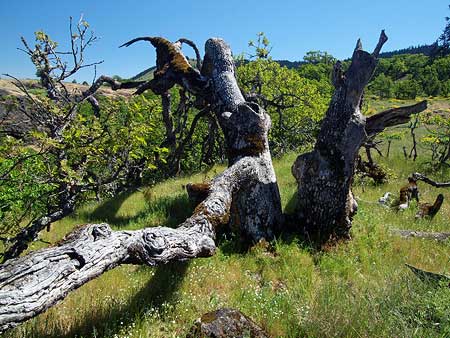
Somewhere under the heading of “hidden in plain sight” is a remarkable Oregon white oak (Quercus garryana) growing just a few yards from the Historic Columbia River Highway, near Rowena Crest. I stumbled across this old sentinel a few weeks ago while exploring the sprawling fields of arrowleaf balsamroot that Rowena is known for.

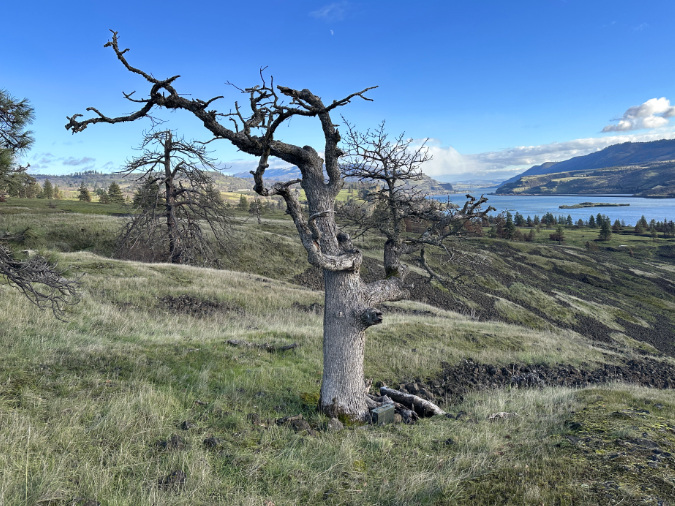
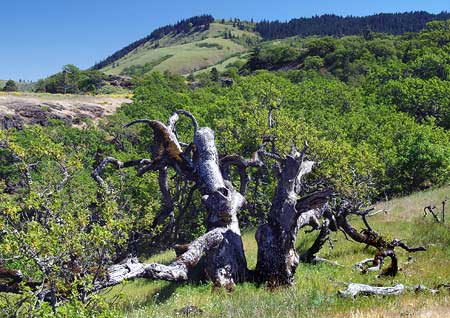
The venerable Rowena oak is not a particularly graceful tree: you won’t find it in coffee table books or on postcards. Though the gnarled trunks of these slow-growing trees are often living works of art, the Rowena oak is as much a battered monument to simple survival as it is a living sculpture. But it’s well worth a visit for anyone who loves ancient trees, and makes for a unique stop for those exploring the old highway.

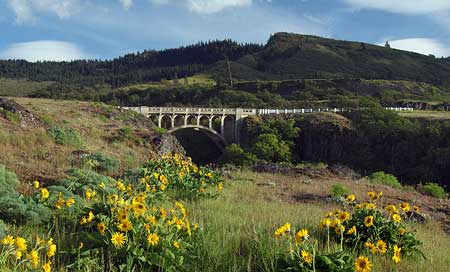
Dry Canyon Bridge and McCall Point from Rowena Plateau

Dry Canyon Bridge and McCall Point from Rowena Plateau

The tree is located in a most unlikely spot, near the brink of craggy Dry Canyon, a Missoula Flood feature that is part of the Rowena Dell canyon complex.

The sheer canyon walls are a reminder that the oaks surviving the harsh Rowena climate are anchored in a very thin layer of soil, atop hundreds of feet of layered basalt. This semi-desert ecosystem has an average of just 14 inches of rain per year, with hot, dry summers and freezing winters, and our infamous Gorge winds ready to strike up at any time, year-round.

The fact that Oregon white oaks can live to be hundreds of years old in this environment is truly remarkable. Part of their secret lies in a large taproot that not only anchors the trees in this windy, hostile environment, but also provides trees access to deep groundwater stored in the layers of basalt bedrock. The main taproot in these trees is complemented by a strong lateral root system, giving our native oaks an especially impressive root structure compared to most other tree species.

Dry Canyon and Rowena Dell from the highway bridge

Dry Canyon and Rowena Dell from the highway bridge

Despite these challenges, the oak trees of the dry savannah found at Rowena are thriving, and even the ancient sentinels in these groves are blooming and producing acorns with each spring.

The Rowena Oak grows just a few yards from the historic Dry Canyon bridge, and was clearly here to witness the construction Samuel Lancaster’s Historic Columbia River Highway and Conde McCullough’s iconic highway bridge over the rocky gorge in 1921. The old tree probably stood witness to first railroads being built in the late 1800s, as well — and the rise and fall of the salmon canning industry that swept through the Gorge toward the end of the 1800s.

The Rowena Oak with the Dry Canyon Bridge in the background

The Rowena Oak with the Dry Canyon Bridge in the background

In fact, at roughly two feet in diameter, the Rowena Oak could easily pre-date the arrival of Europeans in this part of North America. An Oregon State University (OSU) study of similar Oregon white oak habitat in Southern Oregon found that trees greater than 15″ in diameter were consistently 200 years or more years in age. The oldest oak in the OSU study was a whopping 429 years old, truly a testament to survival.

The huge, cascading Rowena Oak hangs into the protected niche of Dry Canyon

The huge, cascading Rowena Oak hangs into the protected niche of Dry Canyon

The arid climate at Rowena may be tough on trees, but it also helps preserve the life history of the old giants as they gradually succumb to the elements. Their broken tops and limbs are often preserved exactly where they fell decades ago, as mute testimony to the years of hardship these ancient trees have endured.

The Rowena oak is a great example, as it is surrounded by its own debris from decades of the ice storms, relentless winds and even the occasional lightning strike that are part of survival in the Gorge. The density of Oregon White oak wood helps in the preservation, as well — the same hardness that preserves its wood in the wild is also why these trees have historically been used to make furniture, flooring and barrels.

The Rowena Oak with Sevenmile Hill in the distance

The Rowena Oak with Sevenmile Hill in the distance

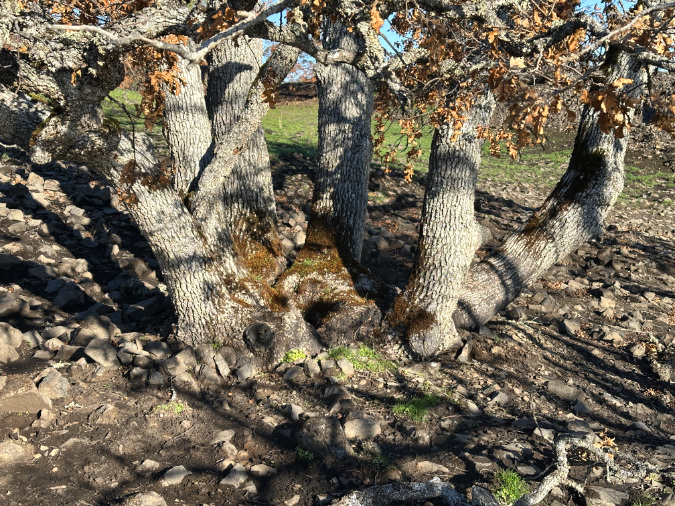
The Rowena oak has huge, twin trunks, the top of each toppled long ago by the elements. Lacking a top, the tree relies on four massive, sprawling limbs to survive, highlighting another survival secret of this species: Oregon White Oak sprouts prolifically from dormant buds on stumps and along trunks when tops are cut or broken off. This ability to adapt helped the Rowena oak survive what could have been catastrophic damage for most tree species.

The eastern of the two trunks points two massive, arching limbs toward the rim of Dry Canyon, and a closer look reveals yet another survival secret of this ancient tree: a tangle of branches cascade over the cliff like a leafy waterfall, with a lush canopy protected from the worst of the Gorge weather that sweeps across the top of the plateau.

A closer look at the sprawling Rowena Oak

A closer look at the sprawling Rowena Oak

A third major limb, nearly a foot thick, snakes a surprising 50 feet from the eastern trunk, along the exposed cliff edge of the canyon. This huge limb hovers just 2-3 feet above the ground — yet doesn’t touch — thanks to the tremendous strength of its wood.

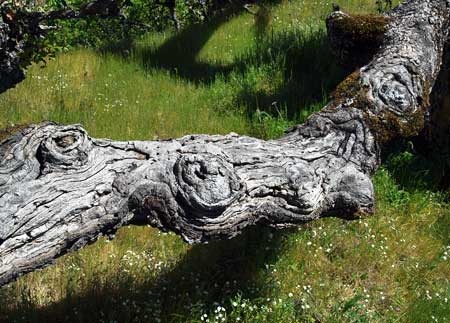
The huge, contorted limbs of the Rowena Oak have "eyes" that seem to be watching curious visitors!

The huge, contorted limbs of the Rowena Oak have “eyes” that seem to be watching curious visitors!

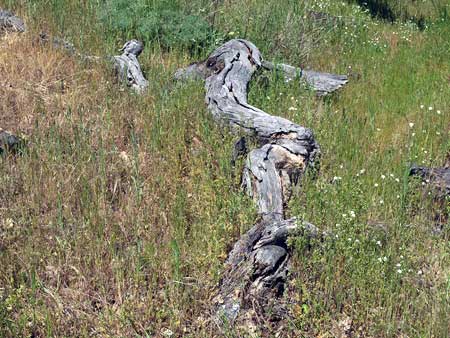
The western of the two main trunks has just one surviving major limb, a crooked, cracked affair that touches ground at several points, surrounded by the bleached bones of its own branches, broken off over the decades. Each of the fracture points in this broken old limb is marked with a thicket of new sprouts, showing how this old tree continues to regenerate, extending its long life.

One of the many bleached "bones" that help tell the survival story of the Rowena Oak

One of the many bleached “bones” that help tell the survival story of the Rowena Oak

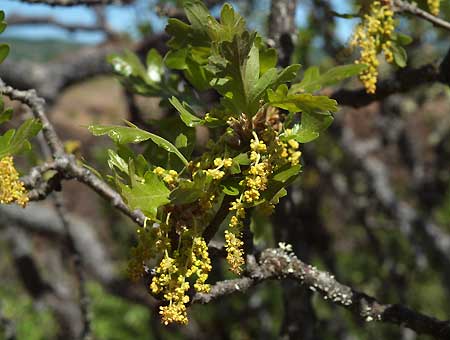
While the Rowena Oak may look haggard, its growing limbs are healthy, putting out annual bursts of new leaves each spring, along with surprisingly abundant flower clusters. These will soon yield acorns, completing a reproductive cycle this tree has likely repeated since the time when Lewis and Clark passed by, if not longer.

Spring brings another flush of new leaves on the venerable Rowena Oak

Spring brings another flush of new leaves on the venerable Rowena Oak

Spring blossoms on the Rowena Oak

Spring blossoms on the Rowena Oak

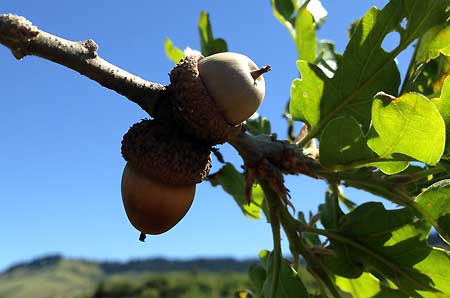
Though most have been stripped by the elements or wildlife, several acorns from last year’s crop are still attached to the Rowena Oak, waiting to be dispersed. A mature Oregon white oak can produce anywhere from 20 to 50 lbs of acorns in a season, depending on growing conditions.

Acorns may look tough, but they are designed to sprout new tree seedlings as soon as moisture and warmth allow, as the seeds only remain viable for a year or so. Only a very few will sprout, and only a tiny fraction of seedlings will survive to become trees.

A few acorns from last season are still attached to the Rowena Oak

A few acorns from last season are still attached to the Rowena Oak

The thickets of younger Oregon white oak trees we see in some parts of the Gorge today may be the result of fire suppression over the past century. Studies of Oregon white oak groves in the Willamette Valley by Oregon State University suggest that pre-settlement fires regularly thinned out seedlings, allowing established oak trees to thrive without the competition of young oaks. Fire also kept other, competing tree species at bay that otherwise would have crowded out the native white oaks.

Visiting the Rowena Oak

Though the spectacular fields of yellow balsamroot and blue lupine have mostly faded, Rowena is always fascinating to explore. The Nature Conservancy owns and manages a sizeable conservation preserve covering much of the area.

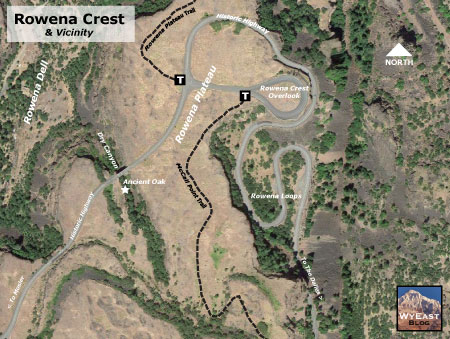
Visiting the Rowena Oak

Visiting the Rowena Oak

(click here for a larger map in a new window)

A lower trail leads across the Rowena Plateau to a cliff-edge view of the Columbia River, and an upper trail climbs to McCall Point to a sweeping view of Mount Hood and the Gorge. Less adventurous hikers can still enjoy terrific views of the Gorge by simply hiking the first quarter mile or so of these trails, so there are hiking options for every ability.

The Rowena Oak is located just a few steps off the Historic Columbia River Highway, immediately west of the Dry Canyon Bridge. Roadside parking is available as you approach the bridge from Mosier. Simply walk uphill along the west edge of the canyon, and you will immediately spot the old oak from a low rise adjacent to the highway. This is an easy, rewarding stop for families with young kids, as the tree tells a fascinating story of survival.

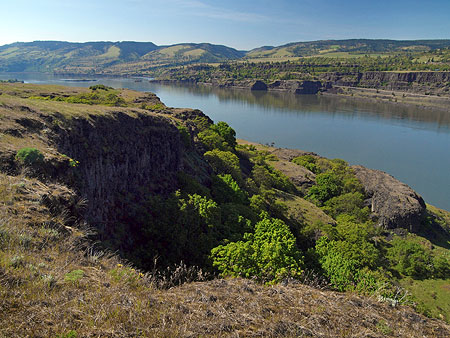
Spectacular river views reward hikers on the Rowena Plateau trail

Spectacular river views reward hikers on the Rowena Plateau trail

The longer hikes to the Rowena Plateau and McCall Point are quite busy during April and May during the wildflower bloom, but you’ll have them to yourself later in summer and fall, when the flowers are gone but the landscape is just as impressive. While the upper trail leads to broad views of the Columbia River and Mount Hood, the lower trail has a unique pair of “kolk” lakes formed during the Missoula Floods, and equally impressive views of the river and Rowena Dell.

Springtime balsamroot atop McCall Point on the upper trail

Springtime balsamroot atop McCall Point on the upper trail

As with all eastern Gorge hikes, use caution hiking in the heat of summer, as there is little tree canopy to shade these trails. The Nature Conservancy also asks that you stay on the trails, and be aware of the triple hazard of rattlesnakes, poison oak and ticks that are standard for the eastern Gorge. The first two in this list are easy to avoid, but you should prepare for ticks, and follow more rigorous precautions (see this recent article on ticks for a few tips). Note that the trails at Rowena are closed in the winter, when they can be slick and potentially hazardous.