Dry Creek Ponds: Orphaned Gems

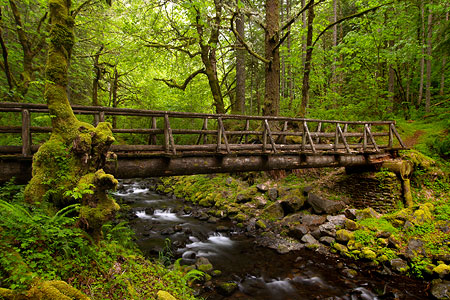
Dry Creek flows into a series of lush ponds just south of I-84.

Dry Creek flows into a series of lush ponds just south of I-84.

Just inside the city limits of Cascade Locks — and just outside the protection of the Columbia Gorge National Scenic area — lie a series of beautiful ponds and an adjacent group natural springs so pure that a national bottled water corporation is considering a new plant here. The ponds, themselves, are posted with real estate signs advertising dream home sites in this pretty location, albeit within earshot of noisy I-84.

The ponds underscore one of the dilemmas facing natural sites in the Columbia Gorge that happen to fall within the designated “urban areas” that are excluded from scenic area protection. Most of the Gorge towns are too small to have the fiscal means to protect these orphaned gems, even if they wanted to. Meanwhile, the non-profit organizations and federal agencies involved in land acquisition focus exclusively outside these urban areas. The result is a surprising number of natural features that face great risk of development, with no clear path for protection.

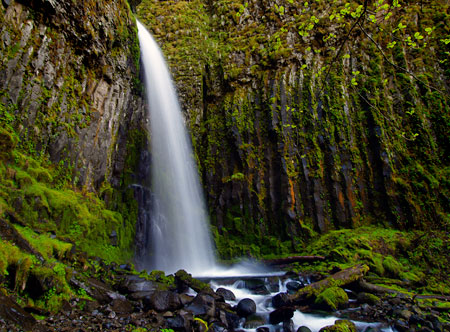
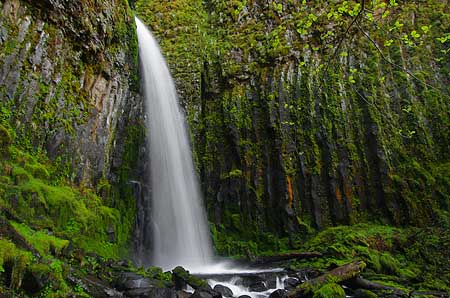
Dry Creek is better known for its waterfall, about a mile upstream from the ponds.

Dry Creek is better known for its waterfall, about a mile upstream from the ponds.

In the case of the Dry Creek Ponds, much of the land is already up for sale, and the real question is whether some sort of public purchase could intervene, and save the ponds from development. The ponds are not entirely pristine: a frontage road along I-84 borders one of the ponds, and there are a few homes tucked into the forest near the ponds. But the ponds are largely undeveloped, and surely worth more to the public as protected natural areas than to a few as exclusive home sites.

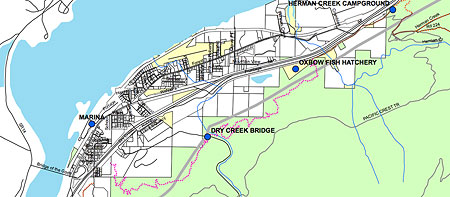
One option for protecting the ponds is the federal acquisition program operated by the Forest Service to consolidate lands within the scenic area. Their guidelines focus outside the urban areas, but a case could easily be made to cross those boundaries when natural sites are adjacent to surrounding public land. This is the case for the Dry Creek ponds, which not only abut the scenic area, but also the federal Oxbow fish hatchery.

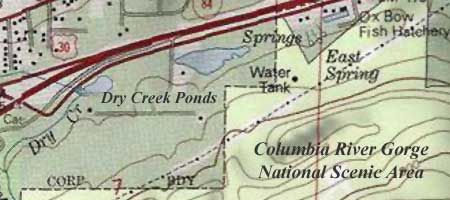
Dry Creek ponds are located outside the protection of both the National Scenic Area boundary and the nearby Oxbow fish hatchery.

Dry Creek ponds are located outside the protection of both the National Scenic Area boundary and the nearby Oxbow fish hatchery.

A second option for protection are the private agencies involved in land acquisition within the scenic area. These organizations typically turn most of their acquisitions over to the federal government for long-management, so in the case of the Dry Creek Ponds, it would still be important to find a way for federal acquisitions to exist inside the urban areas.

A third option is for local governments to step up to the challenge, and create a municipal park or natural area for its local citizenry. In this case, the City of Cascade Locks is the local government in question, and like most of the small cities in the Gorge, is financially strapped. So a hybrid approach where the federal agencies, or perhaps the non-profits (or both) help the small cities make strategic acquisitions of places like the Dry Creek Ponds.

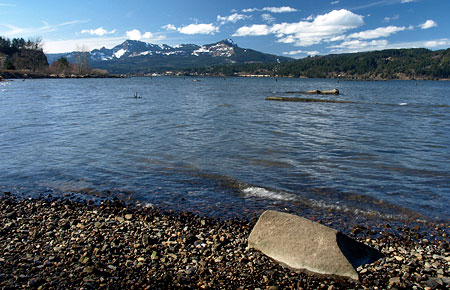
The ponds are teeming with wildlife, despite the noise of the nearby freeway.

The ponds are teeming with wildlife, despite the noise of the nearby freeway.

One of the truisms about sudden growth in small communities like Cascade Locks is that the civic awareness of threats to natural areas usually comes too late in the development boom. After years of slow growth, Cascade Locks is slowly awakening. So, like other Gorge communities, the town is entering a short window of opportunity for natural area protection that will be fleeting.

The Dry Creek Ponds are worth saving. The ponds are home to waterfowl, beaver and a thriving population of other species in the wetlands and forest that border the ponds. The ponds are unique in having such close proximity to Cascade Locks, and therefore easy access for visitors. This is one of only a few places in the Gorge where it is easy to get very close to a pond ecosystem, and thus could provide a valuable place for learning and wildlife watching.

Wetland birds thrive in tall marshes that border the ponds.

Wetland birds thrive in tall marshes that border the ponds.

The ponds could also provide a starting point for hikers to head up Dry Creek to the falls — or points beyond along the Pacific Crest Trail, which passes just above the ponds, inside the scenic area.

In the end, the fate of the ponds will be a measure of our collective will to protect the larger Gorge landscape for generations to come, no matter where we’ve drawn lines on maps or how we have divided public land management responsibilities. In this way, the ponds provide an opportunity for local citizens, public land stewards and non-profit environmental advocates to show that our collective vision extends across those artificial boundaries.

Between a rock and a hard place…

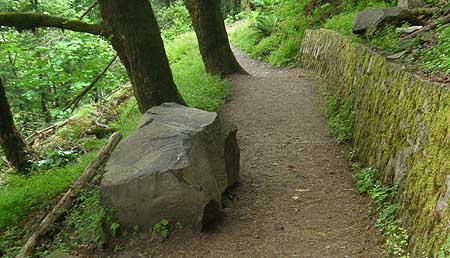
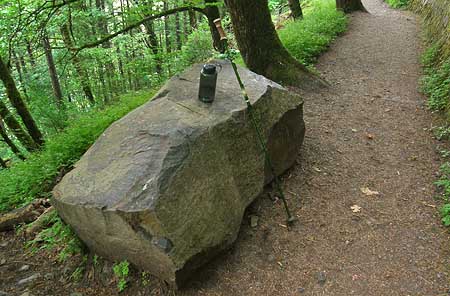
Sometime in the past couple of years, a refrigerator-sized piece of basalt split from the cliffs above Horsetail Falls, tumbled across two switchbacks on Gorge Trail 400, and landed perfectly on a third, forming a handy bench that only Mother Nature could design – or did she?

The convenient boulder that recently appeared on Trail 400, above Horsetail Falls - the work of man or nature?

The convenient boulder that recently appeared on Trail 400, above Horsetail Falls - the work of man or nature?

Rocks like this are constantly breaking loose from the walls of the gorge, usually far from the view or earshot of hikers. Through the relentless effects of water, and cycles of freeze and thaw during the winter months, bits and pieces of the stacked layers of basalt eventually break free, and join the enormous piles of talus that have accumulated beneath the cliffs over the millennia.

The new bench-boulder above Horsetail Falls is a bit chunkier than most, but tiny when compared to the house-sized boulders that are known to break loose on occasion. One infamous event near Wahclella Falls in the late 1960s was massive enough to send an entire subdivision of house-sized boulders into Tanner Creek, temporarily forming a small lake in the aftermath.

Looking down at the new boulder, the view is a bit more menacing, with a big bite taken out of the solid rock wall in the foreground, and a trail of debris, below.

Looking down at the new boulder, the view is a bit more menacing, with a big bite taken out of the solid rock wall in the foreground, and a trail of debris, below.

Assuming that the big rock did land in the middle of the trail, there are a couple of miracles that suggest divine placement. First, the boulder missed the adjacent wall, though it took a sizeable bite out of a retaining wall further uphill (see photo, above). Second, the boulder managed to land parallel to the path, and just far enough from the rock wall to allow hikers to easily slip between… a rock and a hard place!

It’s possible that trail crews could have jimmied this massive stone into its convenient position, but unlikely. Just one cubic foot of solid basalt weighs in at a staggering 188 lbs, which means that this fridge-sized weighs at least 12,000 pounds — more than six tons!

Perfect for a trailside respite, the big rock bench is already a favorite of hikers

Perfect for a trailside respite, the big rock bench is already a favorite of hikers

A more unnerving thought is the possibility of hikers actually witnessing nature at work, here, given the popularity of this well-traveled path nearly year-round. But, even with the scores of hikers walking by, there are plenty of quiet spells during the winter season, when this stone most likely made its move — and there’s also the dark of night.

However the big rock arrived, it has already become a popular stopping point for newbie hikers, puffing their way up the trail from Horsetail Falls, in search of Ponytail Falls. In this way, the big rock might just be Mother Nature’s way of tempting her most impatient species to stop and relax, if only for a moment.

Tunnel Point Wayside

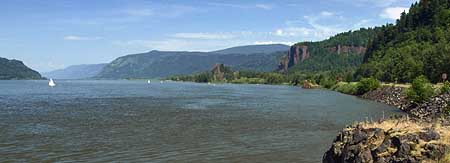
The sprawling vista into the Gorge from Tunnel Point Wayside

The sprawling vista into the Gorge from Tunnel Point Wayside

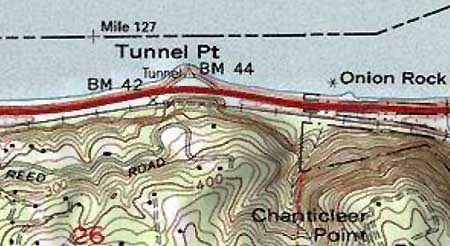
Mostly lost in the noise of Interstate-84, the tiny Tunnel Point Wayside is a forgotten bit of ground that deserves a little more respect. This spot is named for the railroad tunnel that cuts through the lower buttress of Chanticleer Point, to the south. In the early days of Highway 30 construction in the Gorge, the wayside at Tunnel Point was designed as a scenic turnout for visitors. From here, the first big view of the Gorge spreads out, with Crown Point and Vista House framing the scene.

TunnelPointMap

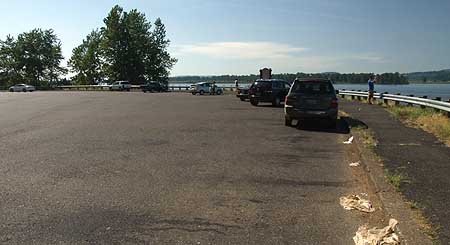
Today, freeway barricades prohibit access to the wayside for eastbound travelers entering the Gorge, and the turnout is an afterthought for most westbound travelers, since the Gorge view is behind them. The wayside has thus devolved into a huge, paved layover spot for semi-trucks — a sad epitaph for what should (and could) be a premier gateway viewpoint in the Gorge.

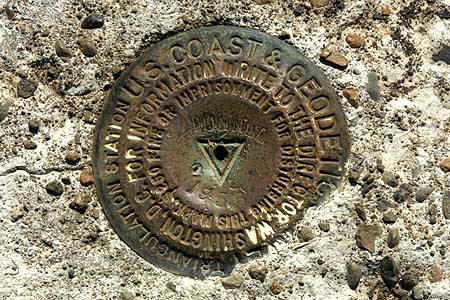
Tunnel Point has two U.S.G.S. benchmarks and a ship beacon bolted to its tiny, rocky cape. Beyond the sterile steel guardrail that borders the turnout, basalt cliffs drop 20 feet into the river. These little cliffs are likely remnants of a more noble formation, undoubtedly quarried to help build the modern highway in the Gorge in the 1940s and 50s. But they still give a sense of the natural environment that once existed here, and provide for an interesting shoreline along the river.

This USGS benchmark was placed in 1956, likely in conjunction with modern highway construction in the Gorge.

This USGS benchmark was placed in 1956, likely in conjunction with modern highway construction in the Gorge.

Look closely at these rocky mini-bluffs and you’ll see cliff-dwelling Gorge plants making a home, while red alder and Douglas fir are colonizing the rocky shoreline on both sides of Tunnel Point. Nature is making a valiant attempt to restore this spot, even if we humans are lagging in the effort.

How could the Tunnel Point Wayside be restored? For starters, the massive expanse of asphalt could be redesigned to restore green areas, with landscaping, trees, picnic tables, restrooms and perhaps a travel information center. After all, this spot is as much a gateway to the Portland metropolitan area as to the Gorge, given that access is limited to westbound travelers.

Next, a series of walking paths could be added along the little bluffs, providing a place for travelers to stretch their legs, and learn a bit about the Gorge. A wooden Oregon History sign is already mounted in the parking area, and could be restored to become part of an improved interpretive display and walking path system.

Wasted space: the vast, barren turnout at Tunnel Point.

Wasted space: the vast, barren turnout at Tunnel Point.

These improvements would provide for a welcome refuge for travelers arriving in the Portland region from points east, but what about travelers entering the Gorge from the west? Providing access to eastbound visitors would be a tall order, requiring some sort of overpass or tunnel to deliver visitors from the opposite side of the highway. The cost, logistics and visual impacts probably make this infeasible, unfortunately.

But for now, improving the wayside for westbound traffic would be a big step in the right direction. Since the wayside is within the highway right-of-way, improvements could be built by the Oregon Department of Transportation (ODOT) with highway funds, in conjunction with Oregon Parks and Recreation. Tunnel Point Wayside deserves this new lease on life, and travelers in the Gorge deserve to enjoy this unique perspective of the river and Gorge.

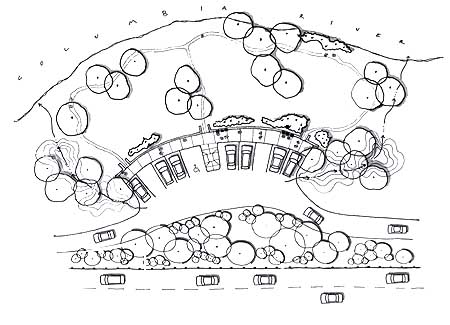
Postscript: after writing this article a few months ago, I ran across a “generic” roadside pullout design in the 2005 I-84 Design Strategy — a joint ODOT, U.S. Forest Service, Federal Highway Administration and Columbia Gorge Commission planning document that lays out the framework for future improvements to the highway within the Columbia River Gorge National Scenic Area.

The schematic looks tailor-made for the Tunnel Point Wayside, and in this design, reclaims much of the parking area as a park with riverside loop trail. Though hard to see in this scaled-down version, the plan calls for just ten parking spots, with trucks obviously barred from entering (the truck stops in Troutdale are only a few miles further, after all). Most interesting are bio-swales on both sides of the pullout, draining the parking area and adding more green screening from the highway. A glimpse of what might be, perhaps?

Arrowleaf Balsamroot

Balsamroot blankets the Dalles Mountain nature preserve in spring; Mount Hood rises from the clouds on the horizon, above the Columbia River and the town of The Dalles

Balsamroot blankets the Dalles Mountain nature preserve in spring; Mount Hood rises from the clouds on the horizon, above the Columbia River and the town of The Dalles

In late spring across the arid mountain west, sunny slopes and open Ponderosa forests explode with bright yellow drifts off Arrowleaf balsamroot (Balsamorhiza sagittata), the native sunflower of the western states. These handsome plants are especially abundant along the dry east slope of the Cascades, where they are also known as Oregon sunflower.

The name “Arrowleaf” describes the large, felted leaves of this plant — though in size they are closer to a spade than an arrowhead, often as much as a foot in length. “Balsamroot” refers to the fist-sized, branched taproot that anchors these plants in their typically windswept, harsh environment. The roots have a strong, pine-scented (or “balsam”) sap. These oversized roots not only draw moisture from deep in the arid soils in which Arrowleaf balsamroot grow, but also allow the plants to easily survive fires.

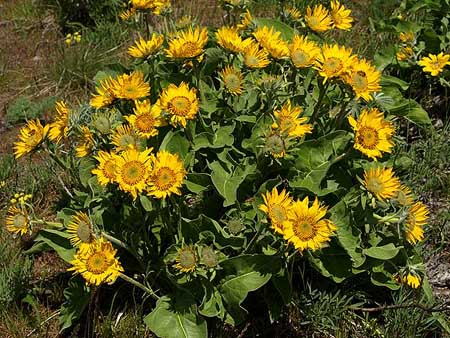
A typical balsamroot in spring, nearing peak bloom

A typical balsamroot in spring, nearing peak bloom

The flowers are actually complex collection of individual blossoms that give the illusion of a single, large flower head. The outer ring of “petals” emerge from dozens of individual florets, each producing one enormous petal that combine to form the ring of yellow petals. A close look at the developing flower head (below) shows these emerging super-petals as a fringe of green tips.

Honeybee on a balsamroot

Honeybee on a balsamroot

Native Americans used almost all parts of these plants for food. Tender shoots and leaves were eaten raw or steamed, and immature flower heads were peeled and eaten. The sunflower-like seeds were eaten dry, or roasted. The roots, which are bitter when raw, were cooked and ground into a meal that was used to make cakes, and dried and powdered to make tea.

The plant was also used for medicinal purposes, with green leaves used to treat burns and the boiled roots used to create a medicinal salve for small wounds. A tea made from the roots was used to treat respiratory ailments. Balsamroot is still used today in organic foods and herbal medicines.

Wildlife also depend on Arrowleaf balsamroot. The plants are tolerant of browsing by deer and elk, and the seeds are important forage for small mammals, such as the Columbia ground squirrel. Wild horses graze on the plants in spring, and are especially fond of the flowers. The plants are also grazed by domestic stock, though they are sensitive overgrazing.

Miles of balsamroot create a brief dusting of bright green and yellow on the desert slopes of the Eastern Gorge each spring

Miles of balsamroot create a brief dusting of bright green and yellow on the desert slopes of the Eastern Gorge each spring

In the right conditions, Arrowleaf balsamroot grow to fill whole mountainsides with their spectacular blooms. As the blooming season of Arrowleaf balsamroot peaks in late April or early May, the Columbia River Gorge provides one of the finer displays anywhere. Blue lupine is a frequent companion plant, providing a painting-perfect complement to the displays.

You can visit some of these spectacular displays by exploring Gorge hiking trails at Dog Mountain, Catherine Creek, Rowena Crest and Dalles Mountain Ranch. Check out the Portland Hikers Field Guide for more information on these destinations.