Arrowleaf Balsamroot

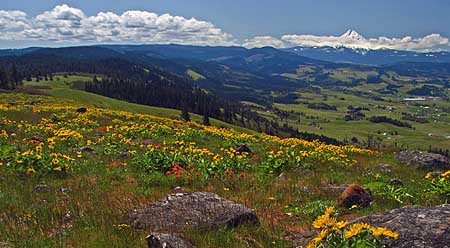
Balsamroot blankets the Dalles Mountain nature preserve in spring; Mount Hood rises from the clouds on the horizon, above the Columbia River and the town of The Dalles

Balsamroot blankets the Dalles Mountain nature preserve in spring; Mount Hood rises from the clouds on the horizon, above the Columbia River and the town of The Dalles

In late spring across the arid mountain west, sunny slopes and open Ponderosa forests explode with bright yellow drifts off Arrowleaf balsamroot (Balsamorhiza sagittata), the native sunflower of the western states. These handsome plants are especially abundant along the dry east slope of the Cascades, where they are also known as Oregon sunflower.

The name “Arrowleaf” describes the large, felted leaves of this plant — though in size they are closer to a spade than an arrowhead, often as much as a foot in length. “Balsamroot” refers to the fist-sized, branched taproot that anchors these plants in their typically windswept, harsh environment. The roots have a strong, pine-scented (or “balsam”) sap. These oversized roots not only draw moisture from deep in the arid soils in which Arrowleaf balsamroot grow, but also allow the plants to easily survive fires.

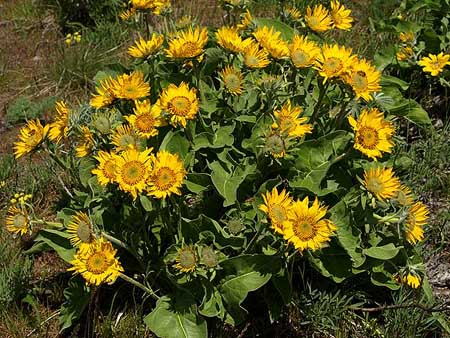
A typical balsamroot in spring, nearing peak bloom

A typical balsamroot in spring, nearing peak bloom

The flowers are actually complex collection of individual blossoms that give the illusion of a single, large flower head. The outer ring of “petals” emerge from dozens of individual florets, each producing one enormous petal that combine to form the ring of yellow petals. A close look at the developing flower head (below) shows these emerging super-petals as a fringe of green tips.

Honeybee on a balsamroot

Honeybee on a balsamroot

Native Americans used almost all parts of these plants for food. Tender shoots and leaves were eaten raw or steamed, and immature flower heads were peeled and eaten. The sunflower-like seeds were eaten dry, or roasted. The roots, which are bitter when raw, were cooked and ground into a meal that was used to make cakes, and dried and powdered to make tea.

The plant was also used for medicinal purposes, with green leaves used to treat burns and the boiled roots used to create a medicinal salve for small wounds. A tea made from the roots was used to treat respiratory ailments. Balsamroot is still used today in organic foods and herbal medicines.

Wildlife also depend on Arrowleaf balsamroot. The plants are tolerant of browsing by deer and elk, and the seeds are important forage for small mammals, such as the Columbia ground squirrel. Wild horses graze on the plants in spring, and are especially fond of the flowers. The plants are also grazed by domestic stock, though they are sensitive overgrazing.

Miles of balsamroot create a brief dusting of bright green and yellow on the desert slopes of the Eastern Gorge each spring

Miles of balsamroot create a brief dusting of bright green and yellow on the desert slopes of the Eastern Gorge each spring

In the right conditions, Arrowleaf balsamroot grow to fill whole mountainsides with their spectacular blooms. As the blooming season of Arrowleaf balsamroot peaks in late April or early May, the Columbia River Gorge provides one of the finer displays anywhere. Blue lupine is a frequent companion plant, providing a painting-perfect complement to the displays.

You can visit some of these spectacular displays by exploring Gorge hiking trails at Dog Mountain, Catherine Creek, Rowena Crest and Dalles Mountain Ranch. Check out the Portland Hikers Field Guide for more information on these destinations.

Scorpions!

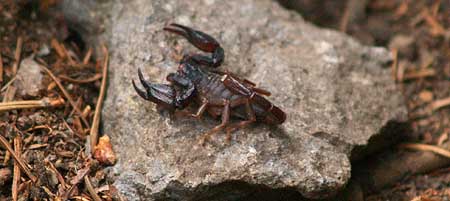
At first glance, just a wayward crayfish.. but wait! Is that (gulp!) a scorpion's tail..?

At first glance, just a wayward crayfish.. but wait! Is that (gulp!) a scorpion's tail..?

A couple of years ago, I stopped to do some trail tending on the way down from Tamanawas Falls, on the Cold Spring Creek trail. It was dusk, and I was moving some rocks around to improve the tread in a gravelly area, on a slope just above the rushing creek. I spotted what looked like an oval coin, where I had just turned over a rock. Closer inspection revealed a pair of pincers and a tail, perfectly coiled up and tucked in around an armored body.

I thought it might be a crayfish that had somehow made its way up the slope to the trail. But suddenly, the creature exploded into motion, bolting to the top of a nearby rock at a speed that no crayfish could reach out of water. At that point, the tail was extended, and I realized I was looking at a scorpion!

It was nearly dark, so I quickly set up my tripod, as the scorpion sat motionless for me — apparently agreeable to an unscheduled portrait. The first view (above) was his semi-alert position that he held until I moved the camera closer for a better shot. At that point, he went into what can only be described as a “defensive” posture (below), and I must say that this sent some of my primal neurons into overdrive!

What scorpions do when they've decided their photo-op is over..!

What scorpions do when they've decided their photo-op is over..!

I snapped a couple more shots of this pose before he abruptly raced up the slope — right past my foot, alarmingly — and into the brush. It was exhilarating because I don’t often stumble upon some new creature that I haven’t seen before, and especially one this exotic and seemingly out-of-place. What was a scorpion doing in a lush, mountain canyon along a rushing stream? Aren’t they desert dwellers?

After the trip, I researched scorpions a bit, and learned that they do, indeed, inhabit the Cascades as far north as British Columbia. Though I have yet to positively identify this one, it appears to be Paruroctonus boreus, the Northern Scorpion, or possibly one of the Vaejovis scorpion species native to Oregon. Its body was about 2″ in length, claws roughly an inch long, and the tail around 2″ long.

Oregon State University zoologist Philip Brownell provides helpful background in this article on just how scorpions could survive in a place like Cold Spring canyon, where deep snow covers the ground for months every winter. The key is their unique metabolic ability go into stasis in underground burrows, using little oxygen and requiring little food until conditions on the surface improve. But unlike other hibernating creatures, scorpions can quickly switch from stasis to active hunting in a matter of minutes.

Scorpion Mountain, in the Bull of the Woods country south of Mount Hood, might just have been inspired by the real thing, after all..!

Scorpion Mountain, in the Bull of the Woods country south of Mount Hood, might just have been inspired by the real thing, after all..!

Scorpions are live-bearing, with the female carrying her brood on her back until their first molt, upon which they head off on their own. If you get the creepy-crawlies from the sight of scorpions, I don’t suggest Googling images of a female ferrying her batch of young one around! They’re also nocturnal, so you’re unlikely to ever see one in the Cascades.

And what of the dreaded venom? Well, the Northern Scorpion’s venom is listed as a potentially dangerous neurotoxin for humans by some sources, with swelling and pain at the site of the sting, and possibly other more serious reactions. So it’s pretty clear that these creatures are to be seen, but not handled.

According to the National Geographic article link, above, the toxicity of the venom is inversely proportional to the size of the pincers, since large-clawed scorpions tend to hunt their insect prey with their claws, where small-clawed species are more likely to depend on their venom to immobilize their prey.

The spot where I found my specimen was classic habitat for Northern scorpion, according to several web sources. This species apparently lives on dry, loose riverbank slopes in much of its range. So that means that the entire Cold Spring Creek canyon is prime habitat, not to mention most every other canyon in this part of the Cascades.

So, keep that in mind, next time you’re turning over stones in the woods!

Hood River Mountain Trophy Homes

These fragile slopes on Hood River Mountain -- covered in their spring blanket of yellow balsamroot -- were recently scarred with a driveway to yet another ill-conceived trophy home.

These fragile slopes on Hood River Mountain -- covered in their spring blanket of yellow balsamroot -- were recently scarred with a driveway to yet another ill-conceived trophy home.

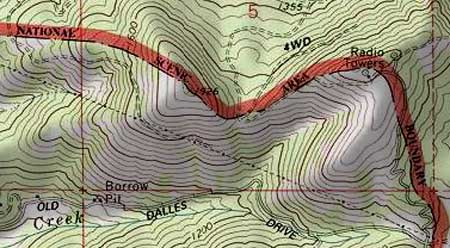
One of the great tragedies of the Columbia River National Scenic Area Act (signed into law on November 17, 1986) was the crude delineation of what should be protected and what should not. The official boundary was eventually determined by pulling in terrain that could be viewed from the river, and from a scenic resources perspective, this was a fair starting point.

But the flaw in this thinking is that nature rarely follows clear boundaries, and some of the most precious lands in the Gorge were excluded by virtue of being hidden from view. It’s times to correct that oversight. It was also automobile-centric, since gorge visitors on foot, bicycle or horseback are likely to visit the high points and overlooks that have a broader viewshed.

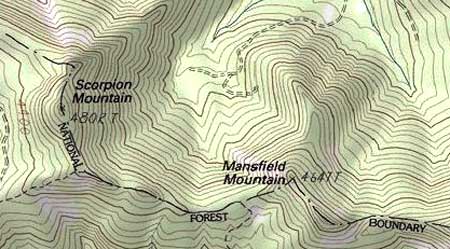
This map shows how the scenic area boundary excluded the unique, open slopes of Hood River Mountain shown in the previous photo.
This map shows how the scenic area boundary excluded the unique, open slopes of Hood River Mountain shown in the previous photo.
One such area is Hood River Mountain. Hikers flock to the area, though few realize that they’re hiking on private land (despite a sign stating so). Still fewer know that the land they are hiking on has no protection from the Columbia River National Scenic Area, though the Columbia River can be seen below. Without Oregon’s strict statewide planning, this area would be maze of roads and trophy homes by now. Instead, the mountain survives largely intact, in big parcels owned by a Washington timber company.

But not all of Hood River Mountain was spared. The northern extent had already been divided into smaller parcels by the time Oregon’s planning laws were enacted in the 1970s, and today these parcels are in high demand for trophy homes. The dwelling pictured at the top of this article was recently constructed on one such parcel, scarring the mountain forever with a quarter-mile driveway. This gouge across the delicate sloped meadows of arrowleaf balsamroot threatens to destabilize sensitive soils, placing an important ecosystem at risk.

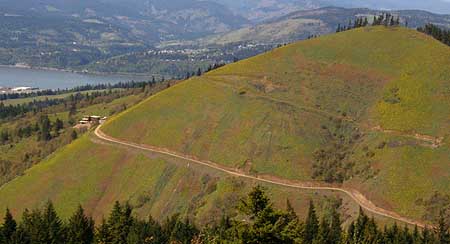
The sprawling meadows on Hood River Mountain are owned by a (so far) benevolent timber company, but are on the wrong side of the scenic area boundary for the purpose of public protection.

The sprawling meadows on Hood River Mountain are owned by a (so far) benevolent timber company, but are on the wrong side of the scenic area boundary for the purpose of public protection.

This development on the northern tier of Hood River Mountain is a jarring reminder that in the short term, the scenic area boundary must be revisited to identify rare or endangered ecosystems, or other important resources that abut the line. Adjusting the boundary in these areas would open the door to federal protections and public acquisition of these sites over time.

In the long-term, the more difficult question of acquiring and either removing, or re-purposing some of the more egregious trophy homes must be addressed. The Forest Service has rarely crossed this line, largely due to lack of adequate funding for acquisition to begin with. Someday, this will be an important part of the restoration vision of the Mount Hood National Park Campaign. But for now, simply stopping the bleeding is a more pragmatic goal. The Forest Service must receive more funding to accelerate private acquisitions.

Trophy home gate on Hood River Mountain, where high anxiety accompanies country living for these dream-home dwellers.

Trophy home gate on Hood River Mountain, where high anxiety accompanies country living for these dream-home dwellers.

The State of Oregon and local governments can also help on this front. The state and local jurisdictions could offer a tax incentive for trophy-home owners in high-profile locations to eventually deed these homes to the public for demolition, removal or reuse as a public facility.

In the meantime, the counties that issue permits for rural trophy homes can raise the bar for what they are willing to accept in engineering as geotechnical justifications for these projects. The Forest Service could assist the counties in providing an enhanced permit process, as a strategy for preventing the least sustainable eyesores from slipping through.

Non-profit land advocates are already important partners in addressing both the short and long-term problem. Today, at least three of these organizations have begun to acquire private lands in the Gorge, and are advocating for expanding the scenic area boundaries to encompass more endangered lands. Since the non-profits are not bound by official designations, and could begin working immediately with landowners to acquire land at overlooked places like Hood River Mountain, they offer the potential to work far in advance of the federal bureaucracy.

Each of us can help by supporting the non-profits who do this work. Most prominent are the Trust for Public Lands, Friends of the Columbia Gorge and the Nature Conservancy. You can find contact information for all three in this directory of organizations. Consider joining or simply contributing to one of these groups, and helping protect some of our most unique landscapes so that they may someday be intact or rehabilitated — as part of the Mount Hood National Park vision.

Western Pasque Flower

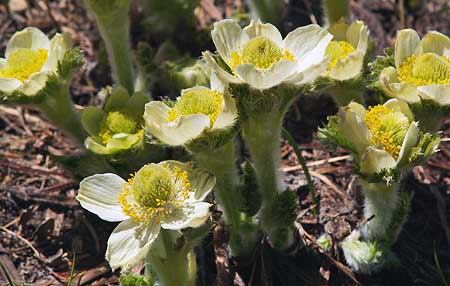
The blossoms of the Western Pasque Flower emerge just after snow melt

The blossoms of the Western Pasque Flower emerge just after snow melt

The earliest visitors to the Mount Hood high country are among the lucky few to see Western Pasque Flower (Anemone occidentalis) in bloom. The cream-colored blossoms of these plants emerge in meadows and on sandy mountain slopes as soon as the snow melts, often along the margins of lingering snow patches. Western Pasque bloom even before their foliage emerges, allowing the plants to accelerate seed production in the short mountain summers.

After just a few days in bloom, the petals drop, and the Western Pasque enters a second stage, where the flower heads take on the form of a green sea anemone, with balls of soft spikes rising above emerging, fern-like foliage.

The second phase of the Western Pasque Flower, when the new seedheads are in their sea anemone form

The second phase of the Western Pasque Flower, when the new seedheads are in their sea anemone form

The second phase goes unnoticed by most mountain visitors, lost in the green of rapidly awakening meadows. But during this phase, the seedheads begin their metamorphosis to the final stage that gives Western Pasque Flower its best-known persona.

In this phase, the prickly “sea anemone” globes suddenly grow an impressive mane of white hair that is like no other alpine flower. The dramatic seedheads of the Western Pasque persist at this stage from late July well into the fall, when the seeds are finally distributed.

The final phase of the Western Pasque Flower, when it becomes the Old Man of the Mountains

The final phase of the Western Pasque Flower, when it becomes the Old Man of the Mountains

The whimsical appearance of the Western Pasque in this final form has given rise to a number of equally colorful common names:

• Old Man of the Mountain
• Tow-Headed Baby
• Mop Top
• Hippie-on-a-Stick
• Mouse-on-a-Stick

As a child of the 70s, I suppose it’s not surprising that I call them “Muppets of the Mountains”. They’re like an old friend to hikers, greeting us as we venture to our favorite alpine meadows and swales on bright summer weekends, waving in the breeze with their silky “wigs” growing more curious and eccentric by the day.

Western Pasque Flower carpet Elk Cove in summer

Western Pasque Flower carpet Elk Cove in summer

If Native Americans gathered these plants, their local use was apparently not passed along to anthropologists. Other American species of Anemone were used by Native Americans for a variety of medicinal uses, but perhaps the high-elevation range of the Western Pasque simply made it impractical to harvest? In most years, the high meadows that these plants call home are only snow-free for 3-4 months in summer.

Today, you can find Western Pasque Flower above 5,000 feet in Mount Hood’s alpine meadows and steep, sandy slopes. The plants are most prolific at Elk Cove and Paradise Park, but can be founds along many sections of the Timberline Trail, blooming in mid-July and in their more familiar bearded form from Late July through September.

They paved paradise, put up a parking lot…

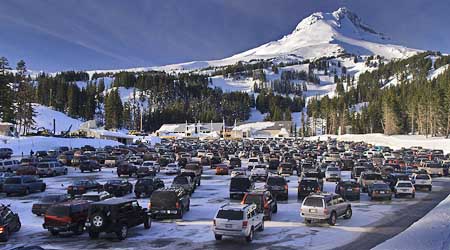
The sprawling Mount Hood Meadow parking lot is a sea of cars in ski season

The sprawling Mount Hood Meadow parking lot is a sea of cars in ski season

First-timers arriving at the Mount Hood Meadows resort in winter are greeted with a handsome view of the broad southeast face of the mountain — framed by a giant, mall-sized parking lot. Since the resort first opened in 1967, the parking lot has been a continued bone of contention for mountain defenders.

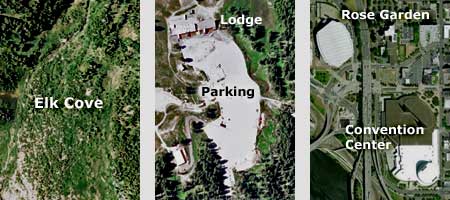
The original 6-acre lot covers what were once mountain meadows and groves of ancient subalpine fir and mountain hemlock. Growth rings in trees cut on nearby ski slopes show the cleared forest to have been upwards of 200 years old, and among the oldest alpine trees on the mountain. The lot has since been augmented by a 3-acre overflow lot in the forests below, and the 5-acre Hood River Meadows satellite lot built in the late 1970s. The resort master plan calls for another 8 acres of parking, which would bring the total for Meadows to an equivalent of 22 city blocks of high-elevation pavement.

A visual comparison of the main Meadows lot (center) to Elk Cove, on Mount Hood's north side and a similar footprint in downtown Portland.

A visual comparison of the main Meadows lot (center) to Elk Cove, on Mount Hood's north side and a similar footprint in downtown Portland.

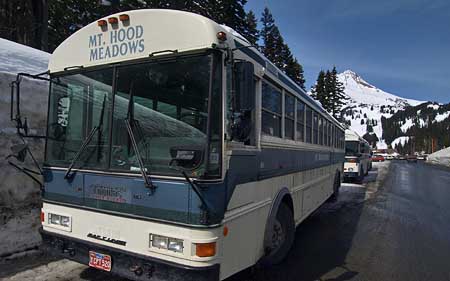
But the deed is done, and Meadows has begun to respond to pressure to minimize expansion of the lot to the extent that buses are now used to transport a few skiers. But the long-term solutions must include variable fees on parking and lift tickets that help even out the demand to park at the resort, and prevent the huge weekend crowds that drive parking pressures (as well as highway congestion).

This will surely be fought by the resort operators, but they’re running their business on leased, public land. You and I own the parking lot, and the land under the lodge and every lift tower the resort operators have constructed. So it’s fair to say “enough is enough” as the land owners. And enough IS enough for the Meadows resort. From this point forward, the operation should focus on reducing parking, not expanding it.

What would pricing do to help manage parking? Done correctly, and in tandem with lift ticket prices, variable pricing would distribute traffic on Highways 26 and 35 in a way that prevents traffic jams on weekends, and pressure to expand these routes for a few skiers. It would also reduce lift lines, and pressure on lodge facilities. But most of all, it would allow the parking lot at Meadows to stop growing — an eventually, be reduced in size.

Ski buses at Meadows are lost in the sea of automobiles - a fact that must change in order to reclaim some of the paved areas, and restore sustainability to the resort.

Ski buses at Meadows are lost in the sea of automobiles - a fact that must change in order to reclaim some of the paved areas, and restore sustainability to the resort.

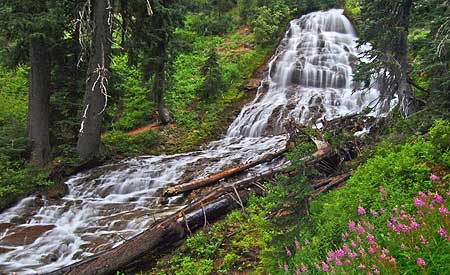
Why should the current lot be reduced in size? Because the design of the main lot has a substantial impact on the headwaters of the East Fork Hood River, which flows around the east perimeter of the parking area, then plunges over lovely Umbrella Falls — just 300 feet from the south edge of the lot.

As might be expected, the splash pool of the falls is littered with debris tossed out by skiers, then blown into the stream by snowplows. Worse, sand and gravel blown from the roads is rapidly silting the stream, filling once-deep alpine pools with sediments that the natural stream flow cannot hope to keep pace with.

New innovations in urban parking lot management provide good examples for the Meadows resort to follow, including bioswales and pervious paving designed to contain and treat runoff. These concepts could be applied immediately, and with proven results. Across the country, storm water mitigation is being designed into new parking lots, and retrofitted into existing lots to protect water supplies.

A more permanent solution would be an undergound, structured lot that wouldn’t require plowing, and wouldn’t add any surface runoff to the stream system. A working example is the lot under Capitol Mall, in Salem — few visitors realize that the lush gardens and fountains framing Oregon’s Capitol dome are actually the roof of a parking structure. In the long term, this could provide the best solution for Meadows, and would be welcomed by skiers who now tromp through grimy parking lot slush and rows of muddy cars to reach the lodge.

Lovely Umbrella Falls splashes just a few hundred feet from the Meadows resort. Sadly, the falls is littered with parking lot debris blown by snow plows.

Lovely Umbrella Falls splashes just a few hundred feet from the Meadows resort. Sadly, the falls is littered with parking lot debris blown by snow plows.

The Meadows resort operates under a permit from the U.S. Forest Service, and can be clearly be regulated into these changes, based simply on environmental considerations. But the political reality is that the resort would likely need an economic incentive to rehabilitate the lot.

One option is to simply subsidize the development of structured parking, in tandem with an a pricing program and meaningful transit to the resort. This has been done at some of Portland’s suburban light rail stations, for example, with marked success. Another option would be to allow Meadows its long sought after overnight lodging in exchange for a major upgrade to its parking lots and transportation program, and a parking lot lid would be an excellent spot for new lodging.

In the end, undoing the parking lot damage is part of adopting a new ethic for the Meadows resort that goes beyond what is now largely a token marketing facade of “sustainability.” It’s time to expect more from the corporate tenants of our public lands.

Parkdale Lava Flow

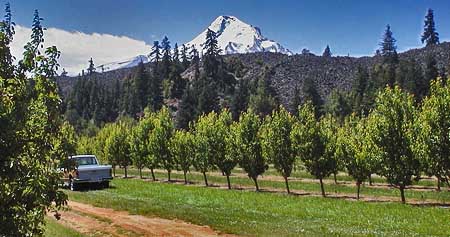
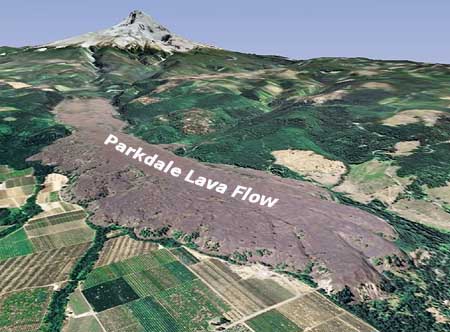
The dark wall formed by the Parkdale Lava Flow rises abruptly from the famous fruit orchards of the Hood River Valley

The dark wall formed by the Parkdale Lava Flow rises abruptly from the famous fruit orchards of the Hood River Valley

Tourists will soon be streaming into the Hood River Valley to marvel at the pink and white blossoms that blanket Oregon’s most famous apple and pear orchards each spring, with snowy Mount Hood towering above.

For many, the trip takes them to the tiny farm hamlet of Parkdale, in the heart of the upper valley. Here, the unexpected view of a dark wall of lava known as the Parkdale Lava Flow is a surprise to even longtime Oregonians. This dramatic flow is among the largest and youngest in the Cascades, yet remains surprisingly unknown.

This Google Earth view looks south, from the toe of the Parkdale Lava Flow, toward its origin, at the foot of Mount Hood

This Google Earth view looks south, from the toe of the Parkdale Lava Flow, toward its origin, at the foot of Mount Hood

From the farms near Parkdale. the lava flow looks like a ridge of jumbled boulders, with the occasional Douglas fir or ponderosa pine poking out of the chaos. But viewed from above, the formation takes on a more recognizable form. Flowing north from a deep fissure at the foot of Mount Hood, the lava first poured down the valley in a single, broad stream, pushing the Middle Fork of the Hood River from its channel.

As the river of molten rock reached the flats of the upper Hood River Valley, the lava began to spread out from the river channel, with great lobes spilling sideways from the main flow onto the valley floor. By the time the eruption was over, the lava had traveled more than four miles, and poured more than 390 million cubic yards of molten rock on the surface. That’s 4 million dump truck loads of lava, and when the lava cooled, it covered nearly 3,000 acres to depths as much as 300 feet.

Aerial views show giant ripples and lobes in the Parkdale lava flow, and the displaced Middle Fork Hood River, flowing along the edge of the new lava

Aerial views show giant ripples and lobes in the Parkdale lava flow, and the displaced Middle Fork Hood River, flowing along the edge of the new lava

The Middle Fork of the Hood River must have been a hellish sight when the eruption occurred, as molten rock filled the stream bed, and vaporized both river and forest as it overwhelmed the landscape. Today, the river traces the west margin of the flow (shown on the right in the image above), with lava slopes rising steeply from the stream. This rugged terrain along the Middle Fork makes for one of the least-visited sections of river anywhere in the Mount Hood region.

The Parkdale Lava Flow is young by geologic standards at just 7,000 years old. That places the eruption at about the time when Crater Lake was formed, following the massive eruption and collapse of the former Mount Mazama.

The Parkdale Lava Flow falls partly into private ownership

The Parkdale Lava Flow falls partly into private ownership

Geologists note that the Parkdale flow overlays traces of Crater Lake ash deposited in the Mount Hood area, suggesting that the lava flowed just after the destruction of Mount Mazama. This puts both events within the period when the first Native Americans were living in the region, and we can only imagine how the ensuing chaos must have impacted these early residents.

Since the eruption 7,000 years ago, a few trees have pioneered the lava flow, mostly along shaded side slopes, but it mostly looks like it erupted very recently. As might be expected, the flow is also home to small wildlife that thrive in the shelter that the jumbled rock provides. Through sheer luck, the flow was never mined for aggregate, despite its proximity to huge construction projects, such as the dams and highways in the nearby Columbia River Gorge.

The Forest Service has designated 854 acres of the Parkdale Lava Flow as a geologic “Special Interest Area” for the stated purpose of “public recreation use, study and enjoyment.” In its forest plan, the agency has committed to managing such areas in a natural condition, pending a detailed implementation plan for each area. This is where the Parkdale Lava Flow stands today.

Part of the lava flow, along the northeast corner (see map), is on private land. While this private land is already inside the Mount Hood National Forest jurisdictional boundary, the agency rarely acquires land thanks to lack of dedicated funding or a clear mission on which lands ought to be acquired. So for now, this is yet another unique natural feature at risk of development.

In the long term, the Mount Hood National Park Campaign envisions bringing the L-shaped piece of private land into public ownership, and providing recreational and interpretive access to the area. Until that day, the area can be explored off-trail, with access from adjacent forest roads.

The Million Dollar View

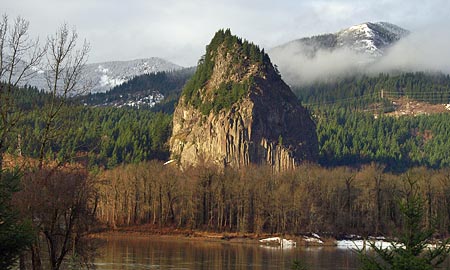
Beacon Rock rising above the Columbia, as viewed from the Oregon side

Beacon Rock rising above the Columbia, as viewed from the Oregon side

Beacon Rock rises nearly 1,000 feet above the Columbia River, and forms the nucleus of some of the finest park lands on the Washington side of the Columbia Gorge. The famous network of catwalks and stairways installed on Beacon Rock in the 1920s leads thousands of visitors to the airy summit each year to marvel at the view.

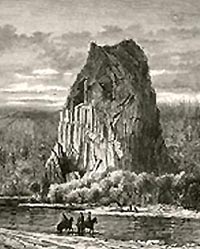
Nineteenth-century engraving of an early Beacon Rock scene

Nineteenth-century engraving of an early Beacon Rock scene

Beacon Rock, itself, is a testament to conservation, having been saved from an early 1900s scheme to actually mine the monolith for quarry stone. Today, it is among the most visited — and best loved — spots in the Gorge, with campgrounds, picnic areas and an impressive network of hiking and bicycling trails. But when the park boundaries were laid out for Beacon Rock, the Oregon side of the river was left out of the equation.

In the early days of white settlement, fish wheels operated in the shadow of Beacon Rock, along this section of the Oregon shore, harvesting salmon from the vast migrations that moved up the river.

Early settler Frank Warren operated a cannery on the site, and the town that grew around his operation became known as Warrendale. (editor’s note: Frank Warren was the only Oregon resident known to have perished on the Titanic; his wife Anna was among the few to escape in a lifeboat, and survived, while her husband stayed behind on the ship to help other women and children into lifeboats)

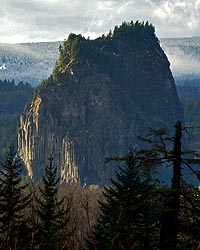
Present-day view of Beacon Rock from the Oregon side

Present-day view of Beacon Rock from the Oregon side

After the demise of fish wheels and the Warren cannery in the early 1900s, Warrendale began a slow slide into obscurity. Today, the former town site has largely been replaced by Interstate-84, and a dozen homes now occupy this remnant of private parcels along the Columbia River.

This is where the story gets a bit ugly. Like all inholdings in the Gorge and around Mount Hood, the river front homes in Warrendale suffer from trespassing — both by well-meaning visitors simply trying to find access to the river, and by less courteous visitors who clearly don’t respect the numerous private property postings.

The lure of the river here is undeniable. Beacon Rock towers across the Columbia, and sandy beaches line the river in summer and fall. Yet, no public access exists along this stretch of Oregon shoreline, and thus the tension between land owners and visitors.

Tensions run high in Warrendale as property owners struggle to block visitors from trespassing to reach Columbia River beaches

Tensions run high in Warrendale as property owners struggle to block visitors from trespassing to reach Columbia River beaches

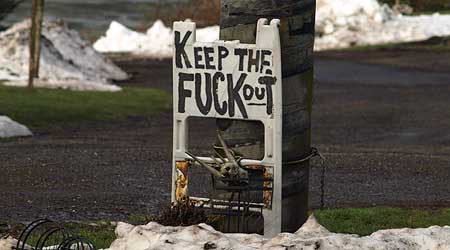
Some landowners have taken drastic steps, in response, posting profane signs that have shocked more than a few families who have stumbled into Warrendale. Less confrontational signs show up everywhere, making it abundantly clear that the public is not welcome in this community.

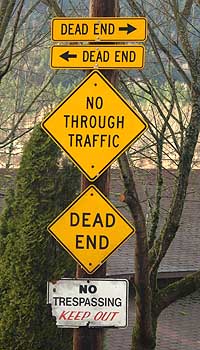
Even the official signposts in Warrendale bear blunt warnings for visitors

Even the official signposts in Warrendale bear blunt warnings for visitors

There’s no doubt that the view from these homes is among the most spectacular anywhere, but in the long term, should this stretch of beach be reserved for just a few? After all, were it not for the fish wheel and cannery that once stood here, this would likely be public land, with public access for all. Is it possible that in the long term, this unique spot can be dedicated to public access?

Not in the near term, in all likelihood. Though the Columbia River Gorge National Scenic Area (CRGNSA) receives funds each year from Congress for the express purpose of acquiring private parcels in critical locations, most acquisitions are for properties that directly abut federal or state lands, or are in pristine condition. The dozen homes in Warrendale are neither — they are separated from public lands by Interstate-84 and largely developed.

One viable option for the CRGNSA is to follow the lead of private land acquisition organizations, like the Nature Conservancy and Trust for Public Lands, and purchase conservation easements or living trusts for these properties. For private conservation groups, these have been valuable real estate tools for eventually bringing private lands into the public realm. Another option is a partnership between the CRGNSA and one of these organizations to reach a similar result.

It’s not too soon for the CRGNSA to be thinking about this possibility. This is a million dollar view that deserves to be enjoyed by all, not just a few.

Postscript: In June 2010, one of the riverfront homeowners in Warrendale, 68-year-old James Koch, threatened four salmon fishermen who were anchored for the night in their boat just offshore, then fired rifle shots toward the boat. After his arrest by Multnomah County authorities, he was found guilty of felony unlawful use of a weapon, misdemeanor menacing and misdemeanor recklessly endangering other.

During his trial, he called on neighbors who testified about the public encroaching on their riverfront property. In this November 3, 2010 Oregonian article, one of the fishermen, Steve Bruce, said he was “sickened by that attitude. It’s not just him (Koch), they all feel that they own the land under the water.”

Koch could face prison time, pending sentencing, and will lose is right to own or operate firearms.

Second Postscript: In November 2010, James Ellis Koch was sentenced in Multnomah County court to 60 days jail time and three years probation for firing weapons at four salmon fishermen who were anchored for the night in their boat just offshore from his Warrendale property.

In this November 19, 2010 Oregonian article, Judge Janice Wilson took issue not only with Koch’s unrepentant attitude, but also with the vigilante culture that exists in the Warrendale community. From the article:

James Koch also offered these words: “I’m sorry for whatever happened, the stuff that happened out there that evening.”

That prompted this response from the judge. “(That) is not an apology,” she said. “It’s actually worse than nothing. It’s an anti-apology.”

The judge said Koch wasn’t justified that night in the slightest. The fishermen weren’t making noise, they weren’t drinking and they were lawfully camping on the water. The judge said she was concerned about Koch’s attitude, as well as the attitudes of his neighbors.

Neighbors testified that they are so wary of strangers and crime that they stop unknown drivers traveling through their remote east county hamlet. Yet on the night Koch fired his weapons, they didn’t look to see what was going on because shots in their neighborhood aren’t unusual.

“I don’t know what that says about that neighborhood … but it’s a little bit scary,” the judge said. “… This vigilante culture in this neighborhood is of grave concern to the court.

Campaign Website Overhaul

newbannerclipping2

This is a departure from the usual topical posts (and a bit of an explanation on the recent draught in this blog), but I want to finally announce that I’ve completed a massive overhaul of the Mount Hood National Park Campaign web site!

The new look (shown above) is retro, and largely drawn from the 1930s heyday of Civilian Conservation Corps (CCC) and Works Progress Administration (WPA) efforts that brought many of the “national park” elements to Mount Hood and the Columbia River Gorge. Some of the imagery is even more evocative, going back to the great landscape artists of the 1800s. The goal with the retro look was to enhance the sense of possibility — that it’s never to late to think big for Mount Hood and the Gorge.

The site content is also greatly expanded, with a new “proposals” area that includes ambitious concepts for greatly expanded hiking and bike trails, campgrounds, picnic areas, byways and lodges. The details on these concepts can be browsed in a series of indexed maps in the “proposals” section. Hopefully, these will be fun and inspiring for those with a detailed knowledge of the area to explore.

The “how you can help” section has also been greatly updated, reflecting new elected officials, our new political paradigm (hooray!) and some improved tools for crafting a letter to Congress in support of the national park idea. This includes a handy “national parks compared” page, with Q&A for those inclined to read the details.

But above all, the overhaul of the site represents a new direction for the campaign as an “idea campaign.” That’s my way of saying that visitors won’t be asked for contributions, and that I won’t be forming a non-profit anytime soon. Instead, the goal is simply to keep the big ideas alive, and our collective hopes for a Mount Hood National Park intact and inspired — and ready for action when the time comes to make the dream a reality.

Here’s the link to the new website.

Restoring Celilo Falls

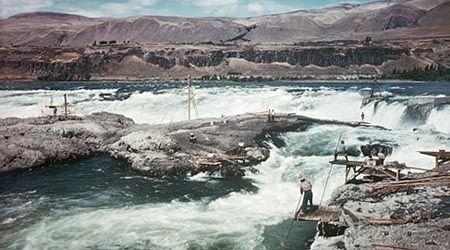
Celilo Falls has always been phantom of history to me, since I born a few years after the U.S. Army Corps of Engineers buried the falls behind The Dalles Dam in 1957. My understanding of the falls and the loss it now represents has come from old photos and maps, and a few shaky film images.

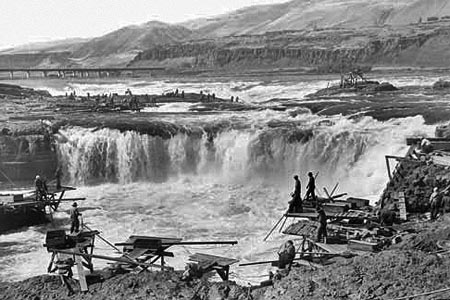
The railroad bridge in the background of this iconic view is the key to locating the falls today

The railroad bridge in the background of this iconic view is the key to locating the falls today

Yet for many, the falls and the native culture surrounding them are alive and vibrant in their memories, thanks to seeing and experiencing them first-hand. For Native Americans, the vivid memories only add to the pain of losing a place that quite literally defined a people for millennia.

The idea of restoring the falls — even temporarily — has been suggested over the years, usually to be slapped down quickly by the Corps of Engineers as unfeasible, or even dangerous. In the late 1980s, a brief, 30th anniversary movement to temporarily draw down the pool behind the dam briefly gained local momentum before the federal agencies killed any talk of the idea. The Corps likely realized that revealing the falls to the public even once could make it politically impossible to ever refill the dam again.

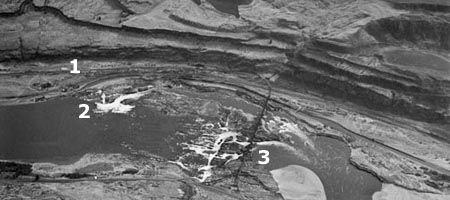
This 1940s aerial view shows the falls and railroad bridge, looking south

This 1940s aerial view shows the falls and railroad bridge, looking south

The hostility of the federal agencies toward even acknowledging the falls fanned the rumors among the local tribes that the falls had, in fact, been purposely destroyed by the Corps of Engineers just before they were inundated. This rumor persisted until last year, when a new mindset among Corps managers spurred the agency to compile a comprehensive sonar map of the falls to show that they are quite intact, beneath the still surface of the reservoir.

The sonar confirmation of the intact falls has breathed new life into the hopes of many that the falls will not just someday be restored, but perhaps someday soon. This is where the restoration of Celilo Falls fits within the scope of the MHNP Campaign: the emerging environmental theme in the coming century is restoration, and no place in the Pacific Northwest is more deserving — perhaps even the nation, considering that 11,000 years of Native American culture at Celilo makes it the oldest continuously settled place in North America.

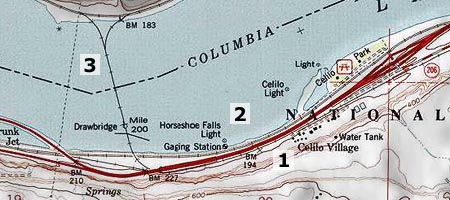
This map clip correlates today's landmarks to the aerial view of the falls, above

This map clip correlates today's landmarks to the aerial view of the falls, above

But the connection to Mount Hood is even more elemental: the mountain towers over the Celilo country like a beacon, and has been a similarly important feature in the culture of Lower Columbia tribes. Celilo and WyEast are connected, and so their restoration should be. A joined effort to heal these places expands the possibilities for both.

What will a restored Celilo Falls look like? Initially, it will likely be mineral-stained and muddy. But the new sonar maps confirm that silts have not overtaken the falls, so if the pool behind The Dalles Dam were simply lowered today, we would see a largely intact falls — perhaps even with traces of the cantilevered dip net fishing structures that once clung to the rocks around the falls. And over time, the falls would quickly recover to blend again with the surrounding landscape.

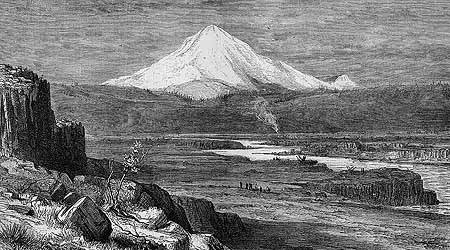
R. Swain Gifford's 1875 etching of Mount Hood towering over the Celilo Narrows is among the earliest geographically accurate renderings of the area

R. Swain Gifford's 1875 etching of Mount Hood towering over the Celilo Narrows is among the earliest geographically accurate renderings of the area

What would a restored Celilo Falls mean for the mid-Columbia economy? The immediate impact would be on power supplies, and it is unlikely that the falls could ever be restored without some alternate energy supply — perhaps a wind farm of equal wattage? — ensuring that no net loss in energy production would result.

The next big question would be impacts on shipping, but the good news here is that barges were already using the Celilo Canal to bypass the falls long before the dam was erected. The canal system would conceivably resume this function, if the falls were reborn, albeit with likely improvements and modernization.

These scene was photographed in the mid-1950s, just before the falls was inundated

These scene was photographed in the mid-1950s, just before the falls was inundated

What kind of protection should the restored Celilo Falls receive? That part is easy. The astonishing scope of history tied to the falls easily qualify the site for World Heritage status within the U.S. National Park System, perhaps as a National Historic Site. This would put the restored falls in a category with places like Mesa Verde, in Colorado, and provide the needed framework to preserve and understand the historic resources that lie beneath today’s reservoir.

Restoration of Celilo Falls is a long-term dream of so many, but movement in that direction really began as soon as the falls disappeared in 1957. The falls has never left our collective consciousness, and thus demands restoration.

Another small step toward restoration will occur in 2009, when the commemorative Confluence Project will bring an art installation to Celilo. The project is marking the two centuries since Lewis and Clark passed through the region, and the millennia of human history that makes Celilo unique. A small step, but also a bit more progress toward what I believe will be the inevitable restoration of Celilo Falls — under the gaze of a restored Mount Hood.

Transmission Corridor Redux

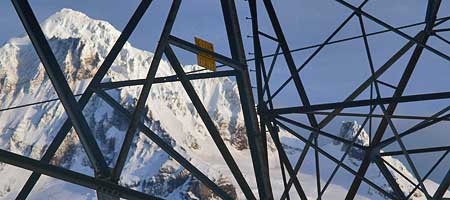
The current controversy over the proposed Palomar utility corridor (that would slice across the Clackamas River country, south of Mount Hood) is an uncanny reminder of the 1950s disaster that brought the Bonneville Power Administration (BPA) transmission lines to Lolo Pass, north of Mount Hood. In both cases, the result is a permanent, linear clearcut running up and down mountainsides, with almost no regard for visual or environmental impact.

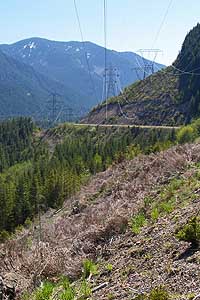
The disastrous BPA transmission corridor over Lolo Pass set a new low for siting transmission corridors

The disastrous BPA transmission corridor over Lolo Pass set a new low for siting transmission corridors

The BPA lines came with the completion of the John Day and The Dalles dams, along the lower Columbia River. As if drowning the incomparable Celilo Falls weren’t enough, the transmission lines crested the Cascades at Lolo Pass, at the time one of the more remote and spectacular corners of the Mount Hood backcountry.

In the 1950s, American society was still in the early years of sprawling hydroelectric projects and rows of transmission towers marching toward the horizon. At the time, these images equaled progress, and nothing more.

the BPA corridor saws across the shoulder of Sugarloaf Mountain in this view

Transmission corridors are straight, but nature is not: the BPA corridor saws across the shoulder of Sugarloaf Mountain in this view

But the BPA lines over Lolo Pass marked a particularly senseless disregard for the landscape, needlessly ruining mountain valleys, blocking Mount Hood vistas, and creating a permanent nuisance with the permanent clearcut that is maintained along the corridor.

The transmission lines also brought a new road to Lolo Pass, along with a devastating logging program that nearly cleared the Clear Fork and Elk Creek valleys, along the corridor. The permanent clear cut below the transmission lines was maintained for decades with chemical herbicides, though the BPA has more recently bowed to pressure to maintain their swath of destruction with mechanical methods.

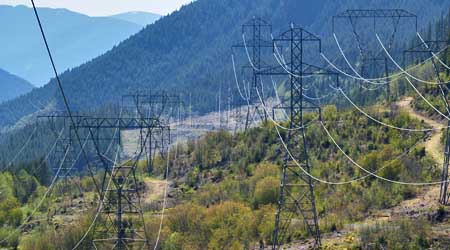
Over the years, the lines have multiplied, and today, the Lolo Pass swath encompasses four large transmission lines in a quarter-mile wide swath. The maze of “closed” dirt maintenance roads below the lines are a perennial draw for target shooters, off-highway vehicles and illegal dumpers. These activities, in turn, have helped turn the linear clear cut into a conduit of invasive species, brining Scotch broom and Himalayan blackberry deep into the Cascades.

The Lolo transmission corridor began on the scale of the Palomar proposal, but has grown over time

The Lolo transmission corridor began on the scale of the Palomar proposal, but has grown over time

The lessons from the Lolo Pass disaster are many, but above all, we’ve learned that a single utility corridor will almost surely grow over time, as utility planners make the case that future lines ought to follow these existing paths of least resistance.

We’ve also learned that the visual and environmental blight that the corridors create is insidious, causing forest managers to discount the value of adjacent, intact forests as somehow tainted — as less worthy of protection or even recreation use. This will surely be the case if the Palomar corridor is approved.

But the story of Lolo Pass is not complete, and the final chapter has yet to be written. Why? Because after just 50 years, the BPA lines are already approaching their design life, and will eventually need to be replaced.

Mount Hood towering above Lolo Pass

Mount Hood towering above Lolo Pass

Under the logic that led to the expansion of this corridor to encompass four parallel transmission lines, it would be easy to assume that the towers and lines will simply be replaced in place, within the existing corridor.

But it will be equally possible to imagine something better for Lolo Pass — relocating the corridor and restoring the pass, and perhaps finding a better, more efficient, less destructive way to transport our energy.

That’s the dream and vision for many who hold the former beauty of Lolo Pass in their memories, and can imaging restoring this corner of the mountain to its fomer splendor. But it’s also a reminder not to repeat the Lolo Pass mistake at Palomar, setting yet another legacy of perpetual, linear destruction in motion.

Fire Forests of the Cascades

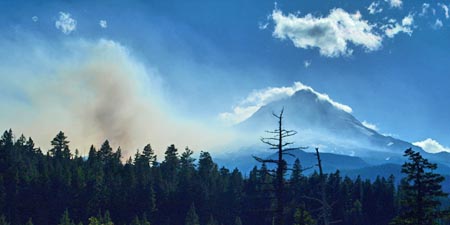
The Gnarl Fire of 2008 shocked Portlanders by racing across the east slopes of Mount Hood, and nearly destroying the historic buildings at Cloud Cap and Tilly Jane. But as an east side fire, the Gnarl burn was relatively small, and part of what has become an annual ritual for rural communities of fighting intense blazes along the east slope of the Cascades.

The 2008 Gnarl Fire, viewed in August from Dufur Mill Road

The 2008 Gnarl Fire, viewed in August from Dufur Mill Road

The cause for the intensity of these fires is well-known and well-documented. We know that a century of fire suppression, promotion of even-aged stands of second growth in logged areas and a changing climate are forces conspiring to burn the east side forests on a scale not seen in recent decades.

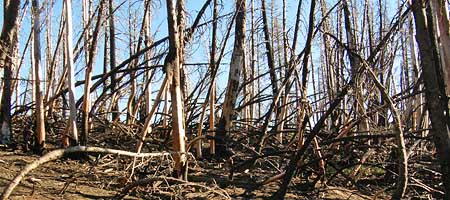
But not all of the east side fires are catastrophic, even with the fuel build-up from our history of fire suppression. The 2006 fire at Bluegrass Ridge was a glimpse into what was once a routine occurrence along the east side of the Cascades. The Bluegrass Fire began as a lightning strike in the dry season, and soon spread along the east face of the ridge in a mosaic pattern: some parts of the forest were completely killed, while others were a mix, where pockets of forest survived among the burned trees.

The aftermath of the 2006 Bluegrass Fire ranged from total destruction in areas like this, to mosaic patterns where less crowded forests existed

The aftermath of the 2006 Bluegrass Fire ranged from total destruction in areas like this, to mosaic patterns where less crowded forests existed

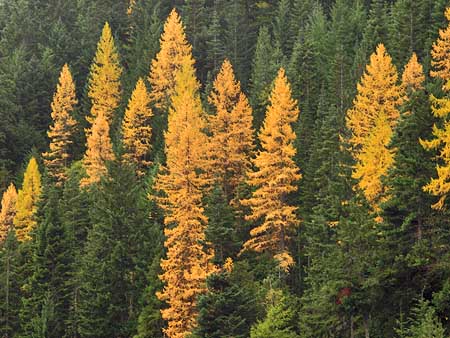
Most significantly, the larger, fire-resistant species like western larch and ponderosa pine often survive fires in these mosaic areas, and this was the case in the Bluegrass Fire. We will know in a year or two whether the extensive larch population in the Gnarl Fire area were similarly resistant.

The survival of these big trees is the key to the natural ecosystem that defines east side forests. Forest ecologists are now calling these east side regimes “fire forests”, as a counterpoint to the west side rain forests, where abundant rainfall is the operative element in defining the forests.

The “fire forest” name is apt, since we now know that a number of tree species in this dry forest system depend on fire for natural succession that creates mature forests. In the Mount Hood area, these east side trees are Douglas fir, western larch and ponderosa pine. All three have thick, fire-resistant bark that helps them survive moderate fires, and benefit from periodic clearing of undergrowth that competes for moisture and soil nutrients. Fires, in turn, release nutrients for the big trees, further enhancing the growth of fire-resistant species.

Western larch light up the eastside forests in autumn. Larch are among the fire-resistant species that require periodic burns for their long-term health

Western larch light up the eastside forests in autumn. Larch are among the fire-resistant species that require periodic burns for their long-term health

The question for the east side forest is not whether they will continue to burn — they have evolved with fire, after all — but rather, how we will learn to live with the fires. We now know that we cannot simply extinguish them. A century of fire suppression has created mammoth fires that we simply cannot control.

We also know that we cannot prevent forest fires from starting, since the large majority begin from lighting strikes. And we know that many more catastrophic burns will occur before the east side forests return to a more sustainable condition that mimics the natural ecosystem that once thrived.

Most ominous is the recent discovery — from tree-ring research — that the Western states are coming off an unusually wet century, and that the decades ahead are likely to carry more drought, not less. So it is imperative to help the east side forests stabilize before conditions make that proposition still more difficult.

These mature, healthy forests of western larch, ponderosa pine and Douglas fir along Bluegrass Ridge survived the fire

These mature, healthy forests of western larch, ponderosa pine and Douglas fir along Bluegrass Ridge survived the fire

A first step is continuing to thin tree plantations on logged lands to help prevent still more crowded, bug-infested forests like those that are currently driving the fire epidemic. The second step is more difficult: letting fires burn. This policy will be most difficult in the many areas where rural development has encroached on forest boundaries, but it is a necessary step. Both of these steps will require a new mindset about fire, not the least of which will be a public education shift away from Smokey Bear and fire suppression and toward a modern understanding of fire.

But a third step is most difficult of all: setting fires in prescribed locations to help restore forest balance. While the rash of east side fires in recent years has made this part of restoring forest balance less urgent, it will still be necessary — and controversial. Federal agencies have already begun employing this tool, but in cases where a controlled burn becomes a wildfire, the public is not prepared to understand why that risk is necessary — and perfectly natural. Still more public outreach and education will be needed.

The good news is that the scientists are winning this debate, and even the Forest Service has gradually begun to embrace fire ecology as part of their management philosophy. The Park Service is much further long, having successfully weathered the early criticism of their prescient decision to let the huge Yellowstone fires of the mid-1980s burn.

The remarkable resilience and recovery of Yellowstone in the intervening years has not only been vindication for that bold decision, but also an invaluable lesson to land agencies across the west who are responsible for managing “fire forests”. The time to embrace fires in our forests has arrived.

Phoca Rock

An early 1900s postcard shows a steam ship passing Phoca Rock

An early 1900s postcard shows a steam ship passing Phoca Rock

Anyone who has made a few trips through the Columbia Gorge has noticed the small monolith that pokes out of the center of the river near Cape Horn. This is Phoca Rock, and its distinction lies partly in the fact that it is one of the few landmarks in the Gorge that carries the name given by Lewis and Clark on their 1805-06 Corps of Discovery journey.

Lewis and Clark didn’t actually name the rock until they were camped on the Oregon Coast, and compiled their journals while suffering through a dank Northwest winter. William Clark named the rock for the abundant harbor seals spotted in the river – phoca vitulina.

Harbor seals basking in Alaska's Tracy Arm

Harbor seals basking in Alaska's Tracy Arm

Harbor seals are still native to the lower Columbia River, although in smaller numbers than when Lewis and Clark paddled through. Government bounties in Oregon and Washington killed more than 20,000 Harbor seals in the two states from the 1920s through 1972, when hunting was finally banned.

The Harbor seal population has since rebounded from fewer than 7,000 seals at the time of the ban to more than 17,000 today. Still, biologists in both states must monitor the seals for health and impacts from commercial fisheries.

Phoca Rock continues to serve as a river beacon today, marking the edge of shipping lanes on the Columbia. The rock marks the edge of two-foot shallows along Oregon’s Sand Island and the 45-foot deep Candiana Channel that separates Phoca Rock from Cape Horn, on the Washington side.

Phoca Rock today, as seen from Bridal Veil State Park

Phoca Rock today, as seen from Bridal Veil State Park

Clark estimated the rock to be 100 feet tall, but today we know it to be just 30 feet. Its prominence lies in its isolation, and early names for the rock underscored this point: beginning in the mid-1800s, Phoca was alternately called “Hermit’s Islet”, “Lone Rock” and “Sentinel Rock” before the federal government finally restored the original name given by Lewis and Clark, in the early 1900s.

This 1911 map shows Phoca Rock with its restored name

This 1911 map shows Phoca Rock with its restored name

So, why is Phoca Rock sitting alone, in the middle of the Columbia River? Chances are the rock isn’t a tiny cousin to nearby Beacon Rock, the exposed, solid core of an ancient volcano. Phoca is more likely an outcrop of the Grande Ronde basalt flows that produced the cliffs of Cape Horn, to the north, and the Pillars of Hercules, along the Oregon shore.

One of many old postcard views that show "Sentinel Rock", one of the itinerant names for Phoca Rock

Diminutive Phoca Rock is as tough as it is tiny. The rock survived multiple Missoula Floods, after all, and thousands of years of parting the waters of the Columbia River. And left alone, Phoca Rock will continue to weather the elements for millennia with little change, long after the ribbons of asphalt and steel that line the Gorge have vanished.

Unfinished work at Tumala

Most of us grew up using the word “squaw” as the counterpoint to “brave” in our one-dimensional, Hollywood version of Indian culture. But historians and Native Americans always knew this word to be derogatory and offensive in its original use, so the current national efforts to remove “squaw” from maps and places is long overdue.

In Oregon, the list of places using this name numbers 172, but nowhere was there such a concentration as in the Roaring River high country, where no less than four features — plus a road — were named “squaw”.

Acting on a legislative directive, the Clackamas County Commission began the work of changing the names of “Squaw” mountain, meadows, lakes and creek to “Tumala” in 2007, and the Oregon Geographic Names Board completed the work in early 2008. Tumala is a Chinook word meaning tomorrow, or afterlife, and is as good a name as you might wish for in this lovely mountain blend of craggy peaks, big trees and sunny meadows.

Beautiful Tumala Lakes and Meadows in the Roaring River backcountry

Beautiful Tumala Lakes and Meadows in the Roaring River backcountry

But the work here has only begun. Tumala Mountain and the surrounding country are rich with Native American and early pioneer history, yet little has been done to simply preserve the legacy, much less celebrate it.

Native Americans hunted and foraged along the high ridges of Tumala Mountain area for centuries, and likely set fires to keep the huckleberry slopes productive.

In the autumn of 1855, a 22-year old U.S. Army lieutenant named Henry Abbot and his 18-year old Indian guide, Sam-ax-shat, led a survey party across the Cascades. They followed the high divide between the Salmon and Roaring rivers, and passed through the Tumala Lakes basin, a protected refuge with water and grazing along the high ridge top.

Abbot’s journey lent his name to the early Forest Service road that would later be built along this route, in the 1920s. A string of fire lookouts, guard stations and a network of trails soon followed in this corridor. The lookout on Tumala Mountain was rebuilt at least twice, before it was finally removed in the 1960s, when the Forest Service burned hundreds of old lookout structures that were no longer in use.

Stairway to the past, these steps once led to the lookout atop Tumala Mountain

Stairway to the past, these steps once led to the lookout atop Tumala Mountain

Today, the old road to the Tumala Mountain lookout site still exists, but serves mainly to deliver motorcycles and OHVs to the fragile mountain summit. The Abbot Road, itself, has become a sad, dangerous shooting gallery overrun by OHVs and target hunters. Tumala Meadows and Lakes are also within reach of the OHVs, despite efforts to keep them out of this remarkable basin.

The original lookout on Tumala Mountain, pictured in 1916 (USFS photo)

The original lookout on Tumala Mountain, pictured in 1916 (USFS photo)

So the name change is a starting point, but the work here is unfinished. At Tumala Mountain, the solution is simple: the area must be managed for activities that build on the natural and cultural legacy, and help preserve the traces that still remain.

The first step in making this transition is to remove the shooters and OHVers from the area. Until they are gone, hikers, picnickers, cyclists and equestrians are unlikely to feel safe visiting the area, and the area will continue to suffer the abuse that is so evident today.

A message from the builders of the old lookout awaits hikers who discover the stairsteps that still remain

A message from the builders of the old lookout awaits hikers who discover the stairsteps that still remain

Unfortunately, the Forest Service is on the path to do just the opposite: the so-called “Mount Hood Travel Plan” currently underway has proposed that this area simply be written off as an OHV playground. This is unacceptable, and another reminder that the USFS agency mission simply does not allow it to behave as a responsible steward for the land.

But beyond the OHV problem, the second part of the puzzle is how to make the area more inviting for quiet recreation? There is no lack of scenery or interesting destination, after all. Indeed, this would most involve simple measures like better road and trail signs and improving lost campgrounds like those at Lookout Springs and Twin Springs — both would be excellent base camps for equestrians or cyclists. With a few improvements and the promise of finally solving the OHV and shooting problems, the area would become a prime outdoor destination.

This unfinished work can start now, by simply weighing in against the foolish, shortsighted OHV plan with the Forest Service. This would at least stop the bleeding.

But in the longer term, the unfinished work at Tamala — “tomorrow” — Mountain would be better managed by the National Park Service. Tumala is yet another reminder that the Forest Service cannot be trusted to protect and celebrate the natural and cultural legacy of Mount Hood.

Tamanawas Falls

Autumn colors on a foggy day in the huge amphitheater that surrounds Tamanawas Falls

Autumn in the huge amphitheater that holds Tamanawas Falls

For many years, the rustic path along Cold Spring Creek to Tamanawas Falls was a well-kept secret, but today the short trail to this 150-foot falls has become a popular hiking destination. Floods and a massive rock slide rearranged the trail at times in recent years, but the route has since been repaired, and is no less scenic for ravages of Mother Nature. The easy hike to the falls is described in the Portland Hikers Field Guide.

Cold Spring Creek is unique in that it drains a rather large portion of Mount Hood’s eastern slope, yet runs clear year-round because it carries no glacial outflow. The headwaters are formed by the sprawling Elk Meadows and the high, tundra-like slopes of Cooper Spur. A classic overnight backpacking trip (or long day hike) is the 15-mile loop along the Cold Spring Creek trail to Elk Meadows and return via Bluegrass Ridge.

Brilliant cottonwoods light up the trail to Tamanawas Falls in late October

Brilliant cottonwoods light up the trail to Tamanawas Falls in late October

One of the subtle attractions of the trail is the mix of eastside and westside flora — you’ll find eastside species like Western larch, Ponderosa pine, Douglas maple and quaking aspen flanked by more western species like Western redcedar, white pine and Douglas fir. There are also a surprising number of wildflowers in display in early summer, and in autumn the trail is lined with brilliant cottonwoods and vine maple.

A close-up view reveals the huge cavern behind Tamanawas Falls

A close-up view reveals the huge cavern behind Tamanawas Falls

But the main attraction on this hike is Tamanawas Falls, a thundering spectacle during early summer snow melt, and more graceful curtain later in the season. “Tamanawas” is the Chinook jargon word for “friendly or guardian spirit”, and the current spelling was corrected by the Oregon Board of Geographic Names in 1971. With its broad, symmetrical shape, the falls is more in the form of a Gorge waterfall, since it flows in a perfect curtain over what appears to a layer of basalt. But the rock here is andesite, a more recent material that has erupted from the vents that formed Mount Hood and many of the smaller peaks in the area.

The massive rock fall just downstream from the falls provides a unique glimpse into the formation of the canyon, and how actively the creek continues to change the landscape. In this section, the re-routed trail climbs through truck-sized boulders that dropped from the cliffs rimming the canyon just a few years ago. A destroyed footbridge from the old trail can be seen in the creek, far below.

Adventurous hikers will not want to stop where the spur trail to the falls abruptly ends at a viewpoint. With a bit of careful scrambling, even better views of the falls can be had from the stream, just beyond the trail, and with a bit more scrambling, hikers can even make their way into the huge cavern behind the falls. The view from behind the water is especially awesome, though too rough to reach for younger children and less experienced hikers.

Boundary Clear Cut – Part Two

The Boundary clear cut consumed this tiny lake. The trees behind mark the wilderness boundary as it rides over the ridges

The Boundary clear cut consumed this tiny lake. The trees behind mark the wilderness boundary as it rides over the ridges

The first part of this article focused on the Forest Service failures that allowed the massive Boundary clear cut to happen on Mount Hood’s northwest shoulder. Now, a look at more of the fallout from the massive clear cut, and opportunities for restoring the area in the future.

First, some numbers. Using a conservative estimate of 100 trees per acre, the 800 acre Boundary complex contained at least 80,000 mature trees, mostly noble fir. Using the Forest Service’s Center for Urban Forest Research models (2002), a conservative estimate for storm water interception of each tree is at least 1,100 gallons per year, or some 88 million gallons of runoff from the Boundary clear cut area, alone. How much additional runoff is that? Enough to nearly fill the 33-story KOIN tower in downtown Portland.

The twin to the logged-over lake, pictured above, this peaceful tarn is located just two hundred yards away, safely inside the wilderness boundary

The twin to the logged-over lake, pictured above, this peaceful tarn is located just two hundred yards away, safely inside the wilderness boundary

Without the forest canopy, the bulk of the rain that falls upon these mountain slopes now runs off, eroding the thin soils, carrying mud and sediments to nearby streams and resulting spikes in stream flows that damage riparian areas and fish habitat. This effect is repeated, of course, across the thousands of clear cuts in the Mount Hood National Forest.

For the Boundary clear cut, the runoff impact is on the heavily logged West Fork Hood River drainage, which is already struggling to recover from the first wave of logging at the turn of the 20th Century (see “Just 75 years” article).

Like other clear cuts, the Boundary cut also triggered edge effects on the uncut forests bordering the timber sale. Because the Boundary clear cut is high elevation, and nearly crests Vista Ridge, these were impacts that timber planners surely could have expected. Yet the timber sale spread close enough to the historic Vista Ridge trail that blowdown triggered by the cut still fall across the trail with regulatory, and unnecessarily. Sadly, this was preventable.

These trees along the Vista Ridge Trail are victims of the Boundary clear cut, having been exposed to high winds by the removal of adjacent forests.

These trees along the Vista Ridge Trail are victims of the Boundary clear cut, having been exposed to high winds by the removal of adjacent forests.

What to do next? For the cut forests of the Boundary complex, the main treatments are road decommissioning and thinning operations in 15-20 years, when the plantations of young trees are likely to become a crowded monoculture.

Just beyond the edge of the Boundary cut, this lofty outcrop provides a stunning view

Just beyond the edge of the Boundary cut, this lofty outcrop provides a stunning view

But from a broader perspective, what about restoring recreation to the area? The Mount Hood National Park campaign calls for converting several roads in the area to single-track bike and horse trails, and adding a campground in proximity to these new trails, and the Vista Ridge trailhead.

There are also opportunities to connect the Vista Ridge trail to the Mazama Trailhead, across Ladd Creek. This new route would provide much-needed loop options that would disperse the heavy hiking traffic that Mount Hood experiences in summer, plus access to the little-known lakes and rocky viewpoints that lie just beyond the destruction zone of the Boundary clear cut.

The key in making this transition is restoration through recreation — bringing visitors back to the area with the express purpose of fostering a public sense of stewardship needed to ensure that a Boundary clear cut never happens again.