
Author’s note: I wrote a version of this article for the Mazama newsletter a few weeks ago, so I’m sharing an expanded version here, as this is a sequel to a WyEast Blog post from 2011.
_________________
Since posting an article more than a decade ago (“Return of the Mountain Goat”) proposing reintroduction of Rocky Mountain Goats on Mount Hood, I’ve received a steady stream of updates from area hikers with recent goat sightings on Mount Hood and in the Columbia River Gorge. Are they making a spontaneous comeback?
Possibly. But I couldn’t have predicted the many related events that have unfolded since I wrote that first piece back in 2011, and they don’t necessarily help the case for bringing mountain goats back to Mount Hood – nor do they rule the idea out. It’s just much less clear, now.
The first big event was the Dollar Lake Fire on Mount Hood that roared through just a few months after I posted the article. While there had been fairly recent fires on the east slopes of the mountain (the Bluegrass Fire and Gnarl Fire), they had mostly burned below timberline and were also partly within the ecological zone known as “fire forests”. These are forests with fire-dependent species like Ponderosa Pine and Western Larch have evolved with fire as a regular occurrence on the dry east slopes of the mountain.

Dollar Lake Fire burning across Mount Hood’s north side in September 2011
The Dollar Lake Fire on the north side was different, largely burning subalpine Noble Fir and Mountain Hemlock forests, species that have not evolved to withstand fire. The result was a complete canopy loss along most of the north slope of the mountain. I’ve since been documenting the forest recovery in a series of WyEast blog articles, and it’s a story of remarkable resilience in an ecosystem where fires are both rare and devastating.
However, if you were a mountain goat living on Mount Hood when that fire roared through in the late summer of 2011, you would likely have survived. Though the Dollar Lake Fire touched timberline in places like Elk Cove and Cairn Basin, most of the timberline and alpine habitat was untouched. This would have allowed goats living in the rocky areas at and above the tree line to escape the smoke and flames during the event.

The Dollar Lake Fire transformed more than 6,000 acres of subalpine terrain from dense forests to open huckleberry and beargrass fields. This scene is from 99 Ridge, above Elk Cove
The vast huckleberry and beargrass fields that now grow among bleached tree skeletons within the burn zone are prime habitat for wildlife, including elk, deer and bear. What is unknown is whether the new habitat would support mountain goats where it exposed rocky terrain that had been engulfed in forest cover over the past century – places like The Pinnacle or 99 Ridge (the rocky ridge that forms the west wall of Elk Cove, shown above).
We do know that when white migrants began streaming into the Oregon country in the mid-1800s, the Cascade forests looked much different than they do today, after a century of wildfire suppression. A series of survey photos captured from dozens of Forest Service lookouts in the early 1930s provide a remarkable record of just how open much of the high country surrounding Mount Hood was in places like Zigzag Mountain, Mirror Lake and today’s Salmon-Huckleberry Wilderness.
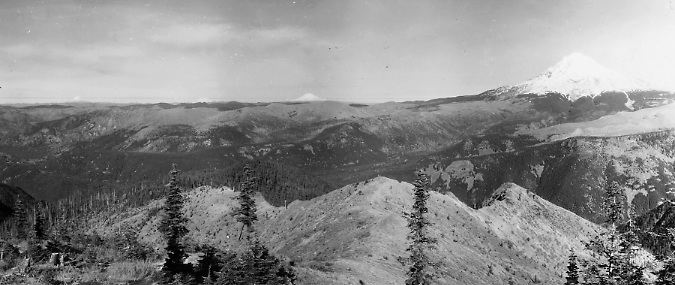
The northern slopes of Devils Peaks had been cleared by repeated fires over centuries in this 1933 lookout panorama. In the distance, the entirety of Zigzag Mountain was also an open expanse of huckleberry and beargrass fields. Mount Hood and the burned slopes near Mirror Lake are on the right
[Click here for a larger version]
These openings were created by repeated fires, some set by indigenous people who had used fire for centuries to maintain ridgetop fields of beargrass and huckleberries for food and medicinal purposes. Thin mountaintop soils and summer lightning strikes during our summer droughts combined to make these forests vulnerable to wildfire, as well – and still do.
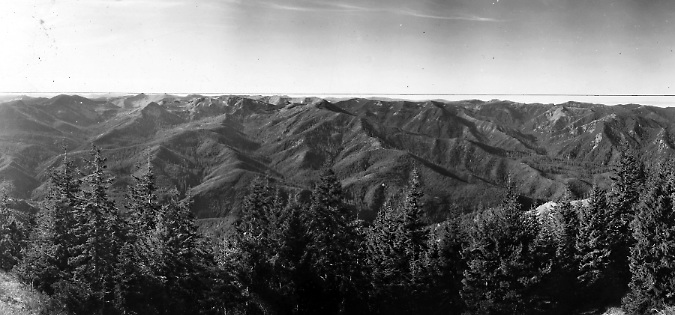
The view across the Salmon Huckleberry Wilderness in 1933 shows most of the peaks and ridgetops now covered by timber to still open from centuries of repeated fires
[Click here for a larger version]
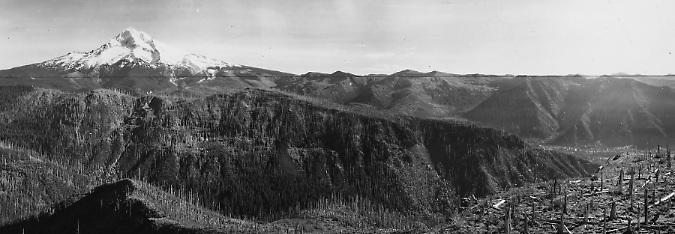
This 1932 view from Hickman Butte, in the Bull Run watershed, shows signs of recent fires in the foreground and on Sugarloaf Mountain (in front of Mount Hood), as well as the open northern slopes of Zigzag Mountain in the distance (and to the right of Mount Hood) created by fires
[Click here for a larger version]
In September 2017 we watched the Eagle Creek Fire burn through the Oregon side of the Columbia River Gorge. This was the first major fire in the Gorge in more than a century, burning much of the high country in the Hatfield Wilderness, as well as the steep, drought-prone cliffs of the Gorge walls. Thanks to the east winds that define the Gorge, we know that especially devastating fires were once common here, as shown in both the 1930s lookout surveys and in vintage late-1800s photographs by Carleton Watkins, the Kiser Brothers (below) and Benjamin A. Gifford.
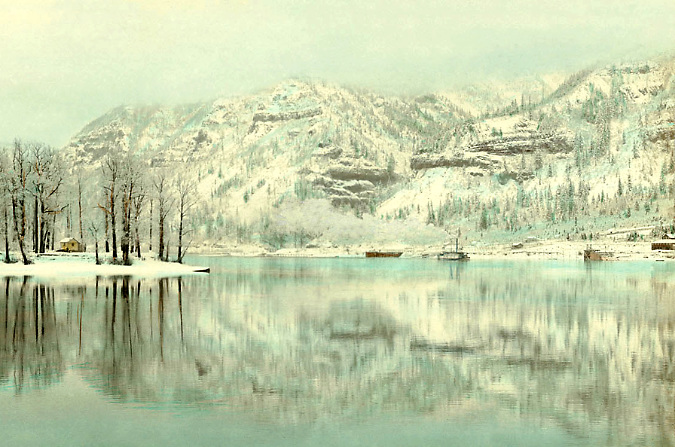
The cliffs above today’s Warrendale community and McCord Creek canyon in the Columbia Gorge were mostly open when this photo was taken by the Kiser Brothers in 1903. The Eagle Creek fire of 2017 has returned this area to a similar post-fire habitat
Their early images show the rugged cliff walls and high ridges of the Gorge as we see them today, covered with lush, recovering understory that we know has been a boon to deer and elk populations. By comparison to the Mount Hood fires, the 2017 burn area in the Gorge opened much more steep, rocky terrain that could be favorable to goats.
When the 2020 wildfires swept through Oregon, one of the impacted areas was Mount Jefferson, where mountain goats had been transplanted in 2010 in a collaborative effort by the Oregon Department of Fish and Wildlife (ODFW) and Confederated Tribes of Warm Springs (described here in the original 2011 post). State wildlife managers expressed concern over the fate of the goats at the time, given the scale of the fires.
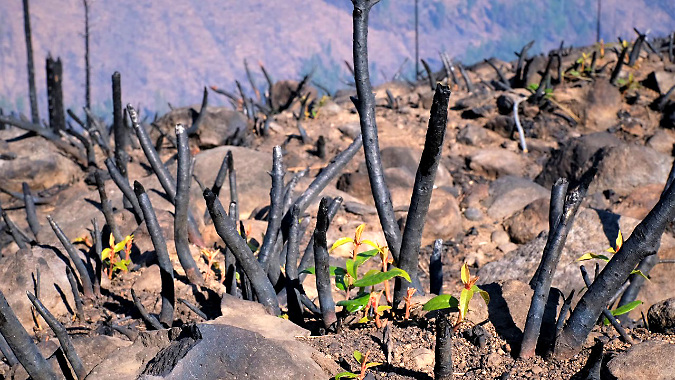
Regrowth already beginning a few weeks after the Lionhead Fire in 2020 (USFS)
Like the Mount Hood fires, the 2020 fires around Mount Jefferson opened rocky terrain that had become heavily forested over the past century through human-fire suppression, though at Mount Jefferson the amount of burned alpine terrain is much more extensive in places like Park Ridge. We may eventually discover that these fires allow reintroduced mountain goats in this area to expand their range to burned places like the upper Breitenbush basin and even the Bull of the Woods wilderness.
Another unexpected development since the 2011 blog article was a National Park Service (NPS) decision to relocate hundreds of mountain goats from Olympic National Park to the North Cascades, in Washington State. This came as a shock to many, given the perceived iconic connection of goats to the Olympics, but the controversial plan was well conceived and deeply grounded in science when it swung into motion in 2018.
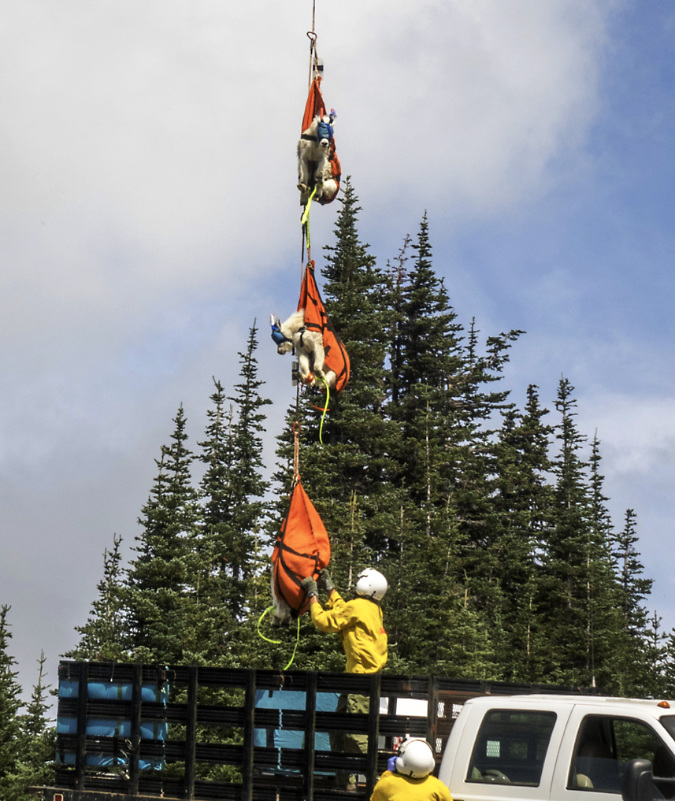
Park Service staff transporting goats at Olympic National Park in 2018 (NPS)
Less known to the public at the time was that Rocky Mountain Goats were not native to the Olympics, and instead had been introduced by hunters in the 1920s. The combination of their environmental impact and (sometimes fatal) interactions with park visitors finally led to the NPS plan to eliminate the herds from the park.
By the summer of 2020, the Park Service had removed 381 goats from the park, with 325 of these relocated to the North Cascades. Most of the rest did not survive the capture or transport process, and 16 kids were transferred to area zoos. Some goats were left behind because of the difficulty of capture, and the Park Service scientists believe the number too small to regenerate a population.
The more jarring news is that most of the 324 relocated goats have not survived. The Park Service reported earlier this year that of the 151 goats among the transplanted population that were equipped with tracking collars, only four are now known to be alive. According to the scientists, the die-off is not simply a result of the relocation, but likely due to lack of suitable habitat – and especially climate change, which has resulted in summer drought and lack of forage for goats in the North Cascades.
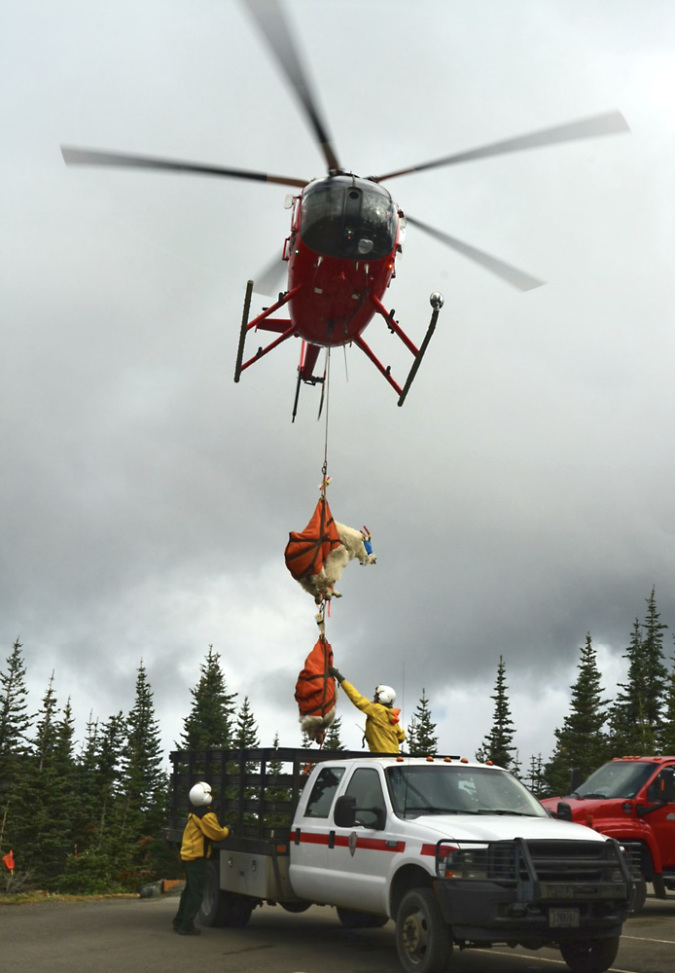
Park Service staff transporting goats in 2018 (NPS)
We are in a period of rapid change for so many species, and our mountain goats can be added to that list. The Park Service estimates that 10,000 goats were living in the Washington Cascades as recently at 60 years ago, a number that has dropped to just 3,000 today.
What does this mean for bringing goats back to the northern Oregon Cascades? I remain optimistic that the return of wildfire to our high-country landscapes will create enough alpine and subalpine habitat for these animals to once again thrive here – that we will once again see Rocky Mountain goats where they had always been, on the snowy slopes of Mount Hood and along the rocky cliffs and ridgelines of the Columbia Gorge.
Indeed, in recent years, there have been periodic sightings of lone goats on Mount Hood on the east slopes of the mountain, near the Newton Clark glacier, and on the west side, high on Yocum Ridge. One recent sighting made local news this summer when a hiker on Yocum Ridge captured a video clip that has since circulated widely (below).
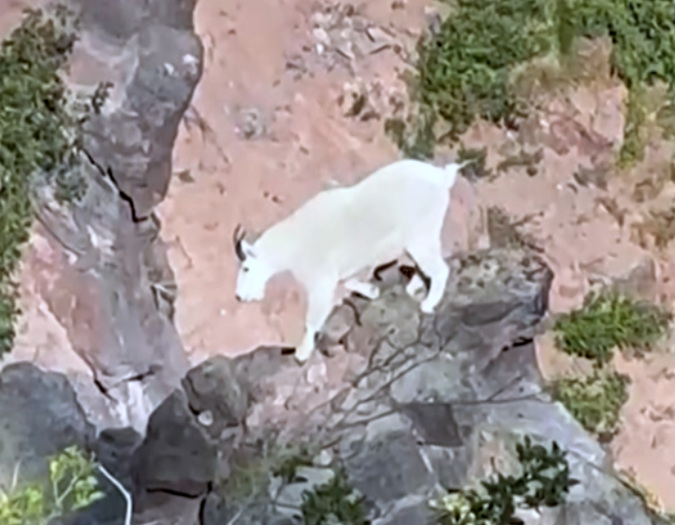
Lone mountain goat spotted on Yocum Ridge earlier this year (KOIN-TV)
These recently spotted goats on Mount Hood almost certainly migrated from the herd that was transplanted to Mount Jefferson in 2010. The long trip north to Mount Hood would have required at least 40 miles of travel along a relatively low, mostly forested section of the Cascade Crest, crossing Highway 26 and perhaps Highway 35 along the way. These obstacles underscore just how adaptative these animals can be when searching for new habitat.
Hikers have also spotted mountain goats on the north side of the Columbia River Gorge in recent years, mostly near Dog Mountain. While there are several goat herds to the north of the Gorge in Washington State, in the Gifford Pinchot National Forest, these are the first recent sightings within the Gorge, suggesting the Washington herds are expanding their range southward.
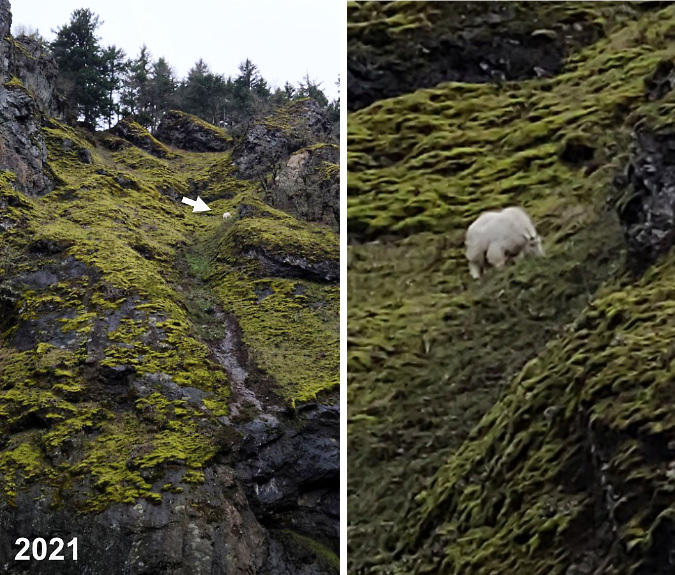
Lone mountain goat near Carson in the Columbia Gorge (Oregon Hikers)
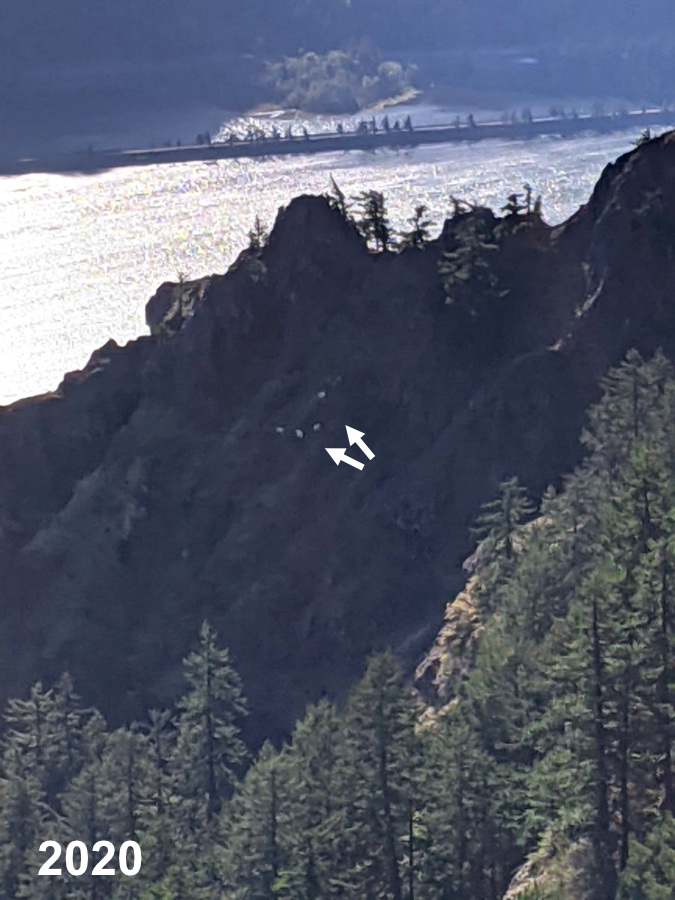
Herd of four mountain goats on Dog Mountain (Oregon Hikers)
Hikers have also spotted the ghost-like appearance of a mountain goat grazing in a heavily forested area near Dog Mountain (below). This sighting confirms their ability to travel between their preferred higher-elevation terrain in search of new habitat, as would be the case for Washington herds migrating south through forests to the reach open cliffs of the Gorge.
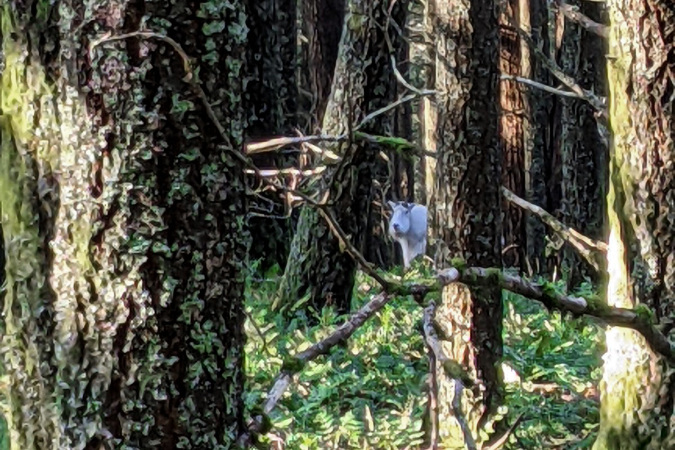
Ghost in the forest spotted near Dog Mountain in 2020 (Oregon Hikers)
Recent goat sightings like these in the Gorge and on Mount Hood are a thrill, and they have made for a lot of excitement in the hiking community. Do they represent a trend and perhaps the return of this species to its historic range in WyEast Country?
Only time will tell, but it’s a hopeful glimpse of what may come!
______________
Tom Kloster | WyEast Blog
 WyEast Blog
Loved the mountain goat article, Tom!
I’ve seen tracks in the snow below Newton Clark Glacier on Hood while exploring Bandit Boulder.
-Regis
LikeLiked by 1 person
Thanks Regis! 🙂
LikeLike
Excellent information as usual. Humans are prone to mistakes and often don’t do well to repair them. Perhaps humans will cooperate with nature a little bit more and the goats will stand a chance of recovery. We can hope.
LikeLiked by 1 person
Thanks, Janice! 🙂
LikeLike
I came within 20 feet of a goat standing on the Pacific Crest Trail near Cultus Lake in the Indian Heaven Wilderness. So they certainly live nearby. I’ve also seen them on Mt. Adams.
LikeLike
Hello,
By now I’m sure you’ve received many folks’ reports of goats they’ve seen around the area. Here’s mine – attached. I saw it last year on Zigzag Mountain. Specifically, on the west side of the mountain on the Horseshoe Ridge trail just below the junction with the Zigzag Mt. trail. We stared at each other for a minute and then he disappeared into the mists.
I just thought I’d share my sighting.
Also, thanks for doing this blog – it’s such a great source of information. Keep the posts coming!
~Chris.
LikeLike
[image: Zigzag the goat.png]
LikeLike
Thanks, Chris! That’s the first I’ve heard of a goat on Zigzag Mountain, but it makes sense given how close that habitat is to Yocum Ridge (and connected by high country). I’d be happy to post your photo as an addendum to the article, but it looks like you’ll have to e-mail it to me… WordPress didn’t like your attachment. Thanks for sharing your experience!
LikeLike
Great article Tom! I’ve heard some folks see goats up in the Silver Star Mountain area in Skamania County. Haven’t encountered any in the wild (yet.) They are beautiful and fascinating animals.
LikeLike