2025 Campaign Calendar..!

2025 Campaign Calendar Cover

December brings my annual year in review as told through the images I’ve chosen for the new Mount Hood National Park Campaign calendar. It’s a collection of images from around WyEast country that captures my explorations over the past year and its published in a high-quality, oversized format by the good folks at Zazzle. You can order one here:

2025 Mount Hood National Park Campaign Calendar

As always, all proceeds go to Trailkeepers of Oregon (TKO) and you can have these calendars delivered anywhere. You may notice a Red Rock Country calendar of desert southwest images from a recent trip through the Colorado Plateau — proceeds from the is calendar to to TKO, as well! Meanwhile, here’s a deeper dive into the thirteen images I selected for this year’s calendar.

Stories behind the photos…

The cover image is also the most recent in the calendar. It’s an alpenglow view of Mount Hood’s west face taken from Lolo Pass road in early November. This is a classic spot for photography after the first few fall snowstorms, so I’m rarely alone there – a notably, I ran into Peter Marbach, one of our amazing WyEast Country professional photographers on this visit! This view came a few minutes before sunset on a crystal-clear fall evening:
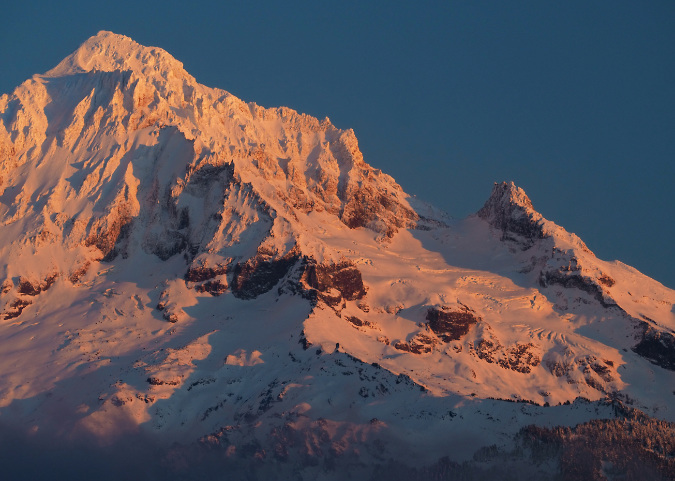
Last light after an early snowfall on the mountain is the cover image of the 2025 campaign calendar

The backstory to this photo is that I had planned to shoot from a favorite spot on the east shoulder of Lolo Pass that evening. I even had my camera set up, ready to go, when a huge fog bank rolled up the West Fork Hood River valley and parked over me at Lolo Pass. It happened in less than a minute, as the photo sequence below shows:
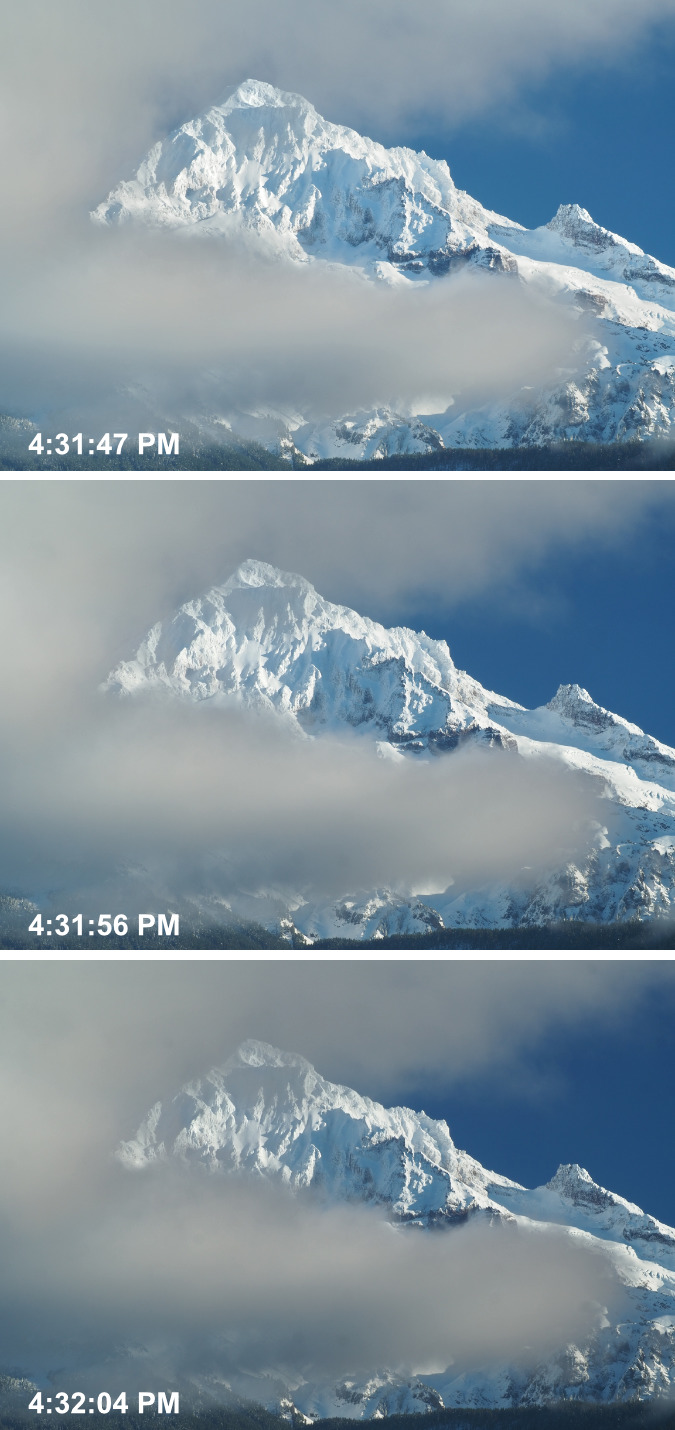
Lolo Pass fog rolling in… setting up my tripod seems to have this effect on the weather!

It turns that topographic conditions are prime at Lolo Pass for fog events like this (sometimes becoming freezing fog). Most of these are triggered when colder, drier continental air from east of the Cascades collides with moist, marine air from west of the mountains to form very localized fog banks parked on top of the pass, with otherwise clear weather to the east and west. 

Sure enough, when I packed up and headed to a viewpoint just west of the pass, the mountain was in full view – along with the fog bank draped over Lolo Pass (below). This is where I captured the cover photo for the new calendar that day and had the pleasure of meeting Mr. Marbach! I’m still kicking myself for not getting a selfie – I’m a big fan of his amazing work.
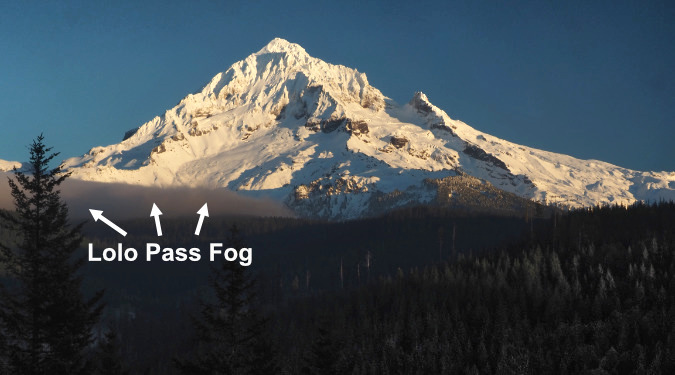
Looking back at the Lolo Pass fog bank from the west side of the mountain

In fall and early spring, strong temperature inversions can also fill the mountain valleys on both sides of Lolo Pass with dense fog. As the sun drops down toward sunset, the valley inversion fog often surges over the pass due to its remarkably low elevation of just 3,415 feet – at least a thousand feet lower than most of the Cascade passes in Oregon.

Continuing with the fog theme, inversion valley fog is just how this photo (below) I chose for January image in the new calendar came about. This scene was captured on the east side of Mount Hood, along the lower slopes of Lookout Mountain, with the East Fork Hood River canyon filled nearly to the brim with a dense, thousand-foot thick layer of fog. The view is framed with long-needled Ponderosa Pine boughs, the signature conifer species on the east slope of the Cascades.
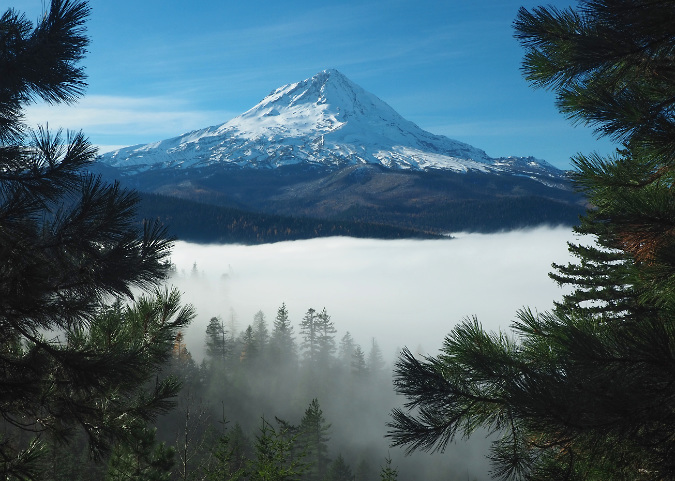
More fog for the January calendar image – this time in the East Fork Hood River valley

Here’s a wider view from the same area (below) showing how the fog filled the valley like a bathtub that day, thanks to a layer of cold, moist air trapped by a stable high-pressure system that was bringing all that sunshine and relatively mild temperatures directly above. On winter days like this, it’s common for temperatures in the fog zone to be hovering near freezing while temperatures above the inversion rise well into the upper 40s or even low 50s.
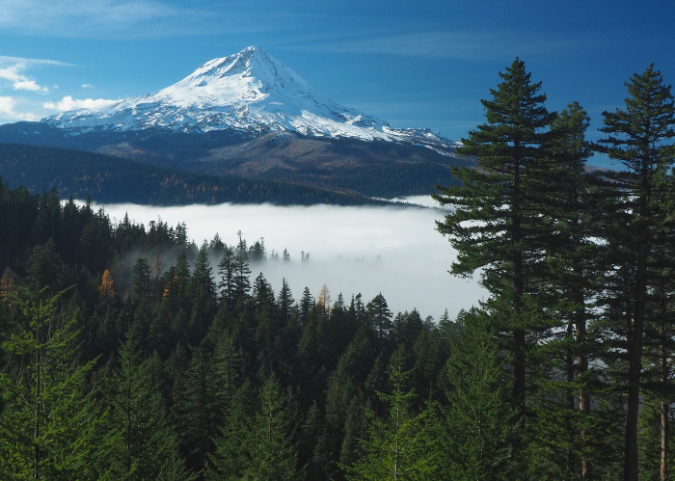
East Fork Hood River inversion fog and Mount Hood

Inversion fog is common on the east end of the Columbia River Gorge and is tributary valleys in winter, often with freezing temperatures that make for spectacular frost displays (and slick roads) when the inversions persist. The forests here are completely adapted to this effect, including the annual pruning that a heavy ice accumulation from persistent fog can bring. 

In this view (below), the winter advantage of Western Larch also stands out. While a few of the Larch still have their golden needles, most (like the one in the center) have already dropped their foliage for the winter, making them less susceptible to heavy winter winds and accumulations of snow and ice. Like Ponderosa Pine, Larch are also fire-resistant – making them perfectly adapted to this “fire forest” mountain ecosystem.
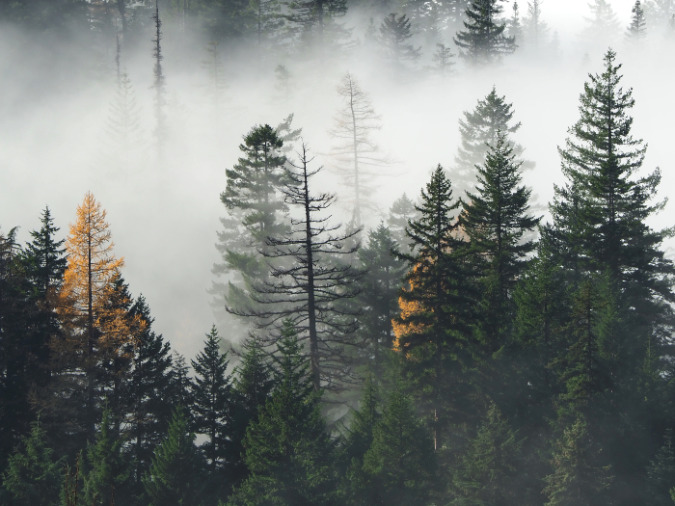
Fog swirling through an east side forest of Larch, true firs, Douglas fir and Ponderosa pine

The fog was sloshing around the East Fork valley that day as I watched and captured the changing scenes. While the overall inversion layer is generally flat, there are waves in the upper surface of the fog what wash “ashore” along the valley walls as the inversion air pressure gradient rolls across the surface of the fog layer. It’s mesmerizing to watch this effect from just above “shore level” as the waves surge below.

This final view was taken from the same spot as the above calendar image, and it shows an approaching wave of fog that would soon overtop the spot where I had set up my camera for these images. Once it engulfed me, the air temperature nearly 20 degrees in just a few minutes!
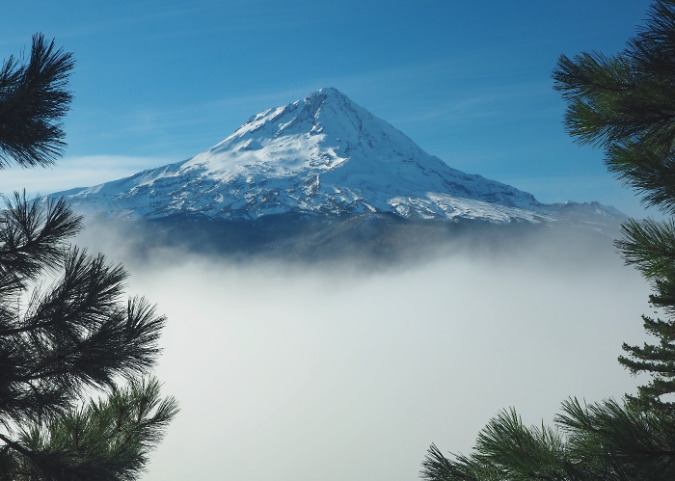
The mountain a few minutes before the ocean of fog inundated this spot!

Winter can be long and grey on the west side of the mountains, but if you know Oregon’s weather patterns you can often spot conditions when the east side of the mountains will be bright and sunny, even as rain falls on the west side. A favorite retreat for me on these days is the lower Deschutes River Canyon, less than two hours from Portland. 

Despite the still-cool temperatures, I prefer to visit the Deschutes River in late winter, when few people are there, and the canyon slopes are green with emerging spring growth and the Alders turn yellow, then rusty-red with catkins. For the February image in the new campaign calendar, I chose this scene (below) near Rattlesnake Canyon that features a picturesque White Alder just coming into its late winter bloom.
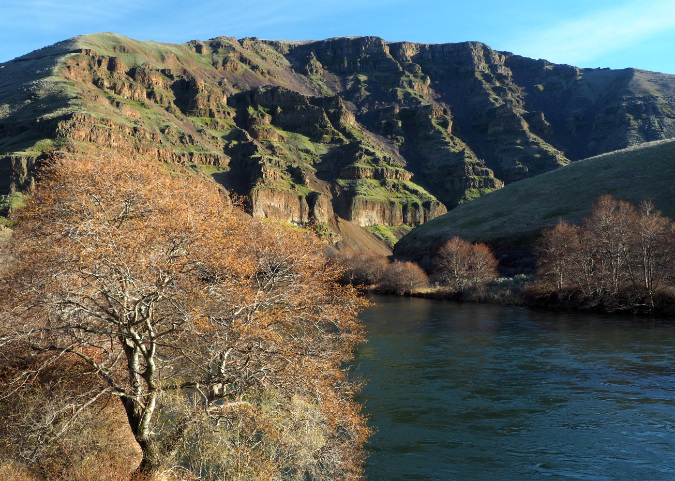
White Alder providing winter color along the Deschutes River for the February calendar image 

Here’s another winter scene along the Deschutes with a mature grove of White Alder (below) growing along the riverbank. White Alder are not widespread in Oregon, and mostly limited to the Willamette Valley, eastern Columbia River Gorge (including the lower Deschutes Canyon) and the Siskiyous in Southern Oregon, Their range overlaps the Red Alder, its close cousin, that grows along the Pacific coast and extends as far inland as the Willamette Valley, where the two species meet.
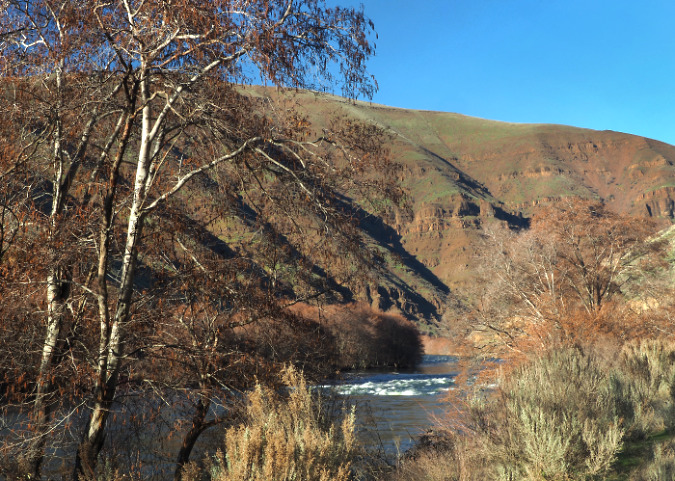
White Alder (left) in winter along the Deschutes

Seen up close, both the male and female catkins of White Alder come into view. In this February photo (below), the male catkins are the long, pendulous blossoms and the green female catkins are still in bud form, just beginning to emerge. The “cones” of last year’s female catkins can still be seen, too. They are the dark ovals that resemble tiny pine cones when they open and dry to a dark brown color in fall. Because White Alder contains both male and female flowers on the same tree, they rely only on wind to pollinate, and the desert country east of Mount Hood provides plenty fo that!
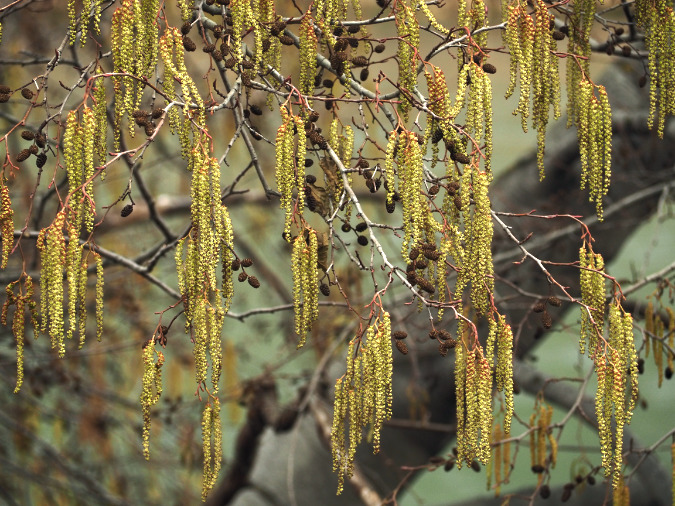
White Alder catkins emerging in February

This view of a typical section of the Lower Deschutes canyon (below) shows just how important the White Alder groves that line the shore are to the ecosystem. They are the only sizable trees in this desert landscape, and they provide essential wildlife habitat along the river. Both Red and White Alder are also nitrogen-fixing trees, enriching the soil for other plants wherever they grow.

White Alder groves line the lower Deschutes River Canyon in winter

Another surprise on this winter trip to the Lower Deschutes were the many flowing tributary waterfalls that are dry for much of the year. This unnamed, two-tier waterfall near Trestle Bend is dropping into a grove of White Alder (below).
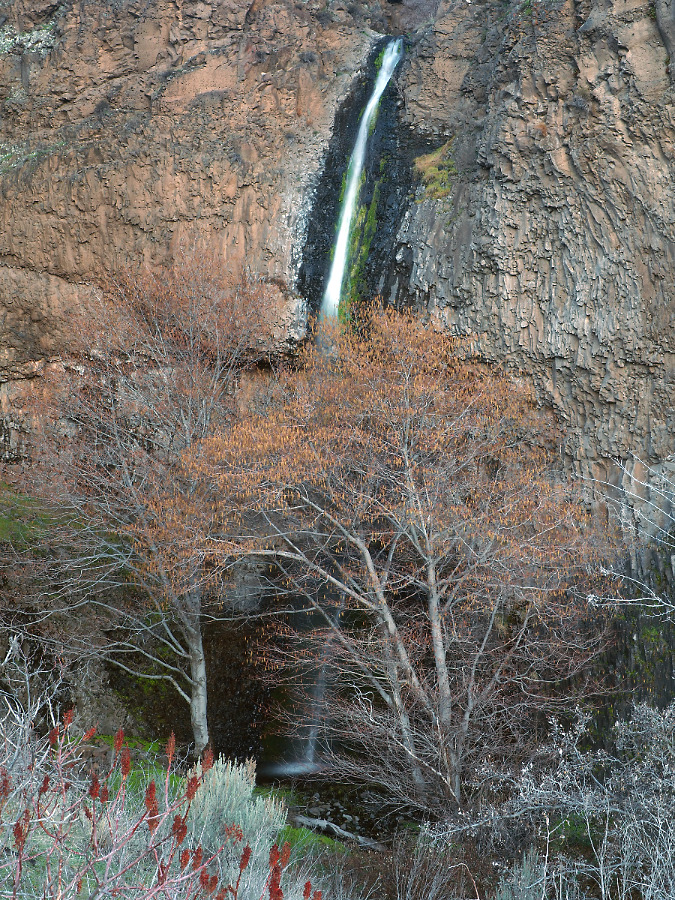
Season waterfall dropping into the Deschutes canyon in winter

While I’ve known for some time that Rocky Mountain Bighorn Sheep live in the Lower Deschutes canyon, I had not seen them until this trip last February, when I spotted two herds high above the river, just upstream from Rattlesnake Canyon. Both were bachelor herds working their way downstream, along the upper slopes of the canyon (below). 
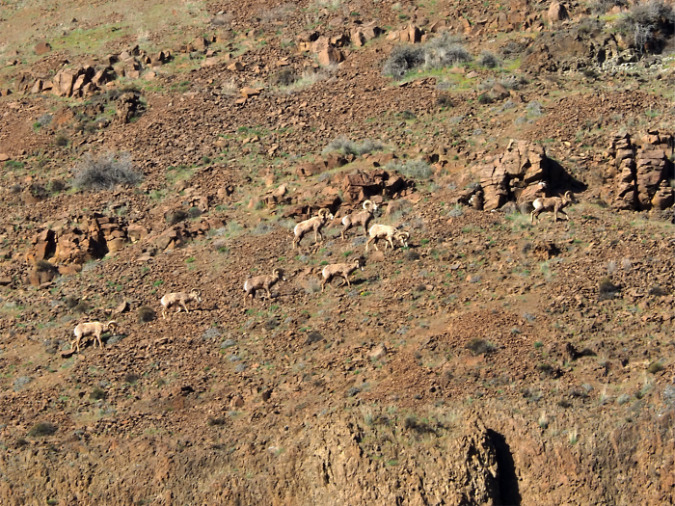
Bighorn Sheep in the lower Deschutes River canyon

Bighorn Sheep are a welcome sight in the Deschutes River canyon, not just because they’re beautiful to see and watch, but because they’re also an indicator of ecosystem health. Bighorns are highly sensitive to human activity, so their presence here reflects the continuing efforts by the Bureau of Land Management and Oregon Department of Fish and Wildlife to expand habitat protection for these animals in Oregon’s desert country.
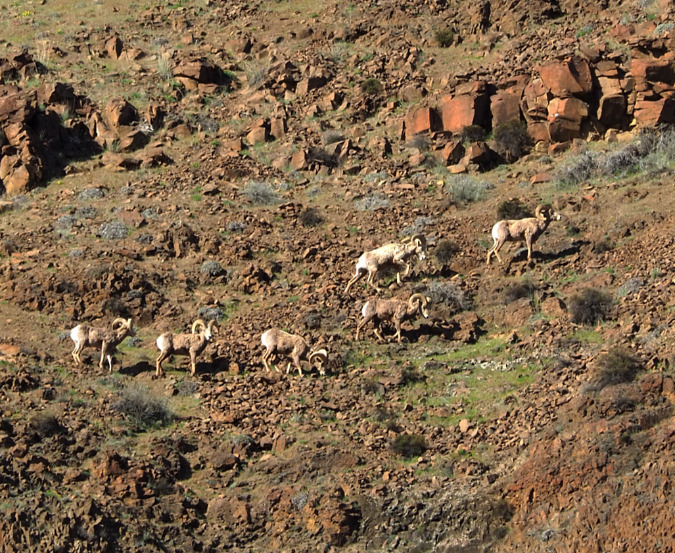
Bighorn Sheep in the lower Deschutes River canyon

This trip was my second to the Lower Deschutes last winter, and I did have a practical mission for returning. On the first trip I had come frighteningly close to dropping a wheel over the edge of a paved section of the river access road, where a landslide has taken a big bite out of it. When I pulled over to take a look, I was spooked by the realization that going off the road here would have sent me 200 feet down the landslide scar, and directly into the river! 

So, one week later I came armed with a can of white paint to (at least temporarily) mark off a shy distance for drivers passing north along the road. Hopefully, the land managers didn’t mind…
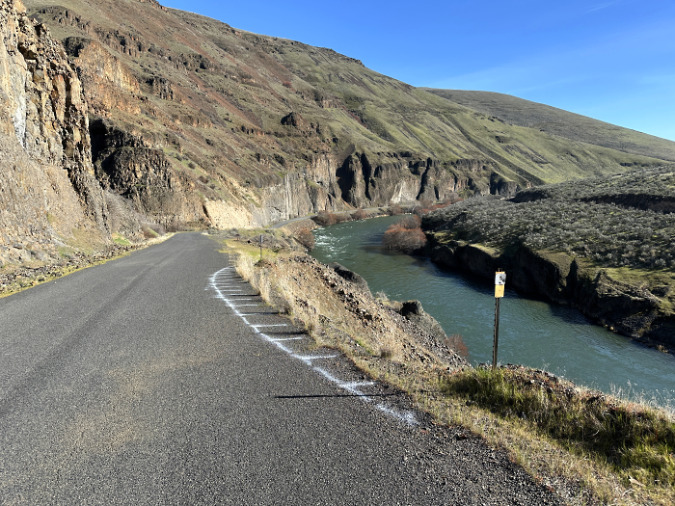
Scary landslide damage to the Deschutes River Road!

This aerial view of the landslide scar from Google Earth (the image below is from 2022) shows just how sketchy the situation is, and that there are really two slides at work, here. The larger slide on the right is the one picture above, where the roadway has been seriously compromised.
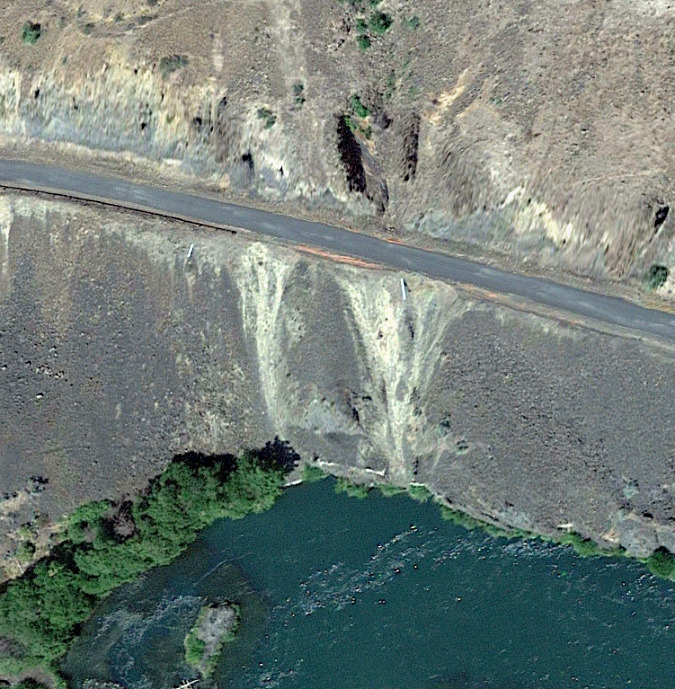
Aerial view of the Deschutes River Road landslides in 2022 (Google Earth)

For the March calendar image, I moved to the Columbia River Gorge and Tanner Creek. It’s a place that I describe as the “Gorge on the half-shell”, as this spectacular 2-mile loop trail along to Wahclella Falls has all of the elements of a classic Gorge hike: towering basalt cliffs, a rushing stream with thundering waterfalls, wispy, impossibly tall tributary waterfalls, old-growth Douglas Fir and Western Redcedar, fern-covered talus slopes and lush green moss on seemingly every surface. Throw in four unique footbridges (one where you can reach out and touch a waterfall) and it’s a perfect introduction to the Gorge.

In past years, I have included a favorite scene captured from a viewpoint high above the falls, showing a couple of the tributary waterfalls dropping into the deep gorge that Tanner Creek has carved. I captured the scene once again this year (below), but wanted to try something different for 2025.

Wahclella Falls in the Columbia River Gorge

This year I opted for the view from in front of the falls (below), taken from the long footbridge that can spotted in the previous photo. From this streamside perspective, a young Western Redcedar growing directly in front of the falls, and will soon block the view. So, for this year I embraced the photo-bombing tree and framed it to be directly silhouetted by the falls while it’s still short enough not to completely block the view.
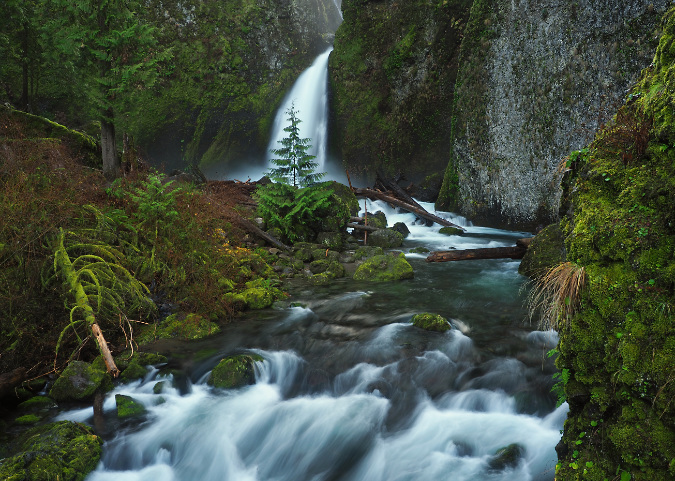
Wahclella Falls and the upstart Western Redcedar tree are featured as the March calendar image

How long before the tree eclipses the view from the footbridge? Here’s a comparative view of this young upstart, and you can see that it will clearly block the falls from this vantage point in the next decade or so… if it survives! That’s an open question, as this little tree is growing quite close to Tanner Creek, and there’s a reason the largest trees near the falls are on higher ground. Tanner Creek is big and rowdy in winter, and regularly scours the streambanks along its course in high water, easily carrying away whole trees in its wake. The giant logjam in the earlier, wide view of the falls is testament to the stream’s power.
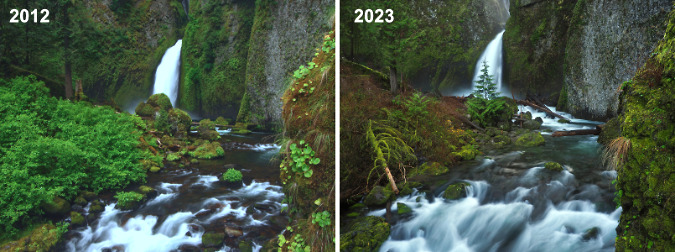
The upstart cedar at Wahclella Falls

[click here for a much larger version]

For geoscience types (that would be me), the still-fresh scar from the 1973 landslide at Tanner Creek is hard to take your eyes off when hiking this trail, but in recent years there have been a series of much smaller basalt wall collapses right next to Wahclella Falls that are fascinating to track. Sometime in the past year, another 15×20 foot slab immediately west of the falls collapsed into the splash pool after being undercut by erosion from the pounding water. The photo pair below shows the new scar.
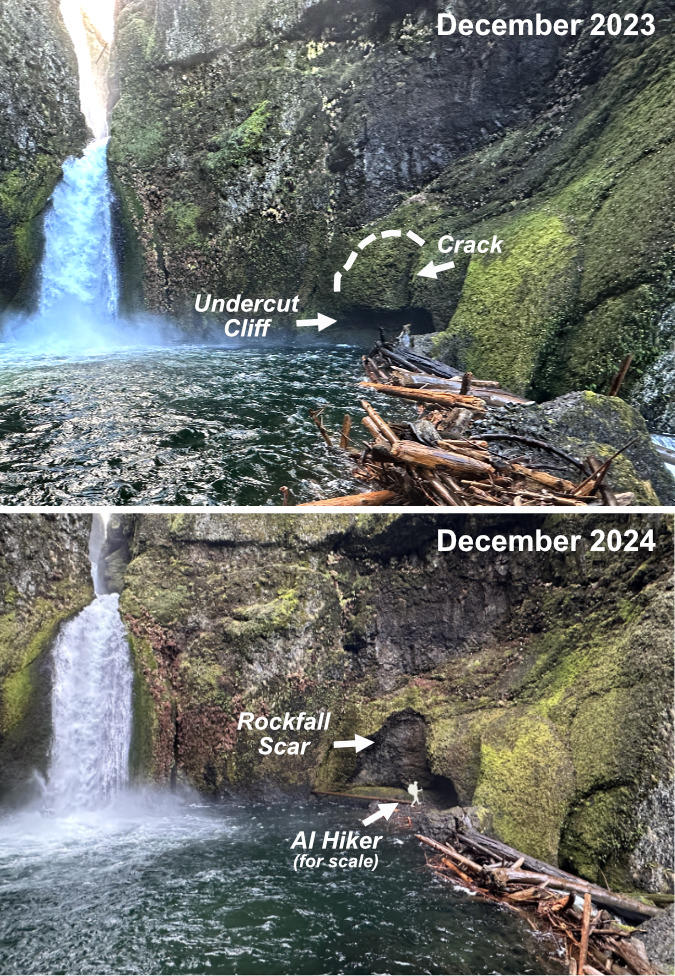
Recent wall collapse along the Wahclella Falls splash pool

This latest evidence of the ongoing erosion along Tanner Creek is a more typical example of the incremental, nearly constant deepening of the canyon that occurs through the combination of gravity and annual freeze-thaw cycles that push cracks in the basalt walls open and gradually the rock apart. 

This weaking of the rock is accelerated by the erosive action of Tanner Creek in undercutting the canyon walls, especially where the heavy basalt layers rests on the must softer Eagle Creek Formation, made up of ancient volcanic debris flows that are easily eroded by the stream. The trailside cave just below Wahclella Falls (where the new the new logjam has accumulated) is a great example of stream erosion cutting away this softer layer beneath several hundred feet of vertical basalt cliff, above. This was mostly likely what triggered the massive 1973 collapse, as well.

For the April image in the new calendar, I chose a scene that put April-blooming Balsamroot front and center. This view from the Columbia Hills State Historical Park (below) is looking west toward Mount Hood on a cool, blustery spring day.
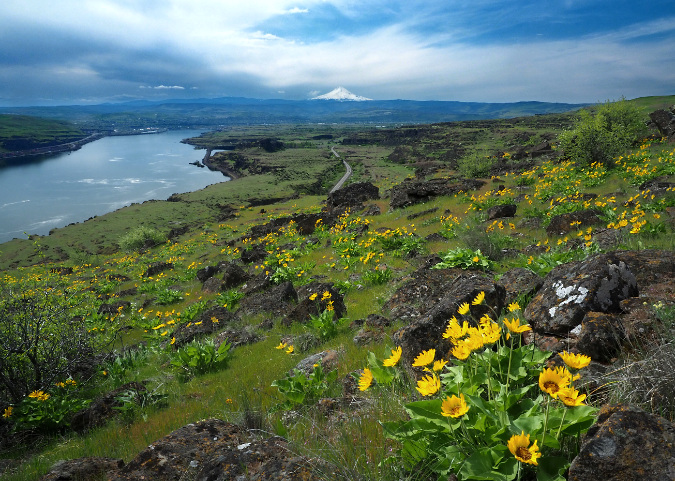
Mount Hood and the flood-scoured lower slopes of the Columbia Gorge are featured in the April calendar image

Staying with a geology theme, this viewpoint is notable for how rocky this scene below is. It was taken at a point just below the high-water mark of the series of ice age floods that shaped much of what we know as the Gorge today. The floodwaters scoured away all but the most resistant basalt, leaving this rugged terrain we know today behind.

You can easily spot the high-water mark of the ice age floods in this part of the Gorge. Just a hundred feet uphill from the viewpoint where the previous photo was taken, the terrain suddenly softens into the rolling slopes that make up the Columbia Hills (below). There’s plenty of jagged basalt here, too, but it’s mostly buried under millennia of soil accumulation that survived the floods thanks to being mainly above the flood levels.
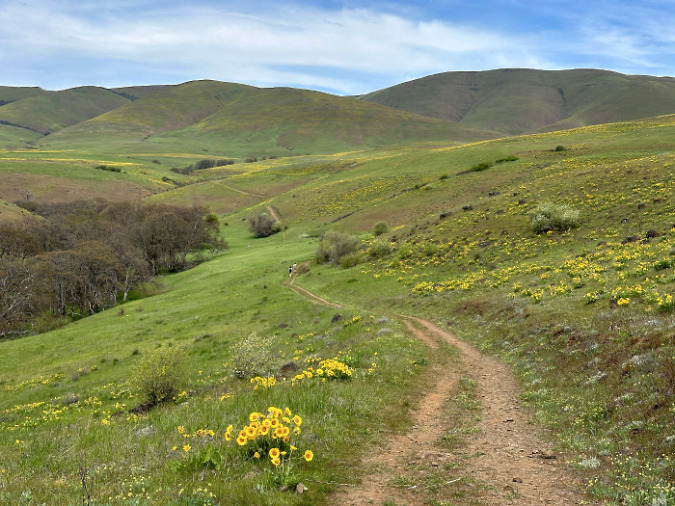
Gentle terrain above the ice age flood high-water level in the Columbia Hills

The surviving soil in these upper slopes of the Gorge translate into enormous wildflower meadows that draw people from around the world. Yellow Balsamroot steals the flower show in the east Gorge in spring, but in places with the Columbia Hills, they are just part of a wildflower spectacle, with Phlox (below), lupine and dozens of other wildflowers filling the gaps between the showy Balsamroot.
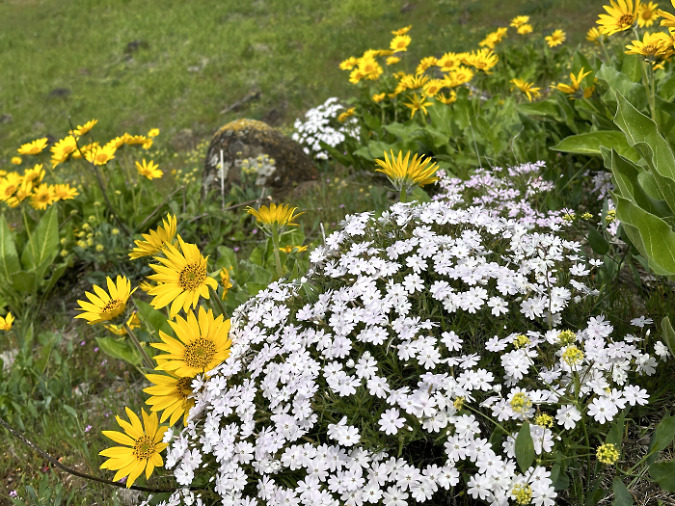
Spring wildflower gardens in the Columbia Hills

Each time I visit places the east Gorge in spring, I make it a goal to spot a few of these co-stars in the flower show that I might not have noticed before. To my surprise, my visit last spring included Ballhead Waterleaf, a lush plant that grows throughout the west, but is typically found in moist spots. Yet, this colony (below) had found a shady slope beneath a pair of Bigleaf Maple trees with just enough groundwater to help them thrive in this desert environment.
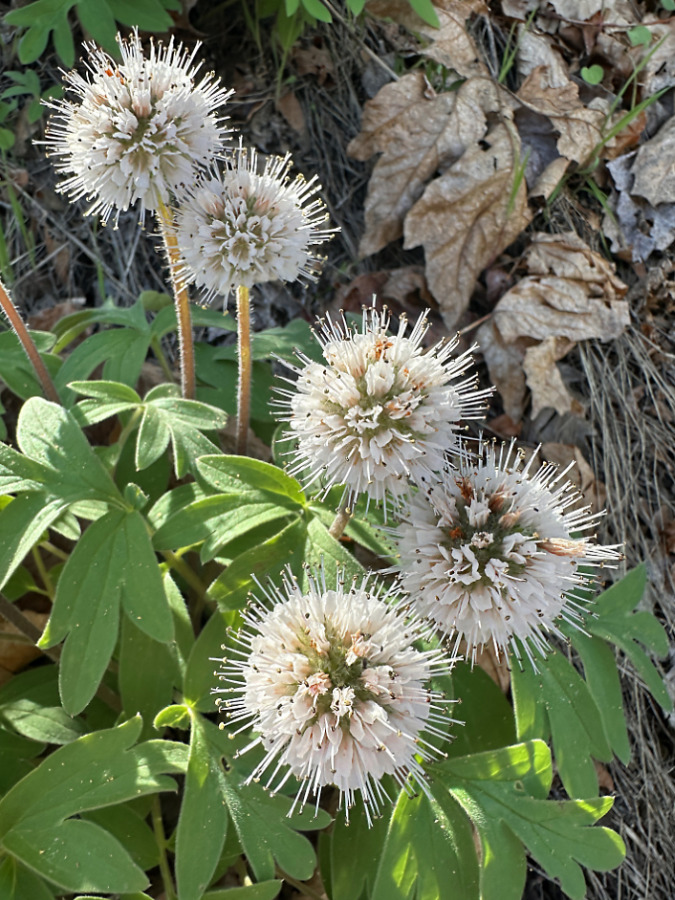
This Ballhead Waterleaf found a shaded niche in the Columbia Hills

Another striking wildflower was new to me on that trip, a lovely plant called Whitestem Frasera (below). It was just coming into bloom and still in bud when I was there, but in a couple weeks would have clusters of blue flowers rising above the beautiful foliage. This is one of many species that is typically found well east of the Cascades, but makes its way well into the Columbia River Gorge where conditions are right.
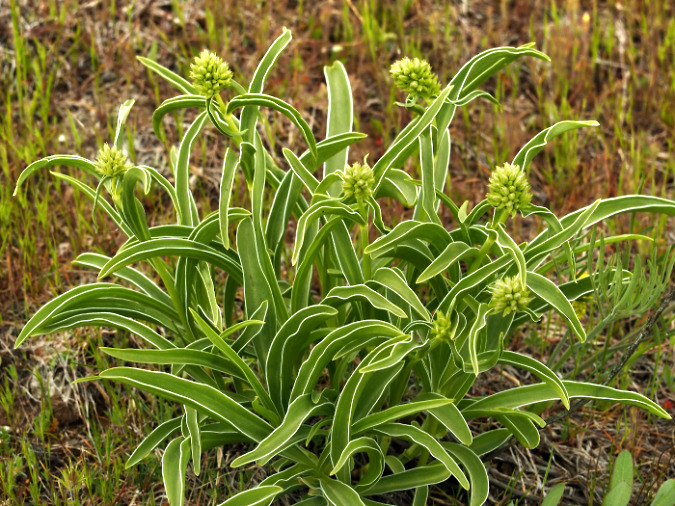
Whitestem Fraseria still in bud in the Columbia Hills

Still more surprising on that trip were several Cushion Fleabane (below) colonizing the old access road that forms the first mile or so of the Crawford Oaks trail in the Columbia Hills. These little plants thrive in fine gravels, and the old roadbed provides that for them, now that traffic is mostly limited to hiking boots.
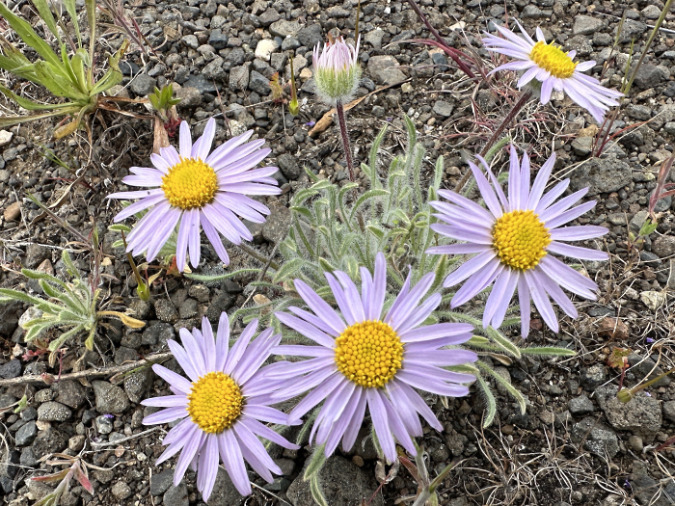
Tiny Cushion Fleabane in the Columbia HIlls

I stayed on the east side of the mountains for the May calendar image, with a view of White River Falls (below), where one of Mount Hood’s many glacial streams carves a deep canyon through sagebrush country and make a spectacular leap over a wide basalt cliff on the way to its confluence with the Deschutes River, just downstream. The falls and its lower canyon are protected as part of White River Falls State Park.
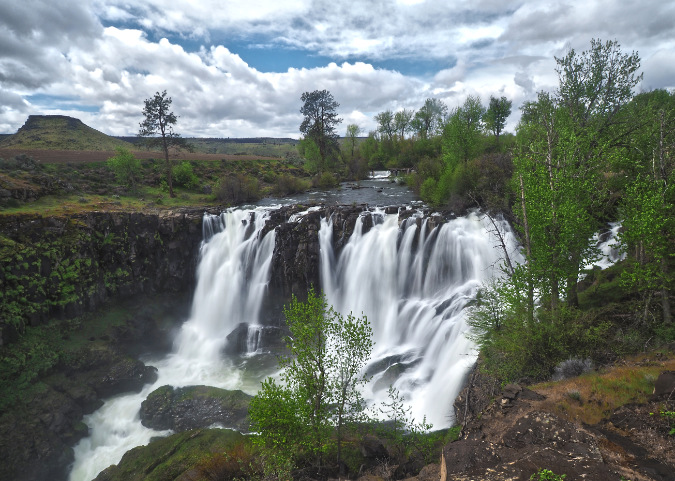
White River Falls during spring runoff in the May calendar image

This spectacular view of the main falls is best in spring, when runoff is high. The upper viewpoint is easily accessible, too – just a few hundred feet from the trailhead, with some of the path paved. But the deep gorge below the main falls hides still more waterfalls that make it well worth the steep hike into the canyon, despite the choppy descent along a long set of deteriorating stairs!

The stairway to White River heaven…

The lower tier of the main falls is unofficially called Celestial Falls (below) and forms a perfect punchbowl between walls of basalt. When winter temperatures drop below freezing, this natural bowl can become a mass of ice built up from the waterfall spray.
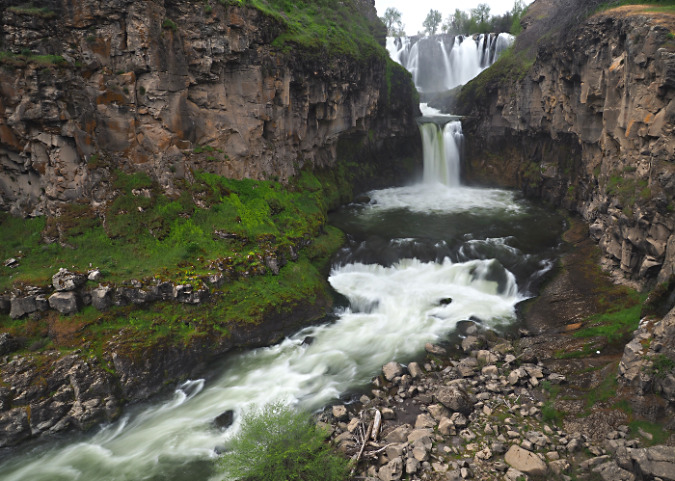
Celestial Falls on the White River, just below the main White River falls

Continue a bit further downstream on an increasingly unofficial trail, past the ruins of the early 1900s hydroelectric plant that once operated here, and the White River makes a third, smaller plunge into another, larger punchbowl at the lower falls (below). This might be my favorite spot in the canyon, as the lower falls and its deep pool are framed with wildflowers in spring, sprinkled among the boulders on the slopes that surround the river.
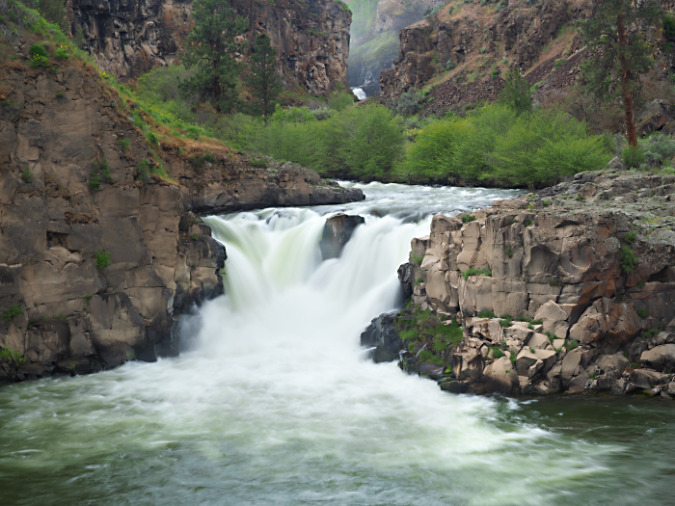
Lower White River Falls

There is a lot to see at White River Falls, and because it’s a regular stop for me, my eye goes to new details on each visit. When I stopped last spring and captured the calendar image shown previously, I was surprised to notice that beavers had taken up residence in the long, slow pool near the old powerhouse, between Celestial Falls and the lower falls. They had also recently made quick work of several trunks of a White Alder clump growing along the beach (below). If you look closely at the image from last April, you can see four fresh cuts, along with at least five previously cut trunks. Just one trunk remained, then, and even this sole survivor had a fresh scar where the beavers were working to finish the job on this grove!
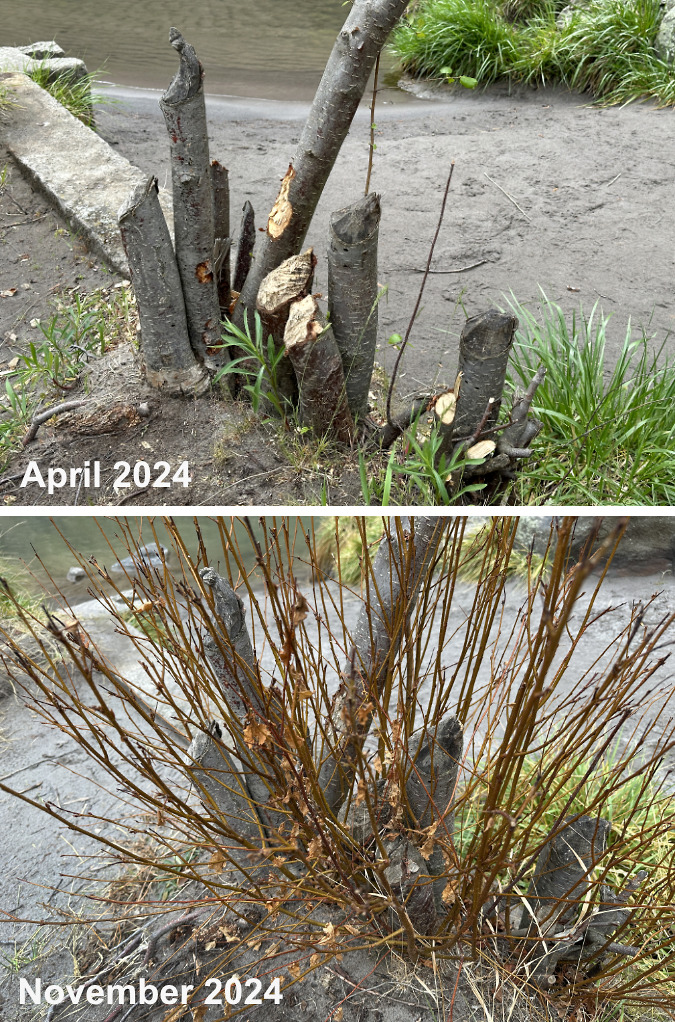
Busy beavers at White River Falls State Park

In the more recent image from last month – just seven months later — you can see the Alder tree is fighting back with a vengeance. Not only did that lonely last trunk survive, dozens of new shoots exploded from the stumps over the summer to replace what the beavers had hauled away. It’s a great example of the continuous cycle between beavers and streamside trees.

When I visited last month, I was also reminded of man’s impact on the falls. In low water, which extends from mid-summer into mid-winter, much of the face of White River Falls goes dry. Why? The answer is in the distance, just beyond the falls, where a long-derelict diversion dam (shown below) was built more than a century ago to direct water to the old hydroelectric penstock pipes.
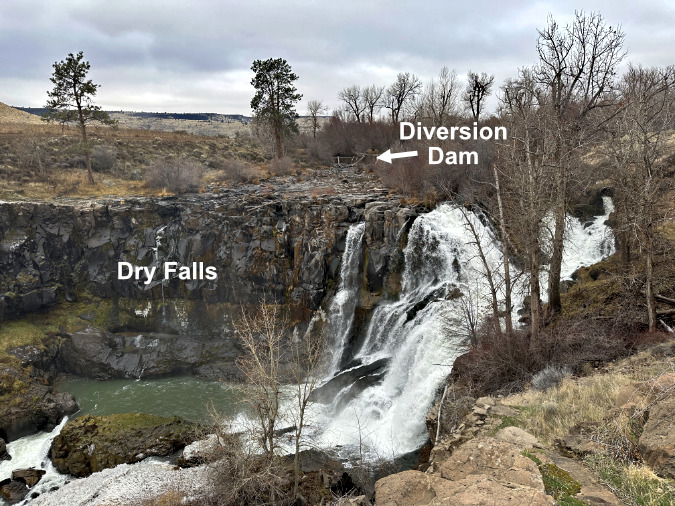
Dried-up White River Falls in the low water season when the main river flow is diverted

You can get a close-up look at the ruins of the old waterworks by following a path that heads upstream from the main falls overlook. Here, the diversion dam and abandoned canals that were once the headworks (below) to an elaborate pipe system are still diverting the river, but only to a side channel that spills around the main falls, as the pipe system was largely removed decades ago.
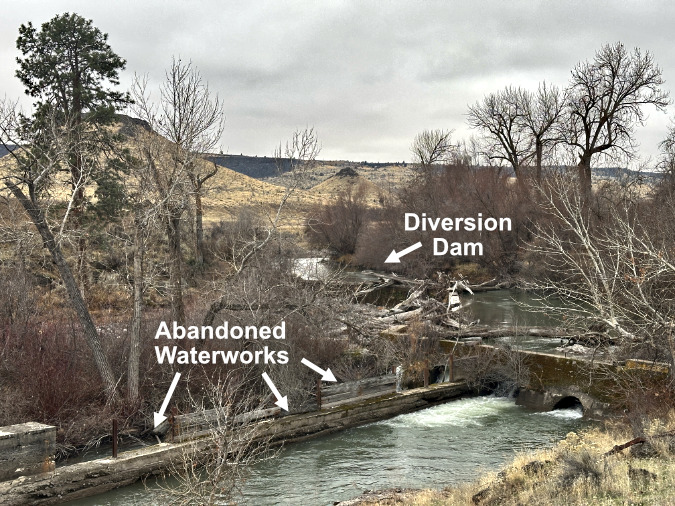
Derelict White River Falls diversion works depriving White River Falls its full spectacle

My hope is that Oregon State Parks officials will someday breach the old dam and restore the falls to its original channel year-round, instead of waiting for the White River to do the job (and it will, eventually).

For June, I chose another east-side image for the calendar. This view of Eightmile Falls (below) is where the main stream flowing from Columbia Hills State Historic Park drops over a basalt cliff as it enters the ice age flood-scoured lower reaches of the Columbia Gorge. In spring, this overlook is especially beautiful, lined with blooming Balsamroot and the creek is running strong with early season runoff.
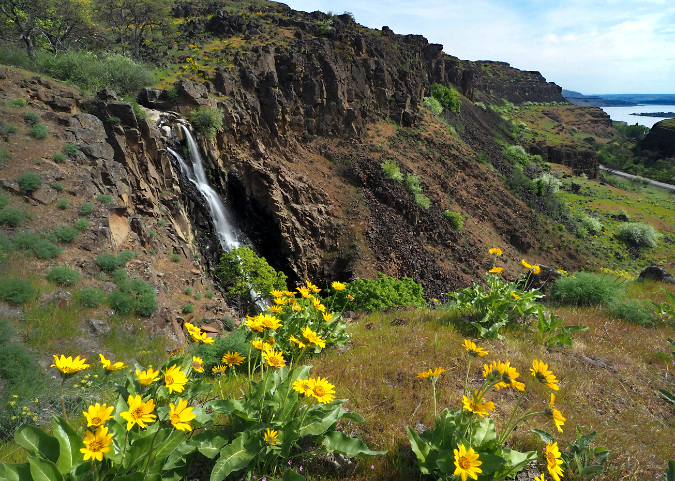
June in the new calendar features Eightmile Falls in the Columbia Hills

Eightmile Falls is located along the Crawford Oaks trail, a relatively new access point to the park that follows a portion of the historic military road that once passed through this area. Along the way, there are views of Mount Hood and the Columbia River framed by old stone walls (below) from the early days of white settlement here in the late 1800s.
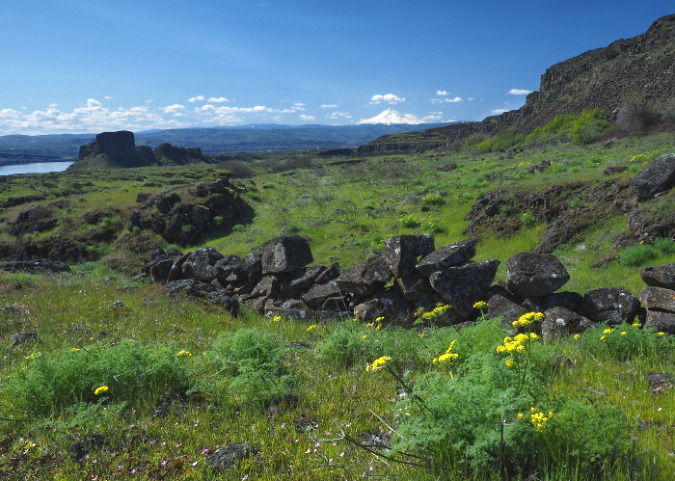
Stone walls in the Columbia Hills mark early white settlements in the area

One surprise along this section of the old military road is a grove of heritage apple trees that have somehow survived here for a century of more, in the middle of this harsh desert environment. In spring, they are covered with blossoms (below) that reveal them to be part of the human story here.
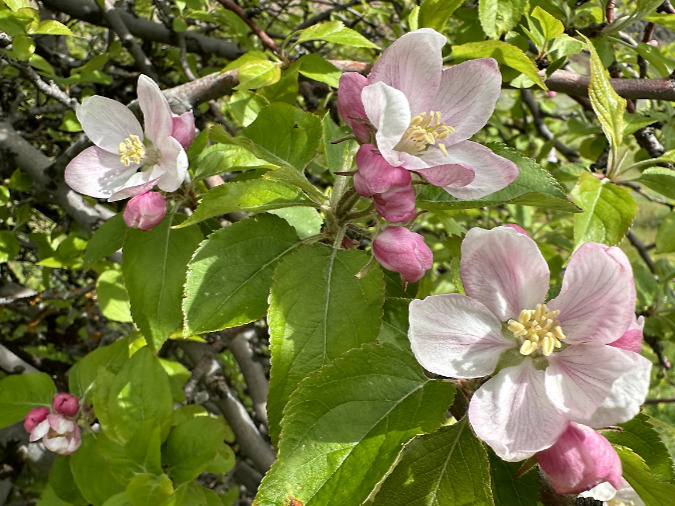
Heritage apple trees from white settlements still survive at Crawford Oaks

Another surprise along the old road are several groups of Bigleaf Maple, a species that thrives in Cascade rainforests. These unlikely trees manage to carve out a niche in this desert environment where they typically grows along basalt walls that provide both weather protection and provide groundwater seeps to help them survive hot summers.
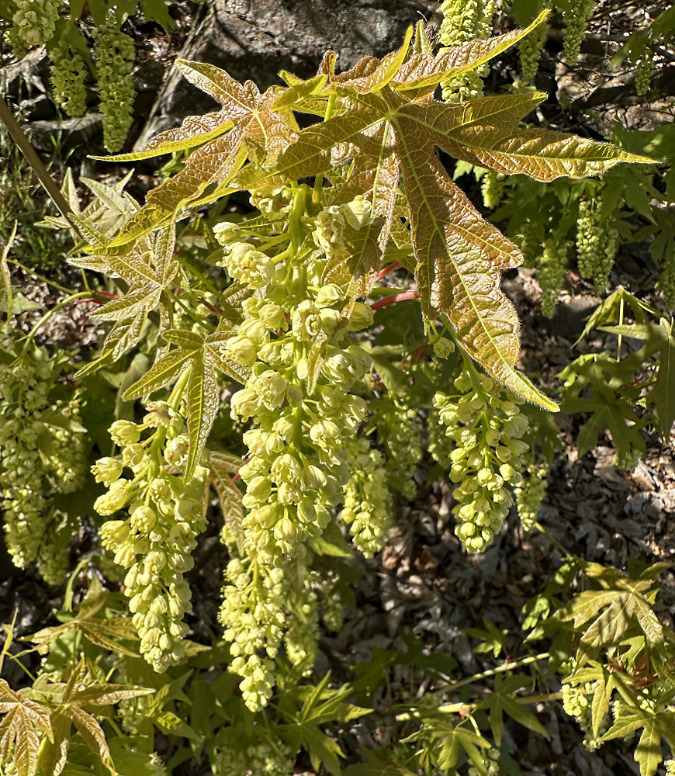
Bigleaf Maple blossoms in the Columbia Hills

In spring, these out-of-place maples also put on an impressive flower display (above) that is easier to appreciate here, where the trees often grow just 15-20 feet high. Their foliage is at eye level, where you can see the blossoms close-up, compared to rainforest cousins where the blooms are often 70 or 80 feet above the forest floor.

For the July calendar image, I moved up into the mountains with this view (below) of the historic Cooper Spur Shelter, located along the Timberline Trail on the northeast shoulder of Mount Hood. This is among of the most iconic spots on the mountain, and it didn’t disappoint this year, with drifts of blooming yellow Buckwheat and purple Lupine framing the 1930s, Civilian Conservation Corps structure.
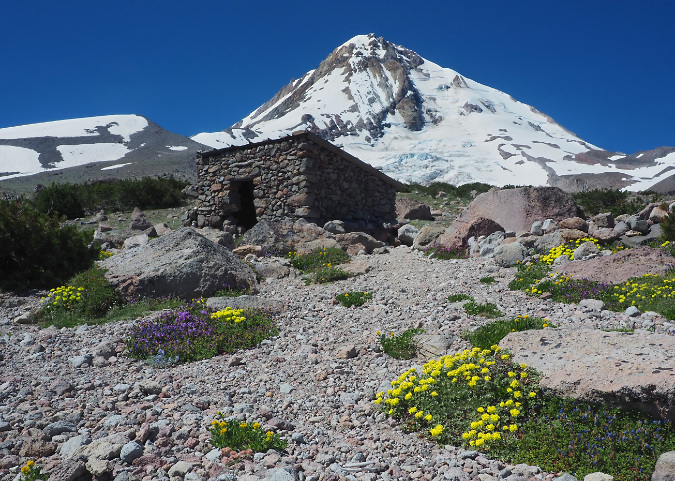
Cooper Spur Shelter with alpine wildflowers are featured in the July calendar image

As tough as it has been to witness the accelerating effects of global warming on Mount Hood’s glaciers in past years, the early summer view of the Eliot Glacier remains one of the most impressive sights in WyEast Country. In this view from farther up the Cooper Spur trail (below) a few weeks later, a group of hikers is silhouetted against the mountain, giving scale to the enormity of the glacier as it tumbles down the mountain.
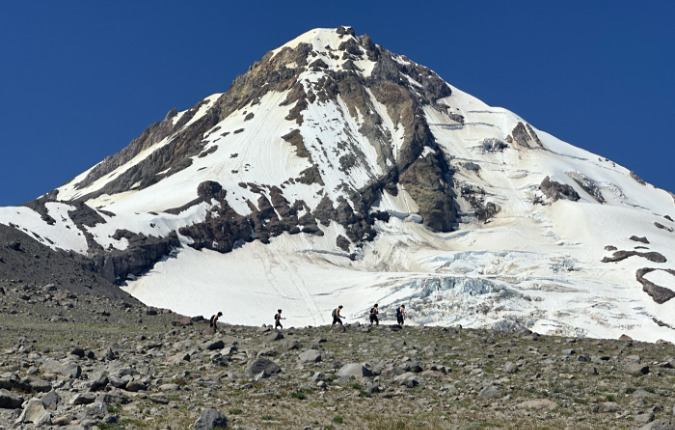
Hikers framed against the Eliot Glacier in Summer

Many of the trails in the Cooper Spur area are as unofficial as they are historic, dating back to the earliest recreation visits to the mountain in the late 1800s and early 1900s, when the Cloud Cap Inn was in its heyday. Today, the continue to be as heavily traveled as the formal trail system. This is made possible by a largely unseen corps of unofficial trail tenders that have helped tend to these routes for decades, as well as the official Timberline and Cooper Spur routes. I know, because I’ve adopted a few of these trails, and I always see the handiwork of others when I’m working there.

Last July, my unofficial trail work focused on retiring a persistent shortcut just below the crest of the South Eliot Moraine. It’s caveman work, as you can see in the schematic below – simply covering the shortcut with rocks large enough to discourage people from taking the shortcut. It’s a never-ending task, as new routes are formed instantly in this open, loose alpine terrain when just one group hikers decides to leave the established trail and make their own way. 
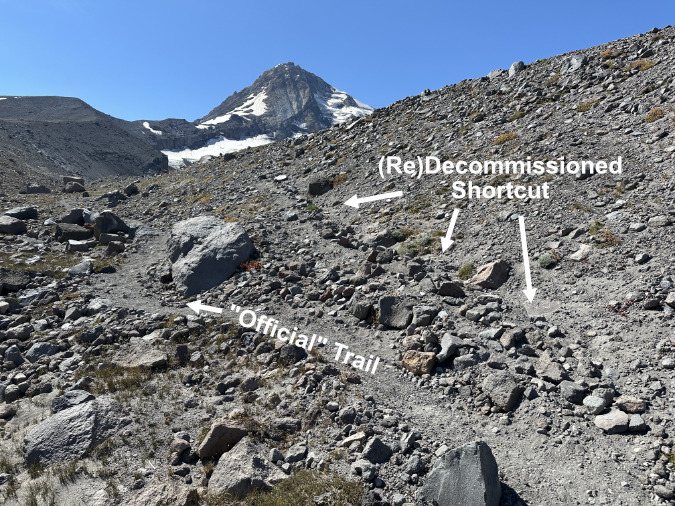
Trail tending along the South Eliot moraine

In the era of cell phones and GPS, these shortcuts are becoming more numerous and persistent. Why? Because the errant digital tracks from lost hikers following dead-ends or short cuts are blindly added to the big data commercial websites that cater to hikers. It’s among the many reasons to avoid commercial apps and social media for hiking guidance, especially when we have TKO’s free Oregon Hikers Field Guide for trails in Oregon and Southwest Washington, a non-profit resource written by hikers, for hikers.

The Cooper Spur Shelter, itself, was also in need of some volunteer tending this year, as the stovepipe in the south corner of the structure has rusted through and that seems to have led to a collapse of the stone wall surrounding it (below). 
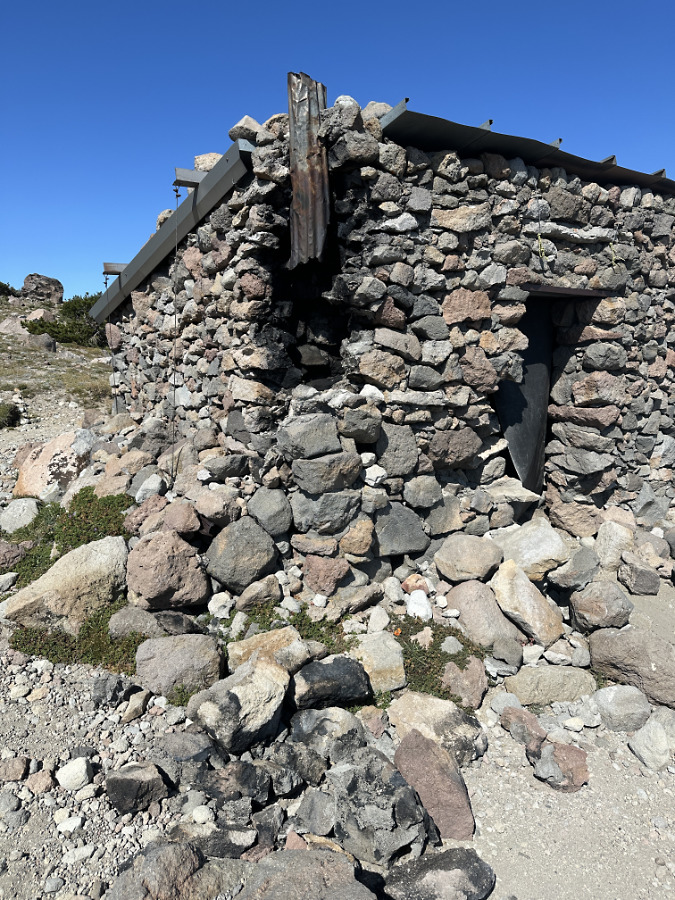
Recent collapse of the south shoulder of the Cooper Spur shelter

While it’s possible the U.S. Forest Service will repair this, I’m going to guess that it will fall to volunteers that I’ve seen working on the structure in the past. I’ve come across them many times over the years, as early as this view (below) taken 22 years ago, when a group of volunteers was repairing that same south corner of the building. Like most of the trails around Cooper Spur, the shelter also represents an ongoing volunteer effort to ensure it survives.
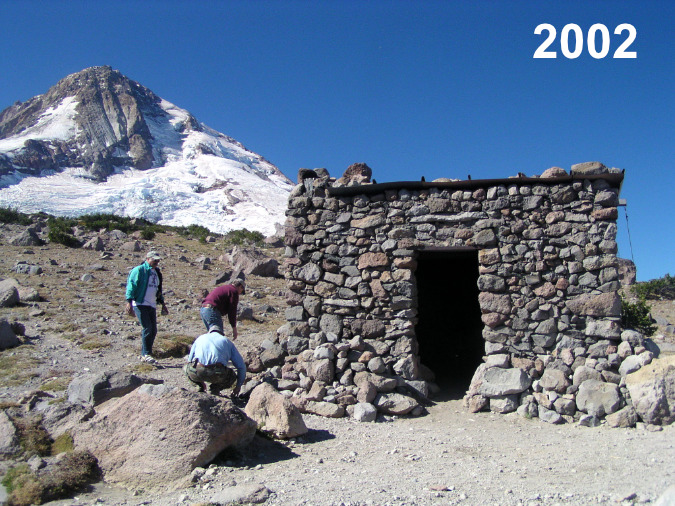
Volunteers repairing the south wall of the shelter more than 20 years ago

For the August image in the new calendar, I chose the view from Inspiration Point (below), a rocky spot along the Cloud Cap Road that provides a sweeping view of the Eliot Branch canyon and Mount Hood’s steep northeast side. This has been a popular tourist stop since visitors begin arriving at the Cooper Spur Inn by horse and buggy in the 1890s.
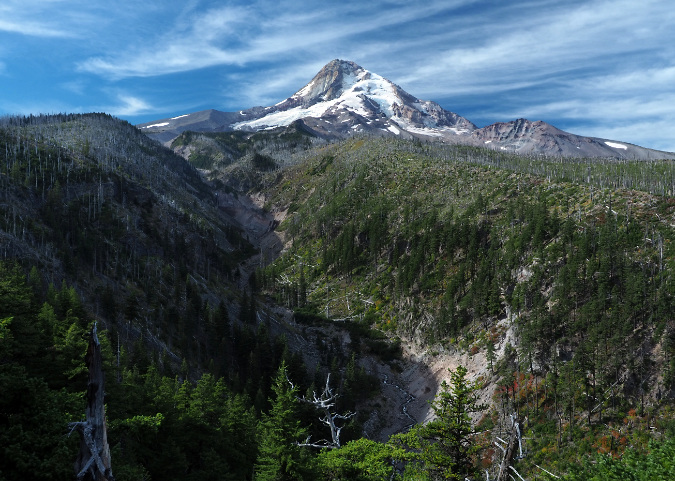
The August calendar image features this classic view of Mount Hood from Inspiration Point

Inspiration Point still offers one of the finest views of both the Coe and Eliot glaciers, the two largest on the mountain. The Coe is the lesser known of the two due to its remote location on the rugged north face of the mountain, and this viewpoint is one of the few places with a close-up look accessible by road.
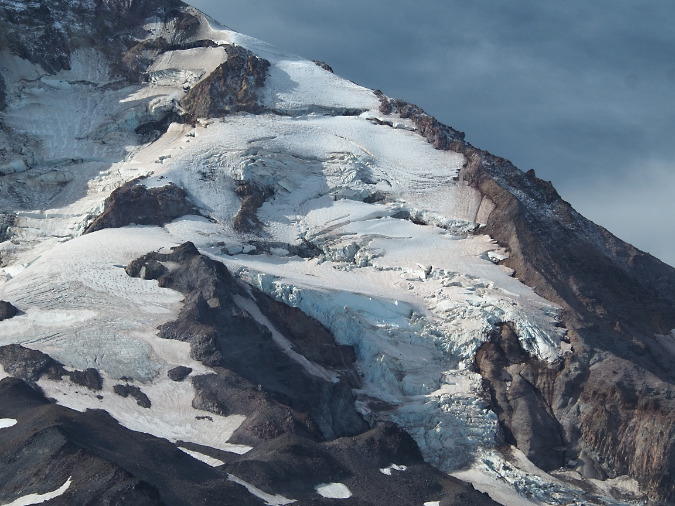
Coe Glacier from Inspiration Point

The steep, unofficial trail to Inspiration Point has been on my list of adopted trails for nearly 20 years, and despite its short length, keeping this little path intact has been a challenge – especially in the years since the 2011 Dollar Lake Fire swept through and left many standing snags that are still periodically falling across the trail.

If you’re not an avid hiker and looking for a short side trip on your way to Cloud Cap, watch for the following signpost at an obvious switchback in the road at about the 3 mile mark (below). From the sign, the trail drops roughly 300 feet to the rocky overlook of Inspiration Point.
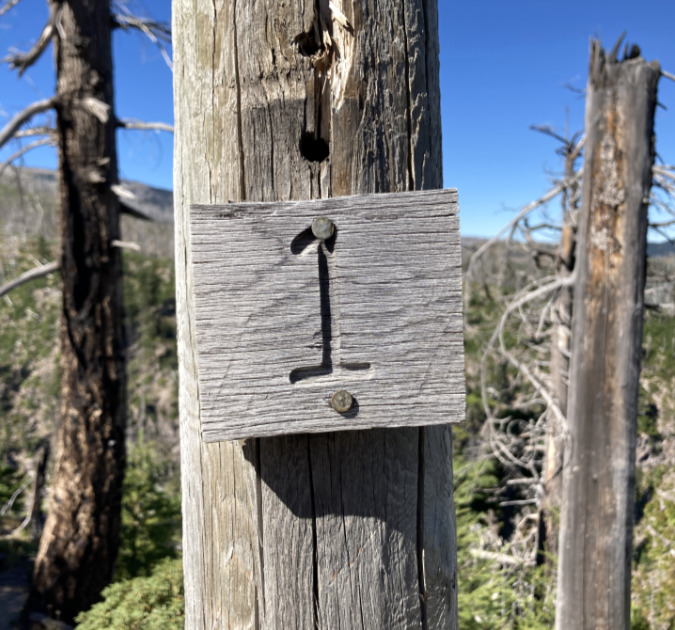
Inspiration Point trail marker 

What does the “1” stand for in this unofficial trail marker? It dates back to a brochure and map once published by the Forest Service that described the history of the Cloud Cap area by numbered waypoints along the road. This signpost and an old, mounted wagon wheel further up the road are all that remains from that effort to share the local history. I do plan to feature the brochure in a future blog article, along with mileage waypoints to guide visitors, in lieu of the old markers that were once here. 

Inspiration Point trail marker… a reminder of an interpretive story that was once told here

For the best view from Inspiration Point, the short trail is a must, but there was a time when you could take in the view from road as you motored your Model T up to Cloud Cap Inn. In fact, an old guardrail that I think might be the original shown in a 1920s postcard view (below) is still there – albeit with a few trees now partly blocking the view.
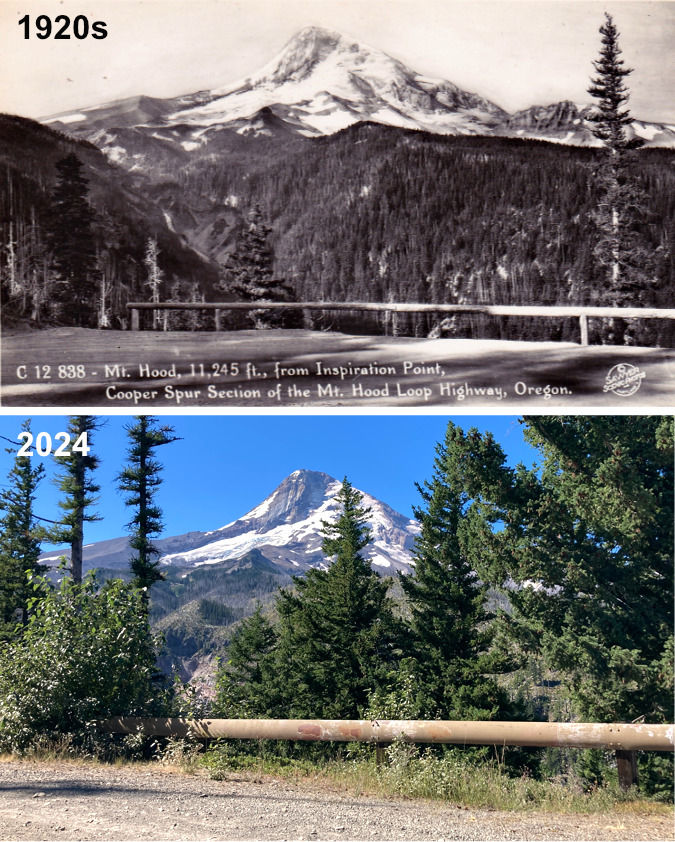
The view from Inspiration Point – then and now

For the September calendar image, I stayed on the mountain and chose an early fall scene at WyEast Basin (below). This photo was taken on a hike in October of this year along the Timberline Trail, from WyEast Basin to Elk Cove, when the huckleberry foliage had turned a brilliant crimson and the alpine meadows to shades of yellow and gold.

WyEast Basin on Mount Hood’s north side is the September image

This photo (below) from the descent into Elk Cove is also from that day, showing the light dusting of early snow that had fallen on the summit the day before.
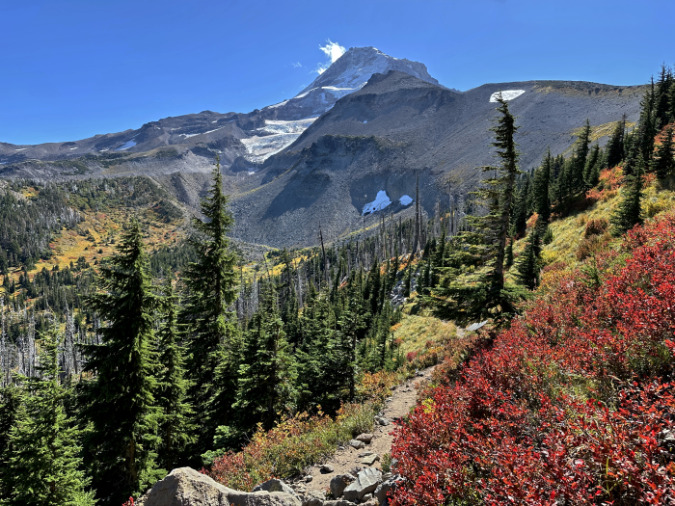
The Timberline Trail approach to Elk Cove lights up with color in autumn

I considered using this view of the upper meadows at Elk Cove (below) from that October trip for the calendar, before realizing just how many times I’ve featured Elk Cove over the years! Lovely as it is, this year I went for a change of scenery with the WyEast Basin scene.
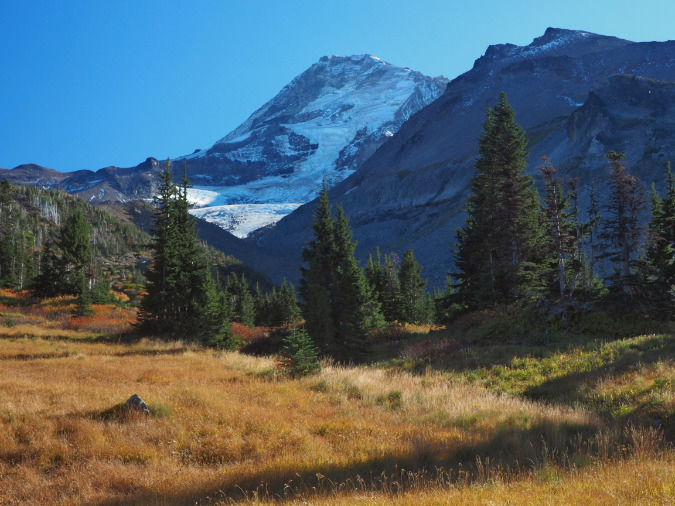
Elk Cove in autumn with an early dusting of snow on the mountain

One pleasant surprise at Elk Meadows this year was a new trail sign located at the Timberline Trail junction with the Elk Cove Trail. The old sign had pretty much disintegrated in recent years, causing a fair amount of confusion for hikers, based on the number of times I helped people find their way at that junction. 

One benefit of coming to Elk Cove every year is the opportunity to track changes there over time. This includes trail signs, and in a place where the winter snowpack regularly reaches 10 feet or more in winter, it’s no wonder that these signs take a beating. As you can see from the photo sequence below, the two small signs pointing to “campsites” get the award for most durable. They were already quite weathered in 2010 when the previous “new” trail sign was installed. By 2023, the “new” main sign from 2010 was falling apart. This year, both the main trail sign and the “no camping in meadows” sign were completely replaced, while the two “campsites” signs are still doing their job. 
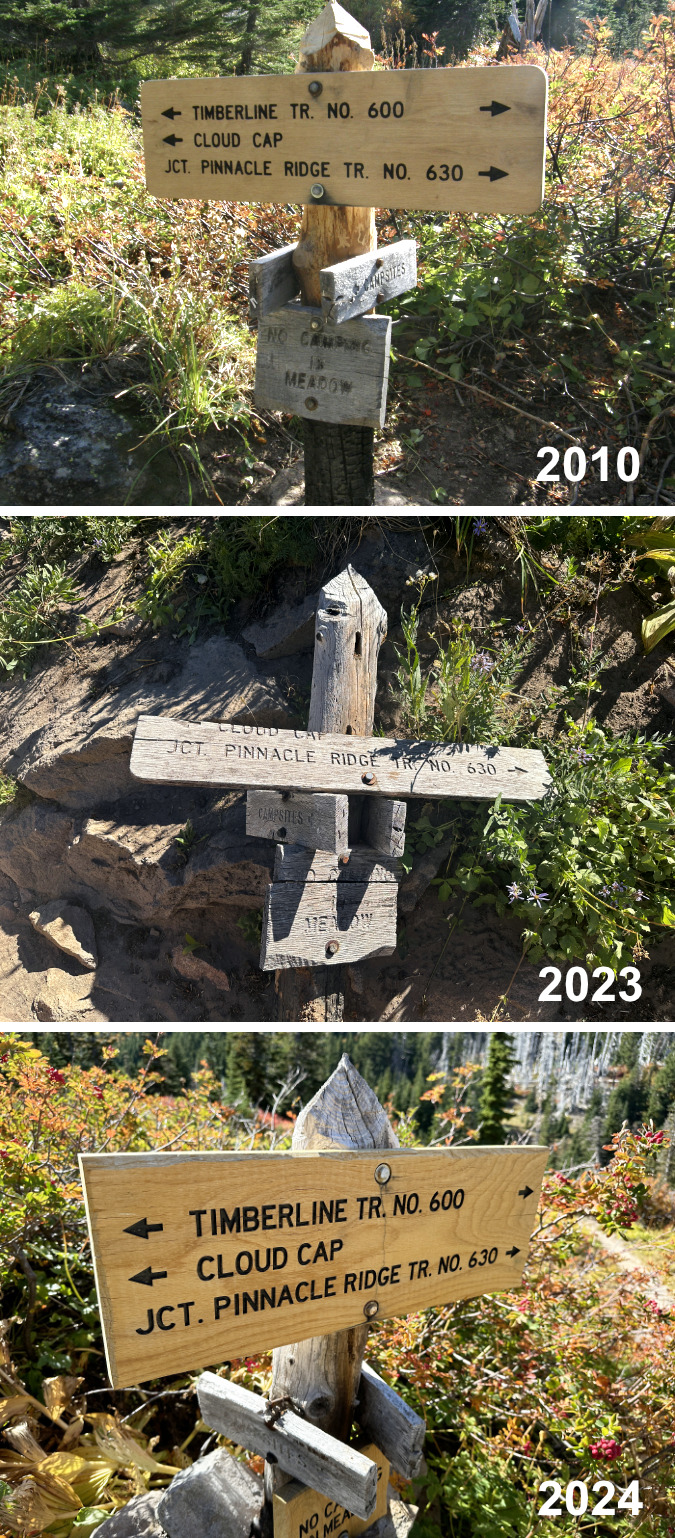
Elk Cove trail signs over the years

On the hike back from Elk Cove, I stopped to collect some trail condition photos at WyEast Basin, where the growing stream of hikers has begun to take its toll on the meadow. Some of this is the result of hikers simply stepping off the trail when passing one-another on a busy section of the Timberline Trail, but the widening tread is mostly the result of the original trail becoming trenched from heavy use, then becoming a muddy ditch when snowmelt fills it early in the hiking season. Hikers then opt to walk on either side to keep their boots dry, gradually destroying the meadow vegetation in the process. 

This schematic (below) shows the original trail at the center (now a trench) as a white dashed line and shoulder paths in red dashed lines, where hikers have already destroyed an alarming amount of meadow vegetation.

Growing damage from trail overuse at WyEast Basin

Over time, this parallel use paths on both sides of the trenched trail will turn into a muddy slog, too, resulting in an ever-widening trail across a beautiful meadow. I’m hoping to find a way for TKO volunteers to restore this trail with a different design that anticipates the muddy season, perhaps even something as bold as a turnpike, or raised section of trail between parallel logs that is designed to keep the trail tread dry by elevating it above the surrounding ground. Below is a recent example from McIver State Park.
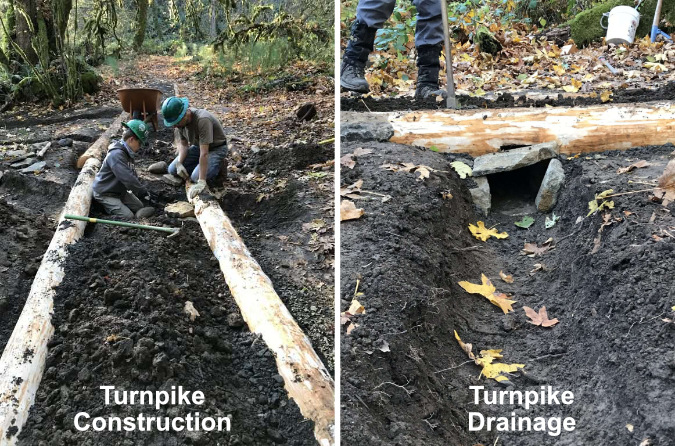
Trailkeepers of Oregon (TKO) volunteers building a turnpike on soggy ground at McIver State Park (photo: TKO)

[click here for a larger version]

The second photo in the above example shows a drainage features, one of the potential benefits of a turnpike at WyEast Basin, as the Timberline Trail crosses at least three small streams that meander through the meadow. However, turnpikes are typically built from found materials near the trail (logs, rocks and soil), which could prove to be challenging in an alpine, wilderness environment. 

For the October image in the new calendar, I went back to Wahcella Falls. It’s not the first time a waterfall has appeared twice in a single calendar, but it was the combination of fall colors and a person in the photo – a rarity for me – that made the case. Look closely (below) and you’ll see a hiker in front of the falls, taking in the magnificent view.
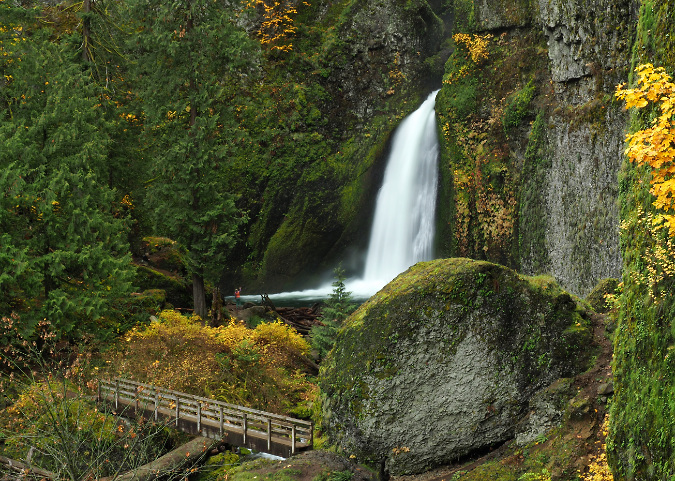
Wahclella Falls (and a hiker) with fall colors is featured as the October image in the calendar

Earlier in this article, I included a photo of Wahclella Falls from an off-trail viewpoint taken in early spring. By late October each year, the same view lights up with gold and yellow fall colors (below) that are becoming even more prevalent in the aftermath of the 2017 Eagle Creek Fire that swept through this canyon. That’s thanks to the rapid recovery of broadleaf trees like Bigleaf and Vine maple that are taking advantage of the open forest conditions created by the fire, and bouncing back from roots and stumps that survived the burn.

Fall colors at Wahclella Falls have become more dramatic since the 2017 fire

Bigleaf Maple are the real stars in this comeback story, with most growing from the surviving stump of a parent tree killed by the fire. The new access to sunlight and explosive growth also makes for super-sized foliage, with individual leaves measuring nearly a foot across (below) underscoring the common name for these essential trees.
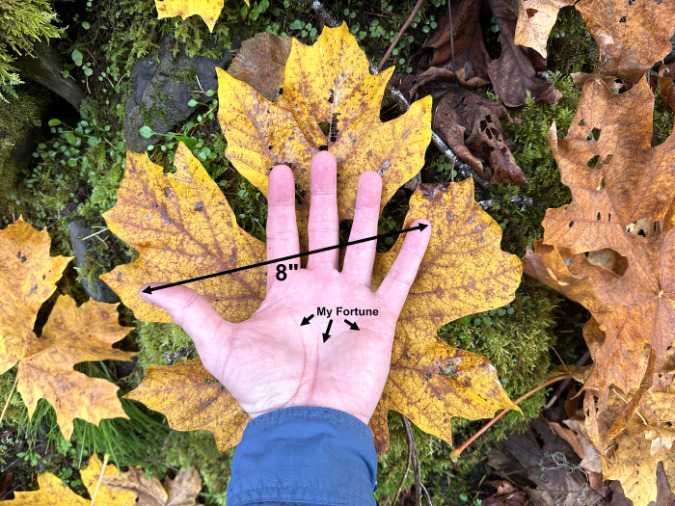
Biglieaf maple leaves are growing to gigantic proportions in the post-fire recovery

When I hike this trail, I see the handiwork of Trailkeepers of Oregon (TKO) crews everywhere, as TKOs volunteers have done much to rescue the trail in the aftermath of the 2017 fire. This includes a streamside section where a huge, post-fire logjam of killed trees accumulated just below Wahclella Falls, and piled so high they spilled onto the trail, itself. TKO and Pacific Crest Trail Association volunteers used a combination of saws and ropes to clear the way back in 2021, and today the logjam is still there to remind us of the power of this stream.
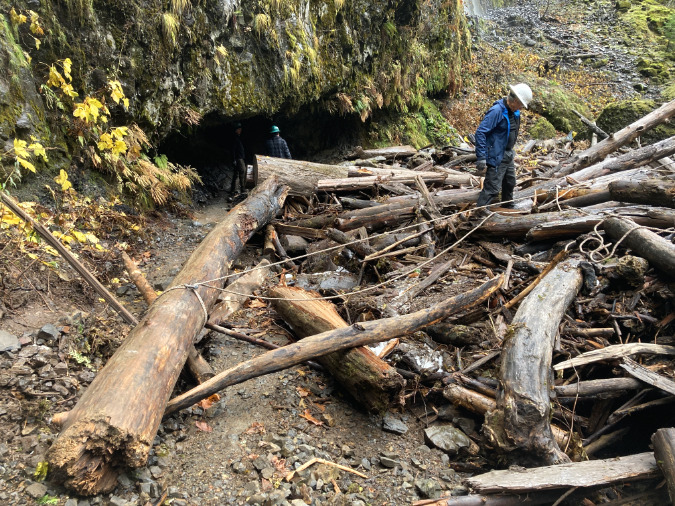
TKO crews clearing the logjam from the Wahclalla Falls trail in 2021

TKO volunteers also worked with the Forest Service to build a rustic set of stairs where the trail had collapsed near the falls, leaving a sketchy scramble through this gap in the rocks for hikers to navigate. The rock steps not only make the trail more accessible to everyday hikers, the add another interesting element and a bit of whimsey for young hikers (below) visiting this family-friendly trail for the first time.

Rustic steps built by TKO volunteers at Wahclella Falls area favorite with young hikers

For the November calendar image, I returned to the east side of the mountain and chose a scene captured along the Lookout Mountain Road in late fall. This is the least-visited, less familiar side of the mountain to Portlanders, with a broad, sweeping profile that looks more like other Cascade volcanoes, and contrasts with the familiar, pyramid-shaped summit the mountain presents to the millions who live west of the mountain.
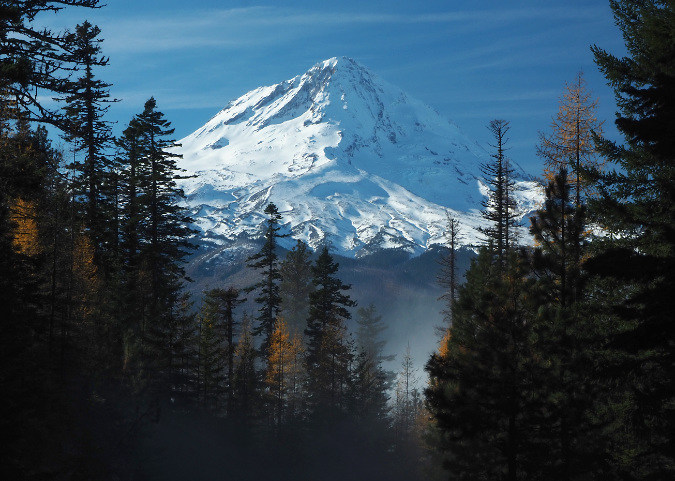
Yellow and gold Larch framing Mount Hood are featured as the November image in the calendar

When the conditions are right, the Western Larch here have turned to their yellow and gold autumn colors and the first temperature inversions have arrived, filling the East Fork Hood River valley with fog. The effect can be quite dramatic. On this day the fog layer was growing especially fast, and surged over me in just the view minutes (below) I had to set up my camera!  
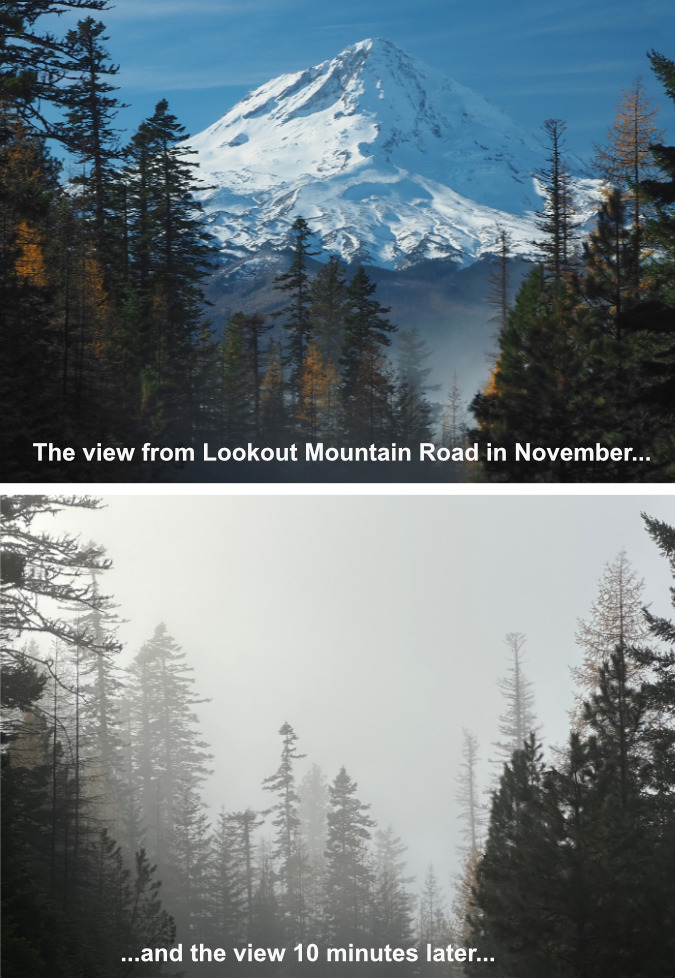
Fast moving fog at Lookout Mountain!

Having been fogged out on that chilly day, I followed another November ritual in the mountains and collected some greens for holiday decorating. Normally, I look for Noble Fir boughs, but on this day, I gathered some beautiful, blue-tinted Engelmann Spruce greens. You can easily distinguish spruce from other conifers by their sharp needles, making them a bit prickly to work with as holiday greens. Nonetheless, they made for some lovely Christmas arrangements at home!
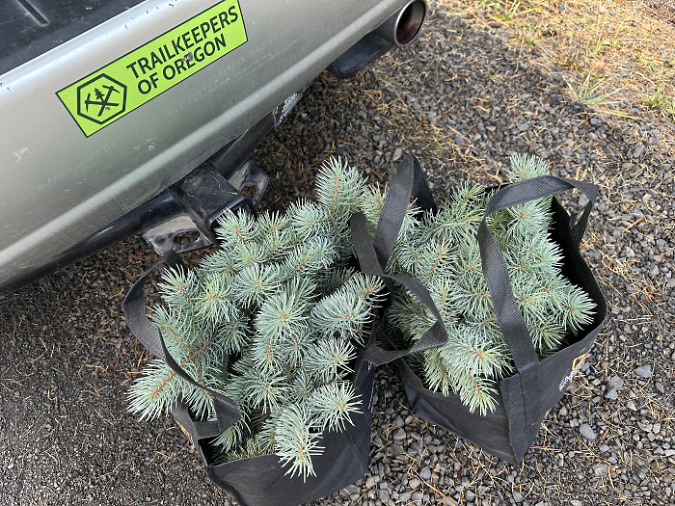
Engelmann Spruce holiday greens..? Prickly!

Is it legal to collect holiday greens within Mount Hood National Forest? Absolutely, but check their website to see if a permit is required. For 2024, permits are waived, and you may collect up to 25 pounds (that’s a lot of boughs!) in a season. The main restriction is Whitebark Pine, which are now a protected species and may not be collected or cut in any way. These trees only grow at and above timberline, but if you’re unsure of how to identify them, just avoid cutting any pine boughs and stick with fir trees. Leave no trace also applies, so collect boughs as if you were pruning trees in your garden, with cuts made as discreetly as possible.

For December, I chose a fairly unconventional image for the new calendar. Continuing with the fog theme, I selected this photo from the Bennett Pass area, where dueling valley fog banks in both the White River and East Fork Hood River valleys were colliding at the pass. The effect in the ancient Noble Fir forests just above Bennett Pass was mesmerizing, with patching of blue sky opening and closing overhead as waves of fog rolled through the big trees.
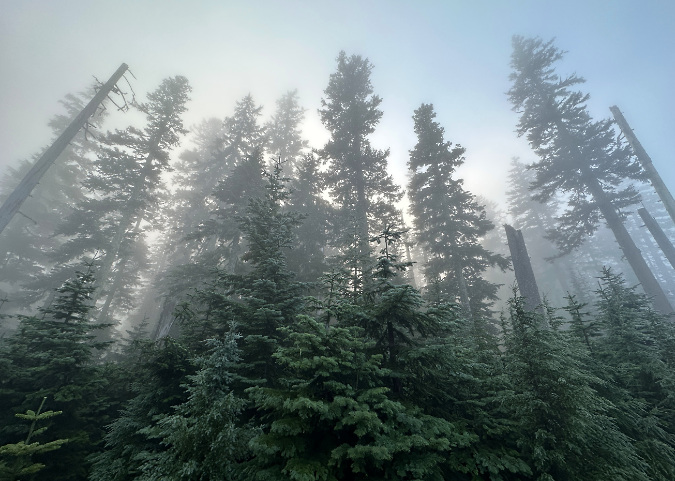
Ancient Noble Fir forest rising into the fog near Bennett Pass are featured as the December image in the new calendar
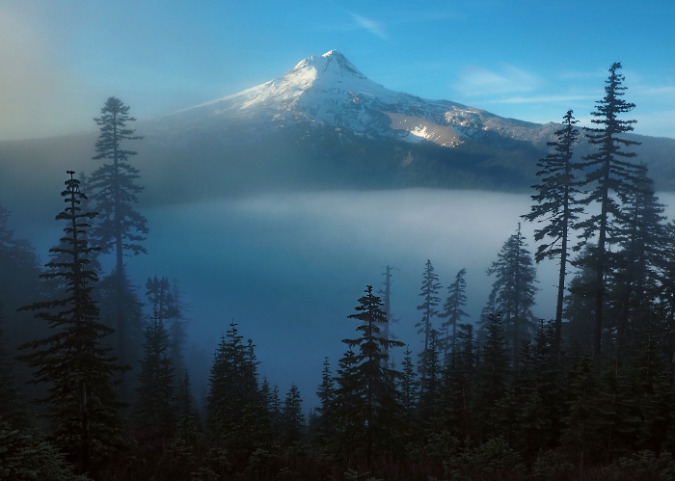
Fog bank filling the East Fork Hood River Valley as viewed from above Bennett Pass

How old are these trees? Some are at least 400 years old. We know this because the area saw heavy logging in the 1970s and 1980s, and many of the giant stumps left from that unfortunate era still remain to tell the story through their tree rings. Fortunately, not all of the big trees were cut, and some truly magnificent old-growth Noble Fir stands remain today.
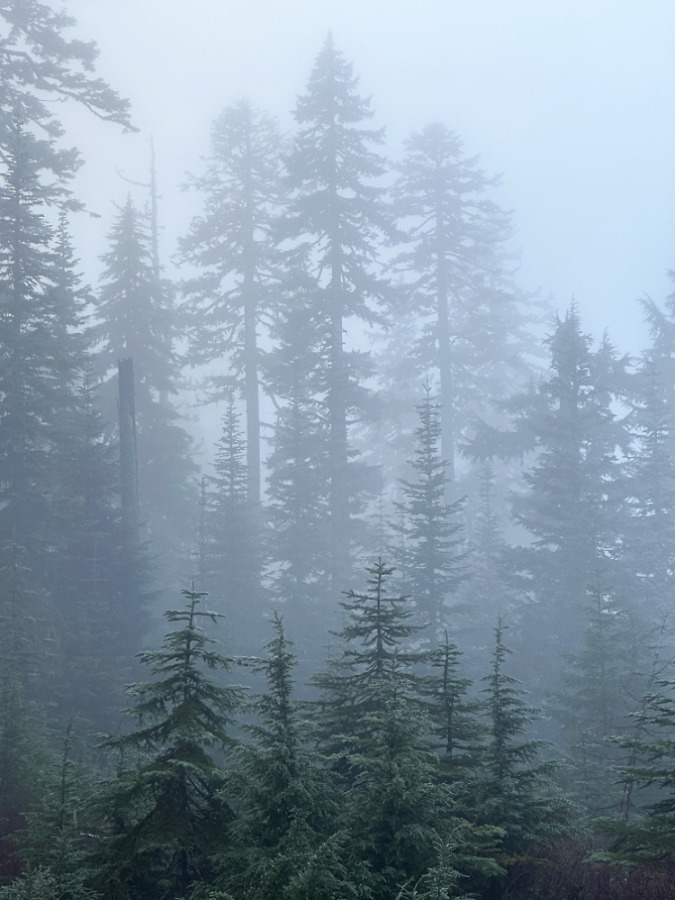
Noble Fir giants in the fog near Bennett Pass
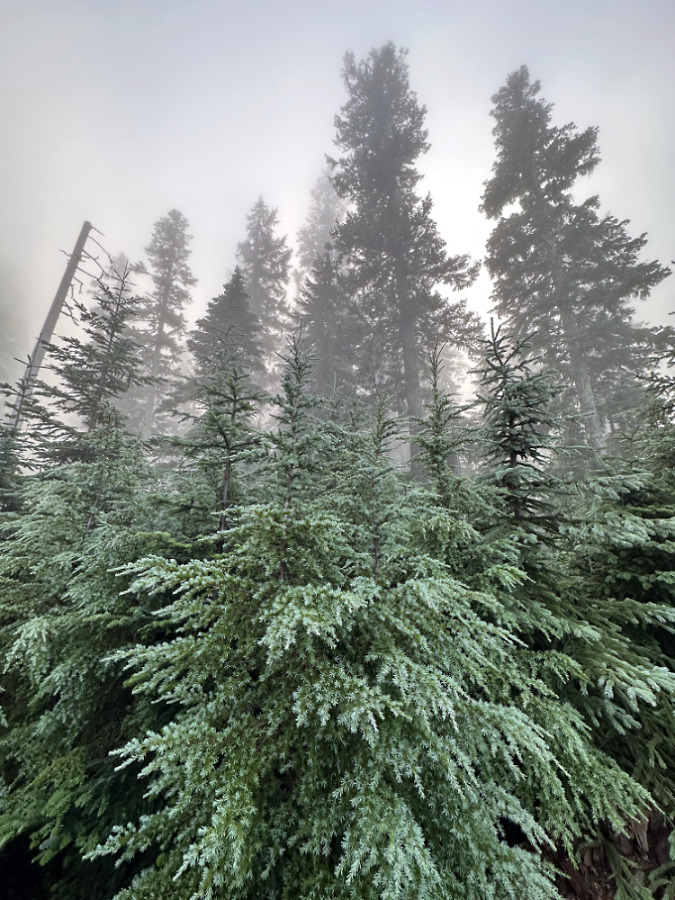
Noble Fir giants and Mountain Hemlock seedlings in the fog near Bennett Pass

On a more practical note, I was encouraged on that trip to see the Forest Service continuing to gradually improve visitor facilities on the mountain, including a new toilet at the popular winter trailhead at Bennett Pass. While pit toilets might not be a joy for anyone to use, they are essential at busy trailheads, especially for families with young kids. Modern toilets like the new facility at Bennett Pass are also accessible for visitors with mobility devices, removing a very real barrier to our public lands.
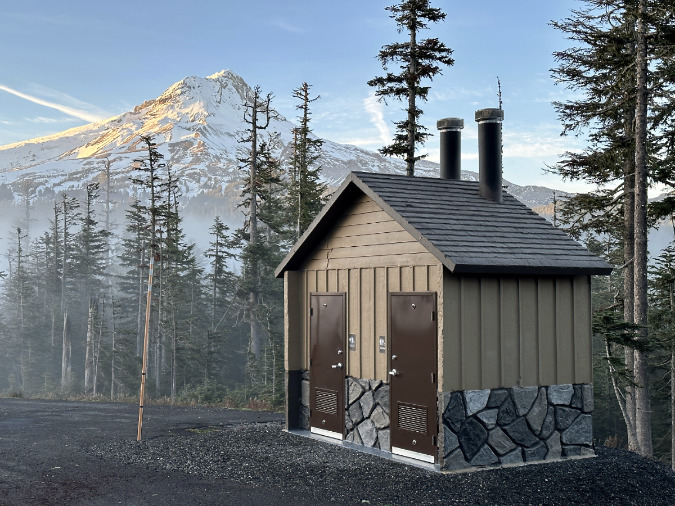
New toilets at Bennett Pass – with a view!

Finally, the back cover of the new campaign calendar features some of the wildflower highlights captured in WyEast Country over the past year (below). Some might be familiar, but I do have one confession to make: the Prickley Pear cactus in the center square wasn’t photographed anywhere near Mount Hood. Instead, it’s over in the John Day country, where I photographed this particular colony near the Painted Hills last spring. 
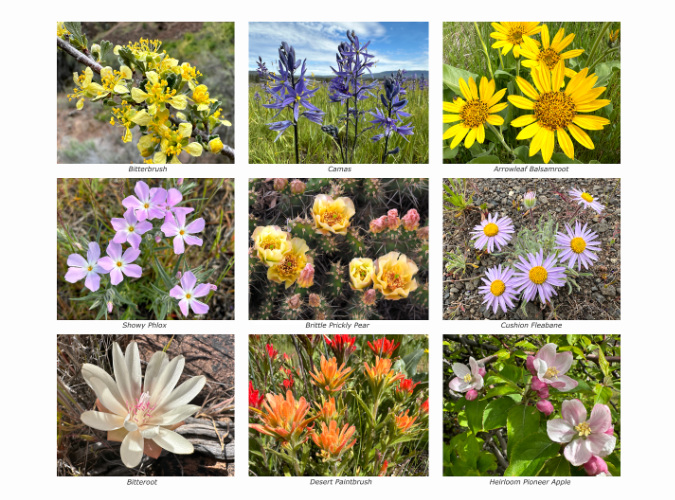
Wildflower mashup on the back of the 2025 calendar

Here’s a closer look at one of the cactus blossoms from that trip (below), showing the unlikely contrast of impossibly delicate flowers emerging from a maze of thorns that make these tough plants so fascinating:
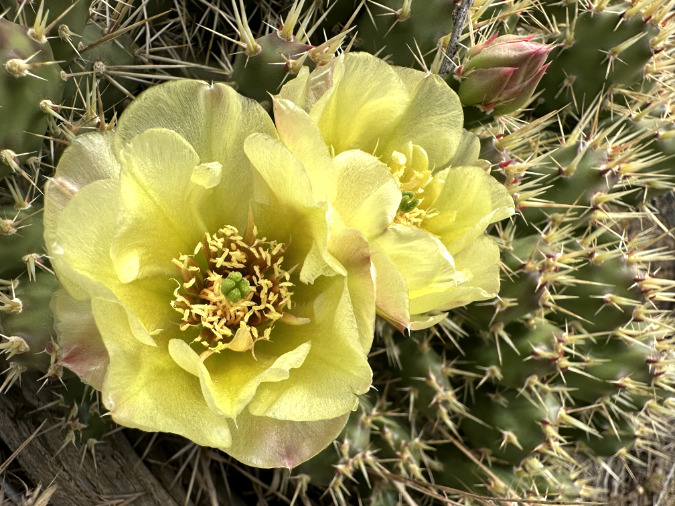
Brittle Prickley Pear near the Painted Hills

Why include this, then? Because I am admittedly obsessed with our native cacti, and determined to finally photograph them where they grow here in WyEast Country. I have two promising leads on that front that I’ll be following up on this spring. Both are near The Dalles and apparently hidden in plain sight, but I suspect I will have some searching to do!
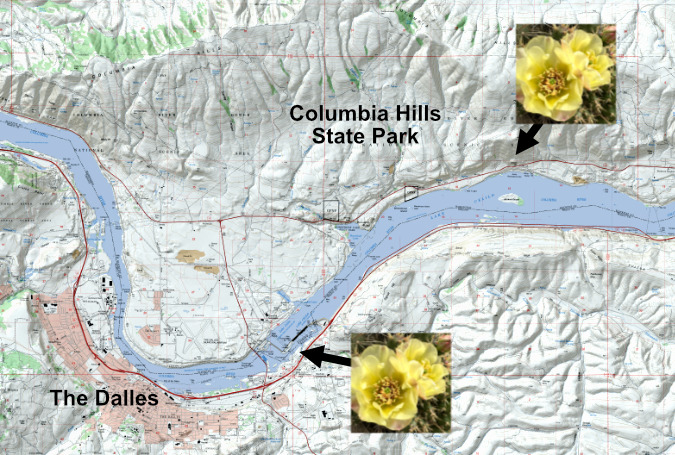
Where the Prickley Pear grows..?

I’ve spent a lot of time over the years hunting for cactus in Oregon. As spectacular and flamboyant as these flowers are when in bloom, the plants are surprisingly well-camouflaged and hard to find when they’re not… unless you step on one! So, more to come in this story.

…and to spare you from scrolling back to the top, here’s the link if you’d like to order the 2025 campaign calendar featuring these new photos:

2025 Mount Hood National Park Campaign Calendar

and all proceeds from calendar sales go to Trailkeepers of Oregon (TKO), and they can be delivered anywhere

Looking ahead to 2025

Thanks for reading this far! Mea culpa: I began 2024 with high hopes of a lot of WyEast Blog articles, but my day job and real-life demands got the better of me this year, once again! Therefore, I’m recycling that goal for 2025, and I’ve got some fun topics that I’m eager to dive into. 

These include some new digging I’ve done on a massive landslide that completely rerouted one of Mount Hood’s major rivers, plus some new research on what many call “Indian pits” or “vision quest pits” – those mysterious pits found in talus slopes all through the Gorge and in spots around Mount Hood. I’ve also got a history piece on a surprising road race with a WyEast connection, and much more beyond these…time permitting!

The old man and the mountain..

As always, thanks for patiently checking back when my posts become infrequent, putting up with the typos and grammatical errors, and — more importantly — thank you for being a friend of our Mountain and Gorge. I hope to see you on the trail sometime in 2025!

________________

Tom Kloster | December 2024
Who was Newton Clark?

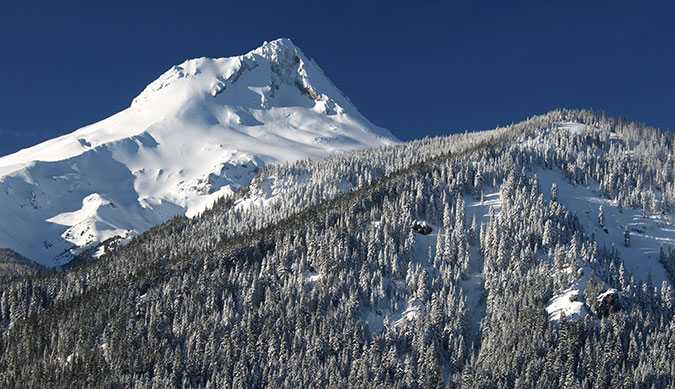
The Newton Clark Glacier flows from Mount Hood’s east face

High on Mount Hood’s broad east face is the Newton Clark Glacier, third largest of the twelve named glaciers on the mountain. Many assume a hyphen must be missing in what appears to be two surnames, especially since the two major glacial outflows from this glacier are separately known as Newton Creek and Clark Creek. Who is this Newton character… and what about Clark?

Instead, it turns out that Newton Clark was just one man who made his place in local history as one of the early surveyors mapping the Mount Hood area. And in a rarity among place names in Oregon, his full name made it to our maps, where our modern naming rules limit honorary place names to surnames. It also turns out that nearby Surveyor’s Ridge, with its popular mountain biking trail, is also named for Newton Clark, albeit anonymously.

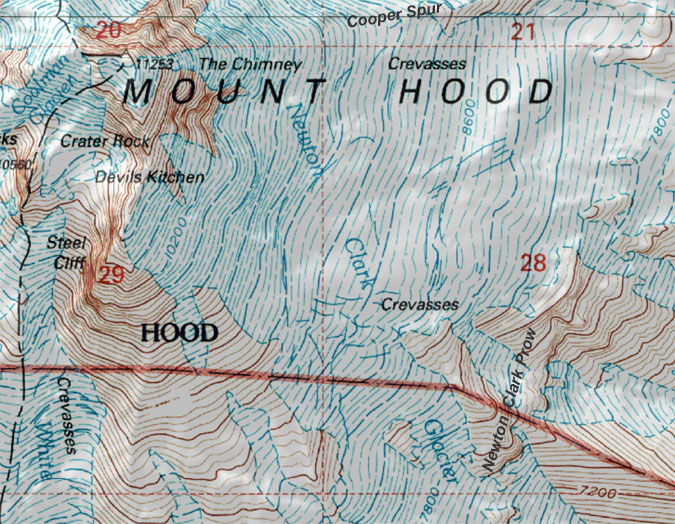
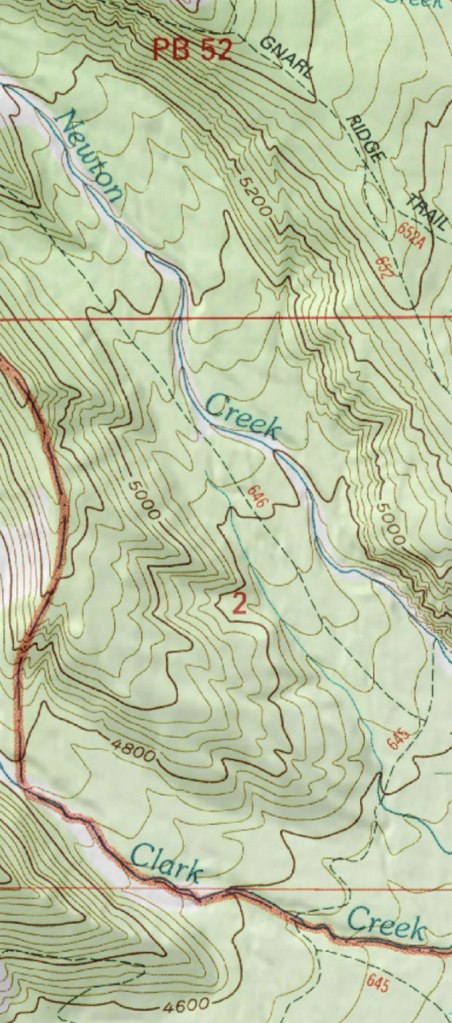
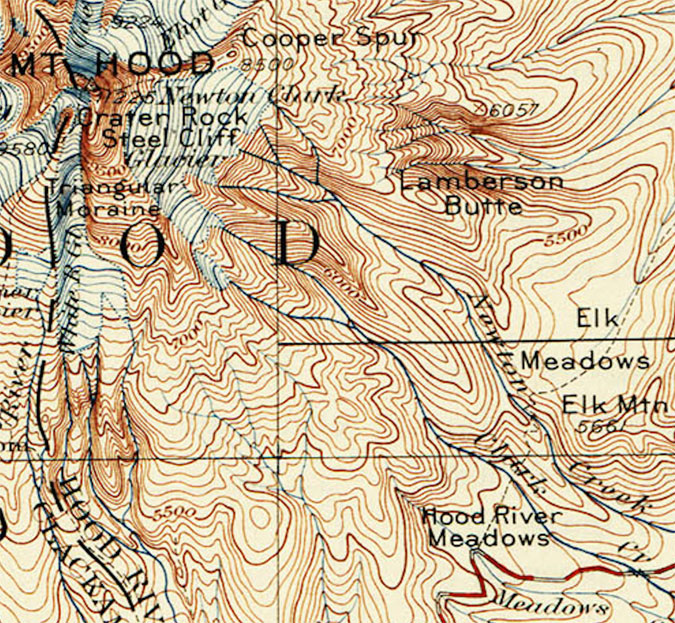
Topo map of the Newton Clark Glacier on Mount Hood’s east face

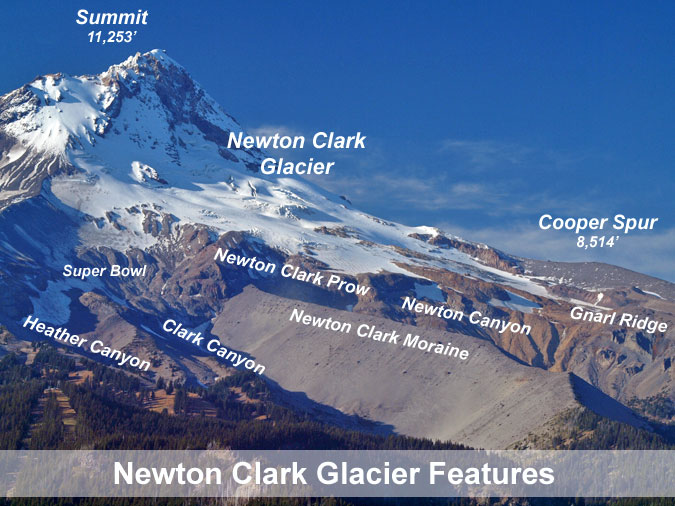
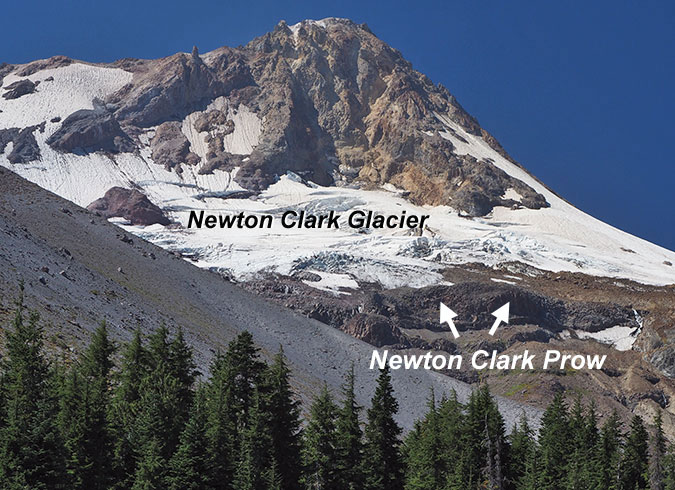
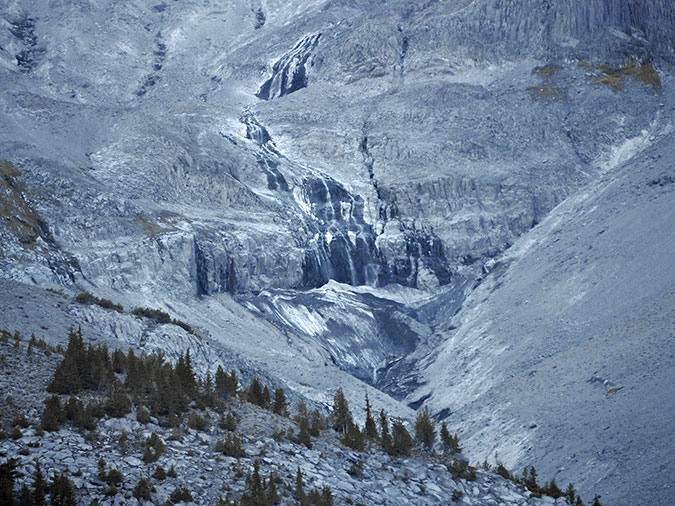
The sprawling glacier named for Newton Clark is unique among Mount Hood’s glaciers: it’s wider than it is long! While glaciers like the Eliot, White, Coe and Reid flow down the mountain in rivers of ice, the Newton Clark Glacier is draped like a big ice blanket on the east face of the mountain high atop a steep bench formed by the Newton Clark Prow, a massive lava outcrop that prevents the glacier from flowing any further down the mountain. 

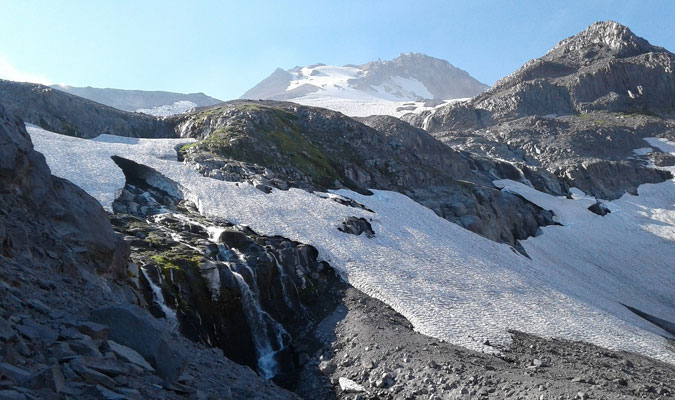
The Newton Clark Prow splits the glacier into its twin canyons, Clark Canyon to the south and Newton Canyon on the north. At nearly 8,000 feet in elevation, this jagged rock outcrop once divided a much larger ice age glacier into two rivers of ice that left today’s massive Newton Clark Moraine behind, a medial moraine that once had rivers of ice as high as the moraine flowing on both sides (you can read more on that topic in this blog article). Today, the Newton Clark Prow forms the rugged head of Newton Canyon, with summer meltwater from the glacier tumbling over its cliffs in dozens of waterfalls.

The broad Newton Clark Glacier is bordered on the north by Cooper Spur, a long, gentle ridge that extends from Cloud Cap to the summit of Mount Hood. At 8,514 feet, the summit of Cooper Spur is among the highest points in Oregon that can be reached by trail, and one of the more popular hikes on the mountain. The view from the top of Cooper Spur provides a close-up look the rugged, crevassed surface of the Newton Clark Glacier.

The Newton Clark Glacier from Cooper Spur
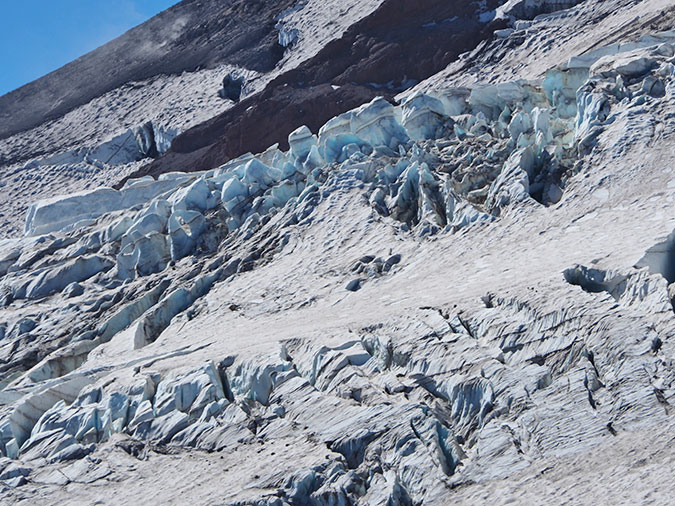
Giant ice pinnacles known as seracs are pushed into the air by this icefall on the Newton Clark Glacier

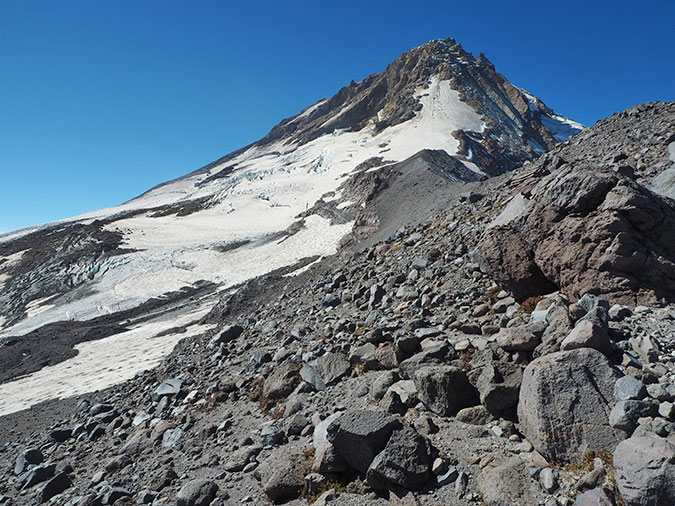
From below, the Newton Clark Glacier actually looks stranded (below), sitting unusually high on the mountain, with its crevasse fields spreading out in multiple directions as the glacier sprawls above the cliffs of the Newton Clark Prow.

The Newton Clark Glacier and Prow as viewed from Newton Canyon
Rare, close-up view of the Newton Clark Prow (photo: Chip Down)

Downstream, the Newton and Clark canyons eventually merge at the southern foot of the Newton Clark Moraine, where the flat, mile-wide floor of the East Fork Hood River valley begins. Here, the arms of the ice age ancestor of the Newton Clark Glacier continued for miles down the mountain toward Hood River, creating the broad, U-shaped valley we travel today on the OR 35 portion of the Mount Hood Loop Highway.

Newton and Clark creeks don’t quite merge as the converge at the foot of the Newton Clark Moraine

Surprisingly, the two glacial outflows don’t merge on the valley floor. Instead, they each flow into the East Fork Hood River separately, about a mile apart. Both Newton and Clark creeks are notoriously volatile glacial streams, each changing course on the floor of the East Fork valley during recurring flood events.

Of the two outflows, Newton Creek is the largest and most volatile stream, repeatedly sending massive debris flows down the East Fork Hood River valley over the years and washing out OR 35 in the process (more on that later). Clark Creek is less violent, but still a powerful glacial stream that challenges Timberline Trail hikers attempting to ford it during the summer glacial melt.

Now that we’ve met the Newton Clark Glacier and its sibling streams, what about the man behind the name?

Who was Newton Clark?

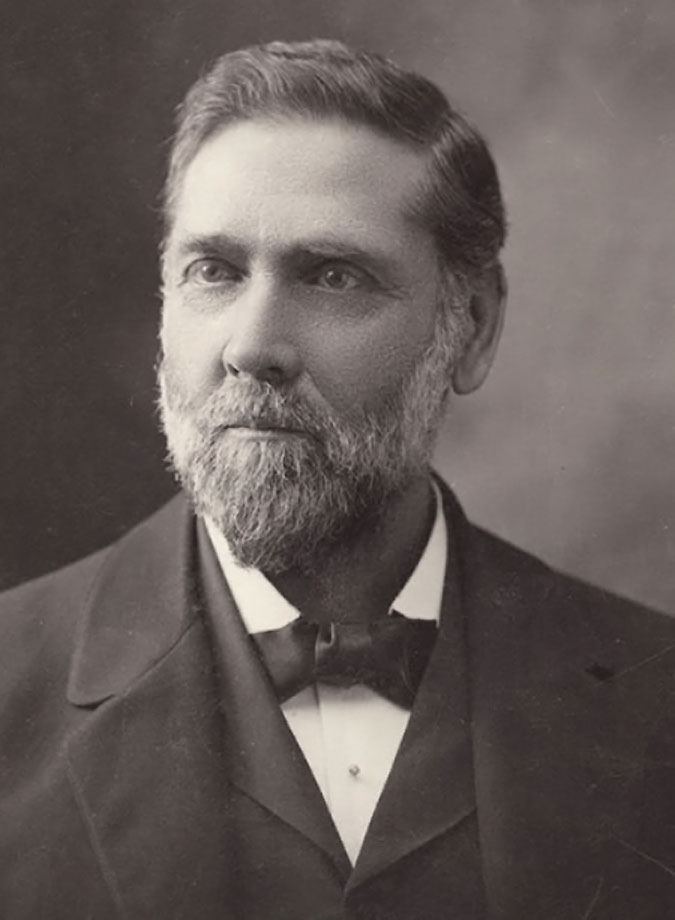
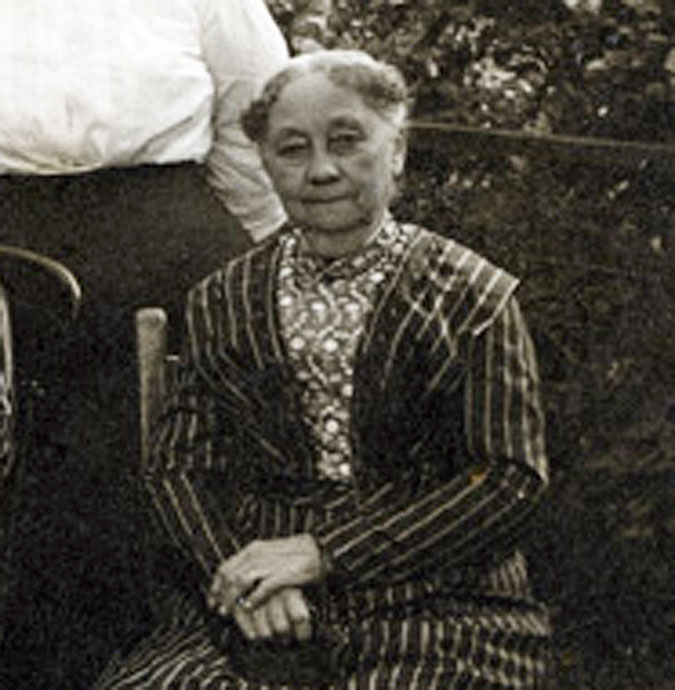
Newton Clark in the 1880s

Newton Clark was born in Illinois in 1838 and soon moved as a child with his family to Wisconsin as pioneer settlers. Clark spent his youth there, becoming an exceptional student and later studying surveying at the Point Bluff Institute.

In October 1860, Newton Clark married Scottish immigrant Mary A. Hill, and the two resided in North Freedom, Wisconsin. Just one year later, in September 1861, 23-year old Newton enlisted in the 14th Volunteer Infantry, Company K Wisconsin volunteers of the Union Army. His company served in 14 battles under General Ulysses. S. Grant in Civil War battles across the south. 

Newton Clark in the early 1900s

Like so many in their Civil War generation, young Newton and Mary’s married life was put on hold during his four years of service. Mary remained in Wisconsin with their young daughter during Newton’s infantry service, undoubtedly anxious for her young husband’s return from our nation’s deadliest war. 

When he left for battle, Newton said “If I never come back remember that you have our little Minnie to live for, work for her and she will be a comfort to you.” Newton later returned from battle, but their little Minnie died during his time away at war.

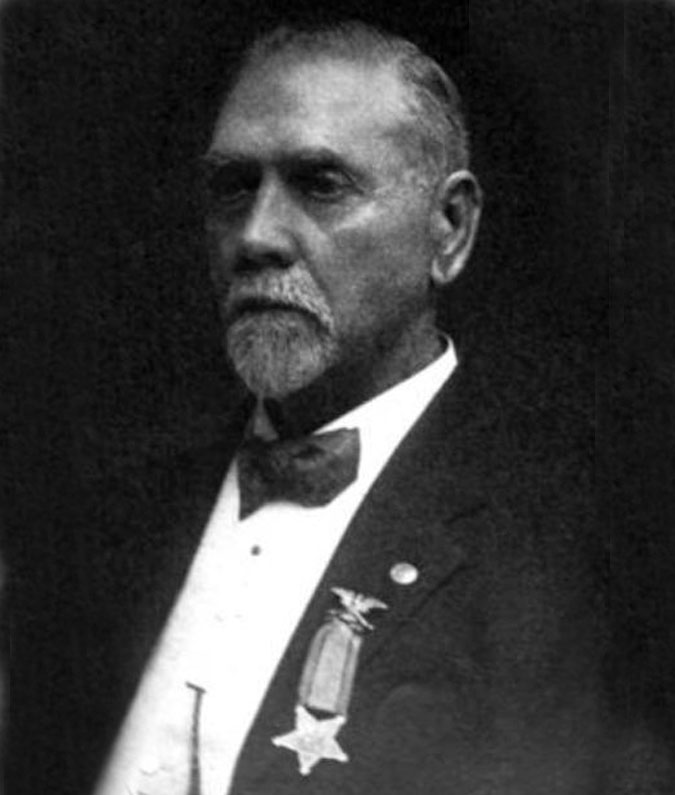
Newton Clark served as Quartermaster during his Civil War enlistment, and he furnished the flag that was raised above the Vicksburg, Mississippi courthouse when the war was ended on May 9, 1865. After the war, Newton was an active veteran with the Grand Army of the Republic (G.A.R.) fraternal organization. The above portrait above was taken late in is life, and proudly shows his G.A.R. insignia.

Detailed view of the G.A.R. insignia worn in the late 1800s

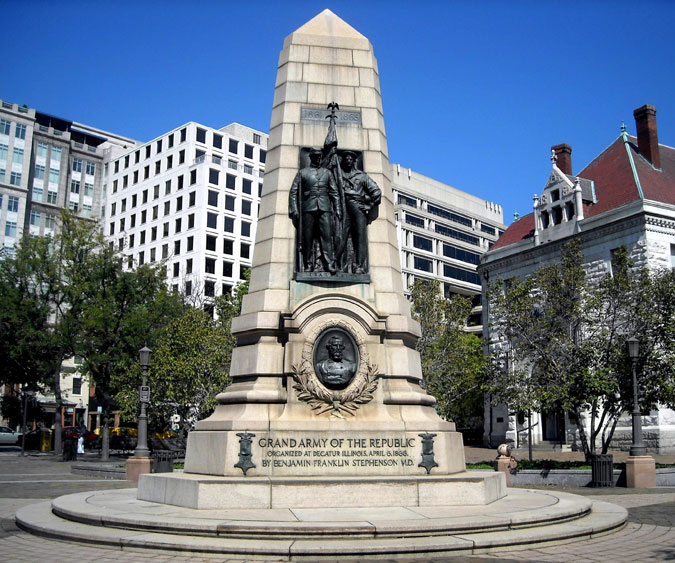
The G.A.R. was much more than what we think of with today’s fraternal organizations. Following the Civil War, the G.A.R. emerged as among the first and largest advocacy group on the nation’s political scene, dedicated to both political causes and the benevolent interests of their veteran members.

The G.A.R. was an important arm of the Republican Party (at the time, the progressive party in American politics), and in this capacity the organization was deeply involved in the reconstruction that followed the war. Among their efforts, the G.A.R. actively promoted voting rights for black Civil War veterans. They also became a racially integrated organization at a time when the emerging Jim Crow era was about to stall civil rights in this country with another century of racial segregation and persecution of black Americans. At its political peak in the late 1800s, the G.A.R. had nearly half a million members.

The G.A.R. Monument in Washington, D.C., located on Pennsylvania Avenue across from the National Archives (Wikipedia)

The G.A.R. also focused on advancing Republican candidates to public office and promoted patriotism and veteran’s rights across the country. This included providing pensions for veterans, creating hundreds of war memorials so that the Civil War might never be forgotten and establishment of Memorial Day as a national holiday, a legacy many of us celebrate without knowing of its origins. 

In his later years, Newton Clark served as an officer in the Ancient Order of United Workmen (A.O.U.W.) for decades, a fraternal benefit society formed to provide mutual social and financial support for its membership after the Civil War. By the late 1800s, it was the largest fraternal organization in the country, and one that Newton continued to serve until his death.

Newton and Mary’s Life in the West

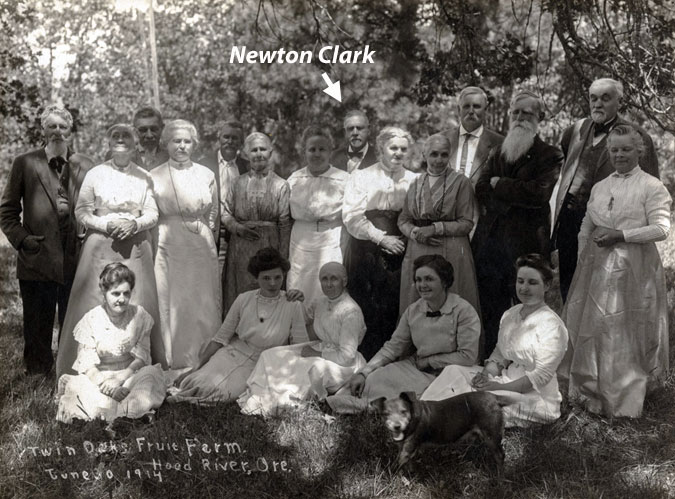
Newton Clark is identified in this photo taken at Twin Oaks Farm in the Hood River Valley in 1914 (back row, center, wearing a bow tie) (photo: Hood River History)

Soon after Newton’s return from his service in the Civil War, he and Mary moved west to the new Dakota Territory that had been created in 1861, just as the Civil War erupted. There, the Clarks farmed as pioneers in what is now the state of South Dakota. 

The old Dakota Territory was massive, encompassing today’s North and South Dakota, most of Montana and the north half of Wyoming until statehood came to Wyoming and the Dakotas in 1888-89, long after the Clarks had moved again, this time to Oregon. 

During their time in the Dakota Territory, Newton and Mary continued to have children, in the wake of losing their baby daughter Minnie, eventually adding two daughters and a son to their young family. The Clarks built the first frame house in Minnehaha County, where they farmed on a homestead located two miles from today’s town of Sioux Falls. Newton also worked as a surveyor of public lands for eight years, where he laid out the sections and townships in much of the Dakota Territory.

Newton Clark entered politics while in the Dakota Territory, too. He served as school superintendent, and was chairman of the board of county commissioners in Minnehaha county for several years before serving as a state legislator in the Dakota Territorial Legislator in the early 1870s. Newton Clark’s public service in the Dakota Territory put his name on the map of today’s South Dakota, with Clark County and the county seat of Clark, South Dakota named for him.

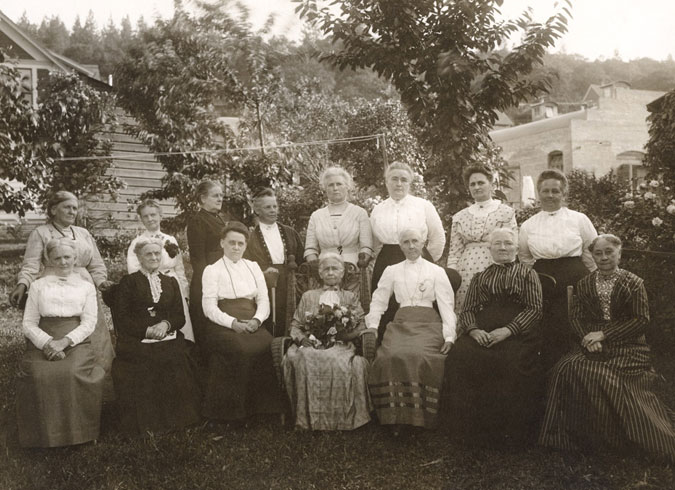
Mary Clark (on the far right) at a garden party in the 1910s (photo: Hood River History)

The grasshopper plagues that swept the high plains in mid-1870s eventually drove Clark from the Dakota Territory, and he continued his family’s migration west to Oregon in 1877. That year, he left Mary behind to care for the children in the Dakota Territory while he joined up his parents, Thomas and Delilah Clark, who had been living in Colorado. 

Together, Newton and his parents traveled three months overland in the summer of 1877, arriving in the Hood River area on September 1. Mary Clark and their three children, William, Jeanette and Grace, eventually joined Newton and his parents in 1878, settling into their new home in Oregon.

Newton later said “I tried farming on my homestead in Dakota, but after two years of successful crops of grasshoppers, I became a disgusted with that form of agriculture and struck for Oregon, driving a team overland.”

Closer view of Mary Clark enlarged from the previous photo (photo: Hood River History)

Newton and Mary Clark arrived in Oregon with almost no money to their name, and set about creating a new life in Hood River. They were among the first pioneers to settle there, and Newton initially found work cutting cordwood and splitting shingles for other valley settlers. By 1878, he was able to purchase 160 acres on the west side of the Hood River Valley, where they built their family home. Newton’s parents built their home on an adjoining parcel.

Newton Clark said later of their new home “We found the Hood River Valley as nature had designed it and habited by a handful of the pioneers… the salubrity of the climate, its freedom from storms of wind and lightning of summer and its frigid blizzards of winter as compared with the Dakotas, all delighted us.”

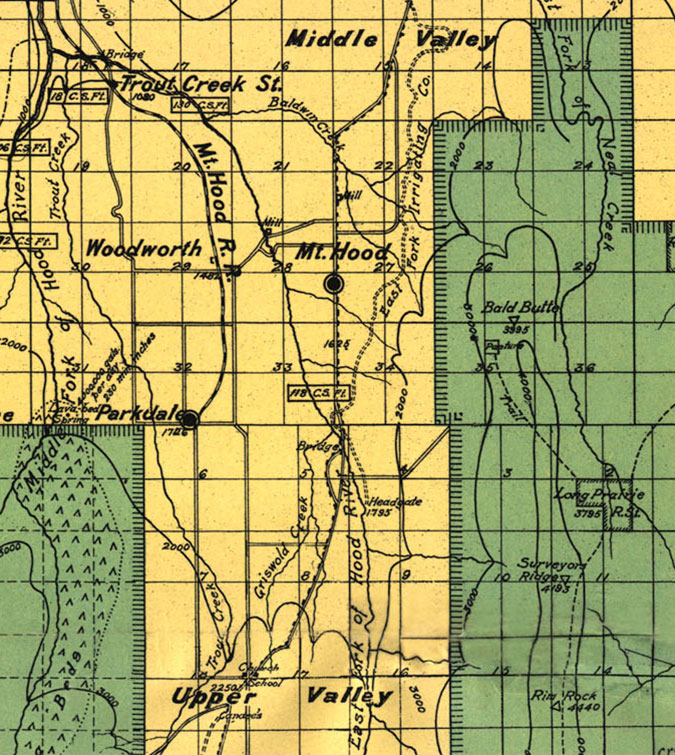
Newton soon began taking contracts with the federal government to survey public lands in the rugged western and southern parts of Hood River County, establishing the section lines in the Upper Hood River Valley and surrounding mountain country that are still the basis of our maps today. Most of these areas would become part of today’s Mount Hood National Forest. Loggers in the early 1900s were still reporting survey marks on trees left by Newton Clark’s crews more than 30 years later.

Many of the section lines (the grid system based on township and range) on this early 1900s map of the Hood River Valley were surveyed by Newton Clark in the 1880s

Like today’s immigrants to Oregon, Newton Clark was drawn to explore the unmatched scenery that we sometimes take for granted. He was among the first to summit Mount Hood and he was also a member of the first party of white men to set eyes on iconic Lost Lake. 

Surveying and exploring in Mount Hood country the 1880s was difficult and dangerous. Trips into the mountains took days, with Clark’s crews carrying heavy supplies on their backs and packhorses. There were few trails, so much of the travel was cross-country, through dense, virgin forests.

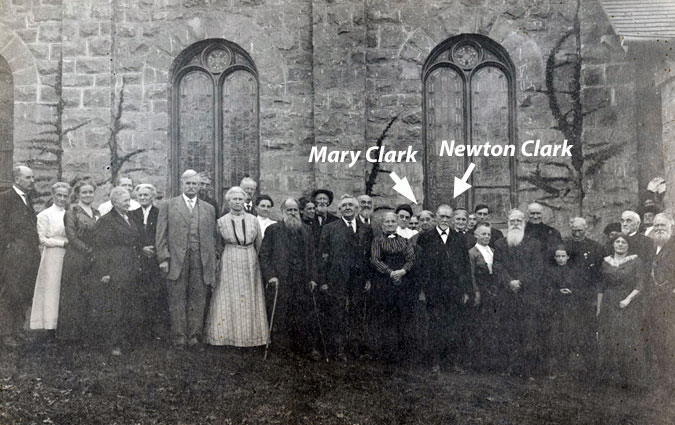
Though not identified on the image, Newton Clark and Mary clearly appear beneath the arched window on the right in this photo taken at the Riverside Congregational Church in 1913 (photo: Hood River History)
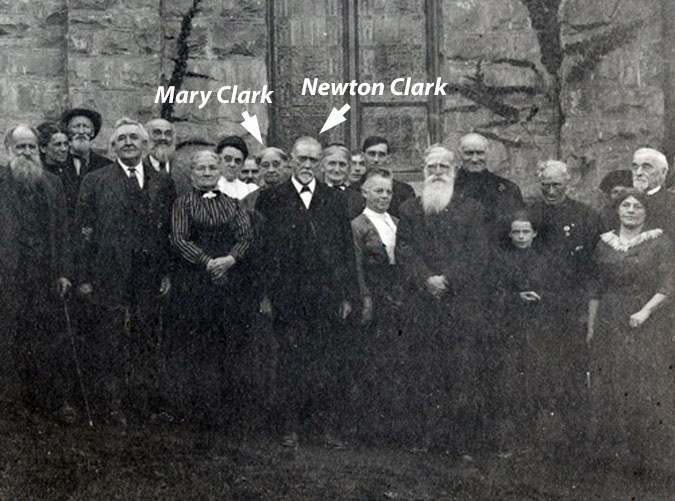
A closer view of the previous photo showing Newton Clark and Mary standing behind him, looking over his right shoulder (photo: Hood River History)
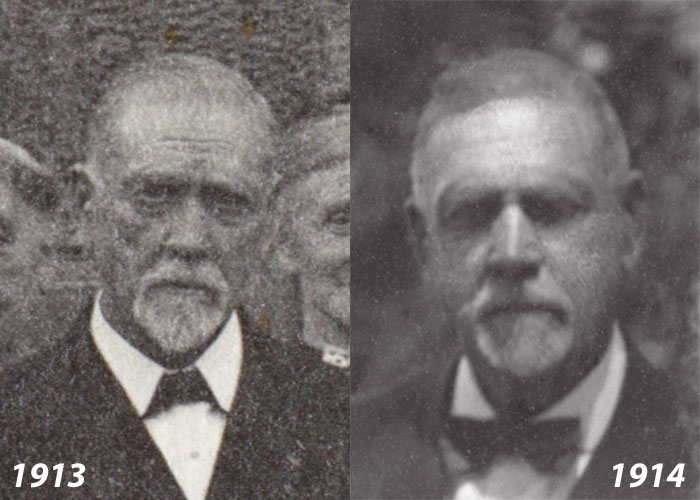
Comparison of the known image of Newton Clark in 1914 at Twin Oaks (right) and 1913 Riverside Church photos (left), and it’s clearly Newton Clark in the Riverside photo (photos: Hood River History)
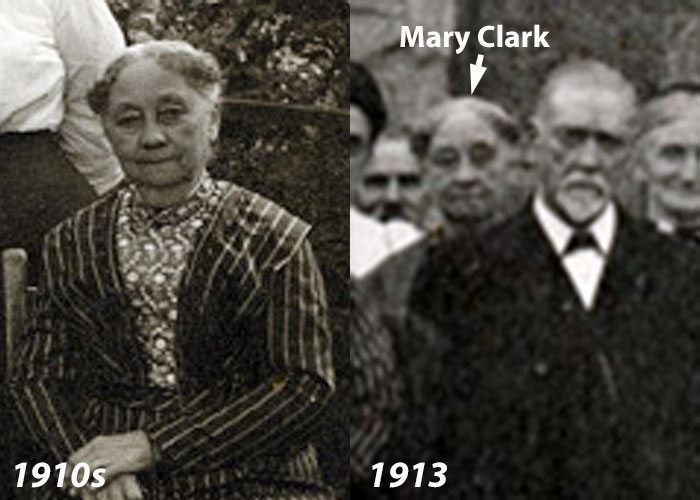
Comparison of the early 1910s garden party photo (left) and 1913 Riverside Church photos (right), and we can clearly see Mary Clark standing just behind her husband (photos: Hood River History)

Like other pioneer explorers of Mount Hood, Clark eventually had a feature on the mountain named for him. For unknown reasons, his full name was used in naming the Newton Clark Glacier. Perhaps this was to prevent confusion with the many features in the West named for William Clark, of the Lewis and Clark Expedition? It remains among the few places in Oregon to feature the full name of its namesake.

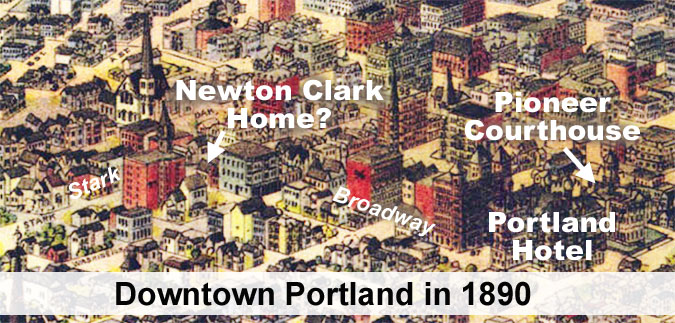
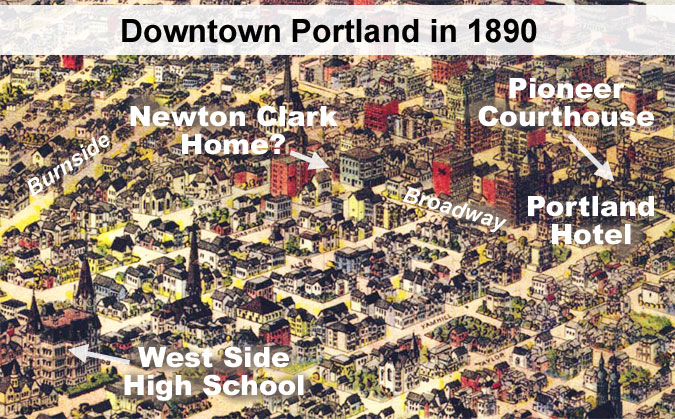
The Clarks left Hood River in 1888 when Newton was elected Grand Recorder of the A.O.U.W., his beloved fraternal older, though he retained some of his property in the Hood River Valley until his death. He served in this capacity with the A.O.U.W. for the next 20 years, with the family living in downtown Portland in a house at “400 Broadway”. Under Portland’s historic address system, this would have been at the corner of Broadway and Stark, where the Hotel Lucia now stands today — in theory, as least.

This illustrated map from 1890 shows a home located at the southeast corner of Broadway and Start, a few blocks from the once iconic Portland Hotel that stood where today’s Pioneer Courthouse Square is located.

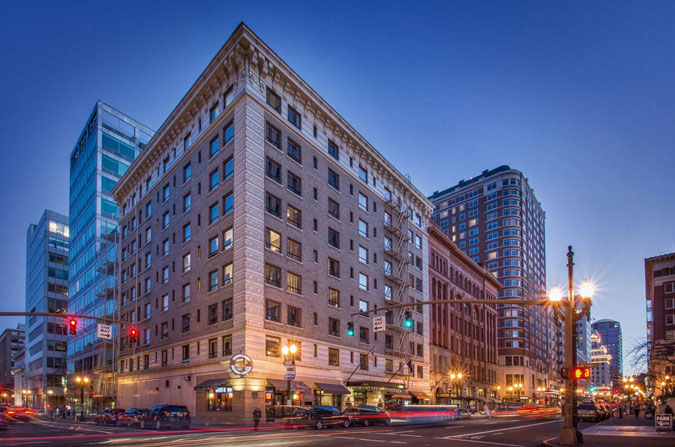
While the 1890 map seems to provide a plausible case for where the Clarks lived in Portland, the fact that today’s historic Hotel Lucia (once called the Imperial) was built in 1909 at this corner clouds that history. The Clarks moved back to Hood River that year, which might make a plausible case for a new hotel going up where home had been, but newspaper accounts show them living at the same home in Portland a few years later, with their daughter. So, more research is needed to know just where the Clarks lived in Portland.

The historic Hotel Lucia was originally the Imperial, built in 1909, a full nine years before Newton and Mary Clark lived on Broadway at the end of their lives

The family returned to Hood River in 1909 when Newton retired from his A.O.U.W. office and built a new home on a hill above town that became their retirement residence.

During these later years in Hood River, the Clarks spent summers at a cabin Newton built at Lake Lyttle on the Oregon Coast, in today’s town of Rockaway Beach. Unlike today’s travelers, they didn’t follow roads to Rockaway Beach. Instead, they took the new Oregon Pacific Railway that had recently opened a route through the Coast Range from Hillsboro to Tillamook

It’s unknown if Newton’s parents joined him when the Clarks moved to Portland in 1888, but his father died in 1892 and historic accounts show his mother living with the Clark family in Portland when she died in 1905, at the age of 98. So, one possibility would be that Delilah Clark joined her son’s family when Thomas Clark passed away in 1892, though there are no history accounts to confirm this. 

What is clear is that Newton was close enough to his parents to bring them west to Hood River with his family in 1877, and later, to bring his elderly mother into his home in Portland. Somewhere out there, a portrait of the extended Clark family exists, and I’m hopeful a reader of this article might be able to help with that.

Newton Clark’s Family

True to the era, less is known about Newton Clark’s wife, Mary, beyond her husband’s description of their life together. She was a native of Edinburgh, Scotland, and according to the historical accounts available, she shared Newton’s passion and determination in their adventurous life as pioneers. 

Two of Newton and Mary’s children died while the parents were still living, baby Minnie in the early 1860s, while Newton was serving in the Civil War and later, their adult daughter Grace (Clark) Dwinell, in 1910. 

Grace finished school in Portland after the family had relocated there in 1888, and became a West Side (now Lincoln) High School graduate. What history is recorded about Grace describes her as outgoing and with a beautiful singing voice that she would often entertain with at family gatherings. 

West Side (which later became Lincoln) High School was located at 14th and Morrison in downtown Portland, seven blocks from where the Clarks live on Broadway. The school was completed in 1885, and opened while the Clarks were living in the neighborhood.
The ornate, gothic-style West Side (later called Lincoln) High School as it appeared when Newton Clark and his family lived in the neighborhood. This impressive structure is among the many grand buildings built in downtown Portland in the 1800s that were later razed as the city continued its rapid growth.

Grace Clark met young Frank Dwinnell while on a trip to visit family in Wisconsin, and he followed her back to Portland, where the two married.  They moved back to Wisconsin for a time and started a family, but sometime in the late 1890s, Grace contracted tuberculosis — then called “consumption” and the leading cause of death at the turn of the century. 

At the time, Grace attributed her illness to the harsh climate in Wisconsin, and the family relocated back to Oregon. After initially recovering from the disease, her tuberculosis eventually returned and Grace died in 1910 at the age of 37. Her funeral was held at Newton and Mary’s new home overlooking Hood River. Frank Dwinnell later moved back to Wisconsin with their young son and daughter to be near his family.

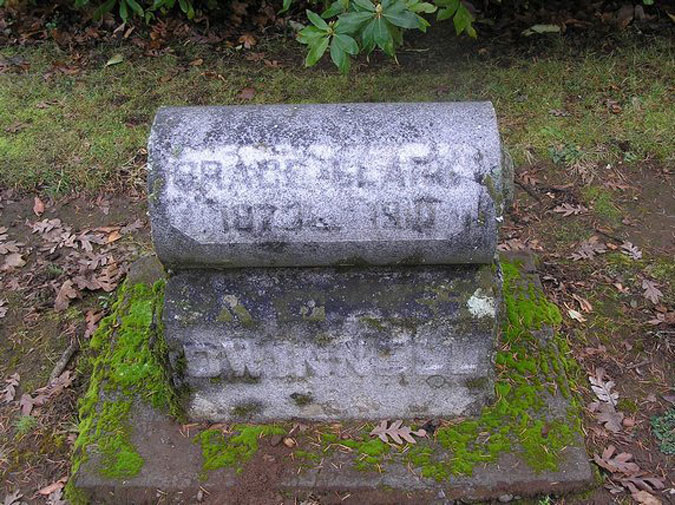
Grace (Clark) Dwinnell’s grave in the Idlewild Cemetery in Hood River

Two of Newton and Mary Clark’s children survived them, including their son William Lewis Clark and daughter Jeanette (Clark) Brazelton. Jeanette’s life is the least documented of the three Clark children who survived childhood, except that she became Mrs. W.B. Brazelton and appeared to living with her parents in their Portland home at the time of their deaths in 1918. I was unable to discover more about her life or even where she was buried for this article, so hopefully a reader will have more of Jeanette’s history to share.

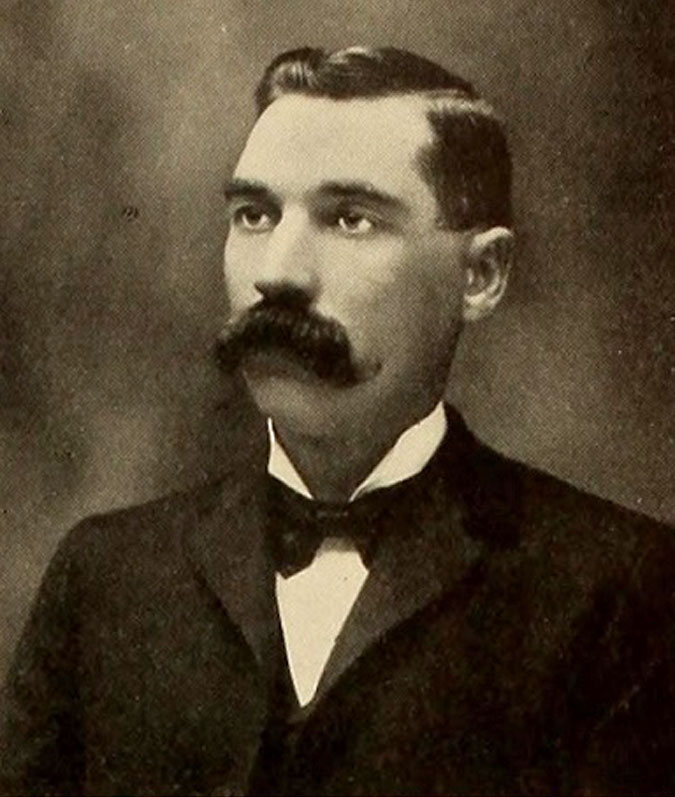
William Lewis Clark followed his father’s footsteps and became a prominent civil engineer in Oregon. William was eleven when the family moved west to Oregon, and after finishing school in Hood River, he worked on his father’s survey crews. At age 19, William went to work for the Northern Pacific Railroad and later the Southern Pacific, overseeing various construction projects across the West. 

William Lewis Clark sometime around the turn of the 20th Century

William married Mary Ann Mabee in 1880 (later records show her as Estella Mabee), and the two would later have a son in 1899, Newton Mabee Clark, who would become a third-generation engineer in the Clark Family. Newton Mabee Clark attended Stanford University, graduating in 1916. He was enlisted in Stanford’s elite Student Army Training Corps, a unit of the U.S. Marines, and served in World War I. Newton M. Clark died in Seattle in 1975 and had no children.

In 1900, the year after his only son was born, William Lewis Clark left the railroads and became the City of Portland’s district engineer for next seven years. William returned with his family to Hood River in 1907, shortly before his parents made their own return to Hood River from Portland. 

For the next ten years he worked in the flour and grain business for C.H Stranahan in Hood River before returning to public service in 1917 for the Oregon Highway Department, at a time when the Historic Columbia River Highway construction was in full swing.

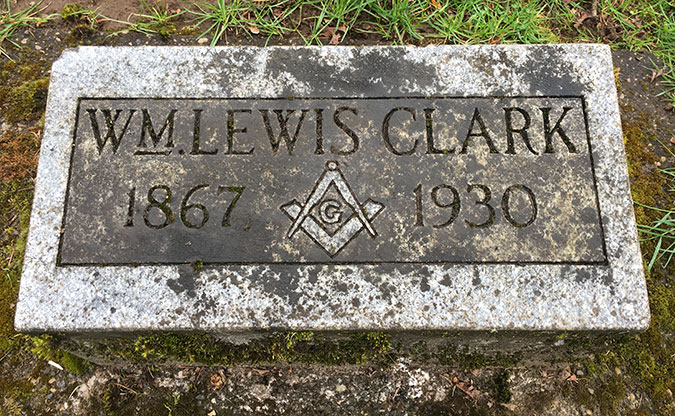
William Clark’s grave in the Idlewild Cemetery in Hood River

William finished his career with the City of Hood River, serving as city engineer from 1922 to (apparently) his death in April 1930, at the age of 62. Mary Ann (also listed as Estella) Clark moved to Seattle sometime after William’s death, apparently to be near their own son. She died in 1950 at the age of 75.

Back to Portland to serve his beloved A.O.U.W

Historical accounts show that Newton and Mary had moved back to Portland in about 1914. He had been called back from retirement to once again serve Grand Recorder of his beloved A.O.U.W. in the wake of so many members of the organization being called to serve active duty in World War I. If this timeline is correct, the Clarks spent just five years in Hood River after their 1909 return, and the photos in this article of the Clarks taking part in community life in Hood River marked their final days living there.

Newton and Mary Clark both died in 1918, and remarkably, both were exactly 80 years and 24 days old at the time of their deaths. Newton died on June 21 of that year at his daughter Jeanette Brazelton’s home in Portland, which seems to be the home where Newton and Mary lived in during their previous 20 years in Portland. Despite a global influenza pandemic that year, Newton died of a “paralytic stroke”, according to historical new accounts. 
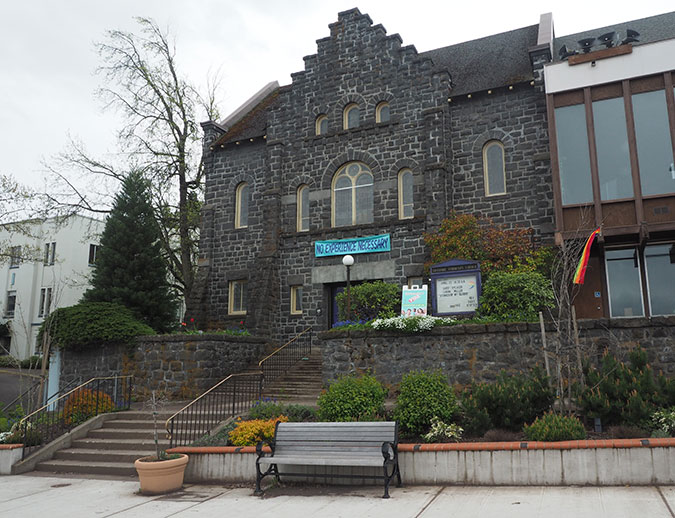
The Riverside Community Church in Hood River today

Newton’s death was widely covered by newspapers in Portland and Hood River, and his funeral at Riverside Congregational Church in Hood River drew a large turnout from the community, including many of the surviving pioneers who had known the Clarks since the mid-1800s. However, Mary Clark was in failing health when her husband died, and she was unable to travel to Hood River to attend his service.

The Hood River Glacier published this tribute to Newton:

________________

Newton Clark

“A soldier, and a fighting one, for four years of his early manhood, and then a frontiersman, he experienced life as men of the following generations could not. It was a privilege to hear him recount tales of the days of the past. As everlasting as the hills and mountain crags he loved were the principles and rugged honesty of Newton Clark. He was loyal to the things he believed in and fought untiringly for their accomplishment. 

“But few men knew that Mr. Clark had passed the age of 80 years. He walked with erectness and his step was firm. News of his death brought a shock of grief to all here last Friday. His comrades, men who knew him best, and loved him, and the families of pioneers, heard the sad news with pains of deepest regrets. 

“Another of our pioneers has gone on the long trail, and we will miss him.”

The Hood River Glacier, June 27, 1918

________________

After the shock of Newton’s death, Mary seemed to be recovering and traveled to Hood River with Jeanette to visit their old home, returning in “better health and good spirits” according to news accounts. But on the morning of July 20, Jeanette found that her mother had died in the night at her home in Portland, just a month after Newton has passed away.

This tribute was published in the Hood River Glacier as the community mourned the loss of two of its most prominent pioneers:

________________

Newton and Mary Clark

“Married at North Freedom, Wisconsin on October 17, 1860, Mr. and Mrs. Newton Clark, of this city, have trodden the pathway of life’s long journey together longer than the most couples of Oregon. Yet few men or women who have not yet reached the three-score-and-ten mark are more active or vigorous than this sturdy couple, a typical product of the frontier and pioneer life. 

“With all faculties alert and hale and hearty both are enjoying their old age. Both are possessed of an optimism and enthusiasm that youth might envy.”

The Hood River Glacier, April 6, 1916 

________________

Though Newton and Mary Clark spent most of their years in Oregon living in Portland, their hearts were clearly in Hood River, where they had first carved out a life as Oregon pioneers. Not only did they choose to retire to Hood River (however briefly before Newton was called back to service), they also chose to be buried there, just a few steps from where they had buried their daughter Grace eight years before, and where their son William would be buried just twelve years after they died.

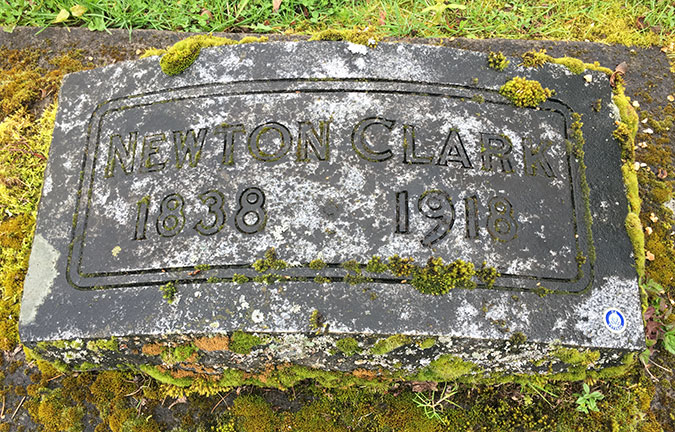
Newton Clark’s grave in the Idlewild Cemetery in Hood River
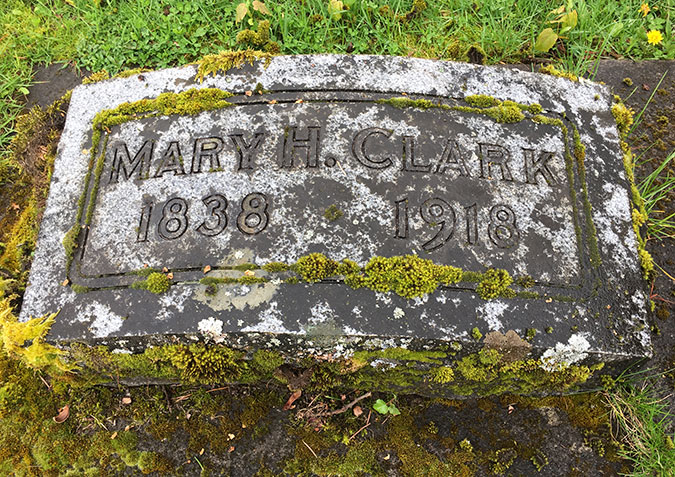
Mary Clark’s grave in the Idlewild Cemetery in Hood River, adjoining her husband’s burial spot

As I researched this article, I grew increasingly dumfounded that Newton Clark isn’t more celebrated in our local history. True, he does have a spectacular glacier named for him, which sure beats a street or local park, but his commitment to service puts him in rare company among the early pioneers in Oregon. Fortunately, his contemporaries recognized this and there are excellent historical accounts of his life, if only we take the time to discover them.

For the direct quotes from Newton Clark used in this article, I turned to a front-page interview and profile published on April 6, 1916 by the Hood River Glacier, just two years before his death. I’ve created a PDF of the entire article that [link=]you can read here.[/link]

For additional history, I turned to other news accounts from the era, as well as an excellent oral history largely written by Newton Clark, himself, in the History of Early Pioneer Families of Hood River, Oregon, compiled in 1913 by Mrs. D.M. Coon. Had these two efforts to record his life in his own words not been made, much of Newton Clark’s extraordinary contribution to our history would have ben lost to time.

And now, some unfinished business…

A Modest Proposal…

Newton Clark Glacier and the Newton Clark Moraine (center) after an early autumn snowfall on Mount Hood

Call it a burr under my saddle, but when I learned decades ago that Newton Clark was one man, not a hyphenation, it bothered me that the two outflow streams were each given one half of his name. It struck me as a combination of historical ignorance and a degree of disrespect behind that decision, wherever it came from. So, where did it come from?

My guess is that these were lighthearted names attached by an early forest ranger, long ago, when most of the features in our national forests were casually named with little thought that these names would stick for centuries to come. Perhaps even Barney Cooper, the first district ranger for the Hood River area, named these streams in the early 1900s? And if Barney came up with the names, then surely he knew Newton Clark personally? After all, Hood River was a very small community in those early days. Perhaps it was Newton Clark, himself, who came up with these names while out on a survey? 

History doesn’t provide an answer, but a look at some of the earliest topographic maps (below) confirms that both Newton and Clark creeks were named by the 1920s, when the Mount Hood Loop Highway had been completed and visitors began pouring into the area.

1920s map of Mount Hood showing Clark and Newton Creeks already named at the time the Mount Hood Loop highway was completed (lower right corner)

Whatever the reason behind the names for this pair of streams, the fact is that place names are one of the best and most durable ways to preserve our history for future generations. That’s why the confusion these names might cause remains a problem, at least in my mind.

Thus, I have a modest proposal, and it’s quite simple: add one word to the name of each stream and you not only solve the potential confusion, you also give Mary Clark her due. After all, would Newton have managed his remarkable life without a remarkable partner like Mary? Of course not. 

Therefore:

• Newton Creek should become Newton Clark Creek

• Clark Creek should become Mary Clark Creek

See how easy that is? And there’s some logic behind it, too, since Newton Creek carries the majority of the outflow from the Newton Clark Glacier. 

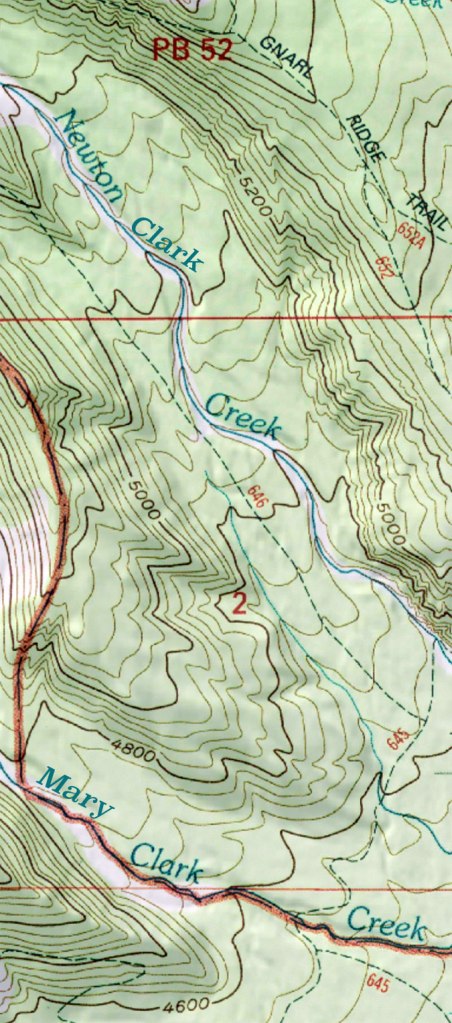
Here’s how this would look on the topographic maps — easy fix!

A slightly modified map…

Of course, when it comes to geographic names, nothing is easy! The Oregon Geographic Names Board (OGBN) is a volunteer panel administered by the Oregon Historical Society that serves as the overseer of geographic names in our state. New names or changes to existing names must be approved by this panel, and among their various criteria are support for public agencies (in this case the Forest Service) and the following:

“If the proposed name commemorates an individual, the person must be deceased for at least five years; a person’s surname is preferred; and the person must have some historic connection or have made a significant contribution to the local area.”

The Clarks have certainly passed the 5-year requirement, 102 years after their deaths. The second part of this requirement could be more of a challenge, but the fact that the Newton Clark Glacier already contains the full name of a historic figure would be my argument for making another exception, here. The last part is easy, as the contribution the Clarks made to the area is undeniable and well documented. Most importantly, the proposed change would also clear up potential confusion, something the OGBN also factors into their decisions.

So, I’ve added this to my list of OGBN proposals that I’ll someday submit when I have a moment, and when I do, I will reach out to the Hood River History Museum and U.S. Forest Service for their endorsements of the proposal, as well.

Exploring Newton Clark Country

Now that we’ve met Newton Clark and his family, the following is a short tour of the places named for him in Mount Hood country.

The Newton Clark Glacier sprawls across Mount Hood’s east face in this classic view from Elk Meadows

For Portlanders, the Newton Clark Glacier is on the dark side of the moon — it’s on the east face of the mountain, hidden from view from the rainy, evening side of the Cascade Range. But from the morning side of the mountain it’s prominent, and dominates the east face of Mount Hood.

Most who see the Newton Clark Glacier up-close view it from the crest of popular Cooper Spur, from nearby Elk Meadows or from Lookout Mountain, due east by five miles, across the East Fork valley. But some of the best views are from Gnarl Ridge, on the Timberline Trail. Here, the impressive scale of the Newton Creek canyon and the full width of the glacier are in full view. In summer, a series of tall waterfalls cascade from the glacier over the Newton Clark Prow and into Newton Canyon.

Vast Newton Canyon as seen from Gnarl Ridge, among the most awesome viewpoints on the mountain. The Newton Clark Glacier fills the east face of the mountain with the layered, black lava cliffs of the Newton Clark Prow at the base of the glacier

True to its name, Gnarl Ridge is home to hundreds of ancient, gnarled Whitebark pine that have survived the harsh conditions here for centuries. There’s no easy way to Gnarl Ridge. Both approaches, either from Cloud Cap or Hood River Meadows, involve a lot of climbing, though the scenery is some of the finest in Oregon. One advantage of the Cloud Cap approach is that no glacial stream crossings are required. However, several permanent, and potentially treacherous snowfields must be crossed on this highest section of the Timberline Trail.

The trail to Elk Meadows is among the most popular on the mountain, and deservedly so, and it provides a photogenic view of Mount Hood’s east face. This is a good family hike for a summer day, but it does require crossing Newton Creek without the aid of a footbridge — which can be an exciting experience. By mid-summer, Timberline Trail hikers have usually stitched together a seasonal crossing with available logs and stones, but expect wet feet when the water is high!

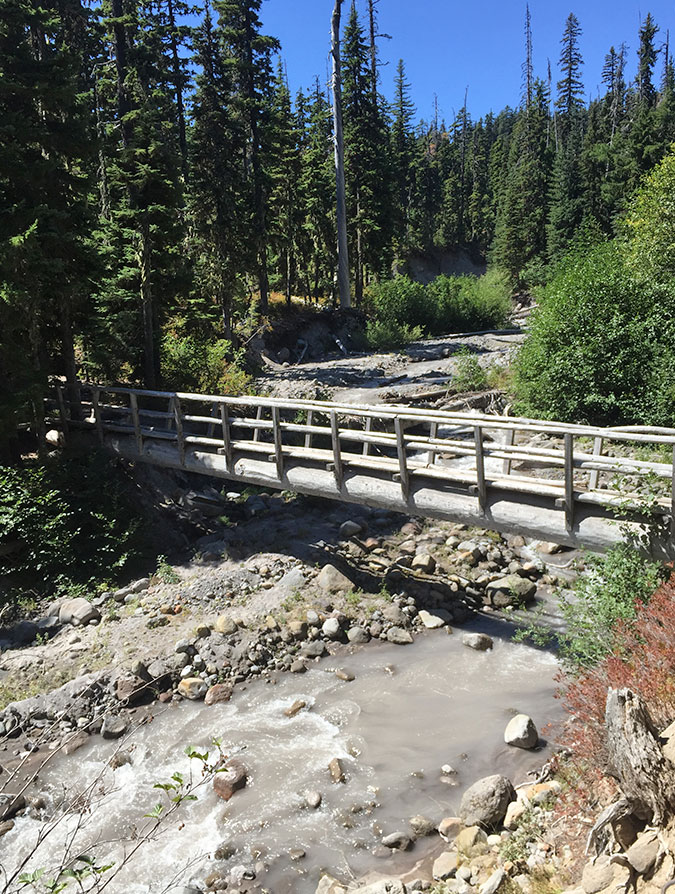
Footbridge over Clark Creek on the trail to Elk Meadows. In summer, the outflow creeks from the Newton Clark Glacier are milky with glacial till.

For a more remote experience, following the Newton Creek Trail to either Newton Creek or Clark Creek (or both) has dramatic views and a lot of rugged mountain terrain to explore. The route to the Newton Clark Trail crosses Clark Creek on a log bridge that has somehow survived this rowdy stream, then turns north and travels along Newton Creek before making a gradual climb along the northeast shoulder of the Newton Clark Moraine.

At the junction of the Newton Creek Trail with the Timberline Trail you can go right for a visit to Newton Creek or left to head over to Clark Creek. Or both, which is how I enjoy doing this hike.

Where Newton Creek canyon is vast and awesome, Clark Creek canyon has a few surprises, including lovely, verdant Heather Canyon, a side canyon with a string of splashing waterfalls.

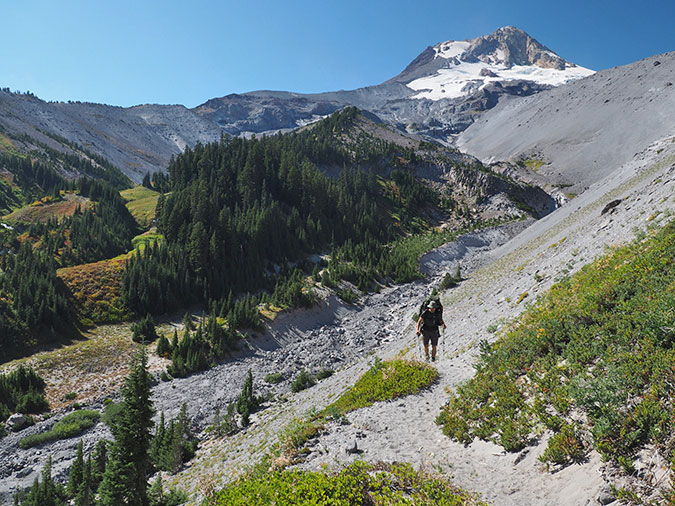
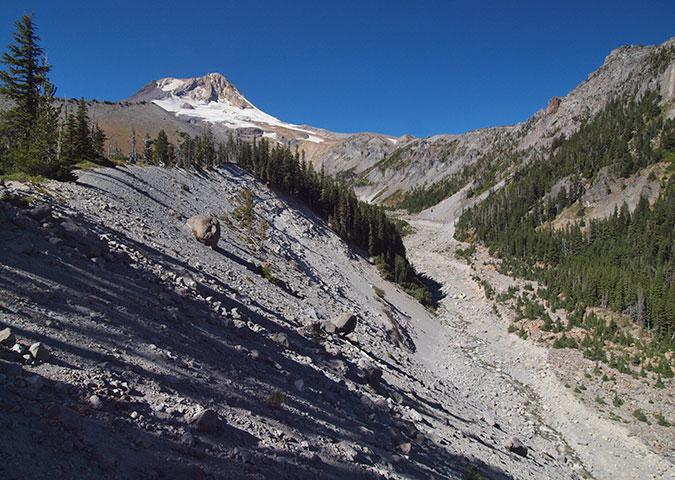
A lone hiker climbs the east slope of Clark Canyon on the Timberline Trail. The Newton Clark Moraine is the massive, gray ridge on the right. Verdant Heather Canyon is on the left

The Clark Canyon headwall is also unique. The receding Newton Clark Glacier has left a wide, scoured rock amphitheater behind that has dozens of tiny streams running across its face in summer. To skiers, this is known as the “Super Bowl”, and it’s impressive to see close-up.

The headwaters of Clark Creek are among the most remote on the mountain, and feature dozens of glacial streams cascading steep cliffs below the Newton Clark Glacier

Downstream from the bowl, Clark Creek drops over a major waterfall (visible from the Timberline Trail) before reaching the debris-covered floor of the valley. This is where the Timberline Trail crosses Clark Creek, so if you like to avoid glacial stream crossings, it’s a nice turnaround spot for lunch. But if you don’t mind the crossing, a pretty waterfall on Heather Creek lies just a quarter mile beyond the Clark Creek crossing and makes for an especially lovely stop.

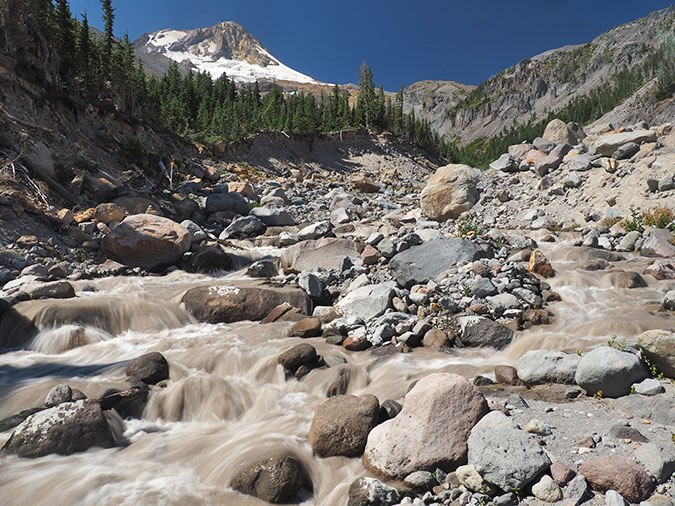
Clark Creek on a summer afternoon, heavy with glacial till during peak runoff

Heading the other direction on the Timberline Trail from the Newton Creek Trail junction quickly takes you to Newton Creek, proper. In most years, an impromptu rope helps hikers navigate a washed-out bank as you approach the chaotic canyon floor, and this is a preview of what can be one of the more difficult glacial crossings on the Timberline Trail. 

Newton Canyon from the Newton Creek Trail, just below the Timberline Trail

Like Clark Creek, you can skip the crossing this glacial stream and simply enjoy a lunch atop one of the many table-sized boulders that fill Newton Canyon, with a fine view of the mountain. The Newton Clark Glacier is more prominent here, and the steep cliffs of Gnarl Ridge and Lamberson Spur rise along the far canyon wall. 

The formidable crossing of Newton Creek on the Timberline Trail, one of more difficult of the many glacial stream crossings on the circuit

Newton and Clark creeks are both thick with glacial till in summer, and don’t make good water sources, but Heather Creek runs clear and there’s a tiny creek flowing into Newton Canyon where the Timberline Trail approaches the canyon floor that provides both drinking water and a couple of shady campsites.

Exploring Surveyors Ridge

Before the era of mountain biking, Surveyors Ridge Trail was a lightly used, lesser-known trail on the mountain that had originally been built for early forest travel.

Though an anonymous tribute, Surveyors Ridge is also named for Newton Clark, and it’s well worth exploring. If you’re a mountain biker, I need say no more. You’ve been there and taken in the sweeping vistas!

But if you’re a hiker, I recommend making a trip to Bald Butte, which forms the northern end of Surveyor’s Ridge. It’s known to a few as “the other Dog Mountain” for its beautiful yellow balsamroot and blue lupine meadows in May and early June each year that echo the much more popular counterpart in the Gorge. Plus, the view of Mount Hood and the upper Hood River Valley from Bald Butte are stunning.

Surveyors Ridge is named for Newton Clark, albeit anonymously. In his lifetime, few trails existed here

There are a couple of ways to get to Bald Butte. If you’re up for a stiff climb, you can take the Oak Ridge Trail (the trailhead is just south of the Hood River Ranger Station, off OR 35). This steep but scenic trail switchbacks up an open slope of Oregon white oak and spring wildflowers before entering forest and joining the Surveyors Ridge Trail. Turn left and hike a couple more miles and you’re on top of Bald Butte.

If you don’t mind driving a bit and are looking for a shorter climb, you can also take Pinemont Drive from where it intersects OR 35 (at the obvious crest between the middle and upper Hood River valleys) and follow this road for several miles to the east shoulder of Bald Butte. Watch for a gravel spur road on the right, shortly after you pass under a swath of transmission towers, and follow the spur to a trailhead under the powerlines. 

The view from the trailhead is spectacular enough, but following the trail from here (which is really the old, primitive lookout road) to the summit of Bald Butte is even more sublime, passing several wildflower meadows that bloom in May and early June.

The Surveyors Ridge Trail ends at Bald Mountain, where yellow Balsamroot and blue Lupine cover the slopes in May and early June

When you make the final ascent of Bald Butte, it’s hard to ignore the impact that off-road vehicles are having on the butte. Hopefully, the Forest Service decision to close most areas in the forest to these destructive vehicles will eventually be enforced. In the meantime, there’s a bit more on the subject in this earlier blog article on the fate of Bald Butte.

For a completely different slice of the Surveyor’s Ridge Trail, you can simply ramble the section north of Shellrock Mountain, where there are several big views of the mountain, plus a look into the weird terrain of Badlands Basin, where an ancient layer of volcanic ash and debris that has been carved into fantastic shapes. You can hike to this area from the Gibson Prairie Horse Camp. 

Mount Hood and Shellrock Mountain from the Surveyors Ridge Trail

The trail spur is located across the road, and if you turn left on the Surveyors Ridge Trail you’ll be heading toward views of Shellrock Mountain and Badlands Basin. Several handy boulders in the steep meadow pictured above make for a good destination for this short, easy hike. Turn right on Surveyors Ridge Trail, and you can take a shorter hike to Rimrock, where the views are somewhat overgrown, but still nice.

The 2006 Floods

Visiting the twin canyons of the Newton Clark Glacier is a great way to appreciate the raw power of the floods it has generated over the years. While Clark Creek can certainly hold its own, Newton Creek is the most fearsome stream on Mount Hood’s east side. Views along the lower section of the Newton Creek Trail (below) tell the story, with truck-sized boulders and stacks of 80-foot logs tossed about in a quarter-mile wide flood channel. 

Much of the more recent devastation you see here occurred in the fall of 2006, when heavy rains fell on a blanket of early snow, and combined to send a wall of rock and mud down the canyon.

Truck-sized boulders and whole trees stacked like matchsticks are silent testimony to the power of Newton Creek in this scene several miles below the glacier, where flash floods have created a debris zone a quarter mile wide. This scene is along the lower part of the Newton Creek Trail.

The debris flow roared down to Highway 35, blocking culverts, covering the road with boulders and washing out large sections of road bed. A similar event was occurring on the White River at the same time, temporarily cutting off access to the Mount Hood Meadows resort from both east and west. As sudden and violent as this event seemed, in reality it was part of an ongoing erosional process as old as the mountain, itself.

We can see this ancient story playing out in new LIDAR imagery, a form of aerial radar used to map the earth’s surface in stunning detail, revealing landforms that could never be captured with conventional surveying. Over the past decade, the Oregon LIDAR Consortium has been working to bring this new mapping technology to a larger audience, including for the Mount Hood area. LIDAR has allowed geoscientists to map the history of faults, floodplains and landslides as never before. 

The map below is from the Oregon LIDAR project, and shows how Newton and Clark creeks emerge from their narrow, twin mountain canyons to spread out on the floor of the broad East Fork Hood River valley. The valley floor is made up of loose debris deposited from these floods over the millennia, and both Newton and Clark creeks have changed course in this soft material with regularity. 

Lidar imagery in recent years has unveiled a long and recurring history of big floods and shifting stream channels in the Newton Clark flood zone. The Mount Hood Loop Highway crosses dozens of these old channels where it crosses the zone.

(Click here for a larger view of the Newton Clark Flood Zone map)

You can see this history in the maze of braided channels that show up on LIDAR. Whereas topographic maps simply show a relatively flat, featureless valley floor here, LIDAR reveals hundreds of interwoven flood channels across what we now know as the Newton Clark flood zone. 

Many of these channels were formed centuries ago, and some in our lifetimes. Some may have flowed for decades without much change, while others may have formed in a single event, then went dry. Both Newton and Clark creeks are continually on the move, and so long as the main steam of the East Fork is on the opposite, and downhill side the Mount Hood Loop Highway (OR 35), both streams will continue to wreak havoc on the highway.

In 2012 the Federal Highway Administration (FHWA) and ODOT replaced the bridge at White River and built massive new culverts for Clark and Newton Creeks on the east side of the mountain (below). 

To contend with the frequent flooding of Newton and Clark creeks, the Federal Highway Administration and ODOT built these massive flood control structures on OR 35 in 2012. They haven’t been tested by a major flood event… yet…

The following are a few photos taken after the water subsided in the fall of 2006, and ODOT crews were assessing the damage to OR 35. The damage shown here occurred over a 24-hour span.

A flash flood from the Newton Clark Glacier in the fall of 2006 sent walls of boulders and ash down the mountain, covering portions of Highway 35 in eight feet of debris (ODOT)
With culverts blocked by debris during the 2006 event, Newton Creek simply flowed down OR 35 (ODOT)
In this view from 2006, a raging Newton Creek simply dissolved the road bed under OR 35, leaving slabs of asphalt hanging in the air (ODOT)

So far, the new flood structures at Newton Creek have not been tested by a major flood event. But when you consider the mosaic of old stream channels in the LIDAR imagery that have been created over the centuries by hundreds of flood events, these new structures are temporary, at best. It’s only a matter of time.

____________________

I’ve mentioned several hikes in this part of the article, and they can also be found in much more detail in the Oregon Hikers Field Guide at the links below. Enjoy!

Gnarl Ridge from Hood River Meadows Hike

Gnarl Ridge from Cloud Cap Hike

Elk Meadows Hike

Bald Butte Hike

____________________

Hood River History Museum (photo: Hood River History)

Special thanks to the Hood River History Museum for permission to include photos from their outstanding collection of historic images in this article. Like all museums, they are closed to the public until further notice because of the COVID-19 pandemic. This has an immediate impact on funding their operations, so please consider supporting the museum during this crisis with a donation. You can make one-time or ongoing monthly donations via PayPal, just go to the “donate” link on their website to support their valuable work.

And another special thanks to Oregon Hikers off-trail legend Chip Down for permission to use his photo of the Newton Clark Prow, one of the least-explored places on Mount Hood. You can read his trip report and see more of his outstanding photos of the Newton Clark backcountry over here.

______________

Postscript:this article was two years in the making (!), as the story of Newton Clark is told in bits and pieces in century-old sources. Despite the miracle of the internet and the astonishing information we have at our fingertips in our time, uncovering local history is still like peeling back the layers of an onion. With each new discovery, more mysteries are uncovered… and blog articles get a bit longer and a bit later!

In this spirit, please help me improve this short history of Newton and Mary Clark and their family where I’ve made errors or omissions. 

Thanks for stopping by and reading this especially long entry!

Tom Kloster | May 2020

The “Other” Shellrock Mountain

Mount Hood rises above Shellrock Mountain and Badlands Basin

Mount Hood rises above Shellrock Mountain and Badlands Basin

Hidden in plain sight above the Hood River Valley, Shellrock Mountain is a little-known peak with a familiar name. Though it shares a name with its better-known cousin in the Columbia River Gorge, the “other” Shellrock Mountain has much more to offer, and is easier to explore.

The “other” Shellrock Mountain is located along the Surveyors Ridge trail, a route popular with mountain bikers who ride from one glorious viewpoint to another along this well-traveled route. At one point on the trail, an obscure wooden sign points to Shellrock Mountain, but really just marks a short spur trail with a view of the south face of Shellrock. Beyond this modest view, few visitors take the time to explore the mountain or the rugged Badlands Basin, located nearby.

Hidden in plain sight: Shellrock Mountain is from Cooper Spur Road

Hidden in plain sight: Shellrock Mountain is from Cooper Spur Road

[click here for a larger view]

Reaching the summit of Shellrock Mountain involves a short, stiff off-trail scramble up the northeast slope of the peak (more about that later), where a stunning view stretches from the nearby glaciers of Mount Hood to the big peaks of the southern Washington Cascades and arid desert country of the eastern Columbia River Gorge.

Shellrock Mountain sits astride the Hood River Fault, a 20-mile long scarp that forms the east wall of the Hood River Valley. The scarp also forms the last high ridge of the Cascade Range in the Mount Hood area, with evergreen forests giving way to the arid deserts of Eastern Oregon just a few miles east of Shellrock Mountain. This proximity to the desert ecosystem brings together a blend of mountain and desert flora and fauna that make Shellrock Mountain and its surrounding area unique.

While most of the uplifted ridge along the Hood River Fault is composed of ancient layers of basalt, andesite and dacite, the Badlands Basin reveals the more recent debris of a pyroclastic flow, the same roiling mixture of steam, volcanic ash and rock that roared from Mount St. Helens in the May 1980 eruption. This flow originated from Mount Hood during its early formation.

Badlands Basin sprawls against the northern foot of Shellrock Mountain

Badlands Basin sprawls against the northern foot of Shellrock Mountain

Badlands Basin is located at the headwaters of Cat Creek, on the north flank of Shellrock Mountain. Here, the ancient pyroclastic flow has been carved into a fantastic landscape of pinnacles, ridges and goblins that is unmatched elsewhere in the region. The Badland Basin formation spreads across about 100 acres, rising nearly 1,000 above Cat Creek.

The maze of formations in Badlands Basin as viewed from Shellrock Mountain

The maze of formations in Badlands Basin as viewed from Shellrock Mountain

Exploring the Badlands Basin is a rugged and surreal experience for the rare visitors who make their way through the jagged formations. No trails go here, and the terrain is both steep and exposed. But once inside the formation, individual spires and ridges take on a new life, as their bizarre shapes come into focus on a human scale. The Badlands are surprisingly alive, too, with a unique ecosystem of desert and sun-loving alpine flora thriving in dry meadows among the rock outcrops.

Badlands Basin: “The Grizzly Bear”

Badlands Basin: “The Grizzly Bear”

Badlands Basin: “The Hippo”

Badlands Basin: “The Hippo”

Badlands Basin: “The Iguana”

Badlands Basin: “The Iguana”

Together, Shellrock Mountain and the adjacent Badlands Basin are special places that beg to be explored. While the Surveyors Ridge Trail provides a good view into the area, new trails that explore the strange formations of the Badlands up-close and reach the airy summit of Shellrock Mountain could make these places much more accessible for hikers and cyclists. What would these new trails look like?

Proposal: Shellrock Mountain Loop Trail

This proposal calls for a new trail to Shellrock Mountain and Badland Basin from the Loop Highway. Why start at the highway? It makes sense for several reasons: first, the new trailhead at Cat Creek would be only about one-third mile from the popular Dog River Trailhead, making a long and spectacular loop possible for mountain bikers, as the Dog River Trail also connects to the Surveyors Ridge Trail.

Second, a highway trailhead would make the area much more accessible and secure for all visitors, as highway trailheads are easier for law enforcement to patrol, and highway traffic, alone, acts as significant deterrent against car clouters.

ShellrockMountain08

[click here for a large version]

Finally, a trailhead along the Loop Highway could be open most of the year, allowing for winter snowshoe access to the high country around Shellrock Mountain when the Surveyors Ridge Road is buried under snowdrifts.

The proposed Shellrock Mountain Loop would have two legs: a 2.5 mile northern leg would follow Cat Creek to the base of Badlands Basin, then wind through the rock formations to a junction with the Surveyors Ridge Trail. A southern leg would climb the long ridge west of Shellrock Mountain to a separate junction with the Surveyors Ridge Trail, about a mile south of the northern leg. The Surveyors Ridge trail would connect these new trails, creating the loop.

A short summit spur trail would lead from the existing Surveyors Ridge Trail to the rocky top of Shellrock Mountain, providing a side-trip option for cyclists on the ridge and the main destination for hikers on the new Shellrock loop trail.

The following oblique views show the proposed trails from both west and east perspectives:

ShellrockMountain09

[click here for a large version]

ShellrockMountain10

[click here for a large version]

What Would it Take?

In 2009, President Obama signed a bill into law creating the Mount Hood National Recreation Area (MHNRA), a small but significant new form of protection for the Mount Hood area. The MHNRA concept has mountain bikes in mind, as it provides a way to protect recreation areas in a wild state, but without bicycle restrictions (under federal law, bicycles are not allowed in designated wilderness areas).

Shellrock Mountain and Mt. Hood from the Surveyors Ridge Trail

Shellrock Mountain and Mt. Hood from the Surveyors Ridge Trail

The entirety of Shellrock Mountain and the Badlands Basin fall within the MHNRA designation, and as such, deserve to be considered for proposals like this one. The Forest Service has shown an encouraging willingness to work with mountain biking advocates to build new bike trails in the Surveyors Ridge area, too. So while the agency has generally opposed building new trails anywhere else, there is a good chance that the Shellrock Mountain Loop could be build if mountain bike advocates were to embrace the idea.

The first mile of both legs of the new trail would also fall on Hood River County land. The county currently focuses most of its energy on logging its forest holdings, but has worked with mountain bikers in the Post Canyon area to diversify the kinds of uses that county land can be dedicated to.

Nope, this sign doesn’t lead to Shellrock Mountain… yet…

Nope, this sign doesn’t lead to Shellrock Mountain… yet…

In the Shellrock Mountain area, Hood River County has already logged off the big trees, so hopefully the County would see the wisdom of shifting the focus in this area to recreation, as well – and possibly consider funding for trail construction, as well.

Most importantly, mountain biking advocates like the International Mountain Biking Association (IMBA) have a terrific record of trail building, and with help from other trail advocates like Trailkeepers of Oregon (TKO), could be the catalyst in bringing together a collaborative effort of volunteers, the Forest Service and Hood River County in creating this new trail system.

How to Visit Shellrock Mountain

Sturdy hikers can visit Shellrock Mountain today with a bit of wayfinding expertise and some bushwhacking skills. The best starting point is an unofficial trailhead located along the Surveyors Ridge Road.

A brave bushwhacker heads for Shellrock’s summit

A brave bushwhacker heads for Shellrock’s summit

To reach the trailhead from Hood River, drive the Loop Highway (OR 35) ten miles south of I-84 to a crest just beyond the Mount Hood Mill, where you turn left onto Pinemont Drive. This road eventually becomes Surveyors Ridge Road, alternating between paved and gravel surfaces, but is always easily passable for any car.
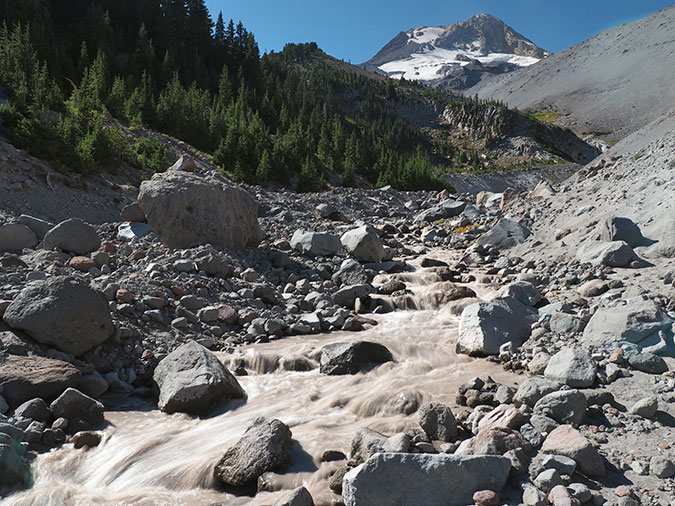
At almost exactly 11 miles from where you turned off the main highway, watch for an unmarked trail heading to the right at an obvious bend in the road. Park here, and follow the short path to the Surveyors Ridge Trail, just a few feet off the gravel road. Shellrock Mountain is visible directly ahead of you!

The open summit ridge of Shellrock Mountain

The open summit ridge of Shellrock Mountain

From here, turn left (south) and follow the Surveyors Ridge trail for about one-third mile to a gentle crest along the forested east shoulder of Shellrock Mountain. If you pass the trail sign pointing to Shellrock Mountain, you’ve gone too far.

At the crest, head directly uphill on whatever path you can find through the forest, then abruptly leave the trees and reach the open east slopes of Shellrock Mountain, where you will wind among patches of manzanita and ocean spray as you work your way toward the summit. Don’t forget to look back periodically to help you retrace your steps upon your return!

Mount Hood fills the horizon from the top of Shellrock Mountain

Mount Hood fills the horizon from the top of Shellrock Mountain

Soon, you will reach the summit ridge with a series of viewpoints of the Badlands Basin (and your starting point) spreading out to the north and Mount Hood towering to the southwest.

From this vantage point, you can also see the full extent of the 2008 Gnarl Fire that burned the eastern slopes of Mount Hood, sweeping from near Gnarl Ridge on the far left horizon toward Cloud Cap, located right of center. The historic Cloud Cap Inn was barely spared by this blaze. In 2011, the Dollar Fire was started by a lightning strike west of Cloud Cap, sweeping over the right shoulder of the mountain for several miles toward Lolo Pass. For more on the Dollar Fire, click here.

Early stages of the 2008 Gnarl Fire from near Shellrock Mountain

Early stages of the 2008 Gnarl Fire from near Shellrock Mountain

You’ll want to linger on the summit, and be sure to bring along a good map to help you identify the many features near and far that can be seen from this lonely summit. For photographer, the best time to visit in in the morning, which the light on Mount Hood is at its best.

Enjoy!

Billy Bob, meet Joe Spandex…!

BillyBob01

This article is the second in a series of proposals for new “bikepacking” areas around Mount Hood and in the Gorge — places where cyclists can ride to overnight, off-road campsites. As with the earlier Waucoma Bicycle Backcountry proposal, the concept here is to convert fading logging roads into dual-track bicycle routes, complementing existing single-track trails that already exist in the area.

This proposal focuses on the potential for the Billy Bob Sno-Park to be put to work year-round, using the otherwise vacant facility in the snow-free season as the gateway to a new mountain bike network. The trailhead would become the hub of the newly created Mount Hood National Recreation Area (NRA) unit that covers the Fifteenmile Creek canyon backcountry, and was designed with backcountry bicycling in mind.

The Billy Bob Trailhead

The Billy Bob Winter Shelter

The Billy Bob Winter Shelter

The existing Billy Bob Sno-Park features a winter shelter, complete with wood stove, and is provided for snowmobiles and Nordic skiers. A local snowmobile club is under contract with the Forest Service to groom some forest roads as snowmobile routes, while ski trails are un-groomed and seldom used. Snowshoers also use Billy Bob as a base for reaching the nearby Fivemile Butte and Flag Point lookouts, as both can be rented during the winter.

The winter shelter is at the south end of a very large, paved turnaround suitable for up to 40 vehicles, including trailers carrying snowmobiles. Like the nearby Little John SnoPark, the parking area appears to be an asphalt relic from the logging heyday of the 80s and 90s, originally serving as a loading area for log trucks.

Plenty of parking here..!

Plenty of parking here..!

A pit toilet is also located here, at the northwest corner of the turnaround, opposite the shelter. Presumably, the toilet is kept snow-free in winter, but is also open in summer (though not regularly serviced… ahem!) to the rare visitor in the off-season. There is no water provided at Billy Bob.

The "modern" pit toilet at Billy Bob is relatively new

The “modern” pit toilet at Billy Bob is relatively new

In addition to winter use by snowmobiles and occasional skiers and snowshoers, Billy Bob is sometimes used as a base camp during the fall hunting season, as the surrounding area remains popular for hunting.

Fortunately, the site is far enough from population centers and major highways that it has largely been spared from the dual scourge of illegal dumping and target shooting that plagues similar pullouts and trailheads on the west side of the mountain.

The Proposal

BillyBob05

Click here for a large map

How would the new Fifteenmile Canyon bicycle backcountry work? The first step would be conversion of a number of old logging roads in the area to become dual-track bike trails. In this way, the routes could also continue to function as snowmobile or ski trails in the winter. These proposed routes are shown in yellow on the map.

Next, a few new dual-track trails are proposed (in solid red) where they would better connect the existing network of logging tracks and directly connect the Billy Bob site to nearby drive-up campgrounds at Pebble Ford and the Underhill Site. Abandoned logging spurs make up the bulk of these new routes, so little new construction would be required to complete these dual-track gaps.

Recovering ponderosa forests in the area are a reminder of the clearcutting heyday of the 80s and 90s

Recovering ponderosa forests in the area are a reminder of the clearcutting heyday of the 80s and 90s

The purpose of dual-track trails is to provide less experienced cyclists and families with young kids a less challenging, more relaxed alternative to single track for trail riding. Dual-track routes allow for cyclists to easily pass on the trail, so are a good solution for busy trails where riders with a range of skill levels are expected. The dual-track design would also allow for safer shared use by cyclists, hikers and horses.

In Fifteenmile Canyon, the proposal calls for converting several roads to dual track to create a loop system located along the boundaries of the new Mount Hood NRA. The dual track loop would be gated, with motorized entry limited to service vehicles for maintenance or emergency access.

Stands of large ponderosa and larch are still intact within the canyons of the Eightmile NRA

Stands of large ponderosa and larch are still intact within the canyons of the Eightmile NRA

Within the proposed dual-track loop system, the NRA is centered on the steep maze of gulches, draws and ravines that form thousand-foot deep Fifteenmile Creek canyon. Three existing hiking trails (dashed black on map) extend into the canyon, one following Fifteenmile Creek, and two climbing the north and south slopes of the canyon, connecting to area campgrounds.

The proposal would fill in a few gaps in the existing single-track trail network that explores the Fifteenmile Creek backcountry, including (in dashed red on map) a new route that would extend west from the creek canyon to Bulo Point, a lovely, almost forgotten viewpoint, treated badly during the recent logging bonanza. A new single-track tie would connect the Pebble Ford and Fifteenmile campgrounds and short tie near Fraley Point would complete the single-track system.

Ridgetop meadows and interesting rock outcrops are found throughout the area

Ridgetop meadows and interesting rock outcrops are found throughout the area

The trails at the heart of the Fifteenmile Creek backcountry traverse some of the most ecologically diverse terrain in Oregon, from sun-baked Oregon white oak stands and open balsamroot meadows on sunny slopes and ridgetops to giant ponderosa and western larch parklands along canyon slopes. There are even lush, shady Western red cedar and red alder groves tucked along Fifteenmile Creek.

The proposal calls for three new bicycle camps within this beautiful, quiet backcountry. These campsites would consist of 4-6 groomed tent sites, one or two picnic tables, fire rings and secure bike racks — a comfortable step up from the truly primitive level of wilderness, but still providing a rustic backcountry experience. This, after all, is what the NRA was created for!

The Billy Bob concept calls for 3-way sharing by trail users

The Billy Bob concept calls for 3-way sharing by trail users

A total of ten trailheads are shown on the proposal map. Some already exist, some would be new, but all would need to be upgraded under this proposal to be geared toward backcountry cyclists. This includes a complete trail map with difficulty ratings for trail segments, information on the backcountry camps and “share the trail” information for all users — as these trails would continue to serve hikers and horses, as well as cyclists.

Connections to Points Beyond

Views into the Columbia Basin desert abound from the many high points in the Fifteenmile backcountry

Views into the Columbia Basin desert abound from the many high points in the Fifteenmile backcountry

The main focus of the Billy Bob trailhead proposal is the “bikepacking” potential for the Fifteenmile Canyon backcountry, but a wealth of nearby destinations are close enough to make for fine day trips from the proposed new trailhead.

Nearby Fivemile Butte is already a popular goal for cyclists, with a lookout tower and picnic tables that provide for a rewarding destination. The Flag Point Lookout is also within reach, and still in service during the summer, providing an especially interesting destination, as the lookout staff usually welcome visitors with a tour of the tower.

Cyclists visiting the Fivemile Butte Lookout

Cyclists visiting the Fivemile Butte Lookout

Lookout Mountain is also within reach, although the summit trail falls within the Badger Creek Wilderness, and thus is off-limits to bikes. But cyclists can still ride to High Prairie on a mix of trails and primitive roads and make the short final ascent of the mountain on foot — an equally satisfying option to riding.

The remote Flag Point Lookout is still staffed in summer

The remote Flag Point Lookout is still staffed in summer

The Boy Scouts operate Camp Baldwin just to the north of the proposed bicycle backcountry, with a summer camp program that draws thousands of scouts each year. The camp program includes mountain biking into the surrounding forests, so the proposed Fifteenmile bicycle backcountry would be a natural fit for the Scouts. Even better is the possibility of an ongoing partnership between mountain biking organizations and the Scouts to build and maintain trails in the area over the long term.

Does it Make Sense?

The Surveyors Ridge area to the west of Billy Bob and Fifteenmile Canyon is already a very popular cycling destination, with overflowing trailheads on most summer weekends, so there seems more than enough demand to justify this proposal. More importantly, the Fifteenmile backcountry would provide a unique, overnight “bikepacking” experience for cyclists that doesn’t exist elsewhere on Mount Hood’s east side.

Cyclist on popular Surveyors Ridge (The Oregonian)

Cyclist on popular Surveyors Ridge (The Oregonian)

An emerging bicycle sport that could complement summer riding on the proposed trail nework is “fat biking” or snow biking. Fat bikes use oversized tires to put cyclists on snow-covered trails in winter, and it’s possible that the Billy Bob trailhead and proposed bicycle network could serve this growing form of cycling.

BillyBob14

Likewise, Nordic skiing and snowshoeing are continuing to grow in popularity, and though winter access to the Billy Bob trailhead is a long ride from the Portland area it could provide an important option for Gorge-based visitors looking for something away from the Portland crowds that often overwhelm Mount Hood on winter weekends.

What would it take?

Like the earlier [link=]Waucoma Bicycle Backcountry[/link] proposal on this blog, the viability of this proposal is in its simplicity: less than eight miles of new trail would open a 50-mile network, with dozens of loop options that could be tailored to the ability of individual mountain bikers.

Most of the work required could be done with the help of volunteers, from trail building and campsite development to signage and ongoing maintenance. Some heavy equipment would be required to develop the main trailhead at Billy Bob and to decommission vehicle access on some of the converted roads, and would have to be provided by the Forest Service.

Views from the open ridgetops in Fifteenmile Backcountry extend north to Mount Adams and Mount Rainer in Washington

Views from the open ridgetops in Fifteenmile Backcountry extend north to Mount Adams and Mount Rainer in Washington

The proposal would also require the Forest Service to fully devote the Fifteenmile Canyon to quiet recreation during the snow-free months. A few years ago, that would have been unlikely, but in recent years, the agency has not only adopted plans to phase out hundreds of miles of logging roads, but also adopted a new policy to focus OHV use in a few, very specific areas of the forest.

These recent developments could move this proposal if public support exists for a bicycle backcountry, although the Forest Service will need continued support from quiet recreation advocates to convert old logging roads to trails: recently, the agency has put plans to phase out old roads in the Barlow Ranger District that encompasses the Fifteenmile backcountry on hold, due in part to pressure from OHV groups.

The good news is that mountain bicycling organizations are already working hard to develop trails elsewhere in the Mount Hood region and hopefully would find this proposal worth pursuing, too. If you’re a mountain biker, you can do your part by sharing this article with like-minded enthusiasts, or your favorite mountain biking organization that could serve as a champion!
____________

Bikepacking Resources:

Bikepacking.net is an online community that focuses on off-road touring, away from cars, with great information on gear, routes and trip planning.

The Adventure Cycling Association posted this helpful article on how to pack for your bikepack trip.

The International Mountain Bicycling Association (IMBA) is the premier organization and advocate for backcountry bicycling.

In the Mount Hood region, the Northwest Trail Alliance is the IMBA Chapter doing the heavy-lifting on bicycle trail advocacy.

The IMBA has a guide to fat biking.

Where the heck is Tamarack Rock?

TamarackRock01

You won’t find Tamarack Rock on any maps, though this rugged knoll is hidden in plain sight — just off the Surveyors Ridge Road (FR 17) on the east side of Mount Hood. The rock didn’t get much respect during the logging heyday of the late 1900s, with gravel spur roads wrapping almost entirely around the rock, and big ponderosa trees felled from its gentle southern flank.

But through all the destruction that reigned here, a lone Western larch tree survived in a most unlikely spot, among the huge boulders near the crest. The tree is among the most magnificent of its kind in the area, a massive, gnarled, determined old sentinel that has managed to dodge lightning strikes and fires, as well as chainsaws.

Mount Hood at dusk from Tamarack Rock

Mount Hood at dusk from Tamarack Rock

The view from the rock is glorious, with the broad northeastern face of Mount Hood towering over waves of forest ridges, and the tiny farms and orchards of the Upper Hood River Valley, spread far below. The forested Mill Creek Buttes complete the scene, to the east. The scenery is so sweeping that it’s easy to forget the maze of logging roads and clearcuts all around. In this way, Tamarack Rock survives, surprisingly intact.

A birds-eye view of Tamarack Rock

A birds-eye view of Tamarack Rock

I had passed the rock countless times over the years, always promising myself that I’d explore this postage-stamp wilderness someday. This spring, I finally made good on the promise, and explored the landmark from all sides. Trail riders and hikers are already familiar with the rugged west face of the rock, where it towers above the popular Surveyors Ridge Trail. From this angle, the rock has a “face”, which in turn led to a spirited discussion among the PortlandHikers.org community on just what to call the rock — if it didn’t already have a name.

The "face" of Tamarack Rock from the Surveyors Ridge Trail.

A quick survey of those familiar with the area didn’t reveal a local name for the rock, so I posted a survey on PortlandHikers.org to poll a few options. When the votes were counted, the uncanny resemblance of the “face” to a certain Hollywood film director won the day, and it appeared that this landmark might become “Hitchcock Rock” to recreationists. Fortunately, the story didn’t end there, though it led to some creative photo interpretations (see below).

The backup filming location for "North by Northwest", perhaps?

This is where the PortlandHikers.org discussion sent me back to the rock, because it was unclear from my early photos whether the ancient tree near the crest was living, dying or dead — or simply a larch in dormant winter phase, sans needles. My second visit a few weeks later revealed a fresh burst of new needles covering the old giant, and redirected the naming discussion to the tree in question.

Given the proximity of Larch Mountain (and other features) using the larch as namesake, the PortlandHikers.org consensus was to fudge a bit by using the “tamarack” name, instead. This is botanically incorrect, but as we learned in our debate on the subject, a good portion of the west actually uses the name “tamarack” to describe Western larch, and it had a nice ring to it, besides: Tamarack Rock!

I wasn't the first to the top, and surely won't be the last..!

I wasn't the first to the top, and surely won't be the last..!

On this follow-up visit to the rock, I also discovered a long history of visitors, beginning with a geocache box tucked into an inconspicuous hiding spot. The journal inside listed a visitor earlier the same day, remarking on a “large coyote” seen near the rock. Other visitors simply commented on the impressive views.

Not far from the geochache were a couple of homemade memorials, honoring Adam J. Dietz Sr. (1917-1997) and Alfred West (1910-1998). Clearly, these two gentlemen had some connection with the rock, but for now, I can only assume they worked or hunted in the forest, and might have been local to the area. But their presence further cemented the idea of a more respectful name for the rock, no matter the Hitchcockian resemblance.

The rustic Adam J. Dietz Sr. Memorial on Tamarack Rock

The rustic Adam J. Dietz Sr. Memorial on Tamarack Rock

Yet the human history of Tamarack Rock seems to go back even further, and perhaps by millennia: a few yards from the aluminum Alfred West memorial cross, there are at least two, and possibly three Native American ceremonial pits. One is quite obvious, a second somewhat compromised and a third barely visible. The pits are located in full view of the mountain, and mimic similar pits in the area, including this subject of an earlier post.

Finding all this human history in gathering twilight on that brisk spring evening was exhilarating, to say the least. It was yet another reminder that we are all just passing through, and how we treat this land will be our only real legacy. Tamarack Rock has clearly been admired and loved for generations, and how fortunate we are that the even the era of road building and forest destruction didn’t destroy this unique place.

In another century, there’s a good chance the old larch tree will still live, clinging to this rock, long after we’re gone. If the old tree does survive, it will be a pretty good measure of our collective will to leave the Mount Hood country in better shape than we found it. It will also reflect our human capacity to honor places like this simply because of their spiritual significance to those who came before us.

I think we’re up to that challenge.