Restoring Trails… and Hope? The Owl Point Register Story (Part 1 of 2)

Dad and daughter signing in at Owl Point in 2016 (photo courtesy of Sergey Kiselev)

Making time for this blog is always a challenge, given my day job, caring for family and a broken-down old house… and all the other distractions in life that we ALL tend to! So, I’m a bit tardy with this article. But to be candid, it’s the political chaos unfolding at the national level in this election year that has been on my mind in a big way, making it hard to think about the places and things I care about most, right here in WyEast country. I also know I’m hardly alone in being discouraged and fearful about what the November election might bring for our country. It’s a crazy time in America. Again.

Then I had a breakthrough last week. I was up at my beloved Owl Point, on Mount Hood’s north side, scouting for an upcoming trail stewardship event. While there, I was doing my annual tending to the summit register I placed there in 2012. It’s a simple setup: a painted steel ammo box with some maps and photos of the area and a simple log book for folks to sign. 
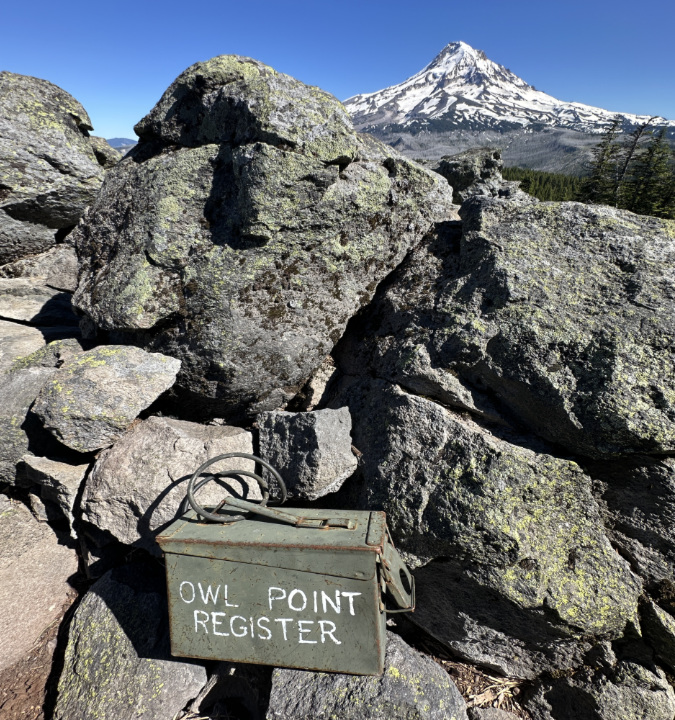
Twelve tough years in the elements, and the Owl Point Register is still holding up in 2024!

When I placed it back in in the fall of 2012, I didn’t expect a big response. Though the Old Vista Ridge trail to Owl Point had been re-opened by volunteers five years prior, in the summer of 2007, it was still only lightly visited. The Forest Service would not formally recognize the trail as “maintained” for another five years. Looking back now — twelve years later — more than 1,000 entries by individuals, couples, families, hiking groups and even the occasional dog fill 272 pages (and counting) that have now spilled into a third edition of the register!

Given its popularity, I’ve always fretted about the box being vandalized or stolen, thus losing all those entries and the wonderful personal histories they contain. Therefore, whenever I’m up at Owl Point I take photos of the latest entries as a backup, of sorts. In this way, I’ve maintained a running digital (so to speak) version of the register since the very beginning.

It was in this context of capturing the latest entries that I came across the following message last week. It had been entered last October, just before the winter snows closed in on Owl Point:
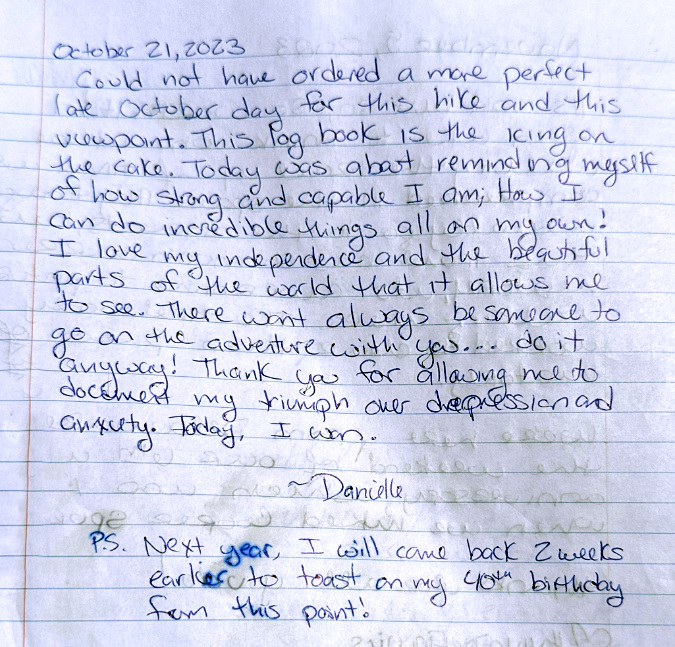
Reading Danielle’s brave, vulnerable message immediately broke through the political noise, dread and polarization that has been swirling in my head in this miserable election season. It  reminded me that the antidote to all of the toxicity washing over our society right was right in front of me – Mount Hood towering above and Danielle’s personal testament in my hands. It was a needed reminder of the limitless restorative powers of just being out in nature, rediscovering who we are and what we care about most, and being reminded that we’re always stronger than we think.

And therein was the breakthrough for me: return my own focus to being an active advocate and steward for our natural landscapes right here in WyEast Country: for a better future for Mount Hood and the Gorge and for the trails that provide access for everyone to our precious public lands. 

Restoring my focus back to these things that matter most to me, and making time to be outside in nature has already helped provide me the renewed sense of hope and perspective I’ll need to make a difference this fall — and beyond. It was always there, but Danielle’s messages was the reminder I needed to look past the discouraging distractions and toward things that I can directly impact right here in my corner of the world.
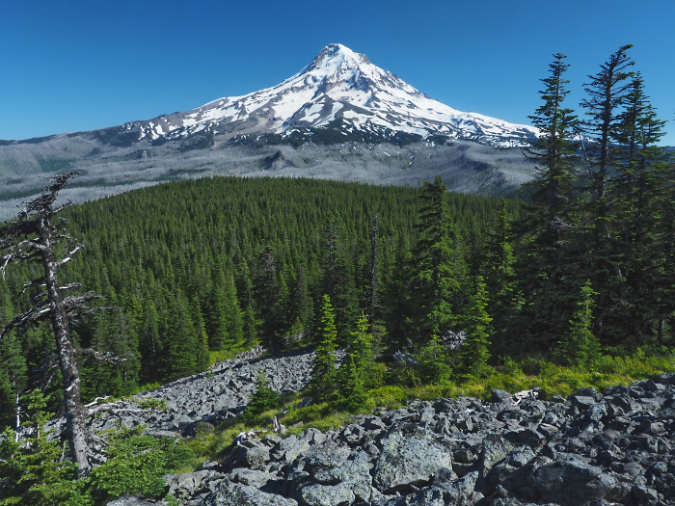
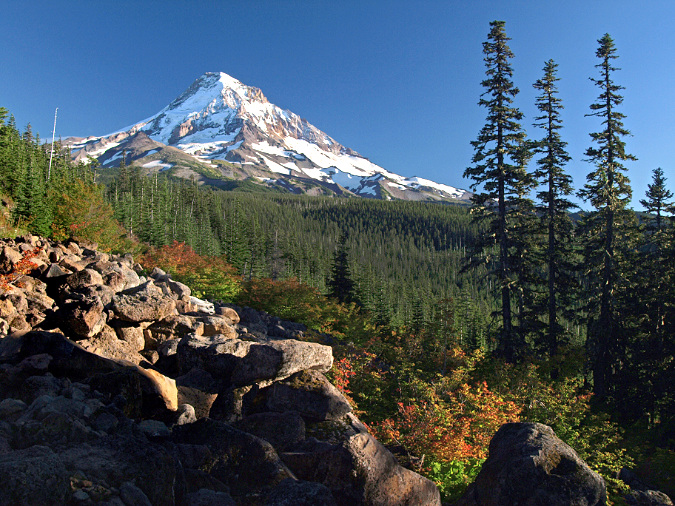
Mount Hood shining under a brilliant summer sky last week in this view from Owl Point – the highlight of the Old Vista Ridge trail

And thus, this article. It’s simply a collection of highlights that I’ve selection from the hundreds of messages posted in the Owl Point Register since 2012. I’ve chosen them based upon the joy, hope, graciousness and good humor they offer. They range from poignant and spiritual to whimsical and silly. Yet, in every message you can feel how just being there at Owl Point, taking in that amazing scene, has inspired these messages. The first batch of selections spans the first five seasons, from fall 2012 through 2016. Part 2 of this article will draw highlights from 2017 through the present.

I hope these will resonate with you as they do with me, perhaps restoring some much-needed hope and faith in humanity for you, as well, in this crazy, consequential time we are living in. 

It all started in October 2012…
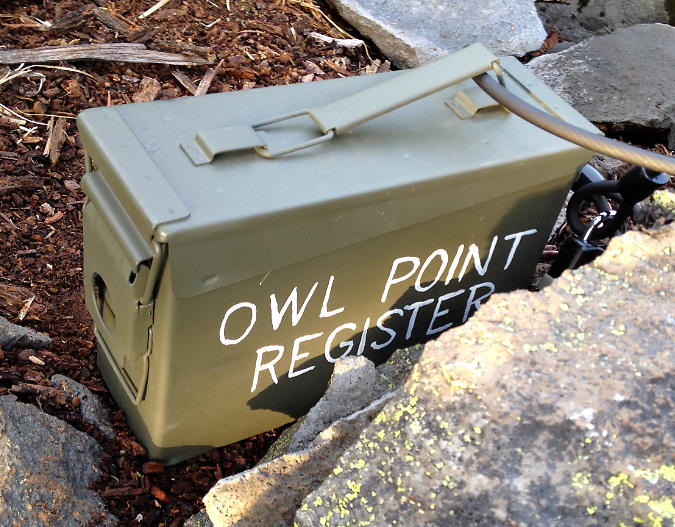
The freshly painted Owl Point Register on the day it was placed – October 17, 2012. The ammo can was from Andy & Bax in Portland (the iconic store recently closed, ending an era). I added a coat of army-green Rustoleum and some shaky, hand-painted lettering…

The Owl Point Register came about as part of a plan to bring more folks to the (then) little-known Old Vista Ridge trail, with an eye toward creating broader awareness of this largely unknown corner of Mount Hood’s backcountry. The register not only lets visitors share their thoughts with those who follow in their footsteps, it also describes the rich history of the area, and has maps and a photo guide to the features on Mount Hood that they can study as they take in the view.

In 2009, President Obama signed an expansion of the Mount Hood Wilderness into law that pushed the protected area north by about a mile, to where it now follows much of the Old Vista Ridge trail as the official wilderness boundary. It was a welcome recognition of the restored trail and an overdue expansion of protections for the mountain, yet still leaves the rugged country north of the trail unprotected. Thus, the continued goal to make the area known to hikers who can help advocate for its future. As recently as 2008, the Forest Service had proposed an off-road vehicle “play area” for Owl Point and Old Vista Ridge, so the risks of losing this wild place are still very real.
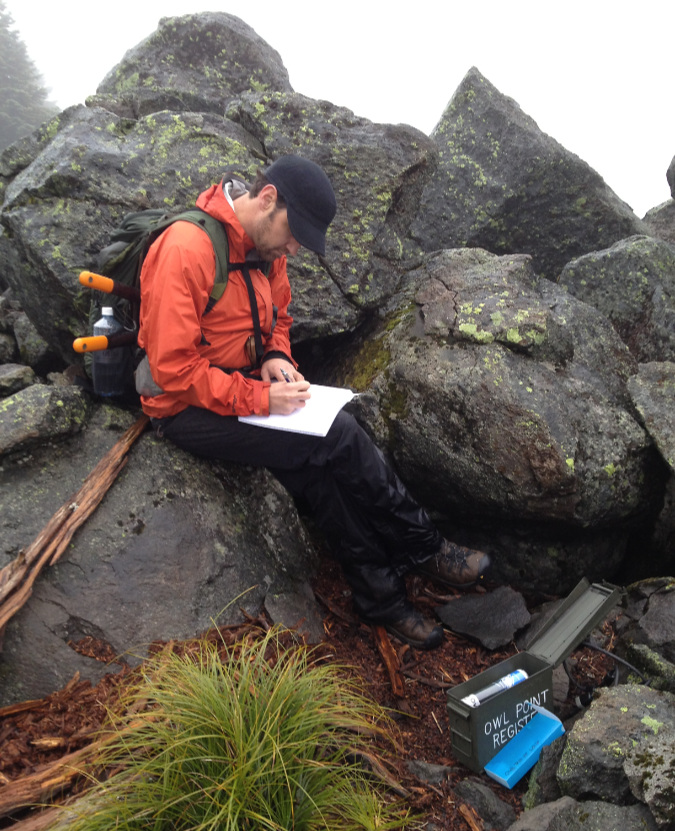
Old Vista Ridge Jedi-volunteer Jamie Chabot becoming one of the first to sign the new register on a foggy day in November 2012

Within the first year, the register began to fill with messages from hikers. Many were astonished at the “new” view from Owl Point that the trail provided – one of the finest of the mountain, and yet largely unknown at the time. There were also many kudos for those who had rescued the Old Vista Ridge trail and continued to restore this historic route. This was especially rewarding to the handful of trail volunteers doing the work, as it was still unofficial, and there was no guarantee that the Forest Service would eventually recognize the trail, even in its restored state.

The opening message in the register was written by me on October 17, with a bit of an introduction to Owl Point:
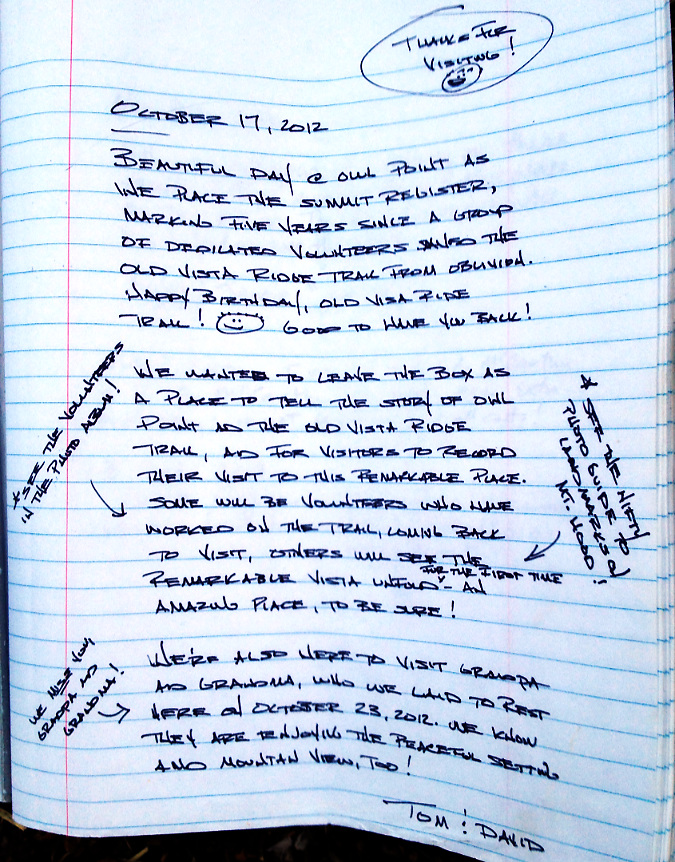
I’d forgotten until preparing this article that I also recorded scattering the ashes of my beloved grandparents on that first day! They had asked me to someday place their remains on Mount Hood, and there simply was simply no better place than Owl Point. I still check in with them every time I’m up there – and they always report that they’re enjoying the amazing view!

2013

The register began to really catch on during its first full season at Owl Point, in 2013. Among the early surprises: international visitors… to Owl Point? It turns out this hike description that I wrote in the Oregon Hikers Field Guide had reached far beyond the shadow of Mount Hood to wherever internet access existed. In this case, all the way to Saipan:
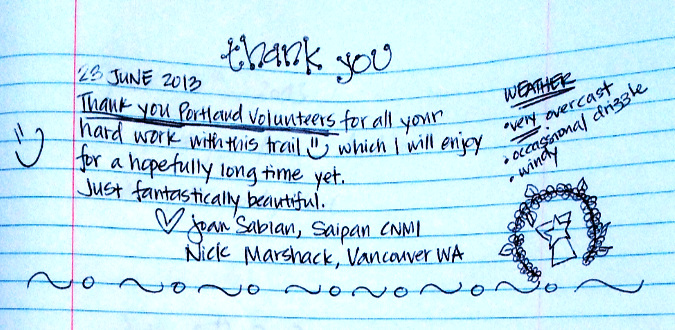
…and soon, more international visitors to Owl Point – from Austria:

…and from France!
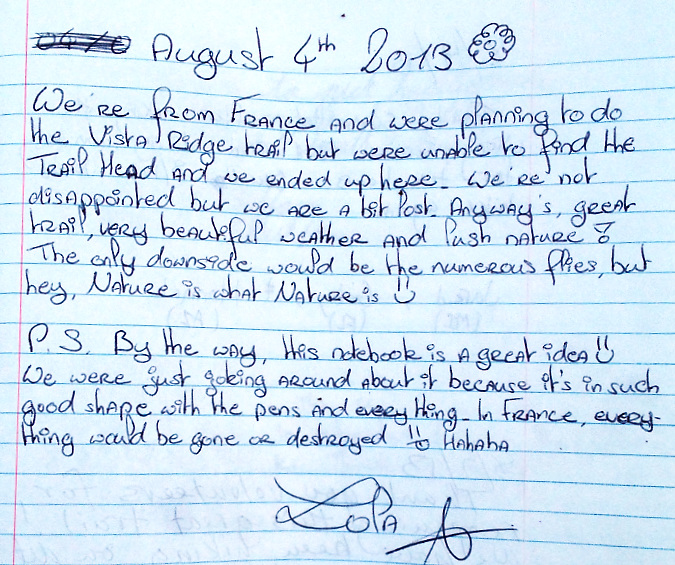
The postscript from the French visitors surprised me, too! I don’t know that Americans have any better track record than Europeans when it comes to respecting public spaces, but I do think that the particular slice of humanity that is willing to walk two miles into a wilderness for a mountain view does. Hikers are good people.

2014

As the popularity of the Old Vista Ridge trail continued to grow, entries in the Owl Point Register began to include organized hiking groups, like this one:
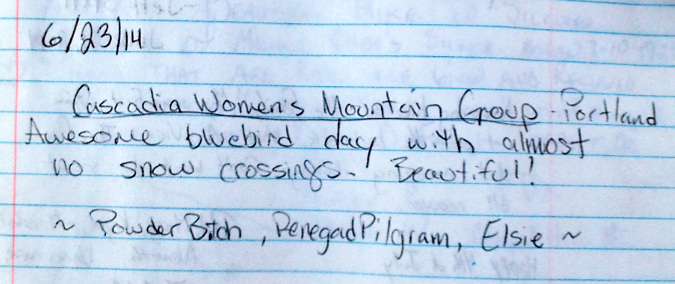
Every year, I’ve also added my own entries to help me track the changes since my last visit. Here’s a message from a trail tending trip in 2014 with Jeff Statt, another Jedi-volunteer. As you can see, seeing other hikers on the trail was still a novelty at the time and very rewarding:
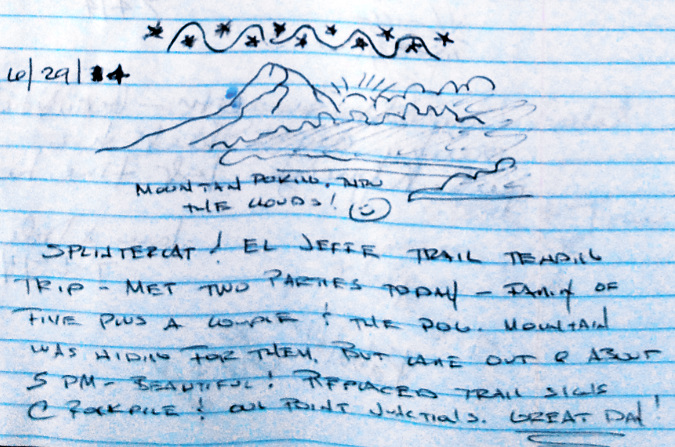
So, what did the mountain look like on that June day in 2014? Like this:
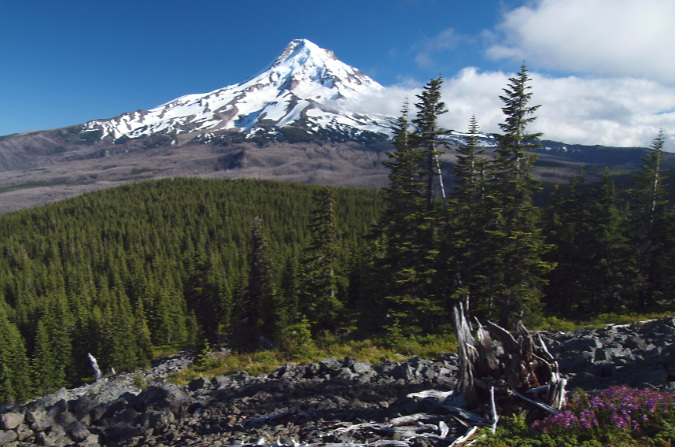
The view from Owl Point in June 2014

Here’s Jedi Jeff reading some of the latest entries in the register on that day back in 2014:
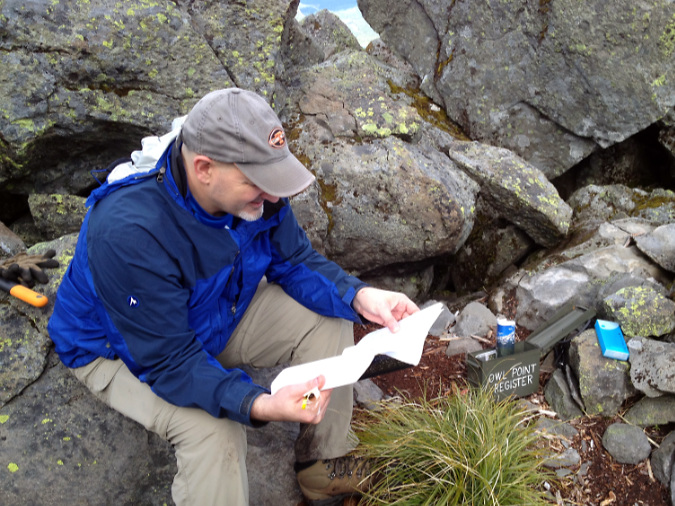
Jedi-volunteer Jeff Statt reading the Owl Point Register in 2014

Among my favorite entries over the years are those from young families. I had the good fortune of growing up with an outdoors-oriented family, an experience that has since shaped every aspect of my life. Thus, I love to see young parents adventuring into the forest with their kids. In this case, parents Mike and Brittany signed in with a bunch of kids in July 2014:

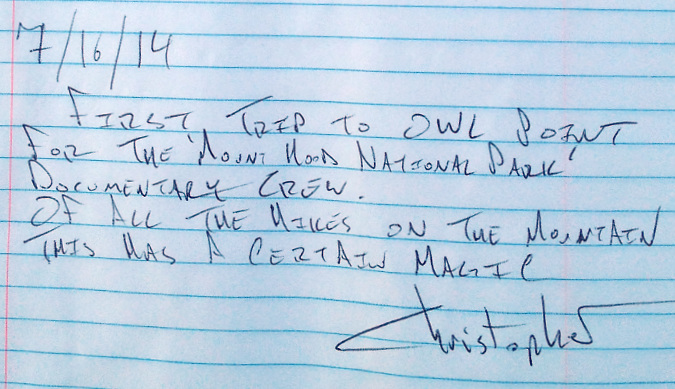
This notable entry in 2014 is from documentary film maker Christopher Alley, made on a scouting trip to Owl Point:
Chris (white shirt in the photo, below) returned the next year with his crew, and I was privileged to come along for the ride. Spending time with them ranks among the best adventures I’ve stumbled into in my life. 
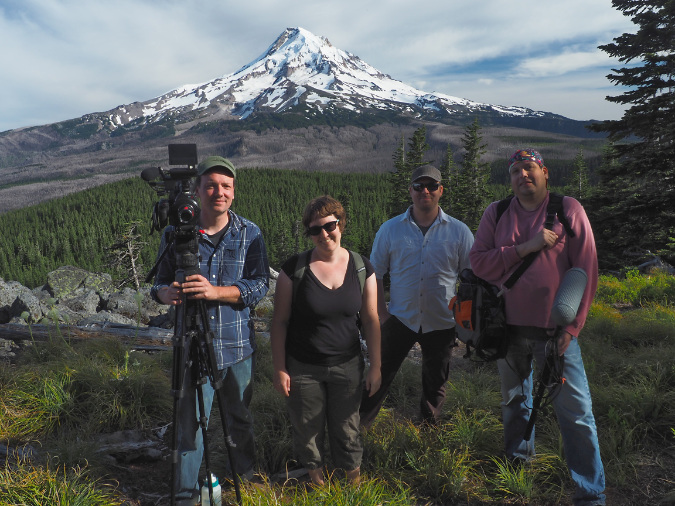
Documentary filmmaker Chris Alley and his crew at Owl Point in 2015

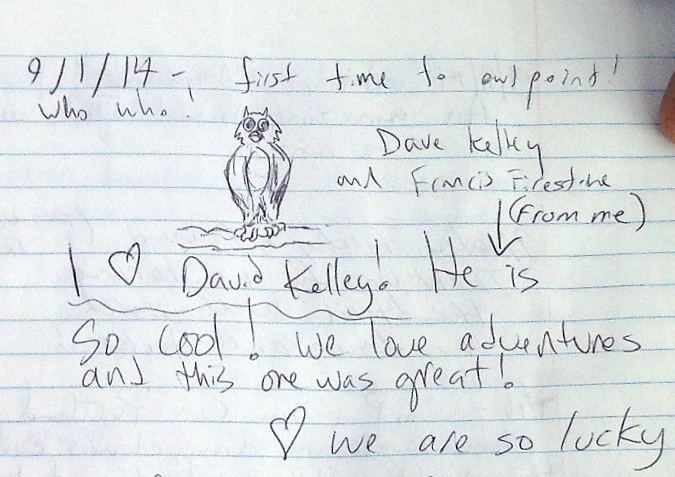
Plenty of close friendships are shared in the Owl Point Register, too – along with many Owl-themed sketches and memes:
So, where did Owl Point get its name? No, not from any official proclamation or map. I confess: I made it up! But that backstory will have to wait until a future article…

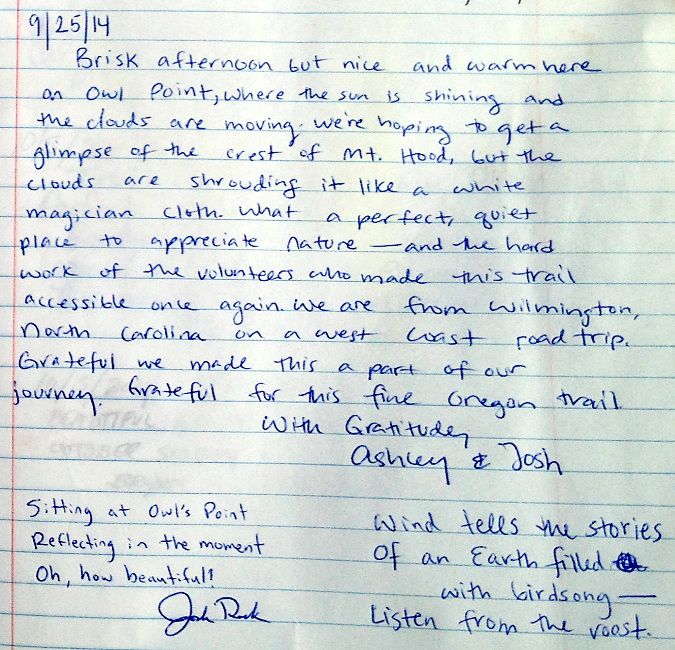
By the fall of 2014, the register was filling up fast, often with reflective messages from visitors near and far – like this introspective pair from North Carolina:
Often visitors are inspired to include ballpoint art of Mount Hood, like this entry from October 2014:
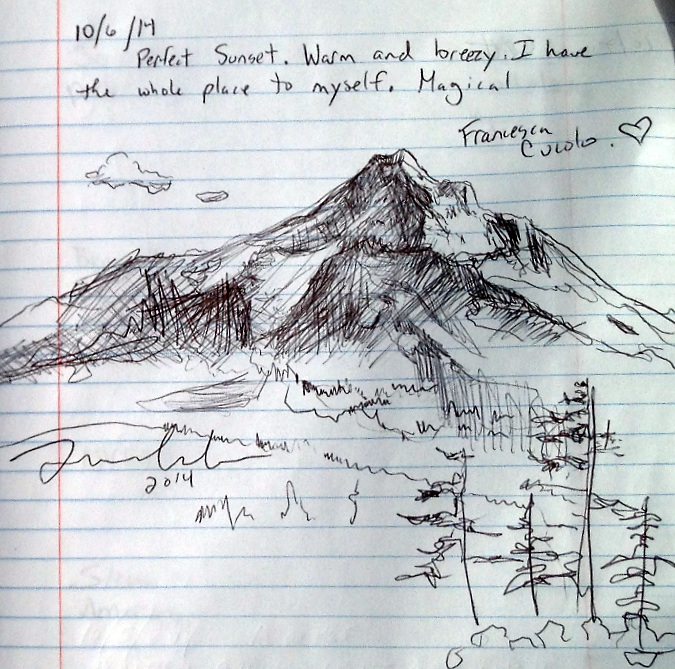
I’m a visual thinker, too, so I do appreciate the urge to draw when inspired – thank you, Francesca! 

2015
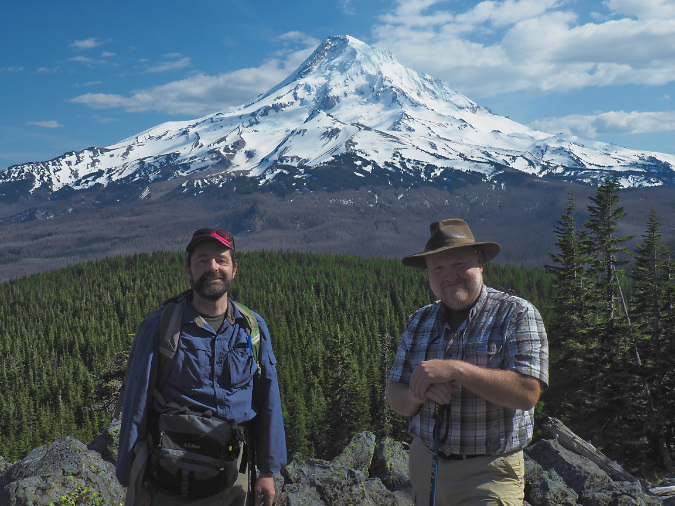
Reunited with my college friend David in May 2015

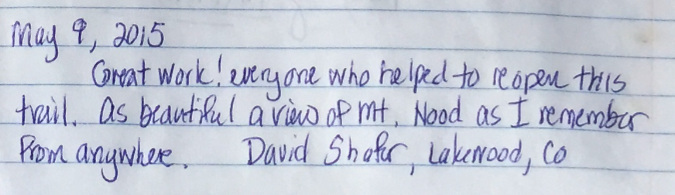
The Old Vista Ridge trail to Owl Point has become one of my go-to hikes with out-of-town visitors looking for a Mount Hood adventure. Such was the case in the spring of 2015 when my college roommate David Shafer (above, with me) was in town. David is originally from Portland, so while he’s been in Colorado for many years, now, he still knows his Hood – as you can tell from his message in the Owl Point Register:
I’m not the only person who brings out-of-towners to Owl Point – in this case, sibling escaping to the mountain in June 2015:
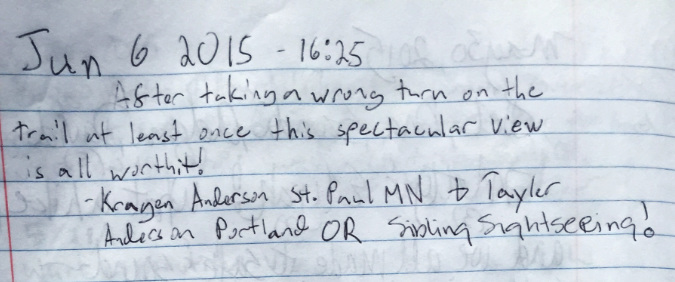
For the record, in the years since this message was posted, those confusing junctions have largely been resolved, and signs posted at those that remain, so fewer folks are getting turned around on the route to the Owl Point trailhead.

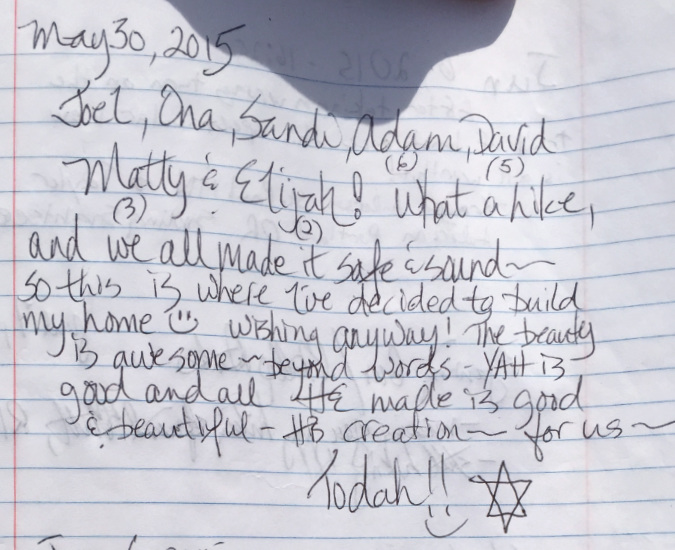
The spectacular view of Mount Hood from Owl Point has inspired many spiritual reflections in the register over the years – like this one:
This 2015 message from a Chinese visitor came complete with Mandarin and English praises for our mountain:

Continuing the out-of-town theme, these visitors from Oregon, Texas and Sydney, Australia made the trip on consecutive days in June of 2015:
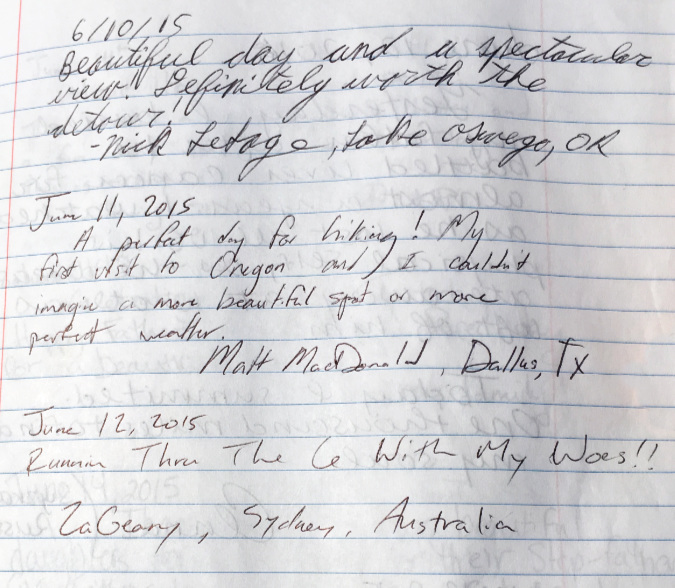
…though the meaning of the Aussie message is lost in translation for me!

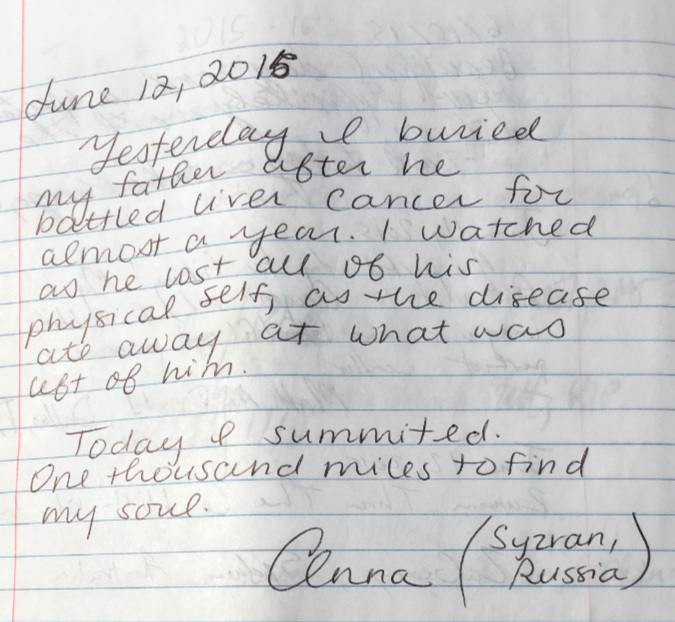
Here’s another from around the world, this time a reflective message from a Russian visitor seeking the restorative power that is so specific to time spent alone on a mountain trail:
Here’s another spiritual sentiment from 2015 that I can sign onto…
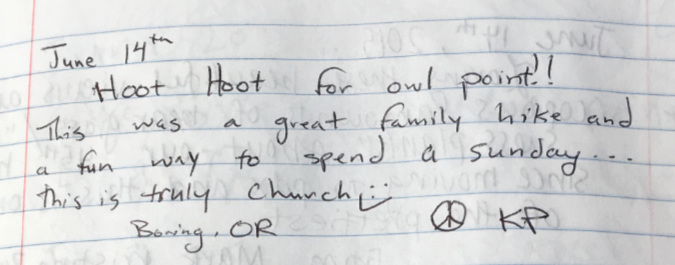
…and on the same day, two families taking dad out for a hike on Father’s Day recorded this:
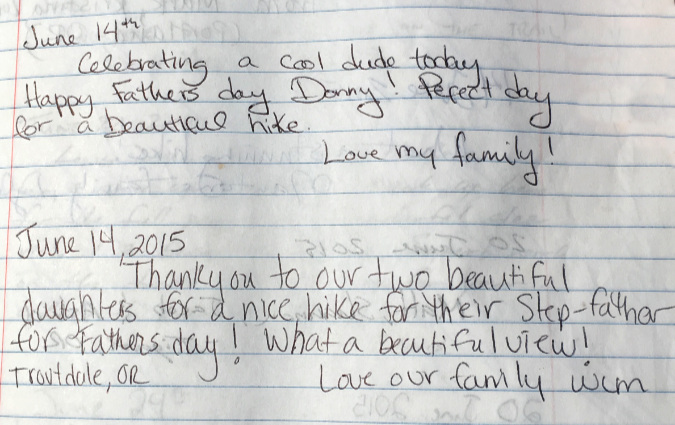
Still another family (and their dog) and some visitors from Idaho left this entry in June 2015:
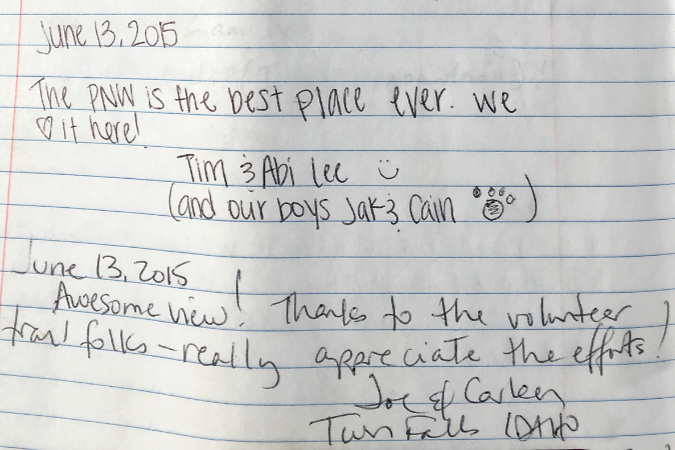
These youngsters left a message in June 2015:
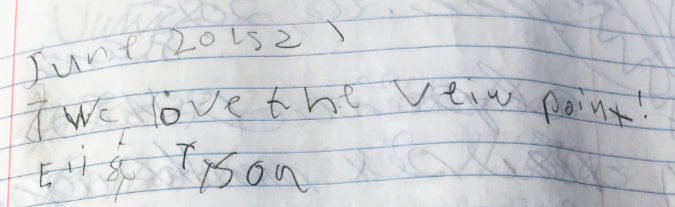
No doubt Eli and Tyson enjoyed the view, but one of the best parts of having a summit register is watching kids’ eyes light up when they see it. I don’t know how much they absorb from its contents, but they DO love to open the box and unpack it!

This message from a pair of especially energetic hikers caught my eye: 
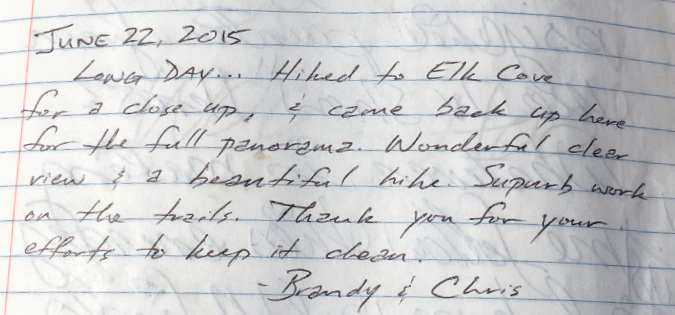
One of my goals is to eventually complete a trail connecting Old Vista Ridge to Laurance Lake, something the Forest Service has already agreed to in concept, at least. This would allow for a very long wilderness loop for backpackers that connects Owl Point to the Timberline Trail via Elk Cove and WyEast Basin.

Here’s the first post from a Vermonter…
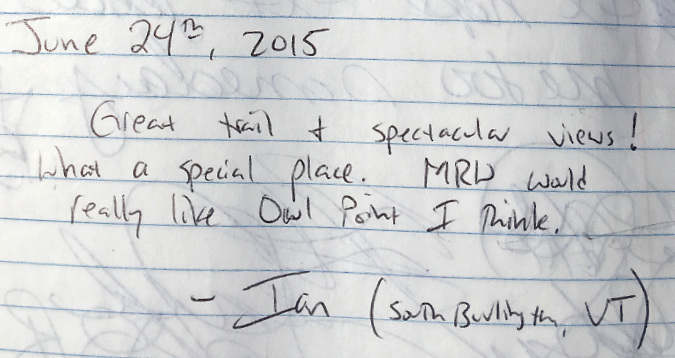
…and this is an enthusiastic message from one of the formal hiking groups that have added Owl Point to their annual offerings. These folks were in an older group of 60+ “spring chickens” from Portland:

Second only to seeing young kids on the trail, I do love to see older hikers on outings like this. They inspire me, as I’m now in their cohort (ahem!) at age 62, and they seem – make that, they ARE – among the happiest, most contented people I know!

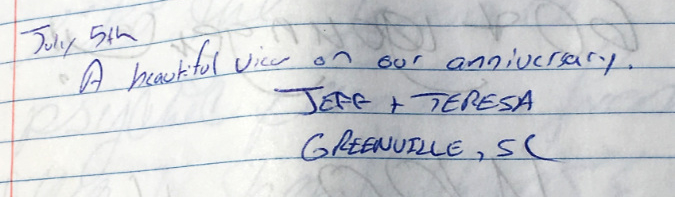
Still more out-of-towners, this time two South Carolinians celebrating an anniversary  – another surprisingly common theme among visitors to Owl Point:
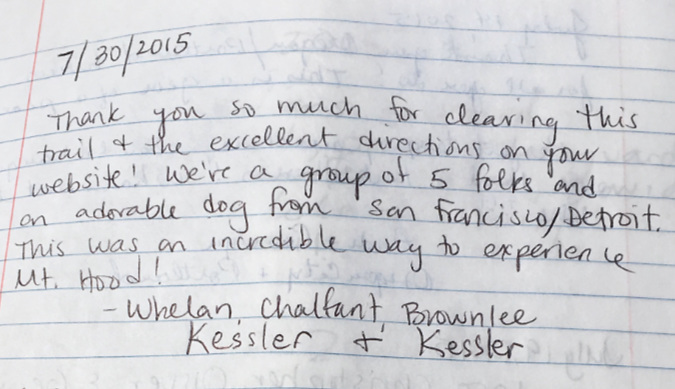
…and still more out-of-towners visiting WyEast country in July 2015 (with their dog) – this time from Detroit and San Francisco:
As had been the case for several years, I was joined once again by Jedi-volunteers Jamie and Jeff in the summer of 2015 for more trail tending (below). At this point in its restoration, the Old Vista Ridge trail was starting to look like it had never been abandoned, with the growing number of boots on the trail making it look well used and well loved.
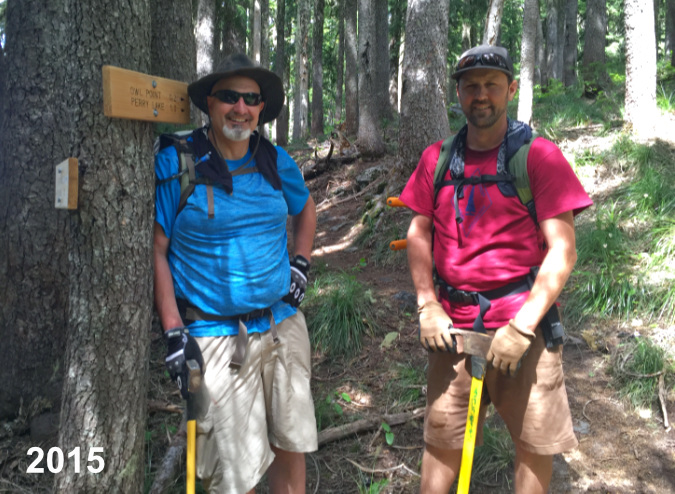
Old Vista Ridge Jedi-volunteers Jeff Statt and Jamie Chabot

This message from July 2015 is a first for the register – a marriage proposal! These folks were visiting from Minnesota:
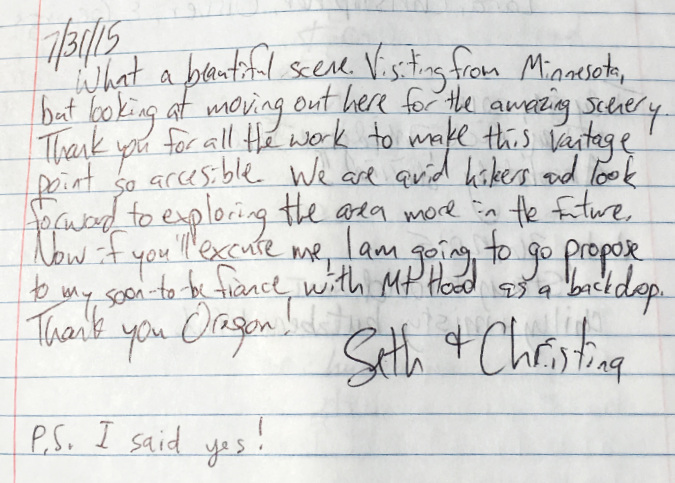
…and naturally she said “yes”! It’s the Owl Point effect, and this is just one of my life events that have been recorded in the Owl Point register over the past 12 years.

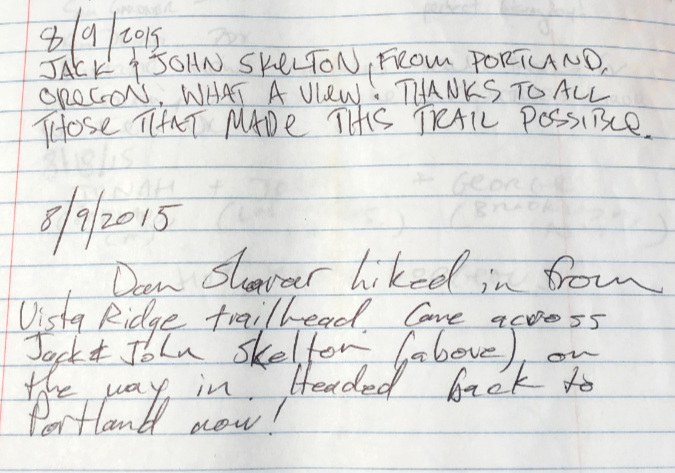
Sometimes complete strangers become acquaintances by virtue of meeting on a trail like Old Vista Ridge, as seems to be the case with these visitors:
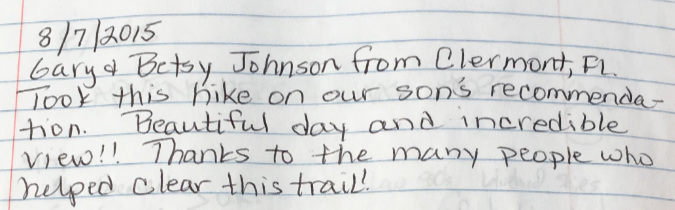
More out-of-towners, this time hecking the box for visitors to the Upper Left corner of the country from the Lower Right corner:
This eclectic group took me a few reads to figure out, but we seem to have five out-of-towners (two from the U.K.) visiting a Portlander:
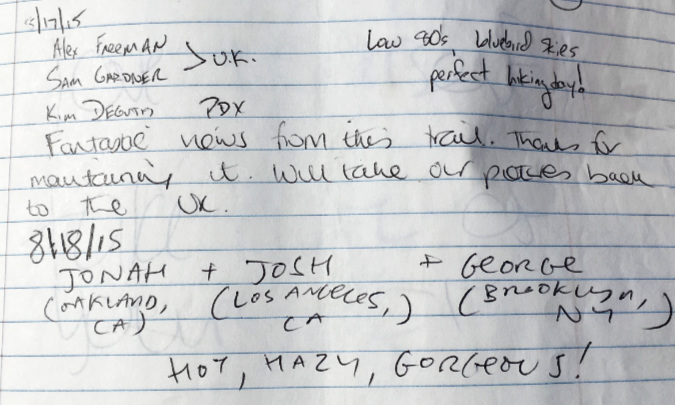
Sometimes visitors leave big, bold messages of hope – like this one from August 2015:

…and sometimes there’s just anonymous whimsey… or maybe not?
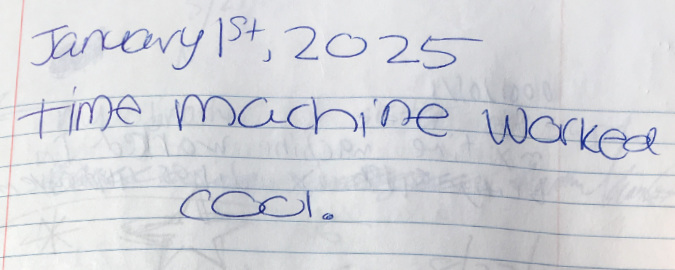
The above time machine message was just too much for this youngster to resist a few days later:

Aha! So, cavemen eat hikers, too? Well, I’ll just add them to the list with mosquitos and black flies… and dinosaurs.

Place a summit register in front of a stunning mountain view, and you often find entries from people experiencing a crossroad in their life or celebrating a personal milestone. This message is such a great example. I’ve included an enlargement of the sidebar on the left (which is a bit difficult to read), as this is the crux of the message from this transplanted New Yorker:

Enlarged view of the reflective sidebar:
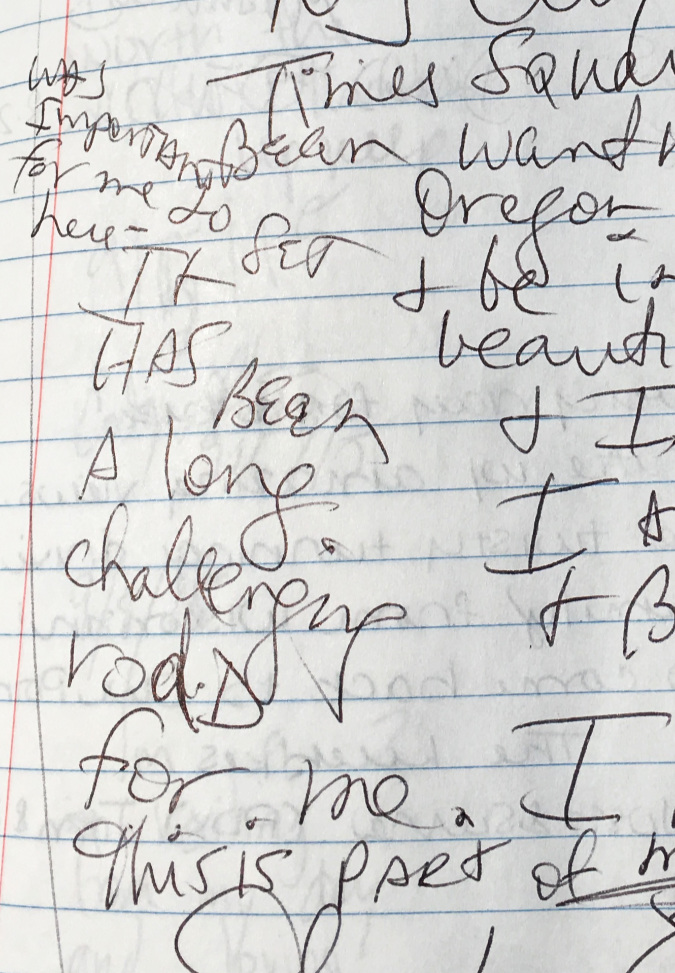
The challenge of a new trail, the experience of being in a deep forest, the vastness of a mountain view spreading out before you and the satisfaction of reaching your destination. This seems to inspire so many visitors to Owl Point to step away from the background noise of their daily lives and allow needed time for reflection and restoring the sense of peace of gratitude that we all need. I know it has this effect on me, every time I go there.

More out-of-towners in 2015, this time from Wisconsin and Missouri:
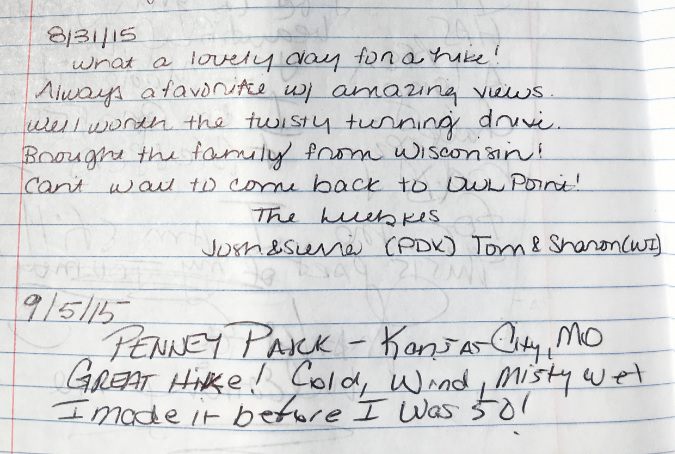
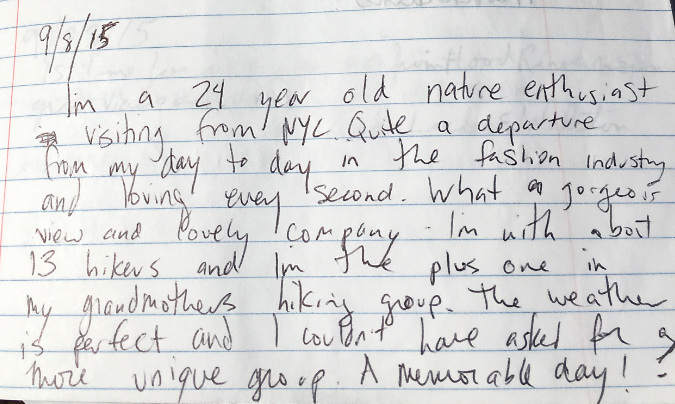
And another New Yorker, this time a young person in their mid-20s joining their grandmother’s hiking group for the trip to Owl Point. There are many family entries like this, and they underscore the role trails can play in creating experiences that bridge generations and bond our relationships:
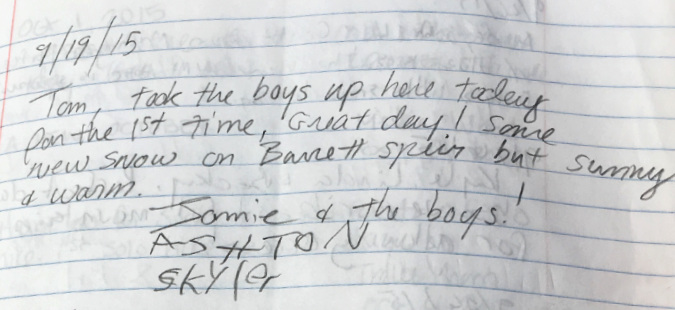
On the theme of family bonding, Jedi-volunteer Jamie Chabot wasn’t all work at Owl Point back in 2015. Here, he made a point of bringing his young boys to walk the trail their dad helped build:
Jamie is a single dad, so making the time to help restore the Old Vista Ridge trail and provide his boys with an outdoor-oriented life takes real effort. Hopefully his boys (below, with Jamie, in early 2015) will hike this trail for many decades to come, knowing that their dad played an important part in making it happen!
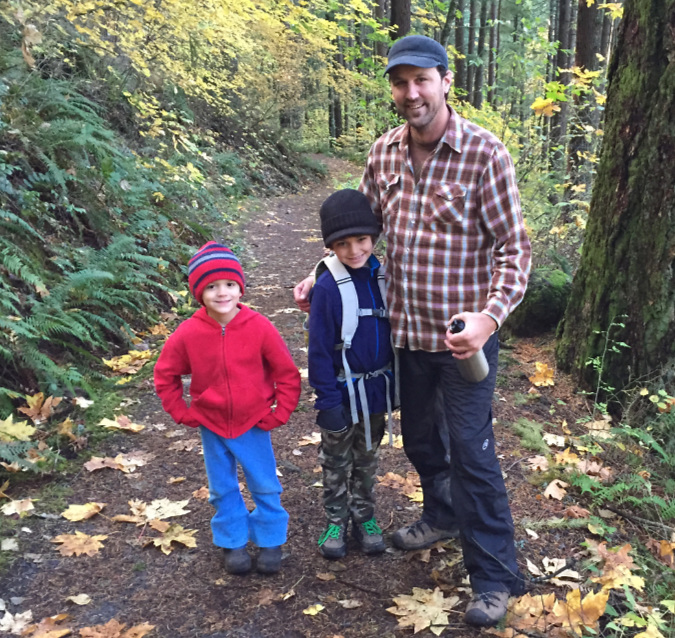
Jedi-volunteer Jamie Chabot on the trail with his boys in 2015

Here are still more grateful out-of-staters admiring our backyard in 2015 – these folks are from South Carolina and Wisconsin:
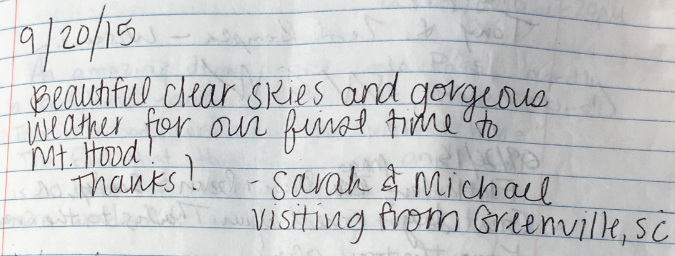
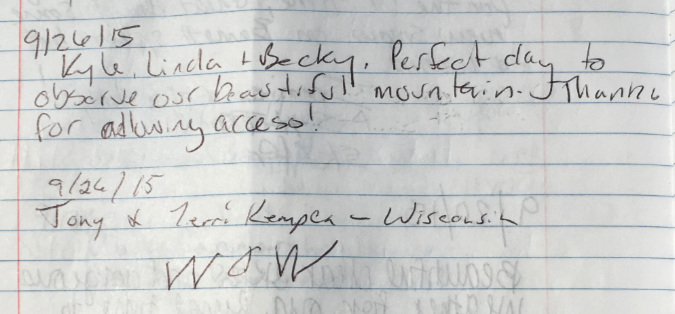
One of the final entries recorded in the fall of 2015 is what mindfulness and gratitude are all about. This is why public lands, and the trails that allow us to experience them, matter so much in our modern world:
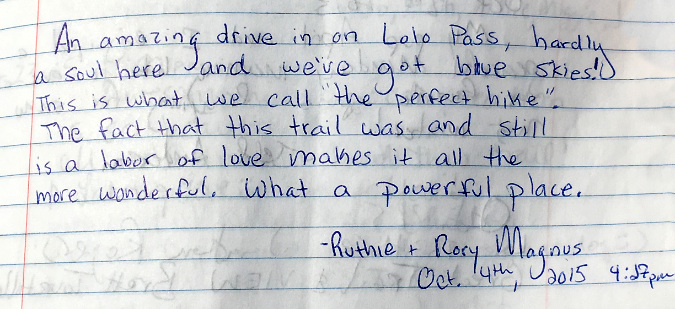
2016

While this year’s election year turmoil has brought back unwelcome flashbacks to the 2016 election debacle, that year was especially lovely at Owl Point. The Beargrass bloom cycle was enjoying one of its peak years (below) and a healthy snowpack on the mountain lingered well into summer.
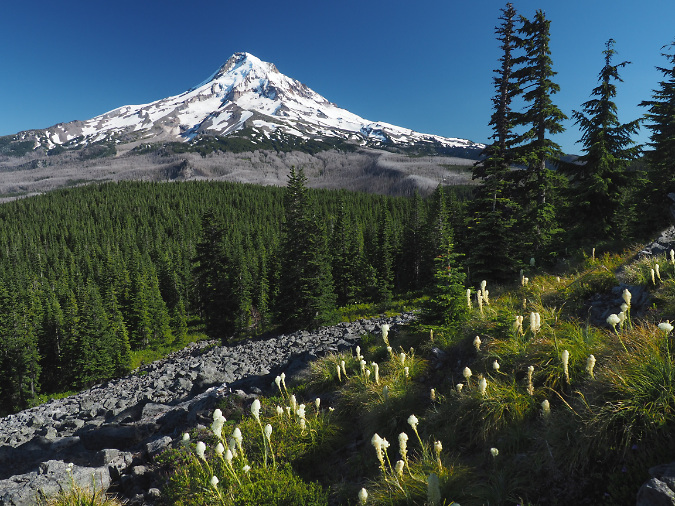
Summer 2016 brought a spectacular Beargrass bloom to Owl Point

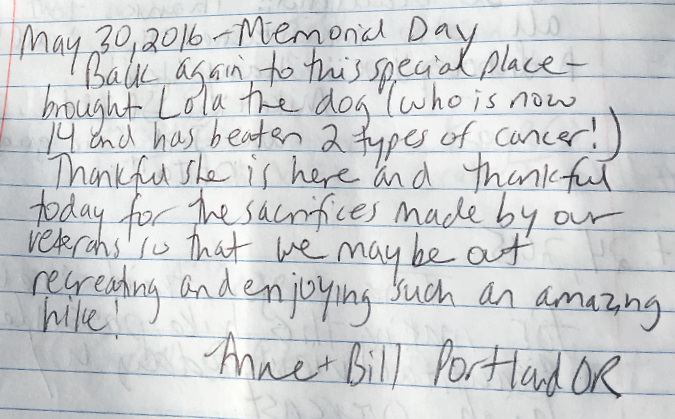
These grateful hikers were among the first to hike the trail in 2016 when they visited on Memorial Day, likely crossing a few snow patches along the way and leaving a reflective message of thanks and appreciation in the summit register:
This coming-of-age message from the same day in 2016 is among my favorites, as I was also 16 when I completed my own first solo overnight hike on Mount Hood:
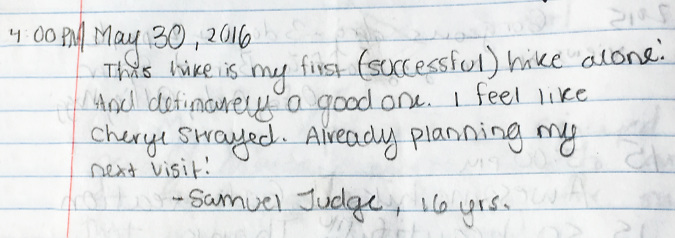
Samuel is 24 years old, now, wherever he might be. Hopefully, this early confidence-builder will continue to be one of those childhood formative experiences that keep us pushing forward throughout our adult lives. I know it was for me – I still remember that first solo trip like it was yesterday!

Here are a pair of dog messages from the same day in June 2016 – the second one is especially inspired… in an offbeat, Steven Wright way:
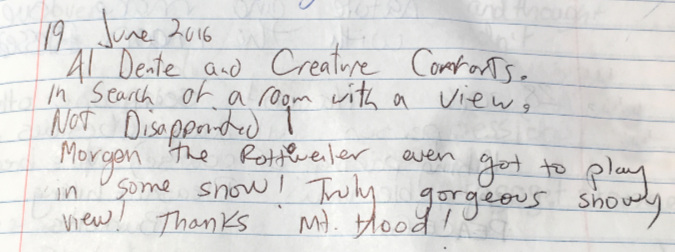
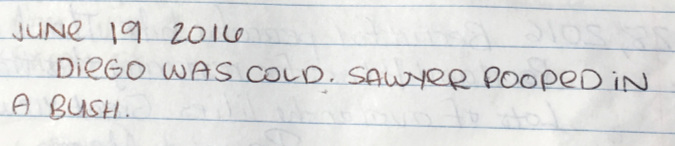
The Old Vista Ridge trail is a great option for dogs. It’s largely forest traveling, with plenty of shade and a soft trail surface that’s easy on their pads. It’s also uncrowded, making it easier to navigate with your pup and avoid unwanted interactions with other dogs. Notably, while I have seen plenty of dogs up there in the 17 years I’ve been involved with this trail, I have yet to find one of those notorious, orphaned bags of dog poop left behind – that’s quite a streak! 

This message from July 2016 took me a couple of reads to figure out, but it’s both tongue-in-cheek and an earnestly triumphant message from a person just getting their trail legs under them:
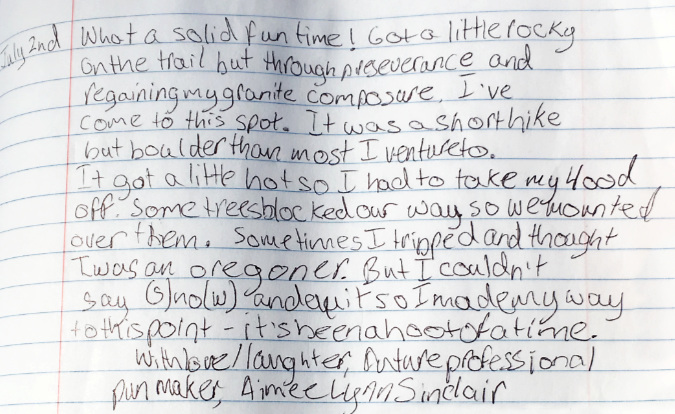
Here’s another favorite from that year. I love seeing families on the trail, and especially a single parent out their children. It takes a lot of commitment, but they’re doing such an important thing that will forever influence their kid’s lives:

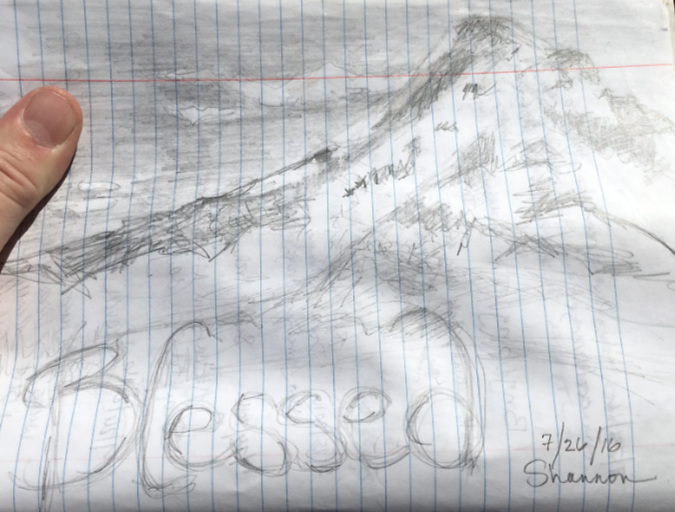
(…and apologies for my thumb in a few of these – they were all taken up at Owl Point, and quite often I was battling the wind to hold the pages down with one hand while shooting the photos with the other!)

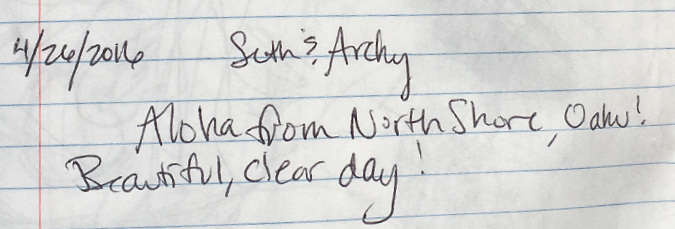
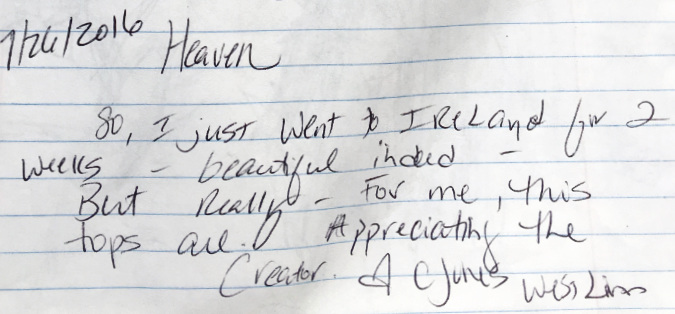
Here’s another out-of-towner, this time from Hawaii – a first for the register:
In this message, WyEast country counts as Heaven on earth, and I can surely sign on to that (and no offense to Ireland):
More mountain-inspired sketch art (and my thumb, again)….
…and still more art, this time from budding artists. Sure, I can see the mountain! I think…
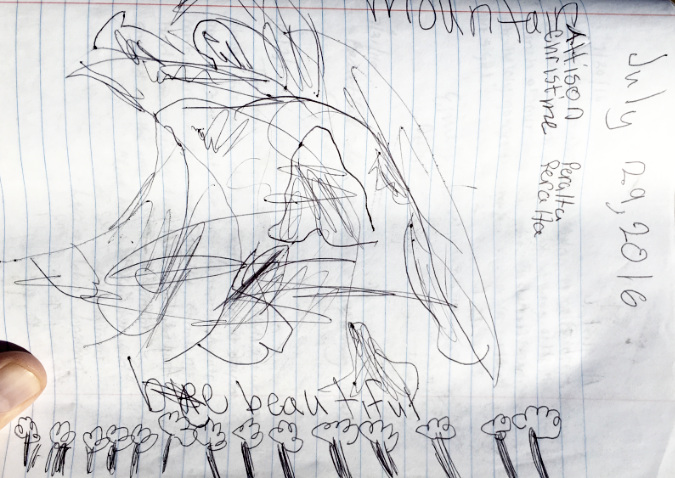
I can definitely see the trees! Thank you for the fine art, Allison and Christine – and yes, it is beautiful.
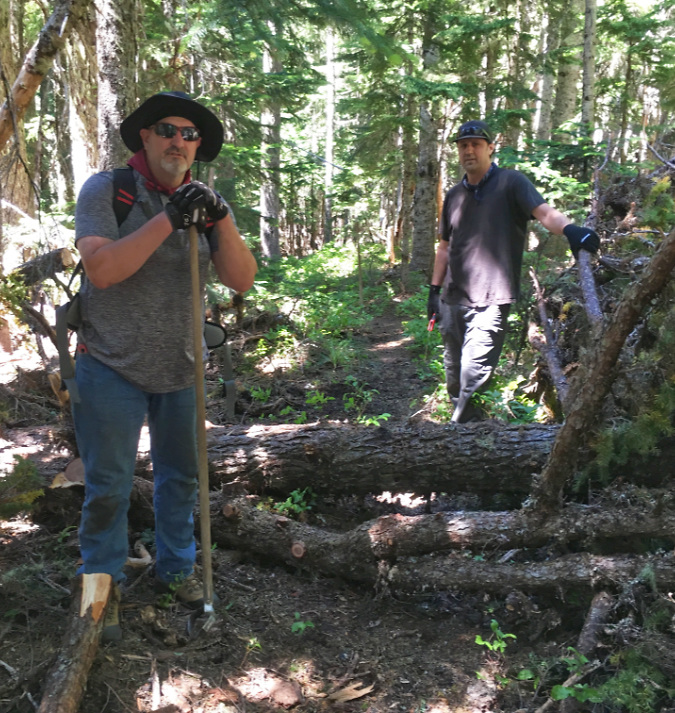
Jedi-volunteers Jeff and Jamie clearing winter blowdown on the Old Vista Ridge trail in July 2016

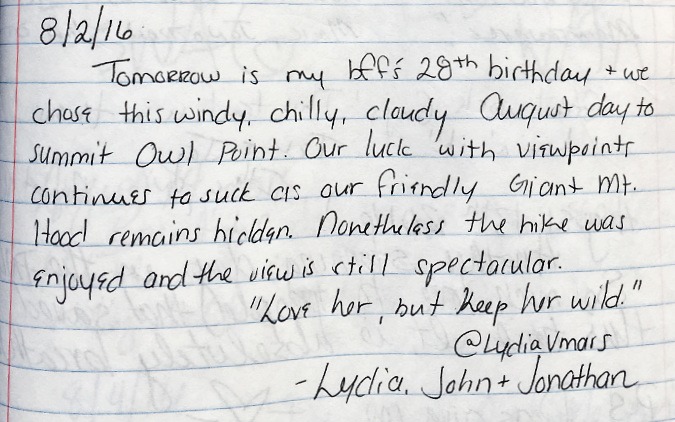
A good number of messages in the register share the frustration at our unpredictable weather that the example below carries. Yet, these messages invariably end with deep appreciation for time spent in the mountains, even if “the friendly giant Mount Hood” is hiding in the clouds. As the saying goes, “there are no bad days on the trail”:
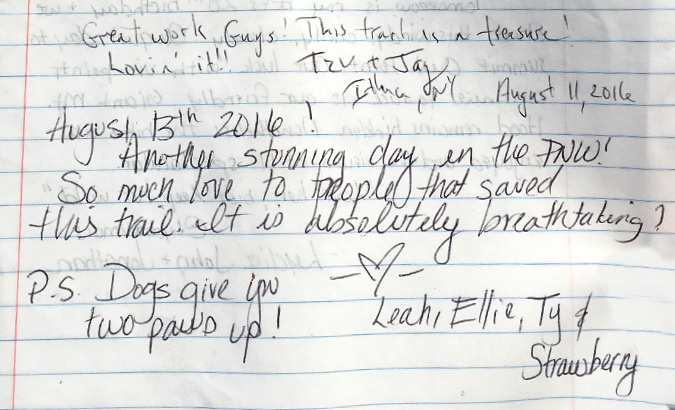
Still another New Yorker shared a message in 2016, this time a visitor from upstate – plus a couple of local dogs give two paws up on the view:
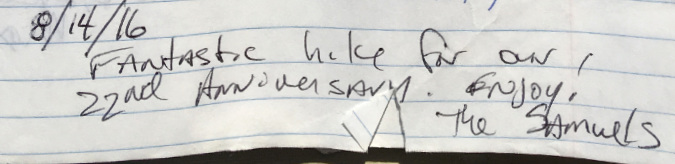
And yet another anniversary celebration that year….
This message from 2016 is significant for the mention of William Sullivan’s guidebook:
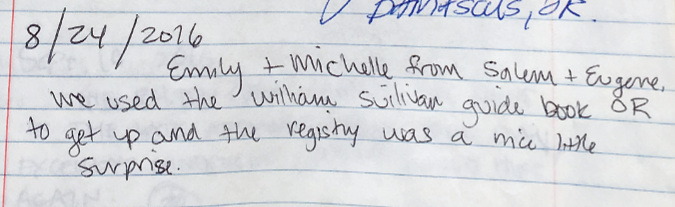
Sullivan added the Old Vista Ridge trail to his fourth edition of the popular Northwest Oregon hiking guide, published in 2013. This edition followed both the reopening of trail by volunteers, and the 2011 Dollar Lake Fire that torched the nearby Vista Ridge Trail. The fire left Old Vista Ridge and Owl Point untouched, which Sullivan describes as a shady, green alternatives to the better-known trails that now traverse the burn. Sullivan’s guide surely sent a few more hikers from well-beyond WyEast country to the trail.

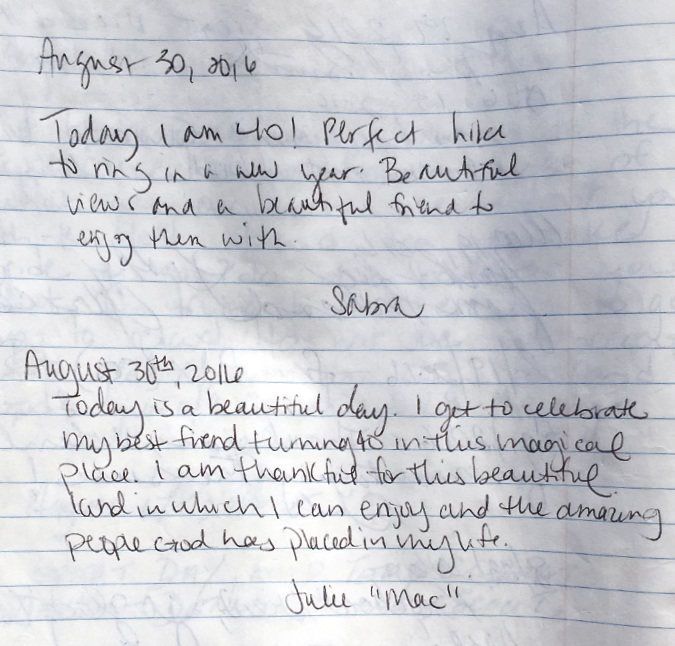
Here’s a wonderful pair of messages from August 2016 that simply celebrate a friendship:
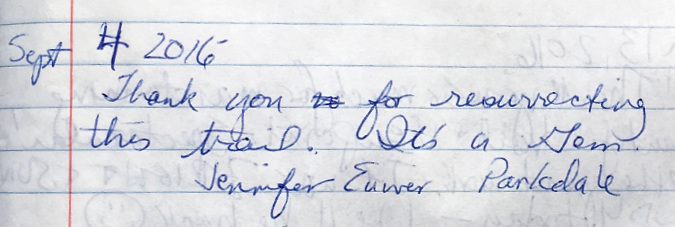
This brief message stands out for the location. The farm community of Parkdale is plainly visible from Owl Point, directly below, in the Upper Hood River valley. While it’s fun to see entries in the register from all over the world, it’s especially rewarding to know that local residents are enjoying this trail, too:
Here’s a fun message that covers a lot of ground, from corny jokes to a new life together that hikers Allie and Tom were about to embark upon:
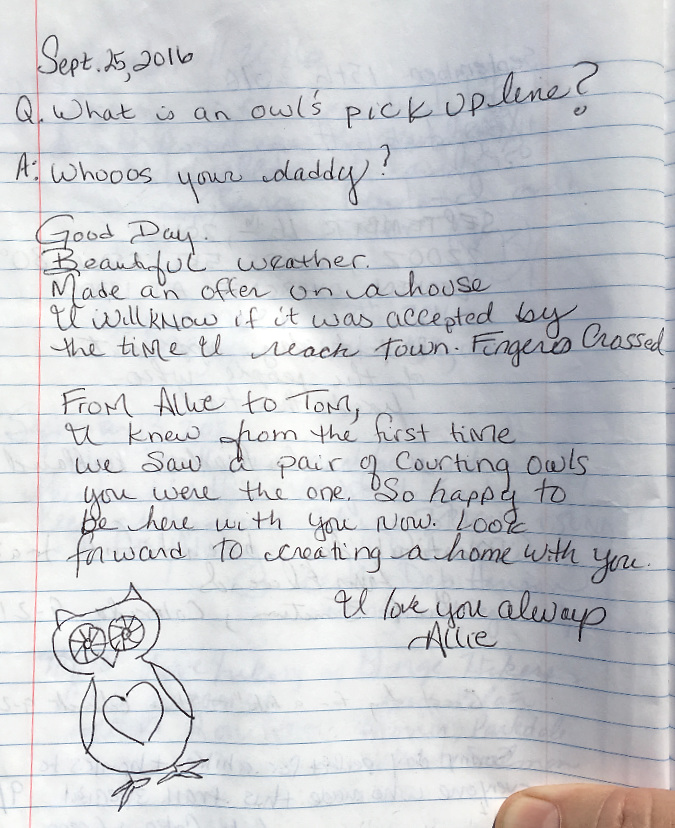
Bonus points to this couple for the owl sketch and symbolism! Hopefully, they can still return to Owl Point once in a while to recharge and remember this significant day for them back in 2016.
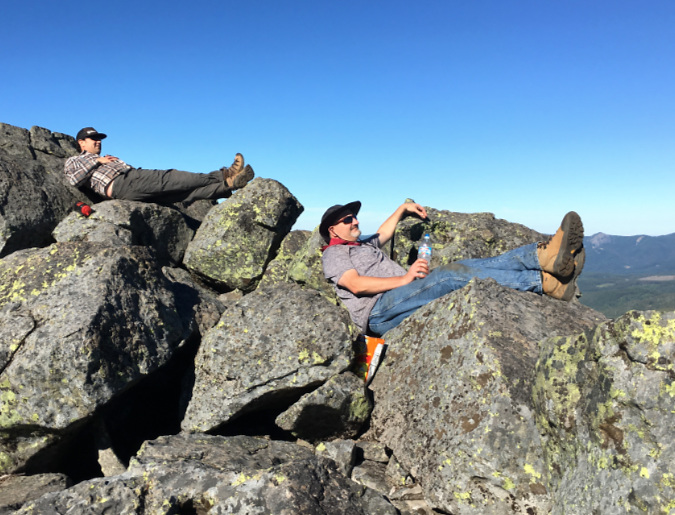
Jeff and Jamie relaxing on the rocks at Owl Point after a day of trail work in July 2016…
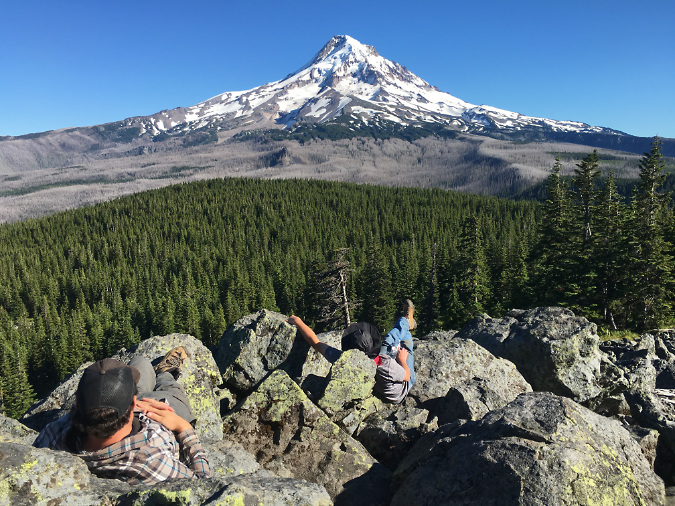
…where the view is the reward!

Still more out-of-staters in the register in 2016, this time from Scott and Grant in Georgia:
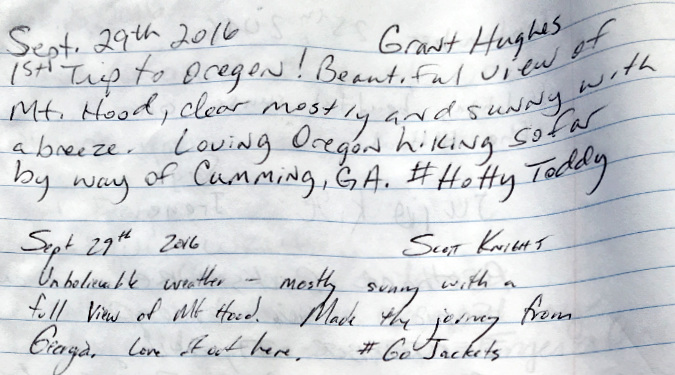
I googled it, and that last part refers to the Georgia Institute of Technology mascot – the Yellow Jackets! Georgia Tech is located in downtown Atlanta and Cumming is a northern suburb.

Here’s a message from September 2016 that jumps from a simple weather report to being surprisingly philosophical:
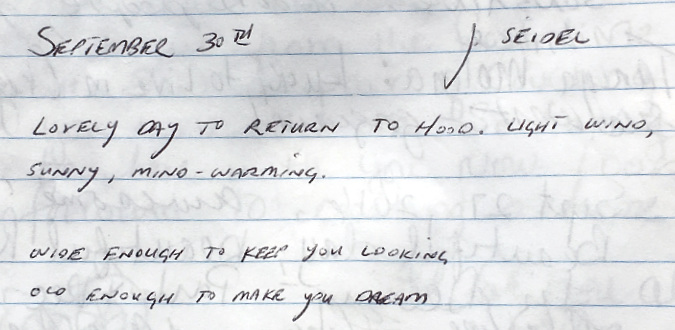
This message is straightforward, but “my favorite hike” is always music to my ears when it comes to Old Vista Ridge and Owl Point:

…and then there’s this message that still resonates today – or echoes, perhaps?

Note the date. The country was in the middle of deeply divisive political meltdown that fall, just as we find ourselves in today. As the current election cycle looms, this message from eight years ago is such a good reminder to take time out and gain perspective in that way that a day on the mountain can provide. The sound of wind and scent of a mountain forest really can help drown out the unwelcome echoes from everyday life that we often carry with us. 

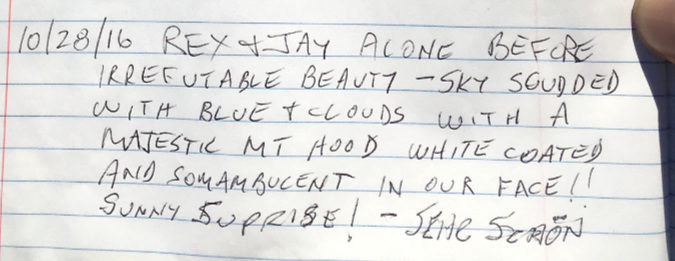
Just a few days ahead of the 2016 election, Rex and Jay were poetic in this message – though I still can’t figure out what “somambucent” means!
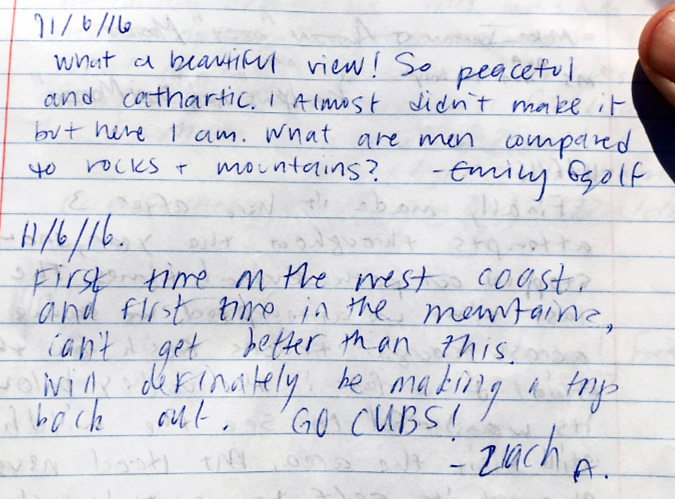
That fall brought a lot of reflective comments to the Owl Point register. Here are a pair of messages left on the Sunday before the 2016 election – one from a philosopher and the other a first-timer to our mountains:
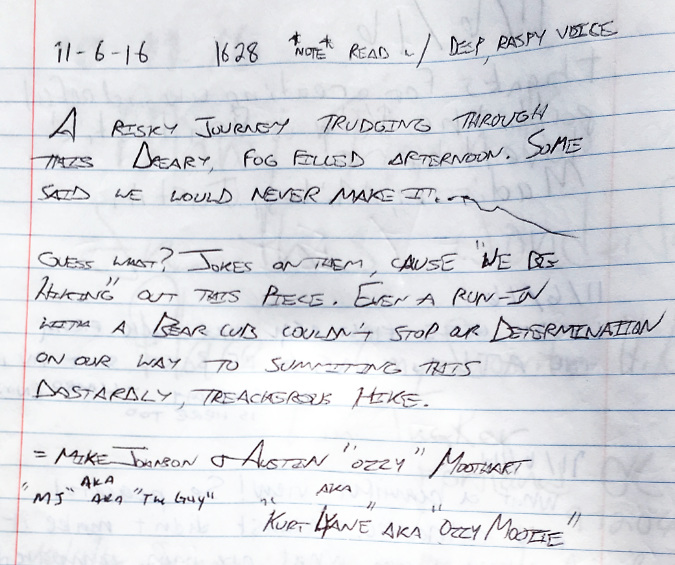
..and on that same November Sunday, a pair of visitors with multiple aliases left this tongue-in-cheek ode to determination “to be read in a deep, raspy voice”. I chose Orson Welles:
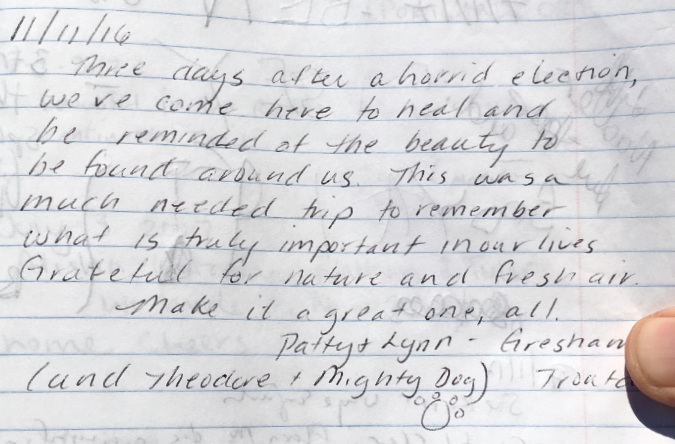
This message – left three days after the 2016 election – serves as yet another reminder that we’ll always need our trails (and the public lands they lead us into) as a counterbalance to the twists and turns of everyday life. Trails help us reconnect with “what is truly important in our lives” when we most need to restore that faith. 

I’m quoting Patty and Lynn (and Theodore and Mighty Dog) on that part, as they said exactly that in this final message in the Owl Point register for 2016:
Reading through these messages eight year later reminded me that we did, in fact, survive that election cycle. While real harm was done to our democracy (and to our public lands) during the four years that followed, we also lived another day to work toward “that more perfect union”. With progress comes setbacks – and 2016 was a doozy.

Nobody knows what more the 2024 election will bring this fall, though we’re off to a very rough start. Being alone with the view on that stellar, crystal-clear day up at Owl Point last week, and reading through the many hopeful, joyful and gracious messages left in the summit register restored a bit of my faith in humanity. In the end, we have so much more in common than the political battles might suggest.

The messages also reminded me to block out the political noise (and now violence, sadly) in this election cycle and sharpen my focus on being an active advocate and steward for trails and public lands. Yes, my vote might make a difference in the fall election, but I know I can make a difference right here in WyEast Country. That’s where I need to keep my head and heart through this turbulent time we’re in.

_____________
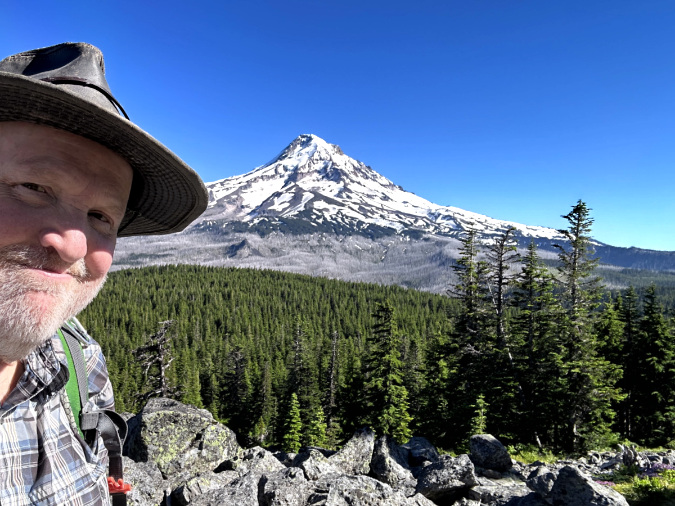
The author getting his head straight (once again) at Owl Point on July 11, 2024

In Part 2 of this article I’ll continue with more highlights from the Owl Point Register from 2017 to the present. This was an especially positive era for the Old Vista Ridge trail, despite the dysfunctional national political backdrop… and a global pandemic! More than ever, the trails were our inspiration and refuge, and Old Vista Ridge delivered.

More to come!

Tom Kloster | July 2024
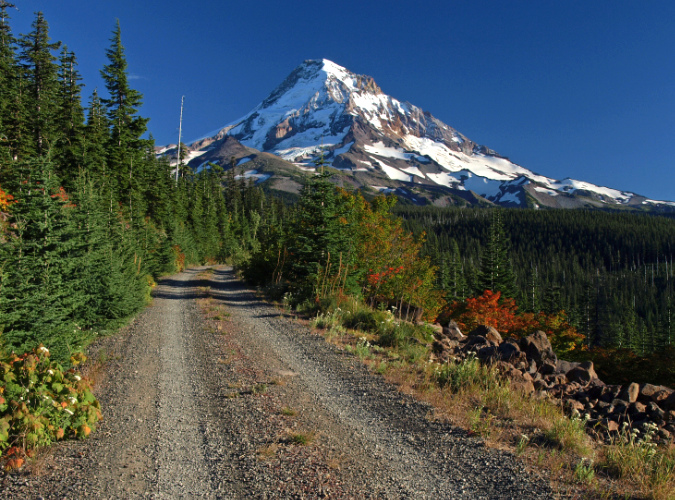
Rx for the Vista Ridge Trailhead!

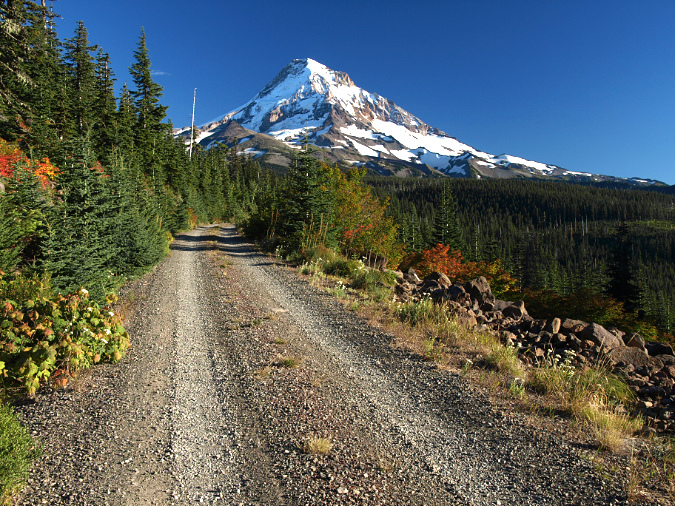
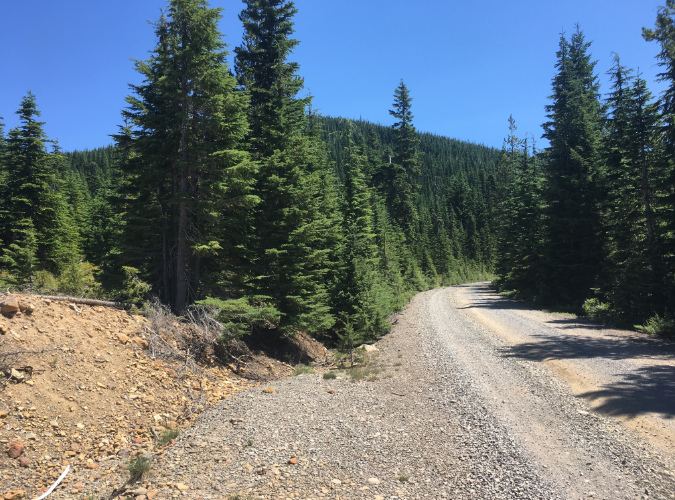
Mount Hood’s scenic wonders beckon on the final approach to the Vista Ridge trailhead on Forest Road 1650

Public lands across the nation experienced a big spike in visitors during the recent pandemic, continuing a growth trend that has been in motion for decades. In WyEast Country, this has placed an unprecedented burden on some of Mount Hood’s under-developed trailheads, like the one at Vista Ridge, on the mountain’s north side. 

The scenic gems within a few miles of this trailhead are among the mountain’s most iconic: Cairn Basin, Eden Park, Elk Cove, WyEast Basin and Owl Point draw hikers here, despite the washboards along the dusty final gravel road stretch – and the completely inadequate trailhead. 

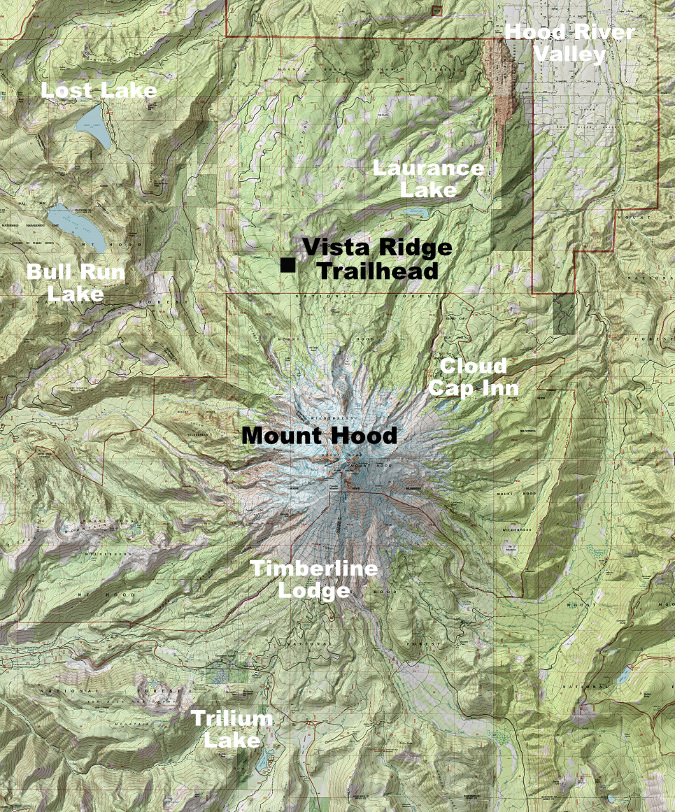
The Vista Ridge is located on Mount Hood’s rugged north side and reached from Lolo Pass Road

The pandemic isn’t the only driver in the growing popularity of Vista Ridge. The 2011 Dollar Lake Fire torched Vista Ridge, leaving a vast ghost forest behind. In the years since, the forest recovery has featured a carpet of Avalanche Lilies in early summer that draws still more visitors to this trailhead. And since 2007, volunteers have restored the Old Vista Ridge trail to Owl Point, adding yet another popular hiking destination here.

It is abundantly apparent to anyone using the existing Vista Ridge trailhead that it was never designed or developed to be one. Instead, it was the result of a plan during the logging heyday of the 1960s to extend Forest Road 1650 over the crest of Vista Ridge and connect to the growing maze of logging roads to the east, in the Clear Branch valley. 

For reasons unknown, that never happened, and by the late 1960s the road stub defaulted into an unimproved trailhead for the Vista Ridge Trail when a short trail connection from the road stub to the saddle was built, instead. This new trail connection short-circuited the northern two miles of the Vista Ridge trail, but has since been restored reopened as the Old Vista Ridge trail. This is how today’s Vista Ridge trailhead came to be on a steep hillside at the abrupt end of a defunct logging spur.

The existing Vista Ridge trailhead is simply a logging spur that was abandoned mid-construction in the 1960s, and thus lacks even a simple turnaround

While it was still lightly used as recently as the early 2000s, the popularity of the Vista Ridge trailhead has grown dramatically over the past 15 years. Today, dozens of cars are shoehorned into this dead-end spur during the busy summer hiking season.

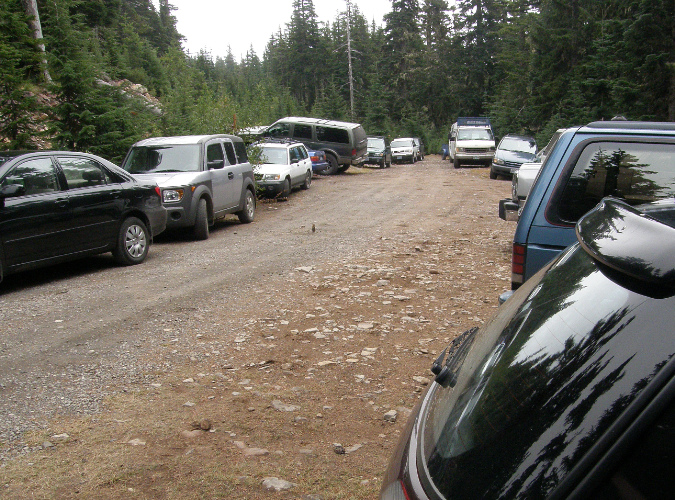
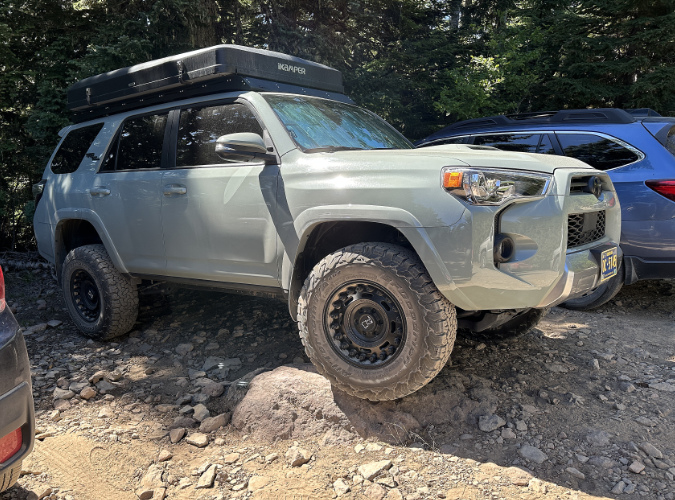
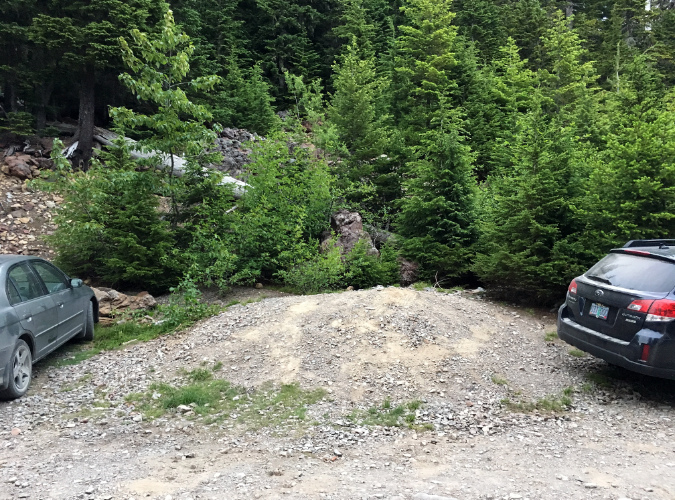
Parking at the trailhead is a haphazard affair, at best. There is room for about 6 cars along the south edge of the stub, though it was never graded for this purpose, and thus even these “spaces” are a minefield of sneaky, axel-cracking pits and oil-pan ripping boulders. These semi-organized spaces fill immediately on summer days, so most who come here end up parking at the stubbed-out end of the spur or spill out along the narrow final approach of Road 1650. 

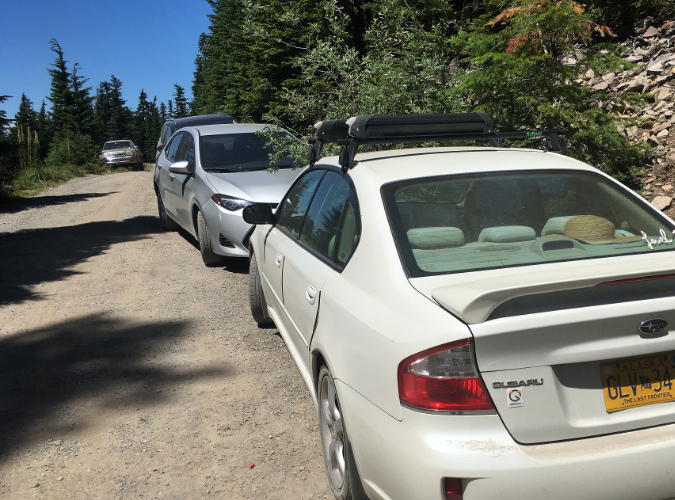
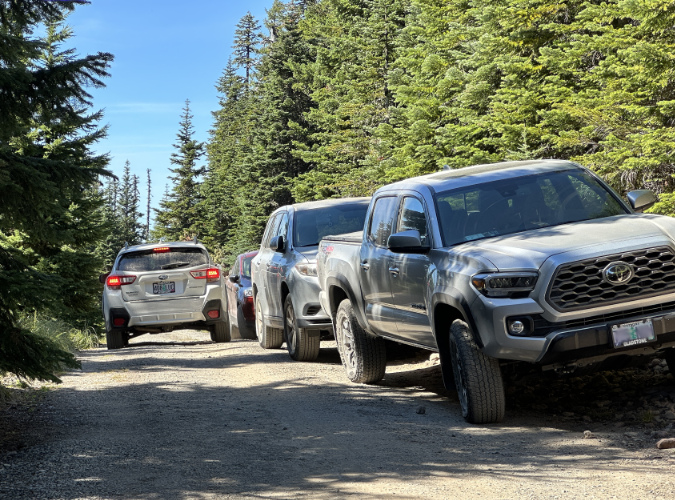
Overflow from the cramped existing trailhead routinely spills over to the narrow Road 1650 approach during the summer hiking season

Spillover parking on this section of Road 1650 is only unsafe for passing vehicles, it also impacts a resident Pika population living in these talus slopes

Because the existing trailhead was never designed or graded as a parking area, visitors must navigate large boulders and deep pits to find parking

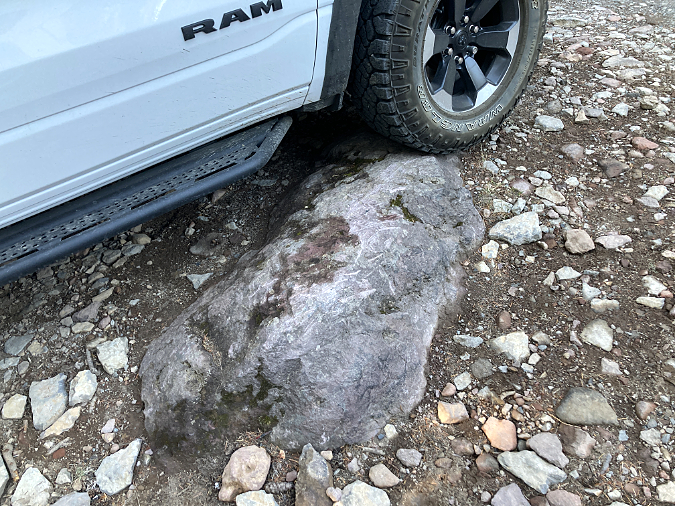
The scars on this boulder are testimony to the real damage caused by the lack of an improved parking surface at the existing Vista Ridge trailhead

The constrained, chaotic parking at the Vista Ridge Trailhead and resulting overflow on busy weekends is frustrating enough for visitors, but it also creates a safety problem for emergency response. This trailhead provides the best access to the northern part of the Mount Hood Wilderness, yet there is often no way to turn a vehicle around in summer, much less park a fire truck or ambulance here.

The overflow parking on the narrow access road is not only stressful an potentially dangerous for visitors to navigate, it also creates an access problem for larger emergency vehicles attempting to reach the trailhead

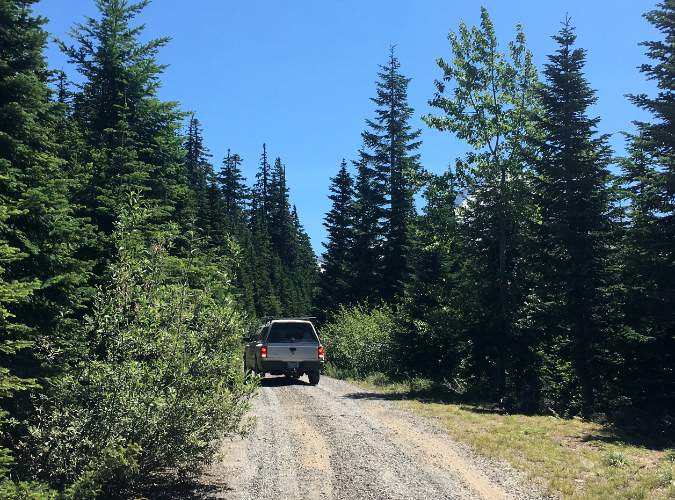
This visitor was forced to back nearly 1/4 mile down the access road after reaching the full parking lot and overflow shoulder parking that left no room to turn around
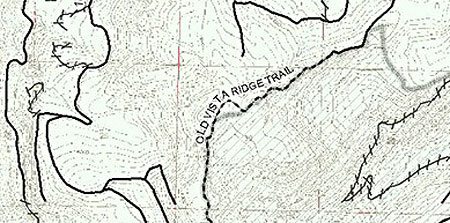
The origins of the short trail connector from today’s trailhead to the historic Vista Ridge Trail has unclear origins, it appears to have been built between 1963 and 1967, and it was clearly intended to replace the northern portion of the Vista Ridge Trail – the section that has since been restored as the Old Vista Ridge Trail.  

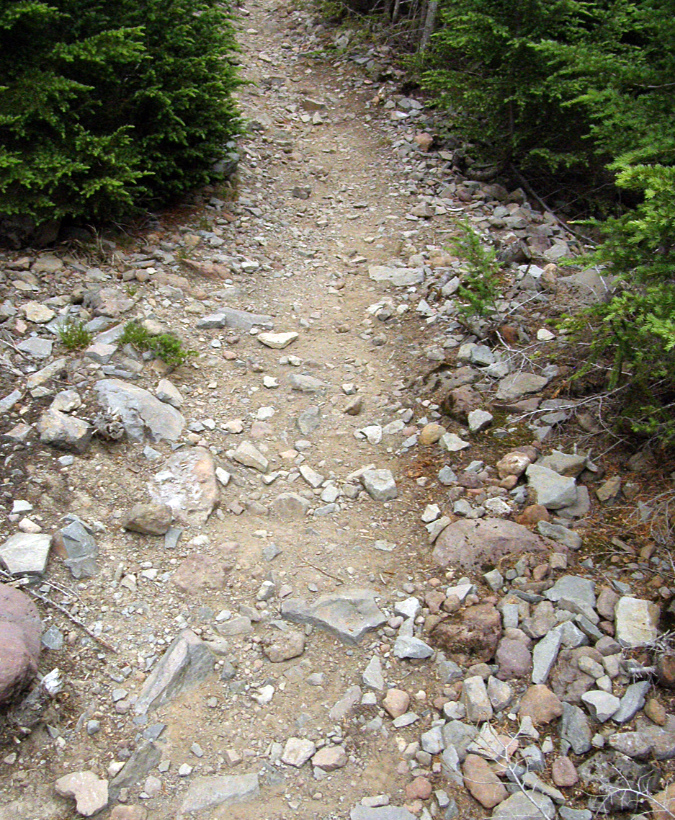
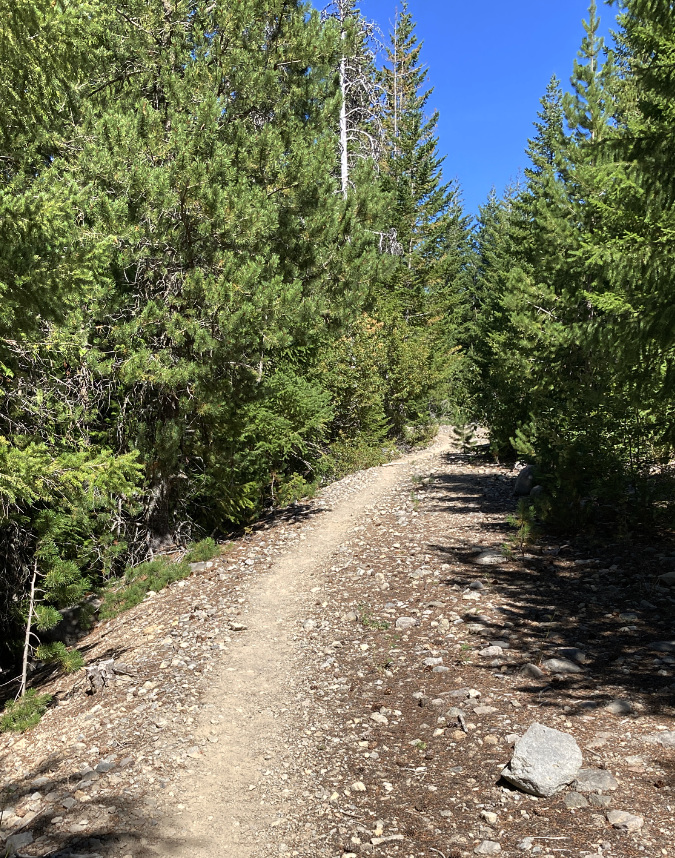
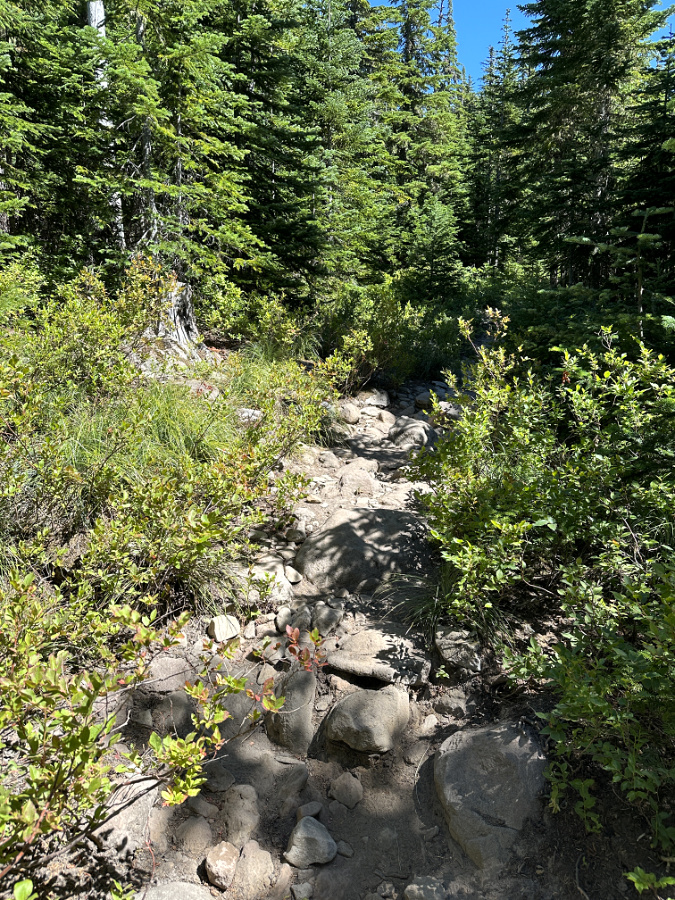
While most of the short connector trail is a well-constructed and graded route through dense forest, the first 200 yards are a miserable, rocky mess where the “trail” is really just a rough track that was bulldozed for a planned extension of the logging spur, but never fully graded. This sad introduction to the wonders that lie ahead is a frustrating chore to hike – and an ankle-twisting nightmare to re-negotiate at the end of your hike. 

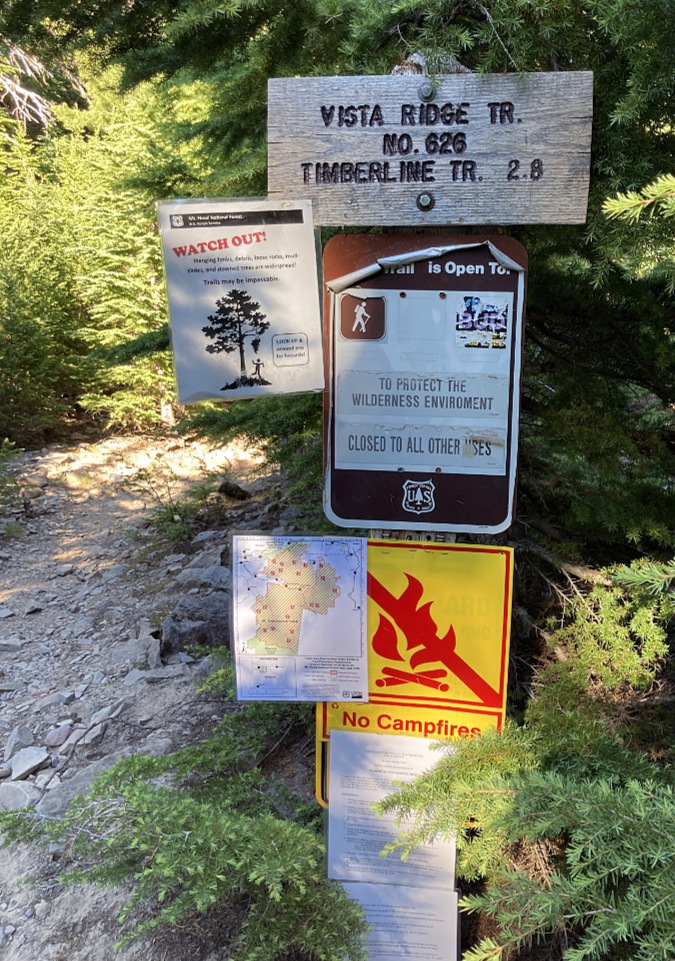
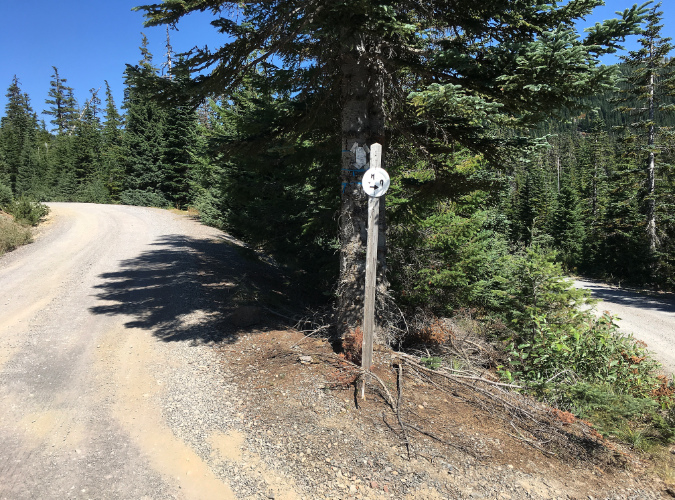
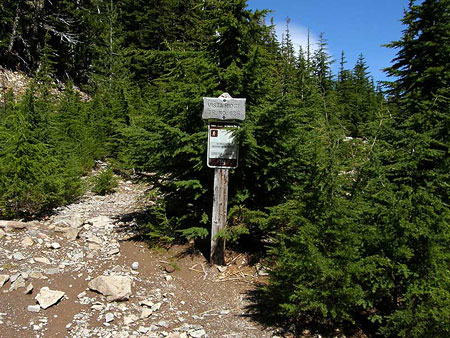
This signpost is the sole “improvement” at the Vista Ridge trailhead, leaving much room for improvement at what has become one of Mount Hood’s most popular trailheads

The first 1/3 mile of the Vista Ridge trail follows an abandoned, partially constructed section of logging spur that has significant surface and drainage problems that also leave much room for improvement as the gateway to this popular area

Add to these trailhead and trail condition woes an ongoing lack of proper signage to help people actually find Vista Ridge, and you have a discouraging start to what should be stellar wilderness experience for visitors – many from around the country and even the world. Thus, the following: a proposal to finally fix these issues at Vista Ridge and give this sub-par portal into the Mount Hood Wilderness the attention it has long deserved.

The Proposal…

The problems that plague the existing Vista Ridge Trailhead all stem from its accidental location on the steep mountainside. As a result, there is no way to safely accommodate needed parking, a turnaround or other trailhead amenities in the current location. The good news is that flat ground lies about 1/2 mile away, where Road 1650 passes an already disturbed site that was part of a recent logging operation.

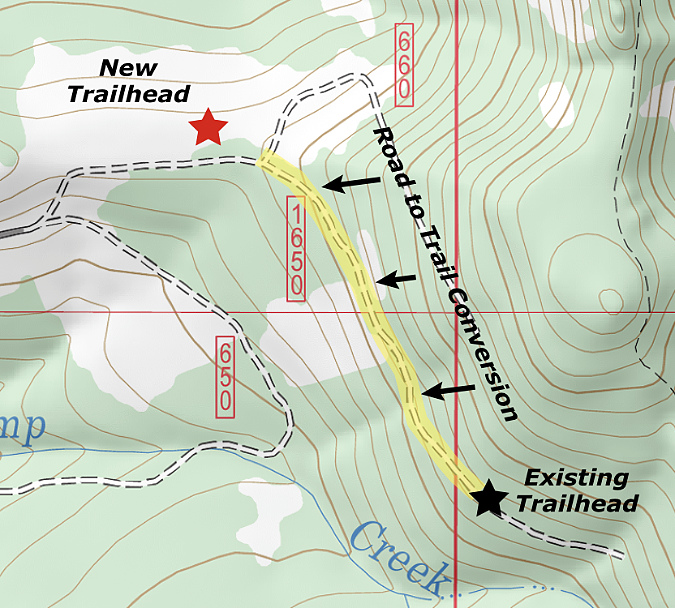
This map shows the proposed new trailhead site – roughly 1/2 mile northwest of the existing trailhead – and the section of existing road (highlighted in yellow) that would be converted to trail

To make this new location work, the section of Road 1650 from the proposed new trailhead to the old (highlighted above in yellow) would be converted to trail. Normally, adding a half-mile of converted road to a hike would be a minus, but this segment of Road 1650 is stunning (see below), with spectacular views of Mount Hood. The talus slopes that provide these views are also home to colonies of Pika that provide their distinctive “meep!” as you pass through – something that can’t be appreciated from a car.

Converted roads don’t always make for great trails, but the approach to the existing Vista Ridge trailhead is exceptionally scenic and would make for a fine gateway trail to the Mount Hood Wilderness

The first step in creating the new trailhead (and even without the new trailhead) would be restored signage to help visitors find their way from Lolo Pass Road to Vista Ridge, especially at the confusing fork (below) located just short of the proposed trailhead.

Finding the Vista Ridge trailhead is a challenge. The signpost at this crucial fork just below the trailhead had lost its sign in this view from two years ago, but the entire post has since disappeared. A new trailhead would include restoring directional signage to help visitors navigate the route

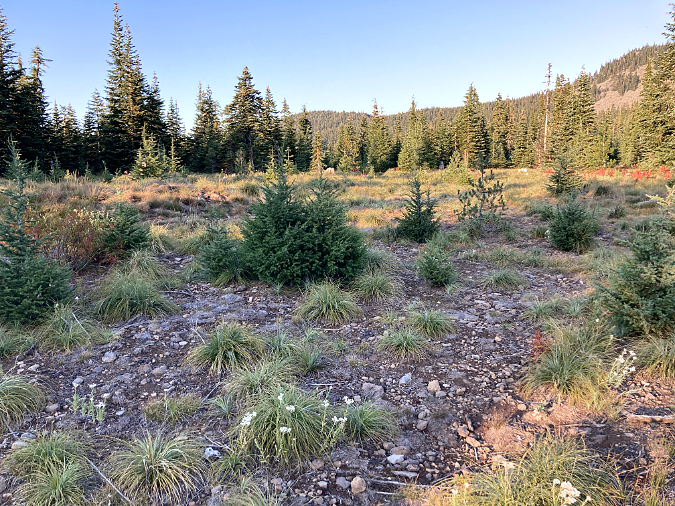
Next up, the obvious spot for the new trailhead (below) is a yarding area from a logging operation that was impacted more recently with a nearby thinning project. Dirt logging spurs radiate in all directions from this cleared area, allowing for new trailhead parking to incorporate these already impacted areas to minimize environmental impacts.

The proposed new trailhead site was previously disturbed with a logging operations

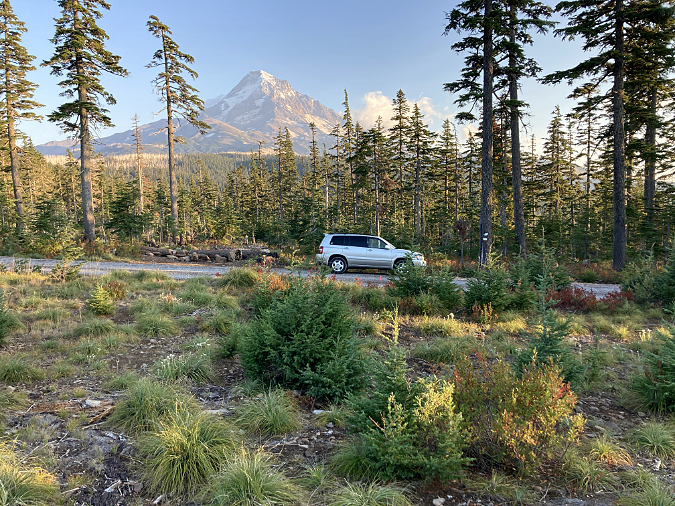
Until recently, the proposed new parking area faced a wall of trees to the south, but a tree thinning project on the opposite side of Road 1650 has suddenly provided a Mount Hood view (below). The purpose of the thinning was to enhance forest health by removing smaller, crowded plantation trees to promote huckleberries in the understory – an important first food harvested by area tribes. 

Should the huckleberries thrive as planned and bring berry harvesters to the area, this could be another benefit of providing trailhead parking here. For now, the thinning just provide a sneak-peak at the mountain that lie ahead for hikers or a backdrop for people using picnic tables at the trailhead (more about that in a moment).

The proposed new trailhead is directly across Road 1650 from a recently thinned area

It looks pretty grim now, but the tree thinning project across from the proposed is intended to spur the huckleberry understory to allow for berry harvesting… eventually

The concept for the new trailhead parking is to use an old dirt logging spur that splits off the Vista Ridge Road as the entrance to the parking loop. The existing Road 1650 would be closed and converted to trail from this point forward. The logging spur is shown on the left in the photo below, along with the portion of Road 1650 where the trail conversion would begin. The existing trailhead lies about 1/2 mile from this point.

The existing road conversion to trail would begin here, with the new parking access following the logging spur on the left

Roughly 200 yards beyond the proposed trailhead, the views open up along existing Road 1650 where it crosses the first of two talus slopes (below). This is one of those “wow!” spots that comes as a surprise to hikers as they drive to the existing trailhead. The right half (downhill) in this converted section of the existing road would be retained as trail, the left (uphill) side would be decommissioned.

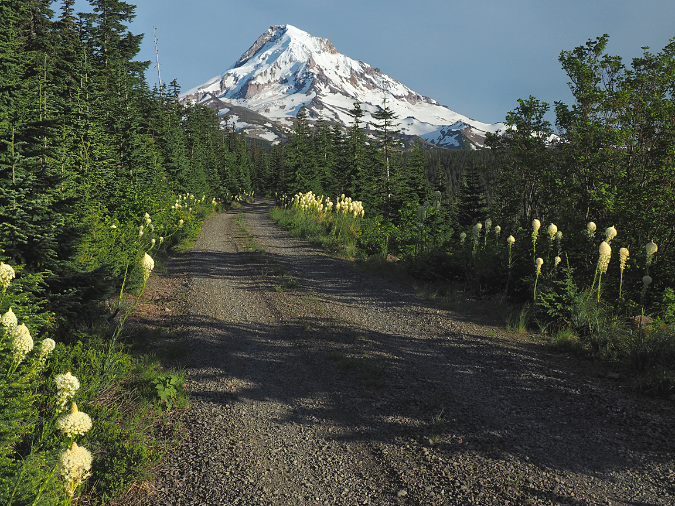
The final 1/2 mile of Road 1950 is scenic in all seasons, with Beargrass blooms in early summer and brilliant fall colors emerging by late summer

How does this work? The decommissioning of the uphill half of the existing road could be accomplished by upturning the surface with a backhoe – a process used to decommission miles of logging roads in recent years around Mount Hood country. The scene below is a typical example from a decommissioned road near Black Lake, located a few miles north of Mount Hood, on Waucoma Ridge. In this example, the goal was to completely retire the road, though the same method can be used to convert a road to single-track trail.

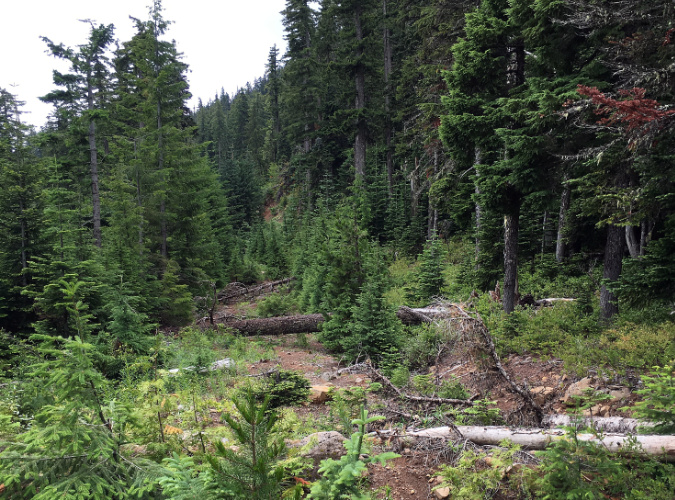
This road near Black Lake was decommissioned in the early 2000s and is gradually revegetating

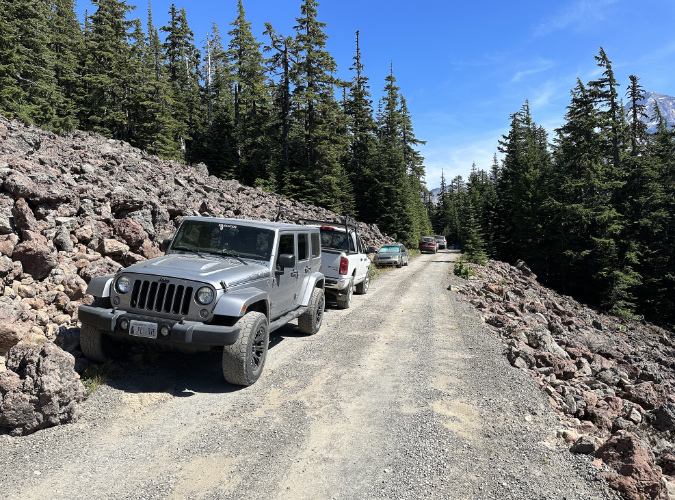
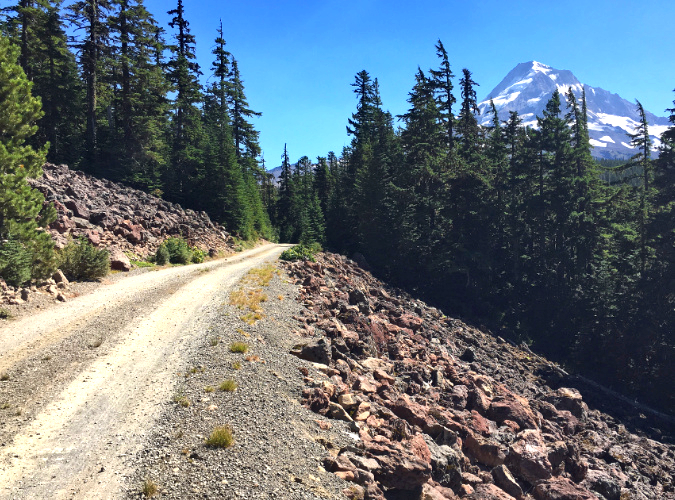
Just beyond the first “wow!” talus viewpoint, the mountain comes into view once again along the existing Road 1650 as it crosses the second talus slope, just before reaching the existing trailhead. This slope here is unique in that it consists of red lava (below), a somewhat uncommon sight around Mount Hood that adds to the scenic beauty. Like the first talus section, this slope is also home to Pika colonies, adding to the trail experience. The right half of the converted road would be retained as trail here, and the left (uphill) side decommissioned.

Without overflow parking blocking the view, the final stretch of the access road passes this scenic and somewhat unusual talus slope composed of red lava rocks

Beyond the practical benefits of moving the Vista Ridge trailhead to make it safer and more functional, there are also compelling conservation arguments for the move. First, it would allow the Forest Service to retire another segment of old logging road – and though only 1/2 mile in length, in its current state it nonetheless contributes to the massive backlog of failing roads built during the logging heyday that the agency can no longer afford to maintain.

There are also noisy (meep!) wildlife benefits, as the Pika colonies living in both talus slopes are likely impacted by the noise, vibration and pollution that the steady stream of hikers bring as they drive – and increasingly park – along this scenic section of road.

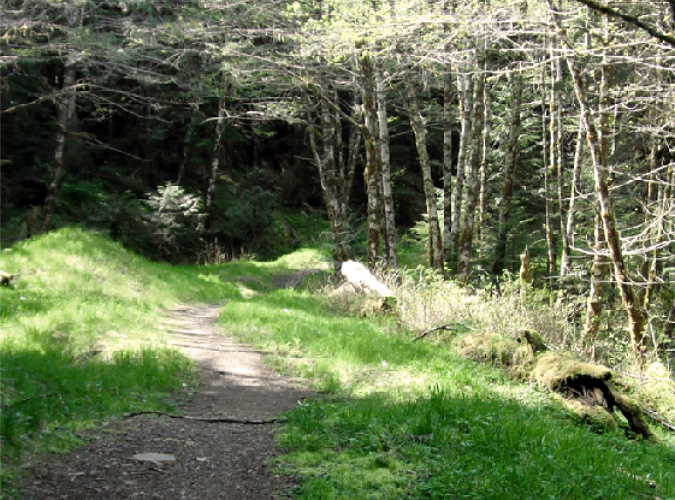
Because most road-to-trail conversions around Mount Hood have been driven by wilderness boundary expansions, washouts or other abrupt events, there aren’t many examples of intentional conversions to point to. Instead, most conversions are simply abandoned roadbeds that nature is gradually reclaiming, like the section of the Elk Cove trail shown below.

The lower section of the Elk Cove Trail follows an old logging road that was simply closed, but not formally converted to trail

Beyond often being a hot, dusty trudge for hikers looking for a true trail experience, old roads that aren’t intentionally converted also lack proper trail design features for stormwater runoff and drainage, as seen on the opening section of the existing Vista Ridge trail. Abandoned roads also lead to thickets of brush and young trees as the forest moves in, making maintenance of trails that follow these routes a constant chore. It simply makes more sense to undertake true conversions from road to trail on these routes in the long run.

Recently converted road-to-trail at Salmon Butte (Oregon Hikers)

There are very good examples of intentional conversions, and among the best is the Salmon Butte Trail, where the Forest Service decommissioned a section of road in 2010 and intestinally created meandering trail through mounds of earth along the old roadbed to further conceal evidence of the road from hikers. Just a few years after the conversion (above) the signs of the old road were already fading fast, creating a more authentic trail experience. Self-sustaining drainage features were also incorporated into the design. The same approach could be applied to decommission both the final road section and the current trailhead parking area at Vista Ridge.

Finally, improvements to the opening stretch of the existing Vista Ridge trail that also follows old roadbed is in order. This short section (below) is typical of a road that wasn’t property converted to trail, and as a result suffers from serious runoff erosion during the winter and spring. The result is a cobbled mess that is hard on ankles and morale as hikers set off for their hike. 

If this looks like a dry streambed, that’s because it is! It’s also the opening 1/3 mile section of the Vista Ridge Trail where it follows an abandoned, partly constructed road bed that becomes a running stream in the winter months

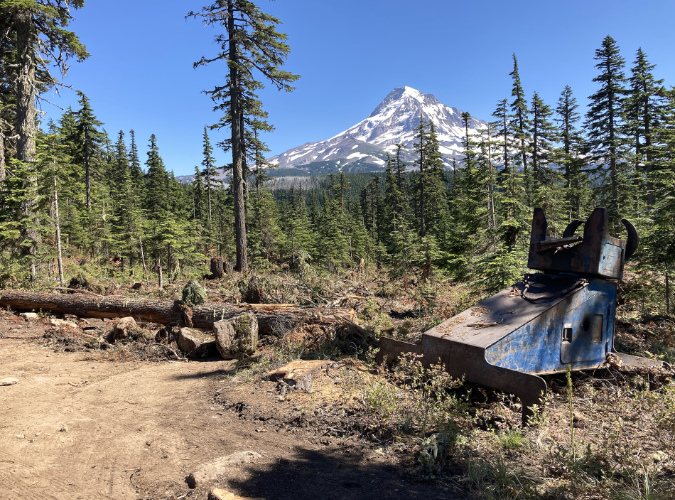
There are some basic trail drainage features that could keep this section from becoming a river during the wet months. Next, some of the most miserably rocky sections could be covered with gravel – but from where? It turns out the Forest Service left a couple of large piles (below) where today’s trailhead is located when work on extending this road was abandoned more than 50 years ago. 

Northwest Youth Corps crew did just this about a decade ago, but because the drainage problem wasn’t addressed, most of that first layer of gravel has been washed away and their efforts long since erased.There are some basic trail drainage features that could keep this section from becoming a river during the wet months. Next, some of the most miserably rocky sections could be covered with gravel – but from where? It turns out the Forest Service left a couple of large piles (below) where today’s trailhead is located when work on extending this road was abandoned more than 50 years ago. 

Let’s put this leftover pile of gravel from the logging days to work!

How a parking loop would work…

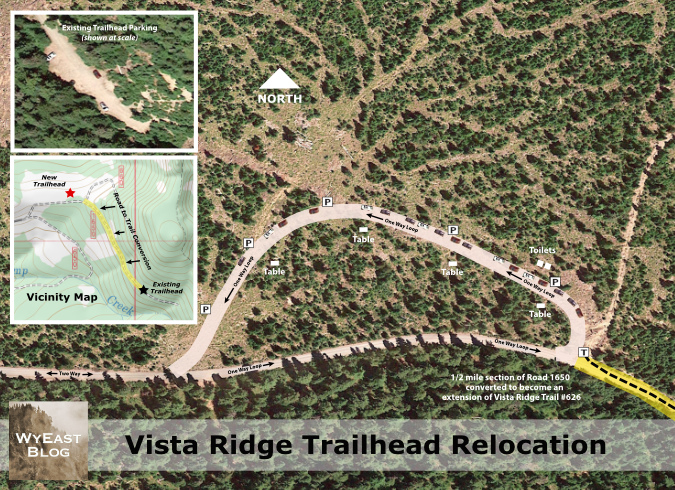
Putting it all together, this proposal (below) shows how the new trailhead parking could be accomplished as a parking loop, as opposed to a parking lot. The inset images include an aerial image of the current, dead-end trailhead parking at the same scale as the proposed loop map for direct comparison. The topographic inset map shows the proposed trailhead and parking loop, along with the proposed road conversion in relation to the existing trailhead (be sure to click on “large version” link below for a closer look!) 

[click here for a large version]

Why a loop? First, it’s the least impactful on the environment. Instead of clearing a wide area to provide room for cars to back in and out, the parking is simply provided along the right shoulder of the loop – like parallel parking in the city – but with nature left intact inside the “donut hole” of the loop.  

In this case, the loop would follow a series of old logging skid roads, further minimizing the impact on the forest. But perhaps most importantly from an environmental impact perspective, adding a couple hundred yards of new loop road here would allow a half-mile section of existing road to be retired and converted to trail, a clear net gain, overall.

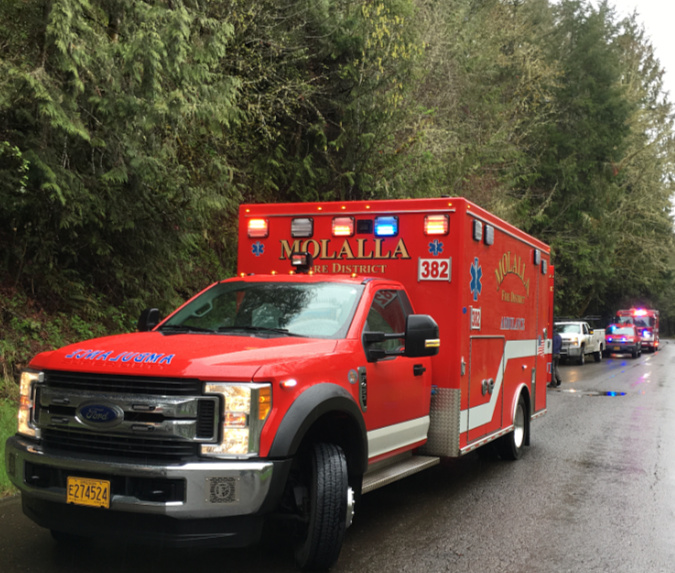
Busy trailheads call for amenities like improved signage and toilets – and space for emergency vehicles to have access. These vehicles were called to the trailhead where a hiker was injured in the Clackamas River area – fortunately, the trailhead was located along a paved forest road with ready access and space to turn around

Another important benefit of a loop is to provide a much-needed turnaround at the end of a dead-end road for forest rangers and emergency responders. This might be the most compelling reason to fix the Vista Ridge trailhead sooner than later, as today’s overflowing dead-end parking area is a disaster waiting to happen should fire trucks or other emergency vehicles need to access the Vista Ridge trail on a busy weekend.  

Designing the parking loop…

From a user perspective, a parking loop is efficient and easy to navigate. The one-way design ensures that people arriving here would always reach the closest available parking spot to the trailhead first. This is the opposite of the current dead-end trailhead, where hikers arriving later in the day often park in less-than-safe spots along the access road when they see overflow shoulder parking occurring, for fear of not being able to turn around in the cramped trailhead lot – often after spaces have opened up in the main parking area.

As shown in the parking schematic (above), the relocated trailhead would accommodate up to 30 vehicles along a 1,100-foot-long loop – or about three times what the current dead-end parking area allows. The loop would be gravel-surfaced, 16-feet wide and designed to flow one-way in a counter-clock-wise direction, with shoulder parking allowed on the right side.

The new trailhead could also be a Northwest Forest Pass site with the required toilets, picnic tables and welcoming signage for visitors, something that the space constraints at the current lot would not allow. These could be located in the “donut hole” center of the loop. Making this a forest pass site would also address one of the more dire needs at Vista Ridge – a toilet! The heavy use at the trailhead and steep terrain has turned a couple of more accessible trees adjacent to the parking area into de-facto toilets, with unpleasant results. 

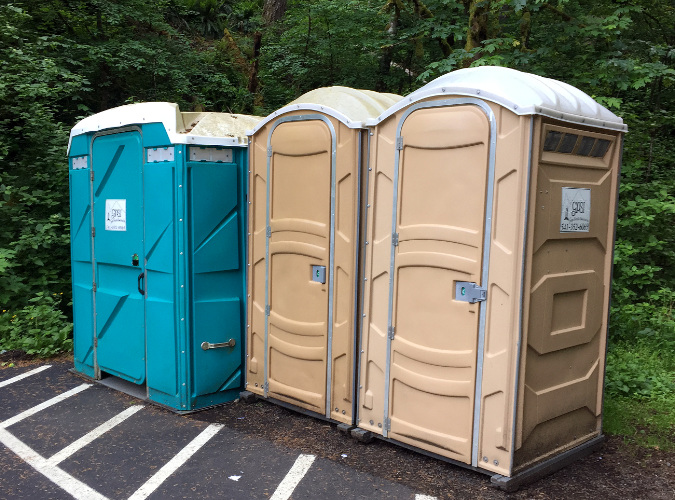
Industrial toilets at a busy trailhead in the Columbia Gorge – functional, but not exactly a complement to the outdoor experience!

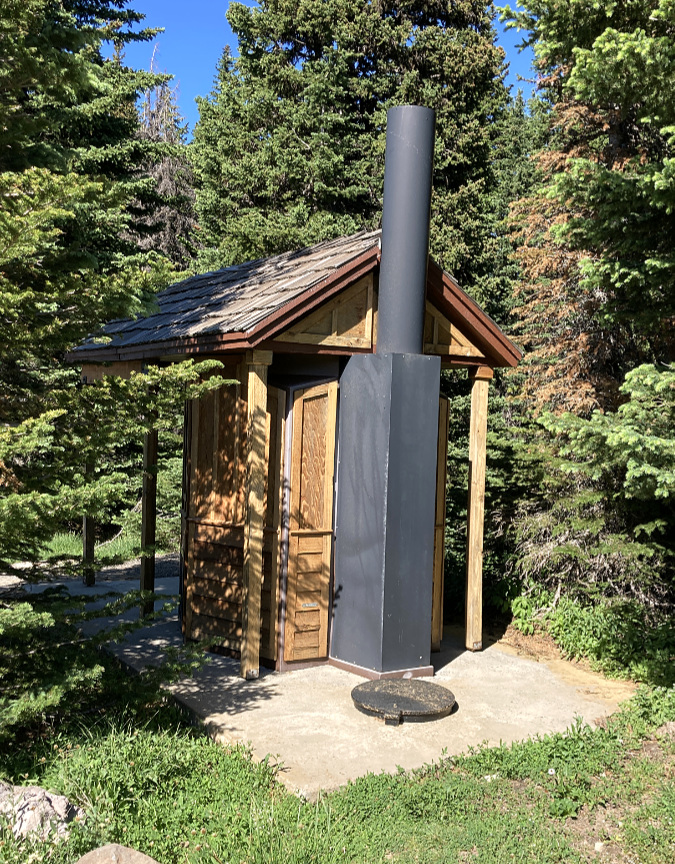
The Forest Service has upped its game with pit toilets in recent year at some Northwest Forest Pass sites, replacing industrial porta-potties (above) that are the last thing you want to see as you set off for a wilderness experience with more aesthetic toilets, like the one at the High Prairie trailhead (below), just east of Mount Hood. This would be a great choice for a new trailhead at Vista Ridge.

Rustic toilet design at the High Prairie trailhead, gateway to the Badger Creek Wilderness

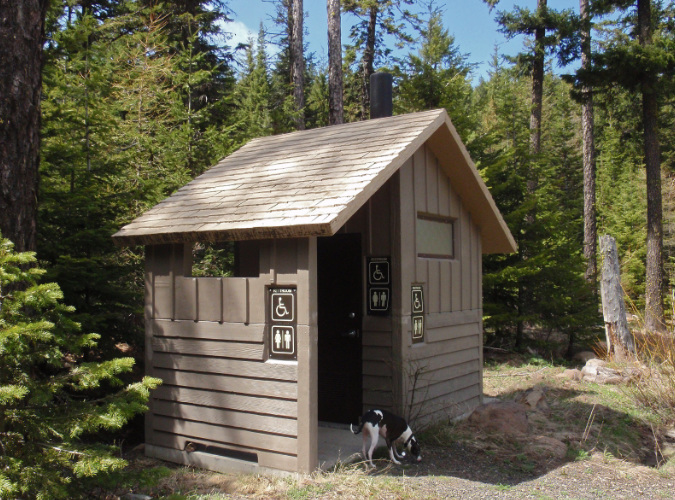
The are also more substantial examples around Mount Hood that are wheelchair accessible, like this one at the Billy Bob snow park near Lookout Mountain (below).

Accessible, rustic toilet design at the Billy Bob snow park near Lookout Mountain

Why an accessible toilet? Because there’s also an opportunity for the converted road section in this proposal to incorporate an accessible trail surface to at least one of the talus viewpoints along the way – like this well-photographed spot along the existing road (below), located just a few hundred yards from the proposed trailhead. 

This view is from the shoulder of the current access road, just a few hundred yards from the proposed new Vista Ridge trailhead. Converting the road to an accessible trail design and providing some simple amenities (e.g., a picnic table) would make this a welcome new destination for people with limited mobility or who use mobility devices

Accessible trail opportunities are in woefully short supply around Mount Hood, an unacceptable reality. There’s room at this viewpoint for an accessible picnic table, benches and perhaps interpretive signage — allowing for the extended Vista Ridge trail to serve a wider spectrum of visitors and abilities, not just able-bodied hikers heading into the wilderness.

What would it take?

There are two main parts to this proposal: (1) building the new parking loop and (2) converting the final half-mile section of Road 1650 to become a trail. The first part – the parking loop, pit toilets, picnic tables, signage and other trailhead amenities — would have to be built by the Forest Service. However, this work could likely be fast-tracked as an exemption under the environmental review process, since it involves relocating an existing parking area and would result in much less roadway than the current trailhead. That environmental analysis would also have to be completed by the Forest Service.

The second part of this proposal — the road-to-trail conversion — could be completed as a partnership between the Forest Service and volunteers, like Trailkeepers of Oregon (TKO), who already maintain the Old Vista Ridge and Vista Ridge trails. The Forest Service could complete the rough backhoe work to reduce the converted road to single track, and volunteer crews could finalize the tread and drainage on the converted trail. 

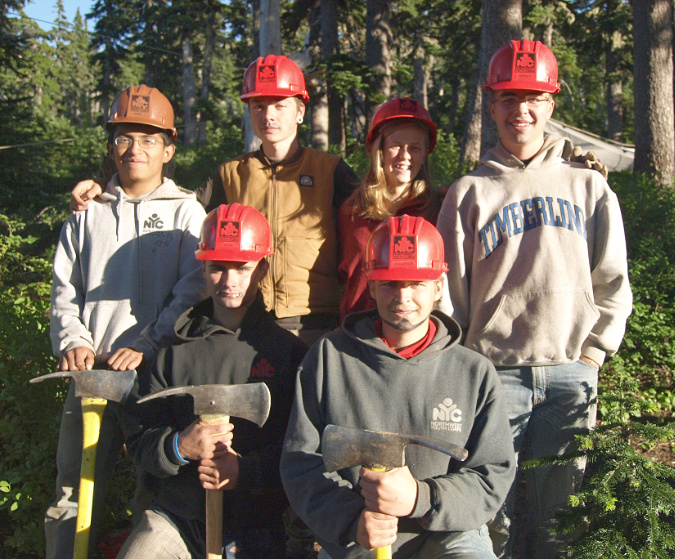
Volunteers could also install viewpoint benches and picnic tables for an accessible trail and trailhead signage at the new parking area. Some of the heavier work could be contracted to organizations like the Northwest Youth Corps, which has a long history of trail work around Mount Hood.

Northwest Youth Corp crew working on the Vista Ridge Trail

How could this concept move forward? Funding is always a concern for the Forest Service, but there’s also unprecedented funding coming online right now for the federal agencies from the 2022 Inflation Reduction Act. This project could compete for these funds, many of which are competitive, especially if it includes an accessible trail. Creating a new Northwest Forest Pass site would also generate revenue (in theory) to help maintain the new trailhead. 

Volunteer crews from TKO are already working from this trailhead every summer to maintain the Vista Ridge and Old Vista Ridge trails. The over-crowding at the existing trailhead has already made their work more difficult, so contributing to the trail conversion effort would be a natural fit for TKO volunteers to be part of.

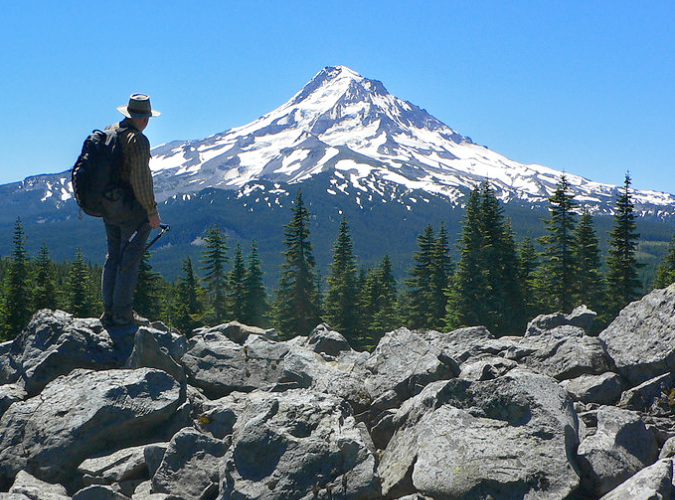
The author on the Old Vista Ridge trail

In the meantime, if you want to experience the wonders of Vista Ridge and Old Vista Ridge, the best plan is to avoid this trailhead on Fridays, Saturdays and Sundays from July through mid-September. If you must go on those days, then it’s not a bad idea to simply park on the shoulder of Road 1650 where this new trailhead is proposed, and simply walk the scenic final half mile to the current trailhead. You’ll get mountain views, hear the local pikas calling out, avoid the stressful chaos of the existing trailhead – and with any luck, you’ll be getting a preview of things to come!

__________________

Tom Kloster | August 2023

After the Dollar Lake Fire

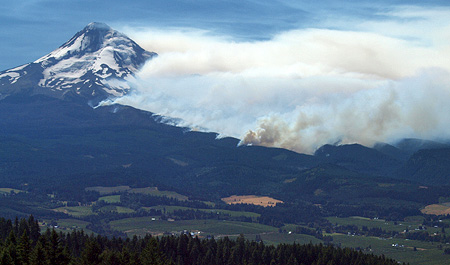
The Dollar Lake Fire from Bald Butte on September 3, 2011

On August 26, 2011, a lightning strike ignited what was to become the Dollar Lake Fire, on Mount Hood’s rugged north side. The fire started in the Coe Branch canyon, just below the Elk Cove trail, and was spotted by numerous hikers.

Initially, it seemed small and manageable. But over the next few days and weeks, arid conditions and strong winds spread the fire from Stranahan Ridge on the east to Cathedral Ridge on the northwest side of the mountain, eventually consuming some 6,300 acres of high elevation forest. The blaze burned through September and into early October, when fall rains finally arrived.

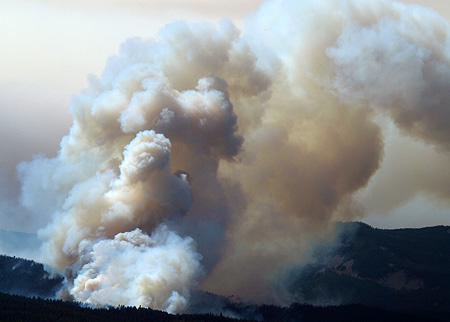
Hot spot erupts along Stranahan Ridge on September 3, 2011

Some of the burn was of the beneficial form, a mosaic fire leaving islands of surviving trees, but much of the fire was too hot and the accumulated forest fuel too plentiful to prevent devastating crown fires from sweeping across the forest. Eventually, the fire destroyed most of the standing timber and burned the forest duff down to mineral soil throughout most of the burn area.

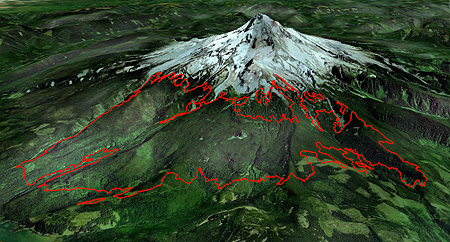
The fire was contained entirely within the Mount Hood Wilderness, thanks to the recent Clear Branch additions that expanded the wilderness boundary on the north to encompass the Clear Branch valley and the high country surrounding Owl Point, to the north. While this complicated fire fighting, it has also created a living laboratory for forest recovery, as the USFS is unlikely to assist the reforestation process inside the wilderness boundary. The Forest Service map, below, shows the broad extent of the fire.

Final extent of the Dollar Lake Fire (outlined in red)

Though the fire burned to the tree line in several spots, a surprising amount of terrain along the iconic Timberline Trail was somehow spared. While the burn touched Elk Cove and Cairn Basin, WyEast Basin and Barrett Spur are well beyond the burned area. The Clear Branch wilderness additions to the north were mostly spared, as well.

The New Vista Ridge: After the Fire

The following is a photo essay from my first visit to the burn, on June 22, 2012, and is the first in what will eventually be a series of articles on the aftermath of the fire.

The devastation left by the fire is awesome to witness, but also starkly beautiful when you consider the context of a forest fire. After all, this event is part of the natural rhythm of the forest just as much as the changing of seasons.

From this point forward, we will have a front-row seat to the miracle of life returning to the fire zone, much as we’ve watched life return to the Mount St. Helens blast zone over the past 32 years. And as my photos show, the rebirth of the forest ecosystem has already begun on Mount Hood’s northern slopes.

Untouched trailhead at Vista Ridge.

From the Vista Ridge trailhead, I followed the Vista Ridge Trail to the snow line, above about 5,000 feet. The Vista Ridge trailhead is completely untouched, though the fire swept through a vast area immediately to the south. Yet, no sign of the fire is evident at the trailhead marker (above).

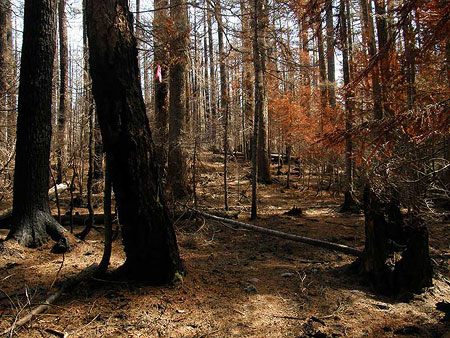
A bit further up the trail, at the Old Vista Ridge trailhead, the fire zone comes into view. Where green forests existed last summer, browned foliage and a burned forest floor spread out east of the junction. This fringe of the fire is of the healthy “mosaic” form, sparing large trees, while clearing accumulated forest debris.

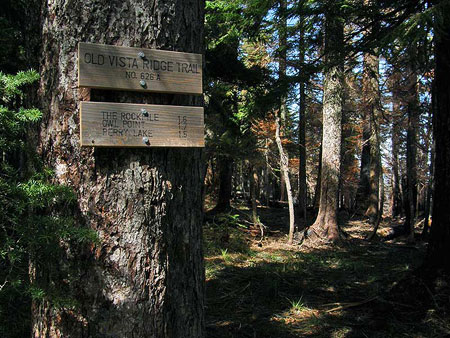
Old Vista Ridge trailhead spared by fire… just barely.

An unexpected benefit of the fire came last fall, when the USFS added the long-neglected Old Vista Ridge trail to official agency fire maps (below) released to the public. Volunteers began restoring this beautiful trail in 2007, but formal acknowledgement of the route on USFS maps is a welcome development.

Welcome development: Old Vista Ridge trail reappears on USFS fire fighting maps

Clearly, the restoration of the Old Vista Ridge trail helped fire fighters reach this area, and could have served as a fire line had the blaze swept north, across the Clear Branch. Hopefully this is an indication that the Old Vista Ridge trail will someday reappear on the USFS maintenance schedule, too.

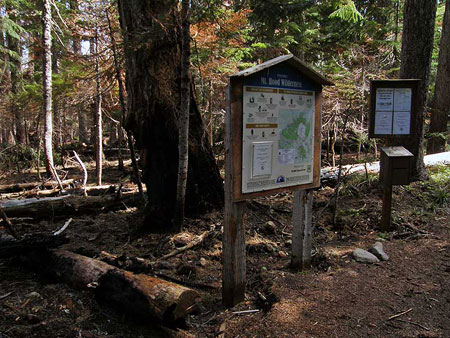
Turning south on the Vista Ridge trail from the Old Vista Ridge junction, the wilderness registration box and map board seem to have received divine intervention from the fire — the blaze burned within a few feet of the signs, yet spared both. From here, the Vista Ridge trail abruptly leaves the scorched fringe of the fire, and heads into the most devastated areas.

Vista Ridge trail signs were spared… by divine guidance?

A few yards up the Vista Ridge trail, the devastation quickly intensifies.

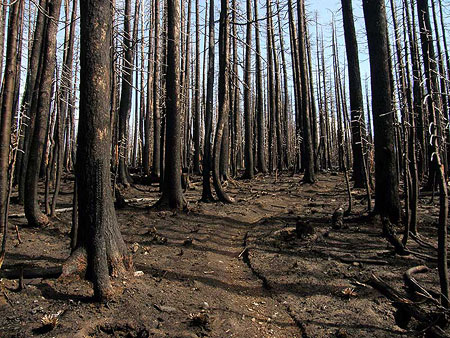
From about the 4,700 foot level, the Dollar Lake Fire burned the forests along Vista Ridge to bare earth. In this area, the entire forest crowned, leaving only a scattering of surviving trees where protected by topography or sheer luck. Forest understory, woody debris and duff burned to mineral soil, leaving a slick, muddy surface of ash. For those who have hiked through the previous Bluegrass Fire or Gnarl Fire zones on the east slopes of Mount Hood, this eerie scene is familiar.

The surprisingly intact trail curves through the devastated forests along Vista Ridge.

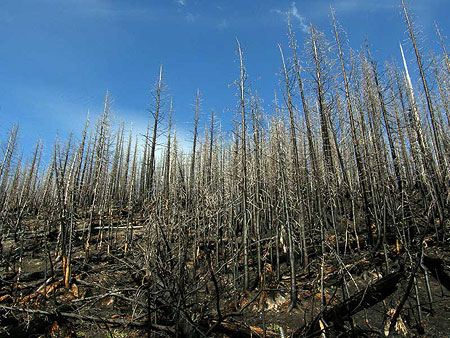
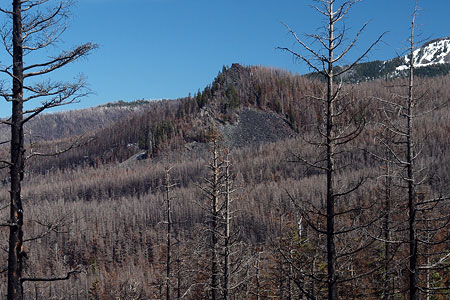
Crown fires have killed almost all of the standing forests along Vista Ridge.

Amid the devastation in this hottest part of the Dollar Lake Fire, signs of life are already emerging. At this elevation, one of the toughest survivors is beargrass, a member of the lily family with a deep rhizome that allows plants to survive even the hottest fires. These plants are normally evergreen, but were completely scorched in the fire. The new grown in this photo (below) has emerged this spring.

Beargrass (Xerophyllum tenax) emerges from underground rhizomes protected from the fire.

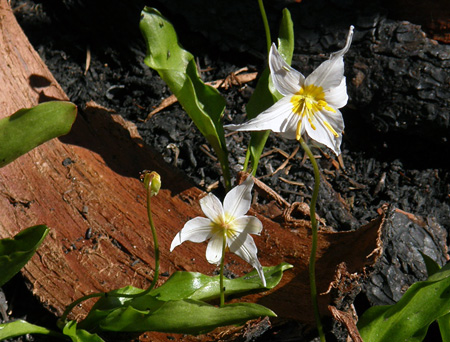
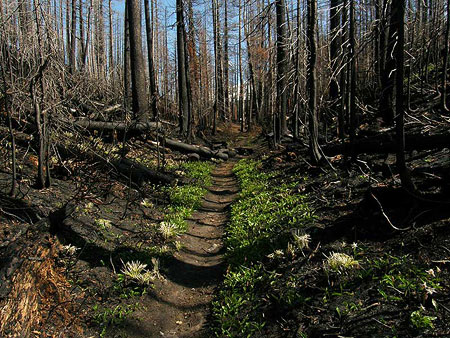
Another surprise is avalanche lily, one of the more delicate flowers in the subalpine ecosystem. Like beargrass, these plants survive thanks to a bulb located deep enough in the soil to escape the heat of the fire. As one of the early bloomers in the mountain forests, these plants area already forming bright green carpets in the sea of fire devastation (below).

Avalanche Lily (Erythronium grandiflorum) emerging from the ashes.

A ribbon of green, these Avalanche Lilies are emerging along the Vista Ridge trail.

Another of the beneficial aspects of the fire comes into view a bit further up the trail: several sections of Vista Ridge had long been overgrown with thickets of overcrowded, stressed trees that were ripe for a burn.

Over the coming years, these areas are likely to evolve into beargrass and huckleberry meadows like those found at nearby Owl Point or along Zigzag Mountain, where fires have opened the landscape to sun-loving, early succession plants.

Unhealthy forest thickets cleared by fire — a beneficial outcome of the blaze.

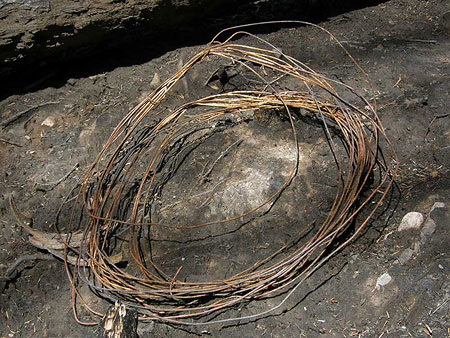
One human artifact was uncovered by firefighters — a coil of what must be telephone cable (below). This is a first along the Vista Ridge trail, but makes sense given the insulators and cable found along the Old Vista Ridge trail.

It’s hard to know what this connected to, but on the north end, it served the old Perry Lake Guard Station and lookout, just east of Owl Point. It’s possible this line extended to the Bald Mountain lookout, though I have been unable to verify this on historic forest maps.

Telephone cable on Vista Ridge – gathered up and coiled by firefighters?

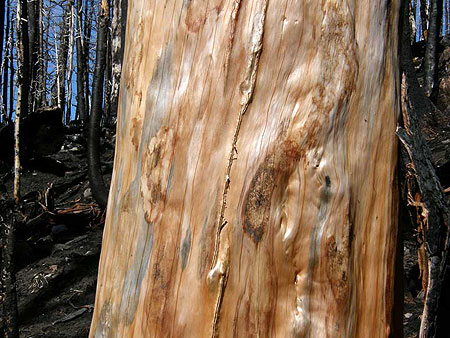
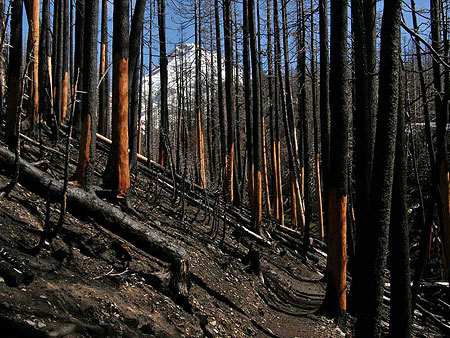
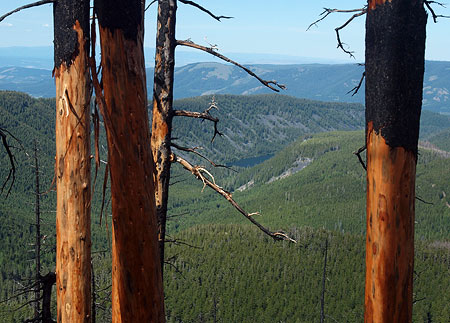
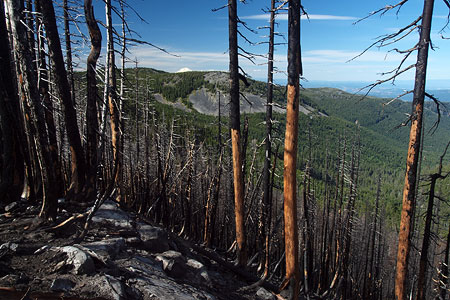
Though much of the devastation zone still consists of blackened trees and soil, some of the burned forest has begun to evolve into the uniquely attractive second phase. This happens when scorched bark peels away from trees to reveal the often beautiful, unburned wood beneath.

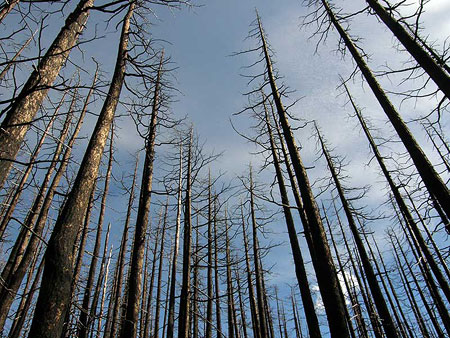
Soon, all of the trees in this forest will shed their bark. The skeletons of thousands of trees will emerge in colors of red, yellow and tan, then gradually fade to a bleached gray and white with time.

The burned trees of Vista Ridge are just beginning to shed their blackened bark, revealing beautiful trunks unscarred by the fire.

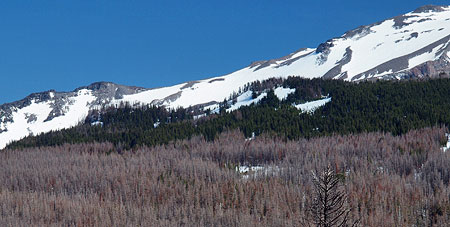
Mount Hood rises behind the new ghost forests of Vista Ridge

This second phase of the fire is helped along by winter snow. As the scene above shows, the freeze-thaw and compacting effects of the snow pack have already stripped many trees of their bark beneath the now-melted snowpack. Hot summer sun will continue this process, shrinking the remaining bark until it drops from the drying tree trunk.

This process of de-barking is the first in a post-fire sequence of events that will recycle much-needed organic matter to the forest floor. Twigs and tree limbs will soon fall, and over time, whole trees will begin to drop. This is a critical phase in stabilizing the forest soil, when low vegetation is still just beginning to re-establish in the fire zone.

Strips of tree bark are the first organic layer to accumulate on the floor of the burn zone.

The next few images show the extent of the Dollar Lake Fire, as viewed from Vista Ridge. To the east (below), The Pinnacle was mostly burned, but the fire somehow missed stand of trees just below the north summit.

These trees will play an important role in reforestation of the area, partly because so few trees survived the fire, but also because of their geographic location above the surrounding forest, where wind will widely scatter their seeds.

The Pinnacle, where a small grove of of trees on the north slope survived the fire.

To the south, the area above Elk Cove known as 99 Ridge (shown below) was partly spared, though the fire did scorch the east slopes of the ridge. From this side (to the west), the Timberline Trail corridor was almost completely spared. Ironically, Dollar Lake — the namesake for the fire — appears to have been spared, as well.

To the west of 99 Ridge, WyEast Basin was also spared, but the area along the Timberline Trail to the west of the basin, along the upper sections of Vista Ridge, was largely burned.

Forests along 99 Ridge were spared by the fire.

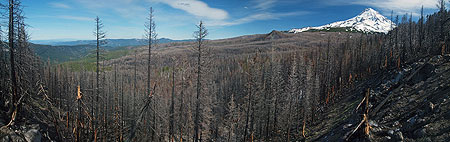
This panoramic view (below) encompasses the entire mid-section of the fire, from Stranahan Ridge on the horizon to Vista Ridge, on the right. This is a new viewpoint along a largely unnoticed rocky scarp on the east shoulder of Vista Ridge, now revealed thanks to the fire.

(Click here for a much larger panoramic view]

A Changed Landscape

Those who have explored Mount Hood’s north slopes over the years will surely mourn the loss of the beautiful forests of noble fir and mountain hemlock that once stood here — I certainly have. But this is also a chance to watch the ecosystem recover and restore itself over time, as it has for centuries. Among the surprising benefits are the new scenic vistas that are suddenly available, giving a bit more meaning to the name “Vista Ridge.”

The new views from Vista Ridge include Laurance Lake and Bald Butte, to the east.

By following the true ridge top of Vista Ridge, the new views extend east across Laurance Lake and the Clear Branch valley to Bald Butte and the Columbia Basin (above). Most of the area below the ridge is not burned, and this new perspective on the recent additions to the Mount Hood Wilderness is both unexpected and beautiful.

To the north, the new views include the rugged and little-known Owl Point area of the expanded Mount Hood Wilderness (reached by the Old Vista Ridge trail). Mount Adams rises in the distance, above the talus fields and meadows of Owl Point.

Owl Point and Mount Adams from newly revealed viewpoint on Vista Ridge.

This suddenly very scenic “true” ridge along the lower portion of Vista Ridge is easy enough to hike by simply following the ridge top where the existing trail heads into a narrow draw, about one-half mile from the Old Vista Ridge trail junction. It’s worth the visit if you’d like to inspect the scenery and Dollar Lake Fire up-close.

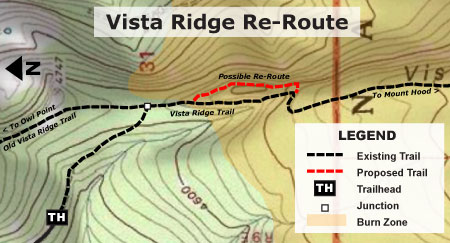
But in the spirit of recasting the Vista Ridge trail in the aftermath of the fire, and taking in these new views, now would be the perfect time to simply realign the trail along the ridge top. As shown on the map (below), this project could be done in a weekend by volunteers, if approved by the Forest Service.

(Click here for a larger map]

The fire has already done the heavy work of trail building by clearing the ground to mineral soil: designing and completing a realigned trail here would be quite straightforward. The slope of the ridge top, itself, is surprisingly gentle and would allow for an easy grade, similar to the current trail.

I hope to pitch this idea to the Forest Service, so if you’re interested in getting involved, watch the Portland Hikers forum for updates. That’s where volunteer work parties will be organized if there is interest from the USFS.

Until then, take the time to explore the fire zone, and watch the unfolding forest recovery firsthand. Visit the Portland Hikers Field Guide for directions to the Vista Ridge Trailhead.