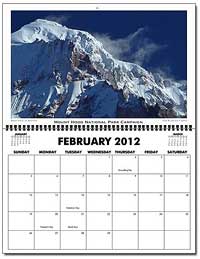
2012 Mount Hood National Park Calendar

Each year at about this time I assemble the Mount Hood National Park Scenic Calendar. The proceeds are modest, but do help support the Mount Hood National Park Campaign website and related project expenses. The main purpose is simply to promote the project, and make the case for the campaign with pictures.

I’ve published the calendars since 2004, and the photos in each calendar are from trips and trails I’ve explored in the previous year. Thus, the 2012 calendar features photos I’ve taken on my weekly outings throughout 2011.

I get a surprising number of questions about the photos, so in addition to simply announcing the 2012 calendar, I thought I would dedicate this article to the story behind the images.

The 2012 Scenes

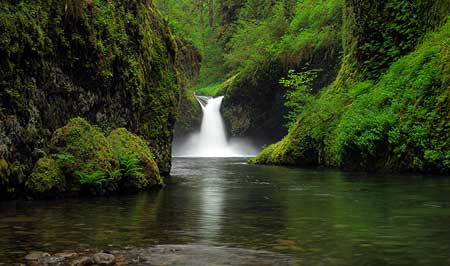
The cover image for the 2012 calendar is a world-class favorite: Punchbowl Falls on Eagle Creek (below), one of our iconic local scenes that is recognized around the world. The Eagle Creek trail is busy year-round, so I picked a Wednesday morning in June to slip in between the crowds, and had Punchbowl Falls to myself for nearly an hour.

Cover: Punchbowl Falls on Eagle Creek

In spring, this view requires wet feet — or waders — to shoot, as I was standing in about a foot of water and 30 feet from the stream bank to capture this image. I chose wet feet over waders, and to say they were numb afterward would be an understatement!

For the January calendar image, I picked this view (below) of the southeast face of Mount Hood, as seen from the slopes of Gunsight Butte. This was taken on a very cold afternoon last January on a snowshoe trip in the Pocket Creek area. This image benefited from some Photoshop editing, as I removed my own boot prints from the otherwise pristine snow in the foreground!

January: Mount Hood from near Pocket Creek

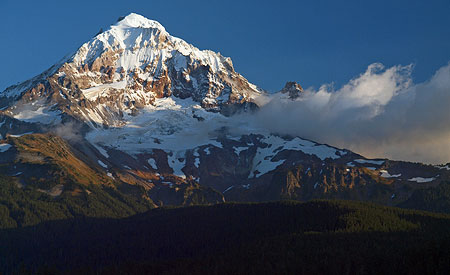
I try to reflect the seasons with the monthly photos as best I can, but the February image (below) of the Sandy Headwall in the new calendar is an example where the scene could be in mid-winter, but was really captured just a few days ago, with the first blanket of snow transforming the summit of Mount Hood.

February: The Sandy Headwall in early autumn

This close-up photo was taken from the slopes of Bald Mountain, near Lolo Pass on a brilliant autumn afternoon. It features a new camera toy I picked up this year, too — a 70-300mm telephoto lens that replaced my older, less powerful version.

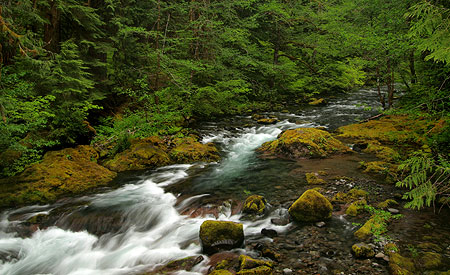
For March, the calendar image (below) is from a June hike along the Hot Springs Fork of the Collawash River. The stream is known to many (incorrectly) as “Bagby Creek”, as it is home to the historic guard station and rustic bath houses at Bagby Hot Springs.

March: The Hot Springs Fork of the Collowash River

The Bagby area has been in the news this year because of an ill-conceived and controversial Forest Service plan to privatize the operations, but I hiked the trail for the beauty of the stream, itself. It’s a beautiful forest hike through old-growth forests and past lovely stream views, albeit very well traveled by the hordes of hot-spring seekers!

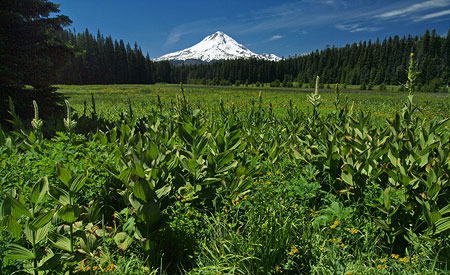
The April calendar scene (below) is one that few will ever see in person, as it features an off-trail view across little-known Brooks Meadow, on the high slopes of Lookout Mountain, east of Mount Hood. The day was especially memorable for the wildlife all around me as I shot the scene — elk bugling in the forest margins, hummingbirds moving through the acres of wildflowers and several hawks prowling the meadow from the big trees that surround it.

April: Brooks Meadow and Mount Hood

I featured Brooks Meadow in this article earlier this year, and was later disappointed to see closure signs posted at the public access points. So, until the policy changes, this view is officially off-limits to the public.

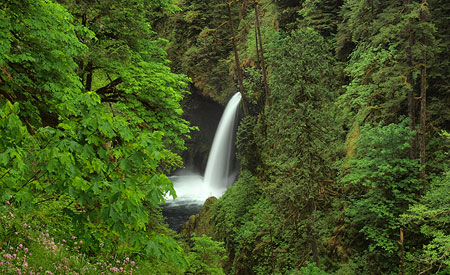
For the month of May, I picked a much-photographed view of Metlako Falls from along the Eagle Creek Trail (below). This view was captured on the same day as the Punchbowl Falls scene on the calendar cover.

May: Metlako Falls on Eagle Creek

A little secret among photographers is that a clean shot of Metlako Falls requires you to plant at least one foot on the scary side of the cable fence that otherwise keeps hikers from slipping over a 200 foot cliff. It’s perfectly safe… as long as you don’t fall! My main goal was to capture the scene with the spring flowers that appear in the lower left, something I’d admired in other photos.
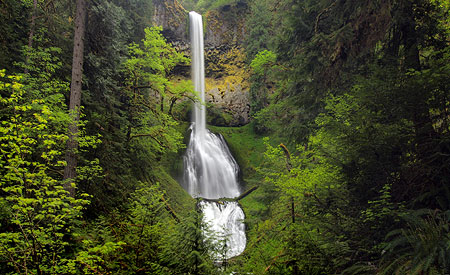
2011 was a wet year with a persistent snowpack in the Oregon high country, so June hiking was still focused on the lowlands, and especially on waterfalls, which benefited from the runoff. In early June, I made a trip along the Clackamas River Trail to beautiful Pup Creek Falls (below), an impressive, lesser-known cascade tucked into a hidden side canyon, just off the main stem of the Clackamas. I profiled the hike in this WyEast Blog article.

June: Pup Creek Falls

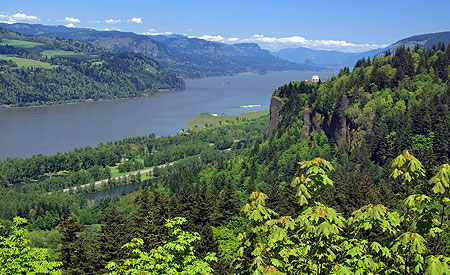
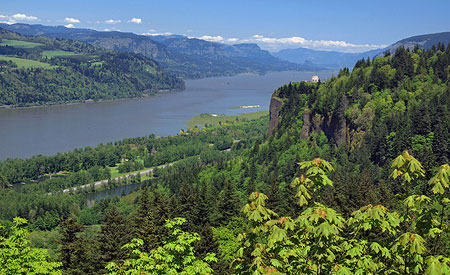
For July, the scene is another familiar view — the sweeping panorama of Crown Point and the Columbia Gorge from Chanticleer Point, at Women’s Forum State Park (below).

In a typical year, this might have been a day for hiking in the mountains, but in 2011, the lingering snowpack persisted until the end of July. This image shows the resulting swollen, flooded Columbia, with spring levels of runoff continuing well into the summer.

July: Crown Point and the Columbia from Chanticleer Point

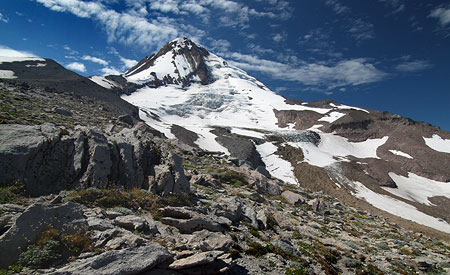
The high country trails finally opened in early August, and I followed one of my summer rituals with a hike to Cooper Spur, high above Cloud Cap Inn on the east slopes of Mount Hood. This view (below) is from the south Eliot Glacier moraine, just below the spur. I profiled a proposal for improving the Cooper Spur trail in this WyEast Blog article.

Not visible at this scale are the ice climbers who were exploring the lower Eliot Glacier icefall that day, in the right center of the photo.

August: Eliot Glacier and Mount Hood from the slopes of Cooper Spur

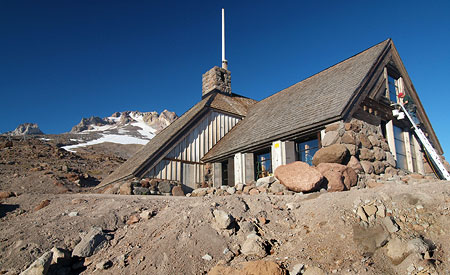
In September I was doing research on historic Silcox Hut, located about a mile and a thousand vertical feet above Timberline Lodge. The venerable structure was built in 1939 by the Works Progress Administration for a mere $80,000, and served for many years as the upper terminal of the original Magic Mile chairlift. The Friends of Silcox Hut restored the structure in the 1980s, and it was reopened for overnight guests in 1994.

Though I rarely include man-made structures in the calendar, this view of Silcox Hut (below) shows how the structure seems to rise up as part of the mountain, itself, in a triumph in architectural design. The worker on the ladder is part of a 2011 American Recovery and Reinvestment Act (ARRA) project to further restore the building for generations to come.

September: Historic Silcox Hut

In October, I usually scramble to capture early fall foliage images for the calendar. Mount Hood and a group of vine maples obliged this year in this view from Lolo Pass Road (below), captured just a few days ago on a beautiful Indian Summer day.

October: Mount Hood in Autumn from Lolo Pass Road

The November calendar scene (below) is from Lolo Pass, proper, taken in late October on a crisp evening just before sunset. The scene includes all of the ingredients that make autumn on Mount Hood so rewarding for photographers: the first blanket of snow had fallen at the highest elevations, while the meadows above timberline have turned to shades of read and gold. The mountain, itself, is wrapped in swirling autumn clouds. Spectacular!

November: Mount Hood at sunset from Lolo Pass

The final image in the new calendar is of Tamanawas Falls in winter (below). The falls are located on Cold Spring Creek, a major tributary to the East Fork Hood River, and this scene was captured last January while on a hike with an old friend visiting from Nevada. In this scene, rays of intermittent sunshine were lightening up mist from the falls, creating what can only be described as a “winter wonderland”! The hike to Tamanawas Falls is described in this 2008 WyEast Blog article.

December: Tamanawas Falls on Cold Spring Creek in winter

The thirteen images I chose for the 2012 Mount Hood National Park Calendar were narrowed from 117 images that I had set aside over the course of 2011. These were the “best” of several thousand images taken on something upward of 50 outings to Mount Hood and the Gorge. As always, these adventures took me to new places and discoveries, as well as my old haunts.

And as always, the magnificent scenery further confirmed my conviction that Mount Hood should be set aside as our next National Park! Hopefully, the calendar makes that case, as well.

Where can I get one?

The 2012 calendars are available now at the Mount Hood National Park Campaign store. They are large and functional, measuring 17” across by 22” tall, with plenty of room for writing notes and scheduling activities. They sell for $24.99, with about 25% of the proceeds going to support the Mount Hood National Park Campaign.

Thanks for your support!

Farewell to an Old Friend

The Bucher barn and Nesmith Point (2008)

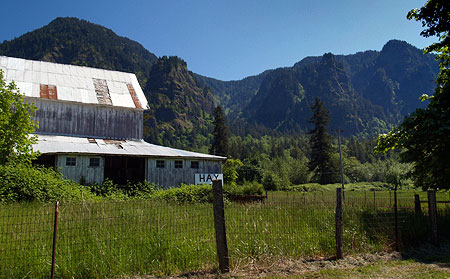
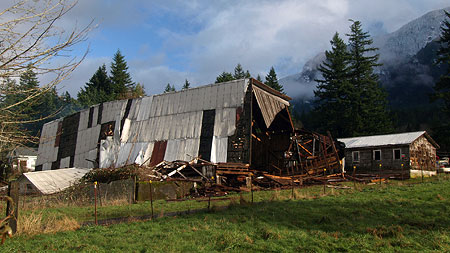
For camera buffs, the century-old Bucher family dairy barn at the foot of St. Peters Dome in the Columbia River Gorge has been like an old friend. The huge, stately old structure could not have been more picturesque, with its bleached planks and rusty tin roof standing in dramatic contrast to the towering basalt walls of the Gorge.

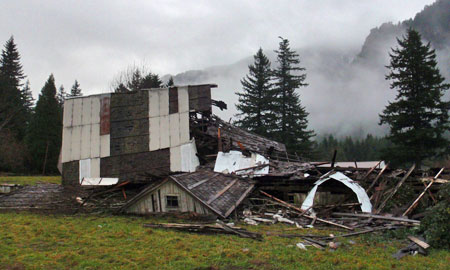
Thus, it was to the great dismay of many when the barn came down this fall, and now is in the process of being salvaged.

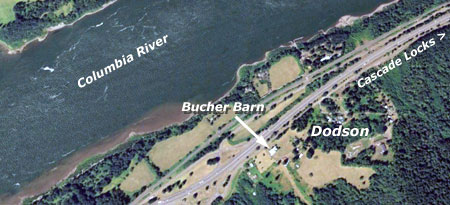
The Bucher barn was located in the old Dodson district, a fading rural village that experienced its heyday in the 1930s, when the original Columbia River Highway was the premier travel route through the Gorge.

Until its recent collapse, the barn had survived to become the most prominent structure in the Dodson district in recent years, familiar to speeding traffic on I-84 (and plainly visible in the air photo, above).

The Bucher barn in happier days (2006)

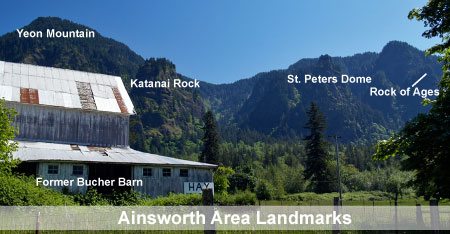
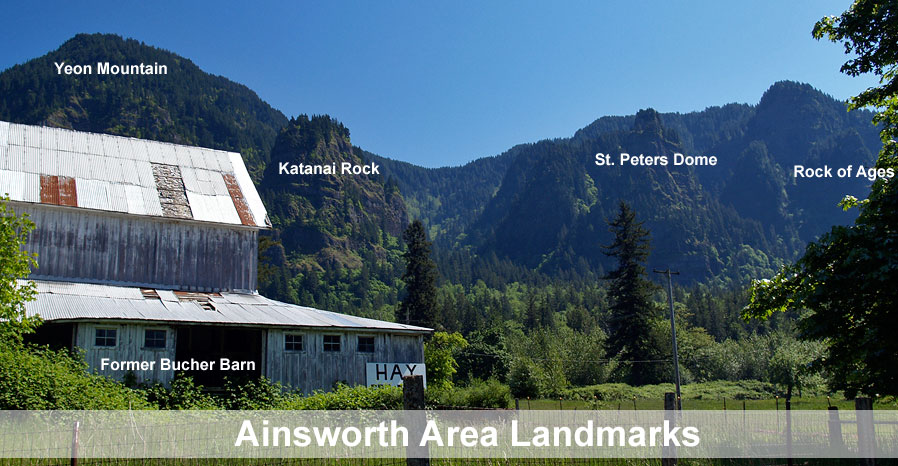
The Bucher barn was tucked at the base of the towering cliffs and spires of Ainsworth State Park, with Yeon Mountain, Katanai Rock, St. Peters Dome and Rock of Ages filling the skyline. Nesmith Point is also prominent, and is the loftiest cliff in the Columbia Gorge, rising nearly 4,000 feet directly above the river.

The barn was located in an area that made headlines in the winter of 1996, when a series of dramatic debris flows roared down from the Gorge rim and burst across I-84, closing the freeway for five days and destroying nearby homes — but sparing the barn. (click here for a full account of the debris flows)

Beginning of the end in November 2010

In recent years, the U.S. Forest Service and Oregon State Parks have been actively acquiring private land in proximity to the Bucher barn as part of implementing the long-term vision for the Columbia River Gorge National Scenic Area. According to the National Integrated Land System (NILS), these acquisitions may cover the Bucher barn parcel, which could explain the barn coming down, though I have not been able to verify this connection.

(Note: please see the postscript to this article for updated background on the ownership of the barn and decision to bring it down).

The fallen barn in November 2010

The current deconstruction of the Bucher barn was underway by mid-November of this year. The plank siding had been partially removed from the lower half of the structure by Thanksgiving, but the main building frame was still intact.

By late November, however, the building had been toppled, tipping forward toward the frontage road with the roof framing intact. Whether the collapse was intentional or from a structural failure is unclear, though the ongoing salvage operation suggests that it was dropped intentionally.

Almost gone in December 2010

A series of early winter storms gripped the Gorge in late November and early December of this year, but the salvage work continues, and by mid-December, half the roof frame of the Bucher barn has been removed, along with most of the metal roofing.

At the current rate of removal, the barn will likely be gone in a few weeks, taking a bit of Oregon history with it. Thankfully, it is one of the more photographed barns in the region, so will live on through images that captured its charm and unique setting.

Bucher barn salvage in December 2010

The sudden demise of the Bucher barn is a reminder that historic barns are fading away across the Oregon landscape, so hopefully others can be equally appreciated and documented while they are still standing.

If you are interested in seeing this rapidly disappearing bit of history, take the Ainsworth exit on I-84, then follow signs to the eastbound Frontage Road and John B. Yeon State Park. The barn is located one-quarter mile from the interchange, just beyond the first house. Please respect the private property signs, and stay outside the fenced pasture.

Postscript

In April 2011, Breanna Mohr, a member of the Bucher family, provided some additional family history on the Bucher barn. The building once belonged to her great-grandfather, Joseph Bucher, a dairy farmer in the Dodson area. When Joseph Bucher passed away, his farm was divided among his children, and the portion that included the barn was passed to his daughter. Breana Mohr goes on to say:

“Now to explain why it is being tern down. The barn has been falling down for many years now, and my aunt could not keep up with the work that it needed… So the family decided to tear it down. This has been a hard thing for my family because they all still remember it being full of milk cows, (my grandfather was the milk man in Dodson) and having to get up early in the morning to milk the cows.”

Breanna also pointed out that I didn’t include Katanai Rock in the original article. The name was new to me, but after a bit of research, I learned that this is the local name for the huge monolith immediately above the Bucher farm. I’ve taken a shot at identifying the various landmarks that make up the towering heights of Ainsworth State Park and the Dodson area, including Katanai Rock:

Click here for a large version of this photo

Though all but the Katanai name are official and found on USGS maps, interpreting the jumble of contours on the map as they related to real features on the ground turns out to be more difficult than I’d imagined. Thus, I’d appreciate any corrections to this schematic that local residents or area explorers have to offer.

Finally, I’d like to thank Breanna Mohr and the Bucher family for not only providing historical background on the area, but also for keeping this fine old structure standing for so long. While it shall be missed by all of us, it was enjoyed for decades for its picturesque charm, and lives on in our memories, as well!

Proposal: Mark O. Hatfield Memorial Trail

Senator Mark O. Hatfield campaigning in 1967

One of the legacies of former Oregon Senator Mark O. Hatfield was expansion of the state’s wilderness system in 1978 and 1984, the largest expansion before or since that time. Though Hatfield was harshly criticized by conservationists for also sponsoring pro-logging legislation that led to the destruction of ancient forests, his role in creating new wilderness in Oregon remains a singular achievement that no other senator has yet matched.

To honor the senator, Congress renamed one of these new wilderness areas, the former Columbia Wilderness, as the Mark O. Hatfield Wilderness in 1996. This recognition marked the senator’s retirement from Congress after nearly a half century of public service that included serving as an Oregon legislator, Oregon’s Secretary of State, then Governor, before finally being elected to the U.S. Senate in 1967, where he served for 30 years

Senator Hatfield with wife Antoinette in 2008 (Willamette University)

The recognition also triggered another round of critiques by conservationists over Hatfield’s environmental legacy. But for many, it was also a fitting tribute to the senator who had pushed the Columbia River Gorge Scenic Act through Congress in the 1980s when it would have been easy for the Oregon Republican to simply leave the task to his Democratic counterparts.

Hatfield’s long service, and his independent stance on a number of topics, forced him to break ranks with the Republican Party on a number of progressive issues. These ranged from successfully sponsoring Oregon’s landmark civil rights legislation in 1954 (a full decade ahead of the U.S. Civil Rights Act) to his early opposition to American involvement in the Vietnam conflict, and later, the Gulf War.

His independence and principled “sanctity of life” stance that led him to champion civil rights for minorities and gays, while opposing wars, the death penalty and abortion later earned him his own chapter in Tom Brokaw’s “The Greatest Generation”.

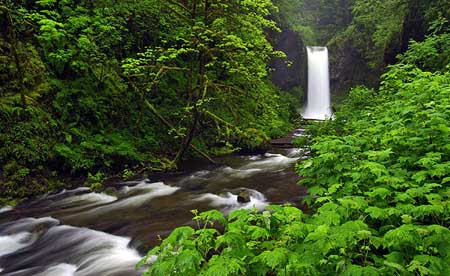
Multnomah Creek along the proposed Hatfield Trail

Though his environmental legacy is a conflicted one, Hatfield’s landmark environmental protections in Oregon still exceed that of his fellow Democrats, who claim the natural constituency of environmentalists, but have seldom acted with such determination and vision.

The Mark O. Hatfield Wilderness originally spanned the most remote high country on the Oregon side of the Columbia River Gorge, but in 2009, President Obama signed a new wilderness bill into law that expanded the Hatfield wilderness significantly. The new boundary stretches the Hatfield Wilderness from Larch Mountain and Multnomah Creek on the west to the steep ridges and canyons of Mount Defiance, on the east.

The Concept

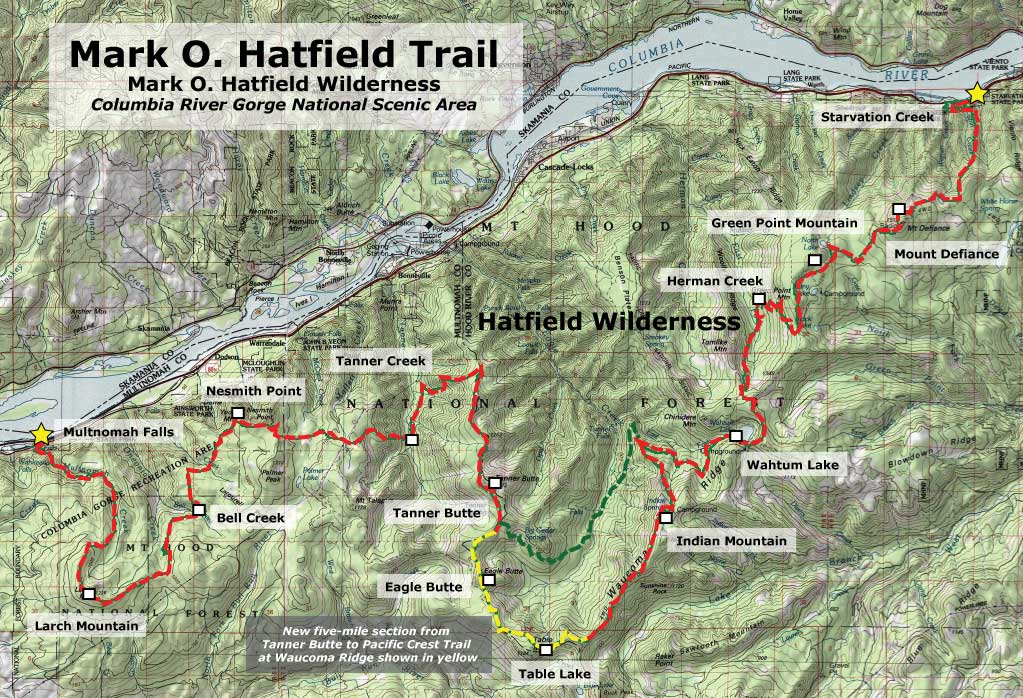
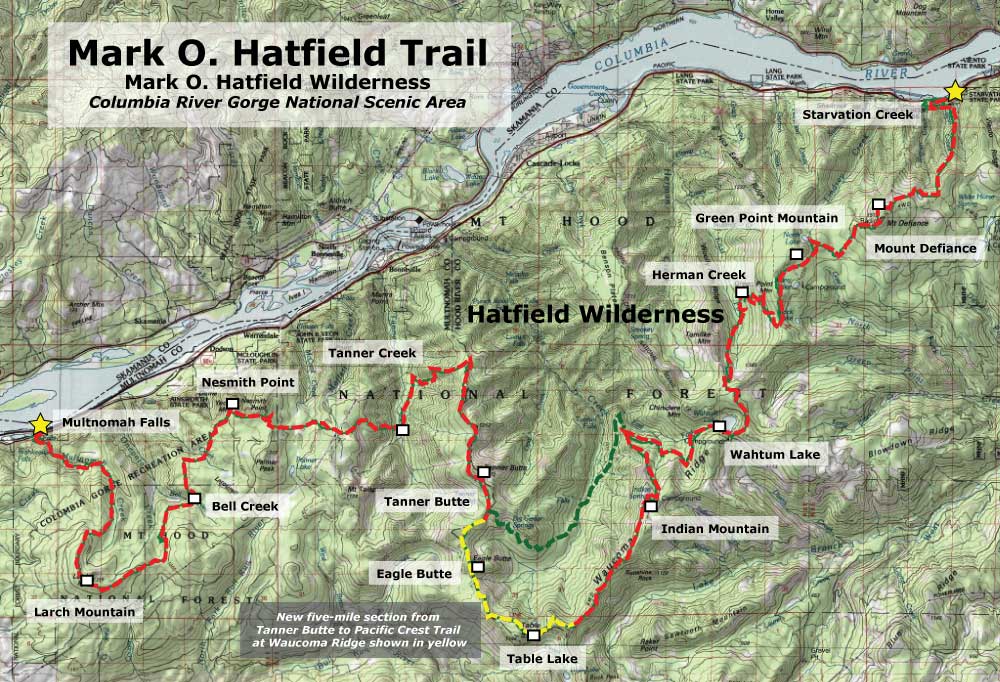
This Mark O. Hatfield Trail proposal is for a 60-mile memorial trail that spans the Hatfield Wilderness, beginning at Multnomah Falls and culminating at Starvation Creek Falls, passing through the most rugged, lonely country to be found in the Columbia River Gorge along the way. This new trail would join classic hikes like the Timberline Trail at Mount Hood and the Wonderland Trail at Mount Rainier as premier backpacking destinations of national prominence.

(click here to view a larger map)

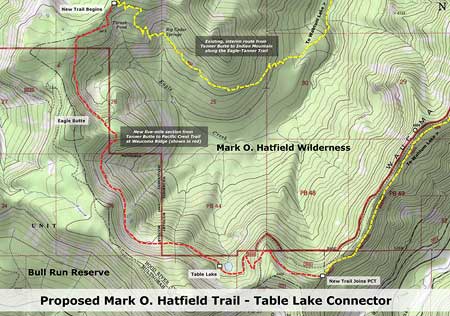
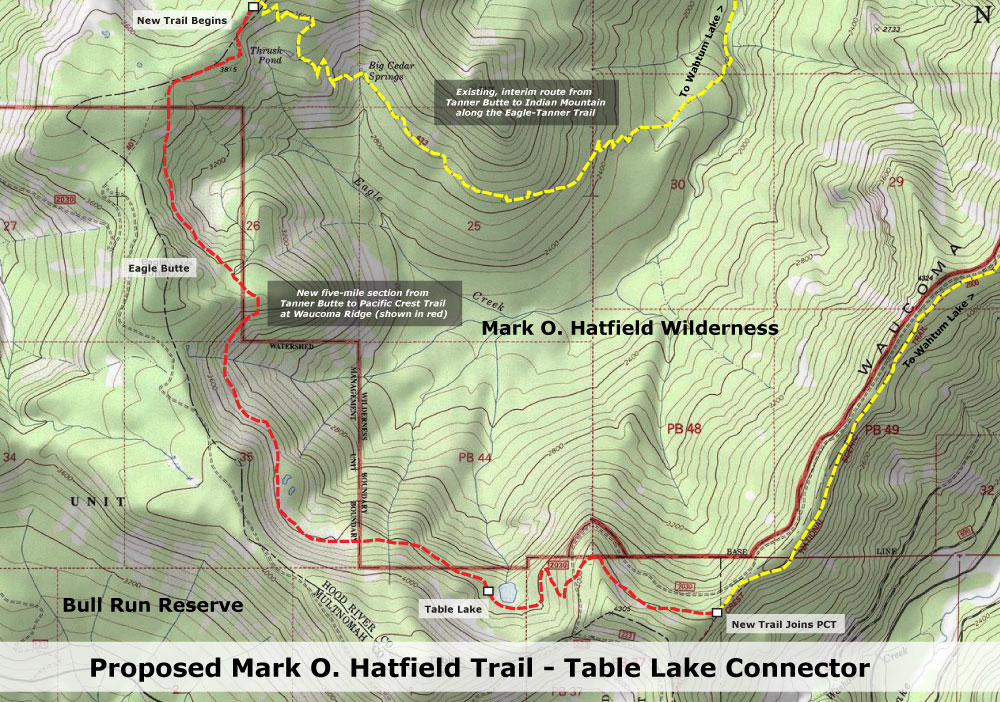
The new trail would largely be assembled from existing routes, but with a notable exception: a new, five-mile segment would curve just inside the Bull Run Reserve, along the headwaters of Eagle Creek. The new segment would bring hikers to little known Eagle Butte and rare views into the Eagle Creek backcountry that few have seen before.

Though this new trail segment would not physically enter the Bull Run watershed, it would nonetheless pass inside the reserve boundary. This would require special approval by the U.S. Forest Service, similar to that given the Pacific Crest Trail, where it crosses along the edge of Bull Run. Simply raising the issue might even challenge the absurd notion that trails and hikers present a risk to the watershed – a separate topic for another column!

Rugged Tanner Butte in the Hatfield Wilderness

Along the route, there are also many trails that would be “saved” by this proposal – routes that have been badly neglected for decades, but deserve to be maintained. In some spots, short realignments would be needed to improve old or confusing sections. In the area of Starvation Creek, for example, a redesigned trail along the final stretch near I-84 is needed to improve on the current, rather jarring re-entry into civilization.

The Trail

The 60-mile route is designed as a six-day trek, beginning at the Multnomah Falls Lodge, then leaving civilization behind for most of the next six days as the route traverses through the rugged high country of the Hatfield Wilderness.

The following trip log shows the most prominent landmarks along the trail, with proposed camp spots for five nights on the trail. The up-and-down elevation changes inherent to the Hatfield Wilderness terrain will make this a challenging trek for any hiker. Segment and cumulative mileage is shown, along with net elevation gains and losses:

Day 1 to Bell Creek: the 60-mile trek would begin along the very popular Larch Mountain Trail, following Multnomah Creek beyond the reach of the throngs at Multnomah Falls, then climbing to historic Sherrard Point on Larch Mountain, another popular tourist destination. From here, the trail leaves the tourists behind, dropping into ancient forests along Bell Creek and the first campsite at 10.5 miles.

Day 2 to Dublin Lake: this is the most strenuous day along the circuit, covering 12.8 miles as the trail climbs over the shoulder of Nesmith Point, drops into Tanner Creek canyon, then climbs out again to arrive at Dublin Lake. At Nesmith Point, hikers can look down on the Columbia River nearly 4,000 feet below from the highest point on the Gorge rim, and on Van Ahn Rim hikers will get a rare look into the backcountry of the Tanner Creek canyon and into the Bull Run Reserve.

Indian Mountain with Eagle Butte in the distance

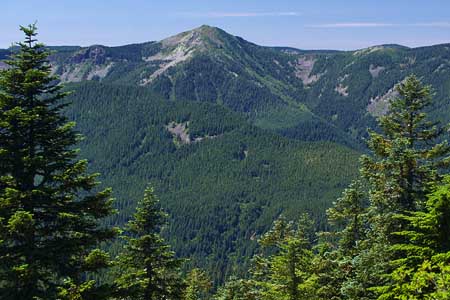
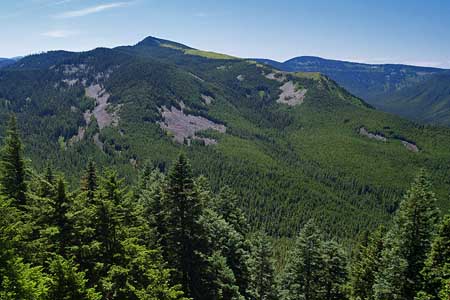
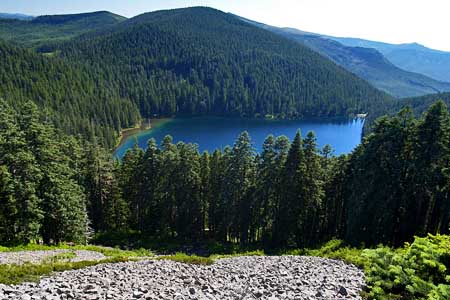
Day 3 to Table Lake: the third day of the proposed Hatfield Trail is a less challenging 9-mile hike along the high ridges of the Eagle Creek backcountry, allowing time for the spectacular side trip to Tanner Butte, along the way. The new trail segment begins north of Tanner Butte, and traverses across the rugged talus slopes and mountain tarns of Eagle Butte and Table Mountain, with expansive views into the Eagle Creek canyon, 3,000 feet below. The campsite for this proposed new segment is inside the Bull Run Reserve, at little-known Table Lake. Though the trail is inside the Bull Run boundary, the entirely of the trail is within the upper reaches of the Eagle Creek drainage, and is outside the physical watershed of the Bull Run.

Day 4 to Herman Creek: on the fourth day, the route joins the Pacific Crest Trail and passes high over the shoulder of Indian Mountain, then drops to popular Wahtum Lake. The lake provides a midpoint trailhead access for those looking for a shorter trip, an alternative camping spot or possibly a feed drop for those planning stock trips along the trail. From Wahtum Lake, the trail climbs over Anthill Ridge, then descends past Mud Lake before reaching a campsite at Herman Creek at the 12.6 miles.

Wahtum Lake from Anthill Ridge along the proposed Hatfield Trail

Day 5 to Warren Lake: this is also a less demanding day, with most of the climbing in the first few miles, as the route climbs out of the Herman Creek canyon, and passes the rocky summit of Green Point Mountain, with expansive views of the surrounding wilderness. From here, the route passes above Rainy, North and Bear lakes before curving around the rocky north face of Mount Defiance, then dropping to beautiful Warren Lake at 9.5 miles.

While the recommended circuit includes a night at Warren Lake to enjoy the exceptionally rugged setting and wilderness scenery, the relatively short, final leg to Starvation Creek will draw many hikers to make this a 5-day trip, and skip the final campsite at Warren Lake. For these hikers, the lake might simply offer the opportunity for a quick swim before heading back to civilization.

Bear Lake and Mount Defiance along the proposed Hatfield Trail

Day 6 to Starvation Creek: the short, 5.6 mile final leg travels steeply down the north slope of Mount Defiance along Starvation Ridge, dropping 3,600 feet in just over five miles. Along the way, the trail passes above dizzying cliff-top viewpoints and shady side-canyon waterfalls before reaching the Columbia River and the end of the trail at Starvation Creek.

The restrooms, telephone, easy highway access and shady, un-crowded streamside picnic sites below lofty Starvation Creek Falls make this an ideal terminus for hikers seeking to relax after their adventure.

The following table summarizes the recommended 6-day hike, with running mileage and daily elevation gains:

What would it take?

Much of the trail network described is exceptional in scenic value, but suffers from years of deferred maintenance and modernization. Since most of the route is already in place, the Mark O. Hatfield trail concept would mostly require a stepped up commitment to maintaining and improving existing routes.

This would include basic maintenance, like brushing out overgrown routes, tread repair and drainage, but would also new signage and log bridges across major streams, consistent with the Wilderness Act . This work could begin immediately, but will require funding, as the route is generally too remote and rugged to depend entirely on volunteer labor.

(Click here for a larger map of the new trail)

Constructing the new 5-mile segment proposed inside the Bull Run Reserve is the boldest element of this proposal, and a tall order for the federal bureaucracy. However, a simple interim plan is to route the new trail along the existing Eagle/Tanner (No. 433) and Indian Spring (No. 435) trails. These trails are shown in yellow on the map, above, and in green on the map showing the entire Hatfield Trail proposal.

This interim route would reduce the total hike distance by about two miles, and add about 1,000 feet of elevation gain. However, the interim option would allow for full implementation the Hatfield Trail concept in the near term, rather than waiting for the bureaucracy to address the watershed issue.

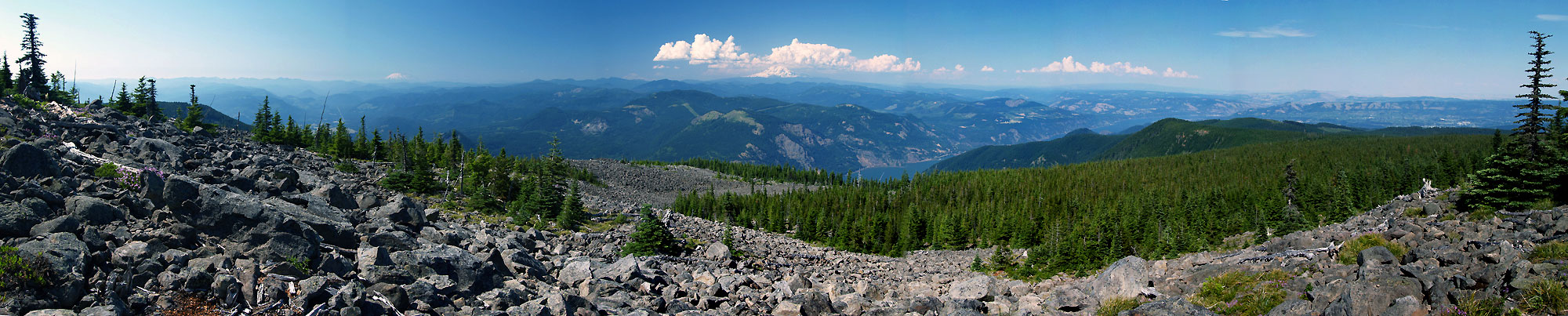
Columbia River from rugged Mount Defiance, near Warren Lake

(Click here for a large view of the panorama)

Another possibility for the long term is to finally complete the long-stalled Gorge Trail (No. 400) connection from Wyeth to Starvation Creek. This missing piece is a segment that would curve around the steep face of Shellrock Mountain (the focus of a future WyEast Blog article), creating a 30-mile trail connection from Multnomah Falls to Starvation Creek.

This connection would allow for a loop hike for hardy backpackers looking for a 90-mile backpack. However, because substantial portions of the existing Gorge Trail 400 are exposed to freeway noise and other reminders of civilization, the loop is not included in the Mark O. Hatfield Trail concept.

Why now?

This isn’t a difficult project to realize, and it would pay fitting tribute to begin work on this concept in time for Senator Hatfield to personally see the project begin – possibly even to participate in the ground breaking.

Accomplishing this project would be well-deserved recognition for the heavy lifting he did as our senator to protect the Columbia Gorge and Oregon’s wilderness for generations to come. The better question: why not now?

New Maps of Mount Hood and the Gorge

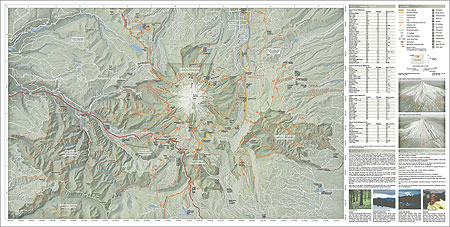
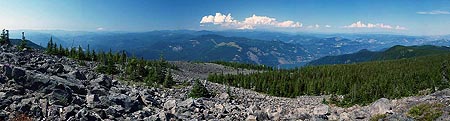
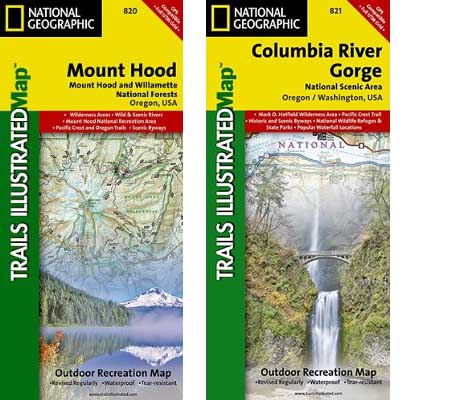
Mount Hood and the Columbia River Gorge were in fine company earlier this year when the National Geographic Society released a pair of new maps in their Trails Illustrated series covering both areas. This map series is generally limited to national parks, so the few outstanding areas outside the National Park System (NPS) included in the set read like a who’s who of places that should be made into national parks or recreation areas.

NatGeo01

For locals already familiar with these areas, the new maps feature surprisingly accurate, up-to-date information on trails, campgrounds, forest roads and — most impressively — the many new and expanded wilderness areas that were legislated this year with the new Mount Hood wilderness bill. This information, alone, makes them a worthy addition to your map collection.

As with any National Geographic map, the cartography is lush, and containes a wealth of details. One example are Bureau of Land Management (BLM) and Oregon State Forest (OSF) lands that are helpfully mapped where they abut national forest boundaries. But most importantly, the new maps show numbered forest trails on a backdrop of contour lines an relief shading, making for an excellent trip planning tool or handy map for the field.

The Mount Hood map (No. 820) extends from Lost Lake south to the edge of the Mount Jefferson Wilderness, and from Table Rock on the west to the Warm Springs reservation on the east. New, expanded boundaries for the Mount Hood, Badger Creek, Bull of the Woods and Salmon Huckleberry Wilderness Areas are shown, and are interesting to study for those who have only seen the new wilderness legislation on cryptic web maps.

NatGeo02

This detail of the Cloud Cap area includes a note about the washed-out Eliot Branch crossing on the Timberline Trail

The Mount Hood map also includes the newly created Clackamas and Roaring River wilderness areas, the new “Mount Hood National Recreation Area” (a new designation adjacent to Badger Creek Wilderness) and the various new additions to the Wild and Scenic River system. Map blurbs provide travel information, area history and surprisingly detailed specifics on each of the wilderness areas that will be valuable to visitors exploring the area.

The Columbia Gorge map (No. 821) extends from Troutdale east all the way to the Deschutes River, encompassing the entire Columbia River Gorge National Scenic Area. The map also extends from Lost Lake on the south well into the Gifford Pinchot country north of the river, incorporating a good portion of the Indian Heaven Wilderness and all of the Silver Star Mountain backcountry.

Like the Mount Hood map, the Gorge map includes trail and travel information, map blurbs with travel information, area history, details on popular destinations within the Gorge and depicts the new wilderness boundaries resulting from the recent Mount Hood wilderness legislation.

NatGeo03

This except from the new Roaring River Wilderness shows the new boundaries in green, and the new Wild and Scenic River designation for the South Fork Roaring River

Both maps are printed on waterproof paper for use in the field, and measure approximately 4.25″ x 9.25″ folded, fitting neatly into a coat pocket or backpack. Both are at a scale of 1:75,000, which is a bit small for some hikers, but has the advantage of being a great travel planning map – or just a nice way to explore those new wilderness areas from the comfort of your traveling armchair. Each map retails for about $12 directly from National Geographic or from online book sellers.

The Million Dollar View

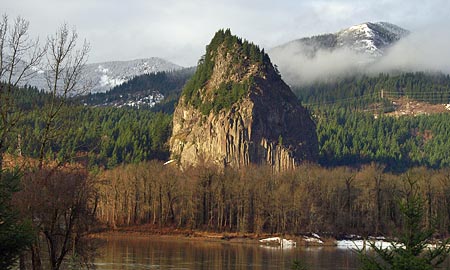
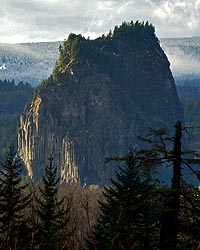
Beacon Rock rising above the Columbia, as viewed from the Oregon side

Beacon Rock rising above the Columbia, as viewed from the Oregon side

Beacon Rock rises nearly 1,000 feet above the Columbia River, and forms the nucleus of some of the finest park lands on the Washington side of the Columbia Gorge. The famous network of catwalks and stairways installed on Beacon Rock in the 1920s leads thousands of visitors to the airy summit each year to marvel at the view.

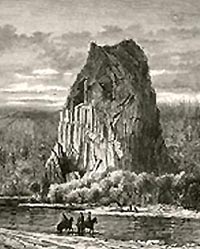
Nineteenth-century engraving of an early Beacon Rock scene

Nineteenth-century engraving of an early Beacon Rock scene

Beacon Rock, itself, is a testament to conservation, having been saved from an early 1900s scheme to actually mine the monolith for quarry stone. Today, it is among the most visited — and best loved — spots in the Gorge, with campgrounds, picnic areas and an impressive network of hiking and bicycling trails. But when the park boundaries were laid out for Beacon Rock, the Oregon side of the river was left out of the equation.

In the early days of white settlement, fish wheels operated in the shadow of Beacon Rock, along this section of the Oregon shore, harvesting salmon from the vast migrations that moved up the river.

Early settler Frank Warren operated a cannery on the site, and the town that grew around his operation became known as Warrendale. (editor’s note: Frank Warren was the only Oregon resident known to have perished on the Titanic; his wife Anna was among the few to escape in a lifeboat, and survived, while her husband stayed behind on the ship to help other women and children into lifeboats)

Present-day view of Beacon Rock from the Oregon side

Present-day view of Beacon Rock from the Oregon side

After the demise of fish wheels and the Warren cannery in the early 1900s, Warrendale began a slow slide into obscurity. Today, the former town site has largely been replaced by Interstate-84, and a dozen homes now occupy this remnant of private parcels along the Columbia River.

This is where the story gets a bit ugly. Like all inholdings in the Gorge and around Mount Hood, the river front homes in Warrendale suffer from trespassing — both by well-meaning visitors simply trying to find access to the river, and by less courteous visitors who clearly don’t respect the numerous private property postings.

The lure of the river here is undeniable. Beacon Rock towers across the Columbia, and sandy beaches line the river in summer and fall. Yet, no public access exists along this stretch of Oregon shoreline, and thus the tension between land owners and visitors.

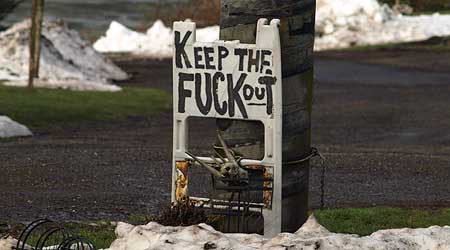
Tensions run high in Warrendale as property owners struggle to block visitors from trespassing to reach Columbia River beaches

Tensions run high in Warrendale as property owners struggle to block visitors from trespassing to reach Columbia River beaches

Some landowners have taken drastic steps, in response, posting profane signs that have shocked more than a few families who have stumbled into Warrendale. Less confrontational signs show up everywhere, making it abundantly clear that the public is not welcome in this community.

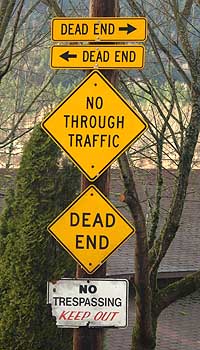
Even the official signposts in Warrendale bear blunt warnings for visitors

Even the official signposts in Warrendale bear blunt warnings for visitors

There’s no doubt that the view from these homes is among the most spectacular anywhere, but in the long term, should this stretch of beach be reserved for just a few? After all, were it not for the fish wheel and cannery that once stood here, this would likely be public land, with public access for all. Is it possible that in the long term, this unique spot can be dedicated to public access?

Not in the near term, in all likelihood. Though the Columbia River Gorge National Scenic Area (CRGNSA) receives funds each year from Congress for the express purpose of acquiring private parcels in critical locations, most acquisitions are for properties that directly abut federal or state lands, or are in pristine condition. The dozen homes in Warrendale are neither — they are separated from public lands by Interstate-84 and largely developed.

One viable option for the CRGNSA is to follow the lead of private land acquisition organizations, like the Nature Conservancy and Trust for Public Lands, and purchase conservation easements or living trusts for these properties. For private conservation groups, these have been valuable real estate tools for eventually bringing private lands into the public realm. Another option is a partnership between the CRGNSA and one of these organizations to reach a similar result.

It’s not too soon for the CRGNSA to be thinking about this possibility. This is a million dollar view that deserves to be enjoyed by all, not just a few.

Postscript: In June 2010, one of the riverfront homeowners in Warrendale, 68-year-old James Koch, threatened four salmon fishermen who were anchored for the night in their boat just offshore, then fired rifle shots toward the boat. After his arrest by Multnomah County authorities, he was found guilty of felony unlawful use of a weapon, misdemeanor menacing and misdemeanor recklessly endangering other.

During his trial, he called on neighbors who testified about the public encroaching on their riverfront property. In this November 3, 2010 Oregonian article, one of the fishermen, Steve Bruce, said he was “sickened by that attitude. It’s not just him (Koch), they all feel that they own the land under the water.”

Koch could face prison time, pending sentencing, and will lose is right to own or operate firearms.

Second Postscript: In November 2010, James Ellis Koch was sentenced in Multnomah County court to 60 days jail time and three years probation for firing weapons at four salmon fishermen who were anchored for the night in their boat just offshore from his Warrendale property.

In this November 19, 2010 Oregonian article, Judge Janice Wilson took issue not only with Koch’s unrepentant attitude, but also with the vigilante culture that exists in the Warrendale community. From the article:

James Koch also offered these words: “I’m sorry for whatever happened, the stuff that happened out there that evening.”

That prompted this response from the judge. “(That) is not an apology,” she said. “It’s actually worse than nothing. It’s an anti-apology.”

The judge said Koch wasn’t justified that night in the slightest. The fishermen weren’t making noise, they weren’t drinking and they were lawfully camping on the water. The judge said she was concerned about Koch’s attitude, as well as the attitudes of his neighbors.

Neighbors testified that they are so wary of strangers and crime that they stop unknown drivers traveling through their remote east county hamlet. Yet on the night Koch fired his weapons, they didn’t look to see what was going on because shots in their neighborhood aren’t unusual.

“I don’t know what that says about that neighborhood … but it’s a little bit scary,” the judge said. “… This vigilante culture in this neighborhood is of grave concern to the court.

Phoca Rock

An early 1900s postcard shows a steam ship passing Phoca Rock

An early 1900s postcard shows a steam ship passing Phoca Rock

Anyone who has made a few trips through the Columbia Gorge has noticed the small monolith that pokes out of the center of the river near Cape Horn. This is Phoca Rock, and its distinction lies partly in the fact that it is one of the few landmarks in the Gorge that carries the name given by Lewis and Clark on their 1805-06 Corps of Discovery journey.

Lewis and Clark didn’t actually name the rock until they were camped on the Oregon Coast, and compiled their journals while suffering through a dank Northwest winter. William Clark named the rock for the abundant harbor seals spotted in the river – phoca vitulina.

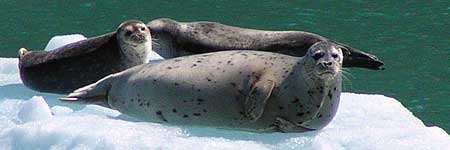
Harbor seals basking in Alaska's Tracy Arm

Harbor seals basking in Alaska's Tracy Arm

Harbor seals are still native to the lower Columbia River, although in smaller numbers than when Lewis and Clark paddled through. Government bounties in Oregon and Washington killed more than 20,000 Harbor seals in the two states from the 1920s through 1972, when hunting was finally banned.

The Harbor seal population has since rebounded from fewer than 7,000 seals at the time of the ban to more than 17,000 today. Still, biologists in both states must monitor the seals for health and impacts from commercial fisheries.

Phoca Rock continues to serve as a river beacon today, marking the edge of shipping lanes on the Columbia. The rock marks the edge of two-foot shallows along Oregon’s Sand Island and the 45-foot deep Candiana Channel that separates Phoca Rock from Cape Horn, on the Washington side.

Phoca Rock today, as seen from Bridal Veil State Park

Phoca Rock today, as seen from Bridal Veil State Park

Clark estimated the rock to be 100 feet tall, but today we know it to be just 30 feet. Its prominence lies in its isolation, and early names for the rock underscored this point: beginning in the mid-1800s, Phoca was alternately called “Hermit’s Islet”, “Lone Rock” and “Sentinel Rock” before the federal government finally restored the original name given by Lewis and Clark, in the early 1900s.

This 1911 map shows Phoca Rock with its restored name

This 1911 map shows Phoca Rock with its restored name

So, why is Phoca Rock sitting alone, in the middle of the Columbia River? Chances are the rock isn’t a tiny cousin to nearby Beacon Rock, the exposed, solid core of an ancient volcano. Phoca is more likely an outcrop of the Grande Ronde basalt flows that produced the cliffs of Cape Horn, to the north, and the Pillars of Hercules, along the Oregon shore.

One of many old postcard views that show "Sentinel Rock", one of the itinerant names for Phoca Rock

Diminutive Phoca Rock is as tough as it is tiny. The rock survived multiple Missoula Floods, after all, and thousands of years of parting the waters of the Columbia River. And left alone, Phoca Rock will continue to weather the elements for millennia with little change, long after the ribbons of asphalt and steel that line the Gorge have vanished.

We have to choose?

Crown Point from Women's Forum State Park - a threatened view?

Crown Point from Women's Forum State Park - a threatened view?

According to the Columbia Gorge Commission website, the Vital Signs Indicators Project is “identifying several measures to assess changes in the scenic quality of the Gorge over time.” Translated, this means that the Gorge Commission has set up a web survey to poll the most popular Gorge vistas among the traveling public. The survey allows “up to three” favorite vistas for each of Interstate 84, Highway 14 and the Historic Columbia River Highway.

Wait..! Just three? Do we really have to choose? Well, yes. And according to the Commission, “the views with the most votes for each roadway will be included in the list of key Gorge views that will be monitored in the future by the Commission.” So, your votes matter, at least for this effort. The good news is that this project is intended to help the Commission cope with man-made eyesores that mar scenic vistas, as well as “vegetation management”, so that views like the classic scene from Women’s Forum Park (above) aren’t blocked over time.

Thus, hard as it might be to choose, you should take a moment to visit their website and take the survey. It will take you 10 minutes, or so, and you’ll be helping the Gorge in a small way. The survey runs through December 5, 2008, and after that, you’ll have to settle for reading the results. Here’s the link to the Gorge Commission website.