Mount Hood Loop Interpretive Signs

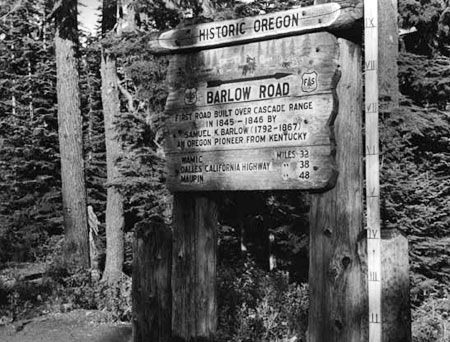
Original “Historic Oregon” sign at Barlow Pass in the 1940s (Wikimedia Commons)

Original “Historic Oregon” sign at Barlow Pass in the 1940s (Wikimedia Commons)

One of the unexpected discoveries in launching the Mount Hood National Park Campaign in 2004 was the surprising number of people who think our mountain and gorge are already protected as a national park!

This tragic misconception is shared by newbies and natives, alike, so my conclusion is that it comes from the “park-like” visual cues along the Mount Hood Loop: the historic lodges, rustic stone work and graceful bridges along the old highway. There is also a surprising (if disjointed) collection of interpretive signs that you might expect to find in a bona fide national park.
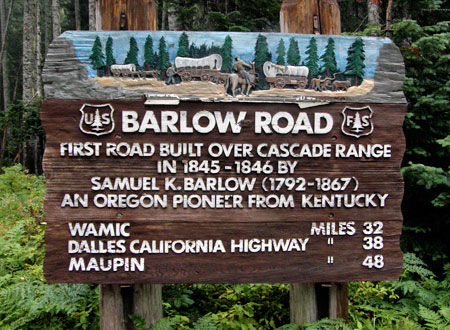
The new (or restored?) sign at Barlow Pass in 2010

The new (or restored?) sign at Barlow Pass in 2010

The interpretive signs around Mount Hood are an eclectic mish-mash of survivors from various public and private efforts over the years to tell the human and natural history of the area.

The oldest signs tell the story of the Barlow Road, the miserable mountain gauntlet that marked the end of the Oregon Trail. The above images show one of the best known of these early signs, a mammoth carved relief that stands at Barlow Pass (the current sign appears to be a reproduction of the original).

Less elaborate signs and monuments of assorted vintage and styles are sprinkled along the old Barlow Road route wherever it comes close to the modern loop highway: Summit Prairie, Pioneer Woman’s Gravel, Laurel Hill.

More recently, the Forest Service and Oregon State Parks have been adding much-needed interpretive signage along the Historic Columbia River Highway (as described in this article), an encouraging new trend.
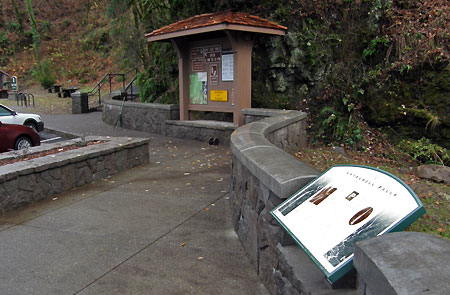
Oregon State Parks interpretive panels are showing out throughout the Gorge

Oregon State Parks interpretive panels are showing out throughout the Gorge

Thus, I was thrilled when the Forest Service Center for Design and Interpretation in McCall, Idaho contacted me last year about a new series of roadside signs planned for the Mount Hood Loop. They had seen my photos online, and were looking for some very specific locations and subjects.

In the end, the project team picked eight of my images to be included on a series of four interpretive signs. The following is a preview of the signs, and some of the story behind the project. The new signs should be installed soon, and hopefully will survive at least a few seasons on the mountain!

The Signs

The first installation will be placed somewhere along the Salmon River Road, probably near the Salmon River trailhead. This sign focuses on fisheries and the role of the Sandy River system as an unimpeded spawning stream for salmon and steelhead.
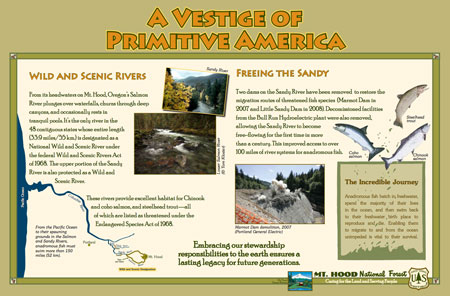
This sign will appear near the Salmon River (USFS)

This sign will appear near the Salmon River (USFS)

(click here for a large view)

Part of the narrative for this sign focuses on the removal of the Marmot and Little Sandy dams, a nice milestone in connecting the network of Wild and Scenic Rivers in the Sandy watershed to the Columbia. A PGE photo of the Marmot Dam demolition in 2007 is included on the display, along with river scenes of the Sandy and Salmon. The Salmon River image on the first sign is the only one I captured specifically for the project, in early 2012. It’s a rainy winter scene along the Old Salmon River Trail.

The second sign will be placed at the Little Zigzag trailhead, located along a section of the original Mount Hood Loop highway at the base of the Laurel Hill Grade. The site already has an interpretive sign, so I’m not sure if this is an addition or replacement for the existing (and somewhat weather-worn) installation.
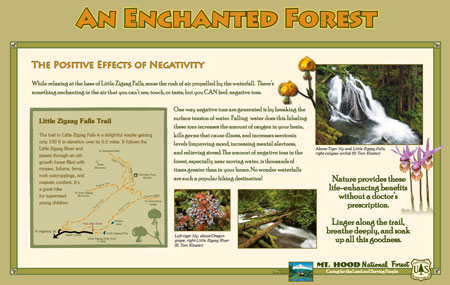
This sign will be located at the Little Zigzag trailhead (USFS)

This sign will be located at the Little Zigzag trailhead (USFS)

(click here for a large view)

The content of the Little Zigzag sign is unique, launching into a surprisingly scientific explanation of how the negative ions created by streams and waterfalls feed your brain to give you a natural high! Not your everyday interpretive sign..! It also includes a decent trail map describing the hike to Little Zigzag falls, as well as other trails in the area.

The Forest Service used several of my images on this sign: views of Little Zigzag Falls, the Little Zigzag River and several botanical shots are incorporated into the layout.

The Little Zigzag Falls image has a bit of a back story: the Forest Service designers couldn’t take their eyes off a log sticking up from the left tier of the falls. To them, it looked like some sort of flaw in the image. I offered to edit it out, and after much debate, they decided to go ahead and use the “improved” scene. While I was at it, I also clipped off a twig on the right tier of the falls. Both edits can be seen on the large image, below:
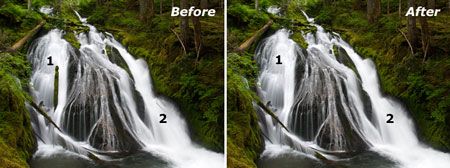
USFS_Panel_1a

(click here for a larger image)

I should note that I rarely edit features out of a photo — and only when the element in question is something ephemeral, anyway: loose branches, logs, or other debris, mostly… and sometimes the occasional hiker (or dog) that walks into a scene!

The third sign will be installed at the popular Mirror Lake trailhead, near Government Camp. Like the Little Zigzag sign, this panel has a trail map and hike description for Mirror Lake and Tom Dick and Harry Mountain.

A nice touch on Mirror Lake sign is the shout-out to the Children & Nature Network, a public-private collaborative promoting kids in the outdoors. I can’t think of a better trail for this message, as Mirror Lake has long been a “gateway” trail where countless visitors to Mount Hood have had their first real hiking experience.
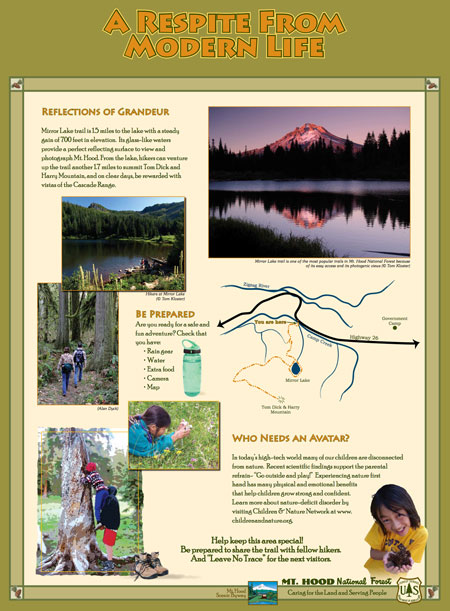
This sign will be at the Mirror Lake trailhead (USFS)

This sign will be at the Mirror Lake trailhead (USFS)

(click here for a large view)

The Forest Service team used a couple of my photos in the Mirror Lake layout: a summertime shot of the lake with Tom Dick and Harry Mountain in the background, and a family at the edge of the lake, and a second “classic” view of alpenglow on Mount Hood from the lakeshore.

The fourth sign in the series focuses on geology. Surprisingly, it’s not aimed at familiar south side volcanic features like Crater Rock — a theme that was called out in some of the early materials the Forest Service sent me. Instead, this panel describes huge Newton Clark Ridge, and will apparently be installed at the Bennett Pass parking area.
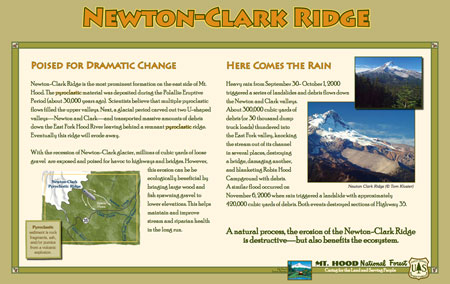
This sign is planned for Bennett Pass (USFS)

This sign is planned for Bennett Pass (USFS)

(click here for a large view)

In a previous blog article, I argue Newton Clark Ridge to be a medial moraine, as opposed to currently accepted theory of a pyroclastic flow deposited on top of a glacier. The Forest Service interpretive panel mostly goes with the conventional pyroclastic flow theory, but hedges a bit, describing it as “remnant” of two glaciers… which sounds more like a medial moraine!

The Newton Clark Ridge sign also includes a description of the many debris flows that have rearranged Highway 35 over the past few decades (and will continue to). One missed opportunity is to have included some of the spectacular flood images that ODOT and Forest Service crews captured after the last event, like this 2006 photo of Highway 35 taken just east of Bennett Pass:
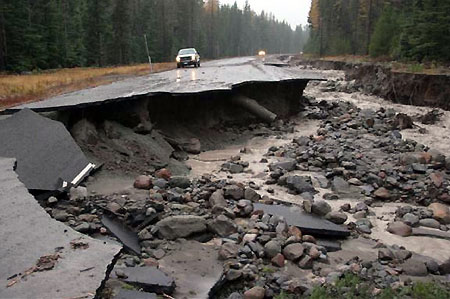
Missed opportunity: photo of the 2006 Newton Creek Floods (USFS)

Missed opportunity: photo of the 2006 Newton Creek Floods (USFS)

The Forest Service used two of my photos for this sign, both taken from viewpoints along the old Bennett Pass Road, about two miles south of the parking area. One wrinkle in how well this sign actually works for visitors is the fact that Newton-Clark Ridge is only partially visible from the Bennett Pass parking lot, whereas it is very prominent from the viewpoints located to the south. Maybe this was the point of using the photos?
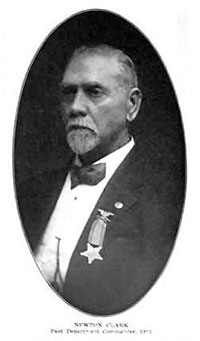
The real Newton Clark (1837-1918)

The real Newton Clark (1837-1918)

There is also a glitch in this panel that I failed to catch during the production phase: the hyphen between “Newton” and “Clark” in the title and throughout the text. There’s a lot of confusion about this point, but it turns out that Newton Clark was one person, not two: a decorated Civil War veteran who fought at Shiloh and Vicksburg, among many prominent battles, then moved to the Hood River Valley in 1887, where he was a local surveyor, farmer and early explorer of Mount Hood’s backcountry.

Newton Clark was part of the first white party to visit (and name) Lost Lake, and today’s Newton Clark Glacier and nearby Surveyors Ridge are named for him. The confusion comes from the subsequent naming of the two major streams that flow from the Newton Clark Glacier as “Clark Creek” and “Newton Creek”, suggesting two different namesakes. Hopefully, the local Forest Service staff caught this one before the actual sign was produced!

Strange Bedfellows?

I was somewhat torn as to whether to post this article, as it goes without saying that the WyEast Blog and Mount Hood National Park Campaign are not exactly open love letters to the U.S. Forest Service. So, why did I participate in their interpretive sign project?

First, it wasn’t for the money – there wasn’t any, and I didn’t add a dime to the federal deficit! I don’t sell any of my photos, though I do regularly donate them to friendly causes. So, even though the Forest Service did offer to pay for the images, they weren’t for sale.
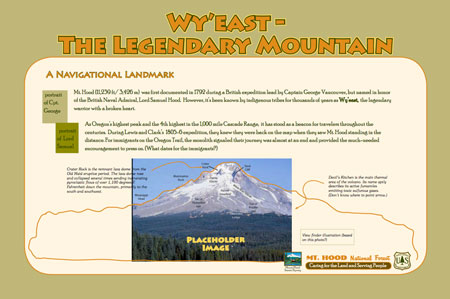
One that won’t be built? This sign was originally conceived for Buzzard Point, near Barlow Pass, but it’s not clear if it made the final cut (USFS)

One that won’t be built? This sign was originally conceived for Buzzard Point, near Barlow Pass, but it’s not clear if it made the final cut (USFS)

(click here for a large version)

In this case, once I understood the purpose of the project, it quickly moved into the “worthy cause” column, and I offered to donate whatever images the Forest Service could use, provided I see the context — and now you have, too, in this preview of the new signs!

I will also point out that the Forest Service project staff were terrific to work with, and very dedicated to making a positive difference. We’re fortunate to have them in public service, and that’s a genuine comment, despite my critiques of the agency, as a whole.

Here’s a little secret about the crazy-quilt-bureaucracy that is the Forest Service: within the ranks, there are a lot of professionals who are equally frustrated with the agency’s legacy of mismanagement. While I may differ on the ability of the agency to actually be reformed, I do commend their commitment to somehow making it work. I wish them well in their efforts, and when possible, I celebrate their efforts on this blog.

So you want to change the Forest Service from within..?
1960s visitors in Glacier National Park (NPS)

1960s visitors in Glacier National Park (NPS)

Given the frustrating peril of good sailors aboard a sinking ship, it turns out there are some great options for supporting those in the Forest Service ranks seeking to make a positive difference. So, I thought I would close this article by profiling a couple of non-profit advocacy organizations with a specific mission of promoting sustainable land management and improving the visitor experience on our public lands. I hope you will take a look at what they do, and consider supporting them if you’re of like mind:

USFS_Panel_7

The National Association for Interpretation (NAI) is a not-for-profit 501(c)(3) involved in the interpretation of natural and cultural heritage resources in settings such as national parks, forests, museums, nature centers and historical sites. Their membership includes more than 5,000 volunteers and professionals in over 30 countries.

Original “Historic Oregon” sign at Barlow Pass in the 1940s (Wikimedia Commons)

Original “Historic Oregon” sign at Barlow Pass in the 1940s (Wikimedia Commons)

The Forest Service has a conservation watchdog group all its own, Forest Service Employees for Environmental Ethics (FSEEE), a not-for-profit 501(c)(3) based right here in Oregon. Their mission is to protect our national forests and to reform the U.S. Forest Service by advocating environmental ethics, educating citizens, and defending whistleblowers. The FSEEE membership is made up of thousands of concerned citizens, former and present Forest Service employees, other public land resource managers, and activists working to change the Forest Service’s basic land management philosophy.

I take great comfort in simply knowing that both organizations exist, and are actively keeping an eye on the Forest Service… from within!

Alva Day and the Lost Lake Highway

Timeless classic: 1920s Postcard view of Mount Hood from Lost Lake

Timeless classic: 1920s Postcard view of Mount Hood from Lost Lake

The Hood River History blog recently featured a series that caught my eye: a local family packing up their car for a camping trip to Lost Lake. The images were from a series captured in the 1939s and early 40s by Alva Luman Day, a local photographer whose legacy as a figure in Mount Hood history is only now beginning to emerge.

As happens with most history research, digging a bit deeper into the story of Alva Day’s camping trips to Lost Lake revealed more than a few surprises. This article is the story of how the modern-day highway to Lost Lake came to be, and how the life of Alva Day is intertwined in this story.

Alva Luman Day

Alva Day was born in 1887 in Colorado and moved to Oregon by the early 1900s. Day married Io Stewart in 1908, and they gave birth to their son Carroll Stewart Day in July 1910. Sometime after arriving in Oregon, Alva spent time in Alaska, though it is unclear whether his wife and young son traveled with him. But by 1918, he was back in Hood River to stay, working for Pacific Power and Light until he retired in the 1940s.

Alva Day clamming in Ketchikan - 1917 (Source: Hood River History)

Alva Day clamming in Ketchikan – 1917 (Source: Hood River History)

The above photo from Hood River History shows a young Alva Day during his Alaska years, posing for his camera during a clam dig near Ketchikan in 1917. He was just shy of 30 years old in this photo, and about to make his permanent move to Oregon.

Alva Day was a skilled and prolific photographer. The History Museum of Hood River has more than a thousand of Day’s images in their collection. The Lost Lake series is typical of his photos, too. He had an eye for detail and composition, but with a journalist’s instinct for storytelling. He often added his own, handwritten notes to the back of his prints, gradually building a rich historic legacy that we are just beginning to appreciate today.

1920s postcard view of Lost Lake from nearby Raker Point

1920s postcard view of Lost Lake from nearby Raker Point

Alva Day’s family trips to Lost Lake by automobile were a relatively new phenomenon in the 1930s. A rough wagon road had been constructed in 1905, but soon fell into disrepair, and was never passable to automobiles. The new Lost Lake Highway had only been completed in the early 20s and was still unpaved when the Day family made their camping treks. In fact, most of the public lands around Mount Hood were still roadless at the time, as commercial logging (and its roads) would not emerge a major focus of the U.S. Forest Service until the 1950s.

Construction of the Lost Lake Highway began in 1919, spurred by construction of the new Mount Hood Loop Highway, and the excitement over the recently completed Columbia River Highway. The Lost Lake Highway was conceived as a joint venture between the U.S. Forest Service and Hood River County, climbing 14 miles from the company mill town of Dee to the lake. Roughly two-thirds the road was on county land, and the upper third inside the Oregon (later renamed Mount Hood) National Forest boundary.

Lost Lake is prominent on this 1920s map of the Mount Hood Loop (Source: The Oregonian)

Lost Lake is prominent on this 1920s map of the Mount Hood Loop (Source: The Oregonian)

The project got off to a rough start, and endured many setbacks and delays over four years of construction. From the beginning, there were worker shortages, with District Ranger Warren Cooper making trips to Hood River in September 1919 in search of men willing to join the effort:

“We are going to have the road finished for motor traffic by next summer if we can get help. We need ten men now” said Cooper at the time. But by November of that year, snow shut down road construction until the following spring of 1920.

By mid-summer of 1920, Forest Supervisor Thomas H. Sherrard had 12 workers pushing forward on the National Forest portion of the project in order to complete the final two miles to the lake. By September of that year, the Oregonian reported the construction to be “progressing fast” with the “gem of the Cascades to be open to auto travel next year.”

Hood River photographer Fred Donnerberg captured this image of the road under construction in the summer of 1920 (note the boxes of explosives in the background) (source: Hood River History)

Hood River photographer Fred Donnerberg captured this image of the road under construction in the summer of 1920 (note the boxes of explosives in the background) (source: Hood River History)

Still more delays followed, with the “finished” road rough and still impassable to most cars by the end of 1921. With the route largely in place, a gravel surface would be added in the summer of 1922, finally making it a truly durable “highway” for auto travel. The Oregonian reported the completion of the clearing and grading phase in the fall of 1921 as follows:

“When the last charge of TNT was exploded, removing the last barrier of boulders and a giant fir stump, members of the 20-man forestry crew paused on the lake’s edge and gave a huzza that echoed and re-echoed through the forest. Then they cleared away the debris, the new road was open, and one of the gems of the Oregon National Forest was made accessible to motorists of the Hood River Valley, or their visitors from Portland, over the Columbia River Highway.

“The forestry crew broke camp today, closing the new dirt grade with a barricade of felled trees as they left the district… It is planned that the new grade of approximately five miles shall be surfaced with crushed rock next summer… The cost of grading the stretch, which penetrates a district of magnificent firs and cedars, was about $18,000.”

It turns out that Alva Day had an important role in the completion of the Lost Lake Highway, too. He was an avid sportsman, and secretary of the Hood River Game Protection Association at the time, one in a series of prominent roles he played over his life advocating for hunting, fishing and wildlife conservation.

Alva Day (left) overseeing the release of hatchery fry in 1933 (source: Hood River History)

Alva Day (left) overseeing the release of hatchery fry in 1933 (source: Hood River History)

The game association was a strong advocate for the project, promoting the idea and leading critical local fund-raising efforts for the county portion of the project in 1919 and 1920 to keep construction on track.

By the mid-1920s, thousands of cars were streaming up the dusty, gravel road to Lost Lake, and Alva Day was undoubtedly among the visitors. Responding to this instant popularity, the Forest Service gave the green light to several summer cabins and a small resort in the years that followed, and later constructed the beautiful campground we know today. Lost Lake was now a major tourism destination, drawing tens of thousands of visitors each year to its postcard shoreline views of Mount Hood, framed by ancient cedars.

Day Family Trips to Lost Lake

Alva Day’s involvement in the conception and completion of the Lost Lake Highway adds new meaning to the series of photos he captured on family outings to Lost Lake in the 1930s and 40s. He loved the lake, and according to Hood River History accounts, made these annual camping excursions every summer.

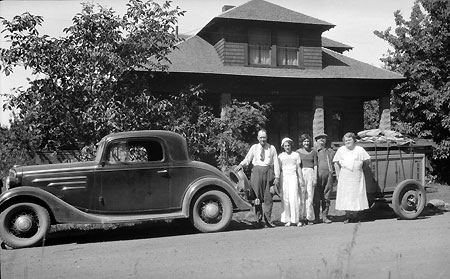
The Day family ready to go camping in 1938 (Source: Hood River History)

The Day family ready to go camping in 1938 (Source: Hood River History)

The Hood River History series of Lost Lake images begins with the above photo, captured in front of the Day family home in Hood River at 420 June Street. According to the Hood River History blog discussion, the house still stands. Note the hefty trailer behind the car — as subsequent photos in the series show, this is industrial camping!

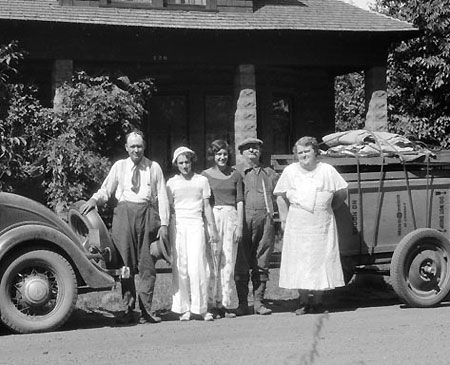
A closer view of the Day family (Source: Hood River History)

A closer view of the Day family (Source: Hood River History)

Looking at the first image in a bit more detail, we see Alva Day on the left and Io Day on the right. The Hood River History blog discussion speculates that the two young women were the Day’s daughters (Helen and Emma) and the older man next to Io Day was her father. However, I wasn’t able to confirm this in any formal records.

Instead, official records show that Alva and Io Day had just one child, their son Carroll. Carroll married a Helen Colby in 1931, so the “Helen” speculated in this photo could be his wife. Sadly, Helen (Colby) Day died just nine years later, in 1947 (Carroll Day married again in 1948 to Aline Andrew, and both lived into the 1990s).

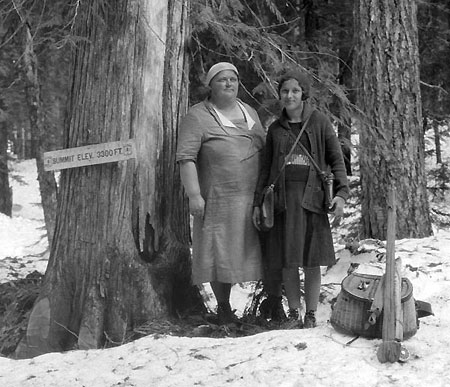
Snow at the lake? Not unusual in early summer  (Source: Hood River History)

Snow at the lake? Not unusual in early summer (Source: Hood River History)

The next image in the Hood River History series is from an earlier trip, taken in 1933, but I’ve included it here because it wouldn’t have been unusual for early summer campers to encounter snowdrifts on the way to Lost Lake. On this earlier trip, it’s possible that Alva Day (on the left) and Io (center) were simply heading up for some early summer fishing, and not on a camping trip.

The Hood River History blog clearly identifies the man on the left in both of the previous photos as Alva Day, which raises a question: did he shoot these as self-portraits using a timer, or was someone else behind the camera? More on that in a moment…

Is this Alva and Io Day’s daughter-in-law? (Source: Hood River History)

Is this Alva and Io Day’s daughter-in-law? (Source: Hood River History)

A closer look at the 1933 photo clearly shows Io Day to be the same person as that pictured in the 1938 camping trip series. But the young woman next to her in the 1933 photo (above) also seems to be the same person standing near the stove (below) in this detailed look at the next photo in the series, captured in 1938:

Helen (Colby) Day five years later? (Source: Hood River History)

Helen (Colby) Day five years later? (Source: Hood River History)

The similarity between these images, and lack of documentation on Alva and Io Day having more than one child leads me to speculate that we’re looking at Helen (Colby) Day, first wife of Alva and Io’s son Carroll. There is no birth date available for Helen (Colby) Day, but assuming she was roughly Carroll Day’s age, they would both have been in their mid-20s when these images were captured.

A wider view of the campsite scene (below) shows the rest of the family, and the impressive array of gear that filled up that trailer behind the family car! You can see still more detail on the original Historic Hood River image, but some of the intriguing highlights include the cook stove, wooden table, what appears to be a wood pantry or food box, and of course a canvas tent in the background.

Sharp-eyed viewers of this photo in the Hood River History blog also spotted bratwurst in one of the frying pans, a pile of discarded tin cans behind the stove (did they pack them out?) and a swimsuit and towels hanging to dry on the clothes line. Alva’s boat is tied up at the lakeshore, just beyond the table.

Camping in style at Lost Lake in 1938 (Source: Hood River History)

Camping in style at Lost Lake in 1938 (Source: Hood River History)

In this wider view, Alva Day is seated to the left, and next to him a young man that I will speculate is Carroll Day. The woman toward the back is clearly Io Day, with another unidentified young woman seated next to her. If the young man in the above photo is, indeed, Carroll Day, then I will also speculate that he was behind the camera in the previous two images, as well.

The next camping image is actually from 1941, but also fits the theme. In this view, Io Day is relaxing at the base of a large cedar tree, looking quite comfortable and content. On this outing, the wood stove is still there, and a wood picnic table has appeared. Were these provided by the Forest Service? Most interesting, of course, is the portable radio sitting on the table:

Io Day relaxing at Lost Lake in 1941 (Source: Hood River History)

Io Day relaxing at Lost Lake in 1941 (Source: Hood River History)

A closer look (below) shows the radio in a bit more detail — likely a portable “farm radio” of the era, designed to run on batteries at a time when many rural areas were still without electricity, but within reach of radio broadcasts. Could they pick up Portland broadcasts at Lost Lake? Or possibly KODL 1440 in The Dalles, which began broadcasting in 1940?

Is Io listening to The Whistler? (Source: Hood River History)

Is Io listening to The Whistler? (Source: Hood River History)

Whatever the station, they would have been listening to popular suspense programs of the day like “The Whistler” and “The Shadow”, made all the more spooky by firelight in the middle of the forest!

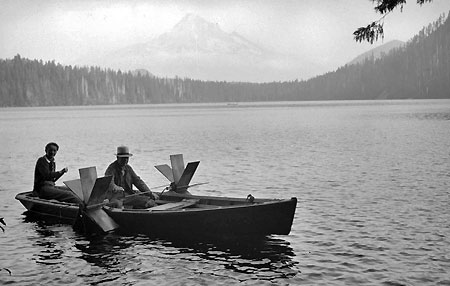
Next in the series is another image from the 1938 outing that shows Alva Day in his unique paddleboat. The unidentified women from the previous campsite image is steering the boat and Alva is cranking the paddles. Mount Hood rises in the hazy background in this scene:

Alva Day’s boat at Lost Lake in 1938 (Source: Hood River History)

Alva Day’s boat at Lost Lake in 1938 (Source: Hood River History)

A closer look at the boat (below) shows the crank mechanism Alva is using to turn the paddles — an ingenious, if odd design!
A two man paddleboat? (Source: Hood River History)

A two man paddleboat? (Source: Hood River History)

The cedar branch in the upper corner shows this image was taken from shore — perhaps by Carroll Day… or Io? Setting up a timed self-portrait for this view would have been quite a feat, even for Alva Day.

Alva’s Lost Lake bounty (Source: Hood River History)

Alva’s Lost Lake bounty (Source: Hood River History)

The final image (above) in the Historic Hood River series shows Alva Day’s sportsman side: an even dozen trout, presumably caught while camping at Lost Lake. A fitting finale to the Lost Lake camping series!
Alva Day’s Legacy

Alva Day’s role in the creation of the Lost Lake Highway is a mostly forgotten part of his legacy. But his roles in advocating for wildlife and in photographing the unfolding history of the Hood River region are only now being rediscovered and appreciated.
For more than three decades, Alva Day was a local leader for wildlife conservation in Hood River, and later was active in the formation of the Oregon Wildlife Federation and the Western Federated Sportsmen. During this period, he was also a contributor to The Oregon Sportsman, the monthly journal of the Oregon Game Commission.

It’s easy to forget how dire the need for wildlife conservation was at the time, and especially the role that hunters and fishermen played in the movement. For a century, the developing Northwest been dumping raw sewage into its rivers, filling the air with smoke, clearing the forests, scouring mountain streams with logging “splash dam” floods and overharvesting many species of game and fish. While we are still struggling to restore our native habitats and wildlife in our time, we have come a long way, already, thanks to the pioneering efforts of people like Alva Day.

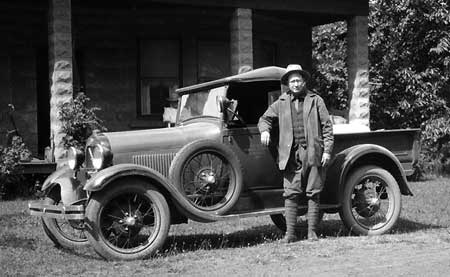
Alva Day with his Pacific Power company car in 1929 (Source: Hood River History)

Alva Day with his Pacific Power company car in 1929 (Source: Hood River History)

Alva Day’s photographic story of the Hood River area is perhaps his greatest contribution, and in time, is likely to be his most enduring legacy. The History Museum has hundreds of his prints in their collection, documenting everything from simple scenes of daily life to historic events, like the June 1927 flood that ravaged the town of Arlington, or the shameful day in May 1942, when hundreds Japanese Americans from the Hood River Valley were loaded onto trains and sent to World War II internment camps

This Hood River History blog project is now in the process of scanning many of Alva Day’s images, and using the blog to build an oral history for each image. This work allows all of us to have a window into the past and contribute to the continued documentation of our region’s history.

A Trip to Idlewild Cemetery

The Idlewild Cemetery in Hood River was established in 1894, and with more than 7,000 graves, is a treasure trove of local history. You can find Alva Day’s family here, too.

Idlewild Cemetery (source: findagrave.com)

Idlewild Cemetery (source: findagrave.com)

Alva and Io Day were both born in 1887, and both died in 1955, after nearly 47 years of marriage. Io died in early January of that year, and Alva Day followed on November 15, 1955. Both are buried at the Idlewild, along with their son Carroll Day, whose ashes joined the family plot at the age of 81 in January 1991. Carroll’s second wife, Aline Day, died in 1995, and her ashes were also placed with Carroll and his parents at Idlewild.

Alva and Io Day and son Carroll and his wife Aline are at rest in the same plot (source: findagrave.com)

Alva and Io Day and son Carroll and his wife Aline are at rest in the same plot (source: findagrave.com)

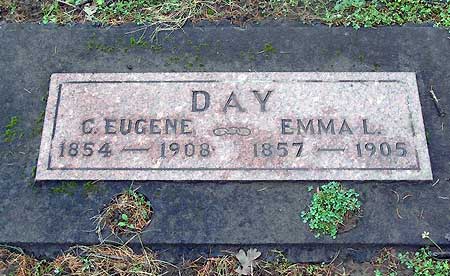
Alva Day’s parents, Emma and Charles Eugene Day, are buried at Idlewild Cemetery, too. Emma Day died in 1905 and Charles Day on May 17, 1908 — the same year that Alva and Io Day were married.

Alva Day’s parents Charles Eugene and Emma Day are also buried at Idlewild Cemetery (source: findagrave.com)

Alva Day’s parents Charles Eugene and Emma Day are also buried at Idlewild Cemetery (source: findagrave.com)

You can visit the Day family plot in Block 9, Lot 24. Idlewild Cemetery is on Tucker Road at Brookside Drive, and though located on a commercial strip, the back of the cemetery abuts orchards, so it makes for a pleasant and interesting afternoon of exploring.
_________________________________

Postscript: Supporting Hood River History

Over the past couple of years, the History Museum of Hood River County has issued a series of terrific images in their Historic Hood River blog series. The history blog comes to us through the generous work of volunteers Arthur Babitz, Bill Pattison and Sally Donovan, and we are truly indebted to their efforts.

By creating this online archive of historic photos, the museum is providing an invaluable resource, free to the public. If you love history and the Mount Hood region, consider supporting the museum for their efforts. While the modest $5 museum admission fee helps support the museum, consider becoming a member to help provide ongoing support for their fine work as stewards of Hood River history.

The History Museum of Hood River County (source: History Museum)

The History Museum of Hood River County (source: History Museum)

The History Museum graciously granted permission to showcase the images included in this article, and I’m hopeful it will send a few visitors and donations in their direction.

The museum is now open after a year or major renovations. You can find it on East Port Marina Drive, accessed via Exit 64 on Interstate-84. The museum is located on the banks of the Hood River, near the prominent suspension footbridge visible from the freeway, and well worth the visit!
____________________________

Postscript: More on Alva Day from Hood River History

Arthur Babitz writes to say: “We actually have 2500 of his images, indicating an annual summer trip to Lost Lake for much of his adult life. There is an extended series showing construction of the bridge near the lodge building. He also participated in and photographed the Legion climbs of Mt. Hood for many years. We have hundreds of images he shot on those climbs. You’ll be seeing many more of them on the HHR blog.”

Thanks for all your fine work in bringing the Day photos back to life, Arthur!

Latourell Falls Makeover (Part 2)

Latourell Falls

Latourell Falls

In the first part of this article, I focused on recent improvements that have greatly enhanced the Historic Columbia River Highway wayside at Latourell Falls. This article looks at the balance of Guy Talbot State Park, where a number of improvements are needed to keep pace with the ever-growing number of visitors who now hike the Latourell loop trail year-round.

Improving the Loop Trail

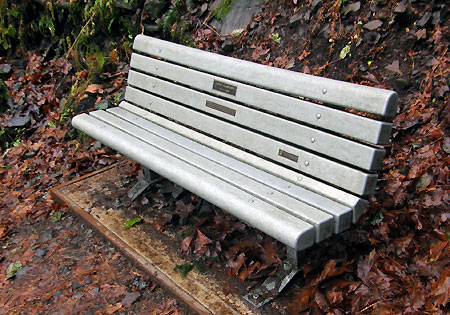
Hiking the loop in the traditional clockwise direction from the wayside, the first stop is bench located a few hundred yards up the trail. This memorial bench was donated by the Sierra Club, and though it’s not a great architectural fit for the area (a rustic style would be more appropriate), it’s still a welcome resting spot for casual hikers.

Memorial bench along the Latourell Loop Trail

Memorial bench along the Latourell Loop Trail

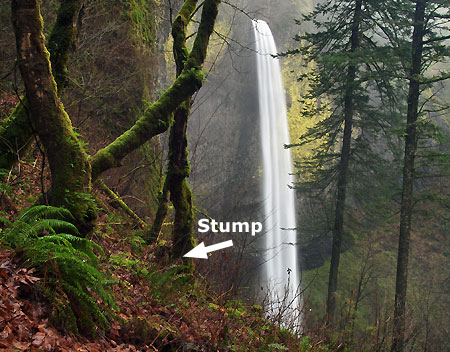
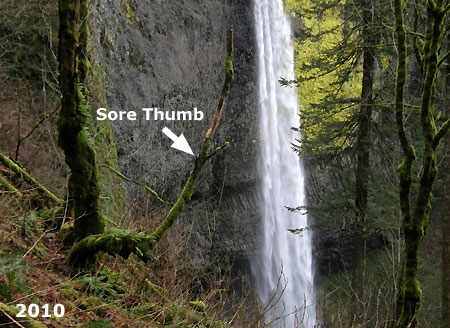
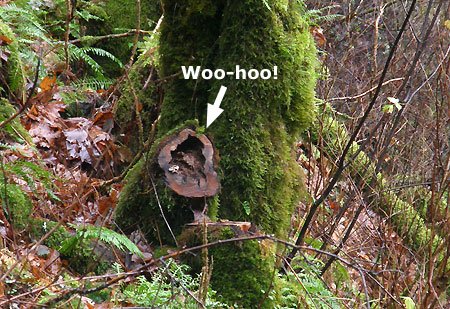
Not coincidentally, the bench faces a lovely view of Latourell Falls, but there’s a story behind the view, as someone has made the effort to do some “scene management” for photographers. Take a look at the photo below, and you can appreciate the waterfall scene in its graceful glory, framed by firs and moss-covered maples. But a closer look reveals a sawed-off stump with a fresh cut. Why here? Because a trail steward (authorized or otherwise) trimmed off the broken shards of a maple that split off in an ice storm a few years ago — leaving a sore thumb that marred this classic view. You can see in these after/before comparisons from now and in 2010:

A beautiful scene as viewed in December 2012…

A beautiful scene as viewed in December 2012…

…and the sore thumb that once was…

…and the sore thumb that once was…

…and the telltale stump!

…and the telltale stump!

If this was sanctioned “scene management” pruning, then kudos to the State Parks folks for putting classic views on their maintenance list. If this is a guerilla effort by a frustrated photographer, then perhaps State Parks managers will take note, and keep this view intact..!

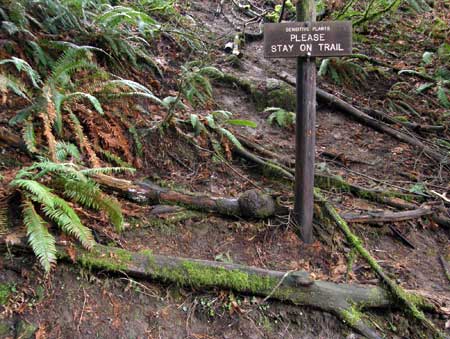
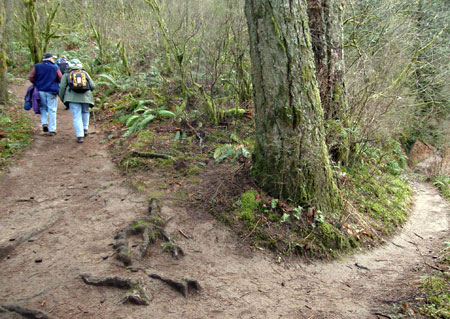
Moving up the loop, the trail soon approaches a heavily trampled bluff above Latourell Falls. Here, the first apparent problem is a decades-old shortcut at the first switchback. A sign begs hikers to stay on the trail to protect “sensitive plants”, but so far, the boots are winning, despite logs and debris purposely scattered across the shortcut.

Tossing more logs across this shortcut might help, but borrowing an idea from the beautiful new stonework at the trailhead (or recently built stonework along the Bridal Veil Falls trail), and adding a rustic stone retaining wall here to corral traffic would be a nice option that would have lasting value.

A forlorn sign attempts to reason with trail-cutters

A forlorn sign attempts to reason with trail-cutters

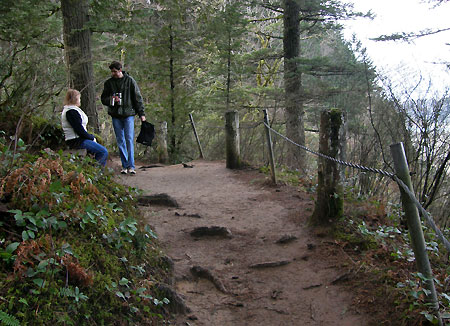
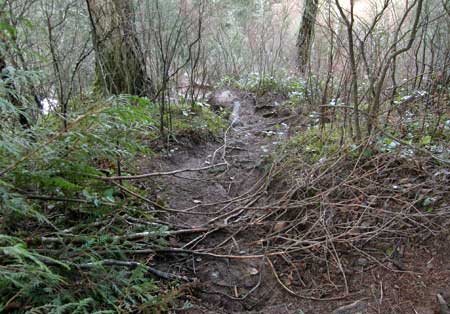
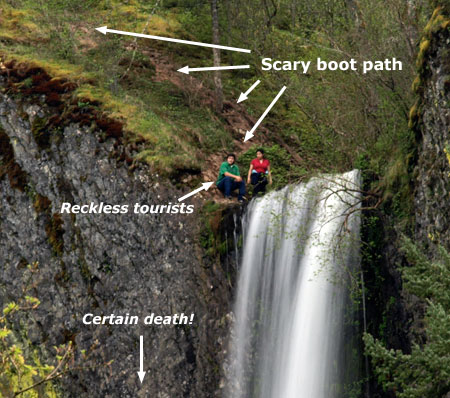
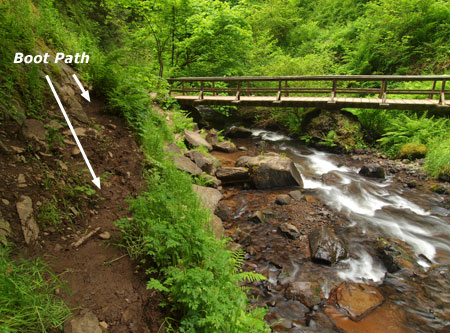
The viewpoint atop the well-worn bluff is really starting to show its age. The 1950s-vintage steel cable fence and mix of concrete and steel pipe posts were never a good aesthetic fit for the Gorge, but more importantly, they’re not doing anything. Visitors have recently pushed a scary boot path past the fence, and down to the brink of Latourell Falls (shown below), so a near-term fix is in order.

The overgrown, beleaguered viewpoint at the to of the falls is in need of some TLC!

The overgrown, beleaguered viewpoint at the to of the falls is in need of some TLC!

The trail at the overlook has already been stomped into a wide “plaza” of sorts, and that would be a good design solution here, with a stone wall replacing the rickety old handrail. A layer of crushed gravel (another design feature of the recent improvements at Bridal Veil Falls) would further help minimize the mud slick that forms in wet months.

The lone (and beleaguered) wood bench at the overlook is well-used, and a redesign should include two or three places to sit and admire the view. For most visitors who venture beyond the lower falls overlook, this bluff above the falls is the turnaround point.

The boot path to the brink of the falls has become a heavily used liability in recent years

The boot path to the brink of the falls has become a heavily used liability in recent years

Adding a stone wall to better define the overlook would help curb foolhardy visitors from following the boot path to the falls brink. However, the overlook also needs some vegetation management in order to simply maintain the view back down to the trailhead — this is what most hikers who push beyond the handrails are looking for, after all.

A pair of reckless visitors in flip-flops spotted in 2010 at the bottom of the dangerous boot path, tempting fate…

A pair of reckless visitors in flip-flops spotted in 2010 at the bottom of the dangerous boot path, tempting fate…

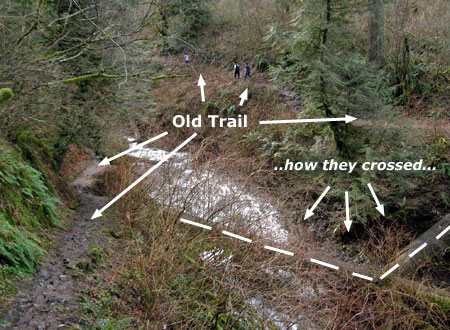
A few steps beyond the bluff overlook, an unmarked trail forks to the right, descending to Latourell Creek. At first, this seems like another informal boot path, but a closer look reveals a well-constructed trail. In fact, this is where a lower loop once crossed the creek, connecting to the main loop where it returns (and is clearly visible) on the far side of the creek. This is an old idea that still makes sense, and should be embraced with a new bridge and refurbished connector trail.

This side trail (to the right) used to be part of a lower loop route

This side trail (to the right) used to be part of a lower loop route

In reality, hikers are already using the lower loop, though a series of slick, dangerous logs a few yards upstream from the brink of Latourell Falls serve as the “bridge”. Reconnecting and restoring these old trail segments would be a good way to provide a shorter loop for less active hikers, and also resolve this hazardous crossing that is clearly too tempting for many hikers to resist.

Bridge needed! This old trail and the sketchy log crossing are an accident waiting to happen -- and also an opportunity to provide an excellent short loop for hikers.

Bridge needed! This old trail and the sketchy log crossing are an accident waiting to happen — and also an opportunity to provide an excellent short loop for hikers.

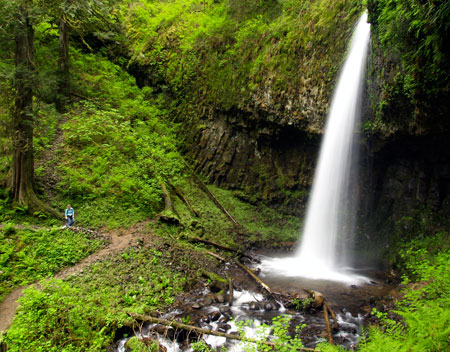
Moving along the loop to its upper end, the Latourell trail has a few issues at Upper Latourell Falls that deserve attention in the interest of protecting the lush landscape from being loved to death. For many years, this upper section of the trail was only lightly used, but the proximity of Talbot State Park to the Portland Metro region and the family-friendly nature of this trail has clearly made the full loop a very favorite destination.

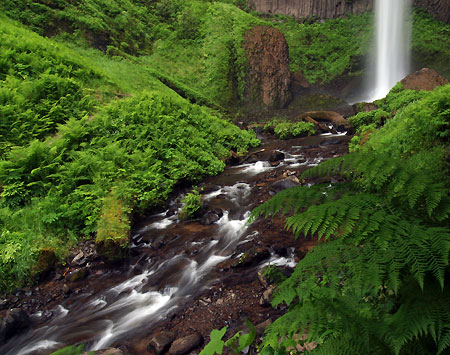
Upper Latourell Falls

Upper Latourell Falls

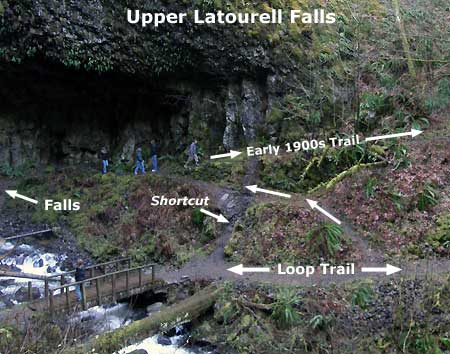
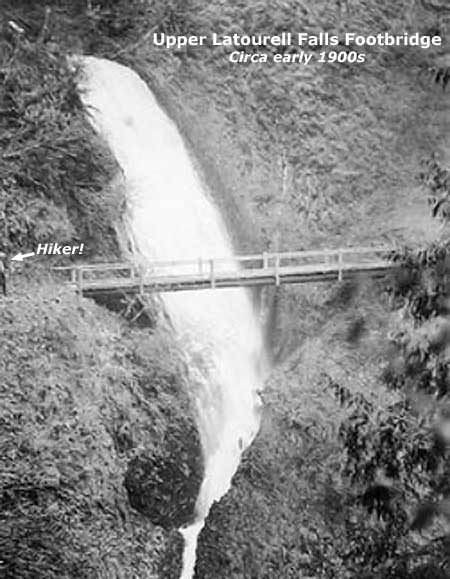
The trail approach on the east side of the falls is in good shape, but problems start to emerge on the west side of the footbridge. This is not coincidental, as an adventurous early trail once switch-backed up the slope on the west side, and led to a precarious bridge across the mid-section of the falls (shown below).

The location of this old trail was uncovered only recently. Century-old rockwork and obvious paths heading uphill from the falls have always hinted at an old trail, but a geocache has now been placed along the old path, drawing enough visitors up the slope to add some urgency to addressing the off-trail impacts here.

A century-old trail climbs the west slope at Upper Latourell Falls

A century-old trail climbs the west slope at Upper Latourell Falls

The best solution here is to embrace the lowest segment of the old path by repairing the stonework, or perhaps adding steps where a shortcut has formed, and provide hikers with that close-up view from behind the falls that is responsible for the bulk of the off-trail traffic (the hikers in the photo above are making this irresistible trip).

The upper sections of the old trail are much less traveled, and a simple solution here might be to simply ask the geocache owner to remove the cache. The cache risks not simply re-opening the old trail, but also bringing inexperienced hikers to the potentially dangerous rock shelf where the log footbridge once stood. If the geocache is removed soon, it’s unlikely that visitors would even notice the upper portions of this trail.

This precarious bridge spanned the upper tier of Upper Latourell Falls in the early 1900s (courtesy U of O Archives)

This precarious bridge spanned the upper tier of Upper Latourell Falls in the early 1900s (courtesy U of O Archives)

Turning downstream along the west leg of the Latourell loop, the trail passes a couple of spots where some TLC is needed. First, another potentially dangerous log crossing (shown below) has drawn enough traffic to form its own boot path.

It could be decades before this old log finally collapses into the creek, so a better plan is needed to stem the damage now. Sawing out the log seems possible, and is a job that could be easily in early fall, when water levels are at their lowest, and fire danger has passed. This might even be a job for volunteer trail stewards with crosscut skills.

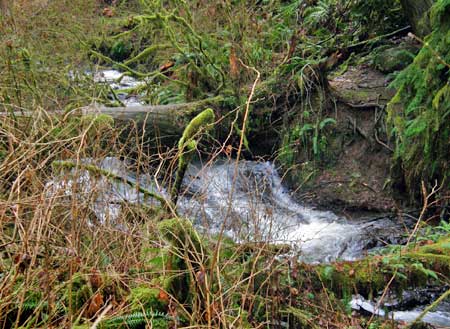
The other “bridge” on upper Latourell Creek…

The other “bridge” on upper Latourell Creek…

A bit further downstream along the west leg, the loop trail passes the old trail leading to the former footbridge (described previously). Here, the new trail launches uphill along a steep, slick segment built to bypass the bridge.

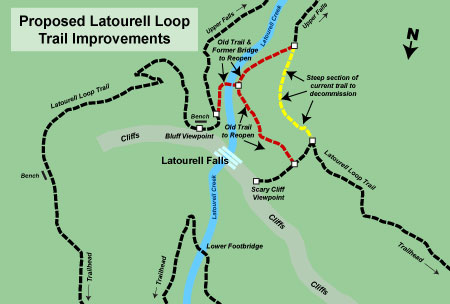
Reopening the old trail section (and adding a new bridge) would therefore have a spinoff benefit here: not only would a shorter loop be possible (and safe), but the short, badly designed new section of the current trail (shown in yellow on the map, below) could be decommissioned, with the main route using the old section of trail, once again (shown in red). This would be a terrific project for volunteers, including bridge construction.

LatourellLoop16

(click here for a large map)

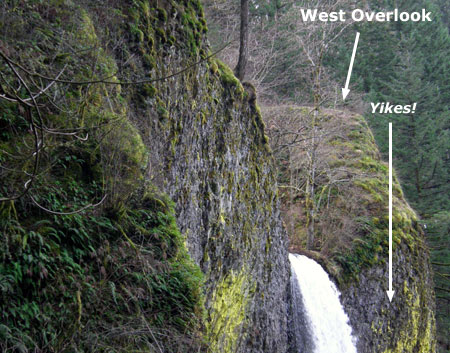
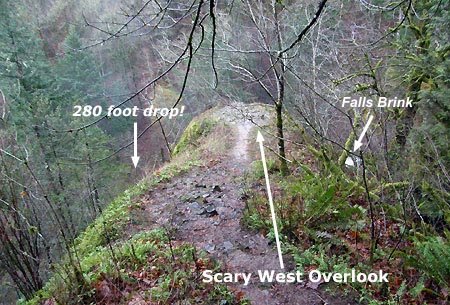
Another scary feature suddenly appears as the west leg of the loop trail curves above Latourell Falls: an old viewpoint spur trail heads straight down to a very exposed, rocky outcrop rising directly above the falls. The view from this exposed landing is impressive, but completely unsafe, given the thousands of families with young kids that walk this loop each year. There is no railing and no warning of the extreme exposure for parents attempting to keep kids in tow.

The west overlook from the trail… yikes!

The west overlook from the trail… yikes!

The safety hazards of the west overlook are twofold: certain death for someone slipping over the 280 foot sheer cliff to the north and a tempting, sloped scramble to the falls brink for daredevils and the foolhardy.

A simple solution could be a handrail or cable encircling the viewpoint, but a more elegant option would be a more permanent viewing platform in the stonework style of the improvements at the trailhead, serving both as a safety measure and to encourage visitors to comfortably enjoy the airy view.

The west overlook and falls brink from the east side

The west overlook and falls brink from the east side

Next, the loop trail curves away from the creek and out of Latourell canyon, passing an overgrown viewpoint (that probably deserves to be retired), then descending in a long switchback to the Historic Columbia River Highway.

Here, the route crosses the road, and resumes on an attractive path that suddenly ends in the Talbot State Park picnic area. Though a bit of searching gets most hikers to the resumption of the loop hike, some signage would be helpful here — both to direct loop hikers back to the main trailhead, but also pointing picnickers to trail to both the upper and main waterfalls.

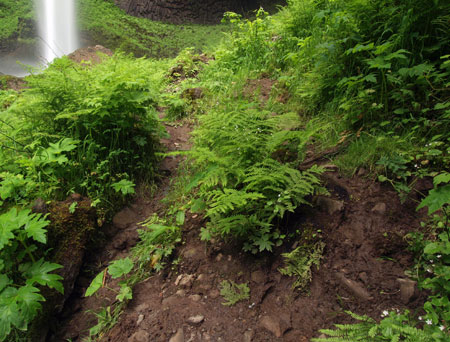
Heavy traffic has formed a boot-path at the base of Latourell Falls

Heavy traffic has formed a boot-path at the base of Latourell Falls

Beyond the picnic area, the trail re-enters Latourell canyon and quickly descends to the base of Latourell Falls, the final area where loop trail improvements are sorely needed. At this point along the loop, we are within a few hundred yards of the main trailhead and wayside, so the crush of year-round visitors is evident everywhere — and thus the paved trail surface in this portion of the loop.

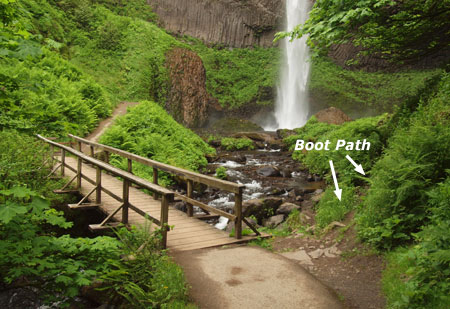
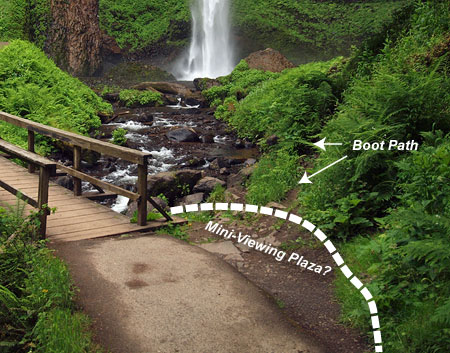
Most of the human impact is absorbed by the trail, but in recent years a messy boot path has developed along the west side of the creek, starting at the lower footbridge, and branching as it heads toward the base of the falls.

Looking back at the footbridge, and the extent of damage from the boot path

Looking back at the footbridge, and the extent of damage from the boot path

As it nears the falls, the boot path devolves into a web of muddy paths, where delicate ferns and wildflowers have been trampled

As it nears the falls, the boot path devolves into a web of muddy paths, where delicate ferns and wildflowers have been trampled

There isn’t a good way to convert this boot path into a formal spur or viewpoint because of the unstable slopes and visual impact it would create, so the challenge is how to best manage the off-trail activity. The simplest option would be an extension of the bridge hand-rail to block the boot path, making off-trail exploring a bit harder.

This mud patch at the east approach to the lower footbridge would make a perfect mini-plaza for visitors to spend time taking in the view

This mud patch at the east approach to the lower footbridge would make a perfect mini-plaza for visitors to spend time taking in the view

But there is also an opportunity to embrace the first part of the boot path, where a “mud plaza” of sorts has been stomped into the ground. This spot features one of the best angles for photographing the falls, after all, so a stone masonry mini-plaza with seating would be a terrific way to both discourage the off-trail travel, and give waterfall admirers an inviting place to stop and photograph the falls, out of the main flow of foot traffic.

Honoring Guy W. Talbot

One last bit of unfinished business at Talbot State Park is a debt of gratitude to Guy Talbot, himself. At the west end of the historic highway bridge, a large gravel pullout serves as overflow parking for this popular park. The loop trail crosses the highway near the pullout and in recent years, heavy use has turned this into an overflow trailhead, as well.

The wide pullout at the west end of the Latourell Bridge

The wide pullout at the west end of the Latourell Bridge

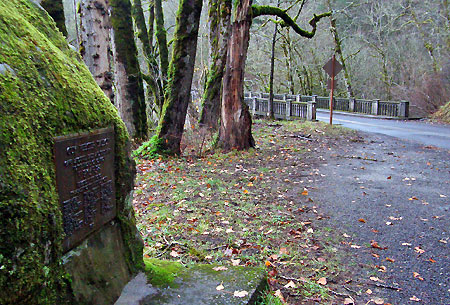
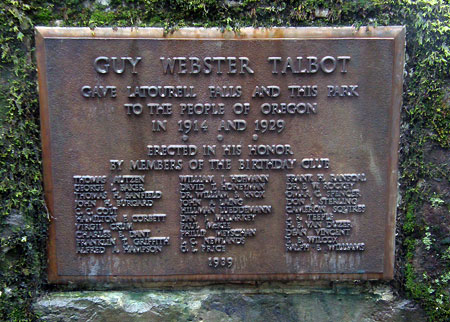
At first glance, it seems nothing more than a broad, gravel shoulder. But upon closer inspection, it’s home to the only real monument to Guy Webster Talbot — the man whose profound generosity spared Latourell Falls from some other fate, and gave us the park that we know today. After all, the property wasn’t simply an undeveloped tract of forest, but rather, Talbot’s beloved country home. He gave the place he loved most to all Oregonians, in perpetuity.

Few traces of Talbot’s home and the surrounding estate survive, so this would be the perfect spot for a third interpretive sign (the first two are on the east end of the bridge, at the refurbished wayside) focused on Talbot, and why he was such an important historical figure in history of the area.

This plaque is the sole evidence of Guy Talbot’s grand gesture to the public

This plaque is the sole evidence of Guy Talbot’s grand gesture to the public

The pullout, itself, could also be improved to become a more formal secondary trailhead for the loop, as well — perhaps not as substantial as the newly rebuilt main trailhead and wayside at the other end of the bridge, but something better than the pothole-covered pullout that exists today.

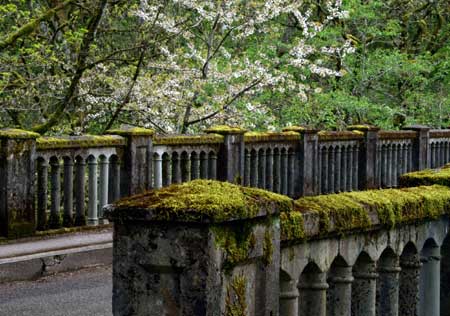
The venerable Latourell Creek Bridge is among the most impressive on the old highway

The venerable Latourell Creek Bridge is among the most impressive on the old highway

Finally, there’s one more interpretive opportunity near the Guy Talbot memorial: a tale of two bridges. One is the towering, 300-foot long Latourell Bridge along the old highway, to the east. The unique history of its construction in 1914 is a story that should be told, especially since visitors can walk both sides of the bridge on the beautifully designed, original sidewalks.

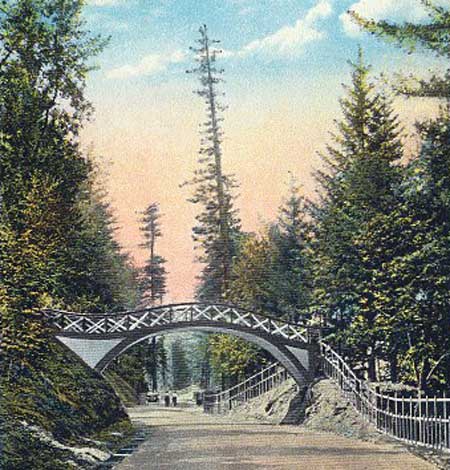
The second bridge is a curious phantom of history — a former footbridge that once connected the two halves of the Talbot property in an elaborate, Venetian-style arch. Though long gone, the footings for the bridge can still be seen, and are a reminder of the elegance of days gone by.

The old footbridge over the highway was located just east of Latourell Creek

The old footbridge over the highway was located just east of Latourell Creek

The good news is that both the Oregon State Parks and Oregon Department of Transportation (ODOT) are on a roll when it comes to enhancing the Historic Columbia River Highway trails and waysides. Many recent improvements to the Gorge parks and the old highway, itself, have already been completed in recent years, and more are already under construction.

Hopefully, polishing up the rest of the Latourell Falls loop and Talbot State Park can find its way into the State Parks and ODOT work program, too!

___________________________

Addendum: after posting this article, I heard from the owner of the geocache mentioned above Upper Latourell Falls. File this under the “small world” department, but it also happened to be someone I’ve known for many years, and who sets the highest standard for conservation ethics. Had I checked the cache ownership and known this, it would have erased any concerns about potential impacts the cache will have on the area. I now know it is in very good hands!

The cache owner also shared some numbers behind the cache that support that last point: only 50 users have logged it in the 3-plus years since it was placed, so not enough to have a noticeable impact on the terrain. Thus, the impacts that we’ve seen in recent years are likely just more of what we see elsewhere on the loop, where the crush of thousands off feet hitting this trail each year is running the landscape a bit ragged.

At its core, geocaching is a terrific way to introduce people (and especially children) to our public lands, which in turn, helps create advocates for conservation — something very much in line with this blog. Hopefully this article didn’t leave other geocachers thinking otherwise. After all, I own several caches myself, and like most cache owners, do my best to ensure they bring people into the wilds while also having minimal impact on the landscape.