Where is Devil Canyon… and why does it matter now?

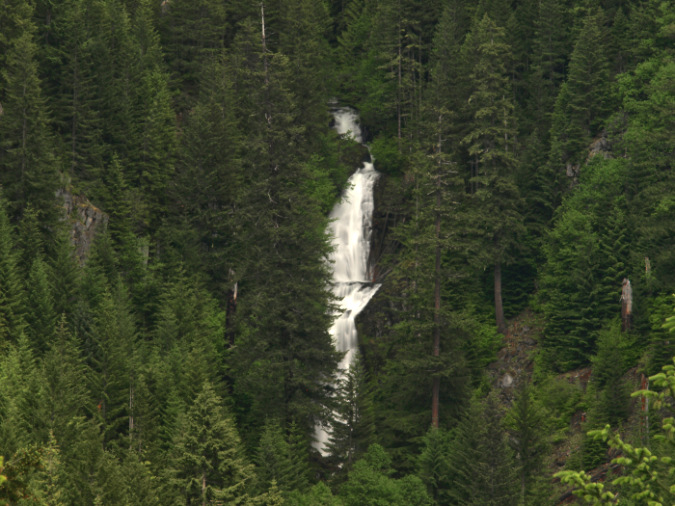
Devil Canyon holds one of Mount Hood’s best waterfalls – known to only a few, despite being less than a mile from busy traffic on US26

Growing up in Portland in the 1970s and 80s meant many trips to a family cabin on Forest Road 35A, along the Zigzag River. My folks eventually sold the place when I was in my 20s, and simply owning a house was still way out of reach — much less a second home on the Zigzag River. How I would have loved to keep it in the family, but alas, I have only fond memories and a few photos to remember our family cabin. 

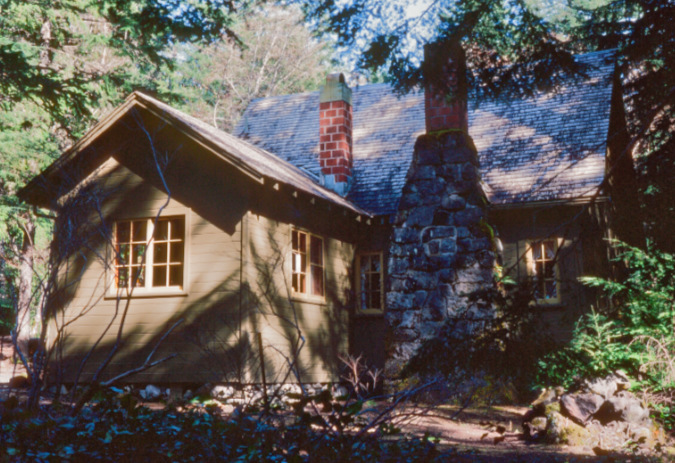
It’s still there, though, toward the turnaround at the end Road 35A. It’s a rustic, hand-crafted gem built in the 1930s on Forest Service land as part of the 99-year lease program. When my family bought it, the place was completely furnished with original pinewood furniture, a cast iron cook stove, 1930s dishes and cookware, a shelf of vintage board games and colorful, coiled rag rugs of the era scattered throughout. There was even a small bookcase stocked with Zane Grey paperbacks and old guidebooks and maps of the Mount Hood area! It was like a living museum.

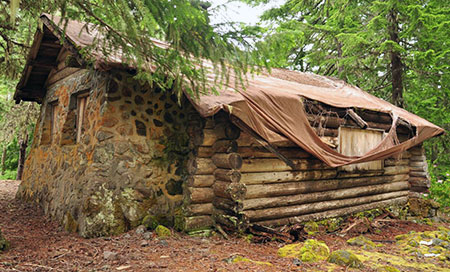
The family cabin on Road 35A in the late 1970s, after much TLC from the family to restore it to its original condition.

Only after the cabin was sold in the early 90s did we learn of its dark past. It turns out the prior owner had been a loner who tragically ended life there with a shotgun – and wasn’t discovered for several weeks thereafter. Thus, when my family bought the cabin “furnished, as is”, it included a rather grisly scene in the downstairs bedroom, along with all those vintage 1930s furnishings that took on a new meaning.

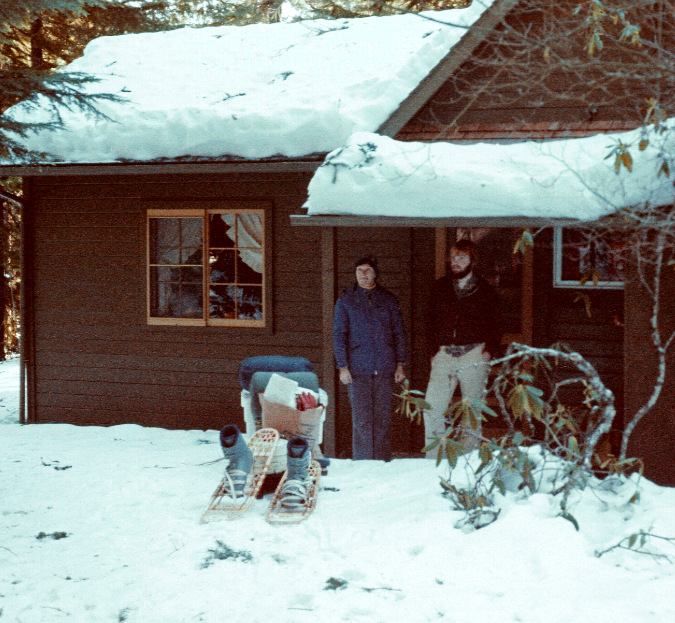
Road 35A was (and is) barely maintained by the Forest Service, much less plowed in winter. Instead, we often parked along US26 and made the trek to the end of the road on snowshoes, pulling food and gear on toboggans. This photo of me and mom is from the winter of 1980-81 when I had just turned 18 and started college

This very late revelation about the cabin’s secret past did explain several parents-only trips in the very beginning, when we were told the place “needed some repairs” before the kids could join them up there. Dad was a physician, so making those “repairs” were all in a day’s work for him, as he later described to us in all-too-graphic detail the scene they found on their first walk through the cabin.

In retrospect, the rest of the family was relieved to have been spared this grim backstory over those many years of vacations and holidays spent at the cabin — though much speculation followed on whether the occasional bumps and footsteps heard in the middle of the night were really just our imagination..?

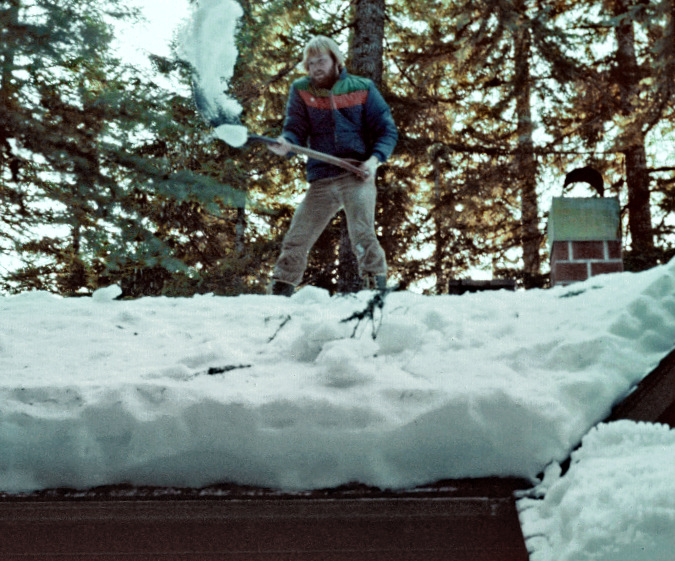
The best reason to bring your teenager home from college along to the cabin – aside from hauling heavy toboggans loaded with food and gear? Shoveling snow off the roof, of course! This is also a scene from the winter of 1980-81, and I’m not even sure how I got up there safely, much less got back down…

It was during those years at the Zigzag cabin that my passion for the mountain really took off. In winter, it was a base camp for skiing and snowshoeing. In summer, I roamed the trails and forests in all directions, mostly alone (still my preferred mode). Dad picked up a copy of Jack Grauer’s classic “Mount Hood – A Complete History” that we kept up at the cabin, and I devoured every page. I still read it often. I was – and still am – infatuated with Mount Hood!

The most popular trail in the area was a short loop at the end of Road 35A that climbs to a rocky bluff high above the Zigzag River. Called “High Rocks” by the cabin community, the outcrop gave fine views of Mount Hood, nearby “Silent Rock” – the highway cut where US26 begins its ascent of Laurel Hill — and Tom Dick and Harry Mountain, beyond. Though I haven’t hiked it in years, the rustic loop trail is no doubt still there, and still maintained by cabin owners.

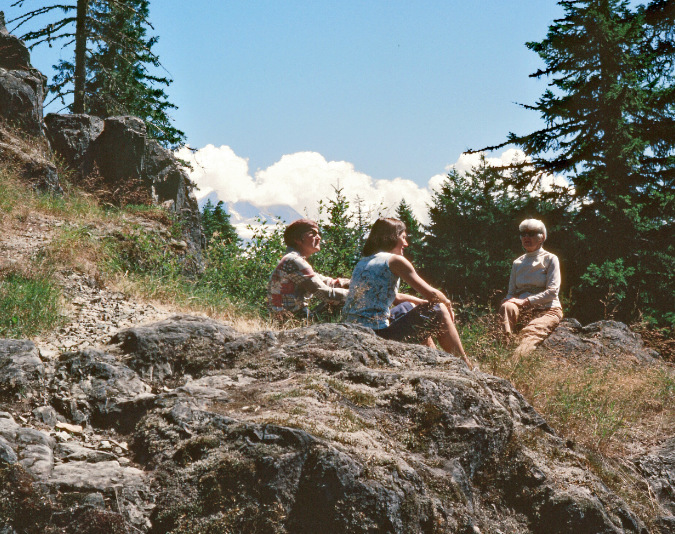
I took this photo of mom (center), my Great-Aunt Mabel (right) and Mabel’s ”best friend and companion” Pauline (left, and we would say her “partner” today, social mores having thankfully evolved). They were enjoying the view from “High Rocks” on one of their visits to Oregon in 1982. Mount Hood is peeking out from the clouds in the distance, and the Zigzag River flows directly below these 100-foot cliffs

Beyond the High Rocks loop, a lesser-known trail network was developed and maintained by a longtime cabin owner who I only knew by his old-school hiking staff and the Scottish tartan vests and cap he wore. If I could teleport in time, I’d retrieve the copy of his hand-drawn trail map that hung on the ancient refrigerator in our Zigzag cabin, as it included all sorts of unofficial trails linking into the surrounding Forest Service system.

Thankfully, I do remember most of those trails, and one in particular that could be useful today (more on why in a moment). It was called “The Tripod Trail” and left the High Rocks loop to climb a still high bluff to a viewpoint of the Zigzag Valley. The old map also noted a mysterious waterfall, located just below the Tripod Trail where it traversed into Devil Canyon. Intriguing!

Most of the old Tripod Trail followed an old logging grade that scaled the bluff in switchbacks. The often-faint trail was marked by simple stick tripods tied with twine that gave the trail its name.  From the end of the logging grade at crest of the bluff a user trail continued north, eventually crossing Devil Creek and connecting to the West Zigzag and South Burnt Lake trailheads at the upper end of Forest Road 27 – also known as Enola Hill Road. During those years at the Zigzag cabin, this was my direct, unofficial access from the cabin door to the Zigzag Mountain trail network and the Mount Hood Wilderness.

Today’s Road 27 Dilemma

Road 27 begins about a mile west of Road 35A. Starting from US26, it also crosses the Zigzag River, then briefly parallels the river heading upstream to provide access for a small group of Forest Service summer cabins. Soon the road makes a hairpin turn, reverts to an unimproved dirt surface and launches up the steep face of Enola Hill along a very narrow, winding traverse. This is the nerve-wracking section the road is most notorious for.

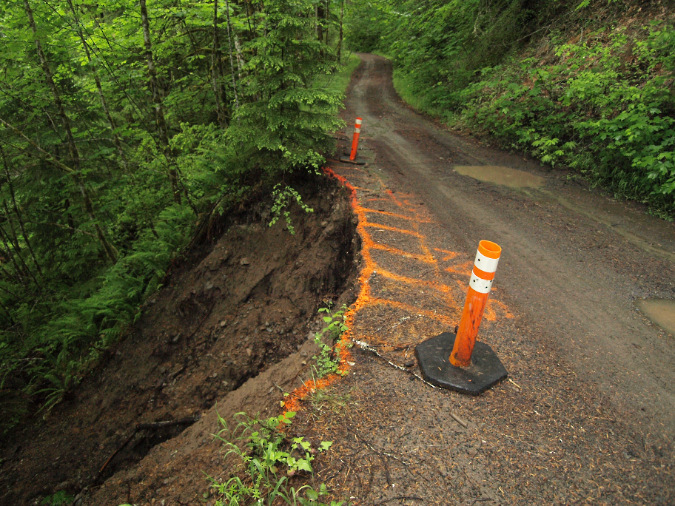
The lower portion of Road 27 is (in)famous for its periodic landslides and nerve-wracking drop-offs… 

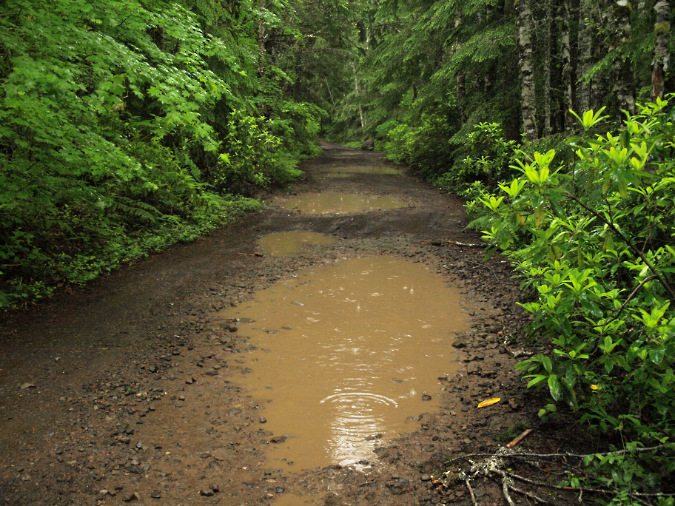
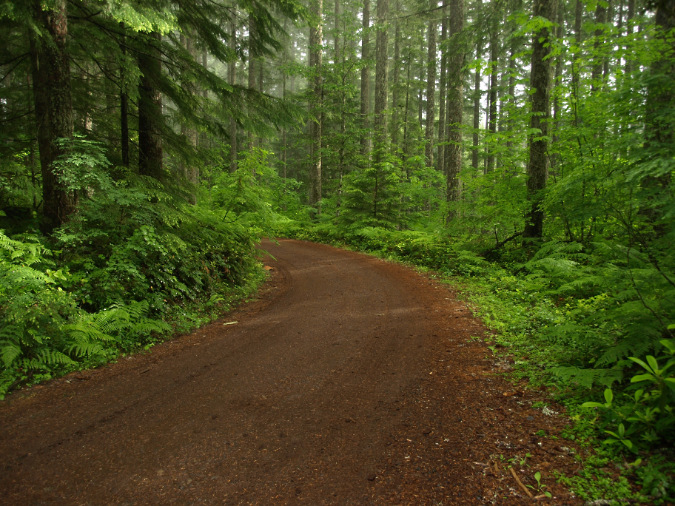
…while the upper portion is known for its sprawling mudholes

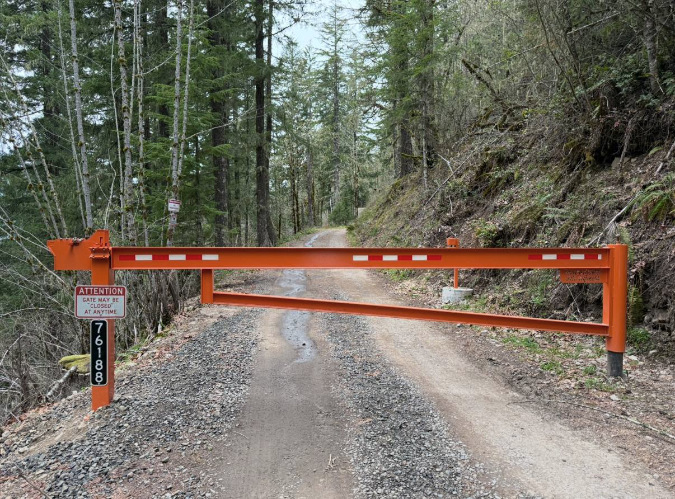
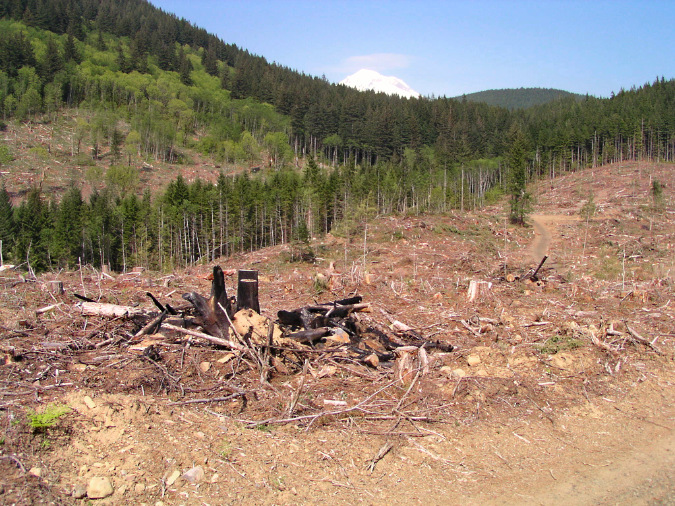
Near the top of Enola Hill, the road flattens out as it crosses a large inholding of private land on a flat bench above the hill. These and other private lands on the hill have been brutally logged many times over, a source of legal disputes with area tribes. However, the private land owners have never attempted to limit general public use of the road where it passes through the private inholding. Until now.

This gate abruptly appeared on Road 27 last year. Signs posted just beyond warn of private property and surveillance (photo: Jerry King)

Through a legal and bureaucratic saga too long and frustrating to summarize for this article, the Forest Service apparently has no means to remove a gate that was abruptly installed by the private land owners last year. This has caused much angst among hikers who fear losing the trails accessed by Road 27 forever, as well as folks in the Rhododendron community whose Henry Creek water source originates on Enola Hill, and is also reached via Road 27. 

Can you spot the private land in this view from Road 27? Mount Hood peeks over protected public forests in the distance, within the Mount Hood Wilderness that border these private parcels.

There are good arguments for figuring out a solution and reopening the gate to the general public, though the chances do seem slim. Fortunately, the Rhododendron community appears to have worked out access to the Henry Creek watershed. However, it’s unclear whether even emergency responders have access, should there be a need for search and rescue crews or other responders. The rest of the public is simply left out in the cold after nearly a century of enjoying access to our national forest lands on this road.

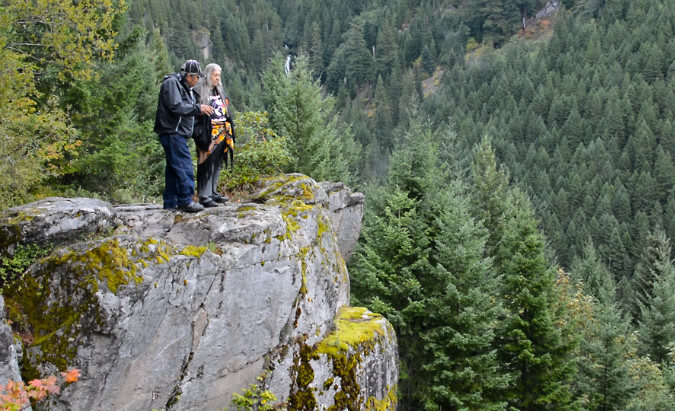
Tribal leaders survey Devil Canyon from the rocky viewpoint atop Enola Hill during their years-long dispute over a nearby highway widening project that destroyed a spiritual site (the tribes finally won a settlement in that case from the federal government in 2023). Devil Canyon Falls can be seen in the distance (photo: Beckett Fund for Religious Liberty)

Despite these frustrations, there are some real benefits to this road finally being closed. That’s the focus of this article. At the top of the list is the spiritual significance of Enola Hill to local tribes, a concern that has led to prolonged legal disputes over past decades with the Forest Service and the Oregon Department of Transportation. 

Though the tribal interests cover a larger area surrounding the hill, the spot that most anyone can appreciate as sacred and worth protecting is the rocky outcrop on the east end of the hill, where views sweep from Devil Canyon Falls to Laurel Hill, and to the broad Zigzag Valley, below. The overlook is located National Forest land, and until last year, the tribes enjoyed open, public access to this revered spot, along with everyone else.

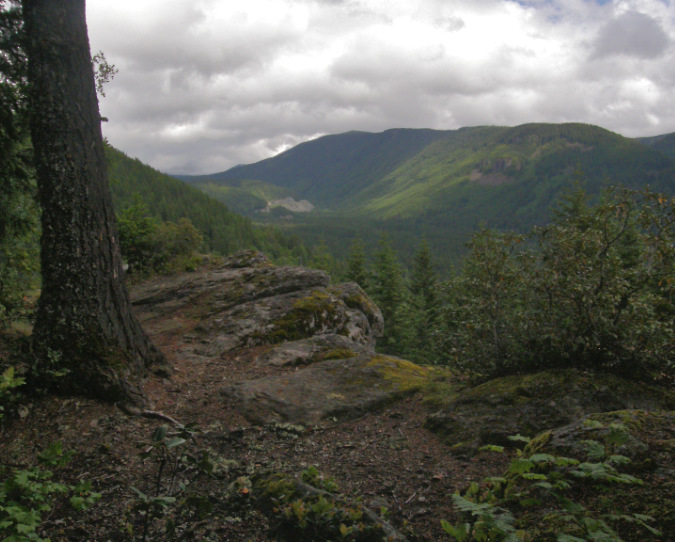
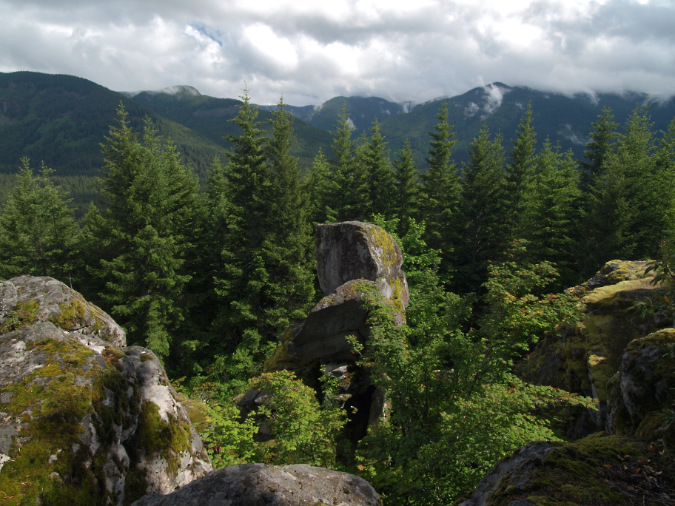
A short path leads to the dramatic overlook on Enola Hill, with the Zigzag Valley spreading out below and Tom Dick and Harry Mountain in the distance in this view

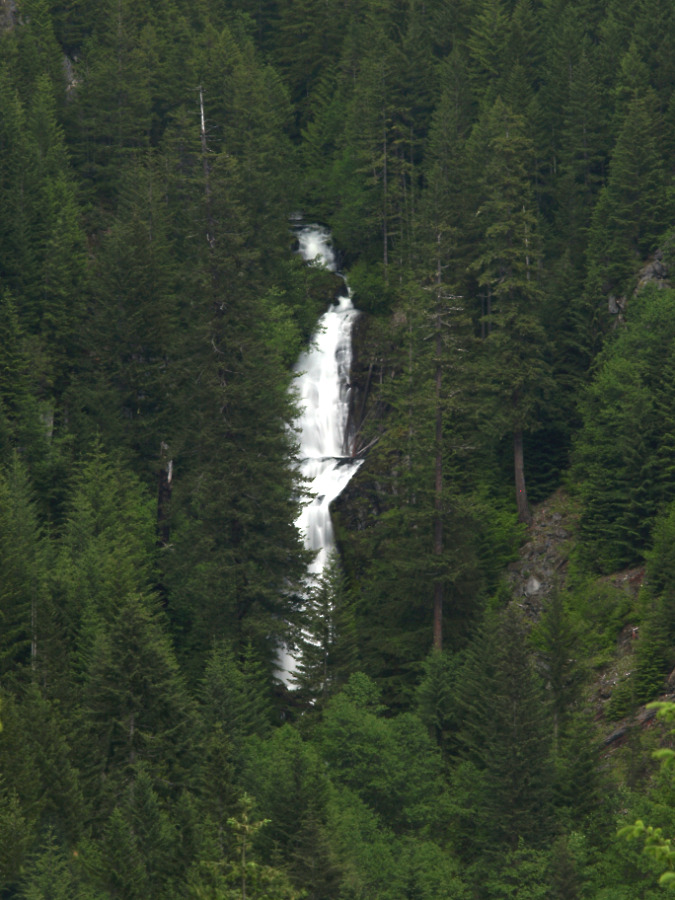
Devil Canyon Falls is the show-stopper from the Enola Hill viewpoint, the only spot where the full extent of the 3-tiered falls can be seen and heard

However, despite its beauty and cultural significance, the rocky viewpoint on Enola Hill has the misfortune of being just a few yards from wide pullout on Road 27 that has long attracted target shooters, off-roaders and other bad actors who routinely left their trash and broken glass behind.  The gated road has at least given the culturally important area a reprieve from this ongoing problem.

The road itself is a also maintenance liability to a Forest Service already overburdened with a sprawling network of deteriorating logging roads. The steep, lower section is prone to landslides and blowdowns and parts of the upper section can be a 3-season muddy quagmire. Though its condition was always primitive, simply keeping it open remained a chore.

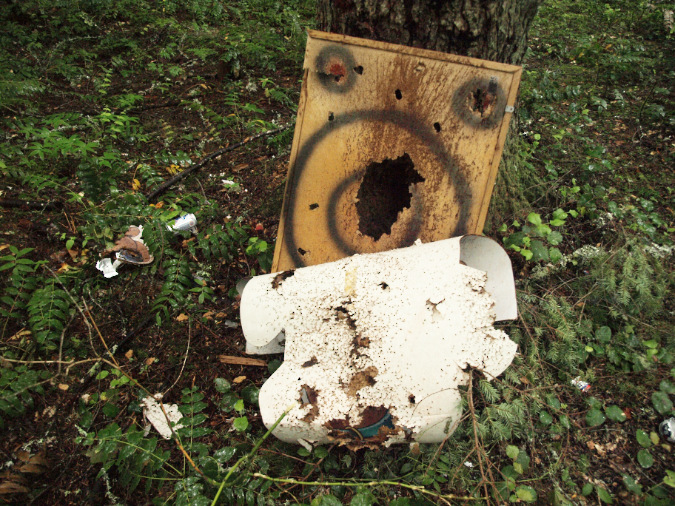
Forest roads bring shooters, dumpers and illegal off-high vehicle activity. Road 27 is no exception, as evidenced in this scene just steps away from the Enola Hill viewpoint

Times have also changed the need for Road 27. Beyond access to the private inholdings, the road no longer serves its original purpose for logging and as a route to the long-gone Devils Meadow Campground. Today, most of the public lands along upper Road 27 are protected as wilderness, and thus the road will never again serve commercial logging on public lands here. Its sole remaining public function is access to the West Zigzag and South Burnt Lake trailheads into the Mount Hood Wilderness.

Before the gate closure last year, the reputation of Road 27 as a rough, sketchy road with some rough, sketchy characters hanging out along it kept many hikers away from the trailhead, and this may have been one of the motivations for the gate. Simply reopening the road would likely revert to the same, sketchy status quo. In this way, the gate closure provides an opportunity to create a better option for hikers: to finally bypass the road entirely with a new Devil Canyon Trail.

Into the canyon…

The idea of accessing the wilderness with an official trail that begins somewhere along the Zigzag River has long been on my mind – ever since that old sketch map that took me up the Tripod Trail. In those days of exploring the area, I’d also made my way up Devil Canyon from below, fascinated by the steep, rambunctious stream and the mystery of a big waterfall upstream – and I wondered why there wasn’t already a trail here?

Decades later, I finally returned to Devil Canyon with a group of friends on a mission to reach the falls, this time with the dream of a new trail passing right in front of the waterfall on the way to the West Zigzag and South Burnt Lake trailheads. Though it had been 30 years since I last explored the area, it was exactly as I remembered it. 

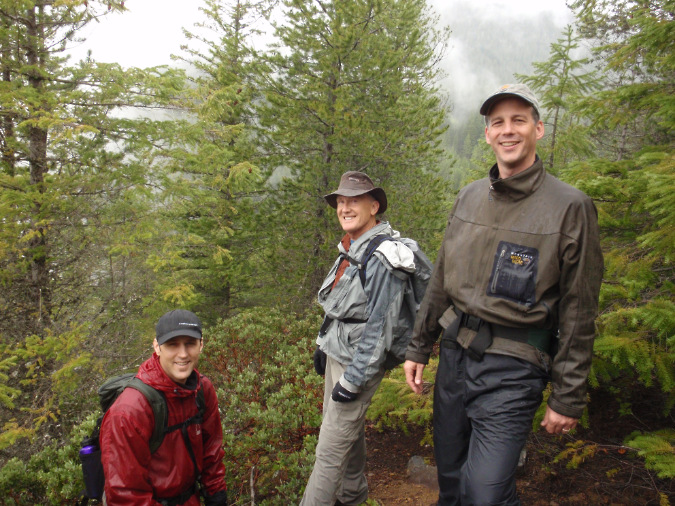
Intrepid waterfall hunters Jamie, Don and Ted getting ready to descend into Devil Canyon a few years ago

Following my memory of the old sketch map, it didn’t take long before we found the upper end of the Tripod Trail along Road 27 – well above both Enola Hill and the falls – and followed it down to a very well-used (and flagged) log crossing of Devil Creek. From there, the obvious path took us along the east rim of the canyon, as the stream below us dropped steeply and noisily toward the falls. Soon, we left the Tripod Trail and followed our ears deeper into the canyon.

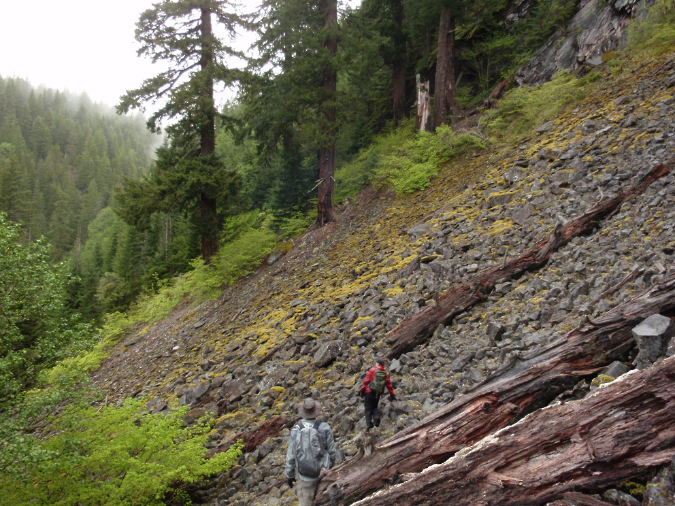
Picking our way across the broad talus slope that borders Devil Canyon Falls

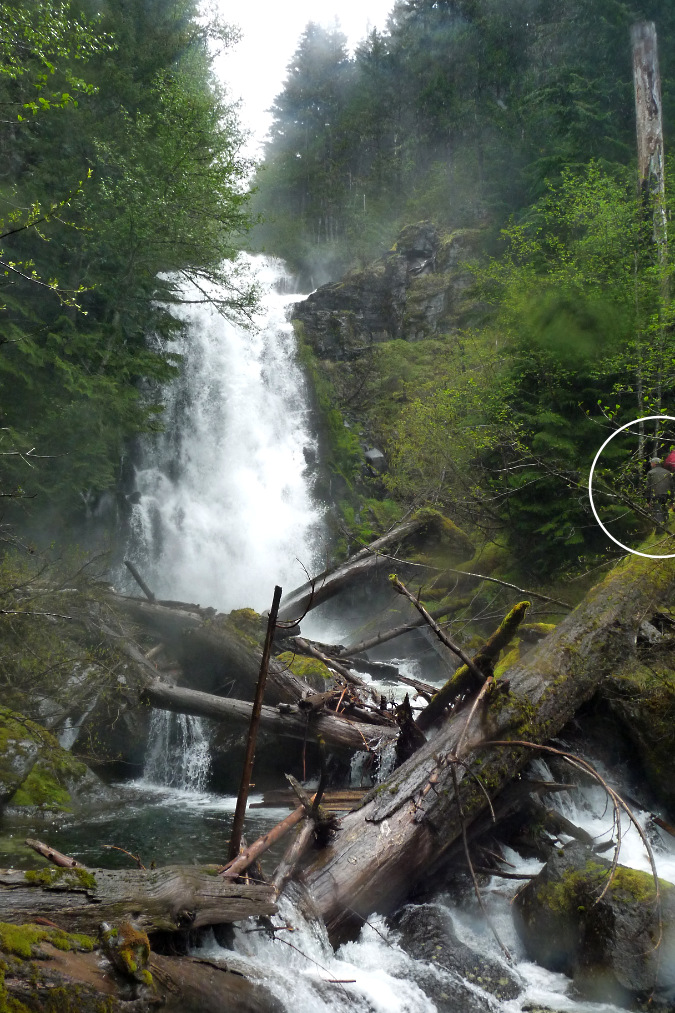
The final descent to the falls was down a tall, steep talus slope. We couldn’t see the falls until we were nearly at its foot, and it was raging in an unusually wet June. I had pictured a tall, stairstep cascade, up-close, something like Wahkeena Falls in the Gorge, but the steepness of the canyon meant that we could only see the final 90-foot tier of the falls from below. 

It turned out the best view of the falls was from that rocky viewpoint on Enola Hill, though finally standing at its thundering base was exhilarating, indeed! Red alders crowded the stream and waved in the blast of mist blowing downstream from the falls. Piles of car-sized boulders and massive logs jammed the stream and ancient groves of Douglas fir towering above, giving the scene a remote, primeval feel. 

As close is this spot was to the rush of the outside world, it was truly wild. Maybe it really would be best to keep the view at a distance?

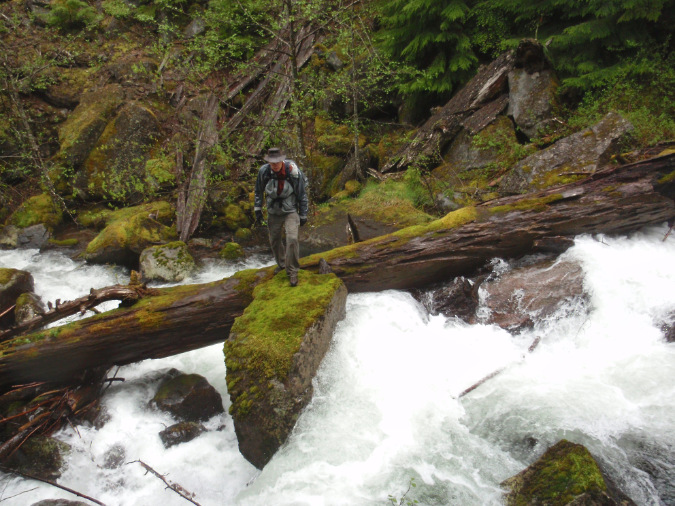
The lower of three tiers that make up Devil Canyon Falls. The canyon contains stands of ancient Douglas fir, with a few fallen giants lodged in the stream. Ted and Jamie are standing on the huge log in this view – circled for scale. 

Thus, my daydream of a streamside trail ascending to a front-row viewpoint of the falls was fading fast in that rugged, wild canyon. As we made our way back up the steep talus slope to the Tripod Trail, I began to think about other options for a new connecting route to Zigzag Mountain. 

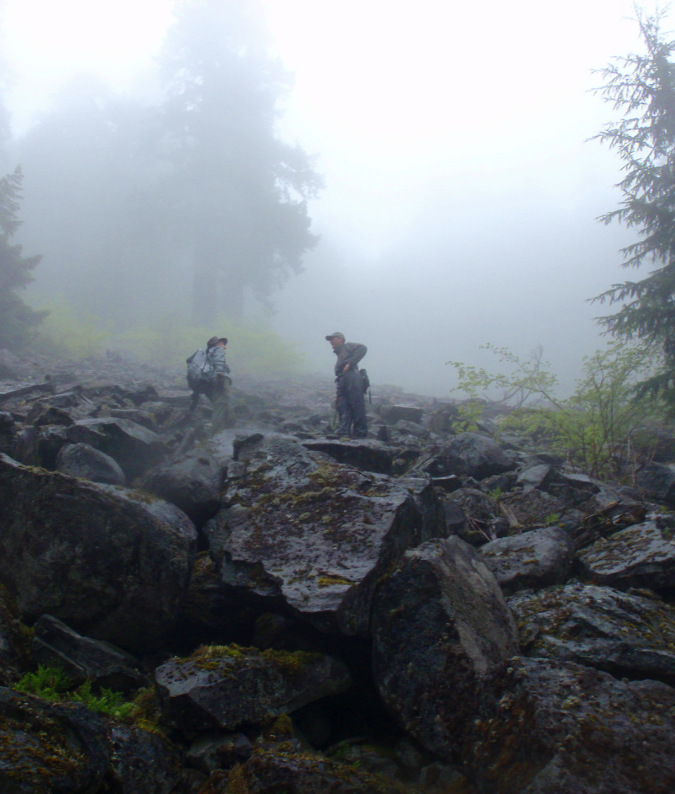
Climbing out of Devil Canyon and into the mist – and back to the Tripod Trail.

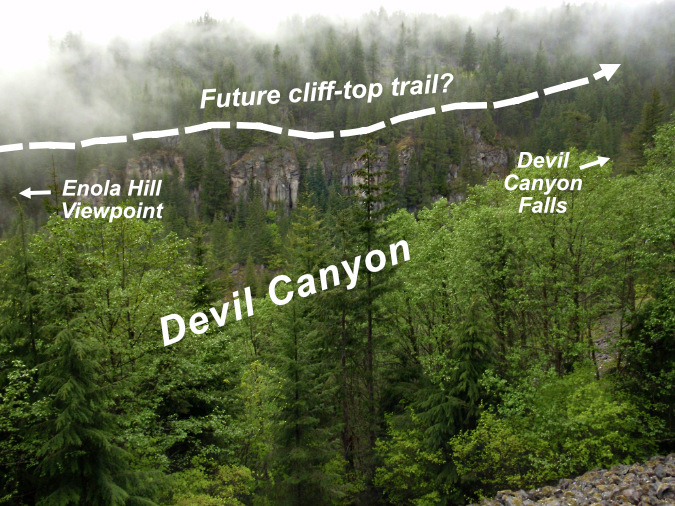
From the top of the talus slope, we had a good view of the west canyon rim, behind us. A series of flat-topped cliffs extended north from the Enola Hill overlook, possibly providing more waterfall views from along the way. These cliffs could offer a scenic rim trail route if the Forest Service were to go big and design a new trail to bypass the Road 27 dilemma. Meanwhile, the Tripod Trail we were following on the east side of the canyon was clearly an option, as well.

Looking across at the cliff tops on the west side of Devil Canyon that could provide a new wilderness trail connecting route

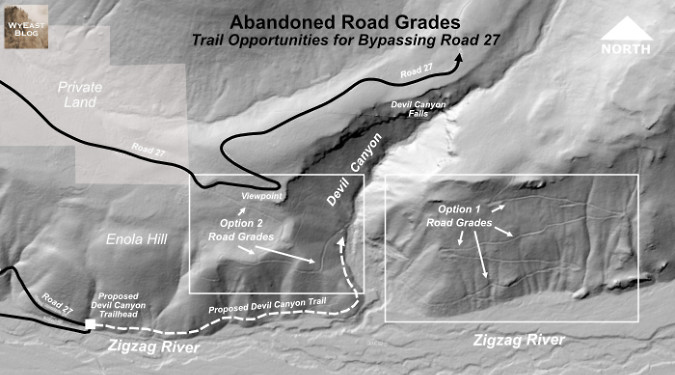
Back home from our canyon adventure, a closer look at LIDAR imagery (below) showed the Tripod Trail alignment nicely, where the ascent section climbs the wall of the Zigzag River valley on a well-built logging grade as it switchbacks up the slope. The user trail that continues from the top of the logging spur to Road 27 doesn’t show on Lidar, but it’s plain as day on the ground, and mostly follows a level bench above the canyon. An official Forest Service trail along this route to bypass Road 27 seems straightforward. 

[click here for a larger map in a new window]

The LIDAR image revealed yet another surprise option: a series of old logging grades that climb Enola Hill, on the west side of the canyon. These would provide an even better opportunity for a low-cost trail alternative to the Tripod Trail that bypasses Road 27. 

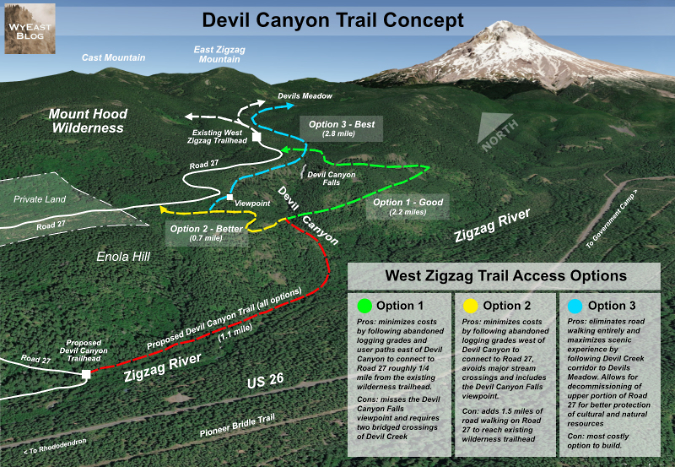
Clearly, these are some good options for a new trail, but which is best? The following concept map includes all three options – good, better and best – for a Devil Canyon Trail. All three options would begin as a new streamside trail that follows the Zigzag River to Devil Canyon, then turns upstream to follow Devils Creek a short distance to where the three options diverge (below):

[click here for a large, printable map in a new window]

A new streamside trail along the Zigzag River and Devils Creek would, alone, be a win for Mount Hood, where there are few such trails, thanks to the concentration of roads that follow many of the stream corridors around the mountain. Simply walking this 1.1 mile streamside segment would be a destination in its own right for hikers with young families or cabin owners looking for a short outing – and provide a way for those who don’t own summer cabins to enjoy the beauty of the Zigzag River, up close. 

Hundreds of private cabins built on leased Forest Service land has made the Zigzag River mostly a privileged sight. The proposed options for bypassing the Road 27 closure would all include nearly a mile of trail along this beautiful stream, a destination in its own right

From the split in Devil Canyon, the first option — the old Tripod Trail on the east side of Devil Canyon – would be the easiest to build. The upper section still showed signs of regular use on our visit just a few years ago, and the old road grades are clearly still in place on the bluff face. It could be a straightforward way to formalize a new trail connection that simply follows an existing, already graded route. This might also be the most pragmatic option, given the many challenges the Forest Service is facing in our current political moment.  

The main drawback of the Tripod Trail route are two crossings of Devil Creek. It’s an often rowdy stream and a significant barrier in the wet season that would require footbridges to safely cross. Another drawback of this option is that it entirely misses the Enola Hill viewpoint, an important destination in its own right, and possibly the only full view of Devil Canyon Falls to be found. 

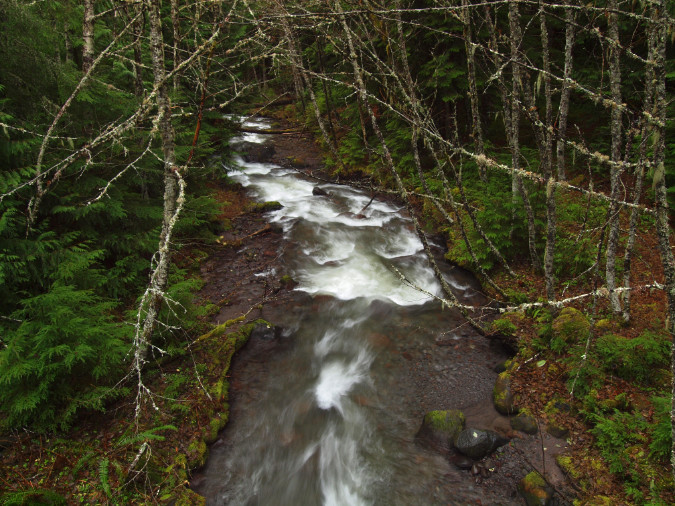
Devil Creek flows loud and fast through its steep canyon. This view was captured on our June exploration, during heavy spring runoff.

The second trail option would follow the old Enola Hill logging grades revealed on LIDAR, heading west from where the three trail options split to climb the hill in a series of switchbacks. This option improves on the Tripod Trail by avoiding stream crossings entirely. The route eventually connects to Road 27 at a point just east of the private parcels, and provides access to the clifftop viewpoint of Devil Canyon Falls after a short road walk along Road 27. 

The main drawback of the second option is the 1.8 of miles of road walking from where the route would join Road 27 to the existing wilderness trailheads. As road walks go, however, the section above the private inholdings is narrow and rustic, climbing through dense, mostly untouched forest. It’s a big step up from walking a more modern, gravel forest road through clearcuts. If the Forest Service were to close and decommission this section of Road 27, it could also be more formally converted into trail, with the Salmon Butte road-to-trail conversion as one recent example.

As road walks go, the public section of Road 27 is pleasant enough… but it’s still a road walk

It turns out the “trail” beyond the existing wilderness trailhead to Burnt Lake and East Zigzag Mountain is, in fact, a repurposed forest road that once led to a long-gone campground at Devils Meadow. Over the decades, the road has very gradually faded to seem more like a trail as nature reclaims its edges. Thus, if Road 27 were closed and simply designated as a trail, it would eventually fade to something more trail-like, even without a specific project to convert it to trail tread – albeit, over many decades.

The third – and preferred — option is to go big – to build a completely new trail that bypasses both the gated portion of Road 27 and the old, converted road section above the current South Burnt Lake trailhead. This new trail could be a far more scenic, rewarding route that follows dramatic clifftop views and parallels Devil Creek more closely on the approach to Devils Meadow. 

Looking south into the Salmon-Huckleberry Wilderness from the viewpoint on Enola Hill – a destination that would be part of both the second and third trail options described in this article

Such a trail would be similar to the Cold Springs Creek trail that passes Tamanawas Falls on the way to Elk Meadows, providing lots of turnaround points at meaningful destinations. This could provide options for folks of all abilities, will still providing backcountry access into the Mount Hood Wilderness for more adventurous hikers. The experience would also be similar to the North Burnt Lake Trail, on the opposite side of Zigzag Mountain, where the trail follows Lost Creek, passing a series of small waterfalls along the way to Burnt Lake.

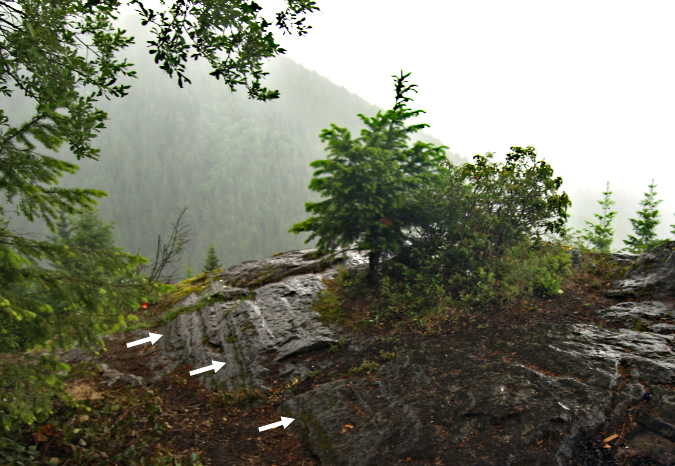
Look closely – assuming public access is restored — at the rocky viewpoint on Enola Hill and you can find ice-age glacial striations (see arrows in the image, above) from when massive glaciers filled the Zigzag River valley so deep they scraped and sculpted the tops of these cliffs more than 500 feet above the valley floor

The best part of this “go big” option would be the viewpoint on Enola Hill, itself – an important destination in its own right that deserves public access – but without the destructive behavior that roads too often bring to special places.  I don’t claim much insight or understanding of the importance of this place to area tribes, though it’s my hope that a trail could be a benefit to the tribes by ending much of the destructive history that Road 27 has brought to the area, while once again restoring their access.

And the new trailhead?

All three trail options would begin at the base of Enola Hill, where Road 27 turns sharply and reverts to a dirt road as it begins its steep ascent. There’s plenty of space here for a turnaround, as there is an old road spur heading east (blocked by boulders). 
The north Burnt Lake trailhead might be the best model for what could work at a new Devil Canyon trailhead. It has spaces for about a dozen vehicles and is operated as a Northwest Forest Pass site, providing some regulation on use and an official presence by the Forest Service.

This old spur from Road 27 at the base of Enola Hill would serve as the new Devil Canyon Trailhead.

Would improved access from the south side of Zigzag Mountain have the unintended effect of diverting trailhead use (and parking) from the popular north access to Burnt Lake to a new trailhead for the south access? Not likely. That’s because the hike to the lake from the north trailhead is only 3 miles long, with a few hundred feet elevation gain, whereas the new route to the lake from a Devil Canyon trailhead would be at least 6 miles long and gain well over a thousand feet in elevation to reach the lake. 

So, what next?

As with any new trail, there’s opportunity for much of the work to be done in partnership with volunteer organizations, like Trailkeepers of Oregon (TKO) and other trail organizations. Local community groups in the Zigzag area could also be part of the effort. 

A new trail here would need to be built in partnership with area tribes, as well, given their deep interest in Enola Hill. They would need to be consulted in all aspects of any project in order to respect and protect their cultural interests in the area, and hopefully there could be a way to provide both restored public access and protect these values.

Could this happen anytime soon? I’m hopeful the Forest Service is at least thinking along these lines. The Road 27 issue seems intractable, and it’s far too soon to give up on access to public trails that have been around for more than a century. 

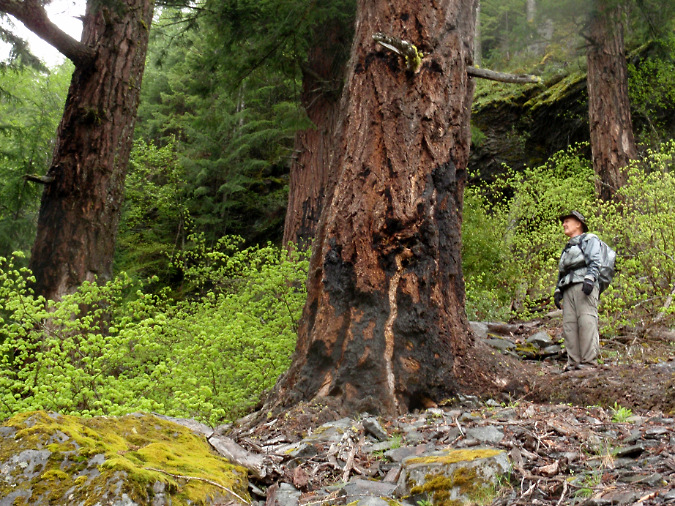
The burn scars on these giant Douglas fir in Devil Canyon date back more than a century to fires that swept most of Zigzag Mountain. This grove survived and is thriving high above Devil Canyon Falls

Yes, this is a tall order in a time of federal agency cuts and the current administration’s emphasis on extraction over all else on our federal lands. But we’re only a couple years from a new administration – and hopefully just a few months from restoring meaningful congressional checks on the administration that could help reverse some of the attacks on our public lands and dismantling of the agencies who administer them. 

There’s also a lot of federal infrastructure funding for our national parks and forests that was authorized during the last administration, but is being slow-walked by the current one.  These funds could be (and likely would be) obligated very quickly by a new administration, underscoring the importance of moving forward to plan for projects like this, even in these times. 

After all, it’s never too early to plan for better days that do lie ahead!

__________________

Tom Kloster | May 2026

A Tale of Two Ranger Stations: Part Two

Forest Service guard on duty at the Upper Sandy station in the 1930s

Forest Service guard on duty at the Upper Sandy station in the 1930s

Mount Hood National Forest (MHNF) recently completed a $1.7 million overhaul of its Zigzag Ranger Station, the de-facto visitor gateway to Mount Hood. Yet the historic Upper Sandy Guard Station, a National Historic Landmark located just a few miles away, near popular Ramona Falls, has fallen into a serious state of disrepair.

Basic repairs needed to save the historic guard station would cost a fraction of what the Zigzag project cost, so why has the Upper Sandy structure been so badly neglected? Part two of this article looks at some of the reasons behind this frustrating paradox, and some possible solutions.

1930s: Guarding Portland’s Watershed

The Upper Sandy Guard Station was built along the newly constructed Timberline Trail in the 1930s. Its purpose was to house a Forest Service guard, stationed there to patrol the Bull Run Reserve — Portland’s water supply — where it abutted the new around-the-mountain recreation trail. At the time, the Bull Run boundary was much more expansive, touching the northwest corner of Mount Hood.

Guard stations were important landmarks for early forest travelers

Guard stations were important landmarks for early forest travelers

The Upper Sandy Guard Station was one of dozens dotting the Mount Hood National Forest in the 1930s, all built to protect forest resources from timber poaching and other illegal activities. Several of the old guard stations could only be reached by trail, and the roads that did reach them were primitive.

The guard stations also served as a supply and communications base for the scores of fire lookouts built throughout the forest, often connected by phone lines that can still be found along less-traveled trails today. As recreation use along forest trails grew in the 1920s and 30s, guard stations also provided a comforting presence for hikers exploring the largely undeveloped national forests of the time.

Today the Upper Sandy Guard Station is slowly fading away (Cheryl Hill © 2013)

Today the Upper Sandy Guard Station is slowly fading away (Cheryl Hill © 2013)

View of the handsome stonework that makes the guard station unique  (Cheryl Hill © 2013)

View of the handsome stonework that makes the guard station unique (Cheryl Hill © 2013)

The industrial logging era that began in the national forests by the late 1940s soon made guard stations obsolete: as thousands of miles of logging roads were bulldozed into remote areas once only accessible by trail, forest administrative operations were consolidated into a few ranger district office, and most of the old guard stations were shuttered.

The unused buildings soon fell into disrepair, and most of these structures were dismantled or burned by the Forest Service in the late 1950s and 1960s (along with most fire lookouts, also deemed obsolete as aerial fire surveillance began).

When the Bull Run Division boundary was changed in 1977, the Upper Sandy Guard Station was left miles away from the resource it was built to defend. One year later, the Mount Hood Wilderness was expanded to encompass the building, sealing its fate as a relic in the eyes of the Forest Service.

In recent years the roof on the Upper Sandy Guard Station has partially collapsed, despite crude repairs by volunteers  (Cheryl Hill © 2013)

In recent years the roof on the Upper Sandy Guard Station has partially collapsed, despite crude repairs by volunteers (Cheryl Hill © 2013)

The few guard stations that did survive decades of neglect intact now represent a precious glimpse into an earlier, idyllic time in the national forests. They now stand as historical gems, worthy of special protection.

Some of these structures have already been preserved, like the Clackamas Lake Guard Station near Timothy Lake, while others have been allowed to fade away nearly to oblivion, like the Upper Sandy Guard Station. A few that survived intentional destruction by the Forest Service have nonetheless been lost to neglect, like the former High Prairie Guard Station on Lookout Mountain, a building that was partially standing as recently as the early 1980s.

Ruins of the High Prairie Guard Station in 1983 before it faded into the meadow

Ruins of the High Prairie Guard Station in 1983 before it faded into the meadow

In September 2009, the National Park Service finally added the Upper Sandy Guard Station to the U.S. National Register of Historic Places, a move that many considered to be the building’s salvation. After all, the Forest Service had actively sought the historic designation and local Forest Service historians had strongly advocated for preservation of the building. Thus, the disappointment in the years since, as even the most rudimentary Forest Service efforts to stabilize the building failed to materialize.

Instead, the Forest Service posted the following notice on the building, “warning” hikers that entering the structure presented a dire hantavirus risk from resident deer mice. The notice actually admits that only one (!) documented hantavirus case has ever been documented in Oregon, and that “there is no evidence that the disease is carried by rodents who call this building home.”

Of course, deer mice surely inhabit every other historic wilderness structure in the wilderness areas around Mount Hood, yet no health warnings are posted on the shelters at McNeil Point, Cairn Basin, Cooper Spur and Elk Meadows or the lookout at Devils Peak, where hikers routinely camp inside (and maintain) the structures. So, the point of this notice on the Upper Sandy structure seems to be to frighten visitors from entering — or perhaps maintaining — the structure.

The Forest Service has posted this "health warning" on the structure to discourage visitors  (Cheryl Hill © 2013)

The Forest Service has posted this “health warning” on the structure to discourage visitors (Cheryl Hill © 2013)

The Upper Sandy Guard Station was added to the elite National Register partly because of its historic role as a base for patrolling the Bull Run Reserve, but mostly as the only surviving design of its kind in the Pacific Northwest. The building has a unique, rustic architecture that embodies the New Deal programs that put skilled craftsmen and laborers to work on our public lands as part of the 1930s economic recovery.

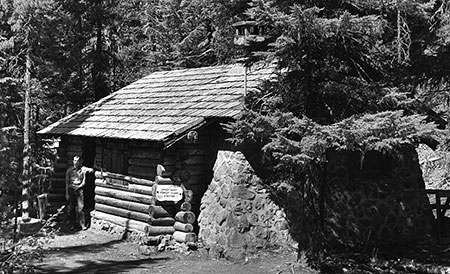
Most notable is the massive stone masonry end wall that has probably helped stabilize the structure as the log walls continue to deteriorate. Its unique design combining rubble stone and wood walls make it one of a kind among the more than 700 forest administrative buildings constructed during the New Deal era.

The building was constructed by a seven-man crew in the summer of 1935 with a budget of $958.88, including materials: two carpenters worked at the rate of $7/day and two laborers assisted at the more modest rate of $4/day. The guard station was completed on September 28, 1935.

Today the building suffers serious holes roof and will almost certainly be lost in a few years without an immediate effort to stabilize the structure, or better yet, all of the work needed to fully restore this building. So, why is the Forest Service allowing this to happen? Blame it on the Wilderness..?

Does the Upper Sandy Guard Station have a future? (Cheryl Hill © 2013)

Does the Upper Sandy Guard Station have a future? (Cheryl Hill © 2013)

For a time following the 2009 National Historic Register listing, the old guard station had an advocate in the Northwest Forest Conservancy (NFC), a local non-profit focused on preserving several historic forest structures in the Mount Hood National Forest. Today, the NFC appears to be inactive, and there are no advocates pressing for the building to be rescued.

Prior to the 2009 Historic Register listing, the NFC formally proposed managing a restored building. Today, several historic structures in the Tilly Jane area (on the northeast side of Mount Hood) are managed in this way by the Oregon Nordic Club under an agreement with the Forest Service.

Under such an arrangement, the Upper Sandy Guard Station could have been put it to year-round use as part of its restoration. The NFC envisioned volunteers to staff the guard station during the summer, as the proximity to both the trailhead and nearby Ramona Falls makes the guard station a natural base for both volunteers and visitors. Sadly, this plan never moved forward.

The Upper Sandy Guard Station was prominent on this 1939 map of the Timberline Trail, along with the log shelter that once stood at Ramona Falls

The Upper Sandy Guard Station was prominent on this 1939 map of the Timberline Trail

Despite the agency effort to list the building on the National Register, friends of the old guard station within the Forest Service are surprisingly scarce, and mostly limited to historic resource specialists whose workloads spans multiple forests.

Unfortunately, the Upper Sandy Guard Station carries a still heavier burden than simply a lack of interest from the Forest Service: since a 1978 expansion, the guard station has located within the Mount Hood Wilderness, which by some interpretations means it should be allowed to fade into the oblivion in deference to protecting the untrammeled nature of wilderness.

Is it really that simple? Not at all, but internal Forest Service e-mails on the fate of the historic structure show Mount Hood National Forest recreation planners quickly turning to this argument in defending the decision to let the Upper Sandy Guard Station fall further into disrepair. The same e-mail exchanges also reveal internal rivalries between recreation and historic resource staff that have more to do with protecting recreation budgets than adhering to strict interpretations of the Wilderness Act.

Letting this historic building deteriorate is also at odds with the 1999 Mount Hood National Forest facilities master plan, a forest-wide effort to address surplus Forest Service building. The facilities master plan identified the Upper Sandy Guard Station as surplus building, but set no policy for decommissioning or disposing of the structure — one of the core purposes of the facilities plan.

The Devils Peak lookout has apparently found favor with the Forest Service, despite its location inside the Salmon-Huckleberry Wilderness

The Devils Peak lookout has apparently found favor with the Forest Service, despite its location inside the Salmon-Huckleberry Wilderness

The 1999 facilities plan includes other historic structures located inside wilderness area, notably the lookouts at Bull of the Woods and nearby Devils Peak. Both lookouts are included in the National Historic Lookout Register, which is often a first step toward listing in the more rigorous National Historic Landmark Register.

While the Forest Service is silent on Bull of the Woods lookout (and the structure is now showing signs of serious disrepair) the Devils Peak Lookout is described on the Mount Hood National Forest website “open to the public” and maintained as a Forest Service facility.

Why the disparity, especially given that the Devils Peak lookout lacks National Historic Register status? For now, that remains a mystery, as the Forest Service does not seem to have a comprehensive plan for their historic wilderness structures, nor a consistent policy on which structures will be allowed to deteriorate beyond the point of repair — including the remaining Timberline Trail shelters and other facilities across the forest that have gradually been incorporated into new wilderness areas over the years.

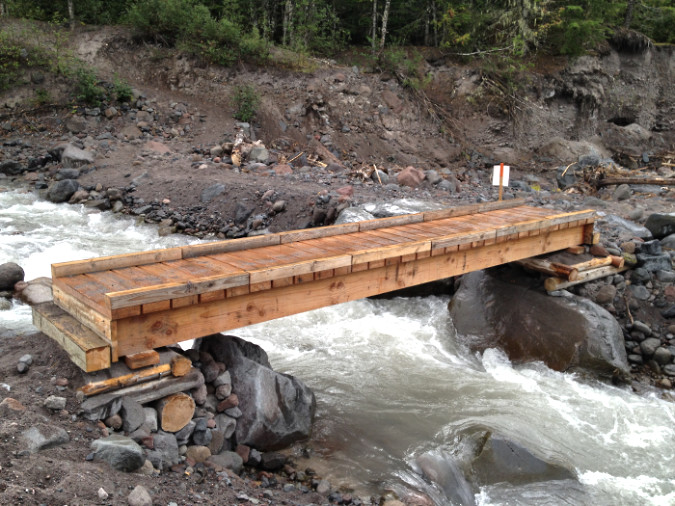
This massive new bridge over modest Ramona Creek was built in 2012 inside the Mount Hood Wilderness, less than a mile from the Upper Sandy Guard Station.

This massive new bridge over modest Ramona Creek was built in 2012 inside the Mount Hood Wilderness, less than a mile from the Upper Sandy Guard Station.

Still more confounding is the fact that the Forest Service constructed an elaborate new bridge over Ramona Creek in 2012, just a mile from the Upper Sandy Guard Station and well within the Mount Hood Wilderness. Ramona Creek is a modest stream that can be easily crossed without a bridge, so how was this structure justified?

In a reportedly confrontational exchange in 2007 over the Upper Sandy Guard Station several years ago, a recreation planner from the Zigzag Ranger District responded to questions about the structure with “Have you READ the Wilderness Act? Man-made structures are NOT allowed!” Yet, the same planner was apparently responsible for construction of the elaborate new wilderness bridge over Ramona Creek in 2012.

Clearly, the Mount Hood National Forest has no consistent policy on structures in wilderness areas, historic or otherwise, and thus the highly selective, subjective decisions by district-level staff to build new structures while allowing historic structures to deteriorate.

So, what to do? Fortunately, the answer seems to be coming from the federal land agencies, themselves.

Rethinking the Wilderness Act

Core to the Mount Hood National Forest rationale for letting the Upper Sandy Guard Station fade into oblivion is the opinion — albeit, selectively applied — that “man made structures are not allowed” in wilderness areas. This opinion stems from a series of three recent court decisions and is now widely shared as gospel among the federal land rank-and-file staff.

The stone Cooper Spur shelter along the Timberline Trail is among the historic gems that depend on a better interpretation of the Wilderness Act to survive for future generations

The stone Cooper Spur shelter along the Timberline Trail is among the historic gems that depend on a better interpretation of the Wilderness Act to survive for future generations

However, there is an emerging opinion among wilderness experts within the federal agencies that maintaining and restoring historic wilderness structures is consistent with the 1964 Wilderness Act, and that recent court decisions are more a reflection of flawed arguments made by the federal government in defending its actions to protect historic (and other) structures in wilderness areas. This new argument starts with a key passage in the Wilderness Act, which is the basis for the recent court decisions:

Except in certain specific instances, “there shall be no…structure or installation within any [wilderness] area.” (Wilderness Act, Section 4(c))

In their defense, the federal government has pointed to another passage in the Wilderness Act, arguing that the maintenance or restoration of historic structures qualifies as “use” and is clearly called out among the public purposes of the act:

“Except as otherwise provided in this Act, wilderness areas shall be devoted to the public purposes of recreational, scenic, scientific, educational, conservation, and historical use.” (Wilderness Act, Section 4(b))

Yet, in recent decisions the courts have focused upon the “except as otherwise provided” preface to this clause, and in three key decisions have interpreted historic structures to be at odds with the Wilderness Act. The new thinking emerging among federal wilderness experts focuses on a different defense that would build on this passage in the Wilderness Act:

“A wilderness…may also contain ecological, geological, or other features of scientific, educational, scenic, or historical value.” (Wilderness Act, Section 2(c))

Under this argument, a new approach to defending protection of historic resources in wilderness areas would focus on the “value” of the resource, not “use”, and therefore the mere existence of a demonstrably historic resource like the Upper Sandy Guard Station would be enough to justify maintenance (and even restoration) over time. Finally, another section of the Wilderness Act fills out this new approach, where the act states that structures are generally prohibited except:

“…as necessary to meet minimum requirements for the administration of the area for the purpose of this Act.” (Wilderness Act, Section 4(c))

Therefore, if historic structures represent a “feature of value”, then preserving the structure would be the “minimum requirement” for administering the resource. That’s a lot of legal wrangling, but it could just be what saves our historic wilderness structures.

The Upper Sandy Guard Station sits on a flat bench above the Sandy River, just off the modern alignment of the Pacific Crest Trail.

The Upper Sandy Guard Station sits on a flat bench above the Sandy River, just off the modern alignment of the Pacific Crest Trail.

Taking this interpretation a step further, the fact that “scientific, educational (and) scenic” values are also listed suggests that preserving the Upper Sandy Guard Station by virtue of using it as an overnight rental facility or even staffing it to provide an administrative presence along the overwhelmingly popular Ramona Falls Trail would also be “values” that pass muster under the Wilderness Act. So far, this new approach has not been tested in the courts, but it does offer a hopeful alternative to the troubling direction of recent decisions.

The historic Green Mountain Lookout near Glacier Peak, saved from the federal courts in 2014 by an Act of Congress

The historic Green Mountain Lookout near Glacier Peak, saved from the federal courts in 2014 by an Act of Congress

In the meantime, historic resource advocates in the State of Washington recently short-circuited these recent court decisions in a successful effort to save the Green Mountain Lookout, located inside the Glacier Peak Wilderness.

The Forest Service was taken to court in 2010 over a major restoration of the historic lookout needed to save the structure after years of neglect, including the use of helicopters to carry materials to the remote lookout site. In 2012, the case resulted in one of the three court rulings that have since become the mantra against protecting wilderness structures, and the Forest Service began preparing to remove the building under court order.

Historic resource advocates in Washington State were stunned, and took the case to their congressional delegation. Under the leadership of Senators Patty Murray and Maria Cantwell, Congress acted to permanently protect the structure in April of this year, paving the way for the Forest Service to continue to maintain the Green Mountain lookout for the enjoyment of the public indefinitely.

Saving it by using it?

Ramona Falls is among the most visited wilderness destinations in the country and could use a better ranger presence - why not use the Upper Sandy Guard Station as a base?

Ramona Falls is among the most visited wilderness destinations in the country and could use a better ranger presence – why not use the Upper Sandy Guard Station as a base?

So, how can the Upper Sandy Guard Station be saved? Above all, the building needs an energetic advocate in the form of a non-profit dedicated to historic preservation our public lands – or perhaps even a “Friends of the Upper Sandy Guard Station” non-profit.

The fact that the Mount Hood National Forest has been so arbitrary in its decisions to maintain or build some wilderness structures while allowing others to fall into disrepair is an opportunity: consistent, persistent pressure should be enough to get the Forest Service to do the right thing, and save this priceless old building.

Another possibility is an act of Congress, mirroring the Green Mountain precedent. Given the dire state of the building, perhaps Oregon Senators Ron Wyden and Jeff Merkley could follow in the footsteps of Washington Senator Murray and Cantwell, and simply direct the Forest Service (and the courts) to preserve and restore the building?

These original windows on the guard station were intact as recently as 2008

These original windows on the guard station were intact as recently as 2008

But even with needed repairs, the Upper Sandy Guard Station still lacks a sustaining purpose beyond its intrinsic value as a historic structure. Clearly, the Forest Service sees little value in the building, but to hikers, the structure could be invaluable if managed as a recreation resource.

Here’s how: in summer the guard station could operate in its intended function, with volunteer rangers living in the building during the period when the Sandy River trail bridge is installed (late May through September).

This would put a needed presence on a trail that is heavily traveled, and unfortunately has problems with car break-ins and rowdy visitors at Ramona Falls. The building has the potential to be quite comfortable, as it was originally served with a piped water supply (since removed), and had a sink, small kitchen and even a shower stall that still survives.

Original brass window hardware was still present in 2008, but has since been stripped from by building by vandals

Original brass window hardware was still present in 2008, but has since been stripped from by building by vandals

Volunteer seasonal rangers could also serve as interpreters, giving tours of the old structure and answering questions at Ramona Falls, where the overwhelming share of visitors are casual hikers and young families new to the forest.

Once the seasonal trail bridges have been removed in fall, the guard station could transition to a winter rental, much as several lookouts in the area and the historic guard station at Tilly Jane are operated today. The Old Maid Flat area is a popular snowshoeing and Nordic skiing area, and a restored guard station would be an idyllic overnight destination in high demand. Revenue from rentals could also help pay for needed maintenance and repairs to the structure.

This magnificent fireplace stands at the center of the guard station; the room in the background is a built-in shower, lined with galvanized steel.

This magnificent fireplace stands at the center of the guard station; the room in the background is a built-in shower, lined with galvanized steel.

Could this really work? There are some logistical consideration that would have to be bridged by the Forest Service to actually bring the building back into public use, but they are not insurmountable. First, regular use of the structure would require an outhouse to be restored to the site. Hopefully the original location could be determined from old photos or building plans.

Second, the building would need to be supplied with firewood for winter use, which in turn, would require a woodshed. The National Historic Register evaluation of the building describes a shed that was apparently dismantled many years ago, but could be faithfully restored as part of reconstructing the guard station as it was originally built.

Today, the main structural risk to the building is where several holes have formed in the roof around the chimney. The tarps visible in this photo were placed by the National Historic Register survey crew in 2008 to help stabilize the building.

Today, the main structural risk to the building is where several holes have formed in the roof around the chimney. The tarps visible in this photo were placed by the National Historic Register survey crew in 2008 to help stabilize the building.

Supplying the Guard Station with firewood would be another matter, as any firewood would need to be collected without the use of power tools — a routine task for the hardy individuals who built these structures, but more daunting to us in the modern era. This could be one of the activities of the summer resident rangers. Bundles firewood could also be dropped at the site when a helicopter is already being used to pull out the Sandy River hiking bridge at the end of the summer season.

What next?

Hopefully, this beautiful old structure will find a champion soon, as time is running out for the Upper Sandy Guard Station. While the building condition was described as “excellent” as recently as the 1980s, it has begun to experience major problems from neglect. Worse, vandals have since stripped the building of furnishings and even burned the original wood shutters. The Upper Sandy Guard Station deserves better!

If you would like to help out, consider sending a message to the Forest Service or even your congressional representatives expressing your support for saving this one-of-a-kind window into the past before it’s too late:

Contact Mount Hood National Forest Contact Senator Ron Wyden Contact Senator Jeff Merkley Contact Rep. Earl Blumenauer

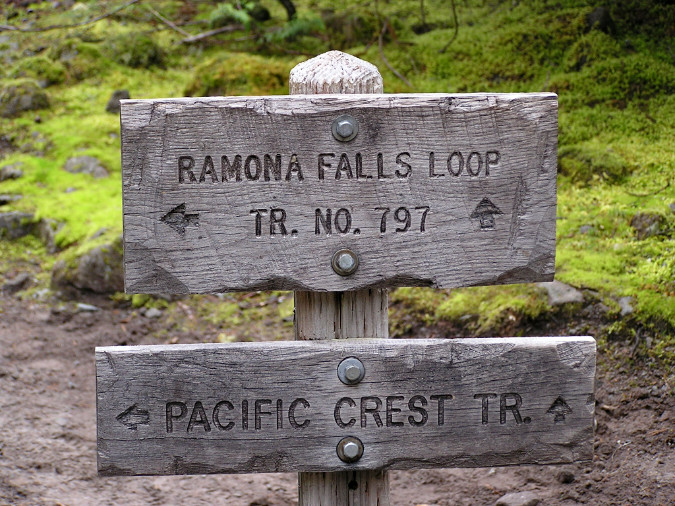
If you would like to see the building for yourself, it’s easy to find. The building is on a bench above the Sandy River floodplain, just a few hundred feet off the trail where the Ramona Falls loop intersects the Pacific Crest Trail, near Ramona Falls. The best time to visit is during the summer, when the Sandy River hikers bridge has been installed for the season.

A Tale of Two Ranger Stations: Part One

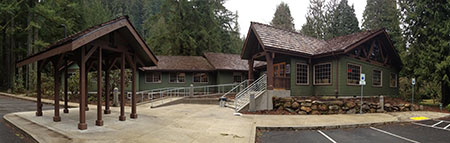
The new Zigzag Ranger Station

The new Zigzag Ranger Station

Mount Hood National Forest (MHNF) recently completed a much-needed, $1.7 million overhaul of its dated Zigzag Ranger Station, the de-facto visitor gateway to Mount Hood. The new ranger station and visitor center not only provide a modern facility for forest visitors, it was also designed to compliment the rare collection of historic forest buildings that sprawl across the Zigzag campus, the entirety of which was listed on the National Historic Register in 1986. It’s a big step forward for Mount Hood.

Meanwhile, the Upper Sandy Guard Station, located just a few miles away near popular Ramona Falls, has fallen into serious disrepair, all but abandoned after years of neglect. The Upper Sandy Guard Station is also listed on the National Historic Register (in 2009), yet now is on the brink of collapse. Basic repairs would cost a fraction of what the Zigzag project cost, so why the disparity?

Upper Sandy Guard Station in better days (1930s)

Upper Sandy Guard Station in better days (1930s)

This is a two-part story about the two historic ranger stations, one reborn and the other about to die, and how this frustrating chain of events came to pass. And, most importantly, how the Upper Sandy Guard Station might still be saved.

No Welcome Mat?

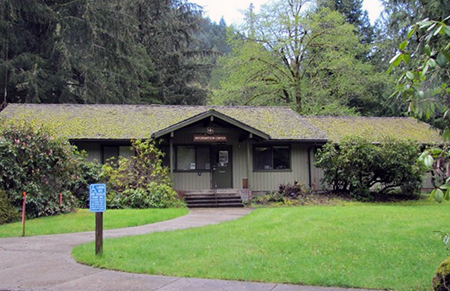
Mount Hood has always lacked a truly functional visitor center. For years the 1960s-era Zigzag ranger station, with its cluttered, cramped public counter, served as the main stop for visitors new to the area. The old Mount Hood National Forest headquarters was actually worse, located in a rundown section of east Division Street in Gresham, next to mini-storage. It was hardly an inspiring “gateway” to Mount Hood.

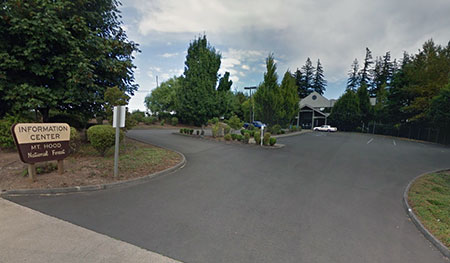
A relatively new forest headquarters building was constructed in Sandy in the 1990s with a more aesthetic design the 1990s, but is awkwardly located in a suburban industrial park, where the public is discouraged from visiting the building. Few travelers even realize they are passing the building, though it is within plain view of the Mount Hood highway.

The "new" (1990s) Mount Hood headquarters hides in an industrial park on the outskirts of Sandy.

The “new” (1990s) Mount Hood headquarters hides in an industrial park on the outskirts of Sandy.

The new headquarters in Sandy was a missed opportunity to build a visitor gateway on a scale that reflects the millions who visit the mountain each year. Most regrettable was the decision to locate the building two miles from downtown Sandy, where it could have been easily found by visitors, but also would have complemented other visitor facilities there, and reinforced the tourism economy that is so important to the town of Sandy.

This small building served as the Zigzag Ranger Station until 2013

This small building served as the Zigzag Ranger Station until 2013

By the late 1990s, the Forest Service had formed a partnership with Clackamas County and the Mount Hood Chamber to open a new visitor facility in a vacant commercial space on the Mount Hood Village RV resort grounds, a few miles west of Zigzag. This odd arrangement operated into the mid-2000s, but was eventually closed due to county budget cuts. Relatively few visitors found their way to this location, anyway, so the closure mostly impacted hikers who had enjoyed the convenience of a public restroom.

After the RV resort experiment, the visitor gateway to Mount Hood reverted to an outdoor kiosk at the 1960s-era Zigzag Ranger Station. A portable toilet was added to the parking area to complete the outdoor facilities. This arrangement served as the main visitor experience until last summer, when the handsome new ranger station and visitor center opened.

The original Zigzag Ranger Station was built by the CCC in 1935

The original Zigzag Ranger Station was built by the CCC in 1935

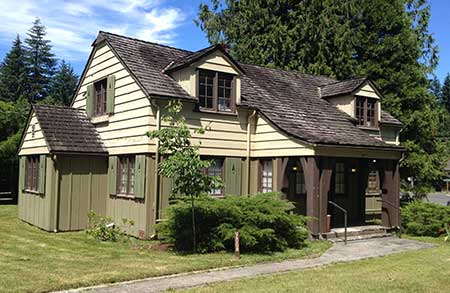
The good news is that the original Civilian Conservation Corps (CCC) era Zigzag Ranger Station also survives, along with nineteen other historic structures on the Zigzag site. To the credit of the MHNF, all of these structures have been well preserved over the decades for their historic significance at a time when historic forest service structure around the nation are rapidly fading away.

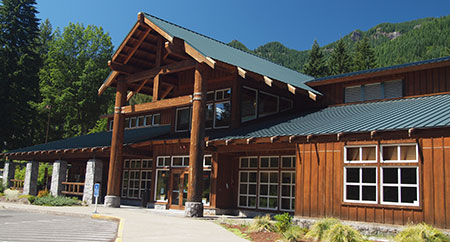
While the visitor gateway to Mount Hood bounced around over the past several decades, other national forests in the region were moving ahead with bold visitor centers that signaled a new focus on recreation. Notably, the Willamette National Forest built four expansive new ranger stations in the 2000s on far less travelled forest gateways than loop highway approach to Mount Hood, including a dramatic new Detroit Ranger Station (below), which opened in 2009.

The grand Detroit Lake Ranger Station and visitors center

The grand Detroit Lake Ranger Station and visitors center

Meanwhile, the Mount Hood National Forest limped along with the fading 1960s era Zigzag Ranger Station and a similarly dated and cramped Estacada Ranger Station. The Hood River Ranger Station is even worse, a leased space until recently, and little more than a portable building.

Perhaps a bit of intra-agency envy ensued, as the Mount Hood National Forest finally assembled funding in 2012 for a major upgrade to the Zigzag Ranger Station. Requests for construction bids were titled the “Mount Hood Scenic Byway Portal Project”, a fitting acknowledgement of the main focus of the building upgrade.

The New Zigzag Ranger Station

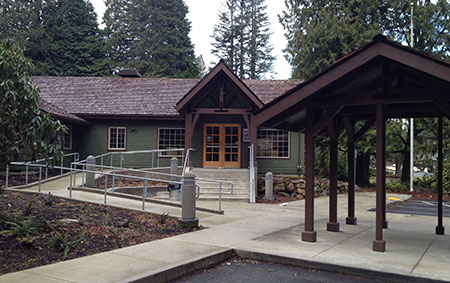
The new Zigzag Ranger Station (below) is tucked into the historic complex at Zigzag, east of the original ranger station and incorporating the 1960s era building. Though not as grandiose as the new gateway structures in nearby Willamette National Forest, the new Zigzag facility has an attractive, rustic design that complements the surrounding historic structures rather than overshadow them.

Visitor Center at the new Zigzag Ranger Station

Visitor Center at the new Zigzag Ranger Station

DKA Architecture of Seattle designed the project, which includes a remodel of the old 1960s structure with new additions that double the square footage of the facility. Payne Construction of Portland was selected from a competitive bid to build the new facility.

The new ranger station and visitor center has three main elements: (1) the indoor reception and visitors area, backed by administrative offices and conferences rooms, (2) an outdoor plaza and display gazebo and (3) separate public restrooms. The new ranger station structure is clad in clapboard siding and shingled gable roof, echoing the Cascadian architecture of the original 1935 structure.

The new Zigzag Visitors Center is fronted with a small plaza and information gazebo

The new Zigzag Visitors Center is fronted with a small plaza and information gazebo

HBB Landscape Architecture of Seattle designed the mostly rustic landscaping around the new structure. Modern touches to the landscape include a concrete, railed wheelchair ramp and sleek lighting bollards. The landscape design appropriately focuses on native plants, including sword fern, salal, Oregon grape, rhododendron and even some stonecrop tucked into a rock retaining wall, all just getting started, but well suited to thrive here.

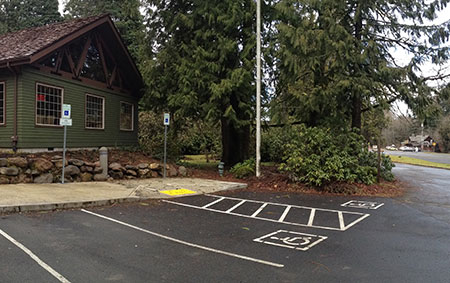
Wheelchair parking is provided close to the gazebo with ramps to both the restroom and visitor center

Wheelchair parking is provided close to the gazebo with ramps to both the restroom and visitor center

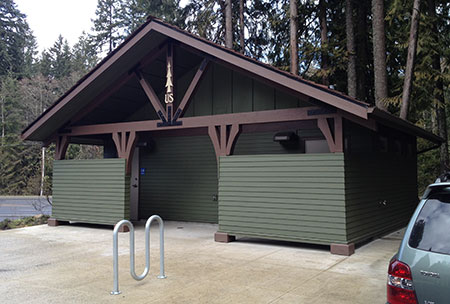
The very modern public restroom is located across the small parking area from the new ranger station and visitor center. The proximity to US 26 and dramatic improvement over the portable toilets (yikes!) that used to be here will make these restrooms a popular stop along the loop highway – and hopefully inspire travelers to take a few minutes and explore the visitor center, as well.

The restroom exterior design has a nice touch: the traditional 1930s “open pine tree” logo is incorporated into the center gable post, a thoughtful nod to the collection of historic CCC buildings that surround the new facility. The restroom includes a single bicycle rack — minimal, but easy to expand over time, thanks to the spacious plaza in front of the restroom.

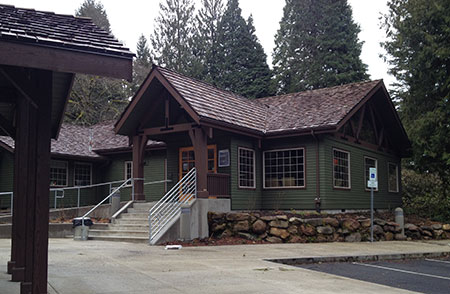
New restrooms at the Zigzag Ranger Station and Visitor Center

New restrooms at the Zigzag Ranger Station and Visitor Center

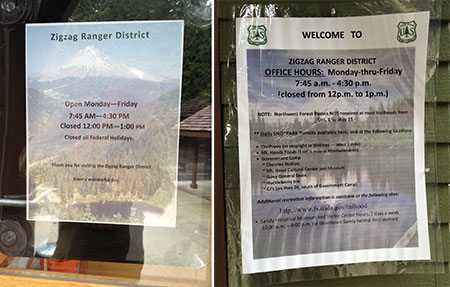
The informational kiosk in the plaza is still not complete (assuming there will eventually be information posted here!), which apparently inspired Zigzag staff to begin tacking fliers to the brand new siding near the front door with thumbtacks. That’s not how most of us would treat freshly painted siding on our homes, so it’s disappointing to see on such a beautiful new facility (not to mention that a nearly identical poster hangs two feet away, in the window on the main door).

Tacky, tacky -- hopefully, the Zigzag Ranger District will give the new facility the quality informational and interpretive displays it deserves

Tacky, tacky — hopefully, the Zigzag Ranger District will give the new facility the quality informational and interpretive displays it deserves

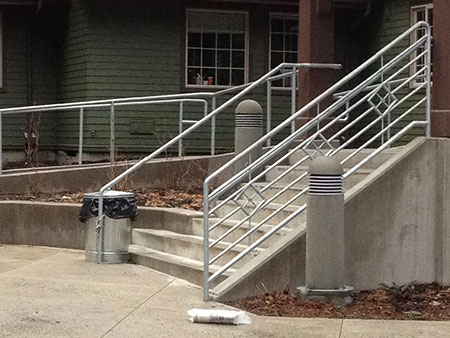
Likewise, the Zigzag District staff has chained a cheap galvanized trashcan to the sleek new entry rails at the main entrance stairway — jarring against the handsome new architecture, and perhaps just a temporary solution. Hopefully, a permanent trash and recycling station is on order for the plaza area!

Another gap in an otherwise fine new design for the ranger station is the lack of benches and tables outside the visitor facility. It’s another detail that can easily be addressed, and perhaps was anticipated in the landscape design, as well. The new ranger station is a pleasant place to be, and visitors will want to spend time here.

Nothing like the sight of a trashcan to say "welcome to Mount Hood!"

Nothing like the sight of a trashcan to say “welcome to Mount Hood!”

Overall, the new Zigzag ranger station and visitors center is a very big step forward, and a welcome development for those discovering Mount Hood for the first time. While the $1.7 million price tag may seem steep to some, it’s a very reasonable expense for a facility of this scale — and especially given the context of some 2.6 million visitors pouring into the area each year. Hopefully, similar facilities will eventually be constructed at the Hood River and Clackamas gateways to Mount Hood, as well.

But for many, the substantial price tag for the new Zigzag ranger station raises another question: if we can afford to build a brand new station at Zigzag, why can’t we afford to simply stabilize the beautiful Upper Sandy Guard Station, which teeters on the brink of being lost forever?
_____________________

Next: Part Two of this article looks at the fate of the Upper Sandy Guard Station