Restoring Trails… and Hope? The Owl Point Register Story (Part 2 of 2)

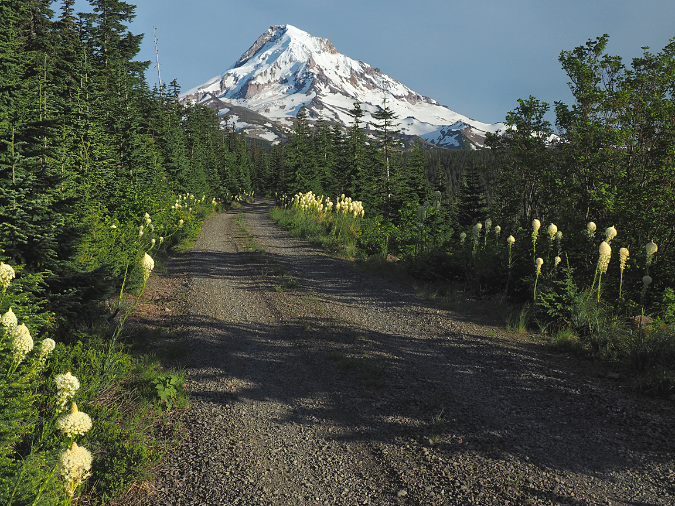
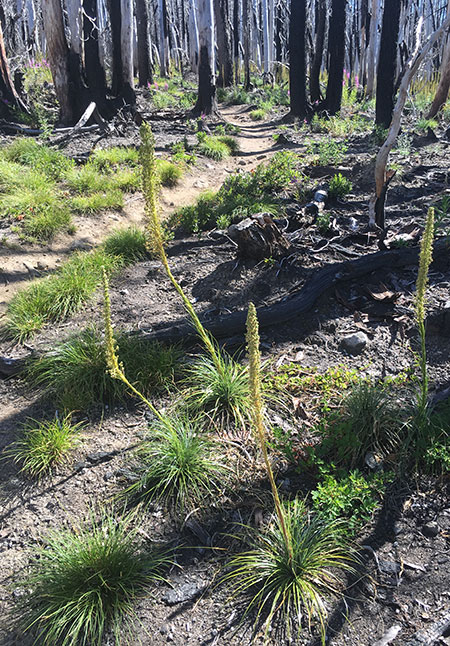
The prolific 2021 Beargrass bloom at Owl Point

When I posted Part 1 of this article last month, the theme was about the redemptive, restorative power of time spent in the outdoors. At the time, I wasn’t alone in dreading the November elections, and the prospect of a renewed attack on public lands protections (and democracy, itself). 

Flash forward one month, and the election landscape has radically changed in ways nobody could have predicted. I suddenly find myself with renewed hope and optimism that the next four years might bring more federal action on the climate crisis and protection of our public lands. Words like hope, optimism and bipartisanship have even found their way back into the national debate.

Our antiquated Electoral College system will ensure this election continues to be political nail-biter, yet it was through this lens of renewed optimism that I read through more comments in the Owl Point Register for this sequel. Part 2 of this article draws from the hundreds of messages left in the log between 2017 and 2023, and I chose a select few that further underscore the title of this two-part series. 

Read on… with hope!

_______________

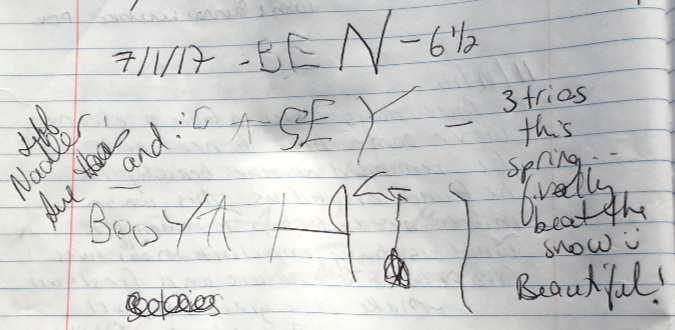
With the country suddenly talking about our shared future, again, what better way to begin Part 2 than with this wonderful message from a determined young family that tried – and succeeded – after three attempts to make it to Owl Point in the summer of 2017:
I so love seeing families on this trail. Here’s another family message from the same month in 2017, in this case with kids old enough to be Swifties:
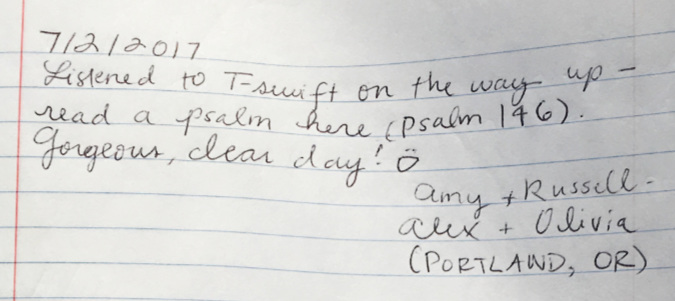
In the Oregon Hikers Field Guide the Old Vista Ridge trail is described as “family friendly” because It’s just long enough to give kids a workout (and hopefully they will sleep all the way home) and sense of accomplishment at reaching their goal at Owl Point. Along the way, there are interesting things that appeal uniquely to kids: short side trails to secret viewpoints, mysterious talus caves, lots of boulders to climb, the “elephant trunk tree” near Blind Luck Meadow and a string of kid-friendly geocaches. 

The Owl Point Register serves as one more feature for kids to explore, often writing the entry on behalf of their family, or at least giving their parents an assist. The summit box also has some local history and a guide to Mount Hood’s features for older kids and parents to ponder (more about that toward the end of the article).

There were a series of important milestones in the Old Vista Ridge trail saga that began in 2017, and led to this old trail formally being recognized by the Forest Service, once again. I previewed what was to come in this message I wrote in early July of that year on my annual scouting trip:
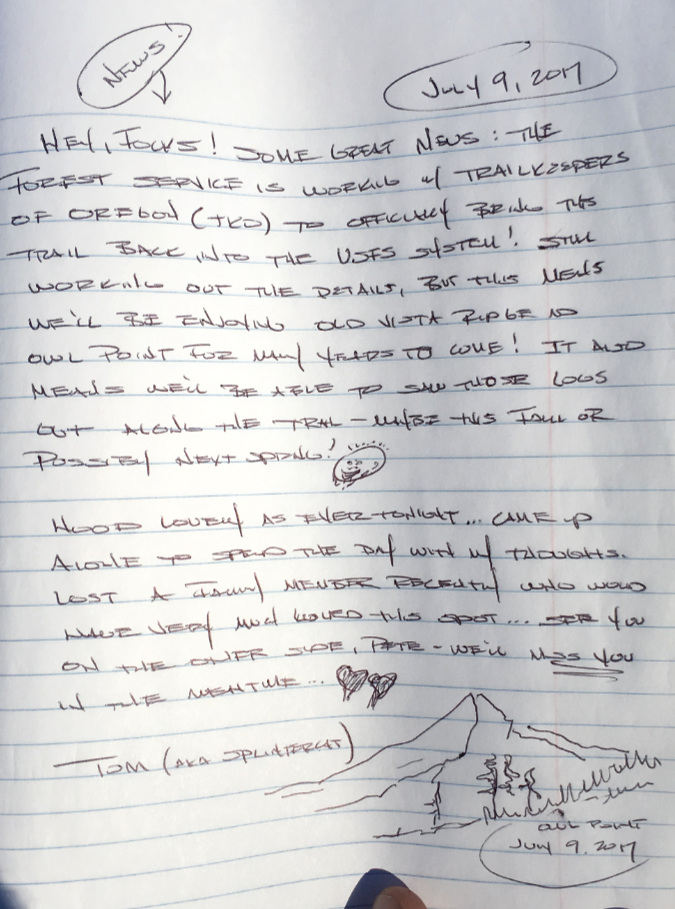
The second paragraph in the above entry refers to my oldest brother, Pete, who died unexpectedly and tragically of suicide that July, at just 66 years old. He died just two days before I wrote this message. Pete was a hero to me in every way, and I still think of him most days – but especially when I’m out on the trail. 

I’d forgotten spending that day up on the Old Vista Ridge trail, so soon after his death, until I re-read this message. It makes sense. Owl Point continues to be one of my go-to places when I need to sort out life and regain perspective. As I said in that message in 2017, Pete would have loved it up there, and I only wish I had somehow made that happen when he was alive.
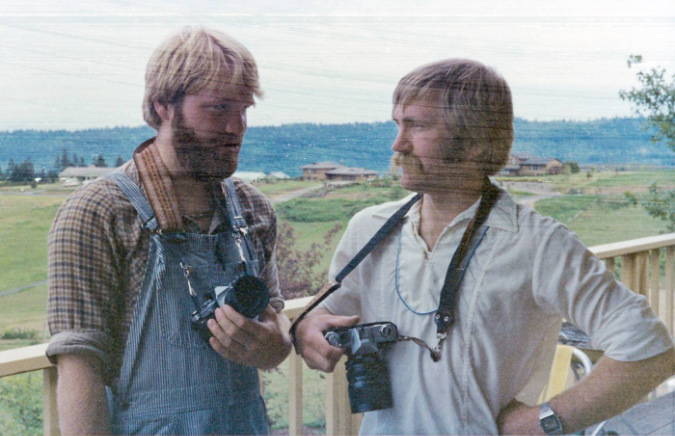
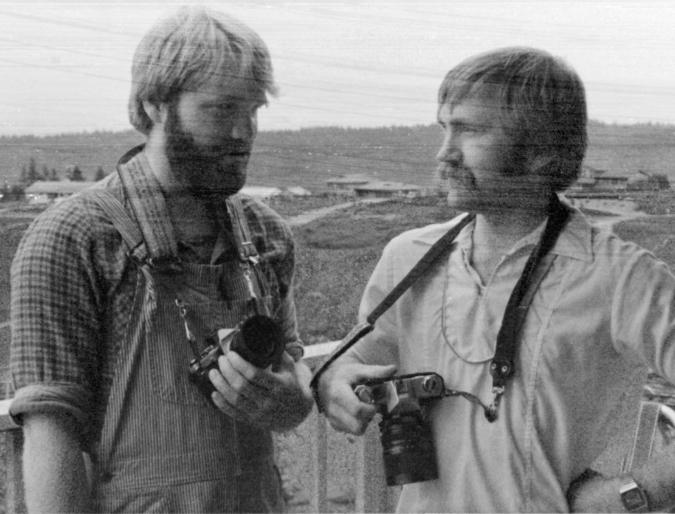
The 20-year-old me and my late brother Pete (right) talking cameras in 1982. Pete got me hooked on photography, music from folk to classical and so much more that defines me today. I can’t blame him for those overalls, however! Such was my wardrobe during my college years. I still have that camera that I’m holding – Olympus OM-1, my first real camera. Pete helped me pick it out. It still works as if it were brand new, and taking a roll of film with it now is like having Pete back, if only for the moment.

Two weeks after that early July scouting trip in 2017, I was joined by Forest Service (USFS) staff from the Hood River District and Trailkeepers of Oregon (TKO) executive director Steve Kruger for an official walk-through of the trail. The goal was to assess its restored condition and finalize an agreement with the USFS for TKO to adopt and maintain the trail in perpetuity in exchange for it being formally recognized by agency, once again. The USFS team included Claire Fernandez, then the Hood River District recreation manager, and two forest resource specialists, Mike and Ken (below)

Mike, Steve, Claire and Ken at Owl Point on July 26, 2017

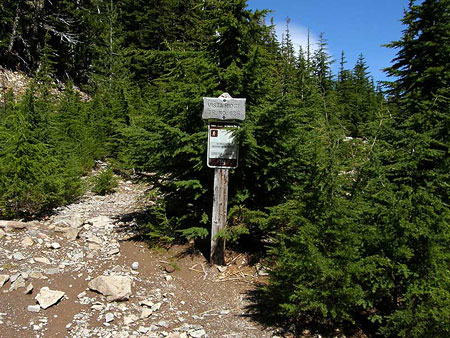
Our first stop that day was at the unofficial trailhead, marked by these hand-made signs. The first order of business was to figure out where official USFS trail signs should be located to replace these user-made signs. It turned out that Claire had done some heavy lifting with a few of her USFS colleagues by smoothing over some bad feelings over these unsanctioned signs and advocating for the trail to be formally reopened. I’m convinced that without Claire’s efforts behind the scenes, the official status of the Old Vista Ridge Trail would still be in limbo.
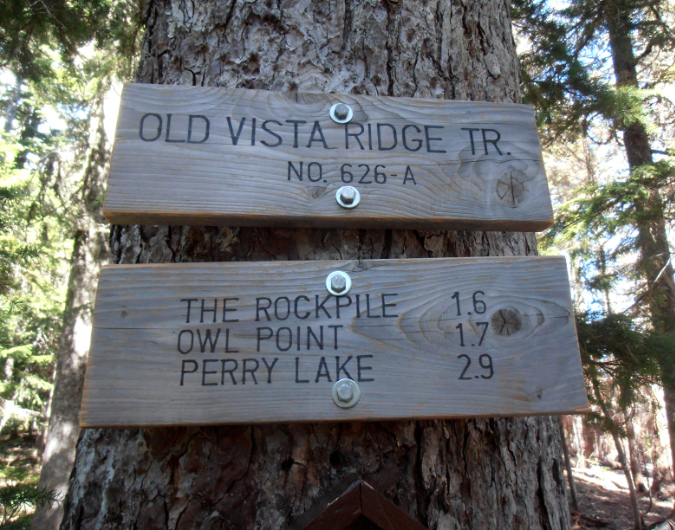
The old user-made signs posted at the Old Vista Ridge trailhead in July 2017

When we reached Owl Point, I held my breath as Claire immediately spotted the register box, then opened it and began reading through some of the messages in the log. I watched out of the corner of my eye from fifteen feet away, pretending to take photos. I was certain we would be asked to remove it, along with the hand-made trail signage. In just five years, the box had become an important part of what made Owl Point such a fun hike, and I was dreading a request to remove it.

Instead, she carefully packed the log back into the register box after reading entries for a few minutes, then closed the lid and didn’t say a word about it to me. I’ve never asked her, but I suspect as a person who has devoted her professional life to outdoor recreation, she appreciated the dozens of joyful, often quite personal notes that people had been moved to write in the log while at the view from Owl Point. 

The Owl Point Register box in July 2017

The Forest Service walk-through hike that day finally sent the formal paperwork into motion, and TKO officially adopted the Old Vista Ridge trail later that year. As you will see later in this article, the timing couldn’t have been better, as future events would have made it nearly impossible for volunteers to unofficially keep the trail open.

This entry from 2017 jumped out to me for the fact that a pair of long-distance visitors (England and Connecticut) made their way to Katsuk Point, an off-trail, somewhat challenging trek that few hikers attempt:
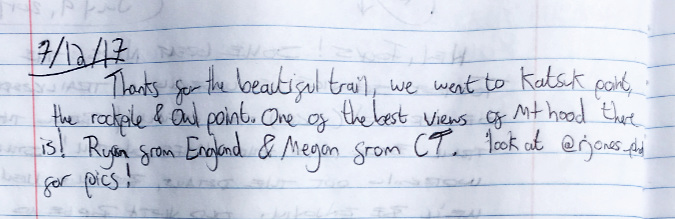
Here’s yet another message from the Portland Parks & Recreation Senior Hikers group. By 2017, they had become annual visitors, with a group of 17 along for this hike:

Here’s a message I’ve included as a cultural date stamp, as even the Owl Point Register wasn’t immune from a Game of Thrones reference in 2017 — though I was pleased to see that Owl Point won out over the premier episode!

I love the following message from a first-time solo hiker. Noting the date, it is surely must have been one that Claire read when she opened the log four days later? Perhaps it was this wonderful, heartfelt entry that saved the Owl Point Register?
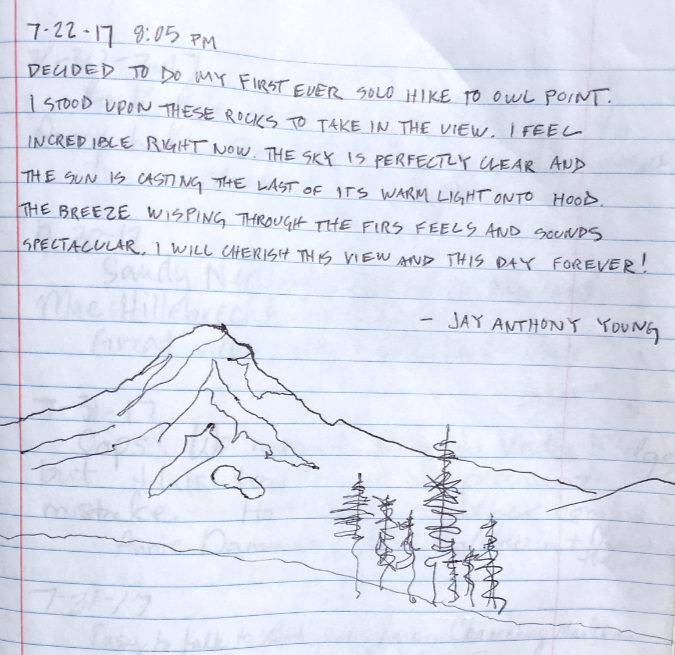
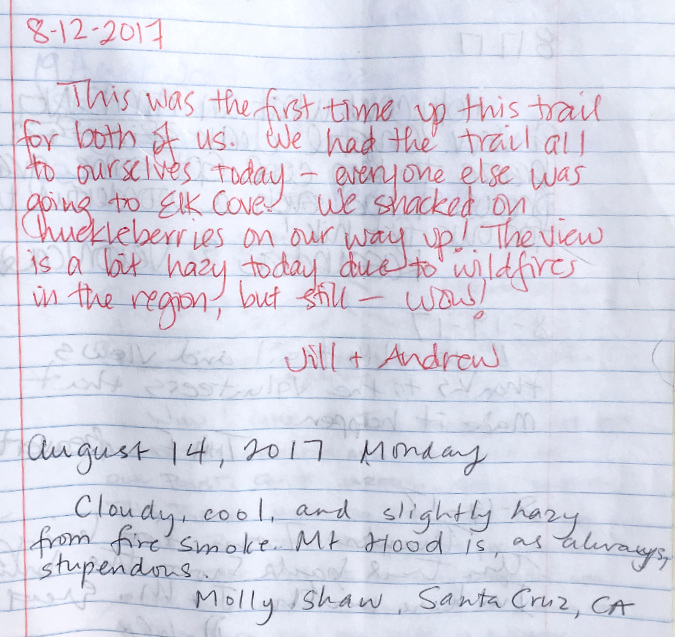
August messages in the log book commonly mention the two things that seem to arrive every summer, these days: huckleberries and wildfire smoke:
The smoke had cleared a week later when I posted this message (below) in the log on August 21, 2017. The event? The solar eclipse that had turned Oregon into crazytown that year. While Owl Point was just outside the path of totality, I was looking for solitude that day, and decided to experience something short of totality from the Old Vista Ridge Trail, away from the predicted traffic jams. As it turned out, I was the only person there that day!
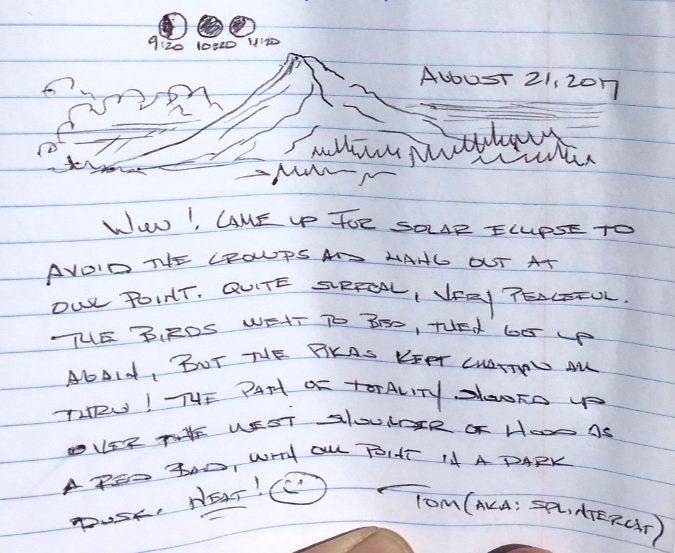
Why, I even included highly scientific sketches of the eclipse phases in my log message! I had, in fact, mapped out the path in detail using some of the tools (below) that were available for eclipse-watchers.

Totality path of the August 2017 solar eclipse
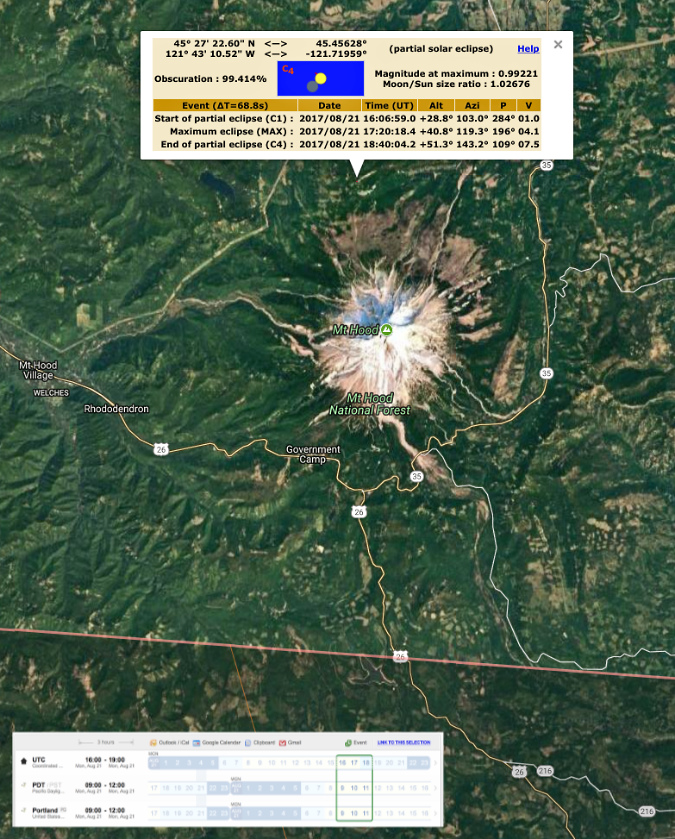
Detailed delineation of the totality zone beginning just south of Mount Hood

I wasn’t sure what to expect from the eclipse, but I wanted to capture both a timed sequence of images and some informal shots. Add in an iPhone, I was busy documenting the slow-motion changes unfolding in the sky.

My camera kit for the day: two DSLRs with wide and telephoto options. Not pictured: two tripods… a heavy load that day!

I arrived at Owl Point a few minutes past 9 AM to find a clear, bright sky. A typical summer day on the Old Vista Ridge trail:
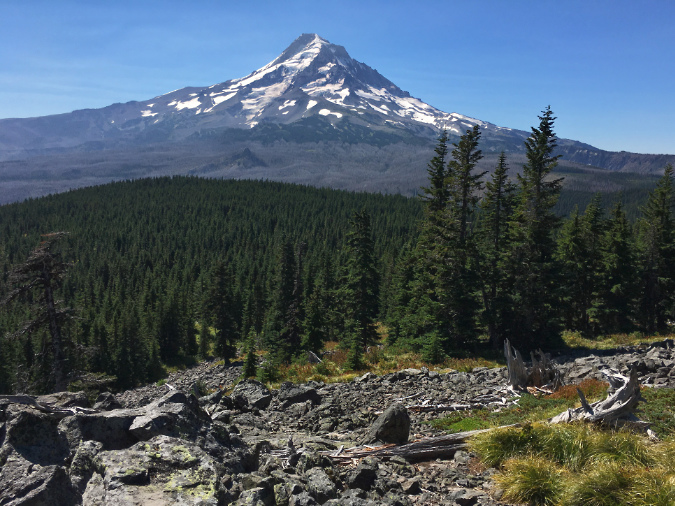
The view from Owl Point in the hour prior to the eclipse

Here’s my camera setup as the eclipse began to unfold. This was taken with my iPhone, and picked up a weird yellowish glare that was filtered out of the images captured on my two larger cameras:
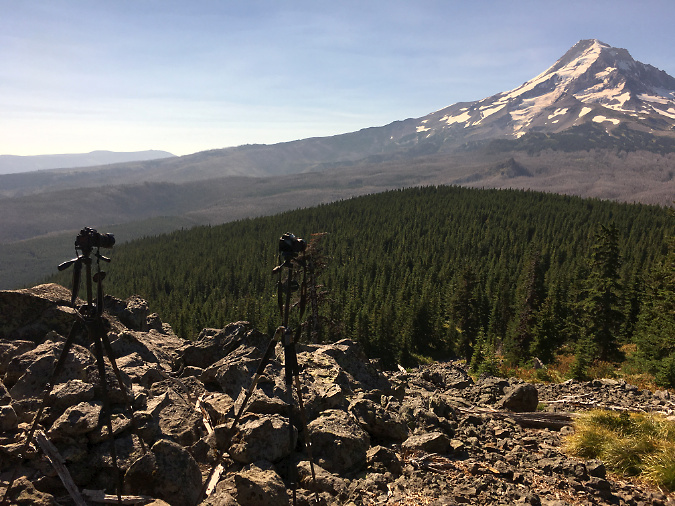
Dual cameras ready to go as the eclipse begins

Assembling a series of images from the camera on the left, this sequence (below) spans the eclipse from beginning to totality. In final two images, the bright band along the west shoulder of the mountain is actually daylight from beyond the path of totality – an unexpected and otherworldly effect.
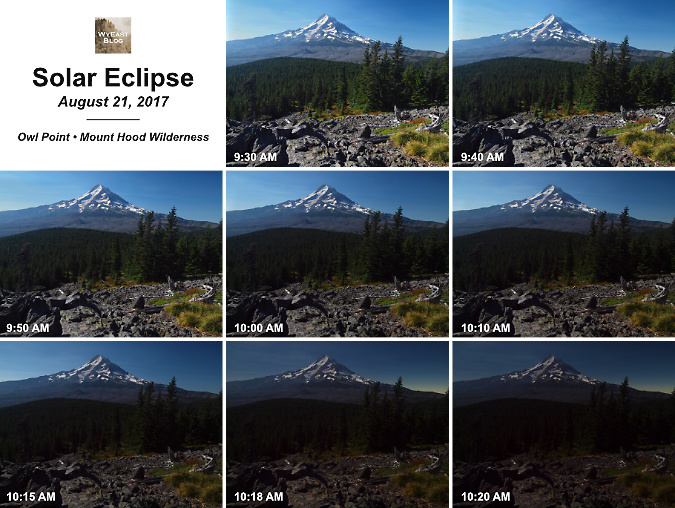
[click here for a large view of this sequence]

This iPhone panorama was taken as totality approached, and gives a better sense of how strange it was to be looking south, past the path of totality, to the daylight beyond. It might look like a cloud band, but it’s really a thin strip of night passing overhead:
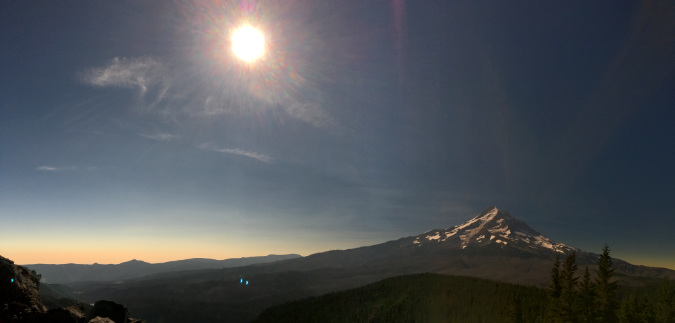
Panorama of the eclipse as it approached totality

I’d created a schedule with 10-minute intervals between timed images, so I also took advantage of the healthy huckleberry crop at Owl Point that day…
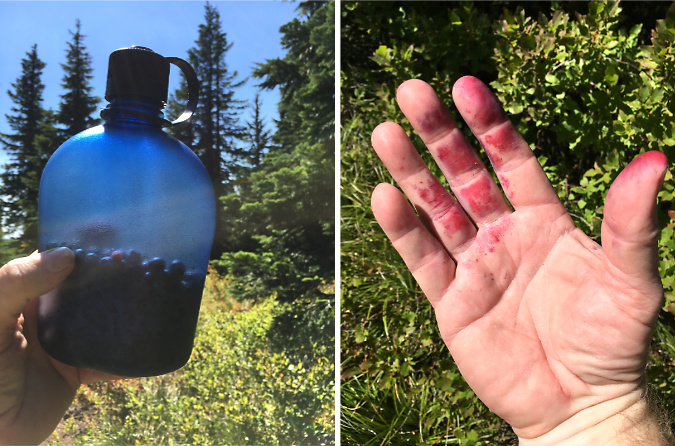
One-half water bottle is enough for a huckleberry cobbler…!

This message from September 2017 (below) is a first in the log – a portmanteau!  The Schweitzer + Franks families = the Schwanks! I’m going to guess that Latte was a canine member of the party, and I especially liked the unexpected last part of this entry. So many people are inspired to reflect on lost friends and family while at Owl Point.
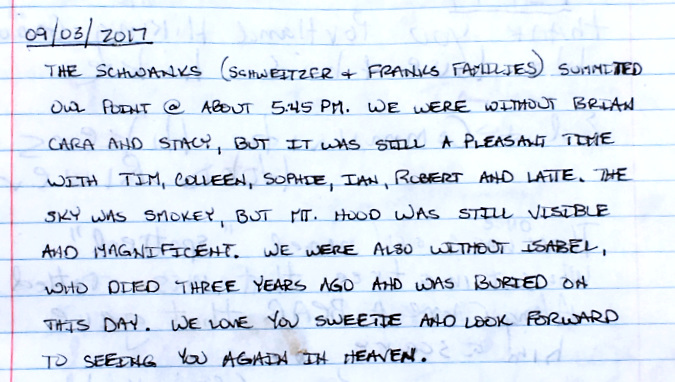
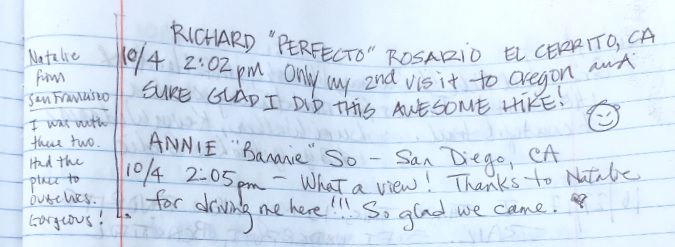
More long-distance visitors from California came to Owl Point to close out the 2017 hiking season:
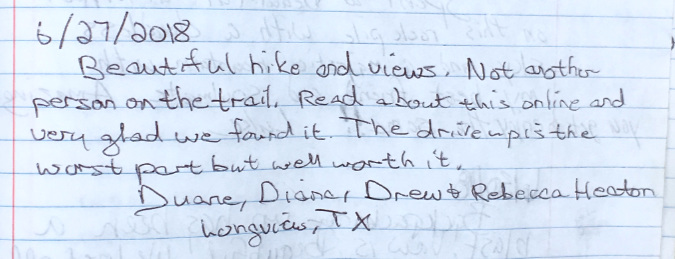
…and these out-of-towners from Texas opened the 2018 season:
More early visitors in 2018, with the second group spending the night at Owl Point and adding botanical sketches:
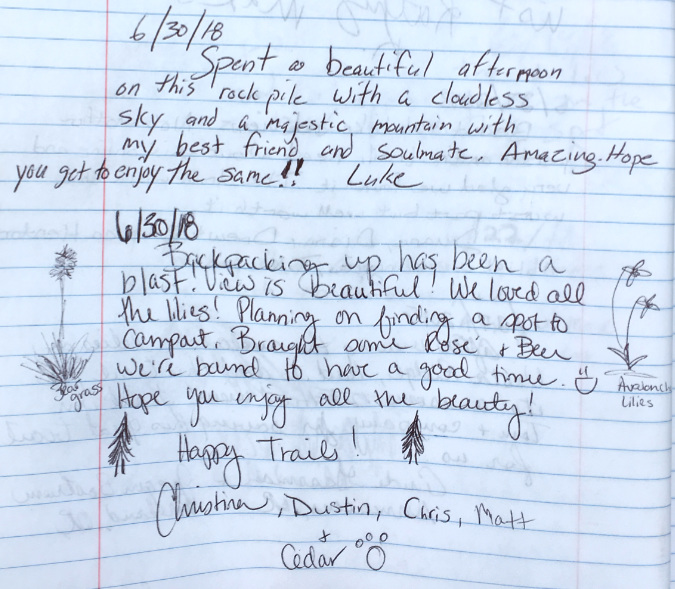
While there are a few posts in the Owl Point Log that mention overnight stays, they’re not common. I suspect that’s mainly because there’s no water source up there, and thus the group above would have had to carry water in (including for Cedar) to augment the wine and beer!

Here’s a post from a couple of trail friends that I run into periodically who were up at Owl Point in 2018 as part of the Cascade Pika Watch effort:

Here’s a notable, if understated, post from that same day in early July, 2018, when the Old Vista Ridge trail was formally re-dedicated as part of TKO’s 10th Anniversary:
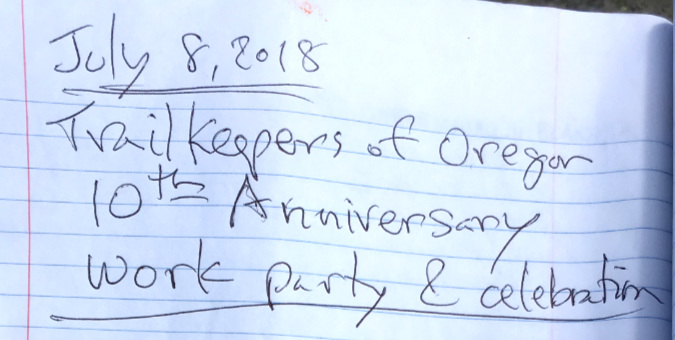
In fact, this event had originally been scheduled for September 2017, but the raging Eagle Creek Fire had closed public access to much of the area north of Mount Hood as the fire raced through the Hatfield Wilderness backcountry in the Columbia River Gorge.

The rescheduled event in 2018 kicked off with a typical trailhead orientation for volunteers, with TKO’s Steve Kruger presiding (in yellow hard hat):

TKO 10th Anniversary trailhead talk at the Old Vista Ridge grand re-opening in July 2018

On this special day, TKO volunteers would be installing official USFS signage along the trail as part of the re-dedication, in addition to the annual tasks of clearing logs and brush.
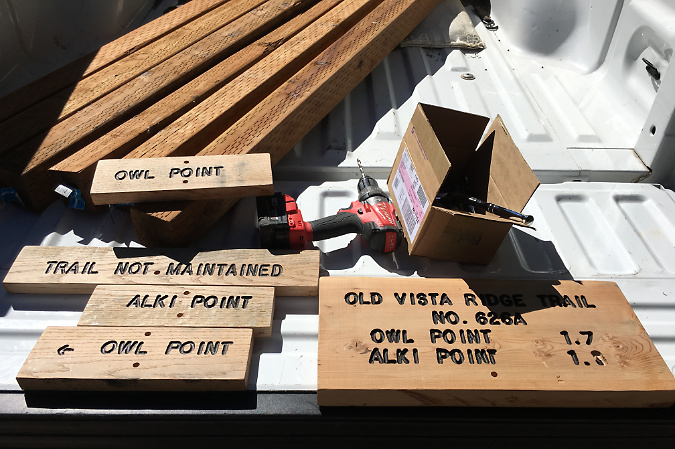
New trail signs and posts in the USFS pickup in July 2018

These trail signs were installed by TKO volunteers in July 2018 and have survived six winters and counting. Volunteers also lugged six 8-foot 4×4” posts up the trail, each buried 18” in rocky soil – a real workout!

TKO Executive Director Steve Kruger and Hood River District Ranger Janeen Tervo re-dedicating the Old Vista Ridge trail on July 8, 2018. Cutting the ribbon involved a handsaw, loppers and trail flagging, of course. Old and new trailhead signs are leaning against the base of the tree
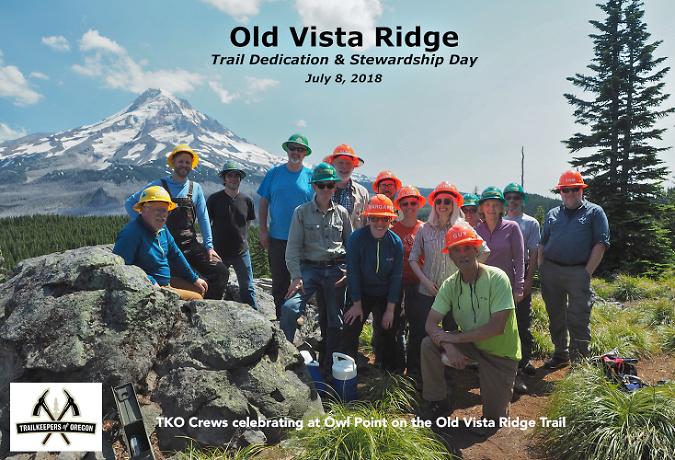
TKO grand re-opening celebration at Owl Point on July 8, 2018 – the first of our annual TKO anniversary events there

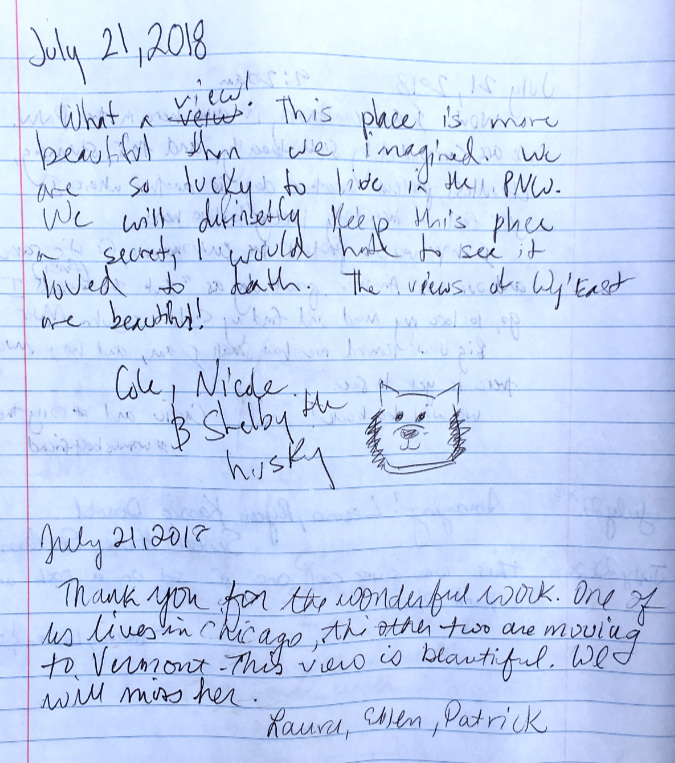
Two groups visiting Owl Point on the same day in late July 2018 shared the sentiment that so many of us can relate to – that we’re so very lucky to live here! My condolences to the folks who made the second entry, too. Vermont is lovely, but not as lovely as the Pacific Northwest (I may have just triggered a few Vermonters):
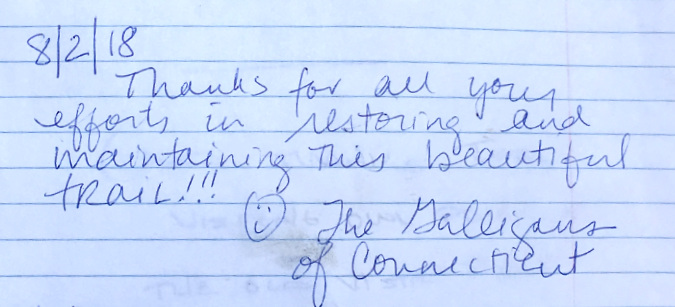
Another out-of-owner in 2018, this time from Connecticut…
By August 2018, the original Owl Point Log had completely filled, and I placed a blank, new edition. For the next year or so, I also left the original log in place for folks to read, with this message:
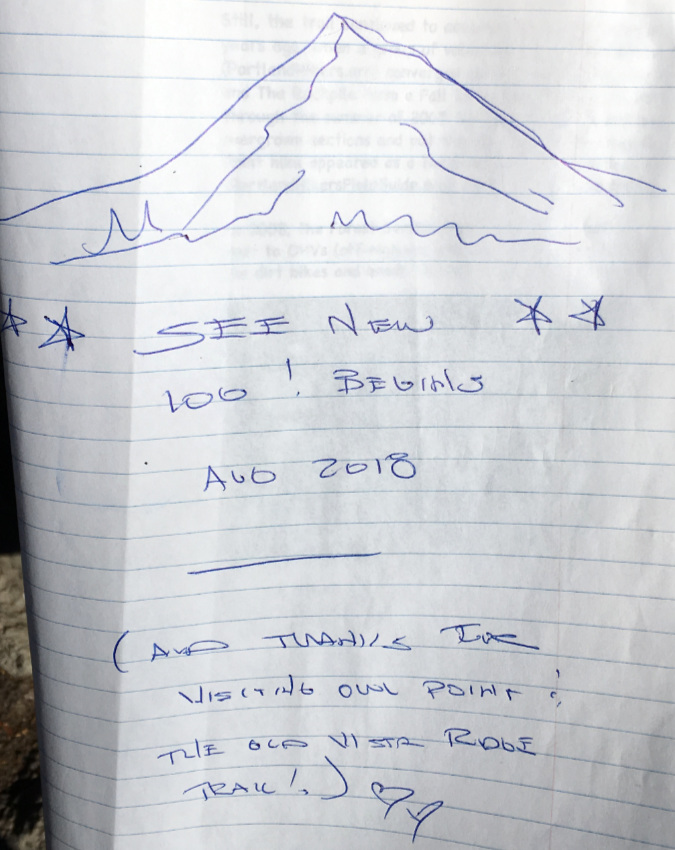
Closing out the original Owl Point Log after six years…
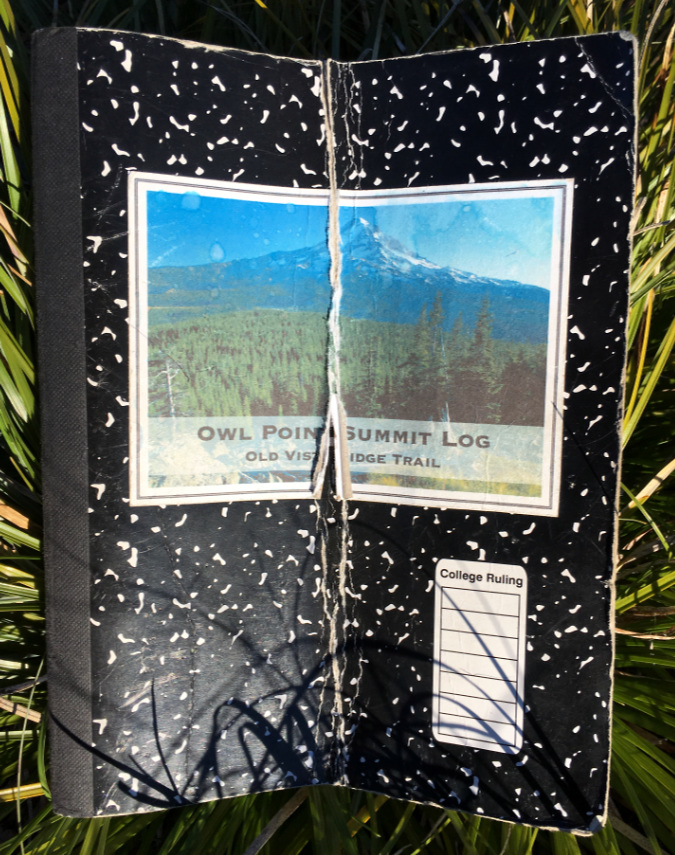
The cover of the original Owl Point Log after six years up on the mountain

The new Owl Point Log (Volume 2) begins with this message:
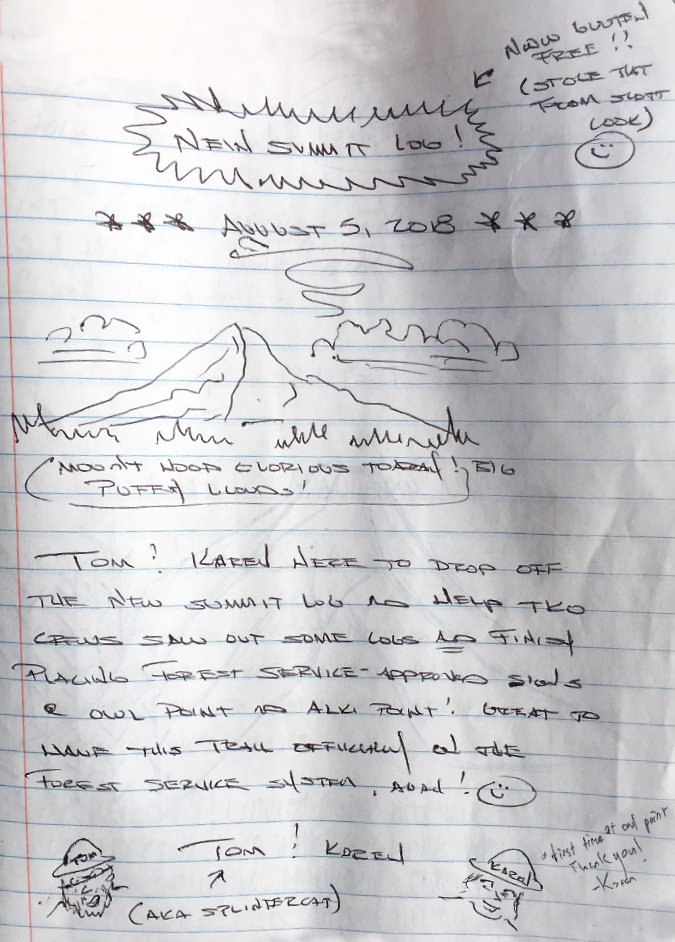
I placed the new log as part of yet another TKO trip to the Old Vista Ridge trail on August 5, 2018. Most of the volunteers that day were focused on clearing the last few logs on the trail, but I worked with TKO intern Karen to finish installing the last of the trail signs at Owl Point (below) and Alki Point.

The author and TKO intern Karen installing the (then) brand new Owl Point spur trail sign in August 2018

More out-of-towners in 2018, this time from Maryland visiting a recently transplanted New Yorker:
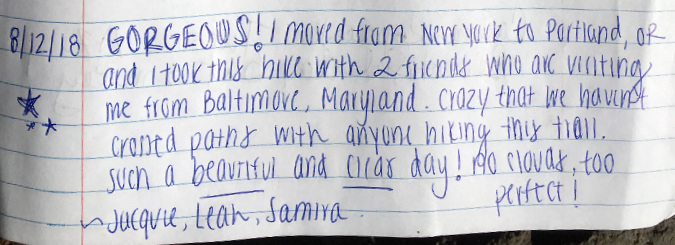
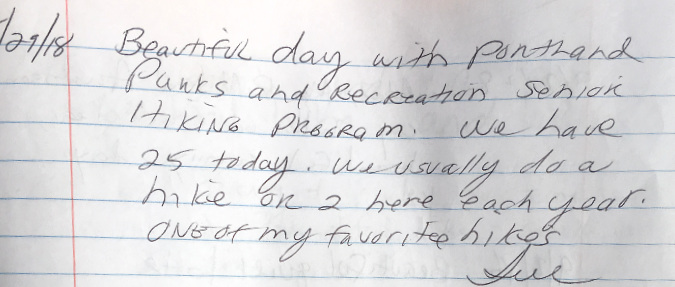
…and another annual visit in 2018 from the Portland Parks & Recreation Senior Hikers group – 25 hikers on this outing!
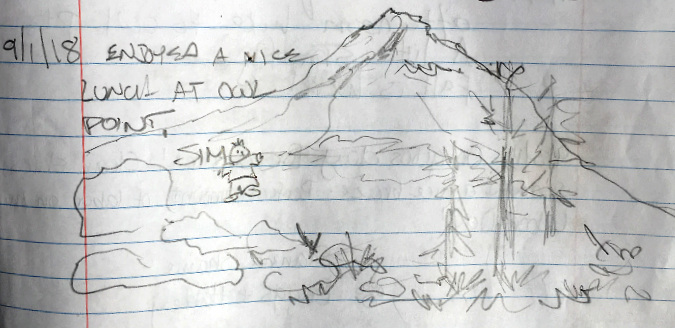
Hiker Jim (below) was apparently so elated with the view from Owl Point in September 2018 that he was suspended in mid-air above the rocks (or so I interpret his sketch):
Guide book author Matt Reeder (below) is a longtime friend of the Old Vista Ridge trail, having not only included it in his “Off the Beaten Trail” guide, but also placing a photo from the trail on the cover!
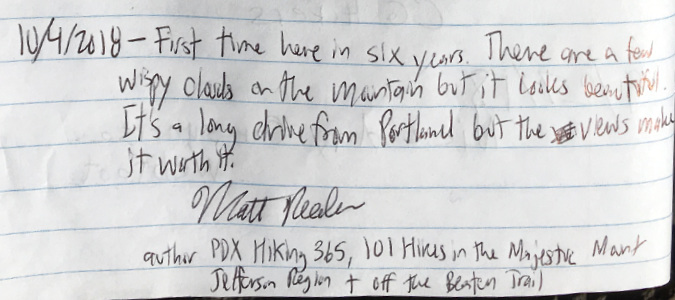
Matt Reader featured a view from the Old Vista Ridge Trail on his “Off the Beaten Trail” guide

This series of visitors in early October, 2018 shared a common fate: Mount Hood lost in the clouds:
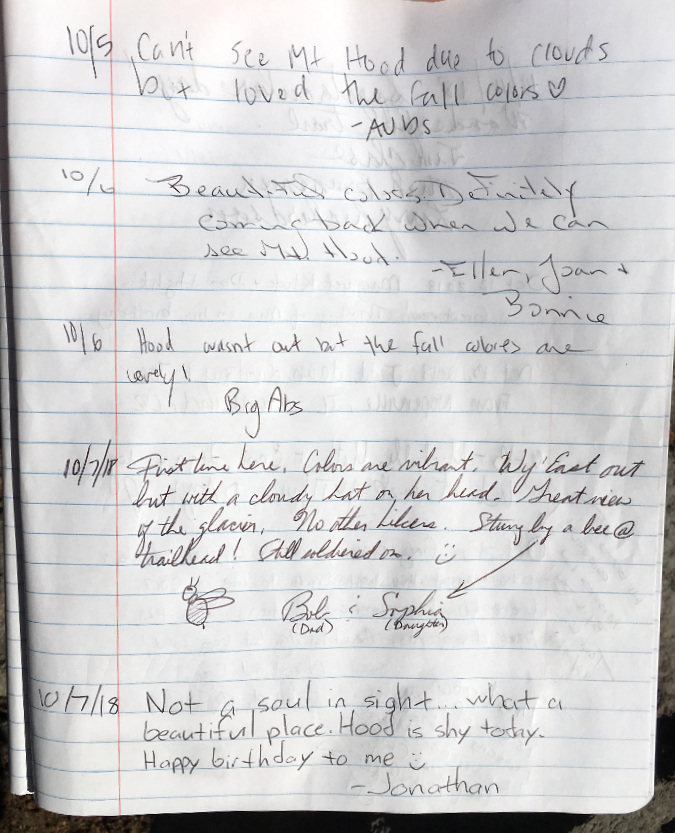
You might wonder why people would pick a viewpoint trail on a cloudy day, but it’s not that simple with Owl Point, especially early and late in the hiking season. Vista Ridge and Owl Point lie precisely on the Cascade divide, a mile-high crest where moist marine air coming off the Pacific often condenses into a low cloud cap, even as Mount Hood rises above into blue skies.

Here’s what it looks like at Owl Point when this happens – this is the view west, into the fog that is seemingly a stationary cloud:
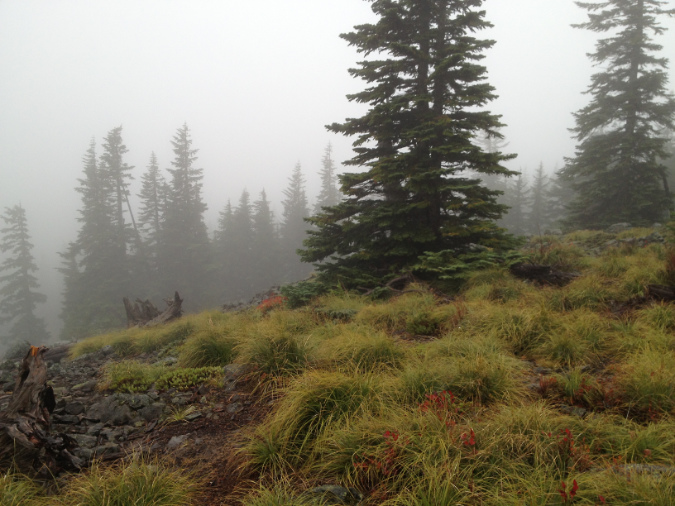
Cloud cap engulfing Owl Point on a fall day

Yet, looking east toward the Hood River Valley you can see the cloud isn’t stationary, at all – and, in fact, is dissipating right above you, with blue skies to the east:
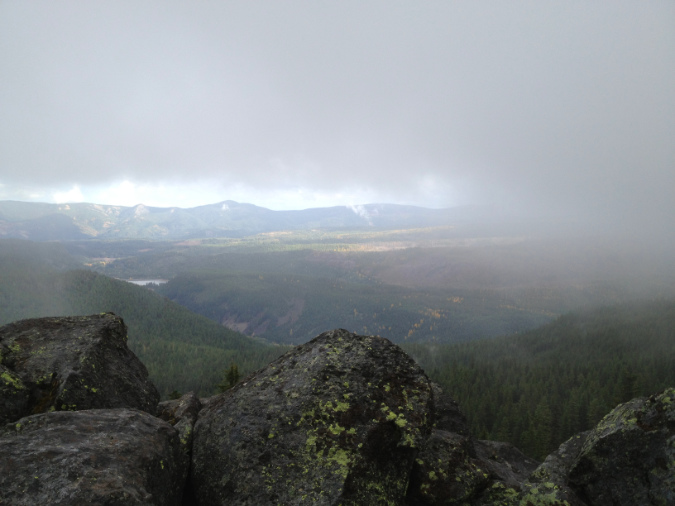
Looking toward the Hood River Valley and Surveyor’s Ridge from under a cloud cap at Owl Point

Here’s what that effect looks like from up on the Timberline Trail – a “cloud waterfall” of marine air condensing into a rolling fog bank as it pushes from the west (left) over Vista Ridge and Owl Point, then cascading and evaporating into the dry air mass to the east (right in this photo) side of the divide:
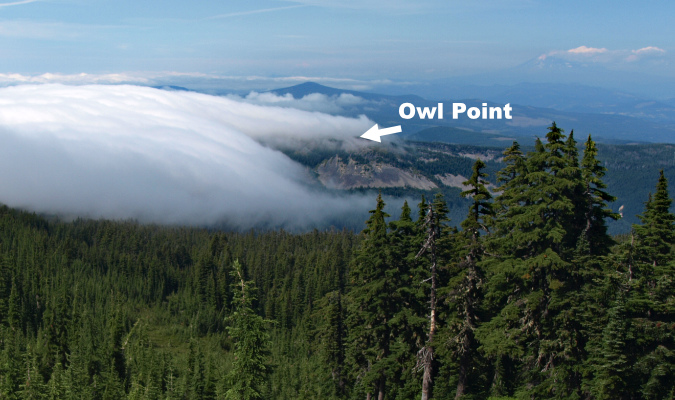
Cloud cap forming a “cloud waterfall” at Owl Point

This effect can be very local, or become widespread when a weak Pacific front pushes in, as shown in this view from above Elk Cove, looking down on the Cascade divide and Owl Point:
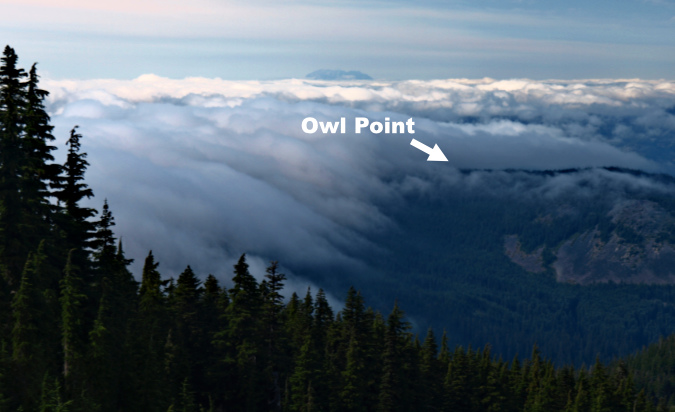
Widespread “cloud waterfalls” along the Cascade crest – the view looking north from Mount Hood toward Mount St. Helens

Even on the clearest spring and fall days, cloud banks can form over Vista Ridge and Owl Point without notice. The clouds those October 2018 hikers encountered had cleared by the time I visited later that month, with an added bonus: they had dusted the mountain with an early coat of fresh snow – a magical time of year on the mountain:
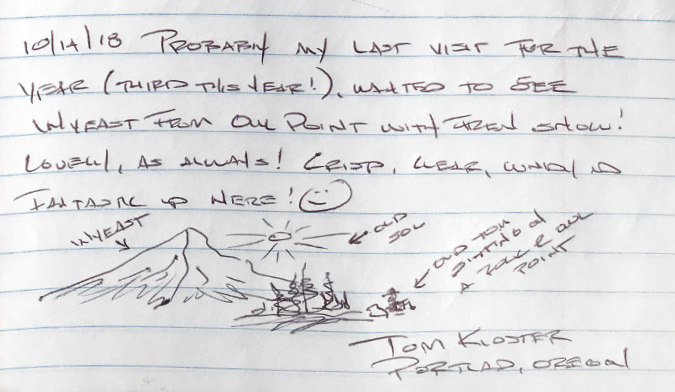
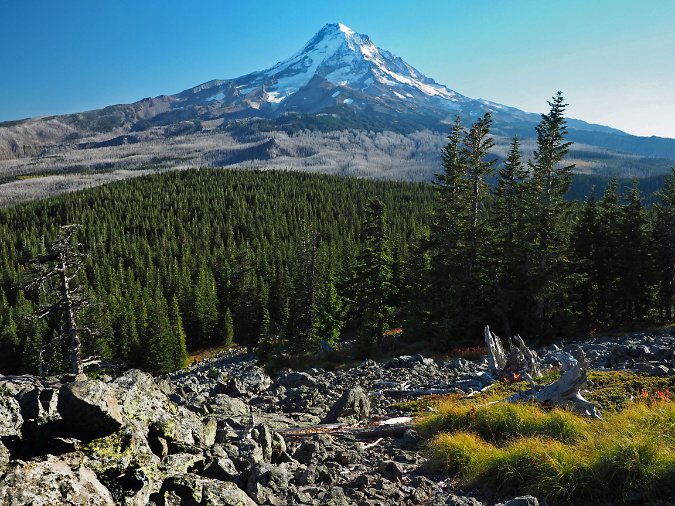
The dusting of snow on Mount Hood described in my October 2018 log entry

Here’s a message from a dedicated grandma – with her 16-month toddler – that caught my eye:
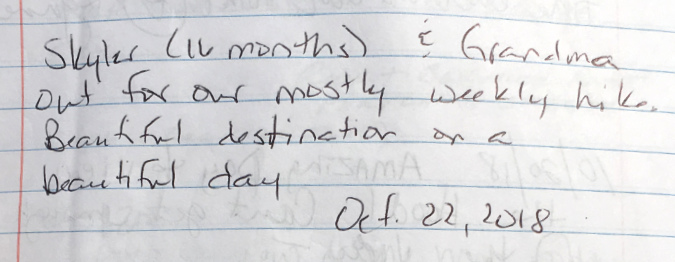
This post from 2018 mentions another guidebook that helped bring folks to the Old Vista Ridge Trail, Paul Gerald’s popular “60 Hikes within 60 minutes of Portland” guide. A lesser-known fact is that Paul served on the TKO board for several years, including a stint as TKO board president. Thank you, Paul!
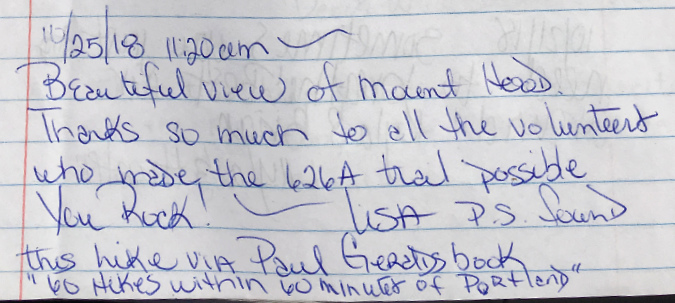
Kicking off the 2019 hiking season, this is perhaps the most international series of messages to date in the Owl Point Log:
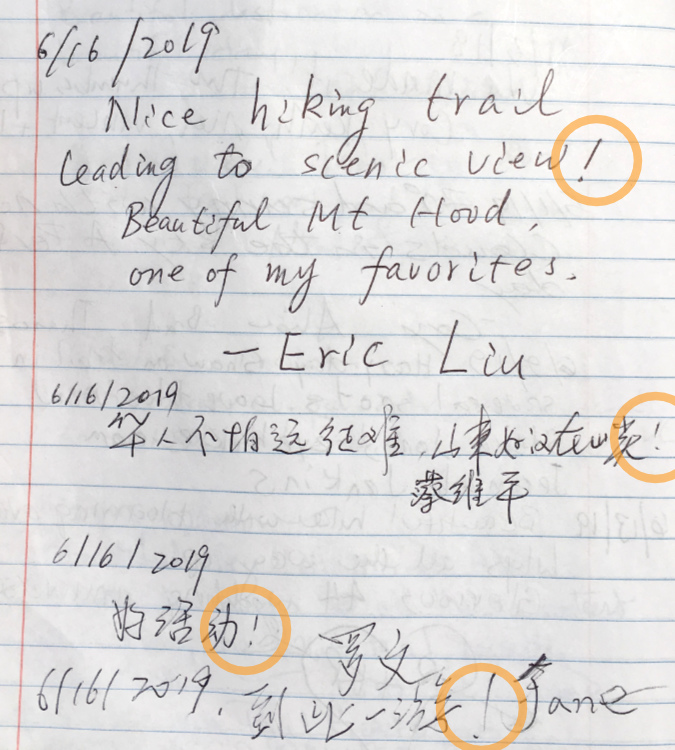
I’ve circled the exclamation marks – while I can’t read the least three messages, they all seem to have been impressed with the view from Owl Point!

Here’s one more from that group of international visitors in 2019 (and if you are a reader of this blog and can translate any of these messages, please add as a comment):

An “opposites attract” milestone message in July 2019, plus more out-of-towners from North Carolina:
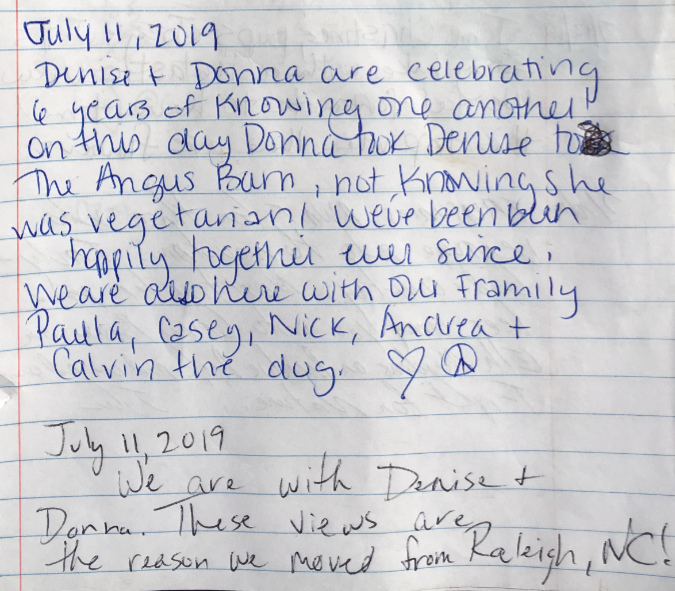
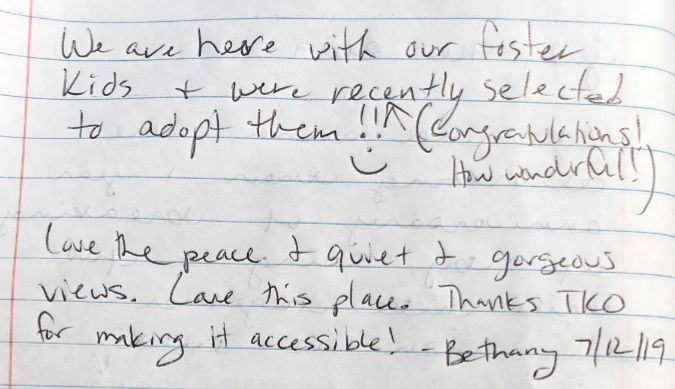
…and yet another milestone message. There have been a few marriage proposals and baby announcements, but this is the first adoption announcement to appear in the Owl Point Log. I especially loved that a subsequent visitor added a congratulations:
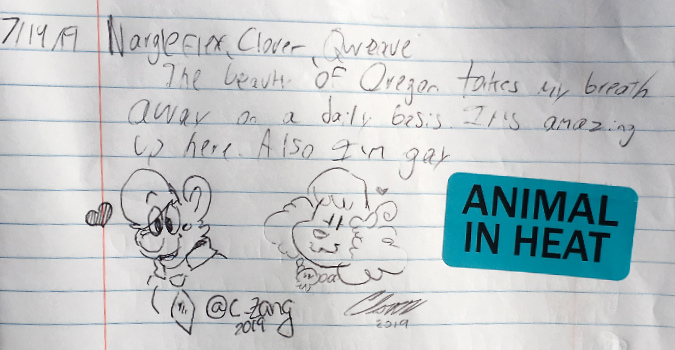
Here’s the first “animal in heat” (!) sticker to appear in the log, along with some very polished cartoons:
Yet another pair of entries from the author, this time on a scouting trip in July 2019 for the annual TKO anniversary event on the Old Vista Ridge Trail:
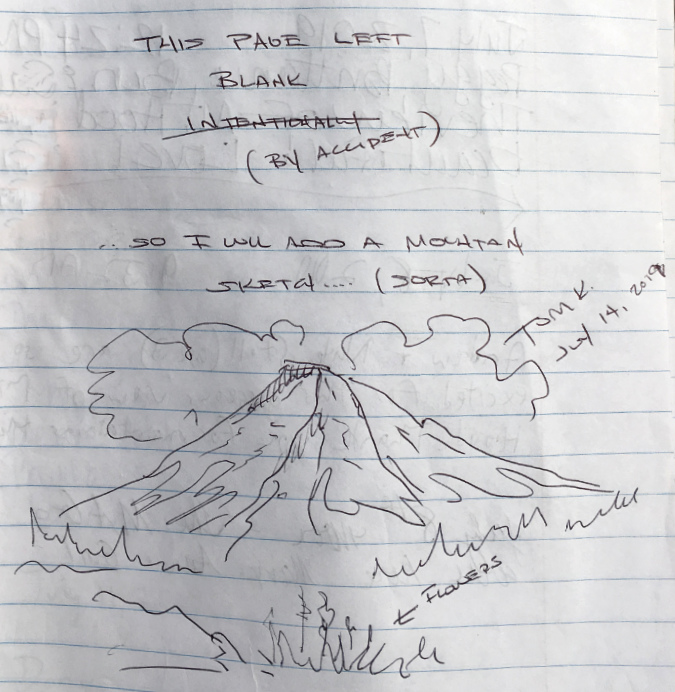
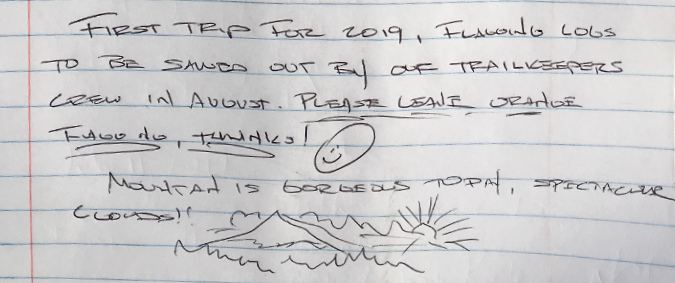
When I re-read this message for this article, I wondered just how gorgeous those clouds really were? Digging back into my photo archives, it’s true – they were spectacular:
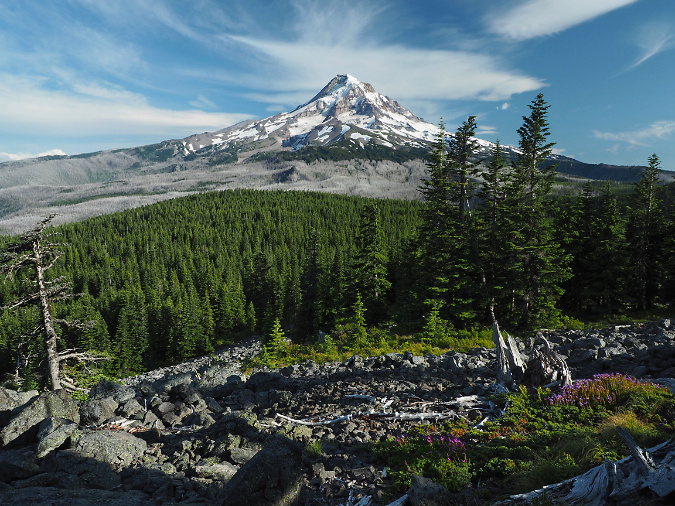
WyEast looking lovely under painterly clouds back in the summer of 2019

…the mountain was pretty nice that day, too!

Here’s another long-distance visitor in 2019, this time from Germany:
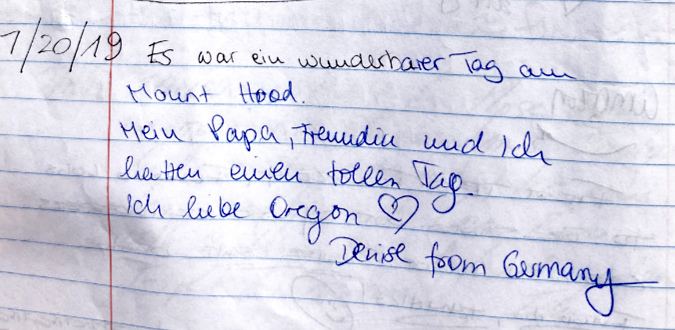
My rough translation of the above entry: It was a wonderful day at Mount Hood. My dad and I had a great day. I love Oregon.” German speakers, help me out if you can!

Also from July 2019, another successful Pika survey:

It doesn’t surprise me that Pika thrive here. While their habitat throughout the west is threatened by climate change, much of the talus (their sole habitat) faces southeast and is shaded from late afternoon heat by the Owl Point ridgeline and stands of Noble fir. Hopefully, this will be enough to keep their familiar “meep” calls coming from the rocks here for decades to come.

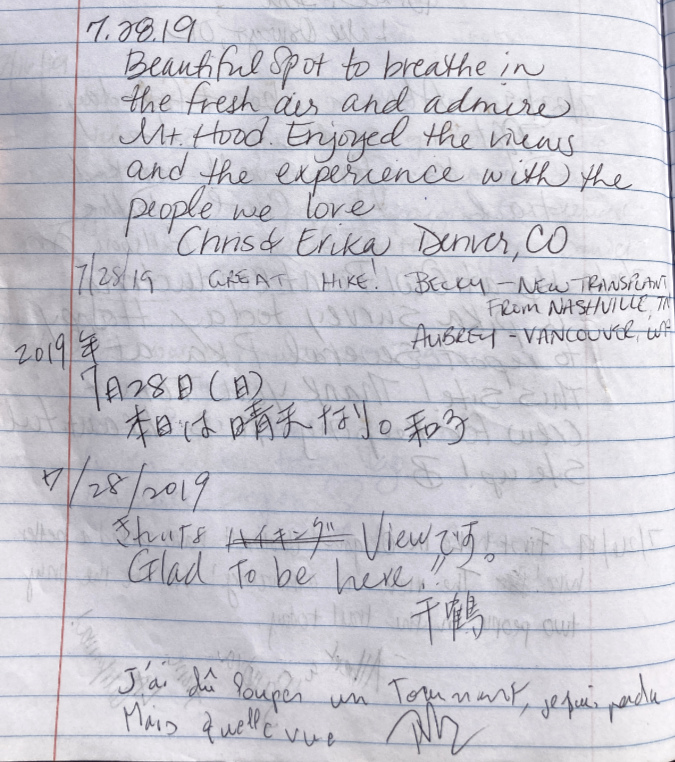
Here’s a string of recent arrivals (from Nashville) and more long-distance visitors who stopped by on the same day in July, 2019 (if you can help with translation, please add a comment).
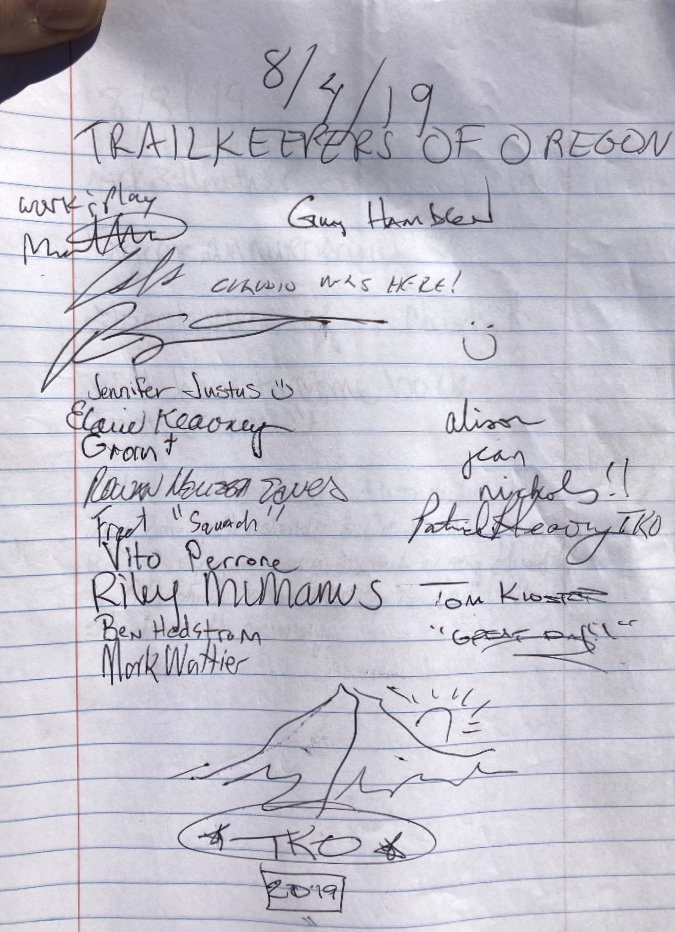
August 2019 brought the second annual TKO celebration to the Old Vista Ridge trail (below) with another large group of volunteers for our annual trail tending. More logs to clear, more huckleberries to brush away from the trail and another fine day up at the mountain!
In that second year of what has since become our annual tradition, we captured the next in a series of group portraits that continue to this day (below). So far, the mountain has been out for every one of our events up at Owl Point. Though that streak surely can’t last forever, it does make for a great photo opportunity:
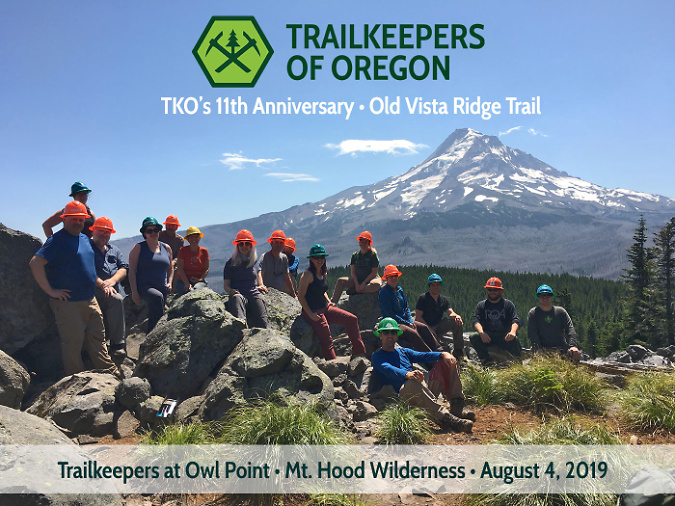
Team portrait from the annual TKO stewardship event in 2019

Here are a few more excerpts from 2019 in the Owl Point Log, beginning with this post that is personally inspiring to me, as hiking until I die is one of my life goals!

This post from first-timers in 2019 carries a common theme found through the log – that Owl Point is now on their annual hiking list:

This entry from September, 2019 made me smile – a couple of parents who survived summer break with kids seeking refuge at Owl Point and more out-of-towners (Colorado and Utah) discovering our huckleberries:
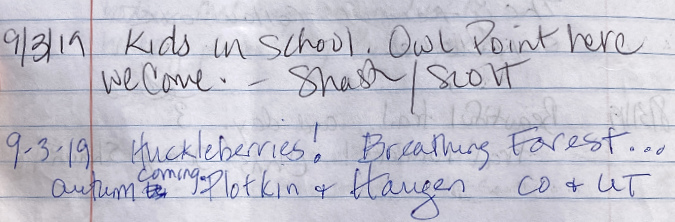
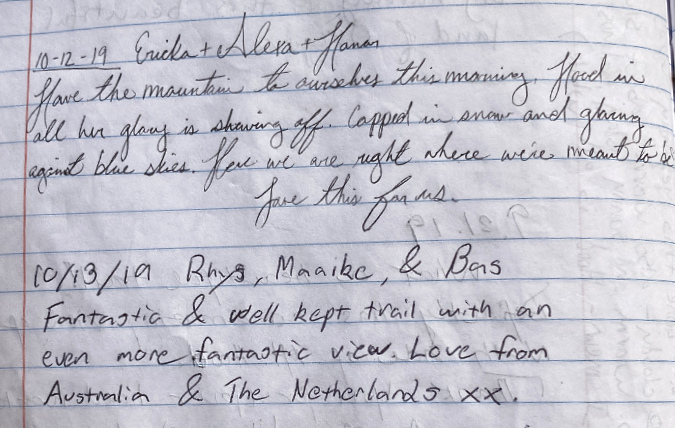
These back-to-back entries from October 2019 provide a nice contrast of “locals right where they’re meant to be” followed by more faraway visitors from Australia and The Netherlands reminding us that we live in a slice of Heaven here in WyEast country:
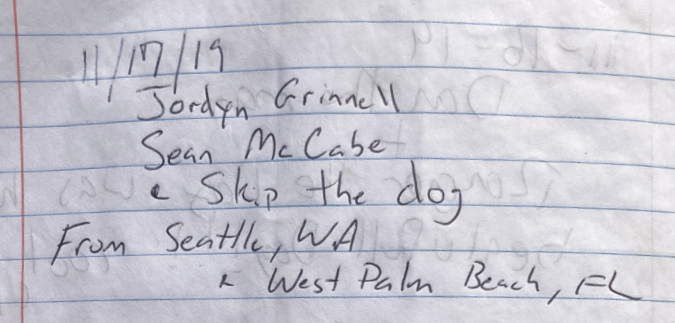
More out-of-towners from Seattle and West Palm Beach to close out the 2019 season, just ahead of the first snowfall that year:
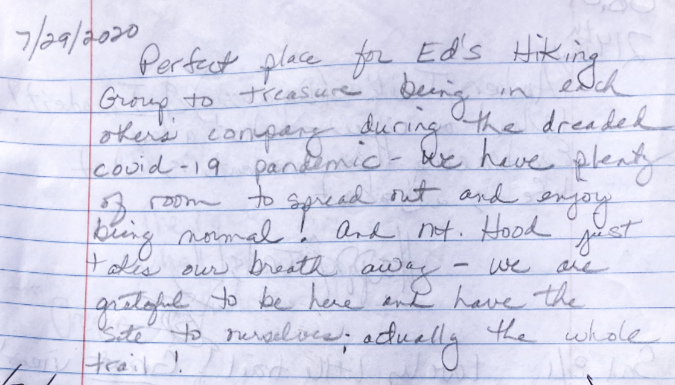
As the snow began to fall that winter, burying the Old Vista Ridge trail under several feet of snow, we couldn’t have imagined that the entire world was about to turn upside down. Even our public lands were closed to entry in those early weeks of the COVID pandemic in the spring of 2020. By June of that year, public lands had reopened, and masked, pandemic-stressed hikers began arriving at Owl Point:
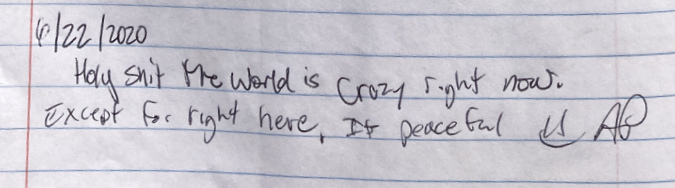
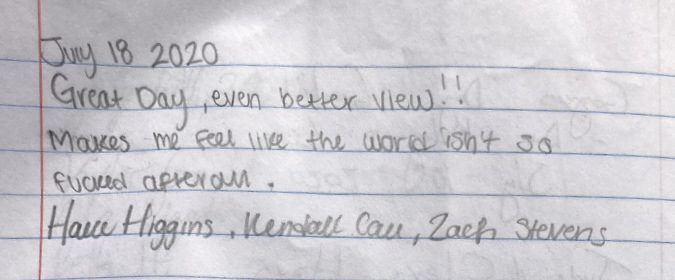
As if charting the five stages of grief, messages in the Owl Point Log in 2020 become more circumspect as the summer season arrived. Pandemic commentary gave way to life milestones and personal reflections as socially-distanced people reconnected with one another on the trail – among the safest places to be during the pandemic.

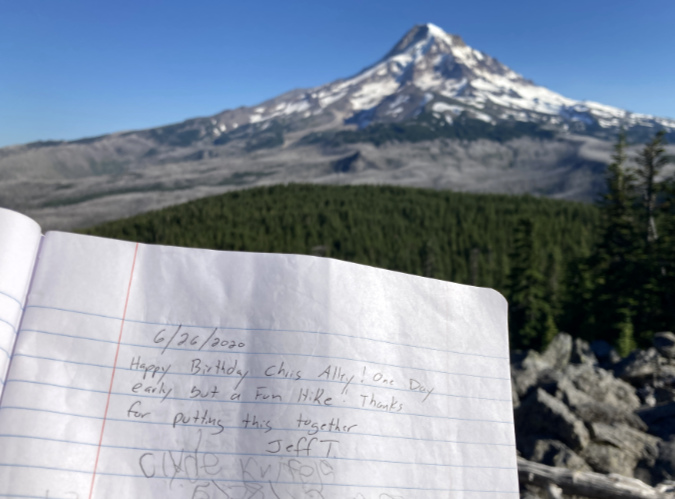
These friends reunited to celebrate a birthday (Chris is mentioned in Part 1 of this article):
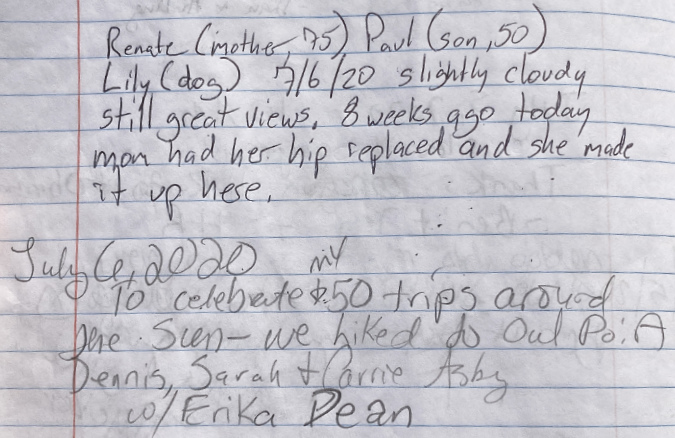
Trails were an especially important refuge for older hikers in 2020, considered the most vulnerable among us to the COVID-19 virus – like these veteran hikers:

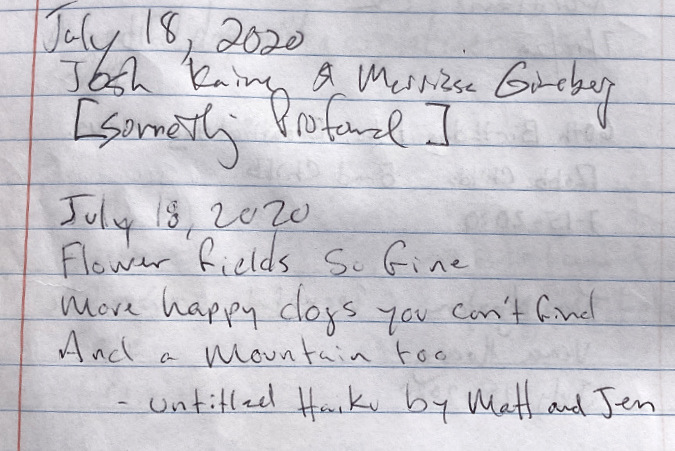
This pair of messages (below) from July 18, 2020 caught my eye. Hikers Matt and Jen filled in the creative blank left by Josh and Marissa on – collaboration!
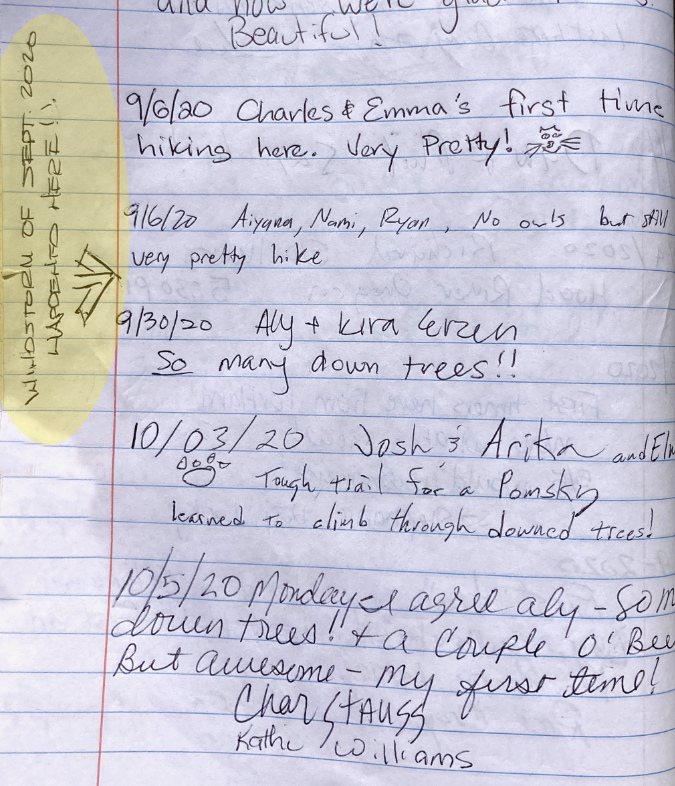
The year 2020 had more unpleasant surprises for Oregon with the Labor Day windstorm and subsequent forests fires that raged up and down the Cascades. Owl Point was not spared from the wind event, and you can spot it in the Owl Point Log comments. I’ve highlighted a comment I wrote in the margins that fall to mark the windstorm:
The mess was as bad as the many comments in the Owl Point Log suggested. Dozens of trees were down, especially along the first mile of the Old Vista Ridge Trail. Here’s what the trail looked like in the spring of 2021, when I made my first trip to survey the damage:
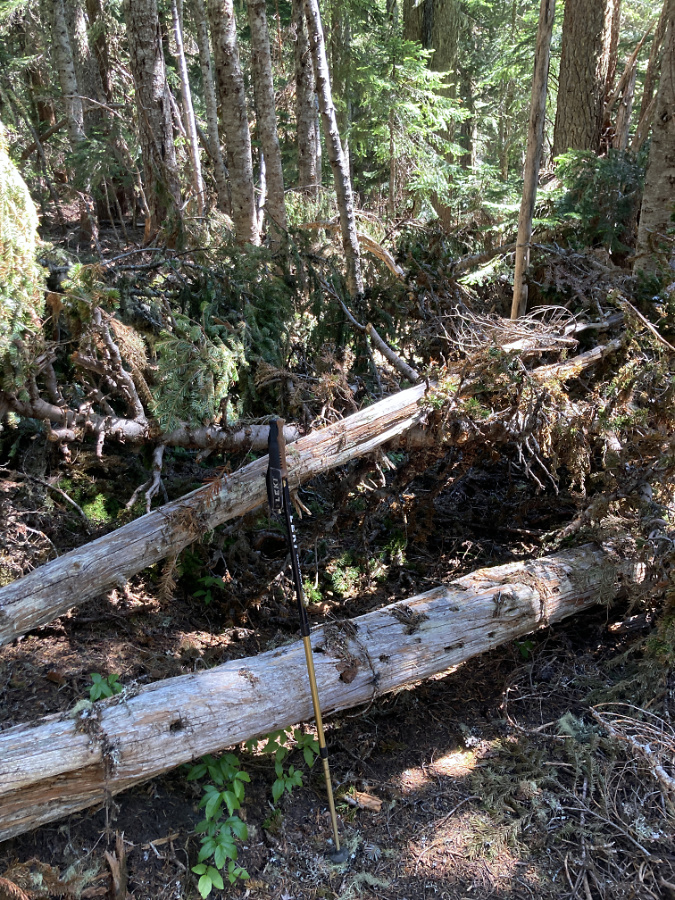
Blowdown from the 2020 Labor Day windstorm burying the Old Vista Ridge Trail

Most startling were the number of very large trees that went down at the Old Vista Ridge trailhead. Yet, somehow the sign TKO volunteers had installed just two years before was (mostly) spared in jumble of debris:
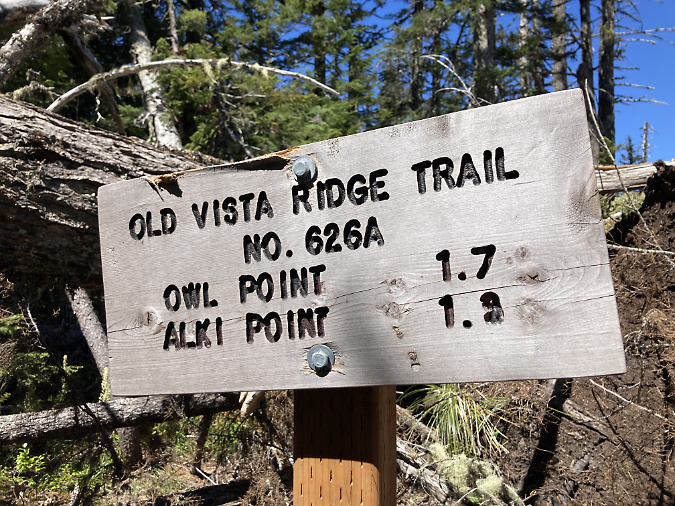
Dented but still standing – the Old Vista Ridge trailhead sign after the 2020 Labor Day windstorm

The author surveying the damage from the 2020 Labor Day windstorm

It would still be a few weeks before TKO volunteers were scheduled to clear the mess in the summer of 2021 when I added the following message, so I included a bit of encouragement to hikers who were still pushing their way through debris to reach Owl Point that year:
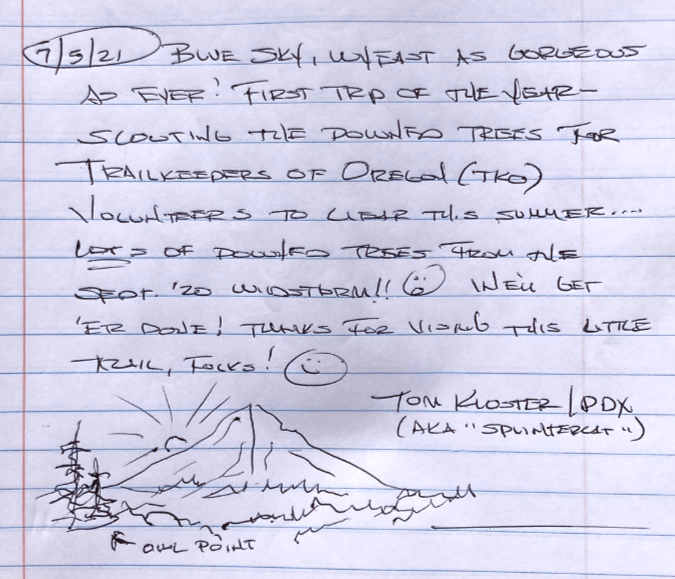
This was the scene on August 11, 2021 when TKO volunteers descended upon the Old Vista Ridge trail and began the task of clearing dozens of downed trees:
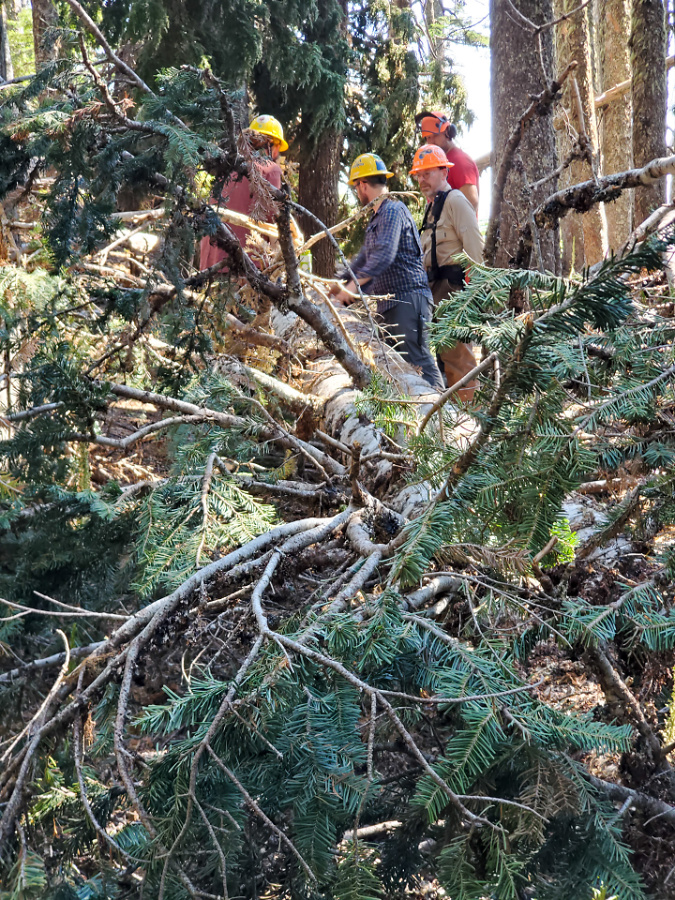
TKO volunteers tackled many piles of fallen trees like this in 2021 (Photo: TKO)

TKO used the event as an opportunity provide crosscut saw training to volunteers, a requirement in wilderness areas where power saws are banned:
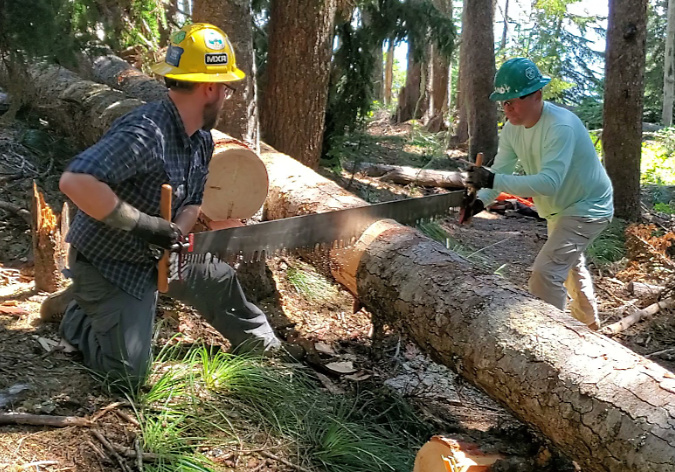
TKO volunteers clearing the trail one log at a time with crosscut saws (Photo: TKO)
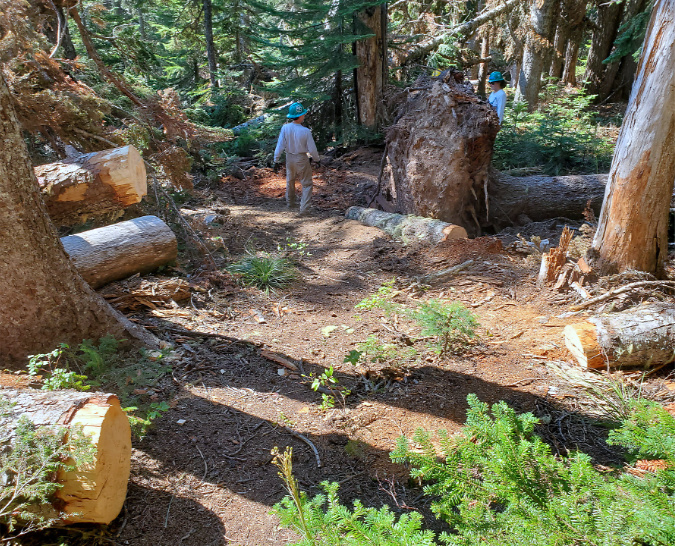
Newly cleared section of the Old Vista Ridge trail in August 2021 (Photo: TKO)

Despite the messy trail conditions that year, you could feel the collective exhale of folks as the pandemic restrictions were gradually lifted. Plenty of thankful messages like these appear in the Owl Point Log:
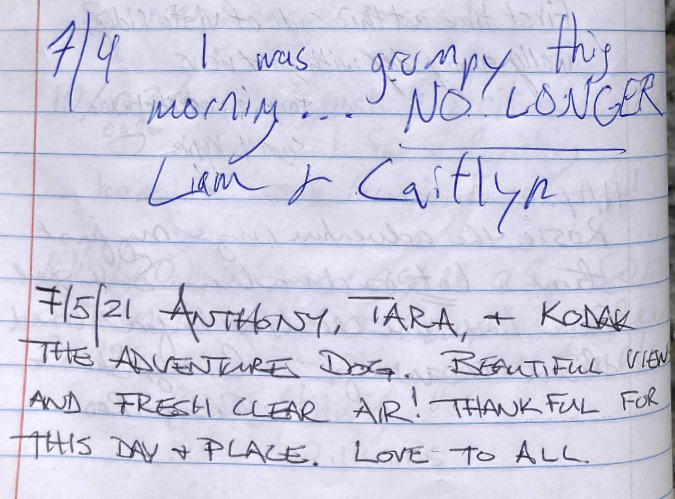
This is a fun post from that summer (below). Ali got the last word in, but do you think Brendon knew what she had written? 

Meanwhile, these Rhode Islanders were in Oregon for a wedding in September 2021:

That year brought the first out-of-towners from eastern Canada, too:

Here’s the final from 2021 – an especially philosophical message left very late in the hiking season:
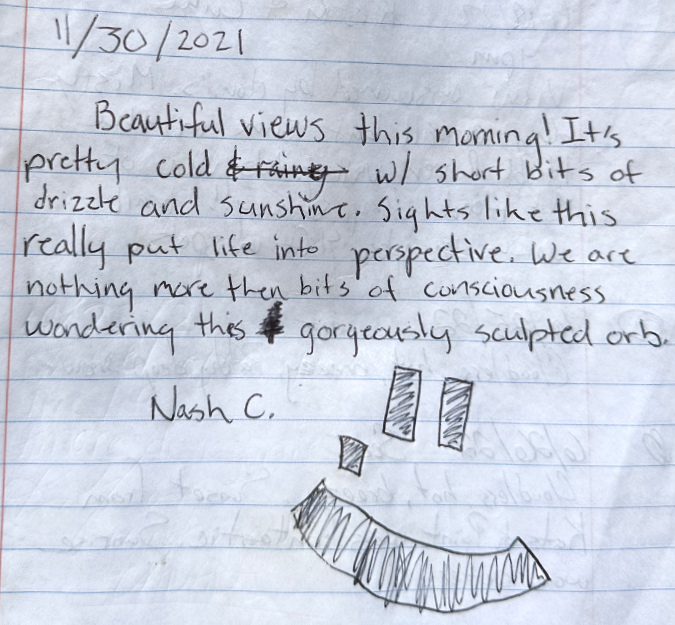
The 2022 hiking season arrived with a very late snowmelt, as noted by these long-distance visitors from the Netherlands:

There were still big snowdrifts in a few spots when I visited a week later with my old friend Ted and his two kids, who were home from college. It was a brisk, breezy and beautiful day to show off the beauty of Owl Point to some first-time visitors:
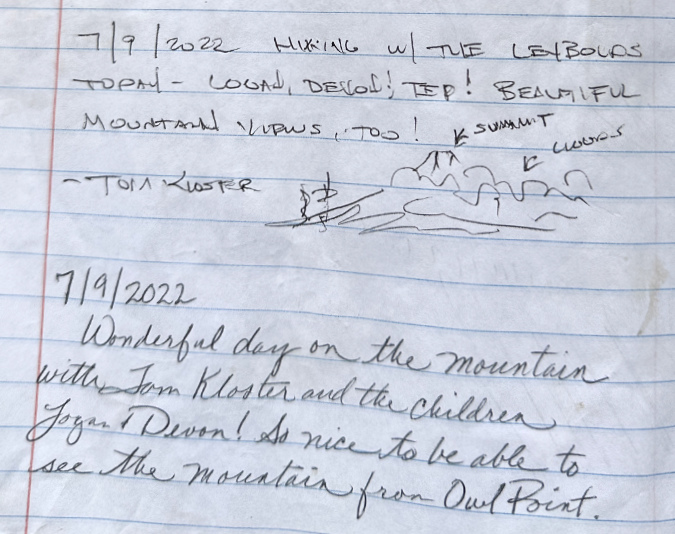
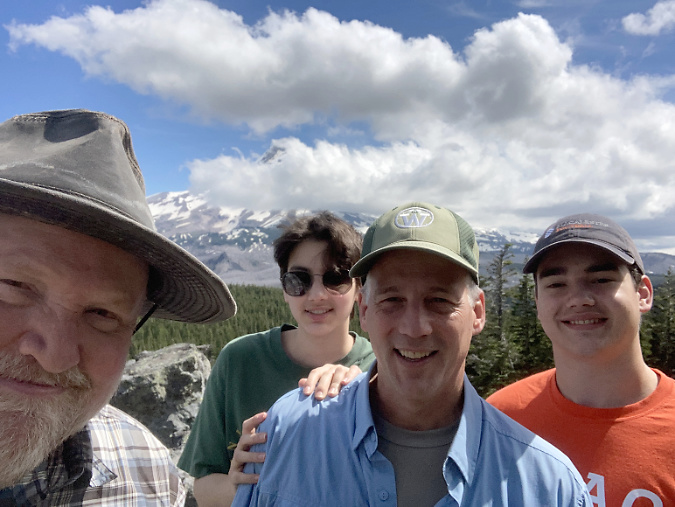
The author giving Ted and his kids a tour of heaven

Ted’s kids asked for some extra adventure, so I obliged with an off-trail visit to Katsuk Point and one of the more dramatic ceremonial Indian pit located nearby:
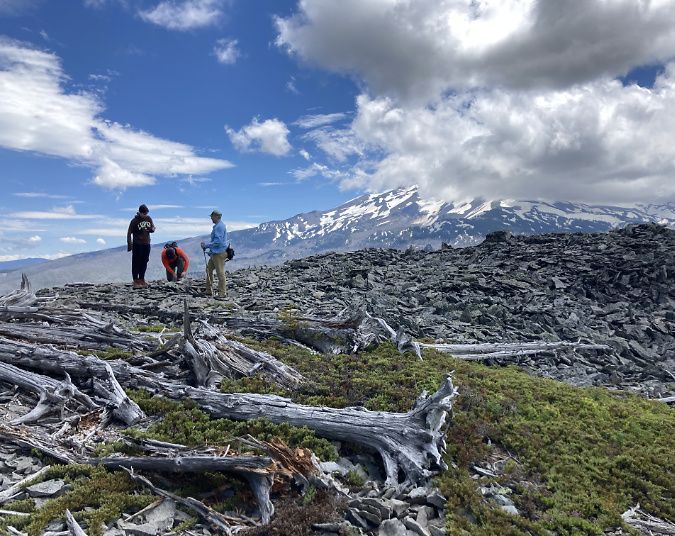
Blustery, beautiful day at Katsuk Point
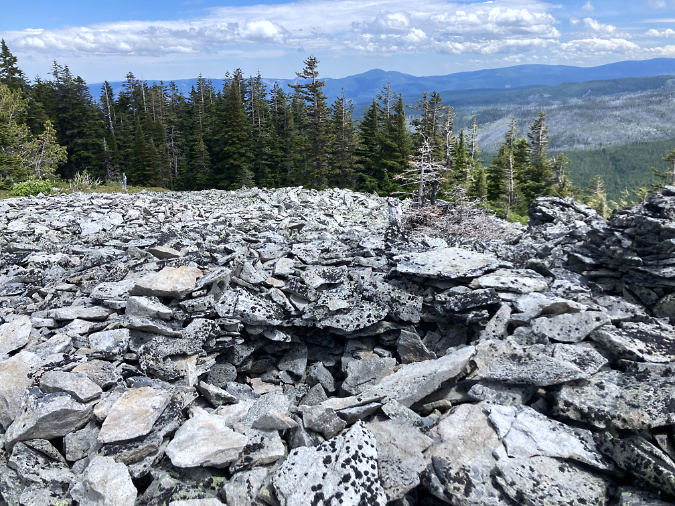
Off-trail Indian Pit near Owl Point

Here’s another thoughtful message (and a toast!) from that summer, posted by out-of-towners from Minnesota and Wisconsin:
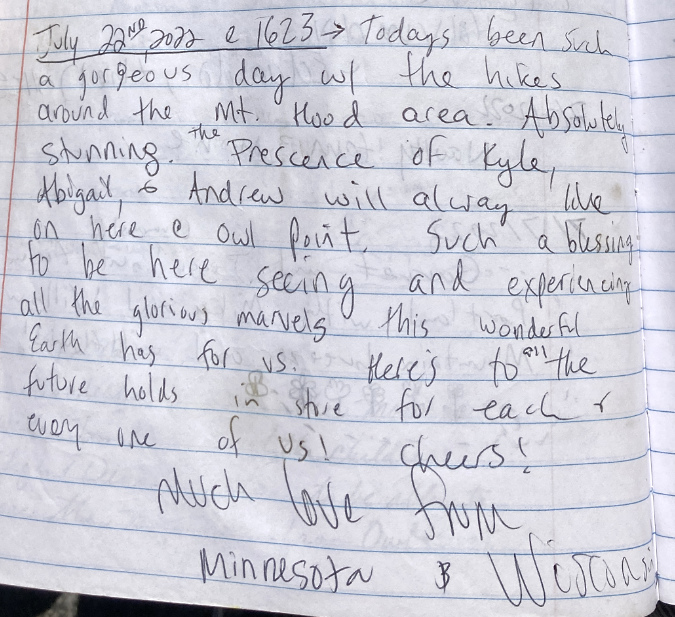
…and another Wisconsin group from the week prior – girls trip!

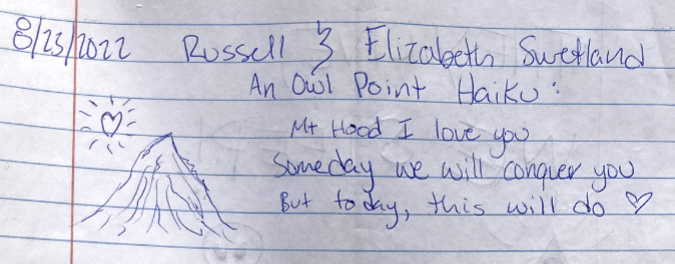
Mount Hood seems to inspire haiku – this entry was added in late August of 2022:
Not surprisingly, this isn’t the first mention of aliens in the Owl Point Log, but it might be the best:

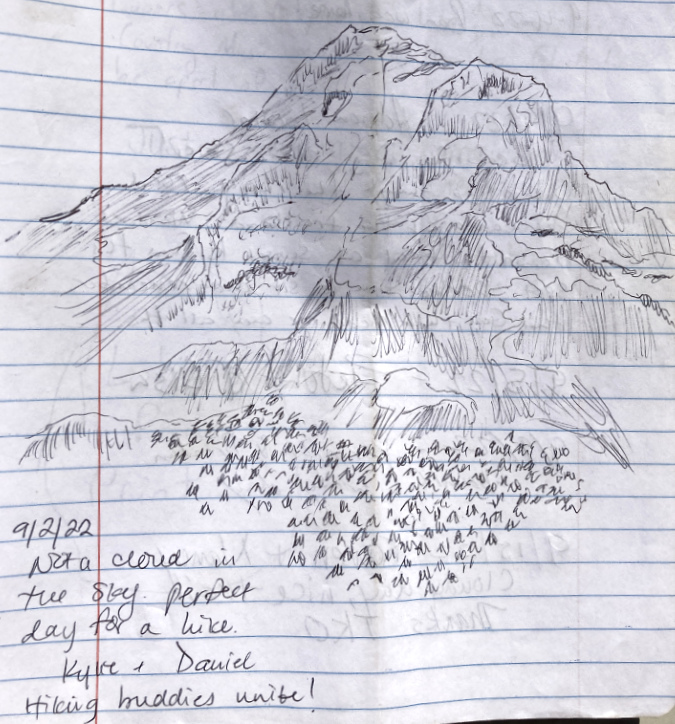
Hiking buddies Kyrie and David left this very detailed sketch of the mountain in September 2022:
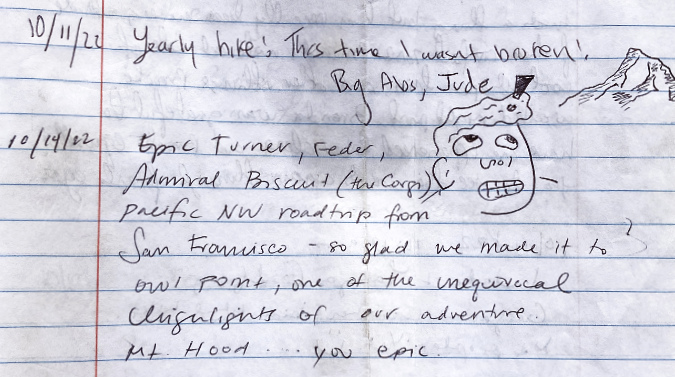
More locals returning to Owl Point in October 2022, plus road-trip out-of-towners from the Bay Area admiring our mountain:
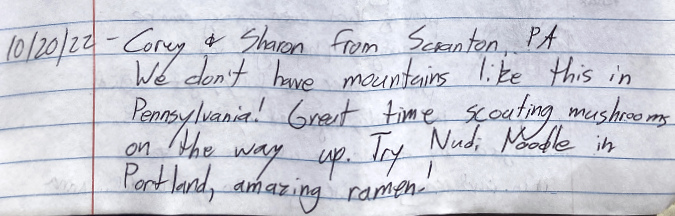
Among the last messages from 2022 is from these Scranton, Pennsylvania out-of-towners, who were also enthused about trendy restaurants in Portland: 
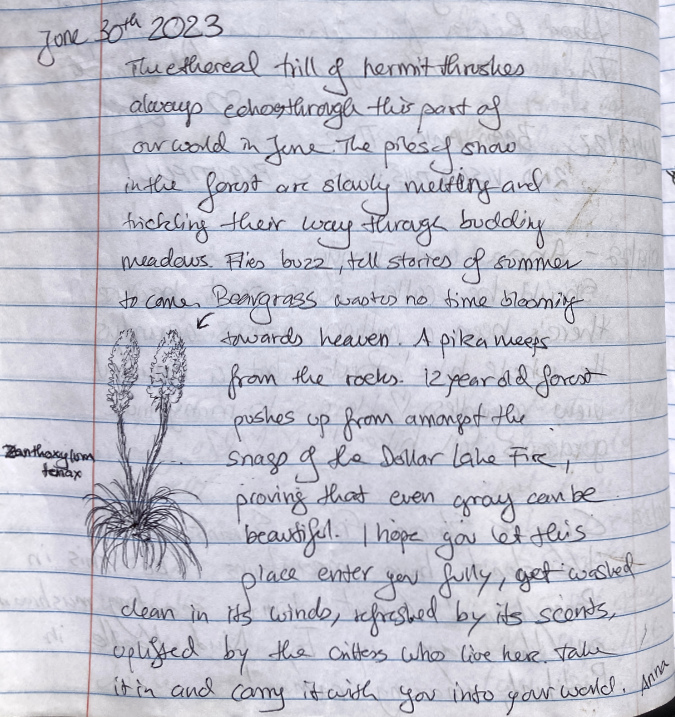
The 2023 season opens with one of the finest entries to date in the Owl Point Log. Hiker Anna gives a literary spin to the natural history of the area, including a nice botanical sketch of Beargrass in bloom (the second in that I’ve included in this article):
Beargrass and Avalanche Lilies are mentioned often in the log by early summer visitors, so to put a face on these wildflowers, here’s a quick primer on these favorites.

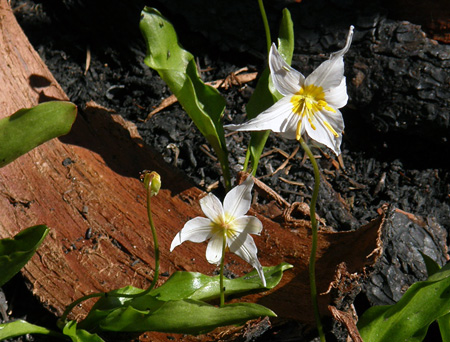
First up, Avalanche Lily. The explosion of these lovely wildflowers in the Dollar Lake Burn area has made the main Vista Ridge Trail a new favorite among photographers, but there are plenty of these lilies growing along the northern sections of the Old Vista Ridge trail. The form carpets of white flowers under the Noble Fir canopy in late June and early July, especially in the section between Blind Luck Meadow and the Owl Point junction.
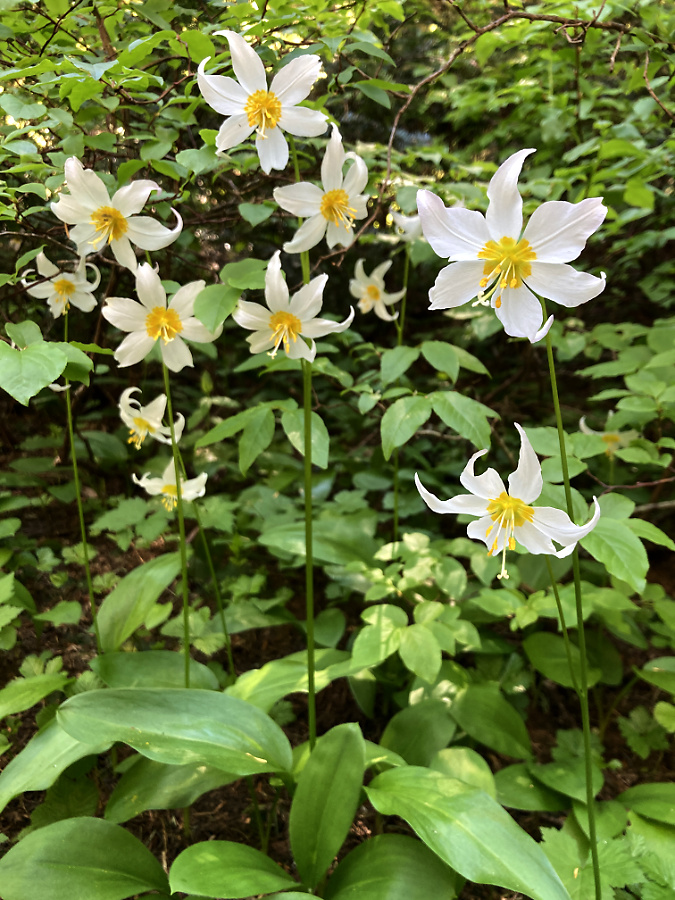
Avalanche Lilies near Owl Point in early July

Beargrass is also found throughout the hike to Owl Point, but it is most prolific in the area around Blind Luck Meadow and fringing the talus slopes at Owl Point, itself. Beargrass blooms in June and early July on tall spikes that gradually unfold whorls of tiny, individual blossoms from the bottom, up. 

This example at Owl Point has just begun to bloom:
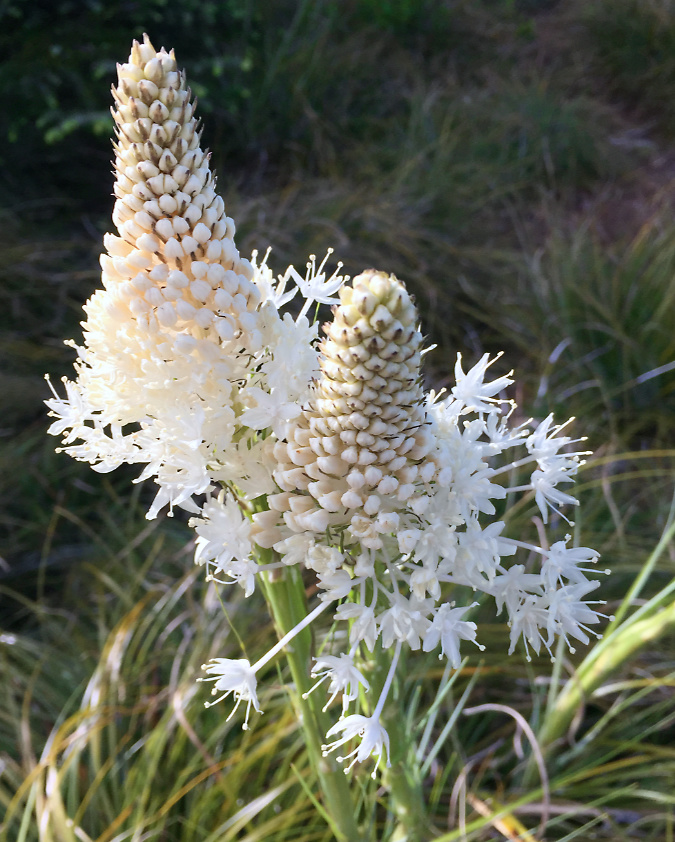
Beargrass bloom beginning to unfurl

Here’s an example of Beargrass at Blind Luck Meadow at it peak, with the top of the spire fully open. For photographers, this is the Beargrass bloom stage they are seeking:
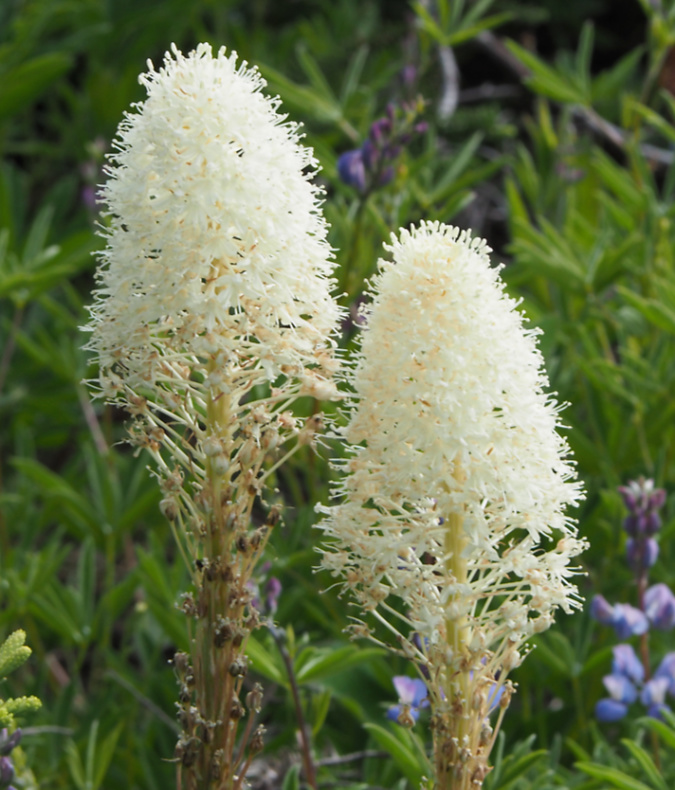
Beargrass in full bloom

Beargrass are fickle in their blooming habits. While there’s a widespread myth that these flowers bloom in seven-year cycles, it is true that individual plants rarely bloom in consecutive years. The abundance of blooming Beargrass in a particular area is more a measure of abundant spring rainfall, soil moisture and especially access to sunlight. Owl Point had prolific Beargrass years in 2016 and 2021, while other years had few or no bloom at all. 
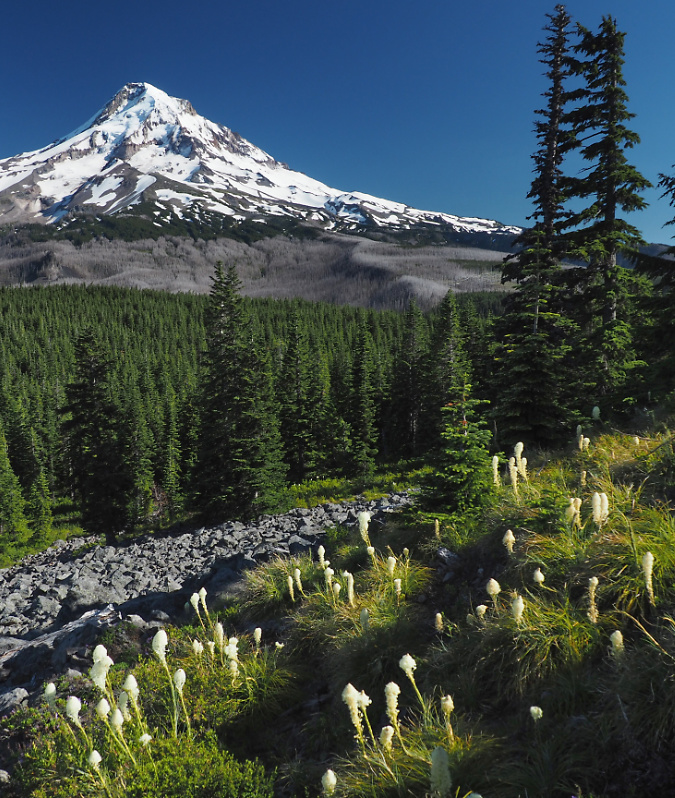
2016 Beargrass bloom at Owl Point

Another myth is that bears eat Beargrass roots. Also not true, though deer and elk to graze on their foliage, and bears have been known to use their leaves as bedding. Native peoples also used the tough leaves from Beargrass in woven baskets and the fleshy roots for medicinal purposes.

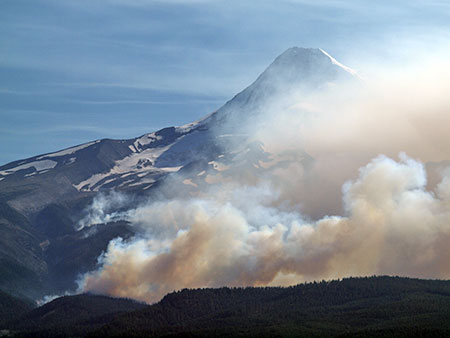
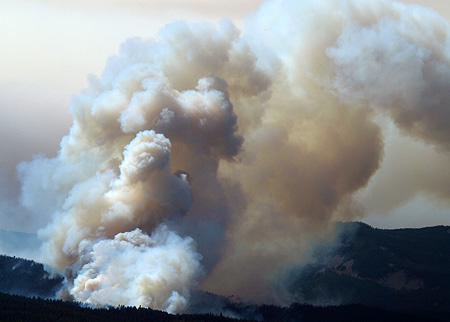
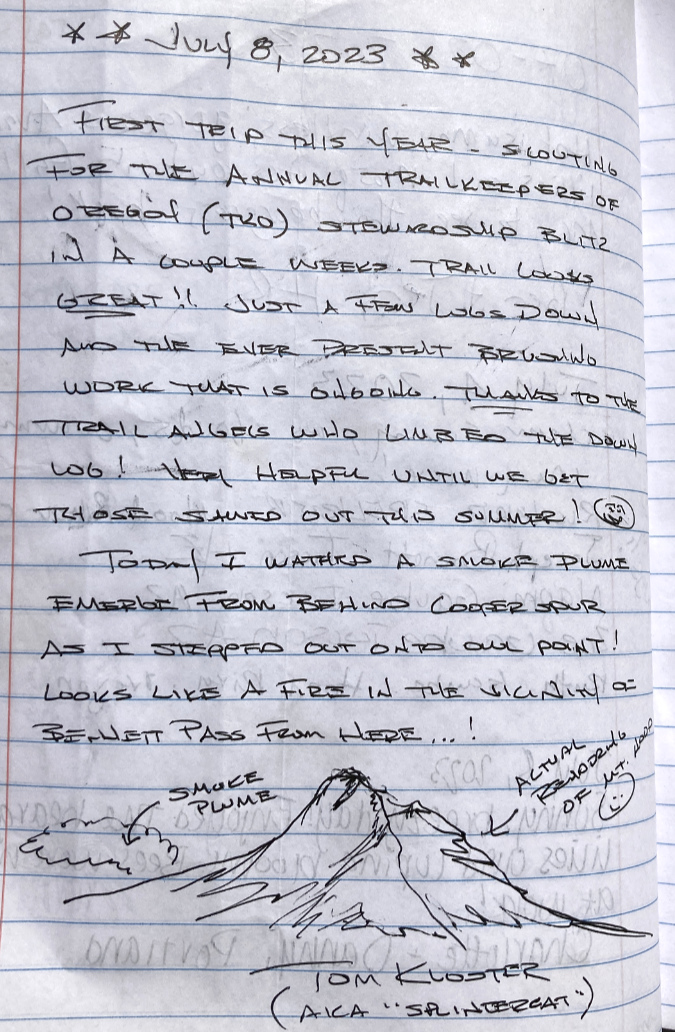
This brings me to the conclusion of the second volume of the Owl Point Log book in, with yet another entry of my own, made while on a TKO scouting trip in July 2023. Notable in this message was the plume of smoke that I watched rising from the east shoulder of the mountain while I was at Owl Point that day. The fire turned out to be further south, along the White River. By the time reached home that night, it had exploded into a substantial fire.
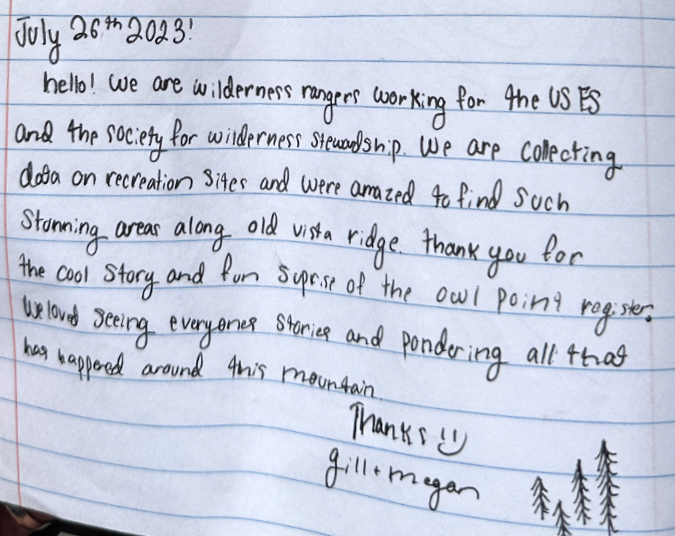
Then, there was this entry from later that month in 2023 (below) by two USFS rangers researching the trail. Once again, I was relieved to read that they appreciated the Owl Point Register box and log book – and the view, of course!
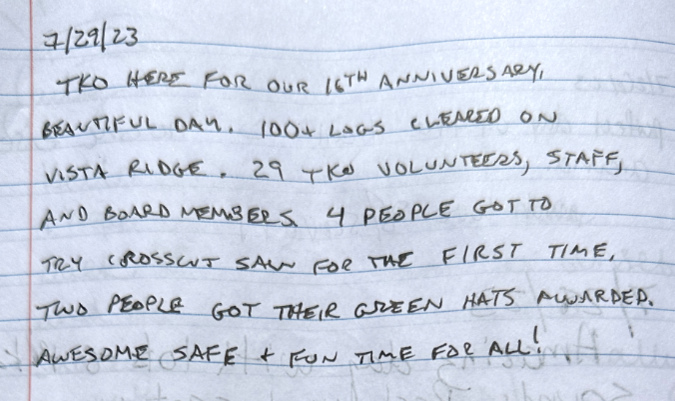
This note (below) marked the most ambitious annual TKO outing to date on the Old Vista Ridge Trail. Not only were there volunteers clearing logs and brush along the Old Vista Ridge trail, a separate group had backpacked to WyEast Basin and spent two days clearing over 100 logs from the main Vista Ridge trail with crosscut saws.
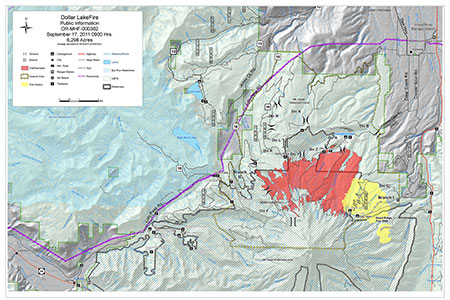
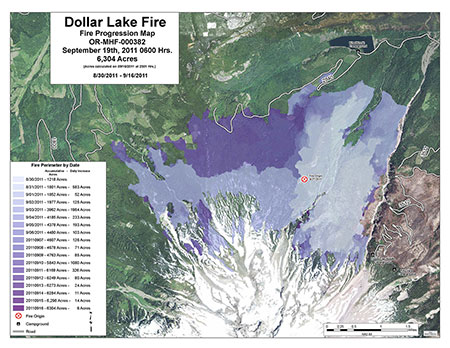
The annual event portrait for 2023 (below) shows both crews meeting up at Owl Point for lunch. On hand were a couple gallons of ice-cold lemonade (hauled two miles in!) and several dozen homemade cookies. The bright yellow sunshades mark the overnight crew that worked the Vista Ridge trail – a very exposed area since the 2011 Dollar Fire swept through.
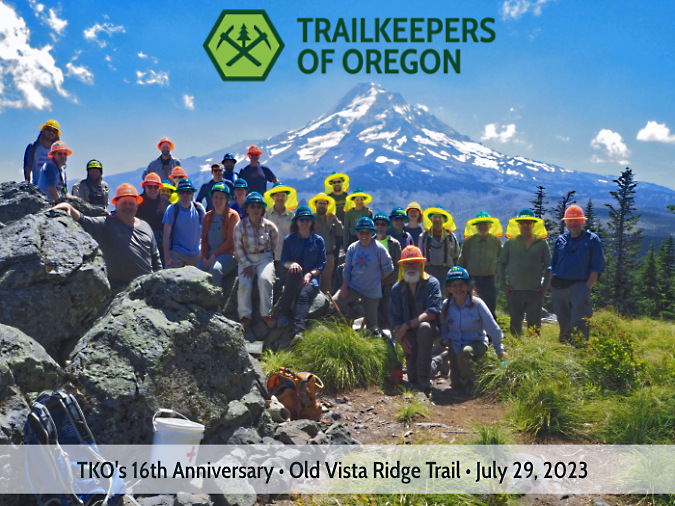
The dual-crew TKO meetup at Owl Point in 2023
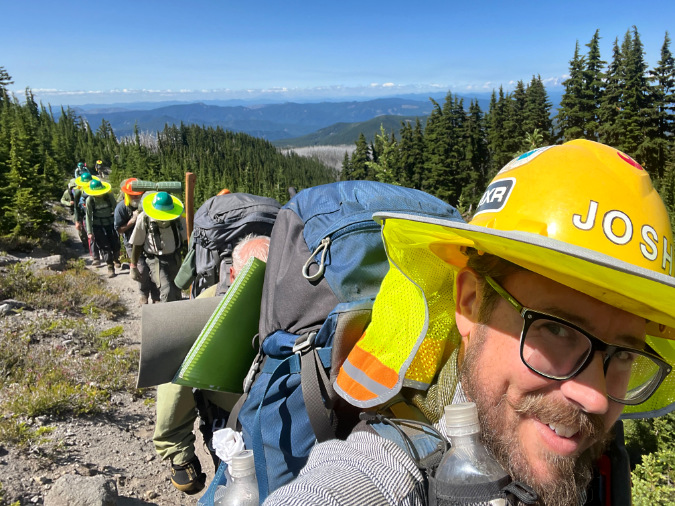
TKO crosscut crews on the main Vista Ridge Trail for an overnight logout in July 2023 (Photo: TKO)
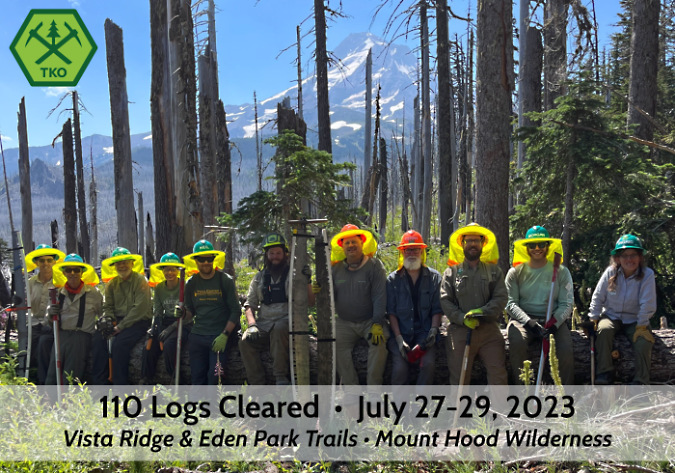
Crosscut crews celebrating 110 logs cleared in two days in 2023

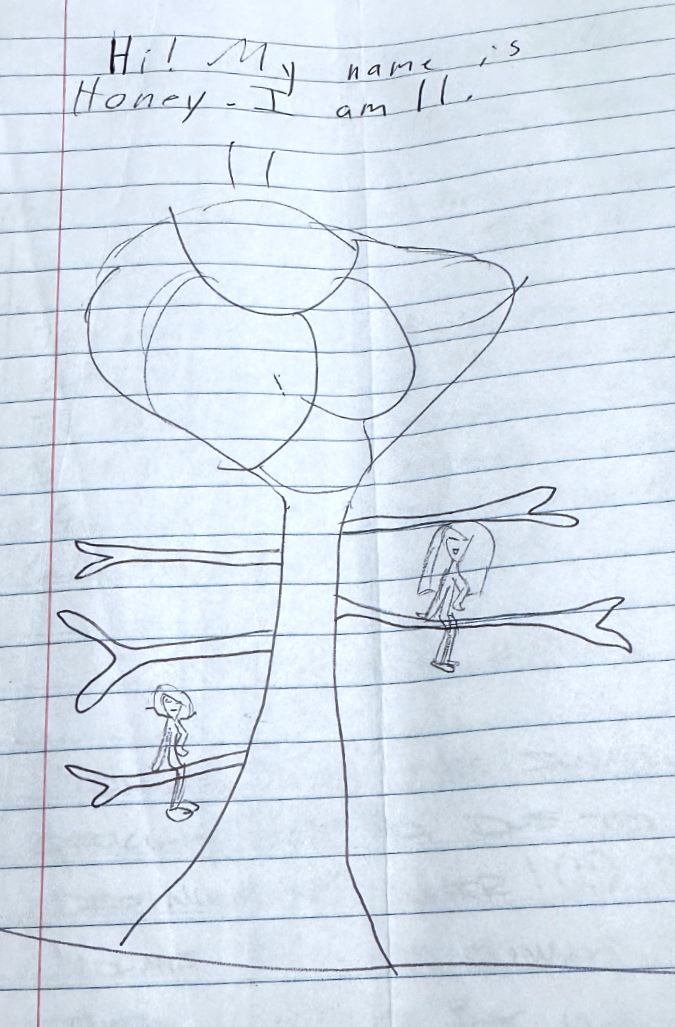
The final (and perfect) entry in Volume 2 of the Owl Point Log is this artful sketch (below) by Honey. I’m going to guess that Honey climbed a tree while at Owl Point? 
The second volume was close to full by August 2023, but worse, the cover was falling apart. A kind visitor had done some first aid with duct tape, but alas, it was time to retire this one…
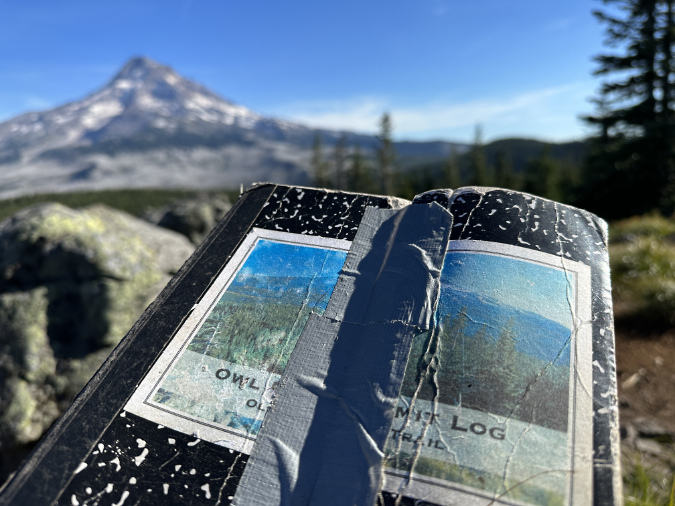
The second volume to the Owl Pont Log was well-loved..

And so, I left this note to close out the second volume:

Where are the first two volumes of the Owl Point Log kept? In TKO’s archives – which really means a closet in my home office. When TKO does have an archive, someday, they will move to that more appropriate place.
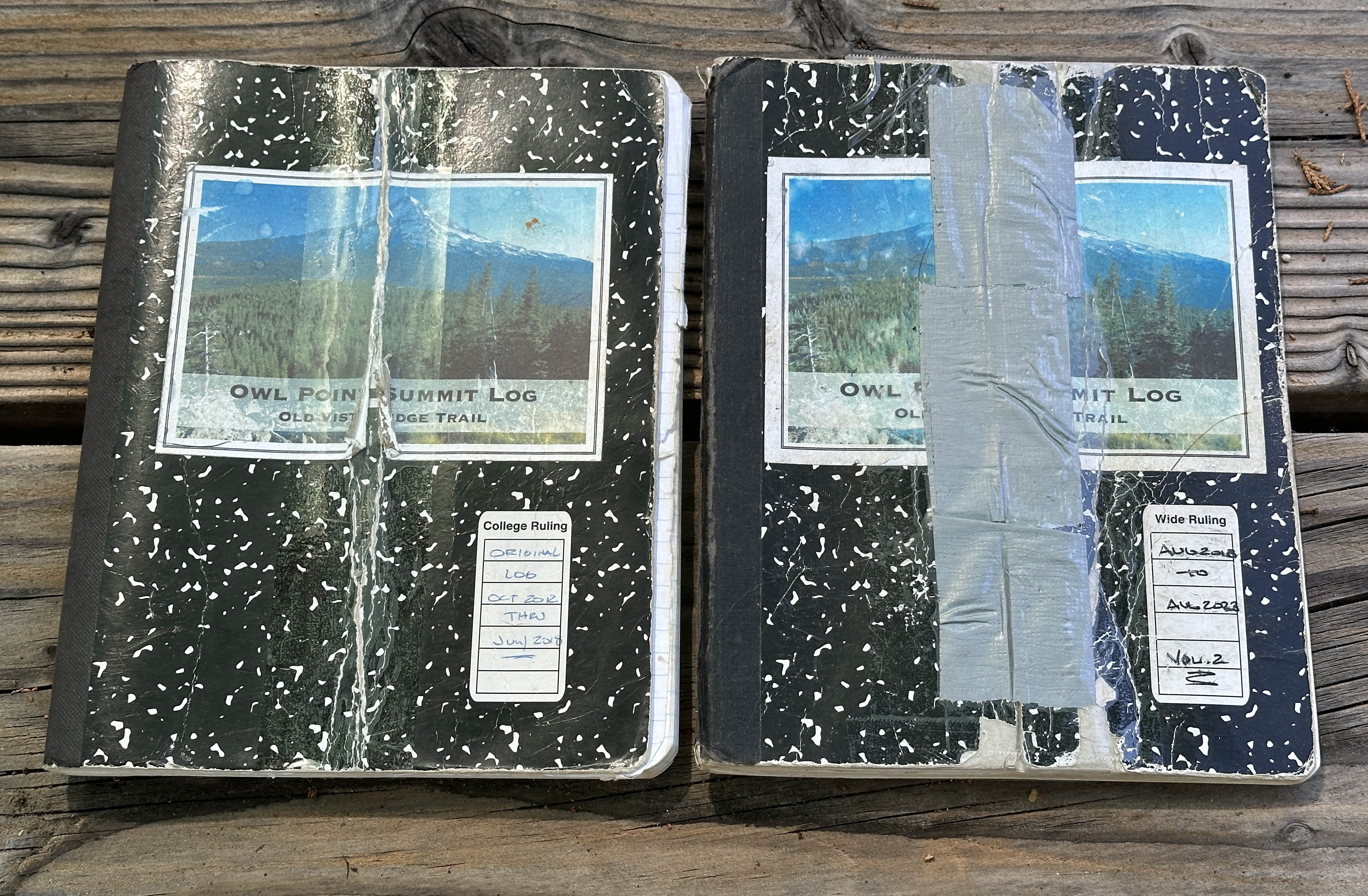
The archived first and second editions of the Owl Pont Log… safe in my closet

…and so, in August of last year I place the third volume of the Owl Point Log in the summit register, along with a fresh version of the Old Vista Ridge scrapbook, maps and visual guide to Mount Hood’s features (below). Judging by the folds, and comments in the log, these get well-used by hikers wanting to learn a bit more about the area and Mount Hood.
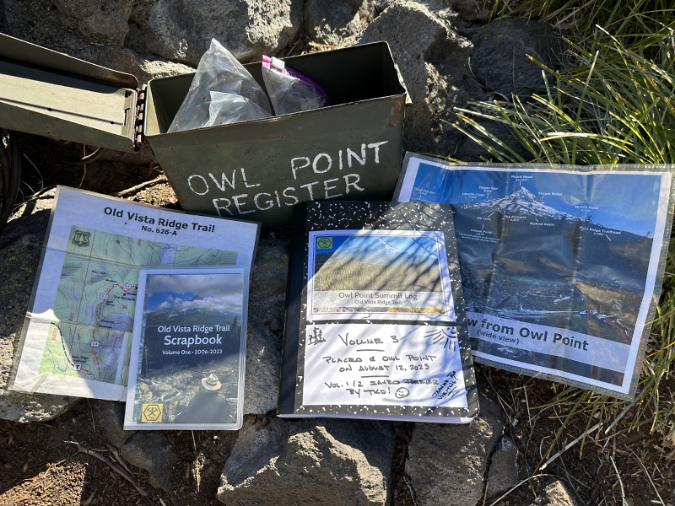
The contents of the Owl Point Register – log, scrapbook, maps and a guide to Mount Hood’s features

And what about the box, itself? So far, it’s doing remarkably well (below), considering the abuse it receives from the elements up on Owl Point. I painted it with army-green Rustoleum back in 2012, and though it’s showing some rust around the edges, It has remained water-tight for twelve years and counting. 

Eleven winters and counting at Owl Point

[click here for a large version]

For those who don’t recognize it, the box is an old Army ammo can that I picked up at the venerable (and since closed) Andy and Bax in Portland. At some point, I’ll need to replace the box, as well – and find a new army surplus store!

What’s ahead for the Old Vista Ridge Trail?

When TKO adopted the Old Vista Ridge Trail – our founding trail – it was part of a broader vision for the area that TKO presented to the Forest Service in 2016. There are lots of proposals in that vision for improving trails and trailhead on the north side of Mount Hood. Among them, the next priority is to provide a route to Owl Point from the east, from the Laurance Lake trailhead.
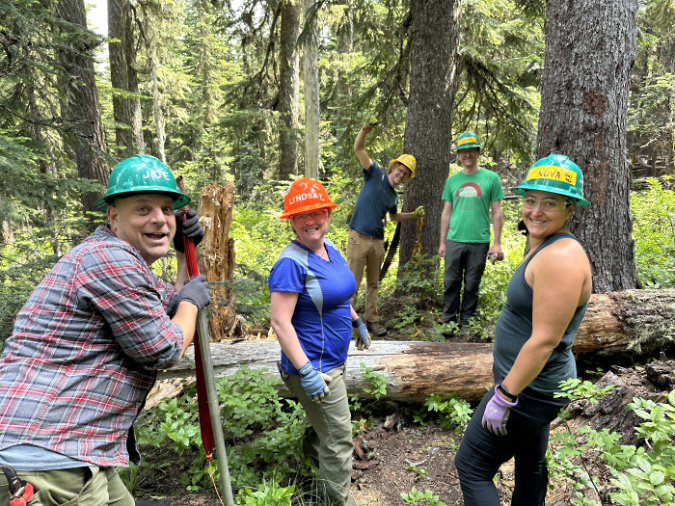
TKO volunteers clearing a log near Owl Point in July 2024

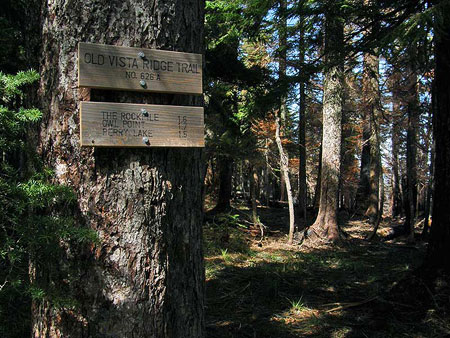
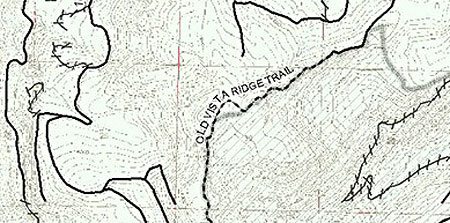
Currently, TKO’s adopted segment of the Old Vista Ridge trail ends at this sign (below), at Alki Point. From here, the unmaintained trail continues downhill to the site of the old Red Hill Guard Station and tiny Perry Lake (more of a pond). 
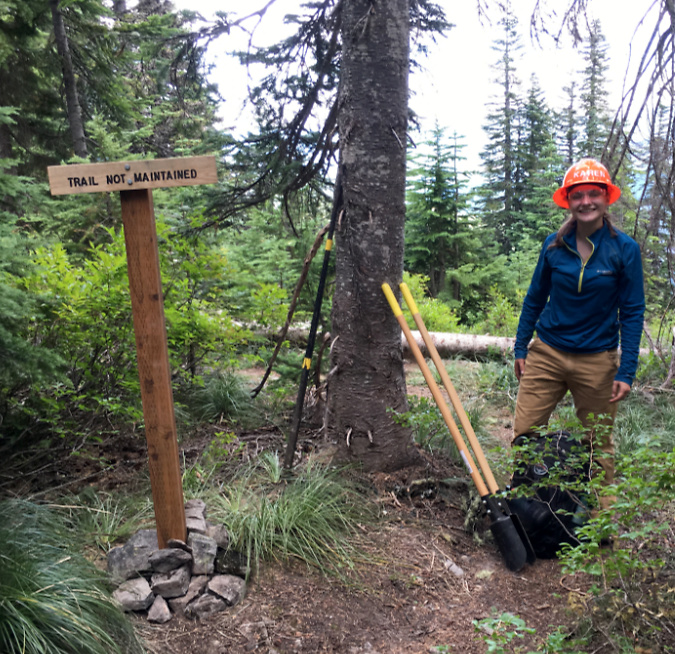
TKO intern Karen helping plant the “trail not maintained” sign at the end of the adopted segment of the Old Vista Ridge Trail in 2018

TKO’s vision is to construct a roughly one-mile connector from Perry Lake to the upper trailhead of the Laurance Lake trail. This schematic shows the proposed connector, as viewed from high on Mount Hood, looking north:
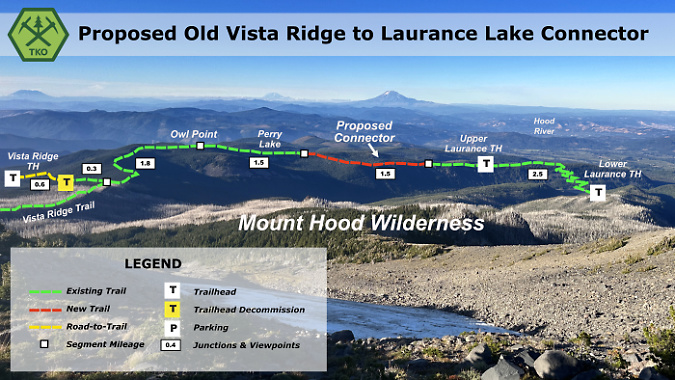
[click here for a large version]

The Laurance Lake Trail was built sometime in the early 1990s and originally envisioned as a mountain bike loop. However, a landslide destroyed the old logging spur that was intended to complete the loop. Later, that part of the planned route was incorporated into the Mount Hood Wilderness, and bicycle travel is now prohibited there.

The orphaned stub of the Laurance Lake Trail remains popular for the views of the lake (below) from the open talus slope the trail traverses and the easy uphill grade that was originally built for bikes.
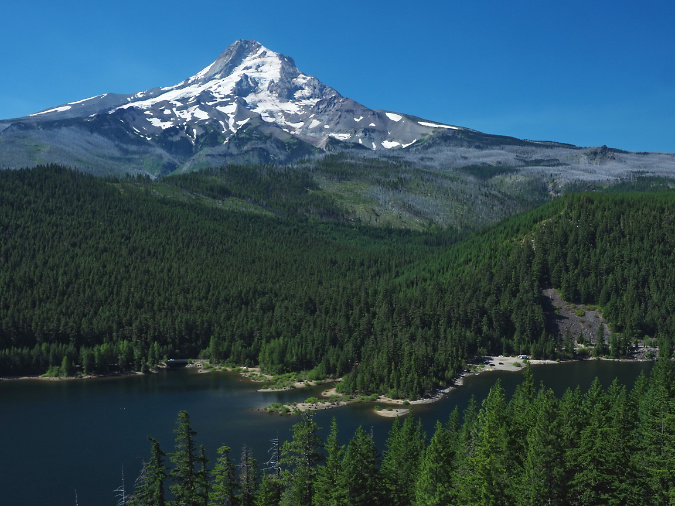
Laurance Lake and Mount Hood from the Laurance Lake Trail

Beyond the talus slopes the trail reaches a ridgetop that eventually extends west to Owl Point. An upper trailhead exists here, too, making construction of the connector trail convenient for crews, since work on the new trail would begin here.
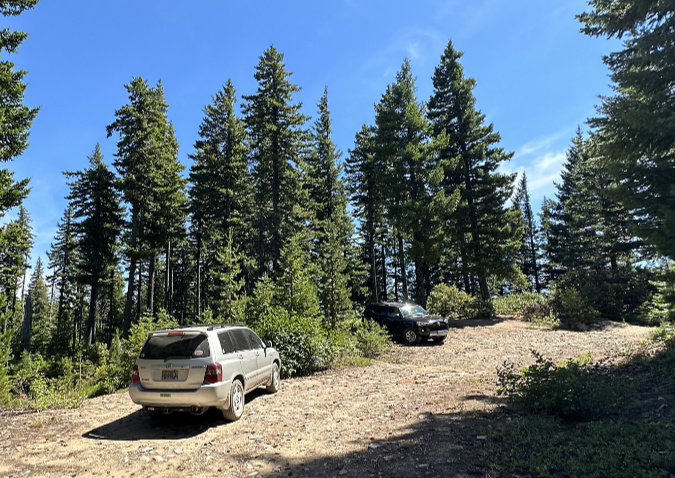
Upper trailhead for the Laurance Lake Trail

Hikers have worn a path along the first quarter mile of the proposed route to and opening along the valley rim (below), with a sweeping view of the mountain.
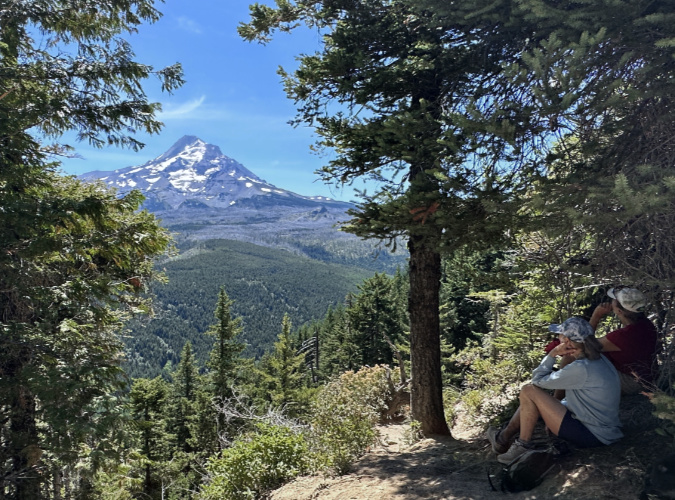
Upper Laurance Lake Trail viewpoint

From the upper trailhead and viewpoint, the new connector would travel through a gently sloped forest for about a mile, then emerge where the unmaintained section of the Old Vista Ridge trail begins. From here, a series of expansive views into the Mount Hood Wilderness unfold along the way to Owl Point.
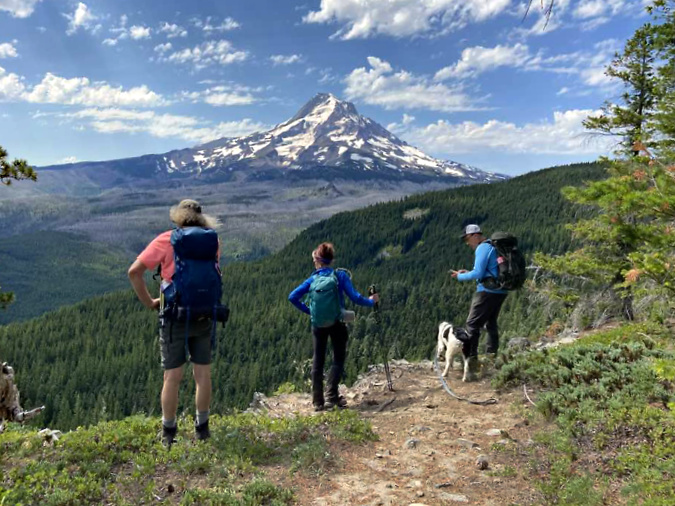
One of the many views along the unmaintained section of the Old Vista Ridge Trail (photo: Janice Abbagliato Messervier)

There is no timeline for this work, and federal planning processes are slow, but I’m hopeful that this new route and others that TKO has proposed can happen sooner than later. It’s no secret why people are increasingly seeking time out on trails in our public lands – the many messages in the Owl Point Log are testament to that – and there’s a tremendous backlog in meeting that need. I’m looking forward to working with TKO to be part of making it happen.
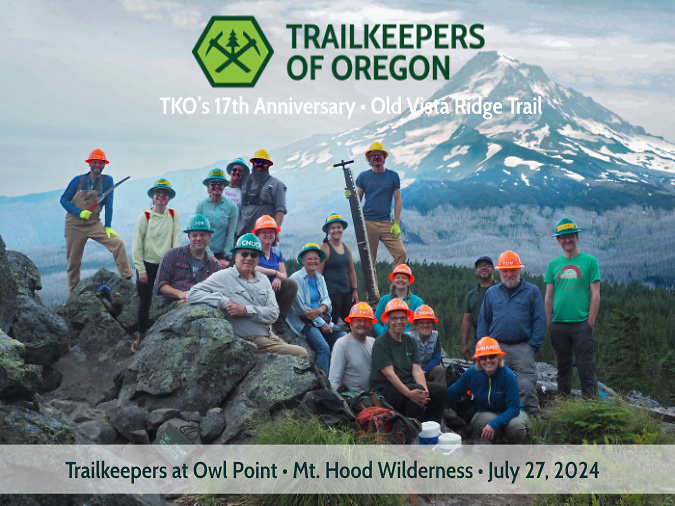
The annual TKO event at Owl Point in 2024

[click here for a large version]

Thanks for indulging me this far in a rather sprawling article and a trip down memory lane! As always, I appreciate folks stopping by and especially for being a friend of WyEast.

Hope to see you on the trail, sometime!
______________

Tom Kloster | August 2024
Rx for the Vista Ridge Trailhead!

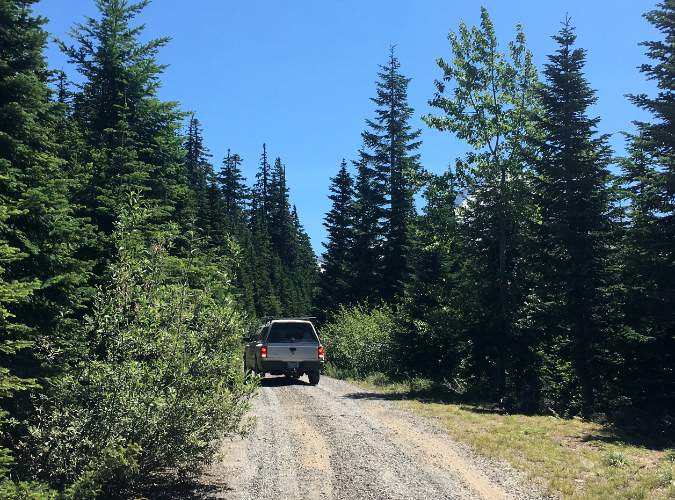
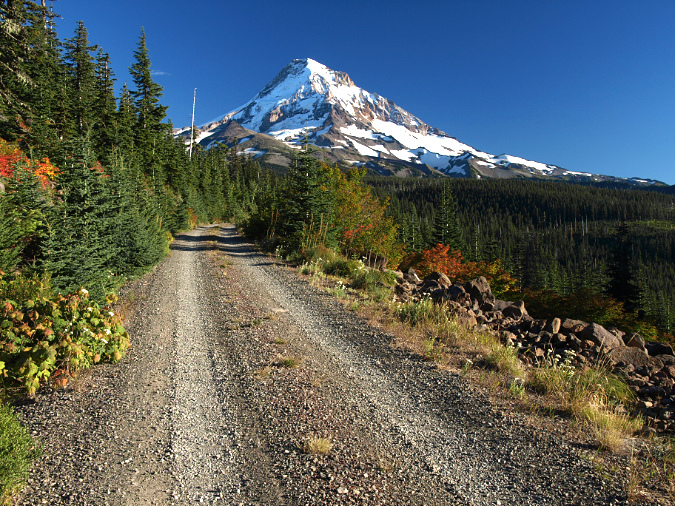
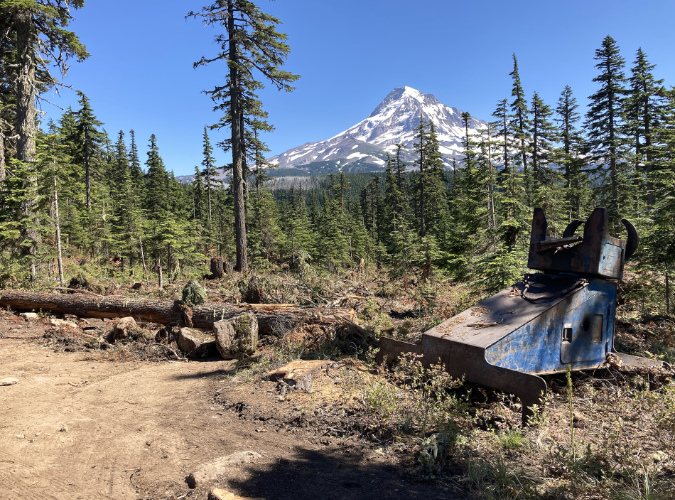
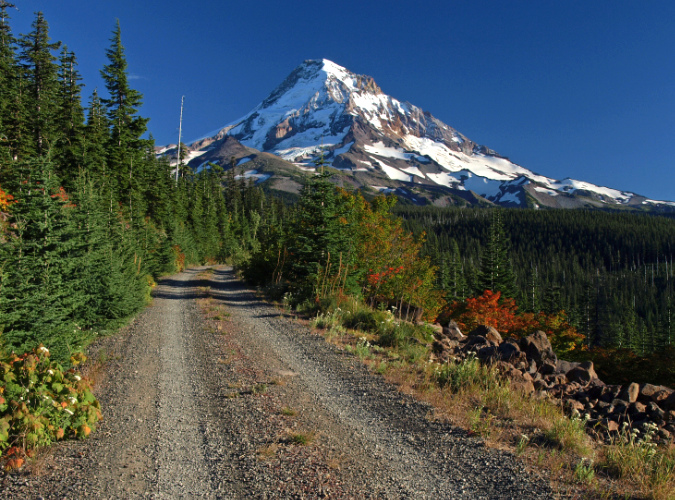
Mount Hood’s scenic wonders beckon on the final approach to the Vista Ridge trailhead on Forest Road 1650

Public lands across the nation experienced a big spike in visitors during the recent pandemic, continuing a growth trend that has been in motion for decades. In WyEast Country, this has placed an unprecedented burden on some of Mount Hood’s under-developed trailheads, like the one at Vista Ridge, on the mountain’s north side. 

The scenic gems within a few miles of this trailhead are among the mountain’s most iconic: Cairn Basin, Eden Park, Elk Cove, WyEast Basin and Owl Point draw hikers here, despite the washboards along the dusty final gravel road stretch – and the completely inadequate trailhead. 

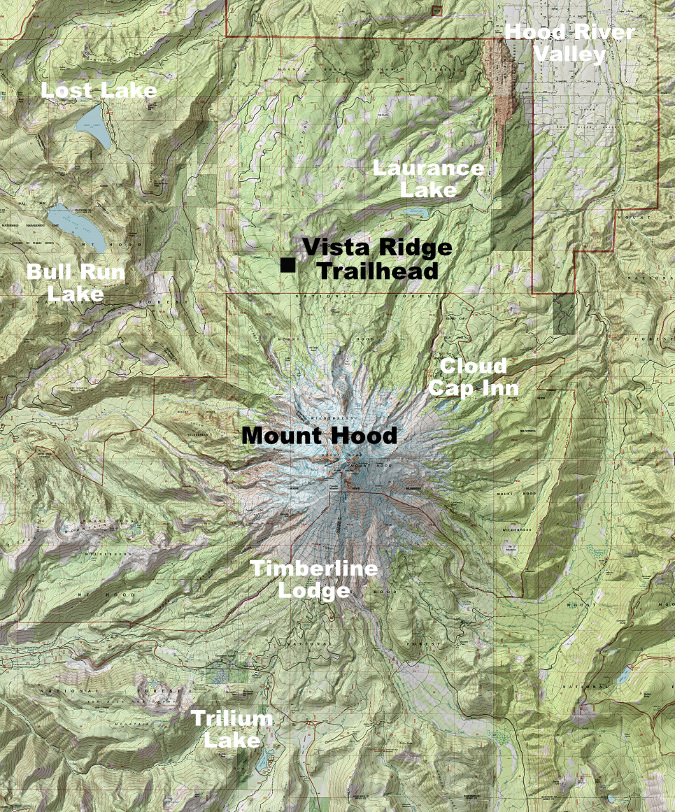
The Vista Ridge is located on Mount Hood’s rugged north side and reached from Lolo Pass Road

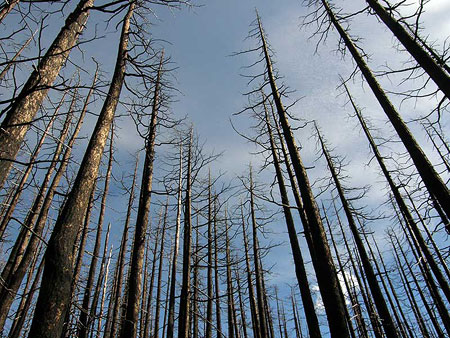
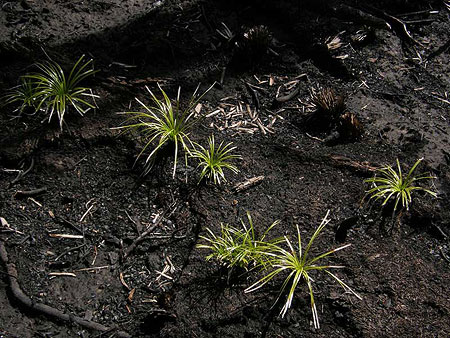
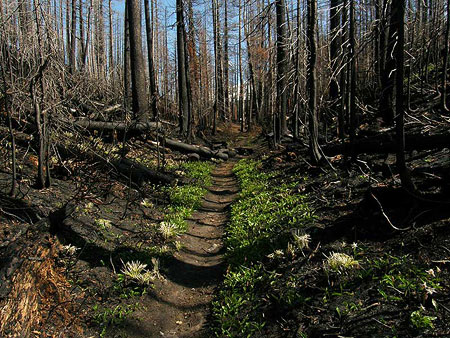
The pandemic isn’t the only driver in the growing popularity of Vista Ridge. The 2011 Dollar Lake Fire torched Vista Ridge, leaving a vast ghost forest behind. In the years since, the forest recovery has featured a carpet of Avalanche Lilies in early summer that draws still more visitors to this trailhead. And since 2007, volunteers have restored the Old Vista Ridge trail to Owl Point, adding yet another popular hiking destination here.

It is abundantly apparent to anyone using the existing Vista Ridge trailhead that it was never designed or developed to be one. Instead, it was the result of a plan during the logging heyday of the 1960s to extend Forest Road 1650 over the crest of Vista Ridge and connect to the growing maze of logging roads to the east, in the Clear Branch valley. 

For reasons unknown, that never happened, and by the late 1960s the road stub defaulted into an unimproved trailhead for the Vista Ridge Trail when a short trail connection from the road stub to the saddle was built, instead. This new trail connection short-circuited the northern two miles of the Vista Ridge trail, but has since been restored reopened as the Old Vista Ridge trail. This is how today’s Vista Ridge trailhead came to be on a steep hillside at the abrupt end of a defunct logging spur.

The existing Vista Ridge trailhead is simply a logging spur that was abandoned mid-construction in the 1960s, and thus lacks even a simple turnaround

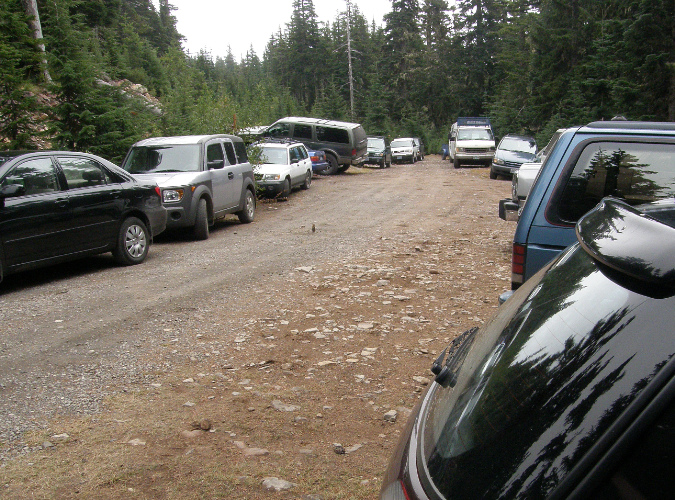
While it was still lightly used as recently as the early 2000s, the popularity of the Vista Ridge trailhead has grown dramatically over the past 15 years. Today, dozens of cars are shoehorned into this dead-end spur during the busy summer hiking season.

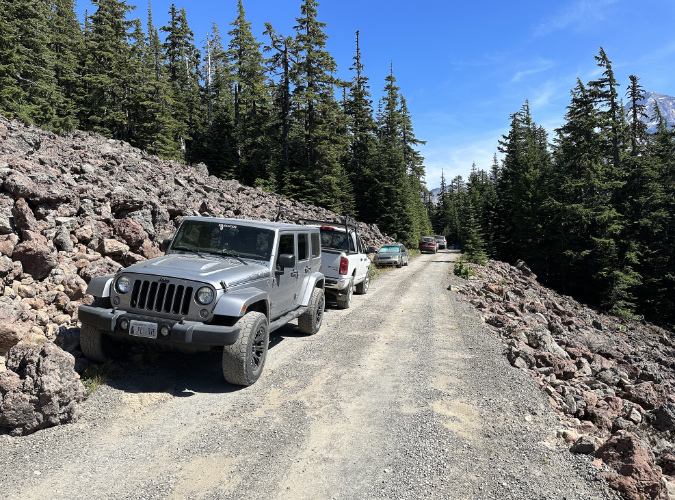
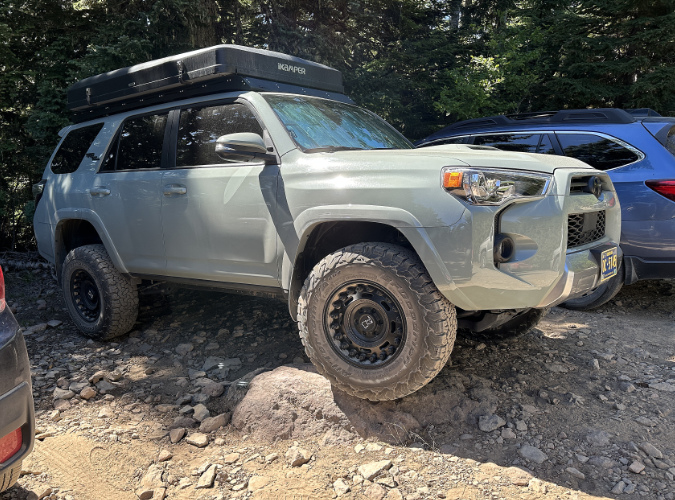
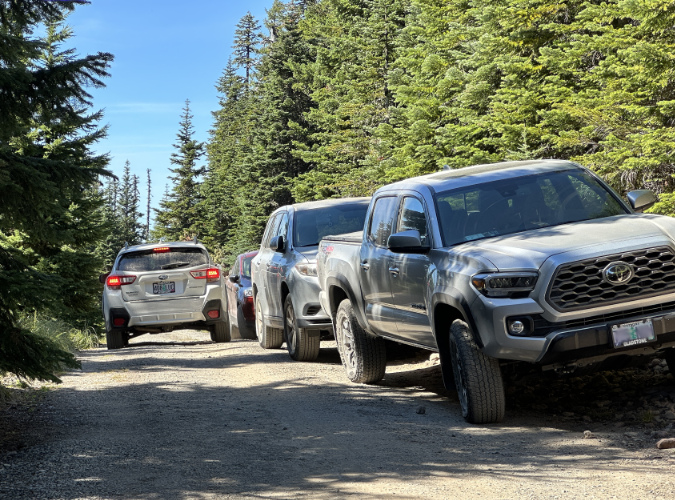
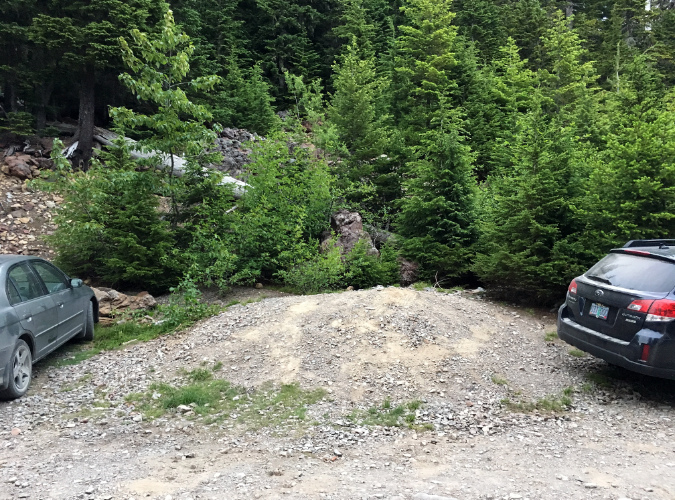
Parking at the trailhead is a haphazard affair, at best. There is room for about 6 cars along the south edge of the stub, though it was never graded for this purpose, and thus even these “spaces” are a minefield of sneaky, axel-cracking pits and oil-pan ripping boulders. These semi-organized spaces fill immediately on summer days, so most who come here end up parking at the stubbed-out end of the spur or spill out along the narrow final approach of Road 1650. 

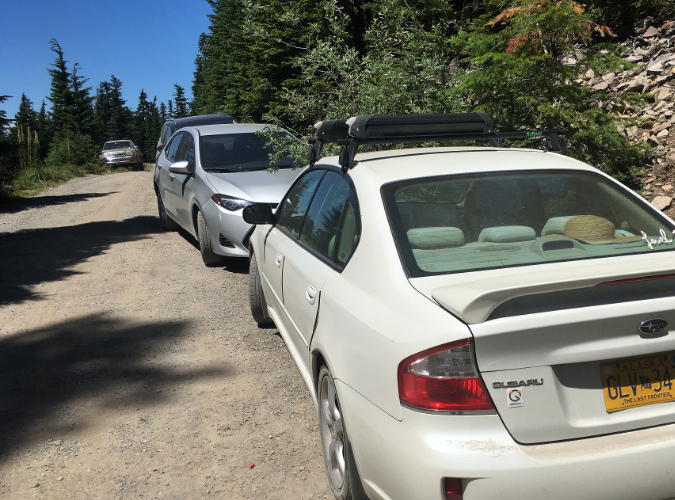
Overflow from the cramped existing trailhead routinely spills over to the narrow Road 1650 approach during the summer hiking season

Spillover parking on this section of Road 1650 is only unsafe for passing vehicles, it also impacts a resident Pika population living in these talus slopes

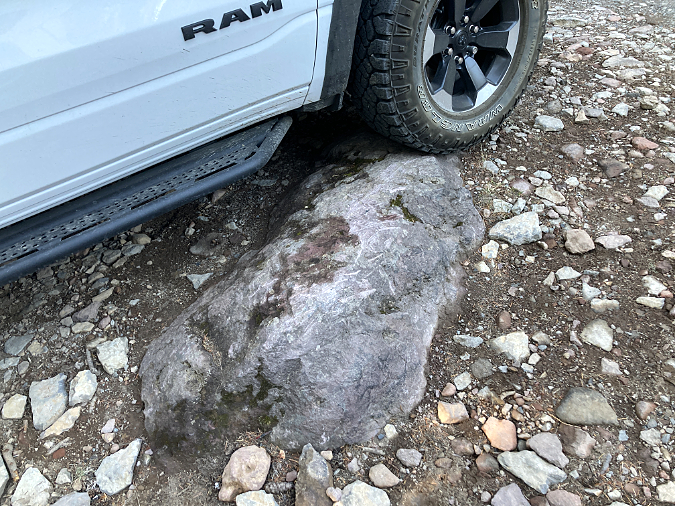
Because the existing trailhead was never designed or graded as a parking area, visitors must navigate large boulders and deep pits to find parking

The scars on this boulder are testimony to the real damage caused by the lack of an improved parking surface at the existing Vista Ridge trailhead

The constrained, chaotic parking at the Vista Ridge Trailhead and resulting overflow on busy weekends is frustrating enough for visitors, but it also creates a safety problem for emergency response. This trailhead provides the best access to the northern part of the Mount Hood Wilderness, yet there is often no way to turn a vehicle around in summer, much less park a fire truck or ambulance here.

The overflow parking on the narrow access road is not only stressful an potentially dangerous for visitors to navigate, it also creates an access problem for larger emergency vehicles attempting to reach the trailhead

This visitor was forced to back nearly 1/4 mile down the access road after reaching the full parking lot and overflow shoulder parking that left no room to turn around

The origins of the short trail connector from today’s trailhead to the historic Vista Ridge Trail has unclear origins, it appears to have been built between 1963 and 1967, and it was clearly intended to replace the northern portion of the Vista Ridge Trail – the section that has since been restored as the Old Vista Ridge Trail.  

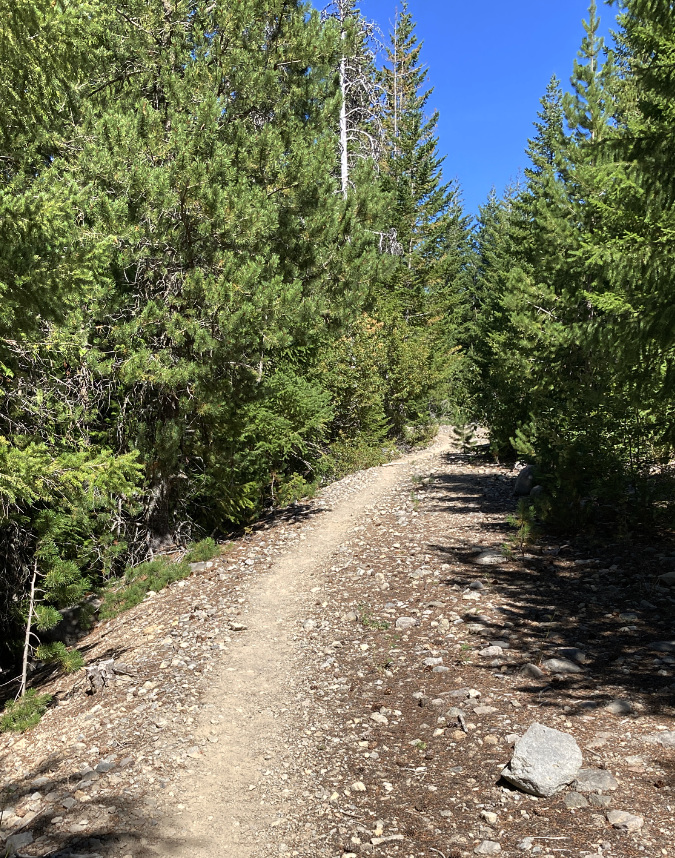
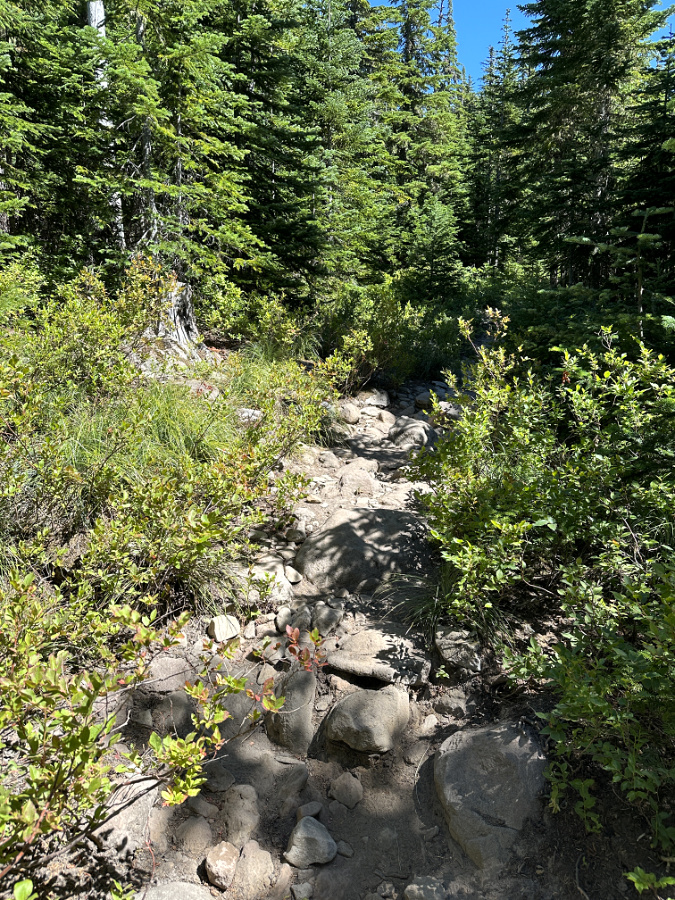
While most of the short connector trail is a well-constructed and graded route through dense forest, the first 200 yards are a miserable, rocky mess where the “trail” is really just a rough track that was bulldozed for a planned extension of the logging spur, but never fully graded. This sad introduction to the wonders that lie ahead is a frustrating chore to hike – and an ankle-twisting nightmare to re-negotiate at the end of your hike. 

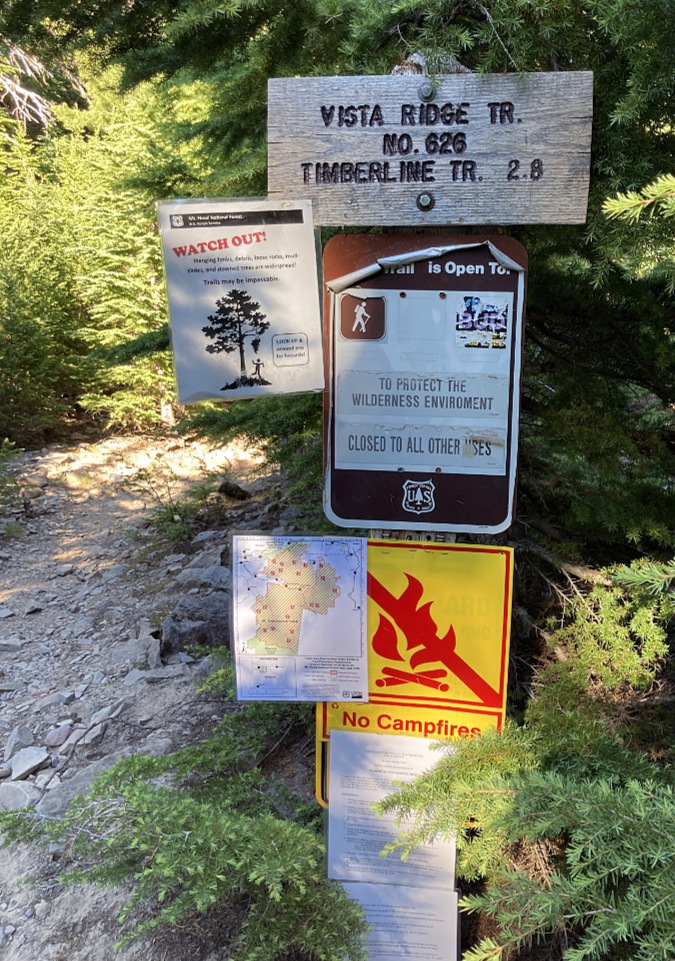
This signpost is the sole “improvement” at the Vista Ridge trailhead, leaving much room for improvement at what has become one of Mount Hood’s most popular trailheads

The first 1/3 mile of the Vista Ridge trail follows an abandoned, partially constructed section of logging spur that has significant surface and drainage problems that also leave much room for improvement as the gateway to this popular area

Add to these trailhead and trail condition woes an ongoing lack of proper signage to help people actually find Vista Ridge, and you have a discouraging start to what should be stellar wilderness experience for visitors – many from around the country and even the world. Thus, the following: a proposal to finally fix these issues at Vista Ridge and give this sub-par portal into the Mount Hood Wilderness the attention it has long deserved.

The Proposal…

The problems that plague the existing Vista Ridge Trailhead all stem from its accidental location on the steep mountainside. As a result, there is no way to safely accommodate needed parking, a turnaround or other trailhead amenities in the current location. The good news is that flat ground lies about 1/2 mile away, where Road 1650 passes an already disturbed site that was part of a recent logging operation.

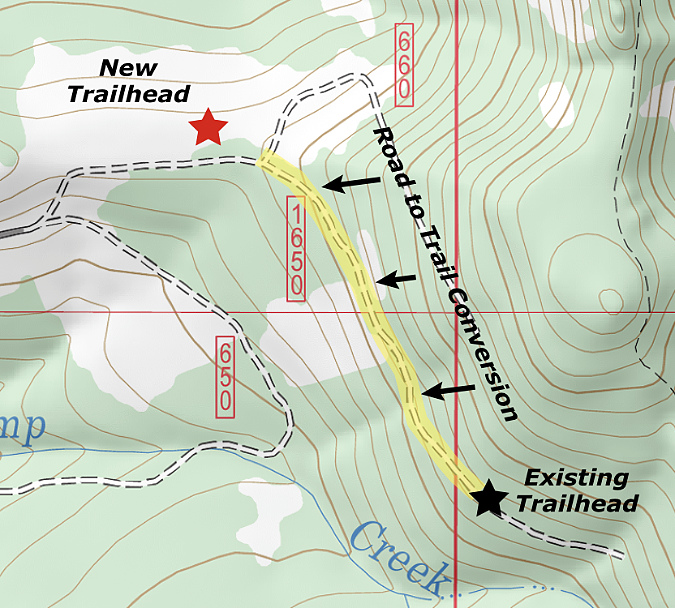
This map shows the proposed new trailhead site – roughly 1/2 mile northwest of the existing trailhead – and the section of existing road (highlighted in yellow) that would be converted to trail

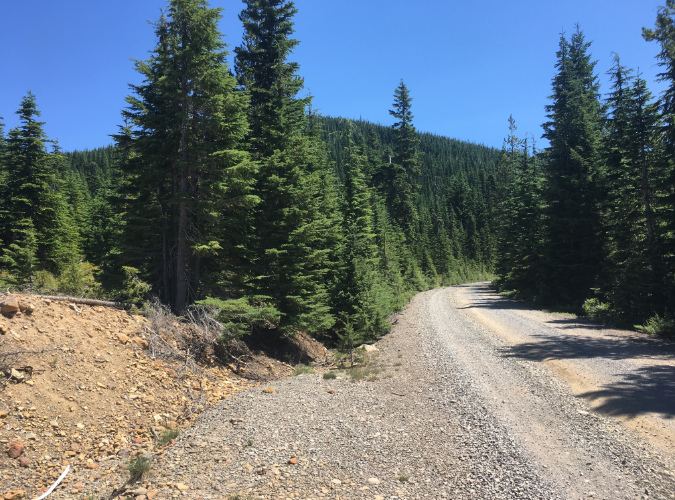
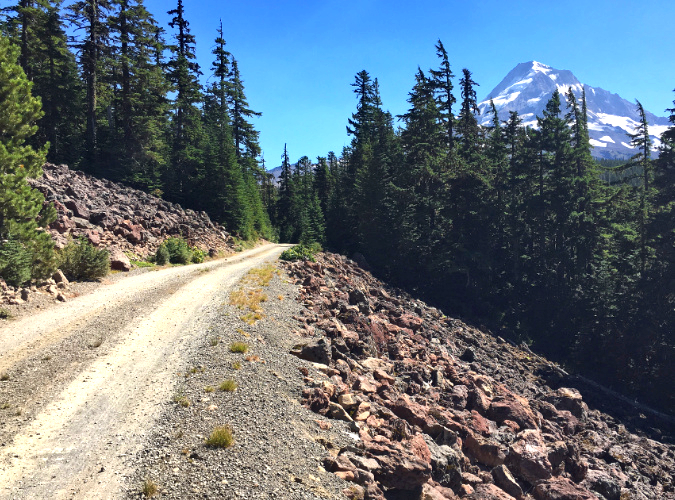
To make this new location work, the section of Road 1650 from the proposed new trailhead to the old (highlighted above in yellow) would be converted to trail. Normally, adding a half-mile of converted road to a hike would be a minus, but this segment of Road 1650 is stunning (see below), with spectacular views of Mount Hood. The talus slopes that provide these views are also home to colonies of Pika that provide their distinctive “meep!” as you pass through – something that can’t be appreciated from a car.

Converted roads don’t always make for great trails, but the approach to the existing Vista Ridge trailhead is exceptionally scenic and would make for a fine gateway trail to the Mount Hood Wilderness

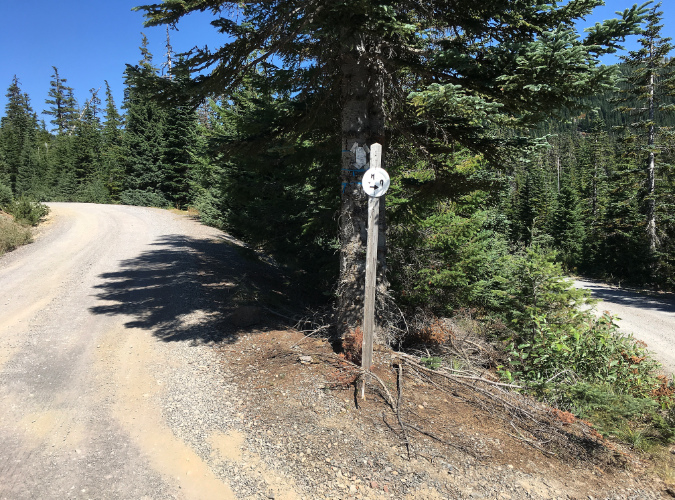
The first step in creating the new trailhead (and even without the new trailhead) would be restored signage to help visitors find their way from Lolo Pass Road to Vista Ridge, especially at the confusing fork (below) located just short of the proposed trailhead.

Finding the Vista Ridge trailhead is a challenge. The signpost at this crucial fork just below the trailhead had lost its sign in this view from two years ago, but the entire post has since disappeared. A new trailhead would include restoring directional signage to help visitors navigate the route

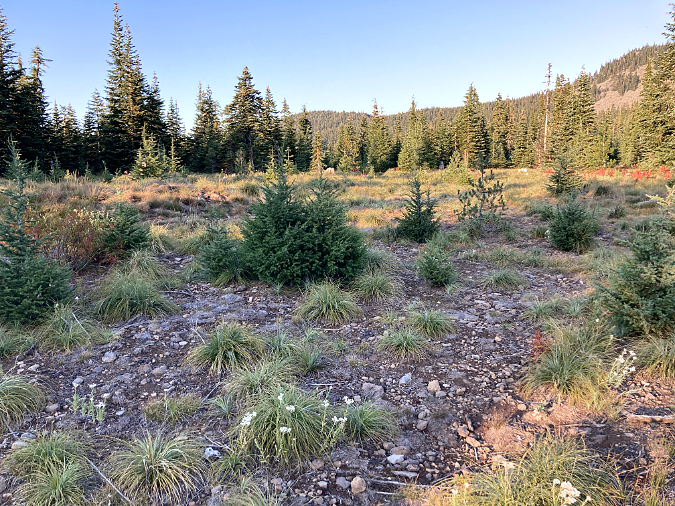
Next up, the obvious spot for the new trailhead (below) is a yarding area from a logging operation that was impacted more recently with a nearby thinning project. Dirt logging spurs radiate in all directions from this cleared area, allowing for new trailhead parking to incorporate these already impacted areas to minimize environmental impacts.

The proposed new trailhead site was previously disturbed with a logging operations

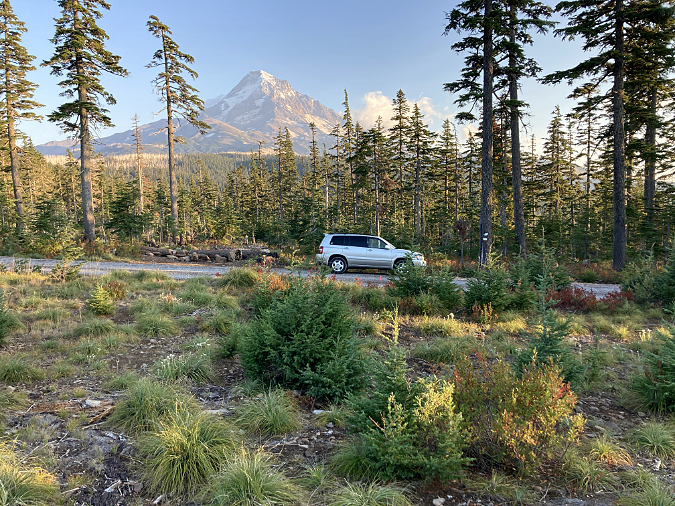
Until recently, the proposed new parking area faced a wall of trees to the south, but a tree thinning project on the opposite side of Road 1650 has suddenly provided a Mount Hood view (below). The purpose of the thinning was to enhance forest health by removing smaller, crowded plantation trees to promote huckleberries in the understory – an important first food harvested by area tribes. 

Should the huckleberries thrive as planned and bring berry harvesters to the area, this could be another benefit of providing trailhead parking here. For now, the thinning just provide a sneak-peak at the mountain that lie ahead for hikers or a backdrop for people using picnic tables at the trailhead (more about that in a moment).

The proposed new trailhead is directly across Road 1650 from a recently thinned area

It looks pretty grim now, but the tree thinning project across from the proposed is intended to spur the huckleberry understory to allow for berry harvesting… eventually

The concept for the new trailhead parking is to use an old dirt logging spur that splits off the Vista Ridge Road as the entrance to the parking loop. The existing Road 1650 would be closed and converted to trail from this point forward. The logging spur is shown on the left in the photo below, along with the portion of Road 1650 where the trail conversion would begin. The existing trailhead lies about 1/2 mile from this point.

The existing road conversion to trail would begin here, with the new parking access following the logging spur on the left

Roughly 200 yards beyond the proposed trailhead, the views open up along existing Road 1650 where it crosses the first of two talus slopes (below). This is one of those “wow!” spots that comes as a surprise to hikers as they drive to the existing trailhead. The right half (downhill) in this converted section of the existing road would be retained as trail, the left (uphill) side would be decommissioned.

The final 1/2 mile of Road 1950 is scenic in all seasons, with Beargrass blooms in early summer and brilliant fall colors emerging by late summer

How does this work? The decommissioning of the uphill half of the existing road could be accomplished by upturning the surface with a backhoe – a process used to decommission miles of logging roads in recent years around Mount Hood country. The scene below is a typical example from a decommissioned road near Black Lake, located a few miles north of Mount Hood, on Waucoma Ridge. In this example, the goal was to completely retire the road, though the same method can be used to convert a road to single-track trail.

This road near Black Lake was decommissioned in the early 2000s and is gradually revegetating

Just beyond the first “wow!” talus viewpoint, the mountain comes into view once again along the existing Road 1650 as it crosses the second talus slope, just before reaching the existing trailhead. This slope here is unique in that it consists of red lava (below), a somewhat uncommon sight around Mount Hood that adds to the scenic beauty. Like the first talus section, this slope is also home to Pika colonies, adding to the trail experience. The right half of the converted road would be retained as trail here, and the left (uphill) side decommissioned.

Without overflow parking blocking the view, the final stretch of the access road passes this scenic and somewhat unusual talus slope composed of red lava rocks

Beyond the practical benefits of moving the Vista Ridge trailhead to make it safer and more functional, there are also compelling conservation arguments for the move. First, it would allow the Forest Service to retire another segment of old logging road – and though only 1/2 mile in length, in its current state it nonetheless contributes to the massive backlog of failing roads built during the logging heyday that the agency can no longer afford to maintain.

There are also noisy (meep!) wildlife benefits, as the Pika colonies living in both talus slopes are likely impacted by the noise, vibration and pollution that the steady stream of hikers bring as they drive – and increasingly park – along this scenic section of road.

Because most road-to-trail conversions around Mount Hood have been driven by wilderness boundary expansions, washouts or other abrupt events, there aren’t many examples of intentional conversions to point to. Instead, most conversions are simply abandoned roadbeds that nature is gradually reclaiming, like the section of the Elk Cove trail shown below.

The lower section of the Elk Cove Trail follows an old logging road that was simply closed, but not formally converted to trail

Beyond often being a hot, dusty trudge for hikers looking for a true trail experience, old roads that aren’t intentionally converted also lack proper trail design features for stormwater runoff and drainage, as seen on the opening section of the existing Vista Ridge trail. Abandoned roads also lead to thickets of brush and young trees as the forest moves in, making maintenance of trails that follow these routes a constant chore. It simply makes more sense to undertake true conversions from road to trail on these routes in the long run.

Recently converted road-to-trail at Salmon Butte (Oregon Hikers)

There are very good examples of intentional conversions, and among the best is the Salmon Butte Trail, where the Forest Service decommissioned a section of road in 2010 and intestinally created meandering trail through mounds of earth along the old roadbed to further conceal evidence of the road from hikers. Just a few years after the conversion (above) the signs of the old road were already fading fast, creating a more authentic trail experience. Self-sustaining drainage features were also incorporated into the design. The same approach could be applied to decommission both the final road section and the current trailhead parking area at Vista Ridge.

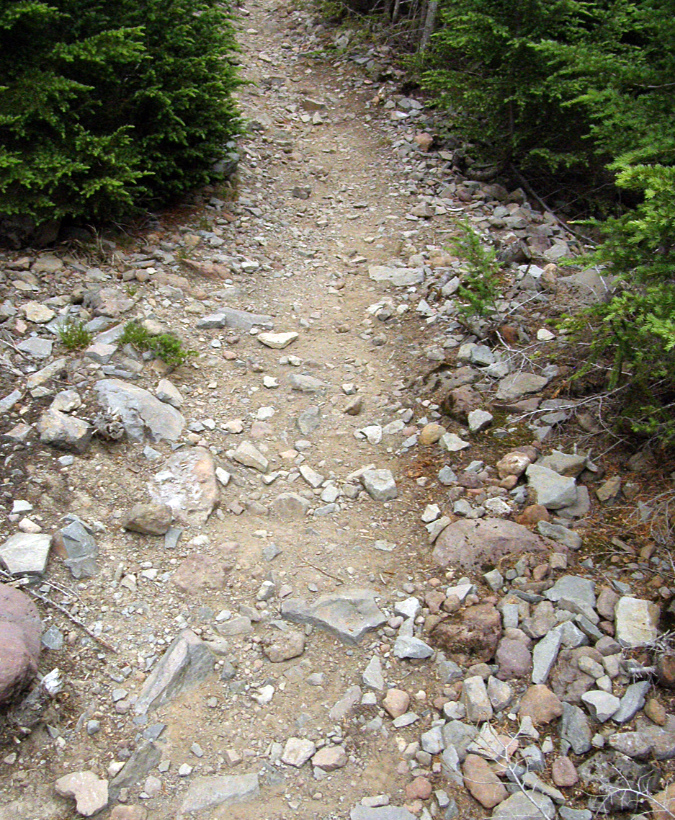
Finally, improvements to the opening stretch of the existing Vista Ridge trail that also follows old roadbed is in order. This short section (below) is typical of a road that wasn’t property converted to trail, and as a result suffers from serious runoff erosion during the winter and spring. The result is a cobbled mess that is hard on ankles and morale as hikers set off for their hike. 

If this looks like a dry streambed, that’s because it is! It’s also the opening 1/3 mile section of the Vista Ridge Trail where it follows an abandoned, partly constructed road bed that becomes a running stream in the winter months

There are some basic trail drainage features that could keep this section from becoming a river during the wet months. Next, some of the most miserably rocky sections could be covered with gravel – but from where? It turns out the Forest Service left a couple of large piles (below) where today’s trailhead is located when work on extending this road was abandoned more than 50 years ago. 

Northwest Youth Corps crew did just this about a decade ago, but because the drainage problem wasn’t addressed, most of that first layer of gravel has been washed away and their efforts long since erased.There are some basic trail drainage features that could keep this section from becoming a river during the wet months. Next, some of the most miserably rocky sections could be covered with gravel – but from where? It turns out the Forest Service left a couple of large piles (below) where today’s trailhead is located when work on extending this road was abandoned more than 50 years ago. 

Let’s put this leftover pile of gravel from the logging days to work!

How a parking loop would work…

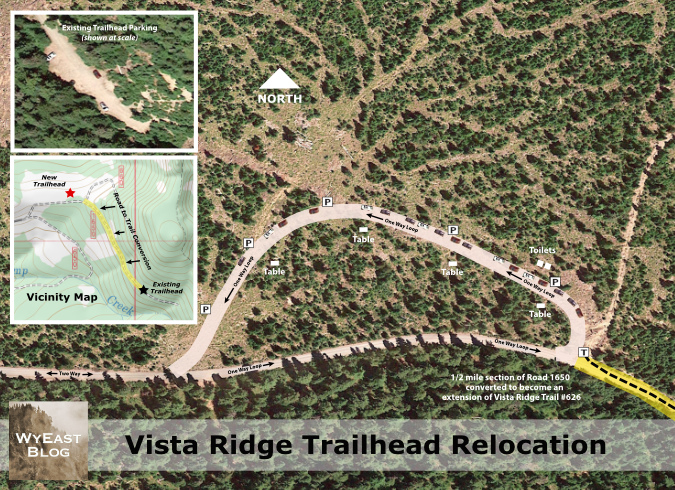
Putting it all together, this proposal (below) shows how the new trailhead parking could be accomplished as a parking loop, as opposed to a parking lot. The inset images include an aerial image of the current, dead-end trailhead parking at the same scale as the proposed loop map for direct comparison. The topographic inset map shows the proposed trailhead and parking loop, along with the proposed road conversion in relation to the existing trailhead (be sure to click on “large version” link below for a closer look!) 

[click here for a large version]

Why a loop? First, it’s the least impactful on the environment. Instead of clearing a wide area to provide room for cars to back in and out, the parking is simply provided along the right shoulder of the loop – like parallel parking in the city – but with nature left intact inside the “donut hole” of the loop.  

In this case, the loop would follow a series of old logging skid roads, further minimizing the impact on the forest. But perhaps most importantly from an environmental impact perspective, adding a couple hundred yards of new loop road here would allow a half-mile section of existing road to be retired and converted to trail, a clear net gain, overall.

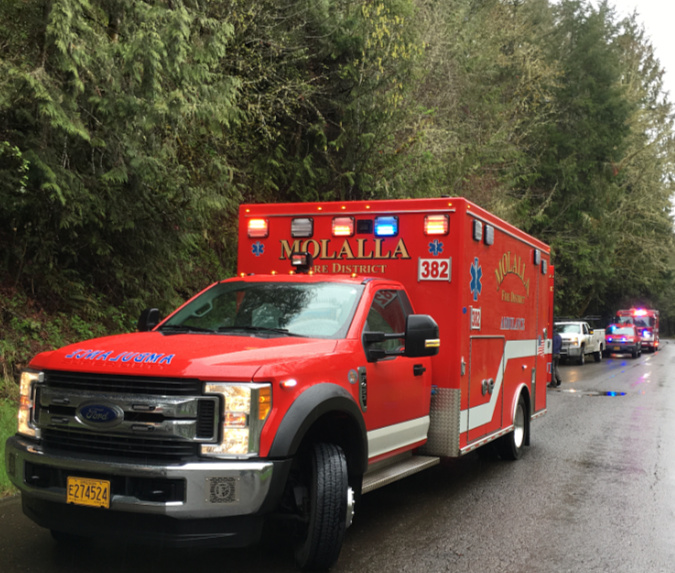
Busy trailheads call for amenities like improved signage and toilets – and space for emergency vehicles to have access. These vehicles were called to the trailhead where a hiker was injured in the Clackamas River area – fortunately, the trailhead was located along a paved forest road with ready access and space to turn around

Another important benefit of a loop is to provide a much-needed turnaround at the end of a dead-end road for forest rangers and emergency responders. This might be the most compelling reason to fix the Vista Ridge trailhead sooner than later, as today’s overflowing dead-end parking area is a disaster waiting to happen should fire trucks or other emergency vehicles need to access the Vista Ridge trail on a busy weekend.  

Designing the parking loop…

From a user perspective, a parking loop is efficient and easy to navigate. The one-way design ensures that people arriving here would always reach the closest available parking spot to the trailhead first. This is the opposite of the current dead-end trailhead, where hikers arriving later in the day often park in less-than-safe spots along the access road when they see overflow shoulder parking occurring, for fear of not being able to turn around in the cramped trailhead lot – often after spaces have opened up in the main parking area.

As shown in the parking schematic (above), the relocated trailhead would accommodate up to 30 vehicles along a 1,100-foot-long loop – or about three times what the current dead-end parking area allows. The loop would be gravel-surfaced, 16-feet wide and designed to flow one-way in a counter-clock-wise direction, with shoulder parking allowed on the right side.

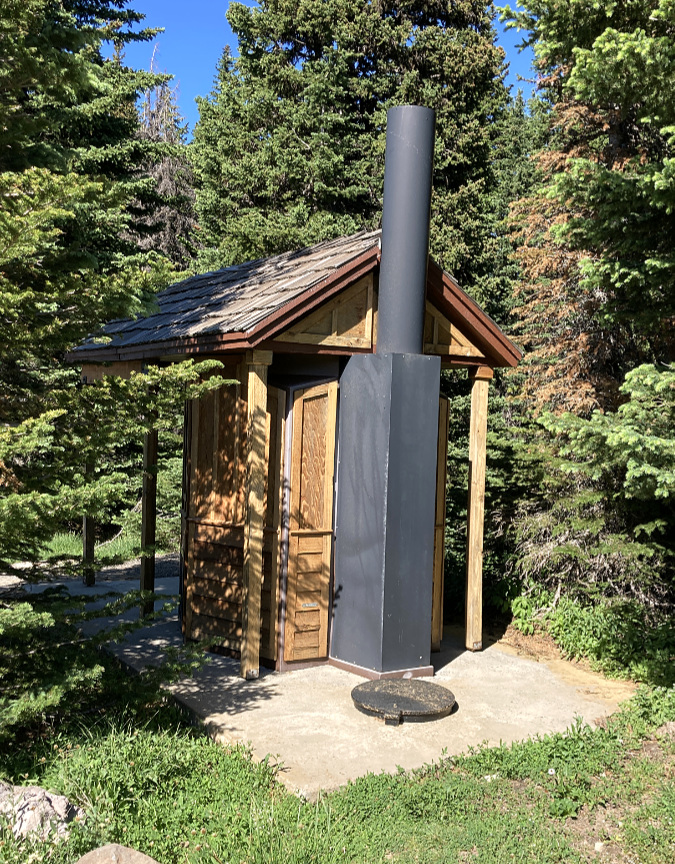
The new trailhead could also be a Northwest Forest Pass site with the required toilets, picnic tables and welcoming signage for visitors, something that the space constraints at the current lot would not allow. These could be located in the “donut hole” center of the loop. Making this a forest pass site would also address one of the more dire needs at Vista Ridge – a toilet! The heavy use at the trailhead and steep terrain has turned a couple of more accessible trees adjacent to the parking area into de-facto toilets, with unpleasant results. 

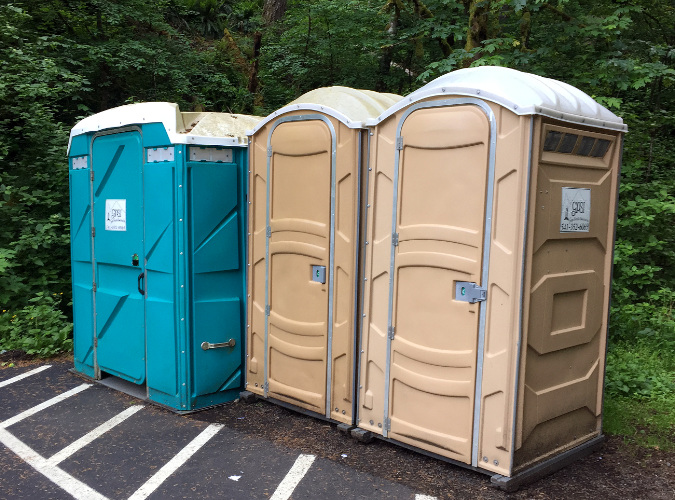
Industrial toilets at a busy trailhead in the Columbia Gorge – functional, but not exactly a complement to the outdoor experience!

The Forest Service has upped its game with pit toilets in recent year at some Northwest Forest Pass sites, replacing industrial porta-potties (above) that are the last thing you want to see as you set off for a wilderness experience with more aesthetic toilets, like the one at the High Prairie trailhead (below), just east of Mount Hood. This would be a great choice for a new trailhead at Vista Ridge.

Rustic toilet design at the High Prairie trailhead, gateway to the Badger Creek Wilderness

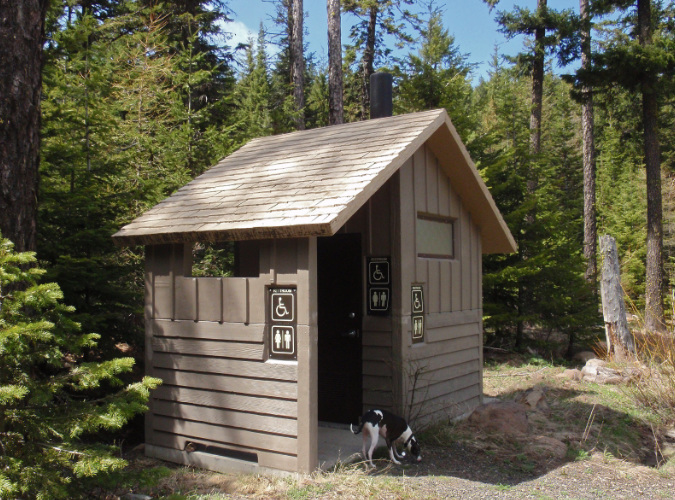
The are also more substantial examples around Mount Hood that are wheelchair accessible, like this one at the Billy Bob snow park near Lookout Mountain (below).

Accessible, rustic toilet design at the Billy Bob snow park near Lookout Mountain

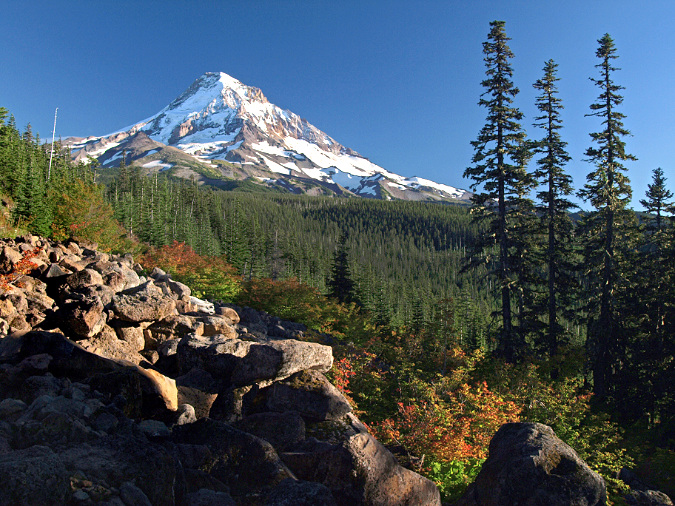
Why an accessible toilet? Because there’s also an opportunity for the converted road section in this proposal to incorporate an accessible trail surface to at least one of the talus viewpoints along the way – like this well-photographed spot along the existing road (below), located just a few hundred yards from the proposed trailhead. 

This view is from the shoulder of the current access road, just a few hundred yards from the proposed new Vista Ridge trailhead. Converting the road to an accessible trail design and providing some simple amenities (e.g., a picnic table) would make this a welcome new destination for people with limited mobility or who use mobility devices

Accessible trail opportunities are in woefully short supply around Mount Hood, an unacceptable reality. There’s room at this viewpoint for an accessible picnic table, benches and perhaps interpretive signage — allowing for the extended Vista Ridge trail to serve a wider spectrum of visitors and abilities, not just able-bodied hikers heading into the wilderness.

What would it take?

There are two main parts to this proposal: (1) building the new parking loop and (2) converting the final half-mile section of Road 1650 to become a trail. The first part – the parking loop, pit toilets, picnic tables, signage and other trailhead amenities — would have to be built by the Forest Service. However, this work could likely be fast-tracked as an exemption under the environmental review process, since it involves relocating an existing parking area and would result in much less roadway than the current trailhead. That environmental analysis would also have to be completed by the Forest Service.

The second part of this proposal — the road-to-trail conversion — could be completed as a partnership between the Forest Service and volunteers, like Trailkeepers of Oregon (TKO), who already maintain the Old Vista Ridge and Vista Ridge trails. The Forest Service could complete the rough backhoe work to reduce the converted road to single track, and volunteer crews could finalize the tread and drainage on the converted trail. 

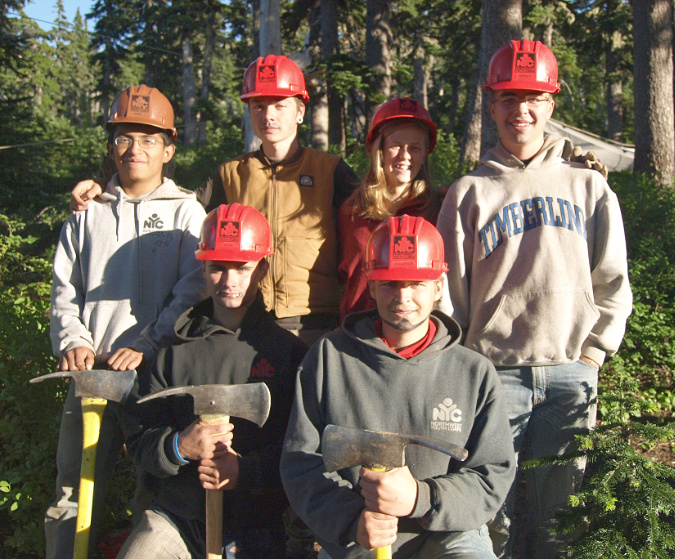
Volunteers could also install viewpoint benches and picnic tables for an accessible trail and trailhead signage at the new parking area. Some of the heavier work could be contracted to organizations like the Northwest Youth Corps, which has a long history of trail work around Mount Hood.

Northwest Youth Corp crew working on the Vista Ridge Trail

How could this concept move forward? Funding is always a concern for the Forest Service, but there’s also unprecedented funding coming online right now for the federal agencies from the 2022 Inflation Reduction Act. This project could compete for these funds, many of which are competitive, especially if it includes an accessible trail. Creating a new Northwest Forest Pass site would also generate revenue (in theory) to help maintain the new trailhead. 

Volunteer crews from TKO are already working from this trailhead every summer to maintain the Vista Ridge and Old Vista Ridge trails. The over-crowding at the existing trailhead has already made their work more difficult, so contributing to the trail conversion effort would be a natural fit for TKO volunteers to be part of.

The author on the Old Vista Ridge trail

In the meantime, if you want to experience the wonders of Vista Ridge and Old Vista Ridge, the best plan is to avoid this trailhead on Fridays, Saturdays and Sundays from July through mid-September. If you must go on those days, then it’s not a bad idea to simply park on the shoulder of Road 1650 where this new trailhead is proposed, and simply walk the scenic final half mile to the current trailhead. You’ll get mountain views, hear the local pikas calling out, avoid the stressful chaos of the existing trailhead – and with any luck, you’ll be getting a preview of things to come!

__________________

Tom Kloster | August 2023

2021 Campaign Calendar!

As I write this annual year-end post after a calamitous 2020, the world seems just a bit more hopeful. The presidential election will shift public lands policy 180 degrees back toward conservation and restoration, and with the release of two COVID-19 vaccines, the end of the world pandemic is finally on the horizon.

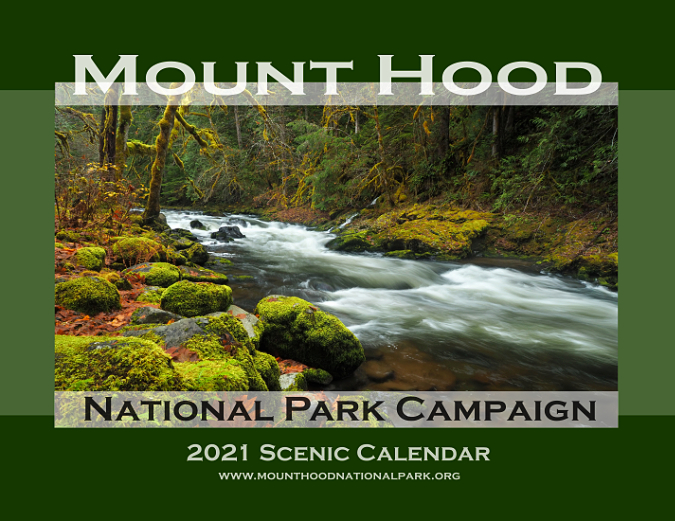
And so, I share some of the stories behind this year’s Mount Hood National Park Campaign scenic calendar with a cautious spring in my step (or my fingers as they type this sentence, at least). You can pick up a copy of the calendar here for $29.95:

2021 Mount Hood National Park Campaign Scenic Calendar

As always, all proceeds will go to Trailkeepers of Oregon (TKO) to support their ongoing effort to care for trails as gateways to our public lands. Zazzle prints these calendars with exceptionally high quality, and they also have large enough boxes to be quite functional for tracking important dates and your trail plans. They make nice gifts, too, of course!

Over the years, I’ve described the Mount Hood National Park Campaign as “an idea campaign” with the simple goal of keeping alive the promise of better protections and restoring the grandeur Mount Hood and the Gorge. I started the project in 2004 as a way to continually remind Oregonians and Washingtonians living in WyEast Country that national park protection was proposed at least three times in Congress, in the 1890s, 1920s and the 1930s. Each time, logging and other extraction industries (and later, the emerging ski industry) were the chief opponents — along with the Forest Service, itself.

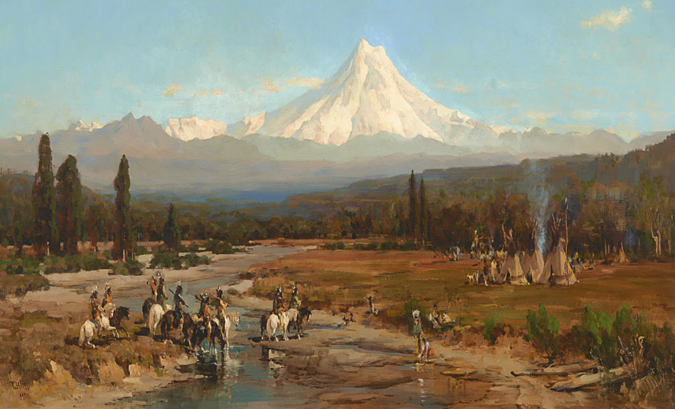
Thomas Cole painted this idyllic scene of Native American life in WyEast Country in the 1870s. The mountain continues to be beacon of inspiration and awe for people living in its shadow to this day

If you’ve watched Ken Burns’ magnificent National Parks series, you know that every park was a battle, typically between short-term exploitation interests and progressives looking toward posterity for future generations. There were no easy wins.

And, so it will be for Mount Hood and the Gorge until enough locals (or our children and grandchildren) recognize national park protection as both urgent and deserving for these world-class places. We haven’t treated them too well over the past 150 years, but real change is suddenly afoot in 2020. What? Yes, you read that correctly… and I will share more about that exciting news in future blog posts!

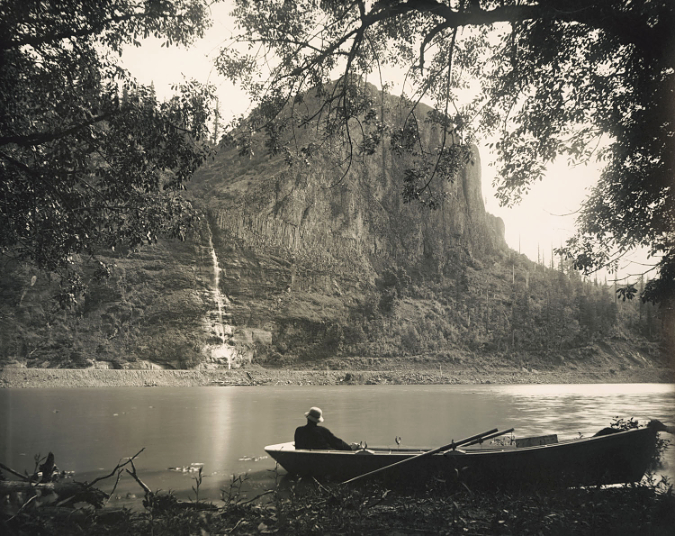
This beautiful cove at the foot of Crown Point was called “Echo Bay” when it was still connected to the Columbia River in this 1870s photo. This was among the spots that inspired the first Congressional effort to create a national park here

But until then, this article is a tour of some of the places that make WyEast country special, and are featured in the 2021 MHNP Campaign scenic calendar. As always, every image in the new calendar was captured over the past year and, as in past years, there are some lesser-known places mixed in with some of the more familiar.

The 2021 Calendar Images

Salmon River in late Autumn

The cover image for the 2021 calendar comes from a very familiar spot along the Old Salmon River Trail, near the community of Zigzag. This quiet trail was bypassed — and spared — when the Salmon River Road was built in the post-World War II logging boom. Today it offers one of the most accessible trails into ancient rainforest anywhere in the Pacific Northwest. This photo was taken just a few weeks ago, too. Because of its low elevation, it’s a trail you can hike year-round. Here’s the Oregon Hikers Field Guide description of the trail.

For January, I chose an image captured from above the West Fork Hood River Valley, on Butcher Knife Ridge. In this scene, Mount Hood is emerging from the clouds after the first big winter storm of fall. I’ll be posting more articles in 2021 about the West Fork valley, as there is some very exciting news to share about this area.

Mount Hood’s rugged northwest face in early winter as viewed from Butcher Knife Ridge

The February image is a familiar view of Wahclella Falls on Tanner Creek, one of the premier trails in the Columbia River Gorge. Before the 2017 Eagle Creek Fire, I visited this trail several times each year, as it’s not only a personal favorite, but also a trail that makes for a great introduction to the Gorge for new hikers or visiting family.

Wahclella Falls on Tanner Creek

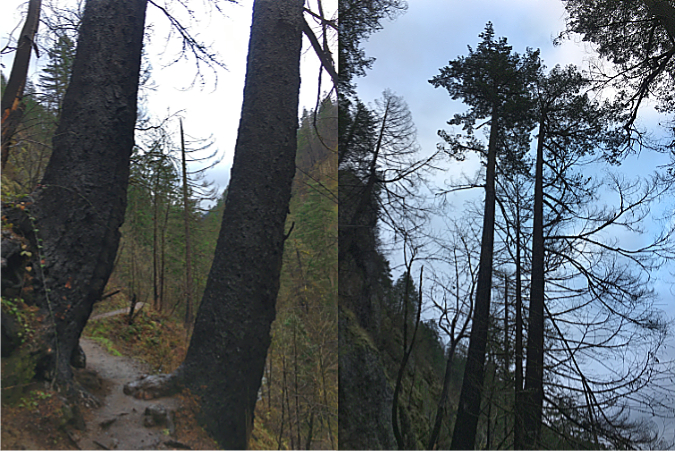
The image in the new calendar is from a visit last winter, and it was my first since the fire. Though the fire did burn through the lower Tanner Creek canyon, many trees survived, especially around Wahclella Falls. Notably, a pair of big trees familiar to hikers also survived — the twin Douglas firs flanking the lower trail (below). As of this year, their upper canopies are still green more than two years after the fire, and that bodes well for them to survive for many years to come.

The familiar twin Douglas firs along the Wahclella Falls Trail have survived the 2017 Gorge fire… so far

What I couldn’t have guessed is that the COVID-19 pandemic restrictions kicked in just a couple weeks after my visit, and Wahclella Falls was once again closed to the public.

As hard as these Gorge trail closures have been for hikers, there are a couple of silver linings. First, they have allowed trail volunteers from TKO, the Pacific Crest Trail Association (PCTA) and other volunteer trail organization to continue the hard work of restoring trails damaged by fire without having to accommodate hiker traffic. Perhaps more importantly, the closures have also allowed forest recovery to begin within the pressures that heavy visitation on popular Gorge trails brings.

Lower White River Falls in spring

The March image (above) features Lower White River Falls, a lesser-known cascade downstream from the main falls at White River Falls State Park. Where the main falls is a raucous spectacle, the lower falls is quiet waterfall in a secluded canyon, where it is framed by desert wildflowers in late spring.

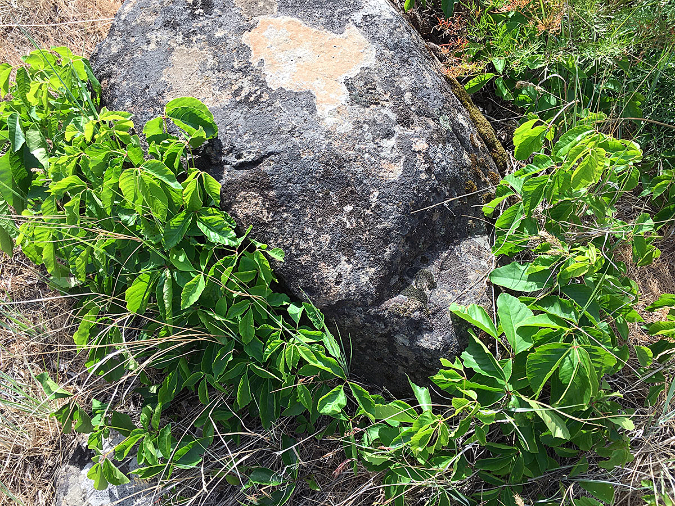
Poison likes to grow in the shade of boulders along the White River — watch where you sit!

The user path to the lower falls has become increasingly prominent in recent years as more visitors discover this pretty spot (and its excellent swimming hole), but be forewarned, the path is lined with Poison Ivy. This relative of Poison Oak bears a close resemblance, but grows as a ground low ground cover in the sandy floodplain along the river, often in the shelter of boulders and old logs.

Lower White River Falls

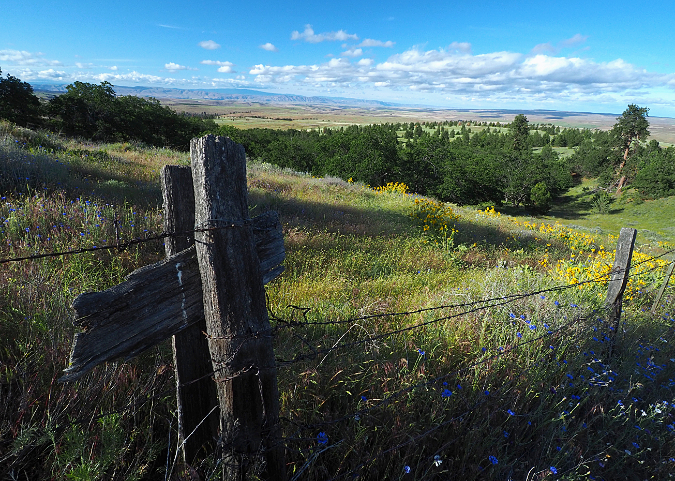
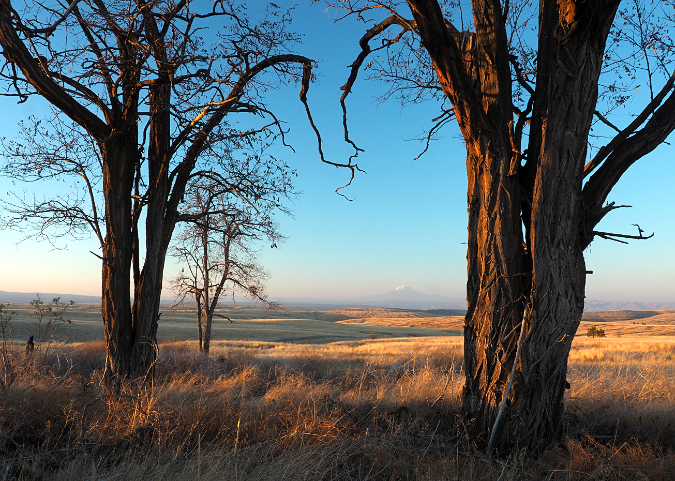
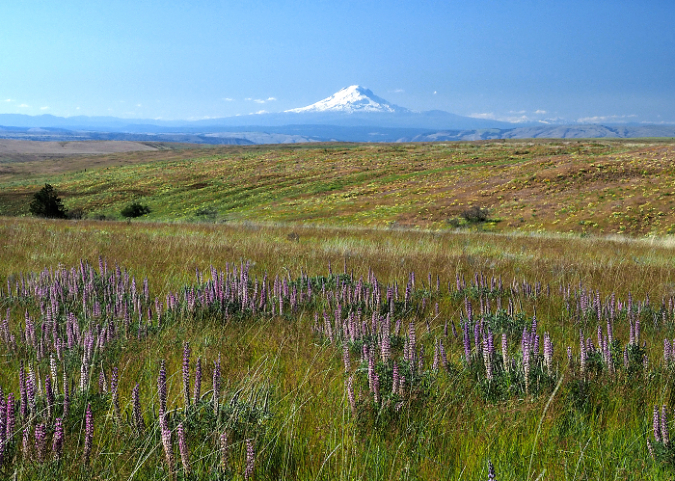
For April, I selected another scene from Mount Hood’s rain shadow, a wildflower meadow on the edge of the tree line where forests give way to the desert country east of the Cascades. This bucolic scene looks across the rolling wheat country of Wasco County, toward the Columbia Hills and the Columbia River, on the horizon (below).

Wildflower meadows on the east slope of the Cascades near Friend

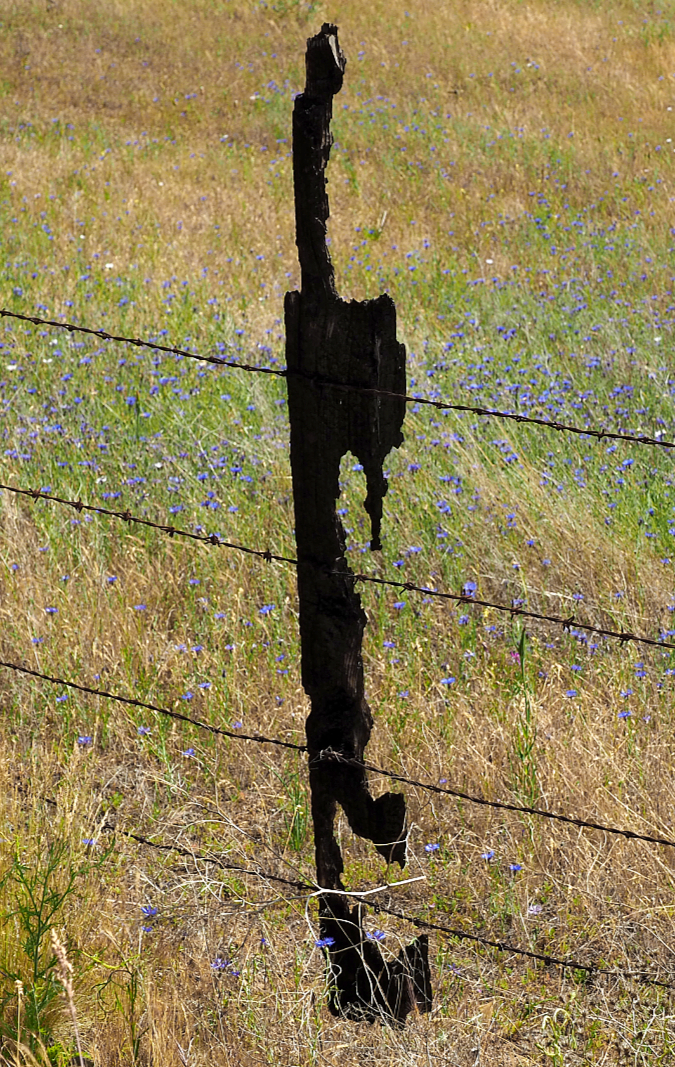
Though you wouldn’t know from this photo, the South Valley Fire swept through this area in 2018, one of three major range fires that combined that year to burn nearly 200,000 acres. Two years later, and only the scattered snags of Ponderosa pine, Western juniper and burned fence posts hint at the fire, as the sage and grass savannah has recovered in a remarkably short time. But the fires had a human toll, too. Homes and barns were burned, as well as several historic farmsteads that can never be replaced.

Only a few charred remains tell the story of the 2018 range fires east of Mount Hood

Switching back to the west side of the Cascades, I chose a scene from a visit to Silver Falls State Park for the May image. With many of the Gorge waterfall trails still closed by the aftermath of the Eagle Creek Fire, Silver Falls visitation has exploded over the past couple years, as hikers look for new places to get their waterfall fix.

Visiting Silver Falls State Park is pretty close to a national park experience, as the park is loaded with 1930s Civilian Conservation Corp construction and the Oregon Parks and Recreation Department do an excellent job maintaining and curating the park’s network of scenic trails. Lower South Falls (below, and the May image in the new calendar) and nearby Middle North Falls are favorites among photographers in the park, and they have some similarities. Both begin as a wide curtain of falling water before crashing onto the rocky basalt aprons that make up their base, and both have a trail behind them.

Lower South Falls on Silver Creek

A few years ago, a local Republican legislator introduced a bill proposing National Monument status for Silver Creek. The bill didn’t go anywhere, but it was a nice opportunity to showcase the area and a reminder that seeking national park status can be a bipartisan effort, even in these days of deep political division.

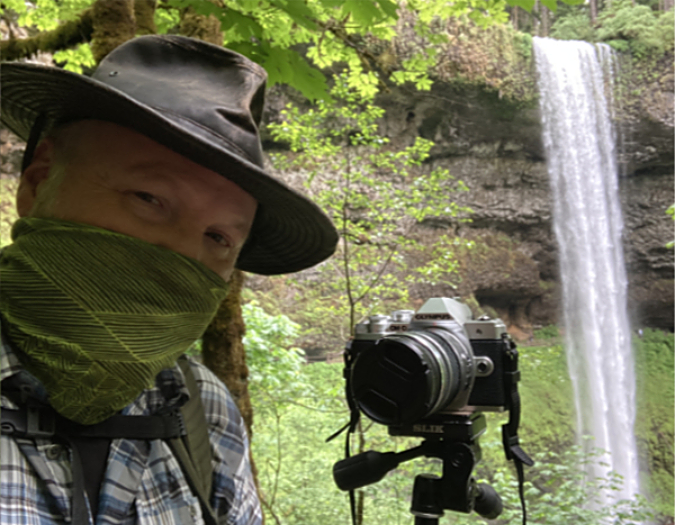
Pandemic-compliant blogger at Silver Creek State Park

Visiting Silver Falls State Park (and most other state parks) in 2020 also meant controlling the COVID-19 virus while huffing and puffing on a buy trail. While I was discouraged by the disregard for masks on my trips to Silver Falls last spring (maybe 1 in 5 had one), there has been a noticeable uptick in mask use in our state parks national forests since. That’s good, because in a year of pandemic shutdowns and closures, the benefits of being outdoors and connecting with nature have never been greater.

Crowds of pandemic-defying hikers at Silver Falls State Park on Memorial Day 2020

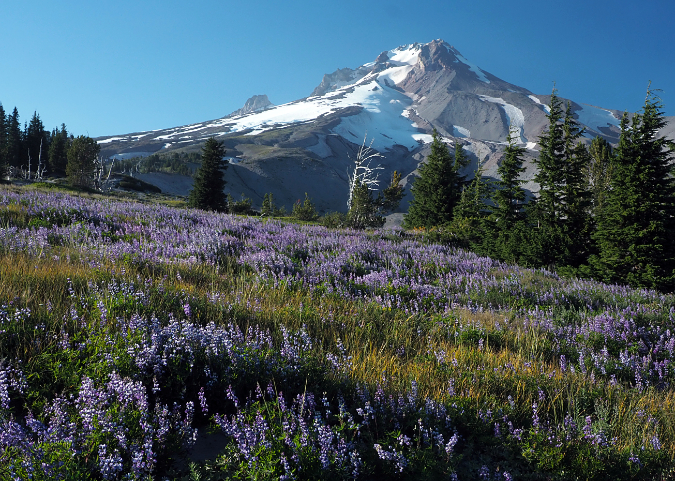
For June, I chose a scene from just off the Timberline Trail, along the rim of the White River Canyon (below). This expansive Lupine meadow is only a few steps from the trail, but just out of view and thus known to surprisingly few.

Summer Lupine meadows along the rim of White River canyon

If only this blog had a virtual scratch-and-sniff, as there is nothing quite as heady as the sweetly-scented mountain air in a Lupine meadow, and this one was no exception. For those who haven’t had the experience, Lupine are in the pea family, and have the same sweet aroma as garden sweet peas — but with a mountain backdrop!

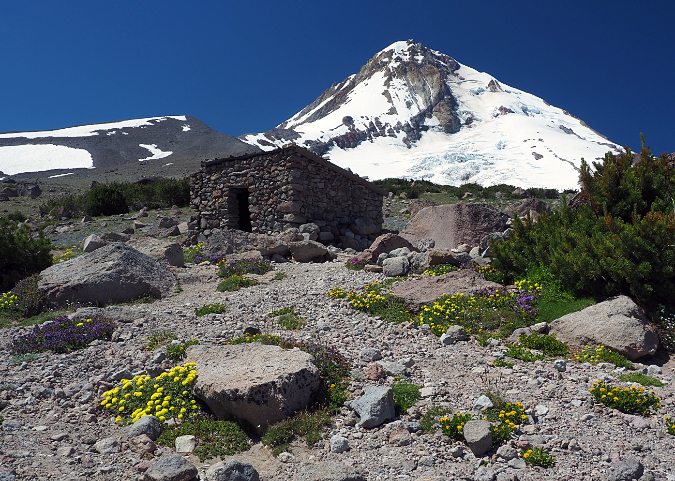
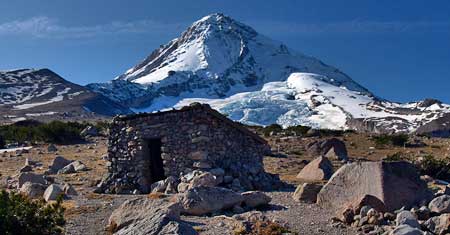
For July, I chose another wildflower scene, though this one fits more of a rock garden motif, featuring yellow Buckwheat and purple Penstemmon among the chunks of andesite scattered here. This is the historic Cooper Spur shelter, just off the Timberline Trail on the mountain’s north side. Cooper Spur, proper, rises to the left and the Eliot Glacier tumbles down Mount Hood’s north face to the right of the shelter. This is one of several stone shelters built by the Civilian Conservation Corps in the early 1930s and today is one of just three that still survive (the other survivors are at McNeil Point and Cairn Basin).

Cooper Spur Shelter in summer

Follow the climbers trail to the right of the shelter to the nearby moraine viewpoint (marked by large cairn) and you’ll have a front-row view of the Eliot Glacier. While I was there, a house-sized ice blocks suddenly collapsed (below), filling the canyon with a roar! It’s always a thrill to see and hear our glaciers in action.

Icefall collapse on the Eliot Glacier!

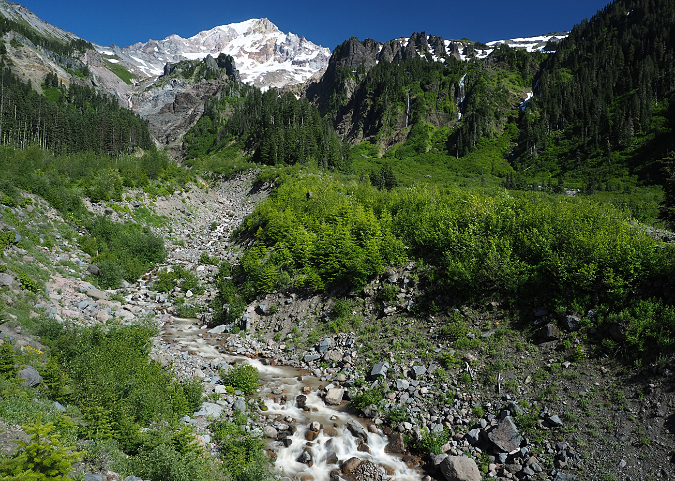
Another mountain scene fills out the summer as the August image in the new calendar. This multi-image composite assembles the impossibly massive scene at the western base of the mountain, where the Timberline Trail fords the twin branches of the Muddy Fork (below). From here, the mountain rises more than 7,000 vertical feet above the scene, and dramatic waterfalls tumble down the 800-foot cliffs that frame the canyon.

The wide-open scenery of the Muddy Fork canyon

The Muddy Fork valley is a volatile, continually changing landscape. In the early 2000s, a massive debris flow swept through, felling an entire forest and leaving a 25-foot layer of rock and sand on the valley floor. The Muddy Fork has since carved through the debris, all the way down to the former valley floor, revealing the stumps of trees that were snapped off by the event. Some are visible along the stream at the center the above photo. Meanwhile, the rest of the Muddy Fork debris flow is already dense with Red Alder, Cottonwood and Douglas Fir pioneers that are quickly re-establishing the forest, continuing the eternal cycle of forest renewal.

Several photos in this year’s calendar are from the dry country east of Mount Hood, in the rain shadow of the Cascade Range. I made several trips there while researching the strange desert mounds unique to the area (see “Mystery of the Desert Mounds“) and I fell back in love with the landscape, having spent time living there in the early 1980s. The September image in the new calendar is of a lesser-known gem in this area, the historic Nansene Community Hall (below) located on the northern slopes of Tygh Ridge.

Remains of the historic Nansene Community Hall on Tygh Ridge

The community hall dates back to the early 1900s, when sheep ranching was still the dominant industry in the area. Sprawling wheat fields and cattle have long since replaced the sheep herds, but thanks to the arid climate, abandoned wood structures from the early white settlement era can survive intact for a century or more. But they can’t survive fire, and while many historic homestead structures were destroyed by the 2018 range fires that swept through the area, Nansene Hall was among those spared.

Thankfully, the iconic grain elevator at Boyd survived the fire, too, and this photo (below) was a candidate for the calendar, save for the fact that Mount Hood isn’t peeking over the horizon!

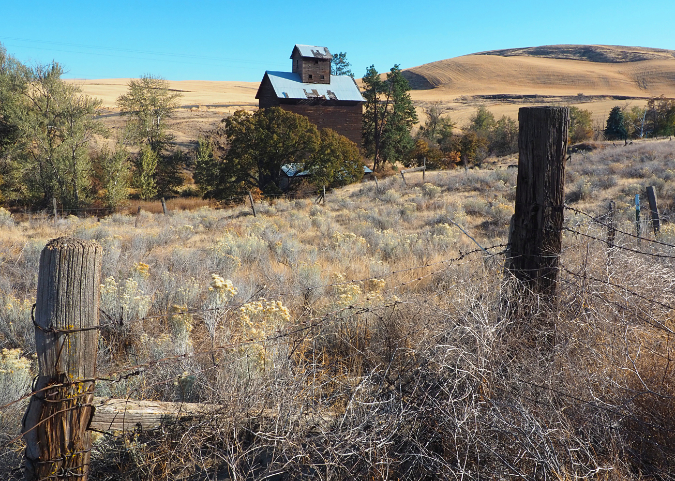
Grain elevator on Fifteenmile Creek at Boyd

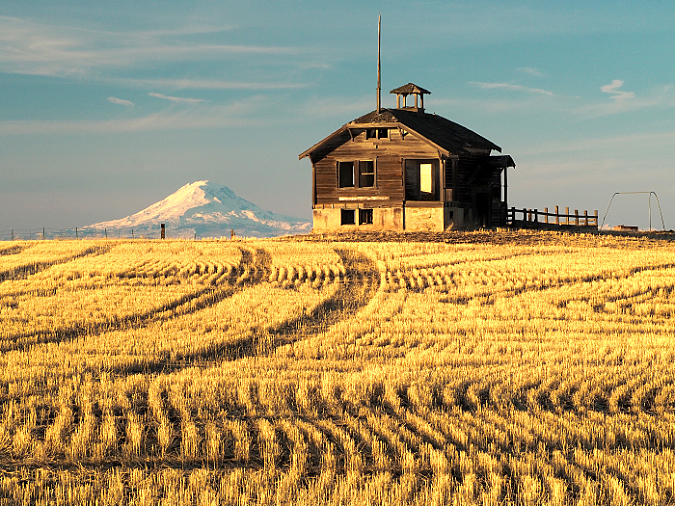
Several historic schoolhouses in the area also survived the fire, including the picturesque Center Ridge Schoolhouse (below), located a couple miles northeast of the Nansene Commumity Hall. This amazingly intact old building was designed with more aesthetics in mind than you might guess. The big windows along the west side of the structure define its single classroom, but the building was sited at an angle to ensure that Mount Hood filled the horizon through those windows, while Mount Adams looms to the north of its playground!

Center Ridge Schoolhouse and Mount Adams

While exploring the Tygh Ridge area this year, I happened upon a toxic creature that was unknown to me: the Green Blister Beetle (below), part of the legendary family of bugs that Spanish Fly is derived from. This iridescent native of the western states is highly toxic to the touch, though I only learned that later, when I was trying to identify this bug from photos I had taken while surrounded by a swarm of them in the field!

Don’t touch the Green Blister Beetle! (though the smaller beetles in this photo don’t seem to be bothered by their toxic neighbor)

Fortunately, I did not handle them, as that can lead to a potentially dangerous reaction. So, while we don’t have many toxic plants and creatures to navigate in the Pacific Northwest, here’s a new one for the list of those to avoid.

The Blister Beetle confab was unfolding in the historic Kingsley Catholic Cemetery, one of the more photogenic spots in the Tygh Ridge area. While walking among the pioneer graves that day last June, I also spotted this wonderful note hanging from a tree, a most welcome bit of hope and optimism in an otherwise grim pandemic year:

Sometimes a simple note can make a tough year a little better…

I later shared the note with a friend in the Dufur area, who in turn shared it in local circles there, hopefully drawing some interest. Little discoveries like this are poignant reminders that the future is always bright through young eyes, and it’s our job as elders to embrace their optimism and sense of promise.

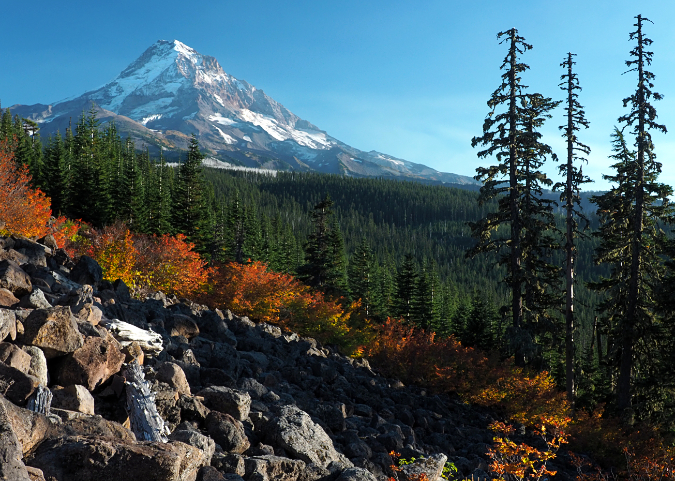
For October, I selected a scene familiar to many (below). This is the view from just below the Vista Ridge trailhead, where the mountain suddenly unfolds for arriving hikers. It’s a popular roadside spot for evening photography, especially in fall when Vine Maple light up the scene.

The popular photographers’ tableau at Vista Ridge

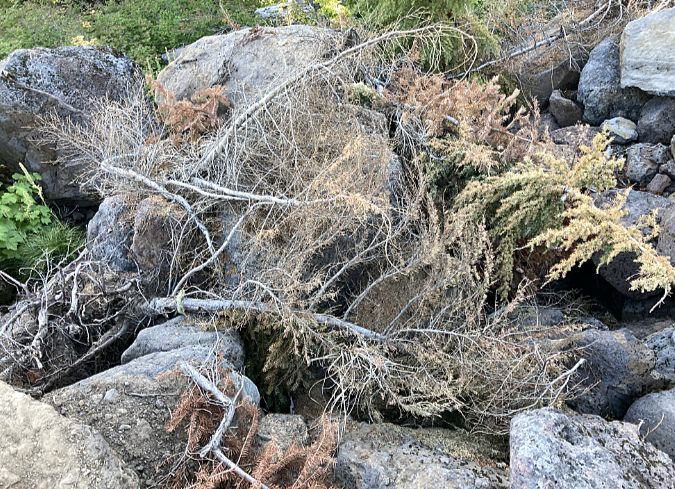
However… when I stopped there this fall, I was quite annoyed to see that Forest Service contractors hired to brush out the road had dumped their slash right in the middle of this lovely talus slope! Sacrilege! So, I took a deep breath, put on a pair of gloves and spent a couple hours dragging the slash down the road to another debris pile that was out of view in a nearby wooded area.

Aargh!

Sacrilegious!

Why get my dander up over this? Because talus slopes are special. They’re scenic and offer welcome views in our heavily forested region, of course. But they’re also home to species that depend on these unique places to survive. The best known are the tiny Pika who live exclusively in talus fields, but they are just part of the unique web of plants and animals found in these rocky islands. They deserve to be revered as unique places in the same way that our understanding of deserts has evolved in recent years to see them as places full of life, despite their lack of trees.

For November, I went back to yet another image from the slopes of Tygh Ridge (below). This is a view looking north across the broad, gentle apron of the ridge toward Mount Adams, shining on the far horizon. Less obvious in this autumn view are the many fallow fields where wheat was once planted, but now are carpeted with wildflowers and native grasses. What gives?

Tygh Ridge Locust trees frame Mount Adams

This photo (below) from a nearby spot was taken in June, and shows the expansive meadows that now cover formerly plowed land on Tygh Ridge. It turns out that these areas have been allowed to recover with native grassland species to benefit wildlife as part of the federal Conservation Reserve Program. It’s an opt-in program that compensates farmers for making long-term commitments (typically 10 or 15 years) to leave fields fallow for wildlife recovery. Hundreds of acres on Tygh Ridge are now part of this program.

Lupine meadows on Tygh Ridge are part of the Conservation Reserve Program that compensates famers for allowing fields to revert to natural cover to benefit wildlife

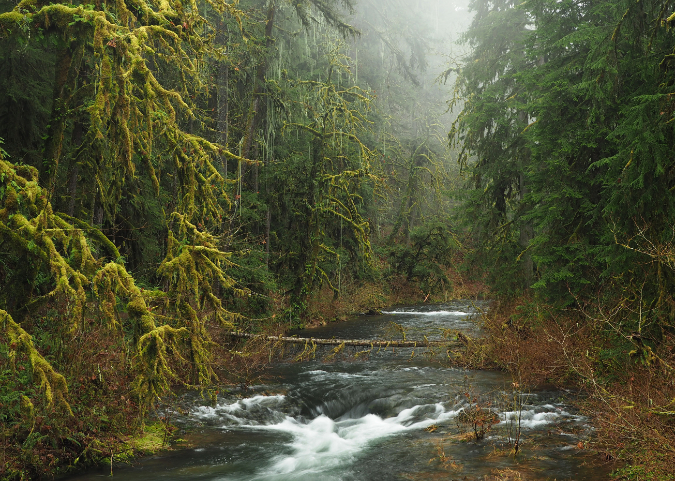
Heading back to the west side for December, I chose another image from beautiful Silver Falls State Park, though not of one of the iconic waterfalls. Instead, this scene (below) captures a classic winter rainforest scene, with the bare, contorted limbs of moss-draped Bigleaf maple revealed, now that their summer jacket of leaves has been discarded for the winter.

North Fork Silver Creek in winter

With all of the tragedy and trauma that 2020 brought to the world, this simple scene seemed most appropriate for closing out the calendar for the coming year: calming, cool and reflective, and with a needed sense of order and eternity that a misty day in the rainforest can bring us.

Remembering 2020..?

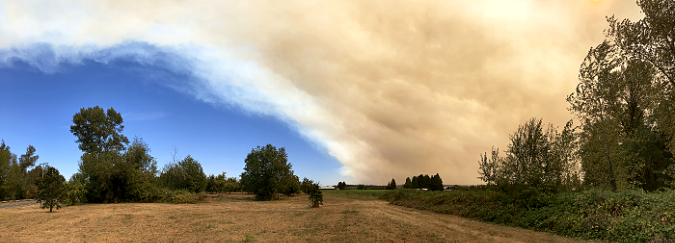
Riverside Fire exploding into a conflagration in September

Assembling this year’s calendar was yet another reminder of the horrendous year we are leaving behind. While spending time in the outdoors is always a needed escape, in 2020 we suddenly found many of our favorite forest sanctuaries closed by COVID-19. Later, the massive Riverside and Beachie fires roared through the Clackamas and Mount Jefferson areas, perhaps closing them for years to come, and with little known about the full impact of these fires at this time.

As I sorted through about 130 images that I’d set aside over the year, everything fell into two categories: burned in the fires or not. We still don’t know just how extensively the Riverside Fire burned the Molalla River watershed, for example, though we do know that it reached all the way to the Willamette Valley, causing evacuations in several communities on the valley floor — an unthinkable development in our recent history with fire. The Molalla River corridor remains closed, and it could be years before the Bureau of Land Management reopens the area to the public.

The Molalla Eye… before the fire

Some spots were spared, if just barely. Just south of the Molalla corridor, the Riverside and Beachie fires converged and bolted Silver Falls State Park. The park was spared, but not nearby Shellburg Falls, which was intensely burned, with no surviving forest. The Little North Fork valley was equally charred, including historic structures at Opal Creek.

Upper Butte Creek Falls… spared by the fire

Meanwhile, the fires followed ridgetops above Abiqua and Butte Creeks, but left the waterfalls and big trees there intact. Butte Creek was on my mind, as I had just made a trip there last June, when I ran into a family learning to fly fish at Upper Butte Creek Falls. While this spot didn’t burn, it will still likely be affected by the fires. As we’ve learned following the 2017 Eagle Creek Fire in the Gorge, stream corridors spared by the actual fire will soon fill with logs downed by the burn, and this will likely be the case in places like Butte Creek in coming years.

Fishing at Butte Creek

I’ve posted many articles about fire, and our need to come to terms with both its inevitability and benefits. And while it was frustrating to learn that the Riverside Fire was — once again — human-caused, it’s also the case that the forest will recover. With that recovery comes opportunities to rethink how we manage the Clackamas River watershed, and I’ll be posting more on that topic in the coming year. If catastrophic fires are a reset for the forest, then they can also be a reset for how we manage them.

While the wildfires took center stage in Oregon in September, the COVID-19 crisis is the tragedy that will forever mark 2020. Like many, social distancing took me outdoors, but I quickly found that my usual haunts were packed with people, and too many were without masks or observing basic precautions for preventing transmission of the virus.

So, I ventured a bit farther afield in WyEast country, visiting several places for the very first time, but also taking great pains not to interact with others and risk accidentally being a spreader, myself. Once such place was Cliffs Park, a remarkable spot along the Columbia River that offers a stunning view of the Columbia River. On a quiet Sunday, I had the place to myself, but the empty fishing platforms were a reminder that indigenous peoples have been fishing these beaches for millennia — and that in our pandemic, Native Americans have been among the hardest hit by the virus.

Tribal fishing platforms at Cliffs Park

Cliffs Park

Looking downstream at Cliffs Park, WyEast rises above the basalt walls of the Gorge, and the scene seems timeless. Turn around and look upstream, and the John Day Dam fills the horizon, another reminder of the cultural devastation that white settlement brought to the indigenous societies that had flourished along the river for millennia — and the trauma they still carry from the loss of Celilo Falls, just downstream from Cliffs Park, and inundated by The Dalles Dam in 1957. This recent piece in Portland Monthly on the subject is well worth reading:

The Rise and Fall of Kah-Nee-Ta

It’s fairly easy to be socially distant (and completely alone) in the wide-open desert country east of Mount Hood, but what about some pandemic solitude on the mountain? It turns out to be in plain sight, if you’re willing to do some boulder-hopping. Over the summer, I made several cross-country forays into the White River flood zone, and to my surprise, the river channel abruptly changed sometime in late summer, before my final visit in late September.

The White River strikes back… again!

My guess is that a cloudburst or just some steady rain had kicked off a debris slide far up the canyon, but the volume was such that the entire floodplain was affected, with a couple feet of new sand and cobbles left behind by the flood. On my visit, the river was still trying to find its new course, and made a wonderful clattering noise it rocks and pebbles rolled down the stream in the muddy water.

The White River finding its new path

It’s not the first time the White River has changed course, that’s for sure, and it certainly won’t be the last. Seeing the raw forces of nature steadily at work was also quite reassuring. Yes, humanity has been struggling with a pandemic this year, but the mountain didn’t even notice. Nature has a way of putting our human frailty in helpful perspective, and reminding us that we’re temporary features here.

And, on a personal note…

Everyone has their list of reasons to hate 2020, and I certainly have mine. I’ll start with an odd one that connects some dots, and it’s about my photography. After decades of making some of the most innovative, compact cameras that seemed to be designed with hikers and active photographers in mind, Olympus announced last June that it would be selling off its camera division. What..??

It turns out that like all traditional camera makers, Olympus had seen sales sag with the explosion of smartphone and their amazingly good photo capability. No surprise, there, and I’m no exception. I marvel at what my iPhone can do. But I’ve also been a loyal Olympus user since I was 18 years old.

End of an era for this photographer? Not a chance! My newest Olympus (complete with collapsing 14-45mm zoom lens) sitting in the palm of my hand…

The good news is that the buyer of the Olympus line is planning to continue offering a full lineup under the old brand name, so we’ll see how that goes. But in the meantime, I used this troubling news as rationale to double down and pick up a few lenses and another camera body that will help me keep this blog full of photos for years to come!

Here’s where I will connect some dots, as the Olympus news had deeper significance with me, as I got the photography bug from my oldest brother Pete, who died in 2017. Pete is on my mind whenever I’m out in the forest or up in the mountains shooting with my beloved Olympus cameras. He helped me pick out my first Olympus camera when I was a teenager.

Me (left) as a 20-year old with my late brother Pete and my first Olympus way back in 1982. Pete was my photography inspiration and my mentor

Pete and I had a special connection that went beyond photography, and I’m thankful for the time I had with him, but I’m especially thankful for the time I still have to be out exploring the world. I’d wish he could still join me, and after losing him, I’ll surely never take my time on this earth for granted again.

This regrettable year also marked the passing of my dad on September 1. He was 91 years old, and like my brother Pete, had a huge impact on my life. Dad moved our family out here from Iowa in 1962, just few weeks before I was added as the last of five kids (and the only one born in Oregon). Dad was drawn to the Pacific Northwest by the active outdoor life, and passed that appreciation on to his kids — and to my mom, who passed away in September 2018. Together, they climbed mountains, backpacked, camped, fished and when it came time to retire, lived out their years on a forested hilltop.

My folks enjoying a pitcher and pizza just three years ago, in September 2017. These transplanted Iowans gave me my love of the Pacific Northwest outdoors

Needless to say, my life moving forward has changed forever with the loss of both parents and my oldest brother. But if every kid wants to make their family proud, I felt good when it came time to sort through the things my folks left behind. Their home was full of photographs, sketches and sculptures that I’d made for them over the years, and they had even saved every Mount Hood calendar I’d printed since starting these in 2004!

So, I know they were pleased that they had successfully planted that outdoor life and conservation ethic in me, and whatever I can do as a conservationist and advocate in my remaining life, it will be an extension of their influence — and Pete’s, too. I’ll always miss them, but whenever I’m in the outdoors, I’m really still with them!

Their passing is also a reminder to me (and all of us) that an essential part of being a conservationist and steward for our public lands is to pass along that ethic and passion to those who will follow us, a role that is now even more prominent in my own mind.

Looking forward to 2021!

What’s coming in 2021 for this blog? As always, I have lots of articles underway, and as I mentioned at the top, the potential for some very big news for the mountain. I will post on that topic as soon as I learn more. I also hope to see some of the Riverside Fire aftermath first-hand and report on what the Clackamas watershed looks like today, along with ongoing visits to some lesser-known spots in WyEast country.

The author at Lower White River Falls in June (with mask in stored position!)

Most of all, a return to life beyond the pandemic is on all of our minds, perhaps as soon as next summer. Until then, thanks for reading the blog and for indulging me in these annual reflections. Best to you in 2021, and I hope to see you on the trail, sometime!


Tom Kloster | December 2020

Dollar Lake Fire: Five Years After

dollarfirefiveyears01

The Dollar Lake Fire from Bald Butte in August 2011

In 2006, the Bluegrass Fire raced along Bluegrass Ridge, torching the subalpine forests above Elk Meadows on Mount Hood’s east flank. In 2008, the Gnarl Fire burned a much larger swath of the east slope, from just above Elk Meadows to the Eliot Branch canyon, nearly destroying century-old Cloud Cap Inn, Snowshoe Lodge and the historic structures at nearby Tilly Jane Campground. Heroic efforts by Forest Service firefighters spared these priceless jewels of Mount Hood’s history, with the fire burning within a few yards of these old structures.

In August 2011, the Dollar Lake Fire was the third in a string of major fires that would ravage the slopes of Mount Hood in a period of just five years, this time burning the north slopes of the mountain. Lightning started the Dollar Fire started on a weekend, just below the popular Elk Cove trail and was immediately reported by hikers in the area.

dollarfirefiveyears02

The Dollar Lake Fire burning below Elk Cove

The Dollar Fire soon erupted to become one of the most fiercely fought and carefully documented fires in recent memory as it swept to the west, eventually threatening Bonneville Power Administration transmission lines at Lolo Pass and the nearby Bull Run Watershed, source of Portland’s drinking water.

The fire wasn’t fully contained until the end of September of that year, eventually burning more than 6,200 acres of forest (maps and photos of the fire can still be viewed on the InciWeb interagency website).

dollarfirefiveyears03

Flare-up in the Dollar Lake Fire in August 2011

Firefighting efforts were initially slow to arrive at the Dollar Fire, and some (including the media and members of Oregon’s Congressional delegation) accused the Forest Service of purposely allowing the fire to grow because it was inside the Mount Hood Wilderness where it didn’t threaten areas open to commercial logging. But a subsequent investigation pointed to overstretched firefighting resources, a growing problem as the federal land agencies struggle to fund the spiraling forest fire phenomena across the west.

dollarfirefiveyears04

Location of the Dollar Lake and Gnarl fires

 [click here for a large map]

By the time fall rains arrived, the fire had burned almost the entire north slope of Mount Hood, a 5-mile swath stretching from the Eliot Branch on the east to Cathedral Ridge on the west. Almost all of the burn was subalpine Noble fir forest, though a few old-growth mountain hemlock stands along the Timberline Trail were burned at Elk Cove and Cairn Basin.

dollarfirefiveyears05

Timeline and extent of the Dollar Lake fire

[click here for a large map]

The eastern extent of the Dollar Burn contained large stands of Western larch, a fire forest species adapted to frequent, low intensity fires. Most of these trees did not appear to survive the fire, however, due to its extreme heat and intensity.

dollarfirefiveyears06

Ground zero for the Dollar Lake fire is the foreground in these views from the Elk Cove Trail taken before the burn and five years after the fire

 [click here for a large map]

In fact, very few trees survived the fire except along its margins, where a beneficial mosaic burn pattern left standing trees and some undergrowth to help begin the recovery phase. This is the new reality facing our forests, as a century of fire suppression continues to fuel catastrophic fires that completely destroy forest on a massive scale.

Summer 2012: Immediate Aftermath

dollarfirefiveyears07

Total destruction along Vista Ridge in 2012

The dense network of trails that cross through the Dollar Burn provide a front-row seat to how (and if) our forests recover from catastrophic fires inside a protected wilderness, without human intervention. In the immediate aftermath of the Dollar Fire, the picture was bleak. In the heart of the burn, the forest kill was nearly complete, as even the duff layer on the forest floor was burned away, exposing a thin layer of volcanic soils vulnerable to erosion.

dollarfirefiveyears08

Blackened trees in 2012, before scorched bark began to peel away

One of the first lessons of the fire was the importance of tree debris in stabilizing the unprotected soil. The living trees in this forest weren’t burned so much as boiled alive as their living cambium layer was superheated beneath their bark. The surprising result in the first season after the fire was scorched bark peeling away to reveal untouched wood underneath.

The piles of peeled bark provided an immediate layer of mulch over the exposed soil, with smaller twigs and limbs also helping to form the beginnings of a new duff layer on the burnt soil.

dollarfirefiveyears09

Trees inside the burn shed their scorched bark in the first year, helping stabilize exposed soils

The roots of some understory plants in the worst of the burn zone also survived the fire, including huckleberry, beargrass and avalanche lilies. Two years after the fire, seeds blown into the burn began to establish, and the recovery was underway in surprisingly short order. Read more about the initial recovery in this 2012 WyEast Blog article.

2016: Five Years of Recovery

This year marks the five-year anniversary of the fire, and the recovery within the Dollar Burn is in full swing, though it will take a century or more for the area to fully recover – more on that in a moment.

How does the Dollar Burn of today compare to the first summer after the fire? As the July scenes along the Vista Ridge Trail (below) show, the understory is recovering rapidly.

dollarfirefiveyears10

Comparison of the recovery along the Vista Ridge Trail in 2012 and 2016

In 2012, avalanche lilies sprung from bulbs spared by the heat of the fire, creating striking stripes of white blossoms and bright green foliage where these plants survived. A few beargrass (a close relative of the lily family) also survived, thanks to deep underground roots that escaped the fire. A few scattered huckleberry and other understory shrubs also sprouted from surviving roots in the first summer after the fire.

In recent years, the beargrass and avalanche lily display in the Dollar Burn has become a spectacular attraction for early season hikers on the Vista Rigde Trail as these fire survivors continue flourish and spread in the bright new conditions. Other shrubby survivors, like huckleberry, have also continued to recover, thriving in the bright new conditions created by the fire.

But the story in the last few years of the recovery has been the arrival of new plants in the burn zone, blown in by seed or deposited by wildlife. These include more understory species, but also the first few conifers to take root.

dollarfirefiveyears11

This trailside log was a favorite resting spot for hikers on the Vista Ridge Trail before the Dollar Fire. Since the fire, hikers still rest here and have begun to polish away the charred surface along the top of the log – presumably with a charcoal backside as their souvenir!

After five years, most of the scorched bark has fallen from the torched trees, and the trunks underneath have bleached from their initial golden shades of newly exposed wood to weathered silver and gray shades of a “ghost forest”.

The standing ghost trees still retain a surprising number of their limbs, and perhaps more surprising, very few have toppled in the five years since the fire. This is testament to the fact that the core of these trees didn’t burn. Most will stand for decades before insects and decay finally bring them down.

dollarfirefiveyears12

These felled Noble fir along Vista Ridge Trail reveal a forest that was more than 300 years old before the fire

A few trees in the burn zone were cut by firefighters in an attempt to create fire lines. Today, these cut stumps provide a look at the age of this forest. While the trees in the Dollar Burn aren’t particularly large by Pacific Northwest standards, they were actually quite old. The cut tree shown above was more than 300 years old and stump below is from a tree that had grown on Vista Ridge for 360 years!

dollarfirefiveyears13_360years

This ancient Noble fir was 360 years old when it succumbed to the catastrophic Dollar Lake fire

The extreme weather conditions and thin soils make for a hard life for subalpine trees, stunting their relative size compared to lower-elevation forests.

The relatively modest size of these trees compared to their impressive age is another reminder of the vulnerability of our subalpine Noble fir forests that are still being logged commercially. While they continue to be “harvested” in unprotected areas under the premise of sustainability, these trees take centuries to reach a size worthy of commercial cutting, making the “harvest” more like mining than tree farming.

The Pioneers

dollarfirefiveyears14

Fireweed is the rock star of the pioneer plants species in the burn zone

The understory in the Dollar Burn is noticeably greener just five years after the fire, and a closer look reveals a handful of plant species doing the heavy lifting at this stage in the forest recovery. At the top of the list of pioneer species is fireweed, (described here in the previous article in this blog).

dollarfirefiveyears15

Fireweed crowding the Vista Ridge Trail in 2016

True to its name, fireweed has evolved to be the first in line to resettle burned or disturbed areas. These plants produce massive quantities of winged seeds that can quickly reach very large areas. They are also hardy perennials with large root systems, so also play an important role in stabilizing exposed soil.

In the Dollar Burn, fireweed has already colonized large areas, creating a spectacular flower displays from mid-summer through fall.

dollarfirefiveyears16

Showy blooms of Fireweed in late summer on Vista Ridge

Look between the drifts of fireweed and you’ll find other pioneers taking root. One surprising species is the diminutive wild dwarf bramble (sometimes called wild strawberry for its resemblance of its runners and leaves to domestic strawberries). These tiny plants are now found throughout the burn, threading through piles of bark and limbs.

dollarfirefiveyears17

Wild dwarf bramble growing over charred bark along the Vista Ridge Trail

Huckleberries also continue their comeback, mostly from the surviving roots of established plants that grew before the fire but also as seedlings. In a few spots, the understory was not completely destroyed, and in these areas huckleberry is responding strongly to the bright conditions with abundant berry production.

dollarfirefiveyears18

Huckleberry seedlings emerging on Vista Ridge

dollarfirefiveyears19

Huckleberry seedlings growing from the base of a burned snag on Vista Ridge

dollarfirefiveyears20

Huckleberries that survived the fire are producing abundant berry crops in the suddenly sunny environment in the Dollar Burn

Though they were among the few understory survivors, the recovery of beargrass has been more gradual than expected. Most plants seem to be growing from roots that survived the fire, though the first big bloom of these survivors (and the seeds they produced) only arrived over the past two years.

dollarfirefiveyears21

Beargrass emerging from surviving roots are just beginning to produce blooms within the burn zone

Clumping grasses have also arrived throughout the burn, as well as the occasional rush in moist, protected pockets.

dollarfirefiveyears22

Rush growing in a moist hollow on Vista Ridge

dollarfirefiveyears23

Clumping grasses are taking root in some of the driest areas of the Dollar Burn

Elderberry is among the few woody understory pioneers to arrive in this stage of the Dollar Burn recovery. These plants are scattered widely, growing in less burned areas, and may also be growing from surviving roots.

dollarfirefiveyears24
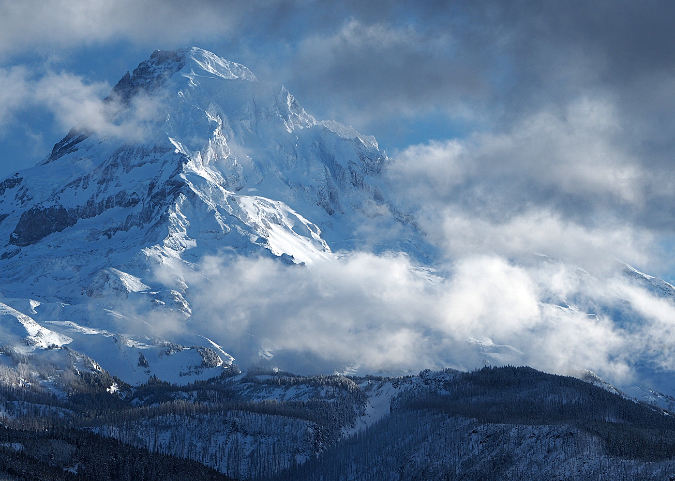
This young Elderberry shrub is just getting started in the burn zone in 2016

Conifers are just getting started five years after the Dollar Fire. Almost all of the conifer seedlings at this point in the recovery are Mountain hemlock and Noble fir, the dominant evergreens in Mount Hood’s subalpine forests.

By counting branch tiers, a few young trees as old as four years can be found, but most are one or two year-old seedlings. But if you look closely, there are also many seedlings that have not survived the harsh summers in the burn zone, where there is little shade and the sandy mountain soils are extremely dry by the time rain reappears in the fall.

This is the sorting process at work, where only a few seedlings will survive winter cold, summer heat and competition from understory plants to someday become part of the new forest canopy.

dollarfirefiveyears25

Young Mountain hemlock in the Dollar Burn in 2016

dollarfirefiveyears26

Three-year old Noble Fir in the Dollar Burn in 2016

Though most of the Dollar Fire was an overheated catastrophe for the forest, killing almost everything, there are a few spots where the fire cooled and burned in a “mosaic” pattern, leaving a few surviving trees and much of the understory.

These areas are lush islands of life just five years after the fire, underscoring their importance in the recovery and why cooler mosaic burns can be beneficial to the long-term health of a forest. Pioneer species are much more abundant in heavily burned areas that are immediately adjacent to these surviving patches than in other parts of the burn, as plants quickly spread from these islands of green.

dollarfirefiveyears27

Island of green where the Dollar Lake Fire spared a section of forest that now serves as a nursery for regenerating the burn zone

While the Dollar Burn is recovering at nature’s pace, without human intervention, the Forest Service has given the nearby Gnarl Burn section along Cloud Cap Road a recovery boost by planting conifer seedlings. These trees were planting in 2010, about a year before the Dollar Lake Fire and following commercial removal of burned trees along the historic road.

dollarfirefiveyears28

Planted conifers in the Gnarl Burn along Cloud Cap Road in 2016

Today, these trees are thriving, and the main effect of replanting is the diversity of species, including lodgepole pine, western larch, Western white pine, Englemann Spruce and even whitebark pine at higher elevations. Noble fir and mountain hemlock do not seem to have been part of the replanting, perhaps because these species are the most likely to recover without human intervention.

The Long View?

dollarfirefiveyears29

Hazard tree warning at the Vista Ridge trailhead

Hikers on the north side of Mount Hood will continue to have a front-row seat to the forest recovery in the Dollar Burn. Already, there are some surprising lessons.

First, the main victims of blowdown since the fire have often been the few trees that survived the fire intact. This is because of the sudden exposure of their canopy to winter winds and snow loads, and is a surprising blow to the forest recovery these trees would otherwise be helping to seed the burn zone.

dollarfirefiveyears30

Toppled surviving Noble fir in the burn zone in 2016

dollarfirefiveyears31

A surviving canopy becomes a liability in a burned forest, as surviving trees along Vista Ridge were tipped by winter storms in 2016

The Dollar Burn generally stayed well below timberline (and the Timberline Trail), leaving most of the alpine zone intact. But where the fire did burn into places like Elk Cove, Eden Park and Cairn Basin, we will also have an opportunity to watch how alpine ecosystems react to fire.

Some of Mount Hood’s most ancient forests grow in this zone, and have presumably survived because they are somewhat isolated from lower-elevation forests and often grow in moister conditions where snowpack is greater and summer days are cooler. But the forest could take centuries to recover in these areas, impacting the many species of plants and wildlife that live exclusively at this elevation.

dollarfirefiveyears32

It could take centuries for this high-elevation forest of Mountain hemlock and Whitebark pine on Vista Ridge to recover from the fire

In human terms, it’s hard to see forest fire cycles in perspective, but in the case of the Dollar Burn, we have the benefit of early photographs from the area. Forest surveys show that the Red Hill area on the north edge of the Mount Hood Wilderness burned in the early 1900s, and were barely recovering by the 1950s (see below).

dollarfirefiveyears33

The view from Owl Point in 1952 and 2016 shows the cycle of fire on Mount Hood’s north slope over the past century (top photo courtesy Hood River History Museum)

[Click here for a larger version]

Today, the forest in this northern edge of the wilderness has substantially recovered after a century of regrowth, and now the view is reversed: the silvery ghost forests of the Dollar Fire now mark the once-green slopes of Mount Hood as viewed from Owl Point, while green forests and beargrass meadows cover the former Red Hill burn in the foreground.

dollarfirefiveyears34

Looking down on the Dollar Burn and Owl Point in the distance from the Timberline Trail in 2016

So far, so good, but the larger question in an era of climate change is whether our forests will continue to recover from catastrophic fire – or logging – in the way that we have always assumed they will.

As the recovery unfolds in the Dollar Lake, Gnarl and Blue Ridge burns on Mount Hood we’ll learn how resilient our forests really are, and hopefully make better decisions in protecting them for the benefit of future generations.

After the Dollar Lake Fire

The Dollar Lake Fire from Bald Butte on September 3, 2011

On August 26, 2011, a lightning strike ignited what was to become the Dollar Lake Fire, on Mount Hood’s rugged north side. The fire started in the Coe Branch canyon, just below the Elk Cove trail, and was spotted by numerous hikers.

Initially, it seemed small and manageable. But over the next few days and weeks, arid conditions and strong winds spread the fire from Stranahan Ridge on the east to Cathedral Ridge on the northwest side of the mountain, eventually consuming some 6,300 acres of high elevation forest. The blaze burned through September and into early October, when fall rains finally arrived.

Hot spot erupts along Stranahan Ridge on September 3, 2011

Some of the burn was of the beneficial form, a mosaic fire leaving islands of surviving trees, but much of the fire was too hot and the accumulated forest fuel too plentiful to prevent devastating crown fires from sweeping across the forest. Eventually, the fire destroyed most of the standing timber and burned the forest duff down to mineral soil throughout most of the burn area.

The fire was contained entirely within the Mount Hood Wilderness, thanks to the recent Clear Branch additions that expanded the wilderness boundary on the north to encompass the Clear Branch valley and the high country surrounding Owl Point, to the north. While this complicated fire fighting, it has also created a living laboratory for forest recovery, as the USFS is unlikely to assist the reforestation process inside the wilderness boundary. The Forest Service map, below, shows the broad extent of the fire.

Final extent of the Dollar Lake Fire (outlined in red)

Though the fire burned to the tree line in several spots, a surprising amount of terrain along the iconic Timberline Trail was somehow spared. While the burn touched Elk Cove and Cairn Basin, WyEast Basin and Barrett Spur are well beyond the burned area. The Clear Branch wilderness additions to the north were mostly spared, as well.

The New Vista Ridge: After the Fire

The following is a photo essay from my first visit to the burn, on June 22, 2012, and is the first in what will eventually be a series of articles on the aftermath of the fire.

The devastation left by the fire is awesome to witness, but also starkly beautiful when you consider the context of a forest fire. After all, this event is part of the natural rhythm of the forest just as much as the changing of seasons.

From this point forward, we will have a front-row seat to the miracle of life returning to the fire zone, much as we’ve watched life return to the Mount St. Helens blast zone over the past 32 years. And as my photos show, the rebirth of the forest ecosystem has already begun on Mount Hood’s northern slopes.

Untouched trailhead at Vista Ridge.

From the Vista Ridge trailhead, I followed the Vista Ridge Trail to the snow line, above about 5,000 feet. The Vista Ridge trailhead is completely untouched, though the fire swept through a vast area immediately to the south. Yet, no sign of the fire is evident at the trailhead marker (above).

A bit further up the trail, at the Old Vista Ridge trailhead, the fire zone comes into view. Where green forests existed last summer, browned foliage and a burned forest floor spread out east of the junction. This fringe of the fire is of the healthy “mosaic” form, sparing large trees, while clearing accumulated forest debris.

Old Vista Ridge trailhead spared by fire… just barely.

An unexpected benefit of the fire came last fall, when the USFS added the long-neglected Old Vista Ridge trail to official agency fire maps (below) released to the public. Volunteers began restoring this beautiful trail in 2007, but formal acknowledgement of the route on USFS maps is a welcome development.

Welcome development: Old Vista Ridge trail reappears on USFS fire fighting maps

Clearly, the restoration of the Old Vista Ridge trail helped fire fighters reach this area, and could have served as a fire line had the blaze swept north, across the Clear Branch. Hopefully this is an indication that the Old Vista Ridge trail will someday reappear on the USFS maintenance schedule, too.

Turning south on the Vista Ridge trail from the Old Vista Ridge junction, the wilderness registration box and map board seem to have received divine intervention from the fire — the blaze burned within a few feet of the signs, yet spared both. From here, the Vista Ridge trail abruptly leaves the scorched fringe of the fire, and heads into the most devastated areas.

Vista Ridge trail signs were spared… by divine guidance?

A few yards up the Vista Ridge trail, the devastation quickly intensifies.

From about the 4,700 foot level, the Dollar Lake Fire burned the forests along Vista Ridge to bare earth. In this area, the entire forest crowned, leaving only a scattering of surviving trees where protected by topography or sheer luck. Forest understory, woody debris and duff burned to mineral soil, leaving a slick, muddy surface of ash. For those who have hiked through the previous Bluegrass Fire or Gnarl Fire zones on the east slopes of Mount Hood, this eerie scene is familiar.

The surprisingly intact trail curves through the devastated forests along Vista Ridge.

Crown fires have killed almost all of the standing forests along Vista Ridge.

Amid the devastation in this hottest part of the Dollar Lake Fire, signs of life are already emerging. At this elevation, one of the toughest survivors is beargrass, a member of the lily family with a deep rhizome that allows plants to survive even the hottest fires. These plants are normally evergreen, but were completely scorched in the fire. The new grown in this photo (below) has emerged this spring.

Beargrass (Xerophyllum tenax) emerges from underground rhizomes protected from the fire.

Another surprise is avalanche lily, one of the more delicate flowers in the subalpine ecosystem. Like beargrass, these plants survive thanks to a bulb located deep enough in the soil to escape the heat of the fire. As one of the early bloomers in the mountain forests, these plants area already forming bright green carpets in the sea of fire devastation (below).

Avalanche Lily (Erythronium grandiflorum) emerging from the ashes.

A ribbon of green, these Avalanche Lilies are emerging along the Vista Ridge trail.

Another of the beneficial aspects of the fire comes into view a bit further up the trail: several sections of Vista Ridge had long been overgrown with thickets of overcrowded, stressed trees that were ripe for a burn.

Over the coming years, these areas are likely to evolve into beargrass and huckleberry meadows like those found at nearby Owl Point or along Zigzag Mountain, where fires have opened the landscape to sun-loving, early succession plants.

Unhealthy forest thickets cleared by fire — a beneficial outcome of the blaze.

One human artifact was uncovered by firefighters — a coil of what must be telephone cable (below). This is a first along the Vista Ridge trail, but makes sense given the insulators and cable found along the Old Vista Ridge trail.

It’s hard to know what this connected to, but on the north end, it served the old Perry Lake Guard Station and lookout, just east of Owl Point. It’s possible this line extended to the Bald Mountain lookout, though I have been unable to verify this on historic forest maps.

Telephone cable on Vista Ridge – gathered up and coiled by firefighters?

Though much of the devastation zone still consists of blackened trees and soil, some of the burned forest has begun to evolve into the uniquely attractive second phase. This happens when scorched bark peels away from trees to reveal the often beautiful, unburned wood beneath.

Soon, all of the trees in this forest will shed their bark. The skeletons of thousands of trees will emerge in colors of red, yellow and tan, then gradually fade to a bleached gray and white with time.

The burned trees of Vista Ridge are just beginning to shed their blackened bark, revealing beautiful trunks unscarred by the fire.

Mount Hood rises behind the new ghost forests of Vista Ridge

This second phase of the fire is helped along by winter snow. As the scene above shows, the freeze-thaw and compacting effects of the snow pack have already stripped many trees of their bark beneath the now-melted snowpack. Hot summer sun will continue this process, shrinking the remaining bark until it drops from the drying tree trunk.

This process of de-barking is the first in a post-fire sequence of events that will recycle much-needed organic matter to the forest floor. Twigs and tree limbs will soon fall, and over time, whole trees will begin to drop. This is a critical phase in stabilizing the forest soil, when low vegetation is still just beginning to re-establish in the fire zone.

Strips of tree bark are the first organic layer to accumulate on the floor of the burn zone.

The next few images show the extent of the Dollar Lake Fire, as viewed from Vista Ridge. To the east (below), The Pinnacle was mostly burned, but the fire somehow missed stand of trees just below the north summit.

These trees will play an important role in reforestation of the area, partly because so few trees survived the fire, but also because of their geographic location above the surrounding forest, where wind will widely scatter their seeds.

The Pinnacle, where a small grove of of trees on the north slope survived the fire.

To the south, the area above Elk Cove known as 99 Ridge (shown below) was partly spared, though the fire did scorch the east slopes of the ridge. From this side (to the west), the Timberline Trail corridor was almost completely spared. Ironically, Dollar Lake — the namesake for the fire — appears to have been spared, as well.

To the west of 99 Ridge, WyEast Basin was also spared, but the area along the Timberline Trail to the west of the basin, along the upper sections of Vista Ridge, was largely burned.

Forests along 99 Ridge were spared by the fire.

This panoramic view (below) encompasses the entire mid-section of the fire, from Stranahan Ridge on the horizon to Vista Ridge, on the right. This is a new viewpoint along a largely unnoticed rocky scarp on the east shoulder of Vista Ridge, now revealed thanks to the fire.

(Click here for a much larger panoramic view]

A Changed Landscape

Those who have explored Mount Hood’s north slopes over the years will surely mourn the loss of the beautiful forests of noble fir and mountain hemlock that once stood here — I certainly have. But this is also a chance to watch the ecosystem recover and restore itself over time, as it has for centuries. Among the surprising benefits are the new scenic vistas that are suddenly available, giving a bit more meaning to the name “Vista Ridge.”

The new views from Vista Ridge include Laurance Lake and Bald Butte, to the east.

By following the true ridge top of Vista Ridge, the new views extend east across Laurance Lake and the Clear Branch valley to Bald Butte and the Columbia Basin (above). Most of the area below the ridge is not burned, and this new perspective on the recent additions to the Mount Hood Wilderness is both unexpected and beautiful.

To the north, the new views include the rugged and little-known Owl Point area of the expanded Mount Hood Wilderness (reached by the Old Vista Ridge trail). Mount Adams rises in the distance, above the talus fields and meadows of Owl Point.

Owl Point and Mount Adams from newly revealed viewpoint on Vista Ridge.

This suddenly very scenic “true” ridge along the lower portion of Vista Ridge is easy enough to hike by simply following the ridge top where the existing trail heads into a narrow draw, about one-half mile from the Old Vista Ridge trail junction. It’s worth the visit if you’d like to inspect the scenery and Dollar Lake Fire up-close.

But in the spirit of recasting the Vista Ridge trail in the aftermath of the fire, and taking in these new views, now would be the perfect time to simply realign the trail along the ridge top. As shown on the map (below), this project could be done in a weekend by volunteers, if approved by the Forest Service.

(Click here for a larger map]

The fire has already done the heavy work of trail building by clearing the ground to mineral soil: designing and completing a realigned trail here would be quite straightforward. The slope of the ridge top, itself, is surprisingly gentle and would allow for an easy grade, similar to the current trail.

I hope to pitch this idea to the Forest Service, so if you’re interested in getting involved, watch the Portland Hikers forum for updates. That’s where volunteer work parties will be organized if there is interest from the USFS.

Until then, take the time to explore the fire zone, and watch the unfolding forest recovery firsthand. Visit the Portland Hikers Field Guide for directions to the Vista Ridge Trailhead.

Building the Timberline Trail

The McNeil Point Shelter.

For decades, hikers and backpackers have taken Mount Hood’s famous Timberline Trail for granted — and why not? It was one of the earliest alpine hiking trails in the American West, and seems to have evolved with the mountain itself.

But the story of the trail is one of an original vision that has been realized in fits and starts, and the story is still unfolding.

The first recreational trail on Mount Hood followed the South Eliot Moraine from Cloud Cap Inn to Cooper Spur, as shown on this 1911 map.

The first modern trail on Mount Hood was established in 1885, beginning at David Rose Cooper’s tent camp hotel, located near the present-day Cloud Cap Inn. The route followed the south Eliot Moraine to his namesake Cooper Spur. Soon thereafter, the Langille family would lead hikes and climbs on this route from the new Cloud Cap Inn, completed in 1889.

The Langilles also established a route from Cloud Cap to Elk Cove for their visitors, completing another section of what would someday become the Timberline Trail.

Hikers climbing toward Cooper Spur along one of the original sections of the Timberline Trail.

The route remains a popular trail, today, though it has never been formally adopted or maintained by the Forest Service. The first leg of this trail briefly functioned as a segment of the Timberline Trail, thanks to a temporary re-routing in the mid-2000s (more about that, later).

The significance of the original Cooper Spur trail is that it was built entirely for recreational purposes, the first such route on the mountain.

Camp Blossom was built some fifty years before Timberline Lodge was opened in 1938, but established the same network of trails that have since served the lodge.

Other hiking routes soon followed on the south side of the mountain, connecting the former Camp Blossom to nearby Paradise Park and the White River canyon. Camp Blossom was built by a “Judge Blossom” in 1888 to cater to tourists. The camp was at the end of a new wagon road from Government Camp, and located near present-day Timberline Lodge. It was eventually replaced by the Timberline Cabin (1916), and later, Timberline Lodge (1938).

The informal network of alpine trails radiating from Camp Blossom in the late 1800s still forms the framework of trails we use today. This is especially true for the nearly 7 miles of trail from White River to Paradise Park, which largely defined the Timberline Trail alignment in this section.

By the 1920s, the Langille family had developed trails from their Cloud Cap Inn to nearby Elk Cove (1924 USGS map).
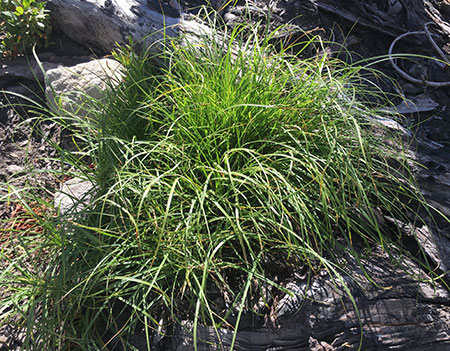
By the 1920s, the Mazamas and other local outdoor clubs were pushing for more recreation facilities around the mountain, and public interest in a round-the-mountain trail was growing.

By this time, new Forest Service trails had been built on the north side of the mountain from the Clear Branch valley to Elk Cove and along Vista Ridge to WyEast Basin. These trails were connected at timberline (with a spur to Dollar Lake), creating another segment of what was to become the Timberline Trail. Combined with the route from Cloud Cap to Elk Cove, nearly 8 miles of the future Timberline Trail had been built on the north side of the mountain by the 1920s.

By the 1920s, the Vista Ridge and Elk Cove trails were established, extending the emerging Timberline Trail from Cloud Cap to Eden Park (1924 USGS map).
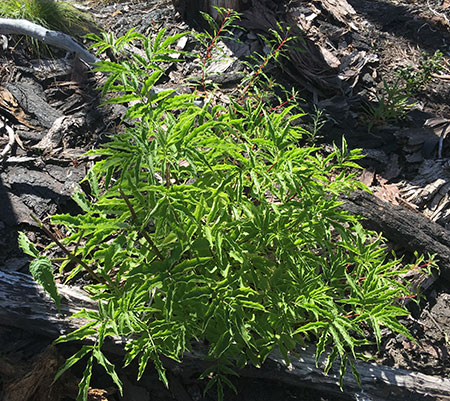
The Timberline Trail is Born

The concept of a complete loop around the mountain finally came together in the 1930s, during the depths of the Great Depression, when Franklin Delano Roosevelt’s New Deal recovery program, and the Civilian Conservation Corps (CCC), brought the needed manpower and financial resources to the project.

The CCC completed the new 37.6 mile Timberline Trail in 1934, stitching together the existing north side and south side trails, and covering completely new terrain on the remote west and east sides of the mountain.

The venerable Cooper Spur shelter still stands on the slopes above Cloud Cap, maintained by volunteers.

The Corps built a generous tread for the time in anticipation of heavy recreation use. The new trail was built 4 feet wide in forested areas, 2 feet wide in open terrain, and gently graded for easy hiking.

The trail was marked by square cedar posts placed at rectangular intervals over open country and by blazes in forested areas. Many of the distinctive trail posts survive between Cloud Cap and Gnarl Ridge, mounted in huge cairns.

Shelters were built along the trail by the CCC crews as a place for hikers to camp and rest, and as protection against sudden storms. Most are of the same stone design, with a small fireplace and chimney. They were built with steel rafters instead of wood so that the structures, themselves, would not be used as firewood in the treeless high country, and also to withstand heavy winter snows. Of the six original stone structures, only those at McNeil Point, Cairn Basin and Cooper Spur survive (see large version of map, below).

Map of the completed Timberline Trail and CCC era shelters.

(Click here for a large map)

Three wood structures were also built along lower sections of trail, at Ramona Falls, Bald Mountain and Elk Meadows. Of the three, only the rapidly deteriorating structure at Elk Meadows survives.

The completed trail featured a couple of oddities: the McNeil Point shelter had been constructed on a high bluff above the Muddy Fork that was eventually left off the final trail alignment, due to concerns about maintaining the trail at this elevation. Today, thousands of hikers nevertheless use the partially completed trail each year to reach the historic shelter and spectacular viewpoint.

Curiously, the shelter at Elk Meadows was also built off the main loop, perhaps because at the time, the meadows were seen as much a place to graze packhorses as for their scenic value. Like McNeil Point, this “forgotten” shelter continues to be a very popular stop for hikers, today.

This 1921 map shows the Oregon Skyline Trail terminating at Mount Hood, before construction of the Timberline Trail. Note the early Bull Run Reserve encompassing the entire west side of the mountain.

By the late 1930s, much of the new Timberline Trail had also been designated as an extension of the Oregon Skyline Trail — according to maps from the time (above), the Skyline had previously terminated on the slopes of Mount Hood, above Government Camp.

The expanded Skyline Trail arrived at the Timberline Trail from the south, near Timberline Lodge, turned east and traced the new Timberline Trail counter-clockwise around the mountain before descending to Lolo Pass, then headed north to Lost Lake and the Columbia Gorge.

1970s Trail Renaissance

A third major era of trail construction on the mountain came in the 1960s and 1970s, when several major re-routes of the Timberline Trail were built.

By the early 1960s, the Oregon Skyline Trail had been relocated to the west side of the mountain, following the Timberline Trail from Timberline Lodge north to the Bald Mountain Shelter, then on to Lolo Pass.

By the time the Pacific Crest Trail was established in the 1968 National Trails Act, absorbing the old Skyline Trail, a new route across the Muddy Fork canyon was in the works for the Timberline Trail.

The Cairn Basin stone shelter is the best-preserved of the CCC-era structures, thanks to more protection from the elements than most of the original buildings.

By the early 1970s, this new section rounded Yocum Ridge from Ramona Falls, crossed both branches of the Muddy Fork, then ascended to the steep meadows of Bald Mountain, one of the most popular Timberline Trail destinations today.

The new Muddy Fork segment is now part of the Timberline Trail loop, with the Pacific Crest Trail following the old Timberline Trail/Oregon Skyline Trail alignment. Though less scenic, the old route is more direct and reliable for through hikers and horses.

In contrast, the scenic new route for the Timberline Trail has been a challenge for the Forest Service to keep open, with the Muddy Fork regularly changing channels, and avalanche chutes on the valley walls taking out sections of trail, as well.

Going, going… this view from the slowly collapsing Elk Meadows shelter will soon be a memory. This is the only remaining wood shelter of three that were built by the CCC.

In the 1970s, a section of trail descending the east wall of Zigzag Canyon was also relocated, presumably as part of meeting Pacific Crest Trail design standards. While the old route traversed open, loose slopes of sand and boulders, the new trail ducks below the tree line, descending through forest in gentle switchbacks to the Zigzag River crossing of today.

At Paradise Park, a “low route” was built below the main meadow complex, and the headwater cliffs of Rushing Water Creek. Like the Zigzag Canyon reroute, the Paradise Park bypass was presumably built to PCT standards, which among other requirements, are intended to accommodate horses.

The north side of the mountain also saw major changes in the early 1970s. The original Timberline Trail had descended from Cathedral Ridge to Eden Park, before climbing around Vista Ridge and up to WyEast Basin. The new route skips Eden Park, traveling through Cairn Basin, instead, and climbing high over the crest of Vista Ridge before dropping to WyEast Basin.

Beautiful meadow views line the “new” Vista Ridge trail section completed in the early 1970s.

Finally, a section of trail near Dollar Lake was moved upslope, shortening the hike to the lake by a few hundred yards, and creating the sweeping views to the north that hikers now enjoy from open talus slopes east of Dollar Lake. Just beyond Dollar Lake junction, the descent into Elk Cove was also rebuilt, with today’s long, single switchback replacing a total of six on the old trail which descended more sharply into the cove.

In each case, the new trail segments from the early 1970s are notable for their well-graded design and longer, gentler switchbacks. While the main intent of the trail designers was an improved Timberline Trail, the new segments also created a numerous new routes for day hikers who could follow new and old trail segments to form hiking loops. These loops are among the most popular hikes on the mountain today.

The Future?

The retreat of Mount Hood’s glaciers in recent years has destabilized the outwash canyons, and in the past two decades, massive debris flows have buried highways and scoured out streambeds. One of the oldest segments of the Timberline Trail, near Cloud Cap, has been disrupted by washouts for nearly a decade, and is now completely closed, thanks to a huge washout on the Eliot Branch in 2007.

Sign from the first re-route, posted in 2001. Now the trail is completely closed at the Eliot Branch.

The Forest Service has since struggled to find funding to reconnect the trail at the Eliot Branch. The first washout moved the stream crossing uphill, taking advantage of the original Cooper Spur path established in the 1880s, then crossing to a parallel climbers path on the north moraine of the Eliot Glacier.

This temporary crossing lasted a for a few years in the early 2000s before the massive washout in 2007 permanently erased this section of trail. This portion of the loop as since been completely closed, though hundreds of hikers each summer continue to cross this extremely unstable, very dangerous terrain.

Site of the Eliot Branch washout and closure -- and the risky route hikers are taking, anyway.

The growing volatility of the glacial streams will ultimately claim other sections of trail, creating an ongoing challenge for the Forest Service to keep the Timberline Trail open each summer.

If repairing the washouts along the trail were as costly as those along the nearby Mount Hood Loop Highway, then there might be some question of whether it makes sense to keep the trail open. After all, millions of dollars are being spent this year to rebuild the Mount Hood Highway bridge over White River, yet again, in an area that has had repeated washouts.

Hikers crossing the Eliot Branch before the 2007 washout.

By comparison, a wilderness trail is exceptionally cheap to build, and much less constrained by topographical or environmental concerns than a road. It really just comes down to money and priorities, and the Forest Service simply doesn’t have the funding to keep pace with the growing needs of the Timberline Trail. With even a modest increase in funding, the trail can be rebuilt and adapted to periodic washouts, or other natural disturbances.

Speaking Up

One way to have an impact on the funding situation for the Timberline Trail is to weigh in with your Congressman and Senators. While the current political climate says that earmarks are dead, history tells us otherwise: ask for an earmark for the Timberline Trail. After all, the trail is historic and an international draw that brings tourists from around the world to help boost local economies.

If you’re not an earmark fan, then you can argue for an across-the-board funding boost for forest trails as a job-producing priority in the federal budget. A ten-fold increase over current levels would be lost in rounding areas in the context of the massive federal budget.

Yet another angle are the health benefits that trails provide, particularly given the federal government’s newly expanded interest in public health. This is emerging as the best reason to begin investing in trails, once again.

Hikers negotiating the Muddy Fork crossing after the 2002 debris flow swept through the canyon.

Of particular interest is the fact that Oregon Congressmen Earl Blumenauer and Greg Walden actually hiked the loop, just before the 2007 Eliot Branch washout. One is a Democrat, the other Republican, so you can cover your bipartisan bases with an e-mail both! They share the mountain, with the congressional district boundary running right down the middle, so both have an interest in the Timberline Trail.

Finally, Oregon Senator Ron Wyden championed expanded wilderness for the Mount Hood area for years, and President Obama finally signed the bill into law earlier this year. So, another angle is to argue for the needed funding to support trail maintenance in these new wilderness areas, especially since they will require more costly, manual maintenance now.

It really makes a difference to weigh in, plus it feels good to advocate for trails with your Congressional delegation. Here’s a handy resource page for contacting these representatives, and the rest of the Oregon delegation:

Here’s how to send an e-mail to Congress

Thanks in advance for making your voice heard!