Boundary Clear Cut – Part Two

The Boundary clear cut consumed this tiny lake. The trees behind mark the wilderness boundary as it rides over the ridges

The Boundary clear cut consumed this tiny lake. The trees behind mark the wilderness boundary as it rides over the ridges

The first part of this article focused on the Forest Service failures that allowed the massive Boundary clear cut to happen on Mount Hood’s northwest shoulder. Now, a look at more of the fallout from the massive clear cut, and opportunities for restoring the area in the future.

First, some numbers. Using a conservative estimate of 100 trees per acre, the 800 acre Boundary complex contained at least 80,000 mature trees, mostly noble fir. Using the Forest Service’s Center for Urban Forest Research models (2002), a conservative estimate for storm water interception of each tree is at least 1,100 gallons per year, or some 88 million gallons of runoff from the Boundary clear cut area, alone. How much additional runoff is that? Enough to nearly fill the 33-story KOIN tower in downtown Portland.

The twin to the logged-over lake, pictured above, this peaceful tarn is located just two hundred yards away, safely inside the wilderness boundary

The twin to the logged-over lake, pictured above, this peaceful tarn is located just two hundred yards away, safely inside the wilderness boundary

Without the forest canopy, the bulk of the rain that falls upon these mountain slopes now runs off, eroding the thin soils, carrying mud and sediments to nearby streams and resulting spikes in stream flows that damage riparian areas and fish habitat. This effect is repeated, of course, across the thousands of clear cuts in the Mount Hood National Forest.

For the Boundary clear cut, the runoff impact is on the heavily logged West Fork Hood River drainage, which is already struggling to recover from the first wave of logging at the turn of the 20th Century (see “Just 75 years” article).

Like other clear cuts, the Boundary cut also triggered edge effects on the uncut forests bordering the timber sale. Because the Boundary clear cut is high elevation, and nearly crests Vista Ridge, these were impacts that timber planners surely could have expected. Yet the timber sale spread close enough to the historic Vista Ridge trail that blowdown triggered by the cut still fall across the trail with regulatory, and unnecessarily. Sadly, this was preventable.

These trees along the Vista Ridge Trail are victims of the Boundary clear cut, having been exposed to high winds by the removal of adjacent forests.

These trees along the Vista Ridge Trail are victims of the Boundary clear cut, having been exposed to high winds by the removal of adjacent forests.

What to do next? For the cut forests of the Boundary complex, the main treatments are road decommissioning and thinning operations in 15-20 years, when the plantations of young trees are likely to become a crowded monoculture.

Just beyond the edge of the Boundary cut, this lofty outcrop provides a stunning view

Just beyond the edge of the Boundary cut, this lofty outcrop provides a stunning view

But from a broader perspective, what about restoring recreation to the area? The Mount Hood National Park campaign calls for converting several roads in the area to single-track bike and horse trails, and adding a campground in proximity to these new trails, and the Vista Ridge trailhead.

There are also opportunities to connect the Vista Ridge trail to the Mazama Trailhead, across Ladd Creek. This new route would provide much-needed loop options that would disperse the heavy hiking traffic that Mount Hood experiences in summer, plus access to the little-known lakes and rocky viewpoints that lie just beyond the destruction zone of the Boundary clear cut.

The key in making this transition is restoration through recreation — bringing visitors back to the area with the express purpose of fostering a public sense of stewardship needed to ensure that a Boundary clear cut never happens again.
Vision Quest Sites

The Lookout Mountain vision quest site is perched high on rocky cliff

The Lookout Mountain vision quest site is perched high on rocky cliff

One of the great thrills of exploring remote mountain tops and rocky outcrops in the Mount Hood backcountry is stumbling upon a long-forgotten vision quest site. These are typically rock pits, large enough for a person — though modern visitors should never enter them, out of respect for both their spiritual and scientific significance.

Archaeologists are still debating the purpose of these pits. The most accepted theory is that these pits were built by Native Americans seeking a vision of their guardian spirit through a combination of physical exertion, deprivation and isolation. Under this theory, Native Americans would have spent several days building these pits, then meditating in them without food or human interaction in order to achieve a spiritual experience.

Other researchers argue that the pits were used as hunting blinds or to store food. But these alternative theories are hard to accept for locations like those around Mount Hood and in the Gorge. Most of this sites are on huge talus slopes or mountain tops, which would have been inconvenient as a food cache or for retrieving killed game.

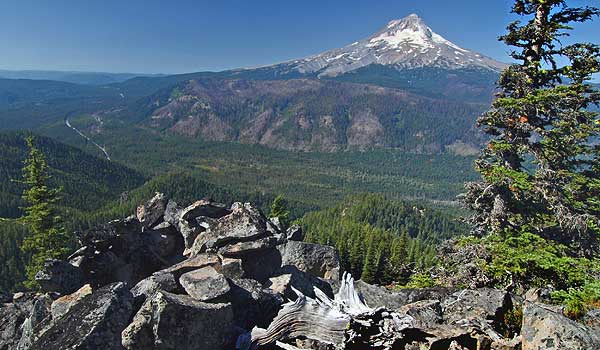
The Lookout Mountain vision quest pit pictured here has still more mystery surrounding it. While the location of the pit is typical – high on a rocky knoll, overlooking the East Fork valley and Mount Hood – the walls of the pit are stacked higher and narrower than most, possibly due to the steepness of the site.

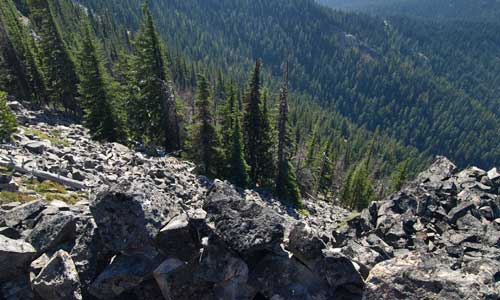
Looking down the steep slopes of Lookout Mountain from the vision quest pit

Looking down the steep slopes of Lookout Mountain from the vision quest pit

But even more perplexing are the worn traces of mortar between some of the stones (seen in the wall of the pit, toward the bottom of the second image). One possibility is that the mortar was an early attempt to preserve the site, given it’s fragile and exposed state. But who would have hauled both mortar and water to this site?

Perhaps early forest rangers who once manned a Forest Service guard station at High Prairie, a short distance away. The guard station was abandoned half a century ago, so this timing would be consistent with other, early 20th Century effort to “restore” Native American structures. This was famously done at several spots in Pueblo country, but might have happened here, too.

Whatever the answer, the Lookout Mountain vision quest site is among the most inspiring in the area, and it’s easy to imagine Native Americans seeking out spots like this for a spiritual journey. But it’s also easy to imagine sites like this being lost forever, for lack of a management imperative by the U.S. Forest Service to actively protect these places.

This kind of fragile resource is also among the best arguments for the Mount Hood National Park Campaign, since the Park Service has a long and proven track record of this sort of resource protection. In contrast, the Forest Service has aggressively logged much of the terrain around this site, oblivious to special places like this. So for now, obscurity is the best friend of these resources, until better stewardship finally comes to Mount Hood.

We have to choose?

Crown Point from Women's Forum State Park - a threatened view?

Crown Point from Women's Forum State Park - a threatened view?

According to the Columbia Gorge Commission website, the Vital Signs Indicators Project is “identifying several measures to assess changes in the scenic quality of the Gorge over time.” Translated, this means that the Gorge Commission has set up a web survey to poll the most popular Gorge vistas among the traveling public. The survey allows “up to three” favorite vistas for each of Interstate 84, Highway 14 and the Historic Columbia River Highway.

Wait..! Just three? Do we really have to choose? Well, yes. And according to the Commission, “the views with the most votes for each roadway will be included in the list of key Gorge views that will be monitored in the future by the Commission.” So, your votes matter, at least for this effort. The good news is that this project is intended to help the Commission cope with man-made eyesores that mar scenic vistas, as well as “vegetation management”, so that views like the classic scene from Women’s Forum Park (above) aren’t blocked over time.

Thus, hard as it might be to choose, you should take a moment to visit their website and take the survey. It will take you 10 minutes, or so, and you’ll be helping the Gorge in a small way. The survey runs through December 5, 2008, and after that, you’ll have to settle for reading the results. Here’s the link to the Gorge Commission website.