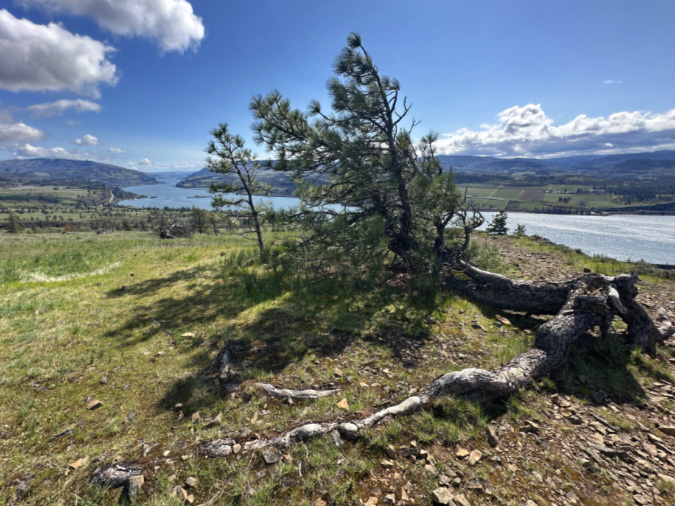
The old tree looking splendid last spring on its perch high above the Columbia River, looking eastward
Among the victims of the July’s Burdoin Fire in the East Gorge was a venerable Ponderosa pine that had clung to life for many decades on an exposed basalt shelf, high atop the cliffs of Rowland Wall. For years, it has been like an old friend to hikers passing this scenic overlook along the West Catherine Creek loop.
The July fire swept through less than a year after the Top of the World fire burned across the Catherine Creek area in October 2024. The old pine had managed to dodge that earlier event, and likely others before it, but the low-slung tree was completely overwhelmed by this year‘s blaze.
Ponderosa pines are built for fire, and have evolved to rely upon it. They’re part of the fire forest ecosystem on the east slopes of the Cascades, where they are a keystone species. Yet, their natural defenses of thick, fire-resistant bark and a high crown that extends beyond the reach of periodic fires couldn’t save this stunted old Ponderosa. That’s because extreme Gorge winds and exposure to winter ice and snow had transformed what might have been a towering, 90-foot tree into a contorted Krumholtz, natures inspiration for the ancient art of Bonsai.
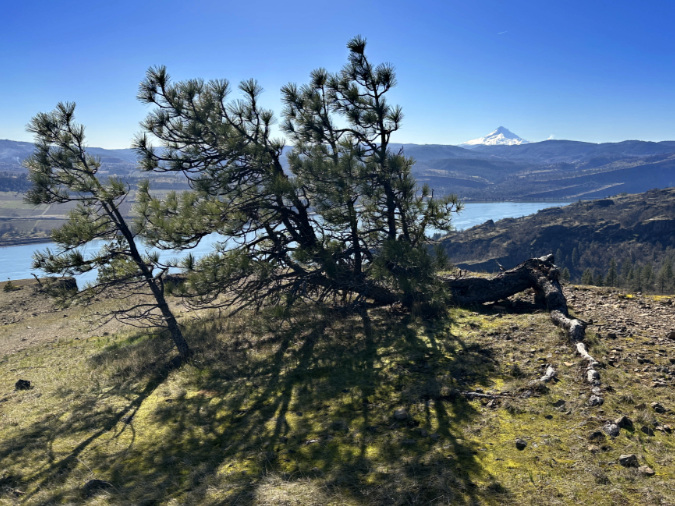
The old tree (and it’s offspring, on the left) also enjoyed a fine view downriver to Mount Hood
Ancient, sculpted trees like these have inspired humans for millennia, and it’s easy to see why. Their heroic efforts to adapt, their ability to somehow survive in unbearably harsh conditions and their sheer longevity lend a spiritual nature to these remarkable living things. The further fact that their lifespans in these harshest of conditions still exceeds ours by decades, and even centuries, only adds to their intrigue and fascination. Their fantastic, battered shapes tell a story about their survival like no other living thing,
__________________
I had a pretty good idea the old tree had been killed since viewing it from a far ridge several weeks ago. When I finally approached it up-close on the trail in mid-December, its grim fate was unavoidable. The old tree was gone. Only a totally charred skeleton remained.
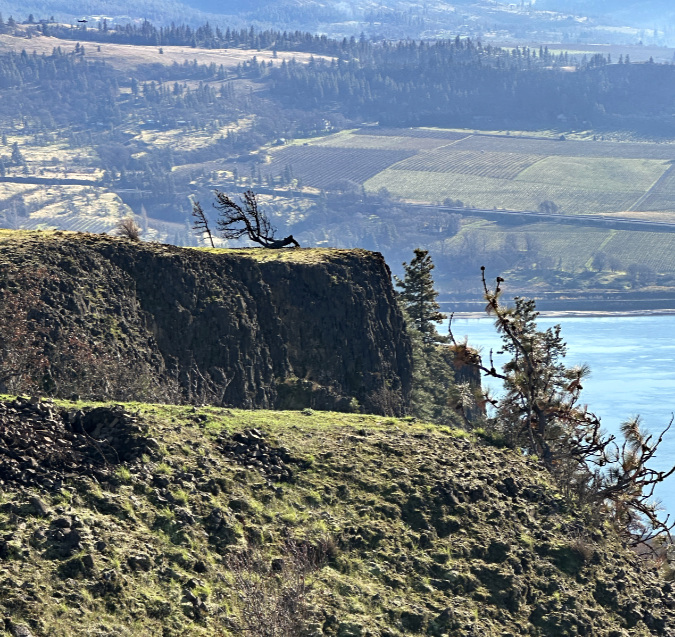
First glimpse of the old tree’s fate – a blackened skeleton on its lonely clifftop
Up close, you could see exactly what happened. Though blackened, most of the old, bleached deadwood on the tree had survived, yet the entire canopy had been torched and bark boiled off the living sections of its trunk and limbs. It must have been an incredibly hot firestorm when the fire rolled over the rocky shelf, though it didn’t linger enough to completely consume the tree.
As you can see in the opening photos, there wasn’t much fuel on the ground to feed the fire for very long here, suggesting that a tremendous wave of wind-blown flames simply rolled across this ridge and continued eastward.
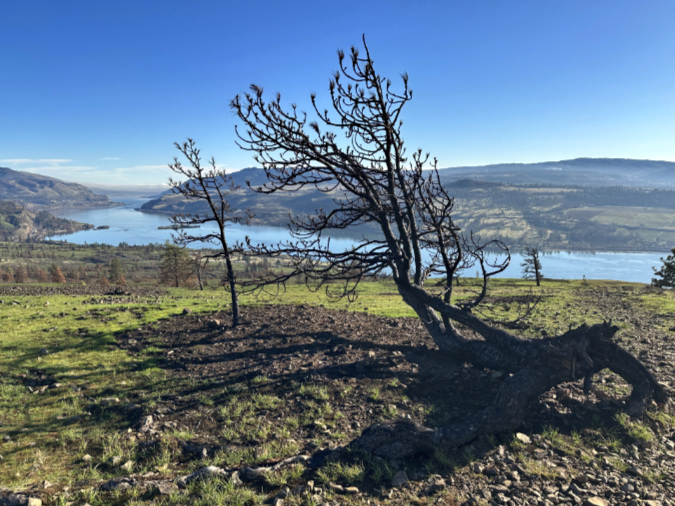
Though blackened, much of the deadwood on the tree didn’t fully burn, suggesting a very fast, very hot fire rolling through
The old tree had originally taken on its reclining shape when it was tipped over by strong winds long ago, yet it survived by virtue of a few intact roots on the lee side that continued to sustain it until now. Once tipped, two of its side limbs emerged as a pair of new replacement leaders, forming the new crown. The surviving roots that kept the tree alive were suspended above ground, however, and remained highly vulnerable to fire.
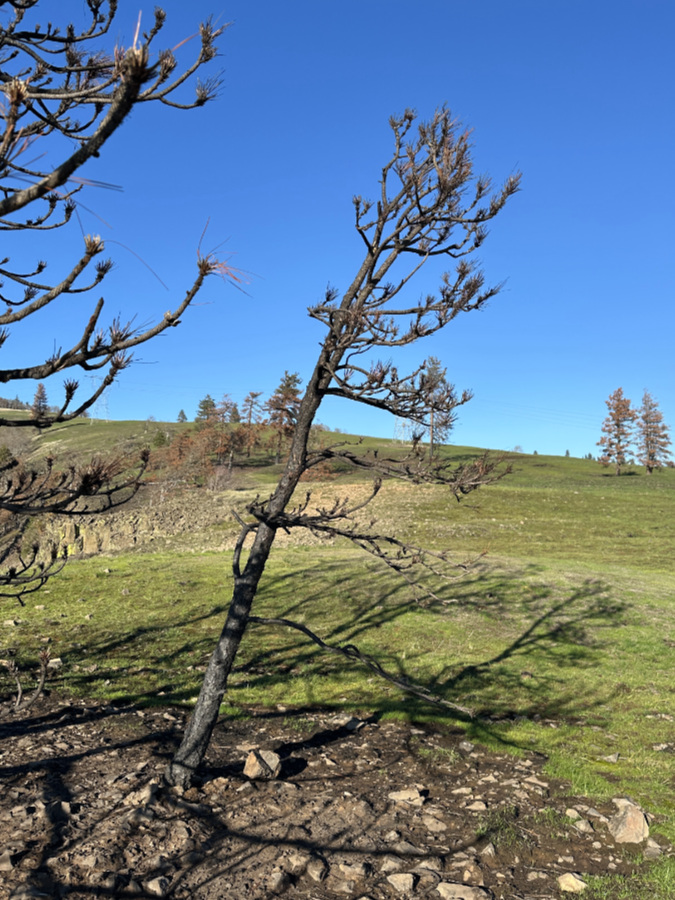
The little offspring of the old tree also perished in the fire, a common fate for young Ponderosa, and one that the species have adapted to. Fires help thin stands of crowded seedlings, creating our familiar Ponderosa parklands on the east slope of the Cascades
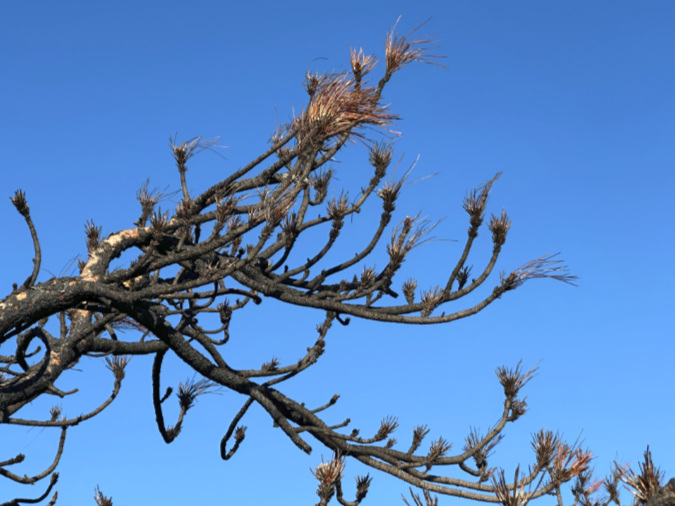
Grassland fires normally brown but don’t actually burn green needles on Ponderosa pine. The Burdoin Fire was so hot that it fully torched the needles on this old tree, completely burning them away in a flash.
This old Ponderosa was likely approaching a century in age, perhaps older. From this isolated ledge above the river, it probably witnessed the highways being built and the slack water ponding behind Bonneville Dam. It survived at least one major fire in its lifetime, though likely more. Fires are common here. This tough little tree survived numerous droughts and undoubtedly a few close lightning strikes, too. More recently, it survived a wave of beetle invasions that killed many healthy Ponderosa pine in the gorge.
For the past few decades, the West Catherine Creek loop trail has curved around this old tree, bringing it into new prominence and appreciation by hundreds of hikers who pass by each year and considered it a friend. Even its nearby neighbor (below), another picturesque, sculpted old tree along the trail, was killed by the fire, its top snapping off after the heart of the main trunked burned away from lingering fire.
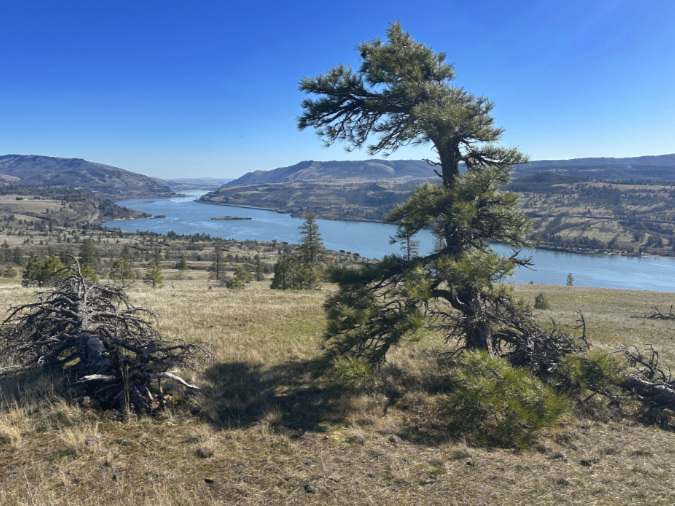
This neighboring Ponderosa survivor also succumbed to the blaze, though in this case it was the adjacent supply of dry, downed wood you can see in this view from March 2025 that sealed this trees fate by burning longer and hotter here
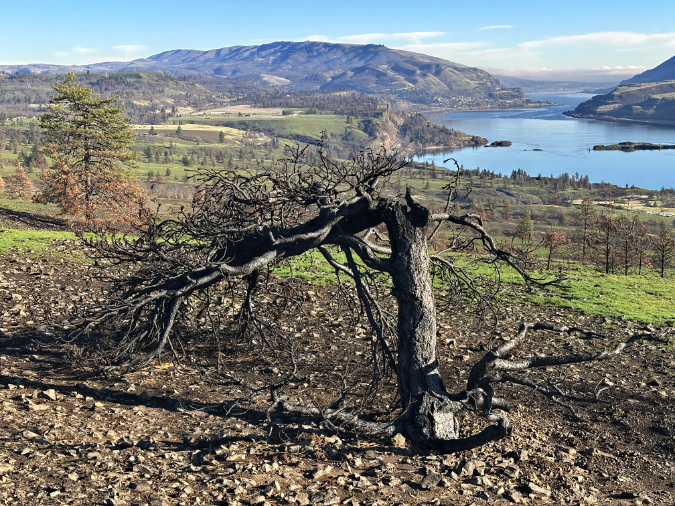
The scorched earth surrounding the skeleton of the neighboring Ponderosa shows just how hot and long the fire burned here, thanks to the fuel lying around the tree. The fire burned long enough her to hollow the tree and topple its crown
While it’s hard to say goodbye to these old trees, losing them serves as a needed reminder of what is at stake on our public lands. Fires are becoming more frequent and more destructive, and the large majority are caused by humans. Like any human-caused fire, this didn’t need to happen, nor can our forests keep up with the pace of human-caused fires with the changes in climate we are experiencing. Losing trees like these before their time also means depriving future generations the chance to appreciate as we have been privileged to.
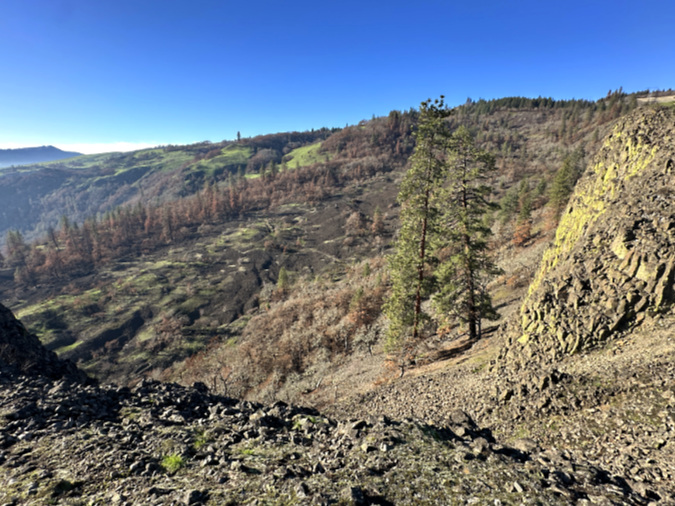
Oddly, the tall Ponderosas growing at the base of Rowland Wall escaped the fire entirely, just a few dozen yards from trees that were completely torched on the exposed rim. This could be their isolation on rocky talus slopes, or it could simply be how strong winds moved the fire through the area. The Burdoin Fire is presumed to be human-caused and began at the left base of the far ridge in this view, along Highway 14
It’s human nature to be sentimental when losing old survivors like these, though nature has no such attachment. In nature, there is a certain randomness when ancient trees are finally lost to fire, drought or disease that is beyond our human ability to fully understand, much less accept. They seem so tough and immortal — and yet we know they are irreplaceable, too, and therefore incredibly fragile.
Just down the rim from the old Ponderosa, that randomness of nature spared a spectacularly gnarled Oregon white oak (below). If the old Ponderosa was stooped, this old oak is downright crawling. Its limbs grow no more than two fee from the ground, yet it stretches nearly twenty feet in length, with a 10-inch trunk! Had the fire swept through it, it wouldn’t have survived. Yet, through that same randomness of the wildfire event, it will live to produce acorns for another season.

Like the old Ponderosa neighbor that lived just up the ridge, this old oak was tipped at some point, yet survived. It now grows as a flattened krummholz in this very windy, exposed meadow
With its bare winter limbs and bleached, gnarled trunk, this old oak could be mistaken for one of the many killed trees, save for the telltale unburned summer grasses that mark this as an unburned area. Like its Ponderosa neighbor just up the ridge, the beauty of this tree is in the story of perseverance and survival under the harshest of conditions that its contorted shape tells. That story is still told even after these old survivors have finally succumbed to the elements, when their skeletons slowly fade away in the dry, desert landscape.
Embracing their continuum
On the next ridge to the east, across the Catherine Creek canyon, another gnarled Ponderosa pine (two photos, below) lost its battle to survive before the recent fires raced through in 2024 and 2025. Its sun-bleached skeleton managed to dodge both fires, or it would be completely gone today. This old tree’s top lies on the ground, a few feet from its trunk, likely blown off by a lightning strike that also might have killed the tree. Lighting is a real threat for lone trees growing out in the open savannah of the East Gorge.

This old Ponderosa skeleton dodged both recent fires and still stands to tell a story of survival on this windy slope
This old skeleton is still sturdy, will likely stand for at least few more years, barring more wildfires. Its battered trunk still has some bark attached, and old snags like these can persist for decades in this environment. And, just as we are learning to appreciate the bleached ghost forests on Mount Hood for their own stark beauty, these old skeletons in the Gorge can be newly appreciated for their sculptured forms and they survival stories they continue to tell.
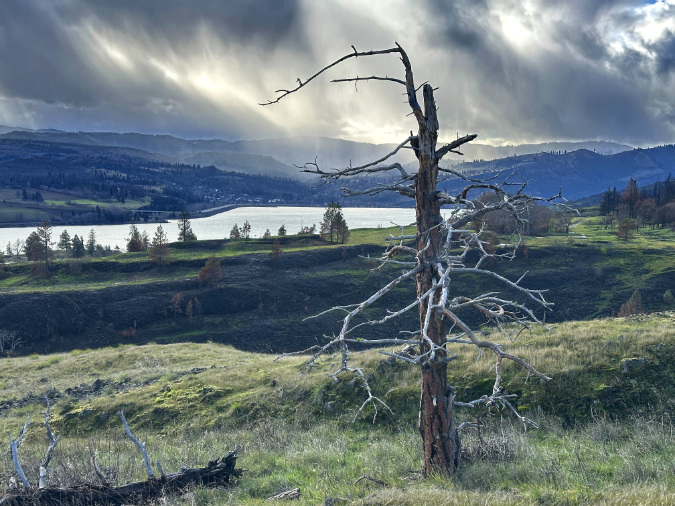
Winter storms battered the old tree in life and as a skeleton. This view is looking west, toward the Cascades and an approaching December squall
The part that comes less naturally for us is how these old trees embrace their larger continuum so gracefully. From a seed germinating in rocky Gorge soils, to becoming a mature tree, drawing water and minerals from the soil to grow and sustain a green canopy and produce seeds, and then eventually dying and decaying to become part of the rocky soil, once again. In our very own short lives, we focus on the living part, but for the Ponderosa pine and Oregon white oak trees of the east Gorge, the larger continuum is the point.
About a half mile downhill from the lightning snag is yet another Ponderosa skeleton (below) that has finally tipped over, after its roots had decayed and the Gorge winds had become too much to bear. Hundreds of hikers pass this tree carcass every year, though few take note of the story this old skeleton has to tell. This stunted survivor was only 10 feet tall when it was living, and yet its trunk was a foot thick. It was probably 75-100 years old when it finally it lost the battle to the elements, yet in life it likely produced some of the offspring that have now become the surviving Ponderosa pine in the distance.
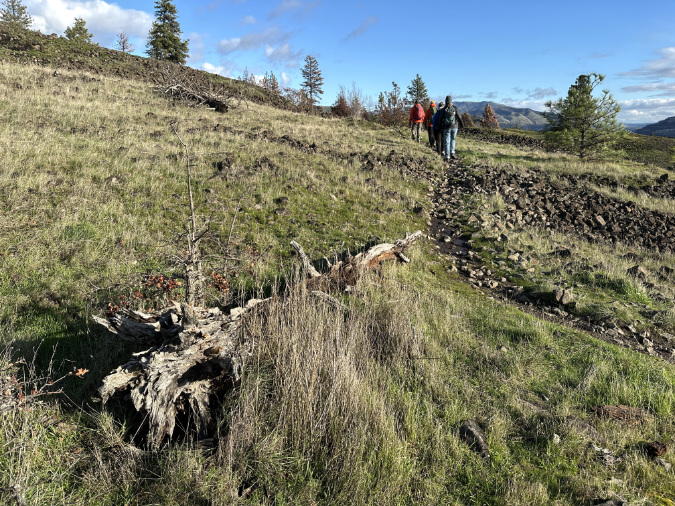
This stunted old Ponderosa Pine snag finally toppled, and now provides shelter and food for a young (leafless in this winter view) Oregon white oak seen poking up from behind
Even as its skeleton lies on the ground, rotting in this final stage of the continuum, the remains of old tree are providing a sheltered spot for a young Oregon white oak to get its start. Its decaying trunk is habitat for burrowing bugs and rodents, including a ground squirrel who stowed the acorn that sprouted to become the young oak. These residents of the old tree are helping to further break down the remaining wood into fine organic matter that feeds the little oak and a drift of wildflowers that have clustered around the skeleton.
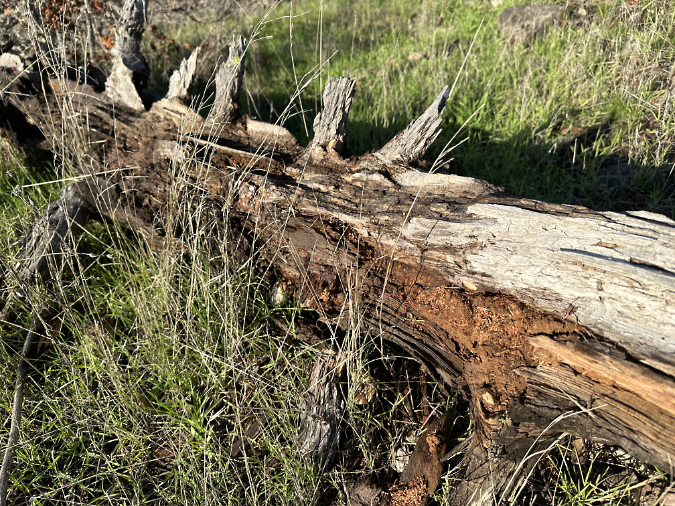
Bugs and rodents are active inside the toppled snag, helping to dismantle it to become part of the soil, once again
When we think of trees through a human lens, we focus on their survival as a means to simply reproduce for another year. But what if trees are mostly taking the longer view, using their ability (and apparent will) to survive to an old age as a means to produce and store as much organic matter as they can manage before they die, thereby creating new habitat and building the soil for the offspring of their offspring’s offspring? Why wouldn’t living things capable of surviving for centuries have this longer continuum as their greatest purpose?
Then, just imagine how different our lives would be if our every thought was grounded in providing for our grandchildren’s children’s children. Imagine how different our world would be!

__________________
Looking ahead in the New Year…
As of today, I have retired after 40 years in public service! It has been a great journey, but I’m now looking ahead to a lot more time on the trail, various writing and advocacy projects, and (of course) more time volunteering for Trailkeepers of Oregon (TKO) in this new year. I’ve been looking forward to this chapter in life!
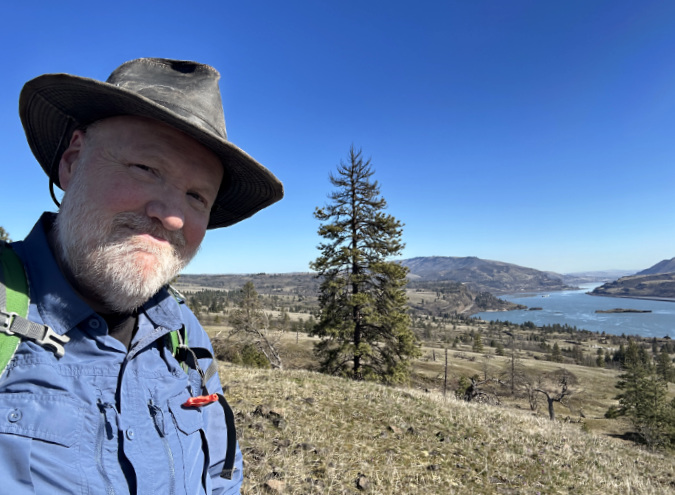
The (now reired!) author blending in nicely with bleached, gnarled old trees in the East Gorge…
As always, I appreciate you stopping by to read a long-form blog in the era of Tik-Tok videos and YouTube Shorts, and especially for your patience during the periodic dry spells in the blog over the past couple years. I plan to improve on that in 2026! Thank you for caring about WyEast Country, too. I know you may not always agree with what I post here, but I also know you love this place just as much as I do, and I appreciate the space to say what’s on my mind in that very generous spirit.
Next up in this new year? I’m working on a series of articles looking at the Burdoin Fire impact and recovery in depth. There is so much to learn from our wildfires! I’ve also got a couple surprises that I’ve been working on, including an overdue proposal to make the Timberline Trail a lot better for the hundreds (thousands?) who complete that classic around-the-mountain trek each year.
In the meantime, I hope to see you on the trail somewhere!
_____________
Tom Kloster | New Years Day 2026
 WyEast Blog