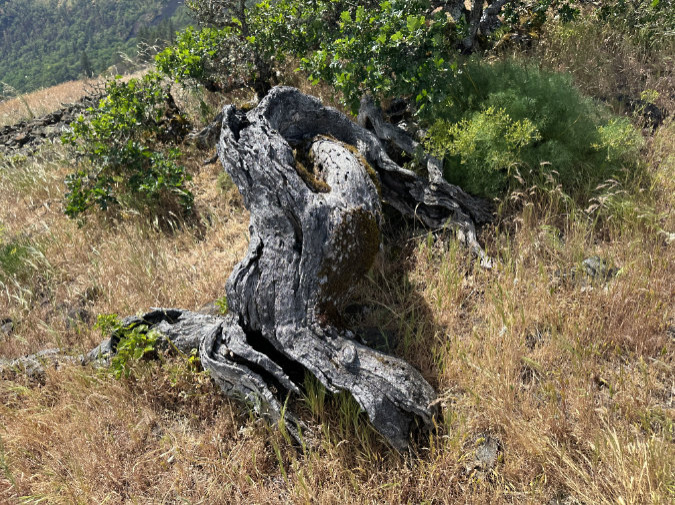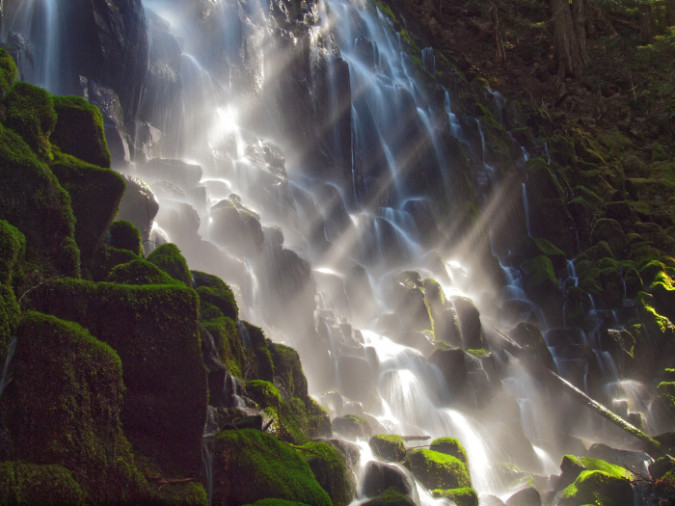
Morning sunbeams catching the mist at Ramona Falls
August was hot and dry in Oregon in 2014, and we were on the way to the hottest summer on record at the time. The combined heat and drought led to a predictable wave of wildfires that year, with a full 31 days of Level 5 fire conditions that surpassed all previous records by a full week.
No wonder, then, that Portlanders flocked to the mountains seeking cool respite from the heat. Among the most popular escapes was Ramona Falls, among the most visited waterfalls in Oregon and located just inside the Mount Hood Wilderness. The lacy, intricate beauty that makes the falls famous to photographers also creates a unique microclimate, cooling the air at the shady base of the falls by 15 degrees or more. On busy summer days, hundreds hike the rambling 7-mile loop trail and bask in the cooling mist and absorb the beauty of this idyllic, family-friendly place.
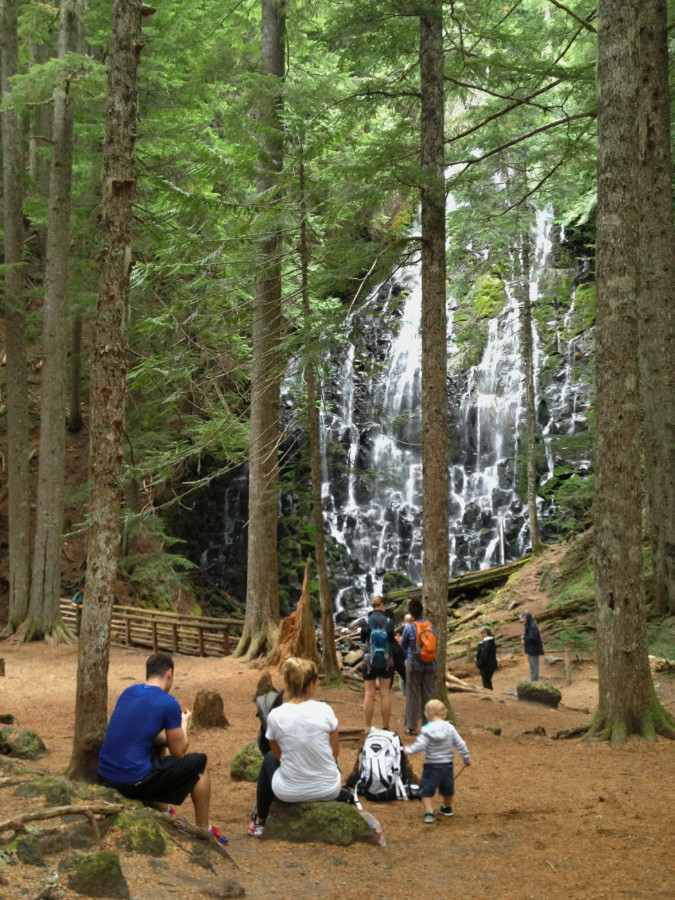
With its gentle grade and abundant scenery, the Ramona Falls loop has been a favorite family hike in the Mount Hood Wilderness for generations
Such was the scene that year on Tuesday, August 12. Hordes of hikers had set off from the crowded trailhead that day, only to be surprised by a sudden, intense thunderstorm that gathered over Mount Hood. As they returned to the seasonal footbridge over the Sandy River, just a mile from the trailhead, they discovered a suddenly raging torrent nearly touching the bridge.
Scores were able to cross the bridge safely, but hikers Nathan Johnson and Brent Ludwig met tragedy that day. They were taking up the rear with their group and still on the bridge when a flood surge dislodged a logjam just upstream, unleashing a sudden wave 5-8 feet deep that overtook the bridge. Both men were swept into the river. Johnson somehow survived the ordeal, but Ludwig perished in the torrent.
Brent Ludwig had come to Oregon on a visit from his hometown of New Lenox, Illinois, but he would not return. His body was later recovered by searchers more than a mile downstream.
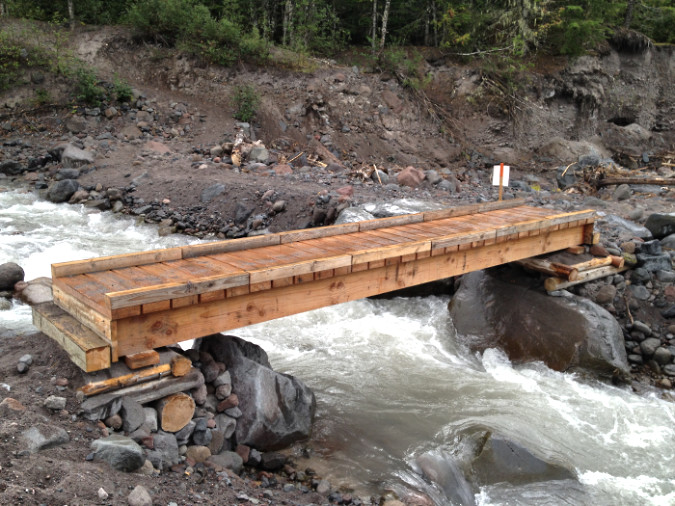
The Forest Service had just installed this seasonal bridge over the Sandy River on the Ramona Falls trail in 2013. One year later it would wash out in the tragic incident that took the life of Brent Ludwig. It has not been replaced since
Witnesses described a chaotic scene after the bridge washed out, with rescue workers ferrying hikers stranded on the north side of a raging Sandy River for several hours using a pair of tethered rafts. In all, 23 hikers were rescued that day. Meanwhile, other rescuers searched the river banks below for victims, eventually locating Ludwig.
The 2014 rescue was hampered by the relative remoteness of the washed-out bridge. Hikers who had made it across before the wash-out still had to walk another mile back to the trailhead, then drive several miles toward Highway 26 to reach the nearest cell coverage and report the dire situation.
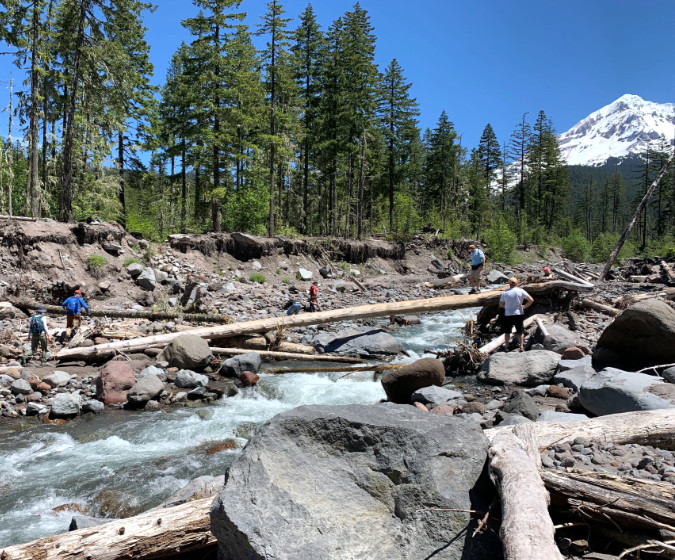
Hikers chose this precarious log to cross the Sandy River on the Ramona Falls trail in 2022… (TKO)
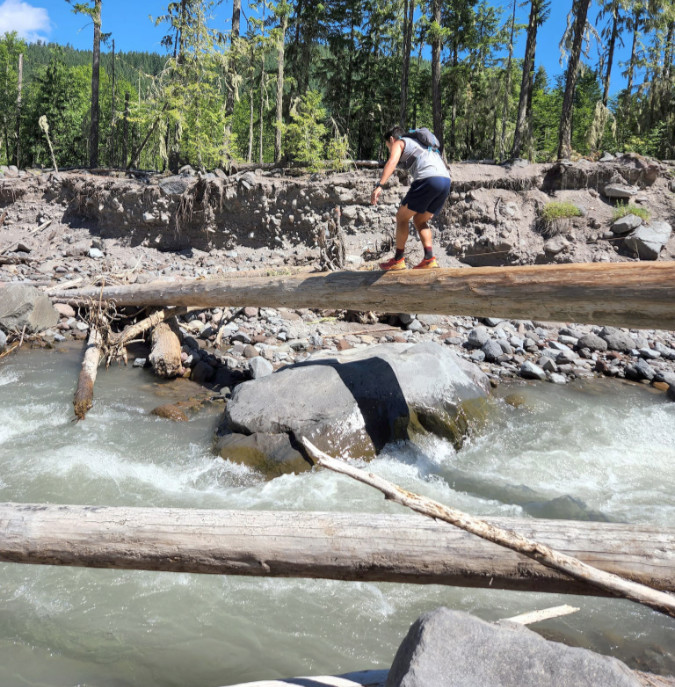
…and though it was the best available crossing, it was extremely dangerous, with hikers balancing ten feet above rushing glacial runoff and the large boulders that flank the stream (TKO)
Soon after the 2014 incident, the estate of Brent Ludwig filed suit against the Forest Service seeking damages for negligence. After many years in the courts, the case was finally decided in favor of the Forest Service in October 2021. In the meantime, the seasonal bridge on this heavily traveled trail had not been replaced, with the Forest Service pointing to the pending litigation as cause to simply leave Ramona Falls visitors to their own devices in crossing the Sandy River.
Though the court case is long settled, the Sandy River crossing still has no bridge, putting the thousands of hikers who head into the Mount Hood Wilderness for Ramona Falls each year needlessly at risk.
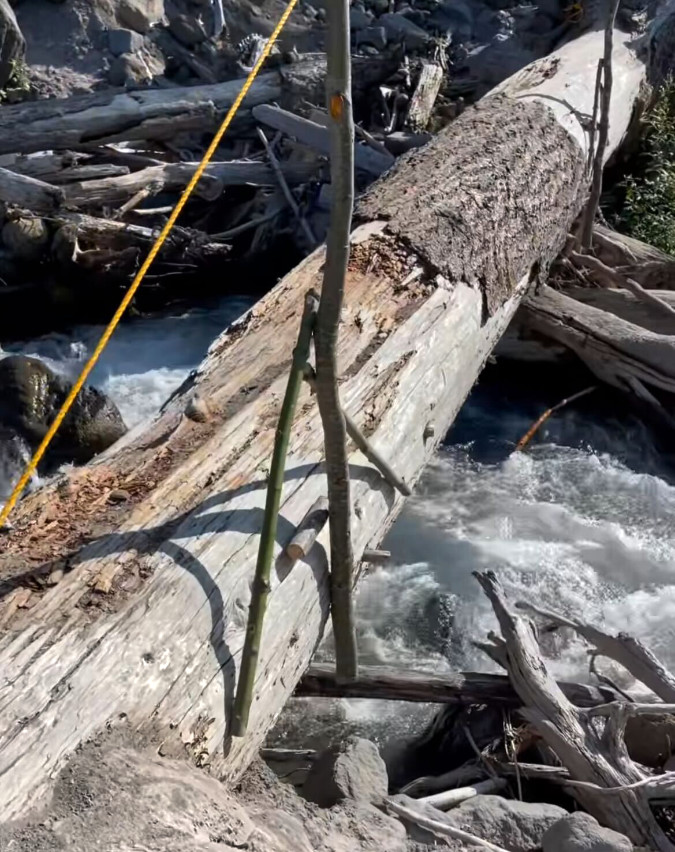
Though understandable, hikers often add makeshift rigging to log crossings, intending to improve safety – though trusting these rickety solutions can be riskier than the logs themselves. This rigged handline was later removed by volunteer trail crews in July 2024 at the request of the Forest Service (TKO)
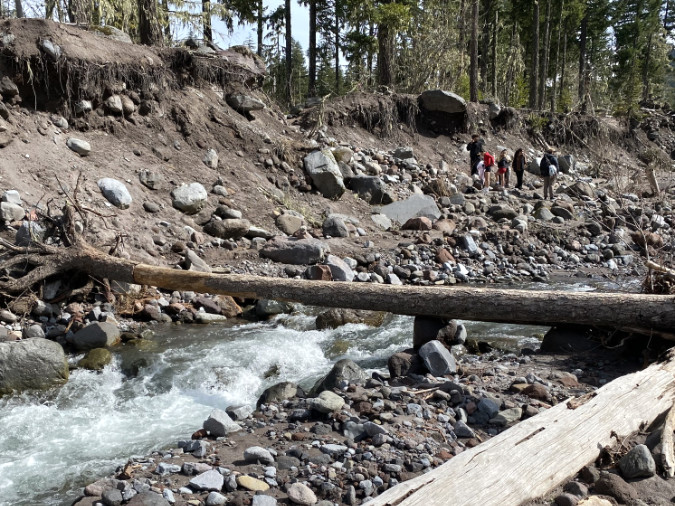
The otherwise family-friendly Ramona Falls trail puts hundreds of kids at risk each year when they must contend with the Sandy River crossing (Matt Bromley)
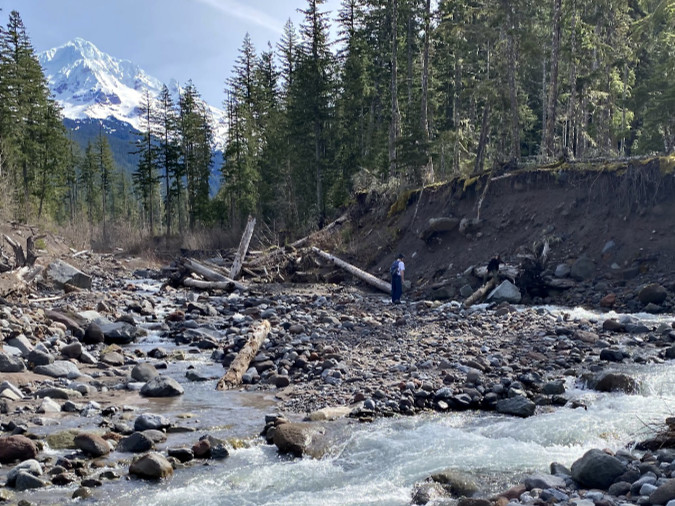
Hikers in March of this year searching for a Sandy River crossing on the Ramona Falls trail. Each winter the river reshapes the channel and shifts log piles (Matt Bromley)
Other Forest Service explanations for continuing to leave this heavily traveled crossing bridgeless have included legal restrictions from its wilderness status and the idea that leaving the crossing in its current state will somehow self-manage the overcrowding that exists on this popular trail. Still another argument is that danger involved in making the crossing is somehow part of the “wilderness experience”.
None of these arguments holds up. First, the Wilderness Act clearly allows federal lands agencies wide discretion to construct footbridges where needed to “protect the health and safety of persons within the area”. There are many examples to point to, but most obvious are the two wilderness bridges over Ramona Creek, itself, on this very hiking loop. Both are modest stream crossings that present exponentially less risk to public health and safety than the Sandy River crossing.
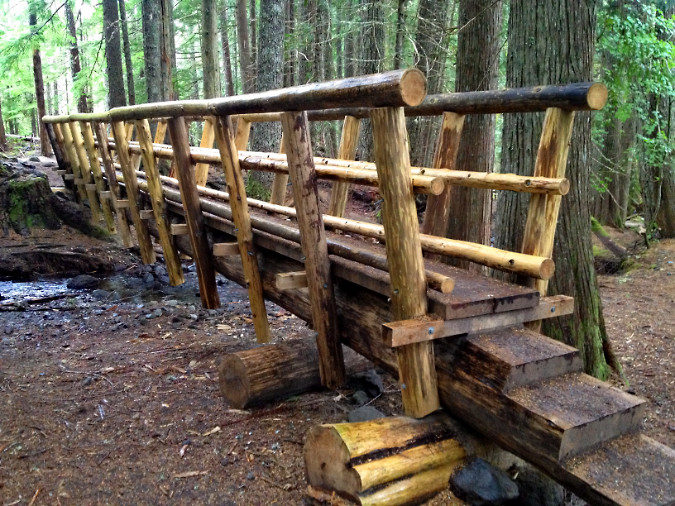
This impressive new bridge over Ramona Creek was built inside the Mount Hood Wilderness boundary in 2012, just a half-mile beyond the bridgeless Sandy River crossing
Predictably, the lack of a safe crossing at the Sandy River since the 2014 incident has also done little to deter hikers from showing up here. Instead, the crowds have grown, thanks to both social media, the growing popularity of hiking and of the spectacle of Ramona Falls, itself. There are many proven tools for managing crowded trails in our wilderness areas. Making the experience more dangerous should not be among them, nor should forcing visitors to take undue risks be considered part of the “wilderness experience”.
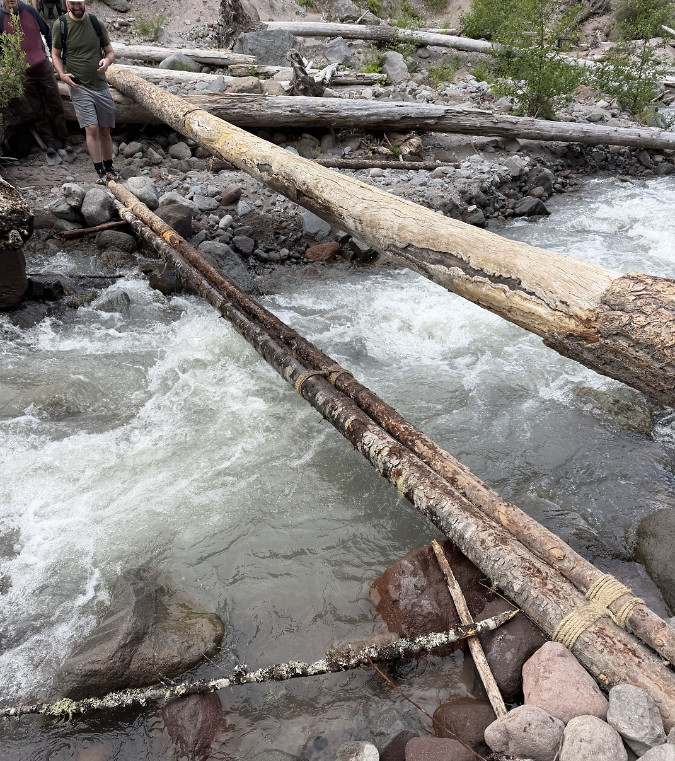
Impromptu Sandy River crossing installed by hikers, as seen in early June 2026… (Kevin Lu)
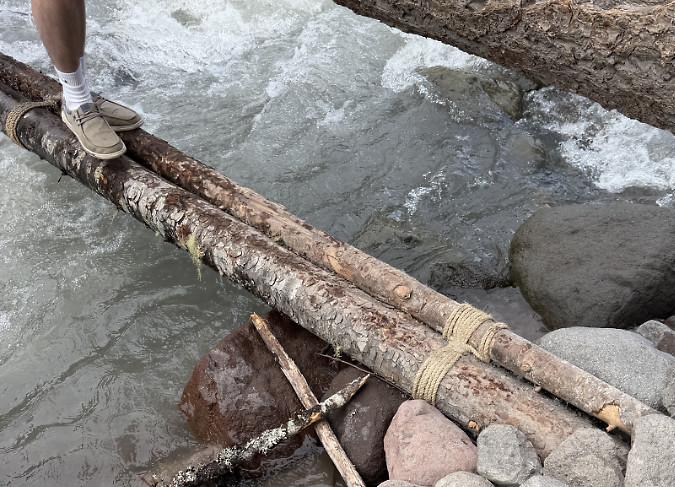
….this effort involved lashing two thin poles together (Kevin Lu)
As it proved in 2014, the Sandy River can be unruly – like all of Mount Hood’s glacial runoff streams. They are prone to flash floods year-round and have become even more erratic as the mountain’s glaciers and winter snowpack recede with global climate change. This means a nearly constant re-arranging of the river channels each year, with hikers searching for fallen logs to inch their way across the streams where trails cross them.
While challenging for any hiker, it’s an unacceptable situation at the Sandy River crossing on the Ramona Falls trail, where young children, less able-bodied or experienced hikers and small pets make up such a large share of the visitors.
It’s long overdue to fix this crossing.
Ten Years Earlier…
The summer of 2004 was much different than 2014 would turn out to be for Oregon. The west side of the state experienced unseasonably cool, wet weather, with rare summer snows on Mount Hood as low as 6,000 feet. The last week of August that year was especially stormy, with the west slopes of the mountain receiving as much as 10 inches of rain from August 21-25. This, at a time of year when thousands of hikers from around the world come to Mount Hood to experience the iconic 42-mile Timberline Trail.
One of these hikers was Portlander Sarah Nicole Bishop, a 27-year-old backpacker who had started her clockwise trip around the mountain at the Ramona Falls trailhead. Sarah set off across the Sandy River footbridge and past Ramona Falls on the first day of a planned 4-day loop around the mountain. She was a seasoned backpacker and well-prepared for adverse conditions.
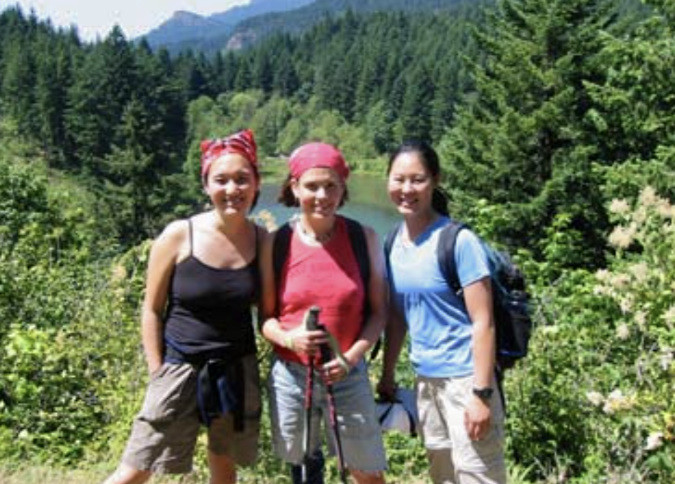
Sarah (center) and friends in 2004
By all accounts, Sarah Bishop was a force of nature just beginning to make her mark in the world. In her young life, she had worked at youth camps, been a residential counselor, social work case manager and had served as a crisis intervention specialist with Harry’s Mother, a Portland youth shelter.
She was politically active, creating and managing 100 Percent Portland, a democracy project to promote voter registration and civic duty. Sarah was outspoken for workers’ rights and an active member of the International Workers of the World (commonly known as ‘Wobblies.’) Her future was very bright.
On the fourth and final day of her wet circuit around the mountain, Sarah passed Timberline Lodge, stopping for hot chocolate. before pushing ahead to the Zigzag River crossing, climbing to Paradise Park. From there, she had only the steep descent to the Sandy River and two river crossings before reaching her starting point at the Ramona Falls trailhead. Sarah had safely managed several crossings over rain-swollen glacial streams on her circuit, and hikers who encountered her as she made her way back to the Ramona Falls trailhead reported that she was in good spirits and enjoying her hike.
Read moving reflections here from all four hikers who encountered Sarah on August 26, 2004
Sarah had started her hike on Saturday afternoon, August 21, crossing the Ramona Falls footbridge over the Sandy River when conditions were still dry. By that night, the weather changed and the Sandy River had flooded its banks and washed out the bridge. Worse, by the time she was returning to the trailhead on that final day of her hike, she would also have to contend with the bridgeless upper crossing of the Sandy River along the Timberline Trail. It was here that Sarah’s life was cut tragically short.
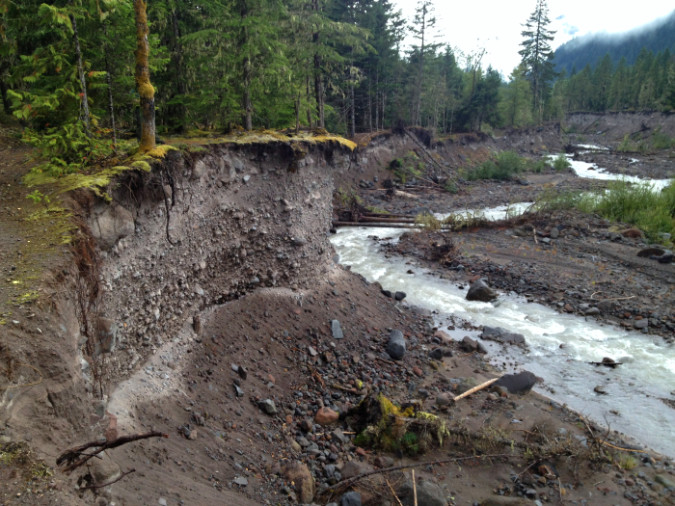
The Sandy River channel is wide and ever-changing. Much of the river is lined with steep bluffs where the stream has continually flooded and undercut its banks. This view is near the junction of the Pacific Crest and Ramona Falls trails (Bruce Bishop)
When Sarah did not return from her hike as scheduled on Tuesday, August 24, her family became concerned, but they were informed that a search and rescue could not be authorized until it was verified that Sarah was on the mountain. That kicked off a search for her truck the next day by her father Bruce and Sarah’s partner Joseph at the most likely trailheads, beginning at Cloud Cap and working clockwise. It was raining and dark when they finally found Sarah’s car at the Ramona Falls trailhead at 10 PM that evening – the last vehicle in the lot. They reported her missing to the Clackamas County Sheriff that night.
The formal search and rescue effort began the next morning on Thursday, August 26, with teams searching the 12-mile section of the Timberline Trail between the Ramona Falls trailhead and Timberline Lodge where Sarah was last seen. At around 2 PM that afternoon Sarah’s body was found along the Sandy River, about a half-mile below the upper crossing on the Timberline Trail, and just three miles from her truck.
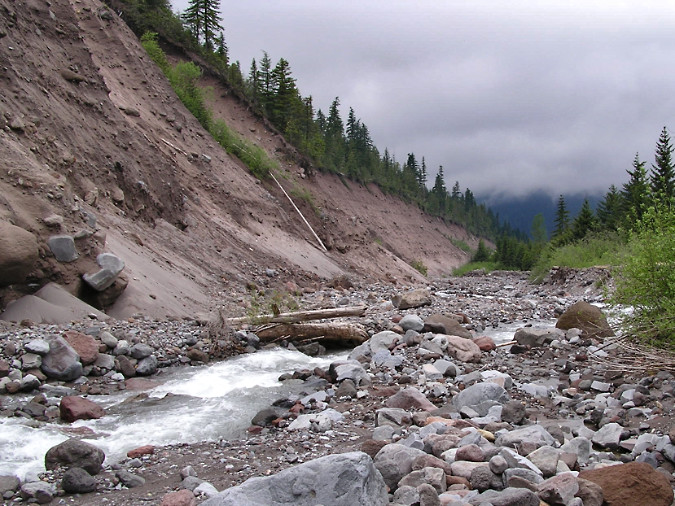
This view shows the high, unstable bluffs below the Timberline Trail ford where Sarah may have fallen while scouting for a safe crossing (Bruce Bishop)
Sarah still had the waistbelt on her pack buckled and her boots on when searchers found her, so her family believes she had been scouting for a spot to cross the unseasonably high Sandy River. While searching for a place to cross, she may have slipped into the river from the steep bluffs that line this section of the stream, possibly becoming injured in the fall.
If you have hiked into the Mount Hood Wilderness in the decades since, you likely know Sarah’s story from the work her family has done to honor her memory and to educate hikers on the dangers of glacial stream crossings. Near each of five wilderness trailheads — Ramona Falls, Top Spur, Cloud Cap, White River and Timberline West – Sarah’s story is shared on interpretive trail signs that warn of the danger and provide tips for safe stream fords.
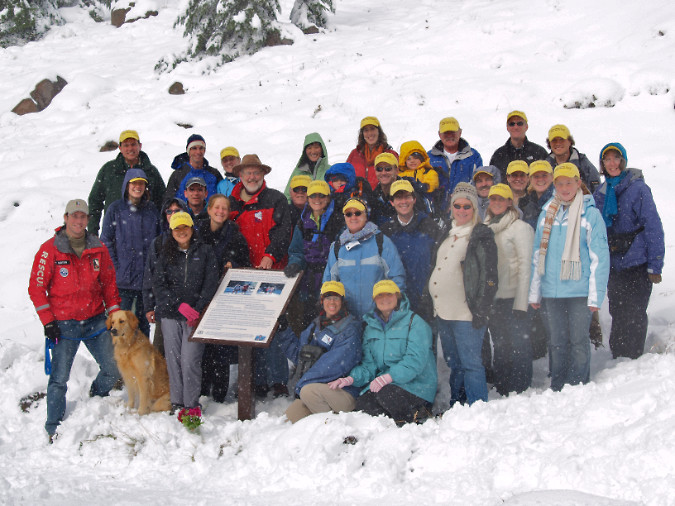
An early snowstorm greeted volunteers installing the sign west of Timberline Lodge on September 29, 2007 (Bruce Bishop)
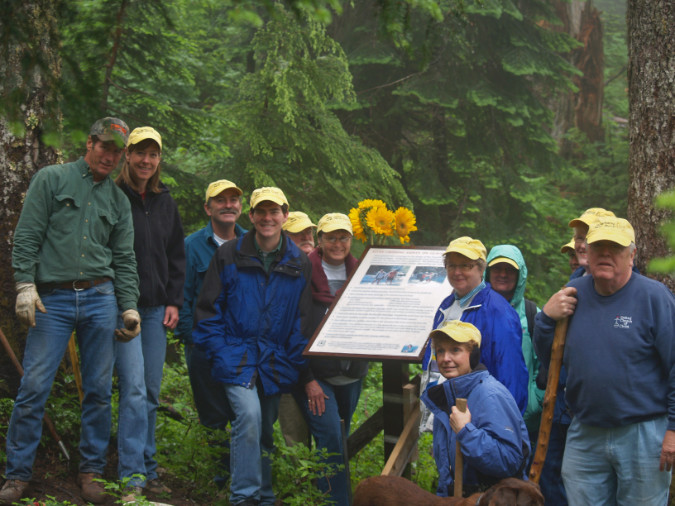
Volunteers installing the Top Spur sign on August 1, 2008 (Bruce Bishop)
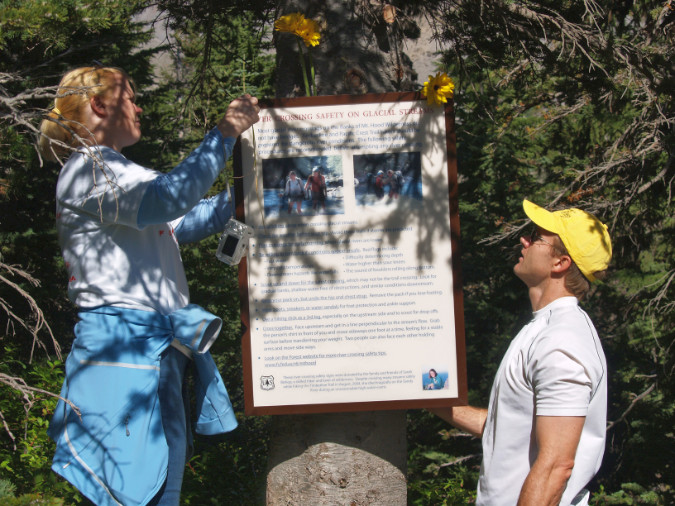
Sign installation near the White River wilderness boundary on September 27, 2009 (Bruce Bishop)
Sarah’s family worked with the Forest Service to design, build and install these signs, though they were completely privately funded. All five signs are still in place today. Sarah’s family and friends regularly visit and maintain each sign, an effort that continues to be privately funded as a labor of love by those who loved Sarah.
_________________
The seasonal Sandy River bridge on the Ramona Falls Trail was replaced by the Forest Service after Sarah died in 2004, and was installed each summer until the 2014 bridge tragedy. Sarah’s family and friends crossed the bridge in 2005 and hiked another two miles upstream to the spot where Sarah was found to celebrate her memory. Sarah’s parents, Bruce and Judy Bishop, were joined by her 83-year-old grandmother and more than two dozen others on that memorable day. The yellow caps in the photos that follow were made for the occasion, and read “Remembering Sarah Bishop”.
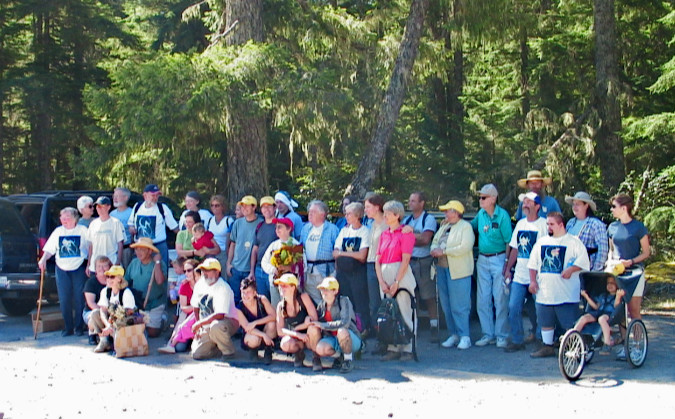
Sarah’s family and friends gathered on August 27, 2005 to hike a section of the Ramona Falls loop in remembrance of her life (Bruce Bishop)
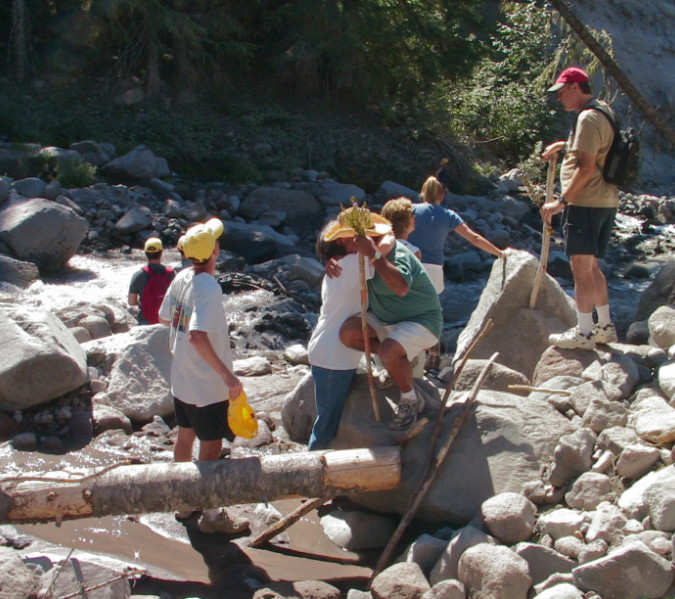
The 2005 remembrance hike ended at the upper Sandy River crossing where Sarah had lost her life the year before. Soon after, Bruce and Judy Bishop resolved to pay tribute to Sarah’s memory in service to other hikers (Bruce Bishop)
Over the next two years, Bruce and Judy worked to gain approval of the plan, and by the summer of 2009 all five signs had been installed by Sarah’s family and friends, with Forest Service staff support on hand.
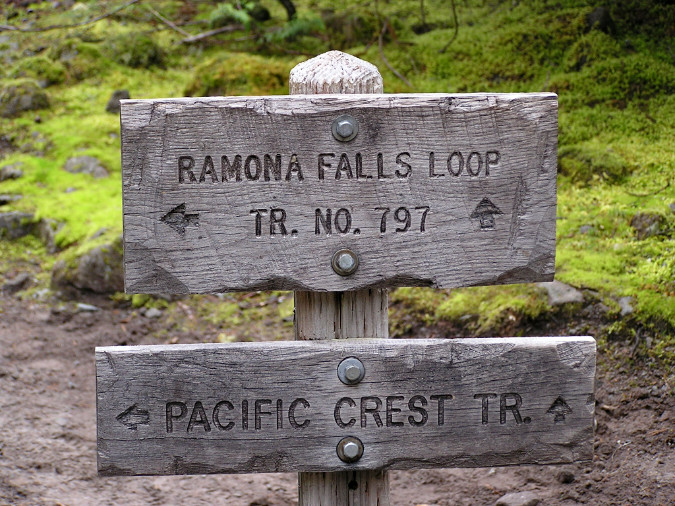
Ramona Falls Loop sign (Bruce Bishop)
Sadly, many of those who gave tribute to Sarah on that memorable day in 2005 would not be able to repeat the trip today. The bridgeless Sandy River crossing on the Ramona Falls trail is an untenable barrier for so many. While it’s a frustration for many who would simply like to visit the falls, it’s a more profound disappointment to those who would pay tribute to Sarah’s memory near the place where she died.
It’s time to fix this crossing.
_________________
Last winter, I had the privilege of meeting Bruce and learning Sarah’s story. We’ve since met several times to figure out how to get the Forest Service unstuck on this long-overdue need at Ramona Falls – and at other increasingly dangerous glacial stream crossings around the mountain. The following is a Q&A with Bruce on the subject:
WyEast: Bruce, when you picture the bridge finally being restored at the Ramona Falls trailhead, what would that mean to you? Who are the folks that come to mind that you’d like to see walking over it, once again?
Bruce: Our family first hiked to Ramona Falls with church families, probably in 1984 when Sarah was 7 years old. Over 20 years later, our memorial hike included a group with a wide range of ages and abilities. Such groups today can’t visit Ramona Falls safely. While the hike to the river is enjoyable, continuing to the falls makes the hike spectacular. I’d like families with young children and elderly great grandparents like us to be able to see Ramona Falls.
WyEast: By all accounts, Sarah was a force of nature, and loved being in nature. Wilderness trails seem to be where she recharged and found the energy to have an impact in her daily life. Can you tell us more about what it meant to her to be out in nature?
Bruce: In her youth, Sarah went to church camp every summer outside Molalla and became a camp staffer and director there through college. She hiked around Mt. Rainier with a group of incoming students for her orientation to college. It rained, and she was the only one to have packed rain gear for the hike. After college, she hiked extensively in the Gorge and on Mount Hood. And in early August 2004, she and a friend hiked to the top of Pilot Rock in the Rogue River Valley. A photo from that predawn hike was used for the woodcut in the poster below.
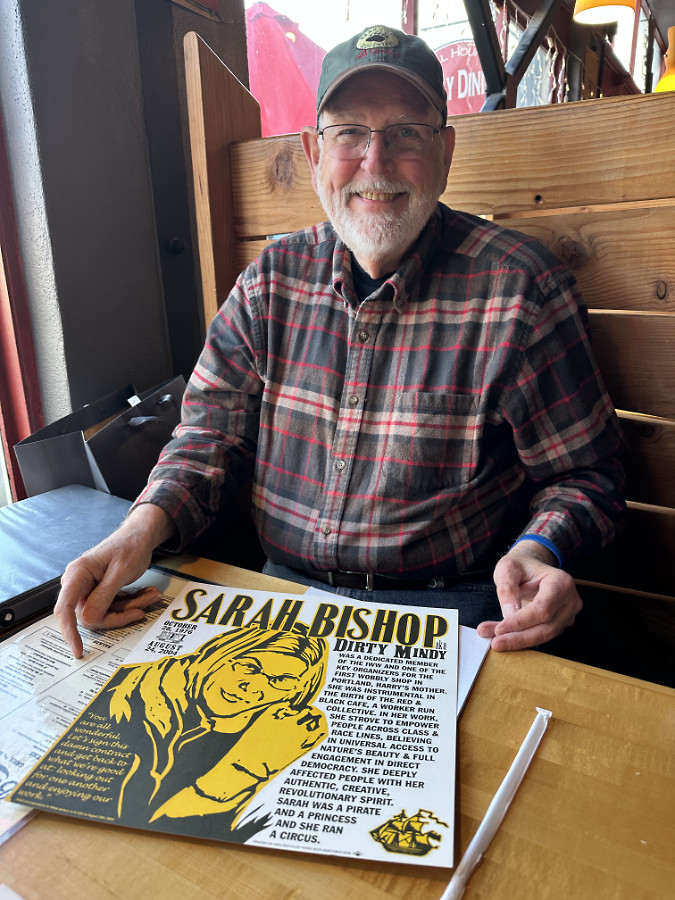
Bruce and Judy Bishop have worked for 22 years to honor Sarah’s life and make something good from the tragedy of her death
WyEast: In 2005 you led your family and many of Sarah’s friends on a remembrance hike to the spot where she was found. How did that day lead to the wilderness sign project?
Bruce: Many of those at the memorial hike in 2005 spent that weekend at our church camp, a place that Sarah loved. We caravanned from the camp to the Ramona Falls trailhead for the group hike, passing the studio for Mt. Hood ceramists Dave and Suzanne Enna. After the hike, we stopped at their studio sale, and several family members purchased pieces of Enna art. As a youth, Dave had attended our church in downtown Portland and created the communion ware for the church, as well as Sarah’s urn.
Following the memorial hike and inspired by Dave Enna’s ceramics, Judy and I agreed that signs promoting hiker safety would be a fitting memorial for Sarah, and we contacted Forest Service staff to turn the idea into reality.
WyEast: We’ve talked about the Ramona Falls trail being special because of both its beauty, but also its accessibility to the average person – not just avid hikers. Is that part of your motivation for finally getting the Sandy River crossing fixed? Is it something Sarah would have been passionate about?
Bruce: Sarah had a diverse array of “passions.” Her friends who inscribed her memorial poster described her well when they wrote, “[She] was a dedicated member of the IWW and one of the key organizers for the first Wobbly shop in Portland, Harry’s Mother. She was instrumental in the birth of the Red and Black Cafe, a worker run collective. In her work she strove to empower people across class and race lines, believing in universal access to nature’s beauty and full engagement in direct democracy. She deeply affected people with her authentic, creative, revolutionary spirit. Sarah was a pirate and a princess and she ran a circus.”
_________________
So, how would this happen? If the question is to simply restore the seasonal Sandy River footbridge on the Ramona Falls trail, that’s very easy. The Forest Service simply needs to say yes. It really is that simple, and it’s long overdue.
In reality, it won’t be that simple. Yet, I’m confident that Bruce and Judy Bishop, and all who loved Sarah, will keep at this and persuade the Forest Service to finally do what’s right for the many people who come to the Mount Hood Wilderness to spend a day in nature and marvel at the beauty of Ramona Falls. I like their odds, as they have Sarah’s memory on their side.
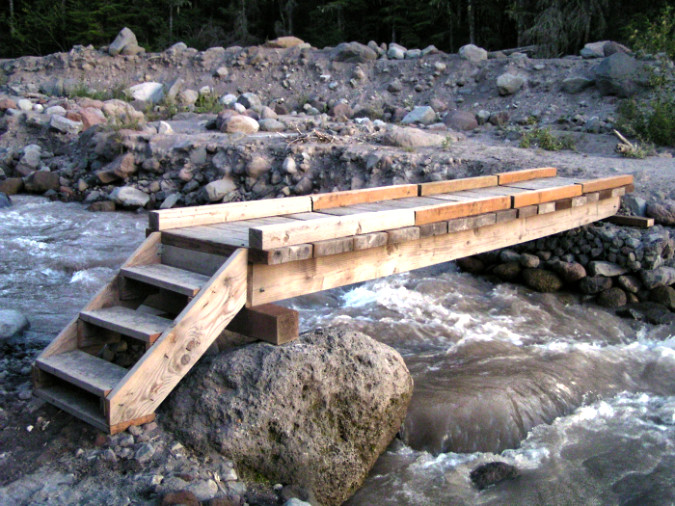
The seasonal Sandy River footbridge at the Ramona Falls trailhead on August 20, 2004. Sarah would cross this bridge on the first day of her hike around the mountain. The next morning, it was gone in the stormwaters that also took Sarah’s life.
_________________
Postscript
After my first meeting with Bruce last year, I dug into my photo archives and folders to prepare this article. I remembered seeing the new trailhead signs for the first time at the Top Spur trailhead, and discovered I had taken photos of the new sign back in September 2008 — including this detailed view of Sarah:
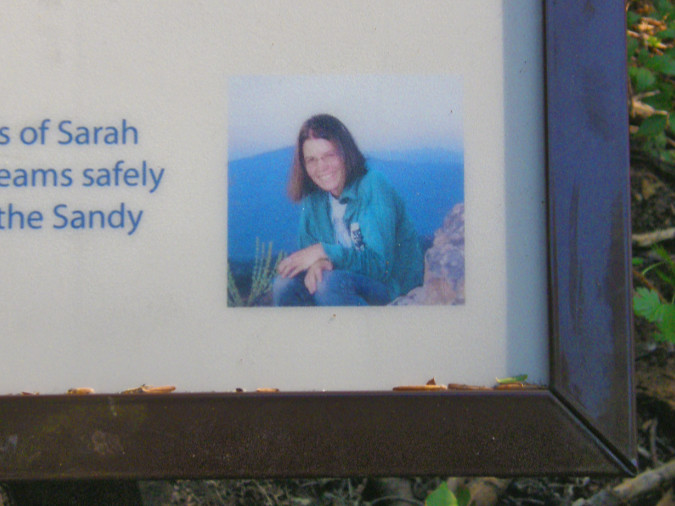
Each of the trailhead signs include Sarah’s image and memory as a reminder of the real dangers that crossing glacial streams present
At the time, I remember being pleasantly surprised that the Forest Service had even agreed to the signs being posted – no small task! I also remembered the tragic incident, and after searching through my archives, I found I had saved this Oregonian article back in 2004 in a folder dedicated to the stream crossing situation on Mount Hood. Clearly, the problem is not new, though it has certainly worsened in the intervening years.
As I looked back into my photo archives, I was startled to discover that I had walked the Sandy River and Paradise Park sections of the Timberline Trail the same week Sarah had. These photos of the Sandy River from the Ramona Falls trail are from August 20, 2004, the day before Sarah would walk this trail to begin her hike:
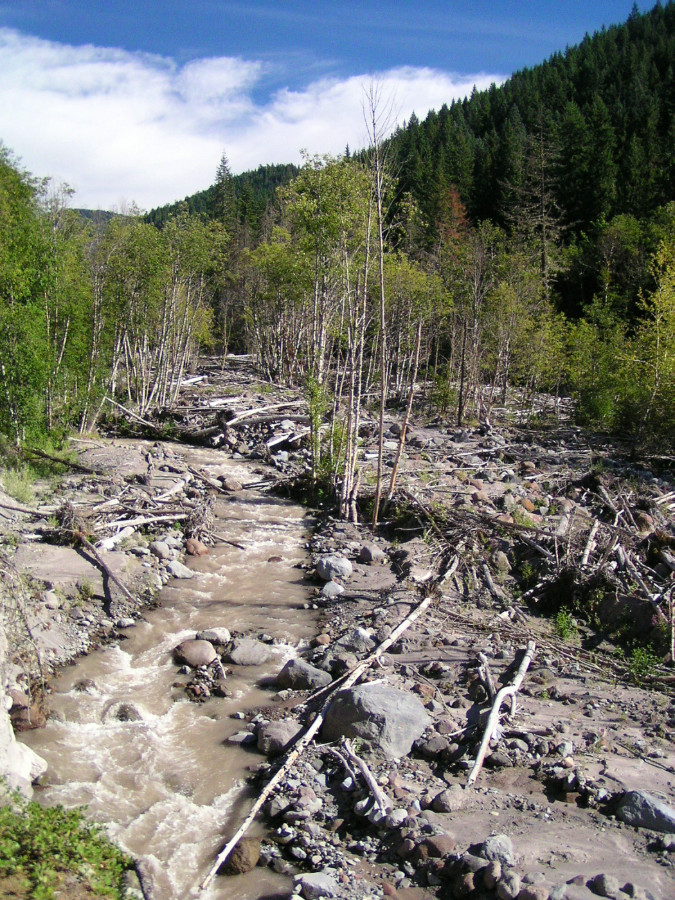
The ravaged Sandy River floodway along the Ramona Falls trail on August 20, 2004. The next day, the river would swell once again from the storm that took Sarah Bishop’s life
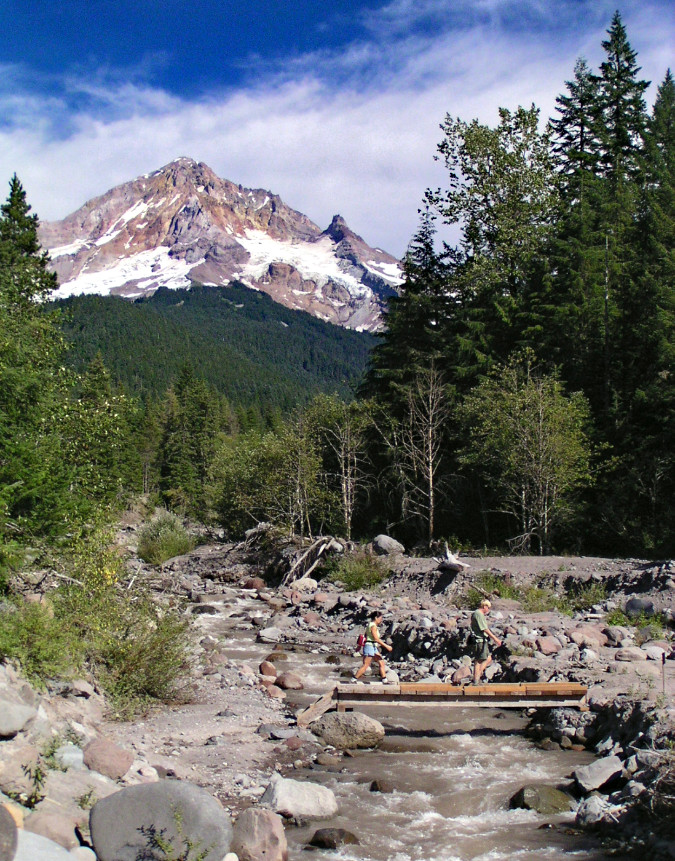
Hikers crossing the Sandy River bridge to Ramona Falls on August 20, 2004. Sarah Bishop would cross this bridge the following day to begin her 4-day trip. Within a day of her crossing, the bridge would wash out in the storm that took Sarah’s life
One week later, I would hike the Timberline Trail west from Timberline Lodge to Paradise Park, the section where Sarah was last seen just days prior. My motivation for going there on that day was scenery. There had been a break in the weather, with fresh snow on the mountain from the same storm that had made Sarah’s trip so tragic. These are scenes from Paradise Park on that day, August 28, 2004:
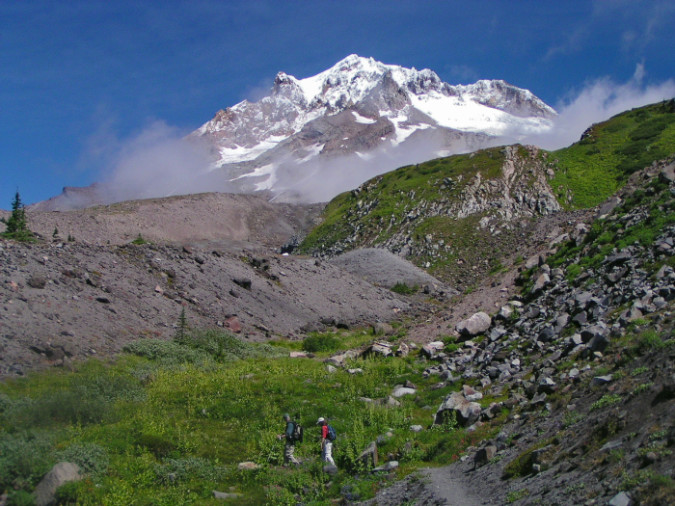
The powerful storm that swept over Mount Hood while Sarah Bishop hiked the Timberline Trail cleared abruptly, leaving a rare dusting of August snow on the mountain. This scene was captured at Paradise Park on August 28, 2004, just four days after Sarah hiked through
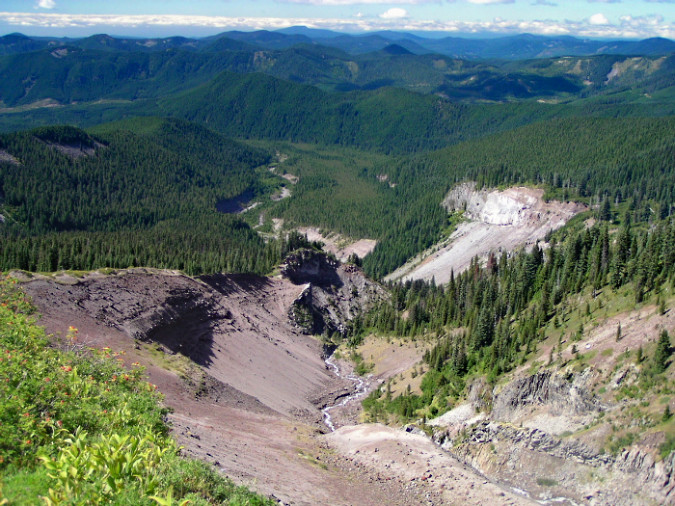
Looking down the Sandy River canyon from Paradise Park toward the Timberline Trail crossing and Ramona Falls area, far below, on August 28, 2004
Though I was likely thinking of Sarah on this second trip — as I had archived the news coverage account the day before — rediscovering these photos and meeting her father after 22 years made Sarah’s story all the more real and impactful. The real gift in writing this article has been getting to know Bruce. Through his eyes and memories, I can begin to appreciate the amazing, inspired person behind that familiar face on the trailhead signs, and why she lives on so vividly in the hearts of so many.
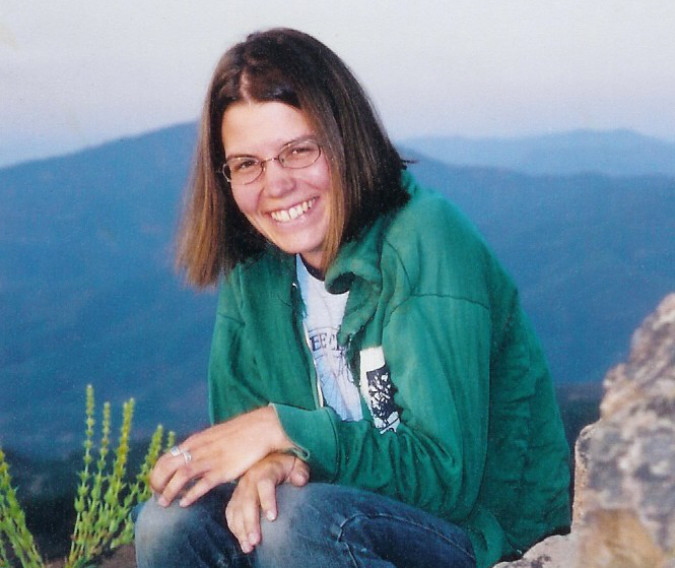
Sarah Bishop hiking at Pilot Rock, Oregon in August 2004, just a few days before her tragic death on Mount Hood
Sarah’s tragedy raises the larger question about the many other dangerous glacial outflow crossings on the mountain today. While her death might not have been preventable, the lack of safe crossings on the Timberline Trail today remains unacceptable. Watch for a follow-up article with a modest proposal to finally move forward on this front.
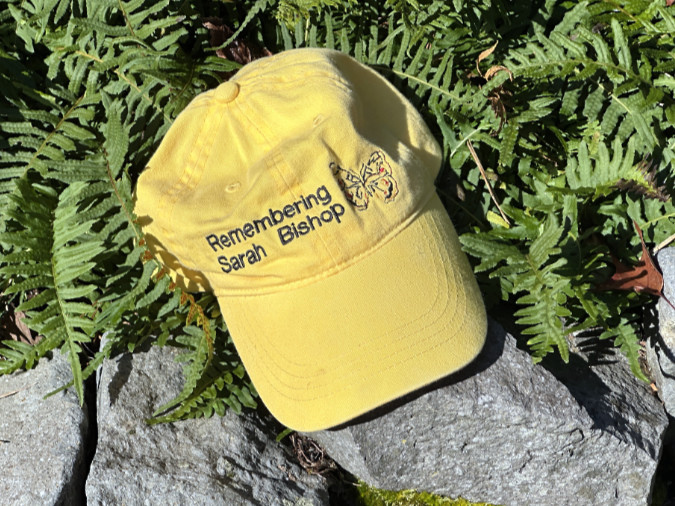
Remembering Sarah…
In the meantime, we can all take lessons to live by from Sarah Bishop: connect with the world around us, take the time to care and make the time to act on our convictions. Be brave and step up to uncomfortable challenges. Reach out and help. Make a difference where we can.
Sarah continues to inspire those who knew and loved her because of that undefeatable spirit. We should thank her for that – and remember her.
(updated June 28 to expand details of the search for Sarah in August 2004)
_________________
Tom Kloster | June 2026