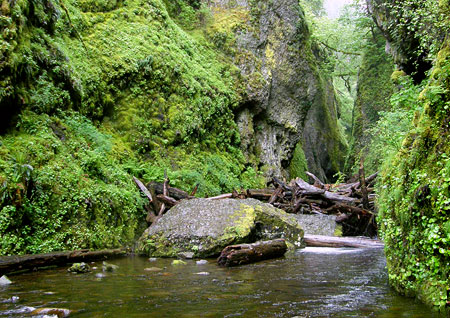
The logjam at Oneonta Gorge in May 2011
Over nearly a century, a summer rite of passage for thousands of Oregonians has been wading through the vertical-walled Oneonta Gorge to the beautiful falls hidden at the head of this slot-canyon. Since 1914, the old Columbia River Highway has brought a steady stream of visitors to the tempting view into the gorge from atop a graceful bridge.
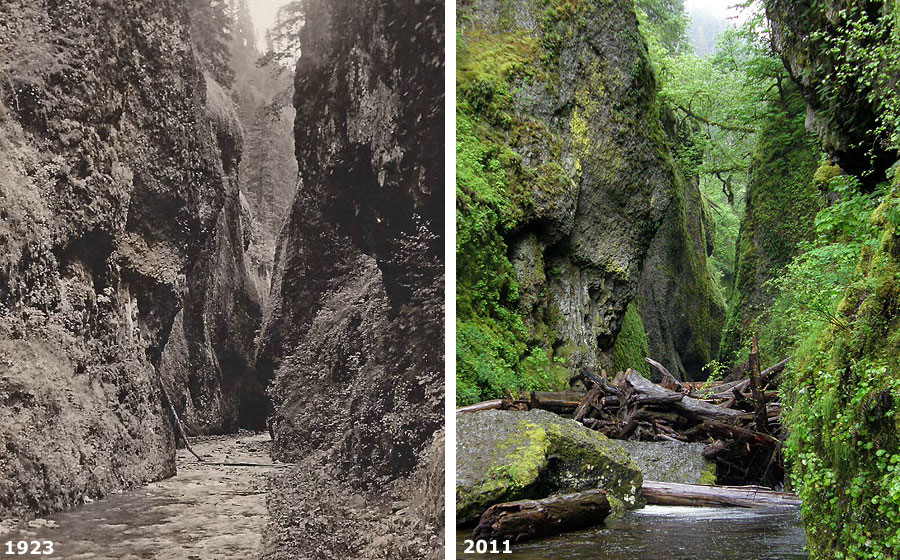
More recently, this tradition has been tarnished by a series of natural events that have made the trip up Oneonta Gorge downright dangerous. First, a rockfall near the entrance to the Gorge in the late 1990s that left three pickup-sized boulders in the stream. Then a logjam formed behind the boulders, creating a slippery maze that hundreds of visitors each summer now struggle to navigate. Sadly, the danger prevents many families with children from even attempting the trip.
Two weeks ago, Portlanders were reminded of the dangers of the logjam when 22-year old hiker Hassan Roussi tragically — and needlessly — drowned after slipping on the logjam. In the spirit of preventing another tragedy at Oneonta Gorge, this article proposes a few solutions that address both the safety and quality of experience for visitors to this uniquely beautiful place.
Phase 1: Log the Logjam
The logjam must go. Immediately. Just saw it out, with chainsaws. The log pile took one life this month, and that’s one too many. Add the many unreported accidents that have likely occurred here, and it’s long overdue to simply remove the hazard.

The logjam and boulders that created it are a recent change at Oneonta
(click here for a larger version of this comparison)
Forget any excuses about ecological concerns, the stream playing out its natural processes or budget constraints. The arguments in favor of removing the logjam are simple:
Environmental Impacts: hundreds of visitors hike through Oneonta Gorge every summer, so the stream is only as pristine as a few hundred pairs of feet allow. Running chainsaws during an “in water” window, when salmon and steelhead are not spawning, would be no more disruptive than any of the in-stream activities that occur across the Mount Hood National Forest every year — from road projects and culvert repairs to timber harvesting.
Natural Systems: it’s true that Oneonta Creek has flushed logs from the drainage for millennia, so why one just let the natural order play out? One simple reason is public safety, of course. Unless the Forest Service is willing to close the gorge to visitors, then clearing the logjam is the only responsible option.
But there is also an economic argument against allowing the logjam to grow: eventually, it could burst during a flood event, pushing a wall of rock, logs and water against the pair of highway bridges and railroad bridge, 100 yards downstream. The result could be disastrous for these historic structures. Removing the logjam just makes sense for ODOT.
Budget Constraints: this is the standard argument for doing nothing in our national forests, but at some point, the agency will be held legally accountable for allowing recreation hazards like the logjam to persist. It might take that kind of shock to the system for the Forest Service to put recreation — and especially safety needs — ahead of other forest projects. Given the logjam has been accumulating since the 1990s, there has been plenty of opportunity for the agency to remedy this problem.
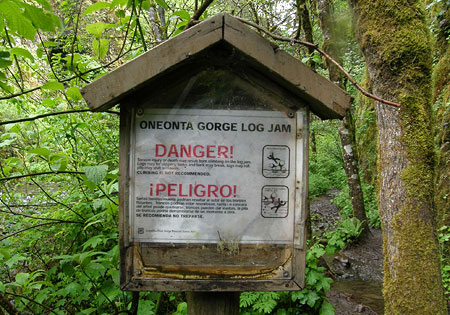
Signs like this mark the bootpaths to Oneonta Gorge
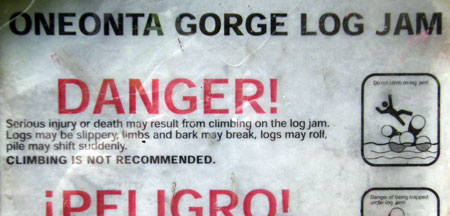
Though these signs are mostly intended to absolve the USFS from legal action, they don’t excuse the agency for allowing this hazard to accumulate
Since the boulders that created the logjam will likely take decades (or centuries) to move downstream from Oneonta Gorge, periodic logging out of accumulated debris is the obvious and appropriate action. It should happen this summer — with the recent tragedy as the impetus for fast-tracking this project. There really is no excuse for waiting.
This is completely within the scope and funding capability of the Forest Service, but could also be a joint responsibility shared with ODOT, given the risk the logjam represents for the highway bridges. It’s also a moral imperative for public agency stewards, given the risk to visitors, and the fatal outcome last week.
After the present logjam is cleared, it should be logged out regularly, perhaps every year or two. Just as other trails in the forest are cleared of winter downfall, Oneonta Gorge should be regularly cleared of dangerous logs.
Phase 2: Embrace the Bootpaths
The safety concerns at Oneonta Gorge aren’t limited to the logjam. Visitors to the area are naturally tempted by the view into the gorge from the historic Columbia River Highway bridge over Oneonta Creek, and an inviting stairway leads down from the bridge to the west bank of the stream.

Oneonta Creek from the historic highway bridge
Once at the bottom of the stairs, visitors usually follow a braided system of unofficial boot paths that climb along the west wall of the canyon, formed by thousands of feet that have tramped this way for decades.
Much of this path is a watery slog in the rainy months, ending in a slippery scramble over rock outcrops, but all of it is completely salvageable as a trail, with careful design and some tread work.

The swampy boot path along the west approach to Oneonta Gorge
On the east side of the bridge, the Forest Service and ODOT have done their best to deny access to the stream, but with little success. Hikers have pushed beyond the piled logs and root wads at the “trailhead”, keeping the long-established route to the creek obvious and well-used.
Like the boot path along the west side of the creek, the east approach would be easily upgraded to a formal trail with a bit of design and tread work.
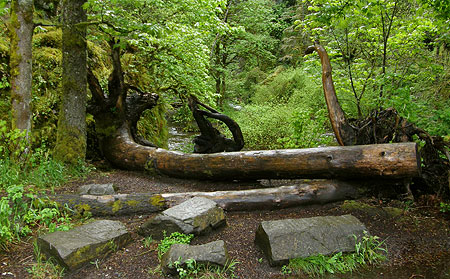
Nice try, but no dice: intrepid creek explorers aren’t stopped by this Forest Service blockade at the east approach to Oneonta Gorge
Together, the pair of boot paths flanking Oneonta Creek offer an excellent trail opportunity. Instead of trying to keep visitors out, a formal loop trail could safely bring less hardy hikers right to the mouth of Oneonta Gorge, while better managing some of the streamside impacts that the current maze of informal routes create.
The Proposal
Over the past decade, ODOT has spent a considerable amount restoring a section of the Historic Columbia River Highway at Oneonta Creek. The project included repaving the old highway and converting it to a hike/bike trail, with new parking for visitors and, most notably, restoring the old highway tunnel through Oneonta Bluff.

The beautifully restored Oneonta Tunnel
The highway restoration project was done beautifully, but many in the recreation community questioned the expense, given the many other unmet recreation needs in the area — the Oneonta logjam among them. Now is the time to backfill this project with trail improvements that connect the restored highway to the Oneonta Gorge — the main attraction in this area.
This proposal is simple: build on the beautiful restoration of the old highway and tunnel with a simple loop trail that follows the existing boot paths to the mouth of Oneonta Gorge. Coupled with removal of the logjam, these paths would lessen the impact of the many visitors who head up the gorge each summer. But the loop would also provide an excellent opportunity for less able hikers and families with children to take a short hike and see Oneonta Gorge, up close.
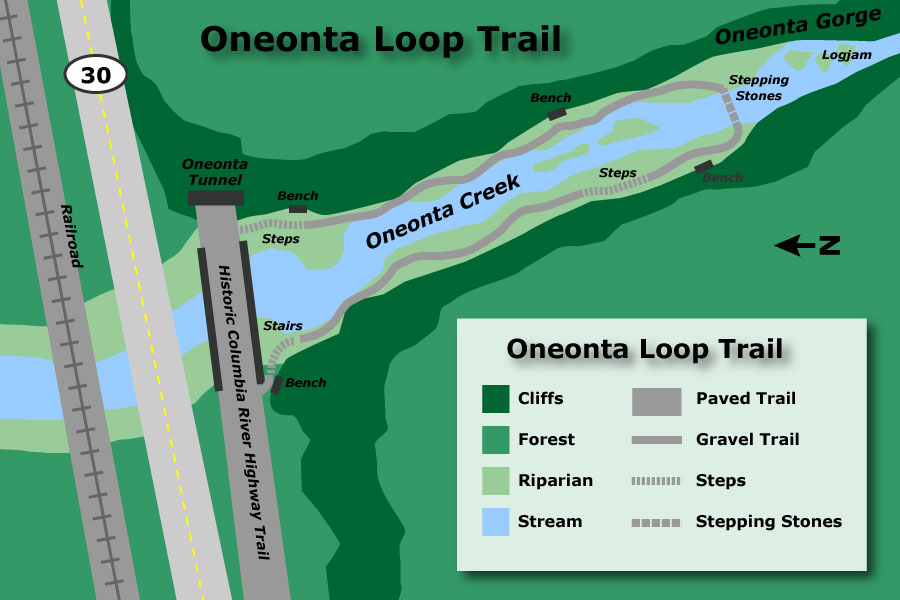
The following map shows the proposed loop trail:

[click here for a larger version of the map]
The loop would expand on several existing elements. First, it would take advantage of the historic stairway at the west end of the old highway bridge as the starting point for the loop, since most visitors already approach from this side of Oneonta Creek.
The stairway sets a wonderful rustic tone for the trail, more like a narrow footpath than a modern trail. This scale should be reflected in how the rest of the loop is designed, as it is perfectly scaled (and completely irresistible) to small children.

The wonderful old stairway at the west end of the Oneonta Bridge
The stairway is in amazingly good repair, given the neglect it has suffered for nearly a century. Though at least one of the railing posts needs to be restored, the stairway is completely serviceable in its present condition.
The bench at the top of the stairs is another important design element, and would be repeated at three new locations along the proposed loop. If the tiny stairway is a perfect magnet for children, the bench is ideal for less able visitors who might walk a portion of the loop, or perhaps just the first few feet of the trail.
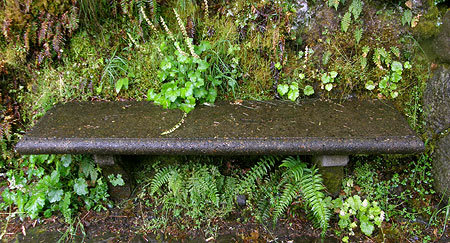
The historic bench at the top of the old stairway
Using these basic design cues, the loop would formalize the boot paths on both sides of Oneonta Creek, with the new trail specifically designed for periodic flooding. This is because the entire riparian area between the walls of the gorge is subject to being submerged by high water, so trail elements would have to be designed accordingly.
An excellent design prototype already exists on another Columbia Gorge trail for accomplishing this all-weather design. The newly reconstructed trail at nearby Bridal Veil Falls provides an excellent blueprint for constructing a gravel-surfaced, flood-resistant trail. In the Bridal Veil design, the gravel trail is contained by a low border of basalt rocks (below).

The newly reconstructed Bridal Veil Falls trail
The proposal also calls for steps at a couple of rock outcrops along the west side of Oneonta Creek, and where the loop connects to the old highway on the east side of the creek. These would be mortared steps, in the “CCC” style seen throughout the Columbia River Gorge.
The most unusual element of this trail proposal is the means of crossing Oneonta Creek, at the mouth of Oneonta Gorge. In low water months, this is a slippery rock hop for visitors, but with some careful design and periodic maintenance, it could be designed as a more formalized series of steppingstones, providing a safe crossing over a much longer season.
The steppingstone design would be a durable alternative to a conventional footbridge (which would not be appropriate in this location, given the visual impact), and would also be in tune with the rustic nature of the trail, itself. Depending on water levels and ability, hikers could opt to stop at the crossing, or venture across to complete the loop.

Steppingstone crossing near Pup Creek Falls on the Clackamas River Trail
The Forest Service has also provided an excellent prototype for the steppingstone crossing, though not in the Columbia Gorge. Instead, the stream crossing pictured above, on the Clackamas River Trail, serves as an excellent blueprint. The stream flow in the scene is pictured in mid-winter, and similar to the summer flows on Oneonta Creek. A design like this is clearly feasible at Oneonta, though it would take periodic maintenance to ensure that steppingstones are adjusted or replaced, as needed, to maintain a safe crossing.
Finding a Creative Path Forward
Many of the ideas in these proposals require a break from conventional Forest Service practices, but “no action” at Oneonta Gorge isn’t a serious option. The Forest Service must address the logjam hazard, at a minimum.
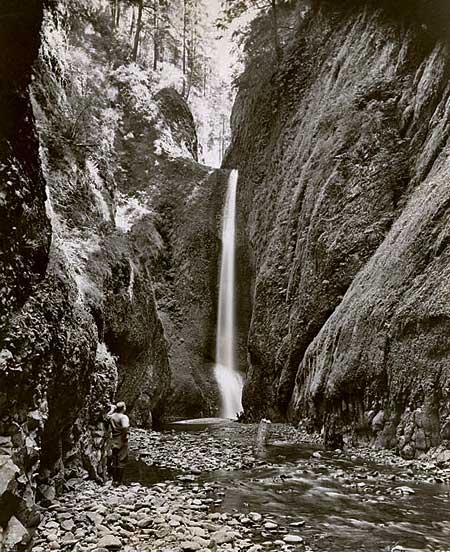
Hiker visiting Oneonta Gorge in 1923
The loop trail proposal would move the Oneonta area from a band-aid, substandard level of recreation support to an experience that could be a memorable highlight for many Columbia River Gorge visitors. The public should expect no less from our agency stewards.
How to get there? Clearly, the Forest Service must re-allocate funding to address the safety issue at the logjam, and soon. ODOT could be a partner in this effort, given their interest in protecting the highway bridges downstream.
But it’s also possible that ODOT or the Oregon State Parks could partner with the Forest Service in developing the loop trail. The work could also be underwritten by a corporate sponsor, given the high profile of Oneonta Gorge as a destination along the old highway.
The only limit at Oneonta Gorge is our imagination — and the willingness of our public land stewards to step up to the challenge. Now is the time.


Not familar with the situation and this may not apply.
The Iron Goat Trail near Stevens Pass, west of Skykomish, WA was in part
remade by volunteer efforts.
LikeLike
What a great proposal. I often hike the Gorge and am always turned back from venturing into the Oneonta because of that very very dangerous looking jam. For myself, it’s a heartbreaking case of longing to finally see the lower falls Vs. breaking my neck in the attempt. I would propose we might contact 1000 Friends of Oregon and the Friends of the Columbia River Gorge and perhaps do a large hiking fundraiser event to raise the funds for the project and even offer the expertise of the thousands of hikers who love and already do trail work in the gorge as well.
LikeLike
Just tried to hike up Oneonta Gorge with my children, ages 5 and 7 today. I wanted to show them something I have wonderful memories of experiencing when I was young. I was stunned to see the log jam and the traffic jam of people trying to scramble up and across it.
Many parents were frustrated and stressed in the face of the danger, others just dismayed at the almost Disneyland experience of waiting for others to move before they could take a single step. Most of the parents with children under 7 turned back with often sobbing, disappointed kids. Other parents pushed their kids to “toughen up” as they cried, expressing honest and rational fears of falling through the web of logs, which annoyed most of the rest of us as we all clung together on the side of the giant boulder waiting for our turn to navigate the log jam.
Those who chose to swim the neck-deep creek to get in to the fall hustled out afterward, shivering and in a hurry to get to their cars.
We chose to skip the chaos, instead wandering downstream, exploring Oneonta Creek as it flows under two bridges, picking blackberries, and trying to shake the stress of our failed attempt to get into the gorge.
In short, I fully support your proposals. An idea for the log jam removal might be to allow some local artists who work in salvaged wood the opportunity to get involved. They might offer to each take a piece or several and create something that could be put up for auction. The income could offset the cost of removing the log jam, and proper event promotion could provide great exposure and PR for local artists.
Here are a few examples of the kinds of artists who could create absolute masterpieces with the wood. I’m sure a lot of money could be generated:
http://www.thejoinery.com/
http://www.nwfinewoodworking.com/
http://www.custommade.com/nakashima-inspired-live-edge-dining-table/by/tassajaradesigns
OPB ran a show, not sure how long ago, on George Nakashima, amazing NW wood worker. Tables made in his style, which The Joinery can do, sell for $4,000- $10,000. Add to that the story of the wood being salvaged from Oneonta Gorge, and I imagine it could be more…. or maybe some kind of foundation or corporate involvement, and they get an amazing board room table with a history….?
Good luck!
LikeLike
Thanks for the comments! Kerri, it breaks my heart to hear your story of kids struggling to deal with the logjam, and how the experience might be tainting their first real adventure in experiencing nature. The USFS read this blog regularly, so your ideas and concerns won’t go unnoticed, and hopefully can (literally) get the situation unstuck at Oneonta.
Tom
LikeLike
Thanks, Kerri. I’m going there today to check it out. I hope to attempt the log jam with my son who wants to see the falls. I’m posting your blog to my travel page: https://www.facebook.com/GoOregonNow
LikeLike
We were at the jam just this past Sunday afternoon. I was appalled to see very small children and a pregnant lady trying to pick through and over the logs. I did end up swimming bits of the journey and the water was at least 50 degrees, well within hypothermia causing temps for the younger, smaller folks. Yet, its so crowded.. the lure of the falls is just too much. Where should I write to get the jam removed?
LikeLike
Phil, I would suggest contacting the Forest Service unit that operates the Gorge scenic area:
Columbia River Gorge National Scenic Area
902 Wasco Street,
Suite 200
Hood River, OR 97031
(541) 308-1700
Here’s a link to their online comment form:
http://tinyurl.com/6xsfzv9
Thanks for your concern, and taking the time to make your voice heard!
LikeLike
I left a firm sounding message making it seem like they had been negligent not to get this taken care of. We’ll see if anyone gets back to me.
The online write in form that you gave us above seems to work until you hit submit and then it gives a “page not found” message. So, I don’t know if our write in comments are being received online. We may have to try the snail mail approach.
LikeLike
Just had a very long talk with Jennifer Kevil from the gorge scenic area folks. Long story short, they have no intention ever of removing the log jam. The ecologists and hydrologist insist the logs help the stream in this spot and benefit the stream bed and the wildlife. They are willing to put up more signage, that’s about it. She is going to have one of the experts call me and have them explain in detail how the jam helps the big picture even though its so dangerous to people. I’ll update you when that conversation occurs.
LikeLike
Maybe It’s time for a little civil disobedience…a midnight chainsaw party?
LikeLike
Maybe we should just leave it as it is. Nature caused the log jam and the fallen rocks. Nature will deal with it the way it always has, Naturally. More people being able to reach this amazing gorge translates to more garbage, more vandalism, more people camping where they shouldn’t be camping. As for Pregnant women and children attempting the log jam… They should be nowhere near the log jam. That’s on the parents to be responsible enough to know that this is not a toddler friendly hike. Should we gripe every time a beaver builds a dam in a wilderness stream??? NONSENSE! There are hundreds of trails and waterfalls to witness in the gorge area, not all are for everybody and I for one would not bitch at God about allowing nature to do it’s thing.
I’d rather traverse the log jam a million times than to see garbage, abandoned camp gear and human feces floating down the stream. That’s my opinion, take it as you may. Thanks for listening.
LikeLiked by 2 people
All are good and valid comments, Chris – thanks for posting them.
Tom
LikeLike
Chris wins my vote. I have been going to the gorge since I was a child and although I want others to share my experience, somethings need to remain an “adventure” and only available to those who wish to risk a little to enjoy a wounder. It is almost impossible to go to some places in the summer because more and more people are “enjoying” the wilderness. For those of us that respect it it’s a sad sight. The newcomers have (for the most part) no respect and treat it like someone will come and clean up their mess because we pay taxes and that’s how it works, right?. Wrong! leave the logs, as a matter of fact make it bigger. If you can’t make it in you shouldn’t be there.
LikeLike
I visited the Oneonta gorge yesterday. I had planned on scaling the log jam but just got scared. It is immense and just too dangerous. I am quite surprised that there are not more injuries, they must go unreported. Why would you say something like “if you can’t make it in you shouldn’t be there”. That is quite some comment. And you have little faith in most naturist and lovers of the outdoors . . . I have never encountered “camps” on the other trails. It seems very selfish of you . . We have places like this for all people to enjoy not just a few.
LikeLike
I was just there last weak. Personally I would just leave it. I know it’s completely selfish of me but I like the fact that the log jam keeps people out, more privacy for those of us willing to traverse it. Couple that with the fact that the gorge has deep pools of frigid water…….. it’s probably not for small children anyway. Let nature do it’s thing. If the log jam was manmade I would say do something, it’s not.
LikeLike
Well, after a long wait for the right conditions (and the time off work), I ventured into the gorge today. I must say…. after reading this (and others) over the last day or so, I was not sure if it was for this old 56 year old photographer or not.
However. Now that I’ve done it (first time), I must say that it was not as bad as expected. I did wear my fishing shoes (complete with carbide studs) and carry my staff, so I was more prepared than most.
As for my opinion…I think the log jam should STAY.
As it was, there were far too many people there, but when I got back to the parking lot, I saw just how many MORE there would have been without the logs.
Only my opinion.
Thanks for all the information!
LikeLiked by 1 person
July 11,3013
At 53 was determined to view this beautiful gorge for myself, and carefuly traversed the scary logjam. It was difficult, and dangerous. I do agree with other posters, the tunnel, stairs, bench and trails around the gorge itself make it a very inviting activity. The logjam hasn’t been there for millions of years, it has only been there less than 20. Could the foot path above be partially responsible for the fallen timbers. The trail is a man made venture. People are drawn to the gorge, a beautiful example of nature, just as we are drawn to so many other wonders in our world. While I was in the gorge I only saw people with utmost respect for this pristine beauty. Clear the logjam, This is not a hard fix. Otherwise they will have to take steps to close this wonder in our world.
LikeLike
I agree with Cindy, the log jam is relatively new to this beautiful water hike. also Cindy makes very good points about the respect that people have for the beauty of the gorge. I still would like to see the log jam cleared or some way to make it a little safer.
LikeLike
An alternative to answer the ecologists that think the jam is necessary is to construct a trail platform around the logjam. I have seen such trails constructed in China and Switzerland. Unless the powers that be just want the Oneonta Gorge closed this could be an alternative.
LikeLiked by 1 person
Why is it people always want to convert the natural world into Disneyland? If that’s the way it is that’s the way it is. If you can hike it or climb it, and accept the risk, do it. If you cannot, there are plenty of paved or graded level trails in this world going to interesting places. There are 77 waterfalls in the Columbia River Gorge and many of them can be seen without even leaving your car, or by walking along paved paths. How many more do you need? These provide opportunities galore for kids and the less nimble. For the record, at 70, I just was at the Oneonta Gorge, climbed the logjam, slowly and carefully, and reached the other side. Not every place needs to attract hordes of people to trash the natural environment with their candy wrappers and dirty diapers and dogs that leave crap that owners do not pick up.
LikeLike
Oneonta gorge is a unique ecosystem, one that in temporal space exists nowhere else on this planet. It has glacial plants that have survived for thousands of years. i visit the gorge year round and the peace of return to nature once all the thousands of humans leave it is awestriking. Not every place on earth is for every human on earth, but those that are trying like handicap tramways to machu pichu, etc. are trying, but those that can climb over, up trees, down canyons, still yet find what nature is outside of humans using it. Foolish people to suggest cutting the logs in the middle of the night. no i have a better word, stupidity.
LikeLike
Dr. Gossen.
I could not agree more with your thoughts on this.
If you can’t (or won’t) climb over the logs to enjoy this wonder of nature, then you don’t belong there. Period.
Those that think EVERYONE should have the same as everyone else are likely the same people who believe in ‘redistribution of wealth’.
Chainsaws at night? While we are at it, why not move the gorge to downtown Portland to avoid those nasty east winds?
LikeLike
@ Russell – partisan politics aside, there is no debate about who owns our public lands: all of us! So, to the extent that people are pouring into a place like Oneonta Gorge (like it or not), it’s my view that the land managers (the Forest Service) have an obligation to make it safe — or limit access. Right now, they are doing neither. The signage posted by the USFS has more to do with checking a legal liability box.
“They are willing to put up more signage, that’s about it. She is going to have one of the experts call me and have them explain in detail how the jam helps the big picture even though its so dangerous to people.”
From an earlier comment. This made me smile, as the same USFS has closed the Cloud Cap Road to vehicles indefinitely in order to log MORE of the standing trees burned in the Gnarl Fire in 2008 to “protect the public” from deathly hazard… though the road remains open to hikers… who apparently won’t be harmed by killer trees if they’re not inside a car? Just more evidence that we should be finding a new steward to manage our Gorge and Mountain… in my humble opinion!
Thanks for the comments, everyone — always good to hear different perspectives!
Tom 🙂
LikeLike
It sounds as though the logs will be there until good old “mother nature” decides it’s time to remove them.
Since my first trip over the logs in June of this year, I’ve made several more trips. While I would in no way call the trips over the logs “safe”, I would say that it can be made “safer”.
There are obvious routes that are well worn on the logs that pretty much point the way. What it really comes down to is not exceeding your skills and limits, and above all, taking your time.
I would also never try it during the “wet” times of the year, without wearing the studded boots that I use.
Personally, I find it hard to believe that someone could actually die while doing this (even though I know it to be a fact).
In my opinion, a slip would more likely mean a sprain or broken bone at worse.
I’ve been told that the person who died while traversing the log jam was a young man who had been drinking and was wearing tennis shoes. I don’t know if this is true or not, but it sure makes sense to me.
I agree with Tom that we should “find a new steward to manage our Gorge and Mountain”. The forest service and the BLM have failed our fine state in more ways than I care to count.
Thanks for the opportunity to voice my thoughts.
Cheers!
-Russ
LikeLike
Thanks, Russ – and I couldn’t agree more about people trying to go in there during high water conditions (a pretty good indicator of inexperience, for sure). I’m fairly certain the person who died was attempting to cross in high water, slipped and became pinned under the water. Hard to imagine, but apparently it happened.
The most surprising thing to me about the log jam is that ODOT hasn’t been in there to clear the logs! It seems like a setup to take out both the original and second highway bridges, just downstream, in the event that the jam comes apart catastrophically in a winter flood. They’ve done a lot of work there in recent years, so I’m assuming they’re aware of the jam. But on the other hand, I’m not sure they put the same emphasis on “prevention” along the old highway as they tend to do along the modern routes.
Tom
LikeLike